EP1394212A1 - Polyester resin composition containing inorganic filler, polyetherimide, and polymer containing polyethylene naphthalate in constituent unit thereof - Google Patents
Polyester resin composition containing inorganic filler, polyetherimide, and polymer containing polyethylene naphthalate in constituent unit thereof Download PDFInfo
- Publication number
- EP1394212A1 EP1394212A1 EP03018615A EP03018615A EP1394212A1 EP 1394212 A1 EP1394212 A1 EP 1394212A1 EP 03018615 A EP03018615 A EP 03018615A EP 03018615 A EP03018615 A EP 03018615A EP 1394212 A1 EP1394212 A1 EP 1394212A1
- Authority
- EP
- European Patent Office
- Prior art keywords
- polyester resin
- resin composition
- inorganic filler
- polyetherimide
- polyethylene naphthalate
- Prior art date
- Legal status (The legal status is an assumption and is not a legal conclusion. Google has not performed a legal analysis and makes no representation as to the accuracy of the status listed.)
- Withdrawn
Links
- 239000000203 mixture Substances 0.000 title claims abstract description 56
- 229920001225 polyester resin Polymers 0.000 title claims abstract description 56
- 239000004645 polyester resin Substances 0.000 title claims abstract description 56
- 239000004697 Polyetherimide Substances 0.000 title claims abstract description 38
- 229920001601 polyetherimide Polymers 0.000 title claims abstract description 38
- 239000011112 polyethylene naphthalate Substances 0.000 title claims abstract description 38
- 229920003207 poly(ethylene-2,6-naphthalate) Polymers 0.000 title claims abstract description 34
- 239000011256 inorganic filler Substances 0.000 title claims abstract description 30
- 229910003475 inorganic filler Inorganic materials 0.000 title claims abstract description 30
- -1 polyethylene naphthalate Polymers 0.000 title claims abstract description 23
- 229920000642 polymer Polymers 0.000 title claims abstract description 22
- 239000000470 constituent Substances 0.000 title claims abstract description 14
- BPQQTUXANYXVAA-UHFFFAOYSA-N Orthosilicate Chemical compound [O-][Si]([O-])([O-])[O-] BPQQTUXANYXVAA-UHFFFAOYSA-N 0.000 claims abstract description 39
- 229920000139 polyethylene terephthalate Polymers 0.000 claims abstract description 35
- 239000005020 polyethylene terephthalate Substances 0.000 claims abstract description 35
- 239000003795 chemical substances by application Substances 0.000 claims abstract description 7
- 229920001577 copolymer Polymers 0.000 claims abstract description 7
- 238000006116 polymerization reaction Methods 0.000 claims description 3
- LYCAIKOWRPUZTN-UHFFFAOYSA-N Ethylene glycol Chemical compound OCCO LYCAIKOWRPUZTN-UHFFFAOYSA-N 0.000 description 18
- 230000000052 comparative effect Effects 0.000 description 16
- 229920005989 resin Polymers 0.000 description 15
- 239000011347 resin Substances 0.000 description 15
- 238000004898 kneading Methods 0.000 description 14
- 230000007062 hydrolysis Effects 0.000 description 11
- 238000006460 hydrolysis reaction Methods 0.000 description 11
- 238000000034 method Methods 0.000 description 11
- 238000011156 evaluation Methods 0.000 description 9
- KKEYFWRCBNTPAC-UHFFFAOYSA-N Terephthalic acid Chemical compound OC(=O)C1=CC=C(C(O)=O)C=C1 KKEYFWRCBNTPAC-UHFFFAOYSA-N 0.000 description 8
- 239000002253 acid Substances 0.000 description 8
- 229920000728 polyester Polymers 0.000 description 8
- 239000002734 clay mineral Substances 0.000 description 7
- OKKJLVBELUTLKV-UHFFFAOYSA-N Methanol Chemical compound OC OKKJLVBELUTLKV-UHFFFAOYSA-N 0.000 description 6
- QVGXLLKOCUKJST-UHFFFAOYSA-N atomic oxygen Chemical compound [O] QVGXLLKOCUKJST-UHFFFAOYSA-N 0.000 description 6
- 229910052760 oxygen Inorganic materials 0.000 description 6
- 239000001301 oxygen Substances 0.000 description 6
- 230000015572 biosynthetic process Effects 0.000 description 5
- 239000002131 composite material Substances 0.000 description 5
- 229910010272 inorganic material Inorganic materials 0.000 description 5
- 239000011147 inorganic material Substances 0.000 description 5
- 239000002245 particle Substances 0.000 description 5
- HEFNNWSXXWATRW-UHFFFAOYSA-N Ibuprofen Chemical compound CC(C)CC1=CC=C(C(C)C(O)=O)C=C1 HEFNNWSXXWATRW-UHFFFAOYSA-N 0.000 description 4
- OFOBLEOULBTSOW-UHFFFAOYSA-N Malonic acid Chemical compound OC(=O)CC(O)=O OFOBLEOULBTSOW-UHFFFAOYSA-N 0.000 description 4
- 150000001875 compounds Chemical class 0.000 description 4
- 150000002148 esters Chemical class 0.000 description 4
- 239000010445 mica Substances 0.000 description 4
- 229910052618 mica group Inorganic materials 0.000 description 4
- RXOHFPCZGPKIRD-UHFFFAOYSA-N naphthalene-2,6-dicarboxylic acid Chemical compound C1=C(C(O)=O)C=CC2=CC(C(=O)O)=CC=C21 RXOHFPCZGPKIRD-UHFFFAOYSA-N 0.000 description 4
- 150000002892 organic cations Chemical class 0.000 description 4
- 229910021647 smectite Inorganic materials 0.000 description 4
- 238000012360 testing method Methods 0.000 description 4
- AZJYLVAUMGUUBL-UHFFFAOYSA-A u1qj22mc8e Chemical compound [F-].[F-].[F-].[F-].[F-].[F-].[F-].[F-].[F-].[F-].[F-].[F-].[F-].[F-].[F-].[F-].[F-].[F-].[Na+].[Na+].[Na+].[Na+].[Na+].[Na+].[Na+].[Na+].[Na+].[Na+].[Mg+2].[Mg+2].[Mg+2].[Mg+2].[Mg+2].[Mg+2].[Mg+2].[Mg+2].[Mg+2].[Mg+2].[Mg+2].[Mg+2].[Mg+2].[Mg+2].[Mg+2].[Mg+2].O=[Si]=O.O=[Si]=O.O=[Si]=O.O1[Si](O2)([O-])O[Si]3([O-])O[Si]1([O-])O[Si]2([O-])O3.O1[Si](O2)([O-])O[Si]3([O-])O[Si]1([O-])O[Si]2([O-])O3.O1[Si](O2)([O-])O[Si]3([O-])O[Si]1([O-])O[Si]2([O-])O3.O1[Si](O2)([O-])O[Si]3([O-])O[Si]1([O-])O[Si]2([O-])O3.O1[Si](O2)([O-])O[Si]3([O-])O[Si]1([O-])O[Si]2([O-])O3.O1[Si](O2)([O-])O[Si]3([O-])O[Si]1([O-])O[Si]2([O-])O3 AZJYLVAUMGUUBL-UHFFFAOYSA-A 0.000 description 4
- MUBZPKHOEPUJKR-UHFFFAOYSA-N Oxalic acid Chemical compound OC(=O)C(O)=O MUBZPKHOEPUJKR-UHFFFAOYSA-N 0.000 description 3
- 125000000217 alkyl group Chemical group 0.000 description 3
- 230000004888 barrier function Effects 0.000 description 3
- 238000007334 copolymerization reaction Methods 0.000 description 3
- GUJOJGAPFQRJSV-UHFFFAOYSA-N dialuminum;dioxosilane;oxygen(2-);hydrate Chemical compound O.[O-2].[O-2].[O-2].[Al+3].[Al+3].O=[Si]=O.O=[Si]=O.O=[Si]=O.O=[Si]=O GUJOJGAPFQRJSV-UHFFFAOYSA-N 0.000 description 3
- 239000006185 dispersion Substances 0.000 description 3
- 230000000694 effects Effects 0.000 description 3
- WGCNASOHLSPBMP-UHFFFAOYSA-N hydroxyacetaldehyde Natural products OCC=O WGCNASOHLSPBMP-UHFFFAOYSA-N 0.000 description 3
- 230000001771 impaired effect Effects 0.000 description 3
- 239000010410 layer Substances 0.000 description 3
- 229910052901 montmorillonite Inorganic materials 0.000 description 3
- 230000000704 physical effect Effects 0.000 description 3
- 239000002904 solvent Substances 0.000 description 3
- 238000010561 standard procedure Methods 0.000 description 3
- 238000002834 transmittance Methods 0.000 description 3
- XLYOFNOQVPJJNP-UHFFFAOYSA-N water Substances O XLYOFNOQVPJJNP-UHFFFAOYSA-N 0.000 description 3
- VQNQTIUCMJTZGX-UHFFFAOYSA-N 2-hydroxyethyl(triphenyl)phosphanium Chemical compound C=1C=CC=CC=1[P+](C=1C=CC=CC=1)(CCO)C1=CC=CC=C1 VQNQTIUCMJTZGX-UHFFFAOYSA-N 0.000 description 2
- QGZKDVFQNNGYKY-UHFFFAOYSA-O Ammonium Chemical compound [NH4+] QGZKDVFQNNGYKY-UHFFFAOYSA-O 0.000 description 2
- VTYYLEPIZMXCLO-UHFFFAOYSA-L Calcium carbonate Chemical compound [Ca+2].[O-]C([O-])=O VTYYLEPIZMXCLO-UHFFFAOYSA-L 0.000 description 2
- RTZKZFJDLAIYFH-UHFFFAOYSA-N Diethyl ether Chemical compound CCOCC RTZKZFJDLAIYFH-UHFFFAOYSA-N 0.000 description 2
- AEMRFAOFKBGASW-UHFFFAOYSA-N Glycolic acid Chemical compound OCC(O)=O AEMRFAOFKBGASW-UHFFFAOYSA-N 0.000 description 2
- QIGBRXMKCJKVMJ-UHFFFAOYSA-N Hydroquinone Chemical compound OC1=CC=C(O)C=C1 QIGBRXMKCJKVMJ-UHFFFAOYSA-N 0.000 description 2
- KFZMGEQAYNKOFK-UHFFFAOYSA-N Isopropanol Chemical compound CC(C)O KFZMGEQAYNKOFK-UHFFFAOYSA-N 0.000 description 2
- 239000004952 Polyamide Substances 0.000 description 2
- 239000000654 additive Substances 0.000 description 2
- WNLRTRBMVRJNCN-UHFFFAOYSA-N adipic acid Chemical compound OC(=O)CCCCC(O)=O WNLRTRBMVRJNCN-UHFFFAOYSA-N 0.000 description 2
- 239000003963 antioxidant agent Substances 0.000 description 2
- 230000003078 antioxidant effect Effects 0.000 description 2
- SVPXDRXYRYOSEX-UHFFFAOYSA-N bentoquatam Chemical compound O.O=[Si]=O.O=[Al]O[Al]=O SVPXDRXYRYOSEX-UHFFFAOYSA-N 0.000 description 2
- WERYXYBDKMZEQL-UHFFFAOYSA-N butane-1,4-diol Chemical compound OCCCCO WERYXYBDKMZEQL-UHFFFAOYSA-N 0.000 description 2
- 125000004432 carbon atom Chemical group C* 0.000 description 2
- 125000003178 carboxy group Chemical group [H]OC(*)=O 0.000 description 2
- 239000013078 crystal Substances 0.000 description 2
- GELSOTNVVKOYAW-UHFFFAOYSA-N ethyl(triphenyl)phosphanium Chemical compound C=1C=CC=CC=1[P+](C=1C=CC=CC=1)(CC)C1=CC=CC=C1 GELSOTNVVKOYAW-UHFFFAOYSA-N 0.000 description 2
- TXPMUPUOSOZCCS-UHFFFAOYSA-N hexadecyl(trimethyl)phosphanium Chemical compound CCCCCCCCCCCCCCCC[P+](C)(C)C TXPMUPUOSOZCCS-UHFFFAOYSA-N 0.000 description 2
- 125000004435 hydrogen atom Chemical group [H]* 0.000 description 2
- 125000002887 hydroxy group Chemical group [H]O* 0.000 description 2
- 238000010348 incorporation Methods 0.000 description 2
- QQVIHTHCMHWDBS-UHFFFAOYSA-N isophthalic acid Chemical compound OC(=O)C1=CC=CC(C(O)=O)=C1 QQVIHTHCMHWDBS-UHFFFAOYSA-N 0.000 description 2
- 229940094522 laponite Drugs 0.000 description 2
- XCOBTUNSZUJCDH-UHFFFAOYSA-B lithium magnesium sodium silicate Chemical compound [Li+].[Li+].[OH-].[OH-].[OH-].[OH-].[OH-].[OH-].[OH-].[OH-].[OH-].[OH-].[OH-].[OH-].[Na+].[Na+].[Mg+2].[Mg+2].[Mg+2].[Mg+2].[Mg+2].[Mg+2].[Mg+2].[Mg+2].[Mg+2].[Mg+2].[Mg+2].[Mg+2].[Mg+2].[Mg+2].[Mg+2].[Mg+2].O1[Si](O2)([O-])O[Si]3([O-])O[Si]1([O-])O[Si]2([O-])O3.O1[Si](O2)([O-])O[Si]3([O-])O[Si]1([O-])O[Si]2([O-])O3.O1[Si](O2)([O-])O[Si]3([O-])O[Si]1([O-])O[Si]2([O-])O3.O1[Si](O2)([O-])O[Si]3([O-])O[Si]1([O-])O[Si]2([O-])O3.O1[Si](O2)([O-])O[Si]3([O-])O[Si]1([O-])O[Si]2([O-])O3.O1[Si](O2)([O-])O[Si]3([O-])O[Si]1([O-])O[Si]2([O-])O3 XCOBTUNSZUJCDH-UHFFFAOYSA-B 0.000 description 2
- 239000000463 material Substances 0.000 description 2
- 125000001997 phenyl group Chemical group [H]C1=C([H])C([H])=C(*)C([H])=C1[H] 0.000 description 2
- XNGIFLGASWRNHJ-UHFFFAOYSA-N phthalic acid Chemical compound OC(=O)C1=CC=CC=C1C(O)=O XNGIFLGASWRNHJ-UHFFFAOYSA-N 0.000 description 2
- 229920002647 polyamide Polymers 0.000 description 2
- 229920001707 polybutylene terephthalate Polymers 0.000 description 2
- 239000011342 resin composition Substances 0.000 description 2
- 229910000275 saponite Inorganic materials 0.000 description 2
- CXMXRPHRNRROMY-UHFFFAOYSA-N sebacic acid Chemical compound OC(=O)CCCCCCCCC(O)=O CXMXRPHRNRROMY-UHFFFAOYSA-N 0.000 description 2
- 239000000758 substrate Substances 0.000 description 2
- BJQWBACJIAKDTJ-UHFFFAOYSA-N tetrabutylphosphanium Chemical compound CCCC[P+](CCCC)(CCCC)CCCC BJQWBACJIAKDTJ-UHFFFAOYSA-N 0.000 description 2
- SZWHXXNVLACKBV-UHFFFAOYSA-N tetraethylphosphanium Chemical compound CC[P+](CC)(CC)CC SZWHXXNVLACKBV-UHFFFAOYSA-N 0.000 description 2
- FAUOSXUSCVJWAY-UHFFFAOYSA-N tetrakis(hydroxymethyl)phosphanium Chemical compound OC[P+](CO)(CO)CO FAUOSXUSCVJWAY-UHFFFAOYSA-N 0.000 description 2
- 229920001169 thermoplastic Polymers 0.000 description 2
- 239000004416 thermosoftening plastic Substances 0.000 description 2
- BNIWTJAVDJYTIJ-UHFFFAOYSA-N 1,3-dimethylnaphthalene-2,6-dicarboxylic acid Chemical compound OC(=O)C1=CC=C2C(C)=C(C(O)=O)C(C)=CC2=C1 BNIWTJAVDJYTIJ-UHFFFAOYSA-N 0.000 description 1
- PXGZQGDTEZPERC-UHFFFAOYSA-N 1,4-cyclohexanedicarboxylic acid Chemical compound OC(=O)C1CCC(C(O)=O)CC1 PXGZQGDTEZPERC-UHFFFAOYSA-N 0.000 description 1
- FRASJONUBLZVQX-UHFFFAOYSA-N 1,4-dioxonaphthalene Natural products C1=CC=C2C(=O)C=CC(=O)C2=C1 FRASJONUBLZVQX-UHFFFAOYSA-N 0.000 description 1
- BOKGTLAJQHTOKE-UHFFFAOYSA-N 1,5-dihydroxynaphthalene Chemical compound C1=CC=C2C(O)=CC=CC2=C1O BOKGTLAJQHTOKE-UHFFFAOYSA-N 0.000 description 1
- BTVWZWFKMIUSGS-UHFFFAOYSA-N 2-methylpropane-1,2-diol Chemical compound CC(C)(O)CO BTVWZWFKMIUSGS-UHFFFAOYSA-N 0.000 description 1
- 239000005995 Aluminium silicate Substances 0.000 description 1
- ZILXLWDXJIKUHY-UHFFFAOYSA-N C=1C=CC=CC=1C(C=1C=CC=CC=1)(CCCCCCCCCCCCCCCCCP)C1=CC=CC=C1 Chemical compound C=1C=CC=CC=1C(C=1C=CC=CC=1)(CCCCCCCCCCCCCCCCCP)C1=CC=CC=C1 ZILXLWDXJIKUHY-UHFFFAOYSA-N 0.000 description 1
- KYXHKHDZJSDWEF-LHLOQNFPSA-N CCCCCCC1=C(CCCCCC)C(\C=C\CCCCCCCC(O)=O)C(CCCCCCCC(O)=O)CC1 Chemical compound CCCCCCC1=C(CCCCCC)C(\C=C\CCCCCCCC(O)=O)C(CCCCCCCC(O)=O)CC1 KYXHKHDZJSDWEF-LHLOQNFPSA-N 0.000 description 1
- 229920000049 Carbon (fiber) Polymers 0.000 description 1
- 239000004129 EU approved improving agent Substances 0.000 description 1
- LFQSCWFLJHTTHZ-UHFFFAOYSA-N Ethanol Chemical compound CCO LFQSCWFLJHTTHZ-UHFFFAOYSA-N 0.000 description 1
- ISWSIDIOOBJBQZ-UHFFFAOYSA-N Phenol Chemical compound OC1=CC=CC=C1 ISWSIDIOOBJBQZ-UHFFFAOYSA-N 0.000 description 1
- OAICVXFJPJFONN-UHFFFAOYSA-N Phosphorus Chemical compound [P] OAICVXFJPJFONN-UHFFFAOYSA-N 0.000 description 1
- 239000002202 Polyethylene glycol Substances 0.000 description 1
- 239000004721 Polyphenylene oxide Substances 0.000 description 1
- KDYFGRWQOYBRFD-UHFFFAOYSA-N Succinic acid Natural products OC(=O)CCC(O)=O KDYFGRWQOYBRFD-UHFFFAOYSA-N 0.000 description 1
- 229920004738 ULTEM® Polymers 0.000 description 1
- 229920004747 ULTEM® 1000 Polymers 0.000 description 1
- 238000002441 X-ray diffraction Methods 0.000 description 1
- 150000007513 acids Chemical class 0.000 description 1
- 230000000996 additive effect Effects 0.000 description 1
- 239000001361 adipic acid Substances 0.000 description 1
- 235000011037 adipic acid Nutrition 0.000 description 1
- 235000012211 aluminium silicate Nutrition 0.000 description 1
- 125000003368 amide group Chemical group 0.000 description 1
- 239000000440 bentonite Substances 0.000 description 1
- 229910000278 bentonite Inorganic materials 0.000 description 1
- VHTDHSVPBYDDAM-UHFFFAOYSA-N benzyl(triethyl)phosphanium Chemical compound CC[P+](CC)(CC)CC1=CC=CC=C1 VHTDHSVPBYDDAM-UHFFFAOYSA-N 0.000 description 1
- 230000001588 bifunctional effect Effects 0.000 description 1
- 230000005540 biological transmission Effects 0.000 description 1
- KDYFGRWQOYBRFD-NUQCWPJISA-N butanedioic acid Chemical compound O[14C](=O)CC[14C](O)=O KDYFGRWQOYBRFD-NUQCWPJISA-N 0.000 description 1
- 229910000019 calcium carbonate Inorganic materials 0.000 description 1
- VNSBYDPZHCQWNB-UHFFFAOYSA-N calcium;aluminum;dioxido(oxo)silane;sodium;hydrate Chemical compound O.[Na].[Al].[Ca+2].[O-][Si]([O-])=O VNSBYDPZHCQWNB-UHFFFAOYSA-N 0.000 description 1
- 239000004917 carbon fiber Substances 0.000 description 1
- 150000001768 cations Chemical class 0.000 description 1
- PMMYEEVYMWASQN-IMJSIDKUSA-N cis-4-Hydroxy-L-proline Chemical compound O[C@@H]1CN[C@H](C(O)=O)C1 PMMYEEVYMWASQN-IMJSIDKUSA-N 0.000 description 1
- 229920006026 co-polymeric resin Polymers 0.000 description 1
- 238000006482 condensation reaction Methods 0.000 description 1
- 230000007423 decrease Effects 0.000 description 1
- OTVDXFMHEQYRFC-UHFFFAOYSA-N decyl(trimethyl)phosphanium Chemical compound CCCCCCCCCC[P+](C)(C)C OTVDXFMHEQYRFC-UHFFFAOYSA-N 0.000 description 1
- 230000006735 deficit Effects 0.000 description 1
- YJEDGLAKFNEZAZ-UHFFFAOYSA-N dioctyl(diphenyl)phosphanium Chemical compound C=1C=CC=CC=1[P+](CCCCCCCC)(CCCCCCCC)C1=CC=CC=C1 YJEDGLAKFNEZAZ-UHFFFAOYSA-N 0.000 description 1
- 238000009826 distribution Methods 0.000 description 1
- MIQYOHNNWUEBSP-UHFFFAOYSA-N dodecyl(trimethyl)phosphanium Chemical compound CCCCCCCCCCCC[P+](C)(C)C MIQYOHNNWUEBSP-UHFFFAOYSA-N 0.000 description 1
- 125000003700 epoxy group Chemical group 0.000 description 1
- 125000001033 ether group Chemical group 0.000 description 1
- 239000000835 fiber Substances 0.000 description 1
- 239000003365 glass fiber Substances 0.000 description 1
- 230000005484 gravity Effects 0.000 description 1
- 125000005843 halogen group Chemical group 0.000 description 1
- 229910000271 hectorite Inorganic materials 0.000 description 1
- KWLMIXQRALPRBC-UHFFFAOYSA-L hectorite Chemical compound [Li+].[OH-].[OH-].[Na+].[Mg+2].O1[Si]2([O-])O[Si]1([O-])O[Si]([O-])(O1)O[Si]1([O-])O2 KWLMIXQRALPRBC-UHFFFAOYSA-L 0.000 description 1
- 229920001519 homopolymer Polymers 0.000 description 1
- 125000001183 hydrocarbyl group Chemical group 0.000 description 1
- 125000005462 imide group Chemical group 0.000 description 1
- 239000003112 inhibitor Substances 0.000 description 1
- 229910001410 inorganic ion Inorganic materials 0.000 description 1
- 239000010954 inorganic particle Substances 0.000 description 1
- 239000011229 interlayer Substances 0.000 description 1
- 238000005342 ion exchange Methods 0.000 description 1
- 150000002500 ions Chemical class 0.000 description 1
- NLYAJNPCOHFWQQ-UHFFFAOYSA-N kaolin Chemical compound O.O.O=[Al]O[Si](=O)O[Si](=O)O[Al]=O NLYAJNPCOHFWQQ-UHFFFAOYSA-N 0.000 description 1
- 239000000696 magnetic material Substances 0.000 description 1
- 239000011159 matrix material Substances 0.000 description 1
- 238000005259 measurement Methods 0.000 description 1
- AZFQCTBZOPUVOW-UHFFFAOYSA-N methyl(triphenyl)phosphanium Chemical compound C=1C=CC=CC=1[P+](C=1C=CC=CC=1)(C)C1=CC=CC=C1 AZFQCTBZOPUVOW-UHFFFAOYSA-N 0.000 description 1
- 239000000178 monomer Substances 0.000 description 1
- DFFZOPXDTCDZDP-UHFFFAOYSA-N naphthalene-1,5-dicarboxylic acid Chemical compound C1=CC=C2C(C(=O)O)=CC=CC2=C1C(O)=O DFFZOPXDTCDZDP-UHFFFAOYSA-N 0.000 description 1
- MNZMMCVIXORAQL-UHFFFAOYSA-N naphthalene-2,6-diol Chemical compound C1=C(O)C=CC2=CC(O)=CC=C21 MNZMMCVIXORAQL-UHFFFAOYSA-N 0.000 description 1
- WPUMVKJOWWJPRK-UHFFFAOYSA-N naphthalene-2,7-dicarboxylic acid Chemical compound C1=CC(C(O)=O)=CC2=CC(C(=O)O)=CC=C21 WPUMVKJOWWJPRK-UHFFFAOYSA-N 0.000 description 1
- SLCVBVWXLSEKPL-UHFFFAOYSA-N neopentyl glycol Chemical compound OCC(C)(C)CO SLCVBVWXLSEKPL-UHFFFAOYSA-N 0.000 description 1
- 229910000273 nontronite Inorganic materials 0.000 description 1
- 230000003287 optical effect Effects 0.000 description 1
- 230000008520 organization Effects 0.000 description 1
- 235000006408 oxalic acid Nutrition 0.000 description 1
- 150000004714 phosphonium salts Chemical class 0.000 description 1
- 229910052698 phosphorus Inorganic materials 0.000 description 1
- 239000011574 phosphorus Substances 0.000 description 1
- 238000006068 polycondensation reaction Methods 0.000 description 1
- 229920000570 polyether Polymers 0.000 description 1
- 229920001223 polyethylene glycol Polymers 0.000 description 1
- BDERNNFJNOPAEC-UHFFFAOYSA-N propan-1-ol Chemical compound CCCO BDERNNFJNOPAEC-UHFFFAOYSA-N 0.000 description 1
- 230000003014 reinforcing effect Effects 0.000 description 1
- 239000012779 reinforcing material Substances 0.000 description 1
- 239000011369 resultant mixture Substances 0.000 description 1
- 150000004760 silicates Chemical class 0.000 description 1
- 239000011734 sodium Substances 0.000 description 1
- YXTFRJVQOWZDPP-UHFFFAOYSA-M sodium;3,5-dicarboxybenzenesulfonate Chemical compound [Na+].OC(=O)C1=CC(C(O)=O)=CC(S([O-])(=O)=O)=C1 YXTFRJVQOWZDPP-UHFFFAOYSA-M 0.000 description 1
- 239000011877 solvent mixture Substances 0.000 description 1
- RWSOTUBLDIXVET-UHFFFAOYSA-O sulfonium Chemical compound [SH3+] RWSOTUBLDIXVET-UHFFFAOYSA-O 0.000 description 1
- 230000002522 swelling effect Effects 0.000 description 1
- 239000000454 talc Substances 0.000 description 1
- 229910052623 talc Inorganic materials 0.000 description 1
- WFIYFFUAOQKJJS-UHFFFAOYSA-N tetraoctylphosphanium Chemical compound CCCCCCCC[P+](CCCCCCCC)(CCCCCCCC)CCCCCCCC WFIYFFUAOQKJJS-UHFFFAOYSA-N 0.000 description 1
- USFPINLPPFWTJW-UHFFFAOYSA-N tetraphenylphosphonium Chemical compound C1=CC=CC=C1[P+](C=1C=CC=CC=1)(C=1C=CC=CC=1)C1=CC=CC=C1 USFPINLPPFWTJW-UHFFFAOYSA-N 0.000 description 1
- 238000005979 thermal decomposition reaction Methods 0.000 description 1
- 229920005992 thermoplastic resin Polymers 0.000 description 1
- SNDRYHUSDCHSDJ-UHFFFAOYSA-N tributyl(dodecyl)phosphanium Chemical compound CCCCCCCCCCCC[P+](CCCC)(CCCC)CCCC SNDRYHUSDCHSDJ-UHFFFAOYSA-N 0.000 description 1
- XKFPGUWSSPXXMF-UHFFFAOYSA-N tributyl(methyl)phosphanium Chemical compound CCCC[P+](C)(CCCC)CCCC XKFPGUWSSPXXMF-UHFFFAOYSA-N 0.000 description 1
- PMJCFMOHKYAWDN-UHFFFAOYSA-N tributyl(octadecyl)phosphanium Chemical compound CCCCCCCCCCCCCCCCCC[P+](CCCC)(CCCC)CCCC PMJCFMOHKYAWDN-UHFFFAOYSA-N 0.000 description 1
- IKANSXQHJXBNIN-UHFFFAOYSA-N trimethyl(octadecyl)phosphanium Chemical compound CCCCCCCCCCCCCCCCCC[P+](C)(C)C IKANSXQHJXBNIN-UHFFFAOYSA-N 0.000 description 1
- 229910052902 vermiculite Inorganic materials 0.000 description 1
- 239000010455 vermiculite Substances 0.000 description 1
- 235000019354 vermiculite Nutrition 0.000 description 1
Classifications
-
- C—CHEMISTRY; METALLURGY
- C08—ORGANIC MACROMOLECULAR COMPOUNDS; THEIR PREPARATION OR CHEMICAL WORKING-UP; COMPOSITIONS BASED THEREON
- C08L—COMPOSITIONS OF MACROMOLECULAR COMPOUNDS
- C08L67/00—Compositions of polyesters obtained by reactions forming a carboxylic ester link in the main chain; Compositions of derivatives of such polymers
- C08L67/02—Polyesters derived from dicarboxylic acids and dihydroxy compounds
-
- C—CHEMISTRY; METALLURGY
- C08—ORGANIC MACROMOLECULAR COMPOUNDS; THEIR PREPARATION OR CHEMICAL WORKING-UP; COMPOSITIONS BASED THEREON
- C08L—COMPOSITIONS OF MACROMOLECULAR COMPOUNDS
- C08L79/00—Compositions of macromolecular compounds obtained by reactions forming in the main chain of the macromolecule a linkage containing nitrogen with or without oxygen or carbon only, not provided for in groups C08L61/00 - C08L77/00
- C08L79/04—Polycondensates having nitrogen-containing heterocyclic rings in the main chain; Polyhydrazides; Polyamide acids or similar polyimide precursors
- C08L79/08—Polyimides; Polyester-imides; Polyamide-imides; Polyamide acids or similar polyimide precursors
-
- C—CHEMISTRY; METALLURGY
- C08—ORGANIC MACROMOLECULAR COMPOUNDS; THEIR PREPARATION OR CHEMICAL WORKING-UP; COMPOSITIONS BASED THEREON
- C08K—Use of inorganic or non-macromolecular organic substances as compounding ingredients
- C08K3/00—Use of inorganic substances as compounding ingredients
- C08K3/34—Silicon-containing compounds
Definitions
- the present invention relates to a polyester composition containing an inorganic filler, and more particularly to a polyester resin composition in which an inorganic filler is dispersed in a polyester resin containing polyethylene naphthalate (PEN) in the constituent unit thereof.
- PEN polyethylene naphthalate
- thermoplastic polyester represented by polyethylene terephthalate (hereinafter abbreviated as "PET” upon occasion) or polybutylene terephthalate (PBT) exhibits excellent heat resistance and processability and therefore is used in various applications such as formed articles, films, or fibers.
- PET polyethylene terephthalate
- PBT polybutylene terephthalate
- Reinforced resin compositions which are obtained by mixing or kneading a thermoplastic polyester with a fibrous reinforcing material such as glass fibers or carbon fibers, or with an inorganic material, such as a calcium carbonate, a clay mineral or mica, in order to further improve mechanical strength (mechanical properties) and heat resistance, are also widely known.
- an inorganic material such as a calcium carbonate, a clay mineral or mica
- 6-56975 discloses a composition in which a kaolin, talc, or the like is dispersed in a PET/PEN copolymer resin, but this composition also has the above-mentioned problem.
- the polyester itself is hydrolyzed when processed at a high temperature. For this reason, a formed article or film having good appearance and physical properties cannot be obtained practically.
- adding a large amount of an inorganic material in order to raise mechanical strength and heat resistance causes an increase of specific gravity or an impairment of processability.
- JP-A No. 62-74957 discloses a composite material, which comprises a lamellar clay mineral dispersed uniformly in polyamide and has excellent strength, rigidity, and heat resistance. Certainly, even small amounts of the lamellar clay mineral can remarkably improve mechanical properties and heat resistance.
- JP-A No. 8-53572 discloses a resin composition comprising a lamellar silicate, which has a non-reactive compound between layers and is dispersed in a polymer.
- a polyester resin is used as the matrix, it is impossible to obtain a formed article, film, or the like having good appearance and physical properties because temperature at the time of formation is high and therefore hydrolysis of the resin tends to occur easily.
- JP-A No. 11-130951 discloses a polyester composite material containing a lamellar silicate organized by a phosphonium salt, and maintains that the mechanical properties and heat resistance can be improved thereby.
- coloration or the like due to the thermal decomposition of the organizing agent itself is prevented and the color becomes better and the mechanical properties and heat resistance are somewhat improved.
- the presence of the organic cation of the organizing agent accelerates the hydrolysis of the polyester resin when heated (at the time of formation) and thus the mechanical properties and heat resistance of the composite material deteriorates. As a result, formed articles or films that can withstand actual use cannot be obtained.
- JP-A No. 11-1605 discloses that a lamellar silicate can be dispersed at a high level into a polyester resin by ionic bonding organo-phosphonium ions interlaminarly, and thus, the polyester resin can be made into a formed article having excellent strength, rigidity, and heat resistance.
- this method cannot prevent hydrolysis of the resin when heated.
- even in the compositions and resin films described in JP-A Nos. 2000-53847 and 2000-327805 there is a problem with respect to resistance to hydrolysis of the resin when heated.
- JP-A Nos. 2001-323143, 2001-323144, 2001-323145, and 2001-329150 each propose techniques which improve the mechanical properties and thermal stability when heated of a polyester resin composition and thus improve the balance of physical properties.
- processes are complicated and a step in which a lamellar compound is surface-treated with a polyether compound is required. Thus, there is a problem in that productivity is inferior.
- a polyester resin compound which comprises an inorganic material such as a lamellar silicate uniformly dispersed in the polyester resin and has excellent appearance and further has high strength (mechanical strength) and heat resistance free from hydrolysis even at the time of formation (when heated) , has not yet been provided.
- a polyester resin composition which comprises an inorganic filler having sizes of nanometer order dispersed at a high level in the polyester, wihch has high strength and heat resistance free from hydrolysis at the time of formation and which further has high transparency with low haze, dimension stability, and oxygen barrier property.
- the invention is a polyester resin composition
- a polyester resin composition comprising an inorganic filler, polyetherimide (hereinafter abbreviated as "PEI” upon occasion) , and a polymer containing polyethylene naphthalate (hereinafter abbreviated as "PEN” upon occasion) in a constituent unit thereof.
- PEI polyetherimide
- PEN polyethylene naphthalate
- the polyester resin composition of the present invention contains polyetherimide (PEI) as a dispersing aid together with an inorganic filler and a resin component.
- PEI polyetherimide
- polyester resin composition of the invention will be described in detail below.
- the polyester resin composition of the invention includes an inorganic filler, polyetherimide (PEI), and a polymer containing polyethylene naphthalate (PEN) in a constituent unit thereof and may further contain other component.
- PEI polyetherimide
- PEN polyethylene naphthalate
- the polyester resin composition of the invention contains a polymer comprising at least polyethylene naphthalate (PEN) in the constituent unit thereof.
- PEN polyethylene naphthalate
- This polymer may be a homopolymer comprised solely of PEN or may be a copolymer obtained by copolymerizing PEN and other polyester resin and/or monomer.
- a dicarboxylic acid component and a glycol component are used.
- the dicarboxylic acid comprises 2,6-naphthalene dicarboxylic acid as a main component, part (normally 15% by mol or less of the total amount of acid components) thereof may be replaced with one or two or more of bifunctional acids such as oxalic acid, succinic acid, adipic acid, sebacic acid, dimeric acid, hexahydroterephthalic acid, phthalic acid, isophthalic acid, terephthalic acid, 2,7-naphthalenedicarboxylic acid, 1,5-naphthalenedicarboxylic acid, diphenyldicarboxylic acid, diphenyletherdicarboxylic acid, diphenoxyethane-4,4'-dicarboxylic acid, diphenylsulfonedicarboxylic acid, sodium 3,5-dicarboxybenzenesulfonate, glycolic acid, p-oxybenzo
- the glycol component comprises ethylene glycol as a main component
- part normally 30% by mol or less of the total amount of glycol components
- dioxycompounds such as polyethylene glycol represented by HO (CH 2 ) n OK (where n denotes an integer of 3 to 10) , isobutylene glycol, neopentyl glycol, 1,4-cyclohexanediol, 2,2-bis-4-hydroxyphenylpropane, hydroquinone, 1,5-dihydroxynaphthalene, and 2,6-dihydroxynaphthalene.
- the polymer is preferably a PET/PEN copolymer and more preferably a PET/PEN copolymer obtained by using 2,6-naphthalenedicarboxylic acid and terephthalic acid. These copolymers may comprise other constituent unit by copolymerization, insofar as the effects of the invention are not inhibited.
- the PET/PEN copolymer can be obtained by a condensation reaction between dicarboxylic acid components, which is terephthalic acid or an ester derivative thereof and naphthalene-2,6-dicarboxylic acid or an ester derivative thereof, and ethylene glycol or an ester derivative thereof.
- dicarboxylic acid components which is terephthalic acid or an ester derivative thereof and naphthalene-2,6-dicarboxylic acid or an ester derivative thereof, and ethylene glycol or an ester derivative thereof.
- the content of the naphthalene-2 , 6 - dicarboxylic acid or an ester derivative thereof in the dicarboxylic acid components is preferably 1% by mol or more and more preferably 5% by mol or more. It is possible to adjust the above-described content such that the PEN proportion falls within the range up to 100%.
- the above-mentioned copolymer may contain a polar group such as an amide group, a sulfonic group, and/or the like.
- the polymerization proportion (ratio) of PEN in the polymer (or the copolymer) is preferably 1 to 100% by mol and more preferably 5 to 100% by mol. If the polymerization proportion of PEN is less than 1% by mol, the compatibility with PEI, which will be described later, decreases. Because of this, the dispersibility of the inorganic filler may be reduced and, as a result, the strength or formability may be impaired.
- the polyester resin composition of the invention contains an inorganic filler together with the above-mentioned polymer (or copolymer).
- the incorporation of the inorganic filler can further improve the strength and heat resistance of the formed articles, and films made of the polyester resin composition.
- a swellable, lamellar silicate is particularly preferable as the inorganic filler. Any of swellable, lamellar silicates may be used and it may be selected from known ones. Examples of the swellable, lamellar silicate include smectite clay minerals such as natural or synthetic hectorite, saponite, stevensite, beidellite, montmorillonite, nontronite, and bentonite; swellable mica clay minerals such as Na-type tetrasilicic fluoromica, Li-type tetrasilicic fluoromica, Na-type fluorothenyolite, and Li-type fluoroteniolite; vermiculite; and mixtures of two or more thereof.
- smectite clay minerals such as natural or synthetic hectorite, saponite, stevensite, beidellite, montmorillonite, nontronite, and bentonite
- swellable mica clay minerals such as Na
- examples of the inorganic fillers that are commercially available include Laponite XLG (manufactured by Laporte Corp. in U.K., similar to synthetic hectorite), Laponite RD (manufactured by Laporte Corp. in U.K., synthetic hectorite analogue), Thermabis (manufactured by Henkel Corp. in Germany, synthetic hectorite analogue), Smectone SA-1 (manufactured by Kunimine Industries Co., Ltd., saponite analogue), Bengel (manufactured by Hojun Yoko Co.
- swelling means the swelling property that is observed when a solvent such as water, alcohol, or ether penetrates between the crystal layers of a lamellar silicate.
- the swellable, lamellar silicate is organized by an organizing agent and the polyester resin composition of the invention contains the lamellar silicate in this state.
- the replacement of the interlayer inorganic ions of the lamellar silicate that is an inorganic component with organic ions makes it possible to increase the compatibility of the lamellar silicate with a resin component, particularly PEI, that will be described later.
- the organizing agent is an organo-onium ion.
- organo-onium ion include ammonium ion, phosphonium ion, and sulfonium ion. Among these, ammonium ion and phosphonium ion are preferable. From the standpoint of heat resistance, phosphonium ion is particularly preferable.
- the phosphonium ion is preferably one represented by the following formula (1).
- R 1 , R 2 , R 3 , and R 4 independently represent a group selected from the group consisting of a hydrogen atom, an alkyl group having 1 to 20 carbon atoms, and a hydrocarbon group containing a carboxyl group, a hydroxyl group, a phenyl group, and/or an epoxy group.
- part of hydrogen atoms thereof may be substituted with a group selected from the group consisting of a halogen atom, a hydroxyl group, a carboxyl group, and -COOR (where R represents an alkyl group having 1 to 5 carbon atoms).
- phosphonium ions represented by the above-mentioned formula (1) that are particularly preferred are tetraethylphosphonium, triethylbenzylphosphonium, tetrabutylphosphonium, tetraoctylphosphonium, trimethyldecylphosphonium, trimethyldodecylphosphonium, trimethylhexadecylphosphonium, trimethyloctadecylphosphonium, tributylmethylphosphonium, tributyldodecylphosphonium, tributylhexadodecylphosphonium, tributyloctadecylphosphonium, tetrakis(hydroxymethyl)phosphonium, methyltriphenylphosphonium, ethyltriphenylphosphonium, 2-hydroxyethyltriphenylphosphonium.
- diphenyldioctylphosphonium triphenyloctadecylphosphonium, and tetraphenylphosphonium.
- tetraethylphosphonium, tetrabutylphosphonium, tetrakis(hydroxymethyl)phosphonium, ethyltriphenylphosphonium, and 2-hydroxyethyltriphenylphosphonium are particularly preferable.
- a method for organizing the swellable, lamellar silicate comprises dispersing the swellable, lamellar silicate in a solvent and mixing the resulting dispersion with the phosphonium ions represented by the formula (1) so that the silicate is organized by carrying out ion exchange between part or all of the cations (Na, and/or Li) , which are present between crystal layers of the silicate, and the phosphonium ions.
- the method is not particularly limited.
- examples of the solvent to be used include water, methanol, propanol, isopropanol, ethylene glycol, and 1,4-butanediol.
- the content of the inorganic filler (particularly the swellable, lamellar silicate that is organized) is preferably 0.5 to 30% by mass, and more preferably 3 to 20% by mass, based on the total mass of the polyester resin composition. If the content is less than 0.5% by mass, the reinforcing effect to be obtained by the incorporation with the inorganic filler may not be sufficient. On the other hand, if the content exceeds 30% by mass, the dispersibility and the transparency of the inorganic filler may be reduced or the formed articles or films made of the polyester resin composition may become brittle.
- the polyester resin composition of the invention contains polyetherimide (PEI) as a dispersing aid of the inorganic filler and also as an inhibitor of hydrolysis of the polyester.
- PEI polyetherimide
- the heat resistance is impaired because the organic cation acts as a factor that accelerates hydrolysis of the polymer containing the polyethylene naphthalate in the constituent unit thereof at the time of formation (when heated).
- the use of PEI in combination with the inorganic filler makes it possible to prevent the organic cation of the inorganic filler from coming into direct contact with the polymer and to secure the dispersibility of the inorganic filler because the organic cation is compatible with PEI. For this reason, it is possible to raise the dispersibility of the inorganic filler and remarkably improve the heat resistance of the polyester resin composition.
- the polyetherimide (PEI) is an amorphous thermoplastic resin comprised of a repeating unit having an ether group and an imide group.
- Specific examples of the polyetherimide (PEI) that is commercially available include ULTEM (manufactured by General Electric Company in U.S.A.).
- the content of the polyetherimide is preferably 50 to 200 parts by mass, and more preferably 75 to 150 parts by mass, based on 100 parts by mass of the inorganic filler. If the content is less than 50 parts by mass, the effects of the invention such as improvement of the dispersibility of the inorganic filler and the improvement of heat resistance (resistance to hydrolysis) may not be sufficient. On the other hand, if the content exceeds 200 parts by mass, coloration due to PEI may occur.
- the polyester resin composition of the invention can be manufactured by a process comprising mixing polyetherimide (PEI) with an inorganic filler by melt-kneading and thereafter melt-kneading the resulting mixture with a polymer containing PEN in the constituent unit thereof and other additives as necessary.
- PEI polyetherimide
- the kneader that can be used for the melt-kneading is not particularly limited. Examples of the kneader include a twin-screw extruder, a biaxial rotor-type continuous kneader, a mortar-type continuous kneader (KCK) in which the kneading is carried out between a rotating disk and a stationary disk, a Banbury mixer, and a roll mill.
- KCK mortar-type continuous kneader
- the polyester resin composition of the invention may contain other additive, such as heat-resistance improving agents exemplified by a hindered phenol antioxidant and a phosphorus-containing antioxidant, insofar as the characteristics and effects of the invention are not impaired.
- polyester resin composition of the invention can be used advantageously in such applications as formed articles, films for optical materials, substrates for magnetic materials, and substrates for image-forming materials.
- a swellable, lamellar silicate 5 kg of SWN (synthetic smectite manufactured by Co-op Chemical Co., Ltd.) was used. The silicate was dispersed in 50 liters of a water/methanol solvent mixture. After that, 5 kg of trimethylhexadecylphosphonium was added to the resultant mixture and the resultant was stirred. In this way, an organized, swellable, lamellar silicate that had been treated with trimethylhexadecylphosphonium ions for organization was obtained.
- SWN synthetic smectite manufactured by Co-op Chemical Co., Ltd.
- ULTEM 1000 manufactured by General Electric Company in U.S.A. was prepared as polyetherimide.
- the polyetherimide (PEI) and the organized, swellable, lamellar silicate obtained above were placed at a ratio of 1:1 in a twin-screw extruder (TEM-37 manufactured by Toshiba Machine Co., Ltd.) and were subjected to melt-kneading. In this way, a blend of PEI and the organized, swellable, lamellar silicate was obtained.
- the melt-kneading was carried out at a screw revolution of 500 rpm and at a temperature of 300°C.
- the blend of PEI and the organized, swellable, lamellar silicate and the PET/PEN copolymer were placed in a twin-screw extruder (TEM-37 manufactured by Toshiba Machine Co., Ltd.) such that the proportion of the PET/PEN copolymer/PEI/the organized, swellable, lamellar silicate was 90/5/5 and were subjected to melt-kneading.
- a polyester resin composition of the invention was obtained.
- the melt-kneading was carried out at a screw revolution of 500 rpm and at a temperature of 250°C.
- PET polyethylene terephthalate
- TEM-37 twin-screw extruder
- the melt-kneading was carried out at a screw revolution of 500 rpm and at a temperature of 250°C.
- the PET was obtained according to a standard method.
- a polyester resin composition for comparison was obtained in the same way as in Comparative Example 1, except that a PET/PEN copolymer was obtained in the same way as in Example 1 and was used in place of the PET used in Comparative Example 1.
- a polyester resin composition for comparison was obtained in the same way as in Example 1, except that polyethylene terephthalate (PET) was used in place of the PET/PEN copolymer obtained in Example 1.
- PET polyethylene terephthalate
- the PET was obtained according to a standard method as in Comparative Example 1.
- An organized, swellable, lamellar silicate was obtained in the same way as in Example 1. Moreover, a polyethylene terephthalate (PET) was prepared in place of the PET/PEN copolymer obtained in Example 1. Then, the resulting organized, swellable, lamellar silicate and the PET were placed in a twin-screw extruder (TEM-37 manufactured by Toshiba Machine Co., Ltd.) such that the proportion of the PET/PEI/the organized, swellable, lamellar silicate was 95/0/5 and were subjected to melt-kneading. In this way, a polyester resin composition for comparison was obtained. The melt-kneading was carried out at a screw revolution of 500 rpm and at a temperature of 250°C. The PET was obtained according to a standard method.
- PET polyethylene terephthalate
- a polyester resin composition for comparison was obtained in the same way as in Comparative Example 4, except that a PET/PEN copolymer was obtained in the same way as in Example 1 and was used in place of the PET used in Comparative Example 4.
- the diffraction peak of the (001) face of the lamellar silicate was measured by a wide-angle X-ray diffractometry.
- the state of dispersion was visually observed using a transmission electron microscope. Based on the results of the measurement and observation, the dispersibility was evaluated according to the following criteria.
- the criteria are as follows.
- Oxygen transmittance was measured by means of OX-TRAN10/50A (manufactured by Mocon Corp.) and the degree of oxygen transmittance with respect to oxygen transmitttance of the polyester resin compositions obtained in Comparative Examples 1 and 2 (referred to as "nonreinforced resins" in this evaluation) were used as indices for evaluation.
- the criteria are as follows.
- the organized, swellable, lamellar silicate was removed from the polyester resin compositions obtained in Examples and Comparative Examples. After that, the molecular weight distributions of the resin components were measured by means of GPC and number average molecular weights were sought. The proportions (%) of these number average molecular weights with respect to those of the polyester resin compositions obtained in Comparative Examples 1 and 2 (referred to as "nonreinforced resins" in this evaluation) were used as indices for evaluation. The criteria are as follows.
- the proportions (%) of these values with respect to those of the polyester resin compositions obtained in Comparative Examples 1 and 2 were used as indices for evaluation.
- the standard is as follows.
- the polyester resin compositions of the invention which comprises a combination of a lamellar silicate, a polymer containing PEN in the constituent unit thereof, and PEI, has excellent dispersibility of the lamellar silicate and better tensile elasticity (mechanical strength) and also better heat resistance owing to reduced hydrolysis as indicated by the number average molecular weights obtained.
- the polyester resin compositions of the invention has excellent oxygen barrier property and good transparency.
- the polyester resin compositions for comparison which dose not use a combination of a lamellar silicate, a polymer containing PEN in the constituent unit thereof, and PEI, exhibites inferior dispersibility of the lamellar silicate and dose not provide satisfactory performances including strength and heat resistance.
- the compositions exhibit inferior dispersibility of the lamellar silicate and, in addition, do not inhibit hydrolysis and cannot secure the heat resistance.
- Comparative Example 3 although PEI is incorporated, the dispersibility is poor due to inferior compatibility and therefore the mechanical strength is inferior because the polymer dose not contain PEN in the constituent unit thereof.
Landscapes
- Chemical & Material Sciences (AREA)
- Health & Medical Sciences (AREA)
- Chemical Kinetics & Catalysis (AREA)
- Medicinal Chemistry (AREA)
- Polymers & Plastics (AREA)
- Organic Chemistry (AREA)
- Compositions Of Macromolecular Compounds (AREA)
Abstract
Description
- The present invention relates to a polyester composition containing an inorganic filler, and more particularly to a polyester resin composition in which an inorganic filler is dispersed in a polyester resin containing polyethylene naphthalate (PEN) in the constituent unit thereof.
- A thermoplastic polyester represented by polyethylene terephthalate (hereinafter abbreviated as "PET" upon occasion) or polybutylene terephthalate (PBT) exhibits excellent heat resistance and processability and therefore is used in various applications such as formed articles, films, or fibers.
- Reinforced resin compositions, which are obtained by mixing or kneading a thermoplastic polyester with a fibrous reinforcing material such as glass fibers or carbon fibers, or with an inorganic material, such as a calcium carbonate, a clay mineral or mica, in order to further improve mechanical strength (mechanical properties) and heat resistance, are also widely known. However, in the case of the inorganic material, there is a problem in that sufficient mechanical strength or heat resistance cannot be ensured because it is difficult to form minute inorganic particles with just the mixing or kneading, and thus, the particles cannot be evenly dispersed. Japanese Patent Application Laid-Open (JP-A) No. 6-56975 discloses a composition in which a kaolin, talc, or the like is dispersed in a PET/PEN copolymer resin, but this composition also has the above-mentioned problem. In particular, in the case where heat resistance is not sufficient, the polyester itself is hydrolyzed when processed at a high temperature. For this reason, a formed article or film having good appearance and physical properties cannot be obtained practically. On the other hand, adding a large amount of an inorganic material in order to raise mechanical strength and heat resistance causes an increase of specific gravity or an impairment of processability.
- In recent years, as techniques for solving the above-mentioned problems, various composite materials, in which heat resistance and mechanical properties are improved by using small amounts of an inorganic material by dispersing, at a molecular level, a lamellar silicate in a polyester resin, have been proposed. For example, JP-A No. 62-74957 discloses a composite material, which comprises a lamellar clay mineral dispersed uniformly in polyamide and has excellent strength, rigidity, and heat resistance. Certainly, even small amounts of the lamellar clay mineral can remarkably improve mechanical properties and heat resistance. However, in the case of polyester, it is impossible to obtain a composite in which the lamellar clay mineral is uniformly dispersed as in the case of polyamide by the method disclosed in the above-mentioned gazette. Because of this, although JP-A No. 3-62846 discloses a technique in which the dispersibility of the lamellar clay mineral is improved by the addition of a compatibilizer, this method provides little improvement in the mechanical properties and heat resistance and only a formed article, a toughness of which is greatly reduced, can be obtained.
- Moreover, JP-A No. 8-53572 discloses a resin composition comprising a lamellar silicate, which has a non-reactive compound between layers and is dispersed in a polymer. However, when a polyester resin is used as the matrix, it is impossible to obtain a formed article, film, or the like having good appearance and physical properties because temperature at the time of formation is high and therefore hydrolysis of the resin tends to occur easily.
- JP-A No. 11-130951 discloses a polyester composite material containing a lamellar silicate organized by a phosphonium salt, and maintains that the mechanical properties and heat resistance can be improved thereby. Certainly, coloration or the like due to the thermal decomposition of the organizing agent itself is prevented and the color becomes better and the mechanical properties and heat resistance are somewhat improved. However, the presence of the organic cation of the organizing agent accelerates the hydrolysis of the polyester resin when heated (at the time of formation) and thus the mechanical properties and heat resistance of the composite material deteriorates. As a result, formed articles or films that can withstand actual use cannot be obtained.
- JP-A No. 11-1605 discloses that a lamellar silicate can be dispersed at a high level into a polyester resin by ionic bonding organo-phosphonium ions interlaminarly, and thus, the polyester resin can be made into a formed article having excellent strength, rigidity, and heat resistance. However, as in the above-mentioned case, this method cannot prevent hydrolysis of the resin when heated. Moreover, even in the compositions and resin films described in JP-A Nos. 2000-53847 and 2000-327805, there is a problem with respect to resistance to hydrolysis of the resin when heated.
- Further, JP-A Nos. 2001-323143, 2001-323144, 2001-323145, and 2001-329150 each propose techniques which improve the mechanical properties and thermal stability when heated of a polyester resin composition and thus improve the balance of physical properties. However, in each of these techniques, processes are complicated and a step in which a lamellar compound is surface-treated with a polyether compound is required. Thus, there is a problem in that productivity is inferior.
- As stated above, a polyester resin compound, which comprises an inorganic material such as a lamellar silicate uniformly dispersed in the polyester resin and has excellent appearance and further has high strength (mechanical strength) and heat resistance free from hydrolysis even at the time of formation (when heated) , has not yet been provided.
- Therefore, there is a need for a polyester resin composition which comprises an inorganic filler having sizes of nanometer order dispersed at a high level in the polyester, wihch has high strength and heat resistance free from hydrolysis at the time of formation and which further has high transparency with low haze, dimension stability, and oxygen barrier property.
- The invention is a polyester resin composition comprising an inorganic filler, polyetherimide (hereinafter abbreviated as "PEI" upon occasion) , and a polymer containing polyethylene naphthalate (hereinafter abbreviated as "PEN" upon occasion) in a constituent unit thereof.
- The polyester resin composition of the present invention contains polyetherimide (PEI) as a dispersing aid together with an inorganic filler and a resin component.
- The polyester resin composition of the invention will be described in detail below.
- The polyester resin composition of the invention includes an inorganic filler, polyetherimide (PEI), and a polymer containing polyethylene naphthalate (PEN) in a constituent unit thereof and may further contain other component.
- The polyester resin composition of the invention contains a polymer comprising at least polyethylene naphthalate (PEN) in the constituent unit thereof. This polymer may be a homopolymer comprised solely of PEN or may be a copolymer obtained by copolymerizing PEN and other polyester resin and/or monomer.
- For the copolymerization, a dicarboxylic acid component and a glycol component are used. Although the dicarboxylic acid comprises 2,6-naphthalene dicarboxylic acid as a main component, part (normally 15% by mol or less of the total amount of acid components) thereof may be replaced with one or two or more of bifunctional acids such as oxalic acid, succinic acid, adipic acid, sebacic acid, dimeric acid, hexahydroterephthalic acid, phthalic acid, isophthalic acid, terephthalic acid, 2,7-naphthalenedicarboxylic acid, 1,5-naphthalenedicarboxylic acid, diphenyldicarboxylic acid, diphenyletherdicarboxylic acid, diphenoxyethane-4,4'-dicarboxylic acid, diphenylsulfonedicarboxylic acid, sodium 3,5-dicarboxybenzenesulfonate, glycolic acid, p-oxybenzoic acid, and p-oxyethoxybenzoic acid.
- Although the glycol component comprises ethylene glycol as a main component, part (normally 30% by mol or less of the total amount of glycol components) thereof may be replaced with one or two or more of dioxycompounds such as polyethylene glycol represented by HO (CH2)nOK (where n denotes an integer of 3 to 10) , isobutylene glycol, neopentyl glycol, 1,4-cyclohexanediol, 2,2-bis-4-hydroxyphenylpropane, hydroquinone, 1,5-dihydroxynaphthalene, and 2,6-dihydroxynaphthalene.
- The polymer is preferably a PET/PEN copolymer and more preferably a PET/PEN copolymer obtained by using 2,6-naphthalenedicarboxylic acid and terephthalic acid. These copolymers may comprise other constituent unit by copolymerization, insofar as the effects of the invention are not inhibited.
- The PET/PEN copolymer can be obtained by a condensation reaction between dicarboxylic acid components, which is terephthalic acid or an ester derivative thereof and naphthalene-2,6-dicarboxylic acid or an ester derivative thereof, and ethylene glycol or an ester derivative thereof. In this case, the content of the naphthalene-2 , 6 - dicarboxylic acid or an ester derivative thereof in the dicarboxylic acid components is preferably 1% by mol or more and more preferably 5% by mol or more. It is possible to adjust the above-described content such that the PEN proportion falls within the range up to 100%.
- Moreover, the above-mentioned copolymer may contain a polar group such as an amide group, a sulfonic group, and/or the like.
- In the above-mentioned polymer, the polymerization proportion (ratio) of PEN in the polymer (or the copolymer) is preferably 1 to 100% by mol and more preferably 5 to 100% by mol. If the polymerization proportion of PEN is less than 1% by mol, the compatibility with PEI, which will be described later, decreases. Because of this, the dispersibility of the inorganic filler may be reduced and, as a result, the strength or formability may be impaired.
- The polyester resin composition of the invention contains an inorganic filler together with the above-mentioned polymer (or copolymer). The incorporation of the inorganic filler can further improve the strength and heat resistance of the formed articles, and films made of the polyester resin composition.
- A swellable, lamellar silicate is particularly preferable as the inorganic filler. Any of swellable, lamellar silicates may be used and it may be selected from known ones. Examples of the swellable, lamellar silicate include smectite clay minerals such as natural or synthetic hectorite, saponite, stevensite, beidellite, montmorillonite, nontronite, and bentonite; swellable mica clay minerals such as Na-type tetrasilicic fluoromica, Li-type tetrasilicic fluoromica, Na-type fluorothenyolite, and Li-type fluoroteniolite; vermiculite; and mixtures of two or more thereof.
- More specifically, examples of the inorganic fillers that are commercially available include Laponite XLG (manufactured by Laporte Corp. in U.K., similar to synthetic hectorite), Laponite RD (manufactured by Laporte Corp. in U.K., synthetic hectorite analogue), Thermabis (manufactured by Henkel Corp. in Germany, synthetic hectorite analogue), Smectone SA-1 (manufactured by Kunimine Industries Co., Ltd., saponite analogue), Bengel (manufactured by Hojun Yoko Co. Ltd., natural montmorillonite), Kunipia F (manufactured by Kunimine Industries Co., Ltd., natural montmorillonite), Beegum (manufactured by Vanderbilt Corp. in U.S.A., natural hectorite), Dimonite (manufactured by Topy Industry, Ltd., synthetic swellable mica), Somasif (manufactured by Co-op Chemical Co., Ltd., synthetic swellable mica), SWN (manufactured by Co-op Chemical Co., Ltd., synthetic smectite) , and SWF (manufactured by Co-op Chemical Co. , Ltd., synthetic smectite).
- The term "swellable" means the swelling property that is observed when a solvent such as water, alcohol, or ether penetrates between the crystal layers of a lamellar silicate.
- It is preferable that the swellable, lamellar silicate is organized by an organizing agent and the polyester resin composition of the invention contains the lamellar silicate in this state. The replacement of the interlayer inorganic ions of the lamellar silicate that is an inorganic component with organic ions makes it possible to increase the compatibility of the lamellar silicate with a resin component, particularly PEI, that will be described later.
- It is preferable that the organizing agent is an organo-onium ion. Typical examples of the organo-onium ion include ammonium ion, phosphonium ion, and sulfonium ion. Among these, ammonium ion and phosphonium ion are preferable. From the standpoint of heat resistance, phosphonium ion is particularly preferable.
- The phosphonium ion is preferably one represented by the following formula (1).

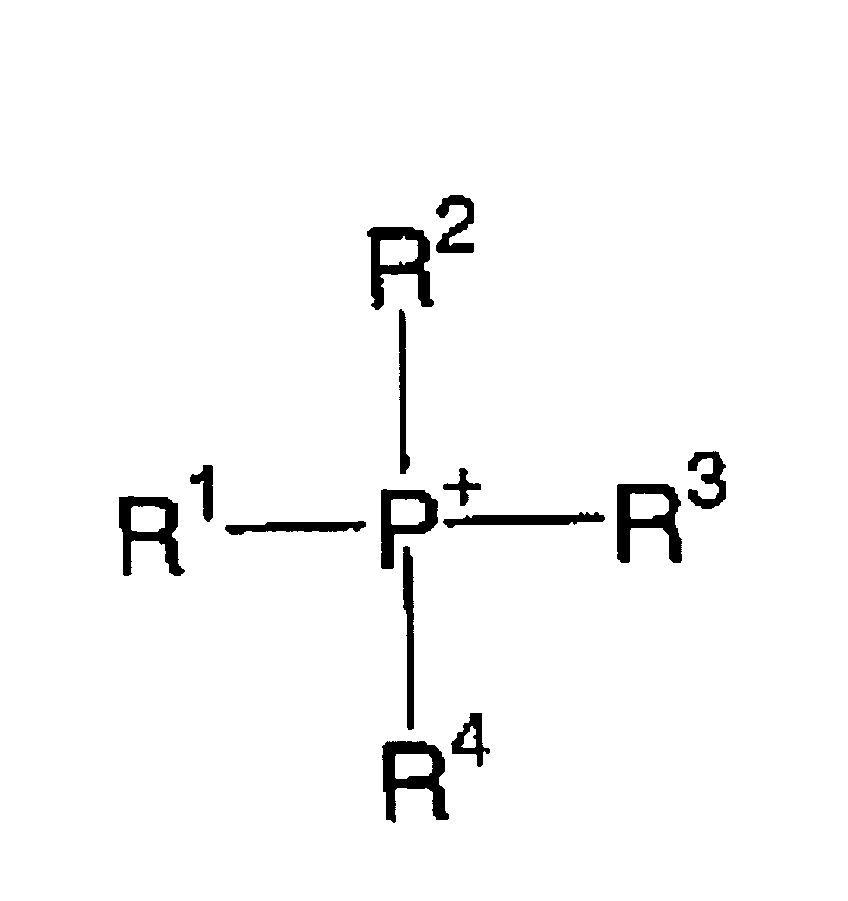
- In the formula (1) , R1, R2, R3, and R4 independently represent a group selected from the group consisting of a hydrogen atom, an alkyl group having 1 to 20 carbon atoms, and a hydrocarbon group containing a carboxyl group, a hydroxyl group, a phenyl group, and/or an epoxy group. In the alkyl group and the phenyl group, part of hydrogen atoms thereof may be substituted with a group selected from the group consisting of a halogen atom, a hydroxyl group, a carboxyl group, and -COOR (where R represents an alkyl group having 1 to 5 carbon atoms).
- Specific examples of the phosphonium ions represented by the above-mentioned formula (1) that are particularly preferred are tetraethylphosphonium, triethylbenzylphosphonium, tetrabutylphosphonium, tetraoctylphosphonium, trimethyldecylphosphonium, trimethyldodecylphosphonium, trimethylhexadecylphosphonium, trimethyloctadecylphosphonium, tributylmethylphosphonium, tributyldodecylphosphonium, tributylhexadodecylphosphonium, tributyloctadecylphosphonium, tetrakis(hydroxymethyl)phosphonium, methyltriphenylphosphonium, ethyltriphenylphosphonium, 2-hydroxyethyltriphenylphosphonium. diphenyldioctylphosphonium, triphenyloctadecylphosphonium, and tetraphenylphosphonium. Among these, tetraethylphosphonium, tetrabutylphosphonium, tetrakis(hydroxymethyl)phosphonium, ethyltriphenylphosphonium, and 2-hydroxyethyltriphenylphosphonium are particularly preferable.
- A method for organizing the swellable, lamellar silicate comprises dispersing the swellable, lamellar silicate in a solvent and mixing the resulting dispersion with the phosphonium ions represented by the formula (1) so that the silicate is organized by carrying out ion exchange between part or all of the cations (Na, and/or Li) , which are present between crystal layers of the silicate, and the phosphonium ions. The method is not particularly limited. In this case, examples of the solvent to be used include water, methanol, propanol, isopropanol, ethylene glycol, and 1,4-butanediol.
- The content of the inorganic filler (particularly the swellable, lamellar silicate that is organized) is preferably 0.5 to 30% by mass, and more preferably 3 to 20% by mass, based on the total mass of the polyester resin composition. If the content is less than 0.5% by mass, the reinforcing effect to be obtained by the incorporation with the inorganic filler may not be sufficient. On the other hand, if the content exceeds 30% by mass, the dispersibility and the transparency of the inorganic filler may be reduced or the formed articles or films made of the polyester resin composition may become brittle.
- The polyester resin composition of the invention contains polyetherimide (PEI) as a dispersing aid of the inorganic filler and also as an inhibitor of hydrolysis of the polyester.
- As stated above, if the organized inorganic filler is incorporated, the heat resistance is impaired because the organic cation acts as a factor that accelerates hydrolysis of the polymer containing the polyethylene naphthalate in the constituent unit thereof at the time of formation (when heated). In the invention, particularly the use of PEI in combination with the inorganic filler makes it possible to prevent the organic cation of the inorganic filler from coming into direct contact with the polymer and to secure the dispersibility of the inorganic filler because the organic cation is compatible with PEI. For this reason, it is possible to raise the dispersibility of the inorganic filler and remarkably improve the heat resistance of the polyester resin composition.
- The polyetherimide (PEI) is an amorphous thermoplastic resin comprised of a repeating unit having an ether group and an imide group. Specific examples of the polyetherimide (PEI) that is commercially available include ULTEM (manufactured by General Electric Company in U.S.A.).
- The content of the polyetherimide is preferably 50 to 200 parts by mass, and more preferably 75 to 150 parts by mass, based on 100 parts by mass of the inorganic filler. If the content is less than 50 parts by mass, the effects of the invention such as improvement of the dispersibility of the inorganic filler and the improvement of heat resistance (resistance to hydrolysis) may not be sufficient. On the other hand, if the content exceeds 200 parts by mass, coloration due to PEI may occur.
- The polyester resin composition of the invention can be manufactured by a process comprising mixing polyetherimide (PEI) with an inorganic filler by melt-kneading and thereafter melt-kneading the resulting mixture with a polymer containing PEN in the constituent unit thereof and other additives as necessary. The kneader that can be used for the melt-kneading is not particularly limited. Examples of the kneader include a twin-screw extruder, a biaxial rotor-type continuous kneader, a mortar-type continuous kneader (KCK) in which the kneading is carried out between a rotating disk and a stationary disk, a Banbury mixer, and a roll mill.
- The polyester resin composition of the invention may contain other additive, such as heat-resistance improving agents exemplified by a hindered phenol antioxidant and a phosphorus-containing antioxidant, insofar as the characteristics and effects of the invention are not impaired.
- The polyester resin composition of the invention can be used advantageously in such applications as formed articles, films for optical materials, substrates for magnetic materials, and substrates for image-forming materials.
- The present invention will now be explained by the Examples which follow, though it should be understood that the invention is not restricted to these Examples.
- As a swellable, lamellar silicate, 5 kg of SWN (synthetic smectite manufactured by Co-op Chemical Co., Ltd.) was used. The silicate was dispersed in 50 liters of a water/methanol solvent mixture. After that, 5 kg of trimethylhexadecylphosphonium was added to the resultant mixture and the resultant was stirred. In this way, an organized, swellable, lamellar silicate that had been treated with trimethylhexadecylphosphonium ions for organization was obtained.
- Moreover, ULTEM 1000 (manufactured by General Electric Company in U.S.A.) was prepared as polyetherimide.
- On the other hand, a PET/PEN copolymer (PET/PEN copolymerization ratio (% by mol) = 90/10) was obtained by carrying out a polycondensation between 12.05 kg of terephthalic acid and 1.68 kg of dimethyl-2,6-naphthalenedicarboxylic acid, which were acid components, and 9.84 kg of ethylene glycol.
- Next, the polyetherimide (PEI) and the organized, swellable, lamellar silicate obtained above were placed at a ratio of 1:1 in a twin-screw extruder (TEM-37 manufactured by Toshiba Machine Co., Ltd.) and were subjected to melt-kneading. In this way, a blend of PEI and the organized, swellable, lamellar silicate was obtained. The melt-kneading was carried out at a screw revolution of 500 rpm and at a temperature of 300°C.
- Subsequently, the blend of PEI and the organized, swellable, lamellar silicate and the PET/PEN copolymer were placed in a twin-screw extruder (TEM-37 manufactured by Toshiba Machine Co., Ltd.) such that the proportion of the PET/PEN copolymer/PEI/the organized, swellable, lamellar silicate was 90/5/5 and were subjected to melt-kneading. In this way, a polyester resin composition of the invention was obtained. The melt-kneading was carried out at a screw revolution of 500 rpm and at a temperature of 250°C.
- Polyester resin compositions wree obtained in the same way as in Example 1, except that PET/PEN ratios in the PET/PEN copolymers and the proportions of the PET/PEN copolymer/PEI/the organized, swellable, lamellar silicate were changed according to the proportions shown in Table 1.
- In place of the PET/PEN copolymer obtained in Example 1, a polyethylene terephthalate (PET) was prepared. The PET alone (PET/PEI/the organized, swellable, lamellar silicate = 100/0/0) was placed in a twin-screw extruder (TEM-37 manufactured by Toshiba Machine Co. , Ltd.) and was subjected to melt-kneading. In this way, a polyester resin composition for comparison was obtained. The melt-kneading was carried out at a screw revolution of 500 rpm and at a temperature of 250°C. The PET was obtained according to a standard method.
- A polyester resin composition for comparison was obtained in the same way as in Comparative Example 1, except that a PET/PEN copolymer was obtained in the same way as in Example 1 and was used in place of the PET used in Comparative Example 1.
- A polyester resin composition for comparison was obtained in the same way as in Example 1, except that polyethylene terephthalate (PET) was used in place of the PET/PEN copolymer obtained in Example 1. The PET was obtained according to a standard method as in Comparative Example 1.
- An organized, swellable, lamellar silicate was obtained in the same way as in Example 1. Moreover, a polyethylene terephthalate (PET) was prepared in place of the PET/PEN copolymer obtained in Example 1. Then, the resulting organized, swellable, lamellar silicate and the PET were placed in a twin-screw extruder (TEM-37 manufactured by Toshiba Machine Co., Ltd.) such that the proportion of the PET/PEI/the organized, swellable, lamellar silicate was 95/0/5 and were subjected to melt-kneading. In this way, a polyester resin composition for comparison was obtained. The melt-kneading was carried out at a screw revolution of 500 rpm and at a temperature of 250°C. The PET was obtained according to a standard method.
- A polyester resin composition for comparison was obtained in the same way as in Comparative Example 4, except that a PET/PEN copolymer was obtained in the same way as in Example 1 and was used in place of the PET used in Comparative Example 4.
- By using the polyester resin compositions of the invention and the polyester resin compositions for comparison obtained above, the following evaluations were conducted. The results thereof are shown in Table 1.
- The diffraction peak of the (001) face of the lamellar silicate was measured by a wide-angle X-ray diffractometry. In addition, the state of dispersion was visually observed using a transmission electron microscope. Based on the results of the measurement and observation, the dispersibility was evaluated according to the following criteria.
-
- o ○: Diffraction peak was absent and any flocculated particle was not found.
- ○: Diffraction peak was absent and the proportion of the flocculated particles found was not greater than 5%.
- Δ: Diffraction peak was absent and the proportion of the flocculated particles found was less than 30%.
- ×: Diffraction peak was present and the proportion of the flocculated particles found was 30% or more.
-
- A test piece, having a thickness of 1 mm and a width of 10 mm, was made of each polyester resin composition, and subjected to a tension test using a tension tester (manufactured by Toyo Seiki Seisaku-sho, Ltd.). Based on the results, moduli of elasticity were sought and the ratios of improvement (%) of elasticity of the test pieces with respect to elasticity of the test pieces made of the polyester resin compositions obtained in Comparative Examples 1 and 2 (referred to as "nonreinforced resin specimens" in this evaluation) were used as indices for evaluation. The criteria are as follows.
-
- o ○: Ratio of improvement with respect to nonreinforced resin specimen was 50% or more.
- ○: Ratio of improvement with respect to nonreinforced resin specimen was 20% or more but less than 50%.
- Δ: Ratio of improvement with respect to nonreinforced resin specimen was 5% or more but less than 20%.
- × : Ratio of improvement with respect to nonreinforced resin specimen was less than 5% or inferior without being improved.
-
- Oxygen transmittance was measured by means of OX-TRAN10/50A (manufactured by Mocon Corp.) and the degree of oxygen transmittance with respect to oxygen transmitttance of the polyester resin compositions obtained in Comparative Examples 1 and 2 (referred to as "nonreinforced resins" in this evaluation) were used as indices for evaluation. The criteria are as follows.
-
- o ○: 1/10 or less
- ○: More than 1/10 but 1/5 or less
- Δ: More than 1/5 but 1/2 or less
- ×: More than 1/2
-
- The organized, swellable, lamellar silicate was removed from the polyester resin compositions obtained in Examples and Comparative Examples. After that, the molecular weight distributions of the resin components were measured by means of GPC and number average molecular weights were sought. The proportions (%) of these number average molecular weights with respect to those of the polyester resin compositions obtained in Comparative Examples 1 and 2 (referred to as "nonreinforced resins" in this evaluation) were used as indices for evaluation. The criteria are as follows.
-
- o ○: 95% or more
- ○: 90% or more but less than 95%
- Δ: 70% or more but less than 90%
- ×: Less than 70%
-
- A sheet, having a thickness of 0.5 mm, was made from each polyester resin composition, and light transmittance was measured using a turbidity measuring instrument NDH-1001DP (manufactured by Nippon Denshoku Industries Co. , Ltd.) . The proportions (%) of these values with respect to those of the polyester resin compositions obtained in Comparative Examples 1 and 2 (referred to as "nonreinforced resin sheets" in this evaluation) were used as indices for evaluation. The standard is as follows.
-
- o ○: 95% or more
- ○: 90% or more but less than 95%
- Δ: 70% or more but less than 90%
- ×: Less than 70%

-
- As shown in Table 1, the polyester resin compositions of the invention, which comprises a combination of a lamellar silicate, a polymer containing PEN in the constituent unit thereof, and PEI, has excellent dispersibility of the lamellar silicate and better tensile elasticity (mechanical strength) and also better heat resistance owing to reduced hydrolysis as indicated by the number average molecular weights obtained. In addition, the polyester resin compositions of the invention has excellent oxygen barrier property and good transparency.
- On the other hand, the polyester resin compositions for comparison, which dose not use a combination of a lamellar silicate, a polymer containing PEN in the constituent unit thereof, and PEI, exhibites inferior dispersibility of the lamellar silicate and dose not provide satisfactory performances including strength and heat resistance. In particular, in the case where PEI is not incorporated even if a lamellar silicate is incorporated, the compositions exhibit inferior dispersibility of the lamellar silicate and, in addition, do not inhibit hydrolysis and cannot secure the heat resistance. In Comparative Example 3, although PEI is incorporated, the dispersibility is poor due to inferior compatibility and therefore the mechanical strength is inferior because the polymer dose not contain PEN in the constituent unit thereof.
Claims (7)
- A polyester resin composition comprising an inorganic filler, polyetherimide, and a polymer containing polyethylene naphthalate in a constituent unit thereof.
- The polyester resin composition of claim 1, wherein a polymerization ratio of polyethylene naphthalate constituting the polymer is 1 to 100% by mol.
- The polyester resin composition of claim 1 or 2, wherein the polymer is a copolymer containing polyethylene terephthalate and polyethylene naphthalate as copolymerized components.
- The polyester resin composition of any of claims 1 to 3, wherein a content of the polyetherimide is 50 to 200 parts by mass with respect to 100 parts by mass of the inorganic filler.
- The polyester resin composition of any of claims 1 to 4, wherein the content of the inorganic filler is 0.5 to 30% by mass with respect to the total mass of the polyester resin composition.
- The polyester resin composition of any of claims 1 to 5, wherein the inorganic filler is a swellable, lamellar silicate organized by an organizing agent.
- The polyester resin composition of any of claims 1 to 6, further comprising a heat-resistance imparting agent.
Applications Claiming Priority (2)
| Application Number | Priority Date | Filing Date | Title |
|---|---|---|---|
| JP2002246951 | 2002-08-27 | ||
| JP2002246951A JP2004083750A (en) | 2002-08-27 | 2002-08-27 | Polyester resin composition |
Publications (1)
| Publication Number | Publication Date |
|---|---|
| EP1394212A1 true EP1394212A1 (en) | 2004-03-03 |
Family
ID=31492543
Family Applications (1)
| Application Number | Title | Priority Date | Filing Date |
|---|---|---|---|
| EP03018615A Withdrawn EP1394212A1 (en) | 2002-08-27 | 2003-08-19 | Polyester resin composition containing inorganic filler, polyetherimide, and polymer containing polyethylene naphthalate in constituent unit thereof |
Country Status (4)
| Country | Link |
|---|---|
| US (1) | US20040044144A1 (en) |
| EP (1) | EP1394212A1 (en) |
| JP (1) | JP2004083750A (en) |
| CN (1) | CN100352860C (en) |
Cited By (1)
| Publication number | Priority date | Publication date | Assignee | Title |
|---|---|---|---|---|
| WO2009124989A1 (en) * | 2008-04-09 | 2009-10-15 | Toray Plastics Europe | Extruded plastic film filled with metal particles, method of obtaining same and uses of said film |
Families Citing this family (3)
| Publication number | Priority date | Publication date | Assignee | Title |
|---|---|---|---|---|
| WO2009038986A1 (en) * | 2007-09-17 | 2009-03-26 | Dow Global Technologies, Inc. | Aqueous based coating |
| KR100985717B1 (en) * | 2008-02-19 | 2010-10-06 | 주식회사 에이스테크놀로지 | Frequency Tunable Filter Using Sliding Method |
| CN109401223A (en) * | 2018-09-30 | 2019-03-01 | 长沙新材料产业研究院有限公司 | A kind of high temperature resistant high-barrier resin combination and preparation method thereof |
Citations (5)
| Publication number | Priority date | Publication date | Assignee | Title |
|---|---|---|---|---|
| JPH07228761A (en) * | 1994-02-18 | 1995-08-29 | Toyobo Co Ltd | Polyester resin composition and its molding |
| JPH10152605A (en) * | 1996-11-25 | 1998-06-09 | Teijin Ltd | Resin composition |
| JP2000053847A (en) * | 1998-08-07 | 2000-02-22 | Toray Ind Inc | Polyester resin composition |
| JP2000327805A (en) * | 1999-05-18 | 2000-11-28 | Kanegafuchi Chem Ind Co Ltd | Resin film |
| EP1199333A1 (en) * | 1999-05-10 | 2002-04-24 | Teijin Limited | Resin composition containing crystalline polyimide |
Family Cites Families (7)
| Publication number | Priority date | Publication date | Assignee | Title |
|---|---|---|---|---|
| JP2674720B2 (en) * | 1991-08-12 | 1997-11-12 | アライド−シグナル・インコーポレーテッド | Melt fabrication method of polymer nanocomposite of exfoliated layered material |
| CN1103080A (en) * | 1993-09-15 | 1995-05-31 | 通用电气公司 | Fire retarding thermoformable blends of polycarbonate, polyetherimide and siloxane-polyetherimide copolymer resins |
| US5648433A (en) * | 1994-05-31 | 1997-07-15 | Eastman Chemical Company | Ternary polyetherimide/polyester/polyester blends |
| JP3736695B2 (en) * | 1996-05-20 | 2006-01-18 | 富士写真フイルム株式会社 | Method for producing polyester support, polyester support, and photographic photosensitive film using the same |
| DE69728384T2 (en) * | 1996-11-25 | 2005-02-17 | Teijin Ltd. | THERMOPLASTIC RESIN COMPOSITIONS CONTAINING A NON-CRYSTALLINE POLYIMIDE |
| US6194497B1 (en) * | 1997-07-23 | 2001-02-27 | General Electric Company | Anti-static resin composition containing fluorinated phosphonium sulfonates |
| JPH11176245A (en) * | 1997-10-14 | 1999-07-02 | Furukawa Electric Co Ltd:The | Multilayer insulated wire and transformer using the same |
-
2002
- 2002-08-27 JP JP2002246951A patent/JP2004083750A/en active Pending
-
2003
- 2003-05-12 CN CNB031251528A patent/CN100352860C/en not_active Expired - Fee Related
- 2003-08-19 EP EP03018615A patent/EP1394212A1/en not_active Withdrawn
- 2003-08-19 US US10/642,577 patent/US20040044144A1/en not_active Abandoned
Patent Citations (5)
| Publication number | Priority date | Publication date | Assignee | Title |
|---|---|---|---|---|
| JPH07228761A (en) * | 1994-02-18 | 1995-08-29 | Toyobo Co Ltd | Polyester resin composition and its molding |
| JPH10152605A (en) * | 1996-11-25 | 1998-06-09 | Teijin Ltd | Resin composition |
| JP2000053847A (en) * | 1998-08-07 | 2000-02-22 | Toray Ind Inc | Polyester resin composition |
| EP1199333A1 (en) * | 1999-05-10 | 2002-04-24 | Teijin Limited | Resin composition containing crystalline polyimide |
| JP2000327805A (en) * | 1999-05-18 | 2000-11-28 | Kanegafuchi Chem Ind Co Ltd | Resin film |
Non-Patent Citations (3)
| Title |
|---|
| PATENT ABSTRACTS OF JAPAN vol. 1995, no. 11 26 December 1995 (1995-12-26) * |
| PATENT ABSTRACTS OF JAPAN vol. 2000, no. 05 14 September 2000 (2000-09-14) * |
| PATENT ABSTRACTS OF JAPAN vol. 2000, no. 14 5 March 2001 (2001-03-05) * |
Cited By (2)
| Publication number | Priority date | Publication date | Assignee | Title |
|---|---|---|---|---|
| WO2009124989A1 (en) * | 2008-04-09 | 2009-10-15 | Toray Plastics Europe | Extruded plastic film filled with metal particles, method of obtaining same and uses of said film |
| FR2929948A1 (en) * | 2008-04-09 | 2009-10-16 | Toray Plastics Europ Soc Par A | EXTRUDED PLASTIC FILM CHARGED WITH METAL PARTICLES, PROCESS FOR PRODUCING THE SAME, AND USES THEREOF |
Also Published As
| Publication number | Publication date |
|---|---|
| CN1478813A (en) | 2004-03-03 |
| JP2004083750A (en) | 2004-03-18 |
| CN100352860C (en) | 2007-12-05 |
| US20040044144A1 (en) | 2004-03-04 |
Similar Documents
| Publication | Publication Date | Title |
|---|---|---|
| US6552113B2 (en) | Polymer-clay nanocomposite comprising an amorphous oligomer | |
| AU758550B2 (en) | A high barrier amorphous polyamide-clay nanocomposite and a process for preparing same | |
| US6391449B1 (en) | Polymer/clay intercalates, exfoliates, and nanocomposites comprising a clay mixture and a process for making same | |
| US6417262B1 (en) | High barrier amorphous polyamide-clay nanocomposite and a process for preparing same | |
| US6586500B2 (en) | Polymer nanocomposite comprising a matrix polymer and a layered clay material having an improved level of extractable material | |
| EP1699845B1 (en) | Flame retardant polyester resin composition and articles formed therefrom | |
| CN107922717B (en) | Thermoplastic polyester resin composition and light reflector using the same | |
| US6552114B2 (en) | Process for preparing a high barrier amorphous polyamide-clay nanocomposite | |
| AU771071B2 (en) | A polymer/clay nanocomposite comprising a clay mixture and a process for making same | |
| US7056963B2 (en) | Polyester resin composition and process for the preparation thereof | |
| US20040044144A1 (en) | Polyester resin composition containing inorganic filler, polyetherimide, and polymer containing polyethylene naphthalate in constituent unit thereof | |
| JP3438345B2 (en) | Aromatic polyester composition | |
| JP4256754B2 (en) | Polyester resin composition | |
| JPH09143359A (en) | Polycarbonate resin composition | |
| JP2001261947A (en) | Polyester resin composition | |
| JPH09208813A (en) | Reinforced polyester block copolymer composition and method for producing the same | |
| US20070191525A1 (en) | Polyester resin composition | |
| JP4668394B2 (en) | Polyester resin composition | |
| JPH11323102A (en) | Reinforced polyester resin composition | |
| JP2010024370A (en) | Polyester resin composition | |
| JPH11323106A (en) | Polyester resin composition and manufacturing method | |
| JP2008007552A (en) | Polyester resin composition, method for producing the same and molded article | |
| JPH06145479A (en) | Polybutylene terephthalate resin composition |
Legal Events
| Date | Code | Title | Description |
|---|---|---|---|
| PUAI | Public reference made under article 153(3) epc to a published international application that has entered the european phase |
Free format text: ORIGINAL CODE: 0009012 |
|
| AK | Designated contracting states |
Kind code of ref document: A1 Designated state(s): AT BE BG CH CY CZ DE DK EE ES FI FR GB GR HU IE IT LI LU MC NL PT RO SE SI SK TR |
|
| AX | Request for extension of the european patent |
Extension state: AL LT LV MK |
|
| 17P | Request for examination filed |
Effective date: 20040705 |
|
| AKX | Designation fees paid |
Designated state(s): DE NL |
|
| RAP1 | Party data changed (applicant data changed or rights of an application transferred) |
Owner name: FUJIFILM CORPORATION |
|
| 17Q | First examination report despatched |
Effective date: 20070403 |
|
| STAA | Information on the status of an ep patent application or granted ep patent |
Free format text: STATUS: THE APPLICATION IS DEEMED TO BE WITHDRAWN |
|
| 18D | Application deemed to be withdrawn |
Effective date: 20100302 |