EP1394191A1 - Process for preparing biocompatible polyurea - Google Patents
Process for preparing biocompatible polyurea Download PDFInfo
- Publication number
- EP1394191A1 EP1394191A1 EP02078540A EP02078540A EP1394191A1 EP 1394191 A1 EP1394191 A1 EP 1394191A1 EP 02078540 A EP02078540 A EP 02078540A EP 02078540 A EP02078540 A EP 02078540A EP 1394191 A1 EP1394191 A1 EP 1394191A1
- Authority
- EP
- European Patent Office
- Prior art keywords
- hydroxy
- functional
- compound
- cbc
- reaction
- Prior art date
- Legal status (The legal status is an assumption and is not a legal conclusion. Google has not performed a legal analysis and makes no representation as to the accuracy of the status listed.)
- Withdrawn
Links
- 238000004519 manufacturing process Methods 0.000 title claims description 6
- 229920002396 Polyurea Polymers 0.000 title description 12
- 229920000642 polymer Polymers 0.000 claims abstract description 35
- 238000000034 method Methods 0.000 claims abstract description 23
- 230000008569 process Effects 0.000 claims abstract description 22
- 150000001875 compounds Chemical class 0.000 claims abstract description 19
- XSQUKJJJFZCRTK-UHFFFAOYSA-N Urea Chemical compound NC(N)=O XSQUKJJJFZCRTK-UHFFFAOYSA-N 0.000 claims abstract description 18
- 239000004202 carbamide Substances 0.000 claims abstract description 18
- 238000000576 coating method Methods 0.000 claims abstract description 9
- 239000007822 coupling agent Substances 0.000 claims abstract description 9
- 150000002894 organic compounds Chemical class 0.000 claims abstract description 9
- LFQSCWFLJHTTHZ-UHFFFAOYSA-N Ethanol Chemical compound CCO LFQSCWFLJHTTHZ-UHFFFAOYSA-N 0.000 claims description 28
- 239000000203 mixture Substances 0.000 claims description 18
- 229910052751 metal Inorganic materials 0.000 claims description 9
- 239000002184 metal Substances 0.000 claims description 9
- 229920000728 polyester Polymers 0.000 claims description 7
- 125000000217 alkyl group Chemical group 0.000 claims description 6
- PFPSOZSOSPOAPX-UHFFFAOYSA-N 7-(7-oxoazepane-2-carbonyl)azepan-2-one Chemical compound C1CCCC(=O)NC1C(=O)C1CCCCC(=O)N1 PFPSOZSOSPOAPX-UHFFFAOYSA-N 0.000 claims description 5
- 125000003837 (C1-C20) alkyl group Chemical group 0.000 claims description 4
- 125000003118 aryl group Chemical group 0.000 claims description 4
- 229920002857 polybutadiene Polymers 0.000 claims description 3
- 229920000570 polyether Polymers 0.000 claims description 3
- 229920000193 polymethacrylate Polymers 0.000 claims description 3
- 229920000098 polyolefin Polymers 0.000 claims description 3
- 229920002451 polyvinyl alcohol Polymers 0.000 claims description 3
- 235000019422 polyvinyl alcohol Nutrition 0.000 claims description 3
- 125000002915 carbonyl group Chemical group [*:2]C([*:1])=O 0.000 claims description 2
- 230000000737 periodic effect Effects 0.000 claims description 2
- OKKJLVBELUTLKV-UHFFFAOYSA-N Methanol Chemical compound OC OKKJLVBELUTLKV-UHFFFAOYSA-N 0.000 description 27
- 238000006243 chemical reaction Methods 0.000 description 24
- 235000013877 carbamide Nutrition 0.000 description 18
- 229920005862 polyol Polymers 0.000 description 16
- KFZMGEQAYNKOFK-UHFFFAOYSA-N Isopropanol Chemical compound CC(C)O KFZMGEQAYNKOFK-UHFFFAOYSA-N 0.000 description 15
- -1 poly(α-hydroxy acid) Polymers 0.000 description 15
- 150000003077 polyols Chemical class 0.000 description 14
- 150000002148 esters Chemical class 0.000 description 12
- 239000003054 catalyst Substances 0.000 description 10
- 210000004027 cell Anatomy 0.000 description 8
- 239000012948 isocyanate Substances 0.000 description 8
- 229920002635 polyurethane Polymers 0.000 description 8
- 239000004814 polyurethane Substances 0.000 description 8
- 238000002360 preparation method Methods 0.000 description 7
- 238000005160 1H NMR spectroscopy Methods 0.000 description 6
- 238000009472 formulation Methods 0.000 description 6
- 150000002513 isocyanates Chemical class 0.000 description 6
- 150000003951 lactams Chemical group 0.000 description 6
- 238000007142 ring opening reaction Methods 0.000 description 6
- 238000001644 13C nuclear magnetic resonance spectroscopy Methods 0.000 description 5
- 101001091417 Agaricus bisporus Polyphenol oxidase 1 Proteins 0.000 description 5
- 101000611521 Arabidopsis thaliana Protoporphyrinogen oxidase 1, chloroplastic Proteins 0.000 description 5
- 210000002950 fibroblast Anatomy 0.000 description 5
- 229960004592 isopropanol Drugs 0.000 description 5
- 239000000047 product Substances 0.000 description 5
- 238000005033 Fourier transform infrared spectroscopy Methods 0.000 description 4
- MZRVEZGGRBJDDB-UHFFFAOYSA-N N-Butyllithium Chemical compound [Li]CCCC MZRVEZGGRBJDDB-UHFFFAOYSA-N 0.000 description 4
- 238000004132 cross linking Methods 0.000 description 4
- 125000002887 hydroxy group Chemical group [H]O* 0.000 description 4
- 239000000463 material Substances 0.000 description 4
- 238000005259 measurement Methods 0.000 description 4
- 238000002844 melting Methods 0.000 description 4
- 230000008018 melting Effects 0.000 description 4
- 229920001451 polypropylene glycol Polymers 0.000 description 4
- 239000000376 reactant Substances 0.000 description 4
- 230000009257 reactivity Effects 0.000 description 4
- 101001091423 Agaricus bisporus Polyphenol oxidase 2 Proteins 0.000 description 3
- 101000611523 Arabidopsis thaliana Protoporphyrinogen oxidase 2, chloroplastic/mitochondrial Proteins 0.000 description 3
- LYCAIKOWRPUZTN-UHFFFAOYSA-N Ethylene glycol Chemical compound OCCO LYCAIKOWRPUZTN-UHFFFAOYSA-N 0.000 description 3
- DNIAPMSPPWPWGF-UHFFFAOYSA-N Propylene glycol Chemical compound CC(O)CO DNIAPMSPPWPWGF-UHFFFAOYSA-N 0.000 description 3
- KEAYESYHFKHZAL-UHFFFAOYSA-N Sodium Chemical compound [Na] KEAYESYHFKHZAL-UHFFFAOYSA-N 0.000 description 3
- YXFVVABEGXRONW-UHFFFAOYSA-N Toluene Chemical compound CC1=CC=CC=C1 YXFVVABEGXRONW-UHFFFAOYSA-N 0.000 description 3
- ZMANZCXQSJIPKH-UHFFFAOYSA-N Triethylamine Chemical compound CCN(CC)CC ZMANZCXQSJIPKH-UHFFFAOYSA-N 0.000 description 3
- 150000001408 amides Chemical class 0.000 description 3
- 230000015572 biosynthetic process Effects 0.000 description 3
- 230000015556 catabolic process Effects 0.000 description 3
- 230000021164 cell adhesion Effects 0.000 description 3
- 230000010261 cell growth Effects 0.000 description 3
- 239000011248 coating agent Substances 0.000 description 3
- 239000003431 cross linking reagent Substances 0.000 description 3
- 238000006731 degradation reaction Methods 0.000 description 3
- 125000005442 diisocyanate group Chemical group 0.000 description 3
- 229920001002 functional polymer Polymers 0.000 description 3
- 239000000499 gel Substances 0.000 description 3
- 238000010438 heat treatment Methods 0.000 description 3
- 239000000017 hydrogel Substances 0.000 description 3
- QQVIHTHCMHWDBS-UHFFFAOYSA-N isophthalic acid Chemical group OC(=O)C1=CC=CC(C(O)=O)=C1 QQVIHTHCMHWDBS-UHFFFAOYSA-N 0.000 description 3
- 239000002953 phosphate buffered saline Substances 0.000 description 3
- 229920001982 poly(ester urethane) Polymers 0.000 description 3
- 238000000746 purification Methods 0.000 description 3
- 229920005989 resin Polymers 0.000 description 3
- 239000011347 resin Substances 0.000 description 3
- 238000007086 side reaction Methods 0.000 description 3
- 229910000104 sodium hydride Inorganic materials 0.000 description 3
- 239000012312 sodium hydride Substances 0.000 description 3
- 239000000243 solution Substances 0.000 description 3
- 239000002904 solvent Substances 0.000 description 3
- 239000007858 starting material Substances 0.000 description 3
- 238000003756 stirring Methods 0.000 description 3
- 150000003673 urethanes Chemical class 0.000 description 3
- CWRORZJYSUFYHO-UHFFFAOYSA-N (3z)-3-diazobicyclo[2.2.2]octane Chemical compound C1CC2C(=[N+]=[N-])CC1CC2 CWRORZJYSUFYHO-UHFFFAOYSA-N 0.000 description 2
- NWUYHJFMYQTDRP-UHFFFAOYSA-N 1,2-bis(ethenyl)benzene;1-ethenyl-2-ethylbenzene;styrene Chemical compound C=CC1=CC=CC=C1.CCC1=CC=CC=C1C=C.C=CC1=CC=CC=C1C=C NWUYHJFMYQTDRP-UHFFFAOYSA-N 0.000 description 2
- YBRVSVVVWCFQMG-UHFFFAOYSA-N 4,4'-diaminodiphenylmethane Chemical compound C1=CC(N)=CC=C1CC1=CC=C(N)C=C1 YBRVSVVVWCFQMG-UHFFFAOYSA-N 0.000 description 2
- 239000006144 Dulbecco’s modified Eagle's medium Substances 0.000 description 2
- JOYRKODLDBILNP-UHFFFAOYSA-N Ethyl urethane Chemical compound CCOC(N)=O JOYRKODLDBILNP-UHFFFAOYSA-N 0.000 description 2
- ZRALSGWEFCBTJO-UHFFFAOYSA-N Guanidine Chemical compound NC(N)=N ZRALSGWEFCBTJO-UHFFFAOYSA-N 0.000 description 2
- 239000004793 Polystyrene Substances 0.000 description 2
- WYURNTSHIVDZCO-UHFFFAOYSA-N Tetrahydrofuran Chemical compound C1CCOC1 WYURNTSHIVDZCO-UHFFFAOYSA-N 0.000 description 2
- HEDRZPFGACZZDS-MICDWDOJSA-N Trichloro(2H)methane Chemical compound [2H]C(Cl)(Cl)Cl HEDRZPFGACZZDS-MICDWDOJSA-N 0.000 description 2
- 238000007259 addition reaction Methods 0.000 description 2
- 230000001464 adherent effect Effects 0.000 description 2
- KKEYFWRCBNTPAC-UHFFFAOYSA-N benzene-dicarboxylic acid Natural products OC(=O)C1=CC=C(C(O)=O)C=C1 KKEYFWRCBNTPAC-UHFFFAOYSA-N 0.000 description 2
- ISAOCJYIOMOJEB-UHFFFAOYSA-N benzoin Chemical compound C=1C=CC=CC=1C(O)C(=O)C1=CC=CC=C1 ISAOCJYIOMOJEB-UHFFFAOYSA-N 0.000 description 2
- 239000006227 byproduct Substances 0.000 description 2
- 238000006555 catalytic reaction Methods 0.000 description 2
- 239000006143 cell culture medium Substances 0.000 description 2
- 150000002009 diols Chemical class 0.000 description 2
- LOKCTEFSRHRXRJ-UHFFFAOYSA-I dipotassium trisodium dihydrogen phosphate hydrogen phosphate dichloride Chemical compound P(=O)(O)(O)[O-].[K+].P(=O)(O)([O-])[O-].[Na+].[Na+].[Cl-].[K+].[Cl-].[Na+] LOKCTEFSRHRXRJ-UHFFFAOYSA-I 0.000 description 2
- LQZZUXJYWNFBMV-UHFFFAOYSA-N dodecan-1-ol Chemical compound CCCCCCCCCCCCO LQZZUXJYWNFBMV-UHFFFAOYSA-N 0.000 description 2
- 238000003379 elimination reaction Methods 0.000 description 2
- 125000004356 hydroxy functional group Chemical group O* 0.000 description 2
- 238000001727 in vivo Methods 0.000 description 2
- 239000003456 ion exchange resin Substances 0.000 description 2
- 229920003303 ion-exchange polymer Polymers 0.000 description 2
- 230000007246 mechanism Effects 0.000 description 2
- OJURWUUOVGOHJZ-UHFFFAOYSA-N methyl 2-[(2-acetyloxyphenyl)methyl-[2-[(2-acetyloxyphenyl)methyl-(2-methoxy-2-oxoethyl)amino]ethyl]amino]acetate Chemical compound C=1C=CC=C(OC(C)=O)C=1CN(CC(=O)OC)CCN(CC(=O)OC)CC1=CC=CC=C1OC(C)=O OJURWUUOVGOHJZ-UHFFFAOYSA-N 0.000 description 2
- PSHKMPUSSFXUIA-UHFFFAOYSA-N n,n-dimethylpyridin-2-amine Chemical compound CN(C)C1=CC=CC=N1 PSHKMPUSSFXUIA-UHFFFAOYSA-N 0.000 description 2
- BDERNNFJNOPAEC-UHFFFAOYSA-N n-propyl alcohol Natural products CCCO BDERNNFJNOPAEC-UHFFFAOYSA-N 0.000 description 2
- 231100000252 nontoxic Toxicity 0.000 description 2
- 230000003000 nontoxic effect Effects 0.000 description 2
- 229920001225 polyester resin Polymers 0.000 description 2
- 239000004645 polyester resin Substances 0.000 description 2
- 229920001223 polyethylene glycol Polymers 0.000 description 2
- 229920002223 polystyrene Polymers 0.000 description 2
- 229910052700 potassium Inorganic materials 0.000 description 2
- 239000000843 powder Substances 0.000 description 2
- XJMOSONTPMZWPB-UHFFFAOYSA-M propidium iodide Chemical compound [I-].[I-].C12=CC(N)=CC=C2C2=CC=C(N)C=C2[N+](CCC[N+](C)(CC)CC)=C1C1=CC=CC=C1 XJMOSONTPMZWPB-UHFFFAOYSA-M 0.000 description 2
- 238000000425 proton nuclear magnetic resonance spectrum Methods 0.000 description 2
- 230000035484 reaction time Effects 0.000 description 2
- 229910052708 sodium Inorganic materials 0.000 description 2
- 239000011734 sodium Substances 0.000 description 2
- UCSJYZPVAKXKNQ-HZYVHMACSA-N streptomycin Chemical compound CN[C@H]1[C@H](O)[C@@H](O)[C@H](CO)O[C@H]1O[C@@H]1[C@](C=O)(O)[C@H](C)O[C@H]1O[C@@H]1[C@@H](NC(N)=N)[C@H](O)[C@@H](NC(N)=N)[C@H](O)[C@H]1O UCSJYZPVAKXKNQ-HZYVHMACSA-N 0.000 description 2
- 239000000126 substance Substances 0.000 description 2
- 238000006467 substitution reaction Methods 0.000 description 2
- 229920001187 thermosetting polymer Polymers 0.000 description 2
- 231100000331 toxic Toxicity 0.000 description 2
- 230000002588 toxic effect Effects 0.000 description 2
- 150000004072 triols Chemical class 0.000 description 2
- 238000005406 washing Methods 0.000 description 2
- 230000004580 weight loss Effects 0.000 description 2
- UHQZGWJEFFDHSR-UHFFFAOYSA-N 1-(2-oxoazepane-1-carbonyl)azepan-2-one Chemical compound C1CCCCC(=O)N1C(=O)N1CCCCCC1=O UHQZGWJEFFDHSR-UHFFFAOYSA-N 0.000 description 1
- JIABEENURMZTTI-UHFFFAOYSA-N 1-isocyanato-2-[(2-isocyanatophenyl)methyl]benzene Chemical compound O=C=NC1=CC=CC=C1CC1=CC=CC=C1N=C=O JIABEENURMZTTI-UHFFFAOYSA-N 0.000 description 1
- KZDCMKVLEYCGQX-UDPGNSCCSA-N 2-(diethylamino)ethyl 4-aminobenzoate;(2s,5r,6r)-3,3-dimethyl-7-oxo-6-[(2-phenylacetyl)amino]-4-thia-1-azabicyclo[3.2.0]heptane-2-carboxylic acid;hydrate Chemical compound O.CCN(CC)CCOC(=O)C1=CC=C(N)C=C1.N([C@H]1[C@H]2SC([C@@H](N2C1=O)C(O)=O)(C)C)C(=O)CC1=CC=CC=C1 KZDCMKVLEYCGQX-UDPGNSCCSA-N 0.000 description 1
- UPMLOUAZCHDJJD-UHFFFAOYSA-N 4,4'-Diphenylmethane Diisocyanate Chemical compound C1=CC(N=C=O)=CC=C1CC1=CC=C(N=C=O)C=C1 UPMLOUAZCHDJJD-UHFFFAOYSA-N 0.000 description 1
- 108091003079 Bovine Serum Albumin Proteins 0.000 description 1
- 208000008964 Chemical and Drug Induced Liver Injury Diseases 0.000 description 1
- ZDQWESQEGGJUCH-UHFFFAOYSA-N Diisopropyl adipate Chemical compound CC(C)OC(=O)CCCCC(=O)OC(C)C ZDQWESQEGGJUCH-UHFFFAOYSA-N 0.000 description 1
- 206010020751 Hypersensitivity Diseases 0.000 description 1
- DGAQECJNVWCQMB-PUAWFVPOSA-M Ilexoside XXIX Chemical compound C[C@@H]1CC[C@@]2(CC[C@@]3(C(=CC[C@H]4[C@]3(CC[C@@H]5[C@@]4(CC[C@@H](C5(C)C)OS(=O)(=O)[O-])C)C)[C@@H]2[C@]1(C)O)C)C(=O)O[C@H]6[C@@H]([C@H]([C@@H]([C@H](O6)CO)O)O)O.[Na+] DGAQECJNVWCQMB-PUAWFVPOSA-M 0.000 description 1
- 206010061218 Inflammation Diseases 0.000 description 1
- CHJJGSNFBQVOTG-UHFFFAOYSA-N N-methyl-guanidine Natural products CNC(N)=N CHJJGSNFBQVOTG-UHFFFAOYSA-N 0.000 description 1
- CTQNGGLPUBDAKN-UHFFFAOYSA-N O-Xylene Chemical compound CC1=CC=CC=C1C CTQNGGLPUBDAKN-UHFFFAOYSA-N 0.000 description 1
- 229920003171 Poly (ethylene oxide) Polymers 0.000 description 1
- 229920001244 Poly(D,L-lactide) Polymers 0.000 description 1
- ZLMJMSJWJFRBEC-UHFFFAOYSA-N Potassium Chemical compound [K] ZLMJMSJWJFRBEC-UHFFFAOYSA-N 0.000 description 1
- 244000028419 Styrax benzoin Species 0.000 description 1
- 235000000126 Styrax benzoin Nutrition 0.000 description 1
- 235000008411 Sumatra benzointree Nutrition 0.000 description 1
- XSTXAVWGXDQKEL-UHFFFAOYSA-N Trichloroethylene Chemical compound ClC=C(Cl)Cl XSTXAVWGXDQKEL-UHFFFAOYSA-N 0.000 description 1
- 239000002253 acid Substances 0.000 description 1
- 230000002378 acidificating effect Effects 0.000 description 1
- 150000001298 alcohols Chemical class 0.000 description 1
- 229920003232 aliphatic polyester Polymers 0.000 description 1
- 208000026935 allergic disease Diseases 0.000 description 1
- 230000007815 allergy Effects 0.000 description 1
- 229910052782 aluminium Inorganic materials 0.000 description 1
- 239000000427 antigen Substances 0.000 description 1
- 102000036639 antigens Human genes 0.000 description 1
- 108091007433 antigens Proteins 0.000 description 1
- 208000006673 asthma Diseases 0.000 description 1
- 208000010668 atopic eczema Diseases 0.000 description 1
- 230000009286 beneficial effect Effects 0.000 description 1
- 230000008901 benefit Effects 0.000 description 1
- 229960002130 benzoin Drugs 0.000 description 1
- 239000012620 biological material Substances 0.000 description 1
- 229920001400 block copolymer Polymers 0.000 description 1
- CDQSJQSWAWPGKG-UHFFFAOYSA-N butane-1,1-diol Chemical compound CCCC(O)O CDQSJQSWAWPGKG-UHFFFAOYSA-N 0.000 description 1
- 238000001460 carbon-13 nuclear magnetic resonance spectrum Methods 0.000 description 1
- 238000012512 characterization method Methods 0.000 description 1
- 229920001429 chelating resin Polymers 0.000 description 1
- 239000003153 chemical reaction reagent Substances 0.000 description 1
- 238000006757 chemical reactions by type Methods 0.000 description 1
- 239000003795 chemical substances by application Substances 0.000 description 1
- 239000008199 coating composition Substances 0.000 description 1
- 238000007796 conventional method Methods 0.000 description 1
- 230000007797 corrosion Effects 0.000 description 1
- 238000005260 corrosion Methods 0.000 description 1
- 230000008878 coupling Effects 0.000 description 1
- 238000010168 coupling process Methods 0.000 description 1
- 238000005859 coupling reaction Methods 0.000 description 1
- 229920006037 cross link polymer Polymers 0.000 description 1
- 230000003247 decreasing effect Effects 0.000 description 1
- 238000011161 development Methods 0.000 description 1
- 238000000113 differential scanning calorimetry Methods 0.000 description 1
- SWSQBOPZIKWTGO-UHFFFAOYSA-N dimethylaminoamidine Natural products CN(C)C(N)=N SWSQBOPZIKWTGO-UHFFFAOYSA-N 0.000 description 1
- 238000012377 drug delivery Methods 0.000 description 1
- 230000008030 elimination Effects 0.000 description 1
- 230000005284 excitation Effects 0.000 description 1
- 230000001747 exhibiting effect Effects 0.000 description 1
- 238000002474 experimental method Methods 0.000 description 1
- 239000012091 fetal bovine serum Substances 0.000 description 1
- 239000012467 final product Substances 0.000 description 1
- 230000009477 glass transition Effects 0.000 description 1
- 235000019382 gum benzoic Nutrition 0.000 description 1
- 208000006454 hepatitis Diseases 0.000 description 1
- 231100000283 hepatitis Toxicity 0.000 description 1
- 230000003301 hydrolyzing effect Effects 0.000 description 1
- 238000000338 in vitro Methods 0.000 description 1
- 238000011534 incubation Methods 0.000 description 1
- 230000004054 inflammatory process Effects 0.000 description 1
- 229910052744 lithium Inorganic materials 0.000 description 1
- 210000004072 lung Anatomy 0.000 description 1
- 229910052749 magnesium Inorganic materials 0.000 description 1
- 229910052987 metal hydride Inorganic materials 0.000 description 1
- 150000004681 metal hydrides Chemical class 0.000 description 1
- 229910000000 metal hydroxide Inorganic materials 0.000 description 1
- 150000004692 metal hydroxides Chemical class 0.000 description 1
- 238000001000 micrograph Methods 0.000 description 1
- 239000000178 monomer Substances 0.000 description 1
- 238000010172 mouse model Methods 0.000 description 1
- DIAIBWNEUYXDNL-UHFFFAOYSA-N n,n-dihexylhexan-1-amine Chemical compound CCCCCCN(CCCCCC)CCCCCC DIAIBWNEUYXDNL-UHFFFAOYSA-N 0.000 description 1
- XTAZYLNFDRKIHJ-UHFFFAOYSA-N n,n-dioctyloctan-1-amine Chemical compound CCCCCCCCN(CCCCCCCC)CCCCCCCC XTAZYLNFDRKIHJ-UHFFFAOYSA-N 0.000 description 1
- SLCVBVWXLSEKPL-UHFFFAOYSA-N neopentyl glycol Chemical compound OCC(C)(C)CO SLCVBVWXLSEKPL-UHFFFAOYSA-N 0.000 description 1
- 238000012758 nuclear staining Methods 0.000 description 1
- 238000010899 nucleation Methods 0.000 description 1
- 230000037361 pathway Effects 0.000 description 1
- WVDDGKGOMKODPV-ZQBYOMGUSA-N phenyl(114C)methanol Chemical compound O[14CH2]C1=CC=CC=C1 WVDDGKGOMKODPV-ZQBYOMGUSA-N 0.000 description 1
- 229920001610 polycaprolactone Polymers 0.000 description 1
- 238000006116 polymerization reaction Methods 0.000 description 1
- 229920000909 polytetrahydrofuran Polymers 0.000 description 1
- 238000011417 postcuring Methods 0.000 description 1
- 239000011591 potassium Substances 0.000 description 1
- BDAWXSQJJCIFIK-UHFFFAOYSA-N potassium methoxide Chemical compound [K+].[O-]C BDAWXSQJJCIFIK-UHFFFAOYSA-N 0.000 description 1
- 125000002924 primary amino group Chemical group [H]N([H])* 0.000 description 1
- 239000011541 reaction mixture Substances 0.000 description 1
- 230000000717 retained effect Effects 0.000 description 1
- 239000007787 solid Substances 0.000 description 1
- 238000010186 staining Methods 0.000 description 1
- 230000001954 sterilising effect Effects 0.000 description 1
- 238000004659 sterilization and disinfection Methods 0.000 description 1
- 229960005322 streptomycin Drugs 0.000 description 1
- 230000002459 sustained effect Effects 0.000 description 1
- 230000008961 swelling Effects 0.000 description 1
- 229920002994 synthetic fiber Polymers 0.000 description 1
- 150000003512 tertiary amines Chemical class 0.000 description 1
- 238000012360 testing method Methods 0.000 description 1
- YLQBMQCUIZJEEH-UHFFFAOYSA-N tetrahydrofuran Natural products C=1C=COC=1 YLQBMQCUIZJEEH-UHFFFAOYSA-N 0.000 description 1
- 238000002411 thermogravimetry Methods 0.000 description 1
- 229910052719 titanium Inorganic materials 0.000 description 1
- 231100000419 toxicity Toxicity 0.000 description 1
- 230000001988 toxicity Effects 0.000 description 1
- IMFACGCPASFAPR-UHFFFAOYSA-N tributylamine Chemical compound CCCCN(CCCC)CCCC IMFACGCPASFAPR-UHFFFAOYSA-N 0.000 description 1
- 230000002792 vascular Effects 0.000 description 1
- 231100000925 very toxic Toxicity 0.000 description 1
- 239000008096 xylene Substances 0.000 description 1
- 229910052725 zinc Inorganic materials 0.000 description 1
- 229910052726 zirconium Inorganic materials 0.000 description 1
Images
Classifications
-
- C—CHEMISTRY; METALLURGY
- C08—ORGANIC MACROMOLECULAR COMPOUNDS; THEIR PREPARATION OR CHEMICAL WORKING-UP; COMPOSITIONS BASED THEREON
- C08G—MACROMOLECULAR COMPOUNDS OBTAINED OTHERWISE THAN BY REACTIONS ONLY INVOLVING UNSATURATED CARBON-TO-CARBON BONDS
- C08G71/00—Macromolecular compounds obtained by reactions forming a ureide or urethane link, otherwise, than from isocyanate radicals in the main chain of the macromolecule
- C08G71/02—Polyureas
Definitions
- the present invention relates to new biocompatible polyurea polymers and networks of polyurea polymers, made from hydroxy-functional organic compounds.
- the invention relates also to the use of such polyurea polymers or polymer networks in a variety of applications, for example in tissue engineering and low temperature curable coatings.
- WO 01/66609 discloses a thermosetting composition containing a functional resin with hydroxy or amino groupsand a functionality of more than 2, a carbonylbislactam compound as crosslinking agent, and usually an acid or a base as a catalyst (especially when hydroxy-terminated resins are cured).
- the crosslinking temperature varies between 100 and 200°C and the working examples using a polyester resin comprising 100% isophthalic acid units, carbonylbiscaprolactam, flow benzoin, and optionally a catalyst, illustrate a curing temperature of the powder coating obtained at 200°C.
- crosslinking of resins using a blocked isocyanate as crosslinking agent is conducted at temperatures of about 150°C or more. See, e.g., D.A. Wicks et al., in Progress in Organic Coatings (1999) 36:148-172.
- Synthetic biocompatible and bioresorbable polymers such as poly( ⁇ -hydroxy acid)s, poly( ⁇ -amino acid)s and poly(ester urethane)s have become increasingly important, for example for the development of temporary surgical and pharmaceutical devices, such as wound closure devices, vascular protheses or sustained drug delivery systems.
- temporary surgical and pharmaceutical devices such as wound closure devices, vascular protheses or sustained drug delivery systems.
- Bioresorbable poly(ester urethane)s and poly(ester-urea-urethane)s have been synthesized and are widely used in medical devices (G.A. Abraham, et al., J. Appl. Poly. Sci. 1997, 65:1193-1203; T. Kartvelishvili, et al., Macromol. Chem. Phys. 1997, 198 :1921-1932; G. A. Abraham, et al., J. Appl. Poly . Sci. 1998, 69:2159-2167).
- the preparation of such polymers generally involves the use of isocyanates as crosslinking agents which are known to be very toxic and expensive.
- C.A. Herrick, et al., J. Allergy and Clin Immun (2002) 109 :873-878 describe a mouse model of diisocyanate-induces asthma showing allergic-type inflammation in the lung after inhaled antigen challenge.
- CBL carbonylbislactam
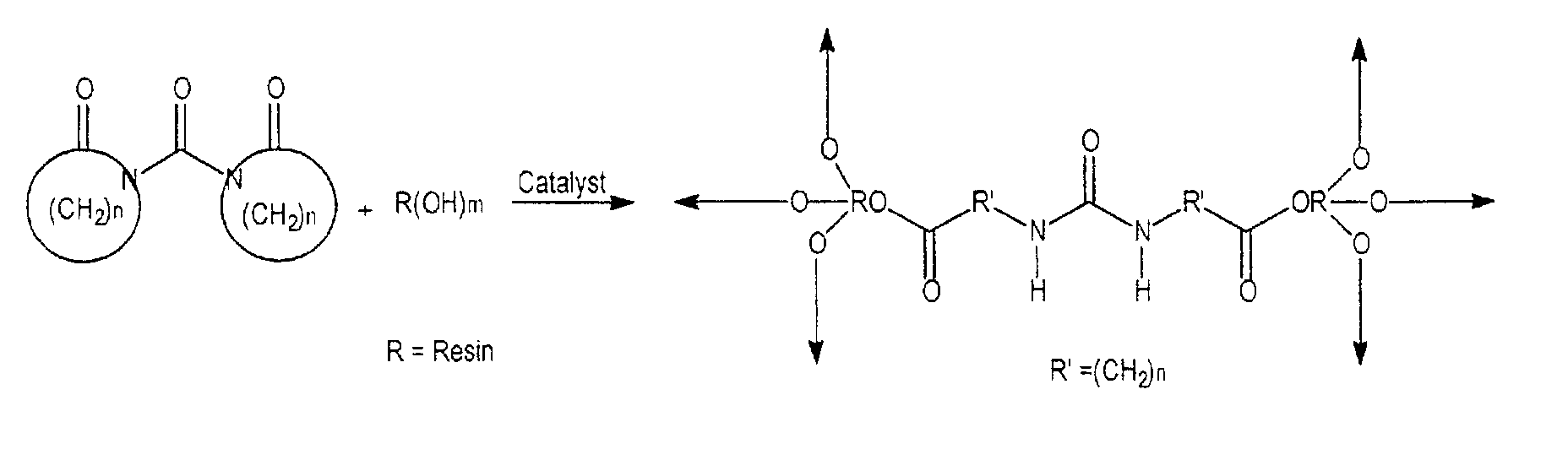
- the present invention provides a process for preparing a urea-containing polymer by contacting a hydroxy-functional organic compound having a functionality of two or more, with a coupling agent in the presence of a strong base, characterised in that the coupling agent is a carbonylbislactam compound having the general formula (I): wherein n is an integer from 3 to 15, and that the contacting is conducted at a temperature between 0°C and 100°C.
- reaction conditions are mild, i.e. the reaction is preferably carried out at temperatures ranging between room temperature and about 80°C, mainly depending on the reactivity of the reactants. A more preferred temperature is in the range of 50-60°C. Extreme conditions should be avoided to prevent undesired side-reactions.
- Suitable hydroxy-functional organic compounds which can be used as starting compound include hydroxy-functional polyethers, hydroxy-functional polyesters, hydroxy-functional polybutadienes, hydroxy-functional poly(meth)acrylates, hydroxy-functional polyolefines, polyvinylalcohols preferably partly esterified, and the like, or combinations thereof.
- the resulting cross-linked polymers have beneficial properties and can be used in a variety of applications, in particular tissue engineering and coating applications, preferably in low temperature curable powder coatings, of course depending on the reactivity of the selected starting compounds and the reaction conditions.
- a new isocyanate-free synthetic route to polyurea polymers and in particular poly(ester urea)s is provided which is primarily based on polyols commonly used in polyurethane chemistry.
- the process according to the present invention can be used for the coupling of a variety of substances having two or more hydroxy-functional groups, also referred to herein as polyol compounds.
- Preferred starting compounds having such functional hydroxy groups include hydroxy-functional polyethers, such as polyethylene glycols (PEG), polypropylene glycols, polytetrahydrofurans, and the like; hydroxy-functional polyesters, for example aliphatic polyesters, such as polycaprolactones and polybutylene adipates, or aromatic polyesters, such as polymers of ethylene glycol, propylene glycol, neopentyl glycol, butanediol, and the like, with terephthalic or isophthalic acid, and the like; hydroxy-functional polybutadienes; hydroxy-functional poly(meth)acrylates, hydroxy-functional polyolefines, polyvinylalcohols preferably partly esterified, and the like, or combinations thereof.
- the number of functional hydroxy groups in the starting polymers, m may vary, frequently in view of the final product aimed and its desired properties, and is usually in the range between 2 and 20 per chain of the starting polymer, more preferably from 2 to 10, and most preferably from 2 to 4.
- Suitable and preferred strong bases which are used in the process of the present invention include metal hydrides, metal hydroxides, metal alkylates, and metal alcoholates, where the metal is Li, Na, K, Ti, Zr, Al, Zn, Mg, and the like, the metal alkylate is a metal C 1-20 alkylate, for example n-butyl lithium, and the alcohol forming the metal alcoholate is a C 1-20 alkyl alcohol or a C 1-20 aryl(alkyl) alcohol, for example, methanol, ethanol, n- and isopropylalcohol, benzylalcohol, and the like; metal alkyls, such as n-butyl lithium, and the like.
- tertiary amines including triethylamine, tributylamine, trihexylamine, trioctylamine, guanidine, cyclic amines sus as diazobicyclo[2,2,2]octane (DABCO), dimethylaminopyridine (DMAP), and morfoline, and the like, are also suitable.
- the functionality of the starting hydroxy-functional organic compounds is two or more, preferably more than 2.5, most preferably more than 3.
- Low-temperature thermosetting polyester coatings which can be produced by the present invention predominantly contain curable polyester resins which are carboxy- and hydroxy-functional to ensure a crosslinking reaction.
- curable polyester resins which are carboxy- and hydroxy-functional to ensure a crosslinking reaction.
- a wide range of polyesters allow a combination of useful properties such as tunable reactivity, color stability, appearance, corrosion resistance and weathering performance.
- reaction of the polyol compound(s) and the carbonylbislactam compound, in particular CBC, is preferably carried out in about stoichiometric amounts of functional hydroxy groups : carbonylbislactam of 2:1, but the ranges are not very critical and may further vary, for example, from 4:1 to 1:2.
- Suitable solvents include toluene, xylene, tetrahydrofuran, and the like.
- the amount of catalyst to be used is not very critical either and may vary, for example, in the range from 10 -2 to 10 mol percent. A preferred range is from 5x10 -2 to 3 mol percent.
- reaction conditions of the process according to the invention are relatively "mild", i.e. the reaction frequently proceeds to completion at room temperature within a few minutes, of course depending on the reactivity of the reactants and the selection of the catalyst. Therefore, the reaction is conveniently carried out between room temperature and about 80°C, more preferably between 50 and 60°C. Suitable reaction times are ranging between about a few minutes, or less, to about 5 hours, more preferably from 1 minute to 3 hours, and most preferably from 5 minutes to 1 hour. Care has to be taken to avoid more extreme, especially higher temperatures, since this may result in the elimination of a lactam ring of the coupling agent rather than the opening of the ring.
- reaction conditions as well as the selection and amounts of reactants including the catalyst can be easily optimized by a person skilled in the art without inventive effort or undue experimentation.
- the reaction of CBC with hydroxy-functional organic compounds according to the process of the present invention is conveniently used for the preparation of polymers and polymer networks, e.g. based on commercial diols and triols usually applied in polyurethane formulations.
- the reaction of CBC with polyols usually occurs in analogy to the reaction of blocked diisocyanates and polyols in polyurethane chemistry.
- the substitution of diisocyanates for CBC results in the formation of poly(ester urea)s.
- CBC/ polypropylene oxide based triol formulations are conveniently mixed at room temperature with about 4 mol.% sodium alcoholate of the polyol and cured at 50°C for 10 min.
- the obtained poly(ester urea) networks show a thermal stability up to 325°C (5% weight loss) and rubber-like mechanical properties.
- post-curing may be conducted at higher temperatures (usually above 100°C, for example 150°C) to fully complete the reaction.
- the ability of the polymerized poly(ester urea)s to support cell adhesion and cell growth was examined.
- the polymer networks support cell adhesion and cell growth.
- Grown fibroblasts retain their morphology similar to the cells grown on tissue culture polystyrene. Therefore, this novel synthetic material is non-toxic and offers attractive potential for tissue engineering applications.
- Carbonylbislactam compounds and in particular CBC represents an attractive and very versatile intermediate to produce polyureas, without requiring the use of isocyanates.
- the mechanical properties, the excellent biocompatibility and the degradation behaviour of the poly(ester urea)s make them interesting materials for the substitution of polyurethanes in medical applications.
- cross-linking CBC/polyester formulations according to the present process will result in coating compositions which can be cured at much lower temperatures.
- An additional advantage of the process of the present invention is that it provides a process for coating purposes wherein no lactam is released.
- N,N'-carbonylbis(caprolactam) (DSM), methanol, ethanol, 2-propanol, lauryl alcohol and sodium hydride (all from Fluka) were used as received.
- FT-IR spectroscopy was carried out using a Bruker IFS 88 spectrometer equipped with a temperature chamber and a Golden Gate single reflection ATR unit. TGA measurements were performed using a Netzsch STA 409.
- the compositions and properties of these polyols are listed in Table 1.
- Composition and properties of the used polyols Baygal® K55 Baygal® K390 M n (g/mol) 440 4800 Number of hydroxy groups per molecule 3 3 DP n (PO) 5 69 DP n (EO) 1 15
- the resulting polymer networks were investigated with respect to their mechanical properties, thermal stability, degradation and swelling behaviour and biocompatibility.
- the formulation of the different samples and the mechanical properties are listed in Table 2.
- the p oly- e sther- u rea samples are named PEUx with x referring to the molar percentage of PPO1 used with respect to the total molar amount of PPO1 and PPO2.
- PEUx p oly- e sther- u rea samples
- x referring to the molar percentage of PPO1 used with respect to the total molar amount of PPO1 and PPO2.
- the mechanical data of sample PU0, a common polyurethane prepared from PPO2 as polyol and methylene diphenylene diisocyanate (Desmodur PU1806, Bayer AG) as diisocyanate are also listed in Table 2.
- the mechanical properties of PU0 and PEU0 are comparable.
- the CBC-based system shows a lower Young's modulus and tensile strength at break. In contrast the elongation at break increased.
- PEU0 and PEU10 show the same temperature stability as the corresponding PUO.
- the mechanical properties of polyurethanes are primarily influenced by the polyols used.
- the polyol composition for the CBC formulations was modified in analogy.
- the amount of low molecular weight polyol, PPO1 was increased from 0 to 100 wt.% due to the amount of polyol.
- the amount of CBC was also raised with increasing amount of PPO1.
- crosslinked poly(ester urea)s which are prepared by the method of the present invention have mechanical properties which are similar or identical to those obtained by conventional production methods usually involving harmful isocyanate compounds, whereas the biocompatibility and degradation behaviour of the material is much better, which makes this material extremely useful for biomedical applications.
- the ability of the polymerized CBC-polyol-networks to support cell adhesion and cell growth was investigated using a human fibroblast cell line (HS 27).
- Thin slices of the hydrogels to be investigated were immersed in 70% ethanol for 30 min for sterilization and subsequently equilibrated with cell culture medium (DMEM, Gibco).
- DMEM cell culture medium
- the image of the PEU 0 sample ( Figure 1) shows that after seeding the cells spreaded on the polymer surfaces and gradually adhered to the polymer surface within a few hours.
- the fibroblasts retained their morphology after continuous culture of fibroblasts on hydrogels for 4 days, similar to the cells grown on tissue culture polystyrene. Since the cells that adhered on the polymer surface remained healthy, the polymerized CBC-polyol-networks are considered non-toxic in vitro.
Landscapes
- Chemical & Material Sciences (AREA)
- Health & Medical Sciences (AREA)
- Chemical Kinetics & Catalysis (AREA)
- Medicinal Chemistry (AREA)
- Polymers & Plastics (AREA)
- Organic Chemistry (AREA)
- Polyurethanes Or Polyureas (AREA)
- Polyesters Or Polycarbonates (AREA)
- Materials For Medical Uses (AREA)
- Paints Or Removers (AREA)
Abstract
A process is provided for preparing urea-containing polymers by
contacting a hydroxy-functional organic compound having a functionality of two or
more, with a coupling agent in the presence of a strong base, wherein the coupling
agent is a carbonylbislactam compound having the general formula (I):
Description
- The present invention relates to new biocompatible polyurea polymers and networks of polyurea polymers, made from hydroxy-functional organic compounds. The invention relates also to the use of such polyurea polymers or polymer networks in a variety of applications, for example in tissue engineering and low temperature curable coatings.
- WO 01/66609 discloses a thermosetting composition containing a functional resin with hydroxy or amino groupsand a functionality of more than 2, a carbonylbislactam compound as crosslinking agent, and usually an acid or a base as a catalyst (especially when hydroxy-terminated resins are cured). According to the description the crosslinking temperature varies between 100 and 200°C and the working examples using a polyester resin comprising 100% isophthalic acid units, carbonylbiscaprolactam, flow benzoin, and optionally a catalyst, illustrate a curing temperature of the powder coating obtained at 200°C.
- The reaction of hydroxy-functional polymers and carbonylbislactam at temperatures above 100 °C usually proceeds in analogy with hydroxy-functional polymers and blocked isocyanates.
- Furthermore, it is generally known that the crosslinking of resins using a blocked isocyanate as crosslinking agent is conducted at temperatures of about 150°C or more. See, e.g., D.A. Wicks et al., in Progress in Organic Coatings (1999) 36:148-172.
- Synthetic biocompatible and bioresorbable polymers such as poly(α-hydroxy acid)s, poly(α-amino acid)s and poly(ester urethane)s have become increasingly important, for example for the development of temporary surgical and pharmaceutical devices, such as wound closure devices, vascular protheses or sustained drug delivery systems. See, e.g., R. Langer and N. Peppas, J. Macromol. Sci. Rev., Macromol. Chem. Phys., 1983, C32, 61; J. Kopeck and U. Ulbrich, Prog. Polym. Sci., 1983, 9:1; D.F. Williams, in: Comprehensive PolymerScience, G.C. Eastmond, et al., Eds., Pergamon Press, Oxford, England, 1989; vol. 6, p. 607; J.Y. Zhang, et al., Biomaterials 2000, 21:1247-1258.
- Bioresorbable poly(ester urethane)s and poly(ester-urea-urethane)s have been synthesized and are widely used in medical devices (G.A. Abraham, et al., J. Appl. Poly. Sci. 1997, 65:1193-1203; T. Kartvelishvili, et al., Macromol. Chem. Phys. 1997, 198:1921-1932; G. A. Abraham, et al., J. Appl. Poly. Sci. 1998, 69:2159-2167). The preparation of such polymers generally involves the use of isocyanates as crosslinking agents which are known to be very toxic and expensive. For example, C.A. Herrick, et al., J. Allergy and Clin Immun (2002) 109:873-878 describe a mouse model of diisocyanate-induces asthma showing allergic-type inflammation in the lung after inhaled antigen challenge.
- In addition, some of these polymers were observed to produce toxic by-products which have posed severe limitations on their use in vivo. For example, urethane formed by reacting poly(D,L-lactide)diol with methylenediphenyl diisocyanate hydrolyses in vivo into 4,4'-diaminodiphenylmethane, which reportedly causes hepatitis in humans (D.B. McGill, J.D. Motto, An industrial outbreak of toxic hepatitis due to methylene-dianiline. New Engl. J. Med. 1974, 291:278-282).
- Despite their toxicity urethanes and urethane ureas were found to possess unique properties which make them ideal for tissue engineering applications. These properties include a wide range of physical and mechanical properties, chemical functionality, and diversity in specific polymer characteristics.
- There is therefore a need for a manufacturing process for polyureas and other hydroxy-functional polymers in which harmful reagents, such as toxic isocyanate-based monomers, and undesired by-products are substantially avoided.
- It is an object of the present invention to provide such a process, as well as new polyurea polymers and polymer networks which are obtainable by such a process exhibiting similar or even better characteristics as the prior art urethanes and urethane ureas mentioned above.
- When investigating alternative routes for manufacturing polyureas, in particular poly(ester urea)s, substantially avoiding the use of isocyanates, it was surprisingly found that carbonylbislactam (CBL) compounds are valuable reactants when reacted with hydroxy-functional organic compounds with a functionality of more than 2 in the presence of a suitable catalyst at temperatures below 100°C, to prepare polymeric materials showing properties that at least equalize those of similar polymers prepared by conventional methods.
- Accordingly, the present invention provides a process for preparing a urea-containing polymer by contacting a hydroxy-functional organic compound having a functionality of two or more, with a coupling agent in the presence of a strong base, characterised in that the coupling agent is a carbonylbislactam compound having the general formula (I): wherein n is an integer from 3 to 15, and that the contacting is conducted at a temperature between 0°C and 100°C.
- The reaction conditions are mild, i.e. the reaction is preferably carried out at temperatures ranging between room temperature and about 80°C, mainly depending on the reactivity of the reactants. A more preferred temperature is in the range of 50-60°C. Extreme conditions should be avoided to prevent undesired side-reactions.
- A suitable and preferred carbonylbislactam coupling agent is carbonylbiscaprolactam (CBC; see formula I, wherein n = 5).
- Suitable hydroxy-functional organic compounds which can be used as starting compound include hydroxy-functional polyethers, hydroxy-functional polyesters, hydroxy-functional polybutadienes, hydroxy-functional poly(meth)acrylates, hydroxy-functional polyolefines, polyvinylalcohols preferably partly esterified, and the like, or combinations thereof.
- Suitable and preferred strong bases which can be used as catalysts in the process defined above include compounds with the formulas M(OR)p, M(OH)p, M(R)p, or M(H)p, wherein M is a metal from Groups I, II or III of the Periodic System, p = 1-3, and R is C1-20 alkyl or C1-20 aryl(alkyl).
- The resulting cross-linked polymers have beneficial properties and can be used in a variety of applications, in particular tissue engineering and coating applications, preferably in low temperature curable powder coatings, of course depending on the reactivity of the selected starting compounds and the reaction conditions.
-
- These and other objects of the present invention will be explained in further detail below.
-
- Figure 1 shows a micrograph of adherent and spread fibroblasts on PEU0, Scale bar 200 µm.
- Figure 2 shows the influence of the temperature on the polymer composition according to the present invention.
-
- According to one aspect of the present invention a new isocyanate-free synthetic route to polyurea polymers and in particular poly(ester urea)s is provided which is primarily based on polyols commonly used in polyurethane chemistry.
- It has been surprisingly found that the reaction between polyols and carbonylbislactams (CBLs) in the presence of a strong alkaline catalyst occurs relatively smoothly under mild conditions, i.e. at ambient or elevated temperatures, and results in the opening of both lactam rings as will be further explained below. Accordingly, this reaction can be conveniently used for the preparation of polyureas and polyurea networks which are known to have, inter alia, useful mechanical properties, good temperature stability, and hydrolytic resistance. In addition, these networks are biocompatible since essentially no harmful isocyanate compounds are involved in the reaction.
- As far as the inventors are aware, the reaction type of CBL with polyols resulting in the opening of the two lactam rings does not belong to the state of the art, and the resulting polymer compounds and polymer networks are therefore considered novel.
- The process according to the present invention can be used for the coupling of a variety of substances having two or more hydroxy-functional groups, also referred to herein as polyol compounds. Preferred starting compounds having such functional hydroxy groups include hydroxy-functional polyethers, such as polyethylene glycols (PEG), polypropylene glycols, polytetrahydrofurans, and the like; hydroxy-functional polyesters, for example aliphatic polyesters, such as polycaprolactones and polybutylene adipates, or aromatic polyesters, such as polymers of ethylene glycol, propylene glycol, neopentyl glycol, butanediol, and the like, with terephthalic or isophthalic acid, and the like; hydroxy-functional polybutadienes; hydroxy-functional poly(meth)acrylates, hydroxy-functional polyolefines, polyvinylalcohols preferably partly esterified, and the like, or combinations thereof. The number of functional hydroxy groups in the starting polymers, m, may vary, frequently in view of the final product aimed and its desired properties, and is usually in the range between 2 and 20 per chain of the starting polymer, more preferably from 2 to 10, and most preferably from 2 to 4.
- Suitable and preferred strong bases which are used in the process of the present invention include metal hydrides, metal hydroxides, metal alkylates, and metal alcoholates, where the metal is Li, Na, K, Ti, Zr, Al, Zn, Mg, and the like, the metal alkylate is a metal C1-20 alkylate, for example n-butyl lithium, and the alcohol forming the metal alcoholate is a C1-20 alkyl alcohol or a C1-20 aryl(alkyl) alcohol, for example, methanol, ethanol, n- and isopropylalcohol, benzylalcohol, and the like; metal alkyls, such as n-butyl lithium, and the like. However, other strong bases such as NRqH4-qOH (R is C1-20alkyl and q = 1-4), tertiary amines including triethylamine, tributylamine, trihexylamine, trioctylamine, guanidine, cyclic amines sus as diazobicyclo[2,2,2]octane (DABCO), dimethylaminopyridine (DMAP), and morfoline, and the like, are also suitable.
- The functionality of the starting hydroxy-functional organic compounds is two or more, preferably more than 2.5, most preferably more than 3.
- Low-temperature thermosetting polyester coatings which can be produced by the present invention predominantly contain curable polyester resins which are carboxy- and hydroxy-functional to ensure a crosslinking reaction. A wide range of polyesters allow a combination of useful properties such as tunable reactivity, color stability, appearance, corrosion resistance and weathering performance.
- The reaction of the polyol compound(s) and the carbonylbislactam compound, in particular CBC, is preferably carried out in about stoichiometric amounts of functional hydroxy groups : carbonylbislactam of 2:1, but the ranges are not very critical and may further vary, for example, from 4:1 to 1:2.
- It may be convenient if the process is carried out in a solvent. Suitable solvents include toluene, xylene, tetrahydrofuran, and the like.
- The amount of catalyst to be used is not very critical either and may vary, for example, in the range from 10-2 to 10 mol percent. A preferred range is from 5x10⁻² to 3 mol percent.
- The reaction conditions of the process according to the invention are relatively "mild", i.e. the reaction frequently proceeds to completion at room temperature within a few minutes, of course depending on the reactivity of the reactants and the selection of the catalyst. Therefore, the reaction is conveniently carried out between room temperature and about 80°C, more preferably between 50 and 60°C. Suitable reaction times are ranging between about a few minutes, or less, to about 5 hours, more preferably from 1 minute to 3 hours, and most preferably from 5 minutes to 1 hour. Care has to be taken to avoid more extreme, especially higher temperatures, since this may result in the elimination of a lactam ring of the coupling agent rather than the opening of the ring.
- The reaction conditions as well as the selection and amounts of reactants including the catalyst can be easily optimized by a person skilled in the art without inventive effort or undue experimentation.
- The reaction of CBC with hydroxy-functional organic compounds according to the process of the present invention is conveniently used for the preparation of polymers and polymer networks, e.g. based on commercial diols and triols usually applied in polyurethane formulations. The reaction of CBC with polyols usually occurs in analogy to the reaction of blocked diisocyanates and polyols in polyurethane chemistry. In contrast to the formation of urethanes in conventional polyurethane chemistry the substitution of diisocyanates for CBC results in the formation of poly(ester urea)s.
- As a typical example of the process according to the present invention CBC/ polypropylene oxide based triol formulations are conveniently mixed at room temperature with about 4 mol.% sodium alcoholate of the polyol and cured at 50°C for 10 min. The obtained poly(ester urea) networks show a thermal stability up to 325°C (5% weight loss) and rubber-like mechanical properties. Although the process according to the present invention generally proceeds rapidly in the temperature range defined at relatively short reaction times, post-curing may be conducted at higher temperatures (usually above 100°C, for example 150°C) to fully complete the reaction.
- The ability of the polymerized poly(ester urea)s to support cell adhesion and cell growth was examined. The polymer networks support cell adhesion and cell growth. Grown fibroblasts retain their morphology similar to the cells grown on tissue culture polystyrene. Therefore, this novel synthetic material is non-toxic and offers attractive potential for tissue engineering applications.
- Carbonylbislactam compounds and in particular CBC represents an attractive and very versatile intermediate to produce polyureas, without requiring the use of isocyanates. The mechanical properties, the excellent biocompatibility and the degradation behaviour of the poly(ester urea)s make them interesting materials for the substitution of polyurethanes in medical applications.
- Likewise, cross-linking CBC/polyester formulations according to the present process will result in coating compositions which can be cured at much lower temperatures.
- Although the present inventors do not wish to be bound to any theory on reaction mechanisms, it is believed that the present process proceeds through ring opening of both lactam rings of the coupling agent. In order to obtain information on the reaction mechanism the conversion of CBC and three monovalent alcohols, methanol, ethanol and 2-propanol, respectively, with alcoholate catalysis was monitored by FT-IR, 1H- and 13C-NMR spectroscopy. The reaction of CBC and alcohol in the presence of the corresponding alcoholate as catalyst occurs by quantitative ring opening addition of two equivalents of alcohol. This reaction behaviour was observed for methanol, ethanol and 2-propanol. No side reactions were observed at ambient temperature, a purification of the products was not necessary. This seems to confirm that CBC reacts with alcohol under alcoholate catalysis by a ring opening addition reaction.
-
- N,N'-carbonylbis(caprolactam) (DSM), methanol, ethanol, 2-propanol, lauryl alcohol and sodium hydride (all from Fluka) were used as received. The two trihydroxy-functional block copolymers of poly(propylene oxide) with poly(ethylene oxide) end segments, Baygal® K55 (Mn= 440 g/mol) and Baygal® K390 (Mn= 4800 g/mol) (both from Bayer), were dried in a vacuum mixer at 80°C for 5 h.
- FT-IR spectroscopy was carried out using a Bruker IFS 88 spectrometer equipped with a temperature chamber and a Golden Gate single reflection ATR unit. TGA measurements were performed using a Netzsch STA 409.
- 1H and 13C NMR spectra were recorded in CDCl3 at concentrations of 100 mg/ml on a Bruker ARX 300 spectrometer, operating at 300 MHz and 75.4 MHz, respectively. Melting points were determined using a Büchi Melting Point B540 apparatus.
- Differential scanning calorimetry measurements were performed on a Perkin Elmer DSC-7. Glass transition temperatures (Tg) were taken from the second heating run at a heating rate of 10 K/min. The measurements were performed from - 100°C up to 30°C.
- Flexural strength and modulus were measured using an Instron 4204 universal testing machine.
-
- 0.4 ml (10 mmol) of a potassium methanolate solution (4%), prepared by stirring 2.45 g potassium in 250 ml of methanol, were added to a solution of 2.52 g (10 mmol) CBC in 10 ml methanol. The mixture was stirred for 10 h at ambient temperature. Then 3g of acidic ion exchange resin Amberlite IR 120 (Fluka) were added to neutralize the reaction mixture. After 15 min the ion exchange resin was filtered off and the solvent was removed under reduced pressure, The product was dried in vacuo at 60°C and characterized without purification by 1H NMR, 13C NMR, FTIR spectroscopy, and melting point measurements.
- The 1H NMR spectrum of the product obtained was recorded (not shown here). All 1H NMR signals of CBC at 3.8, 2.6, 1.8 and 1.7 ppm disappeared. New signals of the adduct were observed at 4.7, 3.6, 3.1, 2.2, 1.6, 1.4 and 1.3 ppm. It was demonstrated that the reaction between CBC and methanol occurs by ring opening addition reaction, thus producing the title compound in quantitative yield. No side reactions were observed at ambient temperature and purification of the product was not necessary. Additional characterization by FT-IR and melting point measurement provided additional experimental evidence for the formation of 6,6'-uretylene-di-hexanoic acid dimethyl ester.
- Title compound: C15H28N2O5 (316 g/mol); m.p. 101°C-103°C, IR: 1730 cm-1, (s C=O ester), 1617 cm-1, (s C=O urea), 1576 cm-1, (s amide II, urea); 1H NMR: δ= 4.7 (t, 10, 13), 3.6 (s, 2. 21), 3.1 (q, 9, 14), 2.2 (t, 5, 18), 1.6 (m, 8, 15), 1.4 (m, 6, 17), 1.3 (m, 7, 16); 13C-NMR: δ= 174.0 (19, 3), 158,6 (11), 51.4 (2, 21), 40.0 (14, 9), 33.8 (5, 18), 29.9 (8, 15), 26.3 (6, 17), 24.5 (7, 16).
- In a similar manner as described in Example 1, however using ethanol instead of methanol, the title compound was obtained.
- Title compound: C17H32N2O5 (344 g/mol); m.p. 64°C-66°C, IR: 1734 cm-1, (s C=O ester), 1617 cm-1, (s C=O urea), 1589 cm-1, (s amide II, urea); 1H NMR: δ = 4.1 (q, 22, 2), 3.1 (t, 10, 15), 2.2 (t, 6, 19), 1.6 (m, 9, 16), 1.5 (m, 7, 18) 1.3 (m, 8, 17), 1.2 (t, 3, 23); 13C-NMR: δ= 173.7 (20, 4), 158.9 (12), 60.2 (2, 22), 40.2 (15, 10), 34.1 (6, 19), 29.7 (9, 16), 26.3 (7, 18), 24.4 (8, 17).
- In a similar manner as described in Example 1, however using isopropylalcohol instead of methanol, the title compound was obtained.
- Title compound: C19H26N2O5 (372 g/mol); m.p. 58°C-59°C, IR: 1731 cm-1, (s C=O ester), 1617 cm-1, (s C=O urea), 1572 cm-1, (s amide II, urea); 1H NMR: δ = 4.9 (m, 2, 23), 4.5 (t, 12, 15), 3.1 (q, 11, 16), 2.2 (t, 7, 20), 1.6 (m, 10, 17), 1.5 (m, 8, 19) 1.3 (m, 9, 118) 1.2 (d, 3, 6, 24, 26); 13C-NMR: δ= 173.2 (21. 4), 158.4 (13), 67.5 (2, 23), 40.2 (11. 16), 34.5 (7, 20), 29.8 (10, 17), 26.3 (8, 19), 24.6 (9, 18), 21.8 (3, 6, 24, 26).
- Carbonylbis(caprolactam), 1.26 g (5 mmol), and 1.865 g of lauryl alcohol (10 mmol) were reacted with 12 mg (0.5 mmol) of sodium hydride as a catalyst in a twinscrew microcompounder for 10 minutes at 30, 50, 70, 90, and 110°C, respectively. The products obtained were identified as described above.
- As illustrated in Figure 2, it was observed that at the lower temperatures the ring opening of both lactam groups of CBC is the favoured reaction pathway. At 30°C, 74% "double ring-opened" CBC were produced. Only 26% of the intermediate single ring-opened CBC underwent ring-elimination to produce urethane. Upon raising the temperature, the double ring-opened CBC decreased and was reduced to zero at 110°C (not shown).
- A polymerization experiment was conducted using Baygal® K55 (Mn = 440 g/mol) (PPO1) and Baygal® K390 (Mn = 4800 g/mol) (PPO2), two polypropylene oxide based triols, as typical examples of suitable polyols. The compositions and properties of these polyols are listed in Table 1.
Composition and properties of the used polyols Baygal® K55 Baygal® K390 Mn (g/mol) 440 4800 Number of hydroxy groups per molecule 3 3 DPn(PO) 5 69 DPn (EO) 1 15 - 16.54 g (65.6 mmol) solid CBC were mixed with 90 g (18.75 mmol) Baygal K390. After heating to 120°C for 5 min under stirring to homogenize the mixture, it was cooled to 40°C under stirring. 10 g (22.7 mmol) partially deprotonated Baygal K55, prepared by adding 138 mg (5.75 mmol) sodium hydride to 10 g (22.7 mmol) Baygal K55, were added and the mixture was stirred for further 5 min. The transparent mixture was poured into a heated (50°C) mould (200 mm x 200 mm x 4 mm) and cured at 50°C for 10 min and post-cured overnight at 125°C.
- The resulting polymer networks were investigated with respect to their mechanical properties, thermal stability, degradation and swelling behaviour and biocompatibility. The formulation of the different samples and the mechanical properties are listed in Table 2. The p oly- e sther- u rea samples are named PEUx with x referring to the molar percentage of PPO1 used with respect to the total molar amount of PPO1 and PPO2. For comparison of polyurethane and CBC chemistry the mechanical data of sample PU0, a common polyurethane prepared from PPO2 as polyol and methylene diphenylene diisocyanate (Desmodur PU1806, Bayer AG) as diisocyanate are also listed in Table 2.
Formulation and mechanical properties of the prepared poly(ester urea)s. Sample Name PU0 PEU0 PEU10 PEU20 PEU50 PEU100 Baygal® K55 [wt.%] 0 8.6 6 33 51.4 Baygal® K390 [wt.%] 1.9 92.7 7.2 4 3 0 CBC [wt.%] 8.1 7.3 14.2 0 4 48.6 Appearance yellowish transparent transparent opaque opaque transparent Tg [°C] n.d. -61 -59 -60/-12 -59 /-8 -20 TGA [°C] [5 % weight loss] 314 325 317 300 274 189 Young's modulus [N/mM2] 3.6 0.79 1.59 0.92 2.04 4.45 Tensile strength at break 0.8 0.52 0.54 0.62 1.02 0.90 [N/mm2] Elongation at break [%] 65 134 50 27 82 26 - The mechanical properties of PU0 and PEU0 are comparable. The CBC-based system shows a lower Young's modulus and tensile strength at break. In contrast the elongation at break increased. PEU0 and PEU10 show the same temperature stability as the corresponding PUO.
- The mechanical properties of polyurethanes are primarily influenced by the polyols used. The polyol composition for the CBC formulations was modified in analogy. The amount of low molecular weight polyol, PPO1 was increased from 0 to 100 wt.% due to the amount of polyol. As shown in Table 2, the amount of CBC was also raised with increasing amount of PPO1.
- In conclusion, the crosslinked poly(ester urea)s which are prepared by the method of the present invention have mechanical properties which are similar or identical to those obtained by conventional production methods usually involving harmful isocyanate compounds, whereas the biocompatibility and degradation behaviour of the material is much better, which makes this material extremely useful for biomedical applications.
- The ability of the polymerized CBC-polyol-networks to support cell adhesion and cell growth was investigated using a human fibroblast cell line (HS 27).
- Thin slices of the hydrogels to be investigated were immersed in 70% ethanol for 30 min for sterilization and subsequently equilibrated with cell culture medium (DMEM, Gibco).
- At
day 1 cells were seeded in a density of 40,000 cells per cm2 in a volume of 50 µl on the top of the hydrogel surface. After 1h incubation in a humidified incubator at 37°C equilibrated with 5% CO2, 2 ml of cell culture medium (DMEM supplemented with 10% fetal bovine serum, penicillin 100 U/ml andstreptomycin 100 µg/ml) were carefully added to each well. Gels containing cells on their surface were incubated in a humidified incubator at 37°C equilibrated with 5% CO2. - At day 4 staining with propidium iodide was performed to visualize viable adherent cells. Briefly, gels were fixed in ice-cold 70% ethanol for 10 min. After washing with phosphate buffered saline (3x5 min) the gels were incubated in a propidium iodide solution (8 µg/ml in phosphate buffered saline) in the dark for 30 min. After a second washing step (3x5 min in PBS) nuclear staining was evaluated using a fluorescence microscope (excitation 510-560 nm).
- The image of the
PEU 0 sample (Figure 1) shows that after seeding the cells spreaded on the polymer surfaces and gradually adhered to the polymer surface within a few hours. The fibroblasts retained their morphology after continuous culture of fibroblasts on hydrogels for 4 days, similar to the cells grown on tissue culture polystyrene. Since the cells that adhered on the polymer surface remained healthy, the polymerized CBC-polyol-networks are considered non-toxic in vitro.
Claims (8)
- A process for preparing a urea-containing polymer by contacting a hydroxy-functional organic compound having a functionality of two or more, with a coupling agent in the presence of a strong base, characterised in that the coupling agent is a carbonylbislactam compound having the general formula (I): wherein n is an integer from 3 to 15, and that the contacting is conducted at a temperature between 0°C and 100°C.
- A process according to claim 1, wherein the temperature ranges between room temperature and 80°C, more preferably between 50 and 60°C.
- A process according to claim 1 or 2, wherein the carbonylbislactam compound is carbonylbiscaprolactam (CBC).
- A process according to any one of claims 1 to 3, wherein the strong base is at least one compound of the formula M(OR)p, M(OH)p, M(R)p, or M(H)p, wherein M is a metal from Groups I, II or III of the Periodic System, p = 1-3, and R is C1-20 alkyl or C1-20 aryl(alkyl).
- A process according to any one of claims 1 to 4, wherein the hydroxy-functional organic compound is selected from the group consisting of hydroxy-functional polyethers, hydroxy-functional polyesters, hydroxy-functional polybutadienes, hydroxy-functional poly(meth)acrylates, hydroxy-functional polyolefines, polyvinylalcohols preferably partly esterified, or combinations thereof.
- Use of a polymer composition as defined in claim 6 or as obtained by the process of any one of claims 1 to 5, for tissue engineering.
- Use of a polymer composition as defined in claim 6 or as obtained by the process of any one of claims 1 to 5, for coatings purposes.
Priority Applications (6)
| Application Number | Priority Date | Filing Date | Title |
|---|---|---|---|
| EP02078540A EP1394191A1 (en) | 2002-08-28 | 2002-08-28 | Process for preparing biocompatible polyurea |
| EP03791486A EP1546236A1 (en) | 2002-08-28 | 2003-08-07 | Process for preparing biocompatible polyurea |
| PCT/NL2003/000567 WO2004020501A1 (en) | 2002-08-28 | 2003-08-07 | Process for preparing biocompatible polyurea |
| US10/525,953 US20060122367A1 (en) | 2002-08-28 | 2003-08-07 | Process for preparing biocompatible polyurea |
| JP2004532454A JP2005537357A (en) | 2002-08-28 | 2003-08-07 | Method for producing biocompatible polyurea |
| AU2003256158A AU2003256158A1 (en) | 2002-08-28 | 2003-08-07 | Process for preparing biocompatible polyurea |
Applications Claiming Priority (1)
| Application Number | Priority Date | Filing Date | Title |
|---|---|---|---|
| EP02078540A EP1394191A1 (en) | 2002-08-28 | 2002-08-28 | Process for preparing biocompatible polyurea |
Publications (1)
| Publication Number | Publication Date |
|---|---|
| EP1394191A1 true EP1394191A1 (en) | 2004-03-03 |
Family
ID=31197931
Family Applications (2)
| Application Number | Title | Priority Date | Filing Date |
|---|---|---|---|
| EP02078540A Withdrawn EP1394191A1 (en) | 2002-08-28 | 2002-08-28 | Process for preparing biocompatible polyurea |
| EP03791486A Withdrawn EP1546236A1 (en) | 2002-08-28 | 2003-08-07 | Process for preparing biocompatible polyurea |
Family Applications After (1)
| Application Number | Title | Priority Date | Filing Date |
|---|---|---|---|
| EP03791486A Withdrawn EP1546236A1 (en) | 2002-08-28 | 2003-08-07 | Process for preparing biocompatible polyurea |
Country Status (5)
| Country | Link |
|---|---|
| US (1) | US20060122367A1 (en) |
| EP (2) | EP1394191A1 (en) |
| JP (1) | JP2005537357A (en) |
| AU (1) | AU2003256158A1 (en) |
| WO (1) | WO2004020501A1 (en) |
Families Citing this family (1)
| Publication number | Priority date | Publication date | Assignee | Title |
|---|---|---|---|---|
| EP1621179A1 (en) * | 2004-07-30 | 2006-02-01 | DENTSPLY DETREY GmbH | Laser curable polymerisable composition for the protection of hard tissue |
Citations (1)
| Publication number | Priority date | Publication date | Assignee | Title |
|---|---|---|---|---|
| WO2001066609A1 (en) * | 2000-03-10 | 2001-09-13 | Dsm N.V. | Thermosetting composition |
-
2002
- 2002-08-28 EP EP02078540A patent/EP1394191A1/en not_active Withdrawn
-
2003
- 2003-08-07 WO PCT/NL2003/000567 patent/WO2004020501A1/en not_active Ceased
- 2003-08-07 EP EP03791486A patent/EP1546236A1/en not_active Withdrawn
- 2003-08-07 AU AU2003256158A patent/AU2003256158A1/en not_active Abandoned
- 2003-08-07 US US10/525,953 patent/US20060122367A1/en not_active Abandoned
- 2003-08-07 JP JP2004532454A patent/JP2005537357A/en active Pending
Patent Citations (1)
| Publication number | Priority date | Publication date | Assignee | Title |
|---|---|---|---|---|
| WO2001066609A1 (en) * | 2000-03-10 | 2001-09-13 | Dsm N.V. | Thermosetting composition |
Also Published As
| Publication number | Publication date |
|---|---|
| JP2005537357A (en) | 2005-12-08 |
| WO2004020501A1 (en) | 2004-03-11 |
| US20060122367A1 (en) | 2006-06-08 |
| AU2003256158A1 (en) | 2004-03-19 |
| EP1546236A1 (en) | 2005-06-29 |
Similar Documents
| Publication | Publication Date | Title |
|---|---|---|
| US8357361B2 (en) | Bioabsorbable surgical composition | |
| JP4440888B2 (en) | Production of supramolecular polymer containing 4-deuterium bond unit in polymer backbone | |
| EP2087027B1 (en) | Supramolecular polymers from low-melting, easily processable building blocks | |
| KR840000523B1 (en) | Method of Preparation of Synthetic Polymer | |
| EP0369590B1 (en) | Hydroxyl functional monomers, their preparation and their use in preparing polyurethanes | |
| CA2128345C (en) | Liquid diphenylmethane diisocyanate | |
| EP0473107A2 (en) | Method for producing non-yellowing polyurethane urea foam | |
| EP2450394B1 (en) | A process for the preparation of a supramolecular polymer | |
| Zimmermann et al. | The formation of poly (ester–urea) networks in the absence of isocyanate monomers | |
| US12071505B2 (en) | Polyurethanes and method for making polyurethanes | |
| JP7579240B2 (en) | Poly(butylene oxide) polyol-based polyurethane cast elastomers and methods for making polyurethane cast elastomers - Patents.com | |
| US5084202A (en) | Isocyanate prepolymers and secondary amines from disecondary amines and alkyl diisocyanates | |
| EP1394191A1 (en) | Process for preparing biocompatible polyurea | |
| US3277027A (en) | Polyurethane plastics prepared from a nitrogen containing polyol | |
| Covolan et al. | Polyurethane based materials for the production of biomedical materials | |
| JPH1045897A (en) | Hydroxy-functional polyurethane-carbonate, its production and its use as a binder | |
| JP4135076B2 (en) | Polyalkylene ether chain-containing diol compound, process for producing the same, and polyurethane resin | |
| US5010160A (en) | Process for preparing novel diamines | |
| US7659420B2 (en) | Dihydroxyacetone-based polymers | |
| US3833545A (en) | Fluorine-containing polyurethanes | |
| KR100945300B1 (en) | Additives for improving hydrolysis of polyurethane compounds, preparation methods thereof and polyurethane compositions using the same | |
| JP4228274B2 (en) | Polyalkylene ether chain-containing diol compound, process for producing the same, and polyurethane resin | |
| JP3220880B2 (en) | Polyurethane urea elastomer | |
| US4229561A (en) | Polyurea polymer prepared from polyethers having heterocyclic groups and terminal amino groups | |
| US20230272148A1 (en) | Thermoplastic poly(urethane-urea) polyadducts |
Legal Events
| Date | Code | Title | Description |
|---|---|---|---|
| PUAI | Public reference made under article 153(3) epc to a published international application that has entered the european phase |
Free format text: ORIGINAL CODE: 0009012 |
|
| AK | Designated contracting states |
Kind code of ref document: A1 Designated state(s): AT BE BG CH CY CZ DE DK EE ES FI FR GB GR IE IT LI LU MC NL PT SE SK TR |
|
| AX | Request for extension of the european patent |
Extension state: AL LT LV MK RO SI |
|
| STAA | Information on the status of an ep patent application or granted ep patent |
Free format text: STATUS: THE APPLICATION HAS BEEN WITHDRAWN |
|
| 18W | Application withdrawn |
Effective date: 20040324 |