EP1394110A1 - Activated carbon and method for production thereof - Google Patents
Activated carbon and method for production thereof Download PDFInfo
- Publication number
- EP1394110A1 EP1394110A1 EP02716367A EP02716367A EP1394110A1 EP 1394110 A1 EP1394110 A1 EP 1394110A1 EP 02716367 A EP02716367 A EP 02716367A EP 02716367 A EP02716367 A EP 02716367A EP 1394110 A1 EP1394110 A1 EP 1394110A1
- Authority
- EP
- European Patent Office
- Prior art keywords
- coal
- activated carbon
- amount
- semicoke
- denitration
- Prior art date
- Legal status (The legal status is an assumption and is not a legal conclusion. Google has not performed a legal analysis and makes no representation as to the accuracy of the status listed.)
- Withdrawn
Links
Images



Classifications
-
- B—PERFORMING OPERATIONS; TRANSPORTING
- B01—PHYSICAL OR CHEMICAL PROCESSES OR APPARATUS IN GENERAL
- B01D—SEPARATION
- B01D53/00—Separation of gases or vapours; Recovering vapours of volatile solvents from gases; Chemical or biological purification of waste gases, e.g. engine exhaust gases, smoke, fumes, flue gases, aerosols
- B01D53/02—Separation of gases or vapours; Recovering vapours of volatile solvents from gases; Chemical or biological purification of waste gases, e.g. engine exhaust gases, smoke, fumes, flue gases, aerosols by adsorption, e.g. preparative gas chromatography
-
- B—PERFORMING OPERATIONS; TRANSPORTING
- B01—PHYSICAL OR CHEMICAL PROCESSES OR APPARATUS IN GENERAL
- B01D—SEPARATION
- B01D53/00—Separation of gases or vapours; Recovering vapours of volatile solvents from gases; Chemical or biological purification of waste gases, e.g. engine exhaust gases, smoke, fumes, flue gases, aerosols
- B01D53/02—Separation of gases or vapours; Recovering vapours of volatile solvents from gases; Chemical or biological purification of waste gases, e.g. engine exhaust gases, smoke, fumes, flue gases, aerosols by adsorption, e.g. preparative gas chromatography
- B01D53/04—Separation of gases or vapours; Recovering vapours of volatile solvents from gases; Chemical or biological purification of waste gases, e.g. engine exhaust gases, smoke, fumes, flue gases, aerosols by adsorption, e.g. preparative gas chromatography with stationary adsorbents
-
- B—PERFORMING OPERATIONS; TRANSPORTING
- B01—PHYSICAL OR CHEMICAL PROCESSES OR APPARATUS IN GENERAL
- B01J—CHEMICAL OR PHYSICAL PROCESSES, e.g. CATALYSIS OR COLLOID CHEMISTRY; THEIR RELEVANT APPARATUS
- B01J20/00—Solid sorbent compositions or filter aid compositions; Sorbents for chromatography; Processes for preparing, regenerating or reactivating thereof
- B01J20/02—Solid sorbent compositions or filter aid compositions; Sorbents for chromatography; Processes for preparing, regenerating or reactivating thereof comprising inorganic material
- B01J20/20—Solid sorbent compositions or filter aid compositions; Sorbents for chromatography; Processes for preparing, regenerating or reactivating thereof comprising inorganic material comprising free carbon; comprising carbon obtained by carbonising processes
-
- C—CHEMISTRY; METALLURGY
- C01—INORGANIC CHEMISTRY
- C01B—NON-METALLIC ELEMENTS; COMPOUNDS THEREOF; METALLOIDS OR COMPOUNDS THEREOF NOT COVERED BY SUBCLASS C01C
- C01B32/00—Carbon; Compounds thereof
- C01B32/30—Active carbon
-
- C—CHEMISTRY; METALLURGY
- C01—INORGANIC CHEMISTRY
- C01B—NON-METALLIC ELEMENTS; COMPOUNDS THEREOF; METALLOIDS OR COMPOUNDS THEREOF NOT COVERED BY SUBCLASS C01C
- C01B32/00—Carbon; Compounds thereof
- C01B32/30—Active carbon
- C01B32/312—Preparation
-
- B—PERFORMING OPERATIONS; TRANSPORTING
- B01—PHYSICAL OR CHEMICAL PROCESSES OR APPARATUS IN GENERAL
- B01D—SEPARATION
- B01D2253/00—Adsorbents used in seperation treatment of gases and vapours
- B01D2253/10—Inorganic adsorbents
- B01D2253/102—Carbon
-
- B—PERFORMING OPERATIONS; TRANSPORTING
- B01—PHYSICAL OR CHEMICAL PROCESSES OR APPARATUS IN GENERAL
- B01D—SEPARATION
- B01D2253/00—Adsorbents used in seperation treatment of gases and vapours
- B01D2253/30—Physical properties of adsorbents
- B01D2253/302—Dimensions
- B01D2253/304—Linear dimensions, e.g. particle shape, diameter
-
- B—PERFORMING OPERATIONS; TRANSPORTING
- B01—PHYSICAL OR CHEMICAL PROCESSES OR APPARATUS IN GENERAL
- B01D—SEPARATION
- B01D2253/00—Adsorbents used in seperation treatment of gases and vapours
- B01D2253/30—Physical properties of adsorbents
- B01D2253/302—Dimensions
- B01D2253/308—Pore size
-
- B—PERFORMING OPERATIONS; TRANSPORTING
- B01—PHYSICAL OR CHEMICAL PROCESSES OR APPARATUS IN GENERAL
- B01D—SEPARATION
- B01D2257/00—Components to be removed
- B01D2257/30—Sulfur compounds
- B01D2257/302—Sulfur oxides
-
- B—PERFORMING OPERATIONS; TRANSPORTING
- B01—PHYSICAL OR CHEMICAL PROCESSES OR APPARATUS IN GENERAL
- B01D—SEPARATION
- B01D2257/00—Components to be removed
- B01D2257/40—Nitrogen compounds
-
- B—PERFORMING OPERATIONS; TRANSPORTING
- B01—PHYSICAL OR CHEMICAL PROCESSES OR APPARATUS IN GENERAL
- B01D—SEPARATION
- B01D53/00—Separation of gases or vapours; Recovering vapours of volatile solvents from gases; Chemical or biological purification of waste gases, e.g. engine exhaust gases, smoke, fumes, flue gases, aerosols
- B01D53/02—Separation of gases or vapours; Recovering vapours of volatile solvents from gases; Chemical or biological purification of waste gases, e.g. engine exhaust gases, smoke, fumes, flue gases, aerosols by adsorption, e.g. preparative gas chromatography
- B01D53/06—Separation of gases or vapours; Recovering vapours of volatile solvents from gases; Chemical or biological purification of waste gases, e.g. engine exhaust gases, smoke, fumes, flue gases, aerosols by adsorption, e.g. preparative gas chromatography with moving adsorbents, e.g. rotating beds
- B01D53/08—Separation of gases or vapours; Recovering vapours of volatile solvents from gases; Chemical or biological purification of waste gases, e.g. engine exhaust gases, smoke, fumes, flue gases, aerosols by adsorption, e.g. preparative gas chromatography with moving adsorbents, e.g. rotating beds according to the "moving bed" method
Definitions
- This invention relates to high-strength activated carbon having good desulfurization and denitration properties and durability with minimal powdering, after repetition of use and reactivation, and being suitable particularly to the desulfurization and denitration of the exhaust gasses and so on from a thermal power plant, a sintering plant and the like, and a method of producing the same.
- the dry moving bed type desulfurization and denitration treatment method is employed especially for the desulfurization and denitration of the exhaust gasses emitted from fixed emission sources, namely plants burning coal and heavy oils, and activated carbon is mainly used for the method.
- the activated carbon suitable for the use is required to have high SO x adsorption capacity, high denitration capacity for NO x under the addition of NH 3 and high durability for suppressing the disintegration caused by impact and wear in the moving beds and the powdering caused by reactions.
- various kinds of activated carbon have been proposed, but a result satisfying all these requirements at the same time has not been obtained so far.
- activated carbon having an adsorption capacity enhanced by the addition of zinc oxide onto the surface of a carbon matrix (according to Japanese Unexamined Patent Publication No. H9-66231), that having metals such as Ti, Cr, V, Fe and Cu held in a carbon matrix (according to Japanese Examined Patent Publication No. S56-18246) and that having the properties as described above by the addition of titanium dioxide to a carbon matrix (according to Japanese Unexamined Patent Publication No. H9-20509), may be cited.
- these substances are added in the order of several percents for improving catalytic functions, different metals coexist in the activated carbon and, as a result, large cracks are likely to develop inside the activated carbon, deteriorating its strength and durability.
- the addition of these substances makes the product catalysts expensive and, therefore, the proposed products are not economical.
- the activated carbon capable of obtaining good desulfurization and denitration properties by means of the control of organic oxygen contained in activated carbon and the optimization of volatile matter and grain size (according to Japanese Unexamined Patent Publication No. H11-555)
- the proposed measure is basically insufficient in enhancing strength and increasing pore volume and so on for enhancing desulfurization capacity and, thus, the required properties are not satisfied.
- the activated carbon having a high adsorption property and long service life by controlling the strength to 90% or higher and optimizing the surface area and the pore volume (according to Japanese Unexamined Patent Publication No. H7-277716) is effective in adsorbing molecules of a large effective molecular size such as volatile matter judging from the pore diameter.
- its large specific surface area is incompatible with strength and durability and, what is more, the denitration performance of this activated carbon is not disclosed in the Publication. As explained above, no conventional activated carbon is satisfactory from all the above performance and cost aspects.
- H11-157822 discloses a method of adjusting the blend of material coal so as to control the free swelling index of the mixture to a range from 1.5 to 4 and then carbonizing and activating the mixture.
- the Roga index and free swelling index are the indices of the strength such as wear resistance and the coking property of blended coal and, therefore, though it is possible to produce activated carbon excellent in wear resistance and strength by controlling the blending of coal to make the Roga index and free swelling index fall within respective specific ranges, the desulfurization performance or the desulfurization and denitration performance is not necessarily improved by the measure.
- Japanese Unexamined Patent Publication No. H11-349317 discloses a method of producing activated carbon excellent in strength and adsorption capacity by blending various kinds of coal having volatile matter and fluidity within respective optimum ranges.
- this method there are many restrictions regarding the kinds of main and ancillary materials and production conditions such as the temperature and the heating rate and, as a consequence, the problems here are that the main and ancillary materials having homogeneous components are hardly available, the activated carbon is not easily produced owing to complicated production processes, and thus the production cost is increased.
- the present invention solves the conventional problems described above and provides economical activated carbon excellent in desulfurization and denitration properties and having high strength and durability to withstand re-circulated use in a moving bed type dry desulfurization and denitration process. More specifically, the present invention provides activated carbon for desulfurization and denitration use having an impact strength of 97% or more, a Roga strength of 96% or more, an SO 2 adsorption amount of 70 mg/g. or more, a denitration ratio of 20% or more and a powdering ratio of 1.0% or less under ammonia addition.
- the present invention also provides a method of producing high-strength activated carbon excellent in desulfurization property having a high adsorption capacity (such as SO x adsorption capacity) and a high strength to withstand re-circulated use in a moving bed type dry desulfurization and denitration process.
- a high adsorption capacity such as SO x adsorption capacity
- the present invention is, therefore, activated carbon for desulfurization and denitration use produced using coal as raw material, characterized by containing volatile matter at 2.0% or more, fixed carbon at 87 to 94%, Fe 2 O 3 + TiO 2 at 0.7% or more and K 2 O + Na 2 O + CaO + MgO at 0.3 to 1.0%.
- the activated carbon according to the present invention is configured as follows.
- the fixed carbon component in the activated carbon product is controlled to 87% or more and, by so doing, a carbon matrix is secured and a high desulfurization capacity per unit pore volume is retained.
- the fixed carbon component is controlled to 94% or less and, by so doing, the development of the cracks caused by the contraction and expansion during carbonization resulting from the increased amount of superfluous carbon components is suppressed and, thus, the impact strength and Roga strength are prevented from deteriorating.
- the content of the volatile matter is controlled to 2% or more and the content of Fe 2 O 3 + TiO 2 to 0.7% or more and, by so doing, denitration capacity is enhanced.
- the content of K 2 O + Na 2 O + CaO + MgO is controlled to 0.3 to 1.0% and, by so doing, the fusion of activated carbon pores by SO x during desulfurization is inhibited and, at the same time, the powdering caused by the formation of ammonium sulfate owing to the adsorption of ammonia during denitration is suppressed, and, as a result, durability is enhanced.
- activated carbon suitable for circulated use in a moving bed type dry desulfurization and denitration process is obtained by forming activated carbon into grains or pellets 3 to 20 mm in average diameter and 5 to 20 mm in length.
- the present invention is also a method of producing robust activated carbon having an extremely high desulfurization performance (such as SO x adsorption capacity) and a high strength for withstanding protracted use in moving beds by selecting and mixing the kinds of coal wherein the amount of the components having a long transverse relaxation time, i.e., the amount of mobile hydrogen components (fusion index), in the coal grains is within a specific range, based on the results of the nuclear magnetic resonance (NMR) measurement in a temperature range where said coal is plasticized.
- an extremely high desulfurization performance such as SO x adsorption capacity
- fusion index the amount of mobile hydrogen components
- the present invention is a method of producing activated carbon, wherein activated carbon is produced by using the semicoke, which is obtained by applying low-temperature carbonization at a temperature of 300 to 600°C to coal, as the main material, using a kind of coal having a coking property as the ancillary material and, after the materials are mixed with a binder and formed into pellets, subjecting the pellets to a heat treatment for carbonization and activation, characterized by using the kind of coal, wherein the amount of the mobile hydrogen components calculated from the results of the NMR measurement at a temperature at which the coal is in a plastic state is 30% or less, as the material coal for semicoke, which constitutes the main material of the activated carbon.
- the present invention is a method of producing activated carbon by using a kind of coal, wherein the amount of the mobile hydrogen components calculated from the results of the NMR measurement at a temperature at which the coal is in a plastic state is 35 to 45%, as the coal having a coking property used as the ancillary material in the above invention.
- the method of producing activated carbon according to the present invention a great number of microscopic pores 10 ⁇ or so in diameter suitable for adsorbing SO x molecules are formed by using the kinds of coal, wherein the amount of the mobile hydrogen components calculated from the results of the NMR measurement at a temperature at which the coal is plasticized is 30% or less, as the material coal for semicoke which constitutes the main material. For this reason, the activated carbon produced from the semicoke has high strength and an excellent SO x adsorption capacity.
- activated carbon having good appearance, a high Roga strength and a good SO x adsorption capacity is produced by using the coking coal, wherein the amount of the mobile hydrogen components calculated from the results of the NMR measurement is 35 to 45%, as the material coal for pellets, which material coal constitutes the ancillary material to be mixed to the above-mentioned semicoke which constitutes the main material.
- the activated carbon according to the present invention has a fixed carbon amount of 87% or more, the pore volume, the number of pores and the specific surface area can be increased while the activated carbon has a matrix capable of maintaining a good impact strength and a good Roga strength.
- the amount of fixed carbon of the matrix is below 87%, the carbon points involved in reactions are decreased and, consequently, the pore volume and the specific surface area are also decreased even under the same conditions of the temperature and time of carbonization and the amount of activation steam and, as a result, the desulfurization capacity of the activated carbon is reduced.
- the very ammonia which is added in usual practice as an auxiliary agent for accelerating the denitration using activated carbon, is adsorbed and the ammonia adsorbed in the pores of the activated carbon reacts with SO x to form crystals of ammonium sulfate in the pores, which, as a result of volume expansion, destroys the pores, causing the powdering of the activated carbon, as shown in Fig. 4.
- the amounts of volatile matter and carbon, strength, the amounts of Fe 2 O 3 , TiO 2 , K 2 O, Na 2 O, CaO and MgO, SO x adsorption amount, denitration ratio and powdering ratio mentioned herein were measured by the following methods.
- a specimen is completely rid of free water in a dryer kept at 107°C, then, 1 g. of the specimen is put into a crucible with a lid, charged into an electric furnace heated to 900°C, heated for 7 min., extracted from the electric furnace immediately after the heating, and cooled first for 10 min. on a cold metal plate and then for 20 min. in a desiccator.
- the weight loss of the specimen by the heating is measured immediately after the cooling, and its ratio to the specimen weight initially put into the crucible is defined as the amount of the volatile matter. (According to Japanese Industrial Standard (JIS) M 8812.)
- a specimen is completely rid of free water in a dryer kept at 107°C, 1 g. of the specimen is put into an ashing pot and charged into an electric furnace, held in the electric furnace set at 815°C for 1 h., extracted from the electric furnace, and cooled first for 10 min. on a cold metal plate and then for 20 min. in a desiccator.
- the mass in the ashing pot is measured after the cooling and its ratio to the specimen weight initially put into the ashing pot is defined as the content of ash.
- a specimen of 10 g. is put into a vertical cylindrical pipe 30 mm in diameter and 415 mm in height to form a bed on the bottom, a plummet 28 mm in diameter and 328 g. in weight is dropped onto the bed twice from a height of 415 mm, the specimen is discharged from the pipe and sifted through a 0.5-mm mesh sieve.
- the proportion of the size more than 0.5 mm is defined as the impact strength. This is an indicator of expressing the mechanical strength of activated carbon independent from other factors.
- An activated carbon specimen of 30 g. is put into a rotating cylinder (200 x 70 mm) structured to receive and discharge activated carbon and having two baffle plates 30 mm in height placed at opposing positions of its inner wall, the rotating cylinder is made to turn 1,000 rounds at a rotation speed of 60 rpm, then, the activated carbon is discharged and sifted through a 3-mm mesh sieve to remove fine powder.
- the weight ratio of more than 3-mm mesh sieve to the initial weight of activated carbon is calculated and the Roga strength is determined by the following equation (1).
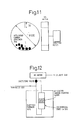
- a Roga strength tester is shown in Fig. 11.
- Roga strength (weight of the activated carbon more than 3-mm mesh sieve (g.)) / (weight of initially charged activated carbon (g.) 5) x 100
- Each of these oxides is quantified according to JIS M 8815 from the amount of ash obtained in the calculation of the volatile matter.
- a powder specimen of 2 g. ground in an agate mortar is charged into a measuring cell (Omnisorp 360 made by Beckman Coulter Inc.), deaerated under a vacuum at 150°C for 6 h. and subjected to adsorption and desorption processes by the nitrogen gas continuation capacity method in the same measuring cell.
- a BET plot is made based on the relative pressure and the amount of nitrogen molecule adsorption, and the specific surface area is calculated from the plot.
- a synthetic gas (SO 2 : 2 vol.%, O 2 : 5 vol.%, N 2 : 83 vol.%, H 2 O: 10 vol.%) is made to contact an activated carbon specimen of 10 cc, consisting of grains controlled to 1 to 3 mm in size, at 100C° for 3 h. at a flow rate of 3 Nl/min. to have the SO 2 gas adsorbed. Then, the activated carbon specimen is heated at 400°C for 1.5 h. in an N 2 gas flow to have the SO 2 gas adsorbed during the previous process carried away by the N 2 gas.
- Activated carbon of 170 cc is packed in a cylindrical column (reaction vessel for denitration test) 50 mm in diameter and heated to 90°C, and a synthetic gas (SO 2 : 135 ppm, NO: 160 ppm, NH 3 : 450 ppm, O 2 : 10%, H 2 O: 10%, and the balance consisting of N 2 ) is heated to 90°C and made to contact the packing layer of the activated carbon at a flow rate of 2 Nl/min.
- a synthetic gas SO 2 : 135 ppm, NO: 160 ppm, NH 3 : 450 ppm, O 2 : 10%, H 2 O: 10%, and the balance consisting of N 2
- Denitration ratio ⁇ (entry NO concentration) - (exit NO concentration) ⁇ / (entry NO concentration) x 100
- Activated carbon of 170 cc is packed in a cylindrical column (reaction vessel for denitration test) 50 mm in diameter and heated to 90°C, and a synthetic gas (SO 2 : 135 ppm, NO: 160 ppm, NH 3 : 450 ppm, O 2 : 10%, H 2 O: 10%, and the balance consisting of N 2 ) is made to contact the packing layer of the activated carbon at a flow rate of 2 Nl/min.
- a synthetic gas SO 2 : 135 ppm, NO: 160 ppm, NH 3 : 450 ppm, O 2 : 10%, H 2 O: 10%, and the balance consisting of N 2
- All the activated carbon is discharged from the cylindrical column after the contact with the synthetic gas for 100 h, lightly stirred in water in a beaker so as to be impregnated with water, filtered through a 1-mm metal mesh to separate a filtrate containing activated carbon fine from activated carbon pellets.
- the activated carbon fine is separated further from the filtrate by filtration, dried and then weighed to obtain the weight of the fine activated carbon.
- the activated carbon pellets are reactivated through heating at 400°C for 1.5 h. in an N 2 gas flow and then weighed to obtain the total weight of the activated carbon pellets after the reactivation.
- the sum of the weights of the activated carbon fine and the reactivated activated carbon pellets is defined as the total weight of the reactivated activated carbon.
- the reactivated activated carbon pellets are sifted through a 3-mm mesh sieve, and the weights of the undersize and the fine activated carbon are added together to obtain the weight of the activated carbon below 3 mm in size.
- the figure calculated by the following equation (3) is defined as the ratio of the powdering owing to the formation of ammonium sulfate.
- An apparatus for measuring the ratio of denitration and the ratio of the powdering owing to ammonium sulfate formation is shown in Fig. 12.
- Ratio of powdering (below 3 mm) (weight of activated carbon below 3 mm) / (total weight of reactivated activated carbon) x 100
- the amount of mobile hydrogen components, Roga strength, the ratio of desulfurization and denitration and the ratio of the powdering owing to ammonium sulfate formation in the present invention are measured in the following manner.
- a subject coal specimen is charged into a specimen tube exclusively used for a nuclear magnetic resonance apparatus. Note that there is no specific restriction as to the grain size and shape of the coal specimen as long as the grain size is several millimeters or less so as to be put into the specimen tube.
- the NMR image of hydrogen nuclei in coal is obtained by the following measurement method: the pulse duration of hydrogen at 90° is set at 8 ⁇ sec., the echo time at 50 ⁇ sec. to 3 msec., the repetition time at 5 msec.
- the data size is set at 512 points in the X direction, 512 points in the Y direction and 1 to 512 points in the Z direction; the measurement is done by imposing magnetic field gradients of 89, 96 and 107 gauss/cm, respectively, on the X, Y and Z axes within a short time while the specimen is heated at a rate of 3°C/min.
- the NMR image of the coal in a plastic state is obtained by carrying out the same measurement procedures continuing the heating further.
- the distribution at an adequate transverse relaxation time and the amount of mobile hydrogen components are calculated from the images thus obtained.
- the amount of mobile hydrogen components means the amount of the components having a transverse relaxation time of 100 ⁇ sec. or more in the temperature range where the coal is in a plastic state.
- the multiple pulse and the transverse relaxation time are described in Japanese Unexamined Patent Publication No. H11-326248.
- reference numeral 1 indicates the coal to be transformed into char through the application of low-temperature carbonization, namely the coal used as the raw material coal of the semicoke which constitutes the main material of the activated carbon according to the present invention.
- the coal is the one wherein the amount of the mobile hydrogen components calculated from the results of the NMR measurement at a temperature corresponding to the temperature range in which the coal is in a plastic state is 30% or less, preferably from 15 to 30%.
- the reason why the amount of the mobile hydrogen components calculated from the results of the NMR measurement at a temperature corresponding to the temperature range in which the coal is in a plastic state is to be within the above specified range is that, when the amount of the mobile hydrogen components exceeds 30%, the volume of the pores 10 ⁇ or so in diameter, which are effective for adsorbing SO x molecules, is decreased and, when the amount is below 15%, on the other hand, the effect of improving the SO x adsorption capacity becomes saturated and no further significant improvement can be expected.
- the coal 1 is transformed into semicoke by charging it into a low-temperature carbonization furnace 2 and carbonizing it at a low temperature under the condition of an oxygen concentration of 6% or less, a heating atmosphere temperature from 300 to 600°C, preferably from 400 to 550°C, and a residence time inside the heating zone of the furnace from 15 to 120 min., preferably from 25 to 80 min.
- a heating atmosphere temperature from 300 to 600°C, preferably from 400 to 550°C
- a residence time inside the heating zone of the furnace from 15 to 120 min., preferably from 25 to 80 min.
- the evaporation of the volatile matter does not advance sufficiently for forming the pore structure required for the semicoke and, consequently, the semicoke obtained will be of a poor pore structure, having only crystal water and a small part of the volatile matter evaporated.
- the activating reaction with steam or other activating gas does not proceed sufficiently in the activation process and, as a result, what is obtained is activated carbon having only a poor SO x adsorption capacity.
- the temperature of the heating atmosphere is 600°C or above or the residence time inside the furnace is 120 min.
- the amount of mobile hydrogen components calculated from the results of the NMR measurement of the coking coal to be mixed as the ancillary material is from 35 to 45%.
- the reason for this is that, when a kind of coal having an amount of the mobile hydrogen components below 35% is used as the ancillary material, while the appearance of the produced activated carbon is good, its Roga strength is significantly lowered and, when a kind of coal having an amount of the mobile hydrogen components in excess of 45% is used as the ancillary material, on the other hand, the produced activated carbon swells owing to an excessive coking property and cracks develop as a result and, in addition, many large diameter pores are formed inside the activated carbon and, as a consequence, its Roga strength is lowered.
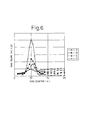
- Fig. 6 shows the examples of the measurement results of the pore diameter distributions of the semicoke produced from the 16 kinds of coal by heating at 450°C for 60 min. From the measurement results of the pore diameter distributions of the produced semicoke, said 16 kinds of coal can be classified into four categories, A, B, C and D, according to the degree of the development of the volume of the pores 10 ⁇ or so in diameter.
- the semicoke produced from the kinds of coal belonging to categories B, C and D having an amount of the mobile hydrogen components exceeding 30% has a structure in which the volume of the pores 10 ⁇ or so in diameter is singularly developed, even under the same heating conditions.
- the volume of the pores 10 ⁇ or so in diameter of the semicoke produced from the kinds of coal belonging to category B, C or D decreases as the amount of the mobile hydrogen components increases.
- Fig. 7 shows the relation between the SO x adsorption capacity of the semicoke produced and the heating time when the low-temperature carbonization is applied at 450°C. From this result, it is clear that the semicoke produced from the kinds of coal belonging to category A has the best SO x adsorption capacity, and the SO x adsorption capacity decreases as the amount of the mobile hydrogen components in the coal increases.
- the semicoke to be used as the main material is crushed in a crusher 3.
- the coking coal 4 to be used as the ancillary material is also crushed in the crusher 3.
- the main material semicoke and the ancillary material coking coal 4 thus crushed are mixed at a ratio from 9:1 to 5:5, preferably from 8:2 to 6:4, to form a crushed grain mixture.
- the crushed grain mixture is fed to a kneading machine 7, where coal-based or petroleum-based heavy oil such as tar or pitch, or waste liquor from pulp production or the like, is added as a binder 5 and, in addition, a forming aid 6 is added.
- the kneaded mixture is then fed to a forming machine 8 and formed into pellets 5 to 20 mm in diameter and 5 to 30 mm in length. Subsequently, the pellets are fed at a prescribed rate to a carbonization furnace (carbonization and activation furnace) 9 such as a rotary kiln and, there, they are carbonized and activated at a temperature from 750 to 950°C and a furnace resident time from 60 to 90 min., while steam 10 and nitrogen gas 11 are added so that the activation advances effectively.
- a carbonization furnace carbonization and activation furnace
- a product 12 namely high-strength activated carbon: containing volatile matter of 2.3%, fixed carbon of 91%, the Fe 2 O 3 + TiO 2 component of 0.7% and the K 2 O + Na 2 O + CaO + MgO component of 0.4%; having high desulfurization and denitration performance and high durability such as an impact strength of 99%, a Roga strength of 99%, a SO x adsorption capacity of 70 mg/g., a denitration ratio of 24% and a powdering ratio of 0.5%; and being quite suitable for being used in a dry desulfurization and denitration apparatus using NH 3 addition; is produced.
- An exhaust gas containing SO x : 135 ppm, NO x : 150 ppm, O 2 : 10% and H 2 O: 10% was treated by using activated carbon according to the present invention, passing through an adsorption tower equipped with three moving beds wherein the activated carbon moves downwards so as to move in the opposite direction to the flow of the gas, applying the addition of NH 3 by 150 ppm at the third bed, and moving the activated carbon beds at a space velocity of 400 l/h.
- the activated carbon after the adsorption treatment could be reused after removing sulfuric contents in a regenerator kept at 400°C; a very stable operation was possible at the reuse of the activated carbon, achieving a desulfurization ratio of 99%, a denitration ratio of 25% and a powdering ratio of 0.5%.
- Fig. 8 shows the relation between the addition amount of the ancillary material coal mixed to the main material and the Roga strength.
- the main material semicoke was produced by heating the kind of coal 1 belonging to category A at 450°C for 60 min.
- the activated carbon for which the coal belonging to category A or B was used as the coking coal to be mixed as the ancillary material the product shape was good with no apparent cracking caused by swelling or expansion and its grain size was narrowly distributed, but the Roga strength was significantly lower than conventional activated carbon.
- the swelling caused by an excessive coking property occurred, a great number of large diameter pores were seen at section surfaces and the Roga strength was lower than conventional activated carbon.
- the activated carbon for which the coal belonging to category C was used as the coking coal to be mixed as the ancillary material in contrast, when the mixing ratio of the main material semicoke and the ancillary material coking coal was within the range from 9:1 to 5:5, the obtained activated carbon did not have the cracks caused by the swelling or expansion, the product shape was good, the grain size was narrowly distributed and the Roga strength was higher than conventional activated carbon.
- Table 3 shows the performance figures of the kinds of activated carbon produced by changing the contents of Fe 2 O 3 , TiO 2 , K 2 O, Na 2 O, CaO and MgO in the material coals through the addition of respective chemicals and changing, among the above production condition items, the contents of the fixed carbon and volatile matter through the control of the carbonization temperature and time, but keeping the grain size and other material conditions the same as the above.
- the required properties are not satisfied.
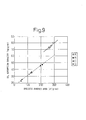
- Fig. 9 The relation between the specific surface area and SO x adsorption capacity of the activated carbon produced through the method described above is shown in Fig. 9 together with that of comparative examples.
- Semicoke was produced through the low-temperature carbonization of the six kinds of coal belonging to category A wherein the amounts of the mobile hydrogen components were 30% or less, among the 16 kinds of coal having different amounts of the mobile hydrogen components listed in Table 1, and activated carbon was produced using the semicoke thus obtained as the main material.
- the kinds of coal belonging to category A were rough-crushed to a grain size of 50 mm or less, carbonized into semicoke in an external heating type rotary kiln under the conditions of an oxygen concentration of 2% or less, a heating atmosphere temperature of 450°C and a residence time in the kiln of 60 min., and then the semicoke thus produced was crushed in a crusher to be used as the main material of the activated carbon.
- the pitch coal having a fusion index of the mobile hydrogen components being 40.2% was crushed in a crusher and used as the ancillary material.
- the main and ancillary materials were mixed in a mass ratio of 8:2, then coal-based soft pitch of 20 mass % was added as a binder and water of 15 mass % as a forming aid to the mixture. After sufficiently kneading the mixture thus prepared in a kneading machine, it was formed into columnar pellets 10 mm in diameter and 10 mm in length by an extrusion forming machine.
- the activated carbon was produced from the pellets by feeding them to an external heating type rotary kiln and carbonizing and activating them through heating, in an atmosphere having an oxygen concentration of 1% and an injection amount of activating steam of 1.0 kg per kg of the pellets, so that the highest temperature of the pellets was 830°C, the average heating rate was 18°C/min. and the holding time at 800°C or above was 40 min.
- the activated carbon thus obtained had a Roga strength of 97.9 to 98.8%, a SO x adsorption capacity of 72.0 to 80.2 mg/g-ac, a denitration ratio of 48% and a ratio of the powdering owing to ammonium sulfate formation of 0.01% and, thus it was excellent as the activated carbon for desulfurization and denitration use.
- Semicoke was produced through the low-temperature carbonization of the two kinds of coal belonging to category B wherein the amounts of the mobile hydrogen components were over 30% but below 35%, among the 16 kinds of coal having different amounts of the mobile hydrogen components listed in Table 1, and activated carbon was produced using the semicoke thus obtained as the main material.
- the kinds of coal belonging to category B were rough-crushed to grain size of 50 mm or less, carbonized into semicoke in an external heating type rotary kiln under the conditions of an oxygen concentration of 2% or less, a heating atmosphere temperature of 450°C and a residence time in the kiln of 60 min., and then the semicoke thus produced was crushed in a crusher to be used as the main material of the activated carbon.
- the pitch coal having a fusion index of the mobile hydrogen components being 40.2% was crushed in a crusher and used as the ancillary material.
- the main and ancillary materials were mixed in a mass ratio of 8:2, then coal-based soft pitch of 20 mass % was added as a binder and water of 15 mass % as a forming aid to the mixture.
- coal-based soft pitch of 20 mass % was added as a binder and water of 15 mass % as a forming aid to the mixture.
- the activated carbon was produced from the pellets by feeding them to an external heating type rotary kiln and carbonizing and activating them through heating, in an atmosphere having an oxygen concentration of 1% and an injection amount of activating steam of 1.0 kg per kg of the pellets, so that the highest temperature of the pellets was 830°C, the average heating rate was 18°C/min. and the holding time at 800°C or above was 40 min.
- the activated carbon thus obtained had a sufficiently high Roga strength of 97.1 to 98.2%, but it had a SO x adsorption capacity of 45.5 to 47.0 mg/g-ac, a denitration ratio of 38% and a ratio of the powdering owing to ammonium sulfate formation of 0.9%, much inferior to the example according to the present invention.
- Semicoke was produced through the low-temperature carbonization of the six kinds of coal belonging to category C wherein the amounts of the mobile hydrogen components were from 35% to 45%, among the 16 kinds of coal having different amounts of the mobile hydrogen components listed in Table 1, and activated carbon was produced using the semicoke thus obtained as the main material.
- the kinds of coal belonging to category C were rough-crushed to a grain size of 50 mm or less, carbonized into semicoke in an external heating type rotary kiln under the conditions of an oxygen concentration of 2% or less, a heating atmosphere temperature of 450°C and a residence time in the kiln of 60 min., and then the semicoke thus produced was crushed in a crusher to be used as the main material of the activated carbon.
- the pitch coal having a fusion index of the mobile hydrogen components being 40.2% was crushed in a crusher and used as the ancillary material.
- the main and ancillary materials were mixed in a mass ratio of 8:2, then coal-based soft pitch of 20 mass % was added as a binder and water of 15 mass % as a forming aid to the mixture.
- coal-based soft pitch of 20 mass % was added as a binder and water of 15 mass % as a forming aid to the mixture.
- the activated carbon was produced from the pellets by feeding them to an external heating type rotary kiln and carbonizing and activating them through heating, in an atmosphere having an oxygen concentration of 1% and an injection amount of activating steam of 1.0 kg per kg of the pellets, so that the highest temperature of the pellets was 830°C, the average heating rate was 18°C/min. and the holding time at 800°C or above was 40 min.
- the activated carbon thus obtained had a Roga strength of 92.0 to 94.8%, a SO x adsorption capacity of 33.0 to 36.0 mg/g-ac, a denitration ratio of 38% and a ratio of the powdering owing to ammonium sulfate formation of 1.2%, much inferior to the example according to the present invention in any of the performance figures.
- Semicoke was produced through the low-temperature carbonization of the three kinds of coal belonging to category D wherein the amounts of the mobile hydrogen components exceeded 45%, among the 16 kinds of coal having different amounts of the mobile hydrogen components listed in Table 1, and activated carbon was produced using the semicoke thus obtained as the main material.
- the kinds of coal belonging to category D were rough-crushed to grain size of 50 mm or less, carbonized into semicoke in an external heating type rotary kiln under the conditions of an oxygen concentration of 2% or less, a heating atmosphere temperature of 450°C and a residence time in the kiln of 60 min., and then the semicoke thus produced was crushed in a crusher to be used as the main material of the activated carbon.
- the pitch coal having a fusion index of the mobile hydrogen components being 40.2% was crushed in a crusher and used as the ancillary material.
- the main and ancillary materials were mixed in a mass ratio of 8:2, then coal-based soft pitch of 20 mass % was added as a binder and water of 15 mass % as a forming aid to the coal mixture.
- coal-based soft pitch of 20 mass % was added as a binder and water of 15 mass % as a forming aid to the coal mixture.
- the activated carbon was produced from the pellets by feeding them to an external heating type rotary kiln and carbonizing and activating them through heating, in an atmosphere having an oxygen concentration of 1% and an injection amount of activating steam of 1.0 kg per kg of the pellets, so that the highest temperature of the pellets was 830°C, the average heating rate was 18°C/min. and the holding time at 800°C or above was 40 min.
- the activated carbon thus obtained had a Roga strength of 90.2 to 92.1%, a SO x adsorption capacity of 10.8 to 12.0 mg/g-ac, a denitration ratio of 5% and a ratio of powdering owing to ammonium sulfate formation of 1.0%, remarkably inferior to the example according to the present invention in any of the performance figures.
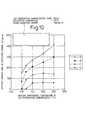
- Fig. 9 shows that the SO x adsorption capacity is improved as the specific surface area is increased by the formation of pores. It is clear from the figure that the activated carbon having a large specific surface area produced from the coal of category A shows good desulfurization performance. As the specific surface area changes widely depending on the temperature of the heating atmosphere of the low-temperature carbonization as shown in Fig. 10, it is desirable to adequately control the temperature during the carbonization.
- the activated carbon according to the present invention is an economical activated carbon excellent in desulfurization and denitration performance, strength, impact resistance and wear resistance, and demonstrates very little powdering even when used in a denitration apparatus using ammonia.
- the method of producing activated carbon according to the present invention makes it possible to form a great number of pores 10 ⁇ or so in diameter suitable for adsorbing SO x molecules by using the kind of coal, wherein the amount of the mobile hydrogen components calculated from the results of the NMR measurement at a temperature at which the coal is in a plastic state is 30% or less, as the coal for producing the semicoke used as the main material through low-temperature carbonization, and makes the activated carbon thus produced from the material have a high strength and an excellent desulfurization performance (SO x adsorption capacity, for instance).
- the method also makes it possible to produce activated carbon excellent in appearance and having a high Roga strength, good desulfurization performance (SO x adsorption capacity) and a low ratio of the powdering owing to ammonium sulfate formation by using the kind of coking coal, wherein the amount of the mobile hydrogen components calculated from the results of the NMR measurement is from 35 to 45%, as the ancillary material to be mixed with the main material semicoke. Furthermore, the method makes it possible to obtain the activated carbon excellent in the desulfurization and denitration performance.
Landscapes
- Chemical & Material Sciences (AREA)
- Organic Chemistry (AREA)
- Inorganic Chemistry (AREA)
- Analytical Chemistry (AREA)
- Chemical Kinetics & Catalysis (AREA)
- Engineering & Computer Science (AREA)
- General Chemical & Material Sciences (AREA)
- Oil, Petroleum & Natural Gas (AREA)
- Carbon And Carbon Compounds (AREA)
- Solid-Sorbent Or Filter-Aiding Compositions (AREA)
- Treating Waste Gases (AREA)
Abstract
Description
- This invention relates to high-strength activated carbon having good desulfurization and denitration properties and durability with minimal powdering, after repetition of use and reactivation, and being suitable particularly to the desulfurization and denitration of the exhaust gasses and so on from a thermal power plant, a sintering plant and the like, and a method of producing the same.
- In view of the growing environmental disruption resulting from the emission of atmospheric contaminants such as sulfur oxides and nitrogen oxides, more stringent emission regulation is imperative for the conservation of the global environment. The technologies for coping with the problem are varied; the dry moving bed type desulfurization and denitration treatment method is employed especially for the desulfurization and denitration of the exhaust gasses emitted from fixed emission sources, namely plants burning coal and heavy oils, and activated carbon is mainly used for the method. The activated carbon suitable for the use is required to have high SOx adsorption capacity, high denitration capacity for NOx under the addition of NH3 and high durability for suppressing the disintegration caused by impact and wear in the moving beds and the powdering caused by reactions. As countermeasures, various kinds of activated carbon have been proposed, but a result satisfying all these requirements at the same time has not been obtained so far.
- As some examples, activated carbon having an adsorption capacity enhanced by the addition of zinc oxide onto the surface of a carbon matrix (according to Japanese Unexamined Patent Publication No. H9-66231), that having metals such as Ti, Cr, V, Fe and Cu held in a carbon matrix (according to Japanese Examined Patent Publication No. S56-18246) and that having the properties as described above by the addition of titanium dioxide to a carbon matrix (according to Japanese Unexamined Patent Publication No. H9-20509), may be cited. However, when these substances are added in the order of several percents for improving catalytic functions, different metals coexist in the activated carbon and, as a result, large cracks are likely to develop inside the activated carbon, deteriorating its strength and durability. Besides, the addition of these substances makes the product catalysts expensive and, therefore, the proposed products are not economical. Apart from the above, in the activated carbon capable of obtaining good desulfurization and denitration properties by means of the control of organic oxygen contained in activated carbon and the optimization of volatile matter and grain size (according to Japanese Unexamined Patent Publication No. H11-555), while denitration performance is enhanced by increasing the amount of organic oxygen, which accelerates denitration through the optimization of the amount of organic oxygen, the proposed measure is basically insufficient in enhancing strength and increasing pore volume and so on for enhancing desulfurization capacity and, thus, the required properties are not satisfied. The activated carbon having a high adsorption property and long service life by controlling the strength to 90% or higher and optimizing the surface area and the pore volume (according to Japanese Unexamined Patent Publication No. H7-277716) is effective in adsorbing molecules of a large effective molecular size such as volatile matter judging from the pore diameter. However, its large specific surface area is incompatible with strength and durability and, what is more, the denitration performance of this activated carbon is not disclosed in the Publication. As explained above, no conventional activated carbon is satisfactory from all the above performance and cost aspects.
- A wide variety of studies have been carried out for eliminating the shortcomings of activated carbon adsorbents. As a result, methods for producing formed activated carbon suitable for desulfurization and denitration purposes have been proposed, wherein coal is used as the raw material, various binders are added to the material coal and the mixture is formed and then carbonized and activated under specific conditions. For example, Japanese Examined Patent Publication No. S62-51885 discloses a method of: producing semicoke having high activity from coal using the semicoke as the main material; adding some kinds of coal and binders to the semicoke; adjusting the strength so as to control the Roga index to 20 to 30% and; then, carbonizing and activating the mixture. As another example, Japanese Unexamined Patent Publication No. H11-157822 discloses a method of adjusting the blend of material coal so as to control the free swelling index of the mixture to a range from 1.5 to 4 and then carbonizing and activating the mixture. However, the Roga index and free swelling index are the indices of the strength such as wear resistance and the coking property of blended coal and, therefore, though it is possible to produce activated carbon excellent in wear resistance and strength by controlling the blending of coal to make the Roga index and free swelling index fall within respective specific ranges, the desulfurization performance or the desulfurization and denitration performance is not necessarily improved by the measure.
- Further, Japanese Unexamined Patent Publication No. H11-349317 discloses a method of producing activated carbon excellent in strength and adsorption capacity by blending various kinds of coal having volatile matter and fluidity within respective optimum ranges. In this method, however, there are many restrictions regarding the kinds of main and ancillary materials and production conditions such as the temperature and the heating rate and, as a consequence, the problems here are that the main and ancillary materials having homogeneous components are hardly available, the activated carbon is not easily produced owing to complicated production processes, and thus the production cost is increased.
- The present invention solves the conventional problems described above and provides economical activated carbon excellent in desulfurization and denitration properties and having high strength and durability to withstand re-circulated use in a moving bed type dry desulfurization and denitration process. More specifically, the present invention provides activated carbon for desulfurization and denitration use having an impact strength of 97% or more, a Roga strength of 96% or more, an SO2 adsorption amount of 70 mg/g. or more, a denitration ratio of 20% or more and a powdering ratio of 1.0% or less under ammonia addition. The present invention also provides a method of producing high-strength activated carbon excellent in desulfurization property having a high adsorption capacity (such as SOx adsorption capacity) and a high strength to withstand re-circulated use in a moving bed type dry desulfurization and denitration process.
- By focusing attention on the control of the components of activated carbon, the present inventors dedicated themselves to concentrated studies to develop economical activated carbon having sufficient desulfurization and denitration properties and high durability for treating multi-component exhaust gasses containing SOx, NOx, H2O and so on. As a result, they discovered that it was possible to attain the above object by controlling the components of activated carbon, and established the present invention. The present invention is, therefore, activated carbon for desulfurization and denitration use produced using coal as raw material, characterized by containing volatile matter at 2.0% or more, fixed carbon at 87 to 94%, Fe2O3 + TiO2 at 0.7% or more and K2O + Na2O + CaO + MgO at 0.3 to 1.0%.
- The activated carbon according to the present invention is configured as follows. The fixed carbon component in the activated carbon product is controlled to 87% or more and, by so doing, a carbon matrix is secured and a high desulfurization capacity per unit pore volume is retained. In addition, the fixed carbon component is controlled to 94% or less and, by so doing, the development of the cracks caused by the contraction and expansion during carbonization resulting from the increased amount of superfluous carbon components is suppressed and, thus, the impact strength and Roga strength are prevented from deteriorating. The content of the volatile matter is controlled to 2% or more and the content of Fe2O3 + TiO2 to 0.7% or more and, by so doing, denitration capacity is enhanced. In addition, the content of K2O + Na2O + CaO + MgO is controlled to 0.3 to 1.0% and, by so doing, the fusion of activated carbon pores by SOx during desulfurization is inhibited and, at the same time, the powdering caused by the formation of ammonium sulfate owing to the adsorption of ammonia during denitration is suppressed, and, as a result, durability is enhanced. It has to be noted that activated carbon suitable for circulated use in a moving bed type dry desulfurization and denitration process is obtained by forming activated carbon into grains or
pellets 3 to 20 mm in average diameter and 5 to 20 mm in length. - The present invention is also a method of producing robust activated carbon having an extremely high desulfurization performance (such as SOx adsorption capacity) and a high strength for withstanding protracted use in moving beds by selecting and mixing the kinds of coal wherein the amount of the components having a long transverse relaxation time, i.e., the amount of mobile hydrogen components (fusion index), in the coal grains is within a specific range, based on the results of the nuclear magnetic resonance (NMR) measurement in a temperature range where said coal is plasticized. More specifically, the present invention is a method of producing activated carbon, wherein activated carbon is produced by using the semicoke, which is obtained by applying low-temperature carbonization at a temperature of 300 to 600°C to coal, as the main material, using a kind of coal having a coking property as the ancillary material and, after the materials are mixed with a binder and formed into pellets, subjecting the pellets to a heat treatment for carbonization and activation, characterized by using the kind of coal, wherein the amount of the mobile hydrogen components calculated from the results of the NMR measurement at a temperature at which the coal is in a plastic state is 30% or less, as the material coal for semicoke, which constitutes the main material of the activated carbon. In addition, the present invention is a method of producing activated carbon by using a kind of coal, wherein the amount of the mobile hydrogen components calculated from the results of the NMR measurement at a temperature at which the coal is in a plastic state is 35 to 45%, as the coal having a coking property used as the ancillary material in the above invention.
- By the method of producing activated carbon according to the present invention, a great number of
microscopic pores 10 Å or so in diameter suitable for adsorbing SOx molecules are formed by using the kinds of coal, wherein the amount of the mobile hydrogen components calculated from the results of the NMR measurement at a temperature at which the coal is plasticized is 30% or less, as the material coal for semicoke which constitutes the main material. For this reason, the activated carbon produced from the semicoke has high strength and an excellent SOx adsorption capacity. Further, activated carbon having good appearance, a high Roga strength and a good SOx adsorption capacity is produced by using the coking coal, wherein the amount of the mobile hydrogen components calculated from the results of the NMR measurement is 35 to 45%, as the material coal for pellets, which material coal constitutes the ancillary material to be mixed to the above-mentioned semicoke which constitutes the main material. -
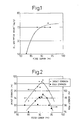
- [Fig. 1] A graph showing the relation between the amount of fixed carbon components and the desulfurization ratio.
- [Fig. 2] A graph showing the relation of the amount of fixed carbon components to impact strength and Roga strength.
- [Fig. 3] A graph showing the relation of the amount of Fe2O3 + TiO2 components to denitration ratio and impact strength.
- [Fig. 4] A graph showing the relation of the amount of K2O + Na2O + CaO + MgO components to powdering ratio and Roga strength.
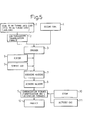
- [Fig. 5] A flow chart of the process for producing activated carbon according to the present invention.
- [Fig. 6] An explanatory graph showing the distributions of pore volume of the kinds of semicoke produced from four kinds of coal classified by the amount of mobile hydrogen components.
- [Fig. 7] A graph showing the relation between low-temperature carbonization time and the SOx adsorption capacity of semicoke.
- [Fig. 8] A graph showing the relation between the mixing ratio of ancillary material coal having a coking property and Roga strength.
- [Fig. 9] A graph showing the increase of SOx adsorption capacity with the increment of specific surface area with regard to the kinds of material coal for semicoke used as the main material of activated carbon.
- [Fig. 10] A graph showing the change of the specific surface area of activated carbon according to the temperature of the low-temperature carbonization.
- [Fig. 11] An explanatory illustration of a Roga strength tester.
- [fig. 12] An explanatory illustration of the method of measuring denitration ratio and the ratio of powdering resulting from the formation of ammonium sulfate.
-
- When the activated carbon according to the present invention has a fixed carbon amount of 87% or more, the pore volume, the number of pores and the specific surface area can be increased while the activated carbon has a matrix capable of maintaining a good impact strength and a good Roga strength. However, as seen in Fig. 1, when the amount of fixed carbon of the matrix is below 87%, the carbon points involved in reactions are decreased and, consequently, the pore volume and the specific surface area are also decreased even under the same conditions of the temperature and time of carbonization and the amount of activation steam and, as a result, the desulfurization capacity of the activated carbon is reduced.
- In such a situation, even if a great amount of steam is used for the activation in order to forcibly increase the pore volume and specific surface area, the number of pores does not increase in proportion to the amount of steam but only the pore volume does. This means that only the desulfurization capacity increases and, what is more, since the pore volume increases mainly in large diameter pores, strength decreases adversely. When the amount of fixed carbon is increased to over 94%, the desulfurization capacity becomes saturated even under the same conditions of the temperature and time of carbonization and the amount of activation steam as specified above and, in addition, as is clear from Fig. 2, impact strength and Roga strength are lowered, because cracks easily develop as a result of the shortage of ash content in portions not fused during carbonization, which ash content prevents the internal cracks resulting from the expansion and contraction during the carbonization process from propagating, as a consequence of the increase in carbon content. Further, when the amount of volatile matter is below 2% and that of the Fe2O3 + TiO2 component is below 0.7%, as shown in Fig. 3, the denitration catalyst capacity of the activated carbon becomes less efficient, lowering its denitration capacity. In addition, when the amount of the K2O + Na2O + CaO + MgO component is below 0.3%, the very ammonia, which is added in usual practice as an auxiliary agent for accelerating the denitration using activated carbon, is adsorbed and the ammonia adsorbed in the pores of the activated carbon reacts with SOx to form crystals of ammonium sulfate in the pores, which, as a result of volume expansion, destroys the pores, causing the powdering of the activated carbon, as shown in Fig. 4. When the amount of the K2O + Na2O + CaO + MgO component exceeds 1.0%, on the other hand, the SOx existing in the pores in the form of sulfuric acid reacts with the K2O + Na2O + CaO + MgO component in the activated carbon and corrosion propagates from the positions where the K2O + Na2O + CaO + MgO component exists. This accelerates the powdering likewise and the durability of the activated carbon is remarkably deteriorated. For these reasons, in order to enhance the desulfurization and denitration efficiency and satisfy the performance in both the strength and durability aspects at the same time in the use of the activated carbon, it is imperative to restrain the contents of the above components to within the respective ranges specified above.
- The amounts of volatile matter and carbon, strength, the amounts of Fe2O3, TiO2, K2O, Na2O, CaO and MgO, SOx adsorption amount, denitration ratio and powdering ratio mentioned herein were measured by the following methods.
- A specimen is completely rid of free water in a dryer kept at 107°C, then, 1 g. of the specimen is put into a crucible with a lid, charged into an electric furnace heated to 900°C, heated for 7 min., extracted from the electric furnace immediately after the heating, and cooled first for 10 min. on a cold metal plate and then for 20 min. in a desiccator. The weight loss of the specimen by the heating is measured immediately after the cooling, and its ratio to the specimen weight initially put into the crucible is defined as the amount of the volatile matter. (According to Japanese Industrial Standard (JIS) M 8812.)
- A specimen is completely rid of free water in a dryer kept at 107°C, 1 g. of the specimen is put into an ashing pot and charged into an electric furnace, held in the electric furnace set at 815°C for 1 h., extracted from the electric furnace, and cooled first for 10 min. on a cold metal plate and then for 20 min. in a desiccator. The mass in the ashing pot is measured after the cooling and its ratio to the specimen weight initially put into the ashing pot is defined as the content of ash. The amount of fixed carbon is calculated from the amounts of the volatile matter and the ash obtained as above by the following equation: fixed carbon (%) = 100 - (ash (%) + volatile matter (%)). (According to JIS M 8812.)
- A specimen of 10 g. is put into a vertical
cylindrical pipe 30 mm in diameter and 415 mm in height to form a bed on the bottom, a plummet 28 mm in diameter and 328 g. in weight is dropped onto the bed twice from a height of 415 mm, the specimen is discharged from the pipe and sifted through a 0.5-mm mesh sieve. The proportion of the size more than 0.5 mm is defined as the impact strength. This is an indicator of expressing the mechanical strength of activated carbon independent from other factors. - An activated carbon specimen of 30 g. is put into a rotating cylinder (200 x 70 mm) structured to receive and discharge activated carbon and having two
baffle plates 30 mm in height placed at opposing positions of its inner wall, the rotating cylinder is made to turn 1,000 rounds at a rotation speed of 60 rpm, then, the activated carbon is discharged and sifted through a 3-mm mesh sieve to remove fine powder. The weight ratio of more than 3-mm mesh sieve to the initial weight of activated carbon is calculated and the Roga strength is determined by the following equation (1). A Roga strength tester is shown in Fig. 11. - Each of these oxides is quantified according to JIS M 8815 from the amount of ash obtained in the calculation of the volatile matter.
- A powder specimen of 2 g. ground in an agate mortar is charged into a measuring cell (Omnisorp 360 made by Beckman Coulter Inc.), deaerated under a vacuum at 150°C for 6 h. and subjected to adsorption and desorption processes by the nitrogen gas continuation capacity method in the same measuring cell. A BET plot is made based on the relative pressure and the amount of nitrogen molecule adsorption, and the specific surface area is calculated from the plot.
- A synthetic gas (SO2: 2 vol.%, O2: 5 vol.%, N2: 83 vol.%, H2O: 10 vol.%) is made to contact an activated carbon specimen of 10 cc, consisting of grains controlled to 1 to 3 mm in size, at 100C° for 3 h. at a flow rate of 3 Nl/min. to have the SO2 gas adsorbed. Then, the activated carbon specimen is heated at 400°C for 1.5 h. in an N2 gas flow to have the SO2 gas adsorbed during the previous process carried away by the N2 gas. All the SO2 gas carried away by the N2 gas is absorbed in a 3% aqueous solution of H2O2 (recovered as sulfuric acid through the reaction: SO2 + H2O2 → H2SO4). The amount of adsorbed SO2 determined by the neutralization titration of the absorption liquor by the arsenazo III method specified in JIS K 0103 is defined as the SOx adsorption capacity. The amount of SO2 adsorbed per 1 g. of activated carbon is expressed using the unit mg/g-ac, where "ac" stands for activated carbon.
- Activated carbon of 170 cc is packed in a cylindrical column (reaction vessel for denitration test) 50 mm in diameter and heated to 90°C, and a synthetic gas (SO2: 135 ppm, NO: 160 ppm, NH3: 450 ppm, O2: 10%, H2O: 10%, and the balance consisting of N2) is heated to 90°C and made to contact the packing layer of the activated carbon at a flow rate of 2 Nl/min. The concentrations of NO are measured at the entry to and the exit from the packing layer of the activated carbon after the synthetic gas is supplied for 20 h., and the denitration ratio is determined by the following equation (2):
- Activated carbon of 170 cc is packed in a cylindrical column (reaction vessel for denitration test) 50 mm in diameter and heated to 90°C, and a synthetic gas (SO2: 135 ppm, NO: 160 ppm, NH3: 450 ppm, O2: 10%, H2O: 10%, and the balance consisting of N2) is made to contact the packing layer of the activated carbon at a flow rate of 2 Nl/min. All the activated carbon is discharged from the cylindrical column after the contact with the synthetic gas for 100 h, lightly stirred in water in a beaker so as to be impregnated with water, filtered through a 1-mm metal mesh to separate a filtrate containing activated carbon fine from activated carbon pellets. The activated carbon fine is separated further from the filtrate by filtration, dried and then weighed to obtain the weight of the fine activated carbon. The activated carbon pellets are reactivated through heating at 400°C for 1.5 h. in an N2 gas flow and then weighed to obtain the total weight of the activated carbon pellets after the reactivation. The sum of the weights of the activated carbon fine and the reactivated activated carbon pellets is defined as the total weight of the reactivated activated carbon. The reactivated activated carbon pellets are sifted through a 3-mm mesh sieve, and the weights of the undersize and the fine activated carbon are added together to obtain the weight of the activated carbon below 3 mm in size. Then, the figure calculated by the following equation (3) is defined as the ratio of the powdering owing to the formation of ammonium sulfate. An apparatus for measuring the ratio of denitration and the ratio of the powdering owing to ammonium sulfate formation is shown in Fig. 12.
- The amount of mobile hydrogen components, Roga strength, the ratio of desulfurization and denitration and the ratio of the powdering owing to ammonium sulfate formation in the present invention are measured in the following manner.
- A subject coal specimen is charged into a specimen tube exclusively used for a nuclear magnetic resonance apparatus. Note that there is no specific restriction as to the grain size and shape of the coal specimen as long as the grain size is several millimeters or less so as to be put into the specimen tube. The NMR image of hydrogen nuclei in coal is obtained by the following measurement method: the pulse duration of hydrogen at 90° is set at 8 µsec., the echo time at 50 µsec. to 3 msec., the repetition time at 5 msec. to 1 sec., and the number of accumulations to 512 times; the data size is set at 512 points in the X direction, 512 points in the Y direction and 1 to 512 points in the Z direction; the measurement is done by imposing magnetic field gradients of 89, 96 and 107 gauss/cm, respectively, on the X, Y and Z axes within a short time while the specimen is heated at a rate of 3°C/min. The NMR image of the coal in a plastic state is obtained by carrying out the same measurement procedures continuing the heating further. The distribution at an adequate transverse relaxation time and the amount of mobile hydrogen components are calculated from the images thus obtained. Here, the amount of mobile hydrogen components means the amount of the components having a transverse relaxation time of 100 µsec. or more in the temperature range where the coal is in a plastic state. The multiple pulse and the transverse relaxation time are described in Japanese Unexamined Patent Publication No. H11-326248.
- In Fig. 5,
reference numeral 1 indicates the coal to be transformed into char through the application of low-temperature carbonization, namely the coal used as the raw material coal of the semicoke which constitutes the main material of the activated carbon according to the present invention. The coal is the one wherein the amount of the mobile hydrogen components calculated from the results of the NMR measurement at a temperature corresponding to the temperature range in which the coal is in a plastic state is 30% or less, preferably from 15 to 30%. The reason why the amount of the mobile hydrogen components calculated from the results of the NMR measurement at a temperature corresponding to the temperature range in which the coal is in a plastic state is to be within the above specified range is that, when the amount of the mobile hydrogen components exceeds 30%, the volume of thepores 10 Å or so in diameter, which are effective for adsorbing SOx molecules, is decreased and, when the amount is below 15%, on the other hand, the effect of improving the SOx adsorption capacity becomes saturated and no further significant improvement can be expected. - The
coal 1 is transformed into semicoke by charging it into a low-temperature carbonization furnace 2 and carbonizing it at a low temperature under the condition of an oxygen concentration of 6% or less, a heating atmosphere temperature from 300 to 600°C, preferably from 400 to 550°C, and a residence time inside the heating zone of the furnace from 15 to 120 min., preferably from 25 to 80 min. The reasons why the condition of the low-temperature carbonization is defined as above are as follows. When the temperature of the heating atmosphere is 300°C or below or the residence time inside the furnace is 15 min. or shorter, the evaporation of the volatile matter does not advance sufficiently for forming the pore structure required for the semicoke and, consequently, the semicoke obtained will be of a poor pore structure, having only crystal water and a small part of the volatile matter evaporated. If such insufficiently heated semicoke is used as the main material for producing activated carbon, the activating reaction with steam or other activating gas does not proceed sufficiently in the activation process and, as a result, what is obtained is activated carbon having only a poor SOx adsorption capacity. When the temperature of the heating atmosphere is 600°C or above or the residence time inside the furnace is 120 min. or longer, on the other hand, while the evaporation of the volatile matter advances sufficiently for forming the pore structure, the graphitization of the matrix of the very semicoke overshoots. Since the crystal of graphite is a stable structure in which constituent carbon atoms are arranged regularly, if it exists in activated carbon in a great quantity, not only the SOx adsorption capacity but also the catalytic activity for denitration is markedly reduced. - Since the SOx adsorption capacity and the strength of an activated carbon product are determined by the microscopic pores and the coking property, which remains to some extent, of the semicoke which constitutes the main material, the selection of the material coal used for producing semicoke is of vital importance. In order for activated carbon to have a high SOx adsorption capacity, it is desirable that many pores having an appropriate diameter for adsorbing SOx molecules be formed in the semicoke to be used as the main material of the activated carbon. The amounts of mobile hydrogen components calculated from the results of the NMR measurement at a temperature corresponding to the temperature range in which the coal is in a plastic state are shown in Table 1, comparing 16 kinds of coal having different degrees of coalification. The range of the temperature at which the kinds of coal listed therein are in a plastic state is from 350 to 510°C.
- Besides the above, it is desirable that the amount of mobile hydrogen components calculated from the results of the NMR measurement of the coking coal to be mixed as the ancillary material is from 35 to 45%. The reason for this is that, when a kind of coal having an amount of the mobile hydrogen components below 35% is used as the ancillary material, while the appearance of the produced activated carbon is good, its Roga strength is significantly lowered and, when a kind of coal having an amount of the mobile hydrogen components in excess of 45% is used as the ancillary material, on the other hand, the produced activated carbon swells owing to an excessive coking property and cracks develop as a result and, in addition, many large diameter pores are formed inside the activated carbon and, as a consequence, its Roga strength is lowered.
-
Classification Amount of mobile hydrogen components
(%)A Coal 120.1 Coal 223.1 Coal 323.6 Coal 4 25.7 Coal 526.1 Coal 629.3 B Coal 7 30.5 Coal 834.5 C Coal 9 35.4 Coal 1038.0 Coal 11 38.9 Coal 1240.2 Coal 13 40.2 D Coal 14 45.8 Coal 1548.2 Coal 16 51.3 - Fig. 6 shows the examples of the measurement results of the pore diameter distributions of the semicoke produced from the 16 kinds of coal by heating at 450°C for 60 min. From the measurement results of the pore diameter distributions of the produced semicoke, said 16 kinds of coal can be classified into four categories, A, B, C and D, according to the degree of the development of the volume of the
pores 10 Å or so in diameter. That is to say, compared with the semicoke produced from the kinds of coal belonging to categories B, C and D having an amount of the mobile hydrogen components exceeding 30%, the semicoke produced from the kinds of coal belonging to category A having an amount of the mobile hydrogen components of 30% or less has a structure in which the volume of thepores 10 Å or so in diameter is singularly developed, even under the same heating conditions. Besides, the volume of thepores 10 Å or so in diameter of the semicoke produced from the kinds of coal belonging to category B, C or D decreases as the amount of the mobile hydrogen components increases. While no swelling or expansion is apparent in the semicoke produced from the kinds of coal belonging to category B, the semicoke produced from the kind of coal belonging to categories C or D shows remarkable swelling; coarse pores are seen in sectional surfaces of such semicoke, and a number of coarse pores caused by swelling or expansion are seen also on the outer surface of the semicoke. In the case of the kinds of coal belonging to category D, especially, coal grains are deformed by swelling and they strongly stick to each other by fusion, causing problems in the operation of activated carbon production. - Next, Fig. 7 shows the relation between the SOx adsorption capacity of the semicoke produced and the heating time when the low-temperature carbonization is applied at 450°C. From this result, it is clear that the semicoke produced from the kinds of coal belonging to category A has the best SOx adsorption capacity, and the SOx adsorption capacity decreases as the amount of the mobile hydrogen components in the coal increases. This indicates that, for effectively enhancing the SOx adsorption capacity at the stage where the coal has been changed into the semicoke to be used as the main material, it is necessary to increase the volume of the
pores 10 Å or so in diameter as much as possible and, to this end, it is desirable to use as the main material the semicoke produced by applying low-temperature carbonization to the kinds of coal belonging to category A wherein the amount of the mobile hydrogen components calculated from the results of the NMR measurement in the temperature range where the coal is in a plastic state is 30% or less. - The semicoke to be used as the main material is crushed in a
crusher 3. The coking coal 4 to be used as the ancillary material is also crushed in thecrusher 3. Then, the main material semicoke and the ancillary material coking coal 4 thus crushed are mixed at a ratio from 9:1 to 5:5, preferably from 8:2 to 6:4, to form a crushed grain mixture. Then, the crushed grain mixture is fed to a kneadingmachine 7, where coal-based or petroleum-based heavy oil such as tar or pitch, or waste liquor from pulp production or the like, is added as abinder 5 and, in addition, a formingaid 6 is added. The kneaded mixture is then fed to a formingmachine 8 and formed intopellets 5 to 20 mm in diameter and 5 to 30 mm in length. Subsequently, the pellets are fed at a prescribed rate to a carbonization furnace (carbonization and activation furnace) 9 such as a rotary kiln and, there, they are carbonized and activated at a temperature from 750 to 950°C and a furnace resident time from 60 to 90 min., whilesteam 10 and nitrogen gas 11 are added so that the activation advances effectively. By the above procedures, aproduct 12, namely high-strength activated carbon: containing volatile matter of 2.3%, fixed carbon of 91%, the Fe2O3 + TiO2 component of 0.7% and the K2O + Na2O + CaO + MgO component of 0.4%; having high desulfurization and denitration performance and high durability such as an impact strength of 99%, a Roga strength of 99%, a SOx adsorption capacity of 70 mg/g., a denitration ratio of 24% and a powdering ratio of 0.5%; and being quite suitable for being used in a dry desulfurization and denitration apparatus using NH3 addition; is produced. - An exhaust gas containing SOx: 135 ppm, NOx: 150 ppm, O2: 10% and H2O: 10% was treated by using activated carbon according to the present invention, passing through an adsorption tower equipped with three moving beds wherein the activated carbon moves downwards so as to move in the opposite direction to the flow of the gas, applying the addition of NH3 by 150 ppm at the third bed, and moving the activated carbon beds at a space velocity of 400 l/h. The activated carbon after the adsorption treatment could be reused after removing sulfuric contents in a regenerator kept at 400°C; a very stable operation was possible at the reuse of the activated carbon, achieving a desulfurization ratio of 99%, a denitration ratio of 25% and a powdering ratio of 0.5%.
- Fig. 8 shows the relation between the addition amount of the ancillary material coal mixed to the main material and the Roga strength. In this case, the main material semicoke was produced by heating the kind of
coal 1 belonging to category A at 450°C for 60 min. In the activated carbon for which the coal belonging to category A or B was used as the coking coal to be mixed as the ancillary material, the product shape was good with no apparent cracking caused by swelling or expansion and its grain size was narrowly distributed, but the Roga strength was significantly lower than conventional activated carbon. In the activated carbon for which the coal belonging to category D was used as the coking coal to be mixed as the ancillary material, the swelling caused by an excessive coking property occurred, a great number of large diameter pores were seen at section surfaces and the Roga strength was lower than conventional activated carbon. In the activated carbon for which the coal belonging to category C was used as the coking coal to be mixed as the ancillary material, in contrast, when the mixing ratio of the main material semicoke and the ancillary material coking coal was within the range from 9:1 to 5:5, the obtained activated carbon did not have the cracks caused by the swelling or expansion, the product shape was good, the grain size was narrowly distributed and the Roga strength was higher than conventional activated carbon. This indicates that, for obtaining robust activated carbon, it is essential to select as the ancillary material a kind of coking coal in which the amount of the mobile hydrogen components calculated from the results of the NMR measurement at a temperature corresponding to the temperature range where the coal is in a plastic state is from 35 to 45%. - Various kinds of activated carbon containing different amounts of volatile matters, fixed carbon, Fe2O3 + TiO2 components and K2O + Na2O + CaO + MgO components were produced by controlling the mixing ratio of two or more kinds of coal which were the raw material of the activated carbon and keeping identical the production conditions of the grain size of crushing, the temperature and time of carbonization, the shape of forming, the temperature of activation and the amount of activating steam. Table 2 shows the properties, namely the impact strength, Roga strength, SOx adsorption amount, denitration ratio and powdering ratio, of the kinds of activated carbon falling within the rage of the present invention and those outside it. As is clear from the table, when the volatile matter content is 2% or more, if any one of the other parameters, namely the amounts of the fixed carbon, Fe2O3 + TiO2 component and K2O + Na2O + CaO + MgO component, is outside the range of the present invention, the required propeties are not satisfied.
- Table 3 shows the performance figures of the kinds of activated carbon produced by changing the contents of Fe2O3, TiO2, K2O, Na2O, CaO and MgO in the material coals through the addition of respective chemicals and changing, among the above production condition items, the contents of the fixed carbon and volatile matter through the control of the carbonization temperature and time, but keeping the grain size and other material conditions the same as the above. As in the case where different kinds of coal are used as the materials, if any one of the amounts of the fixed carbon, volatile matter, Fe2O3 + TiO2 component and K2O + Na2O + CaO + MgO component is outside the range of the present invention, the required properties are not satisfied.
-

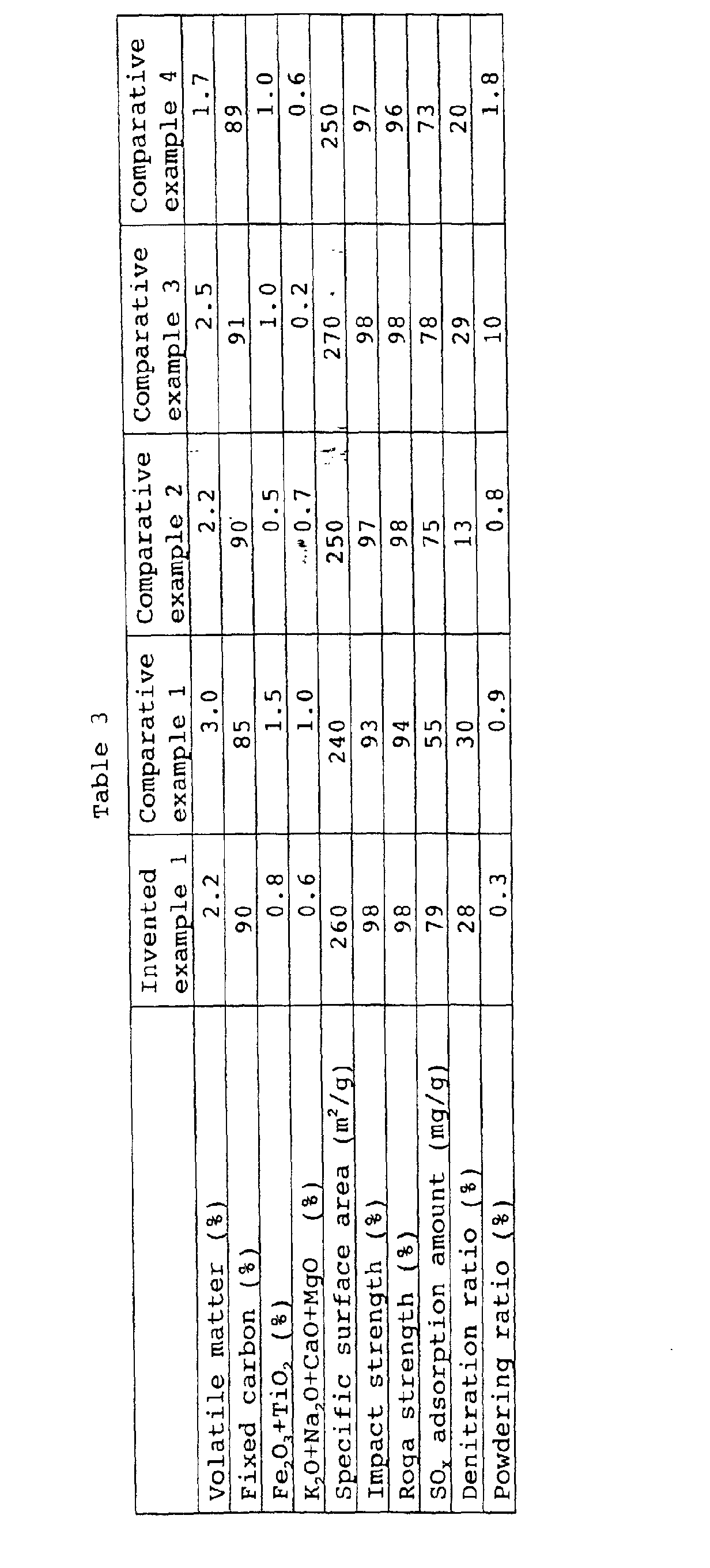
- The relation between the specific surface area and SOx adsorption capacity of the activated carbon produced through the method described above is shown in Fig. 9 together with that of comparative examples. Semicoke was produced through the low-temperature carbonization of the six kinds of coal belonging to category A wherein the amounts of the mobile hydrogen components were 30% or less, among the 16 kinds of coal having different amounts of the mobile hydrogen components listed in Table 1, and activated carbon was produced using the semicoke thus obtained as the main material. The kinds of coal belonging to category A were rough-crushed to a grain size of 50 mm or less, carbonized into semicoke in an external heating type rotary kiln under the conditions of an oxygen concentration of 2% or less, a heating atmosphere temperature of 450°C and a residence time in the kiln of 60 min., and then the semicoke thus produced was crushed in a crusher to be used as the main material of the activated carbon. In the production of the activated carbon, among the 16 kinds of coal having different contents of the mobile hydrogen components listed in Table 1, the pitch coal having a fusion index of the mobile hydrogen components being 40.2% was crushed in a crusher and used as the ancillary material. The main and ancillary materials were mixed in a mass ratio of 8:2, then coal-based soft pitch of 20 mass % was added as a binder and water of 15 mass % as a forming aid to the mixture. After sufficiently kneading the mixture thus prepared in a kneading machine, it was formed into
columnar pellets 10 mm in diameter and 10 mm in length by an extrusion forming machine. The activated carbon was produced from the pellets by feeding them to an external heating type rotary kiln and carbonizing and activating them through heating, in an atmosphere having an oxygen concentration of 1% and an injection amount of activating steam of 1.0 kg per kg of the pellets, so that the highest temperature of the pellets was 830°C, the average heating rate was 18°C/min. and the holding time at 800°C or above was 40 min. The activated carbon thus obtained had a Roga strength of 97.9 to 98.8%, a SOx adsorption capacity of 72.0 to 80.2 mg/g-ac, a denitration ratio of 48% and a ratio of the powdering owing to ammonium sulfate formation of 0.01% and, thus it was excellent as the activated carbon for desulfurization and denitration use. - Semicoke was produced through the low-temperature carbonization of the two kinds of coal belonging to category B wherein the amounts of the mobile hydrogen components were over 30% but below 35%, among the 16 kinds of coal having different amounts of the mobile hydrogen components listed in Table 1, and activated carbon was produced using the semicoke thus obtained as the main material. The kinds of coal belonging to category B were rough-crushed to grain size of 50 mm or less, carbonized into semicoke in an external heating type rotary kiln under the conditions of an oxygen concentration of 2% or less, a heating atmosphere temperature of 450°C and a residence time in the kiln of 60 min., and then the semicoke thus produced was crushed in a crusher to be used as the main material of the activated carbon. In the production of the activated carbon, among the 16 kinds of coal having different contents of the mobile hydrogen components listed in Table 1, the pitch coal having a fusion index of the mobile hydrogen components being 40.2% was crushed in a crusher and used as the ancillary material. The main and ancillary materials were mixed in a mass ratio of 8:2, then coal-based soft pitch of 20 mass % was added as a binder and water of 15 mass % as a forming aid to the mixture. After sufficiently kneading the mixture thus prepared in a kneading machine, it was formed into
columnar pellets 10 mm in diameter and 10 mm in length by an extrusion forming machine. The activated carbon was produced from the pellets by feeding them to an external heating type rotary kiln and carbonizing and activating them through heating, in an atmosphere having an oxygen concentration of 1% and an injection amount of activating steam of 1.0 kg per kg of the pellets, so that the highest temperature of the pellets was 830°C, the average heating rate was 18°C/min. and the holding time at 800°C or above was 40 min. The activated carbon thus obtained had a sufficiently high Roga strength of 97.1 to 98.2%, but it had a SOx adsorption capacity of 45.5 to 47.0 mg/g-ac, a denitration ratio of 38% and a ratio of the powdering owing to ammonium sulfate formation of 0.9%, much inferior to the example according to the present invention. - Semicoke was produced through the low-temperature carbonization of the six kinds of coal belonging to category C wherein the amounts of the mobile hydrogen components were from 35% to 45%, among the 16 kinds of coal having different amounts of the mobile hydrogen components listed in Table 1, and activated carbon was produced using the semicoke thus obtained as the main material. The kinds of coal belonging to category C were rough-crushed to a grain size of 50 mm or less, carbonized into semicoke in an external heating type rotary kiln under the conditions of an oxygen concentration of 2% or less, a heating atmosphere temperature of 450°C and a residence time in the kiln of 60 min., and then the semicoke thus produced was crushed in a crusher to be used as the main material of the activated carbon. In the production of the activated carbon, among the 16 kinds of coal having different contents of the mobile hydrogen components listed in Table 1, the pitch coal having a fusion index of the mobile hydrogen components being 40.2% was crushed in a crusher and used as the ancillary material. The main and ancillary materials were mixed in a mass ratio of 8:2, then coal-based soft pitch of 20 mass % was added as a binder and water of 15 mass % as a forming aid to the mixture. After sufficiently kneading the mixture thus prepared in a kneading machine, it was formed into
columnar pellets 10 mm in diameter and 10 mm in length by an extrusion forming machine. The activated carbon was produced from the pellets by feeding them to an external heating type rotary kiln and carbonizing and activating them through heating, in an atmosphere having an oxygen concentration of 1% and an injection amount of activating steam of 1.0 kg per kg of the pellets, so that the highest temperature of the pellets was 830°C, the average heating rate was 18°C/min. and the holding time at 800°C or above was 40 min. The activated carbon thus obtained had a Roga strength of 92.0 to 94.8%, a SOx adsorption capacity of 33.0 to 36.0 mg/g-ac, a denitration ratio of 38% and a ratio of the powdering owing to ammonium sulfate formation of 1.2%, much inferior to the example according to the present invention in any of the performance figures. - Semicoke was produced through the low-temperature carbonization of the three kinds of coal belonging to category D wherein the amounts of the mobile hydrogen components exceeded 45%, among the 16 kinds of coal having different amounts of the mobile hydrogen components listed in Table 1, and activated carbon was produced using the semicoke thus obtained as the main material. The kinds of coal belonging to category D were rough-crushed to grain size of 50 mm or less, carbonized into semicoke in an external heating type rotary kiln under the conditions of an oxygen concentration of 2% or less, a heating atmosphere temperature of 450°C and a residence time in the kiln of 60 min., and then the semicoke thus produced was crushed in a crusher to be used as the main material of the activated carbon. In the production of the activated carbon, among the 16 kinds of coal having different contents of the mobile hydrogen components listed in Table 1, the pitch coal having a fusion index of the mobile hydrogen components being 40.2% was crushed in a crusher and used as the ancillary material. The main and ancillary materials were mixed in a mass ratio of 8:2, then coal-based soft pitch of 20 mass % was added as a binder and water of 15 mass % as a forming aid to the coal mixture. After sufficiently kneading the mixture thus prepared in a kneading machine, it was formed into
columnar pellets 10 mm in diameter and 10 mm in length by an extrusion forming machine. The activated carbon was produced from the pellets by feeding them to an external heating type rotary kiln and carbonizing and activating them through heating, in an atmosphere having an oxygen concentration of 1% and an injection amount of activating steam of 1.0 kg per kg of the pellets, so that the highest temperature of the pellets was 830°C, the average heating rate was 18°C/min. and the holding time at 800°C or above was 40 min. The activated carbon thus obtained had a Roga strength of 90.2 to 92.1%, a SOx adsorption capacity of 10.8 to 12.0 mg/g-ac, a denitration ratio of 5% and a ratio of powdering owing to ammonium sulfate formation of 1.0%, remarkably inferior to the example according to the present invention in any of the performance figures. - Fig. 9 shows that the SOx adsorption capacity is improved as the specific surface area is increased by the formation of pores. It is clear from the figure that the activated carbon having a large specific surface area produced from the coal of category A shows good desulfurization performance. As the specific surface area changes widely depending on the temperature of the heating atmosphere of the low-temperature carbonization as shown in Fig. 10, it is desirable to adequately control the temperature during the carbonization.
- As has been explained above, the activated carbon according to the present invention is an economical activated carbon excellent in desulfurization and denitration performance, strength, impact resistance and wear resistance, and demonstrates very little powdering even when used in a denitration apparatus using ammonia. The method of producing activated carbon according to the present invention makes it possible to form a great number of
pores 10 Å or so in diameter suitable for adsorbing SOx molecules by using the kind of coal, wherein the amount of the mobile hydrogen components calculated from the results of the NMR measurement at a temperature at which the coal is in a plastic state is 30% or less, as the coal for producing the semicoke used as the main material through low-temperature carbonization, and makes the activated carbon thus produced from the material have a high strength and an excellent desulfurization performance (SOx adsorption capacity, for instance). In addition, the method also makes it possible to produce activated carbon excellent in appearance and having a high Roga strength, good desulfurization performance (SOx adsorption capacity) and a low ratio of the powdering owing to ammonium sulfate formation by using the kind of coking coal, wherein the amount of the mobile hydrogen components calculated from the results of the NMR measurement is from 35 to 45%, as the ancillary material to be mixed with the main material semicoke. Furthermore, the method makes it possible to obtain the activated carbon excellent in the desulfurization and denitration performance.
Claims (3)
- Activated carbon produced from coal for desulfurization and denitration use characterized by containing volatile matter at 2.0% or more, fixed carbon at 87 to 94%, Fe2O3 + TiO2 at 0.7% or more and K2O + Na2O + CaO + MgO at 0.3 to 1.0%.
- A method of producing activated carbon by using the semicoke produced by applying low-temperature carbonization to coal at a temperature from 300 to 600°C as the main material and a kind of coal having a coking property as the ancillary material, kneading and forming the materials into pellets with an addition of a binder and then applying a carbonization and activation treatment to the pellets, characterized by using the kind of coal, wherein the amount of mobile hydrogen components calculated from the results of the NMR measurement at a temperature at which the coal is in a plastic state is 30% or less, as the material coal of the semicoke which constitutes the main material of the activated carbon.
- A method of producing activated carbon according to claim 2, characterized by using the kind of coal, wherein the amount of mobile hydrogen components calculated from the results of the NMR measurement at a temperature at which the coal is in a plastic state is 35 to 45%, as a coking coal which constitutes the ancillary material of the activated carbon.
Applications Claiming Priority (5)
| Application Number | Priority Date | Filing Date | Title |
|---|---|---|---|
| JP2001162881 | 2001-05-30 | ||
| JP2001162881A JP4017360B2 (en) | 2001-05-30 | 2001-05-30 | Method for producing activated carbon |
| JP2001162882 | 2001-05-30 | ||
| JP2001162882A JP4017361B2 (en) | 2001-05-30 | 2001-05-30 | Activated carbon |
| PCT/JP2002/000522 WO2002098793A1 (en) | 2001-05-30 | 2002-01-24 | Activated carbon and method for production thereof |
Publications (2)
| Publication Number | Publication Date |
|---|---|
| EP1394110A1 true EP1394110A1 (en) | 2004-03-03 |
| EP1394110A4 EP1394110A4 (en) | 2006-06-21 |
Family
ID=26615992
Family Applications (1)
| Application Number | Title | Priority Date | Filing Date |
|---|---|---|---|
| EP02716367A Withdrawn EP1394110A4 (en) | 2001-05-30 | 2002-01-24 | ACTIVE CARBON AND PROCESS FOR PRODUCING THE SAME |
Country Status (7)
| Country | Link |
|---|---|
| EP (1) | EP1394110A4 (en) |
| KR (1) | KR100516528B1 (en) |
| CN (1) | CN1463247B (en) |
| AU (1) | AU2002226715B2 (en) |
| BR (1) | BR0205445A (en) |
| TW (1) | TWI257374B (en) |
| WO (1) | WO2002098793A1 (en) |
Cited By (2)
| Publication number | Priority date | Publication date | Assignee | Title |
|---|---|---|---|---|
| CN111170328A (en) * | 2020-02-07 | 2020-05-19 | 中国科学院兰州化学物理研究所 | Method for improving oil shale semi-coke whiteness by compound titanium dioxide |
| US11912940B2 (en) | 2019-03-28 | 2024-02-27 | Jfe Steel Corporation | Method of producing coal mixture and method of producing coke |
Families Citing this family (11)
| Publication number | Priority date | Publication date | Assignee | Title |
|---|---|---|---|---|
| CN102275914A (en) * | 2011-05-18 | 2011-12-14 | 新疆大学 | Method for preventing active carbon activation process from fracture |
| CN103157371B (en) * | 2011-12-15 | 2016-08-03 | 中国石油化工股份有限公司 | A kind of coal tar reduces the method for oxynitride discharge |
| CN104357092B (en) * | 2014-11-07 | 2016-08-31 | 陕西煤业化工技术研究院有限责任公司 | Coal gasification, pyrolysis Joint Production activated carbon system and technique |
| KR101635087B1 (en) | 2015-09-22 | 2016-06-30 | 윤용섭 | Manufacture method for mini activated carbon |
| KR101635089B1 (en) | 2015-09-22 | 2016-06-30 | 윤용섭 | Manufacturing equipment for mini activated carbon |
| CN109482147A (en) * | 2018-11-26 | 2019-03-19 | 山东科技大学 | It modified activated carbon, preparation method and its is applied in kitchen garbage and Treatment of Sludge |
| KR20210059357A (en) | 2019-11-15 | 2021-05-25 | 주식회사 씨엠티 | Dielectric heating element having adsorption/desorption function and manufacturing method thereof |
| CN111762782A (en) * | 2020-07-15 | 2020-10-13 | 成都云白环境设备制造有限公司 | Preparation method of desulfurization and denitrification activated carbon |
| KR102338991B1 (en) | 2021-06-15 | 2021-12-14 | 무림케미칼 주식회사 | Manufacturing method of liquid active carbon by use of coal powdered activated carbon |
| CN114349003A (en) * | 2022-01-29 | 2022-04-15 | 内蒙古浦瑞芬环保科技有限公司 | Preparation method of activated carbon |
| KR102877555B1 (en) * | 2022-11-30 | 2025-10-27 | 재단법인 포항산업과학연구원 | Manufacturing method of active coke and active coke manufactured using the same |
Family Cites Families (10)
| Publication number | Priority date | Publication date | Assignee | Title |
|---|---|---|---|---|
| JP3224117B2 (en) * | 1994-04-07 | 2001-10-29 | 株式会社キャタラー | Activated carbon |
| JP3663679B2 (en) * | 1995-06-30 | 2005-06-22 | 三菱化学株式会社 | Method for producing activated carbon |
| TW369510B (en) * | 1995-02-03 | 1999-09-11 | Mitsubishi Chem Corp | Activated carbon and process for producing the same |
| JPH0966231A (en) * | 1995-08-31 | 1997-03-11 | Mitsubishi Chem Corp | Activated carbon |
| JPH11555A (en) * | 1997-06-11 | 1999-01-06 | Sumitomo Heavy Ind Ltd | Desulfurization denitration agent |
| JP4143150B2 (en) * | 1997-11-25 | 2008-09-03 | 株式会社キャタラー | Method for producing activated carbon |
| JPH11326248A (en) * | 1998-05-07 | 1999-11-26 | Nippon Steel Corp | Coal quality evaluation method |
| JPH11349317A (en) * | 1998-06-08 | 1999-12-21 | Nippon Steel Corp | Method for producing activated coke having high strength and high adsorption capacity |
| JP2000225320A (en) * | 1998-12-01 | 2000-08-15 | Mitsubishi Chemicals Corp | Hot gas treatment method and activated carbon |
| CN1120800C (en) * | 1999-04-30 | 2003-09-10 | 煤炭科学研究总院北京煤化学研究所 | Production method of coal base mesopore active carbon |
-
2002
- 2002-01-24 CN CN028018591A patent/CN1463247B/en not_active Expired - Fee Related
- 2002-01-24 WO PCT/JP2002/000522 patent/WO2002098793A1/en not_active Ceased
- 2002-01-24 EP EP02716367A patent/EP1394110A4/en not_active Withdrawn
- 2002-01-24 BR BR0205445-0A patent/BR0205445A/en not_active IP Right Cessation
- 2002-01-24 KR KR10-2003-7001370A patent/KR100516528B1/en not_active Expired - Fee Related
- 2002-01-24 AU AU2002226715A patent/AU2002226715B2/en not_active Ceased
- 2002-01-30 TW TW091101591A patent/TWI257374B/en not_active IP Right Cessation
Non-Patent Citations (2)
| Title |
|---|
| No further relevant documents disclosed * |
| See also references of WO02098793A1 * |
Cited By (2)
| Publication number | Priority date | Publication date | Assignee | Title |
|---|---|---|---|---|
| US11912940B2 (en) | 2019-03-28 | 2024-02-27 | Jfe Steel Corporation | Method of producing coal mixture and method of producing coke |
| CN111170328A (en) * | 2020-02-07 | 2020-05-19 | 中国科学院兰州化学物理研究所 | Method for improving oil shale semi-coke whiteness by compound titanium dioxide |
Also Published As
| Publication number | Publication date |
|---|---|
| CN1463247B (en) | 2010-10-06 |
| WO2002098793A1 (en) | 2002-12-12 |
| EP1394110A4 (en) | 2006-06-21 |
| CN1463247A (en) | 2003-12-24 |
| KR20030038680A (en) | 2003-05-16 |
| KR100516528B1 (en) | 2005-09-26 |
| BR0205445A (en) | 2003-07-01 |
| AU2002226715B2 (en) | 2006-11-16 |
| TWI257374B (en) | 2006-07-01 |
Similar Documents
| Publication | Publication Date | Title |
|---|---|---|
| Benedetti et al. | Characterization of char from biomass gasification and its similarities with activated carbon in adsorption applications | |
| AU2002226715B2 (en) | Activated carbon and method for production thereof | |
| Nomura et al. | The characteristics of catalyst-coated highly reactive coke | |
| Niu et al. | Cost-effective activated carbon (AC) production from partial substitution of coal with red mud (RM) as additive for SO2 and NOx abatement at low temperature | |
| RU2449833C1 (en) | Method of producing catalyst for reforming resin-containing gas, method of reforming resin and method of regenerating catalyst for reforming resin-containing gas | |
| Narciso-Romero et al. | Influence of the carbon material on the synthesis of silicon carbide | |
| Chen et al. | Coke powder improving the performance of desulfurized activated carbon from the cyclic thermal regeneration | |
| JP4418079B2 (en) | Method for producing activated coke having high strength and high adsorption capacity | |
| Zhang et al. | Improving SO2 and/or NO removal by activated carbon through comprehensive utilization of inherent pyrite and calcite in coal | |
| Chao et al. | Effect of calcite on desulfurization and denitration performance of activated coke and its mechanism | |
| JPH07267619A (en) | Production of granular activated carbon | |
| Jellali et al. | Phosphorus recovery from aqueous solutions by a Mg/Al-modified biochar from date palm wastes in column mode: adsorption characteristics and scale-up design parameters assessment | |
| Chen et al. | Co-pyrolysis and activation of microalgae and waste polypropylene in the synthesis of nitrogen doped and porous carbon for pollutant adsorption | |
| JP4017360B2 (en) | Method for producing activated carbon | |
| EP0004044B1 (en) | Granular activated carbon manufacture from sub-bituminous coal treated with dilute inorganic acid: direct activation method | |
| Niu et al. | Utilization of inherent minerals in coal for high-performance activated carbon production: The mechanism of deSO2 and/or deNOx enhanced by in situ transformed calcium sulfide (CaS) | |
| EP0070321B1 (en) | Process for preparing carbonaceous material for use in desulfurization | |
| GB1573927A (en) | Active carbon | |
| Vaiškūnaitė | Research of batch and fixed-bed column adsorption for phosphorus removal from wastewater using sewage sludge biochar | |
| Çuhadar | Production and characterization of activated carbon from hazelnut shell and hazelnut husk | |
| JP2020023420A (en) | Active carbon and manufacturing method of active carbon, and decoloration method | |
| JPH10501174A (en) | Air purification in enclosed space | |
| JP4174265B2 (en) | Depressurized gas oil hydrotreating catalyst, its production method, and depressurized gas oil hydrotreating method | |
| Zhang | Porous biochar material for carbon capture and wastewater treatment | |
| CN108283920B (en) | NOx removal catalyst and preparation method thereof |
Legal Events
| Date | Code | Title | Description |
|---|---|---|---|
| PUAI | Public reference made under article 153(3) epc to a published international application that has entered the european phase |
Free format text: ORIGINAL CODE: 0009012 |
|
| 17P | Request for examination filed |
Effective date: 20030224 |
|
| AK | Designated contracting states |
Kind code of ref document: A1 Designated state(s): AT BE CH CY DE DK ES FI FR GB GR IE IT LI LU MC NL PT SE TR |
|
| RIN1 | Information on inventor provided before grant (corrected) |
Inventor name: NAKAUMA, YOSHINORI,C/O TAIHEI KOGYO CO., LTD. Inventor name: MIYOSHI, HIROYUKI,C/O TAIHEI KOGYO CO., LTD. Inventor name: SAITO, KOJI,C/O NIPPON STEEL CORPORATION Inventor name: KAMIYAMA, HISAOC/O NIPPON STEEL CORP NAGOYA WORKS Inventor name: KINOSHITA, MASATUGU,C/O TAIHEI KOGYO CO., LTD. Inventor name: UEDA, HARUHISA,C/O NIPPON STEEL CORPORATION Inventor name: TAKAHASHI, NORIMICHI,C/O TAIHEI KOGYO CO., LTD. |
|
| A4 | Supplementary search report drawn up and despatched |
Effective date: 20060522 |
|
| REG | Reference to a national code |
Ref country code: DE Ref legal event code: 8566 |
|
| STAA | Information on the status of an ep patent application or granted ep patent |
Free format text: STATUS: THE APPLICATION HAS BEEN WITHDRAWN |
|
| 18W | Application withdrawn |
Effective date: 20060905 |