EP1393637A1 - Agent for sustaining concentration and attentiveness and food and drink containing the agent - Google Patents
Agent for sustaining concentration and attentiveness and food and drink containing the agent Download PDFInfo
- Publication number
- EP1393637A1 EP1393637A1 EP02769566A EP02769566A EP1393637A1 EP 1393637 A1 EP1393637 A1 EP 1393637A1 EP 02769566 A EP02769566 A EP 02769566A EP 02769566 A EP02769566 A EP 02769566A EP 1393637 A1 EP1393637 A1 EP 1393637A1
- Authority
- EP
- European Patent Office
- Prior art keywords
- palatinose
- test
- minutes
- agent
- concentration
- Prior art date
- Legal status (The legal status is an assumption and is not a legal conclusion. Google has not performed a legal analysis and makes no representation as to the accuracy of the status listed.)
- Granted
Links
Images


Classifications
-
- A—HUMAN NECESSITIES
- A23—FOODS OR FOODSTUFFS; TREATMENT THEREOF, NOT COVERED BY OTHER CLASSES
- A23G—COCOA; COCOA PRODUCTS, e.g. CHOCOLATE; SUBSTITUTES FOR COCOA OR COCOA PRODUCTS; CONFECTIONERY; CHEWING GUM; ICE-CREAM; PREPARATION THEREOF
- A23G4/00—Chewing gum
- A23G4/06—Chewing gum characterised by the composition containing organic or inorganic compounds
- A23G4/10—Chewing gum characterised by the composition containing organic or inorganic compounds characterised by the carbohydrates used, e.g. polysaccharides
-
- A—HUMAN NECESSITIES
- A23—FOODS OR FOODSTUFFS; TREATMENT THEREOF, NOT COVERED BY OTHER CLASSES
- A23G—COCOA; COCOA PRODUCTS, e.g. CHOCOLATE; SUBSTITUTES FOR COCOA OR COCOA PRODUCTS; CONFECTIONERY; CHEWING GUM; ICE-CREAM; PREPARATION THEREOF
- A23G1/00—Cocoa; Cocoa products, e.g. chocolate; Substitutes therefor
- A23G1/30—Cocoa products, e.g. chocolate; Substitutes therefor
- A23G1/32—Cocoa products, e.g. chocolate; Substitutes therefor characterised by the composition containing organic or inorganic compounds
- A23G1/40—Cocoa products, e.g. chocolate; Substitutes therefor characterised by the composition containing organic or inorganic compounds characterised by the carbohydrates used, e.g. polysaccharides
-
- A—HUMAN NECESSITIES
- A23—FOODS OR FOODSTUFFS; TREATMENT THEREOF, NOT COVERED BY OTHER CLASSES
- A23G—COCOA; COCOA PRODUCTS, e.g. CHOCOLATE; SUBSTITUTES FOR COCOA OR COCOA PRODUCTS; CONFECTIONERY; CHEWING GUM; ICE-CREAM; PREPARATION THEREOF
- A23G3/00—Sweetmeats; Confectionery; Marzipan; Coated or filled products
- A23G3/34—Sweetmeats, confectionery or marzipan; Processes for the preparation thereof
- A23G3/346—Finished or semi-finished products in the form of powders, paste or liquids
-
- A—HUMAN NECESSITIES
- A23—FOODS OR FOODSTUFFS; TREATMENT THEREOF, NOT COVERED BY OTHER CLASSES
- A23G—COCOA; COCOA PRODUCTS, e.g. CHOCOLATE; SUBSTITUTES FOR COCOA OR COCOA PRODUCTS; CONFECTIONERY; CHEWING GUM; ICE-CREAM; PREPARATION THEREOF
- A23G3/00—Sweetmeats; Confectionery; Marzipan; Coated or filled products
- A23G3/34—Sweetmeats, confectionery or marzipan; Processes for the preparation thereof
- A23G3/36—Sweetmeats, confectionery or marzipan; Processes for the preparation thereof characterised by the composition containing organic or inorganic compounds
- A23G3/364—Sweetmeats, confectionery or marzipan; Processes for the preparation thereof characterised by the composition containing organic or inorganic compounds containing microorganisms or enzymes; containing paramedical or dietetical agents, e.g. vitamins
- A23G3/368—Sweetmeats, confectionery or marzipan; Processes for the preparation thereof characterised by the composition containing organic or inorganic compounds containing microorganisms or enzymes; containing paramedical or dietetical agents, e.g. vitamins containing vitamins, antibiotics
-
- A—HUMAN NECESSITIES
- A23—FOODS OR FOODSTUFFS; TREATMENT THEREOF, NOT COVERED BY OTHER CLASSES
- A23G—COCOA; COCOA PRODUCTS, e.g. CHOCOLATE; SUBSTITUTES FOR COCOA OR COCOA PRODUCTS; CONFECTIONERY; CHEWING GUM; ICE-CREAM; PREPARATION THEREOF
- A23G3/00—Sweetmeats; Confectionery; Marzipan; Coated or filled products
- A23G3/34—Sweetmeats, confectionery or marzipan; Processes for the preparation thereof
- A23G3/36—Sweetmeats, confectionery or marzipan; Processes for the preparation thereof characterised by the composition containing organic or inorganic compounds
- A23G3/42—Sweetmeats, confectionery or marzipan; Processes for the preparation thereof characterised by the composition containing organic or inorganic compounds characterised by the carbohydrates used, e.g. polysaccharides
-
- A—HUMAN NECESSITIES
- A23—FOODS OR FOODSTUFFS; TREATMENT THEREOF, NOT COVERED BY OTHER CLASSES
- A23G—COCOA; COCOA PRODUCTS, e.g. CHOCOLATE; SUBSTITUTES FOR COCOA OR COCOA PRODUCTS; CONFECTIONERY; CHEWING GUM; ICE-CREAM; PREPARATION THEREOF
- A23G3/00—Sweetmeats; Confectionery; Marzipan; Coated or filled products
- A23G3/34—Sweetmeats, confectionery or marzipan; Processes for the preparation thereof
- A23G3/50—Sweetmeats, confectionery or marzipan; Processes for the preparation thereof characterised by shape, structure or physical form, e.g. products with supported structure
- A23G3/54—Composite products, e.g. layered, coated, filled
-
- A—HUMAN NECESSITIES
- A23—FOODS OR FOODSTUFFS; TREATMENT THEREOF, NOT COVERED BY OTHER CLASSES
- A23L—FOODS, FOODSTUFFS OR NON-ALCOHOLIC BEVERAGES, NOT OTHERWISE PROVIDED FOR; PREPARATION OR TREATMENT THEREOF
- A23L2/00—Non-alcoholic beverages; Dry compositions or concentrates therefor; Preparation or treatment thereof
- A23L2/52—Adding ingredients
- A23L2/60—Sweeteners
-
- A—HUMAN NECESSITIES
- A23—FOODS OR FOODSTUFFS; TREATMENT THEREOF, NOT COVERED BY OTHER CLASSES
- A23L—FOODS, FOODSTUFFS OR NON-ALCOHOLIC BEVERAGES, NOT OTHERWISE PROVIDED FOR; PREPARATION OR TREATMENT THEREOF
- A23L27/00—Spices; Flavouring agents or condiments; Artificial sweetening agents; Table salts; Dietetic salt substitutes; Preparation or treatment thereof
- A23L27/30—Artificial sweetening agents
- A23L27/33—Artificial sweetening agents containing sugars or derivatives
-
- A—HUMAN NECESSITIES
- A23—FOODS OR FOODSTUFFS; TREATMENT THEREOF, NOT COVERED BY OTHER CLASSES
- A23L—FOODS, FOODSTUFFS OR NON-ALCOHOLIC BEVERAGES, NOT OTHERWISE PROVIDED FOR; PREPARATION OR TREATMENT THEREOF
- A23L33/00—Modifying nutritive qualities of foods; Dietetic products; Preparation or treatment thereof
- A23L33/10—Modifying nutritive qualities of foods; Dietetic products; Preparation or treatment thereof using additives
-
- A—HUMAN NECESSITIES
- A61—MEDICAL OR VETERINARY SCIENCE; HYGIENE
- A61P—SPECIFIC THERAPEUTIC ACTIVITY OF CHEMICAL COMPOUNDS OR MEDICINAL PREPARATIONS
- A61P25/00—Drugs for disorders of the nervous system
-
- A—HUMAN NECESSITIES
- A23—FOODS OR FOODSTUFFS; TREATMENT THEREOF, NOT COVERED BY OTHER CLASSES
- A23G—COCOA; COCOA PRODUCTS, e.g. CHOCOLATE; SUBSTITUTES FOR COCOA OR COCOA PRODUCTS; CONFECTIONERY; CHEWING GUM; ICE-CREAM; PREPARATION THEREOF
- A23G2200/00—COCOA; COCOA PRODUCTS, e.g. CHOCOLATE; SUBSTITUTES FOR COCOA OR COCOA PRODUCTS; CONFECTIONERY; CHEWING GUM; ICE-CREAM; PREPARATION THEREOF containing organic compounds, e.g. synthetic flavouring agents
- A23G2200/04—COCOA; COCOA PRODUCTS, e.g. CHOCOLATE; SUBSTITUTES FOR COCOA OR COCOA PRODUCTS; CONFECTIONERY; CHEWING GUM; ICE-CREAM; PREPARATION THEREOF containing organic compounds, e.g. synthetic flavouring agents containing vitamins, antibiotics, other medicaments
-
- A—HUMAN NECESSITIES
- A23—FOODS OR FOODSTUFFS; TREATMENT THEREOF, NOT COVERED BY OTHER CLASSES
- A23G—COCOA; COCOA PRODUCTS, e.g. CHOCOLATE; SUBSTITUTES FOR COCOA OR COCOA PRODUCTS; CONFECTIONERY; CHEWING GUM; ICE-CREAM; PREPARATION THEREOF
- A23G2200/00—COCOA; COCOA PRODUCTS, e.g. CHOCOLATE; SUBSTITUTES FOR COCOA OR COCOA PRODUCTS; CONFECTIONERY; CHEWING GUM; ICE-CREAM; PREPARATION THEREOF containing organic compounds, e.g. synthetic flavouring agents
- A23G2200/06—COCOA; COCOA PRODUCTS, e.g. CHOCOLATE; SUBSTITUTES FOR COCOA OR COCOA PRODUCTS; CONFECTIONERY; CHEWING GUM; ICE-CREAM; PREPARATION THEREOF containing organic compounds, e.g. synthetic flavouring agents containing beet sugar or cane sugar if specifically mentioned or containing other carbohydrates, e.g. starches, gums, alcohol sugar, polysaccharides, dextrin or containing high or low amount of carbohydrate
-
- A—HUMAN NECESSITIES
- A23—FOODS OR FOODSTUFFS; TREATMENT THEREOF, NOT COVERED BY OTHER CLASSES
- A23V—INDEXING SCHEME RELATING TO FOODS, FOODSTUFFS OR NON-ALCOHOLIC BEVERAGES AND LACTIC OR PROPIONIC ACID BACTERIA USED IN FOODSTUFFS OR FOOD PREPARATION
- A23V2002/00—Food compositions, function of food ingredients or processes for food or foodstuffs
-
- A—HUMAN NECESSITIES
- A23—FOODS OR FOODSTUFFS; TREATMENT THEREOF, NOT COVERED BY OTHER CLASSES
- A23V—INDEXING SCHEME RELATING TO FOODS, FOODSTUFFS OR NON-ALCOHOLIC BEVERAGES AND LACTIC OR PROPIONIC ACID BACTERIA USED IN FOODSTUFFS OR FOOD PREPARATION
- A23V2200/00—Function of food ingredients
- A23V2200/30—Foods, ingredients or supplements having a functional effect on health
- A23V2200/322—Foods, ingredients or supplements having a functional effect on health having an effect on the health of the nervous system or on mental function
Definitions
- This invention relates to an agent for sustaining concentration and attention, and a food and a drink comprising the agent. Particularly, this invention relates to an agent for enhancing concentration and attention and also for maintaining concentration and attention over a longer time and more constantly, and a food and a drink comprising the agent.
- concentration is a mental condition where a person is moderately relaxed and moderately tense. It is also said that concentration is roughly divided in two categories, instantaneous concentration and sustained concentration.
- the instantaneous concentration is ability exerted in a moment of time, which is realized by bringing one's ability into full play, for example, ability of getting through a sudden crisis, ability of getting an idea, and ability of judgment and handling in sports.
- the sustained concentration is ability of continuing a monotonous work for a long time, or dealing with a single long-term work with patience to finish it to the end, for example, ability for simple calculation jobs, ability for short-term memory, attention in driving a car, and continued learning ability to prepare for an examination.
- a method by food such as a method by food, amethodbyaroma such as aromatherapy and incense, a method by refreshment of mind and body, a self-control method, a method by enhancing one's volition, a method by getting rid of stress, a method by concentrating attention on one point, a method by putting environment in order, and a breathing method by Zen sitting meditation.
- the present inventors have found that concentration and attention can be enhanced and sustained over a longer time and more constantly by taking palatinose.
- the present invention provides an agent for sustaining concentration and attention, which comprises palatinose.
- the present invention also provides a food and a drink comprising the agent.
- Palatinose which is also called isomaltulose, is a disaccharide in which glucose is bonded to fructose via ⁇ -1,6-glucosyl bonding.
- Palatinose is found in honey and cane juice in nature. It is also present in a rearrangement reaction product which is formed when ⁇ -glucosyltransferase originating from bacteria or yeast acts on sucrose.
- sucrose is converted mostly into palatinose by subjecting sucrose to the action of ⁇ -glucosyltransferase which is produced by bacteria, such as Protaminobacter rubrum or Serratia plymuthica.
- the terms "concentration and attention” refer to the mental ability to mainly do consideration relating to the following works and to increase the working efficiency when a person does works which require consideration such as getting an idea, judgment, calculation, and memory.
- the works which require consideration include simple calculation works, recall of short-term memory, driving an automobile, learning work for examination, association of ideas game, plays on words such as crossword puzzle and shiritori (or verses-capping game), games using brain such as game of go or shougi (Japanese chess) game, and sports which require game plans such as ball handling or time allotment.
- the agent for sustaining concentration and attention in the present invention includes crystalline palatinose, and palatinose syrup.
- Crystalline palatinose available on the market (Crystalline Palatinose-IC, trade name, ShinMitsui Sugar Co., Ltd.) contains 99.0% or more of palatinose including crystal water).
- Palatinose syrup available on the market (Palatinose Syrup-ISN or -TN, trade name, Shin Mitsui Sugar Co., Ltd.) contains 11 - 17 % of palatinose and, further, trehalulose.
- Trehalulose syrup available on the market (Mildear-75 or 85, trade name, Shin Mitsui Sugar Co., Ltd.) contains 8 - 13 % of palatinose and, therefore, may be used as the present agent.
- the agent for sustaining concentration and attention may be fondants, granules, tablets, powder mixtures (which comprise an acidulant, sweetener, sugar ester, flavor etc.) or syrups, comprising crystalline palatinose or palatinose syrup.
- palatinose is taken in an amount of 5 to 50 g at once, preferably 5 to 20 g.
- the food and the drink comprising the agent for sustaining concentration and attention according to the present invention include various types of beverage, such as soft drinks, near water, sports drinks , jelly drinks, tea drinks, cocoa drinks andcoffee drinks, and various types of foods, such as soft jellies, hard candies, soft candies, chocolates and chewing gums.
- the agent for sustaining concentration and attention according to the present invention may be added as a sweetener in coffee, tea or cocoa.
- concentration and attention are enhanced and maintained over a longer time and more constantly.
- the Kraepelin test is originally a psychological test to know features in jobs and actions of a subject where the subject continues addition of two numerals of a single digit for 30 minutes. Recently, the Kraepelin test is often used as a method for determining concentration and attention. Specifically, in the present test, a subject makes addition on numerals in a first line from the left to the right for one minute (1st round) , and then do the same on the second line (2nd round) . This is repeated on total 15 lines for 15 minutes.
- a subject Immediately before drinking a test sample, a subject takes the aforesaid test, and an average score for 15 lines is determined. Then, the subject takes a test sample and, after a predetermined time, the subject takes the aforesaid test again and an average score is calculated.
- the second average minus the first average reflects the effect of the test sample on the sustention of concentration and attention.
- the degree of sweetness is equal among them. If the degree of sweetness is not equal with each other, it might happen that the score of a group who took a higher degree of the sweetness is higher than that of a group who took a lower degree of the sweetness, because of a psychological effect.
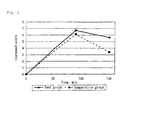
- the degree of sweetness of palatinose is 42, with the degree of sweetness of sucrosebeing 100. Accordingly, aspartame and acesulfame potassium are added to a palatinose sample to adjust the degree of sweetness to that of a sucrose sample while the intake weight of palatinose is set equal to that of sucrose. As seen in the following preliminary test and in Fig. 1, the mixture of aspartame and acesulfame potassium scarcely raises the score in the Kraepelin test.
- palatinose for the test group
- the increase in the score is about 6.7 and about 5.6 at 90 minutes and 150 minutes after taking palatinose, respectively. This shows that concentration and attention is constantly sustained by taking palatinose.
- the increase in the score in the comparative group by taking sucrose is about 6.1 after 90 minutes.
- the increase in the score after 150 minutes is about 3.4, which is almost half as large as the score after 90 minutes.
- the difference between the average score after 90 minutes with palatinose (test group) and the initial average score is recognized as significant with 1 % or less of a risk level; and the difference after 150 minutes is also significant with 5 % or less of a risk level.
- sucrose comparative group
- the difference after 90 minutes is recognized as significant with 1 % or less of a risk level, but the difference after 150minutes is recognizedas non-significant because of a risk level of 17 %.
- palatinose gives a significantly increased score for a longer time period than sucrose does.
- Another method, sequential memory test, is known to determine the sustainability of concentration and attention.
- a score of correct answers is regarded as ability for short-term memory. More specifically, several sheets of paper on which a meaningless series of katakana characters or several digits of numerals are written are shown to a subject for two seconds per sheet. Then, the subject writes what was written on each sheet orderly, in an answer sheet. A correct answer is given one point in score. This is repeated several times.
- the sustainability of the concentration and attention is determined in the sequential memory test as follows. First, the sequential memory test is performed on a subject immediately before drinking a test sample to determine an initial score. Then, the test sample is taken and the sequential memory test is performedafter a predetermined time. For the sequential memory test, a card on which five digits of numerals are written is shown to a subj ect for two seconds. Total five sheets are presented. Then, the subject writes all of the shown five digits of numerals in an answer form. This is repeated 5 times to make a set of tests. Therefore, perfect answer is given 25 points. The sustainability of concentration and attention is judged by whether the score after the predetermined period of time is significantly, increased, compared to the initial score.
- palatinose for the test group
- the increase in the score is about 3.0 and about 4.1 at 90 minutes and 150 minutes after taking palatinose, respectively.
- sucrose for the comparative group
- the increase with sucrose is about 3.3 and about 1.9, respectively. That is, the increase in score of palatinose is a little lower than that of sucrose at 90 minutes, but is more than two times as high as that of sucrose at 150 minutes.
- the differences between the average score after 90 minutes and 150 minutes with palatinose (for the test group) and the initial average score are both recognized as significant with 1 % or less of a risk level.
- sucrose for the comparative group
- the increases in score after 90 minutes are various among the subjects, but the difference is recognized as significant with 5 % or less of a risk level.
- the difference after 150 minutes is recognized as significant with 5 % or less of a risk level.
- palatinose gives a significantly increased score for a longer time period than sucrose does.
- palatinose can sustain concentration and attention over a longer time and more constantly than sucrose does.
- the Kraepelin test was performed for 15 minutes (15 rounds) without taking any food or drink to determine an initial score.
- the subjects took 200mL of a drink in which 0.12 g of aspartame and 0.12 g of acesulfame potassium were dissolved in 200mL of distilled water.
- the Kraepelin test was performed for 15 minutes (15 rounds) at 90 minutes and 150 minutes after taking the drink, and the average increase in score of the subjects was calculated.
- the drink of Example 1 40g of crystalline palatinose (Crystal Palatinose-IC, trade name, Shin Mitsui Sugar Co., Ltd.), 0.06 g of aspartame and 0.06 g of acesulfame potassium were dissolved in 200mL of distilled water to prepare a drink containing the agent of the present invention (hereinafter, referred to as "the drink of Example 1").
- the drink of Example 1 40g of crystalline palatinose (Crystal Palatinose-IC, trade name, Shin Mitsui Sugar Co., Ltd.), 0.06 g of aspartame and 0.06 g of acesulfame potassium were dissolved in 200mL of distilled water to prepare a drink containing the agent of the present invention (hereinafter, referred to as "the drink of Example 1").
- the drink of Example 1 40g of crystalline palatinose (Crystal Palatinose-IC, trade name, Shin Mitsui Sugar Co., Ltd.), 0.06 g of
- the subjects did not take breakfast on the test day to be in abstinence from diet for 12 hours or more before starting the test.
- the Kraepelin test was performed for 15 minutes (15 rounds) without taking any food or drink to determine an initial score.
- the test group took 200mL of the drink of Example 1 and the comparative group took 200mL of a drink in which 40g of sucrose was dissolved in 200mL of distilled water.
- the Kraepelin test was performed for 15 minutes at 90 minutes and 150 minutes after taking the drink, and the average increase in score of the subjects in each group was calculated. The t-test for paired samples was made.
- the increase in score is about 5.6 in the test group; and about 3.4 in the comparative group. This shows that the test group indicated a clearly better result than the comparative group at 150 minutes after taking the drinks.
- the increase in score is about 6.7 at 90 minutes and about 5.6 at 150 minutes, so that the fall in score with time is little .
- the increase in score is about 6.1 at 90 minutes and about 3.4 at 150 minutes, so that the fall in score with time is apparent.
- the t-test for paired samples was conducted on the difference between the score at 90 minutes and the initial score and on the difference between the score at 150 minutes and the initial score.
- the difference between the average score at 90 minutes and the initial score is recognized as significant with 1 % or less of a risk level; and the difference at 150 minutes, significant with 5 % or less of a risk level.
- the difference for 90 minutes is recognized as significant with 1 % or less of a risk level, but the difference for 150 minutes is recognized as non-significant because of a risk level of 17 %.
- palatinose significantly increases the score and maintains the significant increase over a long time and constantly.
- Healthy twelve males and two females aged 25 to 59 years who were different from those in the control test were chosen as subj ects, and they were divided into two groups with each seven persons (a test group and a comparative group) so that the average ages of the two groups were even.
- the subjects did not take breakfast on the test day to be in abstinence from diet for 12 hours or more before starting the test.
- the sequential memory test was performed five times with a set of five cards indicating a 5-digit numeral thereon, without taking any food or drink to determine an initial score.
- the test group took 200mL of the drink of Example 1 and the comparative group took 200mL of a drink in which 40g of sucrose was dissolved in 200mL of distilled water.
- the sequential memory test was performed at 90 minutes and 150 minutes after taking the drink, and the average increase in score of the subjects in each group was calculated.
- the increase in score is about 3.0 at 90 minutes after taking the drinks; and about 1. 9 at 150 minutes.
- the t-test forpaired samples was conductedon the difference at 90minutes andon the difference at 150 minutes in comparison with the initial score to find that the differences are both significant with a risk level of 1 % or less.
- the increase in score is about 3.3 at 90 minutes after taking the drinks; and about 1. 9 at 150 minutes.
- the t-test for paired samples was conducted on the difference at 90 minutes and on the difference at 150 minutes to find that the differences are both significant with a risk level of 5 % or less.
- An agent according to the present invention fondant was manufactured in the following recipe.
- Crystalline palatinose (Crystal Palatinose-IC, trade name of Shin Mitsui Sugar Co., Ltd.) was fed at a raw material feeder of a twin-screw extruder at a rate of 120 kg per hour, and melted at 160 - 200 C. After this location, water was injected for cooling at a rate of 5.6 kg per hour to prepare microcrystals .
- palatinose syrup Palatinose Syrup-ISN, trade name of ShinMitsui Sugar Co., Ltd.
- An agent according to the present invention granules, was manufactured using crystalline palatinose powder.
- Crystalline palatinose (Crystal Palatinose-IC, trade name of Shin Mitsui Sugar Co., Ltd., 70 % or more of 28 - 68 mesh powder) was fed to a raw material feeder of a twine-screw extruder at a rate of 40kg per hour, and melted at 160 - 180 C. After this location, water was added for cooling and precipitation at a rate of 2 kg per hour to obtain powder. The powder was sieved to collect granules, 99 % or more of which was of 10 - 40 mesh.
- An agent according to the present invention tablets, was manufactured in the following recipe.
- Mixed powder of the following recipe was compressed at a tablet pressure of 300 kg per cm 2 to form tablets which each have a diameter of 18 mm, thickness of 5 mm, and weight of 1.5 g.
- Pulverized palatinose (prepared by pulverizing the agent manufactured in Example 4 with an atomizer crusher) 55 parts by weight Citric acid 1 parts by weight Sugar ester 1 parts by weight Aspartame 0.05 part by weight Vitamin P 0.0002 part by weight Water 0.6 part by weight Lemon flavor proper amount
- An agent according to the present invention powder mixture, was manufactured in the following recipe using a universal mixer in accordance with a conventional manner.
- Crystalline palatinose (Crystal Palatinose-IC) 84.7 parts by weight Powdered fruit juice 10 parts by weight Citric acid anhydride 3 parts by weight Sodium citrate 0.4 part by weight L-Ascorbic acid 0.5 part by weight Sodium ascorbate 0.3 part by weight Riboflavin, 10 wt.% content 0.1 part by weight
- Sugar-coated tablets which contained the agent according to the present invention were manufactured using the tablets manufactured in Example 5.
- the tablets manufactured in Example 5 were put into a coating pan and soft-coated with a syrup of the following recipe (a) and with powder isomalt, alternately, at a weight ratio of 1:2 , and subsequently hard-coated with a syrup of the following recipe (b). After the coating, they were air-dried using air of atmospheric temperature.
- Powder isomalt (Palatinit, type GS, trade name of Shin Mitsui Sugar Co., Ltd.) 62 % by weight Gum arabic 6.5 % by weight Water 31.5 % by weight
- Powder isomalt (Palatinit, type GS) 65 % by weight Gum arabic 3.5 % by weight Water 31.5 % by weight Lemon flavor proper amount.
- Adrink containing the agent according to the present invention was manufactured by using the agent, powder mixture, manufactured in Example 6. Twenty five grams of the agent manufactured in Example 5 were dissolved in 200 ml of hot water.
- Arefreshing drink containing the agent according to thepresent invention was manufactured in the following recipe.
- the following ingredients were dissolved in 250 ml of hot water and filled in a drink can for 250 mL.
- Crystalline palatinose (Crystal Palatinose-IC) 8 parts by weight Citric acid 0.15 part by weight Vitamin C 0.03 part by weight Sodium chloride 0.05 part by weight Potassium chloride 0.04 part by weight Calcium chloride 0.012 part by weight
- Hard candies containing the agent according to the present invention were manufactured in the following recipe. First, crystalline palatinose, trehalulose syrup and water were added to a dissolver, and heated to dissolve under stirring. Then, they were heated at the temperature of 120 C at a reduced pressure of 700 mmHg, and then citric acid, aspartame, vitamin P and lemon flavor were mixed. After cooled to about 70 - 80 C, the mixture was shaped into candies of each 4 grams, which were packaged each separately.
- Crystalline palatinose 70 parts by weight Trehalulose syrup (Mildear-75, Shin Mitsui Sugar Co., Ltd.) 40 parts by weight Citric acid 2 parts by weight Aspartame 0.07 part by weight Vitamin P 0.003 part by weight Water 15 parts by weight Lemon flavor proper amount.
- Jelly drinks with orange taste containing the agent according to the present invention were manufactured in the following recipe. First, a palatinose syrup and water were mixed with each other, to which a gelling agent was added portionwise to dissolve while heated up to 90 C. Then, the mixture was cooled to 70 C, to which the remaining ingredients were added and mixed to dissolve. The solution was filled in cheer packs, sealed, and sterilized at a temperature of 90 C for 20 minutes, and then cooled. Palatinose syrup, Bx.
Landscapes
- Life Sciences & Earth Sciences (AREA)
- Chemical & Material Sciences (AREA)
- Engineering & Computer Science (AREA)
- Health & Medical Sciences (AREA)
- Polymers & Plastics (AREA)
- Food Science & Technology (AREA)
- Nutrition Science (AREA)
- Inorganic Chemistry (AREA)
- Molecular Biology (AREA)
- Mycology (AREA)
- Microbiology (AREA)
- General Chemical & Material Sciences (AREA)
- Neurology (AREA)
- Organic Chemistry (AREA)
- Animal Behavior & Ethology (AREA)
- General Health & Medical Sciences (AREA)
- Public Health (AREA)
- Veterinary Medicine (AREA)
- Nuclear Medicine, Radiotherapy & Molecular Imaging (AREA)
- Medicinal Chemistry (AREA)
- Chemical Kinetics & Catalysis (AREA)
- Neurosurgery (AREA)
- Pharmacology & Pharmacy (AREA)
- Biomedical Technology (AREA)
- Bioinformatics & Cheminformatics (AREA)
- Proteomics, Peptides & Aminoacids (AREA)
- Coloring Foods And Improving Nutritive Qualities (AREA)
- Medicinal Preparation (AREA)
- Non-Alcoholic Beverages (AREA)
- Pharmaceuticals Containing Other Organic And Inorganic Compounds (AREA)
- Confectionery (AREA)
- Saccharide Compounds (AREA)
- General Preparation And Processing Of Foods (AREA)
- Food Preservation Except Freezing, Refrigeration, And Drying (AREA)
Abstract
Description
| Pulverized palatinose (prepared by pulverizing the agent manufactured in Example 4 with an atomizer crusher) | 55 parts by |
| Citric acid | |
| 1 parts by | |
| Sugar ester | |
| 1 parts by weight | |
| Aspartame | 0.05 part by weight |
| Vitamin P | 0.0002 part by weight |
| Water | 0.6 part by weight |
| Lemon flavor | proper amount |
| Crystalline palatinose (Crystal Palatinose-IC) | 84.7 parts by weight |
| Powdered fruit juice | 10 parts by weight |
| | 3 parts by weight |
| Sodium citrate | 0.4 part by weight |
| L-Ascorbic acid | 0.5 part by weight |
| Sodium ascorbate | 0.3 part by weight |
| Riboflavin, 10 wt.% content | 0.1 part by weight |
| Powder isomalt (Palatinit, type GS, trade name of Shin Mitsui Sugar Co., Ltd.) | 62 % by weight |
| Gum arabic | 6.5 % by weight |
| Water | 31.5 % by weight |
| Powder isomalt (Palatinit, type GS) | 65 % by weight |
| Gum arabic | 3.5 % by weight |
| Water | 31.5 % by weight |
| Lemon flavor | proper amount. |
| Crystalline palatinose (Crystal Palatinose-IC) | 8 parts by weight |
| Citric acid | 0.15 part by weight |
| Vitamin C | 0.03 part by weight |
| Sodium chloride | 0.05 part by weight |
| Potassium chloride | 0.04 part by weight |
| Calcium chloride | 0.012 part by weight |
| Magnesium carbonate | 0.002 part by weight |
| Sodium glutamate | 0.006 part by weight |
| Stevia | 0.01 part by weight |
| Vitamin P | 0.0004 part by weight |
| Flavour | proper amount. |
| Crystalline palatinose (Crystal Palatinose-IC) | 70 parts by weight |
| Trehalulose syrup (Mildear-75, Shin Mitsui Sugar Co., Ltd.) | 40 parts by |
| Citric acid | |
| 2 parts by weight | |
| Aspartame | 0.07 part by weight |
| Vitamin P | 0.003 part by weight |
| Water | 15 parts by weight |
| Lemon flavor | proper amount. |
| Palatinose syrup, Bx. 75 (Palatinose Syrup-TN, ShinMitsui Sugar Co., Ltd.) | 15 parts by |
| Gelling agent | |
| 1 part by weight | |
| Orange fruit juice, 1/5 concentrated | 4 parts by weight |
| Water | 80 parts by weight |
| Citric acid | 0.35 part by weight |
| Sodium citrate | 0.20 part by weight |
| Vitamin C | 0.6 part by weight |
| beta-Carotene | 0.01 part by weight |
| Stevia | 0.01 part by weight |
| Vitamin P | 0.0004 part by weight |
| Orange flavor | proper amount. |
Claims (9)
- An agent for sustaining concentration and attention, comprising palatinose.
- A food or a drink comprising the agent according to claim 1.
- The food according to claim 2, wherein the food is in a form of tablets, soft jellies, hardcandies, soft candies, chocolates or chewing gums.
- The drink according to claim 2, wherein the drink is in a form of soft drinks, near water, sports drinks, jelly drinks, tea drinks, cocoa drinks, or coffee drinks.
- A method for sustaining concentration and attention, comprising a step of taking palatinose.
- The method according to claim 5, wherein palatinose is taken in a form of a food or a drink which contains palatinose.
- The method according to claim 6, wherein the food is in a form of tablets, soft jellies, hard candies, soft candies, chocolates or chewing gums.
- The method according to claim 6, wherein the drink is in a form of soft drinks, near water, sports drinks, jelly drinks, tea drinks, cocoa drinks, or coffee drinks.
- The method according to claim 5, wherein 5 to 50 g of palatinose is taken at once.
Applications Claiming Priority (5)
| Application Number | Priority Date | Filing Date | Title |
|---|---|---|---|
| JP2001143370 | 2001-05-14 | ||
| JP2001143370 | 2001-05-14 | ||
| JP2001223004A JP4860840B2 (en) | 2001-05-14 | 2001-07-24 | Agent for maintaining concentration and attention and food and drink containing the agent |
| JP2001223004 | 2001-07-24 | ||
| PCT/JP2002/004578 WO2002091859A1 (en) | 2001-05-14 | 2002-05-10 | Agent for sustaining concentration and attentiveness, and food and drink containing the agent |
Publications (3)
| Publication Number | Publication Date |
|---|---|
| EP1393637A1 true EP1393637A1 (en) | 2004-03-03 |
| EP1393637A4 EP1393637A4 (en) | 2005-06-29 |
| EP1393637B1 EP1393637B1 (en) | 2007-11-14 |
Family
ID=26615046
Family Applications (1)
| Application Number | Title | Priority Date | Filing Date |
|---|---|---|---|
| EP02769566A Expired - Lifetime EP1393637B1 (en) | 2001-05-14 | 2002-05-10 | Use of palatinose for sustaining mental concentration and attentiveness |
Country Status (6)
| Country | Link |
|---|---|
| EP (1) | EP1393637B1 (en) |
| JP (1) | JP4860840B2 (en) |
| KR (1) | KR20030093354A (en) |
| GB (1) | GB0325696D0 (en) |
| TW (1) | TWI304326B (en) |
| WO (1) | WO2002091859A1 (en) |
Cited By (7)
| Publication number | Priority date | Publication date | Assignee | Title |
|---|---|---|---|---|
| WO2006007993A1 (en) * | 2004-07-21 | 2006-01-26 | Südzucker Aktiengesellschaft Mannheim/Ochsenfurt | Improved mixtures containing cocoa |
| DE102008007072A1 (en) | 2008-01-31 | 2009-08-13 | Südzucker Aktiengesellschaft Mannheim/Ochsenfurt | Process for the production of fermentable drinks |
| DE202009016108U1 (en) | 2009-11-25 | 2010-02-25 | Korte, Hermann, Dipl.-Ing. | Storage or transport device with held information sign |
| WO2010118866A1 (en) | 2009-04-15 | 2010-10-21 | Südzucker Aktiengesellschaft Mannheim/Ochsenfurt | Trehalulose-containing composition, its preparation and use |
| WO2012007138A1 (en) | 2010-07-14 | 2012-01-19 | Südzucker Aktiengesellschaft Mannheim/Ochsenfurt | Isomaltulose for use in enhancing mental performance |
| WO2014155186A1 (en) * | 2013-03-27 | 2014-10-02 | Palsgaard Industri De Mexico, S. De R.L. De C.V. | Food supplement for people with down syndrome, autism spectrum disorder and/or attention deficit disorder with or without hyperactivity |
| CN109511849A (en) * | 2018-12-26 | 2019-03-26 | 广西壮族自治区农业科学院农产品加工研究所 | A kind of cassava juice beverage and its processing method adjusting intestinal flora |
Families Citing this family (8)
| Publication number | Priority date | Publication date | Assignee | Title |
|---|---|---|---|---|
| KR101043212B1 (en) * | 2004-11-03 | 2011-06-21 | 주식회사 한국인삼공사 | Health functional food for improving brain function |
| JP5000874B2 (en) * | 2005-03-29 | 2012-08-15 | 三井製糖株式会社 | Agents that inhibit sucrase activity or glucoamylase activity |
| DE102006022506A1 (en) * | 2006-05-08 | 2007-11-15 | Südzucker AG Mannheim/Ochsenfurt | Isomaltulose with improved flowability |
| CN104055189A (en) * | 2014-03-14 | 2014-09-24 | 上海键源碳水化合物有限公司 | Application of sucrose invert sugar in functional beverage |
| JP7316035B2 (en) * | 2018-11-15 | 2023-07-27 | Dm三井製糖株式会社 | Drowsiness suppressant and food/beverage for suppressing drowsiness |
| WO2021064616A1 (en) * | 2019-09-30 | 2021-04-08 | Almendra Pte. Ltd | Methods and compositions for improved taste quality |
| JP7099652B1 (en) * | 2022-04-19 | 2022-07-12 | 大正製薬株式会社 | Beverages containing vitamin B2 |
| JP2024021800A (en) * | 2022-08-04 | 2024-02-16 | Dm三井製糖株式会社 | Cerebral blood flow increasing agent, brain activity promoter, and alertness improver |
Family Cites Families (7)
| Publication number | Priority date | Publication date | Assignee | Title |
|---|---|---|---|---|
| DE3062775D1 (en) * | 1979-11-07 | 1983-05-19 | Tate & Lyle Plc | Tablets containing isomaltulose, their use and a method of producing them |
| JPS5846294B2 (en) * | 1980-09-25 | 1983-10-15 | 三井製糖株式会社 | Anti-caries hondant-like molasses sugar and method for producing the same |
| JPS5771377A (en) * | 1980-10-23 | 1982-05-04 | Mitsui Seito Kk | Sweetening agent having low cariogenicity |
| JPS60102144A (en) * | 1983-11-07 | 1985-06-06 | Ajinomoto Co Inc | Aspartame-containing chocolate |
| JP2923072B2 (en) * | 1991-04-17 | 1999-07-26 | 株式会社ロッテ | Sugar coating |
| WO1991015941A1 (en) * | 1991-06-19 | 1991-10-31 | Wm. Wrigley Jr. Company | Chewing gum containing palatinose |
| JP2000245390A (en) * | 1999-02-25 | 2000-09-12 | Ezaki Glico Co Ltd | Food and beverage sustaining mental raised feeling, good in fullness in stomach and having high palatability |
-
2001
- 2001-07-24 JP JP2001223004A patent/JP4860840B2/en not_active Expired - Lifetime
-
2002
- 2002-05-10 KR KR10-2003-7014728A patent/KR20030093354A/en not_active Withdrawn
- 2002-05-10 EP EP02769566A patent/EP1393637B1/en not_active Expired - Lifetime
- 2002-05-10 WO PCT/JP2002/004578 patent/WO2002091859A1/en not_active Ceased
- 2002-05-13 TW TW091109870A patent/TWI304326B/zh not_active IP Right Cessation
-
2003
- 2003-11-04 GB GBGB0325696.3A patent/GB0325696D0/en active Pending
Cited By (22)
| Publication number | Priority date | Publication date | Assignee | Title |
|---|---|---|---|---|
| US8282976B2 (en) | 2004-07-21 | 2012-10-09 | Sudzucker Aktiengesellschaft Mannheim/Ochsenfurt | Mixtures containing cocoa |
| DE102004035373B3 (en) * | 2004-07-21 | 2006-03-30 | Südzucker AG Mannheim/Ochsenfurt | Improved cocoa mixtures |
| WO2006007993A1 (en) * | 2004-07-21 | 2006-01-26 | Südzucker Aktiengesellschaft Mannheim/Ochsenfurt | Improved mixtures containing cocoa |
| CN1997283B (en) * | 2004-07-21 | 2011-10-26 | 曼海姆/奥克森富特旭德楚克股份公司 | Improved mixtures containing cocoa |
| DE102008007072A1 (en) | 2008-01-31 | 2009-08-13 | Südzucker Aktiengesellschaft Mannheim/Ochsenfurt | Process for the production of fermentable drinks |
| US10194679B2 (en) | 2008-01-31 | 2019-02-05 | Sudzucker Aktiengesellschaft | Process for the production of fermented beverages |
| WO2010118866A1 (en) | 2009-04-15 | 2010-10-21 | Südzucker Aktiengesellschaft Mannheim/Ochsenfurt | Trehalulose-containing composition, its preparation and use |
| EA029353B1 (en) * | 2009-04-15 | 2018-03-30 | Зюдцукер Акциенгезелльшафт Маннхайм/Окзенфурт | Trehalulose-containing composition, its preparation and use |
| CN102448332A (en) * | 2009-04-15 | 2012-05-09 | 甜糖(曼海姆/奥克森富特)股份公司 | Trehalulose-containing composition, its preparation and use |
| US9707249B2 (en) | 2009-04-15 | 2017-07-18 | Sudzucker Aktiengesellschaft Mannheim/Ochsenfurt | Trehalulose-containing composition, its preparation and use |
| EP2418971B1 (en) * | 2009-04-15 | 2017-09-06 | Südzucker Aktiengesellschaft Mannheim/Ochsenfurt | Trehalulose-containing composition, its preparation and use |
| US9744184B2 (en) | 2009-04-15 | 2017-08-29 | Sudzucker Aktiengesellschaft Mannheim/Ochsenfurt | Trehalulose-containing composition, its preparation and use |
| CN107095096A (en) * | 2009-04-15 | 2017-08-29 | 甜糖(曼海姆/奥克森富特)股份公司 | Composition containing trehalulose, its preparation and application thereof |
| EP2328137A2 (en) | 2009-11-25 | 2011-06-01 | Hermann Dipl.-Ing. Korte | Storage or transport device with information sign attached thereto |
| DE202009016108U1 (en) | 2009-11-25 | 2010-02-25 | Korte, Hermann, Dipl.-Ing. | Storage or transport device with held information sign |
| EA026164B1 (en) * | 2010-07-14 | 2017-03-31 | Зюдцукер Акциенгезелльшафт Маннхайм/Окзенфурт | Isomaltulose for use in enhancing mental performance |
| CN103068259A (en) * | 2010-07-14 | 2013-04-24 | 甜糖(曼海姆/奥克森富特)股份公司 | Isomaltulose for use in enhancing mental performance |
| WO2012007138A1 (en) | 2010-07-14 | 2012-01-19 | Südzucker Aktiengesellschaft Mannheim/Ochsenfurt | Isomaltulose for use in enhancing mental performance |
| CN105050428A (en) * | 2013-03-27 | 2015-11-11 | 墨西哥帕斯嘉工业公司 | Food supplement for people with down syndrome, autism spectrum disorder and/or attention deficit disorder with or without hyperactivity |
| WO2014155186A1 (en) * | 2013-03-27 | 2014-10-02 | Palsgaard Industri De Mexico, S. De R.L. De C.V. | Food supplement for people with down syndrome, autism spectrum disorder and/or attention deficit disorder with or without hyperactivity |
| CN109511849A (en) * | 2018-12-26 | 2019-03-26 | 广西壮族自治区农业科学院农产品加工研究所 | A kind of cassava juice beverage and its processing method adjusting intestinal flora |
| CN109511849B (en) * | 2018-12-26 | 2022-03-01 | 广西壮族自治区农业科学院农产品加工研究所 | Cassava juice beverage capable of regulating intestinal flora and processing method thereof |
Also Published As
| Publication number | Publication date |
|---|---|
| JP2003034643A (en) | 2003-02-07 |
| EP1393637A4 (en) | 2005-06-29 |
| EP1393637B1 (en) | 2007-11-14 |
| TWI304326B (en) | 2008-12-21 |
| WO2002091859A1 (en) | 2002-11-21 |
| KR20030093354A (en) | 2003-12-06 |
| GB0325696D0 (en) | 2003-12-10 |
| JP4860840B2 (en) | 2012-01-25 |
Similar Documents
| Publication | Publication Date | Title |
|---|---|---|
| EP1393637B1 (en) | Use of palatinose for sustaining mental concentration and attentiveness | |
| JP3199742B2 (en) | Concentrated bioavailable calcium source | |
| CA2246730C (en) | Confections containing sweetener | |
| EP0945074B1 (en) | Sweetening compositions | |
| US20030190396A1 (en) | Methods and compositions for altering the sweetness delivery profile of sucralose | |
| US20060188627A1 (en) | Isomaltulose or trehalose containing comestibles for sustained carbohydrate energy release and increased fat oxidation | |
| US20100004194A1 (en) | Use of isomaltulose in food products having a regenerative effect | |
| AU2006271893B2 (en) | Low-glycemic mixtures | |
| EP2592950B2 (en) | Isomaltulose for use in enhancing mental performance | |
| JP3462535B2 (en) | Mineral absorption promoting composition | |
| EP1462011A1 (en) | Comestibles containing Isomaltulose and Trehalose for sustained carbohydrate energy release and reduced glycemic/insulinimic responses | |
| US20030199728A1 (en) | Agent for enhancing alpha-wave appearance, an agent for inducing a relaxed state and a food or drink comprising the agent | |
| US12208128B2 (en) | Compositions and methods for treating traveler's diarrhea | |
| US20230079812A1 (en) | COMPOSITION OF (D)-ß-HYDROXYBUTYRIC ACID, (D)-1,3 BUTANEDIOL AND DIGESTIBLE CARBOHYDRATE | |
| JP5063330B2 (en) | Amla fruit processed products | |
| ZA200600013B (en) | Isomaltulose or trehalose containing comestibles for sustained carbohydrate energy release and increased fat oxidation | |
| JPH0984553A (en) | Foods containing beetroot tea and mint | |
| JP2003155240A (en) | Agent for maintaining concentration and attention and food and drink containing the agent | |
| EP1500335A1 (en) | Trehalose containing comestibles for sustained carboydrate energy release and reduced glycemic/insulinemic responses | |
| Ivanova et al. | Investigation the influence of the additives on the taste and the flavor of food and sweeties products. | |
| HU200915B (en) | Process for producing curative compositions suitable for preventing diseases of travellers and/or for influencing oral hygiene, particularly chewing gum, soft drinks and/or syrups |
Legal Events
| Date | Code | Title | Description |
|---|---|---|---|
| PUAI | Public reference made under article 153(3) epc to a published international application that has entered the european phase |
Free format text: ORIGINAL CODE: 0009012 |
|
| 17P | Request for examination filed |
Effective date: 20031202 |
|
| AK | Designated contracting states |
Kind code of ref document: A1 Designated state(s): CH DE DK ES FI FR GB IT LI NL SE |
|
| A4 | Supplementary search report drawn up and despatched |
Effective date: 20050519 |
|
| RIC1 | Information provided on ipc code assigned before grant |
Ipc: 7A 23L 2/60 B Ipc: 7A 23G 3/30 B Ipc: 7A 23L 1/30 A Ipc: 7A 23L 1/23 B Ipc: 7A 23G 3/00 B |
|
| REG | Reference to a national code |
Ref country code: DE Ref legal event code: 8566 |
|
| RAP1 | Party data changed (applicant data changed or rights of an application transferred) |
Owner name: MITSUI SUGAR CO., LTD. |
|
| RBV | Designated contracting states (corrected) |
Designated state(s): GB |
|
| 17Q | First examination report despatched |
Effective date: 20060824 |
|
| RTI1 | Title (correction) |
Free format text: USE OF PALATINOSE FOR SUSTAINING MENTAL CONCENTRATION AND ATTENTIVENESS |
|
| GRAP | Despatch of communication of intention to grant a patent |
Free format text: ORIGINAL CODE: EPIDOSNIGR1 |
|
| RIC1 | Information provided on ipc code assigned before grant |
Ipc: A23L 1/23 20060101ALI20070606BHEP Ipc: A23L 2/60 20060101ALI20070606BHEP Ipc: A23G 4/10 20060101ALI20070606BHEP Ipc: A23G 3/00 20060101ALI20070606BHEP Ipc: A23L 1/30 20060101AFI20070606BHEP |
|
| GRAS | Grant fee paid |
Free format text: ORIGINAL CODE: EPIDOSNIGR3 |
|
| GRAA | (expected) grant |
Free format text: ORIGINAL CODE: 0009210 |
|
| AK | Designated contracting states |
Kind code of ref document: B1 Designated state(s): GB |
|
| REG | Reference to a national code |
Ref country code: GB Ref legal event code: FG4D |
|
| PLBE | No opposition filed within time limit |
Free format text: ORIGINAL CODE: 0009261 |
|
| STAA | Information on the status of an ep patent application or granted ep patent |
Free format text: STATUS: NO OPPOSITION FILED WITHIN TIME LIMIT |
|
| 26N | No opposition filed |
Effective date: 20080815 |
|
| PGFP | Annual fee paid to national office [announced via postgrant information from national office to epo] |
Ref country code: GB Payment date: 20210517 Year of fee payment: 20 |
|
| REG | Reference to a national code |
Ref country code: GB Ref legal event code: PE20 Expiry date: 20220509 |
|
| PG25 | Lapsed in a contracting state [announced via postgrant information from national office to epo] |
Ref country code: GB Free format text: LAPSE BECAUSE OF EXPIRATION OF PROTECTION Effective date: 20220509 |