EP1393099B1 - Estimation of toxic substance release - Google Patents
Estimation of toxic substance release Download PDFInfo
- Publication number
- EP1393099B1 EP1393099B1 EP02723887A EP02723887A EP1393099B1 EP 1393099 B1 EP1393099 B1 EP 1393099B1 EP 02723887 A EP02723887 A EP 02723887A EP 02723887 A EP02723887 A EP 02723887A EP 1393099 B1 EP1393099 B1 EP 1393099B1
- Authority
- EP
- European Patent Office
- Prior art keywords
- sensor
- substance
- time
- concentration
- measurements
- Prior art date
- Legal status (The legal status is an assumption and is not a legal conclusion. Google has not performed a legal analysis and makes no representation as to the accuracy of the status listed.)
- Expired - Lifetime
Links
Images

Classifications
-
- G—PHYSICS
- G01—MEASURING; TESTING
- G01N—INVESTIGATING OR ANALYSING MATERIALS BY DETERMINING THEIR CHEMICAL OR PHYSICAL PROPERTIES
- G01N33/00—Investigating or analysing materials by specific methods not covered by groups G01N1/00 - G01N31/00
- G01N33/0004—Gaseous mixtures, e.g. polluted air
-
- G—PHYSICS
- G08—SIGNALLING
- G08B—SIGNALLING SYSTEMS, e.g. PERSONAL CALLING SYSTEMS; ORDER TELEGRAPHS; ALARM SYSTEMS
- G08B21/00—Alarms responsive to a single specified undesired or abnormal condition and not otherwise provided for
- G08B21/02—Alarms for ensuring the safety of persons
- G08B21/12—Alarms for ensuring the safety of persons responsive to undesired emission of substances, e.g. pollution alarms
- G08B21/14—Toxic gas alarms
Definitions
- This invention relates generally to techniques for estimating the amount of release, or release rate, of a substance and, more particularly, to release of a toxic chemical. More particularly, the invention relates to estimating release of a toxic chemical in a liquid or gaseous state.
- the invention may be used to direct emergency response to an unfolding of the event, as well as to a post-event analysis or a pre-event preparation.
- the invention may be applied to fixed release locations, such as chemical facilities, as well as to portable events, such as may occur at a railroad car, a pipeline, or the like.
- a significant challenge in any emergency scenario is the estimation of the amount of chemical being released.
- An exemplary event may involve several derailed railroad cars leaking unknown amounts of chemical, or a plant process area engulfed in a toxic materials with no way of observing where in the process the leak is occurring and how much chemical is being released.
- Each event is unique and may involve a very small amount of material, or be catastrophic in its scope. Initial estimates are very difficult and even an expert responder can only guess at the initial release. Therefore, a quick and accurate estimation of the release is crucial for the response agencies in warning the public and taking them out of harms way.
- Document WO 00/33066 A2 discloses a system of gas monitors surrounding a chemical facility. The system simply monitors surrounding conditions. The document is concerned of wireless communications between the various gas monitors and a central facility. The monitors can generate data, such as amount of gas, the time of measurement, wind speed and wind direction, and others.
- the article of Lu, X.: "A GIS model for hazardous chemicals pathway analysis” published in URISA Proceedings, p. 293-299 on 16 July 1995 describes a mathematical dispersion model for calculating gas concentration in mass per volume.
- the mathematical model creates a dispersion plume model using as inputs gas emission rate, wind speed at the point of release, and certain standard deviations in gas concentration in the crosswind and vertical direction, at the downwind distance.
- Document US 4 924 095 is directed to a remote gas analyser for motor vehicle exhaust emissions surveillance disclosing a gas analyser which determines the volumes concentration of gas pollutants in the exhaust.
- a method of estimating an amount of substance being released into an ambient, thereby creating a plume includes making concentration measurements of the substance over a period of time and providing an estimate of the amount of the substance released as a function of the multiple concentration measurements and a time of the measurements.
- the method may further include considering atmospheric conditions of the ambient into which the substance was released.
- the considering of atmospheric conditions may include considering atmospheric conditions over the period of time.
- the considering of atmospheric conditions may include providing at least one weather sensor adapted to measure atmospheric conditions of the ambient into which the substance was released.
- the considering of atmospheric conditions may include downloading weather data from a global electronic network, downloading weather data from a government dial-up weather service, and/or estimating weather by a weather professional.
- the measurement may be projected back in time to when the sensor was first impacted by the plume.
- measurements from a sensor may be no longer used when the sensor has reached a maximum measurement for the capabilities of the sensor.
- a predicted profile of time and concentration measurements is provided and the concentration measurements compared with the predicted profile.
- the predicted profile may be revised in response to the outcome of comparing.
- the algorithm may be performed until convergence with the predicted profile has occurred. Multiple measurements are made in each of multiple different locations and an estimate of the amount of the substance released may be obtained as a function of the multiple concentration measurements at each of the locations and a time of the measurements.
- some sensors may not begin reading a concentration of the substance until later in an event while other sensors begin reading concentration early in an event and may saturate, or reach a maximum upper limit of its reading range and these may change as the evolution of the plume changes, such as by passage of time or by change in prevailing wind.
- the use of the term "toxic” herein may include chemicals that are harmful to plants, animals or humans, or explosive or flammable, or corrosive, or otherwise requiring a response from emergency personnel.
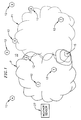
- Substance release estimating system 10 includes a computer (not shown) running an algorithm 14 ( Fig. 5 ) and sensors 12.
- Information passed from each sensor may include a sensor ID number, its location, a time of making a reading, and a concentration measurement. This information is passed to algorithm 14.
- the algorithm is apprised of the sensor properties of each sensor, such as the type of chemical it can measure, the concentration at which it saturates, i.e., its maximum measurement, and any other relevant information.
- Sensors may be fixed sensors 12f, which are designed to continuously monitor within or near the source of emission, such as a plant S.
- the sensor network may be hard-wired to the computer running algorithm 14 and may continuously make sensor readings available. This may be utilized to provide an automatic data entry system.
- Measurements may also be taken by portable gas sensors 12p placed in the release.
- a responder or detection vehicle may be placed downwind of the source of emission S and use radio telemetry and global position system (GPS) data to communicate to the computer running algorithm 14. This can also be thought of as an automatic data entry system.
- the portable sensors are positioned downwind of the release location.
- the sensor may be a wireless sensor that communicates with a central control by wireless communication or may be manually read.
- the portable sensor(s) may be positioned at the beginning of the substance release. Furthermore, the portable sensor(s) may be moved during the event. If so, attempts to collect data would discontinue during the move and resume after the move. The sensor(s) could data log the collected data to be used after an event.
- fixed sensor(s) can be stand-alone or wired to a digital control system (DCS) or a process logic controller (PLC).
- DCS digital control system
- PLC process logic controller
- the DCS or PLC converts the analog sensor output to a digital format useful to the computer. They may also store the data readings for use with other equipment and make the data available over a computer network or directly connected to the computer. Both the DCS and PLC would be polled by the algorithm 14.
- a variety of gas monitoring techniques may be utilized, such as a photoionization detector (PID), a flame ionization detector (FID), an electrochemical detector, or the like. Measurements may also be taken by field personnel using hand-held portable measurement instruments downwind of the release. The concentration should be immediately relayed to the computer running algorithm 14, such as by telephone, radio, facsimile, or the like. This may be considered manual data entry. Subjective measurements may also be taken where the concentration is described by persons impacted by the event. A combination of some or all of the above sensing techniques may be utilized by algorithm 14.
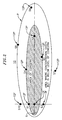
- Fig. 2 represents an idealistic representation of a plume P.
- Plume P is idealistically made up of a central area of concern which may be, by way of example, a beginning of human toxicity, or explosive concentration, or other such level of concentration.
- the area outside of the area of concern, but within plume P, is an area where concentration will be processed by algorithm 14, but may not necessarily be the lowest level that can be measured.
- the outer area of plume P represents the area where some level of the cloud may be monitored at a range below the level of concern.
- sensors 12f are full-time gas concentration monitors, typically a part of a digital control system, and are designated sensors S1, S2, S3, S10, on the Fig. 2 .
- Sensors 12p are portable sensor monitors and must be deployed.
- Sensors S4, S5, S6, S7, S8 and S9 are portable sensors. Some gas-monitoring sensors may take up to a fixed period of time, such as 50 seconds for example, to start detecting the chemical. This is known as monitoring lag or sensor lag. In most cases, once a reading starts, it continues being available for the entire event unless the sensor becomes saturated. Alternatively, a reading can be taken once at a location using hand-held devices and a voice reporting the measurement, time, and location back to the control running algorithm 14.
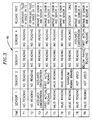
- Time T3 is the first time that sensors 1 and 2 begin to be affected by the released substance. It may take an additional period of time, for example, 60 seconds, to obtain a concentration reading due to sensor lag.
- sensors 1 and 2 obtain an actual concentration reading.
- Algorithm 14 fills in a concentration value for interval T3 for both sensors 1 and 2 that relate to the actual concentration reading made at interval T4.
- the algorithm fills in a concentration reading at interval T3 which is the same as a concentration-reading read for sensors 1 and 2 in interval T4.
- sensor 2 obtains a reading that is a maximum reading for the type of instrument that is sensor 2.
- Algorithm 14 in the illustrative embodiment, runs a dispersion model with a guessed, or assumed, or predicted, or trial, value for release rate. Algorithm 14 produces a time profile 18 for each sensor ( Figs. 4a-4c ). Actual sensor information, namely, sensor time and concentration measurement, is matched against the predicted profile. A determination is made whether there is a match within a particular convergence span 20. If there is a match within the convergence span in terms of time and concentration measurement for all sensors, the predicted value is recorded as the true value. Otherwise, a new predicted profile is tried. Actual concentration value is indicated by line 22. Actual time value is indicated by line 24. There are two loops for convergence; one loop converges on the time parameter and the other converges on the concentration parameter. When both the time and concentration parameters are converged within a tolerance limit, the computed value is accepted.
- the trial method would basically establish limits for the release rate or amount, and then use one of a root-finding method, such as Bisection Newton-Raphson, false position, or the like, to find an actual release rate or release amount.
- a release rate versus time is obtained for the source S which is then fed to the dispersion model for chemical impact. This procedure is repeated as new information is received and updates are determined. Accuracy is greater for measurements taken closer to the centerline C of the plume ( Fig. 2 ) and for readings that are not too close and not too far from the release point S.
- a weight factor may be applied.
- the value of this weight factor may change, for example, by 0.1 from measurements taken from the plume centerline to measurements on the edge of the cloud. Therefore, if a tolerance value of 1% is set for the centerline concentration accuracy, the edge measurement may only require a 10% accuracy. This may be accomplished by assigning a weight factor to each sensor as a function of its position. During the iteration, these weight factors can be used to determine convergence criteria for each sensor.
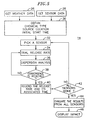
- Algorithm 14 begins by obtaining weather data 26 and sensor data at 28 from the various sensors 12.
- Weather data may be obtained from a weather sensor 27.
- weather data could be obtained from a global electronic network, such as the Internet, government dial-up services, other companies' fixed systems, wireless portable weather sensors, or estimated by a weather professional, or the like.
- the algorithm determines the chemical that is being detected. It assumes that the chemical corresponds with the type of sensor that is detecting something. In other words, if a sensor for a particular chemical is sensing a condition, we assume that it is that chemical that is source of the toxic release. The algorithm 14 can change that conclusion if it is later on determined to be incorrect.
- the algorithm picks one of the sensors and at 34 picks a trial, or predicted, release rate.
- a dispersion analysis is run at 36 and it is determined at 38 whether convergence has been reached. If it is determined at 38 that convergence has not been reached, then a new predicted release rate is chosen at 34 and the dispersion analysis is repeated at 36 until it is determined at 38 that convergence has been reached.
- the release rate and its associated times are recorded at 40.
- the release rate calculations for all sensors are evaluated at 44. This may be accomplished by estimating a release rate by the back calculation model for each measured concentration, along with its time of measurement shown in Fig. 3 .
- Substance release estimation system 10 allows an estimation of the amount of toxic chemical released as the event occurs. Furthermore, the system is capable of being highly automated which removes the skill of the operator from the analysis. Moreover, the substance release estimation system can be used as a monitoring system by taking into account time as a factor in the measurements such that the system may be utilized to alert the operator of the occurrence of an event rather than the other way around.
- portable sensors 12P may be of the type manufactured by Rae Systems, a wireless gas detection system manufactured by Gastronics, or other commercially available wireless gas detection system. Utilizing substance release estimation system 10, as data is changed, the result is updated. During an interval, such as 10 minutes, data is updated automatically. The plume may be continuously regenerated as more and more data is obtained.
- Substance release estimation system 10 may make a record of the event for review after the event by interested parties.
- the system can be utilized for monitoring installations, especially where fixed sensors are placed.
- Portable sensors can be placed in downwind locations where movement of the plume is expected. Monitoring movement of the plume is assisted by the automatic entry of atmospheric conditions as is possible with substance release estimation system 10.
- the present invention works well with any existing dispersion modeling known in the art. This may include the REAL-TIMETM system marketed by the present assignee, SAFER Systems, L.L.C., the ALOHA system supplied by the United States Government, the CHARM system supplied by Radiant Corporation, the COMPAS system supplied by Brank Software Systems, or the like. Such dispersion models are based upon a mass balance around the release site, but other dispersion model basis may be used.
- Substance release estimation system utilizes a) gas detection sensors, b) meteorological measurement, c) release location information, d) starting time of the release and d) dispersion model.
- types of sensors useful with system 10 include PID, electro-chemical, paper tape, open path, and the like.
- the location of the sensor may be verbally described or measured with global position accuracy. Time of measurement, as well as upper and lower limits of concentration measurement, are taken into account, as well as the chemical of response or what substances can be accurately measured.
- Meteorological measurement may include wind speed and direction, as well as stability classification as defined by the Environmental Protection Agency (EPA). Release location is the actual source of the release.
- Substance release estimation system 10 may be a standalone system or may be incorporated into other programs. As previously set forth, system 10 may be utilized for dispersion modeling, providing assistance as an event unfolds, reconstruction of the unfolding of the event after the fact, and monitoring of equipment for the occurrence of a release. Although illustrated for use with toxic liquid or gas chemicals, the substance release estimation system 10 could also be used to track non-toxic chemical releases.
Landscapes
- Health & Medical Sciences (AREA)
- General Health & Medical Sciences (AREA)
- Engineering & Computer Science (AREA)
- Chemical & Material Sciences (AREA)
- Toxicology (AREA)
- Life Sciences & Earth Sciences (AREA)
- General Physics & Mathematics (AREA)
- Physics & Mathematics (AREA)
- Immunology (AREA)
- Environmental & Geological Engineering (AREA)
- Analytical Chemistry (AREA)
- Medicinal Chemistry (AREA)
- Food Science & Technology (AREA)
- Pathology (AREA)
- Combustion & Propulsion (AREA)
- Biochemistry (AREA)
- Business, Economics & Management (AREA)
- Emergency Management (AREA)
- Testing Or Calibration Of Command Recording Devices (AREA)
- Investigating Or Analyzing Materials By The Use Of Electric Means (AREA)
- Sampling And Sample Adjustment (AREA)
- Investigating Or Analysing Biological Materials (AREA)
- Fats And Perfumes (AREA)
- Agricultural Chemicals And Associated Chemicals (AREA)
Applications Claiming Priority (7)
| Application Number | Priority Date | Filing Date | Title |
|---|---|---|---|
| US28475001P | 2001-04-18 | 2001-04-18 | |
| US284750P | 2001-04-18 | ||
| US31242901P | 2001-08-15 | 2001-08-15 | |
| US312429P | 2001-08-15 | ||
| US98685 | 2002-03-15 | ||
| US10/098,685 US6772071B2 (en) | 2001-04-18 | 2002-03-15 | Estimation of toxic substance release |
| PCT/US2002/012147 WO2002086547A1 (en) | 2001-04-18 | 2002-04-18 | Estimation of toxic substance release |
Publications (3)
| Publication Number | Publication Date |
|---|---|
| EP1393099A1 EP1393099A1 (en) | 2004-03-03 |
| EP1393099A4 EP1393099A4 (en) | 2006-10-11 |
| EP1393099B1 true EP1393099B1 (en) | 2011-12-14 |
Family
ID=27378641
Family Applications (1)
| Application Number | Title | Priority Date | Filing Date |
|---|---|---|---|
| EP02723887A Expired - Lifetime EP1393099B1 (en) | 2001-04-18 | 2002-04-18 | Estimation of toxic substance release |
Country Status (7)
| Country | Link |
|---|---|
| US (1) | US6772071B2 (enExample) |
| EP (1) | EP1393099B1 (enExample) |
| JP (1) | JP4515708B2 (enExample) |
| AT (1) | ATE537444T1 (enExample) |
| CA (1) | CA2444072C (enExample) |
| MX (1) | MXPA03009556A (enExample) |
| WO (1) | WO2002086547A1 (enExample) |
Cited By (1)
| Publication number | Priority date | Publication date | Assignee | Title |
|---|---|---|---|---|
| CN110726805A (zh) * | 2019-09-29 | 2020-01-24 | 中国农业大学 | 氧气泄漏预警装置及观赏鱼运输中的氧气泄漏预警方法 |
Families Citing this family (34)
| Publication number | Priority date | Publication date | Assignee | Title |
|---|---|---|---|---|
| US7064660B2 (en) * | 2002-05-14 | 2006-06-20 | Motorola, Inc. | System and method for inferring an electronic rendering of an environment |
| US7834754B2 (en) | 2002-07-19 | 2010-11-16 | Ut-Battelle, Llc | Method and system for monitoring environmental conditions |
| EP1639432A2 (en) * | 2003-07-02 | 2006-03-29 | THE GOVERNMENT OF THE UNITED STATES OF AMERICA, as represented by THE SECRETARY OF THE NAVY | Ct-analyst: a software system for zero latency, high fidelity emergency assessment of airborne chemical, biological, radiological (cbr) threats |
| US8949037B2 (en) * | 2003-08-20 | 2015-02-03 | Airdar Inc. | Method and system for detecting and monitoring emissions |
| CA2476902C (en) * | 2003-08-20 | 2014-04-22 | Dennis S. Prince | Innovative gas monitoring with spacial and temporal analysis |
| SE0401607D0 (sv) * | 2004-06-22 | 2004-06-22 | Nilsson Intelligence Systems A | Övervakningssystem |
| US8712335B2 (en) * | 2005-12-30 | 2014-04-29 | Honeywell International Inc. | Wireless monitoring in process applications |
| US10368146B2 (en) | 2016-09-20 | 2019-07-30 | General Electric Company | Systems and methods for environment sensing |
| US8145439B2 (en) * | 2007-08-06 | 2012-03-27 | Safer Systems, L.L.C. | Substance release estimation using path-averaged concentration measurements |
| US8190376B2 (en) * | 2008-08-18 | 2012-05-29 | Safer Systems, Llc | System and method for source identification for a chemical release |
| US20100148946A1 (en) * | 2008-12-16 | 2010-06-17 | Portendo Ab | Surveillance System |
| CN102460220B (zh) * | 2009-04-14 | 2014-04-16 | 艾尔达股份有限公司 | 测量排放和量化排放源的方法和系统 |
| US9978251B2 (en) * | 2009-12-28 | 2018-05-22 | Honeywell International Inc. | Wireless location-based system and method for detecting hazardous and non-hazardous conditions |
| US9229132B2 (en) | 2011-07-05 | 2016-01-05 | International Business Machines Corporation | Meteorological parameter forecasting |
| US9294936B2 (en) | 2012-08-14 | 2016-03-22 | Honeywell International Inc. | System and method for improved location system accuracy |
| US9595183B2 (en) * | 2014-04-25 | 2017-03-14 | Safer Systems, Llc | System and method for distribution of sensors for emergency response |
| AU2015385701B2 (en) * | 2015-03-12 | 2020-03-26 | Honeywell International Inc. | Wireless mesh network gas detection real time location system |
| US10156552B2 (en) | 2015-05-13 | 2018-12-18 | Honeywell International Inc. | Method to auto-configure gas detectors based on real-time location |
| US20180074032A1 (en) * | 2016-09-09 | 2018-03-15 | Delta M Incorporated | System and method of testing for airborne pathogens, toxins, pollutants and/or contaminants |
| CA3079192C (en) * | 2016-10-18 | 2021-07-27 | The Regents Of The Unversity Of Colorado, A Body Corporate | Apparatus and methods for location and sizing of trace gas sources |
| US10775258B2 (en) * | 2018-03-13 | 2020-09-15 | International Business Machines Corporation | Heuristic based analytics for gas leak source identification |
| US11881093B2 (en) | 2020-08-20 | 2024-01-23 | Denso International America, Inc. | Systems and methods for identifying smoking in vehicles |
| US11636870B2 (en) | 2020-08-20 | 2023-04-25 | Denso International America, Inc. | Smoking cessation systems and methods |
| US12017506B2 (en) | 2020-08-20 | 2024-06-25 | Denso International America, Inc. | Passenger cabin air control systems and methods |
| US11760169B2 (en) | 2020-08-20 | 2023-09-19 | Denso International America, Inc. | Particulate control systems and methods for olfaction sensors |
| US11828210B2 (en) | 2020-08-20 | 2023-11-28 | Denso International America, Inc. | Diagnostic systems and methods of vehicles using olfaction |
| US12377711B2 (en) | 2020-08-20 | 2025-08-05 | Denso International America, Inc. | Vehicle feature control systems and methods based on smoking |
| US11932080B2 (en) | 2020-08-20 | 2024-03-19 | Denso International America, Inc. | Diagnostic and recirculation control systems and methods |
| US12269315B2 (en) | 2020-08-20 | 2025-04-08 | Denso International America, Inc. | Systems and methods for measuring and managing odor brought into rental vehicles |
| US11760170B2 (en) | 2020-08-20 | 2023-09-19 | Denso International America, Inc. | Olfaction sensor preservation systems and methods |
| US11813926B2 (en) | 2020-08-20 | 2023-11-14 | Denso International America, Inc. | Binding agent and olfaction sensor |
| US12251991B2 (en) | 2020-08-20 | 2025-03-18 | Denso International America, Inc. | Humidity control for olfaction sensors |
| US12674749B2 (en) * | 2022-03-07 | 2026-07-07 | University Of South Carolina | Spectroscopy combining base stations and unmanned aerial vehicles |
| CN117079426B (zh) * | 2023-07-25 | 2026-04-14 | 利晟(杭州)科技有限公司 | 一种VOCs来源分析预警方法 |
Family Cites Families (17)
| Publication number | Priority date | Publication date | Assignee | Title |
|---|---|---|---|---|
| FR2542453B1 (fr) * | 1983-03-07 | 1985-07-12 | Centre Electron Horloger | Dispositif miniature sensible au champ magnetique et appareil de mesure du champ magnetique incorporant un tel dispositif |
| US4924095A (en) | 1987-06-02 | 1990-05-08 | West Lodge Research | Remote gas analyzer for motor vehicle exhaust emissions surveillance |
| US5057227A (en) * | 1990-10-09 | 1991-10-15 | University Of South Carolina | Method for in-situ removal of hydrocarbon contaminants from groundwater |
| US5132968A (en) | 1991-01-14 | 1992-07-21 | Robotic Guard Systems, Inc. | Environmental sensor data acquisition system |
| US5297421A (en) | 1991-03-05 | 1994-03-29 | Mitsui Toatsu Chemicals, Inc. | Leak detection system for gas, steam or the like that involves multi-point sampling |
| JPH07198523A (ja) * | 1993-12-28 | 1995-08-01 | Chiyoda Corp | ガス濃度データと風速データからのガス漏洩源位置とガス漏洩量の推定方法 |
| US5468964A (en) * | 1994-06-20 | 1995-11-21 | The University Of Chicago | Millimeter wave sensor for monitoring effluents |
| US5604299A (en) | 1995-05-26 | 1997-02-18 | Sensible Technologies, Inc. | Method of locating emission sources |
| US5807113A (en) * | 1996-04-22 | 1998-09-15 | The United States Of America As Represented By The Secretary Of The Army | Method and apparatus for training in the detection of nuclear, biological and chemical (NBC) contamination |
| US5739686A (en) * | 1996-04-30 | 1998-04-14 | Naughton; Michael J. | Electrically insulating cantilever magnetometer with mutually isolated and integrated thermometry, background elimination and null detection |
| US5724255A (en) * | 1996-08-27 | 1998-03-03 | The University Of Wyoming Research Corporation | Portable emergency action system for chemical releases |
| US5832411A (en) | 1997-02-06 | 1998-11-03 | Raytheon Company | Automated network of sensor units for real-time monitoring of compounds in a fluid over a distributed area |
| WO1998048260A1 (en) * | 1997-04-18 | 1998-10-29 | Raytheon Company | Method and system for remotely determining column density of trace gases |
| DE19823599A1 (de) | 1998-05-27 | 1999-12-09 | Beb Erdgas & Erdoel Gmbh | Verfahren und Vorrichtungen zur Überwachung von Anlagen der chemischen Industrie |
| US6252510B1 (en) | 1998-10-14 | 2001-06-26 | Bud Dungan | Apparatus and method for wireless gas monitoring |
| DE19858022C2 (de) | 1998-12-16 | 2002-11-28 | Draeger Safety Ag & Co Kgaa | Verfahren zur Messung von Gaskonzentrationen |
| JP2001042052A (ja) * | 1999-07-30 | 2001-02-16 | Weather Information System Co Ltd | ダイオキシン類等の化学物質、微粒状降下物等に対する地域環境モニタリングシステム |
-
2002
- 2002-03-15 US US10/098,685 patent/US6772071B2/en not_active Expired - Lifetime
- 2002-04-18 EP EP02723887A patent/EP1393099B1/en not_active Expired - Lifetime
- 2002-04-18 MX MXPA03009556A patent/MXPA03009556A/es active IP Right Grant
- 2002-04-18 JP JP2002584019A patent/JP4515708B2/ja not_active Expired - Lifetime
- 2002-04-18 CA CA002444072A patent/CA2444072C/en not_active Expired - Lifetime
- 2002-04-18 AT AT02723887T patent/ATE537444T1/de active
- 2002-04-18 WO PCT/US2002/012147 patent/WO2002086547A1/en not_active Ceased
Cited By (1)
| Publication number | Priority date | Publication date | Assignee | Title |
|---|---|---|---|---|
| CN110726805A (zh) * | 2019-09-29 | 2020-01-24 | 中国农业大学 | 氧气泄漏预警装置及观赏鱼运输中的氧气泄漏预警方法 |
Also Published As
| Publication number | Publication date |
|---|---|
| JP4515708B2 (ja) | 2010-08-04 |
| US6772071B2 (en) | 2004-08-03 |
| WO2002086547A1 (en) | 2002-10-31 |
| CA2444072A1 (en) | 2002-10-31 |
| CA2444072C (en) | 2009-12-22 |
| EP1393099A1 (en) | 2004-03-03 |
| US20020169557A1 (en) | 2002-11-14 |
| MXPA03009556A (es) | 2004-12-06 |
| EP1393099A4 (en) | 2006-10-11 |
| ATE537444T1 (de) | 2011-12-15 |
| JP2004528562A (ja) | 2004-09-16 |
Similar Documents
| Publication | Publication Date | Title |
|---|---|---|
| US6772071B2 (en) | Estimation of toxic substance release | |
| US5583765A (en) | Remote system for monitoring the weight and emission compliance of trucks and other vehicles | |
| EP2317311A2 (en) | Sensing network and method | |
| US11378485B2 (en) | Structural monitoring system | |
| US20220260539A1 (en) | Integrated monitoring system for real-time odor tracking | |
| US9797798B2 (en) | Systems and methods for sensitive open-path gas leak and detection alarm | |
| EP4279894A1 (en) | Method and system for locating and quantifying fugitive emission leaks | |
| CA2476902A1 (en) | Innovative gas monitoring with spacial and temporal analysis | |
| US20190033160A1 (en) | Adaptive sensing for gas leak detection | |
| Badicu et al. | PMs concentration forecasting using ARIMA algorithm | |
| Amoah et al. | Smart sensors, smart calibration: Applications in machine learning for coal dust monitoring | |
| CN121365615A (zh) | 基于数字孪生技术的智慧管理系统 | |
| CN121231717A (zh) | 一种基于智能化气体分析的远程监控方法 | |
| EP4421487A1 (en) | Method and system to determine the size of a gas emission expelled from a processing facility | |
| CN100541169C (zh) | 扩散物质的扩散状况预测方法及扩散状况预测系统 | |
| WO2022076617A1 (en) | Air measurement device | |
| Pastório et al. | A machine learning-based approach to calibrate low-cost particulate matter sensors | |
| KR20050122623A (ko) | 이동형 에어와치 시스템 | |
| KR101048896B1 (ko) | 라이다를 이용한 비산먼지 발생 작업장 감시 시스템 | |
| van Ettinger et al. | Evaluating the performance of a UAV-based in situ methane sensor for quantifying point source emissions | |
| KR102800017B1 (ko) | 라만 분광을 이용한 콘크리트 탄산화 측정 시스템 및 그 방법 | |
| Amoah et al. | Smart Sensors, Smart Calibration: Machine Learning Advancements for Coal Dust Monitoring and Control | |
| Koehler et al. | Probabilistic Machine Learning with Low-Cost Sensor Networks for Occupational Exposure Assessment and Industrial Hygiene Decision Making | |
| van Ettinger et al. | Evaluating the performance of a cost effective in situ methane sensor for UAS-based systems and its ability to quantify facility-scale emissions | |
| CN121275580A (zh) | 基于物联网的化工园区监测方法及系统 |
Legal Events
| Date | Code | Title | Description |
|---|---|---|---|
| PUAI | Public reference made under article 153(3) epc to a published international application that has entered the european phase |
Free format text: ORIGINAL CODE: 0009012 |
|
| 17P | Request for examination filed |
Effective date: 20031118 |
|
| AK | Designated contracting states |
Kind code of ref document: A1 Designated state(s): AT BE CH CY DE DK ES FI FR GB GR IE IT LI LU MC NL PT SE TR |
|
| AX | Request for extension of the european patent |
Extension state: AL LT LV MK RO SI |
|
| RIN1 | Information on inventor provided before grant (corrected) |
Inventor name: KHAJEHNAJAFI, SHAHRYAR Inventor name: GILBERT, ERNEST, J. |
|
| RIC1 | Information provided on ipc code assigned before grant |
Ipc: G01N 33/00 20060101ALI20060831BHEP Ipc: G06F 17/50 20060101ALN20060831BHEP Ipc: G01W 1/00 20060101AFI20021107BHEP Ipc: G08B 21/14 20060101ALI20060831BHEP |
|
| A4 | Supplementary search report drawn up and despatched |
Effective date: 20060913 |
|
| 17Q | First examination report despatched |
Effective date: 20070725 |
|
| REG | Reference to a national code |
Ref country code: DE Ref legal event code: R079 Ref document number: 60241738 Country of ref document: DE Free format text: PREVIOUS MAIN CLASS: G01W0001000000 Ipc: G01N0033000000 |
|
| RTI1 | Title (correction) |
Free format text: ESTIMATION OF TOXIC SUBSTANCE RELEASE |
|
| RIC1 | Information provided on ipc code assigned before grant |
Ipc: G08B 21/14 20060101ALI20110524BHEP Ipc: G01N 33/00 20060101AFI20110524BHEP |
|
| GRAP | Despatch of communication of intention to grant a patent |
Free format text: ORIGINAL CODE: EPIDOSNIGR1 |
|
| GRAS | Grant fee paid |
Free format text: ORIGINAL CODE: EPIDOSNIGR3 |
|
| GRAA | (expected) grant |
Free format text: ORIGINAL CODE: 0009210 |
|
| AK | Designated contracting states |
Kind code of ref document: B1 Designated state(s): AT BE CH CY DE DK ES FI FR GB GR IE IT LI LU MC NL PT SE TR |
|
| REG | Reference to a national code |
Ref country code: GB Ref legal event code: FG4D |
|
| REG | Reference to a national code |
Ref country code: CH Ref legal event code: EP |
|
| REG | Reference to a national code |
Ref country code: IE Ref legal event code: FG4D |
|
| REG | Reference to a national code |
Ref country code: DE Ref legal event code: R096 Ref document number: 60241738 Country of ref document: DE Effective date: 20120209 |
|
| REG | Reference to a national code |
Ref country code: NL Ref legal event code: VDEP Effective date: 20111214 |
|
| PG25 | Lapsed in a contracting state [announced via postgrant information from national office to epo] |
Ref country code: GR Free format text: LAPSE BECAUSE OF FAILURE TO SUBMIT A TRANSLATION OF THE DESCRIPTION OR TO PAY THE FEE WITHIN THE PRESCRIBED TIME-LIMIT Effective date: 20120315 Ref country code: NL Free format text: LAPSE BECAUSE OF FAILURE TO SUBMIT A TRANSLATION OF THE DESCRIPTION OR TO PAY THE FEE WITHIN THE PRESCRIBED TIME-LIMIT Effective date: 20111214 Ref country code: SE Free format text: LAPSE BECAUSE OF FAILURE TO SUBMIT A TRANSLATION OF THE DESCRIPTION OR TO PAY THE FEE WITHIN THE PRESCRIBED TIME-LIMIT Effective date: 20111214 |
|
| PG25 | Lapsed in a contracting state [announced via postgrant information from national office to epo] |
Ref country code: BE Free format text: LAPSE BECAUSE OF FAILURE TO SUBMIT A TRANSLATION OF THE DESCRIPTION OR TO PAY THE FEE WITHIN THE PRESCRIBED TIME-LIMIT Effective date: 20111214 Ref country code: CY Free format text: LAPSE BECAUSE OF FAILURE TO SUBMIT A TRANSLATION OF THE DESCRIPTION OR TO PAY THE FEE WITHIN THE PRESCRIBED TIME-LIMIT Effective date: 20111214 |
|
| PG25 | Lapsed in a contracting state [announced via postgrant information from national office to epo] |
Ref country code: PT Free format text: LAPSE BECAUSE OF FAILURE TO SUBMIT A TRANSLATION OF THE DESCRIPTION OR TO PAY THE FEE WITHIN THE PRESCRIBED TIME-LIMIT Effective date: 20120416 |
|
| REG | Reference to a national code |
Ref country code: AT Ref legal event code: MK05 Ref document number: 537444 Country of ref document: AT Kind code of ref document: T Effective date: 20111214 |
|
| PLBE | No opposition filed within time limit |
Free format text: ORIGINAL CODE: 0009261 |
|
| STAA | Information on the status of an ep patent application or granted ep patent |
Free format text: STATUS: NO OPPOSITION FILED WITHIN TIME LIMIT |
|
| PG25 | Lapsed in a contracting state [announced via postgrant information from national office to epo] |
Ref country code: DK Free format text: LAPSE BECAUSE OF FAILURE TO SUBMIT A TRANSLATION OF THE DESCRIPTION OR TO PAY THE FEE WITHIN THE PRESCRIBED TIME-LIMIT Effective date: 20111214 |
|
| 26N | No opposition filed |
Effective date: 20120917 |
|
| PG25 | Lapsed in a contracting state [announced via postgrant information from national office to epo] |
Ref country code: IT Free format text: LAPSE BECAUSE OF FAILURE TO SUBMIT A TRANSLATION OF THE DESCRIPTION OR TO PAY THE FEE WITHIN THE PRESCRIBED TIME-LIMIT Effective date: 20111214 Ref country code: MC Free format text: LAPSE BECAUSE OF NON-PAYMENT OF DUE FEES Effective date: 20120430 |
|
| REG | Reference to a national code |
Ref country code: CH Ref legal event code: PL |
|
| REG | Reference to a national code |
Ref country code: DE Ref legal event code: R097 Ref document number: 60241738 Country of ref document: DE Effective date: 20120917 |
|
| REG | Reference to a national code |
Ref country code: IE Ref legal event code: MM4A |
|
| PG25 | Lapsed in a contracting state [announced via postgrant information from national office to epo] |
Ref country code: CH Free format text: LAPSE BECAUSE OF NON-PAYMENT OF DUE FEES Effective date: 20120430 Ref country code: AT Free format text: LAPSE BECAUSE OF FAILURE TO SUBMIT A TRANSLATION OF THE DESCRIPTION OR TO PAY THE FEE WITHIN THE PRESCRIBED TIME-LIMIT Effective date: 20111214 Ref country code: LI Free format text: LAPSE BECAUSE OF NON-PAYMENT OF DUE FEES Effective date: 20120430 Ref country code: IE Free format text: LAPSE BECAUSE OF NON-PAYMENT OF DUE FEES Effective date: 20120418 |
|
| PG25 | Lapsed in a contracting state [announced via postgrant information from national office to epo] |
Ref country code: ES Free format text: LAPSE BECAUSE OF FAILURE TO SUBMIT A TRANSLATION OF THE DESCRIPTION OR TO PAY THE FEE WITHIN THE PRESCRIBED TIME-LIMIT Effective date: 20120325 |
|
| PG25 | Lapsed in a contracting state [announced via postgrant information from national office to epo] |
Ref country code: FI Free format text: LAPSE BECAUSE OF FAILURE TO SUBMIT A TRANSLATION OF THE DESCRIPTION OR TO PAY THE FEE WITHIN THE PRESCRIBED TIME-LIMIT Effective date: 20111214 |
|
| PG25 | Lapsed in a contracting state [announced via postgrant information from national office to epo] |
Ref country code: TR Free format text: LAPSE BECAUSE OF FAILURE TO SUBMIT A TRANSLATION OF THE DESCRIPTION OR TO PAY THE FEE WITHIN THE PRESCRIBED TIME-LIMIT Effective date: 20111214 |
|
| PG25 | Lapsed in a contracting state [announced via postgrant information from national office to epo] |
Ref country code: LU Free format text: LAPSE BECAUSE OF NON-PAYMENT OF DUE FEES Effective date: 20120418 |
|
| REG | Reference to a national code |
Ref country code: FR Ref legal event code: PLFP Year of fee payment: 15 |
|
| REG | Reference to a national code |
Ref country code: FR Ref legal event code: PLFP Year of fee payment: 16 |
|
| REG | Reference to a national code |
Ref country code: FR Ref legal event code: PLFP Year of fee payment: 17 |
|
| PGFP | Annual fee paid to national office [announced via postgrant information from national office to epo] |
Ref country code: DE Payment date: 20210428 Year of fee payment: 20 Ref country code: FR Payment date: 20210426 Year of fee payment: 20 |
|
| PGFP | Annual fee paid to national office [announced via postgrant information from national office to epo] |
Ref country code: GB Payment date: 20210427 Year of fee payment: 20 |
|
| REG | Reference to a national code |
Ref country code: DE Ref legal event code: R071 Ref document number: 60241738 Country of ref document: DE |
|
| REG | Reference to a national code |
Ref country code: GB Ref legal event code: PE20 Expiry date: 20220417 |
|
| PG25 | Lapsed in a contracting state [announced via postgrant information from national office to epo] |
Ref country code: GB Free format text: LAPSE BECAUSE OF EXPIRATION OF PROTECTION Effective date: 20220417 |