The present invention relates to an amplitude
limiting circuit and, more particularly, to an amplitude
limiting circuit which can be suitably used to limit an
input to a transmission power amplifier incorporated in
a CDMA communication apparatus.
Recent digital mobile communication systems
often use CDMA (Code Division Multiple Access)
communication apparatuses to improve the interference
resistance ability between communication channels.
In a CDMA communication apparatus, since the
instantaneous power at the time of transmission is much
higher than the average power, the linearity of a
transmission power amplifier must be maintained up to a
very high output level to suppress spreading of a
transmission spectrum due to nonlinear distortion so as
to reduce adjacent channel leakage power.
A power amplifier designed to have good
linearity up to a very high amplitude has a large
circuit size, and hence increases in cost and power
consumption. For this reason, as a transmission power
amplifier for a CDMA communication apparatus, a
nonlinear compensation amplifier is used, which exhibits
good linearity with respect to small amplitude
components and nonlinearity with respect to large
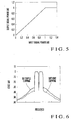
amplitude components. As shown in Fig. 5, the linearity
of this nonlinear compensation amplifier has the
input/output characteristics that linearity is
maintained up to its maximum output, and when an input
amplitude exceeds a value corresponding to the maximum
output, the output level becomes constant.
In a transmission power amplifier having
input/output characteristics like those shown in Fig. 5,
when a signal corresponding to a level exceeding the
maximum output is input, a transmission output is
saturated to increase nonlinear distortion. As a
consequence, the transmission spectrum spreads to
increase adjacent channel leakage power, as indicated by
the spectrum waveform without "CLIPPING" in Fig. 6.
It is therefore desirable to maximize the
saturation power (maximum output) of the transmission
power amplifier. In this case, however, as described
above, the circuit size increases to increase power
consumption and cost. For this reason, it is important
in the CDMA communication apparatus that the
instantaneous maximum power of an input signal is
limited so as not to exceed the saturation power of the
transmission power amplifier.
The simplest method of limiting the input
amplitude of the transmission power amplifier is to clip
an input signal with a predetermined value. If, however,
an input signal is simply clipped, the nonlinear
distortion of a signal waveform increases. As a result,
the transmission spectrum further spreads, as indicated
by the spectrum waveform obtained by "SIMPLE CLIPPING"
in Fig. 6. As shown in Fig. 7, therefore, an amplitude
limiting circuit is generally provided before a band
limiting filter.
An amplitude limiting circuit 20 shown in
Fig. 7 includes an amplitude converter 21 which
calculates the amplitude value of an input signal
constituted by an in-phase component I and quadrature
component Q, a determination unit 22 which compares the
amplitude value calculated by the amplitude converter 21
with a preset threshold to output a control value for
limiting the amplitude of an input signal that exceeds
the threshold, and a clipping circuit 23 which limits an
output amplitude to a value equal to or less than the
threshold in accordance with the control value output
from the determination unit 22.
Of an output signal from the amplitude
limiting circuit 20, only a predetermined baseband
component is output from a filter 24. In this
arrangement, since the frequency component of an output
signal is limited by the filter 24 within a
predetermined band, the transmission spectrum does not
spread.
In the arrangement shown in Fig. 7, however,
since the amplitude limiting circuit and filter 24
differ in their sampling rates for signal processing,
level variations occur at the time of sampling. As a
result, the amplitude of the signal passing through the
filter 24 may increase again.
In addition, when the amplitude limiting
circuit shown in Fig. 7 is applied to a CDMA
communication apparatus of a so-called multicarrier
amplification scheme of combining a plurality of carrier
signals, shown in Fig. 8, the amplitude of the signal is
increased again by processing after amplitude limitation.
The CDMA communication apparatus shown in
Fig. 8 includes a plurality of amplitude limiting
circuits 311 to 31N (N is a positive integer) which
limit the amplitudes of input signals and a plurality of
filters 321 to 32N which pass only predetermined band
components.
The CDMA communication apparatus also includes
first frequency converters 331 to 33N which convert
input signals as baseband signals into signals having
different frequencies for the respective channels, and a
carrier combining unit 34 which combines output signals
from the first frequency converters 331 to 33N.
The CDMA communication apparatus further
includes a D/A converter 35 which converts the signal
obtained by carrier combining into an analog signal, a
second frequency converter 36 which converts the output
signal from the D/A converter 35 into an RF signal, and
a transmission power amplifier 37 which amplifies the RF
signal to power necessary for transmission.
The CDMA communication apparatus includes the
amplitude limiting circuits 311 to 31N, filters 321 to
32N, and first frequency converters 331 to 33N for the
respective channels.
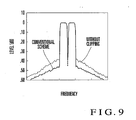
In this arrangement, since signals
corresponding to a plurality of channels are subjected
to vector combining in the carrier combining unit 34
after amplitude limitation, the effect of the amplitude
limitation is lost. As a consequence, the transmission
spectrum spreads, as indicated by the spectrum waveform
of "CONVENTIONAL SCHEME" in Fig. 9.
The present invention has been made to solve
the above problems in the prior art, and has as its
object to provide an amplitude limiting circuit which
can be effectively used to limit an input to a
transmission power amplifier incorporated in a CDMA
communication apparatus.
In order to achieve the above object,
according to the present invention, there is provided an
amplitude limiting circuit for limiting an amplitude of
a signal input to a power amplifier, comprising an
amplitude converter which calculates an amplitude value
of an input signal, a determination unit which detects,
as a detection interval, an interval in which the
amplitude value exceeds a threshold, on the basis of a
preset threshold and the amplitude value of the input
signal, a peak detector which detects, in the detection
interval, a peak time when a maximum amplitude value
appears and an amplitude value at the peak time as a
peak value, a window filter which generates a window
function for limiting the amplitude value to a value not
more than the threshold by using the peak value output
from the peak detector, a delay circuit which delays the
input signal such that the peak time output from the
peak detector coincides with time when the window
function output from the window filter exhibits a
minimum value, and a multiplier which multiplies an
output signal from the delay circuit by the window
function.
The present invention will be described next
with reference to the accompanying drawings.
Description of the Preferred Embodiment
As shown in Fig. 1, an amplitude limiting
circuit according to the present invention includes an
amplitude converter 1 which calculates the amplitude
value of an input signal constituted by an in-phase
component I and quadrature component Q and a
determination unit 2 which is connected to the amplitude
converter 1 and compares a preset threshold with an
output value from the amplitude converter to detect an
interval in which the amplitude value of the input
signal exceeds the threshold.
The amplitude limiting circuit also includes a
peak detector 3 which is connected to the determination
unit 2 and detects, in the interval in which the
amplitude value of the input signal exceeds the
threshold, the time (peak time) when the maximum
amplitude value appears and the maximum value (peak
value), and a window filter 4 which is connected to the
peak detector 3 and generates a predetermined window
function by using the values detected by the peak
detector 3.
In addition, the amplitude limiting circuit
includes a delay circuit 5 which delays the input signal
by a predetermined delay amount and a multiplier 6 which
is connected to the delay circuit 5 and multiplies an
output signal from the delay circuit 5 by the window
function generated by the window filter 4.
As shown in Fig. 1, the input signal to the
amplitude limiting circuit is a signal which is
constituted by the in-phase component I and quadrature
component Q and has undergone filtering processing and
carrier combining.
The amplitude converter 1 calculates an
amplitude value P of the input signal from the in-phase
component I and quadrature component Q by
P = (I2 + Q2)½
The determination unit 2 includes an amplitude
value comparing section 2a which compares the amplitude
value calculated by the amplitude converter 1 with a
threshold to determine whether or nor the amplitude
value exceeds the threshold, and interval detecting
section 2b which detects an interval in which the
amplitude value of the input signal exceeds the
threshold.
Note that the threshold is set by a threshold
input section 7 in advance to a value equal to or less
than an input amplitude at which the output of a
transmission power amplifier located after the amplitude
limiting circuit is not saturated.
In the interval in which it is determined that
the amplitude value of the input signal exceeds the
threshold, the peak detector 3 outputs the peak time
when the maximum amplitude value appears and the peak
value at the peak time.
The window filter 4 outputs a window function
which exhibits a value of 1 before and after a preset
correction interval longer than the interval in which
the amplitude value of the input signal exceeds the
threshold, and makes the value at the center of the
correction interval proportional to the reciprocal of
the peak value.
The delay circuit 5 delays the input signal
such that the peak time coincides with the center of the
correction interval. The signal output from the delay
circuit 5 is multiplied by the window function output
from the window filter 4.
As shown in Fig. 2, a CDMA communication
apparatus of this embodiment includes a plurality of
filters 111 to 11N (N is a positive integer) which pass
only predetermined band components, and a plurality of
first frequency converters 121 to 12N which are
respectively connected to the filters 111 to 11N and
convert baseband signals passing through the filters
into signals with different frequencies for the
respective channels.
The CDMA communication apparatus also includes
a carrier combining unit 13 which is connected to the
first frequency converters 121 to 12N and combines
output signals from the first frequency converters 121
to 12N, and an amplitude limiting circuit 14 which is
connected to the carrier combining unit 13 and limits
the amplitude of the signal obtained by carrier
combining.
In addition, the CDMA communication apparatus
includes a D/A converter 15 which is connected to the
amplitude limiting circuit 14 and converts the
amplitude-limited signal into an analog signal, a second
frequency converter 16 which is connected to the D/A
converter 15 and converts an output signal from the D/A
converter 15 into an RF signal, and a transmission power
amplifier 17 which is connected to the second frequency
converter 16 and amplifies the RF signal to power
necessary for transmission.
That is, the CDMA communication apparatus
includes a filter 11 and first frequency converter 12
for each channel.
In this arrangement, since amplitude
limitation is performed with respect to the signal
obtained by filtering by the filters 111 to 11N and
carrier combining, there is no chance that the signal
amplitude increases again by processing after amplitude
limitation as in the prior art.
The operation of the amplitude limiting
circuit according to the present invention will be
described next with reference to Figs. 3 and 4.
In the amplitude limiting circuit of this
embodiment, the amplitude converter 1 converts an input
signal into an amplitude value, and the determination
unit 2 compares the amplitude value with a preset
threshold. If the amplitude value exceeds the threshold,
the peak detector 3 detects the peak time when the
maximum amplitude appears and the peak value at the time.
The window filter 4 generates a function
exhibiting a value which is 1 until the peak value,
gradually decreases thereafter to become A (=
threshold/peak value) after a lapse of a time τ, and
gradually increases thereafter to return to 1 after a
lapse of the time τ (see "WINDOW FUNCTION" in Fig. 3).
In this case, τ is set in advance to a value
half a value corresponding to a time longer than the
interval in which the input signal exceeds the threshold.
For example, a value about 10 to 20 times the chip
period is used.
Note that the chip period is the reciprocal of
the spreading frequency (= chip rate) used in the CDMA
communication apparatus. Referring to Fig. 3, the unit
of time on the abscissa is represented by "CHIP", which
indicates that a given time corresponds to a specific
multiple of the chip rate.
The input signal is delayed by the time τ by
the delay circuit 5 (see "DELAY CIRCUIT OUTPUT" in
Fig. 3). This signal is then multiplied by the window
function generated by the window filter 4, and the
resultant signal is output (see "OUTPUT SIGNAL" in
Fig. 3). At this time, the multiplier 6 outputs a
signal which is wave-shaped such that the peak value is
equal to or less than the threshold.
The
window filter 4 generates, for example, a
window function w(t) represented by
In this case, when t = τ, it suffices if w(t)
= 1 - 2a ≦ A. For example, a = (1 - A)/2 is set.
As shown in Fig. 2, in the CDMA communication
apparatus of this embodiment, since amplitude limitation
is performed with respect to the signal obtained by
filtering by the filters and carrier combining, there is
no chance that the signal amplitude increases again by
processing after amplitude limitation as in the prior
art.
Therefore, this apparatus is free from
nonlinear distortion which is caused when a transmission
output from the transmission power amplifier 17 on the
output stage is saturated, and hence spreading of a
transmission spectrum is suppressed. This makes it
possible to suppress adjacent channel leakage power.
The amplitude limiting circuit of this
embodiment smoothly limits the amplitude of an input
signal by using a window function instead of simply
clipping the input signal. This prevents the occurrence
of nonlinear distortion due to amplitude limitation
processing, and hence suppresses spreading of a
transmission spectrum as indicated by the waveform based
on "SCHEME ACCORDING PRESENT INVENTION".
The present invention is configured in the
above manner, and hence has the following effects.
An amplitude limiting circuit according to the
present invention includes an amplitude converter which
calculates the amplitude value of an input signal, and a
determination unit which compares a preset threshold
with the amplitude value of the input signal to detect
an interval in which the amplitude value exceeds the
threshold.
The amplitude limiting circuit also includes a
peak detector which detects, in the interval in which
the amplitude value of the input signal exceeds the
threshold, the peak time when the amplitude value of the
input signal becomes maximum and the amplitude value at
the peak time, and a window filter which generates a
window function for limiting the amplitude value of the
input signal to a value equal to or less than the
threshold by using the peak value.
The amplitude limiting circuit further
includes a delay circuit which delays the input signal
such that the peak time coincides with the time when the
window function exhibits the minimum value, and a
multiplier which multiplies an output signal from the
delay circuit by the window function.
With this operation, the amplitude of the
input signal is limited to a value equal to or less than
the threshold by using the window function, and hence no
nonlinear distortion is caused by amplitude limitation
processing. This makes it possible to suppress
spreading of the transmission spectrum.
A CDMA communication apparatus according to
the present invention includes a plurality of filters
which pass predetermined band components containing
input signals, and a plurality of first frequency
converters which convert the signals passing through the
filters into signals with different frequencies for the
respective channels.
The CDMA communication apparatus also includes
a carrier combining unit which combines output signals
from the first frequency converters, the above amplitude
limiting circuit which limits the amplitude of an output
signal from the carrier combining unit, and a D/A
converter which converts an output signal from the
amplitude limiting circuit into an analog signal.
The CDMA communication apparatus further
includes a second frequency converter which converts the
analog signal into an RF signal, and a transmission
power amplifier which amplifies the RF signal to power
necessary for transmission.
With this operation, the amplitude of an
output signal from the carrier combining unit is limited
by the above amplitude limiting circuit to perform
amplitude limitation with respect to the signal obtained
by filtering by the baseband filters and carrier
combining. This prevents the signal amplitude from
increasing again due to processing after amplitude
limitation as in the prior art.
Therefore, this apparatus is free from
nonlinear distortion which is caused when a transmission
output from the transmission power amplifier on the
transmitting side is saturated, and hence spreading of a
transmission spectrum is suppressed. This makes it
possible to suppress adjacent channel leakage power.