EP1390860B1 - Personalization server unified user profile - Google Patents
Personalization server unified user profile Download PDFInfo
- Publication number
- EP1390860B1 EP1390860B1 EP02764328.7A EP02764328A EP1390860B1 EP 1390860 B1 EP1390860 B1 EP 1390860B1 EP 02764328 A EP02764328 A EP 02764328A EP 1390860 B1 EP1390860 B1 EP 1390860B1
- Authority
- EP
- European Patent Office
- Prior art keywords
- user
- database
- data
- personalization
- java bean
- Prior art date
- Legal status (The legal status is an assumption and is not a legal conclusion. Google has not performed a legal analysis and makes no representation as to the accuracy of the status listed.)
- Expired - Lifetime
Links
Images


Classifications
-
- G—PHYSICS
- G06—COMPUTING OR CALCULATING; COUNTING
- G06Q—INFORMATION AND COMMUNICATION TECHNOLOGY [ICT] SPECIALLY ADAPTED FOR ADMINISTRATIVE, COMMERCIAL, FINANCIAL, MANAGERIAL OR SUPERVISORY PURPOSES; SYSTEMS OR METHODS SPECIALLY ADAPTED FOR ADMINISTRATIVE, COMMERCIAL, FINANCIAL, MANAGERIAL OR SUPERVISORY PURPOSES, NOT OTHERWISE PROVIDED FOR
- G06Q30/00—Commerce
- G06Q30/02—Marketing; Price estimation or determination; Fundraising
-
- G—PHYSICS
- G06—COMPUTING OR CALCULATING; COUNTING
- G06F—ELECTRIC DIGITAL DATA PROCESSING
- G06F16/00—Information retrieval; Database structures therefor; File system structures therefor
- G06F16/20—Information retrieval; Database structures therefor; File system structures therefor of structured data, e.g. relational data
- G06F16/25—Integrating or interfacing systems involving database management systems
- G06F16/252—Integrating or interfacing systems involving database management systems between a Database Management System and a front-end application
Definitions
- the present invention relates generally to the integration of data from multiple sources.
- Corporations are continually looking for better ways to integrate new information with their existing data, such as information relating to current and prospective customers that may be acquired from third party sources.
- new information such as information relating to current and prospective customers that may be acquired from third party sources.
- a company must be able to streamline the integration process, eliminate unnecessary cost or purchases, and eliminate the downtime that is typically necessary to implement a new data system or modify existing data structures.
- a corporation may wish to incorporate additional user profile data into their established user data.
- This additional profile data may be configured and maintained by a separate source, such as a personalization server.
- the corporation often has pre-existing corporate customer or user data that is outside the scope of the personalization server.
- This data which typically lives in an existing corporate database, may include, for each customer, information such as name, social security number, and/or company-particular information such as frequent flyer miles for a particular airline.
- the corporation would like to integrate this data seamlessly into their personalization solution, avoiding data migration difficulties where possible.
- US 5875327 discloses a system and method for workstation configuration that includes a hierarchy management of preferences that are managed and stored with a file server. Preference files are read in order to use the information within those files to configure a workstation.
- a further embodiment of the invention is defined by the dependent claim.
- An architecture of the present invention defines the way in which existing user data may be incorporated with more dynamically-changing personalization data.
- a server such as a personalization server that is used to personalize content or services for a particular use or group of users
- system users are typically represented by user profiles.
- a user profile provides an ID for a user and access to the properties of a user, such as age or email address.
- Property values can be single-valued or multi-valued, and may be requested via a getProperty() function or similar method which takes a property name as a key.
- An advantage of a user profile of the present invention is that it may be extended and customized to retrieve user information from an existing data source.
- a user profile that ships with a server or solution, such as a personalization server may combine user properties, such as properties from a personalization server database with user properties from an LDAP server or legacy database as are known in the art, into a single user profile for use within an application. Developers and system users then need not worry about the different underlying data sources.
- the user profile is the only place necessary to go for user information.
- a unified user profile (UUP) of the present invention includes this aggregation of properties from an existing data source and the personalization server database tables into a single, customized user profile. More specifically, a UUP marries existing user/customer data by extending a user component. By installing the personalization server database tables into the existing database instance and extending a user implementation, developers can quickly create a customized UUP that is capable of retrieving properties from, and storing/updating properties to, an existing database. This flexibility is desirable because it allows access to existing data without any migration of data or disruption of existing applications using that data. It should be understood, however, that existing data may be migrated into a separate personalization server database instance if desired.
- UUP requires no database scheme updates or data migration within a data management system, such as a customer Relational Database Management System (RDBMS).
- RDBMS customer Relational Database Management System
- the UUP is preferably created by writing an extension EJB, rather than by updating database tables, or running data migration scripts. Servers of the prior art often require the updating of the user database table schema for additional user properties.
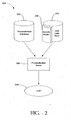
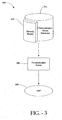
- Figures 1-4 show possible configurations for a UUP system of the present invention.
- a corporate, legacy, or other external database 102 and personalization server database 104 provide property data to a personalization server 110.
- the personalization server 110 also receives information from a user data store 106, such as authentication information, user lists, group lists, and group membership.
- the user data store may be any appropriate system, such as an LDAP, Unix, or NT system as are known in the art.
- the user data store 106 also includes a security realm 108 for authentication.
- the personalization server database 104 and security realm 108 are kept separate in this configuration, as such separation of authentication and retrieval may be desirable, though not necessary to practice the invention.
- This configuration may be used where users and groups already exist in some type of data store, such as an LDAP directory. This existing user property data is then taken by the personalization server 110 and merged with the personalization data to generate the UUP 112.
- a second configuration 200 may be useful where users and groups already exist in a user data store 204, such as an LDAP directory, and no existing user data must be incorporated into the UUP 210. All user and group property data is then preferably stored in the tables of the personalization server 202 database.
- the personalization server 208 in this configuration still preferably utilizes a security realm 206 of the user data store 204.
- a third configuration 300 may be useful where there is no existing store of users and groups.
- the tables of the personalization server database 302 contain all user and group data, as well as preferably housing a separated security realm 304.
- the personalization server 306 then only need to look to the personalization server database 302 in generating the UUP 308.
- a fourth configuration 400 may be useful where user, group, and property data are in an existing corporate, legacy, or other external database 402 and must be incorporated into the UUP 410 by the personalization server 408.
- a custom security realm 404 must then be created in order to use the existing users and groups with the personalization server.
- the custom security realm need not necessarily be stored with the external database 402, but may be incorporated into the personalization database 406. Again, the retrieval and authentication realms are preferably kept separate.
- One embodiment of an architecture of the present invention relies on three primary contributors for incorporating data in a UUP: (1) a base user enterprise java bean (EJB), (2) an user data store, and (3) a user-specific enterprise java bean (EJB).
- EJB enterprise java bean
- EJB enterprise java bean
- a base user EJB is a Java class which is preferably extended by a personalization customer to incorporate existing user data into the personalization solution.
- the base user EJB preferably provides a single, transparent interface through which both implicit properties and explicit properties can be retrieved or updated.
- the base user EJB utilizes a property set, which may be used to give namespace qualifications to properties, as well as to define property types, allowable values, etc.
- a property set acts like a data schema for user properties.
- transparency generally refers to the fact that a user or application can make a call or request without care as to where the data is stored or what naming convention the data may use. If the data is in a legacy database instead of a personalization database, the UUP will automatically process the request without the user or application ever needing to know about the location or name.
- subclasses of the base User EJB use two methods to retrieve or update: getProperty and getProperty. These methods may retrieve and/or update both implicit and explicit properties.
- the methods may be set as follows:
- the propertySetName attribute specifies the data schema to which the invocation applies. In this way, the propertySetName acts as a namespace for the property that is to be retrieved or updated.
- the propertyName attribute specifies the name of the property to be updated or retrieved.
- One advantage of the using the propertySetName-propertyName pair is that a single propertyName may be used across multiple applications, or sub-application scopes. The multiple instances of the property names may also correspond to differing definitions. Properties retrieved from the base User bean shall be referred to as implicit properties.
- the user data store which may be in existence prior to the incorporation, is typically a database or table where data is held that may relate to current users or customer data. This table may be colocated in a database instance of the personalization server.
- the existing user data store may hold user data which exists independent of the personalization server database tables.
- the personalization server may require the existing user data store to live in the same RDBMS instance as the personalization server tables.
- An example "AcmeCustomer" RDBMS table is shown in Table 1. This table defines three values for each customer: (1) Customer_Name, (2) Acme_Points, and (3) Acme_Discount.
- Customer_Name is used as a unique identifier for each customer. This unique identifier, once integration is complete, is preferably used to uniquely identify a user throughout the Personalization server.
- Acme_Points is a sample customer value. An Acme customer might collect points as he or she makes purchases of Acme products. Acme_Discount is the discount the customer receives on each Acme product purchase.
- Table 1 AcmeCustomer RDBMS table Customer_Name Acme_Points Acme_Discount bsmith 50000 0.2 jpatadia 100000 0.1 ughandi 85000 0.15 mbisson 65000 0.3 kdickson 32000 0.05 tstamm 200000 0.2 tcook 100000 0.1
- an EJB may be written to extend the user bean, which may be provided with the personalization server.
- the personalization server client has transparent read and write access to properties previously stored in the user-specific database table ( explicit properties ), and to properties stored in the set of property tables of the Personalization server ( implicit properties ).
- an AcmeUser EJB may be written that provides data update and retrieval mechanisms for the existing table.
- the AcmeUser EJB may define the following methods:
- Properties retrieved from the extended user bean are called explicit properties.
- both the Acme points and the Acme discount may be retrieved with the inherited getProperty() and setProperty() methods implemented by the base User EJB.
- the UUP preferably uses the notion of Java reflection to determine whether a property is explicit before treating the property as implicit and employing the notion of Property Sets. Reflection is a feature of the Java programming language that allows an executing Java program to examine or introspect upon itself in order to manipulate internal properties of the program.
- An explicit property is preferably updated or retrieved before an implicit property, if the propertyName corresponds to an explicit property. Because of this search order, the actual property set name is of no consequence if an explicit property is being updated or retrieved.
- the following example demonstrates a fictitious company's use of the UUP to take advantage of existing customer data.
- the example extends the User bean and retrieves data from a preexisting database. This example shows how, with relative ease, a customized UUP can be created that meets an application's persistence needs.
- Table 2 explains what may be extended in order to create a custom UUP.
- Table 2 - Sample Extensions to create a custom UUP Object Must Extend UUP Primary Key UserPk--with no key fields added.
- UUP is a ConfigurableEntity
- Explicitly setting a property as used herein means calling a setter method for a property directly.
- Implicitly setting a property means setting a property via the setProperty() method where no explicit setter method is available. For example, if a UUP contains a "userPoints" property, calling setUserPoints() directly would explicitly set the userPoints property. Calling setProperty() with the "userPoints" key would implicitly set the userPoints property. When called, setProperty() first looks for a setUserPoints() setter method to call in the user profile.
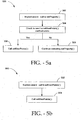
- Figures 5(a) and 5(b) diagram both an explicit 550 and implicit 500 call to setUserPoints(), respectively. In both cases, it is the responsibility of the UUP bean to store the userPoints value. If no setUserPoints() method had existed in the UUP bean, the ConfigurableEntity implementation would have handled storing the userPoints value.
- a call is made to setProperty() 502. The system checks to see if a setUserPoints() method exists 506. If so, setUserPoints() is called 506. If not, the system continues executing setProperty 510.
- a call made to setUserPoints() 552 will simply call setUserPoints() 554.
- a get PropertyName() / set PropertyName() approach is followed for all explicit property setting and getting in a UUP. If a UUP has an explicit userPoints property, an explicit getUserPoints() method is provided, as retrieveUserPoints() would not work. Similarly, setting userPoints is done with a setUserPoints() method.
- the getProperty() and setProperty() methods look for getters and setters that follow this convention when getting and setting properties via implicit calls. Overriding setProperty() or getProperty() is not permitted.
- the getting and setting of explicit properties is done through getter and setter methods. Explicit getters and setters take and return objects. Primitives such as long and float are wrapped, such as in java.lang.Long and java.lang.Float objects, to be compatible with ConfigurableEntity's getProperty() and setProperty() methods.
- a getter method it may be a good idea to provide a setter method, and vice versa, as it cannot be predicted when a user or application will try to set or get a property. For example, if a getter is provided that retrieves a property from a database table without a corresponding setter, a call to setProperty() will store that property in a Personalization Server table. This is undesirable, as the value is retrieved from one place and set in another. The next time the property is retrieved, it would have its original value - not the value that was set. If a read-only property is to be provided, an empty setter method may be implemented.
- the getProperty() method preferably searches for properties in a specific order. For example, if a property is not found for a User, a Group may be queried for the value. In this case the User would inherit the property value from a Group. In ConfigurableEntityterms, the Group would be the User's "successor". If a property is not found in a ConfigurableEntity, then the successor to ConfigurableEntity may be queried. This way, ConfigurableEntities can inherit and override values from a parent entity.
- An implicit successor is a default successor to a ConfigurableEntity, or a successor that is set for a specific Property Set.
- An explicit successor is preferably a ConfigurableEntity that may be passed as a parameter to the getProperty() method. Following is the order of the getProperty() property search as it exists in a preferred ConfigurableEntity:
- setProperty() is used to set a property for a Property Set that is inconsistent with the Property Set definition, an exception may be thrown. For example, suppose a "UnifiedUserExample” Property Set is defined that has a userPoints property of type Integer. If someone tries to set the userPoints property for the "UnifiedUserExample” Property Set to be “abc” an exception would be thrown because userPoints is defined as being of type Integer and "abc" is text. Similarly, setting a Boolean property value to "bar” would result in an exception because Boolean values are restricted to Boolean objects.
- the property value may be set in the null Property Set, referred to as the default Property Set.
- the default property set is preferably searched before looking for the property value in the "Reserved" Property Set and successor.
- the "Reserved” Property Set is preferably a read-only Property Set that may be used to hold property values from an external datastore.
- the "Reserved” Property Set may be used in the Personalization Server, such as when properties are retrieved from an LDAP directory. Attempting to set a property in the "Reserved” Property Set may result in an exception being thrown. Properties in the "Reserved” Property Set and the Reserved Property Set itself may not be editable via User Management tools. Preferred User Management tools allow the specification of attributes to be retrieved from an LDAP or other server for users and groups. These attributes may then be the only ones retrieved at runtime.
- Properties may be set via setProperty() with a Property Set specified that does not exist. This may be undesirable. When done, a Property Set is not created "on-the-fly" for the specified Property Set name. Rather, the specified Property Set name serves only as a namespace for the property. Similarly, it may be undesirable to set. a property via setProperty() for an existing Property Set, specifying a property that does not exist for that Property Set. Properties set in either of these ways may not be editable through the User Management tools, while properties in the "null" or "default” property set may be editable.
- a call to getProperty() preferably returns a java.lang.Long object if setProperty() is called passing a java.lang.Integer object value.
- Code retrieving such a property may be written as follows:
- a call to getProperty() preferably returns a java.lang.Double object if setProperty() is called with a java.lang.Float object.
- Code retrieving such a property may be written as follows:
- a User object preferably offers functionality for EJB find operations that makes integrating a UUP with the Personalization Server easy.
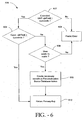
- Figure 6 shows a flowchart for an ejbFind() operation.
- An extended UUP ejbFind() searches for records in the existing data store 602. If successful, a call will be made to super.ejbFind() 604, the User object ejbFind(). If successful, the User object ejbFind() will create the necessary records for the UUP in the Personalization Server database tables if they do not yet exist 610 and return the appropriate primary key. If the User object ejbFind() fails, it may check the underlying security realm 608 to determine whether the username corresponds to a valid user.
- the User object ejbFind() creates the necessary records 610, thereby eliminating finder errors and the time needed initially to migrate user data into the Personalization Server User database tables. If either ejbFind() fails or the user does not exist in the realm, a Finder Error is encountered 606. If no Finder Error is encountered, the appropriate primary key is returned 612.
- the last step in one embodiment of creating a custom UUP requires the UUP to be registered with a personalization or other server, such as through user management tools.
- preferred user management tools utilize the following, in Table 3: Table 3 - Registering the UUP (example) Profile Type Name Arbitrary name that is later used to refer to the profile type through the User Management system's ⁇ um:getprofile > JSP extension tag Profile Home Class The home class of the new profile type Profile Remote Interface The remote interface of the new profile type Profile Primary Key Class The primary key class of the new profile type Profile JNDI Name The JNDI lookup name of the new profile type
- a unified user profile mechanism facilitates the retrieval of user information from an LDAP server, with no Java code required from the personalization server customer.
- a set of administration tools allows specification of user and group properties to be retrieved from the LDAP server at a property request during application run time.
- the only requirement of the Personalization Server customer for LDAP property retrieval is that the customer employ an LDAP security realm.
- the UUP queries certain configuration information to detect whether the LDAP security realm is currently in use. If so, the names of the user and group properties to be retrieved may be obtained from an LDAPConfiguration session EJB, and the appropriate properties for the current user retrieved. The customer may not be required to use the LDAP security realm to receive the benefit of other UUP capabilities.
Landscapes
- Engineering & Computer Science (AREA)
- Business, Economics & Management (AREA)
- Databases & Information Systems (AREA)
- Theoretical Computer Science (AREA)
- Physics & Mathematics (AREA)
- Accounting & Taxation (AREA)
- Development Economics (AREA)
- Finance (AREA)
- Strategic Management (AREA)
- General Physics & Mathematics (AREA)
- Entrepreneurship & Innovation (AREA)
- General Business, Economics & Management (AREA)
- Marketing (AREA)
- Economics (AREA)
- Game Theory and Decision Science (AREA)
- Data Mining & Analysis (AREA)
- General Engineering & Computer Science (AREA)
- Information Retrieval, Db Structures And Fs Structures Therefor (AREA)
- Storage Device Security (AREA)
Applications Claiming Priority (5)
| Application Number | Priority Date | Filing Date | Title |
|---|---|---|---|
| US28646601P | 2001-04-25 | 2001-04-25 | |
| US286466P | 2001-04-25 | ||
| US21855 | 2001-12-13 | ||
| US10/021,855 US20030065670A1 (en) | 2001-04-25 | 2001-12-13 | Personalization server unified user profile |
| PCT/US2002/012909 WO2002086738A1 (en) | 2001-04-25 | 2002-04-25 | Personalization server unified user profile |
Publications (3)
| Publication Number | Publication Date |
|---|---|
| EP1390860A1 EP1390860A1 (en) | 2004-02-25 |
| EP1390860A4 EP1390860A4 (en) | 2008-04-09 |
| EP1390860B1 true EP1390860B1 (en) | 2015-05-27 |
Family
ID=26695186
Family Applications (1)
| Application Number | Title | Priority Date | Filing Date |
|---|---|---|---|
| EP02764328.7A Expired - Lifetime EP1390860B1 (en) | 2001-04-25 | 2002-04-25 | Personalization server unified user profile |
Country Status (6)
| Country | Link |
|---|---|
| US (1) | US20030065670A1 (enExample) |
| EP (1) | EP1390860B1 (enExample) |
| JP (1) | JP4365100B2 (enExample) |
| CN (1) | CN100409215C (enExample) |
| AU (1) | AU2002307520B2 (enExample) |
| WO (1) | WO2002086738A1 (enExample) |
Families Citing this family (28)
| Publication number | Priority date | Publication date | Assignee | Title |
|---|---|---|---|---|
| US20030065670A1 (en) | 2001-04-25 | 2003-04-03 | Michel Bisson | Personalization server unified user profile |
| US6988099B2 (en) | 2002-06-27 | 2006-01-17 | Bea Systems, Inc. | Systems and methods for maintaining transactional persistence |
| US7526798B2 (en) * | 2002-10-31 | 2009-04-28 | International Business Machines Corporation | System and method for credential delegation using identity assertion |
| US20050025349A1 (en) * | 2003-07-30 | 2005-02-03 | Matthew Crewe | Flexible integration of software applications in a network environment |
| US7822831B2 (en) * | 2003-07-31 | 2010-10-26 | International Business Machines Corporation | Method, system and program product for preserving and restoring mobile device user settings |
| US8332430B2 (en) * | 2006-03-01 | 2012-12-11 | Oracle International Corporation | Secure search performance improvement |
| US9177124B2 (en) | 2006-03-01 | 2015-11-03 | Oracle International Corporation | Flexible authentication framework |
| US8868540B2 (en) * | 2006-03-01 | 2014-10-21 | Oracle International Corporation | Method for suggesting web links and alternate terms for matching search queries |
| US8875249B2 (en) * | 2006-03-01 | 2014-10-28 | Oracle International Corporation | Minimum lifespan credentials for crawling data repositories |
| US8005816B2 (en) * | 2006-03-01 | 2011-08-23 | Oracle International Corporation | Auto generation of suggested links in a search system |
| US8027982B2 (en) * | 2006-03-01 | 2011-09-27 | Oracle International Corporation | Self-service sources for secure search |
| US8707451B2 (en) | 2006-03-01 | 2014-04-22 | Oracle International Corporation | Search hit URL modification for secure application integration |
| US8214394B2 (en) | 2006-03-01 | 2012-07-03 | Oracle International Corporation | Propagating user identities in a secure federated search system |
| US8433712B2 (en) * | 2006-03-01 | 2013-04-30 | Oracle International Corporation | Link analysis for enterprise environment |
| US7941419B2 (en) * | 2006-03-01 | 2011-05-10 | Oracle International Corporation | Suggested content with attribute parameterization |
| US20070214129A1 (en) * | 2006-03-01 | 2007-09-13 | Oracle International Corporation | Flexible Authorization Model for Secure Search |
| WO2007115863A1 (en) * | 2006-04-12 | 2007-10-18 | International Business Machines Corporation | Method and system for adjusting environment settings to the capabilities of a client device |
| US7996392B2 (en) * | 2007-06-27 | 2011-08-09 | Oracle International Corporation | Changing ranking algorithms based on customer settings |
| US8316007B2 (en) | 2007-06-28 | 2012-11-20 | Oracle International Corporation | Automatically finding acronyms and synonyms in a corpus |
| US8260821B2 (en) * | 2008-02-05 | 2012-09-04 | International Business Machines Corporation | Global, dynamic, remote and central system for database driver configuration |
| US8214389B2 (en) * | 2009-04-03 | 2012-07-03 | International Business Machines Corporation | Common architecture for administration of client side property settings in a distributed and heterogeneous environment |
| US8312273B2 (en) * | 2009-10-07 | 2012-11-13 | Microsoft Corporation | Privacy vault for maintaining the privacy of user profiles |
| US20110161830A1 (en) * | 2009-12-30 | 2011-06-30 | International Business Machines Corporation | Faceted profiles with customized privacy controls and personalized view |
| US8910052B2 (en) * | 2010-12-04 | 2014-12-09 | Facebook, Inc. | Tagging users of a social networking system in an experience in a user's user profile |
| US9424509B2 (en) | 2011-03-09 | 2016-08-23 | T-Mobile Usa, Inc. | System for application personalization for a mobile device |
| US20150019547A1 (en) * | 2012-04-20 | 2015-01-15 | Krishnamurthy Thalapathy | Unified user profiles |
| CN108241705B (zh) * | 2016-12-27 | 2021-10-01 | 北京神州泰岳软件股份有限公司 | 一种数据插入方法及装置 |
| CN110543498B (zh) * | 2019-08-20 | 2022-02-18 | 武汉稀云科技有限公司 | 一种基于事件触发的多方数据关联查询方法和装置 |
Family Cites Families (24)
| Publication number | Priority date | Publication date | Assignee | Title |
|---|---|---|---|---|
| US5023907A (en) * | 1988-09-30 | 1991-06-11 | Apollo Computer, Inc. | Network license server |
| US5940504A (en) * | 1991-07-01 | 1999-08-17 | Infologic Software, Inc. | Licensing management system and method in which datagrams including an address of a licensee and indicative of use of a licensed product are sent from the licensee's site |
| US5812865A (en) * | 1993-12-03 | 1998-09-22 | Xerox Corporation | Specifying and establishing communication data paths between particular media devices in multiple media device computing systems based on context of a user or users |
| JPH07230380A (ja) * | 1994-02-15 | 1995-08-29 | Internatl Business Mach Corp <Ibm> | 適用業務プログラムの利用管理方法およびシステム |
| US5758257A (en) * | 1994-11-29 | 1998-05-26 | Herz; Frederick | System and method for scheduling broadcast of and access to video programs and other data using customer profiles |
| KR100538547B1 (ko) * | 1995-12-30 | 2006-02-28 | 타임라인 인코퍼레이티드 | 복수의소스능력을가진데이터검색방법및장치 |
| US5813006A (en) * | 1996-05-06 | 1998-09-22 | Banyan Systems, Inc. | On-line directory service with registration system |
| US6029145A (en) * | 1997-01-06 | 2000-02-22 | Isogon Corporation | Software license verification process and apparatus |
| US5875327A (en) * | 1997-02-18 | 1999-02-23 | International Business Machines Corporation | Hierarchy of preferences and preference groups |
| US6073105A (en) * | 1997-06-13 | 2000-06-06 | Tele-Publishing, Inc. | Interactive personals online network method and apparatus |
| US6237135B1 (en) * | 1998-06-18 | 2001-05-22 | Borland Software Corporation | Development system with visual design tools for creating and maintaining Java Beans components |
| US6195651B1 (en) * | 1998-11-19 | 2001-02-27 | Andersen Consulting Properties Bv | System, method and article of manufacture for a tuned user application experience |
| US6202062B1 (en) * | 1999-02-26 | 2001-03-13 | Ac Properties B.V. | System, method and article of manufacture for creating a filtered information summary based on multiple profiles of each single user |
| US6199099B1 (en) * | 1999-03-05 | 2001-03-06 | Ac Properties B.V. | System, method and article of manufacture for a mobile communication network utilizing a distributed communication network |
| US6766305B1 (en) * | 1999-03-12 | 2004-07-20 | Curl Corporation | Licensing system and method for freely distributed information |
| US6609128B1 (en) * | 1999-07-30 | 2003-08-19 | Accenture Llp | Codes table framework design in an E-commerce architecture |
| US6640244B1 (en) * | 1999-08-31 | 2003-10-28 | Accenture Llp | Request batcher in a transaction services patterns environment |
| WO2001052118A2 (en) * | 2000-01-14 | 2001-07-19 | Saba Software, Inc. | Information server |
| US20020049770A1 (en) * | 2000-02-29 | 2002-04-25 | Vijay Mayadas | System and method for distributed audience profile development through consensual interaction with a network |
| US8799208B2 (en) * | 2000-03-07 | 2014-08-05 | E-Rewards, Inc. | Method and system for evaluating, reporting, and improving on-line promotion effectiveness |
| US7155414B2 (en) * | 2000-04-05 | 2006-12-26 | International Business Machines Corporation | License compliance verification system |
| US7234103B1 (en) * | 2000-04-26 | 2007-06-19 | Accenture Llp | Network-based tax framework database |
| US6557009B1 (en) * | 2000-09-01 | 2003-04-29 | American Management Systems, Inc. | Environmental permit web portal with data validation capabilities |
| US20030065670A1 (en) | 2001-04-25 | 2003-04-03 | Michel Bisson | Personalization server unified user profile |
-
2001
- 2001-12-13 US US10/021,855 patent/US20030065670A1/en not_active Abandoned
-
2002
- 2002-04-25 JP JP2002584189A patent/JP4365100B2/ja not_active Expired - Lifetime
- 2002-04-25 EP EP02764328.7A patent/EP1390860B1/en not_active Expired - Lifetime
- 2002-04-25 WO PCT/US2002/012909 patent/WO2002086738A1/en not_active Ceased
- 2002-04-25 CN CNB028121430A patent/CN100409215C/zh not_active Expired - Lifetime
- 2002-04-25 AU AU2002307520A patent/AU2002307520B2/en not_active Expired
Also Published As
| Publication number | Publication date |
|---|---|
| JP2004537096A (ja) | 2004-12-09 |
| EP1390860A4 (en) | 2008-04-09 |
| WO2002086738A1 (en) | 2002-10-31 |
| CN100409215C (zh) | 2008-08-06 |
| US20030065670A1 (en) | 2003-04-03 |
| JP4365100B2 (ja) | 2009-11-18 |
| EP1390860A1 (en) | 2004-02-25 |
| CN1516839A (zh) | 2004-07-28 |
| AU2002307520B2 (en) | 2008-05-29 |
Similar Documents
| Publication | Publication Date | Title |
|---|---|---|
| AU2002307520B2 (en) | Personalization server unified user profile | |
| AU2002307520A1 (en) | Personalization server unified user profile | |
| EP1460565B1 (en) | Method and system for uniformly accessing multiple directory services | |
| US6738775B2 (en) | Database communication system and method for communicating with a database | |
| US7421458B1 (en) | Querying, versioning, and dynamic deployment of database objects | |
| US6915287B1 (en) | System, method and computer program product for migrating data from one database to another database | |
| US7024656B1 (en) | Persistent agents | |
| US6448981B1 (en) | Intermediate user-interface definition method and system | |
| US8082322B1 (en) | Federation of information from multiple data sources into a common, role-based distribution model | |
| JP2001527243A (ja) | オブジェクト指向アプリケーション内のクラスに対応するリレーショナル・データベース内のインデックスを生成するための方法及び装置 | |
| EP1519266A2 (en) | Mapping architecture for arbitrary data models | |
| US20050151738A1 (en) | Data referencing within a database graph | |
| US20050149907A1 (en) | Method and system to automatically generate software code | |
| US7840614B2 (en) | Virtual content repository application program interface | |
| JP2004534304A (ja) | ソフトウェア・コンポーネント・プラグイン・フレームワークのためのシステム及びその方法 | |
| US8954461B2 (en) | Systems and methods for object to relational mapping extensions | |
| EP1638024A2 (en) | Durable Storage of .NET Data Types and Instances | |
| US20030088678A1 (en) | Virtual attribute service in a directory server | |
| US7593951B2 (en) | Application programming interface for centralized storage of principal data | |
| CN100530181C (zh) | 用于生成统一用户特征集的系统和方法 | |
| JP2001527241A (ja) | オブジェクト指向データ依存性に対応するデータベース内の記憶済み手続をロードするための方法及び装置 | |
| US20100205144A1 (en) | Creating searchable revisions of a resource in a repository | |
| Ganesh et al. | Building database applications with JDBC | |
| Spell | Introducing JDBC | |
| HK1069896A (en) | Method and system for uniformly multiple directory services |
Legal Events
| Date | Code | Title | Description |
|---|---|---|---|
| PUAI | Public reference made under article 153(3) epc to a published international application that has entered the european phase |
Free format text: ORIGINAL CODE: 0009012 |
|
| 17P | Request for examination filed |
Effective date: 20031121 |
|
| AK | Designated contracting states |
Kind code of ref document: A1 Designated state(s): AT BE CH CY DE DK ES FI FR GB GR IE IT LI LU MC NL PT SE TR |
|
| AX | Request for extension of the european patent |
Extension state: AL LT LV MK RO SI |
|
| A4 | Supplementary search report drawn up and despatched |
Effective date: 20080307 |
|
| RIC1 | Information provided on ipc code assigned before grant |
Ipc: H04H 1/00 20080101ALI20080303BHEP Ipc: G06F 17/30 20060101ALI20080303BHEP Ipc: G06F 15/16 20060101ALI20080303BHEP Ipc: G06F 9/44 20060101ALI20080303BHEP Ipc: G06F 15/00 20060101AFI20021105BHEP |
|
| 17Q | First examination report despatched |
Effective date: 20080703 |
|
| RAP1 | Party data changed (applicant data changed or rights of an application transferred) |
Owner name: ORACLE INTERNATIONAL CORPORATION |
|
| GRAP | Despatch of communication of intention to grant a patent |
Free format text: ORIGINAL CODE: EPIDOSNIGR1 |
|
| RIC1 | Information provided on ipc code assigned before grant |
Ipc: G06F 17/30 20060101ALI20141201BHEP Ipc: G06F 15/00 20060101AFI20141201BHEP Ipc: G06F 15/16 20060101ALI20141201BHEP Ipc: G06F 9/44 20060101ALI20141201BHEP |
|
| INTG | Intention to grant announced |
Effective date: 20141216 |
|
| GRAS | Grant fee paid |
Free format text: ORIGINAL CODE: EPIDOSNIGR3 |
|
| GRAA | (expected) grant |
Free format text: ORIGINAL CODE: 0009210 |
|
| AK | Designated contracting states |
Kind code of ref document: B1 Designated state(s): AT BE CH CY DE DK ES FI FR GB GR IE IT LI LU MC NL PT SE TR |
|
| REG | Reference to a national code |
Ref country code: GB Ref legal event code: FG4D |
|
| REG | Reference to a national code |
Ref country code: CH Ref legal event code: EP |
|
| REG | Reference to a national code |
Ref country code: AT Ref legal event code: REF Ref document number: 729190 Country of ref document: AT Kind code of ref document: T Effective date: 20150615 |
|
| REG | Reference to a national code |
Ref country code: IE Ref legal event code: FG4D |
|
| REG | Reference to a national code |
Ref country code: DE Ref legal event code: R096 Ref document number: 60247217 Country of ref document: DE Effective date: 20150709 Ref country code: DE Ref legal event code: R096 Ref document number: 60247217 Country of ref document: DE |
|
| REG | Reference to a national code |
Ref country code: AT Ref legal event code: MK05 Ref document number: 729190 Country of ref document: AT Kind code of ref document: T Effective date: 20150527 |
|
| PG25 | Lapsed in a contracting state [announced via postgrant information from national office to epo] |
Ref country code: ES Free format text: LAPSE BECAUSE OF FAILURE TO SUBMIT A TRANSLATION OF THE DESCRIPTION OR TO PAY THE FEE WITHIN THE PRESCRIBED TIME-LIMIT Effective date: 20150527 Ref country code: PT Free format text: LAPSE BECAUSE OF FAILURE TO SUBMIT A TRANSLATION OF THE DESCRIPTION OR TO PAY THE FEE WITHIN THE PRESCRIBED TIME-LIMIT Effective date: 20150928 Ref country code: FI Free format text: LAPSE BECAUSE OF FAILURE TO SUBMIT A TRANSLATION OF THE DESCRIPTION OR TO PAY THE FEE WITHIN THE PRESCRIBED TIME-LIMIT Effective date: 20150527 |
|
| REG | Reference to a national code |
Ref country code: NL Ref legal event code: MP Effective date: 20150527 |
|
| PG25 | Lapsed in a contracting state [announced via postgrant information from national office to epo] |
Ref country code: GR Free format text: LAPSE BECAUSE OF FAILURE TO SUBMIT A TRANSLATION OF THE DESCRIPTION OR TO PAY THE FEE WITHIN THE PRESCRIBED TIME-LIMIT Effective date: 20150828 Ref country code: AT Free format text: LAPSE BECAUSE OF FAILURE TO SUBMIT A TRANSLATION OF THE DESCRIPTION OR TO PAY THE FEE WITHIN THE PRESCRIBED TIME-LIMIT Effective date: 20150527 |
|
| PG25 | Lapsed in a contracting state [announced via postgrant information from national office to epo] |
Ref country code: DK Free format text: LAPSE BECAUSE OF FAILURE TO SUBMIT A TRANSLATION OF THE DESCRIPTION OR TO PAY THE FEE WITHIN THE PRESCRIBED TIME-LIMIT Effective date: 20150527 |
|
| REG | Reference to a national code |
Ref country code: DE Ref legal event code: R097 Ref document number: 60247217 Country of ref document: DE |
|
| PLBE | No opposition filed within time limit |
Free format text: ORIGINAL CODE: 0009261 |
|
| STAA | Information on the status of an ep patent application or granted ep patent |
Free format text: STATUS: NO OPPOSITION FILED WITHIN TIME LIMIT |
|
| PG25 | Lapsed in a contracting state [announced via postgrant information from national office to epo] |
Ref country code: IT Free format text: LAPSE BECAUSE OF FAILURE TO SUBMIT A TRANSLATION OF THE DESCRIPTION OR TO PAY THE FEE WITHIN THE PRESCRIBED TIME-LIMIT Effective date: 20150527 |
|
| 26N | No opposition filed |
Effective date: 20160301 |
|
| PG25 | Lapsed in a contracting state [announced via postgrant information from national office to epo] |
Ref country code: BE Free format text: LAPSE BECAUSE OF FAILURE TO SUBMIT A TRANSLATION OF THE DESCRIPTION OR TO PAY THE FEE WITHIN THE PRESCRIBED TIME-LIMIT Effective date: 20150527 |
|
| REG | Reference to a national code |
Ref country code: CH Ref legal event code: PL |
|
| PG25 | Lapsed in a contracting state [announced via postgrant information from national office to epo] |
Ref country code: LU Free format text: LAPSE BECAUSE OF FAILURE TO SUBMIT A TRANSLATION OF THE DESCRIPTION OR TO PAY THE FEE WITHIN THE PRESCRIBED TIME-LIMIT Effective date: 20160425 |
|
| REG | Reference to a national code |
Ref country code: IE Ref legal event code: MM4A |
|
| REG | Reference to a national code |
Ref country code: FR Ref legal event code: ST Effective date: 20161230 |
|
| PG25 | Lapsed in a contracting state [announced via postgrant information from national office to epo] |
Ref country code: FR Free format text: LAPSE BECAUSE OF NON-PAYMENT OF DUE FEES Effective date: 20160502 Ref country code: LI Free format text: LAPSE BECAUSE OF NON-PAYMENT OF DUE FEES Effective date: 20160430 Ref country code: CH Free format text: LAPSE BECAUSE OF NON-PAYMENT OF DUE FEES Effective date: 20160430 |
|
| PG25 | Lapsed in a contracting state [announced via postgrant information from national office to epo] |
Ref country code: IE Free format text: LAPSE BECAUSE OF NON-PAYMENT OF DUE FEES Effective date: 20160425 |
|
| PG25 | Lapsed in a contracting state [announced via postgrant information from national office to epo] |
Ref country code: NL Free format text: LAPSE BECAUSE OF FAILURE TO SUBMIT A TRANSLATION OF THE DESCRIPTION OR TO PAY THE FEE WITHIN THE PRESCRIBED TIME-LIMIT Effective date: 20150527 Ref country code: SE Free format text: LAPSE BECAUSE OF FAILURE TO SUBMIT A TRANSLATION OF THE DESCRIPTION OR TO PAY THE FEE WITHIN THE PRESCRIBED TIME-LIMIT Effective date: 20150527 |
|
| PG25 | Lapsed in a contracting state [announced via postgrant information from national office to epo] |
Ref country code: CY Free format text: LAPSE BECAUSE OF FAILURE TO SUBMIT A TRANSLATION OF THE DESCRIPTION OR TO PAY THE FEE WITHIN THE PRESCRIBED TIME-LIMIT Effective date: 20150527 |
|
| PG25 | Lapsed in a contracting state [announced via postgrant information from national office to epo] |
Ref country code: TR Free format text: LAPSE BECAUSE OF FAILURE TO SUBMIT A TRANSLATION OF THE DESCRIPTION OR TO PAY THE FEE WITHIN THE PRESCRIBED TIME-LIMIT Effective date: 20150527 Ref country code: MC Free format text: LAPSE BECAUSE OF FAILURE TO SUBMIT A TRANSLATION OF THE DESCRIPTION OR TO PAY THE FEE WITHIN THE PRESCRIBED TIME-LIMIT Effective date: 20150527 |
|
| REG | Reference to a national code |
Ref country code: DE Ref legal event code: R082 Ref document number: 60247217 Country of ref document: DE Representative=s name: D YOUNG & CO LLP, DE |
|
| PGFP | Annual fee paid to national office [announced via postgrant information from national office to epo] |
Ref country code: GB Payment date: 20210331 Year of fee payment: 20 |
|
| PGFP | Annual fee paid to national office [announced via postgrant information from national office to epo] |
Ref country code: DE Payment date: 20210330 Year of fee payment: 20 |
|
| REG | Reference to a national code |
Ref country code: DE Ref legal event code: R071 Ref document number: 60247217 Country of ref document: DE |
|
| REG | Reference to a national code |
Ref country code: GB Ref legal event code: PE20 Expiry date: 20220424 |
|
| PG25 | Lapsed in a contracting state [announced via postgrant information from national office to epo] |
Ref country code: GB Free format text: LAPSE BECAUSE OF EXPIRATION OF PROTECTION Effective date: 20220424 |