The present invention relates to a method for determining the
format of an optical recording medium comprising one or more
data and/or audio and/or video tracks, and an apparatus for
reading from and/or writing to optical recording media using
such method.
A common optical recording medium is the well-known compact
disc (CD). Over the years CD format has evolved from the
initial CDDA audio format (Red Book) to a whole family of
formats covering different audio, video, and data applications.
Some of these formats support a mixture of CDDA format and a
variety of data and video formats on the same disc. Examples
for such formats are Mixed-mode CD, CD Extra, and VCD.
Format definitions:
CDDA:
CDDA format is the so-called compact disc (audio CD) and is
specified in the IEC 908 standard (known as Red Book format).
CD-ROM / CD-ROM-XA:
The CD-ROM / CD-ROM-XA format describes the extension of CD to
store computer data (known as Yellow Book format).
Mix-mode:
Mix-mode format comprises a combination of CDDA and CD-ROM/CD-ROM-XA
tracks, usually one data track (files) plus up to 98
audio tracks.
AVCD:
The Audio Video CD comprises an IS09660 track (file system)
plus a video track plus CDDA tracks.
CD Extra / CD Plus / Enhanced CD:
These discs contain a first session comprising CDDA and a
second session comprising data. The format is defined in the
Blue Book.
VCD - Movie:
The Video CD (Movie) comprises an ISO9660 track (file system)
plus a video track. The format is defined in the White Book.
VCD - Karaoke:
The Video CD (Karaoke) comprises an ISO9660 track (file system)
plus a video track. The format is defined in the White Book.
While copying of audio CDs was only a minor problem for a long
time, the recent availability of inexpensive recording
equipment and media has made unauthorised copying of audio CDs
a major issue for the music industry. Therefore, a number of
copy protection mechanisms have been introduced. The copy
protection mechanisms shall prevent copying audio CDs using a
CD-ROM drive of a personal computer. Copy protected discs will
disturb the CD-ROM drive if it tries to copy the digital data
format directly. Furthermore, depending on the copy protection
mechanism, it will also cause playback problems. However, the
copy-protected discs must not cause any side effect or degrade
the quality of the audio tracks if the disc is played back with
a standard audio CD player. The copy protection mechanism may,
therefore, not violate the CD Red Book standard too much and
exceed the tolerances of a standard audio CD player.
However, caused by the large number of different disc formats,
many multi-format disc players are available on the market. In
addition, due to the increasing success of compressed audio
formats like MP3, there is a growing demand for disc players
capable of playing back compressed audio files. For the above
reasons many current disc players are equipped with CD-ROM
drives rather than standard audio CD drives as used in older
audio CD players. These disc players are confronted with severe
problems upon attempting the legitimate playback of copy-protected
audio CDs.
Known copy protection mechanisms can be classified into five
categories, which are listed below:
1. Hidden audio tracks in the table of content (TOC)
This mechanism uses multiple sessions. A first session contains
audio tracks, which are marked as digital tracks in the TOC.
The second or later session contains a number of virtual audio
tracks. Therefore, the CD-ROM drive cannot identify the audio
tracks and cannot find the file system in the first session. It
only finds the virtual audio tracks in the second or later
session. Standard audio CD players do not have any problems
with this mechanism, since they only support a single session
and will ignore the indication as digital tracks. A standard
audio CD player will persist to process any track it encounters
as an audio track.
2. Wrong or incomplete file map
A first session contains the audio tracks. A data session is
located in a second or later session and pretends an existing
file system. The CD-ROM drive is trapped in this second or
later session upon trying to parse a wrong or incomplete file
map. This mechanism does not disturb a standard audio CD player
either, since the first session is correct and the player will
ignore any further session.
3. Noise insertion by emulation of missing frames
The absolute and/or relative time in the Q sub-channel is
modified in regular intervals to emulate missing frames. The
CD-ROM drive will try to retrieve the missing frames to assure
the integrity of the output data stream. As a result, the drive
will either abort this operation due to excessive reading
errors (C2 error) or the data output will be interrupted or
chopped up into discontinuous pieces. A standard audio CD
player will simply ignore the missing frames.
4. Unrecoverable errors in the audio track
Unrecoverable errors are inserted in the audio track by
scrambling the error correction code (ECC), by adding defects
during the 8-to-14 modulation (EFM), or by inserting artificial
fake errors in the audio content (C2 error). This technique
decreases the readability of the disc and is based on the fact
that CD-ROM drives use a more sophisticated error correction
approach than audio CD drives. A standard audio CD player will
rather try to hide the errors instead of making too many
correction attempts.
5. Unsettling the CD writer
Using inconsistent pre-gap lengths and leaving index marks in
unexpected positions will unsettle many CD writers. Moreover,
modifying the TOC in a second or later session to indicate a
full data size larger than the available disc capacity, for
example 900 MB, will further unsettle many CD writers and keep
them from making a digital copy.
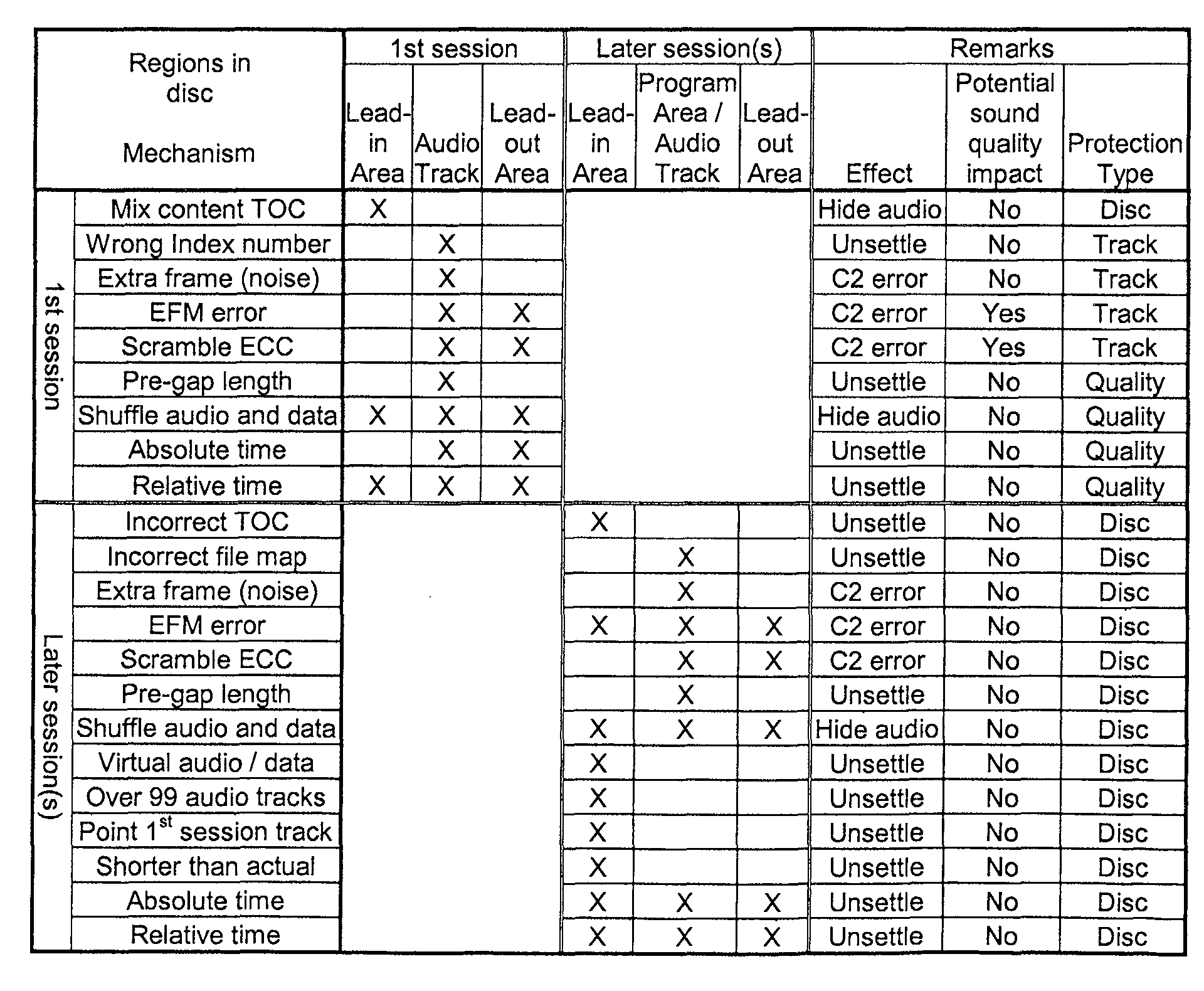
The following table shows a summary of existing copy protection
methods with the regions of a disc, to which they can be
applied. Furthermore, the type of error caused by the copy
protection methods and the potential impact on the sound
quality is also shown.
In the table, the protection types in the last column and their
effect on playback by a CD-ROM drive can be explained as
follows.
Track copy protection (usually mechanism 4): Each track has to
be protected individually. The tracks can be played back by any
CD-ROM drive (in CDDA mode) since the TOC in the lead-in area
allows to precisely determine the disc type as CDDA.
Quality copy protection (usually mechanism 3): The tracks can
be copied but their quality is decreased. The sound will
comprise random pauses or any other interruptions, or will be
discontinuous. Similar to the track copy protection, the tracks
can be played back by any CD-ROM drive (in CDDA mode) since the
disc type can be determined as CDDA.
Disc copy protection (usually
mechanisms 1, 2, 5): The whole
disc is protected against copying. However, it cannot be played
back in a CD-ROM drive since the TOC does not allow to
determine the disc type as CDDA.
Predictably, the copy protection mechanisms are not limited to
the existing known approaches. A large number of further
mechanisms may be developed. However, the copy protection
mechanisms must not disturb playback of the audio CDs in
standard audio CD players. Therefore, they cannot violate the
red book standard too much and exceed the tolerances of a
standard audio CD player. For this reason the copy protection
mechanisms only make a few modifications to the lead-in area of
the first session, as can be seen from the above table. In
addition, the mechanisms must also meet market requirements.
Consumers will not accept a degradation of the sound quality or
a data track before the audio tracks in a single session CD,
which could be used to trap a CD drive, but which would be
played back as a short mute track by a standard audio CD
player. In an alternative approach, a copy protection mechanism
could be based on combining a plurality of audio tracks in a
single track, and using indices instead of tracks for random
access. However, many audio CD players, especially low-end
players, do not support index play.
As described in the list of copy protection mechanisms, most
problems do not occur with audio drives. It would, therefore,
be desirable to operate a CD-ROM drive in an audio drive mode.
For this purpose, however, the format of an optical disc
inserted in the CD-ROM drive has to be securely determined.
JP 10 124 978 discloses a method and an apparatus, which allow
to discriminate whether a specific track of a CD-ROM is a data
track or in fact an audio track conforming to the CDDA format.
This discrimination enables a multi-format disc player to
reproduce audio tracks stored on the CD-ROM while at the same
time preventing the erroneous reproduction of data tracks
stored on the CD-ROM. The discrimination between both types of
tracks is based on additional four-bit control attributes for
each track, which are included in the table of contents (TOC)
of the disc, indicating if a track is a data track or an audio
track. This additional attributes are evaluated by an
information class distinction means before starting
reproduction of the tracks, and only audio tracks are
reproduced. The disclosed method has the disadvantage that if
the information in the TOC is partially incorrect due to copy
protection measures, discrimination between audio tracks and
data tracks might fail and some audio tracks might not be
reproduced.
It is, therefore, an object of the present invention to propose
a method for determining the format of an optical recording
medium comprising one or more data, audio and/or video tracks
in one or more sessions, which is robust against partially
incorrect data on the recording medium. It is another object of
the present invention to propose an apparatus for reading from
and/or writing to optical recording media using such method.
According to the invention, this object is achieved by a method
comprising the steps of:
- reading the table of contents of a first session of the
recording medium;
- checking whether more than one track is present in the first
session and/or whether at least one track is indicated as
being an audio track in the table of contents; and
- determining the format of the recording medium to be audio if
at least one of the checking steps yields a positive result,
and determining the format to be data else.
Assuming that all tracks are audio tracks if data tracks and
audio tracks are found on a disc simulates the behaviour of a
standard audio CD drive, which will play each track
irrespective of the audio or data indication in the TOC. Since,
however, all audio tracks on a copy protected disc could be
incorrectly classified in the TOC, the CD-ROM drive in an audio
system cannot solely rely on the track type indication in the
TOC of the lead-in area. Commercial audio CDs are seldom
published with the single audio track. Therefore, the number of
tracks is used to determine if a disc is an audio disc or a
data disc. If the disc contains more than one track, it is
assumed to be an audio disc. Otherwise, it is assumed to be a
data disc. A data disc may, for example, contain compressed
and/or uncompressed audio files.
Favourably, the method further comprises the steps of:
- checking whether the recording medium comprises more than one
session;
- performing said steps of checking for the number of tracks
and/or audio tracks and said determining steps only if the
recording medium comprises more than one session; and
- relying on the original information contained in the table of
contents for determining the format of the recording medium
else.
Checking for multi-session allows to extend the inventive
method to audio-video products. Otherwise mixed content discs
could not be supported. Since most commercially successful copy
protection mechanisms use multi-session discs for copy
protection, only for these discs it is necessary to check for
audio content. A single-session disc can be safely assumed to
contain correct and unmodified data in the TOC.
Advantageously, the method additionally comprises the step of
enabling a user to force said steps of checking for the number
of tracks and/or audio tracks and said determining steps
independently of the result of the step checking whether the
recording medium comprises more than one session. This allows a
user to intervene in case a drive cannot automatically detect
the disc type for some reason. This might, for example, be the
case for a copy protection mechanism not using a multi-session
approach.
According to the invention, the checking steps are based on
data in the table of contents, which must not be altered to
ensure compatibility with standard audio format players. This
is advantageous since future copy protection mechanisms will
not alter these data. The method will, therefore, not be
circumvented by future copy protection mechanisms.
Favourably, the data in the table of contents used for the
checking steps comprises address data and pointer data. These
are essential data for any standard audio CD player.
Advantageously, sessions other than the first session are
suppressed in case the format of the recording medium is
determined to be audio. In this way a CD-ROM drive behaves
exactly like a standard audio CD drive, which only supports a
single session on a disc. Since some discs contain data tracks
in a second or later session, these tracks would otherwise be
played back, but without sound. This would hardly meet user
demands.
According to the invention, the data in the table of contents
are adapted to values corresponding to the determined format of
the recording medium. This allows to correct data in the TOC,
which has been modified by a copy protection mechanism.
Furthermore, the corrected TOC can simply be processed by a
standard servo controller. No modifications need to be made to
the servo controller, which reduces cost for implementing the
inventive method.
The data adapted to values corresponding to the determined
format of the recording medium favourably comprise control bits
and/or address data. These are the data which are most likely
modified by a copy protection mechanism. If these data were not
corrected, the incorrect data could unsettle a standard servo
controller.
A method according to the invention is advantageously performed
by a disc format determination module for determining the
format of an optical recording medium comprising a table of
contents and one or more tracks. The disc format determination
module is favourably implemented as a software solution,
however, a hardware solution can also be used.
Favourably, the disc format determination module is interposed
in the communication between an optical reading unit and a
servo controller module. This allows to reduce the cost for
implementing the inventive method, since a standard servo
controller module can be used, while all necessary additional
processing is performed by the disc format determination
module. It is, of course, also possible to integrate the disc
format determination module and the servo controller module
into a single module.
According to another aspect of the invention, an apparatus for
reading from and/or writing to optical recording media,
performs a method according to the invention and/or comprises a
disc format determination module according to the invention for
determining the format of an inserted recording medium. Such an
apparatus has the advantage that it is capable of reproducing
various types of disc formats including discs containing
compressed and/or uncompressed audio files, without being
disturbed by copy protection mechanisms.
For a better understanding of the invention, exemplary
embodiments are specified in the following description of
advantageous configurations with reference to the figures. It
is understood that the invention is not limited to these
exemplary embodiments and that specified features can also
expediently be combined and/or modified without departing from
the scope of the present invention. In the figures:
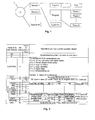
- Fig. 1
- shows a typical CD data layout;
- Fig. 2
- shows the fields of the Q sub-channel code in the
lead-in and their possible values;
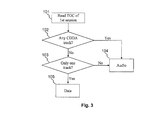
- Fig. 3
- shows a method according to the invention applicable
to audio products;
- Fig. 4
- shows a method according to the invention applicable
to audio-video products;
- Fig. 5
- schematically shows the an apparatus for reading
from and/or writing to optical recording media using
the inventive method;
- Fig. 6
- depicts the implementation of the inventive method
as a Q sub-channel sequential filter for an audio
product; and
- Fig 7
- depicts the Q sub-channel sequential filter for an
audio-video product.
Fig. 1 shows a typical CD data layout. An optical recording
medium 1 usually can have one or more sessions. Each session
comprises a lead-in, program and lead-out area. The program
area contains one or more tracks that can be audio tracks or
data tracks. Along the disc, sub-channels (subcodes) are
embedded in each area (lead-in, program and lead-out). The
table of contents (TOC) is the Q sub-channel located in the
lead-in area and contains information about the contents of the
session, such as the number of tracks and their attributes and
locations.
Fig. 2 shows the fields of the Q sub-channel code in the lead-in
area of a session. Each Q sub-channel code starts with two
sync-patterns S0 and S1 as the first two symbols. The next four
data bits CONTROL are control bits and define the content of a
track, i.e. audio or data and may also contain information
about copy protection. The control bits CONTROL are followed by
address information ADR specifying one of four modes for the Q
data bits DATA-Q. The Q data bits DATA-Q are contained in a Q
data block comprising 72 bits subsequent to the address bit
ADR. The Q sub-channel code ends with 16 CRC bits used for
cyclic redundancy check of the control CONTROL, address ADR and
Q data bits DATA-Q. In the lead-in TOC, the address bit ADR has
a value "1" indicating that the Q data block DATA-Q contains
information about the TOC. Other possible values for the
address bit ADR are "2" (Q data block DATA-Q contains a
catalogue number), "3" (Q data block DATA-Q contains
international standard recording (ISR) code), or "5"
(indicating multi-session). Each Q data block DATA-Q of a Q
sub-channel code in the TOC contains a pointer POINT, pointing
to one of the available tracks or the lead-out area, or
indicating the first or last track. In addition, the Q data
block contains the starting minute, second and frame (MSF) of
the track pointed to by the pointer. In case of a multi-session
disc, the pointer POINT may further indicate the starting
minute, second and frame of the next session.
The TOC items, which are packed into the Q sub-channel shown in
Fig. 2, are repeated three times each in successive Q sub-channel
code blocks. The whole TOC is continuously repeated
during the lead-in area of a session. As for multi-session with
POINT equal to "others" and ADR equal to "5", it will
additionally occur at about half frequency and is interleaved
in the original Red Book layout. Each sub-channel code is also
successively repeated three times. In Fig. 2, some fields of
the Q sub-channel code are shaded in grey. These fields contain
the minimum necessary data in the lead-in TOC for a standard
audio CD player. In other words, these essential data must be
correct to allow playback of an audio CD by a standard audio CD
player. Therefore, copy protection mechanisms must not alter
these data.
Fig. 3 shows a method according to the invention applicable to
audio products. In a step 101 the TOC of the first session on a
disc is read. A first checking step 102 analyses if any of the
tracks found in the TOC is indicated as an audio track (CDDA).
This information can be derived from the control bits. If the
first checking step 102 reveals an audio track, in a conclusion
step 104 all tracks of the first session of the disc are
processed like audio tracks, irrespective of the control bits.
The disc is assumed to be an audio disc and possible further
sessions on the disc are ignored. If the first checking step
102, however, does not reveal any audio track, a second
checking step 103 is performed. In this step 103 the number of
tracks is determined using, for example, the POINT information.
If more than one track is present, the disc is assumed to be an
audio disc as before in the conclusion step 104 and all tracks
are processed like audio tracks. Possible further sessions on
the disc are ignored. If, however, only a single track is
present, in a step 105 the disc is handled like a data disc and
all sessions and tracks on the disc are processed accordingly.
In this context, data comprises compressed and uncompressed
audio files. Of course, the order of the first and the second
checking steps 102, 103 can also be reversed.
Standard audio CD players support only a single session on a
disc, i.e. if a disc contains more than one session, only the
tracks in the first session will be reproduced. Therefore, in
all commercial audio CDs the audio tracks are put into a single
session. If any of the tracks is actually a data track or any
other non-audio track, a standard audio CD player will play
back this track anyway, but without sound. If the same
capability is requested of a multi-format disc player using a
CD-ROM drive, such a player has to ignore any further sessions
on a disc if the first session contains audio tracks. This is
achieved by the first checking step 102. The behaviour is
different from the behaviour of a standard CD-ROM drive, which
tries to analyse the data content in all sessions. In other
words, the standard CD-ROM drive works in a data mode while the
CD-ROM drive in the audio system works in an audio mode when a
disc has both audio and data content.
While the TOC of the lead-in area indicates all track locations
in the first session, the track type, which is actually audio
track, may be incorrectly indicated as data track on a copy
protected audio CD in order to hide the audio tracks in the
first session. As explained before, a standard audio CD player
will play each track irrespective of the audio or data
indication in the TOC. Therefore, the copy protected audio
tracks can be played back correctly by a standard audio CD
player, but a standard CD-ROM drive will try to parse the file
system in a first faked data track instead. Since all audio
tracks on a copy protected disc could be incorrectly classified
in the TOC, the CD-ROM drive in an audio system cannot solely
rely on the track type indication in the TOC of the lead-in
area. Commercial audio CDs are seldom published with the single
audio track. Although all songs can be recorded in a single
track and accessed by an index, most standard audio CD players
do not support index search, especially the low-end players.
Therefore, in the second checking step 103 the number of tracks
in the first session is used to determine if a disc is an audio
disc or a data disc. If the disc contains more than one track,
it is assumed to be an audio disc. Otherwise, it is assumed to
be a data disc.
In Fig. 4 a method according to the invention applicable to an
audio-video product is shown. While the method shown in Fig. 3
easily and quickly allows to determine the type of disc in an
audio product by detecting audio tracks or the number of tracks
in the lead-in TOC of the first session, the method does not
support data tracks on a mixed content disc. These discs are
mainly available in the audio-video market and are mostly
single session discs (VCD, AVCD,...), except for the Enhanced
CD, which has a second session for PC applications. While the
steps 101 to 105 correspond to the steps shown in Fig. 3, the
method is modified and enhanced to support mixed content discs.
For this purpose a third checking step 107 is introduced,
checking whether the disc is a multi-session disc. If this is
not the case, in a conclusion step 108 the disc is processed as
a hybrid disc and all contents in the single session are
reproduced. The hybrid disc may contain data, video, audio or a
partial combination of the above. For determining the specific
type of disc (CDDA, VCD, AVCD, etc.) the audio video product
will in this case rely on the information contained in the TOC.
It is assumed that this information has not been altered by a
copy protection mechanism. Though a copy protection mechanism
can add a fake file system in the first data track of a single
session disc to unsettle the CD-ROM drive, this approach will
hardly lead to user satisfaction since it creates a short mute
track in a standard audio CD player. Such a copy protection
mechanism would, therefore, be unsuccessful on the market.
Despite of this, an "Audio-CD mode"-switch can be added to the
audio-video product allowing a user to force the CD-ROM drive
into audio CD mode just in case it cannot automatically detect
the disc type. For this purpose, a fourth checking step 106 is
added checking for "Audio CD mode" and forcing audio playback
if this mode is switched on. Optionally, the fourth checking
step 106 can be moved just in front of the conclusion step 108
to implement a semi-automatic disc detection. This is
especially useful in a multi-disc system allowing to hold
different types of discs at the same time.
If the third checking step 107 yields a multi-session disc, the
steps 102 to 105 as in Fig. 3 are performed. In case of an
Enhanced CD, which is a multi-session disc, this disc will be
correctly reproduced, i.e. only the audio tracks contained in
the first session will be played back.
The approach shown in Fig. 4 relies on the fact that all
commercially successful copy protection mechanisms use multi-session
discs for copy protection.
In Fig. 5 an apparatus for reading from and/or writing to
optical recording media using a method according to the
invention in is shown schematically. The apparatus comprises a
reading unit 2 for reading information from an optical
recording medium 1, and a processor 3 for processing this
information. The processor 3 comprises a data processing module
6, which receives the main data from the reading unit 2, a
servo control module 5 for controlling the reading unit 2, and
a disc type determination module 4 for determining the disc
type. The disc type determination module 4 is implemented as a
Q sub-channel sequential filter. The Q sub-channel sequential
filter 4 processes Q sub-channel data received from the reading
unit 2 and corrects incorrect data caused by copy protection
mechanisms, where necessary. The servo control module 5 has
full capability of determining the disc type itself in case the
information contained in the Q sub-channel is correct.
Therefore, in the conclusion step 108 of Fig. 4 no further
discrimination between different disc types is necessary. The
approach has the advantage that it can be easily implemented by
simply adding the disc type determination module 4 in the
communication between the reading unit 2 and the servo control
module 5. The original servo control module 5 does not have to
be modified in any way.
Fig. 6 shows the implementation of a Q sub-channel sequential
filter 4 for an audio product. The sequential filter 4 makes
use of the integrity of the shaded fields of the TOC shown in
Fig. 2. The feasibility of the sequential filter 4 is mainly
based on two properties of the servo control module 5
implementation, namely an interactive control based on Q sub-channel
codes and a retrial mechanism for loss or error data.
These two properties are used during the initial state of the
sequential filter to determine the disc type and its layout.
After a disc 1 is inserted in the disc drive, in a step 10 the
local parameters of the sequential filter 4 are initialised,
where "Counter" is the number of retries to retrieve the lead-in
TOC to determine the disc type, "Status" is to store the
disc type, and "LastQ" is a buffer to store the last Q sub-channel
code frame. Upon a control command from the servo
control module 5, the reading unit 2 sends a Q code frame to
the sequential filter 4. In an entry step 20 it is checked
whether the Q code frame belongs to the lead-in TOC using the
values Q.TNO and Q.ADR. If this is the case, filtering
continues. Otherwise, the Q code frame is skipped and passed to
the servo control module 5. Q.TNO is the TNO field of the Q
sub-channel code; a similar representation for all fields is
used in the figure and throughout the following description. If
the entry step 20 yields a Q code frame belonging to the lead-in
TOC, a checking step 31 checks if Status is "RESET". If it
is, the function continues with the checking step 32;
otherwise, it continues with the checking step 41. The checking
step 32 analyses whether more than one track is present or if a
track has non-digital content. In either case, in a step 36
Status is set to "AUDIO". The filtering then continues with a
step 34 changing Q.TNO from "0" to "1" to make the servo
control module 5 believe that it has got a wrong track number,
e.g. track 1, in order to let it relocate the current track to
"0" again. This processing simulates a random choice to
retrieve another Q code frame from the lead-in TOC to improve
reliability. Following step 34, the function returns to step 20
and waits for another Q code frame. If in the checking step 32
neither of the conditions is fulfilled, in a step 33 the number
of retrials is decremented by "1" and checked. If the maximum
number of retrials is not yet reached, the above described step
34 follows. Otherwise, in a step 35 Status is set to "DATA" and
the function continues with step 20, waiting for another Q code
frame.
If in the checking step 31 Status is not "RESET", in the
checking step 41 it is analysed if the Status is "AUDIO". If
this is not the case, the Q code frame is simply passed to the
servo control module 5 and the function continues with step 20
waiting for another Q code frame. If, however, Status is
"AUDIO", a further step 42 checks whether the Q code frame is
mode 1, i.e. if Q.ADR is equal to "1". If it is, in a step 43
the control bits Q.CONTROL of the Q code frame are set to
indicate audio and the corrected Q code frame is backed up,
i.e. the corrected Q code frame is written to the buffer LastQ.
The corrected Q code frame is then passed to the servo control
module 5 and the function returns to step 20 waiting for
another Q code frame.
In case in the step 42 the Q code frame is not mode 1, a step
44 checks whether the LastQ buffer is not yet initialised. If
it is not initialised, in a step 45 similar to step 34 Q.TNO is
changed from "0" to "1" to retrieve another Q code frame and
the function returns to step 20 waiting for another Q code
frame. If, however, the step 44 returns that the LastQ buffer
is already initialised, in a step 46 the current Q code frame
is replaced with a LastQ value to mask out non-audio content,
e.g. multi-session, and passed to the servo control module 5.
The function then continues with step 20 waiting for another Q
code frame.
The detailed description of the implementation can be
summarized as follows. For each Q code frame it is checked
whether it belongs to the lead-in TOC or not. If it doesn't, it
is simply passed to the servo control module 5. If, however,
the Q code frame belongs to the lead-in TOC, it is submitted to
further processing. Step 31 checks whether the disc type has
already been determined. If this is not the case, in the steps
32 to 36 the sequential filter tries to determine the disc
type. The result will either be "AUDIO" or "RESET". In either
case, the servo control module 5 relocates the current track to
"0" again to retrieve another Q code frame. If the steps 32 to
36 did not reveal an audio disc, i.e. the status is still
"RESET", these steps are repeated with the next Q code frame.
Only if a predetermined number "n" of unsuccessful attempts has
been made to determine an audio disc, the status will be set to
"DATA". The following Q code frames will then simply be passed
to the servo control module 5 through the steps 20, 31 and 41.
If, however, an audio disc was determined, the steps 41 to 46
make sure that for all following Q code frames of the lead-in
TOC the control bits are set to indicate "audio" and the mode
is set to "1".
In Fig. 7 an extended implementation of the Q sub-channel
sequential filter 4 for an audio-video product is shown. In the
figure the optional approach mentioned with regard to Fig. 4 is
realised, i.e. the semi-automatic disc detection. As before in
Fig. 6, in the step 10 the local parameters of the sequential
filter 4 are initialised, where "Counter" is an additional
counter determining the number of retries to retrieve the lead-in
TOC to determine if the disc is multi-session, and "Mode" is
to record the user mode. Mode can assume the values "AUTO",
"RESET", and "Audio-CD". In case of "AUTO", the servo control
module 5 relies on the information contained in the TOC. It is
assumed that this information has not been altered by a copy
protection mechanism. "Audio-CD" forces the sequential filter 4
to perform the steps 31-46 shown in Fig. 6. While step 20, as
before, checks whether the Q code frame belongs to the lead-in
TOC, step 30 checks if the mode has been set to "AUTO". In this
case, the Q code frame is simply passed to the servo control
module 5. Otherwise, in step 40 it is checked whether the disc
is a multi-session disc. If it is, in a step 90 the function of
Fig. 6 is called. If the disc is not multi-session, the step 50
decrements the counter by "1" and checks whether the
predetermined number of retries has already been reached. If
the predetermined number has not yet been reached, in a step 60
Q.TNO is changed from "0" to "1" to let the servo control
module 5 relocate the current track to "0" again. The function
then returns to step 20 waiting for another Q code frame. If,
however, the predetermined number of retries has already been
reached, step 70 checks if the user has switched the mode to
"Audio-CD". In this case in the step 90 the function shown in
Fig. 6 is called, which will perform the above described audio
CD determination. Otherwise, in step 80 the mode is set to
"AUTO" and the Q code frame will simply be passed to the servo
control module 5.