EP1389621A1 - N-substituted pyrazolyl-o-glycoside derivatives and remedial agent for diabetes containing the same - Google Patents
N-substituted pyrazolyl-o-glycoside derivatives and remedial agent for diabetes containing the same Download PDFInfo
- Publication number
- EP1389621A1 EP1389621A1 EP02722839A EP02722839A EP1389621A1 EP 1389621 A1 EP1389621 A1 EP 1389621A1 EP 02722839 A EP02722839 A EP 02722839A EP 02722839 A EP02722839 A EP 02722839A EP 1389621 A1 EP1389621 A1 EP 1389621A1
- Authority
- EP
- European Patent Office
- Prior art keywords
- group
- pyrazole
- pharmaceutically acceptable
- acceptable salt
- alkyl group
- Prior art date
- Legal status (The legal status is an assumption and is not a legal conclusion. Google has not performed a legal analysis and makes no representation as to the accuracy of the status listed.)
- Withdrawn
Links
- 0 Cc1c(*)c(*)c(*)c(*)c1* Chemical compound Cc1c(*)c(*)c(*)c(*)c1* 0.000 description 4
- QOWBZRXUJSGBGC-UHFFFAOYSA-N CCc1ccc(Cc2c(C(F)(F)F)[n](C3CCCC3)nc2OC2(N=O)OC(CO)C(CO)OC2)cc1 Chemical compound CCc1ccc(Cc2c(C(F)(F)F)[n](C3CCCC3)nc2OC2(N=O)OC(CO)C(CO)OC2)cc1 QOWBZRXUJSGBGC-UHFFFAOYSA-N 0.000 description 1
Classifications
-
- C—CHEMISTRY; METALLURGY
- C07—ORGANIC CHEMISTRY
- C07H—SUGARS; DERIVATIVES THEREOF; NUCLEOSIDES; NUCLEOTIDES; NUCLEIC ACIDS
- C07H17/00—Compounds containing heterocyclic radicals directly attached to hetero atoms of saccharide radicals
- C07H17/02—Heterocyclic radicals containing only nitrogen as ring hetero atoms
-
- A—HUMAN NECESSITIES
- A61—MEDICAL OR VETERINARY SCIENCE; HYGIENE
- A61P—SPECIFIC THERAPEUTIC ACTIVITY OF CHEMICAL COMPOUNDS OR MEDICINAL PREPARATIONS
- A61P13/00—Drugs for disorders of the urinary system
- A61P13/02—Drugs for disorders of the urinary system of urine or of the urinary tract, e.g. urine acidifiers
-
- A—HUMAN NECESSITIES
- A61—MEDICAL OR VETERINARY SCIENCE; HYGIENE
- A61P—SPECIFIC THERAPEUTIC ACTIVITY OF CHEMICAL COMPOUNDS OR MEDICINAL PREPARATIONS
- A61P3/00—Drugs for disorders of the metabolism
- A61P3/08—Drugs for disorders of the metabolism for glucose homeostasis
- A61P3/10—Drugs for disorders of the metabolism for glucose homeostasis for hyperglycaemia, e.g. antidiabetics
Definitions
- the present invention relates to novel pyrazole derivatives and a therapeutic agent for diabetes containing such compounds as the active ingredient.
- Na + -dependent glucose transporter is a membrane protein which transports glucose
- SGLT-1 and SGLT-2 are known.
- the SGLT-2 is mainly expressed.
- Glucose that is filtered in glomeruli is reabsorbed at the renal uriferous tubules via SGLT, and the glucose taken is reused in the body through the bloodstream.
- the SGLT-2 is inhibited, the amount of glucose reabsorbed at renal uriniferous tubles lowers, and the glucose is excreted in urine. As a result, it is considered that the level of blood glucose decreases. Therefore, it is considered that an SGLT inhibitor which is effective when administered orally is useful for treating diabetes.
- the inventors of the present invention have synthesized various derivatives (1A) and (1B) wherein glucose (namely, ⁇ -D-glucopyranose) is bonded to a pyrazole nucleus, and intensively explored the effect of those derivatives on urinary excretion of sugar.
- the present invention provides pyrazole derivatives represented by the following general formula (1A) or (1B), or pharmaceutically acceptable salts thereof: wherein X represents ⁇ -D-glucopyranosyl group (wherein one or more hydroxyl groups may be acylated); Y represents a lower alkyl group or a perfluoro lower alkyl group; Z represents a cyclic alkyl group which may have a substituent(s), a cyclic unsaturated alkyl group which may have a substituent(s), a lower alkyl group having a cyclic alkyl group which may have a substituent(s), or a lower alkyl group having a cyclic unsaturated alkyl group which may have a substituent(s); R1 to R5 may be the same or different and each represent a hydrogen atom, a lower alkyl group, a perfluoro lower alkyl group, a lower alkoxyl group, a perfluoro lower alkoxyl group,
- the present invention also provides pyrazole-O-glycoside derivatives represented by the following general formula (I) and pharmaceutically acceptable salts thereof: wherein X' represents ⁇ -D-glucopyranosyl group (wherein one or more hydroxyl groups may be acylated); Y' represents a hydrogen atom, a lower alkyl group, a fluoro lower alkyl group or a perfluoro lower alkyl group; Z' represents a halo lower alkyl group; and R 1 ' to R 5 ' may be the same or different and each represent a hydrogen atom, a halogeno group, a lower alkyl group, a halo lower alkyl group, a perfluoro lower alkyl group, a lower alkoxyl group, a perfluoro lower alkoxyl group, a lower alkylthio group, a perfluoro lower alkylthio group, a lower alkylamino group, a lower alkanoyl
- the present invention provides a pharmaceutical composition
- a pharmaceutical composition comprising as the active ingredient the above-mentioned pyrazole derivatives or pharmaceutically acceptable salts thereof.
- the present invention also provides a therapeutic agent for diabetes comprising as the active ingredient the above-mentioned pyrazole derivatives or pharmaceutically acceptable salts.
- the present invention also provides an agent for inducing urinary excretion of sugar comprising as the active ingredient the above-mentioned pyrazole derivatives or pharmaceutically acceptable salts thereof.
- the present invention provides the use of the above-mentioned pyrazole derivatives or pharmaceutically acceptable salts thereof for reducing renal glucose reabsorption at renal uriniferous tubules.
- lower alkyl group in the present specification means an alkyl group having 1 to 6 carbon atoms, preferably 1 to 3 carbon atoms.
- lower alkenyl group in the present specification means an alkenyl group having 2 to 6 carbon atoms, preferably 2 to 4 carbon atoms.
- lower alkynyl group in the present specification means an alkynyl group having 2 to 6 carbon atoms, preferably 2 to 4 carbon atoms.
- alkyl used in the alkyl group, perfluoro lower alkyl group, lower alkoxyl group, perfluoro lower alkoxyl group, lower alkylthio group, perfluoro lower alkylthio group, lower alkylamino group, lower alkanoyl group, lower alkenyl group, or lower alkynyl group may be straight-chain or branched.
- alkyl group examples include methyl group, ethyl group, propyl group, butyl group, pentyl group, hexyl group, isopropyl group, isobutyl group, isopentyl group, isohexyl group.
- the halo lower alkyl group includes a fluoro lower alkyl group, a chloro lower alkyl group, and a bromo lower alkyl group.
- fluoro lower alkyl group examples include monofluoromethyl group, difluoromethyl group, 2-fluoroethyl group, 2,2-difluoroethyl group, 2,2,2-trifluoroethyl group, 3,3,3-trifluoropropyl group, 1,3-difluoroisopropyl group, 1,1,1-trifluoro-2-propyl group, 1,1,1,3,3,3-hexafluoroisopropyl group.
- perfluoro lower alkyl group examples include trifluoromethyl group, pentafluoroethyl group, heptafluoropropyl group.
- Examples of the lower alkoxyl group include methoxy group, ethoxy group, propyloxy group, isopropyloxy group, butyloxy group.
- perfluoro lower alkoxyl group examples include trifluoromethoxy group, pentafluoroethoxy group, heptafluoropropyloxy group.
- Examples of the lower alkylthio group include methylthio group, ethylthio group, propylthio group.
- perfluoro lower alkylthio group examples include trifluoromethylthio group, pentafluoroethylthio group, heptafluoropropylthio group.
- Examples of the lower alkylamino group include methylamino group, ethylamino group, propylamino group, dimethylamino group, diethylamino group, diisopropylamino group.
- Examples of the lower alkanoyl group are acetyl group, propionyl group.
- Examples of the lower alkenyl group include vinyl group, propenyl group, 2-methyl-1-propenyl group.
- Examples of the lower alkynyl group include ethynyl group, 2-methylethynyl group.
- aralkyl group examples include benzyl group, benzyl group which may have a substituent(s), phenethyl group, phenethyl group which may have a substituent(s).
- substituent herein used are a lower alkyl group, a lower alkoxyl group, a halogeno group, an amino group, a lower alkylamino group.
- halogeno group examples include fluorine atom, chlorine atom, bromine atom, and iodine atom.
- Examples of the lower alkoxycarbonyl group include methoxycarbonyl group, ethoxycarbonyl group, and isopropoxycarbonyl group.
- cyclic alkyl group which may have a substituent(s) means a cyclic alkyl group having 3 to 7 carbon atoms which may have a substituent(s).
- substituent(s) such as methyl group, ethyl group, methoxy group, ethoxy group, fluorine atom, chlorine atom, bromine atom.
- the number of the substituent and the position of the substitution are not particularly limited.
- the "cyclic unsaturated alkyl group which may have a substituent(s)" includes cyclopentenyl group and cyclohexenyl group.
- the ring in the above groups may have a substituent(s) such as methyl group, ethyl group, methoxy group, ethoxy group, fluorine atom, chlorine atom, bromine atom.
- the number of the substituent and the position of the substitution are not particularly limited.
- the number, kind, and position of the unsaturated bond are not particularly limited, either.
- the "lower alkyl group having a cyclic alkyl group which may have a substituent(s)" includes, for example, cyclobutylmethyl group, cyclobutylethyl group, cyclopentylmethyl group, cyclopentylethyl group, cyclohexylmethyl group, cyclohexylethyl group.
- the ring in the above groups may have a substituent(s) such as methyl group, ethyl group, methoxy group, ethoxy group, fluorine atom, chlorine atom, bromine atom.
- the number of the substituent and the position of the substitution are not particularly limited.
- the "lower alkyl group having a cyclic unsaturated alkyl group which may have a substituent(s)" includes cyclopentenylmethyl group and cyclohexenylmethyl group.
- the ring in the above groups may have a substituent(s) such as methyl group, ethyl group, methoxy group, ethoxy group, fluorine atom, chlorine atom, bromine atom.
- the number of the substituent and the position of the substitution are not particularly limited.
- the number, kind, and position of the unsaturated bond are not particularly limited, either.
- the groups used for acylating the hydroxyl group include acyl group and carbamate group.
- the acyl group are acetyl group, propionyl group, benzoyl group, pivaloyl group.
- the carbamate group are methyl carbonate group, ethyl carbonate group, propyl carbonate group, isopropyl carbonate group, phenyl carbonate group.
- one or more hydroxyl groups in the ⁇ -D-glucopyranosyl group which is a group represented by X may be acylated, in particular, with a group selected from an alkanoyl group having 2 to 20 carbon atoms, a lower alkoxycarbonyl group and a benzoyl group.
- a group selected from an alkanoyl group having 2 to 20 carbon atoms, a lower alkoxycarbonyl group and a benzoyl group examples of such groups are 6-acetyl- ⁇ -D-glucopyranosyl group and 6-carbomethoxy- ⁇ -D-glucopyranosyl group.
- ⁇ -D-glucopyranosyl group As the group represented by X, ⁇ -D-glucopyranosyl group, 6-acetyl- ⁇ -D-glucopyranosyl group and 6-carbomethoxy- ⁇ -D-glucopyranosyl group are preferable. Further, ⁇ -D-glucopyranosyl group is particularly preferable.
- the perfluoro lower alkyl group having 1 to 6 carbon atoms, in particular, trifluoromethyl group is preferable.
- the lower alkyl group having 1 to 6 carbon atoms, in particular, methyl group is particularly preferable.
- a preferable group represented by Z is a cyclic alkyl group which may have a substituent(s).
- a cyclic alkyl group having 3 to 7 carbon atoms is more preferable, and cyclobutyl group and cyclopentyl group are especially preferable.
- the group represented by Z the lower alkyl group having an unsaturated bond is also preferable, and an alkyl group having 2 to 6 carbon atoms containing an unsaturated bond therein is more preferable.
- allyl group and vinyl group are preferable.
- the cyclic unsaturated alkyl group which may have a substituent(s) is preferable, a cyclic alkyl group having 4 to 7 carbon atoms is more preferable, and in particular, cyclopentenyl group and cyclohexenyl group are most preferable.
- the group represented by R1 to R5 may be a lower alkyl group having 1 to 6 carbon atoms, and a lower alkylthio group having 1 to 6 carbon atoms, in particular, methyl group, ethyl group, methylthio group and ethylthio group.
- n represent an integer of 1.
- Y is trifluoromethyl group and n is an integer of 1.
- Y is trifluoromethyl group
- n is an integer of 1
- X is ⁇ -D-glucopyranosyl group (wherein one or more hydroxyl groups may be acylated with a group selected from the group consisting of an alkanoyl group having 2 to 20 carbon atoms, a lower alkoxycarbonyl group and a benzoyl group).
- Y is trifluoromethyl group
- n is an integer of 1
- X is ⁇ -D-glucopyranosyl group.
- Y is trifluoromethyl group
- n is an integer of 1
- X is 6-acetyl- ⁇ -D-glucopyranosyl group.
- Y is trifluoromethyl group
- n is an integer of 1
- X is 6-carbomethoxy- ⁇ -D-glucopyranosyl group.
- one or more hydroxyl groups in the ⁇ -D-glucopyranosyl group which is a group represented by X' may be acylated or carbamated.
- one or more hydroxyl groups in the above-mentioned group may be acylated with a group selected from the group consisting of an alkanoyl group having 2 to 20 carbon atoms, preferably 2 to 6 carbon atoms, a lower alkoxycarbonyl group, and a benzoyl group. Examples of such groups are 6-acetyl- ⁇ -D-glucopyranosyl group and 6-carbomethoxy- ⁇ -D-glucopyranosyl group.
- ⁇ -D-glucopyranosyl group 6-acetyl- ⁇ -D-glucopyranosyl group, 6-carbomethoxy- ⁇ -D-glucopyranosyl group, and 6-carboethoxy- ⁇ -D-glucopyranosyl group are preferable.
- the lower alkyl group and the perfluoro lower alkyl group especially trifluoromethyl group and methyl group are preferable.
- a halo lower alkyl group having 2 to 6 carbon atoms is preferable.
- the alkyl group in the above-mentioned halo lower alkyl group may be preferably branched.
- mono-substitution or poly-substitution is suitable.
- the position of a substitution with a halogeno group is not particularly limited.
- a fluoro lower alkyl group it is preferable to use a fluoro lower alkyl group; more preferable to use monofluoroethyl, monofluoropropyl, monofluoroisopropyl, difluoroisopropyl, and trifluoroisopropyl; and most preferable to use 1,3-difluoroisopropyl group.
- the group represented by Z' may be any other groups than the perfluoro lower alkyl group.
- the group represented by R 1 ' to R 5 ' may be a lower alkyl group having 1 to 6 carbon atoms, a lower alkylthio group having 1 to 6 carbon atoms, a lower alkoxyl group having 1 to 6 carbon atoms, or a halogeno group.
- methyl group, ethyl group, methoxy group, ethoxy group, and fluorine atom are preferable.
- R 3 ' is any of the above-mentioned groups.
- X' is ⁇ -D-glucopyranosyl group (wherein one or more hydroxyl groups may be acylated with a group selected from the group consisting of an alkanoyl group having 2 to 20 carbon atoms, a lower alkoxycarbonyl group and a benzoyl group), Y' is trifluoromethyl group, and Z' is a halo lower alkyl group.
- X' is ⁇ -D-glucopyranosyl group (wherein one or more hydroxyl groups may be acylated with a group selected from the group consisting of an alkanoyl group having 2 to 20 carbon atoms, a lower alkoxycarbonyl group and a benzoyl group), Y' is trifluoromethyl group, and Z'is a fluoro lower alkyl group.
- X' is ⁇ -D-glucopyranosyl group (wherein one or more hydroxyl groups may be acylated with a group selected from the group consisting of an alkanoyl group having 2 to 20 carbon atoms, a lower alkoxycarbonyl group and a benzoyl group), Y' is methyl group, and Z' is a halo lower alkyl group.
- X' is ⁇ -D-glucopyranosyl group (wherein one or more hydroxyl groups may be acylated with a group selected from the group consisting of an alkanoyl group having 2 to 20 carbon atoms, a lower alkoxycarbonyl group and a benzoyl group), Y' is methyl group, and Z' is a fluoro lower alkyl group.
- X' is 6-acetyl- ⁇ -D-glucopyranosyl group
- Y' is trifluoromethyl group
- Z' is a fluoro lower alkyl group.
- X' is 6-carbomethoxy- ⁇ -D-glucopyranosyl group
- Y' is trifluoromethyl group
- Z' is a fluoro lower alkyl group.
- X' is 6-acetyl- ⁇ -D-glucopyranosyl group
- Y' is methyl group
- Z' is a fluoro lower alkyl group
- X' is 6-carbomethoxy- ⁇ -D-glucopyranosyl group
- Y' is methyl group
- Z' is a fluoro lower alkyl group
- the derivative can be prepared by the method shown below.
- a compound (11) of the present invention can be obtained by the following method. For example, a hydroxyl group of 1,2-dihydro-4-[(4-ethylphenyl)methyl]-5-(trifluoromethyl)-3H-pyrazol-3-one (4) is protected using tert-butyl dimethylsilyl chloride to obtain a compound (5). A nitrogen atom on the pyrazole is allowed to react with cyclobutyl alcohol in accordance with the Mitsunobu reaction, thereby producing a compound (6).
- the obtained compound is allowed to react with 2,3,4,6-tetra-O-acetyl- ⁇ -D-glucopyranosyl bromide (8) overnight in the presence of potassium carbonate in a mixture of chloroform and water, and the resultant reaction product is subjected to a purification procedure by using, for example, chromatography, so that a tetra-O-acetyl intermediate (9) is obtained.
- the intermediate is deprotected in an aqueous solution of sodium hydroxide, whereby a compound (10) is obtained.
- the primary hydroxyl group of the obtained compound (10) is allowed to react with methyl chlorocarbonate, thereby obtaining the intended compound (11).
- the derivative can be prepared by the method shown below.
- the compound represented by general formula (I) according to the present invention can be obtained using as the starting material, for example, 1,2-dihydro-4-[(4-ethylphenyl)methyl]-5-(trifluoromethyl)-3H-pyrazol-3-one (IV) (prepared by the method described in J. Med. Chem 1996, 39, 3920-3928). More specifically, a hydroxyl group of a compound (IV) is protected using TBS group to obtain a compound (V). Thereafter, a nitrogen atom on the pyrazole is subjected to selective alkylation by the Mitsunobu reaction, thereby obtaining a compound (VI).
- IV 1,2-dihydro-4-[(4-ethylphenyl)methyl]-5-(trifluoromethyl)-3H-pyrazol-3-one
- the TBS group of the compound (VI) is deprotected to obtain a compound (VII).
- the compound (VII) is allowed to react with acetobromoglucose (VIII) in the presence of potassium carbonate at room temperature, thereby obtaining a glycoside (IV).
- acetobromoglucose (VIII) in the presence of potassium carbonate at room temperature, thereby obtaining a glycoside (IV).
- deprotection of the acetyl protecting group of the glycoside (IV) with a 1N lithium hydroxide aqueous solution can produce pyrazole glucoside (II).
- the pyrazole glucoside (II) is dissolved in collidine and allowed to react with methyl chlorocarbonate at -10°C, thereby obtaining a compound (III) wherein a hydroxyl group at the 6th position of the glucose is replaced by methyl carbonate.
- the pyrazole-O-glucoside derivatives according to the present invention which may be prepared by the above-mentioned method can easily be separated from the reaction mixture and purified by using the conventional isolation and purification means such as extraction from a solvent, chromatography, and crystallization.
- hydroxyl group of the compound of the present invention may be substituted with an appropriate substituent which can be replaced by hydroxyl group in vivo.
- acyl group and carbamate group can be used as the substituent for the hydroxyl group.
- the acyl group includes, for example, an alkanoyl group having 2 to 20 carbon atoms and a benzoyl group; and the carbamate group includes, for example, a lower alkoxycarbonyl group.
- any salts that are pharmaceutically acceptable can be used.
- the combination with the acidic group can give the following salts: ammonium salts; salts of alkali metals such as sodium and potassium; salts of alkaline earth metals such as calcium and magnesium; aluminum salts and zinc salts; salts of organic amines such as triethylamine, ethanolamine, morpholine, piperidine and dicyclohexylamine; and salts of basic amino acids such as arginine and lysine.
- the combination with the basic group can give the following salts: salts of inorganic acids such as hydrochloric acid, sulfuric acid and phosphoric acid; salts of organic carboxylic acids such as oxalic acid, acetic acid, citric acid, malic acid, benzoic acid, maleic acid, fumaric acid, tartaric acid, succinic acid and glutamic acid; and salts of organic sulfonic acids such as methanesulfonic acid and p-toluenesulfonic acid.
- Such salts can be formed by mixing the compound of general formula (1A), (1B) or (I) with an acid or base as required in appropriate proportions in a solvent and a dispersant.
- the salts can also be obtained by cation or anion exchange from other salts in different forms.
- the present invention includes the compound represented by general formula (1A), (1B) or (I) in the form of solvates, for example, hydrates, alcohol adducts.
- an inhibitor comprising as the active ingredient the compound represented by general formula (1A), (1B) or (I), or the salt thereof can be used for a pharmaceutical composition, in particular, for treatment of diabetes.
- the agent when the above-mentioned pyrazole-O-glycoside derivative is applied to the pharmaceutical composition, for example, to a therapeutic agent for diabetes, the agent can be administered orally or parenterally (i.e., intramuscularly, subcutaneously or intravenously, and in the form of suppositories).
- oral administration is preferred.
- the daily dose in adults taken for the above-mentioned purpose which is determined depending on the intended therapeutic effect, administration method, treatment period, and age and weight of the individual, is usually in the range of 1 ⁇ g to 10g by oral administration, and in the range of 0.01 ⁇ g to 1 g by parenteral administration.
- the daily dose is preferably in the range of 0.5 mg to 1 g, more preferably in the range of 1.0 mg to 500 mg.
- the formulation is shaped into, for example, a tablet, powder, pill, granule, capsule, suppository, solution, sugar-coated tablet, depot preparation, syrup by the conventional methods after the addition of an excipient and other agents such as a binder, disintegrant, lubricant, coloring agent, taste- and odor-masking agent to the derivative of the present invention.
- excipient include lactose, corn starch, sucrose, glucose, sorbitol and crystalline cellulose.
- binder examples include polyvinyl alcohol, polyvinyl ether, ethyl cellulose, methyl cellulose, gum arabic, tragacanth, gelatin, shellac, hydroxypropyl cellulose, hydroxypropyl starch, polyvinylpyrrolidone.
- disintegrant examples include starch, agar, gelatin powder, crystalline cellulose, calcium carbonate, sodium hydrogen carbonate, calcium citrate, dextran, pectin.
- lubricant examples include magnesium stearate, talc, polyethylene glycol, silica, hydrogenated vegetable oil.
- coloring agent any materials that are permitted to be added to pharmaceutical compositions can be used.
- taste- and odor-masking agent examples include cocoa powder, menthol, aromatic acid, mentha oil, borneol, cinnamon bark powder. Such tablets and granules may appropriately be coated with sugar, gelatin and other coating agents, if necessary.
- a solution for subcutaneous, intramuscular, or intravenous injection is prepared according to the conventional methods by the addition of a pH adjuster, a buffering agent, a stabilizing agent, a preserving agent, if necessary.
- reaction mixture was extracted with 10 ml of ethyl acetate three times, dried over anhydrous sodium sulfate and concentrated, and thereafter, purified with a silica gel column using hexane alone and a mixed solvent of ethyl acetate and hexane at a ratio of 5:95 successively to give 0.84 g (2.6 mmol) of the intended product (78%).
- the resultant organic layer was purified with a silica gel column using hexane alone and a mixed solvent of hexane and ethyl acetate at a ratio of 10:1 to 2:1 successively to give 2.1 g of the intended compound in the form of a crude product, which product was subjected to the following reaction.
- the resultant mixture was extracted with 20 ml of ethyl acetate three times, concentrated, and purified with a silica gel column using dichloromethane alone and a mixed solvent of methanol and dichloromethane at a ratio of 10:90 successively.
- 0.63 g (1.3 mmol) of the intended product was obtained (50%).
- the intended product was obtained from 1-cyclopentyl-4-[(4-ethylphenyl) methyl]-5-trifluoromethyl-3-O-t-butyl dimethylsilyl-1H-pyrazole in the same manner as in the step 3 of Example 1 (95%).
- the intended product was obtained by the hydrolysis of the crude product of 1'-cyclopentyl-4'-[(4-ethylphenyl)methyl]-5'-trifluoromethyl-1H-pyrazole-3'-O-(2,3,4,6-tetraacetyl)- ⁇ -D-glucopyranoside in the same manner as in the step 5 of Example 1 (90%).
- the intended product was obtained by allowing 1'-cyclopentyl-4'-[(4-ethylphenyl)methyl]-5'-trifluoromethyl-1H-pyrazole-3'-O- ⁇ -D-glucopyranoside to react with methyl chlorocarbonate in the same manner as in the step 6 of Example 1 (67%).
- the test compound was orally administered to the rat at a dosage of 100 mg/kg at 11 a.m.
- Urine of the rat was collected for a given period of time from the time immediately after the administration to 24 hours after the administration, and the urine volume was measured. Subsequently, the glucose concentration in urine was determined by the glucose oxidase method and the daily amount of glucose excreted in urine per individual was calculated.
- the mixture thus obtained was cooled to 0°C, and 2.84 ml (6.25 mmol) of a 40% toluene solution of diethyl azodicarboxylate was slowly added to the mixture, with the reaction mixture being maintained at a temperature lower than 10°C.
- the temperature of the reaction mixture was returned to room temperature to carry out the reaction for 2 hours, followed by concentration.
- a mixed solvent of ethyl acetate and hexane at a ratio of 1:10 was added to precipitate the triphenylphosphine, which was removed from the reaction mixture by filtration.
- reaction mixture was stirred overnight at room temperature. Then, the reaction mixture was neutralized with a 1N hydrochloric acid aqueous solution. After the addition of a saturated sodium chloride aqueous solution, the reaction mixture was extracted with dichloromethane three times. The resultant organic layer was dried, concentrated and purified with a silica gel column using a mixed solvent of ethyl acetate and hexane at a ratio of 1:2. Thus, 2.51 g (3.7 mmol) of the intended product was obtained in the form of a mixture with acetobromoglucose.
- the mixture was neutralized with a 1N hydrochloric acid aqueous solution, and a saturated sodium chloride aqueous solution was added to the mixture.
- the reaction mixture was extracted with ethyl acetate and dried over anhydrous sodium sulfate. After the resultant product was concentrated, the product was purified with a silica gel column using a mixed solvent of methanol and dichloromethane at a ratio of 1:10. Thus, 1.52 g (2.98 mmol) of the intended product was obtained.
- the resultant organic layer was successively washed with a 1N hydrochloric acid solution, a saturated aqueous solution of sodium carbonate and an aqueous solution of sodium chloride, dried and concentrated.
- the obtained product was then purified with a silica gel column using a mixed solvent of methanol and methylene chloride at a ratio of 5:95. Thus, 526 mg of the intended product was obtained.
- test compound was suspended in olive oil, so that solutions of the compound with concentrations of 6 and 20 mg/ml were prepared to have a dose of 5 ml/kg body weight of the rat. After the rats were not fed for 4 hours, the test compound was orally administered to the rats at a dosage of 10, 30 and 100 mg/kg at 11 a.m.
- Urine of the rat was collected for a given period of time from the time immediately after the administration to 24 hours after the administration, and the urine volume was measured. Subsequently, the glucose concentration in urine was determined by the glucose oxidase method and the daily amount of glucose excreted in urine per individual was calculated.
- novel pyrazole derivatives exhibited an excellent effect on urinary sugar excretion.
- the novel pyrazole derivatives of the present invention which show excellent antidiabetic properties, is considered to be remarkably useful in the pharmaceutical industry.
Landscapes
- Health & Medical Sciences (AREA)
- Chemical & Material Sciences (AREA)
- Organic Chemistry (AREA)
- General Health & Medical Sciences (AREA)
- Engineering & Computer Science (AREA)
- Life Sciences & Earth Sciences (AREA)
- Diabetes (AREA)
- Public Health (AREA)
- Animal Behavior & Ethology (AREA)
- Chemical Kinetics & Catalysis (AREA)
- General Chemical & Material Sciences (AREA)
- Medicinal Chemistry (AREA)
- Nuclear Medicine, Radiotherapy & Molecular Imaging (AREA)
- Molecular Biology (AREA)
- Pharmacology & Pharmacy (AREA)
- Bioinformatics & Cheminformatics (AREA)
- Genetics & Genomics (AREA)
- Biotechnology (AREA)
- Biochemistry (AREA)
- Veterinary Medicine (AREA)
- Urology & Nephrology (AREA)
- Emergency Medicine (AREA)
- Endocrinology (AREA)
- Obesity (AREA)
- Hematology (AREA)
- Pharmaceuticals Containing Other Organic And Inorganic Compounds (AREA)
- Saccharide Compounds (AREA)
Abstract
The present invention relates to pyrazole derivatives represented by the
following formulas and analogues thereof, which can be used for a therapeutic
agent for diabetes.
Description
The present invention relates to novel pyrazole derivatives and a therapeutic
agent for diabetes containing such compounds as the active ingredient.
Na+-dependent glucose transporter (SGLT) is a membrane protein which
transports glucose, and SGLT-1 and SGLT-2 are known. In the renal uriniferous
tubules, the SGLT-2 is mainly expressed. Glucose that is filtered in glomeruli is
reabsorbed at the renal uriferous tubules via SGLT, and the glucose taken is
reused in the body through the bloodstream. When the SGLT-2 is inhibited, the
amount of glucose reabsorbed at renal uriniferous tubles lowers, and the glucose
is excreted in urine. As a result, it is considered that the level of blood glucose
decreases. Therefore, it is considered that an SGLT inhibitor which is effective
when administered orally is useful for treating diabetes.
There is known 3-(benzo[b]furan-5-yl)-2',6'-dihydroxy-4'-methylpropiophenone
2'-O-(6-O-methoxycarbonyl-β-D-glucopyranoside) as a compound that can inhibit
the SGLT and promote the action of urinary sugar excretion in the animals (J.
Med. Chem., 42, 5311-5324, 1999). Oral administration of the above-mentioned
compound to the rat indicates the increase in the amount of sugar excreted in
urine and the decrease in the level of blood sugar (Diabetes, Vol. 48, pp. 1794-1800,
1999). However, there is the shortcoming that the dose needed to exhibit the
efficacy is as large as 100 mg/kg. Further, the evaluation system by a glucose
tolerance test shows that compounds disclosed in WO 0116147 are effective at a
dose of 10 mg/kg in the rats by intravenous administration or subcutaneous
administration. However, there is no description about the efficacy of those
compounds by oral administration.
It is an object of the present invention to provide novel pyrazole derivatives.
It is another object of the present invention to provide a pharmaceutical
composition comprising the above-mentioned novel compounds.
It is still another object of the present invention to provide a therapeutic
agent for diabetes comprising the above-mentioned novel compounds.
It is a further object of the present invention to find a therapeutic agent for
diabetes which can easily be synthesized and has less toxicity and excellent
therapeutic effect, and to provide the therapeutic agent for diabetes as a
pharmaceutical product.
It is a still further object of the present invention to provide an agent for
inducing urinary sugar excretion which comprises the above-mentioned novel
compounds.
Also, it is a still further object of the present invention to provide the use of
the above-mentioned novel compounds for reducing renal glucose reabsorption at
renal uriniferous tubules.
The inventors of the present invention have synthesized various derivatives
(1A) and (1B) wherein glucose (namely, β-D-glucopyranose) is bonded to a
pyrazole nucleus, and intensively explored the effect of those derivatives on
urinary excretion of sugar. As a result, it has been found that an outstanding
effect on urinary excretion of sugar is exhibited in tests on animals particularly by
the compounds of general formula (1A) or (1B) wherein Z represents a cyclic alkyl
group which may have a substituent(s), a cyclic unsaturated alkyl group which
may have a substituent(s), a lower alkyl group having an unsaturated bond, a
lower alkyl group having a cyclic alkyl group which may have a substituent(s), or
a lower alkyl group having a cyclic unsaturated alkyl group which may have a
substituent(s). The present invention has been thus accomplished. The
inventors of the present invention have also found that oral administration of a
compound represented by general formula (I) wherein Z' is a halo lower alkyl
group indicates an outstanding effect on urinary excretion of sugar in tests on
animal, and thus accomplished the present invention. These compounds have
not synthesized, and therefore, such compounds are entirely novel
pyrazole-O-glycoside derivatives.
Namely, the present invention provides pyrazole derivatives represented by
the following general formula (1A) or (1B), or pharmaceutically acceptable salts
thereof:
 wherein X represents β-D-glucopyranosyl group (wherein one or more hydroxyl
groups may be acylated); Y represents a lower alkyl group or a perfluoro lower
alkyl group; Z represents a cyclic alkyl group which may have a substituent(s), a
cyclic unsaturated alkyl group which may have a substituent(s), a lower alkyl
group having a cyclic alkyl group which may have a substituent(s), or a lower
alkyl group having a cyclic unsaturated alkyl group which may have a
substituent(s); R1 to R5 may be the same or different and each represent a
hydrogen atom, a lower alkyl group, a perfluoro lower alkyl group, a lower alkoxyl
group, a perfluoro lower alkoxyl group, a lower alkylthio group, a perfluoro lower
alkylthio group, a lower alkylamino group, a halogeno group, a lower alkanoyl
group, an alkenyl group, a cyclic alkenyl group, an alkynyl group, a phenyl group
which may have a substituent(s), or a lower alkoxycarbonyl group; and n is an
integer of 0 to 3.
wherein X represents β-D-glucopyranosyl group (wherein one or more hydroxyl
groups may be acylated); Y represents a lower alkyl group or a perfluoro lower
alkyl group; Z represents a cyclic alkyl group which may have a substituent(s), a
cyclic unsaturated alkyl group which may have a substituent(s), a lower alkyl
group having a cyclic alkyl group which may have a substituent(s), or a lower
alkyl group having a cyclic unsaturated alkyl group which may have a
substituent(s); R1 to R5 may be the same or different and each represent a
hydrogen atom, a lower alkyl group, a perfluoro lower alkyl group, a lower alkoxyl
group, a perfluoro lower alkoxyl group, a lower alkylthio group, a perfluoro lower
alkylthio group, a lower alkylamino group, a halogeno group, a lower alkanoyl
group, an alkenyl group, a cyclic alkenyl group, an alkynyl group, a phenyl group
which may have a substituent(s), or a lower alkoxycarbonyl group; and n is an
integer of 0 to 3.
The present invention also provides pyrazole-O-glycoside derivatives
represented by the following general formula (I) and pharmaceutically acceptable
salts thereof:
 wherein X' represents β-D-glucopyranosyl group (wherein one or more hydroxyl
groups may be acylated); Y' represents a hydrogen atom, a lower alkyl group, a
fluoro lower alkyl group or a perfluoro lower alkyl group; Z' represents a halo
lower alkyl group; and R1' to R5' may be the same or different and each represent a
hydrogen atom, a halogeno group, a lower alkyl group, a halo lower alkyl group, a
perfluoro lower alkyl group, a lower alkoxyl group, a perfluoro lower alkoxyl group,
a lower alkylthio group, a perfluoro lower alkylthio group, a lower alkylamino
group, a lower alkanoyl group, a lower alkenyl group, or a lower alkynyl group.
wherein X' represents β-D-glucopyranosyl group (wherein one or more hydroxyl
groups may be acylated); Y' represents a hydrogen atom, a lower alkyl group, a
fluoro lower alkyl group or a perfluoro lower alkyl group; Z' represents a halo
lower alkyl group; and R1' to R5' may be the same or different and each represent a
hydrogen atom, a halogeno group, a lower alkyl group, a halo lower alkyl group, a
perfluoro lower alkyl group, a lower alkoxyl group, a perfluoro lower alkoxyl group,
a lower alkylthio group, a perfluoro lower alkylthio group, a lower alkylamino
group, a lower alkanoyl group, a lower alkenyl group, or a lower alkynyl group.
The present invention provides a pharmaceutical composition comprising as
the active ingredient the above-mentioned pyrazole derivatives or
pharmaceutically acceptable salts thereof.
The present invention also provides a therapeutic agent for diabetes
comprising as the active ingredient the above-mentioned pyrazole derivatives or
pharmaceutically acceptable salts.
The present invention also provides an agent for inducing urinary excretion
of sugar comprising as the active ingredient the above-mentioned pyrazole
derivatives or pharmaceutically acceptable salts thereof.
Further, the present invention provides the use of the above-mentioned
pyrazole derivatives or pharmaceutically acceptable salts thereof for reducing
renal glucose reabsorption at renal uriniferous tubules.
The term "lower alkyl group" in the present specification means an alkyl
group having 1 to 6 carbon atoms, preferably 1 to 3 carbon atoms.
The term "lower alkenyl group" in the present specification means an alkenyl
group having 2 to 6 carbon atoms, preferably 2 to 4 carbon atoms.
The term "lower alkynyl group" in the present specification means an
alkynyl group having 2 to 6 carbon atoms, preferably 2 to 4 carbon atoms.
The terms "alkyl", "alkenyl" and "alkynyl" used in the alkyl group, perfluoro
lower alkyl group, lower alkoxyl group, perfluoro lower alkoxyl group, lower
alkylthio group, perfluoro lower alkylthio group, lower alkylamino group, lower
alkanoyl group, lower alkenyl group, or lower alkynyl group may be straight-chain
or branched.
Examples of the alkyl group include methyl group, ethyl group, propyl group,
butyl group, pentyl group, hexyl group, isopropyl group, isobutyl group, isopentyl
group, isohexyl group.
The halo lower alkyl group includes a fluoro lower alkyl group, a chloro lower
alkyl group, and a bromo lower alkyl group. There can be employed, for example,
fluoromethyl group, fluoroethyl group, fluoropropyl group, fluorobutyl group,
fluoropentyl group, fluorohexyl group, chloromethyl group, chloroethyl group,
chloropropyl group, chlorobutyl group, chloropentyl group, chlorohexyl group,
bromomethyl group, bromoethyl group, bromopropyl group, bromobutyl group,
bromopentyl group, bromohexyl group.
Specific examples of the fluoro lower alkyl group include monofluoromethyl
group, difluoromethyl group, 2-fluoroethyl group, 2,2-difluoroethyl group,
2,2,2-trifluoroethyl group, 3,3,3-trifluoropropyl group, 1,3-difluoroisopropyl group,
1,1,1-trifluoro-2-propyl group, 1,1,1,3,3,3-hexafluoroisopropyl group.
Examples of the perfluoro lower alkyl group include trifluoromethyl group,
pentafluoroethyl group, heptafluoropropyl group.
Examples of the lower alkoxyl group -include methoxy group, ethoxy group,
propyloxy group, isopropyloxy group, butyloxy group.
Examples of the perfluoro lower alkoxyl group include trifluoromethoxy
group, pentafluoroethoxy group, heptafluoropropyloxy group.
Examples of the lower alkylthio group include methylthio group, ethylthio
group, propylthio group.
Examples of the perfluoro lower alkylthio group include trifluoromethylthio
group, pentafluoroethylthio group, heptafluoropropylthio group.
Examples of the lower alkylamino group include methylamino group,
ethylamino group, propylamino group, dimethylamino group, diethylamino group,
diisopropylamino group.
Examples of the lower alkanoyl group are acetyl group, propionyl group.
Examples of the lower alkenyl group include vinyl group, propenyl group,
2-methyl-1-propenyl group.
Examples of the lower alkynyl group include ethynyl group, 2-methylethynyl
group.
Examples of the aralkyl group include benzyl group, benzyl group which may
have a substituent(s), phenethyl group, phenethyl group which may have a
substituent(s). Examples of the substituent herein used are a lower alkyl group,
a lower alkoxyl group, a halogeno group, an amino group, a lower alkylamino
group.
Examples of the halogeno group are fluorine atom, chlorine atom, bromine
atom, and iodine atom.
Examples of the lower alkoxycarbonyl group include methoxycarbonyl group,
ethoxycarbonyl group, and isopropoxycarbonyl group.
The "cyclic alkyl group which may have a substituent(s)" means a cyclic alkyl
group having 3 to 7 carbon atoms which may have a substituent(s). For example,
cyclopropyl group, cyclobutyl group, cyclopentyl group, cyclohexyl group,
cycloheptyl group can be used. The ring in the above groups may have a
substituent(s) such as methyl group, ethyl group, methoxy group, ethoxy group,
fluorine atom, chlorine atom, bromine atom. The number of the substituent and
the position of the substitution are not particularly limited.
The "cyclic unsaturated alkyl group which may have a substituent(s)"
includes cyclopentenyl group and cyclohexenyl group. The ring in the above
groups may have a substituent(s) such as methyl group, ethyl group, methoxy
group, ethoxy group, fluorine atom, chlorine atom, bromine atom. The number of
the substituent and the position of the substitution are not particularly limited.
The number, kind, and position of the unsaturated bond are not particularly
limited, either.
The "lower alkyl group having a cyclic alkyl group which may have a
substituent(s)" includes, for example, cyclobutylmethyl group, cyclobutylethyl
group, cyclopentylmethyl group, cyclopentylethyl group, cyclohexylmethyl group,
cyclohexylethyl group. The ring in the above groups may have a substituent(s)
such as methyl group, ethyl group, methoxy group, ethoxy group, fluorine atom,
chlorine atom, bromine atom. The number of the substituent and the position of
the substitution are not particularly limited.
The "lower alkyl group having a cyclic unsaturated alkyl group which may
have a substituent(s)" includes cyclopentenylmethyl group and
cyclohexenylmethyl group. The ring in the above groups may have a
substituent(s) such as methyl group, ethyl group, methoxy group, ethoxy group,
fluorine atom, chlorine atom, bromine atom. The number of the substituent and
the position of the substitution are not particularly limited. The number, kind,
and position of the unsaturated bond are not particularly limited, either.
The groups used for acylating the hydroxyl group include acyl group and
carbamate group. Examples of the acyl group are acetyl group, propionyl group,
benzoyl group, pivaloyl group. Examples of the carbamate group are methyl
carbonate group, ethyl carbonate group, propyl carbonate group, isopropyl
carbonate group, phenyl carbonate group.
In the above-mentioned general formula (1A) or (1B), one or more hydroxyl
groups in the β-D-glucopyranosyl group which is a group represented by X may
be acylated, in particular, with a group selected from an alkanoyl group having 2
to 20 carbon atoms, a lower alkoxycarbonyl group and a benzoyl group.
Examples of such groups are 6-acetyl-β-D-glucopyranosyl group and
6-carbomethoxy-β-D-glucopyranosyl group.
As the group represented by X, β-D-glucopyranosyl group, 6-acetyl-β-D-glucopyranosyl
group and 6-carbomethoxy-β-D-glucopyranosyl group are
preferable. Further, β-D-glucopyranosyl group is particularly preferable.
As the group represented by Y, the perfluoro lower alkyl group having 1 to 6
carbon atoms, in particular, trifluoromethyl group is preferable.
As the group represented by Y, the lower alkyl group having 1 to 6 carbon
atoms, in particular, methyl group is particularly preferable.
A preferable group represented by Z is a cyclic alkyl group which may have a
substituent(s). In particular, a cyclic alkyl group having 3 to 7 carbon atoms is
more preferable, and cyclobutyl group and cyclopentyl group are especially
preferable. As the group represented by Z, the lower alkyl group having an
unsaturated bond is also preferable, and an alkyl group having 2 to 6 carbon
atoms containing an unsaturated bond therein is more preferable. In particular,
allyl group and vinyl group are preferable. As the group represented by Z, the
cyclic unsaturated alkyl group which may have a substituent(s) is preferable, a
cyclic alkyl group having 4 to 7 carbon atoms is more preferable, and in particular,
cyclopentenyl group and cyclohexenyl group are most preferable.
Preferably, the group represented by R1 to R5 may be a lower alkyl group
having 1 to 6 carbon atoms, and a lower alkylthio group having 1 to 6 carbon
atoms, in particular, methyl group, ethyl group, methylthio group and ethylthio
group.
It is particularly preferable that n represent an integer of 1.
In general formula (1A) or (1B), -it is preferable that Y is trifluoromethyl
group.
Further, in general formula (1A) or (1B), it is preferable that Y is
trifluoromethyl group and n is an integer of 1.
Furthermore, in general formula (1A) or (1B), it is preferable that Y is
trifluoromethyl group, n is an integer of 1, and X is β-D-glucopyranosyl group
(wherein one or more hydroxyl groups may be acylated with a group selected from
the group consisting of an alkanoyl group having 2 to 20 carbon atoms, a lower
alkoxycarbonyl group and a benzoyl group).
Also, it is preferable in general formula (1A) or (1B) that Y is
trifluoromethyl group, n is an integer of 1, and X is β-D-glucopyranosyl group.
Further, in general formula (1A), it is preferable that Y is trifluoromethyl
group, n is an integer of 1, and X is 6-acetyl-β-D-glucopyranosyl group.
In general formula (1A) or (1B), it is preferable that Y is trifluoromethyl
group, n is an integer of 1, and X is 6-carbomethoxy-β-D-glucopyranosyl group.
With respect to the general formula (1A) or (1B),the compounds or
pharmaceutically acceptable salts thereof described below are also preferable:
Of the above-mentioned examples, the following compounds or
pharmaceutically acceptable salts thereof are particularly preferable:


In the above-mentioned general formula (I), one or more hydroxyl groups in
the β-D-glucopyranosyl group which is a group represented by X' may be acylated
or carbamated. In particular, one or more hydroxyl groups in the
above-mentioned group may be acylated with a group selected from the group
consisting of an alkanoyl group having 2 to 20 carbon atoms, preferably 2 to 6
carbon atoms, a lower alkoxycarbonyl group, and a benzoyl group. Examples of
such groups are 6-acetyl-β-D-glucopyranosyl group and 6-carbomethoxy-β-D-glucopyranosyl
group.
As the group represented by X', in particular, β-D-glucopyranosyl group,
6-acetyl- β-D-glucopyranosyl group, 6-carbomethoxy-β-D-glucopyranosyl group,
and 6-carboethoxy-β-D-glucopyranosyl group are preferable.
As the group represented by Y', the lower alkyl group and the perfluoro lower
alkyl group, especially trifluoromethyl group and methyl group are preferable.
As the group represented by Z', a halo lower alkyl group having 2 to 6 carbon
atoms is preferable. In particular, the alkyl group in the above-mentioned halo
lower alkyl group may be preferably branched. With respect to the substitution
by a halogeno group, mono-substitution or poly-substitution is suitable. The
position of a substitution with a halogeno group, is not particularly limited. In
particular, it is preferable to use a fluoro lower alkyl group; more preferable to use
monofluoroethyl, monofluoropropyl, monofluoroisopropyl, difluoroisopropyl, and
trifluoroisopropyl; and most preferable to use 1,3-difluoroisopropyl group. In
addition, the group represented by Z' may be any other groups than the perfluoro
lower alkyl group.
The group represented by R1' to R5' may be a lower alkyl group having 1 to 6
carbon atoms, a lower alkylthio group having 1 to 6 carbon atoms, a lower alkoxyl
group having 1 to 6 carbon atoms, or a halogeno group. In particular, methyl
group, ethyl group, methoxy group, ethoxy group, and fluorine atom are preferable.
In particular, it is most preferable that R3' is any of the above-mentioned groups.
In the general formula (I), it is preferable that X' is β-D-glucopyranosyl
group (wherein one or more hydroxyl groups may be acylated with a group
selected from the group consisting of an alkanoyl group having 2 to 20 carbon
atoms, a lower alkoxycarbonyl group and a benzoyl group), Y' is trifluoromethyl
group, and Z' is a halo lower alkyl group.
It is also preferable in general formula (I) that X' is β-D-glucopyranosyl
group (wherein one or more hydroxyl groups may be acylated with a group
selected from the group consisting of an alkanoyl group having 2 to 20 carbon
atoms, a lower alkoxycarbonyl group and a benzoyl group), Y' is trifluoromethyl
group, and Z'is a fluoro lower alkyl group.
In general formula (I), it is preferable that X' is β-D-glucopyranosyl group
(wherein one or more hydroxyl groups may be acylated with a group selected from
the group consisting of an alkanoyl group having 2 to 20 carbon atoms, a lower
alkoxycarbonyl group and a benzoyl group), Y' is methyl group, and Z' is a halo
lower alkyl group.
Also, it is preferable in general formula (I) that X' is β-D-glucopyranosyl
group (wherein one or more hydroxyl groups may be acylated with a group
selected from the group consisting of an alkanoyl group having 2 to 20 carbon
atoms, a lower alkoxycarbonyl group and a benzoyl group), Y' is methyl group, and
Z' is a fluoro lower alkyl group.
Further, it is preferable in general formula (I) that X' is 6-acetyl-β-D-glucopyranosyl
group, Y' is trifluoromethyl group, and Z' is a fluoro lower
alkyl group.
It is also preferable in general formula (I) that X' is 6-carbomethoxy-β-D-glucopyranosyl
group, Y' is trifluoromethyl group, and Z' is a fluoro lower alkyl
group.
Further, it is preferable in general formula (I) that X' is 6-acetyl-β-D-glucopyranosyl
group, Y' is methyl group, and Z' is a fluoro lower alkyl group.
Furthermore, it is also preferable in general formula (I) that X' is
6-carbomethoxy-β-D-glucopyranosyl group, Y' is methyl group, and Z' is a fluoro
lower alkyl group.
With respect to the general formula (I), the compounds or pharmaceutically
acceptable salts thereof described below are also preferable:

With respect to the method for preparing the pyrazole derivative (1A) or (1B)
according to the present invention, for example, wherein X represents β-D-glucopyranosyl
group, the derivative can be prepared by the method shown below.

A compound (11) of the present invention can be obtained by the following
method. For example, a hydroxyl group of
1,2-dihydro-4-[(4-ethylphenyl)methyl]-5-(trifluoromethyl)-3H-pyrazol-3-one (4) is
protected using tert-butyl dimethylsilyl chloride to obtain a compound (5). A
nitrogen atom on the pyrazole is allowed to react with cyclobutyl alcohol in
accordance with the Mitsunobu reaction, thereby producing a compound (6).
After the deprotection of the TBS group in the compound (6) with diluted
hydrochloric acid, the obtained compound is allowed to react with
2,3,4,6-tetra-O-acetyl-α-D-glucopyranosyl bromide (8) overnight in the presence of
potassium carbonate in a mixture of chloroform and water, and the resultant
reaction product is subjected to a purification procedure by using, for example,
chromatography, so that a tetra-O-acetyl intermediate (9) is obtained.
Subsequently, the intermediate is deprotected in an aqueous solution of sodium
hydroxide, whereby a compound (10) is obtained. The primary hydroxyl group of
the obtained compound (10) is allowed to react with methyl chlorocarbonate,
thereby obtaining the intended compound (11).
With respect to the methods for preparing the pyrazole derivatives (I)
according to the present invention wherein X' represents β-D-glucopyranosyl
group, for example, the derivative can be prepared by the method shown below.

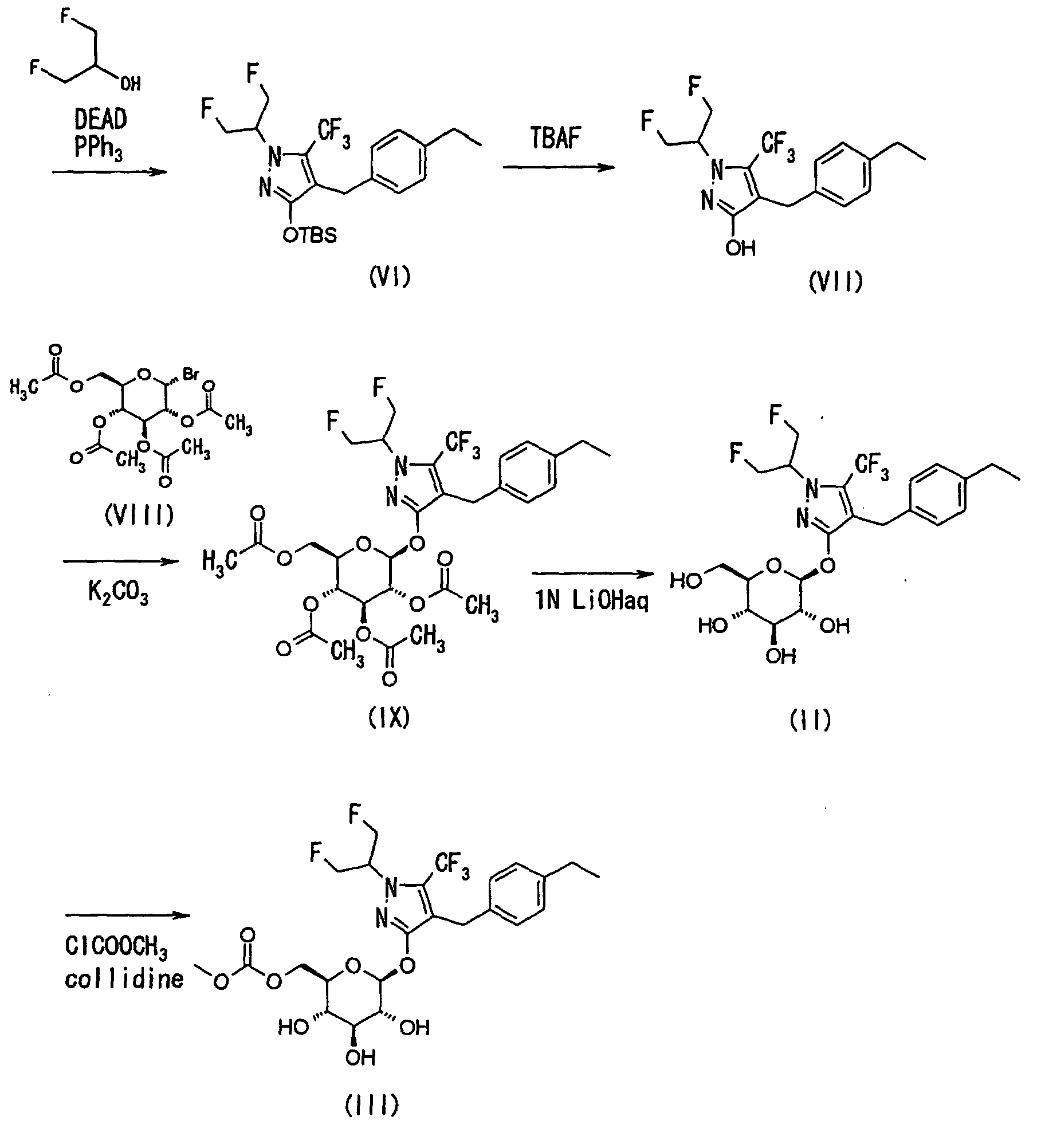
The compound represented by general formula (I) according to the present
invention can be obtained using as the starting material, for example,
1,2-dihydro-4-[(4-ethylphenyl)methyl]-5-(trifluoromethyl)-3H-pyrazol-3-one (IV)
(prepared by the method described in J. Med. Chem 1996, 39, 3920-3928). More
specifically, a hydroxyl group of a compound (IV) is protected using TBS group to
obtain a compound (V). Thereafter, a nitrogen atom on the pyrazole is subjected
to selective alkylation by the Mitsunobu reaction, thereby obtaining a compound
(VI). Subsequently, the TBS group of the compound (VI) is deprotected to obtain
a compound (VII). The compound (VII) is allowed to react with
acetobromoglucose (VIII) in the presence of potassium carbonate at room
temperature, thereby obtaining a glycoside (IV). Thereafter, deprotection of the
acetyl protecting group of the glycoside (IV) with a 1N lithium hydroxide aqueous
solution can produce pyrazole glucoside (II). The pyrazole glucoside (II) is
dissolved in collidine and allowed to react with methyl chlorocarbonate at -10°C,
thereby obtaining a compound (III) wherein a hydroxyl group at the 6th position of
the glucose is replaced by methyl carbonate.
The pyrazole-O-glucoside derivatives according to the present invention
which may be prepared by the above-mentioned method can easily be separated
from the reaction mixture and purified by using the conventional isolation and
purification means such as extraction from a solvent, chromatography, and
crystallization.
Further, the hydroxyl group of the compound of the present invention may be
substituted with an appropriate substituent which can be replaced by hydroxyl
group in vivo. For example, acyl group and carbamate group can be used as the
substituent for the hydroxyl group. The acyl group includes, for example, an
alkanoyl group having 2 to 20 carbon atoms and a benzoyl group; and the
carbamate group includes, for example, a lower alkoxycarbonyl group.
In the case where the compound represented by general formula (1A), (1B) or
(I) according to the present invention can be formed into salts thereof, any salts
that are pharmaceutically acceptable can be used. For example, when an acidic
group exists in the formula, the combination with the acidic group can give the
following salts: ammonium salts; salts of alkali metals such as sodium and
potassium; salts of alkaline earth metals such as calcium and magnesium;
aluminum salts and zinc salts; salts of organic amines such as triethylamine,
ethanolamine, morpholine, piperidine and dicyclohexylamine; and salts of basic
amino acids such as arginine and lysine. When a basic group exists in the
formula, the combination with the basic group can give the following salts: salts of
inorganic acids such as hydrochloric acid, sulfuric acid and phosphoric acid; salts
of organic carboxylic acids such as oxalic acid, acetic acid, citric acid, malic acid,
benzoic acid, maleic acid, fumaric acid, tartaric acid, succinic acid and glutamic
acid; and salts of organic sulfonic acids such as methanesulfonic acid and
p-toluenesulfonic acid. Such salts can be formed by mixing the compound of
general formula (1A), (1B) or (I) with an acid or base as required in appropriate
proportions in a solvent and a dispersant. Alternatively, the salts can also be
obtained by cation or anion exchange from other salts in different forms.
The present invention includes the compound represented by general
formula (1A), (1B) or (I) in the form of solvates, for example, hydrates, alcohol
adducts.
According to the present invention, an inhibitor comprising as the active
ingredient the compound represented by general formula (1A), (1B) or (I), or the
salt thereof can be used for a pharmaceutical composition, in particular, for
treatment of diabetes.
In the present invention, when the above-mentioned pyrazole-O-glycoside
derivative is applied to the pharmaceutical composition, for example, to a
therapeutic agent for diabetes, the agent can be administered orally or
parenterally (i.e., intramuscularly, subcutaneously or intravenously, and in the
form of suppositories). As for the compound of formula (I), oral administration is
preferred. The daily dose in adults taken for the above-mentioned purpose,
which is determined depending on the intended therapeutic effect, administration
method, treatment period, and age and weight of the individual, is usually in the
range of 1 µg to 10g by oral administration, and in the range of 0.01 µg to 1 g by
parenteral administration. When the compound of formula (I) is given by oral
administration, the daily dose is preferably in the range of 0.5 mg to 1 g, more
preferably in the range of 1.0 mg to 500 mg.
Further, when the pyrazole-O-glycoside derivative of the present invention is
prepared into a formulation for oral administration, the formulation is shaped into,
for example, a tablet, powder, pill, granule, capsule, suppository, solution,
sugar-coated tablet, depot preparation, syrup by the conventional methods after
the addition of an excipient and other agents such as a binder, disintegrant,
lubricant, coloring agent, taste- and odor-masking agent to the derivative of the
present invention. Examples of the excipient include lactose, corn starch, sucrose,
glucose, sorbitol and crystalline cellulose. Examples of the binder include
polyvinyl alcohol, polyvinyl ether, ethyl cellulose, methyl cellulose, gum arabic,
tragacanth, gelatin, shellac, hydroxypropyl cellulose, hydroxypropyl starch,
polyvinylpyrrolidone. Examples of the disintegrant include starch, agar, gelatin
powder, crystalline cellulose, calcium carbonate, sodium hydrogen carbonate,
calcium citrate, dextran, pectin. Examples of the lubricant include magnesium
stearate, talc, polyethylene glycol, silica, hydrogenated vegetable oil. With
respect to the coloring agent, any materials that are permitted to be added to
pharmaceutical compositions can be used. Examples of the taste- and
odor-masking agent include cocoa powder, menthol, aromatic acid, mentha oil,
borneol, cinnamon bark powder. Such tablets and granules may appropriately be
coated with sugar, gelatin and other coating agents, if necessary.
For the preparation of an injection, a solution for subcutaneous,
intramuscular, or intravenous injection is prepared according to the conventional
methods by the addition of a pH adjuster, a buffering agent, a stabilizing agent, a
preserving agent, if necessary.
The following Examples will further illustrate the present invention. They
are preferred embodiments of the present invention, which by no means limit the
invention.
4.76 g (17.6 mmol) of 1,2-dihydro-4-[(4-ethylphenyl)methyl]-5-trifluoromethyl-3H-pyrazol-3-one
(prepared by the method described in
J. Med. Chem 1996, 39, 3920-3928) and 1.57 g (23.1 mmol) of imidazole were
dissolved in 20 ml of dimethylformamide. To this mixture was added 2.98 g (19.8
mmol) of t-butyl dimethylsilyl chloride, and the resultant mixture was stirred at
room temperature for 30 minutes. After adding 100 ml of water to the
above-mentioned mixture, the reaction mixture was extracted with a mixed
solvent of ethyl acetate and hexane (2:1) three times. The resultant organic layer
was washed with water, dried over sodium sulfate and concentrated, so that 6.9 g
(17.9 mmol, quantitative yield) of the intended product was obtained.
1H-NMR (300MHz, CDCl3) δ : 0.21 (6H, s), 0.93 (9H, s), 1.19 (3H, t, J = 7.6 Hz), 2.59 (2H, q, J = 7.6 Hz), 3.74 (2H, s), 7.09 (4H, m).
ESI-MS (m/z): 269 [(M-TBS)-]
1H-NMR (300MHz, CDCl3) δ : 0.21 (6H, s), 0.93 (9H, s), 1.19 (3H, t, J = 7.6 Hz), 2.59 (2H, q, J = 7.6 Hz), 3.74 (2H, s), 7.09 (4H, m).
ESI-MS (m/z): 269 [(M-TBS)-]
2.5 g (6.5 mmol) of 4-[(4-ethylphenyl) methyl]-5-trifluoromethyl-3-O-t-butyldimethylsilyl-1H-pyrazole,
1.9 g (7.2 mmol) of triphenylphosphine, and 0.71 g (9.8
mmol) of cyclobutanol were dissolved in 15 ml of anhydrous tetrahydrofuran, and
the obtained mixture was stirred at room temperature. To the thus obtained
solution, 3.4 ml (7.5 mmol) of a 40% toluene solution of diethyl azodicarboxylate
was added slowly. After 20 minutes, the above-mentioned reaction mixture was
concentrated and 20 ml of hexane was added thereto. After the resultant
precipitate was separated by filtration, the filtrate was concentrated and subjected
to a silica gel column for purification, using hexane alone and a mixed solvent of
ethyl acetate and hexane at a ratio of 5:95 successively. Thus, 1.4 g (3.3 mmol) of
the intended product was obtained (51%).
1H-NMR (300MHz, CDCl3) δ : 0.27 (6H, s), 0.96 (9H, s), 1.20 (3H, t, J = 7.5Hz), 2.26-2.34 (2H, m), 2.59 (2H, q, J = 7.5 Hz), 2.54-2.67 (2H, m), 3.72 (2H, s), 4.67 (1H, quint, J = 8.1 Hz), 7.06 (2H, d, J = 8.5 Hz), 7.10 (2H, d, J = 8.5 Hz).
ESI-MS (m/z): [323 (M-TBS)-]
1H-NMR (300MHz, CDCl3) δ : 0.27 (6H, s), 0.96 (9H, s), 1.20 (3H, t, J = 7.5Hz), 2.26-2.34 (2H, m), 2.59 (2H, q, J = 7.5 Hz), 2.54-2.67 (2H, m), 3.72 (2H, s), 4.67 (1H, quint, J = 8.1 Hz), 7.06 (2H, d, J = 8.5 Hz), 7.10 (2H, d, J = 8.5 Hz).
ESI-MS (m/z): [323 (M-TBS)-]
1.4 g (3.3 mmol) of 1-cyclobutyl-4-[(4-ethylphenyl)methyl]-5-trifluoromethyl-3-O-t-butyl
dimethylsilyl-1H-pyrazole was dissolved in a mixture of 25 ml of
tetrahydrofuran and 5 ml of methanol. To the above solution was added 5 ml of a
1M HCl aqueous solution, and the mixture thus prepared was stirred overnight at
room temperature. To the resultant mixture was added 100 ml of water. The
reaction mixture was extracted with 10 ml of ethyl acetate three times, dried over
anhydrous sodium sulfate and concentrated, and thereafter, purified with a silica
gel column using hexane alone and a mixed solvent of ethyl acetate and hexane at
a ratio of 5:95 successively to give 0.84 g (2.6 mmol) of the intended product (78%).
1H-NMR (300MHz, CDCl3) δ : 1.20 (3H, t, J = 7.5 Hz), 1.70-1.90 (2H, m), 2.28-2.36 (2H, m), 2.59 (2H, q, J = 7.5 Hz), 2.55-2.68 (2H, m), 3.80 (2H, s), 4.75 (1H, pseudo quint, J = 8.1 Hz), 7.10 (2H, d, J = 8.8 Hz), 7.18 (2H, d, J = 8.8 Hz).
ESI-MS (m/z): [325 (M+H)+], [323 (M-H)-]
1H-NMR (300MHz, CDCl3) δ : 1.20 (3H, t, J = 7.5 Hz), 1.70-1.90 (2H, m), 2.28-2.36 (2H, m), 2.59 (2H, q, J = 7.5 Hz), 2.55-2.68 (2H, m), 3.80 (2H, s), 4.75 (1H, pseudo quint, J = 8.1 Hz), 7.10 (2H, d, J = 8.8 Hz), 7.18 (2H, d, J = 8.8 Hz).
ESI-MS (m/z): [325 (M+H)+], [323 (M-H)-]
2 ml of water and 10 ml of chloroform were added to a mixture of 0.84 g (2.6
mmol) of 1-cyclobutyl-4-[(4-ethylphenyl)methyl]-5-trifluoromethyl-1H-pyrazole, 1.5
g (3.7 mmol) of 2,3,4,6-O-tetraacetyl-α-D-glucopyranosyl bromide, 0.10 g (0.32
mmol) of benzyl tri-n-butyl ammonium chloride, and 3.23 g (23 mmol) of
potassium carbonate. The thus obtained mixture was stirred at room
temperature for 18 hours. The resultant organic layer was purified with a silica
gel column using hexane alone and a mixed solvent of hexane and ethyl acetate at
a ratio of 10:1 to 2:1 successively to give 2.1 g of the intended compound in the
form of a crude product, which product was subjected to the following reaction.
1H-NMR (300MHz, CDCl3) δ : 1.19 (3H, t, J = 7.6 Hz), 1.72-1.84 (2H, m), 1.89 (3H, s), 2.03 (3H, s), 2.04 (3H, s), 2.06 (3H, s), 2.29-2.38 (2H, m), 2.58 (2H, q, J = 7.6 Hz), 2.58-2.68 (2H, m), 3.72 (2H, s), 3.88 (1H, ddd, J = 9.9, 4.9, 2.3 Hz), 4.11-4.17 (1H, m), 4.26 (1H, dd, J = 12.3, 9.4 Hz), 4.70-4.76 (1H, m), 5.15-5.22 (1H, m), 5.28-5.32 (2H, m), 5.64-5.66 (1H, m), 7.06 (4H, s).
ESI-MS (m/z): [655 (M+H)+]
1H-NMR (300MHz, CDCl3) δ : 1.19 (3H, t, J = 7.6 Hz), 1.72-1.84 (2H, m), 1.89 (3H, s), 2.03 (3H, s), 2.04 (3H, s), 2.06 (3H, s), 2.29-2.38 (2H, m), 2.58 (2H, q, J = 7.6 Hz), 2.58-2.68 (2H, m), 3.72 (2H, s), 3.88 (1H, ddd, J = 9.9, 4.9, 2.3 Hz), 4.11-4.17 (1H, m), 4.26 (1H, dd, J = 12.3, 9.4 Hz), 4.70-4.76 (1H, m), 5.15-5.22 (1H, m), 5.28-5.32 (2H, m), 5.64-5.66 (1H, m), 7.06 (4H, s).
ESI-MS (m/z): [655 (M+H)+]
After 2.1 g of the crude product of
1'-cyclobutyl-4'-[(4-ethylphenyl)methyl]-5'-trifluoromethyl-1H-pyrazole-3'-O-(2,3,4,
6-tetraacetyl)-β-D-glucopyranoside was dissolved in 20 ml of ethanol, the
obtained mixture was stirred at room temperature with 4 ml of a 4N sodium
hydroxide aqueous solution being added thereto. One hour later, 50 ml of a
saturated sodium chloride aqueous solution and 10 ml of water were added to the
above-mentioned mixture. The resultant mixture was extracted with 20 ml of
ethyl acetate three times, concentrated, and purified with a silica gel column using
dichloromethane alone and a mixed solvent of methanol and dichloromethane at a
ratio of 10:90 successively. Thus, 0.63 g (1.3 mmol) of the intended product was
obtained (50%).
1H-NMR (300MHz, CD3OD) δ: 1.18 (3H, t, J = 7.6 Hz), 1.79-1.89 (2H, m), 2.28-2.36 (2H, m); 2.57 (2H, q, J = 7.6 Hz), 2.60-2.72 (2H, m), 3.37-3.45 (4H, m), 3.65-3.71 (1H, m), 3.81 (2H, s), 3.81-3.86 (1H, m), 5.39-5.41 (1H, m), 7.06 (4H, s).
MS(ESI) (m/z): [487 (M+H)+], [485 (M-H)-]
1H-NMR (300MHz, CD3OD) δ: 1.18 (3H, t, J = 7.6 Hz), 1.79-1.89 (2H, m), 2.28-2.36 (2H, m); 2.57 (2H, q, J = 7.6 Hz), 2.60-2.72 (2H, m), 3.37-3.45 (4H, m), 3.65-3.71 (1H, m), 3.81 (2H, s), 3.81-3.86 (1H, m), 5.39-5.41 (1H, m), 7.06 (4H, s).
MS(ESI) (m/z): [487 (M+H)+], [485 (M-H)-]
0.18 g (0.32 mmol) of
1'-cyclobutyl-4'-[(4-ethylphenyl)methyl]-5'-trifluoromethyl-1H-pyrazole-3'-O-β-D-glucopyranoside
was dissolved in 2.0 ml of 2,4,6-collidine and cooled to -50°C.
With the addition of 0.035 ml (0.45 mmol) of methyl chlorocarbonate, the
temperature of the obtained mixture was returned to room temperature over a
period of 0.5 hours. After 27 hours, 20 ml of ethyl acetate and 20 ml of a 1M
hydrochloric acid aqueous solution were added to the above-mentioned reaction
mixture, and the reaction mixture was extracted with ethyl acetate. The reaction
product was dried and concentrated, and thereafter purified with a silica gel
column using a mixed solvent of hexane and ethyl acetate at a ratio of 1:1 to 1:3
and ethyl acetate alone successively. Thus, 0.12 g (0.20 mmol) of the intended
product was obtained (62%).
1H-NMR (300MHz, CDCl3) δ : 1.20 (3H, t, J = 7.6 Hz), 1.71-1.86 (2H, m), 2.29-2.38 (2H, m); 2.48 (1H, d, J = 2.6 Hz); 2.60-2.68 (2H, m), 2.60 (2H, q, J = 7.6 Hz), 2.68 (1H, s), 2.72 (1H, s), 3.49-3.65 (4H, m), 3.72 (1H, d, J = 15.2 Hz), 3.79 (3H, s), 3.87 (1H, d, J = 15.2 Hz), 4.32 (1H, dd, J = 12.0, 2.1 Hz), 4.48 (1H, dd, J = 12.0, 4.1 Hz), 4.74 (1H, pseudo quint, J = 8.4 Hz), 5.22 (1H, d, J = 7.9 Hz), 7.10 (4H, s). MS(ESI) (m/z): [545 (M+H)+], [543 (M-H)-]
1H-NMR (300MHz, CDCl3) δ : 1.20 (3H, t, J = 7.6 Hz), 1.71-1.86 (2H, m), 2.29-2.38 (2H, m); 2.48 (1H, d, J = 2.6 Hz); 2.60-2.68 (2H, m), 2.60 (2H, q, J = 7.6 Hz), 2.68 (1H, s), 2.72 (1H, s), 3.49-3.65 (4H, m), 3.72 (1H, d, J = 15.2 Hz), 3.79 (3H, s), 3.87 (1H, d, J = 15.2 Hz), 4.32 (1H, dd, J = 12.0, 2.1 Hz), 4.48 (1H, dd, J = 12.0, 4.1 Hz), 4.74 (1H, pseudo quint, J = 8.4 Hz), 5.22 (1H, d, J = 7.9 Hz), 7.10 (4H, s). MS(ESI) (m/z): [545 (M+H)+], [543 (M-H)-]
The step 2 in Example 1 was repeated except that cyclobutanol was replaced
by cyclopentanol, so that the intended product was obtained (86%).
1H-NMR (300MHz, CDCl3) δ : 0.23 (6H, s), 0.94 (9H, s), 1.20 (3H, t, J = 7.6Hz), 1.55-1.70 (2H, m), 1.80-2.05 (6H, m), 2.59 (2H, q, J = 7.6 Hz), 3.72 (2H, s), 4.54-4.66 (1H, m), 7.06 (2H, d, J = 8.4 Hz), 7.11 (2H, d, J = 8.4 Hz).
1H-NMR (300MHz, CDCl3) δ : 0.23 (6H, s), 0.94 (9H, s), 1.20 (3H, t, J = 7.6Hz), 1.55-1.70 (2H, m), 1.80-2.05 (6H, m), 2.59 (2H, q, J = 7.6 Hz), 3.72 (2H, s), 4.54-4.66 (1H, m), 7.06 (2H, d, J = 8.4 Hz), 7.11 (2H, d, J = 8.4 Hz).
The intended product was obtained from 1-cyclopentyl-4-[(4-ethylphenyl)
methyl]-5-trifluoromethyl-3-O-t-butyl dimethylsilyl-1H-pyrazole in the same
manner as in the step 3 of Example 1 (95%).
1H-NMR (300MHz, CDCl3) δ : 1.20 (3H, t, J = 7.6 Hz), 1.50-1.70 (2H, m), 1.80-2.10 (6H, m), 2.60 (2H, q, J = 7.6 Hz), 3.79 (2H, s), 4.53-4.68 (1H, m), 7.09 (2H, d, J = 8.1 Hz), 7.17 (2H, d, J = 8.1 Hz), 10.1-10.2 (1H, br).
MS(ESI) (m/z): 339 [(M+H)+], 337 [(M-H)-]
1H-NMR (300MHz, CDCl3) δ : 1.20 (3H, t, J = 7.6 Hz), 1.50-1.70 (2H, m), 1.80-2.10 (6H, m), 2.60 (2H, q, J = 7.6 Hz), 3.79 (2H, s), 4.53-4.68 (1H, m), 7.09 (2H, d, J = 8.1 Hz), 7.17 (2H, d, J = 8.1 Hz), 10.1-10.2 (1H, br).
MS(ESI) (m/z): 339 [(M+H)+], 337 [(M-H)-]
The intended product was obtained as a crude product from
1-cyclopentyl-4-[(4-ethylphenyl)methyl]-5-trifluoromethyl-1H-pyrazole in the same
manner as in the step 4 of Example 1.
1H-NMR (300MHz, CDCl3) δ : 1.19 (3H, t, J = 7.6 Hz), 1.60-1.68 (2H, m), 1.88 (3H, s), 2.02 (3H, s), 2.04 (3H, s), 2.06 (3H, s), 1.98-2.0 (2H, m), 2.58 (2H, q, J = 7.6 Hz), 3.72 (2H, s), 3.80-3.85 (1H, m), 4.11 (1H, dd, J = 8.5, 3.8 Hz), 4.25 (1H, dd, J = 12.5, 4.8 Hz), 4.65 (1H, pseudo quint, J = 7.0 Hz), 5.14-5.20 (1H, m), 5.24-5.30 (2H, m), 5.56-5.59 (1H, m), 7.06 (4H, s).
MS(ESI) m/z [669 (M+H)+]
1H-NMR (300MHz, CDCl3) δ : 1.19 (3H, t, J = 7.6 Hz), 1.60-1.68 (2H, m), 1.88 (3H, s), 2.02 (3H, s), 2.04 (3H, s), 2.06 (3H, s), 1.98-2.0 (2H, m), 2.58 (2H, q, J = 7.6 Hz), 3.72 (2H, s), 3.80-3.85 (1H, m), 4.11 (1H, dd, J = 8.5, 3.8 Hz), 4.25 (1H, dd, J = 12.5, 4.8 Hz), 4.65 (1H, pseudo quint, J = 7.0 Hz), 5.14-5.20 (1H, m), 5.24-5.30 (2H, m), 5.56-5.59 (1H, m), 7.06 (4H, s).
MS(ESI) m/z [669 (M+H)+]
The intended product was obtained by the hydrolysis of the crude product of
1'-cyclopentyl-4'-[(4-ethylphenyl)methyl]-5'-trifluoromethyl-1H-pyrazole-3'-O-(2,3,4,6-tetraacetyl)-β-D-glucopyranoside
in the same manner as in the step 5 of
Example 1 (90%).
1H-NMR (300MHz, CD3OD) δ : 1.19 (3H, t, J = 7.6 Hz), 1.62-1.68 (2H, m), 1.87-2.04 (6H, m), 2.57 (2H, q, J = 7.6 Hz), 3.32-3.45 (3H, m), 3.67 (1H, dd, J = 12.0, 5.0 Hz), 3.78-3.82 (3H, m), 4.70 (1H, pseudo quint, J = 6.9 Hz), 5.30-5.37 (1H, m), 7.06 (4H, s).
MS(ESI) m/z [501 (M+H)+], [499 (M-H)-]
1H-NMR (300MHz, CD3OD) δ : 1.19 (3H, t, J = 7.6 Hz), 1.62-1.68 (2H, m), 1.87-2.04 (6H, m), 2.57 (2H, q, J = 7.6 Hz), 3.32-3.45 (3H, m), 3.67 (1H, dd, J = 12.0, 5.0 Hz), 3.78-3.82 (3H, m), 4.70 (1H, pseudo quint, J = 6.9 Hz), 5.30-5.37 (1H, m), 7.06 (4H, s).
MS(ESI) m/z [501 (M+H)+], [499 (M-H)-]
The intended product was obtained by allowing
1'-cyclopentyl-4'-[(4-ethylphenyl)methyl]-5'-trifluoromethyl-1H-pyrazole-3'-O-β-D-glucopyranoside
to react with methyl chlorocarbonate in the same manner as in
the step 6 of Example 1 (67%).
1H-NMR (300MHz, CDCl3) δ : 1.20 (3H, t, J = 7.5 Hz), 1.60-1.70 (2H, m), 1.84-1.94 (2H, m), 1.98-2.04 (4H, m), 2.55 (1H, d, J = 2.3 Hz), 2.60 (2H, q, J = 7.5 Hz), 2.75 (1H, d, J = 2.1 Hz), 2.85 (1H, d, J = 2.6 Hz), 3.47-3.63 (4H, m), 3.72 (1H, dd, J = 15.8, 1.2 Hz), 3.78 (3H, s), 3.87 (1H, d, J = 15.8 Hz), 4.36 (1H, dd, J = 12.0, 1.8 Hz), 4.45 (1H, dd, J = 12.0, 4.1 Hz), 4.66 (1H, pseudo quint, J = 6.9 Hz), 5.14 (1H, d, J = 7.9 Hz), 7.10 (4H, s).
MS(ESI) m/z [559 (M+H)+], [557 (M-H)-]
1H-NMR (300MHz, CDCl3) δ : 1.20 (3H, t, J = 7.5 Hz), 1.60-1.70 (2H, m), 1.84-1.94 (2H, m), 1.98-2.04 (4H, m), 2.55 (1H, d, J = 2.3 Hz), 2.60 (2H, q, J = 7.5 Hz), 2.75 (1H, d, J = 2.1 Hz), 2.85 (1H, d, J = 2.6 Hz), 3.47-3.63 (4H, m), 3.72 (1H, dd, J = 15.8, 1.2 Hz), 3.78 (3H, s), 3.87 (1H, d, J = 15.8 Hz), 4.36 (1H, dd, J = 12.0, 1.8 Hz), 4.45 (1H, dd, J = 12.0, 4.1 Hz), 4.66 (1H, pseudo quint, J = 6.9 Hz), 5.14 (1H, d, J = 7.9 Hz), 7.10 (4H, s).
MS(ESI) m/z [559 (M+H)+], [557 (M-H)-]
The chemical structures of the compounds obtained in Examples 1 to 4
are shown below.
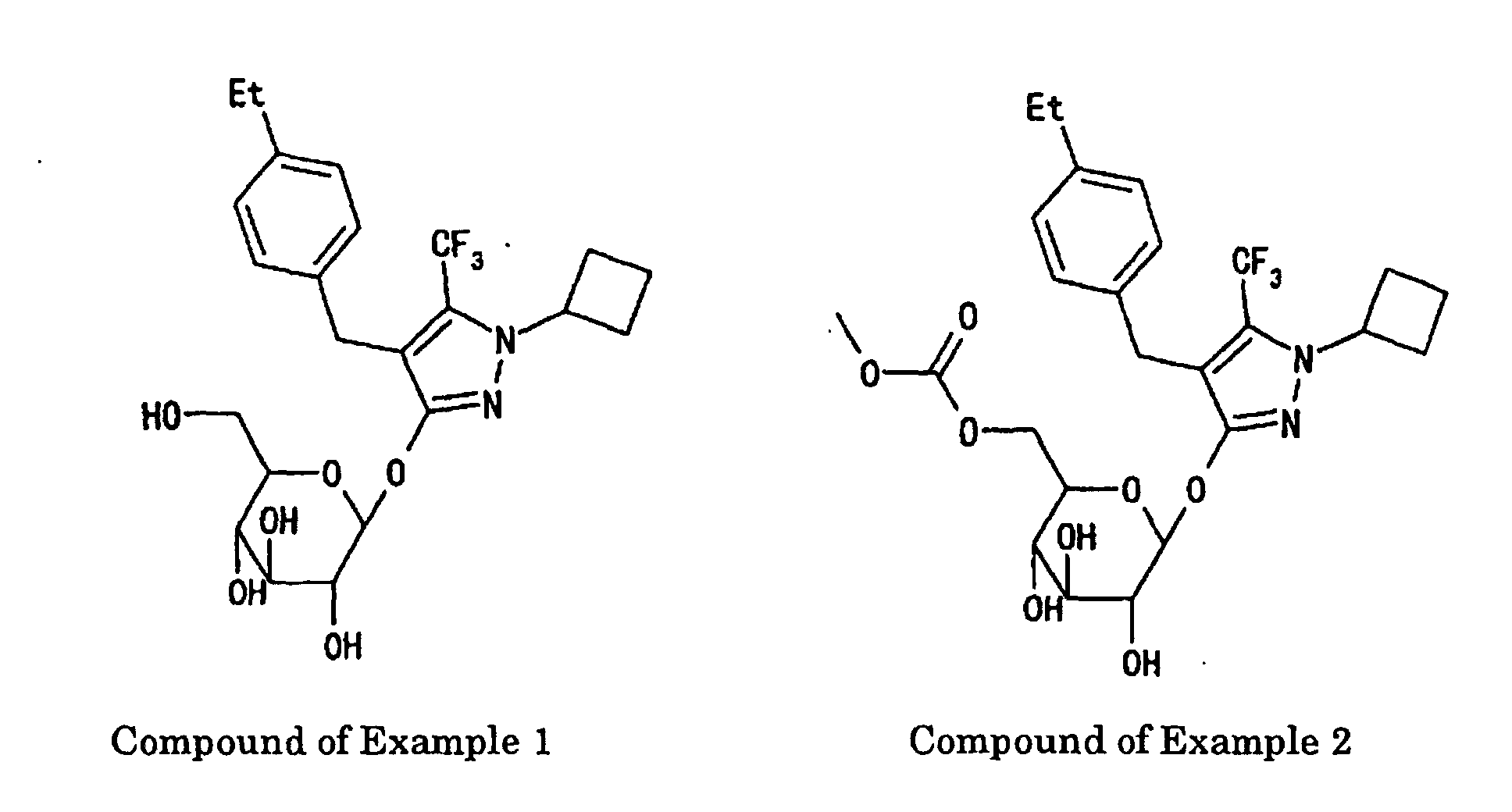
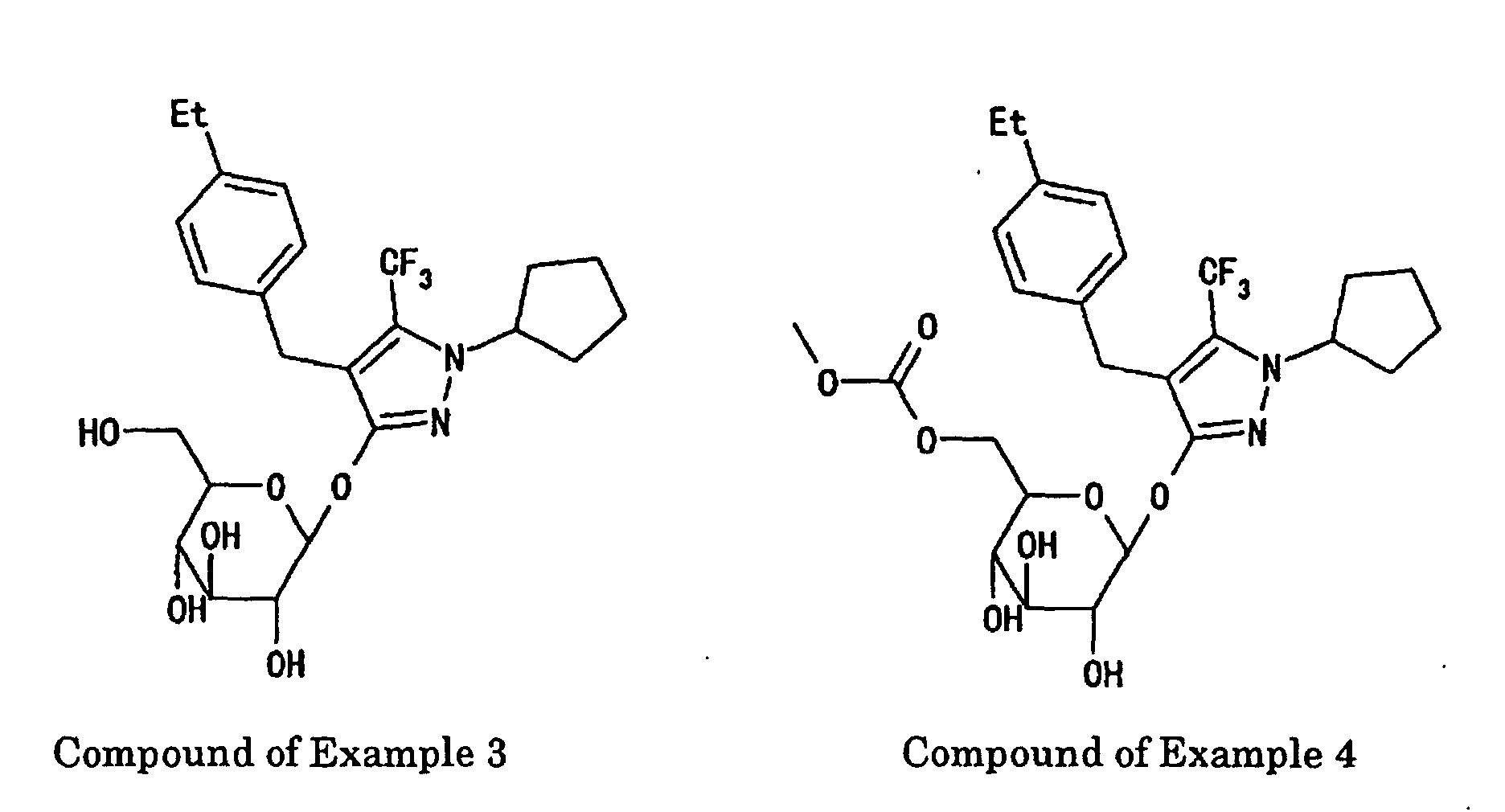
Five-week-old male Wistar rats (purchased from Charles River Japan, Inc.)
were housed in metabolic cages for about one week prior to the experiment. A
test compound was suspended in olive oil, so that a solution of the compound with
a concentration of 20 mg/ml was prepared to have a dose of 5 ml/kg body weight of
the rat.
After the rats were not fed for 4hours, the test compound was orally
administered to the rat at a dosage of 100 mg/kg at 11 a.m. Urine of the rat was
collected for a given period of time from the time immediately after the
administration to 24 hours after the administration, and the urine volume was
measured. Subsequently, the glucose concentration in urine was determined by
the glucose oxidase method and the daily amount of glucose excreted in urine per
individual was calculated.
The results are shown in Table 1.
| Test Compound | The amount of glucose excreted in urine (mg) |
| Compound of Example 2 | 656 |
| Compound of Example 4 | 452 |
15.0 g (55.6 mmol) of 1,2-dihydro-4-((4-ethylphenyl)
methyl)-5-(trifluoromethyl)-3H-pyrazol-3-one (4) (prepared by the method
described in J. Med. Chem 1996, 39, 3920-3928) was dissolved in 150 ml of
dimethylformamide, and cooled to 0°C. Then, 9.3 g (61.1 mmol) of t-butyl
dimethylsilyl chloride was added to the above solution in small portions, and
thereafter 4.2 g (61.1 mmol) of imidazole was added in small portions. The
temperature of the resultant mixture was returned to room temperature and the
mixture was stirred for 3 hours. After the addition of water to the reaction
mixture, the reaction mixture was extracted with ethyl acetate twice. The
resultant organic layer was washed with a saturated sodium chloride aqueous
solution, dried over anhydrous sodium sulfate and concentrated, to give 21.4 g
(55.6 mmol) of the intended compound (100% yield).
After 2.0 g (5.2 mmol) of 3-t-butyl dimethylsilyloxy-4-((4-ethylphenyl)
methyl)-5-(trifluoromethyl)-1H-pyrazole was dissolved in 20 ml of tetrahydrofuran
to prepare a solution, 1.6 g (6.25 mmol) of triphenylphosphine and 0.48 ml (6.25
mmol) of 1,3-difluoro-2-propanol were added to the above-mentioned solution.
The mixture thus obtained was cooled to 0°C, and 2.84 ml (6.25 mmol) of a 40%
toluene solution of diethyl azodicarboxylate was slowly added to the mixture, with
the reaction mixture being maintained at a temperature lower than 10°C. The
temperature of the reaction mixture was returned to room temperature to carry
out the reaction for 2 hours, followed by concentration. To the concentrate thus
obtained, a mixed solvent of ethyl acetate and hexane at a ratio of 1:10 was added
to precipitate the triphenylphosphine, which was removed from the reaction
mixture by filtration. The resultant filtrate was concentrated and purified with a
silica gel column using a mixed solvent of ethyl acetate and hexane at a ratio of
1:4. Thus, 1.95 g (4.22 mmol) of the intended difluoroisopropyl compound was
obtained. (81% yield)
1H-NMR (300MHz, DMSO-d6) δ : 0.22 (6H, s), 0.91 (9H, s), 1.13 (3H, t, J = 7.5), 2.53 (2H, q, J = 7.5), 3.70 (2H, s), 4.65 (2H, brs), 4.81 (3H, brs), 7.02 (2H, d, J = 8.4), 7.11 (2H, d, J = 8.7).
ESI-MS (m/z): 347 [(M-TBS)-]
1H-NMR (300MHz, DMSO-d6) δ : 0.22 (6H, s), 0.91 (9H, s), 1.13 (3H, t, J = 7.5), 2.53 (2H, q, J = 7.5), 3.70 (2H, s), 4.65 (2H, brs), 4.81 (3H, brs), 7.02 (2H, d, J = 8.4), 7.11 (2H, d, J = 8.7).
ESI-MS (m/z): 347 [(M-TBS)-]
1.95 g (4.22 mmol) of 3-t-butyl dimethylsilyloxy-4-((4-ethylphenyl)
methyl)-1-(1,3-difluoro-2-propyl)-5-(trifluoromethyl)pyrazole was added to 30 ml of
tetrahydrofuran and cooled to 0°C. To the thus obtained mixture, 6.33 ml (6.33
mmol) of a 1M tetrahydrofuran solution of tetrabutylammonium fluoride was
slowly added, and the obtained reaction mixture was stirred at room temperature
for 30 minutes. The reaction mixture was concentrated and purified with a silica
gel column using a mixed solvent of ethyl acetate and hexane at a ratio of 1:4.
Thus, 684 mg (1.96 mmol) of the intended product was obtained. (46% yield)
1H-NMR (300MHz, DMSO-d6) δ : 1.18 (3H, t, J = 7.5), 2.58 (2H, q, J = 7.5),3.74 (2H, s), 4.70 (2H, s), 4.86 (3H, brs), 7.08 (2H, d, J = 7.8), 7.15 (2H, d, J = 8.4), 10.75 (1H, brs).
ESI-MS (m/z): 347 [(M-H)-]
1H-NMR (300MHz, DMSO-d6) δ : 1.18 (3H, t, J = 7.5), 2.58 (2H, q, J = 7.5),3.74 (2H, s), 4.70 (2H, s), 4.86 (3H, brs), 7.08 (2H, d, J = 7.8), 7.15 (2H, d, J = 8.4), 10.75 (1H, brs).
ESI-MS (m/z): 347 [(M-H)-]
684 mg (1.96 mmol) of 1,2-dihydro-4-((4-ethylphenyl)
methyl)-1-(1,3-difluoro-2-propyl)-5-(trifluoromethyl)-3H-pyrazol-3-one was
dissolved in 10 ml of chloroform, and to the above solution were added 2.2 g (15.7
mmol) of potassium carbonate and 153 mg (0.49 mmol) of benzyl
tributylammonium chloride. Further, 1.2 g (2.94 mmol) of 2,3,4,6-tetraacetyl-α-D-glucopyranosyl
bromide was added to the reaction mixture with stirring at
room temperature. The obtained reaction mixture was stirred overnight at room
temperature. Then, the reaction mixture was neutralized with a 1N hydrochloric
acid aqueous solution. After the addition of a saturated sodium chloride aqueous
solution, the reaction mixture was extracted with dichloromethane three times.
The resultant organic layer was dried, concentrated and purified with a silica gel
column using a mixed solvent of ethyl acetate and hexane at a ratio of 1:2. Thus,
2.51 g (3.7 mmol) of the intended product was obtained in the form of a mixture
with acetobromoglucose.
1H-NMR (300MHz, DMSO-d6) δ : 1.13 (3H, t, J = 7.5), 1.89 (3H, s), 1.96 (3H, s), 1.97 (3H, s), 2.00 (3H, s), 2.53 (2H, q, J = 7.5), 3.69 (2H, s), 3.98-4.04 (1H, m), 4.11-4.19 (3H, m), 4.69 (1H, t, J = 5.7), 4.84 (1H, t, J = 6.6), 4.96-5.11 (3H, m), 5.46 (1H, t, J = 9.6), 5.85 (1H, d, J = 8.1), 6.98 (2H, d, J = 8.1), 7.09 (2H, d, J = 8.1).
ESI-MS (m/z): 679 [(M+H)+]
1H-NMR (300MHz, DMSO-d6) δ : 1.13 (3H, t, J = 7.5), 1.89 (3H, s), 1.96 (3H, s), 1.97 (3H, s), 2.00 (3H, s), 2.53 (2H, q, J = 7.5), 3.69 (2H, s), 3.98-4.04 (1H, m), 4.11-4.19 (3H, m), 4.69 (1H, t, J = 5.7), 4.84 (1H, t, J = 6.6), 4.96-5.11 (3H, m), 5.46 (1H, t, J = 9.6), 5.85 (1H, d, J = 8.1), 6.98 (2H, d, J = 8.1), 7.09 (2H, d, J = 8.1).
ESI-MS (m/z): 679 [(M+H)+]
1.33 g (1.96 mmol) of 4'-((4'-ethylphenyl)
methyl)-1'-(1',3'-difluoro-2'-propyl)-5'-(trifluoromethyl)-1H-pyrazole-3'-O-(2,3,4,6-O-tetraacetyl)-β-D-glucopyranoside
was dissolved in a mixture of 2 ml of
tetrahydrofuran and 2 ml of methanol, and the mixture was stirred at room
temperature with the addition thereto of 1N lithium hydroxide. Thirty minutes
later, the mixture was neutralized with a 1N hydrochloric acid aqueous solution,
and a saturated sodium chloride aqueous solution was added to the mixture. The
reaction mixture was extracted with ethyl acetate and dried over anhydrous
sodium sulfate. After the resultant product was concentrated, the product was
purified with a silica gel column using a mixed solvent of methanol and
dichloromethane at a ratio of 1:10. Thus, 1.52 g (2.98 mmol) of the intended
product was obtained.
1H-NMR (300MHz, DMSO-d6) δ : 1.14 (3H, t, J = 7.5), 2.54 (2H, q, J = 7.5), 3.19-3.25 (4H, m), 3.47 (1H, m), 3.61-3.66 (1H, m), 3.77 (2H, s), 4.47 (1H, t, J = 6.0), 4.66 (1H, t, J = 4.8), 4.82 (1H, t, J = 4.8), 4.83-4.97 (1H, m), 4.97 (1H, d, J = 3.0), 5.08 (1H, d, J = 4.2), 5.23 (1H, d, J = 7.5), 5.36 (1H, d, J = 4.8), 7.09 (4H, s).
ESI-MS (m/z): 509 [(M-H)-]
1H-NMR (300MHz, DMSO-d6) δ : 1.14 (3H, t, J = 7.5), 2.54 (2H, q, J = 7.5), 3.19-3.25 (4H, m), 3.47 (1H, m), 3.61-3.66 (1H, m), 3.77 (2H, s), 4.47 (1H, t, J = 6.0), 4.66 (1H, t, J = 4.8), 4.82 (1H, t, J = 4.8), 4.83-4.97 (1H, m), 4.97 (1H, d, J = 3.0), 5.08 (1H, d, J = 4.2), 5.23 (1H, d, J = 7.5), 5.36 (1H, d, J = 4.8), 7.09 (4H, s).
ESI-MS (m/z): 509 [(M-H)-]
700 mg (1.37 mmol) of 4-((4-ethylphenyl)methyl)-1-(1,3-difluoro-2-propyl)-5-(trifluoromethyl)-1H-pyrazole-3-O-β-D-glucopyranoside
was dissolved in 10 ml of
2,4,6-collidine and cooled to -10°C. To this solution was added 0.13 ml (1.64
mmol) of methyl chlorocarbonate, and the reaction was carried out overnight at
-10°C. Then, the reaction mixture was neutralized with a 2N hydrochloric acid
solution, and a saturated aqueous solution of sodium chloride was added thereto.
The reaction mixture was extracted with ethyl acetate twice. The resultant
organic layer was successively washed with a 1N hydrochloric acid solution, a
saturated aqueous solution of sodium carbonate and an aqueous solution of
sodium chloride, dried and concentrated. The obtained product was then purified
with a silica gel column using a mixed solvent of methanol and methylene chloride
at a ratio of 5:95. Thus, 526 mg of the intended product was obtained. (68%
yield)
1H-NMR (300MHz, DMSO-d6) δ : 1.14 (3H, t, J = 7.5), 2.53 (2H, q, J = 7.5), 3.15-3.30 (4H, m), 3.46-3.51 (1H, m), 3.75 (2H, s), 4.12 (1H, d, J = 11.7), 4.32 (1H, d, J = 11.7), 4.64-4.68 (2H, m), 4.80-4.83 (2H, m), 4.91 (1H, m), 5.21 (1H, d, J = 4.2), 5.22 (1H, d, J = 7.8), 5.31 (1H, d, J = 5.7), 5.46 (1H, d, J = 4.8), 7.08 (4H, s).
ESI-MS (m/z): 569 [(M+H)+], 567 [(M-H)-]
1H-NMR (300MHz, DMSO-d6) δ : 1.14 (3H, t, J = 7.5), 2.53 (2H, q, J = 7.5), 3.15-3.30 (4H, m), 3.46-3.51 (1H, m), 3.75 (2H, s), 4.12 (1H, d, J = 11.7), 4.32 (1H, d, J = 11.7), 4.64-4.68 (2H, m), 4.80-4.83 (2H, m), 4.91 (1H, m), 5.21 (1H, d, J = 4.2), 5.22 (1H, d, J = 7.8), 5.31 (1H, d, J = 5.7), 5.46 (1H, d, J = 4.8), 7.08 (4H, s).
ESI-MS (m/z): 569 [(M+H)+], 567 [(M-H)-]
The chemical structures of the compounds obtained in Examples 6 and 7 are
shown below.


Five-week-old male Wistar rats (purchased from Charles River Japan, Inc.)
were housed in metabolic cages for about one week prior to the experiment. A
test compound was suspended in olive oil, so that solutions of the compound with
concentrations of 6 and 20 mg/ml were prepared to have a dose of 5 ml/kg body
weight of the rat. After the rats were not fed for 4 hours, the test compound was
orally administered to the rats at a dosage of 10, 30 and 100 mg/kg at 11 a.m.
Urine of the rat was collected for a given period of time from the time immediately
after the administration to 24 hours after the administration, and the urine
volume was measured. Subsequently, the glucose concentration in urine was
determined by the glucose oxidase method and the daily amount of glucose
excreted in urine per individual was calculated.
As the positive control compound,
3-(benzo[b]furan-5-yl)-2',6'-dihydroxy-4'-methylpropiophenone 2'-O-(6-O-methoxycarbonyl-β-D-glucopyranoside)
was used. The results are shown in
Table 2.
| Amount of glucose excreted in urine by oral administration in rats (24hours) | ||
| Test Compound | Dosage (mg/kg) | The amount of glucose excreted in urine (mg) |
| Compound of Example 7 | 10 | 136 |
| 30 | 272 | |
| 100 | 524 | |
| Positive Control Compound | 10 | 2 |
| 30 | 78 | |
| 100 | 274 |
As is apparent from the above, the novel pyrazole derivatives exhibited an
excellent effect on urinary sugar excretion. The novel pyrazole derivatives of the
present invention, which show excellent antidiabetic properties, is considered to
be remarkably useful in the pharmaceutical industry.
Claims (20)
- A pyrazole derivative represented by general formula (1A) or (1B), or pharmaceutically acceptable salt thereof:wherein X represents β-D-glucopyranosyl group, wherein one or more hydroxyl groups may be acylated; Y represents a lower alkyl group or a perfluoro lower alkyl group; Z represents a cyclic alkyl group which may have a substituent(s), a cyclic unsaturated alkyl group which may have a substituent(s), a lower alkyl group having a cyclic alkyl group which may have a substituent(s), or a lower alkyl group having a cyclic unsaturated alkyl group which may have a substituent(s); R1 to R5 may be the same or different and each represent a hydrogen atom, a lower alkyl group, a perfluoro lower alkyl group, a lower alkoxyl group, a perfluoro lower alkoxyl group, a lower alkylthio group, a perfluoro lower alkylthio group, a lower alkylamino group, a halogeno group, a lower alkanoyl group, an alkenyl group, a cyclic alkenyl group, an alkynyl group, a phenyl group which may have a substituent(s), or a lower alkoxycarbonyl group; and n is an integer of 0 to 3.

- The pyrazole derivative or pharmaceutically acceptable salt thereof according to claim 1, wherein, in formula (1A) or (1B), Y is trifluoromethyl group.
- The pyrazole derivative or pharmaceutically acceptable salt thereof according to claim 1, wherein, in formula (1A) or (1B), Y is trifluoromethyl group and n is 1.
- The pyrazole derivative or pharmaceutically acceptable salt thereof according to claim 1, wherein, in formula (1A) or (1B), Y is trifluoromethyl group, n is 1, and X is β-D-glucopyranosyl group, wherein one or more hydroxyl groups may be acylated with a group selected from the group consisting of an alkanoyl group having 2 to 20 carbon atoms, a lower alkoxycarbonyl group and a benzoyl group.
- The compound or pharmaceutically acceptable salt thereof according to claim 1, selected from the group consisting of compounds shown below:


- A pharmaceutical composition comprising the pyrazole derivative or pharmaceutically acceptable salt thereof according to any one of claims 1 to 5.
- A therapeutic agent for diabetes comprising the pyrazole derivative or pharmaceutically acceptable salt thereof according to any one of claims 1 to 5.
- An agent for inducing urinary sugar excretion comprising the pyrazole derivative or pharmaceutically acceptable salt thereof according to any one of claims 1 to 5.
- Use of the pyrazole derivative or pharmaceutically acceptable salt thereof according to any one of claims 1 to 5 for reducing renal glucose reabsorption at renal uriniferous tubules.
- A pyrazole-O-glycoside derivative represented by formula (I) or pharmaceutically acceptable salt thereofwherein X' represents β-D-glucopyranosyl group, wherein one or more hydroxyl groups may be acylated; Y' represents a hydrogen atom, a lower alkyl group, a fluoro lower alkyl group or a perfluoro lower alkyl group; Z' represents a halo lower alkyl group; and R1' to R5' may be the same or different and each represent a hydrogen atom, a halogeno group, a lower alkyl group, a halo lower alkyl group, a perfluoro lower alkyl group, a lower alkoxyl group, a perfluoro lower alkoxyl group, a lower alkylthio group, a perfluoro lower alkylthio group, a lower alkylamino group, a lower alkanoyl group, a lower alkenyl group, or a lower alkynyl group.

- The pyrazole-O-glycoside derivative or pharmaceutically acceptable salt thereof according to claim 10, wherein, in formula (I), X' is β-D-glucopyranosyl group, wherein one or more hydroxyl groups may be acylated with a group selected from the group consisting of an alkanoyl group having 2 to 20 carbon atoms, a lower alkoxycarbonyl group and a benzoyl group, Y' is trifluoromethyl group, and Z' is a halo lower alkyl group.
- The pyrazole-O-glycoside derivative or pharmaceutically acceptable salt thereof according to claim 10, wherein, in formula (I), X' is β-D-glucopyranosyl group wherein one or more hydroxyl groups may be acylated with a group selected from the group consisting of an alkanoyl group having 2 to 20 carbon atoms, a lower alkoxycarbonyl group and a benzoyl group, Y' is trifluoromethyl group, and Z' is a fluoro lower alkyl group.
- The pyrazole-O-glycoside derivative or pharmaceutically acceptable salt thereof according to claim 10, wherein, in formula (I), X' is β-D-glucopyranosyl group, wherein one or more hydroxyl groups may be acylated with a group selected from the group consisting of an alkanoyl group having 2 to 20 carbon atoms, a lower alkoxycarbonyl group and a benzoyl group, Y' is methyl group, and Z' is a halo lower alkyl group.
- The pyrazole derivative or pharmaceutically acceptable salt thereof according to claim 10, wherein, in formula (I), X' is β-D-glucopyranosyl group, wherein one or more hydroxyl groups may be acylated with a group selected from the group consisting of an alkanoyl group having 2 to 20 carbon atoms, a lower alkoxycarbonyl group and a benzoyl group, Y' is methyl group, and Z' is a fluoro lower alkyl group.
- The compound or pharmaceutically acceptable salt thereof according to claim 10, selected from the group consisting of compounds shown below:
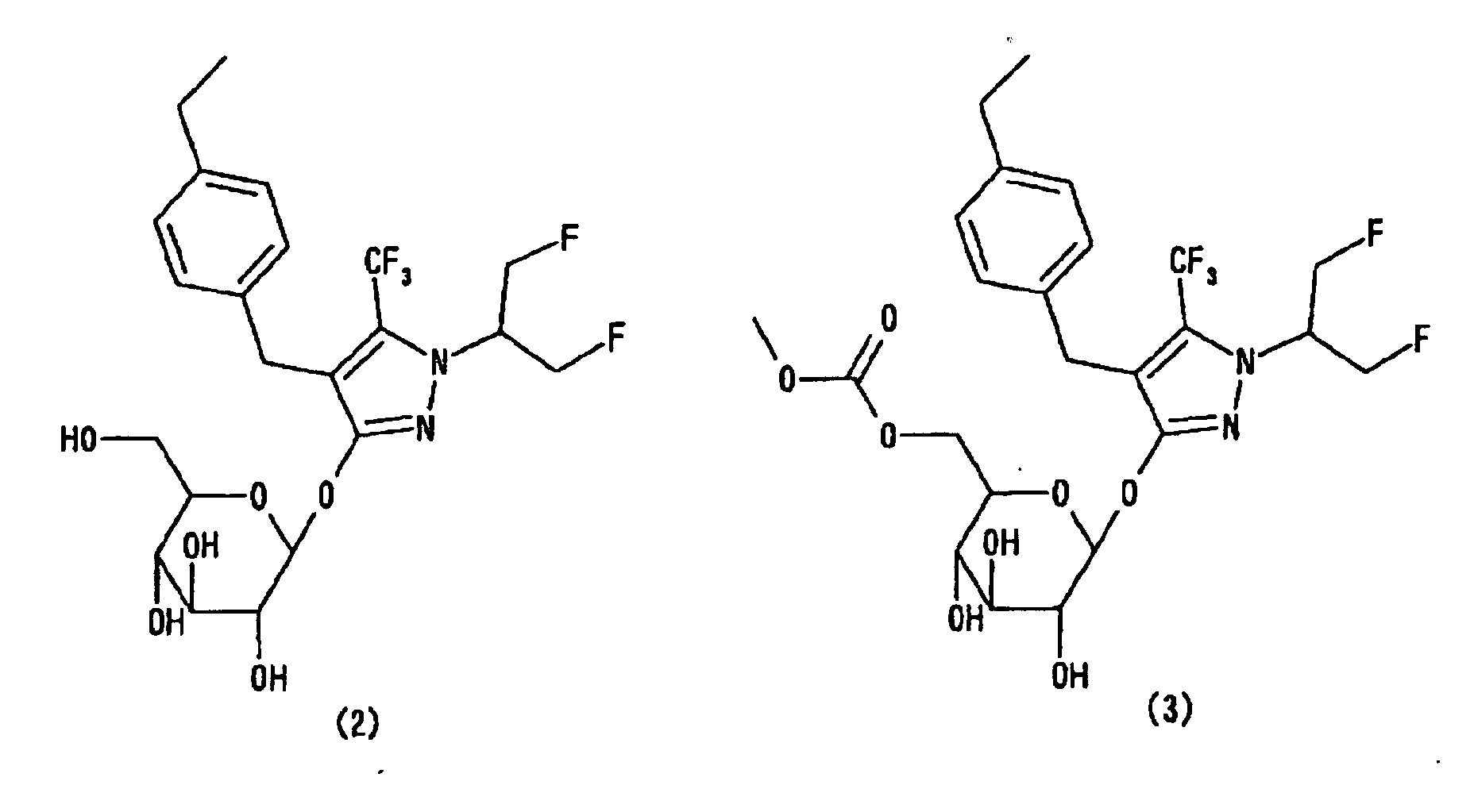
- A pharmaceutical composition comprising the pyrazole-O-glycoside derivative or pharmaceutically acceptable salt thereof according to any one of claims 10 to 15.
- A therapeutic agent for diabetes comprising the pyrazole-O-glycoside derivative or pharmaceutically acceptable salt thereof according to any one of claims 10 to 15.
- A therapeutic agent for diabetes for oral administration, comprising the pyrazole-O-glycoside derivative or pharmaceutically acceptable salt thereof according to any one of claims 10 to 15.
- An agent for inducing urinary sugar excretion comprising the pyrazole-O-glycoside derivative or pharmaceutically acceptable salt thereof according to any one of claims 10 to 15.
- Use of the pyrazole-O-glycoside derivative or pharmaceutically acceptable salt thereof according to any one of claims 10 to 15 for reducing renal glucose reabsorption at renal uriniferous tubules.
Applications Claiming Priority (5)
| Application Number | Priority Date | Filing Date | Title |
|---|---|---|---|
| JP2001131265 | 2001-04-27 | ||
| JP2001131265 | 2001-04-27 | ||
| JP2001263717 | 2001-08-31 | ||
| JP2001263717 | 2001-08-31 | ||
| PCT/JP2002/004238 WO2002088157A1 (en) | 2001-04-27 | 2002-04-26 | N-substituted pyrazolyl-o-glycoside derivatives and remedial agent for diabetes containing the same |
Publications (2)
| Publication Number | Publication Date |
|---|---|
| EP1389621A1 true EP1389621A1 (en) | 2004-02-18 |
| EP1389621A4 EP1389621A4 (en) | 2005-05-11 |
Family
ID=26614388
Family Applications (1)
| Application Number | Title | Priority Date | Filing Date |
|---|---|---|---|
| EP02722839A Withdrawn EP1389621A4 (en) | 2001-04-27 | 2002-04-26 | N-substituted pyrazolyl-o-glycoside derivatives and remedial agent for diabetes containing the same |
Country Status (5)
| Country | Link |
|---|---|
| US (1) | US6908905B2 (en) |
| EP (1) | EP1389621A4 (en) |
| JP (2) | JP4292570B2 (en) |
| CA (2) | CA2672001A1 (en) |
| WO (1) | WO2002088157A1 (en) |
Cited By (5)
| Publication number | Priority date | Publication date | Assignee | Title |
|---|---|---|---|---|
| WO2007010015A1 (en) * | 2005-07-22 | 2007-01-25 | Boehringer Ingelheim International Gmbh | Processes for preparing pyrazole-o-glycoside derivatives and novel intermediates of said processes |
| WO2007070135A1 (en) * | 2005-09-06 | 2007-06-21 | Serapis Farmaceuticals Limited | Compounds |
| US7524822B2 (en) | 2006-01-11 | 2009-04-28 | Boehringer Ingelheim International Gmbh | Crystalline form of 1′-(1-methylethyl)-4′-[(2-fluoro-4-methoxyphenyl)methyl]-5′-methyl-1H-pyrazol-3′-O-β-D-glucopyranoside, a method for its preparation and the use thereof for preparing medicaments |
| US7943748B2 (en) | 2004-07-27 | 2011-05-17 | Chugai Seiyaku Kabushiki Kaisha | Glucitol derivative, prodrug thereof and salt thereof, and therapeutic agent containing the same for diabetes |
| US8048897B2 (en) | 2004-07-26 | 2011-11-01 | Chugai Seiyaku Kabushiki Kaisha | Cyclohexane derivative, prodrug thereof and salt thereof, and therapeutic agent containing the same for diabetes |
Families Citing this family (47)
| Publication number | Priority date | Publication date | Assignee | Title |
|---|---|---|---|---|
| WO2002036602A1 (en) | 2000-11-02 | 2002-05-10 | Ajinomoto Co., Inc. | Novel pyrazole derivatives and diabetes remedies containing the same |
| US7087579B2 (en) | 2001-02-26 | 2006-08-08 | Kissei Pharmaceutical Co., Ltd. | Glucopyranosyloxypyrazole derivatives and medicinal use thereof |
| EP1400529A4 (en) | 2001-05-30 | 2007-12-19 | Kissei Pharmaceutical | Glucopyranosyloxypyrazole derivative, medicinal composition containing the same, medicinal use thereof, and intermediate therefor |
| EP1500403A4 (en) * | 2002-04-26 | 2008-09-17 | Ajinomoto Kk | Preventive/remedy for diabetes |
| US7956041B2 (en) | 2002-04-26 | 2011-06-07 | Ajinomoto Co., Inc. | Prophylactic and therapeutic agent of diabetes mellitus |
| JP4606876B2 (en) * | 2002-08-27 | 2011-01-05 | キッセイ薬品工業株式会社 | Pyrazole derivative, pharmaceutical composition containing the same, and pharmaceutical use thereof |
| CA2500873C (en) * | 2002-10-04 | 2012-01-17 | Kissei Pharmaceutical Co., Ltd. | Pyrazole derivative, medicinal composition containing the same, medicinal use thereof and intermediate in producing the same |
| JP4679155B2 (en) * | 2002-12-25 | 2011-04-27 | キッセイ薬品工業株式会社 | Nitrogen-containing heterocyclic derivative, pharmaceutical composition containing the same, and pharmaceutical use thereof |
| JP2004300102A (en) * | 2003-03-31 | 2004-10-28 | Kissei Pharmaceut Co Ltd | Condensed heterocyclic derivative, pharmaceutical composition containing the same and its pharmaceutical application |
| WO2004113359A1 (en) | 2003-06-20 | 2004-12-29 | Kissei Pharmaceutical Co., Ltd. | Pyrazole derivative, drug composition containing the same and production intermediate therefor |
| MXPA06001274A (en) | 2003-08-01 | 2006-04-11 | Tanabe Seiyaku Co | NEW COMPOUNDS THAT HAVE INHIBITORY ACTIVITY AGAINST SODIUM-DEPENDENT CARRIER. |
| US8785403B2 (en) | 2003-08-01 | 2014-07-22 | Mitsubishi Tanabe Pharma Corporation | Glucopyranoside compound |
| US7375090B2 (en) | 2003-08-26 | 2008-05-20 | Boehringer Ingelheim International Gmbh | Glucopyranosyloxy-pyrazoles, pharmaceutical compositions containing these compounds, the use thereof and processed for the preparation thereof |
| WO2005021566A2 (en) * | 2003-08-26 | 2005-03-10 | Boehringer Ingelheim International Gmbh | Glucopyranosyloxy- pirazoles, drugs containing said compounds the use and production method thereof |
| TW200637869A (en) | 2005-01-28 | 2006-11-01 | Chugai Pharmaceutical Co Ltd | The spiroketal derivatives and the use as therapeutical agent for diabetes of the same |
| MY147375A (en) | 2005-01-31 | 2012-11-30 | Mitsubishi Tanabe Pharma Corp | Indole derivatives |
| AR053329A1 (en) * | 2005-01-31 | 2007-05-02 | Tanabe Seiyaku Co | INDOL DERIVATIVES USEFUL AS INHIBITORS OF GLUCOSE CONVEYORS DEPENDENT ON SODIUM (SGLT) |
| UY29694A1 (en) * | 2005-07-28 | 2007-02-28 | Boehringer Ingelheim Int | METHODS TO PREVENT AND TREAT METABOLIC AND NEW DISORDERS DERIVED FROM PIRAZOL-O-GLUCOSIDO |
| PE20080251A1 (en) | 2006-05-04 | 2008-04-25 | Boehringer Ingelheim Int | USES OF DPP IV INHIBITORS |
| US20080020987A1 (en) * | 2006-07-20 | 2008-01-24 | Waldemar Pfrengle | Processes for preparing pyrazole-O-glycoside derivatives and novel intermediates of said processes |
| TWI418556B (en) | 2006-07-27 | 2013-12-11 | Mitsubishi Tanabe Pharma Corp | Indole derivatives |
| UY30730A1 (en) | 2006-12-04 | 2008-07-03 | Mitsubishi Tanabe Pharma Corp | CRYSTAL FORM OF HEMIHYDRATE 1- (B (BETA) -D-GLUCOPYRANOSIL) -4-METHYL-3- [5- (4-FLUOROPHENYL) -2-TIENYLMETHYL] BENZENE |
| JP5298025B2 (en) | 2006-12-04 | 2013-09-25 | ジヤンセン・フアーマシユーチカ・ナームローゼ・フエンノートシヤツプ | Thienyl-containing glycopyranosyl derivatives as antidiabetic agents |
| CN101801371B (en) | 2007-09-10 | 2012-11-28 | 詹森药业有限公司 | Process for the preparation of compounds useful as SGLT inhibitors |
| CL2008003653A1 (en) | 2008-01-17 | 2010-03-05 | Mitsubishi Tanabe Pharma Corp | Use of a glucopyranosyl-derived sglt inhibitor and a selected dppiv inhibitor to treat diabetes; and pharmaceutical composition. |
| BRPI0913129A2 (en) | 2008-05-22 | 2016-01-05 | Bristol Myers Squibb Co | method for treating hyperuricemia employing an sglt2 inhibitor and composition containing the same |
| MX2011002166A (en) * | 2008-08-28 | 2011-04-07 | Pfizer | Dioxa-bicyclo[3.2.1.]octane-2,3,4-triol derivatives. |
| US9056850B2 (en) * | 2008-10-17 | 2015-06-16 | Janssen Pharmaceutica N.V. | Process for the preparation of compounds useful as inhibitors of SGLT |
| US20110009347A1 (en) | 2009-07-08 | 2011-01-13 | Yin Liang | Combination therapy for the treatment of diabetes |
| KR101532412B1 (en) | 2009-07-10 | 2015-06-29 | 얀센 파마슈티카 엔.브이. | Crystallization method of 1- (β-D-glucopyranosyl) -4-methyl-3- (5- (4-fluorophenyl) -2-thienylmethyl) benzene |
| SG10201500258WA (en) | 2009-10-14 | 2015-03-30 | Janssen Pharmaceutica Nv | Process for the preparation of compounds useful as inhibitors of sglt2 |
| NZ599945A (en) | 2009-11-02 | 2014-05-30 | Pfizer | Dioxa-bicyclo[3.2.1]octane-2,3,4-triol derivatives |
| WO2011070592A2 (en) | 2009-12-09 | 2011-06-16 | Panacea Biotec Ltd. | Novel sugar derivatives |
| LT2568988T (en) | 2010-05-11 | 2016-09-12 | Janssen Pharmaceutica, N.V. | Pharmaceutical formulations comprising 1-(beta-d-glucopyranosyl)-2-thienylmethylbenzene derivatives as inhibitors of sglt |
| AU2012241897C1 (en) | 2011-04-13 | 2017-05-11 | Janssen Pharmaceutica Nv | Process for the preparation of compounds useful as inhibitors of SGLT2 |
| TWI542596B (en) | 2011-05-09 | 2016-07-21 | 健生藥品公司 | (2S,3R,4R,5S,6R)-2-(3-((5-(4-fluorophenyl)thiophen-2-yl)methyl)-4-methylphenyl)-6-(hydroxyl L-proline and citric acid cocrystals of methyl)tetrahydro-2H-piperan-3,4,5-triol |
| KR20190110628A (en) | 2011-12-21 | 2019-09-30 | 바이오딜리버리 사이언시스 인터내셔널 인코포레이티드 | Transmucosal drug delivery devices for use in chronic pain relief |
| PT3466431T (en) | 2013-03-14 | 2024-01-26 | Msd Int Gmbh | Crystalline forms and methods for preparing sglt2 inhibitors |
| US20170071970A1 (en) | 2015-09-15 | 2017-03-16 | Janssen Pharmaceutica Nv | Co-therapy comprising canagliflozin and phentermine for the treatment of obesity and obesity related disorders |
| WO2020016335A1 (en) | 2018-07-19 | 2020-01-23 | Astrazeneca Ab | Methods of treating hfpef employing dapagliflozin and compositions comprising the same |
| WO2020039394A1 (en) | 2018-08-24 | 2020-02-27 | Novartis Ag | New drug combinations |
| US20210251983A1 (en) | 2020-02-13 | 2021-08-19 | Biodelivery Sciences International, Inc. | Methods of treatment with buprenorphine |
| AU2021202643B2 (en) | 2020-07-27 | 2023-02-02 | Astrazeneca Ab | Methods of treating chronic kidney disease with dapagliflozin |
| PT4188389T (en) | 2020-07-27 | 2025-10-07 | Astrazeneca Ab | Methods of treating chronic kidney disease with dapagliflozin |
| WO2022208172A1 (en) | 2021-04-01 | 2022-10-06 | Astrazeneca Uk Limited | Systems and methods for managing prediabetes with a gliflozin sodium-glucose cotransport 2 inhibitor pharmaceutical composition |
| CN118510504A (en) | 2022-01-26 | 2024-08-16 | 阿斯利康(瑞典)有限公司 | Dapagliflozin for use in the treatment of pre-diabetes or in reducing the risk of developing type 2 diabetes |
| WO2025125513A1 (en) | 2023-12-15 | 2025-06-19 | AstraZeneca Ireland Limited | Sglt2 inhibitors and baxdrostat for treating chronic kidney disease and hypertension |
Family Cites Families (8)
| Publication number | Priority date | Publication date | Assignee | Title |
|---|---|---|---|---|
| UA71994C2 (en) * | 1999-08-31 | 2005-01-17 | Kissei Pharmaceutical | Glucopyranosyloxypyrazole derivatives, a pharmaceutical composition containing these derivatives and intermediate compounds for the preparation thereof |
| WO2002036602A1 (en) * | 2000-11-02 | 2002-05-10 | Ajinomoto Co., Inc. | Novel pyrazole derivatives and diabetes remedies containing the same |
| SI1354888T1 (en) | 2000-12-28 | 2009-10-31 | Kissei Pharmaceutical | Glucopyranosyloxypyrazole derivatives and use thereof in medicines |
| US7087579B2 (en) * | 2001-02-26 | 2006-08-08 | Kissei Pharmaceutical Co., Ltd. | Glucopyranosyloxypyrazole derivatives and medicinal use thereof |
| ES2350084T3 (en) | 2001-02-27 | 2011-01-18 | Kissei Pharmaceutical Co., Ltd. | DERIVATIVES OF GLUCOPIRANOSILOXIPIRAZOL AND MEDICAL USE OF THE SAME. |
| EP1400529A4 (en) | 2001-05-30 | 2007-12-19 | Kissei Pharmaceutical | Glucopyranosyloxypyrazole derivative, medicinal composition containing the same, medicinal use thereof, and intermediate therefor |
| JP4115105B2 (en) | 2001-07-02 | 2008-07-09 | 協和醗酵工業株式会社 | Pyrazole derivative |
| US20030087843A1 (en) | 2001-09-05 | 2003-05-08 | Washburn William N. | O-pyrazole glucoside SGLT2 inhibitors and method of use |
-
2002
- 2002-04-26 CA CA002672001A patent/CA2672001A1/en not_active Abandoned
- 2002-04-26 EP EP02722839A patent/EP1389621A4/en not_active Withdrawn
- 2002-04-26 WO PCT/JP2002/004238 patent/WO2002088157A1/en not_active Ceased
- 2002-04-26 JP JP2002585455A patent/JP4292570B2/en not_active Expired - Fee Related
- 2002-04-26 CA CA2445346A patent/CA2445346C/en not_active Expired - Fee Related
-
2003
- 2003-10-27 US US10/692,738 patent/US6908905B2/en not_active Expired - Fee Related
-
2008
- 2008-09-26 JP JP2008249028A patent/JP2009029832A/en not_active Abandoned
Cited By (7)
| Publication number | Priority date | Publication date | Assignee | Title |
|---|---|---|---|---|
| US8048897B2 (en) | 2004-07-26 | 2011-11-01 | Chugai Seiyaku Kabushiki Kaisha | Cyclohexane derivative, prodrug thereof and salt thereof, and therapeutic agent containing the same for diabetes |
| US7943748B2 (en) | 2004-07-27 | 2011-05-17 | Chugai Seiyaku Kabushiki Kaisha | Glucitol derivative, prodrug thereof and salt thereof, and therapeutic agent containing the same for diabetes |
| WO2007010015A1 (en) * | 2005-07-22 | 2007-01-25 | Boehringer Ingelheim International Gmbh | Processes for preparing pyrazole-o-glycoside derivatives and novel intermediates of said processes |
| WO2007070135A1 (en) * | 2005-09-06 | 2007-06-21 | Serapis Farmaceuticals Limited | Compounds |
| US8507461B2 (en) | 2005-09-06 | 2013-08-13 | Abdalla Rifai | Non-absorbable non-digestible polymer compounds |
| US7524822B2 (en) | 2006-01-11 | 2009-04-28 | Boehringer Ingelheim International Gmbh | Crystalline form of 1′-(1-methylethyl)-4′-[(2-fluoro-4-methoxyphenyl)methyl]-5′-methyl-1H-pyrazol-3′-O-β-D-glucopyranoside, a method for its preparation and the use thereof for preparing medicaments |
| US7838500B2 (en) | 2006-01-11 | 2010-11-23 | Ajinomoto Co., Inc. | Crystalline form of 1′-(1-methylethyl)-4′-[(2-fluoro-4-methoxyphenyl)methyl]-5′-methyl-1H-pyrazol-3′-O-β-D-glucopyranoside, a method for its preparation and the use thereof for preparing medicaments |
Also Published As
| Publication number | Publication date |
|---|---|
| CA2445346A1 (en) | 2002-11-07 |
| CA2672001A1 (en) | 2002-11-07 |
| WO2002088157A1 (en) | 2002-11-07 |
| CA2445346C (en) | 2010-04-06 |
| JPWO2002088157A1 (en) | 2004-08-19 |
| EP1389621A4 (en) | 2005-05-11 |
| US20040110936A1 (en) | 2004-06-10 |
| JP4292570B2 (en) | 2009-07-08 |
| JP2009029832A (en) | 2009-02-12 |
| US6908905B2 (en) | 2005-06-21 |
Similar Documents
| Publication | Publication Date | Title |
|---|---|---|
| US6908905B2 (en) | N-substituted pyrazole-O-glycoside derivatives and therapeutic agent for diabetes containing the same | |
| US6815428B2 (en) | Pyrazole derivatives and diabetic medicine containing them | |
| AU2001290257B2 (en) | Glucopyranosyloxybenzylbenzene derivatives and medicinal compositions containing the same | |
| JP3334980B2 (en) | Novel erythromycin derivatives, their production method and their use as drugs | |
| JPWO2001016147A1 (en) | Glucopyranosyloxypyrazole derivatives, pharmaceutical compositions containing the same, and intermediates for their production | |
| KR20020033781A (en) | Glucopyranosyloxypyrazole derivatives, medicinal compositions containing the same and intermediates in the production thereof | |
| EP0773226A1 (en) | Propiophenone derivative and processes for preparing the same | |
| US6605595B1 (en) | Avermectin derivatives | |
| RU2074185C1 (en) | Derivative of 4-deoxy-4-epipodophyllotoxin or its pharmaceutically acceptable salt and pharmaceutical composition based on thereof | |
| JP3228835B2 (en) | New derivatives of erythromycin, their preparation and use as pharmaceuticals | |
| US4853467A (en) | Nitrogen containing derivatives of epipodophyllotoxin glucosides | |
| EP0297594A2 (en) | Novel 3',4'-dinitrogen substituted epipodophyllotoxin glucoside derivatives | |
| JP2002543213A (en) | Halo derivatives of 9-deoxo-9a-aza-9a-homoerythromycin A | |
| WO2018127194A1 (en) | C-glycoside sodium-glucose transporter 2 inhibitor | |
| CN108640958B (en) | Isobenzofuran derivatives, pharmaceutical compositions and formulations thereof, and uses thereof | |
| EP1589023B1 (en) | Oligosaccharide derivative | |
| JP4591781B2 (en) | Novel pyrazole derivatives and therapeutic agents for diabetes containing them | |
| EP4166547A1 (en) | Aryl glucoside derivative | |
| JPWO1990000557A1 (en) | 5-substituted uridine derivatives and their manufacturing intermediates |
Legal Events
| Date | Code | Title | Description |
|---|---|---|---|
| PUAI | Public reference made under article 153(3) epc to a published international application that has entered the european phase |
Free format text: ORIGINAL CODE: 0009012 |
|
| 17P | Request for examination filed |
Effective date: 20031024 |
|
| AK | Designated contracting states |
Kind code of ref document: A1 Designated state(s): AT BE CH CY DE DK ES FI FR GB GR IE IT LI LU MC NL PT SE TR |
|
| AX | Request for extension of the european patent |
Extension state: AL LT LV MK RO SI |
|
| A4 | Supplementary search report drawn up and despatched |
Effective date: 20050330 |
|
| GRAP | Despatch of communication of intention to grant a patent |
Free format text: ORIGINAL CODE: EPIDOSNIGR1 |
|
| STAA | Information on the status of an ep patent application or granted ep patent |
Free format text: STATUS: THE APPLICATION IS DEEMED TO BE WITHDRAWN |
|
| 18D | Application deemed to be withdrawn |
Effective date: 20111213 |