EP1389606A1 - Separatory agent comprising polysaccharide derivative having polycyclic structure - Google Patents
Separatory agent comprising polysaccharide derivative having polycyclic structure Download PDFInfo
- Publication number
- EP1389606A1 EP1389606A1 EP02722795A EP02722795A EP1389606A1 EP 1389606 A1 EP1389606 A1 EP 1389606A1 EP 02722795 A EP02722795 A EP 02722795A EP 02722795 A EP02722795 A EP 02722795A EP 1389606 A1 EP1389606 A1 EP 1389606A1
- Authority
- EP
- European Patent Office
- Prior art keywords
- separating agent
- derivative
- chromatography
- agent according
- polycyclic structure
- Prior art date
- Legal status (The legal status is an assumption and is not a legal conclusion. Google has not performed a legal analysis and makes no representation as to the accuracy of the status listed.)
- Granted
Links
- 229920001282 polysaccharide Polymers 0.000 title claims abstract description 37
- 239000005017 polysaccharide Substances 0.000 title claims abstract description 37
- 239000003795 chemical substances by application Substances 0.000 title claims abstract description 35
- 150000004676 glycans Chemical class 0.000 title claims abstract 6
- 125000003367 polycyclic group Chemical group 0.000 title claims description 18
- 125000003118 aryl group Chemical group 0.000 claims abstract description 8
- 125000002619 bicyclic group Chemical group 0.000 claims abstract description 7
- 125000002723 alicyclic group Chemical group 0.000 claims abstract description 6
- 125000000623 heterocyclic group Chemical group 0.000 claims abstract description 6
- 230000003100 immobilizing effect Effects 0.000 claims description 17
- 239000001913 cellulose Substances 0.000 claims description 15
- 229920002678 cellulose Polymers 0.000 claims description 15
- 238000004587 chromatography analysis Methods 0.000 claims description 15
- AKZWRTCWNXHHFR-PDIZUQLASA-N [(3S)-oxolan-3-yl] N-[(2S,3S)-4-[(5S)-5-benzyl-3-[(2R)-2-carbamoyloxy-2,3-dihydro-1H-inden-1-yl]-4-oxo-3H-pyrrol-5-yl]-3-hydroxy-1-phenylbutan-2-yl]carbamate Chemical compound NC(=O)O[C@@H]1Cc2ccccc2C1C1C=N[C@](C[C@H](O)[C@H](Cc2ccccc2)NC(=O)O[C@H]2CCOC2)(Cc2ccccc2)C1=O AKZWRTCWNXHHFR-PDIZUQLASA-N 0.000 claims description 12
- 229920000856 Amylose Polymers 0.000 claims description 11
- 238000004811 liquid chromatography Methods 0.000 claims description 7
- 238000005251 capillar electrophoresis Methods 0.000 claims description 4
- 238000004809 thin layer chromatography Methods 0.000 claims description 4
- 150000002148 esters Chemical class 0.000 claims description 3
- 150000004804 polysaccharides Chemical class 0.000 description 31
- 238000000926 separation method Methods 0.000 description 20
- 239000000945 filler Substances 0.000 description 12
- VYPSYNLAJGMNEJ-UHFFFAOYSA-N Silicium dioxide Chemical compound O=[Si]=O VYPSYNLAJGMNEJ-UHFFFAOYSA-N 0.000 description 11
- 238000000034 method Methods 0.000 description 10
- 239000007983 Tris buffer Substances 0.000 description 9
- 239000000741 silica gel Substances 0.000 description 9
- 229910002027 silica gel Inorganic materials 0.000 description 9
- 150000001875 compounds Chemical class 0.000 description 8
- 125000002887 hydroxy group Chemical group [H]O* 0.000 description 7
- 238000004519 manufacturing process Methods 0.000 description 7
- 239000000126 substance Substances 0.000 description 7
- LQLLKAMCVQUIAF-UHFFFAOYSA-N 2,3-dihydro-1h-inden-5-yl carbamate Chemical compound NC(=O)OC1=CC=C2CCCC2=C1 LQLLKAMCVQUIAF-UHFFFAOYSA-N 0.000 description 6
- JUJWROOIHBZHMG-UHFFFAOYSA-N Pyridine Chemical compound C1=CC=NC=C1 JUJWROOIHBZHMG-UHFFFAOYSA-N 0.000 description 6
- KWGKDLIKAYFUFQ-UHFFFAOYSA-M lithium chloride Chemical compound [Li+].[Cl-] KWGKDLIKAYFUFQ-UHFFFAOYSA-M 0.000 description 6
- 230000003287 optical effect Effects 0.000 description 6
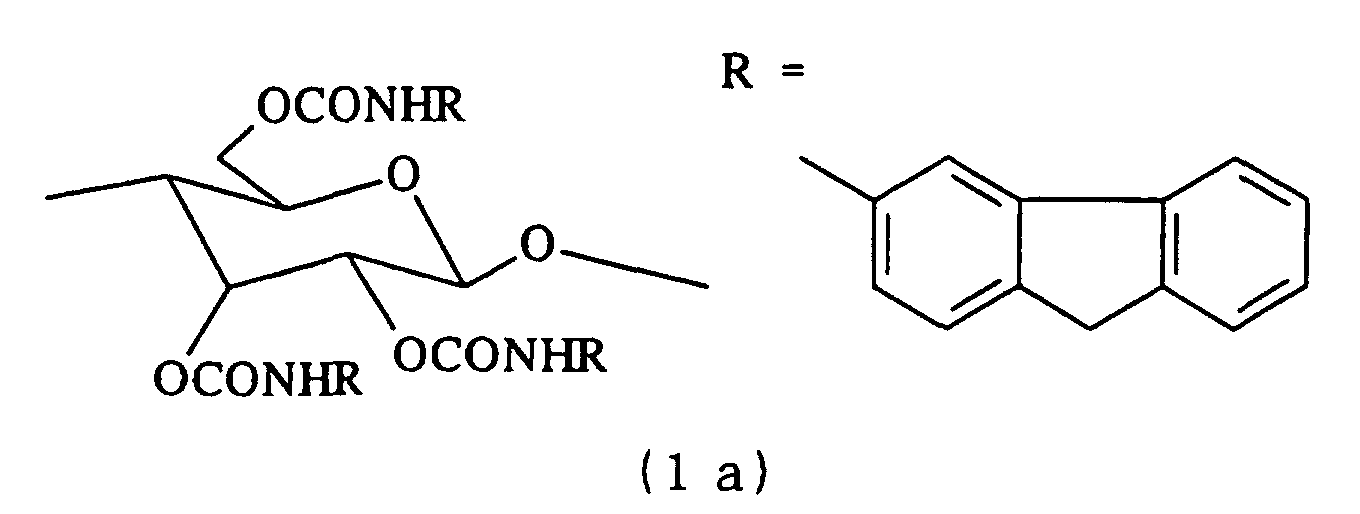
- ROYRFEJVPOMEND-UHFFFAOYSA-N 9h-fluoren-1-yl carbamate Chemical compound C1C2=CC=CC=C2C2=C1C(OC(=O)N)=CC=C2 ROYRFEJVPOMEND-UHFFFAOYSA-N 0.000 description 5
- 238000004458 analytical method Methods 0.000 description 5
- 238000004128 high performance liquid chromatography Methods 0.000 description 5
- -1 poly(triphenylmethyl methacrylate) Polymers 0.000 description 5
- 229920001503 Glucan Polymers 0.000 description 4
- FXHOOIRPVKKKFG-UHFFFAOYSA-N N,N-Dimethylacetamide Chemical compound CN(C)C(C)=O FXHOOIRPVKKKFG-UHFFFAOYSA-N 0.000 description 4
- WYURNTSHIVDZCO-UHFFFAOYSA-N Tetrahydrofuran Chemical compound C1CCOC1 WYURNTSHIVDZCO-UHFFFAOYSA-N 0.000 description 4
- 230000000052 comparative effect Effects 0.000 description 4
- 238000000921 elemental analysis Methods 0.000 description 4
- 125000000524 functional group Chemical group 0.000 description 4
- 239000011521 glass Substances 0.000 description 4
- 239000002245 particle Substances 0.000 description 4
- 239000002904 solvent Substances 0.000 description 4
- PYJJKIOYUUDDDM-UHFFFAOYSA-N 5-isocyanato-2,3-dihydro-1h-indene Chemical compound O=C=NC1=CC=C2CCCC2=C1 PYJJKIOYUUDDDM-UHFFFAOYSA-N 0.000 description 3
- 230000015572 biosynthetic process Effects 0.000 description 3
- 239000003814 drug Substances 0.000 description 3
- VLKZOEOYAKHREP-UHFFFAOYSA-N n-Hexane Chemical compound CCCCCC VLKZOEOYAKHREP-UHFFFAOYSA-N 0.000 description 3
- 239000000843 powder Substances 0.000 description 3
- UMJSCPRVCHMLSP-UHFFFAOYSA-N pyridine Natural products COC1=CC=CN=C1 UMJSCPRVCHMLSP-UHFFFAOYSA-N 0.000 description 3
- 239000011541 reaction mixture Substances 0.000 description 3
- 238000001226 reprecipitation Methods 0.000 description 3
- 238000004381 surface treatment Methods 0.000 description 3
- 238000003786 synthesis reaction Methods 0.000 description 3
- 229920001221 xylan Polymers 0.000 description 3
- 229920002498 Beta-glucan Polymers 0.000 description 2
- 229920002101 Chitin Polymers 0.000 description 2
- 229920001661 Chitosan Polymers 0.000 description 2
- 229920002670 Fructan Polymers 0.000 description 2
- 229920001202 Inulin Polymers 0.000 description 2
- KFZMGEQAYNKOFK-UHFFFAOYSA-N Isopropanol Chemical compound CC(C)O KFZMGEQAYNKOFK-UHFFFAOYSA-N 0.000 description 2
- CPLXHLVBOLITMK-UHFFFAOYSA-N Magnesium oxide Chemical compound [Mg]=O CPLXHLVBOLITMK-UHFFFAOYSA-N 0.000 description 2
- WQZGKKKJIJFFOK-RWOPYEJCSA-N beta-D-mannose Chemical compound OC[C@H]1O[C@@H](O)[C@@H](O)[C@@H](O)[C@@H]1O WQZGKKKJIJFFOK-RWOPYEJCSA-N 0.000 description 2
- 238000009835 boiling Methods 0.000 description 2
- 150000004657 carbamic acid derivatives Chemical class 0.000 description 2
- 229940079593 drug Drugs 0.000 description 2
- 238000005516 engineering process Methods 0.000 description 2
- RTZKZFJDLAIYFH-UHFFFAOYSA-N ether Substances CCOCC RTZKZFJDLAIYFH-UHFFFAOYSA-N 0.000 description 2
- JYJIGFIDKWBXDU-MNNPPOADSA-N inulin Chemical compound O[C@H]1[C@H](O)[C@@H](CO)O[C@@]1(CO)OC[C@]1(OC[C@]2(OC[C@]3(OC[C@]4(OC[C@]5(OC[C@]6(OC[C@]7(OC[C@]8(OC[C@]9(OC[C@]%10(OC[C@]%11(OC[C@]%12(OC[C@]%13(OC[C@]%14(OC[C@]%15(OC[C@]%16(OC[C@]%17(OC[C@]%18(OC[C@]%19(OC[C@]%20(OC[C@]%21(OC[C@]%22(OC[C@]%23(OC[C@]%24(OC[C@]%25(OC[C@]%26(OC[C@]%27(OC[C@]%28(OC[C@]%29(OC[C@]%30(OC[C@]%31(OC[C@]%32(OC[C@]%33(OC[C@]%34(OC[C@]%35(OC[C@]%36(O[C@@H]%37[C@@H]([C@@H](O)[C@H](O)[C@@H](CO)O%37)O)[C@H]([C@H](O)[C@@H](CO)O%36)O)[C@H]([C@H](O)[C@@H](CO)O%35)O)[C@H]([C@H](O)[C@@H](CO)O%34)O)[C@H]([C@H](O)[C@@H](CO)O%33)O)[C@H]([C@H](O)[C@@H](CO)O%32)O)[C@H]([C@H](O)[C@@H](CO)O%31)O)[C@H]([C@H](O)[C@@H](CO)O%30)O)[C@H]([C@H](O)[C@@H](CO)O%29)O)[C@H]([C@H](O)[C@@H](CO)O%28)O)[C@H]([C@H](O)[C@@H](CO)O%27)O)[C@H]([C@H](O)[C@@H](CO)O%26)O)[C@H]([C@H](O)[C@@H](CO)O%25)O)[C@H]([C@H](O)[C@@H](CO)O%24)O)[C@H]([C@H](O)[C@@H](CO)O%23)O)[C@H]([C@H](O)[C@@H](CO)O%22)O)[C@H]([C@H](O)[C@@H](CO)O%21)O)[C@H]([C@H](O)[C@@H](CO)O%20)O)[C@H]([C@H](O)[C@@H](CO)O%19)O)[C@H]([C@H](O)[C@@H](CO)O%18)O)[C@H]([C@H](O)[C@@H](CO)O%17)O)[C@H]([C@H](O)[C@@H](CO)O%16)O)[C@H]([C@H](O)[C@@H](CO)O%15)O)[C@H]([C@H](O)[C@@H](CO)O%14)O)[C@H]([C@H](O)[C@@H](CO)O%13)O)[C@H]([C@H](O)[C@@H](CO)O%12)O)[C@H]([C@H](O)[C@@H](CO)O%11)O)[C@H]([C@H](O)[C@@H](CO)O%10)O)[C@H]([C@H](O)[C@@H](CO)O9)O)[C@H]([C@H](O)[C@@H](CO)O8)O)[C@H]([C@H](O)[C@@H](CO)O7)O)[C@H]([C@H](O)[C@@H](CO)O6)O)[C@H]([C@H](O)[C@@H](CO)O5)O)[C@H]([C@H](O)[C@@H](CO)O4)O)[C@H]([C@H](O)[C@@H](CO)O3)O)[C@H]([C@H](O)[C@@H](CO)O2)O)[C@@H](O)[C@H](O)[C@@H](CO)O1 JYJIGFIDKWBXDU-MNNPPOADSA-N 0.000 description 2
- 229940029339 inulin Drugs 0.000 description 2
- 238000002844 melting Methods 0.000 description 2
- 230000008018 melting Effects 0.000 description 2
- 239000012528 membrane Substances 0.000 description 2
- 238000000053 physical method Methods 0.000 description 2
- 230000001766 physiological effect Effects 0.000 description 2
- 238000006116 polymerization reaction Methods 0.000 description 2
- 239000011148 porous material Substances 0.000 description 2
- 108090000623 proteins and genes Proteins 0.000 description 2
- 102000004169 proteins and genes Human genes 0.000 description 2
- 239000000243 solution Substances 0.000 description 2
- YLQBMQCUIZJEEH-UHFFFAOYSA-N tetrahydrofuran Natural products C=1C=COC=1 YLQBMQCUIZJEEH-UHFFFAOYSA-N 0.000 description 2
- WDQLRUYAYXDIFW-RWKIJVEZSA-N (2r,3r,4s,5r,6r)-4-[(2s,3r,4s,5r,6r)-3,5-dihydroxy-4-[(2r,3r,4s,5s,6r)-3,4,5-trihydroxy-6-(hydroxymethyl)oxan-2-yl]oxy-6-[[(2r,3r,4s,5s,6r)-3,4,5-trihydroxy-6-(hydroxymethyl)oxan-2-yl]oxymethyl]oxan-2-yl]oxy-6-(hydroxymethyl)oxane-2,3,5-triol Chemical compound O[C@@H]1[C@@H](CO)O[C@@H](O)[C@H](O)[C@H]1O[C@H]1[C@H](O)[C@@H](O[C@H]2[C@@H]([C@@H](O)[C@H](O)[C@@H](CO)O2)O)[C@H](O)[C@@H](CO[C@H]2[C@@H]([C@@H](O)[C@H](O)[C@@H](CO)O2)O)O1 WDQLRUYAYXDIFW-RWKIJVEZSA-N 0.000 description 1
- BKJMIMBCVWATHA-UHFFFAOYSA-N 1-isocyanato-9h-fluorene Chemical compound C12=CC=CC=C2CC2=C1C=CC=C2N=C=O BKJMIMBCVWATHA-UHFFFAOYSA-N 0.000 description 1
- 229920000936 Agarose Polymers 0.000 description 1
- 239000005995 Aluminium silicate Substances 0.000 description 1
- 229920000945 Amylopectin Polymers 0.000 description 1
- 0 CC(C(*)C1*)C(C*)OC1OC Chemical compound CC(C(*)C1*)C(C*)OC1OC 0.000 description 1
- KXDHJXZQYSOELW-UHFFFAOYSA-M Carbamate Chemical compound NC([O-])=O KXDHJXZQYSOELW-UHFFFAOYSA-M 0.000 description 1
- 229920002307 Dextran Polymers 0.000 description 1
- 229920000057 Mannan Polymers 0.000 description 1
- 108010064983 Ovomucin Proteins 0.000 description 1
- 239000004793 Polystyrene Substances 0.000 description 1
- 229920001218 Pullulan Polymers 0.000 description 1
- 239000004373 Pullulan Substances 0.000 description 1
- 229920002305 Schizophyllan Polymers 0.000 description 1
- BLRPTPMANUNPDV-UHFFFAOYSA-N Silane Chemical compound [SiH4] BLRPTPMANUNPDV-UHFFFAOYSA-N 0.000 description 1
- 229920002472 Starch Polymers 0.000 description 1
- GWEVSGVZZGPLCZ-UHFFFAOYSA-N Titan oxide Chemical compound O=[Ti]=O GWEVSGVZZGPLCZ-UHFFFAOYSA-N 0.000 description 1
- 238000010521 absorption reaction Methods 0.000 description 1
- 239000013543 active substance Substances 0.000 description 1
- 239000000783 alginic acid Substances 0.000 description 1
- 229920000615 alginic acid Polymers 0.000 description 1
- 229960001126 alginic acid Drugs 0.000 description 1
- 235000010443 alginic acid Nutrition 0.000 description 1
- 150000004781 alginic acids Chemical class 0.000 description 1
- PNEYBMLMFCGWSK-UHFFFAOYSA-N aluminium oxide Inorganic materials [O-2].[O-2].[O-2].[Al+3].[Al+3] PNEYBMLMFCGWSK-UHFFFAOYSA-N 0.000 description 1
- 235000012211 aluminium silicate Nutrition 0.000 description 1
- 125000005428 anthryl group Chemical group [H]C1=C([H])C([H])=C2C([H])=C3C(*)=C([H])C([H])=C([H])C3=C([H])C2=C1[H] 0.000 description 1
- 239000011324 bead Substances 0.000 description 1
- 230000006399 behavior Effects 0.000 description 1
- 239000011248 coating agent Substances 0.000 description 1
- 238000000576 coating method Methods 0.000 description 1
- 230000008602 contraction Effects 0.000 description 1
- 238000010511 deprotection reaction Methods 0.000 description 1
- 238000001514 detection method Methods 0.000 description 1
- 230000000694 effects Effects 0.000 description 1
- 238000001962 electrophoresis Methods 0.000 description 1
- 230000029142 excretion Effects 0.000 description 1
- 125000003983 fluorenyl group Chemical group C1(=CC=CC=2C3=CC=CC=C3CC12)* 0.000 description 1
- 150000002243 furanoses Chemical group 0.000 description 1
- 125000002791 glucosyl group Chemical group C1([C@H](O)[C@@H](O)[C@H](O)[C@H](O1)CO)* 0.000 description 1
- 125000003392 indanyl group Chemical group C1(CCC2=CC=CC=C12)* 0.000 description 1
- 125000003454 indenyl group Chemical group C1(C=CC2=CC=CC=C12)* 0.000 description 1
- 239000012948 isocyanate Substances 0.000 description 1
- 150000002513 isocyanates Chemical class 0.000 description 1
- NLYAJNPCOHFWQQ-UHFFFAOYSA-N kaolin Chemical compound O.O.O=[Al]O[Si](=O)O[Si](=O)O[Al]=O NLYAJNPCOHFWQQ-UHFFFAOYSA-N 0.000 description 1
- AIHDCSAXVMAMJH-GFBKWZILSA-N levan Chemical compound O[C@H]1[C@H](O)[C@@H](CO)O[C@@]1(CO)OC[C@@H]1[C@@H](O)[C@H](O)[C@](CO)(CO[C@@H]2[C@H]([C@H](O)[C@@](O)(CO)O2)O)O1 AIHDCSAXVMAMJH-GFBKWZILSA-N 0.000 description 1
- 239000007788 liquid Substances 0.000 description 1
- 239000000395 magnesium oxide Substances 0.000 description 1
- 239000000463 material Substances 0.000 description 1
- 230000004060 metabolic process Effects 0.000 description 1
- 239000000693 micelle Substances 0.000 description 1
- 238000004452 microanalysis Methods 0.000 description 1
- 125000001624 naphthyl group Chemical group 0.000 description 1
- 239000005445 natural material Substances 0.000 description 1
- 150000002894 organic compounds Chemical class 0.000 description 1
- 125000005561 phenanthryl group Chemical group 0.000 description 1
- 230000000704 physical effect Effects 0.000 description 1
- 229920005640 poly alpha-1,3-glucan Polymers 0.000 description 1
- 229920002401 polyacrylamide Polymers 0.000 description 1
- 229920000058 polyacrylate Polymers 0.000 description 1
- 229920000642 polymer Polymers 0.000 description 1
- 229920002223 polystyrene Polymers 0.000 description 1
- 238000004237 preparative chromatography Methods 0.000 description 1
- 238000004262 preparative liquid chromatography Methods 0.000 description 1
- 235000019423 pullulan Nutrition 0.000 description 1
- 150000003214 pyranose derivatives Chemical group 0.000 description 1
- 125000001725 pyrenyl group Chemical group 0.000 description 1
- 125000005493 quinolyl group Chemical group 0.000 description 1
- 230000004044 response Effects 0.000 description 1
- 229910000077 silane Inorganic materials 0.000 description 1
- 150000004760 silicates Chemical class 0.000 description 1
- 239000000377 silicon dioxide Substances 0.000 description 1
- 239000002002 slurry Substances 0.000 description 1
- 239000008107 starch Substances 0.000 description 1
- 235000019698 starch Nutrition 0.000 description 1
- 238000006467 substitution reaction Methods 0.000 description 1
- 230000002522 swelling effect Effects 0.000 description 1
- OGIDPMRJRNCKJF-UHFFFAOYSA-N titanium oxide Inorganic materials [Ti]=O OGIDPMRJRNCKJF-UHFFFAOYSA-N 0.000 description 1
- 230000001988 toxicity Effects 0.000 description 1
- 231100000419 toxicity Toxicity 0.000 description 1
- 238000010792 warming Methods 0.000 description 1
Classifications
-
- C—CHEMISTRY; METALLURGY
- C08—ORGANIC MACROMOLECULAR COMPOUNDS; THEIR PREPARATION OR CHEMICAL WORKING-UP; COMPOSITIONS BASED THEREON
- C08B—POLYSACCHARIDES; DERIVATIVES THEREOF
- C08B15/00—Preparation of other cellulose derivatives or modified cellulose, e.g. complexes
- C08B15/05—Derivatives containing elements other than carbon, hydrogen, oxygen, halogens or sulfur
- C08B15/06—Derivatives containing elements other than carbon, hydrogen, oxygen, halogens or sulfur containing nitrogen, e.g. carbamates
-
- B—PERFORMING OPERATIONS; TRANSPORTING
- B01—PHYSICAL OR CHEMICAL PROCESSES OR APPARATUS IN GENERAL
- B01J—CHEMICAL OR PHYSICAL PROCESSES, e.g. CATALYSIS OR COLLOID CHEMISTRY; THEIR RELEVANT APPARATUS
- B01J20/00—Solid sorbent compositions or filter aid compositions; Sorbents for chromatography; Processes for preparing, regenerating or reactivating thereof
- B01J20/281—Sorbents specially adapted for preparative, analytical or investigative chromatography
- B01J20/29—Chiral phases
-
- B—PERFORMING OPERATIONS; TRANSPORTING
- B01—PHYSICAL OR CHEMICAL PROCESSES OR APPARATUS IN GENERAL
- B01J—CHEMICAL OR PHYSICAL PROCESSES, e.g. CATALYSIS OR COLLOID CHEMISTRY; THEIR RELEVANT APPARATUS
- B01J20/00—Solid sorbent compositions or filter aid compositions; Sorbents for chromatography; Processes for preparing, regenerating or reactivating thereof
- B01J20/22—Solid sorbent compositions or filter aid compositions; Sorbents for chromatography; Processes for preparing, regenerating or reactivating thereof comprising organic material
- B01J20/26—Synthetic macromolecular compounds
-
- B—PERFORMING OPERATIONS; TRANSPORTING
- B01—PHYSICAL OR CHEMICAL PROCESSES OR APPARATUS IN GENERAL
- B01J—CHEMICAL OR PHYSICAL PROCESSES, e.g. CATALYSIS OR COLLOID CHEMISTRY; THEIR RELEVANT APPARATUS
- B01J20/00—Solid sorbent compositions or filter aid compositions; Sorbents for chromatography; Processes for preparing, regenerating or reactivating thereof
- B01J20/22—Solid sorbent compositions or filter aid compositions; Sorbents for chromatography; Processes for preparing, regenerating or reactivating thereof comprising organic material
- B01J20/26—Synthetic macromolecular compounds
- B01J20/262—Synthetic macromolecular compounds obtained otherwise than by reactions only involving carbon to carbon unsaturated bonds, e.g. obtained by polycondensation
-
- B—PERFORMING OPERATIONS; TRANSPORTING
- B01—PHYSICAL OR CHEMICAL PROCESSES OR APPARATUS IN GENERAL
- B01J—CHEMICAL OR PHYSICAL PROCESSES, e.g. CATALYSIS OR COLLOID CHEMISTRY; THEIR RELEVANT APPARATUS
- B01J20/00—Solid sorbent compositions or filter aid compositions; Sorbents for chromatography; Processes for preparing, regenerating or reactivating thereof
- B01J20/22—Solid sorbent compositions or filter aid compositions; Sorbents for chromatography; Processes for preparing, regenerating or reactivating thereof comprising organic material
- B01J20/26—Synthetic macromolecular compounds
- B01J20/265—Synthetic macromolecular compounds modified or post-treated polymers
-
- B—PERFORMING OPERATIONS; TRANSPORTING
- B01—PHYSICAL OR CHEMICAL PROCESSES OR APPARATUS IN GENERAL
- B01J—CHEMICAL OR PHYSICAL PROCESSES, e.g. CATALYSIS OR COLLOID CHEMISTRY; THEIR RELEVANT APPARATUS
- B01J20/00—Solid sorbent compositions or filter aid compositions; Sorbents for chromatography; Processes for preparing, regenerating or reactivating thereof
- B01J20/281—Sorbents specially adapted for preparative, analytical or investigative chromatography
- B01J20/282—Porous sorbents
- B01J20/285—Porous sorbents based on polymers
-
- B—PERFORMING OPERATIONS; TRANSPORTING
- B01—PHYSICAL OR CHEMICAL PROCESSES OR APPARATUS IN GENERAL
- B01J—CHEMICAL OR PHYSICAL PROCESSES, e.g. CATALYSIS OR COLLOID CHEMISTRY; THEIR RELEVANT APPARATUS
- B01J20/00—Solid sorbent compositions or filter aid compositions; Sorbents for chromatography; Processes for preparing, regenerating or reactivating thereof
- B01J20/30—Processes for preparing, regenerating, or reactivating
- B01J20/32—Impregnating or coating ; Solid sorbent compositions obtained from processes involving impregnating or coating
- B01J20/3231—Impregnating or coating ; Solid sorbent compositions obtained from processes involving impregnating or coating characterised by the coating or impregnating layer
- B01J20/3242—Layers with a functional group, e.g. an affinity material, a ligand, a reactant or a complexing group
- B01J20/3244—Non-macromolecular compounds
- B01J20/3246—Non-macromolecular compounds having a well defined chemical structure
- B01J20/3248—Non-macromolecular compounds having a well defined chemical structure the functional group or the linking, spacer or anchoring group as a whole comprising at least one type of heteroatom selected from a nitrogen, oxygen or sulfur, these atoms not being part of the carrier as such
- B01J20/3253—Non-macromolecular compounds having a well defined chemical structure the functional group or the linking, spacer or anchoring group as a whole comprising at least one type of heteroatom selected from a nitrogen, oxygen or sulfur, these atoms not being part of the carrier as such comprising a cyclic structure not containing any of the heteroatoms nitrogen, oxygen or sulfur, e.g. aromatic structures
-
- C—CHEMISTRY; METALLURGY
- C07—ORGANIC CHEMISTRY
- C07B—GENERAL METHODS OF ORGANIC CHEMISTRY; APPARATUS THEREFOR
- C07B57/00—Separation of optically-active compounds
-
- B—PERFORMING OPERATIONS; TRANSPORTING
- B01—PHYSICAL OR CHEMICAL PROCESSES OR APPARATUS IN GENERAL
- B01D—SEPARATION
- B01D15/00—Separating processes involving the treatment of liquids with solid sorbents; Apparatus therefor
- B01D15/08—Selective adsorption, e.g. chromatography
- B01D15/26—Selective adsorption, e.g. chromatography characterised by the separation mechanism
- B01D15/38—Selective adsorption, e.g. chromatography characterised by the separation mechanism involving specific interaction not covered by one or more of groups B01D15/265 and B01D15/30 - B01D15/36, e.g. affinity, ligand exchange or chiral chromatography
- B01D15/3833—Chiral chromatography
-
- B—PERFORMING OPERATIONS; TRANSPORTING
- B01—PHYSICAL OR CHEMICAL PROCESSES OR APPARATUS IN GENERAL
- B01J—CHEMICAL OR PHYSICAL PROCESSES, e.g. CATALYSIS OR COLLOID CHEMISTRY; THEIR RELEVANT APPARATUS
- B01J2220/00—Aspects relating to sorbent materials
- B01J2220/50—Aspects relating to the use of sorbent or filter aid materials
- B01J2220/54—Sorbents specially adapted for analytical or investigative chromatography
Definitions
- the present invention relates to a separating agent including as an effective component a polysaccharide derivative having a bicyclic or more structure containing an aromatic ring, an alicyclic ring, or a heterocyclic ring (hereinafter referred to as a polycyclic structure) and to an enantiomeric isomer separating agent that is used for separation of various chemical substances, in particular, for optical resolution.
- optically active poly(triphenylmethyl methacrylate) JP 57-150432 A
- cellulose and amylose derivative
- amylose derivative Y. Okamoto, M. Kawashima and K. Hatada, J. Am. Chem. Soc., 106, 5337, 1984
- ovomucoid JP 63-307829 A
- HPLC high chiral immobilizing phases for HPLC
- optical resolution columns that carry cellulose or an amylose derivative on silica gel are known to have high asymmetry identifying ability for a very wide variety of compounds.
- enantiomeric isomer separation thin layer chromatography that is capable of performing the separation of enantiomeric isomers by a separation operation simpler than enantiomeric isomer separation in the field of capillary electrophoresis (CE) or HPLC has received high attention. Accordingly, application of polysaccharide derivatives having high asymmetry identifying ability to these fields of the art has been demanded.
- the inventors of the present invention have made extensive research with a view to solving the above-mentioned problems, and as a result they have found that a polysaccharide derivative having a sterically bulky polycyclic structure has excellent asymmetry identifying ability, thereby achieving the present invention.
- the present invention relates to a separating agent for enantiomeric isomers including as an effective component a polysaccharide derivative having a polycyclic structure.
- the present invention provides use of a polysaccharide derivative containing a bicyclic or more structure (hereinafter referred to as a polycyclic structure) containing an aromatic ring, an alicyclic ring or a heterocyclic ring as a separating agent for enantiomeric isomers and a method of separating enantiomeric isomers with a polysaccharide derivative containing a bicyclic or more structure (hereinafter referred to a polycyclic structure) containing an aromatic ring, an alicyclic ring or a heterocyclic ring.
- a polysaccharide derivative containing a bicyclic or more structure hereinafter referred to as a polycyclic structure
- any synthetic polysaccharide, any natural polysaccharide, and any modified natural polysaccharide may be used so long as they have an optical activity. Those which have a high regularity for the binding form are more desired.
- ⁇ -1,4-glucan cellulose
- ⁇ -1,4-glucan amylose, amylopectin
- ⁇ -1,6-glucan dextran
- ⁇ -1,6-glucan busturan
- ⁇ -1,3-glucan for example, cardran, schizophyllan, etc.
- ⁇ -1,3-glucan ⁇ -1,2-glucan (Crown Gall polysaccharide)
- ⁇ -1,4-galactan ⁇ -1,4-mannan, ⁇ -1,6-mannan, ⁇ -1,2-fructan (inulin), ⁇ -2,6-fructan (levan)
- ⁇ -1,4-xylan ⁇ -1,3-xylan
- ⁇ -1,4-chitosan ⁇ -1,4-N-acetylchitosan (chitin)
- pullulan agarose, alginic acid, and the like.
- the polysaccharide includes starch containing amylose.
- starch containing amylose cellulose, amylose, ⁇ -1,4-xylan, ⁇ -1,4-chitosan, chitin, ⁇ -1,4-mannan, inulin, and cardran, which are readily available as the polysaccharide having high purity, are preferred.
- Cellulose and amylose are particularly preferred.
- polysaccharides have a number average degree of polymerization (an average number of pyranose rings or furanose rings contained in one molecule) of 5 or more, preferably 10 or more and desirably 1, 000 or less in consideration of ease of handling although there is no particular upper limit.
- polysaccharide derivatives refer to compounds including a polysaccharide with a part or all of the hydroxyl groups thereof bonded to a compound having a functional group reactive with the hydroxyl group or groups through an ester bond, an urethane bond or an ether bond, with a carbamate derivative or an ester derivative thereof being preferable.
- Particularly preferred polysaccharide derivatives used in the present invention are ester derivatives or carbamate derivatives of polysaccharides having 0.1 or more ester bond or urethane bond per 1 glucose unit and the carbamate derivatives are more preferably used.
- the polycyclic structure means a bicyclic or more structure containing an aromatic ring, an alicyclic ring or a heterocyclic ring, with a structure containing an aromatic ring being preferable.
- the number of rings bonded is not particularly limited but a bicyclic ring is preferable.
- Specific examples of the group having a polycyclic structure include a fluorenyl group, an indanyl group, an anthryl group, a pyrenyl group, a phenanthryl group, a quinolyl group, a pentarenyl group, an indenyl group, a naphthyl group, an azurenyl group, and a heptanyl group.
- the polysaccharide derivative having a polycyclic structure used in the present invention can be obtained by reacting a polysaccharide with a compound having a polycyclic structure and a functional group reactive with a hydroxyl group of the polysaccharide to form an ester bond, an urethane bond, an ether bond or the like.
- the compound having a polycyclic structure and a functional group reactive with a hydroxyl group of the polysaccharide includes those compounds that have a functional group reactive with the above-mentioned hydroxyl group and further have the above-mentioned polycyclic structure, for example, 9H-furorenyl isocyanate and 5-indanyl isocyanate.
- the polysaccharide derivative having a polycyclic structure of the present invention is a substance that is an extremely useful substance as a functional material and is useful as an enantiomeric isomer separating agent, in particular, a chiral immobilizing phase for chromatography.
- a separating agent in the separation of compounds or enantiomeric isomers, generally it is used in chromatographic methods such as a gas chromatographic method, a liquid chromatographic method, a thin layer chromatographic method, a supercritical chromatographic method, a capillary electrophoretic method, and a continuous liquid preparative chromatographic method.
- an immobilizing phase for liquid chromatography As the chiral immobilizing phase for chromatography using the polysaccharide derivative of the present invention, an immobilizing phase for liquid chromatography, an immobilizing phase for thin layer chromatography, an asymmetry identifying agent added to an electrophoretic solution in capillary electrophoresis represented by a micelle electroconductive chromatographic method, and immobilizing phase for preparative continuous liquid chromatography represented by a simulated moving bed chromatography are preferable.
- the separating agent of the present invention to a liquid chromatography method, there are a method for filling the separating agent as powder in a column, a method of coating it on a capillary column, a method of forming a capillary with the separating agent and utilizing the inner wall thereof, and so on.
- the separating agent is converted to powder.
- the separating agent be pulverized or made into the form of beads.
- the size of the particles may vary depending on the size of the column to be used, and the particle size is preferably 1 ⁇ m to 10 mm, and more preferably 1 ⁇ m to 300 ⁇ m.
- the particles are preferably porous.
- the separating agent be held on a carrier.
- the size of the carrier may vary depending on the size of the column or plate to be used; generally the size is 1 ⁇ m to 10 mm, and more preferably 1 ⁇ m to 300 ⁇ m.
- the carrier is preferably porous and has an average pore diameter of preferably 10 ⁇ to 100 ⁇ m, and more preferably 50 ⁇ to 50,000 ⁇ .
- the carrying amount of the separating agent is 1 to 100% by weight, preferably 5 to 50% by weight based on the carrier.
- the method of carrying the polysaccharide derivative to the carrier may be either a chemical method or a physical method.
- deprotection is performed and the deprotected hydroxyl group and silica gel are chemically bonded (Y. Okamoto et al., J. Liq. Chromatogr., 10 (8&9), 1613, 1987).
- the physical method there is a method in which the polysaccharide derivative is dissolved in a solvent in which the polysaccharide derivative is soluble and rendered well mixed with the carrier and the solvent is distilled off under a reduced pressure, under warming or under an air stream or the like.
- the carrier mention may be made of a porous organic carrier and a porous inorganic carrier.
- the porous inorganic carrier is preferable.
- Suitable examples of the porous organic carrier include polymer substances such as polystyrene, polyacrylamide, and polyacrylate.
- Suitable examples of the porous inorganic carrier include synthetic or natural substances such as silica, alumina, magnesia, titanium oxide, glass, silicates, and kaolin.
- the carrier may be subjected to a surface treatment.
- Themethodof the surface treatment includes a silane treatment with an organosilane compound or a surface treatment with plasma polymerization, and so on.
- enantiomeric isomer separating agent having high asymmetry identifying ability can be provided.
- the carbamate derivative (1b) obtained in [1] was used to fabricate a filler on which cellulose tris (5-indanyl carbamate) (1b) was carried in the same manner as in [2] of Example 1.
- the carbamate derivative (2b) obtained in [1] was used to fabricate a filler on which amylose tris(5-indanyl carbamate) (2b) was carried in the same manner as in [2] of Example 1.
- an enantiomeric isomer separation column was fabricated by the same method as that in Example 1 in JP 60-108751 A.
- k 1 ' is the holding coefficient of a relatively weakly held enantiomeric isomer
- k 2 ' is the holding coefficient of a relatively strongly held enantiomeric isomer.
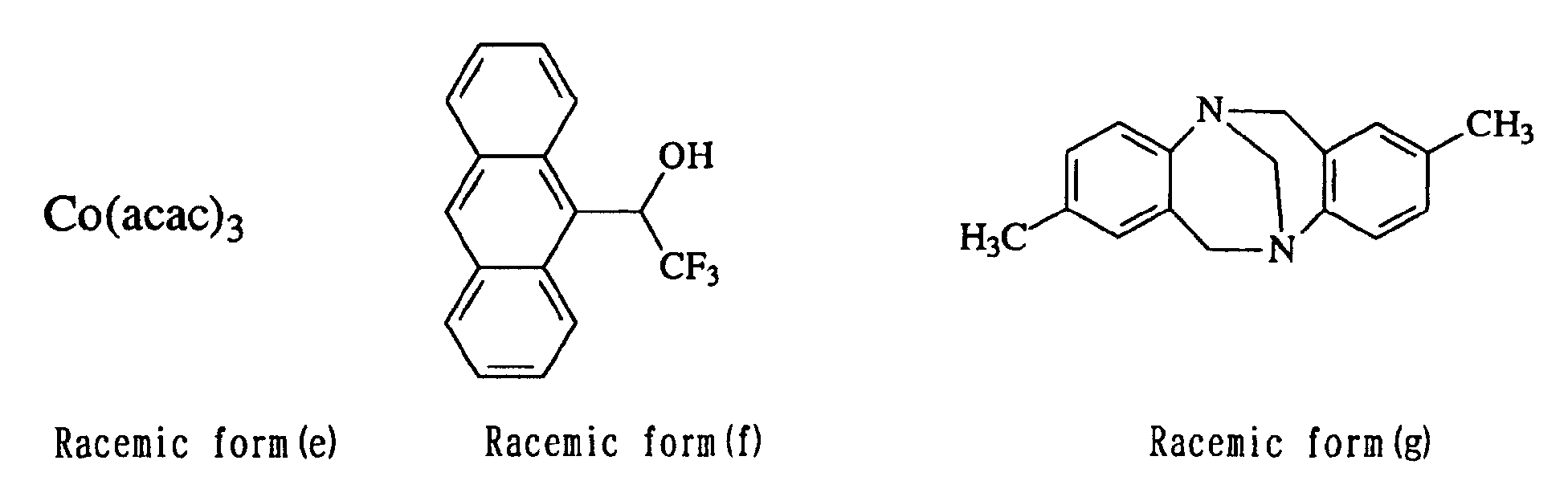
- Target racemic form for separation Separation coefficient (a) Example 1 Example 2 Example 3 Comparative Example 1 (a) 1.56 1.41 1.46 1.19 (b) to 1 1.25 1.49 1.0 (c) 1.26 1.78 1.30 1.47 (d) to 1 1.21 1.41 to 1 (e) to 1 1.5 to 1 1.0 (f) 1.14 1.67 to 1 1.52 (g) to 1 1.57 1.21 to 1
Landscapes
- Chemical & Material Sciences (AREA)
- Organic Chemistry (AREA)
- Analytical Chemistry (AREA)
- Chemical Kinetics & Catalysis (AREA)
- Health & Medical Sciences (AREA)
- Engineering & Computer Science (AREA)
- Biochemistry (AREA)
- Materials Engineering (AREA)
- Life Sciences & Earth Sciences (AREA)
- Medicinal Chemistry (AREA)
- Polymers & Plastics (AREA)
- Organic Low-Molecular-Weight Compounds And Preparation Thereof (AREA)
- Solid-Sorbent Or Filter-Aiding Compositions (AREA)
- Treatment Of Liquids With Adsorbents In General (AREA)
- Nitrogen Condensed Heterocyclic Rings (AREA)
- Pyrane Compounds (AREA)
- Epoxy Compounds (AREA)
- Polysaccharides And Polysaccharide Derivatives (AREA)
Abstract
Description


| Elemental analysis result | ||||
| C% | H% | N% | ||
| (1a) | Calculated value | 73.55 | 4.76 | 5.36 |
| Analysis value | 71.95 | 4.98 | 5.13 | |
| (1b) | Calculated value | 67.59 | 5.83 | 6.57 |
| Analysis value | 65.49 | 5.75 | 6.26 | |
| (2b) | Calculated value | 67.59 | 5.83 | 6.57 |
| Analysis value | 66.19 | 5.76 | 6.44 |

| Target racemic form for separation | Separation coefficient (a) | |||
| Example 1 | Example 2 | Example 3 | Comparative Example 1 | |
| (a) | 1.56 | 1.41 | 1.46 | 1.19 |
| (b) | to 1 | 1.25 | 1.49 | 1.0 |
| (c) | 1.26 | 1.78 | 1.30 | 1.47 |
| (d) | to 1 | 1.21 | 1.41 | to 1 |
| (e) | to 1 | 1.5 | to 1 | 1.0 |
| (f) | 1.14 | 1.67 | to 1 | 1.52 |
| (g) | to 1 | 1.57 | 1.21 | to 1 |
Claims (9)
- A separating agent for enantiomeric isomers comprising as an effective component a polysaccharide derivative that contains a bicyclic or more structure (hereinafter referred to a polycyclic structure) containing an aromatic ring, an alicyclic ring or a heterocyclic ring.
- The separating agent according to claim 1, wherein the polysaccharide derivative having a polycyclic structure is a cellulose derivative or an amylose derivative.
- The separating agent according to claim 1 or 2, wherein the polysaccharide derivative having a polycyclic structure contains an aromatic ring.
- The separating agent according to any one of claims 1 to 3, wherein the polysaccharide derivative having a polycyclic structure is an ester derivative or a carbamate derivative.
- The separating agent according to any one of claims 1 to 4, wherein the separating agent is used as a chiral immobilizing phase for chromatography.
- The separating agent according to claim 5, wherein the chiral immobilizing phase for chromatography is an immobilizing phase for liquid chromatography.
- The separating agent according to claim 5, wherein the chiral immobilizing phase for chromatography is an immobilizing phase for a thin layer chromatography.
- The separating agent according to claim 5, wherein the chiral immobilizing phase for chromatography is an asymmetry identifying agent added to an electrophoretic solution in a capillary electrophoresis.
- The separating agent according to claim 5, wherein the chiral immobilizing phase for chromatography is an immobilizing phase for a preparative continuous liquid chromatography.
Applications Claiming Priority (3)
| Application Number | Priority Date | Filing Date | Title |
|---|---|---|---|
| JP2001131942 | 2001-04-27 | ||
| JP2001131942 | 2001-04-27 | ||
| PCT/JP2002/004160 WO2002088048A1 (en) | 2001-04-27 | 2002-04-25 | Separatory agent comprising polysaccharide derivative having polycyclic structure |
Publications (3)
| Publication Number | Publication Date |
|---|---|
| EP1389606A1 true EP1389606A1 (en) | 2004-02-18 |
| EP1389606A4 EP1389606A4 (en) | 2007-04-18 |
| EP1389606B1 EP1389606B1 (en) | 2013-06-05 |
Family
ID=18980040
Family Applications (1)
| Application Number | Title | Priority Date | Filing Date |
|---|---|---|---|
| EP02722795.8A Expired - Lifetime EP1389606B1 (en) | 2001-04-27 | 2002-04-25 | Separatory agent for enantiomeric isomers comprising a polysaccharide with an indanyl group |
Country Status (6)
| Country | Link |
|---|---|
| US (2) | US7156989B2 (en) |
| EP (1) | EP1389606B1 (en) |
| JP (1) | JP4293792B2 (en) |
| KR (1) | KR100899357B1 (en) |
| CN (1) | CN1211322C (en) |
| WO (1) | WO2002088048A1 (en) |
Cited By (1)
| Publication number | Priority date | Publication date | Assignee | Title |
|---|---|---|---|---|
| WO2009067904A1 (en) * | 2007-11-08 | 2009-06-04 | Cspc Zhongqi Pharmaceutical Technology (Shijiazhuang) Co., Ltd. | Methods for resolution of the mixture of the optical isomers, especially the racemate of pinocembrin |
Families Citing this family (3)
| Publication number | Priority date | Publication date | Assignee | Title |
|---|---|---|---|---|
| US7994092B2 (en) * | 2008-03-14 | 2011-08-09 | TRGel, LLC | Carbohydrate polyethers for chromatographic media |
| MX2010012031A (en) | 2008-05-13 | 2011-01-20 | Novimmune Sa | Anti-il-6/il-6r antibodies and methods of use thereof. |
| CN112375226B (en) * | 2020-10-12 | 2023-03-17 | 苏州纳微科技股份有限公司 | Bonded amylose derivative and preparation method and application thereof |
Family Cites Families (18)
| Publication number | Priority date | Publication date | Assignee | Title |
|---|---|---|---|---|
| JPH0691956B2 (en) | 1981-03-11 | 1994-11-16 | ダイセル化学工業株式会社 | Adsorbent for separation supporting optically active polymer |
| JPS60108751A (en) | 1983-11-18 | 1985-06-14 | Daicel Chem Ind Ltd | Separating agent |
| JPS60142930A (en) * | 1983-12-28 | 1985-07-29 | Daicel Chem Ind Ltd | Resolving agent |
| JPS60226829A (en) * | 1984-03-29 | 1985-11-12 | Daicel Chem Ind Ltd | Separating agent consisting of polysaccharide derivative |
| US5562614A (en) * | 1993-11-22 | 1996-10-08 | Advanced Cardiovascular Systems, Inc. | Programmable manifold system for automatic fluid delivery |
| JPS60226832A (en) * | 1984-04-02 | 1985-11-12 | Daicel Chem Ind Ltd | Separating agent containing polysaccharide fatty acid ester |
| JPH0713030B2 (en) | 1986-04-02 | 1995-02-15 | エーザイ株式会社 | Separation agent for optical isomers |
| US5066793A (en) * | 1987-10-26 | 1991-11-19 | Ciba-Geigy Corporation | Finely particulate cellulose esters of aromatic or aromatic-aliphatic carboxylic acids, process for their preparation, and the use thereof |
| US5354852A (en) * | 1991-03-04 | 1994-10-11 | Daicel Chemical Industries, Ltd. | Polysaccharide derivative, process for producing the same, and separating agent |
| US5770088A (en) * | 1992-06-30 | 1998-06-23 | Daicel Chemical Industries, Ltd. | Simulated moving bed chromatographic separation process |
| JP3051782B2 (en) | 1992-09-16 | 2000-06-12 | ダイセル化学工業株式会社 | Separating agents comprising alkoxy-substituted aromatic carbamate derivatives of cellulose |
| SE500248C2 (en) * | 1992-12-03 | 1994-05-24 | Eka Nobel Ab | Chiral adsorbents and their preparation as well as compounds on which the adsorbents are based and their preparation |
| JP3148032B2 (en) | 1993-01-18 | 2001-03-19 | ダイセル化学工業株式会社 | Substituted aromatic carbamate derivatives of polysaccharides and separating agents |
| US5496937A (en) * | 1993-05-14 | 1996-03-05 | Nakano Vinegar Co., Ltd. | Polysaccharide substances, process for producing them and use of them |
| US5679572A (en) * | 1993-09-22 | 1997-10-21 | Daicel Chemical Industries, Ltd. | Separation of chiral compounds on polysaccharide supports |
| JPH07285889A (en) * | 1994-04-20 | 1995-10-31 | Daicel Chem Ind Ltd | Method for separating optical isomers |
| EP0907663B1 (en) * | 1996-06-27 | 2004-03-10 | Novartis AG | Thermally immobilized polysaccharide derivatives |
| US6372142B1 (en) * | 1996-11-13 | 2002-04-16 | Transgenomic, Inc. | Column for DNA separation by matched ion polynucleotide chromatography |
-
2002
- 2002-04-25 KR KR1020027017818A patent/KR100899357B1/en not_active Expired - Fee Related
- 2002-04-25 CN CNB028014545A patent/CN1211322C/en not_active Expired - Fee Related
- 2002-04-25 EP EP02722795.8A patent/EP1389606B1/en not_active Expired - Lifetime
- 2002-04-25 JP JP2002585354A patent/JP4293792B2/en not_active Expired - Lifetime
- 2002-04-25 WO PCT/JP2002/004160 patent/WO2002088048A1/en not_active Ceased
- 2002-04-25 US US10/467,201 patent/US7156989B2/en not_active Expired - Lifetime
-
2006
- 2006-10-03 US US11/542,458 patent/US7740758B2/en not_active Expired - Fee Related
Cited By (3)
| Publication number | Priority date | Publication date | Assignee | Title |
|---|---|---|---|---|
| WO2009067904A1 (en) * | 2007-11-08 | 2009-06-04 | Cspc Zhongqi Pharmaceutical Technology (Shijiazhuang) Co., Ltd. | Methods for resolution of the mixture of the optical isomers, especially the racemate of pinocembrin |
| US8399691B2 (en) | 2007-11-08 | 2013-03-19 | Cspc Zhongqi Pharmaceutical Technology (Shijiazhuang) Co. Ltd. | Method for resolution of a mixture of pinocembrin optical isomers, especially a pinocembrin racemate |
| RU2480460C2 (en) * | 2007-11-08 | 2013-04-27 | СиЭсПиСи ЧЖУНЦИ ФАРМАСЬЮТИКАЛ ТЕКНОЛОДЖИ (ШИЦЗЯЧЖУАН) КО., ЛТД. | Method of separating mixture of optical isomers of pinocembrin, particularly pinocembrin racemate |
Also Published As
| Publication number | Publication date |
|---|---|
| KR20040002413A (en) | 2004-01-07 |
| CN1211322C (en) | 2005-07-20 |
| US7156989B2 (en) | 2007-01-02 |
| JP4293792B2 (en) | 2009-07-08 |
| US20040065608A1 (en) | 2004-04-08 |
| US20070029242A1 (en) | 2007-02-08 |
| JPWO2002088048A1 (en) | 2004-08-12 |
| US7740758B2 (en) | 2010-06-22 |
| KR100899357B1 (en) | 2009-05-26 |
| WO2002088048A1 (en) | 2002-11-07 |
| CN1462263A (en) | 2003-12-17 |
| EP1389606B1 (en) | 2013-06-05 |
| EP1389606A4 (en) | 2007-04-18 |
Similar Documents
| Publication | Publication Date | Title |
|---|---|---|
| EP0459530B1 (en) | Alkyl-substituted phenylcarbamate derivative of polysaccharide | |
| US20070215549A1 (en) | Separating agent for enantiomeric isomers | |
| US20090008329A1 (en) | Separating agent for enantiomeric isomers | |
| US7772153B2 (en) | Separating agent for enantiomeric isomers | |
| US7156989B2 (en) | Separating agent including polysaccharide derivative having a polycyclic structure | |
| EP1721664A1 (en) | Separating agent for optical isomer | |
| JP3635002B2 (en) | Filler for separation of optical isomers for liquid chromatography | |
| JP2001163806A (en) | Optical isomer separating agent | |
| US7090775B2 (en) | Separation agent for separating optical isomer and method for preparation thereof | |
| JPH06211902A (en) | Substituted aromatic carbamate derivative of polysaccharide, and separating agent | |
| US20070039890A1 (en) | Separating agent for enantiomeric isomers | |
| JPH0475893B2 (en) | ||
| JP4334654B2 (en) | Separating agent | |
| JP3905564B2 (en) | Method for producing separation agent | |
| JP4430881B2 (en) | Method for producing filler for separation of optical isomers for liquid chromatography | |
| JPH11255671A (en) | Chromatographic separation of optical isomers | |
| EP1389605A1 (en) | Separatory agent for optical isomer |
Legal Events
| Date | Code | Title | Description |
|---|---|---|---|
| PUAI | Public reference made under article 153(3) epc to a published international application that has entered the european phase |
Free format text: ORIGINAL CODE: 0009012 |
|
| 17P | Request for examination filed |
Effective date: 20031024 |
|
| AK | Designated contracting states |
Kind code of ref document: A1 Designated state(s): AT BE CH CY DE DK ES FI FR GB GR IE IT LI LU MC NL PT SE TR |
|
| A4 | Supplementary search report drawn up and despatched |
Effective date: 20070321 |
|
| RIC1 | Information provided on ipc code assigned before grant |
Ipc: C07B 57/00 20060101AFI20021108BHEP |
|
| RAP1 | Party data changed (applicant data changed or rights of an application transferred) |
Owner name: DAICEL CHEMICAL INDUSTRIES, LTD. |
|
| 17Q | First examination report despatched |
Effective date: 20080124 |
|
| RIC1 | Information provided on ipc code assigned before grant |
Ipc: B01J 20/285 20060101ALI20121120BHEP Ipc: B01J 20/32 20060101ALI20121120BHEP Ipc: B01J 20/26 20060101ALI20121120BHEP Ipc: C07B 57/00 20060101AFI20121120BHEP Ipc: B01J 20/29 20060101ALI20121120BHEP |
|
| GRAP | Despatch of communication of intention to grant a patent |
Free format text: ORIGINAL CODE: EPIDOSNIGR1 |
|
| GRAS | Grant fee paid |
Free format text: ORIGINAL CODE: EPIDOSNIGR3 |
|
| GRAA | (expected) grant |
Free format text: ORIGINAL CODE: 0009210 |
|
| AK | Designated contracting states |
Kind code of ref document: B1 Designated state(s): AT BE CH CY DE DK ES FI FR GB GR IE IT LI LU MC NL PT SE TR |
|
| REG | Reference to a national code |
Ref country code: GB Ref legal event code: FG4D |
|
| REG | Reference to a national code |
Ref country code: CH Ref legal event code: EP Ref country code: CH Ref legal event code: NV Representative=s name: MICHELI AND CIE SA, CH |
|
| REG | Reference to a national code |
Ref country code: AT Ref legal event code: REF Ref document number: 615600 Country of ref document: AT Kind code of ref document: T Effective date: 20130615 |
|
| REG | Reference to a national code |
Ref country code: IE Ref legal event code: FG4D |
|
| REG | Reference to a national code |
Ref country code: CH Ref legal event code: PFA Owner name: DAICEL CORPORATION, JP Free format text: FORMER OWNER: DAICEL CHEMICAL INDUSTRIES, LTD., JP |
|
| REG | Reference to a national code |
Ref country code: DE Ref legal event code: R096 Ref document number: 60245071 Country of ref document: DE Effective date: 20130801 |
|
| REG | Reference to a national code |
Ref country code: AT Ref legal event code: MK05 Ref document number: 615600 Country of ref document: AT Kind code of ref document: T Effective date: 20130605 |
|
| PG25 | Lapsed in a contracting state [announced via postgrant information from national office to epo] |
Ref country code: FI Free format text: LAPSE BECAUSE OF FAILURE TO SUBMIT A TRANSLATION OF THE DESCRIPTION OR TO PAY THE FEE WITHIN THE PRESCRIBED TIME-LIMIT Effective date: 20130605 Ref country code: ES Free format text: LAPSE BECAUSE OF FAILURE TO SUBMIT A TRANSLATION OF THE DESCRIPTION OR TO PAY THE FEE WITHIN THE PRESCRIBED TIME-LIMIT Effective date: 20130916 Ref country code: SE Free format text: LAPSE BECAUSE OF FAILURE TO SUBMIT A TRANSLATION OF THE DESCRIPTION OR TO PAY THE FEE WITHIN THE PRESCRIBED TIME-LIMIT Effective date: 20130605 Ref country code: AT Free format text: LAPSE BECAUSE OF FAILURE TO SUBMIT A TRANSLATION OF THE DESCRIPTION OR TO PAY THE FEE WITHIN THE PRESCRIBED TIME-LIMIT Effective date: 20130605 Ref country code: GR Free format text: LAPSE BECAUSE OF FAILURE TO SUBMIT A TRANSLATION OF THE DESCRIPTION OR TO PAY THE FEE WITHIN THE PRESCRIBED TIME-LIMIT Effective date: 20130906 |
|
| REG | Reference to a national code |
Ref country code: NL Ref legal event code: VDEP Effective date: 20130605 |
|
| PG25 | Lapsed in a contracting state [announced via postgrant information from national office to epo] |
Ref country code: BE Free format text: LAPSE BECAUSE OF FAILURE TO SUBMIT A TRANSLATION OF THE DESCRIPTION OR TO PAY THE FEE WITHIN THE PRESCRIBED TIME-LIMIT Effective date: 20130605 Ref country code: PT Free format text: LAPSE BECAUSE OF FAILURE TO SUBMIT A TRANSLATION OF THE DESCRIPTION OR TO PAY THE FEE WITHIN THE PRESCRIBED TIME-LIMIT Effective date: 20131007 |
|
| PG25 | Lapsed in a contracting state [announced via postgrant information from national office to epo] |
Ref country code: NL Free format text: LAPSE BECAUSE OF FAILURE TO SUBMIT A TRANSLATION OF THE DESCRIPTION OR TO PAY THE FEE WITHIN THE PRESCRIBED TIME-LIMIT Effective date: 20130605 |
|
| PLBE | No opposition filed within time limit |
Free format text: ORIGINAL CODE: 0009261 |
|
| STAA | Information on the status of an ep patent application or granted ep patent |
Free format text: STATUS: NO OPPOSITION FILED WITHIN TIME LIMIT |
|
| PG25 | Lapsed in a contracting state [announced via postgrant information from national office to epo] |
Ref country code: DK Free format text: LAPSE BECAUSE OF FAILURE TO SUBMIT A TRANSLATION OF THE DESCRIPTION OR TO PAY THE FEE WITHIN THE PRESCRIBED TIME-LIMIT Effective date: 20130605 |
|
| 26N | No opposition filed |
Effective date: 20140306 |
|
| PG25 | Lapsed in a contracting state [announced via postgrant information from national office to epo] |
Ref country code: IT Free format text: LAPSE BECAUSE OF FAILURE TO SUBMIT A TRANSLATION OF THE DESCRIPTION OR TO PAY THE FEE WITHIN THE PRESCRIBED TIME-LIMIT Effective date: 20130605 |
|
| REG | Reference to a national code |
Ref country code: DE Ref legal event code: R097 Ref document number: 60245071 Country of ref document: DE Effective date: 20140306 |
|
| PG25 | Lapsed in a contracting state [announced via postgrant information from national office to epo] |
Ref country code: LU Free format text: LAPSE BECAUSE OF FAILURE TO SUBMIT A TRANSLATION OF THE DESCRIPTION OR TO PAY THE FEE WITHIN THE PRESCRIBED TIME-LIMIT Effective date: 20140425 Ref country code: MC Free format text: LAPSE BECAUSE OF FAILURE TO SUBMIT A TRANSLATION OF THE DESCRIPTION OR TO PAY THE FEE WITHIN THE PRESCRIBED TIME-LIMIT Effective date: 20130605 |
|
| REG | Reference to a national code |
Ref country code: IE Ref legal event code: MM4A |
|
| PG25 | Lapsed in a contracting state [announced via postgrant information from national office to epo] |
Ref country code: IE Free format text: LAPSE BECAUSE OF NON-PAYMENT OF DUE FEES Effective date: 20140425 |
|
| REG | Reference to a national code |
Ref country code: FR Ref legal event code: PLFP Year of fee payment: 15 |
|
| PGFP | Annual fee paid to national office [announced via postgrant information from national office to epo] |
Ref country code: FR Payment date: 20160309 Year of fee payment: 15 |
|
| PG25 | Lapsed in a contracting state [announced via postgrant information from national office to epo] |
Ref country code: CY Free format text: LAPSE BECAUSE OF FAILURE TO SUBMIT A TRANSLATION OF THE DESCRIPTION OR TO PAY THE FEE WITHIN THE PRESCRIBED TIME-LIMIT Effective date: 20130605 |
|
| PG25 | Lapsed in a contracting state [announced via postgrant information from national office to epo] |
Ref country code: TR Free format text: LAPSE BECAUSE OF FAILURE TO SUBMIT A TRANSLATION OF THE DESCRIPTION OR TO PAY THE FEE WITHIN THE PRESCRIBED TIME-LIMIT Effective date: 20130605 |
|
| PGFP | Annual fee paid to national office [announced via postgrant information from national office to epo] |
Ref country code: CH Payment date: 20160411 Year of fee payment: 15 Ref country code: GB Payment date: 20160420 Year of fee payment: 15 |
|
| REG | Reference to a national code |
Ref country code: CH Ref legal event code: PL |
|
| GBPC | Gb: european patent ceased through non-payment of renewal fee |
Effective date: 20170425 |
|
| REG | Reference to a national code |
Ref country code: FR Ref legal event code: ST Effective date: 20171229 |
|
| PG25 | Lapsed in a contracting state [announced via postgrant information from national office to epo] |
Ref country code: FR Free format text: LAPSE BECAUSE OF NON-PAYMENT OF DUE FEES Effective date: 20170502 |
|
| PG25 | Lapsed in a contracting state [announced via postgrant information from national office to epo] |
Ref country code: GB Free format text: LAPSE BECAUSE OF NON-PAYMENT OF DUE FEES Effective date: 20170425 Ref country code: CH Free format text: LAPSE BECAUSE OF NON-PAYMENT OF DUE FEES Effective date: 20170430 Ref country code: LI Free format text: LAPSE BECAUSE OF NON-PAYMENT OF DUE FEES Effective date: 20170430 |
|
| PGFP | Annual fee paid to national office [announced via postgrant information from national office to epo] |
Ref country code: DE Payment date: 20190410 Year of fee payment: 18 |
|
| REG | Reference to a national code |
Ref country code: DE Ref legal event code: R119 Ref document number: 60245071 Country of ref document: DE |
|
| PG25 | Lapsed in a contracting state [announced via postgrant information from national office to epo] |
Ref country code: DE Free format text: LAPSE BECAUSE OF NON-PAYMENT OF DUE FEES Effective date: 20201103 |