EP1389604A1 - BAG CAPABLE OF PREVENTING PERMEATION OF LIQUID, CUSHION AND CLEARANCE FILLING STRUCTURE - Google Patents
BAG CAPABLE OF PREVENTING PERMEATION OF LIQUID, CUSHION AND CLEARANCE FILLING STRUCTURE Download PDFInfo
- Publication number
- EP1389604A1 EP1389604A1 EP02771741A EP02771741A EP1389604A1 EP 1389604 A1 EP1389604 A1 EP 1389604A1 EP 02771741 A EP02771741 A EP 02771741A EP 02771741 A EP02771741 A EP 02771741A EP 1389604 A1 EP1389604 A1 EP 1389604A1
- Authority
- EP
- European Patent Office
- Prior art keywords
- bag
- liquid
- foamed sheet
- polyurethane foam
- foaming
- Prior art date
- Legal status (The legal status is an assumption and is not a legal conclusion. Google has not performed a legal analysis and makes no representation as to the accuracy of the status listed.)
- Withdrawn
Links
Images

Classifications
-
- C—CHEMISTRY; METALLURGY
- C08—ORGANIC MACROMOLECULAR COMPOUNDS; THEIR PREPARATION OR CHEMICAL WORKING-UP; COMPOSITIONS BASED THEREON
- C08G—MACROMOLECULAR COMPOUNDS OBTAINED OTHERWISE THAN BY REACTIONS ONLY INVOLVING UNSATURATED CARBON-TO-CARBON BONDS
- C08G18/00—Polymeric products of isocyanates or isothiocyanates
- C08G18/06—Polymeric products of isocyanates or isothiocyanates with compounds having active hydrogen
- C08G18/70—Polymeric products of isocyanates or isothiocyanates with compounds having active hydrogen characterised by the isocyanates or isothiocyanates used
- C08G18/72—Polyisocyanates or polyisothiocyanates
- C08G18/74—Polyisocyanates or polyisothiocyanates cyclic
- C08G18/76—Polyisocyanates or polyisothiocyanates cyclic aromatic
- C08G18/7607—Compounds of C08G18/7614 and of C08G18/7657
-
- C—CHEMISTRY; METALLURGY
- C08—ORGANIC MACROMOLECULAR COMPOUNDS; THEIR PREPARATION OR CHEMICAL WORKING-UP; COMPOSITIONS BASED THEREON
- C08G—MACROMOLECULAR COMPOUNDS OBTAINED OTHERWISE THAN BY REACTIONS ONLY INVOLVING UNSATURATED CARBON-TO-CARBON BONDS
- C08G18/00—Polymeric products of isocyanates or isothiocyanates
- C08G18/06—Polymeric products of isocyanates or isothiocyanates with compounds having active hydrogen
- C08G18/28—Polymeric products of isocyanates or isothiocyanates with compounds having active hydrogen characterised by the compounds used containing active hydrogen
- C08G18/40—High-molecular-weight compounds
- C08G18/4009—Two or more macromolecular compounds not provided for in one single group of groups C08G18/42 - C08G18/64
- C08G18/4072—Mixtures of compounds of group C08G18/63 with other macromolecular compounds
-
- C—CHEMISTRY; METALLURGY
- C08—ORGANIC MACROMOLECULAR COMPOUNDS; THEIR PREPARATION OR CHEMICAL WORKING-UP; COMPOSITIONS BASED THEREON
- C08G—MACROMOLECULAR COMPOUNDS OBTAINED OTHERWISE THAN BY REACTIONS ONLY INVOLVING UNSATURATED CARBON-TO-CARBON BONDS
- C08G18/00—Polymeric products of isocyanates or isothiocyanates
- C08G18/06—Polymeric products of isocyanates or isothiocyanates with compounds having active hydrogen
- C08G18/28—Polymeric products of isocyanates or isothiocyanates with compounds having active hydrogen characterised by the compounds used containing active hydrogen
- C08G18/40—High-molecular-weight compounds
- C08G18/61—Polysiloxanes
-
- C—CHEMISTRY; METALLURGY
- C08—ORGANIC MACROMOLECULAR COMPOUNDS; THEIR PREPARATION OR CHEMICAL WORKING-UP; COMPOSITIONS BASED THEREON
- C08G—MACROMOLECULAR COMPOUNDS OBTAINED OTHERWISE THAN BY REACTIONS ONLY INVOLVING UNSATURATED CARBON-TO-CARBON BONDS
- C08G18/00—Polymeric products of isocyanates or isothiocyanates
- C08G18/06—Polymeric products of isocyanates or isothiocyanates with compounds having active hydrogen
- C08G18/28—Polymeric products of isocyanates or isothiocyanates with compounds having active hydrogen characterised by the compounds used containing active hydrogen
- C08G18/67—Unsaturated compounds having active hydrogen
- C08G18/68—Unsaturated polyesters
- C08G18/683—Unsaturated polyesters containing cyclic groups
- C08G18/686—Unsaturated polyesters containing cyclic groups containing cycloaliphatic groups
-
- C—CHEMISTRY; METALLURGY
- C08—ORGANIC MACROMOLECULAR COMPOUNDS; THEIR PREPARATION OR CHEMICAL WORKING-UP; COMPOSITIONS BASED THEREON
- C08G—MACROMOLECULAR COMPOUNDS OBTAINED OTHERWISE THAN BY REACTIONS ONLY INVOLVING UNSATURATED CARBON-TO-CARBON BONDS
- C08G2101/00—Manufacture of cellular products
-
- Y—GENERAL TAGGING OF NEW TECHNOLOGICAL DEVELOPMENTS; GENERAL TAGGING OF CROSS-SECTIONAL TECHNOLOGIES SPANNING OVER SEVERAL SECTIONS OF THE IPC; TECHNICAL SUBJECTS COVERED BY FORMER USPC CROSS-REFERENCE ART COLLECTIONS [XRACs] AND DIGESTS
- Y10—TECHNICAL SUBJECTS COVERED BY FORMER USPC
- Y10T—TECHNICAL SUBJECTS COVERED BY FORMER US CLASSIFICATION
- Y10T428/00—Stock material or miscellaneous articles
- Y10T428/13—Hollow or container type article [e.g., tube, vase, etc.]
- Y10T428/1334—Nonself-supporting tubular film or bag [e.g., pouch, envelope, packet, etc.]
-
- Y—GENERAL TAGGING OF NEW TECHNOLOGICAL DEVELOPMENTS; GENERAL TAGGING OF CROSS-SECTIONAL TECHNOLOGIES SPANNING OVER SEVERAL SECTIONS OF THE IPC; TECHNICAL SUBJECTS COVERED BY FORMER USPC CROSS-REFERENCE ART COLLECTIONS [XRACs] AND DIGESTS
- Y10—TECHNICAL SUBJECTS COVERED BY FORMER USPC
- Y10T—TECHNICAL SUBJECTS COVERED BY FORMER US CLASSIFICATION
- Y10T428/00—Stock material or miscellaneous articles
- Y10T428/13—Hollow or container type article [e.g., tube, vase, etc.]
- Y10T428/1352—Polymer or resin containing [i.e., natural or synthetic]
- Y10T428/1376—Foam or porous material containing
Definitions
- the present invention relates to a liquid impermeable bag and also to a cushion member and a space-filling structure which have the bag and an enclosed material foamed or cured therein.
- a method for manufacturing cushion member used for a headrest or an arm rest used in an automobile there is a method using a double layer sheet consisting of a facing sheet and a foamed sheet or a triple layer sheet further including a resin film laminated on a surface of the foamed sheet opposite to the surface thereof on which the facing sheet is superposed.
- the method has sewing the double or triple layer sheet into a bag with the facing sheet outward, pouring raw liquid for polyurethane into an obtained bag, and foaming the liquid, thereby forming an integral cushion member.
- the raw liquid for the polyurethane foam poured into the bag may permeate into the foamed sheet and ooze out of the cushion member onto the facing sheet.
- a great amount of the raw liquid permeates into a portion of the foamed sheet having higher permeability than other area of the sheet, so that the portion becomes hard after the raw liquid is hardened.
- a user of the cushion member may feel something as a foreign matter when touching the surface of the cushion member.
- the permeation of the raw liquid for polyurethane into the foamed sheet may occur the following problems:
- the resin film prevents the raw liquid from permeating into the foamed sheet to some extent.
- the raw liquid may permeate the foamed sheet and still may ooze onto the surface through pin holes created in the resin film due to foreign objects in the manufacturing process or impact during transportation, flaws created due to tension or heat in the laminating process, and/or holes created due to friction or scratches in the sewing process into the bag shape.
- it is required to take care not to create flaws nor holes during the manufacture and transportation of the resin films and pay the closest attention to set the laminating condition.
- the curable silicone liquid may permeate the bag and may be leached.
- the problems of permeation of the curable silicone liquid and of leaching of the liquid can be solved.
- the hardness of the silicone rubber can not be absorbed by the bag.
- the hardness is directly transmitted to a user's arm so that the user may feel pain if using for a long time.
- a liquid impermeable bag of the present invention is made with a foamed sheet obtained by foaming a raw mixture for polyurethane foam.
- the raw mixture contains reactive silicone with hydroxyl groups and polyester polyether polyol,
- the raw mixture contains reactive silicone with hydroxyl groups and organic phosphorus compound.
- the raw material contains dimer acid polyol.
- the foamed sheet obtained by foaming any one of the raw mixtures is hard to allow the permeation of liquid raw material such as urethane raw liquid.
- a cushion member and a space-filling structure of the present invention have a liquid impermeable bag as mentioned above.
- the cushion member of the present invention has a bag made with a foamed sheet and a cushion element disposed in the bag, wherein the cushion element is made from raw liquid fed into the bag, and the foamed sheet is one of the above three aspects.
- the space-filling structure of the present invention has a bag disposed in a space, and a filler filled in the bag, wherein the filler is made from the raw liquid fed into the bag and the foamed sheet is one of the above three aspects.
- the foamed sheet employed in the above cushion member and the structure is hard to allow the permeation of the raw liquid, deterioration in appearance of the cushion member due to the leaching of the raw liquid onto the surface of the bag and partial permeation of the raw liquid which may cause a user to feel the portion as a foreign matter can be prevented.
- the cushion member in the cushion member has relatively high hardness such as silicone rubber, the cushion member can have soft touch because of the buffering function of the foamed sheet of the bag.
- the cushion element may be polyurethane foam which is obtained by feeding raw liquid for polyurethane foam into the bag and foaming the raw liquid.
- the cushion element may be silicone rubber which is obtained by feeding curable silicone liquid into the bag and curing it in the bag.
- the cushion member of the present invention may have a facing sheet arranged on the outer surface of the bag.
- the facing sheet may be attached to the foamed sheet by the flame lamination method.
- the facing sheet may be arranged after the raw liquid is fed and cured in the bag to become integral with the bag.
- a resin film may be laminated on a surface of the foamed sheet opposite to the surface on which the facing sheet is arranged.
- the cushion member obtained as mentioned above can be suitably used as an interior article of an automobile, an arm rest to be used with an OA machine, an article of furniture, an article of bedding, a toy, or a sports article.
- an arm rest there are a headrest, an arm rest, an EA member, a trim, and a ceiling material for an automobile, an arm rest for a personal computer, an arm rest, headrest, leg rest, and foot rest of an article of furniture, a chair, a cushion, a pillow, a stuffed toy, and a plastic model kit.
- the space-filling structure of the present invention can be suitably used as an interior article of an automobile such as a pillar.
- the foamed sheet is manufactured by foaming a raw mixture containing polyhydroxy compound (polyol), isocyanate, foaming agent, catalyst, foam stabilizer, and at least one additive, if necessary, to be formed into a sheet by the ordinary method.
- the raw mixtures is one of the following raw mixtures i), ii) and iii):
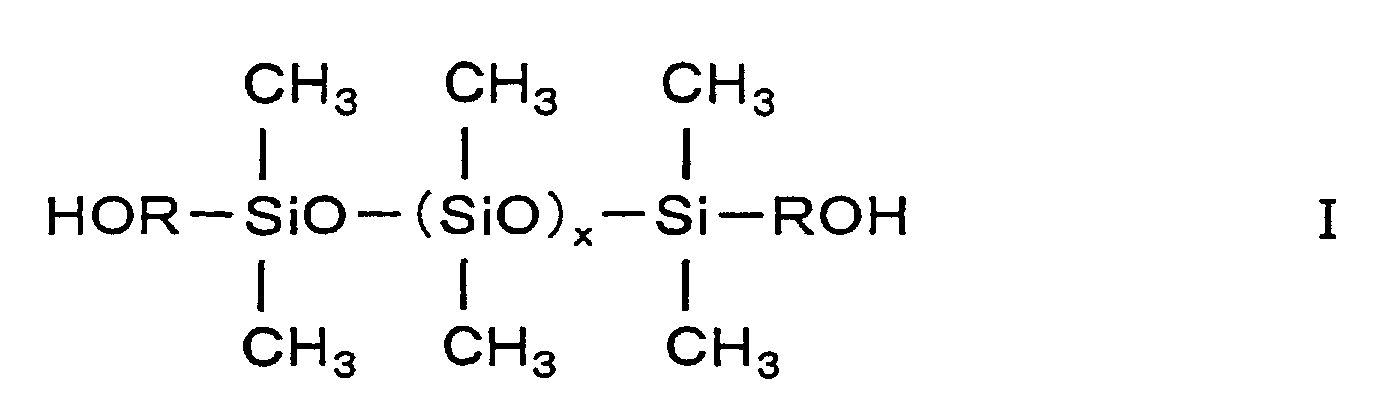
- examples of the reactive silicone with hydroxyl group(s) are compounds of which backbone chain and/or branched chains has one or two or more OH groups, such as compounds indicated by one of the following formulas I to III.
- R represents an alkylene group
- the reactive silicone of which a backbone chain and/or branched chains has one or more OH groups can be obtained by modifying silicone oil with alcohol.
- the reactive silicone with hydroxyl group(s) is used as a foam stabilizer.
- the polyester polyether polyol may be obtained by reacting a polyhydric alcohol, such as ethylene glycol, glycerin, or trimethylolpropane, with alkylene oxide such as propylene oxide or butylene oxide and polycarboxylic acids such as adipic acid, phthalic acid, or succinic acid.
- a polyhydric alcohol such as ethylene glycol, glycerin, or trimethylolpropane
- alkylene oxide such as propylene oxide or butylene oxide
- polycarboxylic acids such as adipic acid, phthalic acid, or succinic acid.
- the polyester polyether polyol preferably has a molecular weight from 1000 to 6000 and an OH value from 20 to 80.
- the isocyanate component there is no particular limitation on the isocyanate component, the foaming agent, and the catalyst.
- the isocyanate tolylenediisocyanate, polymethylene polyethylene polydiisocyanate, hexamethylene diisocyanate, 1,5-naphthalenediisocyanate, xylenediisocyanate, or isophorone diisocyanate may be employed.
- the foaming agent water or methylene chloride may be used, but the forming agent is not limited thereto.
- tertiary amine complex salt of tertiary amine, organic tin compound
- triethylene diamine complex salt of triethylene diamine, triethylamine, complex salt of bisdimethylaminoethyl ether, N-methylmorpholine of bisdimethylaminoethyl ether, stannous octoate, stannic dibutyl lauric acid may be preferably employed.
- At least one additive such an ultraviolet ray absorbing agent, an antioxidant agent, and a pigment may be added if necessary.
- the polyol component besides the aforementioned polyester polyether polyol, polyether polyol, polyester polyol, dimer acid polyol described later may be used.
- the ratio of the polyester polyether polyol is preferably 10 wt. % or more relative to the polyol component as a whole.
- the foam stabilizer is not limited to the reactive silicone with hydroxyl groups.
- compositions of the raw mixture for the polyurethane foam of the above i) are preferably as follows, wherein the preferable isocyanate index is from 90 to 120:
- the examples cited above as used in the polyurethane foam raw mixture of the above i) may be used as the reactive silicone with hydroxyl groups.
- organic phosphorus compound there are phosphate-type polyether polyol and phosphite-type polyol which are obtained by adding alkylene oxide such as ethylene oxide, propylene oxide into phosphoric ester, and mixture thereof.
- alkylene oxide such as ethylene oxide, propylene oxide into phosphoric ester, and mixture thereof.
- Known flame retardants such as tris(2-chloroethyl)phosphate, tris( ⁇ -chloropropyl)phosphate, tris(dichloropropyl) phosphate, cresyldiphenylphosphate, and dibromoneopentyl glycol may also be employed. These may be added as a flame retardant, or a fusion property conditioner for the flame lamination process.
- the isocyanate component As the isocyanate component, the foaming agent, the catalyst, and other additives of the raw mixture of the above ii), the examples cited above as used in the polyurethane foam raw mixture of the above i) may be employed.
- alkylene oxide additives of polyalcohol such as ethylene glycol, propylene glycol, glycerin, trimethylolpropane, pentaerythritol, and cane sugar
- alkylene oxide additives such as diethanolamine, triethanolamine, and ethylene diamine
- graft-type polymer polyol such as styrene and acrylonitrile
- polyester polyol there may be polyester polyol having hydroxyl groups at terminal end obtained by polymerizing fatty carboxylic acid such as malonic acid, succinic acid, or adipic acid, aromatic carboxylic acid such as phthalic acid, terephthalic acid, or a mixture thereof, with fatty glycols such as ethylene glycol, propylene glycol, diethylene glycol or triol such as trimethylolpropane, glycerin, and polyester polyol such as polycaprolactone obtained by ring opening polymerization of lactone.
- the polyol preferably has a molecular weight from 600 to 8000 and an OH value from 20 to 100.
- polyester polyether polyol as described above and/or dimer acid polyol as described later may be used.
- foam stabilizer another foam stabilizer may be used together with the reactive silicone with hydroxyl groups, similarly to the polyurethane foam raw mixture of the above i).
- compositions of the raw mixture of the above ii) are preferably as follows, wherein the preferable isocyanate index is from 90 to 120:
- the followings may be used as the dimer acid polyol.
- the dimer acid is a dibasic acid, that is, a dibasic acid of which molecular obtained by bonding two monobasic fatty chains (the number of carbons is normally 18) according to carbon-carbon covalent bonding.
- Typical compounds as the dimer acid are obtained by heating linoleic acid and oleic acid and are represented by the following structural formula:
- dimer acid polyol examples include dimer acid polyesters which is reaction products from such dimer acid and shorter-chain diol, triol, or polyol; reaction products from such dimer acid and polyalkylene glycol, poryalkylene triole, or long-chain polyol; reaction products obtained by reacting mixture of dimer acid and other polycarboxylic acid such as adipic acid with diol, triol, or polyol; reaction products of such dimer acid and alkylene oxide, and mixture thereof. It should be noted the dimer acid polyol is not limited thereto.
- the polyol component besides the dimer acid polyol, polyether polyol, polyester polyol, or polyester polyether polyol mentioned above may be employed.
- the ratio of the dimer acid polyol is preferably 10 wt. % or more relative to the polyol component as a whole.
- the isocyanate component As the isocyanate component, the foaming agent, the catalyst, and other additives of the polyurethane foam raw mixture of the above iii), the examples cited above as used in the polyurethane foam raw mixture of the above i) may be employed.
- siloxane of any type, polyalkylene oxide block copolymer, or reactive silicone with hydroxyl groups mentioned above may be employed.
- compositions of the raw mixture of the above iii) are preferably as follows, wherein the preferable isocyanate index is from 90 to 120:
- a foamed sheet manufactured by foaming and forming any one of the aforementioned raw mixtures into a sheet preferably has a density of 20-70 g/cm 3 , and an air permeability of 0-10 cc/m 2 /sec (at a foam thickness of 10 mm), as measured by a FRAGILE type testing apparatus as specified in Japanese Industrial Standard (JIS) L1004.
- the thickness of the foamed sheet is preferably in the order of 1.0-20.0 mm.
- such a foamed sheet may be employed singly, with a facing sheet attached on one surface so as to form a double layer sheet, or with a resin film attached to the other surface in addition to the facing sheet so as to form a triple layer sheet.
- the facing sheet fabric such as tricot, double raschel, moquette, plain weave fabric, non woven fabric, PVC leathercloth, resin film, resin sheet, paper, or complexities thereof may be employed.
- the facing sheet is preferably attached to the foamed sheet by the flame lamination method.
- the facing sheet may be put on the surface of the bag after liquid raw material is poured into the bag and formed integrally with the bag.
- a polyolefin resin film or a polyurethane resin film may be employed as the resin film.
- the films are laminated, for example, by a laminating method.
- a foamed sheet or a laminated sheet is processed to be formed into a bag by sewing or the like.
- the laminated sheet is formed into a bag with the facing sheet outward.
- a cushion member of the present invention is formed by feeding raw liquid such as urethane liquid into the bag and foaming or curing the liquid to be integrated with the bag.
- a space-filling structure of the present invention is accomplished by disposing the bag as mentioned above into a space, feeding raw liquid such as urethane liquid into the bag, and foaming or curing the liquid to be integrated with the bag.
- the raw liquid to be fed into the bag are as follows:
- the raw liquid [A] may be for hard or soft urethane foam for molding use having any compositions.
- the isocyanate component, the catalyst, the foaming agent, and other additives thereof the examples cited above as used in the material of the foamed sheet may be employed.
- the polyol component there are alkylene oxide additives of polyalcohol such as ethylene glycol, propylene glycol, glycerin, trimethylolpropane, pentaerythritol, and cane sugar; alkylene oxide additives such as diethanolamine, triethanolamine, and ethylene diamine, and graft-type polymer polyol such as styrene and acrylonitrile.
- the polyol preferably has a molecular weight from 3000 to 8000 and an OH value from 20 to 100.
- siloxane of any type or polyalkylene oxide block copolymer may be employed.
- the isocyanate index of the polyurethane foam liquid is preferably from 90 to 120.
- the curable silicone liquid [B] mentioned above may be of a one-component condensation reaction type, a one-component addition reaction type, a two-component condensation reaction type, and the like.
- the foamed sheet used in the present invention has excellent impermeability against liquid raw material such as the aforementioned polyurethane foam liquid and the curable silicone liquid, thereby preventing deterioration in appearance of the cushion member due to the leaching of the foam liquid onto the surface and preventing partial permeation of the liquid raw material which may cause the user to feel the portion as a foreign matter.
- the cushion member because of the presence of the bag made with the foamed sheet, the cushion member has soft touch.
- the leakage of the liquid raw material out of the bag and the permeation of the liquid raw material can be prevented, thereby preventing poor working condition and avoiding the loss of the liquid raw material. Therefore, a labor can conduct the filling work under well working condition, thereby obtaining improved filling effect.
- the cushion member obtained as mentioned above can be suitably used as an interior article of an automobile such as a headrest, an arm rest to be used with an OA machine such as a personal computer, or the like.
- the cushion member can be suitably used as an article of furniture, an article of bedding, a toy, or a sports article.
- a headrest, an arm rest, an EA (energy absorbing) member, a trim, and a ceiling material for an automobile an arm rest for a personal computer, an arm rest, headrest, leg rest, and foot rest of an article of furniture, a chair, a cushion, a pillow, a stuffed toy, and a plastic model kit.
- the space-filling structure of the present invention can be suitably used as an interior article of an automobile such as a pillar.
- Fig. 1 is a sectional view of a headrest as an embodiment of a cushion member of the present invention and Fig. 2 is an enlarged view of a part II of Fig. 1.
- the headrest 1 comprises a bag 2, a polyurethane foam 3 disposed in the bag 2, and a facing sheet 4 arranged on the outer surface of the bag 2.
- the bag 2 is made by sewing a foamed sheet with the facing sheet 4 on its one surface into a bag shape with the facing sheet 4 outward.
- Raw liquid for polyurethane foam is fed into the bag 2 with the facing sheet 4 and is foamed, thereby making the bag 2 filled with the polyurethane foam 3.
- the urethane liquid is foamed in a state that a headrest frame is arranged inside the bag 2, whereby the headrest frame can be inserted, but not illustrated.
- a resin film 5 may be attached to the inner surface of the bag 2.
- the headrest 1 has no leakage problem of the urethane liquid onto the facing sheet 4 and no permeation problem of the urethane liquid into the bag 2 so that the headrest 1 has superior cushioning property, good appearance, and soft touch.
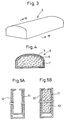
- Fig. 3 is a perspective view of an arm rest to be used with a keyboard or mouse of a personal computer as another embodiment of the cushion member of the present invention
- Fig. 4 is a sectional view taken along a line IV-IV of Fig. 3.
- the arm rest 6 has a bag 7 and a silicone rubber 8 disposed in the bag 7, and a facing sheet 9 arranged on the outer surface of the bag 7.
- the bag 7 is made by cutting a foamed sheet into a predetermined size and sewing the foamed sheet into a bag shape. Curable silicone liquid is fed into the bag 7 and is cured. Then, the facing sheet 9 is disposed to cover the bag 7. As a result of this, the bag 7 is filled with the silicone rubber 8 and covered by the facing sheet 9.
- the arm rest 6 has no permeation problem of the curable silicone liquid into the bag 7 so that the arm rest 6 has superior cushioning property and good appearance.
- the foamed sheet of the bag 7 prevents the hardness of silicone rubber from being transmitted to a user's arm, thereby providing enough effect of softening the load on the user's arm for many minutes (hours).
- Figs. 5A, 5B are sectional views of a pillar of an automobile as an example a space-filling structure of the present invention, wherein Fig. 5A shows a state before urethane liquid is fed and Fig. 5B shows a state after the urethane liquid is fed.
- a bag 11 is inserted into a space as a hollow portion of a pillar 10 of an automobile and then urethane liquid is poured into the bag 11 and is foamed. As a result, the bag 11 is filled with the polyurethane foam 12.
- the bag 11 is made by cutting a foamed sheet into a predetermined size and sewing the foamed sheet into a bag shape.
- the urethane liquid may be for soft polyurethane foam or for hard polyurethane foam.
- a foamed sheet which was 4 mm in thickness and had density and permeability shown in Table 1 was obtained by foaming a raw mixture (isocyanate index: 104) having the below-described composition for polyurethane foam.
- a tricot fabric was attached to one surface of the foamed sheet by the flame lamination method, thereby forming a double layer sheet.
- the permeability of the double layer sheet was shown in Table 1.
- the double layer sheet made with the foamed sheet thus obtained was sewn to form a bag.
- urethane liquid isocyanate index: 105
- a headrest was formed.
- the condition of penetration of the liquid into the bag was measured before foaming and the result was shown in Table 1.
- a foamed sheet which was 4 mm in thickness and had density and permeability shown in Table 1 was obtained by foaming a urethane raw mixture (isocyanate index: 110) having the below-described composition.
- a tricot fabric was attached to one surface of the foamed sheet by the flame lamination method, thereby forming a double layer sheet.
- the permeability of the double layer sheet was shown in Table 1.
- a foamed sheet which was 4 mm in thickness and had density and permeability shown in Table 1 was obtained by foaming a urethane raw mixture (isocyanate index: 110) having the below-described composition.
- a tricot fabric was attached to one surface of the foamed sheet by the flame lamination method, thereby forming a double layer sheet.
- the permeability of the double layer sheet was shown in Table 1.
- a foamed sheet having density and permeability shown in Table 1 was made in the same manner as Example 1, but using urethane raw mixture for a foamed sheet having the below-described composition.
- a tricot fabric was attached to one surface of the foamed sheet by the flame lamination method, thereby forming a double layer sheet.
- the permeability of the double layer sheet was shown in Table 1.
- Comparative Examples 2, 3 For each of Comparative Examples 2, 3, a laminated body of was made in the same manner as Comparative Example 1, but further laminating a resin film shown in Table 1 on a surface of the foamed sheet opposite to the surface to which the tricot was attached. As a result, a triple layer sheet having permeability shown in Table 1 was formed. The condition of penetration of liquid was measured by flowing polyurethane foam liquid onto the surface laminated with the resin film and the result was shown in Table 1.
- any of the headrests made in Examples 1-3 was excellent in appearance and soft to touch because there was no deterioration in appearance of the cushion member due to the leaching of the urethane liquid onto the surface and no partial permeation of the urethane liquid so that the user may not feel the portion as a foreign matter.
- the present invention can provide the cushion member which is excellent in appearance and soft to touch because the permeation of the liquid raw material into the foamed sheet composing the bag can be prevented so that there was no deterioration in appearance of the cushion member due to the leaching of the liquid raw material onto the surface of the bag and no partial permeation of the urethane liquid so that the user may not feel the portion as a foreign matter.
- the present invention can provide a space-filling structure in which the permeation of the liquid raw material can be prevented and which is excellent in filling property.
Landscapes
- Chemical & Material Sciences (AREA)
- Health & Medical Sciences (AREA)
- Chemical Kinetics & Catalysis (AREA)
- Medicinal Chemistry (AREA)
- Polymers & Plastics (AREA)
- Organic Chemistry (AREA)
- Polyurethanes Or Polyureas (AREA)
- Casting Or Compression Moulding Of Plastics Or The Like (AREA)
Abstract
Description


Claims (20)
- A liquid impermeable bag being made with a foamed sheet, wherein said foamed sheet is obtained by foaming a raw mixture containing reactive silicone with hydroxyl groups and polyester polyether polyol for polyurethane foam.
- A liquid impermeable bag being made with a foamed sheet, wherein said foamed sheet is obtained by foaming a raw mixture containing reactive silicone with hydroxyl groups and organic phosphorus compound for polyurethane foam.
- A liquid impermeable bag being made with a foamed sheet, wherein said foamed sheet is obtained by foaming a raw mixture containing dimer acid polyol for polyurethane foam.
- A liquid impermeable bag as claimed in any one of claims 1 through 3, wherein a facing sheet is arranged on the outer surface of the bag.
- A liquid impermeable bag as claimed in claim 4, wherein the foamed sheet is made of polyurethane foam for flame lamination.
- A liquid impermeable bag as claimed in any one of claims 1 through 5, wherein a resin film is laminated on an inner surface of the bag.
- A cushion member comprising a bag made with a foamed sheet and a cushion element disposed in the bag,
wherein the cushion element is made from a liquid raw material fed into the bag, and
wherein the foamed sheet is obtained by foaming a raw mixture containing reactive silicone with hydroxyl groups and polyester polyether polyol for polyurethane foam. - A cushion member comprising a bag made with a foamed sheet and a cushion element disposed in the bag,
wherein the cushion element is made from liquid raw material fed into the bag, and
wherein the foamed sheet is obtained by foaming a raw mixture containing reactive silicone with hydroxyl groups and organic phosphorus compound for polyurethane foam. - A cushion member comprising a bag made with a foamed sheet and a cushion element disposed in the bag,
wherein the cushion element made from liquid raw material fed into the bag, and
wherein the foamed sheet is obtained by foaming a raw mixture containing dimer acid polyol for polyurethane foam. - A cushion member as claimed in any one of claims 7 through 9, wherein said cushion element is polyurethane foam, and wherein said polyurethane foam is made by feeding urethane liquid into said bag and foaming the urethane liquid.
- A cushion member as claimed in any one of claims 7 through 9, wherein said cushion element is silicone rubber, and wherein said silicone rubber is made by feeding curable silicone liquid into said bag and curing the curable silicone liquid.
- A cushion member as claimed in any one of claims 7 through 11, wherein a facing sheet is arranged on the outer surface of said bag.
- A cushion member as claimed in claim 12, wherein said foamed sheet is made of polyurethane foam for flame lamination and said facing sheet is attached to said foamed sheet by flame lamination method.
- A cushion member as claimed in any one of claims 7 through 13, wherein a resin film is laminated on an inner surface of the bag.
- A cushion member as claimed in any one of claims 7 through 14, wherein the cushion member is an interior article of an automobile, an arm rest to be used with an OA machine, an article of furniture, an article of bedding, a toy, or a sports article.
- A space-filling structure comprising a bag, made with a foamed sheet and disposed in a space, and a filler disposed to fill the bag,
wherein the filler is made from liquid raw material fed into the bag, and
wherein the foamed sheet is obtained by foaming a urethane raw mixture containing reactive silicone with hydroxyl groups and polyester polyether polyol. - A space-filling structure comprising a bag made with a foamed sheet and a filler disposed to fill the bag,
wherein the filler is made from liquid raw material fed into the bag, and
wherein the foamed sheet is obtained by foaming a urethane raw mixture containing reactive silicone with hydroxyl groups and organic phosphorus compound. - A space-filling structure comprising a bag made with a foamed sheet and a filler disposed to fill the bag,
wherein the filler is made from liquid raw material fed into the bag, and
wherein the foamed sheet is obtained by foaming a urethane raw mixture containing dimer acid polyol. - A space-filling structure as claimed in any one of claims 16 through 18, wherein said filler is polyurethane foam, and wherein said polyurethane foam is made by feeding urethane liquid into said bag and foaming the urethane liquid.
- A space-filling structure as claimed in any one of claims 16 through 19, wherein said space-filling structure is an interior article of an automobile.
Applications Claiming Priority (3)
| Application Number | Priority Date | Filing Date | Title |
|---|---|---|---|
| JP2001154146 | 2001-05-23 | ||
| JP2001154146 | 2001-05-23 | ||
| PCT/JP2002/004879 WO2002094710A1 (en) | 2001-05-23 | 2002-05-21 | Bag capable of preventing permeation of liquid, cushion and clearance filling structure |
Publications (2)
| Publication Number | Publication Date |
|---|---|
| EP1389604A1 true EP1389604A1 (en) | 2004-02-18 |
| EP1389604A4 EP1389604A4 (en) | 2004-09-29 |
Family
ID=18998538
Family Applications (1)
| Application Number | Title | Priority Date | Filing Date |
|---|---|---|---|
| EP02771741A Withdrawn EP1389604A4 (en) | 2001-05-23 | 2002-05-21 | Bag capable of preventing permeation of liquid, cushion and clearance filling structure |
Country Status (5)
| Country | Link |
|---|---|
| US (1) | US20040109962A1 (en) |
| EP (1) | EP1389604A4 (en) |
| JP (1) | JPWO2002094710A1 (en) |
| CN (1) | CN1525938A (en) |
| WO (1) | WO2002094710A1 (en) |
Families Citing this family (2)
| Publication number | Priority date | Publication date | Assignee | Title |
|---|---|---|---|---|
| GB201008181D0 (en) * | 2010-05-17 | 2010-06-30 | Airbus Operations Ltd | A device for locating a first aerospace component relative to a second aerospace component |
| JP7668128B2 (en) * | 2020-03-27 | 2025-04-24 | 株式会社イノアックコーポレーション | Vehicle cushion pad and vehicle seat cushion |
Family Cites Families (13)
| Publication number | Priority date | Publication date | Assignee | Title |
|---|---|---|---|---|
| FR1418850A (en) * | 1964-06-01 | 1965-11-26 | Simca Automobiles Sa | Process for closing a hollow body at a determined point |
| US4264743A (en) * | 1979-04-23 | 1981-04-28 | Nhk Spring Co., Ltd. | Polyurethane foam sealing material and process for producing the same |
| US4268557A (en) * | 1979-07-05 | 1981-05-19 | Roberto Bracesco | Process and mold for producing padded seat backs, and the product obtained |
| GB8526292D0 (en) * | 1985-10-24 | 1985-11-27 | Dow Corning Ltd | Foam filled elements |
| JPH0260684A (en) * | 1988-08-29 | 1990-03-01 | Nhk Spring Co Ltd | Skin integrated foaming urethane skin material and skin integrated foamed product using skin material |
| JPH05329281A (en) * | 1992-06-02 | 1993-12-14 | Toyobo Co Ltd | Flame-retardant seat for vehicle |
| EP0639596A1 (en) * | 1993-08-20 | 1995-02-22 | Bridgestone Corporation | Preparation of waterimpermeable polyurethane foam |
| JP3524575B2 (en) * | 1994-03-14 | 2004-05-10 | 株式会社イノアックコーポレーション | Headrest and manufacturing method thereof |
| JPH10309787A (en) * | 1997-05-13 | 1998-11-24 | Okamoto Ind Inc | Polyurethane foam integral molded product with polyvinyl chloride skin |
| JP4285709B2 (en) * | 1997-08-18 | 2009-06-24 | 株式会社エルブ | Production method of functional urethane foam |
| JPH10319854A (en) * | 1997-12-22 | 1998-12-04 | Fuji Kobunshi Kogyo Kk | Cushion material and its manufacturing method |
| JP3391437B2 (en) * | 1998-05-11 | 2003-03-31 | ジョンソン コントロールズ オートモーティブ システムズ株式会社 | Skin material integrated foam |
| JP2000038157A (en) * | 1998-07-21 | 2000-02-08 | Mazda Motor Corp | Body reinforcement structure and method of forming the same |
-
2002
- 2002-05-21 US US10/473,426 patent/US20040109962A1/en not_active Abandoned
- 2002-05-21 EP EP02771741A patent/EP1389604A4/en not_active Withdrawn
- 2002-05-21 WO PCT/JP2002/004879 patent/WO2002094710A1/en not_active Ceased
- 2002-05-21 CN CNA028102975A patent/CN1525938A/en active Pending
- 2002-05-21 JP JP2002591388A patent/JPWO2002094710A1/en active Pending
Also Published As
| Publication number | Publication date |
|---|---|
| WO2002094710A1 (en) | 2002-11-28 |
| JPWO2002094710A1 (en) | 2004-09-09 |
| CN1525938A (en) | 2004-09-01 |
| US20040109962A1 (en) | 2004-06-10 |
| EP1389604A4 (en) | 2004-09-29 |
Similar Documents
| Publication | Publication Date | Title |
|---|---|---|
| JP5230987B2 (en) | Soft polyurethane foam for skin material integrated foam molding | |
| EP1966266B1 (en) | Method for making automotive headliners | |
| WO1990013588A1 (en) | Production of polyether ester polyol and polyurethane | |
| US20120285612A1 (en) | Delayed action polyurethane catalyst | |
| EP1219654B1 (en) | Process for producing polyurethane foam | |
| KR101797462B1 (en) | Polyurethan foam composition for sound absorbing material of automobile and sound absorbing material using the same | |
| KR100582975B1 (en) | Method for producing composite materials and composite materials for vehicle interiors comprising hydrophilic polyester-polyurethane foam materials | |
| JP5352507B2 (en) | Polyurethane foam for frame lamination | |
| CN115093821A (en) | Laminate and skin material for interior material for vehicle | |
| US5240635A (en) | Composition of flexible polyurethane foams blown using reduced amounts of chlorofluorocarbon blowing agents and method for preparation | |
| KR101916508B1 (en) | composition for manufacturing polyurethane foam and molded article thereof | |
| JPH09151234A (en) | Urethane foam and its production | |
| US20040109962A1 (en) | Bag capable of preventing permeation of liquid, cushion and clearance filling structure | |
| US20070142489A1 (en) | Method for producing polyurethane foam | |
| KR20120053748A (en) | Enviromental-friendly polyurethane using biopolyol | |
| US12187840B2 (en) | Vehicle cushion pad and vehicle seat cushion | |
| JP6752920B2 (en) | Manufacturing method of laminated sheet having uneven pattern on the surface | |
| US5164423A (en) | Composition of flexible polyurethane foams below using reduced amounts of chlorofluorocarbone blowing agents and method for preparation | |
| US5200435A (en) | Composition of flexible polyurethane foams blown using reduced amouns of chlorofluorocarbon blowing agents and method for preparation | |
| US20170190080A1 (en) | Composite material composed of outer layer and polyurethane foam layer | |
| JP5877626B2 (en) | Flexible polyurethane foam for frame lamination | |
| US6784220B2 (en) | Polyurethane foam | |
| JPH0455420A (en) | Urethane polyol and composition for polyurethane form using the same | |
| JP2021154116A (en) | Vehicle cushion pad and vehicle seat cushion | |
| JPH0610238B2 (en) | Method for producing flame-retardant polyurethane foam capable of flame lamination |
Legal Events
| Date | Code | Title | Description |
|---|---|---|---|
| PUAI | Public reference made under article 153(3) epc to a published international application that has entered the european phase |
Free format text: ORIGINAL CODE: 0009012 |
|
| 17P | Request for examination filed |
Effective date: 20030930 |
|
| AK | Designated contracting states |
Kind code of ref document: A1 Designated state(s): AT BE CH CY DE DK ES FI FR GB GR IE IT LI LU MC NL PT SE TR |
|
| AX | Request for extension of the european patent |
Extension state: AL LT LV MK RO SI |
|
| RTI1 | Title (correction) |
Free format text: BAG CAPABLE OF PREVENTING PERMEATION OF LIQUID, CUSHION AND CLEARANCE FILLING STRUCTURE |
|
| A4 | Supplementary search report drawn up and despatched |
Effective date: 20040813 |
|
| RIC1 | Information provided on ipc code assigned before grant |
Ipc: 7C 08G 18/76 B Ipc: 7C 08G 18/68 B Ipc: 7C 08G 18/61 B Ipc: 7C 08G 18/40 B Ipc: 7B 68G 7/06 A |
|
| 17Q | First examination report despatched |
Effective date: 20060828 |
|
| STAA | Information on the status of an ep patent application or granted ep patent |
Free format text: STATUS: THE APPLICATION IS DEEMED TO BE WITHDRAWN |
|
| 18D | Application deemed to be withdrawn |
Effective date: 20070109 |