EP1389446A2 - Chirurgische Zange mit Inserts - Google Patents
Chirurgische Zange mit Inserts Download PDFInfo
- Publication number
- EP1389446A2 EP1389446A2 EP03255902A EP03255902A EP1389446A2 EP 1389446 A2 EP1389446 A2 EP 1389446A2 EP 03255902 A EP03255902 A EP 03255902A EP 03255902 A EP03255902 A EP 03255902A EP 1389446 A2 EP1389446 A2 EP 1389446A2
- Authority
- EP
- European Patent Office
- Prior art keywords
- ratchet
- jaws
- insert
- pawl
- pad
- Prior art date
- Legal status (The legal status is an assumption and is not a legal conclusion. Google has not performed a legal analysis and makes no representation as to the accuracy of the status listed.)
- Withdrawn
Links
Images








Classifications
-
- A—HUMAN NECESSITIES
- A61—MEDICAL OR VETERINARY SCIENCE; HYGIENE
- A61B—DIAGNOSIS; SURGERY; IDENTIFICATION
- A61B17/00—Surgical instruments, devices or methods
- A61B17/28—Surgical forceps
- A61B17/29—Forceps for use in minimally invasive surgery
-
- A—HUMAN NECESSITIES
- A61—MEDICAL OR VETERINARY SCIENCE; HYGIENE
- A61B—DIAGNOSIS; SURGERY; IDENTIFICATION
- A61B17/00—Surgical instruments, devices or methods
- A61B17/28—Surgical forceps
- A61B17/2812—Surgical forceps with a single pivotal connection
- A61B17/282—Jaws
- A61B2017/2825—Inserts of different material in jaws
-
- A—HUMAN NECESSITIES
- A61—MEDICAL OR VETERINARY SCIENCE; HYGIENE
- A61B—DIAGNOSIS; SURGERY; IDENTIFICATION
- A61B17/00—Surgical instruments, devices or methods
- A61B17/28—Surgical forceps
- A61B17/29—Forceps for use in minimally invasive surgery
- A61B2017/2926—Details of heads or jaws
- A61B2017/2927—Details of heads or jaws the angular position of the head being adjustable with respect to the shaft
- A61B2017/2929—Details of heads or jaws the angular position of the head being adjustable with respect to the shaft with a head rotatable about the longitudinal axis of the shaft
-
- A—HUMAN NECESSITIES
- A61—MEDICAL OR VETERINARY SCIENCE; HYGIENE
- A61B—DIAGNOSIS; SURGERY; IDENTIFICATION
- A61B17/00—Surgical instruments, devices or methods
- A61B17/28—Surgical forceps
- A61B17/29—Forceps for use in minimally invasive surgery
- A61B2017/2946—Locking means
-
- A—HUMAN NECESSITIES
- A61—MEDICAL OR VETERINARY SCIENCE; HYGIENE
- A61B—DIAGNOSIS; SURGERY; IDENTIFICATION
- A61B90/00—Instruments, implements or accessories specially adapted for surgery or diagnosis and not covered by any of the groups A61B1/00 - A61B50/00, e.g. for luxation treatment or for protecting wound edges
- A61B90/06—Measuring instruments not otherwise provided for
- A61B2090/061—Measuring instruments not otherwise provided for for measuring dimensions, e.g. length
Definitions
- This invention relates generally to surgical instruments, and more specifically to a laparoscopic grasper having atraumatic jaw inserts.
- Graspers of the prior art have utilized Babcock jaws formed of metal to achieve secure grasping and mobilization of an organ or tissue.
- the Babcock jaw shape is particularly effective at grasping and capturing a portion of a large organ, such as the stomach, and is almost always used for mobilizing the stomach in a procedure known as laparoscopic Nissen fundoplication.
- the Babcock jaws are formed of metal, they provide a high degree of traction, but also tend to traumatize the immediate and surrounding tissue in the process.
- the metal jaws have also tended to perforate delicate tissue when an excessive clamping force is applied.
- graspers of the prior art have been designed to minimize or regulate the allowable clamping pressure of the metal jaws. While it is known that trauma to tissue having an irregular shape can be controlled by conforming or deforming the clamping jaws, this has not been possible with the metal jaws of the prior art. '
- Graspers of the prior art have included ratcheting mechanisms and have required movement of a lever to temporarily disengage the ratchet mechanism each time the grasper jaws were closed.
- a procedure requiring the surgeon to "run" the jaws through a large length of tubing, such as the bowel, has been relatively impossible using this type of ratchet mechanism.
- operating rooms have been required to have both types of graspers, those with and those without ratcheting mechanisms.
- the atraumatic laparoscopic grasper of the present invention overcomes these deficiencies of the prior art. This is accomplished by incorporating a Babcock-shaped, disposable insert into a jaw assembly. With this configuration, the Babcock shape of the insert serves to capture and hold tissue, such as the fundus of the stomach, while the elastomeric pads eliminate tissue trauma. In addition to providing the high degree of atraumatic traction, the elastomeric pads are also capable of conforming and deforming to accommodate tissues of irregular shape. With this configuration, the device is particularly effective at capturing and holding flaccid tissue such as the fundus of the stomach.
- the grasper also includes an enhanced insert to jaw attachment system that consists of a pair of vertical notches formed into each jaw, and a corresponding pair of vertical ribs molded into each insert.
- the ribs on the insert seat in the notches of the jaws and prevent axial removal of the insert from the jaw.
- the enhanced attachment system allows the device to be used for axially pulling organs or tissues without the possibility of insert slippage or movement in the axial direction.
- the laparoscopic grasper also includes a ratcheting mechanism that allows the jaws to be locked in place.
- the mechanism is normally active so that operation of the handle of the device not only closes the jaws, but maintains the jaws in a closed, locked configuration.
- a trigger is provided to temporarily deactivate the ratcheting mechanism.
- a novel thumbscrew can be operated to completely deactivate the ratcheting mechanism. This allows the surgeon to quickly grasp and release tissue without having to repeatedly activate the trigger.
- the present invention obviates the need for an operating room to stock two types of graspers, by first including a trigger that can temporarily deactivate the ratchet mechanism, and also including a novel thumbscrew that can completely deactivate the ratchet mechanism.
- a laparoscopic grasper is illustrated in Figure 1 and designated generally by the reference numeral 10.
- the grasper 10 is operatively positioned through a trocar 12 and extends into an abdomen 14 of a patient 16. Within the abdomen 14, the grasper 10 can be operated to grasp a stomach 18, for example, and to move the stomach as required by the surgical procedure.
- the grasper 10 of this embodiment includes a barrel 21 extending between a proximal end 23 and a distal end 25.
- a handle assembly 27 and ratchet mechanism 30 are disposed at the proximal end 23 and movable to operate a jaw assembly 32 at the distal end 25.
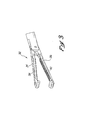
- the jaw assembly 32 is illustrated to include a pair of opposing jaws 34 and 36 relatively movable between an open position, as illustrated in Figure 3, and a closed position, as illustrated in Figure 4.
- Each of the jaws 34 and 36 is provided with an associated atraumatic insert 38 and 41, respectively.
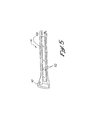
- the insert 41 of this embodiment is best illustrated in Figures 3-5 to include an elongate injection-molded plastic insert base 43, an insert-molded low-profile atraumatic pad 45, and a high-profile pad 47 which may be wrapped with a polyester braid material 50.
- the disposable insert 41 also incorporates a pair of verticle ribs 52, which are positioned to nest in a corresponding pair of vertical notches 54 in the insert jaw 36.
- the notches 54 are located near the distal tip of the jaw 36 so that the strength of the jaw is not compromised.
- the ribs 52 are preferably an integral portion of the injection-molded, plastic insert base 43. Their function is to prevent the insert from being pulled axially distally relative to the jaw 36 in order to prevent axial removal of the insert from the jaw. With the interaction of the ribs 52 and notches 54, the insert 41 is removable from the jaw 36 only with a pivotal motion, as illustrated by an arrow 56 in Figure 7.
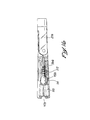
- FIG. 8 An axial cross-section view of the grasper 10, is illustrated in Figure 8.
- the barrel 21 of a preferred embodiment includes an outer tube 58 and a central shaft 61 that are relatively movable to operate the jaw assembly 32. Relative movement of the outer tube 58 and inner shaft 61 is accomplished by operation of the handle assembly 27 and associated ratchet mechanism 30.
- An apertured cylinder 63 operating in combination with an associated pin 65 provides the grasper 10 with a capability for indexing the jaw assembly 32.
- an extension 70 is coupled between the inner shaft 61 and a handle 72, which is pivotal on a handle housing 74 fixed to the tube 58. Movement of the handle 72 relative to the handle housing 74 moves the extension 70 and associated shaft 61 relative to the tube 58 and thereby operates the jaw assembly 32.
- the ratchet assembly 30 includes a series of ratchet teeth 76. These teeth 76 are formed along the extension 70 and are moveable relative to a pawl 78 which is coupled through the handle housing 74 to a thumbscrew 81. As the extension 70 and associated shaft 61 are moved relative to the tube 58 to close the jaw assembly 32, the ratchet teeth 76 slides over the pawl 78 to lock the jaw assembly 32 in its most closed position.
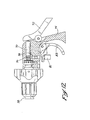
- the locked ratchet assembly 30 can be released by operation of a trigger 83, which is pivotal on the handle housing 74 and operable to remove the pawl 78 from the ratchet teeth 76, as illustrated in Figure 12. With the pawl 78 biased to the active position, release of the trigger 83 permits the pawl to re-engage the ratchet teeth 76 in the active state, illustrated in Figures 9-11.
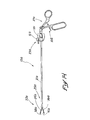
- Figure 14 illustrates a grasper 10a and a barrel 21a with a jaw assembly 32a disposed at a proximal end 23a, and a handle assembly 27a disposed at a distal end 25a.
- a rotation knob 101 functions in a manner similar to the apertured cylinder 63.
- a pair of jaw inserts 38a and 41a can be mounted on associated opposing jaws 34a and 36a in a manner similar to that previously discussed with reference to Figures 5-7.
- a ratchet mechanism 105 is operable with the handle assembly 27a as described in greater detail below.
- the jaw assembly 32a is described with reference to Figure 15, where the axis of the barrel 21a is designated by the reference numeral 107.
- the injection-molded plastic insert 41a is illustrated with an insert-molded, low-profile elastomeric pad 45a and a compression-molded, high-profile elastomeric pad 47a. Of particular interest is the relative height of these pads 45a and 47a.
- the height of the low-profile pad 45a is minimized, while the height of the high-profile pad 47a is maximized.
- a surface 109, supporting the high-profile pad 47a is lower or deeper into the jaw 36a than a surface 112, which supports the low-profile pad 45a.
- These surfaces 110 and 112, as well as a cutout 114 disposed therebetween, are best illustrated in the side and cross-section views of Figures 16 and 17, respectively. With the surface 110 being lower or deeper into the insert base 41a, the high-profile pad 47a can be provided with a greater thickness and therefore increased resiliency relative to that of the low-profile pad 45a.
- This construction maximizes the atraumatic properties of the insert 41 a, while still allowing the grasper 10a to pass through a small-diameter trocar 12 ( Figure 1).
- the cutout 114 in the insert base 41a maximizes the area of the undercut.
- the high-profile pad 47a is disposed distally of the tip of the supporting jaw 36a.
- the surface 110 supporting the high-profile pad 47a is not only lower than the surface 112 supporting the low-profile pad 45a, but also lower than a supporting surface 116 of the jaw 36a. Measured with respect to the axis 107, it can be seen that the supporting surface 116 of the jaw 36a is spaced a distance greater than the surface 112 supporting the low-profile pad 45a, and a distance less than the surface 110 supporting the high-profile pad 47a.
- the bottom surface of the elastomeric pad 47a is below the top surface of the jaw 36a, allowing the thickness of the pad to be maximized to enhance the atraumatic properties of the insert 41 a, while retaining the strength of the jaw 36a.
- Nestling of the high-profile elastomeric pad 47a also allows for a more secure bond to the plastic insert base 41 a.
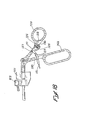
- the handle assembly 27a includes a non-moveable finger handle 74a and a pivotally-attached thumb handle 72a.
- the ratchet mechanism 105 includes a lever 121, which carries a series of ratchet teeth 123.
- the lever 121 includes an extension 125 and is pivotally mounted on a pin 127 fixed to the thumb handle 72a.
- the ratchet mechanism 105 also includes a pawl 130 fixed to the finger handle 74a.
- This particular embodiment of the ratchet mechanism 105 also includes a lock pin 132, which is fixed to the thumb handle 72a, and a pair of arms 134 and 136 which are mounted on the extension 125 and pivotal with the lever 121 to engage and disengage the lock pin 132.
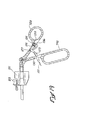
- the lever 121 can be pivoted on the pin 127 between a first position, illustrated in Figure 18, and a second position, illustrated in Figure 19.
- the lever In the first position, the lever is biased by a spring 141 so that the teeth 123 engage the pawl 130.
- the grasper 10a In this position, the grasper 10a is provided with ratchet characteristics, meaning that the jaws 134a and 136a are locked into progressively closed positions as the thumb handle 72a is moved into proximity with the finger handle 74a.
- the lever 121 can be pivoted on the pin 127 against the bias of the spring 141 until the teeth 123 disengage the pawl 130.
Landscapes
- Health & Medical Sciences (AREA)
- Surgery (AREA)
- Life Sciences & Earth Sciences (AREA)
- Medical Informatics (AREA)
- Nuclear Medicine, Radiotherapy & Molecular Imaging (AREA)
- Engineering & Computer Science (AREA)
- Biomedical Technology (AREA)
- Heart & Thoracic Surgery (AREA)
- Ophthalmology & Optometry (AREA)
- Molecular Biology (AREA)
- Animal Behavior & Ethology (AREA)
- General Health & Medical Sciences (AREA)
- Public Health (AREA)
- Veterinary Medicine (AREA)
- Surgical Instruments (AREA)
- Materials For Medical Uses (AREA)
Applications Claiming Priority (5)
| Application Number | Priority Date | Filing Date | Title |
|---|---|---|---|
| US10540698P | 1998-10-23 | 1998-10-23 | |
| US105406P | 1998-10-23 | ||
| US15603299P | 1999-09-23 | 1999-09-23 | |
| US156032P | 1999-09-23 | ||
| EP99970903A EP1123051A4 (de) | 1998-10-23 | 1999-10-22 | Chirurgische zange mit inserts und methode zur verwendung |
Related Parent Applications (1)
| Application Number | Title | Priority Date | Filing Date |
|---|---|---|---|
| EP99970903A Division EP1123051A4 (de) | 1998-10-23 | 1999-10-22 | Chirurgische zange mit inserts und methode zur verwendung |
Publications (2)
| Publication Number | Publication Date |
|---|---|
| EP1389446A2 true EP1389446A2 (de) | 2004-02-18 |
| EP1389446A3 EP1389446A3 (de) | 2004-03-10 |
Family
ID=30773260
Family Applications (1)
| Application Number | Title | Priority Date | Filing Date |
|---|---|---|---|
| EP03255902A Withdrawn EP1389446A3 (de) | 1998-10-23 | 1999-10-22 | Chirurgische Zange mit Inserts |
Country Status (1)
| Country | Link |
|---|---|
| EP (1) | EP1389446A3 (de) |
Cited By (6)
| Publication number | Priority date | Publication date | Assignee | Title |
|---|---|---|---|---|
| CN104161566A (zh) * | 2014-08-12 | 2014-11-26 | 厦门大博颖精医疗器械有限公司 | 咬合钳 |
| USD804028S1 (en) | 2016-06-20 | 2017-11-28 | Karl Storz Gmbh & Co. Kg | Suture retriever |
| USD804027S1 (en) | 2016-06-20 | 2017-11-28 | Karl Storz Gmbh & Co. Kg | Suture retriever |
| USD804026S1 (en) | 2016-06-20 | 2017-11-28 | Karl Storz Gmbh & Co. Kg | Suture retriever |
| USD804025S1 (en) | 2016-06-20 | 2017-11-28 | Karl Storz Gmbh & Co. Kg | Suture retriever |
| WO2025238535A1 (en) * | 2024-05-15 | 2025-11-20 | Cilag Gmbh International | Surgical instrument with dual grip end effector and related methods |
Family Cites Families (4)
| Publication number | Priority date | Publication date | Assignee | Title |
|---|---|---|---|---|
| US3786815A (en) * | 1971-07-14 | 1974-01-22 | Bard Inc C R | Radiopaque clamp |
| CA2075333C (en) * | 1991-10-18 | 2003-07-22 | Ernie Aranyi | Handle for endoscopic surgical instruments and jaw structure |
| AU676208B2 (en) * | 1992-11-18 | 1997-03-06 | Ethicon Inc. | Atraumatic endoscopic apparatus |
| US5728121A (en) * | 1996-04-17 | 1998-03-17 | Teleflex Medical, Inc. | Surgical grasper devices |
-
1999
- 1999-10-22 EP EP03255902A patent/EP1389446A3/de not_active Withdrawn
Cited By (7)
| Publication number | Priority date | Publication date | Assignee | Title |
|---|---|---|---|---|
| CN104161566A (zh) * | 2014-08-12 | 2014-11-26 | 厦门大博颖精医疗器械有限公司 | 咬合钳 |
| CN104161566B (zh) * | 2014-08-12 | 2016-08-24 | 大博医疗科技股份有限公司 | 咬合钳 |
| USD804028S1 (en) | 2016-06-20 | 2017-11-28 | Karl Storz Gmbh & Co. Kg | Suture retriever |
| USD804027S1 (en) | 2016-06-20 | 2017-11-28 | Karl Storz Gmbh & Co. Kg | Suture retriever |
| USD804026S1 (en) | 2016-06-20 | 2017-11-28 | Karl Storz Gmbh & Co. Kg | Suture retriever |
| USD804025S1 (en) | 2016-06-20 | 2017-11-28 | Karl Storz Gmbh & Co. Kg | Suture retriever |
| WO2025238535A1 (en) * | 2024-05-15 | 2025-11-20 | Cilag Gmbh International | Surgical instrument with dual grip end effector and related methods |
Also Published As
| Publication number | Publication date |
|---|---|
| EP1389446A3 (de) | 2004-03-10 |
Similar Documents
| Publication | Publication Date | Title |
|---|---|---|
| WO2000024322A1 (en) | Surgical grasper with inserts and method of using same | |
| US5728121A (en) | Surgical grasper devices | |
| AU737271B2 (en) | Fingertip-mounted minimally invasive surgical instruments and methods of use | |
| JP4049275B2 (ja) | 最小侵入外科手術用のシステム、方法、機器 | |
| JP5443158B2 (ja) | 最少侵襲的な手術アセンブリおよび方法 | |
| US5425743A (en) | Surgical instrument locking mechanism | |
| US5609601A (en) | Endoscopic surgical apparatus with rotation lock | |
| US5441044A (en) | Surgical retractor | |
| US20050080434A1 (en) | Laparoscopic retractable dissector and suture and needle passer | |
| JPH06217987A (ja) | 非外傷型内視鏡装置 | |
| JPH09504963A (ja) | 改良された内視鏡器具 | |
| WO1998000069A9 (en) | Fingertip-mounted minimally invasive surgical instruments and methods of use | |
| EP3638136B1 (de) | Laparoskopische vorrichtungen | |
| JPH10513092A (ja) | 力制限機構を備えた医療器具 | |
| US5342375A (en) | Needle gripping apparatus | |
| EP1389446A2 (de) | Chirurgische Zange mit Inserts | |
| EP2223658B1 (de) | Chirurgisches Multifunktionsinstrument | |
| JP4133969B2 (ja) | クリップおよびクリップ装置 | |
| US7833243B2 (en) | Medical grasping and holding instrument | |
| JP2014512870A (ja) | 腹腔鏡下手術用開創器 | |
| WO2004032753A1 (en) | Multi-purpose surgical instrument |
Legal Events
| Date | Code | Title | Description |
|---|---|---|---|
| PUAI | Public reference made under article 153(3) epc to a published international application that has entered the european phase |
Free format text: ORIGINAL CODE: 0009012 |
|
| PUAL | Search report despatched |
Free format text: ORIGINAL CODE: 0009013 |
|
| 17P | Request for examination filed |
Effective date: 20030920 |
|
| AC | Divisional application: reference to earlier application |
Ref document number: 1123051 Country of ref document: EP Kind code of ref document: P |
|
| AK | Designated contracting states |
Kind code of ref document: A2 Designated state(s): DE FR GB |
|
| AK | Designated contracting states |
Kind code of ref document: A3 Designated state(s): DE FR GB |
|
| AKX | Designation fees paid |
Designated state(s): DE FR GB |
|
| 17Q | First examination report despatched |
Effective date: 20050610 |
|
| STAA | Information on the status of an ep patent application or granted ep patent |
Free format text: STATUS: THE APPLICATION IS DEEMED TO BE WITHDRAWN |
|
| 18D | Application deemed to be withdrawn |
Effective date: 20051021 |