EP1389203B1 - Analogs of thalidomide as angiogenesis inhibitors - Google Patents
Analogs of thalidomide as angiogenesis inhibitors Download PDFInfo
- Publication number
- EP1389203B1 EP1389203B1 EP02780964A EP02780964A EP1389203B1 EP 1389203 B1 EP1389203 B1 EP 1389203B1 EP 02780964 A EP02780964 A EP 02780964A EP 02780964 A EP02780964 A EP 02780964A EP 1389203 B1 EP1389203 B1 EP 1389203B1
- Authority
- EP
- European Patent Office
- Prior art keywords
- thalidomide
- pharmaceutically acceptable
- compound
- angiogenesis
- composition
- Prior art date
- Legal status (The legal status is an assumption and is not a legal conclusion. Google has not performed a legal analysis and makes no representation as to the accuracy of the status listed.)
- Expired - Lifetime
Links
- UEJJHQNACJXSKW-UHFFFAOYSA-N 2-(2,6-dioxopiperidin-3-yl)-1H-isoindole-1,3(2H)-dione Chemical compound O=C1C2=CC=CC=C2C(=O)N1C1CCC(=O)NC1=O UEJJHQNACJXSKW-UHFFFAOYSA-N 0.000 title abstract description 66
- 229960003433 thalidomide Drugs 0.000 title abstract description 26
- 239000004037 angiogenesis inhibitor Substances 0.000 title description 5
- 229940121369 angiogenesis inhibitor Drugs 0.000 title description 2
- 230000033115 angiogenesis Effects 0.000 claims abstract description 32
- 150000001875 compounds Chemical class 0.000 claims description 46
- 201000010099 disease Diseases 0.000 claims description 17
- 208000037265 diseases, disorders, signs and symptoms Diseases 0.000 claims description 17
- 239000000203 mixture Substances 0.000 claims description 17
- 150000003839 salts Chemical class 0.000 claims description 15
- 229910052736 halogen Inorganic materials 0.000 claims description 10
- 150000002367 halogens Chemical class 0.000 claims description 10
- 239000003814 drug Substances 0.000 claims description 9
- 229910052739 hydrogen Inorganic materials 0.000 claims description 9
- 239000001257 hydrogen Substances 0.000 claims description 9
- UFHFLCQGNIYNRP-UHFFFAOYSA-N Hydrogen Chemical compound [H][H] UFHFLCQGNIYNRP-UHFFFAOYSA-N 0.000 claims description 8
- 125000000904 isoindolyl group Chemical group C=1(NC=C2C=CC=CC12)* 0.000 claims description 7
- 230000002401 inhibitory effect Effects 0.000 claims description 6
- 239000008194 pharmaceutical composition Substances 0.000 claims description 6
- 239000003937 drug carrier Substances 0.000 claims description 5
- 230000001404 mediated effect Effects 0.000 claims description 5
- KZNICNPSHKQLFF-UHFFFAOYSA-N succinimide Chemical group O=C1CCC(=O)N1 KZNICNPSHKQLFF-UHFFFAOYSA-N 0.000 claims description 5
- 125000002496 methyl group Chemical group [H]C([H])([H])* 0.000 claims description 4
- 125000001997 phenyl group Chemical group [H]C1=C([H])C([H])=C(*)C([H])=C1[H] 0.000 claims description 4
- PEEHTFAAVSWFBL-UHFFFAOYSA-N Maleimide Chemical group O=C1NC(=O)C=C1 PEEHTFAAVSWFBL-UHFFFAOYSA-N 0.000 claims 2
- 150000004673 fluoride salts Chemical class 0.000 claims 2
- 238000004519 manufacturing process Methods 0.000 claims 2
- 229960002317 succinimide Drugs 0.000 claims 2
- 230000001772 anti-angiogenic effect Effects 0.000 abstract description 16
- 230000000694 effects Effects 0.000 abstract description 10
- 230000005764 inhibitory process Effects 0.000 abstract description 6
- -1 thalidomide analog compounds Chemical class 0.000 abstract description 4
- 230000003278 mimic effect Effects 0.000 abstract description 3
- 206010028980 Neoplasm Diseases 0.000 description 20
- YSJCNZQEYLMVPJ-UHFFFAOYSA-N 2-(2,4-difluorophenyl)-4,5,6,7-tetrafluoroisoindole-1,3-dione Chemical compound FC1=CC(F)=CC=C1N1C(=O)C(C(F)=C(F)C(F)=C2F)=C2C1=O YSJCNZQEYLMVPJ-UHFFFAOYSA-N 0.000 description 12
- IJGRMHOSHXDMSA-UHFFFAOYSA-N Atomic nitrogen Chemical compound N#N IJGRMHOSHXDMSA-UHFFFAOYSA-N 0.000 description 12
- GGHDSBMLSIVVPC-UHFFFAOYSA-N 2-(2,4-difluorophenyl)-4,7-dimethylisoindole-1,3-dione Chemical compound O=C1C=2C(C)=CC=C(C)C=2C(=O)N1C1=CC=C(F)C=C1F GGHDSBMLSIVVPC-UHFFFAOYSA-N 0.000 description 9
- IAZDPXIOMUYVGZ-UHFFFAOYSA-N Dimethylsulphoxide Chemical compound CS(C)=O IAZDPXIOMUYVGZ-UHFFFAOYSA-N 0.000 description 9
- IAZDPXIOMUYVGZ-WFGJKAKNSA-N Dimethyl sulfoxide Chemical compound [2H]C([2H])([2H])S(=O)C([2H])([2H])[2H] IAZDPXIOMUYVGZ-WFGJKAKNSA-N 0.000 description 8
- 238000011282 treatment Methods 0.000 description 8
- 206010027476 Metastases Diseases 0.000 description 7
- 229940079593 drug Drugs 0.000 description 7
- 239000002207 metabolite Substances 0.000 description 7
- 230000009401 metastasis Effects 0.000 description 7
- 238000000034 method Methods 0.000 description 7
- OKTJSMMVPCPJKN-UHFFFAOYSA-N Carbon Chemical compound [C] OKTJSMMVPCPJKN-UHFFFAOYSA-N 0.000 description 6
- 241001465754 Metazoa Species 0.000 description 6
- 229910052799 carbon Inorganic materials 0.000 description 6
- 229910052757 nitrogen Inorganic materials 0.000 description 6
- 239000000243 solution Substances 0.000 description 6
- 239000002904 solvent Substances 0.000 description 6
- 238000004458 analytical method Methods 0.000 description 5
- 230000015572 biosynthetic process Effects 0.000 description 5
- QTBSBXVTEAMEQO-UHFFFAOYSA-N Acetic acid Chemical compound CC(O)=O QTBSBXVTEAMEQO-UHFFFAOYSA-N 0.000 description 4
- LFQSCWFLJHTTHZ-UHFFFAOYSA-N Ethanol Chemical compound CCO LFQSCWFLJHTTHZ-UHFFFAOYSA-N 0.000 description 4
- 238000000134 MTT assay Methods 0.000 description 4
- 231100000002 MTT assay Toxicity 0.000 description 4
- 238000010183 spectrum analysis Methods 0.000 description 4
- 239000000126 substance Substances 0.000 description 4
- KRHYYFGTRYWZRS-UHFFFAOYSA-M Fluoride anion Chemical compound [F-] KRHYYFGTRYWZRS-UHFFFAOYSA-M 0.000 description 3
- 230000002491 angiogenic effect Effects 0.000 description 3
- QVGXLLKOCUKJST-UHFFFAOYSA-N atomic oxygen Chemical compound [O] QVGXLLKOCUKJST-UHFFFAOYSA-N 0.000 description 3
- 210000004204 blood vessel Anatomy 0.000 description 3
- 230000037396 body weight Effects 0.000 description 3
- 210000004027 cell Anatomy 0.000 description 3
- 238000007912 intraperitoneal administration Methods 0.000 description 3
- 238000004949 mass spectrometry Methods 0.000 description 3
- 230000008018 melting Effects 0.000 description 3
- 238000002844 melting Methods 0.000 description 3
- 230000004060 metabolic process Effects 0.000 description 3
- 229910052760 oxygen Inorganic materials 0.000 description 3
- 239000001301 oxygen Substances 0.000 description 3
- 230000002265 prevention Effects 0.000 description 3
- 238000003786 synthesis reaction Methods 0.000 description 3
- 231100000027 toxicology Toxicity 0.000 description 3
- 210000004881 tumor cell Anatomy 0.000 description 3
- 238000005160 1H NMR spectroscopy Methods 0.000 description 2
- CEPCPXLLFXPZGW-UHFFFAOYSA-N 2,4-difluoroaniline Chemical compound NC1=CC=C(F)C=C1F CEPCPXLLFXPZGW-UHFFFAOYSA-N 0.000 description 2
- WEPCDISQBQXOBE-UHFFFAOYSA-N 4,7-dimethyl-2-benzofuran-1,3-dione Chemical compound CC1=CC=C(C)C2=C1C(=O)OC2=O WEPCDISQBQXOBE-UHFFFAOYSA-N 0.000 description 2
- QGZKDVFQNNGYKY-UHFFFAOYSA-N Ammonia Chemical compound N QGZKDVFQNNGYKY-UHFFFAOYSA-N 0.000 description 2
- 241000124008 Mammalia Species 0.000 description 2
- 238000005481 NMR spectroscopy Methods 0.000 description 2
- 239000007832 Na2SO4 Substances 0.000 description 2
- GLUUGHFHXGJENI-UHFFFAOYSA-N Piperazine Chemical compound C1CNCCN1 GLUUGHFHXGJENI-UHFFFAOYSA-N 0.000 description 2
- PMZURENOXWZQFD-UHFFFAOYSA-L Sodium Sulfate Chemical compound [Na+].[Na+].[O-]S([O-])(=O)=O PMZURENOXWZQFD-UHFFFAOYSA-L 0.000 description 2
- FAPWRFPIFSIZLT-UHFFFAOYSA-M Sodium chloride Chemical compound [Na+].[Cl-] FAPWRFPIFSIZLT-UHFFFAOYSA-M 0.000 description 2
- 206010046851 Uveitis Diseases 0.000 description 2
- 229960000583 acetic acid Drugs 0.000 description 2
- 230000004913 activation Effects 0.000 description 2
- 239000004480 active ingredient Substances 0.000 description 2
- 230000003527 anti-angiogenesis Effects 0.000 description 2
- 210000000709 aorta Anatomy 0.000 description 2
- 239000000969 carrier Substances 0.000 description 2
- 238000006243 chemical reaction Methods 0.000 description 2
- 230000001684 chronic effect Effects 0.000 description 2
- 230000001419 dependent effect Effects 0.000 description 2
- 238000011161 development Methods 0.000 description 2
- 210000002889 endothelial cell Anatomy 0.000 description 2
- 235000019441 ethanol Nutrition 0.000 description 2
- 239000012362 glacial acetic acid Substances 0.000 description 2
- 230000007062 hydrolysis Effects 0.000 description 2
- 238000006460 hydrolysis reaction Methods 0.000 description 2
- 239000003112 inhibitor Substances 0.000 description 2
- 239000000463 material Substances 0.000 description 2
- 230000002503 metabolic effect Effects 0.000 description 2
- 230000014399 negative regulation of angiogenesis Effects 0.000 description 2
- 239000008177 pharmaceutical agent Substances 0.000 description 2
- 230000003389 potentiating effect Effects 0.000 description 2
- 238000002360 preparation method Methods 0.000 description 2
- 230000035755 proliferation Effects 0.000 description 2
- 239000011780 sodium chloride Substances 0.000 description 2
- 229910052938 sodium sulfate Inorganic materials 0.000 description 2
- 230000003595 spectral effect Effects 0.000 description 2
- 125000001424 substituent group Chemical group 0.000 description 2
- 239000003826 tablet Substances 0.000 description 2
- WGTYBPLFGIVFAS-UHFFFAOYSA-M tetramethylammonium hydroxide Chemical compound [OH-].C[N+](C)(C)C WGTYBPLFGIVFAS-UHFFFAOYSA-M 0.000 description 2
- 230000001225 therapeutic effect Effects 0.000 description 2
- 230000005740 tumor formation Effects 0.000 description 2
- VEEGZPWAAPPXRB-BJMVGYQFSA-N (3e)-3-(1h-imidazol-5-ylmethylidene)-1h-indol-2-one Chemical class O=C1NC2=CC=CC=C2\C1=C/C1=CN=CN1 VEEGZPWAAPPXRB-BJMVGYQFSA-N 0.000 description 1
- 238000001644 13C nuclear magnetic resonance spectroscopy Methods 0.000 description 1
- 101710175516 14 kDa zinc-binding protein Proteins 0.000 description 1
- 238000004293 19F NMR spectroscopy Methods 0.000 description 1
- 150000003923 2,5-pyrrolediones Chemical group 0.000 description 1
- IQHSSYROJYPFDV-UHFFFAOYSA-N 2-bromo-1,3-dichloro-5-(trifluoromethyl)benzene Chemical group FC(F)(F)C1=CC(Cl)=C(Br)C(Cl)=C1 IQHSSYROJYPFDV-UHFFFAOYSA-N 0.000 description 1
- CQOQDQWUFQDJMK-SSTWWWIQSA-N 2-methoxy-17beta-estradiol Chemical compound C([C@@H]12)C[C@]3(C)[C@@H](O)CC[C@H]3[C@@H]1CCC1=C2C=C(OC)C(O)=C1 CQOQDQWUFQDJMK-SSTWWWIQSA-N 0.000 description 1
- BJDDKZDZTHIIJB-UHFFFAOYSA-N 4,5,6,7-tetrafluoro-2-benzofuran-1,3-dione Chemical compound FC1=C(F)C(F)=C2C(=O)OC(=O)C2=C1F BJDDKZDZTHIIJB-UHFFFAOYSA-N 0.000 description 1
- 102100028187 ATP-binding cassette sub-family C member 6 Human genes 0.000 description 1
- 102400000068 Angiostatin Human genes 0.000 description 1
- 108010079709 Angiostatins Proteins 0.000 description 1
- 239000004475 Arginine Substances 0.000 description 1
- OYPRJOBELJOOCE-UHFFFAOYSA-N Calcium Chemical compound [Ca] OYPRJOBELJOOCE-UHFFFAOYSA-N 0.000 description 1
- 208000002691 Choroiditis Diseases 0.000 description 1
- 206010009900 Colitis ulcerative Diseases 0.000 description 1
- 208000011231 Crohn disease Diseases 0.000 description 1
- 229920000858 Cyclodextrin Polymers 0.000 description 1
- 206010012689 Diabetic retinopathy Diseases 0.000 description 1
- 208000019878 Eales disease Diseases 0.000 description 1
- 102400001047 Endostatin Human genes 0.000 description 1
- 108010079505 Endostatins Proteins 0.000 description 1
- PIICEJLVQHRZGT-UHFFFAOYSA-N Ethylenediamine Chemical compound NCCN PIICEJLVQHRZGT-UHFFFAOYSA-N 0.000 description 1
- 208000006168 Ewing Sarcoma Diseases 0.000 description 1
- WQZGKKKJIJFFOK-GASJEMHNSA-N Glucose Natural products OC[C@H]1OC(O)[C@H](O)[C@@H](O)[C@@H]1O WQZGKKKJIJFFOK-GASJEMHNSA-N 0.000 description 1
- 201000002563 Histoplasmosis Diseases 0.000 description 1
- 241000282412 Homo Species 0.000 description 1
- 206010051151 Hyperviscosity syndrome Diseases 0.000 description 1
- 206010021143 Hypoxia Diseases 0.000 description 1
- DGAQECJNVWCQMB-PUAWFVPOSA-M Ilexoside XXIX Chemical compound C[C@@H]1CC[C@@]2(CC[C@@]3(C(=CC[C@H]4[C@]3(CC[C@@H]5[C@@]4(CC[C@@H](C5(C)C)OS(=O)(=O)[O-])C)C)[C@@H]2[C@]1(C)O)C)C(=O)O[C@H]6[C@@H]([C@H]([C@@H]([C@H](O6)CO)O)O)O.[Na+] DGAQECJNVWCQMB-PUAWFVPOSA-M 0.000 description 1
- AHLPHDHHMVZTML-BYPYZUCNSA-N L-Ornithine Chemical compound NCCC[C@H](N)C(O)=O AHLPHDHHMVZTML-BYPYZUCNSA-N 0.000 description 1
- ODKSFYDXXFIFQN-BYPYZUCNSA-P L-argininium(2+) Chemical compound NC(=[NH2+])NCCC[C@H]([NH3+])C(O)=O ODKSFYDXXFIFQN-BYPYZUCNSA-P 0.000 description 1
- KDXKERNSBIXSRK-YFKPBYRVSA-N L-lysine Chemical compound NCCCC[C@H](N)C(O)=O KDXKERNSBIXSRK-YFKPBYRVSA-N 0.000 description 1
- WHXSMMKQMYFTQS-UHFFFAOYSA-N Lithium Chemical compound [Li] WHXSMMKQMYFTQS-UHFFFAOYSA-N 0.000 description 1
- 208000016604 Lyme disease Diseases 0.000 description 1
- KDXKERNSBIXSRK-UHFFFAOYSA-N Lysine Natural products NCCCCC(N)C(O)=O KDXKERNSBIXSRK-UHFFFAOYSA-N 0.000 description 1
- 239000004472 Lysine Substances 0.000 description 1
- 206010025412 Macular dystrophy congenital Diseases 0.000 description 1
- FYYHWMGAXLPEAU-UHFFFAOYSA-N Magnesium Chemical compound [Mg] FYYHWMGAXLPEAU-UHFFFAOYSA-N 0.000 description 1
- 206010062207 Mycobacterial infection Diseases 0.000 description 1
- ONXPDKGXOOORHB-BYPYZUCNSA-N N(5)-methyl-L-glutamine Chemical compound CNC(=O)CC[C@H](N)C(O)=O ONXPDKGXOOORHB-BYPYZUCNSA-N 0.000 description 1
- 206010029260 Neuroblastoma Diseases 0.000 description 1
- 201000004404 Neurofibroma Diseases 0.000 description 1
- 206010029350 Neurotoxicity Diseases 0.000 description 1
- MSHZHSPISPJWHW-UHFFFAOYSA-N O-(chloroacetylcarbamoyl)fumagillol Chemical compound O1C(CC=C(C)C)C1(C)C1C(OC)C(OC(=O)NC(=O)CCl)CCC21CO2 MSHZHSPISPJWHW-UHFFFAOYSA-N 0.000 description 1
- AHLPHDHHMVZTML-UHFFFAOYSA-N Orn-delta-NH2 Natural products NCCCC(N)C(O)=O AHLPHDHHMVZTML-UHFFFAOYSA-N 0.000 description 1
- UTJLXEIPEHZYQJ-UHFFFAOYSA-N Ornithine Natural products OC(=O)C(C)CCCN UTJLXEIPEHZYQJ-UHFFFAOYSA-N 0.000 description 1
- 208000010191 Osteitis Deformans Diseases 0.000 description 1
- 208000027868 Paget disease Diseases 0.000 description 1
- 208000004788 Pars Planitis Diseases 0.000 description 1
- 208000003971 Posterior uveitis Diseases 0.000 description 1
- ZLMJMSJWJFRBEC-UHFFFAOYSA-N Potassium Chemical compound [K] ZLMJMSJWJFRBEC-UHFFFAOYSA-N 0.000 description 1
- 208000002158 Proliferative Vitreoretinopathy Diseases 0.000 description 1
- 229940123924 Protein kinase C inhibitor Drugs 0.000 description 1
- 201000004613 Pseudoxanthoma elasticum Diseases 0.000 description 1
- 206010037649 Pyogenic granuloma Diseases 0.000 description 1
- 206010038848 Retinal detachment Diseases 0.000 description 1
- 206010038910 Retinitis Diseases 0.000 description 1
- 201000000582 Retinoblastoma Diseases 0.000 description 1
- 206010038933 Retinopathy of prematurity Diseases 0.000 description 1
- 206010038934 Retinopathy proliferative Diseases 0.000 description 1
- 206010039897 Sedation Diseases 0.000 description 1
- 102000007562 Serum Albumin Human genes 0.000 description 1
- 108010071390 Serum Albumin Proteins 0.000 description 1
- 206010043275 Teratogenicity Diseases 0.000 description 1
- 206010044221 Toxic encephalopathy Diseases 0.000 description 1
- 201000005485 Toxoplasmosis Diseases 0.000 description 1
- 201000006704 Ulcerative Colitis Diseases 0.000 description 1
- 241000251539 Vertebrata <Metazoa> Species 0.000 description 1
- 208000014070 Vestibular schwannoma Diseases 0.000 description 1
- 206010047663 Vitritis Diseases 0.000 description 1
- HCHKCACWOHOZIP-UHFFFAOYSA-N Zinc Chemical compound [Zn] HCHKCACWOHOZIP-UHFFFAOYSA-N 0.000 description 1
- 230000002159 abnormal effect Effects 0.000 description 1
- 238000002835 absorbance Methods 0.000 description 1
- 239000002253 acid Substances 0.000 description 1
- 208000004064 acoustic neuroma Diseases 0.000 description 1
- 239000013543 active substance Substances 0.000 description 1
- 239000002671 adjuvant Substances 0.000 description 1
- 125000000217 alkyl group Chemical group 0.000 description 1
- XAGFODPZIPBFFR-UHFFFAOYSA-N aluminium Chemical compound [Al] XAGFODPZIPBFFR-UHFFFAOYSA-N 0.000 description 1
- 229910052782 aluminium Inorganic materials 0.000 description 1
- 229910021529 ammonia Inorganic materials 0.000 description 1
- 229940006133 antiglaucoma drug and miotics carbonic anhydrase inhibitors Drugs 0.000 description 1
- ODKSFYDXXFIFQN-UHFFFAOYSA-N arginine Natural products OC(=O)C(N)CCCNC(N)=N ODKSFYDXXFIFQN-UHFFFAOYSA-N 0.000 description 1
- 229960003121 arginine Drugs 0.000 description 1
- 210000001367 artery Anatomy 0.000 description 1
- FZCSTZYAHCUGEM-UHFFFAOYSA-N aspergillomarasmine B Natural products OC(=O)CNC(C(O)=O)CNC(C(O)=O)CC(O)=O FZCSTZYAHCUGEM-UHFFFAOYSA-N 0.000 description 1
- 238000003556 assay Methods 0.000 description 1
- UPABQMWFWCMOFV-UHFFFAOYSA-N benethamine Chemical compound C=1C=CC=CC=1CNCCC1=CC=CC=C1 UPABQMWFWCMOFV-UHFFFAOYSA-N 0.000 description 1
- JUHORIMYRDESRB-UHFFFAOYSA-N benzathine Chemical compound C=1C=CC=CC=1CNCCNCC1=CC=CC=C1 JUHORIMYRDESRB-UHFFFAOYSA-N 0.000 description 1
- WQZGKKKJIJFFOK-VFUOTHLCSA-N beta-D-glucose Chemical compound OC[C@H]1O[C@@H](O)[C@H](O)[C@@H](O)[C@@H]1O WQZGKKKJIJFFOK-VFUOTHLCSA-N 0.000 description 1
- 230000004071 biological effect Effects 0.000 description 1
- 239000008280 blood Substances 0.000 description 1
- 210000004369 blood Anatomy 0.000 description 1
- 210000000481 breast Anatomy 0.000 description 1
- 125000001246 bromo group Chemical group Br* 0.000 description 1
- 239000000872 buffer Substances 0.000 description 1
- 239000011575 calcium Substances 0.000 description 1
- 229910052791 calcium Inorganic materials 0.000 description 1
- 201000011510 cancer Diseases 0.000 description 1
- 238000001460 carbon-13 nuclear magnetic resonance spectrum Methods 0.000 description 1
- 239000003489 carbonate dehydratase inhibitor Substances 0.000 description 1
- 150000001768 cations Chemical class 0.000 description 1
- 230000004663 cell proliferation Effects 0.000 description 1
- 230000001413 cellular effect Effects 0.000 description 1
- 230000008859 change Effects 0.000 description 1
- ZXFCRFYULUUSDW-OWXODZSWSA-N chembl2104970 Chemical compound C([C@H]1C2)C3=CC=CC(O)=C3C(=O)C1=C(O)[C@@]1(O)[C@@H]2CC(O)=C(C(=O)N)C1=O ZXFCRFYULUUSDW-OWXODZSWSA-N 0.000 description 1
- 239000003795 chemical substances by application Substances 0.000 description 1
- 238000002512 chemotherapy Methods 0.000 description 1
- 125000001309 chloro group Chemical group Cl* 0.000 description 1
- VDANGULDQQJODZ-UHFFFAOYSA-N chloroprocaine Chemical compound CCN(CC)CCOC(=O)C1=CC=C(N)C=C1Cl VDANGULDQQJODZ-UHFFFAOYSA-N 0.000 description 1
- 229960002023 chloroprocaine Drugs 0.000 description 1
- OEYIOHPDSNJKLS-UHFFFAOYSA-N choline Chemical compound C[N+](C)(C)CCO OEYIOHPDSNJKLS-UHFFFAOYSA-N 0.000 description 1
- 229960001231 choline Drugs 0.000 description 1
- 210000001072 colon Anatomy 0.000 description 1
- 238000002648 combination therapy Methods 0.000 description 1
- 230000021615 conjugation Effects 0.000 description 1
- 230000008878 coupling Effects 0.000 description 1
- 238000010168 coupling process Methods 0.000 description 1
- 238000005859 coupling reaction Methods 0.000 description 1
- 239000013078 crystal Substances 0.000 description 1
- 229940097362 cyclodextrins Drugs 0.000 description 1
- 230000006378 damage Effects 0.000 description 1
- 239000003599 detergent Substances 0.000 description 1
- 238000003745 diagnosis Methods 0.000 description 1
- 235000005911 diet Nutrition 0.000 description 1
- 230000037213 diet Effects 0.000 description 1
- ZBCBWPMODOFKDW-UHFFFAOYSA-N diethanolamine Chemical compound OCCNCCO ZBCBWPMODOFKDW-UHFFFAOYSA-N 0.000 description 1
- 229940043237 diethanolamine Drugs 0.000 description 1
- HPNMFZURTQLUMO-UHFFFAOYSA-N diethylamine Chemical compound CCNCC HPNMFZURTQLUMO-UHFFFAOYSA-N 0.000 description 1
- 239000000890 drug combination Substances 0.000 description 1
- 230000002255 enzymatic effect Effects 0.000 description 1
- 238000006911 enzymatic reaction Methods 0.000 description 1
- 230000008020 evaporation Effects 0.000 description 1
- 238000001704 evaporation Methods 0.000 description 1
- 230000029142 excretion Effects 0.000 description 1
- 230000001497 fibrovascular Effects 0.000 description 1
- 125000001153 fluoro group Chemical group F* 0.000 description 1
- 239000012634 fragment Substances 0.000 description 1
- 125000000524 functional group Chemical group 0.000 description 1
- 239000008103 glucose Substances 0.000 description 1
- 210000003128 head Anatomy 0.000 description 1
- 230000036541 health Effects 0.000 description 1
- 201000011066 hemangioma Diseases 0.000 description 1
- 238000001794 hormone therapy Methods 0.000 description 1
- 208000013653 hyalitis Diseases 0.000 description 1
- 150000002431 hydrogen Chemical class 0.000 description 1
- 230000001146 hypoxic effect Effects 0.000 description 1
- 238000010191 image analysis Methods 0.000 description 1
- 230000002519 immonomodulatory effect Effects 0.000 description 1
- 201000001371 inclusion conjunctivitis Diseases 0.000 description 1
- 230000001939 inductive effect Effects 0.000 description 1
- 208000015181 infectious disease Diseases 0.000 description 1
- 238000002347 injection Methods 0.000 description 1
- 239000007924 injection Substances 0.000 description 1
- 208000014674 injury Diseases 0.000 description 1
- 150000007529 inorganic bases Chemical class 0.000 description 1
- 238000003780 insertion Methods 0.000 description 1
- 230000037431 insertion Effects 0.000 description 1
- 238000001990 intravenous administration Methods 0.000 description 1
- 238000010253 intravenous injection Methods 0.000 description 1
- 230000009545 invasion Effects 0.000 description 1
- 238000011835 investigation Methods 0.000 description 1
- 125000002346 iodo group Chemical group I* 0.000 description 1
- 238000002955 isolation Methods 0.000 description 1
- 231100000636 lethal dose Toxicity 0.000 description 1
- 208000032839 leukemia Diseases 0.000 description 1
- 150000002632 lipids Chemical class 0.000 description 1
- 239000008297 liquid dosage form Substances 0.000 description 1
- 239000006193 liquid solution Substances 0.000 description 1
- 239000006194 liquid suspension Substances 0.000 description 1
- 229910052744 lithium Inorganic materials 0.000 description 1
- 210000004185 liver Anatomy 0.000 description 1
- 210000004072 lung Anatomy 0.000 description 1
- 229960003646 lysine Drugs 0.000 description 1
- 208000002780 macular degeneration Diseases 0.000 description 1
- 239000011777 magnesium Substances 0.000 description 1
- 229910052749 magnesium Inorganic materials 0.000 description 1
- 208000027202 mammary Paget disease Diseases 0.000 description 1
- 239000003771 matrix metalloproteinase inhibitor Substances 0.000 description 1
- 229940121386 matrix metalloproteinase inhibitor Drugs 0.000 description 1
- 229920000609 methyl cellulose Polymers 0.000 description 1
- 239000001923 methylcellulose Substances 0.000 description 1
- 235000010981 methylcellulose Nutrition 0.000 description 1
- 210000004088 microvessel Anatomy 0.000 description 1
- 208000027531 mycobacterial infectious disease Diseases 0.000 description 1
- 208000001491 myopia Diseases 0.000 description 1
- 230000004379 myopia Effects 0.000 description 1
- VMGAPWLDMVPYIA-HIDZBRGKSA-N n'-amino-n-iminomethanimidamide Chemical compound N\N=C\N=N VMGAPWLDMVPYIA-HIDZBRGKSA-N 0.000 description 1
- 210000003739 neck Anatomy 0.000 description 1
- 208000021971 neovascular inflammatory vitreoretinopathy Diseases 0.000 description 1
- 230000007135 neurotoxicity Effects 0.000 description 1
- 231100000228 neurotoxicity Toxicity 0.000 description 1
- 235000015097 nutrients Nutrition 0.000 description 1
- 230000000414 obstructive effect Effects 0.000 description 1
- 238000011275 oncology therapy Methods 0.000 description 1
- 150000007530 organic bases Chemical class 0.000 description 1
- 229960003104 ornithine Drugs 0.000 description 1
- 230000003204 osmotic effect Effects 0.000 description 1
- 201000008968 osteosarcoma Diseases 0.000 description 1
- 230000003647 oxidation Effects 0.000 description 1
- 238000007254 oxidation reaction Methods 0.000 description 1
- 239000006187 pill Substances 0.000 description 1
- 239000011591 potassium Substances 0.000 description 1
- 229910052700 potassium Inorganic materials 0.000 description 1
- 239000000843 powder Substances 0.000 description 1
- 239000003755 preservative agent Substances 0.000 description 1
- MFDFERRIHVXMIY-UHFFFAOYSA-N procaine Chemical compound CCN(CC)CCOC(=O)C1=CC=C(N)C=C1 MFDFERRIHVXMIY-UHFFFAOYSA-N 0.000 description 1
- 229960004919 procaine Drugs 0.000 description 1
- 239000000047 product Substances 0.000 description 1
- 230000006785 proliferative vitreoretinopathy Effects 0.000 description 1
- 230000000069 prophylactic effect Effects 0.000 description 1
- 210000002307 prostate Anatomy 0.000 description 1
- 239000003881 protein kinase C inhibitor Substances 0.000 description 1
- 102000004169 proteins and genes Human genes 0.000 description 1
- 108090000623 proteins and genes Proteins 0.000 description 1
- 238000000425 proton nuclear magnetic resonance spectrum Methods 0.000 description 1
- 208000023558 pseudoxanthoma elasticum (inherited or acquired) Diseases 0.000 description 1
- 239000012264 purified product Substances 0.000 description 1
- 238000001959 radiotherapy Methods 0.000 description 1
- 230000009467 reduction Effects 0.000 description 1
- 238000006722 reduction reaction Methods 0.000 description 1
- 231100000916 relative toxicity Toxicity 0.000 description 1
- BOLDJAUMGUJJKM-LSDHHAIUSA-N renifolin D Natural products CC(=C)[C@@H]1Cc2c(O)c(O)ccc2[C@H]1CC(=O)c3ccc(O)cc3O BOLDJAUMGUJJKM-LSDHHAIUSA-N 0.000 description 1
- 230000004044 response Effects 0.000 description 1
- 230000004264 retinal detachment Effects 0.000 description 1
- 201000009410 rhabdomyosarcoma Diseases 0.000 description 1
- 201000000306 sarcoidosis Diseases 0.000 description 1
- 238000012216 screening Methods 0.000 description 1
- 230000036280 sedation Effects 0.000 description 1
- 239000000932 sedative agent Substances 0.000 description 1
- 230000001624 sedative effect Effects 0.000 description 1
- 239000008299 semisolid dosage form Substances 0.000 description 1
- 208000007056 sickle cell anemia Diseases 0.000 description 1
- 239000011734 sodium Substances 0.000 description 1
- 229910052708 sodium Inorganic materials 0.000 description 1
- 239000007909 solid dosage form Substances 0.000 description 1
- 241000894007 species Species 0.000 description 1
- 238000001228 spectrum Methods 0.000 description 1
- 238000012453 sprague-dawley rat model Methods 0.000 description 1
- 238000010561 standard procedure Methods 0.000 description 1
- 230000000638 stimulation Effects 0.000 description 1
- 238000006467 substitution reaction Methods 0.000 description 1
- 208000006379 syphilis Diseases 0.000 description 1
- 201000000596 systemic lupus erythematosus Diseases 0.000 description 1
- 231100000462 teratogen Toxicity 0.000 description 1
- 239000003439 teratogenic agent Substances 0.000 description 1
- 231100000211 teratogenicity Toxicity 0.000 description 1
- CZDYPVPMEAXLPK-UHFFFAOYSA-N tetramethylsilane Chemical compound C[Si](C)(C)C CZDYPVPMEAXLPK-UHFFFAOYSA-N 0.000 description 1
- 238000002560 therapeutic procedure Methods 0.000 description 1
- 210000001519 tissue Anatomy 0.000 description 1
- 230000000699 topical effect Effects 0.000 description 1
- 206010044325 trachoma Diseases 0.000 description 1
- 230000008733 trauma Effects 0.000 description 1
- CYRMSUTZVYGINF-UHFFFAOYSA-N trichlorofluoromethane Chemical compound FC(Cl)(Cl)Cl CYRMSUTZVYGINF-UHFFFAOYSA-N 0.000 description 1
- LENZDBCJOHFCAS-UHFFFAOYSA-N tris Chemical compound OCC(N)(CO)CO LENZDBCJOHFCAS-UHFFFAOYSA-N 0.000 description 1
- 230000005747 tumor angiogenesis Effects 0.000 description 1
- 210000003932 urinary bladder Anatomy 0.000 description 1
- 239000003981 vehicle Substances 0.000 description 1
- 210000003462 vein Anatomy 0.000 description 1
- 201000007790 vitelliform macular dystrophy Diseases 0.000 description 1
- XLYOFNOQVPJJNP-UHFFFAOYSA-N water Substances O XLYOFNOQVPJJNP-UHFFFAOYSA-N 0.000 description 1
- 239000011701 zinc Substances 0.000 description 1
- 229910052725 zinc Inorganic materials 0.000 description 1
Images


Classifications
-
- C—CHEMISTRY; METALLURGY
- C07—ORGANIC CHEMISTRY
- C07D—HETEROCYCLIC COMPOUNDS
- C07D209/00—Heterocyclic compounds containing five-membered rings, condensed with other rings, with one nitrogen atom as the only ring hetero atom
- C07D209/02—Heterocyclic compounds containing five-membered rings, condensed with other rings, with one nitrogen atom as the only ring hetero atom condensed with one carbocyclic ring
- C07D209/44—Iso-indoles; Hydrogenated iso-indoles
- C07D209/48—Iso-indoles; Hydrogenated iso-indoles with oxygen atoms in positions 1 and 3, e.g. phthalimide
-
- A—HUMAN NECESSITIES
- A61—MEDICAL OR VETERINARY SCIENCE; HYGIENE
- A61K—PREPARATIONS FOR MEDICAL, DENTAL OR TOILETRY PURPOSES
- A61K31/00—Medicinal preparations containing organic active ingredients
- A61K31/33—Heterocyclic compounds
- A61K31/395—Heterocyclic compounds having nitrogen as a ring hetero atom, e.g. guanethidine or rifamycins
- A61K31/40—Heterocyclic compounds having nitrogen as a ring hetero atom, e.g. guanethidine or rifamycins having five-membered rings with one nitrogen as the only ring hetero atom, e.g. sulpiride, succinimide, tolmetin, buflomedil
- A61K31/403—Heterocyclic compounds having nitrogen as a ring hetero atom, e.g. guanethidine or rifamycins having five-membered rings with one nitrogen as the only ring hetero atom, e.g. sulpiride, succinimide, tolmetin, buflomedil condensed with carbocyclic rings, e.g. carbazole
- A61K31/4035—Isoindoles, e.g. phthalimide
-
- A—HUMAN NECESSITIES
- A61—MEDICAL OR VETERINARY SCIENCE; HYGIENE
- A61K—PREPARATIONS FOR MEDICAL, DENTAL OR TOILETRY PURPOSES
- A61K31/00—Medicinal preparations containing organic active ingredients
- A61K31/33—Heterocyclic compounds
- A61K31/395—Heterocyclic compounds having nitrogen as a ring hetero atom, e.g. guanethidine or rifamycins
- A61K31/435—Heterocyclic compounds having nitrogen as a ring hetero atom, e.g. guanethidine or rifamycins having six-membered rings with one nitrogen as the only ring hetero atom
- A61K31/44—Non condensed pyridines; Hydrogenated derivatives thereof
- A61K31/445—Non condensed piperidines, e.g. piperocaine
- A61K31/4523—Non condensed piperidines, e.g. piperocaine containing further heterocyclic ring systems
- A61K31/454—Non condensed piperidines, e.g. piperocaine containing further heterocyclic ring systems containing a five-membered ring with nitrogen as a ring hetero atom, e.g. pimozide, domperidone
-
- A—HUMAN NECESSITIES
- A61—MEDICAL OR VETERINARY SCIENCE; HYGIENE
- A61K—PREPARATIONS FOR MEDICAL, DENTAL OR TOILETRY PURPOSES
- A61K31/00—Medicinal preparations containing organic active ingredients
- A61K31/33—Heterocyclic compounds
- A61K31/395—Heterocyclic compounds having nitrogen as a ring hetero atom, e.g. guanethidine or rifamycins
- A61K31/495—Heterocyclic compounds having nitrogen as a ring hetero atom, e.g. guanethidine or rifamycins having six-membered rings with two or more nitrogen atoms as the only ring heteroatoms, e.g. piperazine or tetrazines
- A61K31/505—Pyrimidines; Hydrogenated pyrimidines, e.g. trimethoprim
- A61K31/506—Pyrimidines; Hydrogenated pyrimidines, e.g. trimethoprim not condensed and containing further heterocyclic rings
-
- A—HUMAN NECESSITIES
- A61—MEDICAL OR VETERINARY SCIENCE; HYGIENE
- A61K—PREPARATIONS FOR MEDICAL, DENTAL OR TOILETRY PURPOSES
- A61K31/00—Medicinal preparations containing organic active ingredients
- A61K31/33—Heterocyclic compounds
- A61K31/395—Heterocyclic compounds having nitrogen as a ring hetero atom, e.g. guanethidine or rifamycins
- A61K31/495—Heterocyclic compounds having nitrogen as a ring hetero atom, e.g. guanethidine or rifamycins having six-membered rings with two or more nitrogen atoms as the only ring heteroatoms, e.g. piperazine or tetrazines
- A61K31/505—Pyrimidines; Hydrogenated pyrimidines, e.g. trimethoprim
- A61K31/513—Pyrimidines; Hydrogenated pyrimidines, e.g. trimethoprim having oxo groups directly attached to the heterocyclic ring, e.g. cytosine
-
- A—HUMAN NECESSITIES
- A61—MEDICAL OR VETERINARY SCIENCE; HYGIENE
- A61P—SPECIFIC THERAPEUTIC ACTIVITY OF CHEMICAL COMPOUNDS OR MEDICINAL PREPARATIONS
- A61P35/00—Antineoplastic agents
-
- A—HUMAN NECESSITIES
- A61—MEDICAL OR VETERINARY SCIENCE; HYGIENE
- A61P—SPECIFIC THERAPEUTIC ACTIVITY OF CHEMICAL COMPOUNDS OR MEDICINAL PREPARATIONS
- A61P35/00—Antineoplastic agents
- A61P35/02—Antineoplastic agents specific for leukemia
-
- A—HUMAN NECESSITIES
- A61—MEDICAL OR VETERINARY SCIENCE; HYGIENE
- A61P—SPECIFIC THERAPEUTIC ACTIVITY OF CHEMICAL COMPOUNDS OR MEDICINAL PREPARATIONS
- A61P43/00—Drugs for specific purposes, not provided for in groups A61P1/00-A61P41/00
-
- A—HUMAN NECESSITIES
- A61—MEDICAL OR VETERINARY SCIENCE; HYGIENE
- A61P—SPECIFIC THERAPEUTIC ACTIVITY OF CHEMICAL COMPOUNDS OR MEDICINAL PREPARATIONS
- A61P9/00—Drugs for disorders of the cardiovascular system
-
- C—CHEMISTRY; METALLURGY
- C07—ORGANIC CHEMISTRY
- C07D—HETEROCYCLIC COMPOUNDS
- C07D401/00—Heterocyclic compounds containing two or more hetero rings, having nitrogen atoms as the only ring hetero atoms, at least one ring being a six-membered ring with only one nitrogen atom
- C07D401/02—Heterocyclic compounds containing two or more hetero rings, having nitrogen atoms as the only ring hetero atoms, at least one ring being a six-membered ring with only one nitrogen atom containing two hetero rings
- C07D401/04—Heterocyclic compounds containing two or more hetero rings, having nitrogen atoms as the only ring hetero atoms, at least one ring being a six-membered ring with only one nitrogen atom containing two hetero rings directly linked by a ring-member-to-ring-member bond
-
- C—CHEMISTRY; METALLURGY
- C07—ORGANIC CHEMISTRY
- C07D—HETEROCYCLIC COMPOUNDS
- C07D403/00—Heterocyclic compounds containing two or more hetero rings, having nitrogen atoms as the only ring hetero atoms, not provided for by group C07D401/00
- C07D403/02—Heterocyclic compounds containing two or more hetero rings, having nitrogen atoms as the only ring hetero atoms, not provided for by group C07D401/00 containing two hetero rings
- C07D403/04—Heterocyclic compounds containing two or more hetero rings, having nitrogen atoms as the only ring hetero atoms, not provided for by group C07D401/00 containing two hetero rings directly linked by a ring-member-to-ring-member bond
Definitions
- the present invention concerns anti-angiogenesis compositions and methods, and particularly thalidomide analogs that actively inhibit angiogenesis in humans and animals.
- Angiogenesis is the formation of new blood vessels from pre-existing vessels. Angiogenesis is prominent in solid tumor formation and metastasis. A tumor requires formation of a network of blood vessels to sustain the nutrient and oxygen supply for continued growth. Some tumors in which angiogenesis is important include most solid tumors and benign tumors, such as acoustic neuroma, neurofibroma, trachoma, and pyogenic granulomas. Prevention of angiogenesis could halt the growth of these tumors and the resultant damage due to the presence of the tumor.
- tumor microvessel density there is a direct correlation between tumor microvessel density and the incidence of metastasis.
- Tumor cells themselves can produce factors that stimulate the proliferation of endothelial cells and new capillary growth.
- Angiogenesis is important in two stages of tumor metastasis. The first stage where angiogenesis stimulation is important is in the vascularization of the tumor, which allows tumor cells to enter the blood stream and to circulate throughout the body. After the tumor cells have left the primary site, and have settled into the secondary, metastasis site, angiogenesis must occur before the new tumor can grow and expand. Therefore, prevention of angiogenesis could lead to the prevention of metastasis of tumors and possibly contain the neoplastic growth at the primary site.
- thalidomide was marketed as a sedative in Europe but was withdrawn from the market when it was found to be a potent teratogen. Recently, thalidomide has been promoted as a possible inhibitor of angiogenesis. Studies have indicated, however, that thalidomide itself is not sufficiently active to inhibit angiogenesis. Instead, the anti-angiogenic activity or effects previously attributed to thalidomide are the resulting effects of compounds that are only present following metabolic activation of thalidomide (i.e., "active" thalidomide metabolites). D'Amato, R.; Loughman Flynn, E.; Folkman, J., Thalidomide as an Inhibitor of Angiogenesis. Proc.
- active thalidomide analogs may be synthesized to provide exceptionally effective compounds inhibiting angiogenic effects. This is especially true when comparing thalidomide to "active" thalidomide analogs. To obtain such active compounds from thalidomide, thalidomide must first be activated via metabolism; only a very small amount of thalidomide would actually be metabolized to one or more "active" metabolites. Further, it may be possible to administer such "active" thalidomide analogs in lower amounts and still achieve the desired anti-angiogenic effects.
- thalidomide analogs could be safer than thalidomide in avoiding undesirable side effects, e.g., teratogenicity or neurotoxicity, and may be more specific to tumor angiogenesis than thalidomide-thalidomide has a host of undesirable biological activities.
- the patent WO 94/20085 Discloses thalidomide derivatives for use as angiogenesis inhibitors in the treatment of angiogenesis-mediated diseases.
- the present invention provides compounds having superior anti-angiogenic properties. More specifically, a number of thalidomide metabolites having superior anti-angiogenic properties have now been isolated and identified. Accordingly, the present invention provides active thalidomide analogs that mimic the effects of the isolated and identified active thalidomide metabolites, and variations of such thalidomide analogs. Such thalidomide analog compounds of the present invention show enhanced potency in the inhibition of undesirable angiogenesis.
- the present invention further provides the use of such compounds in methods for inhibiting unwanted angiogenesis in a human or animal by administering to the human or animal with the undesired angiogenesis a composition comprising an effective amount of active thalidomide analog of the present invention.
- the invention includes the use in a method of inhibiting angiogenesis by exposing the mass having the undesirable angiogenesis to an angiogenesis inhibiting amount of one or more of the present invention thalidomide analogs or pharmaceutically acceptable salts of such compounds, wherein such thalidomide analogs have the following general formula : wherein R4 through R7 are fluoride or are another halogen, R4 through R7 may comprise the same or different halogens or R5 and R6 are hydrogen and R4 and R7 are methyl groups.
- R4 through R7 may comprise different groups on the isoindole ring to obtain 4-chloro; 4-nitro; 5,6-dichloro; 4-methyl; 5-methyl; 5,6-dimethyl; and 4,5,6,7-tetrachloro.
- the isoindole ring may be replaced with succinimides or maleimides.
- other halogens may be substituents at the phenyl ring.
- the following groups may be substituents on the phenyl ring: 2,3-difluoro; 2,5-difluoro; 2,6-difluoro; 3,4-difluoro; 3,5-difluoro; 2,3-dichloro; 2,4-dichloro; 2,4-dichloro; 2,6-dichloro; 2,4-dibromo; 2,5-dibromo; 2,6-dibromo; 2-fluoro; 3-fluoro; 4-fluoro; 2-chloro; 3-chloro; 4-chloro; 2-bromo; 3-bromo; 4-bromo; 2,3,4-trifluoro.
- the invention also includes pharmaceutical compositions that include one or more of the compounds of the present invention, or pharmaceutically acceptable salts thereof, and pharmaceutically acceptable carriers.
- Examples of some specific thalidomide analog compounds (having superior anti-angiogenic activity) that are members of the genus of Formula B of the present invention are i.e., 2-(2,4-difluorophenyl)-4,7-dimethyl-1 H -isoindole-1,3(2 H )-dione, and i.e., 2-(2,4-difluorophenyl)-4,5,6,7-tetrafluoro-1 H -isoindole-1,3(2 H )-dione.
- the invention also includes pharmaceutical compositions that include one or more of the above-described compounds.
- halogen refers to fluoro, bromo, chloro and iodo substituents.
- a “pharmaceutical agent” or “drug” refers to a chemical compound or composition capable of inducing a desired therapeutic or prophylactic effect when properly administered to a subject.
- the pharmaceutically acceptable salts of the compounds of this invention include those formed from cations such as sodium, potassium, aluminum, calcium, lithium, magnesium, zinc, and from bases such as ammonia, ethylenediamine, N-methyl-glutamine, lysine, arginine, ornithine, choline, N,N'-dibenzylethylenediamine, chloroprocaine, diethanolamine, procaine, N-benzylphenethylamine, diethylamine, piperazine, tris(hydroxymethyl)aminomethane, and tetramethylammonium hydroxide.
- bases such as ammonia, ethylenediamine, N-methyl-glutamine, lysine, arginine, ornithine, choline, N,N'-dibenzylethylenediamine, chloroprocaine, diethanolamine, procaine, N-benzylphenethylamine, diethylamine, piperazine, tris(hydroxymethyl)
- a thalidomide "analog” as used herein is a synthetic chemical compound using the thalidomide structure as a backbone (i.e., side groups have been added or such groups have been deleted from the parent structure).
- the analog differs in structure from thalidomide and its metabolite compounds such as by a difference in the length of an alkyl chain, a molecular fragment, by one or more functional groups, or a change in ionization.
- Thalidomide analogs generally are not naturally occurring compounds. That is, thalidomide analogs generally cannot be enzymatically or nonenzymatically formed in the body by administration of thalidomide.
- a thalidomide "metabolite” is a thalidomide derivative that is formed by enzymatic action, i.e., metabolism of thalidomide in the body.
- the metabolite is formed by phase-one reactions (e.g., oxidation, reduction, and hydrolysis) or by phase-two reactions (e.g., conjugations).
- Thalidomide metabolites require an enzyme reaction to be produced.
- Angiogenesis refers to the development of blood vessels. Accordingly, “anti-angiogenic activity” refers to the inhibition and/or complete cessation of angiogenesis.
- Tumor refers to a mass of cells resulting from excessive cellular multiplication.
- a “mammal” includes both human and non-human mammals. Similarly, the term “subject” includes both human and veterinary subjects.
- an "animal” is a living multicellular vertebrate organism, a category that includes, for example, mammals and birds.
- Thalidomide or N-(2,6-dioxopiperidin-3-yl)phthalimide has the following chemical structure:
- This example illustrates the preparation and analysis of 2-(2,4-difluorophenyl)-4,7-dimethyl-1 H -isoindole-1,3(2 H )-dione having an exact mass of 287.08, a molecular weight of about 287.6 (carbon about 66.90%, hydrogen about 3.86%, fluoride about 13.23%, nitrogen about 4.88%, and oxygen about 11.14%).
- the solvent was evaporated to dryness under reduced pressure of from about 200 to about 15 mbar.
- the residue was dissolved in about 130 mL of CH 2 C 12 .
- the solution was washed three times with about 50 mL of about 0.1 M HCl and twice with about 50 mL of H 2 O and was then dried with Na 2 SO 4 .
- the residue was recrystallized from ethyl alcohol to yield about 1.27 g (32%) 2-(2,4-difluorophenyl)-4,7-dimethyl-1H-isoindole-1,3(2H)-dione having a melting point of about 212° to about 212.5° C.
- This example illustrates the preparation and analysis of 2-(2,4-difluoro-phenyl)-4,5,6,7-tetrafluoro-1H-isoindole-1,3(2 H )-dione (C 14 H 3 F 6 NO 2 ) having an exact mass of 331.01 and a molecular weight of about 331.2 (carbon about 50.77%, hydrogen about 0.91 %, fluoride about 34.42%, nitrogen about 4.23%, and oxygen about 9.66%).
- a mixture of about 1 g (about 7.75 mmol) of 2,4-difluoroaniline, about 1.54 g (about 7 mmol) of tetrafluorophthalic anhydride and about 50 mL of glacial acetic acid was refluxed for about 3.5 hours.
- the solvent was evaporated to dryness under reduced pressure of from about 200 to about 15 mbar.
- the residue was dissolved in about 75 mL of CH 2 C 12 .
- the solution was washed three times with about 25 mL of about 0.1 M HCl and twice with about 25 mL of water.
- the residue was then dried with Na 2 SO 4 .
- the 1 H NMR spectral analysis results were as follows: (DMSO-d6) 7.22-7.38 (m, 1H), 7.50-7.66 (m, 2H).
- the 19 F NMR spectral analysis results were as follows: (DMSO-d6/CFCl3) -142.3 (m, 2F), -136.9 (m, 2F), -113.8 (m, 1F), -105.6 (m,1F).
- the mass spectral (EI) analysis results were as follows: m / z (relative intensity), 331 (M+, 65), 287 (68), 148 (100).
- Analytically calculated values for the compound C 14 H 3 NO 2 F 6 were carbon about 50.78%, hydrogen about 0.91%, and nitrogen about 4.23%.
- values for the compound C 14 H 3 NO 2 F 6 were carbon about 50.60%, hydrogen about 0.83%, and nitrogen about 3.95%.
- HUVEC MTT assays were performed for the selected thalidomide analogs of the present disclosure to determine a rough estimate of the efficacy of such compounds in the inhibition of angiogenesis.
- MTT assay 1.0 to 2.5 x 10 3 cells per well were plated in 96-well plates in 0.1 ml medium, in triplicate. After 24 hours, the cells were exposed to treatment for 5 days. One plate was analyzed every 24 hours by the addition of 20 ⁇ L of 5 mg/ml MTT solution (available from Sigma of St. Louis, MO) in PBS, to each well for 4 hours. The MTT solution was aspirated and 170 ⁇ L DMSO was added to each well to dissolve the formazan crystals.
- the absorbance at 540 nm was measured using a Biokinetics plate reader (available from Bio-Tek Instruments of Winooski, VT). Triplicate wells were assayed for each condition.
- the assay protocol described herein stems from Kruger et al., a protein kinase C inhibitor, inhibits endothelial cell proliferation and angiogenic hypoxic response, Invasion and Metastasis, 18(4): 209-218 ).
- the present invention includes a treatment for undesirable angiogenesis and angiogenesis dependent or associated diseases, in a subject such as an animal, for example a rat or human.
- the method includes administering one or more of the compounds of the present invention, or a combination of one or more of the compounds and one or more other pharmaceutical agents, to the subject in a pharmaceutically compatible carrier.
- the administration is made in an amount effective to inhibit the development or progression of angiogenesis and diseases associated with the same.
- the treatment can be used prophylactically in any patient in a demographic group at significant risk for such diseases, subjects can also be selected using more specific criteria, such as a definitive diagnosis of the condition.
- the vehicle in which the drug is delivered can include pharmaceutically acceptable compositions of the drugs, using methods well known to those with skill in the art. Any of the common carriers, such as sterile saline or glucose solution, can be utilized with the drugs provided by the invention.
- Routes of administration include but are not limited to oral and parenteral routes, such as intravenous (iv), intraperitoneal (ip), rectal, topical, ophthalmic, nasal, and transdermal.
- the drugs may be administered in a suitable manner now known or later developed, e.g., orally or intravenously, in any conventional medium.
- intravenous injection may be by an aqueous saline medium.
- the medium may also contain conventional pharmaceutical adjunct materials such as, for example, pharmaceutically acceptable salts to adjust the osmotic pressure, lipid carriers such as cyclodextrins, proteins such as serum albumin, hydrophilic agents such as methyl cellulose, detergents, buffers, preservatives and the like.
- Embodiments of other pharmaceutical compositions can be prepared with conventional pharmaceutically acceptable carriers, adjuvants and counterions as would be known to those of skill in the art.
- the compositions are preferably in the form of a unit dose in solid, semi-solid and liquid dosage forms such as tablets, pills, powders, liquid solutions or suspensions.
- the compounds of the present invention are ideally administered as soon as possible after detected unwanted angiogenesis. For example, once unwanted angiogenesis has been confirmed or the presence of a tumor has been identified, a therapeutically effective amount of the drug is administered.
- the dose can be given orally or by frequent bolus administration.
- Therapeutically effective doses of the compounds of the present invention can be determined by one of skill in the art, with a goal of achieving a desired level of anti-angiogenesis as illustrated in the foregoing examples.
- the relative toxicities of the compounds make it possible to administer in various dosage ranges.
- An example of such a dosage range is from about 0.5 to about 50 mg/kg body weight orally in single or divided doses.
- Another example of a dosage range is from about 0.5 to about 50 mg/kg body weight orally in single or divided doses.
- the compositions are, for example, provided in the form of a tablet containing from about 25 to about 500 mg of the active ingredient, particularly 100 mg of the active ingredient for the symptomatic adjustment of the dosage to the subject being treated.
- the specific dose level and frequency of dosage for any particular subject may be varied and will depend upon a variety of factors, including the activity of the specific compound, the extent of existing angiogenic activity, the age, body weight, general health, sex, diet, mode and time of administration, rate of excretion, drug combination, and severity of the condition of the host undergoing therapy.
- the pharmaceutical compositions can be used in the treatment of a variety of diseases mediated by angiogenesis.
- diseases include all types of cancer, ocular neovascular disease, solid tumor formation and metastasis in solid tumors such as rhabdomyosarcomas, retinoblastoma, Ewing sarcoma, neuroblastoma, osteosarcoma, colon, prostate, head and neck, breast, bladder, liver, pancreatic, lung, CNS, and blood-born tumors such as leukemia, also diseases such as hemangioma, ulcerative colitis, Crohn's disease, diabetic retinopathy, macular degeneration, sickle cell anemia, sarcoid, syphilis, pseudoxanthoma elasticum, Paget's disease, vein occlusion, artery occlusion, carotid obstructive disease, chronic uveitis/vitritis, mycobacterial infections, Lyme's disease, systemic lupus erythe
- the present invention also includes combinations of the thalidomide analogs of the present invention and/or combination of the same with various other angiogenesis inhibitor compounds.
- the compounds of this invention may be administered in combination with effective doses of other anti-angiogenic agents.
- administration refers to both concurrent and sequential administration of the active agents.
- anti-angiogenic agents that can be used in combination with the thalidomide analogs of the present invention are TNP-470, carbonic anhydrase inhibitors, endostatin, angiostatin, 2-methoxyestradiol, IMiD (Immune-modulating inhibitor drug) CC5013, matrix metalloproteinase inhibitors, and COL-3.
- the thalidomide analogs of this invention may be used in combination with other forms of cancer therapy, e.g., chemotherapy, radiation therapy, hormonal therapy).
Landscapes
- Health & Medical Sciences (AREA)
- Chemical & Material Sciences (AREA)
- Organic Chemistry (AREA)
- Veterinary Medicine (AREA)
- Medicinal Chemistry (AREA)
- Pharmacology & Pharmacy (AREA)
- Life Sciences & Earth Sciences (AREA)
- Animal Behavior & Ethology (AREA)
- General Health & Medical Sciences (AREA)
- Public Health (AREA)
- Epidemiology (AREA)
- Chemical Kinetics & Catalysis (AREA)
- General Chemical & Material Sciences (AREA)
- Nuclear Medicine, Radiotherapy & Molecular Imaging (AREA)
- Engineering & Computer Science (AREA)
- Bioinformatics & Cheminformatics (AREA)
- Hematology (AREA)
- Oncology (AREA)
- Cardiology (AREA)
- Heart & Thoracic Surgery (AREA)
- Pharmaceuticals Containing Other Organic And Inorganic Compounds (AREA)
- Plural Heterocyclic Compounds (AREA)
- Indole Compounds (AREA)
Abstract
Description
- The present invention concerns anti-angiogenesis compositions and methods, and particularly thalidomide analogs that actively inhibit angiogenesis in humans and animals.
- Angiogenesis is the formation of new blood vessels from pre-existing vessels. Angiogenesis is prominent in solid tumor formation and metastasis. A tumor requires formation of a network of blood vessels to sustain the nutrient and oxygen supply for continued growth. Some tumors in which angiogenesis is important include most solid tumors and benign tumors, such as acoustic neuroma, neurofibroma, trachoma, and pyogenic granulomas. Prevention of angiogenesis could halt the growth of these tumors and the resultant damage due to the presence of the tumor.
- It has been shown that there is a direct correlation between tumor microvessel density and the incidence of metastasis. Tumor cells themselves can produce factors that stimulate the proliferation of endothelial cells and new capillary growth. Angiogenesis is important in two stages of tumor metastasis. The first stage where angiogenesis stimulation is important is in the vascularization of the tumor, which allows tumor cells to enter the blood stream and to circulate throughout the body. After the tumor cells have left the primary site, and have settled into the secondary, metastasis site, angiogenesis must occur before the new tumor can grow and expand. Therefore, prevention of angiogenesis could lead to the prevention of metastasis of tumors and possibly contain the neoplastic growth at the primary site. These observations have led to the investigation of anti-angiogenic agents as possible therapeutic options for various cancers.
- In the 1950's, thalidomide was marketed as a sedative in Europe but was withdrawn from the market when it was found to be a potent teratogen. Recently, thalidomide has been promoted as a possible inhibitor of angiogenesis. Studies have indicated, however, that thalidomide itself is not sufficiently active to inhibit angiogenesis. Instead, the anti-angiogenic activity or effects previously attributed to thalidomide are the resulting effects of compounds that are only present following metabolic activation of thalidomide (i.e., "active" thalidomide metabolites). D'Amato, R.; Loughman Flynn, E.; Folkman, J., Thalidomide as an Inhibitor of Angiogenesis. Proc. Nat'l. Acad. Sci., 1994, 91, 4082-4085; M.; Bauer, K.; Dixon, S.; Figg, W. Inhibition of Angiogenesis by Thalidomide Requires Metabolic Activation, Which Is Species-dependent. Biochem. Pharmacology, 1998, 55, 1827-1834. Accordingly, it has been speculated that certain metabolites of thalidomide rather than thalidomide itself are responsible for its anti-angiogenic properties. However, the specific thalidomide metabolites responsible for the anti-angiogenic properties have not yet been isolated and identified.
- There are hundreds, if not thousands of compounds formed as a result of metabolism of thalidomide and the actively metabolized products of hydrolysis compounds of the thalidomide. Many of the thalidomide metabolites are inactive and/or unstable. There is no way to predict which metabolite(s) will have superior anti-angiogenic properties. As such, "active" thalidomide metabolites (or "active" thalidomide analogs) having superior anti-angiogenic properties are not yet available.
- If the anti-angiogenic activity can be attributed to one or a small number of thalidomide metabolites and those metabolites could be isolated and identified, then active thalidomide analogs may be synthesized to provide exceptionally effective compounds inhibiting angiogenic effects. This is especially true when comparing thalidomide to "active" thalidomide analogs. To obtain such active compounds from thalidomide, thalidomide must first be activated via metabolism; only a very small amount of thalidomide would actually be metabolized to one or more "active" metabolites. Further, it may be possible to administer such "active" thalidomide analogs in lower amounts and still achieve the desired anti-angiogenic effects. Moreover, such "active" thalidomide analogs could be safer than thalidomide in avoiding undesirable side effects, e.g., teratogenicity or neurotoxicity, and may be more specific to tumor angiogenesis than thalidomide-thalidomide has a host of undesirable biological activities.
- The patent
WO 94/20085 - Accordingly, there is a need for isolation and identification of the thalidomide metabolites having superior anti-angiogenic properties. Further, there is a need for the synthesis of purified thalidomide analogs that can mimic the effects of the isolated and identified thalidomide metabolites that display such anti-angiogenic activity. In addition, there is a need for means to treat undesired angiogenesis using such active thalidomide analogs.
- The present invention provides compounds having superior anti-angiogenic properties. More specifically, a number of thalidomide metabolites having superior anti-angiogenic properties have now been isolated and identified. Accordingly, the present invention provides active thalidomide analogs that mimic the effects of the isolated and identified active thalidomide metabolites, and variations of such thalidomide analogs. Such thalidomide analog compounds of the present invention show enhanced potency in the inhibition of undesirable angiogenesis.
- The present invention further provides the use of such compounds in methods for inhibiting unwanted angiogenesis in a human or animal by administering to the human or animal with the undesired angiogenesis a composition comprising an effective amount of active thalidomide analog of the present invention. Specifically, the invention includes the use in a method of inhibiting angiogenesis by exposing the mass having the undesirable angiogenesis to an angiogenesis inhibiting amount of one or more of the present invention thalidomide analogs or pharmaceutically acceptable salts of such compounds, wherein such thalidomide analogs have the following general formula :
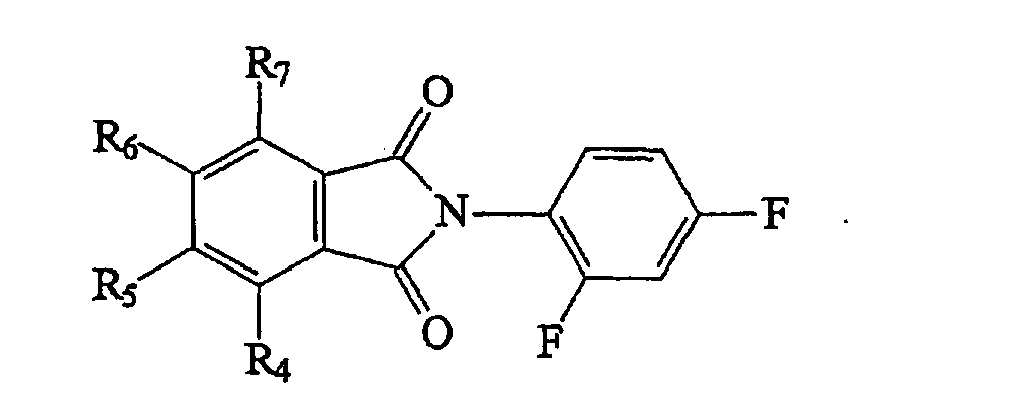
- For example, rather than 2,4-fluoro, the following groups may be substituents on the phenyl ring: 2,3-difluoro; 2,5-difluoro; 2,6-difluoro; 3,4-difluoro; 3,5-difluoro; 2,3-dichloro; 2,4-dichloro; 2,4-dichloro; 2,6-dichloro; 2,4-dibromo; 2,5-dibromo; 2,6-dibromo; 2-fluoro; 3-fluoro; 4-fluoro; 2-chloro; 3-chloro; 4-chloro; 2-bromo; 3-bromo; 4-bromo; 2,3,4-trifluoro.
- The invention also includes pharmaceutical compositions that include one or more of the compounds of the present invention, or pharmaceutically acceptable salts thereof, and pharmaceutically acceptable carriers.
- Examples of some specific thalidomide analog compounds (having superior anti-angiogenic activity) that are members of the genus of Formula B of the present invention are


- The invention also includes pharmaceutical compositions that include one or more of the above-described compounds.
- The foregoing and other objects, features, and advantages of the invention will become more apparent from the following detailed description of particular examples that proceed with reference to the accompanying figures.
-
-
Fig. 1 is a photomicrograph of a control comprising a rat aorta ring treated with DMSO. -
Fig. 2 is a photomicrograph of another rat aorta ring treated with about 100 µM of CPS49. - The term "halogen" refers to fluoro, bromo, chloro and iodo substituents.
- A "pharmaceutical agent" or "drug" refers to a chemical compound or composition capable of inducing a desired therapeutic or prophylactic effect when properly administered to a subject.
- The pharmaceutically acceptable salts of the compounds of this invention include those formed from cations such as sodium, potassium, aluminum, calcium, lithium, magnesium, zinc, and from bases such as ammonia, ethylenediamine, N-methyl-glutamine, lysine, arginine, ornithine, choline, N,N'-dibenzylethylenediamine, chloroprocaine, diethanolamine, procaine, N-benzylphenethylamine, diethylamine, piperazine, tris(hydroxymethyl)aminomethane, and tetramethylammonium hydroxide. These salts may be prepared by standard procedures, for example by reacting the free acid with a suitable organic or inorganic base. Any chemical compound recited in this specification may alternatively be administered as a pharmaceutically acceptable salt thereof.
- All chemical compounds include both the (+) and (-) stereoisomers, as well as either the (+) or (-) stereoisomer.
- A thalidomide "analog" as used herein is a synthetic chemical compound using the thalidomide structure as a backbone (i.e., side groups have been added or such groups have been deleted from the parent structure). The analog differs in structure from thalidomide and its metabolite compounds such as by a difference in the length of an alkyl chain, a molecular fragment, by one or more functional groups, or a change in ionization. Thalidomide analogs generally are not naturally occurring compounds. That is, thalidomide analogs generally cannot be enzymatically or nonenzymatically formed in the body by administration of thalidomide.
- A thalidomide "metabolite" is a thalidomide derivative that is formed by enzymatic action, i.e., metabolism of thalidomide in the body. The metabolite is formed by phase-one reactions (e.g., oxidation, reduction, and hydrolysis) or by phase-two reactions (e.g., conjugations). Thalidomide metabolites require an enzyme reaction to be produced.
- "Angiogenesis" refers to the development of blood vessels. Accordingly, "anti-angiogenic activity" refers to the inhibition and/or complete cessation of angiogenesis.
- "Tumor" refers to a mass of cells resulting from excessive cellular multiplication.
- Other chemistry terms herein are used according to conventional usage in the art, as exemplified by The McGraw-Hill Dictionary of Chemical Terms (1985), The Condensed Chemical Dictionary (1981), and Dorland's Illustrated Medical Dictionary (1974).
- A "mammal" includes both human and non-human mammals. Similarly, the term "subject" includes both human and veterinary subjects.
- An "animal" is a living multicellular vertebrate organism, a category that includes, for example, mammals and birds.
- "Thalidomide" or N-(2,6-dioxopiperidin-3-yl)phthalimide has the following chemical structure:

- Where necessary, solvents were dried and purified according to the recommended procedures. Organic solutions were dried over NaSO4. Evaporation refers to removal of solvent on a Vacuubrand rotary evaporator under reduced pressure of from about 200 to about 15 mbar. Melting points were determined using a Boetius apparatus and are uncorrected. 1H NMR spectra (300 Mhz), 13C NMR spectra (75 MHz), and 19F spectra (188 MHz) were recorded on a Varian Gemini 300 spectrometer with tetramethylsilane as internal standard; the values of chemical shifts (δ) are given in ppm and coupling constants (J) in Hz. Mass spectral data were determined by direct insertion at 70 eV with a Varian MAT CH6 spectrometer as well as a HP-MS Engine 5989A. Yields refer to purified products and are not optimized.
- Compounds are identified throughout this detailed description using alpha-numeric references in bold, which correspond to the identification of the compounds as set forth in the Summary of the Invention, and in the following examples.
- This example illustrates the preparation and analysis of 2-(2,4-difluorophenyl)-4,7-dimethyl-1H-isoindole-1,3(2H)-dione having an exact mass of 287.08, a molecular weight of about 287.6 (carbon about 66.90%, hydrogen about 3.86%, fluoride about 13.23%, nitrogen about 4.88%, and oxygen about 11.14%).
- A mixture of about 2 g (about 15.6 mmol) of 2,4-difluoroaniline, about 2.46 g (about 14 mmol) of 3,6-dimethylphthalic anhydride, and about 100 mL of glacial acetic acid was refluxed for about 3.5 hours. The 3,6-dimethylphthalic anhydride was prepared according to Newman, M. S.; Lord, B. T., J. Am. Chem. Soc., 1944, 66, 733 .
- The solvent was evaporated to dryness under reduced pressure of from about 200 to about 15 mbar. The residue was dissolved in about 130 mL of CH2C12. The solution was washed three times with about 50 mL of about 0.1 M HCl and twice with about 50 mL of H2O and was then dried with Na2SO4. After removal of the solvent, the residue was recrystallized from ethyl alcohol to yield about 1.27 g (32%) 2-(2,4-difluorophenyl)-4,7-dimethyl-1H-isoindole-1,3(2H)-dione having a melting point of about 212° to about 212.5° C.
- The 1H NMR spectral analysis results were as follows: (DMSO-d6) 2.59 (s, 6H), 7.24-7.32 (m, 1H), 7.46-7.56 (m, 1H), 7.54 (s, 2H) 7.56-7.66 (m, 1H). The 13C NMR spectral analysis results were as follows: (DMSO-d6) 16.87 (CH3), 104.93 (dd, 2J = 27.1, 24.2 Hz, C-3'), 112.08 (dd, 2J = 22.6, 4J = 3.6 Hz, C-5'), 115.93 (dd, 2J =13.2, 4J = 3.9 Hz, C-1'), 128.15 (C-4, C-7), 132.07 (dd, 3J = 10.1, 2.1 Hz, C-6') 135.37 (C-3a, C-7a), 136.62 (C-5, C-6), 157.81 and 162.08 (d, J = 264.1 Hz and d, J = 235.6 Hz, C-2' and C-4'), 166.64 (C-1, C-3). Mass spectrometry analysis (EI) results yielded, m/z (relative intensity), 287 (M+, 1-00), 259 (81c). Analytically calculated values for the compound C16H11NO2F2 were carbon 66.90%, hydrogen 3.86%, and nitrogen 4.88%. As determined from the NMR and mass spectrometry analysis result values for the compound C16H11NO2F2 were carbon about 67.20%, hydrogen about 3.77%, and nitrogen about 4.59%.
- This example illustrates the preparation and analysis of 2-(2,4-difluoro-phenyl)-4,5,6,7-tetrafluoro-1H-isoindole-1,3(2H)-dione (C14H3F6NO2) having an exact mass of 331.01 and a molecular weight of about 331.2 (carbon about 50.77%, hydrogen about 0.91 %, fluoride about 34.42%, nitrogen about 4.23%, and oxygen about 9.66%).
- A mixture of about 1 g (about 7.75 mmol) of 2,4-difluoroaniline, about 1.54 g (about 7 mmol) of tetrafluorophthalic anhydride and about 50 mL of glacial acetic acid was refluxed for about 3.5 hours. The solvent was evaporated to dryness under reduced pressure of from about 200 to about 15 mbar. The residue was dissolved in about 75 mL of CH2C12. The solution was washed three times with about 25 mL of about 0.1 M HCl and twice with about 25 mL of water. The residue was then dried with Na2SO4. After removal of the solvent, the residue was recrystallized from ethyl alcohol to yield about 980 mg (about 42%) of 2-(2,4-difluorophenyl)-4,5,6,7-tetrafluoro-1H-isoindole-1,3(2H)-dione with a melting point of about 145° to about 146° C.
- The 1H NMR spectral analysis results were as follows: (DMSO-d6) 7.22-7.38 (m, 1H), 7.50-7.66 (m, 2H). The 19F NMR spectral analysis results were as follows: (DMSO-d6/CFCl3) -142.3 (m, 2F), -136.9 (m, 2F), -113.8 (m, 1F), -105.6 (m,1F). The mass spectral (EI) analysis results were as follows: m/z (relative intensity), 331 (M+, 65), 287 (68), 148 (100). Analytically calculated values for the compound C14H3NO2F6 were carbon about 50.78%, hydrogen about 0.91%, and nitrogen about 4.23%. As determined from the NMR and mass spectrometry analysis results values for the compound C14H3NO2F6 were carbon about 50.60%, hydrogen about 0.83%, and nitrogen about 3.95%.
- HUVEC MTT assays were performed for the selected thalidomide analogs of the present disclosure to determine a rough estimate of the efficacy of such compounds in the inhibition of angiogenesis. For the MTT assay, 1.0 to 2.5 x 10³ cells per well were plated in 96-well plates in 0.1 ml medium, in triplicate. After 24 hours, the cells were exposed to treatment for 5 days. One plate was analyzed every 24 hours by the addition of 20 µL of 5 mg/ml MTT solution (available from Sigma of St. Louis, MO) in PBS, to each well for 4 hours. The MTT solution was aspirated and 170 µL DMSO was added to each well to dissolve the formazan crystals. The absorbance at 540 nm was measured using a Biokinetics plate reader (available from Bio-Tek Instruments of Winooski, VT). Triplicate wells were assayed for each condition. The assay protocol described herein stems from Kruger et al., a protein kinase C inhibitor, inhibits endothelial cell proliferation and angiogenic hypoxic response, Invasion and Metastasis, 18(4): 209-218 ).
- The following results for the selected compounds were determined measured utilizing growth curves comparing control wells to treated wells using the MTT assays.
- 2-(2,4-difluorophenyl)-4,7-dimethyl-1H-isoindole-1,3(2H)-dione (CPS42) - An inhibition of about 44% was found at 100 µM but no such activity was found at a level of about 10 µM.
- 2-(2,4-difluoro-phenyl)-4,5,6,7-tetrafluoro-1H-isoindole-1,3(2H)-dione (CPS49) - A potent inhibition of about 90% was found at 100 µM but no such activity was found at a level of about 10 µM.
- The efficacy of a selected thalidomide analog of the present invention was studied by five-day treatment of rat aortic rings (utilizing Sprague-Dawley-rats available from Charles River Labs). A DMSO control was utilized (
Fig. 1 ). The results, determined using image analysis comparing control rings versus the treated rings (using NIM. Image software), of the studies are as follows: - 2-(2,4-difluoro-phenyl)-4,5,6,7-tetrafluoro-1H-isoindole-1,3(2H)-dione (CPS49) - A daily dosage of 100 µM showed extensive angiogenesis inhibition activity (
Fig. 2 ). - Toxicology screen studies have been performed for the thalidomide analogs of the present invention. The results of such toxicology screening studies for selected thalidomide analogs are as follows:
- 2-(2,4-difluorophenyl)-4,7-dimethyl-1H-isoindole-1,3(2H)-dione (CPS42) - Treatment was safe at a dosage level 200 mg/kg, i.p., single dose. Slight sedation was noted within 15 minutes of injection.
- 2-(2,4-difluoro-phenyl)-4,5,6,7-tetrafluoro-1H-isoindole-1,3(2H)-dione (CPS49) - A dose of 200 mg/kg, i.p., single dose, was a lethal dose. Animals treated with such dosage died within 18 hours of treatment.
- The present invention includes a treatment for undesirable angiogenesis and angiogenesis dependent or associated diseases, in a subject such as an animal, for example a rat or human. The method includes administering one or more of the compounds of the present invention, or a combination of one or more of the compounds and one or more other pharmaceutical agents, to the subject in a pharmaceutically compatible carrier. The administration is made in an amount effective to inhibit the development or progression of angiogenesis and diseases associated with the same. Although the treatment can be used prophylactically in any patient in a demographic group at significant risk for such diseases, subjects can also be selected using more specific criteria, such as a definitive diagnosis of the condition.
- The vehicle in which the drug is delivered can include pharmaceutically acceptable compositions of the drugs, using methods well known to those with skill in the art. Any of the common carriers, such as sterile saline or glucose solution, can be utilized with the drugs provided by the invention. Routes of administration include but are not limited to oral and parenteral routes, such as intravenous (iv), intraperitoneal (ip), rectal, topical, ophthalmic, nasal, and transdermal.
- The drugs may be administered in a suitable manner now known or later developed, e.g., orally or intravenously, in any conventional medium. For example, intravenous injection may be by an aqueous saline medium. The medium may also contain conventional pharmaceutical adjunct materials such as, for example, pharmaceutically acceptable salts to adjust the osmotic pressure, lipid carriers such as cyclodextrins, proteins such as serum albumin, hydrophilic agents such as methyl cellulose, detergents, buffers, preservatives and the like. A more complete explanation of parenteral pharmaceutical carriers can be found in Remington: The Science and Practice of Pharmacy (19th Edition, 1995) in chapter 95.
- Embodiments of other pharmaceutical compositions can be prepared with conventional pharmaceutically acceptable carriers, adjuvants and counterions as would be known to those of skill in the art. The compositions are preferably in the form of a unit dose in solid, semi-solid and liquid dosage forms such as tablets, pills, powders, liquid solutions or suspensions.
- The compounds of the present invention are ideally administered as soon as possible after detected unwanted angiogenesis. For example, once unwanted angiogenesis has been confirmed or the presence of a tumor has been identified, a therapeutically effective amount of the drug is administered. The dose can be given orally or by frequent bolus administration.
- Therapeutically effective doses of the compounds of the present invention can be determined by one of skill in the art, with a goal of achieving a desired level of anti-angiogenesis as illustrated in the foregoing examples. The relative toxicities of the compounds make it possible to administer in various dosage ranges. An example of such a dosage range is from about 0.5 to about 50 mg/kg body weight orally in single or divided doses. Another example of a dosage range is from about 0.5 to about 50 mg/kg body weight orally in single or divided doses. For oral administration, the compositions are, for example, provided in the form of a tablet containing from about 25 to about 500 mg of the active ingredient, particularly 100 mg of the active ingredient for the symptomatic adjustment of the dosage to the subject being treated.
- The specific dose level and frequency of dosage for any particular subject may be varied and will depend upon a variety of factors, including the activity of the specific compound, the extent of existing angiogenic activity, the age, body weight, general health, sex, diet, mode and time of administration, rate of excretion, drug combination, and severity of the condition of the host undergoing therapy.
- The pharmaceutical compositions can be used in the treatment of a variety of diseases mediated by angiogenesis. Examples of such diseases include all types of cancer, ocular neovascular disease, solid tumor formation and metastasis in solid tumors such as rhabdomyosarcomas, retinoblastoma, Ewing sarcoma, neuroblastoma, osteosarcoma, colon, prostate, head and neck, breast, bladder, liver, pancreatic, lung, CNS, and blood-born tumors such as leukemia, also diseases such as hemangioma, ulcerative colitis, Crohn's disease, diabetic retinopathy, macular degeneration, sickle cell anemia, sarcoid, syphilis, pseudoxanthoma elasticum, Paget's disease, vein occlusion, artery occlusion, carotid obstructive disease, chronic uveitis/vitritis, mycobacterial infections, Lyme's disease, systemic lupus erythematosis, retinopathy of prematurity, Eale's disease, Bechet's disease, infections causing a retinitis or choroiditis, presumed ocular histoplasmosis, Best's disease, myopia, optic pits, Stargart's disease, pars planitis, chronic retinal detachment, hyperviscosity syndromes, toxoplasmosis, trauma and post-laser complications. Other diseases include, but are not limited to, diseases associated with rubeosis (neovasculariation of the angle) and diseases caused by the abnormal proliferation of fibrovascular or fibrous tissue including all forms of proliferative vitreoretinopathy.
- The present invention also includes combinations of the thalidomide analogs of the present invention and/or combination of the same with various other angiogenesis inhibitor compounds. For example, the compounds of this invention may be administered in combination with effective doses of other anti-angiogenic agents. The term "administration" refers to both concurrent and sequential administration of the active agents. Examples of anti-angiogenic agents that can be used in combination with the thalidomide analogs of the present invention are TNP-470, carbonic anhydrase inhibitors, endostatin, angiostatin, 2-methoxyestradiol, IMiD (Immune-modulating inhibitor drug) CC5013, matrix metalloproteinase inhibitors, and COL-3. In addition, the thalidomide analogs of this invention may be used in combination with other forms of cancer therapy, e.g., chemotherapy, radiation therapy, hormonal therapy).
- In view of the many possible embodiments to which the principles of our invention may be applied, it should be recognized that the illustrated embodiment is only a preferred example of the invention and should not be taken as a limitation on the scope of the invention. Rather, the scope of the invention is defined by the following claims.
Claims (10)
- A composition that inhibits angiogenesis-mediated diseases in a subject when administered in an effective amount, wherein the composition comprises one or more compounds having the following formula or pharmaceutically acceptable salts thereof:

- The composition of claim 1, wherein the compound is:

- The composition of claim 1, wherein the compound is:

- A compound having the following formula, or a pharmaceutically acceptable salt thereof, wherein the compound is:

- A pharmaceutical composition comprising the compound of claim 1, or a pharmaceutically acceptable salt thereof, and a pharmaceutically acceptable carrier.
- A pharmaceutical composition comprising the compound of claim 4, or a pharmaceutically acceptable salt thereof, and a pharmaceutically acceptable carrier.
- Use of a composition in the manufacture of a medicament for inhibiting an angiogenesis mediated disease in a subject, the composition comprising:one or more compounds, for administering to a subject, selected from the group consisting of the following compounds, and mixtures thereof, or pharmaceutically acceptable salts thereof:wherein R4 through R7 are, independently, a halogen, R4 through R7 may comprise the same or different halogens or R5 and R6 are hydrogen and R4 and R7 are methyl groups, or wherein R4 through R7 comprise groups on the isoindole ring such as to obtain 4-nitro, 5,6-dichloro, 4-methyl, 5-methyl or 5,6-dimethyl or wherein the isoindole ring is replaced with a succinimide or a maleimide, or wherein one or more of the fluorides on the phenyl ring is replaced with a different halogen.

- Use of the composition of claim 7, wherein the compound is:

- Use of the composition of claim 7, wherein the compound is:

- Use of the compound of claim 4, for the manufacture of a medicament for inhibiting an angiogenesis-mediated disease, wherein the compound is administered in a therapeutically effective amount to a subject.
Applications Claiming Priority (3)
| Application Number | Priority Date | Filing Date | Title |
|---|---|---|---|
| US27194101P | 2001-02-27 | 2001-02-27 | |
| US271941P | 2001-02-27 | ||
| PCT/US2002/005868 WO2002068414A2 (en) | 2001-02-27 | 2002-02-26 | Analogs of thalidomide as potential angiogenesis inhibitors |
Publications (3)
| Publication Number | Publication Date |
|---|---|
| EP1389203A2 EP1389203A2 (en) | 2004-02-18 |
| EP1389203B1 true EP1389203B1 (en) | 2009-12-02 |
| EP1389203B8 EP1389203B8 (en) | 2010-03-10 |
Family
ID=23037728
Family Applications (1)
| Application Number | Title | Priority Date | Filing Date |
|---|---|---|---|
| EP02780964A Expired - Lifetime EP1389203B8 (en) | 2001-02-27 | 2002-02-26 | Analogs of thalidomide as angiogenesis inhibitors |
Country Status (9)
| Country | Link |
|---|---|
| US (2) | US7320991B2 (en) |
| EP (1) | EP1389203B8 (en) |
| JP (2) | JP4361273B2 (en) |
| AT (1) | ATE450529T1 (en) |
| AU (1) | AU2002306596B2 (en) |
| CA (1) | CA2439410C (en) |
| DE (1) | DE60234585D1 (en) |
| ES (1) | ES2338534T3 (en) |
| WO (1) | WO2002068414A2 (en) |
Families Citing this family (83)
| Publication number | Priority date | Publication date | Assignee | Title |
|---|---|---|---|---|
| HU228769B1 (en) * | 1996-07-24 | 2013-05-28 | Celgene Corp | Substituted 2(2,6-dioxopiperidin-3-yl)phthalimides and -1-oxoisoindolines and their use for production of pharmaceutical compositions for mammals to reduce the level of tnf-alpha |
| US7629360B2 (en) * | 1999-05-07 | 2009-12-08 | Celgene Corporation | Methods for the treatment of cachexia and graft v. host disease |
| US6458810B1 (en) | 2000-11-14 | 2002-10-01 | George Muller | Pharmaceutically active isoindoline derivatives |
| NZ526683A (en) * | 2000-11-30 | 2008-03-28 | Childrens Medical Center | Synthesis of 4-amino-thalidomide and its enantiomers that are suitable for inhibiting angiogenesis |
| EP1389203B8 (en) | 2001-02-27 | 2010-03-10 | The Governement of the United States of America, represented by The Secretary Department of Health and Human services | Analogs of thalidomide as angiogenesis inhibitors |
| USRE48890E1 (en) | 2002-05-17 | 2022-01-11 | Celgene Corporation | Methods for treating multiple myeloma with 3-(4-amino-1-oxo-1,3-dihydroisoindol-2-yl)-piperidine-2,6-dione after stem cell transplantation |
| US20100129363A1 (en) * | 2002-05-17 | 2010-05-27 | Zeldis Jerome B | Methods and compositions using pde4 inhibitors for the treatment and management of cancers |
| WO2003097040A1 (en) * | 2002-05-17 | 2003-11-27 | Celgene Corporation | Methods and compositions using selective cytokine inhibitory drugs for treatment and management of cancers and other diseases |
| US7323479B2 (en) * | 2002-05-17 | 2008-01-29 | Celgene Corporation | Methods for treatment and management of brain cancer using 1-oxo-2-(2,6-dioxopiperidin-3-yl)-4-methylisoindoline |
| US7393862B2 (en) | 2002-05-17 | 2008-07-01 | Celgene Corporation | Method using 3-(4-amino-1-oxo-1,3-dihydro-isoindol-2-yl)-piperidine-2,6-dione for treatment of certain leukemias |
| US7968569B2 (en) * | 2002-05-17 | 2011-06-28 | Celgene Corporation | Methods for treatment of multiple myeloma using 3-(4-amino-1-oxo-1,3-dihydro-isoindol-2-yl)-piperidine-2,6-dione |
| US8404716B2 (en) | 2002-10-15 | 2013-03-26 | Celgene Corporation | Methods of treating myelodysplastic syndromes with a combination therapy using lenalidomide and azacitidine |
| US7842691B2 (en) * | 2002-10-15 | 2010-11-30 | Celgene Corporation | Method for the treatment of myelodysplastic syndromes using cyclopropanecarboxylic acid {2-[1-(3-ethoxy-4-methoxy-phenyl)-2-methanesulfonyl-ethyl]-3-OXO-2,3-dihydro-1 H-isoindol-4-yl}-amide |
| US8404717B2 (en) * | 2002-10-15 | 2013-03-26 | Celgene Corporation | Methods of treating myelodysplastic syndromes using lenalidomide |
| US7189740B2 (en) * | 2002-10-15 | 2007-03-13 | Celgene Corporation | Methods of using 3-(4-amino-oxo-1,3-dihydro-isoindol-2-yl)-piperidine-2,6-dione for the treatment and management of myelodysplastic syndromes |
| US11116782B2 (en) | 2002-10-15 | 2021-09-14 | Celgene Corporation | Methods of treating myelodysplastic syndromes with a combination therapy using lenalidomide and azacitidine |
| US20050203142A1 (en) * | 2002-10-24 | 2005-09-15 | Zeldis Jerome B. | Methods of using and compositions comprising immunomodulatory compounds for treatment, modification and management of pain |
| US20040091455A1 (en) * | 2002-10-31 | 2004-05-13 | Zeldis Jerome B. | Methods of using and compositions comprising immunomodulatory compounds for treatment and management of macular degeneration |
| KR20090048520A (en) | 2002-11-06 | 2009-05-13 | 셀진 코포레이션 | Method of using and selective composition of selective cytokine inhibitory drugs for the treatment and management of cancer and other diseases |
| US8034831B2 (en) * | 2002-11-06 | 2011-10-11 | Celgene Corporation | Methods for the treatment and management of myeloproliferative diseases using 4-(amino)-2-(2,6-Dioxo(3-piperidyl)-isoindoline-1,3-dione in combination with other therapies |
| US7563810B2 (en) * | 2002-11-06 | 2009-07-21 | Celgene Corporation | Methods of using 3-(4-amino-1-oxo-1,3-dihydroisoindol-2-yl)-piperidine-2,6-dione for the treatment and management of myeloproliferative diseases |
| UA83504C2 (en) | 2003-09-04 | 2008-07-25 | Селджин Корпорейшн | Polymorphic forms of 3-(4-amino-1-oxo-1,3 dihydro-isoindol-2-yl)-piperidine-2,6-dione |
| US8952895B2 (en) | 2011-06-03 | 2015-02-10 | Apple Inc. | Motion-based device operations |
| WO2005028436A2 (en) * | 2003-09-17 | 2005-03-31 | The Government Of The United States Of America, As Represented By The Secretary Of The Department Of Health And Human Services | Thalidomide analogs as tnf-alpha modulators |
| US20080027113A1 (en) * | 2003-09-23 | 2008-01-31 | Zeldis Jerome B | Methods of Using and Compositions Comprising Immunomodulatory Compounds for Treatment and Management of Macular Degeneration |
| US7612096B2 (en) * | 2003-10-23 | 2009-11-03 | Celgene Corporation | Methods for treatment, modification and management of radiculopathy using 1-oxo-2-(2,6-dioxopiperidin-3yl)-4-aminoisoindoline |
| EP1684758A4 (en) * | 2003-11-06 | 2009-02-18 | Celgene Corp | Methods and compositions using thalidomide for the treatment and management of cancers and other diseases. |
| US20050100529A1 (en) * | 2003-11-06 | 2005-05-12 | Zeldis Jerome B. | Methods of using and compositions comprising immunomodulatory compounds for the treatment and management of asbestos-related diseases and disorders |
| US20050143344A1 (en) * | 2003-12-30 | 2005-06-30 | Zeldis Jerome B. | Methods and compositions using immunomodulatory compounds for the treatment and management of central nervous system disorders or diseases |
| MXPA06010699A (en) * | 2004-03-22 | 2006-12-15 | Celgene Corp | Methods of using and compositions comprising immunomodulatory compounds for the treatment and management of skin diseases or disorders. |
| US20050222209A1 (en) * | 2004-04-01 | 2005-10-06 | Zeldis Jerome B | Methods and compositions for the treatment, prevention or management of dysfunctional sleep and dysfunctional sleep associated with disease |
| CN1972686A (en) * | 2004-04-14 | 2007-05-30 | 细胞基因公司 | Use of Selective Cytokine Inhibitors in Myelodysplastic Syndrome |
| CN1968695A (en) * | 2004-04-14 | 2007-05-23 | 细胞基因公司 | Compositions comprising immunomodulatory compounds for the treatment and control of myelodysplastic syndromes and using methods |
| JP2007533761A (en) * | 2004-04-23 | 2007-11-22 | セルジーン・コーポレーション | Methods of using immunomodulatory compounds and compositions containing immunomodulatory compounds for treating and managing pulmonary hypertension |
| CA2588597A1 (en) * | 2004-11-23 | 2006-06-01 | Celgene Corporation | Methods and compositions using immunomodulatory compounds for treatment and management of central nervous system injury |
| CN100383139C (en) | 2005-04-07 | 2008-04-23 | 天津和美生物技术有限公司 | Piperidine-2,6-dione derivatives that can inhibit the release of tumor necrosis factor from cells |
| US20060270707A1 (en) * | 2005-05-24 | 2006-11-30 | Zeldis Jerome B | Methods and compositions using 4-[(cyclopropanecarbonylamino)methyl]-2-(2,6-dioxopiperidin-3-yl)isoindole-1,3-dione for the treatment or prevention of cutaneous lupus |
| US20080138295A1 (en) * | 2005-09-12 | 2008-06-12 | Celgene Coporation | Bechet's disease using cyclopropyl-N-carboxamide |
| US20070155791A1 (en) * | 2005-12-29 | 2007-07-05 | Zeldis Jerome B | Methods for treating cutaneous lupus using aminoisoindoline compounds |
| CA2648216C (en) * | 2006-04-13 | 2016-06-07 | Michael Gutschow | Tetrahalogenated compounds useful as inhibitors of angiogenesis |
| CL2007002218A1 (en) * | 2006-08-03 | 2008-03-14 | Celgene Corp Soc Organizada Ba | USE OF 3- (4-AMINO-1-OXO-1,3-DIHIDRO-ISOINDOL-2-IL) -PIPERIDINE 2,6-DIONA FOR THE PREPARATION OF A USEFUL MEDICINAL PRODUCT FOR THE TREATMENT OF LAYER CELL LYMPHOMA. |
| US8877780B2 (en) | 2006-08-30 | 2014-11-04 | Celgene Corporation | 5-substituted isoindoline compounds |
| WO2009020590A1 (en) | 2007-08-07 | 2009-02-12 | Celgene Corporation | Methods for treating lymphomas in certain patient populations and screening patients for said therapy |
| GB0914330D0 (en) | 2009-08-17 | 2009-09-30 | Univ Dublin City | A method of predicting response to thalidomide in multiple myeloma patients |
| JP2013537172A (en) | 2010-09-09 | 2013-09-30 | トリフォイリウム エーピーエス | Respiratory administration of angiogenesis inhibitors |
| NZ607473A (en) | 2010-09-27 | 2014-11-28 | Morphosys Ag | Anti-cd38 antibody and lenalidomide or bortezomib for the treatment of multiple myeloma and nhl |
| LT2785695T (en) * | 2011-11-30 | 2020-08-25 | F. Hoffmann-La Roche Ag | New bicyclic dihydroisoquinoline-1-one derivatives |
| US8927725B2 (en) | 2011-12-02 | 2015-01-06 | The United States Of America, As Represented By The Secretary, Department Of Health And Human Services | Thio compounds |
| US10126301B2 (en) | 2013-02-08 | 2018-11-13 | Institute For Myeloma & Bone Cancer Research | Diagnostic, prognostic, and monitoring methods for multiple myeloma, chronic lymphocytic leukemia, and B-cell non-hodgkin lymphoma |
| US20180228907A1 (en) | 2014-04-14 | 2018-08-16 | Arvinas, Inc. | Cereblon ligands and bifunctional compounds comprising the same |
| CN119591582A (en) * | 2014-04-14 | 2025-03-11 | 阿尔维纳斯运营股份有限公司 | Imide-based proteolytic modulators and related methods of use |
| WO2015184087A2 (en) | 2014-05-28 | 2015-12-03 | Institute For Myeloma & Bone Cancer Research | Anti-cancer effects of jak2 inhibitors in combination with thalidomide derivatives and glucocorticoids |
| MX388181B (en) | 2014-07-22 | 2025-03-19 | Cb Therapeutics Inc | ANTI-PD-1 ANTIBODIES. |
| JP6909153B2 (en) | 2014-08-05 | 2021-07-28 | アポロミクス インコーポレイテッド | Anti-PD-L1 antibody |
| US10034872B2 (en) | 2014-08-22 | 2018-07-31 | Celgene Corporation | Methods of treating multiple myeloma with immunomodulatory compounds in combination with antibodies |
| HUE065109T2 (en) | 2015-06-26 | 2024-05-28 | Celgene Corp | Methods for the treatment of kaposi's sarcoma or kshv-induced lymphoma using immunomodulatory compounds, and uses of biomarkers |
| EP3662909A1 (en) | 2015-07-24 | 2020-06-10 | Oncotracker, Inc. | Gamma secretase modulators for the treatment of immune system dysfunction |
| ES2898329T3 (en) | 2016-01-12 | 2022-03-07 | Oncotracker Inc | Improved methods for monitoring the immune status of a subject |
| CN115932265B (en) | 2016-05-30 | 2026-04-14 | 因塞特公司 | Methods of predicting therapeutic benefit of CD19 antibody treatment in a patient |
| US20200078400A1 (en) | 2016-12-03 | 2020-03-12 | Juno Therapeutics, Inc. | Methods for determining car-t cells dosing |
| US20190358262A1 (en) | 2016-12-03 | 2019-11-28 | Juno Therapeutics, Inc. | Methods for modulation of car-t cells |
| CN106806366B (en) * | 2016-12-29 | 2020-02-11 | 兰州大学 | New application of isoindole-1, 3-diketone compound |
| KR20240139092A (en) | 2017-05-01 | 2024-09-20 | 주노 쎄러퓨티크스 인코퍼레이티드 | Combination of a cell therapy and an immunomodulatory compound |
| CN111225675B (en) | 2017-06-02 | 2024-05-03 | 朱诺治疗学股份有限公司 | Articles and methods of treatment using adoptive cell therapy |
| WO2018231944A1 (en) | 2017-06-13 | 2018-12-20 | Berenson James R | Diagnostic, prognostic, and monitoring methods for solid tumor cancers |
| EP3644721A1 (en) | 2017-06-29 | 2020-05-06 | Juno Therapeutics, Inc. | Mouse model for assessing toxicities associated with immunotherapies |
| KR20200086278A (en) | 2017-10-18 | 2020-07-16 | 노파르티스 아게 | Compositions and methods for selective proteolysis |
| US12031975B2 (en) | 2017-11-01 | 2024-07-09 | Juno Therapeutics, Inc. | Methods of assessing or monitoring a response to a cell therapy |
| CA3080904A1 (en) | 2017-11-01 | 2019-05-09 | Juno Therapeutics, Inc. | Antibodies and chimeric antigen receptors specific for b-cell maturation antigen |
| KR20200116081A (en) | 2017-12-01 | 2020-10-08 | 주노 쎄러퓨티크스 인코퍼레이티드 | Methods of administration and control of genetically engineered cells |
| WO2019118937A1 (en) | 2017-12-15 | 2019-06-20 | Juno Therapeutics, Inc. | Anti-cct5 binding molecules and methods of use thereof |
| CA3117978A1 (en) | 2018-11-08 | 2020-05-14 | Juno Therapeutics, Inc. | Methods and combinations for treatment and t cell modulation |
| EP3880238A1 (en) | 2018-11-16 | 2021-09-22 | Juno Therapeutics, Inc. | Methods of dosing engineered t cells for the treatment of b cell malignancies |
| BR112021010354A2 (en) | 2018-11-30 | 2021-11-03 | Juno Therapeutics Inc | Methods for treatment using adoptive cell therapy |
| WO2020117759A1 (en) * | 2018-12-03 | 2020-06-11 | Dana-Farber Cancer Institute, Inc. | Small molecule degraders of helios and methods of use |
| CA3123303A1 (en) | 2019-01-29 | 2020-08-06 | Juno Therapeutics, Inc. | Antibodies and chimeric antigen receptors specific for receptor tyrosine kinase like orphan receptor 1 (ror1) |
| EP3959320A1 (en) | 2019-04-24 | 2022-03-02 | Novartis AG | Compositions and methods for selective protein degradation |
| AU2020267823A1 (en) | 2019-05-03 | 2021-11-11 | Incyte Corporation | Anti-CD19 therapy in patients having a limited number of NK cells |
| AU2020376305A1 (en) | 2019-10-31 | 2022-05-12 | Incyte Corporation | Anti-CD19 therapy in combination with lenalidomide for the treatment of leukemia or lymphoma |
| WO2021084064A1 (en) | 2019-10-31 | 2021-05-06 | Morphosys Ag | Sequential anti-cd19 therapy |
| WO2023250400A1 (en) | 2022-06-22 | 2023-12-28 | Juno Therapeutics, Inc. | Treatment methods for second line therapy of cd19-targeted car t cells |
| WO2024097905A1 (en) | 2022-11-02 | 2024-05-10 | Celgene Corporation | Methods of treatment with t cell therapy and immunomodulatory agent maintenance therapy |
| WO2025076472A1 (en) | 2023-10-06 | 2025-04-10 | Juno Therapeutics, Inc. | Combination therapies with a cell therapy expressing a gprc5d-targeting car and related methods and uses |
Citations (1)
| Publication number | Priority date | Publication date | Assignee | Title |
|---|---|---|---|---|
| WO1994020085A1 (en) * | 1993-03-01 | 1994-09-15 | The Children's Medical Center Corporation | Methods and compositions for inhibition of angiogenesis |
Family Cites Families (55)
| Publication number | Priority date | Publication date | Assignee | Title |
|---|---|---|---|---|
| US2830991A (en) * | 1954-05-17 | 1958-04-15 | Gruenenthal Chemie | Products of the amino-piperidine-2-6-dione series |
| GB962857A (en) | 1961-12-04 | 1964-07-08 | Distillers Co Yeast Ltd | Process for the production of imides |
| GB1049283A (en) | 1962-04-14 | 1966-11-23 | Distillers Co Yeast Ltd | Substituted butyro-lactones and -thiolactones |
| US3320270A (en) * | 1963-10-08 | 1967-05-16 | Tri Kem Corp | Certain 2-acylimidothiazole compounds |
| US3314953A (en) * | 1964-03-16 | 1967-04-18 | Richardson Merrell Inc | 1-substituted-3-phthalimido-2, 5-dioxopyrrolidines |
| IL25595A (en) | 1965-05-08 | 1971-01-28 | Gruenenthal Chemie | New derivatives of cyclic imide compounds and process for the manufacture of these compounds |
| US3560495A (en) * | 1965-05-08 | 1971-02-02 | Ernst Frankus | 1-heterocyclic amino methyl or 1-heterocyclic hydrazino methyl-3-phthalimido or (3',6'-dithia-3',4',5',6'-tetrahydrophthalimido)-pyrrolidinediones-2,5 or piperidinediones-2,6 |
| GB1324718A (en) * | 1970-11-10 | 1973-07-25 | Nehezvegyipari Kutato Intezet | Phthalimido triazines |
| US4067718A (en) * | 1975-11-12 | 1978-01-10 | American Cyanamid Company | Method for controlling the relative stem growth of plants |
| US4291048A (en) * | 1978-07-06 | 1981-09-22 | Joseph Gold | Method of treating tumors and cancerous cachexia with L-tryptophan |
| DE3332633A1 (en) | 1983-09-09 | 1985-04-04 | Luitpold-Werk Chemisch-pharmazeutische Fabrik GmbH & Co, 8000 München | Substituted carboxylic acid derivatives, process for their preparation, and pharmaceuticals |
| GB9311281D0 (en) * | 1993-06-01 | 1993-07-21 | Rhone Poulenc Rorer Ltd | Novel composition of matter |
| WO1992018496A1 (en) | 1991-04-17 | 1992-10-29 | Grünenthal GmbH | New thalidomide derivatives, method of manufacture and use thereof in medicaments |
| US6096768A (en) * | 1992-01-28 | 2000-08-01 | Rhone-Poulenc Rorer Limited | Compounds containing phenyl linked to aryl or heteroaryl by an aliphatic- or heteroatom-containing linking group |
| US20010056114A1 (en) * | 2000-11-01 | 2001-12-27 | D'amato Robert | Methods for the inhibition of angiogenesis with 3-amino thalidomide |
| US6228879B1 (en) * | 1997-10-16 | 2001-05-08 | The Children's Medical Center | Methods and compositions for inhibition of angiogenesis |
| US5434170A (en) | 1993-12-23 | 1995-07-18 | Andrulis Pharmaceuticals Corp. | Method for treating neurocognitive disorders |
| US5443824A (en) | 1994-03-14 | 1995-08-22 | Piacquadio; Daniel J. | Topical thalidomide compositions for surface or mucosal wounds, ulcerations, and lesions |
| DE4422237A1 (en) * | 1994-06-24 | 1996-01-04 | Gruenenthal Gmbh | Use of lactam compounds as active pharmaceutical ingredients |
| US5789434A (en) * | 1994-11-15 | 1998-08-04 | Bayer Corporation | Derivatives of substituted 4-biarylbutyric acid as matrix metalloprotease inhibitors |
| JP3251796B2 (en) * | 1994-12-28 | 2002-01-28 | 株式会社日本自動車部品総合研究所 | Ceramic piezoelectric material |
| US6429221B1 (en) | 1994-12-30 | 2002-08-06 | Celgene Corporation | Substituted imides |
| JPH10511678A (en) | 1994-12-30 | 1998-11-10 | セルジーン コーポレイション | Immunotherapeutic imides / amides and their use to reduce levels of TNFα |
| US5783605A (en) * | 1995-02-27 | 1998-07-21 | Kuo; Sheng-Chu | Helper inducers for differentiation therapy and chemoprevention of cancer |
| AUPN278795A0 (en) | 1995-05-05 | 1995-05-25 | Neumann, Gregory Carl Heinrich | Animated displays |
| US5728844A (en) | 1995-08-29 | 1998-03-17 | Celgene Corporation | Immunotherapeutic agents |
| CA2251060C (en) | 1996-04-09 | 2006-09-12 | Grunenthal Gmbh | Acylated n-hydroxy methyl thalidomide prodrugs with immunomodulator action |
| DE19613976C1 (en) * | 1996-04-09 | 1997-11-20 | Gruenenthal Gmbh | Thalidomide prodrugs with immunomodulatory effects |
| CZ389398A3 (en) | 1996-05-29 | 1999-07-14 | Prototek, Inc. | Thalidomide promedicaments and their use for modulation or t-cell function |
| US5635517B1 (en) * | 1996-07-24 | 1999-06-29 | Celgene Corp | Method of reducing TNFalpha levels with amino substituted 2-(2,6-dioxopiperidin-3-YL)-1-oxo-and 1,3-dioxoisoindolines |
| PT2177517E (en) * | 1996-07-24 | 2011-11-10 | Celgene Corp | AMINO-SUBSTITUTED 2- (2,6-DIOXOPIPERIDIN-3-IL) -FTALIMIDE TO REDUCE TNF-ALFA LEVELS |
| WO1998007421A1 (en) * | 1996-08-16 | 1998-02-26 | Ishihara Sangyo Kaisha, Ltd. | Medicinal composition |
| JPH10109975A (en) | 1996-08-16 | 1998-04-28 | Ishihara Sangyo Kaisha Ltd | Pharmaceutical composition |
| DE69734290T2 (en) | 1996-11-05 | 2006-07-06 | The Children's Medical Center Corp., Boston | MEANS FOR INHIBITING ANGIOGENESIS-CONTAINING THALODOMIDE AND A NSAID |
| BR9714394A (en) | 1996-12-13 | 2000-05-16 | Lilly Co Eli | Inhibitors of psa enzyme activity |
| DE19703763C1 (en) | 1997-02-01 | 1998-10-01 | Gruenenthal Gmbh | Thalidomide-analogous compounds from the class of the piperidine-2,6-diones |
| RU2108786C1 (en) | 1997-09-15 | 1998-04-20 | Клавдия Степановна Евланенкова | Agent for treatment of oncological patients |
| DE19743968C2 (en) | 1997-10-06 | 2002-07-11 | Gruenenthal Gmbh | Intravenous application form of thalidomide for the therapy of immunological diseases |
| AU749356B2 (en) | 1998-05-11 | 2002-06-27 | Children's Medical Center Corporation | Analogs of 2-phthalimidinoglutaric acid and their use as inhibitors of angiogenesis |
| CN1188389C (en) | 1998-05-15 | 2005-02-09 | 阿斯特拉曾尼卡有限公司 | Benzamide derivatives for the treatment of diseases caused by cytokines |
| DE19843793C2 (en) * | 1998-09-24 | 2000-08-03 | Gruenenthal Gmbh | Substituted benzamides |
| US20030013739A1 (en) * | 1998-12-23 | 2003-01-16 | Pharmacia Corporation | Methods of using a combination of cyclooxygenase-2 selective inhibitors and thalidomide for the treatment of neoplasia |
| DK1040838T3 (en) | 1999-03-31 | 2003-05-26 | Gruenenthal Gmbh | Stable aqueous solution of 3- (1-oxo-1,3-dihydroisoindol-2-yl) piperidine-2,6-dione |
| US6310360B1 (en) * | 1999-07-21 | 2001-10-30 | The Trustees Of Princeton University | Intersystem crossing agents for efficient utilization of excitons in organic light emitting devices |
| AU4515001A (en) * | 1999-12-02 | 2001-06-18 | Regents Of The University Of Michigan, The | Compositions and methods for locally treating inflammatory diseases |
| AU2001249755A1 (en) * | 2000-03-31 | 2001-10-15 | Celgene Corporation | Inhibition of cyclooxygenase-2 activity |
| US6458810B1 (en) * | 2000-11-14 | 2002-10-01 | George Muller | Pharmaceutically active isoindoline derivatives |
| NZ526683A (en) | 2000-11-30 | 2008-03-28 | Childrens Medical Center | Synthesis of 4-amino-thalidomide and its enantiomers that are suitable for inhibiting angiogenesis |
| EP1389203B8 (en) | 2001-02-27 | 2010-03-10 | The Governement of the United States of America, represented by The Secretary Department of Health and Human services | Analogs of thalidomide as angiogenesis inhibitors |
| NZ531294A (en) | 2001-08-06 | 2005-11-25 | Childrens Medical Center | Synthesis and anti-tumor activity of nitrogen substituted thalidomide analogs |
| EP1336602A1 (en) | 2002-02-13 | 2003-08-20 | Giovanni Scaramuzzino | Nitrate prodrugs able to release nitric oxide in a controlled and selective way and their use for prevention and treatment of inflammatory, ischemic and proliferative diseases |
| EP2272513A1 (en) | 2002-05-17 | 2011-01-12 | Celgene Corporation | Pharmaceutical compositions for treating cancer |
| CN100488959C (en) | 2003-03-27 | 2009-05-20 | 天津和美生物技术有限公司 | Water soluble thalidomide derivative |
| EP1546146A1 (en) | 2003-06-03 | 2005-06-29 | Teva Pharmaceutical Industries Limited | POLYMORPHIC FORMS OF ZIPRASIDONE HCl AND PROCESSES FOR THEIR PREPARATION |
| WO2005016326A2 (en) | 2003-07-11 | 2005-02-24 | The Government Of The United States Of America As Represented By The Secretary Of The Department Of Health And Human Services | Analogs of thalidomide as potential angiogenesis inhibitors |
-
2002
- 2002-02-26 EP EP02780964A patent/EP1389203B8/en not_active Expired - Lifetime
- 2002-02-26 ES ES02780964T patent/ES2338534T3/en not_active Expired - Lifetime
- 2002-02-26 AU AU2002306596A patent/AU2002306596B2/en not_active Ceased
- 2002-02-26 WO PCT/US2002/005868 patent/WO2002068414A2/en not_active Ceased
- 2002-02-26 AT AT02780964T patent/ATE450529T1/en not_active IP Right Cessation
- 2002-02-26 CA CA2439410A patent/CA2439410C/en not_active Expired - Fee Related
- 2002-02-26 DE DE60234585T patent/DE60234585D1/de not_active Expired - Lifetime
- 2002-02-26 US US10/469,359 patent/US7320991B2/en not_active Expired - Fee Related
- 2002-02-26 JP JP2002567927A patent/JP4361273B2/en not_active Expired - Fee Related
-
2007
- 2007-07-19 US US11/880,404 patent/US8716315B2/en not_active Expired - Fee Related
-
2009
- 2009-06-16 JP JP2009143087A patent/JP2009263376A/en active Pending
Patent Citations (1)
| Publication number | Priority date | Publication date | Assignee | Title |
|---|---|---|---|---|
| WO1994020085A1 (en) * | 1993-03-01 | 1994-09-15 | The Children's Medical Center Corporation | Methods and compositions for inhibition of angiogenesis |
Also Published As
| Publication number | Publication date |
|---|---|
| US20040077685A1 (en) | 2004-04-22 |
| CA2439410C (en) | 2011-09-06 |
| DE60234585D1 (en) | 2010-01-14 |
| US20070293519A1 (en) | 2007-12-20 |
| ATE450529T1 (en) | 2009-12-15 |
| EP1389203A2 (en) | 2004-02-18 |
| US8716315B2 (en) | 2014-05-06 |
| CA2439410A1 (en) | 2002-09-06 |
| ES2338534T3 (en) | 2010-05-10 |
| AU2002306596B2 (en) | 2008-01-17 |
| WO2002068414A2 (en) | 2002-09-06 |
| JP2004523561A (en) | 2004-08-05 |
| WO2002068414A3 (en) | 2002-10-17 |
| EP1389203B8 (en) | 2010-03-10 |
| JP2009263376A (en) | 2009-11-12 |
| US7320991B2 (en) | 2008-01-22 |
| JP4361273B2 (en) | 2009-11-11 |
| WO2002068414A8 (en) | 2010-02-25 |
Similar Documents
| Publication | Publication Date | Title |
|---|---|---|
| CA2439410C (en) | Analogs of thalidomide as potential angiogenesis inhibitors | |
| AU2002306596A1 (en) | Analogs of thalidomide as potential angiogenesis inhibitors | |
| WO2005016326A2 (en) | Analogs of thalidomide as potential angiogenesis inhibitors | |
| US9242941B2 (en) | Alkyl, fluoroalkyl-1,4-benzodiazepinone compounds | |
| JP2015530411A (en) | Bis (fluoroalkyl) -1,4-benzodiazepinone compounds as Notch inhibitors | |
| TW200401768A (en) | Methods of treatment with CETP inhibitors and antihypertensive agents | |
| CN109563088B (en) | Multifunctional inhibitors of MEK/PI3K and mTOR/MEK/PI3K and therapeutic uses | |
| JP2000511559A (en) | N-substituted 2-cyanopyrrolidine | |
| KR20070047807A (en) | Isoindolin compounds and methods of using the same | |
| KR20150038547A (en) | Solid forms comprising (+)-2-[1-(3-ethoxy-4-methoxyphenyl)-2-methylsulfonylethyl]-4-acetylaminoisoindoline-1,3-dione, compositions thereof, and uses thereof | |
| BRPI1012313B1 (en) | Substituted derivatives of substituted isoindoline-1,3-dione, their use and pharmaceutical composition | |
| EP2512469A1 (en) | 3-(indolyl)-or 3-(azaindolyl)- 4-arylmaleimide derivatives for use in the treatment of colon and gastric adenocarzinoma | |
| JP2024001205A (en) | Deuterated analogs of elacridar | |
| JP5341521B2 (en) | Compounds and methods for inhibiting the interaction between a protein and a binding partner | |
| EP2542075A1 (en) | Fluorouracil derivatives | |
| TW200526585A (en) | Anti-inflammatory agents | |
| JPH10114651A (en) | Methods for inhibiting the growth of mammalian cells | |
| CA2134098A1 (en) | Biologically active ureido derivatives useful as antimetastatic agents | |
| CN1723206A (en) | Highly specific anticancer pharmacological drug system, drug synthesis and prescription development method | |
| WO2021087077A1 (en) | Small molecule inhibitors of autophagy and histone deactylases and uses thereof | |
| JPH02304058A (en) | Xanthocillin x monomethyl ether derivative and antineoplastic agent | |
| EA000166B1 (en) | Biologically active ureido derivatives useful in the treatment of multiple sclerosis | |
| CN113480520B (en) | A kind of isoquinoline-1,3(2H,4H)-dione derivative and application thereof | |
| CN115073442B (en) | Compound containing disulfide bonds, preparation method thereof, pharmaceutical composition and use thereof | |
| WO2024247648A1 (en) | Tumor therapeutic agent, and complex |
Legal Events
| Date | Code | Title | Description |
|---|---|---|---|
| PUAI | Public reference made under article 153(3) epc to a published international application that has entered the european phase |
Free format text: ORIGINAL CODE: 0009012 |
|
| 17P | Request for examination filed |
Effective date: 20030925 |
|
| AK | Designated contracting states |
Kind code of ref document: A2 Designated state(s): AT BE CH CY DE DK ES FI FR GB GR IE IT LI LU MC NL PT SE TR |
|
| AX | Request for extension of the european patent |
Extension state: AL LT LV MK RO SI |
|
| 17Q | First examination report despatched |
Effective date: 20050224 |
|
| 17Q | First examination report despatched |
Effective date: 20050224 |
|
| GRAP | Despatch of communication of intention to grant a patent |
Free format text: ORIGINAL CODE: EPIDOSNIGR1 |
|
| RTI1 | Title (correction) |
Free format text: ANALOGS OF THALIDOMIDE AS ANGIOGENESIS INHIBITORS |
|
| GRAS | Grant fee paid |
Free format text: ORIGINAL CODE: EPIDOSNIGR3 |
|
| GRAA | (expected) grant |
Free format text: ORIGINAL CODE: 0009210 |
|
| AK | Designated contracting states |
Kind code of ref document: B1 Designated state(s): AT BE CH CY DE DK ES FI FR GB GR IE IT LI LU MC NL PT SE TR |
|
| REG | Reference to a national code |
Ref country code: GB Ref legal event code: FG4D |
|
| REG | Reference to a national code |
Ref country code: CH Ref legal event code: EP |
|
| REG | Reference to a national code |
Ref country code: IE Ref legal event code: FG4D |
|
| REF | Corresponds to: |
Ref document number: 60234585 Country of ref document: DE Date of ref document: 20100114 Kind code of ref document: P |
|
| REG | Reference to a national code |
Ref country code: CH Ref legal event code: NV Representative=s name: BOHEST AG Ref country code: CH Ref legal event code: PK |
|
| REG | Reference to a national code |
Ref country code: NL Ref legal event code: VDEP Effective date: 20091202 |
|
| PG25 | Lapsed in a contracting state [announced via postgrant information from national office to epo] |
Ref country code: FI Free format text: LAPSE BECAUSE OF FAILURE TO SUBMIT A TRANSLATION OF THE DESCRIPTION OR TO PAY THE FEE WITHIN THE PRESCRIBED TIME-LIMIT Effective date: 20091202 Ref country code: SE Free format text: LAPSE BECAUSE OF FAILURE TO SUBMIT A TRANSLATION OF THE DESCRIPTION OR TO PAY THE FEE WITHIN THE PRESCRIBED TIME-LIMIT Effective date: 20091202 |
|
| REG | Reference to a national code |
Ref country code: ES Ref legal event code: FG2A Ref document number: 2338534 Country of ref document: ES Kind code of ref document: T3 |
|
| PG25 | Lapsed in a contracting state [announced via postgrant information from national office to epo] |
Ref country code: CY Free format text: LAPSE BECAUSE OF FAILURE TO SUBMIT A TRANSLATION OF THE DESCRIPTION OR TO PAY THE FEE WITHIN THE PRESCRIBED TIME-LIMIT Effective date: 20091202 |
|
| PG25 | Lapsed in a contracting state [announced via postgrant information from national office to epo] |
Ref country code: AT Free format text: LAPSE BECAUSE OF FAILURE TO SUBMIT A TRANSLATION OF THE DESCRIPTION OR TO PAY THE FEE WITHIN THE PRESCRIBED TIME-LIMIT Effective date: 20091202 |
|
| PG25 | Lapsed in a contracting state [announced via postgrant information from national office to epo] |
Ref country code: NL Free format text: LAPSE BECAUSE OF FAILURE TO SUBMIT A TRANSLATION OF THE DESCRIPTION OR TO PAY THE FEE WITHIN THE PRESCRIBED TIME-LIMIT Effective date: 20091202 Ref country code: PT Free format text: LAPSE BECAUSE OF FAILURE TO SUBMIT A TRANSLATION OF THE DESCRIPTION OR TO PAY THE FEE WITHIN THE PRESCRIBED TIME-LIMIT Effective date: 20100402 |
|
| PG25 | Lapsed in a contracting state [announced via postgrant information from national office to epo] |
Ref country code: BE Free format text: LAPSE BECAUSE OF FAILURE TO SUBMIT A TRANSLATION OF THE DESCRIPTION OR TO PAY THE FEE WITHIN THE PRESCRIBED TIME-LIMIT Effective date: 20091202 |
|
| PLBE | No opposition filed within time limit |
Free format text: ORIGINAL CODE: 0009261 |
|
| STAA | Information on the status of an ep patent application or granted ep patent |
Free format text: STATUS: NO OPPOSITION FILED WITHIN TIME LIMIT |
|
| PG25 | Lapsed in a contracting state [announced via postgrant information from national office to epo] |
Ref country code: MC Free format text: LAPSE BECAUSE OF NON-PAYMENT OF DUE FEES Effective date: 20100301 Ref country code: GR Free format text: LAPSE BECAUSE OF FAILURE TO SUBMIT A TRANSLATION OF THE DESCRIPTION OR TO PAY THE FEE WITHIN THE PRESCRIBED TIME-LIMIT Effective date: 20100303 |
|
| 26N | No opposition filed |
Effective date: 20100903 |
|
| PG25 | Lapsed in a contracting state [announced via postgrant information from national office to epo] |
Ref country code: IE Free format text: LAPSE BECAUSE OF NON-PAYMENT OF DUE FEES Effective date: 20100226 Ref country code: DK Free format text: LAPSE BECAUSE OF FAILURE TO SUBMIT A TRANSLATION OF THE DESCRIPTION OR TO PAY THE FEE WITHIN THE PRESCRIBED TIME-LIMIT Effective date: 20091202 |
|
| PG25 | Lapsed in a contracting state [announced via postgrant information from national office to epo] |
Ref country code: LU Free format text: LAPSE BECAUSE OF NON-PAYMENT OF DUE FEES Effective date: 20100226 |
|
| PG25 | Lapsed in a contracting state [announced via postgrant information from national office to epo] |
Ref country code: TR Free format text: LAPSE BECAUSE OF FAILURE TO SUBMIT A TRANSLATION OF THE DESCRIPTION OR TO PAY THE FEE WITHIN THE PRESCRIBED TIME-LIMIT Effective date: 20091202 |
|
| REG | Reference to a national code |
Ref country code: CH Ref legal event code: PCAR Free format text: NEW ADDRESS: HOLBEINSTRASSE 36-38, 4051 BASEL (CH) |
|
| REG | Reference to a national code |
Ref country code: FR Ref legal event code: PLFP Year of fee payment: 14 |
|
| REG | Reference to a national code |
Ref country code: FR Ref legal event code: PLFP Year of fee payment: 15 |
|
| REG | Reference to a national code |
Ref country code: FR Ref legal event code: PLFP Year of fee payment: 16 |
|
| PGFP | Annual fee paid to national office [announced via postgrant information from national office to epo] |
Ref country code: FR Payment date: 20170223 Year of fee payment: 16 Ref country code: CH Payment date: 20170227 Year of fee payment: 16 Ref country code: DE Payment date: 20170227 Year of fee payment: 16 |
|
| PGFP | Annual fee paid to national office [announced via postgrant information from national office to epo] |
Ref country code: GB Payment date: 20170227 Year of fee payment: 16 |
|
| PGFP | Annual fee paid to national office [announced via postgrant information from national office to epo] |
Ref country code: ES Payment date: 20170227 Year of fee payment: 16 Ref country code: IT Payment date: 20170223 Year of fee payment: 16 |
|
| REG | Reference to a national code |
Ref country code: DE Ref legal event code: R119 Ref document number: 60234585 Country of ref document: DE |
|
| REG | Reference to a national code |
Ref country code: CH Ref legal event code: PL |
|
| GBPC | Gb: european patent ceased through non-payment of renewal fee |
Effective date: 20180226 |
|
| PG25 | Lapsed in a contracting state [announced via postgrant information from national office to epo] |
Ref country code: LI Free format text: LAPSE BECAUSE OF NON-PAYMENT OF DUE FEES Effective date: 20180228 Ref country code: CH Free format text: LAPSE BECAUSE OF NON-PAYMENT OF DUE FEES Effective date: 20180228 |
|
| REG | Reference to a national code |
Ref country code: FR Ref legal event code: ST Effective date: 20181031 |
|
| PG25 | Lapsed in a contracting state [announced via postgrant information from national office to epo] |
Ref country code: DE Free format text: LAPSE BECAUSE OF NON-PAYMENT OF DUE FEES Effective date: 20180901 |
|
| PG25 | Lapsed in a contracting state [announced via postgrant information from national office to epo] |
Ref country code: IT Free format text: LAPSE BECAUSE OF NON-PAYMENT OF DUE FEES Effective date: 20180226 Ref country code: FR Free format text: LAPSE BECAUSE OF NON-PAYMENT OF DUE FEES Effective date: 20180228 Ref country code: GB Free format text: LAPSE BECAUSE OF NON-PAYMENT OF DUE FEES Effective date: 20180226 |
|
| REG | Reference to a national code |
Ref country code: ES Ref legal event code: FD2A Effective date: 20190801 |
|
| PG25 | Lapsed in a contracting state [announced via postgrant information from national office to epo] |
Ref country code: ES Free format text: LAPSE BECAUSE OF NON-PAYMENT OF DUE FEES Effective date: 20180227 |