EP1387426A2 - Combustion cell module and battery based thereon - Google Patents
Combustion cell module and battery based thereon Download PDFInfo
- Publication number
- EP1387426A2 EP1387426A2 EP02738996A EP02738996A EP1387426A2 EP 1387426 A2 EP1387426 A2 EP 1387426A2 EP 02738996 A EP02738996 A EP 02738996A EP 02738996 A EP02738996 A EP 02738996A EP 1387426 A2 EP1387426 A2 EP 1387426A2
- Authority
- EP
- European Patent Office
- Prior art keywords
- ports
- electrolyte
- fuel cell
- cell module
- outlet
- Prior art date
- Legal status (The legal status is an assumption and is not a legal conclusion. Google has not performed a legal analysis and makes no representation as to the accuracy of the status listed.)
- Withdrawn
Links
Images
Classifications
-
- H—ELECTRICITY
- H01—ELECTRIC ELEMENTS
- H01M—PROCESSES OR MEANS, e.g. BATTERIES, FOR THE DIRECT CONVERSION OF CHEMICAL ENERGY INTO ELECTRICAL ENERGY
- H01M8/00—Fuel cells; Manufacture thereof
- H01M8/02—Details
- H01M8/0271—Sealing or supporting means around electrodes, matrices or membranes
- H01M8/0273—Sealing or supporting means around electrodes, matrices or membranes with sealing or supporting means in the form of a frame
-
- H—ELECTRICITY
- H01—ELECTRIC ELEMENTS
- H01M—PROCESSES OR MEANS, e.g. BATTERIES, FOR THE DIRECT CONVERSION OF CHEMICAL ENERGY INTO ELECTRICAL ENERGY
- H01M8/00—Fuel cells; Manufacture thereof
- H01M8/24—Grouping of fuel cells, e.g. stacking of fuel cells
- H01M8/2465—Details of groupings of fuel cells
- H01M8/2483—Details of groupings of fuel cells characterised by internal manifolds
-
- H—ELECTRICITY
- H01—ELECTRIC ELEMENTS
- H01M—PROCESSES OR MEANS, e.g. BATTERIES, FOR THE DIRECT CONVERSION OF CHEMICAL ENERGY INTO ELECTRICAL ENERGY
- H01M8/00—Fuel cells; Manufacture thereof
- H01M8/24—Grouping of fuel cells, e.g. stacking of fuel cells
- H01M8/2457—Grouping of fuel cells, e.g. stacking of fuel cells with both reactants being gaseous or vaporised
-
- H—ELECTRICITY
- H01—ELECTRIC ELEMENTS
- H01M—PROCESSES OR MEANS, e.g. BATTERIES, FOR THE DIRECT CONVERSION OF CHEMICAL ENERGY INTO ELECTRICAL ENERGY
- H01M8/00—Fuel cells; Manufacture thereof
- H01M8/24—Grouping of fuel cells, e.g. stacking of fuel cells
- H01M8/2459—Comprising electrode layers with interposed electrolyte compartment with possible electrolyte supply or circulation
-
- H—ELECTRICITY
- H01—ELECTRIC ELEMENTS
- H01M—PROCESSES OR MEANS, e.g. BATTERIES, FOR THE DIRECT CONVERSION OF CHEMICAL ENERGY INTO ELECTRICAL ENERGY
- H01M8/00—Fuel cells; Manufacture thereof
- H01M8/02—Details
- H01M8/0202—Collectors; Separators, e.g. bipolar separators; Interconnectors
-
- Y—GENERAL TAGGING OF NEW TECHNOLOGICAL DEVELOPMENTS; GENERAL TAGGING OF CROSS-SECTIONAL TECHNOLOGIES SPANNING OVER SEVERAL SECTIONS OF THE IPC; TECHNICAL SUBJECTS COVERED BY FORMER USPC CROSS-REFERENCE ART COLLECTIONS [XRACs] AND DIGESTS
- Y02—TECHNOLOGIES OR APPLICATIONS FOR MITIGATION OR ADAPTATION AGAINST CLIMATE CHANGE
- Y02E—REDUCTION OF GREENHOUSE GAS [GHG] EMISSIONS, RELATED TO ENERGY GENERATION, TRANSMISSION OR DISTRIBUTION
- Y02E60/00—Enabling technologies; Technologies with a potential or indirect contribution to GHG emissions mitigation
- Y02E60/30—Hydrogen technology
- Y02E60/50—Fuel cells
Definitions
- the invention relates to the field of fuel cells (FC) and may be used during the production of FC modules having a layered frame construction with internal collectors for the inlet and outlet of the working mediums.
- FC fuel cells
- FC module of filter-press construction comprising a plurality of FCs of frame construction with insulating frames. Ports are positioned uniformly on the periphery of the frames for the inlet and outlet of working mediums. Electrical switching of the FCs in the module is carried out by means of bipolar plates (FR, 2300425, H 01 M 8/24, 8 October 1976).
- a drawback of this FC module is related to the absence of external current taps from each FC, which limits the possibility for electrical switching in the module to only a series connection via the bipolar plates. Furthermore, arrangement of the ports along the whole perimeter of the insulating frames completely excludes the possibility of executing external current taps from each FC and also makes sealing of the component FCs in the module more complex.
- FC module comprising at least two rectangular FCs, each of which includes an anode with a current collector and an insulating frame positioned along the periphery of the anode and forming an anode chamber, a cathode with a current collector and an insulating frame positioned along the periphery of the cathode and forming a cathode chamber, and an electrolyte chamber formed by an insulating frame and positioned between the anode and the cathode, insulating frames along the periphery are provided with ports for the inlet and outlet of hydrogen, oxygen/air and electrolyte and with channels connecting the ports to corresponding chambers (FR 2564249, H 01 M 8/04, 15 November 1985).
- FC module A drawback of this FC module is the absence of external current taps from each FC, which limits the variants of electrical switching of the FCs to only series connection by means of bipolar plates, and also the possibility of accumulating bubbles in the electrolyte channels and chambers and dropping liquid in the gas paths exists. This limits the possibility of using the module and reduces its operating reliability.
- FC battery comprising a plurality of FCs, a layered construction with insulating frames, which FCs are connected in series into a general electrical circuit by means of bipolar switching plates (US 4 640 876, H 01 M 8/02, 3 February 1987).
- a drawback of this battery is the absence of current taps from each FC, which limits the possibility of electrically switching them in the battery and setting the required voltage and current values.
- FC battery comprising at least two FC modules (US 5 069 985, H 01 M 8/02, 8 December 1991).
- a drawback of this battery is the absence of current taps from each FC, which limits the possibility of electrically switching them in the battery and setting the required voltage and current values.
- the object of the invention is to create an FC module and a battery based thereon, which are suitable for any electrical switching circuit and have convenient management and increased reliability.
- an FC module comprises at least two substantially rectangular FCs, each of which includes an anode with a current collector and an insulating frame positioned along the periphery of the anode and forming an anode chamber, a cathode with a current collector and an insulating frame positioned along the periphery of the cathode and forming a cathode chamber, and an electrolyte chamber formed by an insulating frame and positioned between the anode and the cathode, the insulating frames along the periphery are provided with ports for the inlet and outlet of hydrogen, oxygen/air and electrolyte and with channels connecting the ports to corresponding chambers. Wherewith the ports and channels are positioned on the upper and/or the lower sides of the insulating frames, and the current collectors are brought out of the fuel cell through the lateral sides of the insulating frames.
- the ports for the inlet and outlet of hydrogen in the module of fuel cells be positioned on the upper side of the insulating frame. Positioning the ports on the upper side of the insulating frame prevents dropping liquid from entering the hydrogen inlet and outlet channels formed in the FC module by corresponding ports, which promotes the provision for uniform distribution of the hydrogen to the FCs.
- the ports for the inlet of oxygen/air in the FC module be positioned on the upper side of the frame, and the ports for outlet of the oxygen/air be positioned on the lower side of the insulating frames. Such a positioning of these ports when dropping liquid appears in the cathode chambers ensures its removal by the flow of gas.
- the ports in the FC module for the inlet of electrolyte be positioned on the lower side of the frames, and the ports for the outlet of the electrolyte be positioned on the upper side of the insulating frames. Such a positioning of these ports in the case of the presence of gaseous bubbles in the electrolyte chamber provides for their removal by the flow of electrolyte.
- the ports in the FC module for the inlet of oxygen/air be smaller than the ports for the outlet of oxygen/air, wherewith the ratio of the areas of the ports for the outlet and inlet of oxygen/air is from 1.9 to 2.2. This ratio of the areas ensures uniform distribution of oxygen/air to the cells of the module and battery.
- the ports in the FC module for the inlet of electrolyte be smaller than the ports for the outlet of the electrolyte, wherewith the ratio of the areas of the ports for the outlet and inlet of the electrolyte be from 1.7 to 2.0. This ratio of the areas ensures the required uniform distribution of electrolyte to the FCs included in the makeup of the modules and batteries.
- the ports for the inlet of electrolyte in the FC module be positioned below the other ports, and the ports for the outlet of the electrolyte be positioned above the other ports, wherewith each of the ports for the inlet and outlet of the electrolyte be connected to electrolyte chambers by two arched channels.
- the ports for the inlet and outlet of electrolyte and the arched channels encompass all the remaining ports over the outer perimeter, forming a thermal screen.
- the presence of the thermal screen prevents the possibility for condensation and formation of dropping liquid in the anode and cathode chambers and also in the inlet and outlet ports and channels.
- service access ports connected to the anode chambers of the FCs by channels, be made in the FC module on the lower side of the insulating frames.
- the presence of such ports makes it possible to remove dropping liquid from the anode chambers, which gets there during technological operations or in the process of operation.
- FCs in the module be mechanically connected to each other by welding or gluing.
- Making the modules in the form of a monolithic construction makes their development simpler and simplifies the assembly and switching of the batteries.
- plate-like current taps provided with a longitudinal cut in which the ends of current collectors are placed, be secured to the ends of current collectors extending out of the FCs, wherein the upper and lower ends of the current taps go outside the fuel cells and are made in the form of substantially rectangular rounded flanges with openings for securing electrical switching buses.
- FCs in the module be connected electrically in parallel, in series or parallel/series by means of " ⁇ " - shaped buses of electrical switching, insulating and conducting washers, provided with holes, and a tightening stud with an insulating coating, which passes through the holes.
- the tightening stud may be made hollow, and its ends after switching may be expanded to prevent weakening of the tightening force. This electrical switching is distinguished by the simple construction and the multiple variety of the variants of the circuits for the electrical connection of the FCs.
- the " ⁇ " - shaped buses of electrical switching be mounted vertically, horizontally or both vertically and horizontally.
- the anode chambers of the FCs in the module be separated into two, substantially equal, parts by a vertical rib, which does not reach the lower side of the anode chamber.
- the division of the anode chamber into two equal parts ensures uniform distribution of hydrogen over the surface of the electrode.
- the cathode chambers of the fuel cells in the FC module be connected in parallel in respect to air.
- the cathode chambers of the fuel cells in the FC module be connected in parallel or parallel/series in respect to oxygen.
- the type of connection in respect to oxygen is selected from the condition of ensuring the permissible pressure differential in respect to the oxygen contour.
- the electrolyte chambers in the FC module be connected in parallel in respect to the electrolyte.
- FC battery it comprises at least two FC modules which are made as described above.
- modules in the battery be connected in parallel or parallel/series in respect to oxygen.
- the modules in the battery be connected in parallel, in series or in parallel/series in respect to hydrogen.
- the indicated connection of the FC modules in respect to the working mediums is determined by the predetermined pressure differentials in respect to corresponding contours.
- the modules in the battery be connected electrically, in series or parallel/series.
- the circuit of connection of the modules in the battery is determined by predetermined voltage and current values.
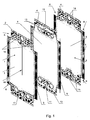
- the proposed FC module comprises an anode 1, with a current collector (not shown in Fig. 1) and with an insulating frame 2, and a cathode 3 with a current collector (not shown in Fig. 1) and an insulating frame 4.
- the anode 1 and the cathode 3 are provided with current taps 5 with flanges 6, secured to the current collectors.
- the insulating frames 2 and 4 upon assembly of the module form an anode chamber 7, an electrolyte chamber 8 and a cathode chamber 9.
- the insulating frames are provided with ports for the inlet and outlet of hydrogen 10 into the anode chamber 7, ports 11 for the inlet and ports 12 for the outlet of electrolyte, connected by arched channels 13 to the electrolyte chamber 8, ports 14 for the inlet and ports 15 for the outlet of oxygen/air.
- the anode chamber is provided with a rib 16, separating the chamber into two equal portions, and a service access port 17 connected by a channel to the anode chamber.
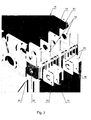
- a module 18 assembled by means of a mechanical connection in respect to the insulating frames of adjacent FC components, end power plates 23 and tightening studs (not shown in Fig.
- inlet and outlet ports form internal collectors for the inlet and outlet of working mediums (hydrogen, oxygen/air, electrolyte).
- Electrical switching of the FCs is carried out by means of " ⁇ " - shaped buses 19, mounted vertically and horizontally depending on the scheme of FC connections, connecting 20 and insulating 21 spacers with holes and tightening hollow stud 22 with an insulating coating (not shown in Fig. 2).
- An FC battery of predetermined power is assembled from the aforesaid modules by electrical switching and connection in respect to the working mediums (hydrogen, oxygen/air, electrolyte).
- the proposed FC battery works in the following manner. Hydrogen is fed into and removed from the anode chambers of the FCs through the ports 10 on the upper side of the insulating frames.
- the anode chamber is separated into two equal portions by the rib 16 which does not reach the lower side of the insulating frame.
- the presence of the rib in the anode chamber ensures uniformity of distribution of hydrogen over the surface of the anode.
- Positioning the hydrogen ports on the upper side of the insulating frames excludes the possibility for dropping liquid to enter the hydrogen collectors, which ensures uniformity of the distribution of hydrogen to the FCs.
- service access ports 17, connected by channels to the anode chambers, are made on the lower side of the insulating frame.
- These ports in the module form an internal collector and make it possible to remove dropping liquid from the anode chambers 7 of the FCs in the process of operating or during servicing. Furthermore, these ports make it possible, if necessary, to wash the anode chambers.
- Oxygen or air is fed into the cathode chambers through the inlet ports 14 positioned on the upper side of the insulating frames. The oxygen or air is outlet through the ports 15 positioned on the lower side of the insulating frames.
- the area of the inlet ports is about half the area of the outlet ports. Uniformity of the distribution of oxygen/air to the cathode chambers of the FCs is provided by the aforesaid ratio of the areas of the ports. Arrangement of the outlet ports on the lower side of the insulating frames ensures the removal of the dropping phase, appearing in the cathode chamber in the process of refilling or operation.
- the electrolyte is input into the electrolyte chambers from below through ports 11, the electrolyte is removed through ports 12. These ports are connected to the electrolyte chamber by means of two arched channels 13.
- the area of the inlet port is about half the area of the outlet port. This ratio of the areas of the ports ensures uniformity of distribution of the electrolyte to the FCs.
- the supply of the electrolyte from below and the removal from above ensures removal of bubbles from the electrolyte chamber of the FC, which have entered during loading or in the process of operation.
- the electrolyte ports and arched channels encompass all the inlet and outlet ports along the outer perimeter. Such a positioning of the ports creates a thermal screen, which prevents the possibility of condensation of water vapors and the formation of dropping liquid in the inlet and outlet gas collectors.
- electric power, heat and water are generated due to the flow of a current-forming reaction between hydrogen and oxygen.
- the electric power is sent to an external consumer by means of the buses for electric switching, while heat and water are removed by the flow of electrolyte and utilized by known methods by means of functional servicing systems.
- This invention is designed mainly for use as a current source in autonomous power plants, during the production of electrochemical generators, and may also be used for any electrical switching circuit.
Landscapes
- Life Sciences & Earth Sciences (AREA)
- Engineering & Computer Science (AREA)
- Manufacturing & Machinery (AREA)
- Sustainable Development (AREA)
- Sustainable Energy (AREA)
- Chemical & Material Sciences (AREA)
- Chemical Kinetics & Catalysis (AREA)
- Electrochemistry (AREA)
- General Chemical & Material Sciences (AREA)
- Fuel Cell (AREA)
- Electric Connection Of Electric Components To Printed Circuits (AREA)
Abstract
Description
Claims (28)
- A fuel cell module comprising at least two substantially rectangular fuel cells, each of which including an anode with a current collector and an insulating frame positioned along the periphery of the anode and forming an anode chamber, a cathode with a current collector and an insulating frame positioned along the periphery of the cathode and forming a cathode chamber, and an electrolyte chamber formed by an insulating frame and positioned between the anode and the cathode, the insulating frames along the periphery are provided with ports for the inlet and outlet of hydrogen, oxygen/air and electrolyte and with channels connecting said ports to corresponding chambers, characterized in that the ports and channels are positioned on upper and/or lower sides of the insulating frames, and the current collectors are brought out of the fuel cell through the lateral sides of the insulating frames.
- The fuel cell module according to claim 1, characterized in that the ports for the inlet of hydrogen into and outlet from the anode chambers are positioned on the upper side of the insulating frames.
- The fuel cell module according to claim 1, characterized in that the ports for the inlet of oxygen/air into the cathode chambers are positioned on the upper side of the frame, and the ports for the outlet of the oxygen/air are positioned on the lower side of the insulating frames.
- The fuel cell module according to claim 1, characterized in that the ports for the inlet of electrolyte into the electrolyte chambers are positioned on the lower side of the frames and the ports for the outlet of the electrolyte are positioned on the upper side of the insulating frames.
- The fuel cell module according to claim 3, characterized in that the ports for the inlet of oxygen/air into the cathode chambers are smaller than the ports for the outlet of oxygen/air.
- The fuel cell module according to claim 5, characterized in that the ratio of the areas of the ports for the outlet and inlet of oxygen/air is from 1.9 to 2.2.
- The fuel cell module according to claim 4, characterized in that the ports for the inlet of electrolyte into the electrolyte chambers are smaller than the ports for the outlet of the electrolyte.
- The fuel cell module according to claim 7, characterized in that the ratio of the areas of the ports for the outlet and inlet of the electrolyte is from 1.7 to 2.0.
- The fuel cell module according to claim 4, characterized in that the ports for the inlet of electrolyte are positioned below the other ports, and the ports for the outlet of the electrolyte are positioned above the other ports.
- The fuel cell module according to any one of claims 4, 7, 8, 9, characterized in that each of the ports for the inlet and outlet of the electrolyte is connected to electrolyte chambers by two arched channels.
- The fuel cell module according to any one of claims 4, 7-10, characterized in that the ports for the inlet and outlet of electrolyte and the arched channels encompass all the remaining ports over the outer perimeter, forming a thermal screen.
- The fuel cell module according to claim 1, characterized in that service access ports, connected to the anode chambers of the fuel cells by channels, are made on the lower side of the insulating frames.
- The fuel cell module according to claim 1, characterized in that adjacent insulating frames of fuel cells in the module are mechanically connected by welding or gluing.
- The fuel cell module according to claim 1, characterized in that plate-like current taps, provided with a longitudinal cut in which ends of current collectors are placed, are secured to ends of current collectors extending out of the fuel cells, wherein upper and lower ends of the current taps go outside the fuel cells and are made in the form of substantially rectangular rounded flanges with openings for securing electrical switching buses.
- The fuel cell module according to any one of claims 1, 14, characterized in that the fuel cells in the module are connected electrically in parallel, in series or parallel/series by means of "Π" - shaped buses of electrical switching, insulating and conducting washers, provided with holes, and a tightening stud with an insulating coating, which passes through the holes of the current taps, electrical switching buses and washers.
- The fuel cell module according to claim 15, characterized in that the stud is made hollow, and its ends after tightening are expanded.
- The fuel cell module according to any one of claims 1, 14, characterized in that depending on the type of electrical switching, the "Π" - shaped buses of electrical switching are mounted vertically, horizontally or both vertically and horizontally.
- The fuel cell module according to claim 1 or claim 2, characterized in that the anode chambers of the fuel cells are separated into two parts by a vertical rib which does not reach the lower side of the anode chamber.
- The fuel cell module according to any one of claims 1, 2, 18, characterized in that the anode chambers of the fuel cells are separated into two equal parts by a vertical rib.
- The fuel cell module according to claim 1, characterized in that the cathode chambers of the fuel cells are connected in parallel in respect to air.
- The fuel cell module according to claim 1, characterized in that the cathode chambers of the fuel cells are connected in parallel or parallel/series in respect to oxygen.
- The fuel cell module according to claim 1, characterized in that the electrolyte chambers of the fuel cells are connected in parallel in respect to the electrolyte.
- A battery of fuel cells, comprising at least two fuel cell modules, characterized in that the module is made according to any one of claims 1-22.
- The battery of fuel cells according to claim 23, characterized in that the modules in the battery are connected in parallel in respect to the electrolyte.
- The battery of fuel cells according to claim 23, characterized in that the modules in the battery are connected in parallel in respect to air.
- The battery of fuel cells according to claim 23, characterized in that the modules in the battery are connected in parallel or parallel/series in respect to oxygen.
- The battery of fuel cells according to claim 23, characterized in that the modules in the battery are connected in parallel, in series or in parallel/series in respect to hydrogen.
- The battery of fuel cells according to claim 23, characterized in that the modules in the battery are connected electrically, in series or parallel/series.
Applications Claiming Priority (3)
| Application Number | Priority Date | Filing Date | Title |
|---|---|---|---|
| RU2001109733 | 2001-04-12 | ||
| RU2001109733/09A RU2183370C1 (en) | 2001-04-12 | 2001-04-12 | Fuel cell module and battery built around it |
| PCT/RU2002/000163 WO2002084769A1 (en) | 2001-04-12 | 2002-04-10 | Fuel cell module and battery based thereon |
Publications (2)
| Publication Number | Publication Date |
|---|---|
| EP1387426A2 true EP1387426A2 (en) | 2004-02-04 |
| EP1387426A4 EP1387426A4 (en) | 2008-01-23 |
Family
ID=20248322
Family Applications (1)
| Application Number | Title | Priority Date | Filing Date |
|---|---|---|---|
| EP02738996A Withdrawn EP1387426A4 (en) | 2001-04-12 | 2002-04-10 | Fuel cell module and battery based thereon |
Country Status (6)
| Country | Link |
|---|---|
| US (1) | US6872487B2 (en) |
| EP (1) | EP1387426A4 (en) |
| AU (1) | AU2002313341A1 (en) |
| CA (1) | CA2416609A1 (en) |
| RU (1) | RU2183370C1 (en) |
| WO (1) | WO2002084769A1 (en) |
Cited By (1)
| Publication number | Priority date | Publication date | Assignee | Title |
|---|---|---|---|---|
| US20120088133A1 (en) * | 2010-10-07 | 2012-04-12 | Battelle Memorial Institute | Planar high density sodium battery |
Families Citing this family (18)
| Publication number | Priority date | Publication date | Assignee | Title |
|---|---|---|---|---|
| JP4529439B2 (en) * | 2003-12-26 | 2010-08-25 | トヨタ自動車株式会社 | Fuel cell manufacturing method and manufacturing apparatus |
| RU2256981C1 (en) * | 2004-03-30 | 2005-07-20 | Общество с ограниченной ответственностью "ИНТЕНСИС" (ООО "ИНТЕНСИС") | Alkali fuel cell electrode and its manufacturing process |
| CN101043990A (en) | 2004-07-09 | 2007-09-26 | 卡博陶粒有限公司 | Process for preparing solid ceramic particles using spray drying |
| EA012824B1 (en) | 2004-09-14 | 2009-12-30 | Карбо Керамикс Инк. | Sintered spherical pellets for gas and oil wells and a method of fracturing |
| US7166383B2 (en) | 2004-12-07 | 2007-01-23 | Astria Energi Inc. | Electrode structure for stacked alkaline fuel cells |
| US7615172B2 (en) | 2005-03-01 | 2009-11-10 | Carbo Ceramics, Inc. | Methods for producing sintered particles from a slurry of an alumina-containing raw material |
| DE102005010399B4 (en) * | 2005-03-07 | 2010-08-05 | Airbus Deutschland Gmbh | Aircraft with a fuel cell emergency system and method for external air independent emergency power supply |
| US7833645B2 (en) * | 2005-11-21 | 2010-11-16 | Relion, Inc. | Proton exchange membrane fuel cell and method of forming a fuel cell |
| EP1997172A1 (en) * | 2006-03-06 | 2008-12-03 | MKU Cyprus Limited | Electrode structure for stacked alkaline fuel cells |
| US7828998B2 (en) | 2006-07-11 | 2010-11-09 | Carbo Ceramics, Inc. | Material having a controlled microstructure, core-shell macrostructure, and method for its fabrication |
| WO2008028074A2 (en) | 2006-08-30 | 2008-03-06 | Carbo Ceramics Inc. | Low bulk density proppant and methods for producing the same |
| US8026020B2 (en) | 2007-05-08 | 2011-09-27 | Relion, Inc. | Proton exchange membrane fuel cell stack and fuel cell stack module |
| US9293778B2 (en) | 2007-06-11 | 2016-03-22 | Emergent Power Inc. | Proton exchange membrane fuel cell |
| EA201000114A1 (en) | 2007-07-06 | 2010-06-30 | Карбо Керамикс Инк. | PROPPANT AND METHOD OF HYDRAULIC PLASTING OF THE PLATE (OPTIONS) |
| US8003274B2 (en) | 2007-10-25 | 2011-08-23 | Relion, Inc. | Direct liquid fuel cell |
| EP3699323A1 (en) * | 2019-02-20 | 2020-08-26 | Hymeth ApS | Electrode system |
| CN110429296B (en) * | 2019-08-26 | 2024-12-27 | 国鸿氢能科技(嘉兴)股份有限公司 | Fuel cell bipolar plate |
| DE102020215013A1 (en) * | 2020-11-30 | 2022-06-02 | Robert Bosch Gesellschaft mit beschränkter Haftung | Bipolar plate for an electrochemical cell, method of making the bipolar plate, electrochemical cell assembly and method of operating the electrochemical cell assembly |
Family Cites Families (14)
| Publication number | Priority date | Publication date | Assignee | Title |
|---|---|---|---|---|
| US3515595A (en) * | 1967-08-09 | 1970-06-02 | Gen Electric | Current collectors for cells utilizing hot acid electrolytes |
| US3871922A (en) * | 1971-07-12 | 1975-03-18 | Licentia Gmbh | Gas diffusion electrode for electrochemical cells |
| FR2300425A1 (en) | 1975-02-06 | 1976-09-03 | Alsthom Cgee | FUEL CELL OF THE CROSS-FEED TYPE AND DODECAGONAL FILTER-PRESS STRUCTURE |
| JPS52122844A (en) * | 1976-04-09 | 1977-10-15 | Hitachi Ltd | Stacked structure battery |
| FR2499774A1 (en) * | 1981-02-12 | 1982-08-13 | Inst Francais Du Petrole | FUEL CELL BLOCK CONSISTING OF A STACK OF HOLLOW ELEMENTS CARRYING ELECTRODES |
| FR2564249B1 (en) * | 1984-05-11 | 1986-09-12 | Alsthom Atlantique | FITTINGS FOR FUEL CELL STRUCTURES |
| FR2568412B1 (en) * | 1984-07-27 | 1986-10-17 | Occidental Chem Co | IMPROVEMENTS ON THE STRUCTURES OF FUEL CELLS. |
| US5069985A (en) * | 1990-02-15 | 1991-12-03 | International Fuel Cells Corporation | Plaque fuel cell stack |
| DE4201632C2 (en) * | 1992-01-23 | 1997-02-06 | Siemens Ag | Method and arrangement for moistening the reactants flowing into a fuel cell |
| DE4234093A1 (en) * | 1992-10-09 | 1994-04-14 | Siemens Ag | Component for installation in a process engineering facility |
| IT1270878B (en) * | 1993-04-30 | 1997-05-13 | Permelec Spa Nora | IMPROVED ELECTROCHEMISTRY CELL USING ION EXCHANGE MEMBRANES AND METAL BIPOLAR PLATES |
| JP4236298B2 (en) * | 1998-04-14 | 2009-03-11 | 東邦瓦斯株式会社 | Solid oxide fuel cell with honeycomb integrated structure |
| JP2000182653A (en) * | 1998-12-15 | 2000-06-30 | Kansai Electric Power Co Inc:The | Solid oxide fuel cell block and solid oxide fuel cell module |
| ID26558A (en) * | 1998-12-25 | 2001-01-18 | Araco Kk | FUEL BATTERY, SEPARATOR FOR FUEL BATTERY AND SEPARATOR MAKING METHOD |
-
2001
- 2001-04-12 RU RU2001109733/09A patent/RU2183370C1/en not_active IP Right Cessation
-
2002
- 2002-04-10 US US10/297,395 patent/US6872487B2/en not_active Expired - Lifetime
- 2002-04-10 WO PCT/RU2002/000163 patent/WO2002084769A1/en not_active Ceased
- 2002-04-10 CA CA002416609A patent/CA2416609A1/en not_active Abandoned
- 2002-04-10 EP EP02738996A patent/EP1387426A4/en not_active Withdrawn
- 2002-04-10 AU AU2002313341A patent/AU2002313341A1/en not_active Abandoned
Cited By (2)
| Publication number | Priority date | Publication date | Assignee | Title |
|---|---|---|---|---|
| US20120088133A1 (en) * | 2010-10-07 | 2012-04-12 | Battelle Memorial Institute | Planar high density sodium battery |
| US9276294B2 (en) * | 2010-10-07 | 2016-03-01 | Battelle Memorial Institute | Planar high density sodium battery |
Also Published As
| Publication number | Publication date |
|---|---|
| WO2002084769A8 (en) | 2003-12-18 |
| CA2416609A1 (en) | 2002-10-24 |
| AU2002313341A1 (en) | 2002-10-28 |
| RU2183370C1 (en) | 2002-06-10 |
| US20030134175A1 (en) | 2003-07-17 |
| WO2002084769A1 (en) | 2002-10-24 |
| US6872487B2 (en) | 2005-03-29 |
| EP1387426A4 (en) | 2008-01-23 |
Similar Documents
| Publication | Publication Date | Title |
|---|---|---|
| US6872487B2 (en) | Fuel cell module and battery based thereon | |
| US6395154B1 (en) | Electrochemical cell using a folded double electrode plate | |
| EP1401040B1 (en) | Solid-oxide fuel cell module for a fuel cell stack | |
| JP6448770B2 (en) | Methods for high temperature electrolysis or co-electrolysis, methods for generating electricity using SOFC fuel cells, and related interconnectors, reactors, and methods of operation | |
| DK3234227T3 (en) | DEVICE GROUP FOR A WATER ELECTROLYSE OR -CO ELECTROLYCLE REACTOR (SOEC) OR FUEL CELL (SOFC) WITH OPERATING UNDER PRESSURE | |
| JP3460346B2 (en) | Solid polymer electrolyte fuel cell | |
| US7329471B2 (en) | Methods and apparatus for assembling solid oxide fuel cells | |
| KR101822771B1 (en) | Fuel cell stack and fuel cell module | |
| US20150333342A1 (en) | Electrical insulation and sealing surround for water electrolysis reactor (soec) or fuel cell (sofc) | |
| JPH08273696A (en) | Fuel cell stack structure | |
| JP2013541157A (en) | Lithium storage battery | |
| TW202339335A (en) | Cell stack and cell stack assembly | |
| KR20150048407A (en) | Fuel cell stack having dummy cell | |
| JP4791152B2 (en) | Fuel cell stack | |
| US20170271690A1 (en) | Electrochemical reactor balancing the pressure drops of the cathode/anode homogenization areas | |
| JP7690691B2 (en) | Modules for electrochemical devices having relatively long useful lives. | |
| EP1162681B1 (en) | Cooling of a fuel cell system | |
| JPS6160548B2 (en) | ||
| KR20100022362A (en) | A fuel cell with insulated manifold | |
| KR20240071382A (en) | Fuel cell comprising an end plate comprising a main device and an auxiliary device, method for accessing the fuel cell shaft | |
| EP4444937A1 (en) | Electrolyser with a stack of welded four-layer modules | |
| JPH07320768A (en) | Gas distribution method for fuel cell stack and fuel cell stack | |
| KR100661820B1 (en) | Separator and End Plate of Roll Cell Stack | |
| KR102872959B1 (en) | Electrolysis cell for easy supply and reuse of reaction gas and electrolysis device using the same | |
| CA1308776C (en) | Fuel cell and method of ameliorating temperature distribution thereof |
Legal Events
| Date | Code | Title | Description |
|---|---|---|---|
| PUAI | Public reference made under article 153(3) epc to a published international application that has entered the european phase |
Free format text: ORIGINAL CODE: 0009012 |
|
| 17P | Request for examination filed |
Effective date: 20021214 |
|
| AK | Designated contracting states |
Kind code of ref document: A2 Designated state(s): AT BE CH CY DE DK ES FI FR GB GR IE IT LI LU MC NL PT SE TR |
|
| AX | Request for extension of the european patent |
Extension state: AL LT LV MK RO SI |
|
| RTI1 | Title (correction) |
Free format text: FUEL CELL MODULE AND BATTERY BASED THEREON |
|
| RAP1 | Party data changed (applicant data changed or rights of an application transferred) |
Owner name: OBSCHESTVO S OGRANICHENNOI OTVETSTVENNOSTIYU "INT |
|
| A4 | Supplementary search report drawn up and despatched |
Effective date: 20071227 |
|
| RIC1 | Information provided on ipc code assigned before grant |
Ipc: H01M 8/08 20060101ALI20071218BHEP Ipc: H01M 8/24 20060101ALI20071218BHEP Ipc: H01M 8/04 20060101AFI20021029BHEP |
|
| 17Q | First examination report despatched |
Effective date: 20090204 |
|
| GRAP | Despatch of communication of intention to grant a patent |
Free format text: ORIGINAL CODE: EPIDOSNIGR1 |
|
| STAA | Information on the status of an ep patent application or granted ep patent |
Free format text: STATUS: THE APPLICATION IS DEEMED TO BE WITHDRAWN |
|
| 18D | Application deemed to be withdrawn |
Effective date: 20101103 |