EP1387352A2 - Sprachkommunikationsgerät mit dynamischer Geräuschunterdrückung - Google Patents
Sprachkommunikationsgerät mit dynamischer Geräuschunterdrückung Download PDFInfo
- Publication number
- EP1387352A2 EP1387352A2 EP03016499A EP03016499A EP1387352A2 EP 1387352 A2 EP1387352 A2 EP 1387352A2 EP 03016499 A EP03016499 A EP 03016499A EP 03016499 A EP03016499 A EP 03016499A EP 1387352 A2 EP1387352 A2 EP 1387352A2
- Authority
- EP
- European Patent Office
- Prior art keywords
- input
- volume
- level
- noise suppression
- amplification
- Prior art date
- Legal status (The legal status is an assumption and is not a legal conclusion. Google has not performed a legal analysis and makes no representation as to the accuracy of the status listed.)
- Withdrawn
Links
- 230000001629 suppression Effects 0.000 title claims abstract description 43
- 238000004891 communication Methods 0.000 title description 7
- 230000003321 amplification Effects 0.000 claims abstract description 31
- 238000003199 nucleic acid amplification method Methods 0.000 claims abstract description 31
- 230000000694 effects Effects 0.000 claims abstract description 11
- 230000035945 sensitivity Effects 0.000 claims description 10
- 230000006835 compression Effects 0.000 claims description 5
- 238000007906 compression Methods 0.000 claims description 5
- 238000000034 method Methods 0.000 description 22
- 230000006870 function Effects 0.000 description 20
- 238000010586 diagram Methods 0.000 description 7
- 238000012986 modification Methods 0.000 description 4
- 230000004048 modification Effects 0.000 description 4
- 238000012545 processing Methods 0.000 description 4
- 238000012546 transfer Methods 0.000 description 3
- 238000012935 Averaging Methods 0.000 description 2
- 230000001413 cellular effect Effects 0.000 description 2
- 238000001514 detection method Methods 0.000 description 2
- 238000013507 mapping Methods 0.000 description 2
- 230000008569 process Effects 0.000 description 2
- 230000009467 reduction Effects 0.000 description 2
- 230000003068 static effect Effects 0.000 description 2
- 241000208199 Buxus sempervirens Species 0.000 description 1
- 238000013459 approach Methods 0.000 description 1
- 230000003750 conditioning effect Effects 0.000 description 1
- 230000001934 delay Effects 0.000 description 1
- 230000003111 delayed effect Effects 0.000 description 1
- 238000013461 design Methods 0.000 description 1
- 210000005069 ears Anatomy 0.000 description 1
- 239000000284 extract Substances 0.000 description 1
- 238000009499 grossing Methods 0.000 description 1
- 239000000203 mixture Substances 0.000 description 1
- 230000000149 penetrating effect Effects 0.000 description 1
- 238000001228 spectrum Methods 0.000 description 1
- 230000009466 transformation Effects 0.000 description 1
- 230000007704 transition Effects 0.000 description 1
Images

Classifications
-
- G—PHYSICS
- G10—MUSICAL INSTRUMENTS; ACOUSTICS
- G10L—SPEECH ANALYSIS TECHNIQUES OR SPEECH SYNTHESIS; SPEECH RECOGNITION; SPEECH OR VOICE PROCESSING TECHNIQUES; SPEECH OR AUDIO CODING OR DECODING
- G10L21/00—Speech or voice signal processing techniques to produce another audible or non-audible signal, e.g. visual or tactile, in order to modify its quality or its intelligibility
- G10L21/02—Speech enhancement, e.g. noise reduction or echo cancellation
- G10L21/0208—Noise filtering
-
- G—PHYSICS
- G10—MUSICAL INSTRUMENTS; ACOUSTICS
- G10L—SPEECH ANALYSIS TECHNIQUES OR SPEECH SYNTHESIS; SPEECH RECOGNITION; SPEECH OR VOICE PROCESSING TECHNIQUES; SPEECH OR AUDIO CODING OR DECODING
- G10L21/00—Speech or voice signal processing techniques to produce another audible or non-audible signal, e.g. visual or tactile, in order to modify its quality or its intelligibility
- G10L21/02—Speech enhancement, e.g. noise reduction or echo cancellation
- G10L21/0208—Noise filtering
- G10L21/0216—Noise filtering characterised by the method used for estimating noise
- G10L2021/02161—Number of inputs available containing the signal or the noise to be suppressed
- G10L2021/02165—Two microphones, one receiving mainly the noise signal and the other one mainly the speech signal
Definitions
- the present invention pertains generally to voice communications equipment, and more particularly to a device for suppressing ambient noise picked up by a microphone when the microphone is in a moderate to high noise environment.
- VOX voice activated switch device
- the present invention relates to a device that dynamically applies the energy of the voice as a control signal to modulate the volume of an input microphone signal to achieve dynamic voice activated noise suppression.
- the energy of the microphone signal is low, very little amplification energy is applied to boost the volume of the microphone signal. If the energy is medium to high, amplification energy is applied to the microphone output sufficient to raise the signal level to audible levels.
- the perceptual effect of this is that the ambient noise appears (to the listener) to be removed from the signal. This is due to the psychoacoustic effect that louder signals tend to mask softer signals (even if the softer signals are noise).
- the energy of the noise signal is somewhat lower than the direct spoken input to a microphone, due to the proximity of the typical microphone to the speaker's mouth.
- the volume of the amplified noise input immediately (within 6 - 20 milliseconds) tracks the voice energy downward and is thus perceived by the listener to be suppressed immediately after the speaker finished their spoken utterances.
- the present invention directly extracts the energy (or absolute amplitude averaged over a short period of time - 6 - 20 milliseconds) from the voice in a linear fashion and then applies a non-linear transfer function to the voice energy to further enhance the contrast between the low level undesirable signals and the higher level voice signals.
- the output volume level changes gradually (smoothly) and continuously (no sudden jumps) as the input volume level changes.
- low input volumes are suppressed
- medium-low volumes are unchanged
- mid to high level volumes are boosted
- the transitions are gradual and continuous.
- the high level volumes may be unchanged such that only the mid level volumes are boosted. This further improves clarity of voice communications.
- the present invention applies a parallel approach to achieve the signal processing objectives whereby the signal energy E is calculated in one path and the original input signal X is passed through on a second path but is modified by a signal volume control element 38 (such as a gain multiplier at the end of the path) as shown in block diagram form in Figure 2b.
- a signal volume control element 38 such as a gain multiplier at the end of the path
- One embodiment of the present invention is a multi-channel interphone system for small aircraft that can support as many as 6 stereo headset/microphone sets as well as CD/DVD audio inputs, recorder outputs, cellular telephone inputs and outputs, and a direct connection to a two-way aircraft VHF radio system.
- a Digital Signal Processing microprocessor (DSP) is used to provide the necessary switching, mixing and application of the software algorithm of the present invention to perform the dynamic voice activated noise suppression.
- each microphone input has independent voice activated noise suppression applied and the outputs are summed as appropriate to whatever sources are selected for the intercom.
- the invention may be characterized as a device which implements the following methods:
- the invention is an interphone communication system which incorporates a plurality of noise reduction methods above, one to each of a plurality of user microphone inputs, and provides these noise reduced voice signals to various output sources such as multiple intercom network headphones, VHF radio inputs and other two-way communications devices such as cellular telephones
- FIG. 1 shows a block diagram for a small general aviation intercom processing system according to the present invention.
- This system includes user controls 6 , out put LED's 8 , a Digital Signal Processing CPU (DSP) 10 , Flash memory 12 , a multichannel stereo CODEC 14 , microphone/line preamps 16 , headphone/line amplifiers 18 , input jacks for microphones 20 and output jacks for headsets/speakers 22 .
- DSP Digital Signal Processing CPU
- Figure 2 shows different levels of detail of the noise suppression circuit block diagram.
- Figure 2a shows the high level block diagram flow of the input signal X through the dynamic voice activated noise suppression filter to form the output signal Y .
- Figure 2b shows, in a functional diagram, the parallel structure of the signal flow whereby the input signal X is passed through to a single output multiplier 38 which applies the detected energy function E (volume) of the input signal X to the output multiplier 38 .
- a manual user controlled variable level function 34 is applied to the energy detection process to optimize the energy detection sensitivity and/or blend the amount of signal bypass that the user may desire.
- Figure 2c shows the internal functional details of an embodiment of the invention including the energy detector, sensitivity adjustment, and bypass operation functions.
- the input signal X is gain adjusted, function 40 , via a sensitivity mapping function 42 and then passed through a full-wave rectification process 44 (i.e. absolute value of (x)) in order to obtain a coarse linear representation Ec of the (sensitivity gain adjusted) input speech plus noise signal volume.
- this coarse signal Ec is passed through two cascaded efficient low pass smoothing filters 46 (i.e. box car average) each of which averages the coarse energy signal Ec over 8 milliseconds. Because each averaging filter introduces a delay equal to one half of the duration that is averaged, the two filters produce a smoothed output Es which is approximately delayed from the input signal by about 8 milliseconds.
- the design objective is to make this delay as short as possible without making it so short that the volume function tracks low frequency sounds picked up by the microphone.
- Voice microphones have little signal sensitivity below about 150 Hz and the 8 millisecond delay has been found effective.
- the duration of signal that is averaged might fall anywhere between about 4 milliseconds, if there are no low frequencies that would be tracked by such short averaging, and about 100 milliseconds, which is about the outer limit of tolerable delays. A range between 6 and 20 milliseconds is preferred.
- This smoothed output Es (representing volume over a short time period) is then passed through a non-linear lookup table 48 which, in one embodiment, is a combination of an amplitude compression function for medium to high level signals and an expansion function for low level signals which suppresses the low level signals relative to the medium and high level signals.
- This non-linear lookup table is a general purpose 16 bit in/out lookup table for which any mapping function can be inserted and used for optimizing the contrast between low level signals and medium or high level signals. The medium and high level signals are compressed to improve intelligibility and avoid overloading the circuit components or the hearing of the listeners.
- Each output from the look up table specifies an amplification level to be applied to the signal. Because the outputs are binary values, there is a discontinuity from one value to the next. However, the jump from one value to the next in the look up table is chosen so that, when many consecutive values are taken together, the points of the values define a curving line that has no discontinuities (no sudden jumps) and no sudden bends (curves smoothly). The lack of sudden jumps and sudden bends yields better sound to the listener.
- a variable manual control 43 gives the user a choice of how much of the original input signal X they wish to hear blended with the noise suppression control of the input signal X .
- a comparator circuit 50 uses the maximum of either the energy signal E or the static input level control set by the user which is then directly multiplied times the input signal to obtain the output noise suppressed signal Y . Because the maximum of these two sources is used, when the user sets the input high, there is no input signal modification; when the user sets the input low, there is full input signal modification; and when the user sets the input medium, the low level signal expansion (suppression) is less effective compared to when the user sets the input low.
- the effect of setting to medium causes the lower level signals to still get multiplied by a smaller number than full scale volume while still allowing the medium to high voice signals to pass at their envelope tracked higher volumes.
- the highest volumes are still compressed and the mid level volumes are boosted which gives rise to better intelligibility.
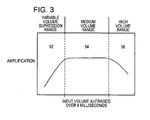
- Figure 3 is a graph showing level of amplification as a function of input signal volume averaged over the prior 8 milliseconds. Signals within a low range 52 receive less amplification than signal within a higher range 54 . The width of the low range that receives reduced amplification can be adjusted by the variable manual control 43 . Signals within a high range 56 also receive less amplification than signals within a medium volume range 54 .
- the smooth curve shown in Figure 3 is implemented with the output values of the look up table 48 . Note that the curve shows neither sudden jumps nor sudden bends.
- circuit of this invention can be used wherever ambient noise is a problem, including motorcycles, factories, stock trading floors, etc.
- the scope of the invention should not be taken as specified or limited by the discussion above but rather as specified by the following claims.
Landscapes
- Engineering & Computer Science (AREA)
- Computational Linguistics (AREA)
- Quality & Reliability (AREA)
- Signal Processing (AREA)
- Health & Medical Sciences (AREA)
- Audiology, Speech & Language Pathology (AREA)
- Human Computer Interaction (AREA)
- Physics & Mathematics (AREA)
- Acoustics & Sound (AREA)
- Multimedia (AREA)
- Circuit For Audible Band Transducer (AREA)
- Telephone Set Structure (AREA)
Applications Claiming Priority (2)
| Application Number | Priority Date | Filing Date | Title |
|---|---|---|---|
| US39793702P | 2002-07-22 | 2002-07-22 | |
| US397937P | 2002-07-22 |
Publications (2)
| Publication Number | Publication Date |
|---|---|
| EP1387352A2 true EP1387352A2 (de) | 2004-02-04 |
| EP1387352A3 EP1387352A3 (de) | 2005-01-12 |
Family
ID=30116084
Family Applications (1)
| Application Number | Title | Priority Date | Filing Date |
|---|---|---|---|
| EP03016499A Withdrawn EP1387352A3 (de) | 2002-07-22 | 2003-07-22 | Sprachkommunikationsgerät mit dynamischer Geräuschunterdrückung |
Country Status (3)
| Country | Link |
|---|---|
| US (1) | US20040196984A1 (de) |
| EP (1) | EP1387352A3 (de) |
| CA (1) | CA2435771A1 (de) |
Cited By (2)
| Publication number | Priority date | Publication date | Assignee | Title |
|---|---|---|---|---|
| WO2013102799A1 (en) * | 2012-01-06 | 2013-07-11 | Sony Ericsson Mobile Communications Ab | Smart automatic audio recording leveler |
| CN101903942B (zh) * | 2007-12-21 | 2013-09-18 | 沃福森微电子股份有限公司 | 具有基于噪声水平的增益控制的噪声消除系统 |
Families Citing this family (11)
| Publication number | Priority date | Publication date | Assignee | Title |
|---|---|---|---|---|
| DE10322207B4 (de) * | 2003-05-16 | 2005-06-16 | Dr.Ing.H.C. F. Porsche Ag | Verfahren zur Ausgabe eines Signals einer Sicherheitsgurt-Warneinrichtung |
| KR101215944B1 (ko) * | 2004-09-07 | 2012-12-27 | 센시어 피티와이 엘티디 | 청취보호기와 음향개선방법 |
| US8848901B2 (en) * | 2006-04-11 | 2014-09-30 | Avaya, Inc. | Speech canceler-enhancer system for use in call-center applications |
| KR101288939B1 (ko) * | 2006-08-24 | 2013-07-24 | 삼성전자주식회사 | 휴대 전화기의 잡음 제거 회로 |
| US8194871B2 (en) * | 2007-08-31 | 2012-06-05 | Centurylink Intellectual Property Llc | System and method for call privacy |
| US8538492B2 (en) * | 2007-08-31 | 2013-09-17 | Centurylink Intellectual Property Llc | System and method for localized noise cancellation |
| US8335308B2 (en) * | 2007-10-31 | 2012-12-18 | Centurylink Intellectual Property Llc | Method, system, and apparatus for attenuating dual-tone multiple frequency confirmation tones in a telephone set |
| US8300801B2 (en) * | 2008-06-26 | 2012-10-30 | Centurylink Intellectual Property Llc | System and method for telephone based noise cancellation |
| US8370157B2 (en) | 2010-07-08 | 2013-02-05 | Honeywell International Inc. | Aircraft speech recognition and voice training data storage and retrieval methods and apparatus |
| KR101335859B1 (ko) * | 2011-10-07 | 2013-12-02 | 주식회사 팬택 | 통신 기기의 음성 통화 품질 최적화 시스템 |
| US9208772B2 (en) * | 2011-12-23 | 2015-12-08 | Bose Corporation | Communications headset speech-based gain control |
Family Cites Families (13)
| Publication number | Priority date | Publication date | Assignee | Title |
|---|---|---|---|---|
| US3691311A (en) * | 1970-12-10 | 1972-09-12 | Pacific Plantronics Inc | Telephone user set |
| GB2179810B (en) * | 1983-09-21 | 1987-10-21 | British Broadcasting Corp | Dynamic range control of a signal |
| US5235637A (en) * | 1989-01-26 | 1993-08-10 | Plantronics, Inc. | Voice communication link interface |
| DE4130045A1 (de) * | 1991-09-10 | 1993-03-18 | Standard Elektrik Lorenz Ag | Schaltungsanordnung zur dynamiksteuerung eines sprachendgeraetes |
| US5459814A (en) * | 1993-03-26 | 1995-10-17 | Hughes Aircraft Company | Voice activity detector for speech signals in variable background noise |
| JPH07193548A (ja) * | 1993-12-25 | 1995-07-28 | Sony Corp | 雑音低減処理方法 |
| US5774557A (en) * | 1995-07-24 | 1998-06-30 | Slater; Robert Winston | Autotracking microphone squelch for aircraft intercom systems |
| US5819217A (en) * | 1995-12-21 | 1998-10-06 | Nynex Science & Technology, Inc. | Method and system for differentiating between speech and noise |
| US5825754A (en) * | 1995-12-28 | 1998-10-20 | Vtel Corporation | Filter and process for reducing noise in audio signals |
| US5708722A (en) * | 1996-01-16 | 1998-01-13 | Lucent Technologies Inc. | Microphone expansion for background noise reduction |
| US5794187A (en) * | 1996-07-16 | 1998-08-11 | Audiological Engineering Corporation | Method and apparatus for improving effective signal to noise ratios in hearing aids and other communication systems used in noisy environments without loss of spectral information |
| US6122384A (en) * | 1997-09-02 | 2000-09-19 | Qualcomm Inc. | Noise suppression system and method |
| US6360203B1 (en) * | 1999-05-24 | 2002-03-19 | Db Systems, Inc. | System and method for dynamic voice-discriminating noise filtering in aircraft |
-
2003
- 2003-07-22 CA CA002435771A patent/CA2435771A1/en not_active Abandoned
- 2003-07-22 EP EP03016499A patent/EP1387352A3/de not_active Withdrawn
- 2003-07-22 US US10/625,461 patent/US20040196984A1/en not_active Abandoned
Cited By (3)
| Publication number | Priority date | Publication date | Assignee | Title |
|---|---|---|---|---|
| CN101903942B (zh) * | 2007-12-21 | 2013-09-18 | 沃福森微电子股份有限公司 | 具有基于噪声水平的增益控制的噪声消除系统 |
| WO2013102799A1 (en) * | 2012-01-06 | 2013-07-11 | Sony Ericsson Mobile Communications Ab | Smart automatic audio recording leveler |
| US9692382B2 (en) | 2012-01-06 | 2017-06-27 | Sony Corporation | Smart automatic audio recording leveler |
Also Published As
| Publication number | Publication date |
|---|---|
| EP1387352A3 (de) | 2005-01-12 |
| CA2435771A1 (en) | 2004-01-22 |
| US20040196984A1 (en) | 2004-10-07 |
Similar Documents
| Publication | Publication Date | Title |
|---|---|---|
| US8964997B2 (en) | Adapted audio masking | |
| AU2002322866B2 (en) | Sound intelligibility enhancement using a psychoacoustic model and an oversampled filterbank | |
| KR101463324B1 (ko) | 오디오 등화를 위한 시스템들, 방법들, 디바이스들, 장치, 및 컴퓨터 프로그램 제품들 | |
| US8416959B2 (en) | Hearing enhancement system and components thereof | |
| CN101208742B (zh) | 自适应的音频响应 | |
| US9076456B1 (en) | System and method for providing voice equalization | |
| US11978469B1 (en) | Ambient noise aware dynamic range control and variable latency for hearing personalization | |
| US8976978B2 (en) | Sound signal processing apparatus and sound signal processing method | |
| AU2002322866A1 (en) | Sound intelligibility enhancement using a psychoacoustic model and an oversampled filterbank | |
| WO2002093876A2 (en) | Final signal from a near-end signal and a far-end signal | |
| US9532149B2 (en) | Method of signal processing in a hearing aid system and a hearing aid system | |
| EP3977443B1 (de) | Mehrzweckmikrofon in akustischen geräten | |
| CN105981408A (zh) | 用于塑形在适应性噪音消除系统中的音频声道之间的次级路径信息的系统和方法 | |
| EP1387352A2 (de) | Sprachkommunikationsgerät mit dynamischer Geräuschunterdrückung | |
| JPH09140000A (ja) | 会議用拡聴器 | |
| CN114080638A (zh) | 具有多个前馈麦克风的anr系统中的增益调整 | |
| US10643597B2 (en) | Method and device for generating and providing an audio signal for enhancing a hearing impression at live events | |
| US12112737B1 (en) | Acoustic feedback control | |
| WO2007128609A1 (en) | Hearing device | |
| KR101405847B1 (ko) | 차량 오디오 시스템의 음질 향상을 위한 신호처리 구조 | |
| CN118476243A (zh) | 具有感知模式自动调平器的音频设备 | |
| US11527232B2 (en) | Applying noise suppression to remote and local microphone signals | |
| CA2397084C (en) | Sound intelligibilty enhancement using a psychoacoustic model and an oversampled filterbank | |
| Sergey et al. | Automatic Volume and Equalization control in mobile devices | |
| JP2024545104A (ja) | 認識モード自動レベラーを有するオーディオデバイス |
Legal Events
| Date | Code | Title | Description |
|---|---|---|---|
| PUAI | Public reference made under article 153(3) epc to a published international application that has entered the european phase |
Free format text: ORIGINAL CODE: 0009012 |
|
| AK | Designated contracting states |
Kind code of ref document: A2 Designated state(s): AT BE BG CH CY CZ DE DK EE ES FI FR GB GR HU IE IT LI LU MC NL PT RO SE SI SK TR |
|
| AX | Request for extension of the european patent |
Extension state: AL LT LV MK |
|
| PUAL | Search report despatched |
Free format text: ORIGINAL CODE: 0009013 |
|
| AK | Designated contracting states |
Kind code of ref document: A3 Designated state(s): AT BE BG CH CY CZ DE DK EE ES FI FR GB GR HU IE IT LI LU MC NL PT RO SE SI SK TR |
|
| AX | Request for extension of the european patent |
Extension state: AL LT LV MK |
|
| RIC1 | Information provided on ipc code assigned before grant |
Ipc: 7H 03G 7/00 B Ipc: 7G 10L 21/02 A |
|
| 17P | Request for examination filed |
Effective date: 20050708 |
|
| AKX | Designation fees paid |
Designated state(s): AT BE BG CH CY CZ DE DK EE ES FI FR GB GR HU IE IT LI LU MC NL PT RO SE SI SK TR |
|
| STAA | Information on the status of an ep patent application or granted ep patent |
Free format text: STATUS: THE APPLICATION IS DEEMED TO BE WITHDRAWN |
|
| 18D | Application deemed to be withdrawn |
Effective date: 20060323 |