EP1386955A2 - Process for preparing hydrogen through thermochemical decomposition of water - Google Patents
Process for preparing hydrogen through thermochemical decomposition of water Download PDFInfo
- Publication number
- EP1386955A2 EP1386955A2 EP03016727A EP03016727A EP1386955A2 EP 1386955 A2 EP1386955 A2 EP 1386955A2 EP 03016727 A EP03016727 A EP 03016727A EP 03016727 A EP03016727 A EP 03016727A EP 1386955 A2 EP1386955 A2 EP 1386955A2
- Authority
- EP
- European Patent Office
- Prior art keywords
- cao
- powders
- water
- coal
- main reactor
- Prior art date
- Legal status (The legal status is an assumption and is not a legal conclusion. Google has not performed a legal analysis and makes no representation as to the accuracy of the status listed.)
- Withdrawn
Links
Images

Classifications
-
- C—CHEMISTRY; METALLURGY
- C10—PETROLEUM, GAS OR COKE INDUSTRIES; TECHNICAL GASES CONTAINING CARBON MONOXIDE; FUELS; LUBRICANTS; PEAT
- C10J—PRODUCTION OF PRODUCER GAS, WATER-GAS, SYNTHESIS GAS FROM SOLID CARBONACEOUS MATERIAL, OR MIXTURES CONTAINING THESE GASES; CARBURETTING AIR OR OTHER GASES
- C10J3/00—Production of combustible gases containing carbon monoxide from solid carbonaceous fuels
- C10J3/46—Gasification of granular or pulverulent flues in suspension
- C10J3/48—Apparatus; Plants
- C10J3/485—Entrained flow gasifiers
-
- C—CHEMISTRY; METALLURGY
- C10—PETROLEUM, GAS OR COKE INDUSTRIES; TECHNICAL GASES CONTAINING CARBON MONOXIDE; FUELS; LUBRICANTS; PEAT
- C10J—PRODUCTION OF PRODUCER GAS, WATER-GAS, SYNTHESIS GAS FROM SOLID CARBONACEOUS MATERIAL, OR MIXTURES CONTAINING THESE GASES; CARBURETTING AIR OR OTHER GASES
- C10J2300/00—Details of gasification processes
- C10J2300/09—Details of the feed, e.g. feeding of spent catalyst, inert gas or halogens
- C10J2300/0903—Feed preparation
- C10J2300/0906—Physical processes, e.g. shredding, comminuting, chopping, sorting
-
- C—CHEMISTRY; METALLURGY
- C10—PETROLEUM, GAS OR COKE INDUSTRIES; TECHNICAL GASES CONTAINING CARBON MONOXIDE; FUELS; LUBRICANTS; PEAT
- C10J—PRODUCTION OF PRODUCER GAS, WATER-GAS, SYNTHESIS GAS FROM SOLID CARBONACEOUS MATERIAL, OR MIXTURES CONTAINING THESE GASES; CARBURETTING AIR OR OTHER GASES
- C10J2300/00—Details of gasification processes
- C10J2300/09—Details of the feed, e.g. feeding of spent catalyst, inert gas or halogens
- C10J2300/0913—Carbonaceous raw material
- C10J2300/093—Coal
-
- C—CHEMISTRY; METALLURGY
- C10—PETROLEUM, GAS OR COKE INDUSTRIES; TECHNICAL GASES CONTAINING CARBON MONOXIDE; FUELS; LUBRICANTS; PEAT
- C10J—PRODUCTION OF PRODUCER GAS, WATER-GAS, SYNTHESIS GAS FROM SOLID CARBONACEOUS MATERIAL, OR MIXTURES CONTAINING THESE GASES; CARBURETTING AIR OR OTHER GASES
- C10J2300/00—Details of gasification processes
- C10J2300/09—Details of the feed, e.g. feeding of spent catalyst, inert gas or halogens
- C10J2300/0953—Gasifying agents
- C10J2300/0973—Water
-
- C—CHEMISTRY; METALLURGY
- C10—PETROLEUM, GAS OR COKE INDUSTRIES; TECHNICAL GASES CONTAINING CARBON MONOXIDE; FUELS; LUBRICANTS; PEAT
- C10J—PRODUCTION OF PRODUCER GAS, WATER-GAS, SYNTHESIS GAS FROM SOLID CARBONACEOUS MATERIAL, OR MIXTURES CONTAINING THESE GASES; CARBURETTING AIR OR OTHER GASES
- C10J2300/00—Details of gasification processes
- C10J2300/09—Details of the feed, e.g. feeding of spent catalyst, inert gas or halogens
- C10J2300/0983—Additives
-
- Y—GENERAL TAGGING OF NEW TECHNOLOGICAL DEVELOPMENTS; GENERAL TAGGING OF CROSS-SECTIONAL TECHNOLOGIES SPANNING OVER SEVERAL SECTIONS OF THE IPC; TECHNICAL SUBJECTS COVERED BY FORMER USPC CROSS-REFERENCE ART COLLECTIONS [XRACs] AND DIGESTS
- Y02—TECHNOLOGIES OR APPLICATIONS FOR MITIGATION OR ADAPTATION AGAINST CLIMATE CHANGE
- Y02E—REDUCTION OF GREENHOUSE GAS [GHG] EMISSIONS, RELATED TO ENERGY GENERATION, TRANSMISSION OR DISTRIBUTION
- Y02E60/00—Enabling technologies; Technologies with a potential or indirect contribution to GHG emissions mitigation
- Y02E60/30—Hydrogen technology
- Y02E60/36—Hydrogen production from non-carbon containing sources, e.g. by water electrolysis
Definitions
- a process for preparing hydrogen by pyrolizing an organic matter such as coal, petroleum, etc. at high temperature under a high pressure process for preparing hydrogen from water gas, process for preparing hydrogen by electrolyzing water, and so forth have been well known up to date.
- the present invention is concerned with a field of such technology for preparing hydrogen as described above, and relates to improvement of a process of selectively preparing hydrogen through thermochemical decomposition of water at high temperature under a high pressure by utilizing heat generated when oxidizing carbon contained in an organic matter.
- a hydrogen gas produced originates from water, and an overall chemical reaction formula described as above indicates selective preparation of hydrogen from carbon in an organic matter and water, which can be deemed as a thermochemical decomposition reaction of water.
- heat of combustion generated upon oxidization of carbon contained in the organic matter
- heat of combustion generated upon oxidization of carbon contained in the organic matter
- CaO added to a reaction system releases reaction heat upon CaO reacting with water to be turned into Ca(OH) 2
- reaction heat as well can naturally be utilized, however, if heat supply is insufficient, heat may be added from outside, thereby promoting the reaction according to the formula (2).
- a temperature of the reaction system according the invention is inevitably not lower than the temperature at which the reaction according to the formula (3) occurs.
- the most recommendable matter as the absorbent for carbon dioxide is CaO or Ca(OH) 2 .
- JP, 2001 - 302206, A there is described the condition under which 0.5 g of pulverized Taiheiyo coal (coal with carbon content 76%, produced by Taiheiyo Coal Mine) is mixed with 3 g of CaO powders, which is in excess of the equivalent weight, a mixture is charged into a reactor to be heated up to 650°C, and a nitrogen gas from a high pressure nitrogen source is introduced into the reactor, maintaining a pressure inside the reactor at 90 atm.
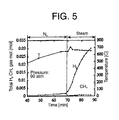
- the inventors have tracked the state in which CaO in the reactor undergoes a chemical change into Ca (OH) 2 by feeding steam into the reactor while maintaining the temperature of the reactor at 700°C and varying the pressure thereof from 1 atm to 100 atm.
- an effective utilization ratio of CaCO 3 produced by way of Ca (OH) 2 when causing thermal decomposition CaCO 3 ⁇ CaO for reuse differs markedly as compared with that for CaCO 3 produced directly from CaO (CaO ⁇ CaCO 3 ) by bypassing Ca (OH) 2 .
- the inventors have confirmed based on the results of tests that it is effective to turn raw material into impalpable powders.
- pulverized specimens composed of coal and CaO are charged into a reactor, nitrogen gas is fed from a high-pressure nitrogen source into the reactor while keeping the reactor at a temperature in a range of about 600°C to 800°C, and a pressure is maintained on the order of from 30 to 60 atm. Thereafter, water in a predetermined amount according to a pump flow meter is fed into a high-pressure steam generator, and steam generated is fed into the reactor at the temperature kept in the range of about 600°C to 800°C, thereby replacing the nitrogen gas. After completion of the reaction, reactants are fed into a cooler, and after solid-liquid separation, are further fed into a gas-liquid separator via a pressure adjuster, thereby sending out a gas to an analytical instrument.
- specimens prepared by pressure-forming pulverized coal and CaO into pellets generate more hydrogen in comparison with specimens prepared simply by pulverizing coal and CaO without pelletization, thus indicating that it is effective to turn raw material into impalpable powders.
- the present invention relates to a process of preparing hydrogen through thermochemical decomposition of water, wherein coal powders are caused to react with water in the presence of CaO under a condition of temperature in a range of 600°C to 800°C substantially without an oxidizing agent added thereto, thereby reducing water to form hydrogen, said process comprising the steps of rendering the coal powders and CaO into impalpable powders to form mixed impalpable powders, feeding steam generated from a steam generator and the mixed impalpable powders to a fluidized bed of a main reactor, and implementing thermochemical decomposition of water in the main reactor by causing the mixed impalpable powders of the coal powders and CaO to undergo grain growth in the fluidized bed while adjusting a steam partial pressure in the main reactor so as to be suited for a condition enabling CaO to form Ca (OH) 2 .
- sulfur and halogen can be arrested in the main reactor by use of one species or not less than two species in combination, selected from the group consisting of NaOH, Na 2 CO 3 , KOH, and K 2 CO 3 , as appropriate to be thereby recovered as water soluble salts without allowing migration of sulfur and halogen into a formed gas.
- substantially without addition of the oxidizing agent thereto signifies that there is no need not only for addition of an oxidizing agent but also for deliberate removal of air and so forth, contained in a specimen or raw material, upon charging the specimen or raw material into the reactor, which represents one of the important requirements in carrying out the present invention.
- coal powders and CaO are first pulverized to a range of about 0.005 to 0.05 mm in grain size, and are fed by means of air flow transfer into a fluidized bed inside a gasification furnace (main reactor).
- An accompanying gas is a high-temperature gas, product gas (CH4), or other gas.
- steam at a high temperature is fed into the furnace.
- CaO reacts with H 2 O at the inlet of the furnace to be turned into Ca (OH) 2 , thereby generating heat.
- Coal makes use of the heat, and undergoes thermal decomposition, forming gas, tar, and char.
- Ca (OH) 2 , and char powders, together with granulated particles, are fluidized in the furnace.
- Ca (OH) 2 absorbs CO 2 and H 2 S to thereby form CaCO 3 and CaS, further generating heat.
- BY making use of the heat, tar and char react with steam to be gasified, thereby forming CO and hydrogen.
- highly concentrated hydrogen is finally formed.
- the granulated particles after the reactions are discharged from the fluidized bed and the gasification furnace to thereby regenerate CaO in a roasting furnace (CaO regenerator) so as to be utilized again as an absorbent. Further, since the reaction of CaCO 3 ⁇ CaO proceeds in the roasting furnace (CaO regenerator), pure carbonic acid gas can be recovered.
- the main reactor is of a moving bed type, not only gas and liquid but also solids can be taken out while keeping reactions proceeding. Also, the outer wall of the main reactor is kept at not higher than 600°C. It is necessary to prevent CaCO 3 from precipitating on the inner wall of the main reactor.
- sulfur can be arrested in the main reactor by use of one species or not less than two species in combination, selected from the group consisting of NaOH, Na 2 CO 3 , KOH, and K 2 CO 3 , however, desulfurization may be performed by the conventional method.
- FIG. 1 is an overall schematic illustration showing a high-pressure reactor system for continuous supply of particulates, for use in carrying out an embodiment of a process of preparing hydrogen according to the invention, however, it is to be understood that the invention is not limited thereto.
- Coal and calcium oxide (Coal/CaO) in particulate form are fed by a carrier gas (N 2 ) to an inlet 1 ⁇ of a main reactor.
- a carrier gas N 2
- steam from a steam generator is fed to the inlet 1 ⁇ of the main reactor.
- Taiheiyo coal was pulverized with a ball mill, and was mixed with CaO powders available in the market at a predetermined mixing ratio, thereby preparing a mixed specimen composed of coal and CaO.
- the mixed specimen was quantifiably fed to the reactor from the lower part thereof.
- high-temperature steam at a high pressure was fed into a furnace.
- the mixed specimen rose from the inlet of the reactor while being kept in catalytic reaction with the steam, and was discharged from the upper part of the reactor.
- Solid particulates were recovered by a cyclone, and gas is separated from liquid in a filter. The gas was fed to an analytical instrument to analyze composition thereof.
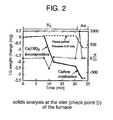
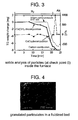
- Figs. 2 and 3 show results of solids analysis at the inlet of the furnace (a check point 1 ⁇ and those of residual particulates inside the furnace (at a check point 2 ⁇ , respectively
- Table 1 shows composition of a formed gas (at a check point 3 ⁇ ). When looking at a formed gas only, except N 2 and H 2 O, it is shown that H 2 gas accounts for about 80% of the formed gas and the remainder is mostly CH2, containing little of CO 2 and CO. Further, the formed gas hardly contains H 2 S, NH 3 , and tar.
- Fig. 4 is a SEM showing the mixed specimen and residual particulates in the furnace.
- the specimen was on the order of about 5 ⁇ m in grain size.
- the grain size of the specimen after a test at 650°C under 30 atm underwent a change so as to be only twice as large as that of the specimen before the test.
- a visual survey of the residual particulates in the furnace, after a test at 650°C under 50 atm shows that the residual particulates underwent fairly large growth in grain size and were granulated into round shape.
- the grain size after the growth was found various, and larger ones showed an increase to 250 ⁇ m, about 50 times as large as that of the specimen before the test.
- Table 1 The results shown in Table 1 represent only a case of carrying out the invention under a specific condition, and it goes without saying that it is possible to control an amount of not only hydrogen gas but also carbonic acid gas as a byproduct by changing raw material, a reaction rate of the main reactor, CaO/ash to be pulled out, and so forth.
- the invention can provide a process of preparing hydrogen through thermochemical decomposition of water, wherein a mixture of impalpable powders of CaO and coal powders can be fed directly to the fluidized bed of a reactor so as to react with each other most efficiently.
Landscapes
- Chemical & Material Sciences (AREA)
- Engineering & Computer Science (AREA)
- Combustion & Propulsion (AREA)
- Oil, Petroleum & Natural Gas (AREA)
- Organic Chemistry (AREA)
- Hydrogen, Water And Hydrids (AREA)
- Feeding, Discharge, Calcimining, Fusing, And Gas-Generation Devices (AREA)
Abstract
Description
| operation condition and composition of a formed gas | ||||||||
| Specimen: | Coal / CaO ratio by wt. | | ||||||
| 1/2.1 | 0.005 mm | |||||||
| Operation condition: | temperature | pressure | steam partial pressure | operation time | ||||
| 650° | 50 atm | 24 | 2 hrs. | |||||
| gas composition: | H2 | CH2 | C2H6 | CO | CO2 | H2S | NH3 | Tar |
| 78% | 17% | 2.7% | 0 | 2.0% | 2 | 0 | 0 |
Claims (4)
- A process of preparing hydrogen through thermochemical decomposition of water, wherein coal powders are caused to react with water in the presence of CaO under a condition of temperature in a range of 600°C to 800°C substantially without an oxidizing agent added thereto, thereby reducing water to form hydrogen, said process comprising the steps of rendering the coal powders and CaO into impalpable powders to form mixed impalpable powders, feeding steam generated from a steam generator and the mixed impalpable powders to a fluidized bed of a main reactor, and implementing thermochemical decomposition of water in the main reactor by causing the mixed impalpable powders of the coal powders and CaO to undergo grain growth in the fluidized bed while adjusting a steam partial pressure in the main reactor so as to be suited for a condition enabling CaO to form Ca(OH)2.
- A process of preparing hydrogen through thermochemical decomposition of water according to claim 1, wherein the steam partial pressure in the fluidized bed is at not less than 3 atm at 600°C and is at not less than 40 atm at 800°C.
- A process of preparing hydrogen through thermochemical decomposition of water according to claim 1, wherein grain size of the mixed impalpable powders is in a range of 0.005 to 0.05 mm, and the grain size after the grain growth is in a range of 0.05 to 0.35 mm.
- A process of preparing hydrogen through thermochemical decomposition of water according to any of claims 1 to 3, wherein the main reactor is a fluidized bed reactor, and the outer wall of the main reactor is cooled to not higher than 600°C.
Applications Claiming Priority (2)
| Application Number | Priority Date | Filing Date | Title |
|---|---|---|---|
| JP2002222185 | 2002-07-30 | ||
| JP2002222185A JP4395570B2 (en) | 2002-07-30 | 2002-07-30 | Method for producing hydrogen by thermochemical decomposition of water |
Publications (2)
| Publication Number | Publication Date |
|---|---|
| EP1386955A2 true EP1386955A2 (en) | 2004-02-04 |
| EP1386955A3 EP1386955A3 (en) | 2004-12-15 |
Family
ID=30112945
Family Applications (1)
| Application Number | Title | Priority Date | Filing Date |
|---|---|---|---|
| EP03016727A Withdrawn EP1386955A3 (en) | 2002-07-30 | 2003-07-22 | Process for preparing hydrogen through thermochemical decomposition of water |
Country Status (4)
| Country | Link |
|---|---|
| US (1) | US7014834B2 (en) |
| EP (1) | EP1386955A3 (en) |
| JP (1) | JP4395570B2 (en) |
| AU (1) | AU2003227318C1 (en) |
Cited By (1)
| Publication number | Priority date | Publication date | Assignee | Title |
|---|---|---|---|---|
| WO2012032363A1 (en) * | 2010-09-08 | 2012-03-15 | Cor Brevis D.O.O. | Fuel and combustible mixture used as a substitute for fossil fuels in thermoelectric power plants, industrial and central heating furnaces |
Families Citing this family (23)
| Publication number | Priority date | Publication date | Assignee | Title |
|---|---|---|---|---|
| WO2006066155A2 (en) * | 2004-12-16 | 2006-06-22 | The Regents Of The University Of California | Hydrogen production by a thermochemical water splitting cycle |
| US20070000177A1 (en) * | 2005-07-01 | 2007-01-04 | Hippo Edwin J | Mild catalytic steam gasification process |
| JP4314488B2 (en) | 2005-07-05 | 2009-08-19 | 株式会社Ihi | Gasification method for solid fuel and gasification apparatus using the method |
| US7842181B2 (en) * | 2006-12-06 | 2010-11-30 | Saudi Arabian Oil Company | Composition and process for the removal of sulfur from middle distillate fuels |
| JP2008247638A (en) * | 2007-03-29 | 2008-10-16 | Gifu Univ | Hydrogen production method and hydrogen production apparatus used therefor |
| JP2009007208A (en) * | 2007-06-29 | 2009-01-15 | Sekitan Energy Center | Calcination method of calcium carbonate |
| CN101391746B (en) * | 2007-09-17 | 2010-12-22 | 上海标氢气体技术有限公司 | Small coal gasification hydrogen production method |
| US20090145808A1 (en) * | 2007-11-30 | 2009-06-11 | Saudi Arabian Oil Company | Catalyst to attain low sulfur diesel |
| US8142646B2 (en) | 2007-11-30 | 2012-03-27 | Saudi Arabian Oil Company | Process to produce low sulfur catalytically cracked gasoline without saturation of olefinic compounds |
| US20100301273A1 (en) * | 2008-01-14 | 2010-12-02 | Wlodzimierz Blasiak | Biomass gasification method and apparatus for production of syngas with a rich hydrogen content |
| WO2009105749A2 (en) | 2008-02-21 | 2009-08-27 | Saudi Arabian Oil Company | Catalyst to attain low sulfur gasoline |
| EP3208612B1 (en) * | 2008-04-09 | 2019-09-18 | Genentech, Inc. | Compositions and methods for the treatment of immune related diseases |
| US8383072B2 (en) | 2008-06-05 | 2013-02-26 | Industrial Research Limited | Gas separation process |
| US9005432B2 (en) | 2010-06-29 | 2015-04-14 | Saudi Arabian Oil Company | Removal of sulfur compounds from petroleum stream |
| US8535518B2 (en) | 2011-01-19 | 2013-09-17 | Saudi Arabian Oil Company | Petroleum upgrading and desulfurizing process |
| JP2012205969A (en) * | 2011-03-29 | 2012-10-25 | Chino Corp | Evaporator |
| JP2012205970A (en) * | 2011-03-29 | 2012-10-25 | Chino Corp | Evaporator |
| CN102876388A (en) * | 2012-11-01 | 2013-01-16 | 湖南欧吉能源科技有限公司 | System and process for gasifying biomass at high temperature by taking mixed gases comprising high-temperature steam as gasifying agent |
| US10752847B2 (en) | 2017-03-08 | 2020-08-25 | Saudi Arabian Oil Company | Integrated hydrothermal process to upgrade heavy oil |
| US10703999B2 (en) | 2017-03-14 | 2020-07-07 | Saudi Arabian Oil Company | Integrated supercritical water and steam cracking process |
| US10526552B1 (en) | 2018-10-12 | 2020-01-07 | Saudi Arabian Oil Company | Upgrading of heavy oil for steam cracking process |
| EP4469391A1 (en) | 2022-01-28 | 2024-12-04 | COSIC, Drago | High energy environmentally friendly fuel as an additive for coal-fired power plants |
| CN116254134B (en) * | 2023-03-09 | 2025-12-09 | 中国石油大学(北京) | Device and method for in-situ hydrogen production |
Family Cites Families (5)
| Publication number | Priority date | Publication date | Assignee | Title |
|---|---|---|---|---|
| JPS5139644B2 (en) * | 1972-11-30 | 1976-10-29 | ||
| US4248605A (en) * | 1979-07-30 | 1981-02-03 | Conoco, Inc. | Gasification of coal liquefaction residues |
| US4440546A (en) * | 1981-09-25 | 1984-04-03 | Conoco Inc. | Process for gasification of carbonaceous material |
| JP2979149B1 (en) * | 1998-11-11 | 1999-11-15 | 財団法人石炭利用総合センター | Method for producing hydrogen by thermochemical decomposition |
| JP3915010B2 (en) | 2000-04-13 | 2007-05-16 | 財団法人石炭利用総合センター | Method for producing hydrogen by thermochemical decomposition |
-
2002
- 2002-07-30 JP JP2002222185A patent/JP4395570B2/en not_active Expired - Fee Related
-
2003
- 2003-07-15 US US10/619,401 patent/US7014834B2/en not_active Expired - Fee Related
- 2003-07-22 EP EP03016727A patent/EP1386955A3/en not_active Withdrawn
- 2003-07-30 AU AU2003227318A patent/AU2003227318C1/en not_active Ceased
Cited By (3)
| Publication number | Priority date | Publication date | Assignee | Title |
|---|---|---|---|---|
| WO2012032363A1 (en) * | 2010-09-08 | 2012-03-15 | Cor Brevis D.O.O. | Fuel and combustible mixture used as a substitute for fossil fuels in thermoelectric power plants, industrial and central heating furnaces |
| CN103119138A (en) * | 2010-09-08 | 2013-05-22 | 科布雷维斯公司 | A fuel and combustible mixture intended to replace fossil fuels used in thermal power plants, factories and central heating furnaces |
| EA023454B1 (en) * | 2010-09-08 | 2016-06-30 | Кор Бревис Д.О.О. | Fuel and combustible mixture used as a substitute for fossil fuels in thermoelectric power plants, industrial and central heating furnaces |
Also Published As
| Publication number | Publication date |
|---|---|
| JP4395570B2 (en) | 2010-01-13 |
| AU2003227318A1 (en) | 2004-02-19 |
| US20040024072A1 (en) | 2004-02-05 |
| JP2004059816A (en) | 2004-02-26 |
| AU2003227318B2 (en) | 2008-02-21 |
| US7014834B2 (en) | 2006-03-21 |
| EP1386955A3 (en) | 2004-12-15 |
| AU2003227318C1 (en) | 2008-10-30 |
Similar Documents
| Publication | Publication Date | Title |
|---|---|---|
| US7014834B2 (en) | Process for preparing hydrogen through thermochemical decomposition of water | |
| US3847567A (en) | Catalytic coal hydrogasification process | |
| US6685754B2 (en) | Method for the production of hydrogen-containing gaseous mixtures | |
| US4558027A (en) | Catalysts for carbon and coal gasification | |
| US4876080A (en) | Hydrogen production with coal using a pulverization device | |
| CA2743911C (en) | Carbonation calcination reaction process for co2 capture using a highly regenerable sorbent | |
| EP1001002A2 (en) | Method for producing hydrogen by thermochemical decomposition | |
| US4118204A (en) | Process for the production of an intermediate Btu gas | |
| US4211669A (en) | Process for the production of a chemical synthesis gas from coal | |
| CA1079972A (en) | Process for production of synthesis gas | |
| CA1212546A (en) | Method for converting carbon - containing raw material into a combustible product gas | |
| US3991557A (en) | Process for converting high sulfur coal to low sulfur power plant fuel | |
| WO2006031011A1 (en) | Apparatus of catalytic gasification for refined biomass fuel at low temperature and the method thereof | |
| CN1018449B (en) | production of fuel gas | |
| CA2184531C (en) | Method for producing hydrogen-carbon monoxide mixed gas, and apparatus thereof | |
| US3516808A (en) | Preparation of carbon dioxide acceptors by the melt process | |
| Li et al. | Reengineering of the carbon-to-acetylene process featuring negative carbon emission | |
| US4231760A (en) | Process for gasification using a synthetic CO2 acceptor | |
| US4284528A (en) | Synthetic CO2 acceptor | |
| JPH0229111B2 (en) | ||
| CN109762603A (en) | A method of ammonia is synthesized using low-order coal multipath | |
| EP0112117A2 (en) | Carbonaceous material conversion process | |
| JP3915010B2 (en) | Method for producing hydrogen by thermochemical decomposition | |
| US4867756A (en) | Removal of sulfur compounds in fluidized bed carbonaceous solids gasification | |
| JP2003082361A (en) | Hydrogen production process by thermochemical decomposition |
Legal Events
| Date | Code | Title | Description |
|---|---|---|---|
| PUAI | Public reference made under article 153(3) epc to a published international application that has entered the european phase |
Free format text: ORIGINAL CODE: 0009012 |
|
| AK | Designated contracting states |
Kind code of ref document: A2 Designated state(s): AT BE BG CH CY CZ DE DK EE ES FI FR GB GR HU IE IT LI LU MC NL PT RO SE SI SK TR |
|
| AX | Request for extension of the european patent |
Extension state: AL LT LV MK |
|
| PUAL | Search report despatched |
Free format text: ORIGINAL CODE: 0009013 |
|
| AK | Designated contracting states |
Kind code of ref document: A3 Designated state(s): AT BE BG CH CY CZ DE DK EE ES FI FR GB GR HU IE IT LI LU MC NL PT RO SE SI SK TR |
|
| AX | Request for extension of the european patent |
Extension state: AL LT LV MK |
|
| 17P | Request for examination filed |
Effective date: 20050420 |
|
| AKX | Designation fees paid |
Designated state(s): DE FR GB |
|
| 17Q | First examination report despatched |
Effective date: 20100222 |
|
| STAA | Information on the status of an ep patent application or granted ep patent |
Free format text: STATUS: THE APPLICATION IS DEEMED TO BE WITHDRAWN |
|
| 18D | Application deemed to be withdrawn |
Effective date: 20140103 |