EP1386946A1 - 4,7-dichlororhodamine dyes useful as molecular probes - Google Patents
4,7-dichlororhodamine dyes useful as molecular probes Download PDFInfo
- Publication number
- EP1386946A1 EP1386946A1 EP03025777A EP03025777A EP1386946A1 EP 1386946 A1 EP1386946 A1 EP 1386946A1 EP 03025777 A EP03025777 A EP 03025777A EP 03025777 A EP03025777 A EP 03025777A EP 1386946 A1 EP1386946 A1 EP 1386946A1
- Authority
- EP
- European Patent Office
- Prior art keywords
- hydrogen
- group
- attached
- linkage
- compound
- Prior art date
- Legal status (The legal status is an assumption and is not a legal conclusion. Google has not performed a legal analysis and makes no representation as to the accuracy of the status listed.)
- Granted
Links
- 239000000975 dye Substances 0.000 title claims abstract description 106
- 239000003068 molecular probe Substances 0.000 title description 6
- 239000002157 polynucleotide Substances 0.000 claims abstract description 55
- 108091033319 polynucleotide Proteins 0.000 claims abstract description 52
- 102000040430 polynucleotide Human genes 0.000 claims abstract description 52
- 229910052739 hydrogen Inorganic materials 0.000 claims abstract description 45
- 239000001257 hydrogen Substances 0.000 claims abstract description 41
- 150000001875 compounds Chemical class 0.000 claims abstract description 40
- 125000005647 linker group Chemical group 0.000 claims abstract description 34
- 238000000034 method Methods 0.000 claims abstract description 32
- 125000000217 alkyl group Chemical group 0.000 claims abstract description 25
- 125000001997 phenyl group Chemical group [H]C1=C([H])C([H])=C(*)C([H])=C1[H] 0.000 claims abstract description 15
- 150000007942 carboxylates Chemical class 0.000 claims abstract description 14
- BDHFUVZGWQCTTF-UHFFFAOYSA-M sulfonate Chemical compound [O-]S(=O)=O BDHFUVZGWQCTTF-UHFFFAOYSA-M 0.000 claims abstract description 14
- ZAMOUSCENKQFHK-UHFFFAOYSA-N Chlorine atom Chemical compound [Cl] ZAMOUSCENKQFHK-UHFFFAOYSA-N 0.000 claims abstract description 13
- PXGOKWXKJXAPGV-UHFFFAOYSA-N Fluorine Chemical compound FF PXGOKWXKJXAPGV-UHFFFAOYSA-N 0.000 claims abstract description 13
- 150000001336 alkenes Chemical class 0.000 claims abstract description 13
- 150000001345 alkine derivatives Chemical class 0.000 claims abstract description 13
- 239000000460 chlorine Substances 0.000 claims abstract description 13
- 229910052801 chlorine Inorganic materials 0.000 claims abstract description 13
- 239000011737 fluorine Substances 0.000 claims abstract description 13
- 229910052731 fluorine Inorganic materials 0.000 claims abstract description 13
- 125000000753 cycloalkyl group Chemical group 0.000 claims abstract description 11
- 125000003368 amide group Chemical group 0.000 claims abstract description 10
- 125000003118 aryl group Chemical group 0.000 claims abstract description 10
- 125000003545 alkoxy group Chemical group 0.000 claims abstract description 9
- 150000002825 nitriles Chemical class 0.000 claims abstract description 8
- 238000012163 sequencing technique Methods 0.000 claims abstract description 8
- 150000003457 sulfones Chemical class 0.000 claims abstract description 8
- 125000003258 trimethylene group Chemical group [H]C([H])([*:2])C([H])([H])C([H])([H])[*:1] 0.000 claims abstract description 8
- 125000002924 primary amino group Chemical group [H]N([H])* 0.000 claims abstract description 7
- 125000005605 benzo group Chemical group 0.000 claims abstract description 6
- 125000000816 ethylene group Chemical group [H]C([H])([*:1])C([H])([H])[*:2] 0.000 claims abstract description 5
- 125000004029 hydroxymethyl group Chemical group [H]OC([H])([H])* 0.000 claims abstract description 5
- 125000003729 nucleotide group Chemical group 0.000 claims description 43
- 239000002773 nucleotide Substances 0.000 claims description 42
- KDCGOANMDULRCW-UHFFFAOYSA-N 7H-purine Chemical compound N1=CNC2=NC=NC2=C1 KDCGOANMDULRCW-UHFFFAOYSA-N 0.000 claims description 28
- 150000002431 hydrogen Chemical class 0.000 claims description 22
- 239000002777 nucleoside Substances 0.000 claims description 22
- 125000000561 purinyl group Chemical group N1=C(N=C2N=CNC2=C1)* 0.000 claims description 18
- 239000000203 mixture Substances 0.000 claims description 17
- 125000002496 methyl group Chemical group [H]C([H])([H])* 0.000 claims description 15
- 150000003833 nucleoside derivatives Chemical class 0.000 claims description 15
- 125000000714 pyrimidinyl group Chemical group 0.000 claims description 15
- UFHFLCQGNIYNRP-UHFFFAOYSA-N Hydrogen Chemical compound [H][H] UFHFLCQGNIYNRP-UHFFFAOYSA-N 0.000 claims description 14
- ISAKRJDGNUQOIC-UHFFFAOYSA-N Uracil Chemical compound O=C1C=CNC(=O)N1 ISAKRJDGNUQOIC-UHFFFAOYSA-N 0.000 claims description 8
- OPTASPLRGRRNAP-UHFFFAOYSA-N cytosine Chemical compound NC=1C=CNC(=O)N=1 OPTASPLRGRRNAP-UHFFFAOYSA-N 0.000 claims description 8
- 150000001412 amines Chemical class 0.000 claims description 7
- 125000001495 ethyl group Chemical group [H]C([H])([H])C([H])([H])* 0.000 claims description 7
- 150000004713 phosphodiesters Chemical class 0.000 claims description 7
- 150000001408 amides Chemical class 0.000 claims description 6
- CZPWVGJYEJSRLH-UHFFFAOYSA-N Pyrimidine Chemical compound C1=CN=CN=C1 CZPWVGJYEJSRLH-UHFFFAOYSA-N 0.000 claims description 4
- 125000005599 alkyl carboxylate group Chemical group 0.000 claims description 4
- 150000008052 alkyl sulfonates Chemical class 0.000 claims description 4
- 229940104302 cytosine Drugs 0.000 claims description 4
- 238000005286 illumination Methods 0.000 claims description 4
- 150000003013 phosphoric acid derivatives Chemical class 0.000 claims description 4
- 239000002213 purine nucleotide Substances 0.000 claims description 4
- 239000002719 pyrimidine nucleotide Substances 0.000 claims description 4
- 150000003230 pyrimidines Chemical class 0.000 claims description 4
- 125000000719 pyrrolidinyl group Chemical group 0.000 claims description 4
- 229940035893 uracil Drugs 0.000 claims description 4
- 238000002189 fluorescence spectrum Methods 0.000 claims description 3
- XKKCQTLDIPIRQD-JGVFFNPUSA-N 1-[(2r,5s)-5-(hydroxymethyl)oxolan-2-yl]-5-methylpyrimidine-2,4-dione Chemical group O=C1NC(=O)C(C)=CN1[C@@H]1O[C@H](CO)CC1 XKKCQTLDIPIRQD-JGVFFNPUSA-N 0.000 claims description 2
- WVXRAFOPTSTNLL-NKWVEPMBSA-N 2',3'-dideoxyadenosine Chemical group C1=NC=2C(N)=NC=NC=2N1[C@H]1CC[C@@H](CO)O1 WVXRAFOPTSTNLL-NKWVEPMBSA-N 0.000 claims description 2
- OCLZPNCLRLDXJC-NTSWFWBYSA-N 2-amino-9-[(2r,5s)-5-(hydroxymethyl)oxolan-2-yl]-3h-purin-6-one Chemical group C1=2NC(N)=NC(=O)C=2N=CN1[C@H]1CC[C@@H](CO)O1 OCLZPNCLRLDXJC-NTSWFWBYSA-N 0.000 claims description 2
- NINIDFKCEFEMDL-UHFFFAOYSA-N Sulfur Chemical compound [S] NINIDFKCEFEMDL-UHFFFAOYSA-N 0.000 claims description 2
- WREGKURFCTUGRC-POYBYMJQSA-N Zalcitabine Chemical group O=C1N=C(N)C=CN1[C@@H]1O[C@H](CO)CC1 WREGKURFCTUGRC-POYBYMJQSA-N 0.000 claims description 2
- QVGXLLKOCUKJST-UHFFFAOYSA-N atomic oxygen Chemical compound [O] QVGXLLKOCUKJST-UHFFFAOYSA-N 0.000 claims description 2
- 239000001301 oxygen Substances 0.000 claims description 2
- 229910052760 oxygen Inorganic materials 0.000 claims description 2
- 229910052717 sulfur Inorganic materials 0.000 claims description 2
- 239000011593 sulfur Substances 0.000 claims description 2
- 229960000523 zalcitabine Drugs 0.000 claims description 2
- 229910018821 PO3 Inorganic materials 0.000 claims 1
- 239000003153 chemical reaction reagent Substances 0.000 abstract description 28
- -1 deoxynucleotides Chemical class 0.000 abstract description 27
- 239000012634 fragment Substances 0.000 abstract description 17
- 238000004458 analytical method Methods 0.000 abstract description 11
- 239000007850 fluorescent dye Substances 0.000 abstract description 10
- 239000005546 dideoxynucleotide Substances 0.000 abstract description 9
- 125000004435 hydrogen atom Chemical class [H]* 0.000 abstract description 7
- 238000006243 chemical reaction Methods 0.000 description 20
- WEVYAHXRMPXWCK-UHFFFAOYSA-N Acetonitrile Chemical compound CC#N WEVYAHXRMPXWCK-UHFFFAOYSA-N 0.000 description 18
- YMWUJEATGCHHMB-UHFFFAOYSA-N Dichloromethane Chemical compound ClCCl YMWUJEATGCHHMB-UHFFFAOYSA-N 0.000 description 18
- OKKJLVBELUTLKV-UHFFFAOYSA-N Methanol Chemical compound OC OKKJLVBELUTLKV-UHFFFAOYSA-N 0.000 description 18
- 108091034117 Oligonucleotide Proteins 0.000 description 18
- 238000003786 synthesis reaction Methods 0.000 description 17
- XLYOFNOQVPJJNP-UHFFFAOYSA-N water Substances O XLYOFNOQVPJJNP-UHFFFAOYSA-N 0.000 description 15
- 230000015572 biosynthetic process Effects 0.000 description 14
- 238000001712 DNA sequencing Methods 0.000 description 13
- 239000007787 solid Substances 0.000 description 13
- 108020004414 DNA Proteins 0.000 description 12
- XEKOWRVHYACXOJ-UHFFFAOYSA-N Ethyl acetate Chemical compound CCOC(C)=O XEKOWRVHYACXOJ-UHFFFAOYSA-N 0.000 description 12
- 230000000295 complement effect Effects 0.000 description 12
- 238000001514 detection method Methods 0.000 description 12
- 239000000243 solution Substances 0.000 description 11
- CSNNHWWHGAXBCP-UHFFFAOYSA-L Magnesium sulfate Chemical compound [Mg+2].[O-][S+2]([O-])([O-])[O-] CSNNHWWHGAXBCP-UHFFFAOYSA-L 0.000 description 10
- 238000000926 separation method Methods 0.000 description 10
- 239000001226 triphosphate Substances 0.000 description 10
- 229910001868 water Inorganic materials 0.000 description 10
- HEMHJVSKTPXQMS-UHFFFAOYSA-M Sodium hydroxide Chemical compound [OH-].[Na+] HEMHJVSKTPXQMS-UHFFFAOYSA-M 0.000 description 9
- ZMANZCXQSJIPKH-UHFFFAOYSA-N Triethylamine Chemical compound CCN(CC)CC ZMANZCXQSJIPKH-UHFFFAOYSA-N 0.000 description 9
- 239000001022 rhodamine dye Substances 0.000 description 9
- FAPWRFPIFSIZLT-UHFFFAOYSA-M Sodium chloride Chemical compound [Na+].[Cl-] FAPWRFPIFSIZLT-UHFFFAOYSA-M 0.000 description 8
- 238000001962 electrophoresis Methods 0.000 description 8
- 238000002372 labelling Methods 0.000 description 8
- 102000039446 nucleic acids Human genes 0.000 description 8
- 108020004707 nucleic acids Proteins 0.000 description 8
- 150000007523 nucleic acids Chemical class 0.000 description 8
- IAZDPXIOMUYVGZ-UHFFFAOYSA-N Dimethylsulphoxide Chemical compound CS(C)=O IAZDPXIOMUYVGZ-UHFFFAOYSA-N 0.000 description 7
- 238000000295 emission spectrum Methods 0.000 description 7
- 238000004007 reversed phase HPLC Methods 0.000 description 7
- 235000011178 triphosphate Nutrition 0.000 description 7
- VKIGAWAEXPTIOL-UHFFFAOYSA-N 2-hydroxyhexanenitrile Chemical compound CCCCC(O)C#N VKIGAWAEXPTIOL-UHFFFAOYSA-N 0.000 description 6
- 102000004190 Enzymes Human genes 0.000 description 6
- 108090000790 Enzymes Proteins 0.000 description 6
- XSQUKJJJFZCRTK-UHFFFAOYSA-N Urea Chemical compound NC(N)=O XSQUKJJJFZCRTK-UHFFFAOYSA-N 0.000 description 6
- 239000000872 buffer Substances 0.000 description 6
- 125000003178 carboxy group Chemical group [H]OC(*)=O 0.000 description 6
- 125000003835 nucleoside group Chemical group 0.000 description 6
- 239000000047 product Substances 0.000 description 6
- 238000011160 research Methods 0.000 description 6
- OCUQMPDZMXSVFG-UHFFFAOYSA-N 4,7-dichloro-1,3-dioxo-2-benzofuran-5-carboxylic acid Chemical compound OC(=O)C1=CC(Cl)=C2C(=O)OC(=O)C2=C1Cl OCUQMPDZMXSVFG-UHFFFAOYSA-N 0.000 description 5
- XKRFYHLGVUSROY-UHFFFAOYSA-N Argon Chemical compound [Ar] XKRFYHLGVUSROY-UHFFFAOYSA-N 0.000 description 5
- 102000016928 DNA-directed DNA polymerase Human genes 0.000 description 5
- 108010014303 DNA-directed DNA polymerase Proteins 0.000 description 5
- VEXZGXHMUGYJMC-UHFFFAOYSA-N Hydrochloric acid Chemical compound Cl VEXZGXHMUGYJMC-UHFFFAOYSA-N 0.000 description 5
- ZMXDDKWLCZADIW-UHFFFAOYSA-N N,N-Dimethylformamide Chemical compound CN(C)C=O ZMXDDKWLCZADIW-UHFFFAOYSA-N 0.000 description 5
- 230000002255 enzymatic effect Effects 0.000 description 5
- 238000001914 filtration Methods 0.000 description 5
- 229910052943 magnesium sulfate Inorganic materials 0.000 description 5
- 239000011541 reaction mixture Substances 0.000 description 5
- 239000000523 sample Substances 0.000 description 5
- 238000010898 silica gel chromatography Methods 0.000 description 5
- 239000002904 solvent Substances 0.000 description 5
- 102000053602 DNA Human genes 0.000 description 4
- WYURNTSHIVDZCO-UHFFFAOYSA-N Tetrahydrofuran Chemical compound C1CCOC1 WYURNTSHIVDZCO-UHFFFAOYSA-N 0.000 description 4
- 229910052786 argon Inorganic materials 0.000 description 4
- 239000003795 chemical substances by application Substances 0.000 description 4
- 238000001816 cooling Methods 0.000 description 4
- 239000012043 crude product Substances 0.000 description 4
- 108090000623 proteins and genes Proteins 0.000 description 4
- 238000000746 purification Methods 0.000 description 4
- PYWVYCXTNDRMGF-UHFFFAOYSA-N rhodamine B Chemical compound [Cl-].C=12C=CC(=[N+](CC)CC)C=C2OC2=CC(N(CC)CC)=CC=C2C=1C1=CC=CC=C1C(O)=O PYWVYCXTNDRMGF-UHFFFAOYSA-N 0.000 description 4
- 239000011780 sodium chloride Substances 0.000 description 4
- 239000000126 substance Substances 0.000 description 4
- 125000001424 substituent group Chemical group 0.000 description 4
- 125000000547 substituted alkyl group Chemical group 0.000 description 4
- 125000002264 triphosphate group Chemical class [H]OP(=O)(O[H])OP(=O)(O[H])OP(=O)(O[H])O* 0.000 description 4
- OALHHIHQOFIMEF-UHFFFAOYSA-N 3',6'-dihydroxy-2',4',5',7'-tetraiodo-3h-spiro[2-benzofuran-1,9'-xanthene]-3-one Chemical compound O1C(=O)C2=CC=CC=C2C21C1=CC(I)=C(O)C(I)=C1OC1=C(I)C(O)=C(I)C=C21 OALHHIHQOFIMEF-UHFFFAOYSA-N 0.000 description 3
- QTBSBXVTEAMEQO-UHFFFAOYSA-N Acetic acid Chemical compound CC(O)=O QTBSBXVTEAMEQO-UHFFFAOYSA-N 0.000 description 3
- UHOVQNZJYSORNB-UHFFFAOYSA-N Benzene Chemical compound C1=CC=CC=C1 UHOVQNZJYSORNB-UHFFFAOYSA-N 0.000 description 3
- QOSSAOTZNIDXMA-UHFFFAOYSA-N Dicylcohexylcarbodiimide Chemical compound C1CCCCC1N=C=NC1CCCCC1 QOSSAOTZNIDXMA-UHFFFAOYSA-N 0.000 description 3
- RTZKZFJDLAIYFH-UHFFFAOYSA-N Diethyl ether Chemical compound CCOCC RTZKZFJDLAIYFH-UHFFFAOYSA-N 0.000 description 3
- QMMFVYPAHWMCMS-UHFFFAOYSA-N Dimethyl sulfide Chemical compound CSC QMMFVYPAHWMCMS-UHFFFAOYSA-N 0.000 description 3
- 102000003960 Ligases Human genes 0.000 description 3
- 108090000364 Ligases Proteins 0.000 description 3
- 108091092878 Microsatellite Proteins 0.000 description 3
- NQTADLQHYWFPDB-UHFFFAOYSA-N N-Hydroxysuccinimide Chemical compound ON1C(=O)CCC1=O NQTADLQHYWFPDB-UHFFFAOYSA-N 0.000 description 3
- VYPSYNLAJGMNEJ-UHFFFAOYSA-N Silicium dioxide Chemical compound O=[Si]=O VYPSYNLAJGMNEJ-UHFFFAOYSA-N 0.000 description 3
- YXFVVABEGXRONW-UHFFFAOYSA-N Toluene Chemical compound CC1=CC=CC=C1 YXFVVABEGXRONW-UHFFFAOYSA-N 0.000 description 3
- 238000010521 absorption reaction Methods 0.000 description 3
- 239000004202 carbamide Substances 0.000 description 3
- 239000011545 carbonate/bicarbonate buffer Substances 0.000 description 3
- 238000010828 elution Methods 0.000 description 3
- 238000001704 evaporation Methods 0.000 description 3
- 238000004128 high performance liquid chromatography Methods 0.000 description 3
- 238000012986 modification Methods 0.000 description 3
- 230000004048 modification Effects 0.000 description 3
- 239000000178 monomer Substances 0.000 description 3
- 229920000642 polymer Polymers 0.000 description 3
- 238000002360 preparation method Methods 0.000 description 3
- 230000002285 radioactive effect Effects 0.000 description 3
- 230000003595 spectral effect Effects 0.000 description 3
- RYYWUUFWQRZTIU-UHFFFAOYSA-K thiophosphate Chemical compound [O-]P([O-])([O-])=S RYYWUUFWQRZTIU-UHFFFAOYSA-K 0.000 description 3
- COHIKSCTBXUBIL-UHFFFAOYSA-N 1-ethyl-2,3-dihydroindol-4-ol Chemical compound C1=CC=C(O)C2=C1N(CC)CC2 COHIKSCTBXUBIL-UHFFFAOYSA-N 0.000 description 2
- OAKPWEUQDVLTCN-NKWVEPMBSA-N 2',3'-Dideoxyadenosine-5-triphosphate Chemical compound C1=NC=2C(N)=NC=NC=2N1[C@H]1CC[C@@H](CO[P@@](O)(=O)O[P@](O)(=O)OP(O)(O)=O)O1 OAKPWEUQDVLTCN-NKWVEPMBSA-N 0.000 description 2
- OWWAUBQOFLVUMS-UHFFFAOYSA-N 2,3-dihydro-1h-indol-4-ol Chemical compound OC1=CC=CC2=C1CCN2 OWWAUBQOFLVUMS-UHFFFAOYSA-N 0.000 description 2
- CWLKGDAVCFYWJK-UHFFFAOYSA-N 3-aminophenol Chemical compound NC1=CC=CC(O)=C1 CWLKGDAVCFYWJK-UHFFFAOYSA-N 0.000 description 2
- BMTDPXOFINIBGC-UHFFFAOYSA-N 3-pyrrolidin-1-ylphenol Chemical compound OC1=CC=CC(N2CCCC2)=C1 BMTDPXOFINIBGC-UHFFFAOYSA-N 0.000 description 2
- 244000105975 Antidesma platyphyllum Species 0.000 description 2
- LSNNMFCWUKXFEE-UHFFFAOYSA-M Bisulfite Chemical compound OS([O-])=O LSNNMFCWUKXFEE-UHFFFAOYSA-M 0.000 description 2
- BVKZGUZCCUSVTD-UHFFFAOYSA-L Carbonate Chemical compound [O-]C([O-])=O BVKZGUZCCUSVTD-UHFFFAOYSA-L 0.000 description 2
- 108020003215 DNA Probes Proteins 0.000 description 2
- 239000003298 DNA probe Substances 0.000 description 2
- 230000006820 DNA synthesis Effects 0.000 description 2
- ZHNUHDYFZUAESO-UHFFFAOYSA-N Formamide Chemical compound NC=O ZHNUHDYFZUAESO-UHFFFAOYSA-N 0.000 description 2
- AFVFQIVMOAPDHO-UHFFFAOYSA-N Methanesulfonic acid Chemical compound CS(O)(=O)=O AFVFQIVMOAPDHO-UHFFFAOYSA-N 0.000 description 2
- 0 NC1C(NO)OC(*ON=I)C1NI Chemical compound NC1C(NO)OC(*ON=I)C1NI 0.000 description 2
- UFWIBTONFRDIAS-UHFFFAOYSA-N Naphthalene Chemical compound C1=CC=CC2=CC=CC=C21 UFWIBTONFRDIAS-UHFFFAOYSA-N 0.000 description 2
- 229910052779 Neodymium Inorganic materials 0.000 description 2
- 240000009305 Pometia pinnata Species 0.000 description 2
- 235000017284 Pometia pinnata Nutrition 0.000 description 2
- 108091081062 Repeated sequence (DNA) Proteins 0.000 description 2
- IQFYYKKMVGJFEH-XLPZGREQSA-N Thymidine Chemical compound O=C1NC(=O)C(C)=CN1[C@@H]1O[C@H](CO)[C@@H](O)C1 IQFYYKKMVGJFEH-XLPZGREQSA-N 0.000 description 2
- JLCPHMBAVCMARE-UHFFFAOYSA-N [3-[[3-[[3-[[3-[[3-[[3-[[3-[[3-[[3-[[3-[[3-[[5-(2-amino-6-oxo-1H-purin-9-yl)-3-[[3-[[3-[[3-[[3-[[3-[[5-(2-amino-6-oxo-1H-purin-9-yl)-3-[[5-(2-amino-6-oxo-1H-purin-9-yl)-3-hydroxyoxolan-2-yl]methoxy-hydroxyphosphoryl]oxyoxolan-2-yl]methoxy-hydroxyphosphoryl]oxy-5-(5-methyl-2,4-dioxopyrimidin-1-yl)oxolan-2-yl]methoxy-hydroxyphosphoryl]oxy-5-(6-aminopurin-9-yl)oxolan-2-yl]methoxy-hydroxyphosphoryl]oxy-5-(6-aminopurin-9-yl)oxolan-2-yl]methoxy-hydroxyphosphoryl]oxy-5-(6-aminopurin-9-yl)oxolan-2-yl]methoxy-hydroxyphosphoryl]oxy-5-(6-aminopurin-9-yl)oxolan-2-yl]methoxy-hydroxyphosphoryl]oxyoxolan-2-yl]methoxy-hydroxyphosphoryl]oxy-5-(5-methyl-2,4-dioxopyrimidin-1-yl)oxolan-2-yl]methoxy-hydroxyphosphoryl]oxy-5-(4-amino-2-oxopyrimidin-1-yl)oxolan-2-yl]methoxy-hydroxyphosphoryl]oxy-5-(5-methyl-2,4-dioxopyrimidin-1-yl)oxolan-2-yl]methoxy-hydroxyphosphoryl]oxy-5-(5-methyl-2,4-dioxopyrimidin-1-yl)oxolan-2-yl]methoxy-hydroxyphosphoryl]oxy-5-(6-aminopurin-9-yl)oxolan-2-yl]methoxy-hydroxyphosphoryl]oxy-5-(6-aminopurin-9-yl)oxolan-2-yl]methoxy-hydroxyphosphoryl]oxy-5-(4-amino-2-oxopyrimidin-1-yl)oxolan-2-yl]methoxy-hydroxyphosphoryl]oxy-5-(4-amino-2-oxopyrimidin-1-yl)oxolan-2-yl]methoxy-hydroxyphosphoryl]oxy-5-(4-amino-2-oxopyrimidin-1-yl)oxolan-2-yl]methoxy-hydroxyphosphoryl]oxy-5-(6-aminopurin-9-yl)oxolan-2-yl]methoxy-hydroxyphosphoryl]oxy-5-(4-amino-2-oxopyrimidin-1-yl)oxolan-2-yl]methyl [5-(6-aminopurin-9-yl)-2-(hydroxymethyl)oxolan-3-yl] hydrogen phosphate Polymers Cc1cn(C2CC(OP(O)(=O)OCC3OC(CC3OP(O)(=O)OCC3OC(CC3O)n3cnc4c3nc(N)[nH]c4=O)n3cnc4c3nc(N)[nH]c4=O)C(COP(O)(=O)OC3CC(OC3COP(O)(=O)OC3CC(OC3COP(O)(=O)OC3CC(OC3COP(O)(=O)OC3CC(OC3COP(O)(=O)OC3CC(OC3COP(O)(=O)OC3CC(OC3COP(O)(=O)OC3CC(OC3COP(O)(=O)OC3CC(OC3COP(O)(=O)OC3CC(OC3COP(O)(=O)OC3CC(OC3COP(O)(=O)OC3CC(OC3COP(O)(=O)OC3CC(OC3COP(O)(=O)OC3CC(OC3COP(O)(=O)OC3CC(OC3COP(O)(=O)OC3CC(OC3COP(O)(=O)OC3CC(OC3COP(O)(=O)OC3CC(OC3CO)n3cnc4c(N)ncnc34)n3ccc(N)nc3=O)n3cnc4c(N)ncnc34)n3ccc(N)nc3=O)n3ccc(N)nc3=O)n3ccc(N)nc3=O)n3cnc4c(N)ncnc34)n3cnc4c(N)ncnc34)n3cc(C)c(=O)[nH]c3=O)n3cc(C)c(=O)[nH]c3=O)n3ccc(N)nc3=O)n3cc(C)c(=O)[nH]c3=O)n3cnc4c3nc(N)[nH]c4=O)n3cnc4c(N)ncnc34)n3cnc4c(N)ncnc34)n3cnc4c(N)ncnc34)n3cnc4c(N)ncnc34)O2)c(=O)[nH]c1=O JLCPHMBAVCMARE-UHFFFAOYSA-N 0.000 description 2
- 238000000862 absorption spectrum Methods 0.000 description 2
- OIRDTQYFTABQOQ-KQYNXXCUSA-N adenosine Chemical compound C1=NC=2C(N)=NC=NC=2N1[C@@H]1O[C@H](CO)[C@@H](O)[C@H]1O OIRDTQYFTABQOQ-KQYNXXCUSA-N 0.000 description 2
- 150000008064 anhydrides Chemical class 0.000 description 2
- MWPLVEDNUUSJAV-UHFFFAOYSA-N anthracene Chemical compound C1=CC=CC2=CC3=CC=CC=C3C=C21 MWPLVEDNUUSJAV-UHFFFAOYSA-N 0.000 description 2
- 238000003556 assay Methods 0.000 description 2
- UORVGPXVDQYIDP-UHFFFAOYSA-N borane Chemical compound B UORVGPXVDQYIDP-UHFFFAOYSA-N 0.000 description 2
- 150000001718 carbodiimides Chemical class 0.000 description 2
- 229910052799 carbon Inorganic materials 0.000 description 2
- 239000011203 carbon fibre reinforced carbon Substances 0.000 description 2
- VYXSBFYARXAAKO-WTKGSRSZSA-N chembl402140 Chemical compound Cl.C1=2C=C(C)C(NCC)=CC=2OC2=C\C(=N/CC)C(C)=CC2=C1C1=CC=CC=C1C(=O)OCC VYXSBFYARXAAKO-WTKGSRSZSA-N 0.000 description 2
- 210000000349 chromosome Anatomy 0.000 description 2
- URGJWIFLBWJRMF-JGVFFNPUSA-N ddTTP Chemical compound O=C1NC(=O)C(C)=CN1[C@@H]1O[C@H](COP(O)(=O)OP(O)(=O)OP(O)(O)=O)CC1 URGJWIFLBWJRMF-JGVFFNPUSA-N 0.000 description 2
- ZUOUZKKEUPVFJK-UHFFFAOYSA-N diphenyl Chemical compound C1=CC=CC=C1C1=CC=CC=C1 ZUOUZKKEUPVFJK-UHFFFAOYSA-N 0.000 description 2
- 230000008020 evaporation Effects 0.000 description 2
- 230000005284 excitation Effects 0.000 description 2
- 230000005021 gait Effects 0.000 description 2
- 239000000499 gel Substances 0.000 description 2
- 230000002068 genetic effect Effects 0.000 description 2
- LEQAOMBKQFMDFZ-UHFFFAOYSA-N glyoxal Chemical compound O=CC=O LEQAOMBKQFMDFZ-UHFFFAOYSA-N 0.000 description 2
- UYTPUPDQBNUYGX-UHFFFAOYSA-N guanine Chemical compound O=C1NC(N)=NC2=C1N=CN2 UYTPUPDQBNUYGX-UHFFFAOYSA-N 0.000 description 2
- 235000009424 haa Nutrition 0.000 description 2
- 125000005179 haloacetyl group Chemical group 0.000 description 2
- 125000005843 halogen group Chemical group 0.000 description 2
- 238000009396 hybridization Methods 0.000 description 2
- 150000002430 hydrocarbons Chemical group 0.000 description 2
- AFQIYTIJXGTIEY-UHFFFAOYSA-N hydrogen carbonate;triethylazanium Chemical compound OC(O)=O.CCN(CC)CC AFQIYTIJXGTIEY-UHFFFAOYSA-N 0.000 description 2
- 238000003018 immunoassay Methods 0.000 description 2
- 238000010348 incorporation Methods 0.000 description 2
- HVTICUPFWKNHNG-UHFFFAOYSA-N iodoethane Chemical compound CCI HVTICUPFWKNHNG-UHFFFAOYSA-N 0.000 description 2
- 235000019341 magnesium sulphate Nutrition 0.000 description 2
- 239000000463 material Substances 0.000 description 2
- 239000011159 matrix material Substances 0.000 description 2
- 230000037230 mobility Effects 0.000 description 2
- FUZZWVXGSFPDMH-UHFFFAOYSA-N n-hexanoic acid Natural products CCCCCC(O)=O FUZZWVXGSFPDMH-UHFFFAOYSA-N 0.000 description 2
- QEFYFXOXNSNQGX-UHFFFAOYSA-N neodymium atom Chemical compound [Nd] QEFYFXOXNSNQGX-UHFFFAOYSA-N 0.000 description 2
- IJGRMHOSHXDMSA-UHFFFAOYSA-N nitrogen Substances N#N IJGRMHOSHXDMSA-UHFFFAOYSA-N 0.000 description 2
- 229910052757 nitrogen Inorganic materials 0.000 description 2
- 150000002829 nitrogen Chemical class 0.000 description 2
- 239000003921 oil Substances 0.000 description 2
- 239000012071 phase Substances 0.000 description 2
- 229920002401 polyacrylamide Polymers 0.000 description 2
- 238000003752 polymerase chain reaction Methods 0.000 description 2
- 229920000137 polyphosphoric acid Polymers 0.000 description 2
- BWHMMNNQKKPAPP-UHFFFAOYSA-L potassium carbonate Chemical compound [K+].[K+].[O-]C([O-])=O BWHMMNNQKKPAPP-UHFFFAOYSA-L 0.000 description 2
- 239000000741 silica gel Substances 0.000 description 2
- 229910002027 silica gel Inorganic materials 0.000 description 2
- WGTODYJZXSJIAG-UHFFFAOYSA-N tetramethylrhodamine chloride Chemical compound [Cl-].C=12C=CC(N(C)C)=CC2=[O+]C2=CC(N(C)C)=CC=C2C=1C1=CC=CC=C1C(O)=O WGTODYJZXSJIAG-UHFFFAOYSA-N 0.000 description 2
- RWQNBRDOKXIBIV-UHFFFAOYSA-N thymine Chemical compound CC1=CNC(=O)NC1=O RWQNBRDOKXIBIV-UHFFFAOYSA-N 0.000 description 2
- UNXRWKVEANCORM-UHFFFAOYSA-N triphosphoric acid Chemical class OP(O)(=O)OP(O)(=O)OP(O)(O)=O UNXRWKVEANCORM-UHFFFAOYSA-N 0.000 description 2
- CTJSPUFGQNVJJP-UHFFFAOYSA-N 1,2,3,4-tetrahydroquinolin-6-ol Chemical compound N1CCCC2=CC(O)=CC=C21 CTJSPUFGQNVJJP-UHFFFAOYSA-N 0.000 description 1
- ULTHEAFYOOPTTB-UHFFFAOYSA-N 1,4-dibromobutane Chemical compound BrCCCCBr ULTHEAFYOOPTTB-UHFFFAOYSA-N 0.000 description 1
- VVZRKVYGKNFTRR-UHFFFAOYSA-N 12h-benzo[a]xanthene Chemical compound C1=CC=CC2=C3CC4=CC=CC=C4OC3=CC=C21 VVZRKVYGKNFTRR-UHFFFAOYSA-N 0.000 description 1
- YKBGVTZYEHREMT-KVQBGUIXSA-N 2'-deoxyguanosine Chemical compound C1=NC=2C(=O)NC(N)=NC=2N1[C@H]1C[C@H](O)[C@@H](CO)O1 YKBGVTZYEHREMT-KVQBGUIXSA-N 0.000 description 1
- RAAGZOYMEQDCTD-UHFFFAOYSA-N 2-fluorobenzoyl chloride Chemical compound FC1=CC=CC=C1C(Cl)=O RAAGZOYMEQDCTD-UHFFFAOYSA-N 0.000 description 1
- KLLOEOPUXBJSOW-UHFFFAOYSA-N 3-(methylamino)phenol Chemical compound CNC1=CC=CC(O)=C1 KLLOEOPUXBJSOW-UHFFFAOYSA-N 0.000 description 1
- 229940018563 3-aminophenol Drugs 0.000 description 1
- UHVIHQSYQVURFV-UHFFFAOYSA-N 4,6-dichlorotriazin-5-amine Chemical compound NC1=C(Cl)N=NN=C1Cl UHVIHQSYQVURFV-UHFFFAOYSA-N 0.000 description 1
- CKTSBUTUHBMZGZ-ULQXZJNLSA-N 4-amino-1-[(2r,4s,5r)-4-hydroxy-5-(hydroxymethyl)oxolan-2-yl]-5-tritiopyrimidin-2-one Chemical compound O=C1N=C(N)C([3H])=CN1[C@@H]1O[C@H](CO)[C@@H](O)C1 CKTSBUTUHBMZGZ-ULQXZJNLSA-N 0.000 description 1
- NLMQHXUGJIAKTH-UHFFFAOYSA-N 4-hydroxyindole Chemical compound OC1=CC=CC2=C1C=CN2 NLMQHXUGJIAKTH-UHFFFAOYSA-N 0.000 description 1
- DNWRLMRKDSGSPL-UHFFFAOYSA-N 5-iodopyrimidine Chemical compound IC1=CN=CN=C1 DNWRLMRKDSGSPL-UHFFFAOYSA-N 0.000 description 1
- HBAQYPYDRFILMT-UHFFFAOYSA-N 8-[3-(1-cyclopropylpyrazol-4-yl)-1H-pyrazolo[4,3-d]pyrimidin-5-yl]-3-methyl-3,8-diazabicyclo[3.2.1]octan-2-one Chemical class C1(CC1)N1N=CC(=C1)C1=NNC2=C1N=C(N=C2)N1C2C(N(CC1CC2)C)=O HBAQYPYDRFILMT-UHFFFAOYSA-N 0.000 description 1
- 241000585703 Adelphia <angiosperm> Species 0.000 description 1
- 229930024421 Adenine Natural products 0.000 description 1
- GFFGJBXGBJISGV-UHFFFAOYSA-N Adenine Chemical compound NC1=NC=NC2=C1N=CN2 GFFGJBXGBJISGV-UHFFFAOYSA-N 0.000 description 1
- VHUUQVKOLVNVRT-UHFFFAOYSA-N Ammonium hydroxide Chemical compound [NH4+].[OH-] VHUUQVKOLVNVRT-UHFFFAOYSA-N 0.000 description 1
- NOWKCMXCCJGMRR-UHFFFAOYSA-N Aziridine Chemical compound C1CN1 NOWKCMXCCJGMRR-UHFFFAOYSA-N 0.000 description 1
- 241000894006 Bacteria Species 0.000 description 1
- 239000005711 Benzoic acid Substances 0.000 description 1
- DWRXFEITVBNRMK-UHFFFAOYSA-N Beta-D-1-Arabinofuranosylthymine Natural products O=C1NC(=O)C(C)=CN1C1C(O)C(O)C(CO)O1 DWRXFEITVBNRMK-UHFFFAOYSA-N 0.000 description 1
- BVKZGUZCCUSVTD-UHFFFAOYSA-M Bicarbonate Chemical compound OC([O-])=O BVKZGUZCCUSVTD-UHFFFAOYSA-M 0.000 description 1
- VMQMZMRVKUZKQL-UHFFFAOYSA-N Cu+ Chemical compound [Cu+] VMQMZMRVKUZKQL-UHFFFAOYSA-N 0.000 description 1
- KCXVZYZYPLLWCC-UHFFFAOYSA-N EDTA Chemical compound OC(=O)CN(CC(O)=O)CCN(CC(O)=O)CC(O)=O KCXVZYZYPLLWCC-UHFFFAOYSA-N 0.000 description 1
- 102000003886 Glycoproteins Human genes 0.000 description 1
- 108090000288 Glycoproteins Proteins 0.000 description 1
- OAKJQQAXSVQMHS-UHFFFAOYSA-N Hydrazine Chemical compound NN OAKJQQAXSVQMHS-UHFFFAOYSA-N 0.000 description 1
- 208000026350 Inborn Genetic disease Diseases 0.000 description 1
- PEEHTFAAVSWFBL-UHFFFAOYSA-N Maleimide Chemical compound O=C1NC(=O)C=C1 PEEHTFAAVSWFBL-UHFFFAOYSA-N 0.000 description 1
- RHXKPIDYQHXYSK-UHFFFAOYSA-N OC=1C=C(C=CC=1)ONC(C1=C(C=CC=C1)F)=O Chemical compound OC=1C=C(C=CC=1)ONC(C1=C(C=CC=C1)F)=O RHXKPIDYQHXYSK-UHFFFAOYSA-N 0.000 description 1
- 108020005187 Oligonucleotide Probes Proteins 0.000 description 1
- 238000012408 PCR amplification Methods 0.000 description 1
- 229910019142 PO4 Inorganic materials 0.000 description 1
- 108091028664 Ribonucleotide Proteins 0.000 description 1
- 229920005654 Sephadex Polymers 0.000 description 1
- 239000012507 Sephadex™ Substances 0.000 description 1
- 108020004682 Single-Stranded DNA Proteins 0.000 description 1
- KEAYESYHFKHZAL-UHFFFAOYSA-N Sodium Chemical compound [Na] KEAYESYHFKHZAL-UHFFFAOYSA-N 0.000 description 1
- QAOWNCQODCNURD-UHFFFAOYSA-L Sulfate Chemical compound [O-]S([O-])(=O)=O QAOWNCQODCNURD-UHFFFAOYSA-L 0.000 description 1
- 241000589500 Thermus aquaticus Species 0.000 description 1
- 239000007983 Tris buffer Substances 0.000 description 1
- NFGODEMQGQNUKK-UHFFFAOYSA-M [6-(diethylamino)-9-(2-octadecoxycarbonylphenyl)xanthen-3-ylidene]-diethylazanium;chloride Chemical compound [Cl-].CCCCCCCCCCCCCCCCCCOC(=O)C1=CC=CC=C1C1=C2C=CC(=[N+](CC)CC)C=C2OC2=CC(N(CC)CC)=CC=C21 NFGODEMQGQNUKK-UHFFFAOYSA-M 0.000 description 1
- HDRRAMINWIWTNU-NTSWFWBYSA-N [[(2s,5r)-5-(2-amino-6-oxo-3h-purin-9-yl)oxolan-2-yl]methoxy-hydroxyphosphoryl] phosphono hydrogen phosphate Chemical compound C1=2NC(N)=NC(=O)C=2N=CN1[C@H]1CC[C@@H](COP(O)(=O)OP(O)(=O)OP(O)(O)=O)O1 HDRRAMINWIWTNU-NTSWFWBYSA-N 0.000 description 1
- ARLKCWCREKRROD-POYBYMJQSA-N [[(2s,5r)-5-(4-amino-2-oxopyrimidin-1-yl)oxolan-2-yl]methoxy-hydroxyphosphoryl] phosphono hydrogen phosphate Chemical compound O=C1N=C(N)C=CN1[C@@H]1O[C@H](COP(O)(=O)OP(O)(=O)OP(O)(O)=O)CC1 ARLKCWCREKRROD-POYBYMJQSA-N 0.000 description 1
- 238000002835 absorbance Methods 0.000 description 1
- 125000003647 acryloyl group Chemical group O=C([*])C([H])=C([H])[H] 0.000 description 1
- 230000004913 activation Effects 0.000 description 1
- 229960000643 adenine Drugs 0.000 description 1
- 230000002411 adverse Effects 0.000 description 1
- 230000002776 aggregation Effects 0.000 description 1
- 238000004220 aggregation Methods 0.000 description 1
- 150000001350 alkyl halides Chemical class 0.000 description 1
- 239000000908 ammonium hydroxide Substances 0.000 description 1
- 238000005349 anion exchange Methods 0.000 description 1
- 239000003957 anion exchange resin Substances 0.000 description 1
- 238000013459 approach Methods 0.000 description 1
- 150000001502 aryl halides Chemical class 0.000 description 1
- 125000002393 azetidinyl group Chemical group 0.000 description 1
- 125000004069 aziridinyl group Chemical group 0.000 description 1
- IQFYYKKMVGJFEH-UHFFFAOYSA-N beta-L-thymidine Natural products O=C1NC(=O)C(C)=CN1C1OC(CO)C(O)C1 IQFYYKKMVGJFEH-UHFFFAOYSA-N 0.000 description 1
- 229920001222 biopolymer Polymers 0.000 description 1
- 239000004305 biphenyl Substances 0.000 description 1
- 235000010290 biphenyl Nutrition 0.000 description 1
- 229910000085 borane Inorganic materials 0.000 description 1
- 125000001246 bromo group Chemical group Br* 0.000 description 1
- 125000004432 carbon atom Chemical group C* 0.000 description 1
- BVKZGUZCCUSVTD-UHFFFAOYSA-N carbonic acid Chemical group OC(O)=O BVKZGUZCCUSVTD-UHFFFAOYSA-N 0.000 description 1
- PFKFTWBEEFSNDU-UHFFFAOYSA-N carbonyldiimidazole Chemical compound C1=CN=CN1C(=O)N1C=CN=C1 PFKFTWBEEFSNDU-UHFFFAOYSA-N 0.000 description 1
- 210000004027 cell Anatomy 0.000 description 1
- 239000007795 chemical reaction product Substances 0.000 description 1
- 125000001309 chloro group Chemical group Cl* 0.000 description 1
- 238000004587 chromatography analysis Methods 0.000 description 1
- 238000005859 coupling reaction Methods 0.000 description 1
- 125000004093 cyano group Chemical group *C#N 0.000 description 1
- 125000000113 cyclohexyl group Chemical group [H]C1([H])C([H])([H])C([H])([H])C([H])(*)C([H])([H])C1([H])[H] 0.000 description 1
- 125000001511 cyclopentyl group Chemical group [H]C1([H])C([H])([H])C([H])([H])C([H])(*)C1([H])[H] 0.000 description 1
- SUYVUBYJARFZHO-RRKCRQDMSA-N dATP Chemical compound C1=NC=2C(N)=NC=NC=2N1[C@H]1C[C@H](O)[C@@H](COP(O)(=O)OP(O)(=O)OP(O)(O)=O)O1 SUYVUBYJARFZHO-RRKCRQDMSA-N 0.000 description 1
- SUYVUBYJARFZHO-UHFFFAOYSA-N dATP Natural products C1=NC=2C(N)=NC=NC=2N1C1CC(O)C(COP(O)(=O)OP(O)(=O)OP(O)(O)=O)O1 SUYVUBYJARFZHO-UHFFFAOYSA-N 0.000 description 1
- RGWHQCVHVJXOKC-SHYZEUOFSA-J dCTP(4-) Chemical compound O=C1N=C(N)C=CN1[C@@H]1O[C@H](COP([O-])(=O)OP([O-])(=O)OP([O-])([O-])=O)[C@@H](O)C1 RGWHQCVHVJXOKC-SHYZEUOFSA-J 0.000 description 1
- HAAZLUGHYHWQIW-KVQBGUIXSA-N dGTP Chemical compound C1=NC=2C(=O)NC(N)=NC=2N1[C@H]1C[C@H](O)[C@@H](COP(O)(=O)OP(O)(=O)OP(O)(O)=O)O1 HAAZLUGHYHWQIW-KVQBGUIXSA-N 0.000 description 1
- 230000003247 decreasing effect Effects 0.000 description 1
- 239000008367 deionised water Substances 0.000 description 1
- 229910021641 deionized water Inorganic materials 0.000 description 1
- 239000003398 denaturant Substances 0.000 description 1
- 238000004925 denaturation Methods 0.000 description 1
- 230000036425 denaturation Effects 0.000 description 1
- 239000005547 deoxyribonucleotide Substances 0.000 description 1
- 125000002637 deoxyribonucleotide group Chemical group 0.000 description 1
- 230000001419 dependent effect Effects 0.000 description 1
- PXBRQCKWGAHEHS-UHFFFAOYSA-N dichlorodifluoromethane Chemical compound FC(F)(Cl)Cl PXBRQCKWGAHEHS-UHFFFAOYSA-N 0.000 description 1
- WGLUMOCWFMKWIL-UHFFFAOYSA-N dichloromethane;methanol Chemical compound OC.ClCCl WGLUMOCWFMKWIL-UHFFFAOYSA-N 0.000 description 1
- 229960004132 diethyl ether Drugs 0.000 description 1
- PGUYAANYCROBRT-UHFFFAOYSA-N dihydroxy-selanyl-selanylidene-lambda5-phosphane Chemical compound OP(O)([SeH])=[Se] PGUYAANYCROBRT-UHFFFAOYSA-N 0.000 description 1
- 229960001760 dimethyl sulfoxide Drugs 0.000 description 1
- NAGJZTKCGNOGPW-UHFFFAOYSA-K dioxido-sulfanylidene-sulfido-$l^{5}-phosphane Chemical compound [O-]P([O-])([S-])=S NAGJZTKCGNOGPW-UHFFFAOYSA-K 0.000 description 1
- 201000010099 disease Diseases 0.000 description 1
- 208000037265 diseases, disorders, signs and symptoms Diseases 0.000 description 1
- 239000006185 dispersion Substances 0.000 description 1
- 238000001035 drying Methods 0.000 description 1
- 230000000694 effects Effects 0.000 description 1
- 238000005516 engineering process Methods 0.000 description 1
- 230000007613 environmental effect Effects 0.000 description 1
- 150000002118 epoxides Chemical class 0.000 description 1
- 230000032050 esterification Effects 0.000 description 1
- 238000005886 esterification reaction Methods 0.000 description 1
- 239000002024 ethyl acetate extract Substances 0.000 description 1
- 230000005281 excited state Effects 0.000 description 1
- 230000002349 favourable effect Effects 0.000 description 1
- 239000000706 filtrate Substances 0.000 description 1
- 238000003818 flash chromatography Methods 0.000 description 1
- GNBHRKFJIUUOQI-UHFFFAOYSA-N fluorescein Chemical compound O1C(=O)C2=CC=CC=C2C21C1=CC=C(O)C=C1OC1=CC(O)=CC=C21 GNBHRKFJIUUOQI-UHFFFAOYSA-N 0.000 description 1
- 238000001215 fluorescent labelling Methods 0.000 description 1
- 125000001153 fluoro group Chemical group F* 0.000 description 1
- 238000011010 flushing procedure Methods 0.000 description 1
- 239000006260 foam Substances 0.000 description 1
- 125000002485 formyl group Chemical class [H]C(*)=O 0.000 description 1
- 125000000524 functional group Chemical group 0.000 description 1
- 239000005350 fused silica glass Substances 0.000 description 1
- 238000001502 gel electrophoresis Methods 0.000 description 1
- 238000002523 gelfiltration Methods 0.000 description 1
- 238000012252 genetic analysis Methods 0.000 description 1
- 208000016361 genetic disease Diseases 0.000 description 1
- 239000011521 glass Substances 0.000 description 1
- 150000004676 glycans Chemical class 0.000 description 1
- 229940015043 glyoxal Drugs 0.000 description 1
- 230000005484 gravity Effects 0.000 description 1
- 125000001188 haloalkyl group Chemical group 0.000 description 1
- 125000000623 heterocyclic group Chemical group 0.000 description 1
- 125000002887 hydroxy group Chemical group [H]O* 0.000 description 1
- 150000002463 imidates Chemical class 0.000 description 1
- 238000000338 in vitro Methods 0.000 description 1
- 229920000592 inorganic polymer Polymers 0.000 description 1
- 125000002346 iodo group Chemical group I* 0.000 description 1
- 125000000959 isobutyl group Chemical group [H]C([H])([H])C([H])(C([H])([H])[H])C([H])([H])* 0.000 description 1
- 239000012948 isocyanate Substances 0.000 description 1
- 150000002513 isocyanates Chemical class 0.000 description 1
- 125000001449 isopropyl group Chemical group [H]C([H])([H])C([H])(*)C([H])([H])[H] 0.000 description 1
- 150000002540 isothiocyanates Chemical class 0.000 description 1
- 238000001499 laser induced fluorescence spectroscopy Methods 0.000 description 1
- 150000002632 lipids Chemical class 0.000 description 1
- 238000011068 loading method Methods 0.000 description 1
- 210000004962 mammalian cell Anatomy 0.000 description 1
- 238000004519 manufacturing process Methods 0.000 description 1
- QSHDDOUJBYECFT-UHFFFAOYSA-N mercury Chemical compound [Hg] QSHDDOUJBYECFT-UHFFFAOYSA-N 0.000 description 1
- 229940098779 methanesulfonic acid Drugs 0.000 description 1
- 125000000956 methoxy group Chemical group [H]C([H])([H])O* 0.000 description 1
- 244000005700 microbiome Species 0.000 description 1
- 239000002480 mineral oil Substances 0.000 description 1
- 235000010446 mineral oil Nutrition 0.000 description 1
- PYLWMHQQBFSUBP-UHFFFAOYSA-N monofluorobenzene Chemical compound FC1=CC=CC=C1 PYLWMHQQBFSUBP-UHFFFAOYSA-N 0.000 description 1
- 125000001971 neopentyl group Chemical group [H]C([*])([H])C(C([H])([H])[H])(C([H])([H])[H])C([H])([H])[H] 0.000 description 1
- 125000004433 nitrogen atom Chemical group N* 0.000 description 1
- QJGQUHMNIGDVPM-UHFFFAOYSA-N nitrogen group Chemical group [N] QJGQUHMNIGDVPM-UHFFFAOYSA-N 0.000 description 1
- 210000004940 nucleus Anatomy 0.000 description 1
- 239000002751 oligonucleotide probe Substances 0.000 description 1
- 238000002515 oligonucleotide synthesis Methods 0.000 description 1
- 239000012044 organic layer Substances 0.000 description 1
- 229920000620 organic polymer Polymers 0.000 description 1
- 125000004430 oxygen atom Chemical group O* 0.000 description 1
- 150000002972 pentoses Chemical class 0.000 description 1
- 125000001805 pentosyl group Chemical group 0.000 description 1
- 125000000951 phenoxy group Chemical group [H]C1=C([H])C([H])=C(O*)C([H])=C1[H] 0.000 description 1
- 239000010452 phosphate Substances 0.000 description 1
- PTMHPRAIXMAOOB-UHFFFAOYSA-L phosphoramidate Chemical compound NP([O-])([O-])=O PTMHPRAIXMAOOB-UHFFFAOYSA-L 0.000 description 1
- 150000008300 phosphoramidites Chemical class 0.000 description 1
- 125000003386 piperidinyl group Chemical group 0.000 description 1
- 238000006116 polymerization reaction Methods 0.000 description 1
- 102000054765 polymorphisms of proteins Human genes 0.000 description 1
- 229920001184 polypeptide Polymers 0.000 description 1
- 229920001282 polysaccharide Polymers 0.000 description 1
- 239000005017 polysaccharide Substances 0.000 description 1
- 229910000027 potassium carbonate Inorganic materials 0.000 description 1
- 102000004196 processed proteins & peptides Human genes 0.000 description 1
- 108090000765 processed proteins & peptides Proteins 0.000 description 1
- 125000001436 propyl group Chemical group [H]C([*])([H])C([H])([H])C([H])([H])[H] 0.000 description 1
- 102000004169 proteins and genes Human genes 0.000 description 1
- 230000005588 protonation Effects 0.000 description 1
- 239000012521 purified sample Substances 0.000 description 1
- 239000002718 pyrimidine nucleoside Substances 0.000 description 1
- 238000010791 quenching Methods 0.000 description 1
- 239000011347 resin Substances 0.000 description 1
- 229920005989 resin Polymers 0.000 description 1
- 238000007894 restriction fragment length polymorphism technique Methods 0.000 description 1
- 238000012552 review Methods 0.000 description 1
- MYIOYATURDILJN-UHFFFAOYSA-N rhodamine 110 Chemical compound [Cl-].C=12C=CC(N)=CC2=[O+]C2=CC(N)=CC=C2C=1C1=CC=CC=C1C(O)=O MYIOYATURDILJN-UHFFFAOYSA-N 0.000 description 1
- 239000002336 ribonucleotide Substances 0.000 description 1
- 125000002652 ribonucleotide group Chemical group 0.000 description 1
- 238000005070 sampling Methods 0.000 description 1
- 238000007480 sanger sequencing Methods 0.000 description 1
- 125000002914 sec-butyl group Chemical group [H]C([H])([H])C([H])([H])C([H])(*)C([H])([H])[H] 0.000 description 1
- JRPHGDYSKGJTKZ-UHFFFAOYSA-K selenophosphate Chemical compound [O-]P([O-])([O-])=[Se] JRPHGDYSKGJTKZ-UHFFFAOYSA-K 0.000 description 1
- 238000007873 sieving Methods 0.000 description 1
- 238000001542 size-exclusion chromatography Methods 0.000 description 1
- 239000002002 slurry Substances 0.000 description 1
- BEOOHQFXGBMRKU-UHFFFAOYSA-N sodium cyanoborohydride Chemical compound [Na+].[B-]C#N BEOOHQFXGBMRKU-UHFFFAOYSA-N 0.000 description 1
- 239000012312 sodium hydride Substances 0.000 description 1
- 229910000104 sodium hydride Inorganic materials 0.000 description 1
- 239000007790 solid phase Substances 0.000 description 1
- 238000001228 spectrum Methods 0.000 description 1
- 238000010561 standard procedure Methods 0.000 description 1
- 239000000758 substrate Substances 0.000 description 1
- YBBRCQOCSYXUOC-UHFFFAOYSA-N sulfuryl dichloride Chemical compound ClS(Cl)(=O)=O YBBRCQOCSYXUOC-UHFFFAOYSA-N 0.000 description 1
- 230000001629 suppression Effects 0.000 description 1
- 238000001308 synthesis method Methods 0.000 description 1
- 230000002194 synthesizing effect Effects 0.000 description 1
- 239000013076 target substance Substances 0.000 description 1
- 125000000999 tert-butyl group Chemical group [H]C([H])([H])C(*)(C([H])([H])[H])C([H])([H])[H] 0.000 description 1
- 125000001973 tert-pentyl group Chemical group [H]C([H])([H])C([H])([H])C(*)(C([H])([H])[H])C([H])([H])[H] 0.000 description 1
- 238000012360 testing method Methods 0.000 description 1
- YLQBMQCUIZJEEH-UHFFFAOYSA-N tetrahydrofuran Natural products C=1C=COC=1 YLQBMQCUIZJEEH-UHFFFAOYSA-N 0.000 description 1
- 238000004809 thin layer chromatography Methods 0.000 description 1
- 125000003396 thiol group Chemical group [H]S* 0.000 description 1
- 229940104230 thymidine Drugs 0.000 description 1
- 229940113082 thymine Drugs 0.000 description 1
- 210000001519 tissue Anatomy 0.000 description 1
- 238000012546 transfer Methods 0.000 description 1
- 238000013519 translation Methods 0.000 description 1
- LENZDBCJOHFCAS-UHFFFAOYSA-N tris Chemical compound OCC(N)(CO)CO LENZDBCJOHFCAS-UHFFFAOYSA-N 0.000 description 1
Classifications
-
- C—CHEMISTRY; METALLURGY
- C07—ORGANIC CHEMISTRY
- C07H—SUGARS; DERIVATIVES THEREOF; NUCLEOSIDES; NUCLEOTIDES; NUCLEIC ACIDS
- C07H21/00—Compounds containing two or more mononucleotide units having separate phosphate or polyphosphate groups linked by saccharide radicals of nucleoside groups, e.g. nucleic acids
Definitions
- This invention relates generally to fluorescent dye compounds useful as molecular probes. More specifically, this invention relates to 4,7-dichlororhodamine dyes useful as fluorescent labeling reagents.
- non-radioactive detection of biological analytes is an important technology in modem analytical biotechnology. By eliminating the need for radioactive labels, safety is enhanced and the environmental impact of reagent disposal is greatly reduced, resulting in decreased costs for analysis. Examples of methods utilizing such non-radioactive detection methods include DNA sequencing, oligonucleotide probe methods, detection of polymerase-chain-reaction products, immunoassays, and the like.
- the independent detection of multiple spatially overlap-ping analytes in a mixture is required, e.g., single-tube multiplex DNA probe assays, immuno assays, multicolor DNA sequencing methods, and the like.
- multi-loci DNA probe assays by providing multicolor detection, the number of reaction tubes may be reduced thereby simplifying the experimental protocols and facilitating the manufacturing of application-specific kits.
- multicolor labeling allows for the analysis of all four bases in a single lane thereby increasing throughput over single-color methods and eliminating uncertainties associated with inter-lane electrophoretic mobility variations.
- Multiplex detection imposes a number of severe constraints on the selection of dye labels, particularly for analyses requiring an electrophoretic separation and treatment with enzymes, e.g., DNA sequencing.
- the set may still not be suitable if the respective fluorescent efficiencies are too low. For example , in the case of DNA sequencing, increased sample loading cannot compensate for low fluorescence efficiencies (Pringle).
- the fluorescent dyes must be compatible with the chemistry used to create or manipulate the fragments, e.g., DNA synthesis solvents and reagents, buffers, polymerase enzymes, ligase enzymes, and the like.
- rhodamine dyes particularly useful in multicolor applications are the rhodamine dyes, e.g., tetramethylrhodamine (TAMRA), rhodamine X (ROX), rhodamine 6G (R6G), rhodamine 110 (R110), and the like (Bergot).
- TAMRA tetramethylrhodamine
- ROX rhodamine X
- R6G rhodamine 6G
- R110 rhodamine 110
- Rhodamine dyes are particularly attractive relative to fluorescein dyes because (1) rhodamines are typically more photostable than fluoresceins, (2) rhodamine-labeled dideoxynucleotides are better substrates for thermostable polymerase enzymes, and (3) the emission spectra of rhodamine dyes is significantly to the red (higher wavelength) of fluoresceins.
- rhodamine dyes in the context of multiplex detection methods are relatively broad emission spectrum of such dyes. This broad emission spectrum results in poor spectral resolution between spectrally neighboring dyes thereby making the multicomponent analysis of such dye combinations difficult.
- the fluorescence emission spectra shown in FIG. 7A demonstrate this high degree of spectral overlap.
- a second drawback of currently available rhodamine dyes is that their absorption spectrum does not match the wavelength of currently available solid state frequency-doubled green diode lasers, e.g., neodymium solid-state YAG lasers, which have an emission line at approximately 532 nm. It is highly advantageous to use such lasers because of their compact size, long useful life, and efficient use of power.
- the present invention is directed towards our discovery of a class of 4,7-dichlororhodamine dyes useful as molecular probes.
- the invention includes a compound having the formula:
- the invention includes a labeled nucleotide having the formula:
- the invention includes a labeled polynucleotide containing a nucleotide having the formula:
- the linkage linking B and D is attached to D at one of positions R 1 -R 6 or X 1 -X 3 .
- the linkage linking B and D is attached to D at one of positions X 2 or X 3 .
- the linkage is If B is a purine, the linkage is attached to the 8-position of the purine. If B is 7-deazapurine, the linkage is attached to the 7-position of the 7-deazapurine. If B is pyrimidine, the linkage is attached to the 5-position of the pyrimidine.
- the present invention includes a method of sequencing, such method including the following steps. Forming a mixture of a first, a second, a third, and a fourth class of polynucleotides such that each polynucleotide in the first class includes a 3'-terminal dideoxyadenosine and is labeled with a first dye, each polynucleotide in the second class includes a 3'-terminal dideoxycytidine and is labeled with a second dye, each polynucleotide in the third class includes a 3'-terminal dideoxyguanosine and is labeled with a third dye, and, each polynucleotide in the fourth class includes a 3'-terminal dideoxythymidine and is labeled with a fourth dye.
- the dyes are selected such that one of the first, second, third, or fourth dyes is a 4,7-dichlororhodamine dye of the invention, the other of the dyes being spectrally resolvable from the 4,7-dichlororhodamine dye and from each other. Electrophoretically separating the polynucleotides thereby forming bands of similarly sized polynucleotides, illuminating the bands with an illumination beam capable of causing the dyes to fluoresce, and, identifying the classes of the polynucleotides in the bands by the fluorescence spectrum of the dyes.
- the present invention comprises a novel class of 4,7-dichlororhodamine compounds useful as fluorescent dyes, reagents employing such dyes as molecular labels, and methods utilizing such dyes and reagents in the area of analytical biotechnology.
- the compounds of the present invention find particular application in the area of multicolor fluorescent DNA sequencing and fragment analysis.
- the invention is based in part on the discovery that the fluorescent properties of 4,7-dichlororhodamines and related dyes are highly favorable for use as molecular probes.
- Their emission band widths are generally 20-30 percent narrower than analogs lacking the 4,7-dichloro derivatives, and, their emission and absorption maxima are at wavelengths generally about 10-30 nm higher than analogs lacking the 4,7-dichioro derivatives.
- Linking group refers to a functionality capable of reacting with a "complementary functionality" attached to a reagent, such reaction forming a "linkage” connecting a dye to a reagent.
- the particular linking group used depends on the nature of the complementary functionality and the type of linkage desired. In some cases, the linking group must be activated prior to reaction with a complementary functionality, e.g., the activation of a carboxylate linking group with dicyclohexylcarbodiimide and N-hydroxysuccinimide to form a N-hydroxysuccinimide (NHS) ester.
- the linking group of the invention is isothiocyanate, isocyanate, acyl azide, NHS ester, sulfonyl chloride, aldehyde or glyoxal, epoxide, carbonate, aryl halide, imidoester, carbodiimide, anhydride, 4,6-dichlorotriazinylamine, or other active carboxylate.
- the linking group is haloacetyl, alkyl halide, maleimide, halo acetyl, aziridine, acryloyl, arylating agent, e.g., fluorobenzene, and the like.
- the linking group is preferably diazoalane, diazoacetyl, carbonyldiimidazole, and carbodiimide (Hermanson).
- the linking group is an activated NHS ester which reacts with an amine complementary functionality, where to form the activated NHS ester, a dye of the invention including a carboxylate linking group is reacted with dicyclohexylcarbodiimide and N-hydroxysuccinimide to form the NHS ester (Khanna; Kasai).
- Table 1 shows a sampling of representative linking groups along with compatible complementary functionalities and resulting linkages.
- lower alkyl denotes straight-chain and branched hydrocarbon moieties containing from 1 to 8 carbon atoms, i.e., methyl, ethyl, propyl, isopropyl, tert-butyl, isobutyl, sec-butyl, neopentyl, tert-pentyl, and the like.
- Cycloalkyl refers to hydrocarbon moieties that form rings, e.g. cyclohexyl and cyclopentyl. Nitrogen atoms with cycloalkyl substituents may form aziridinyl, azetidinyl, pyrrolidinyl, piperidinyl, larger rings, and substituted forms thereof
- “Lower substituted alkyl” denotes a lower alkyl including electron-withdrawing substituents, such as halo, cyano, nitro, sulfo, and the like.
- “Lower haloalkyl” denotes a lower substituted alkyl with one or more halogen atom substituents, usually fluoro, chloro, bromo, or iodo.
- “Lower alkene” denotes a lower alkyl or lower substituted alkyl wherein one or more of the carbon-carbon bonds is a double bond.
- “Lower alkyne” denotes a lower alkyl or lower substituted alkyl wherein one or more of the carbon-carbon bonds is a triple bond.
- Lower Alkoxy refers to a moiety including lower alkyl single bonded to an oxygen atom.
- Aryl refers to single or multiple phenyl or substituted phenyl, e.g., benzene, naphthalene, anthracene, biphenyl, and the like.
- nucleoside refers to a compound consisting of a purine, deazapurine, or pyrimidine nucleoside base, e.g., adenine, guanine, cytosine, uracil, thymine, deazaadenine, deazaguanosine, and the like, linked to a pentose at the 1' position, including 2'-deoxy and 2'-hydroxyl forms (Stryer).
- nucleotide refers to a phosphate ester of a nucleoside, e.g., triphosphate esters, wherein the most common site of esterification is the hydroxyl group attached at the C-5 position of the pentose. Many times in the present disclosure the term nucleoside will be intended to include both nucleosides and nucleotides.
- nucleosides in reference to nucleosides include synthetic analogs having modified base moieties, modified sugar moieties, and/or modified phosphate ester moieties, e.g., as described elsewhere (Scheit; Eckstein).
- labeled nucleoside refers to nucleosides which are covalently attached to the dye compounds of Formula I.
- polynucleotide or “oligonucleotide” refer to linear polymers of natural nucleotide monomers or analogs thereof, including double and single stranded deoxyribonucleotides, ribonucleotides, ⁇ -anomeric forms thereof, and the like.
- nucleoside monomers are linked by phosphodiester linkages, where as used herein, the term “phosphodiester linkage” refers to phosphodiester bonds or analogs thereof including phosphorothioate, phosphorodithioate, phosphoroselenoate, phosphorodiselenoate, phosphoroanilothioate, phosphoranilidate, phosphoramidate, and the like, including associated counterions, e.g., H + , NH 4 + , Na + , and the like if such counterions are present.
- Polynucleotides typically range in size from a few monomeric units, e.g. 8-40, to several thousands of monomeric units.
- a polynucleotide is represented by a sequence of letters, such as "ATGCCTG,” it will be understood that the nucleotides are in 5' ⁇ 3' order from left to right and that "A” denotes deoxyadenosine, “C” denotes deoxycytidine, “G” denotes deoxyguanosine, and “T” denotes thymidine, unless otherwise noted.
- spectral resolution in reference to a set of dyes means that the fluorescent emission spectra of the dyes are sufficiently distinct, i.e., sufficiently non-overlapping, that reagents to which the respective dyes are attached, e.g., polynucleotides, can be distinguished on the basis of the fluorescent signal generated by the respective dyes using standard photodetection systems, e.g., employing a system of band pass filters and photomultiplier tubes, a charged-coupled device in conjunction with a spectrograph, or the like, as exemplified by systems described elsewhere (Hunkapiller; Wheeless).
- substituted refers to a molecule wherein one or more hydrogen atoms are replaced with one or more non-hydrogen atoms, functional groups or moieties.
- an unsubstituted nitrogen is ⁇ NH 2
- a substituted nitrogen is ⁇ NHCH 3
- substituents include but are not limited to halo, e.g., fluorine and chlorine, lower alkyl, lower alkene, lower alkyne, sulfate, sulfonate, sulfone, amino, ammonium, amido, nitrile, lower alkoxy, phenoxy, aromatic, phenyl, polycyclic aromatic, heterocycle, and linking group.
- the present invention comprises a novel class of 4,7-dichlororhodamine dye compounds having the general structure shown immediately below as Formula I.
- Formula I 4,7-dichlororhodamine dye compounds having the general structure shown immediately below as Formula I.
- variable substituents are defined as follows.
- R 1 -R 6 taken separately are hydrogen, fluorine, chlorine, lower alkyl, lower alkene, lower alkyne, cycloalkyl, phenyl, aryl, sulfonate, sulfone, amino, amido, nitrile, lower alkoxy, linking group, or combinations thereof or, when taken together, R 1 and R 6 is benzo, or, when taken together, R 4 and R 5 is benzo.
- R 1 -R 6 are hydrogen, methyl, or ethyl.
- Y 1 -Y 4 taken separately are hydrogen, lower alkyl, alkyl sulfonate, alkyl carboxylate, or cycloalkyl.
- Y 1 and R 2 , Y 2 and R 1 , Y 3 and R 3 , and/or Y 4 and R 4 are propano, ethano, or substituted forms thereof to form fused rings.
- X 1 -X 3 taken separately are hydrogen, chlorine, fluorine, lower alkyl, carboxylate, sulfonic acid (sulfonate), hydroxymethyl (-CH 2 OH), and linking groups.
- X 1 is carboxylate and X 2 and X 3 taken separately are hydrogen and linking group.
- R is hydrogen (dJON) or methyl (DMDJ), shown below as FORMULA II.
- dR650 Another particularly preferred compound of the present invention is referred to as dR650, shown below as FORMULA III.
- a third particularly preferred set of compounds are where R is 6-hexanoic acid (dJODA) or methyl- p -benzoic acid (dR134), as shown below in FORMULA IV.
- dJODA 6-hexanoic acid
- dR134 methyl- p -benzoic acid
- a fourth particularly preferred compound of the present invention is referred to herein as dR139, where Y 1 and Y 2 , and Y 3 and Y 4 , form pyrrolidinyl rings as nitrogen substituents, R 1-6 are hydrogen, X 1 is carboxyl, and X 2 and X 3 are carboxyl and hydrogen.
- the structure of dR139 is shown below as Formula V.
- the present invention comprises a novel class of 4,7-dichlororhodamine dye compounds having the general structure shown below as FORMULA VI.
- R 7 -R 10 , R 12 -R 16 , and R 18 may be hydrogen, fluorine, chlorine, methyl, ethyl, lower alkyl, lower alkene, lower alkyne, cycloalkyl, phenyl, aryl, sulfonate, sulfone, amino, amido, nitrile, lower alkoxy, linking group, or combinations thereof.
- R 11 and R 17 are methyl or phenyl.
- X 1 -X 3 taken separately are hydrogen, chlorine, fluorine, lower alkyl, amine, amide, carboxylate, sulfonic acid (sulfonate), hydroxymethyl (-CH 2 OH), and linking groups.
- X 1 is carboxylate and X 2 and X 3 taken separately are hydrogen or linking group.
- Particular preferred embodiments are where R 7 , R 8 , R 10 R 13 , R 14 , and R 17 are hydrogen or methyl, R 9 and R 15 are hydrogen, R 11 and R 15 are methyl or phenyl, and R 12 and R 18 are hydrogen.
- the present invention comprises reagents labeled with the 4,7-dichlororhodamine dye compounds of Formulas I-VI.
- Reagents of the invention can be virtually anything to which the dyes of the invention can be attached.
- the dyes are covalently attached to the reagent directly or through a linkage.
- Exemplary reagents include proteins, polypeptides, polysaccharides, nucleotides, nucleosides, polynucleotides, lipids, solid supports, organic and inorganic polymers, and combinations and assemblages thereof, such as chromosomes, nuclei, living cells, such as bacteria, other microorganisms, mammalian cells, tissues, glycoproteins, and the like.
- a preferred class of reagents of the present invention comprise nucleotides and nucleosides which incorporate the asymmetric benzoxanthene dyes of the invention.
- Such nucleotide/side reagents are particularly useful in the context of labeling polynucleotides formed by enzymatic synthesis, e.g., nucleotide triphosphates used in the context of PCR amplification, Sanger-type polynucleotide sequencing, and nick-translation reactions.
- Preferred nucleotide/side reagents of the present invention are shown below in Formula VII wherein B is a nucleoside base; 7-deazapurine, purine, or pyrimidine nucleotide base, analogs thereof, and preferably uracil, cytosine, deazaadenine, or deazaguanosine.
- D is the 4,7-dichlororhodamine dye compound of the Formulas I-VI of the invention.
- W 1 and W 2 taken separately are H or OH.
- W 3 is OH, OPO 3 , OP 2 O 6 , OP 3 O 9 , including analogs thereof e.g., phosphorothioate, phosphoroanilidate, phosphoroanilothioate, phosphoramidiate, and other like phosphate analogs, including associated counterions ifpresent, e.g., H + , Na + , NH 4 + , and the like.
- W 1 is H
- W 2 is OH
- W 3 is OP 3 O 9 .
- W 1 and W 2 are H and W 3 is OP 3 O 9 .
- B When B is purine or 7-deazapurine, the sugar moiety is attached at the N 9 -position of the purine or deazapurine, and when B is pyrimidine, the sugar moiety is attached at the N 1 -position of the pyrimidine.
- the linkage linking B and D is attached to D at one of positions R 1 -R 18 or X 1 -X 3 .
- the sugar moiety When B is purine or 7-deazapurine, the sugar moiety is attached at the N 9 -position of the purine or deazapurine, and when B is pyrimidine, the sugar moiety is attached at the N 1 -position of the pyrimidine.
- the linkage linking B and D may be attached to D at any one of positions R 1 -R 18 or X 1 -X 3 .
- the linkage is attached at one of X 2 or X 3 .
- B is a purine
- the linkage linking B and D is attached to the 8-position of the purine
- B is 7-deazapurine the linkage is attached to the 7-position of the 7-deazapurine
- B is pyrimidine
- the linkage is attached to the 5-position of the pyrimidine.
- the nucleotides of the present invention are dideoxynucleotide triphosphates having the structure shown below in Formula VIII, including associated counterions if present.
- Labeled dideoxy nucleotides such as that shown in Formula VIII find particular application as chain terminating agents, or "terminators", in Sanger-type DNA sequencing methods (Sanger).
- nucleotides of the present invention are deoxynucleotide triphosphates having the structure shown in Formula IX below, including associated counterions if present.
- Labeled deoxynucleotides such as that shown in Formula IX find particular application as means for labeling polymerase extension products, e.g., in the polymerase chain reaction (Mullis).
- Nucleotide/side labeling can be accomplished using any of a large number of known nucleoside/tide labeling techniques using known linking groups, and associated complementary functionalities to form linkages. See above for a discussion of preferred linking groups.
- the linkage linking the dye and nucleoside should (i) not interfere with oligonucleotide-target hybridization, (ii) be compatible with relevant enzymes, e.g., polymerases, ligases, and the like, and (iii) not quench the fluorescence of the dye.
- the dyes of the invention are covalently linked to the 5-carbon of pyrimidine bases or to the 7-carbon of 7-deazapurine bases.
- suitable base labeling procedures have been reported that can be used with the invention. (Gibson; Gebeyehu; Haralambidis; Nelson 1992; Bergstrom; Fung 1988; Ward; Woo.)
- the linkages are acetylenic amido or alkenic amido linkages, the linkage between the dye and the nucleotide base being formed by reacting an activated NHS ester of the dye with an alkynylamino- or alkenylamino-derivatized base of a nucleotide. More preferably, the resulting linkage is 3-(carboxy)amino-1-propynyl or 3-amino-1-propyn-1-yl (Formula X.1).
- Formulas X.1-6 Khan
- alkynylamino-derivatized nucleosides The synthesis of alkynylamino-derivatized nucleosides is described by (Hobbs 1989, 1992). Briefly, the alkynylamino-derivatized nucleotides are formed by placing the appropriate halodideoxynucleoside (usually 5-iodopyrimidine and 7-iodo-7-deazapurine dideoxynucleosides) and Cu(I) in a flask, flushing with argon to remove air, adding dry DMF, followed by addition of an alkynylamine, triethylamine and Pd ° . The reaction mixture is stirred for several hours, or until thin layer chromatography indicates consumption of the halodideoxynucleoside.
- halodideoxynucleoside usually 5-iodopyrimidine and 7-iodo-7-deazapurine dideoxynucleosides
- the alkynylamino-nucleoside can be isolated by concentrating the reaction mixture and chromatographing on silica gel using an eluting solvent which contains ammonium hydroxide to neutralize the hydrchalide generated in the coupling reaction.
- methanol/methylene chloride can be added to the reaction mixture, followed by the bicarbonate form of a strongly basic anion exchange resin. The slurry can then be stirred for about 45 minutes, filtered, and the resin rinsed with additional methanol/methylene chloride.
- the combined filtrates can be concentrated and purified by flash-chromatography on silica gel using a methanol-methylene chloride gradient.
- the 5'-triphosphates are obtained by standard techniques.
- Yet another preferred class of reagents of the present invention comprise polynucleotides labeled with the 4,7-dichlororhodamine dyes of the invention.
- labeled polynucleotides are useful in a number of important contexts including as DNA sequencing primers, PCR primers, oligonucleotide hybridization probes, and the like.
- the polynucleotides of the invention include a nucleotide having the formula: wherein the variable substituents and linkages are defined as follows.
- D is a 4,7-dichlororhodamine dye compound of the invention.
- B is a 7-deazapurine, purine, or pyrimidine nucleotide base, preferably uracil, cytosine, deazaadenine, or deazaguanosine.
- Z 1 is H, OH, or OCH 3 .
- Z 2 is H, OH, OPO 3 , OP 2 O 6 , OP 3 O 9 , or Nuc, a neighboring nucleotide, wherein Nuc and the nucleoside are linked by a phosphodiester linkage or analog thereof, e.g., phosphorothioate, phosphoroanilidate, phosphoroanilothioate, phosphoramidiate, and other like phosphate analogs, including associated counterions if present, e.g., H + , Na + , NH 4 + , the linkage being attached to the 5'-position of Nuc.
- a phosphodiester linkage or analog thereof e.g., phosphorothioate, phosphoroanilidate, phosphoroanilothioate, phosphoramidiate, and other like phosphate analogs, including associated counterions if present, e.g., H + , Na + , NH 4 + , the linkage being attached to
- Z 3 is H, OPO 2 , including phosphate analogs, or Nuc, wherein Nuc and the nucleoside are linked by a phosphodiester linkage or analog thereof, the linkage being attached to the 3'-position of Nuc wherein Nuc refers to a nucleoside, nucleotide, or polynucleotide.
- B is purine or 7-deazapurine
- the sugar moiety is attached at the N 9 -position of the purine or deazapurine
- B is pyrimidine
- the sugar moiety is attached at the N 1 -position of the pyrimidine.
- B is attached to the sugar moiety and to the dye compound as described above for the nucleotide reagent of the invention.
- the labeled nucleotide of Formula XI can be the 5'-terminal nucleotide, the 3'-terminal nucleotide, or any internal nucleotide of the polynucleotide.
- the polynucleotide of the present invention includes multiple dyes, at least one of which is a dye compound of the invention, located such that fluorescence energy transfer takes place between a donor dye and an acceptor dye.
- a dye compound of the invention located such that fluorescence energy transfer takes place between a donor dye and an acceptor dye.
- Such multi-dye polynucleotides find application as spectrally-tunable probes or DNA sequencing primers (Ju; Lee).
- Labeled polynuclectides may be synthesized either enzymatically, e.g., using a DNA polymerase or ligase (Stryer), or by chemical synthesis, e.g., by the phosphoramidite method, the phosphite-triester method, and the like (Gait). Labels may be introduced during enzymatic synthesis utilizing labeled nucleotide triphosphate monomers as described above or may be introduced subsequent to synthesis.
- the labeled polynucleotide is made by enzymatic synthesis, the following procedure may be used.
- a template DNA is denatured and an oligonucleotide primer is annealed to the template DNA.
- a mixture of deoxynucleotide triphosphates and/or dideoxynucleotide triphosphates is added to the reaction including dGTP, dATP, dCTP, ddTTP, ddGTP, ddATP, ddCTP, and ddTTP, where at least a fraction of one of at least one the deoxynucleotides and/or dideoxynucleotides is labeled with a dye compound of the invention as described above.
- a polymerase enzyme is added under conditions where its polymerase activity is operative.
- a labeled polynucleotide is formed by the incorporation of the labeled deoxynucleotides and/or dideoxynucleotides during polymerase strand synthesis.
- two primers are used instead of one, one primer complementary to the + (plus) strand and the other complementary to the - (minus) strand of the target, the polymerase is a thermostable polymerase, and the reaction temperature is cycled between a denaturation temperature and an extension temperature, thereby exponentially synthesizing a labeled complement to the target sequence by PCR (Mullis; Innis).
- the polynucleotide may be labeled at a number of positions including the 5'-terminus (Eckstein; Orgel; Smith); the phosphodiester backbone (Eckstein); or at the 3'-terminus (Nelson 1992a; Nelson 1992b; Nelson 1995).
- Eckstein the 5'-terminus
- Eckstein the phosphodiester backbone
- 3'-terminus the 3'-terminus
- an oligonucleotide is labeled as follows.
- a dye including a carboxylate linking group is converted to the NHS ester by reacting with approximately 1 equivalent of 1,3-dicyclohexylcarbodiimide and approximately 3 equivalents of N-hydroxysuccinimide in dry ethyl acetate for 3 hours at room temperature.
- the reaction mixture is washed with 5% HCl, dried over magnesium sulfate, filtered, and concentrated to a solid which is resuspended in DMSO.
- the DMSO dye stock is then added in excess (10-20 x) to an aminohexyl derivatized oligonucleotide in 0.25 M bicarbonate/carbonate buffer at pH 9.4 and allowed to react for 6 hours (Fung 1988).
- the dye labeled oligonucleotide is separated from unreacted dye by passage through a size-exclusion chromatography column eluting with buffer, e.g., 0.1 molar triethylammonium acetate (TEAA).
- buffer e.g., 0.1 molar triethylammonium acetate (TEAA).
- TEAA triethylammonium acetate
- the fraction containing the crude labeled oligonucleotide is further purified by reverse phase HPLC employing gradient elution.
- the dyes and reagents of the present invention are well suited to methods utilizing fluorescent detection, particularly methods requiring the simultaneous detection of multiple spatially-overlapping analytes.
- Dyes. and reagents of the invention are particularly well suited for identifying classes of polynucleotides that have been subjected to a biochemical separation procedure, such as electrophoresis, where a series of bands or spots of target substances having similar physiochemical properties, e.g. size, conformation, charge, hydrophobicity, or the like, are present in a linear or planar arrangement.
- the term "bands" includes any spatial grouping or aggregation of analytes on the basis of similar or identical physiochemical properties. Usually bands arise in the separation of dye-polynucleotide conjugates by electrophoresis.
- Classes of polynucleotides can arise in a variety of contexts.
- fragment analysis or “genetic analysis” methods
- labeled polynucleotide fragments are generated through template-directed enzymatic synthesis using labeled primers or nucleotides, e.g., by ligation or polymerase-directed primer extension; the fragments are subjected to a size-dependent separation process, e.g., electrophoresis or chromatography; and, the separated fragments are detected subsequent to the separation, e.g., by laser-induced fluorescence.
- a size-dependent separation process e.g., electrophoresis or chromatography
- the separated fragments are detected subsequent to the separation, e.g., by laser-induced fluorescence.
- multiple classes of polynucleotides are separated simultaneously and the different classes are distinguished by spectrally resolvable labels.
- amplified fragment length polymorphism detection is based on amplified fragment length polymorphisms, i.e., restriction fragment length polymorphisms that are amplified by PCR (Vos). These amplified fragments of varying size serve as linked markers for following mutant genes through families. The closer the amplified fragment is to the mutant gene on the chromosome, the higher the linkage correlation. Because genes for many genetic disorders have not been identified, these linkage markers serve to help evaluate disease risk or paternity.
- the polynucleotides may be labeled by using a labeled polynucleotide PCR primer, or by utilizing labeled nucleotide triphosphates in the PCR.
- VNTRs variable number of tandem repeats
- VNTRs are regions of double-stranded DNA that contain adjacent multiple copies of a particular sequence, with the number of repeating units being variable. Examples of VNTR loci are pYNZ22, pMCT118, and Apo B.
- a subset of VNTR methods are those methods based on the detection of microsatellite repeats, or short tandem repeats (STRs), i.e., tandem repeats of DNA characterized by a short (2-4 bases) repeated sequence.
- STRs short tandem repeats
- classes identified in accordance with the invention are defined in terms of terminal nucleotides so that a correspondence is established between the four possible terminal bases and the members of a set of spectrally resolvable dyes (Fung 1989). Such sets are readily assembled from the dyes of the invention by measuring emission and absorption bandwidths with commercially available spectrophotometers. More preferably, the classes arise in the context of the chemical or chain termination methods of DNA sequencing, and most preferably the classes arise in the context of the chain termination method, i.e., dideoxy DNA sequencing, or Sanger sequencing.
- This method involves the synthesis of a DNA strand by a DNA polymerase in vitro using a single-stranded or double-stranded DNA template whose sequence is to be determined. Synthesis is initiated at only the one site where an oligonucleotide primer anneals to the template. The synthesis reaction is terminated by incorporation of a nucleotide analog that will not support continued DNA elongation.
- the chain-terminating nucleotide analogs are typically 2',3'-dideoxynucleoside 5'-triphosphates (ddNTPs) which lack the 3'-OH group necessary for 3' to 5' DNA chain elongation.
- dNTPs 2'-deoxynucleoside 5'-triphosphates
- enzyme-catalyzed polymerization will be terminated in a fraction of the population of chains at each site where the ddNTP can be incorporated.
- sequence information can be detected by fluorescence after separation by high-resolution electrophoresis.
- dyes of the invention can be attached to either sequencing primers or dideoxynucleotides.
- polynucleotides are preferably separated by electrophoretic procedures (Rickwood and Hames; Osterman)
- the type of electrophoretic matrix is crosslinked or uncrosslinked polyacrylamide having a concentration (weight to volume) of between about 2-20 weight percent. More preferably, the polyacrylamide concentration is between about 4-8 percent.
- the electrophoresis matrix includes a strand separating, or denaturing, agent, e.g., urea, formamide, and the like. Detailed procedures for constructing such matrices are given by (Maniatis 1980; ABI PRISMTM 377 DNA Sequencer User's Manual ).
- the optimal polymer concentration, pH, temperature, concentration of denaturing agent, etc. employed in a particular separation depends on many factors, including the size range of the nucleic acids to be separated, their base compositions, whether they are single stranded or double stranded, and the nature of the classes for which information is sought by electrophoresis. Accordingly application of the invention may require standard preliminary testing to optimize conditions for particular separations.
- the dye-polynucleotide conjugates are detected by measuring the fluorescence emission from the dye labeled polynucleotides.
- the labeled polynucleotides are illuminated by standard means, e.g. high intensity mercury vapor lamps, lasers, or the like.
- the illumination means is a laser having an illumination beam at a wavelength between 488 and 550 nm.
- the dye-polynucleotides are illuminated by laser light generated by an argon ion laser, particularly the 488 and 514 nm emission lines of an argon ion laser, or the 532 emission line of a neodymium solid-state YAG laser.
- an argon ion laser particularly the 488 and 514 nm emission lines of an argon ion laser, or the 532 emission line of a neodymium solid-state YAG laser.
- argon ion lasers are available commercially which lase simultaneously at these lines, e.g., the Model 2001 from Cyonics, Ltd. (Sunnyvale, Calif.).
- the fluorescence is then detected by a light-sensitive detector, e.g., a photomultiplier tube, a charged coupled device, or the like.
- Dimethyl sulfide/borane complex (3.75 ml, 7.5 mmole, 2M in THF) was added dropwise to the tricyclic amide (0.56 gm, 2.5 mmole) in 10 ml dry tetrahydrofuran cooled in an ice bath. The mixture was refluxed for one hour, cooled in an ice bath, and 10 ml methanol was added slowly. Solvent was evaporated under vacuum, more methanol was added, and evaporation was repeated thoroughly under vacuum. The crude product was purified by silica gel chromatography to give the tricyclic amine as a white solid (400 mg, 1.9 mmol, 76%).
- the fraction containing dye-labeled nucleotide and unlabeled nucleotide was concentrated in a vacuum centrifuge and subjected to a second HPLC using a reverse-phase column.
- the unlabeled nucleotide and each dye isomer of dye-labeled nucleotide were separated using an elution gradient of 15% acetonitrile/85% 0.1 M triethylammonium acetate to 35% acetonitrile / 65% 0.1 M triethylammonium acetate.
- the solutions containing dye-labeled nucleotide were concentrated in a vacuum centrifuge, redissolved in 10 mM carbonate/bicarbonate buffer, pH 9, and quantised by measuring the absorbance of the solution in a UV/Visible spectrophotometer. Yields were approximately 1%.
- a solution of 5'-aminohexyl-functionalized oligonucleotide, (10 ⁇ L, 1 mM) and dR139-NHS (10 ⁇ L, 12 mM in methylsulfoxide) and carbonate/bicarbonate buffer (2 ⁇ L, 1 M) were combined.
- the aminohexyl derivatized primer was prepared by automated solid-phase DNA synthesis using Aminolink-2 in the last cycle of the synthesis (PE Biosystems). After 10 min at room temperature the solution was subjected to gel filtration on Sephadex G-25 to separate free dye.
- the fraction containing dye-labeled oligonucleotide and unlabeled oligonucleotide was collected and subjected to HPLC purification on a reverse-phase column.
- the unlabeled oligonucleotide and each dye isomer of dye-labeled oligonucleotide were separated using an elution gradient of 10% acetonitrile/85% 0.1 M triethylammonium acetate to 30% acetonitrile/65% 0.1 M triethylammonium acetate.
- the solutions containing dye-labeled oligonucleotide were concentrated in a vacuum centrifuge, and redissolved in a buffer containing 10 mM Tris, 1 mM EDTA, pH 7.0 (TE).
- Dye terminator reactions were conducted with AmpliTaq® DNA Polymerase, FS following the basic protocols in the ABI PRISMTM Dye Terminator Cycle Sequencing Core Kit Manual (PE Biosystems).
- the FS enzyme is a recombinant thermus aquaticus DNA polymerase having two point mutations--G46D and F667Y). All reagents except the dNTP mix and dye terminators were from an ABI PRISMTM Dye Terminator Cycle Sequencing Core Kit (PE Biosystems).
- a premix of reaction components was prepared as follows, where volumes are on a per reaction basis: 5X Buffer 4 ⁇ l dNTP mix 1 ⁇ l Template:pGEM®-3Zf(+), 0.2 ⁇ g/ ⁇ L 5 ⁇ l Primer: -21 M13 (forward), 0.8 pmol/ ⁇ L 2 ⁇ l AmpliTaq DNA Polymerase, FS 0.5 ⁇ l H 2 O 2.5 ⁇ l
- Reactions were set up in 0.5 ml tubes for the Perkin-Elmer 480 DNA Thermal Cycler (PE Biosystems). Total reaction volumes were 20 ⁇ l, including 15 ⁇ l of the above reaction premix, an appropriate amount of dye labeled terminator, and water.
- Dye terminator reactions were set up with either 1 pmole of dye terminator for A and G terminators or with 15 pmole of dye terminator for C and T terminators, with dyes of the present invention. In a few cases, the dye terminators for C or T were at too low a concentration, such that 5 ⁇ L resulted in less than 15 pmole of dye terminator. In these cases, 5 ⁇ l of dye terminator was used and no water was added to the reaction.
- reactions were thermocycled for 25 cycles as follows: 96 °C for 30 see, 50 °C for 15 sec, 60 °C for 4 min; followed by a 4 °C hold cycle.
- the dried samples were resuspended in 25 ⁇ l of Template Suppression Reagent (PE Biosystems), vortexed, heated to 95 °C for 2 minutes, cooled on ice, vortexed again, and centrifuged (13,000 x g). 10 ⁇ l of the purified sample was aliquoted into sample vials adapted for use with the PE ABI PRISMTM 310 Genetic Analyzer (PE Biosystems). Electrophoresis on the Model 310 used a 61 cm long , 50 ⁇ m ID uncoated fused silica capillary having a length to the detector of 50 cm.
- PE Biosystems Template Suppression Reagent
- the capillary was filled with a solution of a linear dimethylpolyacrylamide (DMA) sieving polymer (Madabhushi), buffer, and containing nucleic acid denaturants (PE Biosystems). Samples were electrokinetically injected for 30 sec at 2.5 kV. Electrophoresis was performed for 2 hr at 12.2 kV with the capillary temperature maintained at 42 °C.
- DMA linear dimethylpolyacrylamide
Landscapes
- Chemical & Material Sciences (AREA)
- Health & Medical Sciences (AREA)
- Life Sciences & Earth Sciences (AREA)
- Biochemistry (AREA)
- Molecular Biology (AREA)
- Organic Chemistry (AREA)
- Genetics & Genomics (AREA)
- General Health & Medical Sciences (AREA)
- Biotechnology (AREA)
- Engineering & Computer Science (AREA)
- Measuring Or Testing Involving Enzymes Or Micro-Organisms (AREA)
- Nitrogen Condensed Heterocyclic Rings (AREA)
- Other In-Based Heterocyclic Compounds (AREA)
- Plural Heterocyclic Compounds (AREA)
- Investigating Or Analysing Biological Materials (AREA)
- Investigating Or Analysing Materials By The Use Of Chemical Reactions (AREA)
- Medicines Containing Antibodies Or Antigens For Use As Internal Diagnostic Agents (AREA)
- Heterocyclic Carbon Compounds Containing A Hetero Ring Having Oxygen Or Sulfur (AREA)
- Pyrane Compounds (AREA)
Abstract

Description
- This invention relates generally to fluorescent dye compounds useful as molecular probes. More specifically, this invention relates to 4,7-dichlororhodamine dyes useful as fluorescent labeling reagents.
-
- ABI PRISM™ 377 DNA Sequencer User's Manual, Rev. A, Chapter 2, The Perkin-Elmer Corporation, Foster City, CA (p/n 903433)(1995).
- Bergot, J. B., etal., U.S. Patent No. 5,366,860 (1994)
- Bergstrom, etal., JACS, 111: 374-375 (1989)
- Caskey etal., U.S. Patent No. 5,364,759 (1994)
- Connell etal., Biotechniques, 5:342-348 (1987)
- Eckstein ed., Oligonucleotides and Analogs, Chapters 8 and 9, IRL Press (1991)
- Eckstein, Oligonucleotides and Analogues, IRL Press (1991)
- Fung etal., U.S. Patent No. 4,757,141 (1988)
- Fung etal., U.S. Patent No. 4,855,225 (1989)
- Gait, Oligonucleotide Synthesis, IRL Press (1990)
- Gebeyehu etal, Nucleic Acids Research, 15:4513-4535 (1987)
- Gibson etal., Nucleic Acids Research, 15:6455-6467 (1987)
- Haralambidis etal, Nucleic Acids Research, 15:4856-4876 (1987)
- Haugland, Molecular Probes Handbook of Fluorescent Probes and Research Chemicals, Molecular Probes, Inc. (1992)
- Herrmann, R., Josel, H., Drexhage, K., Arden, J., U.S. Patent No. 5,750,409, issued May 12, 1998.
- Hermanson, Bioconjugate Techniques, Academic Press (1996)
- Hobbs etal., J Org. Chem., 54:3420 (1989)
- Hobbs etal., U.S. Patent No. 5,151,507 (1992)
- Hunkapiller, etal., U.S. Patent No. 4,811,218(1989)
- Innis etal. eds., PCR Protocols, Academic Press (1990)
- Ju etal., Proc. Natl. Acad. Sci. USA 92:4347-4351 (1995)
- Kasai, etal., Anal. Chem., 47:34037 (1975)
- Khan, S., Menchen, S., Rosenblum, B. "Substituted propargylethoxyamido nucleosides, oligonucleotides and methods for using same", U.S. Patent 5,770,716, issued Jun. 23, 1998
- Khan, S., Menchen, S., Rosenblum, B. "Propargylethoxyamino nucleotides", U.S. Patent 5,821,356, issued Oct. 13, 1998
- Khan, S. etal, "Nucleotides including a rigid linker", Ser. No. 09,172,789, Sling date Oct 14, 1908.
- Khanna, etal., U.S. Patent No. 4,318,846 (1988)
- Lee etal. Nucleic Acids Research, 21:3761-3766 (1993)
- Lee, L., Benson, S., Rosenblum, B., Spurgeon, S., Cassel, J. and Graham, R., "4,7-Dichlororhodamine Dyes", U.S. Patent No. 5,847,162, issued Dec. 8, 1998
- Madabhushi, etal., International Patent Application No. WO US94/13852 (1994)
- Maniatis, Methods in Enzymology, 65:299-305 (1980)
- Menchen, etal., U.S. Patent No. 5,188,934 (1993)
- Mullis, U.S. Patent No. 4,683,202 (1987)
- Nelson etal., Nucleosides and Nucleotides, 5(3):233-241 (1986)
- Nelson, etal., Nucleic Acids Research 20(23):6253-6259 (1992a)
- Nelson, U.S. Patent No. 5,141,813 (1992b)
- Nelson, U.S. Patent No. 5,401,837 (1995)
- Orgel etal., Nucleic Acids Research 11(18):6513 (1983)
- Osterman, Methods of Protein and Nucleic Acid Research, Vol. 1 Springer-Verlag (1984)
- Pringle etal., DNA Core Facilities Newsletter, 1:15-21 (1988)
- Prober etal., Science, 238:336-341 (1987)
- Rickwood and Hames, eds., Gel Electrophoresis of Nucleic Acids: A Practical Approach, IRL Press (1981)
- Sanger, etal., Proc. Natl. Acad. Sci. USA 74:5463-5467 (1977)
- Scheit, Nucleotide Analogs, John Wiley (1980)
- Smith etal., Nucleic Acids Research, 113:2399-2412 (1985)
- Smith etal., U.S. Patent No. 5,118,800 (1992)
- Steiner ed., Excited States of Biopolymers, Plenum Press (1983)
- Stryer, Biochemistry, W.H. Freeman (1981)
- Vos etal., Nucleic Acids Research, 23(21):4407-4414 (1995)
- Vogel, M., Rettig, W., Sens, R., Drexhage, K., Chemical Physics Letters, 147:452-60 (1988)
- Ward, etal., U.S. Patent No. 5,559767 (1995)
- Webber, U.S. Patent No. 5,075,217 (1991)
- Wheeless etal, Flow Cytometry: Instrumentation and Data Analysis, pgs. 21-76, Academic Press (1985)
- Woo, etal., U.S. Patent No. 5,231,191 (1993)
-
- The non-radioactive detection of biological analytes is an important technology in modem analytical biotechnology. By eliminating the need for radioactive labels, safety is enhanced and the environmental impact of reagent disposal is greatly reduced, resulting in decreased costs for analysis. Examples of methods utilizing such non-radioactive detection methods include DNA sequencing, oligonucleotide probe methods, detection of polymerase-chain-reaction products, immunoassays, and the like.
- In many applications the independent detection of multiple spatially overlap-ping analytes in a mixture is required, e.g., single-tube multiplex DNA probe assays, immuno assays, multicolor DNA sequencing methods, and the like. In the case of multi-loci DNA probe assays, by providing multicolor detection, the number of reaction tubes may be reduced thereby simplifying the experimental protocols and facilitating the manufacturing of application-specific kits. In the case of automated DNA sequencing, multicolor labeling allows for the analysis of all four bases in a single lane thereby increasing throughput over single-color methods and eliminating uncertainties associated with inter-lane electrophoretic mobility variations.
- Multiplex detection imposes a number of severe constraints on the selection of dye labels, particularly for analyses requiring an electrophoretic separation and treatment with enzymes, e.g., DNA sequencing. First, it is difficult to find a collection of dyes whose emission spectra are spectrally resolved, since the typical emission band half-width for organic fluorescent dyes is about 40-80 nanometers (nm) and the width of the available spectrum is limited by the excitation light source. Second, even if dyes with non-overlapping emission spectra are found, the set may still not be suitable if the respective fluorescent efficiencies are too low. For example , in the case of DNA sequencing, increased sample loading cannot compensate for low fluorescence efficiencies (Pringle). Third, when several fluorescent dyes are used concurrently, simultaneous excitation becomes difficult because the absorption bands of the dyes are widely separated. Fourth, the charge, molecular size, and conformation of the dyes must not adversely affect the electrophoretic mobilities of the fragments. Finally, the fluorescent dyes must be compatible with the chemistry used to create or manipulate the fragments, e.g., DNA synthesis solvents and reagents, buffers, polymerase enzymes, ligase enzymes, and the like.
- Because of these severe constraints only a few sets of fluorescent dyes have been found that can be used in multicolor applications, particularly in the area of four-color DNA sequencing (Smith 1992, 1995; Prober; Connell).
- One class of fluorescent dyes particularly useful in multicolor applications are the rhodamine dyes, e.g., tetramethylrhodamine (TAMRA), rhodamine X (ROX), rhodamine 6G (R6G), rhodamine 110 (R110), and the like (Bergot). Rhodamine dyes are particularly attractive relative to fluorescein dyes because (1) rhodamines are typically more photostable than fluoresceins, (2) rhodamine-labeled dideoxynucleotides are better substrates for thermostable polymerase enzymes, and (3) the emission spectra of rhodamine dyes is significantly to the red (higher wavelength) of fluoresceins.
- However, one important drawback of presently available rhodamine dyes in the context of multiplex detection methods is the relatively broad emission spectrum of such dyes. This broad emission spectrum results in poor spectral resolution between spectrally neighboring dyes thereby making the multicomponent analysis of such dye combinations difficult. The fluorescence emission spectra shown in FIG. 7A demonstrate this high degree of spectral overlap. A second drawback of currently available rhodamine dyes is that their absorption spectrum does not match the wavelength of currently available solid state frequency-doubled green diode lasers, e.g., neodymium solid-state YAG lasers, which have an emission line at approximately 532 nm. It is highly advantageous to use such lasers because of their compact size, long useful life, and efficient use of power.
- The present invention is directed towards our discovery of a class of 4,7-dichlororhodamine dyes useful as molecular probes.
- It is an object of the invention to provide a class of rhodamine dyes which have emission spectra which are substantially narrower than presently available rhodamine dyes.
- It is another object of the invention to provide a class of rhodamine dyes which have an absorption spectrum shifted to the red as compared to existing rhodamine dyes.
- In a first aspect, the foregoing and other objects of the invention are achieved by a compound having the formula:

- In a second aspect, the invention includes a compound having the formula:
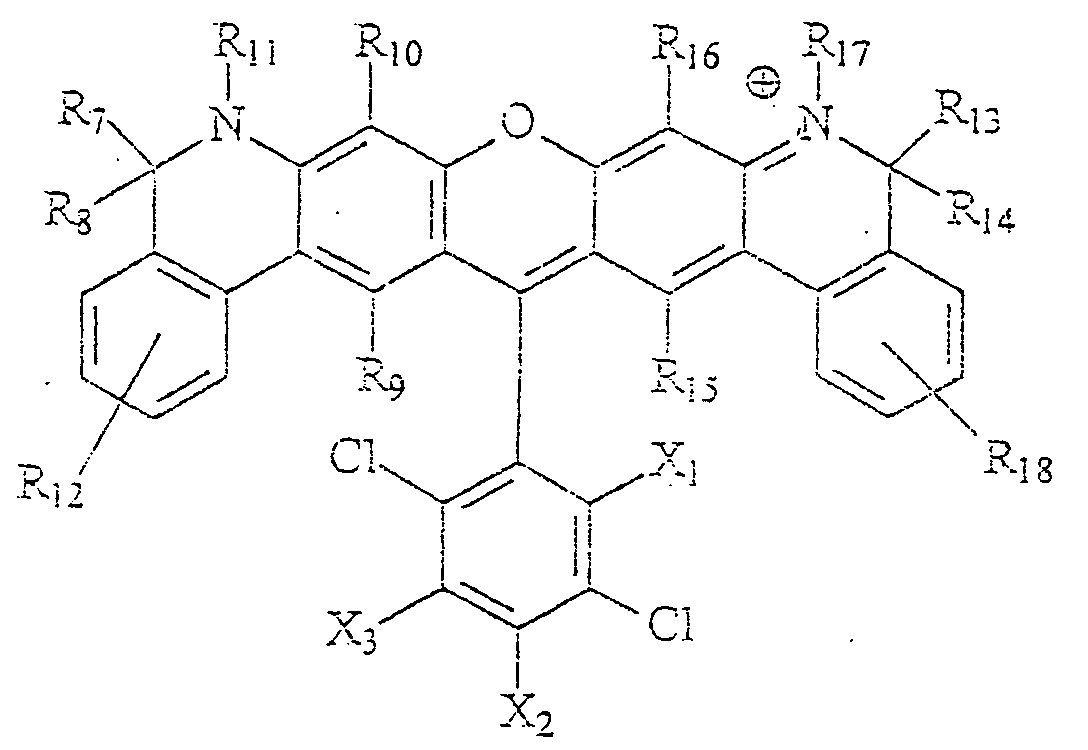
- In a third aspect, the invention includes a labeled nucleotide having the formula:

- In a fourth aspect, the invention includes a labeled polynucleotide containing a nucleotide having the formula:The linkage linking B and D is attached to D at one of positions R1-R6 or X1-X3. Preferably, the linkage linking B and D is attached to D at one of positions X2 or X3. In a particularly preferred embodiment, the linkage is
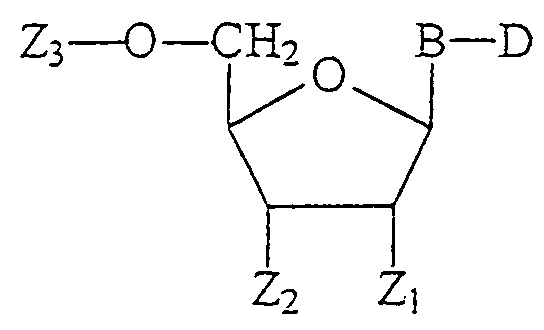 If B is a purine, the linkage is attached to the 8-position of the purine. If B is 7-deazapurine, the linkage is attached to the 7-position of the 7-deazapurine. If B is pyrimidine, the linkage is attached to the 5-position of the pyrimidine.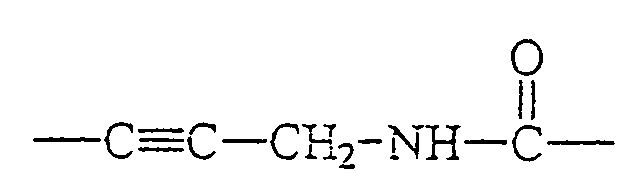
- In a fifth aspect, the present invention includes a method of sequencing, such method including the following steps. Forming a mixture of a first, a second, a third, and a fourth class of polynucleotides such that each polynucleotide in the first class includes a 3'-terminal dideoxyadenosine and is labeled with a first dye, each polynucleotide in the second class includes a 3'-terminal dideoxycytidine and is labeled with a second dye, each polynucleotide in the third class includes a 3'-terminal dideoxyguanosine and is labeled with a third dye, and, each polynucleotide in the fourth class includes a 3'-terminal dideoxythymidine and is labeled with a fourth dye. The dyes are selected such that one of the first, second, third, or fourth dyes is a 4,7-dichlororhodamine dye of the invention, the other of the dyes being spectrally resolvable from the 4,7-dichlororhodamine dye and from each other. Electrophoretically separating the polynucleotides thereby forming bands of similarly sized polynucleotides, illuminating the bands with an illumination beam capable of causing the dyes to fluoresce, and, identifying the classes of the polynucleotides in the bands by the fluorescence spectrum of the dyes.
- These and other aspects, objects, features, and advantages of the present invention will become better understood with reference to the following description, drawings, and appended claims.
- Reference will now be made in detail to the preferred embodiments of the invention, examples of which are illustrated in the accompanying drawings. While the invention will be described in conjunction with the preferred embodiments, it will be understood that they are not intended to limit the invention to those embodiments. On the contrary, the invention is intended to cover alternatives, modifications, and equivalents, which may be included within the invention as defined by the appended claims.
- Generally, the present invention comprises a novel class of 4,7-dichlororhodamine compounds useful as fluorescent dyes, reagents employing such dyes as molecular labels, and methods utilizing such dyes and reagents in the area of analytical biotechnology. The compounds of the present invention find particular application in the area of multicolor fluorescent DNA sequencing and fragment analysis.
- The invention is based in part on the discovery that the fluorescent properties of 4,7-dichlororhodamines and related dyes are highly favorable for use as molecular probes. Their emission band widths are generally 20-30 percent narrower than analogs lacking the 4,7-dichloro derivatives, and, their emission and absorption maxima are at wavelengths generally about 10-30 nm higher than analogs lacking the 4,7-dichioro derivatives.
- Unless stated otherwise, the following terms and phrases as used herein are intended to have the following meanings:
- "Linking group" (L) refers to a functionality capable of reacting with a "complementary functionality" attached to a reagent, such reaction forming a "linkage" connecting a dye to a reagent. The particular linking group used depends on the nature of the complementary functionality and the type of linkage desired. In some cases, the linking group must be activated prior to reaction with a complementary functionality, e.g., the activation of a carboxylate linking group with dicyclohexylcarbodiimide and N-hydroxysuccinimide to form a N-hydroxysuccinimide (NHS) ester. Preferably, whenever the complementary functionality is amine, the linking group of the invention is isothiocyanate, isocyanate, acyl azide, NHS ester, sulfonyl chloride, aldehyde or glyoxal, epoxide, carbonate, aryl halide, imidoester, carbodiimide, anhydride, 4,6-dichlorotriazinylamine, or other active carboxylate. Preferably, whenever the complementary functionality is sulfhydryl, the linking group is haloacetyl, alkyl halide, maleimide, halo acetyl, aziridine, acryloyl, arylating agent, e.g., fluorobenzene, and the like. .When the complementary functionality is carboxylate, the linking group is preferably diazoalane, diazoacetyl, carbonyldiimidazole, and carbodiimide (Hermanson). In a particularly preferred embodiment, the linking group is an activated NHS ester which reacts with an amine complementary functionality, where to form the activated NHS ester, a dye of the invention including a carboxylate linking group is reacted with dicyclohexylcarbodiimide and N-hydroxysuccinimide to form the NHS ester (Khanna; Kasai). Table 1 below shows a sampling of representative linking groups along with compatible complementary functionalities and resulting linkages.

- The term "lower alkyl" denotes straight-chain and branched hydrocarbon moieties containing from 1 to 8 carbon atoms, i.e., methyl, ethyl, propyl, isopropyl, tert-butyl, isobutyl, sec-butyl, neopentyl, tert-pentyl, and the like.
- The term "propano" in particular refers to the moiety ―CH2CH2CH2―.
- "Cycloalkyl" refers to hydrocarbon moieties that form rings, e.g. cyclohexyl and cyclopentyl. Nitrogen atoms with cycloalkyl substituents may form aziridinyl, azetidinyl, pyrrolidinyl, piperidinyl, larger rings, and substituted forms thereof
- "Lower substituted alkyl" denotes a lower alkyl including electron-withdrawing substituents, such as halo, cyano, nitro, sulfo, and the like.
- "Lower haloalkyl" denotes a lower substituted alkyl with one or more halogen atom substituents, usually fluoro, chloro, bromo, or iodo.
- "Lower alkene" denotes a lower alkyl or lower substituted alkyl wherein one or more of the carbon-carbon bonds is a double bond.
- "Lower alkyne" denotes a lower alkyl or lower substituted alkyl wherein one or more of the carbon-carbon bonds is a triple bond.
- "Lower Alkoxy" refers to a moiety including lower alkyl single bonded to an oxygen atom.
- "Aryl" refers to single or multiple phenyl or substituted phenyl, e.g., benzene, naphthalene, anthracene, biphenyl, and the like.
- The term "nucleoside" refers to a compound consisting of a purine, deazapurine, or pyrimidine nucleoside base, e.g., adenine, guanine, cytosine, uracil, thymine, deazaadenine, deazaguanosine, and the like, linked to a pentose at the 1' position, including 2'-deoxy and 2'-hydroxyl forms (Stryer). The term "nucleotide" as used herein refers to a phosphate ester of a nucleoside, e.g., triphosphate esters, wherein the most common site of esterification is the hydroxyl group attached at the C-5 position of the pentose. Many times in the present disclosure the term nucleoside will be intended to include both nucleosides and nucleotides.
- "Analogs" in reference to nucleosides include synthetic analogs having modified base moieties, modified sugar moieties, and/or modified phosphate ester moieties, e.g., as described elsewhere (Scheit; Eckstein). The term "labeled nucleoside" refers to nucleosides which are covalently attached to the dye compounds of Formula I.
- As used herein, the terms "polynucleotide" or "oligonucleotide" refer to linear polymers of natural nucleotide monomers or analogs thereof, including double and single stranded deoxyribonucleotides, ribonucleotides, α-anomeric forms thereof, and the like. Usually the nucleoside monomers are linked by phosphodiester linkages, where as used herein, the term "phosphodiester linkage" refers to phosphodiester bonds or analogs thereof including phosphorothioate, phosphorodithioate, phosphoroselenoate, phosphorodiselenoate, phosphoroanilothioate, phosphoranilidate, phosphoramidate, and the like, including associated counterions, e.g., H+, NH4 +, Na+, and the like if such counterions are present. Polynucleotides typically range in size from a few monomeric units, e.g. 8-40, to several thousands of monomeric units. Whenever a polynucleotide is represented by a sequence of letters, such as "ATGCCTG," it will be understood that the nucleotides are in 5'→3' order from left to right and that "A" denotes deoxyadenosine, "C" denotes deoxycytidine, "G" denotes deoxyguanosine, and "T" denotes thymidine, unless otherwise noted.
- As used herein the term "spectral resolution" in reference to a set of dyes means that the fluorescent emission spectra of the dyes are sufficiently distinct, i.e., sufficiently non-overlapping, that reagents to which the respective dyes are attached, e.g., polynucleotides, can be distinguished on the basis of the fluorescent signal generated by the respective dyes using standard photodetection systems, e.g., employing a system of band pass filters and photomultiplier tubes, a charged-coupled device in conjunction with a spectrograph, or the like, as exemplified by systems described elsewhere (Hunkapiller; Wheeless).
- The term "substituted" as used herein refers to a molecule wherein one or more hydrogen atoms are replaced with one or more non-hydrogen atoms, functional groups or moieties. For example, an unsubstituted nitrogen is ―NH2, while a substituted nitrogen is ―NHCH3. Exemplary substituents include but are not limited to halo, e.g., fluorine and chlorine, lower alkyl, lower alkene, lower alkyne, sulfate, sulfonate, sulfone, amino, ammonium, amido, nitrile, lower alkoxy, phenoxy, aromatic, phenyl, polycyclic aromatic, heterocycle, and linking group.
- In a first aspect, the present invention comprises a novel class of 4,7-dichlororhodamine dye compounds having the general structure shown immediately below as Formula I. (Note that all molecular structures provided throughout this disclosure are intended to encompass not only the exact electronic structure presented, but also include all resonant structures, enantiomers, diastereomers, and protonation states thereof.)

- In Formula I, the variable substituents are defined as follows. R1-R6 taken separately are hydrogen, fluorine, chlorine, lower alkyl, lower alkene, lower alkyne, cycloalkyl, phenyl, aryl, sulfonate, sulfone, amino, amido, nitrile, lower alkoxy, linking group, or combinations thereof or, when taken together, R1 and R6 is benzo, or, when taken together, R4 and R5 is benzo. Preferably, R1-R6 are hydrogen, methyl, or ethyl. Y1-Y4 taken separately are hydrogen, lower alkyl, alkyl sulfonate, alkyl carboxylate, or cycloalkyl. Or, when taken together, Y1 and R2, Y2 and R1, Y3 and R3, and/or Y4 and R4 are propano, ethano, or substituted forms thereof to form fused rings. X1-X3 taken separately are hydrogen, chlorine, fluorine, lower alkyl, carboxylate, sulfonic acid (sulfonate), hydroxymethyl (-CH2OH), and linking groups. Preferably, X1 is carboxylate and X2 and X3 taken separately are hydrogen and linking group.
- In a set of particularly preferred compound of the present invention, R is hydrogen (dJON) or methyl (DMDJ), shown below as FORMULA II.

- Another particularly preferred compound of the present invention is referred to as dR650, shown below as FORMULA III.
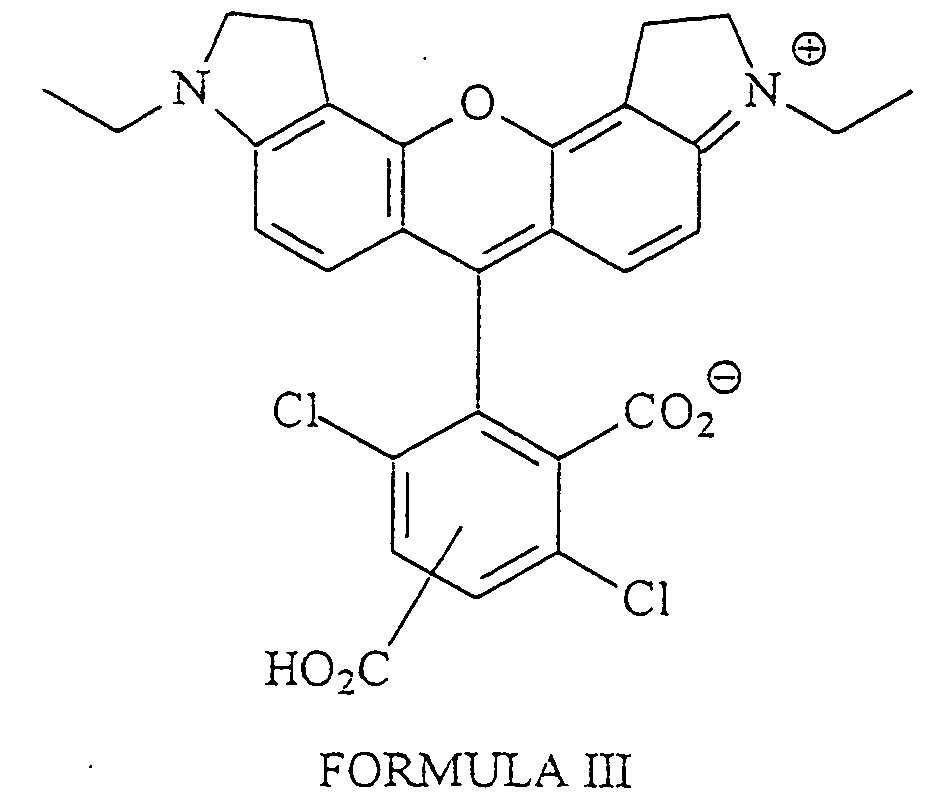
- A third particularly preferred set of compounds are where R is 6-hexanoic acid (dJODA) or methyl-p-benzoic acid (dR134), as shown below in FORMULA IV.
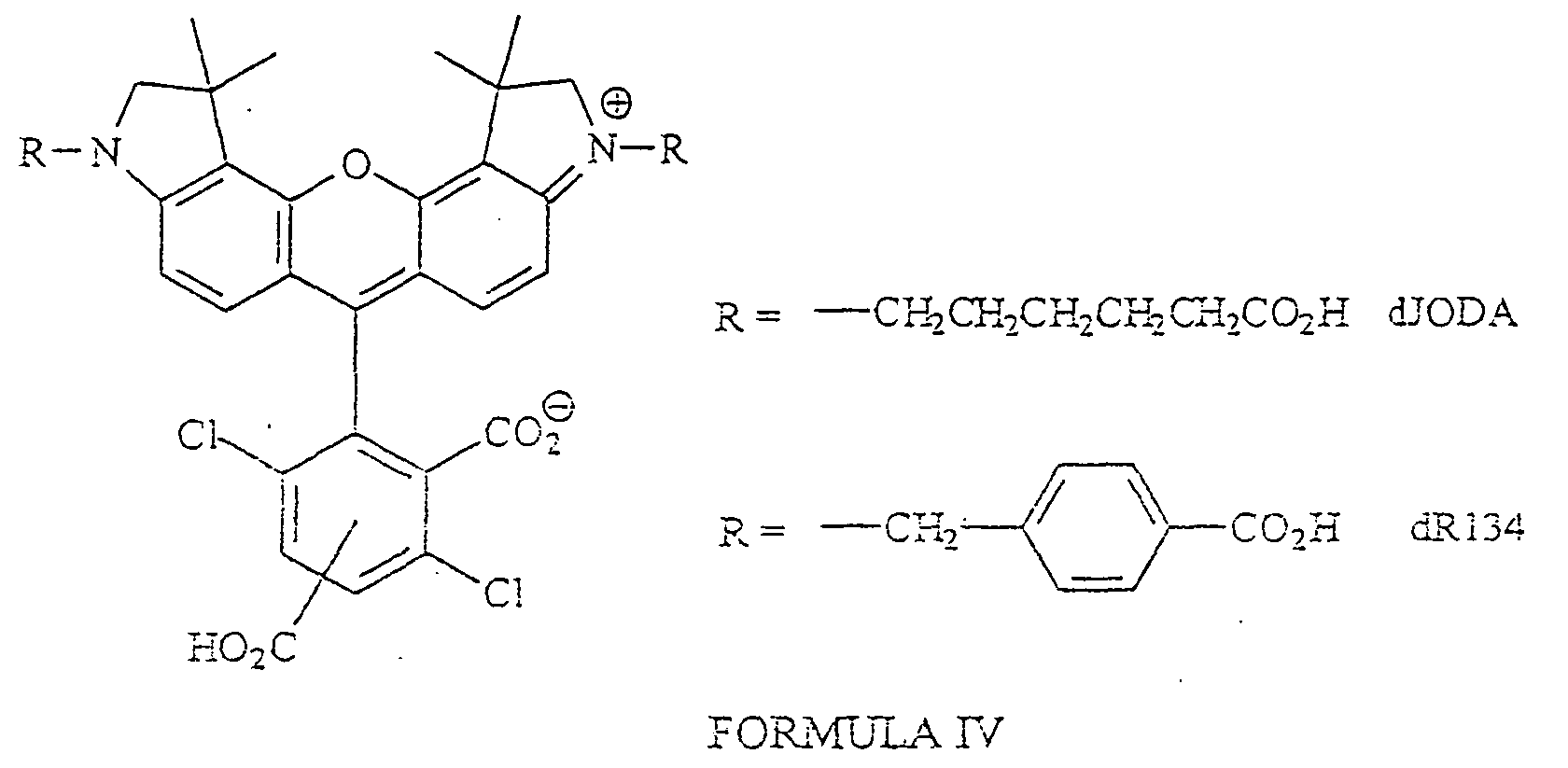
- A fourth particularly preferred compound of the present invention is referred to herein as dR139, where Y1 and Y2, and Y3 and Y4, form pyrrolidinyl rings as nitrogen substituents, R1-6 are hydrogen, X1 is carboxyl, and X2 and X3 are carboxyl and hydrogen. The structure of dR139 is shown below as Formula V.
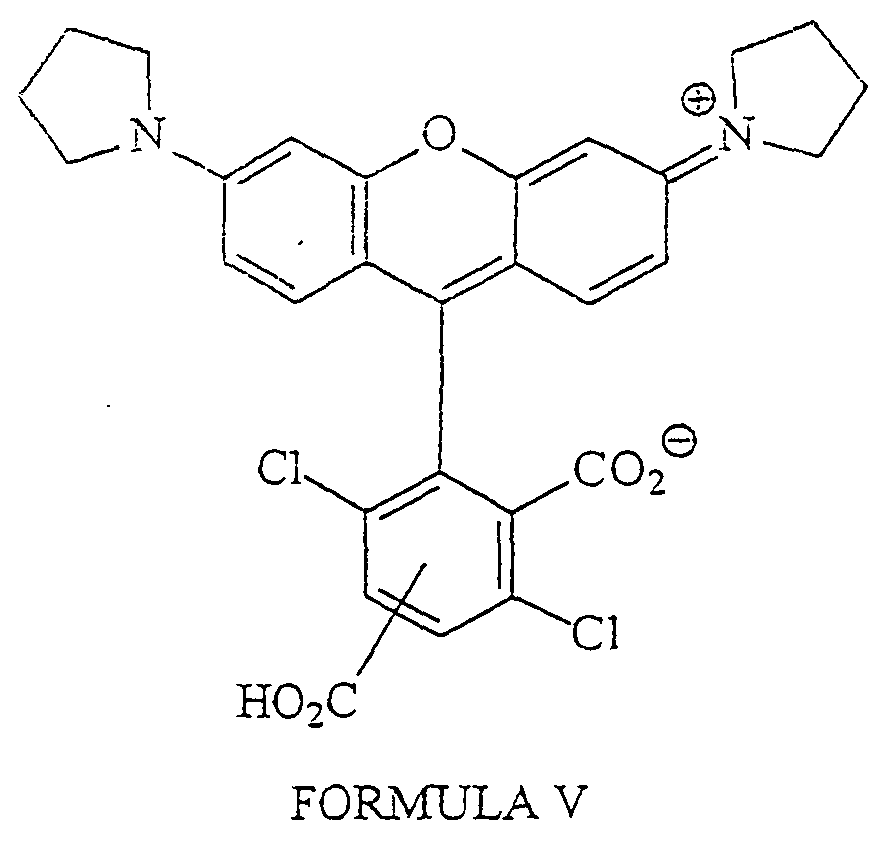
- In a second aspect, the present invention comprises a novel class of 4,7-dichlororhodamine dye compounds having the general structure shown below as FORMULA VI.

- In Formula VI, R7-R10, R12-R16, and R18 may be hydrogen, fluorine, chlorine, methyl, ethyl, lower alkyl, lower alkene, lower alkyne, cycloalkyl, phenyl, aryl, sulfonate, sulfone, amino, amido, nitrile, lower alkoxy, linking group, or combinations thereof. Preferably, R7-R10 and R13-R16 are hydrogen, methyl, or ethyl, R7 and R8, or R13 and R14, taken together may be oxygen (=O), sulfur (=S), imminium (=NH), alkylimminium (=NR), R11 and R17 may be hydrogen, lower alkyl, alkyl sulfonate, alkyl carboxylate, lower alkene, lower, alkyne, cycloalkyl, phenyl, aryl, linking group, or combinations thereof. Preferably R11 and R17 are methyl or phenyl. X1-X3 taken separately are hydrogen, chlorine, fluorine, lower alkyl, amine, amide, carboxylate, sulfonic acid (sulfonate), hydroxymethyl (-CH2OH), and linking groups. Preferably, X1 is carboxylate and X2 and X3 taken separately are hydrogen or linking group. Particular preferred embodiments are where R7, R8, R10 R13, R14, and R17 are hydrogen or methyl, R9 and R15 are hydrogen, R11 and R15 are methyl or phenyl, and R12 and R18 are hydrogen.
- In another aspect, the present invention comprises reagents labeled with the 4,7-dichlororhodamine dye compounds of Formulas I-VI. Reagents of the invention can be virtually anything to which the dyes of the invention can be attached. Preferably the dyes are covalently attached to the reagent directly or through a linkage. Exemplary reagents include proteins, polypeptides, polysaccharides, nucleotides, nucleosides, polynucleotides, lipids, solid supports, organic and inorganic polymers, and combinations and assemblages thereof, such as chromosomes, nuclei, living cells, such as bacteria, other microorganisms, mammalian cells, tissues, glycoproteins, and the like.
- A preferred class of reagents of the present invention comprise nucleotides and nucleosides which incorporate the asymmetric benzoxanthene dyes of the invention. Such nucleotide/side reagents are particularly useful in the context of labeling polynucleotides formed by enzymatic synthesis, e.g., nucleotide triphosphates used in the context of PCR amplification, Sanger-type polynucleotide sequencing, and nick-translation reactions.
- Preferred nucleotide/side reagents of the present invention are shown below in Formula VII whereinB is a nucleoside base; 7-deazapurine, purine, or pyrimidine nucleotide base, analogs thereof, and preferably uracil, cytosine, deazaadenine, or deazaguanosine. D is the 4,7-dichlororhodamine dye compound of the Formulas I-VI of the invention. W1 and W2 taken separately are H or OH. W3 is OH, OPO3, OP2O6, OP3O9, including analogs thereof e.g., phosphorothioate, phosphoroanilidate, phosphoroanilothioate, phosphoramidiate, and other like phosphate analogs, including associated counterions ifpresent, e.g., H+, Na+, NH4 +, and the like. In one preferred embodiment, W1 is H, W2 is OH, and W3 is OP3O9. In a second preferred embodiment, W1 and W2 are H and W3 is OP3O9. When B is purine or 7-deazapurine, the sugar moiety is attached at the N9-position of the purine or deazapurine, and when B is pyrimidine, the sugar moiety is attached at the N1-position of the pyrimidine. The linkage linking B and D is attached to D at one of positions R1-R18 or X1-X3.
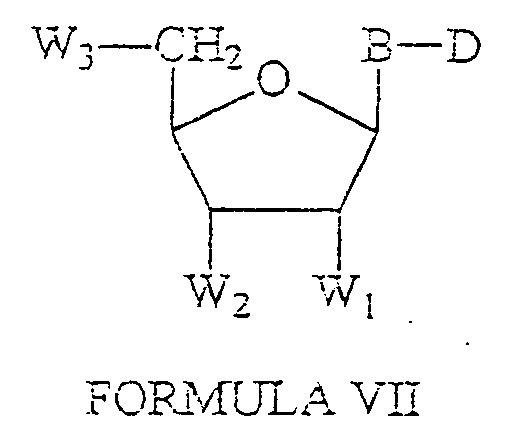
- When B is purine or 7-deazapurine, the sugar moiety is attached at the N9-position of the purine or deazapurine, and when B is pyrimidine, the sugar moiety is attached at the N1-position of the pyrimidine.
- The linkage linking B and D may be attached to D at any one of positions R1-R18 or X1-X3. Preferably, the linkage is attached at one of X2 or X3. Preferably, when B is a purine, the linkage linking B and D is attached to the 8-position of the purine, when B is 7-deazapurine, the linkage is attached to the 7-position of the 7-deazapurine, and when B is pyrimidine, the linkage is attached to the 5-position of the pyrimidine.
- In one particularly preferred embodiment, the nucleotides of the present invention are dideoxynucleotide triphosphates having the structure shown below in Formula VIII, including associated counterions if present.

- Labeled dideoxy nucleotides such as that shown in Formula VIII find particular application as chain terminating agents, or "terminators", in Sanger-type DNA sequencing methods (Sanger).
- In a second particularly preferred embodiment, the nucleotides of the present invention are deoxynucleotide triphosphates having the structure shown in Formula IX below, including associated counterions if present.
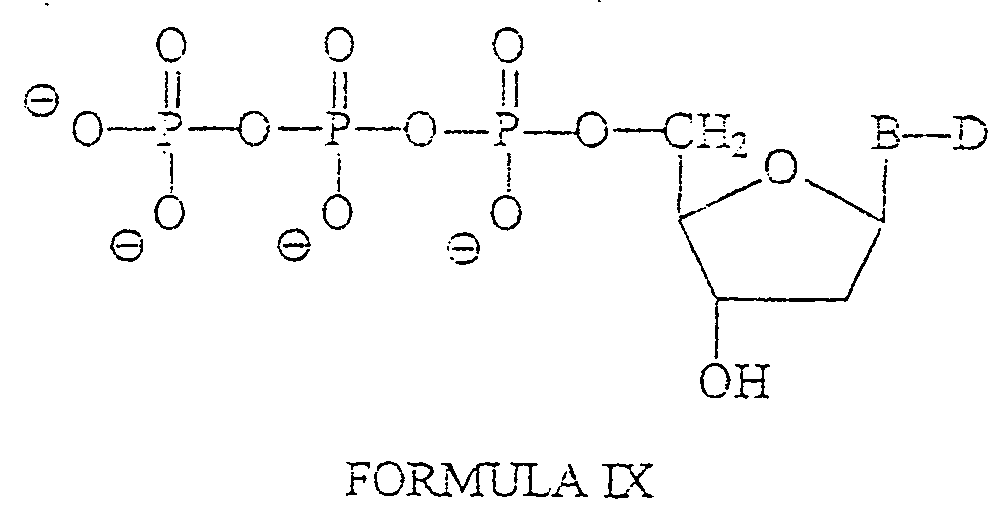
- Labeled deoxynucleotides such as that shown in Formula IX find particular application as means for labeling polymerase extension products, e.g., in the polymerase chain reaction (Mullis).
- Nucleotide/side labeling can be accomplished using any of a large number of known nucleoside/tide labeling techniques using known linking groups, and associated complementary functionalities to form linkages. See above for a discussion of preferred linking groups. The linkage linking the dye and nucleoside should (i) not interfere with oligonucleotide-target hybridization, (ii) be compatible with relevant enzymes, e.g., polymerases, ligases, and the like, and (iii) not quench the fluorescence of the dye.
- In one preferred embodiment, the dyes of the invention are covalently linked to the 5-carbon of pyrimidine bases or to the 7-carbon of 7-deazapurine bases. Several suitable base labeling procedures have been reported that can be used with the invention. (Gibson; Gebeyehu; Haralambidis; Nelson 1992; Bergstrom; Fung 1988; Ward; Woo.)
- Preferably, the linkages are acetylenic amido or alkenic amido linkages, the linkage between the dye and the nucleotide base being formed by reacting an activated NHS ester of the dye with an alkynylamino- or alkenylamino-derivatized base of a nucleotide. More preferably, the resulting linkage is 3-(carboxy)amino-1-propynyl or 3-amino-1-propyn-1-yl (Formula X.1). Several preferred linkages for linking the dyes of the invention to a nucleoside base are shown below as Formulas X.1-6 (Khan).

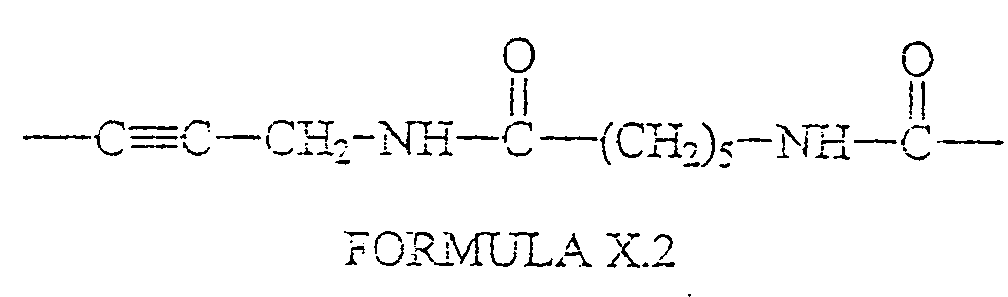
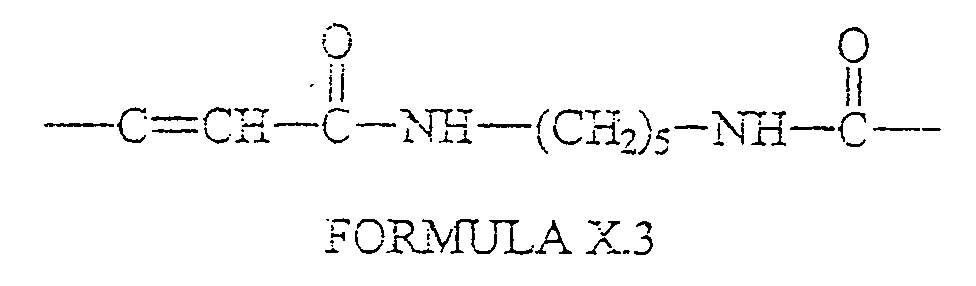
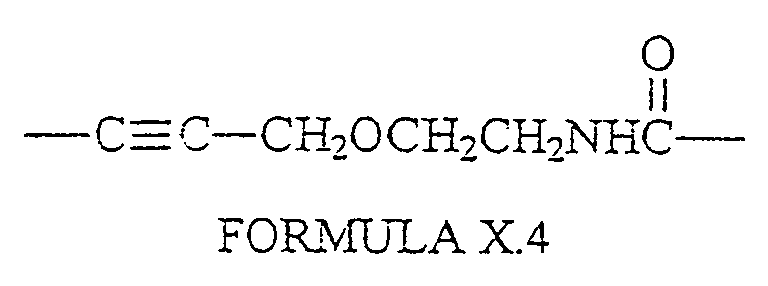


- The synthesis of alkynylamino-derivatized nucleosides is described by (Hobbs 1989, 1992). Briefly, the alkynylamino-derivatized nucleotides are formed by placing the appropriate halodideoxynucleoside (usually 5-iodopyrimidine and 7-iodo-7-deazapurine dideoxynucleosides) and Cu(I) in a flask, flushing with argon to remove air, adding dry DMF, followed by addition of an alkynylamine, triethylamine and Pd°. The reaction mixture is stirred for several hours, or until thin layer chromatography indicates consumption of the halodideoxynucleoside. When an unprotected alkynylamine is used, the alkynylamino-nucleoside can be isolated by concentrating the reaction mixture and chromatographing on silica gel using an eluting solvent which contains ammonium hydroxide to neutralize the hydrchalide generated in the coupling reaction. When a protected alkynylamine is used, methanol/methylene chloride can be added to the reaction mixture, followed by the bicarbonate form of a strongly basic anion exchange resin. The slurry can then be stirred for about 45 minutes, filtered, and the resin rinsed with additional methanol/methylene chloride. The combined filtrates can be concentrated and purified by flash-chromatography on silica gel using a methanol-methylene chloride gradient. The 5'-triphosphates are obtained by standard techniques.
- Yet another preferred class of reagents of the present invention comprise polynucleotides labeled with the 4,7-dichlororhodamine dyes of the invention. Such labeled polynucleotides are useful in a number of important contexts including as DNA sequencing primers, PCR primers, oligonucleotide hybridization probes, and the like.
- The polynucleotides of the invention include a nucleotide having the formula:wherein the variable substituents and linkages are defined as follows. D is a 4,7-dichlororhodamine dye compound of the invention. B is a 7-deazapurine, purine, or pyrimidine nucleotide base, preferably uracil, cytosine, deazaadenine, or deazaguanosine. Z1 is H, OH, or OCH3. Z2 is H, OH, OPO3, OP2O6, OP3O9, or Nuc, a neighboring nucleotide, wherein Nuc and the nucleoside are linked by a phosphodiester linkage or analog thereof, e.g., phosphorothioate, phosphoroanilidate, phosphoroanilothioate, phosphoramidiate, and other like phosphate analogs, including associated counterions if present, e.g., H+, Na+, NH4 +, the linkage being attached to the 5'-position of Nuc. Z3 is H, OPO2 , including phosphate analogs, or Nuc, wherein Nuc and the nucleoside are linked by a phosphodiester linkage or analog thereof, the linkage being attached to the 3'-position of Nuc wherein Nuc refers to a nucleoside, nucleotide, or polynucleotide. When B is purine or 7-deazapurine, the sugar moiety is attached at the N9-position of the purine or deazapurine, and when B is pyrimidine, the sugar moiety is attached at the N1-position of the pyrimidine. B is attached to the sugar moiety and to the dye compound as described above for the nucleotide reagent of the invention. As defined, the labeled nucleotide of Formula XI can be the 5'-terminal nucleotide, the 3'-terminal nucleotide, or any internal nucleotide of the polynucleotide.

- In one preferred embodiment, the polynucleotide of the present invention includes multiple dyes, at least one of which is a dye compound of the invention, located such that fluorescence energy transfer takes place between a donor dye and an acceptor dye. Such multi-dye polynucleotides find application as spectrally-tunable probes or DNA sequencing primers (Ju; Lee).
- Labeled polynuclectides may be synthesized either enzymatically, e.g., using a DNA polymerase or ligase (Stryer), or by chemical synthesis, e.g., by the phosphoramidite method, the phosphite-triester method, and the like (Gait). Labels may be introduced during enzymatic synthesis utilizing labeled nucleotide triphosphate monomers as described above or may be introduced subsequent to synthesis.
- Generally, if the labeled polynucleotide is made by enzymatic synthesis, the following procedure may be used. A template DNA is denatured and an oligonucleotide primer is annealed to the template DNA. A mixture of deoxynucleotide triphosphates and/or dideoxynucleotide triphosphates is added to the reaction including dGTP, dATP, dCTP, ddTTP, ddGTP, ddATP, ddCTP, and ddTTP, where at least a fraction of one of at least one the deoxynucleotides and/or dideoxynucleotides is labeled with a dye compound of the invention as described above. Next, a polymerase enzyme is added under conditions where its polymerase activity is operative. A labeled polynucleotide is formed by the incorporation of the labeled deoxynucleotides and/or dideoxynucleotides during polymerase strand synthesis. In an alternative enzymatic synthesis method, two primers are used instead of one, one primer complementary to the + (plus) strand and the other complementary to the - (minus) strand of the target, the polymerase is a thermostable polymerase, and the reaction temperature is cycled between a denaturation temperature and an extension temperature, thereby exponentially synthesizing a labeled complement to the target sequence by PCR (Mullis; Innis).
- Subsequent to synthesis, the polynucleotide may be labeled at a number of positions including the 5'-terminus (Eckstein; Orgel; Smith); the phosphodiester backbone (Eckstein); or at the 3'-terminus (Nelson 1992a; Nelson 1992b; Nelson 1995). For a through review of oligonucleotide labeling procedures see (Steiner).
- In one preferred post-synthesis chemical labeling method an oligonucleotide is labeled as follows. A dye including a carboxylate linking group is converted to the NHS ester by reacting with approximately 1 equivalent of 1,3-dicyclohexylcarbodiimide and approximately 3 equivalents of N-hydroxysuccinimide in dry ethyl acetate for 3 hours at room temperature. The reaction mixture is washed with 5% HCl, dried over magnesium sulfate, filtered, and concentrated to a solid which is resuspended in DMSO. The DMSO dye stock is then added in excess (10-20 x) to an aminohexyl derivatized oligonucleotide in 0.25 M bicarbonate/carbonate buffer at pH 9.4 and allowed to react for 6 hours (Fung 1988). The dye labeled oligonucleotide is separated from unreacted dye by passage through a size-exclusion chromatography column eluting with buffer, e.g., 0.1 molar triethylammonium acetate (TEAA). The fraction containing the crude labeled oligonucleotide is further purified by reverse phase HPLC employing gradient elution.
- The dyes and reagents of the present invention are well suited to methods utilizing fluorescent detection, particularly methods requiring the simultaneous detection of multiple spatially-overlapping analytes. Dyes. and reagents of the invention are particularly well suited for identifying classes of polynucleotides that have been subjected to a biochemical separation procedure, such as electrophoresis, where a series of bands or spots of target substances having similar physiochemical properties, e.g. size, conformation, charge, hydrophobicity, or the like, are present in a linear or planar arrangement. As used herein, the term "bands" includes any spatial grouping or aggregation of analytes on the basis of similar or identical physiochemical properties. Usually bands arise in the separation of dye-polynucleotide conjugates by electrophoresis.
- Classes of polynucleotides can arise in a variety of contexts. In a preferred category of methods referred to herein as "fragment analysis" or "genetic analysis" methods, labeled polynucleotide fragments are generated through template-directed enzymatic synthesis using labeled primers or nucleotides, e.g., by ligation or polymerase-directed primer extension; the fragments are subjected to a size-dependent separation process, e.g., electrophoresis or chromatography; and, the separated fragments are detected subsequent to the separation, e.g., by laser-induced fluorescence. In a particularly preferred embodiment, multiple classes of polynucleotides are separated simultaneously and the different classes are distinguished by spectrally resolvable labels.
- One such fragment analysis method known as amplified fragment length polymorphism detection (ArnpFLP) is based on amplified fragment length polymorphisms, i.e., restriction fragment length polymorphisms that are amplified by PCR (Vos). These amplified fragments of varying size serve as linked markers for following mutant genes through families. The closer the amplified fragment is to the mutant gene on the chromosome, the higher the linkage correlation. Because genes for many genetic disorders have not been identified, these linkage markers serve to help evaluate disease risk or paternity. In the AmpFLPs technique, the polynucleotides may be labeled by using a labeled polynucleotide PCR primer, or by utilizing labeled nucleotide triphosphates in the PCR.
- Another exemplary fragment analysis method is based on variable number of tandem repeats, or VNTRs (Webber; Caskey). VNTRs are regions of double-stranded DNA that contain adjacent multiple copies of a particular sequence, with the number of repeating units being variable. Examples of VNTR loci are pYNZ22, pMCT118, and Apo B. A subset of VNTR methods are those methods based on the detection of microsatellite repeats, or short tandem repeats (STRs), i.e., tandem repeats of DNA characterized by a short (2-4 bases) repeated sequence. One of the most abundant interspersed repetitive DNA families in humans is the (dC-dA)n--(dG-dT)n dinucleotide repeat family (also called the (CA)n dinucleotide repeat family). There are thought to be as many as 50,000 to 100,000 (CA)n repeat regions in the human genome, typically with 15-30 repeats per block. Many of these repeat regions are polymorphic in length and can therefore serve as useful genetic markers. Preferably, in VNTR or STR methods, a dye label is introduced into the polynucleotide fragments by using a dye-labeled PCR primer.
- In a particularly preferred fragment analysis method, classes identified in accordance with the invention are defined in terms of terminal nucleotides so that a correspondence is established between the four possible terminal bases and the members of a set of spectrally resolvable dyes (Fung 1989). Such sets are readily assembled from the dyes of the invention by measuring emission and absorption bandwidths with commercially available spectrophotometers. More preferably, the classes arise in the context of the chemical or chain termination methods of DNA sequencing, and most preferably the classes arise in the context of the chain termination method, i.e., dideoxy DNA sequencing, or Sanger sequencing. This method involves the synthesis of a DNA strand by a DNA polymerase in vitro using a single-stranded or double-stranded DNA template whose sequence is to be determined. Synthesis is initiated at only the one site where an oligonucleotide primer anneals to the template. The synthesis reaction is terminated by incorporation of a nucleotide analog that will not support continued DNA elongation. The chain-terminating nucleotide analogs are typically 2',3'-dideoxynucleoside 5'-triphosphates (ddNTPs) which lack the 3'-OH group necessary for 3' to 5' DNA chain elongation. When proper proponions of dNTPs (2'-deoxynucleoside 5'-triphosphates) and one of the four ddNTPs are used, enzyme-catalyzed polymerization will be terminated in a fraction of the population of chains at each site where the ddNTP can be incorporated. If labeled primers or labeled ddNTPs are used for each reaction, the sequence information can be detected by fluorescence after separation by high-resolution electrophoresis. In the chain termination method, dyes of the invention can be attached to either sequencing primers or dideoxynucleotides.
- In each of the above fragment analysis methods labeled polynucleotides are preferably separated by electrophoretic procedures (Rickwood and Hames; Osterman) Preferably the type of electrophoretic matrix is crosslinked or uncrosslinked polyacrylamide having a concentration (weight to volume) of between about 2-20 weight percent. More preferably, the polyacrylamide concentration is between about 4-8 percent. Preferably in the context of DNA sequencing in particular, the electrophoresis matrix includes a strand separating, or denaturing, agent, e.g., urea, formamide, and the like. Detailed procedures for constructing such matrices are given by (Maniatis 1980; ABI PRISM™ 377 DNA Sequencer User's Manual). The optimal polymer concentration, pH, temperature, concentration of denaturing agent, etc. employed in a particular separation depends on many factors, including the size range of the nucleic acids to be separated, their base compositions, whether they are single stranded or double stranded, and the nature of the classes for which information is sought by electrophoresis. Accordingly application of the invention may require standard preliminary testing to optimize conditions for particular separations.
- Subsequent to electrophoretic separation, the dye-polynucleotide conjugates are detected by measuring the fluorescence emission from the dye labeled polynucleotides. To perform such detection, the labeled polynucleotides are illuminated by standard means, e.g. high intensity mercury vapor lamps, lasers, or the like. Preferably the illumination means is a laser having an illumination beam at a wavelength between 488 and 550 nm. More preferably, the dye-polynucleotides are illuminated by laser light generated by an argon ion laser, particularly the 488 and 514 nm emission lines of an argon ion laser, or the 532 emission line of a neodymium solid-state YAG laser. Several argon ion lasers are available commercially which lase simultaneously at these lines, e.g., the Model 2001 from Cyonics, Ltd. (Sunnyvale, Calif.). The fluorescence is then detected by a light-sensitive detector, e.g., a photomultiplier tube, a charged coupled device, or the like.
- The invention will be further clarified by a consideration of the following examples, which are intended to be purely exemplary of the invention and not to in any way limit its scope. All reagents were purchased from Aldrich Chemical Co. (Milwaukee, WI) except as otherwise indicated. The 3,6-dichlorotrimellitic anhydride was prepared as described by (Khanna).
-

- A solution of m-aminophenol (12.6 gm, 0.115 moles) and 1,4-dibromobutane (50 gm, 0.23 moles) was heated to 130 °C for 12 hr. The mixture was cooled to room temperature and triturated with diethylether and then ethyl acetate. The residue was dissolved in ethyl acetate and extracted with 1M NaOH, water, and sat. NaCl. After drying the organic layer with MgSO4, filtering, and evaporating solvent under vacuum, the crude product was purified by silica gel chromatography to give a pale yellow solid. The solid was refluxed with 500 ml toluene and 17 ml triethylamine (0.12 moles) for one hr, cooled to room temperature and washed with water and sat. NaCl. The solution was dried again over MgSO4, filtered, and evaporated under vacuum to give 3-pyrrolidinylphenol as a white solid (6.0 gm, 0.037 moles, 32%).
- A mixture of 3-pyrrolidinylphenol (1.63 gm, 10 mmol), 3,6-dichlorotrimellitic anhydride (1.3 g, 5 mmol) and polyphosphoric acid (5 mL) was heated to 160 °C for 2 hr. After cooling to room temperature, water (20 ml) was added and the precipitated product was collected by filtration. Purification by reverse-phase HPLC separated the 5 and 6 carboxyl isomers of dR139, Abs. max 568 run (methanol), (Formula V), Isomer 1 (0.3 gm, 5%) and Isomer 2 (0.6 gm, 10%).
-

- 4-Hydroxyindole was reduced with sodium cyanoborohydride and acetic acid to give 4-hydroxy, dihydroindole. A mixture of ethyl iodide (40 ml), potassium carbonate (1.09 gm, 7.8 mmole) and 4-hydroxy, dihydroindole (1.06 gm, 7.8 mmole) was refluxed for 2 hr. Excess ethyl iodide was evaporated under vacuum, water was added (10 ml) and the product was extracted with dichloromethane. Silica gel chromatography gave N-ethyl-4-hydroxy-dihydroindole (0.30 gm, 23% yield) as a pale yellow solid.
- A mixture of N-ethyl-4-hydroxy-dihydroindole (0.30 g, 1.8 mmol), 3,6-dichlorotrimellitic anhydride (230 mg, 0.9 mmol) and polyphosphoric anhydride (PPA) (5 g) was heated to 180 °C for 2.5 hr. After cooling to room temperature, the solid was dissolved in aqueous NaOH (1M, 7.5 ml). The product was precipitated with aqueous HCl (2M, 7.5 ml). The solid was collected by filtration and purified by reverse-phase HPLC to give dR650, Em. max, 633nm (8M urea), Abs. max. 614 nm (8M urea), (FORMULA III). The regiochemistry of the 5 and 6 carboxyl groups of the isomers were not assigned. Isomer 1 (53 mg, 5%) and Isomer 2 (105 mg, 10%) were separable by reverse-phase HPLC.
-

- A mixture of 6-hydroxy-1,2,3,4-tetrahydroquinoline (1.49 gm, 10 mmol), 3,6-dichlorotrimellitic anhydride (1.3 g, 5 mmol) and methanesulfonic acid (2 ml) was heated to 160 °C for 6 hr. After cooling to room temperature, water (20 ml) was added and the precipitated product was collected by filtration. Purification by reverse-phase HPLC separated the 5 and 6 carboxyl isomers of dJON, Abs. max 357 nm (methanol), (Formula II), Isomer 1 (270 mg, 5%) and Isomer 2 (550 mg, 10%).
-

- A solution of O-fluoro-benzoyl chloride (1.59 gm, 10 mmole) in 2 ml dichloromethane was added dropwise to m-N-methylamino phenol (1.23 gm, 10 mmole) in 5 ml dichloromethane and triethylamine (1.01 gm, 1 mmole) cooled in an ice bath. The reaction was allowed to warm to room temperature over one hour. The mixture was diluted with dichloromethane, extracted with water and sat. NaCl, dried with MgSO4, filtered, and evaporated under vacuum. The crude product was purified by silica gel chromatography to give N-methyl, N-(m-hydroxyphenyl)-O-fluoro-benzamide as a white foam (1.2 gm, 5 mmole, 50%).
- Sodium hydride (200 mg, 60% dispersion in oil, 5 mmol) was added to the amide (1.2 gm, 5 mmole) in 10 ml dimethylformamide at ambient temperature. The mixture was then refluxed for 2 hours and cooled to room temperature. Solvent was evaporated under vacuum and 5 ml hydrochloric acid (2M) was added. The mixture was extracted with ethyl acetate twice. The combined ethyl acetate extracts were washed with water and sat. NaCl, dried with MgSO4, filtered, and evaporated under vacuum. The crude product was purified by silica gel chromatography to give the cyclized, tricyclic amide as a white solid (0.56 gm, 2.5 mmole, 50%).
- Dimethyl sulfide/borane complex (3.75 ml, 7.5 mmole, 2M in THF) was added dropwise to the tricyclic amide (0.56 gm, 2.5 mmole) in 10 ml dry tetrahydrofuran cooled in an ice bath. The mixture was refluxed for one hour, cooled in an ice bath, and 10 ml methanol was added slowly. Solvent was evaporated under vacuum, more methanol was added, and evaporation was repeated thoroughly under vacuum. The crude product was purified by silica gel chromatography to give the tricyclic amine as a white solid (400 mg, 1.9 mmol, 76%).
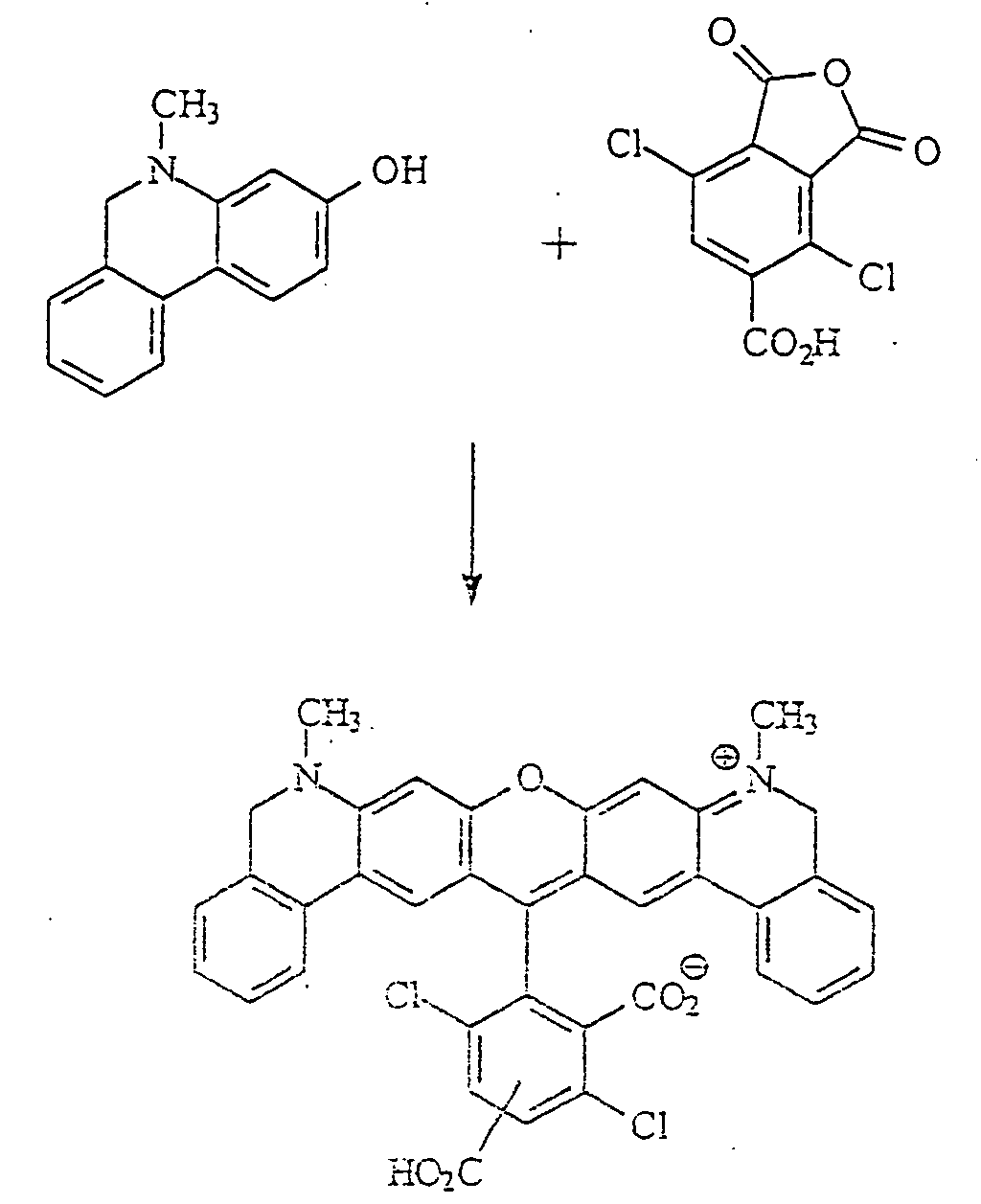
- A mixture of the tricyclic amine (400 mg, 1.9 mmol), 3,6-dichlorotrimellitic anhydride (248 mg, 0.95 mmol) and polyphosphoric acid (1 g) was heated to 180 °C for 2 hr. After cooling to room temperature, the solid was dissolved in aqueous NaOH (1M, 7.5 ml). The product was precipitated with aqueous HCl (2M, 7.5 ml). The solid was collected by filtration and purified by reverse-phase HPLC to give the dye, Abs. max 638 nm). The regiochemistry of the 5 and 6 carboxyl groups of the isomers were not assigned. Isomer 1 (32 mg, 5%) and Isomer 2 (65 mg, 10%) were separable by reverse-phase HPLC.
- A solution of ddATP-NH2 (5 µL, 20 mM, 0.1 µmol) (Hobbs 1989, 1992), dR139-NHS (0.15 µmol) and 250 mM carbonate/bicarbonate buffer, pH 9 (5 µL) were mixed. After 10 min at room temperature the solution was subjected to HPLC with an anion-exchange column and eluted with a gradient of 40% acetonitrile/60% 0.1 M triethylammonium bicarbonate to 40% acetonitrile / 60% 1.5 M triethylammonium bicarbonate to remove free dye. The fraction containing dye-labeled nucleotide and unlabeled nucleotide was concentrated in a vacuum centrifuge and subjected to a second HPLC using a reverse-phase column. The unlabeled nucleotide and each dye isomer of dye-labeled nucleotide were separated using an elution gradient of 15% acetonitrile/85% 0.1 M triethylammonium acetate to 35% acetonitrile / 65% 0.1 M triethylammonium acetate. The solutions containing dye-labeled nucleotide were concentrated in a vacuum centrifuge, redissolved in 10 mM carbonate/bicarbonate buffer, pH 9, and quantised by measuring the absorbance of the solution in a UV/Visible spectrophotometer. Yields were approximately 1%.
- A solution of 5'-aminohexyl-functionalized oligonucleotide, (10 µL, 1 mM) and dR139-NHS (10 µL, 12 mM in methylsulfoxide) and carbonate/bicarbonate buffer (2 µL, 1 M) were combined. The aminohexyl derivatized primer was prepared by automated solid-phase DNA synthesis using Aminolink-2 in the last cycle of the synthesis (PE Biosystems). After 10 min at room temperature the solution was subjected to gel filtration on Sephadex G-25 to separate free dye. The fraction containing dye-labeled oligonucleotide and unlabeled oligonucleotide was collected and subjected to HPLC purification on a reverse-phase column. The unlabeled oligonucleotide and each dye isomer of dye-labeled oligonucleotide were separated using an elution gradient of 10% acetonitrile/85% 0.1 M triethylammonium acetate to 30% acetonitrile/65% 0.1 M triethylammonium acetate. The solutions containing dye-labeled oligonucleotide were concentrated in a vacuum centrifuge, and redissolved in a buffer containing 10 mM Tris, 1 mM EDTA, pH 7.0 (TE).
- Dye terminator reactions were conducted with AmpliTaq® DNA Polymerase, FS following the basic protocols in the ABI PRISM™ Dye Terminator Cycle Sequencing Core Kit Manual (PE Biosystems). (The FS enzyme is a recombinant thermus aquaticus DNA polymerase having two point mutations--G46D and F667Y). All reagents except the dNTP mix and dye terminators were from an ABI PRISM™ Dye Terminator Cycle Sequencing Core Kit (PE Biosystems). A premix of reaction components was prepared as follows, where volumes are on a per reaction basis:
5X Buffer 4 µl dNTP mix 1 µl Template:pGEM®-3Zf(+), 0.2µg/µL 5 µl Primer: -21 M13 (forward), 0.8 pmol/µL 2 µl AmpliTaq DNA Polymerase, FS 0.5 µl H2O 2.5 µl - Reactions were set up in 0.5 ml tubes for the Perkin-Elmer 480 DNA Thermal Cycler (PE Biosystems). Total reaction volumes were 20 µl, including 15 µl of the above reaction premix, an appropriate amount of dye labeled terminator, and water. Dye terminator reactions were set up with either 1 pmole of dye terminator for A and G terminators or with 15 pmole of dye terminator for C and T terminators, with dyes of the present invention. In a few cases, the dye terminators for C or T were at too low a concentration, such that 5 µL resulted in less than 15 pmole of dye terminator. In these cases, 5 µl of dye terminator was used and no water was added to the reaction. 30 µL of mineral oil was added to the top of each reaction volume to reduce evaporation during thermocycling. Reactions were thermocycled for 25 cycles as follows: 96 °C for 30 see, 50 °C for 15 sec, 60 °C for 4 min; followed by a 4 °C hold cycle.
- All reactions were purified by spin-column purification on Centri-Sep spin columns (Princeton Separations, Adelphia, NJ). Gel material in the column was hydrated with 0.8 mL of deionized water for at least 30 minutes at room temperature. After the columns were hydrated, and it was apparent that no bubbles were trapped in the gel material, the upper-end cap and then the lower-end cap were removed. The column was allowed to drain by gravity. Columns were then inserted into the wash tubes provided in the Centi-Sep kit and centrifuged in a variable speed microcentrifuge (Eppendorf Model 5415) at 1300 x g for 2 minutes. Columns were removed from the wash tubes and inserted into sample collection tubes. The reaction mixture was carefully removed from under the oil using a glass pipette and loaded on top of the Centri-Sep column. Columns were centrifuged for 2 minutes. Samples were dried in a vacuum centrifuge.
- The dried samples were resuspended in 25 µl of Template Suppression Reagent (PE Biosystems), vortexed, heated to 95 °C for 2 minutes, cooled on ice, vortexed again, and centrifuged (13,000 x g). 10 µl of the purified sample was aliquoted into sample vials adapted for use with the PE ABI PRISM™ 310 Genetic Analyzer (PE Biosystems). Electrophoresis on the Model 310 used a 61 cm long , 50 µm ID uncoated fused silica capillary having a length to the detector of 50 cm. The capillary was filled with a solution of a linear dimethylpolyacrylamide (DMA) sieving polymer (Madabhushi), buffer, and containing nucleic acid denaturants (PE Biosystems). Samples were electrokinetically injected for 30 sec at 2.5 kV. Electrophoresis was performed for 2 hr at 12.2 kV with the capillary temperature maintained at 42 °C.
- All publications and patent applications are herein incorporated by reference to the same extent as if each individual publication or patent application was specifically and individually indicated to be incorporated by reference.
- Although only a few embodiments have been described in detail above, those having ordinary skill in the organic chemical art will clearly understand that many modifications are possible in the preferred embodiment without departing from the teachings thereof. All such modifications are intended to be encompassed within the following claims.
Claims (20)
- A compound having the formula:wherein:
 R1-R6 taken separately are selected from the group consisting of hydrogen, fluorine, chlorine, lower alkyl, lower alkene, lower alkyne, sulfonate, sulfone, amino, amido, nitrile, lower alkoxy, linking group, and combinations thereof, or, when taken together, R1 and R6 is benzo, or, when taken together, R4 and R5 is benzo;Y1-Y4 taken separately are selected from the group consisting of hydrogen, lower alkyl, alkyl sulfonate, alkyl carboxylate, and cycloalkyl, or, when taken together, Y1 and R2, Y2 and R1, Y3 and R3, and/or Y4 and R4 is propano, ethano, or substituted forms thereof; andX1-X3 taken separately are selected from the group consisting of hydrogen, chlorine, fluorine, lower alkyl, amine, amide, carboxylate, sulfonate, hydroxymethyl, and linking group.
 - The compound of claim 1 wherein R2 and R3 are hydrogen.
- The compound of claim 1 wherein:R1-R6 are hydrogen;Y1 and Y2 are taken together as pyrrolidinyl;Y3 and Y4 are taken together as pyrrolidinyl;X1 is carboxylate; andone of X2 and X3 is linking group, the other being hydrogen, orR2, R3, R5, and R6 are hydrogen;Y1 and Y2 are methyl;R1 and Y2 taken together are propano;R4 and Y4 taken together are propano;X1 is carboxylate; andone of X2 and X3 is linking group, the other being hydrogen, orR2, R3, R5, and R6 are hydrogen;Y1 and Y2 are hydrogen;R1 and Y2 taken together are propano;R4 and Y4 taken together are propano;X1 is carboxylate; andone of X2 and X3 is linking group, the other being hydrogen, orR1, R4, R5, and R6 are hydrogen;Y2 and Y4 taken separately are ethyl;R2 and Y1 taken together are ethano;R3 and Y3 taken together are ethano;X1 is carboxylate; andone of X2 and X3 is linking group, the other being hydrogen.
- A compound having the formula:wherein:
 R7-R10, R12-R16, and R18 taken separately are selected from the group consisting of hydrogen, fluorine, chlorine, methyl, ethyl, lower alkyl, lower alkene, lower alkyne, cycloalkyl, phenyl, aryl, sulfonate, sulfone, amino, amido, nitrile, lower alkoxy, linking group, or combinations thereof;R11 and R17 taken separately are selected from the group consisting of hydrogen, lower alkyl, alkyl sulfonate, alkyl carboxylate, lower alkene, lower alkyne, cycloalkyl, phenyl, aryl, linking group, or combinations thereof; andX1-X3 taken separately are selected from the group consisting of hydrogen, chlorine, fluorine, lower alkyl, amine, amide, carboxylate, sulfonate, hydroxymethyl, and linking group.
 - The compound of claim 1 or claim 4 wherein X1 is carboxylate or sulfonate.
- The compound of claim 1 or claim 4 wherein one of X2 and X3 is linking group.
- The compound of claim 4 wherein R7-R9, R12-R15, and R18 are hydrogen.
- The compound of claim 4 wherein R7, R8, R13, and R14 are methyl or R7, R8, R13, and R14 taken together are selected from the group consisting of oxygen, sulfur, imminium, and alkylimminium.
- The compound of claim 4 wherein R11 and R17 are methyl or phenyl.
- A compound having the formula:wherein:
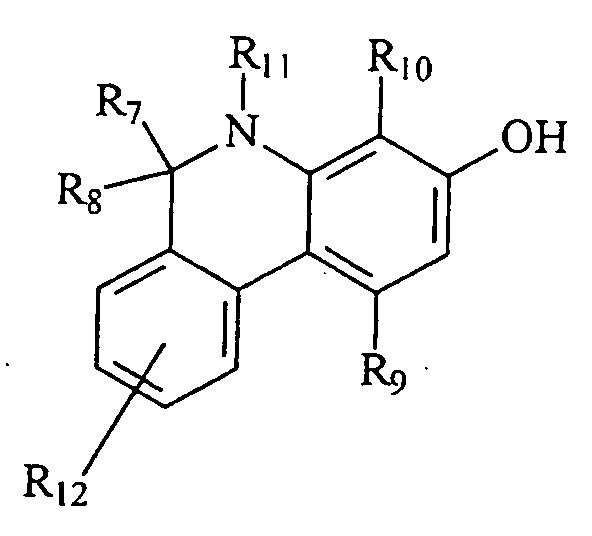 R7-R10, R12 taken separately are selected from the group consisting of hydrogen, fluorine, chlorine, methyl, ethyl, lower alkyl, lower alkene, lower alkyne, cycloalkyl, phenyl, aryl, sulfonate, sulfone, amino, amido, nitrile, lower alkoxy, linking group, or combinations thereof; andR11 taken separately is selected from the group consisting of hydrogen, lower alkyl, lower alkene, lower alkyne, cycloalkyl, phenyl, aryl, linking group, or combinations thereof.
 - The compound of claim 10 wherein R7-R9 and R12 are hydrogen.
- The compound of claim 10 wherein R7 and R8 are methyl.
- The compound of claim 10 wherein R11 is methyl or phenyl.
- A labeled nucleotide having the formula:wherein:
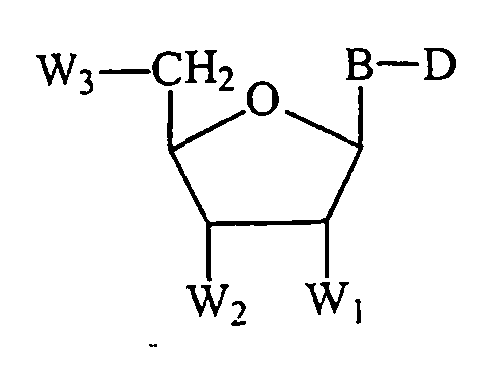 wherein when B is purine or 7-deazapurine, the sugar moiety is attached at the N9-position of the purine or deazapurine, and when B is pyrimidine, the sugar moiety is attached at the N1-position of the pyrimidine;D is the dye compound of claim 1 or claim 4;B is a 7-deazapurine, purine, or pyrimidine nucleotide base;W1 and W2 taken separately are selected from the group consisting of H and OH;W3 is selected from the group consisting of OH, OPO3, OP2O6, OP3O9, and analogs thereof;
wherein the linkage linking B and D is attached to D at one of positions R1-R18 or X1-X3; and
wherein if B is a purine, the linkage is attached to the 8-position of the purine, if B is 7-deazapurine, the linkage is attached to the 7-position of the 7-deazapurine, and if B is pyrimidine, the linkage is attached to the 5-position of the pyrimidine. - The labeled nucleotide of claim 14 wherein W1 is H; W2 is H or OH; and W3 is OP3O9.
- The labeled nucleotide of claim 14 wherein the linkage linking B and D is attached to D at one of positions X2 or X3.
- A labeled polynucleotide containing a nucleotide having the formula:wherein:
 Z3 is selected from the group consisting of H, PO3, phosphate analogs and Nuc, wherein Nuc and the nucleoside attached to D are linked by a phosphodiester linkage or analog thereof, the linkage being attached to the 3'-position of Nuc;D is a dye compound of claim 1 or claim 4;B is a 7-deazapurine, purine, or pyrimidine nucleotide base;Z1 is selected from the group consisting of H and OH;Z2 is selected from the group consisting of H, OH, OPO3 and Nuc, wherein Nuc is a nucleoside, nucleotide or polynucleotide; and Nuc and the nucleoside attached to D are linked by a phosphodiester linkage or analog thereof, the linkage being attached to the 5'-position of Nuc;
wherein when B is purine or 7-deazapurine, the sugar moiety is attached at the N9-position of the purine or deazapurine, and when B is pyrimidine, the sugar moiety is attached at the N1-position of the pyrimidine;
wherein the linkage linking B and D is attached to D at one of positions R1-R18 or X1-X3; and
wherein if B is a purine, the linkage is attached to the 8-position of the purine, if B is 7-deazapurine, the linkage is attached to the 7-position of the 7-deazapurine, and if B is pyrimidine, the linkage is attached to the 5-position of the pyrimidine. - The labeled nucleotide of claim 14 or the labeled polynucleotide of claim 17 wherein B is selected from the group consisting of uracil, cytosine, deazaadenine, and deazaguanosine.
- The labeled nucleotide of claim 14 or the labeled polynucleotide of claim 17 wherein the linkage is
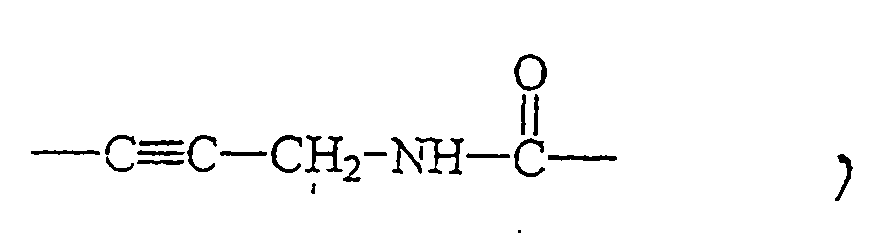


 or
or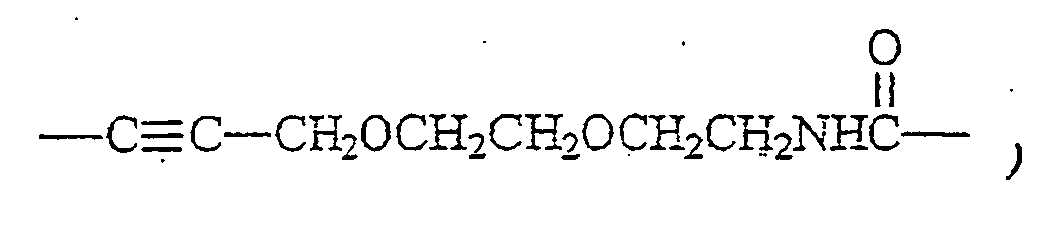

- A method of polynucleotide sequencing comprising the steps of:wherein one of the first, second, third, or fourth dyes is the 4,7-dichlororhodamine dye of claim 1 or claim 4;forming a mixture of a first, a second, a third, and a fourth class of polynucleotides such that:each polynucleotide in the first class includes a 3'-terminal dideoxyadenosine and is labeled with a first dye;each polynucleotide in the second class includes a 3'-terminal dideoxycytidine and is labeled with a second dye;each polynucleotide in the third class includes a 3'-terminal dideoxyguanosine and is labeled with a third dye; andeach polynucleotide in the fourth class includes a 3'-terminal dideoxythymidine and is labeled with a fourth dye;
the other of the dyes being spectrally resolvable from the 4,7-dichlororhodamine dye and from each other;
electrophoretically separating the polynucleotides thereby forming bands of similarly sized polynucleotides;
illuminating the bands with an illumination beam capable of causing the dyes to fluoresce; and
identifying the classes of the polynucleotides in the bands by the fluorescence spectrum of the dyes.
Applications Claiming Priority (3)
| Application Number | Priority Date | Filing Date | Title |
|---|---|---|---|
| US277793 | 1999-03-27 | ||
| US09/277,793 US6080852A (en) | 1996-06-27 | 1999-03-27 | 4,7-dichlororhodamine dyes |
| EP00916662A EP1165694B1 (en) | 1999-03-27 | 2000-03-24 | 4,7-dichlororhodamine dyes useful as molecular probes |
Related Parent Applications (1)
| Application Number | Title | Priority Date | Filing Date |
|---|---|---|---|
| EP00916662A Division EP1165694B1 (en) | 1999-03-27 | 2000-03-24 | 4,7-dichlororhodamine dyes useful as molecular probes |
Publications (2)
| Publication Number | Publication Date |
|---|---|
| EP1386946A1 true EP1386946A1 (en) | 2004-02-04 |
| EP1386946B1 EP1386946B1 (en) | 2009-08-05 |
Family
ID=23062373
Family Applications (2)
| Application Number | Title | Priority Date | Filing Date |
|---|---|---|---|
| EP03025777A Expired - Lifetime EP1386946B1 (en) | 1999-03-27 | 2000-03-24 | Method for analyzing the sequence of a nucleic acid using 4,7-dichlororhodamine dyes |
| EP00916662A Expired - Lifetime EP1165694B1 (en) | 1999-03-27 | 2000-03-24 | 4,7-dichlororhodamine dyes useful as molecular probes |
Family Applications After (1)
| Application Number | Title | Priority Date | Filing Date |
|---|---|---|---|
| EP00916662A Expired - Lifetime EP1165694B1 (en) | 1999-03-27 | 2000-03-24 | 4,7-dichlororhodamine dyes useful as molecular probes |
Country Status (9)
| Country | Link |
|---|---|
| US (2) | US6080852A (en) |
| EP (2) | EP1386946B1 (en) |
| JP (3) | JP3848838B2 (en) |
| AT (2) | ATE277128T1 (en) |
| AU (1) | AU772329B2 (en) |
| CA (1) | CA2367868C (en) |
| DE (2) | DE60014051T8 (en) |
| ES (2) | ES2329562T3 (en) |
| WO (1) | WO2000058406A1 (en) |
Families Citing this family (72)
| Publication number | Priority date | Publication date | Assignee | Title |
|---|---|---|---|---|
| US7550570B2 (en) * | 2000-05-25 | 2009-06-23 | Applied Biosystems, Llc. | 4,7-dichlororhodamine dyes labeled polynucleotides |
| US6080852A (en) | 1996-06-27 | 2000-06-27 | The Perkin-Elmer Corporation | 4,7-dichlororhodamine dyes |
| US5936087A (en) | 1997-11-25 | 1999-08-10 | The Perkin-Elmer Corporation | Dibenzorhodamine dyes |
| US6583168B1 (en) * | 1997-11-25 | 2003-06-24 | Applera Corporation | Sulfonated diarylrhodamine dyes |
| US6372907B1 (en) * | 1999-11-03 | 2002-04-16 | Apptera Corporation | Water-soluble rhodamine dye peptide conjugates |
| US7169922B2 (en) * | 2000-08-04 | 2007-01-30 | Invitrogen Corporation | Derivatives of 1,2-dihydro-7-hydroxyquinolines containing fused rings |
| AU7918501A (en) * | 2000-08-04 | 2002-02-18 | Molecular Probes Inc | Derivatives of 1,2-dihydro-7-hydroxyquinolines containing fused rings |
| AU1312502A (en) * | 2000-10-11 | 2002-04-22 | Pe Corp Ny | Fluorescent nucleobase conjugates having anionic linkers |
| US6582730B2 (en) | 2001-03-30 | 2003-06-24 | Council Of Scientific & Industrial Research | Natural fluorescent dye obtained from a marine invertebrate, compositions containing the said dye and their uses |
| US6916492B2 (en) | 2001-03-30 | 2005-07-12 | Council Of Scientific & Industrial Research | Natural nontoxic multicolor fluorescent protein dye from a marine invertebrate, compositions containing the said dye and its uses |
| US6689391B2 (en) | 2001-03-30 | 2004-02-10 | Council Of Scientific & Industrial Research | Natural non-polar fluorescent dye from a non-bioluminescent marine invertebrate, compositions containing the said dye and its uses |
| US6887690B2 (en) | 2001-06-22 | 2005-05-03 | Pe Corporation | Dye-labeled ribonucleotide triphosphates |
| US6764710B2 (en) | 2001-07-18 | 2004-07-20 | Scimed Life Systems, Inc. | Light emitting markers for use with substrates |
| US7052512B2 (en) * | 2001-07-18 | 2006-05-30 | Boston Scientific Scimed, Inc. | Fluorescent dyed lubricant for medical devices |
| US6956122B2 (en) | 2001-09-05 | 2005-10-18 | Council Of Scientific & Industrial Research | Multiple fluorescent natural dye compound from a marine organism |
| US7445894B2 (en) * | 2002-05-03 | 2008-11-04 | Molecular Probes, Inc. | Compositions and methods for detection and isolation of phosphorylated molecules |
| US20040171034A1 (en) * | 2002-05-03 | 2004-09-02 | Brian Agnew | Compositions and methods for detection and isolation of phosphorylated molecules |
| CN1665790A (en) * | 2002-05-03 | 2005-09-07 | 莫莱丘莱尔探针公司 | Compositions and methods for detection and isolation of phosphorylated molecules |
| US20050250047A1 (en) * | 2002-05-17 | 2005-11-10 | Colin Morton | Light-fast, high-capacity optical storage media |
| AU2003233980A1 (en) * | 2002-05-17 | 2003-12-02 | Ciba Speciality Chemicals Holding Inc. | High-performance optical storage media |
| US20050233307A1 (en) * | 2002-09-12 | 2005-10-20 | Kyle Gee | Site-specific labeling of affinity tags in fusion proteins |
| US20050250214A1 (en) * | 2004-05-05 | 2005-11-10 | Gee Kyle R | Zinc binding compounds and their method of use |
| US7727752B2 (en) * | 2003-07-29 | 2010-06-01 | Life Technologies Corporation | Kinase and phosphatase assays |
| US7619059B2 (en) | 2003-07-29 | 2009-11-17 | Life Technologies Corporation | Bimolecular optical probes |
| CA2445420A1 (en) | 2003-07-29 | 2005-01-29 | Invitrogen Corporation | Kinase and phosphatase assays |
| US7271265B2 (en) * | 2003-08-11 | 2007-09-18 | Invitrogen Corporation | Cyanine compounds and their application as quenching compounds |
| DE602004025592D1 (en) * | 2003-09-12 | 2010-04-01 | Life Technologies Corp | Applications of resonance energy transfer between terbium and GFP |
| US7431915B2 (en) | 2003-10-31 | 2008-10-07 | The Regents Of The University Of California | Peptides whose uptake by cells is controllable |
| US20050214807A1 (en) * | 2003-11-19 | 2005-09-29 | Iain Johnson | Environmental sensitive fluorogenic compounds and their application for singlet oxygen and protein detection |
| US7446202B2 (en) | 2003-12-05 | 2008-11-04 | Molecular Probes, Inc. | Cyanine dye compounds |
| US7776529B2 (en) | 2003-12-05 | 2010-08-17 | Life Technologies Corporation | Methine-substituted cyanine dye compounds |
| GB0329161D0 (en) | 2003-12-16 | 2004-01-21 | Precisense As | Reagant for detecting an analyte |
| JP4127204B2 (en) * | 2003-12-17 | 2008-07-30 | セイコーエプソン株式会社 | Manufacturing method of liquid crystal display device |
| EP1711504A2 (en) | 2004-01-21 | 2006-10-18 | Molecular Probes Inc. | Derivatives of cephalosporin and clavulanic acid for detecting beta-lactamase in a sample |
| US7344701B2 (en) | 2004-02-03 | 2008-03-18 | Biosearch Technologies, Inc. | Xanthene dyes |
| WO2005077125A2 (en) * | 2004-02-11 | 2005-08-25 | Applera Corporation | Methods and compositions for detecting nucleic acids |
| DK1740100T3 (en) * | 2004-04-13 | 2016-11-28 | Biosearch Tech Inc | xanthene |
| WO2006023231A2 (en) | 2004-07-27 | 2006-03-02 | Molecular Probes, Inc. | Fluorescent metal ion indicators with large stokes shift |
| JP2008533167A (en) | 2005-03-15 | 2008-08-21 | アプレラ コーポレイション | Use of antibody alternative antigen systems for analyte detection |
| EP1885718B1 (en) | 2005-05-11 | 2017-03-15 | Life Technologies Corporation | Fluorescent chemical compounds having high selectivity for double stranded dna, and methods for their use |
| WO2007030521A1 (en) * | 2005-09-06 | 2007-03-15 | Invitrogen Corporation | Control of chemical modification |
| US7521577B2 (en) * | 2006-01-12 | 2009-04-21 | Molecular Probes, Inc. | Heavy metal binding compounds and their method of use |
| US20070196860A1 (en) * | 2006-01-18 | 2007-08-23 | Invitrogen Corporation | Methods for Measuring Real Time Kinase Activity |
| WO2007115265A2 (en) | 2006-03-31 | 2007-10-11 | Applied Biosystems Inc. | Reagents useful for synthesizing rhodamine-labeled oligonucleotides |
| EP2021415B1 (en) | 2006-05-18 | 2017-03-15 | Illumina Cambridge Limited | Dye compounds and the use of their labelled conjugates |
| WO2008030986A2 (en) | 2006-09-06 | 2008-03-13 | The Regents Of The University Of California | Molecular diagnosis and classification of malignant melanoma |
| EP2727965B1 (en) | 2006-10-27 | 2019-03-06 | Life Technologies Corporation | FLUOROGENIC pH SENSITIVE DYES AND THEIR METHOD OF USE |
| US8586743B2 (en) * | 2007-01-30 | 2013-11-19 | Life Technologies Corporation | Labeling reagents and methods of their use |
| WO2008151089A2 (en) * | 2007-05-30 | 2008-12-11 | Invitrogen Corporation | Fluorescent phospholipase a2 indicators |
| US20090171078A1 (en) * | 2007-11-20 | 2009-07-02 | Applied Biosystems Inc. | Method of sequencing nucleic acids using elaborated nucleotide phosphorotiolate compounds |
| US8017338B2 (en) * | 2007-11-20 | 2011-09-13 | Life Technologies Corporation | Reversible di-nucleotide terminator sequencing |
| US20090203015A1 (en) * | 2008-02-13 | 2009-08-13 | Celera Corporation | Multiplex assays for hormonal and growth factor receptors, and uses thereof |
| ES2489840T3 (en) | 2008-03-05 | 2014-09-02 | The Regents Of The University Of California | Molecular prognosis and classification of malignant melanoma based on markers selected from the list consisting of RGS1, NCOA3, SPP1, PHIP |
| US20110171124A1 (en) | 2009-02-26 | 2011-07-14 | Osi Pharmaceuticals, Inc. | In situ methods for monitoring the EMT status of tumor cells in vivo |
| WO2013078244A1 (en) | 2011-11-21 | 2013-05-30 | Promega Corporation | Carboxy x rhodamine analogs |
| RS54738B1 (en) | 2011-11-29 | 2016-10-31 | Perosphere Inc | AGENTS THAT REVERSE ANTICOAGULANTS |
| CN102516992A (en) * | 2011-12-07 | 2012-06-27 | 天津工业大学 | A fluorescent probe for detecting Hg2+ ions and its synthesis method and application |
| US9499484B2 (en) | 2012-04-02 | 2016-11-22 | Yissum Research Development Company Of The Hebrew University Of Jerusalem Ltd | Indole, indoline derivatives, compositions comprising them and uses thereof |
| CN105102484B (en) | 2013-01-30 | 2020-03-10 | 艾维拉斯生物科学公司 | Selective Delivery Molecules and Methods of Use |
| US10071990B2 (en) | 2013-06-03 | 2018-09-11 | The Research Foundation For The State University Of New York | Site-specific orthogonal labeling of the carboxy terminus of α-tubulin in live cells |
| CN105764917B (en) | 2013-09-26 | 2021-10-08 | 新加坡国立大学 | Compositions and methods utilizing lysophosphatidylcholine scaffolds |
| US10385380B2 (en) | 2014-10-02 | 2019-08-20 | The Regents Of The University Of California | Personalized protease assay to measure protease activity in neoplasms |
| US10383957B2 (en) | 2015-01-06 | 2019-08-20 | Anthony H. de Haas | Near-infrared fluorescent surgical dye markers |
| US10913944B2 (en) | 2015-01-12 | 2021-02-09 | Life Technologies Corporation | Methods, systems and compositions thereof for nucleic acid library quality control and quantification |
| EP3661539B1 (en) | 2017-08-02 | 2024-10-09 | The Regents of The University of California | Optimized peptides for targeting human nerves and their use in image guided surgery, diagnostics and therapeutic delivery |
| WO2020132487A1 (en) | 2018-12-20 | 2020-06-25 | Life Technologies Corporation | Modified rhodamine dye and use thereof in biological assays |
| KR20210104125A (en) | 2018-12-20 | 2021-08-24 | 라이프 테크놀로지스 코포레이션 | Asymmetric rhodamine dyes and their use in biological assays |
| WO2021072289A1 (en) | 2019-10-10 | 2021-04-15 | Alume Biosciences, Inc. | Methods and systems using peptides for targeting and mapping human nerves in image guided surgery, diagnostics and therapeutic delivery |
| JP7721399B2 (en) | 2020-11-26 | 2025-08-12 | キヤノン株式会社 | Novel compounds and structures for detecting hydrogen sulfide |
| US20240207421A1 (en) | 2020-12-04 | 2024-06-27 | Alume Biosciences, Inc. | Nerve targeting peptides and methods of use |
| KR20230137930A (en) | 2021-01-14 | 2023-10-05 | 알룸 바이오사이언시스 인코포레이티드 | Methods and compositions for visualizing ureters in surgical procedures |
| WO2023004400A1 (en) | 2021-07-21 | 2023-01-26 | Life Technologies Corporation | Dibenzoxanthene quenchers, uses, and methods of preparation |
Citations (3)
| Publication number | Priority date | Publication date | Assignee | Title |
|---|---|---|---|---|
| WO1997036960A1 (en) * | 1996-04-01 | 1997-10-09 | The Perkin-Elmer Corporation | Asymmetric benzoxanthene dyes |
| WO1997049769A1 (en) * | 1996-06-27 | 1997-12-31 | The Perkin-Elmer Corporation | 4,7-dichlororhodamine dyes |
| WO1999027020A1 (en) * | 1997-11-25 | 1999-06-03 | The Perkin-Elmer Corporation | Dibenzorhodamine dyes useful as flourescent labelling agents |
Family Cites Families (24)
| Publication number | Priority date | Publication date | Assignee | Title |
|---|---|---|---|---|
| DE108347C (en) | ||||
| DE47451C (en) | Badische Anilin- und Sodafabrik in Ludwigshafen a. Rh | Innovation in the process for the representation of dyes from the group of metaamidophenol pbtalelns. (4th | ||
| DE45263C (en) | Badische Anilin- und Sodafabrik in Ludwigshafen a. Rh | Innovation in the process for the representation of dyes from the group of m - amidophenol - Phtalei'ns | ||
| BE755141A (en) | 1969-08-21 | 1971-02-22 | Hoechst Ag | PROCESS FOR DYING OR PRINTING TEXTILE MATERIALS BASED ON POLYMERS OR COPOLYMERS OF ACRYLONITRILE |
| FR2065117A5 (en) | 1969-10-08 | 1971-07-23 | Fuji Photo Film Co Ltd | |
| JPS488725B1 (en) | 1969-10-08 | 1973-03-17 | ||
| US4318846A (en) | 1979-09-07 | 1982-03-09 | Syva Company | Novel ether substituted fluorescein polyamino acid compounds as fluorescers and quenchers |
| US4622400A (en) | 1983-12-29 | 1986-11-11 | The United States Of America As Represented By The United States Department Of Energy | Preparation of certain m-aminophenols and the use thereof for preparation of laser dyes |
| DE3425631A1 (en) | 1984-07-12 | 1986-01-16 | Basf Ag, 6700 Ludwigshafen | RHODAMINE DYES |
| US4855225A (en) | 1986-02-07 | 1989-08-08 | Applied Biosystems, Inc. | Method of detecting electrophoretically separated oligonucleotides |
| CA1340806C (en) | 1986-07-02 | 1999-11-02 | James Merrill Prober | Method, system and reagents for dna sequencing |
| US4965349A (en) | 1987-12-24 | 1990-10-23 | Applied Biosystems, Inc. | Method of synthesizing oligonucleotides labeled with ammonia-labile groups on solid phase supports |
| EP0333649B1 (en) | 1988-03-01 | 1994-06-08 | Ciba-Geigy Ag | 3-Basically substituted 2-methyl fluoranes |
| WO1991003476A1 (en) | 1989-09-08 | 1991-03-21 | Applied Biosystems, Inc. | 5- and 6-succinimidylcarboxylate isomers of rhodamine dyes |
| US5366860A (en) | 1989-09-29 | 1994-11-22 | Applied Biosystems, Inc. | Spectrally resolvable rhodamine dyes for nucleic acid sequence determination |
| US5188934A (en) * | 1989-11-14 | 1993-02-23 | Applied Biosystems, Inc. | 4,7-dichlorofluorescein dyes as molecular probes |
| US5750409A (en) * | 1991-11-18 | 1998-05-12 | Boehringer Mannheim Gmbh | Pentacyclic compounds and their use as absorption or fluorescent dyes |
| US5256799A (en) | 1992-07-14 | 1993-10-26 | The United States Of Americas As Represented By The United States Department Of Energy | Preparation of 6-hydroxyindolines and their use for preparation of novel laser dyes |
| DE69324494T2 (en) | 1992-09-03 | 1999-09-23 | The Perkin-Elmer Corp., Foster City | 4,7-DICHLOROFLUOROSZEIN DYES AS MOLECULAR PROBE |
| US5283336A (en) | 1992-09-08 | 1994-02-01 | The United States Of America As Represented By The United States Department Of Energy | Method for preparation of 7-hydroxy-1,2,3,4-tetrahydroquinoline from 1,2,3,4-tetrahydroquinoline |
| WO1994006812A1 (en) | 1992-09-18 | 1994-03-31 | Amoco Corporation | Green fluorescent labeled nucleotides for use in probes |
| US6080852A (en) | 1996-06-27 | 2000-06-27 | The Perkin-Elmer Corporation | 4,7-dichlororhodamine dyes |
| US6017712A (en) | 1996-06-27 | 2000-01-25 | Lee; Linda | 4,7-dichlororhodamine dyes |
| US5770716A (en) * | 1997-04-10 | 1998-06-23 | The Perkin-Elmer Corporation | Substituted propargylethoxyamido nucleosides, oligonucleotides and methods for using same |
-
1999
- 1999-03-27 US US09/277,793 patent/US6080852A/en not_active Expired - Lifetime
-
2000
- 2000-03-24 EP EP03025777A patent/EP1386946B1/en not_active Expired - Lifetime
- 2000-03-24 AT AT00916662T patent/ATE277128T1/en not_active IP Right Cessation
- 2000-03-24 AT AT03025777T patent/ATE438691T1/en not_active IP Right Cessation
- 2000-03-24 AU AU37732/00A patent/AU772329B2/en not_active Ceased
- 2000-03-24 WO PCT/US2000/008003 patent/WO2000058406A1/en not_active Ceased
- 2000-03-24 CA CA002367868A patent/CA2367868C/en not_active Expired - Fee Related
- 2000-03-24 EP EP00916662A patent/EP1165694B1/en not_active Expired - Lifetime
- 2000-03-24 JP JP2000608692A patent/JP3848838B2/en not_active Expired - Lifetime
- 2000-03-24 DE DE60014051T patent/DE60014051T8/en active Active
- 2000-03-24 DE DE60042706T patent/DE60042706D1/en not_active Expired - Lifetime
- 2000-03-24 ES ES03025777T patent/ES2329562T3/en not_active Expired - Lifetime
- 2000-03-24 ES ES00916662T patent/ES2226801T3/en not_active Expired - Lifetime
- 2000-05-25 US US09/578,920 patent/US6713622B1/en not_active Expired - Lifetime
-
2005
- 2005-11-04 JP JP2005321635A patent/JP4732130B2/en not_active Expired - Fee Related
-
2010
- 2010-08-20 JP JP2010185648A patent/JP2011016813A/en not_active Withdrawn
Patent Citations (4)
| Publication number | Priority date | Publication date | Assignee | Title |
|---|---|---|---|---|
| WO1997036960A1 (en) * | 1996-04-01 | 1997-10-09 | The Perkin-Elmer Corporation | Asymmetric benzoxanthene dyes |
| WO1997049769A1 (en) * | 1996-06-27 | 1997-12-31 | The Perkin-Elmer Corporation | 4,7-dichlororhodamine dyes |
| US5847162A (en) * | 1996-06-27 | 1998-12-08 | The Perkin Elmer Corporation | 4, 7-Dichlororhodamine dyes |
| WO1999027020A1 (en) * | 1997-11-25 | 1999-06-03 | The Perkin-Elmer Corporation | Dibenzorhodamine dyes useful as flourescent labelling agents |
Also Published As
| Publication number | Publication date |
|---|---|
| JP2006151973A (en) | 2006-06-15 |
| US6080852A (en) | 2000-06-27 |
| WO2000058406A1 (en) | 2000-10-05 |
| ES2329562T3 (en) | 2009-11-27 |
| CA2367868C (en) | 2007-06-19 |
| DE60042706D1 (en) | 2009-09-17 |
| JP2011016813A (en) | 2011-01-27 |
| AU3773200A (en) | 2000-10-16 |
| JP4732130B2 (en) | 2011-07-27 |
| EP1165694A1 (en) | 2002-01-02 |
| EP1165694B1 (en) | 2004-09-22 |
| DE60014051T8 (en) | 2006-04-27 |
| US6713622B1 (en) | 2004-03-30 |
| CA2367868A1 (en) | 2000-10-05 |
| JP2002540280A (en) | 2002-11-26 |
| AU772329B2 (en) | 2004-04-22 |
| JP3848838B2 (en) | 2006-11-22 |
| DE60014051D1 (en) | 2004-10-28 |
| EP1386946B1 (en) | 2009-08-05 |
| ATE277128T1 (en) | 2004-10-15 |
| DE60014051T2 (en) | 2006-02-23 |
| ES2226801T3 (en) | 2005-04-01 |
| ATE438691T1 (en) | 2009-08-15 |
Similar Documents
| Publication | Publication Date | Title |
|---|---|---|
| EP1165694B1 (en) | 4,7-dichlororhodamine dyes useful as molecular probes | |
| US5847162A (en) | 4, 7-Dichlororhodamine dyes | |
| US6017712A (en) | 4,7-dichlororhodamine dyes | |
| EP0940450B1 (en) | Energy transfer dyes with enhanced fluorescence | |
| EP1212457B1 (en) | Uv excitable fluorescent energy transfer dyes | |
| US5863727A (en) | Energy transfer dyes with enhanced fluorescence | |
| EP0891393B1 (en) | Asymmetric benzoxanthene dyes | |
| US6849745B2 (en) | Energy transfer dyes with enhanced fluorescence | |
| US20090093623A1 (en) | 4,7-dichlororhodamine dyes | |
| US6218124B1 (en) | Method for detecting oligonucleotides using UV light source |
Legal Events
| Date | Code | Title | Description |
|---|---|---|---|
| PUAI | Public reference made under article 153(3) epc to a published international application that has entered the european phase |
Free format text: ORIGINAL CODE: 0009012 |
|
| 17P | Request for examination filed |
Effective date: 20031111 |
|
| AC | Divisional application: reference to earlier application |
Ref document number: 1165694 Country of ref document: EP Kind code of ref document: P |
|
| AK | Designated contracting states |
Kind code of ref document: A1 Designated state(s): AT BE CH CY DE DK ES FI FR GB GR IE IT LI LU MC NL PT SE |
|
| AKX | Designation fees paid |
Designated state(s): AT BE CH CY DE DK ES FI FR GB GR IE IT LI LU MC NL PT SE |
|
| RTI1 | Title (correction) |
Free format text: METHOD FOR ANALYZING THE SEQUENCE OF A NUCLEIC ACID USING 4,7-DICHLORORHODAMINE DYES |
|
| GRAP | Despatch of communication of intention to grant a patent |
Free format text: ORIGINAL CODE: EPIDOSNIGR1 |
|
| GRAS | Grant fee paid |
Free format text: ORIGINAL CODE: EPIDOSNIGR3 |
|
| GRAA | (expected) grant |
Free format text: ORIGINAL CODE: 0009210 |
|
| AC | Divisional application: reference to earlier application |
Ref document number: 1165694 Country of ref document: EP Kind code of ref document: P |
|
| AK | Designated contracting states |
Kind code of ref document: B1 Designated state(s): AT BE CH CY DE DK ES FI FR GB GR IE IT LI LU MC NL PT SE |
|
| REG | Reference to a national code |
Ref country code: GB Ref legal event code: FG4D |
|
| REG | Reference to a national code |
Ref country code: CH Ref legal event code: EP |
|
| REG | Reference to a national code |
Ref country code: IE Ref legal event code: FG4D |
|
| REF | Corresponds to: |
Ref document number: 60042706 Country of ref document: DE Date of ref document: 20090917 Kind code of ref document: P |
|
| REG | Reference to a national code |
Ref country code: SE Ref legal event code: TRGR |
|
| REG | Reference to a national code |
Ref country code: CH Ref legal event code: NV Representative=s name: SERVOPATENT GMBH |
|
| REG | Reference to a national code |
Ref country code: ES Ref legal event code: FG2A Ref document number: 2329562 Country of ref document: ES Kind code of ref document: T3 |
|
| PG25 | Lapsed in a contracting state [announced via postgrant information from national office to epo] |
Ref country code: FI Free format text: LAPSE BECAUSE OF FAILURE TO SUBMIT A TRANSLATION OF THE DESCRIPTION OR TO PAY THE FEE WITHIN THE PRESCRIBED TIME-LIMIT Effective date: 20090805 Ref country code: AT Free format text: LAPSE BECAUSE OF FAILURE TO SUBMIT A TRANSLATION OF THE DESCRIPTION OR TO PAY THE FEE WITHIN THE PRESCRIBED TIME-LIMIT Effective date: 20090805 |
|
| NLV1 | Nl: lapsed or annulled due to failure to fulfill the requirements of art. 29p and 29m of the patents act | ||
| PG25 | Lapsed in a contracting state [announced via postgrant information from national office to epo] |
Ref country code: NL Free format text: LAPSE BECAUSE OF FAILURE TO SUBMIT A TRANSLATION OF THE DESCRIPTION OR TO PAY THE FEE WITHIN THE PRESCRIBED TIME-LIMIT Effective date: 20090805 |
|
| PG25 | Lapsed in a contracting state [announced via postgrant information from national office to epo] |
Ref country code: PT Free format text: LAPSE BECAUSE OF FAILURE TO SUBMIT A TRANSLATION OF THE DESCRIPTION OR TO PAY THE FEE WITHIN THE PRESCRIBED TIME-LIMIT Effective date: 20091205 |
|
| PG25 | Lapsed in a contracting state [announced via postgrant information from national office to epo] |
Ref country code: DK Free format text: LAPSE BECAUSE OF FAILURE TO SUBMIT A TRANSLATION OF THE DESCRIPTION OR TO PAY THE FEE WITHIN THE PRESCRIBED TIME-LIMIT Effective date: 20090805 |
|
| PLBE | No opposition filed within time limit |
Free format text: ORIGINAL CODE: 0009261 |
|
| STAA | Information on the status of an ep patent application or granted ep patent |
Free format text: STATUS: NO OPPOSITION FILED WITHIN TIME LIMIT |
|
| PG25 | Lapsed in a contracting state [announced via postgrant information from national office to epo] |
Ref country code: BE Free format text: LAPSE BECAUSE OF FAILURE TO SUBMIT A TRANSLATION OF THE DESCRIPTION OR TO PAY THE FEE WITHIN THE PRESCRIBED TIME-LIMIT Effective date: 20090805 |
|
| 26N | No opposition filed |
Effective date: 20100507 |
|
| PG25 | Lapsed in a contracting state [announced via postgrant information from national office to epo] |
Ref country code: GR Free format text: LAPSE BECAUSE OF FAILURE TO SUBMIT A TRANSLATION OF THE DESCRIPTION OR TO PAY THE FEE WITHIN THE PRESCRIBED TIME-LIMIT Effective date: 20091106 Ref country code: MC Free format text: LAPSE BECAUSE OF NON-PAYMENT OF DUE FEES Effective date: 20100331 |
|
| PG25 | Lapsed in a contracting state [announced via postgrant information from national office to epo] |
Ref country code: CY Free format text: LAPSE BECAUSE OF FAILURE TO SUBMIT A TRANSLATION OF THE DESCRIPTION OR TO PAY THE FEE WITHIN THE PRESCRIBED TIME-LIMIT Effective date: 20090805 |
|
| PG25 | Lapsed in a contracting state [announced via postgrant information from national office to epo] |
Ref country code: LU Free format text: LAPSE BECAUSE OF NON-PAYMENT OF DUE FEES Effective date: 20100324 |
|
| REG | Reference to a national code |
Ref country code: FR Ref legal event code: PLFP Year of fee payment: 17 |
|
| REG | Reference to a national code |
Ref country code: FR Ref legal event code: PLFP Year of fee payment: 18 |
|
| PGFP | Annual fee paid to national office [announced via postgrant information from national office to epo] |
Ref country code: FR Payment date: 20170213 Year of fee payment: 18 Ref country code: CH Payment date: 20170314 Year of fee payment: 18 Ref country code: DE Payment date: 20170321 Year of fee payment: 18 Ref country code: SE Payment date: 20170313 Year of fee payment: 18 |
|
| PGFP | Annual fee paid to national office [announced via postgrant information from national office to epo] |
Ref country code: IE Payment date: 20170309 Year of fee payment: 18 |
|
| PGFP | Annual fee paid to national office [announced via postgrant information from national office to epo] |
Ref country code: IT Payment date: 20170320 Year of fee payment: 18 Ref country code: ES Payment date: 20170214 Year of fee payment: 18 |
|
| REG | Reference to a national code |
Ref country code: DE Ref legal event code: R119 Ref document number: 60042706 Country of ref document: DE |
|
| PG25 | Lapsed in a contracting state [announced via postgrant information from national office to epo] |
Ref country code: SE Free format text: LAPSE BECAUSE OF NON-PAYMENT OF DUE FEES Effective date: 20180325 |
|
| REG | Reference to a national code |
Ref country code: CH Ref legal event code: PL |
|
| REG | Reference to a national code |
Ref country code: IE Ref legal event code: MM4A |
|
| PG25 | Lapsed in a contracting state [announced via postgrant information from national office to epo] |
Ref country code: IE Free format text: LAPSE BECAUSE OF NON-PAYMENT OF DUE FEES Effective date: 20180324 Ref country code: DE Free format text: LAPSE BECAUSE OF NON-PAYMENT OF DUE FEES Effective date: 20181002 |
|
| PG25 | Lapsed in a contracting state [announced via postgrant information from national office to epo] |
Ref country code: LI Free format text: LAPSE BECAUSE OF NON-PAYMENT OF DUE FEES Effective date: 20180331 Ref country code: IT Free format text: LAPSE BECAUSE OF NON-PAYMENT OF DUE FEES Effective date: 20180324 Ref country code: CH Free format text: LAPSE BECAUSE OF NON-PAYMENT OF DUE FEES Effective date: 20180331 |
|
| PG25 | Lapsed in a contracting state [announced via postgrant information from national office to epo] |
Ref country code: FR Free format text: LAPSE BECAUSE OF NON-PAYMENT OF DUE FEES Effective date: 20180331 |
|
| PGFP | Annual fee paid to national office [announced via postgrant information from national office to epo] |
Ref country code: GB Payment date: 20190320 Year of fee payment: 20 |
|
| REG | Reference to a national code |
Ref country code: ES Ref legal event code: FD2A Effective date: 20190911 |
|
| PG25 | Lapsed in a contracting state [announced via postgrant information from national office to epo] |
Ref country code: ES Free format text: LAPSE BECAUSE OF NON-PAYMENT OF DUE FEES Effective date: 20180325 |
|
| REG | Reference to a national code |
Ref country code: GB Ref legal event code: PE20 Expiry date: 20200323 |
|
| PG25 | Lapsed in a contracting state [announced via postgrant information from national office to epo] |
Ref country code: GB Free format text: LAPSE BECAUSE OF EXPIRATION OF PROTECTION Effective date: 20200323 |