EP1385823B1 - Guanidino compounds as melanocortin-4 receptor (mc4-r) agonists - Google Patents
Guanidino compounds as melanocortin-4 receptor (mc4-r) agonists Download PDFInfo
- Publication number
- EP1385823B1 EP1385823B1 EP02719463A EP02719463A EP1385823B1 EP 1385823 B1 EP1385823 B1 EP 1385823B1 EP 02719463 A EP02719463 A EP 02719463A EP 02719463 A EP02719463 A EP 02719463A EP 1385823 B1 EP1385823 B1 EP 1385823B1
- Authority
- EP
- European Patent Office
- Prior art keywords
- groups
- group
- substituted
- alkyl
- compound
- Prior art date
- Legal status (The legal status is an assumption and is not a legal conclusion. Google has not performed a legal analysis and makes no representation as to the accuracy of the status listed.)
- Expired - Lifetime
Links
- 108010021436 Type 4 Melanocortin Receptor Proteins 0.000 title abstract description 36
- 239000000556 agonist Substances 0.000 title abstract description 11
- 102000001796 Melanocortin 4 receptors Human genes 0.000 title abstract 4
- 125000002795 guanidino group Chemical group C(N)(=N)N* 0.000 title description 7
- 150000001875 compounds Chemical class 0.000 claims abstract description 101
- IJGRMHOSHXDMSA-UHFFFAOYSA-N Atomic nitrogen Chemical class N#N IJGRMHOSHXDMSA-UHFFFAOYSA-N 0.000 claims abstract description 40
- 229910052757 nitrogen Inorganic materials 0.000 claims abstract description 36
- 229910052799 carbon Inorganic materials 0.000 claims abstract description 35
- 208000037265 diseases, disorders, signs and symptoms Diseases 0.000 claims abstract description 35
- 229910052760 oxygen Inorganic materials 0.000 claims abstract description 21
- 201000010099 disease Diseases 0.000 claims abstract description 19
- 208000008589 Obesity Diseases 0.000 claims abstract description 14
- 235000020824 obesity Nutrition 0.000 claims abstract description 14
- 229910052717 sulfur Inorganic materials 0.000 claims abstract description 7
- 208000001072 type 2 diabetes mellitus Diseases 0.000 claims abstract description 7
- -1 (CR6R7)n Inorganic materials 0.000 claims description 249
- 125000000217 alkyl group Chemical group 0.000 claims description 105
- 125000000753 cycloalkyl group Chemical group 0.000 claims description 60
- 125000000623 heterocyclic group Chemical group 0.000 claims description 58
- 125000003342 alkenyl group Chemical group 0.000 claims description 57
- 125000000304 alkynyl group Chemical group 0.000 claims description 50
- 125000003710 aryl alkyl group Chemical group 0.000 claims description 49
- 125000001072 heteroaryl group Chemical group 0.000 claims description 49
- 125000004446 heteroarylalkyl group Chemical group 0.000 claims description 48
- 125000003118 aryl group Chemical group 0.000 claims description 45
- 125000001316 cycloalkyl alkyl group Chemical group 0.000 claims description 38
- 229910052739 hydrogen Inorganic materials 0.000 claims description 37
- 239000000203 mixture Substances 0.000 claims description 33
- 125000003545 alkoxy group Chemical group 0.000 claims description 22
- 238000002360 preparation method Methods 0.000 claims description 20
- 125000004415 heterocyclylalkyl group Chemical group 0.000 claims description 19
- 125000002924 primary amino group Chemical group [H]N([H])* 0.000 claims description 18
- 150000003839 salts Chemical class 0.000 claims description 17
- 125000003917 carbamoyl group Chemical group [H]N([H])C(*)=O 0.000 claims description 14
- 125000004457 alkyl amino carbonyl group Chemical group 0.000 claims description 12
- 125000003282 alkyl amino group Chemical group 0.000 claims description 12
- 125000005100 aryl amino carbonyl group Chemical group 0.000 claims description 12
- 125000005167 cycloalkylaminocarbonyl group Chemical group 0.000 claims description 12
- 125000004663 dialkyl amino group Chemical group 0.000 claims description 12
- 125000004473 dialkylaminocarbonyl group Chemical group 0.000 claims description 12
- 125000005843 halogen group Chemical group 0.000 claims description 12
- 125000005241 heteroarylamino group Chemical group 0.000 claims description 12
- 125000005222 heteroarylaminocarbonyl group Chemical group 0.000 claims description 12
- 125000004433 nitrogen atom Chemical group N* 0.000 claims description 11
- YTPLMLYBLZKORZ-UHFFFAOYSA-N Thiophene Chemical compound C=1C=CSC=1 YTPLMLYBLZKORZ-UHFFFAOYSA-N 0.000 claims description 10
- 125000000113 cyclohexyl group Chemical group [H]C1([H])C([H])([H])C([H])([H])C([H])(*)C([H])([H])C1([H])[H] 0.000 claims description 10
- 125000004432 carbon atom Chemical group C* 0.000 claims description 9
- UFHFLCQGNIYNRP-UHFFFAOYSA-N Hydrogen Chemical group [H][H] UFHFLCQGNIYNRP-UHFFFAOYSA-N 0.000 claims description 8
- 125000004210 cyclohexylmethyl group Chemical group [H]C([H])(*)C1([H])C([H])([H])C([H])([H])C([H])([H])C([H])([H])C1([H])[H] 0.000 claims description 8
- 150000004678 hydrides Chemical class 0.000 claims description 8
- 239000001257 hydrogen Substances 0.000 claims description 8
- 239000008194 pharmaceutical composition Substances 0.000 claims description 8
- 150000004677 hydrates Chemical class 0.000 claims description 7
- 230000001404 mediated effect Effects 0.000 claims description 7
- 239000012453 solvate Substances 0.000 claims description 7
- JUJWROOIHBZHMG-UHFFFAOYSA-N Pyridine Chemical compound C1=CC=NC=C1 JUJWROOIHBZHMG-UHFFFAOYSA-N 0.000 claims description 6
- 125000004448 alkyl carbonyl group Chemical group 0.000 claims description 6
- 125000005129 aryl carbonyl group Chemical group 0.000 claims description 6
- 125000000582 cycloheptyl group Chemical group [H]C1([H])C([H])([H])C([H])([H])C([H])([H])C([H])(*)C([H])([H])C1([H])[H] 0.000 claims description 6
- 125000005842 heteroatom Chemical group 0.000 claims description 6
- RAXXELZNTBOGNW-UHFFFAOYSA-N imidazole Natural products C1=CNC=N1 RAXXELZNTBOGNW-UHFFFAOYSA-N 0.000 claims description 6
- 125000002496 methyl group Chemical group [H]C([H])([H])* 0.000 claims description 6
- DTGKSKDOIYIVQL-WEDXCCLWSA-N (+)-borneol Chemical group C1C[C@@]2(C)[C@@H](O)C[C@@H]1C2(C)C DTGKSKDOIYIVQL-WEDXCCLWSA-N 0.000 claims description 5
- YLQBMQCUIZJEEH-UHFFFAOYSA-N Furan Chemical compound C=1C=COC=1 YLQBMQCUIZJEEH-UHFFFAOYSA-N 0.000 claims description 5
- 125000000596 cyclohexenyl group Chemical group C1(=CCCCC1)* 0.000 claims description 5
- 125000000640 cyclooctyl group Chemical group [H]C1([H])C([H])([H])C([H])([H])C([H])([H])C([H])(*)C([H])([H])C([H])([H])C1([H])[H] 0.000 claims description 5
- 125000001511 cyclopentyl group Chemical group [H]C1([H])C([H])([H])C([H])([H])C([H])(*)C1([H])[H] 0.000 claims description 5
- 125000001449 isopropyl group Chemical group [H]C([H])([H])C([H])(*)C([H])([H])[H] 0.000 claims description 5
- 125000004352 2-phenylcyclohexyl group Chemical group [H]C1=C([H])C([H])=C(C([H])=C1[H])C1([H])C([H])([H])C([H])([H])C([H])([H])C([H])([H])C1([H])* 0.000 claims description 4
- KYQCOXFCLRTKLS-UHFFFAOYSA-N Pyrazine Chemical compound C1=CN=CC=N1 KYQCOXFCLRTKLS-UHFFFAOYSA-N 0.000 claims description 4
- KAESVJOAVNADME-UHFFFAOYSA-N Pyrrole Chemical compound C=1C=CNC=1 KAESVJOAVNADME-UHFFFAOYSA-N 0.000 claims description 4
- 125000005073 adamantyl group Chemical group C12(CC3CC(CC(C1)C3)C2)* 0.000 claims description 4
- CUFNKYGDVFVPHO-UHFFFAOYSA-N azulene Chemical compound C1=CC=CC2=CC=CC2=C1 CUFNKYGDVFVPHO-UHFFFAOYSA-N 0.000 claims description 4
- WDECIBYCCFPHNR-UHFFFAOYSA-N chrysene Chemical compound C1=CC=CC2=CC=C3C4=CC=CC=C4C=CC3=C21 WDECIBYCCFPHNR-UHFFFAOYSA-N 0.000 claims description 4
- 125000004855 decalinyl group Chemical group C1(CCCC2CCCCC12)* 0.000 claims description 4
- ZUOUZKKEUPVFJK-UHFFFAOYSA-N diphenyl Chemical compound C1=CC=CC=C1C1=CC=CC=C1 ZUOUZKKEUPVFJK-UHFFFAOYSA-N 0.000 claims description 4
- 239000003937 drug carrier Substances 0.000 claims description 4
- NIHNNTQXNPWCJQ-UHFFFAOYSA-N fluorene Chemical compound C1=CC=C2CC3=CC=CC=C3C2=C1 NIHNNTQXNPWCJQ-UHFFFAOYSA-N 0.000 claims description 4
- 125000004108 n-butyl group Chemical group [H]C([H])([H])C([H])([H])C([H])([H])C([H])([H])* 0.000 claims description 4
- YNPNZTXNASCQKK-UHFFFAOYSA-N phenanthrene Chemical compound C1=CC=C2C3=CC=CC=C3C=CC2=C1 YNPNZTXNASCQKK-UHFFFAOYSA-N 0.000 claims description 4
- BBEAQIROQSPTKN-UHFFFAOYSA-N pyrene Chemical compound C1=CC=C2C=CC3=CC=CC4=CC=C1C2=C43 BBEAQIROQSPTKN-UHFFFAOYSA-N 0.000 claims description 4
- 125000004122 cyclic group Chemical group 0.000 claims description 3
- 125000002868 norbornyl group Chemical group C12(CCC(CC1)C2)* 0.000 claims description 3
- UMJSCPRVCHMLSP-UHFFFAOYSA-N pyridine Natural products COC1=CC=CN=C1 UMJSCPRVCHMLSP-UHFFFAOYSA-N 0.000 claims description 3
- 125000003107 substituted aryl group Chemical group 0.000 claims description 3
- JYEUMXHLPRZUAT-UHFFFAOYSA-N 1,2,3-triazine Chemical compound C1=CN=NN=C1 JYEUMXHLPRZUAT-UHFFFAOYSA-N 0.000 claims description 2
- HGUFODBRKLSHSI-UHFFFAOYSA-N 2,3,7,8-tetrachloro-dibenzo-p-dioxin Chemical compound O1C2=CC(Cl)=C(Cl)C=C2OC2=C1C=C(Cl)C(Cl)=C2 HGUFODBRKLSHSI-UHFFFAOYSA-N 0.000 claims description 2
- UXGVMFHEKMGWMA-UHFFFAOYSA-N 2-benzofuran Chemical compound C1=CC=CC2=COC=C21 UXGVMFHEKMGWMA-UHFFFAOYSA-N 0.000 claims description 2
- MGADZUXDNSDTHW-UHFFFAOYSA-N 2H-pyran Chemical compound C1OC=CC=C1 MGADZUXDNSDTHW-UHFFFAOYSA-N 0.000 claims description 2
- BCHZICNRHXRCHY-UHFFFAOYSA-N 2h-oxazine Chemical compound N1OC=CC=C1 BCHZICNRHXRCHY-UHFFFAOYSA-N 0.000 claims description 2
- BWCDLEQTELFBAW-UHFFFAOYSA-N 3h-dioxazole Chemical compound N1OOC=C1 BWCDLEQTELFBAW-UHFFFAOYSA-N 0.000 claims description 2
- KWIVRAVCZJXOQC-UHFFFAOYSA-N 3h-oxathiazole Chemical compound N1SOC=C1 KWIVRAVCZJXOQC-UHFFFAOYSA-N 0.000 claims description 2
- RELAJOWOFXGXHI-UHFFFAOYSA-N 3h-oxathiole Chemical compound C1SOC=C1 RELAJOWOFXGXHI-UHFFFAOYSA-N 0.000 claims description 2
- ZCQWOFVYLHDMMC-UHFFFAOYSA-N Oxazole Chemical compound C1=COC=N1 ZCQWOFVYLHDMMC-UHFFFAOYSA-N 0.000 claims description 2
- PCNDJXKNXGMECE-UHFFFAOYSA-N Phenazine Natural products C1=CC=CC2=NC3=CC=CC=C3N=C21 PCNDJXKNXGMECE-UHFFFAOYSA-N 0.000 claims description 2
- WTKZEGDFNFYCGP-UHFFFAOYSA-N Pyrazole Chemical compound C=1C=NNC=1 WTKZEGDFNFYCGP-UHFFFAOYSA-N 0.000 claims description 2
- CZPWVGJYEJSRLH-UHFFFAOYSA-N Pyrimidine Chemical compound C1=CN=CN=C1 CZPWVGJYEJSRLH-UHFFFAOYSA-N 0.000 claims description 2
- FZWLAAWBMGSTSO-UHFFFAOYSA-N Thiazole Chemical compound C1=CSC=N1 FZWLAAWBMGSTSO-UHFFFAOYSA-N 0.000 claims description 2
- SLGBZMMZGDRARJ-UHFFFAOYSA-N Triphenylene Natural products C1=CC=C2C3=CC=CC=C3C3=CC=CC=C3C2=C1 SLGBZMMZGDRARJ-UHFFFAOYSA-N 0.000 claims description 2
- 125000002178 anthracenyl group Chemical group C1(=CC=CC2=CC3=CC=CC=C3C=C12)* 0.000 claims description 2
- XYOVOXDWRFGKEX-UHFFFAOYSA-N azepine Chemical compound N1C=CC=CC=C1 XYOVOXDWRFGKEX-UHFFFAOYSA-N 0.000 claims description 2
- 239000004305 biphenyl Substances 0.000 claims description 2
- 235000010290 biphenyl Nutrition 0.000 claims description 2
- 125000002529 biphenylenyl group Chemical group C1(=CC=CC=2C3=CC=CC=C3C12)* 0.000 claims description 2
- 125000006165 cyclic alkyl group Chemical group 0.000 claims description 2
- GVEPBJHOBDJJJI-UHFFFAOYSA-N fluoranthrene Natural products C1=CC(C2=CC=CC=C22)=C3C2=CC=CC3=C1 GVEPBJHOBDJJJI-UHFFFAOYSA-N 0.000 claims description 2
- DDTGNKBZWQHIEH-UHFFFAOYSA-N heptalene Chemical compound C1=CC=CC=C2C=CC=CC=C21 DDTGNKBZWQHIEH-UHFFFAOYSA-N 0.000 claims description 2
- 150000002467 indacenes Chemical class 0.000 claims description 2
- ZLTPDFXIESTBQG-UHFFFAOYSA-N isothiazole Chemical compound C=1C=NSC=1 ZLTPDFXIESTBQG-UHFFFAOYSA-N 0.000 claims description 2
- CTAPFRYPJLPFDF-UHFFFAOYSA-N isoxazole Chemical compound C=1C=NOC=1 CTAPFRYPJLPFDF-UHFFFAOYSA-N 0.000 claims description 2
- 125000006574 non-aromatic ring group Chemical group 0.000 claims description 2
- WCPAKWJPBJAGKN-UHFFFAOYSA-N oxadiazole Chemical compound C1=CON=N1 WCPAKWJPBJAGKN-UHFFFAOYSA-N 0.000 claims description 2
- AZHVQJLDOFKHPZ-UHFFFAOYSA-N oxathiazine Chemical compound O1SN=CC=C1 AZHVQJLDOFKHPZ-UHFFFAOYSA-N 0.000 claims description 2
- CQDAMYNQINDRQC-UHFFFAOYSA-N oxatriazole Chemical compound C1=NN=NO1 CQDAMYNQINDRQC-UHFFFAOYSA-N 0.000 claims description 2
- ATYBXHSAIOKLMG-UHFFFAOYSA-N oxepin Chemical compound O1C=CC=CC=C1 ATYBXHSAIOKLMG-UHFFFAOYSA-N 0.000 claims description 2
- 125000001997 phenyl group Chemical group [H]C1=C([H])C([H])=C(*)C([H])=C1[H] 0.000 claims description 2
- 125000003367 polycyclic group Chemical group 0.000 claims description 2
- PBMFSQRYOILNGV-UHFFFAOYSA-N pyridazine Chemical compound C1=CC=NN=C1 PBMFSQRYOILNGV-UHFFFAOYSA-N 0.000 claims description 2
- 125000005346 substituted cycloalkyl group Chemical group 0.000 claims description 2
- IFLREYGFSNHWGE-UHFFFAOYSA-N tetracene Chemical compound C1=CC=CC2=CC3=CC4=CC=CC=C4C=C3C=C21 IFLREYGFSNHWGE-UHFFFAOYSA-N 0.000 claims description 2
- NQRYJNQNLNOLGT-UHFFFAOYSA-N tetrahydropyridine hydrochloride Natural products C1CCNCC1 NQRYJNQNLNOLGT-UHFFFAOYSA-N 0.000 claims description 2
- 229930192474 thiophene Natural products 0.000 claims description 2
- 150000003852 triazoles Chemical class 0.000 claims description 2
- 125000005580 triphenylene group Chemical group 0.000 claims description 2
- 102100023724 Melanocortin receptor 4 Human genes 0.000 claims 1
- 101710085775 Melanocortin receptor 4 Proteins 0.000 claims 1
- 150000001721 carbon Chemical class 0.000 abstract description 3
- 229910005965 SO 2 Inorganic materials 0.000 abstract 2
- 238000004895 liquid chromatography mass spectrometry Methods 0.000 description 50
- 102000008316 Type 4 Melanocortin Receptor Human genes 0.000 description 32
- 238000000034 method Methods 0.000 description 25
- 239000000047 product Substances 0.000 description 22
- 239000000243 solution Substances 0.000 description 20
- 241000699670 Mus sp. Species 0.000 description 18
- WQZGKKKJIJFFOK-GASJEMHNSA-N Glucose Natural products OC[C@H]1OC(O)[C@H](O)[C@@H](O)[C@@H]1O WQZGKKKJIJFFOK-GASJEMHNSA-N 0.000 description 16
- WQZGKKKJIJFFOK-VFUOTHLCSA-N beta-D-glucose Chemical compound OC[C@H]1O[C@@H](O)[C@H](O)[C@@H](O)[C@@H]1O WQZGKKKJIJFFOK-VFUOTHLCSA-N 0.000 description 16
- 208000035475 disorder Diseases 0.000 description 16
- 239000008103 glucose Substances 0.000 description 15
- UMGDCJDMYOKAJW-UHFFFAOYSA-N thiourea Chemical compound NC(N)=S UMGDCJDMYOKAJW-UHFFFAOYSA-N 0.000 description 14
- WEVYAHXRMPXWCK-UHFFFAOYSA-N Acetonitrile Chemical compound CC#N WEVYAHXRMPXWCK-UHFFFAOYSA-N 0.000 description 12
- YMWUJEATGCHHMB-UHFFFAOYSA-N Dichloromethane Chemical compound ClCCl YMWUJEATGCHHMB-UHFFFAOYSA-N 0.000 description 12
- NOESYZHRGYRDHS-UHFFFAOYSA-N insulin Chemical compound N1C(=O)C(NC(=O)C(CCC(N)=O)NC(=O)C(CCC(O)=O)NC(=O)C(C(C)C)NC(=O)C(NC(=O)CN)C(C)CC)CSSCC(C(NC(CO)C(=O)NC(CC(C)C)C(=O)NC(CC=2C=CC(O)=CC=2)C(=O)NC(CCC(N)=O)C(=O)NC(CC(C)C)C(=O)NC(CCC(O)=O)C(=O)NC(CC(N)=O)C(=O)NC(CC=2C=CC(O)=CC=2)C(=O)NC(CSSCC(NC(=O)C(C(C)C)NC(=O)C(CC(C)C)NC(=O)C(CC=2C=CC(O)=CC=2)NC(=O)C(CC(C)C)NC(=O)C(C)NC(=O)C(CCC(O)=O)NC(=O)C(C(C)C)NC(=O)C(CC(C)C)NC(=O)C(CC=2NC=NC=2)NC(=O)C(CO)NC(=O)CNC2=O)C(=O)NCC(=O)NC(CCC(O)=O)C(=O)NC(CCCNC(N)=N)C(=O)NCC(=O)NC(CC=3C=CC=CC=3)C(=O)NC(CC=3C=CC=CC=3)C(=O)NC(CC=3C=CC(O)=CC=3)C(=O)NC(C(C)O)C(=O)N3C(CCC3)C(=O)NC(CCCCN)C(=O)NC(C)C(O)=O)C(=O)NC(CC(N)=O)C(O)=O)=O)NC(=O)C(C(C)CC)NC(=O)C(CO)NC(=O)C(C(C)O)NC(=O)C1CSSCC2NC(=O)C(CC(C)C)NC(=O)C(NC(=O)C(CCC(N)=O)NC(=O)C(CC(N)=O)NC(=O)C(NC(=O)C(N)CC=1C=CC=CC=1)C(C)C)CC1=CN=CN1 NOESYZHRGYRDHS-UHFFFAOYSA-N 0.000 description 12
- 239000002904 solvent Substances 0.000 description 12
- XLYOFNOQVPJJNP-UHFFFAOYSA-N water Substances O XLYOFNOQVPJJNP-UHFFFAOYSA-N 0.000 description 12
- 125000001495 ethyl group Chemical group [H]C([H])([H])C([H])([H])* 0.000 description 11
- LFQSCWFLJHTTHZ-UHFFFAOYSA-N Ethanol Chemical compound CCO LFQSCWFLJHTTHZ-UHFFFAOYSA-N 0.000 description 10
- 238000009472 formulation Methods 0.000 description 9
- 239000007924 injection Substances 0.000 description 9
- 238000002347 injection Methods 0.000 description 9
- 239000011541 reaction mixture Substances 0.000 description 9
- 239000000725 suspension Substances 0.000 description 9
- QTBSBXVTEAMEQO-UHFFFAOYSA-N Acetic acid Chemical compound CC(O)=O QTBSBXVTEAMEQO-UHFFFAOYSA-N 0.000 description 8
- DTQVDTLACAAQTR-UHFFFAOYSA-N Trifluoroacetic acid Chemical compound OC(=O)C(F)(F)F DTQVDTLACAAQTR-UHFFFAOYSA-N 0.000 description 8
- 150000001412 amines Chemical class 0.000 description 8
- 230000037396 body weight Effects 0.000 description 8
- 0 **(C1)(*2)*1C(*)=C2*=C(*=*)N Chemical compound **(C1)(*2)*1C(*)=C2*=C(*=*)N 0.000 description 7
- OKTJSMMVPCPJKN-UHFFFAOYSA-N Carbon Chemical group [C] OKTJSMMVPCPJKN-UHFFFAOYSA-N 0.000 description 7
- XEKOWRVHYACXOJ-UHFFFAOYSA-N Ethyl acetate Chemical compound CCOC(C)=O XEKOWRVHYACXOJ-UHFFFAOYSA-N 0.000 description 7
- XSQUKJJJFZCRTK-UHFFFAOYSA-N Urea Natural products NC(N)=O XSQUKJJJFZCRTK-UHFFFAOYSA-N 0.000 description 7
- 125000001797 benzyl group Chemical group [H]C1=C([H])C([H])=C(C([H])=C1[H])C([H])([H])* 0.000 description 7
- 125000002619 bicyclic group Chemical group 0.000 description 7
- 238000006243 chemical reaction Methods 0.000 description 7
- 150000003951 lactams Chemical class 0.000 description 7
- 239000003921 oil Substances 0.000 description 7
- 235000019198 oils Nutrition 0.000 description 7
- 230000009467 reduction Effects 0.000 description 7
- 208000024891 symptom Diseases 0.000 description 7
- 239000003981 vehicle Substances 0.000 description 7
- 125000006282 2-chlorobenzyl group Chemical group [H]C1=C([H])C(Cl)=C(C([H])=C1[H])C([H])([H])* 0.000 description 6
- 125000003852 3-chlorobenzyl group Chemical group [H]C1=C([H])C(=C([H])C(Cl)=C1[H])C([H])([H])* 0.000 description 6
- 125000006497 3-methoxybenzyl group Chemical group [H]C1=C([H])C(=C([H])C(OC([H])([H])[H])=C1[H])C([H])([H])* 0.000 description 6
- 125000006180 3-methyl benzyl group Chemical group [H]C1=C([H])C(=C([H])C(=C1[H])C([H])([H])[H])C([H])([H])* 0.000 description 6
- 125000004176 4-fluorobenzyl group Chemical group [H]C1=C([H])C(=C([H])C([H])=C1F)C([H])([H])* 0.000 description 6
- CSCPPACGZOOCGX-UHFFFAOYSA-N Acetone Chemical compound CC(C)=O CSCPPACGZOOCGX-UHFFFAOYSA-N 0.000 description 6
- IAZDPXIOMUYVGZ-UHFFFAOYSA-N Dimethylsulphoxide Chemical compound CS(C)=O IAZDPXIOMUYVGZ-UHFFFAOYSA-N 0.000 description 6
- 102000004877 Insulin Human genes 0.000 description 6
- 108090001061 Insulin Proteins 0.000 description 6
- OKKJLVBELUTLKV-UHFFFAOYSA-N Methanol Chemical compound OC OKKJLVBELUTLKV-UHFFFAOYSA-N 0.000 description 6
- YXFVVABEGXRONW-UHFFFAOYSA-N Toluene Chemical compound CC1=CC=CC=C1 YXFVVABEGXRONW-UHFFFAOYSA-N 0.000 description 6
- 206010012601 diabetes mellitus Diseases 0.000 description 6
- 239000002552 dosage form Substances 0.000 description 6
- 229940125396 insulin Drugs 0.000 description 6
- 238000000746 purification Methods 0.000 description 6
- MPKJCALFZUZXPN-BGUHGZOESA-N (3s)-n-[2-[2-(2,4-dichlorophenyl)ethyl]-1-oxo-3h-isoindol-5-yl]-3-methyl-n'-[(1r,3s,4s,5s)-4,6,6-trimethyl-3-bicyclo[3.1.1]heptanyl]piperazine-1-carboximidamide Chemical compound N([C@@H]1[C@@H](C)[C@@]2(C[C@](C1)(C2(C)C)[H])[H])=C(N1C[C@H](C)NCC1)NC(C=C1C2)=CC=C1C(=O)N2CCC1=CC=C(Cl)C=C1Cl MPKJCALFZUZXPN-BGUHGZOESA-N 0.000 description 5
- RTZKZFJDLAIYFH-UHFFFAOYSA-N Diethyl ether Chemical class CCOCC RTZKZFJDLAIYFH-UHFFFAOYSA-N 0.000 description 5
- 230000003213 activating effect Effects 0.000 description 5
- 239000008280 blood Substances 0.000 description 5
- 210000004369 blood Anatomy 0.000 description 5
- 235000014113 dietary fatty acids Nutrition 0.000 description 5
- 230000000694 effects Effects 0.000 description 5
- 239000000194 fatty acid Substances 0.000 description 5
- 229930195729 fatty acid Natural products 0.000 description 5
- 235000021588 free fatty acids Nutrition 0.000 description 5
- 239000000546 pharmaceutical excipient Substances 0.000 description 5
- ZTWBXCGKRKUYSY-UHFFFAOYSA-N piperazine-1-carboximidamide Chemical compound NC(=N)N1CCNCC1 ZTWBXCGKRKUYSY-UHFFFAOYSA-N 0.000 description 5
- 239000000843 powder Substances 0.000 description 5
- 108090000765 processed proteins & peptides Proteins 0.000 description 5
- 210000002966 serum Anatomy 0.000 description 5
- 238000003756 stirring Methods 0.000 description 5
- 238000003786 synthesis reaction Methods 0.000 description 5
- ZWZVWGITAAIFPS-UHFFFAOYSA-N thiophosgene Chemical compound ClC(Cl)=S ZWZVWGITAAIFPS-UHFFFAOYSA-N 0.000 description 5
- 230000009466 transformation Effects 0.000 description 5
- VHJKDOLGYMULOP-UHFFFAOYSA-N 2-(2,4-dichlorophenyl)ethanamine Chemical compound NCCC1=CC=C(Cl)C=C1Cl VHJKDOLGYMULOP-UHFFFAOYSA-N 0.000 description 4
- CURLTUGMZLYLDI-UHFFFAOYSA-N Carbon dioxide Chemical compound O=C=O CURLTUGMZLYLDI-UHFFFAOYSA-N 0.000 description 4
- 108010008364 Melanocortins Proteins 0.000 description 4
- 102100027467 Pro-opiomelanocortin Human genes 0.000 description 4
- VYPSYNLAJGMNEJ-UHFFFAOYSA-N Silicium dioxide Chemical compound O=[Si]=O VYPSYNLAJGMNEJ-UHFFFAOYSA-N 0.000 description 4
- 235000019577 caloric intake Nutrition 0.000 description 4
- 238000005859 coupling reaction Methods 0.000 description 4
- 239000003085 diluting agent Substances 0.000 description 4
- 229940079593 drug Drugs 0.000 description 4
- 239000003814 drug Substances 0.000 description 4
- 235000012631 food intake Nutrition 0.000 description 4
- 238000004128 high performance liquid chromatography Methods 0.000 description 4
- 150000002540 isothiocyanates Chemical class 0.000 description 4
- 239000002865 melanocortin Substances 0.000 description 4
- 238000002156 mixing Methods 0.000 description 4
- VLKZOEOYAKHREP-UHFFFAOYSA-N n-Hexane Chemical class CCCCCC VLKZOEOYAKHREP-UHFFFAOYSA-N 0.000 description 4
- 125000006239 protecting group Chemical group 0.000 description 4
- 230000002829 reductive effect Effects 0.000 description 4
- 239000007787 solid Substances 0.000 description 4
- 239000000375 suspending agent Substances 0.000 description 4
- 239000003826 tablet Substances 0.000 description 4
- WYURNTSHIVDZCO-UHFFFAOYSA-N tetrahydrofuran Substances C1CCOC1 WYURNTSHIVDZCO-UHFFFAOYSA-N 0.000 description 4
- 238000000844 transformation Methods 0.000 description 4
- 238000011282 treatment Methods 0.000 description 4
- OGCUAECIKFVXQG-UHFFFAOYSA-N 2-(2,4-difluorophenyl)ethanamine Chemical compound NCCC1=CC=C(F)C=C1F OGCUAECIKFVXQG-UHFFFAOYSA-N 0.000 description 3
- VQGZTRKXOUWMAC-UHFFFAOYSA-N 2-(2,4-dimethylphenyl)ethanamine Chemical compound CC1=CC=C(CCN)C(C)=C1 VQGZTRKXOUWMAC-UHFFFAOYSA-N 0.000 description 3
- 125000000094 2-phenylethyl group Chemical group [H]C1=C([H])C([H])=C(C([H])=C1[H])C([H])([H])C([H])([H])* 0.000 description 3
- KBSDLBVPAHQCRY-UHFFFAOYSA-N 307496-19-1 Chemical group C1CC=CCC1CC[Si](O1)(O2)O[Si](O3)(C4CCCC4)O[Si](O4)(C5CCCC5)O[Si]1(C1CCCC1)O[Si](O1)(C5CCCC5)O[Si]2(C2CCCC2)O[Si]3(C2CCCC2)O[Si]41C1CCCC1 KBSDLBVPAHQCRY-UHFFFAOYSA-N 0.000 description 3
- 125000006283 4-chlorobenzyl group Chemical group [H]C1=C([H])C(=C([H])C([H])=C1Cl)C([H])([H])* 0.000 description 3
- 208000024172 Cardiovascular disease Diseases 0.000 description 3
- 239000000055 Corticotropin-Releasing Hormone Substances 0.000 description 3
- 102000003688 G-Protein-Coupled Receptors Human genes 0.000 description 3
- 108090000045 G-Protein-Coupled Receptors Proteins 0.000 description 3
- PEDCQBHIVMGVHV-UHFFFAOYSA-N Glycerine Chemical compound OCC(O)CO PEDCQBHIVMGVHV-UHFFFAOYSA-N 0.000 description 3
- 206010060378 Hyperinsulinaemia Diseases 0.000 description 3
- 206010061218 Inflammation Diseases 0.000 description 3
- KFZMGEQAYNKOFK-UHFFFAOYSA-N Isopropanol Chemical compound CC(C)O KFZMGEQAYNKOFK-UHFFFAOYSA-N 0.000 description 3
- 102000004378 Melanocortin Receptors Human genes 0.000 description 3
- 108090000950 Melanocortin Receptors Proteins 0.000 description 3
- MUBZPKHOEPUJKR-UHFFFAOYSA-N Oxalic acid Chemical compound OC(=O)C(O)=O MUBZPKHOEPUJKR-UHFFFAOYSA-N 0.000 description 3
- DNIAPMSPPWPWGF-UHFFFAOYSA-N Propylene glycol Chemical compound CC(O)CO DNIAPMSPPWPWGF-UHFFFAOYSA-N 0.000 description 3
- 206010037660 Pyrexia Diseases 0.000 description 3
- ZMANZCXQSJIPKH-UHFFFAOYSA-N Triethylamine Chemical compound CCN(CC)CC ZMANZCXQSJIPKH-UHFFFAOYSA-N 0.000 description 3
- 208000027418 Wounds and injury Diseases 0.000 description 3
- 229960000583 acetic acid Drugs 0.000 description 3
- 230000002378 acidificating effect Effects 0.000 description 3
- 239000000654 additive Substances 0.000 description 3
- 239000000443 aerosol Substances 0.000 description 3
- 235000001014 amino acid Nutrition 0.000 description 3
- 229940024606 amino acid Drugs 0.000 description 3
- 150000001413 amino acids Chemical class 0.000 description 3
- 238000003556 assay Methods 0.000 description 3
- 230000015572 biosynthetic process Effects 0.000 description 3
- 229910002092 carbon dioxide Inorganic materials 0.000 description 3
- 210000004027 cell Anatomy 0.000 description 3
- KRKNYBCHXYNGOX-UHFFFAOYSA-N citric acid Chemical compound OC(=O)CC(O)(C(O)=O)CC(O)=O KRKNYBCHXYNGOX-UHFFFAOYSA-N 0.000 description 3
- 208000010877 cognitive disease Diseases 0.000 description 3
- IDLFZVILOHSSID-OVLDLUHVSA-N corticotropin Chemical compound C([C@@H](C(=O)N[C@@H](CO)C(=O)N[C@@H](CCSC)C(=O)N[C@@H](CCC(O)=O)C(=O)N[C@@H](CC=1NC=NC=1)C(=O)N[C@@H](CC=1C=CC=CC=1)C(=O)N[C@@H](CCCNC(N)=N)C(=O)N[C@@H](CC=1C2=CC=CC=C2NC=1)C(=O)NCC(=O)N[C@@H](CCCCN)C(=O)N1[C@@H](CCC1)C(=O)N[C@@H](C(C)C)C(=O)NCC(=O)N[C@@H](CCCCN)C(=O)N[C@@H](CCCCN)C(=O)N[C@@H](CCCNC(N)=N)C(=O)N[C@@H](CCCNC(N)=N)C(=O)N1[C@@H](CCC1)C(=O)N[C@@H](C(C)C)C(=O)N[C@@H](CCCCN)C(=O)N[C@@H](C(C)C)C(=O)N[C@@H](CC=1C=CC(O)=CC=1)C(=O)N1[C@@H](CCC1)C(=O)N[C@@H](CC(N)=O)C(=O)NCC(=O)N[C@@H](C)C(=O)N[C@@H](CCC(O)=O)C(=O)N[C@@H](CC(O)=O)C(=O)N[C@@H](CCC(O)=O)C(=O)N[C@@H](CO)C(=O)N[C@@H](C)C(=O)N[C@@H](CCC(O)=O)C(=O)N[C@@H](C)C(=O)N[C@@H](CC=1C=CC=CC=1)C(=O)N1[C@@H](CCC1)C(=O)N[C@@H](CC(C)C)C(=O)N[C@@H](CCC(O)=O)C(=O)N[C@@H](CC=1C=CC=CC=1)C(O)=O)NC(=O)[C@@H](N)CO)C1=CC=C(O)C=C1 IDLFZVILOHSSID-OVLDLUHVSA-N 0.000 description 3
- 229960000258 corticotropin Drugs 0.000 description 3
- 230000008878 coupling Effects 0.000 description 3
- 238000010168 coupling process Methods 0.000 description 3
- 239000012043 crude product Substances 0.000 description 3
- 230000006378 damage Effects 0.000 description 3
- 230000001856 erectile effect Effects 0.000 description 3
- 235000019439 ethyl acetate Nutrition 0.000 description 3
- 150000004665 fatty acids Chemical class 0.000 description 3
- 230000037406 food intake Effects 0.000 description 3
- 239000008187 granular material Substances 0.000 description 3
- 125000002887 hydroxy group Chemical group [H]O* 0.000 description 3
- 230000003451 hyperinsulinaemic effect Effects 0.000 description 3
- 201000008980 hyperinsulinism Diseases 0.000 description 3
- 238000001727 in vivo Methods 0.000 description 3
- 230000004054 inflammatory process Effects 0.000 description 3
- 208000014674 injury Diseases 0.000 description 3
- 230000000670 limiting effect Effects 0.000 description 3
- 230000001537 neural effect Effects 0.000 description 3
- 125000000449 nitro group Chemical group [O-][N+](*)=O 0.000 description 3
- 238000007410 oral glucose tolerance test Methods 0.000 description 3
- 239000012071 phase Substances 0.000 description 3
- XKJCHHZQLQNZHY-UHFFFAOYSA-N phthalimide Chemical compound C1=CC=C2C(=O)NC(=O)C2=C1 XKJCHHZQLQNZHY-UHFFFAOYSA-N 0.000 description 3
- 238000002953 preparative HPLC Methods 0.000 description 3
- 230000008569 process Effects 0.000 description 3
- 239000000651 prodrug Substances 0.000 description 3
- 229940002612 prodrug Drugs 0.000 description 3
- 208000020016 psychiatric disease Diseases 0.000 description 3
- 230000009329 sexual behaviour Effects 0.000 description 3
- 150000003384 small molecules Chemical class 0.000 description 3
- 239000007921 spray Substances 0.000 description 3
- 239000007858 starting material Substances 0.000 description 3
- 125000001424 substituent group Chemical group 0.000 description 3
- 239000000829 suppository Substances 0.000 description 3
- 239000004094 surface-active agent Substances 0.000 description 3
- 239000003643 water by type Substances 0.000 description 3
- VPTSZLVPZCTAHZ-KZVJFYERSA-N (1r,3s,4s,5s)-4,6,6-trimethylbicyclo[3.1.1]heptan-3-amine Chemical compound C1[C@H](N)[C@@H](C)[C@H]2C(C)(C)[C@@H]1C2 VPTSZLVPZCTAHZ-KZVJFYERSA-N 0.000 description 2
- YAAHVYMDWVLVEW-QMMMGPOBSA-N (2s)-2-amino-3-(2,4-dichlorophenyl)propan-1-ol Chemical compound OC[C@@H](N)CC1=CC=C(Cl)C=C1Cl YAAHVYMDWVLVEW-QMMMGPOBSA-N 0.000 description 2
- GWHQTNKPTXDNRM-QMMMGPOBSA-N (2s)-2-amino-3-(2,4-dichlorophenyl)propanoic acid Chemical compound OC(=O)[C@@H](N)CC1=CC=C(Cl)C=C1Cl GWHQTNKPTXDNRM-QMMMGPOBSA-N 0.000 description 2
- JOMNTHCQHJPVAZ-YFKPBYRVSA-N (2s)-2-methylpiperazine Chemical compound C[C@H]1CNCCN1 JOMNTHCQHJPVAZ-YFKPBYRVSA-N 0.000 description 2
- QPJKXBDJXZCELJ-IDRXGGAISA-N (3s)-n-[2-[(1r,2r)-1,3-dihydroxy-1-phenylpropan-2-yl]-1,3-dioxoisoindol-5-yl]-3-methyl-n'-[(1r,3s,4s,5s)-4,6,6-trimethyl-3-bicyclo[3.1.1]heptanyl]piperazine-1-carboximidamide Chemical compound C1([C@@H](O)[C@@H](CO)N2C(=O)C3=CC=C(C=C3C2=O)NC(=N[C@@H]2[C@@H](C)[C@@]3(C[C@](C2)(C3(C)C)[H])[H])N2C[C@H](C)NCC2)=CC=CC=C1 QPJKXBDJXZCELJ-IDRXGGAISA-N 0.000 description 2
- QPJKXBDJXZCELJ-LVZJZZQJSA-N (3s)-n-[2-[(1r,2s)-1,3-dihydroxy-1-phenylpropan-2-yl]-1,3-dioxoisoindol-5-yl]-3-methyl-n'-[(1r,3s,4s,5s)-4,6,6-trimethyl-3-bicyclo[3.1.1]heptanyl]piperazine-1-carboximidamide Chemical compound C1([C@@H](O)[C@H](CO)N2C(=O)C3=CC=C(C=C3C2=O)NC(=N[C@@H]2[C@@H](C)[C@@]3(C[C@](C2)(C3(C)C)[H])[H])N2C[C@H](C)NCC2)=CC=CC=C1 QPJKXBDJXZCELJ-LVZJZZQJSA-N 0.000 description 2
- QPJKXBDJXZCELJ-LWNQWVGQSA-N (3s)-n-[2-[(1s,2s)-1,3-dihydroxy-1-phenylpropan-2-yl]-1,3-dioxoisoindol-5-yl]-3-methyl-n'-[(1r,3s,4s,5s)-4,6,6-trimethyl-3-bicyclo[3.1.1]heptanyl]piperazine-1-carboximidamide Chemical compound C1([C@H](O)[C@H](CO)N2C(=O)C3=CC=C(C=C3C2=O)NC(=N[C@@H]2[C@@H](C)[C@@]3(C[C@](C2)(C3(C)C)[H])[H])N2C[C@H](C)NCC2)=CC=CC=C1 QPJKXBDJXZCELJ-LWNQWVGQSA-N 0.000 description 2
- GWGJDIORTRAEBZ-WIRAYLPWSA-N (3s)-n-[2-[(2r)-1-hydroxy-3-phenylpropan-2-yl]-1,3-dioxoisoindol-5-yl]-3-methyl-n'-[(1r,3s,4s,5s)-4,6,6-trimethyl-3-bicyclo[3.1.1]heptanyl]piperazine-1-carboximidamide Chemical compound C([C@H](CO)N1C(=O)C2=CC=C(C=C2C1=O)NC(=N[C@@H]1[C@@H](C)[C@@]2(C[C@](C1)(C2(C)C)[H])[H])N1C[C@H](C)NCC1)C1=CC=CC=C1 GWGJDIORTRAEBZ-WIRAYLPWSA-N 0.000 description 2
- LJCMXQHOBVTGGR-ASDLEXAISA-N (3s)-n-[2-[(2s)-1-(2,4-dichlorophenyl)-3-hydroxypropan-2-yl]-1-oxo-3h-isoindol-5-yl]-3-methyl-n'-[(1r,3s,4s,5s)-4,6,6-trimethyl-3-bicyclo[3.1.1]heptanyl]piperazine-1-carboximidamide Chemical compound C([C@@H](CO)N1C(=O)C2=CC=C(C=C2C1)NC(=N[C@@H]1[C@@H](C)[C@@]2(C[C@](C1)(C2(C)C)[H])[H])N1C[C@H](C)NCC1)C1=CC=C(Cl)C=C1Cl LJCMXQHOBVTGGR-ASDLEXAISA-N 0.000 description 2
- GWGJDIORTRAEBZ-DDBOZXBTSA-N (3s)-n-[2-[(2s)-1-hydroxy-3-phenylpropan-2-yl]-1,3-dioxoisoindol-5-yl]-3-methyl-n'-[(1r,3s,4s,5s)-4,6,6-trimethyl-3-bicyclo[3.1.1]heptanyl]piperazine-1-carboximidamide Chemical compound C([C@@H](CO)N1C(=O)C2=CC=C(C=C2C1=O)NC(=N[C@@H]1[C@@H](C)[C@@]2(C[C@](C1)(C2(C)C)[H])[H])N1C[C@H](C)NCC1)C1=CC=CC=C1 GWGJDIORTRAEBZ-DDBOZXBTSA-N 0.000 description 2
- UTXITLQAKRQQQX-BGUHGZOESA-N (3s)-n-[2-[2-(2,4-dichlorophenyl)ethyl]-3-oxo-1h-isoindol-5-yl]-3-methyl-n'-[(1r,3s,4s,5s)-4,6,6-trimethyl-3-bicyclo[3.1.1]heptanyl]piperazine-1-carboximidamide Chemical compound N([C@@H]1[C@@H](C)[C@@]2(C[C@](C1)(C2(C)C)[H])[H])=C(N1C[C@H](C)NCC1)NC(C=C1C2=O)=CC=C1CN2CCC1=CC=C(Cl)C=C1Cl UTXITLQAKRQQQX-BGUHGZOESA-N 0.000 description 2
- YKUJIABIYJEXBX-BGUHGZOESA-N (3s)-n-[2-[2-(2,4-difluorophenyl)ethyl]-1-oxo-3h-isoindol-5-yl]-3-methyl-n'-[(1r,3s,4s,5s)-4,6,6-trimethyl-3-bicyclo[3.1.1]heptanyl]piperazine-1-carboximidamide Chemical compound N([C@@H]1[C@@H](C)[C@@]2(C[C@](C1)(C2(C)C)[H])[H])=C(N1C[C@H](C)NCC1)NC(C=C1C2)=CC=C1C(=O)N2CCC1=CC=C(F)C=C1F YKUJIABIYJEXBX-BGUHGZOESA-N 0.000 description 2
- XHHVIXHNWIDXNC-BGUHGZOESA-N (3s)-n-[2-[2-(2,4-difluorophenyl)ethyl]-3-oxo-1h-isoindol-5-yl]-3-methyl-n'-[(1r,3s,4s,5s)-4,6,6-trimethyl-3-bicyclo[3.1.1]heptanyl]piperazine-1-carboximidamide Chemical compound N([C@@H]1[C@@H](C)[C@@]2(C[C@](C1)(C2(C)C)[H])[H])=C(N1C[C@H](C)NCC1)NC(C=C1C2=O)=CC=C1CN2CCC1=CC=C(F)C=C1F XHHVIXHNWIDXNC-BGUHGZOESA-N 0.000 description 2
- CWKVBMLKOMHWNK-YXZRICSISA-N (3s)-n-[2-[2-(2,4-dimethylphenyl)ethyl]-1-oxo-3h-isoindol-5-yl]-3-methyl-n'-[(1r,3s,4s,5s)-4,6,6-trimethyl-3-bicyclo[3.1.1]heptanyl]piperazine-1-carboximidamide Chemical compound N([C@@H]1[C@@H](C)[C@@]2(C[C@](C1)(C2(C)C)[H])[H])=C(N1C[C@H](C)NCC1)NC(C=C1C2)=CC=C1C(=O)N2CCC1=CC=C(C)C=C1C CWKVBMLKOMHWNK-YXZRICSISA-N 0.000 description 2
- HZKVEOLNWCNCOS-QJFAFGJBSA-N (3s)-n-[2-[2-(2,4-dimethylphenyl)ethyl]-3h-benzimidazol-5-yl]-3-methyl-n'-[(1r,3s,4s,5s)-4,6,6-trimethyl-3-bicyclo[3.1.1]heptanyl]piperazine-1-carboximidamide Chemical compound N([C@@H]1[C@@H](C)[C@@]2(C[C@](C1)(C2(C)C)[H])[H])=C(N1C[C@H](C)NCC1)NC(C=C1N2)=CC=C1N=C2CCC1=CC=C(C)C=C1C HZKVEOLNWCNCOS-QJFAFGJBSA-N 0.000 description 2
- QLCGRRIZXNMKMH-RGCDHHLOSA-N (3s)-n-[2-[2-(2-chloro-4-fluorophenyl)ethyl]-3h-benzimidazol-5-yl]-3-methyl-n'-[(1r,3s,4s,5s)-4,6,6-trimethyl-3-bicyclo[3.1.1]heptanyl]piperazine-1-carboximidamide Chemical compound N([C@@H]1[C@@H](C)[C@@]2(C[C@](C1)(C2(C)C)[H])[H])=C(N1C[C@H](C)NCC1)NC(C=C1N2)=CC=C1N=C2CCC1=CC=C(F)C=C1Cl QLCGRRIZXNMKMH-RGCDHHLOSA-N 0.000 description 2
- ILZCJFVWXOCNGL-WFEBFCDWSA-N (3s)-n-[2-[2-(2-fluoro-4-methylphenyl)ethyl]-1-oxo-3h-isoindol-5-yl]-3-methyl-n'-[(1r,3s,4s,5s)-4,6,6-trimethyl-3-bicyclo[3.1.1]heptanyl]piperazine-1-carboximidamide Chemical compound N([C@@H]1[C@@H](C)[C@@]2(C[C@](C1)(C2(C)C)[H])[H])=C(N1C[C@H](C)NCC1)NC(C=C1C2)=CC=C1C(=O)N2CCC1=CC=C(C)C=C1F ILZCJFVWXOCNGL-WFEBFCDWSA-N 0.000 description 2
- ZCGYIRXIAQVDFM-UHFFFAOYSA-N 2-(2-fluoro-4-methoxyphenyl)ethanamine Chemical compound COC1=CC=C(CCN)C(F)=C1 ZCGYIRXIAQVDFM-UHFFFAOYSA-N 0.000 description 2
- HZAXFHJVJLSVMW-UHFFFAOYSA-N 2-Aminoethan-1-ol Chemical compound NCCO HZAXFHJVJLSVMW-UHFFFAOYSA-N 0.000 description 2
- ZGBKKQNKEFJSDH-UHFFFAOYSA-N 2-[2-(2,4-dichlorophenyl)ethyl]-5-nitroisoindole-1,3-dione Chemical compound O=C1C2=CC([N+](=O)[O-])=CC=C2C(=O)N1CCC1=CC=C(Cl)C=C1Cl ZGBKKQNKEFJSDH-UHFFFAOYSA-N 0.000 description 2
- BSFLDWVIURLXTR-UHFFFAOYSA-N 5-amino-2-[2-(2,4-dichlorophenyl)ethyl]isoindole-1,3-dione Chemical compound O=C1C2=CC(N)=CC=C2C(=O)N1CCC1=CC=C(Cl)C=C1Cl BSFLDWVIURLXTR-UHFFFAOYSA-N 0.000 description 2
- MMVIDXVHQANYAE-UHFFFAOYSA-N 5-nitro-2-benzofuran-1,3-dione Chemical compound [O-][N+](=O)C1=CC=C2C(=O)OC(=O)C2=C1 MMVIDXVHQANYAE-UHFFFAOYSA-N 0.000 description 2
- DLFVBJFMPXGRIB-UHFFFAOYSA-N Acetamide Chemical compound CC(N)=O DLFVBJFMPXGRIB-UHFFFAOYSA-N 0.000 description 2
- QGZKDVFQNNGYKY-UHFFFAOYSA-N Ammonia Chemical compound N QGZKDVFQNNGYKY-UHFFFAOYSA-N 0.000 description 2
- CIWBSHSKHKDKBQ-JLAZNSOCSA-N Ascorbic acid Chemical compound OC[C@H](O)[C@H]1OC(=O)C(O)=C1O CIWBSHSKHKDKBQ-JLAZNSOCSA-N 0.000 description 2
- KXDAEFPNCMNJSK-UHFFFAOYSA-N Benzamide Chemical compound NC(=O)C1=CC=CC=C1 KXDAEFPNCMNJSK-UHFFFAOYSA-N 0.000 description 2
- ZHNUHDYFZUAESO-UHFFFAOYSA-N Formamide Chemical compound NC=O ZHNUHDYFZUAESO-UHFFFAOYSA-N 0.000 description 2
- VZCYOOQTPOCHFL-OWOJBTEDSA-N Fumaric acid Chemical compound OC(=O)\C=C\C(O)=O VZCYOOQTPOCHFL-OWOJBTEDSA-N 0.000 description 2
- 108010010803 Gelatin Proteins 0.000 description 2
- VEXZGXHMUGYJMC-UHFFFAOYSA-N Hydrochloric acid Chemical compound Cl VEXZGXHMUGYJMC-UHFFFAOYSA-N 0.000 description 2
- 206010022489 Insulin Resistance Diseases 0.000 description 2
- 102100023723 Melanocortin receptor 5 Human genes 0.000 description 2
- 101710085771 Melanocortin receptor 5 Proteins 0.000 description 2
- 102400000740 Melanocyte-stimulating hormone alpha Human genes 0.000 description 2
- 102100034216 Melanocyte-stimulating hormone receptor Human genes 0.000 description 2
- 101710161100 Melanocyte-stimulating hormone receptor Proteins 0.000 description 2
- 101710200814 Melanotropin alpha Proteins 0.000 description 2
- 241001465754 Metazoa Species 0.000 description 2
- AFVFQIVMOAPDHO-UHFFFAOYSA-N Methanesulfonic acid Chemical compound CS(O)(=O)=O AFVFQIVMOAPDHO-UHFFFAOYSA-N 0.000 description 2
- JRNVZBWKYDBUCA-UHFFFAOYSA-N N-chlorosuccinimide Chemical compound ClN1C(=O)CCC1=O JRNVZBWKYDBUCA-UHFFFAOYSA-N 0.000 description 2
- KDLHZDBZIXYQEI-UHFFFAOYSA-N Palladium Chemical class [Pd] KDLHZDBZIXYQEI-UHFFFAOYSA-N 0.000 description 2
- NBIIXXVUZAFLBC-UHFFFAOYSA-N Phosphoric acid Chemical compound OP(O)(O)=O NBIIXXVUZAFLBC-UHFFFAOYSA-N 0.000 description 2
- CDBYLPFSWZWCQE-UHFFFAOYSA-L Sodium Carbonate Chemical compound [Na+].[Na+].[O-]C([O-])=O CDBYLPFSWZWCQE-UHFFFAOYSA-L 0.000 description 2
- FAPWRFPIFSIZLT-UHFFFAOYSA-M Sodium chloride Chemical compound [Na+].[Cl-] FAPWRFPIFSIZLT-UHFFFAOYSA-M 0.000 description 2
- 229920002472 Starch Polymers 0.000 description 2
- QAOWNCQODCNURD-UHFFFAOYSA-N Sulfuric acid Chemical compound OS(O)(=O)=O QAOWNCQODCNURD-UHFFFAOYSA-N 0.000 description 2
- 206010067584 Type 1 diabetes mellitus Diseases 0.000 description 2
- 239000002253 acid Substances 0.000 description 2
- 230000000996 additive effect Effects 0.000 description 2
- 150000001298 alcohols Chemical class 0.000 description 2
- 229910052782 aluminium Inorganic materials 0.000 description 2
- XAGFODPZIPBFFR-UHFFFAOYSA-N aluminium Chemical compound [Al] XAGFODPZIPBFFR-UHFFFAOYSA-N 0.000 description 2
- 125000003277 amino group Chemical group 0.000 description 2
- 239000005557 antagonist Substances 0.000 description 2
- 239000003963 antioxidant agent Substances 0.000 description 2
- 235000006708 antioxidants Nutrition 0.000 description 2
- 125000003785 benzimidazolyl group Chemical group N1=C(NC2=C1C=CC=C2)* 0.000 description 2
- IOJUPLGTWVMSFF-UHFFFAOYSA-N benzothiazole Chemical compound C1=CC=C2SC=NC2=C1 IOJUPLGTWVMSFF-UHFFFAOYSA-N 0.000 description 2
- 239000011230 binding agent Substances 0.000 description 2
- 230000008238 biochemical pathway Effects 0.000 description 2
- 239000000872 buffer Substances 0.000 description 2
- 239000002775 capsule Substances 0.000 description 2
- 239000003153 chemical reaction reagent Substances 0.000 description 2
- DCFKHNIGBAHNSS-UHFFFAOYSA-N chloro(triethyl)silane Chemical compound CC[Si](Cl)(CC)CC DCFKHNIGBAHNSS-UHFFFAOYSA-N 0.000 description 2
- KQIADDMXRMTWHZ-UHFFFAOYSA-N chloro-tri(propan-2-yl)silane Chemical compound CC(C)[Si](Cl)(C(C)C)C(C)C KQIADDMXRMTWHZ-UHFFFAOYSA-N 0.000 description 2
- IJOOHPMOJXWVHK-UHFFFAOYSA-N chlorotrimethylsilane Chemical compound C[Si](C)(C)Cl IJOOHPMOJXWVHK-UHFFFAOYSA-N 0.000 description 2
- 239000000839 emulsion Substances 0.000 description 2
- 150000002148 esters Chemical class 0.000 description 2
- 238000003818 flash chromatography Methods 0.000 description 2
- 229920000159 gelatin Polymers 0.000 description 2
- 235000019322 gelatine Nutrition 0.000 description 2
- 235000011852 gelatine desserts Nutrition 0.000 description 2
- 235000011187 glycerol Nutrition 0.000 description 2
- BXWNKGSJHAJOGX-UHFFFAOYSA-N hexadecan-1-ol Chemical compound CCCCCCCCCCCCCCCCO BXWNKGSJHAJOGX-UHFFFAOYSA-N 0.000 description 2
- 229930195733 hydrocarbon Natural products 0.000 description 2
- 150000002430 hydrocarbons Chemical class 0.000 description 2
- 150000003949 imides Chemical class 0.000 description 2
- 239000007943 implant Substances 0.000 description 2
- 238000000338 in vitro Methods 0.000 description 2
- 150000007529 inorganic bases Chemical class 0.000 description 2
- 239000000543 intermediate Substances 0.000 description 2
- 150000002632 lipids Chemical class 0.000 description 2
- HQKMJHAJHXVSDF-UHFFFAOYSA-L magnesium stearate Chemical compound [Mg+2].CCCCCCCCCCCCCCCCCC([O-])=O.CCCCCCCCCCCCCCCCCC([O-])=O HQKMJHAJHXVSDF-UHFFFAOYSA-L 0.000 description 2
- 238000004519 manufacturing process Methods 0.000 description 2
- 239000000463 material Substances 0.000 description 2
- BDAGIHXWWSANSR-UHFFFAOYSA-N methanoic acid Natural products OC=O BDAGIHXWWSANSR-UHFFFAOYSA-N 0.000 description 2
- 229920000609 methyl cellulose Polymers 0.000 description 2
- 239000001923 methylcellulose Substances 0.000 description 2
- 235000010981 methylcellulose Nutrition 0.000 description 2
- 150000007522 mineralic acids Chemical class 0.000 description 2
- 239000003607 modifier Substances 0.000 description 2
- 150000007524 organic acids Chemical class 0.000 description 2
- 150000007530 organic bases Chemical class 0.000 description 2
- 239000003002 pH adjusting agent Substances 0.000 description 2
- 238000007911 parenteral administration Methods 0.000 description 2
- 239000001814 pectin Substances 0.000 description 2
- 235000010987 pectin Nutrition 0.000 description 2
- 229920001277 pectin Polymers 0.000 description 2
- 230000019612 pigmentation Effects 0.000 description 2
- 239000006187 pill Substances 0.000 description 2
- 229920001223 polyethylene glycol Polymers 0.000 description 2
- 230000003389 potentiating effect Effects 0.000 description 2
- 239000003755 preservative agent Substances 0.000 description 2
- 102000005962 receptors Human genes 0.000 description 2
- 108020003175 receptors Proteins 0.000 description 2
- 210000000664 rectum Anatomy 0.000 description 2
- 238000002821 scintillation proximity assay Methods 0.000 description 2
- 238000000926 separation method Methods 0.000 description 2
- 241000894007 species Species 0.000 description 2
- 239000003381 stabilizer Substances 0.000 description 2
- 239000008107 starch Substances 0.000 description 2
- 235000019698 starch Nutrition 0.000 description 2
- 239000000126 substance Substances 0.000 description 2
- 235000000346 sugar Nutrition 0.000 description 2
- 239000006188 syrup Substances 0.000 description 2
- 235000020357 syrup Nutrition 0.000 description 2
- 238000012360 testing method Methods 0.000 description 2
- 231100001274 therapeutic index Toxicity 0.000 description 2
- 150000003568 thioethers Chemical group 0.000 description 2
- 125000003396 thiol group Chemical group [H]S* 0.000 description 2
- JOXIMZWYDAKGHI-UHFFFAOYSA-N toluene-4-sulfonic acid Chemical compound CC1=CC=C(S(O)(=O)=O)C=C1 JOXIMZWYDAKGHI-UHFFFAOYSA-N 0.000 description 2
- VZCYOOQTPOCHFL-UHFFFAOYSA-N trans-butenedioic acid Natural products OC(=O)C=CC(O)=O VZCYOOQTPOCHFL-UHFFFAOYSA-N 0.000 description 2
- AQRLNPVMDITEJU-UHFFFAOYSA-N triethylsilane Chemical compound CC[SiH](CC)CC AQRLNPVMDITEJU-UHFFFAOYSA-N 0.000 description 2
- GETQZCLCWQTVFV-UHFFFAOYSA-N trimethylamine Chemical compound CN(C)C GETQZCLCWQTVFV-UHFFFAOYSA-N 0.000 description 2
- WHNFPRLDDSXQCL-UAZQEYIDSA-N α-msh Chemical compound C([C@@H](C(=O)N[C@@H](CO)C(=O)N[C@@H](CCSC)C(=O)N[C@@H](CCC(O)=O)C(=O)N[C@@H](CC=1NC=NC=1)C(=O)N[C@@H](CC=1C=CC=CC=1)C(=O)N[C@@H](CCCNC(N)=N)C(=O)N[C@@H](CC=1C2=CC=CC=C2NC=1)C(=O)NCC(=O)N[C@@H](CCCCN)C(=O)N1[C@@H](CCC1)C(=O)N[C@@H](C(C)C)C(N)=O)NC(=O)[C@H](CO)NC(C)=O)C1=CC=C(O)C=C1 WHNFPRLDDSXQCL-UAZQEYIDSA-N 0.000 description 2
- JUCGVCVPNPBJIG-DTWKUNHWSA-N (1r,2s)-2-amino-1-phenylpropane-1,3-diol Chemical compound OC[C@H](N)[C@H](O)C1=CC=CC=C1 JUCGVCVPNPBJIG-DTWKUNHWSA-N 0.000 description 1
- JUCGVCVPNPBJIG-IUCAKERBSA-N (1s,2s)-2-amino-1-phenylpropane-1,3-diol Chemical compound OC[C@H](N)[C@@H](O)C1=CC=CC=C1 JUCGVCVPNPBJIG-IUCAKERBSA-N 0.000 description 1
- SJUKJZSTBBSGHF-UHFFFAOYSA-N (2,4-dichlorophenyl)methanamine Chemical compound NCC1=CC=C(Cl)C=C1Cl SJUKJZSTBBSGHF-UHFFFAOYSA-N 0.000 description 1
- STVVMTBJNDTZBF-SECBINFHSA-N (2r)-2-amino-3-phenylpropan-1-ol Chemical compound OC[C@H](N)CC1=CC=CC=C1 STVVMTBJNDTZBF-SECBINFHSA-N 0.000 description 1
- LNAZSHAWQACDHT-XIYTZBAFSA-N (2r,3r,4s,5r,6s)-4,5-dimethoxy-2-(methoxymethyl)-3-[(2s,3r,4s,5r,6r)-3,4,5-trimethoxy-6-(methoxymethyl)oxan-2-yl]oxy-6-[(2r,3r,4s,5r,6r)-4,5,6-trimethoxy-2-(methoxymethyl)oxan-3-yl]oxyoxane Chemical compound CO[C@@H]1[C@@H](OC)[C@H](OC)[C@@H](COC)O[C@H]1O[C@H]1[C@H](OC)[C@@H](OC)[C@H](O[C@H]2[C@@H]([C@@H](OC)[C@H](OC)O[C@@H]2COC)OC)O[C@@H]1COC LNAZSHAWQACDHT-XIYTZBAFSA-N 0.000 description 1
- VQKCCPHTTIUAFE-AYVLKIGVSA-N (3S)-N-[2-[(2S)-1-(2,4-dichlorophenyl)-3-hydroxypropan-2-yl]-1,3,2-benzodioxazol-5-yl]-3-methyl-N'-[(1S,2S,3S,5R)-2,6,6-trimethyl-3-bicyclo[3.1.1]heptanyl]piperazine-1-carboximidamide Chemical compound ClC1=C(C[C@@H](CO)N2OC3=CC=C(C=C3O2)NC(=N[C@@H]2[C@H]([C@H]3C([C@@H](C2)C3)(C)C)C)N2C[C@@H](NCC2)C)C=CC(=C1)Cl VQKCCPHTTIUAFE-AYVLKIGVSA-N 0.000 description 1
- VTWHUFRLGXFQEA-VLTNYMCPSA-N (3s)-n-[2-[(2,4-dichlorophenyl)methyl]-1,3-dioxoisoindol-5-yl]-3-methyl-n'-[(1r,3s,4s,5s)-4,6,6-trimethyl-3-bicyclo[3.1.1]heptanyl]piperazine-1-carboximidamide Chemical compound N([C@@H]1[C@@H](C)[C@@]2(C[C@](C1)(C2(C)C)[H])[H])=C(N1C[C@H](C)NCC1)NC(C=C1C2=O)=CC=C1C(=O)N2CC1=CC=C(Cl)C=C1Cl VTWHUFRLGXFQEA-VLTNYMCPSA-N 0.000 description 1
- VTWHUFRLGXFQEA-XIBLPZLRSA-N (3s)-n-[2-[(2,4-dichlorophenyl)methyl]-1,3-dioxoisoindol-5-yl]-3-methyl-n'-[(3s,4s,5s)-4,6,6-trimethyl-3-bicyclo[3.1.1]heptanyl]piperazine-1-carboximidamide Chemical compound C1CN[C@@H](C)CN1C(NC=1C=C2C(=O)N(CC=3C(=CC(Cl)=CC=3)Cl)C(=O)C2=CC=1)=N[C@@H]1[C@@H](C)[C@@H](C2(C)C)CC2C1 VTWHUFRLGXFQEA-XIBLPZLRSA-N 0.000 description 1
- OSEGLHGGGCCPAB-JUMLGSEASA-N (3s)-n-[2-[(2s)-1-(2,4-dichlorophenyl)-3-hydroxypropan-2-yl]-1,3-dioxoisoindol-5-yl]-3-methyl-n'-[(1r,3s,4s,5s)-4,6,6-trimethyl-3-bicyclo[3.1.1]heptanyl]piperazine-1-carboximidamide Chemical compound C([C@@H](CO)N1C(=O)C2=CC=C(C=C2C1=O)NC(=N[C@@H]1[C@@H](C)[C@@]2(C[C@](C1)(C2(C)C)[H])[H])N1C[C@H](C)NCC1)C1=CC=C(Cl)C=C1Cl OSEGLHGGGCCPAB-JUMLGSEASA-N 0.000 description 1
- RZCYETUOEZGBQX-XCBYHOQVSA-N (3s)-n-[2-[2-(2,4-dichlorophenyl)ethyl]-1,3-dioxoisoindol-5-yl]-3-methyl-n'-[(1r,3s,4s,5s)-4,6,6-trimethyl-3-bicyclo[3.1.1]heptanyl]piperazine-1-carboximidamide Chemical compound N([C@@H]1[C@@H](C)[C@@]2(C[C@](C1)(C2(C)C)[H])[H])=C(N1C[C@H](C)NCC1)NC(C=C1C2=O)=CC=C1C(=O)N2CCC1=CC=C(Cl)C=C1Cl RZCYETUOEZGBQX-XCBYHOQVSA-N 0.000 description 1
- IJODQYZLZVVXJH-KOHYAJNWSA-N (3s)-n-[2-[2-(2,4-dichlorophenyl)ethyl]-1-oxo-3,4-dihydroisoquinolin-6-yl]-3-methyl-n'-[(1r,4s,5s)-4,6,6-trimethyl-3-bicyclo[3.1.1]heptanyl]piperazine-1-carboximidamide Chemical compound C1([C@@H](C)[C@@]2(C[C@](C1)(C2(C)C)[H])[H])N=C(N1C[C@H](C)NCC1)NC(C=C1CC2)=CC=C1C(=O)N2CCC1=CC=C(Cl)C=C1Cl IJODQYZLZVVXJH-KOHYAJNWSA-N 0.000 description 1
- KPPLXCOTVHRULA-RGCDHHLOSA-N (3s)-n-[2-[2-(2,4-dichlorophenyl)ethyl]-3h-benzimidazol-5-yl]-3-methyl-n'-[(1r,3s,4s,5s)-4,6,6-trimethyl-3-bicyclo[3.1.1]heptanyl]piperazine-1-carboximidamide Chemical compound N([C@@H]1[C@@H](C)[C@@]2(C[C@](C1)(C2(C)C)[H])[H])=C(N1C[C@H](C)NCC1)NC(C=C1N=2)=CC=C1NC=2CCC1=CC=C(Cl)C=C1Cl KPPLXCOTVHRULA-RGCDHHLOSA-N 0.000 description 1
- XWROSJWCHOFYAG-XCBYHOQVSA-N (3s)-n-[2-[2-(2,4-difluorophenyl)ethyl]-1,3-dioxoisoindol-5-yl]-3-methyl-n'-[(1r,3s,4s,5s)-4,6,6-trimethyl-3-bicyclo[3.1.1]heptanyl]piperazine-1-carboximidamide Chemical compound N([C@@H]1[C@@H](C)[C@@]2(C[C@](C1)(C2(C)C)[H])[H])=C(N1C[C@H](C)NCC1)NC(C=C1C2=O)=CC=C1C(=O)N2CCC1=CC=C(F)C=C1F XWROSJWCHOFYAG-XCBYHOQVSA-N 0.000 description 1
- CAOCUPHEPKSVET-HOIRLKGCSA-N (3s)-n-[2-[2-(2,4-dimethoxyphenyl)ethyl]-1,3-dioxoisoindol-5-yl]-3-methyl-n'-[(1r,3s,4s,5s)-4,6,6-trimethyl-3-bicyclo[3.1.1]heptanyl]piperazine-1-carboximidamide Chemical compound N([C@@H]1[C@@H](C)[C@@]2(C[C@](C1)(C2(C)C)[H])[H])=C(N1C[C@H](C)NCC1)NC(C=C1C2=O)=CC=C1C(=O)N2CCC1=CC=C(OC)C=C1OC CAOCUPHEPKSVET-HOIRLKGCSA-N 0.000 description 1
- UVZIIIGUHVIBON-QGLVPBHKSA-N (3s)-n-[2-[2-(2,4-dimethylphenyl)ethyl]-1,3-dioxoisoindol-5-yl]-3-methyl-n'-[(1r,3s,4s,5s)-4,6,6-trimethyl-3-bicyclo[3.1.1]heptanyl]piperazine-1-carboximidamide Chemical compound N([C@@H]1[C@@H](C)[C@@]2(C[C@](C1)(C2(C)C)[H])[H])=C(N1C[C@H](C)NCC1)NC(C=C1C2=O)=CC=C1C(=O)N2CCC1=CC=C(C)C=C1C UVZIIIGUHVIBON-QGLVPBHKSA-N 0.000 description 1
- VDJBJALQOVMYIU-YXZRICSISA-N (3s)-n-[2-[2-(2,4-dimethylphenyl)ethyl]-3-oxo-1h-isoindol-5-yl]-3-methyl-n'-[(1r,3s,4s,5s)-4,6,6-trimethyl-3-bicyclo[3.1.1]heptanyl]piperazine-1-carboximidamide Chemical compound N([C@@H]1[C@@H](C)[C@@]2(C[C@](C1)(C2(C)C)[H])[H])=C(N1C[C@H](C)NCC1)NC(C=C1C2=O)=CC=C1CN2CCC1=CC=C(C)C=C1C VDJBJALQOVMYIU-YXZRICSISA-N 0.000 description 1
- WWOYNRLSXPLPAK-ZQQZJHTLSA-N (3s)-n-[2-[2-(2-fluoro-4-methoxyphenyl)ethyl]-1,3-dioxoisoindol-5-yl]-3-methyl-n'-[(3s,4s,5s)-4,6,6-trimethyl-3-bicyclo[3.1.1]heptanyl]piperazine-1-carboximidamide Chemical compound FC1=CC(OC)=CC=C1CCN1C(=O)C2=CC(NC(=N[C@@H]3[C@H]([C@@H]4CC(C4(C)C)C3)C)N3C[C@H](C)NCC3)=CC=C2C1=O WWOYNRLSXPLPAK-ZQQZJHTLSA-N 0.000 description 1
- XKFNEMBPZKVLLM-PXCOIGGGSA-N (3s)-n-[2-[2-(2-fluoro-4-methoxyphenyl)ethyl]-1-oxo-3h-isoindol-5-yl]-3-methyl-n'-[(1r,3s,4s,5s)-4,6,6-trimethyl-3-bicyclo[3.1.1]heptanyl]piperazine-1-carboximidamide Chemical compound N([C@@H]1[C@@H](C)[C@@]2(C[C@](C1)(C2(C)C)[H])[H])=C(N1C[C@H](C)NCC1)NC(C=C1C2)=CC=C1C(=O)N2CCC1=CC=C(OC)C=C1F XKFNEMBPZKVLLM-PXCOIGGGSA-N 0.000 description 1
- BJEPYKJPYRNKOW-REOHCLBHSA-N (S)-malic acid Chemical compound OC(=O)[C@@H](O)CC(O)=O BJEPYKJPYRNKOW-REOHCLBHSA-N 0.000 description 1
- LRANPJDWHYRCER-UHFFFAOYSA-N 1,2-diazepine Chemical compound N1C=CC=CC=N1 LRANPJDWHYRCER-UHFFFAOYSA-N 0.000 description 1
- BCMCBBGGLRIHSE-UHFFFAOYSA-N 1,3-benzoxazole Chemical compound C1=CC=C2OC=NC2=C1 BCMCBBGGLRIHSE-UHFFFAOYSA-N 0.000 description 1
- VOXLDJZCMIIZDP-IAJRUTPKSA-N 1-[2-[2-(2,4-dichlorophenyl)ethyl]-1,3-dioxoisoindol-5-yl]-3-[(1r,3s,4s,5s)-4,6,6-trimethyl-3-bicyclo[3.1.1]heptanyl]thiourea Chemical compound N([C@@H]1[C@@H](C)[C@@]2(C[C@](C1)(C2(C)C)[H])[H])C(=S)NC(C=C1C2=O)=CC=C1C(=O)N2CCC1=CC=C(Cl)C=C1Cl VOXLDJZCMIIZDP-IAJRUTPKSA-N 0.000 description 1
- PPJVXZVTPWQOQS-UHFFFAOYSA-N 1-ethoxy-1-(1-ethoxyethoxy)ethane Chemical compound CCOC(C)OC(C)OCC PPJVXZVTPWQOQS-UHFFFAOYSA-N 0.000 description 1
- GPAAEZIXSQCCES-UHFFFAOYSA-N 1-methoxy-2-(2-methoxyethoxymethoxymethoxy)ethane Chemical compound COCCOCOCOCCOC GPAAEZIXSQCCES-UHFFFAOYSA-N 0.000 description 1
- NRKYWOKHZRQRJR-UHFFFAOYSA-N 2,2,2-trifluoroacetamide Chemical compound NC(=O)C(F)(F)F NRKYWOKHZRQRJR-UHFFFAOYSA-N 0.000 description 1
- SPECGAQNAZRCGK-UHFFFAOYSA-N 2-(2,4-dichlorophenyl)propanoic acid Chemical compound OC(=O)C(C)C1=CC=C(Cl)C=C1Cl SPECGAQNAZRCGK-UHFFFAOYSA-N 0.000 description 1
- YDTQAPOROITHCN-UHFFFAOYSA-N 2-(2,4-dimethoxyphenyl)ethanamine Chemical compound COC1=CC=C(CCN)C(OC)=C1 YDTQAPOROITHCN-UHFFFAOYSA-N 0.000 description 1
- MALOJBYECSZNLI-UHFFFAOYSA-N 2-(3-fluoro-5-methylphenyl)ethanamine Chemical compound CC1=CC(F)=CC(CCN)=C1 MALOJBYECSZNLI-UHFFFAOYSA-N 0.000 description 1
- HUHXLHLWASNVDB-UHFFFAOYSA-N 2-(oxan-2-yloxy)oxane Chemical class O1CCCCC1OC1OCCCC1 HUHXLHLWASNVDB-UHFFFAOYSA-N 0.000 description 1
- OURZNIIEVQAVCL-UHFFFAOYSA-N 2-[2-(2,4-dichlorophenyl)ethyl]-5-isothiocyanato-3h-isoindol-1-one Chemical compound ClC1=CC(Cl)=CC=C1CCN1C(=O)C2=CC=C(N=C=S)C=C2C1 OURZNIIEVQAVCL-UHFFFAOYSA-N 0.000 description 1
- 125000004974 2-butenyl group Chemical group C(C=CC)* 0.000 description 1
- QCFAKTACICNQGT-UHFFFAOYSA-N 2-methyl-2-[(2-methylpropan-2-yl)oxymethoxymethoxy]propane Chemical compound CC(C)(C)OCOCOC(C)(C)C QCFAKTACICNQGT-UHFFFAOYSA-N 0.000 description 1
- BSKHPKMHTQYZBB-UHFFFAOYSA-N 2-methylpyridine Chemical compound CC1=CC=CC=N1 BSKHPKMHTQYZBB-UHFFFAOYSA-N 0.000 description 1
- KNPUGELUZIPXCW-UHFFFAOYSA-N 3-(2,4-dimethylphenyl)propanoic acid Chemical compound CC1=CC=C(CCC(O)=O)C(C)=C1 KNPUGELUZIPXCW-UHFFFAOYSA-N 0.000 description 1
- CWLAMJYAQMNGPA-UHFFFAOYSA-N 3-(2-chloro-4-fluorophenyl)propanoic acid Chemical compound OC(=O)CCC1=CC=C(F)C=C1Cl CWLAMJYAQMNGPA-UHFFFAOYSA-N 0.000 description 1
- 125000004975 3-butenyl group Chemical group C(CC=C)* 0.000 description 1
- ATVJXMYDOSMEPO-UHFFFAOYSA-N 3-prop-2-enoxyprop-1-ene Chemical compound C=CCOCC=C ATVJXMYDOSMEPO-UHFFFAOYSA-N 0.000 description 1
- OSWFIVFLDKOXQC-UHFFFAOYSA-N 4-(3-methoxyphenyl)aniline Chemical compound COC1=CC=CC(C=2C=CC(N)=CC=2)=C1 OSWFIVFLDKOXQC-UHFFFAOYSA-N 0.000 description 1
- HIQIXEFWDLTDED-UHFFFAOYSA-N 4-hydroxy-1-piperidin-4-ylpyrrolidin-2-one Chemical compound O=C1CC(O)CN1C1CCNCC1 HIQIXEFWDLTDED-UHFFFAOYSA-N 0.000 description 1
- FJKROLUGYXJWQN-UHFFFAOYSA-N 4-hydroxybenzoic acid Chemical compound OC(=O)C1=CC=C(O)C=C1 FJKROLUGYXJWQN-UHFFFAOYSA-N 0.000 description 1
- RAUWPNXIALNKQM-UHFFFAOYSA-N 4-nitro-1,2-phenylenediamine Chemical compound NC1=CC=C([N+]([O-])=O)C=C1N RAUWPNXIALNKQM-UHFFFAOYSA-N 0.000 description 1
- SELJXVZCFKVXQW-UHFFFAOYSA-N 5-amino-2-[2-(2,4-dichlorophenyl)ethyl]-3-hydroxy-3h-isoindol-1-one Chemical compound OC1C2=CC(N)=CC=C2C(=O)N1CCC1=CC=C(Cl)C=C1Cl SELJXVZCFKVXQW-UHFFFAOYSA-N 0.000 description 1
- ZOWHKFQYAZWDOX-UHFFFAOYSA-N 5-amino-2-[2-(2,4-dichlorophenyl)ethyl]-3h-isoindol-1-one Chemical compound C1C2=CC(N)=CC=C2C(=O)N1CCC1=CC=C(Cl)C=C1Cl ZOWHKFQYAZWDOX-UHFFFAOYSA-N 0.000 description 1
- QLUFBCVWKTWKBF-UHFFFAOYSA-N 6-nitro-1,3-benzothiazole Chemical compound [O-][N+](=O)C1=CC=C2N=CSC2=C1 QLUFBCVWKTWKBF-UHFFFAOYSA-N 0.000 description 1
- TXSDSKOYHKYSNI-UHFFFAOYSA-N 6-nitro-3,4-dihydroisochromen-1-one Chemical compound O=C1OCCC2=CC([N+](=O)[O-])=CC=C21 TXSDSKOYHKYSNI-UHFFFAOYSA-N 0.000 description 1
- HBAQYPYDRFILMT-UHFFFAOYSA-N 8-[3-(1-cyclopropylpyrazol-4-yl)-1H-pyrazolo[4,3-d]pyrimidin-5-yl]-3-methyl-3,8-diazabicyclo[3.2.1]octan-2-one Chemical class C1(CC1)N1N=CC(=C1)C1=NNC2=C1N=C(N=C2)N1C2C(N(CC1CC2)C)=O HBAQYPYDRFILMT-UHFFFAOYSA-N 0.000 description 1
- 244000215068 Acacia senegal Species 0.000 description 1
- QTBSBXVTEAMEQO-UHFFFAOYSA-M Acetate Chemical compound CC([O-])=O QTBSBXVTEAMEQO-UHFFFAOYSA-M 0.000 description 1
- 102100022455 Adrenocorticotropic hormone receptor Human genes 0.000 description 1
- 101710115814 Adrenocorticotropic hormone receptor Proteins 0.000 description 1
- 229920001817 Agar Polymers 0.000 description 1
- 102000054930 Agouti-Related Human genes 0.000 description 1
- 101710127426 Agouti-related protein Proteins 0.000 description 1
- 102000009027 Albumins Human genes 0.000 description 1
- 108010088751 Albumins Proteins 0.000 description 1
- GUBGYTABKSRVRQ-XLOQQCSPSA-N Alpha-Lactose Chemical compound O[C@@H]1[C@@H](O)[C@@H](O)[C@@H](CO)O[C@H]1O[C@@H]1[C@@H](CO)O[C@H](O)[C@H](O)[C@H]1O GUBGYTABKSRVRQ-XLOQQCSPSA-N 0.000 description 1
- 239000004475 Arginine Substances 0.000 description 1
- OYPRJOBELJOOCE-UHFFFAOYSA-N Calcium Chemical compound [Ca] OYPRJOBELJOOCE-UHFFFAOYSA-N 0.000 description 1
- 239000004215 Carbon black (E152) Substances 0.000 description 1
- 229920002134 Carboxymethyl cellulose Polymers 0.000 description 1
- 102000011632 Caseins Human genes 0.000 description 1
- 108010076119 Caseins Proteins 0.000 description 1
- 229920002101 Chitin Polymers 0.000 description 1
- 229920001661 Chitosan Polymers 0.000 description 1
- 102000008186 Collagen Human genes 0.000 description 1
- 108010035532 Collagen Proteins 0.000 description 1
- FBPFZTCFMRRESA-FSIIMWSLSA-N D-Glucitol Natural products OC[C@H](O)[C@H](O)[C@@H](O)[C@H](O)CO FBPFZTCFMRRESA-FSIIMWSLSA-N 0.000 description 1
- FBPFZTCFMRRESA-KVTDHHQDSA-N D-Mannitol Chemical compound OC[C@@H](O)[C@@H](O)[C@H](O)[C@H](O)CO FBPFZTCFMRRESA-KVTDHHQDSA-N 0.000 description 1
- FBPFZTCFMRRESA-JGWLITMVSA-N D-glucitol Chemical compound OC[C@H](O)[C@@H](O)[C@H](O)[C@H](O)CO FBPFZTCFMRRESA-JGWLITMVSA-N 0.000 description 1
- 229920002307 Dextran Polymers 0.000 description 1
- FEWJPZIEWOKRBE-JCYAYHJZSA-N Dextrotartaric acid Chemical compound OC(=O)[C@H](O)[C@@H](O)C(O)=O FEWJPZIEWOKRBE-JCYAYHJZSA-N 0.000 description 1
- LVGKNOAMLMIIKO-UHFFFAOYSA-N Elaidinsaeure-aethylester Natural products CCCCCCCCC=CCCCCCCCC(=O)OCC LVGKNOAMLMIIKO-UHFFFAOYSA-N 0.000 description 1
- 241000792859 Enema Species 0.000 description 1
- 241001125671 Eretmochelys imbricata Species 0.000 description 1
- BDAGIHXWWSANSR-UHFFFAOYSA-M Formate Chemical compound [O-]C=O BDAGIHXWWSANSR-UHFFFAOYSA-M 0.000 description 1
- 208000002705 Glucose Intolerance Diseases 0.000 description 1
- 206010018429 Glucose tolerance impaired Diseases 0.000 description 1
- WHUUTDBJXJRKMK-UHFFFAOYSA-N Glutamic acid Natural products OC(=O)C(N)CCC(O)=O WHUUTDBJXJRKMK-UHFFFAOYSA-N 0.000 description 1
- 229920000084 Gum arabic Polymers 0.000 description 1
- 229920002153 Hydroxypropyl cellulose Polymers 0.000 description 1
- 206010020710 Hyperphagia Diseases 0.000 description 1
- DGAQECJNVWCQMB-PUAWFVPOSA-M Ilexoside XXIX Chemical compound C[C@@H]1CC[C@@]2(CC[C@@]3(C(=CC[C@H]4[C@]3(CC[C@@H]5[C@@]4(CC[C@@H](C5(C)C)OS(=O)(=O)[O-])C)C)[C@@H]2[C@]1(C)O)C)C(=O)O[C@H]6[C@@H]([C@H]([C@@H]([C@H](O6)CO)O)O)O.[Na+] DGAQECJNVWCQMB-PUAWFVPOSA-M 0.000 description 1
- XUJNEKJLAYXESH-REOHCLBHSA-N L-Cysteine Chemical compound SC[C@H](N)C(O)=O XUJNEKJLAYXESH-REOHCLBHSA-N 0.000 description 1
- CKLJMWTZIZZHCS-REOHCLBHSA-N L-aspartic acid Chemical compound OC(=O)[C@@H](N)CC(O)=O CKLJMWTZIZZHCS-REOHCLBHSA-N 0.000 description 1
- WHUUTDBJXJRKMK-VKHMYHEASA-N L-glutamic acid Chemical compound OC(=O)[C@@H](N)CCC(O)=O WHUUTDBJXJRKMK-VKHMYHEASA-N 0.000 description 1
- STVVMTBJNDTZBF-VIFPVBQESA-N L-phenylalaninol Chemical compound OC[C@@H](N)CC1=CC=CC=C1 STVVMTBJNDTZBF-VIFPVBQESA-N 0.000 description 1
- GUBGYTABKSRVRQ-QKKXKWKRSA-N Lactose Natural products OC[C@H]1O[C@@H](O[C@H]2[C@H](O)[C@@H](O)C(O)O[C@@H]2CO)[C@H](O)[C@@H](O)[C@H]1O GUBGYTABKSRVRQ-QKKXKWKRSA-N 0.000 description 1
- 102000016267 Leptin Human genes 0.000 description 1
- 108010092277 Leptin Proteins 0.000 description 1
- KDXKERNSBIXSRK-UHFFFAOYSA-N Lysine Natural products NCCCCC(N)C(O)=O KDXKERNSBIXSRK-UHFFFAOYSA-N 0.000 description 1
- 239000004472 Lysine Substances 0.000 description 1
- FYYHWMGAXLPEAU-UHFFFAOYSA-N Magnesium Chemical compound [Mg] FYYHWMGAXLPEAU-UHFFFAOYSA-N 0.000 description 1
- 241000124008 Mammalia Species 0.000 description 1
- 229930195725 Mannitol Natural products 0.000 description 1
- 239000000637 Melanocyte-Stimulating Hormone Substances 0.000 description 1
- 108010007013 Melanocyte-Stimulating Hormones Proteins 0.000 description 1
- 102400000747 Melanocyte-stimulating hormone beta Human genes 0.000 description 1
- 101710129905 Melanotropin beta Proteins 0.000 description 1
- 102400000744 Melanotropin gamma Human genes 0.000 description 1
- 101800000520 Melanotropin gamma Proteins 0.000 description 1
- 238000006751 Mitsunobu reaction Methods 0.000 description 1
- 241000699666 Mus <mouse, genus> Species 0.000 description 1
- HSHXDCVZWHOWCS-UHFFFAOYSA-N N'-hexadecylthiophene-2-carbohydrazide Chemical compound CCCCCCCCCCCCCCCCNNC(=O)c1cccs1 HSHXDCVZWHOWCS-UHFFFAOYSA-N 0.000 description 1
- 238000007126 N-alkylation reaction Methods 0.000 description 1
- CHJJGSNFBQVOTG-UHFFFAOYSA-N N-methyl-guanidine Natural products CNC(N)=N CHJJGSNFBQVOTG-UHFFFAOYSA-N 0.000 description 1
- GRYLNZFGIOXLOG-UHFFFAOYSA-N Nitric acid Chemical compound O[N+]([O-])=O GRYLNZFGIOXLOG-UHFFFAOYSA-N 0.000 description 1
- 235000019483 Peanut oil Nutrition 0.000 description 1
- 239000004264 Petrolatum Substances 0.000 description 1
- 241001674048 Phthiraptera Species 0.000 description 1
- 239000002202 Polyethylene glycol Substances 0.000 description 1
- ZLMJMSJWJFRBEC-UHFFFAOYSA-N Potassium Chemical compound [K] ZLMJMSJWJFRBEC-UHFFFAOYSA-N 0.000 description 1
- 108010069820 Pro-Opiomelanocortin Proteins 0.000 description 1
- 239000000683 Pro-Opiomelanocortin Substances 0.000 description 1
- OFOBLEOULBTSOW-UHFFFAOYSA-N Propanedioic acid Natural products OC(=O)CC(O)=O OFOBLEOULBTSOW-UHFFFAOYSA-N 0.000 description 1
- 125000000066 S-methyl group Chemical group [H]C([H])([H])S* 0.000 description 1
- PMZURENOXWZQFD-UHFFFAOYSA-L Sodium Sulfate Chemical compound [Na+].[Na+].[O-]S([O-])(=O)=O PMZURENOXWZQFD-UHFFFAOYSA-L 0.000 description 1
- 229920002125 Sokalan® Polymers 0.000 description 1
- 238000003477 Sonogashira cross-coupling reaction Methods 0.000 description 1
- KDYFGRWQOYBRFD-UHFFFAOYSA-N Succinic acid Natural products OC(=O)CCC(O)=O KDYFGRWQOYBRFD-UHFFFAOYSA-N 0.000 description 1
- CZMRCDWAGMRECN-UGDNZRGBSA-N Sucrose Chemical compound O[C@H]1[C@H](O)[C@@H](CO)O[C@@]1(CO)O[C@@H]1[C@H](O)[C@@H](O)[C@H](O)[C@@H](CO)O1 CZMRCDWAGMRECN-UGDNZRGBSA-N 0.000 description 1
- 229930006000 Sucrose Natural products 0.000 description 1
- FEWJPZIEWOKRBE-UHFFFAOYSA-N Tartaric acid Natural products [H+].[H+].[O-]C(=O)C(O)C(O)C([O-])=O FEWJPZIEWOKRBE-UHFFFAOYSA-N 0.000 description 1
- 229920001615 Tragacanth Polymers 0.000 description 1
- GSEJCLTVZPLZKY-UHFFFAOYSA-N Triethanolamine Chemical compound OCCN(CCO)CCO GSEJCLTVZPLZKY-UHFFFAOYSA-N 0.000 description 1
- DTQVDTLACAAQTR-UHFFFAOYSA-M Trifluoroacetate Chemical compound [O-]C(=O)C(F)(F)F DTQVDTLACAAQTR-UHFFFAOYSA-M 0.000 description 1
- 102000008318 Type 3 Melanocortin Receptor Human genes 0.000 description 1
- 108010021433 Type 3 Melanocortin Receptor Proteins 0.000 description 1
- XGWSRHTXBMFOSP-UHFFFAOYSA-N [N].C1=CC=C2C(=O)NC(=O)C2=C1 Chemical compound [N].C1=CC=C2C(=O)NC(=O)C2=C1 XGWSRHTXBMFOSP-UHFFFAOYSA-N 0.000 description 1
- 238000010521 absorption reaction Methods 0.000 description 1
- 235000010489 acacia gum Nutrition 0.000 description 1
- 239000000205 acacia gum Substances 0.000 description 1
- 230000004913 activation Effects 0.000 description 1
- 210000004100 adrenal gland Anatomy 0.000 description 1
- 239000008272 agar Substances 0.000 description 1
- 235000010419 agar Nutrition 0.000 description 1
- 239000003570 air Substances 0.000 description 1
- 235000010443 alginic acid Nutrition 0.000 description 1
- 229920000615 alginic acid Polymers 0.000 description 1
- 229910052783 alkali metal Inorganic materials 0.000 description 1
- 150000001340 alkali metals Chemical class 0.000 description 1
- 229910052784 alkaline earth metal Inorganic materials 0.000 description 1
- 150000001350 alkyl halides Chemical class 0.000 description 1
- 230000029936 alkylation Effects 0.000 description 1
- 238000005804 alkylation reaction Methods 0.000 description 1
- HSFWRNGVRCDJHI-UHFFFAOYSA-N alpha-acetylene Natural products C#C HSFWRNGVRCDJHI-UHFFFAOYSA-N 0.000 description 1
- BJEPYKJPYRNKOW-UHFFFAOYSA-N alpha-hydroxysuccinic acid Natural products OC(=O)C(O)CC(O)=O BJEPYKJPYRNKOW-UHFFFAOYSA-N 0.000 description 1
- 229910000147 aluminium phosphate Inorganic materials 0.000 description 1
- 150000001408 amides Chemical class 0.000 description 1
- 229910021529 ammonia Inorganic materials 0.000 description 1
- 238000004458 analytical method Methods 0.000 description 1
- 150000008064 anhydrides Chemical class 0.000 description 1
- ZRALSGWEFCBTJO-UHFFFAOYSA-N anhydrous guanidine Natural products NC(N)=N ZRALSGWEFCBTJO-UHFFFAOYSA-N 0.000 description 1
- 210000004102 animal cell Anatomy 0.000 description 1
- 238000010171 animal model Methods 0.000 description 1
- 239000004599 antimicrobial Substances 0.000 description 1
- 239000007900 aqueous suspension Substances 0.000 description 1
- ODKSFYDXXFIFQN-UHFFFAOYSA-N arginine Natural products OC(=O)C(N)CCCNC(N)=N ODKSFYDXXFIFQN-UHFFFAOYSA-N 0.000 description 1
- 235000010323 ascorbic acid Nutrition 0.000 description 1
- 229960005070 ascorbic acid Drugs 0.000 description 1
- 239000011668 ascorbic acid Substances 0.000 description 1
- 235000003704 aspartic acid Nutrition 0.000 description 1
- 239000000305 astragalus gummifer gum Substances 0.000 description 1
- 230000002567 autonomic effect Effects 0.000 description 1
- 239000002585 base Substances 0.000 description 1
- 230000009286 beneficial effect Effects 0.000 description 1
- 230000008901 benefit Effects 0.000 description 1
- RFRXIWQYSOIBDI-UHFFFAOYSA-N benzarone Chemical compound CCC=1OC2=CC=CC=C2C=1C(=O)C1=CC=C(O)C=C1 RFRXIWQYSOIBDI-UHFFFAOYSA-N 0.000 description 1
- SRSXLGNVWSONIS-UHFFFAOYSA-N benzenesulfonic acid Chemical compound OS(=O)(=O)C1=CC=CC=C1 SRSXLGNVWSONIS-UHFFFAOYSA-N 0.000 description 1
- 229940092714 benzenesulfonic acid Drugs 0.000 description 1
- OQFSQFPPLPISGP-UHFFFAOYSA-N beta-carboxyaspartic acid Natural products OC(=O)C(N)C(C(O)=O)C(O)=O OQFSQFPPLPISGP-UHFFFAOYSA-N 0.000 description 1
- 229920002988 biodegradable polymer Polymers 0.000 description 1
- 239000004621 biodegradable polymer Substances 0.000 description 1
- 230000004071 biological effect Effects 0.000 description 1
- 230000036983 biotransformation Effects 0.000 description 1
- 238000009835 boiling Methods 0.000 description 1
- 210000004556 brain Anatomy 0.000 description 1
- KDYFGRWQOYBRFD-NUQCWPJISA-N butanedioic acid Chemical compound O[14C](=O)CC[14C](O)=O KDYFGRWQOYBRFD-NUQCWPJISA-N 0.000 description 1
- 125000000484 butyl group Chemical group [H]C([*])([H])C([H])([H])C([H])([H])C([H])([H])[H] 0.000 description 1
- 125000000480 butynyl group Chemical group [*]C#CC([H])([H])C([H])([H])[H] 0.000 description 1
- 239000011575 calcium Substances 0.000 description 1
- 229910052791 calcium Inorganic materials 0.000 description 1
- 239000007894 caplet Substances 0.000 description 1
- 150000001718 carbodiimides Chemical class 0.000 description 1
- 239000001569 carbon dioxide Substances 0.000 description 1
- 125000002915 carbonyl group Chemical group [*:2]C([*:1])=O 0.000 description 1
- 239000001768 carboxy methyl cellulose Substances 0.000 description 1
- 235000010948 carboxy methyl cellulose Nutrition 0.000 description 1
- 239000008112 carboxymethyl-cellulose Substances 0.000 description 1
- 239000000969 carrier Substances 0.000 description 1
- 239000005018 casein Substances 0.000 description 1
- BECPQYXYKAMYBN-UHFFFAOYSA-N casein, tech. Chemical compound NCCCCC(C(O)=O)N=C(O)C(CC(O)=O)N=C(O)C(CCC(O)=N)N=C(O)C(CC(C)C)N=C(O)C(CCC(O)=O)N=C(O)C(CC(O)=O)N=C(O)C(CCC(O)=O)N=C(O)C(C(C)O)N=C(O)C(CCC(O)=N)N=C(O)C(CCC(O)=N)N=C(O)C(CCC(O)=N)N=C(O)C(CCC(O)=O)N=C(O)C(CCC(O)=O)N=C(O)C(COP(O)(O)=O)N=C(O)C(CCC(O)=N)N=C(O)C(N)CC1=CC=CC=C1 BECPQYXYKAMYBN-UHFFFAOYSA-N 0.000 description 1
- 235000021240 caseins Nutrition 0.000 description 1
- 238000004113 cell culture Methods 0.000 description 1
- 239000001913 cellulose Substances 0.000 description 1
- 229920002678 cellulose Polymers 0.000 description 1
- 239000007795 chemical reaction product Substances 0.000 description 1
- 239000003795 chemical substances by application Substances 0.000 description 1
- 238000002512 chemotherapy Methods 0.000 description 1
- 239000011248 coating agent Substances 0.000 description 1
- 238000000576 coating method Methods 0.000 description 1
- 229940110456 cocoa butter Drugs 0.000 description 1
- 235000019868 cocoa butter Nutrition 0.000 description 1
- 229920001436 collagen Polymers 0.000 description 1
- 238000009833 condensation Methods 0.000 description 1
- 230000005494 condensation Effects 0.000 description 1
- 238000013270 controlled release Methods 0.000 description 1
- 235000005687 corn oil Nutrition 0.000 description 1
- 239000002285 corn oil Substances 0.000 description 1
- 235000012343 cottonseed oil Nutrition 0.000 description 1
- 239000002385 cottonseed oil Substances 0.000 description 1
- 239000006071 cream Substances 0.000 description 1
- 238000002425 crystallisation Methods 0.000 description 1
- 230000008025 crystallization Effects 0.000 description 1
- 125000001995 cyclobutyl group Chemical group [H]C1([H])C([H])([H])C([H])(*)C1([H])[H] 0.000 description 1
- 238000006210 cyclodehydration reaction Methods 0.000 description 1
- 125000003678 cyclohexadienyl group Chemical group C1(=CC=CCC1)* 0.000 description 1
- 125000002433 cyclopentenyl group Chemical group C1(=CCCC1)* 0.000 description 1
- 125000001559 cyclopropyl group Chemical group [H]C1([H])C([H])([H])C1([H])* 0.000 description 1
- 235000018417 cysteine Nutrition 0.000 description 1
- 229960002433 cysteine Drugs 0.000 description 1
- XUJNEKJLAYXESH-UHFFFAOYSA-N cysteine Natural products SCC(N)C(O)=O XUJNEKJLAYXESH-UHFFFAOYSA-N 0.000 description 1
- GVJHHUAWPYXKBD-UHFFFAOYSA-N d-alpha-tocopherol Natural products OC1=C(C)C(C)=C2OC(CCCC(C)CCCC(C)CCCC(C)C)(C)CCC2=C1C GVJHHUAWPYXKBD-UHFFFAOYSA-N 0.000 description 1
- 230000003247 decreasing effect Effects 0.000 description 1
- 230000007812 deficiency Effects 0.000 description 1
- 230000002950 deficient Effects 0.000 description 1
- 239000008121 dextrose Substances 0.000 description 1
- MHDVGSVTJDSBDK-UHFFFAOYSA-N dibenzyl ether Chemical compound C=1C=CC=CC=1COCC1=CC=CC=C1 MHDVGSVTJDSBDK-UHFFFAOYSA-N 0.000 description 1
- VILAVOFMIJHSJA-UHFFFAOYSA-N dicarbon monoxide Chemical compound [C]=C=O VILAVOFMIJHSJA-UHFFFAOYSA-N 0.000 description 1
- 235000005911 diet Nutrition 0.000 description 1
- 230000037213 diet Effects 0.000 description 1
- ZBCBWPMODOFKDW-UHFFFAOYSA-N diethanolamine Chemical compound OCCNCCO ZBCBWPMODOFKDW-UHFFFAOYSA-N 0.000 description 1
- SWSQBOPZIKWTGO-UHFFFAOYSA-N dimethylaminoamidine Natural products CN(C)C(N)=N SWSQBOPZIKWTGO-UHFFFAOYSA-N 0.000 description 1
- KPUWHANPEXNPJT-UHFFFAOYSA-N disiloxane Chemical group [SiH3]O[SiH3] KPUWHANPEXNPJT-UHFFFAOYSA-N 0.000 description 1
- 239000002270 dispersing agent Substances 0.000 description 1
- 238000006073 displacement reaction Methods 0.000 description 1
- 238000004821 distillation Methods 0.000 description 1
- 239000012153 distilled water Substances 0.000 description 1
- 125000004119 disulfanediyl group Chemical group *SS* 0.000 description 1
- 231100000673 dose–response relationship Toxicity 0.000 description 1
- 239000012039 electrophile Substances 0.000 description 1
- 239000003995 emulsifying agent Substances 0.000 description 1
- 230000001804 emulsifying effect Effects 0.000 description 1
- 239000007920 enema Substances 0.000 description 1
- 229940095399 enema Drugs 0.000 description 1
- 230000002708 enhancing effect Effects 0.000 description 1
- 238000007824 enzymatic assay Methods 0.000 description 1
- 230000002255 enzymatic effect Effects 0.000 description 1
- BEFDCLMNVWHSGT-UHFFFAOYSA-N ethenylcyclopentane Chemical compound C=CC1CCCC1 BEFDCLMNVWHSGT-UHFFFAOYSA-N 0.000 description 1
- 150000002170 ethers Chemical class 0.000 description 1
- 229940093499 ethyl acetate Drugs 0.000 description 1
- MVEAAGBEUOMFRX-UHFFFAOYSA-N ethyl acetate;hydrochloride Chemical compound Cl.CCOC(C)=O MVEAAGBEUOMFRX-UHFFFAOYSA-N 0.000 description 1
- WHQLQYRFIHPMNA-UHFFFAOYSA-N ethyl acetate;oxolane Chemical compound C1CCOC1.CCOC(C)=O WHQLQYRFIHPMNA-UHFFFAOYSA-N 0.000 description 1
- LVGKNOAMLMIIKO-QXMHVHEDSA-N ethyl oleate Chemical compound CCCCCCCC\C=C/CCCCCCCC(=O)OCC LVGKNOAMLMIIKO-QXMHVHEDSA-N 0.000 description 1
- 229940093471 ethyl oleate Drugs 0.000 description 1
- 125000002534 ethynyl group Chemical group [H]C#C* 0.000 description 1
- 230000029142 excretion Effects 0.000 description 1
- 210000003499 exocrine gland Anatomy 0.000 description 1
- 238000013265 extended release Methods 0.000 description 1
- 239000000706 filtrate Substances 0.000 description 1
- 239000000796 flavoring agent Substances 0.000 description 1
- 235000013305 food Nutrition 0.000 description 1
- 235000013355 food flavoring agent Nutrition 0.000 description 1
- 235000003599 food sweetener Nutrition 0.000 description 1
- 235000019253 formic acid Nutrition 0.000 description 1
- 238000004108 freeze drying Methods 0.000 description 1
- 239000001530 fumaric acid Substances 0.000 description 1
- 235000011087 fumaric acid Nutrition 0.000 description 1
- 238000007306 functionalization reaction Methods 0.000 description 1
- 239000008273 gelatin Substances 0.000 description 1
- 239000007897 gelcap Substances 0.000 description 1
- 238000010363 gene targeting Methods 0.000 description 1
- 239000012362 glacial acetic acid Substances 0.000 description 1
- 239000004220 glutamic acid Substances 0.000 description 1
- 235000013922 glutamic acid Nutrition 0.000 description 1
- 125000005456 glyceride group Chemical group 0.000 description 1
- 150000002314 glycerols Chemical class 0.000 description 1
- 150000002357 guanidines Chemical class 0.000 description 1
- 229940093915 gynecological organic acid Drugs 0.000 description 1
- 230000036541 health Effects 0.000 description 1
- 125000003187 heptyl group Chemical group [H]C([*])([H])C([H])([H])C([H])([H])C([H])([H])C([H])([H])C([H])([H])C([H])([H])[H] 0.000 description 1
- 125000004051 hexyl group Chemical group [H]C([H])([H])C([H])([H])C([H])([H])C([H])([H])C([H])([H])C([H])([H])* 0.000 description 1
- 238000005984 hydrogenation reaction Methods 0.000 description 1
- 230000007062 hydrolysis Effects 0.000 description 1
- 238000006460 hydrolysis reaction Methods 0.000 description 1
- 239000001863 hydroxypropyl cellulose Substances 0.000 description 1
- 235000010977 hydroxypropyl cellulose Nutrition 0.000 description 1
- 239000001866 hydroxypropyl methyl cellulose Substances 0.000 description 1
- 235000010979 hydroxypropyl methyl cellulose Nutrition 0.000 description 1
- 229920003088 hydroxypropyl methyl cellulose Polymers 0.000 description 1
- 230000003345 hyperglycaemic effect Effects 0.000 description 1
- 201000001421 hyperglycemia Diseases 0.000 description 1
- 230000000910 hyperinsulinemic effect Effects 0.000 description 1
- 238000003018 immunoassay Methods 0.000 description 1
- 230000002779 inactivation Effects 0.000 description 1
- 238000001802 infusion Methods 0.000 description 1
- 239000004615 ingredient Substances 0.000 description 1
- 230000005764 inhibitory process Effects 0.000 description 1
- 210000000936 intestine Anatomy 0.000 description 1
- 238000007918 intramuscular administration Methods 0.000 description 1
- 238000010255 intramuscular injection Methods 0.000 description 1
- 239000007927 intramuscular injection Substances 0.000 description 1
- 238000007912 intraperitoneal administration Methods 0.000 description 1
- 239000007928 intraperitoneal injection Substances 0.000 description 1
- 238000007913 intrathecal administration Methods 0.000 description 1
- 238000001990 intravenous administration Methods 0.000 description 1
- 238000010253 intravenous injection Methods 0.000 description 1
- 238000007914 intraventricular administration Methods 0.000 description 1
- NONOKGVFTBWRLD-UHFFFAOYSA-N isocyanatosulfanylimino(oxo)methane Chemical compound O=C=NSN=C=O NONOKGVFTBWRLD-UHFFFAOYSA-N 0.000 description 1
- FZWBNHMXJMCXLU-BLAUPYHCSA-N isomaltotriose Chemical compound O[C@@H]1[C@@H](O)[C@H](O)[C@@H](CO)O[C@@H]1OC[C@@H]1[C@@H](O)[C@H](O)[C@@H](O)[C@@H](OC[C@@H](O)[C@@H](O)[C@H](O)[C@@H](O)C=O)O1 FZWBNHMXJMCXLU-BLAUPYHCSA-N 0.000 description 1
- 125000001972 isopentyl group Chemical group [H]C([H])([H])C([H])(C([H])([H])[H])C([H])([H])C([H])([H])* 0.000 description 1
- 150000002596 lactones Chemical class 0.000 description 1
- 239000008101 lactose Substances 0.000 description 1
- NRYBAZVQPHGZNS-ZSOCWYAHSA-N leptin Chemical compound O=C([C@H](CO)NC(=O)[C@H](CC(C)C)NC(=O)[C@H](CC(O)=O)NC(=O)[C@H](CC(C)C)NC(=O)[C@H](CCC(N)=O)NC(=O)[C@H](CC=1C2=CC=CC=C2NC=1)NC(=O)[C@H](CC(C)C)NC(=O)[C@@H](NC(=O)[C@H](CC(O)=O)NC(=O)[C@H](CCC(N)=O)NC(=O)[C@H](CC(C)C)NC(=O)[C@H](CO)NC(=O)CNC(=O)[C@H](CCC(N)=O)NC(=O)[C@@H](N)CC(C)C)CCSC)N1CCC[C@H]1C(=O)NCC(=O)N[C@@H](CS)C(O)=O NRYBAZVQPHGZNS-ZSOCWYAHSA-N 0.000 description 1
- 229940039781 leptin Drugs 0.000 description 1
- 231100000518 lethal Toxicity 0.000 description 1
- 230000001665 lethal effect Effects 0.000 description 1
- 239000002502 liposome Substances 0.000 description 1
- 239000007788 liquid Substances 0.000 description 1
- 239000008297 liquid dosage form Substances 0.000 description 1
- 239000007791 liquid phase Substances 0.000 description 1
- 239000006193 liquid solution Substances 0.000 description 1
- 239000006194 liquid suspension Substances 0.000 description 1
- 239000000314 lubricant Substances 0.000 description 1
- 230000002934 lysing effect Effects 0.000 description 1
- 239000011777 magnesium Substances 0.000 description 1
- 229910052749 magnesium Inorganic materials 0.000 description 1
- 235000019359 magnesium stearate Nutrition 0.000 description 1
- 230000014759 maintenance of location Effects 0.000 description 1
- VZCYOOQTPOCHFL-UPHRSURJSA-N maleic acid Chemical compound OC(=O)\C=C/C(O)=O VZCYOOQTPOCHFL-UPHRSURJSA-N 0.000 description 1
- 239000011976 maleic acid Substances 0.000 description 1
- 239000001630 malic acid Substances 0.000 description 1
- 235000011090 malic acid Nutrition 0.000 description 1
- 239000000845 maltitol Substances 0.000 description 1
- 235000010449 maltitol Nutrition 0.000 description 1
- VQHSOMBJVWLPSR-WUJBLJFYSA-N maltitol Chemical compound OC[C@H](O)[C@@H](O)[C@@H]([C@H](O)CO)O[C@H]1O[C@H](CO)[C@@H](O)[C@H](O)[C@H]1O VQHSOMBJVWLPSR-WUJBLJFYSA-N 0.000 description 1
- 229940035436 maltitol Drugs 0.000 description 1
- 239000000594 mannitol Substances 0.000 description 1
- 235000010355 mannitol Nutrition 0.000 description 1
- 235000012054 meals Nutrition 0.000 description 1
- 238000005259 measurement Methods 0.000 description 1
- 238000002844 melting Methods 0.000 description 1
- 230000008018 melting Effects 0.000 description 1
- 230000002503 metabolic effect Effects 0.000 description 1
- 230000037323 metabolic rate Effects 0.000 description 1
- 229910052751 metal Inorganic materials 0.000 description 1
- 239000002184 metal Substances 0.000 description 1
- 229940098779 methanesulfonic acid Drugs 0.000 description 1
- NSPJNIDYTSSIIY-UHFFFAOYSA-N methoxy(methoxymethoxy)methane Chemical compound COCOCOC NSPJNIDYTSSIIY-UHFFFAOYSA-N 0.000 description 1
- 239000000693 micelle Substances 0.000 description 1
- 239000002480 mineral oil Substances 0.000 description 1
- 235000010446 mineral oil Nutrition 0.000 description 1
- 230000004048 modification Effects 0.000 description 1
- 238000012986 modification Methods 0.000 description 1
- 238000007040 multi-step synthesis reaction Methods 0.000 description 1
- 239000006199 nebulizer Substances 0.000 description 1
- 229910017604 nitric acid Inorganic materials 0.000 description 1
- 125000002347 octyl group Chemical group [H]C([*])([H])C([H])([H])C([H])([H])C([H])([H])C([H])([H])C([H])([H])C([H])([H])C([H])([H])[H] 0.000 description 1
- 239000012053 oil suspension Substances 0.000 description 1
- 239000002674 ointment Substances 0.000 description 1
- 239000004006 olive oil Substances 0.000 description 1
- 235000008390 olive oil Nutrition 0.000 description 1
- 239000006186 oral dosage form Substances 0.000 description 1
- 235000005985 organic acids Nutrition 0.000 description 1
- 239000012044 organic layer Substances 0.000 description 1
- 235000006408 oxalic acid Nutrition 0.000 description 1
- 239000000312 peanut oil Substances 0.000 description 1
- 239000008188 pellet Substances 0.000 description 1
- 125000001147 pentyl group Chemical group C(CCCC)* 0.000 description 1
- 239000002304 perfume Substances 0.000 description 1
- 235000019271 petrolatum Nutrition 0.000 description 1
- 229940066842 petrolatum Drugs 0.000 description 1
- 239000003208 petroleum Substances 0.000 description 1
- 230000003285 pharmacodynamic effect Effects 0.000 description 1
- FAQJJMHZNSSFSM-UHFFFAOYSA-N phenylglyoxylic acid Chemical compound OC(=O)C(=O)C1=CC=CC=C1 FAQJJMHZNSSFSM-UHFFFAOYSA-N 0.000 description 1
- TYZYRCHEVXXLSJ-UHFFFAOYSA-N phenylmethoxymethoxymethoxymethylbenzene Chemical compound C=1C=CC=CC=1COCOCOCC1=CC=CC=C1 TYZYRCHEVXXLSJ-UHFFFAOYSA-N 0.000 description 1
- 230000001766 physiological effect Effects 0.000 description 1
- 239000000049 pigment Substances 0.000 description 1
- IVXQBCUBSIPQGU-UHFFFAOYSA-N piperazine-1-carboxamide Chemical compound NC(=O)N1CCNCC1 IVXQBCUBSIPQGU-UHFFFAOYSA-N 0.000 description 1
- 229920001184 polypeptide Polymers 0.000 description 1
- 229920001296 polysiloxane Polymers 0.000 description 1
- 239000001267 polyvinylpyrrolidone Substances 0.000 description 1
- 229920000036 polyvinylpyrrolidone Polymers 0.000 description 1
- 235000013855 polyvinylpyrrolidone Nutrition 0.000 description 1
- 239000011148 porous material Substances 0.000 description 1
- 230000001323 posttranslational effect Effects 0.000 description 1
- 239000011591 potassium Substances 0.000 description 1
- 229910052700 potassium Inorganic materials 0.000 description 1
- 239000002244 precipitate Substances 0.000 description 1
- 230000002265 prevention Effects 0.000 description 1
- 150000003141 primary amines Chemical class 0.000 description 1
- 102000004196 processed proteins & peptides Human genes 0.000 description 1
- 238000012545 processing Methods 0.000 description 1
- 230000002035 prolonged effect Effects 0.000 description 1
- VVWRJUBEIPHGQF-MDZDMXLPSA-N propan-2-yl (ne)-n-propan-2-yloxycarbonyliminocarbamate Chemical compound CC(C)OC(=O)\N=N\C(=O)OC(C)C VVWRJUBEIPHGQF-MDZDMXLPSA-N 0.000 description 1
- 239000003380 propellant Substances 0.000 description 1
- 125000004368 propenyl group Chemical group C(=CC)* 0.000 description 1
- 238000011321 prophylaxis Methods 0.000 description 1
- 125000001436 propyl group Chemical group [H]C([*])([H])C([H])([H])C([H])([H])[H] 0.000 description 1
- 125000002568 propynyl group Chemical group [*]C#CC([H])([H])[H] 0.000 description 1
- 239000006215 rectal suppository Substances 0.000 description 1
- 238000010992 reflux Methods 0.000 description 1
- 230000004044 response Effects 0.000 description 1
- 230000000284 resting effect Effects 0.000 description 1
- 230000002441 reversible effect Effects 0.000 description 1
- 238000009666 routine test Methods 0.000 description 1
- 125000002914 sec-butyl group Chemical group [H]C([H])([H])C([H])([H])C([H])(*)C([H])([H])[H] 0.000 description 1
- 230000001953 sensory effect Effects 0.000 description 1
- 239000008159 sesame oil Substances 0.000 description 1
- 235000011803 sesame oil Nutrition 0.000 description 1
- 230000019491 signal transduction Effects 0.000 description 1
- 230000007781 signaling event Effects 0.000 description 1
- 238000010898 silica gel chromatography Methods 0.000 description 1
- 210000003491 skin Anatomy 0.000 description 1
- 239000002002 slurry Substances 0.000 description 1
- 239000011734 sodium Substances 0.000 description 1
- 229910052708 sodium Inorganic materials 0.000 description 1
- 229910000029 sodium carbonate Inorganic materials 0.000 description 1
- 239000011780 sodium chloride Substances 0.000 description 1
- 229910052938 sodium sulfate Inorganic materials 0.000 description 1
- 235000011152 sodium sulphate Nutrition 0.000 description 1
- 239000007909 solid dosage form Substances 0.000 description 1
- 239000007790 solid phase Substances 0.000 description 1
- 239000004334 sorbic acid Substances 0.000 description 1
- 235000010199 sorbic acid Nutrition 0.000 description 1
- 229940075582 sorbic acid Drugs 0.000 description 1
- 239000000600 sorbitol Substances 0.000 description 1
- 235000010356 sorbitol Nutrition 0.000 description 1
- 238000003860 storage Methods 0.000 description 1
- 238000007920 subcutaneous administration Methods 0.000 description 1
- 238000010254 subcutaneous injection Methods 0.000 description 1
- 239000007929 subcutaneous injection Substances 0.000 description 1
- 125000000547 substituted alkyl group Chemical group 0.000 description 1
- 238000006467 substitution reaction Methods 0.000 description 1
- 239000005720 sucrose Substances 0.000 description 1
- 125000004434 sulfur atom Chemical group 0.000 description 1
- 230000002459 sustained effect Effects 0.000 description 1
- 238000013268 sustained release Methods 0.000 description 1
- 239000012730 sustained-release form Substances 0.000 description 1
- 239000003765 sweetening agent Substances 0.000 description 1
- 208000011580 syndromic disease Diseases 0.000 description 1
- 229920001059 synthetic polymer Polymers 0.000 description 1
- 230000009885 systemic effect Effects 0.000 description 1
- 239000011975 tartaric acid Substances 0.000 description 1
- 235000002906 tartaric acid Nutrition 0.000 description 1
- LMBFAGIMSUYTBN-MPZNNTNKSA-N teixobactin Chemical compound C([C@H](C(=O)N[C@@H]([C@@H](C)CC)C(=O)N[C@@H](CO)C(=O)N[C@H](CCC(N)=O)C(=O)N[C@H]([C@@H](C)CC)C(=O)N[C@@H]([C@@H](C)CC)C(=O)N[C@@H](CO)C(=O)N[C@H]1C(N[C@@H](C)C(=O)N[C@@H](C[C@@H]2NC(=N)NC2)C(=O)N[C@H](C(=O)O[C@H]1C)[C@@H](C)CC)=O)NC)C1=CC=CC=C1 LMBFAGIMSUYTBN-MPZNNTNKSA-N 0.000 description 1
- 125000000999 tert-butyl group Chemical group [H]C([H])([H])C(*)(C([H])([H])[H])C([H])([H])[H] 0.000 description 1
- BCNZYOJHNLTNEZ-UHFFFAOYSA-N tert-butyldimethylsilyl chloride Chemical compound CC(C)(C)[Si](C)(C)Cl BCNZYOJHNLTNEZ-UHFFFAOYSA-N 0.000 description 1
- WROMPOXWARCANT-UHFFFAOYSA-N tfa trifluoroacetic acid Chemical compound OC(=O)C(F)(F)F.OC(=O)C(F)(F)F WROMPOXWARCANT-UHFFFAOYSA-N 0.000 description 1
- 230000001225 therapeutic effect Effects 0.000 description 1
- 239000002562 thickening agent Substances 0.000 description 1
- 150000003585 thioureas Chemical class 0.000 description 1
- 235000010384 tocopherol Nutrition 0.000 description 1
- 229960001295 tocopherol Drugs 0.000 description 1
- 229930003799 tocopherol Natural products 0.000 description 1
- 239000011732 tocopherol Substances 0.000 description 1
- 125000003944 tolyl group Chemical group 0.000 description 1
- 231100000331 toxic Toxicity 0.000 description 1
- 230000002588 toxic effect Effects 0.000 description 1
- 150000003626 triacylglycerols Chemical class 0.000 description 1
- 229940066528 trichloroacetate Drugs 0.000 description 1
- YNJBWRMUSHSURL-UHFFFAOYSA-N trichloroacetic acid Chemical compound OC(=O)C(Cl)(Cl)Cl YNJBWRMUSHSURL-UHFFFAOYSA-N 0.000 description 1
- 239000005051 trimethylchlorosilane Substances 0.000 description 1
- 210000003462 vein Anatomy 0.000 description 1
- 125000000391 vinyl group Chemical group [H]C([*])=C([H])[H] 0.000 description 1
- 229920002554 vinyl polymer Polymers 0.000 description 1
- 230000000007 visual effect Effects 0.000 description 1
- 238000005406 washing Methods 0.000 description 1
- 239000013585 weight reducing agent Substances 0.000 description 1
- 239000000080 wetting agent Substances 0.000 description 1
- GVJHHUAWPYXKBD-IEOSBIPESA-N α-tocopherol Chemical compound OC1=C(C)C(C)=C2O[C@@](CCC[C@H](C)CCC[C@H](C)CCCC(C)C)(C)CCC2=C1C GVJHHUAWPYXKBD-IEOSBIPESA-N 0.000 description 1
- SFVVQRJOGUKCEG-OPQSFPLASA-N β-MSH Chemical compound C1C[C@@H](O)[C@H]2C(COC(=O)[C@@](O)([C@@H](C)O)C(C)C)=CCN21 SFVVQRJOGUKCEG-OPQSFPLASA-N 0.000 description 1
- GZWUQPQBOGLSIM-VOOUCTBASA-N γ msh Chemical compound C([C@H](N)C(=O)N[C@H](C(=O)N[C@@H](CCSC)C(=O)NCC(=O)N[C@@H](CC=1N=CNC=1)C(=O)N[C@@H](CC=1C=CC=CC=1)C(=O)N[C@@H](CCCNC(N)=N)C(=O)N[C@@H](CC=1C2=CC=CC=C2NC=1)C(=O)N[C@@H](CC(O)=O)C(=O)N[C@@H](CCCNC(N)=N)C(=O)N[C@@H](CC=1C=CC=CC=1)C(=O)NCC(O)=O)C(C)C)C1=CC=C(O)C=C1 GZWUQPQBOGLSIM-VOOUCTBASA-N 0.000 description 1
Classifications
-
- C—CHEMISTRY; METALLURGY
- C07—ORGANIC CHEMISTRY
- C07D—HETEROCYCLIC COMPOUNDS
- C07D209/00—Heterocyclic compounds containing five-membered rings, condensed with other rings, with one nitrogen atom as the only ring hetero atom
- C07D209/02—Heterocyclic compounds containing five-membered rings, condensed with other rings, with one nitrogen atom as the only ring hetero atom condensed with one carbocyclic ring
- C07D209/44—Iso-indoles; Hydrogenated iso-indoles
- C07D209/46—Iso-indoles; Hydrogenated iso-indoles with an oxygen atom in position 1
-
- A—HUMAN NECESSITIES
- A61—MEDICAL OR VETERINARY SCIENCE; HYGIENE
- A61P—SPECIFIC THERAPEUTIC ACTIVITY OF CHEMICAL COMPOUNDS OR MEDICINAL PREPARATIONS
- A61P3/00—Drugs for disorders of the metabolism
- A61P3/04—Anorexiants; Antiobesity agents
-
- A—HUMAN NECESSITIES
- A61—MEDICAL OR VETERINARY SCIENCE; HYGIENE
- A61P—SPECIFIC THERAPEUTIC ACTIVITY OF CHEMICAL COMPOUNDS OR MEDICINAL PREPARATIONS
- A61P3/00—Drugs for disorders of the metabolism
- A61P3/08—Drugs for disorders of the metabolism for glucose homeostasis
- A61P3/10—Drugs for disorders of the metabolism for glucose homeostasis for hyperglycaemia, e.g. antidiabetics
-
- A—HUMAN NECESSITIES
- A61—MEDICAL OR VETERINARY SCIENCE; HYGIENE
- A61P—SPECIFIC THERAPEUTIC ACTIVITY OF CHEMICAL COMPOUNDS OR MEDICINAL PREPARATIONS
- A61P43/00—Drugs for specific purposes, not provided for in groups A61P1/00-A61P41/00
-
- A—HUMAN NECESSITIES
- A61—MEDICAL OR VETERINARY SCIENCE; HYGIENE
- A61P—SPECIFIC THERAPEUTIC ACTIVITY OF CHEMICAL COMPOUNDS OR MEDICINAL PREPARATIONS
- A61P7/00—Drugs for disorders of the blood or the extracellular fluid
-
- C—CHEMISTRY; METALLURGY
- C07—ORGANIC CHEMISTRY
- C07D—HETEROCYCLIC COMPOUNDS
- C07D209/00—Heterocyclic compounds containing five-membered rings, condensed with other rings, with one nitrogen atom as the only ring hetero atom
- C07D209/02—Heterocyclic compounds containing five-membered rings, condensed with other rings, with one nitrogen atom as the only ring hetero atom condensed with one carbocyclic ring
- C07D209/44—Iso-indoles; Hydrogenated iso-indoles
- C07D209/48—Iso-indoles; Hydrogenated iso-indoles with oxygen atoms in positions 1 and 3, e.g. phthalimide
-
- C—CHEMISTRY; METALLURGY
- C07—ORGANIC CHEMISTRY
- C07D—HETEROCYCLIC COMPOUNDS
- C07D217/00—Heterocyclic compounds containing isoquinoline or hydrogenated isoquinoline ring systems
- C07D217/22—Heterocyclic compounds containing isoquinoline or hydrogenated isoquinoline ring systems with hetero atoms or with carbon atoms having three bonds to hetero atoms with at the most one bond to halogen, e.g. ester or nitrile radicals, directly attached to carbon atoms of the nitrogen-containing ring
- C07D217/24—Oxygen atoms
-
- C—CHEMISTRY; METALLURGY
- C07—ORGANIC CHEMISTRY
- C07D—HETEROCYCLIC COMPOUNDS
- C07D235/00—Heterocyclic compounds containing 1,3-diazole or hydrogenated 1,3-diazole rings, condensed with other rings
- C07D235/02—Heterocyclic compounds containing 1,3-diazole or hydrogenated 1,3-diazole rings, condensed with other rings condensed with carbocyclic rings or ring systems
- C07D235/04—Benzimidazoles; Hydrogenated benzimidazoles
- C07D235/06—Benzimidazoles; Hydrogenated benzimidazoles with only hydrogen atoms, hydrocarbon or substituted hydrocarbon radicals, directly attached in position 2
- C07D235/08—Radicals containing only hydrogen and carbon atoms
-
- C—CHEMISTRY; METALLURGY
- C07—ORGANIC CHEMISTRY
- C07D—HETEROCYCLIC COMPOUNDS
- C07D235/00—Heterocyclic compounds containing 1,3-diazole or hydrogenated 1,3-diazole rings, condensed with other rings
- C07D235/02—Heterocyclic compounds containing 1,3-diazole or hydrogenated 1,3-diazole rings, condensed with other rings condensed with carbocyclic rings or ring systems
- C07D235/04—Benzimidazoles; Hydrogenated benzimidazoles
- C07D235/06—Benzimidazoles; Hydrogenated benzimidazoles with only hydrogen atoms, hydrocarbon or substituted hydrocarbon radicals, directly attached in position 2
- C07D235/10—Radicals substituted by halogen atoms or nitro radicals
Definitions
- This invention relates to melanocortin-4 receptor (MC4-R) agonists and methods of their preparation.
- the invention also relates to methods of treating melanocortin-4 receptor-mediated diseases, such as obesity or diabetes, by activating the melanocortin-4 receptor with compounds provided herein.
- Melanocortins are peptide products resulting from post-translational processing of pro-opiomelanocortin and are known to have a broad array of physiological activities.
- the natural melanocortins include the different types of melanocyte stimulating hormone ( ⁇ -MSH, ⁇ -MSH, ⁇ -MSH) and ACTH. Of these, ⁇ -MSH and ACTH are considered to be the main endogenous melanocortins.
- MC-R melanocortin receptors
- MC1-R mediates pigmentation of the hair and skin.
- MC2-R mediates the effects of ACTH on steroidogenisis in the adrenal gland.
- MC3-R and MC4-R are predominantly expressed in the brain.
- MC5-R is considered to have a role in the exocrine gland system.
- the melanocortin-4 receptor (MC4-R) is a seven-transmembrane receptor. MC4-R may participate in modulating the flow of visual and sensory information, coordinate aspects of somatomotor control, and/or participate in the modulation of autonomic outflow to the heart. Science 1992 257 :1248-125. Significantly, inactivation of this receptor by gene targeting has resulted in mice that develop a maturity onset obesity syndrome associated with hyperphagia, hyperinsulinemia, and hyperglycemia. Cell 1997 Jan 10; 88(1): 131-41. MC4-R has also been implicated in other disease states including erectile disorders, cardiovascular disorders, neuronal injuries or disorders, inflammation, fever, cognitive disorders, and sexual behavior disorders. Hadley M.E. and Haskell-Luevano C., The proopiomelanocortin system. Ann N Y Acad Sci, 1999 Oct 20;885:1.
- MC4-R is implicated in endogenous energy regulation.
- an agouti protein is normally expressed in the skin and is an antagonist of the cutaneous MC receptor involved in pigmentation, MC1-R. M. M. Ollmann et al., Science, 278:135-138 (1997).
- agouti protein overexpression leads to a yellow coat color due to antagonism of MC1-R and increased food intake and body weight due to antagonism of MC4-R.
- L. L. Kiefer et al. Biochemistry, 36: 2084-2090 (1997); D. S.
- Agouti related protein an agouti protein homologue, antagonizes MC4-R but not MC1-R.
- AGRP Agouti related protein
- M. Fong et al. Biochem. Biophys. Res. Commun. 237:629-631 (1997).
- Administration of AGRP in mice increases food intake and causes obesity but does not alter pigmentation.
- M. Rossi et al. Endocrinology, 139:4428-4431 (1998). Together, this research indicates that MC4-R participates in energy regulation, and therefore, identifies this receptor as a target for a rational drug design for the treatment of obesity.
- the instant invention provides potent and specific agonists of MC4-R that are low molecular weight non-peptide small molecules.
- n 1, 2, or 3;
- W is selected from the group consisting of
- L is selected from the group consisting of C(O), OC(O) and a covalent bond
- Z 1 , Z 2 , and Z 3 are independently selected from the group consisting of CR 8 and N;
- R 1 is selected from the group consisting of substituted and unsubstituted arylalkyl, heteroarylalkyl, aryl, heteroaryl, heterocyclyl, cycloalkyl, heterocyclylalkyl, cycloalkylalkyl, alkenyl, alkynyl, and alkyl groups;
- R 2 is H
- R 3 is selected from the group consisting of substituted and unsubstituted alkyl, alkenyl, alkynyl, cycloalkyl, heteroaryl, heterocyclyl, heterocyclylalkyl, arylalkyl, heteroarylalkyl, and cycloalkylalkyl groups, or R 2 and R 3 may join together to form a ring containing at least two N atoms;
- R 4 is selected from the group consisting of H, and substituted and unsubstituted alkyl, alkenyl, alkynyl, cycloalkyl, aryl, heteroaryl, heterocyclyl, arylalkyl, heteroarylalkyl, and cycloalkylalkyl groups;
- R 5 is selected from the group consisting of H, and substituted and unsubstituted alkyl, alkenyl, alkynyl, cycloalkyl, aryl, heteroaryl, heterocyclyl, arylalkyl, heteroarylalkyl, and cycloalkylalkyl groups, or R 4 and R 5 , together with the nitrogen to which they are bound, form a substituted or unsubstituted heterocyclyl or heteroaryl group;
- R 6 and R 7 may be the same or different, and are each independently selected from the group consisting of H, Cl, I, F, Br, OH, NH 2 , CN, NO 2 , and substituted and unsubstituted alkoxy, amino, alkyl, alkenyl, alkynyl, alkylamino, dialkylamino, cycloalkyl, heterocyclylamino, heteroarylamino, aminocarbonyl, alkylaminocarbonyl, dialkylaminocarbonyl, cycloalkylaminocarbonyl, arylaminocarbonyl, heterocyclylaminocarbonyl, and heteroarylaminocarbonyl groups;
- R 8 is independently selected from the group consisting of H, Cl, I, F, Br, OH, NH 2 , CN, NO 2 , and substituted and unsubstituted alkoxy, amino, alkyl, alkenyl, alkynyl, alkylamino, dialkylamino, cycloalkyl, heterocyclylamino, heteroarylamino, aminocarbonyl, alkylaminocarbonyl, dialkylaminocarbonyl, cycloalkylaminocarbonyl, arylaminocarbonyl, heterocyclylaminocarbonyl, and heteroarylaminocarbonyl groups; and
- R 9 is selected from the group consisting of H, and substituted and unsubstituted alkyl, alkenyl, alkynyl, cycloalkyl, aryl, heteroaryl, heterocyclyl, arylalkyl, heteroarylalkyl, cycloalkylalkyl, alkylcarbonyl, and arylcarbonyl groups.
- Compounds provided by the invention further include pharmaceutically acceptable salts thereof, stereoisomers thereof, tautomers thereof, hydrates thereof, hydrides thereof, or solvates thereof.
- L is a covalent bond
- X and Y have the values according to any of the previous embodiments.
- Z 1 , Z 2 , and Z 3 are all CH, and X, Y, and L have the values according to any of the previous embodiments.
- At least one of Z 1 , Z 2 , or Z 3 is N, and X, Y , and L have the values according to any of the previous embodiments.
- X, Y, L, Z 1 , Z 2 , and Z 3 have any of the values of previous embodiments, and R 1 is selected from the group consisting of substituted and unsubstituted arylalkyl, alkenyl, heteroarylalkyl, and heterocyclylalkyl groups.
- X, Y, L, Z 1 , Z 2 , and Z 3 have any of the values of previous embodiments, and R 1 is 2,4-disubstituted phenethyl.
- X, Y, L, Z 1 , Z 2 , and Z 3 have any of the values of previous embodiments, and R 1 is selected from the group consisting of 2,4-dihalophenethyl, and 2,4-dialkylphenethyl.
- X, Y, L, Z 1 , Z 2 , and Z 3 have any of the values of previous embodiments, and R 1 is selected from the group consisting of phenethyl, 2,4-dichlorophenethyl, 4-methoxyphenethyl, 4-bromophenethyl, 4-methylphenethyl, 4-chlorophenethyl, 4-chlorobenzyl, 4-ethylphenethyl, cyclohexenylethyl, 2-methoxyphenethyl, 2-chlorophenethyl, 2-fluorophenethyl, 3-methoxyphenethyl, 3-fluorophenethyl, thienylethyl, indolylethyl, 4-hydroxyphenethyl, and 3,4-dimethoxyphenethyl.
- X, Y, L, Z 1 , Z 2 , Z 3 , and R 1 have any of the values of previous embodiments, and R 2 is H.
- X, Y, L, Z 1 , Z 2 , Z 3 , R 1 , and R 2 have any of the values of previous embodiments, and R 3 is selected from the group consisting of substituted and unsubstituted alkyl, alkenyl, alkynyl, cycloalkyl, heteroaryl, heterocyclyl, heterocyclylalkyl, arylalkyl, heteroarylalkyl, and cycloalkylalkyl groups.
- X, Y, L, Z 1 , Z 2 , Z 3 , R 1 , and R 2 have any of the values of previous embodiments, and R 3 is selected from the group consisting of substituted and unsubstituted cycloalkyl, alkenyl, alkyl, and aryl groups.
- X, Y, L, Z 1 , Z 2 , Z 3 , R 1 , and R 2 have any of the values of previous embodiments
- R 3 is selected from the group consisting of substituted and unsubstituted cyclohexyl, 2-alkylcyclohexyl, 2,2-dialkylcyclohexyl, 2,3-dialkylcyclohexyl, 2,4-dialkylcyclohexyl, 2,5-dialkylcyclohexyl, 2,6-dialkylcyclohexyl, 3,4-dialkylcyclohexyl, 3-alkylcyclohexyl, 4-alkylcyclohexyl, 3,3,5-trialkylcyclohexyl, cyclohexylmethyl, 2-aminocyclohexyl, 3-aminocyclohexyl, 4-aminocyclohexyl, 2,3-diaminocyclohexyl, 2,4-d
- X, Y, L, Z 1 , Z 2 , Z 3 , R 1 , and R 2 have any of the values of previous embodiments
- R 3 is selected from the group consisting of substituted and unsubstituted cyclohexyl, 2-methylcyclohexyl, 2,2-dimethylcyclohexyl, 2,3-dimethylcyclohexyl, 2,4-dimethylcyclohexyl, 2,5-dimethylcyclohexyl, 2,6-dimethylcyclohexyl, 3,4-dimethylcyclohexyl, 3-methylcyclohexyl, 4-methylcyclohexyl, cyclohex-3-enyl, 3,3,5-trimethylcyclohexyl, 4- t -butylcyclohexyl, 2-methylcycloheptyl, cyclohexylmethyl, isopinocampheyl, 7,7-dimethylnorbornyl, 4-isopropy
- X, Y, L, Z 1 , Z 2 , Z 3 , R 1 , R 2 , and R 3 have any of the values of previous embodiments, and R 5 is selected from the group consisting of substituted and unsubstituted alkyl, alkenyl, alkynyl, cycloalkyl, aryl, heteroaryl, heterocyclyl, arylalkyl, heteroarylalkyl, and cycloalkylalkyl groups.
- X, Y, L, Z 1 , Z 2 , Z 3 , R 1 , R 2 , and R 3 have any of the values of previous embodiments, R 4 is H, and R 5 is selected from the group consisting of substituted and unsubstituted alkyl, arylalkyl, and heteroarylalkyl groups.
- X, Y, L, Z 1 , Z 2 , Z 3 , R 1 , R 2 , and R 3 have any of the values of previous embodiments
- R 4 is H
- R 5 is selected from the group consisting of substituted and unsubstituted dialkylaminoethyl, 4-ethylbenzyl, 3-chlorobenzyl, 2,4-dichlorobenzyl, 3-methylbenzyl, benzyl, 4-fluorobenzyl, 3-methoxybenzyl, 2-chlorobenzyl, and thiophene groups.
- X, Y, L, Z 1 , Z 2 , Z 3 , R 1 , R 2 , and R 3 have any of the values of previous embodiments, and R 4 and R 5 may be the same or different and are each independently selected from the group consisting of substituted and unsubstituted alkyl, arylalkyl, and heteroarylalkyl groups.
- X, Y, L, Z 1 , Z 2 , Z 3 , R 1 , R 2 , and R 3 have any of the values of previous embodiments
- R 4 and R 5 may be the same or different and are each independently selected from the group consisting of substituted and unsubstituted dialkylaminoethyl, 4-ethylbenzyl, 3-chlorobenzyl, 2,4-dichlorobenzyl, 3-methylbenzyl, benzyl, 4-fluorobenzyl, 3-methoxybenzyl, 2-chlorobenzyl, and thiophene groups.
- X, Y, L, Z 1 , Z 2 , Z 3 , R 1 , R 2 , and R 3 have any of the values of previous embodiments, and R 4 and R 5 , together with the nitrogen to which they are bound, form a substituted or unsubstituted piperazino, morpholino, pyrrolidino, piperidino, homopiperazino, or azepino group.
- X, Y, L, Z 1 , Z 2 , Z 3 , R 1 , R 2 , and R 3 have any of the values of previous embodiments, and R 4 and R 5 , together with the nitrogen to which they are bound, form a piperazino group optionally substituted by one or two alkyl groups, for example, one or two methyl groups.
- A is selected from the group consisting of C or CH;
- n 1, 2, or 3;
- W is selected from the group consisting of
- Z 1 , Z 2 , and Z 3 are independently selected from the group consisting of CR 8 and N;
- L is selected from the group consisting of NH, O, C(O), NHC(O), OC(O), and a covalent bond;
- R 1 is selected from the group consisting of substituted and unsubstituted arylalkyl, heteroarylalkyl, aryl, heterocyclyl, cycloalkyl, heterocyclylalkyl, cycloalkylalkyl, alkenyl, alkynyl, and alkyl groups;
- R 2 is H
- R 3 is selected from the group consisting of substituted and unsubstituted alkyl, alkenyl, alkynyl, cycloalkyl, heteroaryl, heterocyclyl, heterocyclylalkyl, arylalkyl, heteroarylalkyl, and cycloalkylalkyl groups, or R 2 and R 3 may join together to form a ring containing at least two N atoms;
- R 4 is selected from the group consisting of H, and substituted and unsubstituted alkyl, alkenyl, alkynyl, cycloalkyl, aryl, heteroaryl, heterocyclyl, arylalkyl, heteroarylalkyl, and cycloalkylalkyl groups;
- R 5 is selected from the group consisting of substituted and unsubstituted alkyl, alkenyl, alkynyl, cycloalkyl, aryl, heteroaryl, heterocyclyl, arylalkyl, heteroarylalkyl, and cycloalkylalkyl groups, or R 4 and R 5 , together with the nitrogen to which they are bound, form a substituted or unsubstituted heterocyclyl or heteroaryl group;
- R 6 and R 7 may be the same or different, and are each independently selected from the group consisting of H, Cl, I, F, Br, OH, NH 2 , CN, NO 2 , and substituted and unsubstituted alkoxy, amino, alkyl, alkenyl, alkynyl, alkylamino, dialkylamino, cycloalkyl, heterocyclylamino, heteroarylamino, aminocarbonyl, alkylaminocarbonyl, dialkylaminocarbonyl, : cycloalkylaminocarbonyl, arylaminocarbonyl, heterocyclylaminocarbonyl, and heteroarylaminocarbonyl groups;
- R 8 is independently selected from the group consisting of H, Cl, I, F, Br, OH, NH 2 , CN, NO 2 , and substituted and unsubstituted alkoxy, amino, alkyl, alkenyl, alkynyl, alkylamino, dialkylamino, cycloalkyl, heterocyclylamino, heteroarylamino, aminocarbonyl, alkylaminocarbonyl, dialkylaminocarbonyl, cycloalkylaminocarbonyl, arylaminocarbonyl, heterocyclylaminocarbonyl, and heteroarylaminocarbonyl groups; and
- R 9 is selected from the group consisting of H, and substituted and unsubstituted alkyl, alkenyl, alkynyl, cycloalkyl, aryl, heteroaryl, heterocyclyl, arylalkyl, heteroarylalkyl, cycloalkylalkyl, alkylcarbonyl, and arylcarbonyl groups.
- Compounds provided by the invention further include pharmaceutically acceptable salts thereof, stereoisomers thereof, tautomers thereof, hydrates thereof, hydrides thereof, or solvates thereof.
- X is N
- Y is NH
- A is C
- the bond between X and A is a double bond.
- X is NH
- Y is N
- A is C
- the bond between Y and A is a double bond.
- A is C and the bond between either A and X or between A and Y is a double bond.
- X, Y, and A have any of the values of previous embodiments, and L is a covalent bond.
- X, Y, A, and L have any of the values of previous embodiments, and Z 1 , Z 2 , and Z 3 are all CH.
- X, Y, A, and L have any of the values, of previous embodiments, and at least one of Z 1 , Z 2 , or Z 3 is N.
- X, Y, A, L, Z 1 , Z 2 , and Z 3 have any of the values of previous embodiments, and R 1 is selected from the group consisting of substituted and unsubstituted arylalkyl, alkenyl, heteroarylalkyl, and heterocyclylalkyl groups.
- X, Y, A, L, Z 1 , Z 2 , and Z 3 have any of the values of previous embodiments, and R 1 is 2,4-disubstituted phenethyl.
- X, Y, A, L, Z 1 , Z 2 , and Z 3 have any of the values of previous embodiments, and R 1 is selected from the group consisting of 2,4-dihalophenethyl, and 2,4-dialkylphenethyl.
- X, Y, A, L, Z 1 , Z 2 , and Z 3 have any of the values of previous embodiments, and R 1 is selected from the group consisting of phenethyl, 2,4-dichlorophenethyl, 4-methoxyphenethyl, 4-bromophenethyl, 4-methylphenethyl, 4-chlorophenethyl, 4-chlorobenzyl, 4-ethylphenethyl, cyclohexenylethyl, 2-methoxyphenethyl, 2-chlorophenethyl, 2-fluorophenethyl, 3-methoxyphenethyl, 3-fluorophenethyl, thienylethyl, indolylethyl, 4-hydroxyphenethyl, and 3,4-dimethoxyphenethyl.
- X, Y, A, L, Z 1 , Z 2 , Z 3 , and R 1 have any of the values of previous embodiments, and R 2 is H.
- X, Y, A, L, Z 1 , Z 2 , Z 3 , R 1 , and R 2 have any of the values of previous embodiments, and R 3 is selected from the group consisting of substituted and unsubstituted alkyl, alkenyl, alkynyl, cycloalkyl, heteroaryl, heterocyclyl, heterocyclylalkyl, arylalkyl, heteroarylalkyl, and cycloalkylalkyl groups.
- X, Y, A, L, Z 1 , Z 2 , Z 3 , R 1 , and R 2 have any of the values of previous embodiments, and R 3 is selected from the group consisting of substituted and unsubstituted cycloalkyl, alkenyl, alkyl, and aryl groups.
- X, Y, A, L, Z 1 , Z 2 , Z 3 , R 1 , and R 2 have any of the values of previous embodiments
- R 3 is selected from the group consisting of substituted and unsubstituted cyclohexyl, 2-alkylcyclohexyl, 2,2-dialkylcyclohexyl, 2,3-dialkylcyclohexyl, 2,4-dialkylcyclohexyl, 2,5-dialkylcyclohexyl, 2,6-dialkylcyclohexyl, 3,4-dialkylcyclohexyl, 3-alkylcyclohexyl, 4-alkylcyclohexyl, 3,3,5-trialkylcyclohexyl, cyclohexylmethyl, 2-aminocyclohexyl, 3-aminocyclohexyl, 4-aminocyclohexyl, 2,3-diaminocyclohexyl, 2,4
- X, Y, A, L, Z 1 , Z 2 , Z 3 , R 1 , and R 2 have any of the values of previous embodiments
- R 3 is selected from the group consisting of substituted and unsubstituted cyclohexyl, 2-methylcyclohexyl, 2,2-dimethylcyclohexyl, 2,3-dimethylcyclohexyl, 2,4-dimethylcyclohexyl, 2,5-dimethylcyclohexyl, 2,6-dimethylcyclohexyl, 3,4-dimethylcyclohexyl, 3-methylcyclohexyl, 4-methylcyclohexyl, cyclohex-3-enyl, 3,3,5-trimethylcyclohexyl, 4- t -butylcyclohexyl, 2-methylcycloheptyl, cyclohexylmethyl, isopinocampheyl, 7,7-dimethylnorbornyl, 4-iso
- X, Y, A, L, Z 1 , Z 2 , Z 3 , R 1 , R 2 and R 3 have any of the values of previous embodiments, and R 5 is selected from the group consisting of substituted and unsubstituted alkyl, alkenyl, alkynyl, cycloalkyl, aryl, heteroaryl, heterocyclyl, arylalkyl, heteroarylalkyl, and cycloalkylalkyl groups.
- X, Y, A, L, Z 1 , Z 2 , Z 3 , R 1 R 2 and R 3 have any of the values of previous embodiments, R 4 is H, and R 5 is selected from the group consisting of substituted and unsubstituted alkyl, arylalkyl, and heteroarylalkyl groups.
- X, Y, A, L, Z 1 , Z 2 , Z 3 , R 1 , R 2 and R 3 have any of the values of previous embodiments
- R 4 is H
- R 5 is selected from the group consisting of substituted and unsubstituted dialkylaminoethyl, 4-ethylbenzyl, 3-chlorobenzyl, 2,4-dichlorobenzyl, 3-methylbenzyl, benzyl, 4-fluorobenzyl, 3-methoxybenzyl, 2-chlorobenzyl, and thiophene groups.
- X, Y, A, L, Z 1 , Z 2 , Z 3 , R 1 , R 2 and R 3 have any of the values of previous embodiments, and R 4 and R 5 may be the same or different and are each independently selected from the group consisting of substituted and unsubstituted alkyl, arylalkyl, and heteroarylalkyl groups.
- X, Y, A, L, Z 1 , Z 2 , Z 3 , R 1 , R 2 and R 3 have any of the values of previous embodiments
- R 4 and R 5 may be the same or different and are each independently selected from the group consisting of substituted and unsubstituted dialkylaminoethyl, 4-ethylbenzyl, 3-chlorobenzyl, 2,4-dichlorobenzyl, 3-methylbenzyl, benzyl, 4-fluorobenzyl, 3-methoxybenzyl, 2-chlorobenzyl, and thiophene groups.
- X, Y, A, L, Z 1 , Z 2 , Z 3 , R 1 , R 2 and R 3 have any of the values of previous embodiments, and R 4 and R 5 , together with the nitrogen to which they are bound, form a substituted or unsubstituted piperazino, morpholino, pyrrolidino, piperidino, homopiperazino, or azepino group.
- X, Y, A, L, Z 1 , Z 2 , Z 3 , R 1 , R 2 and R 3 have any of the values of previous embodiments, and R 4 and R 5 , together with the nitrogen to which they are bound, form a piperazino group optionally substituted by one or two alkyl groups, for example, one or two methyl groups.
- D is selected from the group consisting of N, CH, and C;
- Y is not N, but may be NH
- X is not N, but may be NH
- L is selected from the group consisting of NH, O, C(O), NHC(O), OC(O), and a covalent bond;
- W is selected from the group consisting of
- Z 1 , Z 2 , and Z 3 are independently selected from the group consisting of CR 8 and N;
- R 1 is selected from the group consisting of substituted and unsubstituted arylalkyl, heteroarylalkyl, aryl, heteroaryl, heterocyclyl, cycloalkyl, heterocyclylalkyl, cycloalkylalkyl, alkenyl, alkynyl, and alkyl groups;
- R 2 is H
- R 3 is selected from the group consisting of substituted and unsubstituted alkyl, alkenyl, alkynyl, cycloalkyl, heteroaryl, heterocyclyl, heterocyclylalkyl, arylalkyl, heteroarylalkyl, and cycloalkylalkyl groups, or R 2 and R 3 may join together to form a ring containing at least two N atoms;
- R 4 is selected from the group consisting of H, and substituted and unsubstituted alkyl, alkenyl, alkynyl, cycloalkyl, aryl, heteroaryl, heterocyclyl, arylalkyl, heteroarylalkyl, and cycloalkylalkyl groups;
- R 5 is selected from the group consisting of H, and substituted and unsubstituted alkyl, alkenyl, alkynyl, cycloalkyl, aryl, heteroaryl, heterocyclyl, arylalkyl, heteroarylalkyl, and cycloalkylalkyl groups, or R 4 and R 5 , together with the nitrogen to which they are bound, form a substituted or unsubstituted heterocyclyl or heteroaryl group;
- R 6 and R 7 may be the same or different, and are each independently selected from the group consisting of H, Cl, l, F, Br, OH, NH 2 , CN, NO 2 , and substituted and unsubstituted alkoxy, amino, alkyl, alkenyl, alkynyl, alkylamino, dialkylamino, cycloalkyl, heterocyclylamino, heteroarylamino, aminocarbonyl, alkylaminocarbonyl, dialkylaminocarbonyl, cycloalkylaminocarbonyl, arylaminocarbonyl, heterocyclylaminocarbonyl, and heteroarylaminocarbonyl groups;
- R 8 is independently selected from the group consisting of H, Cl, I, F, Br, OH, NH 2 , CN, NO 2 , and substituted and unsubstituted alkoxy, amino, alkyl, alkenyl, alkynyl, alkylamino, dialkylamino, cycloalkyl, heterocyclylamino, heteroarylamino, aminocarbonyl, alkylaminocarbonyl, dialkylaminocarbonyl, cycloalkylaminocarbonyl, arylaminocarbonyl, heterocyclylaminocarbonyl, and heteroarylaminocarbonyl groups; and
- R 9 is selected from the group consisting of H, and substituted and unsubstituted alkyl, alkenyl, alkynyl, cycloalkyl, aryl, heteroaryl, heterocyclyl, arylalkyl, heteroarylalkyl, cycloalkylalkyl, alkylcarbonyl, and arylcarbonyl groups.
- Compounds provided by the invention further include pharmaceutically acceptable salts thereof, stereoisomers thereof, tautomers thereof, hydrates thereof, hydrides thereof, or solvates thereof.
- X is CH 2
- D is N.
- Y is CH 2
- D is N.
- D is N.
- X is N
- Y is NH
- D is C
- the bond between X and D is a double bond.
- X is NH
- Y is N
- D is C
- the bond, between Y and D is a double bond.
- X, Y, and D have any of the values of previous embodiments, and L is a covalent bond.
- X, Y, D, and L have any of the values of previous embodiments, and Z 1 , Z 2 , and Z 3 are all CH.
- X, Y, D, and L have any of the values of previous embodiments, and at least one of Z 1 , Z 2 , or Z 3 is N.
- X, Y, D, L, Z 1 , Z 2 , and Z 3 have any of the values of previous embodiments, and R 1 is selected from the group consisting of substituted and unsubstituted arylalkyl, alkenyl, heteroarylalkyl, and heterocyclylalkyl groups.
- X, Y, D, L, Z 1 , Z 2 , and Z 3 have any of the values of previous embodiments, and R 1 is 2,4-disubstituted phenethyl.
- X, Y, D, L, Z 1 , Z 2 , and Z 3 have any of the values of previous embodiments, and R 1 is selected from the group consisting of 2,4-dihalophenethyl, and 2,4-dialkylphenethyl.
- X, Y, D, L, Z 1 , Z 2 , and Z 3 have any of the values of previous embodiments, and R 1 is selected from the group consisting of phenethyl, 2,4-dichlorophenethyl, 4-methoxyphenethyl, 4-bromophenethyl, 4-methylphenethyl, 4-chlorophenethyl, 4-chlorobenzyl, 4-ethylphenethyl, cyclohexenylethyl, 2-methoxyphenethyl, 2-chlorophenethyl, 2-fluorophenethyl, 3-methoxyphenethyl, 3-fluorophenethyl, thienylethyl, indolylethyl, 4-hydroxyphenethyl, and 3,4-dimethoxyphenethyl.
- X, Y, D, L, Z 1 , Z 2 , Z 3 , and R 1 have any of the values of previous embodiments, and R 2 is H.
- X, Y, D, L, Z 1 , Z 2 , Z 3 , R 1 , and R 2 have any of the values of previous embodiments, and R 3 is selected from the group consisting of substituted and unsubstituted alkyl, alkenyl, alkynyl, cycloalkyl, heteroaryl, heterocyclyl, heterocyclylalkyl, arylalkyl, heteroarylalkyl, and cycloalkylalkyl groups.
- X, Y, D, L, Z 1 , Z 2 , Z 3 , R 1 , and R 2 have any of the values of previous embodiments, and R 3 is selected from the group consisting of substituted and unsubstituted cycloalkyl, alkenyl, alkyl, and aryl groups.
- X, Y, D, L, Z 1 , Z 2 , Z 3 , R 1 , and R 2 have any of the values of previous embodiments
- R 3 is selected from the group consisting of substituted and unsubstituted cyclohexyl, 2-alkylcyclohexyl, 2,2-dialkylcyclohexyl, 2,3-dialkylcyclohexyl, 2,4-dialkylcyclohexyl, 2,5-dialkylcyclohexyl, 2,6-dialkylcyclohexyl, 3,4-dialkylcyclohexyl, 3-alkylcyclohexyl, 4-alkylcyclohexyl, 3,3,5-trialkylcyclohexyl, cyclohexylmethyl, 2-aminocyclohexyl, 3-aminocyclohexyl, 4-aminocyclohexyl, 2,3-diaminocyclohexyl, 2,4
- X, Y, D, L, Z 1 , Z 2 , Z 3 , R 1 , and R 2 have any of the values of previous embodiments
- R 3 is selected from the group consisting of substituted and unsubstituted cyclohexyl, 2-methylcyclohexyl, 2,2-dimethylcyclohexyl, 2,3-dimethylcyclohexyl, 2,4-dimethylcyclohexyl, 2,5-dimethylcyclohexyl, 2,6-dimethylcyclohexyl, 3,4-dimethylcyclohexyl, 3-methylcyclohexyl, 4-methylcyclohexyl, cyclohex-3-enyl, 3,3,5-trimethylcyclohexyl, 4- t -butylcyclohexyl, 2-methylcycloheptyl, cyclohexylmethyl, isopinocampheyl, 7,7-dimethylnorbornyl, 4-iso
- X, Y, D, L, Z 1 , Z 2 , Z 3 , R 1 , R 2 and R 3 have any of the values of previous embodiments, and R 5 is selected from the group consisting of substituted and unsubstituted alkyl, alkenyl, alkynyl, cycloalkyl, aryl, heteroaryl, heterocyclyl, arylalkyl, heteroarylalkyl, and cycloalkylalkyl groups.
- X, Y, D, L, Z 1 , Z 2 , Z 3 , R 1 , R 2 and R 3 have any of the values of previous embodiments, R 4 is H, and R 5 is selected from the group consisting of substituted and unsubstituted alkyl, arylalkyl, and heteroarylalkyl groups.
- X, Y, D, L, Z 1 , Z 2 , Z 3 , R 1 , R 2 and R 3 have any of the values of previous embodiments
- R 4 is H
- R 5 is selected from the group consisting of substituted and unsubstituted dialkylaminoethyl, 4-ethylbenzyl, 3-chlorobenzyl, 2,4-dichlorobenzyl, 3-methylbenzyl, benzyl, 4-fluorobenzyl, 3-methoxybenzyl, 2-chlorobenzyl, and thiophene groups.
- X, Y, D, L, Z 1 , Z 2 , Z 3 , R 1 , R 2 and R 3 have any of the values of previous embodiments, and R 4 and R 5 may be the same or different and are each independently selected from the group consisting of substituted and unsubstituted alkyl, arylalkyl, and heteroarylalkyl groups.
- X, Y, D, L, Z 1 , Z 2 , Z 3 , R 1 , R 2 and R 3 have any of the values of previous embodiments
- R 4 and R 5 may be the same or different and are each independently selected from the group consisting of substituted and unsubstituted dialkylaminoethyl, 4-ethylbenzyl, 3-chlorobenzyl, 2,4-dichlorobenzyl, 3-methylbenzyl, benzyl, 4-fluorobenzyl, 3-methoxybenzyl, 2-chlorobenzyl, and thiophene groups.
- X, Y, D, L, Z 1 , Z 2 , Z 3 , R 1 , R 2 and R 3 have any of the values of previous embodiments, and R 4 and R 5 , together with the nitrogen to which they are bound, form a substituted or unsubstituted piperazino, morpholino, pyrrolidino, piperidino, homopiperazino, or azepino group.
- X, Y, D, L, Z 1 , Z 2 , Z 3 , R 1 , R 2 and R 3 have any of the values of previous embodiments, and R 4 and R 5 , together with the nitrogen to which they are bound, form a piperazino group optionally substituted by one or two alkyl groups, for example, one or two methyl groups.
- composition comprising a compound according to the instant invention and a pharmaceutically acceptable carrier.
- a method of activating MC4-R comprising administering to a subject in need thereof, an effective amount of a compound or composition of the instant invention.
- a disease to be treated by those methods of the instant invention is obesity, or type I or type II diabetes.
- the composition is administered orally, rectally, by subcutaneous injection, by intravenous injection, by intramuscular injection, or by intraperitoneal injection.
- the instant invention relates to novel classes of small molecule melanocortin-4 receptor (MC4-R) agonists. These compounds can be formulated into compositions and are useful in activating MC4-R, or in the treatment of MC4-R-mediated diseases, such as obesity.
- MC4-R melanocortin-4 receptor
- Alkyl groups are straight chain lower alkyl groups having 1 to 8 carbon atoms, as exemplified by methyl, ethyl, propyl, butyl, pentyl, hexyl, heptyl, and octyl.
- Alkyl groups also include branched chain isomers of straight chain alkyl groups, including, but not limited to, isopropyl, sec-butyl, t-butyl, isopentyl and so on. Substituted alkyl groups may be substituted one or more times with amino, thio, alkoxy, or halo.
- Cycloalkyl groups are cyclic alkyl groups such as, but not limited to, cyclopropyl, cyclobutyl, cyclopentyl, cyclohexyl, cycloheptyl, and cyclooctyl groups, and can include two or more bridgehead carbon atoms to form polycyclic rings (e.g., norbomyl or bicyclo[3.1.1]heptyl). Cycloalkyl groups also includes rings that are substituted with straight or branched chain alkyl groups as defined above (e.g., bornyl or 2,6,6-trimethylbicyclo[3.1.1]heptyl).
- Substituted cycloalkyl groups may be mono-substituted or substituted more than once, such as, but not limited to, 2,2-, 2,3-, 2,4- 2,5- or 2,6-disubstituted cyclohexyl groups or mono-, di- or tri-substituted norbornyl or cycloheptyl groups, which may be substituted with alkyl, alkoxy, amino, thio, or halo groups.
- Alkenyl groups are straight chain, branched or cyclic lower alkyl groups having 2 to 8 carbon atoms, and further including at least one double bond, as exemplified, for instance, by vinyl, propenyl, 2-butenyl, 3-butenyl, isobutenyl, cyclohexenyl, cyclopentenyl, cyclohexadienyl, butadienyl, pentadienyl, and hexadienyl groups among others.
- Alkynyl groups are straight chain or branched lower alkyl groups having 2 to 8 carbon atoms, and further including at least one triple bond, as exemplified by groups, including, but not limited to, ethynyl, propynyl, and butynyl groups.
- Aryl groups are cyclic aromatic hydrocarbons that do not contain heteroatoms selected from phenyl, azulene, heptalene, biphenylene, indacene, fluorene, phenanthrene, triphenylene, pyrene, naphthacene, chrysene, biphenyl, anthracenyl, and naphthenyl groups.
- aryl groups includes groups containing fused rings, such as fused aromatic-aliphatic ring systems, it does not include aryl groups that have other groups, such as alkyl or halo groups, bonded to one of the ring members. Rather, groups such as tolyl are referred to as substituted aryl groups.
- aryl groups includes groups bonded to one or more carbon atom(s), and/or nitrogen atom(s), in the compounds of formulas I and II. Substituted aryl groups may be mono-substituted or substituted more than once, such as, but not limited to, 2-, 3-, 4-, 5-, or 6-substituted phenyl or benzyl groups, which may be substituted with amino, alkoxy, alkyl, or halo.
- Cycloalkylalkyl groups are alkyl groups as defined above in which a hydrogen or carbon bond of an alkyl group is replaced with a bond to a cycloalkyl group as defined above.
- Arylalkyl groups are alkyl groups as defined above in which a hydrogen or carbon bond of an alkyl group is replaced with a bond to an aryl group as defined above.
- Heterocyclyl groups are nonaromatic ring compounds containing 3 or more ring members, of which, one or more is a heteroatom N, O, or S.
- the phrase "heterocyclyl group” includes fused ring species including those comprising fused aromatic and nonaromatic groups. However, the phrase does not include heterocyclyl groups that have other groups, such as alkyl or halo groups, bonded to one of the ring members. Rather, these are referred to as "substituted heterocyclyl groups”.
- Heterocyclyl groups include, but are not limited to, piperazino, morpholino, thiomorpholino, pyrrolidino, piperidino and homopiperazino groups.
- Substituted heterocyclyl groups may be mono-substituted or substituted more than once, such as, but not limited to morphilino or piperazino groups, which are 2-, 3-, 4-, 5-, or 6-substituted, or disubstituted with amino, alkoxy, alkyl, or halo.
- Heteroaryl groups are aromatic ring compounds containing 3 or more ring members, of which, one or more is a heteroatom N, O, or S, selected from furan, thiophene, pyrrole, isopyrrole, diazole, imidazole, isoimidazole, triazole, dithiole, oxathiole, isoxazole, oxazole, thiazole, isothiazole, oxadiazole, oxatriazole, dioxazole, oxathiazole, pyran, dioxin, pyridine, pyrimidine, pyridazine, pyrazine, triazine, oxazine, isoxazine, oxathiazine, azepin, oxepin, thiepin, diazepine, benzofuran, and isobenzofuran.
- heteroaryl groups includes fused ring compounds, the phrase does not include heteroaryl groups that have other groups bonded to one of the ring members, such as alkyl groups. Rather, heteroaryl groups with such substitution are referred to as "substituted heterocyclyl groups”. Substituted heterocyclyl groups may be substituted one or more times with amino, alkoxy, alkyl, or halo.
- Heterocyclylalkyl groups are alkyl groups as defined above in which a hydrogen or carbon bond of an alkyl group is replaced with a bond to a heterocyclyl group as defined above.
- Heteroarylalkyl groups are alkyl groups as defined above in which a hydrogen or carbon bond of an alkyl group is replaced with a bond to a heteroaryl group as defined above.
- Aminocarbonyl groups are groups of the formula RR'NC(O)-, wherein R or R' may be the same or different, and each is independently selected from H, or substituted or unsubstituted alkyl, cycloalkyl, aryl, heterocyclyl or heteroaryl groups, as defined above.
- n 3 and X or Y is a "(CR 6 R 7 ) n " group
- the three carbon chain may be substituted where each carbon bears the same R 6 and R 7 substituents although this is not required.
- X could be a -CH 2 CH(Cl)C(Cl) 2 - group because R 6 and R 7 may be H and Cl.
- L may be a covalent bond.
- the R 1 group is directly bonded to the N in the ring containing the X and Y in compounds of formula I or is directly bonded to A or D in the ring containing the X and Y in compounds of formulas II and III respectively.
- Pharmaceutically acceptable salts include a salt with an inorganic base, organic base, inorganic acid, organic acid, or basic or acidic amino acid.
- the invention includes, for example, alkali metals such as sodium or potassium, alkali earth metals such as calcium and magnesium or aluminum, and ammonia.
- the invention includes, for example, trimethylamine, triethylamine, pyridine, picoline, ethanolamine, diethanolamine, triethanolamine.
- the instant invention includes, for example, hydrochloric acid, hydroboric acid, nitric acid, sulfuric acid, and phosphoric acid.
- the instant invention includes, for example, formic acid, acetic acid, trifluoroacetic acid, fumaric acid, oxalic acid, tartaric acid, maleic acid, citric acid, succinic acid, malic acid, methanesulfonic acid, benzenesulfonic acid, and p-toluenesulfonic acid.
- salts of basic amino acids the instant invention includes, for example, arginine, lysine and omithine.
- Acidic amino acids include, for example, aspartic acid and glutamic acid.
- Prodrugs as used in the context of the instant invention, includes those derivatives of the instant compounds which undergo in vivo metabolic biotransformation, by enzymatic or nonenzymatic processes, such as hydrolysis, to form a compound of the invention.
- Prodrugs can be employed to improve pharmaceutical or biological properties, as for example solubility, melting point, stability and related physicochemical properties, absorption, pharmacodynamics and other delivery-related properties.
- the invention also includes tautomers of the instant compounds.
- the instant invention also includes all tautomers of formula I, II, and III.
- the instant invention also, therefore, includes prodrugs, pharmaceutically acceptable salts, stereoisomers, hydrates, hydrides, or solvates of these tautomers.
- the instant compounds may exist as one or more stereoisomers.
- the various stereoisomers include enantiomers, diastereomers, atropisomers and geometric isomers.
- one stereoisomer may be more active and/or may exhibit beneficial effects in comparison to other stereoisomer(s) or when separated from the other stereoisomer(s).
- stereoisomers of the instant invention necessarily includes mixtures of stereoisomers, individual stereoisomers, or optically active forms.
- compositions which may be prepared by mixing one or more compounds of the instant invention, or pharmaceutically acceptable salts or tautomers thereof, with pharmaceutically acceptable carriers, excipients, binders, diluents or the like, to treat or ameliorate a variety of disorders.
- disorders include, but are not limited to obesity, erectile disorders, cardiovascular disorders, neuronal injuries or disorders, inflammation, fever, cognitive disorders, sexual behavior disorders.
- a therapeutically effective dose further refers to that amount of one or more compounds of the instant invention sufficient to result in amelioration of symptoms of the disorder.
- compositions of the instant invention can be manufactured by methods well known in the art such as conventional granulating, mixing, dissolving, encapsulating, lyophilizing, emulsifying or levigating processes, among others.
- the compositions can be in the form of, for example, granules, powders, tablets, capsules, syrup, suppositories, injections, emulsions, elixirs, suspensions or solutions.
- the instant compositions can be formulated for various routes of administration, for example, by oral administration, by transmucosal administration, by rectal administration, or subcutaneous administration as well as intrathecal, intravenous, intramuscular, intraperitoneal, intranasal, intraocular or intraventricular injection.
- the compound or compounds of the instant invention can also be administered in a local rather than a systemic fashion, such as injection as a sustained release formulation.
- the following dosage forms are given by way of example and should not be construed as limiting the instant invention.
- powders, suspensions, granules, tablets, pills, capsules, gelcaps, and caplets are acceptable as solid dosage forms. These can be prepared, for example, by mixing one or more compounds of the instant invention, or pharmaceutically acceptable salts or tautomers thereof, with at least one additive or excipient such as a starch or other additive.
- Suitable additives or excipients are sucrose, lactose, cellulose sugar, mannitol, maltitol, dextran, sorbitol, starch, agar, alginates, chitins, chitosans, pectins, tragacanth gum, gum arabic, gelatins, collagens, casein, albumin, synthetic or semi-synthetic polymers or glycerides, methyl cellulose, hydroxypropylmethyl-cellulose, and/or polyvinylpyrrolidone.
- oral dosage forms can contain other ingredients to aid in administration, such as an inactive diluent, or lubricants such as magnesium stearate, or preservatives such as paraben or sorbic acid, or anti-oxidants such as ascorbic acid, tocopherol or cysteine, a disintegrating agent, binders, a thickeners, buffers, a sweeteners, flavoring agents or perfuming agents. Additionally, dyestuffs or pigments may be added for identification. Tablets and pills may be further treated with suitable coating materials known in the art.
- Liquid dosage forms for oral administration may be in the form of pharmaceutically acceptable emulsions, syrups, elixirs, suspensions, slurries and solutions, which may contain an inactive diluent, such as water.
- Pharmaceutical formulations may be prepared as liquid suspensions or solutions using a sterile liquid, such as, but not limited to, an oil, water, an alcohol, and combinations of these.
- Pharmaceutically suitable surfactants, suspending agents, emulsifying agents may be added for oral or parenteral administration.
- suspensions may include oils.
- oils include, but are not limited to, peanut oil, sesame oil, cottonseed oil, corn oil and olive oil.
- Suspension preparation may also contain esters of fatty acids such as ethyl oleate, isopropyl myristate, fatty acid glycerides and acetylated fatty acid glycerides.
- Suspension formulations may include alcohols, such as, but not limited to, ethanol, isopropyl alcohol, hexadecyl alcohol, glycerol and propylene glycol.
- Ethers such as but not limited to, poly(ethyleneglycol), petroleum hydrocarbons such as mineral oil and petrolatum; and water may also be used in suspension formulations.
- the pharmaceutical formulations may be a spray or aerosol containing and appropriate solvents and optionally other compounds such as, but not limited to, stabilizers, antimicrobial agents, antioxidants, pH modifiers, surfactants, bioavailability modifiers and combinations of these.
- a propellant for an aerosol formulation may include compressed air, nitrogen, carbon dioxide, or a hydrocarbon based low boiling solvent.
- the compound or compounds of the instant invention are conveniently delivered in the form of an aerosol spray presentation from a nebulizer or the like.
- Injectable dosage forms generally include aqueous suspensions or oil suspensions which may be prepared using a suitable dispersant or wetting agent and a suspending agent. Injectable forms may be in solution phase or in the form of a suspension, which is prepared with a solvent or diluent. Acceptable solvents or vehicles include sterilized water, Ringer's solution, or an isotonic aqueous saline solution. Alternatively, sterile oils may be employed as solvents or suspending agents.
- the oil or fatty acid is non-volatile, including natural or synthetic oils, fatty acids, mono-, di- or triglycerides.
- the pharmaceutical formulation may be a powder suitable for reconstitution with an appropriate solution as described above. Examples of these include, but are not limited to, freeze dried, rotary dried or spray dried powders, amorphous powders, granules, precipitates, or particulates.
- the formulations may optionally contain stabilizers, pH modifiers, surfactants, bioavailability modifiers and combinations of these.
- the compounds may be formulated for parenteral administration by injection such as by bolus injection or continuous infusion.
- a unit dosage form for injection may be in ampoules or in multi-dose containers.
- the pharmaceutical formulations may be in the form of a suppository, an ointment, an enema, a tablet or a cream for release of compound in the intestines, sigmoid flexure and/or rectum.
- Rectal suppositories are prepared by mixing one or more compounds of the instant invention, or pharmaceutically acceptable salts or tautomers of the compound, with acceptable vehicles, for example, cocoa butter or polyethylene glycol, which is present in a solid phase at normal storing temperatures, and present in a liquid phase at those temperatures suitable to release a drug inside the body, such as in the rectum. Oils may also be employed in the preparation of formulations of the soft gelatin type and suppositories.
- suspension formulations which may also contain suspending agents such as pectins, carbomers, methyl cellulose, hydroxypropyl cellulose or carboxymethyl cellulose, as well as buffers and preservatives.
- suspending agents such as pectins, carbomers, methyl cellulose, hydroxypropyl cellulose or carboxymethyl cellulose, as well as buffers and preservatives.
- excipients and carriers are generally known to those skilled in the art and are thus included in the instant invention. Such excipients and carriers are described, for example, in "Remingtons Pharmaceutical Sciences” Mack Pub. Co., New Jersey (1991), which is incorporated herein by reference.
- the formulations of the invention may be designed for to be short-acting, fast-releasing, long-acting, and sustained-releasing as described below.
- the pharmaceutical formulations may also be formulated for controlled release or for slow release.
- compositions may also comprise, for example, micelles or liposomes, or some other encapsulated form, or may be administered in an extended release form to provide a prolonged storage and/or delivery effect. Therefore, the pharmaceutical formulations may be compressed into pellets or cylinders and implanted intramuscularly or subcutaneously as depot injections or as implants such as stents. Such implants may employ known inert materials such as silicones and biodegradable polymers.
- a therapeutically effective dose refers to that amount of the compound that results in amelioration of symptoms. Specific dosages may be adjusted depending on conditions of disease, the age, body weight, general health conditions, sex, diet of the subject, dose intervals, administration routes, excretion rate, and combinations of drugs. Any of the above dosage forms containing effective amounts are well within the bounds of routine experimentation and therefore, well within the scope of the instant invention.
- a therapeutically effective dose may vary depending upon the route of administration and dosage form.
- the preferred compound or compounds of the instant invention is a formulation that exhibits a high therapeutic index.
- the therapeutic index is the dose ratio between toxic and therapeutic effects which can be expressed as the ratio between LD 50 and ED 50 .
- the LD 50 is the dose lethal to 50% of the population and the ED 50 is the dose therapeutically effective in 50% of the population.
- the LD 50 and ED 50 are determined by standard pharmaceutical procedures in animal cell cultures or experimental animals.
- the present invention also provides methods of enhancing MC4-R activity in a human or non-human animal.
- the method comprises administering an effective amount of a compound, or composition, of the instant invention to said mammal or non-human animal.
- Effective amounts of the compounds of the instant invention include those amounts that activate MC4-R which are detectable, for example, by an assay described below in the illustrative Examples, or any other assay known by those skilled in the art that a detect signal transduction, in a biochemical pathway, through activation of G-protein coupled receptors, for example, by measuring an elevated cAMP level as compared to a control model. Accordingly, "activating" means the ability of a compound to initiate a detectable signal. Effective amounts may also include those amounts which alleviate symptoms of a MC4-R disorder treatable by activating MC4-R.
- an MC4-R disorder, or MC4-R-mediated disease which may be treated by those methods provided, include any biological disorder or disease in which MC4-R is implicated, or which inhibition of MC4-R potentiates a biochemical pathway that is defective in the disorder or disease state.
- diseases are obesity, erectile disorders, cardiovascular disorders, neuronal injuries or disorders, inflammation, fever, cognitive disorders, and sexual behavior disorders.
- the instant invention provides compounds, compositions, and methods effective for reducing energy intake and body weight; reducing serum insulin and glucose levels; alleviating insulin resistance; and reducing serum levels of free fatty acids. Accordingly, the instant invention is particularly effective in treating those disorders or diseases associated with obesity or type II diabetes.
- Treating within the context of the instant invention, therefore, means an alleviation of symptoms associated with a disorder or disease, or halt of further progression or worsening of those symptoms, or prevention or prophylaxis of the disease or disorder.
- successful treatment may include an alleviation of symptoms or halting the progression of the disease, as measured by reduction in body weight, or a reduction in amount of food or energy intake.
- successful treatment of type I or type II diabetes may include an alleviation of symptoms or halting the progression of the disease, as measured by a decrease in serum glucose or insulin levels in, for example, hyperinsulinemic or hyperglycemic patients.
- protecting groups in organic synthesis is well known with respect to various groups such as hydroxyl groups, amine groups, and sulfhydryl groups. These and other functionalities may be protected from undesirable reactions with various protecting groups known to those skilled in the art such as those set forth in Protective Groups in Organic Synthesis, Greene, T.W., John Wiley & Sons, New York, NY, (1 st Edition, 1981) which can be added or removed using the procedures set forth therein.
- Examples of protected hydroxyl groups include, but are not limited to, silyl ethers such as those obtained by reaction of a hydroxyl group with a reagent such as, but not limited to, t-butyldimethyl-chlorosilane, trimethylchlorosilane, triisopropylchlorosilane, triethylchlorosilane; substituted methyl and ethyl ethers such as, but not limited to methoxymethyl ether, methythiomethyl ether, benzyloxymethyl ether, t-butoxymethyl ether, 2-methoxyethoxymethyl ether, tetrahydropyranyl ethers, 1-ethoxyethyl ether, allyl ether, benzyl ether; esters such as, but not limited to, benzoylformate, formate, acetate, trichloroacetate, and trifluoracetate.
- a reagent such as, but not limited to
- protected amine groups include, but are not limited to, amides such as, formamide, acetamide, trifluoroacetamide, and benzamide; imides, such as phthalimide, and dithiosuccinimide; and others.
- protected sulfhydryl groups include, but are not limited to, thioethers such as S-benzyl thioether, and S-4-picolyl thioether; substituted S-methyl derivatives such as hemithio, dithio and aminothio acetals; and others.
- Figure 1 illustrates a general synthetic route for compounds containing the following core structure:
- the non-guanidino linked portion of the bicyclic core is functionalized.
- the condensation of an amine and an anhydride gives an N-substituted phthalimide.
- the phthalimide nitrogen may be functionalized by displacement of an activated alcohol.
- the functionalized imide may be reduced to the lactam via a two step process.
- the primary amine may be activated by treatment with thiophosgene to form the thioisocyanate.
- Sequential coupling of two amines yields the desired lactam products, which can exist in two tautomeric forms.
- One skilled in the art would recognize that alternative couplings of amines to thioureas exist, such as the use of a myriad of carbodiimide based coupling reagents or alkylation of the sulfur atom with an alkyl halide prior to addition of an amine.
- bicyclic lactams or bicyclic cyloamido compounds can be generally be functionalized by methods known in the art such as N-alkylation with a variety of electrophiles (see R. Larock, Comprehensive Organic Transformations; VHC Publisher's Inc., 1989).
- Bicyclic lactams can also be generally functionalized as shown in Figure 4. An amine or its activated equivalent (for example an alkyl aluminum amide) is first coupled with a lactone. The resulting product is then used in a subsequent cyclodehydration reaction (for example a Mitsunobu reaction) to give the functionalized bicyclic core.
- the guanidino moiety may then be installed as described above.
- Figure 5 illustrates a general synthetic route for compounds of the invention containing the benzimidazole core structure.
- An activated acid is first condensed with a diaminonitrophenyl starting material followed by exposure of the resulting product to acidic conditions to provide the benzimidazole core.
- the nitro moiety is then reduced and converted to the functionalized quanidino substituent as described above.
- benzoxazole and benzthiazole comprise the bicyclic core.
- These compounds may be constructed as shown in Figure 6.
- Commercially available (Aldrich) 6-nitrobenzothiazole may be treated with base and quenched with N-chlorosuccinimide to give the halogenated intermediate.
- This compound may then be used in a number of metal mediated coupling reactions (for example Heck, Stille, Sonogashira coupling reactions) to functionalize the bicyclic core.
- the nitro group then serves as the attachment point for the guanidino unit.
- HPLC System HPLC was run on a Waters 2690 HPLC system.
- column Reliasil 50 x 4.6mm (5 ⁇ m pore size) method: (note: all solvents include 0.1 % TFA) time (minutes) flow rate (mL/min) %water %CAN init.
- Examples 3-16 were prepared using the procedures described for 1 and 2.
- 6-nitroisochroman-1-one was treated with the dimethylaluminum amide prepared from 2-(2,4-dichlorophenyl)ethanamine, and the product obtained was cyclized using Mitsunobu conditions (as in lan. Bell et al, Tetrahedron. Lett. ( 2000 ), 41 , 1141-1145). The nitro group was then reduced, and the amine was converted to the substituted guanidine (as in steps 2-5 of Example 2 above) to give the title compound. R t 9.06 minutes, LC/MS m / z 596.1 (MH+).
- 2,4-dichlorophenyl propionic acid (1.0 eq) was mixed with 4-nitro-1,2-phenylenediamine (1.1 eq) and EDC (1.5 eq) in THF at room temperature for 8 hours.
- the solution was diluted with ethyl acetate and washed with water (3 x).
- the combined organic layers were dried over sodium sulfate, filtered, and concentrated in vacuo.
- the product was then subjected to refluxing glacial acetic acid for 30 minutes. After removal of the acetic acid in vacuo , the residue was free-based with sodium carbonate.
- Examples 24 and 25 can be prepared using the procedures described for Example 23.
- EC 50 values of test compounds were determined by treating cells expressing MC4-R with test compound and lysing the cells and measuring intercellular cAMP concentration with an Amersham-Pharmacia RPA-559 cAMP Scintillation Proximity Assay (SPA) kit.
- SPA Amersham-Pharmacia RPA-559 cAMP Scintillation Proximity Assay
- the following compounds were synthesized and tested according to this assay. The following compounds are merely illustrative and should not be construed as limiting of the instant invention.
- Compounds having an in vitro potency (as measured by EC 50 value) of less than 3 ⁇ M include:
- mice In vivo studies are conducted to observe the effect of MCR-4 agonists on energy intake, body weight, hyperinsulinemia, and glucose levels. All studies are conducted with male 9-10 week old ob/ob mice which display early onset of obesity, insulin resistance and diabetes due to leptin deficiency lice are acclimated in the facility for 1 week before studies and are caged individually. Vehicle-treated (control) and drug treated mice studies are always un in parallel. In multi-day studies, mice (8-15 per group) are monitored for baseline body weight, fasting levels of glucose, insulin, blood lipids and energy expenditure and then are injected twice daily (9 a.m. and 5 p.m.) with 3mg/kg of an MC4-R agonist according to the invention for 2-4 weeks.
- Body weight as well as food and water intake are monitored daily. Animals are fasted overnight for measurements of fasting levels of glucose, insulin, and lipids once a week until the end of the study. Energy expenditure (resting metabolic rate, i.e., O 2 consumption and CO 2 production) are monitored in air tight chambers at the end of the study on fed animals. O 2 consumption and CO 2 production are measured using Oxymax systems (Columbus Instruments). Oral glucose tolerance test (OGTT - a routine test for diabetes and glucose intolerance) is performed on overnight fasted mice at the end of the study. Blood glucose and oral glucose tolerance are measured using a glucose monitor (Onetouch sold by Lifescan). Free fatty acids are measured using an nonesterfifed free fatty acids enzymatic assay (Waco Chemicals). Serum Insulin levels are measured by immunoassay (Alpco).
- mice treated IP with the compounds of the present invention show that mice treated with the compounds of the present invention show a significant body weight reduction compared to mice not treated with the compounds of the present invention.
- Vehicle treated mice show an increase in blood glucose consistent with the rapid progression of diabetes in this mouse strain, whereas the onset of diabetes is slowed down in mice treated with the compounds of the present invention.
- Oral glucose tolerance tests are performed. Orally administered glucose quickly elevates blood glucose similar to after eating a meal. Vehicle treated mice show an elevated response to glucose consistent with their diabetic state, whereas mice treated with the compounds of the present invention show a very much improved glucose disposal. Mice are fasted overnight and free fatty acid levels are measured the following morning.
- mice treated with the compounds of the present invention show a dramatic 50% decrease.
- Serum insulin levels are measured one hour after single IP dosing of compounds of the present invention in overnight fasted ob/ob mice.
- Mice treated with the compounds of the present invention show a dose dependent decrease relative to vehicle.
Landscapes
- Organic Chemistry (AREA)
- Chemical & Material Sciences (AREA)
- Health & Medical Sciences (AREA)
- Diabetes (AREA)
- General Health & Medical Sciences (AREA)
- Bioinformatics & Cheminformatics (AREA)
- Medicinal Chemistry (AREA)
- Nuclear Medicine, Radiotherapy & Molecular Imaging (AREA)
- Chemical Kinetics & Catalysis (AREA)
- Pharmacology & Pharmacy (AREA)
- Life Sciences & Earth Sciences (AREA)
- Animal Behavior & Ethology (AREA)
- Engineering & Computer Science (AREA)
- Public Health (AREA)
- Veterinary Medicine (AREA)
- General Chemical & Material Sciences (AREA)
- Hematology (AREA)
- Obesity (AREA)
- Child & Adolescent Psychology (AREA)
- Emergency Medicine (AREA)
- Endocrinology (AREA)
- Pharmaceuticals Containing Other Organic And Inorganic Compounds (AREA)
- Acyclic And Carbocyclic Compounds In Medicinal Compositions (AREA)
- Plural Heterocyclic Compounds (AREA)
- Cosmetics (AREA)
- Medicines That Contain Protein Lipid Enzymes And Other Medicines (AREA)
Abstract
Description
- This invention relates to melanocortin-4 receptor (MC4-R) agonists and methods of their preparation. The invention also relates to methods of treating melanocortin-4 receptor-mediated diseases, such as obesity or diabetes, by activating the melanocortin-4 receptor with compounds provided herein.
- Melanocortins are peptide products resulting from post-translational processing of pro-opiomelanocortin and are known to have a broad array of physiological activities. The natural melanocortins include the different types of melanocyte stimulating hormone (α-MSH, β-MSH, γ-MSH) and ACTH. Of these, α-MSH and ACTH are considered to be the main endogenous melanocortins.
- The melanocortins mediate their effects through melanocortin receptors (MC-R), a subfamily of G-protein coupled receptors. There are at least five different receptor subtypes (MC1-R to MC5-R). MC1-R mediates pigmentation of the hair and skin. MC2-R mediates the effects of ACTH on steroidogenisis in the adrenal gland. MC3-R and MC4-R are predominantly expressed in the brain. MC5-R is considered to have a role in the exocrine gland system.
- The melanocortin-4 receptor (MC4-R) is a seven-transmembrane receptor. MC4-R may participate in modulating the flow of visual and sensory information, coordinate aspects of somatomotor control, and/or participate in the modulation of autonomic outflow to the heart. Science 1992 257:1248-125. Significantly, inactivation of this receptor by gene targeting has resulted in mice that develop a maturity onset obesity syndrome associated with hyperphagia, hyperinsulinemia, and hyperglycemia. Cell 1997 Jan 10; 88(1): 131-41. MC4-R has also been implicated in other disease states including erectile disorders, cardiovascular disorders, neuronal injuries or disorders, inflammation, fever, cognitive disorders, and sexual behavior disorders. Hadley M.E. and Haskell-Luevano C., The proopiomelanocortin system. Ann N Y Acad Sci, 1999 Oct 20;885:1.
- Furthermore, observations in connection with endogenous MCx-R antagonists indicate that MC4-R is implicated in endogenous energy regulation. For example, an agouti protein is normally expressed in the skin and is an antagonist of the cutaneous MC receptor involved in pigmentation, MC1-R. M. M. Ollmann et al., Science, 278:135-138 (1997). However, overexpression of agouti protein in mice leads to a yellow coat color due to antagonism of MC1-R and increased food intake and body weight due to antagonism of MC4-R. L. L. Kiefer et al., Biochemistry, 36: 2084-2090 (1997); D. S. Lu et al., Nature, 371:799-802 (1994). Agouti related protein (AGRP), an agouti protein homologue, antagonizes MC4-R but not MC1-R. T. M. Fong et al., Biochem. Biophys. Res. Commun. 237:629-631 (1997). Administration of AGRP in mice increases food intake and causes obesity but does not alter pigmentation. M. Rossi et al., Endocrinology, 139:4428-4431 (1998). Together, this research indicates that MC4-R participates in energy regulation, and therefore, identifies this receptor as a target for a rational drug design for the treatment of obesity.
- In connection with MC4-R and its uncovered role in the etiology of obesity and food intake, the prior art has reported compounds or compositions that act as agonists or antagonists of MC4-R. As examples, U.S. Patent No. 6,060,589 describes polypeptides that are capable of modulating signaling activity of melanocortin receptors. Also, U.S. Patent Nos. 6,054,556 and 5,731,408 describe families of agonists and antagonists for MC4-R receptors that are lactam heptapeptides having a cyclic structure.
- There is a need to for potent and specific agonists of MC4-R that are low molecular weight non-peptide small molecules. Methods of treating a melanocortin-4 receptor mediated disease, such as obesity, with such non-peptide drugs, are also particularly desirable.
- The instant invention provides potent and specific agonists of MC4-R that are low molecular weight non-peptide small molecules. Thus, there has been provided, in accordance with one aspect of the invention, a compound of formula I:

- X and Y are independently selected from the group consisting of N, NR9, C=O, (CR6R7)n and C(=O)-(CR6R7)n;
- n is 1, 2, or 3;
- W is selected from the group consisting of

- L is selected from the group consisting of C(O), OC(O) and a covalent bond;
- Z 1 , Z 2 , and Z 3 are independently selected from the group consisting of CR8 and N;
- R 1 is selected from the group consisting of substituted and unsubstituted arylalkyl, heteroarylalkyl, aryl, heteroaryl, heterocyclyl, cycloalkyl, heterocyclylalkyl, cycloalkylalkyl, alkenyl, alkynyl, and alkyl groups;
- R 2 is H;
- R 3 is selected from the group consisting of substituted and unsubstituted alkyl, alkenyl, alkynyl, cycloalkyl, heteroaryl, heterocyclyl, heterocyclylalkyl, arylalkyl, heteroarylalkyl, and cycloalkylalkyl groups, or R 2 and R 3 may join together to form a ring containing at least two N atoms;
- R 4 is selected from the group consisting of H, and substituted and unsubstituted alkyl, alkenyl, alkynyl, cycloalkyl, aryl, heteroaryl, heterocyclyl, arylalkyl, heteroarylalkyl, and cycloalkylalkyl groups;
- R 5 is selected from the group consisting of H, and substituted and unsubstituted alkyl, alkenyl, alkynyl, cycloalkyl, aryl, heteroaryl, heterocyclyl, arylalkyl, heteroarylalkyl, and cycloalkylalkyl groups, or R 4 and R 5 , together with the nitrogen to which they are bound, form a substituted or unsubstituted heterocyclyl or heteroaryl group;
- R 6 and R 7 may be the same or different, and are each independently selected from the group consisting of H, Cl, I, F, Br, OH, NH2, CN, NO2, and substituted and unsubstituted alkoxy, amino, alkyl, alkenyl, alkynyl, alkylamino, dialkylamino, cycloalkyl, heterocyclylamino, heteroarylamino, aminocarbonyl, alkylaminocarbonyl, dialkylaminocarbonyl, cycloalkylaminocarbonyl, arylaminocarbonyl, heterocyclylaminocarbonyl, and heteroarylaminocarbonyl groups;
- R 8 is independently selected from the group consisting of H, Cl, I, F, Br, OH, NH2, CN, NO2, and substituted and unsubstituted alkoxy, amino, alkyl, alkenyl, alkynyl, alkylamino, dialkylamino, cycloalkyl, heterocyclylamino, heteroarylamino, aminocarbonyl, alkylaminocarbonyl, dialkylaminocarbonyl, cycloalkylaminocarbonyl, arylaminocarbonyl, heterocyclylaminocarbonyl, and heteroarylaminocarbonyl groups; and
- R 9 is selected from the group consisting of H, and substituted and unsubstituted alkyl, alkenyl, alkynyl, cycloalkyl, aryl, heteroaryl, heterocyclyl, arylalkyl, heteroarylalkyl, cycloalkylalkyl, alkylcarbonyl, and arylcarbonyl groups.
- Compounds provided by the invention further include pharmaceutically acceptable salts thereof, stereoisomers thereof, tautomers thereof, hydrates thereof, hydrides thereof, or solvates thereof.
- In one embodiment, X is CH2 and Y is C=O.
- In another embodiment, X is C=O and Y is CH2.
- In another embodiment, X is C=O and Y is C=O.
- In other embodiments, L is a covalent bond, and X and Y have the values according to any of the previous embodiments.
- In another embodiment, Z 1 , Z 2 , and Z 3 are all CH, and X, Y, and L have the values according to any of the previous embodiments.
- In another embodiment, at least one of Z 1 , Z 2 , or Z 3 is N, and X, Y, and L have the values according to any of the previous embodiments.
- In another embodiment, X, Y, L, Z 1 , Z 2 , and Z 3 have any of the values of previous embodiments, and R1 is selected from the group consisting of substituted and unsubstituted arylalkyl, alkenyl, heteroarylalkyl, and heterocyclylalkyl groups.
- In another embodiment, X, Y, L, Z 1 , Z 2 , and Z 3 have any of the values of previous embodiments, and R 1 is 2,4-disubstituted phenethyl.
- In another embodiment, X, Y, L, Z 1 , Z 2 , and Z 3 have any of the values of previous embodiments, and R1 is selected from the group consisting of 2,4-dihalophenethyl, and 2,4-dialkylphenethyl.
- In another embodiment, X, Y, L, Z 1 , Z 2 , and Z 3 have any of the values of previous embodiments, and R 1 is selected from the group consisting of phenethyl, 2,4-dichlorophenethyl, 4-methoxyphenethyl, 4-bromophenethyl, 4-methylphenethyl, 4-chlorophenethyl, 4-chlorobenzyl, 4-ethylphenethyl, cyclohexenylethyl, 2-methoxyphenethyl, 2-chlorophenethyl, 2-fluorophenethyl, 3-methoxyphenethyl, 3-fluorophenethyl, thienylethyl, indolylethyl, 4-hydroxyphenethyl, and 3,4-dimethoxyphenethyl.
- In another embodiment, X, Y, L, Z 1 , Z 2 , Z 3 , and R 1 have any of the values of previous embodiments, and R 2 is H.
- In another embodiment, X, Y, L, Z 1 , Z 2 , Z 3 , R 1 , and R 2 have any of the values of previous embodiments, and R 3 is selected from the group consisting of substituted and unsubstituted alkyl, alkenyl, alkynyl, cycloalkyl, heteroaryl, heterocyclyl, heterocyclylalkyl, arylalkyl, heteroarylalkyl, and cycloalkylalkyl groups.
- In another embodiment, X, Y, L, Z 1 , Z 2 , Z 3 , R 1 , and R 2 have any of the values of previous embodiments, and R 3 is selected from the group consisting of substituted and unsubstituted cycloalkyl, alkenyl, alkyl, and aryl groups.
- In another embodiment, X, Y, L, Z 1 , Z 2 , Z 3 , R 1 , and R 2 have any of the values of previous embodiments, and R 3 is selected from the group consisting of substituted and unsubstituted cyclohexyl, 2-alkylcyclohexyl, 2,2-dialkylcyclohexyl, 2,3-dialkylcyclohexyl, 2,4-dialkylcyclohexyl, 2,5-dialkylcyclohexyl, 2,6-dialkylcyclohexyl, 3,4-dialkylcyclohexyl, 3-alkylcyclohexyl, 4-alkylcyclohexyl, 3,3,5-trialkylcyclohexyl, cyclohexylmethyl, 2-aminocyclohexyl, 3-aminocyclohexyl, 4-aminocyclohexyl, 2,3-diaminocyclohexyl, 2,4-diaminocyclohexyl, 3,4-diaminocyclohexyl, 2,5-diaminocyclohexyl, 2,6-diaminocyclohexyl, 2,2-diaminocyclohexyl, 2-alkoxycyclohexyl, 3-alkoxycyclohexyl, 4-alkoxycyclohexyl, 2,3-dialkoxycyclohexyl, 2,4-dialkoxycyclohexyl, 3,4-dialkoxycydohexyl, 2,5-dialkoxycyclohexyl, 2,6-dialkoxycyclohexyl, 2,2-dialkoxycyclohexyl, 2-alkylthiocyclohexyl, 3-alkylthiocyclohexyl, 4-alkylthiocyclohexyl, 2,3-dialkylthiocyclohexyl, 2,4-dialkylthiocyclohexyl, 3,4-dialkylthiocyclohexyl, 2,5-dialkylthiocyclohexyl, 2,6-dialkylthiocyclohexyl, 2,2-dialkylthiocyclohexyl, cyclopentyl, cycloheptyl, cyclohexenyl, isopropyl, n-butyl, cyclooctyl, 2-arylcyclohexyl, 2-phenylcyclohexyl, 2-arylalkylcyclohexyl, 2-benzylcyclohexyl, 4-phenylcyclohexyl, adamantyl, isocamphenyl, carenyl, 7,7-dialkylnorbornyl, bornyl, norbomyl, and decalinyl groups.
- In another embodiment, X, Y, L, Z 1 , Z 2 , Z 3 , R 1 , and R 2 have any of the values of previous embodiments, and R 3 is selected from the group consisting of substituted and unsubstituted cyclohexyl, 2-methylcyclohexyl, 2,2-dimethylcyclohexyl, 2,3-dimethylcyclohexyl, 2,4-dimethylcyclohexyl, 2,5-dimethylcyclohexyl, 2,6-dimethylcyclohexyl, 3,4-dimethylcyclohexyl, 3-methylcyclohexyl, 4-methylcyclohexyl, cyclohex-3-enyl, 3,3,5-trimethylcyclohexyl, 4-t-butylcyclohexyl, 2-methylcycloheptyl, cyclohexylmethyl, isopinocampheyl, 7,7-dimethylnorbornyl, 4-isopropylcyclohexyl, 2,6,6-trimethylbicyclo[3.1.1]heptyl, and 3-methylcycloheptyl.
- In another embodiment, X, Y, L, Z 1 , Z 2 , Z 3 , R 1 , R 2 , and R 3 have any of the values of previous embodiments, and R 5 is selected from the group consisting of substituted and unsubstituted alkyl, alkenyl, alkynyl, cycloalkyl, aryl, heteroaryl, heterocyclyl, arylalkyl, heteroarylalkyl, and cycloalkylalkyl groups.
- In another embodiment, X, Y, L, Z 1 , Z 2 , Z 3 , R 1 , R 2 , and R 3 have any of the values of previous embodiments, R 4 is H, and R 5 is selected from the group consisting of substituted and unsubstituted alkyl, arylalkyl, and heteroarylalkyl groups.
- In another embodiment, X, Y, L, Z 1 , Z 2 , Z 3 , R 1 , R 2 , and R 3 have any of the values of previous embodiments, R 4 is H, and R 5 is selected from the group consisting of substituted and unsubstituted dialkylaminoethyl, 4-ethylbenzyl, 3-chlorobenzyl, 2,4-dichlorobenzyl, 3-methylbenzyl, benzyl, 4-fluorobenzyl, 3-methoxybenzyl, 2-chlorobenzyl, and thiophene groups.
- In another embodiment, X, Y, L, Z 1 , Z 2 , Z 3 , R 1 , R 2 , and R 3 have any of the values of previous embodiments, and R 4 and R 5 may be the same or different and are each independently selected from the group consisting of substituted and unsubstituted alkyl, arylalkyl, and heteroarylalkyl groups.
- In another embodiment, X, Y, L, Z 1 , Z 2 , Z 3 , R 1 , R 2 , and R 3 have any of the values of previous embodiments, and R 4 and R 5 may be the same or different and are each independently selected from the group consisting of substituted and unsubstituted dialkylaminoethyl, 4-ethylbenzyl, 3-chlorobenzyl, 2,4-dichlorobenzyl, 3-methylbenzyl, benzyl, 4-fluorobenzyl, 3-methoxybenzyl, 2-chlorobenzyl, and thiophene groups.
- In another embodiment, X, Y, L, Z 1 , Z 2 , Z 3 , R 1 , R 2 , and R 3 have any of the values of previous embodiments, and R 4 and R 5 , together with the nitrogen to which they are bound, form a substituted or unsubstituted piperazino, morpholino, pyrrolidino, piperidino, homopiperazino, or azepino group.
- In another embodiment, X, Y, L, Z 1 , Z 2 , Z 3 , R 1 , R 2 , and R 3 have any of the values of previous embodiments, and R 4 and R 5 , together with the nitrogen to which they are bound, form a piperazino group optionally substituted by one or two alkyl groups, for example, one or two methyl groups.
- There has also been provided, in accordance with another aspect of the invention, a compound of formula II:

- A is selected from the group consisting of C or CH;
- X and Y are independently selected from the group consisting of N, C=O, (CR6R7)n, O, NR9, S and C(=O)-(CR6R7)n;
- n is 1, 2, or 3;
- W is selected from the group consisting of

- Z 1 , Z 2 , and Z 3 are independently selected from the group consisting of CR8 and N;
- L is selected from the group consisting of NH, O, C(O), NHC(O), OC(O), and a covalent bond;
- R 1 is selected from the group consisting of substituted and unsubstituted arylalkyl, heteroarylalkyl, aryl, heterocyclyl, cycloalkyl, heterocyclylalkyl, cycloalkylalkyl, alkenyl, alkynyl, and alkyl groups;
- R 2 is H;
- R 3 is selected from the group consisting of substituted and unsubstituted alkyl, alkenyl, alkynyl, cycloalkyl, heteroaryl, heterocyclyl, heterocyclylalkyl, arylalkyl, heteroarylalkyl, and cycloalkylalkyl groups, or R 2 and R 3 may join together to form a ring containing at least two N atoms;
- R 4 is selected from the group consisting of H, and substituted and unsubstituted alkyl, alkenyl, alkynyl, cycloalkyl, aryl, heteroaryl, heterocyclyl, arylalkyl, heteroarylalkyl, and cycloalkylalkyl groups;
- R 5 is selected from the group consisting of substituted and unsubstituted alkyl, alkenyl, alkynyl, cycloalkyl, aryl, heteroaryl, heterocyclyl, arylalkyl, heteroarylalkyl, and cycloalkylalkyl groups, or R 4 and R 5 , together with the nitrogen to which they are bound, form a substituted or unsubstituted heterocyclyl or heteroaryl group;
- R 6 and R 7 may be the same or different, and are each independently selected from the group consisting of H, Cl, I, F, Br, OH, NH2, CN, NO2, and substituted and unsubstituted alkoxy, amino, alkyl, alkenyl, alkynyl, alkylamino, dialkylamino, cycloalkyl, heterocyclylamino, heteroarylamino, aminocarbonyl, alkylaminocarbonyl, dialkylaminocarbonyl, : cycloalkylaminocarbonyl, arylaminocarbonyl, heterocyclylaminocarbonyl, and heteroarylaminocarbonyl groups;
- R 8 is independently selected from the group consisting of H, Cl, I, F, Br, OH, NH2, CN, NO2, and substituted and unsubstituted alkoxy, amino, alkyl, alkenyl, alkynyl, alkylamino, dialkylamino, cycloalkyl, heterocyclylamino, heteroarylamino, aminocarbonyl, alkylaminocarbonyl, dialkylaminocarbonyl, cycloalkylaminocarbonyl, arylaminocarbonyl, heterocyclylaminocarbonyl, and heteroarylaminocarbonyl groups; and
- R 9 is selected from the group consisting of H, and substituted and unsubstituted alkyl, alkenyl, alkynyl, cycloalkyl, aryl, heteroaryl, heterocyclyl, arylalkyl, heteroarylalkyl, cycloalkylalkyl, alkylcarbonyl, and arylcarbonyl groups.
- Compounds provided by the invention further include pharmaceutically acceptable salts thereof, stereoisomers thereof, tautomers thereof, hydrates thereof, hydrides thereof, or solvates thereof.
- In one embodiment, X is N, Y is NH, A is C, and the bond between X and A is a double bond.
- In another embodiment, X is NH, Y is N, A is C, and the bond between Y and A is a double bond.
- In another embodiment, A is C and the bond between either A and X or between A and Y is a double bond.
- In another embodiment, X, Y, and A have any of the values of previous embodiments, and L is a covalent bond.
- In another embodiment, X, Y, A, and L have any of the values of previous embodiments, and Z 1 , Z 2 , and Z 3 are all CH.
- In another embodiment, X, Y, A, and L have any of the values, of previous embodiments, and at least one of Z 1 , Z 2 , or Z 3 is N.
- In another embodiment, X, Y, A, L, Z 1 , Z 2 , and Z 3 have any of the values of previous embodiments, and R 1 is selected from the group consisting of substituted and unsubstituted arylalkyl, alkenyl, heteroarylalkyl, and heterocyclylalkyl groups.
- In another embodiment, X, Y, A, L, Z 1 , Z 2 , and Z 3 have any of the values of previous embodiments, and R 1 is 2,4-disubstituted phenethyl.
- In another embodiment, X, Y, A, L, Z 1 , Z 2 , and Z 3 have any of the values of previous embodiments, and R 1 is selected from the group consisting of 2,4-dihalophenethyl, and 2,4-dialkylphenethyl.
- In another embodiment, X, Y, A, L, Z 1 , Z 2 , and Z 3 have any of the values of previous embodiments, and R 1 is selected from the group consisting of phenethyl, 2,4-dichlorophenethyl, 4-methoxyphenethyl, 4-bromophenethyl, 4-methylphenethyl, 4-chlorophenethyl, 4-chlorobenzyl, 4-ethylphenethyl, cyclohexenylethyl, 2-methoxyphenethyl, 2-chlorophenethyl, 2-fluorophenethyl, 3-methoxyphenethyl, 3-fluorophenethyl, thienylethyl, indolylethyl, 4-hydroxyphenethyl, and 3,4-dimethoxyphenethyl.
- In another embodiment, X, Y, A, L, Z 1 , Z 2 , Z 3 , and R 1 have any of the values of previous embodiments, and R 2 is H.
- In another embodiment, X, Y, A, L, Z 1 , Z 2 , Z 3 , R 1 , and R 2 have any of the values of previous embodiments, and R 3 is selected from the group consisting of substituted and unsubstituted alkyl, alkenyl, alkynyl, cycloalkyl, heteroaryl, heterocyclyl, heterocyclylalkyl, arylalkyl, heteroarylalkyl, and cycloalkylalkyl groups.
- In another embodiment, X, Y, A, L, Z 1 , Z 2 , Z 3 , R 1 , and R 2 have any of the values of previous embodiments, and R 3 is selected from the group consisting of substituted and unsubstituted cycloalkyl, alkenyl, alkyl, and aryl groups.
- In another embodiment, X, Y, A, L, Z 1 , Z 2 , Z 3 , R 1 , and R 2 have any of the values of previous embodiments, and R 3 is selected from the group consisting of substituted and unsubstituted cyclohexyl, 2-alkylcyclohexyl, 2,2-dialkylcyclohexyl, 2,3-dialkylcyclohexyl, 2,4-dialkylcyclohexyl, 2,5-dialkylcyclohexyl, 2,6-dialkylcyclohexyl, 3,4-dialkylcyclohexyl, 3-alkylcyclohexyl, 4-alkylcyclohexyl, 3,3,5-trialkylcyclohexyl, cyclohexylmethyl, 2-aminocyclohexyl, 3-aminocyclohexyl, 4-aminocyclohexyl, 2,3-diaminocyclohexyl, 2,4-diaminocyclohexyl, 3,4-diaminocyclohexyl, 2,5-diaminocyclohexyl, 2,6-diaminocyclohexyl, 2,2-diaminocyclohexyl, 2-alkoxycyclohexyl, 3-alkoxycyclohexyl, 4-alkoxycyclohexyl, 2,3-dialkoxycyclohexyl, 2,4-dialkoxycyclohexyl, 3,4-dialkoxycyclohexyl, 2,5-dialkoxycyclohexyl, 2,6-dialkoxycyclohexyl, 2,2-dialkoxycyclohexyl, 2-alkylthiocyclohexyl, 3-alkylthiocyclohexyl, 4-alkylthiocyclohexyl, 2,3-dialkylthiocyclohexyl, 2,4-dialkylthiocyclohexyl, 3,4-dialkylthiocyclohexyl, 2,5-dialkylthiocyclohexyl, 2,6-dialkylthiocyclohexyl, 2,2-dialkylthiocyclohexyl, cyclopentyl, cycloheptyl, cyclohexenyl, isopropyl, n-butyl, cyclooctyl, 2-arylcyclohexyl, 2-phenylcyclohexyl, 2-arylalkylcyclohexyl, 2-benzylcyclohexyl, 4-phenylcyclohexyl, adamantyl, isocamphenyl, carenyl, 7,7-dialkylnorbornyl, bornyl, norbornyl, and decalinyl groups.
- In another embodiment, X, Y, A, L, Z 1 , Z 2 , Z 3 , R 1 , and R 2 have any of the values of previous embodiments, and R3 is selected from the group consisting of substituted and unsubstituted cyclohexyl, 2-methylcyclohexyl, 2,2-dimethylcyclohexyl, 2,3-dimethylcyclohexyl, 2,4-dimethylcyclohexyl, 2,5-dimethylcyclohexyl, 2,6-dimethylcyclohexyl, 3,4-dimethylcyclohexyl, 3-methylcyclohexyl, 4-methylcyclohexyl, cyclohex-3-enyl, 3,3,5-trimethylcyclohexyl, 4-t-butylcyclohexyl, 2-methylcycloheptyl, cyclohexylmethyl, isopinocampheyl, 7,7-dimethylnorbornyl, 4-isopropylcyclohexyl, 2,6,6-trimethylbicyclo[3.1.1]heptyl, and 3-methylcycloheptyl.
- In another embodiment, X, Y, A, L, Z 1 , Z 2 , Z 3 , R 1 , R 2 and R 3 have any of the values of previous embodiments, and R 5 is selected from the group consisting of substituted and unsubstituted alkyl, alkenyl, alkynyl, cycloalkyl, aryl, heteroaryl, heterocyclyl, arylalkyl, heteroarylalkyl, and cycloalkylalkyl groups. ,
- In another embodiment, X, Y, A, L, Z 1 , Z 2 , Z 3 , R 1 R 2 and R 3 have any of the values of previous embodiments, R 4 is H, and R 5 is selected from the group consisting of substituted and unsubstituted alkyl, arylalkyl, and heteroarylalkyl groups.
- In another embodiment, X, Y, A, L, Z 1 , Z 2 , Z 3 , R 1 , R 2 and R 3 have any of the values of previous embodiments, R 4 is H, and R 5 is selected from the group consisting of substituted and unsubstituted dialkylaminoethyl, 4-ethylbenzyl, 3-chlorobenzyl, 2,4-dichlorobenzyl, 3-methylbenzyl, benzyl, 4-fluorobenzyl, 3-methoxybenzyl, 2-chlorobenzyl, and thiophene groups.
- In another embodiment, X, Y, A, L, Z 1 , Z 2 , Z 3 , R 1 , R 2 and R 3 have any of the values of previous embodiments, and R 4 and R 5 may be the same or different and are each independently selected from the group consisting of substituted and unsubstituted alkyl, arylalkyl, and heteroarylalkyl groups.
- In another embodiment, X, Y, A, L, Z 1 , Z 2 , Z 3 , R 1 , R 2 and R 3 have any of the values of previous embodiments, and R 4 and R 5 may be the same or different and are each independently selected from the group consisting of substituted and unsubstituted dialkylaminoethyl, 4-ethylbenzyl, 3-chlorobenzyl, 2,4-dichlorobenzyl, 3-methylbenzyl, benzyl, 4-fluorobenzyl, 3-methoxybenzyl, 2-chlorobenzyl, and thiophene groups.
- In another embodiment, X, Y, A, L, Z 1 , Z 2 , Z 3 , R 1 , R 2 and R 3 have any of the values of previous embodiments, and R 4 and R 5 , together with the nitrogen to which they are bound, form a substituted or unsubstituted piperazino, morpholino, pyrrolidino, piperidino, homopiperazino, or azepino group.
- In another embodiment, X, Y, A, L, Z 1 , Z 2 , Z 3 , R 1 , R 2 and R 3 have any of the values of previous embodiments, and R 4 and R 5 , together with the nitrogen to which they are bound, form a piperazino group optionally substituted by one or two alkyl groups, for example, one or two methyl groups.
- There has also been provided, in accordance with another aspect of the invention, a compound of formula III:

- X and Y are independently selected from the group consisting of N, C=O, NR9, O, S, (CR6R7)n and C(=O)-(CR6R7)n;
n is 1, 2, or 3; - D is selected from the group consisting of N, CH, and C;
- If X is N, then Y is not N, but may be NH;
- If Y is N, then X is not N, but may be NH;
- If X is CH2, then Y is not CH2;
- If X is NH, then Y is not NH;
- L is selected from the group consisting of NH, O, C(O), NHC(O), OC(O), and a covalent bond;
- W is selected from the group consisting of

- Z 1 , Z 2 , and Z 3 are independently selected from the group consisting of CR8 and N;
- R 1 is selected from the group consisting of substituted and unsubstituted arylalkyl, heteroarylalkyl, aryl, heteroaryl, heterocyclyl, cycloalkyl, heterocyclylalkyl, cycloalkylalkyl, alkenyl, alkynyl, and alkyl groups;
- R 2 is H;
- R 3 is selected from the group consisting of substituted and unsubstituted alkyl, alkenyl, alkynyl, cycloalkyl, heteroaryl, heterocyclyl, heterocyclylalkyl, arylalkyl, heteroarylalkyl, and cycloalkylalkyl groups, or R 2 and R 3 may join together to form a ring containing at least two N atoms;
- R 4 is selected from the group consisting of H, and substituted and unsubstituted alkyl, alkenyl, alkynyl, cycloalkyl, aryl, heteroaryl, heterocyclyl, arylalkyl, heteroarylalkyl, and cycloalkylalkyl groups;
- R 5 is selected from the group consisting of H, and substituted and unsubstituted alkyl, alkenyl, alkynyl, cycloalkyl, aryl, heteroaryl, heterocyclyl, arylalkyl, heteroarylalkyl, and cycloalkylalkyl groups, or R 4 and R 5 , together with the nitrogen to which they are bound, form a substituted or unsubstituted heterocyclyl or heteroaryl group;
- R 6 and R 7 may be the same or different, and are each independently selected from the group consisting of H, Cl, l, F, Br, OH, NH2, CN, NO2, and substituted and unsubstituted alkoxy, amino, alkyl, alkenyl, alkynyl, alkylamino, dialkylamino, cycloalkyl, heterocyclylamino, heteroarylamino, aminocarbonyl, alkylaminocarbonyl, dialkylaminocarbonyl, cycloalkylaminocarbonyl, arylaminocarbonyl, heterocyclylaminocarbonyl, and heteroarylaminocarbonyl groups;
- R 8 is independently selected from the group consisting of H, Cl, I, F, Br, OH, NH2, CN, NO2, and substituted and unsubstituted alkoxy, amino, alkyl, alkenyl, alkynyl, alkylamino, dialkylamino, cycloalkyl, heterocyclylamino, heteroarylamino, aminocarbonyl, alkylaminocarbonyl, dialkylaminocarbonyl, cycloalkylaminocarbonyl, arylaminocarbonyl, heterocyclylaminocarbonyl, and heteroarylaminocarbonyl groups; and
- R 9 is selected from the group consisting of H, and substituted and unsubstituted alkyl, alkenyl, alkynyl, cycloalkyl, aryl, heteroaryl, heterocyclyl, arylalkyl, heteroarylalkyl, cycloalkylalkyl, alkylcarbonyl, and arylcarbonyl groups.
- Compounds provided by the invention further include pharmaceutically acceptable salts thereof, stereoisomers thereof, tautomers thereof, hydrates thereof, hydrides thereof, or solvates thereof.
- In one embodiment, X is CH2, Y is C=O, and D is N.
- In another embodiment, X is C=O, Y is CH2, and D is N.
- In another embodiment, X is C=O, Y is C=O, and D is N.
- In another embodiment, X is N, Y is NH, D is C, and the bond between X and D is a double bond.
- In another embodiment, X is NH, Y is N, D is C, and the bond, between Y and D is a double bond.
- In another embodiment, X, Y, and D have any of the values of previous embodiments, and L is a covalent bond.
- In another embodiment, X, Y, D, and L have any of the values of previous embodiments, and Z 1 , Z 2 , and Z 3 are all CH.
- In another embodiment, X, Y, D, and L have any of the values of previous embodiments, and at least one of Z 1 , Z 2 , or Z 3 is N.
- In another embodiment, X, Y, D, L, Z 1 , Z 2 , and Z 3 have any of the values of previous embodiments, and R 1 is selected from the group consisting of substituted and unsubstituted arylalkyl, alkenyl, heteroarylalkyl, and heterocyclylalkyl groups.
- In another embodiment, X, Y, D, L, Z 1 , Z 2 , and Z 3 have any of the values of previous embodiments, and R 1 is 2,4-disubstituted phenethyl.
- In another embodiment, X, Y, D, L, Z 1 , Z 2 , and Z 3 have any of the values of previous embodiments, and R 1 is selected from the group consisting of 2,4-dihalophenethyl, and 2,4-dialkylphenethyl.
- In another embodiment, X, Y, D, L, Z 1 , Z 2 , and Z 3 have any of the values of previous embodiments, and R 1 is selected from the group consisting of phenethyl, 2,4-dichlorophenethyl, 4-methoxyphenethyl, 4-bromophenethyl, 4-methylphenethyl, 4-chlorophenethyl, 4-chlorobenzyl, 4-ethylphenethyl, cyclohexenylethyl, 2-methoxyphenethyl, 2-chlorophenethyl, 2-fluorophenethyl, 3-methoxyphenethyl, 3-fluorophenethyl, thienylethyl, indolylethyl, 4-hydroxyphenethyl, and 3,4-dimethoxyphenethyl.
- In another embodiment, X, Y, D, L, Z 1 , Z 2 , Z 3 , and R 1 have any of the values of previous embodiments, and R 2 is H.
- In another embodiment, X, Y, D, L, Z 1 , Z 2 , Z 3 , R 1 , and R 2 have any of the values of previous embodiments, and R3 is selected from the group consisting of substituted and unsubstituted alkyl, alkenyl, alkynyl, cycloalkyl, heteroaryl, heterocyclyl, heterocyclylalkyl, arylalkyl, heteroarylalkyl, and cycloalkylalkyl groups.
- In another embodiment, X, Y, D, L, Z 1 , Z 2 , Z 3 , R 1 , and R 2 have any of the values of previous embodiments, and R3 is selected from the group consisting of substituted and unsubstituted cycloalkyl, alkenyl, alkyl, and aryl groups.
- In another embodiment, X, Y, D, L, Z 1 , Z 2 , Z 3 , R 1 , and R 2 have any of the values of previous embodiments, and R 3 is selected from the group consisting of substituted and unsubstituted cyclohexyl, 2-alkylcyclohexyl, 2,2-dialkylcyclohexyl, 2,3-dialkylcyclohexyl, 2,4-dialkylcyclohexyl, 2,5-dialkylcyclohexyl, 2,6-dialkylcyclohexyl, 3,4-dialkylcyclohexyl, 3-alkylcyclohexyl, 4-alkylcyclohexyl, 3,3,5-trialkylcyclohexyl, cyclohexylmethyl, 2-aminocyclohexyl, 3-aminocyclohexyl, 4-aminocyclohexyl, 2,3-diaminocyclohexyl, 2,4-diaminocyclohexyl, 3,4-diaminocyclohexyl, 2,5-diaminocyclohexyl, 2,6-diaminocyclohexyl, 2,2-diaminocyclohexyl, 2-alkoxycyclohexyl, 3-alkoxycyclohexyl, 4-alkoxycyclohexyl, 2,3-dialkoxycyclohexyl, 2,4-dialkoxycyclohexyl, 3,4-dialkoxycyclohexyl, 2,5-dialkoxycyclohexyl, 2,6-dialkoxycyclohexyl, 2,2-dialkoxycyclohexyl, 2-alkylthiocyclohexyl, 3-alkylthiocyclohexyl, 4-alkylthiocyclohexyl, 2,3-dialkylthiocyclohexyl, 2,4-dialkylthiocyclohexyl, 3,4-dialkylthiocyclohexyl, 2,5-dialkylthiocyclohexyl, 2,6-dialkylthiocyclohexyl, 2,2-dialkylthiocyclohexyl, cyclopentyl, cycloheptyl, cyclohexenyl, isopropyl, n-butyl, cyclooctyl, 2-arylcyclohexyl, 2-phenylcyclohexyl, 2-arylalkylcyclohexyl, 2-benzylcyclohexyl, 4-phenylcyclohexyl, adamantyl, isocamphenyl, carenyl, 7,7-dialkylnorbornyl, bornyl, norbomyl, and decalinyl groups.
- In another embodiment, X, Y, D, L, Z 1 , Z 2 , Z 3 , R 1 , and R 2 have any of the values of previous embodiments, and R 3 is selected from the group consisting of substituted and unsubstituted cyclohexyl, 2-methylcyclohexyl, 2,2-dimethylcyclohexyl, 2,3-dimethylcyclohexyl, 2,4-dimethylcyclohexyl, 2,5-dimethylcyclohexyl, 2,6-dimethylcyclohexyl, 3,4-dimethylcyclohexyl, 3-methylcyclohexyl, 4-methylcyclohexyl, cyclohex-3-enyl, 3,3,5-trimethylcyclohexyl, 4-t-butylcyclohexyl, 2-methylcycloheptyl, cyclohexylmethyl, isopinocampheyl, 7,7-dimethylnorbornyl, 4-isopropylcyclohexyl, 2,6,6-trimethylbicyclo[3.1.1]heptyl, and 3-methylcycloheptyl.
- In another embodiment, X, Y, D, L, Z 1 , Z 2 , Z 3 , R 1 , R 2 and R 3 have any of the values of previous embodiments, and R 5 is selected from the group consisting of substituted and unsubstituted alkyl, alkenyl, alkynyl, cycloalkyl, aryl, heteroaryl, heterocyclyl, arylalkyl, heteroarylalkyl, and cycloalkylalkyl groups.
- In another embodiment, X, Y, D, L, Z 1 , Z 2 , Z 3 , R 1 , R 2 and R 3 have any of the values of previous embodiments, R 4 is H, and R 5 is selected from the group consisting of substituted and unsubstituted alkyl, arylalkyl, and heteroarylalkyl groups.
- In another embodiment, X, Y, D, L, Z 1 , Z 2 , Z 3 , R 1 , R 2 and R 3 have any of the values of previous embodiments, R 4 is H, and R 5 is selected from the group consisting of substituted and unsubstituted dialkylaminoethyl, 4-ethylbenzyl, 3-chlorobenzyl, 2,4-dichlorobenzyl, 3-methylbenzyl, benzyl, 4-fluorobenzyl, 3-methoxybenzyl, 2-chlorobenzyl, and thiophene groups.
- In another embodiment, X, Y, D, L, Z 1 , Z 2 , Z 3 , R 1 , R 2 and R 3 have any of the values of previous embodiments, and R 4 and R 5 may be the same or different and are each independently selected from the group consisting of substituted and unsubstituted alkyl, arylalkyl, and heteroarylalkyl groups.
- In another embodiment, X, Y, D, L, Z 1 , Z 2 , Z 3 , R 1 , R 2 and R 3 have any of the values of previous embodiments, and R 4 and R 5 may be the same or different and are each independently selected from the group consisting of substituted and unsubstituted dialkylaminoethyl, 4-ethylbenzyl, 3-chlorobenzyl, 2,4-dichlorobenzyl, 3-methylbenzyl, benzyl, 4-fluorobenzyl, 3-methoxybenzyl, 2-chlorobenzyl, and thiophene groups.
- In another embodiment, X, Y, D, L, Z 1 , Z 2 , Z 3 , R 1 , R 2 and R 3 have any of the values of previous embodiments, and R 4 and R 5 , together with the nitrogen to which they are bound, form a substituted or unsubstituted piperazino, morpholino, pyrrolidino, piperidino, homopiperazino, or azepino group.
- In another embodiment, X, Y, D, L, Z 1 , Z 2 , Z 3 , R 1 , R 2 and R 3 have any of the values of previous embodiments, and R 4 and R 5 , together with the nitrogen to which they are bound, form a piperazino group optionally substituted by one or two alkyl groups, for example, one or two methyl groups.
- There has also been provided, in accordance with another aspect of the invention, a composition comprising a compound according to the instant invention and a pharmaceutically acceptable carrier.
- There has also been provided, in accordance with another aspect of the invention, a method of activating MC4-R, comprising administering to a subject in need thereof, an effective amount of a compound or composition of the instant invention.
- There has also been provided, in accordance with another aspect of the invention, a method of treating an MC4-R mediated disease, comprising administering to a subject in need thereof, a compound or composition of the instant invention.
- In one embodiment, a disease to be treated by those methods of the instant invention is obesity, or type I or type II diabetes.
- There has also been provided, in accordance with another aspect of the invention, a method of decreasing blood glucose levels, comprising administering to a subject in need thereof, a compound or composition of the instant invention.
- In various alternative embodiments, the composition is administered orally, rectally, by subcutaneous injection, by intravenous injection, by intramuscular injection, or by intraperitoneal injection.
- Other objects, features and advantages of the present invention will become apparent from the following detailed description. It should be understood, however, that the detailed description and the specific examples, while indicating preferred embodiments of the invention, are given by way of illustration only, since various changes and modifications within the spirit and scope of the invention will become apparent to those skilled in the art from this detailed description.
- The instant invention relates to novel classes of small molecule melanocortin-4 receptor (MC4-R) agonists. These compounds can be formulated into compositions and are useful in activating MC4-R, or in the treatment of MC4-R-mediated diseases, such as obesity.
- The following definitions are used throughout this specification:
- Alkyl groups are straight chain lower alkyl groups having 1 to 8 carbon atoms, as exemplified by methyl, ethyl, propyl, butyl, pentyl, hexyl, heptyl, and octyl. Alkyl groups also include branched chain isomers of straight chain alkyl groups, including, but not limited to, isopropyl, sec-butyl, t-butyl, isopentyl and so on. Substituted alkyl groups may be substituted one or more times with amino, thio, alkoxy, or halo.
- Cycloalkyl groups are cyclic alkyl groups such as, but not limited to, cyclopropyl, cyclobutyl, cyclopentyl, cyclohexyl, cycloheptyl, and cyclooctyl groups, and can include two or more bridgehead carbon atoms to form polycyclic rings (e.g., norbomyl or bicyclo[3.1.1]heptyl). Cycloalkyl groups also includes rings that are substituted with straight or branched chain alkyl groups as defined above (e.g., bornyl or 2,6,6-trimethylbicyclo[3.1.1]heptyl). Substituted cycloalkyl groups may be mono-substituted or substituted more than once, such as, but not limited to, 2,2-, 2,3-, 2,4- 2,5- or 2,6-disubstituted cyclohexyl groups or mono-, di- or tri-substituted norbornyl or cycloheptyl groups, which may be substituted with alkyl, alkoxy, amino, thio, or halo groups.
- Alkenyl groups are straight chain, branched or cyclic lower alkyl groups having 2 to 8 carbon atoms, and further including at least one double bond, as exemplified, for instance, by vinyl, propenyl, 2-butenyl, 3-butenyl, isobutenyl, cyclohexenyl, cyclopentenyl, cyclohexadienyl, butadienyl, pentadienyl, and hexadienyl groups among others.
- Alkynyl groups are straight chain or branched lower alkyl groups having 2 to 8 carbon atoms, and further including at least one triple bond, as exemplified by groups, including, but not limited to, ethynyl, propynyl, and butynyl groups.
- Aryl groups are cyclic aromatic hydrocarbons that do not contain heteroatoms selected from phenyl, azulene, heptalene, biphenylene, indacene, fluorene, phenanthrene, triphenylene, pyrene, naphthacene, chrysene, biphenyl, anthracenyl, and naphthenyl groups. Although the phrase "aryl groups" includes groups containing fused rings, such as fused aromatic-aliphatic ring systems, it does not include aryl groups that have other groups, such as alkyl or halo groups, bonded to one of the ring members. Rather, groups such as tolyl are referred to as substituted aryl groups. The phrase "aryl groups" includes groups bonded to one or more carbon atom(s), and/or nitrogen atom(s), in the compounds of formulas I and II. Substituted aryl groups may be mono-substituted or substituted more than once, such as, but not limited to, 2-, 3-, 4-, 5-, or 6-substituted phenyl or benzyl groups, which may be substituted with amino, alkoxy, alkyl, or halo.
- Cycloalkylalkyl groups are alkyl groups as defined above in which a hydrogen or carbon bond of an alkyl group is replaced with a bond to a cycloalkyl group as defined above.
- Arylalkyl groups are alkyl groups as defined above in which a hydrogen or carbon bond of an alkyl group is replaced with a bond to an aryl group as defined above.
- Heterocyclyl groups are nonaromatic ring compounds containing 3 or more ring members, of which, one or more is a heteroatom N, O, or S. The phrase "heterocyclyl group" includes fused ring species including those comprising fused aromatic and nonaromatic groups. However, the phrase does not include heterocyclyl groups that have other groups, such as alkyl or halo groups, bonded to one of the ring members. Rather, these are referred to as "substituted heterocyclyl groups". Heterocyclyl groups include, but are not limited to, piperazino, morpholino, thiomorpholino, pyrrolidino, piperidino and homopiperazino groups. Substituted heterocyclyl groups may be mono-substituted or substituted more than once, such as, but not limited to morphilino or piperazino groups, which are 2-, 3-, 4-, 5-, or 6-substituted, or disubstituted with amino, alkoxy, alkyl, or halo.
- Heteroaryl groups are aromatic ring compounds containing 3 or more ring members, of which, one or more is a heteroatom N, O, or S, selected from furan, thiophene, pyrrole, isopyrrole, diazole, imidazole, isoimidazole, triazole, dithiole, oxathiole, isoxazole, oxazole, thiazole, isothiazole, oxadiazole, oxatriazole, dioxazole, oxathiazole, pyran, dioxin, pyridine, pyrimidine, pyridazine, pyrazine, triazine, oxazine, isoxazine, oxathiazine, azepin, oxepin, thiepin, diazepine, benzofuran, and isobenzofuran. Although the phrase "heteroaryl groups" includes fused ring compounds, the phrase does not include heteroaryl groups that have other groups bonded to one of the ring members, such as alkyl groups. Rather, heteroaryl groups with such substitution are referred to as "substituted heterocyclyl groups". Substituted heterocyclyl groups may be substituted one or more times with amino, alkoxy, alkyl, or halo.
- Heterocyclylalkyl groups are alkyl groups as defined above in which a hydrogen or carbon bond of an alkyl group is replaced with a bond to a heterocyclyl group as defined above.
- Heteroarylalkyl groups are alkyl groups as defined above in which a hydrogen or carbon bond of an alkyl group is replaced with a bond to a heteroaryl group as defined above.
- Aminocarbonyl groups are groups of the formula RR'NC(O)-, wherein R or R' may be the same or different, and each is independently selected from H, or substituted or unsubstituted alkyl, cycloalkyl, aryl, heterocyclyl or heteroaryl groups, as defined above.
- The variables "(CR6R7)n" and "C(=O)-(CR6R7)n" are used with respect to X and Y in compounds of formula I, II, and III where n has the value of 1, 2, or 3. The variable "(CR6R7)n" has the same meaning in compounds of formula I, II, and III. The same is true with respect to the variable "C(=O)-(CR6R7)n". Compounds of formula I will be used to illustrate what these variables mean. In compounds of formula I as shown below

- As described above, in some embodiments L may be a covalent bond. In embodiments where L is a covalent bond, the R1 group is directly bonded to the N in the ring containing the X and Y in compounds of formula I or is directly bonded to A or D in the ring containing the X and Y in compounds of formulas II and III respectively.
- Pharmaceutically acceptable salts include a salt with an inorganic base, organic base, inorganic acid, organic acid, or basic or acidic amino acid. As salts of inorganic bases, the invention includes, for example, alkali metals such as sodium or potassium, alkali earth metals such as calcium and magnesium or aluminum, and ammonia. As salts of organic bases, the invention includes, for example, trimethylamine, triethylamine, pyridine, picoline, ethanolamine, diethanolamine, triethanolamine. As salts of inorganic acids, the instant invention includes, for example, hydrochloric acid, hydroboric acid, nitric acid, sulfuric acid, and phosphoric acid. As salts of organic acids, the instant invention includes, for example, formic acid, acetic acid, trifluoroacetic acid, fumaric acid, oxalic acid, tartaric acid, maleic acid, citric acid, succinic acid, malic acid, methanesulfonic acid, benzenesulfonic acid, and p-toluenesulfonic acid. As salts of basic amino acids, the instant invention includes, for example, arginine, lysine and omithine. Acidic amino acids include, for example, aspartic acid and glutamic acid.
- Prodrugs, as used in the context of the instant invention, includes those derivatives of the instant compounds which undergo in vivo metabolic biotransformation, by enzymatic or nonenzymatic processes, such as hydrolysis, to form a compound of the invention. Prodrugs can be employed to improve pharmaceutical or biological properties, as for example solubility, melting point, stability and related physicochemical properties, absorption, pharmacodynamics and other delivery-related properties.
- The invention also includes tautomers of the instant compounds. For example, the instant invention also includes all tautomers of formula I, II, and III.
- The instant invention also, therefore, includes prodrugs, pharmaceutically acceptable salts, stereoisomers, hydrates, hydrides, or solvates of these tautomers.
- The instant compounds may exist as one or more stereoisomers. The various stereoisomers include enantiomers, diastereomers, atropisomers and geometric isomers. In some cases, one stereoisomer may be more active and/or may exhibit beneficial effects in comparison to other stereoisomer(s) or when separated from the other stereoisomer(s). However, it is well within the skill of the ordinary artisan to separate, and/or to selectively prepare said stereoisomers. Accordingly, "stereoisomers" of the instant invention necessarily includes mixtures of stereoisomers, individual stereoisomers, or optically active forms.
- The instant invention also provides for compositions which may be prepared by mixing one or more compounds of the instant invention, or pharmaceutically acceptable salts or tautomers thereof, with pharmaceutically acceptable carriers, excipients, binders, diluents or the like, to treat or ameliorate a variety of disorders. Examples of such disorders include, but are not limited to obesity, erectile disorders, cardiovascular disorders, neuronal injuries or disorders, inflammation, fever, cognitive disorders, sexual behavior disorders. A therapeutically effective dose further refers to that amount of one or more compounds of the instant invention sufficient to result in amelioration of symptoms of the disorder. The pharmaceutical compositions of the instant invention can be manufactured by methods well known in the art such as conventional granulating, mixing, dissolving, encapsulating, lyophilizing, emulsifying or levigating processes, among others. The compositions can be in the form of, for example, granules, powders, tablets, capsules, syrup, suppositories, injections, emulsions, elixirs, suspensions or solutions. The instant compositions can be formulated for various routes of administration, for example, by oral administration, by transmucosal administration, by rectal administration, or subcutaneous administration as well as intrathecal, intravenous, intramuscular, intraperitoneal, intranasal, intraocular or intraventricular injection. The compound or compounds of the instant invention can also be administered in a local rather than a systemic fashion, such as injection as a sustained release formulation. The following dosage forms are given by way of example and should not be construed as limiting the instant invention.
- For oral, buccal, and sublingual administration, powders, suspensions, granules, tablets, pills, capsules, gelcaps, and caplets are acceptable as solid dosage forms. These can be prepared, for example, by mixing one or more compounds of the instant invention, or pharmaceutically acceptable salts or tautomers thereof, with at least one additive or excipient such as a starch or other additive. Suitable additives or excipients are sucrose, lactose, cellulose sugar, mannitol, maltitol, dextran, sorbitol, starch, agar, alginates, chitins, chitosans, pectins, tragacanth gum, gum arabic, gelatins, collagens, casein, albumin, synthetic or semi-synthetic polymers or glycerides, methyl cellulose, hydroxypropylmethyl-cellulose, and/or polyvinylpyrrolidone. Optionally, oral dosage forms can contain other ingredients to aid in administration, such as an inactive diluent, or lubricants such as magnesium stearate, or preservatives such as paraben or sorbic acid, or anti-oxidants such as ascorbic acid, tocopherol or cysteine, a disintegrating agent, binders, a thickeners, buffers, a sweeteners, flavoring agents or perfuming agents. Additionally, dyestuffs or pigments may be added for identification. Tablets and pills may be further treated with suitable coating materials known in the art.
- Liquid dosage forms for oral administration may be in the form of pharmaceutically acceptable emulsions, syrups, elixirs, suspensions, slurries and solutions, which may contain an inactive diluent, such as water. Pharmaceutical formulations may be prepared as liquid suspensions or solutions using a sterile liquid, such as, but not limited to, an oil, water, an alcohol, and combinations of these. Pharmaceutically suitable surfactants, suspending agents, emulsifying agents, may be added for oral or parenteral administration.
- As noted above, suspensions may include oils. Such oils include, but are not limited to, peanut oil, sesame oil, cottonseed oil, corn oil and olive oil. Suspension preparation may also contain esters of fatty acids such as ethyl oleate, isopropyl myristate, fatty acid glycerides and acetylated fatty acid glycerides. Suspension formulations may include alcohols, such as, but not limited to, ethanol, isopropyl alcohol, hexadecyl alcohol, glycerol and propylene glycol. Ethers, such as but not limited to, poly(ethyleneglycol), petroleum hydrocarbons such as mineral oil and petrolatum; and water may also be used in suspension formulations.
- For nasal administration, the pharmaceutical formulations may be a spray or aerosol containing and appropriate solvents and optionally other compounds such as, but not limited to, stabilizers, antimicrobial agents, antioxidants, pH modifiers, surfactants, bioavailability modifiers and combinations of these. A propellant for an aerosol formulation may include compressed air, nitrogen, carbon dioxide, or a hydrocarbon based low boiling solvent. The compound or compounds of the instant invention are conveniently delivered in the form of an aerosol spray presentation from a nebulizer or the like.
- Injectable dosage forms generally include aqueous suspensions or oil suspensions which may be prepared using a suitable dispersant or wetting agent and a suspending agent. Injectable forms may be in solution phase or in the form of a suspension, which is prepared with a solvent or diluent. Acceptable solvents or vehicles include sterilized water, Ringer's solution, or an isotonic aqueous saline solution. Alternatively, sterile oils may be employed as solvents or suspending agents. Preferably, the oil or fatty acid is non-volatile, including natural or synthetic oils, fatty acids, mono-, di- or triglycerides.
- For injection, the pharmaceutical formulation may be a powder suitable for reconstitution with an appropriate solution as described above. Examples of these include, but are not limited to, freeze dried, rotary dried or spray dried powders, amorphous powders, granules, precipitates, or particulates. For injection, the formulations may optionally contain stabilizers, pH modifiers, surfactants, bioavailability modifiers and combinations of these. The compounds may be formulated for parenteral administration by injection such as by bolus injection or continuous infusion. A unit dosage form for injection may be in ampoules or in multi-dose containers.
- For rectal administration, the pharmaceutical formulations may be in the form of a suppository, an ointment, an enema, a tablet or a cream for release of compound in the intestines, sigmoid flexure and/or rectum. Rectal suppositories are prepared by mixing one or more compounds of the instant invention, or pharmaceutically acceptable salts or tautomers of the compound, with acceptable vehicles, for example, cocoa butter or polyethylene glycol, which is present in a solid phase at normal storing temperatures, and present in a liquid phase at those temperatures suitable to release a drug inside the body, such as in the rectum. Oils may also be employed in the preparation of formulations of the soft gelatin type and suppositories. Water, saline, aqueous dextrose and related sugar solutions, and glycerols may be employed in the preparation of suspension formulations which may also contain suspending agents such as pectins, carbomers, methyl cellulose, hydroxypropyl cellulose or carboxymethyl cellulose, as well as buffers and preservatives.
- Besides those representative dosage forms described above, pharmaceutically acceptable excipients and carriers are generally known to those skilled in the art and are thus included in the instant invention. Such excipients and carriers are described, for example, in "Remingtons Pharmaceutical Sciences" Mack Pub. Co., New Jersey (1991), which is incorporated herein by reference.
- The formulations of the invention may be designed for to be short-acting, fast-releasing, long-acting, and sustained-releasing as described below. Thus, the pharmaceutical formulations may also be formulated for controlled release or for slow release.
- The instant compositions may also comprise, for example, micelles or liposomes, or some other encapsulated form, or may be administered in an extended release form to provide a prolonged storage and/or delivery effect. Therefore, the pharmaceutical formulations may be compressed into pellets or cylinders and implanted intramuscularly or subcutaneously as depot injections or as implants such as stents. Such implants may employ known inert materials such as silicones and biodegradable polymers.
- A therapeutically effective dose refers to that amount of the compound that results in amelioration of symptoms. Specific dosages may be adjusted depending on conditions of disease, the age, body weight, general health conditions, sex, diet of the subject, dose intervals, administration routes, excretion rate, and combinations of drugs. Any of the above dosage forms containing effective amounts are well within the bounds of routine experimentation and therefore, well within the scope of the instant invention. A therapeutically effective dose may vary depending upon the route of administration and dosage form. The preferred compound or compounds of the instant invention is a formulation that exhibits a high therapeutic index. The therapeutic index is the dose ratio between toxic and therapeutic effects which can be expressed as the ratio between LD50 and ED50. The LD50 is the dose lethal to 50% of the population and the ED50 is the dose therapeutically effective in 50% of the population. The LD50 and ED50 are determined by standard pharmaceutical procedures in animal cell cultures or experimental animals.
- The present invention also provides methods of enhancing MC4-R activity in a human or non-human animal. The method comprises administering an effective amount of a compound, or composition, of the instant invention to said mammal or non-human animal. Effective amounts of the compounds of the instant invention include those amounts that activate MC4-R which are detectable, for example, by an assay described below in the illustrative Examples, or any other assay known by those skilled in the art that a detect signal transduction, in a biochemical pathway, through activation of G-protein coupled receptors, for example, by measuring an elevated cAMP level as compared to a control model. Accordingly, "activating" means the ability of a compound to initiate a detectable signal. Effective amounts may also include those amounts which alleviate symptoms of a MC4-R disorder treatable by activating MC4-R.
- An MC4-R disorder, or MC4-R-mediated disease, which may be treated by those methods provided, include any biological disorder or disease in which MC4-R is implicated, or which inhibition of MC4-R potentiates a biochemical pathway that is defective in the disorder or disease state. Examples of such diseases are obesity, erectile disorders, cardiovascular disorders, neuronal injuries or disorders, inflammation, fever, cognitive disorders, and sexual behavior disorders. In a preferred embodiment, the instant invention provides compounds, compositions, and methods effective for reducing energy intake and body weight; reducing serum insulin and glucose levels; alleviating insulin resistance; and reducing serum levels of free fatty acids. Accordingly, the instant invention is particularly effective in treating those disorders or diseases associated with obesity or type II diabetes.
- "Treating" within the context of the instant invention, therefore, means an alleviation of symptoms associated with a disorder or disease, or halt of further progression or worsening of those symptoms, or prevention or prophylaxis of the disease or disorder. For example, within the context of obesity, successful treatment may include an alleviation of symptoms or halting the progression of the disease, as measured by reduction in body weight, or a reduction in amount of food or energy intake. In this same vein, successful treatment of type I or type II diabetes may include an alleviation of symptoms or halting the progression of the disease, as measured by a decrease in serum glucose or insulin levels in, for example, hyperinsulinemic or hyperglycemic patients.
- Many of the described specific synthetic transformation steps are familiar to those skilled in the art and their procedures are either described or referenced in common texts such as in March Advanced Organic Chemistry 3rd ed. (Wiley, 1985), Carey and Sundberg Advanced Organic Chemistry A and B 3rd ed. (Plenum Press, 1990), and Vogel's Textbook of Practical Organic Chemistry 5th ed. (Longman, 1989). Implicit in the synthetic transformations are various techniques for purification such as silica gel chromatography, crystallizations, and distillations. These steps may be necessary for isolating the desired product, regioisomer, enantiomer, or diastereomer from a reaction product mixture. Multistep syntheses may also involve the use of protecting groups to address issues of chemo and regioselectivity that cannot otherwise be satisfactorily resolved with respect to chemical purity or yield.
- The use of protecting groups in organic synthesis is well known with respect to various groups such as hydroxyl groups, amine groups, and sulfhydryl groups. These and other functionalities may be protected from undesirable reactions with various protecting groups known to those skilled in the art such as those set forth in Protective Groups in Organic Synthesis, Greene, T.W., John Wiley & Sons, New York, NY, (1st Edition, 1981) which can be added or removed using the procedures set forth therein. Examples of protected hydroxyl groups include, but are not limited to, silyl ethers such as those obtained by reaction of a hydroxyl group with a reagent such as, but not limited to, t-butyldimethyl-chlorosilane, trimethylchlorosilane, triisopropylchlorosilane, triethylchlorosilane; substituted methyl and ethyl ethers such as, but not limited to methoxymethyl ether, methythiomethyl ether, benzyloxymethyl ether, t-butoxymethyl ether, 2-methoxyethoxymethyl ether, tetrahydropyranyl ethers, 1-ethoxyethyl ether, allyl ether, benzyl ether; esters such as, but not limited to, benzoylformate, formate, acetate, trichloroacetate, and trifluoracetate. Examples of protected amine groups include, but are not limited to, amides such as, formamide, acetamide, trifluoroacetamide, and benzamide; imides, such as phthalimide, and dithiosuccinimide; and others. Examples of protected sulfhydryl groups include, but are not limited to, thioethers such as S-benzyl thioether, and S-4-picolyl thioether; substituted S-methyl derivatives such as hemithio, dithio and aminothio acetals; and others.
- Figure 1 illustrates a general synthetic route for compounds containing the following core structure:

- In the first part of the synthesis the non-guanidino linked portion of the bicyclic core is functionalized. In one embodiment of the method of the invention, the condensation of an amine and an anhydride gives an N-substituted phthalimide. Alternatively, if a phthalimide is used as the starting material, the phthalimide nitrogen may be functionalized by displacement of an activated alcohol. These transformations allow access to a wide range of N-substituted intermediates by varying the type of R1OH or R1NH2 inputs. It can further be appreciated that use of the appropriate starting materials for the bicyclic core can also provide, for example, compounds of the invention containing a nitrogen atom in the aromatic ring to which the guanidino moiety is attached.
- In the next phase of the synthetic route, the functionalized imide may be reduced to the lactam via a two step process. After separation of the desired lactam regioisomer, the primary amine may be activated by treatment with thiophosgene to form the thioisocyanate. Sequential coupling of two amines yields the desired lactam products, which can exist in two tautomeric forms. One skilled in the art would recognize that alternative couplings of amines to thioureas exist, such as the use of a myriad of carbodiimide based coupling reagents or alkylation of the sulfur atom with an alkyl halide prior to addition of an amine.

- Use of the other regioisomer obtained from the reduction step would lead to the regioisomeric lactam and its tautomer shown in Figure 2 below.
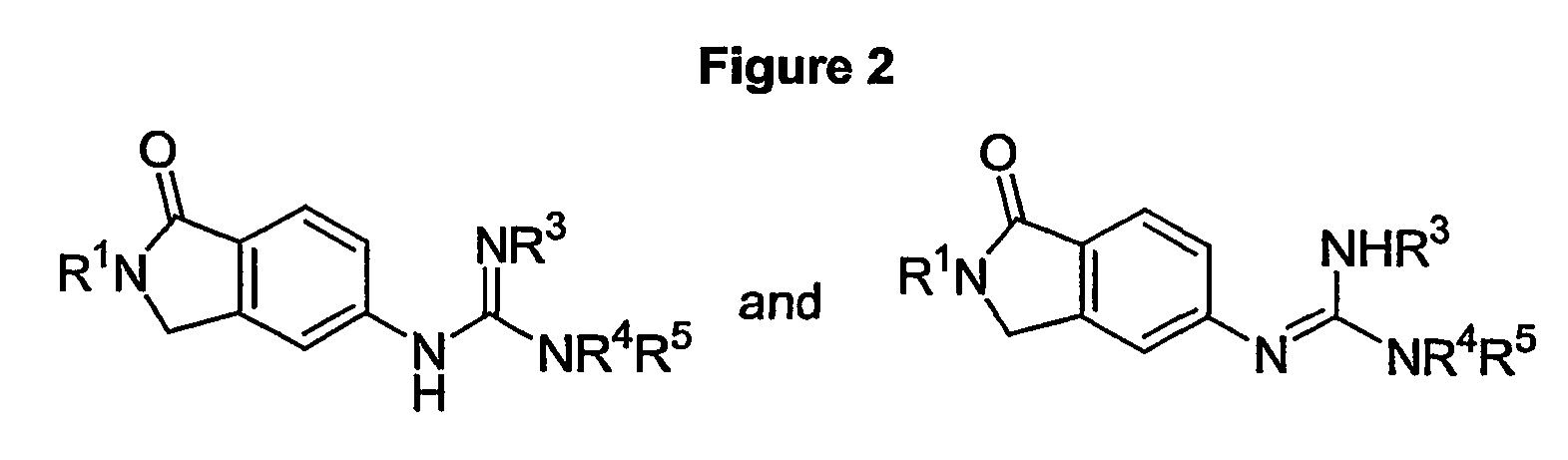
- Furthermore, the reduction steps in Figure 1 can be omitted in its entirety and the reaction scheme can be carried through to give the guanidino imide and its tautomer shown in Figure 3 as products. Conversely, both carbonyl groups can be fully reduced to give the tetrahydro analogs.

- Additional structural variations within the non-guanidino linked portion of the bicyclic core itself can be achieved by starting with, for example, bicyclic lactams or bicyclic cyloamido compounds. These scaffolds can be generally be functionalized by methods known in the art such as N-alkylation with a variety of electrophiles (see R. Larock, Comprehensive Organic Transformations; VHC Publisher's Inc., 1989). Bicyclic lactams can also be generally functionalized as shown in Figure 4. An amine or its activated equivalent (for example an alkyl aluminum amide) is first coupled with a lactone. The resulting product is then used in a subsequent cyclodehydration reaction (for example a Mitsunobu reaction) to give the functionalized bicyclic core. The guanidino moiety may then be installed as described above.

- Figure 5 illustrates a general synthetic route for compounds of the invention containing the benzimidazole core structure. An activated acid is first condensed with a diaminonitrophenyl starting material followed by exposure of the resulting product to acidic conditions to provide the benzimidazole core. The nitro moiety is then reduced and converted to the functionalized quanidino substituent as described above.

- In another embodiment of the invention, benzoxazole and benzthiazole comprise the bicyclic core. These compounds may be constructed as shown in Figure 6. Commercially available (Aldrich) 6-nitrobenzothiazole may be treated with base and quenched with N-chlorosuccinimide to give the halogenated intermediate. This compound may then be used in a number of metal mediated coupling reactions (for example Heck, Stille, Sonogashira coupling reactions) to functionalize the bicyclic core. The nitro group then serves as the attachment point for the guanidino unit.

- The present invention, thus generally described, will be understood more readily by reference to the following examples, which are provided by way of illustration and are not intended to be limiting of the present invention.
- Compounds were named using the ACD/Name v. 4.53.
- The following abbreviations are used throughout the Examples:
- eq
- equivalent
- DIAD
- diisopropylazodicarboxylate
- DIBAL-H
- diisobutlyaluminum hydride
- EDC
- 1-ethyl-3-(3'-dimethylaminopropyl)-carbodlimide hydrochloride
- EtOAc
- ethylacetate
- THF
- tetrahydrofuran
- TFA
- trifluoroacetic acid
- HPLC System: HPLC was run on a Waters 2690 HPLC system.
column = Reliasil 50 x 4.6mm (5µm pore size)
method: (note: all solvents include 0.1 % TFA)time (minutes) flow rate (mL/min) %water %CAN init. 2 95 5 15 2 20 80 15.5 2 0 100 17.5 2 0 100 18.5 2 95 5
detector = (Waters 996 photodiode array detector)
LCMS were run on HP Series 1100 LCMS system
HP LCMS (1100 series)
HP MSD (1100 series)time (minutes) flow rate (mL/min) %A* %B* 0 0.8 95 5 .2 0.8 95 5 3.7 0.8 5 95 3.85 0.8 95 5 5 0.8 95 5 *solvent A = (water + 0.05% TFA) and solvent B = (Acetonitrile + 0.05% TFA)
column temp = 30° C
MS Methodology
MWT: 150-800
CV:20
Ionization: ESP+ -
- Repeat: 1
- Scan Time: 2 seconds
- Preparation of (3S)-N-{2-[2-(2,4-dichlorophenyl)ethyl]-1-oxo-2,3-dihydro-1H-isoindol-5-yl}-3-methyl-N'-[(1S,2S,3S,5R)-2,6,6-trimethylbicyclo[3.1.1]hept-3-yl]piperazine-1 carboxamidine
- 2-(2,4-dichlorophenyl)ethanamine was suspended in toluene with 4-nitrophthalic anhydride (1 eq) and heated to 150°C. After 2 hours, the reaction was cooled and checked for completion by LC/MS. The solvent was then removed in vacuo and the resulting product was taken on to the next step without further purification. Rt 3.36 minutes (HP LCMS), LC/MS m/z 365.1 (MH+).
- The product of the previous step was taken up in ethanol (or methanol) and purged with dry nitrogen. To this solution was introduced activated Pd/C (10% w/w, 0.1 eq) and the mixture was hydrogenated for about 30 minutes or until complete by LC/MS. The mixture was then filtered through celite, concentrated in vacuo, and taken on to the next step. Rt 2.95 minutes (HP LCMS), LC/MS m/z 335.0 (MH+).
- To a CH2Cl2 solution of the phthalimide was added dropwise DIBAL-H (3 eq, 1.0 M solution in CH2Cl2) at room temperature with good stirring. After stirring for one hour, the reaction was diluted with ether, NaF (12 eq), and distilled water (9 eq) and stirred for an additional hour. The reaction mixture was then filtered through celite to remove the aluminum precipitants. After washing the celite with additional CH2Cl2, the filtrate was then concentrated in vacuo to give a crude product (mixture of regioisomers) was then used in the following step without further purification. Rt 2.09 minutes (HP LCMS) and 2.23 minutes (HP LCMS), LC/MS m/z 337.2 (MH+).
- To a CH2Cl2 (0.1 M solution) of the crude product from the previous step was added dropwise triflouroacetic acid (6.0 eq) followed immediately by dropwise addition of triethylsilane (2.9 eq). After stirring for an additional 15 minutes, the mixture was concentrated in vacuo. The crude product of two regioisomeric lactams was then dissolved in acetonitrile and purified via reverse phase (C18) prep HPLC. The fractions for the desired regioisomeric lactam product (later retention time) were collected, frozen, and lyophilized. Rt 7.24minutes, LC/MS m/z 321.1 (MH+).
- To a 0.5 M solution of the amine in acetone (0°C ice bath) was added thiophosgene (3 eq) dropwise. After 30 minutes, the reaction mixture was allowed to warm to room temperature. After two hours, the reaction mixture was concentrated in vacuo to remove solvent and excess thiophosgene. The crude isothiocyanate product was then used in the next step without further purification. Rt 3.43 minutes (HP LCMS), LC/MS m/z 363.1 (MH+).
- To a solution of the crude isothiocyanate in dry acetonitrile (0.5 M solution) was added (+)-isopinocampheyl amine (1.5 eq). After stirring overnight, the reaction mixture was concentrated in vacuo and the thiourea product was dissolved in CH2Cl2 and purified via flash chromatography (1:1 Hexanes:EtOAc). Fractions containing the thiourea product were concentrated in vacuo and dried to yield a creamish white colored solid. Rt 14.53 minutes, LC/MS m/z 516.4 (MH+).
- To a solution of the thiourea in THF (dry, 0.5 M) in a dry vial was added (S)-(+)-2-methylpiperazine (3 eq) and EDC (3 eq). The vial was capped tightly and heated to 80°C for approximately 2 hours. The mixture was then allowed to cool to room temperature and concentrated in vacuo. The reaction mixture was dissolved in DMSO along with TFA (1 eq) and purified by prep HPLC. The pure fractions were collected, frozen, and dried via lyopholization to give the product as a white solid. Rt 8.36 minutes; LC/MS m/z 582.5 (MH+).
- Preparation of (3S)-N-{2-[2-(2,4-dichlorophenyl)ethyl]-1,3-dioxo-2,3-dihydro-1H-isoindol-5-yl}-3-methyl-N'-[(1S,2S,3S,5R)-2,6,6-trimethylbicyclo[3.1.1]hept-3-yl]piperazine-1-carboxamidine
- 2-(2,4-dichlorophenyl)ethanamine was suspended in toluene with 4-nitrophthalic anhydride (1 eq) and heated to 150°C. After 2 hours, the reaction was cooled and checked for completion by LC/MS. The solvent was then removed in vacuo and the resulting product was taken on to the next step without further purification. Rt 3.91 minutes, LC/MS m/z 365.1 (MH+).
- The product of the previous step was taken up in ethanol (or methanol) and purged with dry nitrogen. To this solution was introduced activated Pd/C (10% w/w, 0.1 eq) and the mixture was hydrogenated for about 30 minutes or until complete by LC/MS. The mixture was then filtered through celite, concentrated in vacuo, and taken on to the next step. Rt 2.96 minutes (HP LCMS), LC/MS m/z 335.1 (MH+).
- To a 0.5 M solution of the amine in acetone (0°C ice bath) was added thiophosgene (3 eq) dropwise. After 30 minutes, the reaction mixture was allowed to warm to room temperature. After two hours, the reaction mixture was concentrated in vacuo to remove solvent and excess thiophosgene. The crude isothiocyanate product was then used in the next step without further purification. Rt 3.75 minutes (HP LCMS), LC/MS m/z 377.0 (MH+).
- To a solution of the crude isothiocyanate in dry acetonitrile (0.5 M solution) was added (+)-isopinocampheyl amine (1.5 eq). After stirring overnight, the reaction mixture was concentrated in vacuo and the thiourea product was dissolved in CH2Cl2 and purified via flash chromatography (1:1 Hexanes:EtOAc). Fractions containing the thiourea product were concentrated in vacuo and dried overnight via lyophilization to yield a yellowish-brown solid. Rt 3.98 minutes (HP LCMS), LC/MS m/z 596.1 (MH+).
- To a solution of the thiourea in THF (dry, 0.5 M) in a dry vial was added (S)-(+)-2-methylpiperazine (3 eq) and EDC (3 eq). The vial was capped tightly and heated to 80°C for approximately 2 hours. The mixture was then allowed to cool to room temperature and concentrated in vacuo. The reaction mixture was dissolved in DMSO along with TFA (1 eq) and purified by prep HPLC. The pure fractions were collected, frozen, and dried via lyopholization to give the product as a white solid. Rt 9.57 minutes, LC/MS m/z 596.3 (MH+).
- Examples 3-16 were prepared using the procedures described for 1 and 2.
- (3S)-N-{2-[2-(2,4-dichlorophenyl)ethyl]-3-oxo-2,3-dihydro-1H-isoindol-5-yl}-3-methyl-N'-[(1S,2S,3S,5R)-2,6,6-trimethylbicyclo[3.1.1]hept-3-yl]piperazine-1-carboxamidine
- Synthesized from 2-(2,4-dichlorophenyl)ethanamine. Rt 8.72 minutes, LC/MS m/z 582.5 (MH+).
- (3S)-N-[2-(2,4-dichlorobenzyl)-1,3-dioxo-2,3-dihydro-1H-isoindol-5-yl]-3-methyl-N'-[(1S,2S,3S,5R)-2,6,6-trimethylbicyclo[3.1.1]hept-3-yl]piperazine-1-carboxamidine
- Synthesized from 1-(2,4-dichlorophenyl)methanamine. Rt 8.72 minutes, LC/MS m/z 582.5 (MH+).
- (3S)-N-{2-[(1 S)-1-benzyl-2-hydroxyethyl]-1,3-dioxo-2,3-dihydro-1H-isoindol-5-yl}-3-methyl-N'-[(1S,2S,3S,5R)-2,6,6-trimethylbicyclo[3.1.1]hept-3-yl]piperazine-1-carboxamidine
- Synthesized from L-phenylalaninol. Rt 7.56 minutes, LC/MS m/z 558.7 (MH+).
- (3S)-N-{2-[(1R)-1-benzyl-2-hydroxyethyl]-1,3-dioxo-2,3-dihydro-1H-isoindol-5-yl}-3-methyl-N'-[(1S,2S,3S,5R)-2,6,6-trimethylbicyclo[3.1.1]hept-3-yl]piperazine-1-carboxamidine
- Synthesized from D-phenylalaninol. Rt 7.52 minutes, LC/MS m/z 558.7 (MH+).
- (3S)-N-{2-[2-(2-fluoro-4-methylphenyl)ethyl]-1-oxo-2,3-dihydro-1H-isoindol-5-yl}-3-methyl-N'-[(1 S,2S,3S,5R)-2,6,6-trimethylbicyclo[3.1.1]hept-3-yl]piperazine-1-carboxamidine
- Synthesized from 2-(3-fluoro-5-methylphenyl)ethanamine. Rt 7.8 minutes, LC/MS m/z 546.2 (MH+).
- (3S)-N-{2-[(1S)-1-(2,4-dichlorobenzyl)-2-hydroxyethyl]-1,3-dioxo-2,3-dihydro-1H-isoindol-5-yl}-3-methyl-N'-[(1S,2S,3S,5R)-2,6,6-trimethylbicyclo[3.1.1]hept-3-yl]piperazine-1-carboxamidine
- Synthesized from L-2,4-dichlorophenylalaninol, obtained in one step from the reduction of L-2,4-dichlorophenylalanine (see, for example, JOC 2000, 65 , 5037-5042). Rt 8.46 minutes, LC/MS m/z 626.2 (MH+).
- (3S)-N-{2-[(1S)-1-(2,4-dichlorobenzyl)-2-hydroxyethyl]-1-oxo-2,3-dihydro-1H-isoindol-5-yl}-3-methyl-N'-[(1S,2S,3S,5R)-2,6,6-trimethylbicyclo[3.1.1]hept-3-yl]piperazine-1-carboxamidine
- Synthesized from L-2,4-dichlorophenylalaninol, obtained in one step from the reduction of L-2,4-dichlorophenylalanine (see, for example, JOC 2000, 65 , 5037-5042). Rt 7.71 minutes, LC/MS m/z 612.2 (MH+).
- (3S)-N-{2-[2-(2-fluoro-4-methoxyphenyl)ethyl]-1,3-dioxo-2,3-dihydro-1 H-isoindol-5-yl}-3-methyl-N'-[(1 S,2S,3S,5R)-2,6,6-trimethylbicyclo[3.1.1]hept-3-yl]piperazine-1-carboximidine
- Synthesized from 2-(2-fluoro-4-methoxyphenyl)ethanamine. Rt 8.4 minutes, LC/MS m/z 576.2 (MH+).
- (3S)-N-{2-[2-(2,4-difluorophenyl)ethyl]-1,3-dioxo-2,3-dihydro-1H-isoindol-5-yl}-3-methyl-N'-[(1S,2S,3S,5R)-2,6,6-trimethylbicyclo[3.1.1]hept-3-yl]piperazine-1-carboxamidine
- Synthesized from 2-(2,4-difluorophenyl)ethanamine. Rt 8.53 minutes, LC/MS m/z 564.2 (MH+).
- (3S)-N-{2-[2-(2,4-dimethoxyphenyl)ethyl]-1,3-dioxo-2,3-dihydro-1H-isoindol-5-yl}-3-methyl-N'-[(1S,2S,3S,5R)-2,6,6-trimethylbicyclo[3.1.1]hept-3-yl]piperazine-1-carboxamidine.
- Synthesized from 2-(2,4-dimethoxyphenyl)ethanamine. Rt 8.51 minutes, LC/MS m/z 588.3 (MH+).
- (3S)-N-{2-[2-(2,4-dimethylphenyl)ethyl]-1,3-dioxo-2,3-dihydro-1H-isoindol-5-yl}-3-methyl-N'-[(1S,2S,3S,5R)-2,6,6-trimethylbicyclo[3.1.1]hept-3-yl]piperazine-1-carboxamidine
- Synthesized from 2-(2,4-dimethylphenyl)ethanamine. Rt 9.43 minutes, LC/MS m/z 556.2 (MH+).
- (3S)-N-{2-[(1S,25)-2-hydroxy-1-(hydroxymethyl)-2-phenylethyl]-1,3-dioxo-2.3-dihydro-1H-isoindol-5-yl}-3-methyl-N'-[(1S,2S,3S,5R)-2,6,6-trimethylbicyclo[3.1.1]hept-3-yl]piperazine-1-carboxamidine
- Synthesized from (1S,2S)-(+)-2-amino-1-phenyl-1,3-propanediol. Rt 6.68 minutes, LC/MS m/z 574.3 (MH+).
- (3S)-N-{2-[(1R,2R)-2-hydroxy-1-(hydroxymethyl)-2-phenylethyl]-1,3-dioxo-2,3-dihydro-1H-isoindol-5-yl}-3-methyl-N'-[(1S,2S,3S,5R)-2,6,6-trimethylbicyclo[3.1.1]hept-3-yl]piperazine-1-carboxamidine
- Synthesized from (1R,2R)-(-)-2-amino-1-phenyl-1,3-propariediol. Rt 6.64 minutes, LC/MS m/z 574.3 (MH+).
- (3S)-N-{2-[(1S,2R)-2-hydroxy-1-(hydroxymethyl)-2-phenylethyl]-1,3-dioxo-2,3-dihydro-1H-isoindol-5-yl}-3-methyl-N'-[(1S,2S,3S,5R)-2,6,6-trimethylbicyclo[3.1.1]hept-3-yl]piperazine-1-carboxamidine
- Synthesized from (1R,2S)-(+)-2-amino-1-phenyl-1,3-propanediol. Rt 6.63 minutes, LC/MS m/z 574.3 (MH+).
- (3S)-N-{2-[2-(2-fluoro-4-methoxyphenyl)ethyl]-1-oxo-2,3-dihydro-1H-isoindol-5-yl}-3-methyl-N'-[(1S,2S,3S,5R)-2,6,6-trimethylbicyclo[3.1.1]hept-3-yl]piperazine-1-carboxamidine.
- Synthesized from 2-(2-fluoro-4-methoxyphenyl)ethanamine. Rt 7.42 minutes, LC/MS m/z 562 (MH+).
- (3S)-N-{2-[2-(2,4-difluorophenyl)ethyl]-1-oxo-2,3-dihydro-1H-isoindol-5-yl}-3-methyl-N'-[(1 S,2S,3S,5R)-2,6,6-trimethylbicyclo[3.1.1]hept-3-yl]piperazine-1-carboxamidine
- Synthesized from 2-(2,4-difluorophenyl)ethanamine. Rt 7.5 minutes, LC/MS m/z 550 (MH+).
- (3S)-N-{2-[2-(2,4-difluorophenyl)ethyl]-3-oxo-2,3-dihydro-1H-isoindol-5-yl}-3-methyl-N'-[(1S,2S,3S,5R)-2,6,6-trimethylbicyclo[3.1.1]hept-3-yl]piperazine-1-carboxamidine
- Synthesized from 2-(2,4-difluorophenyl)ethanamine. Rt 7.82 minutes, LC/MS m/z 550 (MH+).
- (3S)-N-{2-[2-(2,4-dimethylphenyl)ethyl]-1-oxo-2,3-dihydro-1H-isoindol-5-yl}-3-methyl-N'-[(1S,2S,3S,5R)-2,6,6-trimethylbicyclo[3.1.1]hept-3-yl]piperazine-1-carboxamidine
- Synthesized from 2-(2,4-dimethylphenyl)ethanamine. Rt . 8.21 minutes, LC/MS m/z 542.1 (MH+).
- (3S)-N-{2-[2-(2,4-dimethylphenyl)ethyl]-3-oxo-2,3-dihydro-1H-isoindol-5-yl}-3-methyl-N'-[(1S,2S,3S,5R)-2,6,6-trimethylbicyclo[3.1.1]hept-3-yl]piperazine-1-carboxamidine
- Synthesized from 2-(2,4-dimethylphenyl)ethanamine. Rt 8.5 minutes, LC/MS m/z 542.1 (MH+).
- (3S)-N-{2-[2-(2,4-dichlorophenyl)ethyl]-1-oxo-1,2,3,4-tetrahydroisoquinolin-6-yl}-3-methyl-N'-[(1S,2S,5R)-2,6,6-trimethylbicyclo[3.1.1]hept-3-yl]piperazine-1-carboxamidine
- 6-nitroisochroman-1-one was treated with the dimethylaluminum amide prepared from 2-(2,4-dichlorophenyl)ethanamine, and the product obtained was cyclized using Mitsunobu conditions (as in lan. Bell et al, Tetrahedron. Lett. (2000), 41, 1141-1145). The nitro group was then reduced, and the amine was converted to the substituted guanidine (as in steps 2-5 of Example 2 above) to give the title compound. Rt 9.06 minutes, LC/MS m/z 596.1 (MH+).
- (3S)-N-{2-[2-(2,4-dichlorophenyl)ethyl]-1H-benzimidazol-5-yl}-3-methyl-N'-[(1S,2S,3S,5R)-2,6,6-trimethylbicyclo[3.1.1]hept-3-yl]piperazine-1-carboxamidine
- 2,4-dichlorophenyl propionic acid (1.0 eq) was mixed with 4-nitro-1,2-phenylenediamine (1.1 eq) and EDC (1.5 eq) in THF at room temperature for 8 hours. The solution was diluted with ethyl acetate and washed with water (3 x). The combined organic layers were dried over sodium sulfate, filtered, and concentrated in vacuo. The product was then subjected to refluxing glacial acetic acid for 30 minutes. After removal of the acetic acid in vacuo, the residue was free-based with sodium carbonate. The resulting compound was then subjected to the hydrogenation and guanidino functionalization conditions described in Example 2 above (steps 2, 3, 4, and 5) to give the desired product. Rt 7.08 minutes, LC/MS m/z 567.2 (MH+).
- Examples 24 and 25 can be prepared using the procedures described for Example 23.
- (3S)-N-{2-[2-(2,4-dimethylphenyl)ethyl]-1H-benzimidazol-6-yl}-3-methyl-N'-[(1S,2S,3S,5R)-2,6,6-trimethylbicyclo[3.1.1]hept-3-yl]piperazine-1-carboxamidine
- Synthesized from 3-(2,4-dimethylphenyl)propanoic acid. Rt 6.93 minutes, LC/MS m/z 527.3 (MH+).
- (3S)-N-{2-[2-(2-chloro-4-fluorophenyl)ethyl]-1H-benzimidazol-6-yl}-3-methyl-N'-[(1S,2S,3S,5R)-2,6,6-trimethylbicyclo[3.1.1]hept-3-yl]piperazine-1-carboxamidine
- Synthesized from 3-(2-chloro-4-fluorophenyl)propanoic acid. Rt 6.54 minutes, LC/MS m/z 551.4 (MH+).
- In addition to the synthesis described above, many of the synthetic transformations presented in U.S. Provisional Application No. 60/245,579 are relevant to the synthesis of the compounds of the present invention. Thus, U.S. Provisional Application No. 60/245,579, filed November 6, 2000 is hereby incorporated by reference in its entirety.
- EC50 values of test compounds were determined by treating cells expressing MC4-R with test compound and lysing the cells and measuring intercellular cAMP concentration with an Amersham-Pharmacia RPA-559 cAMP Scintillation Proximity Assay (SPA) kit. The following compounds were synthesized and tested according to this assay. The following compounds are merely illustrative and should not be construed as limiting of the instant invention. Compounds having an in vitro potency (as measured by EC50 value) of less than 3 µM include:
- (3S)-N-{2-[2-(2,4-dichlorophenyl)ethyl]-1-oxo-2,3-dihydro-1H-isoindol-5-yl}-3-methyl-N'-[(1S,2S,3S,5R)-2,6,6-trimethylbicyclo[3.1.1]hept-3-yl]piperazine-1-carboxamidine; (3S)-N-{2-[2-(2,4-dichlorophenyl)ethyl]-1-oxo-2,3-dihydro-1H-isoindol-5-yl}-3-methyl-N'-[(1S,2S,3S,5R)-2,6,6-trimethylbicyclo[3.1.1]hept-3-yl]piperazine-1-carboxamidine; (3S)-N-{2-[2-(2,4-dichlorophenyl)ethyl]-3-oxo-2,3-dihydro-1H-isoindol-5-yl}-3-methyl-N'-[(1S,2S,3S,5R)-2,6,6-trimethylbicyclo[3.1.1]hept-3-yl]piperazine-1-carboxamidine; (3S)-N-[2-(2,4-dichlorobenzyl)-1,3-dioxo-2,3-dihydro-1H-isoindol-5-yl]-3-methyl-N'-[(1S,2S,3S,SR)-2,6,6-trimethylbicyclo[3.1.1]hept-3-yl]piperazine-1-carboxamidine (3S)-N-{2-[(1S)-1-benzyl-2-hydroxyethyl]-1,3-dioxo-2,3-dihydro-1H-isoindol-5-yl}-3-methyl-N'-[(1S,2S,3S,5R)-2,6,6-trimethylbicyclo[3.1.1]hept-3-yl]piperazine-1-carboxamidine; (3S)-N-{2-[(1R)-1-benzyl-2-hydroxyethyl]-1,3-dioxo-2,3-dihydro-1H-isoindol-5-yl}3-methyl-N'-[(1S,2S,3S,5R)-2,6,6-trimethylbicyclo[3.1.1]hept-3-yl]piperazine-1-carboxamidine (3S)-N-{2-[2-(2-fluoro-4-methylphenyl)ethyl]-1-oxo-2,3-dihydro-1H-isoindol-5-yl}-3-methyl-N'-[(1S,2S,3S,5R)-2,6,6-trimethylbicyclo[3.1.1]hept-3-yl]piperazine-1-carboxamidine; (3S)-N-{2-[(1S)-1-(2,4-dichlorobenzyl)-2-hydroxyethyl]-1,3-dioxa-2,3-dihydro-1 H-isoindol-5-yl}-3-methyl-N'-[(1S,2S,35,5R)-2,6,6-trimethylbicyclo[3.1.1]hept-3-yl]piperazine-1-carboxamidine; (3S)-N-{2-[2-(2-fluoro-4-methoxyphenyl)ethyl]-1,3-dioxo-2,3-dihydro-1H-isoindol-5-yl}-3-methyl-N'-[(1S,2S,3S,SR)-2,6,6-trimethylbicyclo[3.1.1]hept-3-yl]piperazine-1-carboxamidine;(3S)-N-{2-[2-(2,4-difluorophenyl)ethyl]-1,3-dioxo-2,3-dihydro-1H-isoindol-5-yl}-3-methyl-N'-[(1S,2S,3S,5R)-2,6,6-trimethylbicyclo[3.1.1]hept-3-yl]piperazine-1-carboxamidine; (3S)-N-{2-[2-(2,4-dimethoxyphenyl)ethyl]-1,3-dioxo-2,3-dihydro-1H-isoindol-5-yl}-3-methyl-N'-[(1S,2S,3S,5R)-2,6,6-trimethylbicyclo[3.1.1]hept-3-yl]piperazine-1-carboxamidine-(3S)-N-{2-[2-(2,4-dimethylphenyl)ethyl]-1,3-dioxo-2,3-dihydro-1H-isoindol-5-yl}-3-methyl-N'-[(1S,2S,3S,5R)-2,6,6-trimethylbicyclo[3.1.1]hept-3-yl]piperazine-1-carboxamidine; (3S)-N-{2-[(1S,2S)-2-hydroxy-1-(hydroxymethyl)-2-phenylethyl]-1,3-dioxo-2,3-dihydro-1H-isoindol-5-yl}-3-methyl-N'-[(1S,2S,3S,5R)-2,6,6-trimethylbicyclo[3.1.1]hept-3-yl]piperazine-1-carboxamidine; (3S)-N-{2-[(1R,2R)-2-hydroxy-1-(hydroxymethyl)-2-phenylethyl]-1,3-dioxo-2,3-dihydro-1H-isoindol-5-yl}-3-methyl-N'-[(1S,2S,3S,5R)-2,6,6-trimethylbicyclo[3.1.1]hept-3-yl]piperazine-1-carboxamidine; (3S)-N-{2-[(1S,2R)-2-hydroxy-1-(hydroxymethyl)-2-phenylethyl]-1,3-dioxo-2,3-dihydro-1H-isoindol-5-yl}-3-methyl-N'-[(1S,2S,3S,5R)-2,6,6-trimethylbicyclo[3.1.1]hept-3-yl]piperazine-1-carboxamidine; (3S)-N-{2-[2-(2-fluoro-4-methoxyphenyl)ethyl]-1-oxo-2,3-dihydro-1H-isoindol-5-yl}-3-methyl-N'-[(1S,2S,3S,5R)-2,6,6-trimethylbicyclo[3.1.1]hept-3-yl]piperazine-1-carboxamide; (3S)-N-{2-[2-(2,4-difluorophenyl)ethyl]-1-oxo-2,3-dihydro-1H-isoindol-5-yl}-3-methyl-N'-[(1S,2S,3S,5R)-2,6,6-trimethylbicyclo[3.1.1]hept-3-yl]piperazine-1-carboxamidine; (3S)-N-{2-[2-(2,4-difluorophenyl)ethyl]-3-oxo-2,3-dihydro-1H-isoindol-5-yl}-3-methyl-N'-[(1S,2S,3S,5R)-2,6,6-trimethylbicyclo[3.1.1]hept-3-yl]piperazine-1-carboxamidine; (3S)-N-{2-[2-(2,4-dimethylphenyl)ethyl]-1-oxo-2,3-dihydro-1H-isoindol-5-yl}-3-methyl-N'-[(1S,2S,3S,5R)-2,6,6-trimethylbicyclo[3.1.1]hept-3-yl]piperazine-1- carboxamidine; (3S)-N-{2-[2-(2,4-dimethylphenyl)ethyl]-3-oxo-2,3-dihydro-1 H-isoindol-5-yl}-3-methyl-N'-[(1S,2S,3S,5R)-2,6,6-trimethylbycyclo[3.1.1]hept-3-yl]piperazine-1-carboxamidine; (3S)-N-{2-[2-(2,4-dichlorophenyl)ethyl]-1H-benzimidazol-5-yl}-3-methyl-N'-[(1S,3S,5R)-2,6,6-trimethylbicycl[3.1.1]hept-3-yl]piperazine-1-carboxamidine; (3S)-N-{2-[2-(2,4-dimethylphenyl)ethyl]-1H-benzimidazol-6-yl}-3-methyl-N'-[(1S,2S,3S,5R)-2,6,6-trimethylbicyclo[3.1.1]hept-3-yl]piperazine-1-carboxamidine; (3S)-N-{2-[2-(2,4-dichlorophenyl)ethyl]-1-oxo-1,2,3,4-tetrahydroisoquinolin-6-yl}-3-methyl-N'-{(1S,2S,5R)-2,6,6-trimethylbicyclo[3.1.1]hept-3-yl]piperazine-1-carboxamidine; (3S)-N-{2-[(1S)-1-(2,4-dichlorobenzyl)-2-hydroxyethyl]-1-oxo-2,3-dihydro-1H-isoindol-5-yl}-3-methyl-N'-[(1S,2S,3S,5R)-2,6,6-trimethylbicyclo[3,1,1]hept-3-yl]-1-piperazinecarboxamidine; and (3S)-N-{2-[2-(2-chloro-4-fluorophenyl)ethyl]-1H-benzimidazol-6-yl}-3-methyl-N'-[(1S,2S,3S,5R)-2,6,6-trimethylbicyclo[3.1.1]hept-3-yl]piperazine-1-carboxamidine.
- In vivo studies are conducted to observe the effect of MCR-4 agonists on energy intake, body weight, hyperinsulinemia, and glucose levels. All studies are conducted with male 9-10 week old ob/ob mice which display early onset of obesity, insulin resistance and diabetes due to leptin deficiency lice are acclimated in the facility for 1 week before studies and are caged individually. Vehicle-treated (control) and drug treated mice studies are always un in parallel. In multi-day studies, mice (8-15 per group) are monitored for baseline body weight, fasting levels of glucose, insulin, blood lipids and energy expenditure and then are injected twice daily (9 a.m. and 5 p.m.) with 3mg/kg of an MC4-R agonist according to the invention for 2-4 weeks. Body weight as well as food and water intake are monitored daily. Animals are fasted overnight for measurements of fasting levels of glucose, insulin, and lipids once a week until the end of the study. Energy expenditure (resting metabolic rate, i.e., O2 consumption and CO2 production) are monitored in air tight chambers at the end of the study on fed animals. O2 consumption and CO2 production are measured using Oxymax systems (Columbus Instruments). Oral glucose tolerance test (OGTT - a routine test for diabetes and glucose intolerance) is performed on overnight fasted mice at the end of the study. Blood glucose and oral glucose tolerance are measured using a glucose monitor (Onetouch sold by Lifescan). Free fatty acids are measured using an nonesterfifed free fatty acids enzymatic assay (Waco Chemicals). Serum Insulin levels are measured by immunoassay (Alpco).
- The results of the above studies show that a significant reduction in food intake occurs in those mice treated IP with the compounds of the present invention. The results also show that mice treated with the compounds of the present invention show a significant body weight reduction compared to mice not treated with the compounds of the present invention. Vehicle treated mice show an increase in blood glucose consistent with the rapid progression of diabetes in this mouse strain, whereas the onset of diabetes is slowed down in mice treated with the compounds of the present invention. Oral glucose tolerance tests are performed. Orally administered glucose quickly elevates blood glucose similar to after eating a meal. Vehicle treated mice show an elevated response to glucose consistent with their diabetic state, whereas mice treated with the compounds of the present invention show a very much improved glucose disposal. Mice are fasted overnight and free fatty acid levels are measured the following morning. Vehicle treated mice show elevated free fatty acid levels consistent with their obese state, whereas mice treated with the compounds of the present invention show a dramatic 50% decrease. Serum insulin levels are measured one hour after single IP dosing of compounds of the present invention in overnight fasted ob/ob mice. Mice treated with the compounds of the present invention show a dose dependent decrease relative to vehicle.
Claims (32)
- A compound of formula III
 X and Y are independently selected from the group consisting of C=O, NR9, O, S, (CR6R7)n, and C(=O)-(CR6R7)n;n is 1, 2, or 3;wherein when X is N, then Y is not N, with the proviso that when X is N, then Y can still be NH;wherein when Y is N, then X is not N, with the proviso that when Y is N, then X can still be NH;wherein when X is CH2, then Y is not CH2;wherein when X is NH, then Y is not NH;D is selected from the group consisting of N, CH, and C;L is NH, O, C(O), NHC(O), OC(O) or a covalent bond;W is selected from the group consisting of
 Z 1 , Z 2 , and Z 3 are independently selected from the group consisting of CR8 and N;R 1 is selected from the group consisting of substituted and unsubstituted arylalkyl, heteroarylalkyl, aryl, heteroaryl, heterocyclyl, cycloalkyl, heterocyclylalkyl, cycloalkylalkyl, alkenyl, alkynyl, and alkyl groups;R 2 is HR 3 is selected from the group consisting of substituted and unsubstituted alkyl, alkenyl, alkynyl, cycloalkyl, heteroaryl, heterocyclyl, heterocyclylalkyl, arylalkyl, heteroarylalkyl, and cycloalkylalkyl groups, or R 2 and R 3 may join together to form a ring containing at least two N atoms;R 4 is selected from the group consisting of H, and substituted and unsubstituted alkyl, alkenyl, alkynyl, cycloalkyl, aryl, heteroaryl, heterocyclyl, arylalkyl, heteroarylalkyl, and cycloalkylalkyl groups;R 5 is selected from the group consisting of H, and substituted and unsubstituted alkyl, alkenyl, alkynyl, cycloalkyl, aryl, heteroaryl, heterocyclyl, arylalkyl, heteroarylalkyl, and cycloalkylalkyl groups, or R 4 and R 5 , together with the nitrogen to which they are bound, form a substituted or unsubstituted heterocyclyl or heteroaryl group;R 6 and R 7 may be the same or different, and are each independently selected from the group consisting of H, Cl, l, F, Br, OH, NH2, CN, NO2, and substituted and unsubstituted alkoxy, amino, alkyl, alkenyl, alkynyl, alkylamino, dialkylamino, cycloalkyl, heterocyclylamino, heteroarylamino, aminocarbonyl, alkylaminocarbonyl, dialkylaminocarbonyl, cycloalkylaminocarbonyl, arylaminocarbonyl, heterocyclylaminocarbonyl, and heteroarylaminocarbonyl groups:R 8 is independently selected from the group consisting of H, Cl, I, F, Br, OH, NH2, CN, NO2, and substituted and unsubstituted alkoxy, amino, alkyl, alkenyl, alkynyl, alkylamino, dialkylamino, cycloalkyl, heterocyclylamino, heteroarylamino, aminocarbonyl, alkylaminocarbonyl, dialkylaminocarbonyl, cycloalkylaminocarbonyl, arylaminocarbonyl, heterocyclylaminocarbonyl, and heteroarylaminocarbonyl groups;R 9 is selected from the group consisting of H, and substituted and unsubstituted alkyl, alkenyl, alkynyl, cycloalkyl, aryl, heteroaryl, heterocyclyl, arylalkyl, heteroarylalkyl, cycloalkylalkyl, alkylcarbonyl, and arylcarbonyl groups; andpharmaceutically acceptable salts thereof, stereoisomers thereof, tautomers thereof, hydrates thereof, hydrides thereof, or solvates thereof, whereinalkyl groups are straight chain lower alkyl groups having 1 to 8 carbon atoms, also including branched chain isomers of straight chain alkyl groups, whereby alkyl groups may be substituted one or more times with amino, thio, alkoxy, or halo;Cycloalkyl groups are cyclic alkyl groups and can include two or more bridgehead carbon atoms to form polycyclic rings, cycloalkyl groups may also include rings that are substituted with straight or branched chain alkyl groups as defined above, substituted cycloalkyl groups may be substituted more than once with alkyl, alkoxy, amino, thio, or halo groups;alkenyl groups are straight chain, branched or cyclic lower alkyl groups having 2 to 8 carbon atoms, and further including at least one double bond;alkynyl groups are straight chain or branched lower alkyl groups having 2 to 8 carbon atoms, and further including at least one triple bond;aryl groups are cyclic aromatic hydrocarbons that do not contain heteroatoms, selected from phenyl, azulene, heptalene, biphenylene, indacene, fluorene, phenanthrene, triphenylene, pyrene, naphthacene, chrysene, biphenyl, anthracenyl, and naphthenyl groups, and include groups containing fused rings, as fused aromatic-aliphatic ring systems, substituted aryl groups may be substituted more than once with amino, alkoxy, alkyl, or halo;Cycloalkylalkyl groups are alkyl groups as defined above in which a hydrogen or carbon bond of an alkyl group is replaced with a bond to a cycloalkyl group as defined above;arylalkyl groups are alkyl groups as defined above in which a hydrogen or carbon bond of an alkyl group is replaced with a bond to an aryl group as defined above,heterocyclyl groups are nonaromatic ring compounds containing 3 or more ring members, of which, one or more is a heteroatom N, O, or S, including fused ring species including those comprising fused aromatic and nonaromatic groups; substituted heterocyclyl groups may be substituted more than once with amino, alkoxy, alkyl, or halo;heteroaryl groups are aromatic ring compounds containing 3 or more ring members, of which, one or more is a heteroatom N,O, or S, selected from furan, thiophene, pyrrole, isopyrrole, diazole, imidazole, isoimidazole, triazole, dithiole, oxathiole, isoxazole, oxazole, thiazole, isothiazole, oxadiazole, oxatriazole, dioxazole, oxathiazole, pyran, dioxin, pyridine, pyrimidine, pyridazine, pyrazine, triazine, oxazine, isoxazine, oxathiazine, azepin, oxepin, thiepin, diazepine benzofuran, and isobenzofuran, including fused ring compounds, substituted heterocyclyl groups may be substituted one or more times with amino, alkoxy, alkyl, or halo;heterocyclylalkyl groups are alkyl groups as defined above in which a hydrogen or carbon bond of an alkyl group is replaced with a bond to a heterocyclyl group as defined above;heteroarylalkyl groups are alkyl groups as defined above in which a hydrogen or carbon bond of an alkyl group is replaced with a bond to a heteroaryl group as defined above;aminocarbonyl groups are groups of the formula RR'NC(O)-,wherein R or R' may be the same or different, and each is independently selected from H, or substituted or unsubstituted alkyl, cycloalkyl, aryl, heterocyclyl or heteroaryl groups, as defined above.
 - A compound of claim 1, wherein L is a covalent bond.
- A compound of claim 1, having the formula I
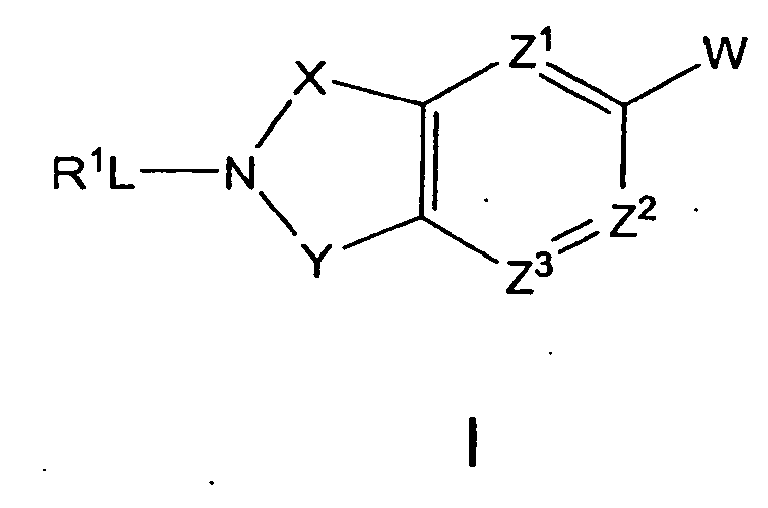 X and Y are independently selected from the group consisting of N, NR9, C=O, (CR6R7)n, and C(=O)-(CR6R7)n;n is 1, 2, or 3;W is selected from the group consisting of
 L is selected from the group consisting of C(O), OC(O), and a covalent bond;Z 1 , Z 2 , and Z 3 are independently selected from the group consisting of CR8 and N;R 1 is selected from the group consisting of substituted and unsubstituted arylalkyl, heteroarylalkyl, aryl, heteroaryl, heterocyclyl, cycloalkyl,-heterocyclylalkyl, cycloalkylalkyl, alkenyl, alkynyl, and alkyl groups as defined in claim 1;R 2 is H;R 3 is selected from the group consisting of substituted and unsubstituted alkyl, alkenyl, alkynyl, cycloalkyl, heteroaryl, heterocyclyl, heterocyclylalkyl, arylalkyl, heteroarylalkyl, and cycloalkylalkyl groups as defined in claim 1, or R 2 and R 3 may join together to form a ring containing at least two N atoms;R 4 is selected from the group consisting of H, and substituted and unsubstituted alkyl, alkenyl, alkynyl, cycloalkyl, aryl, heteroaryl, heterocyclyl, arylalkyl, heteroarylalkyl, and cycloalkylalkyl groups as defined in claim 1;R 5 is selected from the group consisting of H, and substituted and unsubstituted alkyl, alkenyl, alkynyl, cycloalkyl, aryl, heteroaryl, heterocyclyl, arylalkyl, heteroarylalkyl, and cycloalkylalkyl groups as defined in claim 1; or R 4 and R 5 , together with the nitrogen to which they are bound, form a substituted or unsubstituted heterocyclyl or heteroaryl group as defined in claim 1;R 6 and R 7 may be the same or different, and are each independently selected from the group consisting of H, Cl, I, F, Br, OH, NH2, CN, NO2, and substituted and unsubstituted alkoxy, amino, alkyl, alkenyl, alkynyl, alkylamino, dialkylamino, cycloalkyl, heterocyclylamino, heteroarylamino, aminocarbonyl, alkylaminocarbonyl, dialkylaminocarbonyl, cycloalkylaminocarbonyl, arylaminocarbonyl, heterocyclylaminocarbonyl, and heteroarylaminocarbonyl groups as defined in claim 1;R 8 is independently selected from the group consisting of H, Cl, I, F, Br, OH, NH2, CN, NO2, and substituted and unsubstituted alkoxy, amino, alkyl, alkenyl, alkynyl, alkylamino, dialkylamino, cycloalkyl, heterocyclylamino, heteroarylamino, aminocarbonyl, alkylaminocarbonyl, dialkylaminocarbonyl, cycloalkylaminocarbonyl, arylaminocarbonyl, heterocyclylaminocarbonyl, and heteroarylaminocarbonyl groups as defined in claim 1;R 9 is selected from the group consisting of H, and substituted and unsubstituted alkyl, alkenyl, alkynyl, cycloalkyl, aryl, heteroaryl, heterocyclyl, arylalkyl, heteroarylalkyl, cycloalkylalkyl, alkylcarbonyl, and arylcarbonyl group as defined in claim 1; andpharmaceutically acceptable salts thereof, stereoisomers thereof, tautomers thereof, hydrates thereof, hydrides thereof, or solvates thereof.
 - A compound of Claim 1 having the formula II
 A is selected from the group consisting of C or CH;X and Y are independently selected from the group consisting of N, C=O, (CR6R7)n, O, NR9, S, and C(=O)-(CR6R7)n;n is 1, 2, or 3;W is selected from the group consisting of
 Z 1 , Z 2 , and Z 3 are independently selected from the group consisting of CR8 and N;L is selected from the group consisting of NH, O, C(O), NHC(O), OC(O), and a covalent bond;R 1 is selected from the group consisting of substituted and unsubstituted arylalkyl, heteroarylalkyl, aryl, heterocyclyl, cycloalkyl, heterocyclylalkyl, cycloalkylalkyl, alkenyl, alkynyl, and alkyl groups; as defined in claim 1;R 2 is HR 3 is selected from the group consisting of substituted and unsubstituted alkyl, alkenyl, alkynyl, cycloalkyl, heteroaryl, heterocyclyl, heterocyclylalkyl, arylalkyl, heteroarylalkyl, and cycloalkylalkyl groups as defined in claim 1, or R 2 and R 3 may join together to form a ring containing at least two N atoms;R 4 is selected from the group consisting of H, and substituted and unsubstituted alkyl, alkenyl, alkynyl, cycloalkyl, aryl, heteroaryl, heterocyclyl, arylalkyl, heteroarylalkyl, and cycloalkylalkyl groups as defined in claim 1;R 5 is selected from the group consisting of substituted and unsubstituted alkyl, alkenyl, alkynyl, cycloalkyl, aryl, heteroaryl, heterocyclyl, arylalkyl, heteroarylalkyl, and cycloalkylalkyl groups, or R 4 and R 5 , together with the nitrogen to which they are bound, form a substituted or unsubstituted heterocyclyl or heteroaryl group as defined in claim 1;R 6 and R 7 may be the same or different, and are each independently selected from the group consisting of H, Cl, I, F, Br, OH, NH2, CN, NO2, and substituted and unsubstituted alkoxy, amino, alkyl, alkenyl, alkynyl, alkylamino, dialkylamino, cycloalkyl, heterocyclylamino, heteroarylamino, aminocarbonyl, alkylaminocarbonyl, dialkylaminocarbonyl, cycloalkylaminocarbonyl, arylaminocarbonyl, heterocyclylaminocarbonyl, and heteroarylaminocarbonyl groups as defined in claim 1;R 8 is independently selected from the group consisting of H, Cl, I, F, Br, OH, NH2, CN, NO2, and substituted and unsubstituted alkoxy, amino, alkyl, alkenyl, alkynyl, alkylamino, dialkylamino, cycloalkyl, heterocyclylamino, heteroarylamino, aminocarbonyl, alkylaminocarbonyl, dialkylaminocarbonyl, cycloalkylaminocarbonyl, arylaminocarbonyl, heterocyclylaminocarbonyl, and heteroarylaminocarbonyl groups as defined in claim 1;R 9 is selected from the group consisting of H, and substituted and unsubstituted alkyl, alkenyl, alkynyl, cycloalkyl, aryl, heteroaryl, heterocyclyl, arylalkyl, heteroarylalkyl, cycloalkylalkyl, alkylcarbonyl, and arylcarbonyl groups as defined in claim 1; andpharmaceutically acceptable salts thereof, stereoisomers thereof, tautomers thereof, hydrates thereof, hydrides thereof, or solvates thereof.
 - A composition comprising the compound according to any one of claims 1-4 and a pharmaceutically acceptable carrier.
- Use of a compound according to any one of claims 1-4, for the preparation of a pharmaceutical composition for treating an MC4-R mediated disease.
- The use according to claim 6, wherein the disease is obesity or type II diabetes.
- The compound of claim 1 or claim 3, wherein X and Y are selected from the group consisting of CH2, and C=O.
- The compound of claim 8, wherein D is N.
- The compound of claim 8, wherein X is CH2 and Y is C=O.
- The compound of claim 8, wherein X is C=O and Y is CH2.
- The compound of claim 1 or claim 4, wherein X is C=O and Y is C=O.
- The compound of claim 12, wherein D is N.
- The compound of any of claims 1-4, wherein Z1, Z2, and Z3 are all CH.
- The compound of any of claims 1-4, wherein R1 is a substituted or unsubstituted arylalkyl group.
- The compound of claim 15, wherein R1 is a 2,4-disubstituted phenethyl group.
- The compound of any of claims 1-4, wherein R2 is H.
- The compound of any of claims 1-4, wherein R4 and R5, together with the nitrogen to which they are bound, form a substituted or unsubstituted heterocyclyl group.
- The compound of claim 18, wherein R4 and R5, together with the nitrogen to which they are bound, form a substituted or unsubstituted piperazino, morpholino, pyrrolidino, piperidino, homopiperazino, or azepino group.
- The compound of claim 19, wherein R4 and R5, together with the nitrogen to which they are bound, form a substituted or unsubstituted piperazino group.
- The compound of claim 20, wherein R4 and R5, together with the nitrogen to which they are bound, form a piperazino group substituted with one or two methyl groups.
- The compound of any of claims 1-4, wherein R3 is selected from substituted or unsubstituted cycloalkyl, alkenyl, alkyl, or aryl groups.
- The compound of any of claims 1-4, wherein R3 is selected from substituted or unsubstituted cyclohexyl, 2-alkylcyclohexyl, 2,2-dialkylcyclohexyl, 2,3-dialkylcyclohexyl, 2.4-dialkylcyclohexyl, 2,5-dialkycyclohexyl, 2,6-dialkylcyclohexyl, 3,4-dialkylcyclohexyl, 3-alkylcyclohexyl, 4-alkylcyclohexyl, 3,3,5-trialkylcyclohexyl, cyclohexylmethyl, 2-aminocyclohexyl, 3-aminocyclohexyl, 4-aminocyclohexyl, 2,3-diaminocyclohexyl, 2,4-diaminocyclohexyl, 3,4-diaminocyclohexyl, 2,5-diaminocyclohexyl, 2,6-diaminocyclohexyl, 2,2-diaminocyclohexyl, 2-alkoxycyclohexyl, 3-alkoxycyclohexyl, 4-alkoxycyclohexyl, 2,3-dialkoxycyclohexyl, 2,4-dialkoxycyclohexyl, 3,4-dialkoxycyclohexyl, 2,5-dialkoxycyclohexyl; 2,6-dialkoxycyclohexyl, 2,2-dialkoxycyclohexyl, 2-alkylthiocyclohexyl, 3-alkylthiocyclohexyl, 4-alkylthiocyclohexyl, 2,3-dialkylthiocyclohexyl, 2,4-dialkylthiocyclohexyl, 3,4-dialkylthiocyclohexyl, 2,5-dialkylthiocyclohexyl, 2,6-dialkylthiocyclohexyl, 2,2-dialkylthiocyclohexyl, cyclopentyl, cycloheptyl, cyclohexenyl, isopropyl, n-butyl, cyclooctyl, 2-arylcyclohexyl, 2-phenylcyclohexyl, 2-arylalkylcyclohexyl, 2-benzylcyclohexyl, 4-phenylcyclohexyl, adamantyl, isocamphenyl, carenyl, 7,7-dialkyinorbornyl, bornyl, norbornyl, or decalinyl groups.
- The compound of any of claims 1-4, wherein R3 is selected from substituted or unsubstituted cyclohexyl, 2-methylcyclohexyl, 2,2-dimethylcyclohexyl, 2,3-dimethylcyclohexyl, 2,4-dimethylcyclohexyl, 2,5-dimethylcyclohexyl, 2,6-dimethylcyclohexyl 3,4-dimethylcyclohexyl, 3-methylcyclohexyl, 4-methylcyclohexyl, cyclohex-3-enyl, 3,3,5-trimethylcyclohexyl, 4-t-butylcyclohexyl, 2-methylcycloheptyl, cyclohexylmethyl, isopinocampheyl, 7,7-dimethylnorbornyl, 4-isopropylcyclohexyl, 2,6,6-trimethylbicyclo[3.1.1]heptyl, or 3-methylcycloheptyl groups.
- The compound of any of claims 1-4, wherein R5 is selected from substituted or unsubstituted alkyl, arylalkyl, or heteroarylalkyl groups.
- The compound of any of claims 1-4, wherein L is a covalent bond.
- The compound of claim 3 or claim 4, wherein X is N and Y is NH.
- The compound of claim 27, wherein A is C, and the bond between X and A is a double bond.
- The compound of claim 27, wherein D is C, and the bond between X and D is a double bond.
- The compound of claim 3 or claim 4, wherein X is NH and Y is N.
- The compound of claim 30, wherein A is C, and the bond between Y and A is a double bond.
- The compound of claim 30, wherein D is C, and the bond between Y and D is a double bond.
Priority Applications (2)
| Application Number | Priority Date | Filing Date | Title |
|---|---|---|---|
| EP06025693A EP1767525A1 (en) | 2001-04-09 | 2002-04-08 | Guanidino compounds as melanocortin-4 receptor (MC4-R) agonists |
| CY20071100208T CY1107442T1 (en) | 2001-04-09 | 2007-02-15 | GUANIDINE DERIVATIVES AS MESCELLANTS OF THE MELANOCORTIN-4 (MC4-R) RELATIONSHIP |
Applications Claiming Priority (3)
| Application Number | Priority Date | Filing Date | Title |
|---|---|---|---|
| US28284701P | 2001-04-09 | 2001-04-09 | |
| US282847P | 2001-04-09 | ||
| PCT/US2002/010965 WO2002081443A1 (en) | 2001-04-09 | 2002-04-08 | Novel guanidino compounds |
Related Child Applications (1)
| Application Number | Title | Priority Date | Filing Date |
|---|---|---|---|
| EP06025693A Division EP1767525A1 (en) | 2001-04-09 | 2002-04-08 | Guanidino compounds as melanocortin-4 receptor (MC4-R) agonists |
Publications (3)
| Publication Number | Publication Date |
|---|---|
| EP1385823A1 EP1385823A1 (en) | 2004-02-04 |
| EP1385823A4 EP1385823A4 (en) | 2005-02-16 |
| EP1385823B1 true EP1385823B1 (en) | 2006-12-13 |
Family
ID=23083379
Family Applications (2)
| Application Number | Title | Priority Date | Filing Date |
|---|---|---|---|
| EP06025693A Withdrawn EP1767525A1 (en) | 2001-04-09 | 2002-04-08 | Guanidino compounds as melanocortin-4 receptor (MC4-R) agonists |
| EP02719463A Expired - Lifetime EP1385823B1 (en) | 2001-04-09 | 2002-04-08 | Guanidino compounds as melanocortin-4 receptor (mc4-r) agonists |
Family Applications Before (1)
| Application Number | Title | Priority Date | Filing Date |
|---|---|---|---|
| EP06025693A Withdrawn EP1767525A1 (en) | 2001-04-09 | 2002-04-08 | Guanidino compounds as melanocortin-4 receptor (MC4-R) agonists |
Country Status (10)
| Country | Link |
|---|---|
| US (4) | US7456183B2 (en) |
| EP (2) | EP1767525A1 (en) |
| JP (1) | JP4172541B2 (en) |
| AT (1) | ATE348097T1 (en) |
| CY (1) | CY1107442T1 (en) |
| DE (1) | DE60216747T2 (en) |
| DK (1) | DK1385823T3 (en) |
| ES (1) | ES2278016T3 (en) |
| PT (1) | PT1385823E (en) |
| WO (1) | WO2002081443A1 (en) |
Cited By (1)
| Publication number | Priority date | Publication date | Assignee | Title |
|---|---|---|---|---|
| CN103159667A (en) * | 2013-03-15 | 2013-06-19 | 四川大学 | 6-guanidyl-2H-isoindole compound as well as preparation method and application thereof |
Families Citing this family (76)
| Publication number | Priority date | Publication date | Assignee | Title |
|---|---|---|---|---|
| DZ3415A1 (en) * | 2000-08-31 | 2002-03-07 | Chiron Corp | GUANIDINOBENZAMIDES AS MC4-R AGONISTS. |
| EP1767525A1 (en) * | 2001-04-09 | 2007-03-28 | Novartis Vaccines and Diagnostics, Inc. | Guanidino compounds as melanocortin-4 receptor (MC4-R) agonists |
| US7732451B2 (en) * | 2001-08-10 | 2010-06-08 | Palatin Technologies, Inc. | Naphthalene-containing melanocortin receptor-specific small molecule |
| US7718802B2 (en) | 2001-08-10 | 2010-05-18 | Palatin Technologies, Inc. | Substituted melanocortin receptor-specific piperazine compounds |
| US7354923B2 (en) | 2001-08-10 | 2008-04-08 | Palatin Technologies, Inc. | Piperazine melanocortin-specific compounds |
| CA2462200A1 (en) | 2001-08-10 | 2003-02-20 | Palatin Technologies, Inc. | Peptidomimetics of biologically active metallopeptides |
| US7456184B2 (en) | 2003-05-01 | 2008-11-25 | Palatin Technologies Inc. | Melanocortin receptor-specific compounds |
| US7655658B2 (en) * | 2001-08-10 | 2010-02-02 | Palatin Technologies, Inc. | Thieno [2,3-D]pyrimidine-2,4-dione melanocortin-specific compounds |
| US20030207814A1 (en) * | 2002-02-04 | 2003-11-06 | Chiron Corporation | Novel guanidinyl derivatives |
| US20050124652A1 (en) * | 2002-02-04 | 2005-06-09 | Rustum Boyce | Guanidino compounds |
| US20030195187A1 (en) * | 2002-02-04 | 2003-10-16 | Chiron Corporation | Guanidino compounds |
| EP1487474A4 (en) * | 2002-02-25 | 2006-11-29 | Chiron Corp | Intranasal administration of mc4-r agonists |
| DE60333937D1 (en) | 2002-05-23 | 2010-10-07 | Novartis Vaccines & Diagnostic | SUBSTITUTED QUINAZOLINONE COMPOUNDS |
| FR2840302B1 (en) * | 2002-06-03 | 2004-07-16 | Aventis Pharma Sa | ISOINDOLONE DERIVATIVES, PREPARATION METHOD AND INTERMEDIARY THEREOF AS MEDICAMENTS AND PHARMACEUTICAL COMPOSITIONS COMPRISING SAME |
| EP2258365B1 (en) | 2003-03-28 | 2013-05-29 | Novartis Vaccines and Diagnostics, Inc. | Use of organic compounds for immunopotentiation |
| US7968548B2 (en) | 2003-05-01 | 2011-06-28 | Palatin Technologies, Inc. | Melanocortin receptor-specific piperazine compounds with diamine groups |
| US7727990B2 (en) | 2003-05-01 | 2010-06-01 | Palatin Technologies, Inc. | Melanocortin receptor-specific piperazine and keto-piperazine compounds |
| US7727991B2 (en) | 2003-05-01 | 2010-06-01 | Palatin Technologies, Inc. | Substituted melanocortin receptor-specific single acyl piperazine compounds |
| KR20060026011A (en) | 2003-05-09 | 2006-03-22 | 노보 노르디스크 에이/에스 | Obesity Treatment Peptides |
| KR20060018217A (en) * | 2003-05-23 | 2006-02-28 | 카이론 코포레이션 | Guanidino-substituted quinazolinone compounds as Mc4-R agonists |
| JP4727579B2 (en) * | 2003-08-01 | 2011-07-20 | 中外製薬株式会社 | Cyanamide compounds useful as malonyl-CoA decarboxylase inhibitors |
| EP2208495B1 (en) * | 2003-08-01 | 2011-12-14 | Chugai Seiyaku Kabushiki Kaisha | Cyanoguanidine-based azole compounds useful as malonyl-CoA decarboxylase inhibitors |
| MXPA06003474A (en) | 2003-09-30 | 2006-06-05 | Novo Nordisk As | Melanocortin receptor agonists. |
| EP1686996A4 (en) | 2003-11-19 | 2008-11-12 | Novartis Vaccines & Diagnostic | QUINAZOLINONE COMPOUNDS WITH REDUCED BIOACCUMULATION |
| DE10356717A1 (en) * | 2003-12-02 | 2005-07-07 | Aventis Pharma Deutschland Gmbh | Process for the preparation of (3-oxo-2,3-dihydro-1H-isoindol-1-yl) -acetylguanidine derivatives |
| US7531569B2 (en) | 2003-12-02 | 2009-05-12 | Sanofi-Aventis Deutschland Gmbh | Process for preparing (3-oxo-2,3-dihydro-1H-isoindol-1-yl) acetylguanidine derivatives |
| US7709484B1 (en) | 2004-04-19 | 2010-05-04 | Palatin Technologies, Inc. | Substituted melanocortin receptor-specific piperazine compounds |
| JP2008501758A (en) | 2004-06-09 | 2008-01-24 | グラクソ グループ リミテッド | Pyrrolopyridine derivatives |
| JP4541811B2 (en) | 2004-09-13 | 2010-09-08 | キヤノン株式会社 | Image processing apparatus, image processing method, and program |
| MX2007012082A (en) | 2005-03-31 | 2007-11-20 | Pfizer Prod Inc | Cyclopentapyridine and tetrahydroquinoline derivatives. |
| US20070021433A1 (en) | 2005-06-03 | 2007-01-25 | Jian-Qiang Fan | Pharmacological chaperones for treating obesity |
| US7445834B2 (en) * | 2005-06-10 | 2008-11-04 | Morin Brian G | Polypropylene fiber for reinforcement of matrix materials |
| JP2009504803A (en) * | 2005-08-22 | 2009-02-05 | ザ リージェンツ オブ ザ ユニバーシティ オブ カリフォルニア | TLR agonist |
| JP4723320B2 (en) * | 2005-09-05 | 2011-07-13 | 明治飼糧株式会社 | Blood leptin level increasing agent |
| US7592461B2 (en) | 2005-12-21 | 2009-09-22 | Bristol-Myers Squibb Company | Indane modulators of glucocorticoid receptor, AP-1, and/or NF-κB activity and use thereof |
| EP2029597A4 (en) * | 2006-05-31 | 2011-11-23 | Univ California | ANALOGUES OF THE PURINE |
| AU2007274710A1 (en) * | 2006-07-14 | 2008-01-24 | Pfizer Products Inc. | Tartrate salt of (7S)-7-[(5-fluoro-2-methyl-benzyl)oxy]-2-[(2R)-2-methylpiperazin-1-yl]-6,7-dihydro-5H-cyclopenta[b]pyridine |
| US7834017B2 (en) | 2006-08-11 | 2010-11-16 | Palatin Technologies, Inc. | Diamine-containing, tetra-substituted piperazine compounds having identical 1- and 4-substituents |
| ES2456964T3 (en) | 2007-02-07 | 2014-04-24 | The Regents Of The University Of California | Conjugates of synthetic TLR agonists and their uses |
| JP2011511073A (en) * | 2008-02-07 | 2011-04-07 | ザ リージェンツ オブ ザ ユニバーシティ オブ カリフォルニア | Treatment of bladder disease with TLR7 activator |
| UA99555C2 (en) | 2008-11-12 | 2012-08-27 | Элджи Лайф Саенсез Лтд. | Melanocortin receptor agonists |
| US8759539B2 (en) | 2008-11-17 | 2014-06-24 | Merck Sharp & Dohme Corp. | Substituted bicyclic amines for the treatment of diabetes |
| WO2010088924A1 (en) | 2009-02-06 | 2010-08-12 | Telormedix Sa | Pharmaceutical compositions comprising imidazoquinolin(amines) and derivatives thereof suitable for local administration |
| WO2010093436A2 (en) * | 2009-02-11 | 2010-08-19 | Carson Dennis A | Toll-like receptor modulators and treatment of diseases |
| WO2011011506A1 (en) | 2009-07-23 | 2011-01-27 | Schering Corporation | Spirocyclic oxazepine compounds as stearoyl-coenzyme a delta-9 desaturase inhibitors |
| US20120220567A1 (en) | 2009-07-23 | 2012-08-30 | Shipps Jr Gerald W | Benzo-fused oxazepine compounds as stearoyl-coenzyme a delta-9 desaturase inhibitors |
| US8476227B2 (en) | 2010-01-22 | 2013-07-02 | Ethicon Endo-Surgery, Inc. | Methods of activating a melanocortin-4 receptor pathway in obese subjects |
| US9044606B2 (en) | 2010-01-22 | 2015-06-02 | Ethicon Endo-Surgery, Inc. | Methods and devices for activating brown adipose tissue using electrical energy |
| WO2011104378A1 (en) | 2010-02-26 | 2011-09-01 | Novo Nordisk A/S | Peptides for treatment of obesity |
| BR112012021231A2 (en) | 2010-02-26 | 2015-09-08 | Basf Plant Science Co Gmbh | method for enhancing plant yield, plant, construct, use of a construct, method for producing a transgenic plant, collectable parts of a plant, products derived from a plant, use of a nucleic acid and method for producing a product |
| US8785634B2 (en) | 2010-04-26 | 2014-07-22 | Merck Sharp & Dohme Corp | Spiropiperidine prolylcarboxypeptidase inhibitors |
| WO2011134668A1 (en) | 2010-04-30 | 2011-11-03 | Telormedix Sa | Phospholipid drug analogs |
| US9050319B2 (en) | 2010-04-30 | 2015-06-09 | Telormedix, Sa | Phospholipid drug analogs |
| WO2011143057A1 (en) | 2010-05-11 | 2011-11-17 | Merck Sharp & Dohme Corp. | Novel prolylcarboxypeptidase inhibitors |
| US9006268B2 (en) | 2010-06-11 | 2015-04-14 | Merck Sharp & Dohme Corp. | Prolylcarboxypeptidase inhibitors |
| MX2013005454A (en) | 2010-11-15 | 2013-06-24 | Abbvie Inc | Nampt and rock inhibitors. |
| US20150217058A1 (en) | 2012-09-24 | 2015-08-06 | Enable Injections, Llc | Medical vial and injector assemblies and methods of use |
| ES2728054T3 (en) | 2013-06-18 | 2019-10-22 | Enable Injections Inc | Vial transfer and injection device |
| EP3527569B1 (en) | 2014-02-03 | 2021-08-25 | Vitae Pharmaceuticals, LLC | Dihydropyrrolopyridine inhibitors of ror-gamma for use in treating drye eye |
| GB2530001B (en) | 2014-06-17 | 2019-01-16 | Gw Pharma Ltd | Use of cannabidiol in the reduction of convulsive seizure frequency in treatment-resistant epilepsy |
| TWI675032B (en) | 2014-10-14 | 2019-10-21 | 美商維它藥物公司 | Dihydropyrrolopyridine inhibitors of ror-gamma |
| US9663515B2 (en) | 2014-11-05 | 2017-05-30 | Vitae Pharmaceuticals, Inc. | Dihydropyrrolopyridine inhibitors of ROR-gamma |
| US9845308B2 (en) | 2014-11-05 | 2017-12-19 | Vitae Pharmaceuticals, Inc. | Isoindoline inhibitors of ROR-gamma |
| US10092738B2 (en) | 2014-12-29 | 2018-10-09 | Ethicon Llc | Methods and devices for inhibiting nerves when activating brown adipose tissue |
| US10080884B2 (en) | 2014-12-29 | 2018-09-25 | Ethicon Llc | Methods and devices for activating brown adipose tissue using electrical energy |
| ES2856931T3 (en) | 2015-08-05 | 2021-09-28 | Vitae Pharmaceuticals Llc | ROR-gamma modulators |
| EP3868750A1 (en) | 2015-11-20 | 2021-08-25 | Vitae Pharmaceuticals, LLC | Modulators of ror-gamma |
| TW202220968A (en) | 2016-01-29 | 2022-06-01 | 美商維它藥物有限責任公司 | Modulators of ror-gamma |
| US11697851B2 (en) | 2016-05-24 | 2023-07-11 | The Regents Of The University Of California | Early ovarian cancer detection diagnostic test based on mRNA isoforms |
| US9481674B1 (en) | 2016-06-10 | 2016-11-01 | Vitae Pharmaceuticals, Inc. | Dihydropyrrolopyridine inhibitors of ROR-gamma |
| MA49685A (en) | 2017-07-24 | 2021-04-14 | Vitae Pharmaceuticals Llc | MMR gamma INHIBITORS |
| WO2019018975A1 (en) | 2017-07-24 | 2019-01-31 | Vitae Pharmaceuticals, Inc. | Inhibitors of ror gamma |
| SG11202009438UA (en) | 2018-04-18 | 2020-11-27 | Constellation Pharmaceuticals Inc | Modulators of methyl modifying enzymes, compositions and uses thereof |
| CN112262143A (en) | 2018-05-21 | 2021-01-22 | 星座制药公司 | Modulators of methyl-modified enzymes, compositions and uses thereof |
| PH12022550188A1 (en) | 2019-07-24 | 2022-11-21 | Constellation Pharmaceuticals Inc | Crystalline forms of 7-chloro-2-(4-(3-methoxyazetidin-1-yl)cyclohexyl)-2,4-dimethyl-n-((6-methyl-4-(methylthio)-2-oxo-1,2-dihydropyridin-3-yl)methyl)benzo[d][1,3]dioxole-5-carboxamide |
| US12084453B2 (en) | 2021-12-10 | 2024-09-10 | Incyte Corporation | Bicyclic amines as CDK12 inhibitors |
Family Cites Families (55)
| Publication number | Priority date | Publication date | Assignee | Title |
|---|---|---|---|---|
| US3177218A (en) * | 1962-01-17 | 1965-04-06 | Monsanto Chemicals | Methylene-bis(2-guanidino-4-methylquinazoline) |
| DE2623846A1 (en) * | 1976-05-28 | 1977-12-15 | Hoechst Ag | 4-QUINAZOLINYL GUANIDINE AND THE METHOD OF MANUFACTURING IT |
| US4287341A (en) * | 1979-11-01 | 1981-09-01 | Pfizer Inc. | Alkoxy-substituted-6-chloro-quinazoline-2,4-diones |
| EP0059597B1 (en) * | 1981-02-27 | 1986-04-23 | Imperial Chemical Industries Plc | Guanidino-substituted heterocyclic derivatives having histamine h-2 antagonist activity |
| EP0067508B1 (en) * | 1981-05-18 | 1985-10-30 | Imperial Chemical Industries Plc | Amidine derivatives |
| JPS6229566A (en) | 1985-07-30 | 1987-02-07 | Taiyo Yakuhin Kogyo Kk | Novel guanidinomthylbenzoic acid derivative |
| DE3614000A1 (en) * | 1986-04-25 | 1987-10-29 | Boehringer Mannheim Gmbh | NEW ISOCHINOLINDIONE, METHOD FOR THE PRODUCTION THEREOF AND MEDICINAL PRODUCTS CONTAINING THESE COMPOUNDS |
| US4948901A (en) | 1988-05-24 | 1990-08-14 | Pfizer Inc. | Benzamide protease inhibitors |
| US4874864A (en) | 1988-05-24 | 1989-10-17 | Pfizer Inc. | Benzamide protease inhibitors |
| US4948891A (en) | 1988-05-24 | 1990-08-14 | Pfizer Inc. | Benzamide protease inhibitors |
| US5055479A (en) | 1988-06-16 | 1991-10-08 | Sankyo Company, Limited | Method of treating cachexia |
| NZ229828A (en) * | 1988-08-09 | 1992-03-26 | Squibb & Sons Inc | Aryl cyanoguanidine derivatives and pharmaceutical compositions |
| GB8926512D0 (en) | 1989-11-23 | 1990-01-10 | Pfizer Ltd | Therapeutic agents |
| CA2032420A1 (en) * | 1989-12-22 | 1991-06-23 | Akira Okuyama | Guanidinobenzene derivatives |
| US5124328A (en) * | 1990-10-11 | 1992-06-23 | Merck & Co., Inc. | Morpholine derivatives compositions and use |
| DK0690851T3 (en) | 1993-03-23 | 1999-11-08 | Astra Ab | Guanidine derivatives useful for treatment |
| US5807885A (en) | 1993-08-12 | 1998-09-15 | Astra Aktiebolag | Amidine derivatives with nitric oxide synthetase activities |
| US5547966A (en) | 1993-10-07 | 1996-08-20 | Bristol-Myers Squibb Company | Aryl urea and related compounds |
| US5599984A (en) | 1994-01-21 | 1997-02-04 | The Picower Institute For Medical Research | Guanylhydrazones and their use to treat inflammatory conditions |
| AU704972B2 (en) | 1994-08-04 | 1999-05-13 | H. Lundbeck A/S | Novel benzimidazole derivatives |
| US5637439A (en) | 1994-11-07 | 1997-06-10 | Mitsubishi Paper Mills Ltd. | Photographic silver halide photosensitive material and method for developing the same |
| WO1996024580A1 (en) | 1995-02-09 | 1996-08-15 | Novo Nordisk A/S | Compounds with growth hormone releasing properties |
| US6054556A (en) * | 1995-04-10 | 2000-04-25 | The Arizona Board Of Regents On Behalf Of The University Of Arizona | Melanocortin receptor antagonists and agonists |
| US5731408A (en) | 1995-04-10 | 1998-03-24 | Arizona Board Of Regents On Behalf Of The University Of Arizona | Peptides having potent antagonist and agonist bioactivities at melanocortin receptors |
| DE19544687A1 (en) | 1995-11-30 | 1997-06-05 | Thomae Gmbh Dr K | Amino acid derivatives, medicaments containing these compounds and processes for their preparation |
| DE19544685A1 (en) | 1995-11-30 | 1997-06-05 | Thomae Gmbh Dr K | Amino acid derivatives, medicaments containing these compounds and processes for their preparation |
| PT891325E (en) | 1996-03-29 | 2002-07-31 | Searle & Co | DERIVATIVES OF PHENYLPROPANOIC ACID PARA-SUBSTITUTED AS ANTAGONISTS OF INTEGRINA |
| US5889025A (en) * | 1996-05-06 | 1999-03-30 | Reddy's Research Foundation | Antidiabetic compounds having hypolipidaemic, antihypertensive properties, process for their preparation and pharmaceutical compositions containing them |
| US5766877A (en) | 1996-05-10 | 1998-06-16 | Amgen Inc. | Genes encoding art, an agouti-related transcript |
| US6127343A (en) * | 1996-05-14 | 2000-10-03 | Novo Nordisk A/S | Somatostatin agonists and antagonists |
| ES2176776T3 (en) | 1996-08-23 | 2002-12-01 | Agouron Pharma | Y-NEUROPEPTIDE LIGANDS. |
| GB9619284D0 (en) | 1996-09-16 | 1996-10-30 | Celltech Therapeutics Ltd | Chemical compounds |
| WO1998018786A1 (en) * | 1996-10-31 | 1998-05-07 | Novo Nordisk A/S | Constrained somatostatin agonists and antagonists |
| DE69732244T2 (en) | 1996-11-25 | 2006-06-29 | The Board Of Regents Of The University Of Nebraska, Lincoln | GUANIDYL-HETEROCYCLIC COMPOUNDS AS ALPHA-2 ADRENOCEPTOR AGONISTS |
| US5866579A (en) * | 1997-04-11 | 1999-02-02 | Synaptic Pharmaceutical Corporation | Imidazole and imidazoline derivatives and uses thereof |
| JP2001518069A (en) | 1997-05-02 | 2001-10-09 | ドクター・レディーズ・リサーチ・ファウンデーション | Novel anti-diabetic compounds having low lipid and anti-hypertensive properties, methods for their preparation and pharmaceutical compositions containing them |
| KR20010032435A (en) | 1997-11-24 | 2001-04-25 | 데이비드 엠 모이어 | 5-(2-imidazolinylamino)-benzimidazole derivatives, their preparation and their use as alpha-adrenoceptor agonists with improved metabolic stability |
| WO1999064002A1 (en) | 1998-06-11 | 1999-12-16 | Merck & Co., Inc. | Spiropiperidine derivatives as melanocortin receptor agonists |
| DE19831710A1 (en) | 1998-07-15 | 2000-01-20 | Merck Patent Gmbh | New diacyl-hydrazine derivatives, are integrin inhibitors useful for treating e.g. thrombosis, cardiac infarction, tumors, osteoporosis, inflammation or infection |
| FR2784678B1 (en) | 1998-09-23 | 2002-11-29 | Sod Conseils Rech Applic | NOVEL N- (IMINOMETHYL) AMINE DERIVATIVES, THEIR PREPARATION, THEIR USE AS MEDICAMENTS AND THE PHARMACEUTICAL COMPOSITIONS CONTAINING THEM |
| US6297233B1 (en) * | 1999-02-09 | 2001-10-02 | Bristol-Myers Squibb Company | Lactam inhibitors of FXa and method |
| CA2377369A1 (en) | 1999-06-04 | 2000-12-14 | Merck & Co., Inc. | Substituted piperidines as melanocortin-4 receptor agonists |
| BR0012984A (en) | 1999-08-04 | 2002-07-16 | Millennium Pharm Inc | Method for treating a condition associated with mc4-r in a mammal, compound binding to mc4-r, and pharmaceutical composition |
| CZ20022521A3 (en) | 2000-01-27 | 2003-02-12 | Warner-Lambert Company | Pyridopyrimidinone derivatives for treating neurodegenerative diseases |
| JP2003520850A (en) | 2000-01-28 | 2003-07-08 | メラキュア セラピューティクス エービー | Novel melanocortin receptor agonists and antagonists |
| GB0002059D0 (en) | 2000-01-28 | 2000-03-22 | Melacure Therapeutics Ab | Novel aromatic amines |
| AU2001228681A1 (en) | 2000-01-28 | 2001-08-07 | Melacure Therapeutics Ab | Novel aromatic amines and amides acting on the melanocortin receptors |
| EP1268449A4 (en) | 2000-03-23 | 2004-09-15 | Merck & Co Inc | SUBSTITUTED PIPERIDINES AS MELANOCORTINE RECEPTOR AGONISTS |
| EP1268000A4 (en) | 2000-03-23 | 2004-12-29 | Merck & Co Inc | SPIROPIPERIDINE DERIVATIVES FOR USE AS MELANOCORTIN RECEPTOR AGONISTS |
| JP2001302667A (en) | 2000-04-28 | 2001-10-31 | Bayer Ag | Imidazopyrimidine derivative and triazolopyrimidine derivative |
| DZ3415A1 (en) * | 2000-08-31 | 2002-03-07 | Chiron Corp | GUANIDINOBENZAMIDES AS MC4-R AGONISTS. |
| GB0102668D0 (en) | 2001-02-02 | 2001-03-21 | Glaxo Group Ltd | Compounds |
| EP1767525A1 (en) * | 2001-04-09 | 2007-03-28 | Novartis Vaccines and Diagnostics, Inc. | Guanidino compounds as melanocortin-4 receptor (MC4-R) agonists |
| DE60333937D1 (en) | 2002-05-23 | 2010-10-07 | Novartis Vaccines & Diagnostic | SUBSTITUTED QUINAZOLINONE COMPOUNDS |
| US6638297B1 (en) * | 2002-05-30 | 2003-10-28 | Ethicon Endo-Surgery, Inc. | Surgical staple |
-
2002
- 2002-04-08 EP EP06025693A patent/EP1767525A1/en not_active Withdrawn
- 2002-04-08 PT PT02719463T patent/PT1385823E/en unknown
- 2002-04-08 AT AT02719463T patent/ATE348097T1/en not_active IP Right Cessation
- 2002-04-08 ES ES02719463T patent/ES2278016T3/en not_active Expired - Lifetime
- 2002-04-08 JP JP2002579431A patent/JP4172541B2/en not_active Expired - Fee Related
- 2002-04-08 EP EP02719463A patent/EP1385823B1/en not_active Expired - Lifetime
- 2002-04-08 DK DK02719463T patent/DK1385823T3/en active
- 2002-04-08 WO PCT/US2002/010965 patent/WO2002081443A1/en not_active Ceased
- 2002-04-08 US US10/474,331 patent/US7456183B2/en not_active Expired - Fee Related
- 2002-04-08 US US10/118,730 patent/US6716840B2/en not_active Expired - Fee Related
- 2002-04-08 DE DE60216747T patent/DE60216747T2/en not_active Expired - Lifetime
-
2003
- 2003-04-30 US US10/426,937 patent/US6960582B2/en not_active Expired - Fee Related
-
2004
- 2004-04-05 US US10/818,187 patent/US7189727B2/en not_active Expired - Fee Related
-
2007
- 2007-02-15 CY CY20071100208T patent/CY1107442T1/en unknown
Cited By (1)
| Publication number | Priority date | Publication date | Assignee | Title |
|---|---|---|---|---|
| CN103159667A (en) * | 2013-03-15 | 2013-06-19 | 四川大学 | 6-guanidyl-2H-isoindole compound as well as preparation method and application thereof |
Also Published As
| Publication number | Publication date |
|---|---|
| US6960582B2 (en) | 2005-11-01 |
| WO2002081443A1 (en) | 2002-10-17 |
| US20020193595A1 (en) | 2002-12-19 |
| US20040248895A1 (en) | 2004-12-09 |
| EP1385823A1 (en) | 2004-02-04 |
| US7189727B2 (en) | 2007-03-13 |
| EP1385823A4 (en) | 2005-02-16 |
| CY1107442T1 (en) | 2012-12-19 |
| PT1385823E (en) | 2007-01-31 |
| DE60216747D1 (en) | 2007-01-25 |
| US20040024211A1 (en) | 2004-02-05 |
| US7456183B2 (en) | 2008-11-25 |
| ATE348097T1 (en) | 2007-01-15 |
| JP2004535378A (en) | 2004-11-25 |
| DE60216747T2 (en) | 2007-10-04 |
| DK1385823T3 (en) | 2007-03-26 |
| EP1767525A1 (en) | 2007-03-28 |
| US6716840B2 (en) | 2004-04-06 |
| US20050038027A1 (en) | 2005-02-17 |
| ES2278016T3 (en) | 2007-08-01 |
| JP4172541B2 (en) | 2008-10-29 |
Similar Documents
| Publication | Publication Date | Title |
|---|---|---|
| US6716840B2 (en) | Guanidino compounds | |
| CA2420694C (en) | Guanidinobenzamides as mc4-r agonists | |
| EP1551834B1 (en) | Substituted quinazolinone compounds | |
| AU2001288604A2 (en) | Guanidinobenzamides as MC4-R agonists | |
| AU2001288604A1 (en) | Guanidinobenzamides as MC4-R agonists | |
| US20030195187A1 (en) | Guanidino compounds | |
| EP1686996A1 (en) | Quinazolinone compounds with reduced bioaccumulation | |
| US20050124652A1 (en) | Guanidino compounds | |
| ZA200301544B (en) | Guanidinobenzamides as MC4-R agonists. |
Legal Events
| Date | Code | Title | Description |
|---|---|---|---|
| PUAI | Public reference made under article 153(3) epc to a published international application that has entered the european phase |
Free format text: ORIGINAL CODE: 0009012 |
|
| 17P | Request for examination filed |
Effective date: 20031103 |
|
| AK | Designated contracting states |
Kind code of ref document: A1 Designated state(s): AT BE CH CY DE DK ES FI FR GB GR IE IT LI LU MC NL PT SE TR |
|
| AX | Request for extension of the european patent |
Extension state: AL LT LV MK RO SI |
|
| A4 | Supplementary search report drawn up and despatched |
Effective date: 20050107 |
|
| RIC1 | Information provided on ipc code assigned before grant |
Ipc: 7A 61K 31/425 B Ipc: 7C 07D 235/28 B Ipc: 7C 07D 217/22 B Ipc: 7C 07D 235/08 B Ipc: 7C 07D 235/10 B Ipc: 7C 07D 209/48 B Ipc: 7C 07D 209/02 A Ipc: 7C 07D 235/24 B Ipc: 7C 07D 403/02 B Ipc: 7C 07D 209/44 B Ipc: 7C 07D 277/62 B Ipc: 7A 61K 31/47 B Ipc: 7C 07D 217/24 B Ipc: 7C 07D 209/46 B |
|
| GRAP | Despatch of communication of intention to grant a patent |
Free format text: ORIGINAL CODE: EPIDOSNIGR1 |
|
| RTI1 | Title (correction) |
Free format text: GUANIDINO COMPOUNDS AS MELANOCORTIN-4 RECEPTOR (MC4-R) AGONISTS |
|
| GRAS | Grant fee paid |
Free format text: ORIGINAL CODE: EPIDOSNIGR3 |
|
| GRAA | (expected) grant |
Free format text: ORIGINAL CODE: 0009210 |
|
| AK | Designated contracting states |
Kind code of ref document: B1 Designated state(s): AT BE CH CY DE DK ES FI FR GB GR IE IT LI LU MC NL PT SE TR |
|
| REG | Reference to a national code |
Ref country code: GB Ref legal event code: FG4D |
|
| REG | Reference to a national code |
Ref country code: CH Ref legal event code: EP |
|
| REG | Reference to a national code |
Ref country code: IE Ref legal event code: FG4D |
|
| RAP2 | Party data changed (patent owner data changed or rights of a patent transferred) |
Owner name: NOVARTIS VACCINES AND DIAGNOSTICS, INC. |
|
| REF | Corresponds to: |
Ref document number: 60216747 Country of ref document: DE Date of ref document: 20070125 Kind code of ref document: P |
|
| REG | Reference to a national code |
Ref country code: PT Ref legal event code: SC4A Free format text: AVAILABILITY OF NATIONAL TRANSLATION Effective date: 20070111 |
|
| REG | Reference to a national code |
Ref country code: PT Ref legal event code: PC4A Owner name: NOVARTIS VACCINES AND DIAGNOSTICS, INC., US Effective date: 20070117 |
|
| REG | Reference to a national code |
Ref country code: DK Ref legal event code: T3 |
|
| REG | Reference to a national code |
Ref country code: SE Ref legal event code: TRGR |
|
| NLT2 | Nl: modifications (of names), taken from the european patent patent bulletin |
Owner name: NOVARTIS VACCINES AND DIAGNOSTICS, INC. Effective date: 20070124 |
|
| REG | Reference to a national code |
Ref country code: CH Ref legal event code: NV Representative=s name: BOVARD AG PATENTANWAELTE |
|
| REG | Reference to a national code |
Ref country code: GR Ref legal event code: EP Ref document number: 20070400820 Country of ref document: GR |
|
| ET | Fr: translation filed | ||
| REG | Reference to a national code |
Ref country code: ES Ref legal event code: FG2A Ref document number: 2278016 Country of ref document: ES Kind code of ref document: T3 |
|
| NLT1 | Nl: modifications of names registered in virtue of documents presented to the patent office pursuant to art. 16 a, paragraph 1 |
Owner name: NOVARTIS VACCINES AND DIAGNOSTICS, INC. |
|
| PLBE | No opposition filed within time limit |
Free format text: ORIGINAL CODE: 0009261 |
|
| STAA | Information on the status of an ep patent application or granted ep patent |
Free format text: STATUS: NO OPPOSITION FILED WITHIN TIME LIMIT |
|
| 26N | No opposition filed |
Effective date: 20070914 |
|
| REG | Reference to a national code |
Ref country code: FR Ref legal event code: CD |
|
| BECN | Be: change of holder's name |
Owner name: NOVARTIS VACCINES AND DIAGNOSTICS INC. Effective date: 20061213 |
|
| PG25 | Lapsed in a contracting state [announced via postgrant information from national office to epo] |
Ref country code: CY Free format text: LAPSE BECAUSE OF NON-PAYMENT OF DUE FEES Effective date: 20070408 |
|
| PGFP | Annual fee paid to national office [announced via postgrant information from national office to epo] |
Ref country code: DK Payment date: 20090415 Year of fee payment: 8 Ref country code: IE Payment date: 20090420 Year of fee payment: 8 |
|
| PGFP | Annual fee paid to national office [announced via postgrant information from national office to epo] |
Ref country code: FI Payment date: 20090416 Year of fee payment: 8 Ref country code: LU Payment date: 20090424 Year of fee payment: 8 Ref country code: SE Payment date: 20090407 Year of fee payment: 8 |
|
| PGFP | Annual fee paid to national office [announced via postgrant information from national office to epo] |
Ref country code: MC Payment date: 20090330 Year of fee payment: 8 |
|
| PGFP | Annual fee paid to national office [announced via postgrant information from national office to epo] |
Ref country code: CY Payment date: 20090323 Year of fee payment: 8 |
|
| PGFP | Annual fee paid to national office [announced via postgrant information from national office to epo] |
Ref country code: PT Payment date: 20100319 Year of fee payment: 9 |
|
| PGFP | Annual fee paid to national office [announced via postgrant information from national office to epo] |
Ref country code: GB Payment date: 20100325 Year of fee payment: 9 Ref country code: TR Payment date: 20100312 Year of fee payment: 9 |
|
| PGFP | Annual fee paid to national office [announced via postgrant information from national office to epo] |
Ref country code: ES Payment date: 20100505 Year of fee payment: 9 Ref country code: FR Payment date: 20100521 Year of fee payment: 9 |
|
| PGFP | Annual fee paid to national office [announced via postgrant information from national office to epo] |
Ref country code: AT Payment date: 20100413 Year of fee payment: 9 Ref country code: DE Payment date: 20100430 Year of fee payment: 9 Ref country code: IT Payment date: 20100420 Year of fee payment: 9 Ref country code: NL Payment date: 20100402 Year of fee payment: 9 |
|
| PGFP | Annual fee paid to national office [announced via postgrant information from national office to epo] |
Ref country code: BE Payment date: 20100423 Year of fee payment: 9 Ref country code: CH Payment date: 20100414 Year of fee payment: 9 |
|
| EUG | Se: european patent has lapsed | ||
| PG25 | Lapsed in a contracting state [announced via postgrant information from national office to epo] |
Ref country code: MC Free format text: LAPSE BECAUSE OF NON-PAYMENT OF DUE FEES Effective date: 20100430 |
|
| REG | Reference to a national code |
Ref country code: DK Ref legal event code: EBP |
|
| PGFP | Annual fee paid to national office [announced via postgrant information from national office to epo] |
Ref country code: GR Payment date: 20100317 Year of fee payment: 9 |
|
| PG25 | Lapsed in a contracting state [announced via postgrant information from national office to epo] |
Ref country code: IE Free format text: LAPSE BECAUSE OF NON-PAYMENT OF DUE FEES Effective date: 20100408 Ref country code: FI Free format text: LAPSE BECAUSE OF NON-PAYMENT OF DUE FEES Effective date: 20100408 |
|
| PG25 | Lapsed in a contracting state [announced via postgrant information from national office to epo] |
Ref country code: CY Free format text: LAPSE BECAUSE OF NON-PAYMENT OF DUE FEES Effective date: 20100408 |
|
| REG | Reference to a national code |
Ref country code: CH Ref legal event code: PFA Owner name: NOVARTIS VACCINES AND DIAGNOSTICS, INC. Free format text: NOVARTIS VACCINES AND DIAGNOSTICS, INC.#4560 HORTON STREET#EMERYVILLE, CA 94608 (US) -TRANSFER TO- NOVARTIS VACCINES AND DIAGNOSTICS, INC.#4560 HORTON STREET#EMERYVILLE, CA 94608 (US) |
|
| PG25 | Lapsed in a contracting state [announced via postgrant information from national office to epo] |
Ref country code: DK Free format text: LAPSE BECAUSE OF NON-PAYMENT OF DUE FEES Effective date: 20100503 |
|
| REG | Reference to a national code |
Ref country code: PT Ref legal event code: MM4A Free format text: LAPSE DUE TO NON-PAYMENT OF FEES Effective date: 20111010 |
|
| BERE | Be: lapsed |
Owner name: NOVARTIS VACCINES AND DIAGNOSTICS INC. Effective date: 20110430 |
|
| REG | Reference to a national code |
Ref country code: NL Ref legal event code: V1 Effective date: 20111101 |
|
| REG | Reference to a national code |
Ref country code: CH Ref legal event code: PL |
|
| GBPC | Gb: european patent ceased through non-payment of renewal fee |
Effective date: 20110408 |
|
| REG | Reference to a national code |
Ref country code: AT Ref legal event code: MM01 Ref document number: 348097 Country of ref document: AT Kind code of ref document: T Effective date: 20110408 |
|
| REG | Reference to a national code |
Ref country code: GR Ref legal event code: ML Ref document number: 20070400820 Country of ref document: GR Effective date: 20111102 |
|
| REG | Reference to a national code |
Ref country code: FR Ref legal event code: ST Effective date: 20111230 |
|
| PG25 | Lapsed in a contracting state [announced via postgrant information from national office to epo] |
Ref country code: LI Free format text: LAPSE BECAUSE OF NON-PAYMENT OF DUE FEES Effective date: 20110430 Ref country code: DE Free format text: LAPSE BECAUSE OF NON-PAYMENT OF DUE FEES Effective date: 20111101 Ref country code: BE Free format text: LAPSE BECAUSE OF NON-PAYMENT OF DUE FEES Effective date: 20110430 Ref country code: NL Free format text: LAPSE BECAUSE OF NON-PAYMENT OF DUE FEES Effective date: 20111101 Ref country code: PT Free format text: LAPSE BECAUSE OF NON-PAYMENT OF DUE FEES Effective date: 20111010 Ref country code: CH Free format text: LAPSE BECAUSE OF NON-PAYMENT OF DUE FEES Effective date: 20110430 Ref country code: FR Free format text: LAPSE BECAUSE OF NON-PAYMENT OF DUE FEES Effective date: 20110502 |
|
| PG25 | Lapsed in a contracting state [announced via postgrant information from national office to epo] |
Ref country code: GR Free format text: LAPSE BECAUSE OF NON-PAYMENT OF DUE FEES Effective date: 20111102 Ref country code: AT Free format text: LAPSE BECAUSE OF NON-PAYMENT OF DUE FEES Effective date: 20110408 Ref country code: IT Free format text: LAPSE BECAUSE OF NON-PAYMENT OF DUE FEES Effective date: 20110408 Ref country code: GB Free format text: LAPSE BECAUSE OF NON-PAYMENT OF DUE FEES Effective date: 20110408 |
|
| REG | Reference to a national code |
Ref country code: DE Ref legal event code: R119 Ref document number: 60216747 Country of ref document: DE Effective date: 20111101 |
|
| PG25 | Lapsed in a contracting state [announced via postgrant information from national office to epo] |
Ref country code: LU Free format text: LAPSE BECAUSE OF NON-PAYMENT OF DUE FEES Effective date: 20100408 Ref country code: SE Free format text: LAPSE BECAUSE OF NON-PAYMENT OF DUE FEES Effective date: 20100409 |
|
| REG | Reference to a national code |
Ref country code: ES Ref legal event code: FD2A Effective date: 20131030 |
|
| PG25 | Lapsed in a contracting state [announced via postgrant information from national office to epo] |
Ref country code: ES Free format text: LAPSE BECAUSE OF NON-PAYMENT OF DUE FEES Effective date: 20110409 Ref country code: TR Free format text: LAPSE BECAUSE OF NON-PAYMENT OF DUE FEES Effective date: 20110408 |