EP1385372B1 - Floor covering for an animal house - Google Patents
Floor covering for an animal house Download PDFInfo
- Publication number
- EP1385372B1 EP1385372B1 EP02724155A EP02724155A EP1385372B1 EP 1385372 B1 EP1385372 B1 EP 1385372B1 EP 02724155 A EP02724155 A EP 02724155A EP 02724155 A EP02724155 A EP 02724155A EP 1385372 B1 EP1385372 B1 EP 1385372B1
- Authority
- EP
- European Patent Office
- Prior art keywords
- mat
- floor covering
- floor
- slat
- fixing means
- Prior art date
- Legal status (The legal status is an assumption and is not a legal conclusion. Google has not performed a legal analysis and makes no representation as to the accuracy of the status listed.)
- Expired - Lifetime
Links
- 241001465754 Metazoa Species 0.000 title claims abstract description 49
- 235000013365 dairy product Nutrition 0.000 claims abstract description 7
- 235000015278 beef Nutrition 0.000 claims abstract description 4
- 230000003749 cleanliness Effects 0.000 claims abstract description 4
- 239000000463 material Substances 0.000 claims description 13
- 241000283690 Bos taurus Species 0.000 claims description 8
- 210000000078 claw Anatomy 0.000 claims description 8
- 210000003608 fece Anatomy 0.000 claims description 5
- 238000000034 method Methods 0.000 claims description 5
- 230000035939 shock Effects 0.000 claims description 5
- 210000002700 urine Anatomy 0.000 claims description 5
- 229920001971 elastomer Polymers 0.000 claims description 4
- 238000001125 extrusion Methods 0.000 claims description 4
- 230000001174 ascending effect Effects 0.000 claims description 3
- 230000008569 process Effects 0.000 claims description 3
- 229920000459 Nitrile rubber Polymers 0.000 claims description 2
- 239000010828 animal waste Substances 0.000 claims description 2
- 230000006835 compression Effects 0.000 claims description 2
- 238000007906 compression Methods 0.000 claims description 2
- 238000000605 extraction Methods 0.000 claims description 2
- 229920002994 synthetic fiber Polymers 0.000 claims description 2
- 230000000717 retained effect Effects 0.000 claims 1
- 239000007789 gas Substances 0.000 abstract description 8
- 239000002699 waste material Substances 0.000 abstract description 3
- 239000003517 fume Substances 0.000 abstract 1
- 101100491335 Caenorhabditis elegans mat-2 gene Proteins 0.000 description 17
- 238000009434 installation Methods 0.000 description 5
- 230000002745 absorbent Effects 0.000 description 3
- 239000002250 absorbent Substances 0.000 description 3
- 238000004873 anchoring Methods 0.000 description 3
- 230000009286 beneficial effect Effects 0.000 description 3
- 239000002002 slurry Substances 0.000 description 3
- XDTMQSROBMDMFD-UHFFFAOYSA-N C1CCCCC1 Chemical compound C1CCCCC1 XDTMQSROBMDMFD-UHFFFAOYSA-N 0.000 description 2
- 208000027418 Wounds and injury Diseases 0.000 description 2
- 230000015572 biosynthetic process Effects 0.000 description 2
- 230000006378 damage Effects 0.000 description 2
- 239000013536 elastomeric material Substances 0.000 description 2
- 238000005755 formation reaction Methods 0.000 description 2
- 231100001261 hazardous Toxicity 0.000 description 2
- 208000014674 injury Diseases 0.000 description 2
- 208000030175 lameness Diseases 0.000 description 2
- 238000004519 manufacturing process Methods 0.000 description 2
- 238000010079 rubber tapping Methods 0.000 description 2
- 239000007787 solid Substances 0.000 description 2
- XLYOFNOQVPJJNP-UHFFFAOYSA-N water Substances O XLYOFNOQVPJJNP-UHFFFAOYSA-N 0.000 description 2
- HGCIXCUEYOPUTN-UHFFFAOYSA-N C1CC=CCC1 Chemical compound C1CC=CCC1 HGCIXCUEYOPUTN-UHFFFAOYSA-N 0.000 description 1
- 229920001875 Ebonite Polymers 0.000 description 1
- 241000587161 Gomphocarpus Species 0.000 description 1
- 241000221535 Pucciniales Species 0.000 description 1
- 230000004075 alteration Effects 0.000 description 1
- 230000004888 barrier function Effects 0.000 description 1
- 230000008901 benefit Effects 0.000 description 1
- 230000001627 detrimental effect Effects 0.000 description 1
- 238000009408 flooring Methods 0.000 description 1
- 230000001788 irregular Effects 0.000 description 1
- 239000010871 livestock manure Substances 0.000 description 1
- 239000000203 mixture Substances 0.000 description 1
- 230000004048 modification Effects 0.000 description 1
- 238000012986 modification Methods 0.000 description 1
- 230000000704 physical effect Effects 0.000 description 1
- 230000009467 reduction Effects 0.000 description 1
- 239000004460 silage Substances 0.000 description 1
- 239000007779 soft material Substances 0.000 description 1
Images



Classifications
-
- A—HUMAN NECESSITIES
- A01—AGRICULTURE; FORESTRY; ANIMAL HUSBANDRY; HUNTING; TRAPPING; FISHING
- A01K—ANIMAL HUSBANDRY; AVICULTURE; APICULTURE; PISCICULTURE; FISHING; REARING OR BREEDING ANIMALS, NOT OTHERWISE PROVIDED FOR; NEW BREEDS OF ANIMALS
- A01K1/00—Housing animals; Equipment therefor
- A01K1/015—Floor coverings, e.g. bedding-down sheets ; Stable floors
- A01K1/0157—Mats; Sheets
Definitions
- the present invention relates to a floor covering for the protection and comfort of animals, such as beef animals and dairy animals, in an animal house and more particularly to improvements in and relating to mats for concrete floors or concrete slats of slatted houses, for standing areas in animal houses, around feed and water stations, and the bases of cubicle entrances. See e.g. document NL-A-9201484.
- Pipik US 4,799,681 discloses an auxiliary safety base pad comprising a hard rubber base with a covering of outdoor type carpet, the hard base being anchored at its corners to the ground of a baseball playing field at a location proximate the base positions.
- the present invention seeks to alleviate the disadvantages associated with the prior art and the problems associated primarily with slatted floors and also concrete floors.
- a floor covering for an animal house adapted to provide comfort and protection for beef and dairy animals comprising an elongate elastomeric mat adapted to be fixed to a concrete floor slat by fixing means, the mat having an integral rigid portion for receiving the fixing means which are coverable by the mat when it is fixed to the slat, without detracting from the protection and comfort given to the animals and in which the mat has an openable elongate flap valve extending from at least one longitudinal edge of the mat for closing a gap between adjacent slats of a slatted floor to reduce harmful gas and odour emissions ascending through the gap while allowing animal waste to pass through.
- a floor covering of this type with a flap valve can reduce harmful gas and odour emissions which are continuously circulating around a house holding animals which are housed in holdings of this type. Any reduction in gas emission is of benefit to farm workers who spend a considerable amount of time in the slatted house taking care of the housed animals, or who are in the animal house during mixing and emptying the slurry tank at various times of the year. Additionally, the unitary nature of the mat reduces the complexity of assembly of the floor covering thereby reducing the installation time for farmers. A one-piece mat also removes the possibility of relative movement between a housing member and a housed strip preventing injury to the housed animals as a result of them loosing their footing.
- the mat is formed using a multi-extrusion process.
- components of the mat can be formed separately inside the tool and then co-extruded together in a final step of the overall process.
- the components are formed from different materials or from the same materials having different densities. This allows the manufacturer to alter the physical properties of the product depending on customer requirements.
- the width of the entire extrusion may be varied by varying the speed of extraction of the materials forming the component parts of the floor covering.
- the mats are extruded having a plurality of longitudinally extending cavities to maximise comfort. This allows the product to have an increased protection and comfort whilst increasing the shock absorbent properties of the mat with the inclusion of the central cavity.
- the main body comprises a high content of nitrile rubber or a similar material with a high compression set which gives good shock absorbency in the finished mat.
- a hard-wearing durable material is used to provide the outer surface of the main body of the mat. This provides a further layer of protection for the product against the substantial impact forces imparted by the housed animals.
- the rigid portion is provided by a number of longitudinal rigid strip(s) which are co-extruded with the mat in a final step of the overall manufacturing process.
- the rigid strip(s) are co-extruded during manufacture onto the base of the mat and are uniformly distributed about the base to evenly dissipate the load applied about each connection between the mat and the slat or concrete floor. This prevents an uneven distribution of load about any individual connection preventing excessive wear and tear about that particular connection.
- the mat is manufactured from a non absorbent material and has a domed profile in order not to react with or retain animal urine and dung, thereby assisting in improving the cleanliness of the housed animals.
- the rigid strip(s) act as washers for the fixing means increasing the strength of the connection between the mat and the slat or concrete floor.
- the elastomeric mat is subjected to considerable stress and strain due to the uneven weight distribution of animals moving about on the mats.
- Providing rigid strip(s) along the entire length of the mats prevents the elastomeric mat from easily tearing away from the fixing means and slat.
- the location of the rigid strip(s) on the base of the mat may be indicated on the top surface of the mat. This provides a means for identifying the location of the strips to assist in fixing the mats to the slats.
- the barrier is provided by a flap extending from one longitudinal edge of the mat. It will of course be appreciated that the flap could extend from either longitudinal edge or both longitudinal edges of the mat.
- a groove extends longitudinally intermediate the flap and the mat providing a hinge for the flap.
- the flap extends under the bottom surface of the adjacent slat to close the gap therebetween.
- the fixing means is provided by self-tapping screws, masonry nails or any other fixing means which may be applied through the elastomeric mat, lodged in the rigid strip(s), secured into the concrete slat or concrete floor and are covered over by the elastomeric mat so that animals cannot come in contact with the fixing means.
- the rigid strip(s) are vertically aligned with a number of central cavities allowing the fixing means to pass through the outer skin into the central cavities and to lodge into rigid strip(s).
- the heads of the fixing means will not remain proud in the cavity when the fixing means are fully installed.
- a number of longitudinal grooves are provided on the base of the mat. These grooves may increase the flexibility and shock absorbent capabilities of the mat. The grooves provide that a solid piece of material will not extend from the top to the bottom of the mat. This reduces the overall impact forces transmitted to the housed animals when compared with a solid mat.
- the mats may be fitted in either direction when a flap valve extends from both longitudinal edges of the mat.
- the mats are formed using different materials.
- the mats may be formed from a rigid material or a soft material depending on their particular function.
- the mats are manufactured from any extrudable rubber or synthetic material.
- the floor covering 1 is provided by a domed mat 2 having a flap valve 3.
- a groove 4 is located between the flap valve 3 and the mat 2 to provide a hinge.
- the mat 2 has a number of central cavities 5 extending longitudinally through the mat 2.
- Three rigid strips 6 which act as anchors for screws 8 are located about the base 7 of the mat 2.
- Three screws 8 e.g. self-tapping screws are screwed through the mat 2, the central cavities 5 and the rigid strips 6 providing a secure connection between the mat 2 and the slat (not shown). When completely screwed in the heads of the screws 8 are buried into the strips 6 which also retain the shape of the mat.
- a pair of parallel lines 15 are located on the upper surface of the mat to indicate the location of the strips 6 on the bottom surface.
- the screws 8 are inserted between the indicating lines 15 and the material closes back over again after the screws have been inserted.
- the edges of the mat are inclined at an angle ⁇ from the bottom surface of the mat. This creates improved contact with the floor and ensures that the edges of the mat grip the floor and are not inclined to turn upwards.
- the surface of the mat 2 is domed so that it does not retain animal urine and dung on its surface which will wash off easily.
- the floor covering indicated generally by the reference numeral 1 also includes a number of longitudinally extending grooves 11 located on the base 7.
- the grooves 11 prevent direct contact between the mat 2 and the concrete slat reducing forces transmitted to the housed animals.
- Two extra central cavities 5 are also included in the mat 2. Screws 8 are shown fully lodged into the strips 6.
- each mat 2 In use, an operator locates each mat 2 about the top surface of a slat and pushes the flap valve 3 into the gap between the supporting slat and the adjacent slat. The flap valve 3 rests against the bottom surface of the adjacent slat or against the sidewall of the adjacent slat closing the gap therebetween. Ideally, for slatted floors each mat 2 should be mounted with the flap valve 3 facing in the same direction. The operator can now fix the mat 2 to the slat by driving screws or nails 8 into the mat 2 and through the central cavities 5, rigid strips 6 and finally into the concrete slats. The screws 8 are forced into the mat 2 until the screw heads are located within the rigid strips 6. This reduces the risk of an animal hurting itself on an exposed screw or nail head.
- the flap valve 3 flexes under the weight of waste material to allow the waste material to pass through the gap and then returns to a normally closed position to close the gap. This reduces gas and odour emissions from a slurry tank below the ground ascending through the gaps between adjacent slats and into a house above the slatted floor. Slits can be provided along the length of the flap valve 3 at specified intervals so that only a portion of the elongate valve will open as required. If not required the flap valve 3 can be trimmed off or turned under the mat.
- the third embodiment 300 shown in Figure 3 is similar to the first and second embodiments and like features are given like numerals.
- the mat 2 has a flap valve 3, a number of central cavities 5 and three rigid strips 306 for securing the mat in position.
- Each strip 306 has a pair of lugs 307 to provide a secure anchoring with the main body of the mat 2.
- the mats may also be joined in contiguous fashion where edges of each adjoining mat contact one another.
- the flap valves 3 may be inserted under each neighbouring mat or may be removed if desired. This arrangement is particularly beneficial where animals stand adjacent to feed and water stations. It may also be used to provide a comfort zone for animals standing on bare concrete floor or bare concrete slats.
- the straight section 404 has a slightly tapered side wall 406 which ensures a good fit against a concrete strip or ledge as used in an animal cubicle shed and which are generally irregular in shape.
- the fourth embodiment 400 also includes central cavities 5, three rigid strips 6 and longitudinally extending grooves 11 located on the base 7.
- the embodiment 400 can be used in animal houses or portions of animal houses not having a slatted floor surface such as passageways between rows of cubicles and feeding areas in animal houses.
- the embodiment 400 provides a particularly beneficial shock absorbing mat for bovine cows when reversing out and down from a cubicle when the mat 402 is installed as a cubicle kerb. Observations from field tests have shown that the load taken by the hind claws of cows when reversing or slipping out from cubicles to be a very significant cause of lameness.
- the mat 402 provides a cushioned gripping surface for the cows' claws and the shape of the mat allows the claws to open and close correctly and naturally, thereby helping to prevent lameness. To protect a damaged claw a cow can stand so that only one half of a claw stands on the mat 402 with the other half of the claw suspended so as to take pressure off the damaged claw.
- the securing strips of the first three embodiments are replaced by three elongate anchoring formations 506 which secure the mat 502 to a concrete floor slat while the slat is being formed from wet concrete.
- the anchoring formations 506 are T-bars extending from the rigid strips and can have different shapes. Using the embodiment, the concrete floor slats are supplied with the mats already installed.
Landscapes
- Life Sciences & Earth Sciences (AREA)
- Environmental Sciences (AREA)
- Zoology (AREA)
- Animal Husbandry (AREA)
- Biodiversity & Conservation Biology (AREA)
- Housing For Livestock And Birds (AREA)
- Catching Or Destruction (AREA)
- Processing Of Solid Wastes (AREA)
- Floor Finish (AREA)
- Feed For Specific Animals (AREA)
- Fodder In General (AREA)
Abstract
Description
- The present invention relates to a floor covering for the protection and comfort of animals, such as beef animals and dairy animals, in an animal house and more particularly to improvements in and relating to mats for concrete floors or concrete slats of slatted houses, for standing areas in animal houses, around feed and water stations, and the bases of cubicle entrances. See e.g. document NL-A-9201484.
- It is known to place a mat comprising a rubber strip onto the concrete slats in slatted houses used for housing cattle. The known mat is secured on the concrete slat by either tying the mat on to the slat using a wrap around band or by directly screwing the mat into the concrete slat. Securing the mat using the band has not proved to be successful primarily because the band can become damaged. Furthermore the mat is not fully secured to the slat and the mat is likely to come loose and become slideable relative to the slat.
- The disadvantage of screwing this type of mat into a concrete slat is that the exposed screws can pose a hazard either when an animal kneels directly onto the screws resulting in injury to the animal or if and when the screw rusts, again posing a danger to the animal. A more recent attempt of overcoming the problem involves the use of rubber strips attached by means of a bung or clip. For this system to function properly, the concrete flooring would need to be completely uniform which does not happen in practice.
- The mixture of manure, urine and silage effluent that flows into a slurry tank beneath an animal house produces hazardous gases which continually disperse up through the gaps in the concrete slats and circulate around the slatted house. These gases are detrimental to the welfare of the animals that are housed under these conditions and to the farm workers who take care of the animals on a daily basis.
- Pipik, US 4,799,681, discloses an auxiliary safety base pad comprising a hard rubber base with a covering of outdoor type carpet, the hard base being anchored at its corners to the ground of a baseball playing field at a location proximate the base positions.
- None of these prior art systems address the comfort and protection of the animal or assist in dealing with hazardous gases. In order to improve the protection and comfort of animals on concrete and concrete slatted floors while maintaining the proven features of such floors, a floor covering which provides a more beneficial animal floor surface was proposed by the inventor of the present invention in Irish Short-Term Patent Application No. S990443 and International Patent Application No. PCT/IE99/00098. The floor covering disclosed in these applications comprises elongated strips of elastomeric material engageable in separate housings fitted to each separate slat.
- However, a number of problems subsist in the technical solutions in Irish Short-Term Patent Application No. S990443 and International Patent Application No. PCT/IE99/00098. The elongated strips of elastomeric material are difficult to secure to the housings and their installation is labour intensive.
- The present invention seeks to alleviate the disadvantages associated with the prior art and the problems associated primarily with slatted floors and also concrete floors.
- Accordingly to
independent Claim 1, there is provided a floor covering for an animal house adapted to provide comfort and protection for beef and dairy animals comprising an elongate elastomeric mat adapted to be fixed to a concrete floor slat by fixing means, the mat having an integral rigid portion for receiving the fixing means which are coverable by the mat when it is fixed to the slat, without detracting from the protection and comfort given to the animals and in which the mat has an openable elongate flap valve extending from at least one longitudinal edge of the mat for closing a gap between adjacent slats of a slatted floor to reduce harmful gas and odour emissions ascending through the gap while allowing animal waste to pass through. - A floor covering of this type with a flap valve can reduce harmful gas and odour emissions which are continuously circulating around a house holding animals which are housed in holdings of this type. Any reduction in gas emission is of benefit to farm workers who spend a considerable amount of time in the slatted house taking care of the housed animals, or who are in the animal house during mixing and emptying the slurry tank at various times of the year. Additionally, the unitary nature of the mat reduces the complexity of assembly of the floor covering thereby reducing the installation time for farmers. A one-piece mat also removes the possibility of relative movement between a housing member and a housed strip preventing injury to the housed animals as a result of them loosing their footing.
- Preferably, the mat is formed using a multi-extrusion process. Using this technique, components of the mat can be formed separately inside the tool and then co-extruded together in a final step of the overall process.
- Optionally, the components are formed from different materials or from the same materials having different densities. This allows the manufacturer to alter the physical properties of the product depending on customer requirements.
- Ideally, the width of the entire extrusion may be varied by varying the speed of extraction of the materials forming the component parts of the floor covering.
- In a particularly preferred embodiment, the mats are extruded having a plurality of longitudinally extending cavities to maximise comfort. This allows the product to have an increased protection and comfort whilst increasing the shock absorbent properties of the mat with the inclusion of the central cavity.
- In one embodiment, the main body comprises a high content of nitrile rubber or a similar material with a high compression set which gives good shock absorbency in the finished mat.
- In a particularly preferred embodiment, a hard-wearing durable material is used to provide the outer surface of the main body of the mat. This provides a further layer of protection for the product against the substantial impact forces imparted by the housed animals.
- Preferably, the rigid portion is provided by a number of longitudinal rigid strip(s) which are co-extruded with the mat in a final step of the overall manufacturing process.
- Ideally, the rigid strip(s) are co-extruded during manufacture onto the base of the mat and are uniformly distributed about the base to evenly dissipate the load applied about each connection between the mat and the slat or concrete floor. This prevents an uneven distribution of load about any individual connection preventing excessive wear and tear about that particular connection.
- Advantageously, the mat is manufactured from a non absorbent material and has a domed profile in order not to react with or retain animal urine and dung, thereby assisting in improving the cleanliness of the housed animals.
- Preferably, the rigid strip(s) act as washers for the fixing means increasing the strength of the connection between the mat and the slat or concrete floor. The elastomeric mat is subjected to considerable stress and strain due to the uneven weight distribution of animals moving about on the mats. Providing rigid strip(s) along the entire length of the mats prevents the elastomeric mat from easily tearing away from the fixing means and slat.
- In a particularly preferred embodiment, the location of the rigid strip(s) on the base of the mat may be indicated on the top surface of the mat. This provides a means for identifying the location of the strips to assist in fixing the mats to the slats.
- Ideally, the barrier is provided by a flap extending from one longitudinal edge of the mat. It will of course be appreciated that the flap could extend from either longitudinal edge or both longitudinal edges of the mat.
- Preferably, a groove extends longitudinally intermediate the flap and the mat providing a hinge for the flap.
- In one embodiment, the flap extends under the bottom surface of the adjacent slat to close the gap therebetween.
- Ideally, the fixing means is provided by self-tapping screws, masonry nails or any other fixing means which may be applied through the elastomeric mat, lodged in the rigid strip(s), secured into the concrete slat or concrete floor and are covered over by the elastomeric mat so that animals cannot come in contact with the fixing means.
- In a particularly preferred embodiment, the rigid strip(s) are vertically aligned with a number of central cavities allowing the fixing means to pass through the outer skin into the central cavities and to lodge into rigid strip(s). The heads of the fixing means will not remain proud in the cavity when the fixing means are fully installed.
- In one embodiment, a number of longitudinal grooves are provided on the base of the mat. These grooves may increase the flexibility and shock absorbent capabilities of the mat. The grooves provide that a solid piece of material will not extend from the top to the bottom of the mat. This reduces the overall impact forces transmitted to the housed animals when compared with a solid mat.
- Installation of the mats requires a user to fix the mats to the slats with their flap valves extending in the same direction. Ideally only one flap valve is required on each mat when this technique of installation is used.
- Alternatively, the mats may be fitted in either direction when a flap valve extends from both longitudinal edges of the mat.
- Ideally, the mats are formed using different materials. The mats may be formed from a rigid material or a soft material depending on their particular function.
- Ideally, the mats are manufactured from any extrudable rubber or synthetic material.
- The invention will now be described with reference to the accompanying drawings, which show, by way of example only, a number of embodiments of a slatted house floor covering in accordance with the invention in which: -
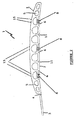
- Figure 1 is a cross sectional view of a first embodiment of a floor covering having a domed surface for cleanliness and with the securing screws shown proud and before final installation; and
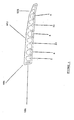
- Figure 2 is a cross sectional view of a second embodiment of floor covering showing the screws lodged in position in the rigid strips;
- Figure 3 is a cross sectional view of a third embodiment of floor covering;
- Figure 4 is a cross sectional view of a fourth embodiment of floor covering which is designed for use on concrete floors and has particular application for dairy cows;
- Figure 5 is a cross sectional view of a fifth embodiment of floor covering.
- Referring to the drawings and initially to Figure 1 there is shown a floor covering indicated generally by the
reference numeral 1. The floor covering 1 is provided by adomed mat 2 having aflap valve 3. Agroove 4 is located between theflap valve 3 and themat 2 to provide a hinge. Themat 2 has a number ofcentral cavities 5 extending longitudinally through themat 2. Threerigid strips 6 which act as anchors forscrews 8 are located about the base 7 of themat 2. Threescrews 8 e.g. self-tapping screws are screwed through themat 2, thecentral cavities 5 and therigid strips 6 providing a secure connection between themat 2 and the slat (not shown). When completely screwed in the heads of thescrews 8 are buried into thestrips 6 which also retain the shape of the mat. - A pair of
parallel lines 15 are located on the upper surface of the mat to indicate the location of thestrips 6 on the bottom surface. Thescrews 8 are inserted between the indicatinglines 15 and the material closes back over again after the screws have been inserted. - As shown in Figure 1, the edges of the mat are inclined at an angle α from the bottom surface of the mat. This creates improved contact with the floor and ensures that the edges of the mat grip the floor and are not inclined to turn upwards. The surface of the
mat 2 is domed so that it does not retain animal urine and dung on its surface which will wash off easily. - Referring to the drawings and now to Figure 2, the features of the second embodiment which correspond with and are identical to features of the first embodiment are referenced by identical numerals. The floor covering indicated generally by the
reference numeral 1 also includes a number of longitudinally extendinggrooves 11 located on the base 7. Thegrooves 11 prevent direct contact between themat 2 and the concrete slat reducing forces transmitted to the housed animals. Two extracentral cavities 5 are also included in themat 2.Screws 8 are shown fully lodged into thestrips 6. - In use, an operator locates each
mat 2 about the top surface of a slat and pushes theflap valve 3 into the gap between the supporting slat and the adjacent slat. Theflap valve 3 rests against the bottom surface of the adjacent slat or against the sidewall of the adjacent slat closing the gap therebetween. Ideally, for slatted floors eachmat 2 should be mounted with theflap valve 3 facing in the same direction. The operator can now fix themat 2 to the slat by driving screws ornails 8 into themat 2 and through thecentral cavities 5,rigid strips 6 and finally into the concrete slats. Thescrews 8 are forced into themat 2 until the screw heads are located within the rigid strips 6. This reduces the risk of an animal hurting itself on an exposed screw or nail head. Theflap valve 3 flexes under the weight of waste material to allow the waste material to pass through the gap and then returns to a normally closed position to close the gap. This reduces gas and odour emissions from a slurry tank below the ground ascending through the gaps between adjacent slats and into a house above the slatted floor. Slits can be provided along the length of theflap valve 3 at specified intervals so that only a portion of the elongate valve will open as required. If not required theflap valve 3 can be trimmed off or turned under the mat. - The
third embodiment 300 shown in Figure 3 is similar to the first and second embodiments and like features are given like numerals. Themat 2 has aflap valve 3, a number ofcentral cavities 5 and threerigid strips 306 for securing the mat in position. Eachstrip 306 has a pair oflugs 307 to provide a secure anchoring with the main body of themat 2. - The mats may also be joined in contiguous fashion where edges of each adjoining mat contact one another. The
flap valves 3 may be inserted under each neighbouring mat or may be removed if desired. This arrangement is particularly beneficial where animals stand adjacent to feed and water stations. It may also be used to provide a comfort zone for animals standing on bare concrete floor or bare concrete slats. - The fourth embodiment 400 shown in Figure 4 which is particularly useful for dairy cows comprises a
mat 402 which has a slopedsection 403 at one side and a generallystraight section 404 at the other side. Thestraight section 404 has a slightly taperedside wall 406 which ensures a good fit against a concrete strip or ledge as used in an animal cubicle shed and which are generally irregular in shape. The fourth embodiment 400 also includescentral cavities 5, threerigid strips 6 and longitudinally extendinggrooves 11 located on the base 7. The embodiment 400 can be used in animal houses or portions of animal houses not having a slatted floor surface such as passageways between rows of cubicles and feeding areas in animal houses. The embodiment 400 provides a particularly beneficial shock absorbing mat for bovine cows when reversing out and down from a cubicle when themat 402 is installed as a cubicle kerb. Observations from field tests have shown that the load taken by the hind claws of cows when reversing or slipping out from cubicles to be a very significant cause of lameness. Themat 402 provides a cushioned gripping surface for the cows' claws and the shape of the mat allows the claws to open and close correctly and naturally, thereby helping to prevent lameness. To protect a damaged claw a cow can stand so that only one half of a claw stands on themat 402 with the other half of the claw suspended so as to take pressure off the damaged claw. - In the
fifth embodiment 500 shown in Figure 5, which is similar to the first, second and third embodiments, the securing strips of the first three embodiments are replaced by three elongate anchoringformations 506 which secure themat 502 to a concrete floor slat while the slat is being formed from wet concrete. The anchoringformations 506 are T-bars extending from the rigid strips and can have different shapes. Using the embodiment, the concrete floor slats are supplied with the mats already installed. - It will of course be understood that the invention is not limited to the specific details as herein described, which are given by way of example only, and that various alterations and modifications may be made without departing from the scope of the invention as defined in the appended claims.
Claims (23)
- A floor covering (1) for an animal house adapted to provide comfort and protection for beef and dairy animals comprising an elongate elastomeric mat (2) adapted to be fixed to a concrete floor slat by fixing means (8), the mat having an integral rigid portion (6) for receiving the fixing means which are coverable by the mat when it is fixed to the slat, without detracting from the protection and comfort given to the animals and in which the mat has an openable elongate flap valve (3) extending from at least one longitudinal edge of the mat for closing a gap between adjacent slats of a slatted floor so as to reduce harmful gas and odour emissions ascending through the gap while allowing animal waste to pass through.
- A floor covering as claimed in Claim 1, wherein the mat is formed using a multi-extrusion process.
- A floor covering as claimed in Claim 2, wherein the width of the entire extrusion is variable by varying the speed of extraction of the materials forming the component parts of the floor covering.
- A floor covering as claimed in Claim 1, wherein the mat is extruded having a covering main body and a fixing means and the main body has a plurality of longitudinally extending central cavities (5).
- A floor covering as claimed in Claim 4, wherein the main body comprises a high content of nitrile rubber or a similar material with a high compression set which gives good shock absorbency in the finished mat.
- A floor covering as claimed in Claim 1, wherein the rigid portion is provided by one or more of longitudinal rigid strip(s) (6) which are co-extruded with the mat.
- A floor covering as claimed in Claim 6, wherein the rigid strip(s) (6) act as washers for the fixing means and also act as supports to retain the shape of the mat.
- A floor covering as claimed in Claims 6 or 7, wherein the rigid strip(s) are co-extruded onto the base of the mat and are uniformly distributed about the base to evenly dissipate the load applied about each connection between the mat and the slat.
- A floor covering as claimed in any one of Claims 6 to 8, wherein the rigid strip(s) are vertically aligned with a number of central cavities to maximize comfort of the animals and to allow access for the fixing means.
- A floor covering as claimed in any one of Claims 6 to 9, wherein the location of the rigid strip(s) on the base of the mat is indicated on the top surface of the mat to provide a guide (15) for the fixing means.
- A floor covering as claimed in Claim 1, wherein the flap valve is provided by a flap extending from at least one longitudinal edge of the mat.
- A floor covering as claimed in Claim 11, wherein the flap extends under the bottom surface of the adjacent slat to close the gap therebetween.
- A floor covering as claimed in Claim 11, wherein the flap extends down and across the gap abutting against the sidewall of the adjacent slat to close the gap therebetween.
- A floor covering as claimed in any preceding claim, wherein a groove extends longitudinally intermediate the flap and the mat to provide a hinge for the flap valve.
- A floor covering as claimed in Claim 1, wherein the fixing means is provided by screws, masonry nails or any other fixing means which may be applied through the elastomeric mat, embedded in the rigid strips and secured into the concrete slat.
- A floor covering as claimed in any preceding claim, wherein a number of longitudinal grooves are provided on the base of the mat.
- A floor covering as claimed in any preceding claim, wherein the mats are formed using materials of variable rigidity.
- A floor covering as claimed in any preceding claim wherein the mats are manufactured from any extrudable rubber or synthetic material.
- A floor covering as claimed in any of the preceding claims wherein the mat has a domed profile (2) in order not to retain, animal urine and dung thereby assisting in improving the cleanliness of the housed animals.
- A floor covering as claimed in any of the preceding claims in which the edges of the mat are inclined at an angle from the bottom surface of the mat, thereby creating improved contact with the floor or slat and ensuring that the edges of the mat grip the floor and are not inclined to turn upwardly.
- A floor covering as claimed in any of the preceding claims in which the mat is specifically adapted for use with dairy cows and is provided with a tapered side wall to ensure a good fit against an irregularly shaped concrete structure such as the base of an animal cubicle wall.
- A floor covering as claimed in any of the preceding claims in which the mat includes a surface adapted to support an animal's claw and allow it to function naturally.
- A floor covering as claimed in any of the preceding claims in which the surface of the mat is sloped to one side to prevent urine and dung from being retained on the mat.
Priority Applications (1)
| Application Number | Priority Date | Filing Date | Title |
|---|---|---|---|
| EP06075253A EP1656828A3 (en) | 2001-01-04 | 2002-01-04 | Floor covering for an animal house |
Applications Claiming Priority (5)
| Application Number | Priority Date | Filing Date | Title |
|---|---|---|---|
| IE20010005 | 2001-01-04 | ||
| IE20010006 | 2001-01-04 | ||
| IES20010006 IES20010006A2 (en) | 2001-01-04 | 2001-01-04 | Improvements in and relating to mats for concrete floors of slatted houses |
| IE20010005A IE20010005A1 (en) | 2001-01-04 | 2001-01-04 | A floor covering for an animal house |
| PCT/EP2002/000274 WO2002065831A2 (en) | 2001-01-04 | 2002-01-04 | Floor covering for an animal house |
Related Child Applications (1)
| Application Number | Title | Priority Date | Filing Date |
|---|---|---|---|
| EP06075253A Division EP1656828A3 (en) | 2001-01-04 | 2002-01-04 | Floor covering for an animal house |
Publications (2)
| Publication Number | Publication Date |
|---|---|
| EP1385372A2 EP1385372A2 (en) | 2004-02-04 |
| EP1385372B1 true EP1385372B1 (en) | 2006-04-26 |
Family
ID=26320309
Family Applications (2)
| Application Number | Title | Priority Date | Filing Date |
|---|---|---|---|
| EP06075253A Withdrawn EP1656828A3 (en) | 2001-01-04 | 2002-01-04 | Floor covering for an animal house |
| EP02724155A Expired - Lifetime EP1385372B1 (en) | 2001-01-04 | 2002-01-04 | Floor covering for an animal house |
Family Applications Before (1)
| Application Number | Title | Priority Date | Filing Date |
|---|---|---|---|
| EP06075253A Withdrawn EP1656828A3 (en) | 2001-01-04 | 2002-01-04 | Floor covering for an animal house |
Country Status (7)
| Country | Link |
|---|---|
| US (2) | US7107935B2 (en) |
| EP (2) | EP1656828A3 (en) |
| AT (1) | ATE324034T1 (en) |
| DE (1) | DE60210948T2 (en) |
| DK (1) | DK1385372T3 (en) |
| ES (1) | ES2260427T3 (en) |
| WO (1) | WO2002065831A2 (en) |
Families Citing this family (12)
| Publication number | Priority date | Publication date | Assignee | Title |
|---|---|---|---|---|
| WO2002065831A2 (en) * | 2001-01-04 | 2002-08-29 | Patrick Roy Mooney | Floor covering for an animal house |
| SE523046C2 (en) * | 2002-02-06 | 2004-03-23 | Gunnar Fritz | Device for concrete slab flooring |
| CA2529975A1 (en) * | 2004-12-13 | 2006-06-13 | Todd J. Koelker (Deceased) | Livestock flooring cover |
| PL2388386T3 (en) | 2005-03-29 | 2015-01-30 | Patrick Roy Mooney | Apparatus for use with a slatted floor |
| US20070028550A1 (en) * | 2005-07-20 | 2007-02-08 | Clapper Edward O | Rafter platform |
| US7634876B2 (en) * | 2006-12-08 | 2009-12-22 | Moller Jr Jorgen J | Modular floor locator apparatus |
| PL2181585T3 (en) | 2008-10-30 | 2013-06-28 | Betonwerk Schwarz Gmbh | Rubber lining for a slatted floor element |
| GB2476295B (en) * | 2009-12-18 | 2012-11-21 | Patrick Roy Mooney | Apparatus for use with a slatted floor |
| US9090497B2 (en) * | 2012-05-31 | 2015-07-28 | Jeffrey H. Bragg | Modular, scalable high solids methane digester for small-sized to medium-sized farms |
| DE102015112983A1 (en) * | 2015-02-12 | 2016-08-18 | Gröne Gmbh | Surface protection element and wall cover |
| WO2016205810A1 (en) | 2015-06-19 | 2016-12-22 | Titan International, Inc. | Improved agricultural mat and associated systems and methods |
| US11473314B2 (en) | 2020-01-31 | 2022-10-18 | Oren Heatwole | Modular flooring system for agricultural animal and poultry houses |
Citations (1)
| Publication number | Priority date | Publication date | Assignee | Title |
|---|---|---|---|---|
| US4799681A (en) * | 1986-09-08 | 1989-01-24 | Pipik Albert M | Baseball runner pads |
Family Cites Families (17)
| Publication number | Priority date | Publication date | Assignee | Title |
|---|---|---|---|---|
| US2122266A (en) * | 1936-11-04 | 1938-06-28 | Seamless Rubber Company Inc | Base plate for baseball diamonds |
| US2665664A (en) * | 1952-09-26 | 1954-01-12 | Donald D Benjamin | Pad for animal stalls |
| US3699926A (en) * | 1970-10-19 | 1972-10-24 | Rubber Ind Vasto Nv | Floor mat for animals |
| US3824960A (en) * | 1973-04-02 | 1974-07-23 | Semperit Ag | Floor structure |
| DE2910767A1 (en) * | 1979-03-19 | 1980-10-30 | Trelleborg Gmbh | Cattle stall floor beam covering - has U=shaped profile gripping beam top with inner projections bedded into beam core |
| DE8911379U1 (en) * | 1989-09-24 | 1989-11-16 | Otting, Horst, 5653 Leichlingen | Cover strip for door thresholds or similar. |
| SG47082A1 (en) * | 1992-07-22 | 1998-03-20 | Scott Brodie | Synthetic horse bedding |
| NL9201484A (en) * | 1992-08-19 | 1994-03-16 | Stichting Beheer Intellectuele | Stable floor mat |
| US5749323A (en) * | 1995-12-18 | 1998-05-12 | Kleinsasser; Jonathan | Flooring slat for an animal pen |
| US5813365A (en) * | 1997-03-06 | 1998-09-29 | Tandem Products, Inc. | Modular flooring system |
| US5813364A (en) * | 1997-05-09 | 1998-09-29 | Harrison; Charles | Automatic pet door housing |
| US5989695A (en) * | 1997-10-01 | 1999-11-23 | Fuller; John J. | Method and apparatus for supporting an animal |
| DE19800945C2 (en) * | 1998-01-13 | 2000-06-21 | Kraiburg Elastik | Mat covering for a cattle shed |
| WO2000016611A2 (en) | 1998-09-18 | 2000-03-30 | Patrick Roy Mooney | Apparatus for joining animal mats and covering slatted floors |
| US6079366A (en) * | 1998-10-06 | 2000-06-27 | Telleen; Bruce A. | Removable dairy free stall base |
| WO2002065831A2 (en) * | 2001-01-04 | 2002-08-29 | Patrick Roy Mooney | Floor covering for an animal house |
| US6889631B2 (en) * | 2003-06-19 | 2005-05-10 | Southwest Agri-Plastics, Inc. | Animal pen flooring system |
-
2002
- 2002-01-04 WO PCT/EP2002/000274 patent/WO2002065831A2/en not_active Ceased
- 2002-01-04 EP EP06075253A patent/EP1656828A3/en not_active Withdrawn
- 2002-01-04 DE DE60210948T patent/DE60210948T2/en not_active Expired - Lifetime
- 2002-01-04 AT AT02724155T patent/ATE324034T1/en not_active IP Right Cessation
- 2002-01-04 ES ES02724155T patent/ES2260427T3/en not_active Expired - Lifetime
- 2002-01-04 DK DK02724155T patent/DK1385372T3/en active
- 2002-01-04 US US10/250,738 patent/US7107935B2/en not_active Expired - Fee Related
- 2002-01-04 EP EP02724155A patent/EP1385372B1/en not_active Expired - Lifetime
-
2006
- 2006-09-18 US US11/523,223 patent/US7353776B2/en not_active Expired - Fee Related
Patent Citations (1)
| Publication number | Priority date | Publication date | Assignee | Title |
|---|---|---|---|---|
| US4799681A (en) * | 1986-09-08 | 1989-01-24 | Pipik Albert M | Baseball runner pads |
Also Published As
| Publication number | Publication date |
|---|---|
| US7353776B2 (en) | 2008-04-08 |
| WO2002065831A2 (en) | 2002-08-29 |
| EP1656828A3 (en) | 2006-07-05 |
| DE60210948D1 (en) | 2006-06-01 |
| DK1385372T3 (en) | 2006-08-28 |
| US20070044727A1 (en) | 2007-03-01 |
| US20040093810A1 (en) | 2004-05-20 |
| DE60210948T2 (en) | 2007-05-24 |
| WO2002065831A3 (en) | 2002-12-12 |
| ATE324034T1 (en) | 2006-05-15 |
| EP1385372A2 (en) | 2004-02-04 |
| ES2260427T3 (en) | 2006-11-01 |
| EP1656828A2 (en) | 2006-05-17 |
| US7107935B2 (en) | 2006-09-19 |
Similar Documents
| Publication | Publication Date | Title |
|---|---|---|
| US7353776B2 (en) | Floor covering for an animal house | |
| US5311837A (en) | Pet bed | |
| CA2647649C (en) | Apparatus for use with a slatted floor | |
| JPH07509360A (en) | synthetic bedding for horses | |
| US20190261598A1 (en) | Elevated pet bed | |
| GB2240251A (en) | Animal bedding | |
| GB2457830A (en) | Rubber floor tile with drainage | |
| US20060124074A1 (en) | Livestock flooring cover | |
| IE20010005A1 (en) | A floor covering for an animal house | |
| Zappavigna et al. | The Design of Dairy Cow and Replacement Heifer Housing Report of the CIGR Section II Working Group | |
| IES84708Y1 (en) | Apparatus for use with a slatted floor | |
| IE20060244U1 (en) | Apparatus for use with a slatted floor | |
| WO2011073450A1 (en) | Apparatus for use with a slatted floor | |
| Graves | Free stall design and construction criteria | |
| US20090282757A1 (en) | Horse Protectors | |
| IES20010006A2 (en) | Improvements in and relating to mats for concrete floors of slatted houses | |
| US20160330928A1 (en) | Animal Enclosure | |
| IES85440Y1 (en) | A rubber tile | |
| KR20040105323A (en) | The cow mat | |
| IES84866Y1 (en) | A rubber tile | |
| IES20020380A2 (en) | Slat mat and connector | |
| IE20090244U1 (en) | A rubber tile | |
| IT201600072876A1 (en) | MATTRESS FOR CATTLE | |
| IE20090245U1 (en) | A rubber tile | |
| WO2005096807A1 (en) | Stable bank system |
Legal Events
| Date | Code | Title | Description |
|---|---|---|---|
| PUAI | Public reference made under article 153(3) epc to a published international application that has entered the european phase |
Free format text: ORIGINAL CODE: 0009012 |
|
| 17P | Request for examination filed |
Effective date: 20031120 |
|
| AK | Designated contracting states |
Kind code of ref document: A2 Designated state(s): AT BE CH CY DE DK ES FI FR GB GR IE IT LI LU MC NL PT SE TR |
|
| AX | Request for extension of the european patent |
Extension state: AL LT LV MK RO SI |
|
| 17Q | First examination report despatched |
Effective date: 20040322 |
|
| GRAP | Despatch of communication of intention to grant a patent |
Free format text: ORIGINAL CODE: EPIDOSNIGR1 |
|
| GRAS | Grant fee paid |
Free format text: ORIGINAL CODE: EPIDOSNIGR3 |
|
| GRAA | (expected) grant |
Free format text: ORIGINAL CODE: 0009210 |
|
| AK | Designated contracting states |
Kind code of ref document: B1 Designated state(s): AT BE CH CY DE DK ES FI FR GB GR IE IT LI LU MC NL PT SE TR |
|
| PG25 | Lapsed in a contracting state [announced via postgrant information from national office to epo] |
Ref country code: IT Free format text: LAPSE BECAUSE OF FAILURE TO SUBMIT A TRANSLATION OF THE DESCRIPTION OR TO PAY THE FEE WITHIN THE PRESCRIBED TIME-LIMIT;WARNING: LAPSES OF ITALIAN PATENTS WITH EFFECTIVE DATE BEFORE 2007 MAY HAVE OCCURRED AT ANY TIME BEFORE 2007. THE CORRECT EFFECTIVE DATE MAY BE DIFFERENT FROM THE ONE RECORDED. Effective date: 20060426 Ref country code: LI Free format text: LAPSE BECAUSE OF FAILURE TO SUBMIT A TRANSLATION OF THE DESCRIPTION OR TO PAY THE FEE WITHIN THE PRESCRIBED TIME-LIMIT Effective date: 20060426 Ref country code: FI Free format text: LAPSE BECAUSE OF FAILURE TO SUBMIT A TRANSLATION OF THE DESCRIPTION OR TO PAY THE FEE WITHIN THE PRESCRIBED TIME-LIMIT Effective date: 20060426 Ref country code: CH Free format text: LAPSE BECAUSE OF FAILURE TO SUBMIT A TRANSLATION OF THE DESCRIPTION OR TO PAY THE FEE WITHIN THE PRESCRIBED TIME-LIMIT Effective date: 20060426 |
|
| REG | Reference to a national code |
Ref country code: GB Ref legal event code: FG4D |
|
| REG | Reference to a national code |
Ref country code: IE Ref legal event code: FG4D |
|
| REF | Corresponds to: |
Ref document number: 60210948 Country of ref document: DE Date of ref document: 20060601 Kind code of ref document: P |
|
| PG25 | Lapsed in a contracting state [announced via postgrant information from national office to epo] |
Ref country code: SE Free format text: LAPSE BECAUSE OF FAILURE TO SUBMIT A TRANSLATION OF THE DESCRIPTION OR TO PAY THE FEE WITHIN THE PRESCRIBED TIME-LIMIT Effective date: 20060726 |
|
| REG | Reference to a national code |
Ref country code: DK Ref legal event code: T3 |
|
| PG25 | Lapsed in a contracting state [announced via postgrant information from national office to epo] |
Ref country code: PT Free format text: LAPSE BECAUSE OF FAILURE TO SUBMIT A TRANSLATION OF THE DESCRIPTION OR TO PAY THE FEE WITHIN THE PRESCRIBED TIME-LIMIT Effective date: 20060926 |
|
| REG | Reference to a national code |
Ref country code: CH Ref legal event code: PL |
|
| REG | Reference to a national code |
Ref country code: ES Ref legal event code: FG2A Ref document number: 2260427 Country of ref document: ES Kind code of ref document: T3 |
|
| ET | Fr: translation filed | ||
| PG25 | Lapsed in a contracting state [announced via postgrant information from national office to epo] |
Ref country code: MC Free format text: LAPSE BECAUSE OF NON-PAYMENT OF DUE FEES Effective date: 20070131 |
|
| PLBE | No opposition filed within time limit |
Free format text: ORIGINAL CODE: 0009261 |
|
| STAA | Information on the status of an ep patent application or granted ep patent |
Free format text: STATUS: NO OPPOSITION FILED WITHIN TIME LIMIT |
|
| 26N | No opposition filed |
Effective date: 20070129 |
|
| PG25 | Lapsed in a contracting state [announced via postgrant information from national office to epo] |
Ref country code: GR Free format text: LAPSE BECAUSE OF FAILURE TO SUBMIT A TRANSLATION OF THE DESCRIPTION OR TO PAY THE FEE WITHIN THE PRESCRIBED TIME-LIMIT Effective date: 20060727 |
|
| PG25 | Lapsed in a contracting state [announced via postgrant information from national office to epo] |
Ref country code: LU Free format text: LAPSE BECAUSE OF NON-PAYMENT OF DUE FEES Effective date: 20070104 Ref country code: CY Free format text: LAPSE BECAUSE OF FAILURE TO SUBMIT A TRANSLATION OF THE DESCRIPTION OR TO PAY THE FEE WITHIN THE PRESCRIBED TIME-LIMIT Effective date: 20060426 |
|
| PG25 | Lapsed in a contracting state [announced via postgrant information from national office to epo] |
Ref country code: TR Free format text: LAPSE BECAUSE OF FAILURE TO SUBMIT A TRANSLATION OF THE DESCRIPTION OR TO PAY THE FEE WITHIN THE PRESCRIBED TIME-LIMIT Effective date: 20060426 |
|
| PGFP | Annual fee paid to national office [announced via postgrant information from national office to epo] |
Ref country code: GB Payment date: 20100331 Year of fee payment: 9 |
|
| PGFP | Annual fee paid to national office [announced via postgrant information from national office to epo] |
Ref country code: DE Payment date: 20100430 Year of fee payment: 9 |
|
| PGFP | Annual fee paid to national office [announced via postgrant information from national office to epo] |
Ref country code: ES Payment date: 20100726 Year of fee payment: 9 Ref country code: NL Payment date: 20090730 Year of fee payment: 9 |
|
| PGFP | Annual fee paid to national office [announced via postgrant information from national office to epo] |
Ref country code: AT Payment date: 20100727 Year of fee payment: 9 Ref country code: IT Payment date: 20100722 Year of fee payment: 9 |
|
| PGFP | Annual fee paid to national office [announced via postgrant information from national office to epo] |
Ref country code: FR Payment date: 20101216 Year of fee payment: 10 Ref country code: DK Payment date: 20100720 Year of fee payment: 9 |
|
| PGFP | Annual fee paid to national office [announced via postgrant information from national office to epo] |
Ref country code: BE Payment date: 20100729 Year of fee payment: 9 |
|
| BERE | Be: lapsed |
Owner name: *MOONEY PATRICK ROY Effective date: 20110131 |
|
| REG | Reference to a national code |
Ref country code: NL Ref legal event code: V1 Effective date: 20110801 |
|
| REG | Reference to a national code |
Ref country code: DK Ref legal event code: EBP |
|
| GBPC | Gb: european patent ceased through non-payment of renewal fee |
Effective date: 20110104 |
|
| PG25 | Lapsed in a contracting state [announced via postgrant information from national office to epo] |
Ref country code: GB Free format text: LAPSE BECAUSE OF NON-PAYMENT OF DUE FEES Effective date: 20110104 Ref country code: AT Free format text: LAPSE BECAUSE OF NON-PAYMENT OF DUE FEES Effective date: 20110104 Ref country code: BE Free format text: LAPSE BECAUSE OF NON-PAYMENT OF DUE FEES Effective date: 20110131 |
|
| REG | Reference to a national code |
Ref country code: DE Ref legal event code: R119 Ref document number: 60210948 Country of ref document: DE Effective date: 20110802 |
|
| PG25 | Lapsed in a contracting state [announced via postgrant information from national office to epo] |
Ref country code: NL Free format text: LAPSE BECAUSE OF NON-PAYMENT OF DUE FEES Effective date: 20110801 Ref country code: IT Free format text: LAPSE BECAUSE OF NON-PAYMENT OF DUE FEES Effective date: 20110104 |
|
| REG | Reference to a national code |
Ref country code: ES Ref legal event code: FD2A Effective date: 20120411 |
|
| PG25 | Lapsed in a contracting state [announced via postgrant information from national office to epo] |
Ref country code: ES Free format text: LAPSE BECAUSE OF NON-PAYMENT OF DUE FEES Effective date: 20110105 |
|
| REG | Reference to a national code |
Ref country code: FR Ref legal event code: ST Effective date: 20120928 |
|
| PG25 | Lapsed in a contracting state [announced via postgrant information from national office to epo] |
Ref country code: FR Free format text: LAPSE BECAUSE OF NON-PAYMENT OF DUE FEES Effective date: 20120131 |
|
| PG25 | Lapsed in a contracting state [announced via postgrant information from national office to epo] |
Ref country code: DE Free format text: LAPSE BECAUSE OF NON-PAYMENT OF DUE FEES Effective date: 20110802 |
|
| PGFP | Annual fee paid to national office [announced via postgrant information from national office to epo] |
Ref country code: IE Payment date: 20200109 Year of fee payment: 19 |
|
| PG25 | Lapsed in a contracting state [announced via postgrant information from national office to epo] |
Ref country code: IE Free format text: LAPSE BECAUSE OF NON-PAYMENT OF DUE FEES Effective date: 20210104 |