EP1384884A1 - Electric generator using a shape memory alloy element - Google Patents

Electric generator using a shape memory alloy element Download PDF

Info

Publication number
EP1384884A1
EP1384884A1 EP03012463A EP03012463A EP1384884A1 EP 1384884 A1 EP1384884 A1 EP 1384884A1 EP 03012463 A EP03012463 A EP 03012463A EP 03012463 A EP03012463 A EP 03012463A EP 1384884 A1 EP1384884 A1 EP 1384884A1
Authority
EP
European Patent Office
Prior art keywords
generator according
temperature
shape
lamina
support
Prior art date
Legal status (The legal status is an assumption and is not a legal conclusion. Google has not performed a legal analysis and makes no representation as to the accuracy of the status listed.)
Withdrawn
Application number
EP03012463A
Other languages
German (de)
French (fr)
Inventor
Marco Pizzi
Piero Perlo
Current Assignee (The listed assignees may be inaccurate. Google has not performed a legal analysis and makes no representation or warranty as to the accuracy of the list.)
Centro Ricerche Fiat SCpA
Original Assignee
Centro Ricerche Fiat SCpA
Priority date (The priority date is an assumption and is not a legal conclusion. Google has not performed a legal analysis and makes no representation as to the accuracy of the date listed.)
Filing date
Publication date
Application filed by Centro Ricerche Fiat SCpA filed Critical Centro Ricerche Fiat SCpA
Publication of EP1384884A1 publication Critical patent/EP1384884A1/en
Withdrawn legal-status Critical Current

Links

Images

Classifications

    • FMECHANICAL ENGINEERING; LIGHTING; HEATING; WEAPONS; BLASTING
    • F03MACHINES OR ENGINES FOR LIQUIDS; WIND, SPRING, OR WEIGHT MOTORS; PRODUCING MECHANICAL POWER OR A REACTIVE PROPULSIVE THRUST, NOT OTHERWISE PROVIDED FOR
    • F03GSPRING, WEIGHT, INERTIA OR LIKE MOTORS; MECHANICAL-POWER PRODUCING DEVICES OR MECHANISMS, NOT OTHERWISE PROVIDED FOR OR USING ENERGY SOURCES NOT OTHERWISE PROVIDED FOR
    • F03G7/00Mechanical-power-producing mechanisms, not otherwise provided for or using energy sources not otherwise provided for
    • F03G7/06Mechanical-power-producing mechanisms, not otherwise provided for or using energy sources not otherwise provided for using expansion or contraction of bodies due to heating, cooling, moistening, drying or the like
    • F03G7/061Mechanical-power-producing mechanisms, not otherwise provided for or using energy sources not otherwise provided for using expansion or contraction of bodies due to heating, cooling, moistening, drying or the like characterised by the actuating element
    • F03G7/0614Mechanical-power-producing mechanisms, not otherwise provided for or using energy sources not otherwise provided for using expansion or contraction of bodies due to heating, cooling, moistening, drying or the like characterised by the actuating element using shape memory elements
    • HELECTRICITY
    • H02GENERATION; CONVERSION OR DISTRIBUTION OF ELECTRIC POWER
    • H02NELECTRIC MACHINES NOT OTHERWISE PROVIDED FOR
    • H02N2/00Electric machines in general using piezoelectric effect, electrostriction or magnetostriction
    • H02N2/18Electric machines in general using piezoelectric effect, electrostriction or magnetostriction producing electrical output from mechanical input, e.g. generators

Definitions

  • the present invention relates to a generator of electrical energy which uses an active element made of shape-memory material.
  • shape-memory alloys Designated by the term shape-memory alloys (SMAs) is the family of metal materials which present the capability of reassuming their initial configuration if they are deformed and subsequently subjected to an appropriate thermal treatment.
  • Shape-memory alloys undergo a transformation of crystalline phase when they are made to pass from their more rigid configuration at a high temperature (Austenite) to the configuration characterized by lower energy and temperature (Martensite).
  • an SMA element When an SMA element is brought to a low temperature, it assumes a configuration of a martensitic type, with low yielding limit, and is easily deformable. Following upon heating, the alloy arranges itself in another crystalline structure, of the austenitic type, and hence reassumes its initial configuration and shape.
  • the temperature at which the alloy "recalls" its primitive shape can be modified by varying the composition or by appropriate types of heat treatment.
  • Metallurgical processes have enabled application of shape-memory materials in new and simplified embodiments.
  • a determining factor has been the increase in the number of work cycles and hence in the life of SMA actuators.
  • the purpose of the present invention is to provide new and advantageous applications of active elements made of shape-memory alloys, for the purposes of obtaining generators of electrical energy.
  • a further purpose of the invention is to provide generators of the above type, operation of which is based upon the use of thin films, which may be obtained by deposition of shape-memory materials with processes typically adopted in the microelectronics industry.
  • a generator of electrical energy which comprises:
  • the aforesaid active element is in the form of a lamina or of a thin film, in particular having a thickness smaller than 50 micron and preferably comprised between 0.5 and 2 micrometers.
  • the means for converting the mechanical deformation of the active element into electrical energy preferably comprise at least one piezoelectric element operatively connected to the active element.
  • Figure 1 shows one of the possible configurations, in which a thin film made of shape-memory alloy, designated by F and referred to in what follows as lamina, is caused to oscillate between two positions, by using a difference in temperature between two parts of a physical system, formed, in the example, by two surfaces PS and PI, which are at different temperatures.
  • F shape-memory alloy
  • thin film is meant herein a laminar element of an extremely small thickness, preferably comprised between 0.5 and 2 micrometers, and in any case less than 50 micron.
  • the thin film which constitutes the lamina F can be made with techniques similar to the ones typically used in the micro-electronics field, for example, for depositing conductive films, namely, by vapour deposition or sputtering.
  • the lamina F can be obtained by means of techniques of flash vapour deposition, based upon the use of a crucible which is maintained at a very high temperature and on which there are introduced powders of the material to be vaporized, i.e., the shape-memory alloy. As soon as they come into contact with the crucible, the aforesaid powders vaporize immediately on a surface so as to form the desired thin film.
  • Another possibility is that of obtaining the lamina F by means of techniques of laser ablation, which exploit laser radiation for fixing a submicrometric powder on a surface by means of a precision-casting process so as to produce a thin film having the same composition as that of the vaporized material.
  • the lamina F is constrained along two opposite sides, for respective stretches E, to the top surface PS, in such a way as to form a flexible loop or bend A which protrudes in the direction of the bottom surface PI.
  • the stretches E of the lamina F may, for example, be bonded directly on the surface PS, or else the structure can be obtained by means of deposition of the lamina upon a layer, referred to as sacrificial layer, which is subsequently removed.
  • the surface PS is maintained at a temperature T1, lower than the temperature T2 at which the surface PI is kept.
  • the temperatures T1 and T2 are chosen in such a way that the SMA material of which the lamina F is made will be, at the temperature T1, in its austenitic phase, characterized by a greater elongation of the lamina itself, and, at the temperature T2, in the respective martensitic phase, characterized by a smaller elongation.
  • the length of the lamina F understood as the distance between the two opposite stretches E bonded to the surface PS, and the distance between the surfaces PS and PI are chosen in such a way that the loop or bend A, i.e., the flexible part of the lamina F, will come into contact with the surface PI at a higher temperature T2 when the SMA material is in its austenitic phase, as may be seen in Figure 2.
  • the extremely small thickness of the lamina F which, as has been said, is preferably smaller than 2 ⁇ m, enables oscillation frequencies of the order of hundreds of hertz or more to be obtained.
  • micro-actuator illustrated in Figures 1 and 2 there may be associated means suitable for converting the mechanical deformation of the lamina F into electrical energy.
  • FIGs 3 and 4 An example of application in this sense is illustrated in Figures 3 and 4, where the same reference numbers as the ones of the preceding figures are used.
  • the contraction of the lamina F is exploited for generating electrical energy, in combination with piezoelectric layers SP, i.e., layers made of ferro-electric material of the type characterized by an electrical polarization which is induced in the material when it undergoes mechanical stresses.
  • piezoelectric layers SP i.e., layers made of ferro-electric material of the type characterized by an electrical polarization which is induced in the material when it undergoes mechanical stresses.
  • the piezoelectric layers SP are deposited in a known way on the top surface PS, and the stretches E of the lamina F are constrained thereon.
  • the length of the lamina is such that, in the martensitic phase of the SMA material, the piezoelectric layers SP are mechanically pre-stressed.
  • a further possible embodiment, illustrated in Figures 5 and 6, envisages that a piezoelectric film, designated by FP, will be directly deposited on the flexible part A of the lamina F.
  • FP piezoelectric film
  • the direct piezoelectric constant designated as "d 31 " is exploited for the purposes of energy generation.
  • the piezoelectric film FP may, for instance, be deposited on the lamina F made of a shape-memory alloy by means of the Sol-Gel technique.
  • the said technique which is widely used in the microelectronics field, basically envisages the steps of: obtaining chemically a gel in which the solid material to be deposited (in this case the piezoelectric material) is present; depositing the gel on the support (in this case the lamina F); and definitively fixing the solid material by means of heat treatment.
  • the solid material to be deposited in this case the piezoelectric material
  • the support in this case the lamina F
  • ferro-electric materials of the "soft" type may be used, which will enable operation outside the resonance frequency.
  • the characteristics of the present invention emerge clearly, the invention being based upon exploitation of the deformation of shape-memory materials for providing generators of electrical energy, the said deformations being obtained starting from differences in temperature induced between different portions of the element F.
  • the temperature gradient necessary for operation of the proposed generators may of course be obtained in any way whatsoever, for example by means of solar or nuclear energy, or energy deriving from combustion, etc.
  • the generator of electrical energy according to the invention could of course envisage a plurality of laminas F made of shape-memory material, associated to which are respective piezoelectric elements PS or FP.
  • the SMA material used for obtaining the lamina F may be of any known type, and preferably chosen in the group comprising the alloys Ni-Ti, Ni-Ti-Cu, Cu-Al -Zn, and
  • the lamina F made of shape-memory material could be constrained to the surface PS just at one end E, whilst, however, maintaining the respective flexible part A.
  • Another possibility consists in setting the constraining stretches E one on top of the other so as to form a closed or annular cross-section.

Landscapes

  • Engineering & Computer Science (AREA)
  • Chemical & Material Sciences (AREA)
  • Combustion & Propulsion (AREA)
  • Mechanical Engineering (AREA)
  • General Engineering & Computer Science (AREA)
  • Micromachines (AREA)

Abstract

A generator of electrical energy comprises a lamina (F) made of a shape-memory material, having a first portion (E), constrained in a fixed way to a respective support (PS), and at least one second flexible portion (A), which can move with respect to the first portion (E). Between the first portion (E) and the second portion (A) there is maintained a temperature gradient such as to determine a cyclic transition of the shape-memory material between the respective austenitic and martensitic phases, with a series of mechanical deformations of the lamina (F) between an elongation state and a contraction state. Piezoelectric means (FP) are envisaged for converting the mechanical deformation of the lamina (F) into electrical energy. <IMAGE> <IMAGE>

Description

The present invention relates to a generator of electrical energy which uses an active element made of shape-memory material.
Designated by the term shape-memory alloys (SMAs) is the family of metal materials which present the capability of reassuming their initial configuration if they are deformed and subsequently subjected to an appropriate thermal treatment.
Shape-memory alloys undergo a transformation of crystalline phase when they are made to pass from their more rigid configuration at a high temperature (Austenite) to the configuration characterized by lower energy and temperature (Martensite).
The above transformation is the primary cause of the peculiar qualities of SMA materials, as well as the peculiarity of the martensitic phase, which plays a fundamental role in the transformation itself.
When an SMA element is brought to a low temperature, it assumes a configuration of a martensitic type, with low yielding limit, and is easily deformable. Following upon heating, the alloy arranges itself in another crystalline structure, of the austenitic type, and hence reassumes its initial configuration and shape.
The temperature at which the alloy "recalls" its primitive shape can be modified by varying the composition or by appropriate types of heat treatment.
During the aforementioned transformation, there may be involved forces of considerable proportions, which are stored within and released by the material, and this fact is exploited in the majority of applications.
Consequently, although there exist numerous alloys which present the "shape-memory" property, of commercial interest are mainly the ones which recover the deformation to a considerable extent or which generate a considerable force during the phase transition, such as for example the alloys Ni-Ti, Ni-Ti-Cu, Cu-Al-Zn, and Cu-Al-Ni.
Metallurgical processes have enabled application of shape-memory materials in new and simplified embodiments. A determining factor has been the increase in the number of work cycles and hence in the life of SMA actuators.
At the current state of the art, known applications of SMA materials basically regard engineering of traditional mechanical components, such as wires or bars which use classical mechanical machining technologies.
The purpose of the present invention is to provide new and advantageous applications of active elements made of shape-memory alloys, for the purposes of obtaining generators of electrical energy.
A further purpose of the invention is to provide generators of the above type, operation of which is based upon the use of thin films, which may be obtained by deposition of shape-memory materials with processes typically adopted in the microelectronics industry.
The above and yet other purposes, which will emerge more clearly from what follows, are achieved according to the present invention thanks to a generator of electrical energy, which comprises:
  • at least one active element made with a shape-memory material, the active element having at least one first portion, constrained in a fixed way to a respective support, and at least one second flexible portion, which can move with respect to the first portion;
  • means for inducing a temperature gradient between the first portion and the second portion, the gradient being such as to determine a cyclic transition of the shape-memory material between the respective austenitic and martensitic phases, and hence a series of mechanical deformations of the active element between an elongation state and a contraction state; and
  • means for converting the mechanical deformation of the active element into electrical energy.
Preferably the aforesaid active element is in the form of a lamina or of a thin film, in particular having a thickness smaller than 50 micron and preferably comprised between 0.5 and 2 micrometers.
The means for converting the mechanical deformation of the active element into electrical energy preferably comprise at least one piezoelectric element operatively connected to the active element.
Advantageous embodiments of the invention are indicated in the annexed claims, which are meant to form an integral part of the present description.
Further purposes, characteristics and advantages of the present invention will emerge clearly from the ensuing detailed description and from the annexed drawings, which are provided purely by way of explanatory and non-limiting example and in which:
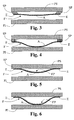
  • Figures 1 and 2 illustrate, by means of schematic cross-sectional views, a thin-film micro-actuator made of shape-memory alloy built according to the invention, in two different operating conditions;
  • Figures 3 and 4 illustrate, by means of schematic cross-sectional views, two different operating conditions of a first generator of electrical energy which uses a thin-film micro-actuator made of shape-memory alloy according to the invention; and
  • Figure 5 and 6 illustrate, by means of schematic cross-sectional views, two different operating conditions of a second generator of electrical energy, which uses a thin-film micro-actuator made of shape-memory alloy according to the invention.
Figure 1 shows one of the possible configurations, in which a thin film made of shape-memory alloy, designated by F and referred to in what follows as lamina, is caused to oscillate between two positions, by using a difference in temperature between two parts of a physical system, formed, in the example, by two surfaces PS and PI, which are at different temperatures.
It is to be noted that by "thin film" is meant herein a laminar element of an extremely small thickness, preferably comprised between 0.5 and 2 micrometers, and in any case less than 50 micron.
The thin film which constitutes the lamina F can be made with techniques similar to the ones typically used in the micro-electronics field, for example, for depositing conductive films, namely, by vapour deposition or sputtering.
In the above perspective, the lamina F can be obtained by means of techniques of flash vapour deposition, based upon the use of a crucible which is maintained at a very high temperature and on which there are introduced powders of the material to be vaporized, i.e., the shape-memory alloy. As soon as they come into contact with the crucible, the aforesaid powders vaporize immediately on a surface so as to form the desired thin film.
Another possibility is that of obtaining the lamina F by means of techniques of laser ablation, which exploit laser radiation for fixing a submicrometric powder on a surface by means of a precision-casting process so as to produce a thin film having the same composition as that of the vaporized material.
In the case illustrated by way of example in Figures 1 and 2, the lamina F is constrained along two opposite sides, for respective stretches E, to the top surface PS, in such a way as to form a flexible loop or bend A which protrudes in the direction of the bottom surface PI. The stretches E of the lamina F may, for example, be bonded directly on the surface PS, or else the structure can be obtained by means of deposition of the lamina upon a layer, referred to as sacrificial layer, which is subsequently removed.
The surface PS is maintained at a temperature T1, lower than the temperature T2 at which the surface PI is kept.
The temperatures T1 and T2 are chosen in such a way that the SMA material of which the lamina F is made will be, at the temperature T1, in its austenitic phase, characterized by a greater elongation of the lamina itself, and, at the temperature T2, in the respective martensitic phase, characterized by a smaller elongation.
The length of the lamina F, understood as the distance between the two opposite stretches E bonded to the surface PS, and the distance between the surfaces PS and PI are chosen in such a way that the loop or bend A, i.e., the flexible part of the lamina F, will come into contact with the surface PI at a higher temperature T2 when the SMA material is in its austenitic phase, as may be seen in Figure 2.
Given the low thermal capacity of the lamina F, which is in the form of a thin film, the thermal equilibrium between the parts E of the lamina F, which are at a temperature T1, and the remaining part A, which is at a temperature T2, is rapidly reached, with the consequent transition to the martensitic phase.
The consequent contraction of the lamina F causes detachment from the bottom surface PI, as is highlighted in Figure 1.
The above process is followed by a new restoration of the thermal equilibrium between the part A of the lamina F and the parts E thereof which are at a temperature T1, which is facilitated by the rapid thermal exchange with the environment obtained thanks to the small thickness of the lamina F. There is thus obtained transition of the SMA material to the austenitic phase, with a consequent subsequent elongation and start of a new cycle.
By appropriate choice of the temperatures T1 and T2, of the distance between the surfaces PS and PI, as well as of the thickness and length of the SMA lamina F, it is therefore possible to obtain continuous oscillation of the lamina itself between the two positions shown in Figures 1 and 2.
The extremely small thickness of the lamina F, which, as has been said, is preferably smaller than 2 µm, enables oscillation frequencies of the order of hundreds of hertz or more to be obtained.
According to an important feature of the present invention, to the micro-actuator illustrated in Figures 1 and 2 there may be associated means suitable for converting the mechanical deformation of the lamina F into electrical energy. An example of application in this sense is illustrated in Figures 3 and 4, where the same reference numbers as the ones of the preceding figures are used.
In the embodiment of Figures 3 and 4, the contraction of the lamina F is exploited for generating electrical energy, in combination with piezoelectric layers SP, i.e., layers made of ferro-electric material of the type characterized by an electrical polarization which is induced in the material when it undergoes mechanical stresses.
The piezoelectric layers SP are deposited in a known way on the top surface PS, and the stretches E of the lamina F are constrained thereon. The length of the lamina is such that, in the martensitic phase of the SMA material, the piezoelectric layers SP are mechanically pre-stressed.
In the above configuration, shear strain of the elements SP is therefore exploited, which in many ferro-electric materials presents a particularly high direct piezoelectric constant, designated by "d51".
As may be readily understood, with the arrangement illustrated, the oscillations of the lamina F due to the temperature difference between the surfaces PS and
PI, as described previously, determine continuous cycles of mechanical stresses of the piezoelectric layers SP, with the consequent generation by the latter of electrical energy, which may then be collected according to procedures in themselves known.
A further possible embodiment, illustrated in Figures 5 and 6, envisages that a piezoelectric film, designated by FP, will be directly deposited on the flexible part A of the lamina F. As compared with the previous embodiment, in the case of Figures 5 and 6 the direct piezoelectric constant designated as "d31" is exploited for the purposes of energy generation.
The piezoelectric film FP may, for instance, be deposited on the lamina F made of a shape-memory alloy by means of the Sol-Gel technique.
The said technique, which is widely used in the microelectronics field, basically envisages the steps of: obtaining chemically a gel in which the solid material to be deposited (in this case the piezoelectric material) is present; depositing the gel on the support (in this case the lamina F); and definitively fixing the solid material by means of heat treatment.
Also in the case of the embodiment illustrated in Figures 5 and 6, the oscillations of the lamina F due to the difference in temperature between the surfaces PS and PI, as described previously, determine continuous cycles of mechanical stresses of the piezoelectric film FP, with consequent generation by the latter of electrical energy, which can then be collected in any known way.
Preferably, for the purposes of the implementation of the invention of Figures 3-4 and 5-6, ferro-electric materials of the "soft" type may be used, which will enable operation outside the resonance frequency.
From what has been said above, the characteristics of the present invention emerge clearly, the invention being based upon exploitation of the deformation of shape-memory materials for providing generators of electrical energy, the said deformations being obtained starting from differences in temperature induced between different portions of the element F.
The temperature gradient necessary for operation of the proposed generators may of course be obtained in any way whatsoever, for example by means of solar or nuclear energy, or energy deriving from combustion, etc.
It is clear that numerous variants are possible, for the person skilled in the branch, to the micro-actuator and to the energy generator described by way of example herein, without thereby departing from the sphere of novelty inherent in the inventive idea.
The generator of electrical energy according to the invention could of course envisage a plurality of laminas F made of shape-memory material, associated to which are respective piezoelectric elements PS or FP.
The SMA material used for obtaining the lamina F may be of any known type, and preferably chosen in the group comprising the alloys Ni-Ti, Ni-Ti-Cu, Cu-Al -Zn, and
Cu-Al-Ni.
With solutions that are clear to the person skilled in the branch, the lamina F made of shape-memory material could be constrained to the surface PS just at one end E, whilst, however, maintaining the respective flexible part A.
Another possibility consists in setting the constraining stretches E one on top of the other so as to form a closed or annular cross-section.
Claims (14)

  1. A generator of electrical energy comprising:
    at least one element made with a shape-memory material (F), said element having at least one first portion (E), constrained in a fixed way to a respective support (PS; SP), and at least one second flexible portion (A), which can move with respect to the first portion (E);
    first means (PI) for inducing a temperature gradient (T2>T1) between the first portion (E) and the second portion (A), the gradient (T2>T1) being such as to determine a cyclic transition of the shape-memory material between the respective austenitic and martensitic phases, and hence a series of mechanical deformations of said element (F) between an elongation state and a contraction state;
    second means (SP; FP) for converting the mechanical deformation of said element (F) into electrical energy.
  2. The generator according to Claim 1, characterized in that said element is in the form of a lamina (F).
  3. The generator according to Claim 1, characterized in that said element is in the form of a thin film (F), in particular of a thickness smaller than 50 µm and preferably comprised between 0.5 and 2 µm.
  4. The generator according to Claim 1, characterized in that said second means comprise at least one piezoelectric element (SP; FP) operatively connected to said element made of shape-memory material (F).
  5. The generator according to Claim 1, characterized in that said first means comprise at least one surface (PI) set at a distance from said support (PS; SP), with which said second portion (A) is able to come into contact when said element (F) is in a respective elongation condition, said surface (PI) being at a first temperature (T2), different from a second temperature (T1) of said support.
  6. The generator according to Claim 5, characterized in that said first temperature (T1) is lower than said second temperature (T2), said material being at the first temperature (T1) in its austenitic phase and at the second temperature (T2) in its martensitic phase.
  7. The generator according to Claim 1, characterized in that said element (F) comprises at least two first portions (E), each constrained to a support (PI), said second flexible part (A) extending between said two first portions (E).
  8. The generator according to Claims 6 and 7, characterized in that the distance between said two first portions (E) and the distance between said support (PS) and said surface (PI) are such that said second flexible part (A) will come into contact with said surface (PI) when said material is in its austenitic phase.
  9. The generator according to Claim 4 or Claim 7, characterized in that said first portion (E) or said two first portions (E) are constrained to a respective piezoelectric element (SP), the latter constituting said support and being fixed to a respective supporting surface (PS).
  10. The generator according to Claim 9, characterized in that said piezoelectric element (SP) is in the form of a layer deposited on said supporting surface (PS).
  11. The generator according to Claim 9, characterized in that said piezoelectric element (SP) is mechanically stressed in the martensitic phase of said material.
  12. The generator according to Claim 4, characterized in that said piezoelectric element (FP) is in the form of film deposited on said second flexible portion (A).
  13. The generator according to Claim 4 and/or Claim 9 and/or Claim 12, characterized in that said piezoelectric element (PS; FP) is made of ferro-electric material of the "soft" type.
  14. A micro-actuator comprising:
    at least one element made with a shape-memory material (F), said element having at least one first portion (E), constrained in a fixed way to a respective support (PS; SP), and at least one second flexible portion (A), which can move with respect to the first portion (E);
    first means (PI) for inducing a temperature gradient (T2>T1) between the first portion (E) and the second portion (A), the gradient (T2>T1) being such as to determine a cyclic transition of the shape-memory material between the respective austenitic and martensitic phases, and hence a series of mechanical deformations of said element (F) between an elongation state and a contraction state.
    The foregoing substantially as described and illustrated herein, and for the purposes specified.
EP03012463A 2002-07-26 2003-05-30 Electric generator using a shape memory alloy element Withdrawn EP1384884A1 (en)

Applications Claiming Priority (2)

Application Number Priority Date Filing Date Title
IT2002TO000665A ITTO20020665A1 (en) 2002-07-26 2002-07-26 ELECTRICITY GENERATOR
ITTO20020665 2002-07-26

Publications (1)

Publication Number Publication Date
EP1384884A1 true EP1384884A1 (en) 2004-01-28

Family

ID=11459536

Family Applications (1)

Application Number Title Priority Date Filing Date
EP03012463A Withdrawn EP1384884A1 (en) 2002-07-26 2003-05-30 Electric generator using a shape memory alloy element

Country Status (2)

Country Link
EP (1) EP1384884A1 (en)
IT (1) ITTO20020665A1 (en)

Cited By (7)

* Cited by examiner, † Cited by third party
Publication number Priority date Publication date Assignee Title
US7800278B2 (en) * 2006-01-25 2010-09-21 The Regents Of The University Of California Energy harvesting by means of thermo-mechanical device utilizing bistable ferromagnets
FR2988912A1 (en) * 2012-04-02 2013-10-04 St Microelectronics Crolles 2 ENERGY RECOVERY DEVICE
US8951425B2 (en) 2012-04-02 2015-02-10 Stmicroelectronics (Crolles 2) Sas Curved plate and method of forming the same
US20160006373A1 (en) * 2013-03-15 2016-01-07 Spx Corporation Thermoelectric Generator
WO2016151250A1 (en) * 2015-03-24 2016-09-29 Nimesis Technology Energetically self-contained device for detecting forest fires and method for detecting forest fires implementing such a device
CN112710285A (en) * 2020-12-17 2021-04-27 浙江大学 Deep sea temperature and deep salt measuring instrument with self-energy supply
CN120582497A (en) * 2025-08-04 2025-09-02 乾元国家实验室 A thermoelectric conversion device

Citations (6)

* Cited by examiner, † Cited by third party
Publication number Priority date Publication date Assignee Title
JPS59218368A (en) * 1983-05-27 1984-12-08 Daido Steel Co Ltd Power generator
GB2155113A (en) * 1984-02-10 1985-09-18 Hitachi Shipbuilding Eng Co Shape memory alloy power generator apparatus
DE3637102A1 (en) * 1986-10-31 1988-05-19 Krupp Gmbh DEVICE WITH PREFORMED BENDING ELEMENT AND ITS USE
EP0286780A1 (en) * 1987-02-13 1988-10-19 International Business Machines Corporation Nitinol drive device
FR2663085A1 (en) * 1990-06-06 1991-12-13 Debruille Marc Device of the engine or pump type including elements with shape memory
WO2001016484A2 (en) * 1999-09-02 2001-03-08 Teledyne Technologies, Inc. A magnetically-assisted shape memory alloy actuator

Patent Citations (6)

* Cited by examiner, † Cited by third party
Publication number Priority date Publication date Assignee Title
JPS59218368A (en) * 1983-05-27 1984-12-08 Daido Steel Co Ltd Power generator
GB2155113A (en) * 1984-02-10 1985-09-18 Hitachi Shipbuilding Eng Co Shape memory alloy power generator apparatus
DE3637102A1 (en) * 1986-10-31 1988-05-19 Krupp Gmbh DEVICE WITH PREFORMED BENDING ELEMENT AND ITS USE
EP0286780A1 (en) * 1987-02-13 1988-10-19 International Business Machines Corporation Nitinol drive device
FR2663085A1 (en) * 1990-06-06 1991-12-13 Debruille Marc Device of the engine or pump type including elements with shape memory
WO2001016484A2 (en) * 1999-09-02 2001-03-08 Teledyne Technologies, Inc. A magnetically-assisted shape memory alloy actuator

Non-Patent Citations (3)

* Cited by examiner, † Cited by third party
Title
CHIAO M ET AL: "SELF-BUCKLING OF MICROMACHINED BEAMS UNDER RESISTIVE HEATING", JOURNAL OF MICROELECTROMECHANICAL SYSTEMS, IEEE INC. NEW YORK, US, vol. 9, no. 1, March 2000 (2000-03-01), pages 146 - 151, XP000964016, ISSN: 1057-7157 *
MAKOTO TANAKA: "Shape Memory Alloy Engine", PROCEEDINGS OF THE 27TH INTERSOCIETY ENERGY CONVERSION ENGINEERING CONFERENCE, vol. 3, 3 August 1992 (1992-08-03), San Diego, CA, pages 87 - 91, XP002248766 *
PATENT ABSTRACTS OF JAPAN vol. 009, no. 092 (M - 373) 20 April 1985 (1985-04-20) *

Cited By (9)

* Cited by examiner, † Cited by third party
Publication number Priority date Publication date Assignee Title
US7800278B2 (en) * 2006-01-25 2010-09-21 The Regents Of The University Of California Energy harvesting by means of thermo-mechanical device utilizing bistable ferromagnets
FR2988912A1 (en) * 2012-04-02 2013-10-04 St Microelectronics Crolles 2 ENERGY RECOVERY DEVICE
US8951425B2 (en) 2012-04-02 2015-02-10 Stmicroelectronics (Crolles 2) Sas Curved plate and method of forming the same
US9276503B2 (en) 2012-04-02 2016-03-01 Stmicroelectronics (Crolles 2) Sas Energy harvesting device
US20160006373A1 (en) * 2013-03-15 2016-01-07 Spx Corporation Thermoelectric Generator
WO2016151250A1 (en) * 2015-03-24 2016-09-29 Nimesis Technology Energetically self-contained device for detecting forest fires and method for detecting forest fires implementing such a device
FR3034239A1 (en) * 2015-03-24 2016-09-30 Nimesis Tech ENERGETICALLY AUTONOMOUS FOREST FIRE DETECTION DEVICE AND METHOD OF DETECTING FIRED FIRES USING SUCH A DEVICE
CN112710285A (en) * 2020-12-17 2021-04-27 浙江大学 Deep sea temperature and deep salt measuring instrument with self-energy supply
CN120582497A (en) * 2025-08-04 2025-09-02 乾元国家实验室 A thermoelectric conversion device

Also Published As

Publication number Publication date
ITTO20020665A0 (en) 2002-07-26
ITTO20020665A1 (en) 2004-01-26

Similar Documents

Publication Publication Date Title
Sofla et al. Two-way antagonistic shape actuation based on the one-way shape memory effect
JP5883203B2 (en) Method for manufacturing MEMS device using stress inherent material and shape memory material
US5825275A (en) Composite shape memory micro actuator
Gill et al. Three-dimensional thin-film shape memory alloy microactuator with two-way effect
Wolf et al. TiNi (shape memory) films silicon for MEMS applications
WO2007087383A2 (en) Energy harvesting by means of thermo-mechanical device utilizing bistable ferromagnets
US20120174572A1 (en) Method for mechanical and electrical integration of sma wires to microsystems
KR19990028924A (en) How to make motion and force by controlling direction of twin crystal structure of material and its usage
EP1384884A1 (en) Electric generator using a shape memory alloy element
Kang et al. Coupling of piezo-and pyro-electric effects in miniature thermal energy harvesters
Tomozawa et al. Microactuators using R-phase transformation of sputter-deposited Ti-47.3 Ni shape memory alloy thin films
Grummon et al. Progress on sputter-deposited thermotractive titanium-nickel films
JP5757531B2 (en) Bidirectional shape memory alloy thin film actuator and method of manufacturing shape memory alloy thin film used therefor
Jardine et al. Characterization of the deposition and materials parameters of thin-film TiNi for microactuators and smart materials
RU2305874C2 (en) Actuator, actuator system, and their manufacturing process
WO2003102256A1 (en) Extremely fine shape memory alloy wire, composite material thereof and process for producing the same
JP3947788B2 (en) Ti-Zr-Ni high temperature shape memory alloy thin film and method for producing the same
Gaur et al. Exploiting the Potential of Pyroelectric–Piezoelectric Hybrid Devices for Low‐Grade Thermal Energy Harvesting
Jardine et al. Dynamics of thin film NiTi cantilevers on Si
Wuttig et al. Stress-Induced Martensite in NiTi Corrugated Films
Huang Two-way behavior of a Nitinol torsion bar
Meyer Jr et al. Flextensional transducers with shape memory caps for tunable devices
CN110573703B (en) Buckling Ring Rotation Motor
RU2790934C1 (en) Device control system with shape memory effect for manipulation of micro- and nano-objects
Chen Energy Harvesting Based on Bistable Shape Memory Film Actuation

Legal Events

Date Code Title Description
PUAI Public reference made under article 153(3) epc to a published international application that has entered the european phase

Free format text: ORIGINAL CODE: 0009012

AK Designated contracting states

Kind code of ref document: A1

Designated state(s): AT BE BG CH CY CZ DE DK EE ES FI FR GB GR HU IE IT LI LU MC NL PT RO SE SI SK TR

AX Request for extension of the european patent

Extension state: AL LT LV MK

17P Request for examination filed

Effective date: 20040213

AKX Designation fees paid

Designated state(s): AT BE BG CH CY CZ DE DK EE ES FI FR GB GR HU IE IT LI LU MC NL PT RO SE SI SK TR

GRAP Despatch of communication of intention to grant a patent

Free format text: ORIGINAL CODE: EPIDOSNIGR1

STAA Information on the status of an ep patent application or granted ep patent

Free format text: STATUS: THE APPLICATION IS DEEMED TO BE WITHDRAWN

18D Application deemed to be withdrawn

Effective date: 20051206