EP1384737A2 - Cycloaliphatic epoxy compounds containing styrenic, cinnamyl, or maleimide functionality - Google Patents
Cycloaliphatic epoxy compounds containing styrenic, cinnamyl, or maleimide functionality Download PDFInfo
- Publication number
- EP1384737A2 EP1384737A2 EP03016521A EP03016521A EP1384737A2 EP 1384737 A2 EP1384737 A2 EP 1384737A2 EP 03016521 A EP03016521 A EP 03016521A EP 03016521 A EP03016521 A EP 03016521A EP 1384737 A2 EP1384737 A2 EP 1384737A2
- Authority
- EP
- European Patent Office
- Prior art keywords
- carbon atoms
- ring
- independently
- group
- reaction
- Prior art date
- Legal status (The legal status is an assumption and is not a legal conclusion. Google has not performed a legal analysis and makes no representation as to the accuracy of the status listed.)
- Granted
Links
- 0 CC1OC2C(C3)C(CC4=C(C5)C4(C)NC(C)(C)*C(C)(C)N)C5C3C2C1 Chemical compound CC1OC2C(C3)C(CC4=C(C5)C4(C)NC(C)(C)*C(C)(C)N)C5C3C2C1 0.000 description 4
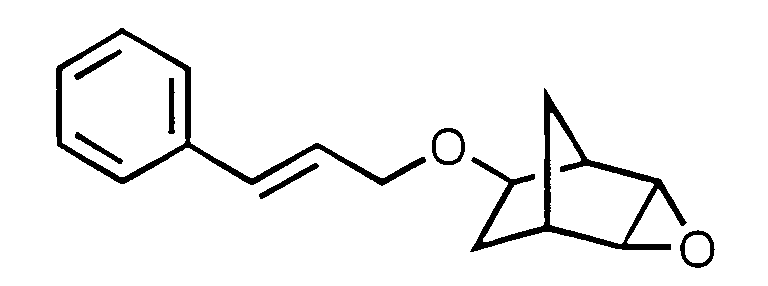
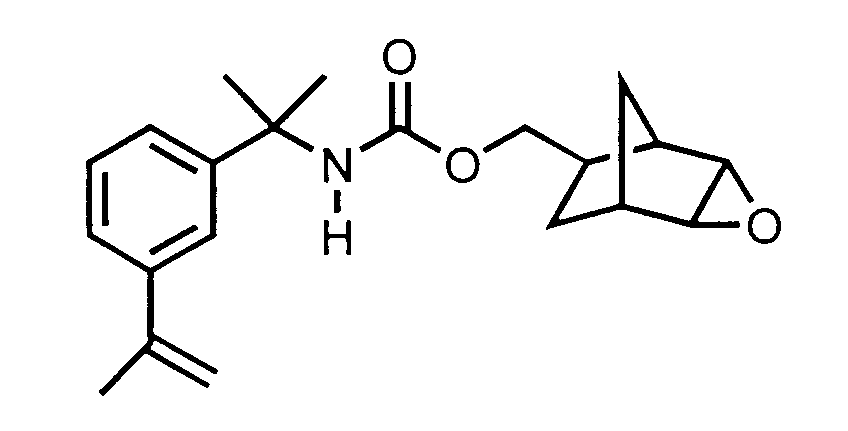
- ARAXWSVBGHFVNI-UHFFFAOYSA-N CC(C)(c1cccc(C(C)=C)c1)NC(OC1C(C2)C3OC3C2C1)=O Chemical compound CC(C)(c1cccc(C(C)=C)c1)NC(OC1C(C2)C3OC3C2C1)=O ARAXWSVBGHFVNI-UHFFFAOYSA-N 0.000 description 1
- LQASLGYSHMGDMT-UHFFFAOYSA-N CC(C)c1cccc(C(C)(C)NC(OCC2CC3OC3CC2)=O)c1 Chemical compound CC(C)c1cccc(C(C)(C)NC(OCC2CC3OC3CC2)=O)c1 LQASLGYSHMGDMT-UHFFFAOYSA-N 0.000 description 1
- MBFXKQNDKGMHIY-UHFFFAOYSA-N CNC(OC)=S Chemical compound CNC(OC)=S MBFXKQNDKGMHIY-UHFFFAOYSA-N 0.000 description 1
- LLUJQOBTVYRNQW-UHFFFAOYSA-N CNC(OCCSC(NC)=O)=S Chemical compound CNC(OCCSC(NC)=O)=S LLUJQOBTVYRNQW-UHFFFAOYSA-N 0.000 description 1
- YUWWOMKVPZHPQI-UHFFFAOYSA-N CNC(SC)=O Chemical compound CNC(SC)=O YUWWOMKVPZHPQI-UHFFFAOYSA-N 0.000 description 1
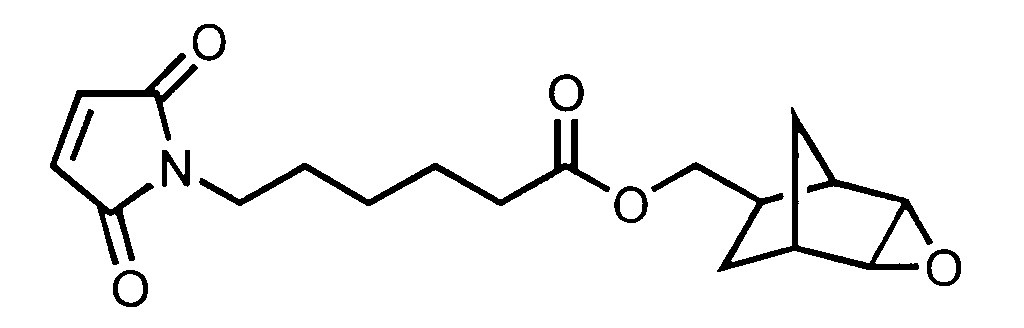
- KRCIFBKWWVHIDM-UHFFFAOYSA-N O=C(C1C(C2)C3OC3C2C1)OCN(C(C=C1)=O)C1=O Chemical compound O=C(C1C(C2)C3OC3C2C1)OCN(C(C=C1)=O)C1=O KRCIFBKWWVHIDM-UHFFFAOYSA-N 0.000 description 1
Classifications
-
- C—CHEMISTRY; METALLURGY
- C08—ORGANIC MACROMOLECULAR COMPOUNDS; THEIR PREPARATION OR CHEMICAL WORKING-UP; COMPOSITIONS BASED THEREON
- C08G—MACROMOLECULAR COMPOUNDS OBTAINED OTHERWISE THAN BY REACTIONS ONLY INVOLVING UNSATURATED CARBON-TO-CARBON BONDS
- C08G59/00—Polycondensates containing more than one epoxy group per molecule; Macromolecules obtained by polymerising compounds containing more than one epoxy group per molecule using curing agents or catalysts which react with the epoxy groups
-
- C—CHEMISTRY; METALLURGY
- C07—ORGANIC CHEMISTRY
- C07D—HETEROCYCLIC COMPOUNDS
- C07D491/00—Heterocyclic compounds containing in the condensed ring system both one or more rings having oxygen atoms as the only ring hetero atoms and one or more rings having nitrogen atoms as the only ring hetero atoms, not provided for by groups C07D451/00 - C07D459/00, C07D463/00, C07D477/00 or C07D489/00
- C07D491/02—Heterocyclic compounds containing in the condensed ring system both one or more rings having oxygen atoms as the only ring hetero atoms and one or more rings having nitrogen atoms as the only ring hetero atoms, not provided for by groups C07D451/00 - C07D459/00, C07D463/00, C07D477/00 or C07D489/00 in which the condensed system contains two hetero rings
- C07D491/04—Ortho-condensed systems
-
- C—CHEMISTRY; METALLURGY
- C07—ORGANIC CHEMISTRY
- C07D—HETEROCYCLIC COMPOUNDS
- C07D303/00—Compounds containing three-membered rings having one oxygen atom as the only ring hetero atom
- C07D303/02—Compounds containing oxirane rings
- C07D303/12—Compounds containing oxirane rings with hydrocarbon radicals, substituted by singly or doubly bound oxygen atoms
- C07D303/16—Compounds containing oxirane rings with hydrocarbon radicals, substituted by singly or doubly bound oxygen atoms by esterified hydroxyl radicals
-
- C—CHEMISTRY; METALLURGY
- C07—ORGANIC CHEMISTRY
- C07D—HETEROCYCLIC COMPOUNDS
- C07D405/00—Heterocyclic compounds containing both one or more hetero rings having oxygen atoms as the only ring hetero atoms, and one or more rings having nitrogen as the only ring hetero atom
- C07D405/02—Heterocyclic compounds containing both one or more hetero rings having oxygen atoms as the only ring hetero atoms, and one or more rings having nitrogen as the only ring hetero atom containing two hetero rings
- C07D405/12—Heterocyclic compounds containing both one or more hetero rings having oxygen atoms as the only ring hetero atoms, and one or more rings having nitrogen as the only ring hetero atom containing two hetero rings linked by a chain containing hetero atoms as chain links
-
- C—CHEMISTRY; METALLURGY
- C07—ORGANIC CHEMISTRY
- C07D—HETEROCYCLIC COMPOUNDS
- C07D405/00—Heterocyclic compounds containing both one or more hetero rings having oxygen atoms as the only ring hetero atoms, and one or more rings having nitrogen as the only ring hetero atom
- C07D405/14—Heterocyclic compounds containing both one or more hetero rings having oxygen atoms as the only ring hetero atoms, and one or more rings having nitrogen as the only ring hetero atom containing three or more hetero rings
-
- C—CHEMISTRY; METALLURGY
- C07—ORGANIC CHEMISTRY
- C07F—ACYCLIC, CARBOCYCLIC OR HETEROCYCLIC COMPOUNDS CONTAINING ELEMENTS OTHER THAN CARBON, HYDROGEN, HALOGEN, OXYGEN, NITROGEN, SULFUR, SELENIUM OR TELLURIUM
- C07F7/00—Compounds containing elements of Groups 4 or 14 of the Periodic Table
- C07F7/02—Silicon compounds
- C07F7/08—Compounds having one or more C—Si linkages
- C07F7/0834—Compounds having one or more O-Si linkage
- C07F7/0838—Compounds with one or more Si-O-Si sequences
-
- C—CHEMISTRY; METALLURGY
- C08—ORGANIC MACROMOLECULAR COMPOUNDS; THEIR PREPARATION OR CHEMICAL WORKING-UP; COMPOSITIONS BASED THEREON
- C08G—MACROMOLECULAR COMPOUNDS OBTAINED OTHERWISE THAN BY REACTIONS ONLY INVOLVING UNSATURATED CARBON-TO-CARBON BONDS
- C08G18/00—Polymeric products of isocyanates or isothiocyanates
- C08G18/06—Polymeric products of isocyanates or isothiocyanates with compounds having active hydrogen
- C08G18/28—Polymeric products of isocyanates or isothiocyanates with compounds having active hydrogen characterised by the compounds used containing active hydrogen
- C08G18/2805—Compounds having only one group containing active hydrogen
- C08G18/2815—Monohydroxy compounds
- C08G18/2845—Monohydroxy epoxy compounds
-
- C—CHEMISTRY; METALLURGY
- C08—ORGANIC MACROMOLECULAR COMPOUNDS; THEIR PREPARATION OR CHEMICAL WORKING-UP; COMPOSITIONS BASED THEREON
- C08G—MACROMOLECULAR COMPOUNDS OBTAINED OTHERWISE THAN BY REACTIONS ONLY INVOLVING UNSATURATED CARBON-TO-CARBON BONDS
- C08G18/00—Polymeric products of isocyanates or isothiocyanates
- C08G18/06—Polymeric products of isocyanates or isothiocyanates with compounds having active hydrogen
- C08G18/70—Polymeric products of isocyanates or isothiocyanates with compounds having active hydrogen characterised by the isocyanates or isothiocyanates used
- C08G18/81—Unsaturated isocyanates or isothiocyanates
- C08G18/8108—Unsaturated isocyanates or isothiocyanates having only one isocyanate or isothiocyanate group
-
- C—CHEMISTRY; METALLURGY
- C08—ORGANIC MACROMOLECULAR COMPOUNDS; THEIR PREPARATION OR CHEMICAL WORKING-UP; COMPOSITIONS BASED THEREON
- C08G—MACROMOLECULAR COMPOUNDS OBTAINED OTHERWISE THAN BY REACTIONS ONLY INVOLVING UNSATURATED CARBON-TO-CARBON BONDS
- C08G59/00—Polycondensates containing more than one epoxy group per molecule; Macromolecules obtained by polymerising compounds containing more than one epoxy group per molecule using curing agents or catalysts which react with the epoxy groups
- C08G59/18—Macromolecules obtained by polymerising compounds containing more than one epoxy group per molecule using curing agents or catalysts which react with the epoxy groups ; e.g. general methods of curing
- C08G59/20—Macromolecules obtained by polymerising compounds containing more than one epoxy group per molecule using curing agents or catalysts which react with the epoxy groups ; e.g. general methods of curing characterised by the epoxy compounds used
-
- C—CHEMISTRY; METALLURGY
- C08—ORGANIC MACROMOLECULAR COMPOUNDS; THEIR PREPARATION OR CHEMICAL WORKING-UP; COMPOSITIONS BASED THEREON
- C08G—MACROMOLECULAR COMPOUNDS OBTAINED OTHERWISE THAN BY REACTIONS ONLY INVOLVING UNSATURATED CARBON-TO-CARBON BONDS
- C08G59/00—Polycondensates containing more than one epoxy group per molecule; Macromolecules obtained by polymerising compounds containing more than one epoxy group per molecule using curing agents or catalysts which react with the epoxy groups
- C08G59/18—Macromolecules obtained by polymerising compounds containing more than one epoxy group per molecule using curing agents or catalysts which react with the epoxy groups ; e.g. general methods of curing
- C08G59/20—Macromolecules obtained by polymerising compounds containing more than one epoxy group per molecule using curing agents or catalysts which react with the epoxy groups ; e.g. general methods of curing characterised by the epoxy compounds used
- C08G59/22—Di-epoxy compounds
- C08G59/24—Di-epoxy compounds carbocyclic
-
- C—CHEMISTRY; METALLURGY
- C08—ORGANIC MACROMOLECULAR COMPOUNDS; THEIR PREPARATION OR CHEMICAL WORKING-UP; COMPOSITIONS BASED THEREON
- C08G—MACROMOLECULAR COMPOUNDS OBTAINED OTHERWISE THAN BY REACTIONS ONLY INVOLVING UNSATURATED CARBON-TO-CARBON BONDS
- C08G59/00—Polycondensates containing more than one epoxy group per molecule; Macromolecules obtained by polymerising compounds containing more than one epoxy group per molecule using curing agents or catalysts which react with the epoxy groups
- C08G59/18—Macromolecules obtained by polymerising compounds containing more than one epoxy group per molecule using curing agents or catalysts which react with the epoxy groups ; e.g. general methods of curing
- C08G59/20—Macromolecules obtained by polymerising compounds containing more than one epoxy group per molecule using curing agents or catalysts which react with the epoxy groups ; e.g. general methods of curing characterised by the epoxy compounds used
- C08G59/22—Di-epoxy compounds
- C08G59/26—Di-epoxy compounds heterocyclic
-
- C—CHEMISTRY; METALLURGY
- C08—ORGANIC MACROMOLECULAR COMPOUNDS; THEIR PREPARATION OR CHEMICAL WORKING-UP; COMPOSITIONS BASED THEREON
- C08G—MACROMOLECULAR COMPOUNDS OBTAINED OTHERWISE THAN BY REACTIONS ONLY INVOLVING UNSATURATED CARBON-TO-CARBON BONDS
- C08G59/00—Polycondensates containing more than one epoxy group per molecule; Macromolecules obtained by polymerising compounds containing more than one epoxy group per molecule using curing agents or catalysts which react with the epoxy groups
- C08G59/18—Macromolecules obtained by polymerising compounds containing more than one epoxy group per molecule using curing agents or catalysts which react with the epoxy groups ; e.g. general methods of curing
- C08G59/20—Macromolecules obtained by polymerising compounds containing more than one epoxy group per molecule using curing agents or catalysts which react with the epoxy groups ; e.g. general methods of curing characterised by the epoxy compounds used
- C08G59/32—Epoxy compounds containing three or more epoxy groups
- C08G59/3218—Carbocyclic compounds
-
- C—CHEMISTRY; METALLURGY
- C08—ORGANIC MACROMOLECULAR COMPOUNDS; THEIR PREPARATION OR CHEMICAL WORKING-UP; COMPOSITIONS BASED THEREON
- C08G—MACROMOLECULAR COMPOUNDS OBTAINED OTHERWISE THAN BY REACTIONS ONLY INVOLVING UNSATURATED CARBON-TO-CARBON BONDS
- C08G59/00—Polycondensates containing more than one epoxy group per molecule; Macromolecules obtained by polymerising compounds containing more than one epoxy group per molecule using curing agents or catalysts which react with the epoxy groups
- C08G59/18—Macromolecules obtained by polymerising compounds containing more than one epoxy group per molecule using curing agents or catalysts which react with the epoxy groups ; e.g. general methods of curing
- C08G59/20—Macromolecules obtained by polymerising compounds containing more than one epoxy group per molecule using curing agents or catalysts which react with the epoxy groups ; e.g. general methods of curing characterised by the epoxy compounds used
- C08G59/32—Epoxy compounds containing three or more epoxy groups
- C08G59/3236—Heterocylic compounds
-
- G—PHYSICS
- G03—PHOTOGRAPHY; CINEMATOGRAPHY; ANALOGOUS TECHNIQUES USING WAVES OTHER THAN OPTICAL WAVES; ELECTROGRAPHY; HOLOGRAPHY
- G03F—PHOTOMECHANICAL PRODUCTION OF TEXTURED OR PATTERNED SURFACES, e.g. FOR PRINTING, FOR PROCESSING OF SEMICONDUCTOR DEVICES; MATERIALS THEREFOR; ORIGINALS THEREFOR; APPARATUS SPECIALLY ADAPTED THEREFOR
- G03F7/00—Photomechanical, e.g. photolithographic, production of textured or patterned surfaces, e.g. printing surfaces; Materials therefor, e.g. comprising photoresists; Apparatus specially adapted therefor
- G03F7/004—Photosensitive materials
- G03F7/038—Macromolecular compounds which are rendered insoluble or differentially wettable
Definitions
- This invention relates to curable compounds that contain a cycloaliphatic epoxy moiety and a styrenic, cinnamyl, or maleimide moiety.
- Radical-curable compositions are used in adhesive compositions, for example, in the fabrication and assembly of semiconductor packages and microelectronic devices.
- adhesive compositions for example, in the fabrication and assembly of semiconductor packages and microelectronic devices.
- electron donor/electron acceptor adhesive systems that are used in the industry, but not all these give as full performance as is needed for all uses.
- adhesive systems that contain both radical-curable moieties and epoxy functionality.
- the compounds disclosed in this specification add to the spectrum of performance materials for use within the semiconductor fabrication industry.
- This invention relates to compounds that contain a cycloaliphatic epoxy moiety and an electron acceptor moiety or an electron donor moiety.
- the preferred electron acceptor is a maleimide moiety.
- the preferred electron donor is a double bond connected to an aromatic ring and conjugated with the unsaturation in the ring.
- Preferred electron donor moieties are styrenic or cinnamyl moieties.
- this invention is a curable composition, such as an adhesive, coating, or encapsulant composition, containing such compounds.
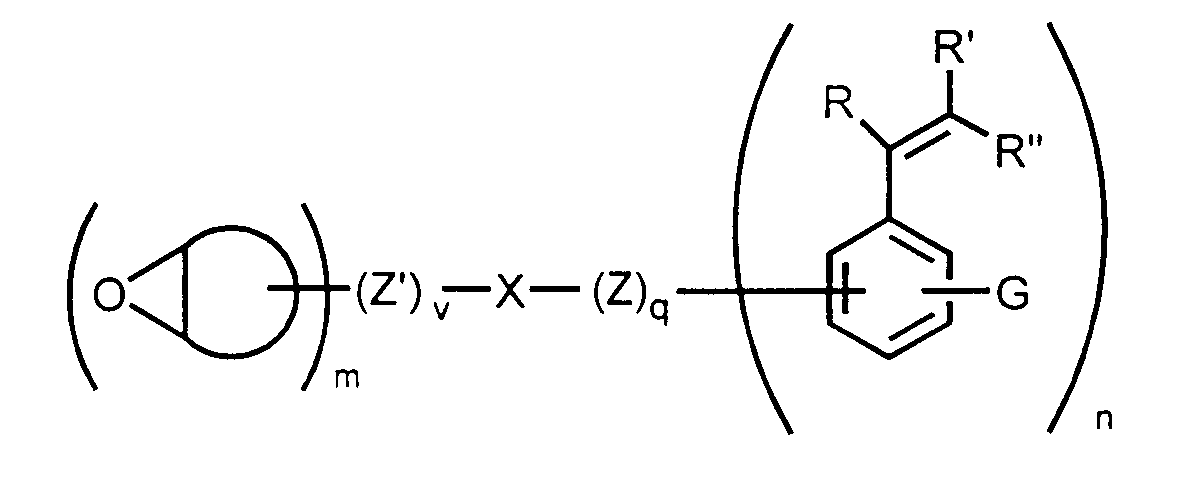
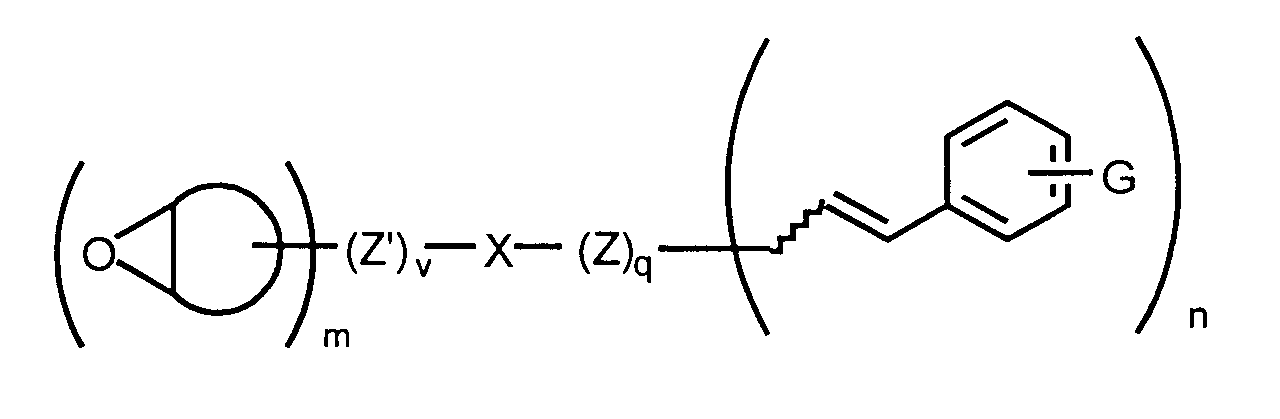
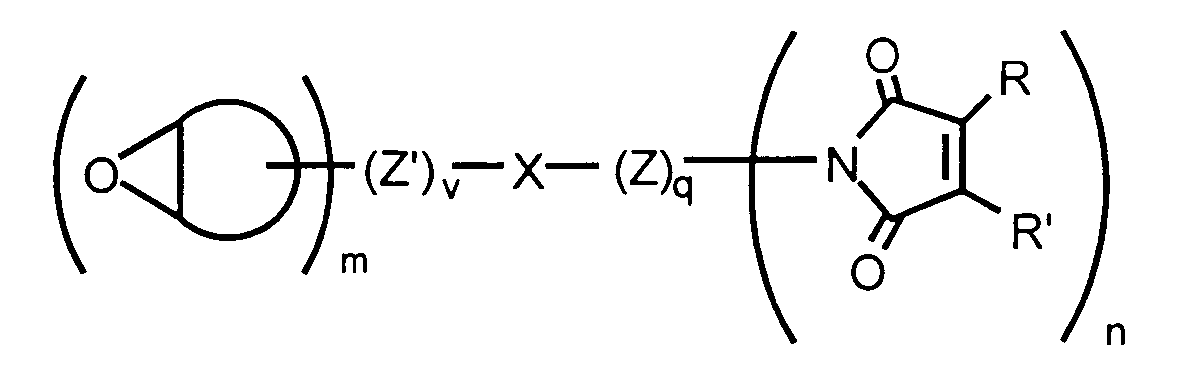
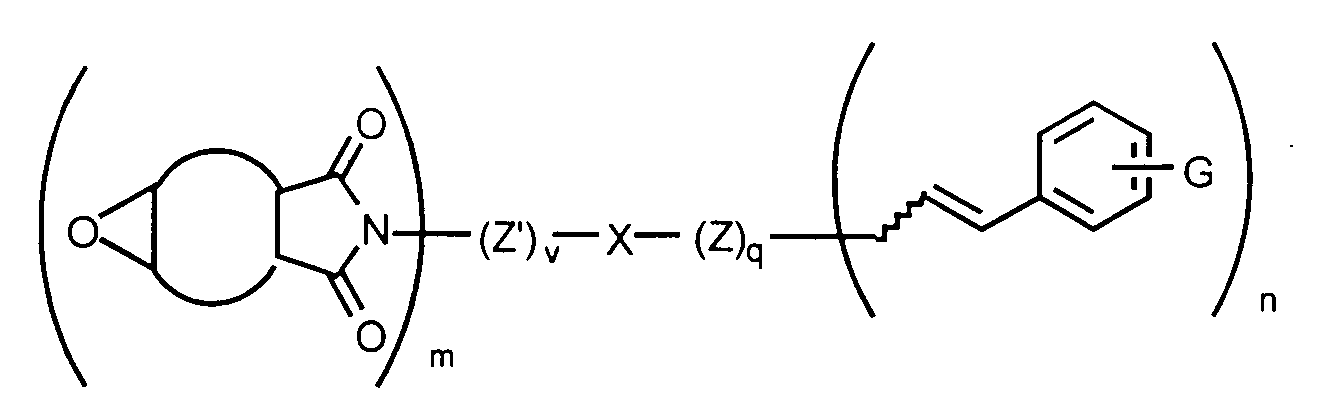
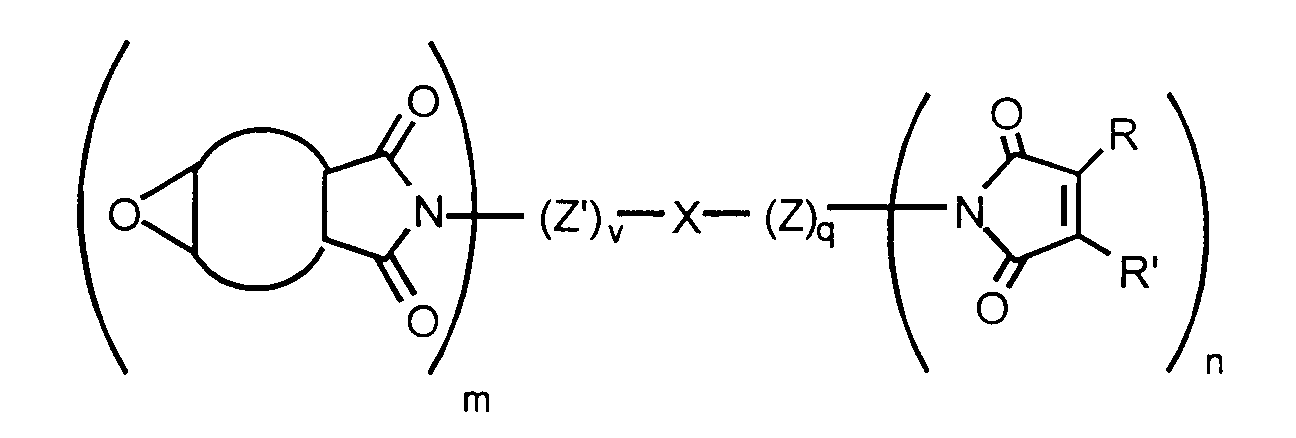
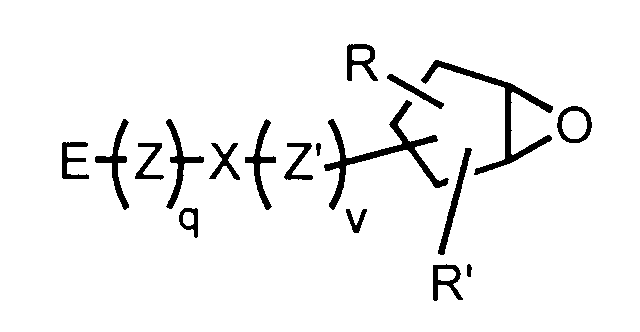
- inventive compounds can be represented by the formulas (in which the bond represented as a wavy line indicates a cis or trans isomer or a racemic mixture of the compound):
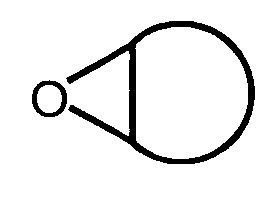
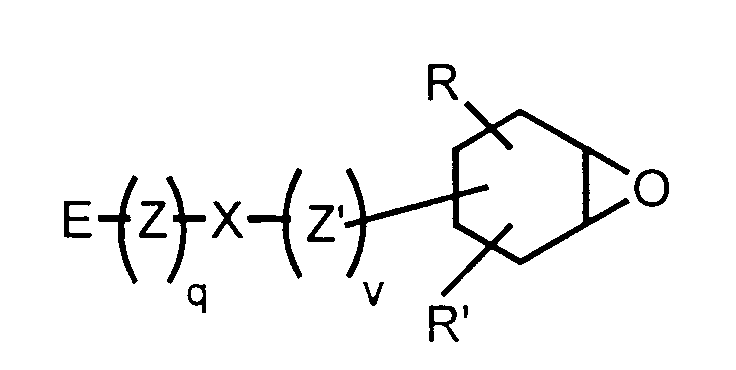
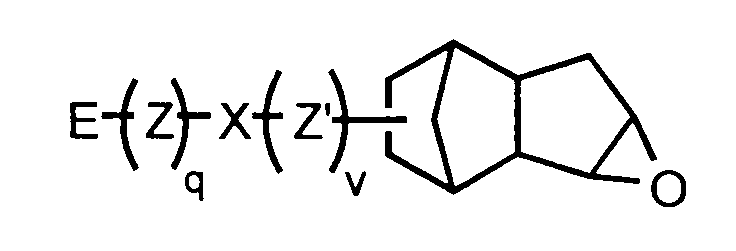
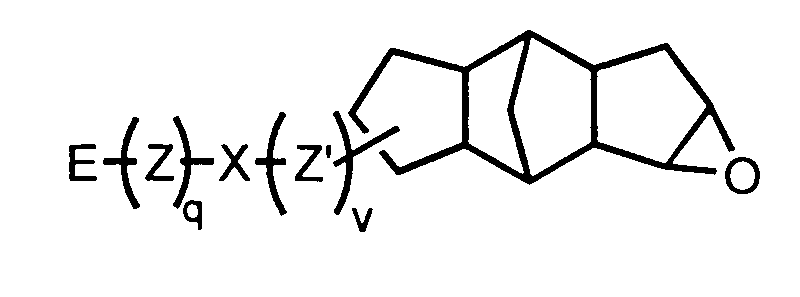
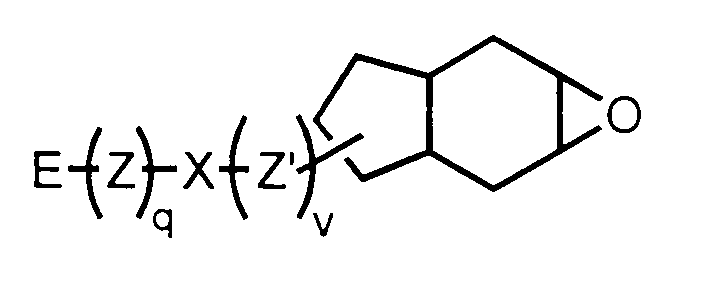
- n and n independently are 1 to 500, preferably 1 to 100, more preferably 1 to 25, and most preferably 1 or 2, q and v independently are 0 or 1; represents a cycloaliphatic epoxy moiety, in which an epoxy group is attached to a cyclic, bicycle or tricyclic ring structure, which structure may contain one or more heteroatoms (N, O, or S); preferably, the cycloaliphatic epoxy moiety is chosen from substituted and unsubstituted five and six membered cyclic rings; substituted and unsubstituted six, seven and eight member bicyclic rings; substituted and unsubstituted nine, ten and eleven member tricyclic rings, in which the substituents on the rings can be any organic moiety, and preferably are lower alkyl;
- R, R', and R" are independently hydrogen, an alkyl group having 1 to 12 carbon atoms and preferably H or 1 to 4 carbon atoms, or an aromatic or heteroaromatic ring or fused ring having 3 to 10 carbon atoms within the ring structure, in which the heteroatoms are N, O, or S;
- G is -OR, -SR, or -N(R)(R') in which R and R' are as described above; or G is an alkyl group having 1 to 12 carbon atoms; or G is an aromatic or heteroaromatic ring or fused ring having 3 to 10 carbon atoms within the ring structure, in which the heteroatoms may be N, O, or S;
- Z and Z' are any monomeric, oligomeric or polymeric organic moiety (for example, alkyl, cycloalkyl, aryl alkyl, alkenyl, cycloalkenyl, aryl alkenyl, or aromatic, and for example poly(butadiene), polyether, polyester, polyurethane, polyacrylic, polystyrene, polycarbonate, polysulfone); and
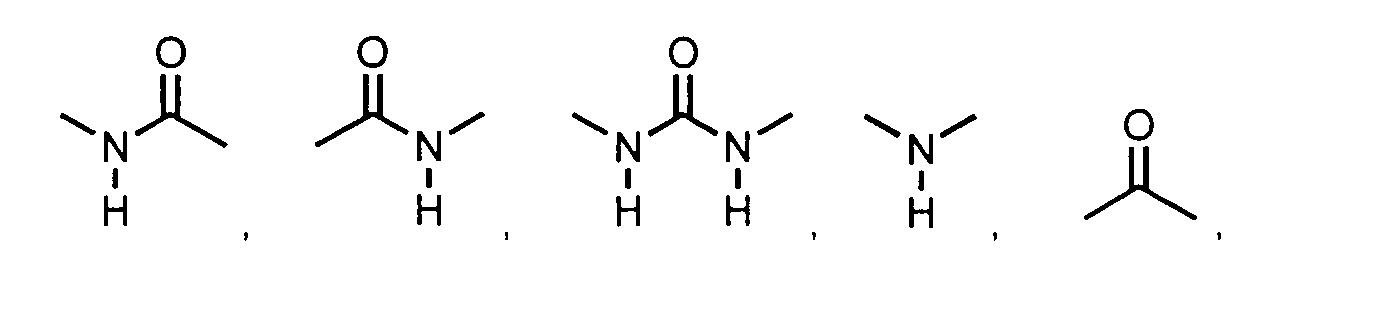
- X is a direct bond or a functional group selected from the groups consisting of: provided that X cannot be oxygen when the cyclic epoxy is epoxy cyclohexane and the other functionality is a styrenic moiety.
- this invention is a curable composition, such as an adhesive, coating, or encapsulant, containing the compound with both cycloaliphatic epoxy and styrenic, cinnamyl, or maleimide functionality.
- the composition can be a paste, prepared by blending or milling, or can be a film, prepared by standard film making techniques known to those skilled in the art.
- the curable composition will include optionally a curing agent, and optionally a filler.
- These compounds can be the main component in the curable composition or can be added as an adhesion promoter to one or more other curable resins.
- an adhesion promoter the amount used in the curable composition will be an effective amount to promote adhesion and, in general, an effective amount will range from 0.005 to 20.0 percent by weight of the formulation.
- curable resins for use as the main component in the curable compositions include epoxies, vinyl ethers, thiolenes, compounds derived from cinnamyl and styrenic starting compounds, fumarates, maleates, acrylates, and maleimides.
- Suitable curing agents are thermal initiators and photoinitiators present in an effective amount to cure the composition. In general, those amounts will range from 0.1% to 30%, preferably 1% to 20%, by weight of the total organic material (that is, excluding any inorganic fillers) in the composition.
- Preferred thermal initiators include peroxides, such as butyl peroctoates and dicumyl peroxide, and azo compounds, such as 2,2'-azobis(2-methyl-propanenitrile) and 2,2'-azobis(2-methyl-butanenitrile).
- a preferred series of photoinitiators are those sold under the trademark Irgacure or Rhodorsil 2074 by Ciba Specialty Chemicals. In some formulations, both thermal initiation and photoinitiation may be desirable: the curing process can be started either by irradiation, followed by heat, or can be started by heat, followed by irradiation.
- the curable compositions will cure within a temperature range of 60°C to 250°C, and curing will be effected within a range of three seconds to three hours.
- the actual cure profile will vary with the components and can be determined without undue experimentation by the practitioner.
- the curable compositions may also comprise nonconductive or thermally or electrically conductive fillers.
- Suitable conductive fillers are carbon black, graphite, gold, silver, copper, platinum, palladium, nickel, aluminum, silicon carbide, boron nitride, diamond, and alumina.
- Suitable nonconductive fillers are particles of vermiculite, mica, wollastonite, calcium carbonate, titania, sand, glass, fused silica, fumed silica, barium sulfate, and halogenated ethylene polymers, such as tetrafluoroethylene, trifluoroethylene, vinylidene fluoride, vinyl fluoride, vinylidene chloride, and vinyl chloride. If present, fillers generally will be in amounts of 20% to 90% by weight of the formulation.
- this invention is a curable composition
- a curable composition comprising the compound having a cycloaliphatic epoxy moiety and a styrenic, cinnamyl, or maleimide moiety, and an aliphatic or aromatic epoxy resin.
- the epoxy resin has the structure
- Procedures and Examples disclose representative compounds containing at least one cycloaliphatic epoxy moiety and one styrenic, cinnamyl, or maleimide moiety per molecule and the synthetic procedures for making those compounds. Also disclosed is the performance of samples in curable compositions.
- PROCEDURE 1 Reaction of isocyanate with alcohol.
- One mole equivalent of isocyanate is solvated in toluene in a three-necked flask equipped with a mechanical stirrer, addition funnel and nitrogen inlet/outlet.
- the reaction is placed under nitrogen, and a catalytic amount of dibutyltin dilaurate (catalyst) is added with stirring as the solution is heated to 60°C.
- the addition funnel is charged with one mole equivalent of alcohol dissolved in toluene. This solution is added to the isocyanate solution over ten minutes, and the resulting mixture is heated for an additional three hours at 60°C. After the reaction cools to room temperature, the solvent is removed in vacuo to give the product.
- PROCEDURE 2 Reaction of alcohol with acid chloride. One mole equivalent of alcohol and triethylamine are mixed in dry methylene chloride at 0°C. One mole equivalent acid chloride dissolved in dry methylene chloride is carefully added. The mixture is allowed to react for four hours. The solvent is evaporated and the crude product is purified by column chromatography using a gradient of hexane / ethyl acetate to give the product.
- PROCEDURE 3 Reaction of alkyl halide with alcohol. One mole equivalent of alcohol, excess amount of 50% NaOH, a catalytic amount of tetrabutyl ammonium hydrogen sulfate, and one mole equivalent of alkyl halide in toluene are stirred for five hours at 53°C, then five hours at 75°C. The reaction cools to room temperature and the organic layer extracted and washed with brine three times. The isolated organic layer is then dried over MgSO 4 , filtered and the solvent removed in vacuo to give the product.
- PROCEDURE 4 Reaction of disiloxane with vinyl epoxy.
- a round-bottomed flask is charged with one mole equivalent of disiloxane and one mole equivalent of vinyl epoxy resin.
- the reaction flask is equipped with a magnetic stirrer and a reflux condenser.
- a catalytic amount of tris(triphenylphosphine)rhodium(I) chloride is added to this mixture.
- the reaction is followed using gas chromatography by monitoring the disappearance of the starting materials and the appearance of the products. After the completion of the reaction, pure product is obtained by fractional vacuum distillation.
- PROCEDURE 5 Hydrosilation.
- One mole equivalent of alkene is dissolved in toluene and placed in a two-necked round bottomed flask.
- One mole equivalent of epoxy siloxane adduct is added to the flask, and the reaction mixture is heated to 60°C.
- One drop of Karstedt's catalyst is added, and the hydrosilation reactions are obtained by following disappearance of Si-H band at 2117 cm -1 in the infrared spectrum. The reaction is over in approximately two to three hours.
- the reaction mixture is poured with stirring into methanol to precipitate the grafted poly(butadiene) polymer.
- the precipitated product is washed with methanol and dried in vacuo at 60°C for eight hours.
- PROCEDURE 6 Reaction of alcohol with carboxylic acid. Into four neck flask is placed one mole equivalent of (0.4739 mol) carboxylic acid. Also charged is one mole equivalent (0.2256 mol) of alcohol, and catalytic amount of sulfuric acid. Toluene is used to solvate the reaction mixture. At this point, the flask is fitted with a Dean Stark apparatus, mercury thermometer, mechanical stirrer, and nitrogen blanket. The reaction mixture is raised to reflux (110°C). Reflux is maintained for approximately four hours at which point the condensate trap is emptied to remove collected water, and allowed to refill with fresh distillate. An equal amount of virgin solvent is charged to the flask to maintain a consistent solvent level.
- the trap is again emptied and allowed to refill; again back charging fresh solvent to replace the distillate that is removed. This process is repeated four more times in an effort to drive the maximum amount of water from the system.
- the oil bath is removed and the reaction shut down. The solvent is evaporated and the crude product is purified by column chromatography using a gradient of hexane / ethyl acetate to give the product.
- PROCEDURE 7 Reaction of amine with acid chloride. One equivalent of amine and one equivalent of triethylamine are mixed in dry methylene chloride at 0°C. One equivalent of acid chloride dissolved in dry methylene chloride is carefully added. The mixture is allowed to react for four hours. The solvent is evaporated and the crude product is purified by column chromatography using a gradient of hexane / ethyl acetate to give the product.
- PROCEDURE 8 Conversion of alcohol functionality to chloride functionality.
- the synthetic procedure is conducted according to E. W. Collington and A. I. Meyers, J. Org. Chem. 36, 3044 (1971).
- a stirred mixture of one mole equivalent of alcohol and 1.1 mole equivalent of s-collidine under nitrogen is treated with one equivalent of lithium chloride dissolved in a minimum amount of dry dimethylformamide.
- the aqueous layer is extracted with cold ether-pentane (1:1) and the combined extracts are washed successively with saturated copper nitrate solution. This is continued until no further intensification of the blue copper solution occurs, indicating complete removal of s-collidine.
- the organic extracts are dried (Na 2 SO 4 ) and concentrated at room temperature, providing a residue of the product.
- PROCEDURE 9 Reaction of alkyl halide with amine.
- One mole equivalent of alkyl halide is solvated in THF in a three neck flask equipped with a mechanical stirrer and addition funnel.
- the addition funnel is charged with one mole equivalent of amine in THF.
- This solution is added to the alkyl halide solution over ten minutes at 0°C, and the resulting mixture is stirred for 12 hours at room temperature.
- the solvent is removed in vacuo and to the resulting mixture is added ether and water.
- the organic layer is extracted and dried over MgSO 4 .
- the solvent is removed in vacuo to give the product.
- PROCEDURE 10 Reaction of carboxylic acid with isocyanate.
- the synthetic procedure is conducted according to T. Nishikubo, E. Takehara, and A. Kameyama, Polymer Journal, 25 , 421 (1993).
- a stirred mixture of one mole equivalent of isocyanate and one mole equivalent of carboxylic acid is solvated in toluene in a three-necked flask equipped with a mechanical stirrer and nitrogen inlet/outlet. The mixture is heated for two hours at 80°C. After the reaction cools to room temperature, the solvent is removed in vacuo to give the product.
- PROCEDURE 11 Reaction of alcohol with vinyl silane. One mole equivalent of alcohol and triethylamine are mixed in dry toluene at 0°C. One mole equivalent of vinyl silane dissolved in toluene is carefully added. The mixture is allowed to react for four hours at room temperature. The solvent is evaporated to give the product.
- Methyl cychohexane methanol epoxide was prepared as follows: 6-Methyl-3-cyclohexene-1-methanol (50 g, 0.396 mole), a 5% aqueous solution of sodium bicarbonate (63 ml) and dichloromethane (94 ml) were charged to a 1L 4-necked round-bottom flask equipped with a mechanical stirrer, pH/temperature probe and two 250 ml slow-addition funnels, each with a side-arm. A 40% aqueous solution of potassium hydroxide (250 ml) was charged to funnel #1 and a solution of sodium acetate (10.42 g) dissolved in peracetic acid (32% by weight, 235.4 g total) was charged to funnel #2.
- reaction flask was cooled in an ice bath with vigorous mixing while the peracetic acid solution was added over three hours, maintaining a reaction temperature of 5° -10°C.
- potassium hydroxide solution (funnel #1) was added as needed.
- the reaction temperature was held at 5° to 10°C for two hours, after which the ice bath was removed.
- the organic and aqueous fractions were isolated using a separatory funnel.
- the product was twice extracted from the aqueous phase with dichloromethane (40 ml each) and the organic fractions were combined and filtered to remove solids.
- An aqueous sodium bicarbonate solution (5% by weight, 50 ml) was slowly added to the organic fraction and mixed until bubbling stopped.
- the resulting white emulsion was placed in a separatory funnel and the organic phase was collected.
- the product was then extracted from the aqueous phase with dichloromethane (25ml) and the organic phases were combined and filtered.
- Methyl cyclohexane methanol epoxide (intermediate) (20.00 g, 0.1163 moles), toluene (50 ml), tetrabutyl ammonium hydrogen sulfate (8.70 g, 0.0256 moles) and 50% sodium hydroxide solution (150 ml) were combined in a 500 ml 4-necked round bottom flask equipped with a condenser, mechanical mixer and oil bath. The mixture was stirred and the oil bath was heated to 90°C at which temperature the solids were totally dissolved.
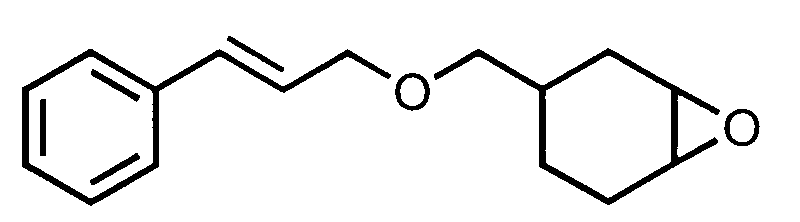
- Cinnamyl chloride was added over approximately 20 minutes. The reaction was heated at 90°C with mixing for an additional hour and then allowed to cool to room temperature. The organic phase was isolated in a separatory funnel and washed three times with 20% sodium chloride solution (200 ml each). As a result, the pH of the washes dropped from 12 to 6. A final wash (200 ml) using distilled water resulted in an emulsion, which was allowed to separate over night.
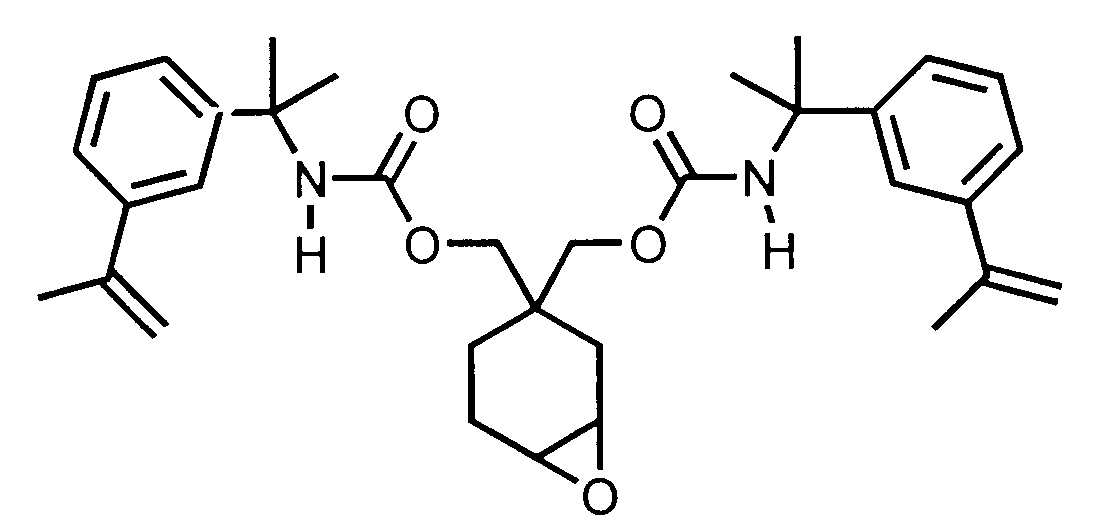
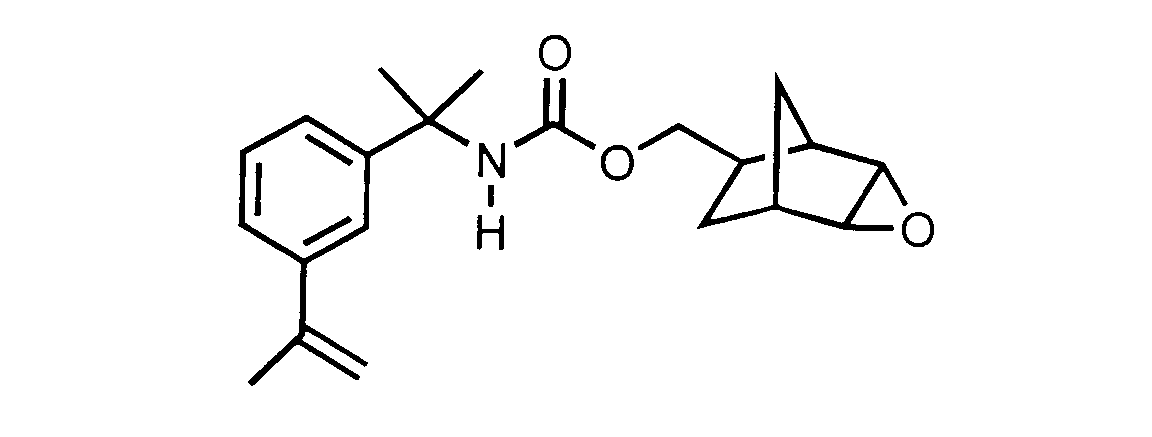
- EXAMPLE II Methyl-cyclohexane epoxide methanol (intermediate from EXAMPLE I) (25 g, 0.1760 moles), 3-isopropenyl- ⁇ , ⁇ -dimethylbenzyl isocyanate ( m -TMI) (35.50 g, 0.1760 moles) and toluene (30 ml) were combined in a 250 ml four-necked round bottom flask equipped with a condenser, mechanical mixer, nitrogen purge and oil bath. The reaction was placed under nitrogen and two drops of dibutyltin dilaurate were added with stirring as the oil bath was heated to 80°C. Heating and stirring of the reaction solution was continued for 24 hours resulting in a clear gold solution. The solvent was removed in vacuo and the product, Compound II, was obtained as thick gold liquid product in quantitative yield.
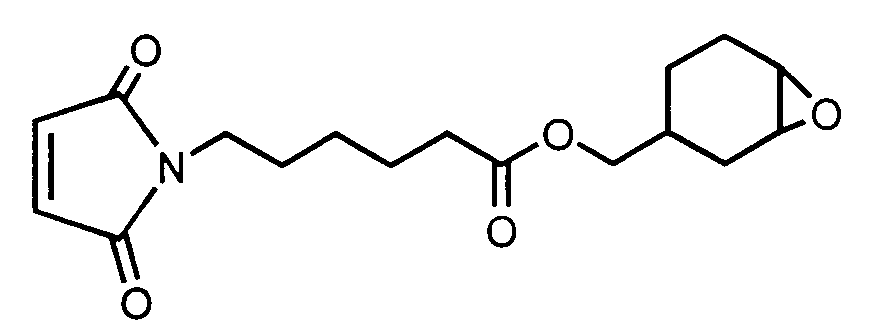
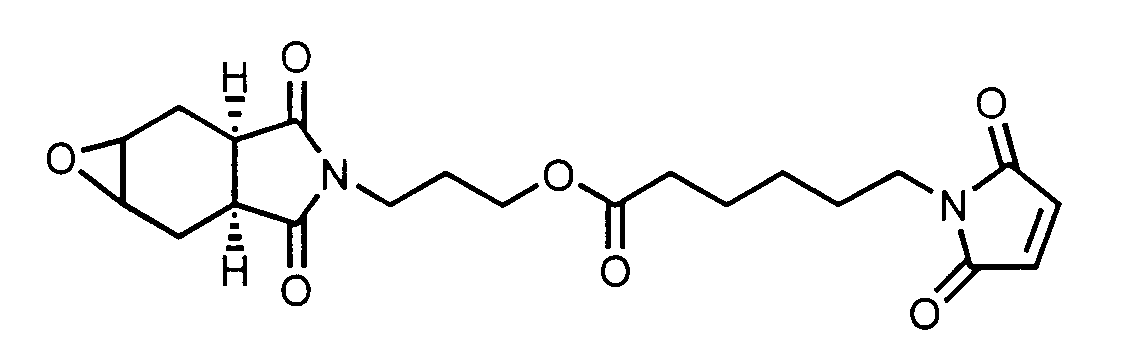
- EXAMPLE III Compound III was prepared from the intermediates 6-maleimidocaproic acid and methyl cyclohexene maleimide.
- 6-Maleimidocaproic acid having the structure was prepared as follows: A solution of one mole equivalent of maleic anhydride in acetonitrile was added to a one mole equivalent of 6-aminocaprioc acid in acetic acid. The mixture was allowed to react for three hours at room temperature. The formed white crystals were filtered off, washed with cold acetonitrile and dried to produce the amic acid adduct.
- the amic acid adduct was mixed with triethylamine in toluene. The mixture was heated to 130°C for two hours and water was collected in a Dean-Stark trap. The organic solvent was evaporated and 2M HCL added to reach pH 2. Extraction with ethyl acetate and drying over MgSO 4 followed by evaporating of the solvent gave the intermediate 6-maleimidocaproic acid (MCA).
- MCA 6-maleimidocaproic acid
- the intermediate methyl cyclohexene maleimide having the structure was prepared as follows: 6-maleimidocaproic acid (140.00 g, 0.6635 moles), 6-methyl-3-cyclohexene-1-methanol (69.80 g, 0.5529 mole), and toluene (600 ml) were combined in a 1L 4-necked round-bottom flask. The flask was fitted with an overhead mixer and thermometer. A Dean-Stark trap was fitted onto the flask with a reflux condenser and nitrogen purge. The mixer and nitrogen purge were started and the oil bath was heated with a set point of 140°C.
- Triethylamine (69.92 g, 0.6910 mole) was added, and the mixture was allowed to stir for one hour. Next, toluene and excess triethylamine were stripped from the reaction solution in vacuo. The resulting amber colored syrup was dissolved in dichloromethane (1000 ml) and this liquid washed with a 20% sodium chloride solution (800 ml). Following separation into two phases, the organic fraction was collected as a gold emulsion. Silica gel (85.00 g) was added to this fraction and the mixture was stirred for 30 minutes. Subsequently, the silica gel was filtered out and the reaction solution was dried over magnesium sulfate. At this point, the reaction was a clear, dark brown solution. The dichloromethane was removed in vacuo, resulting in the intermediate, methyl cyclohexene maleimide as a clear, dark amber syrup in 90% yield.
- Methyl cyclohexene maleimide (70.00 g, 0.2295 mole) and dichloromethane (132 g) were charged to a 1L 4-necked round-bottom flask equipped with a mechanical stirrer, pH/temperature probe and two 250 ml slow-addition funnels, each with a side-arm.
- a 40% aqueous solution of potassium hydroxide (250 ml) was charged to funnel #1 and a solution of sodium acetate (6.03 g) dissolved in peracetic acid (32% by weight, 137.00 g total) was charged to funnel #2.
- the reaction flask was cooled in an ice bath to 5° -10°C with vigorous mixing and a chilled 5% aqueous solution of sodium bicarbonate (90 ml) was added.
- a chilled 5% aqueous solution of sodium bicarbonate 90 ml was added.
- the peracetic acid solution was added slowly while maintaining a reaction temperature of 5° -10 °C.
- the potassium hydroxide solution (funnel #1) was added as needed.
- the reaction temperature was held at 5° to 10°C for two hours and the ice bath was removed.
- the pH was raised to 6.5 - 6.6 with additional 40% potassium hydroxide solution.
- the reaction was then mixed at room temperature for 16 hours and once again, the pH was raised to 6.4 - 6.5 with 40% potassium hydroxide solution.
- the total amount of 40% potassium hydroxide solution added throughout the reaction was 137 ml.
- the organic fraction was isolated using a separatory funnel. Product was then twice extracted from the aqueous phase with dichloromethane (20 ml each). The organic fractions were combined and washed with saturated sodium chloride solution (100 ml) in a separatory funnel. Triethylamine (63.9 g, 0.6312 moles) was added to the hazy gold organic fraction and the color changed to dark orange, immediately. After one hour of mixing, the organic fraction was filtered and washed again with 200 ml saturated sodium chloride solution to remove residual peroxide. Washing continued until indicator strips measured zero ppm peroxides in the wash solution.
- toluene 400 ml was used to extract product from the composite wash solution.
- Dichloromethane was stripped from the organic fraction in vacuo and the resulting opaque amber syrup was dissolved in more toluene.
- the toluene fractions were combined and then washed with more saturated sodium chloride solution (300 ml).
- the organic layer was dried over magnesium sulfate, filtered and stripped in vacuo of toluene and residual triethylamine resulting in Compound III as a cloudy amber syrup in 76% yield.
- EXAMPLE IV According to the procedure from EXAMPLE 1, 5-norbornen-2-ol is reacted with peracetic acid (32% by weight) followed by reaction with m-TMI according to PROCEDURE 1.
- EXAMPLE V According to PROCEDURE 6, 5-norbornen-2-ol is reacted with 6-maleimidocaproic acid (intermediate from EXAMPLE III), followed by reaction with peracetic acid (32% by weight) according to the procedure from EXAMPLE III.
- EXAMPLE VI According to the procedure from EXAMPLE I, 5-norbornen-2-ol is reacted with peracetic acid (32% by weight) followed by reaction with cinnamyl chloride according to PROCEDURE 3.
- EXAMPLE VII According to the procedure from EXAMPLE I, 5-norbornene-2-methanol is reacted with peracetic acid (32% by weight) followed by reaction with m -TMI according to PROCEDURE 1.
- EXAMPLE VIII According to PROCEDURE 6, 5-norbornene-2-methanol is reacted with 6-maleimidocaproic acid (intermediate from EXAMPLE III), followed by reaction with peracetic acid (32% by weight) according to the procedure from EXAMPLE III.
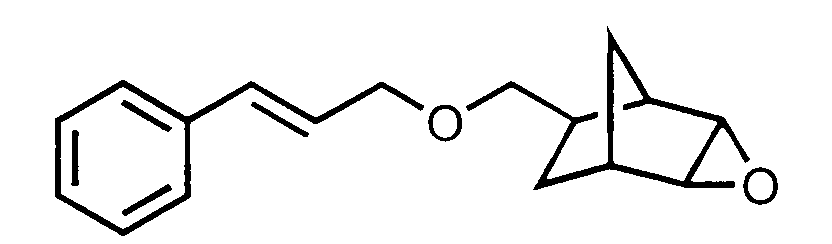
- EXAMPLE IX According to the procedure from EXAMPLE I, 5-norbornene-2-methanol is reacted with peracetic acid (32% by weight) followed by reaction with cinnamyl chloride according to PROCEDURE 3.
- EXAMPLE X According to the procedure from EXAMPLE I, 3-cyclo-hexene-1,1-dimethanol is reacted with peracetic acid (32% by weight) followed by reaction with m -TMI according to PROCEDURE 1.
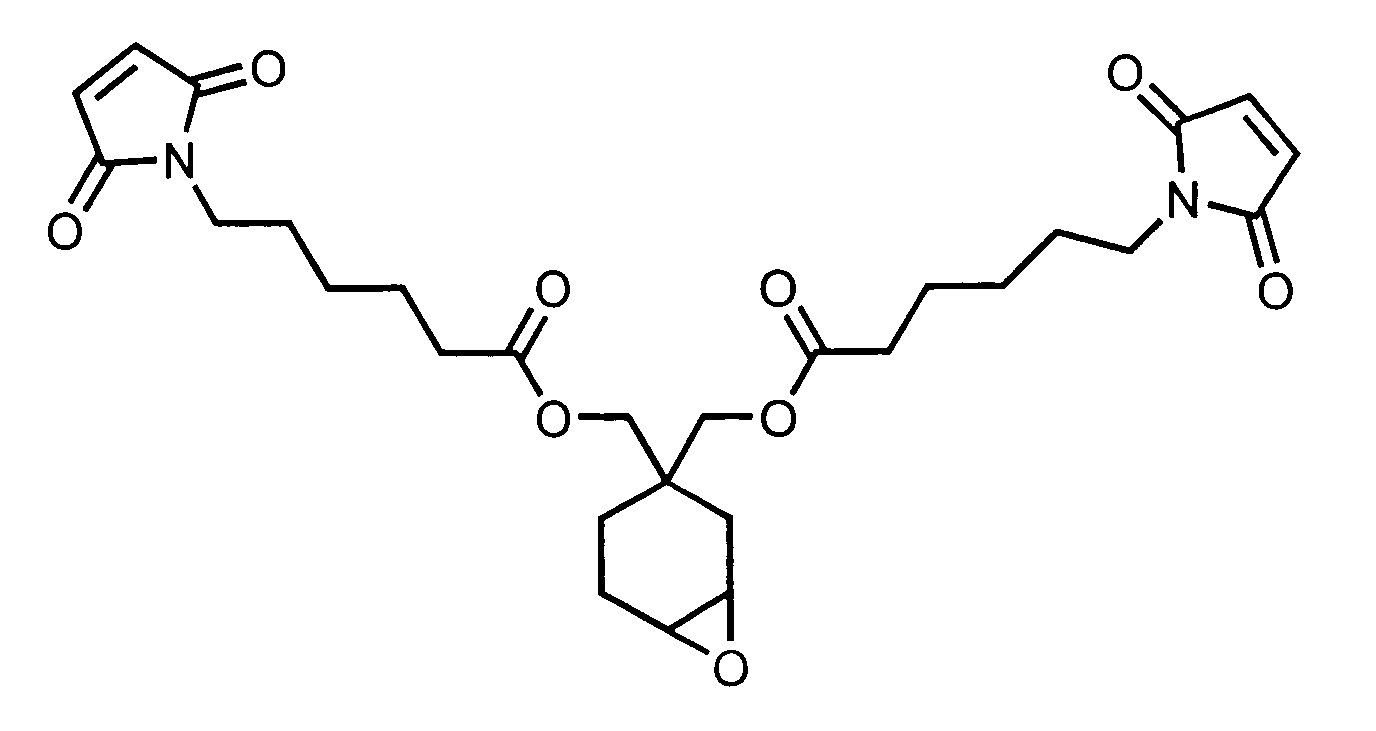
- EXAMPLE XI According to PROCEDURE 6, 3-cyclohexene-1,1-dimethanol is reacted with 6-maleimidocaproic acid (intermediate from EXAMPLE III), followed by reaction with peracetic acid (32% by weight) according to the procedure from EXAMPLE III.
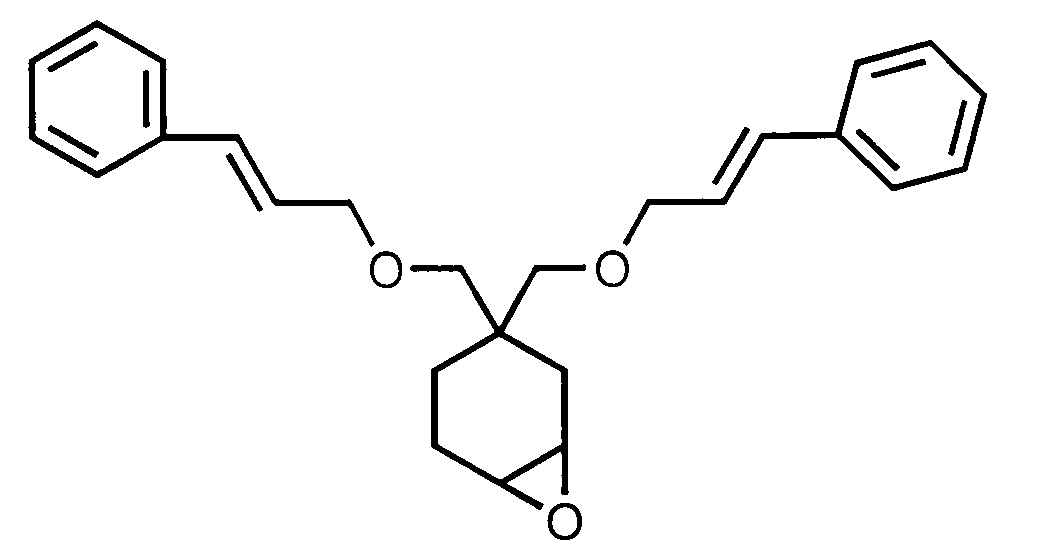
- EXAMPLE XII According to the procedure from EXAMPLE I, 3-cyclo-hexene-1,1-dimethanol is reacted with peracetic acid (32% by weight) followed by reaction with cinnamyl chloride according to PROCEDURE 3.
- EXAMPLE XIII According to the procedure from EXAMPLE I, 5-norbornene-2,2-dimethanol is reacted with peracetic acid (32% by weight) followed by reaction with cinnamyl chloride according to PROCEDURE 3.
- EXAMPLE XIV According to PROCEDURE 6, (2-endo;3-exo)-bicyclo[2.2.2]-octa-5-ene-2,3-dimethanol is reacted with 6-maleimidocaproic acid (intermediate from EXAMPLE III), followed by reaction with peracetic acid (32% by weight) according to the procedure from EXAMPLE III.
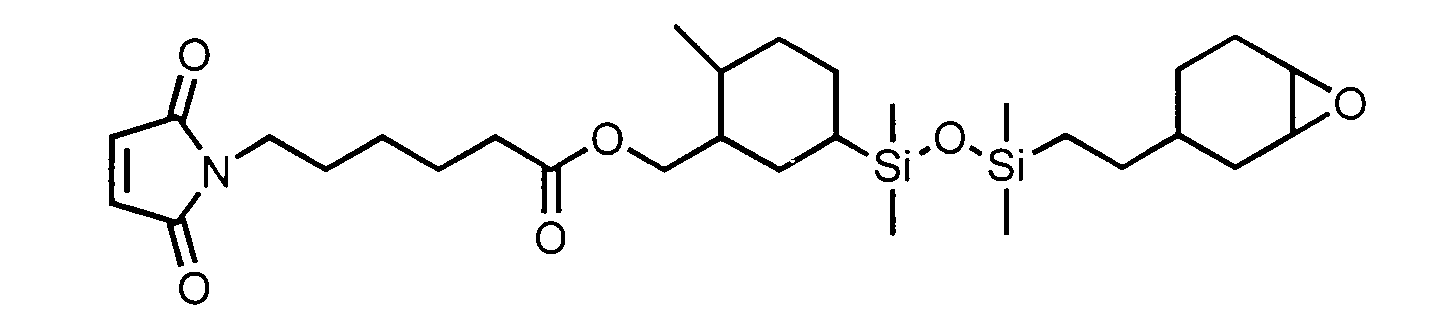
- EXAMPLE XV According to PROCEDURE 4, 3-vinyl-7-oxabicyclo[4.1.0]-heptane is reacted with 1,1,3,3-tetramethyldisiloxane to give 1-[2-(3[7-oxabicyclo [4.1.0] heptyl])ethyl]-1,1,3,3-tetramethyldisiloxane, further reacted with methyl cyclohexene maleimide from EXAMPLE III according to PROCEDURE 5.
- EXAMPLE XVI According to PROCEDURE 6, 5-norbornene-2-carboxylic acid is reacted with N -methylolmaleimide (prepared according to J. Bartus, W. L. Simonsick, and O. Vogl, J.M.S.-Pure Appl. Chem., A36(3), 355, 1999), followed by reaction with peracetic acid (32% by weight) according to the procedure from EXAMPLE III.
- N -methylolmaleimide prepared according to J. Bartus, W. L. Simonsick, and O. Vogl, J.M.S.-Pure Appl. Chem., A36(3), 355, 1999
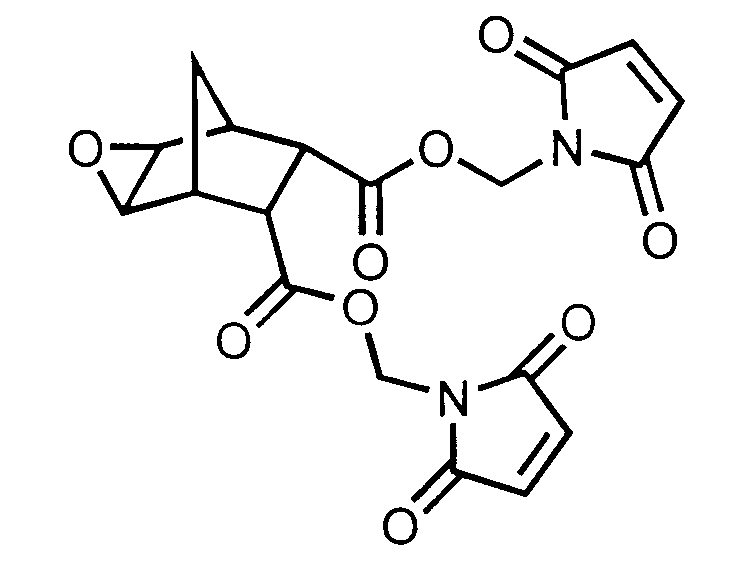
- EXAMPLE XVII According to PROCEDURE 6, cis-5-norbornene-endo-2,3-dicarboxylic acid is reacted with N-methylolmaleimide (prepared according to J. Bartus, W. L. Simonsick, and O. Vogl, J.M.S.-Pure Appl. Chem., A36(3), 355, 1999), followed by reaction with peracetic acid (32% by weight) according to the procedure from EXAMPLE III.
- N-methylolmaleimide prepared according to J. Bartus, W. L. Simonsick, and O. Vogl, J.M.S.-Pure Appl. Chem., A36(3), 355, 1999
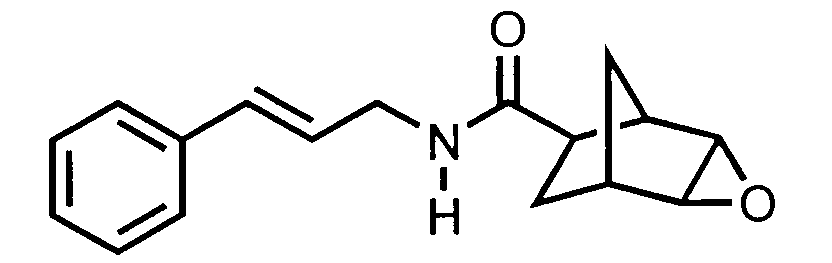
- EXAMPLE XVIII According to the procedure from EXAMPLE I, 5-norbornene-2-acid chloride is reacted with peracetic acid (32% by weight) followed by reaction with cinnamyl amine according to PROCEDURE 7.
- EXAMPLE XIX According to the procedure from EXAMPLE I, 5-norbornene-2-acid chloride is reacted with peracetic acid (32% by weight) followed by reaction with cinnamyl alcohol according to PROCEDURE 2.
- EXAMPLE XX Methyl-cyclohexane epoxide methanol (intermediate from EXAMPLE I) is converted to methyl-cyclohexane epoxide methyl chloride according to PROCEDURE 8, followed by reaction with cinnamyl amine according to PROCEDURE 9.
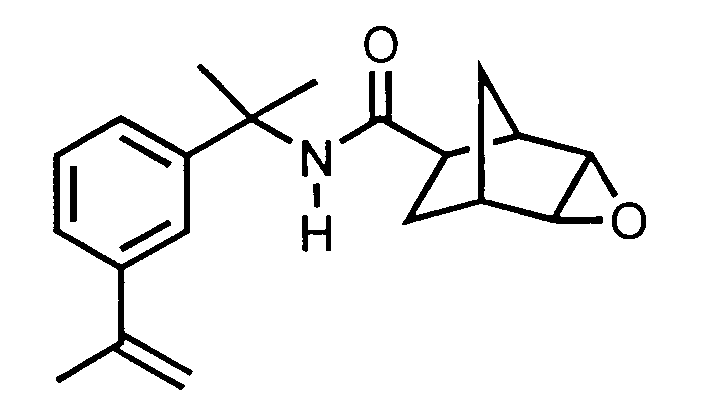
- EXAMPLE XXI According to the procedure from EXAMPLE I, 5-norbornene-2-carboxylic acid is reacted with peracetic acid (32% by weight) followed by reaction with m -TMI according to PROCEDURE 10.
- EXAMPLE XXII In which n and m are approximately 11 and the molecular weight is approximately 17,000 Methylcyclohexane epoxide methanol (intermediate from EXAMPLE I) is converted to methylcyclohexane epoxide methyl chloride according to PROCEDURE 8, followed by reaction with styrene acrylic polymer (Joncryl 587 from Johnson Polymer) according to PRODECURE 3, followed by reaction with m -TMI according to PROCEDURE 1.
- EXAMPLE XXIII According to PROCEDURE 6, 3-cyclohexene-1-methanol is reacted with 6-maleimidocaproic acid (intermediate from EXAMPLE III), followed by reaction with peracetic acid (32% by weight) according to the procedure from EXAMPLE 3.
- EXAMPLE XXIV According to the procedure from EXAMPLE I, 3-cyclohexene-1-methanol is reacted with peracetic acid (32% by weight) followed by reaction with m -TMI according to PROCEDURE 1.
- EXAMPLE XXV According to the procedure from EXAMPLE I, 3-cyclohexene-1-methanol is reacted with peracetic acid (32% by weight) followed by reaction with cinnamyl chloride according to PROCEDURE 3.
- EXAMPLE XXVI A solution of one mole equivalent of cis-1,2,3,6-tetrahydrophthalic anhydride in acetonitrile is added to a one mole equivalent of propanol amine. The mixture is allowed to react for three hours at room temperature. The formed white crystals are filtered off, washed with cold acetonitrile and dried to produce the amic acid adduct. Amic acid is mixed with triethylamine in toluene. The mixture is heated to 130°C for two hours and water is collected in a Dean-Stark trap. The organic solvent is evaporated and 2M HCI added to reach pH 2.
- EXAMPLE XXVII A solution of one mole equivalent of cis-1,2,3,6-tetrahydrophthalic anhydride in acetonitrile is added to a one mole equivalent of propanol amine. The mixture is allowed to react for three hours at room temperature. The formed white crystals are filtered off, washed with cold acetonitrile and dried to produce the amic acid adduct. Amic acid is mixed with triethylamine in toluene. The mixture is heated to 130°C for two hours and water is collected in a Dean-Stark trap. The organic solvent is evaporated and 2M HCI added to reach pH 2.
- EXAMPLE XXVIII A solution of one mole equivalent of cis-1,2,3,6-tetrahydrophthalic anhydride in acetonitrile is added to a one mole equivalent of propanol amine. The mixture is allowed to react for three hours at room temperature. The formed white crystals are filtered off, washed with cold acetonitrile and dried to produce the amic acid adduct. Amic acid is mixed with triethylamine in toluene. The mixture is heated to 130°C for two hours and water is collected in a Dean-Stark trap. The organic solvent is evaporated and 2M HCI added to reach pH 2.
- EXAMPLE XXIX Performance in adhesive formulation.
- An adhesive composition was prepared to contain 20 parts by weight of a bismaleimide resin, 5 parts by weight of an acrylate resin, 3 parts by weight of the compound from EXAMPLE II, 0.15 parts by weight of a photoinitiator 0.4 parts by weight of a radical initiator, and 48.5 parts by weight of silica filler.
- the formulation was used to adhere a 3 X 3 mm silicon die to a silver coated copper leadframe.
- the adhesive was cured by heating at 175°C for 10 seconds. Die shear strength was measured with a Dage 2400-PC Die Shear Tester at room temperature. Ten samples were tested with the average result being 17Kg force.
Landscapes
- Chemical & Material Sciences (AREA)
- Organic Chemistry (AREA)
- Health & Medical Sciences (AREA)
- Chemical Kinetics & Catalysis (AREA)
- Medicinal Chemistry (AREA)
- Polymers & Plastics (AREA)
- Physics & Mathematics (AREA)
- General Physics & Mathematics (AREA)
- Spectroscopy & Molecular Physics (AREA)
- Plural Heterocyclic Compounds (AREA)
- Epoxy Resins (AREA)
- Organic Low-Molecular-Weight Compounds And Preparation Thereof (AREA)
- Pyrrole Compounds (AREA)
- Addition Polymer Or Copolymer, Post-Treatments, Or Chemical Modifications (AREA)
- Epoxy Compounds (AREA)
- Nitrogen Condensed Heterocyclic Rings (AREA)
Abstract
Description




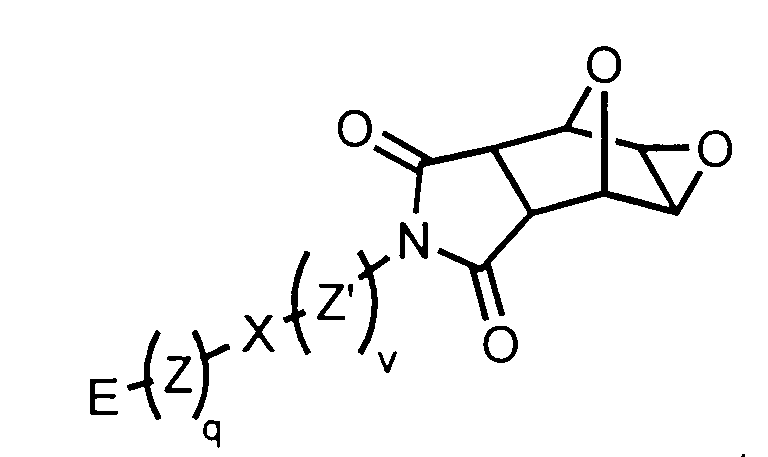
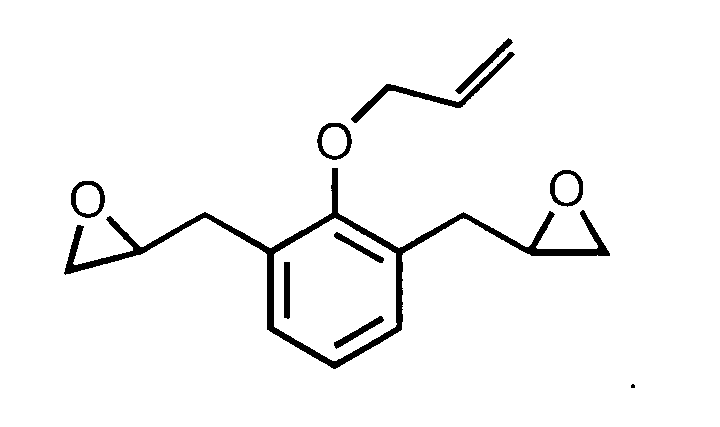
One mole equivalent of alcohol and triethylamine are mixed in dry methylene chloride at 0°C. One mole equivalent acid chloride dissolved in dry methylene chloride is carefully added. The mixture is allowed to react for four hours. The solvent is evaporated and the crude product is purified by column chromatography using a gradient of hexane / ethyl acetate to give the product.


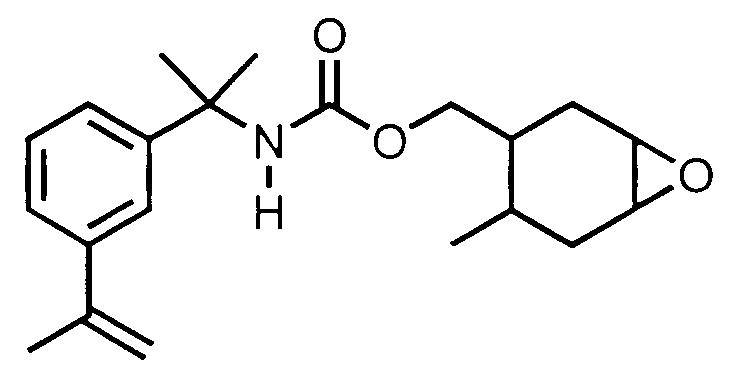


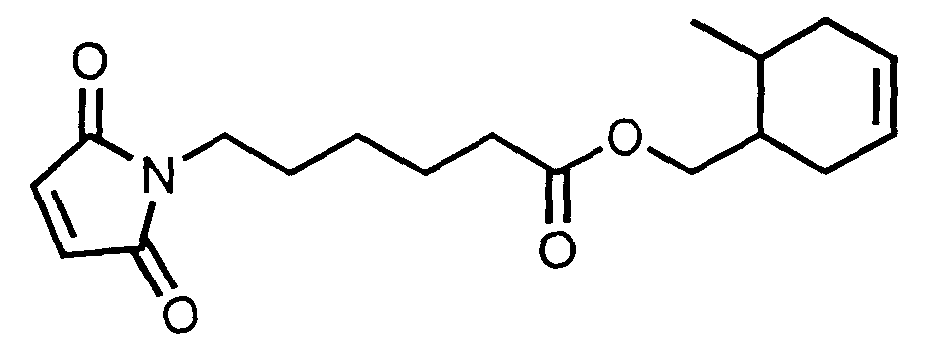








and the molecular weight is approximately 17,000
Methylcyclohexane epoxide methanol (intermediate from EXAMPLE I) is converted to methylcyclohexane epoxide methyl chloride according to PROCEDURE 8, followed by reaction with styrene acrylic polymer (Joncryl 587 from Johnson Polymer) according to PRODECURE 3, followed by reaction with m-TMI according to PROCEDURE 1.



Claims (15)
- A compound having the structure:in which

m and n independently are 1 to 500, q and v independently are 0 or 1;is a cycloaliphatic epoxy moiety, in which an epoxy group is attached to a cyclic, bicyclic or tricyclic ring structure, which structure may contain one or more heteroatoms;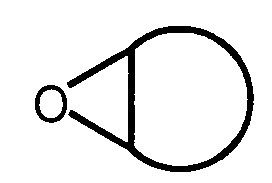
R, R', and R" are independently hydrogen, an alkyl group having 1 to 12 carbon atoms, or an aromatic or heteroaromatic ring or fused ring having 3 to 10 carbon atoms within the ring structure, in which the heteroatoms are N, O, or S;
G is -OR, -SR, or -N(R)(R') in which R and R' are as described above; or
G is an alkyl group having 1 to 12 carbon atoms; or
G is an aromatic or heteroaromatic ring or fused ring having 3 to 10 carbon atoms within the ring structure;
Z and Z' are any monomeric, oligomeric or polymeric organic moiety;
X is a direct bond or a functional group selected from the groups consisting of:
 provided that X cannot be oxygen when the cycloaliphatic epoxy moiety is epoxy cyclohexane.
- The compound according to claim 1 in which the cycloaliphatic epoxy moiety is selected from the group consisting of substituted and unsubstituted five and six membered cyclic rings; substituted and unsubstituted six, seven and eight member bicyclic rings; substituted and unsubstituted nine, ten and eleven member tricyclic rings, in which any substituents on the rings are lower alkyl groups.
- The compound according to claim 1 selected from the group consisting of



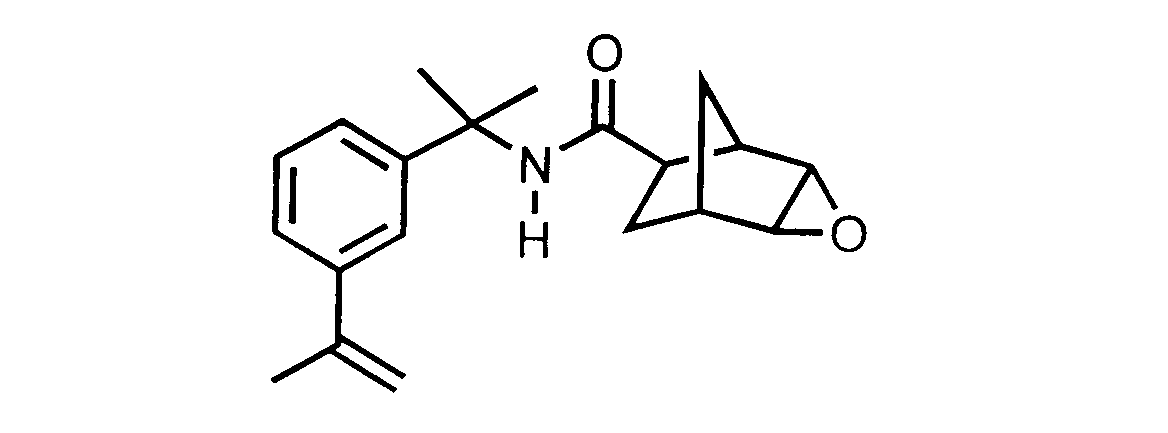 and
and in which n and m are approximately 11, and the molecular weight is approximately 17,000.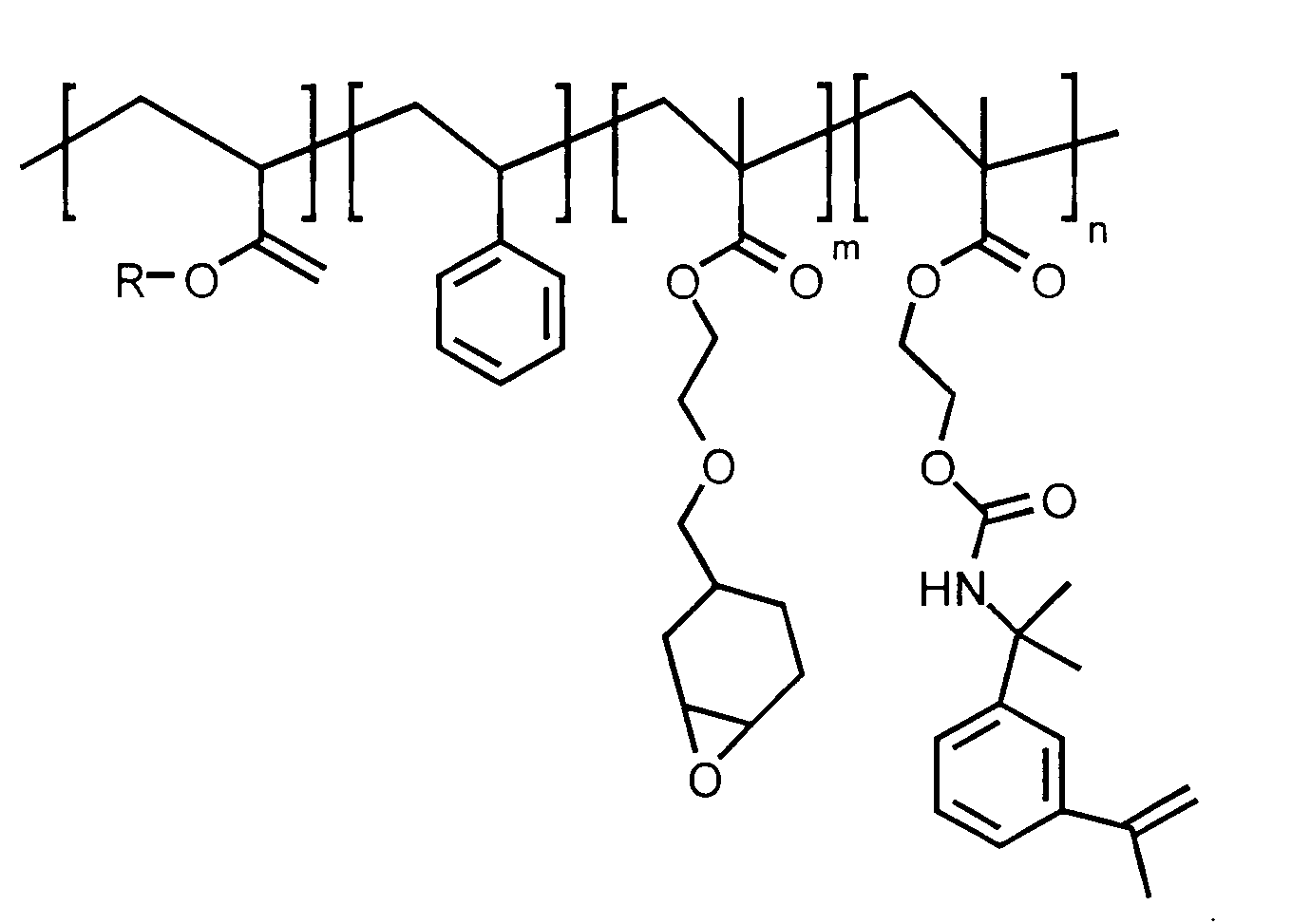
- A compound having the structurein which
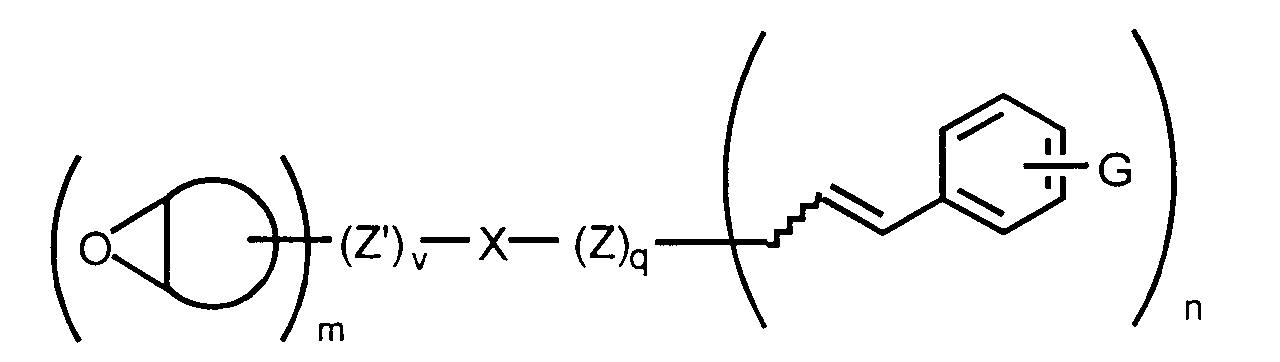
m and n independently are 1 to 500, q and v independently are 0 or 1;is a cycloaliphatic epoxy moiety, in which an epoxy group is attached to a cyclic, bicyclic or tricyclic ring structure, which structure may contain one or more heteroatoms;
G is -OR, -SR, or -N(R)(R') in which R and R' are independently hydrogen, an alkyl group having 1 to 12 carbon atoms, or an aromatic or heteroaromatic ring or fused ring having 3 to 10 carbon atoms within the ring structure; or
G is an alkyl group having 1 to 12 carbon atoms; or
G is an aromatic or heteroaromatic ring or fused ring having 3 to 10 carbon atoms within the ring structure;
Z and Z' are any monomeric, oligomeric or polymeric organic moiety;
X is a direct bond or a functional group selected from the groups consisting of:
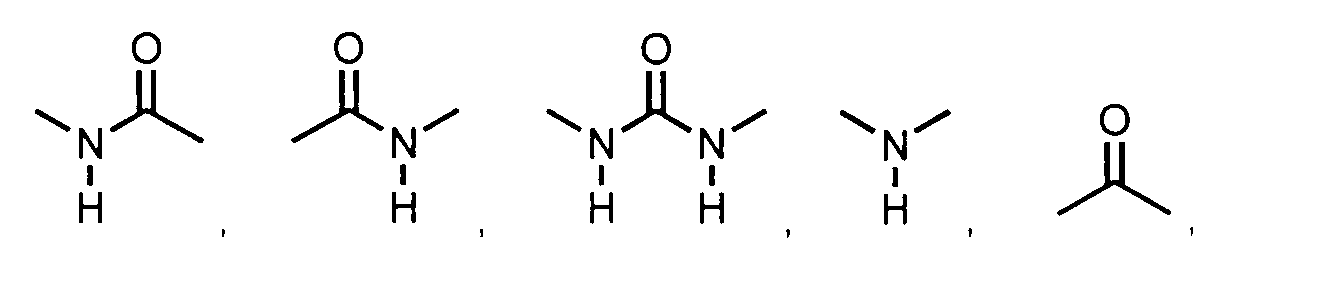

- The compound according to claim 4 in which the cycloaliphatic epoxy moiety is selected from the group consisting of substituted and unsubstituted five and six membered cyclic rings; substituted and unsubstituted six, seven and eight member bicyclic rings; substituted and unsubstituted nine, ten and eleven member tricyclic rings, in which any substituents on the rings are lower alkyl groups.
- The compound according to claim 4 selected from the group consisting of
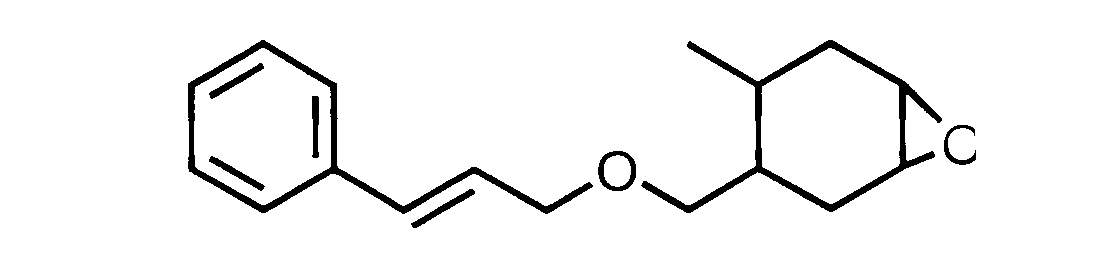
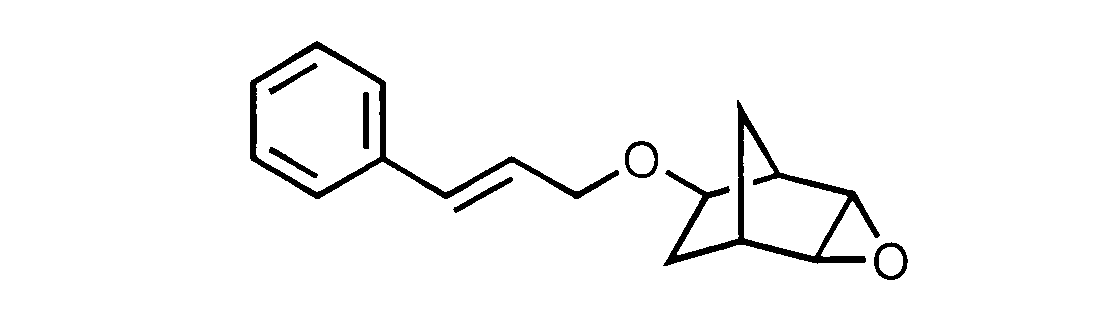

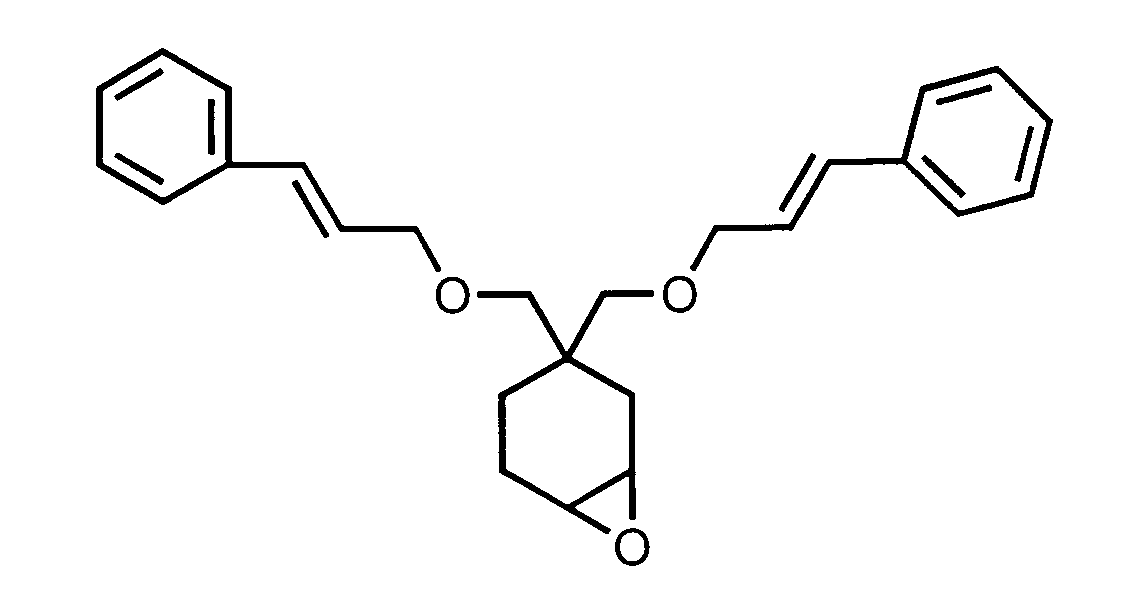
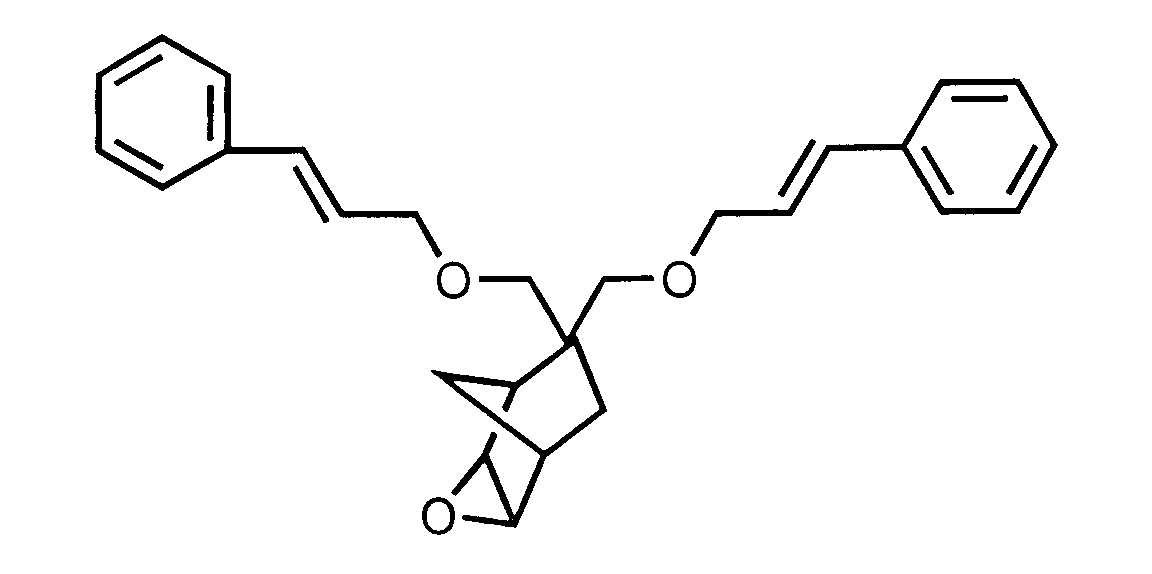

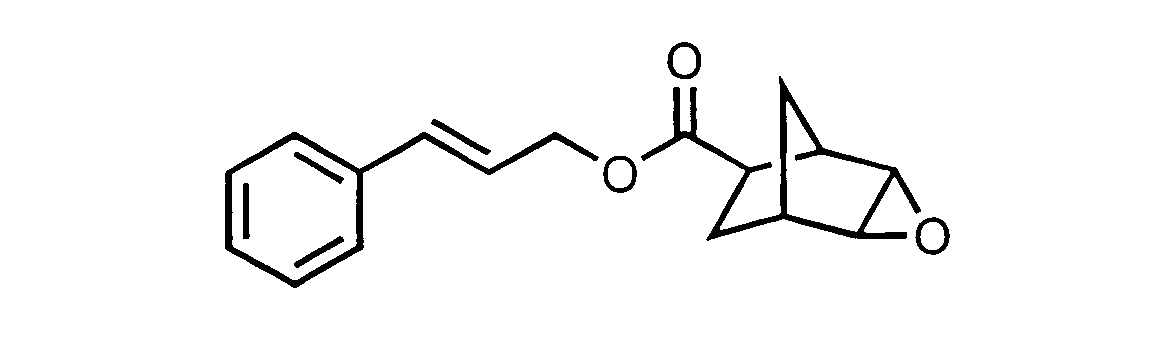 and
and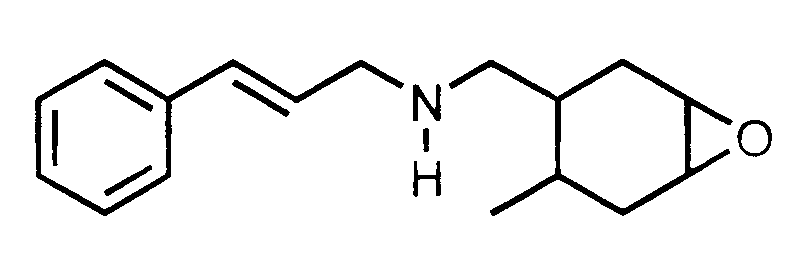

- A compound having the structurein which

m and n independently are 1 to 500, q and v independently are 0 or 1;is a cycloaliphatic epoxy moiety, in which an epoxy group is attached to a cyclic, bicyclic or tricyclic ring structure, which structure may contain one or more heteroatoms;
R, and R' independently are hydrogen, an alkyl group having 1 to 12 carbon atoms, or an aromatic or heteroaromatic ring or fused ring having 3 to 10 carbon atoms within the ring structure;
Z and Z' are any monomeric, oligomeric or polymeric organic moiety;
X is a direct bond or a functional group selected from the groups consisting of: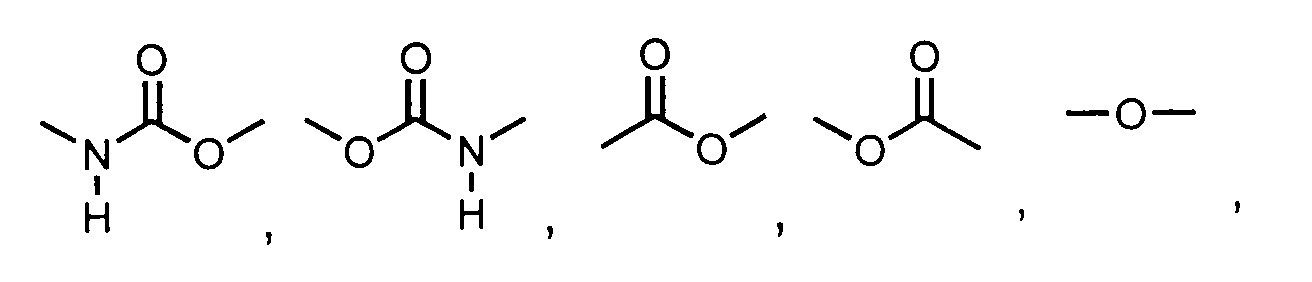


- The compound according to claim 7 in which the cycloaliphatic epoxy moiety is selected from the group consisting of substituted and unsubstituted five and six membered cyclic rings; substituted and unsubstituted six, seven and eight member bicyclic rings; substituted and unsubstituted nine, ten and eleven member tricyclic rings, in which any substituents on the rings are lower alkyl groups.
- The compound according to claim 7 selected from the group consisting of


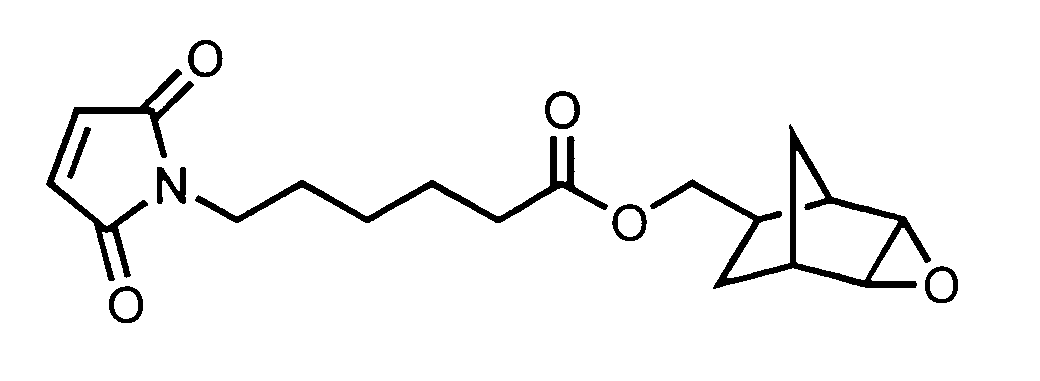


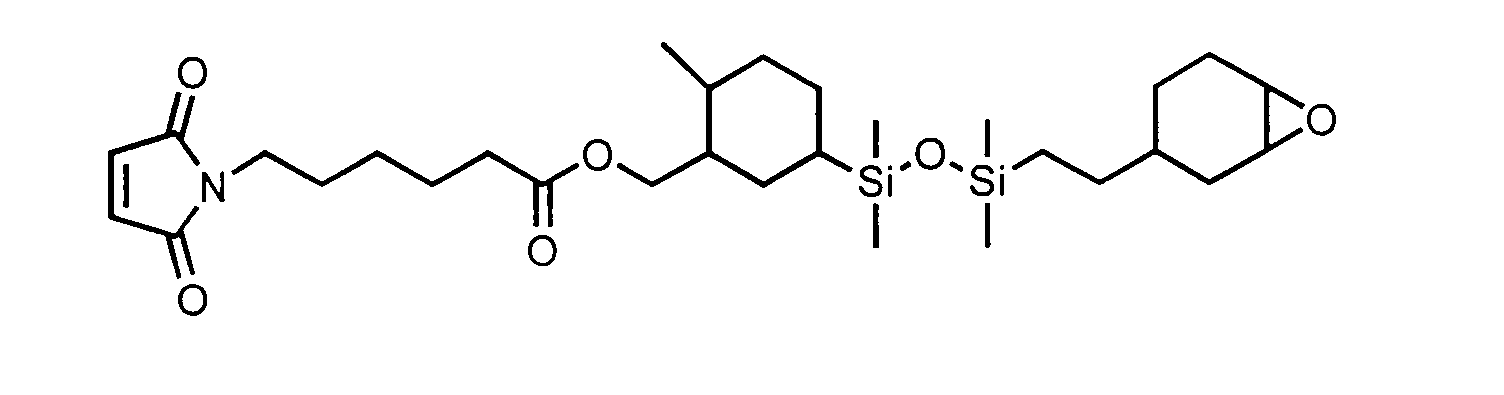
 and
and
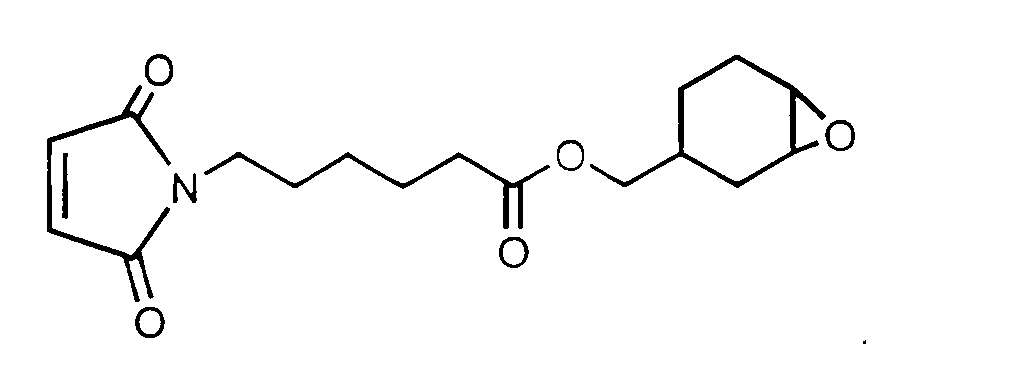
- A compound having the structure:in which
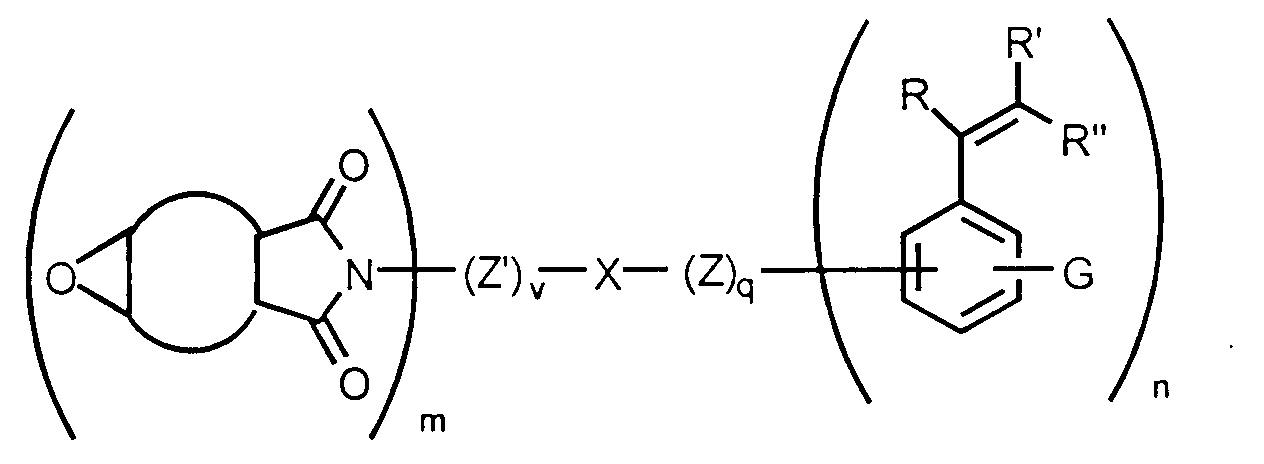
m and n independently are 1 to 500, q and v independently are 0 or 1;is a cycloaliphatic epoxy moiety, in which an epoxy group is attached to a cyclic, bicyclic or tricyclic ring structure, which structure may contain one or more heteroatoms;
R, R', and R" are independently hydrogen, an alkyl group having 1 to 12 carbon atoms, or an aromatic or heteroaromatic ring or fused ring having 3 to 10 carbon atoms within the ring structure;
G is -OR, -SR, or -N(R)(R') in which R and R' are as described above; or G is an alkyl group having 1 to 12 carbon atoms; or G is an aromatic or heteroaromatic ring or fused ring having 3 to 10 carbon atoms within the ring;
Z and Z' are any monomeric, oligomeric or polymeric organic moiety;
X is a direct bond or a functional group selected from the groups consisting of:
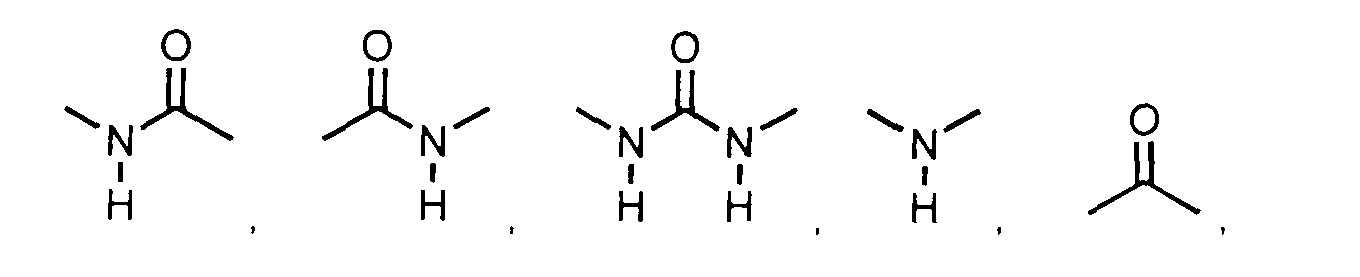

- The compound according to claim 10 having the structure:
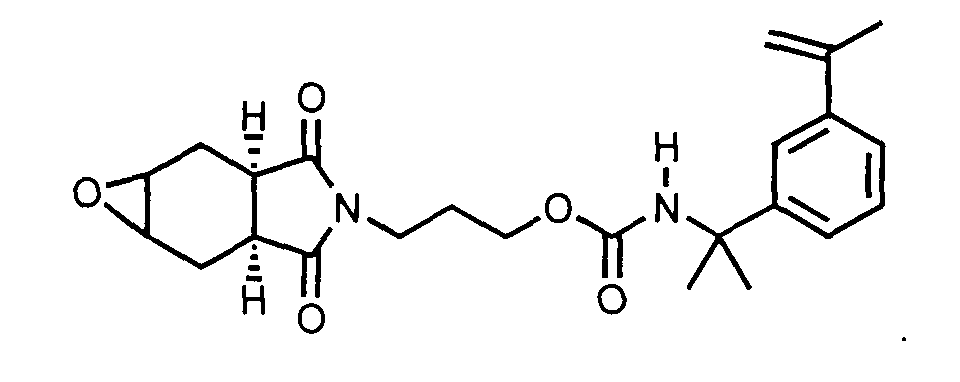
- A compound having the structure:in which

m and n independently are 1 to 500, q and v independently are 0 or 1;is a cycloaliphatic epoxy moiety, in which an epoxy group is attached to a cyclic, bicyclic or tricyclic ring structure, which structure may contain one or more heteroatoms;
G is -OR, -SR, or -N(R)(R') in which R and R' are independently hydrogen, an alkyl group having 1 to 12 carbon atoms, or an aromatic or heteroaromatic ring or fused ring having 3 to 10 carbon atoms within the ring structure; or
G is an alkyl group having 1 to 12 carbon atoms; or
G is an aromatic or heteroaromatic ring or fused ring having 3 to 10 carbon atoms within the ring structure;
Z and Z' are any monomeric, oligomeric or polymeric organic moiety;
X is a direct bond or a functional group selected from the groups consisting of: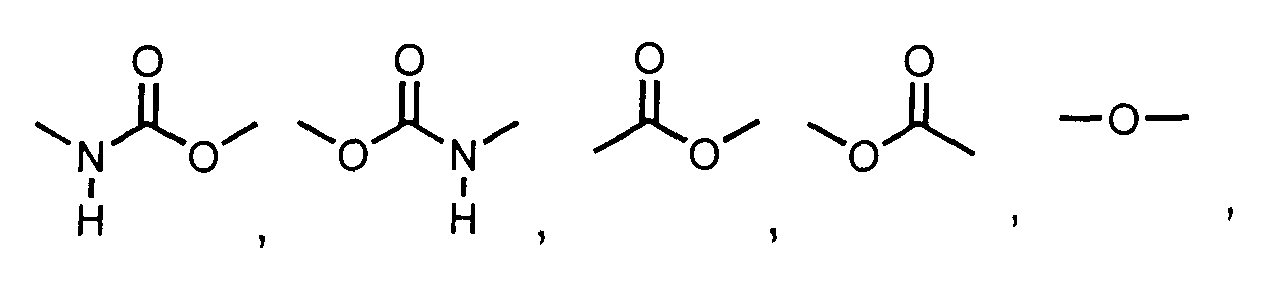
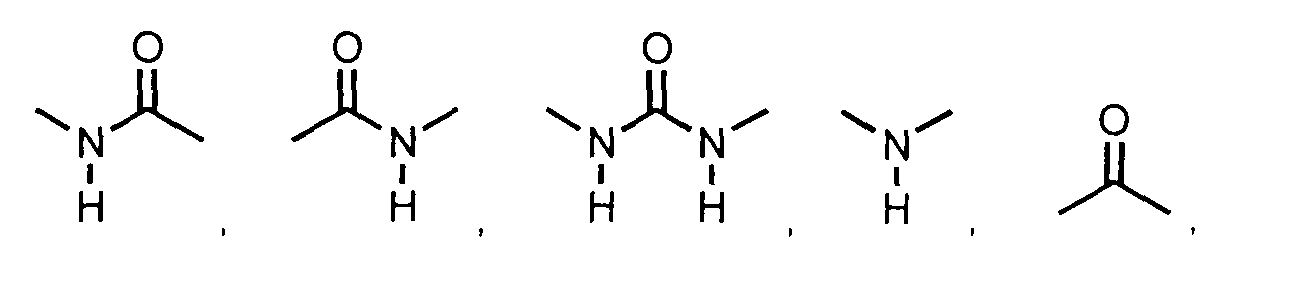
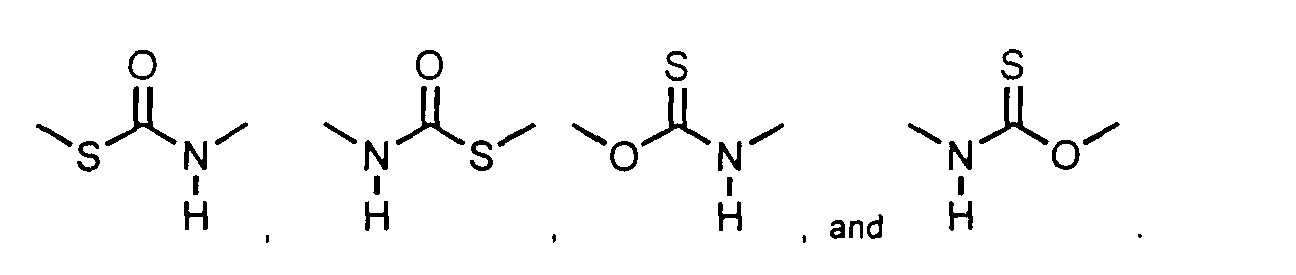
- The compound according to claim 12 having the structure
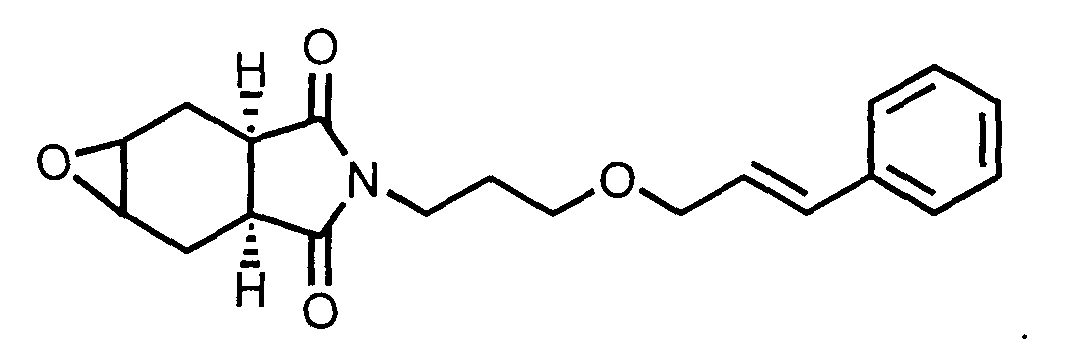
- A compound having the structure:in which

m and n independently are 1 to 500, q and v independently are 0 or 1;is a cycloaliphatic epoxy moiety, in which an epoxy group is attached to a cyclic, bicyclic or tricyclic ring structure, which structure may contain one or more heteroatoms;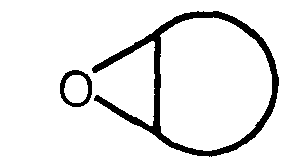
R and R' are independently hydrogen, an alkyl group having 1 to 12 carbon atoms, or an aromatic or heteroaromatic ring or fused ring having 3 to 10 carbon atoms within the ring structure;
Z and Z' are any monomeric, oligomeric or polymeric organic moiety;
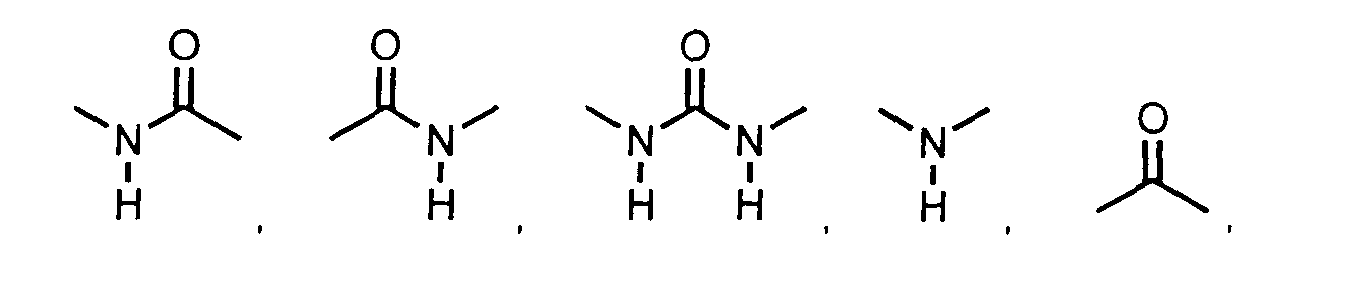
X is a direct bond or a functional group selected from the groups consisting of:

- The compound according to claim 14 having the structure

Priority Applications (1)
| Application Number | Priority Date | Filing Date | Title |
|---|---|---|---|
| EP04029057A EP1531166B1 (en) | 2002-07-22 | 2003-07-22 | Cycloaliphatic epoxy compounds containing maleimide functionality |
Applications Claiming Priority (2)
| Application Number | Priority Date | Filing Date | Title |
|---|---|---|---|
| US201373 | 2002-07-22 | ||
| US10/201,373 US6716992B2 (en) | 2002-07-22 | 2002-07-22 | Cycloaliphatic epoxy compounds containing styrenic, cinnamyl, or maleimide functionality |
Related Child Applications (1)
| Application Number | Title | Priority Date | Filing Date |
|---|---|---|---|
| EP04029057A Division EP1531166B1 (en) | 2002-07-22 | 2003-07-22 | Cycloaliphatic epoxy compounds containing maleimide functionality |
Publications (3)
| Publication Number | Publication Date |
|---|---|
| EP1384737A2 true EP1384737A2 (en) | 2004-01-28 |
| EP1384737A3 EP1384737A3 (en) | 2004-04-14 |
| EP1384737B1 EP1384737B1 (en) | 2008-11-12 |
Family
ID=30000085
Family Applications (2)
| Application Number | Title | Priority Date | Filing Date |
|---|---|---|---|
| EP04029057A Expired - Lifetime EP1531166B1 (en) | 2002-07-22 | 2003-07-22 | Cycloaliphatic epoxy compounds containing maleimide functionality |
| EP03016521A Expired - Lifetime EP1384737B1 (en) | 2002-07-22 | 2003-07-22 | Cycloaliphatic epoxy compounds containing styrenic functionality |
Family Applications Before (1)
| Application Number | Title | Priority Date | Filing Date |
|---|---|---|---|
| EP04029057A Expired - Lifetime EP1531166B1 (en) | 2002-07-22 | 2003-07-22 | Cycloaliphatic epoxy compounds containing maleimide functionality |
Country Status (9)
| Country | Link |
|---|---|
| US (1) | US6716992B2 (en) |
| EP (2) | EP1531166B1 (en) |
| JP (1) | JP2004149512A (en) |
| KR (1) | KR100973317B1 (en) |
| CN (1) | CN100430400C (en) |
| DE (2) | DE60324633D1 (en) |
| MY (1) | MY133626A (en) |
| SG (1) | SG109521A1 (en) |
| TW (1) | TWI276633B (en) |
Cited By (1)
| Publication number | Priority date | Publication date | Assignee | Title |
|---|---|---|---|---|
| EP1736517A1 (en) * | 2005-06-21 | 2006-12-27 | National Starch and Chemical Investment Holding Corporation | Metal salts of maleimide compounds as conductivity promoters |
Families Citing this family (7)
| Publication number | Priority date | Publication date | Assignee | Title |
|---|---|---|---|---|
| CN101754989B (en) * | 2007-05-16 | 2012-11-28 | 陶氏环球技术有限责任公司 | Flame retardant composition |
| WO2009023843A1 (en) | 2007-08-15 | 2009-02-19 | Isp Investments Inc. | Polyvinylamide polymers containing polymerizable functionalities |
| US8242224B2 (en) | 2007-08-15 | 2012-08-14 | Isp Investments Inc. | Polyvinylamide polymers containing polymerizable functionalities |
| JP5266248B2 (en) * | 2007-11-07 | 2013-08-21 | 昭和電工株式会社 | Epoxy group-containing organosiloxane compound |
| US8324319B2 (en) * | 2007-11-20 | 2012-12-04 | Sridhar Laxmisha M | Redox-induced cationically polymerizable compositions with low cure temperature |
| WO2009070172A1 (en) * | 2007-11-30 | 2009-06-04 | Henkel Ag & Co. Kgaa | Curable resins containing acetal, ketal, acetal ester, or ketal ester linkages |
| JP7093150B2 (en) * | 2018-12-06 | 2022-06-29 | 日本化薬株式会社 | Curable resin composition and its cured product |
Family Cites Families (20)
| Publication number | Priority date | Publication date | Assignee | Title |
|---|---|---|---|---|
| SU513033A1 (en) * | 1974-12-09 | 1976-05-05 | Предприятие П/Я В-2304 | - (2 ", 3" -Epoxypropyloxyphenyl) -4,5 epoxyhexahydrophthalimides, as monomers for the production of heat-resistant polymeric materials |
| SU702021A1 (en) * | 1976-12-27 | 1979-12-05 | Предприятие П/Я В-2304 | 3,4-epoxyhexaxydrobenzyl-(4,5-epoxyhexahydro-n-phthalimido)-benzolate as monomer for synthesis of heat-resistant polymers |
| JPH02132106A (en) * | 1988-11-11 | 1990-05-21 | Hitachi Ltd | Unsaturated imide compounds, compositions and their uses |
| JPH0641114A (en) * | 1992-05-25 | 1994-02-15 | Nissan Chem Ind Ltd | New mevalonolactones and its production |
| DE59409479D1 (en) | 1993-08-09 | 2000-09-21 | Ciba Sc Holding Ag | New (meth) acrylates containing urethane groups |
| ES2147777T3 (en) * | 1993-09-16 | 2000-10-01 | Ciba Sc Holding Ag | VINILETER COMPOUNDS WITH ADDITIONAL FUNCTIONAL GROUPS, OTHER THAN VINILETER, AND THEIR USE IN THE FORMULATION OF RETICULABLE COMPOUNDS. |
| US5539132A (en) * | 1994-01-24 | 1996-07-23 | Johns Hopkins University | Cerulenin compounds for fatty acid synthesis inhibition |
| JPH0853430A (en) * | 1994-08-10 | 1996-02-27 | Amuko Enterp Kk | Epoxidized substance of fluorine-containing dicyclopentadiene derivative |
| JPH08269293A (en) * | 1995-03-30 | 1996-10-15 | Toray Dow Corning Silicone Co Ltd | Curable release agent composition |
| US5863970A (en) * | 1995-12-06 | 1999-01-26 | Polyset Company, Inc. | Epoxy resin composition with cycloaliphatic epoxy-functional siloxane |
| DE19608313C2 (en) | 1996-02-22 | 2000-08-31 | Ivoclar Ag Schaan | Polymerizable hybrid monomers, processes for their preparation and their use |
| US6080872A (en) * | 1997-12-16 | 2000-06-27 | Lonza S.P.A. | Cycloaliphatic epoxy compounds |
| US6075155A (en) * | 1998-06-22 | 2000-06-13 | Rensselaer Polytechnic Institute | Radiation-curable cycloaliphatic epoxy compounds, uses thereof, and compositions containing them |
| WO2000010974A2 (en) | 1998-08-20 | 2000-03-02 | Dsm N.V. | Process for the preparation of a maleimide compound, maleimide compound, radiation-curable compositions comprising said compound and coated products |
| US6150479A (en) | 1998-11-23 | 2000-11-21 | Loctite Corporation | Radical-curable adhesive compositions, reaction products of which demonstrate superior resistance to thermal degradation |
| JP4350832B2 (en) * | 1999-04-19 | 2009-10-21 | Jsr株式会社 | Photocurable resin composition for three-dimensional modeling and a modeled product obtained by curing the same |
| GB9913627D0 (en) * | 1999-06-12 | 1999-08-11 | Ciba Geigy Ag | Process for the preparation of reaction products of cycloaliphatic epoxides with multifunctional hydroxy compounds |
| KR100314931B1 (en) * | 1999-09-21 | 2001-11-30 | 박호군 | Method for parallel thinning and polishing of diamond single crystals for wire drawing die |
| AU2001251096A1 (en) | 2000-03-29 | 2001-10-08 | Georgia Tech Research Corporation | Thermally degradable epoxy underfills for flip-chip applications |
| TWI282811B (en) * | 2000-04-10 | 2007-06-21 | Sumitomo Bakelite Co | Die-attaching paste and semiconductor device |
-
2002
- 2002-07-22 US US10/201,373 patent/US6716992B2/en not_active Expired - Lifetime
-
2003
- 2003-07-18 JP JP2003199169A patent/JP2004149512A/en active Pending
- 2003-07-18 TW TW092119896A patent/TWI276633B/en not_active IP Right Cessation
- 2003-07-21 MY MYPI20032729A patent/MY133626A/en unknown
- 2003-07-22 SG SG200304356A patent/SG109521A1/en unknown
- 2003-07-22 DE DE60324633T patent/DE60324633D1/en not_active Expired - Lifetime
- 2003-07-22 EP EP04029057A patent/EP1531166B1/en not_active Expired - Lifetime
- 2003-07-22 DE DE60329604T patent/DE60329604D1/en not_active Expired - Lifetime
- 2003-07-22 EP EP03016521A patent/EP1384737B1/en not_active Expired - Lifetime
- 2003-07-22 KR KR1020030050139A patent/KR100973317B1/en not_active Expired - Fee Related
- 2003-07-22 CN CNB031580211A patent/CN100430400C/en not_active Expired - Fee Related
Cited By (1)
| Publication number | Priority date | Publication date | Assignee | Title |
|---|---|---|---|---|
| EP1736517A1 (en) * | 2005-06-21 | 2006-12-27 | National Starch and Chemical Investment Holding Corporation | Metal salts of maleimide compounds as conductivity promoters |
Also Published As
| Publication number | Publication date |
|---|---|
| EP1531166B1 (en) | 2009-10-07 |
| TW200420551A (en) | 2004-10-16 |
| US20040014890A1 (en) | 2004-01-22 |
| TWI276633B (en) | 2007-03-21 |
| DE60329604D1 (en) | 2009-11-19 |
| KR100973317B1 (en) | 2010-07-30 |
| US6716992B2 (en) | 2004-04-06 |
| CN100430400C (en) | 2008-11-05 |
| EP1384737A3 (en) | 2004-04-14 |
| JP2004149512A (en) | 2004-05-27 |
| MY133626A (en) | 2007-11-30 |
| EP1531166A2 (en) | 2005-05-18 |
| SG109521A1 (en) | 2005-03-30 |
| KR20040010310A (en) | 2004-01-31 |
| CN1488631A (en) | 2004-04-14 |
| DE60324633D1 (en) | 2008-12-24 |
| EP1384737B1 (en) | 2008-11-12 |
| EP1531166A3 (en) | 2005-08-31 |
Similar Documents
| Publication | Publication Date | Title |
|---|---|---|
| KR100794635B1 (en) | Compounds with electron donor and electron acceptor functional groups | |
| WO2008004504A1 (en) | Alicyclic diepoxy compound, epoxy resin composition, and cured product | |
| JPS6368537A (en) | Monomer and oligomer having novel multiple vinylbenzyl ether groups, manufacture and cure product therefrom | |
| US6716992B2 (en) | Cycloaliphatic epoxy compounds containing styrenic, cinnamyl, or maleimide functionality | |
| US4788268A (en) | Method for preparation of epoxysilicone compounds and allyl-terminated silicone compounds | |
| US6015914A (en) | Compound having oxetanyl group, process for producing same, and curing composition | |
| US20030098440A1 (en) | Adhesion promoters containing benzotriazoles | |
| JP4685784B2 (en) | Adhesive composition containing hybrid oxetane compound | |
| US6307001B1 (en) | Curable hybrid electron donor compounds containing vinyl ether | |
| US7754903B2 (en) | Curable polycyclic compounds and process for the production thereof | |
| US7034064B2 (en) | Method of attaching a die to a substrate using a hybrid oxetane compound | |
| WO2003014248A2 (en) | Adhesion promoting resins with cross-linking properties | |
| JP4452037B2 (en) | New alicyclic vinyl ether | |
| US5130461A (en) | 1,3-bis(p-hydroxybenzyl)-1,1,3,3-tetramethyldisiloxane and method for making | |
| JPH05320172A (en) | Disiloxanetetracarboxylic dianhydride and its production | |
| HK1063323A (en) | Cycloaliphatic epoxy compounds containing styrenic, cinnamyl, or maleimide functionality | |
| US6127565A (en) | Aromatic silane ether-containing coatings | |
| WO2006038605A1 (en) | Cyclohexene oxide compound having cyclohexyl group or long-chain alkyl group and use thereof | |
| WO2003029234A1 (en) | Epoxy compounds containing styrenic or cinnamyl functionality | |
| JPWO2005080364A1 (en) | Method for producing alicyclic oxetane compound | |
| JP4868104B2 (en) | (Meth) acrylate compound of cyclobutanetetracarboxylic acid and process for producing the same | |
| JP3902849B2 (en) | Epoxy resin composition containing bisepoxy-1,5,7,11-tetraoxaspiro [5.5] undecane derivative | |
| KR20040069402A (en) | Compounds containing vinyl silane and electron donor or acceptor functionality | |
| JPH04169592A (en) | Bismethylene spiroorthocarbonate compound containing silicon atom | |
| JPS59216889A (en) | Novel spiro compound |
Legal Events
| Date | Code | Title | Description |
|---|---|---|---|
| PUAI | Public reference made under article 153(3) epc to a published international application that has entered the european phase |
Free format text: ORIGINAL CODE: 0009012 |
|
| AK | Designated contracting states |
Kind code of ref document: A2 Designated state(s): AT BE BG CH CY CZ DE DK EE ES FI FR GB GR HU IE IT LI LU MC NL PT RO SE SI SK TR |
|
| AX | Request for extension of the european patent |
Extension state: AL LT LV MK |
|
| PUAL | Search report despatched |
Free format text: ORIGINAL CODE: 0009013 |
|
| AK | Designated contracting states |
Kind code of ref document: A3 Designated state(s): AT BE BG CH CY CZ DE DK EE ES FI FR GB GR HU IE IT LI LU MC NL PT RO SE SI SK TR |
|
| AX | Request for extension of the european patent |
Extension state: AL LT LV MK |
|
| 17P | Request for examination filed |
Effective date: 20040719 |
|
| 17Q | First examination report despatched |
Effective date: 20040924 |
|
| AKX | Designation fees paid |
Designated state(s): DE FR GB IT NL |
|
| RBV | Designated contracting states (corrected) |
Designated state(s): DE FR GB IT NL |
|
| RBV | Designated contracting states (corrected) |
Designated state(s): DE FR GB IT NL |
|
| 17Q | First examination report despatched |
Effective date: 20040924 |
|
| GRAP | Despatch of communication of intention to grant a patent |
Free format text: ORIGINAL CODE: EPIDOSNIGR1 |
|
| RTI1 | Title (correction) |
Free format text: CYCLOALIPHATIC EPOXY COMPOUNDS CONTAINING STYRENIC FUNCTIONALITY |
|
| GRAS | Grant fee paid |
Free format text: ORIGINAL CODE: EPIDOSNIGR3 |
|
| GRAA | (expected) grant |
Free format text: ORIGINAL CODE: 0009210 |
|
| AK | Designated contracting states |
Kind code of ref document: B1 Designated state(s): DE FR GB IT NL |
|
| REG | Reference to a national code |
Ref country code: GB Ref legal event code: FG4D |
|
| REF | Corresponds to: |
Ref document number: 60324633 Country of ref document: DE Date of ref document: 20081224 Kind code of ref document: P |
|
| REG | Reference to a national code |
Ref country code: GB Ref legal event code: 732E Free format text: REGISTERED BETWEEN 20090528 AND 20090603 |
|
| PLBE | No opposition filed within time limit |
Free format text: ORIGINAL CODE: 0009261 |
|
| STAA | Information on the status of an ep patent application or granted ep patent |
Free format text: STATUS: NO OPPOSITION FILED WITHIN TIME LIMIT |
|
| 26N | No opposition filed |
Effective date: 20090813 |
|
| PGFP | Annual fee paid to national office [announced via postgrant information from national office to epo] |
Ref country code: GB Payment date: 20090731 Year of fee payment: 7 Ref country code: NL Payment date: 20090729 Year of fee payment: 7 |
|
| REG | Reference to a national code |
Ref country code: NL Ref legal event code: V1 Effective date: 20110201 |
|
| GBPC | Gb: european patent ceased through non-payment of renewal fee |
Effective date: 20100722 |
|
| PG25 | Lapsed in a contracting state [announced via postgrant information from national office to epo] |
Ref country code: NL Free format text: LAPSE BECAUSE OF NON-PAYMENT OF DUE FEES Effective date: 20110201 |
|
| PG25 | Lapsed in a contracting state [announced via postgrant information from national office to epo] |
Ref country code: GB Free format text: LAPSE BECAUSE OF NON-PAYMENT OF DUE FEES Effective date: 20100722 |
|
| PGFP | Annual fee paid to national office [announced via postgrant information from national office to epo] |
Ref country code: FR Payment date: 20140708 Year of fee payment: 12 |
|
| PGFP | Annual fee paid to national office [announced via postgrant information from national office to epo] |
Ref country code: IT Payment date: 20140718 Year of fee payment: 12 |
|
| PGFP | Annual fee paid to national office [announced via postgrant information from national office to epo] |
Ref country code: DE Payment date: 20150721 Year of fee payment: 13 |
|
| PG25 | Lapsed in a contracting state [announced via postgrant information from national office to epo] |
Ref country code: IT Free format text: LAPSE BECAUSE OF NON-PAYMENT OF DUE FEES Effective date: 20150722 |
|
| REG | Reference to a national code |
Ref country code: FR Ref legal event code: ST Effective date: 20160331 |
|
| PG25 | Lapsed in a contracting state [announced via postgrant information from national office to epo] |
Ref country code: FR Free format text: LAPSE BECAUSE OF NON-PAYMENT OF DUE FEES Effective date: 20150731 |
|
| REG | Reference to a national code |
Ref country code: DE Ref legal event code: R119 Ref document number: 60324633 Country of ref document: DE |
|
| PG25 | Lapsed in a contracting state [announced via postgrant information from national office to epo] |
Ref country code: DE Free format text: LAPSE BECAUSE OF NON-PAYMENT OF DUE FEES Effective date: 20170201 |