EP1384615A1 - Car door glass run - Google Patents
Car door glass run Download PDFInfo
- Publication number
- EP1384615A1 EP1384615A1 EP03019995A EP03019995A EP1384615A1 EP 1384615 A1 EP1384615 A1 EP 1384615A1 EP 03019995 A EP03019995 A EP 03019995A EP 03019995 A EP03019995 A EP 03019995A EP 1384615 A1 EP1384615 A1 EP 1384615A1
- Authority
- EP
- European Patent Office
- Prior art keywords
- glass run
- door glass
- grooves
- door
- glass
- Prior art date
- Legal status (The legal status is an assumption and is not a legal conclusion. Google has not performed a legal analysis and makes no representation as to the accuracy of the status listed.)
- Granted
Links
- 239000011521 glass Substances 0.000 title claims abstract description 168
- 239000000463 material Substances 0.000 claims description 14
- 239000011248 coating agent Substances 0.000 description 18
- 238000000576 coating method Methods 0.000 description 18
- -1 for example Polymers 0.000 description 9
- 239000002344 surface layer Substances 0.000 description 7
- 239000004743 Polypropylene Substances 0.000 description 5
- 150000001336 alkenes Chemical class 0.000 description 5
- 238000001125 extrusion Methods 0.000 description 5
- 229920001155 polypropylene Polymers 0.000 description 5
- 230000002159 abnormal effect Effects 0.000 description 4
- 230000015572 biosynthetic process Effects 0.000 description 4
- 229920002725 thermoplastic elastomer Polymers 0.000 description 4
- 229920002943 EPDM rubber Polymers 0.000 description 3
- 239000004698 Polyethylene Substances 0.000 description 3
- 229920000573 polyethylene Polymers 0.000 description 3
- PPBRXRYQALVLMV-UHFFFAOYSA-N Styrene Chemical compound C=CC1=CC=CC=C1 PPBRXRYQALVLMV-UHFFFAOYSA-N 0.000 description 2
- 239000000203 mixture Substances 0.000 description 2
- 239000000178 monomer Substances 0.000 description 2
- JRZJOMJEPLMPRA-UHFFFAOYSA-N olefin Natural products CCCCCCCC=C JRZJOMJEPLMPRA-UHFFFAOYSA-N 0.000 description 2
- 239000004800 polyvinyl chloride Substances 0.000 description 2
- 229920000915 polyvinyl chloride Polymers 0.000 description 2
- 229920005989 resin Polymers 0.000 description 2
- 239000011347 resin Substances 0.000 description 2
- 238000005507 spraying Methods 0.000 description 2
- 229920002803 thermoplastic polyurethane Polymers 0.000 description 2
- XUIMIQQOPSSXEZ-UHFFFAOYSA-N Silicon Chemical compound [Si] XUIMIQQOPSSXEZ-UHFFFAOYSA-N 0.000 description 1
- 239000000428 dust Substances 0.000 description 1
- 230000000694 effects Effects 0.000 description 1
- 229920001971 elastomer Polymers 0.000 description 1
- 230000004927 fusion Effects 0.000 description 1
- 230000007774 longterm Effects 0.000 description 1
- 238000000034 method Methods 0.000 description 1
- 230000002093 peripheral effect Effects 0.000 description 1
- 239000004576 sand Substances 0.000 description 1
- 238000007789 sealing Methods 0.000 description 1
- 229910052710 silicon Inorganic materials 0.000 description 1
- 239000010703 silicon Substances 0.000 description 1
- 229920003002 synthetic resin Polymers 0.000 description 1
- 239000000057 synthetic resin Substances 0.000 description 1
Images




Classifications
-
- B—PERFORMING OPERATIONS; TRANSPORTING
- B60—VEHICLES IN GENERAL
- B60J—WINDOWS, WINDSCREENS, NON-FIXED ROOFS, DOORS, OR SIMILAR DEVICES FOR VEHICLES; REMOVABLE EXTERNAL PROTECTIVE COVERINGS SPECIALLY ADAPTED FOR VEHICLES
- B60J10/00—Sealing arrangements
- B60J10/20—Sealing arrangements characterised by the shape
- B60J10/27—Sealing arrangements characterised by the shape having projections, grooves or channels in the longitudinal direction
-
- B—PERFORMING OPERATIONS; TRANSPORTING
- B60—VEHICLES IN GENERAL
- B60J—WINDOWS, WINDSCREENS, NON-FIXED ROOFS, DOORS, OR SIMILAR DEVICES FOR VEHICLES; REMOVABLE EXTERNAL PROTECTIVE COVERINGS SPECIALLY ADAPTED FOR VEHICLES
- B60J10/00—Sealing arrangements
- B60J10/15—Sealing arrangements characterised by the material
- B60J10/17—Sealing arrangements characterised by the material provided with a low-friction material on the surface
-
- B—PERFORMING OPERATIONS; TRANSPORTING
- B60—VEHICLES IN GENERAL
- B60J—WINDOWS, WINDSCREENS, NON-FIXED ROOFS, DOORS, OR SIMILAR DEVICES FOR VEHICLES; REMOVABLE EXTERNAL PROTECTIVE COVERINGS SPECIALLY ADAPTED FOR VEHICLES
- B60J10/00—Sealing arrangements
- B60J10/70—Sealing arrangements specially adapted for windows or windscreens
- B60J10/74—Sealing arrangements specially adapted for windows or windscreens for sliding window panes, e.g. sash guides
Definitions
- the present invention relates to a door glass run to be attached on a door frame of a car door.
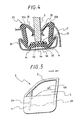
- a door glass run 3 (hereinafter, simply referred to as a glass run) is attached on a door frame 2 of a door 1 of a car along an inner side of the door frame 2 for guiding up/down movement of a door glass 5 and sealing a gap between a circumferential edge of the closed door glass 5 and the door frame 2.
- front and rear vertical extension frame portions 2A of the door flame 2 are provided in a door body and the glass run 3 is attached also on each of the vertical extension frame portions 2A.
- a glass run 3 As such a glass run 3, generally, a glass run having such a configuration as shown in Fig. 6 is used, in which lips 35 and 36 extend, in a direction to face each other, from the opposite ends, at an opening side, of a body portion 30 which is U-shaped in section.
- the door glass 5 moves up/down in the state where a peripheral edge of the door glass 5 is in contact with, its opposite surfaces, between the lips 35 and 36 of the glass run 3, and an end surface of the door glass 5 is also in contact with a bottom surface 31 of the glass run 3.
- the bottom surface 31 of the glass run 3 is subject to smoothening treatment by spraying urethane resin, silicon resin, or the like so as to improve the slidability of the door glass 5.
- urethane resin silicon resin, or the like
- foreign matters such as sand, dust, and the like may come into the body portion 30 of the glass run 3 and may deposit on the bottom surface 31 to thereby gradually lower the slidability of the door glass 5.
- a plurality of grooves are formed in a bottom surface of a glass run body portion having a U-shaped cross-section so as to extend longitudinally at predetermined intervals widthwise.
- the grooves are designed so as to have cross-sectional areas which sequentially become larger from the groove formed adjacent to a flat surface portion of the bottom surface to the groove formed on each opposite side of the flat surface portion.
- grooves may be formed in the bottom surface of a glass run only on opposite sides of a flat surface portion having no grooves.
- the foreign matters which have deposited on the central portion of the bottom surface of the glass run are swept into/out of the opposite sides when the door glass moves up/down, and the large part of the foreign matters fall into the large grooves formed in the opposite portions on the bottom surface to be thereby discharged.
- the groove formed adjacent to the central portion of the bottom surface is small and, hence, even if the groove is filled with the foreign matters, the glass sliding resistance does not become large so that no abnormal sounds are generated.
- foreign matters which have deposited on the bottom surface of the glass run fall into the grooves formed in the opposite portions on the bottom surface to be thereby discharged in the same manner as that in the case of the invention stated in Claim 1. Further, although no groove is formed in the central portion of the bottom surface with which the door glass comes into slide-contact, the amount of foreign matter which may remain in spite of sweeping-out is very small and hence the sliding resistance is hardly increased.
- Fig. 1 shows a glass run 3A according to a first embodiment. This glass run is attached on the vertical frame portion of the door frame 2 of the car shown in Fig. 5.
- the glass run 3A is formed of an extrusion molding of rubber, for example, EPDM (ethylene-propylene-diene) rubber, and has a fundamental configuration in which lips 35 and 36 extend from the opposite ends, at the opening side, of a body portion 30 U-shaped in section.
- a bottom wall is designed to be thicker than the remaining portion.
- a door glass 5 has a thickness of about 4 mm and an end surface arch-shaped in section. The door glass 5 moves up/down in the state where the door glass 5 is in contact with the lips 35 and 36 at its inner and outer surfaces, and a central portion of a side edge surface of the door glass 5 is in contact with a bottom surface 31 of the glass run 3A.
- a plurality of uniform grooves 4 are formed in a bottom surface 31 so as to extend longitudinally at predetermined intervals widthwise to thereby reduce a sliding area between an end surface of door glass 5 and the bottom surface 31 and to thereby bury part of foreign matter entering the glass run into the grooves 4.
- Each of the grooves is shaped in the form of an inverted triangle in section.
- the area of slide-contact between a door glass end surface and the bottom surface 31 of the glass run can be reduced, and foreign matter which has been deposited on the bottom surface 31 of the glass run body portion 30 can be discharged into the grooves to thereby reduce the sliding resistance of the door glass against the bottom surface of the glass run.
- Fig. 2 shows a glass run 3B according to a second embodiment, which is provided for solving the aforementioned problem.
- a plurality of mutually-parallel grooves 4a, 4b, and 4c are formed in the bottom surface 31 to extend longitudinally at equal intervals widthwise.
- Each of the grooves is shaped in the form of an inverted triangle in section and the grooves are designed so as to have sectional areas which become larger in order from the groove formed in a widthwise central portion of the bottom surface 31 to the groove formed on each of the opposite sides of the central portion of the bottom surface 31.
- the groove 4a is formed in the widthwise central position of the bottom surface 31; the grooves 4c are formed in the widthwise opposite-end portions; and the grooves 4b are formed in the intermediate portions between the grooves 4a and 4c.
- the opening width and depth of the groove 4a are selected to be about 0.2 - 0.3mm and about 0.2 - 0.3mm, respectively.
- the opening width and depth of the groove 4c are selected to be about 0.7 - 1.0mm and about 0.4 - 0.6mm, respectively.
- the opening width and depth of the groove 4b are selected to be intermediate values between those of the grooves 4a and 4c.
- the widths of the land portions between the grooves 4a, 4b, and 4c are selected to be an equal value of 0.7 - 0.8mm.
- the bottom surface having the grooves 4a, 4b, and 4c formed therein and the surfaces of the lips 35 and 36 are subjected to a smoothening treatment S with urethane resin.
- the sectional shape of each of the grooves is not limited to such an inverted triangle but it may be shaped into a quadrangle.
- the end surface of the door glass 5 moves up/down while it is in slide-contact with the land portions of the bottom surface 31 of the glass run 3A when the door glass 5 moves up/down.
- the end surface of the door glass 5 is in slide-contact only with the land portions between the grooves so that the influence of foreign matter attached on the bottom surface 31 is reduced. Even if a large quantity of foreign matter has been deposited, the foreign matter on the land portions is swept out right and left by the end surface of the door glass 5 transversely vibrating when the door glass is moved up/down, so that the foreign matter falls into the grooves 4a, 4b, and 4c.
- the central groove 4a is filled with foreign matter, the contact area of the foreign matter with the end surface of the door glass 5 is small, so that the sliding resistance is not greatly increased and no abnormal sounds are generated.
- the maximum width of transverse movement of the central portion of the end surface of the door glass 5 to contact with the bottom surface 31 of the glass run 3B by a transverse vibration of the door glass 5 is limited by the distance between the grooves 4a and 4b. Because the groove 4b is larger than the groove 4a, the groove 4b is not completely filled with foreign matter before long-term use. Thus, even if the groove 4b is filled with foreign matter, the foreign matter hardly gives a large influence on the sliding resistance of the door glass 5. Since the foreign matter swept out by the door glass 5 is received in the grooves 4b and 4c, this provides a function of preventing the swept-out foreign matter from falling and being deposited again on the central portion of the glass run bottom surface 31.
- Fig. 3 shows a glass run 3C according to a third embodiment.
- a central portion of a bottom surface 31 is formed into a flat surface with no groove, and longitudinally extending grooves 4d and 4e are formed in the opposite side portions.
- the flat surface in the central portion is designed to have a width which is equal to the width of lateral or left/right vibration of the central portion of the end surface of the door glass 5 which contacts the flat surface when the door glass 5 moves up/down.
- the width of the flat surface is selected to be about 3 - 4mm.
- the opening width and depth of each of the grooves 4d and 4e on the opposite sides are selected to be 0.7 - 1.0mm and about 0.4 - 0.6mm, respectively.
- the glass run 3C Similar to the glass run 3B, in the case of the glass run 3C, foreign matter which has been deposited on a bottom surface central portion with which the door glass 5 is in slide-contact is discharged into opposite-side grooves 4d and 4e.
- the glass run 3C since no groove is formed in the bottom surface central portion, the glass sliding area is slightly increased correspondingly, in comparison with the glass run 3B.
- there is no groove in the central portion which may fill with foreign matter. Accordingly, the end surface of the door glass 5 never comes into slide-contact with the accumulated foreign matter in the central groove.
- the glass run having the grooves formed in its bottom surface may be integrally molded with an olefin thermoplastic elastomer.
- Fig. 4 shows a glass run 3D according to a fourth embodiment.
- a surface layer 32 which is formed of a material different from that of a glass run body and which is superior in smooth property is formed on the surface of a bottom wall of the body portion 30 so as to face an end surface of the door glass 5, and grooves for receiving foreign matter are formed in an upper surface 31 constituting a bottom wall of the glass run 3D.
- a surface layer 32a which is formed of a different material in place of carrying-out a smoothening treatment S and which is superior in smooth property may be formed on the surface of each of lips 35 and 36.
- the surface layer 32, 32a is formed of a olefin group resin, for example, polyethylene, polypropylene, etc., or an olefin group thermoplastic elastomer, and the surface layer 32 has the same grooves 4a, 4b, and 4c as those in the glass run 3D. Further, the upper surface 31 on the surface layer 32 may be formed in the same manner as that in the case of the glass run 3C.
- the surface layer 32 is integrally formed with an upper surface of a bottom wall of the glass run 3D by extrusion molding or by adhering a tape member and fusion bonding thereafter. Incidentally, in the glass run 3D, it is not necessary to subject the surface layer 32 to a smoothening treatment by spraying or the like.
- the glass run body may be formed by using a synthetic resin, such as PVC (polyvinyl chloride) or the like, or an olefin group thermoplastic elastomer, in addition to the foregoing EPDM rubber.
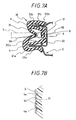
- Fig. 7 shows a glass run 3E according to a fifth embodiment, to be attached on the door frame 2 shown in Fig. 5 so that the portion is positioned along the vertical frame portion of the door frame 2.
- the glass run 3E is obtained by extrusion-molding with TPO (olefin thermoplastic elastomer), and integrally provided with a body portion 30 substantially U-shaped in section; seal lips 35 and 36 extend from opened front ends of opposite side walls 312a and 312b of the body portion 30 so as to face each other; and mole lips 33a and 33b extend from the opened front ends of the opposite side walls 312a and 312b along the outsides of the opposite walls 312a and 312b reversely to the seal lips 35 and 36.
- TPO polypropylene
- the glass run 3E is attached on the door frame 2 in such a manner that the body portion 30 is fitted onto a channel portion 20 formed in an inner circumference of the door flame 2, and the mole lips 33a and 33b formed inside and outside a car are pressed against inside and outside walls 21a and 21b of the channel portion 20 opposite to the mole lips 33a and 33b respectively.
- a coating film 6 of a sliding material is formed on the bottom surface 31 and the whole surface extending from the facing surfaces of the seal lips 35 and 36 to front ends of the mole lips 33a and 33b in the same manner as that in the case of the glass run 3B which is the second embodiment illustrated in Fig. 2.
- the seal lips 35 and 36 are in slide-contact with the door glass 5 while being in contact with the door glass 5 when the door glass 5 moves up/down, and the coating film 6 acts also as a coating member of a designed surface.
- grooves 4d and 4e are formed in the bottom surface 31 so as to be in slide-contact with the end surface of the door glass 5 and are designed so as to have sectional areas which become larger in order from the groove formed in the widthwise central portion of the bottom surface 31 to the groove formed on each of the opposite sides of the central portion in the bottom surface 31. Further, the surfaces of the groves 4d and 4e are also covered with the same coating film 6 as described above so that the grooves 4d and 4e do not fill with foreign matter.
- the material of the coating film 6 it is possible to use a mixture material obtained by mixing TPO with a polypropylene or polyethylene which is fusible to TPO, or a mixture material obtained in such a manner that TPO and styrene are blended with each other and the thus obtained material is mixed with polypropylene, etc.
- Polypropylene gives hardness, brightness and glass slidability to a coating film.
- a polyethylene monomer or a polypropylene monomer may be also used as the coating film 6 may be extrusion-molded at the same time that the glass run 3E is extrusion-molded.
- the extrusion-molded coating film 6 is strongly bonded to the body portion 30 of the glass run 3E of TPO and is extremely glossy with improved brightness in comparison with TPO extrusion moldings.
- TPO glass run
- the coating film 6 is extrusion-molded simultaneously with the glass run body portion 30 to thereby obtain the smoothness of the glass run 3E against the door glass 5 and the improvement of the exterior quality at the same time. Further, the coating film 6 is hardly peeled off.
- Fig. 8 shows a glass run 3F according to a sixth embodiment.
- the glass run 3F is different from the glass run 3E in that there are provided no mole lips.
- Protrusions 34a and 34b are formed in opposite sides of a bottom portion of the glass run 3F to be engaged with stage portions 22a and 22b formed on the opposite side walls 21a and 21b of the channel portion 20 of the door flame 2 so that the glass run 3F is prevented from coming off.
- the structure of the glass run 3F is substantially the same as that of the glass run 3E and hence parts of the glass run 3F identical to those of the glass run 3D are correspondingly referenced.
- a coating film 7 of a sliding material is formed on a bottom surface 31 and the whole designed surface which extends from glass slide-contacting portions of seal lips 35 and 36 to base portions of the same.
- the coating film 7 acts also as the designed coating member.
- the method of forming the coating film 7 and the quality of the sliding material are the same as those in the case of the glass run 3E and formation of the coating film 7 gives the same function and effects as those in the case of the glass run 3E.
- the glass run with a body portion 30 having hardness of about 75 - 80 Hs is used.
- the hardness of the coating film of the sliding material is selected to be about 35 - 45D (Shore D type hardness) in view of glass slidability, damage resistance property, and contact property with a door glass surface.
- the present invention by formation of the grooves in the bottom surface of the glass run, the area of slide-contact between a door glass end surface and the bottom surface of the glass run can be reduced, and foreign matter which has been deposited on the bottom surface of the glass run can be discharged into the grooves to thereby reduce the sliding resistance of the door glass against the bottom surface of the glass run.
- the sliding resistance of the door glass is not largely increased by the accumulated foreign matter.
- the exterior can be made attractive.
Landscapes
- Engineering & Computer Science (AREA)
- Mechanical Engineering (AREA)
- Seal Device For Vehicle (AREA)
- Window Of Vehicle (AREA)
Abstract
Description
Claims (8)
- A door glass run adapted to be attached on a door frame (2) of a car door to guide up/down movement of a door glass (5), comprising:characterized in that:a body portion (30) adapted to be attached on the door frame (2) and having an opening and a bottom surface (31) being adapted to be contacted by an end of the door glass (5);lips (35, 36) disposed on opposite ends of the opening of said body portion so as to be in contact with the door glass (5) from opposite surfaces thereof; anda plurality of grooves (4d, 4e) being formed in said bottom surface (31),said plurality of grooves (4d, 4e) extend longitudinally and are formed in the bottom surface on opposite sides of a flat surface portion having no grooves, which flat surface portion is adapted to be contacted by the end of the door glass (5).
- A door glass run according to claim 1, wherein said grooves (4d, 4e) are designed so as to have cross-sectional areas that sequentially become larger from the groove (4d) formed adjacent to said flat surface portion to the groove (4e) formed on each opposite side of said flat surface portion.
- A door glass run according to claim 1 or 2, wherein each groove (4d, 4e) is shaped in the form of an inverted triangle in cross-section.
- A door glass run according to claim 1, 2 or 3, wherein said grooves (4d, 4e) are mutually-parallel.
- A door glass run according to any one of claims 1-4, wherein an opening width and a depth of each groove (4d, 4e) sequentially becomes larger from the groove (4d) formed adjacent to said flat surface portion to the groove (4e) formed on each opposite side of said flat surface portion.
- A door glass run according to any one of claims 1-5, wherein said flat surface portion comprises a different material from the body portion (30), the different material being smoother than the body portion and being capable of fusing bonding to the body portion, and wherein said grooves (4d, 4e) are formed on said different material.
- A door glass run according to any one of claims 1-6, wherein said lips (35, 36) further comprise smooth layers formed thereon, the smooth layers comprising the same material as the bottom surface (31).
- A door glass run according to claim 7, wherein said smooth layers completely cover said lips (35, 36).
Applications Claiming Priority (3)
| Application Number | Priority Date | Filing Date | Title |
|---|---|---|---|
| JP26101797 | 1997-09-08 | ||
| JP26101797A JP3336926B2 (en) | 1997-09-08 | 1997-09-08 | Car door glass run |
| EP98116955A EP0900680B1 (en) | 1997-09-08 | 1998-09-08 | Car door glass run |
Related Parent Applications (2)
| Application Number | Title | Priority Date | Filing Date |
|---|---|---|---|
| EP98116955.0 Division | 1998-09-08 | ||
| EP98116955A Division EP0900680B1 (en) | 1997-09-08 | 1998-09-08 | Car door glass run |
Publications (2)
| Publication Number | Publication Date |
|---|---|
| EP1384615A1 true EP1384615A1 (en) | 2004-01-28 |
| EP1384615B1 EP1384615B1 (en) | 2006-05-03 |
Family
ID=17355901
Family Applications (2)
| Application Number | Title | Priority Date | Filing Date |
|---|---|---|---|
| EP03019995A Expired - Lifetime EP1384615B1 (en) | 1997-09-08 | 1998-09-08 | Car door glass run |
| EP98116955A Expired - Lifetime EP0900680B1 (en) | 1997-09-08 | 1998-09-08 | Car door glass run |
Family Applications After (1)
| Application Number | Title | Priority Date | Filing Date |
|---|---|---|---|
| EP98116955A Expired - Lifetime EP0900680B1 (en) | 1997-09-08 | 1998-09-08 | Car door glass run |
Country Status (4)
| Country | Link |
|---|---|
| US (1) | US6138414A (en) |
| EP (2) | EP1384615B1 (en) |
| JP (1) | JP3336926B2 (en) |
| DE (2) | DE69824797T2 (en) |
Cited By (1)
| Publication number | Priority date | Publication date | Assignee | Title |
|---|---|---|---|---|
| US20150239328A1 (en) * | 2012-10-22 | 2015-08-27 | Henniges Automotive Sealing Systems North America, Inc. | Weatherstrip assembly for sealing between a frame and a closure member and a method for producing the same |
Families Citing this family (17)
| Publication number | Priority date | Publication date | Assignee | Title |
|---|---|---|---|---|
| JP2000025462A (en) * | 1998-07-15 | 2000-01-25 | Toyoda Gosei Co Ltd | Glass run |
| US6451411B1 (en) * | 1999-09-08 | 2002-09-17 | Schlegel Corporation | Weatherseal having a substrate with an adhesive overflow containment groove |
| JP3812310B2 (en) * | 1999-11-30 | 2006-08-23 | 豊田合成株式会社 | Glass run |
| KR20030027588A (en) * | 2001-09-29 | 2003-04-07 | 현대자동차주식회사 | Power window safety system in vehicle |
| DE10313601B4 (en) * | 2003-03-26 | 2008-02-14 | Metzeler Automotive Profile Systems Gmbh | Sealing arrangement for sealing and guiding a movable window pane, in particular of a motor vehicle |
| US20050120633A1 (en) * | 2003-11-26 | 2005-06-09 | Tomohiro Takase | Glass run for vehicle |
| JP4375072B2 (en) * | 2004-03-23 | 2009-12-02 | 豊田合成株式会社 | Automotive glass run |
| US20060117706A1 (en) * | 2004-11-12 | 2006-06-08 | Hooker Richard D | Simple mirror sail seal for fixed sail construction |
| JP2006182210A (en) * | 2004-12-28 | 2006-07-13 | Toyoda Gosei Co Ltd | Glass run |
| JP4735416B2 (en) * | 2006-05-25 | 2011-07-27 | 豊田合成株式会社 | Glass run mounting structure |
| US7762614B2 (en) * | 2006-09-28 | 2010-07-27 | Toyoda Gosei Co., Ltd. | Glass run |
| JP4521677B2 (en) * | 2007-04-02 | 2010-08-11 | トキワケミカル工業株式会社 | Weather strip for automobile |
| US8495841B2 (en) * | 2009-08-07 | 2013-07-30 | Magna Mirrors Of America, Inc. | Window assembly for vehicle |
| US8776435B2 (en) | 2012-07-03 | 2014-07-15 | Magna Mirrors Of America, Inc. | Window assembly for vehicle |
| JP2015009634A (en) | 2013-06-27 | 2015-01-19 | トヨタ自動車株式会社 | Vehicle press door structure and door glass run |
| CN104512229B (en) * | 2015-01-10 | 2017-01-04 | 许崇霞 | A kind of glass guide groove sealing strip |
| US10167664B2 (en) | 2015-09-09 | 2019-01-01 | Magna Mirrors Of America, Inc. | Window assembly for vehicle |
Citations (5)
| Publication number | Priority date | Publication date | Assignee | Title |
|---|---|---|---|---|
| DE2127097A1 (en) * | 1971-06-01 | 1972-12-14 | Volkswagenwerk Ag, 3180 Wolfsburg | Sliding window guides, in particular for vehicles with retractable windows |
| US4278487A (en) * | 1978-02-20 | 1981-07-14 | Schlegel Gmbh | Method of engaging a self-clamping sealing strip on a retaining flange |
| FR2551826A3 (en) * | 1983-09-12 | 1985-03-15 | Fiat Auto Spa | Seal for a lowering pane for closing a window having a low aerodynamic resistance and a door for a vehicle equipped with such a seal |
| US5247764A (en) * | 1992-08-26 | 1993-09-28 | Ford Motor Company | Molded, bristled glass retainer |
| US5265377A (en) * | 1991-06-07 | 1993-11-30 | Toyoda Gosei Co., Ltd. | Glass run and method of manufacturing the same |
Family Cites Families (8)
| Publication number | Priority date | Publication date | Assignee | Title |
|---|---|---|---|---|
| DE3480913D1 (en) * | 1983-07-18 | 1990-02-08 | Toyota Motor Co Ltd | DOOR DESIGN IN THE VEHICLE. |
| JPH0349929Y2 (en) * | 1985-05-22 | 1991-10-24 | ||
| JPH062448B2 (en) * | 1987-03-30 | 1994-01-12 | 豊田合成株式会社 | Car door glass run |
| US5306537A (en) * | 1991-12-20 | 1994-04-26 | The Standard Products Company | Wear resistant coating for glass run channel |
| US5228740A (en) * | 1992-08-07 | 1993-07-20 | Chardon Rubber Company | Vehicular window frame assembly for sliding window panes |
| JP2568723Y2 (en) * | 1992-08-28 | 1998-04-15 | 豊田合成株式会社 | Car door glass run |
| JP2919747B2 (en) * | 1994-08-30 | 1999-07-19 | 鬼怒川ゴム工業株式会社 | Spacer for seal member |
| US5628150A (en) * | 1996-03-26 | 1997-05-13 | The Standard Products Company | Glass run channel with a composite reinforcement |
-
1997
- 1997-09-08 JP JP26101797A patent/JP3336926B2/en not_active Expired - Fee Related
-
1998
- 1998-09-08 EP EP03019995A patent/EP1384615B1/en not_active Expired - Lifetime
- 1998-09-08 DE DE69824797T patent/DE69824797T2/en not_active Expired - Lifetime
- 1998-09-08 DE DE69834442T patent/DE69834442T2/en not_active Expired - Lifetime
- 1998-09-08 US US09/149,104 patent/US6138414A/en not_active Expired - Lifetime
- 1998-09-08 EP EP98116955A patent/EP0900680B1/en not_active Expired - Lifetime
Patent Citations (5)
| Publication number | Priority date | Publication date | Assignee | Title |
|---|---|---|---|---|
| DE2127097A1 (en) * | 1971-06-01 | 1972-12-14 | Volkswagenwerk Ag, 3180 Wolfsburg | Sliding window guides, in particular for vehicles with retractable windows |
| US4278487A (en) * | 1978-02-20 | 1981-07-14 | Schlegel Gmbh | Method of engaging a self-clamping sealing strip on a retaining flange |
| FR2551826A3 (en) * | 1983-09-12 | 1985-03-15 | Fiat Auto Spa | Seal for a lowering pane for closing a window having a low aerodynamic resistance and a door for a vehicle equipped with such a seal |
| US5265377A (en) * | 1991-06-07 | 1993-11-30 | Toyoda Gosei Co., Ltd. | Glass run and method of manufacturing the same |
| US5247764A (en) * | 1992-08-26 | 1993-09-28 | Ford Motor Company | Molded, bristled glass retainer |
Cited By (3)
| Publication number | Priority date | Publication date | Assignee | Title |
|---|---|---|---|---|
| US20150239328A1 (en) * | 2012-10-22 | 2015-08-27 | Henniges Automotive Sealing Systems North America, Inc. | Weatherstrip assembly for sealing between a frame and a closure member and a method for producing the same |
| US9475374B2 (en) * | 2012-10-22 | 2016-10-25 | Henniges Automotive Sealing Systems North America Inc. | Weatherstrip assembly for sealing between a frame and a closure member and a method for producing the same |
| US10131216B2 (en) | 2012-10-22 | 2018-11-20 | Henniges Automotive Sealing Systems North America Inc. | Weatherstrip assembly for sealing between a frame and a closure member and a method for producing the same |
Also Published As
| Publication number | Publication date |
|---|---|
| EP0900680A1 (en) | 1999-03-10 |
| EP0900680B1 (en) | 2004-06-30 |
| JP3336926B2 (en) | 2002-10-21 |
| DE69824797D1 (en) | 2004-08-05 |
| DE69834442D1 (en) | 2006-06-08 |
| DE69834442T2 (en) | 2007-04-12 |
| US6138414A (en) | 2000-10-31 |
| EP1384615B1 (en) | 2006-05-03 |
| DE69824797T2 (en) | 2005-07-14 |
| JPH1178537A (en) | 1999-03-23 |
Similar Documents
| Publication | Publication Date | Title |
|---|---|---|
| EP1384615B1 (en) | Car door glass run | |
| US4970102A (en) | Weather stripping, particularly for the movable glass of an automotive vehicle | |
| US6843024B2 (en) | Weather strip including core-removal slot | |
| EP0385028B1 (en) | Window pane sealing strips | |
| CA1234592A (en) | Glass run for automobile door | |
| US6679003B2 (en) | Door frame structure of motor vehicle | |
| US7685777B2 (en) | Weather strip for motor vehicle | |
| EP0978404A1 (en) | Weather strip | |
| US20010001916A1 (en) | Glass run of an automobile | |
| US5715632A (en) | Weather strip | |
| GB2076044A (en) | Vehicle window structure | |
| US5817414A (en) | Weather-strip for automobile | |
| US5233805A (en) | Molding for automotive front glass and molding apparatus | |
| US6601345B2 (en) | Sealing structure for vehicle door | |
| EP0972666B1 (en) | Glass run | |
| JP2004098768A (en) | Inner belt molding for vehicles and its mounting structure | |
| US6792718B2 (en) | Vehicle seal | |
| JP3693148B2 (en) | Sealing material mounting structure for resin exterior parts | |
| JP3132639B2 (en) | Vehicle door glass run | |
| JP2000016090A (en) | Glass guide edge member | |
| JPH11180157A (en) | Door glass run for vehicle | |
| JP2004322957A (en) | Belt line molding for automobile | |
| JPS6130416A (en) | Circumferential chenile for car window glass | |
| JP3334619B2 (en) | Glass run | |
| JPH09150634A (en) | Glass run for automobile |
Legal Events
| Date | Code | Title | Description |
|---|---|---|---|
| PUAI | Public reference made under article 153(3) epc to a published international application that has entered the european phase |
Free format text: ORIGINAL CODE: 0009012 |
|
| 17P | Request for examination filed |
Effective date: 20030903 |
|
| AC | Divisional application: reference to earlier application |
Ref document number: 0900680 Country of ref document: EP Kind code of ref document: P |
|
| AK | Designated contracting states |
Kind code of ref document: A1 Designated state(s): DE FR GB |
|
| RIN1 | Information on inventor provided before grant (corrected) |
Inventor name: YATUDA, ATUSHI,C/O TOYODA GOSEI CO., LTD. Inventor name: ARITAKE, MASANORI Inventor name: OHMORI, HITOSHI |
|
| 17Q | First examination report despatched |
Effective date: 20040611 |
|
| AKX | Designation fees paid |
Designated state(s): DE FR GB |
|
| GRAP | Despatch of communication of intention to grant a patent |
Free format text: ORIGINAL CODE: EPIDOSNIGR1 |
|
| GRAS | Grant fee paid |
Free format text: ORIGINAL CODE: EPIDOSNIGR3 |
|
| GRAA | (expected) grant |
Free format text: ORIGINAL CODE: 0009210 |
|
| AC | Divisional application: reference to earlier application |
Ref document number: 0900680 Country of ref document: EP Kind code of ref document: P |
|
| AK | Designated contracting states |
Kind code of ref document: B1 Designated state(s): DE FR GB |
|
| REG | Reference to a national code |
Ref country code: GB Ref legal event code: FG4D |
|
| REF | Corresponds to: |
Ref document number: 69834442 Country of ref document: DE Date of ref document: 20060608 Kind code of ref document: P |
|
| ET | Fr: translation filed | ||
| PLBE | No opposition filed within time limit |
Free format text: ORIGINAL CODE: 0009261 |
|
| STAA | Information on the status of an ep patent application or granted ep patent |
Free format text: STATUS: NO OPPOSITION FILED WITHIN TIME LIMIT |
|
| 26N | No opposition filed |
Effective date: 20070206 |
|
| REG | Reference to a national code |
Ref country code: FR Ref legal event code: PLFP Year of fee payment: 19 |
|
| REG | Reference to a national code |
Ref country code: DE Ref legal event code: R084 Ref document number: 69834442 Country of ref document: DE |
|
| PGFP | Annual fee paid to national office [announced via postgrant information from national office to epo] |
Ref country code: GB Payment date: 20160907 Year of fee payment: 19 Ref country code: DE Payment date: 20160831 Year of fee payment: 19 |
|
| REG | Reference to a national code |
Ref country code: GB Ref legal event code: 746 Effective date: 20161025 |
|
| PGFP | Annual fee paid to national office [announced via postgrant information from national office to epo] |
Ref country code: FR Payment date: 20160816 Year of fee payment: 19 |
|
| REG | Reference to a national code |
Ref country code: DE Ref legal event code: R119 Ref document number: 69834442 Country of ref document: DE |
|
| GBPC | Gb: european patent ceased through non-payment of renewal fee |
Effective date: 20170908 |
|
| REG | Reference to a national code |
Ref country code: FR Ref legal event code: ST Effective date: 20180531 |
|
| PG25 | Lapsed in a contracting state [announced via postgrant information from national office to epo] |
Ref country code: DE Free format text: LAPSE BECAUSE OF NON-PAYMENT OF DUE FEES Effective date: 20180404 Ref country code: GB Free format text: LAPSE BECAUSE OF NON-PAYMENT OF DUE FEES Effective date: 20170908 |
|
| PG25 | Lapsed in a contracting state [announced via postgrant information from national office to epo] |
Ref country code: FR Free format text: LAPSE BECAUSE OF NON-PAYMENT OF DUE FEES Effective date: 20171002 |