EP1382823A2 - Control system of internal combustion engine with output correcting means of thermal type air flow sensor - Google Patents
Control system of internal combustion engine with output correcting means of thermal type air flow sensor Download PDFInfo
- Publication number
- EP1382823A2 EP1382823A2 EP03015685A EP03015685A EP1382823A2 EP 1382823 A2 EP1382823 A2 EP 1382823A2 EP 03015685 A EP03015685 A EP 03015685A EP 03015685 A EP03015685 A EP 03015685A EP 1382823 A2 EP1382823 A2 EP 1382823A2
- Authority
- EP
- European Patent Office
- Prior art keywords
- air flow
- flow sensor
- thermal type
- type air
- control system
- Prior art date
- Legal status (The legal status is an assumption and is not a legal conclusion. Google has not performed a legal analysis and makes no representation as to the accuracy of the status listed.)
- Granted
Links
- 238000002485 combustion reaction Methods 0.000 title claims abstract description 35
- 238000012937 correction Methods 0.000 claims abstract description 46
- 238000005259 measurement Methods 0.000 claims description 13
- 238000010792 warming Methods 0.000 claims 1
- 238000010438 heat treatment Methods 0.000 description 64
- 239000000446 fuel Substances 0.000 description 12
- 239000007858 starting material Substances 0.000 description 9
- 238000001514 detection method Methods 0.000 description 7
- 238000000034 method Methods 0.000 description 7
- 238000010586 diagram Methods 0.000 description 6
- 238000002347 injection Methods 0.000 description 6
- 239000007924 injection Substances 0.000 description 6
- 238000012545 processing Methods 0.000 description 6
- XLYOFNOQVPJJNP-UHFFFAOYSA-N water Substances O XLYOFNOQVPJJNP-UHFFFAOYSA-N 0.000 description 6
- 238000007796 conventional method Methods 0.000 description 3
- 239000007789 gas Substances 0.000 description 3
- 239000004215 Carbon black (E152) Substances 0.000 description 2
- 230000006835 compression Effects 0.000 description 2
- 238000007906 compression Methods 0.000 description 2
- 229930195733 hydrocarbon Natural products 0.000 description 2
- 150000002430 hydrocarbons Chemical class 0.000 description 2
- 230000001133 acceleration Effects 0.000 description 1
- QVGXLLKOCUKJST-UHFFFAOYSA-N atomic oxygen Chemical compound [O] QVGXLLKOCUKJST-UHFFFAOYSA-N 0.000 description 1
- 230000015556 catabolic process Effects 0.000 description 1
- 239000003054 catalyst Substances 0.000 description 1
- 239000000498 cooling water Substances 0.000 description 1
- 230000003247 decreasing effect Effects 0.000 description 1
- 238000006731 degradation reaction Methods 0.000 description 1
- 239000002828 fuel tank Substances 0.000 description 1
- 230000010354 integration Effects 0.000 description 1
- 238000012986 modification Methods 0.000 description 1
- 230000004048 modification Effects 0.000 description 1
- 239000001301 oxygen Substances 0.000 description 1
- 229910052760 oxygen Inorganic materials 0.000 description 1
- 230000005855 radiation Effects 0.000 description 1
- 230000000630 rising effect Effects 0.000 description 1
- 230000001953 sensory effect Effects 0.000 description 1
- 239000002912 waste gas Substances 0.000 description 1
Images






Classifications
-
- G—PHYSICS
- G01—MEASURING; TESTING
- G01F—MEASURING VOLUME, VOLUME FLOW, MASS FLOW OR LIQUID LEVEL; METERING BY VOLUME
- G01F1/00—Measuring the volume flow or mass flow of fluid or fluent solid material wherein the fluid passes through a meter in a continuous flow
- G01F1/68—Measuring the volume flow or mass flow of fluid or fluent solid material wherein the fluid passes through a meter in a continuous flow by using thermal effects
- G01F1/696—Circuits therefor, e.g. constant-current flow meters
- G01F1/6965—Circuits therefor, e.g. constant-current flow meters comprising means to store calibration data for flow signal calculation or correction
-
- F—MECHANICAL ENGINEERING; LIGHTING; HEATING; WEAPONS; BLASTING
- F02—COMBUSTION ENGINES; HOT-GAS OR COMBUSTION-PRODUCT ENGINE PLANTS
- F02D—CONTROLLING COMBUSTION ENGINES
- F02D41/00—Electrical control of supply of combustible mixture or its constituents
- F02D41/02—Circuit arrangements for generating control signals
- F02D41/18—Circuit arrangements for generating control signals by measuring intake air flow
- F02D41/187—Circuit arrangements for generating control signals by measuring intake air flow using a hot wire flow sensor
-
- G—PHYSICS
- G01—MEASURING; TESTING
- G01F—MEASURING VOLUME, VOLUME FLOW, MASS FLOW OR LIQUID LEVEL; METERING BY VOLUME
- G01F1/00—Measuring the volume flow or mass flow of fluid or fluent solid material wherein the fluid passes through a meter in a continuous flow
- G01F1/68—Measuring the volume flow or mass flow of fluid or fluent solid material wherein the fluid passes through a meter in a continuous flow by using thermal effects
- G01F1/684—Structural arrangements; Mounting of elements, e.g. in relation to fluid flow
- G01F1/688—Structural arrangements; Mounting of elements, e.g. in relation to fluid flow using a particular type of heating, cooling or sensing element
- G01F1/69—Structural arrangements; Mounting of elements, e.g. in relation to fluid flow using a particular type of heating, cooling or sensing element of resistive type
-
- G—PHYSICS
- G01—MEASURING; TESTING
- G01F—MEASURING VOLUME, VOLUME FLOW, MASS FLOW OR LIQUID LEVEL; METERING BY VOLUME
- G01F1/00—Measuring the volume flow or mass flow of fluid or fluent solid material wherein the fluid passes through a meter in a continuous flow
- G01F1/68—Measuring the volume flow or mass flow of fluid or fluent solid material wherein the fluid passes through a meter in a continuous flow by using thermal effects
- G01F1/696—Circuits therefor, e.g. constant-current flow meters
-
- F—MECHANICAL ENGINEERING; LIGHTING; HEATING; WEAPONS; BLASTING
- F02—COMBUSTION ENGINES; HOT-GAS OR COMBUSTION-PRODUCT ENGINE PLANTS
- F02D—CONTROLLING COMBUSTION ENGINES
- F02D2200/00—Input parameters for engine control
- F02D2200/02—Input parameters for engine control the parameters being related to the engine
- F02D2200/04—Engine intake system parameters
- F02D2200/0414—Air temperature
-
- F—MECHANICAL ENGINEERING; LIGHTING; HEATING; WEAPONS; BLASTING
- F02—COMBUSTION ENGINES; HOT-GAS OR COMBUSTION-PRODUCT ENGINE PLANTS
- F02D—CONTROLLING COMBUSTION ENGINES
- F02D2200/00—Input parameters for engine control
- F02D2200/50—Input parameters for engine control said parameters being related to the vehicle or its components
- F02D2200/503—Battery correction, i.e. corrections as a function of the state of the battery, its output or its type
Definitions
- the present invention relates to a control system of an internal combustion engine provided with a thermal type air flow sensor and more particularly to a control system of an internal combustion engine for correcting both surge voltage and warming-up characteristic of the thermal type air flow sensor when the air flow sensor starts so as to correct the intake air flow detected value according to the initial temperatures of both temperature sensing and heating resistors of the thermal type air flow sensor.
- each of the conventional techniques described above includes a problem that the detection accuracy is deteriorated when the equilibrium is lost from among the temperature of the engine water, the temperature of the temperature sensing resistor, and the temperature of the heating resistor of the thermal type air flow sensor.
- the initial temperature of the thermal type air flow sensor is estimated from the temperature of the engine water at the starting time of the sensor. Concretely, the initial temperatures of the temperature sensing resistor and the heating resistor of the thermal type air flow sensor do not fall so much even when the engine water is low in temperature if the engine stops before it is warmed up, then it starts again soon. In that state, the equilibrium is lost. If the engine starts in such a state, a detection error occurs.
- the last power-off time must always be measured.
- the CPU operation must be continued even at the power-off time of the engine, thereby the sensor needs time measuring means for such a measurement.
- the power consumption therefore comes to increase, since the CPU power cannot be turned off until the engine cools down completely after its power-off.
- the power wiring system must be checked.
- control system employed for an internal combustion engine provided with a thermal type air flow sensor.
- the control system is provided with means for correcting the output of the air flow sensor, which is capable of correcting a detected voltage error according to both of the surge voltage and the supply voltage of the sensor when the sensor is started.
- the thermal type air flow sensor output correcting means can include means for correcting the measured value of the surge time according to the supply voltage during the surge time measurement.
- the output correcting means can calculate a squared average value of the values obtained respectively by subtracting a predetermined value 1 from the supply voltage during a surge time measurement at the starting time of the air flow sensor. It can then calculate a warming-up characteristic correction amount for the air flow sensor according to the squared average value. Then, the output correcting means can estimate a surge time from the squared average value in the normal condition. Then it can calculate the warming-up characteristic correction amount for the thermal type air flow sensor from the estimated surge time.
- the output correcting means can use a predetermined value 2 as a supply voltage at a resetting time, a total of the measured value and/or a predetermined value 3 as a surge time to calculate the squared average value of the values obtained respectively by subtracting the predetermined value 1 from the supply voltage during a surge time measurement.
- the control system of the present invention employed for an internal combustion engine and configured as described above can correct the surge time measured in the state of the supply voltage during a surge time measurement. Consequently, the surge time is estimated more accurately. It is also possible to correct the surge time measured according to the heating performance calculated during the surge time of the heating resistor of the air flow sensor by subtracting the internal loss of the transistors and/or resistors in the driving circuit of the air flow sensor from the supply voltage during the surge time measurement by calculating the squared average value of the values obtained respectively by subtracting the predetermined value 1 from the supply voltage during the surge time measurement. Thus, the surge time is estimated more accurately.
- the control system employed for an internal combustion engine further includes intake air amount detecting means other than the thermal type air flow sensor, determining means for determining whether or not the value detected by the intake air amount detecting means is equal to or smaller than a predetermined value, and/or correcting means for correcting a warming-up characteristic correction amount for the air flow sensor.
- the warming-up characteristic correction amount can be corrected by the correcting means only when the intake air amount is determined to be equal to or smaller than the predetermined value.
- the intake air amount detecting means other than the thermal type air flow sensor can use at least one of the throttle opening, the accelerator opening, and the engine speed.
- Fig. 1 shows a schematic block diagram of an entire internal combustion engine system provided with air flow sensor output correcting means in this embodiment.
- each cylinder 2 The fuel burned in the cylinder block 2a of each cylinder 2 is sucked/pressed with a fuel pump 17 from a fuel tank 16 so that the pressure is adjusted at a constant value with a pressure regulator 18, then the fuel is injected into the intake air branch pipe 3a from an injector 8 provided in the intake air branch pipe 3a.
- the internal combustion engine 1 is provided with a control unit (control system) 30 and the control unit 30 receives signals output, for example, from sensors disposed at some places of the engine 1 and outputs control signals calculated according to those received signals to the injector 8, the ignition coil 19, the throttle valve 12, etc.
- a control unit control system
- the crank angle sensor 22 is built in the distributor 21.
- the sensor 22 outputs a pulse at each predetermined crank angle and the output signal is inputted to the control unit 30, thereby the cranck angle and the engine speed are calculated and a basic pulse width equivalent to the charging efficiency is calculated from the intake air amount and the engine speed.
- the air-fuel ratio sensor 25 is provided in the exhaust pipe 4 to output a signal in accordance with the oxygen content of the exhaust gas. This signal is also inputted to the control unit 30 to adjust the fuel injection pulse width so as to obtain the target air-fuel ratio (A/F) .
- a battery 20 is disposed in the internal combustion engine 1 and a starter 26 is connected to the engine 1 to start the engine 1.
- the battery 20 is connected to the starter 26, the control unit 30, the thermal type air flow sensor 10, etc. electrically to supply a power to them respectively.
- the battery 20 is connected to the starter 26 electrically through a starter switch 28.
- Signals are inputted to this control unit 30 from the air flow sensor 10, the crank angle sensor 22, the throttle opening sensor 23, the air-fuel ratio sensor 25, and the water temperature sensor 24 and powers are inputted to the control unit 30 from the starter switch 28 and the ignition switch 29. And, signals are outputted from the control unit 30 to the injector 8, the fuel pump 17, a power transistor 33, which is an ignition switch of the ignition plug 5, and the ISC valve 14.
- the RESET signal line 32 controlled by the power supply IC 34 is connected to the RESET terminal in the CPU 31.
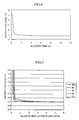
- Fig. 5 shows a graph of the characteristic as described above.
- Fig. 6 shows a graph for describing a relationship between a starting characteristic surge time and a supply voltage. As shown in Fig.. 6, when insufficiency of the energy for heating is caused by a drop of the supply voltage, the surge time becomes long. It is thus possible to estimate the warming-up characteristic of the thermal type air flow sensor 10 accurately by estimating the heating performance of the sensor 10 from the supply voltage while the sensor 10 outputs a surge voltage at its starting time.
- the supply voltage correction amount is obtained by subtracting a predetermined value 1 equivalent to such internal losses as those of the heating resistor driving circuit 10c, the resistor (seer Fig. 3), etc. from the supply voltage at each predetermined time.
- the heating capability of the heating resistor 10a is calculated by squaring each of the voltages at both ends of the heating resistor 10a, integrating the result at each surge voltage occurrence, and then dividing the integration result by the surge voltage occurrence time after the surge voltage falls.
- the heating capability is low in the standard power supply state, the surge time is extended. The detected surge time is thus corrected and decreased.
- the heating capability is high in the standard power supply state, the surge time becomes short. The detected surge time is thus corrected and increased.
- the detection accuracy is improved more if searching in tables is added to the process while the predetermined value 1 is handled as a fixed value here so as to make the calculation easier.
Landscapes
- Physics & Mathematics (AREA)
- Fluid Mechanics (AREA)
- General Physics & Mathematics (AREA)
- Engineering & Computer Science (AREA)
- Chemical & Material Sciences (AREA)
- Combustion & Propulsion (AREA)
- Mechanical Engineering (AREA)
- General Engineering & Computer Science (AREA)
- Combined Controls Of Internal Combustion Engines (AREA)
- Measuring Volume Flow (AREA)
- Electrical Control Of Air Or Fuel Supplied To Internal-Combustion Engine (AREA)
Abstract
Description
- The present invention relates to a control system of an internal combustion engine provided with a thermal type air flow sensor and more particularly to a control system of an internal combustion engine for correcting both surge voltage and warming-up characteristic of the thermal type air flow sensor when the air flow sensor starts so as to correct the intake air flow detected value according to the initial temperatures of both temperature sensing and heating resistors of the thermal type air flow sensor.
- It has been a conventional method that disposes a temperature sensing (thermal type) air flow meter in an intake air pipe of an internal combustion engine so as to detect the intake air flow in the engine. The temperature sensing (thermal type) air flow meter has such internal circuits as a temperature sensing resistor and a heating resistor used to detect the intake air flow respectively. In the temperature sensing (thermal type) air flow meter, the heating resistor is disposed in the intake air passage that receives a current and releases its heat at a constant temperature, thereby the temperature drop to be caused by the intake air is prevented with an increase of the supply of the current. The air flow meter calculates the intake air flow from the supplied current value.
- However, such a temperature sensing (thermal type) air flow meter generates a detection error in a period between when the meter is powered and when the heating resistor reaches the normal control temperature. This is why the air flow meter detected value must be corrected for a predetermined time after the sensor is powered. And, to solve the conventional problem, there has been disclosed a technique (JP Patent Application No. 7-318118 (1995) (JP Patent Publication (Kokai) No. 9-158758 (1997))) that calculates a warming-up correction factor for correcting an intake air flow signal according to an elapsed time after ignition switch ON and the warming-up characteristic of the temperature sensing (thermal type) air flow sensor using means for measuring a time elapsed after the ignition switch ON and means for estimating the warming-up characteristic of the temperature sensing (thermal type) air flow sensor from the water temperature at the starting time of the sensor.
- There is also disclosed another technique (JP Patent Publication (Kokai) No. 6-33825 (1994) for correcting the starting time characteristic of such a thermal type air flow sensor according to the results of the measurements of the last power-on time, the last power-off time, and the current power-on time. Concretely, the correcting technique is employed as means for correcting the starting time characteristic of the thermal type air flow sensor described above when the sensor is powered soon after the power-off state so as to prevent the temperature of the heating resistor from falling nearly to the room temperature after the power-off.
- There is disclosed proposed still another technique (JP Patent Publication (Kokai) No. 5-288113(1993)) for correcting the starting time characteristic of such a thermal type air flow sensor according to the results of measurements of the last power-off time and the current power-on time, as well as a time on which a predetermined voltage value of the thermal type air flow sensor is exceeded at starting time of the sensor.
- Each of the conventional techniques described above, however, includes a problem that the detection accuracy is deteriorated when the equilibrium is lost from among the temperature of the engine water, the temperature of the temperature sensing resistor, and the temperature of the heating resistor of the thermal type air flow sensor. This is because the initial temperature of the thermal type air flow sensor is estimated from the temperature of the engine water at the starting time of the sensor. Concretely, the initial temperatures of the temperature sensing resistor and the heating resistor of the thermal type air flow sensor do not fall so much even when the engine water is low in temperature if the engine stops before it is warmed up, then it starts again soon. In that state, the equilibrium is lost. If the engine starts in such a state, a detection error occurs.
- If the initial temperature of the thermal type air flow sensor is estimated from the power-on and power-off times, the last power-off time must always be measured. Thus, the CPU operation must be continued even at the power-off time of the engine, thereby the sensor needs time measuring means for such a measurement. The power consumption therefore comes to increase, since the CPU power cannot be turned off until the engine cools down completely after its power-off. The power wiring system must be checked.
- Further, in the case of the conventional technique for correcting the warming-up characteristic of the thermal type air flow sensor according to the time on which the voltage of the air flow sensor at its starting time exceeds a predetermined voltage, the time depend strongly on the supply voltage. This is because falling of the supply voltage causes degradation in the heating performance of the heating resistor and the temperature sensing resistor, thereby the correction amount varies significantly according to the changes of the supply voltage to be caused by how much the battery is charged, the power consumption variation of each accessory member, a sudden fluctuation in the power source at the time of starter switch ON, etc. This has also been a problem.
- Under such circumstances, it is an object of the present invention to provide a control system employed for an internal combustion engine provided with a thermal type air flow sensor. The control system is provided with means for correcting the output of the air flow sensor, which is capable of correcting a detected voltage error according to both of the surge voltage and the supply voltage of the sensor when the sensor is started.
- In order to solve the above conventional problems, the control system of the present invention employed for an internal combustion engine is basically provided with means for correcting the output of the thermal type air flow sensor. The output correcting means includes surge time measuring means for measuring a surge time in a value detected by the thermal type air flow sensor when the air flow sensor is powered and/or supply voltage detecting means. The thermal type air flow sensor output correcting means can calculate a warming-up characteristic correction amount for the air flow sensor according to the values of the measured surge time and the detected supply voltage. Concretely, the output correcting means can estimate the initial temperature of the thermal type air flow sensor element according to the values of the measured surge time and/or the detected supply voltage. Then it can calculate the warming-up characteristic correcting amount of the thermal type air flow sensor from the estimated initial temperature.
- In the control system of the present invention employed for an internal combustion engine and configured as described above, it is possible to correct an output error of the detected voltage properly according to a high voltage output (surge) caused by, for example, a temperature rise of the air flow sensor heating resistor to occur just after the air flow sensor is started. Consequently, the intake air amount of the engine is detected accurately when the engine is started. The starting time variation is thus reduced, thereby the CO and the hydrocarbon included in the exhaust gas is reduced at the starting time of the engine.
- The high voltage output (surge) is detected in the temperature rising process of the heating resistor and the high voltage output (surge) time is measured by the surge time measuring means. The surge time of the heating resistor often depends on the supply voltage (ex., battery), so that it is possible to correct the surge time according to the value of the supply voltage so as to correct the output error of the thermal type air flow sensor, thereby calculating the intake air amount of the engine accurately.
- Further, in another concrete aspect of the control system of the present invention employed for an internal combustion engine, the thermal type air flow sensor output correcting means can include means for correcting the measured value of the surge time according to the supply voltage during the surge time measurement. The output correcting means can calculate a squared average value of the values obtained respectively by subtracting a
predetermined value 1 from the supply voltage during a surge time measurement at the starting time of the air flow sensor. It can then calculate a warming-up characteristic correction amount for the air flow sensor according to the squared average value. Then, the output correcting means can estimate a surge time from the squared average value in the normal condition. Then it can calculate the warming-up characteristic correction amount for the thermal type air flow sensor from the estimated surge time. Further, the output correcting means can use apredetermined value 2 as a supply voltage at a resetting time, a total of the measured value and/or apredetermined value 3 as a surge time to calculate the squared average value of the values obtained respectively by subtracting thepredetermined value 1 from the supply voltage during a surge time measurement. - The control system of the present invention employed for an internal combustion engine and configured as described above can correct the surge time measured in the state of the supply voltage during a surge time measurement. Consequently, the surge time is estimated more accurately. It is also possible to correct the surge time measured according to the heating performance calculated during the surge time of the heating resistor of the air flow sensor by subtracting the internal loss of the transistors and/or resistors in the driving circuit of the air flow sensor from the supply voltage during the surge time measurement by calculating the squared average value of the values obtained respectively by subtracting the
predetermined value 1 from the supply voltage during the surge time measurement. Thus, the surge time is estimated more accurately. - Further, according to still another concrete aspect of the present invention, in the control system employed for an internal combustion engine, the
predetermined value 3 is a total time of a standard ECU hardware resetting time and/or a standard software resetting time. Thepredetermined value 2 is a supply voltage value stored beforehand in a memory system provided in the ECU when the ignition switch is on and/or the engine isn't driven. Thepredetermined value 2 is a value assumed just after the ECU is powered. In addition, the warming-up characteristic correction is not made for the thermal type air flow sensor if no surge voltage is detected when the air flow sensor is started after the ECU is powered. - The control system of the present invention employed for an internal combustion engine and configured as described above estimates a surge time obtained by adding a total time of a standard ECU hardware resetting time and/or a standard software resetting time to a measured value, so that the surge time is estimated accurately and it is possible to determine the temperature of the heating resistor of the air flow sensor to be high from the beginning if no surge voltage is detected in the air flow sensor actuated after the ECU is powered. The intake air amount of the engine is thus detected without making no warming-up characteristic correction for the air flow sensor.
- Further, according to still another aspect of the present invention, the control system employed for an internal combustion engine further includes intake air amount detecting means other than the thermal type air flow sensor, determining means for determining whether or not the value detected by the intake air amount detecting means is equal to or smaller than a predetermined value, and/or correcting means for correcting a warming-up characteristic correction amount for the air flow sensor. The warming-up characteristic correction amount can be corrected by the correcting means only when the intake air amount is determined to be equal to or smaller than the predetermined value. And, the intake air amount detecting means other than the thermal type air flow sensor can use at least one of the throttle opening, the accelerator opening, and the engine speed.
- Because the control system of the present invention employed for an internal combustion engine and configured as described above is provided with the intake air amount detecting means other than the thermal type air flow sensor, it is possible to determine whether a detected high voltage of the air flow sensor is caused by a surge or intake air amount, thereby determining whether to request the correcting means to make a correction. In addition, because another detection signal obtained from the throttle opening, the accelerator opening, and/or the engine speed is used to detect an input to the intake air amount detecting means, no special detecting means is needed.
-
- Fig. 1 is a system block diagram of an internal combustion engine for describing an embodiment of a control system of the present invention employed for the engine;
- Fig. 2 is an internal block diagram of the control system employed for the internal combustion engine shown in Fig. 1;
- Fig. 3 is an internal circuit diagram of a thermal (heating resistor type) air flow sensor of the control system employed for the internal combustion engine shown in Fig. 1;
- Fig. 4 is a chart for describing the behavior of an output voltage when the thermal type air flow sensor shown in Fig. 3 is powered;
- Fig. 5 is a chart for describing the dependency of the air amount detection error on the power-off time when the thermal type air flow sensor shown in Fig. 3 is powered;
- Fig. 6 is a chart for describing a relationship between a surge time and a supply voltage when the thermal type air flow sensor shown in Fig. 3 is powered;
- Fig. 7 is a chart for describing the behavior of a battery voltage while the control system of the internal combustion engine shown in Fig. 1 is cranking;
- Fig. 8 is a PAD chart of a routine for measuring a surge time in the control system of the internal combustion engine shown in Fig. 1;
- Fig. 9 is a PAD chart of a routine for calculating the element lead initial temperature index in the control system of the internal combustion engine shown in Fig.1;
- Fig. 10 is a PAD chart of a routine for calculating a battery voltage correction value in the control system of the internal combustion engine shown in Fig. 1;
- Fig. 11 is a PAD chart of a routine for calculating an element lead initial temperature correction value in the control system of the internal combustion engine shown in Fig. 1;
- Fig. 12 is a PAD chart of a routine for calculating an AFM warming-up correction factor in the control system of the internal combustion engine shown in Fig. 1; and
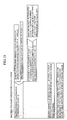
- Fig. 13 is a PAD chart of a routine for correcting an element lead initial temperature estimated value in the control system of the internal combustion engine shown in Fig. 1.
-
- Hereunder, an embodiment of the control system of the present invention employed for an internal combustion engine and provided with air flow sensor output correcting means will be described in detail with reference to the accompanying drawings.
- Fig. 1 shows a schematic block diagram of an entire internal combustion engine system provided with air flow sensor output correcting means in this embodiment.
- In Fig. 1, an
internal combustion engine 1 is a four-cylinder fuel injection that employs a so-called multi-point injection (MPI) method. Anintake pipe 3 and anexhaust pipe 4 are connected to eachcylinder 2 of theinternal combustion engine 1 and anignition plug 5 is disposed on the top of thecylinder 2. Aninjector 8 for injecting the fuel is attached to theintake pipe 3. - An
air cleaner 9 is disposed at the inlet of theintake pipe 3 while a thermal typeair flow sensor 10 is disposed at the downstream of theair cleaner 9. And, a throttle body 11 and acollector 13 are disposed at the downstream of theair cleaner 9. - The air led into each
cylinder 2 passes through theair cleaner 9, then through the thermal typeair flow sensor 10 and the throttle body 11 having athrottle valve 12 for controlling the air flow to be led into thecollector 13. The air is also led into thecollector 13 through anISC valve 14 provided so as to bypass the throttle body 11. The air led into thecollector 13 is distributed to an intakeair branch pipe 3a that is part of theintake pipe 3, then sucked into thecylinder block 2a of eachcylinder 2. - An
intake valve 6 is disposed at the suction side of eachcylinder 2 and the intakeair branch pipe 3a is connected to the suction side while an exhaust valve 7 is disposed at the exhaust side of eachcylinder 2 and theexhaust pipe 4 is connected to the exhaust side. The waste gas in thecylinder block 2a of eachcylinder 2 is exhausted to theexhaust pipe 4 through the exhaust valve 7 and purified withcatalyst 15, then discharged out of theengine 1. - The fuel burned in the
cylinder block 2a of eachcylinder 2 is sucked/pressed with afuel pump 17 from afuel tank 16 so that the pressure is adjusted at a constant value with apressure regulator 18, then the fuel is injected into the intakeair branch pipe 3a from aninjector 8 provided in the intakeair branch pipe 3a. - The
ignition plug 5 receives a high voltage generated at anignition coil 19 through adistributor 21 to generate sparks in thecylinder block 2a of eachcylinder 2. - The
internal combustion engine 1 is provided with a control unit (control system) 30 and thecontrol unit 30 receives signals output, for example, from sensors disposed at some places of theengine 1 and outputs control signals calculated according to those received signals to theinjector 8, theignition coil 19, thethrottle valve 12, etc. - The
crank angle sensor 22 is built in thedistributor 21. Thesensor 22 outputs a pulse at each predetermined crank angle and the output signal is inputted to thecontrol unit 30, thereby the cranck angle and the engine speed are calculated and a basic pulse width equivalent to the charging efficiency is calculated from the intake air amount and the engine speed. - The throttle sensory 23 is attached to the
throttle valve 12 and used to detect the opening of thethrottle valve 12. The output signal of thisthrottle sensor 23 is also inputted to thecontrol unit 30 to detect the fully closed position of thethrottle valve 12, the acceleration, etc. - The
water temperature sensor 24 is attached to eachcylinder 2 to detect the temperature of the cooling water therein. The output signal of this sensor is also inputted to thecontrol unit 30 to detect the warming-up state of theengine 1 and increase the amount of fuel injection, correct the ignition timing, control the on/off timing of the radiator fan 27, and set the target the engine speed when the engine is idling. - The air-
fuel ratio sensor 25 is provided in theexhaust pipe 4 to output a signal in accordance with the oxygen content of the exhaust gas. This signal is also inputted to thecontrol unit 30 to adjust the fuel injection pulse width so as to obtain the target air-fuel ratio (A/F) . - A
battery 20 is disposed in theinternal combustion engine 1 and a starter 26 is connected to theengine 1 to start theengine 1. Thebattery 20 is connected to the starter 26, thecontrol unit 30, the thermal typeair flow sensor 10, etc. electrically to supply a power to them respectively. Thebattery 20 is connected to the starter 26 electrically through astarter switch 28. - Fig. 2 shows an internal block diagram of the
control unit 30. Thecontrol unit 30 is configured by aCPU 31, aRESET signal terminal 32, and a power supply IC 34. - Signals are inputted to this
control unit 30 from theair flow sensor 10, thecrank angle sensor 22, thethrottle opening sensor 23, the air-fuel ratio sensor 25, and thewater temperature sensor 24 and powers are inputted to thecontrol unit 30 from thestarter switch 28 and theignition switch 29. And, signals are outputted from thecontrol unit 30 to theinjector 8, thefuel pump 17, apower transistor 33, which is an ignition switch of theignition plug 5, and theISC valve 14. TheRESET signal line 32 controlled by the power supply IC 34 is connected to the RESET terminal in theCPU 31. - The thermal type
air flow sensor 10 is provided with a bypass path (not shown) and a heating resistor driving circuit. - Fig. 3 shows a circuit diagram of the heating resistor driving circuit. The circuit is configured mainly of a
heating resistor 10a, a temperature sensing resistor 10b, a drivingtransistor 10c, and a current detectingresistor 10d. In the bypass path are disposed theheating resistor 10a and the temperature sensing resistor 10b to detect the intake air flow. Theheating resistor 10a and the temperature sensing resistor 10b are fastened to a supporting member and connected electrically to a control module included in theair flow sensor 10. The control module is an electronic circuit for heating and controlling theheating resistor 10a using an external power supply so that the heating resistor has a constant temperature difference from the temperature sensing resistor 10b. The control module transmits a flow signal obtained according to an amount of heating, which is an amount of heat release from the heating resistor to the air to thecontrol unit 30 through a connector. - Next, the starting characteristic of the thermal type
air flow sensor 10 will be described. When no power is supplied to the thermal typeair flow sensor 10, theheating resistor 10a is not heated. The temperature of theresistor 10a is thus the same as that of the temperature sensing resistor 10b. When theignition switch 29 is turned on, thereby theair flow sensor 10 is powered, the circuit module begins heating theheating resistor 10a so that theheating resistor 10a comes to have a constant temperature difference from the temperature of thetemperature sensing resistor 10. Theheating resistor 10a having a thermal capacity consumes much power just after theair flow sensor 10 is powered. Consequently, just after theair flow sensor 10 is powered, the amount of heating increases even when the amount of heat release to the air is small. As a result, the flow signal rises to cause a surge voltage to be outputted. - Fig. 4 shows a graph of such a surge voltage. For a while even after such a surge voltage is generated, the flow signal output includes an error at the plus side, since the flow signal outputs a total of an amount of heat release to the air from the
heating resistor 10a as a primary flow signal and other heats released to cool the supporting members. - If the initial temperature of the
heating resistor 10a is high, theresistor 10a reaches its thermal equilibrium state quickly, so that the surge time becomes short. On the other hand, if the initial temperature of theheating resistor 10a is low, theheating resistor 10a takes a long time to reach the thermal equilibrium state, so that the surge time becomes long. Fig. 5 shows a graph of the characteristic as described above. - Actually, when the power supply to the
air flow sensor 10 is shut off, for example, when theinternal combustion engine 1 stops, the temperature of theheating resistor 10a goes closer to that of the temperature sensing resistor 10b step by step due to the natural heat radiation. Theheating resistor 10a and the temperature sensing resistor 10b thus come to be almost the same in temperature at the next engine starting time. Sometimes, however, a power is supplied to theair flow sensor 10 to heat theheating resistor 10a before theheating resistor 10a cools down to the temperature of the temperature sensing resistor 10b, thereby theheating resistor 10a transmits its heat to the supporting member. In this case, the amount of heat release is smaller than the amount of heat release when theheating resistor 10a and the heat sensing resistor 10b are the same in temperature. Consequently, the warming-up characteristic correction amount of theair flow sensor 10 must be reduced in accordance with the (initial) temperature of theheating resistor 10a when the air flow sensor is powered. - And, as shown in Fig. 5, it will be understood that the plus side error still remains for a while after the surge disappears. The error and the surge time are proportional to each other; when one becomes larger/smaller when the other is longer/shorter. Consequently, it is possible to estimate the warming-up characteristic of the thermal type
air flow sensor 10 by measuring the surge time. This surge time becomes further longer as the supply voltage falls at a surge occurence. - Fig. 6 shows a graph for describing a relationship between a starting characteristic surge time and a supply voltage. As shown in Fig.. 6, when insufficiency of the energy for heating is caused by a drop of the supply voltage, the surge time becomes long. It is thus possible to estimate the warming-up characteristic of the thermal type
air flow sensor 10 accurately by estimating the heating performance of thesensor 10 from the supply voltage while thesensor 10 outputs a surge voltage at its starting time. - Next, an behavior of the battery voltage will be described. Fig. 7 shows a flowchart of such a battery voltage behavior while the control unit is cranking. The
air flow sensor 10 and the starter 26 receive an operation power from thebattery 20 respectively. When the starter 26 is to be driven, the starter needs a torque to compress the air in eachcylinder block 2a before the piston of theengine 1 reaches the top dead point of the air compression. Thus, the compression consumes much current, thereby the voltage of thebattery 20 falls and the supply voltage to theair flow sensor 10 varies. This is why the supply voltage must be corrected. - The supply voltage correction amount is obtained by subtracting a
predetermined value 1 equivalent to such internal losses as those of the heatingresistor driving circuit 10c, the resistor (seer Fig. 3), etc. from the supply voltage at each predetermined time. The heating capability of theheating resistor 10a is calculated by squaring each of the voltages at both ends of theheating resistor 10a, integrating the result at each surge voltage occurrence, and then dividing the integration result by the surge voltage occurrence time after the surge voltage falls. When the heating capability is low in the standard power supply state, the surge time is extended. The detected surge time is thus corrected and decreased. When the heating capability is high in the standard power supply state, the surge time becomes short. The detected surge time is thus corrected and increased. In this connection, the detection accuracy is improved more if searching in tables is added to the process while thepredetermined value 1 is handled as a fixed value here so as to make the calculation easier. - As described above, the thermal type
air flow sensor 10 comes to include an error in its output for a while depending on its pre-actuation state after both surge voltage and surge time are detected. Such an output error affects the fuel injection pulse and other controls apparently. The control unit employed for an internal combustion engine in this embodiment thus corrects such an error to occur when theair flow sensor 10 is actuated. - Next, a description will be made for how the output of the
air flow sensor 10 used in the control unit in this embodiment is controlled. - Fig. 8 shows a PAD chart of a routine for measuring a surge time. This routine is executed between when the output voltage of the
air flow sensor 10 is a predetermined value c1 and over, and when the output voltage is equal to or smaller than a predetermined value c2. The predetermined value c1 compared with the output voltage of theair flow sensor 10 is assumed to be larger than the output voltage of theair flow sensor 10 when no surge occurs therein. - This routine processing fulfills the condition A when the value in the elapsed time after key-on (ignition switch on) counter that begins counting up when the
ignition switch 29 is turned on is equal to or smaller than a predetermined value c3, the throttle opening is equal to or smaller than a predetermined value c4, and the air flow sensor output value is a predetermined value c1 and over. The routine then sets 'true' in the condition A fulfillment flag and counts up the value in the condition A fulfillment time counter. After that, when the value in the condition A fulfillment time counter is a predetermined value c5 and over, the routine sets 'true' in the condition A empirical flag. When the condition A is not fulfilled, the routine sets 'false' in the condition A fulfillment flag and initializes the condition A fulfillment time counter. - If 'true' is sets in the condition A empirical flag, the air flow sensor output value is equal to or smaller than a predetermined value c2, and the battery voltage is a predetermined value c6 and over, the condition B is fulfilled and the routine sets 'true' in the condition B fulfillment flag and counts up the value in the condition B fulfillment time counter. After that, when the value in the condition B fulfillment time counter is a predetermined value c5 and over, the routine sets 'true' in the condition B empirical flag. When the condition B is not fulfilled, the routine sets 'false' in the condition B fulfillment flag and initializes the condition B fulfillment time counter.
- If 'true' is set in the condition A empirical flag and 'false' is set in the condition B empirical flag, the routine counts up the value in the surge time counter. If 'false' is set in the condition A empirical flag, the routine initializes the value in the surge time counter.
- After that, the routine repeats the detection until 'true' is set in the condition B empirical flag.
- If 'true' is not set in the condition A empirical flag even after the value in the elapsed time after key-on counter reaches a predetermined value c3 and over, '0' is kept in the surge time counter, which denotes that no surge is generated in the air flow sensor output voltage. Thus, no warming-up characteristic correction is done. This is because the condition A is not fulfilled when the value in the elapsed time after key-on counter reaches the predetermined value c3 and over.
- Fig. 9 shows a PAD chart of a routine for calculating an element lead initial temperature index. If 'false' is set in the element lead initial temperature index calculation completion flag and 'true' is set in the condition B empirical flag, the routine calculates an element lead initial temperature index from the value in the surge time counter, the predetermined value c7, which is an estimated value of the resetting time, and the battery voltage correction value and sets 'true' in the element lead initial temperature index calculation completion flag.
- If 'false' is set in the element lead initial temperature index calculation completion flag and the value in the surge time counter goes over the predetermined value c8, the routine sets a predetermined value c9 for the element lead initial temperature index and 'true' in the element lead initial temperature index calculation completion flag respectively.
- Fig. 10 shows a PAD chart of a routine for calculating a correction value for a battery voltage. This routine processing is executed just once after the ignition key is turned on while a surge occurs in the air flow sensor output voltage.
- If 'false' is set in the heating energy calculation first empirical flag, the processing is determined as the first calculation for integrating heating energy values. Thus, the routine calculates a heating energy integrated value using predetermined values c10, c11, and c12, then sets 'true' in the heating energy calculation first empirical flag.
- The heating energy integrated value denotes an integrated value of energy to be supplied to heat the
heating resistor 10a of theair flow sensor 10. The predetermined value c10 used for the first calculation of the heating energy integrated value is premised as an estimated battery voltage between a key-on that cannot be estimated and a software/hardware resetting time. The predetermined value c11 is premised as a voltage that falls in the air flow sensor control circuit and the predetermined value c12 is premised as an estimated resetting time. - While 'true' is set in the condition A fulfillment flag or condition A empirical flag and 'false' is set in the condition B fulfillment flag and the condition B empirical flag respectively after 'true' is set in the heating energy calculation first empirical flag, the squared difference between the current battery voltage to be supplied to heat. the hearting
resistor 10 and the predetermined value c11 is added to the previous heating energy integrated value to calculate a new heating energy integrated value. - After that, the heating energy average value is calculated just once from the heating energy integrated value, the predetermined value c12, and the value in the surge time counter when the value in the condition B empirical flag is changed from 'false' to 'true' and the battery voltage correction value is searched in the battery voltage correction value table according to the obtained heating energy average value.
- Fig. 11 shows a PAD chart of a routine for calculating an element lead initial temperature correction value. This routine processing is executed to search an element lead initial temperature correction value in the element lead initial temperature correction value table according to the element lead initial temperature index if 'true' is set in the condition A empirical flag.
- Fig. 12 shows a PAD chart of a routine for calculating an AFM warming-up correction factor. This routine processing is executed to search an AFM warming-up correction factor in the AFM warming-up correction map according to the value in the surge time counter and the element lead initial temperature correction value if 'true' is set in the condition A empirical flag. In the AFM warming-up correction map, the AFM warming-up correction factor is set closer to 1 as the value in the surge time counter becomes larger. The AFM warming-up correction factor is assumed as 1 when 'false' is set in the condition A empirical flag.
- However, if 'true' is not set in the condition A empirical flag even when the value in the elapsed time after key-on counter reaches the predetermined value c3 and over, it is determined that no surge occurs in the air flow sensor output voltage and the AFM is warmed up enough. Thus, the warming-up correction factor is assumed as 1 and no warming-up correction is made. This is because the condition A is not fulfilled if the value in the elapsed time after key-on counter is the predetermined value c3 and over.
- Further, the routine searches an AFM power-on characteristic correction value in the AFM power-on characteristic table according to the time elapsed after the ignition is turned on. After that, the product of the AFM warming-up correction factor and the AFM power-on characteristic correction value is subtracted from the AFM output voltage to obtain the AFM output voltage after the warming-up correction.
- Further, the routine calculates a basic injection pulse width according to the AFM output voltage after the warming-up correction.
- Fig. 13 shows a PAD chart of a routine for correcting an element lead initial temperature estimated value. This routine processing is executed to search an element lead initial temperature in the element lead initial temperature table according to the value in the surge time counter. After that, the routine searches an element lead initial temperature correction value in the element lead initial temperature table according to the element lead initial temperature.
- While an embodiment of the present invention has been described, it is to be understood that modifications and variations will be apparent to those skilled in the art without departing from the spirit of the invention.
- As described above, the control unit of the present invention employed for an internal combustion engine can correct properly an output error to occur just after the thermal type air flow sensor is actuated, so that the intake air amount at the starting time of the engine is detected accurately and the variation of the engine starting time is reduced, thereby the CO and hydrocarbon included in the exhaust gas at the engine starting time is reduced.
Claims (12)
- A control system employed for an internal combustion engine and provided with a thermal type air flow sensor output correcting means;
wherein said thermal type air flow sensor output correcting means includes:wherein said output correcting means calculates a warming-up characteristic correction amount for said thermal type air flow sensor (10) according to said measured surge time and said detected supply voltage.a surge time measuring means for measuring a surge time in a value detected by said thermal type air flow sensor when said thermal type air flow sensor is powered; anda supply voltage detecting means; - A control system employed for an internal combustion engine and provided with a thermal type air flow sensor output correcting means;
wherein said thermal type air flow sensor output correcting means includes:wherein said output correcting means estimates an initial temperature of an element of said thermal type air flow sensor (10) according to said measured surge time and said detected supply voltage to calculate a warming-up characteristic correction amount for said thermal type air flow sensor (10) from said estimated temperature.a surge time measuring means for measuring a surge time in a value detected by said thermal type air flow sensor when said thermal type air flow sensor is powered; anda supply voltage detecting means; - The control system according to claim 1 or 2,
wherein said thermal type air flow sensor output correcting means further includes a correcting means for correcting said measured surge time according to a supply voltage during a surge time measurement. - The control system according to at least one of claims 1 to 3,
wherein said control system calculates a warming-up characteristic correction amount for said thermal type air flow sensor (10) by calculating a squared average value of values obtained respectively by subtracting a predetermined value 1 from said supply voltage during a surge time measurement when said air flow sensor is actuated, then correcting said supply voltage according to said squared average value. - The control system according to at least one of claims 1 to 4,
wherein said control system (30) calculates a squared average value of values obtained respectively by subtracting a predetermined value 1 from said supply voltage during a surge time measurement, estimates a surge time in the normal condition according to said squared average value, and calculates a warming-up characteristic correction amount for said thermal type air flow sensor (10) from said estimated surge time. - The control system according to at least one of claims 1 to 5,
wherein said control system (30) uses a predetermined value 2 as a supply voltage during a reset operation and a total of said measured value and a predetermined value 3 as a surge time for calculating a squared average value of values obtained respectively by subtracting a predetermined value 1 from said supply voltage during a surge time measurement. - The control system according to at least one of claims 1 to 6,
wherein said predetermined value 3 is a total of a standard hardware resetting time of an ECU and a software resetting time. - The control system according to at least one of claims 1 to 7,
wherein said predetermined value 2 is a supply voltage stored in a memory unit provided in said ECU when said ignition switch is on and an engine isn't driven. - The control system according to at least one of claims 1 to 8,
wherein said predetermined value 2 is obtained just after said ECU is powered. - The control system according to at least one of claims 1 to 9;
wherein warming characteristic correction isn't acted for said thermal type air flow sensor (10) when no surge voltage is detected from said thermal type air flow sensor (10) actuated just after said ECU is powered. - The control system according to at least one of claims 1 to 10,
wherein said control system (30) further includes:wherein said correcting means makes warming-up characteristic correction only when said determining means determines that an intake air flow is equal to or smaller than said predetermined value.intake air flow detecting means other than said thermal type air flow sensor;determining means for determining whether or not a value detected in said intake air flow detecting means is equal to or smaller than a predetermined value; andcorrecting means for correcting said warming-up characteristic correction amount for said thermal type air flow sensor; - The control system according to at least one of claims 1 to 11,
wherein said intake air flow detecting means other than said thermal type air flow sensor uses at least one of throttle opening, accelerator opening, and engine speed.
Applications Claiming Priority (2)
| Application Number | Priority Date | Filing Date | Title |
|---|---|---|---|
| JP2002211328 | 2002-07-19 | ||
| JP2002211328A JP3935013B2 (en) | 2002-07-19 | 2002-07-19 | Control device for internal combustion engine provided with output correction means for thermal airflow sensor |
Publications (3)
| Publication Number | Publication Date |
|---|---|
| EP1382823A2 true EP1382823A2 (en) | 2004-01-21 |
| EP1382823A3 EP1382823A3 (en) | 2007-12-12 |
| EP1382823B1 EP1382823B1 (en) | 2012-11-21 |
Family
ID=29774680
Family Applications (1)
| Application Number | Title | Priority Date | Filing Date |
|---|---|---|---|
| EP03015685A Expired - Lifetime EP1382823B1 (en) | 2002-07-19 | 2003-07-18 | Control system of internal combustion engine with output correcting means of thermal type air flow sensor |
Country Status (3)
| Country | Link |
|---|---|
| US (1) | US6810859B2 (en) |
| EP (1) | EP1382823B1 (en) |
| JP (1) | JP3935013B2 (en) |
Families Citing this family (11)
| Publication number | Priority date | Publication date | Assignee | Title |
|---|---|---|---|---|
| JP4357250B2 (en) * | 2003-09-24 | 2009-11-04 | 株式会社日立製作所 | Heating resistor type fluid flow rate measuring device and control device for internal combustion engine provided with the same |
| US6955145B1 (en) * | 2004-04-15 | 2005-10-18 | Borgwarner Inc. | Methods and apparatus for receiving excessive inputs in a VCT system |
| US7546200B2 (en) * | 2007-10-31 | 2009-06-09 | Roy Dwayne Justice | Systems and methods for determining and displaying volumetric efficiency |
| WO2011064896A1 (en) * | 2009-11-25 | 2011-06-03 | トヨタ自動車株式会社 | Control device for internal combustion engine |
| CN102918409B (en) * | 2010-05-27 | 2016-05-11 | 诺基亚技术有限公司 | Method of estimating remaining charge of battery of portable device |
| US8424372B2 (en) * | 2011-05-06 | 2013-04-23 | GM Global Technology Operations LLC | System and method for establishing a mass flow rate of air entering an engine |
| JP6160433B2 (en) * | 2013-10-18 | 2017-07-12 | 株式会社デンソー | Control device |
| EP3062747B1 (en) | 2013-10-28 | 2022-06-08 | Jace Medical, LLC | Orthopaedic fixation devices and systems |
| JP2016185762A (en) * | 2015-03-27 | 2016-10-27 | 株式会社オートネットワーク技術研究所 | In-vehicle light emitting device |
| CN109405935B (en) * | 2018-12-18 | 2023-12-05 | 东北林业大学 | An air flow sensor detection device and detection method |
| CN112595767B (en) * | 2020-12-14 | 2022-10-04 | 深圳市豪恩安全科技有限公司 | Calibration method, system and equipment of semiconductor type gas sensor |
Citations (1)
| Publication number | Priority date | Publication date | Assignee | Title |
|---|---|---|---|---|
| US578996A (en) | 1897-03-16 | Thirds to daniel g |
Family Cites Families (9)
| Publication number | Priority date | Publication date | Assignee | Title |
|---|---|---|---|---|
| JPS6053813A (en) * | 1983-09-02 | 1985-03-27 | Nippon Denso Co Ltd | Heat type airflow-rate detecting device |
| DE4004552C2 (en) * | 1989-02-14 | 1994-07-07 | Mitsubishi Electric Corp | Signal processing method for a thermal flow sensor |
| JPH0760107B2 (en) * | 1989-07-11 | 1995-06-28 | 三菱電機株式会社 | Signal processing method for thermal flow sensor |
| JP2681569B2 (en) * | 1992-01-17 | 1997-11-26 | 株式会社ユニシアジェックス | Intake air flow rate detection device for internal combustion engine |
| JPH05288113A (en) | 1992-04-10 | 1993-11-02 | Unisia Jecs Corp | Intake air flow rate detection device for internal combustion engine |
| JPH0633825A (en) | 1992-07-16 | 1994-02-08 | Unisia Jecs Corp | Intake air flow rate detection device for internal combustion engine |
| JP3555123B2 (en) | 1995-12-06 | 2004-08-18 | 日産自動車株式会社 | Control device for internal combustion engine |
| JP3433124B2 (en) * | 1998-12-15 | 2003-08-04 | 株式会社日立製作所 | Thermal air flow sensor |
| JP2002130042A (en) * | 2000-10-19 | 2002-05-09 | Denso Corp | In-cylinder charged air amount detection device for internal combustion engines |
-
2002
- 2002-07-19 JP JP2002211328A patent/JP3935013B2/en not_active Expired - Lifetime
-
2003
- 2003-07-15 US US10/618,739 patent/US6810859B2/en not_active Expired - Lifetime
- 2003-07-18 EP EP03015685A patent/EP1382823B1/en not_active Expired - Lifetime
Patent Citations (1)
| Publication number | Priority date | Publication date | Assignee | Title |
|---|---|---|---|---|
| US578996A (en) | 1897-03-16 | Thirds to daniel g |
Also Published As
| Publication number | Publication date |
|---|---|
| EP1382823B1 (en) | 2012-11-21 |
| US6810859B2 (en) | 2004-11-02 |
| JP3935013B2 (en) | 2007-06-20 |
| JP2004052670A (en) | 2004-02-19 |
| US20040020471A1 (en) | 2004-02-05 |
| EP1382823A3 (en) | 2007-12-12 |
Similar Documents
| Publication | Publication Date | Title |
|---|---|---|
| JP2518717B2 (en) | Internal combustion engine cooling system | |
| EP1382823B1 (en) | Control system of internal combustion engine with output correcting means of thermal type air flow sensor | |
| JP3811044B2 (en) | Radiator failure detection device for internal combustion engine | |
| US20090265086A1 (en) | Diagnosis Apparatus for Internal Combustion Engine | |
| JPH07238861A (en) | Fuel property detection device for internal combustion engine | |
| CN102449292B (en) | Control device for internal combustion engine | |
| CA2069836C (en) | Fuel injection control apparatus for internal combustion engine | |
| US5927248A (en) | Method of monitoring an overheating protective arrangement during full-load operation of an internal combustion engine | |
| EP2075458A2 (en) | Control apparatus for an engine | |
| JP2002130014A (en) | Fuel supply control device for internal combustion engine | |
| US7707999B2 (en) | Exhaust protecting device and protecting method for internal combustion engine | |
| JP2002070706A (en) | Ignition timing control device for internal combustion engine | |
| US8000883B2 (en) | Control apparatus and method for air-fuel ratio sensor | |
| JPH11173188A (en) | Fuel injection control device for internal combustion engine | |
| JPH07293315A (en) | Air-fuel ratio detecting method | |
| JP3146850B2 (en) | Engine control device | |
| JP7056108B2 (en) | Cooling control device | |
| JP2004353469A (en) | Control device for internal combustion engine | |
| JPH07269401A (en) | Air-fuel ratio controller for engine | |
| JP4246676B2 (en) | Control device for internal combustion engine | |
| JP3221503B2 (en) | Engine fuel injection amount control method | |
| JP3961446B2 (en) | Control device for internal combustion engine | |
| KR100282912B1 (en) | Fuel level correction device at start-up and its method | |
| KR100579917B1 (en) | Fuel quantity control method according to exhaust gas temperature | |
| JP2754761B2 (en) | Start-up fuel injection control device |
Legal Events
| Date | Code | Title | Description |
|---|---|---|---|
| PUAI | Public reference made under article 153(3) epc to a published international application that has entered the european phase |
Free format text: ORIGINAL CODE: 0009012 |
|
| AK | Designated contracting states |
Kind code of ref document: A2 Designated state(s): AT BE BG CH CY CZ DE DK EE ES FI FR GB GR HU IE IT LI LU MC NL PT RO SE SI SK TR |
|
| AX | Request for extension of the european patent |
Extension state: AL LT LV MK |
|
| RIN1 | Information on inventor provided before grant (corrected) |
Inventor name: NAGAISHI, HATSUO Inventor name: HIRAYAMA, HIROSHI Inventor name: AKAGI, YOSHIHIKO Inventor name: IWASAKI, TETSUYA Inventor name: OKAMOTO, TAKUTO,HITACHI, LTD.,INTELL. PR. GR. Inventor name: MIYA, KAZUHIKO |
|
| PUAL | Search report despatched |
Free format text: ORIGINAL CODE: 0009013 |
|
| AK | Designated contracting states |
Kind code of ref document: A3 Designated state(s): AT BE BG CH CY CZ DE DK EE ES FI FR GB GR HU IE IT LI LU MC NL PT RO SE SI SK TR |
|
| AX | Request for extension of the european patent |
Extension state: AL LT LV MK |
|
| 17P | Request for examination filed |
Effective date: 20080214 |
|
| AKX | Designation fees paid |
Designated state(s): DE FR |
|
| 17Q | First examination report despatched |
Effective date: 20081113 |
|
| GRAP | Despatch of communication of intention to grant a patent |
Free format text: ORIGINAL CODE: EPIDOSNIGR1 |
|
| RAP1 | Party data changed (applicant data changed or rights of an application transferred) |
Owner name: HITACHI, LTD. Owner name: NISSAN MOTOR CO., LTD. |
|
| GRAS | Grant fee paid |
Free format text: ORIGINAL CODE: EPIDOSNIGR3 |
|
| GRAA | (expected) grant |
Free format text: ORIGINAL CODE: 0009210 |
|
| RAP1 | Party data changed (applicant data changed or rights of an application transferred) |
Owner name: NISSAN MOTOR CO., LTD. Owner name: HITACHI, LTD. |
|
| RIN1 | Information on inventor provided before grant (corrected) |
Inventor name: NAGAISHI, HATSUO Inventor name: OKAMOTO, TAKUTO Inventor name: MIYA, KAZUHIKO Inventor name: IWASAKI, TETSUYA Inventor name: AKAGI, YOSHIHIKO Inventor name: HIRAYAMA, HIROSHI |
|
| AK | Designated contracting states |
Kind code of ref document: B1 Designated state(s): DE FR |
|
| REG | Reference to a national code |
Ref country code: DE Ref legal event code: R096 Ref document number: 60342622 Country of ref document: DE Effective date: 20130117 |
|
| PLBE | No opposition filed within time limit |
Free format text: ORIGINAL CODE: 0009261 |
|
| STAA | Information on the status of an ep patent application or granted ep patent |
Free format text: STATUS: NO OPPOSITION FILED WITHIN TIME LIMIT |
|
| 26N | No opposition filed |
Effective date: 20130822 |
|
| REG | Reference to a national code |
Ref country code: DE Ref legal event code: R097 Ref document number: 60342622 Country of ref document: DE Effective date: 20130822 |
|
| REG | Reference to a national code |
Ref country code: FR Ref legal event code: PLFP Year of fee payment: 14 |
|
| REG | Reference to a national code |
Ref country code: FR Ref legal event code: PLFP Year of fee payment: 15 |
|
| REG | Reference to a national code |
Ref country code: FR Ref legal event code: PLFP Year of fee payment: 16 |
|
| REG | Reference to a national code |
Ref country code: DE Ref legal event code: R081 Ref document number: 60342622 Country of ref document: DE Owner name: NISSAN MOTOR CO., LTD., YOKOHAMA-SHI, JP Free format text: FORMER OWNERS: HITACHI AUTOMOTIVE SYSTEMS, LTD., HITACHINAKA-SHI, IBARAKI, JP; NISSAN MOTOR CO., LTD., YOKOHAMA-SHI, KANAGAWA-KEN, JP Ref country code: DE Ref legal event code: R081 Ref document number: 60342622 Country of ref document: DE Owner name: HITACHI ASTEMO, LTD., HITACHINAKA-SHI, JP Free format text: FORMER OWNERS: HITACHI AUTOMOTIVE SYSTEMS, LTD., HITACHINAKA-SHI, IBARAKI, JP; NISSAN MOTOR CO., LTD., YOKOHAMA-SHI, KANAGAWA-KEN, JP Ref country code: DE Ref legal event code: R081 Ref document number: 60342622 Country of ref document: DE Owner name: NISSAN MOTOR CO., LTD., YOKOHAMA-SHI, JP Free format text: FORMER OWNERS: HITACHI, LTD., TOKYO, JP; NISSAN MOTOR CO., LTD., YOKOHAMA-SHI, KANAGAWA-KEN, JP Ref country code: DE Ref legal event code: R081 Ref document number: 60342622 Country of ref document: DE Owner name: HITACHI ASTEMO, LTD., HITACHINAKA-SHI, JP Free format text: FORMER OWNERS: HITACHI, LTD., TOKYO, JP; NISSAN MOTOR CO., LTD., YOKOHAMA-SHI, KANAGAWA-KEN, JP |
|
| PGFP | Annual fee paid to national office [announced via postgrant information from national office to epo] |
Ref country code: FR Payment date: 20220609 Year of fee payment: 20 |
|
| PGFP | Annual fee paid to national office [announced via postgrant information from national office to epo] |
Ref country code: DE Payment date: 20220531 Year of fee payment: 20 |
|
| REG | Reference to a national code |
Ref country code: DE Ref legal event code: R071 Ref document number: 60342622 Country of ref document: DE |