EP1382700A1 - Improved oxidation resistant molybdenum alloy - Google Patents
Improved oxidation resistant molybdenum alloy Download PDFInfo
- Publication number
- EP1382700A1 EP1382700A1 EP03254495A EP03254495A EP1382700A1 EP 1382700 A1 EP1382700 A1 EP 1382700A1 EP 03254495 A EP03254495 A EP 03254495A EP 03254495 A EP03254495 A EP 03254495A EP 1382700 A1 EP1382700 A1 EP 1382700A1
- Authority
- EP
- European Patent Office
- Prior art keywords
- metal
- molybdenum
- alloys
- alloy
- additions
- Prior art date
- Legal status (The legal status is an assumption and is not a legal conclusion. Google has not performed a legal analysis and makes no representation as to the accuracy of the status listed.)
- Granted
Links
Images


Classifications
-
- C—CHEMISTRY; METALLURGY
- C22—METALLURGY; FERROUS OR NON-FERROUS ALLOYS; TREATMENT OF ALLOYS OR NON-FERROUS METALS
- C22C—ALLOYS
- C22C27/00—Alloys based on rhenium or a refractory metal not mentioned in groups C22C14/00 or C22C16/00
- C22C27/04—Alloys based on tungsten or molybdenum
-
- C—CHEMISTRY; METALLURGY
- C22—METALLURGY; FERROUS OR NON-FERROUS ALLOYS; TREATMENT OF ALLOYS OR NON-FERROUS METALS
- C22C—ALLOYS
- C22C1/00—Making non-ferrous alloys
- C22C1/04—Making non-ferrous alloys by powder metallurgy
- C22C1/045—Alloys based on refractory metals
-
- B—PERFORMING OPERATIONS; TRANSPORTING
- B22—CASTING; POWDER METALLURGY
- B22F—WORKING METALLIC POWDER; MANUFACTURE OF ARTICLES FROM METALLIC POWDER; MAKING METALLIC POWDER; APPARATUS OR DEVICES SPECIALLY ADAPTED FOR METALLIC POWDER
- B22F2998/00—Supplementary information concerning processes or compositions relating to powder metallurgy
Definitions
- the present invention relates to Mo-Si-B alloys and, particularly, Mo-Si-B alloys with improved oxidation resistance due to additions of transition elements selected from the group consisting of Fe, Ni, Co, Cu and mixtures thereof.
- Molybdenum has excellent high temperature strength which makes it attractive for structural applications at elevated temperatures.
- the utility of molybdenum and molybdenum-based alloys however are often limited by their poor elevated temperature oxidation resistance.
- the first oxidation product that molybdenum forms is molybdenum trioxide.
- Molybdenum trioxide has a high vapor pressure and sublimes at substantial rates above 1100°F (593.3°C), resulting in accelerated metal loss from the alloy.
- Molybdenum and molybdenum-based alloys are therefore largely limited to use in non-oxidizing environments at elevated temperatures without some form of externally applied oxidation protective coating.
- U.S. Patents 5,595,616 and 5,693,156 disclose a new class of high temperature oxidation resistant molybdenum alloys, Mo-Si-B alloys.
- Mo-Si-B alloys the silicon and boron which remain after the initial molybdenum trioxide surface layer volatizes, oxidize to form a protective borosilicate-based oxide scale. If properly processed, these alloys can exhibit mechanical properties similar to other molybdenum-based alloys while also maintaining good oxidation resistance at elevated temperatures 1500°F-2500°F (815.5°C-1371.1°C). This combination of mechanical properties and oxidation resistance makes these materials very attractive for high temperature structural applications.
- the oxidation resistance of these Mo-Si-B alloys is largely a function of the silicon and boron content in the alloy. Increasing the silicon content in the presence of boron, improves the oxidation resistance of the alloy but also results in increased silicide volume fraction. High silicide volume fraction not only makes the alloy difficult to process, it makes it more difficult to achieve mechanical properties equivalent to other molybdenum-based alloys.
- the '595 patent discloses that quaternary additions of a variety of elements, specifically C, Hf, Ti, Zr, W, Re, Al, Cr, V, Nb and Ta, could improve the oxidation resistance of the Mo-Si-B alloy without increasing the silicide volume fraction. Alloys with the specified quaternary additions exhibited enhanced oxidation resistance at 2200°F (1204.4°C) and 2500°F (1371.1°C) relative to the ternary Mo-Si-B alloys of equivalent silicide content.
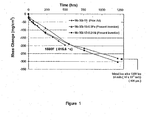
- the oxidation resistance of the ternary Mo-Si-B alloys are improved at elevated temperatures by minor additions of certain transition elements, such as Fe, Ni, Co, Cu. While earlier alloying additions resulted in the formation of an oxide scale which was protective for tens of hours at 2500°F (1371.1°C), the described additions result in the formation of an oxide scale which is protective for hundreds of hours (700hrs+) at 2500°F (1371.1°C). Minor additions of these elements improve the high temperature oxidation resistance of the alloy without any significant effect on the lower and intermediate temperature oxidation resistance of the alloys.
- transition elements such as Fe, Ni, Co, Cu.
- the present invention provides molybdenum alloys composed of body centered cubic molybdenum and intermetallic phases wherein said alloys consist essentially of a composition defined by the area described by the compositional points of the phase diagram for a ternary system: metal-1.0% Si-0.5% B, metal-1.0% Si-4.0% B, metal-4.5% Si-0.5% B, and metal-4.5% Si-4.0% B; wherein percentages are weight % and wherein said metal consists essentially of molybdenum as the major component, and further comprises an element selected from the group consisting of Fe, Ni, Co, Cu and mixtures thereof.
- the minor addition comprises 0.01 to 2.0 wt% Fe, more preferably 0.05 to 1.0 wt% Fe.
- the minor addition comprises 0.01 to 2.0 wt% Ni, more preferably 0.10 to 1.0 wt% Ni.
- the minor addition comprises 0.01 to 2.0 wt% Co, more preferably 0.05 to 1.0 wt% Co.
- the minor addition comprises 0.01 to 2.0 wt% Cu, more preferably 0.01 to 1.0 wt% Cu.
- the Mo-Si-B alloys to which the present invention is drawn are made by combining elements in proportion to the compositional points defined by the points of a phase diagram for the ternary system metal-1.0% Si-0.5% B, metal-1.0% Si-4.0% B, metal-4.5% Si-0.5% B, and metal-4.5% Si-4.0% B, wherein the metal is greater than 50% molybdenum.
- the molybdenum alloys are composed of body-centered cubic (BCC) molybdenum and intermetallic phases wherein the composition of the alloys are defined by the points of a phase diagram for the ternary system metal-1.0% Si-0.5% B, metal-1.0% Si-4.0% B, metal-4.5% Si-0.5% B and metal-4.5% Si-4.0% B where metal is molybdenum or a molybdenum alloy. Smaller amounts of silicon and boron will not provide adequate oxidation resistance; larger amounts will result in alloys too brittle for structural applications. All percentages (%) disclosed herein refer to weight percent unless otherwise specified. The alloys and their manufacture are disclosed in detail in U.S. Patents 5,595,616 and 5,693,156 and these patents are incorporated herein by reference.
- BCC body-centered cubic
- the molybdenum metal component contains one or more of the following transition element additions in replacement of an equivalent amount of molybdenum.
- the oxidation resistance of the ternary Mo-Si-B alloys are improved over a wide range of temperatures by minor additions of the transition elements. While earlier alloying additions resulted in the formation of an oxide scale which was protective for tens of hours at 2500°F (1371.1°C), the described additions result in the formation of an oxide scale which is protective for hundreds of hours (700hrs+) at 2500°F (1371.1°C). Minor additions of these elements improve the high temperature oxidation resistance without any deleterious effect on the lower and intermediate temperature oxidation resistance in this class of alloys.
- the beneficial effects of the described minor additions is not limited to alloys with these elements in quaternary additions, it also includes combinations of these additions and alloys with these additions in combination with higher order (5th and 6th element) additions.
- the alloys of the present invention provide significant improved oxidation resistance when compared to prior art alloys, particularly at elevated temperatures in excess of 2000°F (1093.3°C) over extended time periods.
Landscapes
- Chemical & Material Sciences (AREA)
- Engineering & Computer Science (AREA)
- Materials Engineering (AREA)
- Mechanical Engineering (AREA)
- Metallurgy (AREA)
- Organic Chemistry (AREA)
- Powder Metallurgy (AREA)
- Contacts (AREA)
- Laminated Bodies (AREA)
- Turbine Rotor Nozzle Sealing (AREA)
Abstract
Description
| ELEMENT | WT.% OF ELEMENT IN FINAL ALLOY | |
| BROAD | PREFERRED | |
| Fe | 0.01 to 2.0 | 0.05 to 1.0 |
| Ni | 0.01 to 2.0 | 0.10 to 1.0 |
| Co | 0.01 to 2.0 | 0.05 to 1.0 |
| Cu | 0.01 to 2.0 | 0.01 to 1.0 |
Claims (4)
- A molybdenum alloy composed of body centered cubic molybdenum and intermetallic phases wherein said alloy consists substantially of a composition defined by the area described by the compositional points of the phase diagram for a ternary system: metal-1.0% Si-0.5% B, metal-1.0% Si-4.0% B, metal-4.5% Si-0.5% B, and metal-4.5% Si-4.0% B; wherein percentages are weight % and wherein said metal consists essentially of molybdenum as the major component, and further comprises at least one element selected from the group consisting of Fe, Ni, Co, Cu and mixtures thereof.
- A molybdenum alloy as claimed in claim 1, wherein said at least one element in the stated quantity is selected from the group consisting of:
Fe 0.01 to 2.0 wt.% Ni 0.01 to 2.0 wt.% Co 0.01 to 2.0 wt.% Cu 0.01 to 2.0 wt.%. - A molybdenum alloy as claimed in claim 1, wherein said at least one element in the stated quantity is selected from the group consisting of:
Fe 0.05 to 1.0 wt.% Ni 0.10 to 1.0 wt.% Co 0.05 to 1.0 wt.% Cu 0.01 to 1.0 wt.%. - A molybdenum alloy as claimed in any preceding claim wherein the alloy includes minor additions of higher order (5th and 6th element) additions.
Applications Claiming Priority (2)
| Application Number | Priority Date | Filing Date | Title |
|---|---|---|---|
| US200474 | 1980-10-24 | ||
| US10/200,474 US6652674B1 (en) | 2002-07-19 | 2002-07-19 | Oxidation resistant molybdenum |
Publications (2)
| Publication Number | Publication Date |
|---|---|
| EP1382700A1 true EP1382700A1 (en) | 2004-01-21 |
| EP1382700B1 EP1382700B1 (en) | 2008-09-24 |
Family
ID=29584046
Family Applications (1)
| Application Number | Title | Priority Date | Filing Date |
|---|---|---|---|
| EP03254495A Expired - Lifetime EP1382700B1 (en) | 2002-07-19 | 2003-07-18 | Improved oxidation resistant molybdenum alloy |
Country Status (7)
| Country | Link |
|---|---|
| US (1) | US6652674B1 (en) |
| EP (1) | EP1382700B1 (en) |
| JP (1) | JP2004052112A (en) |
| KR (1) | KR100531702B1 (en) |
| AT (1) | ATE409244T1 (en) |
| DE (1) | DE60323711D1 (en) |
| RU (1) | RU2249057C1 (en) |
Cited By (2)
| Publication number | Priority date | Publication date | Assignee | Title |
|---|---|---|---|---|
| CN100523246C (en) * | 2006-10-16 | 2009-08-05 | 北京有色金属研究总院 | Low-expansion high heat conductivity nonmagnetic ceramic seal alloy and preparation method thereof |
| CN105220051A (en) * | 2015-10-28 | 2016-01-06 | 西北有色金属研究院 | A kind of Mo-Si-B intermetallic compound bar and preparation method thereof |
Families Citing this family (20)
| Publication number | Priority date | Publication date | Assignee | Title |
|---|---|---|---|---|
| US7887578B2 (en) * | 1998-09-05 | 2011-02-15 | Abbott Laboratories Vascular Enterprises Limited | Stent having an expandable web structure |
| US6682554B2 (en) | 1998-09-05 | 2004-01-27 | Jomed Gmbh | Methods and apparatus for a stent having an expandable web structure |
| US6755856B2 (en) | 1998-09-05 | 2004-06-29 | Abbott Laboratories Vascular Enterprises Limited | Methods and apparatus for stenting comprising enhanced embolic protection, coupled with improved protection against restenosis and thrombus formation |
| US7005191B2 (en) * | 2003-05-01 | 2006-02-28 | Wisconsin Alumni Research Foundation | Oxidation resistant coatings for ultra high temperature transition metals and transition metal alloys |
| AT7187U1 (en) * | 2004-02-25 | 2004-11-25 | Plansee Ag | METHOD FOR PRODUCING A MOLYBDENUM ALLOY |
| US20060057418A1 (en) * | 2004-09-16 | 2006-03-16 | Aeromet Technologies, Inc. | Alluminide coatings containing silicon and yttrium for superalloys and method of forming such coatings |
| US7763356B2 (en) * | 2006-03-13 | 2010-07-27 | United Technologies Corporation | Bond coating and thermal barrier compositions, processes for applying both, and their coated articles |
| US20090197075A1 (en) * | 2008-02-01 | 2009-08-06 | United Technologies Corporation | Coatings and coating processes for molybdenum substrates |
| US8268035B2 (en) * | 2008-12-23 | 2012-09-18 | United Technologies Corporation | Process for producing refractory metal alloy powders |
| RU2410201C1 (en) * | 2009-10-28 | 2011-01-27 | Российская Федерация, от имени которой выступает Министерство промышленности и торговли Российской Федерации (Минпромторг России) | Method of producing high-temperature metal composite material based on intermetallic molybdenum |
| JP5394582B1 (en) * | 2012-06-07 | 2014-01-22 | 株式会社アライドマテリアル | Molybdenum heat-resistant alloy |
| US9994937B1 (en) | 2014-05-20 | 2018-06-12 | Imaging Systems Technology, Inc. | Mo-Si-B manufacture |
| DE102016108408B4 (en) * | 2016-05-06 | 2023-10-26 | Danfoss Power Solutions Gmbh & Co. Ohg | Workpiece with improved coating and hydraulic device and/or fluid working machine with the workpiece |
| US10329926B2 (en) | 2016-05-09 | 2019-06-25 | United Technologies Corporation | Molybdenum-silicon-boron with noble metal barrier layer |
| EP3254785B1 (en) | 2016-06-10 | 2021-11-24 | Raytheon Technologies Corporation | Method of forming mo-si-b powder |
| DE102017217082A1 (en) * | 2017-09-26 | 2019-03-28 | Siemens Aktiengesellschaft | Powder of a molybdenum, silicon and boron-containing alloy, use of this powder and additive manufacturing process for a workpiece from this powder |
| DE102018206359A1 (en) * | 2018-04-25 | 2019-10-31 | MTU Aero Engines AG | METHOD FOR PRODUCING A COMPONENT FROM A MOLYBDEN ALLOYING USING ADDITIVE PROCESS |
| DE102018113340B4 (en) * | 2018-06-05 | 2020-10-01 | Otto-Von-Guericke-Universität Magdeburg | Density-optimized molybdenum alloy |
| EP3954806A1 (en) | 2020-08-14 | 2022-02-16 | Raytheon Technologies Corporation | Environmental barrier coating |
| US11761064B2 (en) * | 2020-12-18 | 2023-09-19 | Rtx Corporation | Refractory metal alloy |
Citations (3)
| Publication number | Priority date | Publication date | Assignee | Title |
|---|---|---|---|---|
| US3013329A (en) * | 1958-06-18 | 1961-12-19 | Westinghouse Electric Corp | Alloy and method |
| US3110589A (en) * | 1961-07-31 | 1963-11-12 | Du Pont | Molybdenum-titanium-silicon-nitrogen products and process for making same |
| US5595616A (en) * | 1993-12-21 | 1997-01-21 | United Technologies Corporation | Method for enhancing the oxidation resistance of a molybdenum alloy, and a method of making a molybdenum alloy |
Family Cites Families (3)
| Publication number | Priority date | Publication date | Assignee | Title |
|---|---|---|---|---|
| US3690686A (en) * | 1969-08-11 | 1972-09-12 | Ramsey Corp | Piston with seal having high strength molybdenum alloy facing |
| JPS6033335A (en) * | 1983-07-30 | 1985-02-20 | Toho Kinzoku Kk | Heat resistant molybdenum material |
| US5505793A (en) * | 1994-12-27 | 1996-04-09 | The United States Of America As Represented By The Secretary Of The Air Force | High temperature melting molybdenum-chromium-silicon alloys |
-
2002
- 2002-07-19 US US10/200,474 patent/US6652674B1/en not_active Expired - Lifetime
-
2003
- 2003-07-04 KR KR10-2003-0045095A patent/KR100531702B1/en not_active Expired - Fee Related
- 2003-07-18 AT AT03254495T patent/ATE409244T1/en not_active IP Right Cessation
- 2003-07-18 DE DE60323711T patent/DE60323711D1/en not_active Expired - Lifetime
- 2003-07-18 EP EP03254495A patent/EP1382700B1/en not_active Expired - Lifetime
- 2003-07-18 JP JP2003277080A patent/JP2004052112A/en not_active Ceased
- 2003-07-21 RU RU2003122089/02A patent/RU2249057C1/en not_active IP Right Cessation
Patent Citations (4)
| Publication number | Priority date | Publication date | Assignee | Title |
|---|---|---|---|---|
| US3013329A (en) * | 1958-06-18 | 1961-12-19 | Westinghouse Electric Corp | Alloy and method |
| US3110589A (en) * | 1961-07-31 | 1963-11-12 | Du Pont | Molybdenum-titanium-silicon-nitrogen products and process for making same |
| US5595616A (en) * | 1993-12-21 | 1997-01-21 | United Technologies Corporation | Method for enhancing the oxidation resistance of a molybdenum alloy, and a method of making a molybdenum alloy |
| US5693156A (en) * | 1993-12-21 | 1997-12-02 | United Technologies Corporation | Oxidation resistant molybdenum alloy |
Non-Patent Citations (1)
| Title |
|---|
| ELVERS,B., HAWKINS,S., SCHULZ,G.: "Ullmann's Encyclopedia of Industrial Chemistry, 5.Ed., Vol.16", 1990, VCH VERLAGSGESELLSCHAFT MBH, WEINHEIM (D), XP002255738, 910054 * |
Cited By (2)
| Publication number | Priority date | Publication date | Assignee | Title |
|---|---|---|---|---|
| CN100523246C (en) * | 2006-10-16 | 2009-08-05 | 北京有色金属研究总院 | Low-expansion high heat conductivity nonmagnetic ceramic seal alloy and preparation method thereof |
| CN105220051A (en) * | 2015-10-28 | 2016-01-06 | 西北有色金属研究院 | A kind of Mo-Si-B intermetallic compound bar and preparation method thereof |
Also Published As
| Publication number | Publication date |
|---|---|
| ATE409244T1 (en) | 2008-10-15 |
| RU2249057C1 (en) | 2005-03-27 |
| DE60323711D1 (en) | 2008-11-06 |
| JP2004052112A (en) | 2004-02-19 |
| EP1382700B1 (en) | 2008-09-24 |
| RU2003122089A (en) | 2005-01-27 |
| US6652674B1 (en) | 2003-11-25 |
| KR100531702B1 (en) | 2005-11-29 |
| KR20040010132A (en) | 2004-01-31 |
Similar Documents
| Publication | Publication Date | Title |
|---|---|---|
| US6652674B1 (en) | Oxidation resistant molybdenum | |
| US9695494B2 (en) | Au-base bulk solidifying amorphous alloys | |
| JP6199897B2 (en) | Powder mixture for producing nickel-titanium-rare earth metal (Ni-Ti-RE) sintered alloys | |
| JPH055152A (en) | Heat resistant hard sintered alloy | |
| JP7596160B2 (en) | Multi-component alloy powder | |
| JPS63235438A (en) | Intermetallic compound and its use | |
| JP4193958B2 (en) | Molten metal member having excellent corrosion resistance against molten metal and method for producing the same | |
| JPWO2017204286A1 (en) | Ni-based alloy for hot mold, mold for hot forging using the same, method of manufacturing forged product | |
| JP7716231B2 (en) | Multi-component alloy powder and compact | |
| WO2019106922A1 (en) | Ni-BASED ALLOY FOR HOT-WORKING DIE, AND HOT-FORGING DIE USING SAME | |
| JP2952924B2 (en) | TiAl-based heat-resistant alloy and method for producing the same | |
| JP7213022B2 (en) | Co-based alloy and its powder | |
| JP2569712B2 (en) | Ti-A ▲ -based metal compound cast alloy with excellent high temperature oxidation resistance | |
| JP7602594B2 (en) | Ni-Cr-Mo precipitation hardening alloy | |
| JPS5853703B2 (en) | Molybdenum material with excellent hot workability | |
| JP7680861B2 (en) | Multi-component alloy powder and compact | |
| US4131457A (en) | High-strength, high-expansion manganese alloy | |
| JP7723533B2 (en) | Ni-based self-fluxing alloy | |
| JPH073357A (en) | High hardness cemented carbide excellent in oxidation resistance | |
| JP2004263251A (en) | Group 7a element-containing cemented carbide | |
| JP2542603B2 (en) | Abrasion resistance Al-Si-Mn sintered alloy | |
| JP2732934B2 (en) | Constant temperature forging die made of Ni-base alloy with excellent high-temperature strength and high-temperature oxidation resistance | |
| JP7668843B2 (en) | Cu alloy powder for additive manufacturing having high hardness and high electrical conductivity and additive manufacturing body using the same | |
| JPS6173867A (en) | Hot wear resistant member of dispersion strengthening sintered alloy steel | |
| JPH07316699A (en) | Corrosion resistant nitride-dispersed Ni-based alloy with high hardness and strength |
Legal Events
| Date | Code | Title | Description |
|---|---|---|---|
| PUAI | Public reference made under article 153(3) epc to a published international application that has entered the european phase |
Free format text: ORIGINAL CODE: 0009012 |
|
| AK | Designated contracting states |
Kind code of ref document: A1 Designated state(s): AT BE BG CH CY CZ DE DK EE ES FI FR GB GR HU IE IT LI LU MC NL PT RO SE SI SK TR |
|
| AX | Request for extension of the european patent |
Extension state: AL LT LV MK |
|
| 17P | Request for examination filed |
Effective date: 20031230 |
|
| AKX | Designation fees paid |
Designated state(s): AT BE BG CH CY CZ DE DK EE ES FI FR GB GR HU IE IT LI LU MC NL PT RO SE SI SK TR |
|
| GRAP | Despatch of communication of intention to grant a patent |
Free format text: ORIGINAL CODE: EPIDOSNIGR1 |
|
| GRAS | Grant fee paid |
Free format text: ORIGINAL CODE: EPIDOSNIGR3 |
|
| GRAA | (expected) grant |
Free format text: ORIGINAL CODE: 0009210 |
|
| AK | Designated contracting states |
Kind code of ref document: B1 Designated state(s): AT BE BG CH CY CZ DE DK EE ES FI FR GB GR HU IE IT LI LU MC NL PT RO SE SI SK TR |
|
| REG | Reference to a national code |
Ref country code: GB Ref legal event code: FG4D |
|
| REG | Reference to a national code |
Ref country code: CH Ref legal event code: EP |
|
| REG | Reference to a national code |
Ref country code: IE Ref legal event code: FG4D |
|
| REF | Corresponds to: |
Ref document number: 60323711 Country of ref document: DE Date of ref document: 20081106 Kind code of ref document: P |
|
| PG25 | Lapsed in a contracting state [announced via postgrant information from national office to epo] |
Ref country code: SI Free format text: LAPSE BECAUSE OF FAILURE TO SUBMIT A TRANSLATION OF THE DESCRIPTION OR TO PAY THE FEE WITHIN THE PRESCRIBED TIME-LIMIT Effective date: 20080924 Ref country code: AT Free format text: LAPSE BECAUSE OF FAILURE TO SUBMIT A TRANSLATION OF THE DESCRIPTION OR TO PAY THE FEE WITHIN THE PRESCRIBED TIME-LIMIT Effective date: 20080924 Ref country code: FI Free format text: LAPSE BECAUSE OF FAILURE TO SUBMIT A TRANSLATION OF THE DESCRIPTION OR TO PAY THE FEE WITHIN THE PRESCRIBED TIME-LIMIT Effective date: 20080924 |
|
| NLV1 | Nl: lapsed or annulled due to failure to fulfill the requirements of art. 29p and 29m of the patents act | ||
| PG25 | Lapsed in a contracting state [announced via postgrant information from national office to epo] |
Ref country code: BE Free format text: LAPSE BECAUSE OF FAILURE TO SUBMIT A TRANSLATION OF THE DESCRIPTION OR TO PAY THE FEE WITHIN THE PRESCRIBED TIME-LIMIT Effective date: 20080924 |
|
| PG25 | Lapsed in a contracting state [announced via postgrant information from national office to epo] |
Ref country code: ES Free format text: LAPSE BECAUSE OF FAILURE TO SUBMIT A TRANSLATION OF THE DESCRIPTION OR TO PAY THE FEE WITHIN THE PRESCRIBED TIME-LIMIT Effective date: 20090104 Ref country code: BG Free format text: LAPSE BECAUSE OF FAILURE TO SUBMIT A TRANSLATION OF THE DESCRIPTION OR TO PAY THE FEE WITHIN THE PRESCRIBED TIME-LIMIT Effective date: 20081224 |
|
| PG25 | Lapsed in a contracting state [announced via postgrant information from national office to epo] |
Ref country code: CZ Free format text: LAPSE BECAUSE OF FAILURE TO SUBMIT A TRANSLATION OF THE DESCRIPTION OR TO PAY THE FEE WITHIN THE PRESCRIBED TIME-LIMIT Effective date: 20080924 Ref country code: RO Free format text: LAPSE BECAUSE OF FAILURE TO SUBMIT A TRANSLATION OF THE DESCRIPTION OR TO PAY THE FEE WITHIN THE PRESCRIBED TIME-LIMIT Effective date: 20080924 Ref country code: SK Free format text: LAPSE BECAUSE OF FAILURE TO SUBMIT A TRANSLATION OF THE DESCRIPTION OR TO PAY THE FEE WITHIN THE PRESCRIBED TIME-LIMIT Effective date: 20080924 Ref country code: PT Free format text: LAPSE BECAUSE OF FAILURE TO SUBMIT A TRANSLATION OF THE DESCRIPTION OR TO PAY THE FEE WITHIN THE PRESCRIBED TIME-LIMIT Effective date: 20090224 Ref country code: NL Free format text: LAPSE BECAUSE OF FAILURE TO SUBMIT A TRANSLATION OF THE DESCRIPTION OR TO PAY THE FEE WITHIN THE PRESCRIBED TIME-LIMIT Effective date: 20080924 |
|
| PG25 | Lapsed in a contracting state [announced via postgrant information from national office to epo] |
Ref country code: DK Free format text: LAPSE BECAUSE OF FAILURE TO SUBMIT A TRANSLATION OF THE DESCRIPTION OR TO PAY THE FEE WITHIN THE PRESCRIBED TIME-LIMIT Effective date: 20080924 Ref country code: EE Free format text: LAPSE BECAUSE OF FAILURE TO SUBMIT A TRANSLATION OF THE DESCRIPTION OR TO PAY THE FEE WITHIN THE PRESCRIBED TIME-LIMIT Effective date: 20080924 |
|
| PLBE | No opposition filed within time limit |
Free format text: ORIGINAL CODE: 0009261 |
|
| STAA | Information on the status of an ep patent application or granted ep patent |
Free format text: STATUS: NO OPPOSITION FILED WITHIN TIME LIMIT |
|
| PG25 | Lapsed in a contracting state [announced via postgrant information from national office to epo] |
Ref country code: IT Free format text: LAPSE BECAUSE OF FAILURE TO SUBMIT A TRANSLATION OF THE DESCRIPTION OR TO PAY THE FEE WITHIN THE PRESCRIBED TIME-LIMIT Effective date: 20080924 |
|
| 26N | No opposition filed |
Effective date: 20090625 |
|
| PG25 | Lapsed in a contracting state [announced via postgrant information from national office to epo] |
Ref country code: SE Free format text: LAPSE BECAUSE OF FAILURE TO SUBMIT A TRANSLATION OF THE DESCRIPTION OR TO PAY THE FEE WITHIN THE PRESCRIBED TIME-LIMIT Effective date: 20081224 |
|
| PG25 | Lapsed in a contracting state [announced via postgrant information from national office to epo] |
Ref country code: MC Free format text: LAPSE BECAUSE OF NON-PAYMENT OF DUE FEES Effective date: 20090731 |
|
| REG | Reference to a national code |
Ref country code: CH Ref legal event code: PL |
|
| REG | Reference to a national code |
Ref country code: FR Ref legal event code: ST Effective date: 20100331 |
|
| REG | Reference to a national code |
Ref country code: IE Ref legal event code: MM4A |
|
| PG25 | Lapsed in a contracting state [announced via postgrant information from national office to epo] |
Ref country code: CH Free format text: LAPSE BECAUSE OF NON-PAYMENT OF DUE FEES Effective date: 20090731 Ref country code: FR Free format text: LAPSE BECAUSE OF NON-PAYMENT OF DUE FEES Effective date: 20090731 Ref country code: LI Free format text: LAPSE BECAUSE OF NON-PAYMENT OF DUE FEES Effective date: 20090731 |
|
| PG25 | Lapsed in a contracting state [announced via postgrant information from national office to epo] |
Ref country code: IE Free format text: LAPSE BECAUSE OF NON-PAYMENT OF DUE FEES Effective date: 20090718 |
|
| PG25 | Lapsed in a contracting state [announced via postgrant information from national office to epo] |
Ref country code: GR Free format text: LAPSE BECAUSE OF FAILURE TO SUBMIT A TRANSLATION OF THE DESCRIPTION OR TO PAY THE FEE WITHIN THE PRESCRIBED TIME-LIMIT Effective date: 20081225 |
|
| PG25 | Lapsed in a contracting state [announced via postgrant information from national office to epo] |
Ref country code: LU Free format text: LAPSE BECAUSE OF NON-PAYMENT OF DUE FEES Effective date: 20090718 |
|
| PG25 | Lapsed in a contracting state [announced via postgrant information from national office to epo] |
Ref country code: HU Free format text: LAPSE BECAUSE OF FAILURE TO SUBMIT A TRANSLATION OF THE DESCRIPTION OR TO PAY THE FEE WITHIN THE PRESCRIBED TIME-LIMIT Effective date: 20090325 |
|
| PG25 | Lapsed in a contracting state [announced via postgrant information from national office to epo] |
Ref country code: TR Free format text: LAPSE BECAUSE OF FAILURE TO SUBMIT A TRANSLATION OF THE DESCRIPTION OR TO PAY THE FEE WITHIN THE PRESCRIBED TIME-LIMIT Effective date: 20080924 |
|
| PG25 | Lapsed in a contracting state [announced via postgrant information from national office to epo] |
Ref country code: CY Free format text: LAPSE BECAUSE OF FAILURE TO SUBMIT A TRANSLATION OF THE DESCRIPTION OR TO PAY THE FEE WITHIN THE PRESCRIBED TIME-LIMIT Effective date: 20080924 |
|
| REG | Reference to a national code |
Ref country code: DE Ref legal event code: R082 Ref document number: 60323711 Country of ref document: DE Representative=s name: SCHMITT-NILSON SCHRAUD WAIBEL WOHLFROM PATENTA, DE |
|
| REG | Reference to a national code |
Ref country code: DE Ref legal event code: R082 Ref document number: 60323711 Country of ref document: DE Representative=s name: SCHMITT-NILSON SCHRAUD WAIBEL WOHLFROM PATENTA, DE Ref country code: DE Ref legal event code: R081 Ref document number: 60323711 Country of ref document: DE Owner name: UNITED TECHNOLOGIES CORP. (N.D.GES.D. STAATES , US Free format text: FORMER OWNER: UNITED TECHNOLOGIES CORP., HARTFORD, CONN., US |
|
| PGFP | Annual fee paid to national office [announced via postgrant information from national office to epo] |
Ref country code: GB Payment date: 20190624 Year of fee payment: 17 Ref country code: DE Payment date: 20190620 Year of fee payment: 17 |
|
| REG | Reference to a national code |
Ref country code: DE Ref legal event code: R119 Ref document number: 60323711 Country of ref document: DE |
|
| GBPC | Gb: european patent ceased through non-payment of renewal fee |
Effective date: 20200718 |
|
| PG25 | Lapsed in a contracting state [announced via postgrant information from national office to epo] |
Ref country code: GB Free format text: LAPSE BECAUSE OF NON-PAYMENT OF DUE FEES Effective date: 20200718 |
|
| PG25 | Lapsed in a contracting state [announced via postgrant information from national office to epo] |
Ref country code: DE Free format text: LAPSE BECAUSE OF NON-PAYMENT OF DUE FEES Effective date: 20210202 |