EP1382609A1 - Process for solubilizing organometallic compounds in fluorinated solvents by addition of a fluorinated non-catalytic co-solubilizer - Google Patents
Process for solubilizing organometallic compounds in fluorinated solvents by addition of a fluorinated non-catalytic co-solubilizer Download PDFInfo
- Publication number
- EP1382609A1 EP1382609A1 EP03014938A EP03014938A EP1382609A1 EP 1382609 A1 EP1382609 A1 EP 1382609A1 EP 03014938 A EP03014938 A EP 03014938A EP 03014938 A EP03014938 A EP 03014938A EP 1382609 A1 EP1382609 A1 EP 1382609A1
- Authority
- EP
- European Patent Office
- Prior art keywords
- fluorocarbons
- fluorinated
- solubilizer
- organometallic
- organometallic compound
- Prior art date
- Legal status (The legal status is an assumption and is not a legal conclusion. Google has not performed a legal analysis and makes no representation as to the accuracy of the status listed.)
- Granted
Links
- 239000002904 solvent Substances 0.000 title claims abstract description 137
- 150000002902 organometallic compounds Chemical class 0.000 title claims abstract description 56
- 238000000034 method Methods 0.000 title claims abstract description 49
- 230000003381 solubilizing effect Effects 0.000 title claims abstract description 15
- 230000003197 catalytic effect Effects 0.000 title description 2
- 229920002313 fluoropolymer Polymers 0.000 claims abstract description 42
- 125000002524 organometallic group Chemical group 0.000 claims abstract description 32
- 239000003054 catalyst Substances 0.000 claims abstract description 24
- 239000002887 superconductor Substances 0.000 claims description 33
- 125000001475 halogen functional group Chemical group 0.000 claims description 14
- 229920001577 copolymer Polymers 0.000 claims description 13
- BFKJFAAPBSQJPD-UHFFFAOYSA-N tetrafluoroethene Chemical group FC(F)=C(F)F BFKJFAAPBSQJPD-UHFFFAOYSA-N 0.000 claims description 13
- 239000002243 precursor Substances 0.000 claims description 11
- 229920005548 perfluoropolymer Polymers 0.000 claims description 10
- 125000004122 cyclic group Chemical group 0.000 claims description 8
- -1 siloxanes Chemical class 0.000 claims description 6
- 150000003440 styrenes Chemical class 0.000 claims description 3
- 125000001424 substituent group Chemical group 0.000 claims description 3
- 150000003673 urethanes Chemical class 0.000 claims description 3
- 239000003446 ligand Substances 0.000 description 15
- 239000000463 material Substances 0.000 description 12
- 239000012071 phase Substances 0.000 description 10
- 238000000576 coating method Methods 0.000 description 9
- 239000000203 mixture Substances 0.000 description 8
- YCKRFDGAMUMZLT-UHFFFAOYSA-N Fluorine atom Chemical compound [F] YCKRFDGAMUMZLT-UHFFFAOYSA-N 0.000 description 7
- 238000006243 chemical reaction Methods 0.000 description 7
- 229910052731 fluorine Inorganic materials 0.000 description 7
- 239000011737 fluorine Substances 0.000 description 7
- NBVXSUQYWXRMNV-UHFFFAOYSA-N fluoromethane Chemical compound FC NBVXSUQYWXRMNV-UHFFFAOYSA-N 0.000 description 7
- 125000001183 hydrocarbyl group Chemical group 0.000 description 7
- 229920000642 polymer Polymers 0.000 description 7
- 239000010949 copper Substances 0.000 description 6
- 239000012530 fluid Substances 0.000 description 6
- JPVYNHNXODAKFH-UHFFFAOYSA-N Cu2+ Chemical compound [Cu+2] JPVYNHNXODAKFH-UHFFFAOYSA-N 0.000 description 5
- 239000000654 additive Substances 0.000 description 5
- 238000013459 approach Methods 0.000 description 5
- 239000011575 calcium Substances 0.000 description 5
- 238000006555 catalytic reaction Methods 0.000 description 5
- 239000000945 filler Substances 0.000 description 5
- 229910052739 hydrogen Inorganic materials 0.000 description 5
- 239000001257 hydrogen Substances 0.000 description 5
- 125000005010 perfluoroalkyl group Chemical group 0.000 description 5
- PPBRXRYQALVLMV-UHFFFAOYSA-N Styrene Chemical compound C=CC1=CC=CC=C1 PPBRXRYQALVLMV-UHFFFAOYSA-N 0.000 description 4
- 230000015572 biosynthetic process Effects 0.000 description 4
- 229910052751 metal Inorganic materials 0.000 description 4
- 239000002184 metal Substances 0.000 description 4
- FYJQJMIEZVMYSD-UHFFFAOYSA-N perfluoro-2-butyltetrahydrofuran Chemical compound FC(F)(F)C(F)(F)C(F)(F)C(F)(F)C1(F)OC(F)(F)C(F)(F)C1(F)F FYJQJMIEZVMYSD-UHFFFAOYSA-N 0.000 description 4
- 238000000926 separation method Methods 0.000 description 4
- 239000007787 solid Substances 0.000 description 4
- 229910052712 strontium Inorganic materials 0.000 description 4
- 238000003786 synthesis reaction Methods 0.000 description 4
- 240000002132 Beaucarnea recurvata Species 0.000 description 3
- UHOVQNZJYSORNB-UHFFFAOYSA-N Benzene Chemical compound C1=CC=CC=C1 UHOVQNZJYSORNB-UHFFFAOYSA-N 0.000 description 3
- OKTJSMMVPCPJKN-UHFFFAOYSA-N Carbon Chemical group [C] OKTJSMMVPCPJKN-UHFFFAOYSA-N 0.000 description 3
- 229920006362 Teflon® Polymers 0.000 description 3
- YXFVVABEGXRONW-UHFFFAOYSA-N Toluene Chemical compound CC1=CC=CC=C1 YXFVVABEGXRONW-UHFFFAOYSA-N 0.000 description 3
- 230000000996 additive effect Effects 0.000 description 3
- 150000001336 alkenes Chemical class 0.000 description 3
- 239000008346 aqueous phase Substances 0.000 description 3
- 229910052791 calcium Inorganic materials 0.000 description 3
- 150000001735 carboxylic acids Chemical class 0.000 description 3
- 238000005229 chemical vapour deposition Methods 0.000 description 3
- 150000001875 compounds Chemical class 0.000 description 3
- 229910052802 copper Inorganic materials 0.000 description 3
- 229940079593 drug Drugs 0.000 description 3
- 239000003814 drug Substances 0.000 description 3
- DMEGYFMYUHOHGS-UHFFFAOYSA-N heptamethylene Natural products C1CCCCCC1 DMEGYFMYUHOHGS-UHFFFAOYSA-N 0.000 description 3
- 238000007172 homogeneous catalysis Methods 0.000 description 3
- 125000004435 hydrogen atom Chemical class [H]* 0.000 description 3
- 229910052738 indium Inorganic materials 0.000 description 3
- 229910044991 metal oxide Inorganic materials 0.000 description 3
- 150000004706 metal oxides Chemical class 0.000 description 3
- 150000002739 metals Chemical class 0.000 description 3
- 239000000178 monomer Substances 0.000 description 3
- 238000002360 preparation method Methods 0.000 description 3
- 229910052703 rhodium Inorganic materials 0.000 description 3
- 239000010948 rhodium Substances 0.000 description 3
- 239000000126 substance Substances 0.000 description 3
- XLYOFNOQVPJJNP-UHFFFAOYSA-N water Substances O XLYOFNOQVPJJNP-UHFFFAOYSA-N 0.000 description 3
- RYGMFSIKBFXOCR-UHFFFAOYSA-N Copper Chemical compound [Cu] RYGMFSIKBFXOCR-UHFFFAOYSA-N 0.000 description 2
- RGSFGYAAUTVSQA-UHFFFAOYSA-N Cyclopentane Chemical compound C1CCCC1 RGSFGYAAUTVSQA-UHFFFAOYSA-N 0.000 description 2
- 229910052692 Dysprosium Inorganic materials 0.000 description 2
- 229910052693 Europium Inorganic materials 0.000 description 2
- 229910052688 Gadolinium Inorganic materials 0.000 description 2
- 229910052779 Neodymium Inorganic materials 0.000 description 2
- ISWSIDIOOBJBQZ-UHFFFAOYSA-N Phenol Chemical compound OC1=CC=CC=C1 ISWSIDIOOBJBQZ-UHFFFAOYSA-N 0.000 description 2
- 229910052772 Samarium Inorganic materials 0.000 description 2
- 229910052769 Ytterbium Inorganic materials 0.000 description 2
- 229910052788 barium Inorganic materials 0.000 description 2
- 229910052797 bismuth Inorganic materials 0.000 description 2
- JCXGWMGPZLAOME-UHFFFAOYSA-N bismuth atom Chemical compound [Bi] JCXGWMGPZLAOME-UHFFFAOYSA-N 0.000 description 2
- 150000001768 cations Chemical class 0.000 description 2
- 239000003153 chemical reaction reagent Substances 0.000 description 2
- 239000011248 coating agent Substances 0.000 description 2
- 239000006184 cosolvent Substances 0.000 description 2
- 230000000694 effects Effects 0.000 description 2
- 230000002708 enhancing effect Effects 0.000 description 2
- 239000004811 fluoropolymer Substances 0.000 description 2
- 238000007037 hydroformylation reaction Methods 0.000 description 2
- 238000005984 hydrogenation reaction Methods 0.000 description 2
- APFVFJFRJDLVQX-UHFFFAOYSA-N indium atom Chemical compound [In] APFVFJFRJDLVQX-UHFFFAOYSA-N 0.000 description 2
- 238000012986 modification Methods 0.000 description 2
- 230000004048 modification Effects 0.000 description 2
- WTWWXOGTJWMJHI-UHFFFAOYSA-N perflubron Chemical compound FC(F)(F)C(F)(F)C(F)(F)C(F)(F)C(F)(F)C(F)(F)C(F)(F)C(F)(F)Br WTWWXOGTJWMJHI-UHFFFAOYSA-N 0.000 description 2
- 229960001217 perflubron Drugs 0.000 description 2
- 229910052698 phosphorus Inorganic materials 0.000 description 2
- 239000011574 phosphorus Substances 0.000 description 2
- MHOVAHRLVXNVSD-UHFFFAOYSA-N rhodium atom Chemical compound [Rh] MHOVAHRLVXNVSD-UHFFFAOYSA-N 0.000 description 2
- 230000007928 solubilization Effects 0.000 description 2
- 238000005063 solubilization Methods 0.000 description 2
- CIOAGBVUUVVLOB-UHFFFAOYSA-N strontium atom Chemical compound [Sr] CIOAGBVUUVVLOB-UHFFFAOYSA-N 0.000 description 2
- TXEYQDLBPFQVAA-UHFFFAOYSA-N tetrafluoromethane Chemical compound FC(F)(F)F TXEYQDLBPFQVAA-UHFFFAOYSA-N 0.000 description 2
- JGOJQVLHSPGMOC-UHFFFAOYSA-N triethyl stiborite Chemical compound [Sb+3].CC[O-].CC[O-].CC[O-] JGOJQVLHSPGMOC-UHFFFAOYSA-N 0.000 description 2
- 0 CC(**)C1(OC(C(F)(F)F)(C(F)(F)F)O*1F)F Chemical compound CC(**)C1(OC(C(F)(F)F)(C(F)(F)F)O*1F)F 0.000 description 1
- OYPRJOBELJOOCE-UHFFFAOYSA-N Calcium Chemical class [Ca] OYPRJOBELJOOCE-UHFFFAOYSA-N 0.000 description 1
- 229910052684 Cerium Inorganic materials 0.000 description 1
- PMPVIKIVABFJJI-UHFFFAOYSA-N Cyclobutane Chemical compound C1CCC1 PMPVIKIVABFJJI-UHFFFAOYSA-N 0.000 description 1
- 229910052691 Erbium Inorganic materials 0.000 description 1
- 229910052689 Holmium Inorganic materials 0.000 description 1
- 229910002229 La2−xSrxCuO4 Inorganic materials 0.000 description 1
- 229910052765 Lutetium Inorganic materials 0.000 description 1
- OAICVXFJPJFONN-UHFFFAOYSA-N Phosphorus Chemical compound [P] OAICVXFJPJFONN-UHFFFAOYSA-N 0.000 description 1
- 229910052777 Praseodymium Inorganic materials 0.000 description 1
- 239000002262 Schiff base Substances 0.000 description 1
- 150000004753 Schiff bases Chemical class 0.000 description 1
- 239000004809 Teflon Substances 0.000 description 1
- 229910052775 Thulium Inorganic materials 0.000 description 1
- IQAKAOAPBMJSGJ-UHFFFAOYSA-N [Cu].[Y].[Ba] Chemical compound [Cu].[Y].[Ba] IQAKAOAPBMJSGJ-UHFFFAOYSA-N 0.000 description 1
- 239000002253 acid Substances 0.000 description 1
- 150000007513 acids Chemical class 0.000 description 1
- 229910052783 alkali metal Inorganic materials 0.000 description 1
- 150000001340 alkali metals Chemical class 0.000 description 1
- 150000004703 alkoxides Chemical class 0.000 description 1
- 125000003545 alkoxy group Chemical group 0.000 description 1
- 125000000217 alkyl group Chemical group 0.000 description 1
- 239000000956 alloy Substances 0.000 description 1
- 229910045601 alloy Inorganic materials 0.000 description 1
- 229910052782 aluminium Inorganic materials 0.000 description 1
- 150000001412 amines Chemical class 0.000 description 1
- 230000005290 antiferromagnetic effect Effects 0.000 description 1
- 125000004429 atom Chemical group 0.000 description 1
- QVGXLLKOCUKJST-UHFFFAOYSA-N atomic oxygen Chemical compound [O] QVGXLLKOCUKJST-UHFFFAOYSA-N 0.000 description 1
- DSAJWYNOEDNPEQ-UHFFFAOYSA-N barium atom Chemical compound [Ba] DSAJWYNOEDNPEQ-UHFFFAOYSA-N 0.000 description 1
- 229910052790 beryllium Inorganic materials 0.000 description 1
- 230000005540 biological transmission Effects 0.000 description 1
- 238000009835 boiling Methods 0.000 description 1
- 239000000919 ceramic Substances 0.000 description 1
- 229910052804 chromium Inorganic materials 0.000 description 1
- 150000001879 copper Chemical class 0.000 description 1
- 150000003983 crown ethers Chemical class 0.000 description 1
- 125000001651 cyanato group Chemical group [*]OC#N 0.000 description 1
- 125000000058 cyclopentadienyl group Chemical group C1(=CC=CC1)* 0.000 description 1
- 125000001495 ethyl group Chemical group [H]C([H])([H])C([H])([H])* 0.000 description 1
- 238000002474 experimental method Methods 0.000 description 1
- 238000000605 extraction Methods 0.000 description 1
- 229910052733 gallium Inorganic materials 0.000 description 1
- 229910052735 hafnium Inorganic materials 0.000 description 1
- HCDGVLDPFQMKDK-UHFFFAOYSA-N hexafluoropropylene Chemical group FC(F)=C(F)C(F)(F)F HCDGVLDPFQMKDK-UHFFFAOYSA-N 0.000 description 1
- 230000002209 hydrophobic effect Effects 0.000 description 1
- 239000004615 ingredient Substances 0.000 description 1
- 239000000543 intermediate Substances 0.000 description 1
- 229910052741 iridium Inorganic materials 0.000 description 1
- 229910052742 iron Inorganic materials 0.000 description 1
- 229910052745 lead Inorganic materials 0.000 description 1
- 239000007788 liquid Substances 0.000 description 1
- 229910052744 lithium Inorganic materials 0.000 description 1
- 210000004072 lung Anatomy 0.000 description 1
- 229910052749 magnesium Inorganic materials 0.000 description 1
- 230000005291 magnetic effect Effects 0.000 description 1
- 229910052748 manganese Inorganic materials 0.000 description 1
- 238000002488 metal-organic chemical vapour deposition Methods 0.000 description 1
- 125000002496 methyl group Chemical group [H]C([H])([H])* 0.000 description 1
- 238000002156 mixing Methods 0.000 description 1
- 229910052750 molybdenum Inorganic materials 0.000 description 1
- 125000004123 n-propyl group Chemical group [H]C([H])([H])C([H])([H])C([H])([H])* 0.000 description 1
- 229910052759 nickel Inorganic materials 0.000 description 1
- QJGQUHMNIGDVPM-UHFFFAOYSA-N nitrogen group Chemical group [N] QJGQUHMNIGDVPM-UHFFFAOYSA-N 0.000 description 1
- 229910000510 noble metal Inorganic materials 0.000 description 1
- 239000003960 organic solvent Substances 0.000 description 1
- 229910052760 oxygen Inorganic materials 0.000 description 1
- 239000001301 oxygen Substances 0.000 description 1
- WKMKTIVRRLOHAJ-UHFFFAOYSA-N oxygen(2-);thallium(1+) Chemical compound [O-2].[Tl+].[Tl+] WKMKTIVRRLOHAJ-UHFFFAOYSA-N 0.000 description 1
- 229910052763 palladium Inorganic materials 0.000 description 1
- 125000005004 perfluoroethyl group Chemical group FC(F)(F)C(F)(F)* 0.000 description 1
- 230000000737 periodic effect Effects 0.000 description 1
- 230000035699 permeability Effects 0.000 description 1
- 150000002989 phenols Chemical class 0.000 description 1
- 125000001997 phenyl group Chemical group [H]C1=C([H])C([H])=C(*)C([H])=C1[H] 0.000 description 1
- 150000003017 phosphorus Chemical class 0.000 description 1
- 229910052697 platinum Inorganic materials 0.000 description 1
- 229920000768 polyamine Polymers 0.000 description 1
- 229910052700 potassium Inorganic materials 0.000 description 1
- 239000000376 reactant Substances 0.000 description 1
- 238000011160 research Methods 0.000 description 1
- 238000006467 substitution reaction Methods 0.000 description 1
- 229910052716 thallium Inorganic materials 0.000 description 1
- BKVIYDNLLOSFOA-UHFFFAOYSA-N thallium Chemical compound [Tl] BKVIYDNLLOSFOA-UHFFFAOYSA-N 0.000 description 1
- 229910003438 thallium oxide Inorganic materials 0.000 description 1
- 229910052718 tin Inorganic materials 0.000 description 1
- 229910052719 titanium Inorganic materials 0.000 description 1
- 229910052720 vanadium Inorganic materials 0.000 description 1
- 125000000391 vinyl group Chemical group [H]C([*])=C([H])[H] 0.000 description 1
- 229920002554 vinyl polymer Polymers 0.000 description 1
- 229910052727 yttrium Inorganic materials 0.000 description 1
- 229910052725 zinc Inorganic materials 0.000 description 1
- 229910052726 zirconium Inorganic materials 0.000 description 1
Classifications
-
- C—CHEMISTRY; METALLURGY
- C07—ORGANIC CHEMISTRY
- C07F—ACYCLIC, CARBOCYCLIC OR HETEROCYCLIC COMPOUNDS CONTAINING ELEMENTS OTHER THAN CARBON, HYDROGEN, HALOGEN, OXYGEN, NITROGEN, SULFUR, SELENIUM OR TELLURIUM
- C07F1/00—Compounds containing elements of Groups 1 or 11 of the Periodic Table
- C07F1/005—Compounds containing elements of Groups 1 or 11 of the Periodic Table without C-Metal linkages
Definitions
- the present invention relates to methods for solubilizing organometallic compounds in fluorinated solvents by addition of a co-solubilizing agent.
- the co-solubilizing agent is a fluorinated co-solubilizer.
- a fluorinated tail is added to an organometallic compound to cause the organometallic compound to become soluble in a fluorinated solvent.
- the organometallic compound which is normally not soluble in fluorinated solvents, becomes completely miscible in fluorinated solvents.
- Such materials can be used in many arts such as, for example, electrical arts, electrostatographic arts, computer arts, and the like.
- the organometallic compound and fluorinated solvent solution can be useful as, for example, electrically or thermally conductive soluble fluoropolymer-ceramic hybrids or intermediates, electroluminescent fluorinated fluids or polymer coatings, photosensitive fluorinated fluids or coatings, colored fluorinated fluids or soluble polymer coatings for display devices, fluorinated carrier fluids for metal oxide film formation (where low surface tension of fluorinated fluids are desirable), thermochromic fluorescent or electrochromic fluorinated fluids or coatings, wire coatings such as electrode wire coatings, and many other applications.
- the fluorinated co-solubilizer does not act as a catalyst, but instead, acts as a filler or additive, and is present in the final solution.
- Fluorinated solvents are preferred vehicles for many substances. Fluorinated solvents are preferred because they are thermally insulative, have low surface energy, can have low boiling points, and can be recyclable or recoverable
- Catalysis in the Fluorous Biphase discloses methods for preparation of catalysts derivatised with perfluoroalkyl substitutents to evaluate the criteria for preferential fluorous phase solubility and to investigate the influence of the perfluoroalkyl groups on the properties and activities of the metal catalyst.
- the present invention provides:
- Embodiments of the present invention include: a process for solubilizing an organometallic compound in a fluorinated solvent to form an organometallic solution, comprising adding and reacting a co-solubilizer comprising a fully fluorinated polymer, an organometallic compound, and a fluorinated solvent, wherein the co-solubilizer has the ability to cause the organometallic compound to become miscible in a fluorinated solvent, and wherein the co-solubilizer does not react as a catalyst and is present in the organometallic solution.
- Embodiments further include: a process for solubilizing an organometallic compound in a fluorinated solvent to form an organometallic solution, comprising adding and reacting a co-solubilizer comprising a fully fluorinated polymer, an organometallic compound selected from the group consisting of a superconductor and superconductor precursor, and a fluorinated solvent, wherein the co-solubilizer has the ability to cause the organometallic compound to become miscible in the fluorinated solvent, and wherein the co-solubilizer is not a catalyst and is present in the organometallic solution.
- a process for solubilizing an organometallic compound in a fluorinated solvent to form an organometallic solution comprising adding and reacting a co-solubilizer comprising a fully fluorinated polymer, an organometallic compound selected from the group consisting of a superconductor and superconductor precursor, and a fluorinated solvent, wherein the
- embodiments include: a process for solubilizing an organometallic compound in a fluorinated solvent to form an organometallic solution, comprising adding and reacting a co-solubilizer comprising a fully fluorinated polymer, an organometallic compound, and a fluorinated solvent, wherein the co-solubilizer is a copolymer of tetrafluoroethylene and an oxy-halo perfluoropolymer, and wherein the co-solubilizer has the ability to cause the organometallic compound to become miscible in the fluorinated solvent, and further wherein the co-solubilizer does not act as a catalyst and is present in the organometallic solution.
- a process for solubilizing an organometallic compound in a fluorinated solvent to form an organometallic solution comprising adding and reacting a co-solubilizer comprising a fully fluorinated polymer, an organometallic compound, and a fluorinated solvent,
- the present invention relates to methods for solubilizing organometallic compounds in fluorinated solvents by addition of a co-solubilizing agent.
- the co-solubilizing agent is a fully fluorinated co-solubilizer.
- a fluorinated tail is added to an organometallic compound to render soluble the organometallic compound in a fluorinated solvent.
- the organometallic compound which is normally not soluble in fluorinated solvents, becomes completely miscible in fluorinated solvents due to the addition of the fully fluorinated co-solubilizer.
- the fluorinated co-solubilizer does not act as a catalyst, but instead, acts as a filler or additive, and is present in the final organometallic composition.
- a co-solubilizer comprises a fully fluorinated polymer.
- fully fluorinated polymers refers to fluorinated polymers that do not contain any hydrocarbon chains, hydrocarbon units, hydrocarbon substituents, or any carbon-hydrogen bonds.
- the term “fully fluorinated polymers” includes polymers comprising fluorinated monomers containing no hydrocarbon units, and monomers that are fully fluorinated and do not contain any hydrocarbon units.
- the fully fluorinated polymers are soluble in fluorinated solvents.
- the fully fluorinated polymers may be amorphous, thereby giving them excellent light transmission properties.
- the fully fluorinated polymers are solution-coatable and have a low surface energy, and therefore, smooth, thin and uniform low surface energy coatings can result.
- a co-solubilizer is a substance, which when added to a mixture renders the solute of that mixture soluble by reaction with the solute.
- a co-solubilizer is normally soluble in the solvent. Without the co-solubilizer, the solute would otherwise not be soluble in the solvent.
- suitable co-solubilizers comprising a fully fluorinated polymer include perfluorinated siloxanes, perfluorinated styrenes, perfluorinated urethanes, copolymers of fluoropolymers and perfluoropolymers such as, copolymers of tetrafluoroethylene and fully fluorinated polymers, and copolymers of tetrafluoroethylene and oxygen-containing fully fluorinated polymers, copolymers of tetrafluoroethylene and oxy-halo-fully fluorinated fluoropolymers, and mixtures thereof.
- the fully fluorinated polymer comprises the following Formula l: ((CF 2 ) m ,-(X) n ) o wherein m is a number of from about 1 to about 100, or from about 2 to about 50, or from about 5 to about 25; n is a number of from about 1 to about 100, or from about 2 to about 50, or from about 5 to about 25; and o is a number of from about 1 to about 100, or from about 2 to about 50, or from about 5 to about 25; and wherein X is selected from the group consisting of unsubstituted or substituted, straight or branched chain fluorocarbons having from about 1 to about 50 fluorocarbons, or from about 2 to about 25 fluorocarbons; substituted or unsubstituted cyclic fluorocarbons having from about 3 to about 20 fluorocarbons, or from about 4 to about 10 fluorocarbons; and substituted or unsubstituted oxy-halo fluorocarbons
- the polymer has the following Formula II: (CF 2 ) m -(X) n wherein m, n and X are as defined in Formula I.
- the fully fluorinated polymer has the following Formula III: wherein p is a number of from about 1 to about 100, or from about 2 to about 50, or from about 5 to about 25; and q is a number of from about 1 to about 100, or from about 2 to about 50, or from about 5 to about 25.
- a commercially available perfluoropolymer having the above Formula III is TEFLON® AF, a copolymer of tetrafluoroethylene and perfluoro-2,2-dimethyl-1,3-dioxide, the latter monomer being fully fluorinated.
- the fully fluorinated polymer has the following Formula IV: ((CF 2 ) m -X-(CF 2 ) r ) o wherein r is a number of from about 0 to about 50, or from about 1 to about 25, or from about 2 to about 15; and wherein X, m and o are as defined for Formula I.
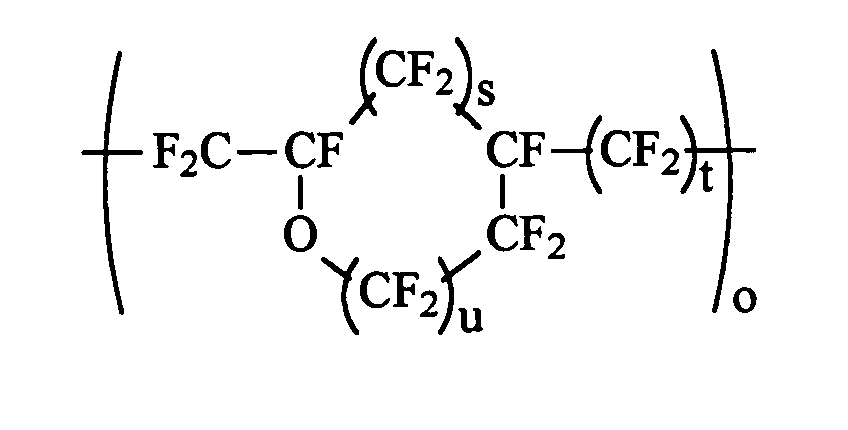
- the fully fluorinated polymer has the following Formula V: wherein o is as defined in Formula I, s is a number of from about 0 to about 5, or from about 1 to about 3, or 2; t is a number of from about 0 to about 25, or from about 1 to about 15, or from about 5 to about 10; and u is a number of from about 0 to about 5, or from about 1 to about 3, or 2.
- o is as defined in Formula I
- s is a number of from about 0 to about 5, or from about 1 to about 3, or 2
- t is a number of from about 0 to about 25, or from about 1 to about 15, or from about 5 to about 10
- u is a number of from about 0 to about 5, or from about 1 to about 3, or 2.
- a commercially available example of a perfluoropolymer having the above Formula IV is CYTOP® available from Asahi Glass Company.
- AUSIMONT® Fluorolink F7004 from Ausimont, Thorofare, New Jersey.
- This fully fluorinated polymer is useful in solubilizing organometallic compounds in fluorinated solvents.
- This fully fluorinated polymer works well with copper complexes such as copper (ii) hexafluoropentanedionate.
- the fully fluorinated coating material is present in the organometallic solution in an amount of from about 0.1 to about 40 percent by weight of total solids, or from about 2 to about 15 percent by weight of total solids.
- Total solids refers to the total amount by weight of fully fluorinated material, fillers, additives, organometallic material such as superconductor or superconductor precursor, and other like solid ingredients contained in the organometallic solution.
- an organometallic compound may be used herein in the process.
- the organometallic compound can be a superconductor or superconductor precursor.
- superconductors refers to metals, alloys and compounds which have the ability to lose both electrical resistance and magnetic permeability at or near absolute zero. In other words, superconductors have infinite electrical conductivity at or near absolute zero. Superconductivity does not normally occur in alkali metals, noble metals, ferro- and antiferromagnetic metals. Usually, elements having 3, 5, or 7 valence electrons per atom can be superconductors.
- a superconductor precursor is a material that may be processed to form a superconductor.
- Organometallic compounds are typically processed via chemical vapor deposition (CVD) to produce films which can be either superconductors or can possess other unique properties such as chemochromic or thermochromic properties.
- MOCVD refers to metal-organic chemical vapor deposition.
- Organometallics that can be processed to create superconductor films are referred to as superconductor precursors.
- suitable superconductors include metal oxide superconductors comprising admixtures of metals from Groups lB, IIA, and IIIB of the Periodic Table.
- Illustrative materials of such type include the metal oxide superconductors of the yttrium-barium-copper type (YBa 2 Cu 3 O y ) type, the so-called "123" high temperature superconductors (HTSC) materials, wherein y may be from about 6 to about 7.3, as well as materials where Y may be substituted by Nd, Sm, Eu, Gd, Dy, Ho, Yb, Lu, Y 0.5 -SC 0.5, Y 0.5 -La 0.5, and Y 0.5 -Lu 0.5, and where Ba may be substituted by Sr-Ca, Ba-Sr, and Ba-Ca.
- YBa 2 Cu 3 O y yttrium-barium-copper type
- HTSC high temperature superconductors
- superconductors or superconductor precursors include organometallic compounds such as copper (II) hexafluoropentanedionate, copper (II) methacryloxyethylacetonacetonate, antimony ethoxide, indium hexafluoropentandionate, and the like, and mixtures thereof.
- organometallic fillers include monodentate, bidentate, or multidentate ligands such as beta-diketonates, cyclopentadienyls, alkyls, perfluoroalkyls, alkoxides, perfluoroalkoxides, and Schiff bases.
- bidentate or multidentate ligands may comprise oxyhydrocarbyl ligands, nitrogenous oxyhydrocarbyl ligands, or fluorooxyhydrocarbyl ligands.
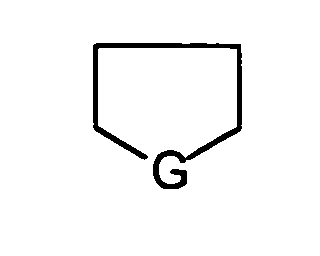
- the multidentate ligand may be selected from the group consisting of amines and polyamines, bipyridines, ligands of the Formula IV: wherein G is -O-, -S-, or -NR-, wherein R is H or hydrocarbyl; crown ethers or cryptates; and ligands of the formula R 0 O(C(R 1 ) 2 C(R 2 ) 2 O) n R 0 , wherein R 0 is selected from the group consisting of hydrogen, methyl, ethyl, n-propyl, cyanato, perfluoroethyl, perfluoro-n-propyl, or vinyl; R 1 is hydrogen, fluorine, or a sterically acceptable hydrocarbyl substituent; R 2 is hydrogen, fluorine or a sterically acceptable hydrocarbyl substituent; n is 4, 5, or 6, and R 0 , R 1 and R 2 may be the same or different from each other.
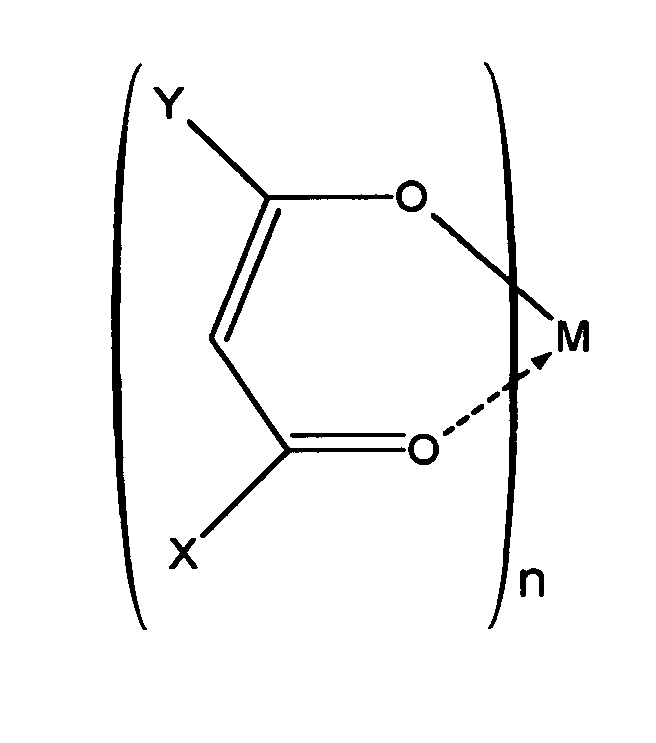
- organometallic additives also include those having the following Formula VII: where M may be selected from the group consisting of Al, Ba, Be, Bi, Cd, Ca, Ce, Cr, Co, Cu, Ga, Hf, In, Ir, Fe, Pb, Li, Mg, Mn, Mo, Ni, Pd, Pt, K, Dy, Er, Eu, Gd, Ho, La, Nd, Pr, Sm, Sc, Tb, Tm, Yb, Y, Rh, Ru, Si, Ag, Na, Sr, Ta, Tl, Sn, Ti, V, Zn, Zr, and the like; X or Y may be a hydrocarbon chain having from about 1 to about 30 carbons, or from about 3 to about 12 carbons; a fluorocarbon having from about 1 to about 30 carbons or from about 3 to about 12 carbons, or having from about 1 to about 20 fluorocarbon units of from about 3 to about 8 fluorocarbon units; a substituted or unsubstituted alkoxy group such as
- the organometallic compound can be present in the organometallic solution in any desired amount.
- amounts include from about 10 to about 250 parts per hundred, or from about 25 to about 200 parts per hundred, or from about 50 to about 200 parts per hundred organometallic material:polymer.
- a fluorinated solvent is a solvent comprising fluorine.
- the fluorinated solvent has low surface energy and low surface tension.
- fluorinated solvents include any partially fluorinated organic molecule with having a carbon chain with from about 2 to about 25 carbons, or from about 5 to about 15 carbons.
- the fluorinated solvent may contain carboxylic acid functionality.
- a specific commercially available example of a suitable fluorinated solvent includes Fluorinert FC-75 from 3M. The fluorinated solvent is added to the organometallic compound and the fully fluorinated polymer in an amount of from about 1 to about 20 percent, or from about 5 to about 15 percent solution by weight.
- the process for solubilizing an organometallic compound in a fluorinated solvent to form an organometallic solution includes adding and reacting a co-solubilizer, an organometallic compound, and a fluorinated solvent.
- the co-solubilizer does not act like a catalyst. Instead, the co-solubilizer acts as a filler or additive, and is present in the final organometallic solution.
- fluorinated co-solubilizers act as catalysts and are not "used up" in the reaction, and do not become part of the final solution. Instead, in known processes, the fluorinated co-solubilizers can be easily and readily separated out of the final solution.
- the fluorinated co-solubilizer is "used up” in the process, is present in the final solution, and is not readily or easily separated out of the final solution.
- the fluorinated solvent in the present process has the ability to cause the organometallic compound or superconductor to become miscible in the fluorinated solvent.
- the organometallic compound is solubilized in the fluorinated solvent via similar methods described here.
- the catalysis reaction occurs when an aqueous phase (containing reactants) is combined into one single phase at a temperature at which the aqueous phase and a given fluorinated solvent phase are miscible.
- the temperature of the reaction vessel is then returned to a temperature where the aqueous and fluorinated phase are once again immiscible.
- the catalyst remains in the fluorinated phase where it can be re-used, while the product of the reaction is emulsified or soluble in the aqueous phase.
- Example 2 To the mixture formed in Example 2, an amount of 0.5 g (approximately 0.0008 moles) of Ausimont Fluorolink 7004 (fully fluorinated co-solubilizer) was added. The resulting combination formed a green-blue solution.
- Ausimont Fluorolink 7004 fully fluorinated co-solubilizer
- the CuHFP was insoluble in FC-75 (fluorinated solvent) until the Fluorolink F7004 (fully fluorinated co-solubilizer) was added.
- Example 2 To the solution formed in Example 2, an amount of 5 grams of a 1 weight percent solution of a fully fluorinated polymer (TEFLON® AF 2400) in a fluorinated solvent (FC-75) was added. The resulting solution was blue-green and exhibited no signs of insolubility or immiscibility.
- TEFLON® AF 2400 fully fluorinated polymer
- FC-75 fluorinated solvent
Landscapes
- Chemical & Material Sciences (AREA)
- Organic Chemistry (AREA)
- Organic Low-Molecular-Weight Compounds And Preparation Thereof (AREA)
- Addition Polymer Or Copolymer, Post-Treatments, Or Chemical Modifications (AREA)
- Compositions Of Macromolecular Compounds (AREA)
- Polyethers (AREA)
- Paints Or Removers (AREA)
Abstract
Description
- The present invention relates to methods for solubilizing organometallic compounds in fluorinated solvents by addition of a co-solubilizing agent. In embodiments, the co-solubilizing agent is a fluorinated co-solubilizer. In embodiments, a fluorinated tail is added to an organometallic compound to cause the organometallic compound to become soluble in a fluorinated solvent. In embodiments, the organometallic compound, which is normally not soluble in fluorinated solvents, becomes completely miscible in fluorinated solvents. Such materials can be used in many arts such as, for example, electrical arts, electrostatographic arts, computer arts, and the like. In embodiments, the organometallic compound and fluorinated solvent solution can be useful as, for example, electrically or thermally conductive soluble fluoropolymer-ceramic hybrids or intermediates, electroluminescent fluorinated fluids or polymer coatings, photosensitive fluorinated fluids or coatings, colored fluorinated fluids or soluble polymer coatings for display devices, fluorinated carrier fluids for metal oxide film formation (where low surface tension of fluorinated fluids are desirable), thermochromic fluorescent or electrochromic fluorinated fluids or coatings, wire coatings such as electrode wire coatings, and many other applications.
- In embodiments, the fluorinated co-solubilizer does not act as a catalyst, but instead, acts as a filler or additive, and is present in the final solution.
- Fluorinated solvents are preferred vehicles for many substances. Fluorinated solvents are preferred because they are thermally insulative, have low surface energy, can have low boiling points, and can be recyclable or recoverable
- A problem results in that many substances are not soluble in fluorinated solvents. For example, many organic molecules and many non-fluorinated or partially fluorinated compounds, are not soluble in fluorinated solvents. Specifically, most, if not all, organometallic compounds, and especially superconductors or superconductor precursors, are not soluble in fluorinated solvents.
- Attempts have been made to render previously fluoro-insoluable materials soluble in fluorinated solvents. These attempts include using fluoro-ponytails (e.g., long carbon chains consisting mainly of perfluoroalkyl segments) as co-solvents. These ponytails greatly increase solubility in the fluorous phase. Many approaches are discussed below. However, in all these approaches, the co-solvent is used as a catalyst and can be separated at the end of the reaction.
- A paper by the University of Leicester Department of Chemistry (http://www.le.ac.uk/chemistry/research/epsrc/egh1.html. 8/28/01 ) entitled, "Catalysis in the Fluorous Biphase," discloses methods for preparation of catalysts derivatised with perfluoroalkyl substitutents to evaluate the criteria for preferential fluorous phase solubility and to investigate the influence of the perfluoroalkyl groups on the properties and activities of the metal catalyst.
- A paper from Chemtech October 1999 (pp. 7-12) by Hans-Joachim Lehmler et al. entitled, "Liquid Ventiliation - A New Way to Deliver Drugs to Diseased Lungs?," discloses ways of enhancing solubility in perfluorocarbon solvents of drugs.
- A paper from Science, Vol. 275, February 7, 1997 (pp. 823-826) by Armido Studer et al. entitled, "Fluorous Synthesis: A Fluorous-Phase Strategy for Improving Separation Efficiency in Organic Synthesis" teaches a "fluorous synthesis" approach in which organic molecules are rendered soluble in fluorocarbon solvents by attachment of a suitable fluorocarbon group.
- A paper from Science, Vol. 266, October 7, 1994 (pp. 72-75) by Istvan T. Horvath et al. entitled, "Facile Catalyst Separation without Water: Fluorous Biphase Hydroformulation of Olefins" discloses the application of fluorous biphase system for the extraction of rhodium from toluene and for the hydroformylation of olefins.
- A paper from Science, Vol. 266, October 7, 1994 (pp. 55-56) by J. A. Gladysz, entitled, "Are Teflon "Ponytails" the Coming Fashion for Catalysts?" discusses use of long carbon chains consisting mainly of perfluoroalkyl segments called "ponytails" appended to increase solubility in the fluorous phase and serve as de facto anchors.
- A paper from Chem. Commun., 1998 (pp. 1531-1532) by David E. Bergbreiter et al. entitled, "A Soluble Fluorous Phase Polymer Support," discloses preparation of a soluble fluorocarbon polymer that has reactive sites that can be used to covalently bind reagents and to render them soluble in the fluorous phase as a polymer-bound reagent.
- A paper from Journal of Pharmaceutical Sciences, Vol. 87, No. 12, December 1998 (pp. 1585-1589) by Thomas D. Williams et al. entitled, "Solubility Enhancement of Phenol and Phenol Derivatives in Perfluorooctyl Bromide," discusses examining the use of a hydrophobic solubilizing agent capable of interacting with model drug solutes by hydrogen bonding with the purpose of enhancing solubility in perfluorooctyl bromide.
- A paper from Journal of Fluorine Chemistry 101, 2000, (pp. 247-255) by Pravat Bhattacharyya et al., entitled "Phosphorus (lll) Ligands in Fluorous Biphase Catalysis," discloses the synthesis, coordination chemistry and catalytic applications of a series of perfluoroalkyl-substituted phosphorus (lll) ligands.
- A paper from Journal of Fluorine Chemistry 99, 1999, (pp. 197-200) by Eric G. Hope et al., entitled "The Rhodium Catalyzed Hydrogenation of Styrene in the Fluorous Biphase," discloses the use of rhodium-catalyzed hydrogenation of styrene as a system to study the influence of the perfluorocarbon and organic solvents and the perfluoroalkyl-ponytails on an application of the fluorous biphase approach to homogeneous catalysis.
- A paper from Journal of Fluorine Chemistry 100, 1999, (pp. 75-83) by Eric G. Hope et al., entitled "Fluorous Biphase Catalysis," discusses the evolution and future prospects for the fluorous biphase approach to homogeneous catalysis.
- A paper from Journal of Fluorine Chemistry 107, 2001, (pp. 141-146) by Hans-Joachim Lehmler et al., entitled "Behaviour of Partially Fluorinated Carboxylic Acids at the Air-Water Interface," discloses langmuir isotherms for several acids.
- A paper from Chemtracts-lnorganic Chemistry 7 1995 (pp. 14-18) by I. T. Horvath et al., entitled, "Facile Catalyst Separation Without Water: Fluorous Biphase Hydroformylation of Olefins," discloses the utility of a new simple scheme to effect catalyst/product separation in homogeneous catalysis.
- However, it is sometimes desired that a fluoro-solubilizing co-solvent not be used as a catalyst as it is used in the above listed experiments. This is necessary when it is not suitable to include the step of separating the catalyst from the fluorinated solution. Such a situation may include creating a coating by mixing several compounds together.
- The present invention provides:
- (1) a process for solubilizing an organometallic compound in a fluorinated solvent to form an organometallic solution, comprising adding and reacting a co-solubilizer comprising a fully fluorinated polymer, an organometallic compound, and a fluorinated solvent, wherein said co-solubilizer has the ability to cause said organometallic compound to become miscible in a fluorinated solvent, and wherein said co-solubilizer does not react as a catalyst and is present in the organometallic solution;
- (2) a process in accordance with (1), wherein said co-solubilizer is selected from the group consisting of perfluorinated siloxanes, perfluorinated styrenes, perfluorinated urethanes, and copolymers of tetrafluoroethylene and a perfluoropolymer;
- (3) a process in accordance with (2), wherein said substituent is a copolymer of tetrafluoroethylene and an oxy-halo perfluoropolymer;
- (4) a process in accordance with (1), wherein said fully fluorinated
polymer has the following Formula l:
- (5) a process in accordance with (4), wherein m is a number of from about 2 to about 50, n is a number of from about 2 to about 50, and o is a number of from about 2 to about 50;
- (6) a process in accordance with (4), wherein X is an oxy-halo fluorocarbon having from about 3 to about 10 fluorocarbons;
- (7) a process in accordance with (1), wherein said fully fluorinated
polymer has the following Formula II:
- (8) a process in accordance with (7), wherein X in Formula II is an oxy-halo fluorocarbon having from about 3 to about 10 fluorocarbons;
- (9) a process in accordance with (7), wherein said fully fluorinated
polymer has the following Formula III:
wherein p is a number of from about 1 to about 100, and q is a number of from about 1 to about 100;

- (10) a process in accordance with (9), wherein said fully fluorinated polymer is a copolymer of tetrafluoroethylene and perfluoro-2,2-dimethyl-1,3-dioxide;
- (11) a process in accordance with (1), wherein said fully fluorinated
polymer has the following Formula IV:
- (12) a process in accordance with (11), wherein said fully fluorinated
polymer has the following Formula V:
wherein o is a number of from about 1 to about 100, s is a number of from about 0 to about 5, t is a number of from about 0 to about 25, and u is a number of from about 0 to about 5;
- (13) a process in accordance with (1), wherein said organometallic compound is selected from the group consisting of monodentate, bidentate, and multidentate ligands;
- (14) a process in accordance with (1), wherein said organometallic compound is selected from the group consisting of a superconductor and a superconductor precursor;
- (15) a process in accordance with (14), wherein said organometallic compound is selected from the group consisting of copper (II) hexafluoropentanedionate, copper (II) methacryloxyethylacetonacetonate, antimony ethoxide, indium hexafluoropentandionate, and mixtures thereof;
- (16) a process in accordance with (15), wherein said organometallic compound is copper II hexafluoropentanedionate;
- (17) a process in accordance with (1), wherein said fluorinated solvent is a partially fluorinated organic molecule;
- (18) a process in accordance with (1), wherein said fluorinated solvent has from about 2 to about 25 carbons;
- (19) a process in accordance with (1), wherein said fluorinated solvent contains carboxylic acid functionality;
- (20) a process for solubilizing an organometallic compound in a fluorinated solvent to form an organometallic solution, comprising adding and reacting a co-solubilizer comprising a fully fluorinated polymer, an organometallic compound selected from the group consisting of a superconductor and superconductor precursor, and a fluorinated solvent, wherein said co-solubilizer has the ability to cause said organometallic compound to become miscible in a fluorinated solvent, and wherein said co-solubilizer is not a catalyst and is present in the organometallic solution; and
- (21) a process for solubilizing an organometallic compound in a fluorinated solvent to form an organometallic solution, comprising adding and reacting a co-solubilizer comprising a fully fluorinated polymer, an organometallic compound, and a fluorinated solvent, wherein said co-solubilizer is a copolymer of tetrafluoroethylene and an oxy-halo perfluoropolymer, and wherein said co-solubilizer has the ability to cause said organometallic compound to become miscible in a fluorinated solvent, and further wherein said co-solubilizer does not act as a catalyst and is present in the organometallic solution.
-
- Embodiments of the present invention include: a process for solubilizing an organometallic compound in a fluorinated solvent to form an organometallic solution, comprising adding and reacting a co-solubilizer comprising a fully fluorinated polymer, an organometallic compound, and a fluorinated solvent, wherein the co-solubilizer has the ability to cause the organometallic compound to become miscible in a fluorinated solvent, and wherein the co-solubilizer does not react as a catalyst and is present in the organometallic solution.
- Embodiments further include: a process for solubilizing an organometallic compound in a fluorinated solvent to form an organometallic solution, comprising adding and reacting a co-solubilizer comprising a fully fluorinated polymer, an organometallic compound selected from the group consisting of a superconductor and superconductor precursor, and a fluorinated solvent, wherein the co-solubilizer has the ability to cause the organometallic compound to become miscible in the fluorinated solvent, and wherein the co-solubilizer is not a catalyst and is present in the organometallic solution.
- In addition, embodiments include: a process for solubilizing an organometallic compound in a fluorinated solvent to form an organometallic solution, comprising adding and reacting a co-solubilizer comprising a fully fluorinated polymer, an organometallic compound, and a fluorinated solvent, wherein the co-solubilizer is a copolymer of tetrafluoroethylene and an oxy-halo perfluoropolymer, and wherein the co-solubilizer has the ability to cause the organometallic compound to become miscible in the fluorinated solvent, and further wherein the co-solubilizer does not act as a catalyst and is present in the organometallic solution.
- The present invention relates to methods for solubilizing organometallic compounds in fluorinated solvents by addition of a co-solubilizing agent. In embodiments, the co-solubilizing agent is a fully fluorinated co-solubilizer. In embodiments, a fluorinated tail is added to an organometallic compound to render soluble the organometallic compound in a fluorinated solvent. In embodiments, the organometallic compound, which is normally not soluble in fluorinated solvents, becomes completely miscible in fluorinated solvents due to the addition of the fully fluorinated co-solubilizer. In embodiments, the fluorinated co-solubilizer does not act as a catalyst, but instead, acts as a filler or additive, and is present in the final organometallic composition. In embodiments, a co-solubilizer comprises a fully fluorinated polymer.
- The term "fully fluorinated polymers" as used herein, refers to fluorinated polymers that do not contain any hydrocarbon chains, hydrocarbon units, hydrocarbon substituents, or any carbon-hydrogen bonds. The term "fully fluorinated polymers" includes polymers comprising fluorinated monomers containing no hydrocarbon units, and monomers that are fully fluorinated and do not contain any hydrocarbon units. In embodiments, the fully fluorinated polymers are soluble in fluorinated solvents. In embodiments, the fully fluorinated polymers may be amorphous, thereby giving them excellent light transmission properties. In embodiments, the fully fluorinated polymers are solution-coatable and have a low surface energy, and therefore, smooth, thin and uniform low surface energy coatings can result.
- A co-solubilizer is a substance, which when added to a mixture renders the solute of that mixture soluble by reaction with the solute. A co-solubilizer is normally soluble in the solvent. Without the co-solubilizer, the solute would otherwise not be soluble in the solvent.
- Examples of suitable co-solubilizers comprising a fully fluorinated polymer include perfluorinated siloxanes, perfluorinated styrenes, perfluorinated urethanes, copolymers of fluoropolymers and perfluoropolymers such as, copolymers of tetrafluoroethylene and fully fluorinated polymers, and copolymers of tetrafluoroethylene and oxygen-containing fully fluorinated polymers, copolymers of tetrafluoroethylene and oxy-halo-fully fluorinated fluoropolymers, and mixtures thereof.
- In embodiments, the fully fluorinated polymer comprises the following Formula l:
- In embodiments, the polymer has the following Formula II:
- In embodiments, the fully fluorinated polymer has the following Formula III:wherein p is a number of from about 1 to about 100, or from about 2 to about 50, or from about 5 to about 25; and q is a number of from about 1 to about 100, or from about 2 to about 50, or from about 5 to about 25. A commercially available perfluoropolymer having the above Formula III is TEFLON® AF, a copolymer of tetrafluoroethylene and perfluoro-2,2-dimethyl-1,3-dioxide, the latter monomer being fully fluorinated.

- In embodiments, the fully fluorinated polymer has the following Formula IV:wherein o is as defined in Formula I, s is a number of from about 0 to about 5, or from about 1 to about 3, or 2; t is a number of from about 0 to about 25, or from about 1 to about 15, or from about 5 to about 10; and u is a number of from about 0 to about 5, or from about 1 to about 3, or 2. A commercially available example of a perfluoropolymer having the above Formula IV is CYTOP® available from Asahi Glass Company.

- Another specific example of a fully fluorinated material co-solubilizer is AUSIMONT® Fluorolink F7004 from Ausimont, Thorofare, New Jersey. This fully fluorinated polymer is useful in solubilizing organometallic compounds in fluorinated solvents. This fully fluorinated polymer works well with copper complexes such as copper (ii) hexafluoropentanedionate.
- The fully fluorinated coating material is present in the organometallic solution in an amount of from about 0.1 to about 40 percent by weight of total solids, or from about 2 to about 15 percent by weight of total solids. Total solids as used herein, refers to the total amount by weight of fully fluorinated material, fillers, additives, organometallic material such as superconductor or superconductor precursor, and other like solid ingredients contained in the organometallic solution.
- An organometallic compound may be used herein in the process. In embodiments, the organometallic compound can be a superconductor or superconductor precursor. The term "superconductors" as used herein refers to metals, alloys and compounds which have the ability to lose both electrical resistance and magnetic permeability at or near absolute zero. In other words, superconductors have infinite electrical conductivity at or near absolute zero. Superconductivity does not normally occur in alkali metals, noble metals, ferro- and antiferromagnetic metals. Usually, elements having 3, 5, or 7 valence electrons per atom can be superconductors.
- A superconductor precursor is a material that may be processed to form a superconductor. Organometallic compounds are typically processed via chemical vapor deposition (CVD) to produce films which can be either superconductors or can possess other unique properties such as chemochromic or thermochromic properties. MOCVD refers to metal-organic chemical vapor deposition. Organometallics that can be processed to create superconductor films are referred to as superconductor precursors.
- Other examples of suitable superconductors include metal oxide superconductors comprising admixtures of metals from Groups lB, IIA, and IIIB of the Periodic Table. Illustrative materials of such type include the metal oxide superconductors of the yttrium-barium-copper type (YBa2Cu3Oy) type, the so-called "123" high temperature superconductors (HTSC) materials, wherein y may be from about 6 to about 7.3, as well as materials where Y may be substituted by Nd, Sm, Eu, Gd, Dy, Ho, Yb, Lu, Y0.5-SC0.5, Y0.5-La0.5, and Y0.5-Lu0.5, and where Ba may be substituted by Sr-Ca, Ba-Sr, and Ba-Ca. Another illustrative class of superconductor materials includes those of the general formula (AO)mM2Can-1CunO2n+2, wherein the A cation can be thallium, lead, bismuth, or a mixture of these elements, m=1 or 2 (but is only 2 when A is bismuth), n is a number of from about 1 to about 5, M is a cation such as barium or strontium, and the substitution of calcium by strontium frequently is observed, as described in "High Tc Oxide Superconductors, " MRS Bulletin, January, 1989, pp. 20-24, and "High Tc Bismuth and Thallium Oxide Superconductors," Sleight, A.W., et al., MRS Bulletin, January, 1989, pp. 45-48. Other examples include YbBa2Cu3O7-x (see P.P. Edwards et al. Chemistry Britain, 1987, pp. 23-26; Pb2Sr2LnCu3)O8-x (see M. O'Keefe et al., J. Am. Chem. Soc. 1988, 110, 1506; La2-xSrxCuO4 (see Bednorz and Muller, Z. Phys. B. Cond. Matter, 1986, 64, pp 189-195, and the like.
- Specific examples of superconductors or superconductor precursors include organometallic compounds such as copper (II) hexafluoropentanedionate, copper (II) methacryloxyethylacetonacetonate, antimony ethoxide, indium hexafluoropentandionate, and the like, and mixtures thereof.
- Other organometallic fillers include monodentate, bidentate, or multidentate ligands such as beta-diketonates, cyclopentadienyls, alkyls, perfluoroalkyls, alkoxides, perfluoroalkoxides, and Schiff bases. Other examples of bidentate or multidentate ligands may comprise oxyhydrocarbyl ligands, nitrogenous oxyhydrocarbyl ligands, or fluorooxyhydrocarbyl ligands. The multidentate ligand may be selected from the group consisting of amines and polyamines, bipyridines, ligands of the Formula IV:wherein G is -O-, -S-, or -NR-, wherein R is H or hydrocarbyl; crown ethers or cryptates; and ligands of the formula R0O(C(R1)2C(R2)2O)nR0, wherein R0 is selected from the group consisting of hydrogen, methyl, ethyl, n-propyl, cyanato, perfluoroethyl, perfluoro-n-propyl, or vinyl; R1 is hydrogen, fluorine, or a sterically acceptable hydrocarbyl substituent; R2 is hydrogen, fluorine or a sterically acceptable hydrocarbyl substituent; n is 4, 5, or 6, and R0, R1 and R2 may be the same or different from each other.
- Examples of organometallic additives also include those having the following Formula VII:where M may be selected from the group consisting of Al, Ba, Be, Bi, Cd, Ca, Ce, Cr, Co, Cu, Ga, Hf, In, Ir, Fe, Pb, Li, Mg, Mn, Mo, Ni, Pd, Pt, K, Dy, Er, Eu, Gd, Ho, La, Nd, Pr, Sm, Sc, Tb, Tm, Yb, Y, Rh, Ru, Si, Ag, Na, Sr, Ta, Tl, Sn, Ti, V, Zn, Zr, and the like; X or Y may be a hydrocarbon chain having from about 1 to about 30 carbons, or from about 3 to about 12 carbons; a fluorocarbon having from about 1 to about 30 carbons or from about 3 to about 12 carbons, or having from about 1 to about 20 fluorocarbon units of from about 3 to about 8 fluorocarbon units; a substituted or unsubstituted alkoxy group such as methoxy, propoxy, ethoxy, butoxy, pentoxy, and the like; substituted or unsubstituted a cyclic group having from about 4 to about 12 carbons such as cyclobutane, cyclopentane, benzene, a phenyl group such as phenol, cycloheptane, and the like; and wherein n is a number of from about 1 to about 100, or from about 1 to about 20, or from about 1 to about 4.
- The organometallic compound can be present in the organometallic solution in any desired amount. Examples of amounts include from about 10 to about 250 parts per hundred, or from about 25 to about 200 parts per hundred, or from about 50 to about 200 parts per hundred organometallic material:polymer.
- Any suitable fluorinated solvent may be used. A fluorinated solvent is a solvent comprising fluorine. In embodiments, the fluorinated solvent has low surface energy and low surface tension. Examples of fluorinated solvents include any partially fluorinated organic molecule with having a carbon chain with from about 2 to about 25 carbons, or from about 5 to about 15 carbons. The fluorinated solvent may contain carboxylic acid functionality. A specific commercially available example of a suitable fluorinated solvent includes Fluorinert FC-75 from 3M. The fluorinated solvent is added to the organometallic compound and the fully fluorinated polymer in an amount of from about 1 to about 20 percent, or from about 5 to about 15 percent solution by weight.
- The process for solubilizing an organometallic compound in a fluorinated solvent to form an organometallic solution includes adding and reacting a co-solubilizer, an organometallic compound, and a fluorinated solvent. Unlike in known processes, the co-solubilizer does not act like a catalyst. Instead, the co-solubilizer acts as a filler or additive, and is present in the final organometallic solution. In known processes, fluorinated co-solubilizers act as catalysts and are not "used up" in the reaction, and do not become part of the final solution. Instead, in known processes, the fluorinated co-solubilizers can be easily and readily separated out of the final solution. In the present process, the fluorinated co-solubilizer is "used up" in the process, is present in the final solution, and is not readily or easily separated out of the final solution. The fluorinated solvent in the present process has the ability to cause the organometallic compound or superconductor to become miscible in the fluorinated solvent.
- In known processes of fluorous biphase catalysis, the organometallic compound is solubilized in the fluorinated solvent via similar methods described here. The catalysis reaction occurs when an aqueous phase (containing reactants) is combined into one single phase at a temperature at which the aqueous phase and a given fluorinated solvent phase are miscible. When the reaction is completed, the temperature of the reaction vessel is then returned to a temperature where the aqueous and fluorinated phase are once again immiscible. The catalyst remains in the fluorinated phase where it can be re-used, while the product of the reaction is emulsified or soluble in the aqueous phase.
- All the patents and applications referred to herein are hereby specifically and totally incorporated herein by reference in their entirety in the instant specification.
- The following Examples further define and describe embodiments of the present invention. Unless otherwise indicated, all parts and percentages are by weight.
- An amount of 0.05 grams (0.0001 moles) of an organometallic bidentate ligand (copper II hexafluoropentanedionate) was added to 5.0 grams of 3M Fluorinert FC-75 (a fluorinated solvent). At this point, the superconductor precursor (CuHFP) was not soluble in the fluorinated solvent.
- To the mixture formed in Example 2, an amount of 0.5 g (approximately 0.0008 moles) of Ausimont Fluorolink 7004 (fully fluorinated co-solubilizer) was added. The resulting combination formed a green-blue solution.
- The CuHFP was insoluble in FC-75 (fluorinated solvent) until the Fluorolink F7004 (fully fluorinated co-solubilizer) was added.
- To the solution formed in Example 2, an amount of 5 grams of a 1 weight percent solution of a fully fluorinated polymer (TEFLON® AF 2400) in a fluorinated solvent (FC-75) was added. The resulting solution was blue-green and exhibited no signs of insolubility or immiscibility.
- While the invention has been described in detail with reference to specific and preferred embodiments, it will be appreciated that various modifications and variations will be apparent to the artisan. All such modifications and embodiments as may readily occur to one skilled in the art are intended to be within the scope of the appended claims.
Claims (10)
- A process for solubilizing an organometallic compound in a fluorinated solvent to form an organometallic solution, comprising adding and reacting a co-solubilizer comprising a fully fluorinated polymer, an organometallic compound, and a fluorinated solvent, wherein said co-solubilizer has the ability to cause said organometallic compound to become miscible in a fluorinated solvent, and wherein said co-solubilizer does not react as a catalyst and is present in the organometallic solution.
- A process in accordance with claim 1, wherein said co-solubilizer is selected from the group consisting of perfluorinated siloxanes, perfluorinated styrenes, perfluorinated urethanes, and copolymers of tetrafluoroethylene and a perfluoropolymer.
- A process in accordance with claim 2, wherein said substituent is a copolymer of tetrafluoroethylene and an oxy-halo perfluoropolymer.
- A process in accordance with claim 1, wherein said fully fluorinated polymer has the following Formula l:
- A process in accordance with claim 1, wherein said fully fluorinated polymer has the following Formula II:
- A process in accordance with claim 5, wherein said fully fluorinated polymer has the following Formula III:wherein p is a number of from about 1 to about 100, and q is a number of from about 1 to about 100.

- A process in accordance with claim 1, wherein said fully fluorinated polymer has the following Formula IV:
- A process in accordance with claim 7, wherein said fully fluorinated polymer has the following Formula V:wherein o is a number of from about 1 to about 100, s is a number of from about 0 to about 5, t is a number of from about 0 to about 25, and u is a number of from about 0 to about 5.

- A process for solubilizing an organometallic compound in a fluorinated solvent to form an organometallic solution, comprising adding and reacting a co-solubilizer comprising a fully fluorinated polymer, an organometallic compound selected from the group consisting of a superconductor and superconductor precursor, and a fluorinated solvent, wherein said co-solubilizer has the ability to cause said organometallic compound to become miscible in a fluorinated solvent, and wherein said co-solubilizer is not a catalyst and is present in the organometallic solution.
- A process for solubilizing an organometallic compound in a fluorinated solvent to form an organometallic solution, comprising adding and reacting a co-solubilizer comprising a fully fluorinated polymer, an organometallic compound, and a fluorinated solvent, wherein said co-solubilizer is a copolymer of tetrafluoroethylene and an oxy-halo perfluoropolymer, and wherein said co-solubilizer has the ability to cause said organometallic compound to become miscible in a fluorinated solvent, and further wherein said co-solubilizer does not act as a catalyst and is present in the organometallic solution.
Applications Claiming Priority (2)
| Application Number | Priority Date | Filing Date | Title |
|---|---|---|---|
| US199927 | 2002-07-18 | ||
| US10/199,927 US6747089B2 (en) | 2002-07-18 | 2002-07-18 | Processes for solubilizing organometallic compounds in fluorinated solvents by addition of a fluorinated non-catalytic co-solubilizer |
Publications (2)
| Publication Number | Publication Date |
|---|---|
| EP1382609A1 true EP1382609A1 (en) | 2004-01-21 |
| EP1382609B1 EP1382609B1 (en) | 2006-01-11 |
Family
ID=29780239
Family Applications (1)
| Application Number | Title | Priority Date | Filing Date |
|---|---|---|---|
| EP03014938A Expired - Lifetime EP1382609B1 (en) | 2002-07-18 | 2003-07-01 | Process for solubilizing organometallic compounds in fluorinated solvents by addition of a fluorinated non-catalytic co-solubilizer |
Country Status (7)
| Country | Link |
|---|---|
| US (1) | US6747089B2 (en) |
| EP (1) | EP1382609B1 (en) |
| JP (1) | JP4353744B2 (en) |
| BR (1) | BR0302413B1 (en) |
| CA (1) | CA2434931C (en) |
| DE (1) | DE60303161T2 (en) |
| MX (1) | MXPA03006299A (en) |
Families Citing this family (3)
| Publication number | Priority date | Publication date | Assignee | Title |
|---|---|---|---|---|
| US7006780B2 (en) * | 2003-11-25 | 2006-02-28 | Xerox Corporation | Partially fluorinated polymer coated development electrodes |
| US7109365B2 (en) * | 2003-11-25 | 2006-09-19 | Xerox Corporation | Processes for solubilizing organometallic compounds in fluorinated solvents by addition of a partly fluorinated non-catalytic co-solubilizer |
| JP2011190183A (en) * | 2010-03-11 | 2011-09-29 | Noguchi Institute | Fluorous sugar-bonded crown ether derivative |
Family Cites Families (7)
| Publication number | Priority date | Publication date | Assignee | Title |
|---|---|---|---|---|
| US5840897A (en) | 1990-07-06 | 1998-11-24 | Advanced Technology Materials, Inc. | Metal complex source reagents for chemical vapor deposition |
| US5225561A (en) | 1990-07-06 | 1993-07-06 | Advanced Technology Materials, Inc. | Source reagent compounds for MOCVD of refractory films containing group IIA elements |
| US5453494A (en) | 1990-07-06 | 1995-09-26 | Advanced Technology Materials, Inc. | Metal complex source reagents for MOCVD |
| US5280012A (en) | 1990-07-06 | 1994-01-18 | Advanced Technology Materials Inc. | Method of forming a superconducting oxide layer by MOCVD |
| GB2274456A (en) | 1993-01-22 | 1994-07-27 | Timothy John Leedham | Volatile rare earth beta-diketone complexes |
| DE69624923T2 (en) * | 1995-08-11 | 2003-08-21 | Daikin Industries, Ltd. | ORGANIC FLUORINE POLYMERS CONTAINING SILICON AND THEIR USE |
| US5892083A (en) | 1997-12-01 | 1999-04-06 | Wayne State University | Organometallic source compounds for chemical vapor deposition |
-
2002
- 2002-07-18 US US10/199,927 patent/US6747089B2/en not_active Expired - Fee Related
-
2003
- 2003-07-01 DE DE60303161T patent/DE60303161T2/en not_active Expired - Lifetime
- 2003-07-01 EP EP03014938A patent/EP1382609B1/en not_active Expired - Lifetime
- 2003-07-10 CA CA002434931A patent/CA2434931C/en not_active Expired - Fee Related
- 2003-07-14 BR BRPI0302413-0A patent/BR0302413B1/en not_active IP Right Cessation
- 2003-07-14 MX MXPA03006299A patent/MXPA03006299A/en active IP Right Grant
- 2003-07-17 JP JP2003275977A patent/JP4353744B2/en not_active Expired - Fee Related
Non-Patent Citations (2)
| Title |
|---|
| BHATTACHARYYA P ET AL: "Phosphorus(III) ligands in fluorous biphase catalysis", JOURNAL OF FLUORINE CHEMISTRY, ELSEVIER SEQUOIA, LAUSANNE, CH, vol. 101, no. 2, February 2000 (2000-02-01), pages 247 - 255, XP004244525, ISSN: 0022-1139 * |
| HORVATH I T ET AL: "FACILE CATALYST SEPARATION WITHOUT WATER: FLUOROUS BIPHASE WITHOUT WATER: FLUOROUS BIPHASE HYDROFORMYLATION OF OLEFINS", SCIENCE, AMERICAN ASSOCIATION FOR THE ADVANCEMENT OF SCIENCE,, US, vol. 266, 7 October 1994 (1994-10-07), pages 72 - 75, XP000606156, ISSN: 0036-8075 * |
Also Published As
| Publication number | Publication date |
|---|---|
| MXPA03006299A (en) | 2005-04-19 |
| DE60303161D1 (en) | 2006-04-06 |
| BR0302413A (en) | 2005-06-07 |
| US6747089B2 (en) | 2004-06-08 |
| EP1382609B1 (en) | 2006-01-11 |
| JP4353744B2 (en) | 2009-10-28 |
| BR0302413B1 (en) | 2012-10-02 |
| CA2434931C (en) | 2009-12-29 |
| DE60303161T2 (en) | 2006-06-29 |
| US20040014862A1 (en) | 2004-01-22 |
| JP2004051992A (en) | 2004-02-19 |
| CA2434931A1 (en) | 2004-01-18 |
Similar Documents
| Publication | Publication Date | Title |
|---|---|---|
| Tang et al. | Glymes as versatile solvents for chemical reactions and processes: from the laboratory to industry | |
| Dikarev et al. | Rational syntheses, structure, and properties of the first Bismuth (II) carboxylate | |
| Wisner et al. | A comparative study of isostructural palladium and platinum methyl complexes. The structures of cis-dimethylbis (diphenylmethylphosphine) palladium (II) and cis-dimethylbis (diphenylmethylphosphine) platinum (II) | |
| US6747089B2 (en) | Processes for solubilizing organometallic compounds in fluorinated solvents by addition of a fluorinated non-catalytic co-solubilizer | |
| KR100343632B1 (en) | Alkene ligand precursor and synthesis method | |
| US6767942B2 (en) | Coatings having fully fluorinated co-solubilizer, metal material and fluorinated solvent | |
| KR20220079532A (en) | Novel Platinum Complex | |
| US7109365B2 (en) | Processes for solubilizing organometallic compounds in fluorinated solvents by addition of a partly fluorinated non-catalytic co-solubilizer | |
| JP4769524B2 (en) | Purification method of polysilane | |
| JP6764782B2 (en) | Method for producing polysilane and method for producing the active metal magnesium component used for this method. | |
| JP5658608B2 (en) | Purification method of polysilane | |
| Boyle et al. | Synthesis and characterization of solvated trifluoroacetate alkaline earth derivatives | |
| JP4951728B2 (en) | Single crystal of organic carboxylic acid metal complex and method for producing the same | |
| JP2000143670A (en) | Allyl ligand precursor and method of synthesis | |
| JP2827360B2 (en) | Organic gold compounds | |
| JP2985085B2 (en) | Organic platinum compounds | |
| JP2004067554A (en) | Complex with metal salt having weak coordination-bonding anion species | |
| Wieser-Jeunesse et al. | The development of platino-calixarenes | |
| JP2009240970A (en) | Method for replacing dispersion medium of ultrafine particle dispersion, and ultrafine particle dispersion liquid manufactured thereby | |
| Ebe et al. | Synthesis of a perovskite surface-coated polymer brush by photo-induced atom transfer radical polymerization | |
| Achar | Oxidative Addition as a New Route to Organometallic Polymers and Dendrimers | |
| Achar | Organometallic Polymers And Dendrimers | |
| KR100600468B1 (en) | Process for preparing cycloalkene copper precursor | |
| JP2000157871A (en) | Oxygen 4-electron reduction catalyst | |
| Alcock et al. | On the reactions of [RuCl 2 (PPh 3) 3] with thia crown ethers: molecular structures of [RuCl 2 (PPh 3)([9] aneS 3)]([9] aneS 3= 1, 4, 7-trithiacyclononane) and [RuCl (PPh 3)([14] aneS 4)] ClO 4 ([14] aneS 4= 1, 4, 8, 11-tetrathiacyclotetradecane) |
Legal Events
| Date | Code | Title | Description |
|---|---|---|---|
| PUAI | Public reference made under article 153(3) epc to a published international application that has entered the european phase |
Free format text: ORIGINAL CODE: 0009012 |
|
| AK | Designated contracting states |
Kind code of ref document: A1 Designated state(s): AT BE BG CH CY CZ DE DK EE ES FI FR GB GR HU IE IT LI LU MC NL PT RO SE SI SK TR |
|
| AX | Request for extension of the european patent |
Extension state: AL LT LV MK |
|
| 17P | Request for examination filed |
Effective date: 20040721 |
|
| AKX | Designation fees paid |
Designated state(s): DE FR GB |
|
| 17Q | First examination report despatched |
Effective date: 20050321 |
|
| GRAP | Despatch of communication of intention to grant a patent |
Free format text: ORIGINAL CODE: EPIDOSNIGR1 |
|
| GRAS | Grant fee paid |
Free format text: ORIGINAL CODE: EPIDOSNIGR3 |
|
| GRAA | (expected) grant |
Free format text: ORIGINAL CODE: 0009210 |
|
| AK | Designated contracting states |
Kind code of ref document: B1 Designated state(s): DE FR GB |
|
| REF | Corresponds to: |
Ref document number: 60303161 Country of ref document: DE Date of ref document: 20060406 Kind code of ref document: P |
|
| ET | Fr: translation filed | ||
| PLBE | No opposition filed within time limit |
Free format text: ORIGINAL CODE: 0009261 |
|
| STAA | Information on the status of an ep patent application or granted ep patent |
Free format text: STATUS: NO OPPOSITION FILED WITHIN TIME LIMIT |
|
| 26N | No opposition filed |
Effective date: 20061012 |
|
| REG | Reference to a national code |
Ref country code: FR Ref legal event code: PLFP Year of fee payment: 13 |
|
| PGFP | Annual fee paid to national office [announced via postgrant information from national office to epo] |
Ref country code: GB Payment date: 20150626 Year of fee payment: 13 |
|
| PGFP | Annual fee paid to national office [announced via postgrant information from national office to epo] |
Ref country code: FR Payment date: 20150625 Year of fee payment: 13 |
|
| PGFP | Annual fee paid to national office [announced via postgrant information from national office to epo] |
Ref country code: DE Payment date: 20150623 Year of fee payment: 13 |
|
| REG | Reference to a national code |
Ref country code: DE Ref legal event code: R119 Ref document number: 60303161 Country of ref document: DE |
|
| GBPC | Gb: european patent ceased through non-payment of renewal fee |
Effective date: 20160701 |
|
| PG25 | Lapsed in a contracting state [announced via postgrant information from national office to epo] |
Ref country code: FR Free format text: LAPSE BECAUSE OF NON-PAYMENT OF DUE FEES Effective date: 20160801 Ref country code: DE Free format text: LAPSE BECAUSE OF NON-PAYMENT OF DUE FEES Effective date: 20170201 |
|
| REG | Reference to a national code |
Ref country code: FR Ref legal event code: ST Effective date: 20170331 |
|
| PG25 | Lapsed in a contracting state [announced via postgrant information from national office to epo] |
Ref country code: GB Free format text: LAPSE BECAUSE OF NON-PAYMENT OF DUE FEES Effective date: 20160701 |