EP1382593A2 - Process for removing fluorinated anionic surfactants from gaseous mixtures - Google Patents
Process for removing fluorinated anionic surfactants from gaseous mixtures Download PDFInfo
- Publication number
- EP1382593A2 EP1382593A2 EP03015359A EP03015359A EP1382593A2 EP 1382593 A2 EP1382593 A2 EP 1382593A2 EP 03015359 A EP03015359 A EP 03015359A EP 03015359 A EP03015359 A EP 03015359A EP 1382593 A2 EP1382593 A2 EP 1382593A2
- Authority
- EP
- European Patent Office
- Prior art keywords
- solution
- ppm
- process according
- surfactant
- aqueous solution
- Prior art date
- Legal status (The legal status is an assumption and is not a legal conclusion. Google has not performed a legal analysis and makes no representation as to the accuracy of the status listed.)
- Granted
Links
Images
Classifications
-
- B—PERFORMING OPERATIONS; TRANSPORTING
- B01—PHYSICAL OR CHEMICAL PROCESSES OR APPARATUS IN GENERAL
- B01D—SEPARATION
- B01D53/00—Separation of gases or vapours; Recovering vapours of volatile solvents from gases; Chemical or biological purification of waste gases, e.g. engine exhaust gases, smoke, fumes, flue gases, aerosols
- B01D53/34—Chemical or biological purification of waste gases
- B01D53/46—Removing components of defined structure
- B01D53/68—Halogens or halogen compounds
- B01D53/70—Organic halogen compounds
-
- B—PERFORMING OPERATIONS; TRANSPORTING
- B01—PHYSICAL OR CHEMICAL PROCESSES OR APPARATUS IN GENERAL
- B01D—SEPARATION
- B01D53/00—Separation of gases or vapours; Recovering vapours of volatile solvents from gases; Chemical or biological purification of waste gases, e.g. engine exhaust gases, smoke, fumes, flue gases, aerosols
- B01D53/14—Separation of gases or vapours; Recovering vapours of volatile solvents from gases; Chemical or biological purification of waste gases, e.g. engine exhaust gases, smoke, fumes, flue gases, aerosols by absorption
- B01D53/1418—Recovery of products
-
- B—PERFORMING OPERATIONS; TRANSPORTING
- B01—PHYSICAL OR CHEMICAL PROCESSES OR APPARATUS IN GENERAL
- B01D—SEPARATION
- B01D53/00—Separation of gases or vapours; Recovering vapours of volatile solvents from gases; Chemical or biological purification of waste gases, e.g. engine exhaust gases, smoke, fumes, flue gases, aerosols
- B01D53/14—Separation of gases or vapours; Recovering vapours of volatile solvents from gases; Chemical or biological purification of waste gases, e.g. engine exhaust gases, smoke, fumes, flue gases, aerosols by absorption
- B01D53/1456—Removing acid components
-
- Y—GENERAL TAGGING OF NEW TECHNOLOGICAL DEVELOPMENTS; GENERAL TAGGING OF CROSS-SECTIONAL TECHNOLOGIES SPANNING OVER SEVERAL SECTIONS OF THE IPC; TECHNICAL SUBJECTS COVERED BY FORMER USPC CROSS-REFERENCE ART COLLECTIONS [XRACs] AND DIGESTS
- Y02—TECHNOLOGIES OR APPLICATIONS FOR MITIGATION OR ADAPTATION AGAINST CLIMATE CHANGE
- Y02C—CAPTURE, STORAGE, SEQUESTRATION OR DISPOSAL OF GREENHOUSE GASES [GHG]
- Y02C20/00—Capture or disposal of greenhouse gases
- Y02C20/30—Capture or disposal of greenhouse gases of perfluorocarbons [PFC], hydrofluorocarbons [HFC] or sulfur hexafluoride [SF6]
Definitions
- the present invention relates to a process to remove or to eliminate fluorinated anionic surfactants from gaseous streams.
- the invention relates to a process to remove anionic fluorinated surfactants of perfluorinated carboxylic acids or their derivatives or their salts, from hexausted air streams coming from drying fluoropolymer processes.
- anionic fluorinated surfactants in particular the perfluorinated carboxylic acids or their derivatives, preferably having a number of carbon atoms from 7 to 10, are used in the polymerization in aqueous dispersion of fluorinated monomers, for example TFE.
- fluorinated anionic surfactant In said processes a sufficiently high amount of fluorinated anionic surfactant must be used, so to stabilize the polymer colloidal particles to avoid coagulation phenomena.
- the most industrially used fluorinated anionic surfactant is the acid having 8 carbon atoms (perfluorooctanoate) or its salts, for example of ammonium or sodium.
- the latex obtained from the polymerization is coagulated by addition of electrolytes, substantially all the perfluorinated surfactant remains adsorbed on the surface of the solid polymer particles.
- the surfactant present on the polymer surface together wtih the residual water, is then removed during the drying step, carried out at temperatures in the range 120°C-280°C.
- the surfactant passes to the gaseous state and mixes itself with the inert gas mixture, typically air, flowing out from the equipment used for the drying.
- anionic perfluorinated surfactants in particular the perfluorooctanoate in acid form or under salt form, are very effective products for the use in the fluorinated monomer polymerization, but they cannot be discharged in the environment since biopersistent. For this reason the international authorities, for example EPA, require a greater and greater reduction of perfluorinated surfactant emissions.
- USP 5, 990, 330 describes a recovery process from exhausted gaseous streams, containing anionic fluorinated surfactants deriving from perfluorinated carboxylic acids or salts thereof.
- the process consists in contacting, in an absorption column, the gaseous stream with a concentrated alkaline solution, for example sodium hydroxide, under conditions such to have phase separation.
- a concentrated alkaline solution for example sodium hydroxide
- foam formation in the column which would decrease the process efficiency.
- the alkaline solution density must be > 1.15 g/cm 3 .
- the separated phase concentrated in PFOA is removed in a decanter and subsequently purified to recover and reuse the surfactant.
- An object of the present invention is an elimination process of fluorinated anionic sufactants from exhausted gaseous streams, having efficiency higher than 99.0%, preferably higher than or equal to 99.9%, wherein the gaseous stream is put into contact, for example by a scrubber, with aqueous solutions having pH from 3.5 to 13.8, the aqueous phase density being lower than 1.05 g/cm 3 , preferably lower than 1.03 g/cm 3 , wherein the concentration in the aqueous solution of the fluorinated anionic surfactant removed from the gaseous stream is lower than or equal to 70 ppm, preferably lower than or equal to 60 ppm, still more preferably lower than 50 ppm.
- the fluorinated anionic surfactants are determined in the aqueous solution by potentiometric titration.
- anionic fluorinated surfactants are selected from perfluorinated carboxylic acid or derivatives thereof, in particular perfluorooctanoate in its acid or salified form.
- the used absorption column can be a filling up column, preferably structured, a plate column or a spray column; preferably a spray column is used.
- the solution flowing out from the absorption column, containing the removed fluorinated anionic surfactant, can be recycled (recycle solution) to the absorption column to limit the volumes of the aqueous solution used in this phase.
- the process of the present invention can be carrid out in a continuous or a discontinuous way, preferably it is carried out in a continuous way.
- the continuous process is carried out for example by recyclcing the solution and recovering the surfactant at each recycle, or by recycling the solution until reaching a concentration of 70 ppm and then by treating the liquid phase to remove the surfactant, or by using in the gas absorption phase fresh solution without recycle; or for example by feeding a fresh aqueous solution aliquot and drawing from the plant an aliquot containing the anionic surfactants to be sent to a recovery plant.
- the discontinuous process is carried out for example by recycling the solution used in the absorption column without recovering the surfactant until a concentration of 70 ppm is reached.
- Said methods are used to bring the anionic surfactant concentration in the recycle solution to levels lower than 70 ppm.
- the above method using Al 2 (SO 4 ) 3 is not used to remove the surfactant from the recycle solutions.
- the treatment is carried out with strong or weak anionic exchange resins, preferably with strong anionic exchange resins.
- strong exchange anionic resins resins wherein the active resin sites are quaternay ammonium groups; with weak exchange anionic resins are meant resins wherein the active resin sites are aminic groups protonizable with secondary or primary ammonium.
- Amberlite®IRA 402 Amberjet®4400 OH
- Amberlist®A26 OH
- Dowex®MSA C Amberlist®A23
- Amberlist®A21 can be mentioned.
- the recovery of the fluorinated anionic surfactant from the ionic exchange columns can be carried out for example with a mixture of diluted mineral acids and polar organic solvents, miscible with water for at least 40% by volume. See for example USP 4,282,162, herein incorporated by reference.
- active carbon such for example Norit® PK1-3, Norit® GAC830, or aluminas and silicas containing free hydroxyl can be mentioned.
- the initial removal solution, and/or the recycle solution have generally a temperature in the range 5°C-40°C preferably 10°C-30°C.
- the pH is measured. It must be maintained in the 3.5-13.5 limits, if needed, optionally by adding acid or alkaline solutions, depending on the used ionic exchange resin column.
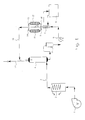
- the liquid stream fed by piping 16 is in countercurrent with respect to the imput gas flow.
- the contact among the phases can be obtained by structured filling up, plate column, or distributing the liquid stream inside the column in the form of small drops by atomizing nozzles.
- the ratio by weight among the flow rates of the feeding aqueous solution (L) through pipe 16, and of gas (G) fed through pipe 3, can range from 2 to 20, preferably from 4 to 15.
- the liquid stream flowing out from the scrubber 4 is discharged in the homogeneization tank 5.
- the temperature of the liquid solution flowing out from the absorption column (scrubber 4) has a temperature from 15°C to 43°C.
- the plant with the described process operates in a continuous way.
- the apparatus of Fig. 1, as said, can operate also in a discontinuous way.
- a fresh aqueous solution is introduced into the scrubber 4 and the solution of tank 5 is recovered.
- the aqueous solution of tank 5 is recycled, optionally mixed with a fresh aqueous solution, avoiding the passing on the column 11 or 12, until the concentration of the fluorinated anionic surfactant flowing out from the scrubber 4 is of 70 ppm, preferably lower than or equal to 60 ppm, still more preferably lower than 50 ppm.
- the anionic surfactant concentration of the solution flowing out from the scrubber 4 is higher than 70 ppm, the solution is not recycled but it is treated with the above methods to bring again the concentration to values lower than 70 ppm. At this point this solution can be recycled by following the above steps.
- the recovered PFOA aliquot is quantified by feeding in the plant described in Fig. 1 a gaseous stream having a known PFOA concentration.
- the used absorption column 4 is of the spray scrubber type in countercurrent.
- the column has diameter of 100 mm and length of 1000 mm.
- the liquid distribution is made by an atomizing nozzle put on the scrubber head, capable to give drops having a diameter in the range 200-600 ⁇ m.
- the removal liquid was formed by demineralized water, or a diluted NaOH solution (pH 10), having a flow rate of 90 kg/h and temperature from 25°C to 30°C.
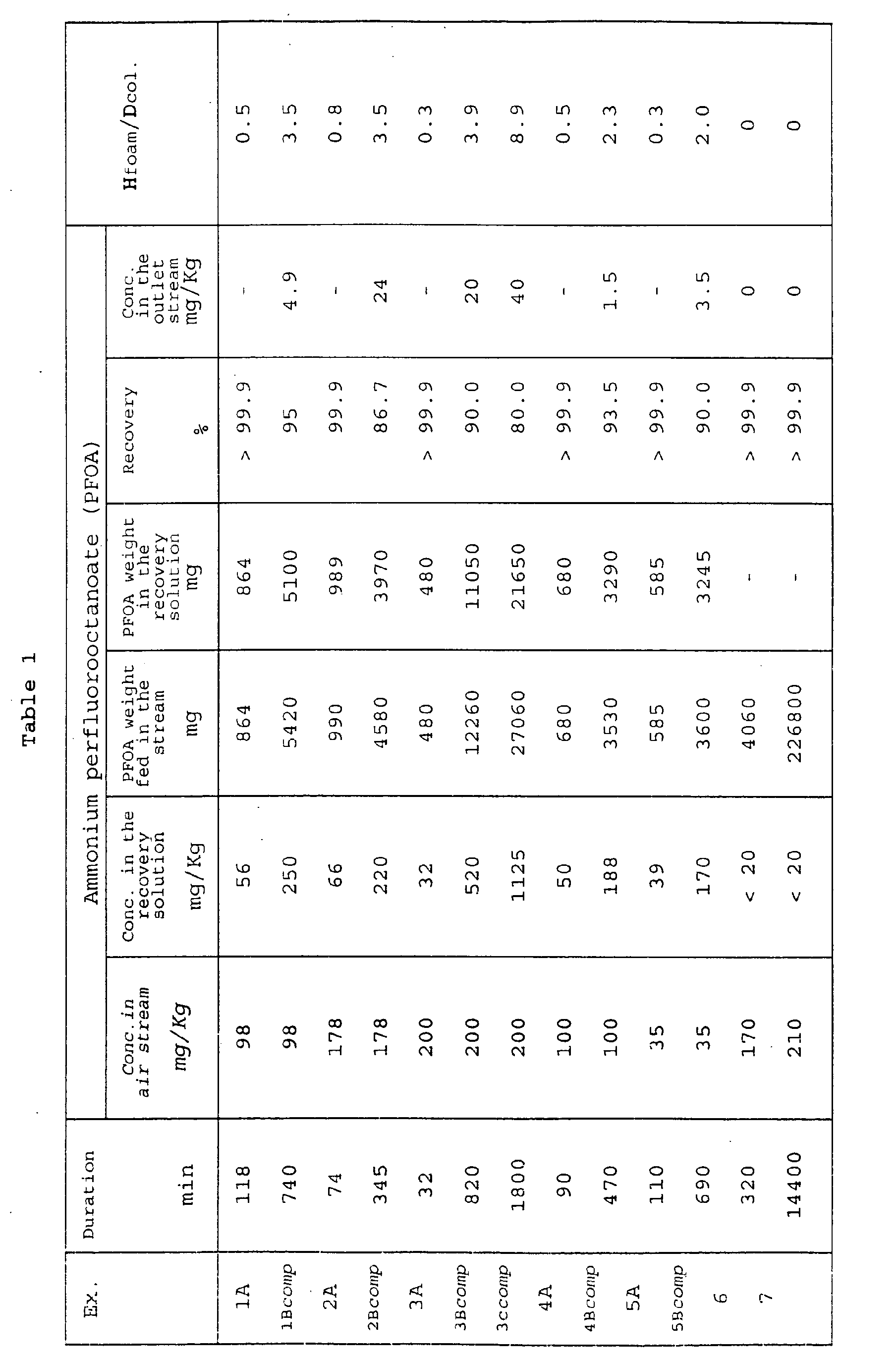
- the liquid collected at the scrubber bottom in the Examples 1-5 has ben recycled in the absorption column top, without carrying out the passing on the ionic exchange resin column.
- the recovered PFOA percentage has been expressed as 100 X (PFOA amount present in solution)/PFOA amount fed in the gaseous stream.
- the ratio between the liquid/gas flow rate is 18.
- the inlet gas has a constant PFOA concentration equal to 98 mg/kg.
- the aqueous solution pH at the beginning of the test was 7.04 and at the end 3.87.
- the PFOA concentration is expressed in ppm, i.e. mg of PFOA/kg of aqueous solution.
- the ratio between the foam heigth and the scrubber diameter is shown in Table 1 as Hfoam/Dcolumn.
- Example 1A The process described in the Example 1A was continued for a total time of 12 hours and 20 minutes.
- Example 1A The process described in the Example 1A is repeated but by using an inlet gas having a constant PFOA concentration equal to 178 mg/kg.
- the ratio between the liquid/gas flow-rate is 18.
- the process lasts 74 minutes in total.
- the initial solution pH was 7.08 and at the end of the process 3.80.
- the example 2A is continued, over the above time, for 5 hours and 45 minutes in total.
- the solution pH at the end of the process was 3.30.
- Example 1A The process described in the Example 1A is repeated but by using an inlet gas having a constant PFOA concentration equal to 200 mg/kg.
- the ratio between the liquid/gas flow-rate is 18.
- the process lasts 32 minutes in total.
- the Example 3A is continued, over the above time, for 13 hours and 40 minutes in total.
- the Example 3B is continued for a total time of 30 hours.
- the solution pH at the end of the process was 2.65.
- the PFOA concentration in the aqueous solution is 1,125 ppm, the recovery efficiency > 80.0%.
- Example 1A The process described in the Example 1A is repeated but by using an inlet gas having a constant PFOA concentration equal to 100 mg/kg and an absorption liquid formed by a diluted solution of NaOH pH 10 (density ⁇ 1.004 g/ml).
- the ratio between the liquid/gas flow-rate is 18.
- the process lasts 90 minutes in total.
- the initial solution pH was 10 and at the end of the process 6.91.
- Example 4A is continued, over the above time, for 470 minutes in total.
- Example 1A The process of the Example 1A is repeated but by using an inlet gas flow-rate of 9 kg/h, having a constant PFOA concentration of 35 mg/kg.
- the ratio between the liquid/gas flow-rate is 9.
- the process lasted 110 minutes in total.
- the initial solution pH was 7.0 and at the end of the process 4.02.
- the Example 5A is continued, over the above time, for 11 hours and 30 minutes in total.
- the solution pH at the end of the process was 2.25.
- the PFOA concentration in the aqueous solution is 170 ppm, the recovery efficiency > 90.0%.
- Example 1 is repeated but by using a gas having a PFOA concentration of 170 mg/kg.
- the liquid collected at the scrubber bottom, as said in the general part, in this case has been fed to the ionic exchange resin column Dowex®MSA 1C.
- the ratio between the liquid/gas flow-rate is 18.
- the process lasts 5 hours and 20 minutes in total.
- the initial solution pH was 7.05 and at the end of the process 12.
- Example 6 is repeated but by using a gas having a PFOA concentration of 210 mg/kg.
- the process lasts 20 days.
- the initial solution pH was 7.02 and at the end of the process 13.5.
Landscapes
- Chemical & Material Sciences (AREA)
- Engineering & Computer Science (AREA)
- Analytical Chemistry (AREA)
- General Chemical & Material Sciences (AREA)
- Oil, Petroleum & Natural Gas (AREA)
- Chemical Kinetics & Catalysis (AREA)
- Health & Medical Sciences (AREA)
- Biomedical Technology (AREA)
- Environmental & Geological Engineering (AREA)
- Treating Waste Gases (AREA)
- Gas Separation By Absorption (AREA)
Abstract
Description
Claims (12)
- An elimination process of fluorinated anionic sufactants from exhausted gaseous streams wherein the gaseous stream is put into contact with aqueous solutions having pH from 3.5 to 13.8, the aqueous solution density being lower than 1.05 g/cm3, preferably lower than 1.03 g/cm3, wherein the concentration in the aqueous solution of the fluorinated anionic surfactant removed from the gaseous stream is lower than or equal to 70 ppm, preferably lower than or equal to 60 ppm, still more preferably lower than 50 ppm.
- A process according to claim 1, wherein the anionic fluorinated surfactants are selected from perfluorinated carboxylic acids or derivatives thereof, preferably perfluorooctanoate in acid or salified form.
- A process according to claims 1-2, wherein the contact between the gaseous stream and the aqueous solutions is carried out in a scrubber.
- A process according to claim 3, wherein the used absorption column is a filling up column, preferably structured, a plate column or a spray column; preferably a spray column is used.
- A process according to claims 1-4, wherein one operates in a discontinuous or a continuous way, preferably in a continuous way.
- A process acording to claim 5, wherein one operates in a continuous way according to one of the following methods:by recycling the solution and recovering the surfactant at each recycle,by recycling the solution until reaching a surfactant concentration of 70 ppm and then by treating the liquid phase to remove the surfactant,by using in the gas absorption phase fresh solution without reycle,by feeding a fresh aqueous solution aliquot and drawing from the plant an aliquot containing the anionic surfactants to be sent to a recovery plant.
- A process according to claim 5, wherein when one operates in a discontinuous way, the solution used in the absorption column is recycled until a surfactant concentration of 70 ppm is reached.
- A process according to claims 1-7, wherein the surfactant is recovered from the aqueous solution flowing out from the absorption column by one of the following methods:by passing the solution on anionic exchange resins,by using specific adsorbers for fluorinated surfactants,by reverse osmosis units,by precipitation with polivalent cation salts.
- A process according to claim 8, wherein a strong anionic exchange resin is used.
- A process according to claim 8, wherein the used specific adsorbers are selected from active carbon, aluminas, silicas.
- A process according to claims 1-10, wherein the initial removal solution, and/or the recycle solution have a temperature in the range 5°C-40°C preferably 10°C-30°C.
- A process according to claims 1-11, wherein in the scrubber the ratio by weight among the flow rates of the feeding aqueous solution and fed gas is from 2 to 20, preferably from 4 to 15.
Applications Claiming Priority (2)
| Application Number | Priority Date | Filing Date | Title |
|---|---|---|---|
| IT2002MI001581A ITMI20021581A1 (en) | 2002-07-18 | 2002-07-18 | PROCEDURE FOR THE ABATEMENT OF FLUORINATED ANIONIC SURFACTANTS |
| ITMI20021581 | 2002-07-18 |
Publications (3)
| Publication Number | Publication Date |
|---|---|
| EP1382593A2 true EP1382593A2 (en) | 2004-01-21 |
| EP1382593A3 EP1382593A3 (en) | 2004-02-11 |
| EP1382593B1 EP1382593B1 (en) | 2009-03-11 |
Family
ID=29765344
Family Applications (1)
| Application Number | Title | Priority Date | Filing Date |
|---|---|---|---|
| EP03015359A Expired - Lifetime EP1382593B1 (en) | 2002-07-18 | 2003-07-08 | Process for removing fluorinated anionic surfactants from gaseous mixtures |
Country Status (6)
| Country | Link |
|---|---|
| US (1) | US7011696B2 (en) |
| EP (1) | EP1382593B1 (en) |
| CN (1) | CN100528295C (en) |
| DE (1) | DE60326519D1 (en) |
| IT (1) | ITMI20021581A1 (en) |
| RU (1) | RU2319535C2 (en) |
Cited By (5)
| Publication number | Priority date | Publication date | Assignee | Title |
|---|---|---|---|---|
| WO2006020721A1 (en) * | 2004-08-11 | 2006-02-23 | E.I. Dupont De Nemours And Company | Removing fluorosurfactant from aqueous fluoropolymer dispersion using sorbent pouches |
| WO2006110160A1 (en) * | 2004-08-11 | 2006-10-19 | E.I. Dupont De Nemours And Company | Removing fluorosurfactant from aqueous fluoropolymer dispersions |
| EP1746130A1 (en) | 2005-07-21 | 2007-01-24 | Solvay Solexis S.p.A. | Fine fluoropolymer powders |
| US7666928B2 (en) | 2006-05-31 | 2010-02-23 | E.I. Du Pont De Nemours And Company | Staged addition of non-fluorinated anionic surfactant to reduced fluorosurfactant fluoropolymer dispersion |
| US7803277B2 (en) | 2004-08-11 | 2010-09-28 | E.I. Du Pont De Nemours And Company | Process for removing fluorosurfactant from an aqueous fluoropolymer dispersion using sorbent pouches |
Families Citing this family (10)
| Publication number | Priority date | Publication date | Assignee | Title |
|---|---|---|---|---|
| US7138551B2 (en) * | 2004-11-05 | 2006-11-21 | E. I. Du Pont De Nemours And Company | Purification of fluorinated alcohols |
| US20090281261A1 (en) * | 2008-05-09 | 2009-11-12 | E. I. Du Pont De Nemours And Company | Abatement of Fluoroether Carboxylic Acids or Salts Employed in Fluoropolymer Resin Manufacture |
| WO2013024790A1 (en) * | 2011-08-18 | 2013-02-21 | 旭硝子株式会社 | Method for concentrating and recovering aqueous solution of a surfactant |
| CN103406009B (en) * | 2013-08-01 | 2016-08-10 | 中国科学院过程工程研究所 | A kind of method and device reclaiming perfluoro caprylic acid from fluoropolymer manufacture tail gas |
| CN108883411A (en) * | 2016-03-04 | 2018-11-23 | 3M创新有限公司 | Method for removing perfluorinated alkanoic acids |
| US12378138B2 (en) | 2019-06-19 | 2025-08-05 | The Johns Hopkins University | Contaminant-sequestering coatings and methods of using the same |
| US11452987B2 (en) | 2019-06-19 | 2022-09-27 | The Johns Hopkins University | Contaminate sequestering coatings and methods of using the same |
| US12545601B2 (en) | 2023-07-14 | 2026-02-10 | Claros Technologies Inc. | Methods and systems of photosensitizer recovery for improved PFAS destruction |
| JP2026525425A (en) | 2023-07-14 | 2026-07-30 | クラロス テクノロジーズ インコーポレイテッド | Method and system for capturing iodine from aqueous solution |
| US12534390B2 (en) | 2023-07-14 | 2026-01-27 | Claros Technologies Inc. | Methods and systems of nitrate removal in aqueous systems for improved PFAS destruction |
Family Cites Families (14)
| Publication number | Priority date | Publication date | Assignee | Title |
|---|---|---|---|---|
| US3882153A (en) * | 1969-09-12 | 1975-05-06 | Kureha Chemical Ind Co Ltd | Method for recovering fluorinated carboxylic acid |
| JPS5243467B2 (en) * | 1973-05-10 | 1977-10-31 | ||
| DE2903981A1 (en) | 1979-02-02 | 1980-08-07 | Hoechst Ag | RECOVERY OF FLUORINATED EMULGATOR ACIDS FROM BASIC ANION EXCHANGERS |
| SU990279A1 (en) * | 1979-11-13 | 1983-01-23 | Научно-производственное объединение "Наирит" | Method of purifying gases from moisture and hydrocarbon impurities |
| US4411787A (en) | 1982-07-22 | 1983-10-25 | Uop Inc. | Reverse osmosis apparatus |
| US4623487A (en) * | 1985-03-14 | 1986-11-18 | E. I. Du Pont De Nemours & Company | Process for recovery of fluorosurfactants |
| US4865745A (en) | 1988-05-02 | 1989-09-12 | Texaco Inc. | Method of treating dilute aqueous solutions |
| DE3902843A1 (en) * | 1989-01-27 | 1990-08-02 | Herbst Umwelttech Gmbh | Process for purifying gases |
| DE4210055A1 (en) * | 1991-11-27 | 1993-06-09 | Degussa Ag, 6000 Frankfurt, De | METHOD FOR REMOVING HALOGENATED ORGANIC COMPOUNDS FROM EXHAUST GASES |
| DE4402694A1 (en) * | 1993-06-02 | 1995-08-03 | Hoechst Ag | Process for the recovery of fluorinated carboxylic acids |
| EP0731081B1 (en) * | 1995-03-09 | 1998-04-15 | Dyneon GmbH | Recovery of highly fluorinated carboxylic acids from gaseous phase |
| JP3937027B2 (en) * | 1996-08-05 | 2007-06-27 | ダイネオン・ゲゼルシャフト・ミト・ベシュレンクテル・ハフツング | Recovery of highly fluorinated carboxylic acids from the gas phase |
| GB9923951D0 (en) * | 1999-10-08 | 1999-12-08 | Boc Group Plc | Treatment of gas mixture |
| US6720437B2 (en) * | 2001-02-07 | 2004-04-13 | E. I. Du Pont De Nemours And Company | Fluorinated carboxylic acid recovery and reuse |
-
2002
- 2002-07-18 IT IT2002MI001581A patent/ITMI20021581A1/en unknown
-
2003
- 2003-07-08 EP EP03015359A patent/EP1382593B1/en not_active Expired - Lifetime
- 2003-07-08 DE DE60326519T patent/DE60326519D1/en not_active Expired - Lifetime
- 2003-07-17 US US10/620,418 patent/US7011696B2/en not_active Expired - Fee Related
- 2003-07-18 RU RU2003122032/15A patent/RU2319535C2/en not_active IP Right Cessation
- 2003-07-18 CN CNB03158019XA patent/CN100528295C/en not_active Expired - Lifetime
Cited By (9)
| Publication number | Priority date | Publication date | Assignee | Title |
|---|---|---|---|---|
| WO2006020721A1 (en) * | 2004-08-11 | 2006-02-23 | E.I. Dupont De Nemours And Company | Removing fluorosurfactant from aqueous fluoropolymer dispersion using sorbent pouches |
| WO2006110160A1 (en) * | 2004-08-11 | 2006-10-19 | E.I. Dupont De Nemours And Company | Removing fluorosurfactant from aqueous fluoropolymer dispersions |
| CN101035814B (en) * | 2004-08-11 | 2010-05-05 | 纳幕尔杜邦公司 | Removal of Fluorosurfactants from Aqueous Fluoropolymer Dispersions |
| US7790041B2 (en) | 2004-08-11 | 2010-09-07 | E.I. Du Pont De Nemours And Company | Removing fluorosurfactant from aqueous fluoropolymer dispersions |
| US7803277B2 (en) | 2004-08-11 | 2010-09-28 | E.I. Du Pont De Nemours And Company | Process for removing fluorosurfactant from an aqueous fluoropolymer dispersion using sorbent pouches |
| CN101001888B (en) * | 2004-08-11 | 2010-09-29 | 纳幕尔杜邦公司 | Fluorosurfactant removal from aqueous fluoropolymer dispersion with sorbent pouches |
| EP1746130A1 (en) | 2005-07-21 | 2007-01-24 | Solvay Solexis S.p.A. | Fine fluoropolymer powders |
| US7691936B2 (en) | 2005-07-21 | 2010-04-06 | Solvay Solexis S.P.A. | Fine fluoropolymer powders |
| US7666928B2 (en) | 2006-05-31 | 2010-02-23 | E.I. Du Pont De Nemours And Company | Staged addition of non-fluorinated anionic surfactant to reduced fluorosurfactant fluoropolymer dispersion |
Also Published As
| Publication number | Publication date |
|---|---|
| CN100528295C (en) | 2009-08-19 |
| ITMI20021581A1 (en) | 2004-01-19 |
| EP1382593B1 (en) | 2009-03-11 |
| US7011696B2 (en) | 2006-03-14 |
| CN1488421A (en) | 2004-04-14 |
| RU2003122032A (en) | 2005-01-10 |
| US20040016343A1 (en) | 2004-01-29 |
| RU2319535C2 (en) | 2008-03-20 |
| EP1382593A3 (en) | 2004-02-11 |
| DE60326519D1 (en) | 2009-04-23 |
Similar Documents
| Publication | Publication Date | Title |
|---|---|---|
| US7011696B2 (en) | Elimination process of fluorinated anionic surfactants | |
| RU2490056C2 (en) | Method of extracting ammonia from gas flow in synthesis of urea | |
| RU2255807C2 (en) | Fluorine-containing emulsifier regeneration method | |
| CA2171408C (en) | Recovery of highly fluorinated carboxylic acids from the gas phase | |
| EP1856165B1 (en) | Recovery of fluorinated surfactants from a basic anion exchange resin having quaternary ammonium groups | |
| WO2002014223A1 (en) | Method of separating anionic fluorochemical surfactant | |
| EP0594558B1 (en) | Industrial process for the separation and recovery of chlorine | |
| US11802060B2 (en) | Brine purification process | |
| CN116116188A (en) | Method and system for reducing amine loss during absorption in a carbon capture process | |
| CN102858430B (en) | Process for the removal of heat stable salts from acid gas absorbents | |
| US4154804A (en) | Novel calcium chloride scrubbing bath | |
| EP4219412A1 (en) | Closed-loop technologies for purifying fluorine containing water streams | |
| EP0684067B1 (en) | Process for treating acidic exhaust gas | |
| JPH05213817A (en) | Method for removing aldehydes and / or vinyl esters from gas or liquid process streams | |
| EP0619268A1 (en) | Process and installation for the production of hydrogen chloride from chlorine containing waste | |
| CA2611802C (en) | Ion exchange process | |
| JPH06210129A (en) | Exhaust gas treatment method | |
| JP4507271B2 (en) | Method for recovering hydrofluoric acid | |
| AU2012250908A1 (en) | Method and apparatus for capturing SOx in a flue gas processing system | |
| CA2160484A1 (en) | The treatment of gaseous substances | |
| CN218358392U (en) | Comprehensive hazardous waste incineration flue gas treatment system | |
| KR101844999B1 (en) | Method for eliminating polymerisation inhibitors of monomer mixtures including tert-butylcatechol | |
| CN111592647B (en) | Hydrolysis method of fluorine-containing polyether acyl fluoride | |
| JPH08318122A (en) | CFC decomposition exhaust gas treatment method | |
| RU2146665C1 (en) | Method and apparatus for recovery of high-fluorine carboxylic acids from emission gas flows |
Legal Events
| Date | Code | Title | Description |
|---|---|---|---|
| PUAI | Public reference made under article 153(3) epc to a published international application that has entered the european phase |
Free format text: ORIGINAL CODE: 0009012 |
|
| PUAL | Search report despatched |
Free format text: ORIGINAL CODE: 0009013 |
|
| AK | Designated contracting states |
Kind code of ref document: A2 Designated state(s): AT BE BG CH CY CZ DE DK EE ES FI FR GB GR HU IE IT LI LU MC NL PT RO SE SI SK TR |
|
| AX | Request for extension of the european patent |
Extension state: AL LT LV MK |
|
| AK | Designated contracting states |
Kind code of ref document: A3 Designated state(s): AT BE BG CH CY CZ DE DK EE ES FI FR GB GR HU IE IT LI LU MC NL PT RO SE SI SK TR |
|
| AX | Request for extension of the european patent |
Extension state: AL LT LV MK |
|
| 17P | Request for examination filed |
Effective date: 20040727 |
|
| AKX | Designation fees paid |
Designated state(s): DE FR GB IT NL |
|
| 17Q | First examination report despatched |
Effective date: 20080313 |
|
| GRAP | Despatch of communication of intention to grant a patent |
Free format text: ORIGINAL CODE: EPIDOSNIGR1 |
|
| GRAS | Grant fee paid |
Free format text: ORIGINAL CODE: EPIDOSNIGR3 |
|
| GRAA | (expected) grant |
Free format text: ORIGINAL CODE: 0009210 |
|
| AK | Designated contracting states |
Kind code of ref document: B1 Designated state(s): DE FR GB IT NL |
|
| REG | Reference to a national code |
Ref country code: GB Ref legal event code: FG4D |
|
| REF | Corresponds to: |
Ref document number: 60326519 Country of ref document: DE Date of ref document: 20090423 Kind code of ref document: P |
|
| PLBE | No opposition filed within time limit |
Free format text: ORIGINAL CODE: 0009261 |
|
| STAA | Information on the status of an ep patent application or granted ep patent |
Free format text: STATUS: NO OPPOSITION FILED WITHIN TIME LIMIT |
|
| 26N | No opposition filed |
Effective date: 20091214 |
|
| PG25 | Lapsed in a contracting state [announced via postgrant information from national office to epo] |
Ref country code: IT Free format text: LAPSE BECAUSE OF FAILURE TO SUBMIT A TRANSLATION OF THE DESCRIPTION OR TO PAY THE FEE WITHIN THE PRESCRIBED TIME-LIMIT Effective date: 20090311 |
|
| PGFP | Annual fee paid to national office [announced via postgrant information from national office to epo] |
Ref country code: DE Payment date: 20140702 Year of fee payment: 12 Ref country code: NL Payment date: 20140610 Year of fee payment: 12 |
|
| PGFP | Annual fee paid to national office [announced via postgrant information from national office to epo] |
Ref country code: FR Payment date: 20140708 Year of fee payment: 12 Ref country code: GB Payment date: 20140702 Year of fee payment: 12 |
|
| REG | Reference to a national code |
Ref country code: DE Ref legal event code: R119 Ref document number: 60326519 Country of ref document: DE |
|
| GBPC | Gb: european patent ceased through non-payment of renewal fee |
Effective date: 20150708 |
|
| REG | Reference to a national code |
Ref country code: NL Ref legal event code: MM Effective date: 20150801 |
|
| PG25 | Lapsed in a contracting state [announced via postgrant information from national office to epo] |
Ref country code: GB Free format text: LAPSE BECAUSE OF NON-PAYMENT OF DUE FEES Effective date: 20150708 Ref country code: DE Free format text: LAPSE BECAUSE OF NON-PAYMENT OF DUE FEES Effective date: 20160202 |
|
| REG | Reference to a national code |
Ref country code: FR Ref legal event code: ST Effective date: 20160331 |
|
| PG25 | Lapsed in a contracting state [announced via postgrant information from national office to epo] |
Ref country code: NL Free format text: LAPSE BECAUSE OF NON-PAYMENT OF DUE FEES Effective date: 20150801 Ref country code: FR Free format text: LAPSE BECAUSE OF NON-PAYMENT OF DUE FEES Effective date: 20150731 |