EP1381100B1 - Electricity storage device - Google Patents
Electricity storage device Download PDFInfo
- Publication number
- EP1381100B1 EP1381100B1 EP02714425A EP02714425A EP1381100B1 EP 1381100 B1 EP1381100 B1 EP 1381100B1 EP 02714425 A EP02714425 A EP 02714425A EP 02714425 A EP02714425 A EP 02714425A EP 1381100 B1 EP1381100 B1 EP 1381100B1
- Authority
- EP
- European Patent Office
- Prior art keywords
- storage device
- charge storage
- positive electrode
- nitroxyl
- formula
- Prior art date
- Legal status (The legal status is an assumption and is not a legal conclusion. Google has not performed a legal analysis and makes no representation as to the accuracy of the status listed.)
- Expired - Lifetime
Links
- 238000003860 storage Methods 0.000 title claims abstract description 69
- 230000005611 electricity Effects 0.000 title abstract description 4
- -1 nitroxyl compound Chemical class 0.000 claims abstract description 44
- 238000006243 chemical reaction Methods 0.000 claims abstract description 10
- YLFIGGHWWPSIEG-UHFFFAOYSA-N aminoxyl Chemical group [O]N YLFIGGHWWPSIEG-UHFFFAOYSA-N 0.000 claims abstract description 7
- 238000003411 electrode reaction Methods 0.000 claims abstract description 4
- 229920000642 polymer Polymers 0.000 claims description 28
- 239000003792 electrolyte Substances 0.000 claims description 27
- 239000003960 organic solvent Substances 0.000 claims description 4
- OKTJSMMVPCPJKN-UHFFFAOYSA-N Carbon Chemical compound [C] OKTJSMMVPCPJKN-UHFFFAOYSA-N 0.000 description 11
- 239000011230 binding agent Substances 0.000 description 11
- 239000011149 active material Substances 0.000 description 10
- YMWUJEATGCHHMB-UHFFFAOYSA-N Dichloromethane Chemical compound ClCCl YMWUJEATGCHHMB-UHFFFAOYSA-N 0.000 description 9
- ODUCDPQEXGNKDN-UHFFFAOYSA-N nitroxyl Chemical group O=N ODUCDPQEXGNKDN-UHFFFAOYSA-N 0.000 description 9
- 239000008151 electrolyte solution Substances 0.000 description 8
- 239000000463 material Substances 0.000 description 8
- 229920005989 resin Polymers 0.000 description 8
- 239000011347 resin Substances 0.000 description 8
- 239000003990 capacitor Substances 0.000 description 7
- 150000001768 cations Chemical class 0.000 description 7
- 229920001577 copolymer Polymers 0.000 description 7
- 125000004122 cyclic group Chemical group 0.000 description 7
- 229910052744 lithium Inorganic materials 0.000 description 7
- 229920000193 polymethacrylate Polymers 0.000 description 7
- 239000002904 solvent Substances 0.000 description 7
- OZAIFHULBGXAKX-UHFFFAOYSA-N 2-(2-cyanopropan-2-yldiazenyl)-2-methylpropanenitrile Chemical compound N#CC(C)(C)N=NC(C)(C)C#N OZAIFHULBGXAKX-UHFFFAOYSA-N 0.000 description 6
- 229920001343 polytetrafluoroethylene Polymers 0.000 description 6
- 239000004810 polytetrafluoroethylene Substances 0.000 description 6
- 150000001875 compounds Chemical class 0.000 description 5
- 230000006866 deterioration Effects 0.000 description 5
- 238000000034 method Methods 0.000 description 5
- 239000000203 mixture Substances 0.000 description 5
- 239000000178 monomer Substances 0.000 description 5
- 239000007784 solid electrolyte Substances 0.000 description 5
- BQCIDUSAKPWEOX-UHFFFAOYSA-N 1,1-Difluoroethene Chemical compound FC(F)=C BQCIDUSAKPWEOX-UHFFFAOYSA-N 0.000 description 4
- KAKZBPTYRLMSJV-UHFFFAOYSA-N Butadiene Chemical compound C=CC=C KAKZBPTYRLMSJV-UHFFFAOYSA-N 0.000 description 4
- OIFBSDVPJOWBCH-UHFFFAOYSA-N Diethyl carbonate Chemical compound CCOC(=O)OCC OIFBSDVPJOWBCH-UHFFFAOYSA-N 0.000 description 4
- HBBGRARXTFLTSG-UHFFFAOYSA-N Lithium ion Chemical compound [Li+] HBBGRARXTFLTSG-UHFFFAOYSA-N 0.000 description 4
- VYPSYNLAJGMNEJ-UHFFFAOYSA-N Silicium dioxide Chemical compound O=[Si]=O VYPSYNLAJGMNEJ-UHFFFAOYSA-N 0.000 description 4
- PPBRXRYQALVLMV-UHFFFAOYSA-N Styrene Chemical compound C=CC1=CC=CC=C1 PPBRXRYQALVLMV-UHFFFAOYSA-N 0.000 description 4
- WYURNTSHIVDZCO-UHFFFAOYSA-N Tetrahydrofuran Chemical compound C1CCOC1 WYURNTSHIVDZCO-UHFFFAOYSA-N 0.000 description 4
- 150000001450 anions Chemical class 0.000 description 4
- 239000003575 carbonaceous material Substances 0.000 description 4
- 229920001940 conductive polymer Polymers 0.000 description 4
- 238000007599 discharging Methods 0.000 description 4
- PQXKHYXIUOZZFA-UHFFFAOYSA-M lithium fluoride Chemical compound [Li+].[F-] PQXKHYXIUOZZFA-UHFFFAOYSA-M 0.000 description 4
- 229910001416 lithium ion Inorganic materials 0.000 description 4
- 239000004570 mortar (masonry) Substances 0.000 description 4
- 238000012856 packing Methods 0.000 description 4
- ZMXDDKWLCZADIW-UHFFFAOYSA-N N,N-Dimethylformamide Chemical compound CN(C)C=O ZMXDDKWLCZADIW-UHFFFAOYSA-N 0.000 description 3
- 239000002033 PVDF binder Substances 0.000 description 3
- 239000003610 charcoal Substances 0.000 description 3
- 230000000052 comparative effect Effects 0.000 description 3
- HCDGVLDPFQMKDK-UHFFFAOYSA-N hexafluoropropylene Chemical group FC(F)=C(F)C(F)(F)F HCDGVLDPFQMKDK-UHFFFAOYSA-N 0.000 description 3
- 230000007774 longterm Effects 0.000 description 3
- VLKZOEOYAKHREP-UHFFFAOYSA-N n-Hexane Chemical compound CCCCCC VLKZOEOYAKHREP-UHFFFAOYSA-N 0.000 description 3
- 229920002981 polyvinylidene fluoride Polymers 0.000 description 3
- 239000000843 powder Substances 0.000 description 3
- 230000009467 reduction Effects 0.000 description 3
- 230000003252 repetitive effect Effects 0.000 description 3
- 150000003839 salts Chemical class 0.000 description 3
- 239000000243 solution Substances 0.000 description 3
- 239000000126 substance Substances 0.000 description 3
- XLYOFNOQVPJJNP-UHFFFAOYSA-N water Substances O XLYOFNOQVPJJNP-UHFFFAOYSA-N 0.000 description 3
- LULAYUGMBFYYEX-UHFFFAOYSA-N 3-chlorobenzoic acid Chemical compound OC(=O)C1=CC=CC(Cl)=C1 LULAYUGMBFYYEX-UHFFFAOYSA-N 0.000 description 2
- YEJRWHAVMIAJKC-UHFFFAOYSA-N 4-Butyrolactone Chemical compound O=C1CCCO1 YEJRWHAVMIAJKC-UHFFFAOYSA-N 0.000 description 2
- NLHHRLWOUZZQLW-UHFFFAOYSA-N Acrylonitrile Chemical compound C=CC#N NLHHRLWOUZZQLW-UHFFFAOYSA-N 0.000 description 2
- IJGRMHOSHXDMSA-UHFFFAOYSA-N Atomic nitrogen Chemical compound N#N IJGRMHOSHXDMSA-UHFFFAOYSA-N 0.000 description 2
- BWGNESOTFCXPMA-UHFFFAOYSA-N Dihydrogen disulfide Chemical compound SS BWGNESOTFCXPMA-UHFFFAOYSA-N 0.000 description 2
- KMTRUDSVKNLOMY-UHFFFAOYSA-N Ethylene carbonate Chemical compound O=C1OCCO1 KMTRUDSVKNLOMY-UHFFFAOYSA-N 0.000 description 2
- 229910001290 LiPF6 Inorganic materials 0.000 description 2
- BAPJBEWLBFYGME-UHFFFAOYSA-N Methyl acrylate Chemical compound COC(=O)C=C BAPJBEWLBFYGME-UHFFFAOYSA-N 0.000 description 2
- SECXISVLQFMRJM-UHFFFAOYSA-N N-Methylpyrrolidone Chemical compound CN1CCCC1=O SECXISVLQFMRJM-UHFFFAOYSA-N 0.000 description 2
- PXHVJJICTQNCMI-UHFFFAOYSA-N Nickel Chemical compound [Ni] PXHVJJICTQNCMI-UHFFFAOYSA-N 0.000 description 2
- 239000004698 Polyethylene Substances 0.000 description 2
- 239000004642 Polyimide Substances 0.000 description 2
- 229920000265 Polyparaphenylene Polymers 0.000 description 2
- 239000004743 Polypropylene Substances 0.000 description 2
- CDBYLPFSWZWCQE-UHFFFAOYSA-L Sodium Carbonate Chemical compound [Na+].[Na+].[O-]C([O-])=O CDBYLPFSWZWCQE-UHFFFAOYSA-L 0.000 description 2
- QAOWNCQODCNURD-UHFFFAOYSA-N Sulfuric acid Chemical compound OS(O)(=O)=O QAOWNCQODCNURD-UHFFFAOYSA-N 0.000 description 2
- 239000006230 acetylene black Substances 0.000 description 2
- HSFWRNGVRCDJHI-UHFFFAOYSA-N alpha-acetylene Natural products C#C HSFWRNGVRCDJHI-UHFFFAOYSA-N 0.000 description 2
- 239000007864 aqueous solution Substances 0.000 description 2
- 229910052799 carbon Inorganic materials 0.000 description 2
- 239000006229 carbon black Substances 0.000 description 2
- 230000003197 catalytic effect Effects 0.000 description 2
- 238000001914 filtration Methods 0.000 description 2
- 229910002804 graphite Inorganic materials 0.000 description 2
- 239000010439 graphite Substances 0.000 description 2
- AMXOYNBUYSYVKV-UHFFFAOYSA-M lithium bromide Chemical compound [Li+].[Br-] AMXOYNBUYSYVKV-UHFFFAOYSA-M 0.000 description 2
- KWGKDLIKAYFUFQ-UHFFFAOYSA-M lithium chloride Chemical compound [Li+].[Cl-] KWGKDLIKAYFUFQ-UHFFFAOYSA-M 0.000 description 2
- 229910052751 metal Inorganic materials 0.000 description 2
- 239000002184 metal Substances 0.000 description 2
- 229910044991 metal oxide Inorganic materials 0.000 description 2
- 150000004706 metal oxides Chemical class 0.000 description 2
- 125000002496 methyl group Chemical group [H]C([H])([H])* 0.000 description 2
- 229920001197 polyacetylene Polymers 0.000 description 2
- 229920000767 polyaniline Polymers 0.000 description 2
- 229920000573 polyethylene Polymers 0.000 description 2
- 229920001721 polyimide Polymers 0.000 description 2
- 239000002861 polymer material Substances 0.000 description 2
- 229920001155 polypropylene Polymers 0.000 description 2
- 229920000128 polypyrrole Polymers 0.000 description 2
- 238000002360 preparation method Methods 0.000 description 2
- 230000008569 process Effects 0.000 description 2
- YLQBMQCUIZJEEH-UHFFFAOYSA-N tetrahydrofuran Natural products C=1C=COC=1 YLQBMQCUIZJEEH-UHFFFAOYSA-N 0.000 description 2
- WNXJIVFYUVYPPR-UHFFFAOYSA-N 1,3-dioxolane Chemical compound C1COCO1 WNXJIVFYUVYPPR-UHFFFAOYSA-N 0.000 description 1
- TTWJFXYMNZEDSX-UHFFFAOYSA-N 2-methylprop-2-enoic acid;2,2,6,6-tetramethylpiperidine Chemical compound CC(=C)C(O)=O.CC1(C)CCCC(C)(C)N1 TTWJFXYMNZEDSX-UHFFFAOYSA-N 0.000 description 1
- NHQDETIJWKXCTC-UHFFFAOYSA-N 3-chloroperbenzoic acid Chemical compound OOC(=O)C1=CC=CC(Cl)=C1 NHQDETIJWKXCTC-UHFFFAOYSA-N 0.000 description 1
- 229910000838 Al alloy Inorganic materials 0.000 description 1
- 229910000873 Beta-alumina solid electrolyte Inorganic materials 0.000 description 1
- RYGMFSIKBFXOCR-UHFFFAOYSA-N Copper Chemical compound [Cu] RYGMFSIKBFXOCR-UHFFFAOYSA-N 0.000 description 1
- LFQSCWFLJHTTHZ-UHFFFAOYSA-N Ethanol Chemical compound CCO LFQSCWFLJHTTHZ-UHFFFAOYSA-N 0.000 description 1
- 229910000733 Li alloy Inorganic materials 0.000 description 1
- 229910000552 LiCF3SO3 Inorganic materials 0.000 description 1
- 229910032387 LiCoO2 Inorganic materials 0.000 description 1
- 229910002993 LiMnO2 Inorganic materials 0.000 description 1
- 229910003005 LiNiO2 Inorganic materials 0.000 description 1
- WHXSMMKQMYFTQS-UHFFFAOYSA-N Lithium Chemical compound [Li] WHXSMMKQMYFTQS-UHFFFAOYSA-N 0.000 description 1
- 229910001194 LixV2O5 Inorganic materials 0.000 description 1
- CERQOIWHTDAKMF-UHFFFAOYSA-N Methacrylic acid Chemical compound CC(=C)C(O)=O CERQOIWHTDAKMF-UHFFFAOYSA-N 0.000 description 1
- VVQNEPGJFQJSBK-UHFFFAOYSA-N Methyl methacrylate Chemical compound COC(=O)C(C)=C VVQNEPGJFQJSBK-UHFFFAOYSA-N 0.000 description 1
- FXHOOIRPVKKKFG-UHFFFAOYSA-N N,N-Dimethylacetamide Chemical compound CN(C)C(C)=O FXHOOIRPVKKKFG-UHFFFAOYSA-N 0.000 description 1
- 229920003171 Poly (ethylene oxide) Polymers 0.000 description 1
- BQCADISMDOOEFD-UHFFFAOYSA-N Silver Chemical compound [Ag] BQCADISMDOOEFD-UHFFFAOYSA-N 0.000 description 1
- RTAQQCXQSZGOHL-UHFFFAOYSA-N Titanium Chemical compound [Ti] RTAQQCXQSZGOHL-UHFFFAOYSA-N 0.000 description 1
- 125000005250 alkyl acrylate group Chemical group 0.000 description 1
- 229910052782 aluminium Inorganic materials 0.000 description 1
- XAGFODPZIPBFFR-UHFFFAOYSA-N aluminium Chemical compound [Al] XAGFODPZIPBFFR-UHFFFAOYSA-N 0.000 description 1
- 239000012300 argon atmosphere Substances 0.000 description 1
- QVGXLLKOCUKJST-UHFFFAOYSA-N atomic oxygen Chemical compound [O] QVGXLLKOCUKJST-UHFFFAOYSA-N 0.000 description 1
- 229920005601 base polymer Polymers 0.000 description 1
- 230000015572 biosynthetic process Effects 0.000 description 1
- WUKWITHWXAAZEY-UHFFFAOYSA-L calcium difluoride Chemical compound [F-].[F-].[Ca+2] WUKWITHWXAAZEY-UHFFFAOYSA-L 0.000 description 1
- 229910001634 calcium fluoride Inorganic materials 0.000 description 1
- 239000003054 catalyst Substances 0.000 description 1
- 230000008859 change Effects 0.000 description 1
- 239000002800 charge carrier Substances 0.000 description 1
- 229910001914 chlorine tetroxide Inorganic materials 0.000 description 1
- 239000000470 constituent Substances 0.000 description 1
- 229910052802 copper Inorganic materials 0.000 description 1
- 239000010949 copper Substances 0.000 description 1
- IEJIGPNLZYLLBP-UHFFFAOYSA-N dimethyl carbonate Chemical compound COC(=O)OC IEJIGPNLZYLLBP-UHFFFAOYSA-N 0.000 description 1
- 239000006185 dispersion Substances 0.000 description 1
- 238000007580 dry-mixing Methods 0.000 description 1
- 239000007772 electrode material Substances 0.000 description 1
- 230000002708 enhancing effect Effects 0.000 description 1
- JBTWLSYIZRCDFO-UHFFFAOYSA-N ethyl methyl carbonate Chemical compound CCOC(=O)OC JBTWLSYIZRCDFO-UHFFFAOYSA-N 0.000 description 1
- 239000011888 foil Substances 0.000 description 1
- 239000011521 glass Substances 0.000 description 1
- PCHJSUWPFVWCPO-UHFFFAOYSA-N gold Chemical compound [Au] PCHJSUWPFVWCPO-UHFFFAOYSA-N 0.000 description 1
- 229910052737 gold Inorganic materials 0.000 description 1
- 239000010931 gold Substances 0.000 description 1
- 238000010438 heat treatment Methods 0.000 description 1
- 239000001257 hydrogen Substances 0.000 description 1
- 229910052739 hydrogen Inorganic materials 0.000 description 1
- 125000004435 hydrogen atom Chemical class [H]* 0.000 description 1
- 150000003949 imides Chemical class 0.000 description 1
- 239000012535 impurity Substances 0.000 description 1
- 229910003480 inorganic solid Inorganic materials 0.000 description 1
- 150000002500 ions Chemical class 0.000 description 1
- 239000005001 laminate film Substances 0.000 description 1
- 239000001989 lithium alloy Substances 0.000 description 1
- MHCFAGZWMAWTNR-UHFFFAOYSA-M lithium perchlorate Chemical compound [Li+].[O-]Cl(=O)(=O)=O MHCFAGZWMAWTNR-UHFFFAOYSA-M 0.000 description 1
- 229910001486 lithium perchlorate Inorganic materials 0.000 description 1
- 229910001496 lithium tetrafluoroborate Inorganic materials 0.000 description 1
- ACFSQHQYDZIPRL-UHFFFAOYSA-N lithium;bis(1,1,2,2,2-pentafluoroethylsulfonyl)azanide Chemical compound [Li+].FC(F)(F)C(F)(F)S(=O)(=O)[N-]S(=O)(=O)C(F)(F)C(F)(F)F ACFSQHQYDZIPRL-UHFFFAOYSA-N 0.000 description 1
- QSZMZKBZAYQGRS-UHFFFAOYSA-N lithium;bis(trifluoromethylsulfonyl)azanide Chemical compound [Li+].FC(F)(F)S(=O)(=O)[N-]S(=O)(=O)C(F)(F)F QSZMZKBZAYQGRS-UHFFFAOYSA-N 0.000 description 1
- 230000007246 mechanism Effects 0.000 description 1
- 229910001092 metal group alloy Inorganic materials 0.000 description 1
- 150000002739 metals Chemical class 0.000 description 1
- LGRLWUINFJPLSH-UHFFFAOYSA-N methanide Chemical compound [CH3-] LGRLWUINFJPLSH-UHFFFAOYSA-N 0.000 description 1
- 239000011259 mixed solution Substances 0.000 description 1
- 238000002156 mixing Methods 0.000 description 1
- 229910052759 nickel Inorganic materials 0.000 description 1
- 229910052757 nitrogen Inorganic materials 0.000 description 1
- 239000004745 nonwoven fabric Substances 0.000 description 1
- 150000002894 organic compounds Chemical class 0.000 description 1
- 229920000620 organic polymer Polymers 0.000 description 1
- 230000003647 oxidation Effects 0.000 description 1
- 238000007254 oxidation reaction Methods 0.000 description 1
- 229910052760 oxygen Inorganic materials 0.000 description 1
- 239000001301 oxygen Substances 0.000 description 1
- VLTRZXGMWDSKGL-UHFFFAOYSA-M perchlorate Chemical compound [O-]Cl(=O)(=O)=O VLTRZXGMWDSKGL-UHFFFAOYSA-M 0.000 description 1
- 239000000088 plastic resin Substances 0.000 description 1
- 229920002239 polyacrylonitrile Polymers 0.000 description 1
- 238000003825 pressing Methods 0.000 description 1
- RUOJZAUFBMNUDX-UHFFFAOYSA-N propylene carbonate Chemical compound CC1COC(=O)O1 RUOJZAUFBMNUDX-UHFFFAOYSA-N 0.000 description 1
- 238000006479 redox reaction Methods 0.000 description 1
- 238000010992 reflux Methods 0.000 description 1
- 229910052709 silver Inorganic materials 0.000 description 1
- 239000004332 silver Substances 0.000 description 1
- 238000005245 sintering Methods 0.000 description 1
- 238000005549 size reduction Methods 0.000 description 1
- 239000002002 slurry Substances 0.000 description 1
- 229910000029 sodium carbonate Inorganic materials 0.000 description 1
- 239000007787 solid Substances 0.000 description 1
- 238000004611 spectroscopical analysis Methods 0.000 description 1
- 239000010935 stainless steel Substances 0.000 description 1
- 229910001220 stainless steel Inorganic materials 0.000 description 1
- 238000003756 stirring Methods 0.000 description 1
- HXJUTPCZVOIRIF-UHFFFAOYSA-N sulfolane Chemical compound O=S1(=O)CCCC1 HXJUTPCZVOIRIF-UHFFFAOYSA-N 0.000 description 1
- 238000003786 synthesis reaction Methods 0.000 description 1
- 239000010936 titanium Substances 0.000 description 1
- 229910052719 titanium Inorganic materials 0.000 description 1
- 229910000314 transition metal oxide Inorganic materials 0.000 description 1
Images


Classifications
-
- H—ELECTRICITY
- H01—ELECTRIC ELEMENTS
- H01M—PROCESSES OR MEANS, e.g. BATTERIES, FOR THE DIRECT CONVERSION OF CHEMICAL ENERGY INTO ELECTRICAL ENERGY
- H01M4/00—Electrodes
- H01M4/02—Electrodes composed of, or comprising, active material
- H01M4/13—Electrodes for accumulators with non-aqueous electrolyte, e.g. for lithium-accumulators; Processes of manufacture thereof
- H01M4/137—Electrodes based on electro-active polymers
-
- H—ELECTRICITY
- H01—ELECTRIC ELEMENTS
- H01M—PROCESSES OR MEANS, e.g. BATTERIES, FOR THE DIRECT CONVERSION OF CHEMICAL ENERGY INTO ELECTRICAL ENERGY
- H01M10/00—Secondary cells; Manufacture thereof
- H01M10/05—Accumulators with non-aqueous electrolyte
- H01M10/052—Li-accumulators
-
- H—ELECTRICITY
- H01—ELECTRIC ELEMENTS
- H01M—PROCESSES OR MEANS, e.g. BATTERIES, FOR THE DIRECT CONVERSION OF CHEMICAL ENERGY INTO ELECTRICAL ENERGY
- H01M4/00—Electrodes
- H01M4/02—Electrodes composed of, or comprising, active material
- H01M4/36—Selection of substances as active materials, active masses, active liquids
- H01M4/60—Selection of substances as active materials, active masses, active liquids of organic compounds
-
- H—ELECTRICITY
- H01—ELECTRIC ELEMENTS
- H01M—PROCESSES OR MEANS, e.g. BATTERIES, FOR THE DIRECT CONVERSION OF CHEMICAL ENERGY INTO ELECTRICAL ENERGY
- H01M4/00—Electrodes
- H01M4/02—Electrodes composed of, or comprising, active material
- H01M4/36—Selection of substances as active materials, active masses, active liquids
- H01M4/60—Selection of substances as active materials, active masses, active liquids of organic compounds
- H01M4/602—Polymers
- H01M4/606—Polymers containing aromatic main chain polymers
- H01M4/608—Polymers containing aromatic main chain polymers containing heterocyclic rings
-
- H—ELECTRICITY
- H01—ELECTRIC ELEMENTS
- H01M—PROCESSES OR MEANS, e.g. BATTERIES, FOR THE DIRECT CONVERSION OF CHEMICAL ENERGY INTO ELECTRICAL ENERGY
- H01M4/00—Electrodes
- H01M4/02—Electrodes composed of, or comprising, active material
- H01M2004/026—Electrodes composed of, or comprising, active material characterised by the polarity
- H01M2004/028—Positive electrodes
-
- Y—GENERAL TAGGING OF NEW TECHNOLOGICAL DEVELOPMENTS; GENERAL TAGGING OF CROSS-SECTIONAL TECHNOLOGIES SPANNING OVER SEVERAL SECTIONS OF THE IPC; TECHNICAL SUBJECTS COVERED BY FORMER USPC CROSS-REFERENCE ART COLLECTIONS [XRACs] AND DIGESTS
- Y02—TECHNOLOGIES OR APPLICATIONS FOR MITIGATION OR ADAPTATION AGAINST CLIMATE CHANGE
- Y02E—REDUCTION OF GREENHOUSE GAS [GHG] EMISSIONS, RELATED TO ENERGY GENERATION, TRANSMISSION OR DISTRIBUTION
- Y02E60/00—Enabling technologies; Technologies with a potential or indirect contribution to GHG emissions mitigation
- Y02E60/10—Energy storage using batteries
Definitions
- This invention relates to a charge storage device with a large energy density from which a large current can be drawn at one time.
- a lithium ion secondary battery wherein a positive electrode uses a lithium-containing transition metal oxide while a negative electrode uses a carbon material has been used as a high-energy secondary battery in a variety of electronic devices.
- the lithium-ion secondary battery has a small reaction rate in an electrode reaction, a large current leads to significant deterioration in battery performance. Therefore, when used in a small electronic device, the battery requires a longer charging time. Also, the battery has not been used in a device such as an electric automobile requiring a large current.
- an electric double layer capacitor using charcoal in an electrode can give a large current and exhibit good cycle properties. It has been, therefore, developed as a backup power source and a power source for an electric automobile. However, since it has a small energy density and thus size reduction has been difficult, it has not been utilized in mobile electronic devices. Furthermore, it has not been extensively mounted in an electric automobile due to its poor capacity.
- a lead storage battery can give a large current and exhibit good cycle properties. It has been, therefore, widely used as an auxiliary power source for an automobile. However, since its voltage and energy density are iow, it has not been applied to an electric automobile in which a motor is driven by electric power.
- a lithium-ion secondary battery cannot be used for a large current and an electric double layer capacitor or lead storage battery cannot give an adequate energy density required for a small electronic device.
- a charge storage device which can be applied to a mobile electronic device or electric automobile, no charge storage devices with a higher energy density through which a large current can be drawn have been obtained.
- US-A-4,397,922 discloses an electricity storage device which contains a stable organic radical in one of the electrodes, and particular the positive electrodes. This document does not explicitly disclose the use of a radical compound have a nitroxyl radical group.
- EP-A-1 128 453 which is a document according to Article 54(3) EPC, disclosing a secondary battery using a radical compound as active electrode material, among which a large number of compounds have nitroxyl radical groups.
- Nitroxyl structure as shown in reaction formula (B), can take the states represented by formula (I) to (III) by transfer of electrons.
- this invention utilizes the reaction between formulas (I) and (II) as a positive electrode reaction, and the device functions as a charge storage device by storage and release of electrons associated with the reaction. Since the redox reaction is based on a mechanism without structural change of the organic compound, the reaction, therefore, proceeds at a large rate. Thus, the charge storage device of this invention makes it possible that large current flows at one time.
- charge storage device refers to a device comprising at least a positive electrode and a negative electrode, through which electrochemically stored energy can be drawn as electric power.
- Examples of a charge storage device include a first battery and a rechargeable secondary battery; a capacity device such as a capacitor and a condenser; and other electrochemical switching devices.
- a charge storage device of this invention can be used as a backup power source for which an electric double layer capacitor has been used, a capacitor such as an electric power source for an automobile or a condenser for an electronic device. Utilizing its high speed charge/discharge properties, it may be also used as an electrochemical switching device where a charged and a discharged states are used as ON and OFF, respectively.
- a positive electrode is an electrode having a higher redox potential while a negative electrode is an electrode having a lower redox potential.
- the nitroxyl compound of the invention is represented by any of formulas (4) to (6).
- Y is -COO- and R 5 is methyl.
- the group represented by formulas (4) to (6) may be not present in all side chains.
- all units constituting a polymer may be represented by formulas (4) to (6) or only a portion of unit may be represented by formulas (4) to (6).
- Its content in the polymer may depend on an application, the structure of the polymer and a preparation process. At least, a small amount must be present. Specifically, it is 0.1 wt% or more, generally 1 wt% or more, preferably 10 wt% or more. When there are no restrictions to polymer synthesis and it is desired to store charge as much as possible, the content is preferably 50 wt% or more, particularly 80 wt% or more.
- Such a polymer can be synthesized as follows.
- a monomer represented by formula (IV) may be homopolymerized or copolymerized with a copolymerizable monomer such as an alkyl acrylate to give a polymer, whose -NH- moiety may be then converted into -N(O.)- to give a polymer having a unit represented by formulas (4) to (6) in an oxidized state.
- R 1 , R 2 , R 3 , R 4 and R 5 are methyl, X' is and Y is -COO-.
- methacrylic acid may be polymerized to give a base polymer, to which may be then introduced a group represented by the part of formula (IV) below the "Y". (or a group having -NH- before oxidation into NO radical) by a polymer reaction.
- a charge storage device of this invention has an electrolyte containing a solvent
- a nitroxyl compound is insoluble in the electrolyte, i. e., high durability. Therefore, although there are no restrictions to a molecular weight of a polymer comprising a cyclic nitroxyl structure represented in formulas (4) to (6), the polymer preferably has a sufficient molecular weight to make the polymer insoluble in the electrolyte, but it depends on a combination of the electrolyte and the type of the solvent.
- the molecular weight is generally 1,000 or more, preferably 10,000 or more, particularly 100,000 or more.
- any larger molecular weight may be acceptable. Generally, it is 5,000,000 or less.
- a polymer comprising a cyclic nitroxyl structure represented by formula (Ia) may be crosslinked to improve its resistance to an electrolyte.
- Nitroxyl cation represented by formula (I) is generally stabilized by an anion from electrolyte; for example, PF 6 - , ClO 4 - , BF 4 - , Br - , Cl - , F - , imide type electrolyte salt anion and methide type electrolyte salt anion.
- a nitroxyl compound in a positive electrode functions as an active material contributing to charging. Therefore, for example, a cathodic active material in a conventional battery may be totally replaced with a nitroxyl compound defined in this invention. Furthermore, even when part of the conventional active material is replaced, a current may be correspondingly increased. There are, therefore, no restrictions to a replacement ratio to the whole active material.
- the compound may be correspondingly effective at 0.1 wt% or more to the whole active material and adequately effective at 10 wt% or more. When it is desired to store charge as much as possible, the amount may be preferably 50 wt% or more, particularly 80 wt% or more, especially 100 wt%.
- the nitroxyl compound is comprised of elements having a small atomic weight such as carbon, hydrogen, nitrogen and oxygen, and therefore, can store much electrical charge with a small weight. Thus, it can provide a charge storage device with a high energy density.
- a conventional active material may be any of known appropriate materials; for example, metal oxides such as LiMnO 2 , LiCoO 2 , LiNiO 2 and Li x V 2 O 5 (0 ⁇ x ⁇ 2).
- a positive electrode may comprise other known constituents; for example, a conductivity enhancing material including carbon materials such as charcoal, graphite, carbon black and acetylene black and conductive polymers such as polyacetylene, polyphenylene, polyaniline and polypyrrole; and a binder including resins such as polyvinylidene fluoride, polytetrafluoroethylene, a copolymer of vinylidene fluoride and hexafluoropropylene, a copolymer rubber of styrene and butadiene, polypropylene, polyethylene and a polyimide.
- the positive electrode may contain, for example, a disulfide, a catalytic compound or an ion-conductive polymer as appropriate.
- a nitroxyl compound is a polymer, it may also act as a binder, depending on some factors such as the type of a polymer main chain, the type of a side chain having the cyclic nitroxyl structure and the type of a side chain without the cyclic nitroxyl structure.
- a polymer may eliminate or reduce a conventional binder.
- a polymer comprising a cyclic nitroxyl structure may be used as a binder. In this case, the amount corresponding to the binder also acts as an active material, resulting in an increased capacity.
- a nitroxyl cation structure is believed to inactivate impurities such as water and an alcohol in an electrolyte to prevent performance deterioration of a charge storage device.
- a polymer nitroxyl compound is particularly effective because of its lower solubility in an electrolyte containing an organic solvent and thus its higher durability.
- a charge storage device of this invention comprises, in addition to a positive electrode as described above, at least a negative electrode and preferably an electrolyte.
- FIG. 1 shows its structure.
- the charge storage device shown in this figure has a structure where a negative electrode 3 and a positive electrode 5 are laminated via a separator 4 containing an electrolyte.
- a charge storage device of this invention comprises at least a negative electrode 3 and a positive electrode 5 as essential components, a negative electrode current collector 1, an insulating packing 2, a separator 4 and a positive electrode current collector 6 are optional.
- the charge storage device may have any known shape.
- the charge storage device may have a shape where an electrode laminate or roll is sealed in a metal case, a resin case or a laminate film. It may have an appropriate appearance such as a cylinder, a square, a coin and a sheet.
- a negative electrode may be made of a well-known material for a charge storage device electrode, including carbon materials such as charcoal, graphite, carbon black and acetylene black; elemental metals or metal alloys such as lithium metal or lithium alloys and lithium-ion storage carbon; and conductive polymers such as polyacetylene, polyphenylene, polyaniline and polypyrrole.
- carbon materials such as charcoal, graphite, carbon black and acetylene black
- elemental metals or metal alloys such as lithium metal or lithium alloys and lithium-ion storage carbon
- conductive polymers such as polyacetylene, polyphenylene, polyaniline and polypyrrole.
- a negative electrode may further contain a resin binder such as polyvinylidene fluoride, polytetrafluoroethylene, a copolymer of vinylidene fluoride and hexafluoropropylene, a copolymer rubber of styrene and butadiene, polypropylene, polyethylene and polyimide; a disulfide; a catalytic compound; and ion-conductive polymers, as appropriate.
- a resin binder such as polyvinylidene fluoride, polytetrafluoroethylene, a copolymer of vinylidene fluoride and hexafluoropropylene, a copolymer rubber of styrene and butadiene, polypropylene, polyethylene and polyimide; a disulfide; a catalytic compound; and ion-conductive polymers, as appropriate.
- a negative electrode current collector 1 and a positive electrode current collector 6 may be made of, for example, nickel, aluminum, copper, gold, silver, titanium, an aluminum alloy, stainless steel and a carbon material. They may have an appropriate shape such as a foil, a plate and a mesh. It may be also possible that the current collector is active as a catalyst and may be chemically bound to an active material.
- the charge storage device of this invention may comprise a separator consisting of a porous film or a nonwoven fabric in order to prevent a negative electrode 3 from being in electrically contact with a positive electrode 5. Furthermore, the device may comprise an insulating packing 2 consisting of a plastic resin in order to prevent a negative electrode current collector 1 from being in electrically contact with a positive electrode current collector 6.
- a charge storage device of this invention may comprise a well-known electrolyte.
- An electrolyte is generally responsible for transferring a charge carrier between a negative electrode and a positive electrode, and generally has an electrolyte ion conductivity of 10 -5 to 10 -1 S/cm at room temperature.
- An electrolyte used in this invention may be an electrolyte solution prepared by, for example, dissolving an electrolyte salt in a solvent.
- Such a solvent examples include organic solvents such as ethylene carbonate, propylene carbonate, dimethyl carbonate, diethyl carbonate, methyl ethyl carbonate, ⁇ -butyrolactone, tetrahydrofuran, dioxolane, sulfolane, dimethylformamide, dimethylacetamide and N-methyl-2-pyrrolidone; and an aqueous solution of sulfuric acid or water.
- these solvents may be used alone or in combination of two or more.
- a polymer nitroxyl compound may improve durability.
- Examples of an electrolyte salt include LiPF 6 , LiClO 4 , LiBF 4 , LiCF 3 SO 3 , LiN(CF 3 SO 2 ) 2 , LiN(C 2 F 5 SO 2 ) 2 , LiC(CF 3 SO 2 ) 3 , LiC(C 2 F 5 SO 2 ) 3 , LiBr, LiCl and LiF
- an electrolyte solution is contained in a separator 4.
- a solid electrolyte may be used.
- examples of an organic solid electrolyte material include vinylidene fluoride polymers such as polyvinylidene fluoride and a copolymer of vinylidene fluoride and hexafluoropropylene; acrylonitrile polymers such as a copolymer of acrylonitrile and methyl methacrylate and a copolymer of acrylonitrile and methyl acrylate; and polyethylene oxide.
- These polymer materials may be used as a gel containing an electrolyte solution or only polymer materials are used.
- examples of an inorganic solid electrolyte include CaF 2 , Agl, LiF, ⁇ -alumina and a glass material. When using such a solid electrolyte, a separator may not be necessary.
- a positive electrode may be formed by any known process; for example, adding a solvent to component materials and then applying the resulting slurry to an electrode current collector, adding a binder resin to component materials and then compressing the mixture, or sintering the component materials by heating. It is preferable that a nitroxyl compound is homogeneously distributed in a positive electrode. The compound may be ground before use when it is insoluble in a solvent.
- a nitroxyl structure used in forming a positive electrode may be in a reduced state having a radical represented by formula (II) or in an oxidized state having a cation represented by formula (I).
- the resulting powder was washed with diethyl carbonate (DEC) and dried in vacuo to give 7.2 g of poly(2,2,6,6-tetramethylpiperidinoxy methacrylate)(PTME) as a dark brown powder in an yield of 68.2 %.
- the structure of the polymer obtained was identified by IR.
- the GPC results indicated a weight average molecular weight (Mw) of 89,000 and a dispersion (Mw/Mn) of 3.30.
- a spin concentration was 2.51 ⁇ 10 21 spin/g as determined by ESR spectrometry. The value corresponds to a spin concentration assuming that the N-H group in poly(2,2,6,6-tetramethylpiperidine methacrylate) is 100 % converted into an N-O radical and all the monomer units in the polymer have a radical.
- poly(2,2,5,5-tetramethylpyrrolidinoxy methacrylate) represented by formula (8) and poly(2,2,5,5-tetramethylpyrrolinoxy methacrylate) represented by formula (9) were prepared.
- the electrode was immersed in an electrolyte solution to allow the electrolyte solution to enter vacancies.
- the electrode impregnated with the electrolyte solution was placed on a positive electrode current collector, on which was then laminated a porous film separator similarly impregnated with the electrolyte solution.
- On the laminate was further placed a lithium metal plate to be a negative electrode, and then a negative electrode current collector covered with an insulating packing was laminated.
- the resulting laminate was compressed by a caulker to provide an enclosed coin type of charge storage device.
- the charge storage device thus prepared had an equilibrium potential of 2.7 V.
- the charge storage device obtained was charged at a fixed current of 1 mA and charging was terminated when a voltage reached 4.0 V.
- the charge storage device after charging was disassembled.
- By analyzing the positive electrode it was observed that a radical concentration was reduced and a corresponding 2,2,6,6-tetramethylpiperidinoxyl cation was formed.
- the cation was stabilized by electrolyte anion PF 6 - .
- a charge storage device was prepared, charged at a fixed current of 1 mA and discharging was conducted immediately after a voltage reached 4.0 V.
- a discharge current was a fixed current of 1 mA as was in charging.
- FIG. 2 shows a charge/discharge curve for this process. During discharge, a voltage plateau was observed around 3.6 V. It was found that the voltage plateau corresponded to a potential difference between reduction of the nitroxyl cation into the nitroxyl radical in the positive electrode and ionization of lithium metal in the negative electrode. Thus, the results implies that the charge storage device according to Example 1 works as a chemical battery.
- a capacity of the charge storage device determined in Example 1 was 5.56 mAh per 1 g of the positive electrode and 55.6 mAh per 1 g of the polymethacrylate. The capacity corresponds to 50 % of the theoretical capacity of the polymer.
- a charge storage device was prepared as described above, and charge/discharge at 1 mA was repeated. Charge was conducted to 4.0 V and discharge was conducted to 3.0 V.
- FIG. 3 shows variation in a discharge capacity when the cycle was repeated 100 times. Even after repetition of charge/discharge, a capacity was not reduced. It indicates that the device is capable of performing repetitive charge/discharge for a long term.
- FIG. 4 shows a discharge curve when conducting charge/discharge at discharge rates of 1C, 2C, 5C, 10C and 30C for a charge storage device as described above. Charge and discharge were conducted to 4.2 V and 2.5 V, respectively. It was found that even at a discharge rate of 30C (full charge/full discharge in 2 min), the charge storage device of this invention exhibited 70 % capacity in comparison with that at a discharge rate of 1C (full charge/full discharge in 1 hour). The results indicate that the charge storage device of this invention is insusceptible to property deterioration even when charge/discharge is conducted at a large current.
- a charge storage device in which a positive electrode does not contain an organic polymer comprising a cyclic nitroxyl structure was prepared. First, 225 mg of graphite powder and 25 mg of a polytetrafluoroethylene resin binder were weighed and blended in an agate mortar. The subsequent procedure was conducted as described in Example 1, to prepare an electrode. Then, a charge storage device was assembled using an electrolyte, a separator, a positive electrode current collector and a negative electrode current collector as described in Example 1.
- An equilibrium potential for the charge storage device thus prepared was 2.9 V.
- the charge storage device obtained was charged at a fixed current of 1 mA. Charging was terminated when a voltage reached 4.0 V and immediately after charging, discharging was conducted also at a fixed current of 1 mA.
- the results are shown in FIG. 2.
- a voltage of the charge storage device gradually and substantially linearly varies without a voltage plateau as was observed in Example 1. The gradually varying voltage would correspond to a voltage difference between a potential of the electric double layer component accumulated in the graphite powder surface and a potential in ionization of lithium metal in the negative electrode. However, a capacity was as low as 0.64 mAh per 1 g of the positive electrode.
- Example 1 Twenty five milligrams of the polymethacrylate represented by formula (8) prepared above, 200 mg of graphite powder and 25 mg of a polytetrafluoroethylene resin binder were weighed and blended in an agate mortar. The subsequent procedure was conducted as described in Example 1, to prepare an electrode. Then, a charge storage device was assembled using an electrolyte, a separator, a positive electrode current collector and a negative electrode current collector as described in Example 1.
- the charge storage device thus prepared had an equilibrium potential of 2.7 V.
- the charge storage device obtained was charged at a fixed current of 1 mA and charging was terminated when a voltage reached 4.0 V.
- the charge storage device after charging was disassembled.
- By analyzing the positive electrode it was observed that a radical concentration was reduced and a corresponding 2,2,5,5-tetramethylpyrrolidinoxyl cation was formed.
- the cation was stabilized by an electrolyte anion PF 6 - .
- a charge storage device was prepared, charged at a fixed current of 1 mA and discharging was conducted immediately after a voltage reached 4.0 V.
- a discharge current was a fixed current of 1 mA as was in charging.
- a voltage plateau was observed. It was found that the voltage plateau corresponded to a potential difference between reduction of the nitroxyl cation into the nitroxyl radical in the positive electrode and ionization of lithium metal in the negative electrode.
- the results implies that the charge storage device according to Example 2 works as a chemical battery.
- Example 2 It was found that a capacity of the charge storage device determined in Example 2 was 5.61 mAh per 1 g of the positive electrode and 56.1 mAh per 1 g of the polymethacrylate. As in Example 1, it was confirmed that the device is capable of performing repetitive charge/discharge for a long term and is insusceptible to property deterioration even when charge/discharge is conducted at a large current.
- the charge storage device thus prepared had an equilibrium potential of 2.7 V.
- the charge storage device obtained was charged at a fixed current of 1 mA and charging was terminated when a voltage reached 4.0 V.
- the charge storage device after charging was disassembled.
- By analyzing the positive electrode it was observed that a radical concentration was reduced and a corresponding 2,2,5,5-tetramethylpyrrolinoxyl cation was formed.
- the cation was stabilized by an electrolyte anion PF 6 - .
- a charge storage device was prepared, charged at a fixed current of 1 mA and discharging was conducted immediately after a voltage reached 4.0 V.
- a discharge current was a fixed current of 1 mA as was in charging.
- a voltage plateau was observed. It was found that the voltage plateau corresponded to a potential difference between reduction of the nitroxyl cation into the nitroxyl radical in the positive electrode and ionization of lithium metal in the negative electrode.
- the results implies that the charge storage device according to Example 3 works as a chemical battery.
- Example 3 It was found that a capacity of the charge storage device determined in Example 3 was 56.9 mAh per 1 g of the positive electrode and 5.69 mAh per 1 g of the polymethacrylate. As in Example 1, it was confirmed that the device is capable of performing repetitive charge/discharge for a long term and is insusceptible to property deterioration even when charge/discharge is conducted at a large current.
- this invention can provide a charge storage device with a higher energy density which can give a large current. Since a nitroxyl compound is a polymer, durability is particularly improved.
Landscapes
- Chemical & Material Sciences (AREA)
- Chemical Kinetics & Catalysis (AREA)
- Electrochemistry (AREA)
- General Chemical & Material Sciences (AREA)
- Engineering & Computer Science (AREA)
- Manufacturing & Machinery (AREA)
- Materials Engineering (AREA)
- Battery Electrode And Active Subsutance (AREA)
- Secondary Cells (AREA)
- Addition Polymer Or Copolymer, Post-Treatments, Or Chemical Modifications (AREA)
- Electric Double-Layer Capacitors Or The Like (AREA)
- Primary Cells (AREA)
Abstract
Description
- This invention relates to a charge storage device with a large energy density from which a large current can be drawn at one time.
- As laptop personal computers, mobile phones and electric automobiles have rapidly expanded their markets, there have been needed a charge storage device with a higher energy density and a large current. Among others, a lithium ion secondary battery wherein a positive electrode uses a lithium-containing transition metal oxide while a negative electrode uses a carbon material has been used as a high-energy secondary battery in a variety of electronic devices.
- However, since the lithium-ion secondary battery has a small reaction rate in an electrode reaction, a large current leads to significant deterioration in battery performance. Therefore, when used in a small electronic device, the battery requires a longer charging time. Also, the battery has not been used in a device such as an electric automobile requiring a large current.
- On the other hand, an electric double layer capacitor using charcoal in an electrode can give a large current and exhibit good cycle properties. It has been, therefore, developed as a backup power source and a power source for an electric automobile. However, since it has a small energy density and thus size reduction has been difficult, it has not been utilized in mobile electronic devices. Furthermore, it has not been extensively mounted in an electric automobile due to its poor capacity.
- As with an electric double layer capacitor, a lead storage battery can give a large current and exhibit good cycle properties. It has been, therefore, widely used as an auxiliary power source for an automobile. However, since its voltage and energy density are iow, it has not been applied to an electric automobile in which a motor is driven by electric power.
- As described above, a lithium-ion secondary battery cannot be used for a large current and an electric double layer capacitor or lead storage battery cannot give an adequate energy density required for a small electronic device. In other words, although there have been a variety of proposals for a charge storage device which can be applied to a mobile electronic device or electric automobile, no charge storage devices with a higher energy density through which a large current can be drawn have been obtained.
-
US-A-4,397,922 discloses an electricity storage device which contains a stable organic radical in one of the electrodes, and particular the positive electrodes. This document does not explicitly disclose the use of a radical compound have a nitroxyl radical group. -
EP-A-1 128 453 , which is a document according to Article 54(3) EPC, disclosing a secondary battery using a radical compound as active electrode material, among which a large number of compounds have nitroxyl radical groups. - It is an object of the present invention to provide a novel charge storage device with a higher energy density which can be used for an application at a large current density. This object is solved by the features over the main claim.
- An advantageous embodiment is mentioned in the subclaims.
-
- FIG. 1 schematically shows an illustrative configuration of a charge storage device.
- FIG. 2 is an initial charge/discharge curve for a charge storage device measured in Example 1 and Comparative Example 1.
- FIG. 3 shows charge/discharge cycle dependency of a discharge capacity for a charge storage device measured in Example 1.
- FIG. 4 shows charge/discharge rate dependency of a discharge curve for a charge storage device measured in Example 1.
- In these figures, the symbols have the following means; 1: negative electrode current collector, 2: insulating packing, 3: negative electrode, 4: separator, 5: positive electrode, and 6: positive electrode current collector.
- Nitroxyl structure, as shown in reaction formula (B), can take the states represented by formula (I) to (III) by transfer of electrons.

- Among these, this invention utilizes the reaction between formulas (I) and (II) as a positive electrode reaction, and the device functions as a charge storage device by storage and release of electrons associated with the reaction. Since the redox reaction is based on a mechanism without structural change of the organic compound, the reaction, therefore, proceeds at a large rate. Thus, the charge storage device of this invention makes it possible that large current flows at one time.
- The term "charge storage device" as used herein refers to a device comprising at least a positive electrode and a negative electrode, through which electrochemically stored energy can be drawn as electric power. Examples of a charge storage device include a first battery and a rechargeable secondary battery; a capacity device such as a capacitor and a condenser; and other electrochemical switching devices.
- A conventional battery where a positive electrode is made of, for example, a metal oxide cannot be used as a capacitive device such as a capacitor because it cannot give a large current at one time. In contrast, a charge storage device of this invention can be used as a backup power source for which an electric double layer capacitor has been used, a capacitor such as an electric power source for an automobile or a condenser for an electronic device. Utilizing its high speed charge/discharge properties, it may be also used as an electrochemical switching device where a charged and a discharged states are used as ON and OFF, respectively.
- In the charge storage device, a positive electrode is an electrode having a higher redox potential while a negative electrode is an electrode having a lower redox potential.
- The nitroxyl compound of the invention is represented by any of formulas (4) to (6).
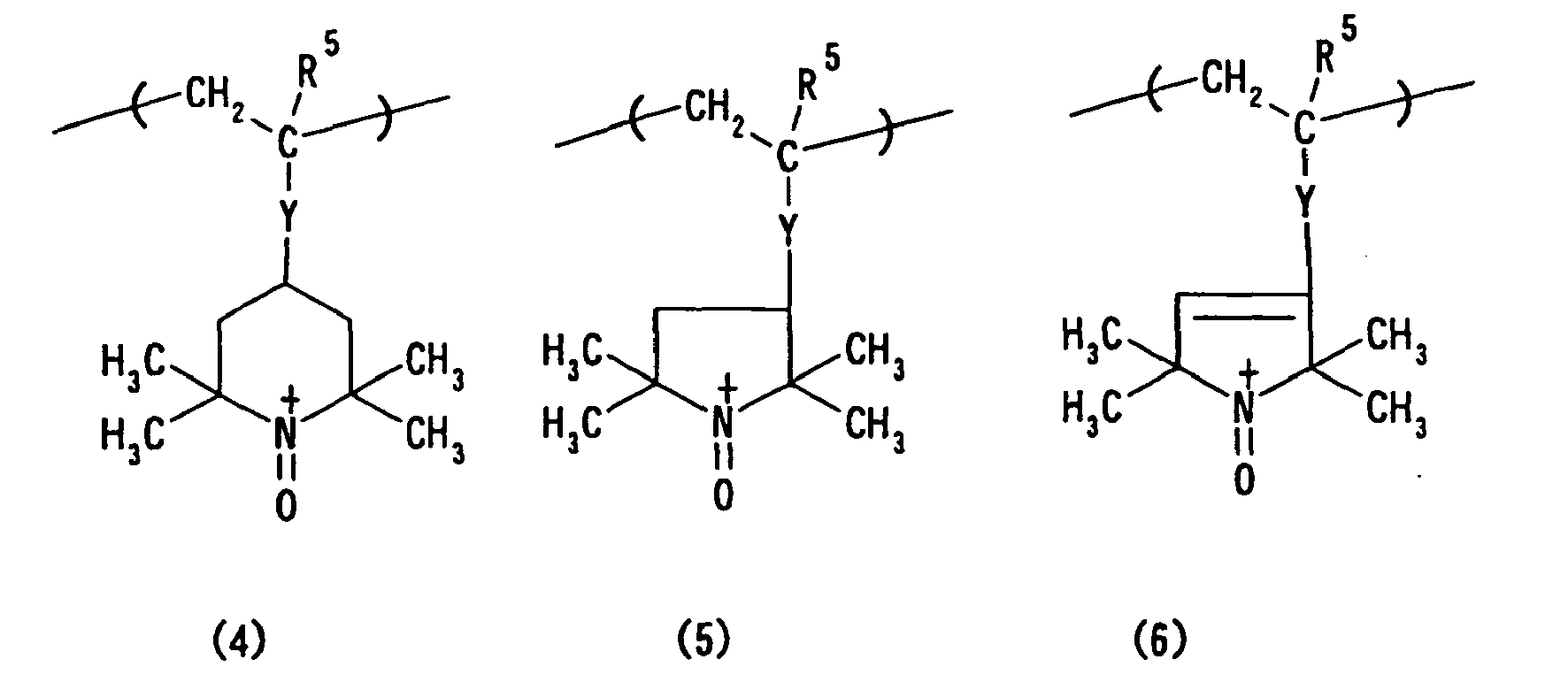
- In these formulas (4) to (6), Y is -COO- and R5 is methyl.
- In this invention, the group represented by formulas (4) to (6) may be not present in all side chains. For example, all units constituting a polymer may be represented by formulas (4) to (6) or only a portion of unit may be represented by formulas (4) to (6). Its content in the polymer may depend on an application, the structure of the polymer and a preparation process. At least, a small amount must be present. Specifically, it is 0.1 wt% or more, generally 1 wt% or more, preferably 10 wt% or more. When there are no restrictions to polymer synthesis and it is desired to store charge as much as possible, the content is preferably 50 wt% or more, particularly 80 wt% or more.
- Such a polymer can be synthesized as follows. For example, a monomer represented by formula (IV) may be homopolymerized or copolymerized with a copolymerizable monomer such as an alkyl acrylate to give a polymer, whose -NH- moiety may be then converted into -N(O.)- to give a polymer having a unit represented by formulas (4) to (6) in an oxidized state.


- Alternatively, for example, methacrylic acid may be polymerized to give a base polymer, to which may be then introduced a group represented by the part of formula (IV) below the "Y". (or a group having -NH- before oxidation into NO radical) by a polymer reaction.
- When a charge storage device of this invention has an electrolyte containing a solvent, it is preferable that a nitroxyl compound is insoluble in the electrolyte, i. e., high durability. Therefore, although there are no restrictions to a molecular weight of a polymer comprising a cyclic nitroxyl structure represented in formulas (4) to (6), the polymer preferably has a sufficient molecular weight to make the polymer insoluble in the electrolyte, but it depends on a combination of the electrolyte and the type of the solvent. The molecular weight is generally 1,000 or more, preferably 10,000 or more, particularly 100,000 or more. Since the polymer can be added as powder to a positive electrode in this invention, any larger molecular weight may be acceptable. Generally, it is 5,000,000 or less. A polymer comprising a cyclic nitroxyl structure represented by formula (Ia) may be crosslinked to improve its resistance to an electrolyte.
- Nitroxyl cation represented by formula (I) is generally stabilized by an anion from electrolyte; for example, PF6 -, ClO4 -, BF4 -, Br-, Cl-, F-, imide type electrolyte salt anion and methide type electrolyte salt anion.
- A nitroxyl compound in a positive electrode functions as an active material contributing to charging. Therefore, for example, a cathodic active material in a conventional battery may be totally replaced with a nitroxyl compound defined in this invention. Furthermore, even when part of the conventional active material is replaced, a current may be correspondingly increased. There are, therefore, no restrictions to a replacement ratio to the whole active material. The compound may be correspondingly effective at 0.1 wt% or more to the whole active material and adequately effective at 10 wt% or more. When it is desired to store charge as much as possible, the amount may be preferably 50 wt% or more, particularly 80 wt% or more, especially 100 wt%. The nitroxyl compound is comprised of elements having a small atomic weight such as carbon, hydrogen, nitrogen and oxygen, and therefore, can store much electrical charge with a small weight. Thus, it can provide a charge storage device with a high energy density.
- A conventional active material may be any of known appropriate materials; for example, metal oxides such as LiMnO2, LiCoO2, LiNiO2 and LixV2O5 (0<x<2).
- In addition to an active material, a positive electrode may comprise other known constituents; for example, a conductivity enhancing material including carbon materials such as charcoal, graphite, carbon black and acetylene black and conductive polymers such as polyacetylene, polyphenylene, polyaniline and polypyrrole; and a binder including resins such as polyvinylidene fluoride, polytetrafluoroethylene, a copolymer of vinylidene fluoride and hexafluoropropylene, a copolymer rubber of styrene and butadiene, polypropylene, polyethylene and a polyimide. In addition, the positive electrode may contain, for example, a disulfide, a catalytic compound or an ion-conductive polymer as appropriate.
- Since a nitroxyl compound is a polymer, it may also act as a binder, depending on some factors such as the type of a polymer main chain, the type of a side chain having the cyclic nitroxyl structure and the type of a side chain without the cyclic nitroxyl structure. Such a polymer may eliminate or reduce a conventional binder. Alternatively, while using a conventional active material, a polymer comprising a cyclic nitroxyl structure may be used as a binder. In this case, the amount corresponding to the binder also acts as an active material, resulting in an increased capacity.
- A nitroxyl cation structure is believed to inactivate impurities such as water and an alcohol in an electrolyte to prevent performance deterioration of a charge storage device.
- In any case, a polymer nitroxyl compound is particularly effective because of its lower solubility in an electrolyte containing an organic solvent and thus its higher durability.
- A charge storage device of this invention comprises, in addition to a positive electrode as described above, at least a negative electrode and preferably an electrolyte. FIG. 1 shows its structure. The charge storage device shown in this figure has a structure where a
negative electrode 3 and apositive electrode 5 are laminated via aseparator 4 containing an electrolyte. However, since a charge storage device of this invention comprises at least anegative electrode 3 and apositive electrode 5 as essential components, a negative electrodecurrent collector 1, an insulatingpacking 2, aseparator 4 and a positive electrodecurrent collector 6 are optional. - The charge storage device may have any known shape. For example, the charge storage device may have a shape where an electrode laminate or roll is sealed in a metal case, a resin case or a laminate film. It may have an appropriate appearance such as a cylinder, a square, a coin and a sheet.
- A negative electrode may be made of a well-known material for a charge storage device electrode, including carbon materials such as charcoal, graphite, carbon black and acetylene black; elemental metals or metal alloys such as lithium metal or lithium alloys and lithium-ion storage carbon; and conductive polymers such as polyacetylene, polyphenylene, polyaniline and polypyrrole. A negative electrode may further contain a resin binder such as polyvinylidene fluoride, polytetrafluoroethylene, a copolymer of vinylidene fluoride and hexafluoropropylene, a copolymer rubber of styrene and butadiene, polypropylene, polyethylene and polyimide; a disulfide; a catalytic compound; and ion-conductive polymers, as appropriate.
- A negative electrode
current collector 1 and a positive electrodecurrent collector 6 may be made of, for example, nickel, aluminum, copper, gold, silver, titanium, an aluminum alloy, stainless steel and a carbon material. They may have an appropriate shape such as a foil, a plate and a mesh. It may be also possible that the current collector is active as a catalyst and may be chemically bound to an active material. The charge storage device of this invention may comprise a separator consisting of a porous film or a nonwoven fabric in order to prevent anegative electrode 3 from being in electrically contact with apositive electrode 5. Furthermore, the device may comprise an insulatingpacking 2 consisting of a plastic resin in order to prevent a negative electrodecurrent collector 1 from being in electrically contact with a positive electrodecurrent collector 6. - A charge storage device of this invention may comprise a well-known electrolyte. An electrolyte is generally responsible for transferring a charge carrier between a negative electrode and a positive electrode, and generally has an electrolyte ion conductivity of 10-5 to 10-1 S/cm at room temperature. An electrolyte used in this invention may be an electrolyte solution prepared by, for example, dissolving an electrolyte salt in a solvent. Examples of such a solvent include organic solvents such as ethylene carbonate, propylene carbonate, dimethyl carbonate, diethyl carbonate, methyl ethyl carbonate, γ-butyrolactone, tetrahydrofuran, dioxolane, sulfolane, dimethylformamide, dimethylacetamide and N-methyl-2-pyrrolidone; and an aqueous solution of sulfuric acid or water. In this invention, these solvents may be used alone or in combination of two or more. In particular, when using an organic solvent, a polymer nitroxyl compound may improve durability.
- Examples of an electrolyte salt include LiPF6, LiClO4, LiBF4, LiCF3SO3, LiN(CF3SO2)2, LiN(C2F5SO2)2, LiC(CF3SO2)3, LiC(C2F5SO2)3, LiBr, LiCl and LiF
- In the structure of the charge storage device shown in FIG. 1, an electrolyte solution is contained in a
separator 4. - Alternatively, a solid electrolyte may be used. Among solid electrolytes, examples of an organic solid electrolyte material include vinylidene fluoride polymers such as polyvinylidene fluoride and a copolymer of vinylidene fluoride and hexafluoropropylene; acrylonitrile polymers such as a copolymer of acrylonitrile and methyl methacrylate and a copolymer of acrylonitrile and methyl acrylate; and polyethylene oxide. These polymer materials may be used as a gel containing an electrolyte solution or only polymer materials are used. Examples of an inorganic solid electrolyte include CaF2, Agl, LiF, β-alumina and a glass material. When using such a solid electrolyte, a separator may not be necessary.
- A positive electrode may be formed by any known process; for example, adding a solvent to component materials and then applying the resulting slurry to an electrode current collector, adding a binder resin to component materials and then compressing the mixture, or sintering the component materials by heating. It is preferable that a nitroxyl compound is homogeneously distributed in a positive electrode. The compound may be ground before use when it is insoluble in a solvent.
- A nitroxyl structure used in forming a positive electrode may be in a reduced state having a radical represented by formula (II) or in an oxidized state having a cation represented by formula (I).
- This invention will be more specifically described with reference to examples.
- In a 100 mL eggplant-shaped flask equipped with a reflux condenser was placed 20 g of 2,2,6,6-tetramethylpiperidine methacrylate monomer (0.089 mol), which was then dissolved in 80 mL of dry tetrahydrofuran. To the mixture was added 0.29 g of azobisisobutyronitrile (AIBN) (0.00187 mol) (monomer/AIBN = 50/1), and the mixture was stirred at 75 to 80 °C under an argon atmosphere. After 6 hours, the mixture was allowed to be cooled to room temperature. The resulting polymer was precipitated in hexane, collected by filtration and dried in vacuo to provide 18 g of poly(2,2,6,6-tetramethylpiperidine methacrylate) (yield: 90 %).
- Then, 10 g of poly(2,2,6,6-tetramethylpiperidine methacrylate) was dissolved in 100 mL of dry dichloromethane. To the stirred solution at room temperature was added dropwise a solution of 15.2 g of m-chloroperbenzoic acid (0.088 mol) in 100 mL of dichloromethane over 1 hour. After stirring for further six hours, precipitated m-chlorobenzoic acid was removed by filtration, the filtered solution was washed with an aqueous solution of sodium carbonate and water, and then dichloromethane was evaporated. The residual solid was ground. The resulting powder was washed with diethyl carbonate (DEC) and dried in vacuo to give 7.2 g of poly(2,2,6,6-tetramethylpiperidinoxy methacrylate)(PTME) as a dark brown powder in an yield of 68.2 %. The structure of the polymer obtained was identified by IR. The GPC results indicated a weight average molecular weight (Mw) of 89,000 and a dispersion (Mw/Mn) of 3.30. A spin concentration was 2.51 × 10²¹ spin/g as determined by ESR spectrometry. The value corresponds to a spin concentration assuming that the N-H group in poly(2,2,6,6-tetramethylpiperidine methacrylate) is 100 % converted into an N-O radical and all the monomer units in the polymer have a radical.
- In a similar manner, poly(2,2,5,5-tetramethylpyrrolidinoxy methacrylate) represented by formula (8) and poly(2,2,5,5-tetramethylpyrrolinoxy methacrylate) represented by formula (9) were prepared.

- Twenty five milligrams of the polymethacrylate represented by formula (7) prepared above, 200 mg of graphite powder and 25 mg of a polytetrafluoroethylene resin binder were weighed and blended in an agate mortar. After dry mixing for 10 min, the resulting mixture was roller extended while applying pressure to give a thin electrode plate with a thickness of 215 µm. The thin electrode plate was dried overnight in vacuo at 80 °C, punched into disks with a diameter of 12 mm and shaped into an electrode for a charge storage device. The total weight of the electrode was 14.4 mg, which contains 1.44 mg (10 wt%) of the polymethacrylate represented by formula (7). A bulk density of the electrode was 0.533 g/cm3
- The electrode was immersed in an electrolyte solution to allow the electrolyte solution to enter vacancies. An electrolyte solution used was a mixed solution of ethylene carbonate and diethyl carbonate (mixing ratio = 3:7) containing 1 mol/L of LiPF6 as electrolyte salt. The electrode impregnated with the electrolyte solution was placed on a positive electrode current collector, on which was then laminated a porous film separator similarly impregnated with the electrolyte solution. On the laminate was further placed a lithium metal plate to be a negative electrode, and then a negative electrode current collector covered with an insulating packing was laminated. The resulting laminate was compressed by a caulker to provide an enclosed coin type of charge storage device.
- The charge storage device thus prepared had an equilibrium potential of 2.7 V. The charge storage device obtained was charged at a fixed current of 1 mA and charging was terminated when a voltage reached 4.0 V. The charge storage device after charging was disassembled. By analyzing the positive electrode, it was observed that a radical concentration was reduced and a corresponding 2,2,6,6-tetramethylpiperidinoxyl cation was formed. The cation was stabilized by electrolyte anion PF6 -.
- In the manner as described above, a charge storage device was prepared, charged at a fixed current of 1 mA and discharging was conducted immediately after a voltage reached 4.0 V. A discharge current was a fixed current of 1 mA as was in charging. FIG. 2 shows a charge/discharge curve for this process. During discharge, a voltage plateau was observed around 3.6 V. It was found that the voltage plateau corresponded to a potential difference between reduction of the nitroxyl cation into the nitroxyl radical in the positive electrode and ionization of lithium metal in the negative electrode. Thus, the results implies that the charge storage device according to Example 1 works as a chemical battery.
- A capacity of the charge storage device determined in Example 1 was 5.56 mAh per 1 g of the positive electrode and 55.6 mAh per 1 g of the polymethacrylate. The capacity corresponds to 50 % of the theoretical capacity of the polymer.
- A charge storage device was prepared as described above, and charge/discharge at 1 mA was repeated. Charge was conducted to 4.0 V and discharge was conducted to 3.0 V. FIG. 3 shows variation in a discharge capacity when the cycle was repeated 100 times. Even after repetition of charge/discharge, a capacity was not reduced. It indicates that the device is capable of performing repetitive charge/discharge for a long term.
- FIG. 4 shows a discharge curve when conducting charge/discharge at discharge rates of 1C, 2C, 5C, 10C and 30C for a charge storage device as described above. Charge and discharge were conducted to 4.2 V and 2.5 V, respectively. It was found that even at a discharge rate of 30C (full charge/full discharge in 2 min), the charge storage device of this invention exhibited 70 % capacity in comparison with that at a discharge rate of 1C (full charge/full discharge in 1 hour). The results indicate that the charge storage device of this invention is insusceptible to property deterioration even when charge/discharge is conducted at a large current.
- As a comparative example, a charge storage device in which a positive electrode does not contain an organic polymer comprising a cyclic nitroxyl structure was prepared. First, 225 mg of graphite powder and 25 mg of a polytetrafluoroethylene resin binder were weighed and blended in an agate mortar. The subsequent procedure was conducted as described in Example 1, to prepare an electrode. Then, a charge storage device was assembled using an electrolyte, a separator, a positive electrode current collector and a negative electrode current collector as described in Example 1.
- An equilibrium potential for the charge storage device thus prepared was 2.9 V. The charge storage device obtained was charged at a fixed current of 1 mA. Charging was terminated when a voltage reached 4.0 V and immediately after charging, discharging was conducted also at a fixed current of 1 mA. The results are shown in FIG. 2. A voltage of the charge storage device gradually and substantially linearly varies without a voltage plateau as was observed in Example 1. The gradually varying voltage would correspond to a voltage difference between a potential of the electric double layer component accumulated in the graphite powder surface and a potential in ionization of lithium metal in the negative electrode. However, a capacity was as low as 0.64 mAh per 1 g of the positive electrode.
- Twenty five milligrams of the polymethacrylate represented by formula (8) prepared above, 200 mg of graphite powder and 25 mg of a polytetrafluoroethylene resin binder were weighed and blended in an agate mortar. The subsequent procedure was conducted as described in Example 1, to prepare an electrode. Then, a charge storage device was assembled using an electrolyte, a separator, a positive electrode current collector and a negative electrode current collector as described in Example 1.
- The charge storage device thus prepared had an equilibrium potential of 2.7 V. The charge storage device obtained was charged at a fixed current of 1 mA and charging was terminated when a voltage reached 4.0 V. The charge storage device after charging was disassembled. By analyzing the positive electrode, it was observed that a radical concentration was reduced and a corresponding 2,2,5,5-tetramethylpyrrolidinoxyl cation was formed. The cation was stabilized by an electrolyte anion PF6 -.
- In the manner as described above, a charge storage device was prepared, charged at a fixed current of 1 mA and discharging was conducted immediately after a voltage reached 4.0 V. A discharge current was a fixed current of 1 mA as was in charging. As a result, during discharge, a voltage plateau was observed. It was found that the voltage plateau corresponded to a potential difference between reduction of the nitroxyl cation into the nitroxyl radical in the positive electrode and ionization of lithium metal in the negative electrode. Thus, the results implies that the charge storage device according to Example 2 works as a chemical battery.
- It was found that a capacity of the charge storage device determined in Example 2 was 5.61 mAh per 1 g of the positive electrode and 56.1 mAh per 1 g of the polymethacrylate. As in Example 1, it was confirmed that the device is capable of performing repetitive charge/discharge for a long term and is insusceptible to property deterioration even when charge/discharge is conducted at a large current.
- Twenty five milligrams of the polymethacrylate represented by formula (9) prepared above, 200 mg of graphite powder and 25 mg of a polytetrafluoroethylene resin binder were weighed and blended in an agate mortar. The subsequent procedure was conducted as described in Example 1, to prepare an electrode. Then, a charge storage device was assembled using an electrolyte, a separator, a positive electrode collector and a negative electrode collector as described in Example 1.
- The charge storage device thus prepared had an equilibrium potential of 2.7 V. The charge storage device obtained was charged at a fixed current of 1 mA and charging was terminated when a voltage reached 4.0 V. The charge storage device after charging was disassembled. By analyzing the positive electrode, it was observed that a radical concentration was reduced and a corresponding 2,2,5,5-tetramethylpyrrolinoxyl cation was formed. The cation was stabilized by an electrolyte anion PF6 -.
- In the manner as described above, a charge storage device was prepared, charged at a fixed current of 1 mA and discharging was conducted immediately after a voltage reached 4.0 V. A discharge current was a fixed current of 1 mA as was in charging. As a result, during discharge, a voltage plateau was observed. It was found that the voltage plateau corresponded to a potential difference between reduction of the nitroxyl cation into the nitroxyl radical in the positive electrode and ionization of lithium metal in the negative electrode. Thus, the results implies that the charge storage device according to Example 3 works as a chemical battery.
- It was found that a capacity of the charge storage device determined in Example 3 was 56.9 mAh per 1 g of the positive electrode and 5.69 mAh per 1 g of the polymethacrylate. As in Example 1, it was confirmed that the device is capable of performing repetitive charge/discharge for a long term and is insusceptible to property deterioration even when charge/discharge is conducted at a large current.
- As described above, this invention can provide a charge storage device with a higher energy density which can give a large current. Since a nitroxyl compound is a polymer, durability is particularly improved.
Claims (2)
- A charge storage device wherein a positive electrode comprises a nitroxyl compound having a structure of a nitroxyl cation moiety represented by formula (I) in an oxidized state while having a structure of a nitroxyl radical moiety represented by formula (II) in a reduced state and a reaction represented by reaction formula (A) in which an electron is transferred between the two states is used as a positive electrode reaction:


- The charge storage device as claimed in claim 1, wherein the device comprises a positive electrode, a negative electrode and an electrolyte containing an organic solvent, and the nitroxyl compound is in soluble in the electrolyte.
Applications Claiming Priority (3)
| Application Number | Priority Date | Filing Date | Title |
|---|---|---|---|
| JP2001104629A JP4687848B2 (en) | 2001-04-03 | 2001-04-03 | Power storage device |
| JP2001104629 | 2001-04-03 | ||
| PCT/JP2002/003334 WO2002082570A1 (en) | 2001-04-03 | 2002-04-03 | Electricity storage device |
Publications (3)
| Publication Number | Publication Date |
|---|---|
| EP1381100A1 EP1381100A1 (en) | 2004-01-14 |
| EP1381100A4 EP1381100A4 (en) | 2004-09-22 |
| EP1381100B1 true EP1381100B1 (en) | 2007-08-29 |
Family
ID=18957461
Family Applications (1)
| Application Number | Title | Priority Date | Filing Date |
|---|---|---|---|
| EP02714425A Expired - Lifetime EP1381100B1 (en) | 2001-04-03 | 2002-04-03 | Electricity storage device |
Country Status (6)
| Country | Link |
|---|---|
| US (1) | US7226697B2 (en) |
| EP (1) | EP1381100B1 (en) |
| JP (1) | JP4687848B2 (en) |
| CN (1) | CN1231987C (en) |
| DE (1) | DE60222109T2 (en) |
| WO (1) | WO2002082570A1 (en) |
Families Citing this family (78)
| Publication number | Priority date | Publication date | Assignee | Title |
|---|---|---|---|---|
| JP3687736B2 (en) * | 2000-02-25 | 2005-08-24 | 日本電気株式会社 | Secondary battery |
| JP2003022809A (en) * | 2001-07-09 | 2003-01-24 | Nec Corp | Battery and electrode for battery |
| JP5034147B2 (en) * | 2001-08-06 | 2012-09-26 | 日本電気株式会社 | Secondary battery |
| US20060019169A1 (en) * | 2002-10-30 | 2006-01-26 | Smith W N | Separators for electochemical devices having an Ionically conductive solid compound therein |
| JP4435087B2 (en) * | 2003-02-28 | 2010-03-17 | 日本電気株式会社 | Secondary battery |
| AU2003901144A0 (en) | 2003-03-13 | 2003-03-27 | Monash University School Of Chemistry | Room temperature ionic liquid electrolytes for lithium secondary batteries |
| US20040197653A1 (en) * | 2003-04-03 | 2004-10-07 | Matsushita Electric Industrial Co., Ltd. | Electrode and electrochemical device using the same |
| JP4569735B2 (en) * | 2003-09-24 | 2010-10-27 | 三菱瓦斯化学株式会社 | Method for producing polymer compound having stable radical |
| US7557433B2 (en) * | 2004-10-25 | 2009-07-07 | Mccain Joseph H | Microelectronic device with integrated energy source |
| JP4632020B2 (en) * | 2004-01-23 | 2011-02-16 | 日本電気株式会社 | Non-aqueous electrolyte secondary battery |
| JP4530133B2 (en) * | 2004-02-16 | 2010-08-25 | 日本電気株式会社 | Power storage device |
| JP4826699B2 (en) * | 2004-02-16 | 2011-11-30 | 日本電気株式会社 | Power storage device |
| US20080226986A1 (en) * | 2004-02-16 | 2008-09-18 | Kentaro Nakahara | Power Storage Device |
| WO2005078831A1 (en) * | 2004-02-16 | 2005-08-25 | Nec Corporation | Electric storage device |
| JP4949018B2 (en) * | 2004-03-16 | 2012-06-06 | パナソニック株式会社 | Lithium secondary battery |
| JP5124139B2 (en) * | 2004-05-31 | 2013-01-23 | 住友精化株式会社 | Method for producing crosslinked poly (meth) acrylic acid nitroxide compound |
| JP4506955B2 (en) * | 2004-07-07 | 2010-07-21 | 三菱瓦斯化学株式会社 | Method for producing copolymer composition having stable radical |
| CN100499226C (en) * | 2004-12-06 | 2009-06-10 | 日本电气株式会社 | Method for producing polyradical compound and battery |
| US20080171265A1 (en) * | 2005-02-04 | 2008-07-17 | Jiro Iriyama | Positive Electrode For Secondary Battery, Manufacturing Method Thereof, and Secondary Battery |
| JPWO2006082708A1 (en) * | 2005-02-04 | 2008-06-26 | 日本電気株式会社 | Positive electrode for secondary battery, method for producing the same, and secondary battery |
| JP2008545863A (en) * | 2005-06-08 | 2008-12-18 | チバ ホールディング インコーポレーテッド | Polymer nitroxide, its manufacture and use |
| CN1741214A (en) * | 2005-07-15 | 2006-03-01 | 复旦大学 | Electrochemical Supercapacitors Using Organic Polymer Radical/Carbon Composite as Cathode |
| JP5124084B2 (en) * | 2005-08-05 | 2013-01-23 | 住友精化株式会社 | Method for producing crosslinked poly (meth) acrylic acid nitroxide compound for electrode material of secondary battery |
| JP4617437B2 (en) * | 2005-09-02 | 2011-01-26 | 学校法人早稲田大学 | Norbornene-based crosslinked copolymer and process for producing the same |
| JP2007183919A (en) * | 2005-12-05 | 2007-07-19 | Nec Corp | Rfid tag |
| JP5034261B2 (en) * | 2006-02-23 | 2012-09-26 | 日本電気株式会社 | Metallic lithium secondary battery |
| KR20080109039A (en) * | 2006-03-21 | 2008-12-16 | 시바 홀딩 인크 | Triazine-Containing Electrode Materials for Secondary Batteries |
| JP5493356B2 (en) * | 2006-06-06 | 2014-05-14 | 日本電気株式会社 | Polyradical compound production method and battery |
| JP5438254B2 (en) | 2006-07-19 | 2014-03-12 | 住友精化株式会社 | (Meth) acrylic acid-based crosslinked copolymer and secondary battery electrode using the same |
| JP4943106B2 (en) * | 2006-09-26 | 2012-05-30 | 住友精化株式会社 | Method for producing (meth) acrylic acid-based crosslinked copolymer |
| JP5020033B2 (en) * | 2006-12-01 | 2012-09-05 | 住友精化株式会社 | (Meth) acrylic acid adamantyl compound and method for producing the same |
| FR2911723A1 (en) * | 2007-01-19 | 2008-07-25 | Arkema France | Electrode, for electrochemical energy storage system, which is useful as a battery for a computer, a server/a portable telephone, or a supercapacitor, comprises a triazinic polynitroxide |
| CN101595580B (en) | 2007-01-25 | 2011-11-30 | 日本电气株式会社 | Polyradical compound-conductive material composite body, method for producing the same, and battery using the same |
| FR2912554A1 (en) * | 2007-02-12 | 2008-08-15 | Arkema France | Electrode, useful for electrochemical energy storage system, which is useful as battery backup unit of personal computer, information server or cell phone, comprises nitroxide and carbon nanotube |
| JP5359278B2 (en) * | 2007-02-15 | 2013-12-04 | 日本電気株式会社 | Electrode forming slurry and battery |
| US20080199778A1 (en) * | 2007-02-20 | 2008-08-21 | Denso Corporation | Electrode for secondary batteries and method for making same, and secondary batteries using the electrode |
| JP5076560B2 (en) * | 2007-03-07 | 2012-11-21 | 日本電気株式会社 | Electricity storage device |
| EP2122739A1 (en) * | 2007-03-09 | 2009-11-25 | Basf Se | Nitroxides for lithium-ion batteries |
| JP5349821B2 (en) * | 2007-03-27 | 2013-11-20 | 住友化学株式会社 | Solid fine particle dispersion, electrode film coating liquid, electrode and method for producing electric double layer capacitor |
| JP5176130B2 (en) * | 2007-05-09 | 2013-04-03 | 日本電気株式会社 | Polyradical compounds, electrode active materials and batteries |
| WO2008155247A1 (en) * | 2007-06-19 | 2008-12-24 | Basf Se | Nitroxide containing electrode materials for secondary batteries |
| JP2009013093A (en) * | 2007-07-03 | 2009-01-22 | Sumitomo Seika Chem Co Ltd | (meth)acryloylimidazolidine nitroxide compound and its production method |
| WO2009038125A1 (en) * | 2007-09-21 | 2009-03-26 | Waseda University | Pyrroline nitroxide polymer and battery using the same |
| JP5332251B2 (en) * | 2008-03-21 | 2013-11-06 | 日本電気株式会社 | Polymer radical material / conductive material composite, method for producing the same, and power storage device |
| JP5413710B2 (en) * | 2008-06-11 | 2014-02-12 | 日本電気株式会社 | Electrode active material, method for producing the same, and battery using the same |
| US20120095179A1 (en) * | 2009-03-12 | 2012-04-19 | Waseda University | Pyrroline-based nitroxide polymer and battery using same |
| JP5516578B2 (en) | 2009-06-02 | 2014-06-11 | 日本電気株式会社 | Power storage device |
| US20120171561A1 (en) * | 2009-09-18 | 2012-07-05 | Nec Corporation | Polymer radical material-activated carbon-conductive material composite, method for producing conductive material composite, and electricity storage device |
| JP5518416B2 (en) * | 2009-10-01 | 2014-06-11 | 学校法人早稲田大学 | Method for producing polyradical compound |
| JP5549516B2 (en) * | 2010-10-06 | 2014-07-16 | 日本電気株式会社 | Secondary battery and electrolyte and membrane used therefor |
| WO2012120929A1 (en) * | 2011-03-09 | 2012-09-13 | 日本電気株式会社 | Electrode active material and secondary cell |
| WO2012133204A1 (en) * | 2011-03-31 | 2012-10-04 | 学校法人早稲田大学 | Battery |
| JP2013089413A (en) * | 2011-10-17 | 2013-05-13 | Canon Inc | Electrode active material for secondary battery, and secondary battery |
| EP2782171B1 (en) * | 2011-11-16 | 2016-11-02 | Murata Manufacturing Co. Ltd. | Electrode active material, production method for said electrode active material, electrode, and secondary battery |
| WO2013154724A1 (en) | 2012-04-13 | 2013-10-17 | PolyJoule, Inc. | Devices and methods including polyacetylenes |
| FR2989378B1 (en) * | 2012-04-16 | 2015-10-02 | Commissariat Energie Atomique | POLYMER AS ELECTRODE MATERIAL FOR LITHIUM SECONDARY BATTERIES. |
| CN104641504A (en) * | 2012-07-18 | 2015-05-20 | 株式会社村田制作所 | Secondary battery |
| WO2014092016A1 (en) * | 2012-12-11 | 2014-06-19 | 日本電気株式会社 | Electric storage device |
| CN103904356A (en) * | 2012-12-27 | 2014-07-02 | 中国科学院物理研究所 | Chargable chemical energy-storage device and application thereof |
| EP2816644B1 (en) | 2013-06-21 | 2017-08-16 | Novaled GmbH | Battery comprising a radialene compound as electroactive material |
| EP3011624A1 (en) | 2013-06-21 | 2016-04-27 | Novaled GmbH | Battery |
| JP2015036128A (en) * | 2013-08-12 | 2015-02-23 | 住友化学株式会社 | Acidic gas adsorption/desorption device |
| WO2016027704A1 (en) | 2014-08-19 | 2016-02-25 | 株式会社リコー | Polythiophene derivative, secondary cell cathode active material, and secondary cell |
| JP2015060636A (en) * | 2013-09-17 | 2015-03-30 | 日本電気株式会社 | Secondary battery |
| JP6447050B2 (en) * | 2013-11-22 | 2019-01-09 | 日本電気株式会社 | Method for manufacturing power storage device |
| WO2015115158A1 (en) | 2014-01-28 | 2015-08-06 | 株式会社リコー | Polythiophene derivative, method for producing same, positive electrode active material for secondary batteries, and secondary battery |
| JP6582455B2 (en) | 2015-03-12 | 2019-10-02 | 株式会社リコー | Secondary battery |
| WO2016147811A1 (en) | 2015-03-16 | 2016-09-22 | 日本電気株式会社 | Electricity storage device |
| US10320001B2 (en) | 2015-10-20 | 2019-06-11 | Ricoh Company, Ltd. | Secondary cell |
| WO2017151647A1 (en) * | 2016-02-29 | 2017-09-08 | Alliance For Sustainable Energy, Llc | Materials for flow battery energy storage and methods of using |
| JP6720350B2 (en) * | 2016-06-02 | 2020-07-08 | エボニック オペレーションズ ゲーエムベーハー | Method for manufacturing electrode material |
| US11001659B1 (en) | 2016-09-06 | 2021-05-11 | Evonik Operations Gmbh | Method for the improved oxidation of secondary amine groups |
| KR102320325B1 (en) | 2017-06-20 | 2021-11-02 | 주식회사 엘지화학 | Lithium-sulfur battery |
| JP6933092B2 (en) * | 2017-11-06 | 2021-09-08 | 日本電気株式会社 | Dye-sensitized solar cell with power storage function |
| TWI740221B (en) | 2018-12-17 | 2021-09-21 | 德商贏創運營有限公司 | Improved solid electrolyte for organic batteries |
| CN109786869B (en) * | 2018-12-18 | 2023-01-06 | 中国科学院青岛生物能源与过程研究所 | Application of polymer containing hindered amine structure in secondary lithium battery |
| JP7530015B2 (en) * | 2021-01-12 | 2024-08-07 | 日本電信電話株式会社 | Manufacturing method of lithium secondary battery |
| CN121620553A (en) | 2023-08-25 | 2026-03-06 | 株式会社可乐丽 | (Meth)acrylic acid nitroxide radical polymer particles and their manufacturing method |
Family Cites Families (10)
| Publication number | Priority date | Publication date | Assignee | Title |
|---|---|---|---|---|
| SE445000B (en) * | 1981-10-08 | 1986-05-20 | Inst Fiz Khim Pisarzhev An | ELECTROCHEMICAL BATTERY |
| JPS60127663A (en) * | 1983-12-12 | 1985-07-08 | Toyota Central Res & Dev Lab Inc | Storage battery and manufacturing of its positive electrode polymer |
| DE3435947A1 (en) | 1984-09-29 | 1986-04-03 | Basf Ag, 6700 Ludwigshafen | METHOD FOR PRODUCING ELECTRICALLY CONDUCTIVE SYSTEMS |
| JPH10106579A (en) * | 1996-09-25 | 1998-04-24 | Sanyo Electric Co Ltd | Lithium secondary battery |
| JP3687736B2 (en) * | 2000-02-25 | 2005-08-24 | 日本電気株式会社 | Secondary battery |
| JP2002117855A (en) * | 2000-10-06 | 2002-04-19 | Nec Corp | Secondary battery and its manufacturing method |
| JP3687515B2 (en) | 2000-10-06 | 2005-08-24 | 日本電気株式会社 | battery |
| JP2002117854A (en) * | 2000-10-06 | 2002-04-19 | Nec Corp | Secondary battery and its manufacturing method |
| JP2002170568A (en) * | 2000-12-01 | 2002-06-14 | Nec Corp | Battery |
| JP2003022809A (en) * | 2001-07-09 | 2003-01-24 | Nec Corp | Battery and electrode for battery |
-
2001
- 2001-04-03 JP JP2001104629A patent/JP4687848B2/en not_active Expired - Lifetime
-
2002
- 2002-04-03 EP EP02714425A patent/EP1381100B1/en not_active Expired - Lifetime
- 2002-04-03 WO PCT/JP2002/003334 patent/WO2002082570A1/en not_active Ceased
- 2002-04-03 DE DE60222109T patent/DE60222109T2/en not_active Expired - Lifetime
- 2002-04-03 CN CNB028078055A patent/CN1231987C/en not_active Expired - Lifetime
- 2002-04-03 US US10/473,158 patent/US7226697B2/en not_active Expired - Lifetime
Non-Patent Citations (1)
| Title |
|---|
| None * |
Also Published As
| Publication number | Publication date |
|---|---|
| DE60222109T2 (en) | 2008-05-21 |
| JP2002304996A (en) | 2002-10-18 |
| JP4687848B2 (en) | 2011-05-25 |
| DE60222109D1 (en) | 2007-10-11 |
| CN1500293A (en) | 2004-05-26 |
| CN1231987C (en) | 2005-12-14 |
| EP1381100A4 (en) | 2004-09-22 |
| US7226697B2 (en) | 2007-06-05 |
| EP1381100A1 (en) | 2004-01-14 |
| WO2002082570A1 (en) | 2002-10-17 |
| US20040115529A1 (en) | 2004-06-17 |
Similar Documents
| Publication | Publication Date | Title |
|---|---|---|
| EP1381100B1 (en) | Electricity storage device | |
| EP1722430B1 (en) | Secondary battery using a radical compound as active electrode material | |
| US8242213B2 (en) | Method for manufacturing polyradical compound and battery | |
| US6174621B1 (en) | Electroactive high storage capacity polyacetylene-co-polysulfur materials and electrolytic cells containing same | |
| US8617744B2 (en) | Electricity storage device | |
| US8034484B2 (en) | Electrochemical device and electrode active material for electrochemical device | |
| EP2025689A1 (en) | Process for production of polyradical compound and battery cell | |
| US7282298B2 (en) | Electrochemical device | |
| CN100444457C (en) | Organic electrolyte solution and lithium-sulfur battery containing the same | |
| US6337155B1 (en) | Battery and method of manufacture thereof | |
| US8475956B2 (en) | Polyradical compound-conductive material composite, method for producing the same, and battery using the same | |
| JP4468058B2 (en) | Secondary battery and electrode active material for secondary battery | |
| CN1191651C (en) | Polymer gel electrolyte | |
| JP2003331838A (en) | Lithium secondary battery | |
| JP4530133B2 (en) | Power storage device | |
| JP4139960B2 (en) | Electricity storage device | |
| US6617077B1 (en) | Polymer electrolyte battery and method of fabricating the same | |
| US7544441B2 (en) | Secondary battery having an active material radical compound | |
| JP4737365B2 (en) | Electrode active material, battery and polymer | |
| JP4314508B2 (en) | Radical battery | |
| JP4752217B2 (en) | Active materials, batteries and polymers | |
| JP2005056857A (en) | Polymerizable compound, polymer solid electrolyte using the same, and use thereof | |
| JP5034147B2 (en) | Secondary battery | |
| JP2010165491A (en) | Electrode active material and secondary battery using it | |
| JP2005228640A (en) | Secondary battery |
Legal Events
| Date | Code | Title | Description |
|---|---|---|---|
| PUAI | Public reference made under article 153(3) epc to a published international application that has entered the european phase |
Free format text: ORIGINAL CODE: 0009012 |
|
| 17P | Request for examination filed |
Effective date: 20031010 |
|
| AK | Designated contracting states |
Kind code of ref document: A1 Designated state(s): AT BE CH CY DE DK ES FI FR GB GR IE IT LI LU MC NL PT SE TR |
|
| AX | Request for extension of the european patent |
Extension state: AL LT LV MK RO SI |
|
| RIC1 | Information provided on ipc code assigned before grant |
Ipc: 7H 01M 4/02 B Ipc: 7H 01M 10/40 B Ipc: 7H 01M 4/60 A |
|
| A4 | Supplementary search report drawn up and despatched |
Effective date: 20040811 |
|
| 17Q | First examination report despatched |
Effective date: 20050520 |
|
| 17Q | First examination report despatched |
Effective date: 20050520 |
|
| GRAP | Despatch of communication of intention to grant a patent |
Free format text: ORIGINAL CODE: EPIDOSNIGR1 |
|
| RBV | Designated contracting states (corrected) |
Designated state(s): DE |
|
| GRAS | Grant fee paid |
Free format text: ORIGINAL CODE: EPIDOSNIGR3 |
|
| GRAA | (expected) grant |
Free format text: ORIGINAL CODE: 0009210 |
|
| AK | Designated contracting states |
Kind code of ref document: B1 Designated state(s): DE |
|
| REF | Corresponds to: |
Ref document number: 60222109 Country of ref document: DE Date of ref document: 20071011 Kind code of ref document: P |
|
| PLBE | No opposition filed within time limit |
Free format text: ORIGINAL CODE: 0009261 |
|
| STAA | Information on the status of an ep patent application or granted ep patent |
Free format text: STATUS: NO OPPOSITION FILED WITHIN TIME LIMIT |
|
| 26N | No opposition filed |
Effective date: 20080530 |
|
| PGFP | Annual fee paid to national office [announced via postgrant information from national office to epo] |
Ref country code: DE Payment date: 20210316 Year of fee payment: 20 |
|
| REG | Reference to a national code |
Ref country code: DE Ref legal event code: R071 Ref document number: 60222109 Country of ref document: DE |