EP1380612A1 - Silicon-containing copolymer and process for producing the same - Google Patents
Silicon-containing copolymer and process for producing the same Download PDFInfo
- Publication number
- EP1380612A1 EP1380612A1 EP02705183A EP02705183A EP1380612A1 EP 1380612 A1 EP1380612 A1 EP 1380612A1 EP 02705183 A EP02705183 A EP 02705183A EP 02705183 A EP02705183 A EP 02705183A EP 1380612 A1 EP1380612 A1 EP 1380612A1
- Authority
- EP
- European Patent Office
- Prior art keywords
- group
- silicon
- general formula
- containing copolymer
- represented
- Prior art date
- Legal status (The legal status is an assumption and is not a legal conclusion. Google has not performed a legal analysis and makes no representation as to the accuracy of the status listed.)
- Granted
Links
- 229920001577 copolymer Polymers 0.000 title claims abstract description 74
- 229910052710 silicon Inorganic materials 0.000 title claims abstract description 68
- 239000010703 silicon Substances 0.000 title claims abstract description 67
- XUIMIQQOPSSXEZ-UHFFFAOYSA-N Silicon Chemical compound [Si] XUIMIQQOPSSXEZ-UHFFFAOYSA-N 0.000 title claims abstract description 66
- 238000000034 method Methods 0.000 title claims description 13
- 229910018557 Si O Inorganic materials 0.000 claims abstract description 17
- LIVNPJMFVYWSIS-UHFFFAOYSA-N silicon monoxide Inorganic materials [Si-]#[O+] LIVNPJMFVYWSIS-UHFFFAOYSA-N 0.000 claims abstract description 17
- 229910007991 Si-N Inorganic materials 0.000 claims abstract description 7
- 229910006294 Si—N Inorganic materials 0.000 claims abstract description 7
- 229910052760 oxygen Inorganic materials 0.000 claims abstract description 6
- 229920000642 polymer Polymers 0.000 claims description 57
- 150000001875 compounds Chemical class 0.000 claims description 30
- 150000004985 diamines Chemical class 0.000 claims description 29
- QGZKDVFQNNGYKY-UHFFFAOYSA-N Ammonia Chemical compound N QGZKDVFQNNGYKY-UHFFFAOYSA-N 0.000 claims description 28
- 125000003118 aryl group Chemical group 0.000 claims description 25
- 238000006243 chemical reaction Methods 0.000 claims description 25
- 125000000217 alkyl group Chemical group 0.000 claims description 17
- XLYOFNOQVPJJNP-UHFFFAOYSA-N water Substances O XLYOFNOQVPJJNP-UHFFFAOYSA-N 0.000 claims description 17
- 239000002904 solvent Substances 0.000 claims description 16
- 229910021529 ammonia Inorganic materials 0.000 claims description 14
- 239000000203 mixture Substances 0.000 claims description 14
- 125000003342 alkenyl group Chemical group 0.000 claims description 13
- 125000003545 alkoxy group Chemical group 0.000 claims description 13
- 125000003282 alkyl amino group Chemical group 0.000 claims description 13
- 125000005103 alkyl silyl group Chemical group 0.000 claims description 13
- 125000000753 cycloalkyl group Chemical group 0.000 claims description 13
- 125000003710 aryl alkyl group Chemical group 0.000 claims description 12
- 125000005843 halogen group Chemical group 0.000 claims description 10
- 125000004957 naphthylene group Chemical group 0.000 claims description 7
- QVGXLLKOCUKJST-UHFFFAOYSA-N atomic oxygen Chemical compound [O] QVGXLLKOCUKJST-UHFFFAOYSA-N 0.000 abstract 1
- 239000001301 oxygen Substances 0.000 abstract 1
- IJGRMHOSHXDMSA-UHFFFAOYSA-N Atomic nitrogen Chemical compound N#N IJGRMHOSHXDMSA-UHFFFAOYSA-N 0.000 description 27
- 238000004519 manufacturing process Methods 0.000 description 20
- JUJWROOIHBZHMG-UHFFFAOYSA-N Pyridine Chemical compound C1=CC=NC=C1 JUJWROOIHBZHMG-UHFFFAOYSA-N 0.000 description 14
- 229910052757 nitrogen Inorganic materials 0.000 description 14
- ZMANZCXQSJIPKH-UHFFFAOYSA-N Triethylamine Chemical compound CCN(CC)CC ZMANZCXQSJIPKH-UHFFFAOYSA-N 0.000 description 12
- 238000002834 transmittance Methods 0.000 description 11
- -1 polyimidebendazol Polymers 0.000 description 10
- 230000009102 absorption Effects 0.000 description 9
- 238000010521 absorption reaction Methods 0.000 description 9
- 239000000463 material Substances 0.000 description 9
- 229910052751 metal Inorganic materials 0.000 description 9
- RTZKZFJDLAIYFH-UHFFFAOYSA-N Diethyl ether Chemical compound CCOCC RTZKZFJDLAIYFH-UHFFFAOYSA-N 0.000 description 8
- 230000015572 biosynthetic process Effects 0.000 description 8
- 239000010410 layer Substances 0.000 description 8
- 239000002184 metal Substances 0.000 description 8
- HLBLWEWZXPIGSM-UHFFFAOYSA-N 4-Aminophenyl ether Chemical compound C1=CC(N)=CC=C1OC1=CC=C(N)C=C1 HLBLWEWZXPIGSM-UHFFFAOYSA-N 0.000 description 7
- 125000000732 arylene group Chemical group 0.000 description 7
- 239000011248 coating agent Substances 0.000 description 7
- 238000000576 coating method Methods 0.000 description 7
- UMJSCPRVCHMLSP-UHFFFAOYSA-N pyridine Natural products COC1=CC=CN=C1 UMJSCPRVCHMLSP-UHFFFAOYSA-N 0.000 description 7
- YMWUJEATGCHHMB-UHFFFAOYSA-N Dichloromethane Chemical compound ClCCl YMWUJEATGCHHMB-UHFFFAOYSA-N 0.000 description 6
- 125000004432 carbon atom Chemical group C* 0.000 description 6
- 230000000052 comparative effect Effects 0.000 description 6
- 239000004065 semiconductor Substances 0.000 description 6
- YWWDBCBWQNCYNR-UHFFFAOYSA-N trimethylphosphine Chemical compound CP(C)C YWWDBCBWQNCYNR-UHFFFAOYSA-N 0.000 description 6
- 229930195733 hydrocarbon Natural products 0.000 description 5
- 239000011229 interlayer Substances 0.000 description 5
- 229920001721 polyimide Polymers 0.000 description 5
- 239000011347 resin Substances 0.000 description 5
- 229920005989 resin Polymers 0.000 description 5
- CBCKQZAAMUWICA-UHFFFAOYSA-N 1,4-phenylenediamine Chemical compound NC1=CC=C(N)C=C1 CBCKQZAAMUWICA-UHFFFAOYSA-N 0.000 description 4
- NLXLAEXVIDQMFP-UHFFFAOYSA-N Ammonia chloride Chemical compound [NH4+].[Cl-] NLXLAEXVIDQMFP-UHFFFAOYSA-N 0.000 description 4
- SECXISVLQFMRJM-UHFFFAOYSA-N N-Methylpyrrolidone Chemical compound CN1CCCC1=O SECXISVLQFMRJM-UHFFFAOYSA-N 0.000 description 4
- CTQNGGLPUBDAKN-UHFFFAOYSA-N O-Xylene Chemical compound CC1=CC=CC=C1C CTQNGGLPUBDAKN-UHFFFAOYSA-N 0.000 description 4
- 239000011521 glass Substances 0.000 description 4
- VLKZOEOYAKHREP-UHFFFAOYSA-N n-Hexane Chemical compound CCCCCC VLKZOEOYAKHREP-UHFFFAOYSA-N 0.000 description 4
- 125000001997 phenyl group Chemical group [H]C1=C([H])C([H])=C(*)C([H])=C1[H] 0.000 description 4
- 239000000758 substrate Substances 0.000 description 4
- GETQZCLCWQTVFV-UHFFFAOYSA-N trimethylamine Chemical compound CN(C)C GETQZCLCWQTVFV-UHFFFAOYSA-N 0.000 description 4
- 239000008096 xylene Substances 0.000 description 4
- AFABGHUZZDYHJO-UHFFFAOYSA-N 2-Methylpentane Chemical compound CCCC(C)C AFABGHUZZDYHJO-UHFFFAOYSA-N 0.000 description 3
- BSKHPKMHTQYZBB-UHFFFAOYSA-N 2-methylpyridine Chemical compound CC1=CC=CC=N1 BSKHPKMHTQYZBB-UHFFFAOYSA-N 0.000 description 3
- UHOVQNZJYSORNB-UHFFFAOYSA-N Benzene Chemical compound C1=CC=CC=C1 UHOVQNZJYSORNB-UHFFFAOYSA-N 0.000 description 3
- VEXZGXHMUGYJMC-UHFFFAOYSA-N Hydrochloric acid Chemical compound Cl VEXZGXHMUGYJMC-UHFFFAOYSA-N 0.000 description 3
- 239000002879 Lewis base Substances 0.000 description 3
- 239000004642 Polyimide Substances 0.000 description 3
- YXFVVABEGXRONW-UHFFFAOYSA-N Toluene Chemical compound CC1=CC=CC=C1 YXFVVABEGXRONW-UHFFFAOYSA-N 0.000 description 3
- 238000002845 discoloration Methods 0.000 description 3
- 150000002170 ethers Chemical class 0.000 description 3
- 239000000706 filtrate Substances 0.000 description 3
- 150000008282 halocarbons Chemical class 0.000 description 3
- 239000003779 heat-resistant material Substances 0.000 description 3
- 150000002430 hydrocarbons Chemical class 0.000 description 3
- 239000011810 insulating material Substances 0.000 description 3
- 150000007527 lewis bases Chemical class 0.000 description 3
- 230000003287 optical effect Effects 0.000 description 3
- 229920001296 polysiloxane Polymers 0.000 description 3
- 238000003756 stirring Methods 0.000 description 3
- QPFMBZIOSGYJDE-UHFFFAOYSA-N 1,1,2,2-tetrachloroethane Chemical compound ClC(Cl)C(Cl)Cl QPFMBZIOSGYJDE-UHFFFAOYSA-N 0.000 description 2
- WZCQRUWWHSTZEM-UHFFFAOYSA-N 1,3-phenylenediamine Chemical compound NC1=CC=CC(N)=C1 WZCQRUWWHSTZEM-UHFFFAOYSA-N 0.000 description 2
- GXDHCNNESPLIKD-UHFFFAOYSA-N 2-methylhexane Natural products CCCCC(C)C GXDHCNNESPLIKD-UHFFFAOYSA-N 0.000 description 2
- RGSFGYAAUTVSQA-UHFFFAOYSA-N Cyclopentane Chemical compound C1CCCC1 RGSFGYAAUTVSQA-UHFFFAOYSA-N 0.000 description 2
- YNQLUTRBYVCPMQ-UHFFFAOYSA-N Ethylbenzene Chemical compound CCC1=CC=CC=C1 YNQLUTRBYVCPMQ-UHFFFAOYSA-N 0.000 description 2
- IMNFDUFMRHMDMM-UHFFFAOYSA-N N-Heptane Chemical compound CCCCCCC IMNFDUFMRHMDMM-UHFFFAOYSA-N 0.000 description 2
- OFBQJSOFQDEBGM-UHFFFAOYSA-N Pentane Chemical compound CCCCC OFBQJSOFQDEBGM-UHFFFAOYSA-N 0.000 description 2
- XYFCBTPGUUZFHI-UHFFFAOYSA-N Phosphine Chemical compound P XYFCBTPGUUZFHI-UHFFFAOYSA-N 0.000 description 2
- WYURNTSHIVDZCO-UHFFFAOYSA-N Tetrahydrofuran Chemical compound C1CCOC1 WYURNTSHIVDZCO-UHFFFAOYSA-N 0.000 description 2
- 239000000853 adhesive Substances 0.000 description 2
- 150000001338 aliphatic hydrocarbons Chemical class 0.000 description 2
- 235000019270 ammonium chloride Nutrition 0.000 description 2
- 238000004458 analytical method Methods 0.000 description 2
- 125000006615 aromatic heterocyclic group Chemical group 0.000 description 2
- 150000004945 aromatic hydrocarbons Chemical class 0.000 description 2
- 239000012298 atmosphere Substances 0.000 description 2
- 239000002585 base Substances 0.000 description 2
- DIKBFYAXUHHXCS-UHFFFAOYSA-N bromoform Chemical compound BrC(Br)Br DIKBFYAXUHHXCS-UHFFFAOYSA-N 0.000 description 2
- 239000000919 ceramic Substances 0.000 description 2
- 239000007810 chemical reaction solvent Substances 0.000 description 2
- 239000003795 chemical substances by application Substances 0.000 description 2
- 229910052801 chlorine Inorganic materials 0.000 description 2
- 125000001309 chloro group Chemical group Cl* 0.000 description 2
- COFLYCFUVHLITN-UHFFFAOYSA-N chloro-[4-[chloro(dimethyl)silyl]phenyl]-dimethylsilane Chemical compound C[Si](C)(Cl)C1=CC=C([Si](C)(C)Cl)C=C1 COFLYCFUVHLITN-UHFFFAOYSA-N 0.000 description 2
- 239000002131 composite material Substances 0.000 description 2
- OSXYHAQZDCICNX-UHFFFAOYSA-N dichloro(diphenyl)silane Chemical compound C=1C=CC=CC=1[Si](Cl)(Cl)C1=CC=CC=C1 OSXYHAQZDCICNX-UHFFFAOYSA-N 0.000 description 2
- KTQYJQFGNYHXMB-UHFFFAOYSA-N dichloro(methyl)silicon Chemical compound C[Si](Cl)Cl KTQYJQFGNYHXMB-UHFFFAOYSA-N 0.000 description 2
- LEMQFDHLRUSMPZ-UHFFFAOYSA-N ethyl(dimethyl)phosphane Chemical compound CCP(C)C LEMQFDHLRUSMPZ-UHFFFAOYSA-N 0.000 description 2
- 229910052731 fluorine Inorganic materials 0.000 description 2
- 125000000524 functional group Chemical group 0.000 description 2
- 125000002887 hydroxy group Chemical group [H]O* 0.000 description 2
- 125000002496 methyl group Chemical group [H]C([H])([H])* 0.000 description 2
- UAEPNZWRGJTJPN-UHFFFAOYSA-N methylcyclohexane Chemical compound CC1CCCCC1 UAEPNZWRGJTJPN-UHFFFAOYSA-N 0.000 description 2
- GDOPTJXRTPNYNR-UHFFFAOYSA-N methylcyclopentane Chemical compound CC1CCCC1 GDOPTJXRTPNYNR-UHFFFAOYSA-N 0.000 description 2
- 239000005048 methyldichlorosilane Substances 0.000 description 2
- 238000002156 mixing Methods 0.000 description 2
- 239000012299 nitrogen atmosphere Substances 0.000 description 2
- 229920000620 organic polymer Polymers 0.000 description 2
- 239000003960 organic solvent Substances 0.000 description 2
- 238000007254 oxidation reaction Methods 0.000 description 2
- 125000000843 phenylene group Chemical group C1(=C(C=CC=C1)*)* 0.000 description 2
- 239000005054 phenyltrichlorosilane Substances 0.000 description 2
- 230000000704 physical effect Effects 0.000 description 2
- 229920003229 poly(methyl methacrylate) Polymers 0.000 description 2
- 238000006116 polymerization reaction Methods 0.000 description 2
- 239000004926 polymethyl methacrylate Substances 0.000 description 2
- 229920001709 polysilazane Polymers 0.000 description 2
- 239000000047 product Substances 0.000 description 2
- 239000002994 raw material Substances 0.000 description 2
- 150000003839 salts Chemical class 0.000 description 2
- 229920005573 silicon-containing polymer Polymers 0.000 description 2
- 239000000126 substance Substances 0.000 description 2
- ORVMIVQULIKXCP-UHFFFAOYSA-N trichloro(phenyl)silane Chemical compound Cl[Si](Cl)(Cl)C1=CC=CC=C1 ORVMIVQULIKXCP-UHFFFAOYSA-N 0.000 description 2
- HTDIUWINAKAPER-UHFFFAOYSA-N trimethylarsine Chemical compound C[As](C)C HTDIUWINAKAPER-UHFFFAOYSA-N 0.000 description 2
- LXZMGANUZZXTDY-UHFFFAOYSA-N 1,1,1,4-tetrachlorobut-2-ene Chemical compound ClCC=CC(Cl)(Cl)Cl LXZMGANUZZXTDY-UHFFFAOYSA-N 0.000 description 1
- RYHBNJHYFVUHQT-UHFFFAOYSA-N 1,4-Dioxane Chemical compound C1COCCO1 RYHBNJHYFVUHQT-UHFFFAOYSA-N 0.000 description 1
- DURPTKYDGMDSBL-UHFFFAOYSA-N 1-butoxybutane Chemical compound CCCCOCCCC DURPTKYDGMDSBL-UHFFFAOYSA-N 0.000 description 1
- PZHIWRCQKBBTOW-UHFFFAOYSA-N 1-ethoxybutane Chemical compound CCCCOCC PZHIWRCQKBBTOW-UHFFFAOYSA-N 0.000 description 1
- 238000005160 1H NMR spectroscopy Methods 0.000 description 1
- AWBIJARKDOFDAN-UHFFFAOYSA-N 2,5-dimethyl-1,4-dioxane Chemical compound CC1COC(C)CO1 AWBIJARKDOFDAN-UHFFFAOYSA-N 0.000 description 1
- 125000000094 2-phenylethyl group Chemical group [H]C1=C([H])C([H])=C(C([H])=C1[H])C([H])([H])C([H])([H])* 0.000 description 1
- ZCYVEMRRCGMTRW-UHFFFAOYSA-N 7553-56-2 Chemical group [I] ZCYVEMRRCGMTRW-UHFFFAOYSA-N 0.000 description 1
- WKBOTKDWSSQWDR-UHFFFAOYSA-N Bromine atom Chemical group [Br] WKBOTKDWSSQWDR-UHFFFAOYSA-N 0.000 description 1
- KMKWGXGSGPYISJ-UHFFFAOYSA-N CC(C)(c(cc1)ccc1Oc(cc1)ccc1N)c(cc1)ccc1Oc(cc1)ccc1N Chemical compound CC(C)(c(cc1)ccc1Oc(cc1)ccc1N)c(cc1)ccc1Oc(cc1)ccc1N KMKWGXGSGPYISJ-UHFFFAOYSA-N 0.000 description 1
- 239000004215 Carbon black (E152) Substances 0.000 description 1
- ZAMOUSCENKQFHK-UHFFFAOYSA-N Chlorine atom Chemical compound [Cl] ZAMOUSCENKQFHK-UHFFFAOYSA-N 0.000 description 1
- 239000005046 Chlorosilane Substances 0.000 description 1
- XDTMQSROBMDMFD-UHFFFAOYSA-N Cyclohexane Chemical compound C1CCCCC1 XDTMQSROBMDMFD-UHFFFAOYSA-N 0.000 description 1
- ZAFNJMIOTHYJRJ-UHFFFAOYSA-N Diisopropyl ether Chemical compound CC(C)OC(C)C ZAFNJMIOTHYJRJ-UHFFFAOYSA-N 0.000 description 1
- OTMSDBZUPAUEDD-UHFFFAOYSA-N Ethane Chemical class CC OTMSDBZUPAUEDD-UHFFFAOYSA-N 0.000 description 1
- YCKRFDGAMUMZLT-UHFFFAOYSA-N Fluorine atom Chemical compound [F] YCKRFDGAMUMZLT-UHFFFAOYSA-N 0.000 description 1
- NHTMVDHEPJAVLT-UHFFFAOYSA-N Isooctane Chemical compound CC(C)CC(C)(C)C NHTMVDHEPJAVLT-UHFFFAOYSA-N 0.000 description 1
- 238000005481 NMR spectroscopy Methods 0.000 description 1
- 229910008072 Si-N-Si Inorganic materials 0.000 description 1
- DHXVGJBLRPWPCS-UHFFFAOYSA-N Tetrahydropyran Chemical compound C1CCOCC1 DHXVGJBLRPWPCS-UHFFFAOYSA-N 0.000 description 1
- BZHJMEDXRYGGRV-UHFFFAOYSA-N Vinyl chloride Chemical group ClC=C BZHJMEDXRYGGRV-UHFFFAOYSA-N 0.000 description 1
- 230000001070 adhesive effect Effects 0.000 description 1
- 150000001298 alcohols Chemical class 0.000 description 1
- 125000002723 alicyclic group Chemical group 0.000 description 1
- 125000001931 aliphatic group Chemical group 0.000 description 1
- 125000004450 alkenylene group Chemical group 0.000 description 1
- 125000005277 alkyl imino group Chemical group 0.000 description 1
- 125000002947 alkylene group Chemical group 0.000 description 1
- PNEYBMLMFCGWSK-UHFFFAOYSA-N aluminium oxide Inorganic materials [O-2].[O-2].[O-2].[Al+3].[Al+3] PNEYBMLMFCGWSK-UHFFFAOYSA-N 0.000 description 1
- 150000001412 amines Chemical class 0.000 description 1
- 238000007098 aminolysis reaction Methods 0.000 description 1
- 238000005915 ammonolysis reaction Methods 0.000 description 1
- 229910000074 antimony hydride Inorganic materials 0.000 description 1
- 239000004760 aramid Substances 0.000 description 1
- 239000012300 argon atmosphere Substances 0.000 description 1
- 229920003235 aromatic polyamide Polymers 0.000 description 1
- RBFQJDQYXXHULB-UHFFFAOYSA-N arsane Chemical compound [AsH3] RBFQJDQYXXHULB-UHFFFAOYSA-N 0.000 description 1
- 125000004429 atom Chemical group 0.000 description 1
- 150000001555 benzenes Chemical class 0.000 description 1
- 125000001797 benzyl group Chemical group [H]C1=C([H])C([H])=C(C([H])=C1[H])C([H])([H])* 0.000 description 1
- 125000000649 benzylidene group Chemical group [H]C(=[*])C1=C([H])C([H])=C([H])C([H])=C1[H] 0.000 description 1
- 230000005540 biological transmission Effects 0.000 description 1
- 125000006267 biphenyl group Chemical group 0.000 description 1
- 238000009835 boiling Methods 0.000 description 1
- 229910052796 boron Inorganic materials 0.000 description 1
- 229950005228 bromoform Drugs 0.000 description 1
- 239000006227 byproduct Substances 0.000 description 1
- 229910010293 ceramic material Inorganic materials 0.000 description 1
- 239000000460 chlorine Substances 0.000 description 1
- KLKCBCTXTCOVFE-UHFFFAOYSA-N chloromethylidene(dichloromethyl)-lambda3-chlorane Chemical compound ClC=ClC(Cl)Cl KLKCBCTXTCOVFE-UHFFFAOYSA-N 0.000 description 1
- KOPOQZFJUQMUML-UHFFFAOYSA-N chlorosilane Chemical compound Cl[SiH3] KOPOQZFJUQMUML-UHFFFAOYSA-N 0.000 description 1
- 125000000490 cinnamyl group Chemical group C(C=CC1=CC=CC=C1)* 0.000 description 1
- 238000006482 condensation reaction Methods 0.000 description 1
- 229910052593 corundum Inorganic materials 0.000 description 1
- 125000002592 cumenyl group Chemical group C1(=C(C=CC=C1)*)C(C)C 0.000 description 1
- 125000002993 cycloalkylene group Chemical group 0.000 description 1
- 230000007547 defect Effects 0.000 description 1
- 238000006356 dehydrogenation reaction Methods 0.000 description 1
- HZHUAESPXGNNFV-UHFFFAOYSA-N diethyl(methyl)phosphane Chemical compound CCP(C)CC HZHUAESPXGNNFV-UHFFFAOYSA-N 0.000 description 1
- SBZXBUIDTXKZTM-UHFFFAOYSA-N diglyme Chemical compound COCCOCCOC SBZXBUIDTXKZTM-UHFFFAOYSA-N 0.000 description 1
- JVSWJIKNEAIKJW-UHFFFAOYSA-N dimethyl-hexane Natural products CCCCCC(C)C JVSWJIKNEAIKJW-UHFFFAOYSA-N 0.000 description 1
- 230000000694 effects Effects 0.000 description 1
- 150000002148 esters Chemical class 0.000 description 1
- 239000011737 fluorine Substances 0.000 description 1
- 125000001153 fluoro group Chemical group F* 0.000 description 1
- 238000010438 heat treatment Methods 0.000 description 1
- DMEGYFMYUHOHGS-UHFFFAOYSA-N heptamethylene Natural products C1CCCCCC1 DMEGYFMYUHOHGS-UHFFFAOYSA-N 0.000 description 1
- 238000009396 hybridization Methods 0.000 description 1
- 229910052739 hydrogen Inorganic materials 0.000 description 1
- 238000006460 hydrolysis reaction Methods 0.000 description 1
- 238000002329 infrared spectrum Methods 0.000 description 1
- 229910010272 inorganic material Inorganic materials 0.000 description 1
- 239000011147 inorganic material Substances 0.000 description 1
- 239000012774 insulation material Substances 0.000 description 1
- 229910052740 iodine Inorganic materials 0.000 description 1
- 150000002576 ketones Chemical class 0.000 description 1
- 239000007788 liquid Substances 0.000 description 1
- VNWKTOKETHGBQD-UHFFFAOYSA-N methane Chemical class C VNWKTOKETHGBQD-UHFFFAOYSA-N 0.000 description 1
- GYNNXHKOJHMOHS-UHFFFAOYSA-N methyl-cycloheptane Natural products CC1CCCCCC1 GYNNXHKOJHMOHS-UHFFFAOYSA-N 0.000 description 1
- 238000000465 moulding Methods 0.000 description 1
- DAZXVJBJRMWXJP-UHFFFAOYSA-N n,n-dimethylethylamine Chemical compound CCN(C)C DAZXVJBJRMWXJP-UHFFFAOYSA-N 0.000 description 1
- GNVRJGIVDSQCOP-UHFFFAOYSA-N n-ethyl-n-methylethanamine Chemical compound CCN(C)CC GNVRJGIVDSQCOP-UHFFFAOYSA-N 0.000 description 1
- 125000001624 naphthyl group Chemical group 0.000 description 1
- TVMXDCGIABBOFY-UHFFFAOYSA-N octane Chemical compound CCCCCCCC TVMXDCGIABBOFY-UHFFFAOYSA-N 0.000 description 1
- 239000013307 optical fiber Substances 0.000 description 1
- 230000003647 oxidation Effects 0.000 description 1
- 229910000073 phosphorus hydride Inorganic materials 0.000 description 1
- 239000013308 plastic optical fiber Substances 0.000 description 1
- 229920006254 polymer film Polymers 0.000 description 1
- 238000001556 precipitation Methods 0.000 description 1
- 238000007789 sealing Methods 0.000 description 1
- 150000003376 silicon Chemical class 0.000 description 1
- 229920002050 silicone resin Polymers 0.000 description 1
- 238000001228 spectrum Methods 0.000 description 1
- OUULRIDHGPHMNQ-UHFFFAOYSA-N stibane Chemical compound [SbH3] OUULRIDHGPHMNQ-UHFFFAOYSA-N 0.000 description 1
- 125000005504 styryl group Chemical group 0.000 description 1
- YLQBMQCUIZJEEH-UHFFFAOYSA-N tetrahydrofuran Natural products C=1C=COC=1 YLQBMQCUIZJEEH-UHFFFAOYSA-N 0.000 description 1
- 229910052719 titanium Inorganic materials 0.000 description 1
- 125000003944 tolyl group Chemical group 0.000 description 1
- 125000005628 tolylene group Chemical group 0.000 description 1
- 125000005270 trialkylamine group Chemical group 0.000 description 1
- RXJKFRMDXUJTEX-UHFFFAOYSA-N triethylphosphine Chemical compound CCP(CC)CC RXJKFRMDXUJTEX-UHFFFAOYSA-N 0.000 description 1
- PORFVJURJXKREL-UHFFFAOYSA-N trimethylstibine Chemical compound C[Sb](C)C PORFVJURJXKREL-UHFFFAOYSA-N 0.000 description 1
- 125000002221 trityl group Chemical group [H]C1=C([H])C([H])=C([H])C([H])=C1C([*])(C1=C(C(=C(C(=C1[H])[H])[H])[H])[H])C1=C([H])C([H])=C([H])C([H])=C1[H] 0.000 description 1
- 125000005023 xylyl group Chemical group 0.000 description 1
- 125000006839 xylylene group Chemical group 0.000 description 1
- 229910001845 yogo sapphire Inorganic materials 0.000 description 1
Classifications
-
- C—CHEMISTRY; METALLURGY
- C08—ORGANIC MACROMOLECULAR COMPOUNDS; THEIR PREPARATION OR CHEMICAL WORKING-UP; COMPOSITIONS BASED THEREON
- C08G—MACROMOLECULAR COMPOUNDS OBTAINED OTHERWISE THAN BY REACTIONS ONLY INVOLVING UNSATURATED CARBON-TO-CARBON BONDS
- C08G77/00—Macromolecular compounds obtained by reactions forming a linkage containing silicon with or without sulfur, nitrogen, oxygen or carbon in the main chain of the macromolecule
- C08G77/48—Macromolecular compounds obtained by reactions forming a linkage containing silicon with or without sulfur, nitrogen, oxygen or carbon in the main chain of the macromolecule in which at least two but not all the silicon atoms are connected by linkages other than oxygen atoms
- C08G77/54—Nitrogen-containing linkages
-
- C—CHEMISTRY; METALLURGY
- C09—DYES; PAINTS; POLISHES; NATURAL RESINS; ADHESIVES; COMPOSITIONS NOT OTHERWISE PROVIDED FOR; APPLICATIONS OF MATERIALS NOT OTHERWISE PROVIDED FOR
- C09D—COATING COMPOSITIONS, e.g. PAINTS, VARNISHES OR LACQUERS; FILLING PASTES; CHEMICAL PAINT OR INK REMOVERS; INKS; CORRECTING FLUIDS; WOODSTAINS; PASTES OR SOLIDS FOR COLOURING OR PRINTING; USE OF MATERIALS THEREFOR
- C09D183/00—Coating compositions based on macromolecular compounds obtained by reactions forming in the main chain of the macromolecule a linkage containing silicon, with or without sulfur, nitrogen, oxygen, or carbon only; Coating compositions based on derivatives of such polymers
- C09D183/14—Coating compositions based on macromolecular compounds obtained by reactions forming in the main chain of the macromolecule a linkage containing silicon, with or without sulfur, nitrogen, oxygen, or carbon only; Coating compositions based on derivatives of such polymers in which at least two but not all the silicon atoms are connected by linkages other than oxygen atoms
Definitions
- the present invention relates to a novel silicon-containing copolymer, a production method thereof and a film which is formed by this novel silicon-containing copolymer, is excellent in heat resistance and transparency, has a low relative dielectric constant, and is excellent in flexibility and mechanical strength.
- This novel silicon-containing copolymer can be widely used for some parts where heat resistance, transparency and further low relative dielectric constant are required such as a heat resisting coating, a dielectric layer for plasma display panel (PDP), an interlayer dielectric film for semiconductor, etc. besides the film.
- PDP plasma display panel
- the silicon-containing copolymer of the present invention is excellent in transparency after curing in the air and has a low relative dielectric constant, it is suitable for a material forming a dielectric layer for PDP.
- heat-resistant and insulating material fields For example, as one of the uses of heat-resistant and insulating materials, a field of a rotating machine such as a generator, a high voltage alternating current motor, a direct current motor for industrial use, an electric train motor, etc. are exemplified. Classified ones in these high voltage rotating machines have a tendency to be made large volume or high voltage and therefore downsizing and high heat resistance thereof are also required. In addition to that, the specific property required heat resistance in these fields is 400° C or higher in the air. Additionally, an electric insulating property, flexibility, a mechanical property, etc. are also required together with the heat resistance.
- an insulating or dielectric layer of a display device such as a dielectric layer for PDP, an interlayer dielectric for a semiconductor, materials for semiconductor elements such as Pre-Metal-Dielectric Layer (PMD) material used suitably upon formation by a low temperature process of 600° C, a front panel of display equipment, a heat resisting film and a heat resisting sheet which are used for a various applications, a heat resisting coating, a plastic optical fiber, an electric wire sheathing, etc.
- PMD Pre-Metal-Dielectric Layer
- the heat resistance temperature being made practicable is 300° C or less concerning to an organic polymer in the heat-resistant polymers being currently used.
- organic metal polymers such as silicone resin, polyborosiloxane resin, etc. have high heat resistance of 500° C or higher since the heat stability of the polymers is high.
- the organic metal polymers compared to organic polymers of which molecular structure is linear structure with less branches, the organic metal polymers have network structure with many branches to form gigantic three-dimensional network structure by the dehydrogenation condensation reaction between an OH group and another OH group or an oxidation reaction. Consequently the flexibility of the organic metal polymers got poor and then the use of the organic metal polymers has been limited.
- the present inventors developed a high heat-resistant silicon-containing copolymer comprising silazane copolymer containing particular recurring units (Japanese Patent Publication Laid-open No. Hei 8-231727 and Japanese Patent Publication Laid-open No. Hei 9-188765).
- This silicon-containing copolymer is an organic metal polymer which has the heat resistance of 400°C or higher and is excellent in a mechanical property and flexibility.
- its production is easy and the copolymer has such characteristic as the transparent polymer being formed upon curing in nitrogen. Therefore, it is a material that is useful for high heat-resistant optical use.
- a silicon-containing copolymer which can realize a comparable or higher transparency even when curing-treatment is made in the air without losing a heat resistance to/than that when curing-treatment is made in nitrogen.
- a silicon-containing copolymer it is also required to provide with the polymer which is not only excellent in heat resistance, a mechanical property, flexibility and transparency but also is low in a relative dielectric constant.
- the object of the present invention is to provide a silicon-containing copolymer which solves the above described problems, it means, which has heat resistance of 400° C or higher, is excellent in mechanical strength and flexibility, has high and colorless transparency even when cured in the air and also a low relative dielectric constant and to provide a production method thereof.
- Another object of the present invention is to provide a film which is formed with the silicon-containing copolymer having the aforementioned excellent properties and is not only excellent in heat resistance, transparency, mechanical strength and flexibility but also low in a relative dielectric constant.
- the present inventors After being dedicated to examine, the present inventors have found that the discoloration upon curing in the air of the polymer which was proposed in aforementioned Japanese Patent Publication Laid-open No. Hei 8-231727 and Japanese Patent Publication Laid-open No. Hei 9-188765 is caused mainly by diamine used upon the production of the polymer. It means that the diamine is used as a denaturing agent upon polymer production in a silicon-containing copolymer that was previously developed and a silazane bond is introduced in a polymer by the use of diamine .
- the silicon-containing copolymer of the present invention is characterized by comprising the following constitution.
- a film such as a f ilm for coating including hard coat film, a film single body, and so on and besides the following usable embodiments can be exemplified.
- the silicon-containing copolymer of the present invention is characterized by having the structural units represented by the aforementioned general formulae (I) and (II), according to the circumstances (I) to (IV) or (I) to (VII) and by having a number average molecular weight of the range from 500 to 1,000,000.
- the silicon-containing copolymer of the present invention has the structural units represented by the aforementioned general formula (II) and optionally (V) to (VII)
- linearity of the polymer proceeds by the introduction of a two functional group (R 7 , occasionally R 10 )
- its heat resistance is 400°C or more because of high oxidation stability brought by Si bonding, of course, besides it has flexibility together.
- it has high mechanical strength because of having the structural unit of the aforementioned general formula (III), occasionally (VI) by the introduction of three functional groups.
- Curing control can be made easily when there exist in the polymer the structural units represented by the general formulae (IV) and (VII) having Si-H and having the structural units represented by the general formulae (I), (III), (IV) and (V) to (VII) having -NH-.
- the silicon-containing copolymer of the present invention is characterized by having the aforementioned structural units represented by the general formulae (I) and (II), according to the circumstances the general formulae (I) to (IV) or the general formulae (I), (II) and (V) to (VII) or the general formulae (1) to (VII) , and particularly having Si-O bond in the structural units represented by the general formula (I) or the formulae (III) and (IV).
- the production method of the present invention is characterized in that a mixture of organopolyhalosilane represented by the aforementioned general formula (VIII) and disilyl compounds represented by the aforementioned general formula ( IX) , or the mixture further comprising organopolyhalosilane represented by the aforementioned general formula (X) and/or general formula (XI) if necessary is reacted with diamine represented by the aforementioned general formula (XII), if necessary, first, and then is reacted with water which is dispersed in an adequate solvent, and thereafter the reaction solution is subjected to reaction with ammonia to permit the unreacted halosilane to be completely reacted.
- a mixture of organopolyhalosilane represented by the aforementioned general formula (VIII) and disilyl compounds represented by the aforementioned general formula ( IX) or the mixture further comprising organopolyhalosilane represented by the aforementioned general formula (X) and/or general formula (XI) if necessary is reacted with di
- R 1 , R 2 , R 8 and R 9 are selected from groups consisting of an alkyl group, an alkenyl group, a cycloalkyl group, an aryl group, an aralkyl group, an alkylamino group, an alkylsilyl group and an alkoxyl group, and usually an alkyl group having 1 to 7 carbon atoms, preferably 1 to 5 carbon atoms and more preferably 1 to 2 carbon atoms, an alkenyl group having 2 to 7 carbon atoms, a cycloalkyl group having 5 to 7 carbon atoms, and an aryl group are used.
- X is usually a fluorine atom, a chlorine atom, a bromine atom or a iodine atom, preferably a chlorine.
- aryl group a phenyl group, a tolyl group, a xylyl group, a cumenyl group, a benzyl group, a phenethyl group, an ⁇ -methylbenzyl group, a benzhydryl group, a trityl group, a styryl group, a cinnamyl group, a biphenyl group, a naphthyl group, etc. can be used.
- alkylsilyl group (mono, di and tri substituted compounds), the alkylamino group (mono and di substituted compounds), and the alkoxyl group, one having 1 to 7 carbon atoms is usually used.
- R 1 and R 2 may be the same. or different each other.
- Diphenyldichlorosilane is preferred as the compound represented by the general formula (VIII) described above, phenyltrichlorosilane is preferred as the compound represented by the general formula (X) described above and methyldichlorosilane is preferred as the compound represented by the general formula (XI) described above.
- R 3 to R 6 of a disilyl compound represented by the general formula (IX) which is used as a starting raw material when producing a silicon-containing copolymer in the present invention are selected from groups consisting of an alkyl group, an alkenyl group, a cycloalkyl group, an aryl group, an aralkyl group, an alkylamino group, an alkylsilyl group and an alkoxyl group as same as the case of R 1 , R 2 , R 8 and R 9 of the general formulae (VIII), (X) and (XI) , and X represents a halogen atom.
- the concrete examples of these groups or atoms can be the similar to those in R 1 , R 2 , R 8 and R 9 in the organopolyhalosilanes represented by the general formula (VIII), (X) and (XI).
- divalent group of R 7 divalent aromatic groups are preferred such as an aralkylene group, a naphthylene group or a group represented by the general formula (A) described above.
- R 7 an alkylene group, an alkenylene group, a cycloalkylene group, an arylene group, an alkylimino group o an alkylsilylene group are exemplified concretely and then an arylene group is a preferable group.
- a phenylene group, a tolylene group, a xylylene group, a benzylidene group, a phenethylidene group, a ⁇ -methylbenzylidene group, a cinnamylidene group, a naphthylene group, etc. can be exemplified as the arylene group.
- the compound represented by the general formula (IX) 1,4-bis(dimethylchlorosilyl)benzene, etc. are preferable compounds concretely.
- diamine represented by the general formula (XII) NH 2 -R 10 -NH 2 if necessary.
- R 10 in the general formula (XII) is a divalent aromatic group and an aralkylene group, a naphthylene group or the group represented by the general formula (A) described above is a preferable group.
- Diamines represented by the general formula (XII) can be exemplified in following:
- an arylene group such as a phenylene group and various divalent aromatic groups such as a biphnylene group can be exemplified as R 10 in the general formula (XII) and an arylene group is a preferable group as R 10 .
- diamines are exemplified above, these are just preferable examples and diamines represented by the general formula (XII) are not restricted in those described above.
- para-phenylene diamine p-PDA
- meta-phenylene diamine m-PDA
- diaminodiphenyl ether such as 4,4'-diphenyldiamino ether (oxydianiline, ODA) are preferable compounds.
- Lewis bases any of Lewis bases, non-reactive solvents or a mixture thereof may be used.
- Lewis bases tert-amines (for example, trialkylamine such as trimethylamine, dimethylethylamine, diethylmethylamine and triethylamine, pyridine; picoline, dimethylanilline and the derivatives thereof), sec-amines having a steric hindrance group, phosphine, stibine, arsine and the derivatives thereof, etc.
- a base with low boiling point and less basic property than ammonia for example, pyridine, picoline, trimethylphosphine, dimethylethylphosphine, methyldiethylphosphine, and trimethylphosphine
- pyridine and picoline are preferred from handling and economical points of view.
- hydrocarbon solvents such as aliphatic hydrocarbons, alicyclic hydrocarbons, aromatic hydrocarbons; halogenated hydrocarbons such as halogenated methane, halogenated ethane, halogenated benzene, etc. , ethers such as an aliphatic ether and an alicyclic ether can be used.
- halogenated hydrocarbons such as chloromethylene, chloroform, tetrachlorometane, bromoform, chloroethylene, chloroethylidene, trichloroethane, tetrachloroethane, ethers such as ethyl ether, isopropyl ether, ethylbutyl ether, butyl ether, 1,2-dioxyethane, dioxane, dimethyldioxane, tetrahydrofuran, tetrahydropyran, etc., hydrocarbons such as pentane, hexane, isohexane, methylpentane, heptane, isoheptane, octane, isooctane, cyclopentane, methylcyclopentane, cyclohexane, methylcyclohexane, benzene, tolu
- organopolyhalosilane(s) represented by the general formula (VIII) and if necessary the general formulae (IX) and (X) described above and a disilyl compound represented by the general formula (XI) are mixed in an organic solvent, followed by being reacted with diamine represented by the general formula (XII), if necessary.
- the mixing ratio of the organopolyhalosilane(s) and the disilyl compound may be in the region of 1 :99 to 99:1 in molar ratio, preferably 90:10 to 10:90, more preferably 80:20 to 40:60.
- the ratio of the both halosilicon compounds and the diamine used may be in the region of 100:0 to 10:90 in molar ratio, preferably 100:0 to 25:75, more preferably 100:0 to 40:60.
- the denatured amount of diamine is preferably made from 0 to 50 mol% relative to an ideal reaction amount of both halosilicon compounds.
- the concentration of the halosilicon compound in a solvent may be selected optionally, however the region from 1 to 25 weight % is preferred.
- the temperature may be any temperature so far as the reaction system is in a liquid state (typically -40°C to 300°C).
- the pressure is generally under normal pressure or imposed pressure and the imposed pressure by nitrogen is preferred.
- water dispersed in a proper solvent is added to the halosilicon compound and reacted to form a Si-O bond.
- a solvent in which water is dispersed the similar solvent to one employed upon the reaction with the above-described diamine can be used.
- Particularly pyridine and pycoline are preferred from the handling and economical. points of view.
- the pouring speed of water into the reaction system influences on the formation of the polymer largely. When the pouring speed is higher, there is a case that the polymer formation is not made sufficiently. Water pouring speed would be preferable at 0.
- the reaction temperature plays an important role for a formation of the polymer.
- the temperature of a hydrolysis reaction is usually -40° C to 20°C, preferably - 20° C to 5°C. In the case that the reaction temperature is higher, there is a case that polymer formation is not made sufficiently.
- ammonia is added and aminolysis reaction is made to permit halosilane to be completely reacted.
- the conditions such as a reaction solvent and temperature in this case are the same as those employed in reaction with diamine described above.
- the amount of ammonia added is determined by the amount of halogen atom remained at an unreacted state. It means that an ideal amount which is required for ammonolysis of a halosilicon compound can be calculated from the quantities of the added amine and water, however ammonia is used more than the ideal amount since ammonia may become excessive.
- the pressure is usually under normal pressure or imposed pressure, however the imposed pressure by nitrogen is preferred.
- HCl is generated in this reaction but it can be separated from the object substance by formation of a salt with a base such as triethylamine or ammonia.
- a salt such as triethylamine or ammonia.
- the copolymer and the by-produced ammonium chloride or amine salt are filtrated and the byproduct is separated. Solvent is removed under reduced pressure from the filtrate to obtain the copolymer.
- a novel silicon-containing copolymer can be obtained easily having structural units represented by the general formulae (I) and (II), according to circumstances the general formulae (I) to (IV), the general formulae (I), (II) and (V) to (VII), or the general formulae (I) to (VII) and having a number average molecular weight in the region of 500 to 1,000,000.
- this polymer is soluble in a general organic solvent such as hydrocarbons, e.g. aliphatic hydrocarbons, alicyclic hydrocarbons and aromatic hydrocarbons, halogenated hydrocarbons, ethers, alcohols, esters, ketones, etc.
- the copolymer obtained by the method of the present invention can be made a molding body having high heat resistance and excellent mechanical strength.
- the copolymer is applied onto a glass substrate and baked, for example at 250° C to 550° C for 0 . 05 to 2.0 hours in the air or in inactive atmosphere such as nitrogen or argon atmosphere to form a coating film.
- a film single body can be obtained by tearing off the coating film from the glass substrate.
- a number average molecular weight of the obtained resin was 2,100.
- this polymer was investigated as follows. That is, the polymer was applied in thickness of 50 microns onto glass substrates and cured under the condition of at 400°C for 1 hour in the air and at 500°C for 1 hour in nitrogen respectively. Then a transmittance and a relative dielectric constant of the cured polymer were measured. As a result, neither formation of crack nor release of the polymer took place, and these showed so much excellent transmission property and heat resistance such as 97% of transmittance and 550°C or higher of heat-resistant temperature in all cases.
- Example 1 In accordance with the method described in Example 1 of the Japanese Patent Publication Laid-open Hei No. 9-188765, a silicon-containing polymer was synthesized, applied on glass substrates, cured, and tested in the same manner as Example 1.
- Example 1 From the results of Example 1 and Comparative Example, by introduction of a Si-O bond, the transmittance in the air was drastically improved.
- the polymer obtained in Example 1 has heat resistance exceeding that of polyimide and higher transmittance than that of polymethylmethacrylate (PMMA).
- PMMA polymethylmethacrylate
- Example 1 As an example of electric property, relative dielectric constants of cured polymer films in Example 1, wherein the curing was conducted at 400° C, 500° C and 600° C each for 1 hour in nitrogen, were measure and the readings were 2.72, 2.71 and 2.54, respectively, which were low relative dielectric constant. From these results of heat resistance, relative dielectric constant and transparency, the polymer of Example 1 can be applied for an interlayer dielectric film of semiconductor in the next generation and for a dielectric of PDP.
- Silicon-containing heat-resistant polymers were obtained in the same manner as Example 1 except for altering an amount of water added, a kind of diamine and a denatured amount of diamine to the conditions shown in Table 2.
- Example 1 Furthermore transmittance of the obtained polymers was measured in the same manner as Example 1 and the results are shown in Table 3. Amount of water added (mol%) Kind of diamine denatured amount of diamine (mol%) Number average molecular weight Example 1 93.5 DDE 5.0 2,100 Example 2 93.5 p-PDA, 5.0 2,050 Example 3 93.5 - 0 2,200 Example 4 70.0 DDE 25.0 1,800 Comparative Example 0 p ⁇ PDA 50.0 850 Light transmittance (%) Curing at 400° C for 1 hr in the air Curing at 500°C for 1 hr in N 2 Example 1 97 97 Example 2 97 97 Example 3 97 97 Example 4 95 96 Comparative Example 40 93
- a polymer with high heat resistance up to about 550°C, high light transmittance up to about 97%, and a low relative dielectric constant, which is strong in mechanical strength and flexible can be obtained even by curing in the air. Therefore, no particular conditions are required such as nitrogen atmosphere and thus an industrial utilization at low cost in a various applications is made possible.
- the silicon-containing polymer of the present invention has high heat resistance, excellent transparency, and low relative dielectric constant, and is excellent in flexibility and mechanical strength, it can be preferably used as the materials for various kinds of films, a heat resisting coating, a dielectric layer for PDP, an interlayer dielectric film for semiconductor, etc. wherein those characteristics are required.
Landscapes
- Chemical & Material Sciences (AREA)
- Chemical Kinetics & Catalysis (AREA)
- Organic Chemistry (AREA)
- Health & Medical Sciences (AREA)
- Medicinal Chemistry (AREA)
- Polymers & Plastics (AREA)
- Life Sciences & Earth Sciences (AREA)
- Engineering & Computer Science (AREA)
- Materials Engineering (AREA)
- Wood Science & Technology (AREA)
- Silicon Polymers (AREA)
- Gas-Filled Discharge Tubes (AREA)
- Manufacture Of Macromolecular Shaped Articles (AREA)
Abstract
Description
- The present invention relates to a novel silicon-containing copolymer, a production method thereof and a film which is formed by this novel silicon-containing copolymer, is excellent in heat resistance and transparency, has a low relative dielectric constant, and is excellent in flexibility and mechanical strength. This novel silicon-containing copolymer can be widely used for some parts where heat resistance, transparency and further low relative dielectric constant are required such as a heat resisting coating, a dielectric layer for plasma display panel (PDP), an interlayer dielectric film for semiconductor, etc. besides the film. Particularly, since the silicon-containing copolymer of the present invention is excellent in transparency after curing in the air and has a low relative dielectric constant, it is suitable for a material forming a dielectric layer for PDP.
- Concerning the heat-resistant polymer, fluorine-containing materials and aromatic/heterocyclic polymers such as polyimidebendazol, aromatic polyamide and polyimide have been studied since a silicone was synthesized by Rocho, et al. Further, in recent years, as astronautical and aeronautical fields are developing, a demand for heat resistance is increasing higher. As a result, research has been progressed in aromatic/heterocyclic polymers, and an improvement of aromatic polyimide is being proceeded. Besides, organic metal polymers, the main chain of which comprises metal elements such as Si, Ti and B, and O N, etc. such like polyborosiloxane and polytitanosiloxane, are being studied.
- Recently an improvement of heat resistance is being demanded in various heat-resistant and insulating material fields. For example, as one of the uses of heat-resistant and insulating materials, a field of a rotating machine such as a generator, a high voltage alternating current motor, a direct current motor for industrial use, an electric train motor, etc. are exemplified. Classified ones in these high voltage rotating machines have a tendency to be made large volume or high voltage and therefore downsizing and high heat resistance thereof are also required. In addition to that, the specific property required heat resistance in these fields is 400° C or higher in the air. Additionally, an electric insulating property, flexibility, a mechanical property, etc. are also required together with the heat resistance.
- As the other applications of heat-resistant and insulating materials, there are raised various ones including an insulating or dielectric layer of a display device such as a dielectric layer for PDP, an interlayer dielectric for a semiconductor, materials for semiconductor elements such as Pre-Metal-Dielectric Layer (PMD) material used suitably upon formation by a low temperature process of 600° C, a front panel of display equipment, a heat resisting film and a heat resisting sheet which are used for a various applications, a heat resisting coating, a plastic optical fiber, an electric wire sheathing, etc. In these applications, optical and electric properties such as transparency, a dielectric property, etc. are also required in addition to heat resistance, flexibility and mechanical property described above. Further, there are being tried applications as materials in the fields of ceramic composite materials, ceramic-metal adhesives, hybrid products with a ceramic material such as Al2O3, MgO, etc., and hybrid products by blending other polymers. However, the heat resistance temperature being made practicable is 300° C or less concerning to an organic polymer in the heat-resistant polymers being currently used.
- On the other hand, organic metal polymers such as silicone resin, polyborosiloxane resin, etc. have high heat resistance of 500° C or higher since the heat stability of the polymers is high. However compared to organic polymers of which molecular structure is linear structure with less branches, the organic metal polymers have network structure with many branches to form gigantic three-dimensional network structure by the dehydrogenation condensation reaction between an OH group and another OH group or an oxidation reaction. Consequently the flexibility of the organic metal polymers got poor and then the use of the organic metal polymers has been limited.
- Therefore in order to improve such defects of the organic metal polymers, hybridization of an organic resin and an inorganic material or the like are being tried. For example, block copolymerized silazane consisting of an inorganic polysilazane part and an organic polysilazane part is being proposed (for example, Japanese Patent Publication Laid-open No. Hei 2-175726). However such hybrid polymers have such problems as insufficient mechanical property etc. and were not still in a satisfactory level.
- Considering such situation, the present inventors developed a high heat-resistant silicon-containing copolymer comprising silazane copolymer containing particular recurring units (Japanese Patent Publication Laid-open No. Hei 8-231727 and Japanese Patent Publication Laid-open No. Hei 9-188765). This silicon-containing copolymer is an organic metal polymer which has the heat resistance of 400°C or higher and is excellent in a mechanical property and flexibility. In addition, its production is easy and the copolymer has such characteristic as the transparent polymer being formed upon curing in nitrogen. Therefore, it is a material that is useful for high heat-resistant optical use. However there is a problem that the cured polymer is discolored when cured in the air and it is difficult to obtain a film which is good in transparency. Because of this, it is necessary to cure the silicone-containing copolymer in nitrogen in order to obtain a transparent cured polymer, and occasionally it is difficult to apply for the some uses from the viewpoints of process cost and mass production.
- Because of this, in order to increase the usefulness of the silicone-containing copolymer more, it is a further theme to develop a silicon-containing copolymer which can realize a comparable or higher transparency even when curing-treatment is made in the air without losing a heat resistance to/than that when curing-treatment is made in nitrogen. As a silicon-containing copolymer, it is also required to provide with the polymer which is not only excellent in heat resistance, a mechanical property, flexibility and transparency but also is low in a relative dielectric constant.
- The object of the present invention is to provide a silicon-containing copolymer which solves the above described problems, it means, which has heat resistance of 400° C or higher, is excellent in mechanical strength and flexibility, has high and colorless transparency even when cured in the air and also a low relative dielectric constant and to provide a production method thereof.
- And another object of the present invention is to provide a film which is formed with the silicon-containing copolymer having the aforementioned excellent properties and is not only excellent in heat resistance, transparency, mechanical strength and flexibility but also low in a relative dielectric constant.
- After being dedicated to examine, the present inventors have found that the discoloration upon curing in the air of the polymer which was proposed in aforementioned Japanese Patent Publication Laid-open No. Hei 8-231727 and Japanese Patent Publication Laid-open No. Hei 9-188765 is caused mainly by diamine used upon the production of the polymer. It means that the diamine is used as a denaturing agent upon polymer production in a silicon-containing copolymer that was previously developed and a silazane bond is introduced in a polymer by the use of diamine . We reached to the presumption that at this moment the association state of the introduced diamine component after curing influences on the coloration of the cured polymer and the discoloration of the polymer occurs when cured in the air. And we reached to the think that it became possible that the discoloration upon curing in the air was suppressed by controlling the state of diamine. In order to control the state of diamine, it is thought to reduce the denatured amount of diamine and to reduce the reaction temperature as a concrete measure. However, diamine is a component for making silicon-containing copolymer linear and for controlling a degree of polymerization. If the amount of diamine is reduced, it is estimated that the degree of polymerization is reduced and the physical properties such as heat resistance and strength of the polymer are deteriorated. It is found that by introducing Si-O bond which is likely to be polymerized relatively in linear newly and reducing the denatured amount of diamine and the reaction temperature in order to make up for aforementioned point, a transparent film can be obtained upon curing even at 400° C in the air and besides increase of transparency and decrease of relative dielectric constant are observed, and attaining the present invention. By the present invention, an industrial usefulness of a silicon-containing copolymer is remarkably improved.
- It means that the silicon-containing copolymer of the present invention is characterized by comprising the following constitution.
- (1) A silicon-containing copolymer having a number average
molecular weight of 500 to 1,000,000 and comprising at least
structural units represented by the general formulae (I) and
(II):
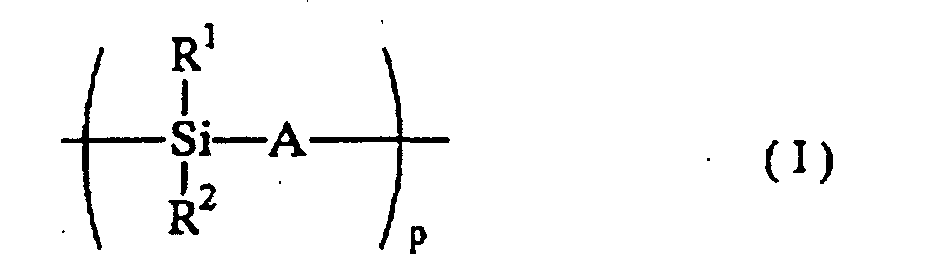 wherein R1, R2, R3, R4, R5 and R6 independently represent an alkyl group, an alkenyl group, a cycloalkyl group, an aryl group, an aralkyl group, an alkylamino group, an alkylsilyl group or an alkoxyl group; R7 is a divalent group; A is NH or O; and the structural units (I) and (II) are arranged at random, and their molar ratios p and q satisfy the following formula:
- (2) A silicon-containing copolymer according to the item 1
described above, wherein the silicon-containing copolymer
further comprises at least one of structural units represented
by the general formulae (III) and (IV):
 wherein R8 and R9 independently represent an alkyl group, an alkenyl group, a cycloalkyl group, an aryl group, an aralkyl group, an alkylamino group, an alkylsilyl group or an alkoxyl group; A is NH or O; and the structural units (I) to (IV) in the polymer are arranged at random, and their molar ratios p, q, r and s satisfy the following formula: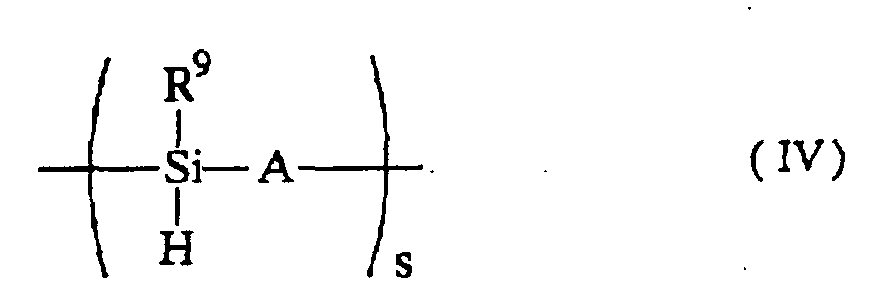
- (3) A silicon-containing copolymer according to the item 1
or 2 described above, wherein the silicon-containing copolymer
further comprises at least one of structural units represented
by the following general formulae (V), (VI) and (VII):

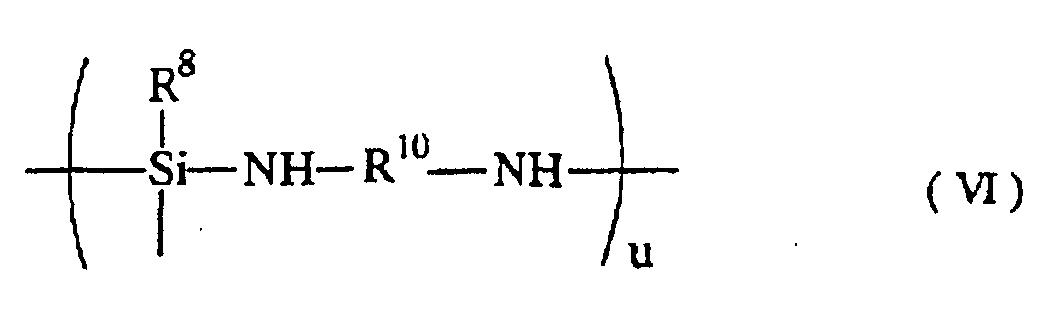 wherein R1, R2, R8 and R9 independently represent an alkyl group, an alkenyl group, a cycloalkyl group, an aryl group, an aralkyl group, an alkylamino group, an alkylsilyl group or an alkoxyl group, R10 is a divalent aromatic group, and the structural units (V) to (VII) are arranged at random.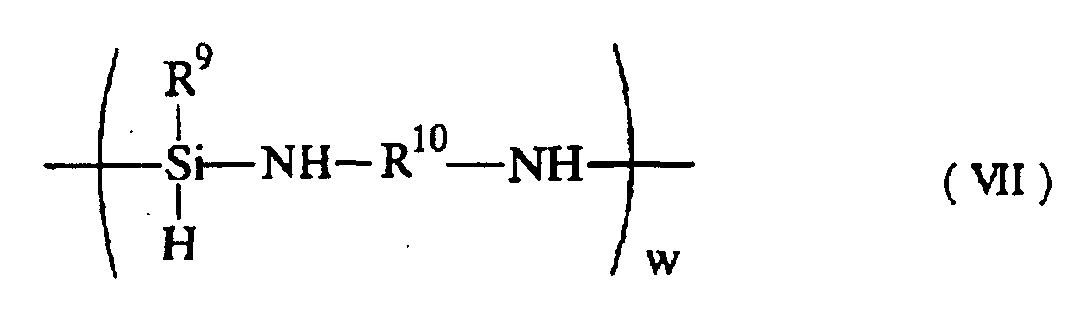
- (4) A silicon-containing copolymer according to any one of
the items 1 to 3 described above, wherein said divalent aromatic
group is an aralkylene group, a naphthylene group or a group
represented by the general formula (A):
wherein R11 is a halogen atom or a lower alkyl group, a is an integer of 0 to 4 , and Z is a direct bond or a group represented by the general formula (B):
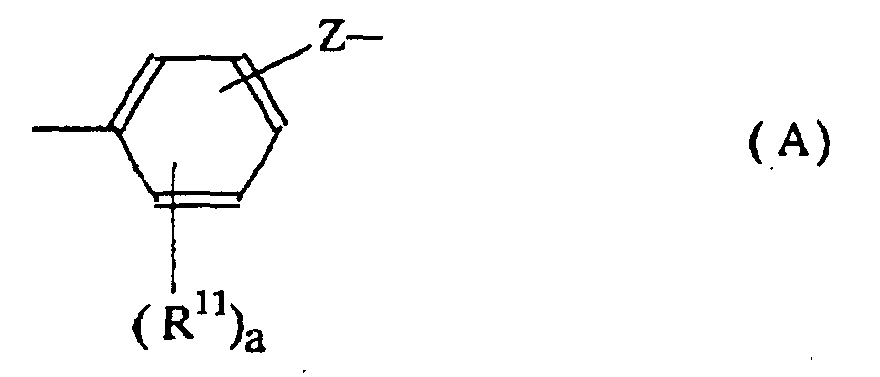 wherein R12 is a halogen atom or a lower alkyl group, b is an integer of 0 to 4, and Y is a direct bond or a divalent group. Further a production method for the silicon-containing copolymer of the present invention is characterized by comprising the following constitution.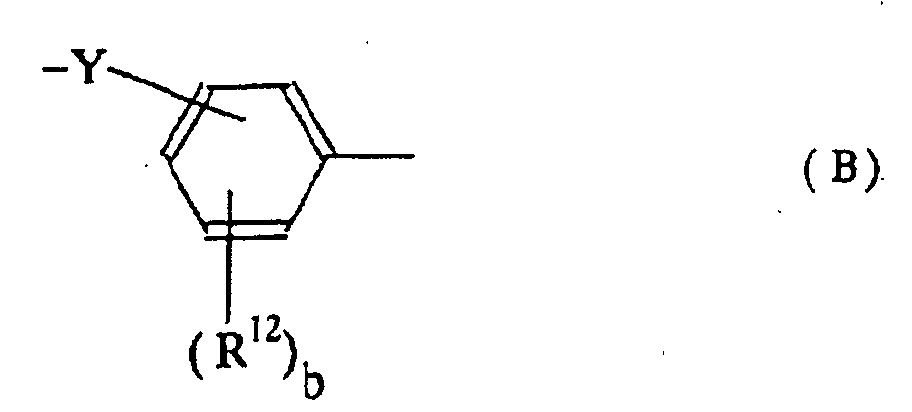
- (5) A production method for the silicon-containing
copolymer described in the item 1 above, which comprises steps
of allowing a mixture containing at least an
organopolyhalosilane represented by the following general
formula (VIII) and a disilyl compound represented by the
following general formula (IX) to react with water dispersed
in a suitable solvent and thereafter allowing the unreacted
halosilane to be completely reacted by making the reaction
solution to react with ammonia:
 wherein R1, R2, R3, R4, R5 and R6 independently represent an alkyl group, an alkenyl group, a cycloalkyl group, an aryl group, an aralkyl group, an alkylamino group, an alkylsilyl group or an alkoxyl group, R' is a divalent group, and X is a halogen atom.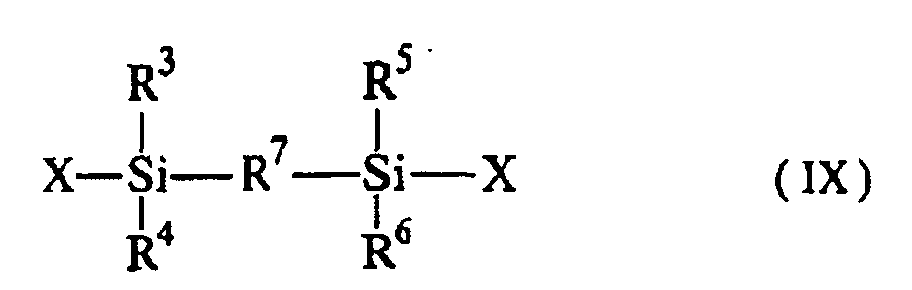
- (6) A production method for a silicon-containing copolymer
according to the item 5 described above, wherein the mixture
containing an organopolyhalosilane represented by the general
formula (VIII) and a disilyl compound represented by the
general formula (IX) further comprises
organopolyhalosilane(s) represented by the following general
formula (X) and/or (XI) to produce the silicon-containing
copolymer described in the item 2 above:
 wherein R8 and R9 independently represent an alkyl group, an alkenyl group, a cycloalkyl group, an aryl group, an aralkyl group, an alkylamino group, an alkylsilyl group or an alkoxyl group, and X is a halogen atom.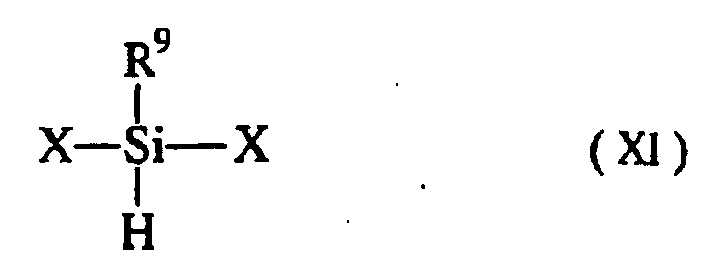
- (7) A production method for the silicon-containing
copolymer described in the item 3 described above, which
comprises steps of allowing a mixture containing an
organopolyhalosilane represented by the general formula (VIII)
and a disilyl compound represented by the general formula (IX)
to react in a first step with a diamine represented by the
following general formula (XII), then allowing the reaction
solution to react with water dispersed in a suitable solvent,
and thereafter allowing the unreacted halosilane to be
completely reacted by making it to reaction with ammonia:
- (8) A production method for a silicon-containing copolymer according to the item 6 or 7 described above, wherein the mixture containing an organopolyhalosilane represented by the general formula (VIII) and a disilyl compound represented by the general formula (IX) further comprises organopolyhalosilane(s) represented by the general formula (X) and/or (XI). Furthermore the film of the present invention is characterized in that it comprises the following constitution.
- (9) A film comprising the silicon-containing copolymer described in any one of the items 1 to 4 described above.
-
- By the way according to the present invention, the following production methods for a silicon-containing copolymer are further provided as a preferable embodiment.
- (i) A production method for a silicon-containing copolymer described in the aforementioned item 4 which is characterized in that the divalent group of R7 is an aralkylene group or a naphthylene group in the general formula (IX) or a group represented by the aforementioned general formula (A).
- (ii) A production method for a silicon-containing copolymer described in aforementioned item 5 which is characterized in that the divalent aromatic group of R10 in the general formula (XII) is an aralkylene group or a naphthylene group or a group represented by the aforementioned general formula (A).
-
- Further according to the present invention, the following polymers and production methods thereof are proposed as a preferable embodiment.
- 1 ○ Aforementioned silicon-containing copolymers wherein R1 to R6, R8 and R9 in the structural unit of the aforementioned general formulae (I) to (VII) represent independently a methyl group or a phenyl group.
- 2 ○ Aforementioned silicon-containing copolymers wherein R7 and R10 in the structural unit of the aforementioned general formulae (II), and (V) to (VII) represent an arylene group.
- 3 ○ Production methods for the aforementioned silicon-containing copolymer wherein R1 to R6, R8 and R9 in the structural unit of the aforementioned general formulae (VIII) to (XI) represent independently a methyl group or a phenyl group.
- 4 ○ Production methods for the aforementioned silicon-containing copolymer, wherein R7 and R10 in the compound of the aforementioned general formulae (IX) and (XII) represent an arylene group.
- 5 ○ Production methods for the aforementioned silicon-containing copolymer, wherein X in the compound of the aforementioned general formulae (VIII) to (XI) is a Cl atom.
-
- As usable applications of the silicon-containing copolymer of the present invention, there can be raised a film such as a f ilm for coating including hard coat film, a film single body, and so on and besides the following usable embodiments can be exemplified.
- (a) A dielectric layer for a PDP back face plate and a PDP front face plate, a material for PDP ribs (insulation material) and a PDP vacuum sealing agent, which are formed by the silicon-containing copolymer described above.
- (b) An interlayer dielectric film of semiconductor comprising the aforementioned silicon-containing copolymer.
- (c) A coating comprising the aforementioned silicon-containing copolymer.
- (d) A front face display plate of a display device comprising the aforementioned silicon-containing copolymer.
- (e) A PMD material usable in low temperature process at 600° C comprising the aforementioned silicon-containing copolymer.
- (f) An optical fiber comprising the aforementioned silicon-containing copolymer.
- (g) An adhesive agent comprising the aforementioned silicon-containing copolymer.
- (h) A wire sheathing comprising the aforementioned silicon-containing copolymer.
- (i) A composite material comprising the aforementioned silicon-containing copolymer and ceramics.
-
- The present invention is explained in details concretely in the following.
- The silicon-containing copolymer of the present invention is characterized by having the structural units represented by the aforementioned general formulae (I) and (II), according to the circumstances (I) to (IV) or (I) to (VII) and by having a number average molecular weight of the range from 500 to 1,000,000. The silicon-containing copolymer of the present invention has the structural units represented by the aforementioned general formula (II) and optionally (V) to (VII) As a result, a bonding energy goes up because of a C=C bond, linearity of the polymer proceeds by the introduction of a two functional group (R7, occasionally R10), its heat resistance is 400°C or more because of high oxidation stability brought by Si bonding, of course, besides it has flexibility together. Further it has high mechanical strength because of having the structural unit of the aforementioned general formula (III), occasionally (VI) by the introduction of three functional groups. In addition, because of the existence of -NH- group in the aforementioned general formulae (I), (III), and (V) to (VII) and Si-H in the aforementioned general formulae (IV) and (VII), curing proceeds by heating and then one with heat resistance and high strength can be obtained. Furthermore because of having a Si-O bond, a cured polymer is colorless and excellent in transparency, besides even if cured in the air, it is colorless and a highly transparent cured polymer can be formed. Curing control can be made easily when there exist in the polymer the structural units represented by the general formulae (IV) and (VII) having Si-H and having the structural units represented by the general formulae (I), (III), (IV) and (V) to (VII) having -NH-.
- The silicon-containing copolymer of the present invention is characterized by having the aforementioned structural units represented by the general formulae (I) and (II), according to the circumstances the general formulae (I) to (IV) or the general formulae (I), (II) and (V) to (VII) or the general formulae (1) to (VII) , and particularly having Si-O bond in the structural units represented by the general formula (I) or the formulae (III) and (IV). By the way the bonding order of structural units represented by the general formulae (I) to (VII) is random and ratios of each structural element, p, q, r, and s or p, q, r, s, t, u, and w can be taken in the range described below.
- Further the ratio of a Si-O bond and a Si-N bond in the polymer is
- Next the production method of the silicon-containing copolymer of the present invention is explained. The production method of the present invention is characterized in that a mixture of organopolyhalosilane represented by the aforementioned general formula (VIII) and disilyl compounds represented by the aforementioned general formula ( IX) , or the mixture further comprising organopolyhalosilane represented by the aforementioned general formula (X) and/or general formula (XI) if necessary is reacted with diamine represented by the aforementioned general formula (XII), if necessary, first, and then is reacted with water which is dispersed in an adequate solvent, and thereafter the reaction solution is subjected to reaction with ammonia to permit the unreacted halosilane to be completely reacted.
- In the organopolysilane represented by the general formula (VIII), (X) or (XI) which is used as a starting raw material when producing the silicon-containing copolymer of the present invention, R1, R2, R8 and R9 are selected from groups consisting of an alkyl group, an alkenyl group, a cycloalkyl group, an aryl group, an aralkyl group, an alkylamino group, an alkylsilyl group and an alkoxyl group, and usually an alkyl group having 1 to 7 carbon atoms, preferably 1 to 5 carbon atoms and more preferably 1 to 2 carbon atoms, an alkenyl group having 2 to 7 carbon atoms, a cycloalkyl group having 5 to 7 carbon atoms, and an aryl group are used. X is usually a fluorine atom, a chlorine atom, a bromine atom or a iodine atom, preferably a chlorine. As the aryl group, a phenyl group, a tolyl group, a xylyl group, a cumenyl group, a benzyl group, a phenethyl group, an α -methylbenzyl group, a benzhydryl group, a trityl group, a styryl group, a cinnamyl group, a biphenyl group, a naphthyl group, etc. can be used. As the alkylsilyl group (mono, di and tri substituted compounds), the alkylamino group (mono and di substituted compounds), and the alkoxyl group, one having 1 to 7 carbon atoms is usually used. R1 and R2 may be the same. or different each other. Diphenyldichlorosilane is preferred as the compound represented by the general formula (VIII) described above, phenyltrichlorosilane is preferred as the compound represented by the general formula (X) described above and methyldichlorosilane is preferred as the compound represented by the general formula (XI) described above.
- On the other hand, R3 to R6 of a disilyl compound represented by the general formula (IX) which is used as a starting raw material when producing a silicon-containing copolymer in the present invention are selected from groups consisting of an alkyl group, an alkenyl group, a cycloalkyl group, an aryl group, an aralkyl group, an alkylamino group, an alkylsilyl group and an alkoxyl group as same as the case of R1, R2, R8 and R9 of the general formulae (VIII), (X) and (XI) , and X represents a halogen atom. The concrete examples of these groups or atoms can be the similar to those in R1, R2, R8 and R9 in the organopolyhalosilanes represented by the general formula (VIII), (X) and (XI). As the divalent group of R7, divalent aromatic groups are preferred such as an aralkylene group, a naphthylene group or a group represented by the general formula (A) described above. As R7, an alkylene group, an alkenylene group, a cycloalkylene group, an arylene group, an alkylimino group o an alkylsilylene group are exemplified concretely and then an arylene group is a preferable group.
- And then, a phenylene group, a tolylene group, a xylylene group, a benzylidene group, a phenethylidene group, a α-methylbenzylidene group, a cinnamylidene group, a naphthylene group, etc. can be exemplified as the arylene group. As the compound represented by the general formula (IX), 1,4-bis(dimethylchlorosilyl)benzene, etc. are preferable compounds concretely.
- In the method of the present invention, first of all, the mixture of organopolyhalosilanes and a disilyl compound described above is reacted with diamine represented by the general formula (XII) NH2-R10-NH2 if necessary. R10 in the general formula (XII) is a divalent aromatic group and an aralkylene group, a naphthylene group or the group represented by the general formula (A) described above is a preferable group. Diamines represented by the general formula (XII) can be exemplified in following:











- As shown in the concrete examples described above, an arylene group such as a phenylene group and various divalent aromatic groups such as a biphnylene group can be exemplified as R10 in the general formula (XII) and an arylene group is a preferable group as R10. Although diamines are exemplified above, these are just preferable examples and diamines represented by the general formula (XII) are not restricted in those described above. Among these diamines, para-phenylene diamine (p-PDA), meta-phenylene diamine (m-PDA) , and diaminodiphenyl ether such as 4,4'-diphenyldiamino ether (oxydianiline, ODA) are preferable compounds.
- As a reaction solvent, anyone of Lewis bases, non-reactive solvents or a mixture thereof may be used. In this case, as Lewis bases, tert-amines (for example, trialkylamine such as trimethylamine, dimethylethylamine, diethylmethylamine and triethylamine, pyridine; picoline, dimethylanilline and the derivatives thereof), sec-amines having a steric hindrance group, phosphine, stibine, arsine and the derivatives thereof, etc. (for example, trimethylphosphine, dimethylethylphosphine, methyldiethylphosphine,triethylphosphine, trimethyl-arsine, trimethylstibine, trimethylamine, triethylamine, etc.) can be exemplified. Among these, a base with low boiling point and less basic property than ammonia (for example, pyridine, picoline, trimethylphosphine, dimethylethylphosphine, methyldiethylphosphine, and trimethylphosphine) is a preferable Lewis base. Particularly pyridine and picoline are preferred from handling and economical points of view.
- As a non-reactive solvent, hydrocarbon solvents such as aliphatic hydrocarbons, alicyclic hydrocarbons, aromatic hydrocarbons; halogenated hydrocarbons such as halogenated methane, halogenated ethane, halogenated benzene, etc. , ethers such as an aliphatic ether and an alicyclic ether can be used. The preferable ones among these are halogenated hydrocarbons such as chloromethylene, chloroform, tetrachlorometane, bromoform, chloroethylene, chloroethylidene, trichloroethane, tetrachloroethane, ethers such as ethyl ether, isopropyl ether, ethylbutyl ether, butyl ether, 1,2-dioxyethane, dioxane, dimethyldioxane, tetrahydrofuran, tetrahydropyran, etc., hydrocarbons such as pentane, hexane, isohexane, methylpentane, heptane, isoheptane, octane, isooctane, cyclopentane, methylcyclopentane, cyclohexane, methylcyclohexane, benzene, toluene, xylene, ethylbenzene, N-methyl-2-pyrrolidone, diglyme, etc. Among these solvents, dichloromethane, xylene and N-methyl-2-pyrrolidone are preferable ones from the safety point of view. And pyridine/dichloromethane mixture solvent is also preferable one.
- In the method of the present invention, at first organopolyhalosilane(s) represented by the general formula (VIII) and if necessary the general formulae (IX) and (X) described above and a disilyl compound represented by the general formula (XI) are mixed in an organic solvent, followed by being reacted with diamine represented by the general formula (XII), if necessary. The mixing ratio of the organopolyhalosilane(s) and the disilyl compound may be in the region of 1 :99 to 99:1 in molar ratio, preferably 90:10 to 10:90, more preferably 80:20 to 40:60. The ratio of the both halosilicon compounds and the diamine used may be in the region of 100:0 to 10:90 in molar ratio, preferably 100:0 to 25:75, more preferably 100:0 to 40:60. The denatured amount of diamine is preferably made from 0 to 50 mol% relative to an ideal reaction amount of both halosilicon compounds. The concentration of the halosilicon compound in a solvent may be selected optionally, however the region from 1 to 25 weight % is preferred. The temperature may be any temperature so far as the reaction system is in a liquid state (typically -40°C to 300°C). The pressure is generally under normal pressure or imposed pressure and the imposed pressure by nitrogen is preferred.
- Subsequent to the reaction between the halosilicon compounds and the diamine being made, or without reacting the halosilicon compounds with diamine, water dispersed in a proper solvent is added to the halosilicon compound and reacted to form a Si-O bond. As a solvent in which water is dispersed, the similar solvent to one employed upon the reaction with the above-described diamine can be used. Particularly pyridine and pycoline are preferred from the handling and economical. points of view. In the reaction with water, the pouring speed of water into the reaction system influences on the formation of the polymer largely. When the pouring speed is higher, there is a case that the polymer formation is not made sufficiently. Water pouring speed would be preferable at 0. 1 molH2O/min or lower. Furthermore the reaction temperature plays an important role for a formation of the polymer. The temperature of a hydrolysis reaction is usually -40° C to 20°C, preferably - 20° C to 5°C. In the case that the reaction temperature is higher, there is a case that polymer formation is not made sufficiently.
- Subsequent to the reaction with water being accomplished, ammonia is added and aminolysis reaction is made to permit halosilane to be completely reacted. The conditions such as a reaction solvent and temperature in this case are the same as those employed in reaction with diamine described above. The amount of ammonia added is determined by the amount of halogen atom remained at an unreacted state. It means that an ideal amount which is required for ammonolysis of a halosilicon compound can be calculated from the quantities of the added amine and water, however ammonia is used more than the ideal amount since ammonia may become excessive. The pressure is usually under normal pressure or imposed pressure, however the imposed pressure by nitrogen is preferred. HCl is generated in this reaction but it can be separated from the object substance by formation of a salt with a base such as triethylamine or ammonia. The copolymer and the by-produced ammonium chloride or amine salt are filtrated and the byproduct is separated. Solvent is removed under reduced pressure from the filtrate to obtain the copolymer.
- According to the method of the present invention, a novel silicon-containing copolymer can be obtained easily having structural units represented by the general formulae (I) and (II), according to circumstances the general formulae (I) to (IV), the general formulae (I), (II) and (V) to (VII), or the general formulae (I) to (VII) and having a number average molecular weight in the region of 500 to 1,000,000. BY the way, this polymer is soluble in a general organic solvent such as hydrocarbons, e.g. aliphatic hydrocarbons, alicyclic hydrocarbons and aromatic hydrocarbons, halogenated hydrocarbons, ethers, alcohols, esters, ketones, etc.
- The copolymer obtained by the method of the present invention can be made a molding body having high heat resistance and excellent mechanical strength. For example, the copolymer is applied onto a glass substrate and baked, for example at 250° C to 550° C for 0 . 05 to 2.0 hours in the air or in inactive atmosphere such as nitrogen or argon atmosphere to form a coating film. In addition, a film single body can be obtained by tearing off the coating film from the glass substrate. These films are heat-resistant, excellent in mechanical characteristics, flexible, almost or completely colorless and excellent in transparency, and have low relative dielectric constant.
- The present invention will now be described more specifically by reference to Examples which, however, are not to be construed to limit the present invention in any way.
- An inside of a reactor installed in a constant-temperature bath was replaced with dry nitrogen, and then a solution of 47 gr. (0.222 mol) of phenyltrichlorosilane (PhSiCl3), 56 gr. (0.222 mol) of diphenyldichlorosilane (Ph2SiCl2), 3.8 gr. (0.033 mol) of methyldichlorosilane (MeSiCl2) and 50 gr. (0.19 mol) of 1,4-bis(dimethylchlorosilyl)benzene in 1,000 ml of xylene was charged thereinto. Next the temperature of the reactor was set at -5°C. When the temperature reached the determined temperature, 3.56 gr. (0.0178 mol) of DDE (diaminodiphenyl ether) was added into the reactor and the reaction was continued for 1 hour under stirring. After that, in order to break a salt of DDE with hydrochloric acid formed upon the reaction, 40 gr. of triethylamine solved in 500 ml of xylene was poured into the reactor. After pouring, it was kept stirring for 1 hour. Maintaining the temperature of the inside of reactor at -5°C, a solution of 13.0 gr. (0.7222 mol) of water which was solved in 1, 000 ml of pyridine was poured into the reactor at a speed of approximately 30 ml/min. At this time, a reaction of halosilane and water took place with pouring and. the temperature inside of the vessel rose up to -2°C. After finishing of pouring the mixture solution of water and pyridine, the stirring of the solution was kept for 1 hour. After that, in order to permit the unreacted chlorosilane to be reacted completely, ammonia was added to the solution at a speed of 2Nl/min for 10 minutes and was stirred. With addition of ammonia, the formation of white precipitation consisting of ammonium chloride was confirmed. After the reaction, unreacted ammonia was removed by introducing dry nitrogen. The solution was pressure-filtered in an atmosphere of nitrogen to obtain 2,300 ml of filtrate. The filtrate was solvent replaced under reduced pressure to obtain 105 gr. of slightly yellowish transparent resin with high viscosity.
- A number average molecular weight of the obtained resin was 2,100. As a result of an IR spectrum analysis, an absorption based on a N-H group at wavelength of 3350 cm-1; an absorption based on Si-H at wavelength of 2160 cm-1; an absorption based on Si-Ph at wavelength of 1140 cm-1; an absorption based on Si-O at wavelength of 1060-1100 cm-1; an absorption based on Si-H and Si-N-Si at wavelength of 1020-820 cm-1; an absorption based on C-H at wavelength of 3140, 2980, and 1270 cm-1; and an absorption based on C-H of a benzene ring at wavelength of 810 and 780 cm-1 were confirmed to be shown.
- Further by analyzing a 1H-NMR (proton nuclear magnetic resonance absorption) spectrum, absorptions of δ 7.2 ppm (br, C6H6) δ 4.8 ppm ( br, SiH), δ 1.4 ppm ( br, NH), and δ 0.3 ppm (br, SiCH3) were confirmed and from the result of the analysis, it was judged that the aimed substance was obtained.
- Next, physical properties of this polymer were investigated as follows. That is, the polymer was applied in thickness of 50 microns onto glass substrates and cured under the condition of at 400°C for 1 hour in the air and at 500°C for 1 hour in nitrogen respectively. Then a transmittance and a relative dielectric constant of the cured polymer were measured. As a result, neither formation of crack nor release of the polymer took place, and these showed so much excellent transmission property and heat resistance such as 97% of transmittance and 550°C or higher of heat-resistant temperature in all cases.
- In accordance with the method described in Example 1 of the Japanese Patent Publication Laid-open Hei No. 9-188765, a silicon-containing polymer was synthesized, applied on glass substrates, cured, and tested in the same manner as Example 1.
- It resulted that a transmittance of the polymer cured at 400°C for 1 hour in the air was 40% and a transmittance of the polymer cured at 500° C for 1 hour in nitrogen was 93%. A relative dielectric constant of the polymer cured at 400° C for 1 hour in the air and of one cured at 500° C for 1 hour in nitrogen were 3.08 and 3.0, respectively.
- From the results of Example 1 and Comparative Example, by introduction of a Si-O bond, the transmittance in the air was drastically improved. The polymer obtained in Example 1 has heat resistance exceeding that of polyimide and higher transmittance than that of polymethylmethacrylate (PMMA). No polymer with such high heat resistance and light transmittance exists among existing resins and therefore various applications such as a high heat-resistant optical use, for example a dielectric layer of a plasma display etc., or the like are possible. And it is also possible to use the polymer as institution for a polyimide film since the polymer has excellent heat resistance and light transmittance and low relative dielectric constant compared with a polyimide film.
- As an example of electric property, relative dielectric constants of cured polymer films in Example 1, wherein the curing was conducted at 400° C, 500° C and 600° C each for 1 hour in nitrogen, were measure and the readings were 2.72, 2.71 and 2.54, respectively, which were low relative dielectric constant. From these results of heat resistance, relative dielectric constant and transparency, the polymer of Example 1 can be applied for an interlayer dielectric film of semiconductor in the next generation and for a dielectric of PDP.
- Silicon-containing heat-resistant polymers were obtained in the same manner as Example 1 except for altering an amount of water added, a kind of diamine and a denatured amount of diamine to the conditions shown in Table 2.
- Furthermore transmittance of the obtained polymers was measured in the same manner as Example 1 and the results are shown in Table 3.
Amount of water added
(mol%)Kind of diamine denatured amount of diamine
(mol%)Number average molecular weight Example 1 93.5 DDE 5.0 2,100 Example 2 93.5 p-PDA, 5.0 2,050 Example 3 93.5 - 0 2,200 Example 4 70.0 DDE 25.0 1,800 Comparative Example 0 p―PDA 50.0 850 Light transmittance (%) Curing at 400° C for 1 hr in the air Curing at 500°C for 1 hr in N2 Example 1 97 97 Example 2 97 97 Example 3 97 97 Example 4 95 96 Comparative Example 40 93 - Further, in order to compare the relative dielectric constants of the polymers in Examples 1 to 4 with that of Comparative Example, each polymer was cured at 400° C for 1 hour in the air and in nitrogen and the relative dielectric constants were measured. The results are shown in Table 4.
Relative dielectric constant Curing at 400°C for 1 hr in the air Curing at 400° C for 1 hr in N2 Example 1 2.75 2.72 Example 2 2.74 2.73 Example 3 2.73 2.74 Example 4 2.83 2.81 Comparative Example 3.08 3.08 3.00 3.00 - As mentioned above, by the present invention, a polymer with high heat resistance up to about 550°C, high light transmittance up to about 97%, and a low relative dielectric constant, which is strong in mechanical strength and flexible can be obtained even by curing in the air. Therefore, no particular conditions are required such as nitrogen atmosphere and thus an industrial utilization at low cost in a various applications is made possible.
- As the silicon-containing polymer of the present invention has high heat resistance, excellent transparency, and low relative dielectric constant, and is excellent in flexibility and mechanical strength, it can be preferably used as the materials for various kinds of films, a heat resisting coating, a dielectric layer for PDP, an interlayer dielectric film for semiconductor, etc. wherein those characteristics are required.
Claims (9)
- A silicon-containing copolymer having a number average molecular weight of 500 to 1,000,000 and comprising at least structural units represented by the general formulae (I) and (II):
 wherein R1, R2, R3, R4, R5 and R6 independently represent an alkyl group, an alkenyl group, a cycloalkyl group, an aryl group, an aralkyl group, an alkylamino group, an alkylsilyl group or an alkoxyl group; R7 is a divalent group; A is NH or O; and the structural units (I) and (II) are arranged at random, and their molar ratios p and q are satisfy the following formula: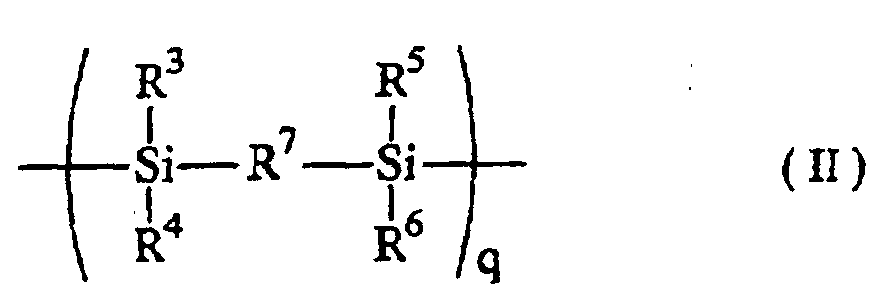
- The silicon-containing copolymer according to claim 1, wherein the silicon-containing copolymer further comprises at least one of structural units represented by the general formulae (III) and (IV):
 wherein R8 and R9 independently represent an alkyl group, an alkenyl group, a cycloalkyl group, an aryl group, an aralkyl group, an alkylamino group, an alkylsilyl group or an alkoxyl group; A is NH or O; and the structural units (I) to (IV) in the polymer are arranged at random, and their molar ratios p, q, r and s satisfy the following formula:
- The silicon-containing copolymer according to claim 1 or 2, wherein the silicon-containing copolymer further comprises at least one of structural units represented by the following general formulae (V), (VI) and (VII):
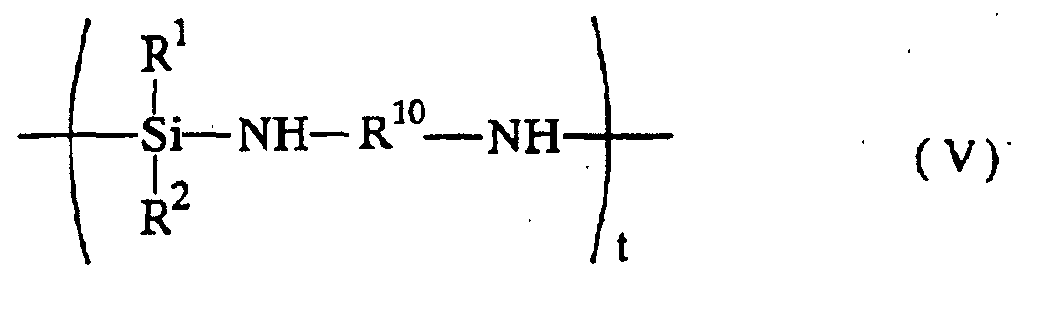
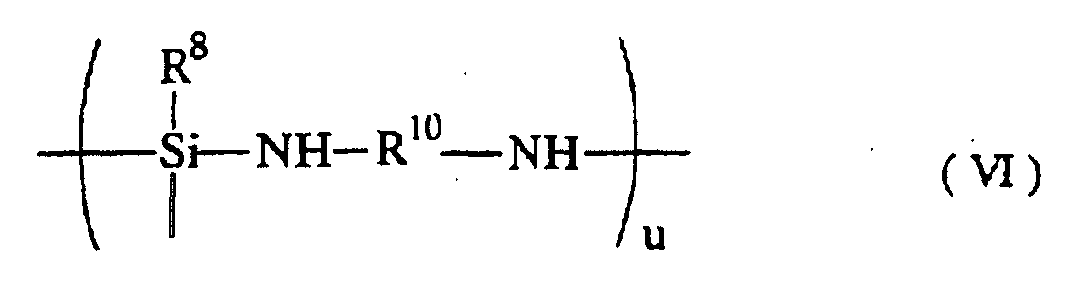 wherein R1, R2, R8 and R9 independently represent an alkyl group, an alkenyl group, a cycloalkyl group, an aryl group, an aralkyl group, an alkylamino group, an alkylsilyl group or an alkoxyl group, R10 is a divalent aromatic group, and the structural units (V) to (VII) are arranged at random.
- The silicon-containing copolymer according to any one of claims 1 to 3, wherein said divalent aromatic group is an aralkylene group, a naphthylene group or a group represented by the general formula (A):wherein R11 is a halogen atom or a lower alkyl group, a is an integer of 0 to 4 , and Z is a direct bond or a group represented by the general formula (B):
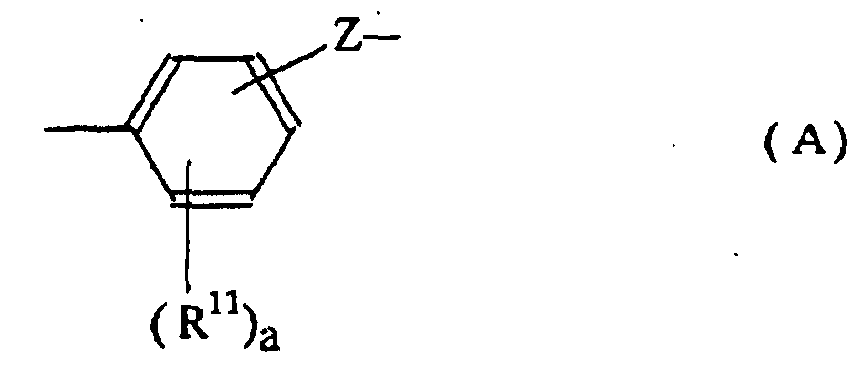 wherein R12 is a halogen atom or a lower alkyl group, b is an integer of 0 to 4 , and Y is a direct bond or a divalent group.
- A process for producing the silicon-containing copolymer described in claim 1, which comprises steps of allowing a mixture containing at least an organopolyhalosilane represented by the following general formula (VIII) and a disilyl compound represented by the following general formula (IX) to react with water dispersed in a suitable solvent and thereafter allowing the unreacted halosilane to be completely reacted by making the reaction solution to react with ammonia:
 wherein R1, R2, R3, R4, R5 and R6 independently represent an alkyl group, an alkenyl group, a cycloalkyl group, an aryl group, an aralkyl group, an alkylamino group, an alkylsilyl group or an alkoxyl group, R7 is a divalent group, and X is a halogen atom.
- The process for producing a silicon-containing copolymer according to claim 5, wherein the mixture containing an organopolyhalosilane represented by the general formula (VIII) and a disilyl compound represented by the general formula (IX) further comprises organopolyhalosilane(s) represented by the following general formula (X) and/or the general formula (XI) to produce the silicon-containing copolymer described in claim 2:
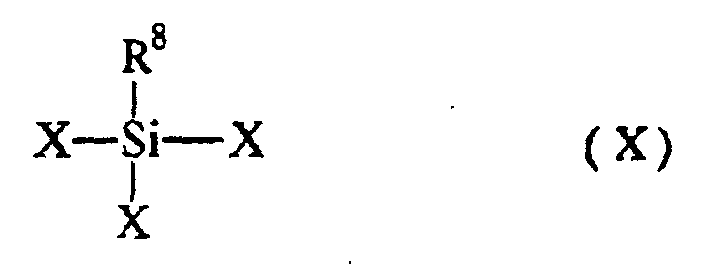 wherein R8 and R9 independently represent an alkyl group, an alkenyl group, a cycloalkyl group, an aryl group, an aralkyl group, an alkylamino group, an alkylsilyl group or an alkoxyl group, and X is a halogen atom.
- A process for producing the silicon-containing copolymer described in claim 3, which comprises steps of allowing a mixture containing an organopolyhalosilane represented by the general formula (VIII) and a disilyl compound represented by the general formula ( IX) to react in a first step of the reaction with a diamine represented by the following general formula (XII), then allowing the reaction solution to react with water dispersed in a suitable solvent, and thereafter allowing the unreacted halosilane to be completely reacted by making it to react with ammonia:
- The process for producing a silicon-containing copolymer according to claim 6 or 7, wherein the mixture containing an organopolyhalosilane represented by the general formula (VIII) and a disilyl compound represented by the general formula (IX) further comprises organopolyhalosilane(s) represented by the general formula (X) and/or the general formula (XI).
- A film comprising the silicon-containing copolymer described in any one of claims 1 to 4.
Applications Claiming Priority (3)
| Application Number | Priority Date | Filing Date | Title |
|---|---|---|---|
| JP2001099092 | 2001-03-30 | ||
| JP2001099092A JP3989184B2 (en) | 2001-03-30 | 2001-03-30 | Silicon-containing copolymer and method for producing the same |
| PCT/JP2002/002417 WO2002081553A1 (en) | 2001-03-30 | 2002-03-14 | Silicon-containing copolymer and process for producing the same |
Publications (3)
| Publication Number | Publication Date |
|---|---|
| EP1380612A1 true EP1380612A1 (en) | 2004-01-14 |
| EP1380612A4 EP1380612A4 (en) | 2005-03-09 |
| EP1380612B1 EP1380612B1 (en) | 2007-05-23 |
Family
ID=18952681
Family Applications (1)
| Application Number | Title | Priority Date | Filing Date |
|---|---|---|---|
| EP02705183A Expired - Lifetime EP1380612B1 (en) | 2001-03-30 | 2002-03-14 | Silicon-containing copolymer and process for producing the same |
Country Status (8)
| Country | Link |
|---|---|
| US (1) | US6946536B2 (en) |
| EP (1) | EP1380612B1 (en) |
| JP (1) | JP3989184B2 (en) |
| KR (1) | KR100854254B1 (en) |
| CN (1) | CN1219810C (en) |
| AT (1) | ATE362953T1 (en) |
| DE (1) | DE60220265T2 (en) |
| WO (1) | WO2002081553A1 (en) |
Cited By (3)
| Publication number | Priority date | Publication date | Assignee | Title |
|---|---|---|---|---|
| EP1500685A4 (en) * | 2002-04-12 | 2007-02-21 | Az Electronic Materials Usa | Composition of silicon-containing copolymer, solvent-soluble crosslinked silicon-containing copolymer, and cured articles obtained therefrom |
| EP2144279A2 (en) | 2008-07-11 | 2010-01-13 | Air Products and Chemicals, Inc. | Aminosilanes for shallow trench isolation films |
| EP4174112A4 (en) * | 2020-06-26 | 2024-07-17 | Kolon Industries, Inc. | SILAZANE-BASED COMPOUND, COATING COMPOSITION COMPRISING SAME, LIGHT-TRANSMITTING FILM HAVING COATING LAYER, AND DISPLAY DEVICE COMPRISING LIGHT-TRANSMITTING FILM |
Families Citing this family (13)
| Publication number | Priority date | Publication date | Assignee | Title |
|---|---|---|---|---|
| JP4159937B2 (en) * | 2003-07-18 | 2008-10-01 | Azエレクトロニックマテリアルズ株式会社 | Polysilazane composition |
| JP4540961B2 (en) * | 2003-10-10 | 2010-09-08 | Azエレクトロニックマテリアルズ株式会社 | Etching stopper layer forming composition |
| JP2006241305A (en) * | 2005-03-03 | 2006-09-14 | Fuji Photo Film Co Ltd | Composition for film formation, insulating film and its manufacturing method |
| US20070065660A1 (en) * | 2005-09-16 | 2007-03-22 | Fuji Photo Film Co., Ltd. | Antireflection film, polarizing plate, and image display device |
| JP5252986B2 (en) * | 2008-05-07 | 2013-07-31 | 国立大学法人東京工業大学 | Silicon-containing polyimide and method for producing the same |
| DE102008064372A1 (en) | 2008-12-22 | 2010-06-24 | Fraunhofer-Gesellschaft zur Förderung der angewandten Forschung e.V. | Polysilane-polycarbosilanes with reduced chlorine content based on methylchloropolysilanes and spinning compositions and ceramic molded articles produced therefrom |
| US8268975B2 (en) | 2009-04-03 | 2012-09-18 | Dow Agrosciences Llc | Demulsification compositions, systems and methods for demulsifying and separating aqueous emulsions |
| CN102695565B (en) * | 2010-01-22 | 2015-08-19 | 旭硝子株式会社 | There is the manufacture method of the resin substrate of hard coat and there is the resin substrate of hard coat |
| US20140271445A1 (en) * | 2013-03-14 | 2014-09-18 | Heritage Research Group | Method of processing waste chlorosilane |
| CN104512075B (en) | 2013-10-04 | 2017-06-23 | 财团法人工业技术研究院 | Release layer, substrate structure and flexible electronic element process |
| JP7103245B2 (en) * | 2019-01-29 | 2022-07-20 | 信越化学工業株式会社 | Polysiloxazan compounds and methods for producing them, and compositions and cured products containing them. |
| JP7535138B2 (en) * | 2020-06-26 | 2024-08-15 | コーロン インダストリーズ インク | Silazane-based compound, coating composition including the same, light-transmitting film having a coating layer, and display device including the light-transmitting film |
| CN114213659B (en) * | 2021-12-27 | 2024-03-26 | 中鼎凯瑞科技成都有限公司 | Heat-resistant silicon-containing polyarylene sulfide and preparation method thereof |
Family Cites Families (9)
| Publication number | Priority date | Publication date | Assignee | Title |
|---|---|---|---|---|
| US3655615A (en) * | 1970-02-02 | 1972-04-11 | Midland Silicones Ltd | Compounds containing silicon and nitrogen |
| US4678688A (en) * | 1983-12-28 | 1987-07-07 | Shin-Etsu Chemical Co., Ltd. | Method for forming a surface film of cured organosilicon polymer on a substrate surface |
| JP2700233B2 (en) | 1988-12-26 | 1998-01-19 | 財団法人石油産業活性化センター | Copolymerized silazane and its production method |
| DE4114217A1 (en) * | 1991-05-01 | 1992-11-05 | Bayer Ag | ORGANIC SILAZANE POLYMERS, METHOD FOR THE PRODUCTION THEREOF AND A METHOD FOR THE PRODUCTION OF CERAMIC MATERIALS THEREOF |
| JP3625912B2 (en) | 1994-08-24 | 2005-03-02 | クラリアント ジャパン 株式会社 | Silicon-containing copolymer and method for producing the same |
| US5596062A (en) * | 1994-08-24 | 1997-01-21 | Tonen Corporation | Silicon-containing copolymer and method of producing same |
| JPH08245880A (en) | 1995-03-10 | 1996-09-24 | Tonen Corp | Heat-resistant film and manufacturing method thereof |
| JP3631834B2 (en) | 1995-12-29 | 2005-03-23 | クラリアント ジャパン 株式会社 | Thermosetting varnish |
| JP3638694B2 (en) | 1995-12-29 | 2005-04-13 | クラリアント ジャパン 株式会社 | Silicon-containing copolymer and method for producing the same |
-
2001
- 2001-03-30 JP JP2001099092A patent/JP3989184B2/en not_active Expired - Fee Related
-
2002
- 2002-03-14 US US10/399,928 patent/US6946536B2/en not_active Expired - Lifetime
- 2002-03-14 AT AT02705183T patent/ATE362953T1/en not_active IP Right Cessation
- 2002-03-14 KR KR1020027016300A patent/KR100854254B1/en not_active Expired - Fee Related
- 2002-03-14 CN CNB028009584A patent/CN1219810C/en not_active Expired - Fee Related
- 2002-03-14 EP EP02705183A patent/EP1380612B1/en not_active Expired - Lifetime
- 2002-03-14 DE DE60220265T patent/DE60220265T2/en not_active Expired - Fee Related
- 2002-03-14 WO PCT/JP2002/002417 patent/WO2002081553A1/en not_active Ceased
Non-Patent Citations (2)
| Title |
|---|
| No further relevant documents disclosed * |
| See also references of WO02081553A1 * |
Cited By (3)
| Publication number | Priority date | Publication date | Assignee | Title |
|---|---|---|---|---|
| EP1500685A4 (en) * | 2002-04-12 | 2007-02-21 | Az Electronic Materials Usa | Composition of silicon-containing copolymer, solvent-soluble crosslinked silicon-containing copolymer, and cured articles obtained therefrom |
| EP2144279A2 (en) | 2008-07-11 | 2010-01-13 | Air Products and Chemicals, Inc. | Aminosilanes for shallow trench isolation films |
| EP4174112A4 (en) * | 2020-06-26 | 2024-07-17 | Kolon Industries, Inc. | SILAZANE-BASED COMPOUND, COATING COMPOSITION COMPRISING SAME, LIGHT-TRANSMITTING FILM HAVING COATING LAYER, AND DISPLAY DEVICE COMPRISING LIGHT-TRANSMITTING FILM |
Also Published As
| Publication number | Publication date |
|---|---|
| JP2002293941A (en) | 2002-10-09 |
| DE60220265D1 (en) | 2007-07-05 |
| WO2002081553A1 (en) | 2002-10-17 |
| EP1380612A4 (en) | 2005-03-09 |
| EP1380612B1 (en) | 2007-05-23 |
| CN1460115A (en) | 2003-12-03 |
| US20040030083A1 (en) | 2004-02-12 |
| KR100854254B1 (en) | 2008-08-26 |
| CN1219810C (en) | 2005-09-21 |
| ATE362953T1 (en) | 2007-06-15 |
| US6946536B2 (en) | 2005-09-20 |
| KR20030007796A (en) | 2003-01-23 |
| JP3989184B2 (en) | 2007-10-10 |
| DE60220265T2 (en) | 2008-01-24 |
Similar Documents
| Publication | Publication Date | Title |
|---|---|---|
| EP1380612B1 (en) | Silicon-containing copolymer and process for producing the same | |
| US6774202B2 (en) | Polyorganosilsesquioxane and process for preparing the same | |
| KR100968734B1 (en) | Silicon-containing copolymer compositions, solvent-soluble crosslinked silicon-containing copolymers, and cured products thereof | |
| US4707531A (en) | Method for producing organosilicon polymers and the polymers prepared thereby | |
| EP2206746B1 (en) | Composition containing polysilazane compound, which can provide dense siliceous film | |
| CN111484621B (en) | Polysilosilazane compound, method for preparing the same, composition comprising the same, and cured product thereof | |
| JPS62230828A (en) | Insulating film for semiconductor, formation thereof and coating solution | |
| JP4159937B2 (en) | Polysilazane composition | |
| JPH0149734B2 (en) | ||
| JP3625912B2 (en) | Silicon-containing copolymer and method for producing the same | |
| JP3681582B2 (en) | Epoxy group-containing silicone resin | |
| JP3638694B2 (en) | Silicon-containing copolymer and method for producing the same | |
| JPH08188649A (en) | Ladder polysiloxane and method for producing the same | |
| JP3114989B2 (en) | Polyphosphosilazane, method for producing the same, and phosphorus atom-containing ceramics | |
| JPH08245880A (en) | Heat-resistant film and manufacturing method thereof | |
| US3431229A (en) | Methods for preparing organopolysiloxanes using diaryloxytitanium oxide catalysts | |
| JPS6155164A (en) | Production of silica film-forming coating solution |
Legal Events
| Date | Code | Title | Description |
|---|---|---|---|
| PUAI | Public reference made under article 153(3) epc to a published international application that has entered the european phase |
Free format text: ORIGINAL CODE: 0009012 |
|
| 17P | Request for examination filed |
Effective date: 20031030 |
|
| AK | Designated contracting states |
Kind code of ref document: A1 Designated state(s): AT BE CH CY DE DK ES FI FR GB GR IE IT LI LU MC NL PT SE TR |
|
| RAP1 | Party data changed (applicant data changed or rights of an application transferred) |
Owner name: CLARIANT FINANCE (BVI) LIMITED |
|
| RAP1 | Party data changed (applicant data changed or rights of an application transferred) |
Owner name: AZ ELECTRONIC MATERIALS USA CORP. |
|
| A4 | Supplementary search report drawn up and despatched |
Effective date: 20050120 |
|
| RIC1 | Information provided on ipc code assigned before grant |
Ipc: 7C 08J 5/18 B Ipc: 7C 08G 77/54 A Ipc: 7C 08L 83/14 B |
|
| 17Q | First examination report despatched |
Effective date: 20060227 |
|
| GRAP | Despatch of communication of intention to grant a patent |
Free format text: ORIGINAL CODE: EPIDOSNIGR1 |
|
| GRAS | Grant fee paid |
Free format text: ORIGINAL CODE: EPIDOSNIGR3 |
|
| GRAA | (expected) grant |
Free format text: ORIGINAL CODE: 0009210 |
|
| AK | Designated contracting states |
Kind code of ref document: B1 Designated state(s): AT BE CH CY DE DK ES FI FR GB GR IE IT LI LU MC NL PT SE TR |
|
| PG25 | Lapsed in a contracting state [announced via postgrant information from national office to epo] |
Ref country code: CH Free format text: LAPSE BECAUSE OF FAILURE TO SUBMIT A TRANSLATION OF THE DESCRIPTION OR TO PAY THE FEE WITHIN THE PRESCRIBED TIME-LIMIT Effective date: 20070523 Ref country code: FI Free format text: LAPSE BECAUSE OF FAILURE TO SUBMIT A TRANSLATION OF THE DESCRIPTION OR TO PAY THE FEE WITHIN THE PRESCRIBED TIME-LIMIT Effective date: 20070523 Ref country code: LI Free format text: LAPSE BECAUSE OF FAILURE TO SUBMIT A TRANSLATION OF THE DESCRIPTION OR TO PAY THE FEE WITHIN THE PRESCRIBED TIME-LIMIT Effective date: 20070523 |
|
| REG | Reference to a national code |
Ref country code: GB Ref legal event code: FG4D |
|
| REG | Reference to a national code |
Ref country code: CH Ref legal event code: EP |
|
| REG | Reference to a national code |
Ref country code: IE Ref legal event code: FG4D |
|
| REF | Corresponds to: |
Ref document number: 60220265 Country of ref document: DE Date of ref document: 20070705 Kind code of ref document: P |
|
| PG25 | Lapsed in a contracting state [announced via postgrant information from national office to epo] |
Ref country code: SE Free format text: LAPSE BECAUSE OF FAILURE TO SUBMIT A TRANSLATION OF THE DESCRIPTION OR TO PAY THE FEE WITHIN THE PRESCRIBED TIME-LIMIT Effective date: 20070823 |
|
| PG25 | Lapsed in a contracting state [announced via postgrant information from national office to epo] |
Ref country code: ES Free format text: LAPSE BECAUSE OF FAILURE TO SUBMIT A TRANSLATION OF THE DESCRIPTION OR TO PAY THE FEE WITHIN THE PRESCRIBED TIME-LIMIT Effective date: 20070903 |
|
| ET | Fr: translation filed | ||
| PG25 | Lapsed in a contracting state [announced via postgrant information from national office to epo] |
Ref country code: AT Free format text: LAPSE BECAUSE OF FAILURE TO SUBMIT A TRANSLATION OF THE DESCRIPTION OR TO PAY THE FEE WITHIN THE PRESCRIBED TIME-LIMIT Effective date: 20070523 |
|
| REG | Reference to a national code |
Ref country code: CH Ref legal event code: PL |
|
| PG25 | Lapsed in a contracting state [announced via postgrant information from national office to epo] |
Ref country code: BE Free format text: LAPSE BECAUSE OF FAILURE TO SUBMIT A TRANSLATION OF THE DESCRIPTION OR TO PAY THE FEE WITHIN THE PRESCRIBED TIME-LIMIT Effective date: 20070523 |
|
| PG25 | Lapsed in a contracting state [announced via postgrant information from national office to epo] |
Ref country code: PT Free format text: LAPSE BECAUSE OF FAILURE TO SUBMIT A TRANSLATION OF THE DESCRIPTION OR TO PAY THE FEE WITHIN THE PRESCRIBED TIME-LIMIT Effective date: 20071023 Ref country code: DK Free format text: LAPSE BECAUSE OF FAILURE TO SUBMIT A TRANSLATION OF THE DESCRIPTION OR TO PAY THE FEE WITHIN THE PRESCRIBED TIME-LIMIT Effective date: 20070523 |
|
| PLBE | No opposition filed within time limit |
Free format text: ORIGINAL CODE: 0009261 |
|
| STAA | Information on the status of an ep patent application or granted ep patent |
Free format text: STATUS: NO OPPOSITION FILED WITHIN TIME LIMIT |
|
| 26N | No opposition filed |
Effective date: 20080226 |
|
| PG25 | Lapsed in a contracting state [announced via postgrant information from national office to epo] |
Ref country code: GR Free format text: LAPSE BECAUSE OF FAILURE TO SUBMIT A TRANSLATION OF THE DESCRIPTION OR TO PAY THE FEE WITHIN THE PRESCRIBED TIME-LIMIT Effective date: 20070824 |
|
| PG25 | Lapsed in a contracting state [announced via postgrant information from national office to epo] |
Ref country code: MC Free format text: LAPSE BECAUSE OF NON-PAYMENT OF DUE FEES Effective date: 20080331 |
|
| PG25 | Lapsed in a contracting state [announced via postgrant information from national office to epo] |
Ref country code: IE Free format text: LAPSE BECAUSE OF NON-PAYMENT OF DUE FEES Effective date: 20080314 |
|
| PGFP | Annual fee paid to national office [announced via postgrant information from national office to epo] |
Ref country code: NL Payment date: 20090315 Year of fee payment: 8 |
|
| PGFP | Annual fee paid to national office [announced via postgrant information from national office to epo] |
Ref country code: GB Payment date: 20090311 Year of fee payment: 8 |
|
| PG25 | Lapsed in a contracting state [announced via postgrant information from national office to epo] |
Ref country code: CY Free format text: LAPSE BECAUSE OF FAILURE TO SUBMIT A TRANSLATION OF THE DESCRIPTION OR TO PAY THE FEE WITHIN THE PRESCRIBED TIME-LIMIT Effective date: 20070523 |
|
| PGFP | Annual fee paid to national office [announced via postgrant information from national office to epo] |
Ref country code: DE Payment date: 20090313 Year of fee payment: 8 Ref country code: IT Payment date: 20090319 Year of fee payment: 8 |
|
| PGFP | Annual fee paid to national office [announced via postgrant information from national office to epo] |
Ref country code: FR Payment date: 20090316 Year of fee payment: 8 |
|
| PG25 | Lapsed in a contracting state [announced via postgrant information from national office to epo] |
Ref country code: LU Free format text: LAPSE BECAUSE OF NON-PAYMENT OF DUE FEES Effective date: 20080314 |
|
| PG25 | Lapsed in a contracting state [announced via postgrant information from national office to epo] |
Ref country code: TR Free format text: LAPSE BECAUSE OF FAILURE TO SUBMIT A TRANSLATION OF THE DESCRIPTION OR TO PAY THE FEE WITHIN THE PRESCRIBED TIME-LIMIT Effective date: 20070523 |
|
| REG | Reference to a national code |
Ref country code: NL Ref legal event code: V1 Effective date: 20101001 |
|
| GBPC | Gb: european patent ceased through non-payment of renewal fee |
Effective date: 20100314 |
|
| REG | Reference to a national code |
Ref country code: FR Ref legal event code: ST Effective date: 20101130 |
|
| PG25 | Lapsed in a contracting state [announced via postgrant information from national office to epo] |
Ref country code: FR Free format text: LAPSE BECAUSE OF NON-PAYMENT OF DUE FEES Effective date: 20100331 Ref country code: NL Free format text: LAPSE BECAUSE OF NON-PAYMENT OF DUE FEES Effective date: 20101001 |
|
| PG25 | Lapsed in a contracting state [announced via postgrant information from national office to epo] |
Ref country code: DE Free format text: LAPSE BECAUSE OF NON-PAYMENT OF DUE FEES Effective date: 20101001 |
|
| PG25 | Lapsed in a contracting state [announced via postgrant information from national office to epo] |
Ref country code: IT Free format text: LAPSE BECAUSE OF NON-PAYMENT OF DUE FEES Effective date: 20100314 Ref country code: GB Free format text: LAPSE BECAUSE OF NON-PAYMENT OF DUE FEES Effective date: 20100314 |