EP1380308B1 - Quickly disintegrable compression-molded materials and process for producing the same - Google Patents
Quickly disintegrable compression-molded materials and process for producing the same Download PDFInfo
- Publication number
- EP1380308B1 EP1380308B1 EP03017389A EP03017389A EP1380308B1 EP 1380308 B1 EP1380308 B1 EP 1380308B1 EP 03017389 A EP03017389 A EP 03017389A EP 03017389 A EP03017389 A EP 03017389A EP 1380308 B1 EP1380308 B1 EP 1380308B1
- Authority
- EP
- European Patent Office
- Prior art keywords
- tablets
- compression
- formulation
- cellulose
- erythritol
- Prior art date
- Legal status (The legal status is an assumption and is not a legal conclusion. Google has not performed a legal analysis and makes no representation as to the accuracy of the status listed.)
- Expired - Lifetime
Links
- 239000000463 material Substances 0.000 title claims abstract description 55
- 238000000034 method Methods 0.000 title claims description 54
- 239000004386 Erythritol Substances 0.000 claims abstract description 35
- UNXHWFMMPAWVPI-UHFFFAOYSA-N Erythritol Natural products OCC(O)C(O)CO UNXHWFMMPAWVPI-UHFFFAOYSA-N 0.000 claims abstract description 35
- 235000019414 erythritol Nutrition 0.000 claims abstract description 35
- UNXHWFMMPAWVPI-ZXZARUISSA-N erythritol Chemical compound OC[C@H](O)[C@H](O)CO UNXHWFMMPAWVPI-ZXZARUISSA-N 0.000 claims abstract description 35
- 229940009714 erythritol Drugs 0.000 claims abstract description 35
- 239000001913 cellulose Substances 0.000 claims abstract description 13
- 229920002678 cellulose Polymers 0.000 claims abstract description 12
- 239000000203 mixture Substances 0.000 claims description 66
- 210000000214 mouth Anatomy 0.000 claims description 29
- 238000004519 manufacturing process Methods 0.000 claims description 22
- 239000000546 pharmaceutical excipient Substances 0.000 claims description 15
- 229920000168 Microcrystalline cellulose Polymers 0.000 claims description 12
- 239000008108 microcrystalline cellulose Substances 0.000 claims description 12
- 229940016286 microcrystalline cellulose Drugs 0.000 claims description 12
- 235000019813 microcrystalline cellulose Nutrition 0.000 claims description 12
- 235000010980 cellulose Nutrition 0.000 claims description 11
- 238000000748 compression moulding Methods 0.000 claims description 8
- 229920002134 Carboxymethyl cellulose Polymers 0.000 claims description 6
- VJHCJDRQFCCTHL-UHFFFAOYSA-N acetic acid 2,3,4,5,6-pentahydroxyhexanal Chemical compound CC(O)=O.OCC(O)C(O)C(O)C(O)C=O VJHCJDRQFCCTHL-UHFFFAOYSA-N 0.000 claims description 6
- 235000010948 carboxy methyl cellulose Nutrition 0.000 claims description 6
- 229950008138 carmellose Drugs 0.000 claims description 6
- 229940031703 low substituted hydroxypropyl cellulose Drugs 0.000 claims description 5
- UFHFLCQGNIYNRP-UHFFFAOYSA-N Hydrogen Chemical compound [H][H] UFHFLCQGNIYNRP-UHFFFAOYSA-N 0.000 claims description 4
- 235000019814 powdered cellulose Nutrition 0.000 claims description 4
- 229920003124 powdered cellulose Polymers 0.000 claims description 4
- 239000003826 tablet Substances 0.000 description 127
- 238000009472 formulation Methods 0.000 description 58
- 238000004090 dissolution Methods 0.000 description 31
- XLYOFNOQVPJJNP-UHFFFAOYSA-N water Substances O XLYOFNOQVPJJNP-UHFFFAOYSA-N 0.000 description 29
- 239000008187 granular material Substances 0.000 description 26
- 238000004080 punching Methods 0.000 description 25
- 238000012360 testing method Methods 0.000 description 23
- 238000000465 moulding Methods 0.000 description 19
- HQKMJHAJHXVSDF-UHFFFAOYSA-L magnesium stearate Chemical compound [Mg+2].CCCCCCCCCCCCCCCCCC([O-])=O.CCCCCCCCCCCCCCCCCC([O-])=O HQKMJHAJHXVSDF-UHFFFAOYSA-L 0.000 description 18
- 230000035807 sensation Effects 0.000 description 18
- 239000004615 ingredient Substances 0.000 description 16
- 239000000654 additive Substances 0.000 description 15
- 239000000047 product Substances 0.000 description 15
- 239000007921 spray Substances 0.000 description 14
- 229920002261 Corn starch Polymers 0.000 description 12
- 239000004480 active ingredient Substances 0.000 description 12
- 239000008120 corn starch Substances 0.000 description 12
- 239000003814 drug Substances 0.000 description 12
- 238000005469 granulation Methods 0.000 description 12
- 230000003179 granulation Effects 0.000 description 12
- 238000002156 mixing Methods 0.000 description 12
- 238000001035 drying Methods 0.000 description 11
- 239000000843 powder Substances 0.000 description 10
- 239000011369 resultant mixture Substances 0.000 description 10
- 235000019359 magnesium stearate Nutrition 0.000 description 9
- CIWBSHSKHKDKBQ-JLAZNSOCSA-N Ascorbic acid Chemical compound OC[C@H](O)[C@H]1OC(=O)C(O)=C1O CIWBSHSKHKDKBQ-JLAZNSOCSA-N 0.000 description 8
- GUBGYTABKSRVRQ-QKKXKWKRSA-N Lactose Natural products OC[C@H]1O[C@@H](O[C@H]2[C@H](O)[C@@H](O)C(O)O[C@@H]2CO)[C@H](O)[C@@H](O)[C@H]1O GUBGYTABKSRVRQ-QKKXKWKRSA-N 0.000 description 8
- 239000008101 lactose Substances 0.000 description 8
- 230000009747 swallowing Effects 0.000 description 8
- 238000005303 weighing Methods 0.000 description 8
- 238000007906 compression Methods 0.000 description 7
- 229940079593 drug Drugs 0.000 description 7
- 239000000243 solution Substances 0.000 description 7
- -1 troches Substances 0.000 description 7
- FBPFZTCFMRRESA-KVTDHHQDSA-N D-Mannitol Chemical compound OC[C@@H](O)[C@@H](O)[C@H](O)[C@H](O)CO FBPFZTCFMRRESA-KVTDHHQDSA-N 0.000 description 6
- 239000007864 aqueous solution Substances 0.000 description 6
- 239000003795 chemical substances by application Substances 0.000 description 6
- 238000009826 distribution Methods 0.000 description 6
- AUNGANRZJHBGPY-SCRDCRAPSA-N Riboflavin Chemical compound OC[C@@H](O)[C@@H](O)[C@@H](O)CN1C=2C=C(C)C(C)=CC=2N=C2C1=NC(=O)NC2=O AUNGANRZJHBGPY-SCRDCRAPSA-N 0.000 description 5
- 150000001720 carbohydrates Chemical class 0.000 description 5
- 230000006835 compression Effects 0.000 description 5
- 235000013305 food Nutrition 0.000 description 5
- 235000003599 food sweetener Nutrition 0.000 description 5
- 239000003765 sweetening agent Substances 0.000 description 5
- 229930006000 Sucrose Natural products 0.000 description 4
- WQZGKKKJIJFFOK-VFUOTHLCSA-N beta-D-glucose Chemical compound OC[C@H]1O[C@@H](O)[C@H](O)[C@@H](O)[C@@H]1O WQZGKKKJIJFFOK-VFUOTHLCSA-N 0.000 description 4
- 238000004108 freeze drying Methods 0.000 description 4
- 229960001031 glucose Drugs 0.000 description 4
- 235000010355 mannitol Nutrition 0.000 description 4
- 210000003800 pharynx Anatomy 0.000 description 4
- 210000003296 saliva Anatomy 0.000 description 4
- 239000007787 solid Substances 0.000 description 4
- 239000005720 sucrose Substances 0.000 description 4
- GUBGYTABKSRVRQ-XLOQQCSPSA-N Alpha-Lactose Chemical compound O[C@@H]1[C@@H](O)[C@@H](O)[C@@H](CO)O[C@H]1O[C@@H]1[C@@H](CO)O[C@H](O)[C@H](O)[C@H]1O GUBGYTABKSRVRQ-XLOQQCSPSA-N 0.000 description 3
- 108010010803 Gelatin Proteins 0.000 description 3
- 239000004372 Polyvinyl alcohol Substances 0.000 description 3
- 235000010323 ascorbic acid Nutrition 0.000 description 3
- 239000011668 ascorbic acid Substances 0.000 description 3
- 229960005070 ascorbic acid Drugs 0.000 description 3
- KRKNYBCHXYNGOX-UHFFFAOYSA-N citric acid Chemical compound OC(=O)CC(O)(C(O)=O)CC(O)=O KRKNYBCHXYNGOX-UHFFFAOYSA-N 0.000 description 3
- 238000000576 coating method Methods 0.000 description 3
- GDVKFRBCXAPAQJ-UHFFFAOYSA-A dialuminum;hexamagnesium;carbonate;hexadecahydroxide Chemical compound [OH-].[OH-].[OH-].[OH-].[OH-].[OH-].[OH-].[OH-].[OH-].[OH-].[OH-].[OH-].[OH-].[OH-].[OH-].[OH-].[Mg+2].[Mg+2].[Mg+2].[Mg+2].[Mg+2].[Mg+2].[Al+3].[Al+3].[O-]C([O-])=O GDVKFRBCXAPAQJ-UHFFFAOYSA-A 0.000 description 3
- 210000003238 esophagus Anatomy 0.000 description 3
- 239000000284 extract Substances 0.000 description 3
- 239000008273 gelatin Substances 0.000 description 3
- 229920000159 gelatin Polymers 0.000 description 3
- 235000019322 gelatine Nutrition 0.000 description 3
- 235000011852 gelatine desserts Nutrition 0.000 description 3
- 229960001545 hydrotalcite Drugs 0.000 description 3
- 229910001701 hydrotalcite Inorganic materials 0.000 description 3
- 238000004806 packaging method and process Methods 0.000 description 3
- 229920002451 polyvinyl alcohol Polymers 0.000 description 3
- NLKNQRATVPKPDG-UHFFFAOYSA-M potassium iodide Chemical compound [K+].[I-] NLKNQRATVPKPDG-UHFFFAOYSA-M 0.000 description 3
- 150000005846 sugar alcohols Chemical class 0.000 description 3
- AKNNEGZIBPJZJG-MSOLQXFVSA-N (-)-noscapine Chemical compound CN1CCC2=CC=3OCOC=3C(OC)=C2[C@@H]1[C@@H]1C2=CC=C(OC)C(OC)=C2C(=O)O1 AKNNEGZIBPJZJG-MSOLQXFVSA-N 0.000 description 2
- GVJHHUAWPYXKBD-UHFFFAOYSA-N (±)-α-Tocopherol Chemical compound OC1=C(C)C(C)=C2OC(CCCC(C)CCCC(C)CCCC(C)C)(C)CCC2=C1C GVJHHUAWPYXKBD-UHFFFAOYSA-N 0.000 description 2
- VBICKXHEKHSIBG-UHFFFAOYSA-N 1-monostearoylglycerol Chemical compound CCCCCCCCCCCCCCCCCC(=O)OCC(O)CO VBICKXHEKHSIBG-UHFFFAOYSA-N 0.000 description 2
- RZVAJINKPMORJF-UHFFFAOYSA-N Acetaminophen Chemical compound CC(=O)NC1=CC=C(O)C=C1 RZVAJINKPMORJF-UHFFFAOYSA-N 0.000 description 2
- 229920001817 Agar Polymers 0.000 description 2
- 241001116389 Aloe Species 0.000 description 2
- VTYYLEPIZMXCLO-UHFFFAOYSA-L Calcium carbonate Chemical compound [Ca+2].[O-]C([O-])=O VTYYLEPIZMXCLO-UHFFFAOYSA-L 0.000 description 2
- AUNGANRZJHBGPY-UHFFFAOYSA-N D-Lyxoflavin Natural products OCC(O)C(O)C(O)CN1C=2C=C(C)C(C)=CC=2N=C2C1=NC(=O)NC2=O AUNGANRZJHBGPY-UHFFFAOYSA-N 0.000 description 2
- WQZGKKKJIJFFOK-GASJEMHNSA-N Glucose Natural products OC[C@H]1OC(O)[C@H](O)[C@@H](O)[C@@H]1O WQZGKKKJIJFFOK-GASJEMHNSA-N 0.000 description 2
- FYYHWMGAXLPEAU-UHFFFAOYSA-N Magnesium Chemical compound [Mg] FYYHWMGAXLPEAU-UHFFFAOYSA-N 0.000 description 2
- TWRXJAOTZQYOKJ-UHFFFAOYSA-L Magnesium chloride Chemical compound [Mg+2].[Cl-].[Cl-] TWRXJAOTZQYOKJ-UHFFFAOYSA-L 0.000 description 2
- 229930195725 Mannitol Natural products 0.000 description 2
- 229920000881 Modified starch Polymers 0.000 description 2
- 244000299790 Rheum rhabarbarum Species 0.000 description 2
- 235000009411 Rheum rhabarbarum Nutrition 0.000 description 2
- 241000242873 Scopolia Species 0.000 description 2
- UIIMBOGNXHQVGW-UHFFFAOYSA-M Sodium bicarbonate Chemical compound [Na+].OC([O-])=O UIIMBOGNXHQVGW-UHFFFAOYSA-M 0.000 description 2
- FAPWRFPIFSIZLT-UHFFFAOYSA-M Sodium chloride Chemical compound [Na+].[Cl-] FAPWRFPIFSIZLT-UHFFFAOYSA-M 0.000 description 2
- CZMRCDWAGMRECN-UGDNZRGBSA-N Sucrose Chemical compound O[C@H]1[C@H](O)[C@@H](CO)O[C@@]1(CO)O[C@@H]1[C@H](O)[C@@H](O)[C@H](O)[C@@H](CO)O1 CZMRCDWAGMRECN-UGDNZRGBSA-N 0.000 description 2
- TVXBFESIOXBWNM-UHFFFAOYSA-N Xylitol Natural products OCCC(O)C(O)C(O)CCO TVXBFESIOXBWNM-UHFFFAOYSA-N 0.000 description 2
- 239000008272 agar Substances 0.000 description 2
- 235000011399 aloe vera Nutrition 0.000 description 2
- XAGFODPZIPBFFR-UHFFFAOYSA-N aluminium Chemical compound [Al] XAGFODPZIPBFFR-UHFFFAOYSA-N 0.000 description 2
- 229910052782 aluminium Inorganic materials 0.000 description 2
- 239000002269 analeptic agent Substances 0.000 description 2
- 230000000954 anitussive effect Effects 0.000 description 2
- 229940125715 antihistaminic agent Drugs 0.000 description 2
- 239000000739 antihistaminic agent Substances 0.000 description 2
- 229940124584 antitussives Drugs 0.000 description 2
- 239000003699 antiulcer agent Substances 0.000 description 2
- 230000008901 benefit Effects 0.000 description 2
- 239000011230 binding agent Substances 0.000 description 2
- 239000002775 capsule Substances 0.000 description 2
- 235000014633 carbohydrates Nutrition 0.000 description 2
- FHRSHSOEWXUORL-HDJSIYSDSA-N cetraxate Chemical compound C1C[C@@H](C[NH3+])CC[C@@H]1C(=O)OC1=CC=C(CCC([O-])=O)C=C1 FHRSHSOEWXUORL-HDJSIYSDSA-N 0.000 description 2
- 229950009533 cetraxate Drugs 0.000 description 2
- 239000007910 chewable tablet Substances 0.000 description 2
- 230000001055 chewing effect Effects 0.000 description 2
- 229960001380 cimetidine Drugs 0.000 description 2
- CCGSUNCLSOWKJO-UHFFFAOYSA-N cimetidine Chemical compound N#CNC(=N/C)\NCCSCC1=NC=N[C]1C CCGSUNCLSOWKJO-UHFFFAOYSA-N 0.000 description 2
- 239000011248 coating agent Substances 0.000 description 2
- 239000003086 colorant Substances 0.000 description 2
- 235000014113 dietary fatty acids Nutrition 0.000 description 2
- 239000003085 diluting agent Substances 0.000 description 2
- 239000007884 disintegrant Substances 0.000 description 2
- 230000000694 effects Effects 0.000 description 2
- 230000001747 exhibiting effect Effects 0.000 description 2
- 239000000194 fatty acid Substances 0.000 description 2
- 229930195729 fatty acid Natural products 0.000 description 2
- 238000011049 filling Methods 0.000 description 2
- 239000000796 flavoring agent Substances 0.000 description 2
- 235000013355 food flavoring agent Nutrition 0.000 description 2
- 239000008103 glucose Substances 0.000 description 2
- LNEPOXFFQSENCJ-UHFFFAOYSA-N haloperidol Chemical compound C1CC(O)(C=2C=CC(Cl)=CC=2)CCN1CCCC(=O)C1=CC=C(F)C=C1 LNEPOXFFQSENCJ-UHFFFAOYSA-N 0.000 description 2
- 229940077716 histamine h2 receptor antagonists for peptic ulcer and gord Drugs 0.000 description 2
- 238000010348 incorporation Methods 0.000 description 2
- CGIGDMFJXJATDK-UHFFFAOYSA-N indomethacin Chemical compound CC1=C(CC(O)=O)C2=CC(OC)=CC=C2N1C(=O)C1=CC=C(Cl)C=C1 CGIGDMFJXJATDK-UHFFFAOYSA-N 0.000 description 2
- UQSXHKLRYXJYBZ-UHFFFAOYSA-N iron oxide Inorganic materials [Fe]=O UQSXHKLRYXJYBZ-UHFFFAOYSA-N 0.000 description 2
- 235000015110 jellies Nutrition 0.000 description 2
- 239000008274 jelly Substances 0.000 description 2
- 239000000314 lubricant Substances 0.000 description 2
- 239000011777 magnesium Substances 0.000 description 2
- 229910052749 magnesium Inorganic materials 0.000 description 2
- 239000000594 mannitol Substances 0.000 description 2
- 239000011159 matrix material Substances 0.000 description 2
- HEBKCHPVOIAQTA-UHFFFAOYSA-N meso ribitol Natural products OCC(O)C(O)C(O)CO HEBKCHPVOIAQTA-UHFFFAOYSA-N 0.000 description 2
- 229960004708 noscapine Drugs 0.000 description 2
- 239000003921 oil Substances 0.000 description 2
- NDLPOXTZKUMGOV-UHFFFAOYSA-N oxo(oxoferriooxy)iron hydrate Chemical compound O.O=[Fe]O[Fe]=O NDLPOXTZKUMGOV-UHFFFAOYSA-N 0.000 description 2
- 229940088417 precipitated calcium carbonate Drugs 0.000 description 2
- ZUFQODAHGAHPFQ-UHFFFAOYSA-N pyridoxine hydrochloride Chemical compound Cl.CC1=NC=C(CO)C(CO)=C1O ZUFQODAHGAHPFQ-UHFFFAOYSA-N 0.000 description 2
- 235000019192 riboflavin Nutrition 0.000 description 2
- 229960002477 riboflavin Drugs 0.000 description 2
- 239000002151 riboflavin Substances 0.000 description 2
- CXYRUNPLKGGUJF-RAFJPFSSSA-M scopolamine methobromide Chemical compound [Br-].C1([C@@H](CO)C(=O)O[C@H]2C[C@@H]3[N+]([C@H](C2)[C@@H]2[C@H]3O2)(C)C)=CC=CC=C1 CXYRUNPLKGGUJF-RAFJPFSSSA-M 0.000 description 2
- CDBYLPFSWZWCQE-UHFFFAOYSA-L sodium carbonate Substances [Na+].[Na+].[O-]C([O-])=O CDBYLPFSWZWCQE-UHFFFAOYSA-L 0.000 description 2
- 229910001220 stainless steel Inorganic materials 0.000 description 2
- 239000010935 stainless steel Substances 0.000 description 2
- 210000002784 stomach Anatomy 0.000 description 2
- 238000010998 test method Methods 0.000 description 2
- DPJRMOMPQZCRJU-UHFFFAOYSA-M thiamine hydrochloride Chemical compound Cl.[Cl-].CC1=C(CCO)SC=[N+]1CC1=CN=C(C)N=C1N DPJRMOMPQZCRJU-UHFFFAOYSA-M 0.000 description 2
- 229940088594 vitamin Drugs 0.000 description 2
- 229930003231 vitamin Natural products 0.000 description 2
- 235000013343 vitamin Nutrition 0.000 description 2
- 239000011782 vitamin Substances 0.000 description 2
- 238000005550 wet granulation Methods 0.000 description 2
- 239000000811 xylitol Substances 0.000 description 2
- 235000010447 xylitol Nutrition 0.000 description 2
- HEBKCHPVOIAQTA-SCDXWVJYSA-N xylitol Chemical compound OC[C@H](O)[C@@H](O)[C@H](O)CO HEBKCHPVOIAQTA-SCDXWVJYSA-N 0.000 description 2
- 229960002675 xylitol Drugs 0.000 description 2
- NOOLISFMXDJSKH-UTLUCORTSA-N (+)-Neomenthol Chemical compound CC(C)[C@@H]1CC[C@@H](C)C[C@@H]1O NOOLISFMXDJSKH-UTLUCORTSA-N 0.000 description 1
- FTLYMKDSHNWQKD-UHFFFAOYSA-N (2,4,5-trichlorophenyl)boronic acid Chemical compound OB(O)C1=CC(Cl)=C(Cl)C=C1Cl FTLYMKDSHNWQKD-UHFFFAOYSA-N 0.000 description 1
- AJZJIYUOOJLBAU-CEAXSRTFSA-N (2r,3r)-2,3-dihydroxybutanedioic acid;n,n,2-trimethyl-3-phenothiazin-10-ylpropan-1-amine Chemical compound OC(=O)[C@H](O)[C@@H](O)C(O)=O.C1=CC=C2N(CC(CN(C)C)C)C3=CC=CC=C3SC2=C1.C1=CC=C2N(CC(CN(C)C)C)C3=CC=CC=C3SC2=C1 AJZJIYUOOJLBAU-CEAXSRTFSA-N 0.000 description 1
- JNYAEWCLZODPBN-JGWLITMVSA-N (2r,3r,4s)-2-[(1r)-1,2-dihydroxyethyl]oxolane-3,4-diol Chemical class OC[C@@H](O)[C@H]1OC[C@H](O)[C@H]1O JNYAEWCLZODPBN-JGWLITMVSA-N 0.000 description 1
- DIWRORZWFLOCLC-HNNXBMFYSA-N (3s)-7-chloro-5-(2-chlorophenyl)-3-hydroxy-1,3-dihydro-1,4-benzodiazepin-2-one Chemical compound N([C@H](C(NC1=CC=C(Cl)C=C11)=O)O)=C1C1=CC=CC=C1Cl DIWRORZWFLOCLC-HNNXBMFYSA-N 0.000 description 1
- YQSHYGCCYVPRDI-UHFFFAOYSA-N (4-propan-2-ylphenyl)methanamine Chemical compound CC(C)C1=CC=C(CN)C=C1 YQSHYGCCYVPRDI-UHFFFAOYSA-N 0.000 description 1
- DKSZLDSPXIWGFO-BLOJGBSASA-N (4r,4ar,7s,7ar,12bs)-9-methoxy-3-methyl-2,4,4a,7,7a,13-hexahydro-1h-4,12-methanobenzofuro[3,2-e]isoquinoline-7-ol;phosphoric acid;hydrate Chemical compound O.OP(O)(O)=O.OP(O)(O)=O.C([C@H]1[C@H](N(CC[C@@]112)C)C3)=C[C@H](O)[C@@H]1OC1=C2C3=CC=C1OC.C([C@H]1[C@H](N(CC[C@@]112)C)C3)=C[C@H](O)[C@@H]1OC1=C2C3=CC=C1OC DKSZLDSPXIWGFO-BLOJGBSASA-N 0.000 description 1
- XIYOPDCBBDCGOE-IWVLMIASSA-N (4s,4ar,5s,5ar,12ar)-4-(dimethylamino)-1,5,10,11,12a-pentahydroxy-6-methylidene-3,12-dioxo-4,4a,5,5a-tetrahydrotetracene-2-carboxamide Chemical compound C=C1C2=CC=CC(O)=C2C(O)=C2[C@@H]1[C@H](O)[C@H]1[C@H](N(C)C)C(=O)C(C(N)=O)=C(O)[C@@]1(O)C2=O XIYOPDCBBDCGOE-IWVLMIASSA-N 0.000 description 1
- SGKRLCUYIXIAHR-AKNGSSGZSA-N (4s,4ar,5s,5ar,6r,12ar)-4-(dimethylamino)-1,5,10,11,12a-pentahydroxy-6-methyl-3,12-dioxo-4a,5,5a,6-tetrahydro-4h-tetracene-2-carboxamide Chemical compound C1=CC=C2[C@H](C)[C@@H]([C@H](O)[C@@H]3[C@](C(O)=C(C(N)=O)C(=O)[C@H]3N(C)C)(O)C3=O)C3=C(O)C2=C1O SGKRLCUYIXIAHR-AKNGSSGZSA-N 0.000 description 1
- FFTVPQUHLQBXQZ-KVUCHLLUSA-N (4s,4as,5ar,12ar)-4,7-bis(dimethylamino)-1,10,11,12a-tetrahydroxy-3,12-dioxo-4a,5,5a,6-tetrahydro-4h-tetracene-2-carboxamide Chemical compound C1C2=C(N(C)C)C=CC(O)=C2C(O)=C2[C@@H]1C[C@H]1[C@H](N(C)C)C(=O)C(C(N)=O)=C(O)[C@@]1(O)C2=O FFTVPQUHLQBXQZ-KVUCHLLUSA-N 0.000 description 1
- DJAHKBBSJCDSOZ-AJLBTXRUSA-N (5z,9e,13e)-6,10,14,18-tetramethylnonadeca-5,9,13,17-tetraen-2-one;(5e,9e,13e)-6,10,14,18-tetramethylnonadeca-5,9,13,17-tetraen-2-one Chemical compound CC(C)=CCC\C(C)=C\CC\C(C)=C\CC\C(C)=C/CCC(C)=O.CC(C)=CCC\C(C)=C\CC\C(C)=C\CC\C(C)=C\CCC(C)=O DJAHKBBSJCDSOZ-AJLBTXRUSA-N 0.000 description 1
- BGRJTUBHPOOWDU-NSHDSACASA-N (S)-(-)-sulpiride Chemical compound CCN1CCC[C@H]1CNC(=O)C1=CC(S(N)(=O)=O)=CC=C1OC BGRJTUBHPOOWDU-NSHDSACASA-N 0.000 description 1
- BJEPYKJPYRNKOW-REOHCLBHSA-N (S)-malic acid Chemical compound OC(=O)[C@@H](O)CC(O)=O BJEPYKJPYRNKOW-REOHCLBHSA-N 0.000 description 1
- PMGQWSIVQFOFOQ-BDUVBVHRSA-N (e)-but-2-enedioic acid;(2r)-2-[2-[1-(4-chlorophenyl)-1-phenylethoxy]ethyl]-1-methylpyrrolidine Chemical compound OC(=O)\C=C\C(O)=O.CN1CCC[C@@H]1CCOC(C)(C=1C=CC(Cl)=CC=1)C1=CC=CC=C1 PMGQWSIVQFOFOQ-BDUVBVHRSA-N 0.000 description 1
- IXPNQXFRVYWDDI-UHFFFAOYSA-N 1-methyl-2,4-dioxo-1,3-diazinane-5-carboximidamide Chemical compound CN1CC(C(N)=N)C(=O)NC1=O IXPNQXFRVYWDDI-UHFFFAOYSA-N 0.000 description 1
- FPIPGXGPPPQFEQ-UHFFFAOYSA-N 13-cis retinol Natural products OCC=C(C)C=CC=C(C)C=CC1=C(C)CCCC1(C)C FPIPGXGPPPQFEQ-UHFFFAOYSA-N 0.000 description 1
- CIVCELMLGDGMKZ-UHFFFAOYSA-N 2,4-dichloro-6-methylpyridine-3-carboxylic acid Chemical compound CC1=CC(Cl)=C(C(O)=O)C(Cl)=N1 CIVCELMLGDGMKZ-UHFFFAOYSA-N 0.000 description 1
- KHOITXIGCFIULA-UHFFFAOYSA-N Alophen Chemical compound C1=CC(OC(=O)C)=CC=C1C(C=1N=CC=CC=1)C1=CC=C(OC(C)=O)C=C1 KHOITXIGCFIULA-UHFFFAOYSA-N 0.000 description 1
- RMMXTBMQSGEXHJ-UHFFFAOYSA-N Aminophenazone Chemical compound O=C1C(N(C)C)=C(C)N(C)N1C1=CC=CC=C1 RMMXTBMQSGEXHJ-UHFFFAOYSA-N 0.000 description 1
- 241001127714 Amomum Species 0.000 description 1
- 108010011485 Aspartame Proteins 0.000 description 1
- BSYNRYMUTXBXSQ-UHFFFAOYSA-N Aspirin Chemical compound CC(=O)OC1=CC=CC=C1C(O)=O BSYNRYMUTXBXSQ-UHFFFAOYSA-N 0.000 description 1
- 241001106067 Atropa Species 0.000 description 1
- RKLNONIVDFXQRX-UHFFFAOYSA-N Bromperidol Chemical compound C1CC(O)(C=2C=CC(Br)=CC=2)CCN1CCCC(=O)C1=CC=C(F)C=C1 RKLNONIVDFXQRX-UHFFFAOYSA-N 0.000 description 1
- 244000080208 Canella winterana Species 0.000 description 1
- 235000008499 Canella winterana Nutrition 0.000 description 1
- GHXZTYHSJHQHIJ-UHFFFAOYSA-N Chlorhexidine Chemical compound C=1C=C(Cl)C=CC=1NC(N)=NC(N)=NCCCCCCN=C(N)N=C(N)NC1=CC=C(Cl)C=C1 GHXZTYHSJHQHIJ-UHFFFAOYSA-N 0.000 description 1
- VEXZGXHMUGYJMC-UHFFFAOYSA-M Chloride anion Chemical compound [Cl-] VEXZGXHMUGYJMC-UHFFFAOYSA-M 0.000 description 1
- DBAKFASWICGISY-BTJKTKAUSA-N Chlorpheniramine maleate Chemical compound OC(=O)\C=C/C(O)=O.C=1C=CC=NC=1C(CCN(C)C)C1=CC=C(Cl)C=C1 DBAKFASWICGISY-BTJKTKAUSA-N 0.000 description 1
- 235000005979 Citrus limon Nutrition 0.000 description 1
- 244000131522 Citrus pyriformis Species 0.000 description 1
- 241000218176 Corydalis Species 0.000 description 1
- FBPFZTCFMRRESA-FSIIMWSLSA-N D-Glucitol Natural products OC[C@H](O)[C@H](O)[C@@H](O)[C@H](O)CO FBPFZTCFMRRESA-FSIIMWSLSA-N 0.000 description 1
- ZAKOWWREFLAJOT-CEFNRUSXSA-N D-alpha-tocopherylacetate Chemical compound CC(=O)OC1=C(C)C(C)=C2O[C@@](CCC[C@H](C)CCC[C@H](C)CCCC(C)C)(C)CCC2=C1C ZAKOWWREFLAJOT-CEFNRUSXSA-N 0.000 description 1
- ZZZCUOFIHGPKAK-UHFFFAOYSA-N D-erythro-ascorbic acid Natural products OCC1OC(=O)C(O)=C1O ZZZCUOFIHGPKAK-UHFFFAOYSA-N 0.000 description 1
- NOOLISFMXDJSKH-UHFFFAOYSA-N DL-menthol Natural products CC(C)C1CCC(C)CC1O NOOLISFMXDJSKH-UHFFFAOYSA-N 0.000 description 1
- 229920001353 Dextrin Polymers 0.000 description 1
- 239000004375 Dextrin Substances 0.000 description 1
- FEWJPZIEWOKRBE-JCYAYHJZSA-N Dextrotartaric acid Chemical compound OC(=O)[C@H](O)[C@@H](O)C(O)=O FEWJPZIEWOKRBE-JCYAYHJZSA-N 0.000 description 1
- AANLCWYVVNBGEE-IDIVVRGQSA-L Disodium inosinate Chemical compound [Na+].[Na+].O[C@@H]1[C@H](O)[C@@H](COP([O-])([O-])=O)O[C@H]1N1C(NC=NC2=O)=C2N=C1 AANLCWYVVNBGEE-IDIVVRGQSA-L 0.000 description 1
- 241000218671 Ephedra Species 0.000 description 1
- ULGZDMOVFRHVEP-RWJQBGPGSA-N Erythromycin Natural products O([C@@H]1[C@@H](C)C(=O)O[C@@H]([C@@]([C@H](O)[C@@H](C)C(=O)[C@H](C)C[C@@](C)(O)[C@H](O[C@H]2[C@@H]([C@H](C[C@@H](C)O2)N(C)C)O)[C@H]1C)(C)O)CC)[C@H]1C[C@@](C)(OC)[C@@H](O)[C@H](C)O1 ULGZDMOVFRHVEP-RWJQBGPGSA-N 0.000 description 1
- LYCAIKOWRPUZTN-UHFFFAOYSA-N Ethylene glycol Chemical compound OCCO LYCAIKOWRPUZTN-UHFFFAOYSA-N 0.000 description 1
- 240000006927 Foeniculum vulgare Species 0.000 description 1
- 235000004204 Foeniculum vulgare Nutrition 0.000 description 1
- 229930091371 Fructose Natural products 0.000 description 1
- 239000005715 Fructose Substances 0.000 description 1
- RFSUNEUAIZKAJO-ARQDHWQXSA-N Fructose Chemical compound OC[C@H]1O[C@](O)(CO)[C@@H](O)[C@@H]1O RFSUNEUAIZKAJO-ARQDHWQXSA-N 0.000 description 1
- 229920001386 Gefarnate Polymers 0.000 description 1
- ZPACYDRSPFRDHO-ROBAGEODSA-N Gefarnate Chemical compound CC(C)=CCC\C(C)=C\CC\C(C)=C\CCC(=O)OC\C=C(/C)CCC=C(C)C ZPACYDRSPFRDHO-ROBAGEODSA-N 0.000 description 1
- 241000202807 Glycyrrhiza Species 0.000 description 1
- BIVBRWYINDPWKA-VLQRKCJKSA-L Glycyrrhizinate dipotassium Chemical compound [K+].[K+].O([C@@H]1[C@@H](O)[C@H](O)[C@H](O[C@@H]1O[C@H]1CC[C@]2(C)[C@H]3C(=O)C=C4[C@@H]5C[C@](C)(CC[C@@]5(CC[C@@]4(C)[C@]3(C)CC[C@H]2C1(C)C)C)C(O)=O)C([O-])=O)[C@@H]1O[C@H](C([O-])=O)[C@@H](O)[C@H](O)[C@H]1O BIVBRWYINDPWKA-VLQRKCJKSA-L 0.000 description 1
- 229920002153 Hydroxypropyl cellulose Polymers 0.000 description 1
- HEFNNWSXXWATRW-UHFFFAOYSA-N Ibuprofen Chemical compound CC(C)CC1=CC=C(C(C)C(O)=O)C=C1 HEFNNWSXXWATRW-UHFFFAOYSA-N 0.000 description 1
- 206010061218 Inflammation Diseases 0.000 description 1
- ZDXPYRJPNDTMRX-VKHMYHEASA-N L-glutamine Chemical compound OC(=O)[C@@H](N)CCC(N)=O ZDXPYRJPNDTMRX-VKHMYHEASA-N 0.000 description 1
- 229930182816 L-glutamine Natural products 0.000 description 1
- 235000010643 Leucaena leucocephala Nutrition 0.000 description 1
- 240000007472 Leucaena leucocephala Species 0.000 description 1
- 229930184510 Mallotus Natural products 0.000 description 1
- 241001060384 Mallotus <angiosperm> Species 0.000 description 1
- OCJYIGYOJCODJL-UHFFFAOYSA-N Meclizine Chemical compound CC1=CC=CC(CN2CCN(CC2)C(C=2C=CC=CC=2)C=2C=CC(Cl)=CC=2)=C1 OCJYIGYOJCODJL-UHFFFAOYSA-N 0.000 description 1
- 244000246386 Mentha pulegium Species 0.000 description 1
- 235000016257 Mentha pulegium Nutrition 0.000 description 1
- 235000004357 Mentha x piperita Nutrition 0.000 description 1
- MYGVPKMVGSXPCQ-JEDNCBNOSA-N Methylmethionine sulfonium salt Chemical compound [Cl-].C[S+](C)CC[C@H](N)C(O)=O MYGVPKMVGSXPCQ-JEDNCBNOSA-N 0.000 description 1
- WHNWPMSKXPGLAX-UHFFFAOYSA-N N-Vinyl-2-pyrrolidone Chemical compound C=CN1CCCC1=O WHNWPMSKXPGLAX-UHFFFAOYSA-N 0.000 description 1
- XCWPUUGSGHNIDZ-UHFFFAOYSA-N Oxypertine Chemical compound C1=2C=C(OC)C(OC)=CC=2NC(C)=C1CCN(CC1)CCN1C1=CC=CC=C1 XCWPUUGSGHNIDZ-UHFFFAOYSA-N 0.000 description 1
- 239000004100 Oxytetracycline Substances 0.000 description 1
- 244000131316 Panax pseudoginseng Species 0.000 description 1
- 235000005035 Panax pseudoginseng ssp. pseudoginseng Nutrition 0.000 description 1
- 235000003140 Panax quinquefolius Nutrition 0.000 description 1
- DJWYOLJPSHDSAL-UHFFFAOYSA-N Pantethine Natural products OCC(C)(C)C(O)C(=O)NCCC(=O)NCCSSCCNC(=O)CCNC(=O)C(O)C(C)(C)CO DJWYOLJPSHDSAL-UHFFFAOYSA-N 0.000 description 1
- 241000972673 Phellodendron amurense Species 0.000 description 1
- 229920003171 Poly (ethylene oxide) Polymers 0.000 description 1
- 239000002202 Polyethylene glycol Substances 0.000 description 1
- 229920002701 Polyoxyl 40 Stearate Polymers 0.000 description 1
- 239000004743 Polypropylene Substances 0.000 description 1
- 206010036790 Productive cough Diseases 0.000 description 1
- 239000004373 Pullulan Substances 0.000 description 1
- 229920001218 Pullulan Polymers 0.000 description 1
- PPTYJKAXVCCBDU-UHFFFAOYSA-N Rohypnol Chemical compound N=1CC(=O)N(C)C2=CC=C([N+]([O-])=O)C=C2C=1C1=CC=CC=C1F PPTYJKAXVCCBDU-UHFFFAOYSA-N 0.000 description 1
- UIIMBOGNXHQVGW-DEQYMQKBSA-M Sodium bicarbonate-14C Chemical compound [Na+].O[14C]([O-])=O UIIMBOGNXHQVGW-DEQYMQKBSA-M 0.000 description 1
- DBMJMQXJHONAFJ-UHFFFAOYSA-M Sodium laurylsulphate Chemical compound [Na+].CCCCCCCCCCCCOS([O-])(=O)=O DBMJMQXJHONAFJ-UHFFFAOYSA-M 0.000 description 1
- 229920002125 Sokalan® Polymers 0.000 description 1
- 229920002472 Starch Polymers 0.000 description 1
- 235000021355 Stearic acid Nutrition 0.000 description 1
- 244000228451 Stevia rebaudiana Species 0.000 description 1
- 241001530209 Swertia Species 0.000 description 1
- FEWJPZIEWOKRBE-UHFFFAOYSA-N Tartaric acid Natural products [H+].[H+].[O-]C(=O)C(O)C(O)C([O-])=O FEWJPZIEWOKRBE-UHFFFAOYSA-N 0.000 description 1
- 239000004098 Tetracycline Substances 0.000 description 1
- QTSXMEPZSHLZFF-UHFFFAOYSA-M Timepidium bromide Chemical compound [Br-].C1[N+](C)(C)CC(OC)CC1=C(C=1SC=CC=1)C1=CC=CS1 QTSXMEPZSHLZFF-UHFFFAOYSA-M 0.000 description 1
- GWEVSGVZZGPLCZ-UHFFFAOYSA-N Titan oxide Chemical compound O=[Ti]=O GWEVSGVZZGPLCZ-UHFFFAOYSA-N 0.000 description 1
- FPIPGXGPPPQFEQ-BOOMUCAASA-N Vitamin A Natural products OC/C=C(/C)\C=C\C=C(\C)/C=C/C1=C(C)CCCC1(C)C FPIPGXGPPPQFEQ-BOOMUCAASA-N 0.000 description 1
- 229930003268 Vitamin C Natural products 0.000 description 1
- 229930003316 Vitamin D Natural products 0.000 description 1
- QYSXJUFSXHHAJI-XFEUOLMDSA-N Vitamin D3 Natural products C1(/[C@@H]2CC[C@@H]([C@]2(CCC1)C)[C@H](C)CCCC(C)C)=C/C=C1\C[C@@H](O)CCC1=C QYSXJUFSXHHAJI-XFEUOLMDSA-N 0.000 description 1
- 229930003427 Vitamin E Natural products 0.000 description 1
- DFPAKSUCGFBDDF-ZQBYOMGUSA-N [14c]-nicotinamide Chemical compound N[14C](=O)C1=CC=CN=C1 DFPAKSUCGFBDDF-ZQBYOMGUSA-N 0.000 description 1
- YKTSYUJCYHOUJP-UHFFFAOYSA-N [O--].[Al+3].[Al+3].[O-][Si]([O-])([O-])[O-] Chemical compound [O--].[Al+3].[Al+3].[O-][Si]([O-])([O-])[O-] YKTSYUJCYHOUJP-UHFFFAOYSA-N 0.000 description 1
- AMZWNNKNOQSBOP-UHFFFAOYSA-M [n'-(2,5-dioxoimidazolidin-4-yl)carbamimidoyl]oxyaluminum;dihydrate Chemical compound O.O.NC(=O)NC1N=C(O[Al])NC1=O AMZWNNKNOQSBOP-UHFFFAOYSA-M 0.000 description 1
- 229960001138 acetylsalicylic acid Drugs 0.000 description 1
- 239000002253 acid Substances 0.000 description 1
- NIXOWILDQLNWCW-UHFFFAOYSA-N acrylic acid group Chemical group C(C=C)(=O)O NIXOWILDQLNWCW-UHFFFAOYSA-N 0.000 description 1
- 230000000996 additive effect Effects 0.000 description 1
- 239000003905 agrochemical Substances 0.000 description 1
- 229940015825 aldioxa Drugs 0.000 description 1
- 235000010443 alginic acid Nutrition 0.000 description 1
- 239000000783 alginic acid Substances 0.000 description 1
- 229920000615 alginic acid Polymers 0.000 description 1
- 229960001126 alginic acid Drugs 0.000 description 1
- 150000004781 alginic acids Chemical class 0.000 description 1
- OENHQHLEOONYIE-UKMVMLAPSA-N all-trans beta-carotene Natural products CC=1CCCC(C)(C)C=1/C=C/C(/C)=C/C=C/C(/C)=C/C=C/C=C(C)C=CC=C(C)C=CC1=C(C)CCCC1(C)C OENHQHLEOONYIE-UKMVMLAPSA-N 0.000 description 1
- FPIPGXGPPPQFEQ-OVSJKPMPSA-N all-trans-retinol Chemical compound OC\C=C(/C)\C=C\C=C(/C)\C=C\C1=C(C)CCCC1(C)C FPIPGXGPPPQFEQ-OVSJKPMPSA-N 0.000 description 1
- BJEPYKJPYRNKOW-UHFFFAOYSA-N alpha-hydroxysuccinic acid Natural products OC(=O)C(O)CC(O)=O BJEPYKJPYRNKOW-UHFFFAOYSA-N 0.000 description 1
- AKNNEGZIBPJZJG-UHFFFAOYSA-N alpha-noscapine Natural products CN1CCC2=CC=3OCOC=3C(OC)=C2C1C1C2=CC=C(OC)C(OC)=C2C(=O)O1 AKNNEGZIBPJZJG-UHFFFAOYSA-N 0.000 description 1
- WLDHEUZGFKACJH-UHFFFAOYSA-K amaranth Chemical compound [Na+].[Na+].[Na+].C12=CC=C(S([O-])(=O)=O)C=C2C=C(S([O-])(=O)=O)C(O)=C1N=NC1=CC=C(S([O-])(=O)=O)C2=CC=CC=C12 WLDHEUZGFKACJH-UHFFFAOYSA-K 0.000 description 1
- 150000001413 amino acids Chemical class 0.000 description 1
- 125000003277 amino group Chemical group 0.000 description 1
- 229960000212 aminophenazone Drugs 0.000 description 1
- 230000000202 analgesic effect Effects 0.000 description 1
- 229940069428 antacid Drugs 0.000 description 1
- 239000003159 antacid agent Substances 0.000 description 1
- 239000003242 anti bacterial agent Substances 0.000 description 1
- 230000000844 anti-bacterial effect Effects 0.000 description 1
- 229940121363 anti-inflammatory agent Drugs 0.000 description 1
- 239000002260 anti-inflammatory agent Substances 0.000 description 1
- 230000001362 anti-vertigo Effects 0.000 description 1
- 239000003416 antiarrhythmic agent Substances 0.000 description 1
- 229940088710 antibiotic agent Drugs 0.000 description 1
- 229940030600 antihypertensive agent Drugs 0.000 description 1
- 239000002220 antihypertensive agent Substances 0.000 description 1
- 239000000164 antipsychotic agent Substances 0.000 description 1
- 239000003907 antipyretic analgesic agent Substances 0.000 description 1
- 229940124575 antispasmodic agent Drugs 0.000 description 1
- 239000003434 antitussive agent Substances 0.000 description 1
- 239000007900 aqueous suspension Substances 0.000 description 1
- 239000000605 aspartame Substances 0.000 description 1
- 235000010357 aspartame Nutrition 0.000 description 1
- IAOZJIPTCAWIRG-QWRGUYRKSA-N aspartame Chemical compound OC(=O)C[C@H](N)C(=O)N[C@H](C(=O)OC)CC1=CC=CC=C1 IAOZJIPTCAWIRG-QWRGUYRKSA-N 0.000 description 1
- 229960003438 aspartame Drugs 0.000 description 1
- 239000003899 bactericide agent Substances 0.000 description 1
- 239000000440 bentonite Substances 0.000 description 1
- 229910000278 bentonite Inorganic materials 0.000 description 1
- SVPXDRXYRYOSEX-UHFFFAOYSA-N bentoquatam Chemical compound O.O=[Si]=O.O=[Al]O[Al]=O SVPXDRXYRYOSEX-UHFFFAOYSA-N 0.000 description 1
- BLFLLBZGZJTVJG-UHFFFAOYSA-N benzocaine Chemical compound CCOC(=O)C1=CC=C(N)C=C1 BLFLLBZGZJTVJG-UHFFFAOYSA-N 0.000 description 1
- 229960005274 benzocaine Drugs 0.000 description 1
- 235000013734 beta-carotene Nutrition 0.000 description 1
- 239000011648 beta-carotene Substances 0.000 description 1
- TUPZEYHYWIEDIH-WAIFQNFQSA-N beta-carotene Natural products CC(=C/C=C/C=C(C)/C=C/C=C(C)/C=C/C1=C(C)CCCC1(C)C)C=CC=C(/C)C=CC2=CCCCC2(C)C TUPZEYHYWIEDIH-WAIFQNFQSA-N 0.000 description 1
- 229960002747 betacarotene Drugs 0.000 description 1
- 229960000503 bisacodyl Drugs 0.000 description 1
- 229960004037 bromperidol Drugs 0.000 description 1
- DQGFCLJXYFXXIJ-LFIBNONCSA-N budralazine Chemical compound C1=CC=C2C(N/N=C(C)/C=C(C)C)=NN=CC2=C1 DQGFCLJXYFXXIJ-LFIBNONCSA-N 0.000 description 1
- 229950001730 budralazine Drugs 0.000 description 1
- HOZOZZFCZRXYEK-GSWUYBTGSA-M butylscopolamine bromide Chemical compound [Br-].C1([C@@H](CO)C(=O)O[C@H]2C[C@@H]3[N+]([C@H](C2)[C@@H]2[C@H]3O2)(C)CCCC)=CC=CC=C1 HOZOZZFCZRXYEK-GSWUYBTGSA-M 0.000 description 1
- RYYVLZVUVIJVGH-UHFFFAOYSA-N caffeine Chemical compound CN1C(=O)N(C)C(=O)C2=C1N=CN2C RYYVLZVUVIJVGH-UHFFFAOYSA-N 0.000 description 1
- 229960001948 caffeine Drugs 0.000 description 1
- 229940023964 caffeine and sodium benzoate Drugs 0.000 description 1
- FAPWYRCQGJNNSJ-UBKPKTQASA-L calcium D-pantothenic acid Chemical compound [Ca+2].OCC(C)(C)[C@@H](O)C(=O)NCCC([O-])=O.OCC(C)(C)[C@@H](O)C(=O)NCCC([O-])=O FAPWYRCQGJNNSJ-UBKPKTQASA-L 0.000 description 1
- 235000010410 calcium alginate Nutrition 0.000 description 1
- 239000000648 calcium alginate Substances 0.000 description 1
- 229960002681 calcium alginate Drugs 0.000 description 1
- FUFJGUQYACFECW-UHFFFAOYSA-L calcium hydrogenphosphate Chemical compound [Ca+2].OP([O-])([O-])=O FUFJGUQYACFECW-UHFFFAOYSA-L 0.000 description 1
- MKJXYGKVIBWPFZ-UHFFFAOYSA-L calcium lactate Chemical compound [Ca+2].CC(O)C([O-])=O.CC(O)C([O-])=O MKJXYGKVIBWPFZ-UHFFFAOYSA-L 0.000 description 1
- 239000001527 calcium lactate Substances 0.000 description 1
- 229960002401 calcium lactate Drugs 0.000 description 1
- 235000011086 calcium lactate Nutrition 0.000 description 1
- 229960002079 calcium pantothenate Drugs 0.000 description 1
- 239000000378 calcium silicate Substances 0.000 description 1
- 229910052918 calcium silicate Inorganic materials 0.000 description 1
- 235000012241 calcium silicate Nutrition 0.000 description 1
- CJZGTCYPCWQAJB-UHFFFAOYSA-L calcium stearate Chemical compound [Ca+2].CCCCCCCCCCCCCCCCCC([O-])=O.CCCCCCCCCCCCCCCCCC([O-])=O CJZGTCYPCWQAJB-UHFFFAOYSA-L 0.000 description 1
- 235000013539 calcium stearate Nutrition 0.000 description 1
- 239000008116 calcium stearate Substances 0.000 description 1
- OKHHGHGGPDJQHR-YMOPUZKJSA-L calcium;(2s,3s,4s,5s,6r)-6-[(2r,3s,4r,5s,6r)-2-carboxy-6-[(2r,3s,4r,5s,6r)-2-carboxylato-4,5,6-trihydroxyoxan-3-yl]oxy-4,5-dihydroxyoxan-3-yl]oxy-3,4,5-trihydroxyoxane-2-carboxylate Chemical compound [Ca+2].O[C@@H]1[C@H](O)[C@H](O)O[C@@H](C([O-])=O)[C@H]1O[C@H]1[C@@H](O)[C@@H](O)[C@H](O[C@H]2[C@H]([C@@H](O)[C@H](O)[C@H](O2)C([O-])=O)O)[C@H](C(O)=O)O1 OKHHGHGGPDJQHR-YMOPUZKJSA-L 0.000 description 1
- OYACROKNLOSFPA-UHFFFAOYSA-N calcium;dioxido(oxo)silane Chemical compound [Ca+2].[O-][Si]([O-])=O OYACROKNLOSFPA-UHFFFAOYSA-N 0.000 description 1
- 125000003917 carbamoyl group Chemical group [H]N([H])C(*)=O 0.000 description 1
- 229960000456 carbinoxamine maleate Drugs 0.000 description 1
- GVNWHCVWDRNXAZ-BTJKTKAUSA-N carbinoxamine maleate Chemical compound OC(=O)\C=C/C(O)=O.C=1C=CC=NC=1C(OCCN(C)C)C1=CC=C(Cl)C=C1 GVNWHCVWDRNXAZ-BTJKTKAUSA-N 0.000 description 1
- 239000004359 castor oil Substances 0.000 description 1
- 235000019438 castor oil Nutrition 0.000 description 1
- 229960001777 castor oil Drugs 0.000 description 1
- 229960001927 cetylpyridinium chloride Drugs 0.000 description 1
- YMKDRGPMQRFJGP-UHFFFAOYSA-M cetylpyridinium chloride Chemical compound [Cl-].CCCCCCCCCCCCCCCC[N+]1=CC=CC=C1 YMKDRGPMQRFJGP-UHFFFAOYSA-M 0.000 description 1
- 239000002801 charged material Substances 0.000 description 1
- OIQPTROHQCGFEF-UHFFFAOYSA-L chembl1371409 Chemical compound [Na+].[Na+].OC1=CC=C2C=C(S([O-])(=O)=O)C=CC2=C1N=NC1=CC=C(S([O-])(=O)=O)C=C1 OIQPTROHQCGFEF-UHFFFAOYSA-L 0.000 description 1
- XMLNCADGRIEXPK-KUMOIWDRSA-M chembl2146143 Chemical compound [Br-].O([C@H]1C[C@H]2CC[C@@H](C1)[N+]2(C)C)C(=O)C(CO)C1=CC=CC=C1 XMLNCADGRIEXPK-KUMOIWDRSA-M 0.000 description 1
- 229960003260 chlorhexidine Drugs 0.000 description 1
- 229940046978 chlorpheniramine maleate Drugs 0.000 description 1
- 239000000812 cholinergic antagonist Substances 0.000 description 1
- 229940017545 cinnamon bark Drugs 0.000 description 1
- 235000015165 citric acid Nutrition 0.000 description 1
- 229960002689 clemastine fumarate Drugs 0.000 description 1
- 239000008199 coating composition Substances 0.000 description 1
- FDJOLVPMNUYSCM-WZHZPDAFSA-L cobalt(3+);[(2r,3s,4r,5s)-5-(5,6-dimethylbenzimidazol-1-yl)-4-hydroxy-2-(hydroxymethyl)oxolan-3-yl] [(2r)-1-[3-[(1r,2r,3r,4z,7s,9z,12s,13s,14z,17s,18s,19r)-2,13,18-tris(2-amino-2-oxoethyl)-7,12,17-tris(3-amino-3-oxopropyl)-3,5,8,8,13,15,18,19-octamethyl-2 Chemical compound [Co+3].N#[C-].N([C@@H]([C@]1(C)[N-]\C([C@H]([C@@]1(CC(N)=O)C)CCC(N)=O)=C(\C)/C1=N/C([C@H]([C@@]1(CC(N)=O)C)CCC(N)=O)=C\C1=N\C([C@H](C1(C)C)CCC(N)=O)=C/1C)[C@@H]2CC(N)=O)=C\1[C@]2(C)CCC(=O)NC[C@@H](C)OP([O-])(=O)O[C@H]1[C@@H](O)[C@@H](N2C3=CC(C)=C(C)C=C3N=C2)O[C@@H]1CO FDJOLVPMNUYSCM-WZHZPDAFSA-L 0.000 description 1
- 229960004415 codeine phosphate Drugs 0.000 description 1
- 150000001875 compounds Chemical class 0.000 description 1
- 238000001816 cooling Methods 0.000 description 1
- HWDGVJUIHRPKFR-UHFFFAOYSA-I copper;trisodium;18-(2-carboxylatoethyl)-20-(carboxylatomethyl)-12-ethenyl-7-ethyl-3,8,13,17-tetramethyl-17,18-dihydroporphyrin-21,23-diide-2-carboxylate Chemical compound [Na+].[Na+].[Na+].[Cu+2].N1=C(C(CC([O-])=O)=C2C(C(C)C(C=C3C(=C(C=C)C(=C4)[N-]3)C)=N2)CCC([O-])=O)C(=C([O-])[O-])C(C)=C1C=C1C(CC)=C(C)C4=N1 HWDGVJUIHRPKFR-UHFFFAOYSA-I 0.000 description 1
- 238000005336 cracking Methods 0.000 description 1
- 229960000913 crospovidone Drugs 0.000 description 1
- 239000013078 crystal Substances 0.000 description 1
- 229960001378 dequalinium chloride Drugs 0.000 description 1
- LTNZEXKYNRNOGT-UHFFFAOYSA-N dequalinium chloride Chemical compound [Cl-].[Cl-].C1=CC=C2[N+](CCCCCCCCCC[N+]3=C4C=CC=CC4=C(N)C=C3C)=C(C)C=C(N)C2=C1 LTNZEXKYNRNOGT-UHFFFAOYSA-N 0.000 description 1
- 239000003599 detergent Substances 0.000 description 1
- 238000011161 development Methods 0.000 description 1
- 235000019425 dextrin Nutrition 0.000 description 1
- 229960003782 dextromethorphan hydrobromide Drugs 0.000 description 1
- AAOVKJBEBIDNHE-UHFFFAOYSA-N diazepam Chemical compound N=1CC(=O)N(C)C2=CC=C(Cl)C=C2C=1C1=CC=CC=C1 AAOVKJBEBIDNHE-UHFFFAOYSA-N 0.000 description 1
- 229960003529 diazepam Drugs 0.000 description 1
- 235000015872 dietary supplement Nutrition 0.000 description 1
- 229960000920 dihydrocodeine Drugs 0.000 description 1
- RBOXVHNMENFORY-DNJOTXNNSA-N dihydrocodeine Chemical compound C([C@H]1[C@H](N(CC[C@@]112)C)C3)C[C@H](O)[C@@H]1OC1=C2C3=CC=C1OC RBOXVHNMENFORY-DNJOTXNNSA-N 0.000 description 1
- 229960004993 dimenhydrinate Drugs 0.000 description 1
- MZDOIJOUFRQXHC-UHFFFAOYSA-N dimenhydrinate Chemical compound O=C1N(C)C(=O)N(C)C2=NC(Cl)=N[C]21.C=1C=CC=CC=1C(OCCN(C)C)C1=CC=CC=C1 MZDOIJOUFRQXHC-UHFFFAOYSA-N 0.000 description 1
- ZZVUWRFHKOJYTH-UHFFFAOYSA-N diphenhydramine Chemical compound C=1C=CC=CC=1C(OCCN(C)C)C1=CC=CC=C1 ZZVUWRFHKOJYTH-UHFFFAOYSA-N 0.000 description 1
- 229960000525 diphenhydramine hydrochloride Drugs 0.000 description 1
- 229940101029 dipotassium glycyrrhizinate Drugs 0.000 description 1
- 238000007907 direct compression Methods 0.000 description 1
- 201000010099 disease Diseases 0.000 description 1
- 230000006806 disease prevention Effects 0.000 description 1
- 208000037265 diseases, disorders, signs and symptoms Diseases 0.000 description 1
- JFVXEJADITYJHK-UHFFFAOYSA-L disodium 2-(3-hydroxy-5-sulfonato-1H-indol-2-yl)-3-oxoindole-5-sulfonate Chemical compound [Na+].[Na+].Oc1c([nH]c2ccc(cc12)S([O-])(=O)=O)C1=Nc2ccc(cc2C1=O)S([O-])(=O)=O JFVXEJADITYJHK-UHFFFAOYSA-L 0.000 description 1
- PXEDJBXQKAGXNJ-QTNFYWBSSA-L disodium L-glutamate Chemical compound [Na+].[Na+].[O-]C(=O)[C@@H](N)CCC([O-])=O PXEDJBXQKAGXNJ-QTNFYWBSSA-L 0.000 description 1
- 239000004194 disodium inosinate Substances 0.000 description 1
- 235000013890 disodium inosinate Nutrition 0.000 description 1
- 238000007922 dissolution test Methods 0.000 description 1
- 235000012489 doughnuts Nutrition 0.000 description 1
- 229960003722 doxycycline Drugs 0.000 description 1
- 239000013583 drug formulation Substances 0.000 description 1
- 238000007908 dry granulation Methods 0.000 description 1
- 206010013781 dry mouth Diseases 0.000 description 1
- SBNKFTQSBPKMBZ-UHFFFAOYSA-N ethenzamide Chemical compound CCOC1=CC=CC=C1C(N)=O SBNKFTQSBPKMBZ-UHFFFAOYSA-N 0.000 description 1
- 229960000514 ethenzamide Drugs 0.000 description 1
- 239000003172 expectorant agent Substances 0.000 description 1
- 230000003419 expectorant effect Effects 0.000 description 1
- 229960001596 famotidine Drugs 0.000 description 1
- XUFQPHANEAPEMJ-UHFFFAOYSA-N famotidine Chemical compound NC(N)=NC1=NC(CSCCC(N)=NS(N)(=O)=O)=CS1 XUFQPHANEAPEMJ-UHFFFAOYSA-N 0.000 description 1
- 150000004665 fatty acids Chemical class 0.000 description 1
- 238000000855 fermentation Methods 0.000 description 1
- 230000004151 fermentation Effects 0.000 description 1
- 229960005191 ferric oxide Drugs 0.000 description 1
- 238000009477 fluid bed granulation Methods 0.000 description 1
- 229960002200 flunitrazepam Drugs 0.000 description 1
- 239000011888 foil Substances 0.000 description 1
- 235000002864 food coloring agent Nutrition 0.000 description 1
- 239000000576 food coloring agent Substances 0.000 description 1
- 239000013022 formulation composition Substances 0.000 description 1
- 238000007710 freezing Methods 0.000 description 1
- 230000008014 freezing Effects 0.000 description 1
- WIGCFUFOHFEKBI-UHFFFAOYSA-N gamma-tocopherol Natural products CC(C)CCCC(C)CCCC(C)CCCC1CCC2C(C)C(O)C(C)C(C)C2O1 WIGCFUFOHFEKBI-UHFFFAOYSA-N 0.000 description 1
- 230000002496 gastric effect Effects 0.000 description 1
- 229940125695 gastrointestinal agent Drugs 0.000 description 1
- 239000004083 gastrointestinal agent Substances 0.000 description 1
- 210000001035 gastrointestinal tract Anatomy 0.000 description 1
- 229960003779 gefarnate Drugs 0.000 description 1
- 235000008434 ginseng Nutrition 0.000 description 1
- 239000011521 glass Substances 0.000 description 1
- 229960002743 glutamine Drugs 0.000 description 1
- ZEMPKEQAKRGZGQ-XOQCFJPHSA-N glycerol triricinoleate Natural products CCCCCC[C@@H](O)CC=CCCCCCCCC(=O)OC[C@@H](COC(=O)CCCCCCCC=CC[C@@H](O)CCCCCC)OC(=O)CCCCCCCC=CC[C@H](O)CCCCCC ZEMPKEQAKRGZGQ-XOQCFJPHSA-N 0.000 description 1
- 229940075507 glyceryl monostearate Drugs 0.000 description 1
- 229960003878 haloperidol Drugs 0.000 description 1
- 235000013402 health food Nutrition 0.000 description 1
- 235000012907 honey Nutrition 0.000 description 1
- 235000001050 hortel pimenta Nutrition 0.000 description 1
- ZUXNZUWOTSUBMN-UHFFFAOYSA-N hydralazine hydrochloride Chemical compound Cl.C1=CC=C2C(NN)=NN=CC2=C1 ZUXNZUWOTSUBMN-UHFFFAOYSA-N 0.000 description 1
- 229960005384 hydralazine hydrochloride Drugs 0.000 description 1
- 229960005469 hydroxocobalamin acetate Drugs 0.000 description 1
- DQOCFCZRZOAIBN-WZHZPDAFSA-L hydroxycobalamin Chemical compound O.[Co+2].[N-]([C@@H]1[C@H](CC(N)=O)[C@@]2(C)CCC(=O)NC[C@@H](C)OP([O-])(=O)O[C@H]3[C@H]([C@H](O[C@@H]3CO)N3C4=CC(C)=C(C)C=C4N=C3)O)\C2=C(C)/C([C@H](C\2(C)C)CCC(N)=O)=N/C/2=C\C([C@H]([C@@]/2(CC(N)=O)C)CCC(N)=O)=N\C\2=C(C)/C2=N[C@]1(C)[C@@](C)(CC(N)=O)[C@@H]2CCC(N)=O DQOCFCZRZOAIBN-WZHZPDAFSA-L 0.000 description 1
- 239000001863 hydroxypropyl cellulose Substances 0.000 description 1
- 235000010977 hydroxypropyl cellulose Nutrition 0.000 description 1
- 239000001866 hydroxypropyl methyl cellulose Substances 0.000 description 1
- 235000010979 hydroxypropyl methyl cellulose Nutrition 0.000 description 1
- 229920003088 hydroxypropyl methyl cellulose Polymers 0.000 description 1
- UFVKGYZPFZQRLF-UHFFFAOYSA-N hydroxypropyl methyl cellulose Chemical compound OC1C(O)C(OC)OC(CO)C1OC1C(O)C(O)C(OC2C(C(O)C(OC3C(C(O)C(O)C(CO)O3)O)C(CO)O2)O)C(CO)O1 UFVKGYZPFZQRLF-UHFFFAOYSA-N 0.000 description 1
- 229960001680 ibuprofen Drugs 0.000 description 1
- 238000009863 impact test Methods 0.000 description 1
- 229960000905 indomethacin Drugs 0.000 description 1
- 230000004054 inflammatory process Effects 0.000 description 1
- LTINPJMVDKPJJI-UHFFFAOYSA-N iodinated glycerol Chemical compound CC(I)C1OCC(CO)O1 LTINPJMVDKPJJI-UHFFFAOYSA-N 0.000 description 1
- PNDPGZBMCMUPRI-UHFFFAOYSA-N iodine Chemical compound II PNDPGZBMCMUPRI-UHFFFAOYSA-N 0.000 description 1
- 230000001788 irregular Effects 0.000 description 1
- DKYWVDODHFEZIM-UHFFFAOYSA-N ketoprofen Chemical compound OC(=O)C(C)C1=CC=CC(C(=O)C=2C=CC=CC=2)=C1 DKYWVDODHFEZIM-UHFFFAOYSA-N 0.000 description 1
- 229960000991 ketoprofen Drugs 0.000 description 1
- 230000007774 longterm Effects 0.000 description 1
- 229960004391 lorazepam Drugs 0.000 description 1
- 229960003511 macrogol Drugs 0.000 description 1
- ZLNQQNXFFQJAID-UHFFFAOYSA-L magnesium carbonate Chemical compound [Mg+2].[O-]C([O-])=O ZLNQQNXFFQJAID-UHFFFAOYSA-L 0.000 description 1
- 239000001095 magnesium carbonate Substances 0.000 description 1
- 229910000021 magnesium carbonate Inorganic materials 0.000 description 1
- 229910001629 magnesium chloride Inorganic materials 0.000 description 1
- 239000000395 magnesium oxide Substances 0.000 description 1
- CPLXHLVBOLITMK-UHFFFAOYSA-N magnesium oxide Inorganic materials [Mg]=O CPLXHLVBOLITMK-UHFFFAOYSA-N 0.000 description 1
- AXZKOIWUVFPNLO-UHFFFAOYSA-N magnesium;oxygen(2-) Chemical compound [O-2].[Mg+2] AXZKOIWUVFPNLO-UHFFFAOYSA-N 0.000 description 1
- 239000001630 malic acid Substances 0.000 description 1
- 235000011090 malic acid Nutrition 0.000 description 1
- 238000005259 measurement Methods 0.000 description 1
- 229940018415 meclizine hydrochloride Drugs 0.000 description 1
- 239000012907 medicinal substance Substances 0.000 description 1
- 238000002844 melting Methods 0.000 description 1
- 230000008018 melting Effects 0.000 description 1
- 229940041616 menthol Drugs 0.000 description 1
- 229940042016 methacycline Drugs 0.000 description 1
- 229920000609 methyl cellulose Polymers 0.000 description 1
- 239000001923 methylcellulose Substances 0.000 description 1
- 235000010981 methylcellulose Nutrition 0.000 description 1
- 229960001383 methylscopolamine Drugs 0.000 description 1
- 229960004023 minocycline Drugs 0.000 description 1
- 239000001788 mono and diglycerides of fatty acids Substances 0.000 description 1
- 201000003152 motion sickness Diseases 0.000 description 1
- PLPRGLOFPNJOTN-UHFFFAOYSA-N narcotine Natural products COc1ccc2C(OC(=O)c2c1OC)C3Cc4c(CN3C)cc5OCOc5c4OC PLPRGLOFPNJOTN-UHFFFAOYSA-N 0.000 description 1
- KJONHKAYOJNZEC-UHFFFAOYSA-N nitrazepam Chemical compound C12=CC([N+](=O)[O-])=CC=C2NC(=O)CN=C1C1=CC=CC=C1 KJONHKAYOJNZEC-UHFFFAOYSA-N 0.000 description 1
- 229960001454 nitrazepam Drugs 0.000 description 1
- 229960004872 nizatidine Drugs 0.000 description 1
- SGXXNSQHWDMGGP-IZZDOVSWSA-N nizatidine Chemical compound [O-][N+](=O)\C=C(/NC)NCCSCC1=CSC(CN(C)C)=N1 SGXXNSQHWDMGGP-IZZDOVSWSA-N 0.000 description 1
- QIQXTHQIDYTFRH-UHFFFAOYSA-N octadecanoic acid Chemical compound CCCCCCCCCCCCCCCCCC(O)=O QIQXTHQIDYTFRH-UHFFFAOYSA-N 0.000 description 1
- OQCDKBAXFALNLD-UHFFFAOYSA-N octadecanoic acid Natural products CCCCCCCC(C)CCCCCCCCC(O)=O OQCDKBAXFALNLD-UHFFFAOYSA-N 0.000 description 1
- 239000008012 organic excipient Substances 0.000 description 1
- 229960002841 oxypertine Drugs 0.000 description 1
- 229960000625 oxytetracycline Drugs 0.000 description 1
- IWVCMVBTMGNXQD-PXOLEDIWSA-N oxytetracycline Chemical compound C1=CC=C2[C@](O)(C)[C@H]3[C@H](O)[C@H]4[C@H](N(C)C)C(O)=C(C(N)=O)C(=O)[C@@]4(O)C(O)=C3C(=O)C2=C1O IWVCMVBTMGNXQD-PXOLEDIWSA-N 0.000 description 1
- 235000019366 oxytetracycline Nutrition 0.000 description 1
- 229960000903 pantethine Drugs 0.000 description 1
- DJWYOLJPSHDSAL-ROUUACIJSA-N pantethine Chemical compound OCC(C)(C)[C@@H](O)C(=O)NCCC(=O)NCCSSCCNC(=O)CCNC(=O)[C@H](O)C(C)(C)CO DJWYOLJPSHDSAL-ROUUACIJSA-N 0.000 description 1
- 235000008975 pantethine Nutrition 0.000 description 1
- 239000011581 pantethine Substances 0.000 description 1
- 229960005489 paracetamol Drugs 0.000 description 1
- 239000002245 particle Substances 0.000 description 1
- 229920001277 pectin Polymers 0.000 description 1
- 239000001814 pectin Substances 0.000 description 1
- 235000010987 pectin Nutrition 0.000 description 1
- 239000008177 pharmaceutical agent Substances 0.000 description 1
- 229950010769 pilsicainide Drugs 0.000 description 1
- BCQTVJKBTWGHCX-UHFFFAOYSA-N pilsicainide Chemical compound CC1=CC=CC(C)=C1NC(=O)CC1(CCC2)N2CCC1 BCQTVJKBTWGHCX-UHFFFAOYSA-N 0.000 description 1
- 229920003023 plastic Polymers 0.000 description 1
- 239000004033 plastic Substances 0.000 description 1
- SUWYPNNPLSRNPS-UNTSEYQFSA-N plaunotol Chemical compound CC(C)=CCC\C(C)=C\CC\C(CO)=C\CC\C(C)=C\CO SUWYPNNPLSRNPS-UNTSEYQFSA-N 0.000 description 1
- 229950009291 plaunotol Drugs 0.000 description 1
- SUWYPNNPLSRNPS-UHFFFAOYSA-N plaunotol Natural products CC(C)=CCCC(C)=CCCC(CO)=CCCC(C)=CCO SUWYPNNPLSRNPS-UHFFFAOYSA-N 0.000 description 1
- 229920001495 poly(sodium acrylate) polymer Polymers 0.000 description 1
- 229920001223 polyethylene glycol Polymers 0.000 description 1
- 229940099429 polyoxyl 40 stearate Drugs 0.000 description 1
- 229920001155 polypropylene Polymers 0.000 description 1
- 229950008882 polysorbate Drugs 0.000 description 1
- 229920000136 polysorbate Polymers 0.000 description 1
- 235000019422 polyvinyl alcohol Nutrition 0.000 description 1
- 239000004800 polyvinyl chloride Substances 0.000 description 1
- 229920000915 polyvinyl chloride Polymers 0.000 description 1
- 235000013809 polyvinylpolypyrrolidone Nutrition 0.000 description 1
- 229920000523 polyvinylpolypyrrolidone Polymers 0.000 description 1
- 229920000036 polyvinylpyrrolidone Polymers 0.000 description 1
- 239000001267 polyvinylpyrrolidone Substances 0.000 description 1
- 235000013855 polyvinylpyrrolidone Nutrition 0.000 description 1
- 230000002265 prevention Effects 0.000 description 1
- 229960003253 procainamide hydrochloride Drugs 0.000 description 1
- ABTXGJFUQRCPNH-UHFFFAOYSA-N procainamide hydrochloride Chemical compound [H+].[Cl-].CCN(CC)CCNC(=O)C1=CC=C(N)C=C1 ABTXGJFUQRCPNH-UHFFFAOYSA-N 0.000 description 1
- 230000002035 prolonged effect Effects 0.000 description 1
- 239000003223 protective agent Substances 0.000 description 1
- 239000004089 psychotropic agent Substances 0.000 description 1
- 235000019423 pullulan Nutrition 0.000 description 1
- 239000011764 pyridoxine hydrochloride Substances 0.000 description 1
- 229960004172 pyridoxine hydrochloride Drugs 0.000 description 1
- 235000019171 pyridoxine hydrochloride Nutrition 0.000 description 1
- 229960001520 ranitidine hydrochloride Drugs 0.000 description 1
- GGWBHVILAJZWKJ-KJEVSKRMSA-N ranitidine hydrochloride Chemical compound [H+].[Cl-].[O-][N+](=O)\C=C(/NC)NCCSCC1=CC=C(CN(C)C)O1 GGWBHVILAJZWKJ-KJEVSKRMSA-N 0.000 description 1
- HELXLJCILKEWJH-NCGAPWICSA-N rebaudioside A Chemical compound O([C@H]1[C@H](O)[C@@H](CO)O[C@H]([C@@H]1O[C@H]1[C@@H]([C@@H](O)[C@H](O)[C@@H](CO)O1)O)O[C@]12C(=C)C[C@@]3(C1)CC[C@@H]1[C@@](C)(CCC[C@]1([C@@H]3CC2)C)C(=O)O[C@H]1[C@@H]([C@@H](O)[C@H](O)[C@@H](CO)O1)O)[C@@H]1O[C@H](CO)[C@@H](O)[C@H](O)[C@H]1O HELXLJCILKEWJH-NCGAPWICSA-N 0.000 description 1
- 230000001105 regulatory effect Effects 0.000 description 1
- 229960000627 roxatidine acetate hydrochloride Drugs 0.000 description 1
- 229940085605 saccharin sodium Drugs 0.000 description 1
- 229950009846 scopolamine butylbromide Drugs 0.000 description 1
- 229960004499 scopolamine hydrobromide Drugs 0.000 description 1
- WTGQALLALWYDJH-MOUKNHLCSA-N scopolamine hydrobromide (anhydrous) Chemical compound Br.C1([C@@H](CO)C(=O)O[C@H]2C[C@@H]3N([C@H](C2)[C@@H]2[C@H]3O2)C)=CC=CC=C1 WTGQALLALWYDJH-MOUKNHLCSA-N 0.000 description 1
- 238000007789 sealing Methods 0.000 description 1
- RMAQACBXLXPBSY-UHFFFAOYSA-N silicic acid Chemical compound O[Si](O)(O)O RMAQACBXLXPBSY-UHFFFAOYSA-N 0.000 description 1
- 235000012239 silicon dioxide Nutrition 0.000 description 1
- 239000011734 sodium Substances 0.000 description 1
- 235000010413 sodium alginate Nutrition 0.000 description 1
- 239000000661 sodium alginate Substances 0.000 description 1
- 229940005550 sodium alginate Drugs 0.000 description 1
- PPASLZSBLFJQEF-RKJRWTFHSA-M sodium ascorbate Substances [Na+].OC[C@@H](O)[C@H]1OC(=O)C(O)=C1[O-] PPASLZSBLFJQEF-RKJRWTFHSA-M 0.000 description 1
- 235000010378 sodium ascorbate Nutrition 0.000 description 1
- 229960005055 sodium ascorbate Drugs 0.000 description 1
- 229910000030 sodium bicarbonate Inorganic materials 0.000 description 1
- 235000017557 sodium bicarbonate Nutrition 0.000 description 1
- JWBPVFVNISJVEM-UHFFFAOYSA-M sodium caffeine benzoate Chemical compound [Na+].[O-]C(=O)C1=CC=CC=C1.CN1C(=O)N(C)C(=O)C2=C1N=CN2C JWBPVFVNISJVEM-UHFFFAOYSA-M 0.000 description 1
- 229910000029 sodium carbonate Inorganic materials 0.000 description 1
- 239000011780 sodium chloride Substances 0.000 description 1
- 235000013758 sodium copper chlorophyllin Nutrition 0.000 description 1
- 229940079841 sodium copper chlorophyllin Drugs 0.000 description 1
- 235000019333 sodium laurylsulphate Nutrition 0.000 description 1
- 229960005077 sodium picosulfate Drugs 0.000 description 1
- GOZDTZWAMGHLDY-UHFFFAOYSA-L sodium picosulfate Chemical compound [Na+].[Na+].C1=CC(OS(=O)(=O)[O-])=CC=C1C(C=1N=CC=CC=1)C1=CC=C(OS([O-])(=O)=O)C=C1 GOZDTZWAMGHLDY-UHFFFAOYSA-L 0.000 description 1
- NNMHYFLPFNGQFZ-UHFFFAOYSA-M sodium polyacrylate Chemical compound [Na+].[O-]C(=O)C=C NNMHYFLPFNGQFZ-UHFFFAOYSA-M 0.000 description 1
- PPASLZSBLFJQEF-RXSVEWSESA-M sodium-L-ascorbate Chemical compound [Na+].OC[C@H](O)[C@H]1OC(=O)C(O)=C1[O-] PPASLZSBLFJQEF-RXSVEWSESA-M 0.000 description 1
- GEYJUFBPCGDENK-UHFFFAOYSA-M sodium;3,8-dimethyl-5-propan-2-ylazulene-1-sulfonate Chemical compound [Na+].CC(C)C1=CC=C(C)C2=C(S([O-])(=O)=O)C=C(C)C2=C1 GEYJUFBPCGDENK-UHFFFAOYSA-M 0.000 description 1
- 239000007944 soluble tablet Substances 0.000 description 1
- 239000000600 sorbitol Substances 0.000 description 1
- 210000003802 sputum Anatomy 0.000 description 1
- 208000024794 sputum Diseases 0.000 description 1
- 239000008107 starch Substances 0.000 description 1
- 235000019698 starch Nutrition 0.000 description 1
- 239000008117 stearic acid Substances 0.000 description 1
- 238000003860 storage Methods 0.000 description 1
- 229960004291 sucralfate Drugs 0.000 description 1
- MNQYNQBOVCBZIQ-JQOFMKNESA-A sucralfate Chemical compound O[Al](O)OS(=O)(=O)O[C@@H]1[C@@H](OS(=O)(=O)O[Al](O)O)[C@H](OS(=O)(=O)O[Al](O)O)[C@@H](COS(=O)(=O)O[Al](O)O)O[C@H]1O[C@@]1(COS(=O)(=O)O[Al](O)O)[C@@H](OS(=O)(=O)O[Al](O)O)[C@H](OS(=O)(=O)O[Al](O)O)[C@@H](OS(=O)(=O)O[Al](O)O)O1 MNQYNQBOVCBZIQ-JQOFMKNESA-A 0.000 description 1
- 238000009495 sugar coating Methods 0.000 description 1
- 229960004940 sulpiride Drugs 0.000 description 1
- 239000004094 surface-active agent Substances 0.000 description 1
- 239000000725 suspension Substances 0.000 description 1
- 239000000454 talc Substances 0.000 description 1
- 229910052623 talc Inorganic materials 0.000 description 1
- 235000012222 talc Nutrition 0.000 description 1
- 239000011975 tartaric acid Substances 0.000 description 1
- 235000002906 tartaric acid Nutrition 0.000 description 1
- 229950006156 teprenone Drugs 0.000 description 1
- IWVCMVBTMGNXQD-UHFFFAOYSA-N terramycin dehydrate Natural products C1=CC=C2C(O)(C)C3C(O)C4C(N(C)C)C(O)=C(C(N)=O)C(=O)C4(O)C(O)=C3C(=O)C2=C1O IWVCMVBTMGNXQD-UHFFFAOYSA-N 0.000 description 1
- 229960002180 tetracycline Drugs 0.000 description 1
- 235000019364 tetracycline Nutrition 0.000 description 1
- 229930101283 tetracycline Natural products 0.000 description 1
- 150000003522 tetracyclines Chemical class 0.000 description 1
- 239000000892 thaumatin Substances 0.000 description 1
- 235000010436 thaumatin Nutrition 0.000 description 1
- UIERGBJEBXXIGO-UHFFFAOYSA-N thiamine mononitrate Chemical compound [O-][N+]([O-])=O.CC1=C(CCO)SC=[N+]1CC1=CN=C(C)N=C1N UIERGBJEBXXIGO-UHFFFAOYSA-N 0.000 description 1
- 229960003737 timepidium bromide Drugs 0.000 description 1
- YDLQKLWVKKFPII-UHFFFAOYSA-N timiperone Chemical compound C1=CC(F)=CC=C1C(=O)CCCN1CCC(N2C(NC3=CC=CC=C32)=S)CC1 YDLQKLWVKKFPII-UHFFFAOYSA-N 0.000 description 1
- 229950000809 timiperone Drugs 0.000 description 1
- 229960005196 titanium dioxide Drugs 0.000 description 1
- OGIDPMRJRNCKJF-UHFFFAOYSA-N titanium oxide Inorganic materials [Ti]=O OGIDPMRJRNCKJF-UHFFFAOYSA-N 0.000 description 1
- 229940042585 tocopherol acetate Drugs 0.000 description 1
- 235000019155 vitamin A Nutrition 0.000 description 1
- 239000011719 vitamin A Substances 0.000 description 1
- 239000011691 vitamin B1 Substances 0.000 description 1
- 239000011715 vitamin B12 Substances 0.000 description 1
- 239000011716 vitamin B2 Substances 0.000 description 1
- 239000011726 vitamin B6 Substances 0.000 description 1
- 235000019154 vitamin C Nutrition 0.000 description 1
- 239000011718 vitamin C Substances 0.000 description 1
- 235000019166 vitamin D Nutrition 0.000 description 1
- 239000011710 vitamin D Substances 0.000 description 1
- 150000003710 vitamin D derivatives Chemical class 0.000 description 1
- 235000019165 vitamin E Nutrition 0.000 description 1
- 229940046009 vitamin E Drugs 0.000 description 1
- 239000011709 vitamin E Substances 0.000 description 1
- 229940045997 vitamin a Drugs 0.000 description 1
- 229940046008 vitamin d Drugs 0.000 description 1
- 239000000080 wetting agent Substances 0.000 description 1
- OENHQHLEOONYIE-JLTXGRSLSA-N β-Carotene Chemical compound CC=1CCCC(C)(C)C=1\C=C\C(\C)=C\C=C\C(\C)=C\C=C\C=C(/C)\C=C\C=C(/C)\C=C\C1=C(C)CCCC1(C)C OENHQHLEOONYIE-JLTXGRSLSA-N 0.000 description 1
Classifications
-
- A—HUMAN NECESSITIES
- A61—MEDICAL OR VETERINARY SCIENCE; HYGIENE
- A61K—PREPARATIONS FOR MEDICAL, DENTAL OR TOILETRY PURPOSES
- A61K47/00—Medicinal preparations characterised by the non-active ingredients used, e.g. carriers or inert additives; Targeting or modifying agents chemically bound to the active ingredient
- A61K47/30—Macromolecular organic or inorganic compounds, e.g. inorganic polyphosphates
- A61K47/36—Polysaccharides; Derivatives thereof, e.g. gums, starch, alginate, dextrin, hyaluronic acid, chitosan, inulin, agar or pectin
-
- A—HUMAN NECESSITIES
- A61—MEDICAL OR VETERINARY SCIENCE; HYGIENE
- A61K—PREPARATIONS FOR MEDICAL, DENTAL OR TOILETRY PURPOSES
- A61K9/00—Medicinal preparations characterised by special physical form
- A61K9/0012—Galenical forms characterised by the site of application
- A61K9/0053—Mouth and digestive tract, i.e. intraoral and peroral administration
- A61K9/0056—Mouth soluble or dispersible forms; Suckable, eatable, chewable coherent forms; Forms rapidly disintegrating in the mouth; Lozenges; Lollipops; Bite capsules; Baked products; Baits or other oral forms for animals
-
- A—HUMAN NECESSITIES
- A61—MEDICAL OR VETERINARY SCIENCE; HYGIENE
- A61K—PREPARATIONS FOR MEDICAL, DENTAL OR TOILETRY PURPOSES
- A61K9/00—Medicinal preparations characterised by special physical form
- A61K9/20—Pills, tablets, discs, rods
- A61K9/2004—Excipients; Inactive ingredients
- A61K9/2013—Organic compounds, e.g. phospholipids, fats
- A61K9/2018—Sugars, or sugar alcohols, e.g. lactose, mannitol; Derivatives thereof, e.g. polysorbates
-
- A—HUMAN NECESSITIES
- A61—MEDICAL OR VETERINARY SCIENCE; HYGIENE
- A61K—PREPARATIONS FOR MEDICAL, DENTAL OR TOILETRY PURPOSES
- A61K9/00—Medicinal preparations characterised by special physical form
- A61K9/20—Pills, tablets, discs, rods
- A61K9/2004—Excipients; Inactive ingredients
- A61K9/2009—Inorganic compounds
-
- A—HUMAN NECESSITIES
- A61—MEDICAL OR VETERINARY SCIENCE; HYGIENE
- A61K—PREPARATIONS FOR MEDICAL, DENTAL OR TOILETRY PURPOSES
- A61K9/00—Medicinal preparations characterised by special physical form
- A61K9/20—Pills, tablets, discs, rods
- A61K9/2004—Excipients; Inactive ingredients
- A61K9/2022—Organic macromolecular compounds
- A61K9/205—Polysaccharides, e.g. alginate, gums; Cyclodextrin
- A61K9/2059—Starch, including chemically or physically modified derivatives; Amylose; Amylopectin; Dextrin
Definitions
- the present invention relates to a quickly disintegratable compression-molded material which has practically sufficient strength in handling of formulations in the field of pharmaceuticals and foods, and which disintegrates and dissolves quickly in the oral cavity or in water.
- the invention also relates to a process for producing such a material.
- EP-A 0 753 262 discloses a sugar coating composition comprising erythritol and water-soluble cellulose for coating a medicine or a food.
- An erythritol-containing solid agent is known from JP 08027033 .
- Solid peroral formulations known in the field of pharmaeuticals and foods include tablets, capsules, troches, chewable tablets, granules, and powders.
- formulations which are easy to handle and easy to swallow for the aged, infants, and those having difficulty in swallowing.
- Tablets and capsules have drawbacks in that water is needed when they are taken.
- patients have difficulty in swallowing or the tablets may become stuck within the pharynx or esophagus.
- Troches are formulations which are gradually dissolved or disintegrated within the mouth for the application to the oral cavity or pharynx, and require no water.
- Chewable tablets need no water, being swallowed after chewing, but, they are not suitable for the aged or infants who have poor chewing force.
- Granules and powders require water for swallowing, and have drawbacks that they tend to stay in the oral cavity, choke the patient, and cause pain when they enter between false teeth.
- a per tubam administration method in which medicines are given through a peroral or pernasal stomach tube catheter to a serious case having difficulty in swallowing.
- a prevailing method consists of injecting into the stomach tube catheter by use of a syringe a suspension prepared by adding crushed tablets or granules, or powdery medicines just as they are, to 20-30 ml of water.
- the procedures are complicated and the catheters are sometimes prone to clog since the inner diameter of the catheter is only 2-4 mm.
- Japanese Patent Publication (kokoku ) No. 50445/1987 discloses a molded material having an open-matrix network structure obtained by filling molding pockets made of polyvinyl chloride sheet with an aqueous solution containing gelatin combined with a medicinal material, cooling and freezing the solution, and then freeze-drying the freezed solution.
- the publication describes that the open-matrix network structure has a density of 10-200 mg/ml, rapidly disintegrates within the oral cavity in 1-5 seconds, and is swallowed with sputum so as to prevent a patient who dislikes taking medicine from spitting it out.
- an intraoral soluble formulation known as Zydis brand name
- R. P. Scherer Engelret
- the composition of the formulation is not known, but the formulation is manufactured by use of a freeze-drying process.
- the formulation manufactured by freeze-drying has the advantage of rapid disintegration, but it is fragile and brittle to such an extent that the hardness cannot be measured.
- productivity of the formulation on an industrial scale is inferior because freeze-drying manufacturing equipment and long fabrication times are required.
- WO 93/12769 discloses an intraoral disintegratable formulation obtained by suspending a medicinal substance, lactose, and mannitol in an agar aqueous solution, solidifying the solution into a jelly state by charging the solution into molding pockets made of PTP (Press Through Package) sheet (made of polypropylene), drying the jelly under reduced pressure, and then sealing PTP-packaged products with aluminum foil.
- the obtained molded material has a density of 400-1000 mg/ml and is disintegrated in the oral cavity in 5-20 seconds.
- the publication describes that the molded material has a hardness of about 2 kg, and removal of the molded material from the PTP package does not result in cracking, crushing, or chipping.
- the molded material since the molded material has low strength as compared with conventional tablets, the material cannot be packaged in other than a PTP package, such as a bottle package. Also, productivity of the material on an industrial scale is inferior because of a long time needed for fabrication.
- Japanese Patent Application Laid-Open (kokai ) No. 271054/1993 discloses an intraoral disintegratable formulation which is obtained by tableting a mixture containing a pharmaceutically active ingredient, a carbohydrate, and a barely sufficient amount of water to moisten the surface of particles of the carbohydrate.
- Japanese Patent Application Laid-Open (kokai) No. 19589/1996 discloses a method of manufacturing tablets by charging wet powder into holes for molding tablets, and forming the powder into the tablet shape by use of a mold for molding after application of a stick-prevention film on at least one surface of the above-mentioned wet powder within the hole.
- Japanese Patent Application Laid-Open (kokai) No. 310558/1993 discloses that a highly disintegratable solid formulation composition that enables reduction of the amount of other additives having high molding characteristics; for example, cellulose-based compounds, acrylic compounds, or gelatin and the like, is obtained by mixing mannitol or lactose, which has poor bonding and molding characteristics, and sorbitol powder or granule having a bulk density of 60 g/100 ml.
- a tablet obtained by molding under low punching pressure has a high disintegrability and dissolution rate but has a low hardness.
- a tablet obtained by molding under high punching pressure has a high hardness but has a low disintegrability and dissolution rate.
- An object of the present invention is to provide a quickly disintegratable compression-molded material which exhibits rapid disintegration and dissolution when placed in the oral cavity or water and which is endowed with high strength that does not permit collapse thereof throughout the processes of manufacture and distribution.
- Another object of the present invention is to provide a method of excellent industrial productivity for the manufacture of a quickly disintegratable compression-molded material having excellent characteristics as described above, without need for intricate steps or complicated facilities, through use of a dry method which is employed in customary tableting methods.
- the present inventors have conducted careful studies in an attempt to solve the above-described problems, and have found that when a mixture of erythritol and an ingredient as further defined by claim 1 is tableted, quite surprisingly there can be obtained a quickly disintegratable compression-molded material which exhibits rapid disintegration and dissolution when placed in the oral cavity or water and which is endowed with high strength that does not permit collapse thereof throughout the processes of manufacture process, thus leading to completion of the invention.
- the present invention provides a compression-molded material as defined by claim 1.
- a quickly disintegratable compression-molded material refers to a compression-molded material having practically sufficient strength throughout the processes of manufacture and distribution of the formulation.
- Excipients which are used in the present invention include organic excipients, namely celluloses as defined by claim 1.
- the celluloses are selected from microcrystalline cellulose, powdered cellulose, low substituted hydroxypropyl cellulose, carmellose, and cross carmellose-Na. Of these, microcrystalline cellulose, powdered cellulose, low substituted hydroxypropyl cellulose, and carmellose are preferred.
- the grain diameter of the cellulose used in the present invention Preferably, the grain diameter of cellulose is 500 ⁇ m or less, from the viewpoint that larger granules tend to cause rough sensation to the oral cavity.
- excipients may be used singly or in combination.
- Erythritol in the present invention is a sweetener obtained through fermentation of glucose and is a tetrahydric sugar alcohol represented by the following formula.
- Erythritol is a white crystalline powder having a melting point of 119°C, and is freely soluble in water.
- the heat of dissolution of erythritol is -42.9 cal/g. It is a sweetener which provides a cool sensation, exhibits no moisture-absorbing properties, and has a sweetness degree which is equivalent to 70-80% that of sugar.
- No particular limitation is imposed on the grain diameter of the erythritol used in the present invention. However, in view that larger granules tend to cause rough sensation to the oral cavity, erythritol having a grain diameter of 500 ⁇ m or less is preferred.
- the total amount of excipient (a) and erythritol (b) preferably falls within the range of 30-99% by weight, more preferably 50-99% by weight, most preferably 70-99% by weight, of the total weight of the quickly disintegratable compression-molded material. Amounts less than 30% by weight lead to insignificant contribution of these ingredients, resulting in poor disintegration and dissolution.
- the ratio of excipient (a) to erythritol (b) is preferably 5-100% by weight, more preferably 10-70% by weight, most preferably 20-50% by weight. If no excipient (a) is incorporated, tableting troubles (capping phenomenon; in which the top portion of the tablet cracks laterally to assume the appearance of a hat) tends to occur, which can be prevented by incorporation of excipient (a) to erythritol (b). On the other hand, when the ratio of excipient (a) to erythritol (b) is in excess of 100% by weight, contribution of erythritol is insignificant, resulting in a prolonged time in terms of disintegration and dissolution. Particularly in the case of celluloses, they are preferably incorporated in an amount of 5-70% by weight, more preferably 5-50% by weight, with respect to the amount of erythritol.
- vitamins examples include vitamin A, vitamin D, vitamin E (such as d - ⁇ -tocopherol acetate), vitamin B 1 (such as thiamin hydrochloride), vitamin B 2 (such as riboflavin), vitamin B 6 (such as pyridoxine hydrochloride), vitamin C (such as ascorbic acid and sodium ascorbate), vitamin B 12 (such as hydroxocobalamin acetate), nicotinamide, calcium pantothenate, and pantethine.
- vitamin A examples include vitamin A, vitamin D, vitamin E (such as d - ⁇ -tocopherol acetate), vitamin B 1 (such as thiamin hydrochloride), vitamin B 2 (such as riboflavin), vitamin B 6 (such as pyridoxine hydrochloride), vitamin C (such as ascorbic acid and sodium ascorbate), vitamin B 12 (such as hydroxocobalamin acetate), nicotinamide, calcium pantothenate, and pantethine.
- antipyretic analgesic antiinflammatory agents include aspirin, acetaminophen, ethenzamide, ibuprofen, ketoprofen, indomethacin, and aminopyrine.
- antihistaminic agents examples include alimemazine tartrate, chlorpheniramine maleate, diphenhydramine hydrochloride, clemastine fumarate, carbinoxamine maleate, dimenhydrinate, and meclizine hydrochloride.
- antitussives examples include codeine phosphate, dihydrocodeine phosphate, dextromethorphan hydrobromide, noscapine, and noscapine hydrochloride.
- bactericides examples include cetylpyridinium chloride, dequalinium chloride, chlorhexidine chloride, iodine, and potassium iodide.
- antacids include magnesium alminosilicate, magnesium alminometasillicate, synthetic hydrotalcite, synthetic aluminum silicate, magnesium oxide, sodium bicarbonate, magnesium carbonate, precipitated calcium carbonate, anhydrous dibasic calcium phosphate, and scopolia extract.
- Example's of crude drugs include aloe, fennel, phellodendron bark, captis rhizome, glycyrrhiza, cinnamon bark, amomum seed, swertia herb, rhubarb, ginseng, mallotus bark, Corydalis Tuber, and ephedra harb.
- gastric mucosal protective agents examples include cetraxate hydrochloride, sodium azulene sulfonate, aldioxa, L-glutamine, sodium copper chlorophyllin, and methylmethionine sulfonium chloride.
- analgetic antispasmodic agents examples include N-methylscopolamine methylsulfate, scopolamine hydrobromide, atropine methyl bromide, methylscopolamine bromide, belladonna extract, scopolia extract, ethyl aminobenzoate, scopolamine butyl bromide, and timepidium bromide.
- anticonstipation agents examples include aloe, rhubarb, bisacodyl, and sodium picosulfate.
- psychotropic agents examples include timiperone, oxypertine, diazepam, nitrazepam, flunitrazepam, lorazepam, haloperidol, and bromperidol.
- H2 receptor antagonists examples include cimetidine, famotidine, ranitidine hydrochloride, nizatidine, and roxatidine acetate hydrochloride.
- antiulcer agents examples include cetraxate hydrochloride, teprenone, sulpiride, sucralfate, plaunotol, and gefarnate.
- antibiotics examples include tetracycline, oxytetracycline, metacycline, doxycycline, minocycline, chloramphenicols, and erythromycins.
- antihypertensives examples include budralazine and hydralazine hydrochloride.
- antiarrhythmic agents examples include pilsicainide hydrochloride and procainamide hydrochloride.
- central nervous system stimulants examples include caffeine, anhydrous caffeine, and caffeine and sodium benzoate.
- the pharmaceutically active ingredients in the present invention may be used singly or in combination.
- preferable effective ingredients include antipsychotic agents, antihistaminic agents, H2 receptor antagonists, antiulcer agents, vitamins, gastrointestinal agents, antitussive and expectorant drugs, anticonstipation agents, antivertigos (anti-motion-sickness drugs), and central nervous system stimulants.
- these ingredients may be applied to veterinary pharmaceuticals, agricultural chemicals, and diagnostic drugs.
- the present invention may also be applied to many uses which may obtain benefits from the features of the present invention; for example, health foods, nutritional supplement foods, ozostomia removers, plaque stain, bath-additive agents, and detergents.
- the amounts of the pharmaceutically active ingredients vary depending on their properties.
- the amounts are 1-70% by weight, preferably 1-50% by weight, more preferably 1-30% by weight, of the solid contents.
- the present invention may contain a variety of additives which are usually used for production of tablets, so long as the effects of the invention are not impeded.
- additives examples include lubricants, disintegrants, diluents, binding agents, coloring agents, flavoring agents, sweeteners, corrigent, effervescent agents, and surfactants.
- lubricants include magnesium stearate, calcium stearate, stearic acid, talc, sucrose fatty acid esters, polyethylene glycol, and hydrogenated oils.
- disintegrants examples include alginic acid, calcium alginate, powdered traganth, crospovidone, powdered agar, and bentonite.
- diluents include lactose, sucrose, glucose, fructose, light anhydrous silicic acid, calcium silicate, and calcium lactate.
- binding agents include acacia, sodium alginate, carboxyvinyl polymers, gelatin, dextrin, pectin, sodium polyacrylate, pullulan, methylcellulose, hydroxypropylcellulose, hydroxypropylmethylcellulose, polyvinyl alcohol, polyvinyl pyrrolidone, and macrogol.
- coloring agents examples include food coloring agents such as food yellow No.5, food red No.2, and food blue No.2, food lakes, yellow ferric oxide, red ferric oxide, titanium oxide, ⁇ -carotene, and riboflavin.
- flavoring agents include oranges, lemons, peppermint, and menthol.
- sweeteners include saccharin sodium, aspartame, dipotassium glycyrrhizinate, stevia, and thaumatin.
- taste improvers examples include sodium chloride, magnesium chloride, disodium inosinate, sodium L-glutamate, and honey.
- effervescent agents examples include combinations of an acid such as citric acid, tartaric acid, or malic acid and a base such as sodium bicarbonate or sodium carbonate.
- Examples of the surfacants include polyoxyl 40 stearate, sorbitan esters of fatty acid, polyoxyethylene hydrogenated castor oil, polysorbate, glyceryl monostearate, and sodium monododecyl sulfate.
- additives may be added singly or in combination at any stage of the process for producing a rapidly disintegratable compression-molded material.
- these additives may be added as desired in suitable amounts during mixing of the pharmaceutically active ingredient, excipient (a), and erythritol (b), or when water is added, or during granulation; or before or after any one of these processes.
- the rapidly disintegratable compression-molded material of the present invention is manufactured, for example, through compression-molding of a substantially dry composition which contains an excipient (a) and erythritol (b). More specifically, the rapidly disintegratable compression-molded material of the present invention is manufactured by directly, or after granulation, bringing to substantial dryness the excipient (a), erythritol (b), and if needed, a pharmaceutically active ingredient and the aforementioned additives, followed by tableting. Details of the process are as follows.
- Excipient (a), erythritol (b), and as necessary, a pharmaceutically active ingredient and the aforementioned additives are mixed and compression-molded as a pressure of 400 to 1600 kg/cm 2 (direct compression method).
- Excipient (a), erythritol (b), and as necessary, pharmaceutically active ingredients and the aforementioned additives are mixed, formed into flakes, compression-molded to form tablets or slug tablets (large tablets) by compression, then crushed into granules, and if desired, combined with the aforementioned additives, dried to a substantially dry state, followed by compression-molding at a pressure of 400 to 1600 kg/cm 2 (dry granulation-tableting method).
- Excipient (a), erythritol (b), and as necessary, pharmaceutically active ingredients and the aforementioned additives are mixed.
- the mixture is granulated by adding water or an aqueous solution or suspension of starch and/or sugaralcohol, followed by granulation.
- the granules are substantially dried. Thereafter, the aforementioned additives are added as desired.
- the resultant mixture is substantially dried and compression-molded at a pressure of 400 to 1600 Kg/cm 2 (wet granulation-compression method).
- the pharmaceutically active ingredients are divided into groups A and B, and through the wet granulation-tableting method referred to as Method 3, their respective granules are prepared. If necessary, the aforementioned additives are further added. The resultant mixture is brought to substantial dryness, followed by compression-molding at a pressure or 400 to 1600 kg/cm 2 (multi-type-granule-compression method).
- the quickly disintegratable compression-molded material of the present invention is produced by use of an apparatus which is generally used in the manufacture of formulations. Specifically, mixing is performed by use of a twin-shell blender, a fluidized bed granulator, an agitated glanulating machine, a nauta mixer, or a cross rotary mixer.
- a dry granulator For obtaining flakes compression molded product through dry granulation, a dry granulator is used, and for compression-molding of slug tablet, a rotary tabelting machine is used.
- wet granulation is performed by use of a fluidized bed granulator, a rotating fluid bed granulation and coating machine, an agitated granulating machine, a cylindrical extruting granulator, or a wet-type extruting granulator.
- Compression-molding is performed by use of an apparatus which is generally used for molding tablets.
- an apparatus which is generally used for molding tablets.
- a single-punch tablet machine rotary tableting machine, or a multilayer rotary tablet machine.
- the molding pressure during tableting can be arbitrarily determined based on the hardness of the molded material, and disintegration and dissolution properties of the molded material when put into the oral cavity or water.
- a characteristic feature of the present invention is that the disintegration and dissolution properties of the molded material when put into the oral cavity or water are not significantly marred even when the material has undergone an increased molding pressure.
- the molding pressure is 400-1600 kg/cm 2 , preferably 600-1600 Kg/cm 2 , more preferably 800-1600 kg/cm 2 .
- the density of the molded material is 800-1600 mg/cm 3 preferably 1000-1400 mg/cm 3 .
- the hardness is regulated to not less than 2 kg, preferably 2-15 kg, more preferably 3-10 kg, for the case in which the diameter or the major length of the quickly disintegratable compression-molded material is 10 mm.
- the thus-obtained quickly disintegratable compression-molded material is endowed with excellent disintegration and dissolution properties when put in the oral cavity or water, has improved hardness, and exhibits excellent falling impact strength.
- the disintegration and dissolution properties of the quickly disintegratable compression-molded product of the present invention differ depending on the size of the product.
- the disintegration time as measured according to the Japanese Pharmacopoeia is within 60 seconds for the case in which the diameter or the major length of the quickly disintegratable compression-molded material is less than 8 mm; within 90 seconds for the case of the size being not less than 8 mm and less than 10 mm; within 120 seconds for the case of the size being not less than between 10 mm and less than 15 mm; within 180 seconds for the case of the size being not less than between 15 mm and less than 20 mm; and within 240 seconds for the case of the size being not less than 20 mm.
- the disintegration and dissolution properties in the oral cavity as measured in terms of time required for disintegration or dissolution is within 40 seconds in the case in which the diameter or the major length of the quickly disintegratable compression-molded material is less than 8 mm; within 60 seconds for the case of the size being not less than 8 mm and less than 10 mm; within 90 seconds for the case of the size being not less than between 10 mm and less than 15 mm; within 120 seconds for the case of the size being not less than between 15 mm and less than 20 mm; and within 180 seconds for the case of the size being not less than 20 mm, all determined when the material is put in the oral cavity.
- preferable disintegration time is generally 5-120 seconds, preferably 5-60 seconds, more preferably 5-30 seconds, in the case in which the diameter or the major length of the quickly disintegratable compression-molded material is less than 10 mm, and the time required for disintegration and dissolution in the oral cavity (i.e., the time required for a tablet to be dissolved completely in the oral cavity of a healthy adult man, without use of water but only use of saliva) is typically 5-90 seconds, preferably 5-60 seconds, most preferably 5-30 seconds.
- the rapidly disintegratable compression-molded material of the present invention disintegrates or dissolves in the presence of saliva.
- Application of pressure in the oral cavity namely pressure applied by the upper jaw and the tongue, or through friction produced against the tongue, namely "licking" movement, etc., causes the tablet to be disintegrated or dissolved in a shorter time.
- cold water or warm water may be used for disintegration and dissolution of the tablet in the oral cavity.
- the tablet of the present invention may be taken exactly in the same manner together with water, as in the case of conventional tablets.
- the rapidly disintegratable compression-molded material of the present invention does not disintegrate or dissolve instantaneously (e.g., within 1 sec), allowing the user to enjoy the intraoral organolestic sensation or spit the tablet if desired.
- the hardness (as measured by use of a tablet hardness tester) of the rapidly disintegratable compression-molded material of the present invention is typically not less than 2 kg, preferably 2-15 kg, more preferably 3-10 kg, in the case in which the diameter or the major length of the quickly disintegratable compression-molded material is 10 mm.
- the falling impact strength (which is a breakage ratio obtained when a tablet is allowed to fall from the height of 50 cm onto a stainless steel plate, and defined by: ⁇ (broken tablets)/(tested tablets) ⁇ x 100 (%)) is typically about 0-50%, preferably 0-20%, more preferably 0%.
- the rapidly disintegratable compression-molded material of the present invention exhibits enhanced hardness that does not permit breakage of the process of manufacture and distribution.
- the tablet satisfactorily endures through the operation of removal thereof from a PTP package.
- the tablet has a harness that allows packaging in bottles (i.e., packaging using a container made of, for example, glass or plastics).
- bottles i.e., packaging using a container made of, for example, glass or plastics.
- the tablets are taken out of aluminum sheet of a PTP package, in the case in which tablets having a diameter of 8 mm are concerned, it is preferred that they exhibit a hardness of 1 kg or more, and in the case in which tablets having a diameter of 10 mm are concerned, it is preferred that they exhibit a hardness of 2 kg or more, although the size and shape of the tablets may shift the range.
- the tablets if they are 10 mm in diameter, have a hardness of 3 kg or more so as to endure impact which may be applied during the process of ditribution.
- the quickly disintegratable compression-molded material of the present invention contains a sweetener erythritol as a base material.
- Erythritol provides cool sensation and sweetness to the tablet.
- Mailard reaction browning of an amino acid and a saccharide, also called an amino-carbonyl reaction
- This is advantageous in that the presence of a pharmaceutical ingredient having an amino group prevents the browning phenomenon, which means improved stability over time.
- the quickly disintegratable compression-molded material of the present invention is used as a formulation that can be easily taken by the aged or infants, or as a formulation which is safely taken by normal adults, for the treatment or prevention of a variety of diseases, in the same manner as in the case of conventional formulations. Also, the material exhibits excellent long-term storageability and stability.
- the shape of the quickly disintegratable compression-molded material of the present invention is not particularly limited.
- examples of the shape of tablets include triangle, square, round, animal-shape, irregular shape (Caplet-type), ring (donut shape), multi-layer tablet, dry coated tablet, etc.
- letters or characters may be marked or applied for discernment. Tablets may be coated by a coating method which is customarily employed for the manufacture of coated formulations.
- a tablet hardness tester (manufactured by Freund Sangyo K.K.; Schleuniger tablet hardness tester) was used to measure the hardness in the direction of diameter. The test was conducted for 5 tablets, and averaged data are shown.
- a tablet was allowed to fall from the height of 50 cm onto a stainless steel plate, and the breakage ratio was determined. Ten tablets were tested for each case and the obtained breakage ratios are shown.
- the punching pressure was measured. Punching pressures per stroke (kg/stroke) as well as corresponding values converted to the punching pressure per unit area (kg/cm 2 ) are shown; the results are shown in average pressures.
- Tablet density (Weight of the tablet) / (Volume of the tablet).
- erythritol product of Nikken Chemical Co., Ltd., which passes through a 42-mesh screen (350 ⁇ m)
- lactose were added to an agitated granulator in amounts shown in Table 1 (formulation indicated under "1").
- the ingredients were mixed for 3 minutes and then water (40 ml) was added for granulation.
- the resultant granules were dried by use of a fluidized-bed granulator drier, and sieved through a 16-mesh screen (1000 ⁇ m). To the through-sieved granules was added magnesium stearate (0.5% by weight), followed by mixing.
- the resultant mixture was formed into tablets which are flat-faced and curved eged tablets of 10 mm ⁇ by use of a single-punch tablet machine. Tablets each weighing 400 mg were produced by the application of three different punching pressures. Results of the tests performed on the thus-prepared tablets are shown in Table 2 (columns indicated under "1").
- Erythritol product of Nikken Chemical Co., Ltd., which passes through a 42-mesh screen (350 ⁇ m)
- corn starch corn starch
- the ingredients were mixed for 3 minutes and then water (800 ml) was added for granulation under a spray air pressure of 2 kg/cm 2 and at a spray rate of 20 ml/min. After drying, the resultant granules were sieved through a 16-mesh screen (1000 ⁇ m). To the through-sieved granules was added magnesium stearate (0.5% by weight), followed by mixing.
- the resultant mixture was formed into tablets which shape flat-faced and curve eged tablets of 10 mm ⁇ by use of a single-punch tablet. Tablets each weighing 400 mg were produced by the application of three different punching pressures. Results of the tests performed on the thus-prepared tablets are shown in Table 5 (columns indicated under "1").
- Example 2 The procedure of Example 1 was repeated based on the formulation shown in Table 4 (formulation indicated under "2") using microcrystalline cellulose instead of corn starch. Results of the tests performed on the thus-prepared tablets are shown in Table 5 (column 2).
- Example 1 The procedure of Example 1 was repeated based on the formulation shown in Table 4 (formulation indicated under "3") using corn starch and partly pregelatinized starch instead of corn starch. Results of the tests performed on the thus-prepared tablets are shown in Table 6 (column 3).
- Example 1 The procedure of Example 1 was repeated based on the formulation shown in Table 4 (formulation indicated under "4") using corn starch, microcrystalline cellulose, and partly pregelatinized starch instead of corn starch. Results of the tests performed on the thus-prepared tablets are shown in Table 6 (column 4).
- Erythritol product of Nikken Chemical Co., Ltd., which passes through a 42-mesh screen (350 ⁇ m)
- corn starch corn starch
- the ingredients were mixed for 3 minutes and then 20 w/v% D-mannitol aqueous solution (175 ml) was added for granulation under a spray air pressure of 2 kg/cm 2 and at a spray rate of 18 ml/min. After drying, the resultant granules were sieved through a 16-mesh screen (1000 ⁇ m).
- Example 5 The procedure of Example 5 was repeated based on the formulation shown in Table 7 (formulation indicated under "6") using corn starch and microcrystalline cellulose instead of corn starch. Results of the tests performed on the thus-prepared tablets are shown in Table 8 (column 6). Table 8 Formulation characteristics Examples 5* 6 Punching pressure (kg/stroke) 826 1037 1446 552 703 920 (kg/cm 2 ) 1052 1321 1842 703 895 1172 Hardness (kg) 0.9 1.5 3.0 3.1 4.3 5.9 Intraoral disintegration or dissolution time (sec) 19 23 29 23 27 33 Disintegration time (sec) 24 27 28 26 26 26 Fall impact strength (%) 20 10 0 0 0 0 Density (mg/cm 3 ) 1135 1169 1218 1128 1168 1205 Remarks No capping, No capping, No rough sensation No rough sensation *Reference
- Erythritol product of Nikken Chemical Co., Ltd., which passes through a 42-mesh screen (350 ⁇ m)
- corn starch corn starch
- the ingredients were mixed for 3 minutes and then 70 w/v% aqueous xylitol solution (32 ml) was added for granulation under a spray air pressure of 2 kg/cm 2 and at a spray rate of 6 ml/min. After drying, the resultant granules were sieved through a 16-mesh screen (1000 ⁇ m).
- Example 7 The procedure of Example 7 was repeated based on the formulation shown in Table 9 (formulation indicated under “8") adding corn starch and microcrystalline cellulose instead of corn starch and mixing for 3 minutes, and then using 8 w/v% aqueous xylitol solution (200 ml). Results of the tests performed on the thus-prepared tablets are shown in Table 10 (column 8).
- Erythritol product of Nikken Chemical Co., Ltd., which passes through a 42-mesh screen (350 ⁇ m)
- synthetic hydrotalcite synthetic hydrotalcite
- the ingredients were mixed for 3 minutes and then water (800 ml) was added for granulation under a spray air pressure of 2 kg/cm 2 and at a spray rate of 20 ml/min. After drying, the resultant granules were sieved through a 16-mesh screen (1000 ⁇ m). To the through-sieved granules was added magnesium stearate (0.5% by weight), followed by mixing.
- the resultant mixture was formed into tablets which are flat-faced and curved eged tablets of 10 mm ⁇ by use of a single-punch tablet machine. Tablets each weighing 400 mg were produced by the application of three different punching pressures. Results of the tests performed on the thus-prepared tablets are shown in Table 12 (columns indicated under "9").
- Example 9 The procedure of Example 9 was repeated based on the formulation shown in Table 11 (formulation indicated under "10") using precipitated calcium carbonate instead of synthetic hydrotalcite. Results of the tests performed on the thus-prepared tablets are shown in Table 12 (column 10). Table 12 Formulation characteristics Examples 9* 10* Punching pressure (kg/stroke) 696 833 1245 760 945 (kg/cm 2 ) 887 1062 1586 968 1204 Hardness (kg) 2.1 2.8 5.5 2.1 2.7 Intraoral disintegration or dissolution time (sec) 13 14 19 42 47 Disintegration time (sec) 19 21 21 106 100 Fall impact strength (%) 0 0 0 20 10 Density (mg/cm 3 ) 1106 1132 1197 1301 1326 Remarks No capping, No capping, No rough sensation no rough sensation *Reference
- Erythritol product of Nikken Chemical Co., Ltd., which passes through a 42-mesh screen (350 ⁇ m)
- ascorbic acid ascorbic acid
- microcrystalline cellulose in amounts shown in Table 13 (formulation indicated under "11") and magnesium stearate (0.5% by weight), followed by mixing.
- the resultant mixture was formed into tablets which are flat-faced and curved eged tablets of 10 mm ⁇ by use of a single-punch tablet machine. Tablets each weighing 400 mg were produced by the application of three different punching pressures. Results of the tests performed on the thus-prepared tablets are shown in Table 14 (columns indicated under "11").
- Example 11 The procedure of Example 11 was repeated based on the formulation shown in Table 13 (formulation indicated under "12") using thiamine nitrate instead of ascorbic acid. Results of the tests performed on the thus-prepared tablets are shown in Table 14 (column 12). Table 14 Formulation characteristics Examples 11 12 Punching pressure (kg/stroke) 361 546 1039 275 1125 1425 (kg/cm 2 ) 460 696 1324 350 1433 1815 Hardness (kg) 3.5 5.3 9.8 0.5 2.1 3.0 Intraoral disintegration or dissolution time (sec) 25 31 43 16 22 20 Disintegration time (sec) 10 17 42 16 17 20 Fall impact strength (%) 0 0 0 10 0 0 Density (mg/cm 3 ) 1110 1221 1317 1113 1254 1286 Remarks No capping, No capping, No rough sensation No rough sensation
- Erythritol product of Nikken Chemical Co., Ltd., which passes through a 42-mesh screen (350 ⁇ m)
- cimetidine cimetidine
- microcrystalline cellulose cimetidine
- low substituted hydroxypropylcellulose respectively in amounts shown in Table 15
- the ingredients were mixed for 3 minutes and then 8 w/v% D-mannitol aqueous solution (100 ml) was added for granulation under a spray air pressure of 1.5 kg/cm 2 and at a spray rate of 20 ml/min. After drying, the resultant granules were sieved through a 16-mesh screen (1000 ⁇ m).
- the rapidly disintegratable compression-molded material of the present invention disintegrates and dissolves rapidly when placed in the oral cavity or in water. Therefore, it can be taken easily. It also has enhanced hardness, exhibiting excellent storage stability in the process of manufacture and distribution.
- the pharmaceutical agents contained therein it can be advantageously used for the treatment and prevention of diseases suffered by patients, particularly elderly citizens, children, and patients who have difficulty in swallowing.
- the rapidly disintegratable compression-molded material exhibiting excellent characteristics as described above can be produced very easily without requiring intricate manufacture steps or special facility.
- the process of the present invention uses a dry tableting method, the material can be formed into tablets of multi-type granules or into multi-layer tablets.
- the present process is applicable for the manufacture of drug formulations in which a plurality of ingredients are contained in mutually varying amounts.
Landscapes
- Health & Medical Sciences (AREA)
- Life Sciences & Earth Sciences (AREA)
- Veterinary Medicine (AREA)
- Chemical & Material Sciences (AREA)
- Public Health (AREA)
- Medicinal Chemistry (AREA)
- Pharmacology & Pharmacy (AREA)
- Epidemiology (AREA)
- Animal Behavior & Ethology (AREA)
- General Health & Medical Sciences (AREA)
- Physiology (AREA)
- Nutrition Science (AREA)
- Zoology (AREA)
- Biophysics (AREA)
- Molecular Biology (AREA)
- Inorganic Chemistry (AREA)
- Medicinal Preparation (AREA)
- Casting Or Compression Moulding Of Plastics Or The Like (AREA)
- Processing Of Solid Wastes (AREA)
- Processing And Handling Of Plastics And Other Materials For Molding In General (AREA)
- Disintegrating Or Milling (AREA)
- Press Drives And Press Lines (AREA)
- Jellies, Jams, And Syrups (AREA)
- Press-Shaping Or Shaping Using Conveyers (AREA)
- Polysaccharides And Polysaccharide Derivatives (AREA)
- Forging (AREA)
- General Preparation And Processing Of Foods (AREA)
Abstract
Description
- The present invention relates to a quickly disintegratable compression-molded material which has practically sufficient strength in handling of formulations in the field of pharmaceuticals and foods, and which disintegrates and dissolves quickly in the oral cavity or in water. The invention also relates to a process for producing such a material.
- A fast dissolving tablet and its production is known from
EP-A 0 553 777 . -
EP-A 0 753 262 discloses a sugar coating composition comprising erythritol and water-soluble cellulose for coating a medicine or a food. An erythritol-containing solid agent is known fromJP 08027033 - Solid peroral formulations known in the field of pharmaeuticals and foods include tablets, capsules, troches, chewable tablets, granules, and powders. However, not many formulations are designed for patient's ease in swallowing. There exists need for development of formulations which are easy to handle and easy to swallow for the aged, infants, and those having difficulty in swallowing. Tablets and capsules have drawbacks in that water is needed when they are taken. In addition, when the tablets are big or many tablets must be taken, patients have difficulty in swallowing or the tablets may become stuck within the pharynx or esophagus. These problems are very serious, especially to the aged, infants, and patients having difficulty in swallowing. Clogging of the throat sometimes suffocates such patients and medicines staying on the esophagus may cause inflammation. Troches are formulations which are gradually dissolved or disintegrated within the mouth for the application to the oral cavity or pharynx, and require no water. However, there is fear that they might stick within the pharynx or the esophagus when they are swallowed due to misuse. Chewable tablets need no water, being swallowed after chewing, but, they are not suitable for the aged or infants who have poor chewing force. Granules and powders require water for swallowing, and have drawbacks that they tend to stay in the oral cavity, choke the patient, and cause pain when they enter between false teeth.
- In recent years, there is used a per tubam administration method in which medicines are given through a peroral or pernasal stomach tube catheter to a serious case having difficulty in swallowing. In practice, a prevailing method consists of injecting into the stomach tube catheter by use of a syringe a suspension prepared by adding crushed tablets or granules, or powdery medicines just as they are, to 20-30 ml of water. However, the procedures are complicated and the catheters are sometimes prone to clog since the inner diameter of the catheter is only 2-4 mm.
- Against the foregoing background, there are known several formulations which are quickly disintegratable or soluble when put in the oral cavity or in water, and thus are suitable for the aged, infants, and those having difficulty in swallowing.
- For example, Japanese Patent Publication (kokoku ) No.
50445/1987 - In countries outside Japan, an intraoral soluble formulation known as Zydis (brand name) is commercialized by R. P. Scherer (England). The composition of the formulation is not known, but the formulation is manufactured by use of a freeze-drying process. The formulation manufactured by freeze-drying has the advantage of rapid disintegration, but it is fragile and brittle to such an extent that the hardness cannot be measured. Moreover, productivity of the formulation on an industrial scale is inferior because freeze-drying manufacturing equipment and long fabrication times are required.
- International Patent Publication No.
WO 93/12769 - Several interoral disintegratable formulations which can be produced by a tableting method have been reported.
- Japanese Patent Application Laid-Open (kokai ) No.
271054/1993 - International Patent Publication No.
WO 93/15724 - (1) the main component of the tablet is a medicinal additive having a high dissolution rate in water; and
- (2) during a process where tablets containing medicinal material are produced by use of a wet granulation method, a kneaded mixture of medicinal material and medicinal additives having a high dissolution rate in water is compression molded and then dried.
- Japanese Patent Application Laid-Open (kokai) No.
218028/1994 - (1) a molding method for producing tablets through a wet process, characterized by filling a mold with wet kneaded material and molding the material by use of compression molding; and
- (2) a molding method for producing tablets through a wet process, in which before wet tablets are compression-molded, powder is applied on the compressed surface or the compression-punched surface of wet tablets in order to prevent wet tablets from sticking when being compressed.
- Japanese Patent Application Laid-Open (kokai) No.
19589/1996 - Since these methods are wet tableting methods, they use a wetting agent during molding, and molding is performed under low pressure. Therefore, they provide porous tablets having proper voids after drying and which are soft and easily disintegrated.
- However, because these methods involve charging and compressing wet powder having poor fluidity, they have the disadvantage that the amount of charged material varies and sticking often occurs. Moreover, they require special drying equipment for drying soft molded material while retaining shape, and productivity on an industrial scale is inferior.
- To solve this problem, an interoral disintegratable formulation produced by a dry tableting method of superior productivity has been reported.
- Japanese Patent Application Laid-Open (kokai) No.
310558/1993 - International Patent Publication No.
WO 95/20380 - A tablet obtained by molding under low punching pressure has a high disintegrability and dissolution rate but has a low hardness. A tablet obtained by molding under high punching pressure has a high hardness but has a low disintegrability and dissolution rate.
- Conventional tablets have a high hardness that does not permit breakage during production and distribution; however, since they are designed to release the pharmaceutically active ingredient through disintegration and dissolution of the perorally administered tablets in the digestive tract, they are given no consideration of prompt disintegration and dissolution in the oral cavity. Consequently, the tablets exhibit insufficient disintegrability and solubility in the oral cavity. No known tablet exhibits rapid disintegration and dissolution in the oral cavity and, at the same time, high hardness.
- Therefore, there remains need for tablets which exhibit rapid disintegration and dissolution when placed in the oral cavity or water and which do not collapse throughout the processes of manufacture and distribution.
- An object of the present invention is to provide a quickly disintegratable compression-molded material which exhibits rapid disintegration and dissolution when placed in the oral cavity or water and which is endowed with high strength that does not permit collapse thereof throughout the processes of manufacture and distribution.
- Another object of the present invention is to provide a method of excellent industrial productivity for the manufacture of a quickly disintegratable compression-molded material having excellent characteristics as described above, without need for intricate steps or complicated facilities, through use of a dry method which is employed in customary tableting methods.
- The present inventors have conducted careful studies in an attempt to solve the above-described problems, and have found that when a mixture of erythritol and an ingredient as further defined by claim 1 is tableted, quite surprisingly there can be obtained a quickly disintegratable compression-molded material which exhibits rapid disintegration and dissolution when placed in the oral cavity or water and which is endowed with high strength that does not permit collapse thereof throughout the processes of manufacture process, thus leading to completion of the invention.
- Accordingly, the present invention provides a compression-molded material as defined by claim 1.
- As used herein, the expression "a quickly disintegratable compression-molded material" refers to a compression-molded material having practically sufficient strength throughout the processes of manufacture and distribution of the formulation.
- Excipients which are used in the present invention include organic excipients, namely celluloses as defined by claim 1.
- Specifically, the celluloses are selected from microcrystalline cellulose, powdered cellulose, low substituted hydroxypropyl cellulose, carmellose, and cross carmellose-Na. Of these, microcrystalline cellulose, powdered cellulose, low substituted hydroxypropyl cellulose, and carmellose are preferred. There is no limitation on the grain diameter of the cellulose used in the present invention. Preferably, the grain diameter of cellulose is 500 µm or less, from the viewpoint that larger granules tend to cause rough sensation to the oral cavity.
- These excipients may be used singly or in combination.
- Erythritol in the present invention is a sweetener obtained through fermentation of glucose and is a tetrahydric sugar alcohol represented by the following formula.

- Erythritol is a white crystalline powder having a melting point of 119°C, and is freely soluble in water. The heat of dissolution of erythritol is -42.9 cal/g. It is a sweetener which provides a cool sensation, exhibits no moisture-absorbing properties, and has a sweetness degree which is equivalent to 70-80% that of sugar. No particular limitation is imposed on the grain diameter of the erythritol used in the present invention. However, in view that larger granules tend to cause rough sensation to the oral cavity, erythritol having a grain diameter of 500 µm or less is preferred.
- The total amount of excipient (a) and erythritol (b) preferably falls within the range of 30-99% by weight, more preferably 50-99% by weight, most preferably 70-99% by weight, of the total weight of the quickly disintegratable compression-molded material. Amounts less than 30% by weight lead to insignificant contribution of these ingredients, resulting in poor disintegration and dissolution.
- The ratio of excipient (a) to erythritol (b) is preferably 5-100% by weight, more preferably 10-70% by weight, most preferably 20-50% by weight. If no excipient (a) is incorporated, tableting troubles (capping phenomenon; in which the top portion of the tablet cracks laterally to assume the appearance of a hat) tends to occur, which can be prevented by incorporation of excipient (a) to erythritol (b). On the other hand, when the ratio of excipient (a) to erythritol (b) is in excess of 100% by weight, contribution of erythritol is insignificant, resulting in a prolonged time in terms of disintegration and dissolution. Particularly in the case of celluloses, they are preferably incorporated in an amount of 5-70% by weight, more preferably 5-50% by weight, with respect to the amount of erythritol.
- No particular limitation is imposed on the pharmaceutically active ingredients which may be used in the present invention, and they may be added in accordance with intended uses in the form of powder, crystals, oil, solutions, or in any other forms. Instead of the active ingredients, other optional ingredients may be added. Examples of such optional ingredients are described below.
- Examples of vitamins include vitamin A, vitamin D, vitamin E (such as d-α-tocopherol acetate), vitamin B1 (such as thiamin hydrochloride), vitamin B2 (such as riboflavin), vitamin B6 (such as pyridoxine hydrochloride), vitamin C (such as ascorbic acid and sodium ascorbate), vitamin B12 (such as hydroxocobalamin acetate), nicotinamide, calcium pantothenate, and pantethine.
- Examples of antipyretic analgesic antiinflammatory agents include aspirin, acetaminophen, ethenzamide, ibuprofen, ketoprofen, indomethacin, and aminopyrine.
- Examples of antihistaminic agents include alimemazine tartrate, chlorpheniramine maleate, diphenhydramine hydrochloride, clemastine fumarate, carbinoxamine maleate, dimenhydrinate, and meclizine hydrochloride.
- Examples of antitussives include codeine phosphate, dihydrocodeine phosphate, dextromethorphan hydrobromide, noscapine, and noscapine hydrochloride.
- Examples of bactericides include cetylpyridinium chloride, dequalinium chloride, chlorhexidine chloride, iodine, and potassium iodide.
- Examples of antacids include magnesium alminosilicate, magnesium alminometasillicate, synthetic hydrotalcite, synthetic aluminum silicate, magnesium oxide, sodium bicarbonate, magnesium carbonate, precipitated calcium carbonate, anhydrous dibasic calcium phosphate, and scopolia extract.
- Example's of crude drugs include aloe, fennel, phellodendron bark, captis rhizome, glycyrrhiza, cinnamon bark, amomum seed, swertia herb, rhubarb, ginseng, mallotus bark, Corydalis Tuber, and ephedra harb.
- Examples of gastric mucosal protective agents include cetraxate hydrochloride, sodium azulene sulfonate, aldioxa, L-glutamine, sodium copper chlorophyllin, and methylmethionine sulfonium chloride.
- Examples of analgetic antispasmodic agents include N-methylscopolamine methylsulfate, scopolamine hydrobromide, atropine methyl bromide, methylscopolamine bromide, belladonna extract, scopolia extract, ethyl aminobenzoate, scopolamine butyl bromide, and timepidium bromide.
- Examples of anticonstipation agents include aloe, rhubarb, bisacodyl, and sodium picosulfate.
- Examples of psychotropic agents include timiperone, oxypertine, diazepam, nitrazepam, flunitrazepam, lorazepam, haloperidol, and bromperidol.
- Examples of H2 receptor antagonists include cimetidine, famotidine, ranitidine hydrochloride, nizatidine, and roxatidine acetate hydrochloride.
- Examples of antiulcer agents include cetraxate hydrochloride, teprenone, sulpiride, sucralfate, plaunotol, and gefarnate.
- Examples of antibiotics include tetracycline, oxytetracycline, metacycline, doxycycline, minocycline, chloramphenicols, and erythromycins.
- Examples of antihypertensives include budralazine and hydralazine hydrochloride.
- Examples of antiarrhythmic agents include pilsicainide hydrochloride and procainamide hydrochloride.
- Examples of central nervous system stimulants include caffeine, anhydrous caffeine, and caffeine and sodium benzoate.
- The pharmaceutically active ingredients in the present invention may be used singly or in combination. Examples of preferable effective ingredients include antipsychotic agents, antihistaminic agents, H2 receptor antagonists, antiulcer agents, vitamins, gastrointestinal agents, antitussive and expectorant drugs, anticonstipation agents, antivertigos (anti-motion-sickness drugs), and central nervous system stimulants. Further, not only to pharmaceuticals for humans, these ingredients may be applied to veterinary pharmaceuticals, agricultural chemicals, and diagnostic drugs. The present invention may also be applied to many uses which may obtain benefits from the features of the present invention; for example, health foods, nutritional supplement foods, ozostomia removers, plaque stain, bath-additive agents, and detergents.
- The amounts of the pharmaceutically active ingredients vary depending on their properties. The amounts are 1-70% by weight, preferably 1-50% by weight, more preferably 1-30% by weight, of the solid contents.
- The present invention may contain a variety of additives which are usually used for production of tablets, so long as the effects of the invention are not impeded.
- Examples of such additives include lubricants, disintegrants, diluents, binding agents, coloring agents, flavoring agents, sweeteners, corrigent, effervescent agents, and surfactants.
- Examples of lubricants include magnesium stearate, calcium stearate, stearic acid, talc, sucrose fatty acid esters, polyethylene glycol, and hydrogenated oils.
- Examples of disintegrants include alginic acid, calcium alginate, powdered traganth, crospovidone, powdered agar, and bentonite.
- Examples of diluents include lactose, sucrose, glucose, fructose, light anhydrous silicic acid, calcium silicate, and calcium lactate.
- Examples of binding agents include acacia, sodium alginate, carboxyvinyl polymers, gelatin, dextrin, pectin, sodium polyacrylate, pullulan, methylcellulose, hydroxypropylcellulose, hydroxypropylmethylcellulose, polyvinyl alcohol, polyvinyl pyrrolidone, and macrogol.
- Examples of coloring agents include food coloring agents such as food yellow No.5, food red No.2, and food blue No.2, food lakes, yellow ferric oxide, red ferric oxide, titanium oxide, β-carotene, and riboflavin.
- Examples of flavoring agents include oranges, lemons, peppermint, and menthol. Examples of the sweeteners include saccharin sodium, aspartame, dipotassium glycyrrhizinate, stevia, and thaumatin.
- Examples of taste improvers include sodium chloride, magnesium chloride, disodium inosinate, sodium L-glutamate, and honey.
- Examples of the effervescent agents include combinations of an acid such as citric acid, tartaric acid, or malic acid and a base such as sodium bicarbonate or sodium carbonate.
- Examples of the surfacants include polyoxyl 40 stearate, sorbitan esters of fatty acid, polyoxyethylene hydrogenated castor oil, polysorbate, glyceryl monostearate, and sodium monododecyl sulfate.
- The above-listed additives may be added singly or in combination at any stage of the process for producing a rapidly disintegratable compression-molded material. For example, these additives may be added as desired in suitable amounts during mixing of the pharmaceutically active ingredient, excipient (a), and erythritol (b), or when water is added, or during granulation; or before or after any one of these processes.
- The rapidly disintegratable compression-molded material of the present invention is manufactured, for example, through compression-molding of a substantially dry composition which contains an excipient (a) and erythritol (b). More specifically, the rapidly disintegratable compression-molded material of the present invention is manufactured by directly, or after granulation, bringing to substantial dryness the excipient (a), erythritol (b), and if needed, a pharmaceutically active ingredient and the aforementioned additives, followed by tableting. Details of the process are as follows.
- Excipient (a), erythritol (b), and as necessary, a pharmaceutically active ingredient and the aforementioned additives are mixed and compression-molded as a pressure of 400 to 1600 kg/cm2 (direct compression method).
- Excipient (a), erythritol (b), and as necessary, pharmaceutically active ingredients and the aforementioned additives are mixed, formed into flakes, compression-molded to form tablets or slug tablets (large tablets) by compression, then crushed into granules, and if desired, combined with the aforementioned additives, dried to a substantially dry state, followed by compression-molding at a pressure of 400 to 1600 kg/cm2 (dry granulation-tableting method).
- Excipient (a), erythritol (b), and as necessary, pharmaceutically active ingredients and the aforementioned additives are mixed. The mixture is granulated by adding water or an aqueous solution or suspension of starch and/or sugaralcohol, followed by granulation. The granules are substantially dried. Thereafter, the aforementioned additives are added as desired. The resultant mixture is substantially dried and compression-molded at a pressure of 400 to 1600 Kg/cm2 (wet granulation-compression method).
- The pharmaceutically active ingredients are divided into groups A and B, and through the wet granulation-tableting method referred to as Method 3, their respective granules are prepared. If necessary, the aforementioned additives are further added. The resultant mixture is brought to substantial dryness, followed by compression-molding at a pressure or 400 to 1600 kg/cm2 (multi-type-granule-compression method).
- The quickly disintegratable compression-molded material of the present invention is produced by use of an apparatus which is generally used in the manufacture of formulations. Specifically, mixing is performed by use of a twin-shell blender, a fluidized bed granulator, an agitated glanulating machine, a nauta mixer, or a cross rotary mixer.
- For obtaining flakes compression molded product through dry granulation, a dry granulator is used, and for compression-molding of slug tablet, a rotary tabelting machine is used.
- Wet granulation is performed by use of a fluidized bed granulator, a rotating fluid bed granulation and coating machine, an agitated granulating machine, a cylindrical extruting granulator, or a wet-type extruting granulator.
- Compression-molding is performed by use of an apparatus which is generally used for molding tablets. For example, there is used a single-punch tablet machine, rotary tableting machine, or a multilayer rotary tablet machine.
- The molding pressure during tableting can be arbitrarily determined based on the hardness of the molded material, and disintegration and dissolution properties of the molded material when put into the oral cavity or water. A characteristic feature of the present invention is that the disintegration and dissolution properties of the molded material when put into the oral cavity or water are not significantly marred even when the material has undergone an increased molding pressure. Thus, the molding pressure is 400-1600 kg/cm2, preferably 600-1600 Kg/cm2, more preferably 800-1600 kg/cm2. The density of the molded material is 800-1600 mg/cm3 preferably 1000-1400 mg/cm3. The hardness is regulated to not less than 2 kg, preferably 2-15 kg, more preferably 3-10 kg, for the case in which the diameter or the major length of the quickly disintegratable compression-molded material is 10 mm.
- The thus-obtained quickly disintegratable compression-molded material is endowed with excellent disintegration and dissolution properties when put in the oral cavity or water, has improved hardness, and exhibits excellent falling impact strength.
- The disintegration and dissolution properties of the quickly disintegratable compression-molded product of the present invention differ depending on the size of the product. Preferably, the disintegration time as measured according to the Japanese Pharmacopoeia (see the disintegration test method (without use of an auxiliary disk) described in the Japanese Pharmacopoeia 12th Revision, under the heading "Tablets") is within 60 seconds for the case in which the diameter or the major length of the quickly disintegratable compression-molded material is less than 8 mm; within 90 seconds for the case of the size being not less than 8 mm and less than 10 mm; within 120 seconds for the case of the size being not less than between 10 mm and less than 15 mm; within 180 seconds for the case of the size being not less than between 15 mm and less than 20 mm; and within 240 seconds for the case of the size being not less than 20 mm. Also, the disintegration and dissolution properties in the oral cavity as measured in terms of time required for disintegration or dissolution is within 40 seconds in the case in which the diameter or the major length of the quickly disintegratable compression-molded material is less than 8 mm; within 60 seconds for the case of the size being not less than 8 mm and less than 10 mm; within 90 seconds for the case of the size being not less than between 10 mm and less than 15 mm; within 120 seconds for the case of the size being not less than between 15 mm and less than 20 mm; and within 180 seconds for the case of the size being not less than 20 mm, all determined when the material is put in the oral cavity. Specifically, preferable disintegration time is generally 5-120 seconds, preferably 5-60 seconds, more preferably 5-30 seconds, in the case in which the diameter or the major length of the quickly disintegratable compression-molded material is less than 10 mm, and the time required for disintegration and dissolution in the oral cavity (i.e., the time required for a tablet to be dissolved completely in the oral cavity of a healthy adult man, without use of water but only use of saliva) is typically 5-90 seconds, preferably 5-60 seconds, most preferably 5-30 seconds.
- When placed in the oral cavity, the rapidly disintegratable compression-molded material of the present invention disintegrates or dissolves in the presence of saliva. Application of pressure in the oral cavity, namely pressure applied by the upper jaw and the tongue, or through friction produced against the tongue, namely "licking" movement, etc., causes the tablet to be disintegrated or dissolved in a shorter time. When the tablet is taken by a subject having a dry mouth, or by a subject who secretes less saliva, cold water or warm water may be used for disintegration and dissolution of the tablet in the oral cavity. Alternatively, the tablet of the present invention may be taken exactly in the same manner together with water, as in the case of conventional tablets.
- The rapidly disintegratable compression-molded material of the present invention does not disintegrate or dissolve instantaneously (e.g., within 1 sec), allowing the user to enjoy the intraoral organolestic sensation or spit the tablet if desired.
- The hardness (as measured by use of a tablet hardness tester) of the rapidly disintegratable compression-molded material of the present invention is typically not less than 2 kg, preferably 2-15 kg, more preferably 3-10 kg, in the case in which the diameter or the major length of the quickly disintegratable compression-molded material is 10 mm. The falling impact strength (which is a breakage ratio obtained when a tablet is allowed to fall from the height of 50 cm onto a stainless steel plate, and defined by: {(broken tablets)/(tested tablets)} x 100 (%)) is typically about 0-50%, preferably 0-20%, more preferably 0%.
- Thus, the rapidly disintegratable compression-molded material of the present invention exhibits enhanced hardness that does not permit breakage of the process of manufacture and distribution. Also, the tablet satisfactorily endures through the operation of removal thereof from a PTP package. Moreover, the tablet has a harness that allows packaging in bottles (i.e., packaging using a container made of, for example, glass or plastics). When tablets are taken out of aluminum sheet of a PTP package, in the case in which tablets having a diameter of 8 mm are concerned, it is preferred that they exhibit a hardness of 1 kg or more, and in the case in which tablets having a diameter of 10 mm are concerned, it is preferred that they exhibit a hardness of 2 kg or more, although the size and shape of the tablets may shift the range. In the case of packaging in a bottle, preferably, the tablets, if they are 10 mm in diameter, have a hardness of 3 kg or more so as to endure impact which may be applied during the process of ditribution.
- The quickly disintegratable compression-molded material of the present invention contains a sweetener erythritol as a base material. Erythritol provides cool sensation and sweetness to the tablet. Also, since erythritol is a sugaralcohol, Mailard reaction (browning of an amino acid and a saccharide, also called an amino-carbonyl reaction) does not occur. This is advantageous in that the presence of a pharmaceutical ingredient having an amino group prevents the browning phenomenon, which means improved stability over time.
- The quickly disintegratable compression-molded material of the present invention is used as a formulation that can be easily taken by the aged or infants, or as a formulation which is safely taken by normal adults, for the treatment or prevention of a variety of diseases, in the same manner as in the case of conventional formulations. Also, the material exhibits excellent long-term storageability and stability.
- The shape of the quickly disintegratable compression-molded material of the present invention is not particularly limited. Examples of the shape of tablets include triangle, square, round, animal-shape, irregular shape (Caplet-type), ring (donut shape), multi-layer tablet, dry coated tablet, etc. In addition, letters or characters may be marked or applied for discernment. Tablets may be coated by a coating method which is customarily employed for the manufacture of coated formulations.
- The present invention will next be described in detail by way of example, which should not be construed as limiting the invention thereto.
- In order to more fully describe the effects of the present invention, the tablets obtained in Reference Examples and Examples were tested for the following formulation characteristics.
- A tablet hardness tester (manufactured by Freund Sangyo K.K.; Schleuniger tablet hardness tester) was used to measure the hardness in the direction of diameter. The test was conducted for 5 tablets, and averaged data are shown.
- Three healthy adult men (age: 25, 30, and 30) participated in the test. The time required for the tablet to be completely disintegrated or dissolved with their intraoral saliva (without water) was measured. The averaged results from the three persons are shown.
- According to the disintegration test described in the Japanese Pharmacopoeia, the 12th Revision, under the heading "Tablets," data were collected without use of an auxiliary disk (a disintegration tester made by Toyama Sangyo K.K.). The test was conducted on six tablets and averaged results are shown.
- A tablet was allowed to fall from the height of 50 cm onto a stainless steel plate, and the breakage ratio was determined. Ten tablets were tested for each case and the obtained breakage ratios are shown.
- The punching pressure was measured. Punching pressures per stroke (kg/stroke) as well as corresponding values converted to the punching pressure per unit area (kg/cm2) are shown; the results are shown in average pressures.
- Ten tablets were measured for their weight and thickness. The averaged measurements were used to calculate the density of the tablet. Tablet density = (Weight of the tablet) / (Volume of the tablet).
- For referential purposes, erythritol (product of Nikken Chemical Co., Ltd., which passes through a 42-mesh screen (350 µm)), and lactose were added to an agitated granulator in amounts shown in Table 1 (formulation indicated under "1"). The ingredients were mixed for 3 minutes and then water (40 ml) was added for granulation. After granulation, the resultant granules were dried by use of a fluidized-bed granulator drier, and sieved through a 16-mesh screen (1000 µm). To the through-sieved granules was added magnesium stearate (0.5% by weight), followed by mixing. The resultant mixture was formed into tablets which are flat-faced and curved eged tablets of 10 mmφ by use of a single-punch tablet machine. Tablets each weighing 400 mg were produced by the application of three different punching pressures. Results of the tests performed on the thus-prepared tablets are shown in Table 2 (columns indicated under "1").
- For referential purposes, the procedure of Reference Example 1 was repeated based on the formulation shown in Table 1 (formulation indicated under "2") using anhydrous glucose instead of lactose. Results of the tests performed on the thus-prepared tablets are shown in Table 2 (column 2). Reference Example 3:
- For referential purposes, the procedure of Reference Example 1 was repeated based on the formulation shown in Table 1 (formulation indicated under "3") using sucrose instead of lactose. Results of the tests performed on the thus-prepared tablets are shown in Table 3 (column 3). Reference Example 4:
- For referential purposes, erythritol (product of Nikken Chemical Co., Ltd., which passes through a 42-mesh screen (350 µm)) and lactose, were added to a fluidized-bed granulator drier in amounts shown in Table 1 (formulation indicated under "4"). The ingredients were mixed for 3 minutes and then 5 w/v% polyvinyl alcohol aqueous solution (200 ml) was added for granulation under a spray air pressure of 2 kg/cm2 and at a spray rate of 20 ml/min. After drying, the resultant granules were sieved through a 16-mesh screen (1000 µm). To the through-sieved granules was added magnesium stearate (0.5% by weight), followed by mixing. The resultant mixture was formed into tablets which shape flat-faced and curved eged tablets of 10 mmφ by use of a single-punch tablet machine. Tablets each weighing 400 mg were produced by the application of three different punching pressures. Results of the tests performed on the thus-prepared tablets are shown in Table 3 (columns indicated under "4").
- Erythritol (product of Nikken Chemical Co., Ltd., which passes through a 42-mesh screen (350 µm)) and corn starch, were added to a fluidized-bed granulator in amounts shown in Table 4 (formulation indicated under "1"). The ingredients were mixed for 3 minutes and then water (800 ml) was added for granulation under a spray air pressure of 2 kg/cm2 and at a spray rate of 20 ml/min. After drying, the resultant granules were sieved through a 16-mesh screen (1000 µm). To the through-sieved granules was added magnesium stearate (0.5% by weight), followed by mixing. The resultant mixture was formed into tablets which shape flat-faced and curve eged tablets of 10 mmφ by use of a single-punch tablet. Tablets each weighing 400 mg were produced by the application of three different punching pressures. Results of the tests performed on the thus-prepared tablets are shown in Table 5 (columns indicated under "1").
- The procedure of Example 1 was repeated based on the formulation shown in Table 4 (formulation indicated under "2") using microcrystalline cellulose instead of corn starch. Results of the tests performed on the thus-prepared tablets are shown in Table 5 (column 2).
- The procedure of Example 1 was repeated based on the formulation shown in Table 4 (formulation indicated under "3") using corn starch and partly pregelatinized starch instead of corn starch. Results of the tests performed on the thus-prepared tablets are shown in Table 6 (column 3).
- The procedure of Example 1 was repeated based on the formulation shown in Table 4 (formulation indicated under "4") using corn starch, microcrystalline cellulose, and partly pregelatinized starch instead of corn starch. Results of the tests performed on the thus-prepared tablets are shown in Table 6 (column 4).
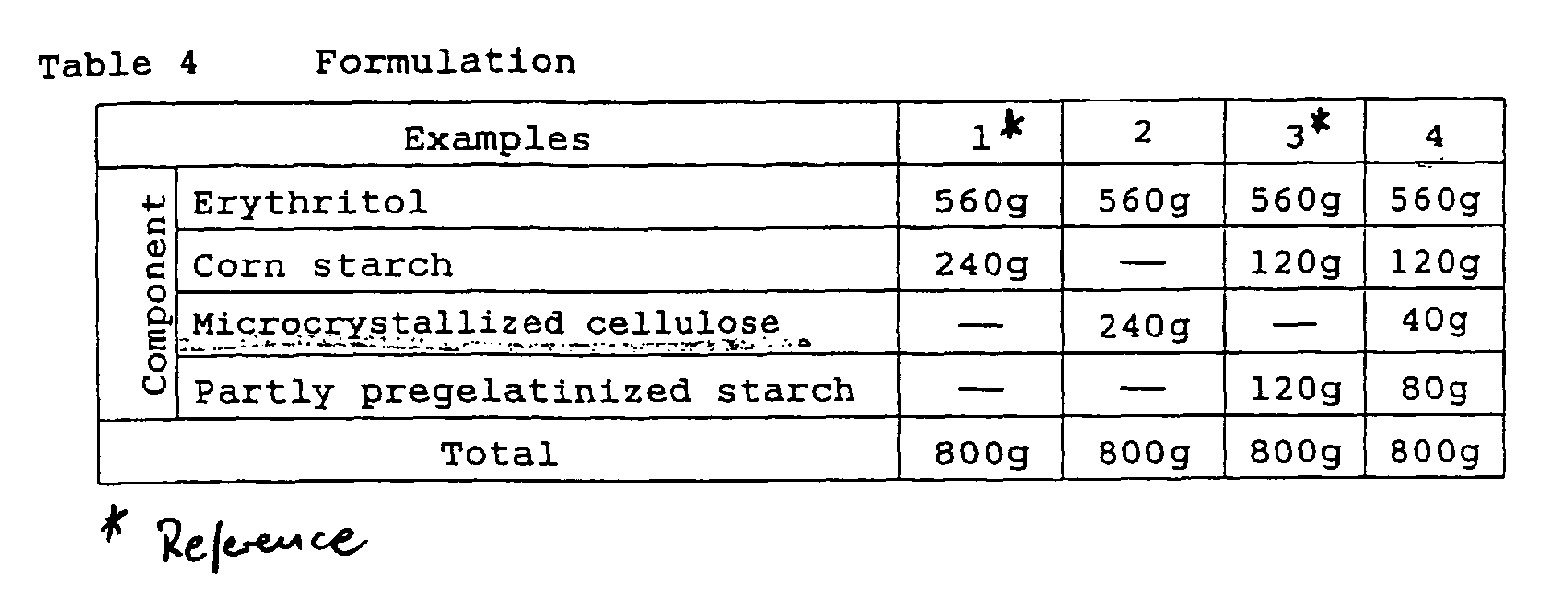
Table 5 Formulation characteristics Example 1* 2 Punching pressure (kg/stroke) 722 1091 1275 531 696 1021 (kg/cm2) 920 1390 1624 676 887 1301 Hardness (kg) 1.9 4.0 4.9 3.6 5.0 7.3 Intraoral disintegration or dissolution time (sec) 12 16 22 12 17 22 Disintegration time (sec) 15 20 24 10 11 14 Fall impact strength (%) 0 0 0 0 0 0 Density (mg/cm3) 1162 1227 1246 1121 1164 1222 Remarks No capping, No rough sensation No capping, No rough sensation *Reference Table 6 Formulation characteristics Example 3* 4 Punching pressure (kg/stroke) 706 1063 1176 729 1016 1224 (kg/cm2) 899 1354 1498 929 1294 1559 Hardness (kg) 1.9 3.9 4.6 1.2 2.1 3.0 Intraoral disintegration or dissolution time (sec) 13 16 16 18 24 28 Disintegration time (sec) 31 34 35 35 43 37 Fall impact strength 20 0 0 0 0 0 Density (mg/cm3) 1137 1195 1211 1115 1164 1190 Remarks No capping, No rough sensation No capping, No rough sensation *Reference - Erythritol (product of Nikken Chemical Co., Ltd., which passes through a 42-mesh screen (350 µm)) and corn starch, were added to a fluidized-bed granulator in amounts shown in Table 7 (formulation indicated under "5"). The ingredients were mixed for 3 minutes and then 20 w/v% D-mannitol aqueous solution (175 ml) was added for granulation under a spray air pressure of 2 kg/cm2 and at a spray rate of 18 ml/min. After drying, the resultant granules were sieved through a 16-mesh screen (1000 µm). To the through-sieved granules was added magnesium stearate (0.5% by weight), followed.by mixing. The resultant mixture was formed into tablets by use of a single-punch tablet machine which shape flat-faced and curved eged tablets of 10 mmφ. Tablets each weighing 400 mg were produced by the application of three different punching pressures. Results of the tests performed on the thus-prepared tablets are shown in Table 8 (columns indicated under "5").
- The procedure of Example 5 was repeated based on the formulation shown in Table 7 (formulation indicated under "6") using corn starch and microcrystalline cellulose instead of corn starch. Results of the tests performed on the thus-prepared tablets are shown in Table 8 (column 6).

Table 8 Formulation characteristics Examples 5* 6 Punching pressure (kg/stroke) 826 1037 1446 552 703 920 (kg/cm2) 1052 1321 1842 703 895 1172 Hardness (kg) 0.9 1.5 3.0 3.1 4.3 5.9 Intraoral disintegration or dissolution time (sec) 19 23 29 23 27 33 Disintegration time (sec) 24 27 28 26 26 26 Fall impact strength (%) 20 10 0 0 0 0 Density (mg/cm3) 1135 1169 1218 1128 1168 1205 Remarks No capping, No capping, No rough sensation No rough sensation *Reference - Erythritol (product of Nikken Chemical Co., Ltd., which passes through a 42-mesh screen (350 µm)) and corn starch, were added to a fluidized-bed granulator in amounts shown in Table 9 (formulation indicated under "7"). The ingredients were mixed for 3 minutes and then 70 w/v% aqueous xylitol solution (32 ml) was added for granulation under a spray air pressure of 2 kg/cm2 and at a spray rate of 6 ml/min. After drying, the resultant granules were sieved through a 16-mesh screen (1000 µm). To the through-sieved granules was added magnesium stearate (0.5% by weight), followed by mixing. The resultant mixture was formed into tablets which are flat-faced and curved eged tablets of 10 mmφ by use of a single-punch tablet machine. Tablets each weighing 400 mg were produced by the application of three different punching pressures. Results of the tests performed on the thus-prepared tablets are shown in Table 10 (columns indicated under "7").
- The procedure of Example 7 was repeated based on the formulation shown in Table 9 (formulation indicated under "8") adding corn starch and microcrystalline cellulose instead of corn starch and mixing for 3 minutes, and then using 8 w/v% aqueous xylitol solution (200 ml). Results of the tests performed on the thus-prepared tablets are shown in Table 10 (column 8).

Table 10 Formulation characteristics Examples 7* 8 Punching pressure (kg/stroke) 836 1009 1259 481 713 837 (kg/cm2) 1065 1285 1604 613 908 1066 Hardness (kg) 1.1 1.4 2.2 2.9 5.3 6.3 Intraoral disintegration or dissolution time (sec) 20 22 26 15 23 31 Disintegration time (sec) 63 57 65 23 252 30 Fall impact strength (%) 10 10 0 0 0 0 Density (mg/cm3) 1139 1165 1191 1109 1171 1195 Remarks No Capping, No Capping, No rough sensation No rough sensation * Reference - Erythritol (product of Nikken Chemical Co., Ltd., which passes through a 42-mesh screen (350 µm)) and synthetic hydrotalcite, were added to a fluidized-bed granulator in amounts shown in Table 11 (formulation indicated under "9"). The ingredients were mixed for 3 minutes and then water (800 ml) was added for granulation under a spray air pressure of 2 kg/cm2 and at a spray rate of 20 ml/min. After drying, the resultant granules were sieved through a 16-mesh screen (1000 µm). To the through-sieved granules was added magnesium stearate (0.5% by weight), followed by mixing. The resultant mixture was formed into tablets which are flat-faced and curved eged tablets of 10 mmφ by use of a single-punch tablet machine. Tablets each weighing 400 mg were produced by the application of three different punching pressures. Results of the tests performed on the thus-prepared tablets are shown in Table 12 (columns indicated under "9").
- The procedure of Example 9 was repeated based on the formulation shown in Table 11 (formulation indicated under "10") using precipitated calcium carbonate instead of synthetic hydrotalcite. Results of the tests performed on the thus-prepared tablets are shown in Table 12 (column 10).

Table 12 Formulation characteristics Examples 9* 10* Punching pressure (kg/stroke) 696 833 1245 760 945 (kg/cm2) 887 1062 1586 968 1204 Hardness (kg) 2.1 2.8 5.5 2.1 2.7 Intraoral disintegration or dissolution time (sec) 13 14 19 42 47 Disintegration time (sec) 19 21 21 106 100 Fall impact strength (%) 0 0 0 20 10 Density (mg/cm3) 1106 1132 1197 1301 1326 Remarks No capping, No capping, No rough sensation no rough sensation *Reference - Erythritol (product of Nikken Chemical Co., Ltd., which passes through a 42-mesh screen (350 µm)) and ascorbic acid, were added to a fluidized-bed granulator in amounts shown in Table 13 (formulation indicated under "11"). The ingredients were mixed for 3 minutes and then water (240 ml) was added for granulation under a spray air pressure of 1.5 kg/cm2 and at a spray rate of 24 ml/min. After drying, the resultant granules were sieved through a 16-mesh screen (1000 µm). To the through-sieved granules were added microcrystalline cellulose in amounts shown in Table 13 (formulation indicated under "11") and magnesium stearate (0.5% by weight), followed by mixing. The resultant mixture was formed into tablets which are flat-faced and curved eged tablets of 10 mmφ by use of a single-punch tablet machine. Tablets each weighing 400 mg were produced by the application of three different punching pressures. Results of the tests performed on the thus-prepared tablets are shown in Table 14 (columns indicated under "11").
- The procedure of Example 11 was repeated based on the formulation shown in Table 13 (formulation indicated under "12") using thiamine nitrate instead of ascorbic acid. Results of the tests performed on the thus-prepared tablets are shown in Table 14 (column 12).

Table 14 Formulation characteristics Examples 11 12 Punching pressure (kg/stroke) 361 546 1039 275 1125 1425 (kg/cm2) 460 696 1324 350 1433 1815 Hardness (kg) 3.5 5.3 9.8 0.5 2.1 3.0 Intraoral disintegration or dissolution time (sec) 25 31 43 16 22 20 Disintegration time (sec) 10 17 42 16 17 20 Fall impact strength (%) 0 0 0 10 0 0 Density (mg/cm3) 1110 1221 1317 1113 1254 1286 Remarks No capping, No capping, No rough sensation No rough sensation - Erythritol (product of Nikken Chemical Co., Ltd., which passes through a 42-mesh screen (350 µm)), cimetidine, microcrystalline cellulose, and low substituted hydroxypropylcellulose, respectively in amounts shown in Table 15, were added to a fluidized-bed granulator. The ingredients were mixed for 3 minutes and then 8 w/v% D-mannitol aqueous solution (100 ml) was added for granulation under a spray air pressure of 1.5 kg/cm2 and at a spray rate of 20 ml/min. After drying, the resultant granules were sieved through a 16-mesh screen (1000 µm). To the through-sieved granules were added magnesium stearate (0.5% by weight), followed by mixing. The resultant mixture was formed into tablets which are flat-faced and curved eged tablets of 10 mmφ by use of a single punch tablet machine. Tablets each weighing 400 mg were produced by the application of three different punching pressures. Results of the tests performed on the thus-prepared tablets are shown in Table 16.

Table 16 Formulation characteristics Examples 13 Punching (kg/stroke) 275* 595 1450* pressure (kg/cm2) 350 758 1847 Hardness (kg) 0.6 1.3 4.1 Intraoral disintegration or dissolution time (sec) 31 30 38 Disintegration time (sec) 22 22 25 Fall impact strength (%) 20 0 0 Density (mg/cm3) 1101 1205 1322 Remarks No capping, No rough sensation *Reference - The rapidly disintegratable compression-molded material of the present invention disintegrates and dissolves rapidly when placed in the oral cavity or in water. Therefore, it can be taken easily. It also has enhanced hardness, exhibiting excellent storage stability in the process of manufacture and distribution.
- Accordingly, in accordance with the pharmaceutical agents contained therein, it can be advantageously used for the treatment and prevention of diseases suffered by patients, particularly elderly citizens, children, and patients who have difficulty in swallowing.
- Moreover, according to the process for the manufacture of the present invention, the rapidly disintegratable compression-molded material exhibiting excellent characteristics as described above can be produced very easily without requiring intricate manufacture steps or special facility.
- Furthermore, since the process of the present invention uses a dry tableting method, the material can be formed into tablets of multi-type granules or into multi-layer tablets. In addition, the present process is applicable for the manufacture of drug formulations in which a plurality of ingredients are contained in mutually varying amounts.
| Reference Examples | 1 | 2 | 3 | 4 | |
| Component | |||||
| Erythritol | 350g | 350g | 350g | 560g | |
| Lactose | 150g | -- | -- | 230g | |
| Anhydrous glucose | -- | 150g | -- | -- | |
| Sucrose | -- | -- | 150g | -- | |
| Polyvinyl alcohol | -- | -- | -- | 10g | |
| Total | 500g | 500g | 500g | 800g | |
| Reference Examples | 1 | 2 | |||||
| Punching pressure | (kg/stroke) | 598 | 722 | 1063 | 452 | 636 | 1126 |
| (kg/cm2) | 762 | 920 | 1354 | 576 | 810 | 1434 | |
| Hardness (kg) | 1.4 | 1.8 | 2.1 | 0.9 | 1.3 | 2.5 | |
| Intraoral disintegration or dissolution time (sec) | 37 | 43 | 45 | 46 | 58 | 77 | |
| Disintegration time (sec) | 46 | 39 | 30 | 43 | 50 | 65 | |
| Fall impact strength (%) | 30 | 10 | 30 | 10 | 30 | 30 | |
| Density (mg/cm3) | 1193 | 1210 | 1240 | 1156 | 1207 | 1251 | |
| Remarks | Hardness was not improved. | Hardness was not improved. | |||||
| Capping occurred at ≥1000 kg/cm2 | Capping occurred at ≥1000 kg/cm2 | ||||||
| Reference Examples | 3 | 4 | |||||
| Punching pressure | (kg/stroke) | 467 | 690 | 995 | 695 | 1033 | 1247 |
| (kg/cm2) | 595 | 879 | 1268 | 885 | 1316 | 1588 | |
| Hardness (kg) | 1.3 | 2.0 | 2.7 | 2.0 | 3.9 | 4.9 | |
| Intraoral disintegration or dissolution time (sec) | 95 | 124 | 150 | 174 | 239 | 261 | |
| Disintegration time (sec) | 12 | 12 | 14 | 93 | 112 | 146 | |
| Fall impact strength (%) | 10 | 20 | 30 | 10 | 0 | 0 | |
| Density (mg/cm3) | 1174 | 1214 | 1243 | 1205 | 1241 | 1252 | |
| Remarks | Hardness was not improved. | Long intraoral disintegration time, No capping | |||||
| Capping occurred at ≥1000 kg/cm2 | |||||||
Claims (4)
- A quickly disintegratable compression-molded material disintegrating and dissolving quickly in the oral cavity, which is obtainable by subjecting a substantially dry composition comprising(a) cellulose as an excipient, which is selected from the group consisting of microcrystalline cellulose, powdered cellulose, low substituted hydroxypropyl cellulose, carmellose and cross carmellose Na, and(b) erythritolto compression-molding at a pressure of 400 to 1600 kg/cm2.
- The quickly disintegratable compression-molded material according to claim 1, wherein the cellulose is microcrystalline cellulose.
- A process for the production of a quickly disintegratable compression-molded material, characterized by subjecting a substantially dry composition comprising(a) cellulose as an excipient, which is selected from the group consisting of microcrystalline cellulose, powdered cellulose, low substituted hydroxypropyl cellulose carmellose and cross carmellose Na, and(b) erythritolto compression-molding at a pressure of 400 to 1600 kg/cm2.
- The process according to claim 3, wherein the cellulose is microcrystalline cellulose.
Applications Claiming Priority (3)
| Application Number | Priority Date | Filing Date | Title |
|---|---|---|---|
| JP18327896 | 1996-07-12 | ||
| JP18327896 | 1996-07-12 | ||
| EP97930741A EP0922464B1 (en) | 1996-07-12 | 1997-07-10 | Quickly disintegrable compression-molded materials and process for producing the same |
Related Parent Applications (1)
| Application Number | Title | Priority Date | Filing Date |
|---|---|---|---|
| EP97930741A Division EP0922464B1 (en) | 1996-07-12 | 1997-07-10 | Quickly disintegrable compression-molded materials and process for producing the same |
Publications (2)
| Publication Number | Publication Date |
|---|---|
| EP1380308A1 EP1380308A1 (en) | 2004-01-14 |
| EP1380308B1 true EP1380308B1 (en) | 2008-07-09 |
Family
ID=16132866
Family Applications (2)
| Application Number | Title | Priority Date | Filing Date |
|---|---|---|---|
| EP03017389A Expired - Lifetime EP1380308B1 (en) | 1996-07-12 | 1997-07-10 | Quickly disintegrable compression-molded materials and process for producing the same |
| EP97930741A Expired - Lifetime EP0922464B1 (en) | 1996-07-12 | 1997-07-10 | Quickly disintegrable compression-molded materials and process for producing the same |
Family Applications After (1)
| Application Number | Title | Priority Date | Filing Date |
|---|---|---|---|
| EP97930741A Expired - Lifetime EP0922464B1 (en) | 1996-07-12 | 1997-07-10 | Quickly disintegrable compression-molded materials and process for producing the same |
Country Status (16)
| Country | Link |
|---|---|
| US (1) | US6287596B1 (en) |
| EP (2) | EP1380308B1 (en) |
| KR (2) | KR20050071718A (en) |
| CN (1) | CN1222317C (en) |
| AT (2) | ATE400299T1 (en) |
| AU (1) | AU713462B2 (en) |
| BR (1) | BR9710265A (en) |
| CA (1) | CA2260038A1 (en) |
| DE (2) | DE69732909T2 (en) |
| DK (1) | DK0922464T3 (en) |
| ES (1) | ES2239783T3 (en) |
| NO (1) | NO990096L (en) |
| PT (1) | PT922464E (en) |
| RU (1) | RU2189227C2 (en) |
| TW (1) | TW586941B (en) |
| WO (1) | WO1998002185A1 (en) |
Families Citing this family (136)
| Publication number | Priority date | Publication date | Assignee | Title |
|---|---|---|---|---|
| EP0974366B1 (en) | 1997-03-28 | 2006-10-18 | Eisai Co., Ltd. | Oral pharmaceutical preparations decreased in bitterness by masking |
| JP4939680B2 (en) * | 1997-05-27 | 2012-05-30 | 武田薬品工業株式会社 | Solid preparation |
| TW580397B (en) | 1997-05-27 | 2004-03-21 | Takeda Chemical Industries Ltd | Solid preparation |
| GB9716432D0 (en) * | 1997-08-05 | 1997-10-08 | Cerestar Holding Bv | Tableting of erythritol |
| GB9720061D0 (en) * | 1997-09-19 | 1997-11-19 | Crosfield Joseph & Sons | Metal compounds as phosphate binders |
| US20030138485A1 (en) * | 1998-01-14 | 2003-07-24 | Daiichi Pharmaceutical Co., Ltd. | Disintegrant |
| EP1058538B9 (en) * | 1998-03-06 | 2013-01-02 | Aptalis Pharma S.r.l. | Fast disintegrating tablets |
| WO1999055373A1 (en) * | 1998-04-24 | 1999-11-04 | Fuji Chemical Industry Co., Ltd. | Saccharide-containing compositions |
| PT1121103E (en) | 1998-05-18 | 2007-02-28 | Takeda Pharmaceutical | Orally disintegrable tablets comprising a benzimidazole |
| ES2237121T3 (en) * | 1998-07-28 | 2005-07-16 | Takeda Pharmaceutical Company Limited | FAST DISGREGABLE SOLID PREPARATION. |
| US6368625B1 (en) * | 1998-08-12 | 2002-04-09 | Cima Labs Inc. | Orally disintegrable tablet forming a viscous slurry |
| JP2000086537A (en) * | 1998-09-11 | 2000-03-28 | Fuji Chem Ind Co Ltd | Inorganic compound saccharide composition, excipient, rapidly disintegrating compression-molded product, and method for producing the same |
| US6596298B2 (en) * | 1998-09-25 | 2003-07-22 | Warner-Lambert Company | Fast dissolving orally comsumable films |
| GB9901819D0 (en) * | 1999-01-27 | 1999-03-17 | Scherer Corp R P | Pharmaceutical compositions |
| JP4719899B2 (en) * | 2000-01-07 | 2011-07-06 | 大正製薬株式会社 | Orally rapidly disintegrating tablets |
| PT1260215E (en) | 2000-03-01 | 2009-09-03 | Eisai R&D Man Co Ltd | Rapidly disintegrable tablet containing polyvinyl alcohol |
| AR028253A1 (en) * | 2000-03-16 | 2003-04-30 | Pfizer Prod Inc | INHIBITORS OF THE GLUCOGENO FOSFORILASA |
| CA2311734C (en) * | 2000-04-12 | 2011-03-08 | Bristol-Myers Squibb Company | Flash-melt oral dosage formulation |
| AU2001248751A1 (en) * | 2000-04-12 | 2001-10-23 | Banyu Pharmaceutical Co. Ltd. | Compositions disintegrating in oral cavity and preparations disintegrating in oral cavity |
| US7510728B2 (en) | 2000-10-06 | 2009-03-31 | Takeda Pharmaceutical Company Limited | Solid preparations |
| CN1469737A (en) * | 2000-10-16 | 2004-01-21 | ��һ��������ҩ��ʽ���� | Oral rapidly disintegrating pharmaceutical composition and preparation method thereof |
| US6733781B2 (en) | 2000-12-06 | 2004-05-11 | Wyeth | Fast dissolving tablet |
| US7799342B2 (en) | 2000-12-06 | 2010-09-21 | Wyeth Llc | Fast dissolving tablet |
| WO2002069933A1 (en) * | 2001-03-06 | 2002-09-12 | Kyowa Hakko Kogyo Co., Ltd. | Tablets quickly disintegrating in oral cavity |
| US6998139B2 (en) * | 2001-03-15 | 2006-02-14 | Astellas Pharma Inc. | Bitterness-reduced intrabuccally quick disintegrating tablets and method for reducing bitterness |
| JP2002275075A (en) * | 2001-03-15 | 2002-09-25 | Fancl Corp | Crude drug powder-containing solid composition and method for producing the same |
| CN1473035B (en) | 2001-07-27 | 2012-07-18 | 安斯泰来制药有限公司 | Compositions containing substained-release fine grains for tablets quickly disintegrable in oral cavity and process for producing same |
| TWI324074B (en) * | 2001-10-09 | 2010-05-01 | Bristol Myers Squibb Co | Flashmelt oral dosage formulation |
| FR2831820B1 (en) * | 2001-11-05 | 2004-08-20 | Ethypharm Sa | ORODISPERSIBLE TABLET HAVING HIGH HOMOGENEITY AND PREPARATION METHOD THEREOF |
| US6723348B2 (en) * | 2001-11-16 | 2004-04-20 | Ethypharm | Orodispersible tablets containing fexofenadine |
| KR100460282B1 (en) * | 2001-12-10 | 2004-12-08 | 고토부키 세이야쿠 가부시키가이샤 | A mouth dosable medicine compound whose bitter taste is reduced |
| KR100798672B1 (en) * | 2001-12-24 | 2008-01-28 | 경동제약 주식회사 | Dry granules containing nizatidine, fast-acting tablets and preparation method thereof |
| US20030148818A1 (en) * | 2002-01-18 | 2003-08-07 | Myrhum Mark C. | Golf club woods with wood club head having a selectable center of gravity and a selectable shaft |
| FR2834889B1 (en) * | 2002-01-18 | 2004-04-02 | Roquette Freres | SOLID ORODISPERSIBLE PHARMACEUTICAL FORM |
| US20030152605A1 (en) | 2002-01-29 | 2003-08-14 | Whitmire Micro-Gen Research Laboratories, Inc. | Optimum density termite bait composition |
| CN1688291A (en) * | 2002-02-01 | 2005-10-26 | 辉瑞产品公司 | Immediate release dosage forms containing solid drug dispersions |
| JP2003238393A (en) * | 2002-02-15 | 2003-08-27 | Otsuka Pharmaceut Co Ltd | Tablet with improved tableting property and method for producing the same |
| DE10207394B4 (en) * | 2002-02-21 | 2007-03-29 | Lts Lohmann Therapie-Systeme Ag | Taste-masked oblate medicinal preparation |
| KR20040091135A (en) * | 2002-03-14 | 2004-10-27 | 다이이찌 산토리 파마 가부시키가이샤 | Tablet containing pilsicainide hydrochloride(dry) |
| AU2003213337A1 (en) * | 2002-03-14 | 2003-09-22 | Daiichi Suntory Pharma Co., Ltd. | Tablet containing pilsicainide hydrochloride (wet) |
| ES2302926T5 (en) | 2002-04-25 | 2012-08-23 | Banner Pharmacaps, Inc. | Soft Chewable Capsule |
| US20030228370A1 (en) * | 2002-06-11 | 2003-12-11 | Michel Serpelloni | Orodispersible solid pharmaceutical form |
| AU2003254914A1 (en) * | 2002-08-12 | 2004-03-03 | Kyowa Hakko Kogyo Co., Ltd. | Amino acid-containing chewable |
| CA2501021C (en) * | 2002-09-30 | 2011-02-22 | Daiichi Pharmaceutical Co., Ltd. | Pantethine-containing particulate |
| UA80991C2 (en) * | 2002-10-07 | 2007-11-26 | Solid preparation containing an insulin resistance improving drug and an active ingredient useful as a remedy for diabetes | |
| GB2394163B (en) * | 2002-10-14 | 2005-12-21 | Nestle Sa | Freeze-dried coffee tablets |
| ATE514418T1 (en) * | 2002-11-12 | 2011-07-15 | Elan Pharma Int Ltd | RAPIDLY DISRUPTING SOLID DOSAGE FORMS WITH NON-FRUABLE CONSISTENCY AND PULLULAN |
| EP1578422B1 (en) | 2002-12-20 | 2007-04-11 | NicoNovum AB | A physically and chemically stable nicotine and micorcrystalline cellulose containing particulate material |
| US20070092583A1 (en) * | 2003-04-30 | 2007-04-26 | Tim Clarot | Cold remedy composition comprising zinc salts |
| JP4739217B2 (en) * | 2003-05-07 | 2011-08-03 | サムヤン コーポレイション | Highly plastic granules for making fast dissolving tablets |
| KR101125268B1 (en) * | 2003-06-06 | 2012-04-23 | 에띠팜 | Orally-dispersible multilaer tablet |
| FR2855756B1 (en) * | 2003-06-06 | 2005-08-26 | Ethypharm Sa | MULTILAYER ORODISPERSIBLE TABLET |
| JP4702763B2 (en) * | 2003-07-30 | 2011-06-15 | 塩野義製薬株式会社 | Stable tablets containing crystalline cellulose |
| US7282217B1 (en) | 2003-08-29 | 2007-10-16 | Kv Pharmaceutical Company | Rapidly disintegrable tablets |
| JP2005187349A (en) * | 2003-12-24 | 2005-07-14 | Lion Corp | Orally disintegrating tablets |
| US7670624B2 (en) | 2004-01-29 | 2010-03-02 | Astella Pharma Inc. | Gastrointestinal-specific multiple drug release system |
| WO2005094843A1 (en) * | 2004-03-11 | 2005-10-13 | Nutriset | Rapidly disintegrating taste-masked tablet |
| US20050220865A1 (en) * | 2004-04-02 | 2005-10-06 | Koleng John J | Compressed composition comprising magnesium salt |
| JP5112619B2 (en) * | 2004-05-20 | 2013-01-09 | 大塚製薬株式会社 | Solid pharmaceutical formulation |
| TWI338583B (en) * | 2004-05-20 | 2011-03-11 | Otsuka Pharma Co Ltd | Solid pharmaceutical formulation |
| TW200613009A (en) * | 2004-06-11 | 2006-05-01 | Ono Pharmaceutical Co | Capsule having chewing stability |
| ES2255429B1 (en) * | 2004-10-25 | 2007-08-16 | Italfarmaco, S.A. | COMPOSITIONS PHARMACEUTICAL BUCODISPERSABLES. |
| RU2282443C1 (en) * | 2004-12-29 | 2006-08-27 | Закрытое акционерное общество "Фармацевтическое предприятие "Оболенское" | Medicinal agent possessing antihypertensive effect and method for its preparing |
| FR2881957B1 (en) * | 2005-02-16 | 2008-08-08 | Solvay | TABLETS COMPRISING A BIOLOGICALLY ACTIVE SUBSTANCE AND AN EXCIPIENT |
| RU2280467C1 (en) * | 2005-02-17 | 2006-07-27 | Открытое акционерное общество "Щелковский витаминный завод" | Method for producing tablet "vikair" possessing anti-ulcerous and anti-acid effect |
| KR101435199B1 (en) * | 2005-05-18 | 2014-08-28 | 다이닛본 스미토모 세이야꾸 가부시끼가이샤 | Stable tablets containing Droxidopa |
| US8497258B2 (en) | 2005-11-12 | 2013-07-30 | The Regents Of The University Of California | Viscous budesonide for the treatment of inflammatory diseases of the gastrointestinal tract |
| PE20070698A1 (en) * | 2005-11-14 | 2007-08-17 | Teijin Pharma Ltd | INTRAORAL RAPID DISGREGATION TABLET CONTAINING AMBROXOL HYDROCHLORIDE |
| MY157620A (en) | 2006-01-31 | 2016-06-30 | Cytochroma Dev Inc | A granular material of a solid water-soluble mixed metal compound capable of binding phosphate |
| EP1986591A1 (en) * | 2006-02-10 | 2008-11-05 | LG Household & Health Care Ltd. | In-situ melting and gelling tablet composition for oral care |
| JP5158318B2 (en) * | 2006-03-07 | 2013-03-06 | ライオン株式会社 | Orally disintegrating tablets |
| US9402809B2 (en) | 2006-03-16 | 2016-08-02 | Niconovum Usa, Inc. | Snuff composition |
| ES2302650B1 (en) * | 2007-01-11 | 2009-02-16 | Tedec-Meiji Farma, S.A. | COMPOSITION OF FAST DISINTEGRATION IN THE ORAL CAVITY. |
| RU2009132748A (en) * | 2007-02-12 | 2011-03-20 | Вм. Ригли Дж. Компани (Us) | CONFECTIONERY AND METHOD FOR ITS MANUFACTURE |
| EP2114171A1 (en) * | 2007-02-12 | 2009-11-11 | Wm. Wrigley Jr. Company | Coated confectionery products |
| GB0714670D0 (en) * | 2007-07-27 | 2007-09-05 | Ineos Healthcare Ltd | Use |
| JP5623275B2 (en) * | 2007-07-31 | 2014-11-12 | カーギル インコーポレイテッド | Directly tabletable dextrose |
| WO2009022670A1 (en) * | 2007-08-10 | 2009-02-19 | Takeda Pharmaceutical Company Limited | Quickly disintegrating tablet |
| US20090053366A1 (en) * | 2007-08-21 | 2009-02-26 | Marni Markell Hurwitz | Refreshment system having effervescent supplement tablets |
| US20090053365A1 (en) * | 2007-08-21 | 2009-02-26 | Marni Markell Hurwitz | Refreshment system having peel away nutrient and supplement packages |
| US20090060983A1 (en) * | 2007-08-30 | 2009-03-05 | Bunick Frank J | Method And Composition For Making An Orally Disintegrating Dosage Form |
| GB2452953B (en) * | 2007-09-20 | 2010-03-10 | Kraft Foods R & D Inc | Coffee Composition |
| GB0720220D0 (en) * | 2007-10-16 | 2007-11-28 | Ineos Healthcare Ltd | Compound |
| GB2453770A (en) * | 2007-10-19 | 2009-04-22 | Reckitt Benckiser Healthcare | Oral composition comprising a cooling agent |
| WO2009054432A1 (en) * | 2007-10-26 | 2009-04-30 | Daiichi Sankyo Company, Limited | Intraorally rapidly disintegrating pharmaceutical composition, and method for production thereof |
| AU2008318851B2 (en) * | 2007-10-31 | 2014-04-17 | Mcneil-Ppc, Inc. | Orally disintegrated dosage form |
| DK3354276T3 (en) | 2007-11-13 | 2020-03-30 | Meritage Pharma Inc | COMPOSITIONS FOR THE TREATMENT OF GASTROINTESTINAL INFLAMMATION |
| EP2100595A1 (en) * | 2008-03-10 | 2009-09-16 | The Procter and Gamble Company | Compressed tablets |
| US8728446B2 (en) * | 2008-06-03 | 2014-05-20 | I Did It, Inc. | Oral hygiene tablets and capsules for direct oral delivery of active ingredients |
| US20110180445A1 (en) * | 2008-06-03 | 2011-07-28 | Marni Markell Hurwitz | Cosmetic tablets and capsules for direct delivery of active ingredients |
| WO2009151072A1 (en) * | 2008-06-13 | 2009-12-17 | 大日本住友製薬株式会社 | Tablet quickly disintegrating in the oral cavity and method for producing the same |
| ES2377869T3 (en) * | 2008-09-04 | 2012-04-02 | Cargill, Incorporated | Erythritol tablet manufacturing |
| US8833378B2 (en) * | 2008-09-17 | 2014-09-16 | Niconovum Ab | Process for preparing snuff composition |
| US20120015094A1 (en) | 2009-04-09 | 2012-01-19 | The Folgers Coffee Company | Ground roast coffee tablet |
| MX2011010622A (en) | 2009-04-09 | 2012-02-23 | Folgers Coffee Co | Ground roast coffee tablet. |
| EP2433652B1 (en) * | 2009-05-20 | 2016-11-09 | Sumitomo Dainippon Pharma Co., Ltd. | Dry-coated orally-disintegrating tablet |
| EP2440210A4 (en) | 2009-06-12 | 2014-01-29 | Meritage Pharma Inc | METHODS OF TREATING GASTROINTESTINAL DISORDERS |
| GB0913525D0 (en) | 2009-08-03 | 2009-09-16 | Ineos Healthcare Ltd | Method |
| CN102480998B (en) | 2009-08-18 | 2016-05-25 | 卡吉尔公司 | The compressing tablet of erythrite and isomalt |
| US8858210B2 (en) | 2009-09-24 | 2014-10-14 | Mcneil-Ppc, Inc. | Manufacture of variable density dosage forms utilizing radiofrequency energy |
| US8784781B2 (en) * | 2009-09-24 | 2014-07-22 | Mcneil-Ppc, Inc. | Manufacture of chewing gum product with radiofrequency |
| ES2713330T3 (en) * | 2009-12-11 | 2019-05-21 | Sumitomo Dainippon Pharma Co Ltd | Dry-coated tablet that disintegrates orally |
| GB201001779D0 (en) | 2010-02-04 | 2010-03-24 | Ineos Healthcare Ltd | Composition |
| JP5902677B2 (en) * | 2010-06-01 | 2016-04-13 | カーギル インコーポレイテッド | Orally disintegrating tablets of erythritol and isomalt |
| EP2658387B2 (en) | 2010-12-30 | 2024-10-30 | Wm. Wrigley Jr. Company | Hard candy with reduced sugar |
| RU2628506C2 (en) | 2012-01-09 | 2017-08-17 | Вм.Ригли Джр. Компани | Composition of gelated sweet (versions) and method of its manufacturing |
| US9744134B2 (en) | 2012-02-03 | 2017-08-29 | Asahi Kasei Chemicals Corporation | Orally disintegrating tablet containing bitterness-masking granules |
| JP6194879B2 (en) * | 2012-02-20 | 2017-09-13 | ニプロ株式会社 | Method for producing orally disintegrating tablets |
| US9233491B2 (en) | 2012-05-01 | 2016-01-12 | Johnson & Johnson Consumer Inc. | Machine for production of solid dosage forms |
| US9511028B2 (en) | 2012-05-01 | 2016-12-06 | Johnson & Johnson Consumer Inc. | Orally disintegrating tablet |
| US9445971B2 (en) | 2012-05-01 | 2016-09-20 | Johnson & Johnson Consumer Inc. | Method of manufacturing solid dosage form |
| NZ704014A (en) * | 2012-07-27 | 2017-10-27 | Redhill Biopharma Ltd | Formulations and methods of manufacturing formulations for use in colonic evacuation |
| JP5945191B2 (en) * | 2012-08-09 | 2016-07-05 | 株式会社ファンケル | Intraoral quick disintegrating tablet |
| FR2999432B1 (en) * | 2012-12-17 | 2014-12-12 | Ethypharm Sa | ORODISPERSIBLE COMPRESSES OBTAINED BY COMPRESSION MOLDING |
| KR101352689B1 (en) * | 2012-12-31 | 2014-01-17 | (주) 에프엔지리서치 | Microgranule preparations comprising agglumerate units consisting of discontinuous phase and continuous phase |
| CN103040816A (en) * | 2012-12-31 | 2013-04-17 | 北京科源创欣科技有限公司 | Drug composition for curing peptic ulcer |
| JP2016117651A (en) * | 2013-04-16 | 2016-06-30 | 株式会社ダイセル | Fast disintegrating tablet suitable for administration to small animals, and simple production method thereof |
| JP2016117652A (en) * | 2013-04-16 | 2016-06-30 | 株式会社ダイセル | Fast disintegrating tablet suitable for administration to children, and simple production method thereof |
| WO2016061486A1 (en) * | 2014-10-16 | 2016-04-21 | Cargill, Incorporated | Process for preparing a directly compressible erythritol & uses thereof |
| JP2016141630A (en) * | 2015-01-30 | 2016-08-08 | 富士フイルム株式会社 | Orally disintegrating tablets |
| US10632076B2 (en) * | 2016-11-18 | 2020-04-28 | Fertin Pharma A/S | Tablet comprising separate binder and erythritol |
| EP3854383A1 (en) * | 2016-11-18 | 2021-07-28 | Fertin Pharma A/S | Oral delivery vehicle |
| US11351103B2 (en) | 2016-11-18 | 2022-06-07 | Johnson & Johnson Consumer Inc. | Method of providing oral care benefits |
| JP6840849B2 (en) * | 2016-11-18 | 2021-03-10 | フェルティン ファルマ アー/エス | Tablets containing separate binders and erythritol |
| US10543205B2 (en) * | 2016-11-18 | 2020-01-28 | Fertin Pharma A/S | Oral delivery vehicle containing nicotine |
| US11058633B2 (en) | 2018-05-17 | 2021-07-13 | Fertin Pharma A/S | Disintegrating oral tablet suitable for active pharmaceutical ingredients |
| US20190350858A1 (en) | 2018-05-17 | 2019-11-21 | Fertin Pharma A/S | Oral tablet for delivery of active ingredients to the gastrointestinal tract |
| US11096895B2 (en) | 2018-05-17 | 2021-08-24 | Fertin Pharma A/S | Oral tablet suitable for active pharmaceutical ingredients |
| US11135157B2 (en) | 2018-05-17 | 2021-10-05 | Fertin Pharma A/S | Oral tablet for delivery of active ingredients to the throat |
| US11058641B2 (en) | 2018-05-17 | 2021-07-13 | Fertin Pharma A/S | Oral tablet for taste masking of active ingredients |
| US11096896B2 (en) | 2018-05-17 | 2021-08-24 | Fertin Pharma A/S | Tablet dosage form for buccal absorption of active ingredients |
| US11052047B2 (en) | 2018-05-17 | 2021-07-06 | Fertin Pharma A/S | Oral tablet suitable for fast release of active pharmaceutical ingredients |
| US11090263B2 (en) | 2018-05-22 | 2021-08-17 | Fertin Pharma A/S | Tableted chewing gum suitable for active pharmaceutical ingredients |
| US11096894B2 (en) | 2018-05-17 | 2021-08-24 | Fertin Pharma A/S | Oral tablet for induced saliva generation |
| BE1028029B1 (en) * | 2020-06-11 | 2021-08-27 | Cole Pharmaceuticals | Orodispersible composition in the form of a melting tablet comprising at least one active substance, in particular comprising at least one vitamin as active substance |
| US20230292795A1 (en) * | 2020-07-24 | 2023-09-21 | Dsm Ip Assets B.V. | New fast dissolvable tablets |
Family Cites Families (11)
| Publication number | Priority date | Publication date | Assignee | Title |
|---|---|---|---|---|
| GB9100009D0 (en) * | 1991-01-02 | 1991-02-20 | Cerestar Holding Bv | Erythritol compositions |
| RU2109509C1 (en) * | 1991-12-24 | 1998-04-27 | Яманути Фармасьютикал Ко., Лтд. | Composition for buccal administration of drug and a method of its preparing |
| JP3069458B2 (en) * | 1992-01-29 | 2000-07-24 | 武田薬品工業株式会社 | Orally disintegrating tablet and production method thereof |
| EP0627218B1 (en) * | 1992-02-18 | 2001-12-19 | Nippon Shinyaku Company, Limited | Process for producing fast soluble tablets and fast soluble tablets comprising xylitol |
| JPH05310558A (en) * | 1992-05-07 | 1993-11-22 | Lion Corp | Solid preparation composition |
| TW391880B (en) * | 1994-01-31 | 2000-06-01 | Yamanouchi Pharma Co Ltd | An oral soluble type compression moulding and its preparation |
| JPH0827033A (en) * | 1994-07-14 | 1996-01-30 | Nikken Chem Co Ltd | Solid agent containing erythritol |
| JP2852498B2 (en) * | 1995-03-22 | 1999-02-03 | 江崎グリコ株式会社 | Low-calorie granules for tablet confection, method for producing the same, and tablet confection using the granules |
| JP3507211B2 (en) * | 1995-07-13 | 2004-03-15 | 三菱化学株式会社 | Dragees and dragees |
| JPH0948726A (en) * | 1995-08-07 | 1997-02-18 | Tanabe Seiyaku Co Ltd | Orally rapidly disintegrating preparation and method for producing the same |
| EP0839526A3 (en) * | 1996-10-31 | 1999-01-07 | Takeda Chemical Industries, Ltd. | Solid pharmaceutical preparation with fast buccal disintegration or dissolution |
-
1997
- 1997-07-10 RU RU99102730/14A patent/RU2189227C2/en not_active IP Right Cessation
- 1997-07-10 US US09/147,501 patent/US6287596B1/en not_active Expired - Fee Related
- 1997-07-10 AT AT03017389T patent/ATE400299T1/en not_active IP Right Cessation
- 1997-07-10 DE DE69732909T patent/DE69732909T2/en not_active Expired - Lifetime
- 1997-07-10 DK DK97930741T patent/DK0922464T3/en active
- 1997-07-10 EP EP03017389A patent/EP1380308B1/en not_active Expired - Lifetime
- 1997-07-10 CA CA002260038A patent/CA2260038A1/en not_active Abandoned
- 1997-07-10 KR KR1020057010997A patent/KR20050071718A/en not_active Ceased
- 1997-07-10 AT AT97930741T patent/ATE291930T1/en not_active IP Right Cessation
- 1997-07-10 DE DE69738829T patent/DE69738829D1/en not_active Expired - Lifetime
- 1997-07-10 BR BR9710265A patent/BR9710265A/en not_active Application Discontinuation
- 1997-07-10 CN CNB971963223A patent/CN1222317C/en not_active Expired - Fee Related
- 1997-07-10 AU AU34587/97A patent/AU713462B2/en not_active Ceased
- 1997-07-10 WO PCT/JP1997/002386 patent/WO1998002185A1/en not_active Ceased
- 1997-07-10 EP EP97930741A patent/EP0922464B1/en not_active Expired - Lifetime
- 1997-07-10 PT PT97930741T patent/PT922464E/en unknown
- 1997-07-10 ES ES97930741T patent/ES2239783T3/en not_active Expired - Lifetime
- 1997-07-11 TW TW086109801A patent/TW586941B/en not_active IP Right Cessation
-
1999
- 1999-01-11 NO NO990096A patent/NO990096L/en not_active Application Discontinuation
- 1999-01-11 KR KR1019997000172A patent/KR20000023713A/en not_active Ceased
Also Published As
| Publication number | Publication date |
|---|---|
| DK0922464T3 (en) | 2005-06-06 |
| TW586941B (en) | 2004-05-11 |
| AU3458797A (en) | 1998-02-09 |
| CA2260038A1 (en) | 1998-01-22 |
| EP0922464A4 (en) | 2000-07-05 |
| DE69738829D1 (en) | 2008-08-21 |
| EP0922464B1 (en) | 2005-03-30 |
| KR20000023713A (en) | 2000-04-25 |
| PT922464E (en) | 2005-07-29 |
| ATE291930T1 (en) | 2005-04-15 |
| ATE400299T1 (en) | 2008-07-15 |
| AU713462B2 (en) | 1999-12-02 |
| US6287596B1 (en) | 2001-09-11 |
| NO990096L (en) | 1999-02-08 |
| RU2189227C2 (en) | 2002-09-20 |
| ES2239783T3 (en) | 2005-10-01 |
| KR20050071718A (en) | 2005-07-07 |
| EP0922464A1 (en) | 1999-06-16 |
| CN1225017A (en) | 1999-08-04 |
| DE69732909T2 (en) | 2005-08-11 |
| WO1998002185A1 (en) | 1998-01-22 |
| BR9710265A (en) | 1999-08-10 |
| DE69732909D1 (en) | 2005-05-04 |
| NO990096D0 (en) | 1999-01-11 |
| CN1222317C (en) | 2005-10-12 |
| EP1380308A1 (en) | 2004-01-14 |
Similar Documents
| Publication | Publication Date | Title |
|---|---|---|
| EP0922464B1 (en) | Quickly disintegrable compression-molded materials and process for producing the same | |
| EP2572705B1 (en) | Orodispersible tablets | |
| ES2813859T3 (en) | Rapidly dispersing granules, orally disintegrating tablets and methods | |
| RU2273472C2 (en) | Medicinal composition decomposing in mouth cavity rapidly and method for its preparing | |
| US20040265375A1 (en) | Orally disintegrating tablets | |
| KR20030094272A (en) | Tablets quickly disintegrating in oral cavity | |
| JPH08301751A (en) | Release control type delivery system | |
| KR20100126266A (en) | Pharmaceutical composition | |
| WO2003086343A2 (en) | Fast disintegrating oral dosage forms | |
| Jain et al. | A review-formulation & development of orodispersible tablet | |
| JP2002255796A (en) | Rapidly disintegrating tablet in oral cavity and method for producing the same | |
| JP2003176242A (en) | Quickly disintegrable compression-molded material and method for producing the same | |
| EP2377522B1 (en) | Orally disintegrating tablet formulations of mirtazapine and process for preparing the same | |
| US9861581B2 (en) | Granulate for the formulation of orodispersible tablets | |
| Jeong et al. | Fast disintegrating tablets | |
| JP5080856B2 (en) | Tablets for oral administration | |
| Jangid et al. | Dispersible tablet as a formulation for oral drug delivery system | |
| KR101340733B1 (en) | Novel microgranule preparations | |
| JPWO1998002185A1 (en) | Rapidly disintegrating compression molded product and its manufacturing method | |
| EP2698151A1 (en) | Orally Disintegrating Formulation of Paliperidone | |
| JP2005194225A (en) | Gastric-disintegrable tablet | |
| US20030228370A1 (en) | Orodispersible solid pharmaceutical form | |
| WO2002092058A1 (en) | Rapidly disintegratable solid preparation | |
| HK1183629A (en) | Orodispersible tablets |
Legal Events
| Date | Code | Title | Description |
|---|---|---|---|
| PUAI | Public reference made under article 153(3) epc to a published international application that has entered the european phase |
Free format text: ORIGINAL CODE: 0009012 |
|
| 17P | Request for examination filed |
Effective date: 20030731 |
|
| AC | Divisional application: reference to earlier application |
Ref document number: 0922464 Country of ref document: EP Kind code of ref document: P |
|
| AK | Designated contracting states |
Kind code of ref document: A1 Designated state(s): AT BE CH DE DK ES FI FR GB GR IE IT LI LU MC NL PT SE |
|
| 17Q | First examination report despatched |
Effective date: 20040812 |
|
| AKX | Designation fees paid |
Designated state(s): AT BE CH DE DK ES FI FR GB GR IE IT LI LU MC NL PT SE |
|
| 17Q | First examination report despatched |
Effective date: 20040812 |
|
| GRAP | Despatch of communication of intention to grant a patent |
Free format text: ORIGINAL CODE: EPIDOSNIGR1 |
|
| GRAS | Grant fee paid |
Free format text: ORIGINAL CODE: EPIDOSNIGR3 |
|
| GRAA | (expected) grant |
Free format text: ORIGINAL CODE: 0009210 |
|
| AC | Divisional application: reference to earlier application |
Ref document number: 0922464 Country of ref document: EP Kind code of ref document: P |
|
| AK | Designated contracting states |
Kind code of ref document: B1 Designated state(s): AT BE CH DE DK ES FI FR GB GR IE IT LI LU MC NL PT SE |
|
| REG | Reference to a national code |
Ref country code: GB Ref legal event code: FG4D |
|
| REG | Reference to a national code |
Ref country code: CH Ref legal event code: EP |
|
| REF | Corresponds to: |
Ref document number: 69738829 Country of ref document: DE Date of ref document: 20080821 Kind code of ref document: P |
|
| REG | Reference to a national code |
Ref country code: IE Ref legal event code: FG4D |
|
| NLV1 | Nl: lapsed or annulled due to failure to fulfill the requirements of art. 29p and 29m of the patents act | ||
| PG25 | Lapsed in a contracting state [announced via postgrant information from national office to epo] |
Ref country code: PT Free format text: LAPSE BECAUSE OF FAILURE TO SUBMIT A TRANSLATION OF THE DESCRIPTION OR TO PAY THE FEE WITHIN THE PRESCRIBED TIME-LIMIT Effective date: 20081209 Ref country code: NL Free format text: LAPSE BECAUSE OF FAILURE TO SUBMIT A TRANSLATION OF THE DESCRIPTION OR TO PAY THE FEE WITHIN THE PRESCRIBED TIME-LIMIT Effective date: 20080709 Ref country code: ES Free format text: LAPSE BECAUSE OF FAILURE TO SUBMIT A TRANSLATION OF THE DESCRIPTION OR TO PAY THE FEE WITHIN THE PRESCRIBED TIME-LIMIT Effective date: 20081020 |
|
| PG25 | Lapsed in a contracting state [announced via postgrant information from national office to epo] |
Ref country code: AT Free format text: LAPSE BECAUSE OF FAILURE TO SUBMIT A TRANSLATION OF THE DESCRIPTION OR TO PAY THE FEE WITHIN THE PRESCRIBED TIME-LIMIT Effective date: 20080709 Ref country code: FI Free format text: LAPSE BECAUSE OF FAILURE TO SUBMIT A TRANSLATION OF THE DESCRIPTION OR TO PAY THE FEE WITHIN THE PRESCRIBED TIME-LIMIT Effective date: 20080709 |
|
| REG | Reference to a national code |
Ref country code: CH Ref legal event code: PL |
|
| PG25 | Lapsed in a contracting state [announced via postgrant information from national office to epo] |
Ref country code: MC Free format text: LAPSE BECAUSE OF NON-PAYMENT OF DUE FEES Effective date: 20080731 Ref country code: BE Free format text: LAPSE BECAUSE OF FAILURE TO SUBMIT A TRANSLATION OF THE DESCRIPTION OR TO PAY THE FEE WITHIN THE PRESCRIBED TIME-LIMIT Effective date: 20080709 |
|
| PG25 | Lapsed in a contracting state [announced via postgrant information from national office to epo] |
Ref country code: DK Free format text: LAPSE BECAUSE OF FAILURE TO SUBMIT A TRANSLATION OF THE DESCRIPTION OR TO PAY THE FEE WITHIN THE PRESCRIBED TIME-LIMIT Effective date: 20080709 |
|
| PLBE | No opposition filed within time limit |
Free format text: ORIGINAL CODE: 0009261 |
|
| STAA | Information on the status of an ep patent application or granted ep patent |
Free format text: STATUS: NO OPPOSITION FILED WITHIN TIME LIMIT |
|
| 26N | No opposition filed |
Effective date: 20090414 |
|
| PG25 | Lapsed in a contracting state [announced via postgrant information from national office to epo] |
Ref country code: LI Free format text: LAPSE BECAUSE OF NON-PAYMENT OF DUE FEES Effective date: 20080731 Ref country code: CH Free format text: LAPSE BECAUSE OF NON-PAYMENT OF DUE FEES Effective date: 20080731 |
|
| PG25 | Lapsed in a contracting state [announced via postgrant information from national office to epo] |
Ref country code: IE Free format text: LAPSE BECAUSE OF NON-PAYMENT OF DUE FEES Effective date: 20080710 |
|
| PG25 | Lapsed in a contracting state [announced via postgrant information from national office to epo] |
Ref country code: IT Free format text: LAPSE BECAUSE OF FAILURE TO SUBMIT A TRANSLATION OF THE DESCRIPTION OR TO PAY THE FEE WITHIN THE PRESCRIBED TIME-LIMIT Effective date: 20080709 |
|
| PG25 | Lapsed in a contracting state [announced via postgrant information from national office to epo] |
Ref country code: SE Free format text: LAPSE BECAUSE OF FAILURE TO SUBMIT A TRANSLATION OF THE DESCRIPTION OR TO PAY THE FEE WITHIN THE PRESCRIBED TIME-LIMIT Effective date: 20081009 |
|
| PG25 | Lapsed in a contracting state [announced via postgrant information from national office to epo] |
Ref country code: LU Free format text: LAPSE BECAUSE OF NON-PAYMENT OF DUE FEES Effective date: 20080710 |
|
| PG25 | Lapsed in a contracting state [announced via postgrant information from national office to epo] |
Ref country code: GR Free format text: LAPSE BECAUSE OF FAILURE TO SUBMIT A TRANSLATION OF THE DESCRIPTION OR TO PAY THE FEE WITHIN THE PRESCRIBED TIME-LIMIT Effective date: 20081010 |
|
| PGFP | Annual fee paid to national office [announced via postgrant information from national office to epo] |
Ref country code: DE Payment date: 20100707 Year of fee payment: 14 Ref country code: FR Payment date: 20100805 Year of fee payment: 14 |
|
| PGFP | Annual fee paid to national office [announced via postgrant information from national office to epo] |
Ref country code: GB Payment date: 20100707 Year of fee payment: 14 |
|
| GBPC | Gb: european patent ceased through non-payment of renewal fee |
Effective date: 20110710 |
|
| REG | Reference to a national code |
Ref country code: FR Ref legal event code: ST Effective date: 20120330 |
|
| PG25 | Lapsed in a contracting state [announced via postgrant information from national office to epo] |
Ref country code: FR Free format text: LAPSE BECAUSE OF NON-PAYMENT OF DUE FEES Effective date: 20110801 Ref country code: DE Free format text: LAPSE BECAUSE OF NON-PAYMENT OF DUE FEES Effective date: 20120201 |
|
| REG | Reference to a national code |
Ref country code: DE Ref legal event code: R119 Ref document number: 69738829 Country of ref document: DE Effective date: 20120201 |
|
| PG25 | Lapsed in a contracting state [announced via postgrant information from national office to epo] |
Ref country code: GB Free format text: LAPSE BECAUSE OF NON-PAYMENT OF DUE FEES Effective date: 20110710 |