EP1379066A2 - Call waiting notification - Google Patents
Call waiting notification Download PDFInfo
- Publication number
- EP1379066A2 EP1379066A2 EP03254178A EP03254178A EP1379066A2 EP 1379066 A2 EP1379066 A2 EP 1379066A2 EP 03254178 A EP03254178 A EP 03254178A EP 03254178 A EP03254178 A EP 03254178A EP 1379066 A2 EP1379066 A2 EP 1379066A2
- Authority
- EP
- European Patent Office
- Prior art keywords
- person
- voice
- processor
- incoming message
- psychoacoustic
- Prior art date
- Legal status (The legal status is an assumption and is not a legal conclusion. Google has not performed a legal analysis and makes no representation as to the accuracy of the status listed.)
- Granted
Links
Images




Classifications
-
- H—ELECTRICITY
- H04—ELECTRIC COMMUNICATION TECHNIQUE
- H04M—TELEPHONIC COMMUNICATION
- H04M3/00—Automatic or semi-automatic exchanges
- H04M3/42—Systems providing special services or facilities to subscribers
- H04M3/428—Arrangements for placing incoming calls on hold
- H04M3/4285—Notifying, informing or entertaining a held party while on hold, e.g. Music On Hold
-
- G—PHYSICS
- G10—MUSICAL INSTRUMENTS; ACOUSTICS
- G10L—SPEECH ANALYSIS TECHNIQUES OR SPEECH SYNTHESIS; SPEECH RECOGNITION; SPEECH OR VOICE PROCESSING TECHNIQUES; SPEECH OR AUDIO CODING OR DECODING
- G10L13/00—Speech synthesis; Text to speech systems
-
- H—ELECTRICITY
- H04—ELECTRIC COMMUNICATION TECHNIQUE
- H04M—TELEPHONIC COMMUNICATION
- H04M2201/00—Electronic components, circuits, software, systems or apparatus used in telephone systems
- H04M2201/40—Electronic components, circuits, software, systems or apparatus used in telephone systems using speech recognition
Definitions
- the present invention relates to telecommunications in general, and, more particularly, to a technique for notifying a person who is engaged in a telephone call with a second person that a third person is calling him or her.
- call waiting A popular feature of modern telecommunications systems is "call waiting." Without call waiting, a person who was engaged in a telephone call with a second person did not know when a third person was calling him or her. In contrast, with call waiting, a person who is engaged in a telephone call does, in fact, know when a third party is calling.
- the telecommunications system notifies the first person that a third person is calling by injecting a series of beeps into his or her ear. This is accomplished by generating and injecting the beeps into the audio channel from the second person. Upon hearing the beeps, the first person can either ignore the incoming call or can put the current call on hold and switch to the incoming call.
- the present invention provides a technique for notifying a person who is engaged in a telephone call with a second person that a third person is calling him or her without some of the costs and disadvantages for doing so in the prior art.
- the illustrative embodiments notify the person of the arrival of a message (e.g., a telephone call, a fax, an e-mail, etc.) not with a series of beeps but with a voice - synthetically generated or pre-recorded - that has at least one different psychoacoustic characteristic than the voice of the second person.
- a message e.g., a telephone call, a fax, an e-mail, etc.
- the illustrative embodiments facilitate the ability of the first person to simultaneously perceive and understand the notification and the voice of the second person.
- a " psychoacoustic " characteristic of a voice is defined as a quality of a voice that facilitates the ability of a listener to perceive and understand one voice at the same time as another.
- a psychoacoustic characteristic of a voice is not, therefore, necessarily the same as a voiceprint characteristic, which seeks to identify a voice or to distinguish one voice from another. Rather, a psychoacoustic characteristic of a voice is a quality of a voice that affects the perception of that voice.
- Example psychoacoustic characteristics of a voice include, but are not limited to, the gender of the speaker's voice (i.e., male or female), the natural language of the speaker's voice (e.g., English, Spanish, French, etc.), the smoothness of the speaker's voice (e.g., silky or raspy, etc.), the frequency range of the speaker's voice (e.g., soprano, alto, contralto, tenor, baritone, bass, etc.), hurried versus relaxed, pleasant vs. dissonant, agitated versus, calm, etc.
- the gender of the speaker's voice i.e., male or female
- the natural language of the speaker's voice e.g., English, Spanish, French, etc.
- the smoothness of the speaker's voice e.g., silky or raspy, etc.
- the frequency range of the speaker's voice e.g., soprano, alto, contralto, tenor, bar
- the illustrative embodiments of the present invention comprise: a receiver for receiving an incoming message for a first person, wherein the incoming message arrives while the first person is engaged in a telephone call with a second person; and a processor for estimating a first psychoacoustic characteristic of the second person's voice and for notifying the first person to the arrival of the incoming message with a voice that is different in the first psychoacoustic characteristic than the second person's voice.
- FIG. 1 depicts a schematic diagram of the salient components of a telecommunications system in accordance with the illustrative embodiments of the present invention.
- Telecommunications system 100 comprises: people 101-1 through 101-3, telephones 102-1 through 102-3 associated with people 101-1 through 101-3, respectively, public switched telephone network 110, central offices 111-1 through 111-3, private branch exchange 120, and cellular base station 130, interconnected as shown.
- person 101-1 has access to public switched telephone network 110 via wireline telephone 102-1 and private branch exchange ("PBX") 120.
- PBX private branch exchange
- person 101-1 has access to public switched telephone network 110 directly via a wireline telephone or via a wireless telephone (e.g., a cellular telephone, a two-way pager, a personal digital assistant, etc.).
- a wireless telephone e.g., a cellular telephone, a two-way pager, a personal digital assistant, etc.
- person 101-2 has access to public switched telephone network 110 via wireline telephone 102-2. It will be clear to those skilled in the art, however, after reading this specification, how to make and use alternative embodiments of the present invention in which person 101-2 has access to public switched telephone network 110 via a private branch exchange or via a wireless telephone.
- person 101-3 has access to public switched telephone network 110 via wireless telephone 102-3, which is connected to public switched telephone network 110 via cellular base station 130. It will be clear to those skilled in the art, however, after reading this specification, how to make and use alternative embodiments of the present invention in which person 101-3 has access to public switched telephone network 110 via a wireline telephone or via a private branch exchange.
- people 101-1, 101-2, and 101-3 engage in telephone calls via public switched telephone network 110. It will be clear to those skilled in the art, however, after reading this specification, how to make and use embodiments of the present invention in which some or all of people 101-1, 101-2, and 101-3 communicate via a different network (e.g., the Internet, an intranet, a private telecommunications network, a cellular or other wireless network, etc.).
- a different network e.g., the Internet, an intranet, a private telecommunications network, a cellular or other wireless network, etc.
- the present invention resides solely in telephone 101-1.
- the present invention resides solely in private branch exchange 120
- the present invention resides solely in public switched telephone network 110. It will be clear to those skilled in the art, however, after reading this specification, how to make and use embodiments of the present invention that reside elsewhere (e.g., in any combination of a telephone, a private branch exchange, and the public switched telephone network, etc.).
- FIG. 2 depicts a block diagram of the first illustrative embodiment, in which the present invention resides solely in telephone 102-1.
- Telephone 102-1 is hand-held telephone, but it will be clear to those skilled in the art how, after reading this specification, to make and use alternative embodiments of the present invention in which telephone 102-1 is a hands-free terminal or a data terminal or both.
- Telephone 102-1 comprises: processor 201, speaker 210, microphone 211, transmitter 212, and receiver 213, interconnected as shown.
- Processor 201 is a programmed general-purpose processor that is capable of performing all of the functionality described below and with respect to FIG. 3. It will be clear to those skilled in the art, however, after reading this specification, how to make and use alternative embodiments of the present invention in which processor 201 is a "hard-wired" or special-purpose processor.
- Speaker 210 is an electro-acoustic transducer that converts information-bearing electromagnetic signals representing sound into sound for person 101-1. It will be clear to those skilled in the art how to make and use speaker 210.
- Microphone 211 is an electro-acoustic transducer that converts sound into information-bearing electromagnetic signals for processor 201. It will be clear to those skilled in the art how to make and use microphone 211.
- Transmitter 212 comprises the circuitry that enables telephone 102-1 to transmit information-bearing electromagnetic signals to private branch exchange 120. It will be clear to those skilled in the art how to make and use transmitter 212.
- Receiver 213 comprises the circuitry that enables telephone 102-1 to receive electromagnetic signals from private branch exchange 120.
- receiver 213 is capable of receiving a plurality of disparate information-bearing signals (e.g., telephone calls, text messages, video calls, etc.) simultaneously. It will be clear to those skilled in the art how to make and use receiver 213.
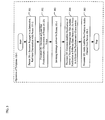
- FIG. 3 depicts a flowchart of the operation of telephone 102-1 in accordance with the first illustrative embodiment.
- person 101-1 becomes engaged in a real-time, interactive conversation (e.g., a telephone call, a video conference, an instant message session, etc.) with person 101-2, which conversation is connected through telephone 102-1, private branch exchange 120, public switched telephone network 110, and telephone 102-2.
- a real-time, interactive conversation e.g., a telephone call, a video conference, an instant message session, etc.
- person 101-2 which conversation is connected through telephone 102-1, private branch exchange 120, public switched telephone network 110, and telephone 102-2.
- the salient characteristic of this conversation is that the voice of person 101-2 is heard by person 101-1.
- processor 201 in telephone 102-1 estimates, using well-known signal processing techniques, at least one psychoacoustic characteristic of person 101-2's voice.
- psychoacoustic characteristics might include: young vs. old, angry vs. happy, and exasperated versus patient. It will be clear to those skilled in the how to make estimate one or more psychoacoustic characteristics of person 101-2's voice.
- an incoming message (e.g., a telephone call, an e-mail, a video conference call, an instant message, etc.) arrives at receiver 213 for person 101-1.
- the incoming message is from person 101-3. It will be clear to those skilled in the art, however, that in some alternative embodiments of the present invention the incoming message might originate not from a person, but rather from a computer.
- processor 201 prepares to notify person 101-1 of the arrival of the incoming message from person 101-3 and generates a verbal, audible notification that is different from person 101-2's voice in at least one psychoacoustic characteristic. For example, when processor 201 at event 302 estimates that person 101-2's voice is female, processor 201 at event 304 might generate a notification that sounds male. Processor 201 can synthesize the notification with the appropriate psychoacoustic characteristics, or, alternatively, can select the notification from a collection of pre-recorded notifications with differing psychoacoustic characteristics.
- the notification can be general in content (e.g., "A message has just arrived for you,” etc.) or more specific (e.g., "Dr. Marza has R.S.V.P'd to your dinner invitation,” etc.) and can, for example, be based on the information in the message.
- the nature of the incoming message might necessitate that person 101-1 halt or suspend the conversation with person 101-2 - when, for example, it was a telephone call - or, alternatively, the incoming message might not necessitate that person 101-1 halt or suspend the conversation with person 101-2 - when, for example, it was an e-mail. This reflects the fact that some incoming messages need to be addressed immediately while others do not.
- processor 201 can generate the notification that is in a different natural language than spoken by person 101-2.
- processor 201 provides person 101-1 with the notification generated at event 304 by injecting it the audio channel from person 101-2, which is then output via speaker 210.
- FIG. 4 depicts a block diagram of the second illustrative embodiment, in which the present invention resides solely in private branch exchange 120.
- Private branch exchange 120 comprises: switch fabric 402, processor 401, transmitter 412, receiver 413, and N pairs of transmitters and receivers - transmitters 410-1 through 410-N and receivers 411-1 through 411-N- interconnected as shown, wherein N is a positive integer.
- Switch fabric 402 enables private branch exchange 120 to establish a telephone call between one or more extension telephones (e.g., telephone 102-1, etc.) and public switched telephone network 110. It will be clear to those skilled in the art how to make and use switch fabric 402.
- extension telephones e.g., telephone 102-1, etc.
- Processor 401 is a programmed general-purpose processor that is capable of performing all of the functionality described below and with respect to FIG. 5. It will be clear to those skilled in the art, however, after reading this specification, how to make and use alternative embodiments of the present invention in which processor 401 is a "hard-wired" or special-purpose processor.
- Transmitter 412 comprises the circuitry that enables private branch exchange 120 to transmit information-bearing electromagnetic signals to public switched telephone network 110. It will be clear to those skilled in the art how to make and use transmitter 412.
- Receiver 413 comprises the circuitry that enables private branch exchange 120 to receiving information-bearing electromagnetic signals from public switched telephone network 110. It will be clear to those skilled in the art how to make and use receiver 413.
- Receiver 411- i comprises the circuitry that enables private branch exchange to receive information-bearing electromagnetic signals from telephone extension 102- i . It will be clear to those skilled in the art how to make and use receiver 411- i .
- FIG. 5 depicts a flowchart of the operation of private branch exchange 120 in accordance with the second illustrative embodiment.
- person 101-1 becomes engaged in a real-time, interactive conversation with person 101-2, which conversation is connected through telephone 102-1, private branch exchange 120, public switched telephone network 110, and telephone 102-2.
- the salient characteristic of this conversation is that the voice of person 101-2 is heard by person 101-1.
- processor 401 in private branch exchange 120 estimates, using well-known signal processing techniques, at least one psychoacoustic characteristic of person 101-2's voice.
- the tasks that processor 401 uses in accomplishing event 502 can be identical to those that processor 201 uses in performing event 302.
- an incoming message from person 101-3 arrives at receiver 413 for person 101-1.
- the incoming message is from person 101-3. It will be clear to those skilled in the art, however, that in some alternative embodiments of the present invention the incoming message might originate not from a person, but rather from a computer.
- processor 201 prepares to notify person 101-1 of the arrival of the incoming message from person 101-3 and generates a verbal, audible notification that is different from person 101-2's voice in at least one psychoacoustic characteristic.
- the tasks that processor 401 uses in performing event 504 can be identical to those that processor 201 uses in performing event 504.
- processor 201 provides person 101-1 with the notification generated at event 504 by injecting it the audio channel from person 101-2, which is then output via speaker 210. It will be clear to those skilled in the art, after reading this specification, how to make and use private branch exchanges in accordance with the present invention.
- FIG. 6 depicts a block diagram of the third illustrative embodiment, in which the present invention resides solely in central office 111-1.
- Central office 111-1 comprises: switch fabric 602, processor 601, M pairs of transmitters and receivers - transmitters 610-1 through 610-M and receivers 411-1 through 411 -M- interconnected as shown, wherein M is a positive integer.
- Switch fabric 602 enables central office 111-1 to establish a telephone call between one or more telephones, private branch exchanges, cellular base stations, and other central offices in public switched telephone network 110. It will be clear to those skilled in the art how to make and use switch fabric 402.
- Processor 601 is a programmed general-purpose processor that is capable of performing all of the functionality described below and with respect to FIG. 7. It will be clear to those skilled in the art, however, after reading this specification, how to make and use alternative embodiments of the present invention in which processor 601 is a "hard-wired" or special-purpose processor.
- Transmitter 610-1 comprises the circuitry that enables central office 111-1 to transmit information-bearing electromagnetic signals to private branch exchange 120. It will be clear to those skilled in the art how to make and person transmitter 610-1.
- Receiver 611-1 comprises the circuitry that enables central office 111-1 to receive information-bearing electromagnetic signals from private branch exchange 120. It will be clear to those skilled in the art how to make and use receiver 611-1.
- Receiver 611- j comprises the circuitry that enables central office 111-1 to receive information-bearing electromagnetic signals from telephones, private branch exchanges, cellular base stations, and other central offices in public switched telephone network 110. It will be clear to those skilled in the art how to make and use receiver 611- j .
- FIG. 7 depicts a flowchart of the operation of central office 111-1 in accordance with the third illustrative embodiment.
- person 101-1 becomes engaged in a real-time, interactive conversation with person 101-2, which conversation is connected through telephone 102-1, private branch exchange 120, public switched telephone network 110, and telephone 102-2.
- the salient characteristic of this conversation is that the voice of person 101-2 is heard by person 101-1.
- processor 601 in central office 111-1 estimates, using well-known signal processing techniques, at least one psychoacoustic characteristic of person 101-2's voice.
- the tasks that processor 601 uses in performing event 702 can be identical to those that processor 201 uses in performing event 302.
- an incoming message from person 101-3 arrives at receiver 610-j for person 101-1.
- the incoming message is from person 101-3. It will be clear to those skilled in the art, however, that in some alternative embodiments of the present invention the incoming message might originate not from a person, but rather from a computer.
- processor 601 prepares to notify person 101-1 of the arrival of the incoming message from person 101-3 and generates a verbal, audible notification that is different from person 101-2's voice in at least one psychoacoustic characteristic.
- the tasks that processor 601 uses in performing event 704 can be identical to those that processor 201 uses in performing event 504.
- processor 601 provides person 101-1 with the vocal notification generated at event 704 by injecting it into the audio channel with the sound from person 101-2.
Landscapes
- Engineering & Computer Science (AREA)
- Multimedia (AREA)
- Signal Processing (AREA)
- Computational Linguistics (AREA)
- Health & Medical Sciences (AREA)
- Audiology, Speech & Language Pathology (AREA)
- Human Computer Interaction (AREA)
- Physics & Mathematics (AREA)
- Acoustics & Sound (AREA)
- Telephonic Communication Services (AREA)
- Telephone Function (AREA)
- Sub-Exchange Stations And Push- Button Telephones (AREA)
Abstract
Description
Claims (20)
- An apparatus comprising:a receiver for receiving an incoming message for a first person, wherein said incoming message arrives while said first person is engaged in a telephone call with a second person; anda processor for estimating a first psychoacoustic characteristic of said second person's voice and for notifying said first person to the arrival of said incoming message with a voice that is different in said first psychoacoustic characteristic than said second person's voice.
- The apparatus of claim 1 wherein said first psychoacoustic characteristic is gender.
- The apparatus of claim 1 wherein said first psychoacoustic characteristic is language.
- The apparatus of claim 1 wherein said processor is also for estimating a second psychoacoustic characteristic of said second person's voice and for notifying said first person to the arrival of said incoming message with a voice that is different in said second psychoacoustic characteristic than said second person's voice.
- The apparatus of claim 4 wherein said first psychoacoustic characteristic is gender and said second psychoacoustic characteristic is pitch.
- The apparatus of claim 1 wherein said incoming message is a second telephone call.
- The apparatus of claim 1 wherein said incoming message is a text message.
- The apparatus of claim 1 wherein said apparatus is a cellular telephone.
- The apparatus of claim 1 wherein said apparatus is a private branch exchange.
- The apparatus of claim 1 wherein said apparatus is a central office switch.
- An apparatus comprising:a receiver for receiving a first telephone call for a first person, wherein said first telephone call arrives while said first person is engaged in a second telephone call with a second person; anda processor for estimating the gender of said second person based on the voice characteristics of said second person's voice, and for notifying said first person to the arrival of said first telephone call with a voice that has the opposite gender of said second person.
- The apparatus of claim 11 wherein said processor is also for estimating the language of said second person based on the voice characteristics of said second person's voice, and for notifying said first person to the arrival of said first telephone call with a voice in a different language than that of said second person.
- The apparatus of claim 11 wherein said processor is also for estimating the volume of said second person's voice based, and for notifying said first person to the arrival of said first telephone call with a voice that is quieter than the volume of said second person's voice.
- The apparatus of claim 11 wherein said processor is also for estimating the frequency range of said second person's voice, and for notifying said first person to the arrival of said first telephone call with a voice that has a substantially different frequency range than said first person's voice.
- A private branch exchange comprising:a receiver for receiving an incoming message for a first person, wherein said incoming message arrives while said person is engaged in a telephone call with a second person; anda processor for estimating a plurality of psychoacoustic characteristics of said second person's voice and for notifying said first person to the arrival of said incoming message with a voice that is different to each of said psychoacoustic characteristics of said second person's voice.
- The private branch exchange of claim 15 wherein said first psychoacoustic characteristic is gender.
- The private branch exchange of claim 15 wherein said first psychoacoustic characteristic is language.
- The private branch exchange of claim 15 wherein said processor is also for estimating a second psychoacoustic characteristic of said second person's voice and for notifying said first person to the arrival of said incoming message with a voice that is different in said second psychoacoustic characteristic than said second person's voice.
- The private branch exchange of claim 15 wherein said incoming message is a second telephone call.
- The private branch exchange of claim 15 wherein said incoming message is a text message.
Applications Claiming Priority (2)
| Application Number | Priority Date | Filing Date | Title |
|---|---|---|---|
| US10/187,100 US6687338B2 (en) | 2002-07-01 | 2002-07-01 | Call waiting notification |
| US187100 | 2002-07-01 |
Publications (3)
| Publication Number | Publication Date |
|---|---|
| EP1379066A2 true EP1379066A2 (en) | 2004-01-07 |
| EP1379066A3 EP1379066A3 (en) | 2004-03-03 |
| EP1379066B1 EP1379066B1 (en) | 2006-08-23 |
Family
ID=29720411
Family Applications (1)
| Application Number | Title | Priority Date | Filing Date |
|---|---|---|---|
| EP03254178A Expired - Lifetime EP1379066B1 (en) | 2002-07-01 | 2003-07-01 | Call waiting notification |
Country Status (4)
| Country | Link |
|---|---|
| US (1) | US6687338B2 (en) |
| EP (1) | EP1379066B1 (en) |
| CA (1) | CA2433468C (en) |
| DE (1) | DE60307737T2 (en) |
Cited By (1)
| Publication number | Priority date | Publication date | Assignee | Title |
|---|---|---|---|---|
| EP3852349A4 (en) * | 2018-09-13 | 2021-10-27 | NEC Platforms, Ltd. | TELEPHONE STANDARD, SOUND DISTRIBUTION PROCESS PENDING AND SOUND DISTRIBUTION PROGRAM PENDING |
Families Citing this family (11)
| Publication number | Priority date | Publication date | Assignee | Title |
|---|---|---|---|---|
| US6910481B2 (en) * | 2003-03-28 | 2005-06-28 | Ric Investments, Inc. | Pressure support compliance monitoring system |
| US20040267531A1 (en) * | 2003-06-30 | 2004-12-30 | Whynot Stephen R. | Method and system for providing text-to-speech instant messaging |
| US8819128B2 (en) * | 2003-09-30 | 2014-08-26 | Apple Inc. | Apparatus, method, and computer program for providing instant messages related to a conference call |
| US8645575B1 (en) | 2004-03-31 | 2014-02-04 | Apple Inc. | Apparatus, method, and computer program for performing text-to-speech conversion of instant messages during a conference call |
| US7715544B1 (en) | 2004-09-30 | 2010-05-11 | At&T Intellectual Property, I, L.P. | Method and apparatus for selective call waiting treatment |
| US20070019797A1 (en) * | 2005-06-29 | 2007-01-25 | Morris Robert P | Methods, systems, and computer program products for performing a context-based call action in response to an incoming call indication |
| US8121842B2 (en) | 2008-12-12 | 2012-02-21 | Microsoft Corporation | Audio output of a document from mobile device |
| US8620282B2 (en) | 2010-04-23 | 2013-12-31 | Blackberry Limited | In-call, audible call waiting |
| US8837705B2 (en) * | 2011-04-06 | 2014-09-16 | Avaya Inc. | Real-time probability based contact handling time |
| US10237082B2 (en) | 2012-08-31 | 2019-03-19 | Avaya Inc. | System and method for multimodal interaction aids |
| US9756083B2 (en) | 2013-02-01 | 2017-09-05 | Avaya Inc. | System and method for context-aware participant management |
Family Cites Families (11)
| Publication number | Priority date | Publication date | Assignee | Title |
|---|---|---|---|---|
| US5652789A (en) * | 1994-09-30 | 1997-07-29 | Wildfire Communications, Inc. | Network based knowledgeable assistant |
| US5850435A (en) * | 1996-03-01 | 1998-12-15 | U S West, Inc. | Method for audible caller name announcement with call list feature |
| US5946386A (en) * | 1996-03-11 | 1999-08-31 | Xantel Corporation | Call management system with call control from user workstation computers |
| US6035273A (en) * | 1996-06-26 | 2000-03-07 | Lucent Technologies, Inc. | Speaker-specific speech-to-text/text-to-speech communication system with hypertext-indicated speech parameter changes |
| US5752230A (en) * | 1996-08-20 | 1998-05-12 | Ncr Corporation | Method and apparatus for identifying names with a speech recognition program |
| US5894504A (en) * | 1996-10-02 | 1999-04-13 | At&T | Advanced call waiting and messaging system |
| US6018710A (en) * | 1996-12-13 | 2000-01-25 | Siemens Corporate Research, Inc. | Web-based interactive radio environment: WIRE |
| US5911129A (en) * | 1996-12-13 | 1999-06-08 | Intel Corporation | Audio font used for capture and rendering |
| WO2001047225A2 (en) * | 1999-12-20 | 2001-06-28 | Qualcomm Incorporated | System and method for enhancing call waiting functionality via voice recognition |
| EP1312198A1 (en) * | 2000-08-23 | 2003-05-21 | Conexant Systems, Inc. | Communication on hold notifier |
| US20020077089A1 (en) * | 2000-12-15 | 2002-06-20 | Telefonaktiebolaget L M Ericsson (Publ) | Method and apparatus for caller identification during call waiting |
-
2002
- 2002-07-01 US US10/187,100 patent/US6687338B2/en not_active Expired - Lifetime
-
2003
- 2003-06-25 CA CA002433468A patent/CA2433468C/en not_active Expired - Fee Related
- 2003-07-01 EP EP03254178A patent/EP1379066B1/en not_active Expired - Lifetime
- 2003-07-01 DE DE60307737T patent/DE60307737T2/en not_active Expired - Lifetime
Cited By (3)
| Publication number | Priority date | Publication date | Assignee | Title |
|---|---|---|---|---|
| EP3852349A4 (en) * | 2018-09-13 | 2021-10-27 | NEC Platforms, Ltd. | TELEPHONE STANDARD, SOUND DISTRIBUTION PROCESS PENDING AND SOUND DISTRIBUTION PROGRAM PENDING |
| AU2019338745B2 (en) * | 2018-09-13 | 2022-03-31 | Nec Platforms, Ltd. | Telephone exchange, hold tone notification method, and hold tone notification program |
| US11418645B2 (en) | 2018-09-13 | 2022-08-16 | Nec Platforms, Ltd. | Telephone exchange, hold tone notification method, and hold tone notification program |
Also Published As
| Publication number | Publication date |
|---|---|
| DE60307737T2 (en) | 2007-08-30 |
| CA2433468A1 (en) | 2004-01-01 |
| EP1379066A3 (en) | 2004-03-03 |
| EP1379066B1 (en) | 2006-08-23 |
| CA2433468C (en) | 2005-09-20 |
| US20040001574A1 (en) | 2004-01-01 |
| DE60307737D1 (en) | 2006-10-05 |
| US6687338B2 (en) | 2004-02-03 |
Similar Documents
| Publication | Publication Date | Title |
|---|---|---|
| US7706513B2 (en) | Distributed text-to-speech synthesis between a telephone network and a telephone subscriber unit | |
| EP1616433B1 (en) | Automatic speak-up indication for conference call attendees | |
| CN101355602B (en) | A mobile terminal and its automatic answering method and system | |
| US9578164B2 (en) | Methods and systems for voice augmented caller ID / ring tone alias | |
| EP1379066B1 (en) | Call waiting notification | |
| US20030072420A1 (en) | System for enabling TDD communciation in a telephone network and method for using same | |
| US20090112589A1 (en) | Electronic apparatus and system with multi-party communication enhancer and method | |
| JPH06350722A (en) | Conference call participation tracking method | |
| US7046784B2 (en) | Polite call waiting notification | |
| US7738645B2 (en) | Mobile terminal and multimedia contents service providing system and method for call connection waiting using the same | |
| CN111768786A (en) | Intelligent terminal platform for deaf-mute communication and communication method thereof | |
| JPWO2015083741A1 (en) | Relay device, display device, and communication system | |
| EP1730977A1 (en) | Telephone for sending voice and text messages | |
| KR101778548B1 (en) | Conference management method and system of voice understanding and hearing aid supporting for hearing-impaired person | |
| JP2023081469A (en) | Program, apparatus, method, and system | |
| EP1009145A1 (en) | Message control system | |
| US6954522B2 (en) | Caller identifying information encoded within embedded digital information | |
| JPH0946413A (en) | Portable telephone set | |
| JP2005039501A (en) | Portable telephone recording service system and its method and program | |
| KR100788312B1 (en) | Mobile phone coloring service method | |
| KR101007080B1 (en) | Status information service method of mobile phone | |
| KR20220147454A (en) | Apparatus and method for providing ringtone of message | |
| JP2007179305A (en) | Message conversion server and system, information processing apparatus | |
| CN110708428A (en) | Intelligent system for automatic answering and displaying of telephone | |
| CA3052236A1 (en) | Telephone system, telephone set, telephone transfer method, and program |
Legal Events
| Date | Code | Title | Description |
|---|---|---|---|
| PUAI | Public reference made under article 153(3) epc to a published international application that has entered the european phase |
Free format text: ORIGINAL CODE: 0009012 |
|
| 17P | Request for examination filed |
Effective date: 20030823 |
|
| AK | Designated contracting states |
Kind code of ref document: A2 Designated state(s): AT BE BG CH CY CZ DE DK EE ES FI FR GB GR HU IE IT LI LU MC NL PT RO SE SI SK TR |
|
| AX | Request for extension of the european patent |
Extension state: AL LT LV MK |
|
| PUAL | Search report despatched |
Free format text: ORIGINAL CODE: 0009013 |
|
| AK | Designated contracting states |
Kind code of ref document: A3 Designated state(s): AT BE BG CH CY CZ DE DK EE ES FI FR GB GR HU IE IT LI LU MC NL PT RO SE SI SK TR |
|
| AX | Request for extension of the european patent |
Extension state: AL LT LV MK |
|
| RIC1 | Information provided on ipc code assigned before grant |
Ipc: 7G 10L 11/04 B Ipc: 7G 10L 15/00 B Ipc: 7G 10L 17/00 B Ipc: 7H 04M 3/428 A |
|
| 17Q | First examination report despatched |
Effective date: 20040720 |
|
| AKX | Designation fees paid |
Designated state(s): DE FR GB |
|
| GRAP | Despatch of communication of intention to grant a patent |
Free format text: ORIGINAL CODE: EPIDOSNIGR1 |
|
| GRAS | Grant fee paid |
Free format text: ORIGINAL CODE: EPIDOSNIGR3 |
|
| GRAA | (expected) grant |
Free format text: ORIGINAL CODE: 0009210 |
|
| AK | Designated contracting states |
Kind code of ref document: B1 Designated state(s): DE FR GB |
|
| REG | Reference to a national code |
Ref country code: GB Ref legal event code: FG4D |
|
| REF | Corresponds to: |
Ref document number: 60307737 Country of ref document: DE Date of ref document: 20061005 Kind code of ref document: P |
|
| ET | Fr: translation filed | ||
| PLBE | No opposition filed within time limit |
Free format text: ORIGINAL CODE: 0009261 |
|
| STAA | Information on the status of an ep patent application or granted ep patent |
Free format text: STATUS: NO OPPOSITION FILED WITHIN TIME LIMIT |
|
| 26N | No opposition filed |
Effective date: 20070524 |
|
| PGFP | Annual fee paid to national office [announced via postgrant information from national office to epo] |
Ref country code: FR Payment date: 20130910 Year of fee payment: 11 |
|
| REG | Reference to a national code |
Ref country code: FR Ref legal event code: ST Effective date: 20150331 |
|
| PG25 | Lapsed in a contracting state [announced via postgrant information from national office to epo] |
Ref country code: FR Free format text: LAPSE BECAUSE OF NON-PAYMENT OF DUE FEES Effective date: 20140731 |
|
| PGFP | Annual fee paid to national office [announced via postgrant information from national office to epo] |
Ref country code: DE Payment date: 20200721 Year of fee payment: 18 |
|
| PGFP | Annual fee paid to national office [announced via postgrant information from national office to epo] |
Ref country code: GB Payment date: 20210727 Year of fee payment: 19 |
|
| REG | Reference to a national code |
Ref country code: DE Ref legal event code: R119 Ref document number: 60307737 Country of ref document: DE |
|
| PG25 | Lapsed in a contracting state [announced via postgrant information from national office to epo] |
Ref country code: DE Free format text: LAPSE BECAUSE OF NON-PAYMENT OF DUE FEES Effective date: 20220201 |
|
| GBPC | Gb: european patent ceased through non-payment of renewal fee |
Effective date: 20220701 |
|
| PG25 | Lapsed in a contracting state [announced via postgrant information from national office to epo] |
Ref country code: GB Free format text: LAPSE BECAUSE OF NON-PAYMENT OF DUE FEES Effective date: 20220701 |