EP1378793A2 - Light sensitive planographic printing plate precursor - Google Patents
Light sensitive planographic printing plate precursor Download PDFInfo
- Publication number
- EP1378793A2 EP1378793A2 EP03011834A EP03011834A EP1378793A2 EP 1378793 A2 EP1378793 A2 EP 1378793A2 EP 03011834 A EP03011834 A EP 03011834A EP 03011834 A EP03011834 A EP 03011834A EP 1378793 A2 EP1378793 A2 EP 1378793A2
- Authority
- EP
- European Patent Office
- Prior art keywords
- group
- light sensitive
- printing plate
- planographic printing
- independently represent
- Prior art date
- Legal status (The legal status is an assumption and is not a legal conclusion. Google has not performed a legal analysis and makes no representation as to the accuracy of the status listed.)
- Withdrawn
Links
- 238000007639 printing Methods 0.000 title claims abstract description 167
- 239000002243 precursor Substances 0.000 title claims abstract description 100
- 150000001875 compounds Chemical class 0.000 claims abstract description 64
- 125000000217 alkyl group Chemical group 0.000 claims description 54
- 229910052799 carbon Inorganic materials 0.000 claims description 46
- 125000003118 aryl group Chemical group 0.000 claims description 44
- 125000000623 heterocyclic group Chemical group 0.000 claims description 34
- 230000001235 sensitizing effect Effects 0.000 claims description 34
- 125000004435 hydrogen atom Chemical group [H]* 0.000 claims description 33
- 125000001424 substituent group Chemical group 0.000 claims description 28
- 230000003287 optical effect Effects 0.000 claims description 26
- 125000003342 alkenyl group Chemical group 0.000 claims description 22
- 239000004372 Polyvinyl alcohol Substances 0.000 claims description 18
- 229920002451 polyvinyl alcohol Polymers 0.000 claims description 18
- 238000010521 absorption reaction Methods 0.000 claims description 16
- 125000002496 methyl group Chemical group [H]C([H])([H])* 0.000 claims description 16
- 125000003545 alkoxy group Chemical group 0.000 claims description 14
- 125000005843 halogen group Chemical group 0.000 claims description 13
- 230000002378 acidificating effect Effects 0.000 claims description 12
- 125000000732 arylene group Chemical group 0.000 claims description 11
- 125000002768 hydroxyalkyl group Chemical group 0.000 claims description 9
- 229930195734 saturated hydrocarbon Natural products 0.000 claims description 9
- 125000002947 alkylene group Chemical group 0.000 claims description 8
- 125000001997 phenyl group Chemical group [H]C1=C([H])C([H])=C(*)C([H])=C1[H] 0.000 claims description 7
- 125000004183 alkoxy alkyl group Chemical group 0.000 claims description 6
- 125000004414 alkyl thio group Chemical group 0.000 claims description 6
- 125000006615 aromatic heterocyclic group Chemical group 0.000 claims description 6
- JUJWROOIHBZHMG-UHFFFAOYSA-N Pyridine Chemical group C1=CC=NC=C1 JUJWROOIHBZHMG-UHFFFAOYSA-N 0.000 claims description 5
- 125000003710 aryl alkyl group Chemical group 0.000 claims description 5
- QGZKDVFQNNGYKY-UHFFFAOYSA-O ammonium group Chemical group [NH4+] QGZKDVFQNNGYKY-UHFFFAOYSA-O 0.000 claims description 4
- 125000004430 oxygen atom Chemical group O* 0.000 claims description 4
- 125000006193 alkinyl group Chemical group 0.000 claims description 3
- 125000004397 aminosulfonyl group Chemical group NS(=O)(=O)* 0.000 claims description 3
- 125000002091 cationic group Chemical group 0.000 claims description 3
- 125000004093 cyano group Chemical group *C#N 0.000 claims description 3
- 229910052717 sulfur Inorganic materials 0.000 claims description 3
- 125000004434 sulfur atom Chemical group 0.000 claims description 3
- 229910017048 AsF6 Inorganic materials 0.000 claims description 2
- 125000002252 acyl group Chemical group 0.000 claims description 2
- 125000004644 alkyl sulfinyl group Chemical group 0.000 claims description 2
- 125000004390 alkyl sulfonyl group Chemical group 0.000 claims description 2
- 125000004185 ester group Chemical group 0.000 claims description 2
- 125000000449 nitro group Chemical group [O-][N+](*)=O 0.000 claims description 2
- 125000000951 phenoxy group Chemical group [H]C1=C([H])C([H])=C(O*)C([H])=C1[H] 0.000 claims description 2
- 125000003808 silyl group Chemical group [H][Si]([H])([H])[*] 0.000 claims description 2
- 125000004432 carbon atom Chemical group C* 0.000 claims 19
- 125000001183 hydrocarbyl group Chemical group 0.000 claims 2
- 238000003672 processing method Methods 0.000 abstract description 3
- 239000010410 layer Substances 0.000 description 161
- -1 acryl Chemical group 0.000 description 108
- XEEYBQQBJWHFJM-UHFFFAOYSA-N Iron Chemical compound [Fe] XEEYBQQBJWHFJM-UHFFFAOYSA-N 0.000 description 79
- 239000000975 dye Substances 0.000 description 57
- 238000000034 method Methods 0.000 description 51
- 238000000576 coating method Methods 0.000 description 38
- 239000000243 solution Substances 0.000 description 37
- 239000000049 pigment Substances 0.000 description 34
- 239000011248 coating agent Substances 0.000 description 32
- HEMHJVSKTPXQMS-UHFFFAOYSA-M Sodium hydroxide Chemical compound [OH-].[Na+] HEMHJVSKTPXQMS-UHFFFAOYSA-M 0.000 description 27
- 150000001721 carbon Chemical group 0.000 description 26
- 229910052742 iron Inorganic materials 0.000 description 26
- 238000011282 treatment Methods 0.000 description 26
- XLYOFNOQVPJJNP-UHFFFAOYSA-N water Substances O XLYOFNOQVPJJNP-UHFFFAOYSA-N 0.000 description 26
- 239000003086 colorant Substances 0.000 description 25
- 239000004094 surface-active agent Substances 0.000 description 24
- 230000035945 sensitivity Effects 0.000 description 23
- 239000011241 protective layer Substances 0.000 description 22
- 238000007788 roughening Methods 0.000 description 22
- NBIIXXVUZAFLBC-UHFFFAOYSA-N Phosphoric acid Chemical compound OP(O)(O)=O NBIIXXVUZAFLBC-UHFFFAOYSA-N 0.000 description 20
- 239000003513 alkali Substances 0.000 description 20
- 239000000463 material Substances 0.000 description 19
- QAOWNCQODCNURD-UHFFFAOYSA-N Sulfuric acid Chemical compound OS(O)(=O)=O QAOWNCQODCNURD-UHFFFAOYSA-N 0.000 description 18
- KWYUFKZDYYNOTN-UHFFFAOYSA-M Potassium hydroxide Chemical compound [OH-].[K+] KWYUFKZDYYNOTN-UHFFFAOYSA-M 0.000 description 15
- 229910052782 aluminium Inorganic materials 0.000 description 15
- XAGFODPZIPBFFR-UHFFFAOYSA-N aluminium Chemical compound [Al] XAGFODPZIPBFFR-UHFFFAOYSA-N 0.000 description 15
- 239000007788 liquid Substances 0.000 description 15
- 230000008030 elimination Effects 0.000 description 14
- 238000003379 elimination reaction Methods 0.000 description 14
- ZWEHNKRNPOVVGH-UHFFFAOYSA-N 2-Butanone Chemical compound CCC(C)=O ZWEHNKRNPOVVGH-UHFFFAOYSA-N 0.000 description 12
- VEXZGXHMUGYJMC-UHFFFAOYSA-N Hydrochloric acid Chemical compound Cl VEXZGXHMUGYJMC-UHFFFAOYSA-N 0.000 description 12
- 239000000203 mixture Substances 0.000 description 12
- 239000000178 monomer Substances 0.000 description 12
- 239000010802 sludge Substances 0.000 description 12
- 230000000052 comparative effect Effects 0.000 description 11
- 229920005596 polymer binder Polymers 0.000 description 11
- 239000002491 polymer binding agent Substances 0.000 description 11
- 239000002253 acid Substances 0.000 description 10
- 229910000147 aluminium phosphate Inorganic materials 0.000 description 10
- UHOVQNZJYSORNB-UHFFFAOYSA-N benzene Substances C1=CC=CC=C1 UHOVQNZJYSORNB-UHFFFAOYSA-N 0.000 description 10
- JHIVVAPYMSGYDF-UHFFFAOYSA-N cyclohexanone Chemical compound O=C1CCCCC1 JHIVVAPYMSGYDF-UHFFFAOYSA-N 0.000 description 10
- 239000008151 electrolyte solution Substances 0.000 description 10
- 125000001165 hydrophobic group Chemical group 0.000 description 10
- 238000002360 preparation method Methods 0.000 description 10
- GRYLNZFGIOXLOG-UHFFFAOYSA-N Nitric acid Chemical compound O[N+]([O-])=O GRYLNZFGIOXLOG-UHFFFAOYSA-N 0.000 description 9
- MUBZPKHOEPUJKR-UHFFFAOYSA-N Oxalic acid Chemical compound OC(=O)C(O)=O MUBZPKHOEPUJKR-UHFFFAOYSA-N 0.000 description 9
- 229910052751 metal Inorganic materials 0.000 description 9
- 239000002184 metal Substances 0.000 description 9
- 229910017604 nitric acid Inorganic materials 0.000 description 9
- 235000011121 sodium hydroxide Nutrition 0.000 description 9
- 238000005238 degreasing Methods 0.000 description 8
- 238000011161 development Methods 0.000 description 8
- 238000001035 drying Methods 0.000 description 8
- 229920001577 copolymer Polymers 0.000 description 7
- 150000002430 hydrocarbons Chemical group 0.000 description 7
- 239000003999 initiator Substances 0.000 description 7
- 230000000452 restraining effect Effects 0.000 description 7
- QTBSBXVTEAMEQO-UHFFFAOYSA-N Acetic acid Chemical compound CC(O)=O QTBSBXVTEAMEQO-UHFFFAOYSA-N 0.000 description 6
- XKRFYHLGVUSROY-UHFFFAOYSA-N Argon Chemical compound [Ar] XKRFYHLGVUSROY-UHFFFAOYSA-N 0.000 description 6
- LFQSCWFLJHTTHZ-UHFFFAOYSA-N Ethanol Chemical compound CCO LFQSCWFLJHTTHZ-UHFFFAOYSA-N 0.000 description 6
- OKKJLVBELUTLKV-UHFFFAOYSA-N Methanol Chemical compound OC OKKJLVBELUTLKV-UHFFFAOYSA-N 0.000 description 6
- 239000007864 aqueous solution Substances 0.000 description 6
- 239000003795 chemical substances by application Substances 0.000 description 6
- KRVSOGSZCMJSLX-UHFFFAOYSA-L chromic acid Substances O[Cr](O)(=O)=O KRVSOGSZCMJSLX-UHFFFAOYSA-L 0.000 description 6
- AWJWCTOOIBYHON-UHFFFAOYSA-N furo[3,4-b]pyrazine-5,7-dione Chemical compound C1=CN=C2C(=O)OC(=O)C2=N1 AWJWCTOOIBYHON-UHFFFAOYSA-N 0.000 description 6
- 125000002541 furyl group Chemical group 0.000 description 6
- 125000002883 imidazolyl group Chemical group 0.000 description 6
- UHOKSCJSTAHBSO-UHFFFAOYSA-N indanthrone blue Chemical compound C1=CC=C2C(=O)C3=CC=C4NC5=C6C(=O)C7=CC=CC=C7C(=O)C6=CC=C5NC4=C3C(=O)C2=C1 UHOKSCJSTAHBSO-UHFFFAOYSA-N 0.000 description 6
- 239000002245 particle Substances 0.000 description 6
- 125000004076 pyridyl group Chemical group 0.000 description 6
- 125000000168 pyrrolyl group Chemical group 0.000 description 6
- 230000009467 reduction Effects 0.000 description 6
- 239000007787 solid Substances 0.000 description 6
- 239000002904 solvent Substances 0.000 description 6
- 125000000335 thiazolyl group Chemical group 0.000 description 6
- YXFVVABEGXRONW-UHFFFAOYSA-N toluene Substances CC1=CC=CC=C1 YXFVVABEGXRONW-UHFFFAOYSA-N 0.000 description 6
- RGCKGOZRHPZPFP-UHFFFAOYSA-N Alizarin Natural products C1=CC=C2C(=O)C3=C(O)C(O)=CC=C3C(=O)C2=C1 RGCKGOZRHPZPFP-UHFFFAOYSA-N 0.000 description 5
- LYCAIKOWRPUZTN-UHFFFAOYSA-N Ethylene glycol Chemical compound OCCO LYCAIKOWRPUZTN-UHFFFAOYSA-N 0.000 description 5
- HFVAFDPGUJEFBQ-UHFFFAOYSA-M alizarin red S Chemical compound [Na+].O=C1C2=CC=CC=C2C(=O)C2=C1C=C(S([O-])(=O)=O)C(O)=C2O HFVAFDPGUJEFBQ-UHFFFAOYSA-M 0.000 description 5
- 238000002048 anodisation reaction Methods 0.000 description 5
- 238000007743 anodising Methods 0.000 description 5
- 125000002029 aromatic hydrocarbon group Chemical group 0.000 description 5
- 125000002887 hydroxy group Chemical group [H]O* 0.000 description 5
- 125000001624 naphthyl group Chemical group 0.000 description 5
- 125000002971 oxazolyl group Chemical group 0.000 description 5
- IEQIEDJGQAUEQZ-UHFFFAOYSA-N phthalocyanine Chemical compound N1C(N=C2C3=CC=CC=C3C(N=C3C4=CC=CC=C4C(=N4)N3)=N2)=C(C=CC=C2)C2=C1N=C1C2=CC=CC=C2C4=N1 IEQIEDJGQAUEQZ-UHFFFAOYSA-N 0.000 description 5
- 238000006116 polymerization reaction Methods 0.000 description 5
- 238000012545 processing Methods 0.000 description 5
- 125000003226 pyrazolyl group Chemical group 0.000 description 5
- 125000000714 pyrimidinyl group Chemical group 0.000 description 5
- 229920002554 vinyl polymer Polymers 0.000 description 5
- RYHBNJHYFVUHQT-UHFFFAOYSA-N 1,4-Dioxane Chemical compound C1COCCO1 RYHBNJHYFVUHQT-UHFFFAOYSA-N 0.000 description 4
- NIQCNGHVCWTJSM-UHFFFAOYSA-N Dimethyl phthalate Chemical compound COC(=O)C1=CC=CC=C1C(=O)OC NIQCNGHVCWTJSM-UHFFFAOYSA-N 0.000 description 4
- KRHYYFGTRYWZRS-UHFFFAOYSA-N Fluorane Chemical compound F KRHYYFGTRYWZRS-UHFFFAOYSA-N 0.000 description 4
- PXHVJJICTQNCMI-UHFFFAOYSA-N Nickel Chemical compound [Ni] PXHVJJICTQNCMI-UHFFFAOYSA-N 0.000 description 4
- 239000004952 Polyamide Substances 0.000 description 4
- VYPSYNLAJGMNEJ-UHFFFAOYSA-N Silicium dioxide Chemical compound O=[Si]=O VYPSYNLAJGMNEJ-UHFFFAOYSA-N 0.000 description 4
- PPBRXRYQALVLMV-UHFFFAOYSA-N Styrene Chemical compound C=CC1=CC=CC=C1 PPBRXRYQALVLMV-UHFFFAOYSA-N 0.000 description 4
- 150000001412 amines Chemical class 0.000 description 4
- XITRBUPOXXBIJN-UHFFFAOYSA-N bis(2,2,6,6-tetramethylpiperidin-4-yl) decanedioate Chemical compound C1C(C)(C)NC(C)(C)CC1OC(=O)CCCCCCCCC(=O)OC1CC(C)(C)NC(C)(C)C1 XITRBUPOXXBIJN-UHFFFAOYSA-N 0.000 description 4
- XCJYREBRNVKWGJ-UHFFFAOYSA-N copper(II) phthalocyanine Chemical compound [Cu+2].C12=CC=CC=C2C(N=C2[N-]C(C3=CC=CC=C32)=N2)=NC1=NC([C]1C=CC=CC1=1)=NC=1N=C1[C]3C=CC=CC3=C2[N-]1 XCJYREBRNVKWGJ-UHFFFAOYSA-N 0.000 description 4
- 235000014113 dietary fatty acids Nutrition 0.000 description 4
- 239000000194 fatty acid Substances 0.000 description 4
- 229930195729 fatty acid Natural products 0.000 description 4
- 150000004665 fatty acids Chemical class 0.000 description 4
- 235000019239 indanthrene blue RS Nutrition 0.000 description 4
- 229920002647 polyamide Polymers 0.000 description 4
- 229920000139 polyethylene terephthalate Polymers 0.000 description 4
- 239000005020 polyethylene terephthalate Substances 0.000 description 4
- 125000002098 pyridazinyl group Chemical group 0.000 description 4
- 229920005989 resin Polymers 0.000 description 4
- 239000011347 resin Substances 0.000 description 4
- 230000003595 spectral effect Effects 0.000 description 4
- 125000000383 tetramethylene group Chemical group [H]C([H])([*:1])C([H])([H])C([H])([H])C([H])([H])[*:2] 0.000 description 4
- QFLWZFQWSBQYPS-AWRAUJHKSA-N (3S)-3-[[(2S)-2-[[(2S)-2-[5-[(3aS,6aR)-2-oxo-1,3,3a,4,6,6a-hexahydrothieno[3,4-d]imidazol-4-yl]pentanoylamino]-3-methylbutanoyl]amino]-3-(4-hydroxyphenyl)propanoyl]amino]-4-[1-bis(4-chlorophenoxy)phosphorylbutylamino]-4-oxobutanoic acid Chemical compound CCCC(NC(=O)[C@H](CC(O)=O)NC(=O)[C@H](Cc1ccc(O)cc1)NC(=O)[C@@H](NC(=O)CCCCC1SC[C@@H]2NC(=O)N[C@H]12)C(C)C)P(=O)(Oc1ccc(Cl)cc1)Oc1ccc(Cl)cc1 QFLWZFQWSBQYPS-AWRAUJHKSA-N 0.000 description 3
- 125000000094 2-phenylethyl group Chemical group [H]C1=C([H])C([H])=C(C([H])=C1[H])C([H])([H])C([H])([H])* 0.000 description 3
- CDSULTPOCMWJCM-UHFFFAOYSA-N 4h-chromene-2,3-dione Chemical compound C1=CC=C2OC(=O)C(=O)CC2=C1 CDSULTPOCMWJCM-UHFFFAOYSA-N 0.000 description 3
- CSCPPACGZOOCGX-UHFFFAOYSA-N Acetone Chemical compound CC(C)=O CSCPPACGZOOCGX-UHFFFAOYSA-N 0.000 description 3
- ATRRKUHOCOJYRX-UHFFFAOYSA-N Ammonium bicarbonate Chemical compound [NH4+].OC([O-])=O ATRRKUHOCOJYRX-UHFFFAOYSA-N 0.000 description 3
- WVDDGKGOMKODPV-UHFFFAOYSA-N Benzyl alcohol Chemical compound OCC1=CC=CC=C1 WVDDGKGOMKODPV-UHFFFAOYSA-N 0.000 description 3
- 241001062009 Indigofera Species 0.000 description 3
- 235000000177 Indigofera tinctoria Nutrition 0.000 description 3
- 241000204992 Leopardus tigrinus Species 0.000 description 3
- WMFOQBRAJBCJND-UHFFFAOYSA-M Lithium hydroxide Chemical compound [Li+].[OH-] WMFOQBRAJBCJND-UHFFFAOYSA-M 0.000 description 3
- OFOBLEOULBTSOW-UHFFFAOYSA-N Malonic acid Chemical compound OC(=O)CC(O)=O OFOBLEOULBTSOW-UHFFFAOYSA-N 0.000 description 3
- QPJVMBTYPHYUOC-UHFFFAOYSA-N Methyl benzoate Natural products COC(=O)C1=CC=CC=C1 QPJVMBTYPHYUOC-UHFFFAOYSA-N 0.000 description 3
- ZMXDDKWLCZADIW-UHFFFAOYSA-N N,N-Dimethylformamide Chemical compound CN(C)C=O ZMXDDKWLCZADIW-UHFFFAOYSA-N 0.000 description 3
- 229910019142 PO4 Inorganic materials 0.000 description 3
- 239000004111 Potassium silicate Substances 0.000 description 3
- DNIAPMSPPWPWGF-UHFFFAOYSA-N Propylene glycol Chemical compound CC(O)CO DNIAPMSPPWPWGF-UHFFFAOYSA-N 0.000 description 3
- ZMANZCXQSJIPKH-UHFFFAOYSA-N Triethylamine Chemical compound CCN(CC)CC ZMANZCXQSJIPKH-UHFFFAOYSA-N 0.000 description 3
- 150000001299 aldehydes Chemical class 0.000 description 3
- 239000001099 ammonium carbonate Substances 0.000 description 3
- 229910052786 argon Inorganic materials 0.000 description 3
- 125000001797 benzyl group Chemical group [H]C1=C([H])C([H])=C(C([H])=C1[H])C([H])([H])* 0.000 description 3
- 239000001055 blue pigment Substances 0.000 description 3
- 125000000484 butyl group Chemical group [H]C([*])([H])C([H])([H])C([H])([H])C([H])([H])[H] 0.000 description 3
- 125000002704 decyl group Chemical group [H]C([H])([H])C([H])([H])C([H])([H])C([H])([H])C([H])([H])C([H])([H])C([H])([H])C([H])([H])C([H])([H])C([H])([H])* 0.000 description 3
- MTHSVFCYNBDYFN-UHFFFAOYSA-N diethylene glycol Chemical compound OCCOCCO MTHSVFCYNBDYFN-UHFFFAOYSA-N 0.000 description 3
- UAOMVDZJSHZZME-UHFFFAOYSA-N diisopropylamine Chemical compound CC(C)NC(C)C UAOMVDZJSHZZME-UHFFFAOYSA-N 0.000 description 3
- 238000004090 dissolution Methods 0.000 description 3
- 230000005611 electricity Effects 0.000 description 3
- 125000001495 ethyl group Chemical group [H]C([H])([H])C([H])([H])* 0.000 description 3
- 238000011156 evaluation Methods 0.000 description 3
- 125000003983 fluorenyl group Chemical class C1(=CC=CC=2C3=CC=CC=C3CC12)* 0.000 description 3
- 230000009477 glass transition Effects 0.000 description 3
- 125000001041 indolyl group Chemical group 0.000 description 3
- 239000003112 inhibitor Substances 0.000 description 3
- 125000001972 isopentyl group Chemical group [H]C([H])([H])C([H])(C([H])([H])[H])C([H])([H])C([H])([H])* 0.000 description 3
- 238000005259 measurement Methods 0.000 description 3
- DZVCFNFOPIZQKX-LTHRDKTGSA-M merocyanine Chemical compound [Na+].O=C1N(CCCC)C(=O)N(CCCC)C(=O)C1=C\C=C\C=C/1N(CCCS([O-])(=O)=O)C2=CC=CC=C2O\1 DZVCFNFOPIZQKX-LTHRDKTGSA-M 0.000 description 3
- FQPSGWSUVKBHSU-UHFFFAOYSA-N methacrylamide Chemical compound CC(=C)C(N)=O FQPSGWSUVKBHSU-UHFFFAOYSA-N 0.000 description 3
- 229940095102 methyl benzoate Drugs 0.000 description 3
- 125000002347 octyl group Chemical group [H]C([*])([H])C([H])([H])C([H])([H])C([H])([H])C([H])([H])C([H])([H])C([H])([H])C([H])([H])[H] 0.000 description 3
- 239000003960 organic solvent Substances 0.000 description 3
- 235000006408 oxalic acid Nutrition 0.000 description 3
- 125000000843 phenylene group Chemical group C1(=C(C=CC=C1)*)* 0.000 description 3
- 239000010452 phosphate Substances 0.000 description 3
- 125000002467 phosphate group Chemical group [H]OP(=O)(O[H])O[*] 0.000 description 3
- 125000003386 piperidinyl group Chemical group 0.000 description 3
- 229920006267 polyester film Polymers 0.000 description 3
- NNHHDJVEYQHLHG-UHFFFAOYSA-N potassium silicate Chemical compound [K+].[K+].[O-][Si]([O-])=O NNHHDJVEYQHLHG-UHFFFAOYSA-N 0.000 description 3
- 229910052913 potassium silicate Inorganic materials 0.000 description 3
- 235000019353 potassium silicate Nutrition 0.000 description 3
- 125000001436 propyl group Chemical group [H]C([*])([H])C([H])([H])C([H])([H])[H] 0.000 description 3
- 125000003373 pyrazinyl group Chemical group 0.000 description 3
- PYWVYCXTNDRMGF-UHFFFAOYSA-N rhodamine B Chemical compound [Cl-].C=12C=CC(=[N+](CC)CC)C=C2OC2=CC(N(CC)CC)=CC=C2C=1C1=CC=CC=C1C(O)=O PYWVYCXTNDRMGF-UHFFFAOYSA-N 0.000 description 3
- 238000007789 sealing Methods 0.000 description 3
- 239000004065 semiconductor Substances 0.000 description 3
- 239000002002 slurry Substances 0.000 description 3
- 125000000391 vinyl group Chemical group [H]C([*])=C([H])[H] 0.000 description 3
- UCTWMZQNUQWSLP-VIFPVBQESA-N (R)-adrenaline Chemical compound CNC[C@H](O)C1=CC=C(O)C(O)=C1 UCTWMZQNUQWSLP-VIFPVBQESA-N 0.000 description 2
- 125000001399 1,2,3-triazolyl group Chemical group N1N=NC(=C1)* 0.000 description 2
- 125000001376 1,2,4-triazolyl group Chemical group N1N=C(N=C1)* 0.000 description 2
- 125000004520 1,3,4-thiadiazolyl group Chemical group 0.000 description 2
- ZOBPZXTWZATXDG-UHFFFAOYSA-N 1,3-thiazolidine-2,4-dione Chemical class O=C1CSC(=O)N1 ZOBPZXTWZATXDG-UHFFFAOYSA-N 0.000 description 2
- UZKWTJUDCOPSNM-UHFFFAOYSA-N 1-ethenoxybutane Chemical compound CCCCOC=C UZKWTJUDCOPSNM-UHFFFAOYSA-N 0.000 description 2
- 125000006030 1-methyl-3-butenyl group Chemical group 0.000 description 2
- JLIDVCMBCGBIEY-UHFFFAOYSA-N 1-penten-3-one Chemical compound CCC(=O)C=C JLIDVCMBCGBIEY-UHFFFAOYSA-N 0.000 description 2
- XUVKSPPGPPFPQN-UHFFFAOYSA-N 10-Methyl-9(10H)-acridone Chemical compound C1=CC=C2N(C)C3=CC=CC=C3C(=O)C2=C1 XUVKSPPGPPFPQN-UHFFFAOYSA-N 0.000 description 2
- JKNCOURZONDCGV-UHFFFAOYSA-N 2-(dimethylamino)ethyl 2-methylprop-2-enoate Chemical compound CN(C)CCOC(=O)C(C)=C JKNCOURZONDCGV-UHFFFAOYSA-N 0.000 description 2
- DPBJAVGHACCNRL-UHFFFAOYSA-N 2-(dimethylamino)ethyl prop-2-enoate Chemical compound CN(C)CCOC(=O)C=C DPBJAVGHACCNRL-UHFFFAOYSA-N 0.000 description 2
- JESXATFQYMPTNL-UHFFFAOYSA-N 2-ethenylphenol Chemical compound OC1=CC=CC=C1C=C JESXATFQYMPTNL-UHFFFAOYSA-N 0.000 description 2
- JITOHJHWLTXNCU-UHFFFAOYSA-N 2-methyl-n-(4-methylphenyl)sulfonylprop-2-enamide Chemical compound CC(=C)C(=O)NS(=O)(=O)C1=CC=C(C)C=C1 JITOHJHWLTXNCU-UHFFFAOYSA-N 0.000 description 2
- NJWGQARXZDRHCD-UHFFFAOYSA-N 2-methylanthraquinone Chemical compound C1=CC=C2C(=O)C3=CC(C)=CC=C3C(=O)C2=C1 NJWGQARXZDRHCD-UHFFFAOYSA-N 0.000 description 2
- SVTBMSDMJJWYQN-UHFFFAOYSA-N 2-methylpentane-2,4-diol Chemical compound CC(O)CC(C)(C)O SVTBMSDMJJWYQN-UHFFFAOYSA-N 0.000 description 2
- 125000003903 2-propenyl group Chemical group [H]C([*])([H])C([H])=C([H])[H] 0.000 description 2
- VVBLNCFGVYUYGU-UHFFFAOYSA-N 4,4'-Bis(dimethylamino)benzophenone Chemical compound C1=CC(N(C)C)=CC=C1C(=O)C1=CC=C(N(C)C)C=C1 VVBLNCFGVYUYGU-UHFFFAOYSA-N 0.000 description 2
- 125000006042 4-hexenyl group Chemical group 0.000 description 2
- ZCYVEMRRCGMTRW-UHFFFAOYSA-N 7553-56-2 Chemical group [I] ZCYVEMRRCGMTRW-UHFFFAOYSA-N 0.000 description 2
- HRPVXLWXLXDGHG-UHFFFAOYSA-N Acrylamide Chemical compound NC(=O)C=C HRPVXLWXLXDGHG-UHFFFAOYSA-N 0.000 description 2
- 229910000838 Al alloy Inorganic materials 0.000 description 2
- 229910000013 Ammonium bicarbonate Inorganic materials 0.000 description 2
- WKBOTKDWSSQWDR-UHFFFAOYSA-N Bromine atom Chemical group [Br] WKBOTKDWSSQWDR-UHFFFAOYSA-N 0.000 description 2
- KAKZBPTYRLMSJV-UHFFFAOYSA-N Butadiene Chemical compound C=CC=C KAKZBPTYRLMSJV-UHFFFAOYSA-N 0.000 description 2
- SOGAXMICEFXMKE-UHFFFAOYSA-N Butylmethacrylate Chemical compound CCCCOC(=O)C(C)=C SOGAXMICEFXMKE-UHFFFAOYSA-N 0.000 description 2
- OKTJSMMVPCPJKN-UHFFFAOYSA-N Carbon Chemical compound [C] OKTJSMMVPCPJKN-UHFFFAOYSA-N 0.000 description 2
- 108091005944 Cerulean Proteins 0.000 description 2
- VYZAMTAEIAYCRO-UHFFFAOYSA-N Chromium Chemical compound [Cr] VYZAMTAEIAYCRO-UHFFFAOYSA-N 0.000 description 2
- MQIUGAXCHLFZKX-UHFFFAOYSA-N Di-n-octyl phthalate Natural products CCCCCCCCOC(=O)C1=CC=CC=C1C(=O)OCCCCCCCC MQIUGAXCHLFZKX-UHFFFAOYSA-N 0.000 description 2
- RTZKZFJDLAIYFH-UHFFFAOYSA-N Diethyl ether Chemical compound CCOCC RTZKZFJDLAIYFH-UHFFFAOYSA-N 0.000 description 2
- ROSDSFDQCJNGOL-UHFFFAOYSA-N Dimethylamine Chemical compound CNC ROSDSFDQCJNGOL-UHFFFAOYSA-N 0.000 description 2
- QUSNBJAOOMFDIB-UHFFFAOYSA-N Ethylamine Chemical compound CCN QUSNBJAOOMFDIB-UHFFFAOYSA-N 0.000 description 2
- QIGBRXMKCJKVMJ-UHFFFAOYSA-N Hydroquinone Chemical compound OC1=CC=C(O)C=C1 QIGBRXMKCJKVMJ-UHFFFAOYSA-N 0.000 description 2
- DGAQECJNVWCQMB-PUAWFVPOSA-M Ilexoside XXIX Chemical compound C[C@@H]1CC[C@@]2(CC[C@@]3(C(=CC[C@H]4[C@]3(CC[C@@H]5[C@@]4(CC[C@@H](C5(C)C)OS(=O)(=O)[O-])C)C)[C@@H]2[C@]1(C)O)C)C(=O)O[C@H]6[C@@H]([C@H]([C@@H]([C@H](O6)CO)O)O)O.[Na+] DGAQECJNVWCQMB-PUAWFVPOSA-M 0.000 description 2
- UQSXHKLRYXJYBZ-UHFFFAOYSA-N Iron oxide Chemical compound [Fe]=O UQSXHKLRYXJYBZ-UHFFFAOYSA-N 0.000 description 2
- RRHGJUQNOFWUDK-UHFFFAOYSA-N Isoprene Chemical compound CC(=C)C=C RRHGJUQNOFWUDK-UHFFFAOYSA-N 0.000 description 2
- CERQOIWHTDAKMF-UHFFFAOYSA-N Methacrylic acid Chemical compound CC(=C)C(O)=O CERQOIWHTDAKMF-UHFFFAOYSA-N 0.000 description 2
- BAPJBEWLBFYGME-UHFFFAOYSA-N Methyl acrylate Chemical compound COC(=O)C=C BAPJBEWLBFYGME-UHFFFAOYSA-N 0.000 description 2
- VVQNEPGJFQJSBK-UHFFFAOYSA-N Methyl methacrylate Chemical compound COC(=O)C(C)=C VVQNEPGJFQJSBK-UHFFFAOYSA-N 0.000 description 2
- BAVYZALUXZFZLV-UHFFFAOYSA-N Methylamine Chemical compound NC BAVYZALUXZFZLV-UHFFFAOYSA-N 0.000 description 2
- LRHPLDYGYMQRHN-UHFFFAOYSA-N N-Butanol Chemical compound CCCCO LRHPLDYGYMQRHN-UHFFFAOYSA-N 0.000 description 2
- ABLZXFCXXLZCGV-UHFFFAOYSA-N Phosphorous acid Chemical compound OP(O)=O ABLZXFCXXLZCGV-UHFFFAOYSA-N 0.000 description 2
- 229920003171 Poly (ethylene oxide) Polymers 0.000 description 2
- SMWDFEZZVXVKRB-UHFFFAOYSA-N Quinoline Chemical compound N1=CC=CC2=CC=CC=C21 SMWDFEZZVXVKRB-UHFFFAOYSA-N 0.000 description 2
- CDBYLPFSWZWCQE-UHFFFAOYSA-L Sodium Carbonate Chemical compound [Na+].[Na+].[O-]C([O-])=O CDBYLPFSWZWCQE-UHFFFAOYSA-L 0.000 description 2
- 239000004115 Sodium Silicate Substances 0.000 description 2
- UIIMBOGNXHQVGW-UHFFFAOYSA-M Sodium bicarbonate Chemical compound [Na+].OC([O-])=O UIIMBOGNXHQVGW-UHFFFAOYSA-M 0.000 description 2
- 229920002125 Sokalan® Polymers 0.000 description 2
- YSMRWXYRXBRSND-UHFFFAOYSA-N TOTP Chemical compound CC1=CC=CC=C1OP(=O)(OC=1C(=CC=CC=1)C)OC1=CC=CC=C1C YSMRWXYRXBRSND-UHFFFAOYSA-N 0.000 description 2
- GWEVSGVZZGPLCZ-UHFFFAOYSA-N Titan oxide Chemical compound O=[Ti]=O GWEVSGVZZGPLCZ-UHFFFAOYSA-N 0.000 description 2
- HCHKCACWOHOZIP-UHFFFAOYSA-N Zinc Chemical compound [Zn] HCHKCACWOHOZIP-UHFFFAOYSA-N 0.000 description 2
- XLOMVQKBTHCTTD-UHFFFAOYSA-N Zinc monoxide Chemical compound [Zn]=O XLOMVQKBTHCTTD-UHFFFAOYSA-N 0.000 description 2
- IORUEKDKNHHQAL-UHFFFAOYSA-N [2-tert-butyl-6-[(3-tert-butyl-2-hydroxy-5-methylphenyl)methyl]-4-methylphenyl] prop-2-enoate Chemical compound CC(C)(C)C1=CC(C)=CC(CC=2C(=C(C=C(C)C=2)C(C)(C)C)OC(=O)C=C)=C1O IORUEKDKNHHQAL-UHFFFAOYSA-N 0.000 description 2
- AOADSHDCARXSGL-ZMIIQOOPSA-M alkali blue 4B Chemical compound CC1=CC(/C(\C(C=C2)=CC=C2NC2=CC=CC=C2S([O-])(=O)=O)=C(\C=C2)/C=C/C\2=N\C2=CC=CC=C2)=CC=C1N.[Na+] AOADSHDCARXSGL-ZMIIQOOPSA-M 0.000 description 2
- 239000012670 alkaline solution Substances 0.000 description 2
- 125000003277 amino group Chemical group 0.000 description 2
- 235000012538 ammonium bicarbonate Nutrition 0.000 description 2
- 125000002178 anthracenyl group Chemical group C1(=CC=CC2=CC3=CC=CC=C3C=C12)* 0.000 description 2
- 150000004945 aromatic hydrocarbons Chemical class 0.000 description 2
- QVGXLLKOCUKJST-UHFFFAOYSA-N atomic oxygen Chemical compound [O] QVGXLLKOCUKJST-UHFFFAOYSA-N 0.000 description 2
- 125000000751 azo group Chemical group [*]N=N[*] 0.000 description 2
- 125000003828 azulenyl group Chemical group 0.000 description 2
- 125000004618 benzofuryl group Chemical group O1C(=CC2=C1C=CC=C2)* 0.000 description 2
- 125000001164 benzothiazolyl group Chemical group S1C(=NC2=C1C=CC=C2)* 0.000 description 2
- BJQHLKABXJIVAM-UHFFFAOYSA-N bis(2-ethylhexyl) phthalate Chemical compound CCCCC(CC)COC(=O)C1=CC=CC=C1C(=O)OCC(CC)CCCC BJQHLKABXJIVAM-UHFFFAOYSA-N 0.000 description 2
- KGBXLFKZBHKPEV-UHFFFAOYSA-N boric acid Chemical compound OB(O)O KGBXLFKZBHKPEV-UHFFFAOYSA-N 0.000 description 2
- 239000004327 boric acid Substances 0.000 description 2
- 230000001680 brushing effect Effects 0.000 description 2
- HQABUPZFAYXKJW-UHFFFAOYSA-N butan-1-amine Chemical compound CCCCN HQABUPZFAYXKJW-UHFFFAOYSA-N 0.000 description 2
- BTANRVKWQNVYAZ-UHFFFAOYSA-N butan-2-ol Chemical compound CCC(C)O BTANRVKWQNVYAZ-UHFFFAOYSA-N 0.000 description 2
- FUSUHKVFWTUUBE-UHFFFAOYSA-N buten-2-one Chemical compound CC(=O)C=C FUSUHKVFWTUUBE-UHFFFAOYSA-N 0.000 description 2
- 229910052801 chlorine Inorganic materials 0.000 description 2
- MVPPADPHJFYWMZ-UHFFFAOYSA-N chlorobenzene Substances ClC1=CC=CC=C1 MVPPADPHJFYWMZ-UHFFFAOYSA-N 0.000 description 2
- 229910052804 chromium Inorganic materials 0.000 description 2
- 239000011651 chromium Substances 0.000 description 2
- 229910017052 cobalt Inorganic materials 0.000 description 2
- 239000010941 cobalt Substances 0.000 description 2
- GUTLYIVDDKVIGB-UHFFFAOYSA-N cobalt atom Chemical compound [Co] GUTLYIVDDKVIGB-UHFFFAOYSA-N 0.000 description 2
- 229910052681 coesite Inorganic materials 0.000 description 2
- 238000011109 contamination Methods 0.000 description 2
- 238000007796 conventional method Methods 0.000 description 2
- 238000007334 copolymerization reaction Methods 0.000 description 2
- 229910052906 cristobalite Inorganic materials 0.000 description 2
- 125000004956 cyclohexylene group Chemical group 0.000 description 2
- 125000004979 cyclopentylene group Chemical group 0.000 description 2
- SWXVUIWOUIDPGS-UHFFFAOYSA-N diacetone alcohol Chemical compound CC(=O)CC(C)(C)O SWXVUIWOUIDPGS-UHFFFAOYSA-N 0.000 description 2
- ZBCBWPMODOFKDW-UHFFFAOYSA-N diethanolamine Chemical class OCCNCCO ZBCBWPMODOFKDW-UHFFFAOYSA-N 0.000 description 2
- FBSAITBEAPNWJG-UHFFFAOYSA-N dimethyl phthalate Natural products CC(=O)OC1=CC=CC=C1OC(C)=O FBSAITBEAPNWJG-UHFFFAOYSA-N 0.000 description 2
- 229960001826 dimethylphthalate Drugs 0.000 description 2
- FPAYXBWMYIMERV-UHFFFAOYSA-L disodium;5-methyl-2-[[4-(4-methyl-2-sulfonatoanilino)-9,10-dioxoanthracen-1-yl]amino]benzenesulfonate Chemical compound [Na+].[Na+].[O-]S(=O)(=O)C1=CC(C)=CC=C1NC(C=1C(=O)C2=CC=CC=C2C(=O)C=11)=CC=C1NC1=CC=C(C)C=C1S([O-])(=O)=O FPAYXBWMYIMERV-UHFFFAOYSA-L 0.000 description 2
- UKMSUNONTOPOIO-UHFFFAOYSA-N docosanoic acid Chemical compound CCCCCCCCCCCCCCCCCCCCCC(O)=O UKMSUNONTOPOIO-UHFFFAOYSA-N 0.000 description 2
- 239000000428 dust Substances 0.000 description 2
- 239000000839 emulsion Substances 0.000 description 2
- 238000005516 engineering process Methods 0.000 description 2
- 230000007613 environmental effect Effects 0.000 description 2
- 238000005530 etching Methods 0.000 description 2
- FJKIXWOMBXYWOQ-UHFFFAOYSA-N ethenoxyethane Chemical compound CCOC=C FJKIXWOMBXYWOQ-UHFFFAOYSA-N 0.000 description 2
- 125000001301 ethoxy group Chemical group [H]C([H])([H])C([H])([H])O* 0.000 description 2
- LZCLXQDLBQLTDK-UHFFFAOYSA-N ethyl 2-hydroxypropanoate Chemical compound CCOC(=O)C(C)O LZCLXQDLBQLTDK-UHFFFAOYSA-N 0.000 description 2
- SUPCQIBBMFXVTL-UHFFFAOYSA-N ethyl 2-methylprop-2-enoate Chemical compound CCOC(=O)C(C)=C SUPCQIBBMFXVTL-UHFFFAOYSA-N 0.000 description 2
- 229910052731 fluorine Inorganic materials 0.000 description 2
- VOZRXNHHFUQHIL-UHFFFAOYSA-N glycidyl methacrylate Chemical compound CC(=C)C(=O)OCC1CO1 VOZRXNHHFUQHIL-UHFFFAOYSA-N 0.000 description 2
- 229910052736 halogen Inorganic materials 0.000 description 2
- 150000002367 halogens Chemical class 0.000 description 2
- JTHNLKXLWOXOQK-UHFFFAOYSA-N hex-1-en-3-one Chemical compound CCCC(=O)C=C JTHNLKXLWOXOQK-UHFFFAOYSA-N 0.000 description 2
- ZSIAUFGUXNUGDI-UHFFFAOYSA-N hexan-1-ol Chemical compound CCCCCCO ZSIAUFGUXNUGDI-UHFFFAOYSA-N 0.000 description 2
- WJRBRSLFGCUECM-UHFFFAOYSA-N hydantoin Chemical compound O=C1CNC(=O)N1 WJRBRSLFGCUECM-UHFFFAOYSA-N 0.000 description 2
- 150000001469 hydantoins Chemical class 0.000 description 2
- WGCNASOHLSPBMP-UHFFFAOYSA-N hydroxyacetaldehyde Natural products OCC=O WGCNASOHLSPBMP-UHFFFAOYSA-N 0.000 description 2
- 125000003454 indenyl group Chemical group C1(C=CC2=CC=CC=C12)* 0.000 description 2
- 229940097275 indigo Drugs 0.000 description 2
- COHYTHOBJLSHDF-UHFFFAOYSA-N indigo powder Natural products N1C2=CC=CC=C2C(=O)C1=C1C(=O)C2=CC=CC=C2N1 COHYTHOBJLSHDF-UHFFFAOYSA-N 0.000 description 2
- 239000011256 inorganic filler Substances 0.000 description 2
- 229910003475 inorganic filler Inorganic materials 0.000 description 2
- 229910052740 iodine Inorganic materials 0.000 description 2
- ZXEKIIBDNHEJCQ-UHFFFAOYSA-N isobutanol Chemical compound CC(C)CO ZXEKIIBDNHEJCQ-UHFFFAOYSA-N 0.000 description 2
- BSIHWSXXPBAGTC-UHFFFAOYSA-N isoviolanthrone Chemical compound C12=CC=CC=C2C(=O)C2=CC=C3C(C4=C56)=CC=C5C5=CC=CC=C5C(=O)C6=CC=C4C4=C3C2=C1C=C4 BSIHWSXXPBAGTC-UHFFFAOYSA-N 0.000 description 2
- 150000002576 ketones Chemical class 0.000 description 2
- 239000011133 lead Substances 0.000 description 2
- 238000004519 manufacturing process Methods 0.000 description 2
- 229910001507 metal halide Inorganic materials 0.000 description 2
- 150000005309 metal halides Chemical class 0.000 description 2
- 125000000956 methoxy group Chemical group [H]C([H])([H])O* 0.000 description 2
- 125000001570 methylene group Chemical group [H]C([H])([*:1])[*:2] 0.000 description 2
- 125000002950 monocyclic group Chemical group 0.000 description 2
- 125000002757 morpholinyl group Chemical group 0.000 description 2
- MXDDRENDTSVWLG-UHFFFAOYSA-N n-(4-methylphenyl)sulfonylprop-2-enamide Chemical compound CC1=CC=C(S(=O)(=O)NC(=O)C=C)C=C1 MXDDRENDTSVWLG-UHFFFAOYSA-N 0.000 description 2
- 125000004957 naphthylene group Chemical group 0.000 description 2
- 238000006386 neutralization reaction Methods 0.000 description 2
- 229910052759 nickel Inorganic materials 0.000 description 2
- 239000012299 nitrogen atmosphere Substances 0.000 description 2
- 229920006284 nylon film Polymers 0.000 description 2
- RPQRDASANLAFCM-UHFFFAOYSA-N oxiran-2-ylmethyl prop-2-enoate Chemical compound C=CC(=O)OCC1CO1 RPQRDASANLAFCM-UHFFFAOYSA-N 0.000 description 2
- 239000001301 oxygen Substances 0.000 description 2
- 229910052760 oxygen Inorganic materials 0.000 description 2
- 125000004817 pentamethylene group Chemical group [H]C([H])([*:2])C([H])([H])C([H])([H])C([H])([H])C([H])([H])[*:1] 0.000 description 2
- 125000001147 pentyl group Chemical group C(CCCC)* 0.000 description 2
- 150000004968 peroxymonosulfuric acids Chemical class 0.000 description 2
- 230000000704 physical effect Effects 0.000 description 2
- 239000002985 plastic film Substances 0.000 description 2
- 229920006255 plastic film Polymers 0.000 description 2
- 239000004014 plasticizer Substances 0.000 description 2
- 239000004584 polyacrylic acid Substances 0.000 description 2
- 229920000642 polymer Polymers 0.000 description 2
- 239000004800 polyvinyl chloride Substances 0.000 description 2
- 229920000915 polyvinyl chloride Polymers 0.000 description 2
- 239000011736 potassium bicarbonate Substances 0.000 description 2
- 235000015497 potassium bicarbonate Nutrition 0.000 description 2
- 229910000028 potassium bicarbonate Inorganic materials 0.000 description 2
- BWHMMNNQKKPAPP-UHFFFAOYSA-L potassium carbonate Chemical compound [K+].[K+].[O-]C([O-])=O BWHMMNNQKKPAPP-UHFFFAOYSA-L 0.000 description 2
- TYJJADVDDVDEDZ-UHFFFAOYSA-M potassium hydrogencarbonate Chemical compound [K+].OC([O-])=O TYJJADVDDVDEDZ-UHFFFAOYSA-M 0.000 description 2
- 230000008569 process Effects 0.000 description 2
- 125000002572 propoxy group Chemical group [*]OC([H])([H])C(C([H])([H])[H])([H])[H] 0.000 description 2
- 125000004805 propylene group Chemical group [H]C([H])([H])C([H])([*:1])C([H])([H])[*:2] 0.000 description 2
- 125000000561 purinyl group Chemical group N1=C(N=C2N=CNC2=C1)* 0.000 description 2
- 125000002755 pyrazolinyl group Chemical group 0.000 description 2
- 125000001422 pyrrolinyl group Chemical group 0.000 description 2
- 150000003254 radicals Chemical class 0.000 description 2
- KIWUVOGUEXMXSV-UHFFFAOYSA-N rhodanine Chemical class O=C1CSC(=S)N1 KIWUVOGUEXMXSV-UHFFFAOYSA-N 0.000 description 2
- 150000003839 salts Chemical class 0.000 description 2
- 239000000377 silicon dioxide Substances 0.000 description 2
- 229910052708 sodium Inorganic materials 0.000 description 2
- 239000011734 sodium Substances 0.000 description 2
- NTHWMYGWWRZVTN-UHFFFAOYSA-N sodium silicate Chemical compound [Na+].[Na+].[O-][Si]([O-])=O NTHWMYGWWRZVTN-UHFFFAOYSA-N 0.000 description 2
- 229910052911 sodium silicate Inorganic materials 0.000 description 2
- 238000001228 spectrum Methods 0.000 description 2
- 229910052682 stishovite Inorganic materials 0.000 description 2
- HJUGFYREWKUQJT-UHFFFAOYSA-N tetrabromomethane Chemical compound BrC(Br)(Br)Br HJUGFYREWKUQJT-UHFFFAOYSA-N 0.000 description 2
- RLQWHDODQVOVKU-UHFFFAOYSA-N tetrapotassium;silicate Chemical compound [K+].[K+].[K+].[K+].[O-][Si]([O-])([O-])[O-] RLQWHDODQVOVKU-UHFFFAOYSA-N 0.000 description 2
- 125000001544 thienyl group Chemical group 0.000 description 2
- OVTCUIZCVUGJHS-VQHVLOKHSA-N trans-dipyrrin Chemical compound C=1C=CNC=1/C=C1\C=CC=N1 OVTCUIZCVUGJHS-VQHVLOKHSA-N 0.000 description 2
- 229910052723 transition metal Inorganic materials 0.000 description 2
- 150000003624 transition metals Chemical class 0.000 description 2
- 229910052905 tridymite Inorganic materials 0.000 description 2
- GETQZCLCWQTVFV-UHFFFAOYSA-N trimethylamine Chemical compound CN(C)C GETQZCLCWQTVFV-UHFFFAOYSA-N 0.000 description 2
- 125000003258 trimethylene group Chemical group [H]C([H])([*:2])C([H])([H])C([H])([H])[*:1] 0.000 description 2
- WFKWXMTUELFFGS-UHFFFAOYSA-N tungsten Chemical compound [W] WFKWXMTUELFFGS-UHFFFAOYSA-N 0.000 description 2
- 229910052721 tungsten Inorganic materials 0.000 description 2
- 239000010937 tungsten Substances 0.000 description 2
- 229920006163 vinyl copolymer Polymers 0.000 description 2
- 238000005406 washing Methods 0.000 description 2
- 239000001018 xanthene dye Substances 0.000 description 2
- JNELGWHKGNBSMD-UHFFFAOYSA-N xanthone Chemical compound C1=CC=C2C(=O)C3=CC=CC=C3OC2=C1 JNELGWHKGNBSMD-UHFFFAOYSA-N 0.000 description 2
- 229910052725 zinc Inorganic materials 0.000 description 2
- 239000011701 zinc Substances 0.000 description 2
- VLTYTTRXESKBKI-UHFFFAOYSA-N (2,4-dichlorophenyl)-phenylmethanone Chemical compound ClC1=CC(Cl)=CC=C1C(=O)C1=CC=CC=C1 VLTYTTRXESKBKI-UHFFFAOYSA-N 0.000 description 1
- YJSCOYMPEVWETJ-UHFFFAOYSA-N (3-sulfamoylphenyl) 2-methylprop-2-enoate Chemical compound CC(=C)C(=O)OC1=CC=CC(S(N)(=O)=O)=C1 YJSCOYMPEVWETJ-UHFFFAOYSA-N 0.000 description 1
- METGJYBKWXVKOA-UHFFFAOYSA-N (3-sulfamoylphenyl) prop-2-enoate Chemical compound NS(=O)(=O)C1=CC=CC(OC(=O)C=C)=C1 METGJYBKWXVKOA-UHFFFAOYSA-N 0.000 description 1
- NIUHGYUFFPSEOW-UHFFFAOYSA-N (4-hydroxyphenyl) prop-2-enoate Chemical compound OC1=CC=C(OC(=O)C=C)C=C1 NIUHGYUFFPSEOW-UHFFFAOYSA-N 0.000 description 1
- IJJHHTWSRXUUPG-UHFFFAOYSA-N (4-sulfamoylphenyl) 2-methylprop-2-enoate Chemical compound CC(=C)C(=O)OC1=CC=C(S(N)(=O)=O)C=C1 IJJHHTWSRXUUPG-UHFFFAOYSA-N 0.000 description 1
- YEBPGJVCOQUTIU-UHFFFAOYSA-N (4-sulfamoylphenyl) prop-2-enoate Chemical compound NS(=O)(=O)C1=CC=C(OC(=O)C=C)C=C1 YEBPGJVCOQUTIU-UHFFFAOYSA-N 0.000 description 1
- QBZIEGUIYWGBMY-FUZXWUMZSA-N (5Z)-5-hydroxyimino-6-oxonaphthalene-2-sulfonic acid iron Chemical compound [Fe].O\N=C1/C(=O)C=Cc2cc(ccc12)S(O)(=O)=O.O\N=C1/C(=O)C=Cc2cc(ccc12)S(O)(=O)=O.O\N=C1/C(=O)C=Cc2cc(ccc12)S(O)(=O)=O QBZIEGUIYWGBMY-FUZXWUMZSA-N 0.000 description 1
- ISBHMJZRKAFTGE-ONEGZZNKSA-N (e)-pent-2-enenitrile Chemical compound CC\C=C\C#N ISBHMJZRKAFTGE-ONEGZZNKSA-N 0.000 description 1
- UIQCRIFSBWGDTQ-UHFFFAOYSA-N 1,1,2,2,3,3,4,4,5,5,6,6,7,7,10,10,10-heptadecafluorodecyl 2-methylprop-2-enoate Chemical compound CC(=C)C(=O)OC(F)(F)C(F)(F)C(F)(F)C(F)(F)C(F)(F)C(F)(F)C(F)(F)CCC(F)(F)F UIQCRIFSBWGDTQ-UHFFFAOYSA-N 0.000 description 1
- OVQQQQUJAGEBHH-UHFFFAOYSA-N 1,1,2,2,3,3,4,4,5,5,6,6,7,7,10,10,10-heptadecafluorodecyl prop-2-enoate Chemical compound FC(F)(F)CCC(F)(F)C(F)(F)C(F)(F)C(F)(F)C(F)(F)C(F)(F)C(F)(F)OC(=O)C=C OVQQQQUJAGEBHH-UHFFFAOYSA-N 0.000 description 1
- GWYSWOQRJGLJPA-UHFFFAOYSA-N 1,1,2,2-tetrafluoropropyl 2-methylprop-2-enoate Chemical compound CC(=C)C(=O)OC(F)(F)C(C)(F)F GWYSWOQRJGLJPA-UHFFFAOYSA-N 0.000 description 1
- CEXMTZSYTLNAOG-UHFFFAOYSA-N 1,1,2,3,3,3-hexafluoropropyl 2-methylprop-2-enoate Chemical compound CC(=C)C(=O)OC(F)(F)C(F)C(F)(F)F CEXMTZSYTLNAOG-UHFFFAOYSA-N 0.000 description 1
- LZDKZFUFMNSQCJ-UHFFFAOYSA-N 1,2-diethoxyethane Chemical compound CCOCCOCC LZDKZFUFMNSQCJ-UHFFFAOYSA-N 0.000 description 1
- XBYRMPXUBGMOJC-UHFFFAOYSA-N 1,2-dihydropyrazol-3-one Chemical class OC=1C=CNN=1 XBYRMPXUBGMOJC-UHFFFAOYSA-N 0.000 description 1
- MSAHTMIQULFMRG-UHFFFAOYSA-N 1,2-diphenyl-2-propan-2-yloxyethanone Chemical compound C=1C=CC=CC=1C(OC(C)C)C(=O)C1=CC=CC=C1 MSAHTMIQULFMRG-UHFFFAOYSA-N 0.000 description 1
- JGRCHNVLXORPNM-UHFFFAOYSA-N 1,2-oxazol-4-one Chemical class O=C1CON=C1 JGRCHNVLXORPNM-UHFFFAOYSA-N 0.000 description 1
- UHNIPFHBUDTBTN-UHFFFAOYSA-N 1,3-diethylimidazolidine-2,4-dione Chemical compound CCN1CC(=O)N(CC)C1=O UHNIPFHBUDTBTN-UHFFFAOYSA-N 0.000 description 1
- XJDDLMJULQGRLU-UHFFFAOYSA-N 1,3-dioxane-4,6-dione Chemical compound O=C1CC(=O)OCO1 XJDDLMJULQGRLU-UHFFFAOYSA-N 0.000 description 1
- UHKAJLSKXBADFT-UHFFFAOYSA-N 1,3-indandione Chemical compound C1=CC=C2C(=O)CC(=O)C2=C1 UHKAJLSKXBADFT-UHFFFAOYSA-N 0.000 description 1
- NOLHRFLIXVQPSZ-UHFFFAOYSA-N 1,3-thiazolidin-4-one Chemical compound O=C1CSCN1 NOLHRFLIXVQPSZ-UHFFFAOYSA-N 0.000 description 1
- AZQWKYJCGOJGHM-UHFFFAOYSA-N 1,4-benzoquinone Chemical compound O=C1C=CC(=O)C=C1 AZQWKYJCGOJGHM-UHFFFAOYSA-N 0.000 description 1
- HXKKHQJGJAFBHI-UHFFFAOYSA-N 1-aminopropan-2-ol Chemical compound CC(O)CN HXKKHQJGJAFBHI-UHFFFAOYSA-N 0.000 description 1
- RWNUSVWFHDHRCJ-UHFFFAOYSA-N 1-butoxypropan-2-ol Chemical compound CCCCOCC(C)O RWNUSVWFHDHRCJ-UHFFFAOYSA-N 0.000 description 1
- CMCBDXRRFKYBDG-UHFFFAOYSA-N 1-dodecoxydodecane Chemical compound CCCCCCCCCCCCOCCCCCCCCCCCC CMCBDXRRFKYBDG-UHFFFAOYSA-N 0.000 description 1
- XXCVIFJHBFNFBO-UHFFFAOYSA-N 1-ethenoxyoctane Chemical compound CCCCCCCCOC=C XXCVIFJHBFNFBO-UHFFFAOYSA-N 0.000 description 1
- OVGRCEFMXPHEBL-UHFFFAOYSA-N 1-ethenoxypropane Chemical compound CCCOC=C OVGRCEFMXPHEBL-UHFFFAOYSA-N 0.000 description 1
- OZFIGURLAJSLIR-UHFFFAOYSA-N 1-ethenyl-2h-pyridine Chemical compound C=CN1CC=CC=C1 OZFIGURLAJSLIR-UHFFFAOYSA-N 0.000 description 1
- RRQYJINTUHWNHW-UHFFFAOYSA-N 1-ethoxy-2-(2-ethoxyethoxy)ethane Chemical compound CCOCCOCCOCC RRQYJINTUHWNHW-UHFFFAOYSA-N 0.000 description 1
- PTXVSDKCUJCCLC-UHFFFAOYSA-N 1-hydroxyindole Chemical class C1=CC=C2N(O)C=CC2=C1 PTXVSDKCUJCCLC-UHFFFAOYSA-N 0.000 description 1
- IXPNQXFRVYWDDI-UHFFFAOYSA-N 1-methyl-2,4-dioxo-1,3-diazinane-5-carboximidamide Chemical compound CN1CC(C(N)=N)C(=O)NC1=O IXPNQXFRVYWDDI-UHFFFAOYSA-N 0.000 description 1
- XLPJNCYCZORXHG-UHFFFAOYSA-N 1-morpholin-4-ylprop-2-en-1-one Chemical compound C=CC(=O)N1CCOCC1 XLPJNCYCZORXHG-UHFFFAOYSA-N 0.000 description 1
- KUIZKZHDMPERHR-UHFFFAOYSA-N 1-phenylprop-2-en-1-one Chemical compound C=CC(=O)C1=CC=CC=C1 KUIZKZHDMPERHR-UHFFFAOYSA-N 0.000 description 1
- QFDDZIRGHKFRMR-UHFFFAOYSA-N 10-butylacridin-9-one Chemical compound C1=CC=C2N(CCCC)C3=CC=CC=C3C(=O)C2=C1 QFDDZIRGHKFRMR-UHFFFAOYSA-N 0.000 description 1
- KGRVJHAUYBGFFP-UHFFFAOYSA-N 2,2'-Methylenebis(4-methyl-6-tert-butylphenol) Chemical compound CC(C)(C)C1=CC(C)=CC(CC=2C(=C(C=C(C)C=2)C(C)(C)C)O)=C1O KGRVJHAUYBGFFP-UHFFFAOYSA-N 0.000 description 1
- VBHXIMACZBQHPX-UHFFFAOYSA-N 2,2,2-trifluoroethyl prop-2-enoate Chemical compound FC(F)(F)COC(=O)C=C VBHXIMACZBQHPX-UHFFFAOYSA-N 0.000 description 1
- ZNJXRXXJPIFFAO-UHFFFAOYSA-N 2,2,3,3,4,4,5,5-octafluoropentyl 2-methylprop-2-enoate Chemical compound CC(=C)C(=O)OCC(F)(F)C(F)(F)C(F)(F)C(F)F ZNJXRXXJPIFFAO-UHFFFAOYSA-N 0.000 description 1
- PIZHFBODNLEQBL-UHFFFAOYSA-N 2,2-diethoxy-1-phenylethanone Chemical compound CCOC(OCC)C(=O)C1=CC=CC=C1 PIZHFBODNLEQBL-UHFFFAOYSA-N 0.000 description 1
- KWVGIHKZDCUPEU-UHFFFAOYSA-N 2,2-dimethoxy-2-phenylacetophenone Chemical compound C=1C=CC=CC=1C(OC)(OC)C(=O)C1=CC=CC=C1 KWVGIHKZDCUPEU-UHFFFAOYSA-N 0.000 description 1
- QWQNFXDYOCUEER-UHFFFAOYSA-N 2,3-ditert-butyl-4-methylphenol Chemical compound CC1=CC=C(O)C(C(C)(C)C)=C1C(C)(C)C QWQNFXDYOCUEER-UHFFFAOYSA-N 0.000 description 1
- YUHMNVVMEMQSHG-UHFFFAOYSA-N 2-(1,3-benzothiazol-2-yl)-5-methyl-4h-pyrazol-3-one Chemical compound O=C1CC(C)=NN1C1=NC2=CC=CC=C2S1 YUHMNVVMEMQSHG-UHFFFAOYSA-N 0.000 description 1
- AZUHIVLOSAPWDM-UHFFFAOYSA-N 2-(1h-imidazol-2-yl)-1h-imidazole Chemical compound C1=CNC(C=2NC=CN=2)=N1 AZUHIVLOSAPWDM-UHFFFAOYSA-N 0.000 description 1
- OAYXUHPQHDHDDZ-UHFFFAOYSA-N 2-(2-butoxyethoxy)ethanol Chemical compound CCCCOCCOCCO OAYXUHPQHDHDDZ-UHFFFAOYSA-N 0.000 description 1
- RNFSZYQXRZMUMB-UHFFFAOYSA-N 2-(2-hydroxyphenyl)prop-2-enoic acid Chemical compound OC(=O)C(=C)C1=CC=CC=C1O RNFSZYQXRZMUMB-UHFFFAOYSA-N 0.000 description 1
- SMZOUWXMTYCWNB-UHFFFAOYSA-N 2-(2-methoxy-5-methylphenyl)ethanamine Chemical compound COC1=CC=C(C)C=C1CCN SMZOUWXMTYCWNB-UHFFFAOYSA-N 0.000 description 1
- QXUZDNRRTQWZDI-UHFFFAOYSA-N 2-(2-methylanilino)-1,3-thiazolidin-4-one Chemical compound CC1=CC=CC=C1NC1SCC(=O)N1 QXUZDNRRTQWZDI-UHFFFAOYSA-N 0.000 description 1
- JAHNSTQSQJOJLO-UHFFFAOYSA-N 2-(3-fluorophenyl)-1h-imidazole Chemical compound FC1=CC=CC(C=2NC=CN=2)=C1 JAHNSTQSQJOJLO-UHFFFAOYSA-N 0.000 description 1
- VZSHQJIHZWJVDD-UHFFFAOYSA-N 2-(3-hydroxyphenyl)prop-2-enoic acid Chemical compound OC(=O)C(=C)C1=CC=CC(O)=C1 VZSHQJIHZWJVDD-UHFFFAOYSA-N 0.000 description 1
- SJIXRGNQPBQWMK-UHFFFAOYSA-N 2-(diethylamino)ethyl 2-methylprop-2-enoate Chemical compound CCN(CC)CCOC(=O)C(C)=C SJIXRGNQPBQWMK-UHFFFAOYSA-N 0.000 description 1
- HZAXFHJVJLSVMW-UHFFFAOYSA-N 2-Aminoethan-1-ol Chemical compound NCCO HZAXFHJVJLSVMW-UHFFFAOYSA-N 0.000 description 1
- NIXOWILDQLNWCW-UHFFFAOYSA-N 2-Propenoic acid Natural products OC(=O)C=C NIXOWILDQLNWCW-UHFFFAOYSA-N 0.000 description 1
- WAEVWDZKMBQDEJ-UHFFFAOYSA-N 2-[2-(2-methoxypropoxy)propoxy]propan-1-ol Chemical compound COC(C)COC(C)COC(C)CO WAEVWDZKMBQDEJ-UHFFFAOYSA-N 0.000 description 1
- AQQNNAXBGPWALO-UHFFFAOYSA-N 2-[butyl(1,1,2,2,3,3,4,4,5,5,6,6,7,7,8,8,8-heptadecafluorooctylsulfonyl)amino]ethyl prop-2-enoate Chemical compound C=CC(=O)OCCN(CCCC)S(=O)(=O)C(F)(F)C(F)(F)C(F)(F)C(F)(F)C(F)(F)C(F)(F)C(F)(F)C(F)(F)F AQQNNAXBGPWALO-UHFFFAOYSA-N 0.000 description 1
- POAOYUHQDCAZBD-UHFFFAOYSA-N 2-butoxyethanol Chemical compound CCCCOCCO POAOYUHQDCAZBD-UHFFFAOYSA-N 0.000 description 1
- FPKCTSIVDAWGFA-UHFFFAOYSA-N 2-chloroanthracene-9,10-dione Chemical compound C1=CC=C2C(=O)C3=CC(Cl)=CC=C3C(=O)C2=C1 FPKCTSIVDAWGFA-UHFFFAOYSA-N 0.000 description 1
- GPOGMJLHWQHEGF-UHFFFAOYSA-N 2-chloroethyl 2-methylprop-2-enoate Chemical compound CC(=C)C(=O)OCCCl GPOGMJLHWQHEGF-UHFFFAOYSA-N 0.000 description 1
- WHBAYNMEIXUTJV-UHFFFAOYSA-N 2-chloroethyl prop-2-enoate Chemical compound ClCCOC(=O)C=C WHBAYNMEIXUTJV-UHFFFAOYSA-N 0.000 description 1
- ZCDADJXRUCOCJE-UHFFFAOYSA-N 2-chlorothioxanthen-9-one Chemical compound C1=CC=C2C(=O)C3=CC(Cl)=CC=C3SC2=C1 ZCDADJXRUCOCJE-UHFFFAOYSA-N 0.000 description 1
- AEPWOCLBLLCOGZ-UHFFFAOYSA-N 2-cyanoethyl prop-2-enoate Chemical compound C=CC(=O)OCCC#N AEPWOCLBLLCOGZ-UHFFFAOYSA-N 0.000 description 1
- VUIWJRYTWUGOOF-UHFFFAOYSA-N 2-ethenoxyethanol Chemical compound OCCOC=C VUIWJRYTWUGOOF-UHFFFAOYSA-N 0.000 description 1
- SLENVLASKTZHDW-UHFFFAOYSA-N 2-ethenylbenzonitrile Chemical compound C=CC1=CC=CC=C1C#N SLENVLASKTZHDW-UHFFFAOYSA-N 0.000 description 1
- ZNQVEEAIQZEUHB-UHFFFAOYSA-N 2-ethoxyethanol Chemical compound CCOCCO ZNQVEEAIQZEUHB-UHFFFAOYSA-N 0.000 description 1
- OADOUUCKYQRROW-UHFFFAOYSA-N 2-ethylsulfanyl-1,3-thiazolidin-4-one Chemical compound CCSC1NC(=O)CS1 OADOUUCKYQRROW-UHFFFAOYSA-N 0.000 description 1
- 229940095095 2-hydroxyethyl acrylate Drugs 0.000 description 1
- 229940044192 2-hydroxyethyl methacrylate Drugs 0.000 description 1
- OMIGHNLMNHATMP-UHFFFAOYSA-N 2-hydroxyethyl prop-2-enoate Chemical compound OCCOC(=O)C=C OMIGHNLMNHATMP-UHFFFAOYSA-N 0.000 description 1
- BQZJOQXSCSZQPS-UHFFFAOYSA-N 2-methoxy-1,2-diphenylethanone Chemical compound C=1C=CC=CC=1C(OC)C(=O)C1=CC=CC=C1 BQZJOQXSCSZQPS-UHFFFAOYSA-N 0.000 description 1
- NQRAOOGLFRBSHM-UHFFFAOYSA-N 2-methyl-n-(4-sulfamoylphenyl)prop-2-enamide Chemical compound CC(=C)C(=O)NC1=CC=C(S(N)(=O)=O)C=C1 NQRAOOGLFRBSHM-UHFFFAOYSA-N 0.000 description 1
- WBAXCOMEMKANRN-UHFFFAOYSA-N 2-methylbut-3-enenitrile Chemical compound C=CC(C)C#N WBAXCOMEMKANRN-UHFFFAOYSA-N 0.000 description 1
- USDDHXNRSWIAES-UHFFFAOYSA-N 2-n-[4-(dimethylamino)phenyl]-7-n,7-n-dimethylphenazine-2,3,7-triamine;hydrochloride Chemical compound Cl.C1=CC(N(C)C)=CC=C1NC1=CC2=NC3=CC=C(N(C)C)C=C3N=C2C=C1N USDDHXNRSWIAES-UHFFFAOYSA-N 0.000 description 1
- FTCOWMWIZNVSPP-UHFFFAOYSA-N 2-phenyl-4h-pyrazol-3-one Chemical compound O=C1CC=NN1C1=CC=CC=C1 FTCOWMWIZNVSPP-UHFFFAOYSA-N 0.000 description 1
- YNVBZLLLSMLFGT-UHFFFAOYSA-N 2-propylsulfanyl-1,4-dihydroimidazol-5-one Chemical compound CCCSC1=NCC(=O)N1 YNVBZLLLSMLFGT-UHFFFAOYSA-N 0.000 description 1
- RUPLDRNWBPRWKO-UHFFFAOYSA-N 2-propylthioxanthen-9-one Chemical compound C1=CC=C2C(=O)C3=CC(CCC)=CC=C3SC2=C1 RUPLDRNWBPRWKO-UHFFFAOYSA-N 0.000 description 1
- GCSVNNODDIEGEX-UHFFFAOYSA-N 2-sulfanylidene-1,3-oxazolidin-4-one Chemical class O=C1COC(=S)N1 GCSVNNODDIEGEX-UHFFFAOYSA-N 0.000 description 1
- UGWULZWUXSCWPX-UHFFFAOYSA-N 2-sulfanylideneimidazolidin-4-one Chemical class O=C1CNC(=S)N1 UGWULZWUXSCWPX-UHFFFAOYSA-N 0.000 description 1
- HXIQYSLFEXIOAV-UHFFFAOYSA-N 2-tert-butyl-4-(5-tert-butyl-4-hydroxy-2-methylphenyl)sulfanyl-5-methylphenol Chemical compound CC1=CC(O)=C(C(C)(C)C)C=C1SC1=CC(C(C)(C)C)=C(O)C=C1C HXIQYSLFEXIOAV-UHFFFAOYSA-N 0.000 description 1
- RVBUGGBMJDPOST-UHFFFAOYSA-N 2-thiobarbituric acid Chemical class O=C1CC(=O)NC(=S)N1 RVBUGGBMJDPOST-UHFFFAOYSA-N 0.000 description 1
- BCHZICNRHXRCHY-UHFFFAOYSA-N 2h-oxazine Chemical compound N1OC=CC=C1 BCHZICNRHXRCHY-UHFFFAOYSA-N 0.000 description 1
- CAAMSDWKXXPUJR-UHFFFAOYSA-N 3,5-dihydro-4H-imidazol-4-one Chemical class O=C1CNC=N1 CAAMSDWKXXPUJR-UHFFFAOYSA-N 0.000 description 1
- QCAHUFWKIQLBNB-UHFFFAOYSA-N 3-(3-methoxypropoxy)propan-1-ol Chemical compound COCCCOCCCO QCAHUFWKIQLBNB-UHFFFAOYSA-N 0.000 description 1
- WUPHOULIZUERAE-UHFFFAOYSA-N 3-(oxolan-2-yl)propanoic acid Chemical compound OC(=O)CCC1CCCO1 WUPHOULIZUERAE-UHFFFAOYSA-N 0.000 description 1
- REEBWSYYNPPSKV-UHFFFAOYSA-N 3-[(4-formylphenoxy)methyl]thiophene-2-carbonitrile Chemical compound C1=CC(C=O)=CC=C1OCC1=C(C#N)SC=C1 REEBWSYYNPPSKV-UHFFFAOYSA-N 0.000 description 1
- 125000004975 3-butenyl group Chemical group C(CC=C)* 0.000 description 1
- 125000004179 3-chlorophenyl group Chemical group [H]C1=C([H])C(*)=C([H])C(Cl)=C1[H] 0.000 description 1
- FDIHXBYYQCPWDX-UHFFFAOYSA-N 3-ethenylbenzonitrile Chemical compound C=CC1=CC=CC(C#N)=C1 FDIHXBYYQCPWDX-UHFFFAOYSA-N 0.000 description 1
- YNGIFMKMDRDNBQ-UHFFFAOYSA-N 3-ethenylphenol Chemical compound OC1=CC=CC(C=C)=C1 YNGIFMKMDRDNBQ-UHFFFAOYSA-N 0.000 description 1
- QGMPPRWUROZRFF-UHFFFAOYSA-N 3-ethyl-1,3-thiazolidin-4-one Chemical compound CCN1CSCC1=O QGMPPRWUROZRFF-UHFFFAOYSA-N 0.000 description 1
- IKQROFBYABVNTB-UHFFFAOYSA-N 3-ethyl-1,3-thiazolidine-2,4-dione Chemical compound CCN1C(=O)CSC1=O IKQROFBYABVNTB-UHFFFAOYSA-N 0.000 description 1
- PVGKKACSLZHMQT-UHFFFAOYSA-N 3-ethylimidazolidine-2,4-dione Chemical compound CCN1C(=O)CNC1=O PVGKKACSLZHMQT-UHFFFAOYSA-N 0.000 description 1
- PYUQCOIVVOLGJK-UHFFFAOYSA-N 3-methyl-4h-1,2-oxazol-5-one Chemical compound CC1=NOC(=O)C1 PYUQCOIVVOLGJK-UHFFFAOYSA-N 0.000 description 1
- OFNISBHGPNMTMS-UHFFFAOYSA-N 3-methylideneoxolane-2,5-dione Chemical compound C=C1CC(=O)OC1=O OFNISBHGPNMTMS-UHFFFAOYSA-N 0.000 description 1
- WTGPITKQSNYMJM-UHFFFAOYSA-N 3-phenyl-1,3-thiazolidine-2,4-dione Chemical compound O=C1CSC(=O)N1C1=CC=CC=C1 WTGPITKQSNYMJM-UHFFFAOYSA-N 0.000 description 1
- IHKNLPPRTQQACK-UHFFFAOYSA-N 3-phenyl-4h-1,2-oxazol-5-one Chemical compound O1C(=O)CC(C=2C=CC=CC=2)=N1 IHKNLPPRTQQACK-UHFFFAOYSA-N 0.000 description 1
- JIGUICYYOYEXFS-UHFFFAOYSA-N 3-tert-butylbenzene-1,2-diol Chemical compound CC(C)(C)C1=CC=CC(O)=C1O JIGUICYYOYEXFS-UHFFFAOYSA-N 0.000 description 1
- XDLMVUHYZWKMMD-UHFFFAOYSA-N 3-trimethoxysilylpropyl 2-methylprop-2-enoate Chemical compound CO[Si](OC)(OC)CCCOC(=O)C(C)=C XDLMVUHYZWKMMD-UHFFFAOYSA-N 0.000 description 1
- LHYQAEFVHIZFLR-UHFFFAOYSA-L 4-(4-diazonio-3-methoxyphenyl)-2-methoxybenzenediazonium;dichloride Chemical compound [Cl-].[Cl-].C1=C([N+]#N)C(OC)=CC(C=2C=C(OC)C([N+]#N)=CC=2)=C1 LHYQAEFVHIZFLR-UHFFFAOYSA-L 0.000 description 1
- JLBJTVDPSNHSKJ-UHFFFAOYSA-N 4-Methylstyrene Chemical compound CC1=CC=C(C=C)C=C1 JLBJTVDPSNHSKJ-UHFFFAOYSA-N 0.000 description 1
- SNTUCKQYWGHZPK-UHFFFAOYSA-N 4-ethenylbenzonitrile Chemical compound C=CC1=CC=C(C#N)C=C1 SNTUCKQYWGHZPK-UHFFFAOYSA-N 0.000 description 1
- YKXAYLPDMSGWEV-UHFFFAOYSA-N 4-hydroxybutyl 2-methylprop-2-enoate Chemical compound CC(=C)C(=O)OCCCCO YKXAYLPDMSGWEV-UHFFFAOYSA-N 0.000 description 1
- NDWUBGAGUCISDV-UHFFFAOYSA-N 4-hydroxybutyl prop-2-enoate Chemical compound OCCCCOC(=O)C=C NDWUBGAGUCISDV-UHFFFAOYSA-N 0.000 description 1
- FUGYGGDSWSUORM-UHFFFAOYSA-N 4-hydroxystyrene Chemical compound OC1=CC=C(C=C)C=C1 FUGYGGDSWSUORM-UHFFFAOYSA-N 0.000 description 1
- VGVHNLRUAMRIEW-UHFFFAOYSA-N 4-methylcyclohexan-1-one Chemical compound CC1CCC(=O)CC1 VGVHNLRUAMRIEW-UHFFFAOYSA-N 0.000 description 1
- YGTVWCBFJAVSMS-UHFFFAOYSA-N 5-hydroxypentyl 2-methylprop-2-enoate Chemical compound CC(=C)C(=O)OCCCCCO YGTVWCBFJAVSMS-UHFFFAOYSA-N 0.000 description 1
- INRQKLGGIVSJRR-UHFFFAOYSA-N 5-hydroxypentyl prop-2-enoate Chemical compound OCCCCCOC(=O)C=C INRQKLGGIVSJRR-UHFFFAOYSA-N 0.000 description 1
- XFOFBPRPOAWWPA-UHFFFAOYSA-N 6-hydroxyhexyl 2-methylprop-2-enoate Chemical compound CC(=C)C(=O)OCCCCCCO XFOFBPRPOAWWPA-UHFFFAOYSA-N 0.000 description 1
- OCIFJWVZZUDMRL-UHFFFAOYSA-N 6-hydroxyhexyl prop-2-enoate Chemical compound OCCCCCCOC(=O)C=C OCIFJWVZZUDMRL-UHFFFAOYSA-N 0.000 description 1
- 125000003341 7 membered heterocyclic group Chemical group 0.000 description 1
- RZVHIXYEVGDQDX-UHFFFAOYSA-N 9,10-anthraquinone Chemical compound C1=CC=C2C(=O)C3=CC=CC=C3C(=O)C2=C1 RZVHIXYEVGDQDX-UHFFFAOYSA-N 0.000 description 1
- 244000215068 Acacia senegal Species 0.000 description 1
- NLHHRLWOUZZQLW-UHFFFAOYSA-N Acrylonitrile Chemical compound C=CC#N NLHHRLWOUZZQLW-UHFFFAOYSA-N 0.000 description 1
- USFZMSVCRYTOJT-UHFFFAOYSA-N Ammonium acetate Chemical compound N.CC(O)=O USFZMSVCRYTOJT-UHFFFAOYSA-N 0.000 description 1
- 239000005695 Ammonium acetate Substances 0.000 description 1
- VHUUQVKOLVNVRT-UHFFFAOYSA-N Ammonium hydroxide Chemical compound [NH4+].[OH-] VHUUQVKOLVNVRT-UHFFFAOYSA-N 0.000 description 1
- NOWKCMXCCJGMRR-UHFFFAOYSA-N Aziridine Chemical compound C1CN1 NOWKCMXCCJGMRR-UHFFFAOYSA-N 0.000 description 1
- 235000021357 Behenic acid Nutrition 0.000 description 1
- LSNNMFCWUKXFEE-UHFFFAOYSA-M Bisulfite Chemical compound OS([O-])=O LSNNMFCWUKXFEE-UHFFFAOYSA-M 0.000 description 1
- BTBUEUYNUDRHOZ-UHFFFAOYSA-N Borate Chemical compound [O-]B([O-])[O-] BTBUEUYNUDRHOZ-UHFFFAOYSA-N 0.000 description 1
- MRABAEUHTLLEML-UHFFFAOYSA-N Butyl lactate Chemical compound CCCCOC(=O)C(C)O MRABAEUHTLLEML-UHFFFAOYSA-N 0.000 description 1
- QXPKRVUAPWWQFC-UHFFFAOYSA-N C1(C=CC=C1)[Ti](C1=C(C(=CC=C1F)C=1NC=CC=1)F)(C1=C(C(=CC=C1F)C=1NC=CC=1)F)C1C=CC=C1 Chemical compound C1(C=CC=C1)[Ti](C1=C(C(=CC=C1F)C=1NC=CC=1)F)(C1=C(C(=CC=C1F)C=1NC=CC=1)F)C1C=CC=C1 QXPKRVUAPWWQFC-UHFFFAOYSA-N 0.000 description 1
- OYPRJOBELJOOCE-UHFFFAOYSA-N Calcium Chemical compound [Ca] OYPRJOBELJOOCE-UHFFFAOYSA-N 0.000 description 1
- 229920002134 Carboxymethyl cellulose Polymers 0.000 description 1
- VEXZGXHMUGYJMC-UHFFFAOYSA-M Chloride anion Chemical compound [Cl-] VEXZGXHMUGYJMC-UHFFFAOYSA-M 0.000 description 1
- ZAMOUSCENKQFHK-UHFFFAOYSA-N Chlorine atom Chemical compound [Cl] ZAMOUSCENKQFHK-UHFFFAOYSA-N 0.000 description 1
- RYGMFSIKBFXOCR-UHFFFAOYSA-N Copper Chemical compound [Cu] RYGMFSIKBFXOCR-UHFFFAOYSA-N 0.000 description 1
- ORAWFNKFUWGRJG-UHFFFAOYSA-N Docosanamide Chemical compound CCCCCCCCCCCCCCCCCCCCCC(N)=O ORAWFNKFUWGRJG-UHFFFAOYSA-N 0.000 description 1
- JIGUQPWFLRLWPJ-UHFFFAOYSA-N Ethyl acrylate Chemical compound CCOC(=O)C=C JIGUQPWFLRLWPJ-UHFFFAOYSA-N 0.000 description 1
- PIICEJLVQHRZGT-UHFFFAOYSA-N Ethylenediamine Chemical compound NCCN PIICEJLVQHRZGT-UHFFFAOYSA-N 0.000 description 1
- PXGOKWXKJXAPGV-UHFFFAOYSA-N Fluorine Chemical compound FF PXGOKWXKJXAPGV-UHFFFAOYSA-N 0.000 description 1
- 108010010803 Gelatin Proteins 0.000 description 1
- 229920000084 Gum arabic Polymers 0.000 description 1
- 239000004354 Hydroxyethyl cellulose Substances 0.000 description 1
- 229920000663 Hydroxyethyl cellulose Polymers 0.000 description 1
- WOBHKFSMXKNTIM-UHFFFAOYSA-N Hydroxyethyl methacrylate Chemical compound CC(=C)C(=O)OCCO WOBHKFSMXKNTIM-UHFFFAOYSA-N 0.000 description 1
- 229920001612 Hydroxyethyl starch Polymers 0.000 description 1
- FYYHWMGAXLPEAU-UHFFFAOYSA-N Magnesium Chemical compound [Mg] FYYHWMGAXLPEAU-UHFFFAOYSA-N 0.000 description 1
- 101100010166 Mus musculus Dok3 gene Proteins 0.000 description 1
- CNCOEDDPFOAUMB-UHFFFAOYSA-N N-Methylolacrylamide Chemical compound OCNC(=O)C=C CNCOEDDPFOAUMB-UHFFFAOYSA-N 0.000 description 1
- SECXISVLQFMRJM-UHFFFAOYSA-N N-Methylpyrrolidone Chemical compound CN1CCCC1=O SECXISVLQFMRJM-UHFFFAOYSA-N 0.000 description 1
- WHNWPMSKXPGLAX-UHFFFAOYSA-N N-Vinyl-2-pyrrolidone Chemical compound C=CN1CCCC1=O WHNWPMSKXPGLAX-UHFFFAOYSA-N 0.000 description 1
- 229910002651 NO3 Inorganic materials 0.000 description 1
- NHNBFGGVMKEFGY-UHFFFAOYSA-N Nitrate Chemical compound [O-][N+]([O-])=O NHNBFGGVMKEFGY-UHFFFAOYSA-N 0.000 description 1
- IOVCWXUNBOPUCH-UHFFFAOYSA-M Nitrite anion Chemical compound [O-]N=O IOVCWXUNBOPUCH-UHFFFAOYSA-M 0.000 description 1
- CTQNGGLPUBDAKN-UHFFFAOYSA-N O-Xylene Chemical compound CC1=CC=CC=C1C CTQNGGLPUBDAKN-UHFFFAOYSA-N 0.000 description 1
- BPQQTUXANYXVAA-UHFFFAOYSA-N Orthosilicate Chemical compound [O-][Si]([O-])([O-])[O-] BPQQTUXANYXVAA-UHFFFAOYSA-N 0.000 description 1
- ALQSHHUCVQOPAS-UHFFFAOYSA-N Pentane-1,5-diol Chemical compound OCCCCCO ALQSHHUCVQOPAS-UHFFFAOYSA-N 0.000 description 1
- 239000005062 Polybutadiene Substances 0.000 description 1
- 239000004698 Polyethylene Substances 0.000 description 1
- 239000002202 Polyethylene glycol Substances 0.000 description 1
- 239000004743 Polypropylene Substances 0.000 description 1
- ZLMJMSJWJFRBEC-UHFFFAOYSA-N Potassium Chemical group [K] ZLMJMSJWJFRBEC-UHFFFAOYSA-N 0.000 description 1
- NRCMAYZCPIVABH-UHFFFAOYSA-N Quinacridone Chemical compound N1C2=CC=CC=C2C(=O)C2=C1C=C1C(=O)C3=CC=CC=C3NC1=C2 NRCMAYZCPIVABH-UHFFFAOYSA-N 0.000 description 1
- KJTLSVCANCCWHF-UHFFFAOYSA-N Ruthenium Chemical compound [Ru] KJTLSVCANCCWHF-UHFFFAOYSA-N 0.000 description 1
- XUIMIQQOPSSXEZ-UHFFFAOYSA-N Silicon Chemical compound [Si] XUIMIQQOPSSXEZ-UHFFFAOYSA-N 0.000 description 1
- UIIMBOGNXHQVGW-DEQYMQKBSA-M Sodium bicarbonate-14C Chemical group [Na+].O[14C]([O-])=O UIIMBOGNXHQVGW-DEQYMQKBSA-M 0.000 description 1
- CZMRCDWAGMRECN-UGDNZRGBSA-N Sucrose Chemical compound O[C@H]1[C@H](O)[C@@H](CO)O[C@@]1(CO)O[C@@H]1[C@H](O)[C@@H](O)[C@H](O)[C@@H](CO)O1 CZMRCDWAGMRECN-UGDNZRGBSA-N 0.000 description 1
- 229930006000 Sucrose Natural products 0.000 description 1
- UWHCKJMYHZGTIT-UHFFFAOYSA-N Tetraethylene glycol, Natural products OCCOCCOCCOCCO UWHCKJMYHZGTIT-UHFFFAOYSA-N 0.000 description 1
- RTAQQCXQSZGOHL-UHFFFAOYSA-N Titanium Chemical compound [Ti] RTAQQCXQSZGOHL-UHFFFAOYSA-N 0.000 description 1
- GSEJCLTVZPLZKY-UHFFFAOYSA-N Triethanolamine Chemical compound OCCN(CCO)CCO GSEJCLTVZPLZKY-UHFFFAOYSA-N 0.000 description 1
- XTXRWKRVRITETP-UHFFFAOYSA-N Vinyl acetate Chemical compound CC(=O)OC=C XTXRWKRVRITETP-UHFFFAOYSA-N 0.000 description 1
- QYKIQEUNHZKYBP-UHFFFAOYSA-N Vinyl ether Chemical compound C=COC=C QYKIQEUNHZKYBP-UHFFFAOYSA-N 0.000 description 1
- 239000003082 abrasive agent Substances 0.000 description 1
- 235000010489 acacia gum Nutrition 0.000 description 1
- 239000000205 acacia gum Substances 0.000 description 1
- 239000000980 acid dye Substances 0.000 description 1
- 238000010306 acid treatment Methods 0.000 description 1
- 239000000999 acridine dye Substances 0.000 description 1
- DPKHZNPWBDQZCN-UHFFFAOYSA-N acridine orange free base Chemical compound C1=CC(N(C)C)=CC2=NC3=CC(N(C)C)=CC=C3C=C21 DPKHZNPWBDQZCN-UHFFFAOYSA-N 0.000 description 1
- 150000001251 acridines Chemical class 0.000 description 1
- FZEYVTFCMJSGMP-UHFFFAOYSA-N acridone Chemical class C1=CC=C2C(=O)C3=CC=CC=C3NC2=C1 FZEYVTFCMJSGMP-UHFFFAOYSA-N 0.000 description 1
- 239000013543 active substance Substances 0.000 description 1
- 238000007259 addition reaction Methods 0.000 description 1
- 150000001298 alcohols Chemical class 0.000 description 1
- 125000001931 aliphatic group Chemical group 0.000 description 1
- 229910052910 alkali metal silicate Inorganic materials 0.000 description 1
- 150000001336 alkenes Chemical class 0.000 description 1
- 150000003973 alkyl amines Chemical class 0.000 description 1
- 229910045601 alloy Inorganic materials 0.000 description 1
- 239000000956 alloy Substances 0.000 description 1
- 229940043376 ammonium acetate Drugs 0.000 description 1
- 235000019257 ammonium acetate Nutrition 0.000 description 1
- 235000010407 ammonium alginate Nutrition 0.000 description 1
- 239000000728 ammonium alginate Substances 0.000 description 1
- KPGABFJTMYCRHJ-YZOKENDUSA-N ammonium alginate Chemical compound [NH4+].[NH4+].O1[C@@H](C([O-])=O)[C@@H](OC)[C@H](O)[C@H](O)[C@@H]1O[C@@H]1[C@@H](C([O-])=O)O[C@@H](O)[C@@H](O)[C@H]1O KPGABFJTMYCRHJ-YZOKENDUSA-N 0.000 description 1
- 235000012501 ammonium carbonate Nutrition 0.000 description 1
- 239000000908 ammonium hydroxide Substances 0.000 description 1
- 239000002280 amphoteric surfactant Substances 0.000 description 1
- 239000003945 anionic surfactant Substances 0.000 description 1
- PGEHNUUBUQTUJB-UHFFFAOYSA-N anthanthrone Chemical compound C1=CC=C2C(=O)C3=CC=C4C=CC=C5C(=O)C6=CC=C1C2=C6C3=C54 PGEHNUUBUQTUJB-UHFFFAOYSA-N 0.000 description 1
- PYKYMHQGRFAEBM-UHFFFAOYSA-N anthraquinone Natural products CCC(=O)c1c(O)c2C(=O)C3C(C=CC=C3O)C(=O)c2cc1CC(=O)OC PYKYMHQGRFAEBM-UHFFFAOYSA-N 0.000 description 1
- 150000004056 anthraquinones Chemical class 0.000 description 1
- JPIYZTWMUGTEHX-UHFFFAOYSA-N auramine O free base Chemical compound C1=CC(N(C)C)=CC=C1C(=N)C1=CC=C(N(C)C)C=C1 JPIYZTWMUGTEHX-UHFFFAOYSA-N 0.000 description 1
- 239000000987 azo dye Substances 0.000 description 1
- 238000007611 bar coating method Methods 0.000 description 1
- 150000007656 barbituric acids Chemical class 0.000 description 1
- 229910052788 barium Inorganic materials 0.000 description 1
- DSAJWYNOEDNPEQ-UHFFFAOYSA-N barium atom Chemical compound [Ba] DSAJWYNOEDNPEQ-UHFFFAOYSA-N 0.000 description 1
- 229940116226 behenic acid Drugs 0.000 description 1
- WURBFLDFSFBTLW-UHFFFAOYSA-N benzil Chemical compound C=1C=CC=CC=1C(=O)C(=O)C1=CC=CC=C1 WURBFLDFSFBTLW-UHFFFAOYSA-N 0.000 description 1
- 125000003785 benzimidazolyl group Chemical group N1=C(NC2=C1C=CC=C2)* 0.000 description 1
- ISAOCJYIOMOJEB-UHFFFAOYSA-N benzoin Chemical class C=1C=CC=CC=1C(O)C(=O)C1=CC=CC=C1 ISAOCJYIOMOJEB-UHFFFAOYSA-N 0.000 description 1
- RWCCWEUUXYIKHB-UHFFFAOYSA-N benzophenone Chemical compound C=1C=CC=CC=1C(=O)C1=CC=CC=C1 RWCCWEUUXYIKHB-UHFFFAOYSA-N 0.000 description 1
- 239000012965 benzophenone Substances 0.000 description 1
- 150000008366 benzophenones Chemical class 0.000 description 1
- DZBUGLKDJFMEHC-UHFFFAOYSA-N benzoquinolinylidene Natural products C1=CC=CC2=CC3=CC=CC=C3N=C21 DZBUGLKDJFMEHC-UHFFFAOYSA-N 0.000 description 1
- IOJUPLGTWVMSFF-UHFFFAOYSA-N benzothiazole Chemical class C1=CC=C2SC=NC2=C1 IOJUPLGTWVMSFF-UHFFFAOYSA-N 0.000 description 1
- 125000004196 benzothienyl group Chemical group S1C(=CC2=C1C=CC=C2)* 0.000 description 1
- AOJOEFVRHOZDFN-UHFFFAOYSA-N benzyl 2-methylprop-2-enoate Chemical compound CC(=C)C(=O)OCC1=CC=CC=C1 AOJOEFVRHOZDFN-UHFFFAOYSA-N 0.000 description 1
- 235000019445 benzyl alcohol Nutrition 0.000 description 1
- GCTPMLUUWLLESL-UHFFFAOYSA-N benzyl prop-2-enoate Chemical compound C=CC(=O)OCC1=CC=CC=C1 GCTPMLUUWLLESL-UHFFFAOYSA-N 0.000 description 1
- 125000002619 bicyclic group Chemical group 0.000 description 1
- 230000015572 biosynthetic process Effects 0.000 description 1
- 229910052797 bismuth Inorganic materials 0.000 description 1
- JCXGWMGPZLAOME-UHFFFAOYSA-N bismuth atom Chemical compound [Bi] JCXGWMGPZLAOME-UHFFFAOYSA-N 0.000 description 1
- 238000009835 boiling Methods 0.000 description 1
- 229910021538 borax Inorganic materials 0.000 description 1
- GDTBXPJZTBHREO-UHFFFAOYSA-N bromine Substances BrBr GDTBXPJZTBHREO-UHFFFAOYSA-N 0.000 description 1
- 229910052794 bromium Inorganic materials 0.000 description 1
- 239000001058 brown pigment Substances 0.000 description 1
- 125000004369 butenyl group Chemical group C(=CCC)* 0.000 description 1
- 125000004106 butoxy group Chemical group [*]OC([H])([H])C([H])([H])C(C([H])([H])[H])([H])[H] 0.000 description 1
- 239000001191 butyl (2R)-2-hydroxypropanoate Substances 0.000 description 1
- CQEYYJKEWSMYFG-UHFFFAOYSA-N butyl acrylate Chemical compound CCCCOC(=O)C=C CQEYYJKEWSMYFG-UHFFFAOYSA-N 0.000 description 1
- UDHMTPILEWBIQI-UHFFFAOYSA-N butyl naphthalene-1-sulfonate;sodium Chemical compound [Na].C1=CC=C2C(S(=O)(=O)OCCCC)=CC=CC2=C1 UDHMTPILEWBIQI-UHFFFAOYSA-N 0.000 description 1
- 229910052980 cadmium sulfide Inorganic materials 0.000 description 1
- 239000011575 calcium Substances 0.000 description 1
- 229910052791 calcium Inorganic materials 0.000 description 1
- 239000006229 carbon black Substances 0.000 description 1
- 150000001728 carbonyl compounds Chemical class 0.000 description 1
- 239000001768 carboxy methyl cellulose Substances 0.000 description 1
- 235000010948 carboxy methyl cellulose Nutrition 0.000 description 1
- 239000008112 carboxymethyl-cellulose Substances 0.000 description 1
- 239000005018 casein Substances 0.000 description 1
- BECPQYXYKAMYBN-UHFFFAOYSA-N casein, tech. Chemical compound NCCCCC(C(O)=O)N=C(O)C(CC(O)=O)N=C(O)C(CCC(O)=N)N=C(O)C(CC(C)C)N=C(O)C(CCC(O)=O)N=C(O)C(CC(O)=O)N=C(O)C(CCC(O)=O)N=C(O)C(C(C)O)N=C(O)C(CCC(O)=N)N=C(O)C(CCC(O)=N)N=C(O)C(CCC(O)=N)N=C(O)C(CCC(O)=O)N=C(O)C(CCC(O)=O)N=C(O)C(COP(O)(O)=O)N=C(O)C(CCC(O)=N)N=C(O)C(N)CC1=CC=CC=C1 BECPQYXYKAMYBN-UHFFFAOYSA-N 0.000 description 1
- 235000021240 caseins Nutrition 0.000 description 1
- JBTHDAVBDKKSRW-UHFFFAOYSA-N chembl1552233 Chemical compound CC1=CC(C)=CC=C1N=NC1=C(O)C=CC2=CC=CC=C12 JBTHDAVBDKKSRW-UHFFFAOYSA-N 0.000 description 1
- YOCIQNIEQYCORH-UHFFFAOYSA-M chembl2028361 Chemical compound [Na+].OC1=CC=C2C=C(S([O-])(=O)=O)C=CC2=C1N=NC1=CC=CC=C1 YOCIQNIEQYCORH-UHFFFAOYSA-M 0.000 description 1
- 239000000460 chlorine Substances 0.000 description 1
- 150000001805 chlorine compounds Chemical class 0.000 description 1
- 125000001309 chloro group Chemical group Cl* 0.000 description 1
- 125000003016 chromanyl group Chemical group O1C(CCC2=CC=CC=C12)* 0.000 description 1
- ZCDOYSPFYFSLEW-UHFFFAOYSA-N chromate(2-) Chemical compound [O-][Cr]([O-])(=O)=O ZCDOYSPFYFSLEW-UHFFFAOYSA-N 0.000 description 1
- IAQWMWUKBQPOIY-UHFFFAOYSA-N chromium(4+);oxygen(2-) Chemical compound [O-2].[O-2].[Cr+4] IAQWMWUKBQPOIY-UHFFFAOYSA-N 0.000 description 1
- AYTAKQFHWFYBMA-UHFFFAOYSA-N chromium(IV) oxide Inorganic materials O=[Cr]=O AYTAKQFHWFYBMA-UHFFFAOYSA-N 0.000 description 1
- 230000015271 coagulation Effects 0.000 description 1
- 238000005345 coagulation Methods 0.000 description 1
- 239000011247 coating layer Substances 0.000 description 1
- 238000004891 communication Methods 0.000 description 1
- 229940125904 compound 1 Drugs 0.000 description 1
- 229910052802 copper Inorganic materials 0.000 description 1
- 239000010949 copper Substances 0.000 description 1
- 238000003851 corona treatment Methods 0.000 description 1
- 238000012937 correction Methods 0.000 description 1
- 125000000332 coumarinyl group Chemical group O1C(=O)C(=CC2=CC=CC=C12)* 0.000 description 1
- 239000013078 crystal Substances 0.000 description 1
- ZXJXZNDDNMQXFV-UHFFFAOYSA-M crystal violet Chemical compound [Cl-].C1=CC(N(C)C)=CC=C1[C+](C=1C=CC(=CC=1)N(C)C)C1=CC=C(N(C)C)C=C1 ZXJXZNDDNMQXFV-UHFFFAOYSA-M 0.000 description 1
- 238000007766 curtain coating Methods 0.000 description 1
- 125000001995 cyclobutyl group Chemical group [H]C1([H])C([H])([H])C([H])(*)C1([H])[H] 0.000 description 1
- OIWOHHBRDFKZNC-UHFFFAOYSA-N cyclohexyl 2-methylprop-2-enoate Chemical compound CC(=C)C(=O)OC1CCCCC1 OIWOHHBRDFKZNC-UHFFFAOYSA-N 0.000 description 1
- 125000000113 cyclohexyl group Chemical group [H]C1([H])C([H])([H])C([H])([H])C([H])(*)C([H])([H])C1([H])[H] 0.000 description 1
- KBLWLMPSVYBVDK-UHFFFAOYSA-N cyclohexyl prop-2-enoate Chemical compound C=CC(=O)OC1CCCCC1 KBLWLMPSVYBVDK-UHFFFAOYSA-N 0.000 description 1
- 125000001511 cyclopentyl group Chemical group [H]C1([H])C([H])([H])C([H])([H])C([H])(*)C1([H])[H] 0.000 description 1
- GTBGXKPAKVYEKJ-UHFFFAOYSA-N decyl 2-methylprop-2-enoate Chemical compound CCCCCCCCCCOC(=O)C(C)=C GTBGXKPAKVYEKJ-UHFFFAOYSA-N 0.000 description 1
- FWLDHHJLVGRRHD-UHFFFAOYSA-N decyl prop-2-enoate Chemical compound CCCCCCCCCCOC(=O)C=C FWLDHHJLVGRRHD-UHFFFAOYSA-N 0.000 description 1
- 150000008049 diazo compounds Chemical class 0.000 description 1
- 150000001989 diazonium salts Chemical class 0.000 description 1
- SOCTUWSJJQCPFX-UHFFFAOYSA-N dichromate(2-) Chemical compound [O-][Cr](=O)(=O)O[Cr]([O-])(=O)=O SOCTUWSJJQCPFX-UHFFFAOYSA-N 0.000 description 1
- WYACBZDAHNBPPB-UHFFFAOYSA-N diethyl oxalate Chemical compound CCOC(=O)C(=O)OCC WYACBZDAHNBPPB-UHFFFAOYSA-N 0.000 description 1
- HPNMFZURTQLUMO-UHFFFAOYSA-N diethylamine Chemical compound CCNCC HPNMFZURTQLUMO-UHFFFAOYSA-N 0.000 description 1
- XXJWXESWEXIICW-UHFFFAOYSA-N diethylene glycol monoethyl ether Chemical compound CCOCCOCCO XXJWXESWEXIICW-UHFFFAOYSA-N 0.000 description 1
- 238000004455 differential thermal analysis Methods 0.000 description 1
- WMYWOWFOOVUPFY-UHFFFAOYSA-L dihydroxy(dioxo)chromium;phosphoric acid Chemical compound OP(O)(O)=O.O[Cr](O)(=O)=O WMYWOWFOOVUPFY-UHFFFAOYSA-L 0.000 description 1
- LVTYICIALWPMFW-UHFFFAOYSA-N diisopropanolamine Chemical compound CC(O)CNCC(C)O LVTYICIALWPMFW-UHFFFAOYSA-N 0.000 description 1
- 229940043276 diisopropanolamine Drugs 0.000 description 1
- 229940043279 diisopropylamine Drugs 0.000 description 1
- 238000007865 diluting Methods 0.000 description 1
- PPSZHCXTGRHULJ-UHFFFAOYSA-N dioxazine Chemical compound O1ON=CC=C1 PPSZHCXTGRHULJ-UHFFFAOYSA-N 0.000 description 1
- 238000003618 dip coating Methods 0.000 description 1
- CZZYITDELCSZES-UHFFFAOYSA-N diphenylmethane Chemical compound C=1C=CC=CC=1CC1=CC=CC=C1 CZZYITDELCSZES-UHFFFAOYSA-N 0.000 description 1
- 125000006840 diphenylmethane group Chemical class 0.000 description 1
- VQHHOXOLUXRQFQ-UHFFFAOYSA-L dipotassium;4,5,6,7-tetrachloro-2',4',5',7'-tetraiodo-3-oxospiro[2-benzofuran-1,9'-xanthene]-3',6'-diolate Chemical compound [K+].[K+].O1C(=O)C(C(=C(Cl)C(Cl)=C2Cl)Cl)=C2C21C1=CC(I)=C([O-])C(I)=C1OC1=C(I)C([O-])=C(I)C=C21 VQHHOXOLUXRQFQ-UHFFFAOYSA-L 0.000 description 1
- 239000000982 direct dye Substances 0.000 description 1
- NJXPQVNXQNPYRT-UHFFFAOYSA-L disodium;3-amino-4-[[4-[4-[[4-(4-methylphenyl)sulfonyloxyphenyl]diazenyl]phenyl]phenyl]diazenyl]naphthalene-2,7-disulfonate Chemical compound [Na+].[Na+].C1=CC(C)=CC=C1S(=O)(=O)OC1=CC=C(N=NC=2C=CC(=CC=2)C=2C=CC(=CC=2)N=NC=2C3=CC=C(C=C3C=C(C=2N)S([O-])(=O)=O)S([O-])(=O)=O)C=C1 NJXPQVNXQNPYRT-UHFFFAOYSA-L 0.000 description 1
- XOSXWYQMOYSSKB-UHFFFAOYSA-M disodium;4-[4-[(4-amino-3-methyl-5-sulfophenyl)-[4-(4-sulfonatophenyl)azaniumylidenecyclohexa-2,5-dien-1-ylidene]methyl]anilino]benzenesulfonate Chemical compound [Na+].[Na+].OS(=O)(=O)C1=C(N)C(C)=CC(C(=C2C=CC(C=C2)=[NH+]C=2C=CC(=CC=2)S([O-])(=O)=O)C=2C=CC(NC=3C=CC(=CC=3)S([O-])(=O)=O)=CC=2)=C1 XOSXWYQMOYSSKB-UHFFFAOYSA-M 0.000 description 1
- GMSCBRSQMRDRCD-UHFFFAOYSA-N dodecyl 2-methylprop-2-enoate Chemical compound CCCCCCCCCCCCOC(=O)C(C)=C GMSCBRSQMRDRCD-UHFFFAOYSA-N 0.000 description 1
- 125000003438 dodecyl group Chemical group [H]C([H])([H])C([H])([H])C([H])([H])C([H])([H])C([H])([H])C([H])([H])C([H])([H])C([H])([H])C([H])([H])C([H])([H])C([H])([H])C([H])([H])* 0.000 description 1
- QELUYTUMUWHWMC-UHFFFAOYSA-N edaravone Chemical compound O=C1CC(C)=NN1C1=CC=CC=C1 QELUYTUMUWHWMC-UHFFFAOYSA-N 0.000 description 1
- 230000000694 effects Effects 0.000 description 1
- YQGOJNYOYNNSMM-UHFFFAOYSA-N eosin Chemical compound [Na+].OC(=O)C1=CC=CC=C1C1=C2C=C(Br)C(=O)C(Br)=C2OC2=C(Br)C(O)=C(Br)C=C21 YQGOJNYOYNNSMM-UHFFFAOYSA-N 0.000 description 1
- SEACYXSIPDVVMV-UHFFFAOYSA-L eosin Y Chemical compound [Na+].[Na+].[O-]C(=O)C1=CC=CC=C1C1=C2C=C(Br)C(=O)C(Br)=C2OC2=C(Br)C([O-])=C(Br)C=C21 SEACYXSIPDVVMV-UHFFFAOYSA-L 0.000 description 1
- 239000003822 epoxy resin Substances 0.000 description 1
- IINNWAYUJNWZRM-UHFFFAOYSA-L erythrosin B Chemical compound [Na+].[Na+].[O-]C(=O)C1=CC=CC=C1C1=C2C=C(I)C(=O)C(I)=C2OC2=C(I)C([O-])=C(I)C=C21 IINNWAYUJNWZRM-UHFFFAOYSA-L 0.000 description 1
- 229940011411 erythrosine Drugs 0.000 description 1
- 235000012732 erythrosine Nutrition 0.000 description 1
- 239000004174 erythrosine Substances 0.000 description 1
- 150000002148 esters Chemical class 0.000 description 1
- NHOGGUYTANYCGQ-UHFFFAOYSA-N ethenoxybenzene Chemical compound C=COC1=CC=CC=C1 NHOGGUYTANYCGQ-UHFFFAOYSA-N 0.000 description 1
- BNKAXGCRDYRABM-UHFFFAOYSA-N ethenyl dihydrogen phosphate Chemical compound OP(O)(=O)OC=C BNKAXGCRDYRABM-UHFFFAOYSA-N 0.000 description 1
- 125000005745 ethoxymethyl group Chemical group [H]C([H])([H])C([H])([H])OC([H])([H])* 0.000 description 1
- UHESRSKEBRADOO-UHFFFAOYSA-N ethyl carbamate;prop-2-enoic acid Chemical compound OC(=O)C=C.CCOC(N)=O UHESRSKEBRADOO-UHFFFAOYSA-N 0.000 description 1
- 229940116333 ethyl lactate Drugs 0.000 description 1
- JVICFMRAVNKDOE-UHFFFAOYSA-M ethyl violet Chemical compound [Cl-].C1=CC(N(CC)CC)=CC=C1C(C=1C=CC(=CC=1)N(CC)CC)=C1C=CC(=[N+](CC)CC)C=C1 JVICFMRAVNKDOE-UHFFFAOYSA-M 0.000 description 1
- 125000000816 ethylene group Chemical group [H]C([H])([*:1])C([H])([H])[*:2] 0.000 description 1
- 125000004705 ethylthio group Chemical group C(C)S* 0.000 description 1
- 125000002534 ethynyl group Chemical group [H]C#C* 0.000 description 1
- 238000007765 extrusion coating Methods 0.000 description 1
- YLQWCDOCJODRMT-UHFFFAOYSA-N fluoren-9-one Chemical compound C1=CC=C2C(=O)C3=CC=CC=C3C2=C1 YLQWCDOCJODRMT-UHFFFAOYSA-N 0.000 description 1
- 239000011737 fluorine Substances 0.000 description 1
- 125000001153 fluoro group Chemical group F* 0.000 description 1
- 239000006260 foam Substances 0.000 description 1
- 125000000524 functional group Chemical group 0.000 description 1
- ADAUKUOAOMLVSN-UHFFFAOYSA-N gallocyanin Chemical compound [Cl-].OC(=O)C1=CC(O)=C(O)C2=[O+]C3=CC(N(C)C)=CC=C3N=C21 ADAUKUOAOMLVSN-UHFFFAOYSA-N 0.000 description 1
- 239000007789 gas Substances 0.000 description 1
- 239000000499 gel Substances 0.000 description 1
- 239000008273 gelatin Substances 0.000 description 1
- 229920000159 gelatin Polymers 0.000 description 1
- 235000019322 gelatine Nutrition 0.000 description 1
- 235000011852 gelatine desserts Nutrition 0.000 description 1
- 239000003292 glue Substances 0.000 description 1
- 150000004676 glycans Chemical class 0.000 description 1
- 150000002334 glycols Chemical class 0.000 description 1
- 239000010439 graphite Substances 0.000 description 1
- 229910002804 graphite Inorganic materials 0.000 description 1
- 238000007756 gravure coating Methods 0.000 description 1
- 239000001056 green pigment Substances 0.000 description 1
- 210000004209 hair Anatomy 0.000 description 1
- 150000004820 halides Chemical class 0.000 description 1
- RBTKNAXYKSUFRK-UHFFFAOYSA-N heliogen blue Chemical compound [Cu].[N-]1C2=C(C=CC=C3)C3=C1N=C([N-]1)C3=CC=CC=C3C1=NC([N-]1)=C(C=CC=C3)C3=C1N=C([N-]1)C3=CC=CC=C3C1=N2 RBTKNAXYKSUFRK-UHFFFAOYSA-N 0.000 description 1
- MDNFYIAABKQDML-UHFFFAOYSA-N heptyl 2-methylprop-2-enoate Chemical compound CCCCCCCOC(=O)C(C)=C MDNFYIAABKQDML-UHFFFAOYSA-N 0.000 description 1
- SCFQUKBBGYTJNC-UHFFFAOYSA-N heptyl prop-2-enoate Chemical compound CCCCCCCOC(=O)C=C SCFQUKBBGYTJNC-UHFFFAOYSA-N 0.000 description 1
- 125000004836 hexamethylene group Chemical group [H]C([H])([*:2])C([H])([H])C([H])([H])C([H])([H])C([H])([H])C([H])([H])[*:1] 0.000 description 1
- LNCPIMCVTKXXOY-UHFFFAOYSA-N hexyl 2-methylprop-2-enoate Chemical compound CCCCCCOC(=O)C(C)=C LNCPIMCVTKXXOY-UHFFFAOYSA-N 0.000 description 1
- 125000004051 hexyl group Chemical group [H]C([H])([H])C([H])([H])C([H])([H])C([H])([H])C([H])([H])C([H])([H])* 0.000 description 1
- LNMQRPPRQDGUDR-UHFFFAOYSA-N hexyl prop-2-enoate Chemical compound CCCCCCOC(=O)C=C LNMQRPPRQDGUDR-UHFFFAOYSA-N 0.000 description 1
- 229940051250 hexylene glycol Drugs 0.000 description 1
- 229940091173 hydantoin Drugs 0.000 description 1
- 230000002209 hydrophobic effect Effects 0.000 description 1
- 235000019447 hydroxyethyl cellulose Nutrition 0.000 description 1
- 229940050526 hydroxyethylstarch Drugs 0.000 description 1
- 125000004029 hydroxymethyl group Chemical group [H]OC([H])([H])* 0.000 description 1
- 238000003384 imaging method Methods 0.000 description 1
- 150000002460 imidazoles Chemical class 0.000 description 1
- 125000002632 imidazolidinyl group Chemical group 0.000 description 1
- 125000002636 imidazolinyl group Chemical group 0.000 description 1
- 230000006872 improvement Effects 0.000 description 1
- 125000003387 indolinyl group Chemical group N1(CCC2=CC=CC=C12)* 0.000 description 1
- 239000001023 inorganic pigment Substances 0.000 description 1
- 239000011630 iodine Substances 0.000 description 1
- DCYOBGZUOMKFPA-UHFFFAOYSA-N iron(2+);iron(3+);octadecacyanide Chemical compound [Fe+2].[Fe+2].[Fe+2].[Fe+3].[Fe+3].[Fe+3].[Fe+3].N#[C-].N#[C-].N#[C-].N#[C-].N#[C-].N#[C-].N#[C-].N#[C-].N#[C-].N#[C-].N#[C-].N#[C-].N#[C-].N#[C-].N#[C-].N#[C-].N#[C-].N#[C-] DCYOBGZUOMKFPA-UHFFFAOYSA-N 0.000 description 1
- 125000000959 isobutyl group Chemical group [H]C([H])([H])C([H])(C([H])([H])[H])C([H])([H])* 0.000 description 1
- 125000001449 isopropyl group Chemical group [H]C([H])([H])C([H])(*)C([H])([H])[H] 0.000 description 1
- JJWLVOIRVHMVIS-UHFFFAOYSA-N isopropylamine Chemical compound CC(C)N JJWLVOIRVHMVIS-UHFFFAOYSA-N 0.000 description 1
- 125000002183 isoquinolinyl group Chemical group C1(=NC=CC2=CC=CC=C12)* 0.000 description 1
- 125000005956 isoquinolyl group Chemical group 0.000 description 1
- 125000000842 isoxazolyl group Chemical group 0.000 description 1
- 239000003350 kerosene Substances 0.000 description 1
- 238000010030 laminating Methods 0.000 description 1
- PBOSTUDLECTMNL-UHFFFAOYSA-N lauryl acrylate Chemical compound CCCCCCCCCCCCOC(=O)C=C PBOSTUDLECTMNL-UHFFFAOYSA-N 0.000 description 1
- 239000004973 liquid crystal related substance Substances 0.000 description 1
- 229920002521 macromolecule Polymers 0.000 description 1
- 239000011777 magnesium Substances 0.000 description 1
- 229910052749 magnesium Inorganic materials 0.000 description 1
- 229940107698 malachite green Drugs 0.000 description 1
- FDZZZRQASAIRJF-UHFFFAOYSA-M malachite green Chemical compound [Cl-].C1=CC(N(C)C)=CC=C1C(C=1C=CC=CC=1)=C1C=CC(=[N+](C)C)C=C1 FDZZZRQASAIRJF-UHFFFAOYSA-M 0.000 description 1
- VZCYOOQTPOCHFL-UPHRSURJSA-N maleic acid Chemical compound OC(=O)\C=C/C(O)=O VZCYOOQTPOCHFL-UPHRSURJSA-N 0.000 description 1
- 239000011976 maleic acid Substances 0.000 description 1
- FPYJFEHAWHCUMM-UHFFFAOYSA-N maleic anhydride Chemical compound O=C1OC(=O)C=C1 FPYJFEHAWHCUMM-UHFFFAOYSA-N 0.000 description 1
- WPBNNNQJVZRUHP-UHFFFAOYSA-L manganese(2+);methyl n-[[2-(methoxycarbonylcarbamothioylamino)phenyl]carbamothioyl]carbamate;n-[2-(sulfidocarbothioylamino)ethyl]carbamodithioate Chemical compound [Mn+2].[S-]C(=S)NCCNC([S-])=S.COC(=O)NC(=S)NC1=CC=CC=C1NC(=S)NC(=O)OC WPBNNNQJVZRUHP-UHFFFAOYSA-L 0.000 description 1
- 239000006224 matting agent Substances 0.000 description 1
- QSHDDOUJBYECFT-UHFFFAOYSA-N mercury Chemical compound [Hg] QSHDDOUJBYECFT-UHFFFAOYSA-N 0.000 description 1
- 229910052753 mercury Inorganic materials 0.000 description 1
- 125000004184 methoxymethyl group Chemical group [H]C([H])([H])OC([H])([H])* 0.000 description 1
- 229920000609 methyl cellulose Polymers 0.000 description 1
- 239000001923 methylcellulose Substances 0.000 description 1
- 235000010981 methylcellulose Nutrition 0.000 description 1
- CXKWCBBOMKCUKX-UHFFFAOYSA-M methylene blue Chemical compound [Cl-].C1=CC(N(C)C)=CC2=[S+]C3=CC(N(C)C)=CC=C3N=C21 CXKWCBBOMKCUKX-UHFFFAOYSA-M 0.000 description 1
- YYGBVRCTHASBKD-UHFFFAOYSA-M methylene green Chemical compound [Cl-].C1=CC(N(C)C)=C([N+]([O-])=O)C2=[S+]C3=CC(N(C)C)=CC=C3N=C21 YYGBVRCTHASBKD-UHFFFAOYSA-M 0.000 description 1
- LVHBHZANLOWSRM-UHFFFAOYSA-N methylenebutanedioic acid Natural products OC(=O)CC(=C)C(O)=O LVHBHZANLOWSRM-UHFFFAOYSA-N 0.000 description 1
- 125000002816 methylsulfanyl group Chemical group [H]C([H])([H])S[*] 0.000 description 1
- 229960000907 methylthioninium chloride Drugs 0.000 description 1
- DFENKTCEEGOWLB-UHFFFAOYSA-N n,n-bis(methylamino)-2-methylidenepentanamide Chemical compound CCCC(=C)C(=O)N(NC)NC DFENKTCEEGOWLB-UHFFFAOYSA-N 0.000 description 1
- OVHHHVAVHBHXAK-UHFFFAOYSA-N n,n-diethylprop-2-enamide Chemical compound CCN(CC)C(=O)C=C OVHHHVAVHBHXAK-UHFFFAOYSA-N 0.000 description 1
- 229940088644 n,n-dimethylacrylamide Drugs 0.000 description 1
- YLGYACDQVQQZSW-UHFFFAOYSA-N n,n-dimethylprop-2-enamide Chemical compound CN(C)C(=O)C=C YLGYACDQVQQZSW-UHFFFAOYSA-N 0.000 description 1
- BSCJIBOZTKGXQP-UHFFFAOYSA-N n-(2-hydroxyethyl)-2-methylprop-2-enamide Chemical compound CC(=C)C(=O)NCCO BSCJIBOZTKGXQP-UHFFFAOYSA-N 0.000 description 1
- UUORTJUPDJJXST-UHFFFAOYSA-N n-(2-hydroxyethyl)prop-2-enamide Chemical compound OCCNC(=O)C=C UUORTJUPDJJXST-UHFFFAOYSA-N 0.000 description 1
- XZSZONUJSGDIFI-UHFFFAOYSA-N n-(4-hydroxyphenyl)-2-methylprop-2-enamide Chemical compound CC(=C)C(=O)NC1=CC=C(O)C=C1 XZSZONUJSGDIFI-UHFFFAOYSA-N 0.000 description 1
- POVITWJTUUJBNK-UHFFFAOYSA-N n-(4-hydroxyphenyl)prop-2-enamide Chemical compound OC1=CC=C(NC(=O)C=C)C=C1 POVITWJTUUJBNK-UHFFFAOYSA-N 0.000 description 1
- RINSWHLCRAFXEY-UHFFFAOYSA-N n-(4-sulfamoylphenyl)prop-2-enamide Chemical compound NS(=O)(=O)C1=CC=C(NC(=O)C=C)C=C1 RINSWHLCRAFXEY-UHFFFAOYSA-N 0.000 description 1
- AJDUTMFFZHIJEM-UHFFFAOYSA-N n-(9,10-dioxoanthracen-1-yl)-4-[4-[[4-[4-[(9,10-dioxoanthracen-1-yl)carbamoyl]phenyl]phenyl]diazenyl]phenyl]benzamide Chemical compound O=C1C2=CC=CC=C2C(=O)C2=C1C=CC=C2NC(=O)C(C=C1)=CC=C1C(C=C1)=CC=C1N=NC(C=C1)=CC=C1C(C=C1)=CC=C1C(=O)NC1=CC=CC2=C1C(=O)C1=CC=CC=C1C2=O AJDUTMFFZHIJEM-UHFFFAOYSA-N 0.000 description 1
- DNTMQTKDNSEIFO-UHFFFAOYSA-N n-(hydroxymethyl)-2-methylprop-2-enamide Chemical compound CC(=C)C(=O)NCO DNTMQTKDNSEIFO-UHFFFAOYSA-N 0.000 description 1
- PMJFVKWBSWWAKT-UHFFFAOYSA-N n-cyclohexylprop-2-enamide Chemical compound C=CC(=O)NC1CCCCC1 PMJFVKWBSWWAKT-UHFFFAOYSA-N 0.000 description 1
- BNTUIAFSOCHRHV-UHFFFAOYSA-N n-ethyl-n-phenylprop-2-enamide Chemical compound C=CC(=O)N(CC)C1=CC=CC=C1 BNTUIAFSOCHRHV-UHFFFAOYSA-N 0.000 description 1
- SWPMNMYLORDLJE-UHFFFAOYSA-N n-ethylprop-2-enamide Chemical compound CCNC(=O)C=C SWPMNMYLORDLJE-UHFFFAOYSA-N 0.000 description 1
- GCGQYJSQINRKQL-UHFFFAOYSA-N n-hexylprop-2-enamide Chemical compound CCCCCCNC(=O)C=C GCGQYJSQINRKQL-UHFFFAOYSA-N 0.000 description 1
- DAHPIMYBWVSMKQ-UHFFFAOYSA-N n-hydroxy-n-phenylnitrous amide Chemical compound O=NN(O)C1=CC=CC=C1 DAHPIMYBWVSMKQ-UHFFFAOYSA-N 0.000 description 1
- NXURUGRQBBVNNM-UHFFFAOYSA-N n-nitro-2-phenylprop-2-enamide Chemical compound [O-][N+](=O)NC(=O)C(=C)C1=CC=CC=C1 NXURUGRQBBVNNM-UHFFFAOYSA-N 0.000 description 1
- BPCNEKWROYSOLT-UHFFFAOYSA-N n-phenylprop-2-enamide Chemical compound C=CC(=O)NC1=CC=CC=C1 BPCNEKWROYSOLT-UHFFFAOYSA-N 0.000 description 1
- QNILTEGFHQSKFF-UHFFFAOYSA-N n-propan-2-ylprop-2-enamide Chemical compound CC(C)NC(=O)C=C QNILTEGFHQSKFF-UHFFFAOYSA-N 0.000 description 1
- KKFHAJHLJHVUDM-UHFFFAOYSA-N n-vinylcarbazole Chemical compound C1=CC=C2N(C=C)C3=CC=CC=C3C2=C1 KKFHAJHLJHVUDM-UHFFFAOYSA-N 0.000 description 1
- UFWIBTONFRDIAS-UHFFFAOYSA-N naphthalene-acid Natural products C1=CC=CC2=CC=CC=C21 UFWIBTONFRDIAS-UHFFFAOYSA-N 0.000 description 1
- CTIQLGJVGNGFEW-UHFFFAOYSA-L naphthol yellow S Chemical compound [Na+].[Na+].C1=C(S([O-])(=O)=O)C=C2C([O-])=C([N+]([O-])=O)C=C([N+]([O-])=O)C2=C1 CTIQLGJVGNGFEW-UHFFFAOYSA-L 0.000 description 1
- 239000000025 natural resin Substances 0.000 description 1
- PGSADBUBUOPOJS-UHFFFAOYSA-N neutral red Chemical compound Cl.C1=C(C)C(N)=CC2=NC3=CC(N(C)C)=CC=C3N=C21 PGSADBUBUOPOJS-UHFFFAOYSA-N 0.000 description 1
- 150000002823 nitrates Chemical class 0.000 description 1
- 239000001005 nitro dye Substances 0.000 description 1
- 229910052757 nitrogen Inorganic materials 0.000 description 1
- 125000004433 nitrogen atom Chemical group N* 0.000 description 1
- 239000001006 nitroso dye Substances 0.000 description 1
- 239000002736 nonionic surfactant Substances 0.000 description 1
- LKEDKQWWISEKSW-UHFFFAOYSA-N nonyl 2-methylprop-2-enoate Chemical compound CCCCCCCCCOC(=O)C(C)=C LKEDKQWWISEKSW-UHFFFAOYSA-N 0.000 description 1
- MDYPDLBFDATSCF-UHFFFAOYSA-N nonyl prop-2-enoate Chemical compound CCCCCCCCCOC(=O)C=C MDYPDLBFDATSCF-UHFFFAOYSA-N 0.000 description 1
- NZIDBRBFGPQCRY-UHFFFAOYSA-N octyl 2-methylprop-2-enoate Chemical compound CCCCCCCCOC(=O)C(C)=C NZIDBRBFGPQCRY-UHFFFAOYSA-N 0.000 description 1
- 229940065472 octyl acrylate Drugs 0.000 description 1
- ANISOHQJBAQUQP-UHFFFAOYSA-N octyl prop-2-enoate Chemical compound CCCCCCCCOC(=O)C=C ANISOHQJBAQUQP-UHFFFAOYSA-N 0.000 description 1
- 239000003921 oil Substances 0.000 description 1
- JRZJOMJEPLMPRA-UHFFFAOYSA-N olefin Natural products CCCCCCCC=C JRZJOMJEPLMPRA-UHFFFAOYSA-N 0.000 description 1
- 150000004010 onium ions Chemical class 0.000 description 1
- 150000001451 organic peroxides Chemical class 0.000 description 1
- 239000012860 organic pigment Substances 0.000 description 1
- 150000002898 organic sulfur compounds Chemical class 0.000 description 1
- 125000001715 oxadiazolyl group Chemical group 0.000 description 1
- NWVVVBRKAWDGAB-UHFFFAOYSA-N p-methoxyphenol Chemical compound COC1=CC=C(O)C=C1 NWVVVBRKAWDGAB-UHFFFAOYSA-N 0.000 description 1
- UCUUFSAXZMGPGH-UHFFFAOYSA-N penta-1,4-dien-3-one Chemical compound C=CC(=O)C=C UCUUFSAXZMGPGH-UHFFFAOYSA-N 0.000 description 1
- GYDSPAVLTMAXHT-UHFFFAOYSA-N pentyl 2-methylprop-2-enoate Chemical compound CCCCCOC(=O)C(C)=C GYDSPAVLTMAXHT-UHFFFAOYSA-N 0.000 description 1
- ULDDEWDFUNBUCM-UHFFFAOYSA-N pentyl prop-2-enoate Chemical compound CCCCCOC(=O)C=C ULDDEWDFUNBUCM-UHFFFAOYSA-N 0.000 description 1
- PNJWIWWMYCMZRO-UHFFFAOYSA-N pent‐4‐en‐2‐one Natural products CC(=O)CC=C PNJWIWWMYCMZRO-UHFFFAOYSA-N 0.000 description 1
- 150000002978 peroxides Chemical class 0.000 description 1
- 150000002979 perylenes Chemical class 0.000 description 1
- 239000003208 petroleum Substances 0.000 description 1
- 125000001792 phenanthrenyl group Chemical group C1(=CC=CC=2C3=CC=CC=C3C=CC12)* 0.000 description 1
- 150000002988 phenazines Chemical class 0.000 description 1
- 125000001484 phenothiazinyl group Chemical class C1(=CC=CC=2SC3=CC=CC=C3NC12)* 0.000 description 1
- 235000021317 phosphate Nutrition 0.000 description 1
- 239000001007 phthalocyanine dye Substances 0.000 description 1
- 125000004193 piperazinyl group Chemical group 0.000 description 1
- 238000001020 plasma etching Methods 0.000 description 1
- 229920000172 poly(styrenesulfonic acid) Polymers 0.000 description 1
- 229920002037 poly(vinyl butyral) polymer Polymers 0.000 description 1
- 229920006122 polyamide resin Polymers 0.000 description 1
- 229920002857 polybutadiene Polymers 0.000 description 1
- 150000004291 polyenes Chemical class 0.000 description 1
- 229920000647 polyepoxide Polymers 0.000 description 1
- 229920001225 polyester resin Polymers 0.000 description 1
- 239000004645 polyester resin Substances 0.000 description 1
- 229920000573 polyethylene Polymers 0.000 description 1
- 229920001223 polyethylene glycol Polymers 0.000 description 1
- 239000003505 polymerization initiator Substances 0.000 description 1
- 229920001155 polypropylene Polymers 0.000 description 1
- 229920001282 polysaccharide Polymers 0.000 description 1
- 239000005017 polysaccharide Substances 0.000 description 1
- 229940005642 polystyrene sulfonic acid Drugs 0.000 description 1
- 229920005749 polyurethane resin Polymers 0.000 description 1
- 229920000036 polyvinylpyrrolidone Polymers 0.000 description 1
- 239000001267 polyvinylpyrrolidone Substances 0.000 description 1
- 235000013855 polyvinylpyrrolidone Nutrition 0.000 description 1
- 150000004032 porphyrins Chemical class 0.000 description 1
- 239000011591 potassium Chemical group 0.000 description 1
- 229910052700 potassium Inorganic materials 0.000 description 1
- 229960003975 potassium Drugs 0.000 description 1
- 229910000027 potassium carbonate Inorganic materials 0.000 description 1
- 235000011181 potassium carbonates Nutrition 0.000 description 1
- 229940086066 potassium hydrogencarbonate Drugs 0.000 description 1
- 239000000843 powder Substances 0.000 description 1
- 238000003825 pressing Methods 0.000 description 1
- AZIQALWHRUQPHV-UHFFFAOYSA-N prop-2-eneperoxoic acid Chemical compound OOC(=O)C=C AZIQALWHRUQPHV-UHFFFAOYSA-N 0.000 description 1
- BDERNNFJNOPAEC-UHFFFAOYSA-N propan-1-ol Chemical compound CCCO BDERNNFJNOPAEC-UHFFFAOYSA-N 0.000 description 1
- 125000006225 propoxyethyl group Chemical group [H]C([H])([H])C([H])([H])C([H])([H])OC([H])([H])C([H])([H])* 0.000 description 1
- NHARPDSAXCBDDR-UHFFFAOYSA-N propyl 2-methylprop-2-enoate Chemical compound CCCOC(=O)C(C)=C NHARPDSAXCBDDR-UHFFFAOYSA-N 0.000 description 1
- PNXMTCDJUBJHQJ-UHFFFAOYSA-N propyl prop-2-enoate Chemical compound CCCOC(=O)C=C PNXMTCDJUBJHQJ-UHFFFAOYSA-N 0.000 description 1
- 229960003351 prussian blue Drugs 0.000 description 1
- 239000013225 prussian blue Substances 0.000 description 1
- 125000003072 pyrazolidinyl group Chemical group 0.000 description 1
- MCSKRVKAXABJLX-UHFFFAOYSA-N pyrazolo[3,4-d]triazole Chemical class N1=NN=C2N=NC=C21 MCSKRVKAXABJLX-UHFFFAOYSA-N 0.000 description 1
- UMJSCPRVCHMLSP-UHFFFAOYSA-N pyridine Natural products COC1=CC=CN=C1 UMJSCPRVCHMLSP-UHFFFAOYSA-N 0.000 description 1
- INCIMLINXXICKS-UHFFFAOYSA-M pyronin Y Chemical compound [Cl-].C1=CC(=[N+](C)C)C=C2OC3=CC(N(C)C)=CC=C3C=C21 INCIMLINXXICKS-UHFFFAOYSA-M 0.000 description 1
- 125000000719 pyrrolidinyl group Chemical group 0.000 description 1
- WVIICGIFSIBFOG-UHFFFAOYSA-N pyrylium Chemical compound C1=CC=[O+]C=C1 WVIICGIFSIBFOG-UHFFFAOYSA-N 0.000 description 1
- 229940051201 quinoline yellow Drugs 0.000 description 1
- 235000012752 quinoline yellow Nutrition 0.000 description 1
- 239000004172 quinoline yellow Substances 0.000 description 1
- IZMJMCDDWKSTTK-UHFFFAOYSA-N quinoline yellow Chemical compound C1=CC=CC2=NC(C3C(C4=CC=CC=C4C3=O)=O)=CC=C21 IZMJMCDDWKSTTK-UHFFFAOYSA-N 0.000 description 1
- 125000002943 quinolinyl group Chemical group N1=C(C=CC2=CC=CC=C12)* 0.000 description 1
- 125000005493 quinolyl group Chemical group 0.000 description 1
- 125000004621 quinuclidinyl group Chemical group N12C(CC(CC1)CC2)* 0.000 description 1
- 239000000985 reactive dye Substances 0.000 description 1
- 239000001054 red pigment Substances 0.000 description 1
- DHHGSXPASZBLGC-VPMNAVQSSA-L remazole orange-3R Chemical compound [Na+].[Na+].OC=1C2=CC(NC(=O)C)=CC=C2C=C(S([O-])(=O)=O)C=1\N=N\C1=CC=C(S(=O)(=O)CCOS([O-])(=O)=O)C=C1 DHHGSXPASZBLGC-VPMNAVQSSA-L 0.000 description 1
- 239000013557 residual solvent Substances 0.000 description 1
- 238000007763 reverse roll coating Methods 0.000 description 1
- 238000012552 review Methods 0.000 description 1
- 229940043267 rhodamine b Drugs 0.000 description 1
- 239000010731 rolling oil Substances 0.000 description 1
- 229910052707 ruthenium Inorganic materials 0.000 description 1
- OARRHUQTFTUEOS-UHFFFAOYSA-N safranin Chemical compound [Cl-].C=12C=C(N)C(C)=CC2=NC2=CC(C)=C(N)C=C2[N+]=1C1=CC=CC=C1 OARRHUQTFTUEOS-UHFFFAOYSA-N 0.000 description 1
- 229910052710 silicon Inorganic materials 0.000 description 1
- 239000010703 silicon Substances 0.000 description 1
- IJXYCMDHQBXUJW-UHFFFAOYSA-M sodium 4-chloro-2-[(3-methyl-5-oxo-1-phenyl-4H-pyrazol-4-yl)diazenyl]-6-sulfophenolate Chemical compound [Na+].ClC=1C=C(C(=C(C=1)S(=O)(=O)[O-])O)N=NC1C(=NN(C1=O)C1=CC=CC=C1)C IJXYCMDHQBXUJW-UHFFFAOYSA-M 0.000 description 1
- 235000010413 sodium alginate Nutrition 0.000 description 1
- 239000000661 sodium alginate Substances 0.000 description 1
- 229940005550 sodium alginate Drugs 0.000 description 1
- 229910000030 sodium bicarbonate Inorganic materials 0.000 description 1
- 235000017557 sodium bicarbonate Nutrition 0.000 description 1
- 229910000029 sodium carbonate Inorganic materials 0.000 description 1
- 235000017550 sodium carbonate Nutrition 0.000 description 1
- 235000010339 sodium tetraborate Nutrition 0.000 description 1
- AXMCIYLNKNGNOT-UHFFFAOYSA-M sodium;3-[[4-[(4-dimethylazaniumylidenecyclohexa-2,5-dien-1-ylidene)-[4-[ethyl-[(3-sulfonatophenyl)methyl]amino]phenyl]methyl]-n-ethylanilino]methyl]benzenesulfonate Chemical compound [Na+].C=1C=C(C(=C2C=CC(C=C2)=[N+](C)C)C=2C=CC(=CC=2)N(CC)CC=2C=C(C=CC=2)S([O-])(=O)=O)C=CC=1N(CC)CC1=CC=CC(S([O-])(=O)=O)=C1 AXMCIYLNKNGNOT-UHFFFAOYSA-M 0.000 description 1
- BUJNIHFICKTDHT-UHFFFAOYSA-M sodium;4-[4-[acetyl(methyl)amino]anilino]-1-amino-9,10-dioxoanthracene-2-sulfonate Chemical compound [Na+].C1=CC(N(C(C)=O)C)=CC=C1NC1=CC(S([O-])(=O)=O)=C(N)C2=C1C(=O)C1=CC=CC=C1C2=O BUJNIHFICKTDHT-UHFFFAOYSA-M 0.000 description 1
- 239000002689 soil Substances 0.000 description 1
- JMCKWTQLJNQCTD-UHFFFAOYSA-N spirit blue Chemical compound Cl.C=1C=C(C(=C2C=CC(C=C2)=NC=2C=CC=CC=2)C=2C=CC(NC=3C=CC=CC=3)=CC=2)C=CC=1NC1=CC=CC=C1 JMCKWTQLJNQCTD-UHFFFAOYSA-N 0.000 description 1
- 150000003413 spiro compounds Chemical class 0.000 description 1
- 229910001220 stainless steel Inorganic materials 0.000 description 1
- 239000010935 stainless steel Substances 0.000 description 1
- 238000003860 storage Methods 0.000 description 1
- 150000003440 styrenes Chemical class 0.000 description 1
- 125000005504 styryl group Chemical group 0.000 description 1
- 239000005720 sucrose Substances 0.000 description 1
- 150000005846 sugar alcohols Polymers 0.000 description 1
- 125000005420 sulfonamido group Chemical group S(=O)(=O)(N*)* 0.000 description 1
- 150000003457 sulfones Chemical class 0.000 description 1
- XTQHKBHJIVJGKJ-UHFFFAOYSA-N sulfur monoxide Chemical compound S=O XTQHKBHJIVJGKJ-UHFFFAOYSA-N 0.000 description 1
- 230000003746 surface roughness Effects 0.000 description 1
- 238000003786 synthesis reaction Methods 0.000 description 1
- 238000010189 synthetic method Methods 0.000 description 1
- 238000010345 tape casting Methods 0.000 description 1
- 125000000999 tert-butyl group Chemical group [H]C([H])([H])C(*)(C([H])([H])[H])C([H])([H])[H] 0.000 description 1
- 125000003718 tetrahydrofuranyl group Chemical group 0.000 description 1
- 125000001412 tetrahydropyranyl group Chemical group 0.000 description 1
- 125000001113 thiadiazolyl group Chemical group 0.000 description 1
- 239000001016 thiazine dye Substances 0.000 description 1
- 239000001017 thiazole dye Substances 0.000 description 1
- JADVWWSKYZXRGX-UHFFFAOYSA-M thioflavine T Chemical compound [Cl-].C1=CC(N(C)C)=CC=C1C1=[N+](C)C2=CC=C(C)C=C2S1 JADVWWSKYZXRGX-UHFFFAOYSA-M 0.000 description 1
- JOUDBUYBGJYFFP-FOCLMDBBSA-N thioindigo Chemical compound S\1C2=CC=CC=C2C(=O)C/1=C1/C(=O)C2=CC=CC=C2S1 JOUDBUYBGJYFFP-FOCLMDBBSA-N 0.000 description 1
- 150000003573 thiols Chemical class 0.000 description 1
- ANRHNWWPFJCPAZ-UHFFFAOYSA-M thionine Chemical compound [Cl-].C1=CC(N)=CC2=[S+]C3=CC(N)=CC=C3N=C21 ANRHNWWPFJCPAZ-UHFFFAOYSA-M 0.000 description 1
- YRHRIQCWCFGUEQ-UHFFFAOYSA-N thioxanthen-9-one Chemical class C1=CC=C2C(=O)C3=CC=CC=C3SC2=C1 YRHRIQCWCFGUEQ-UHFFFAOYSA-N 0.000 description 1
- 229910052719 titanium Inorganic materials 0.000 description 1
- 239000010936 titanium Substances 0.000 description 1
- 239000004408 titanium dioxide Substances 0.000 description 1
- 125000003944 tolyl group Chemical group 0.000 description 1
- VZCYOOQTPOCHFL-UHFFFAOYSA-N trans-butenedioic acid Natural products OC(=O)C=CC(O)=O VZCYOOQTPOCHFL-UHFFFAOYSA-N 0.000 description 1
- 238000012546 transfer Methods 0.000 description 1
- WYXIGTJNYDDFFH-UHFFFAOYSA-Q triazanium;borate Chemical compound [NH4+].[NH4+].[NH4+].[O-]B([O-])[O-] WYXIGTJNYDDFFH-UHFFFAOYSA-Q 0.000 description 1
- 150000003918 triazines Chemical class 0.000 description 1
- ILWRPSCZWQJDMK-UHFFFAOYSA-N triethylazanium;chloride Chemical compound Cl.CCN(CC)CC ILWRPSCZWQJDMK-UHFFFAOYSA-N 0.000 description 1
- ZIBGPFATKBEMQZ-UHFFFAOYSA-N triethylene glycol Chemical compound OCCOCCOCCO ZIBGPFATKBEMQZ-UHFFFAOYSA-N 0.000 description 1
- AAAQKTZKLRYKHR-UHFFFAOYSA-N triphenylmethane Chemical compound C1=CC=CC=C1C(C=1C=CC=CC=1)C1=CC=CC=C1 AAAQKTZKLRYKHR-UHFFFAOYSA-N 0.000 description 1
- 150000004961 triphenylmethanes Chemical class 0.000 description 1
- WUUHFRRPHJEEKV-UHFFFAOYSA-N tripotassium borate Chemical compound [K+].[K+].[K+].[O-]B([O-])[O-] WUUHFRRPHJEEKV-UHFFFAOYSA-N 0.000 description 1
- VRVDFJOCCWSFLI-UHFFFAOYSA-K trisodium 3-[[4-[(6-anilino-1-hydroxy-3-sulfonatonaphthalen-2-yl)diazenyl]-5-methoxy-2-methylphenyl]diazenyl]naphthalene-1,5-disulfonate Chemical compound [Na+].[Na+].[Na+].COc1cc(N=Nc2cc(c3cccc(c3c2)S([O-])(=O)=O)S([O-])(=O)=O)c(C)cc1N=Nc1c(O)c2ccc(Nc3ccccc3)cc2cc1S([O-])(=O)=O VRVDFJOCCWSFLI-UHFFFAOYSA-K 0.000 description 1
- BSVBQGMMJUBVOD-UHFFFAOYSA-N trisodium borate Chemical compound [Na+].[Na+].[Na+].[O-]B([O-])[O-] BSVBQGMMJUBVOD-UHFFFAOYSA-N 0.000 description 1
- SWGJCIMEBVHMTA-UHFFFAOYSA-K trisodium;6-oxido-4-sulfo-5-[(4-sulfonatonaphthalen-1-yl)diazenyl]naphthalene-2-sulfonate Chemical compound [Na+].[Na+].[Na+].C1=CC=C2C(N=NC3=C4C(=CC(=CC4=CC=C3O)S([O-])(=O)=O)S([O-])(=O)=O)=CC=C(S([O-])(=O)=O)C2=C1 SWGJCIMEBVHMTA-UHFFFAOYSA-K 0.000 description 1
- BIKXLKXABVUSMH-UHFFFAOYSA-N trizinc;diborate Chemical compound [Zn+2].[Zn+2].[Zn+2].[O-]B([O-])[O-].[O-]B([O-])[O-] BIKXLKXABVUSMH-UHFFFAOYSA-N 0.000 description 1
- KRLHYNPADOCLAJ-UHFFFAOYSA-N undecyl 2-methylprop-2-enoate Chemical compound CCCCCCCCCCCOC(=O)C(C)=C KRLHYNPADOCLAJ-UHFFFAOYSA-N 0.000 description 1
- RRLMGCBZYFFRED-UHFFFAOYSA-N undecyl prop-2-enoate Chemical compound CCCCCCCCCCCOC(=O)C=C RRLMGCBZYFFRED-UHFFFAOYSA-N 0.000 description 1
- JOYRKODLDBILNP-UHFFFAOYSA-N urethane group Chemical group NC(=O)OCC JOYRKODLDBILNP-UHFFFAOYSA-N 0.000 description 1
- 239000000984 vat dye Substances 0.000 description 1
- ROVRRJSRRSGUOL-UHFFFAOYSA-N victoria blue bo Chemical compound [Cl-].C12=CC=CC=C2C(NCC)=CC=C1C(C=1C=CC(=CC=1)N(CC)CC)=C1C=CC(=[N+](CC)CC)C=C1 ROVRRJSRRSGUOL-UHFFFAOYSA-N 0.000 description 1
- KOZCZZVUFDCZGG-UHFFFAOYSA-N vinyl benzoate Chemical compound C=COC(=O)C1=CC=CC=C1 KOZCZZVUFDCZGG-UHFFFAOYSA-N 0.000 description 1
- 229920001567 vinyl ester resin Polymers 0.000 description 1
- 229910052724 xenon Inorganic materials 0.000 description 1
- FHNFHKCVQCLJFQ-UHFFFAOYSA-N xenon atom Chemical compound [Xe] FHNFHKCVQCLJFQ-UHFFFAOYSA-N 0.000 description 1
- 239000008096 xylene Substances 0.000 description 1
- 239000001043 yellow dye Substances 0.000 description 1
- 239000001052 yellow pigment Substances 0.000 description 1
- 239000011787 zinc oxide Substances 0.000 description 1
- 150000007934 α,β-unsaturated carboxylic acids Chemical class 0.000 description 1
Classifications
-
- G—PHYSICS
- G03—PHOTOGRAPHY; CINEMATOGRAPHY; ANALOGOUS TECHNIQUES USING WAVES OTHER THAN OPTICAL WAVES; ELECTROGRAPHY; HOLOGRAPHY
- G03F—PHOTOMECHANICAL PRODUCTION OF TEXTURED OR PATTERNED SURFACES, e.g. FOR PRINTING, FOR PROCESSING OF SEMICONDUCTOR DEVICES; MATERIALS THEREFOR; ORIGINALS THEREFOR; APPARATUS SPECIALLY ADAPTED THEREFOR
- G03F7/00—Photomechanical, e.g. photolithographic, production of textured or patterned surfaces, e.g. printing surfaces; Materials therefor, e.g. comprising photoresists; Apparatus specially adapted therefor
- G03F7/004—Photosensitive materials
- G03F7/027—Non-macromolecular photopolymerisable compounds having carbon-to-carbon double bonds, e.g. ethylenic compounds
-
- G—PHYSICS
- G03—PHOTOGRAPHY; CINEMATOGRAPHY; ANALOGOUS TECHNIQUES USING WAVES OTHER THAN OPTICAL WAVES; ELECTROGRAPHY; HOLOGRAPHY
- G03F—PHOTOMECHANICAL PRODUCTION OF TEXTURED OR PATTERNED SURFACES, e.g. FOR PRINTING, FOR PROCESSING OF SEMICONDUCTOR DEVICES; MATERIALS THEREFOR; ORIGINALS THEREFOR; APPARATUS SPECIALLY ADAPTED THEREFOR
- G03F7/00—Photomechanical, e.g. photolithographic, production of textured or patterned surfaces, e.g. printing surfaces; Materials therefor, e.g. comprising photoresists; Apparatus specially adapted therefor
- G03F7/004—Photosensitive materials
- G03F7/027—Non-macromolecular photopolymerisable compounds having carbon-to-carbon double bonds, e.g. ethylenic compounds
- G03F7/028—Non-macromolecular photopolymerisable compounds having carbon-to-carbon double bonds, e.g. ethylenic compounds with photosensitivity-increasing substances, e.g. photoinitiators
- G03F7/029—Inorganic compounds; Onium compounds; Organic compounds having hetero atoms other than oxygen, nitrogen or sulfur
-
- Y—GENERAL TAGGING OF NEW TECHNOLOGICAL DEVELOPMENTS; GENERAL TAGGING OF CROSS-SECTIONAL TECHNOLOGIES SPANNING OVER SEVERAL SECTIONS OF THE IPC; TECHNICAL SUBJECTS COVERED BY FORMER USPC CROSS-REFERENCE ART COLLECTIONS [XRACs] AND DIGESTS
- Y10—TECHNICAL SUBJECTS COVERED BY FORMER USPC
- Y10S—TECHNICAL SUBJECTS COVERED BY FORMER USPC CROSS-REFERENCE ART COLLECTIONS [XRACs] AND DIGESTS
- Y10S430/00—Radiation imagery chemistry: process, composition, or product thereof
- Y10S430/1053—Imaging affecting physical property or radiation sensitive material, or producing nonplanar or printing surface - process, composition, or product: radiation sensitive composition or product or process of making binder containing
- Y10S430/1055—Radiation sensitive composition or product or process of making
- Y10S430/127—Spectral sensitizer containing
Definitions
- the present invention relates to a light sensitive planographic printing plate precursor and a processing method thereof, and particular to a light sensitive planographic printing plate precursor providing excellent sensitivity, excellent printing durability, excellent stain elimination property, excellent dot reproduction, and excellent sludge restraining property, and a processing method thereof.
- a light sensitive planographic printing plate precursor (hereinafter referred to also as a printing plate precursor) which comprises a support subjected to hydrophilization treatment and provided thereon, a photopolymerizable layer and a protective layer.
- a planographic printing plate precursor is digitally exposed based on image information employing laser rays, and developed with a developer to prepare a printing plate.
- a system preparing a planographic printing plate in which a light sensitive planographic printing plate precursor is scanning-exposed employing a light source modulated with an image signal transmitted by communication lines or output signals from an electronic plate making system or an image processing system.
- a photopolymerizable layer contains an acryl monomer, an alkali soluble resin, a photo-initiator, and optionally a sensitizing dye to absorb a range of wavelengths of emitted light (particularly laser light).
- a visible light source having a longer wavelength such as an Ar laser (488 nm) or an FD-YAG laser (532 nm).
- semiconductor lasers employing, for example, InGaN type material, which can continuously emit light with a wavelength of from 380 to 430 nm, are about to be put into practical use.
- a scanning exposure system employing light with such a short wavelength as a light source has advantages in providing sufficient output power and an economical system, since the semiconductor lasers can be structurally manufactured at low cost.
- a light sensitive planographic printing plate precursor to be applied to the above light source has a spectral sensitivity shorter than that of a planographic printing plate precursor to be applied to a system employing a conventional FD-YAG laser or Ar laser, and therefore provides an excellent safe light property, whereby operation under room light is easy.
- titanocenes are effective as a photopolymerization initiator.
- a combination of titanocenes and 3-ketocumarine dyes is disclosed in Japanese Patent O.P.I. Publication No. 63-221110, a combination of titanocenes, xanthene dyes and monomers having an amino group or a urethane group in Japanese Patent O.P.I. Publication Nos. 4-221958 and 4-219756, and a combination of titanocenes, and specific merocyanine dyes in Japanese Patent O.P.I. Publication Nos. 6-295061 and 9-328505.
- a photopolymerization type light sensitive planographic printing plate precursor is imagewise exposed, optionally heated, washed with water (in order to remove a protective layer), developed with a developer to remove unexposed portions, washed with water, and post-processed with a finisher or a gumming solution to make non-image portions hydrophilic.
- a printing plate is obtained.
- the protective layer at image portions is not sufficiently removed or finisher or gum components are firmly fixed to the image portions, ink receptivity of the image portions is insufficient, resulting in loss of printed paper sheets.
- a method is proposed in Japanese Patent O.P.I. Publication No. 10-315598, which controls a residual solvent content of the light sensitive layer before the protective layer is provided. However, this method is not satisfactory.
- An aqueous alkaline solution having a pH of not less than 12.5 is generally used in order to remove the light sensitive layer at non-image portions, i.e., develop the light sensitive layer.
- development employing an alkali developer having a lower pH has been required in view of workability, safety, or environmental concerns.
- the conventional photopolymerizable light sensitive planographic printing plate precursor is exposed to laser, and developed with a developer while replenished with a developer replenisher for a long time without being exchanged to fresh developer, sludge occurs in the developer, and the resulting planographic printing plate has problems in that spotted stain or slight contamination occurs at non-image portions, and ink contamination at dot image portions during printing.
- a developer after a large number of light sensitive planographic printing plate precursor was processed, lowers dot image reproduction, particularly reproduction of small dots, dots at shadows, and thin lines, wherein prints with stable quality cannot be obtained. Particularly when printing is carried out employing ink containing no petroleum volatile solvent for environmental reason, such lowering is likely to occur.
- examples of the alkyl group represented by R 4 include a methyl group, an ethyl group, a propyl group, a butyl group, a pentyl group, an iso-pentyl group, a 2-ethylhexyl group, an octyl group, a decyl group, an n-dodecyl group, an n-tetradecyl group, an n-pentradecyl group, an n-hexadecyl group, an n-heptadecyl group, an n-octadecyl group, and an n-docosadecyl group.
- examples of the hydroxyalkyl group represented by R 4 include a hydroxymethyl group, a hydroxyethyl group, a hydroxypropyl group, and a hydroxypentyl group.
- examples of the aryl group represented by R 4 include a phenyl group, and a naphthyl group.
- examples of the alkyl group represented by R 1 or R 2 are the same as those denoted in R 4 above.
- examples of the alkoxy group represented by R 1 or R 2 include a methoxymethyl group, a methoxyethyl group, an ethoxymethyl group, and a propoxyethyl group.
- the divalent linkage having a carbon atom number of from 2 to 12 represented by X 1 is preferably a divalent saturated hydrocarbon group having a carbon atom number of from 2 to 12, an arylene group or a divalent heterocyclic group.
- examples of the divalent saturated hydrocarbon group having a carbon atom number of from 2 to 12 represented by X 1 include an ethylene group, a trimethylene group, a tetramethylene group, a propylene group, an ethylethylene group, a pentamethylene group, a hexamethylene group, a heptamethylene group, an octamethylene group, a nonamethylene group, a decamethylene group, an undecamethylene group, a dodecamethylene group, a cyclohexylene group (e.g., a 1,6-cyclohexanediyl group), and a cyclopentylene group (e.g., a 1,5-cyclopentanediyl group).
- examples of the arylene group having a carbon atom number of from 6 to 12 represented by X 1 include a phenylene group, and a naphthylene group.
- examples of the divalent group represented by X 2 include the same as those denoted in the divalent linkage having a carbon atom number of from 2 to 12 represented by X 1 .
- examples of the divalent group represented by X 2 further include those in which up to five methylene groups of the divalent saturated hydrocarbon group above are replaced by oxygen atoms.
- examples of the trivalent group represented by X 2 include an ethanetriyl group, a propanetriyl group, a butanetriyl group, a pentanetriyl group, a hexanetriyl group, a heptanetriyl group, a octanetriyl group, a nonanetriyl group, a decanetriyl group, an undecanetriyl group, a dodecanetriyl group, a cyclohexanetriyl group, a cyclopentanetriyl group, a benzenetriyl group and a naphthalenetriyl group.
- examples of the tetravalent group represented by X 2 include a propanediylidene group, a 1,3-propanediyl-2-ylidene group, a butanediylidene group, a pentanediylidene group, a hexanediylidene group, a heptanediylidene group, an octanediylidene group, a nonanediylidene group, a decanediylidene group, an undecanediylidene group, a dodecanediylidene group, a cyclohexanediylidene group, a cyclopentanediylidene group, a benzenetetrayl group and a naphthalenetetrayl group.
- examples of the alkyl group represented by Z include a methyl group, an ethyl group, a propyl group, a butyl group, a pentyl group, an isopentyl group, a 2-ethylhexyl group, an octyl group and a decyl group.
- examples of the alkenyl group represented by Z include a 2-propenyl group, a butenyl group, a l-methyl-3-propenyl group, a 3-pentenyl group, a 1-methyl-3-butenyl group, and a 4-hexenyl group.
- examples of the aryl group represented by Z include a phenyl group, a m-chlorophenyl group, a tolyl group, and a naphthyl group.
- examples of the halogen atom represented by Z include a fluorine atom, a chlorine atom, a bromine atom and an iodine atom.
- examples of the alkoxy group represented by Z include a methoxy group, an ethoxy group, a propoxy group, and a butoxy group.
- examples of the heterocyclic group represented by Z include a pyridyl group, a pyrrolyl group, a 2-methylpyrrolyl group, an indolyl group, an imidazolyl group, a furyl group, a thiazolyl group, and a pyrimidinyl group.
- examples of the divalent group having a carbon atom number of from 1 to 5 represented by D 1 or D 2 include a methylene group, a trimethylene group, a tetramethylene group, a propylene group, an ethylethylene group, a pentamethylene group, and a cyclopentylene group.
- examples of the alkylene group having a carbon atom number of from 2 to 12 represented by E are the same as those denoted above in the divalent saturated hydrocarbon group having a carbon atom number of from 2 to 12 represented by X 1 .
- the alkylene groups above include those having as a substituent a 5- to 7-member heterocyclic group.
- the 5- to 7-membered heterocyclic include a pyridyl group, a furyl group, a pyrrolyl group, a pyrazolyl group, an imidazolyl group, an oxazolyl group, a thiazolyl group, a pyrimidinyl group, a pyridazinyl group, a pyrranyl group, a thienyl group, an isoxazolyl group, a pyrrolinyl group, an imidazolinyl group ring, a pyrazolidinyl group, a pyrazolinyl group, a piperidinyl group, a piperazinyl group, a morpholyl group, and a quinuclidinyl group.
- examples of the arylene group having a carbon atom number of from 2 to 12 represented by E include a phenylene group and a naphthylene group.
- Each of the substituents denoted in formula (1) above may further have a substituent.
- the content of the compound represented by formula (1) above in the photopolymerizable layer is preferably from 30 to 70% by weight, and more preferably from 40 to 60% by weight.
- the compound represented by formula (1) above can be synthesized by a known method, for example a method described in Japanese Patent No. 2509288.
- R 8 represents an alkyl group, a hydroxyalkyl group, or an aryl group.
- (g-f) is two or more, plural R 8 's may be the same or different. It is preferred that g and f are the same.
- R 8 is an alkyl group, or a hydroxyalkyl group
- R 8 has a carbon atom number of preferably from 2 to 8, more preferably from 2 to 4.
- R 8 is an aryl group
- R 8 is preferably monocyclic or bicyclic, and more preferably monocyclic.
- the aryl groups include those having a substituent such as an alkyl group, an alkoxy group or a halogen atom.
- R 5 and R 6 independently represent a hydrogen atom, an alkyl group, or an alkoxy group.
- R 5 and R 6 independently represent an alkyl group, or an alkoxy group
- R 5 and R 6 independently has a carbon atom number of preferably from 1 to 5.
- R 7 is preferably a methyl group.
- D 3 and D 4 may be the same or different, and D 3 and D 4 are preferably 6-member saturated heterocyclic groups having two nitrogen atoms, respectively.
- F represents a saturated hydrocarbon group having a carbon atom number of from 2 to 12 or an arylene group having a carbon atom number of from 6 to 12.
- F has a carbon atom number of preferably from 2 to 6, and for example, ethylene, propylene, or cyclohexylene is preferred.
- F is the arylene group, F is preferably phenylene.
- the content of the compound represented by formula (2) above in the photopolymerizable layer is preferably from 30 to 70% by weight, and more preferably from 40 to 60% by weight.
- the alkyl, alkenyl, aryl or heterocyclic group represented by R 1 , R 2 , R 3 , and R 4 of formula (3) is the same as those denoted in Z of formula (1).
- the aralkyl group represented by R 1 , R 2 , R 3 , and R 4 of formula (3) is a benzyl group or a phenethyl group.
- the aralkyl group represented by R 1, R 2 , R 3, and R 4 of formula (3) is a benzyl group or a phenethyl group.
- the alkinyl group represented by R 1 , R 2 , R 3 , and R 4 of formula (3) is an ethinyl group or a propinyl group. Exemplified compounds of the compound represented by formula (3) will be listed below, but the present invention is not limited thereto.
- Examples of the compound represented by formula (4) include ( ⁇ 6-benzene) ( ⁇ 5-cyclopentadienyl) iron (2) hexafluorophosphate, ( ⁇ 6-toluene) ( ⁇ 5-cyclopentadienyl) iron (2) hexafluorophosphate, ( ⁇ 6-cumene) ( ⁇ 5-cyclopentadienyl) iron (2) hexafluorophosphate, ( ⁇ 6-benzene) ( ⁇ 5-cyclopentadienyl)iron (2) hexafluoroarsenate, ( ⁇ 6-benzene) ( ⁇ 5-cyclopentadienyl) iron (2) tetrafluoroborate, ( ⁇ 6-naphthalene) ( ⁇ 5-cyclopentadienyl) iron (2) hexafluorophosphate, ( ⁇ 6-anthracene) ( ⁇ 5-cyclopentadienyl) iron (2) hexafluorophosphate, ( ⁇ 6-pyrene
- the photopolymerizable layer in the light sensitive planographic printing plate precursor of the invention preferably contains a sensitizing dye.
- the known sensitizing dyes which can induce sensitivity to the wavelengths of the visible and near infrared regions, include cyanines, phthalocyanines, merocyanines, porphyrins, spiro compounds, ferrocenes, fluorenes, fulgides, imidazoles, perylenes, phenazines, phenothiazines, polyenes, azo compounds, diphenylmethanes, triphenylmethanes, polymethine acridines, cumarines, ketocumarines, quinacridones, indigos, styryl dyes, pyrylium dyes, pyrromethene dyes, pyrazolotriazole compounds, benzothiazole compounds, barbituric acid derivatives, thiobarbituric acid derivatives, and compounds disclosed in
- the sensitizing dye used in the invention is preferably a sensitizing dye having an absorption maximum in the wavelength regions of from 350 to 450 nm, and more preferably a compound represented by the following formula (5), (6), (7), or (8).
- ⁇ max a wavelength providing an absorption maximum
- U-3300 produced by Hitachi Co., Ltd.
- R 14 represents a hydrogen atom, an alkyl group, an alkenyl group, an aryl, or a heterocyclic group
- R 15 and R 16 combine with each other to form a ring
- X 11 and X 12 independently represent -CR 17 R 18 -, -O-, -S-, or -NR 19 -, in which R 17 , R 18 , and R 19 independently represent a hydrogen atom, an alkyl group, an alkenyl group, an aryl group, or a heterocyclic group.
- Examples of the alkyl group represented by R 14 include a methyl group, an ethyl group, a propyl group, a butyl group, a hexyl group, an octyl group, a decyl group, a dodecyl group, an isopropyl group, an isobutyl group, an isopentyl group, a tert-butyl group or a 2-ethylhexyl group.
- Examples of the alkenyl group represented by R 14 include a vinyl group, a 2-propenyl group, or a 3-butenyl group, a 1-methyl-3-propenyl group, 3-pentenyl group, a 1-methyl-3-butenyl group, and a 4-hexenyl group.
- Examples of the aryl group represented by R 14 include a phenyl group, a naphthyl group, or an aralkyl group such as a benzyl group or phenethyl group.
- Examples of the heterocyclic group represented by R 14 include a pyrrolyl group, an imidazolyl group, a pyrazolyl group, an oxazolyl group, a thiazolyl group, an oxadiazolyl group, a thiadiazolyl group, a benzoimidazolyl group, a pyridyl group, a furyl group, a thienyl group, a chromanyl group, a coumarinyl group, a pyrrolidinyl group, a piperidinyl group, a morpholinyl group, a sulfolanyl group, a tetrahydrofuryl group, and a tetrahydropyranyl group.
- alkyl group, the alkenyl group, the aryl group or the heterocyclic group represented by R 17 , R 18 , or R 19 are the same as those denoted in R 14 above.
- the spectral sensitizing dye represented by formula (5) in the invention can be prepared according to conventional synthetic methods well known in the art.
- sensitizing dye represented by formula (5) examples include but are not limited thereto.
- the aromatic hydrocarbon group represented by A represents a phenyl group, a naphthyl group, a pentalenyl group, an indenyl group, an azulenyl group, a fluorenyl group, a phenanthrenyl group, or an anthracenyl group.
- the heterocyclic group represented by A represents a furyl group, pyrrolyl group, a pyrazolyl group, an imidazolyl group, an oxazolyl group, a thiazolyl group, a 1,2,3-oxazolyl group, a 1,2,3-triazolyl group, a 1,2,4-triazolyl group, a 1,3,4-thiadiazolyl group, a pyridinyl group, a pyridazinyl group, a pyrimidyl group, a pyrazinyl group, an s-triazinyl group, a benzofuryl group, an indolyl group, a benzothienyl group, a benzimidazolyl group, a benzothiazolyl group, a purinyl group, a quinolyl group, an isoquinolyl group, a morpholinyl group, a pyrazolinyl group, a
- the substituent represented by R 11 , R 12 , and R 13 represents an alkyl group, an alkenyl group, an aryl group, an aromatic heterocyclic group, an alkoxy group, an alkylthio group, a hydroxyl group or a halogen atom.
- the alkyl group, alkenyl group, and aryl group represented by R 11 , R 12 , and R 13 represent the alkyl group, alkenyl group, and aryl group denoted in R 14 of formula (5), respectively.
- the aromatic heterocyclic group represented by R 11 , R 12 , and R 13 represents a furyl group, a pyrrolyl group, a pyrazolyl group, an imidazolyl group, an oxazolyl group, a thiazolyl group, pyridyl group, a pyridazinyl group, a pyrimidinyl group, a pyrazinyl group.
- the alkoxy group represented by R 11 , R 12 , and R 13 represents a methoxy group, an ethoxy group, or a propoxy group.
- the alkylthio group represented by R 11 , R 12 , and R 13 represents a methylthio group, an ethylthio group, a propylthio group or a pentylthio group.
- the halogen atom represented by R 11 , R 12 , and R 13 represents fluorine, chlorine, bromine or iodine.
- R 11 , R 12 , R 13 , R 14 , R 15 , R 16 , R 17 , R 18 , and R 18 are the same as those denoted in R 11 , R 12 , and R 13 of formula (6) above.
- two adjacent groups of R 11 , R 12 , R 13 , R 14 , R 15 , R 16 , R 17 , R 18 , and R 18 may combine with each other to form a ring which is a non-aromatic hydrocarbon group, an aryl group, or a heterocyclic group.
- non-aromatic hydrocarbon group examples include a cyclohexyl group, a cyclobutyl group, a cyclopentyl group, and a cycloctyl group.
- aryl group examples include a phenyl group, a naphthyl group, a pentalenyl group, an indenyl group, an azulenyl group, a fluorenyl group, a phenenthrenyl group and a anthracenyl group.
- heterocyclic group examples include a furyl group, a pyrrolyl group, a pyrazolyl group, an imidazolyl group, an oxazolyl group, a thiazolyl group, a 1,2,3-oxathiazolyl group, a 1,2,3-triazolyl group, a 1,2,4-triazolyl group, a 1,3,4-thiadiazolyl group, a pyridyl group, a pyridazinyl group, a pyrimidinyl group, a pyrazinyl group, an s-triazinyl group, a benzofuryl group, an indolyl group, a beozothienyl group, a beozimidazolyl group, a benzothiazolyl group, a purinyl group, a quinolinyl group and an isoquinolinyl group.
- R 10 when R 11 is represented by formula P, R 10 may combine with R 12 or R 19 to form a ring, when R 13 is represented by formula P, R 10 may combine with R 12 or R 14 to form a ring, and when R 11 and R 13 both are represented by formula P, R 10 may combine with R 14 or R 19 to form a ring.
- the ring herein referred to represents a non-aromatic hydrocarbon group, an aryl group, or a heterocyclic group. Examples of the non-aromatic hydrocarbon group, aryl group, or a heterocyclic group are the same as those denoted above.
- Z represents a non-metallic atomic group necessary to form a 5-member acidic nucleus.
- a sensitizing dye represented by a merocyanine dye generally has a basic (electron donating) heterocyclic ring and an acidic (electron withdrawing) heterocyclic ring in the molecular ends.
- the basic (electron donating) heterocyclic ring is called a basic nucleus
- the acidic (electron withdrawing) heterocyclic ring is called an acidic nucleus. Examples of the basic or acidic nucleus are the same as those listed in the eighth paragraph of T. M. James, “The Theory of The Photographic Process", fourth edition, published by Macmillan.
- the acidic nucleus examples include a 1,3-dicarbonyl nucleus (for example, 1,3-indanedione, or 1,3-dioxane-4,6-dione), a pyrazolinone nucleus (for example, 3-methyl-1-phenyl-2-pyrazoline-5-one, 1-phenyl-2-pyrazoline-5-one, or 1-(2-benzothiazolyl)-3-methyl-2-pyrazoline-5-one), an isoxazolinone nucleus (for example, 3-phenyl-2-isoxazoline-5-one, or 3-methyl-2-isoxazoline-5-one), an oxyindole nucleus (for example, 1-alkyl-2,3-dihydro-2-oxyindole), a 2-thio-2,4-dithiazolidinedione nucleus (for example, a rhodanine or its N-substituted derivative such as 3-methylrohdanine, 3-eth
- the substituent represented by X 1 , X 2 , X 3 , X 4 and X 5 represents an alkyl group, an alkenyl group, an aryl group, a heterocyclic group, an alkoxy group, an alkylthio group, a hydroxyl group, or a halogen atom.
- Examples of the alkyl group, alkenyl group, aryl group, heterocyclic group, alkoxy group, alkylthio group, hydroxyl group, or halogen atom are the same as those denoted in R 11 , R 12 , and R 13 of formula (6).
- the aryl group or aromatic heterocyclic represented by z is the same as those denoted in Z of formula (1).
- the sensitizing dye represented by formulae (5) through (8) can be synthesized according to conventional methods, for example, methods described in Japanese Patent O.P.I. Publication Nos. 2000-206690, 2001-42524, and 2001-100412.
- the sensitizing dye is dissolved in a solvent such as water or an organic solvent to obtain a dye solution, and added to a composition of the photopolymerizable light sensitive layer in the invention.
- a solvent such as water or an organic solvent
- the organic solvent include alcohols such as methanol, ethanol, propanol or butanol, ketones such as acetone, methyl ethyl ketone, or cyclohexanone, aromatic hydrocarbons such as benzene, toluene, or xylene, glycols such as ethylene glycol, propylene glycol, or hexylene glycol, glycol ethers such as ethyl cellosolve, butyl cellosolve, ethyl carbitol, butyl carbitol, diethyl cellosolve, or diethyl carbitol, N-methyl pyrrolidone, and dimethylformamide.
- the organic solvents can be used singly or in combination
- the content of the sensitizing dye in the photopolymerizable light sensitive layer is not specifically limited, but is preferably from 0.1 to 10 parts by weight, and more preferably from 0.5 to 5 parts by weight, based on 100 parts of the photopolymerizable light sensitive layer.
- the supports used in the planographic printing plate precursor of the invention include a plate of a metal such as aluminum, stainless steel, nickel or chromium, a plastic film such as a polyester film, a polyethylene film or a polypropylene film, which is deposited with the metal described above or laminated with film of the metal described above, and polyester film, polyvinyl chloride film or nylon film whose surface is subjected to hydrophilic treatment.
- a metal such as aluminum, stainless steel, nickel or chromium
- a plastic film such as a polyester film, a polyethylene film or a polypropylene film, which is deposited with the metal described above or laminated with film of the metal described above, and polyester film, polyvinyl chloride film or nylon film whose surface is subjected to hydrophilic treatment.
- An aluminum plate is preferably used for the support for the planographic printing plate precursor.
- the aluminum plate may be a pure aluminum plate or an aluminum alloy plate.
- the aluminum alloy there can be used various ones including an alloy of aluminum and a metal such as silicon, copper, manganese, magnesium, chromium, zinc, lead, bismuth, nickel, titanium, sodium or iron.
- a metal such as silicon, copper, manganese, magnesium, chromium, zinc, lead, bismuth, nickel, titanium, sodium or iron.
- the support in the invention is subjected to degreasing treatment for removing rolling oil prior to surface roughening (graining).
- the degreasing treatments include degreasing treatment employing solvents such as trichlene and thinner, and an emulsion degreasing treatment employing an emulsion such as kerosene or triethanol. It is also possible to use an aqueous alkali solution such as caustic soda for the degreasing treatment. When an aqueous alkali solution such as caustic soda is used for the degreasing treatment, it is possible to remove soils and an oxidized film which can not be removed by the above-mentioned degreasing treatment alone.
- the resulting support is preferably subjected to desmut treatment in an aqueous solution of an acid such as phosphoric acid, nitric acid, sulfuric acid, chromic acid, or a mixture thereof, since smut is produced on the surface of the support.
- the surface roughening methods include a mechanical surface roughening method and an electrolytic surface roughening method electrolytically etching the support surface.
- the brushing roughening method is carried out by rubbing the surface of the support with a rotating brush with a brush hair with a diameter of 0.2 to 0.8 mm, while supplying slurry in which volcanic ash particles with a particle size of 10 to 100 ⁇ m are dispersed in water to the surface of the support.
- the honing roughening method is carried out by ejecting obliquely slurry with pressure applied from nozzles to the surface of the support, the slurry containing volcanic ash particles with a particle size of 10 to 100 ⁇ m dispersed in water.
- a surface roughening can be also carried out by laminating a support surface with a sheet on the surface of which abrading particles with a particle size of from 10 to 100 ⁇ m was coated at intervals of 100 to 200 ⁇ m and at a density of 2.5 x 10 3 to 10 x 10 3 /cm 2 , and applying pressure to the sheet to transfer the roughened pattern of the sheet and roughen the surface of the support.
- the support After the support has been roughened mechanically, it is preferably dipped in an acid or an aqueous alkali solution in order to remove abrasives and aluminum dust, etc. which have been embedded in the surface of the support.
- the acid include sulfuric acid, persulfuric acid, hydrofluoric acid, phosphoric acid, nitric acid and hydrochloric acid
- the alkali include sodium hydroxide and potassium hydroxide.
- an aqueous alkali solution of for example, sodium hydroxide is preferably used.
- the dissolution amount of aluminum in the support surface is preferably 0.5 to 5 g/m 2 .
- the support After the support has been dipped in the aqueous alkali solution, it is preferable for the support to be dipped in an acid such as phosphoric acid, nitric acid, sulfuric acid and chromic acid, or in a mixed acid thereof, for neutralization.
- an acid such as phosphoric acid, nitric acid, sulfuric acid and chromic acid, or in a mixed acid thereof, for neutralization.
- the electrolytic surface roughening method a method in which the support is electrolytically surface roughened in an acidic electrolytic solution.
- an acidic electrolytic solution generally used for the electrolytic surface roughening can be used, it is preferable to use an electrolytic solution of hydrochloric acid or that of nitric acid.
- the electrolytic surface roughening method disclosed in Japanese Patent Publication No. 48-28123, British Patent No. 896,563 and Japanese Patent O.P.I. Publication No. 53-67507 can be used.
- voltage applied is generally from 1 to 50 V, and preferably from 10 to 30 V.
- the current density used can be selected from the range from 10 to 200 A/dm 2 , and is preferably from 50 to 150 A/dm 2 .
- the quantity of electricity can be selected from the range of from 100 to 5000 C/dm 2 , and is preferably 100 to 2000 C/dm 2 .
- the temperature during the electrolytically surface roughening may be in the range of from 10 to 50 °C, and is preferably from 15 to 45 °C.
- voltage applied is generally from 1 to 50 V, and preferably from 5 to 30 V.
- the current density used can be selected from the range from 10 to 200 A/dm 2 , and is preferably from 20 to 100 A/dm 2 .
- the quantity of electricity can be selected from the range of from 100 to 5000 C/dm 2 , and is preferably 100 to 2000 C/dm 2 .
- the temperature during the electrolytically surface roughening may be in the range of from 10 to 50 °C, and is preferably from 15 to 45 °C.
- the nitric acid concentration in the electrolytic solution is preferably from 0.1 % by weight to 5 % by weight. It is possible to optionally add, to the electrolytic solution, nitrates, chlorides, amines, aldehydes, phosphoric acid, chromic acid, boric acid, acetic acid or oxalic acid.
- voltage applied is generally from 1 to 50 V, and preferably from 2 to 30 V.
- the current density used can be selected from the range from 10 to 200 A/dm 2 , and is preferably from 50 to 150 A/dm 2 .
- the quantity of electricity can be selected from the range of from 100 to 5000 C/dm 2 , and is preferably 100 to 2000 C/dm 2 .
- the temperature during the electrolytically surface roughening may be in the range of from 10 to 50 °C, and is preferably from 15 to 45 °C.
- the hydrochloric acid concentration in the electrolytic solution is preferably from 0.1 % by weight to 5 % by weight.
- the electrolytic solution can contain a nitrate, a chloride, amines, aldehydes, phosphoric acid, chromic acid, boric acid, acetic acid, or oxalic acid as necessary.
- the support After the support has been electrolytically surface roughened, it is preferably dipped in an acid or an aqueous alkali solution in order to remove aluminum dust, etc. produced in the surface of the support.
- the acid include sulfuric acid, persulfuric acid, hydrofluoric acid, phosphoric acid, nitric acid and hydrochloric acid
- the alkali include sodium hydroxide and potassium hydroxide.
- the aqueous alkali solution is preferably used.
- the dissolution amount of aluminum in the support surface is preferably 0.5 to 5 g/m 2 .
- the support After the support has been dipped in the aqueous alkali solution, it is preferable for the support to be dipped in an acid such as phosphoric acid, nitric acid, sulfuric acid and chromic acid, or in a mixed acid thereof, for neutralization.
- an acid such as phosphoric acid, nitric acid, sulfuric acid and chromic acid, or in a mixed acid thereof, for neutralization.
- the mechanical surface roughening and electrolytic surface roughening may be carried out singly, and the mechanical surface roughening followed by the electrolytic surface roughening may be carried out.
- anodizing treatment may be carried out.
- the anodizing treatment forms an anodization film on the surface of the support.
- a method of applying a current density of from 1 to 10 A/dm 2 to an aqueous solution containing sulfuric acid and/or phosphoric acid in a concentration of from 10 to 50%, as an electrolytic solution there is preferably used a method of applying a high current density to sulfuric acid as described in U.S. Patent No. 1,412,768, a method to electrolytically etching the support in phosphoric acid as described in U.S.
- Patent No. 3,511,661 or a method of employing a solution containing two or more kinds of chromic acid, oxalic acid, malonic acid, etc.
- the coated amount of the formed anodization film is suitably 1 to 50 mg/dm 2 , and preferably 10 to 40 mg/dm 2 .
- the coated amount of the formed anodization film can be obtained from the weight difference between the aluminum plates before and after dissolution of the anodization film.
- the anodization film of the aluminum plate is dissolved employing for example, an aqueous phosphoric acid chromic acid solution which is prepared by dissolving 35 ml of 85% by weight phosphoric acid and 20 g of chromium (IV) oxide in 1 liter of water.
- the support which has been subjected to anodizing treatment is optionally subjected to sealing treatment.
- sealing treatment it is possible to use known methods using hot water, boiling water, steam, a sodium silicate solution, an aqueous dichromate solution, a nitrite solution and an ammonium acetate solution.
- the support is suitably undercoated with a water soluble resin such as polyvinyl phosphonic acid, a polymer or copolymer having a sulfonic acid in the side chain, or polyacrylic acid; a water soluble metal salt such as zinc borate; a yellow dye, an amine salt; and so on.
- a water soluble resin such as polyvinyl phosphonic acid, a polymer or copolymer having a sulfonic acid in the side chain, or polyacrylic acid
- a water soluble metal salt such as zinc borate
- a yellow dye, an amine salt and so on.
- the sol-gel treatment support which has a functional group capable of causing addition reaction by radicals as a covalent bond, is suitably used.
- various supports described above can be used, and a polyester film, a polyvinyl chloride film, and a nylon film whose surface is subjected to hydrophilic treatment can be also used.
- a method of making the surface of such a plastic film hydrophilic there is a sulfuric acid treatment method, a plasma etching treatment method, a corona discharge treatment method, or a water soluble resin coating method.
- an aluminum plate which is surface roughened, anodized, subjected to sealing treatment, and sub-coated, is especially preferred.
- the photopolymerizable light sensitive layer in the invention contains a polymer binder.
- the polymer binder is a copolymer obtained by copolymerization employing at least one of the following monomers (1) through (17) as a copolymerization monomer.
- polymers such as a polyvinyl butyral resin, a polyurethane resin, a polyamide resin, a polyester resin, an epoxy resin, and a natural resin may be used as the polymer binder in combination with the vinyl copolymers described above.
- the content of the polymer binder in the photopolymerizable light sensitive layer is preferably from 10 to 90% by weight, more preferably from 15 to 70% by weight, and still more preferably from 20 to 50% by weight in view of sensitivity.
- the addition amount of the vinyl copolymer is preferably from 50 to 100% by weight based on the total addition amount of the polymer binder.
- the acid value of the polymer binder is preferably from 10 to 150, more preferably from 30 to 120, and still more preferably from 50 to 90, in view of balance of polarity of the light sensitive layer, which can prevent coagulation of pigment used in the light sensitive layer coating liquid.
- the light sensitive layer of the light sensitive planographic printing plate precursor of the invention can contain a known polymerization initiator.
- Examples of the known photopolymerization initiator include carbonyl compounds, organic sulfur compounds, peroxides, redox compounds, azo or diazo compounds, halides and photo-reducing dyes disclosed in J. Kosar, "Light Sensitive Systems", Paragraph 5. The examples thereof are disclosed in British Patent No. 1,459,563.
- a benzoin derivative such as benzoin methyl ether, benzoin i-propyl ether, or ⁇ , ⁇ -dimethoxy- ⁇ -phenylacetophenone; a benzophenone derivative such as benzophenone, 2,4-dichlorobenzophenone, o-benzoyl methyl benzoate, or 4,4'-bis (dimethylamino) benzophenone; a thioxanthone derivative such as 2-chlorothioxanthone, 2-i-propylthioxanthone; an anthraquinone derivative such as 2-chloroanthraquinone or 2-methylanthraquinone; an acridone derivative such as N-methylacridone or N-butylacridone; ⁇ , ⁇ -diethoxyacetophenone; benzil; fluorenone; xanthone; an uranyl compound; a triazine derivative disclosed in Japanese Patent Publication Nos.
- transition metal complexes containing a transition metal such as ruthenium disclosed in "Coordination Chemistry Review", Volume 84, p. 85-277 (1988) and Japanese Patent O.P.I. Publication No. 2-182701; 2,4,5-triarylimidazol dimmer disclosed in Japanese Patent O.P.I. Publication No. 3-209477; carbon tetrabromide; and organic halide compounds disclosed in Japanese Patent O.P.I. Publication No. 59-107344.
- titanocenes can be preferably used as the photopolymerization initiator.
- examples of the titanocenes include dicyclopentadienyl-Ti-dichloride, dicyclopentadienyl-Ti-bisphenyl, dicyclopentadienyl-Ti-bis-2,3,4,5,6-pentafluorophenyl, dicyclopentadienyl-Ti-bis-2,3,5,6-tetrafluorophenyl, dicyclopentadienyl-Ti-bis-2,4,6-trifluorophenyl, dicyclopentadienyl-Ti-bis-2,6-difluorophenyl, dicyclopentadienyl-Ti-bis-2,4-difluorophenyl, di-methylcyclopentadienyl-Ti-bis-2,3,4,5,6-pentafluorophenyl, di-methylcyclopentadienyl-Ti
- the coating liquid for the photopolymerizable light sensitive layer in the invention preferably contains a polymerization inhibitor in addition to the compounds described above, in order to prevent undesired polymerization of the ethylenically unsaturated bond-containing monomer during the manufacture or after storage of the light sensitive planographic printing plate.
- polymerization inhibitor examples include hydroquinone, p-methoxyphenol, di-t-butyl-p-cresol, pyrrogallol, t-butylcatechol, benzoquinone, 4,4'-thiobis (3-methyl-6-t-butylphenol), 2,2'-methylenebis (4-methyl-6-t-butylphenol), N-nitrosophenylhydroxylamine cerous salt, and 2-t-butyl-6-(3-t-butyl-6-hydroxy-5-mrthylbenzyl)-4-methylphenyl acrylate.
- the polymerization inhibitor content is preferably 0.01 to 5% by weight based on the total solid content of the photopolymerizable light sensitive layer composition.
- a higher fatty acid such as behenic acid or a higher fatty acid derivative such as behenic amide may be added to the layer, or may be localized on the surface of the layer in the drying step after coating.
- the higher fatty acid or higher fatty acid derivative content is preferably 0.5 to 10% by weight based on the total solid content of the photopolymerizable light sensitive layer composition.
- a colorant can be also used.
- the colorant can be used known materials including commercially available materials. Examples of the colorant include those described in revised edition "Ganryo Binran”, edited by Nippon Ganryo Gijutu Kyoukai (publishe by Seibunndou Sinkosha), or "Color Index Binran”.
- the pigment include black pigment, yellow pigment, red pigment, brown pigment, violet pigment, blue pigment, green pigment, fluorescent pigment, and metal powder pigment.
- the pigment include inorganic pigment (such as titanium dioxide, carbon black, graphite, zinc oxide, Prussian blue, cadmium sulfide, iron oxide, or chromate of lead, zinc, barium or calcium); and organic pigment (such as azo pigment, thioindigo pigment, anthraquinone pigment, anthanthrone pigment, triphenedioxazine pigment, vat dye pigment, phthalocyanine pigment or its derivative, or quinacridone pigment).
- inorganic pigment such as titanium dioxide, carbon black, graphite, zinc oxide, Prussian blue, cadmium sulfide, iron oxide, or chromate of lead, zinc, barium or calcium
- organic pigment such as azo pigment, thioindigo pigment, anthraquinone pigment, anthanthrone pigment, triphenedioxazine pigment, vat dye
- pigment is preferably used which does not substantially have absorption in the absorption wavelength regions of a spectral sensitizing dye used according to a laser for exposure.
- the absorption of the pigment used is not more than 0.05, obtained from the reflection spectrum of the pigment measured employing an integrating sphere and employing light with the wavelength of the laser used.
- the pigment content is preferably 0.1 to 10% by weight, and more preferably 0.2 to 5% by weight, based on the total solid content of the photopolymerizable light sensitive layer composition.
- violet pigment or blue pigment is preferably used in view of the above absorption wavelength relationship or image visibility after the exposure.
- pigment examples include Cobalt Blue, cerulean blue, alkali blue lake, Victria Blue lake, metal free phthalocyanine, Phthalocyanine Blue, Fast Sky Blue, Indanthrene Blue, indigo, dioxane violet, isoviolanthrone violet, Indanthrone Blue, and Indanthrene BC.
- Phthalocyanine Blue and dioxane violet are preferred.
- the above composition can contain a surfactant as a coatability improving agent, as long as performance of the invention is not jeopardized.
- the surfactant is preferably a fluorine-contained surfactant.
- the layer can contain an inorganic filler or a plasticizer such as dioctyl phthalate, dimethyl phthalate or tricresyl phosphate.
- the content of such a material is preferably not more than 10% by weight, based on the total solid content of the light sensitive layer composition.
- the photopolymerizable light sensitive layer in the invention has a thickness of preferably 0.1 to 5 g/m 2 , and more preferably 0.5 to 2.5 g/m 2 .
- the solvents used in the preparation of a coating liquid for the photopolymerizable light sensitive layer in the invention include an alcohol such as sec-butanol, isobutanol, n-hexanol, or benzyl alcohol; a polyhydric alcohol such as diethylene glycol, triethylene glycol, tetraethylene glycol, or 1,5-pentanediol; an ether such as propylene glycol monobutyl ether, dipropylene glycol monomethyl ether, or tripropylene glycol monomethyl ether; a ketone or aldehyde such as diacetone alcohol, cyclohexanone, or methyl cyclohexanone; and an ester such as ethyl lactate, butyl lactate, diethyl oxalate, or methyl benzoate.
- an alcohol such as sec-butanol, isobutanol, n-hexanol, or benzyl alcohol
- the prepared coating liquid for the photopolymerizable light sensitive layer is coated on a support according to a conventional method, and dried to obtain a light sensitive planographic printing plate precursor.
- the coating method include an air doctor coating method, a blade coating method, a wire bar coating method, a knife coating method, a dip coating method, a reverse roll coating method, a gravure coating method, a cast coating method, a curtain coating method, and an extrusion coating method.
- a low drying temperature of the coated light sensitive layer cannot provide sufficient printing durability, while too a high drying temperature of the coated light sensitive layer results in marangoni and produces fog at non-image portions.
- the drying temperature is preferably from 60 to 160 °C, more preferably from 80 to 140 °C, and still more preferably from 90 to 120 °C.
- the color layer in the invention will be explained below.
- the light sensitive planographic printing plate precursor of the invention can be handled in a yellow lamp room which is lighter.
- the yellow lamp used emits light having a wavelength of up to approximately 470 nm.
- the light sensitive planographic printing plate precursor may be sensitive to such a light, resulting in fog occurrence.
- a color layer is preferably provided on the photopolymerizable light sensitive layer in contact with the photopolymerizable light sensitive layer or through another layer.
- the color layer has an optical density at wavelength regions of from 410 to 800 nm of preferably from 0.2 to 3.0, more preferably from 0.4 to 2.0, and still more preferably from 0.5 to 1.5.
- a first sample is prepared by coating a color layer containing a colorant on a 100 ⁇ m thick transparent polyethylene terephthalate film.
- a second sample is prepared by coating a layer containing no colorant on a 100 ⁇ m thick transparent polyethylene terephthalate film.
- the optical density of both samples was measured employing a spectrophotometer U-3300 (produced by Hitachi Co., Ltd.). In the invention, the difference between the optical densities of the first and second samples is defined as the optical density of the colorant layer.
- the colorant content in the color layer is preferably from 5 to 500 mg/m 2 , and more preferably from 10 to 100 mg/m 2 .
- the colorant used in the color layer is a dye or pigment.
- the following water soluble dyes are preferably used.
- the water soluble dye there is a cationic dye, a reactive dye, an acid dye, or a direct dye.
- the dye include a nitroso dye such as Naphthol Green B, a nitro dye such as Naphthol Yellow S or Polar Yellow Brown, an azo dye such as Diachron Scarlet RN, Diamira Red B, Diamira Brilliant Red BB, Diamira Brilliant Violet 5R, Diamira Brilliant Red GG, Diamira Brilliant Orange FR, Diamira Brilliant Orange 3R, Diacryl Brilliant Red GTL-N, Diacryl Red GL-N, Diacryl Brilliant Red GRL-N, Victoria Scarlet 3R, Sulfone Acid Blue R, Supramine red GG, Supramine red B, Supramine Blue R, Polar Red G, Polar Orange R, Metachrome Red 5G, Metachrome Brilliant Blue BL, Supranol Orange RR or Supranol Brilliant Red; a thiazole dye such as Diacryl Red CS-N, Thizine Red R
- pigment in the color layer is, pigment as described above can be used.
- pigment is preferably used which does not substantially have absorption in the absorption wavelength regions of a spectral sensitizing dye used according to a laser for exposure.
- the absorption of the pigment used is not more than 0.05, obtained from the reflection spectrum of the pigment measured employing an integrating sphere and employing light with the wavelength of the laser used.
- the pigment content is preferably 0.1 to 10% by weight, and more preferably 0.2 to 5% by weight, based on the total solid content of the photopolymerizable light sensitive layer composition.
- violet pigment or blue pigment is preferably used in view of the above absorption wavelength relationship or image visibility after the exposure.
- pigment examples include Cobalt Blue, cerulean blue, alkali blue lake, Victria Blue lake, metal free phthalocyanine, Phthalocyanine Blue, Fast Sky Blue, Indanthrene Blue, indigo, dioxane violet, isoviolanthrone violet, Indanthrone Blue, and Indanthrene BC.
- Phthalocyanine Blue and dioxane violet are preferred.
- the above composition can contain a surfactant as a coatability improving agent, as long as performance of the invention is not jeopardized.
- the surfactant is preferably a fluorine-contained surfactant.
- the layer can contain an inorganic filler or a plasticizer such as dioctyl phthalate, dimethyl phthalate or tricresyl phosphate.
- a plasticizer such as dioctyl phthalate, dimethyl phthalate or tricresyl phosphate.
- the content of such a material is preferably not more than 10% by weight, based on the total solid content of the light sensitive layer composition.
- an overcoat layer containing polyvinyl alcohol is preferably provided on the photopolymerizable light sensitive layer in contact with the photopolymerizable light sensitive layer or through another layer. It is more preferred in the light sensitive planographic printing plate that a color layer having an optical density at wavelength regions of from 410 to 800 nm of preferably from 0.2 to 3.0 is provided on the overcoat layer in contact with the overcoat layer or through another layer.
- Such a light sensitive planographic printing plate precursor is preferred in improving a safe light property and sensitivity.
- the overcoat layer contains polyvinyl alcohol, and the polyvinyl alcohol content of the overcoat layer is preferably not less than 5% by weight, more preferably not less than 50% by weight, and still more preferably not less than 80% by weight.
- the overcoat layer may contain the colorant described above.
- a protective layer is preferably provided on the photopolymerizable light sensitive layer of the light sensitive planographic printing plate precursor of the invention. It is preferred that the protective layer (oxygen shielding layer) is highly soluble in a developer (generally an alkaline solution) described later.
- materials used in the protective layer include polyvinyl alcohol, polysaccharide, polyvinyl pyrrolidone, polyethylene glycol, gelatin, glue, casein, hydroxyethyl cellulose, carboxymethyl cellulose, methylcellulose, hydroxyethyl starch, gum arabic, sucrose octacetate, ammonium alginate, sodium alginate, polyvinyl amine, polyethylene oxide, polystyrene sulfonic acid, polyacrylic acid, and a water soluble polyamide. These materials may be used singly or as a mixture of two or more thereof. The especially preferred is polyvinyl alcohol.
- a coating liquid for the protective layer can be prepared by dissolving the materials described above in an appropriate solvent. The thus prepared coating liquid is coated on the photopolymerizable layer and dried to form a protective layer.
- the thickness of the protective layer is preferably from 0.1 to 5.0 ⁇ m, and more preferably from 0.5 to 3.0 ⁇ m.
- the protective layer further contains a surfactant or matting agent as necessary.
- the protective layer coating liquid can be suitably coated on the photopolymerizable layer employing the known coating method described above.
- a drying temperature of the protective layer coated on the photopolymerizable layer is preferably lower than, more preferably not less than 10 °C lower than, and still more preferably not less than 20 °C lower than, that of the photopolymerizable layer. In the above, difference between the drying temperatures of the protective layer and the photopolymerizable layer is not more than 50 °C.
- the drying temperature of the protective layer coated on the photopolymerizable layer is preferably lower than the glass transition temperature (Tg) of the polymer binder contained in the light sensitive polymerizable layer.
- the difference between the drying temperature of the protective layer and the glass transition temperature (Tg) of the polymer binder is preferably not less than 20 °C, and more preferably not less than 40 °C. In the above, the difference is not more than 60 °C.
- a method of forming an image on the light sensitive planographic printing plate precursor of the invention comprises imagewise exposing the light sensitive planographic printing plate precursor described above, and developing the exposed plate with a developer described later.
- the light sources for forming an image on the light sensitive planographic printing plate precursor of the invention include, for example, a laser, an emission diode, a xenon flush lamp, a halogen lamp, a carbon arc light, a metal halide lamp, a tungsten lamp, a high pressure mercury lamp, and a non-electrode light source.
- a mask material having a negative image pattern made of a light shielding material is put on the plate to be in close contact with the plate, and exposure is carried out through the mask.
- an array light such as an emission diode array
- a metal halide lamp or a tungsten lamp is controlled using an optical shutter material such as liquid crystal or PLZT, a digital exposure according to an image signal is possible and preferable. In this case, direct writing is possible without using any mask material.
- argon laser He-Ne gas laser, YAG laser or semi-conductor laser is preferably used.
- a laser scanning method by means of a laser beam includes a method of scanning on an outer surface of a cylinder, a method of scanning on an inner surface of a cylinder and a method of scanning on a plane.
- laser beam exposure is conducted while a drum around which a recording material is wound is rotated, in which main scanning is represented by the rotation of the drum, while sub-scanning is represented by the movement of the laser beam.
- a recording material is fixed on the inner surface of a drum, a laser beam is emitted from the inside, and main scanning is carried out in the circumferential direction by rotating a part of or an entire part of an optical system, while sub-scanning is carried out in the axial direction by moving straight a part of or an entire part of the optical system in parallel with a shaft of the drum.
- main scanning by means of a laser beam is carried out through a combination of a polygon mirror, a galvano mirror and an F ⁇ lens, and sub-scanning is carried out by moving a recording medium.
- the method of scanning on an outer surface of a cylinder and the method of scanning on an inner surface of a cylinder are more suitable for high density recording because they make it easy to enhance a precision of an optical system.
- the light sensitive planographic printing plate precursor used in the invention is subjected to imagewise exposure to harden the exposed portions of the photopolymerizable light sensitive layer, and subjected to developing treatment employing an alkaline developer to remove unexposed portions of the layer, whereby an image is formed.
- an alkaline developer to remove unexposed portions of the layer, whereby an image is formed.
- a conventional alkali developer can be used as the developer.
- Examples of the developer include an alkali developer containing inorganic alkali agents such as sodium silicate, potassium silicate, ammonium silicate, sodium secondary phosphate, potassium secondary phosphate, ammonium secondary phosphate, sodium bicarbonate, potassium bicarbonate, ammonium bicarbonate, sodium carbonate, potassium carbonate, ammonium carbonate, sodium hydrogen carbonate, potassium hydrogen carbonate, ammonium hydrogen carbonate, sodium borate, potassium borate, ammonium borate, sodium hydroxide, potassium hydroxide, ammonium hydroxide, and lithium hydroxide.
- inorganic alkali agents such as sodium silicate, potassium silicate, ammonium silicate, sodium secondary phosphate, potassium secondary phosphate, ammonium secondary phosphate, sodium bicarbonate, potassium bicarbonate, ammonium bicarbonate, sodium carbonate, potassium carbonate, ammonium carbonate, sodium hydrogen carbonate, potassium hydrogen carbonate, ammonium hydrogen carbonate, sodium borate, potassium borate, ammonium borate, sodium hydroxide, potassium hydro
- the developer may contain organic alkali agents such as monomethylamine, dimethylamine, trimethylamine, monoethylamine, diethylamine, triethylamine, monoisopropylamine, diisopropylamine, butylamine, monoethanolamine, diethanolamine, triethanolamine, monoisopropanolamine, diisopropanolamine, ethyleneimine, ethylenediamine, and pyridine.
- organic alkali agents such as monomethylamine, dimethylamine, trimethylamine, monoethylamine, diethylamine, triethylamine, monoisopropylamine, diisopropylamine, butylamine, monoethanolamine, diethanolamine, triethanolamine, monoisopropanolamine, diisopropanolamine, ethyleneimine, ethylenediamine, and pyridine.
- the developer may optionally contain a surfactant such as an anionic surfactant, an amphoteric surfactant or alcohol.
- the developer used in the invention is preferably a developer containing alkali metal silicate and having a pH of preferably less than 12.5, and more preferably from 10.5 to 12.4. Development of such a developer provides the excellent results in the invention that not only developability and sensitivity but also sludge restraining property and printing durability are improved.
- a developer preferably contains a surfactant with a hydrophobic group having no alkyl group or a surfactant with a hydrophobic group including an alkyl group in which the molecular weight of the alkyl group is not more than 25% of the total molecular weight of the hydrophobic group.
- the content of the surfactant in the developer is preferably from 4.0 to 10.0% by weight, and more preferably from 4.5 to 7.0% by weight.
- the alkyl group content of the hydrophobic group in the surfactant is preferably 0 to 5% by weight.
- the molecular weight of the hydrophobic group is preferably at least 120.
- Alkyl/hydrophobic represents the alkyl group content (% by molecular weight) of the hydrophobic group in the surfactant.
- acryl copolymer 1 Twelve parts of methacrylic acid, 70 parts of methyl methacrylate, 8 parts of acrylonitrile, 10 parts of ethyl methacrylate, 500 parts of ethanol, and 3 parts of ⁇ , ⁇ '-azobisisobutylonitrile were put in a three neck flask under nitrogen atmosphere, and reacted under nitrogen atmosphere for 6 hours at 80 °C in an oil bath. After that, 3 parts of triethylammonium chloride and 2 parts of glycidyl methacrylate were further added to the mixture, and reacted for additional 3 hours. Thus, acryl copolymer 1 was obtained. The weight average molecular weight of the acryl copolymer 1 was 50,000, measured according to GPC. The glass transition temperature Tg of the acryl copolymer 1 was 85 °C, measured according to DSC (differential thermal analysis).
- a 0.24 mm thick aluminum plate (material 1050, quality H16) was degreased at 60 °C for one minute in a 5% sodium hydroxide solution, washed with water, immersed at 25 °C for one minute in a 10% hydrochloric acid solution to neutralize, and then washed with water.
- the resulting aluminum plate was electrolytically etched using an alternating current at 25 °C for 60 seconds at a current density of 100 A/dm 2 in a 0.3 weight % nitric acid solution, and desmutted at 60 °C for 10 seconds in a 5 % sodium hydroxide solution.
- the desmutted aluminum plate was anodized at 25 °C for 1 minute at a current density of 10 A/dm 2 and at a voltage of 15 V in a 15% sulfuric acid solution.
- the center line average surface roughness (Ra) of the resulting support was 0.65 ⁇ m.
- the support was further subjected to hydrophilic treatment at 80 °C for 30 minutes, employing a 1.5% polyvinyl phosphonic acid aqueous solution and a 0.2% vinyl phosphoric acid aqueous solution.
- subbing layer coating liquid was coated on the support obtained above using a wire bar, dried at 90 °C for one minute, and further heated at 110 °C for 3 minutes to give a subbing layer with a dry thickness of 0.1 g/m 2 .
- a subbed support was obtained.
- the following photopolymerizable light sensitive layer coating liquid was coated on the subbed support using a wire bar, and dried at 95 °C for 1.5 minutes to give a light sensitive layer with a dry thickness of 1.4 g/m 2 .
- the following overcoat layer coating liquid was coated on the light sensitive layer using an applicator, and dried at 75 °C for 1.5 minutes to give an overcoat layer with a dry thickness of 2.0 g/m 2 .
- light sensitive planographic printing plate precursor samples as shown in Table 1 were prepared.
- the light sensitive planographic printing plate precursor sample obtained above was imagewise exposed at a resolving degree of 2540 dpi, employing an exposure apparatus Tigercat (produced by ECRM Co., Ltd.) equipped with an FD-YAG laser (532 nm) light source.
- dpi represents a dot number per 2.54 cm.
- the exposed sample was pre-heated, pre-washed, subjected to development treatment, post-washed, and gumming treated, employing a CTP automatic developing machine (PHW 23-V produced by Technigraph Co., Ltd.) to obtain a planographic printing plate.
- the developing machine comprised a preheating section, a pre-washing section for removing the over coat layer before development, a development section charged with a developer as described below, a post-washing section for removing the developer remaining on the developed sample after development, and a gumming section charged with a gumming solution (a solution obtained by diluting GW-3, produced by Mitsubishi Chemical Co., Ltd., with water by a factor of 2) for protecting the surface of the developed sample.
- a gumming solution a solution obtained by diluting GW-3, produced by Mitsubishi Chemical Co., Ltd., with water by a factor of 2
- Potassium silicate A an aqueous potassium silicate solution containing 26.5% by weight of SiO 2 and 13.5% by weight of K 2 O
- Surfactant as shown in Table 1 3.0% by weight Potassium hydroxide Amount giving pH 12.3
- the light sensitive planographic printing plate precursor samples obtained above were evaluated as follows:
- Sensitivity was represented in terms of minimum exposure amount through which a planographic printing plate was obtained in which an image of a 175 screen line number/inch with a dot area of 50% was reproduced and no reduction of the layer thickness at image portions was observed.
- the light sensitive planographic printing plate precursor samples were exposed at an appropriate exposure amount and developed to obtain planographic printing plate samples.
- the appropriate exposure amount was two times the exposure amount whereby a planographic printing plate was obtained in which an image of a 175 screen line number/inch with a dot area of 50% was reproduced and no reduction of the layer thickness at image portions was observed.
- the resulting planographic printing plate samples were mounted on a printing press, DAIYA 1F-1 produced by Mitsubishi Jukogyo Co., Ltd., and printing was carried out employing a coated paper, printing ink (Toyo King Hyecho M Magenta, produced by Toyo Ink Manufacturing Co.), and dampening water SG-51 (concentration: 1.5%, produced by Tokyo Ink Co., Ltd.).
- printing durability 1 shows that printing was carried out up to one thousand copies. The greater number shows higher printing durability.
- the light sensitive planographic printing plate precursor was exposed employing the exposure amount described above without correction of linearity.
- the dot image which was to be reproduced to a 90% dot area, was photographed at a magnification of 500, and dot area in the dot image with a size of 2 mm x 2 mm in the photograph was determined and used for a measure of reproduction of 90% dot.
- Each sample of a size of 1.5 m 2 was immersed at 28 °C for 30 seconds in 100 ml of the developer described above.
- the resulting developer was filtered with a filter and the residue was washed with water and dried at 70 °C for one day. The weight of the dried residue was used for a measure of sludge.
- IRUGACURE 784 (produced by Ciba Special Co. Ltd.)
- the inventive samples provide excellent sensitivity, excellent printing durability, excellent stain elimination property, excellent dot reproduction, and excellent sludge restraining property.
- the light sensitive planographic printing plate precursor samples were prepared in the same manner as in Example 1, except that compounds of formula (4) as shown in Table 2 were used instead of compounds of formula (3), and sensitizing dyes used were changed to those as shown in Table 2.
- the resulting samples were evaluated in the same manner as in Example 1. The results are shown in Table 1.
- the inventive samples provide excellent sensitivity, excellent printing durability, excellent stain elimination property, excellent dot reproduction, and excellent sludge restraining property.
- the light sensitive planographic printing plate precursor samples were prepared in the same manner as in Example 1, except that the sensitizing dyes used were changed to the sensitizing dyes as shown in Table 3
- the resulting samples were processed in the same manner as in Example 1, except that the samples were imagewise exposed, employing an exposure apparatus COBALT-8 (produced by Escher-Grad Technologies Inc.) equipped with a violet laser (408 nm) light source instead of the exposure apparatus Tigercat (produced by ECRM Co., Ltd.).
- COBALT-8 produced by Escher-Grad Technologies Inc.
- a violet laser (408 nm) light source instead of the exposure apparatus Tigercat (produced by ECRM Co., Ltd.
- the inventive samples provide excellent sensitivity, excellent printing durability, excellent stain elimination property, excellent dot reproduction, and excellent sludge restraining property.
- a light sensitive planographic printing plate precursor was prepared in the same manner as in Example 1, except that following photopolymerizable light sensitive layer coating liquid was coated on the subbed support.
- light sensitive planographic printing plate precursor samples 4-1 through 4-18 as shown in Table 1 were prepared.
- Comparative compound 11 Polytetramethylene glycol diacrylate PTMGA-250 (produced by Kyoei Kagaku Co., Ltd.)
- the resulting printing plate samples 4-1 through 4-18 were evaluated according to the following methods.
- Sensitivity was represented in terms of minimum exposure amount through which a planographic printing plate was obtained in which an image of a 175 screen line number/inch with a dot area of 50% was reproduced.
- samples providing not more than 270 ⁇ J/cm 2 of the minimum exposure amount can be practically used.
- the light sensitive planographic printing plate precursor samples were exposed at an appropriate exposure amount and developed to obtain planographic printing plate samples.
- the appropriate exposure amount was two times the exposure amount whereby a planographic printing plate was obtained in which an image of a 175 screen line number/inch with a dot area of 50% was reproduced and no reduction of the layer thickness at image portions was observed.
- the resulting planographic printing plate samples were mounted on a printing press, DAIYA 1F-1 produced by Mitsubishi Jukogyo Co., Ltd., and printing was carried out employing a coated paper, printing ink (Toyo King Hyecho M Magenta, produced by Toyo Ink Manufacturing Co.), and dampening water SG-51 (concentration: 1.5%, produced by Tokyo Ink Co., Ltd.).
- printing durability 1 shows that printing was carried out up to one thousand copies. The greater number shows higher printing durability.
- the printing plate is wiped with a plate cleaner in order to eliminate undesired inking on the printing plate, but the wiping reduces the layer strength at the image portions, resulting in lowering of printing durability.
- the above wiping procedure is often used for an accelerating procedure for determining printing durability. Printing durability was evaluated according to the following criteria.
- samples providing evaluation A or B can be practically used.
- the inventive samples provide excellent sensitivity, excellent printing durability, excellent stain elimination property, and excellent 90% dot reproduction, as compared with comparative samples.
- a light sensitive planographic printing plate precursor sample 5-1 was prepared in the same manner as in light sensitive planographic printing plate precursor sample 4-1 of Example 4, except that a colorant as shown in Table 5 was further added to the overcoat coating layer to give an overcoat layer (which also functions as a color layer) with an optical density as shown in Table 5.
- a first sample is prepared by coating a color layer containing a colorant on a 100 ⁇ m thick transparent polyethylene terephthalate film.
- a second sample is prepared by coating a layer containing no colorant on a 100 ⁇ m thick transparent polyethylene terephthalate film.
- the optical density of both samples was measured employing a spectrophotometer U-3300 (produced by Hitachi Co., Ltd.). In the invention, the difference between the optical densities at ⁇ max of the first and second samples is defined as the optical density of the colorant layer.
- Light sensitive planographic printing plate precursor samples 5-2 through 5-12 were prepared in the same manner as in sample 5-1, except that a photopolymerizable compound, a sensitizing dye, a colorant or optical density was changed to those as shown in Table 5.
- Example 4 The resulting samples were evaluated in the same manner as in Example 4. Further, a yellow lamp safety property was evaluated as follows.
- the inventive samples provide excellent sensitivity, excellent printing durability, excellent stain elimination property, and excellent 90% dot reproduction, as compared with comparative samples. Addition of colorant increases the yellow lamp safety time, and the increment of the time in the inventive samples is far greater than that in the comparative samples.
- a light sensitive planographic printing plate precursor sample 6-1 was prepared in the same manner as in light sensitive planographic printing plate precursor sample 4-1 of Example 4, except that the following intermediate coating solution A was coated on the photopolymerizable light sensitive layer to form an intermediate layer A, the overcoat coating solution layer was further added with a colorant as shown in Table 6 and coated on the resulting intermediate layer A to give a color layer B, and further the following protective layer coating solution C was coated on the color layer B to form a protective layer C.
- a light sensitive planographic printing plate precursor sample 6-2 was prepared in the same manner as in light sensitive planographic printing plate precursor sample 6-1, except that the overcoat coating solution layer of Example 4 was coated on the intermediate layer A to form an overcoat layer B, and the above colorant layer coating solution was coated on the overcoat layer B to form a colorant layer C.
- a light sensitive planographic printing plate precursor sample 6-3 was prepared in the same manner as in light sensitive planographic printing plate precursor sample 6-1, except that the colorant shown in Table 6 was further added with the intermediate coating solution A and coated on the photopolymerizable light sensitive layer to form a colorant layer A, and subsequently, the overcoat coating solution layer of Example 4 was coated on the resulting layer A to form an overcoat B, and further the above protective layer coating solution C was coated on the overcoat layer B to form a protective layer C.
- inventive samples 6-1, 6-2 and 6-3 provide excellent sensitivity, excellent printing durability, excellent stain elimination property, and excellent 90% dot reproduction.
- sample (inventive) 6-2 in which the overcoat layer is provided on the photopolymerizable light sensitive layer and the colorant layer is provided on the over coat layer, provides higher sensitivity and longer safety time.
- the present invention provides a light sensitive planographic printing plate precursor, which is excellent in sensitivity, printing durability, a stain elimination property, dot reproduction, and a sludge restraining property.
Landscapes
- Physics & Mathematics (AREA)
- Spectroscopy & Molecular Physics (AREA)
- General Physics & Mathematics (AREA)
- Chemical & Material Sciences (AREA)
- Inorganic Chemistry (AREA)
- Materials For Photolithography (AREA)
- Photosensitive Polymer And Photoresist Processing (AREA)
- Printing Plates And Materials Therefor (AREA)
Abstract
Disclosed are a light sensitive planographic printing plate precursor and its processing method, the precursor comprising a hydrophilic support and provided thereon, a photopolymerizable light sensitive layer containing a compound represented by the following formula (1) or (2) and a compound represented by the following formula (3) or (4): <CHEM> <CHEM> <CHEM> <CHEM>
Description
The present invention relates to a light sensitive
planographic printing plate precursor and a processing method
thereof, and particular to a light sensitive planographic
printing plate precursor providing excellent sensitivity,
excellent printing durability, excellent stain elimination
property, excellent dot reproduction, and excellent sludge
restraining property, and a processing method thereof.
A light sensitive planographic printing plate precursor
(hereinafter referred to also as a printing plate precursor)
is known which comprises a support subjected to
hydrophilization treatment and provided thereon, a
photopolymerizable layer and a protective layer. Recently,
in order to obtain a printing plate with high resolution
image in a short time or to carry out a direct plate making
system, a method has been applied in which a planographic
printing plate precursor is digitally exposed based on image
information employing laser rays, and developed with a
developer to prepare a printing plate.
As one embodiment, there is a system preparing a
planographic printing plate in which a light sensitive
planographic printing plate precursor is scanning-exposed
employing a light source modulated with an image signal
transmitted by communication lines or output signals from an
electronic plate making system or an image processing system.
Generally, a photopolymerizable layer contains an acryl
monomer, an alkali soluble resin, a photo-initiator, and
optionally a sensitizing dye to absorb a range of wavelengths
of emitted light (particularly laser light).
As a light source for exposing a photopolymerization
type light sensitive planographic printing plate precursor is
used a visible light source having a longer wavelength such
as an Ar laser (488 nm) or an FD-YAG laser (532 nm). In
recent years, semiconductor lasers employing, for example,
InGaN type material, which can continuously emit light with a
wavelength of from 380 to 430 nm, are about to be put into
practical use. A scanning exposure system employing light
with such a short wavelength as a light source has advantages
in providing sufficient output power and an economical
system, since the semiconductor lasers can be structurally
manufactured at low cost. Further, a light sensitive
planographic printing plate precursor to be applied to the
above light source has a spectral sensitivity shorter than
that of a planographic printing plate precursor to be applied
to a system employing a conventional FD-YAG laser or Ar
laser, and therefore provides an excellent safe light
property, whereby operation under room light is easy.
Herein, sensitivity of the light sensitive planographic
printing plate precursor to short wavelength light is
problem. Many proposals have been made regarding
photopolymerizable light sensitive materials sensitive to a
visible light with a wavelength exceeding 450 nm. For
example, there are a combination of specific sensitive dyes
disclosed I US Patent No. 2,850,445 and amines (JP 44-20189),
a combination of hexaarylbiimidazoles and dyes (JP 45-37377),
a combination of hexaarylbiimidazoles and p-dialkylaminobenzylideneketones
(JP 45-2528 and Japanese
Patent O.P.I. Publication No. 54-155292), a combination of
cyclic-cis-α-dicarbonyl compounds and dyes (Japanese Patent
O.P.I. Publication No. 48-84183), a combination of
cyclictriazine compounds and merocyanine dyes (Japanese
Patent O.P.I. Publication No. 54-151024), a combination of
keto-cumarine and active agents (Japanese Patent O.P.I.
Publication Nos. 52-112681 and 58-15503), a combination of
bisimidazole, styrene derivatives and thiols (Japanese Patent
O.P.I. Publication No. 59-140203), a combination of organic
peroxides and dyes (Japanese Patent O.P.I. Publication Nos.
59-140203 and 59-189340), a combination of dyes with a
rhodanine nucleus and radical generating agents (Japanese
Patent O.P.I. Publication No. 2-244050), and a combination of
aliphatic amine salts and pyrromethene borate dyes (Japanese
Patent O.P.I. Publication No. 2000-250206).
It is disclosed in Japanese Patent O.P.I. Publication
Nos. 59-152396, 61-151197, 63-10602, 63-41484, and 3-12403
that titanocenes are effective as a photopolymerization
initiator. A combination of titanocenes and 3-ketocumarine
dyes is disclosed in Japanese Patent O.P.I. Publication No.
63-221110, a combination of titanocenes, xanthene dyes and
monomers having an amino group or a urethane group in
Japanese Patent O.P.I. Publication Nos. 4-221958 and 4-219756,
and a combination of titanocenes, and specific
merocyanine dyes in Japanese Patent O.P.I. Publication Nos.
6-295061 and 9-328505.
However, these methods are not satisfactory in
sensitivity.
A photopolymerization type light sensitive planographic
printing plate precursor is imagewise exposed, optionally
heated, washed with water (in order to remove a protective
layer), developed with a developer to remove unexposed
portions, washed with water, and post-processed with a
finisher or a gumming solution to make non-image portions
hydrophilic. Thus, a printing plate is obtained. When the
protective layer at image portions is not sufficiently
removed or finisher or gum components are firmly fixed to the
image portions, ink receptivity of the image portions is
insufficient, resulting in loss of printed paper sheets. As
the countermeasure, a method is proposed in Japanese Patent
O.P.I. Publication No. 10-315598, which controls a residual
solvent content of the light sensitive layer before the
protective layer is provided. However, this method is not
satisfactory.
An aqueous alkaline solution having a pH of not less
than 12.5 is generally used in order to remove the light
sensitive layer at non-image portions, i.e., develop the
light sensitive layer. In recent years, development
employing an alkali developer having a lower pH has been
required in view of workability, safety, or environmental
concerns.
However, development of the conventional
photopolymerizable light sensitive planographic printing
plate precursor with a lower pH alkali developer has a
problem in that developability is lowered, and sludge is
likely to occur in the developer. Improvement of
developability employing a low pH alkali developer is likely
to result in lowering of ink receptivity and printing
durability.
Further, when the conventional photopolymerizable light
sensitive planographic printing plate precursor is exposed to
laser, and developed with a developer while replenished with
a developer replenisher for a long time without being
exchanged to fresh developer, sludge occurs in the developer,
and the resulting planographic printing plate has problems in
that spotted stain or slight contamination occurs at non-image
portions, and ink contamination at dot image portions
during printing. A developer, after a large number of light
sensitive planographic printing plate precursor was
processed, lowers dot image reproduction, particularly
reproduction of small dots, dots at shadows, and thin lines,
wherein prints with stable quality cannot be obtained.
Particularly when printing is carried out employing ink
containing no petroleum volatile solvent for environmental
reason, such lowering is likely to occur.
The present invention has been made in view of the
above. An object of the invention is to provide a light
sensitive planographic printing plate precursor, which is
excellent in sensitivity, printing durability, stain
elimination property, dot reproduction, and sludge
restraining property. Another object of the invention is to
provide a light sensitive planographic printing plate
precursor, which is excellent in a safe light property.
The above objects of the invention can be attained by
the followings:






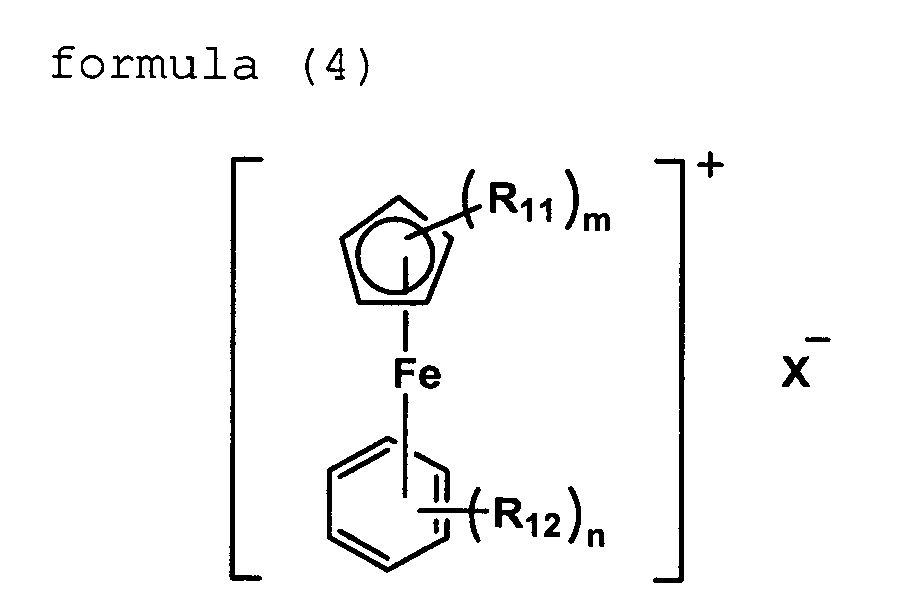

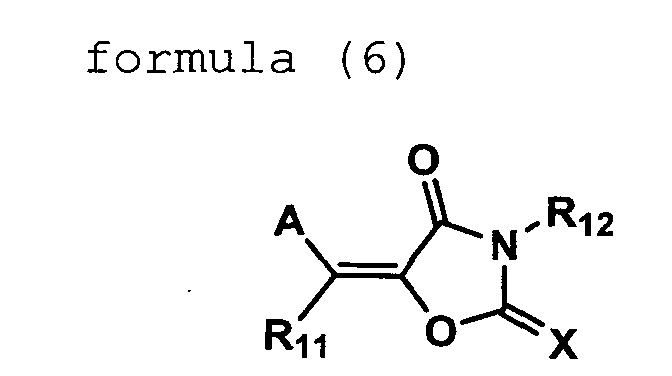


The present invention will be explained in detail
below. The compound represented by formula (1) in the
invention will be detailed below.
In formula (1), examples of the alkyl group represented
by R4 include a methyl group, an ethyl group, a propyl group,
a butyl group, a pentyl group, an iso-pentyl group, a 2-ethylhexyl
group, an octyl group, a decyl group, an n-dodecyl
group, an n-tetradecyl group, an n-pentradecyl group, an n-hexadecyl
group, an n-heptadecyl group, an n-octadecyl group,
and an n-docosadecyl group.
In formula (1), examples of the hydroxyalkyl group
represented by R4 include a hydroxymethyl group, a
hydroxyethyl group, a hydroxypropyl group, and a
hydroxypentyl group.
In formula (1), examples of the aryl group represented
by R4 include a phenyl group, and a naphthyl group.
In formula (1), examples of the alkyl group represented
by R1 or R2 are the same as those denoted in R4 above.
In formula (1), examples of the alkoxy group
represented by R1 or R2 include a methoxymethyl group, a
methoxyethyl group, an ethoxymethyl group, and a propoxyethyl
group.
In formula (1), the divalent linkage having a carbon
atom number of from 2 to 12 represented by X1 is preferably a
divalent saturated hydrocarbon group having a carbon atom
number of from 2 to 12, an arylene group or a divalent
heterocyclic group.
In formula (1), examples of the divalent saturated
hydrocarbon group having a carbon atom number of from 2 to 12
represented by X1 include an ethylene group, a trimethylene
group, a tetramethylene group, a propylene group, an
ethylethylene group, a pentamethylene group, a hexamethylene
group, a heptamethylene group, an octamethylene group, a
nonamethylene group, a decamethylene group, an
undecamethylene group, a dodecamethylene group, a
cyclohexylene group (e.g., a 1,6-cyclohexanediyl group), and
a cyclopentylene group (e.g., a 1,5-cyclopentanediyl group).
In formula (1), examples of the arylene group having a
carbon atom number of from 6 to 12 represented by X1 include
a phenylene group, and a naphthylene group.
In formula (1), examples of the divalent group
represented by X2 include the same as those denoted in the
divalent linkage having a carbon atom number of from 2 to 12
represented by X1. Examples of the divalent group
represented by X2 further include those in which up to five
methylene groups of the divalent saturated hydrocarbon group
above are replaced by oxygen atoms.
In formula (1), examples of the trivalent group
represented by X2 include an ethanetriyl group, a
propanetriyl group, a butanetriyl group, a pentanetriyl
group, a hexanetriyl group, a heptanetriyl group, a
octanetriyl group, a nonanetriyl group, a decanetriyl group,
an undecanetriyl group, a dodecanetriyl group, a
cyclohexanetriyl group, a cyclopentanetriyl group, a
benzenetriyl group and a naphthalenetriyl group.
In formula (1), examples of the tetravalent group
represented by X2 include a propanediylidene group, a 1,3-propanediyl-2-ylidene
group, a butanediylidene group, a
pentanediylidene group, a hexanediylidene group, a
heptanediylidene group, an octanediylidene group, a
nonanediylidene group, a decanediylidene group, an
undecanediylidene group, a dodecanediylidene group, a
cyclohexanediylidene group, a cyclopentanediylidene group, a
benzenetetrayl group and a naphthalenetetrayl group.
In formula (1), examples of the alkyl group represented
by Z include a methyl group, an ethyl group, a propyl group,
a butyl group, a pentyl group, an isopentyl group, a 2-ethylhexyl
group, an octyl group and a decyl group.
In X2 of formula (1), examples of the alkenyl group
represented by Z include a 2-propenyl group, a butenyl group,
a l-methyl-3-propenyl group, a 3-pentenyl group, a 1-methyl-3-butenyl
group, and a 4-hexenyl group.
In X2 of formula (1), examples of the aryl group
represented by Z include a phenyl group, a m-chlorophenyl
group, a tolyl group, and a naphthyl group.
In X2 of formula (1), examples of the halogen atom
represented by Z include a fluorine atom, a chlorine atom, a
bromine atom and an iodine atom.
In X2 of formula (1), examples of the alkoxy group
represented by Z include a methoxy group, an ethoxy group, a
propoxy group, and a butoxy group.
In X2 of formula (1), examples of the heterocyclic
group represented by Z include a pyridyl group, a pyrrolyl
group, a 2-methylpyrrolyl group, an indolyl group, an
imidazolyl group, a furyl group, a thiazolyl group, and a
pyrimidinyl group.
In formula (1), examples of the divalent group having a
carbon atom number of from 1 to 5 represented by D1 or D2
include a methylene group, a trimethylene group, a
tetramethylene group, a propylene group, an ethylethylene
group, a pentamethylene group, and a cyclopentylene group.
In formula (1), examples of the alkylene group having a
carbon atom number of from 2 to 12 represented by E are the
same as those denoted above in the divalent saturated
hydrocarbon group having a carbon atom number of from 2 to 12
represented by X1.
In formula (1), the alkylene groups above include those
having as a substituent a 5- to 7-member heterocyclic group.
Examples of the 5- to 7-membered heterocyclic include a
pyridyl group, a furyl group, a pyrrolyl group, a pyrazolyl
group, an imidazolyl group, an oxazolyl group, a thiazolyl
group, a pyrimidinyl group, a pyridazinyl group, a pyrranyl
group, a thienyl group, an isoxazolyl group, a pyrrolinyl
group, an imidazolinyl group ring, a pyrazolidinyl group, a
pyrazolinyl group, a piperidinyl group, a piperazinyl group,
a morpholyl group, and a quinuclidinyl group.
In formula (1), examples of the arylene group having a
carbon atom number of from 2 to 12 represented by E include a
phenylene group and a naphthylene group.
Each of the substituents denoted in formula (1) above
may further have a substituent.
The content of the compound represented by formula (1)
above in the photopolymerizable layer is preferably from 30
to 70% by weight, and more preferably from 40 to 60% by
weight. The compound represented by formula (1) above can be
synthesized by a known method, for example a method described
in Japanese Patent No. 2509288.
Exemplified compounds of the compound represented by
formula (1) will be listed below, but the present invention
is not limited thereto.

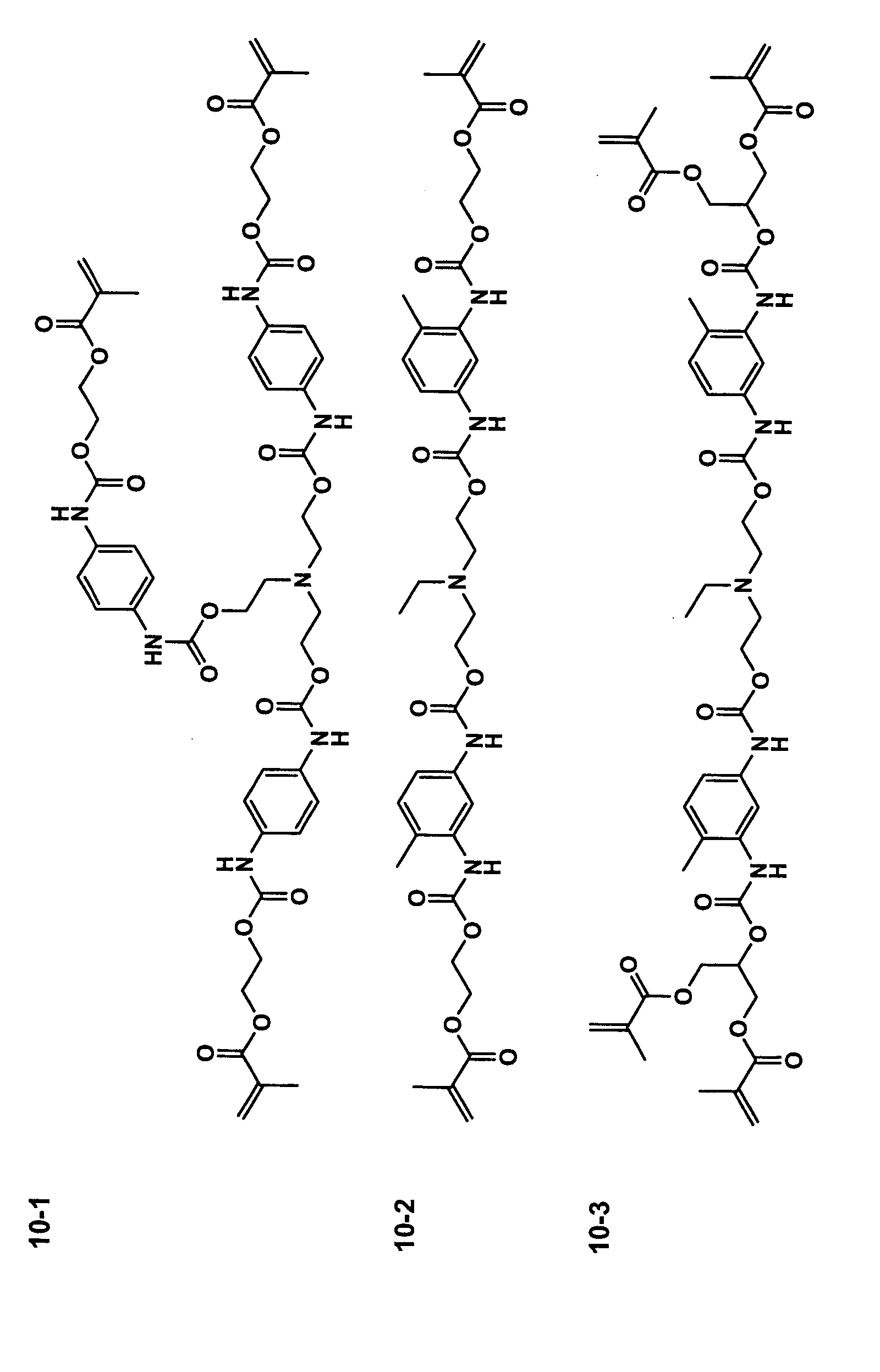


The compound represented by formula (2) in the
invention will be detailed below.
In formula (2), R8 represents an alkyl group, a
hydroxyalkyl group, or an aryl group. When (g-f) is two or
more, plural R8's may be the same or different. It is
preferred that g and f are the same. When R8 is an alkyl
group, or a hydroxyalkyl group, R8 has a carbon atom number
of preferably from 2 to 8, more preferably from 2 to 4. When
R8 is an aryl group, R8 is preferably monocyclic or bicyclic,
and more preferably monocyclic. The aryl groups include
those having a substituent such as an alkyl group, an alkoxy
group or a halogen atom.
In formula (2), R5 and R6 independently represent a
hydrogen atom, an alkyl group, or an alkoxy group. When R5
and R6 independently represent an alkyl group, or an alkoxy
group, R5 and R6 independently has a carbon atom number of
preferably from 1 to 5.
R7 is preferably a methyl group. D3 and D4 may be the
same or different, and D3 and D4 are preferably 6-member
saturated heterocyclic groups having two nitrogen atoms,
respectively.
F represents a saturated hydrocarbon group having a
carbon atom number of from 2 to 12 or an arylene group having
a carbon atom number of from 6 to 12. When F is the
saturated hydrocarbon group, F has a carbon atom number of
preferably from 2 to 6, and for example, ethylene, propylene,
or cyclohexylene is preferred. When F is the arylene group,
F is preferably phenylene.
In order to prepare a compound of formula (2) in which
Q2 is N, and n and m are the same, for example,
glycidylacrylate or hydroxyacrylate is reacted with
alkylamine.
Exemplified compounds of the compound represented by
formula (2) will be listed below.


The content of the compound represented by formula (2)
above in the photopolymerizable layer is preferably from 30
to 70% by weight, and more preferably from 40 to 60% by
weight.
The alkyl, alkenyl, aryl or heterocyclic group
represented by R1, R2, R3, and R4 of formula (3) is the same
as those denoted in Z of formula (1). The aralkyl group
represented by R1, R2, R3, and R4 of formula (3) is a benzyl
group or a phenethyl group. The aralkyl group represented by
R1, R2, R3, and R4 of formula (3) is a benzyl group or a
phenethyl group. The alkinyl group represented by R1, R2, R3,
and R4 of formula (3) is an ethinyl group or a propinyl
group. Exemplified compounds of the compound represented by
formula (3) will be listed below, but the present invention
is not limited thereto.

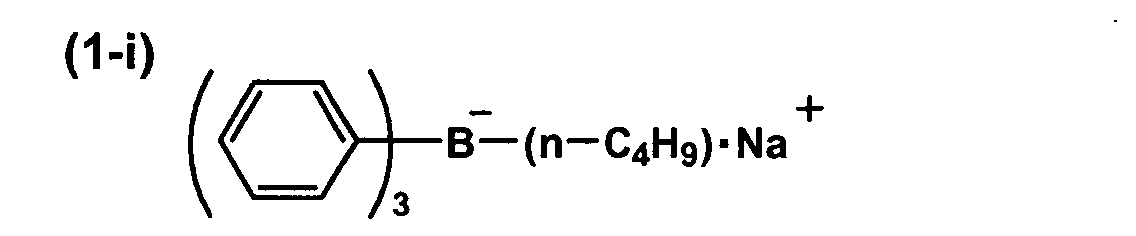

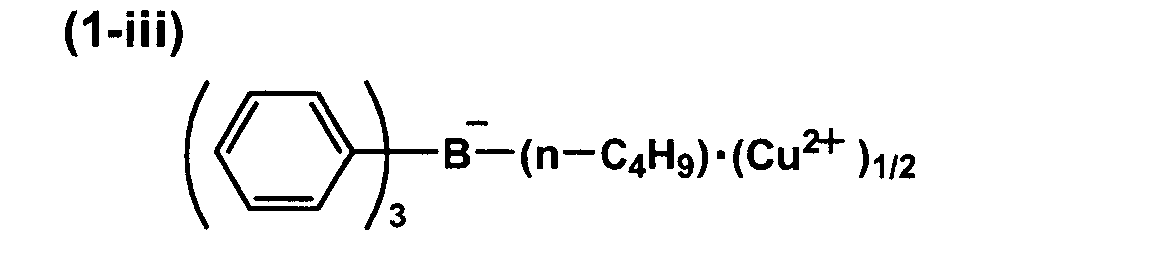






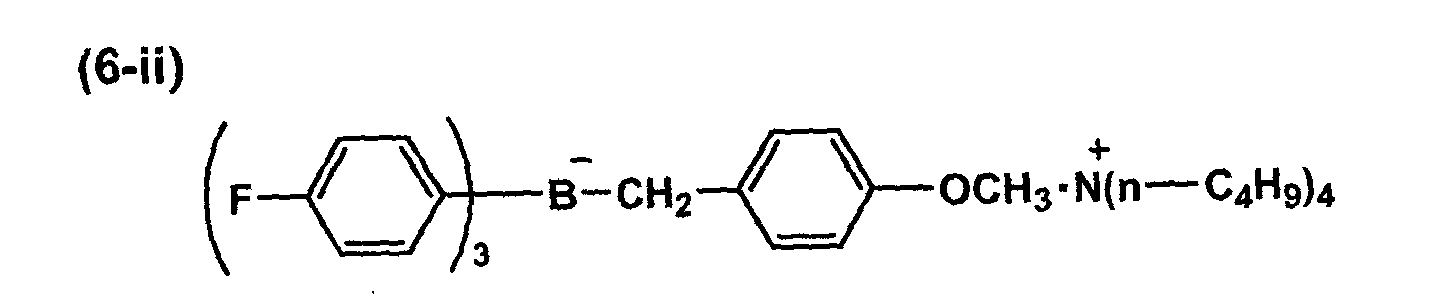


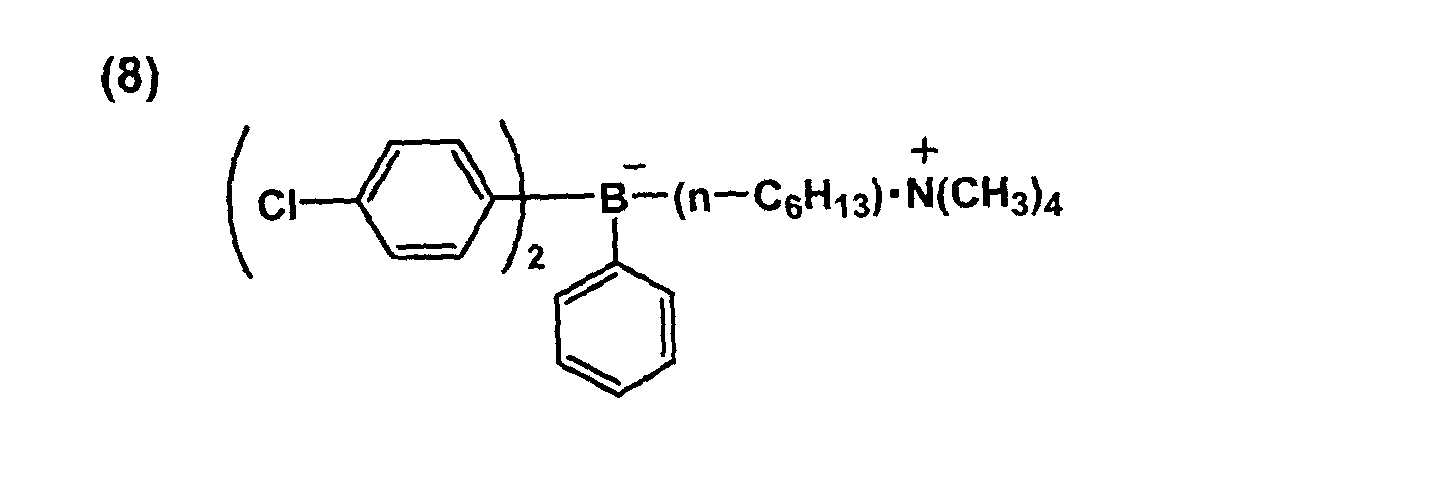









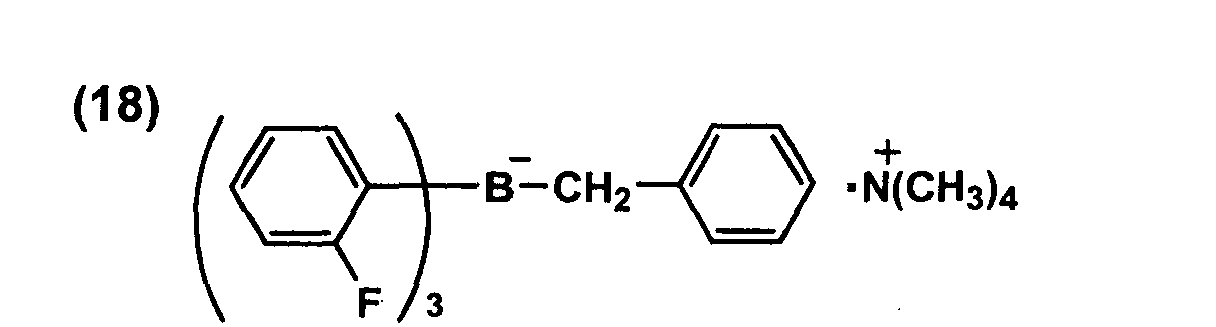
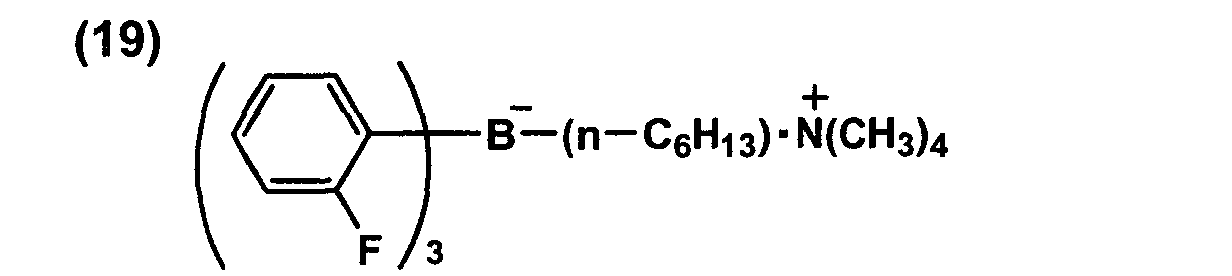
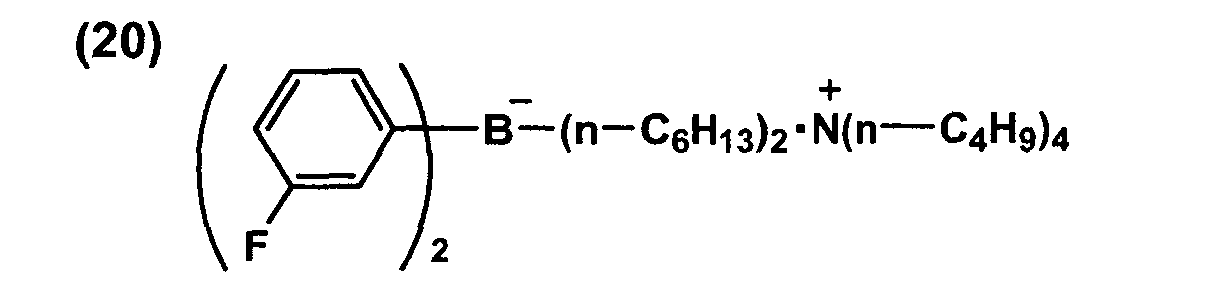
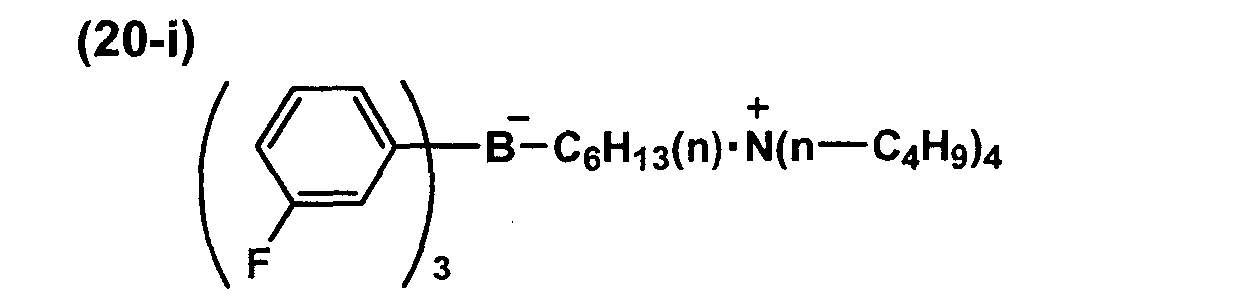

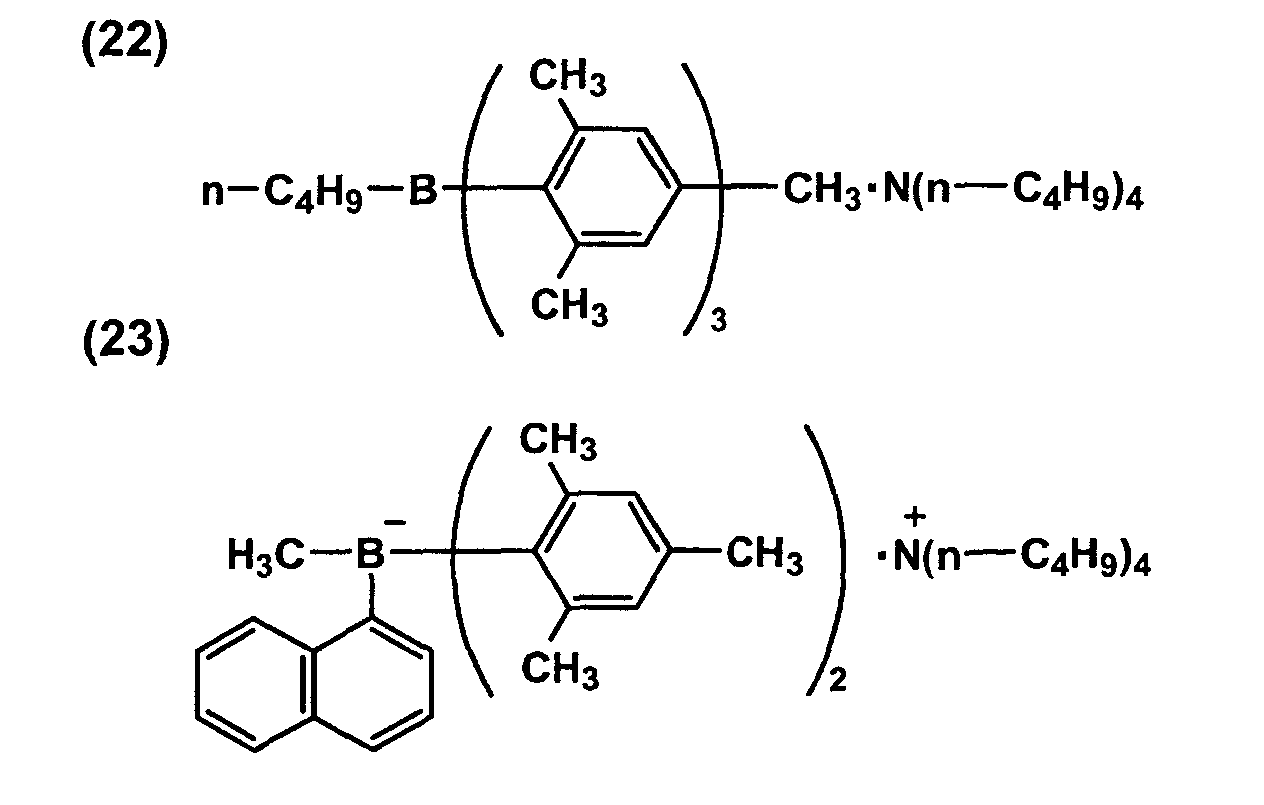


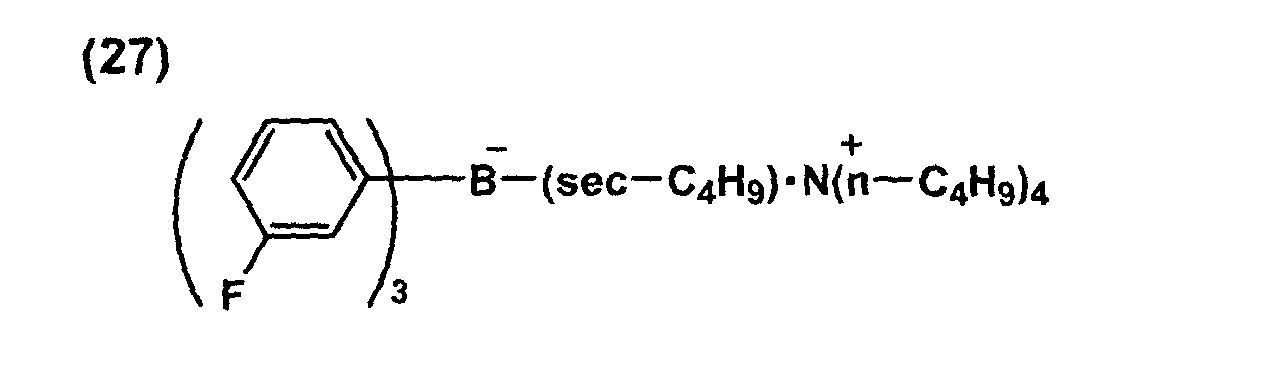


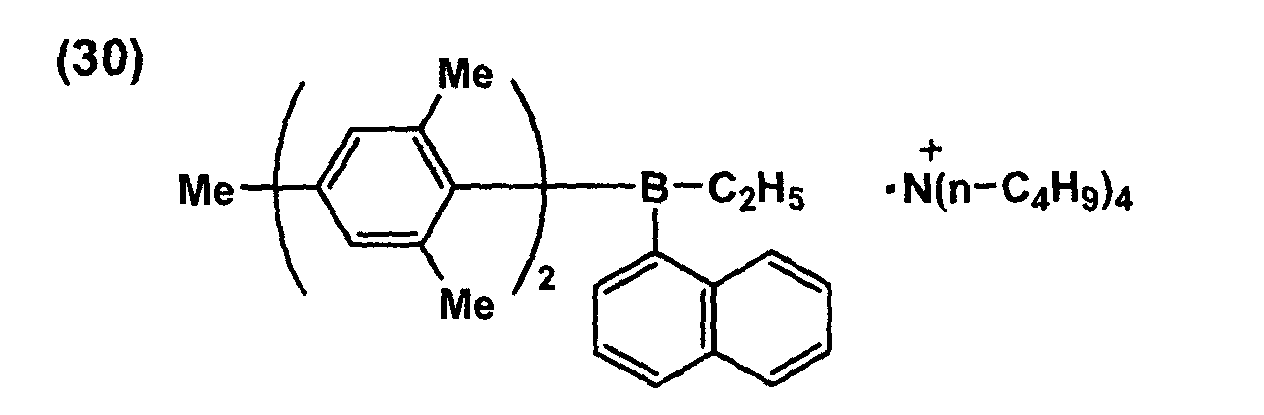

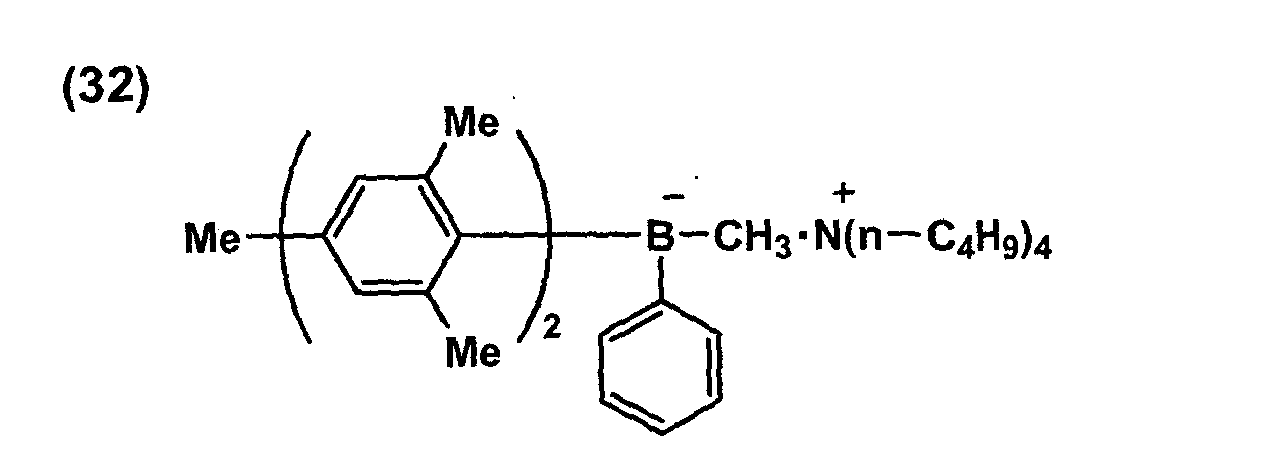


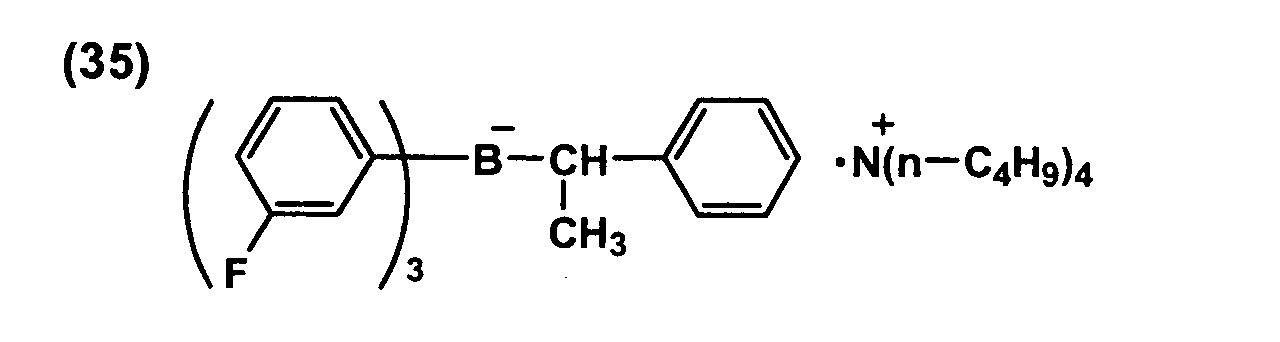

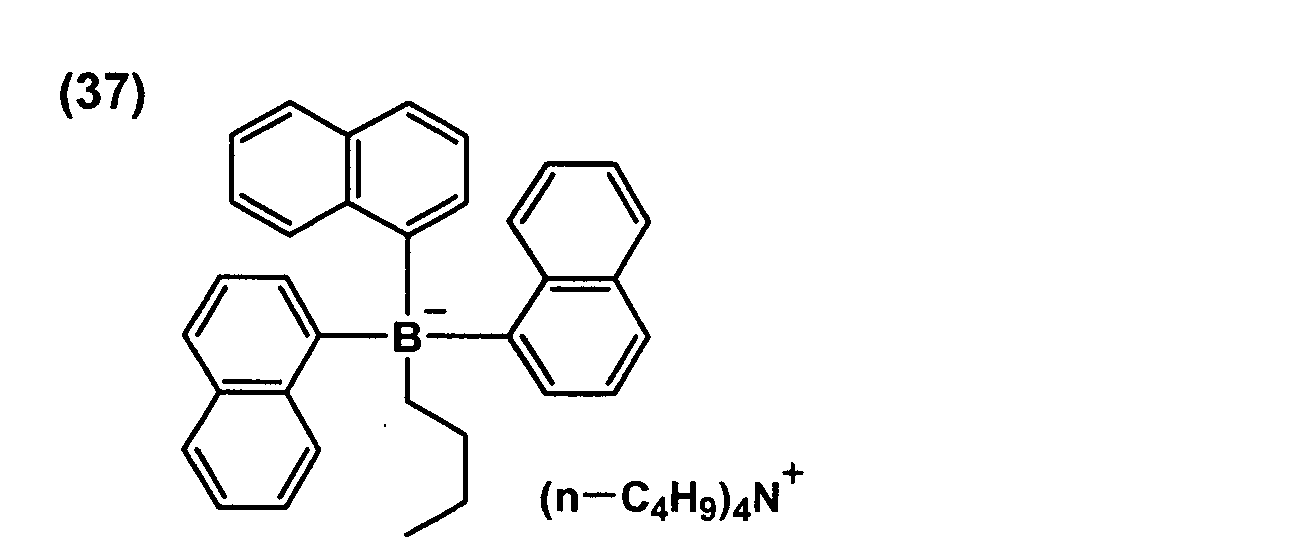


Examples of the compound represented by formula (4)
include (η6-benzene) (η5-cyclopentadienyl) iron (2)
hexafluorophosphate, (η6-toluene) (η5-cyclopentadienyl) iron
(2) hexafluorophosphate, (η6-cumene) (η5-cyclopentadienyl) iron
(2) hexafluorophosphate, (η6-benzene) (η5-cyclopentadienyl)iron
(2) hexafluoroarsenate, (η6-benzene)
(η5-cyclopentadienyl) iron (2) tetrafluoroborate, (η6-naphthalene)
(η5-cyclopentadienyl) iron (2)
hexafluorophosphate, (η6-anthracene) (η5-cyclopentadienyl) iron
(2) hexafluorophosphate, (η6-pyrene) (η5-cyclopentadienyl) iron
(2) hexafluorophosphate, (η6-benzene) (η5-cyanocyclopentadienyl)iron
(2) hexafluorophosphate, (η6-toluene)
(η5-acetylcyclopentadienyl) iron (2)
hexafluorophosphate, (η6-cumene) (η5-cyclopentadienyl) iron (2)
tetrafluoroborate, (η6-benzene) (η5-carboethoxycyclohexadienyl)iron
(2) hexafluorophosphate, (η6-benzene)
(η5-1,3-dichlorocyclohexadienyl) iron (2)
hexafluorophosphate, (η6-acetophenone) (η5-cyclohexadienyl)iron
(2) hexafluorophosphate, (η6-methyl
benzoate) (η5-cyclopentadienyl) iron (2) hexafluorophosphate,
(η6-benzene sulfonamide) (η5-cyclopentadienyl) iron (2)
tetrafluoroborate, (η6-benzamide) (η5-cyclopentadienyl) iron
(2) hexafluorophosphate, (η6-cyanobenzene) (η5-cyanocyclopentadienyl)
iron (2) hexafluorophosphate, (η6-chloronaphthalene)
(η5-cyclopentadienyl) iron (2)
hexafluorophosphate, (η6-anthracene) (η5-cyanocyclopentadienyl)iron
(2) hexafluorophosphate, (η6-chlorobenzene)
(η5-cyclopentadienyl) iron (2)
hexafluorophosphate, and (η6-chlorobenzene) (η5-cyclopentadienyl)iron
(2) tetrafluoroborate. These compounds
can be synthesized according to a method described in Dokl.
Akd. Nauk. SSSR 149 615 (1963).
The photopolymerizable layer in the light sensitive
planographic printing plate precursor of the invention
preferably contains a sensitizing dye. Examples of the known
sensitizing dyes, which can induce sensitivity to the
wavelengths of the visible and near infrared regions, include
cyanines, phthalocyanines, merocyanines, porphyrins, spiro
compounds, ferrocenes, fluorenes, fulgides, imidazoles,
perylenes, phenazines, phenothiazines, polyenes, azo
compounds, diphenylmethanes, triphenylmethanes, polymethine
acridines, cumarines, ketocumarines, quinacridones, indigos,
styryl dyes, pyrylium dyes, pyrromethene dyes,
pyrazolotriazole compounds, benzothiazole compounds,
barbituric acid derivatives, thiobarbituric acid derivatives,
and compounds disclosed in European Patent No. 568,993, US
Patent Nos. 4,508,811 and 5,227,227, and Japanese Patent
O.P.I. Publication Nos. 2001-125255 and 11-271969.
The sensitizing dye used in the invention is preferably
a sensitizing dye having an absorption maximum in the
wavelength regions of from 350 to 450 nm, and more preferably
a compound represented by the following formula (5), (6),
(7), or (8). In the invention, λmax (a wavelength providing
an absorption maximum) of the sensitizing dye is measured in
methanol as a main solvent, employing a spectrophotometer U-3300
(produced by Hitachi Co., Ltd.).
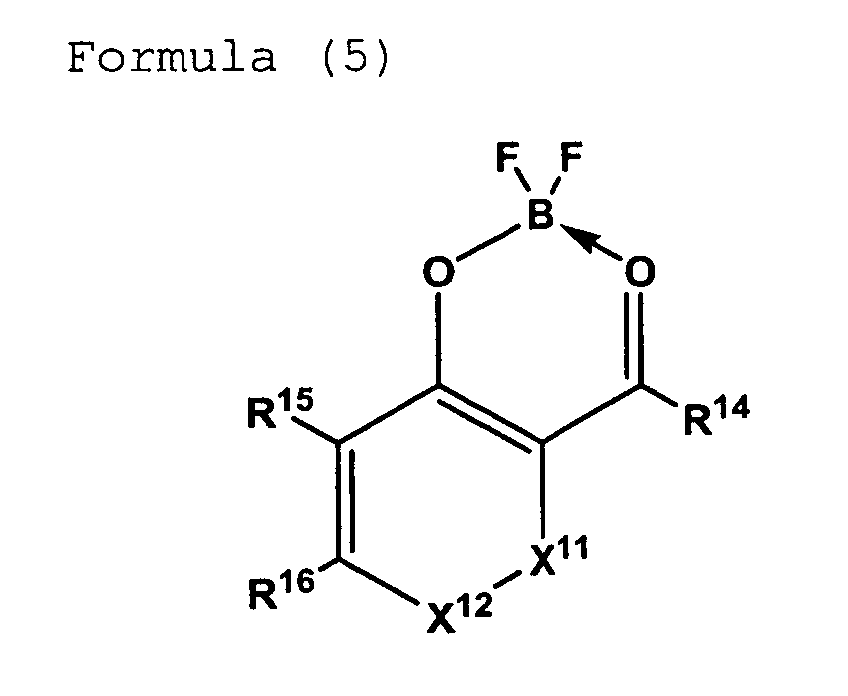
In formula (5), R14 represents a hydrogen atom, an
alkyl group, an alkenyl group, an aryl, or a heterocyclic
group; R15 and R16 combine with each other to form a ring; and
X11 and X12 independently represent -CR17R18-, -O-, -S-, or
-NR19-, in which R17, R18, and R19 independently represent a
hydrogen atom, an alkyl group, an alkenyl group, an aryl
group, or a heterocyclic group.
Examples of the alkyl group represented by R14 include
a methyl group, an ethyl group, a propyl group, a butyl
group, a hexyl group, an octyl group, a decyl group, a
dodecyl group, an isopropyl group, an isobutyl group, an
isopentyl group, a tert-butyl group or a 2-ethylhexyl group.
Examples of the alkenyl group represented by R14 include a
vinyl group, a 2-propenyl group, or a 3-butenyl group, a 1-methyl-3-propenyl
group, 3-pentenyl group, a 1-methyl-3-butenyl
group, and a 4-hexenyl group. Examples of the aryl
group represented by R14 include a phenyl group, a naphthyl
group, or an aralkyl group such as a benzyl group or
phenethyl group. Examples of the heterocyclic group
represented by R14 include a pyrrolyl group, an imidazolyl
group, a pyrazolyl group, an oxazolyl group, a thiazolyl
group, an oxadiazolyl group, a thiadiazolyl group, a
benzoimidazolyl group, a pyridyl group, a furyl group, a
thienyl group, a chromanyl group, a coumarinyl group, a
pyrrolidinyl group, a piperidinyl group, a morpholinyl group,
a sulfolanyl group, a tetrahydrofuryl group, and a
tetrahydropyranyl group.
Examples of the alkyl group, the alkenyl group, the
aryl group or the heterocyclic group represented by R17, R18,
or R19 are the same as those denoted in R14 above.
The spectral sensitizing dye represented by formula (5)
in the invention can be prepared according to conventional
synthetic methods well known in the art.
Examples of the sensitizing dye represented by formula
(5) are listed below, but are not limited thereto.
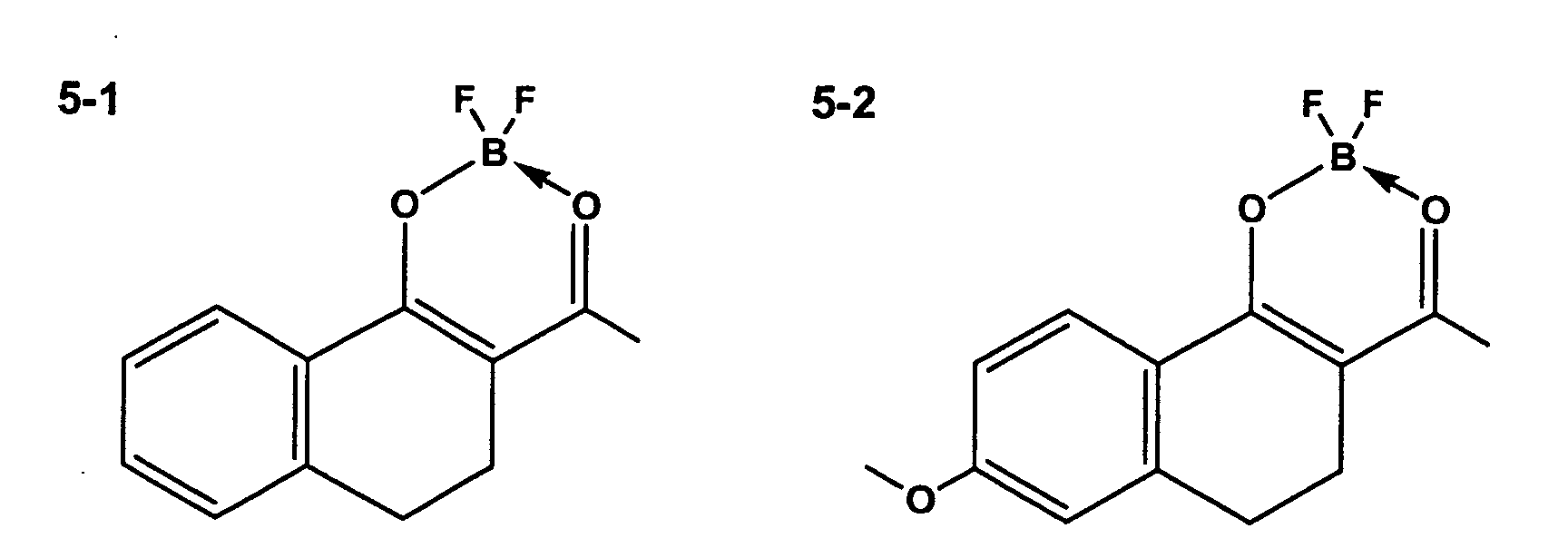


A compound represented by formula (6) will be explained
below.
The aromatic hydrocarbon group represented by A
represents a phenyl group, a naphthyl group, a pentalenyl
group, an indenyl group, an azulenyl group, a fluorenyl
group, a phenanthrenyl group, or an anthracenyl group.
The heterocyclic group represented by A represents a
furyl group, pyrrolyl group, a pyrazolyl group, an imidazolyl
group, an oxazolyl group, a thiazolyl group, a 1,2,3-oxazolyl
group, a 1,2,3-triazolyl group, a 1,2,4-triazolyl group, a
1,3,4-thiadiazolyl group, a pyridinyl group, a pyridazinyl
group, a pyrimidyl group, a pyrazinyl group, an s-triazinyl
group, a benzofuryl group, an indolyl group, a benzothienyl
group, a benzimidazolyl group, a benzothiazolyl group, a
purinyl group, a quinolyl group, an isoquinolyl group, a
morpholinyl group, a pyrazolinyl group, a piperidinyl group,
an indolinyl group, a pyrrolinyl group, an imidazolidinyl
group, and an indolidinyl group.
The substituent represented by R11, R12, and R13
represents an alkyl group, an alkenyl group, an aryl group,
an aromatic heterocyclic group, an alkoxy group, an alkylthio
group, a hydroxyl group or a halogen atom.
The alkyl group, alkenyl group, and aryl group
represented by R11, R12, and R13 represent the alkyl group,
alkenyl group, and aryl group denoted in R14 of formula (5),
respectively.
The aromatic heterocyclic group represented by R11, R12,
and R13 represents a furyl group, a pyrrolyl group, a
pyrazolyl group, an imidazolyl group, an oxazolyl group, a
thiazolyl group, pyridyl group, a pyridazinyl group, a
pyrimidinyl group, a pyrazinyl group.
The alkoxy group represented by R11, R12, and R13
represents a methoxy group, an ethoxy group, or a propoxy
group.
The alkylthio group represented by R11, R12, and R13
represents a methylthio group, an ethylthio group, a
propylthio group or a pentylthio group.
The halogen atom represented by R11, R12, and R13
represents fluorine, chlorine, bromine or iodine.
Examples of the compound represented by formula (6)
will be listed below; but the present invention is not
limited thereto.
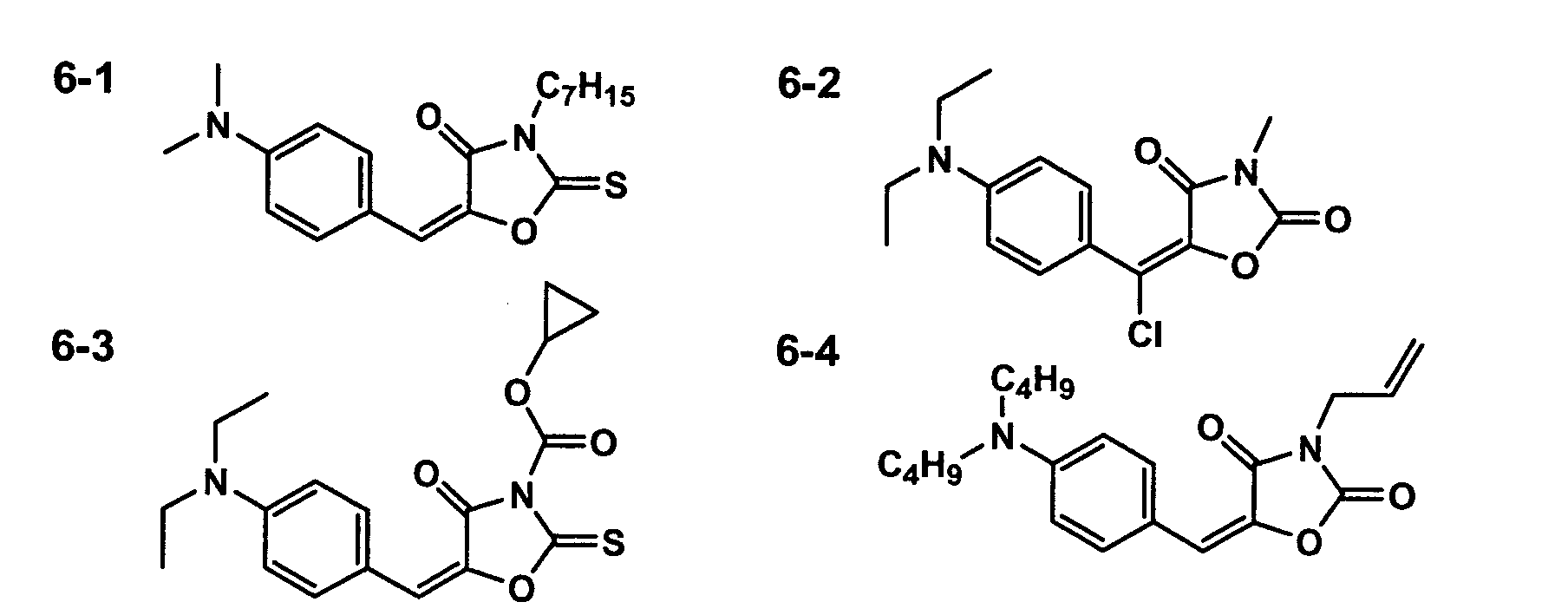

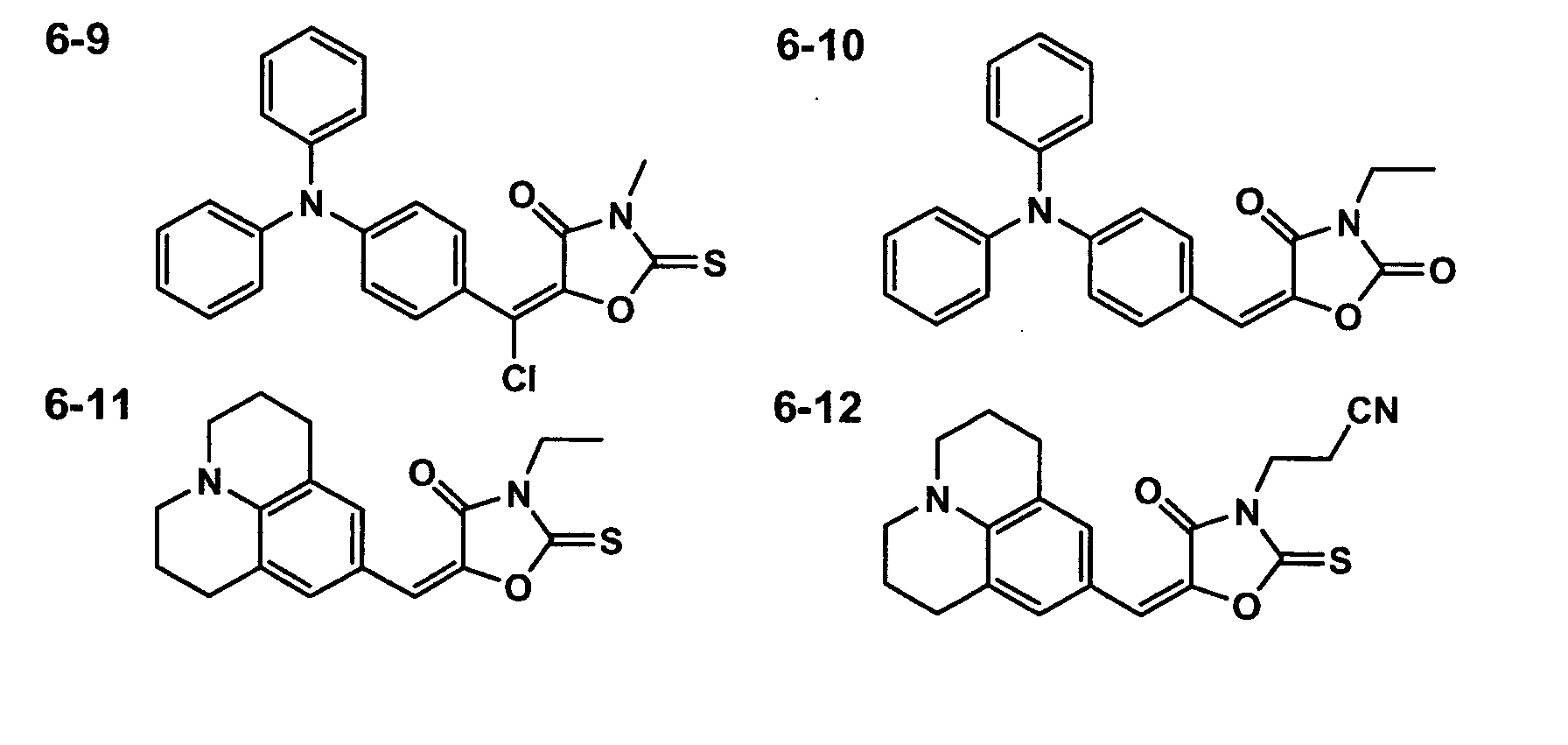

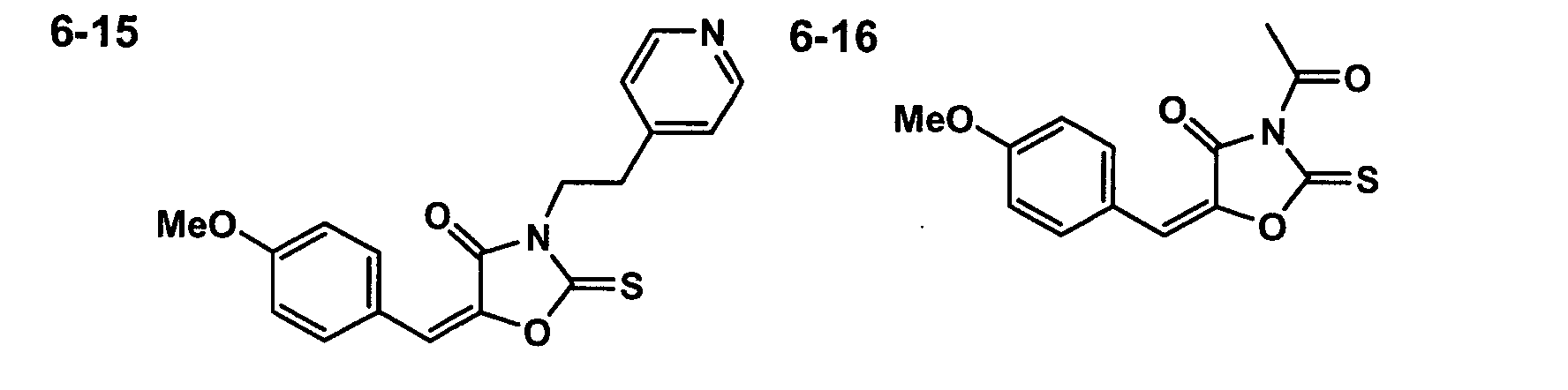

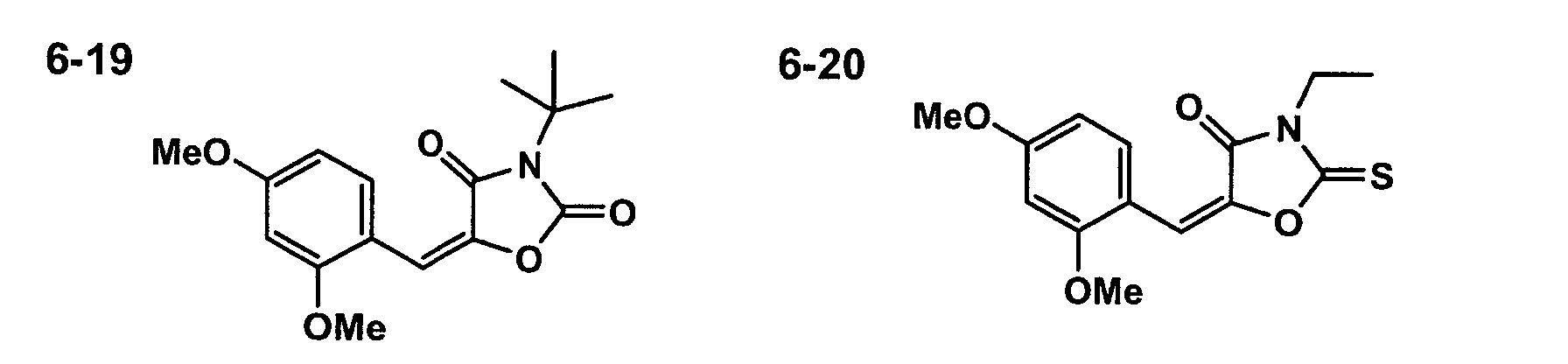

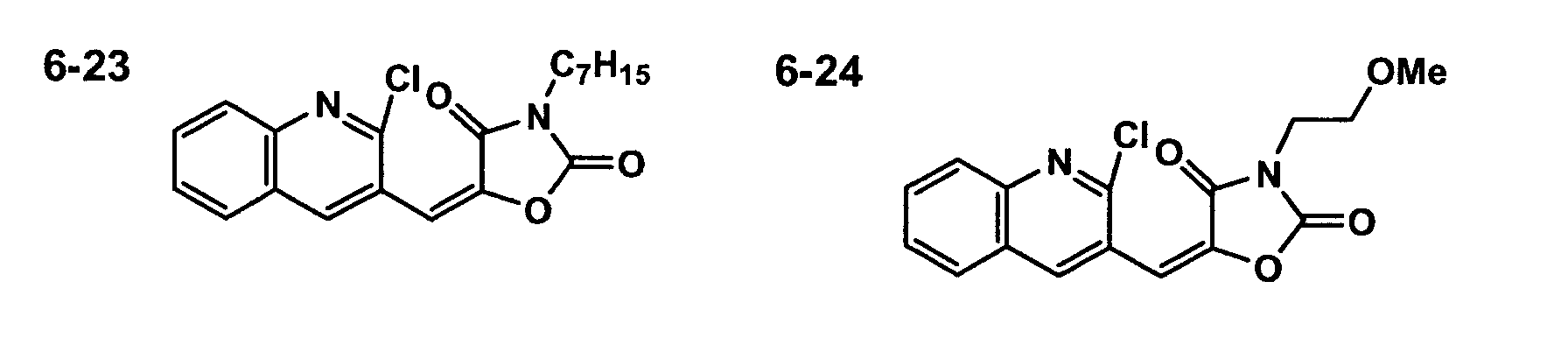
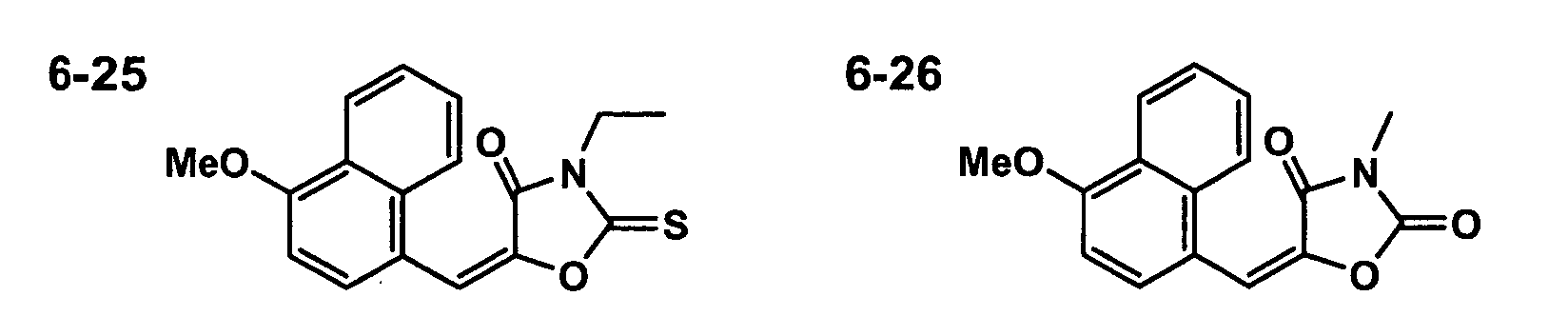
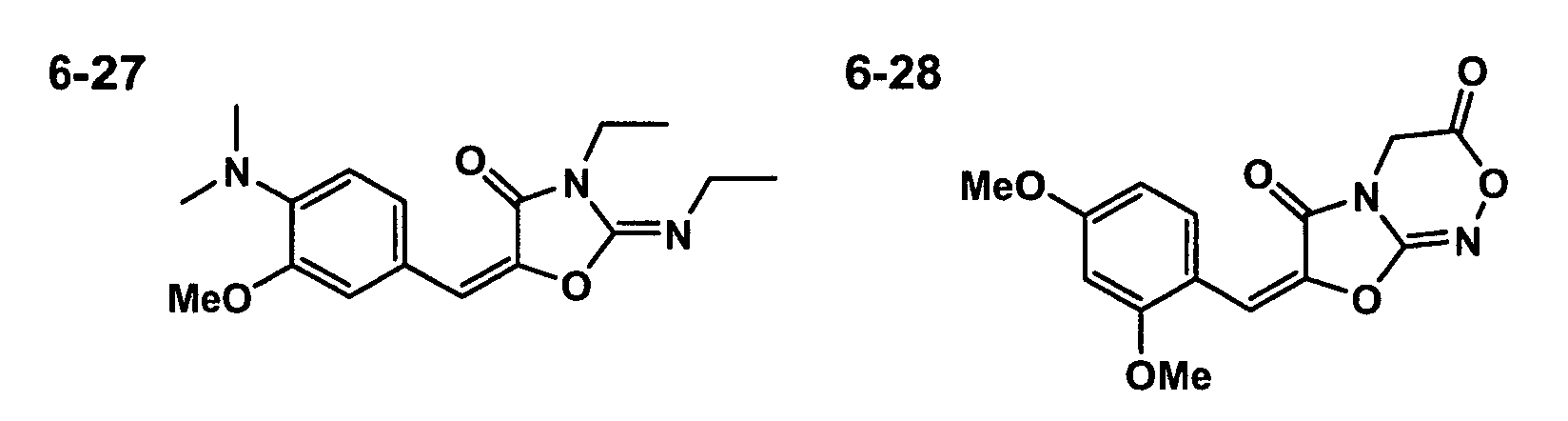
A compound represented by formula (6) will be explained
below.
In formula (7), the substituent represented by R11, R12,
R13, R14, R15, R16, R17, R18, and R18 are the same as those
denoted in R11, R12, and R13 of formula (6) above.
In formula (7), two adjacent groups of R11, R12, R13,
R14, R15, R16, R17, R18, and R18 may combine with each other to
form a ring which is a non-aromatic hydrocarbon group, an
aryl group, or a heterocyclic group.
Examples of the non-aromatic hydrocarbon group include
a cyclohexyl group, a cyclobutyl group, a cyclopentyl group,
and a cycloctyl group. Examples of the aryl group include a
phenyl group, a naphthyl group, a pentalenyl group, an
indenyl group, an azulenyl group, a fluorenyl group, a
phenenthrenyl group and a anthracenyl group. Examples of the
heterocyclic group include a furyl group, a pyrrolyl group, a
pyrazolyl group, an imidazolyl group, an oxazolyl group, a
thiazolyl group, a 1,2,3-oxathiazolyl group, a 1,2,3-triazolyl
group, a 1,2,4-triazolyl group, a 1,3,4-thiadiazolyl
group, a pyridyl group, a pyridazinyl group, a
pyrimidinyl group, a pyrazinyl group, an s-triazinyl group, a
benzofuryl group, an indolyl group, a beozothienyl group, a
beozimidazolyl group, a benzothiazolyl group, a purinyl
group, a quinolinyl group and an isoquinolinyl group.
In formula (7), when R11 is represented by formula P,
R10 may combine with R12 or R19 to form a ring, when R13 is
represented by formula P, R10 may combine with R12 or R14 to
form a ring, and when R11 and R13 both are represented by
formula P, R10 may combine with R14 or R19 to form a ring. The
ring herein referred to represents a non-aromatic hydrocarbon
group, an aryl group, or a heterocyclic group. Examples of
the non-aromatic hydrocarbon group, aryl group, or a
heterocyclic group are the same as those denoted above.
In formula p, Z represents a non-metallic atomic group
necessary to form a 5-member acidic nucleus. Herein,
definition of "acidic ring" is one described in the eighth
paragraph of T. M. James, "The Theory of The Photographic
Process", fourth edition, published by Macmillan. A
sensitizing dye represented by a merocyanine dye generally
has a basic (electron donating) heterocyclic ring and an
acidic (electron withdrawing) heterocyclic ring in the
molecular ends. The basic (electron donating) heterocyclic
ring is called a basic nucleus, and the acidic (electron
withdrawing) heterocyclic ring is called an acidic nucleus.
Examples of the basic or acidic nucleus are the same as those
listed in the eighth paragraph of T. M. James, "The Theory of
The Photographic Process", fourth edition, published by
Macmillan.
Examples of the acidic nucleus include a 1,3-dicarbonyl
nucleus (for example, 1,3-indanedione, or 1,3-dioxane-4,6-dione),
a pyrazolinone nucleus (for example, 3-methyl-1-phenyl-2-pyrazoline-5-one,
1-phenyl-2-pyrazoline-5-one, or 1-(2-benzothiazolyl)-3-methyl-2-pyrazoline-5-one),
an
isoxazolinone nucleus (for example, 3-phenyl-2-isoxazoline-5-one,
or 3-methyl-2-isoxazoline-5-one), an oxyindole nucleus
(for example, 1-alkyl-2,3-dihydro-2-oxyindole), a 2-thio-2,4-dithiazolidinedione
nucleus (for example, a rhodanine or its
N-substituted derivative such as 3-methylrohdanine, 3-ethylrohdanine,
3-phenylrohdanine, 3-allylrohdanine, 3-benzylrohdanine,
3-carboxymethylrohdanine, 3-carboxyethylrohdanine,
3-methoxycarbonylmethylrohdanine, 3-hydroxyethylrohdanine,
or 3-morpholinoethylrohdanine), a 2-thio-2,4-oxazolidinedione
nucleus (for example, 2-thio-2,4-(3H,
4H)-oxazoledione such as 2-ethyl-2-thio-2,4-oxazolidinedione),
a thianaphthenone nucleus (for example,
3(2H)-thianaphthenone or 3(2H)-thianaphthenone-1,1-dioxide),
a 2-thio-2,5-thiazolidinedione nucleus (for example, 3-ethyl-2-thio-2,5-thiazolidinedione),
a 2,4-thiazolidinedione
nucleus (for example, 2,4-thiazolidinedione, 3-ethyl-2,4-thiazolidinedione,
or 3-phenyl-2,4-thiazolidinedione), a
thiazolidinone nucleus (for example, 4-thiazolidinone, 3-ethyl-4-thiazolidinone,
2-ethylmercapto-4-thiazolidinone, or
2-methylphenylamino-4-thiazolidinone), a 2-imino-2-oxazoline-4-one
nucleus (i.e., a pseudo-hydantoin nucleus), a 2,4-imidazolidinedione
nucleus (i.e., a hydantoin nucleus, for
example, 2,4-imidazolidinedione, 3-ethyl-2,4-imidazolidinedione,
or 1,3-diethyl-2,4-imidazolidinedione), a
2-thio-2,4-imidazolidinedione nucleus (i.e., a thiohydantoin
nucleus, for example, 2-thio-2,4-imidazolidinedione, 3-ethyl-2-thio-2,4-imidazolidinedione,
or 1,3-diethyl-2-thio-2,4-imidazolidinedione),
an imidazoline-5-one nucleus (for
example, 2-propylmercapto-2- imidazoline-5-one.
Examples of the compound represented by formula (7)
will be listed below; but the present invention is not
limited thereto.


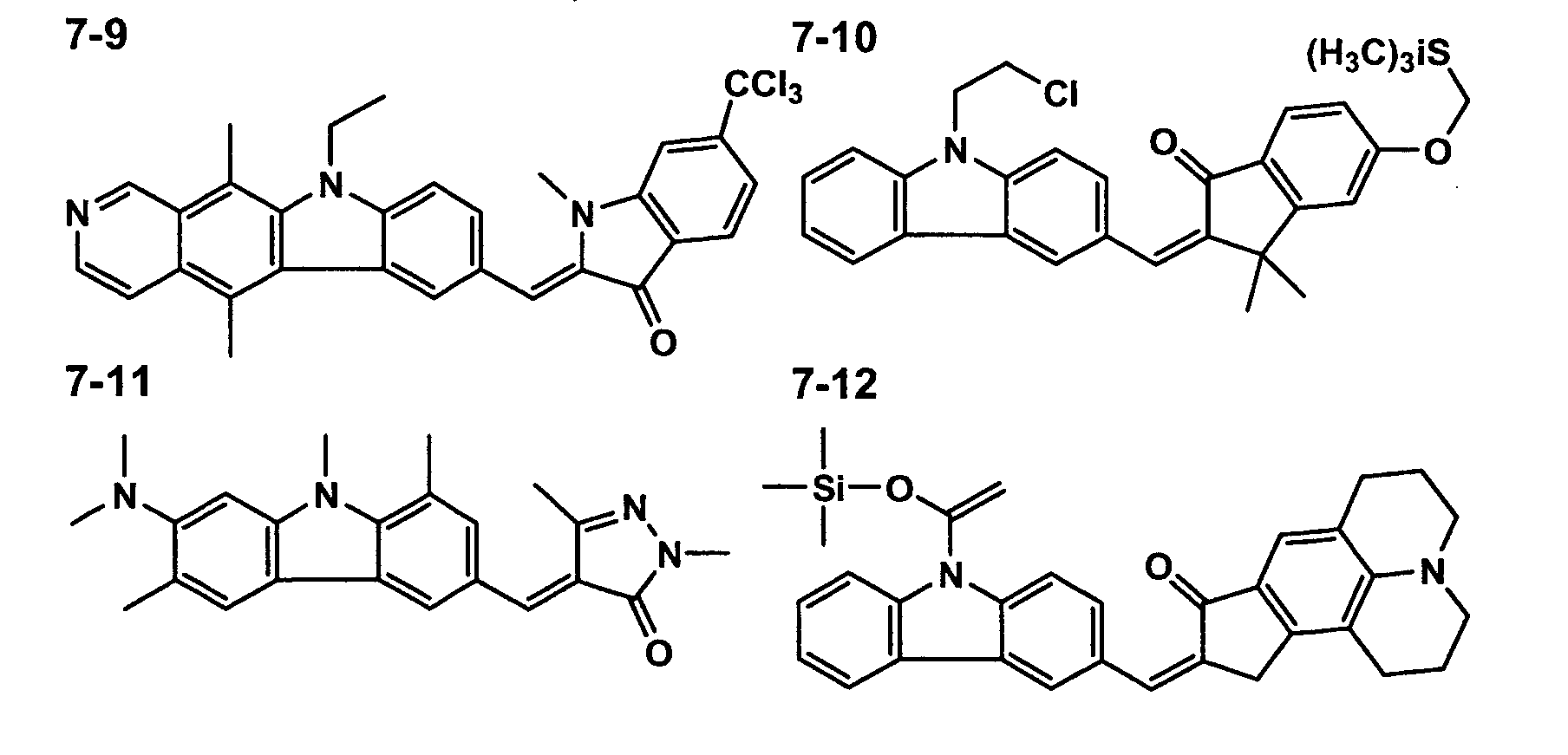
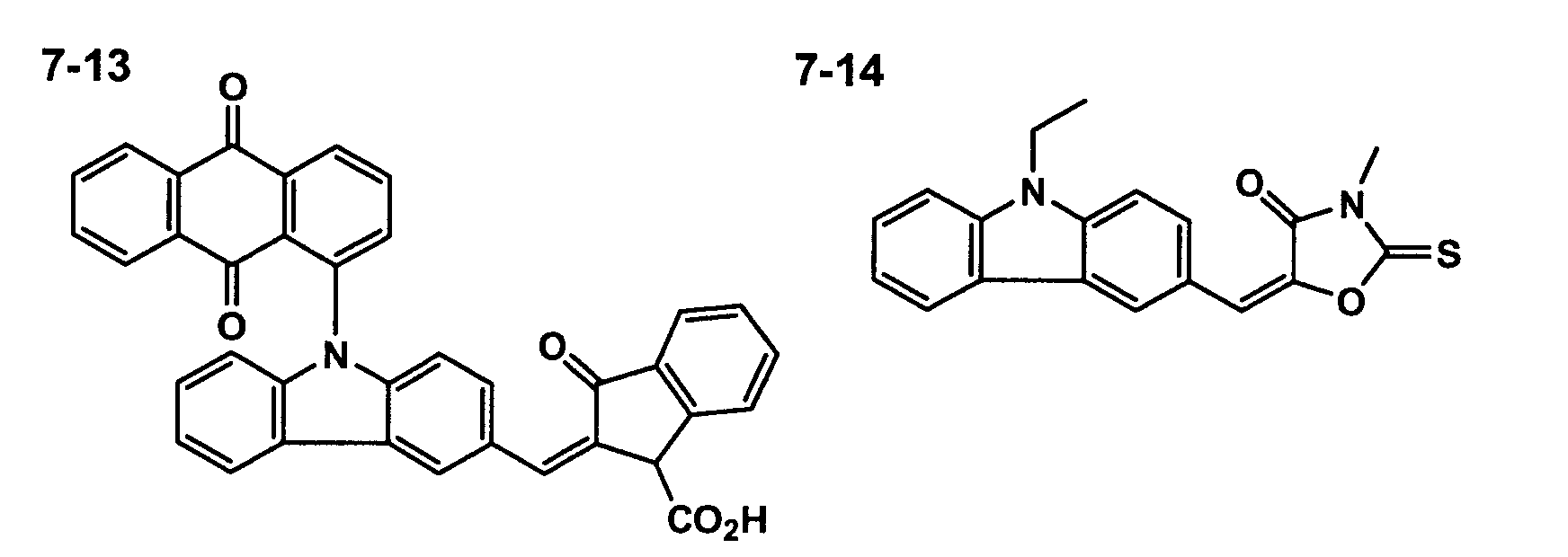


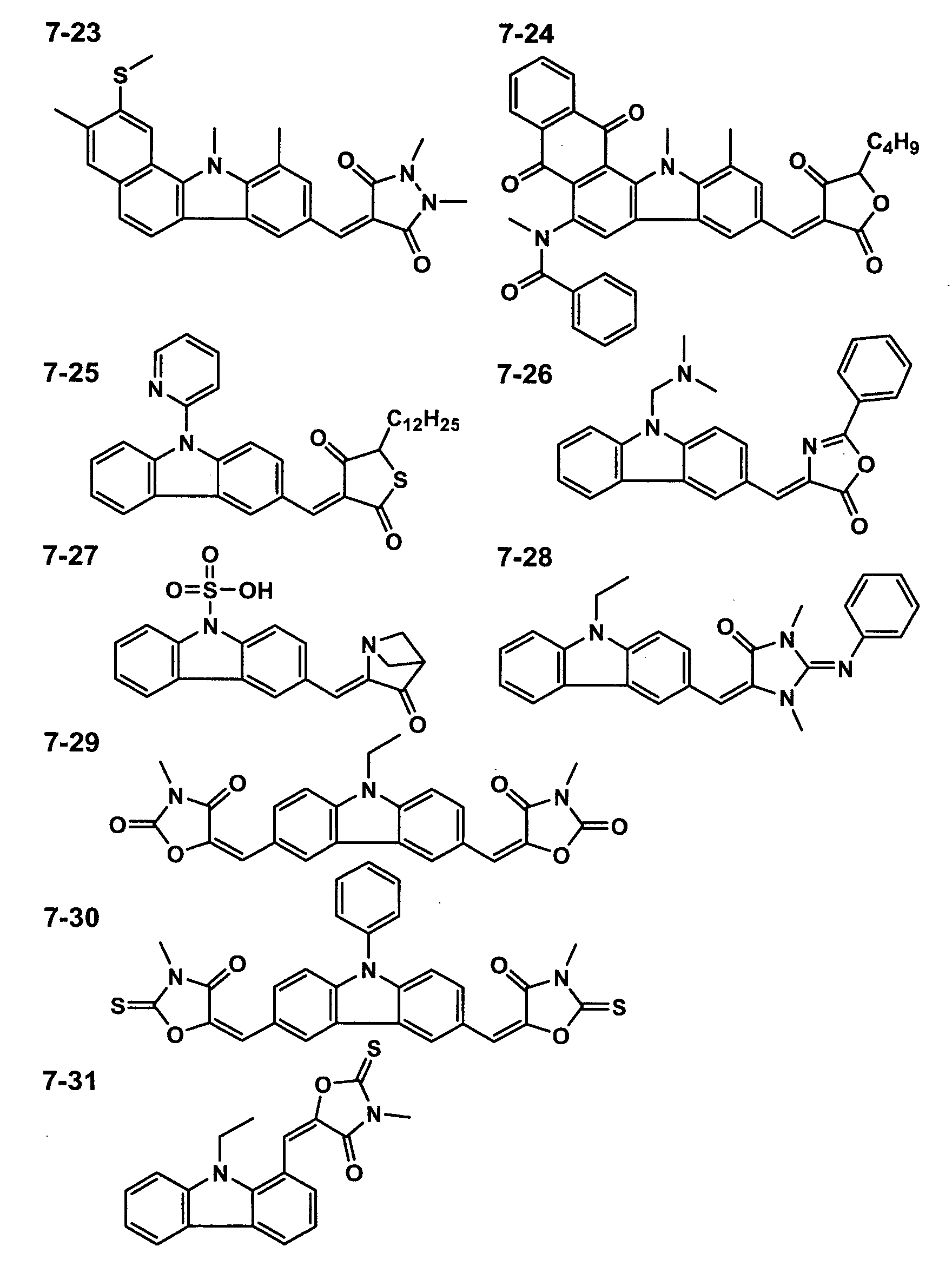
A compound represented by formula (8) will be explained
below.
In formula (8), the substituent represented by X1, X2,
X3, X4 and X5 represents an alkyl group, an alkenyl group, an
aryl group, a heterocyclic group, an alkoxy group, an
alkylthio group, a hydroxyl group, or a halogen atom.
Examples of the alkyl group, alkenyl group, aryl group,
heterocyclic group, alkoxy group, alkylthio group, hydroxyl
group, or halogen atom are the same as those denoted in R11,
R12, and R13 of formula (6). In formula (8), the aryl group
or aromatic heterocyclic represented by z is the same as
those denoted in Z of formula (1).
Examples of the compound represented by formula (8)
will be listed below; but the present invention is not
limited thereto.
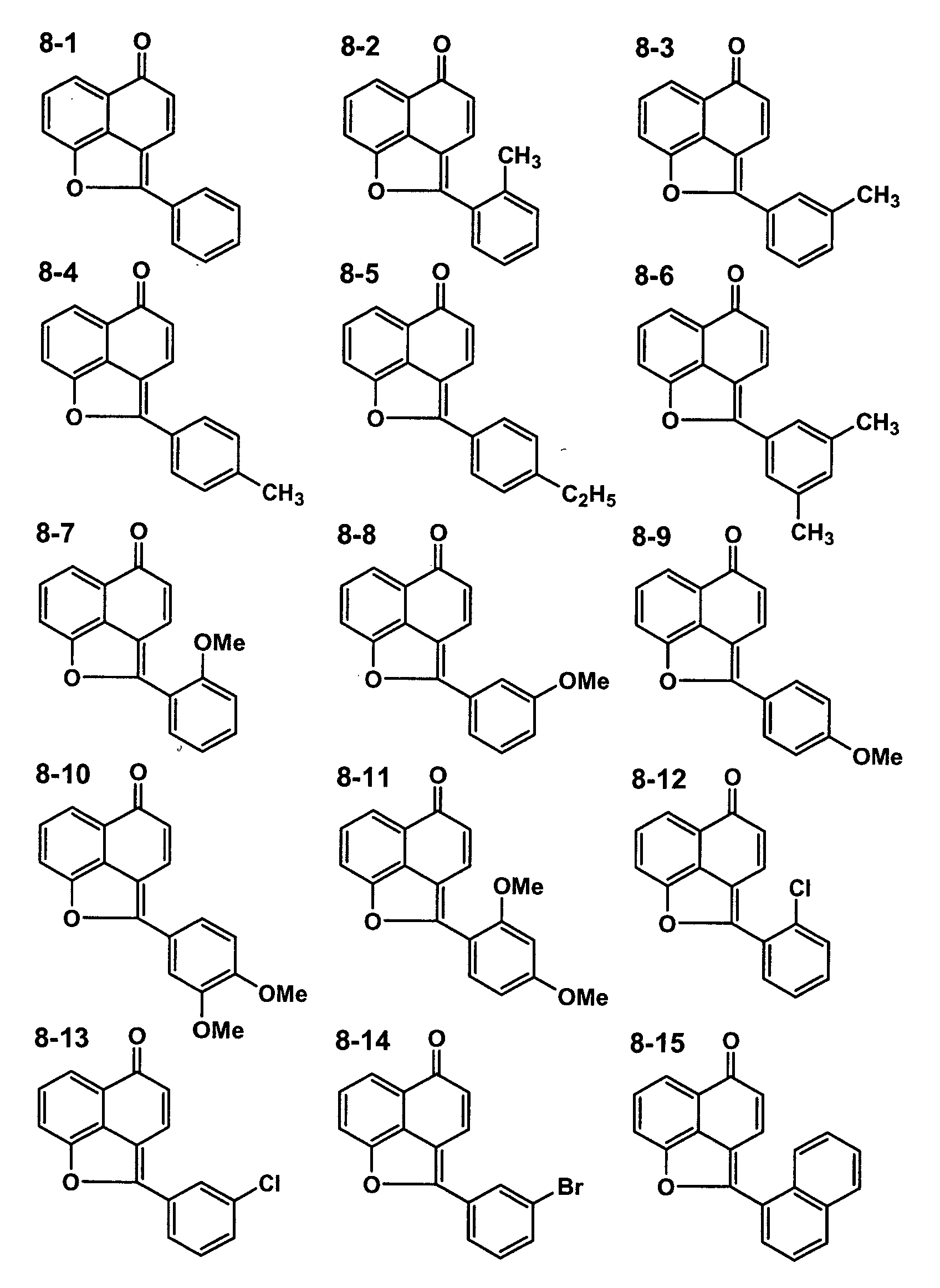
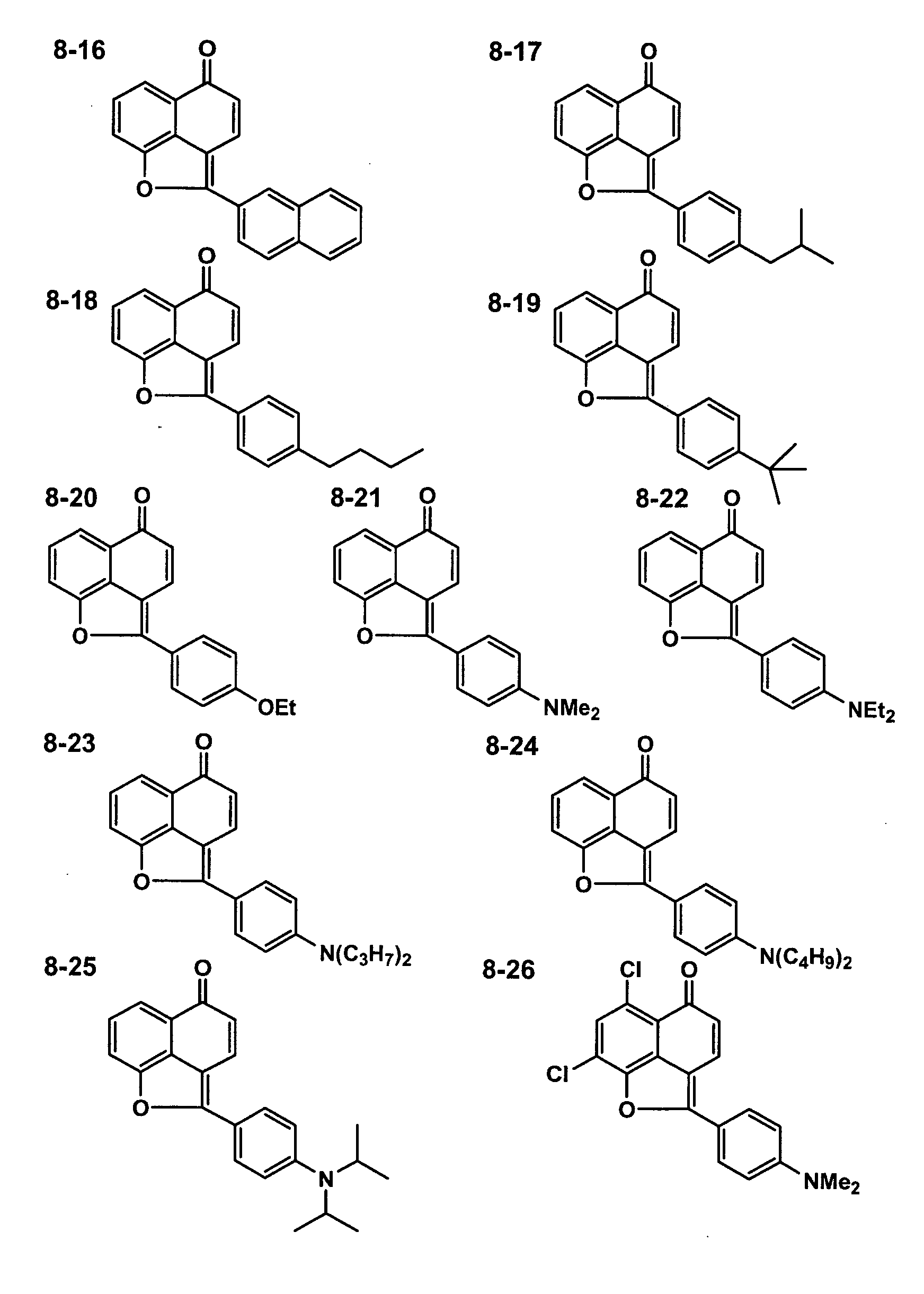
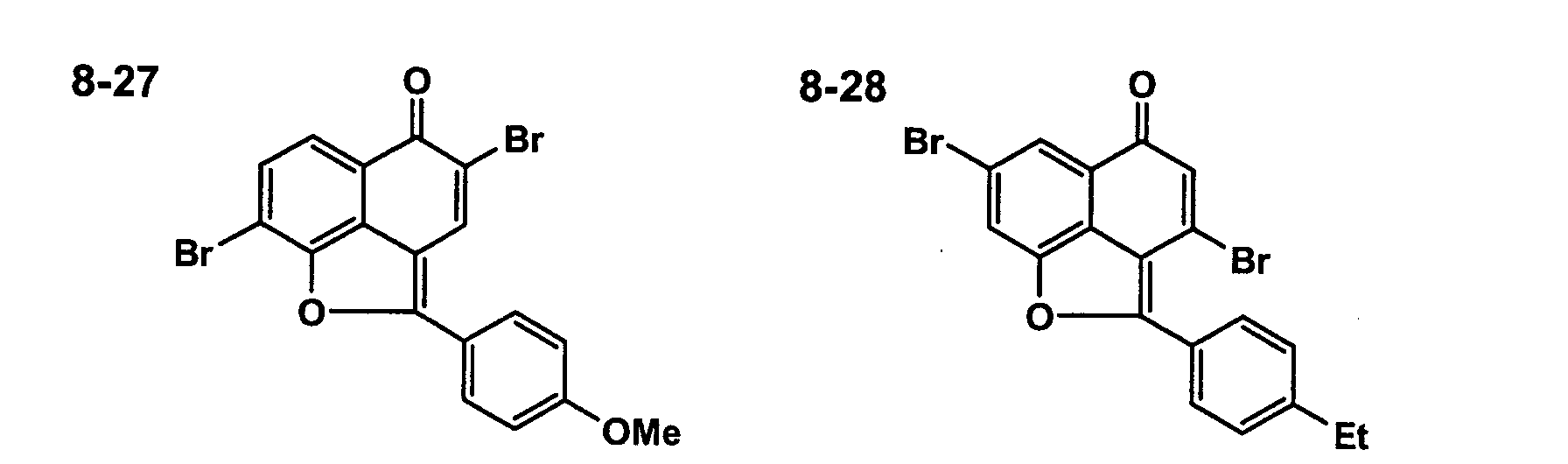

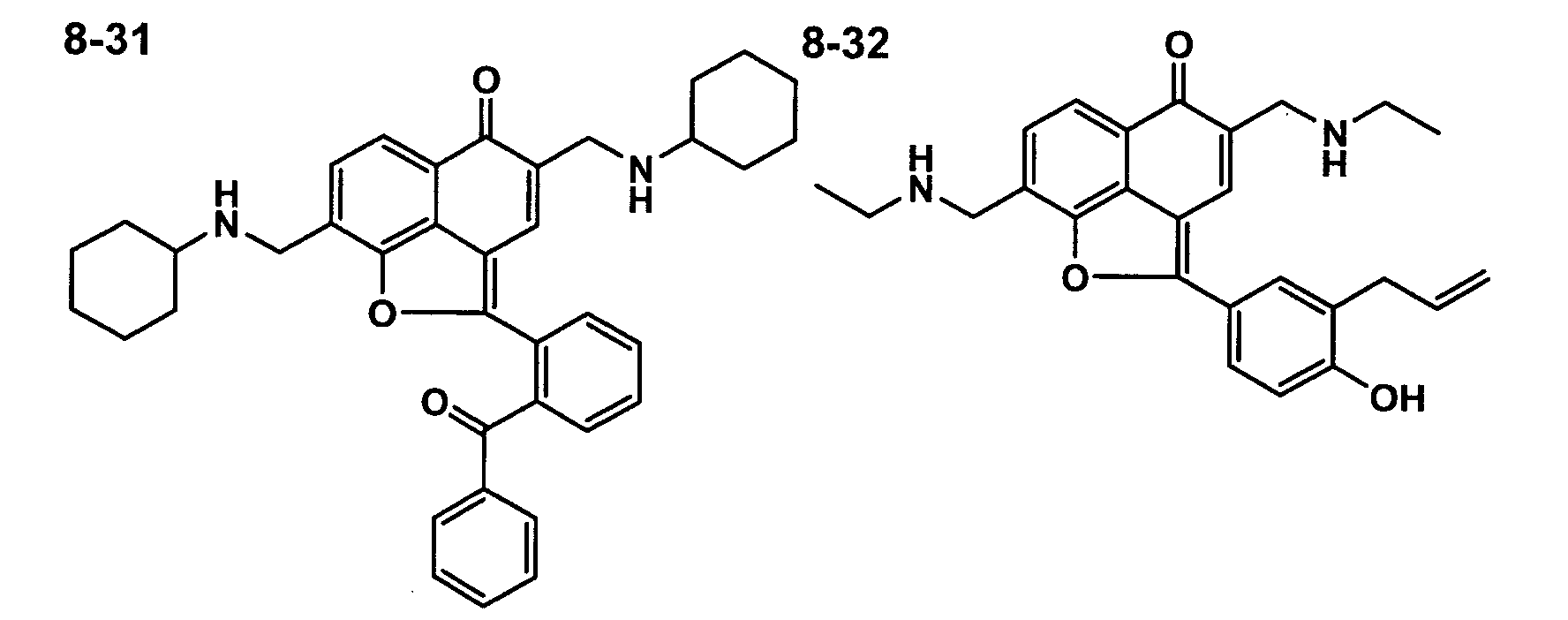

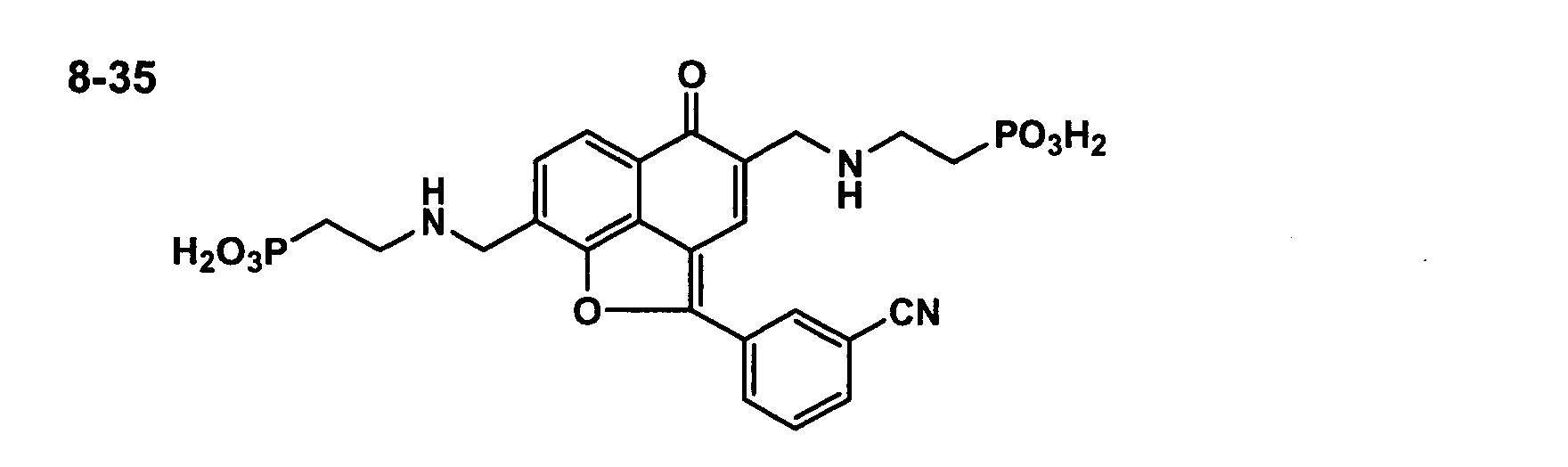

The sensitizing dye represented by formulae (5) through
(8) can be synthesized according to conventional methods, for
example, methods described in Japanese Patent O.P.I.
Publication Nos. 2000-206690, 2001-42524, and 2001-100412.
In the invention, the sensitizing dye is dissolved in a
solvent such as water or an organic solvent to obtain a dye
solution, and added to a composition of the
photopolymerizable light sensitive layer in the invention.
Examples of the organic solvent include alcohols such as
methanol, ethanol, propanol or butanol, ketones such as
acetone, methyl ethyl ketone, or cyclohexanone, aromatic
hydrocarbons such as benzene, toluene, or xylene, glycols
such as ethylene glycol, propylene glycol, or hexylene
glycol, glycol ethers such as ethyl cellosolve, butyl
cellosolve, ethyl carbitol, butyl carbitol, diethyl
cellosolve, or diethyl carbitol, N-methyl pyrrolidone, and
dimethylformamide. The organic solvents can be used singly
or in combination of two or more kinds thereof.
The content of the sensitizing dye in the
photopolymerizable light sensitive layer is not specifically
limited, but is preferably from 0.1 to 10 parts by weight,
and more preferably from 0.5 to 5 parts by weight, based on
100 parts of the photopolymerizable light sensitive layer.
Next, a support used in the invention will be
explained.
The supports used in the planographic printing plate
precursor of the invention include a plate of a metal such as
aluminum, stainless steel, nickel or chromium, a plastic film
such as a polyester film, a polyethylene film or a
polypropylene film, which is deposited with the metal
described above or laminated with film of the metal described
above, and polyester film, polyvinyl chloride film or nylon
film whose surface is subjected to hydrophilic treatment. An
aluminum plate is preferably used for the support for the
planographic printing plate precursor. In this case, the
aluminum plate may be a pure aluminum plate or an aluminum
alloy plate.
As the aluminum alloy, there can be used various ones
including an alloy of aluminum and a metal such as silicon,
copper, manganese, magnesium, chromium, zinc, lead, bismuth,
nickel, titanium, sodium or iron.
It is preferable that the support in the invention is
subjected to degreasing treatment for removing rolling oil
prior to surface roughening (graining). The degreasing
treatments include degreasing treatment employing solvents
such as trichlene and thinner, and an emulsion degreasing
treatment employing an emulsion such as kerosene or
triethanol. It is also possible to use an aqueous alkali
solution such as caustic soda for the degreasing treatment.
When an aqueous alkali solution such as caustic soda is used
for the degreasing treatment, it is possible to remove soils
and an oxidized film which can not be removed by the above-mentioned
degreasing treatment alone. When an aqueous alkali
solution such as caustic soda is used for the degreasing
treatment, the resulting support is preferably subjected to
desmut treatment in an aqueous solution of an acid such as
phosphoric acid, nitric acid, sulfuric acid, chromic acid, or
a mixture thereof, since smut is produced on the surface of
the support. The surface roughening methods include a
mechanical surface roughening method and an electrolytic
surface roughening method electrolytically etching the
support surface.
Though there is no restriction for the mechanical
surface roughening method, a brushing roughening method and a
honing roughening method are preferable. The brushing
roughening method is carried out by rubbing the surface of
the support with a rotating brush with a brush hair with a
diameter of 0.2 to 0.8 mm, while supplying slurry in which
volcanic ash particles with a particle size of 10 to 100 µm
are dispersed in water to the surface of the support. The
honing roughening method is carried out by ejecting obliquely
slurry with pressure applied from nozzles to the surface of
the support, the slurry containing volcanic ash particles
with a particle size of 10 to 100 µm dispersed in water. A
surface roughening can be also carried out by laminating a
support surface with a sheet on the surface of which abrading
particles with a particle size of from 10 to 100 µm was
coated at intervals of 100 to 200 µm and at a density of 2.5
x 103 to 10 x 103/cm2, and applying pressure to the sheet to
transfer the roughened pattern of the sheet and roughen the
surface of the support.
After the support has been roughened mechanically, it
is preferably dipped in an acid or an aqueous alkali solution
in order to remove abrasives and aluminum dust, etc. which
have been embedded in the surface of the support. Examples
of the acid include sulfuric acid, persulfuric acid,
hydrofluoric acid, phosphoric acid, nitric acid and
hydrochloric acid, and examples of the alkali include sodium
hydroxide and potassium hydroxide. Among those mentioned
above, an aqueous alkali solution of for example, sodium
hydroxide is preferably used. The dissolution amount of
aluminum in the support surface is preferably 0.5 to 5 g/m2.
After the support has been dipped in the aqueous alkali
solution, it is preferable for the support to be dipped in an
acid such as phosphoric acid, nitric acid, sulfuric acid and
chromic acid, or in a mixed acid thereof, for neutralization.
Though there is no restriction for the electrolytic
surface roughening method, a method in which the support is
electrolytically surface roughened in an acidic electrolytic
solution. Though an acidic electrolytic solution generally
used for the electrolytic surface roughening can be used, it
is preferable to use an electrolytic solution of hydrochloric
acid or that of nitric acid. The electrolytic surface
roughening method disclosed in Japanese Patent Publication
No. 48-28123, British Patent No. 896,563 and Japanese Patent
O.P.I. Publication No. 53-67507 can be used. In the
electrolytic surface roughening method, voltage applied is
generally from 1 to 50 V, and preferably from 10 to 30 V.
The current density used can be selected from the range from
10 to 200 A/dm2, and is preferably from 50 to 150 A/dm2. The
quantity of electricity can be selected from the range of
from 100 to 5000 C/dm2, and is preferably 100 to 2000 C/dm2.
The temperature during the electrolytically surface
roughening may be in the range of from 10 to 50 °C, and is
preferably from 15 to 45 °C.
When the support is electrolytically surface roughened
by using an electrolytic solution of nitric acid, voltage
applied is generally from 1 to 50 V, and preferably from 5 to
30 V. The current density used can be selected from the
range from 10 to 200 A/dm2, and is preferably from 20 to 100
A/dm2. The quantity of electricity can be selected from the
range of from 100 to 5000 C/dm2, and is preferably 100 to
2000 C/dm2. The temperature during the electrolytically
surface roughening may be in the range of from 10 to 50 °C,
and is preferably from 15 to 45 °C. The nitric acid
concentration in the electrolytic solution is preferably from
0.1 % by weight to 5 % by weight. It is possible to
optionally add, to the electrolytic solution, nitrates,
chlorides, amines, aldehydes, phosphoric acid, chromic acid,
boric acid, acetic acid or oxalic acid.
When the support is electrolytically surface roughened
by using an electrolytic solution of hydrochloric acid,
voltage applied is generally from 1 to 50 V, and preferably
from 2 to 30 V. The current density used can be selected
from the range from 10 to 200 A/dm2, and is preferably from
50 to 150 A/dm2. The quantity of electricity can be selected
from the range of from 100 to 5000 C/dm2, and is preferably
100 to 2000 C/dm2. The temperature during the
electrolytically surface roughening may be in the range of
from 10 to 50 °C, and is preferably from 15 to 45 °C. The
hydrochloric acid concentration in the electrolytic solution
is preferably from 0.1 % by weight to 5 % by weight. The
electrolytic solution can contain a nitrate, a chloride,
amines, aldehydes, phosphoric acid, chromic acid, boric acid,
acetic acid, or oxalic acid as necessary.
After the support has been electrolytically surface
roughened, it is preferably dipped in an acid or an aqueous
alkali solution in order to remove aluminum dust, etc.
produced in the surface of the support. Examples of the acid
include sulfuric acid, persulfuric acid, hydrofluoric acid,
phosphoric acid, nitric acid and hydrochloric acid, and
examples of the alkali include sodium hydroxide and potassium
hydroxide. Among those mentioned above, the aqueous alkali
solution is preferably used. The dissolution amount of
aluminum in the support surface is preferably 0.5 to 5 g/m2.
After the support has been dipped in the aqueous alkali
solution, it is preferable for the support to be dipped in an
acid such as phosphoric acid, nitric acid, sulfuric acid and
chromic acid, or in a mixed acid thereof, for neutralization.
The mechanical surface roughening and electrolytic
surface roughening may be carried out singly, and the
mechanical surface roughening followed by the electrolytic
surface roughening may be carried out.
After the surface roughening, anodizing treatment may
be carried out. There is no restriction in particular for
the method of anodizing treatment used in the invention, and
known methods can be used. The anodizing treatment forms an
anodization film on the surface of the support. For the
anodizing treatment there is preferably used a method of
applying a current density of from 1 to 10 A/dm2 to an
aqueous solution containing sulfuric acid and/or phosphoric
acid in a concentration of from 10 to 50%, as an electrolytic
solution. However, it is also possible to use a method of
applying a high current density to sulfuric acid as described
in U.S. Patent No. 1,412,768, a method to electrolytically
etching the support in phosphoric acid as described in U.S.
Patent No. 3,511,661, or a method of employing a solution
containing two or more kinds of chromic acid, oxalic acid,
malonic acid, etc. The coated amount of the formed
anodization film is suitably 1 to 50 mg/dm2, and preferably
10 to 40 mg/dm2. The coated amount of the formed anodization
film can be obtained from the weight difference between the
aluminum plates before and after dissolution of the
anodization film. The anodization film of the aluminum plate
is dissolved employing for example, an aqueous phosphoric
acid chromic acid solution which is prepared by dissolving 35
ml of 85% by weight phosphoric acid and 20 g of chromium (IV)
oxide in 1 liter of water.
The support which has been subjected to anodizing
treatment is optionally subjected to sealing treatment. For
the sealing treatment, it is possible to use known methods
using hot water, boiling water, steam, a sodium silicate
solution, an aqueous dichromate solution, a nitrite solution
and an ammonium acetate solution.
After the above treatment, the support is suitably
undercoated with a water soluble resin such as polyvinyl
phosphonic acid, a polymer or copolymer having a sulfonic
acid in the side chain, or polyacrylic acid; a water soluble
metal salt such as zinc borate; a yellow dye, an amine salt;
and so on. The sol-gel treatment support, which has a
functional group capable of causing addition reaction by
radicals as a covalent bond, is suitably used.
As the support, various supports described above can be
used, and a polyester film, a polyvinyl chloride film, and a
nylon film whose surface is subjected to hydrophilic
treatment can be also used. As a method of making the
surface of such a plastic film hydrophilic, there is a
sulfuric acid treatment method, a plasma etching treatment
method, a corona discharge treatment method, or a water
soluble resin coating method. In the invention, an aluminum
plate, which is surface roughened, anodized, subjected to
sealing treatment, and sub-coated, is especially preferred.
The photopolymerizable light sensitive layer in the
invention contains a polymer binder. As the polymer binder,
the preferable is a copolymer obtained by copolymerization
employing at least one of the following monomers (1) through
(17) as a copolymerization monomer.
Other polymers such as a polyvinyl butyral resin, a
polyurethane resin, a polyamide resin, a polyester resin, an
epoxy resin, and a natural resin may be used as the polymer
binder in combination with the vinyl copolymers described
above.
The content of the polymer binder in the
photopolymerizable light sensitive layer is preferably from
10 to 90% by weight, more preferably from 15 to 70% by
weight, and still more preferably from 20 to 50% by weight in
view of sensitivity. The addition amount of the vinyl
copolymer is preferably from 50 to 100% by weight based on
the total addition amount of the polymer binder.
The acid value of the polymer binder is preferably from
10 to 150, more preferably from 30 to 120, and still more
preferably from 50 to 90, in view of balance of polarity of
the light sensitive layer, which can prevent coagulation of
pigment used in the light sensitive layer coating liquid.
In the invention, the light sensitive layer of the
light sensitive planographic printing plate precursor of the
invention can contain a known polymerization initiator.
Examples of the known photopolymerization initiator
include carbonyl compounds, organic sulfur compounds,
peroxides, redox compounds, azo or diazo compounds, halides
and photo-reducing dyes disclosed in J. Kosar, "Light
Sensitive Systems", Paragraph 5. The examples thereof are
disclosed in British Patent No. 1,459,563.
Examples of the known photopolymerization initiator
will be listed below, but are not limited thereto.
A benzoin derivative such as benzoin methyl ether,
benzoin i-propyl ether, or α,α-dimethoxy-α-phenylacetophenone;
a benzophenone derivative such as
benzophenone, 2,4-dichlorobenzophenone, o-benzoyl methyl
benzoate, or 4,4'-bis (dimethylamino) benzophenone; a
thioxanthone derivative such as 2-chlorothioxanthone, 2-i-propylthioxanthone;
an anthraquinone derivative such as 2-chloroanthraquinone
or 2-methylanthraquinone; an acridone
derivative such as N-methylacridone or N-butylacridone; α,α-diethoxyacetophenone;
benzil; fluorenone; xanthone; an uranyl
compound; a triazine derivative disclosed in Japanese Patent
Publication Nos. 59-1281 and 61-9621 and Japanese Patent
O.P.I. Publication No. 60-60104; an organic peroxide compound
disclosed in Japanese Patent O.P.I. Publication Nos. 59-1504
and 61-243807; a diazonium compound in Japanese Patent
Publication Nos. 43-23684, 44-6413, 47-1604 and US Patent No.
3,567,453; an organic azide compound disclosed in US Patent
Nos. 2,848,328, 2,852,379 and 2,940,853; orthoquinondiazide
compounds disclosed in Japanese Patent Publication Nos. 36-22062b,
37-13109, 38-18015 and 45-9610; various onium
compounds disclosed in Japanese Patent Publication No. 55-39162,
Japanese Patent O.P.I. Publication No. 59-14023 and
"Macromolecules", Volume 10, p. 1307 (1977); azo compounds
disclosed in Japanese Patent Publication No. 59-142205;
metal arene complexes disclosed in Japanese Patent O.P.I.
Publication No. 1-54440, European Patent Nos. 109,851 and
126,712, and "Journal of Imaging Science", Volume 30, p. 174
(1986); (oxo) sulfonium organoboron complexes disclosed in
Japanese Patent O.P.I. Publication Nos. 5-213861 and 5-255347;
titanocenes disclosed in Japanese Patent O.P.I.
Publication Nos. 59-152396 and 61-151197; transition metal
complexes containing a transition metal such as ruthenium
disclosed in "Coordination Chemistry Review", Volume 84, p.
85-277 (1988) and Japanese Patent O.P.I. Publication No. 2-182701;
2,4,5-triarylimidazol dimmer disclosed in Japanese
Patent O.P.I. Publication No. 3-209477; carbon tetrabromide;
and organic halide compounds disclosed in Japanese Patent
O.P.I. Publication No. 59-107344.
As the photopolymerization initiator, titanocenes can
be preferably used. Examples of the titanocenes include dicyclopentadienyl-Ti-dichloride,
dicyclopentadienyl-Ti-bisphenyl,
dicyclopentadienyl-Ti-bis-2,3,4,5,6-pentafluorophenyl,
dicyclopentadienyl-Ti-bis-2,3,5,6-tetrafluorophenyl,
dicyclopentadienyl-Ti-bis-2,4,6-trifluorophenyl,
dicyclopentadienyl-Ti-bis-2,6-difluorophenyl,
dicyclopentadienyl-Ti-bis-2,4-difluorophenyl,
di-methylcyclopentadienyl-Ti-bis-2,3,4,5,6-pentafluorophenyl,
di-methylcyclopentadienyl-Ti-bis-2,3,5,6-tetrafluorophenyl,
di-methylcyclopentadienyl-Ti-bis-2,4-difluorophenyl, and bis
(cyclopentadienyl)-bis (2,6-difluoro-3-(pyrryl)phenyl)
titanium (IRUGACURE 784, produced by Ciba Specialty Co.,
Ltd.), but the invention is not limited thereto.
The coating liquid for the photopolymerizable light
sensitive layer in the invention preferably contains a
polymerization inhibitor in addition to the compounds
described above, in order to prevent undesired polymerization
of the ethylenically unsaturated bond-containing monomer
during the manufacture or after storage of the light
sensitive planographic printing plate. Examples of the
polymerization inhibitor include hydroquinone, p-methoxyphenol,
di-t-butyl-p-cresol, pyrrogallol, t-butylcatechol,
benzoquinone, 4,4'-thiobis (3-methyl-6-t-butylphenol),
2,2'-methylenebis (4-methyl-6-t-butylphenol),
N-nitrosophenylhydroxylamine cerous salt, and 2-t-butyl-6-(3-t-butyl-6-hydroxy-5-mrthylbenzyl)-4-methylphenyl
acrylate.
The polymerization inhibitor content is preferably 0.01
to 5% by weight based on the total solid content of the
photopolymerizable light sensitive layer composition.
Further, in order to prevent polymerization induced by
oxygen, a higher fatty acid such as behenic acid or a higher
fatty acid derivative such as behenic amide may be added to
the layer, or may be localized on the surface of the layer in
the drying step after coating. The higher fatty acid or
higher fatty acid derivative content is preferably 0.5 to 10%
by weight based on the total solid content of the
photopolymerizable light sensitive layer composition.
A colorant can be also used. As the colorant can be
used known materials including commercially available
materials. Examples of the colorant include those described
in revised edition "Ganryo Binran", edited by Nippon Ganryo
Gijutu Kyoukai (publishe by Seibunndou Sinkosha), or "Color
Index Binran".
Kinds of the pigment include black pigment, yellow
pigment, red pigment, brown pigment, violet pigment, blue
pigment, green pigment, fluorescent pigment, and metal powder
pigment. Examples of the pigment include inorganic pigment
(such as titanium dioxide, carbon black, graphite, zinc
oxide, Prussian blue, cadmium sulfide, iron oxide, or
chromate of lead, zinc, barium or calcium); and organic
pigment (such as azo pigment, thioindigo pigment,
anthraquinone pigment, anthanthrone pigment,
triphenedioxazine pigment, vat dye pigment, phthalocyanine
pigment or its derivative, or quinacridone pigment).
Among these pigment, pigment is preferably used which
does not substantially have absorption in the absorption
wavelength regions of a spectral sensitizing dye used
according to a laser for exposure. The absorption of the
pigment used is not more than 0.05, obtained from the
reflection spectrum of the pigment measured employing an
integrating sphere and employing light with the wavelength of
the laser used. The pigment content is preferably 0.1 to 10%
by weight, and more preferably 0.2 to 5% by weight, based on
the total solid content of the photopolymerizable light
sensitive layer composition.
When an argon laser (488 nm) or an SHG-YAG laser (532
nm) is used as a light source for exposure, violet pigment or
blue pigment is preferably used in view of the above
absorption wavelength relationship or image visibility after
the exposure. Such pigment examples include Cobalt Blue,
cerulean blue, alkali blue lake, Victria Blue lake, metal
free phthalocyanine, Phthalocyanine Blue, Fast Sky Blue,
Indanthrene Blue, indigo, dioxane violet, isoviolanthrone
violet, Indanthrone Blue, and Indanthrene BC. Among these,
Phthalocyanine Blue and dioxane violet are preferred.
The above composition can contain a surfactant as a
coatability improving agent, as long as performance of the
invention is not jeopardized. The surfactant is preferably a
fluorine-contained surfactant.
Further, in order to improve a physical property of the
photopolymerizable light sensitive layer, the layer can
contain an inorganic filler or a plasticizer such as dioctyl
phthalate, dimethyl phthalate or tricresyl phosphate. The
content of such a material is preferably not more than 10% by
weight, based on the total solid content of the light
sensitive layer composition.
The photopolymerizable light sensitive layer in the
invention has a thickness of preferably 0.1 to 5 g/m2, and
more preferably 0.5 to 2.5 g/m2.
The solvents used in the preparation of a coating
liquid for the photopolymerizable light sensitive layer in
the invention include an alcohol such as sec-butanol,
isobutanol, n-hexanol, or benzyl alcohol; a polyhydric
alcohol such as diethylene glycol, triethylene glycol,
tetraethylene glycol, or 1,5-pentanediol; an ether such as
propylene glycol monobutyl ether, dipropylene glycol
monomethyl ether, or tripropylene glycol monomethyl ether; a
ketone or aldehyde such as diacetone alcohol, cyclohexanone,
or methyl cyclohexanone; and an ester such as ethyl lactate,
butyl lactate, diethyl oxalate, or methyl benzoate.
The prepared coating liquid for the photopolymerizable
light sensitive layer is coated on a support according to a
conventional method, and dried to obtain a light sensitive
planographic printing plate precursor. Examples of the
coating method include an air doctor coating method, a blade
coating method, a wire bar coating method, a knife coating
method, a dip coating method, a reverse roll coating method,
a gravure coating method, a cast coating method, a curtain
coating method, and an extrusion coating method.
A low drying temperature of the coated light sensitive
layer cannot provide sufficient printing durability, while
too a high drying temperature of the coated light sensitive
layer results in marangoni and produces fog at non-image
portions. The drying temperature is preferably from 60 to
160 °C, more preferably from 80 to 140 °C, and still more
preferably from 90 to 120 °C.
The color layer in the invention will be explained
below. The light sensitive planographic printing plate
precursor of the invention can be handled in a yellow lamp
room which is lighter.
However, the yellow lamp used emits light having a
wavelength of up to approximately 470 nm. The light
sensitive planographic printing plate precursor may be
sensitive to such a light, resulting in fog occurrence. In
order to prevent such fog, a color layer is preferably
provided on the photopolymerizable light sensitive layer in
contact with the photopolymerizable light sensitive layer or
through another layer.
In order to improve thermal stability and a safe light
property as well as sensitivity, the color layer has an
optical density at wavelength regions of from 410 to 800 nm
of preferably from 0.2 to 3.0, more preferably from 0.4 to
2.0, and still more preferably from 0.5 to 1.5.
A first sample is prepared by coating a color layer
containing a colorant on a 100 µm thick transparent
polyethylene terephthalate film. Similarly, a second sample
is prepared by coating a layer containing no colorant on a
100 µm thick transparent polyethylene terephthalate film.
The optical density of both samples was measured employing a
spectrophotometer U-3300 (produced by Hitachi Co., Ltd.). In
the invention, the difference between the optical densities
of the first and second samples is defined as the optical
density of the colorant layer.
The colorant content in the color layer is preferably
from 5 to 500 mg/m2, and more preferably from 10 to 100
mg/m2.
The colorant used in the color layer is a dye or
pigment. The following water soluble dyes are preferably
used.
As the water soluble dye, there is a cationic dye, a
reactive dye, an acid dye, or a direct dye. Typical examples
of the dye include a nitroso dye such as Naphthol Green B, a
nitro dye such as Naphthol Yellow S or Polar Yellow Brown, an
azo dye such as Diachron Scarlet RN, Diamira Red B, Diamira
Brilliant Red BB, Diamira Brilliant Violet 5R, Diamira
Brilliant Red GG, Diamira Brilliant Orange FR, Diamira
Brilliant Orange 3R, Diacryl Brilliant Red GTL-N, Diacryl Red
GL-N, Diacryl Brilliant Red GRL-N, Victoria Scarlet 3R,
Sulfone Acid Blue R, Supramine red GG, Supramine red B,
Supramine Blue R, Polar Red G, Polar Orange R, Metachrome Red
5G, Metachrome Brilliant Blue BL, Supranol Orange RR or
Supranol Brilliant Red; a thiazole dye such as Diacryl Red
CS-N, Thizine Red R, Thioflavin T, a diphenylmethane dye such
as Auramine, a triphenylmethane dye such as Victoria Pure
Blue BOH, Crystal Violet, Methyl Violet, Ethyl Violet, Spirit
Blue, Acid Violet 6B or Malachite Green, a xanthene dye such
as Pyronine G, Rhodamine S, Eosin G, Eosin Y, Erythrosine,
Rose Bengal B, Rhodamine B or Rhodamine 3GO; an acridine dye
such as Acridine Orange or 2GNX; an azine dye such as Neutral
Violet, Neutral Red, Azocarmine, Safranine T, Wool Fast Blue
BL, or Indocyanine B; an oxazine dye such as Gallocyanine; a
dioxazine dye such as Sirius Light Blue FFRL or Sirius Light
Blue F3GL; a thiazine dye such as Methylene Blue or Methylene
Green G; an anthtaquinone dye such as Diacid Light Blue BR,
Alizarin Direct Violet EFF, Supracen Violet 4BF, Alizarin Sky
Blue B, Alizarin Cyanine Green G, Carbolane Green G, Alizarin
Cyanine Green 5G, Alizarin Brilliant Pure Blue R, Brilliant
Alizarin Light Red 4B, or Alizarin Uranol 2B; a
phthalocyanine dye such as Heliogen Blue SBP or Tolazole Fast
Blue 8GS; a cyanine dye such as Diacryl Brilliant Red 3GN,
Diacryl Brilliant Pink GN, Diacryl Brilliant Pink RN, or
Diacryl Brilliant Red 6BN; and a quinoline dye such as
quinoline yellow or Supra Light Yellow GGL.
As pigment in the color layer is, pigment as described
above can be used.
Among these pigment, pigment is preferably used which
does not substantially have absorption in the absorption
wavelength regions of a spectral sensitizing dye used
according to a laser for exposure. The absorption of the
pigment used is not more than 0.05, obtained from the
reflection spectrum of the pigment measured employing an
integrating sphere and employing light with the wavelength of
the laser used. The pigment content is preferably 0.1 to 10%
by weight, and more preferably 0.2 to 5% by weight, based on
the total solid content of the photopolymerizable light
sensitive layer composition.
When an argon laser (488 nm) or an SHG-YAG laser (532
nm) is used as a light source for exposure, violet pigment or
blue pigment is preferably used in view of the above
absorption wavelength relationship or image visibility after
the exposure. Such pigment examples include Cobalt Blue,
cerulean blue, alkali blue lake, Victria Blue lake, metal
free phthalocyanine, Phthalocyanine Blue, Fast Sky Blue,
Indanthrene Blue, indigo, dioxane violet, isoviolanthrone
violet, Indanthrone Blue, and Indanthrene BC. Among these,
Phthalocyanine Blue and dioxane violet are preferred.
The above composition can contain a surfactant as a
coatability improving agent, as long as performance of the
invention is not jeopardized. The surfactant is preferably a
fluorine-contained surfactant.
Further, in order to improve a physical property of the
color layer, the layer can contain an inorganic filler or a
plasticizer such as dioctyl phthalate, dimethyl phthalate or
tricresyl phosphate. The content of such a material is
preferably not more than 10% by weight, based on the total
solid content of the light sensitive layer composition.
In the light sensitive planographic printing plate
precursor, an overcoat layer containing polyvinyl alcohol is
preferably provided on the photopolymerizable light sensitive
layer in contact with the photopolymerizable light sensitive
layer or through another layer. It is more preferred in the
light sensitive planographic printing plate that a color
layer having an optical density at wavelength regions of from
410 to 800 nm of preferably from 0.2 to 3.0 is provided on
the overcoat layer in contact with the overcoat layer or
through another layer.
Such a light sensitive planographic printing plate
precursor is preferred in improving a safe light property and
sensitivity.
The overcoat layer contains polyvinyl alcohol, and the
polyvinyl alcohol content of the overcoat layer is preferably
not less than 5% by weight, more preferably not less than 50%
by weight, and still more preferably not less than 80% by
weight. The overcoat layer may contain the colorant
described above.
A protective layer is preferably provided on the
photopolymerizable light sensitive layer of the light
sensitive planographic printing plate precursor of the
invention. It is preferred that the protective layer (oxygen
shielding layer) is highly soluble in a developer (generally
an alkaline solution) described later.
Examples of materials used in the protective layer
include polyvinyl alcohol, polysaccharide, polyvinyl
pyrrolidone, polyethylene glycol, gelatin, glue, casein,
hydroxyethyl cellulose, carboxymethyl cellulose,
methylcellulose, hydroxyethyl starch, gum arabic, sucrose
octacetate, ammonium alginate, sodium alginate, polyvinyl
amine, polyethylene oxide, polystyrene sulfonic acid,
polyacrylic acid, and a water soluble polyamide. These
materials may be used singly or as a mixture of two or more
thereof. The especially preferred is polyvinyl alcohol.
A coating liquid for the protective layer can be
prepared by dissolving the materials described above in an
appropriate solvent. The thus prepared coating liquid is
coated on the photopolymerizable layer and dried to form a
protective layer. The thickness of the protective layer is
preferably from 0.1 to 5.0 µm, and more preferably from 0.5
to 3.0 µm. The protective layer further contains a
surfactant or matting agent as necessary.
The protective layer coating liquid can be suitably
coated on the photopolymerizable layer employing the known
coating method described above. A drying temperature of the
protective layer coated on the photopolymerizable layer is
preferably lower than, more preferably not less than 10 °C
lower than, and still more preferably not less than 20 °C
lower than, that of the photopolymerizable layer. In the
above, difference between the drying temperatures of the
protective layer and the photopolymerizable layer is not more
than 50 °C.
The drying temperature of the protective layer coated
on the photopolymerizable layer is preferably lower than the
glass transition temperature (Tg) of the polymer binder
contained in the light sensitive polymerizable layer. The
difference between the drying temperature of the protective
layer and the glass transition temperature (Tg) of the
polymer binder is preferably not less than 20 °C, and more
preferably not less than 40 °C. In the above, the difference
is not more than 60 °C.
A method of forming an image on the light sensitive
planographic printing plate precursor of the invention
comprises imagewise exposing the light sensitive planographic
printing plate precursor described above, and developing the
exposed plate with a developer described later.
The light sources for forming an image on the light
sensitive planographic printing plate precursor of the
invention include, for example, a laser, an emission diode, a
xenon flush lamp, a halogen lamp, a carbon arc light, a metal
halide lamp, a tungsten lamp, a high pressure mercury lamp,
and a non-electrode light source.
When the light sensitive planographic printing plate
precursor is imagewise exposed at one time, a mask material
having a negative image pattern made of a light shielding
material is put on the plate to be in close contact with the
plate, and exposure is carried out through the mask.
When an array light such as an emission diode array is
used or exposure using a halogen lamp, a metal halide lamp or
a tungsten lamp is controlled using an optical shutter
material such as liquid crystal or PLZT, a digital exposure
according to an image signal is possible and preferable. In
this case, direct writing is possible without using any mask
material.
When a laser is used for exposure, which can be
condensed in the beam form, scanning exposure according to an
image can be carried out, and direct writing is possible
without using any mask material. When the laser is employed
for imagewise exposure, a highly dissolved image can be
obtained, since it is easy to condense its exposure spot in
minute size.
As the laser, argon laser, He-Ne gas laser, YAG laser
or semi-conductor laser is preferably used.
A laser scanning method by means of a laser beam
includes a method of scanning on an outer surface of a
cylinder, a method of scanning on an inner surface of a
cylinder and a method of scanning on a plane. In the method
of scanning on an outer surface of a cylinder, laser beam
exposure is conducted while a drum around which a recording
material is wound is rotated, in which main scanning is
represented by the rotation of the drum, while sub-scanning
is represented by the movement of the laser beam. In the
method of scanning on an inner surface of a cylinder, a
recording material is fixed on the inner surface of a drum, a
laser beam is emitted from the inside, and main scanning is
carried out in the circumferential direction by rotating a
part of or an entire part of an optical system, while sub-scanning
is carried out in the axial direction by moving
straight a part of or an entire part of the optical system in
parallel with a shaft of the drum. In the method of scanning
on a plane, main scanning by means of a laser beam is carried
out through a combination of a polygon mirror, a galvano
mirror and an F lens, and sub-scanning is carried out by
moving a recording medium. The method of scanning on an
outer surface of a cylinder and the method of scanning on an
inner surface of a cylinder are more suitable for high
density recording because they make it easy to enhance a
precision of an optical system.
The light sensitive planographic printing plate
precursor used in the invention is subjected to imagewise
exposure to harden the exposed portions of the
photopolymerizable light sensitive layer, and subjected to
developing treatment employing an alkaline developer to
remove unexposed portions of the layer, whereby an image is
formed. As the developer, a conventional alkali developer
can be used. Examples of the developer include an alkali
developer containing inorganic alkali agents such as sodium
silicate, potassium silicate, ammonium silicate, sodium
secondary phosphate, potassium secondary phosphate, ammonium
secondary phosphate, sodium bicarbonate, potassium
bicarbonate, ammonium bicarbonate, sodium carbonate,
potassium carbonate, ammonium carbonate, sodium hydrogen
carbonate, potassium hydrogen carbonate, ammonium hydrogen
carbonate, sodium borate, potassium borate, ammonium borate,
sodium hydroxide, potassium hydroxide, ammonium hydroxide,
and lithium hydroxide.
The developer may contain organic alkali agents such as
monomethylamine, dimethylamine, trimethylamine,
monoethylamine, diethylamine, triethylamine,
monoisopropylamine, diisopropylamine, butylamine,
monoethanolamine, diethanolamine, triethanolamine,
monoisopropanolamine, diisopropanolamine, ethyleneimine,
ethylenediamine, and pyridine.
These alkali agents can be used singly or in
combination of two or more kinds thereof. The developer may
optionally contain a surfactant such as an anionic
surfactant, an amphoteric surfactant or alcohol.
The developer used in the invention is preferably a
developer containing alkali metal silicate and having a pH of
preferably less than 12.5, and more preferably from 10.5 to
12.4. Development of such a developer provides the excellent
results in the invention that not only developability and
sensitivity but also sludge restraining property and printing
durability are improved.
A developer preferably contains a surfactant with a
hydrophobic group having no alkyl group or a surfactant with
a hydrophobic group including an alkyl group in which the
molecular weight of the alkyl group is not more than 25% of
the total molecular weight of the hydrophobic group. The
content of the surfactant in the developer is preferably from
4.0 to 10.0% by weight, and more preferably from 4.5 to 7.0%
by weight. The alkyl group content of the hydrophobic group
in the surfactant is preferably 0 to 5% by weight. The
molecular weight of the hydrophobic group is preferably at
least 120. The developer containing such a surfactant in the
amount as described above minimizes sludge produced during
processing, restrains foams produced during processing, and
further minimizes undesired thickness reduction of the light
sensitive layer.
Examples of the surfactant will be listed below.










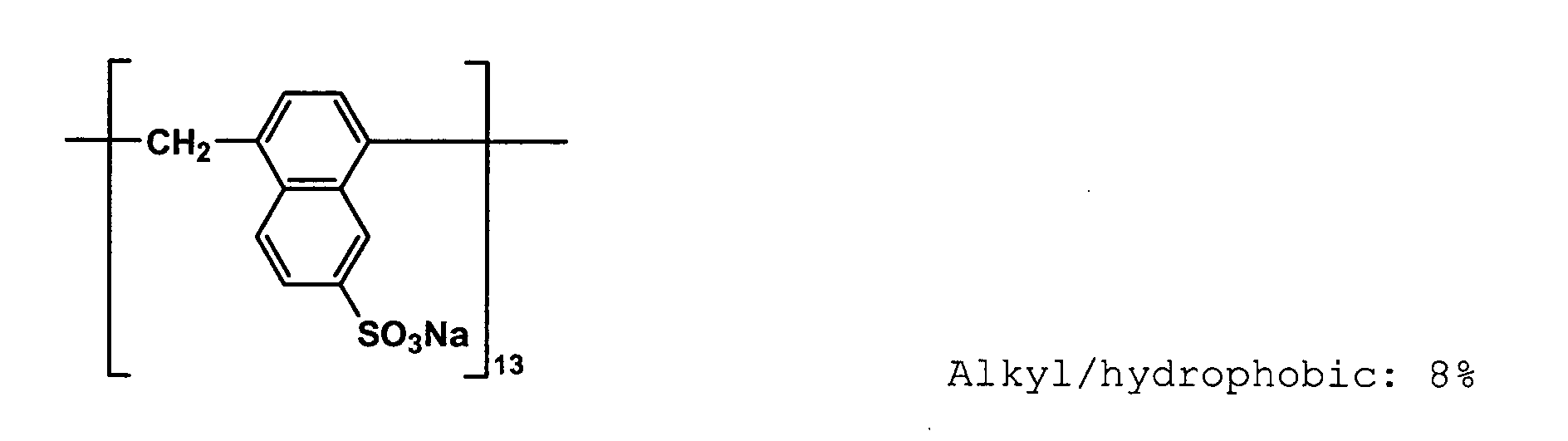
In the above, "Alkyl/hydrophobic" represents the alkyl
group content (% by molecular weight) of the hydrophobic
group in the surfactant.
Next, the present invention will be shown below
employing examples, but the present invention is not limited
thereto. In the examples, "parts" represents "parts by
weight", unless otherwise specified.
Twelve parts of methacrylic acid, 70 parts of methyl
methacrylate, 8 parts of acrylonitrile, 10 parts of ethyl
methacrylate, 500 parts of ethanol, and 3 parts of α,α'-azobisisobutylonitrile
were put in a three neck flask under
nitrogen atmosphere, and reacted under nitrogen atmosphere
for 6 hours at 80 °C in an oil bath. After that, 3 parts of
triethylammonium chloride and 2 parts of glycidyl
methacrylate were further added to the mixture, and reacted
for additional 3 hours. Thus, acryl copolymer 1 was
obtained. The weight average molecular weight of the acryl
copolymer 1 was 50,000, measured according to GPC. The glass
transition temperature Tg of the acryl copolymer 1 was 85 °C,
measured according to DSC (differential thermal analysis).
A 0.24 mm thick aluminum plate (material 1050, quality
H16) was degreased at 60 °C for one minute in a 5% sodium
hydroxide solution, washed with water, immersed at 25 °C for
one minute in a 10% hydrochloric acid solution to neutralize,
and then washed with water. The resulting aluminum plate was
electrolytically etched using an alternating current at 25 °C
for 60 seconds at a current density of 100 A/dm2 in a 0.3
weight % nitric acid solution, and desmutted at 60 °C for 10
seconds in a 5 % sodium hydroxide solution. The desmutted
aluminum plate was anodized at 25 °C for 1 minute at a
current density of 10 A/dm2 and at a voltage of 15 V in a 15%
sulfuric acid solution.
The center line average surface roughness (Ra) of the
resulting support was 0.65 µm. The support was further
subjected to hydrophilic treatment at 80 °C for 30 minutes,
employing a 1.5% polyvinyl phosphonic acid aqueous solution
and a 0.2% vinyl phosphoric acid aqueous solution.
The following subbing layer coating liquid was coated
on the support obtained above using a wire bar, dried at 90
°C for one minute, and further heated at 110 °C for 3 minutes
to give a subbing layer with a dry thickness of 0.1 g/m2.
Thus, a subbed support was obtained.
| γ-Methacryloxypropyltrimethoxysilane | 1 part |
| Methyl ethyl ketone | 80 parts |
| Cyclohexanone | 19 parts |
The following photopolymerizable light sensitive layer
coating liquid was coated on the subbed support using a wire
bar, and dried at 95 °C for 1.5 minutes to give a light
sensitive layer with a dry thickness of 1.4 g/m2. After
that, the following overcoat layer coating liquid was coated
on the light sensitive layer using an applicator, and dried
at 75 °C for 1.5 minutes to give an overcoat layer with a dry
thickness of 2.0 g/m2. Thus, light sensitive planographic
printing plate precursor samples as shown in Table 1 were
prepared.

| (Photopolymerizable light sensitive layer coating liquid) | |
| Polymer binder (Acryl copolymer 1) | 35.0 parts |
| Sensitizing dye (as shown in Table 1) | 4.0 parts |
| Compounds of formula (3) or comparative initiator 1(as shown in Table 1) | 4.0 parts |
| Compounds of formula (1) or (2), or comparative compound 1 (as shown in Table 1) | 50.0 parts |
| Phthalocyanine pigment (MHI #454 produced by Mikuni Sikisosha) | 4.5 parts |
| 2-t-Butyl-6-(3-t-butyl-2-hydroxy-5-methylbenzyl) -4-methylphenyl acrylate (Sumirizer GS produced by Sumitomo 3M Co., Ltd.) | 0.5 parts |
| Sanol LS-770 (produced by Sankyo Co., Ltd.) | 0.5 parts |
| Fluorine-contained surfactant (Megafac F-178K produced by Sumitomo 3M Co., Ltd.) | 0.5 parts |
| Triazine compound described below | 1.0 part |
| Methyl ethyl ketone | 80 parts |
| Cyclohexanone (Overcoat layer coating liquid) | 820 parts |
| Polyvinyl alcohol (GL-05, produced by Nippon Gosei Kagaku Co., Ltd.) | 89 parts |
| Water soluble polyamide (P-70, produced by Toray Co., Ltd.) | 10 parts |
| Surfactant (Surfinol 465, produced by Nisshin Kagaku Kogyo Co., Ltd.) | 1.0 parts |
| Water | 900 parts |
The light sensitive planographic printing plate
precursor sample obtained above was imagewise exposed at a
resolving degree of 2540 dpi, employing an exposure apparatus
Tigercat (produced by ECRM Co., Ltd.) equipped with an FD-YAG
laser (532 nm) light source. Herein, dpi represents a dot
number per 2.54 cm. Subsequently, the exposed sample was
pre-heated, pre-washed, subjected to development treatment,
post-washed, and gumming treated, employing a CTP automatic
developing machine (PHW 23-V produced by Technigraph Co.,
Ltd.) to obtain a planographic printing plate. Herein, the
developing machine comprised a preheating section, a pre-washing
section for removing the over coat layer before
development, a development section charged with a developer
as described below, a post-washing section for removing the
developer remaining on the developed sample after
development, and a gumming section charged with a gumming
solution (a solution obtained by diluting GW-3, produced by
Mitsubishi Chemical Co., Ltd., with water by a factor of 2)
for protecting the surface of the developed sample. Thus, a
planographic printing plate was obtained.
| Potassium silicate A (an aqueous potassium silicate solution containing 26.5% by weight of SiO2 and 13.5% by weight of K2O) | 8.0% by weight |
| Surfactant as shown in Table 1 | 3.0% by weight |
| Potassium hydroxide | Amount giving pH 12.3 |
The light sensitive planographic printing plate
precursor samples obtained above were evaluated as follows:
The results are shown in Table 1.
Sensitivity was represented in terms of minimum
exposure amount through which a planographic printing plate
was obtained in which an image of a 175 screen line
number/inch with a dot area of 50% was reproduced and no
reduction of the layer thickness at image portions was
observed.
The light sensitive planographic printing plate
precursor samples were exposed at an appropriate exposure
amount and developed to obtain planographic printing plate
samples. Herein, the appropriate exposure amount was two
times the exposure amount whereby a planographic printing
plate was obtained in which an image of a 175 screen line
number/inch with a dot area of 50% was reproduced and no
reduction of the layer thickness at image portions was
observed. The resulting planographic printing plate samples
were mounted on a printing press, DAIYA 1F-1 produced by
Mitsubishi Jukogyo Co., Ltd., and printing was carried out
employing a coated paper, printing ink (Toyo King Hyecho M
Magenta, produced by Toyo Ink Manufacturing Co.), and
dampening water SG-51 (concentration: 1.5%, produced by Tokyo
Ink Co., Ltd.). Every time one thousand printed papers were
obtained, the printing was suspended, and the planographic
printing plate samples on the press were wiped with a plate
cleaner. After that, the wiped samples were observed, and
printing was finished when dot reduction at the highlight
portions and clogging at shadow portions of the wiped samples
were observed. The number of the wiping operation was used
for a measure of printing durability. For example, printing
durability 1 shows that printing was carried out up to one
thousand copies. The greater number shows higher printing
durability.
After printing was carried out to one thousand copies,
and suspended, the resulting printing plate samples was wiped
with a plate cleaner, and allowed to stand for 15 minutes.
After that, printing was resumed. The number of printed
papers, in which stain at the background disappeared after
resumption of printing, was used for stain elimination
property. The greater number is preferred.
The light sensitive planographic printing plate
precursor was exposed employing the exposure amount described
above without correction of linearity. The dot image, which
was to be reproduced to a 90% dot area, was photographed at a
magnification of 500, and dot area in the dot image with a
size of 2 mm x 2 mm in the photograph was determined and used
for a measure of reproduction of 90% dot.
Each sample of a size of 1.5 m2 was immersed at 28 °C
for 30 seconds in 100 ml of the developer described above.
The resulting developer was filtered with a filter and the
residue was washed with water and dried at 70 °C for one day.
The weight of the dried residue was used for a measure of
sludge.
The results are shown in Table 1.

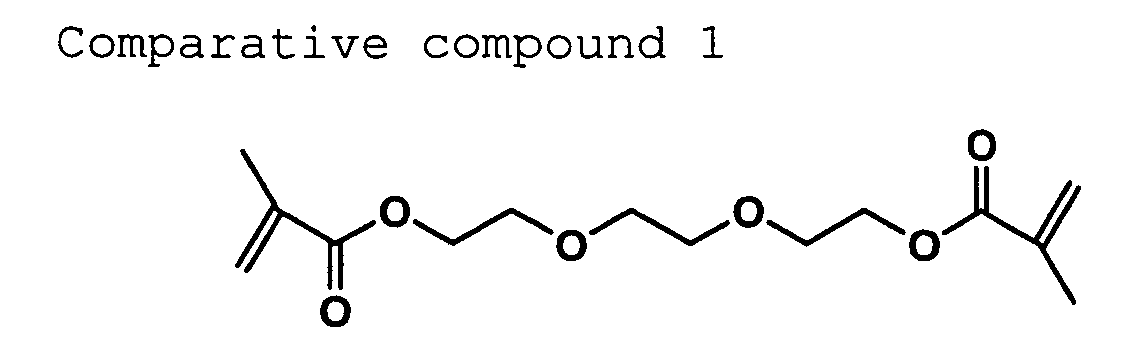
IRUGACURE 784 (produced by Ciba Special Co. Ltd.)


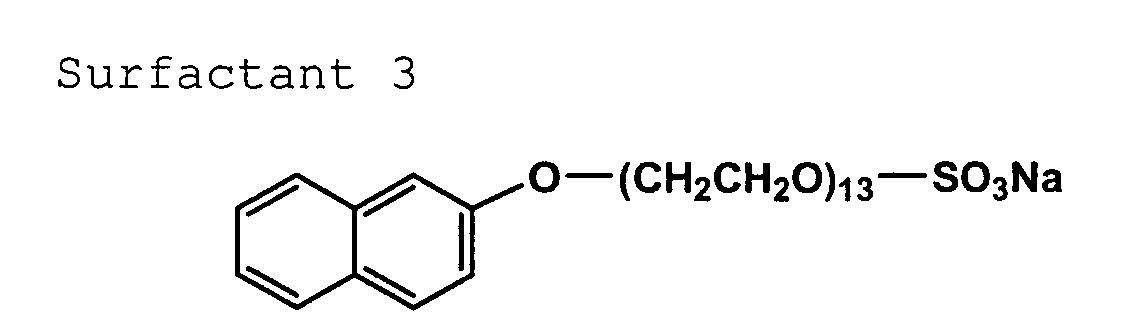
Sodium butylnaphthalene sulfonate (Alkyl group content
of the hydrophobic group is 30% by molecular weight)
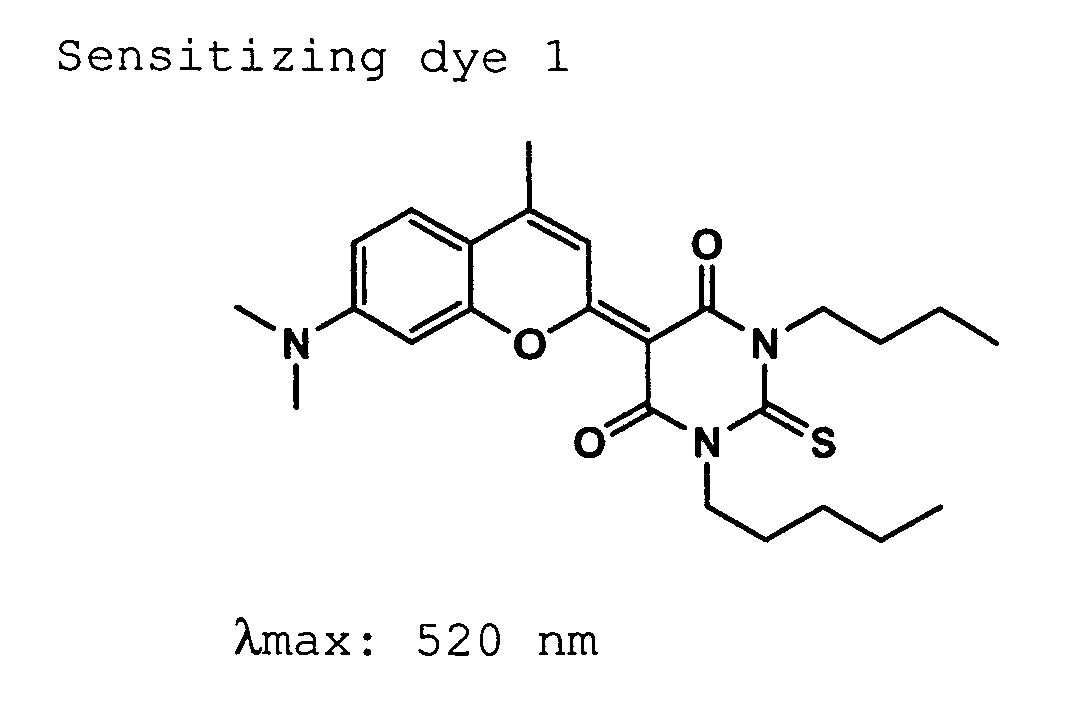
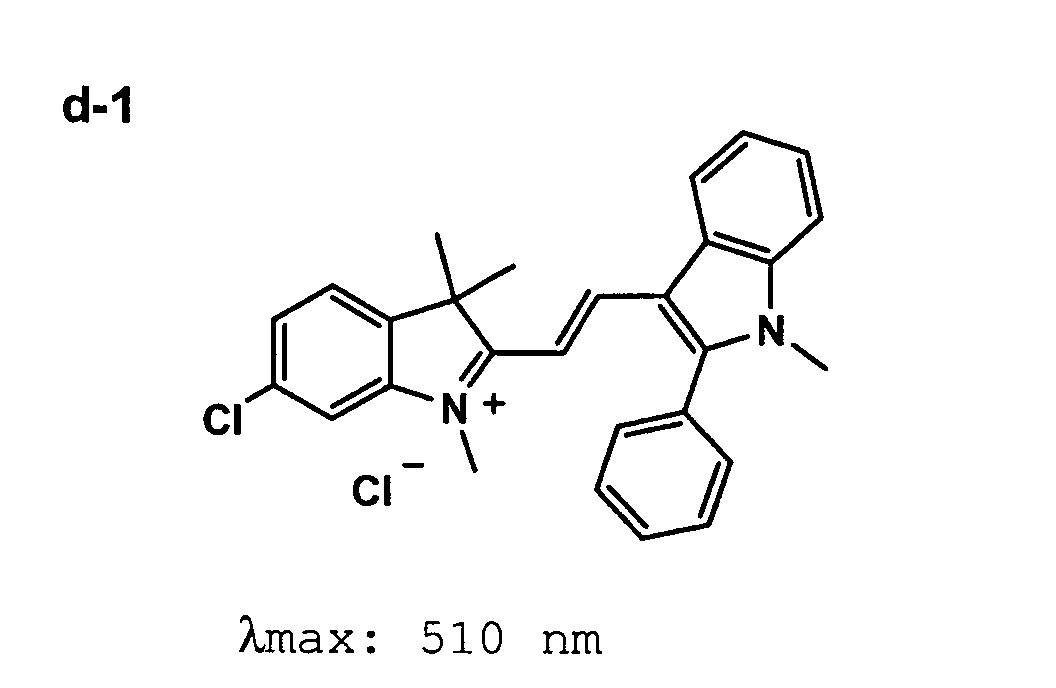

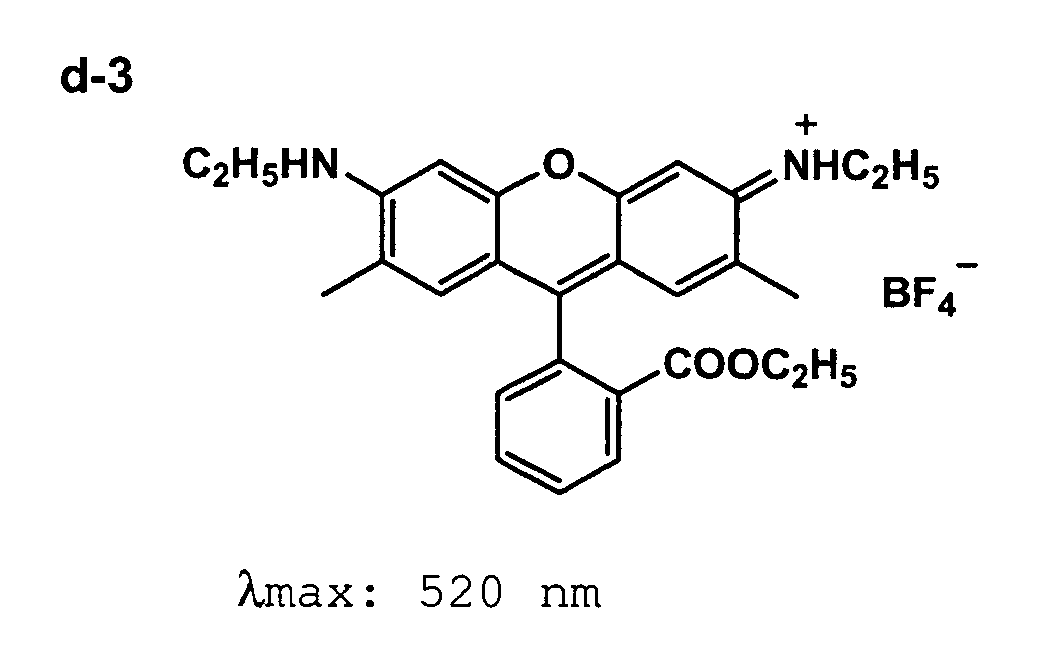
As is apparent from Table 1 above, the inventive
samples provide excellent sensitivity, excellent printing
durability, excellent stain elimination property, excellent
dot reproduction, and excellent sludge restraining property.
The light sensitive planographic printing plate
precursor samples were prepared in the same manner as in
Example 1, except that compounds of formula (4) as shown in
Table 2 were used instead of compounds of formula (3), and
sensitizing dyes used were changed to those as shown in Table
2. The resulting samples were evaluated in the same manner
as in Example 1. The results are shown in Table 1.
In Table 2, Surfactant b, Compounds 4-1, 4-2, and 4-3
are as follows:
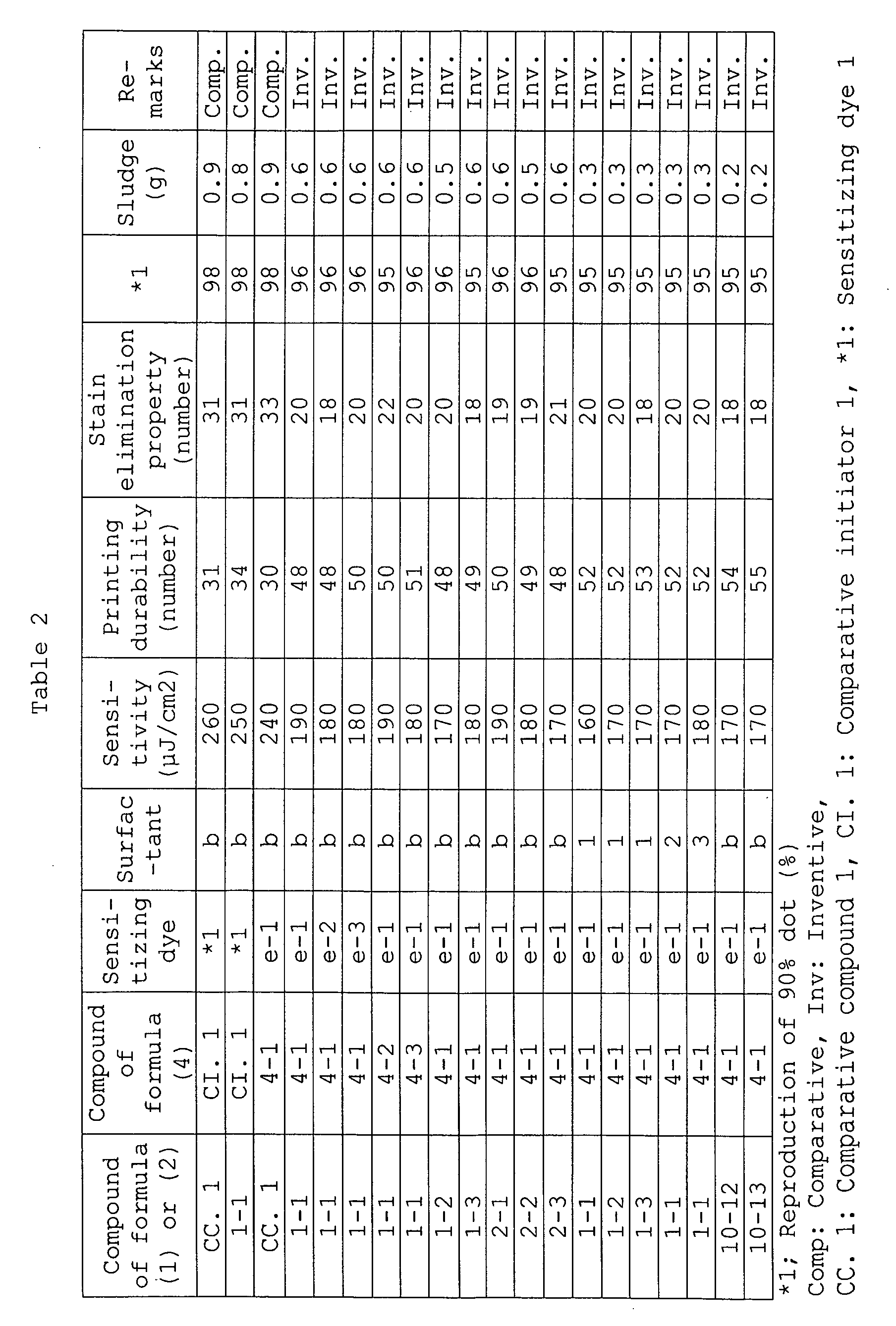

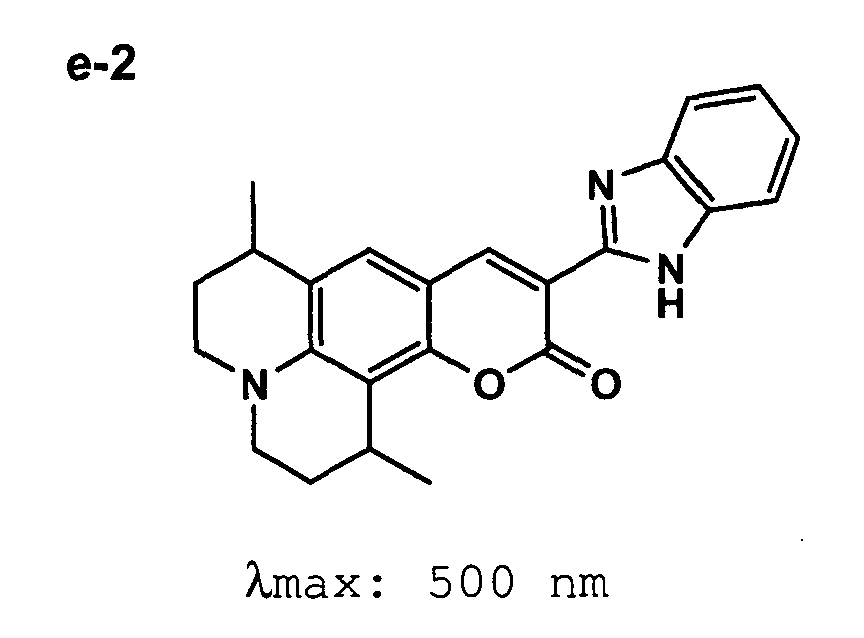

As is apparent from Table 2 above, the inventive
samples provide excellent sensitivity, excellent printing
durability, excellent stain elimination property, excellent
dot reproduction, and excellent sludge restraining property.
The light sensitive planographic printing plate
precursor samples were prepared in the same manner as in
Example 1, except that the sensitizing dyes used were changed
to the sensitizing dyes as shown in Table 3 The resulting
samples were processed in the same manner as in Example 1,
except that the samples were imagewise exposed, employing an
exposure apparatus COBALT-8 (produced by Escher-Grad
Technologies Inc.) equipped with a violet laser (408 nm)
light source instead of the exposure apparatus Tigercat
(produced by ECRM Co., Ltd.). Thus, a planographic printing
plate samples were obtained. The resulting printing plate
samples were evaluated in the same manner as in Example 1.
The results are shown in Table 3.


As is apparent from Table 3 above, the inventive
samples provide excellent sensitivity, excellent printing
durability, excellent stain elimination property, excellent
dot reproduction, and excellent sludge restraining property.
A light sensitive planographic printing plate precursor
was prepared in the same manner as in Example 1, except that
following photopolymerizable light sensitive layer coating
liquid was coated on the subbed support. Thus, light
sensitive planographic printing plate precursor samples 4-1
through 4-18 as shown in Table 1 were prepared.
| (Photopolymerizable light sensitive layer coating liquid) | |
| Polymer binder (Acryl copolymer 1) | 35.0 parts |
| Sensitizing dye (as shown in Table 4) | 4.0 parts |
| IRGACURE 784 (produced by Ciba Speciality Co., Ltd.) | 4.0 parts |
| Compounds of formula (1) or comparative compounds (as shown in Table 4) | 50.0 parts |
| Phthalocyanine pigment (MHI #454 produced by Mikuni Sikisosha) | 4.5 parts |
| 2-t-Butyl-6-(3-t-butyl-2-hydroxy-5-methylbenzyl)-4-methylphenyl acrylate (Sumirizer GS produced by Sumitomo 3M Co., Ltd.) | 0.5 parts |
| Sanol LS-770 (produced by Sankyo Co., Ltd.) | 0.5 parts |
| Fluorine-contained surfactant (Megafac F-178K produced by Sumitomo 3M Co., Ltd.) | 0.5 parts |
| Triazine compound | 1.0 part |
| Methyl ethyl ketone | 80 parts |
| Cyclohexanone | 820 parts |

The resulting samples were processed in the same manner
as in Example 1, except that the samples were imagewise
exposed, employing an exposure apparatus COBALT-8 (produced
by Escher-Grad Technologies Inc.) equipped with a violet
laser (408 nm) light source instead of the exposure apparatus
Tigercat (produced by ECRM Co., Ltd.), and developed with the
following developer. Thus, planographic printing plate
samples 4-1 through 4-18 were obtained.
| Developer (Aqueous solution containing the following materials) | |
| Potassium silicate A (an aqueous potassium silicate solution containing 26.5% by weight of SiO2 and 13.5% by weight of K2O) | 8.0% by weight |
| PELEX NBL produced by Kao Co., Ltd. | 3.0% by weight |
| Newcol B13 (produced by Nippon Nyukazai Co., Ltd.) | 1.0% by weight |
| Potassium hydroxide | Amount giving pH 12.3 |
The resulting printing plate samples 4-1 through 4-18
were evaluated according to the following methods.
Sensitivity was represented in terms of minimum
exposure amount through which a planographic printing plate
was obtained in which an image of a 175 screen line
number/inch with a dot area of 50% was reproduced. Herein,
samples providing not more than 270 µJ/cm2 of the minimum
exposure amount can be practically used.
The light sensitive planographic printing plate
precursor samples were exposed at an appropriate exposure
amount and developed to obtain planographic printing plate
samples. Herein, the appropriate exposure amount was two
times the exposure amount whereby a planographic printing
plate was obtained in which an image of a 175 screen line
number/inch with a dot area of 50% was reproduced and no
reduction of the layer thickness at image portions was
observed. The resulting planographic printing plate samples
were mounted on a printing press, DAIYA 1F-1 produced by
Mitsubishi Jukogyo Co., Ltd., and printing was carried out
employing a coated paper, printing ink (Toyo King Hyecho M
Magenta, produced by Toyo Ink Manufacturing Co.), and
dampening water SG-51 (concentration: 1.5%, produced by Tokyo
Ink Co., Ltd.). Every time one thousand printed papers were
obtained, the printing was suspended, and the planographic
printing plate samples on the press were wiped with a plate
cleaner. After that, the wiped samples were observed, and
printing was finished when dot reduction at the highlight
portions of the wiped samples were observed. The number of
the wiping operation was used for a measure of printing
durability. For example, printing durability 1 shows that
printing was carried out up to one thousand copies. The
greater number shows higher printing durability.
Herein, the printing plate is wiped with a plate
cleaner in order to eliminate undesired inking on the
printing plate, but the wiping reduces the layer strength at
the image portions, resulting in lowering of printing
durability. The above wiping procedure is often used for an
accelerating procedure for determining printing durability.
Printing durability was evaluated according to the following
criteria.
In the invention, samples providing evaluation A or B
can be practically used.
Stain elimination property was evaluated in the same
manner as in Example 1.
Reproduction of 90% dot was evaluated in the same
manner as in Example 1. In the invention, samples providing
a 90% dot reproduction of from 87 to 97% can be practically
used.
The results are shown in Table 4.
| Sample No. | Photopolymerizable compound | Sensitizing dye | Sensitivity µJ/cm2 | Printing durability | Stain elimination (number) | 90% Dot reproduction % | Remarks |
| 4-1 | Comparative compound 11 | Sensitizing dye 12 | 400 | D | 28 | 75 | Comp. |
| 4-2 | 1-1 | Sensitizing dye 12 | 370 | D | 28 | 77 | Comp. |
| 4-3 | Comparative compound 11 | 5-1 | 280 | D | 28 | 77 | Comp. |
| 4-4 | 1-1 | 5-1 | 160 | A | 22 | 96 | Inv. |
| 4-5 | 1-2 | 5-1 | 150 | A | 21 | 96 | Inv. |
| 4-6 | 1-3 | 5-1 | 170 | A | 23 | 96 | Inv. |
| 4-7 | 1-4 | 5-1 | 150 | A | 22 | 96 | Inv. |
| 4-8 | 1-5 | 5-1 | 160 | A | 22 | 96 | Inv. |
| 4-9 | 1-1 | 5-2 | 170 | A | 23 | 96 | Inv. |
| 4-10 | 1-1 | 5-3 | 150 | A | 20 | 96 | Inv. |
| 4-11 | 1-1 | 6-1 | 150 | A | 21 | 96 | Inv. |
| 4-12 | 1-1 | 6-2 | 160 | A | 22 | 96 | Inv. |
| 4-13 | 1-1 | 7-1 | 160 | A | 24 | 96 | Inv. |
| 4-14 | 1-1 | 7-2 | 170 | A | 24 | 96 | Inv. |
| 4-15 | 1-1 | 8-1 | 150 | A | 23 | 96 | Inv. |
| 4-16 | 1-1 | 8-2 | 160 | A | 22 | 96 | Inv. |
| 4-17 | 10-1 | 7-1 | 140 | A | 20 | 96 | Inv. |
| 4-18 | 10-8 | 7-1 | 140 | A | 20 | 96 | Inv. |
| Inv.: Invention, Comp.: Comparative, 5-3: λmax = 420 nm, 6-1: λmax = 380 nm, 6-2: λmax = 390 nm, 7-1: λmax = 420 nm, 7-2: λmax = 420 nm, 8-1: λmax = 380 nm, 8-2: λmax = 390 nm |
As is apparent from Table 4 above, the inventive
samples provide excellent sensitivity, excellent printing
durability, excellent stain elimination property, and
excellent 90% dot reproduction, as compared with comparative
samples.
A light sensitive planographic printing plate precursor
sample 5-1 was prepared in the same manner as in light
sensitive planographic printing plate precursor sample 4-1 of
Example 4, except that a colorant as shown in Table 5 was
further added to the overcoat coating layer to give an
overcoat layer (which also functions as a color layer) with
an optical density as shown in Table 5.


A first sample is prepared by coating a color layer
containing a colorant on a 100 µm thick transparent
polyethylene terephthalate film. Similarly, a second sample
is prepared by coating a layer containing no colorant on a
100 µm thick transparent polyethylene terephthalate film.
The optical density of both samples was measured employing a
spectrophotometer U-3300 (produced by Hitachi Co., Ltd.). In
the invention, the difference between the optical densities
at λmax of the first and second samples is defined as the
optical density of the colorant layer.
Light sensitive planographic printing plate precursor
samples 5-2 through 5-12 were prepared in the same manner as
in sample 5-1, except that a photopolymerizable compound, a
sensitizing dye, a colorant or optical density was changed to
those as shown in Table 5.
The resulting samples were evaluated in the same manner
as in Example 4. Further, a yellow lamp safety property was
evaluated as follows.
The samples obtained above were exposed at an
illuminance of 100 Lux to a yellow lamp Neolumi Super Yellow
Rapid FLR40Y/M (produced by Mitsubishi Electric Co., Ltd.),
and developed. The minimum exposure time which a residual
layer was observed on the support after development was
evaluated as yellow lamp safety time. The results are shown
in Table 5.

As is apparent from Table 5 above, the inventive
samples provide excellent sensitivity, excellent printing
durability, excellent stain elimination property, and
excellent 90% dot reproduction, as compared with comparative
samples. Addition of colorant increases the yellow lamp
safety time, and the increment of the time in the inventive
samples is far greater than that in the comparative samples.
A light sensitive planographic printing plate precursor
sample 6-1 was prepared in the same manner as in light
sensitive planographic printing plate precursor sample 4-1 of
Example 4, except that the following intermediate coating
solution A was coated on the photopolymerizable light
sensitive layer to form an intermediate layer A, the overcoat
coating solution layer was further added with a colorant as
shown in Table 6 and coated on the resulting intermediate
layer A to give a color layer B, and further the following
protective layer coating solution C was coated on the color
layer B to form a protective layer C.
| (Intermediate coating solution A and protective layer coating solution C) | |
| Polyvinyl alcohol (GL-05, produced by Nippon Gosei Kagaku Co., Ltd.) | 89 parts |
| Water soluble polyamide (P-70, produced by Toray Co., Ltd.) | 10 parts |
| Surfactant (Surfinol 465, produced by Nisshin Kagaku Kogyo Co., Ltd.) | 1.0 parts |
| Water | 900 parts |
| (Color layer coating solution) | |
| Polyvinyl alcohol (GL-05, produced by Nippon Gosei Kagaku Co., Ltd.) | 89 parts |
| Water soluble polyamide (P-70, produced by Toray Co., Ltd.) | 10 parts |
| Surfactant (Surfinol 465, produced by Nisshin Kagaku Kogyo Co., Ltd.) | 1.0 parts |
| Colorant | As shown in Table 6 |
| Water | 900 parts |
A light sensitive planographic printing plate precursor
sample 6-2 was prepared in the same manner as in light
sensitive planographic printing plate precursor sample 6-1,
except that the overcoat coating solution layer of Example 4
was coated on the intermediate layer A to form an overcoat
layer B, and the above colorant layer coating solution was
coated on the overcoat layer B to form a colorant layer C.
A light sensitive planographic printing plate precursor
sample 6-3 was prepared in the same manner as in light
sensitive planographic printing plate precursor sample 6-1,
except that the colorant shown in Table 6 was further added
with the intermediate coating solution A and coated on the
photopolymerizable light sensitive layer to form a colorant
layer A, and subsequently, the overcoat coating solution
layer of Example 4 was coated on the resulting layer A to
form an overcoat B, and further the above protective layer
coating solution C was coated on the overcoat layer B to form
a protective layer C.
Herein, the above colorants were added to give an
optical density as shown in Table 6. The resulting light
sensitive planographic printing plate precursor samples 6-1
through 6-3 were processed in the same manner as in Example 4
to obtain planographic printing plate samples 6-1 through 6-3,
and evaluated in the same manner as in Example 4.
The results are shown in Table 6.
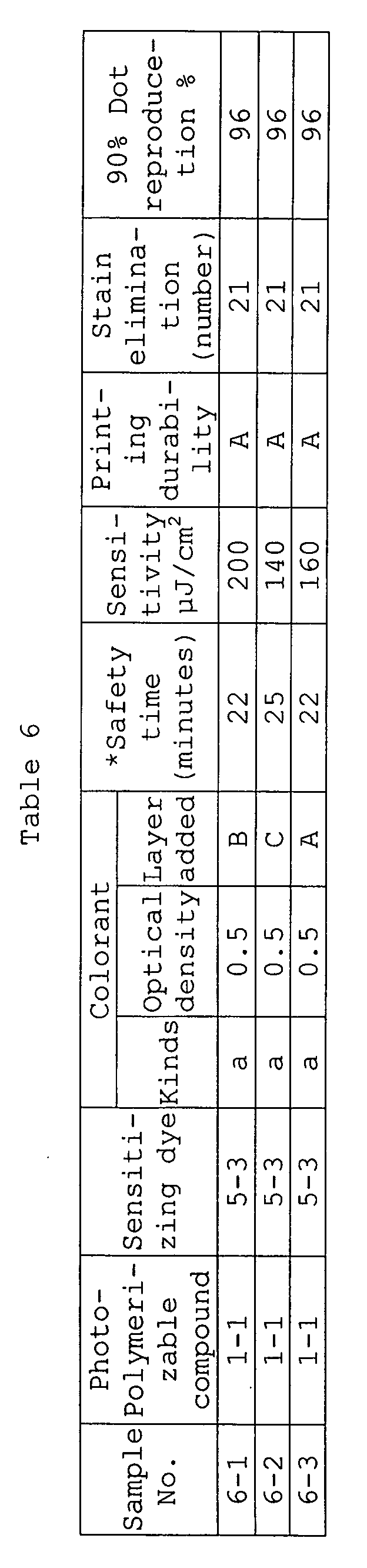
As is apparent from Table 6 above, the inventive
samples 6-1, 6-2 and 6-3 provide excellent sensitivity,
excellent printing durability, excellent stain elimination
property, and excellent 90% dot reproduction. Particularly,
sample (inventive) 6-2, in which the overcoat layer is
provided on the photopolymerizable light sensitive layer and
the colorant layer is provided on the over coat layer,
provides higher sensitivity and longer safety time.
The present invention provides a light sensitive
planographic printing plate precursor, which is excellent in
sensitivity, printing durability, a stain elimination
property, dot reproduction, and a sludge restraining
property.
Claims (13)
- A light sensitive planographic printing plate precursor comprising a hydrophilic support and provided thereon, a photopolymerizable light sensitive layer containing a first compound represented by the following formula (1) or (2) and a second compound represented by the following formula (3) or (4):wherein Q1 represents
 or -S-; R4 represents an alkyl group, a hydroxy alkyl group, or an aryl group; R1 and R2 independently represent a hydrogen atom, an alkyl group, or an alkoxyalkyl group; R3 represents a hydrogen atom, a methyl group, or a methyl group; X1 represents a divalent linkage group having a carbon atom number of from 2 to 12; X2 represents a divalent linkage group, a trivalent linkage group, a tetravalent linkage group, or
 in which Z represents a hydrogen atom, an alkyl group, an alkenyl group, an aryl group, a halogen atom, an alkoxy group, or a heterocyclic group, p is an integer of from 1 to 4, and q is an integer of from 1 to 3; D1 and D2 independently represent a divalent linkage group having a carbon atom number of from 1 to 5; E represents an alkylene group having a carbon atom number of from 2 to 12 or an arylene group having a carbon atom number of from 6 to 12; a is an integer of from 1 to 4; b is 0 or 1; c is an integer of from 1 to 3; m is an integer of from 2 to 4; and n is an integer of from 1 to m, provided that plural groups having the same definition may be the same or different,
 wherein Q2 represents
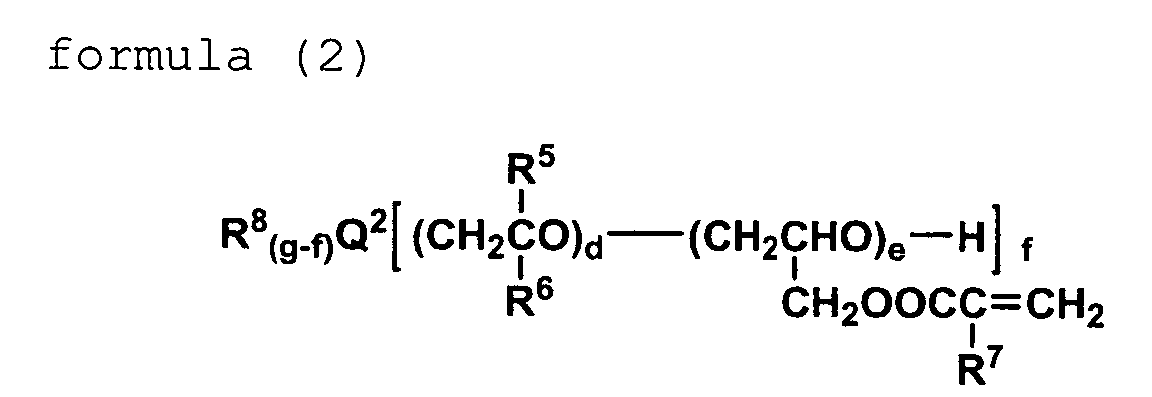 R8 represents an alkyl group, a hydroxyalkyl group, or an aryl group; R5 and R6 independently represent a hydrogen atom, an alkyl group, or an alkoxyalkyl group; and R7 represents a hydrogen atom, a methyl group, or a methyl group; D3 and D4 independently represent a divalent saturated hydrocarbon group having a carbon atom number of from 1 to 5; F represents an alkylene group having a carbon atom number of from 2 to 12 or an arylene group having a carbon atom number of from 6 to 12; d and e independently represent an integer of from 1 to 4; g is an integer of from 2 to 4; and f is an integer of from 1 to g, provided that plural groups having the same definition may be the same or different,
 wherein R1, R2, and R3 independently represent an alkyl group, an aryl group, an aralkyl group, an alkenyl group, a silyl group, a heterocyclic group or a halogen atom; and Z+ is a cationic group,
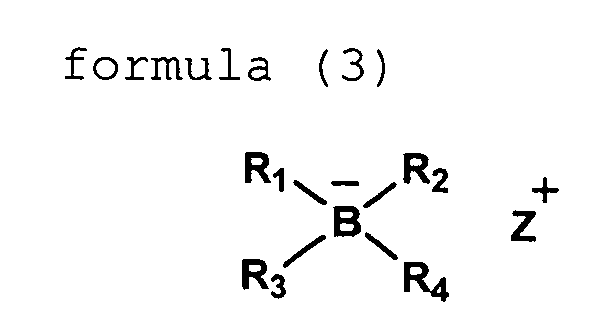 wherein R11 and R12 may be the same or different, and
independently represent an alkyl group having a carbon atom number of from 1 to 12, an alkinyl group having a carbon atom number of from 2 to 12, an alkoxy group having a carbon atom number of from 1 to 8, a cyano group, an alkylthio group, a phenoxy group, a monocarboxyl or ester group having a carbon atom number of from 2 to 6, an alkanoyl group having a carbon atom number of from 2 to 5, an ammonium group, a pyridinium group, a nitro group, an alkylsulfinyl group, an alkylsulfonyl group, a sulfamoyl group or a halogen atom, provided that R12 may form a condensed ring with the benzene ring; X represents BF4, PF6, AsF6, FeCl4, SnCl6, SbCl6, or BiCl6; m is an integer of from 1 to 4; and n is an integer of from 1 to 5. - The light sensitive planographic printing plate precursor of claim 1, wherein the second compound is a compound represented by the formula (3).
- The light sensitive planographic printing plate precursor of claim 1, wherein the second compound is a compound represented by the formula (4).
- The light sensitive planographic printing plate precursor of claim 1, further comprising a sensitizing dye having an absorption maximum in the wavelength regions of from 350 to 450 nm.
- The light sensitive planographic printing plate precursor of claim 1, wherein the sensitizing dye is selected from the group consisting of compounds represented by the following formula (5), (6), (7), and (8),wherein R14 represents a hydrogen atom, an alkyl group which may have a substituent, an alkenyl group which may have a substituent, an aryl group or a heterocyclic group; R15 and R16 represent a substituent capable of combining with each other to form a ring; and X11 and X12 independently represent -CR17R18-, -O-, -S-, or -NR19-, in which R17, R18, and R19 independently represent a hydrogen atom, an alkyl group, an alkenyl group, an aryl group or a heterocyclic group,
 wherein A represents an aryl group or a heterocyclic group; X represents an oxygen atom, a sulfur atom or -N(R13)-; and R11, R12, and R13 independently represent a hydrogen atom or a substituent, provided that A and R11 may combine with each other to form a condensed ring or R12 and R13 may combine with each other to form a ring,
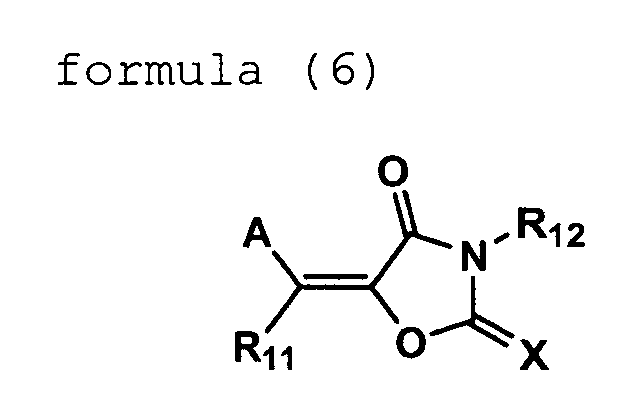 wherein R11, R12, R13, R14, R15, R16, R17, R18 and R19 independently represent a hydrogen atom or a substituent, provided that two adjacent groups of R11, R12, R13, R14, R15, R16, R17, R18 and R19 may combine with each other to form a ring, and at least one of R11 and R13 represents an organic residue represented by the following formula P,
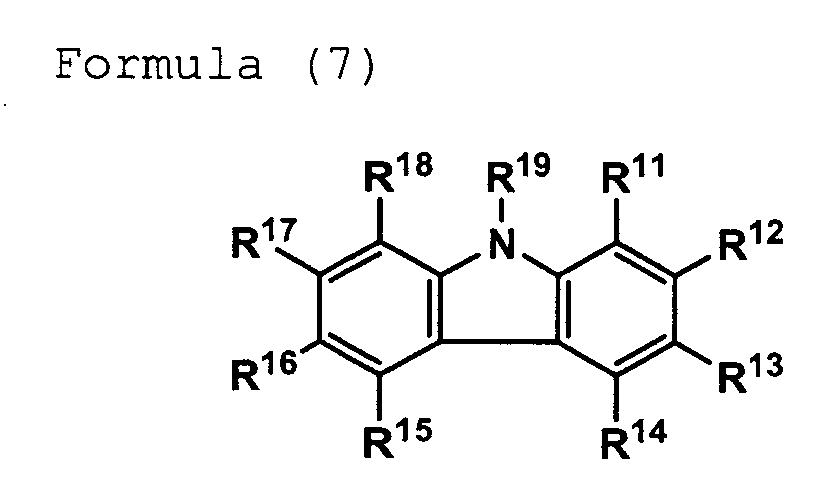 in which R10 represents a hydrogen atom or a substituent; and Z represents a non-metallic atomic group necessary to form a 5-member acidic nucleus, and wherein when R11 is represented by formula P, R10 may combine with R12 or R19 to form a ring, when R13 is represented by formula P, R10 may combine with R12 or R14 to form a ring, and when R11 and R13 both are represented by formula P, R10 may combine with R14 or R19 to form a ring,
 wherein X1, X2, X3, X4 and X5 independently represent a substituent; and Z represents an aryl group or an aromatic heterocyclic group.
- The light sensitive planographic printing plate precursor of claim 1, further comprising a color layer provided on the photopolymerizable light sensitive layer, the color layer having an optical density at wavelength regions of from 410 to 800 nm of from 0.2 to 3.0.
- The light sensitive planographic printing plate precursor of claim 1, further comprising an overcoat layer containing polyvinyl alcohol provided on the photopolymerizable light sensitive layer.
- The light sensitive planographic printing plate precursor of claim 1, further comprising, provided on the photopolymerizable, an overcoat layer containing polyvinyl alcohol and a color layer having an optical density at wavelength regions of from 410 to 800 nm of from 0.2 to 3.0, wherein the overcoat layer is provided between the photopolymerizable light sensitive layer and the color layer.
- A light sensitive planographic printing plate precursor comprising a hydrophilic support and provided thereon, a photopolymerizable light sensitive layer containing a first compound represented by the following formula (1) or (2) and a sensitizing dye having an absorption maximum in the wavelength regions of from 350 to 450 nm,wherein Q1 represents
 or -S-; R4 represents an alkyl group, a hydroxy alkyl group, or an aryl group; R1 and R2 independently represent a hydrogen atom, an alkyl group, or an alkoxyalkyl group; R3 represents a hydrogen atom, a methyl group, or a methyl group; X1 represents a divalent linkage group having a carbon atom number of from 2 to 12; X2 represents a divalent linkage group, a trivalent linkage group, a tetravalent linkage group, or
 in which Z represents a hydrogen atom, an alkyl group, an alkenyl group, an aryl group, a halogen atom, an alkoxy group, or a heterocyclic group, p is an integer of from 1 to 4, and q is an integer of from 1 to 3; D1 and D2 independently represent a divalent linkage group having a carbon atom number of from 1 to 5; E represents an alkylene group having a carbon atom number of from 2 to 12 or an arylene group having a carbon atom number of from 6 to 12; a is an integer of from 1 to 4; b is 0 or 1; c is an integer of from 1 to 3; m is an integer of from 2 to 4; and n is an integer of from 1 to m, provided that plural groups having the same definition may be the same or different,
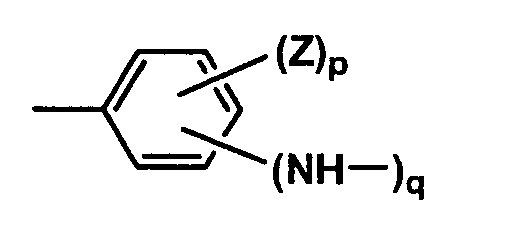 wherein Q2 represents
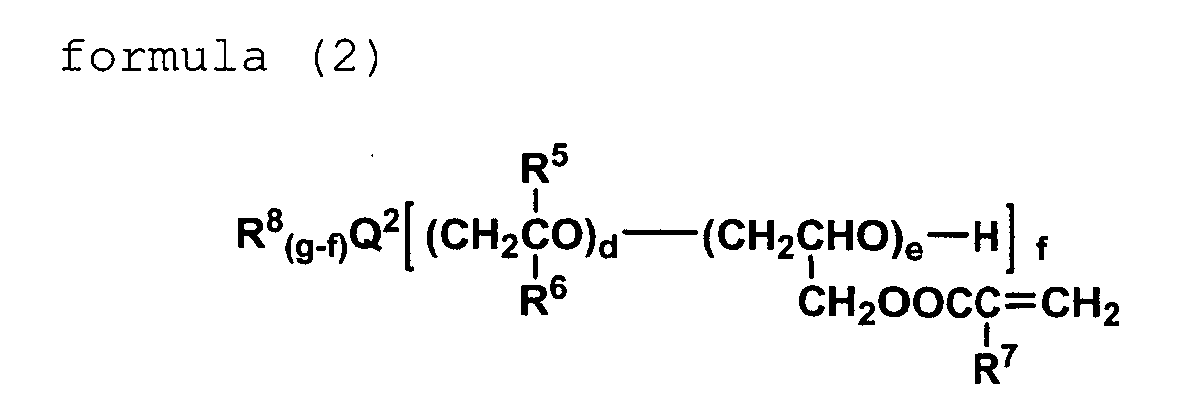 R8 represents an alkyl group, a hydroxy alkyl group, or an aryl group; R5 and R6 independently represent a hydrogen atom, an alkyl group, or an alkoxyalkyl group; and R7 represents a hydrogen atom, a methyl group, or a methyl group; D3 and D4 independently represent a divalent saturated hydrocarbon group having a carbon atom number of from 1 to 5; F represents an alkylene group having a carbon atom number of from 2 to 12 or an arylene group having a carbon atom number of from 6 to 12; d and e independently represent an integer of from 1 to 4; g is an integer of from 2 to 4; and f is an integer of from 1 to g, provided that plural groups having the same definition may be the same or different.
- The light sensitive planographic printing plate precursor of claim 9, wherein the sensitizing dye is selected from the group consisting of compounds represented by the following formula (5), (6), (7), and (8),wherein R14 represents a hydrogen atom, an alkyl group which may have a substituent, an alkenyl group which may have a substituent, an aryl group or a heterocyclic group; R15 and R16 represent a substituent capable of combining with each other to form a ring; and X11 and X12 independently represent -CR17R18-, -O-, -S-, or -NR19-, in which R17, R18, and R19 independently represent a hydrogen atom, an alkyl group, an alkenyl group, an aryl group or a heterocyclic group,
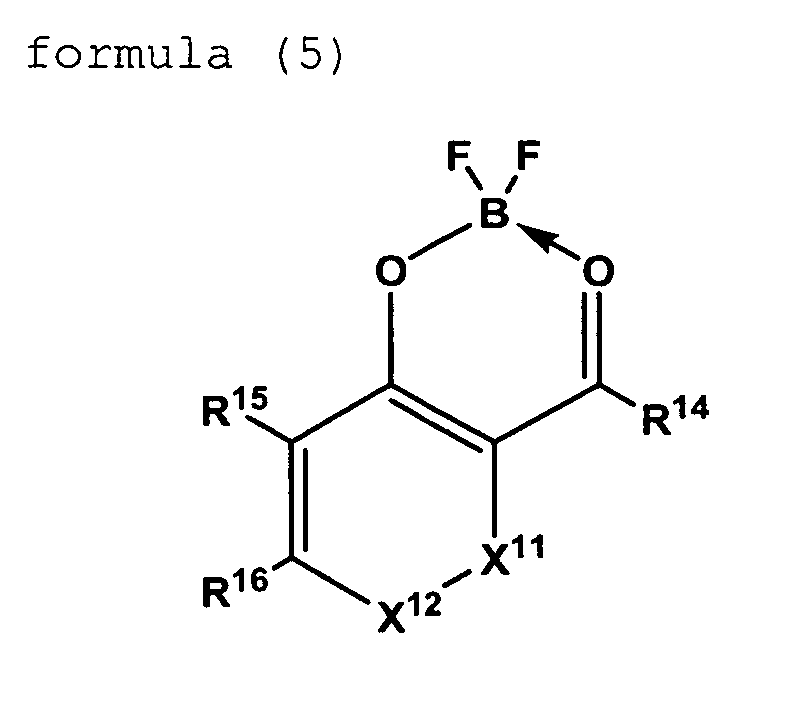 wherein A represents an aryl group or a heterocyclic group; X represents an oxygen atom, a sulfur atom or -N(R13)-; and R11, R12, and R13 independently represent a hydrogen atom or a substituent, provided that A and R11 may combine with each other to form a condensed ring or R12 and R13 may combine with each other to form a ring,
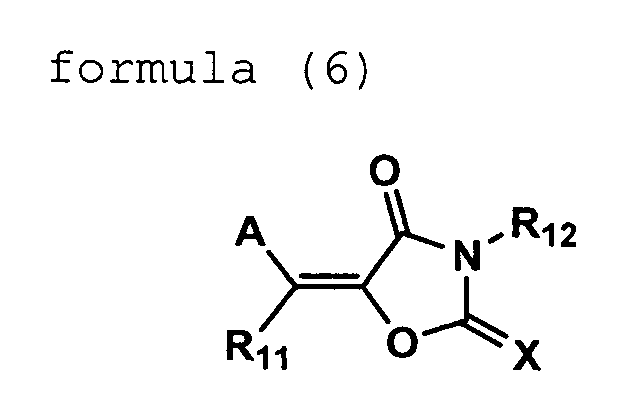 wherein R11, R12, R13, R14, R15, R16, R17, R18 and R19 independently represent a hydrogen atom or a substituent, provided that two adjacent groups of R11, R12, R13, R14, R15, R16, R17, R18 and R19 may combine with each other to form a ring, and at least one of R11 and R13 represents an organic residue represented by the following formula P,
 in which R10 represents a hydrogen atom or a substituent; and Z represents a non-metallic atomic group necessary to form a 5-member acidic nucleus, and wherein when R11 is represented by formula P, R10 may combine with R12 or R19 to form a ring, when R13 is represented by formula P, R10 may combine with R12 or R14 to form a ring, and when R11 and R13 both are represented by formula P, R10 may combine with R14 or R19 to form a ring,
 wherein X1, X2, X3, X4 and X5 independently represent a substituent; and Z represents an aryl group or an aromatic heterocyclic group.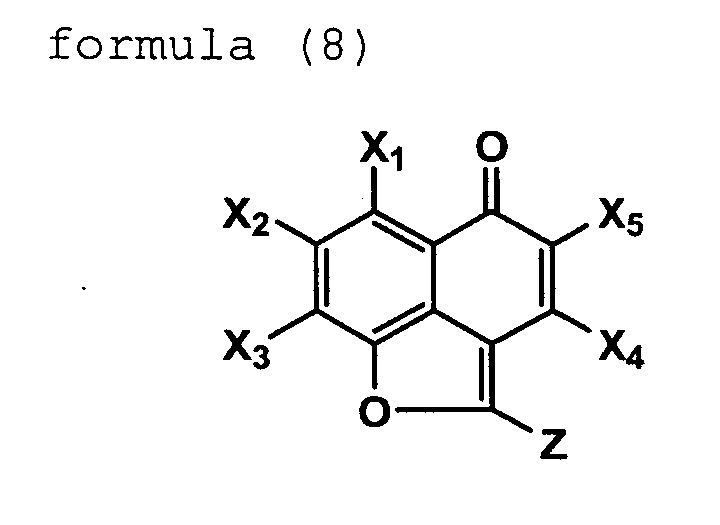
- The light sensitive planographic printing plate precursor of claim 9, further comprising a color layer provided on the photopolymerizable light sensitive layer, the color layer having an optical density at wavelength regions of from 410 to 800 nm of from 0.2 to 3.0.
- The light sensitive planographic printing plate precursor of claim 9, further comprising an overcoat layer containing polyvinyl alcohol provided on the photopolymerizable light sensitive layer.
- The light sensitive planographic printing plate precursor of claim 9, further comprising, provided on the photopolymerizable light sensitive layer, an overcoat layer containing polyvinyl alcohol and a color layer having an optical density at wavelength regions of from 410 to 800 nm of from 0.2 to 3.0, wherein the overcoat layer is provided between the photopolymerizable light sensitive layer and the color layer.
Applications Claiming Priority (4)
| Application Number | Priority Date | Filing Date | Title |
|---|---|---|---|
| JP2002182681 | 2002-06-24 | ||
| JP2002182681 | 2002-06-24 | ||
| JP2002185985 | 2002-06-26 | ||
| JP2002185985 | 2002-06-26 |
Publications (1)
| Publication Number | Publication Date |
|---|---|
| EP1378793A2 true EP1378793A2 (en) | 2004-01-07 |
Family
ID=29720907
Family Applications (1)
| Application Number | Title | Priority Date | Filing Date |
|---|---|---|---|
| EP03011834A Withdrawn EP1378793A2 (en) | 2002-06-24 | 2003-05-26 | Light sensitive planographic printing plate precursor |
Country Status (4)
| Country | Link |
|---|---|
| US (2) | US7074546B2 (en) |
| EP (1) | EP1378793A2 (en) |
| CN (1) | CN100428056C (en) |
| BR (1) | BR0307076A (en) |
Cited By (2)
| Publication number | Priority date | Publication date | Assignee | Title |
|---|---|---|---|---|
| EP1452916A3 (en) * | 2003-02-10 | 2005-02-09 | Konica Minolta Holdings, Inc. | Photosensitive composition, planographic printing plate and processing method of planographic printing plate |
| EP1708025A1 (en) * | 2005-03-25 | 2006-10-04 | Fuji Photo Film Co., Ltd. | Photosensitive lithographic printing plate |
Families Citing this family (15)
| Publication number | Priority date | Publication date | Assignee | Title |
|---|---|---|---|---|
| JP2004325726A (en) * | 2003-04-24 | 2004-11-18 | Konica Minolta Medical & Graphic Inc | Photosensitive composition and photosensitive lithographic printing plate |
| JP2005084092A (en) * | 2003-09-04 | 2005-03-31 | Fuji Photo Film Co Ltd | Photosensitive planographic printing plate |
| US20050058911A1 (en) * | 2003-09-17 | 2005-03-17 | Konica Minolta Medical & Graphic, Inc. | Holographic recording medium, holographic recording method and holographic information medium |
| JP2005274813A (en) * | 2004-03-24 | 2005-10-06 | Konica Minolta Medical & Graphic Inc | Planographic printing plate making method |
| JP2005275223A (en) * | 2004-03-26 | 2005-10-06 | Konica Minolta Medical & Graphic Inc | Method for manufacturing planographic printing plate |
| JP4613115B2 (en) * | 2005-08-30 | 2011-01-12 | 富士フイルム株式会社 | Photopolymerization type photosensitive lithographic printing plate |
| JP4966528B2 (en) * | 2005-09-14 | 2012-07-04 | 旭化成イーマテリアルズ株式会社 | Pattern forming material, pattern forming apparatus and pattern forming method |
| JPWO2008010400A1 (en) * | 2006-07-20 | 2009-12-17 | コニカミノルタエムジー株式会社 | Photosensitive lithographic printing plate material |
| CN102681210B (en) * | 2012-05-23 | 2013-12-04 | 杏晖光学(厦门)有限公司 | Natural gray protection eyeglass |
| EP2869122A4 (en) * | 2012-06-29 | 2016-03-02 | Fujifilm Corp | Method for concentrating processing waste liquid and method for recycling processing waste liquid |
| CN102816088B (en) * | 2012-07-06 | 2014-05-07 | 华南理工大学 | Tertiary amine structure containing methacrylate macromonomer without bisphenol A structure, preparation method and application thereof |
| CN102816089B (en) * | 2012-07-06 | 2014-06-11 | 华南理工大学 | Quaternary ammonium salt and carbamate structure containing antibacterial methyl acrylate monomer, preparation method and application thereof |
| CN105143284B (en) * | 2013-03-19 | 2017-03-15 | 3M创新有限公司 | Free radical polymerisation process and the product obtained by which |
| CN105308505B (en) * | 2013-06-14 | 2019-11-29 | 爱克发有限公司 | Lighographic printing plate precursor |
| CN105308504B (en) * | 2013-06-14 | 2019-12-03 | 爱克发有限公司 | Lithographic printing plate precursors |
Family Cites Families (21)
| Publication number | Priority date | Publication date | Assignee | Title |
|---|---|---|---|---|
| US3717558A (en) * | 1972-03-30 | 1973-02-20 | Scm Corp | Photopolymerization catalyst comprising a metallocene and an active halogen-containing compound |
| DE3710281A1 (en) * | 1987-03-28 | 1988-10-06 | Hoechst Ag | PHOTOPOLYMERIZABLE MIXTURE AND RECORDING MATERIAL MADE THEREOF |
| DE3710279A1 (en) | 1987-03-28 | 1988-10-06 | Hoechst Ag | POLYMERIZABLE COMPOUNDS AND THIS CONTAINING MIXTURE MIXING BY RADIATION |
| JPH0827539B2 (en) | 1987-09-28 | 1996-03-21 | 富士写真フイルム株式会社 | Photopolymerizable composition |
| US5273862A (en) * | 1988-07-29 | 1993-12-28 | Hoechst Aktiengesellschaft | Photopolymerizable recording material comprising a cover layer substantially impermeable to oxygen, binds oxygen and is soluble in water at 20°C. |
| DE3832032A1 (en) | 1988-09-21 | 1990-03-22 | Hoechst Ag | PHOTOPOLYMERIZABLE MIXTURE AND RECORDING MATERIAL MANUFACTURED THEREOF |
| DE4007428A1 (en) * | 1990-03-09 | 1991-09-12 | Hoechst Ag | Photopolymerisable mixt. sensitive to near UV and visible light |
| DE4008815A1 (en) | 1990-03-20 | 1991-09-26 | Hoechst Ag | PHOTOPOLYMERIZABLE MIXTURE AND RECORDING MATERIAL MANUFACTURED THEREOF |
| US5055372A (en) * | 1990-04-23 | 1991-10-08 | The Mead Corporation | Photohardenable composition containing borate salts and ketone initiators |
| DE4013358A1 (en) | 1990-04-26 | 1991-10-31 | Hoechst Ag | METHOD FOR THE PRODUCTION OF PRINTING FORMS OR PHOTORESISTS BY IMPROPER IRRADIATION OF A PHOTOPOLYMERIZABLE RECORDING MATERIAL |
| JP3470253B2 (en) | 1996-07-24 | 2003-11-25 | コニカミノルタホールディングス株式会社 | Photoinitiator, photopolymerizable composition, radical generation method, photosensitive material for making a lithographic printing plate, and method for making a lithographic printing plate |
| JPH1062978A (en) * | 1996-08-21 | 1998-03-06 | Konica Corp | Photoinitiator, photopolymerizable composition, method for generating radical, photosensitive material for producing planographic printing plate and production of planographic printing plate |
| US5983498A (en) * | 1996-10-18 | 1999-11-16 | Lieberman; Christopher E. | Nail clipper with receptacle |
| US6335144B1 (en) * | 1999-04-27 | 2002-01-01 | Fuji Photo Film Co., Ltd. | Photopolymerizable composition for short wavelength semiconductor laser exposure |
| DE19940921A1 (en) | 1999-08-27 | 2001-03-01 | Agfa Gevaert Ag | Photopolymerizable mixture and recording material produced therewith |
| JP2003043673A (en) * | 2001-07-26 | 2003-02-13 | Fuji Photo Film Co Ltd | Plate making method for photopolymerizable planographic printing plate |
| JP3969109B2 (en) * | 2002-02-08 | 2007-09-05 | コニカミノルタホールディングス株式会社 | Photosensitive planographic printing plate and recording method thereof |
| US20030186165A1 (en) * | 2002-03-28 | 2003-10-02 | Agfa-Gevaert | Photopolymerizable composition sensitized for the wavelength range from 300 to 450 nm |
| US7314699B2 (en) * | 2002-04-29 | 2008-01-01 | Agfa Graphics Nv | Radiation-sensitive mixture and recording material produced therewith |
| EP1413925A3 (en) * | 2002-10-23 | 2004-08-25 | Konica Minolta Holdings, Inc. | Photosensitive composition and photosensitive lithographic printing plate |
| JP2004325726A (en) * | 2003-04-24 | 2004-11-18 | Konica Minolta Medical & Graphic Inc | Photosensitive composition and photosensitive lithographic printing plate |
-
2003
- 2003-05-22 US US10/443,943 patent/US7074546B2/en not_active Expired - Lifetime
- 2003-05-26 EP EP03011834A patent/EP1378793A2/en not_active Withdrawn
- 2003-06-20 CN CNB031490689A patent/CN100428056C/en not_active Expired - Lifetime
- 2003-12-19 BR BR0307076-0A patent/BR0307076A/en not_active IP Right Cessation
-
2006
- 2006-01-18 US US11/334,334 patent/US7407735B2/en not_active Expired - Fee Related
Cited By (3)
| Publication number | Priority date | Publication date | Assignee | Title |
|---|---|---|---|---|
| EP1452916A3 (en) * | 2003-02-10 | 2005-02-09 | Konica Minolta Holdings, Inc. | Photosensitive composition, planographic printing plate and processing method of planographic printing plate |
| US7147989B2 (en) | 2003-02-10 | 2006-12-12 | Konica Minolta Holdings, Inc. | Photosensitive composition, planographic printing plate and processing method of planograhic printing plate |
| EP1708025A1 (en) * | 2005-03-25 | 2006-10-04 | Fuji Photo Film Co., Ltd. | Photosensitive lithographic printing plate |
Also Published As
| Publication number | Publication date |
|---|---|
| US7074546B2 (en) | 2006-07-11 |
| CN100428056C (en) | 2008-10-22 |
| BR0307076A (en) | 2005-02-15 |
| US7407735B2 (en) | 2008-08-05 |
| CN1469195A (en) | 2004-01-21 |
| US20060134550A1 (en) | 2006-06-22 |
| US20040005515A1 (en) | 2004-01-08 |
Similar Documents
| Publication | Publication Date | Title |
|---|---|---|
| CN1751270B (en) | Radiation-sensitive compositions comprising oxazole derivatives and imageable elements based thereon | |
| US7074546B2 (en) | Light sensitive planographic printing plate precursor and its processing method | |
| US7011928B2 (en) | Image formation method of planographic printing plate material | |
| US7285375B2 (en) | Photosensitive composition, photosensitive lithography plate and method for producing lithography plate | |
| US7169535B2 (en) | Photosensitive composition and photosensitive lithographic printing plate | |
| US20080160452A1 (en) | Developer for light sensitive planographic printing plate material and manufacturing process of planographic printing plate employing the same | |
| US6749995B2 (en) | Light sensitive composition, light sensitive planographic printing plate recursor, and image formation method | |
| US7147989B2 (en) | Photosensitive composition, planographic printing plate and processing method of planograhic printing plate | |
| US6730455B2 (en) | Method of preparing planographic printing plate | |
| US20080020323A1 (en) | Light sensitive planographic printing plate material | |
| US6890702B2 (en) | Light sensitive composition and light sensitive planographic printing plate precursor | |
| JP2000275823A (en) | Photosensitive composition and photosensitive lithographic printing plate material | |
| EP1673663B1 (en) | Light sensitive coating compositions for lithographic elements | |
| EP1513015A1 (en) | Planographic printing plate material | |
| JP2003270780A (en) | Photosensitive planographic printing plate | |
| US7192690B2 (en) | Process of preparing planographic printing plate | |
| JP4085644B2 (en) | Method for preparing photosensitive lithographic printing plate | |
| EP1586460A1 (en) | Planographic printing plate material and preparing process of planographic printing plate | |
| EP1715382A1 (en) | Process of preparing planographic printing plate | |
| JPH10282647A (en) | Lithographic printing plate material and its production | |
| JP2003233182A (en) | Photopolymerizable composition, photosensitive planographic printing plate and recording method | |
| JP2003066606A (en) | Photosensitive planographic printing plate material | |
| JP2004029123A (en) | Support and material for lithographic printing plate, and manufacturing method and quality guaranteeing method thereof | |
| JP2003057810A (en) | Photosensitive planographic printing plate material and method for producing the same | |
| JP2003066602A (en) | Photosensitive planographic printing plate material |
Legal Events
| Date | Code | Title | Description |
|---|---|---|---|
| PUAI | Public reference made under article 153(3) epc to a published international application that has entered the european phase |
Free format text: ORIGINAL CODE: 0009012 |
|
| AK | Designated contracting states |
Kind code of ref document: A2 Designated state(s): AT BE BG CH CY CZ DE DK EE ES FI FR GB GR HU IE IT LI LU MC NL PT RO SE SI SK TR |
|
| AX | Request for extension of the european patent |
Extension state: AL LT LV MK |
|
| STAA | Information on the status of an ep patent application or granted ep patent |
Free format text: STATUS: THE APPLICATION HAS BEEN WITHDRAWN |
|
| 18W | Application withdrawn |
Effective date: 20090306 |