EP1378345A1 - Metal product surface-treated with alkali-soluble lubricating film exhibiting excellent formability and excellent film removal property being stable for a long time and independent of temperature for drying film - Google Patents
Metal product surface-treated with alkali-soluble lubricating film exhibiting excellent formability and excellent film removal property being stable for a long time and independent of temperature for drying film Download PDFInfo
- Publication number
- EP1378345A1 EP1378345A1 EP02707265A EP02707265A EP1378345A1 EP 1378345 A1 EP1378345 A1 EP 1378345A1 EP 02707265 A EP02707265 A EP 02707265A EP 02707265 A EP02707265 A EP 02707265A EP 1378345 A1 EP1378345 A1 EP 1378345A1
- Authority
- EP
- European Patent Office
- Prior art keywords
- film
- alkali
- soluble
- less
- metal product
- Prior art date
- Legal status (The legal status is an assumption and is not a legal conclusion. Google has not performed a legal analysis and makes no representation as to the accuracy of the status listed.)
- Withdrawn
Links
Images

Classifications
-
- C—CHEMISTRY; METALLURGY
- C23—COATING METALLIC MATERIAL; COATING MATERIAL WITH METALLIC MATERIAL; CHEMICAL SURFACE TREATMENT; DIFFUSION TREATMENT OF METALLIC MATERIAL; COATING BY VACUUM EVAPORATION, BY SPUTTERING, BY ION IMPLANTATION OR BY CHEMICAL VAPOUR DEPOSITION, IN GENERAL; INHIBITING CORROSION OF METALLIC MATERIAL OR INCRUSTATION IN GENERAL
- C23C—COATING METALLIC MATERIAL; COATING MATERIAL WITH METALLIC MATERIAL; SURFACE TREATMENT OF METALLIC MATERIAL BY DIFFUSION INTO THE SURFACE, BY CHEMICAL CONVERSION OR SUBSTITUTION; COATING BY VACUUM EVAPORATION, BY SPUTTERING, BY ION IMPLANTATION OR BY CHEMICAL VAPOUR DEPOSITION, IN GENERAL
- C23C22/00—Chemical surface treatment of metallic material by reaction of the surface with a reactive liquid, leaving reaction products of surface material in the coating, e.g. conversion coatings, passivation of metals
-
- C—CHEMISTRY; METALLURGY
- C10—PETROLEUM, GAS OR COKE INDUSTRIES; TECHNICAL GASES CONTAINING CARBON MONOXIDE; FUELS; LUBRICANTS; PEAT
- C10M—LUBRICATING COMPOSITIONS; USE OF CHEMICAL SUBSTANCES EITHER ALONE OR AS LUBRICATING INGREDIENTS IN A LUBRICATING COMPOSITION
- C10M107/00—Lubricating compositions characterised by the base-material being a macromolecular compound
- C10M107/40—Lubricating compositions characterised by the base-material being a macromolecular compound containing nitrogen
- C10M107/44—Macromolecular compounds obtained otherwise than by reactions only involving carbon-to-carbon unsaturated bonds
-
- C—CHEMISTRY; METALLURGY
- C08—ORGANIC MACROMOLECULAR COMPOUNDS; THEIR PREPARATION OR CHEMICAL WORKING-UP; COMPOSITIONS BASED THEREON
- C08G—MACROMOLECULAR COMPOUNDS OBTAINED OTHERWISE THAN BY REACTIONS ONLY INVOLVING UNSATURATED CARBON-TO-CARBON BONDS
- C08G18/00—Polymeric products of isocyanates or isothiocyanates
- C08G18/06—Polymeric products of isocyanates or isothiocyanates with compounds having active hydrogen
- C08G18/08—Processes
- C08G18/0804—Manufacture of polymers containing ionic or ionogenic groups
- C08G18/0819—Manufacture of polymers containing ionic or ionogenic groups containing anionic or anionogenic groups
- C08G18/0823—Manufacture of polymers containing ionic or ionogenic groups containing anionic or anionogenic groups containing carboxylate salt groups or groups forming them
-
- C—CHEMISTRY; METALLURGY
- C08—ORGANIC MACROMOLECULAR COMPOUNDS; THEIR PREPARATION OR CHEMICAL WORKING-UP; COMPOSITIONS BASED THEREON
- C08G—MACROMOLECULAR COMPOUNDS OBTAINED OTHERWISE THAN BY REACTIONS ONLY INVOLVING UNSATURATED CARBON-TO-CARBON BONDS
- C08G18/00—Polymeric products of isocyanates or isothiocyanates
- C08G18/06—Polymeric products of isocyanates or isothiocyanates with compounds having active hydrogen
- C08G18/08—Processes
- C08G18/10—Prepolymer processes involving reaction of isocyanates or isothiocyanates with compounds having active hydrogen in a first reaction step
- C08G18/12—Prepolymer processes involving reaction of isocyanates or isothiocyanates with compounds having active hydrogen in a first reaction step using two or more compounds having active hydrogen in the first polymerisation step
-
- C—CHEMISTRY; METALLURGY
- C08—ORGANIC MACROMOLECULAR COMPOUNDS; THEIR PREPARATION OR CHEMICAL WORKING-UP; COMPOSITIONS BASED THEREON
- C08G—MACROMOLECULAR COMPOUNDS OBTAINED OTHERWISE THAN BY REACTIONS ONLY INVOLVING UNSATURATED CARBON-TO-CARBON BONDS
- C08G18/00—Polymeric products of isocyanates or isothiocyanates
- C08G18/06—Polymeric products of isocyanates or isothiocyanates with compounds having active hydrogen
- C08G18/28—Polymeric products of isocyanates or isothiocyanates with compounds having active hydrogen characterised by the compounds used containing active hydrogen
- C08G18/40—High-molecular-weight compounds
- C08G18/48—Polyethers
- C08G18/4854—Polyethers containing oxyalkylene groups having four carbon atoms in the alkylene group
-
- C—CHEMISTRY; METALLURGY
- C08—ORGANIC MACROMOLECULAR COMPOUNDS; THEIR PREPARATION OR CHEMICAL WORKING-UP; COMPOSITIONS BASED THEREON
- C08G—MACROMOLECULAR COMPOUNDS OBTAINED OTHERWISE THAN BY REACTIONS ONLY INVOLVING UNSATURATED CARBON-TO-CARBON BONDS
- C08G18/00—Polymeric products of isocyanates or isothiocyanates
- C08G18/06—Polymeric products of isocyanates or isothiocyanates with compounds having active hydrogen
- C08G18/28—Polymeric products of isocyanates or isothiocyanates with compounds having active hydrogen characterised by the compounds used containing active hydrogen
- C08G18/65—Low-molecular-weight compounds having active hydrogen with high-molecular-weight compounds having active hydrogen
- C08G18/66—Compounds of groups C08G18/42, C08G18/48, or C08G18/52
- C08G18/6666—Compounds of group C08G18/48 or C08G18/52
- C08G18/6692—Compounds of group C08G18/48 or C08G18/52 with compounds of group C08G18/34
-
- C—CHEMISTRY; METALLURGY
- C08—ORGANIC MACROMOLECULAR COMPOUNDS; THEIR PREPARATION OR CHEMICAL WORKING-UP; COMPOSITIONS BASED THEREON
- C08G—MACROMOLECULAR COMPOUNDS OBTAINED OTHERWISE THAN BY REACTIONS ONLY INVOLVING UNSATURATED CARBON-TO-CARBON BONDS
- C08G18/00—Polymeric products of isocyanates or isothiocyanates
- C08G18/06—Polymeric products of isocyanates or isothiocyanates with compounds having active hydrogen
- C08G18/70—Polymeric products of isocyanates or isothiocyanates with compounds having active hydrogen characterised by the isocyanates or isothiocyanates used
- C08G18/72—Polyisocyanates or polyisothiocyanates
- C08G18/74—Polyisocyanates or polyisothiocyanates cyclic
- C08G18/75—Polyisocyanates or polyisothiocyanates cyclic cycloaliphatic
- C08G18/751—Polyisocyanates or polyisothiocyanates cyclic cycloaliphatic containing only one cycloaliphatic ring
- C08G18/752—Polyisocyanates or polyisothiocyanates cyclic cycloaliphatic containing only one cycloaliphatic ring containing at least one isocyanate or isothiocyanate group linked to the cycloaliphatic ring by means of an aliphatic group
- C08G18/753—Polyisocyanates or polyisothiocyanates cyclic cycloaliphatic containing only one cycloaliphatic ring containing at least one isocyanate or isothiocyanate group linked to the cycloaliphatic ring by means of an aliphatic group containing one isocyanate or isothiocyanate group linked to the cycloaliphatic ring by means of an aliphatic group having a primary carbon atom next to the isocyanate or isothiocyanate group
- C08G18/755—Polyisocyanates or polyisothiocyanates cyclic cycloaliphatic containing only one cycloaliphatic ring containing at least one isocyanate or isothiocyanate group linked to the cycloaliphatic ring by means of an aliphatic group containing one isocyanate or isothiocyanate group linked to the cycloaliphatic ring by means of an aliphatic group having a primary carbon atom next to the isocyanate or isothiocyanate group and at least one isocyanate or isothiocyanate group linked to a secondary carbon atom of the cycloaliphatic ring, e.g. isophorone diisocyanate
-
- C—CHEMISTRY; METALLURGY
- C08—ORGANIC MACROMOLECULAR COMPOUNDS; THEIR PREPARATION OR CHEMICAL WORKING-UP; COMPOSITIONS BASED THEREON
- C08G—MACROMOLECULAR COMPOUNDS OBTAINED OTHERWISE THAN BY REACTIONS ONLY INVOLVING UNSATURATED CARBON-TO-CARBON BONDS
- C08G18/00—Polymeric products of isocyanates or isothiocyanates
- C08G18/06—Polymeric products of isocyanates or isothiocyanates with compounds having active hydrogen
- C08G18/70—Polymeric products of isocyanates or isothiocyanates with compounds having active hydrogen characterised by the isocyanates or isothiocyanates used
- C08G18/72—Polyisocyanates or polyisothiocyanates
- C08G18/74—Polyisocyanates or polyisothiocyanates cyclic
- C08G18/76—Polyisocyanates or polyisothiocyanates cyclic aromatic
- C08G18/7614—Polyisocyanates or polyisothiocyanates cyclic aromatic containing only one aromatic ring
- C08G18/7628—Polyisocyanates or polyisothiocyanates cyclic aromatic containing only one aromatic ring containing at least one isocyanate or isothiocyanate group linked to the aromatic ring by means of an aliphatic group
- C08G18/765—Polyisocyanates or polyisothiocyanates cyclic aromatic containing only one aromatic ring containing at least one isocyanate or isothiocyanate group linked to the aromatic ring by means of an aliphatic group alpha, alpha, alpha', alpha', -tetraalkylxylylene diisocyanate or homologues substituted on the aromatic ring
-
- C—CHEMISTRY; METALLURGY
- C09—DYES; PAINTS; POLISHES; NATURAL RESINS; ADHESIVES; COMPOSITIONS NOT OTHERWISE PROVIDED FOR; APPLICATIONS OF MATERIALS NOT OTHERWISE PROVIDED FOR
- C09D—COATING COMPOSITIONS, e.g. PAINTS, VARNISHES OR LACQUERS; FILLING PASTES; CHEMICAL PAINT OR INK REMOVERS; INKS; CORRECTING FLUIDS; WOODSTAINS; PASTES OR SOLIDS FOR COLOURING OR PRINTING; USE OF MATERIALS THEREFOR
- C09D175/00—Coating compositions based on polyureas or polyurethanes; Coating compositions based on derivatives of such polymers
- C09D175/04—Polyurethanes
-
- C—CHEMISTRY; METALLURGY
- C10—PETROLEUM, GAS OR COKE INDUSTRIES; TECHNICAL GASES CONTAINING CARBON MONOXIDE; FUELS; LUBRICANTS; PEAT
- C10M—LUBRICATING COMPOSITIONS; USE OF CHEMICAL SUBSTANCES EITHER ALONE OR AS LUBRICATING INGREDIENTS IN A LUBRICATING COMPOSITION
- C10M2217/00—Organic macromolecular compounds containing nitrogen as ingredients in lubricant compositions
- C10M2217/04—Macromolecular compounds from nitrogen-containing monomers obtained otherwise than by reactions only involving carbon-to-carbon unsaturated bonds
- C10M2217/045—Polyureas; Polyurethanes
- C10M2217/0453—Polyureas; Polyurethanes used as base material
-
- C—CHEMISTRY; METALLURGY
- C10—PETROLEUM, GAS OR COKE INDUSTRIES; TECHNICAL GASES CONTAINING CARBON MONOXIDE; FUELS; LUBRICANTS; PEAT
- C10N—INDEXING SCHEME ASSOCIATED WITH SUBCLASS C10M RELATING TO LUBRICATING COMPOSITIONS
- C10N2040/00—Specified use or application for which the lubricating composition is intended
- C10N2040/20—Metal working
- C10N2040/24—Metal working without essential removal of material, e.g. forming, gorging, drawing, pressing, stamping, rolling or extruding; Punching metal
-
- C—CHEMISTRY; METALLURGY
- C10—PETROLEUM, GAS OR COKE INDUSTRIES; TECHNICAL GASES CONTAINING CARBON MONOXIDE; FUELS; LUBRICANTS; PEAT
- C10N—INDEXING SCHEME ASSOCIATED WITH SUBCLASS C10M RELATING TO LUBRICATING COMPOSITIONS
- C10N2050/00—Form in which the lubricant is applied to the material being lubricated
- C10N2050/015—Dispersions of solid lubricants
- C10N2050/02—Dispersions of solid lubricants dissolved or suspended in a carrier which subsequently evaporates to leave a lubricant coating
-
- Y—GENERAL TAGGING OF NEW TECHNOLOGICAL DEVELOPMENTS; GENERAL TAGGING OF CROSS-SECTIONAL TECHNOLOGIES SPANNING OVER SEVERAL SECTIONS OF THE IPC; TECHNICAL SUBJECTS COVERED BY FORMER USPC CROSS-REFERENCE ART COLLECTIONS [XRACs] AND DIGESTS
- Y10—TECHNICAL SUBJECTS COVERED BY FORMER USPC
- Y10T—TECHNICAL SUBJECTS COVERED BY FORMER US CLASSIFICATION
- Y10T428/00—Stock material or miscellaneous articles
- Y10T428/31504—Composite [nonstructural laminate]
- Y10T428/31551—Of polyamidoester [polyurethane, polyisocyanate, polycarbamate, etc.]
- Y10T428/31605—Next to free metal
Definitions
- the present invention relates to a surface-lubricated metal product having an alkali-soluble lubricating film, on the surface, which is excellent in moldability and long-term stable film-removability independent of the film drying temperature, and further relates to a surface-lubricated metal product also excellent in continuous moldability.
- a lubricating oil or the like has been coated so as to protect the metal surface and the metal mold surface from scratching due to poor lubrication.
- coating a lubricating oil gives rise to a cumbersome production process and splashing of the lubricating oil worsens the working environment.
- the lubricating oil is removed using an organic halogen-base solvent such as fluorocarbon, trichloroethane and dichloromethane, however, not only do these solvents adversely affect the health of workers but also the majority thereof are substances having an extremely high impact on the environment.
- a non-removing-type lubricating film giving excellent moldability, corrosion resistance and solvent resistance without using a lubricating oil or a solvent for removing, has been developed.
- the lubricating film remains on the metal surface after the press molding and therefore, this technique cannot be used when the final product is required to have gloss or a texture on the metal surface or when the worked product passes through a welding step.
- a removing-type lubricating film which can be dissolved and removed at the alkali degreasing step after press molding has been developed.
- This alkali removing-type lubricating film is suitably used where a glossy metal surface must be made good use of or a welding property is required after working.
- Japanese Unexamined Patent Publication (Kokai) Nos. 8-156177, 8-252887, 10-114014 and 10-88364 have proposed an alkali removing-type lubricating film using an acrylic resin.
- this alkali-soluble lubricating film using an alkali-soluble polyurethane aqueous composition has a problem in that, for example, the film-removability with an alkali deteriorates in time or, when the drying temperature of the lubricating film becomes high, the film-removability deteriorates.
- this lubricating film disadvantageously changes in alkali removability depending on the dry condition of the coating line.
- One representative example of the metal product obtained through press molding is a metal-made fuel tank for automobiles.
- This fuel tank has a complicated shape, in many cases, and the molding material for fuel tanks is required to exhibit excellent moldability even under severe press molding conditions, such as deep drawing or ironing.
- a substrate metal for fuel tanks which can satisfy the severe requirement for corrosion hole resistance, a stainless steel sheet is known.
- the stainless steel sheet has both excellent corrosion resistance and good weldability and if this can be worked into a required tank shape, the stainless steel sheet can be an excellent substrate metal for fuel tanks.
- the workability of the stainless steel sheet is disadvantageously not capable of coping with the complicated shape of fuel tank in many cases.
- the present inventors have made extensive investigations to solve these problems and to obtain a surface-lubricated metal product excellent in moldability and long-term stable film-removability independent of film drying temperature and, as a result, it has been found that the above-described objects can be attained when both surfaces or one surface of a metal is coated with an alkali-soluble lubricating film mainly comprising a lubricating function-imparting agent and an alkali-soluble polyurethane aqueous composition composed of a polyether polyol and having a carboxyl group within the molecule.
- the present invention has been accomplished based on this finding.
- the alkali-soluble-film surface-lubricated metal product excellent in moldability and long-term stable film-removability independent of film drying temperature according to the present invention is. characterized in that:
- the alkali-soluble polyurethane aqueous composition for use in the present invention can be obtained by reacting a compound having at least two isocyanate groups per molecule, a compound having at least two active hydrogen groups per molecule and a compound having at least one or more active hydrogen group within the molecule and containing a carboxyl group, and dissolving or dispersing the reactant in water.
- Examples of the compound having at least two isocyanate groups per molecule for use in the present invention include aliphatic diisocyanates such as trimethylene diisocyanate (TDI), tetramethylene diisocyanate, hexamethylene diisocyanate, pentamethylene diisocyanate, 1,2-propylene diisocyanate, 1,2-butylene diisocyanate, 2,3-butylene diisocyanate, 1,3-butylene diisocyanate, 2,4,4- or 2,2,4-trimethylhexamethylene diisocyanate and 2,6-diisocyanatomethyl caproate; alicyclic diisocyanates such as 1,3-cyclopentane diisocyanate, 1,4-cyclohexane diisocyanate, 1,3-cyclohexane diisocyanate, 3-isocyanatomethyl-3,5,5-trimethylcyclohexyl isocyanate (IPDI), 4,4'-methylenebis(cyclo
- isocyanate group-containing compounds may be used, but for obtaining satisfactory workability, an aromatic, aroma-aliphatic or alicyclic isocyanate compound is preferably used and reacted.
- an aromatic, aroma-aliphatic or alicyclic isocyanate compound is preferably used and reacted.
- TDI, IPDI, H 6 XDI, 1,3-TMXDI or a mixture of two or more thereof is preferred.
- a polyether polyol is used as the polyether-base compound having at least two active hydrogen groups per molecule, which is reacted with the above-described isocyanate compound.
- the polyether polyol is described below.
- the active hydrogen group of the polyether polyol is preferably a hydroxyl group and from the standpoint of keeping good mechanical properties of film, the number of active hydrogen groups is preferably from 2 to 6, more preferably from 2 to 4. Furthermore, in view of the urethane bond concentration having an effect on the final film performance and the workability in production, the molecular weight of the polyether polyol is preferably 200 to 10,000, more preferably from 300 to 5,000.
- polyether polyol where the active hydrogen group is a hydroxyl group include homopolymers and copolymers of alkylene oxide.
- the homopolymer include polyoxyethylene glycol, polyoxypropylene glycol, polyoxybutylene glycol and polytetramethylene ether glycol.
- the copolymer include a copolymer of propylene oxide and ethylene oxide, a copolymer of propylene oxide and butylene oxide, a copolymer of ethylene oxide and butylene oxide, a copolymer of tetrahydrofuran and 3-methyltetrahydrofuran, and a copolymer of tetrahydrofuran and propylene oxide.
- polytetramethylene ether glycol is preferred for obtaining the physical properties required so as to achieve satisfactory workability.
- a low molecular weight polyol having a molecular weight of 62 to 200 may be mixed.
- the low molecular weight polyol include glycols such as ethylene glycol, propylene glycol, 1,3-propanediol, 1,4-butanediol, 1,5-pentanediol, 1,6-hexanediol, 1,9-nonanediol, 1,8-nonanediol, neopentyl glycol, 2-methylpentanediol, 3-methylpentanediol, 3,3-dimethylolheptane, 2,2,4-trimethyl-1,3-pentanediol, 2,4-diethyl-1,5-pentanediol, diethylene glycol, dipropylene glycol, 1,4-cyclohexanediol and 1,4-cyclohexanedimethanol; and compounds such as glycerin, trimethylolpropane and pentaerythritol.
- glycols such as
- Examples of the compound having at least one or more active hydrogen group within the molecule and containing a carboxyl group include carboxyl group-containing compounds, such as 2,2-dimethylolpropionic acid, 2,2-dimethylolbutyric acid, 2,2-dimethylolvaleric acid, dioxymaleic acid, 2,6-dioxybenzoic acid and 3,4-diaminobenzoic acid, derivatives thereof and polyester polyols obtained by copolymerizing these compounds or derivatives; and carboxyl group-containing compounds obtained by reacting a compound having an anhydride group such as maleic anhydride, phthalic anhydride, succinic anhydride, trimellitic anhydride and pyromellitic anhydride with a compound having an active hydrogen group, and derivatives thereof.
- carboxyl group-containing compounds such as 2,2-dimethylolpropionic acid, 2,2-dimethylolbutyric acid, 2,2-dimethylolvaleric acid, dioxymaleic acid, 2,6
- a carboxyl group may be introduced into the alkali-soluble polyurethane aqueous composition by copolymerizing at least one or more of the above-described carboxy group-containing compounds at the production of the polyurethane prepolymer or reacting it at the chain elongation reaction.
- the carboxyl group is introduced into the polyurethane molecule to have an acid value of 30 to 180 mg KOH/g, whereby despite the high elastic modulus of 0.5 to 20 GPa after coating on a metal surface and flexibility capable of following the molding even under severe molding conditions is imparted to the film.
- the neutralizer which can be used include primary amines such as ammonia, methylamine, ethylamine, n-propylamine and n-butylamine, secondary amines such as dimethylamine, diethylamine and diisopropylamine, tertiary amines such as trimethylamine, triethylamine, triethanolamine, triisopropanolamine and dimethylethanolamine, and alkali metal hydroxides such as sodium hydroxide and potassium hydroxide. These neutralizers may be used individually or in a combination of two or more thereof.
- the neutralizer may be added directly to the polyurethane prepolymer or added to water when the prepolymer is dissolved or dispersed in the water.
- the amount of the neutralizer added is preferably from 0.1 to 2.0 equivalent, more preferably from 0.3 to 1.3 equivalent, to the carboxyl group.
- sodium hydroxide and potassium hydroxide are preferred.
- a surfactant or the like may be used.
- an organic solvent may also be used.
- an organic solvent specific examples thereof include acetone, methyl ethyl ketone, ethyl acetate, acetonitrile and N-methylpyrrolidone.
- the amount of the organic solvent is preferably on the order of 3 to 50 mass% based on the reaction raw materials.
- the polyurethane prepolymer is dissolved or dispersed in water using a homogenizer, a mixer or the like.
- the temperature is preferably on the order of 5 to 70°C so as to prevent evaporation of the basic substance neutralizing the carboxyl group and ensure workability.
- the concentration of the polyurethane aqueous composition is preferably from 10 to 50 mass% so as to not excessively increase the viscosity and to maintain the storage stability.
- chain elongating agent may be further reacted to give a high molecular weight.
- chain elongating agent for example, known polyamine compounds are used.
- the polyamine compound include diamines such as ethylenediamine, 1,2-propanediamine, 1,6-hexamethylenediamine, piperazine, 2,5-dimethylpiperazine, isophoronediamine, 4,4'-dicyclohexylmethanediamine, 3,3'-dimethyl-4,4'-dicyclohexylmethanediamine and 1,4-cyclohexanediamine; polyamines such as diethylenetriamine, dipropylenetriamine, triethylenetetramine and tetraethylenepentamine; compounds having an amino group and a hydroxyl group, such as hydroxyethylhydrazine, hydroxyethyldiethylenetriamine, 2-[(2-aminoethyl)amino]ethanol and 3-aminopropanediol; hydr
- polyamine compounds can be used individually or as a mixture of two or more thereof.
- chain elongating agents in order to achieve good alkali solubility at low temperatures such as room temperature, which is required in the present invention, a chain elongation reaction is preferably performed by using a compound having an amino group and a hydroxyl group so that a hydroxyl group is contained within the molecule.
- a film forming aid In the alkali-soluble polyurethane aqueous composition of the present invention, a film forming aid, a leveling agent, a defoaming agent and a weather resistance stabilizer may be added, if desired.
- the film of the alkali-soluble polyurethane aqueous composition of the present invention is most efficiently solubilized and removed by alkali degreasing but may also be removed by using warm water or a solvent.
- the lubricating function-imparting agent for use in the present invention has a function of reducing the coefficient of friction on the film surface and thereby further imparting lubricity to prevent mold galling or the like and improve the press workability and drawing workability.
- the lubricating function-imparting agent for use in the present invention is not particularly limited as long as it is a particle mainly comprising (a) a solid lubricant or wax comprising a long-chain aliphatic hydrocarbon and having no polar group, (b) a solid lubricant or wax having a long-chain aliphatic hydrocarbon group (long-chain alkyl group) and a polar group within one molecule or (c) a solid lubricant or wax comprising a fluorine-containing resin and it can be stably and uniformly dispersed in an aqueous treating solution.
- Preferred examples of the lubricating function-imparting agent include those comprising a polyolefin-base wax with the hydrocarbon group having from 125 to 700 carbons, such as polyethylene and polypropylene, or a paraffin with the hydrocarbon group having from 32 to 72 carbons (microwax) as the solid lubricant or wax (a), a stearic acid-base solid lubricant as the solid lubricant or wax (b), or polytetrafluoroethylene, polychlorotrifluoroethylene, polyvinylidene fluoride, polyvinyl fluoride or the like as the solid lubricant or wax (c), and those obtained by mixing or modifying one or more of these solid lubricants or waxes (a), (b) and (c).
- a polyolefin-base wax with the hydrocarbon group having from 125 to 700 carbons such as polyethylene and polypropylene, or a paraffin with the hydrocarbon group having from 32 to 72 carbons (microwa
- Examples of the solid lubricant or wax (b) include a higher aliphatic alcohol with the hydrocarbon group "having from 12 to 22 carbons, such as cetyl alcohol and stearyl alcohol; a higher fatty acid with the hydrocarbon group having from 13 to 17 carbons, such as stearic acid and 12-hydroxystearic acid; a metal soap comprising a divalent metal and a higher fatty acid with the hydrocarbon group having from 12 to 30 carbons, such as lead stearate, zinc stearate and calcium stearate; as the ester type, an ester of a higher fatty acid with the hydrocarbon group having from 13 to 17 carbons and another hydrocarbon, an ester of a higher aliphatic alcohol with the hydrocarbon group having from 13 to 17 carbons and an aliphatic dicarboxylic acid or a fatty acid, and an ester of a polyhydric alcohol and a higher fatty acid, such as glycerin tristearate and trimethylolpropane tristearate; as the
- the average particle size of the particulate lubricating function-imparting agent for use in the present invention is preferably 10 ⁇ m or less. If the average particle size exceeds 10 ⁇ m, not only the film loses continuity and uniformity to decrease the adhesion of lubricating film to the substrate steel sheet or the adhesion of the coating material and generate the separation of lubricating function-imparting agent but also the storage stability as a coating material composition decreases.
- the average particle size of the lubricating function-imparting agent is more preferably from 0.5 to 6 ⁇ m.
- the “average particle size” as used herein means “d50 (50% average particle size)" obtained by plotting a relational curve between the particle size and the cumulative volume ratio and reading the particle size when the cumulative volume ratio is 50%.
- the measurement is performed as follows. Laser light is irradiated in the state where particles are dispersed in a solvent, and the interference fringes generated are analyzed to determine d50 or the particle size distribution.
- Suitable examples of the measuring device include a SALD manufactured by Shimadzu Corporation, a CILAS manufactured by CILAS, and an LA manufactured by Horiba Seisakusho.
- the amount of the lubricating function-imparting agent added is, in terms of the solid content of the lubricating function-imparting agent, from 1 to 30 mass%, preferably from 5 to 20 mass%, based on the solid content of the polyurethane aqueous composition. If the amount added is less than 1%, the required lubricating effect cannot be obtained, whereas if it exceeds 30 mass%, problems arise, for example, the film strength decreases or the lubrication-imparting agent is desorbed.
- silica is added.
- the silica particle may be any silica particle such as water-dispersible colloidal silica, ground silica and vapor phase silica.
- the primary particle size is preferably from 2 to 30 nm and the secondary aggregated particle size is preferably 100 nm or less.
- the amount of silica added is preferably from 1 to 30 mass% based on the solid content of the alkali-soluble polyurethane aqueous composition. If the amount added is less than 1%, a sufficiently high effect of improving the corrosion resistance is not obtained and a sufficiently strong adhesion to the underlying layer is also not obtained. If the amount of silica added exceeds 30%, the film elongation decreases and this causes reduction of workability to readily generate galling.
- the lubricating film coated on the surface-lubricated metal product of the present invention may contain, if desired, a pigment for imparting design property, an electrically conducting additive for imparting electrical conductivity, a thickening agent, a defoaming agent, a dispersant, a desiccating agent, a stabilizer, an anti-skinning agent, an antifungal, an antiseptic, an antifreezing agent and the like, according to purpose, within the range of not deteriorating the properties of the film.
- the elastic modulus of the alkali-soluble lubricating film formed on a metal surface is, as the elastic modulus at 25°C after coating, from 0.5 to 20 GPa, preferably from 1.0 to 10 GPa. If this elastic modulus is less than 0.5 GPa, the film is readily damaged in press molding under severe conditions, such as deep drawing or ironing, and satisfactory moldability cannot be exerted, whereas if it exceeds 20 GPa, the film cannot maintain the flexibility capable of following the molding under severe molding conditions.
- the "elastic modulus after coating” as used herein means a Young's modulus determined by using an ultrafine hardness testing machine "FISHER SCOPE H-100" manufactured by Fisher Instrument Co. A Vickers quadrangular pyramid-shaped diamond indenter is used and, to eliminate the effect of the metal surface by far harder than the film, the maximum penetration depth of the indenter is set to 1/2 or less of the film thickness.
- the glass transition temperature of the alkali-soluble polyurethane aqueous composition (A) in the alkali-soluble lubricating film formed on a metal surface is preferably 120°C or more. Under severe press molding conditions where deep drawing or ironing is continuously performing without using a lubricating oil, a steel sheet surface sometimes reaches a temperature of 100°C or more, due to frictional heat, during working.
- the glass transition temperature of the alkali-soluble polyurethane aqueous composition (A) constituting the continuous phase in the lubricating film is less than 120°C, the elastic modulus of the lubricating film decreases to induce mold galling and the lubricating film peeled at the galled part adheres to the metal mold or molding failures such as impairment of appearance on the metal surface are caused.
- the "glass transition temperature” as used herein means a temperature at the peak of tan ⁇ when the dynamic viscoelasticity is measured by a dynamic viscoelasticity measuring device using forced vibration non-resonance under conditions that the exciting frequency is 10 Hz, the temperature-rising rate is 5.0°C/min, the sample length is 5 cm and the amplitude is 0.01 mm.
- the thickness of the lubricating film coated on the surface-lubricated metal product of the present invention is from 0.5 to 10 ⁇ m. If the thickness is less than 0.5 ⁇ m, the film pressed at the working cannot prevent damage reaching the plating layer and, in addition, due to sliding, the required workability cannot be obtained. If the thickness exceeds 10 ⁇ m, peeled film dust increases at the molding and this requires frequent cleaning of the metal mold, giving rise to a reduction in the productivity.
- the lubricating resin film of the present invention is coated on both front and back surfaces or one surface of a metal according to the purpose.
- the lubricating film coated on the surface-lubricated metal product of the present invention can be formed by coating the film using a conventionally known method such as roll coater coating method and spray method, and bake-drying it.
- the substrate may be subjected to a phosphate treatment or a chromate treatment.
- the chromate treatment may be any of an electrolysis-type chromate treatment, a reaction-type chromate treatment and a coating-type chromate treatment.
- the chromate film is preferably a film formed by coating a chromate solution comprising a partially reduced chromic acid and one or more member selected from silica, phosphoric acid and hydrophilic resin, and drying the solution.
- the amount of phosphate attached is preferably from 0.5 to 3.5 g/m 2 as phosphate.
- the amount of chromate attached is, in terms of metal chromium, preferably from 5 to 150 mg/m 2 , more preferably from 10 to 50 mg/m 2 . If the amount attached is less than 5 mg/m 2 , an effect of giving excellent corrosion resistance cannot be obtained, whereas if it exceeds 150 mg/m 2 , the chromate film undergoes cohesion failure at the molding and the workability decreases.
- the substrate may be further subjected to an acid washing treatment, an alkali treatment, an electrolytic reduction treatment, a cobalt plating treatment, a nickel plating treatment, a silane coupling agent treatment or an inorganic silicate treatment.
- a lubricating oil or a lubricating rust-preventive oil may be further coated on the film.
- the lubricating oil or lubricating rust-preventive oil is preferably a lubricating oil or lubricating rust-preventive oil which does not swell or dissolve the lubricating film of the present invention.
- the metal used is not particularly limited and examples of the metal which can be used include aluminum, titanium, zinc, copper, nickel, an alloy containing such a metal, and steel.
- the components are not particularly limited and either a common steel or a chromium-containing steel such as stainless steel may be used.
- the shape of the steel product is also not limited and a steel sheet such as cold-rolled steel sheet and hot-rolled steel sheet, a steel tube, a steel wire or the like can be used.
- a coated plating layer may be present on the surface of a steel and the kind thereof is not limited but examples of the plating layer which can be used include a zinc-base plating layer such as zinc plating, zinc-nickel plating, zinc-iron plating, zinc-chromium plating, zinc-aluminum plating, zinc-titanium plating, zinc-magnesium plating and zinc-manganese plating, an aluminum or aluminum alloy plating layer, a lead or lead alloy plating layer, a tin or tin alloy plating layer, and these plating layers where a small amount of one or more heteroelement such as cobalt, molybdenum, tungsten, nickel, titanium, chromium, aluminum, manganese, iron, magnesium, lead, antimony, tin, copper, cadmium and arsenic is contained or an inorganic material such as silica, alumina and titania is dispersed.
- a zinc-base plating layer such as zinc plating, zinc-
- the present invention can also be applied to a multilayer plating layer comprising a combination of the above-described plating and another kind of plating such as iron plating and iron-phosphorus plating.
- the plating method is not particularly limited and electroplating, hot dipping, vapor deposition plating and the like can be used.
- the treatment after plating includes, for example, a zero spangling treatment which is an appearance uniformalizing treatment after hot dipping, an annealing treatment which is a treatment for reforming the plating layer, and a temper-rolling for adjusting the surface state or material quality, however, in the present invention, the after-treatment is not particularly limited and any of these treatments can be applied.
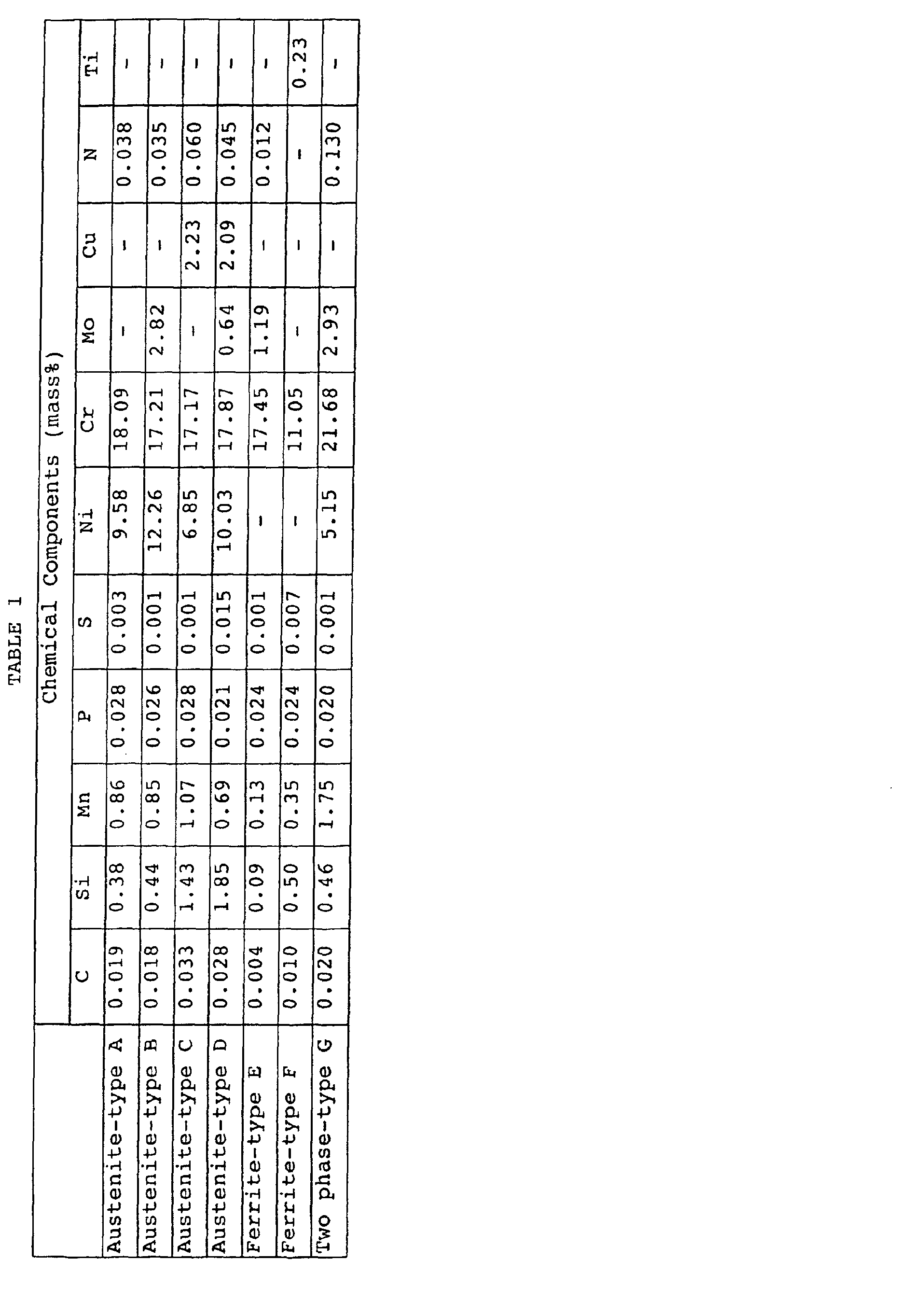
- the austenite-type stainless steel sheet used as the substrate metal preferably comprises, in % by mass, C: 0.5% or less, Si: 5% or less, Mn: 15% or less, P: 0.1% or less, S: 0.05% or less, Ni: 6 to 20%, Cr: 15 to 30%, N: 0.5% or less and Al: 0.001 to 5%, with the balance of Fe and inevitable impurities.
- the ferrite-type stainless steel sheet used as the substrate metal preferably comprises, in % by mass, C: 0.5% or less, Si: 3% or less, Mn: 5% or less, P: 0.1% or less, S: 0.05% or less, Ni: 5% or less, Cr: 9 to 30%, N: 0.2% or less and Al: 0.001 to 5%, with the balance of Fe and inevitable impurities.
- the two phase-type stainless steel sheet used as the substrate metal preferably comprises, in % by mass, C: 0.5% or less, Si: 5% or less, Mn: 15% or less, P: 0.1% or less, S: 0.05% or less, Ni: 2 to 20%, Cr: 12 to 30%, N: 0.5% or less and Al: 0.001 to 5%, with the balance of Fe and inevitable impurities.
- the stainless steel sheet which is any one of austenite-type stainless steel sheet, ferrite-type stainless steel sheet and two phase-type stainless steel sheet, may further contain one or more member of, in % by mass, Mo: 0.01 to 8%, Cu: 0.01 to 5%, Ti: 0.01 to 1%, Nb: 0.01 to 1%, V: 0.01 to 1%, Mg: 0.001 to 0.1%, Ca: 0.001 to 0.1%, B: 0.0005 to 0.05% and W: 0.01 to 5%.
- the surface-lubricated metal product of the present invention contains a polyether polyol in the skeleton and therefore, despite excellent film performance such as durability, the degreasing/film-removing can be easily attained, if desired.
- the degreasing operation is performed, for example, by spraying an alkali aqueous solution (degreasing solution) prepared to a pH of 9.0 to 12.0 and a liquid temperature of 25 to 60°C on the surface-lubricated metal product of the present invention, or by dipping the surface-lubricated metal produce in such a degreasing solution.
- an alkali aqueous solution degreasing solution
- a liquid temperature of 25 to 60°C
- the soluble surface-lubricated stainless steel sheet coated with the alkali-soluble lubricating resin film of the present invention is subjected to molding such as press molding, deep drawing or ironing. Even when such severe working is performed, by virtue of excellent workability and lubricity of the alkali-soluble lubricating resin film of the present invention, satisfactory moldability can be obtained and the steel sheet surface can be protected from scratching or galling. After the soluble surface-lubricated stainless steel sheet coated with the alkali-soluble lubricating resin film of the present invention is molded, the lubricating resin film can be removed by a treatment with an alkali solution, hot water or a solvent.
- the stainless steel sheet of the present invention can be welded to produce a fuel tank.
- the alkali-soluble lubricating resin film of the present invention has good solubility and therefore, causes no adverse effect during the welding.
- the production of a fuel tank obtained through the formation of a lubricating film of a soluble surface-lubricated stainless steel sheet coated with the alkali-soluble lubricating resin film of the present invention, the molding, the removal of lubricating resin film and the welding is described below by referring to Figs. 1A to 1D.
- the alkali-soluble lubricating resin film 2 of the present invention is coated on a stainless steel sheet 1 to prepare a soluble surface-lubricated stainless steel sheet (see, Fig. 1A).
- This stainless steel sheet coated with an alkali-soluble lubricating resin film is, for example, deep-drawn to obtain a molded article 3.
- This molded article comprises a stainless steel sheet 1 and a lubricating resin film 2 and scratches and galling are not observed on the steel sheet 1 (see, Fig. 1B).
- the molded article 3 is treated with an alkali solution or hot water using a spray method or a dipping method to remove the lubricating resin film 2 (see, Fig. 1C).
- the molded articles 3 from which the lubricating film is removed are welded to produce a fuel tank 4 (Fig. 1D).
- the following metal sheets were used as the metal sheet on which a lubricating film is coated.
- the stainless steel sheets having a component constitution shown in Table 1 were used as the substrate metal sheet of the alkali-soluble-film surface-lubricated stainless steel sheet for fuel tanks of the present invention.
- the alkali-soluble polyurethane aqueous compositions used were prepared as follows.
- an acetonitrile solution of polyurethane prepolymer was obtained.
- 287.01 g of the obtained polyurethane prepolymer solution was dispersed using a homodisper in an aqueous triethylamine solution containing 4.86 g of triethylamine dissolved in 451.93 g of water, and thereby formed into an emulsion.
- 4.23 g of 2-[(2-aminoethyl)amino]ethanol diluted with 38.07 g of water was added to perform a chain elongation reaction.
- the following waxes or lubricants were used as the lubricating function-imparting agent.
- colloidal silica having a particle size of 10 to 20 nm, a pH of 8.6 and a heating residue of about 20 mass% was added to have a content of 10 mass% in the film of alkali-soluble polyurethane aqueous composition. That is, 10 parts by weight as a solid content of colloidal silica was added per 100 parts by weight as a solid content of the emulsion of alkali-soluble polyurethane aqueous composition.
- PE Wax A 25 Parts by weight (10 parts by weight as a solid content) of PE Wax A was added to 400 parts by weight (100 parts by weight as a solid content) of the polyurethane aqueous composition prepared in Production Example 1 and thoroughly stirred.
- the obtained coating solution was coated on a metal sheet (a) by a bar coater and bake-dried at a peak metal temperature (PMT) of 80°C or 150°C using a heating furnace at 180°C to form a lubricating film on the metal sheet.
- PMT peak metal temperature
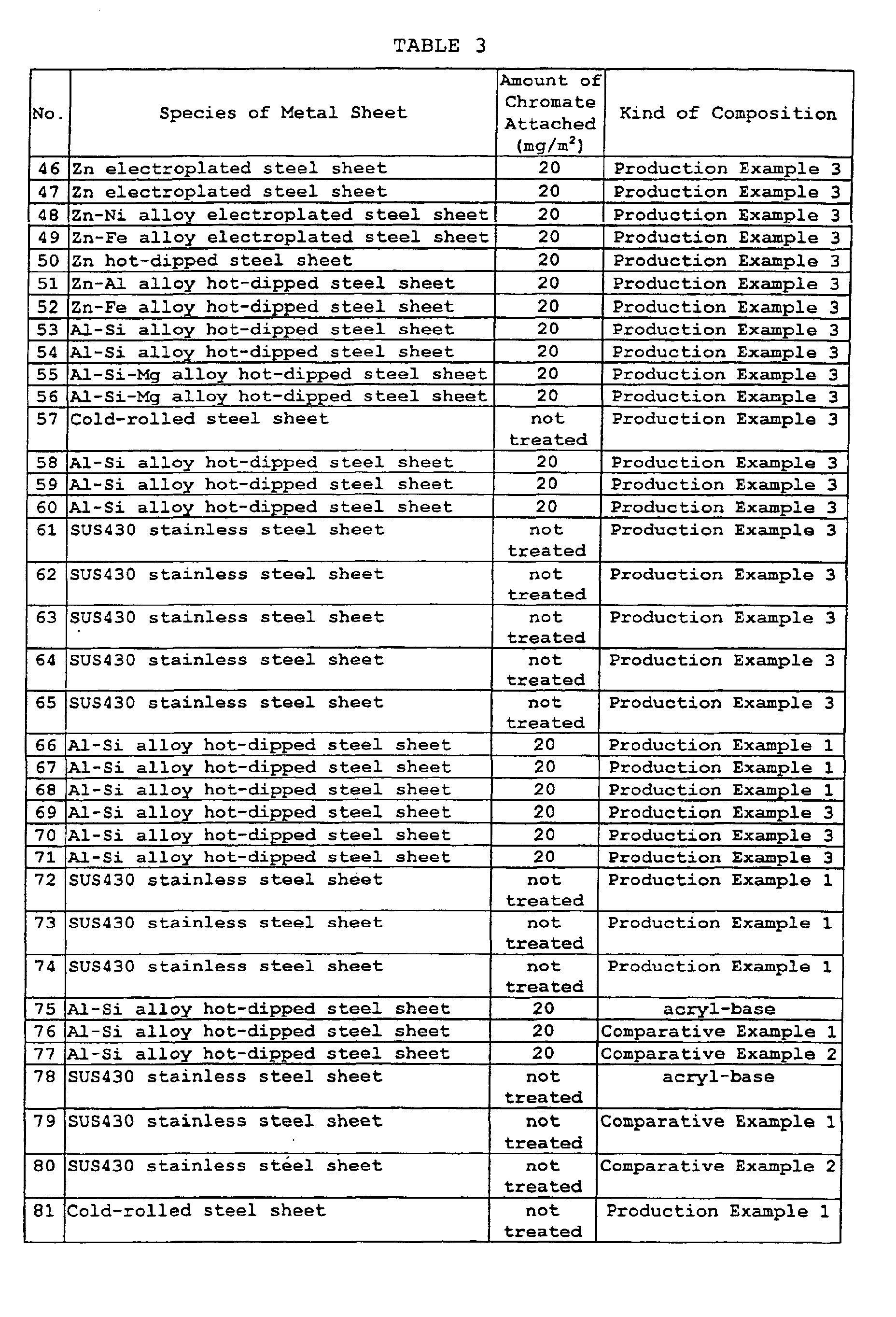
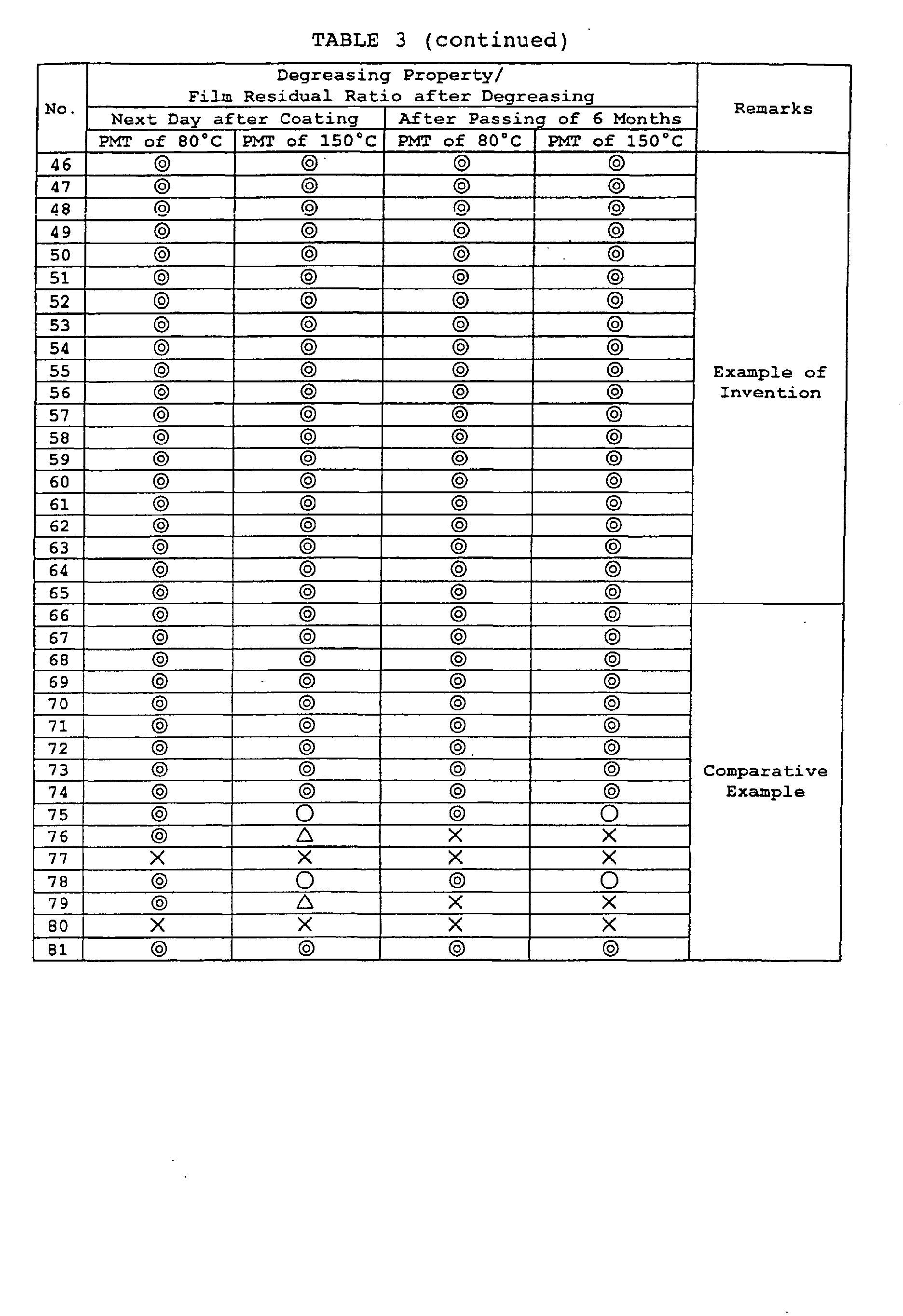
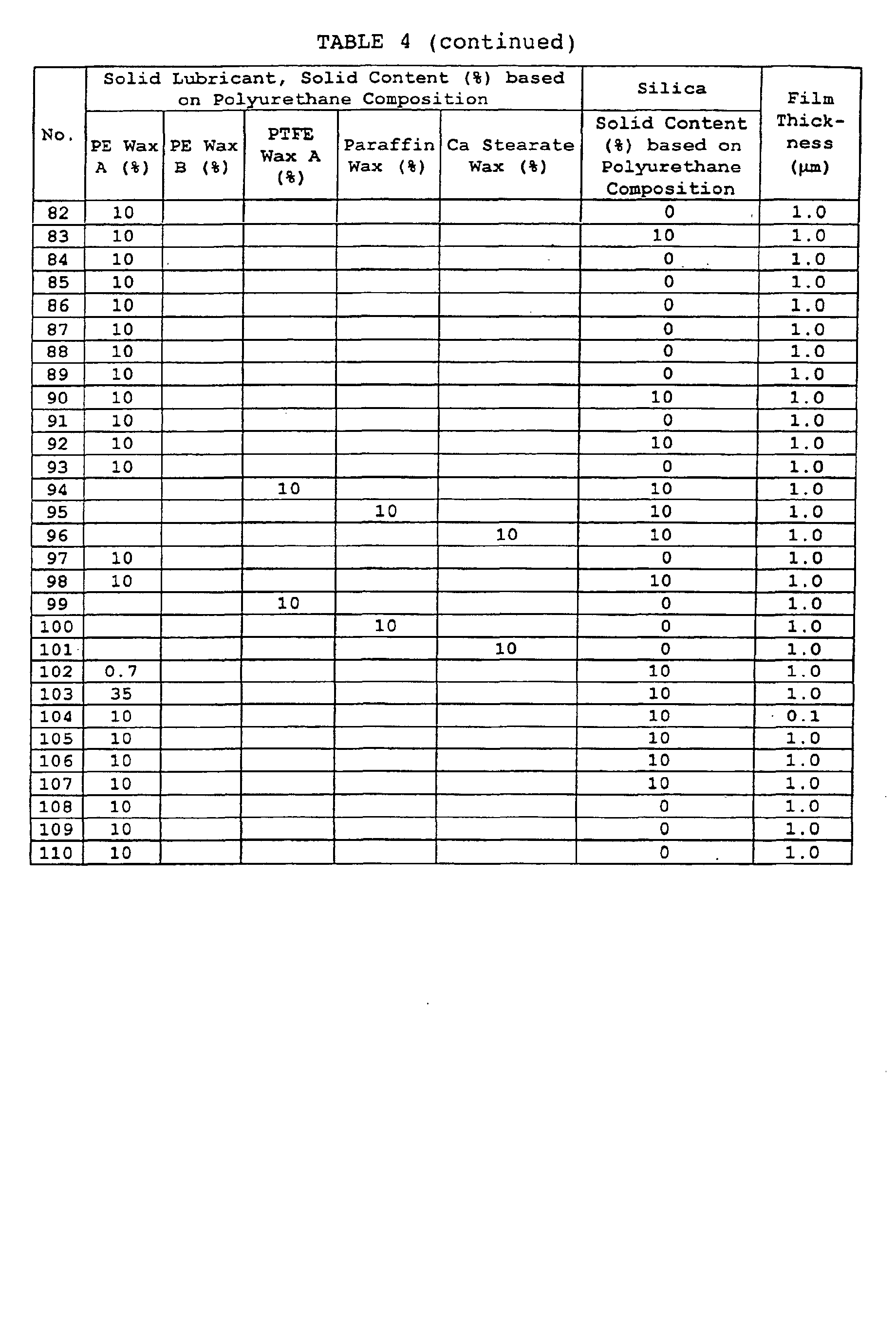
- Example-lubricated metal sheets were produced in the same manner as in Example 1 by baking a lubricating film having a composition shown in Table 2 (Examples 2 to 45) or Table 3 (Examples 46 to 65 and Comparative Examples 66 to 81) on each metal sheet except for (k).
- Table 2 Examples 2 to 45
- Table 3 Examples 46 to 65 and Comparative Examples 66 to 81
- the film formation was performed in the same manner (Comparative Examples 75 and 78).
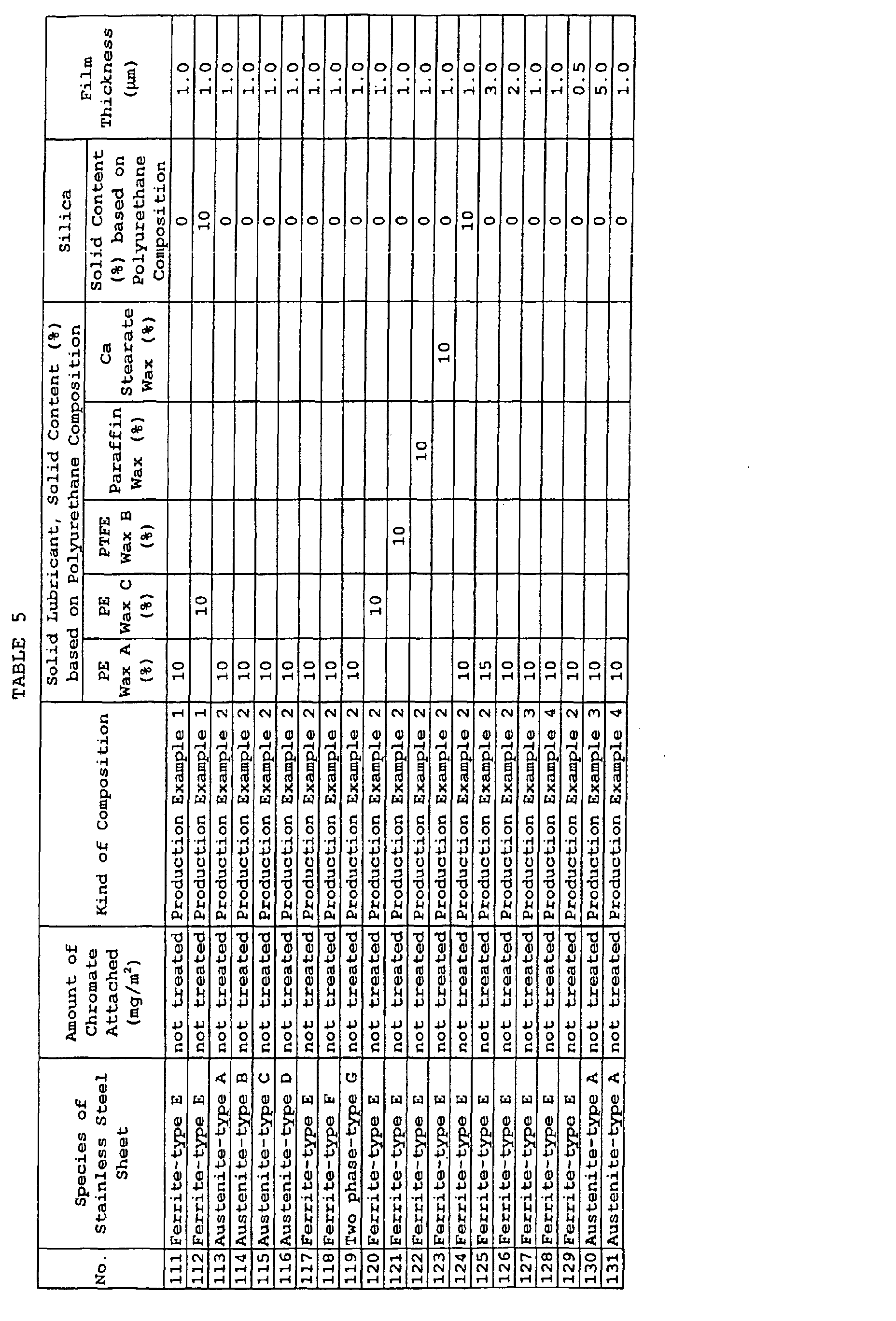
- PE Wax C 25 Parts by weight (10 parts by weight as a solid content) of PE Wax C was added to 400 parts by weight (100 parts by weight as a solid content) of the polyurethane aqueous composition prepared in Production Example 1 and thoroughly stirred.
- the obtained coating solution was coated on a substrate metal sheet (ferrite-type E in Table 1) of an alkali-soluble-film surface-lubricated stainless steel sheet for fuel tanks by a bar coater and bake-dried at a peak metal temperature (PMT) of 80°C using a heating furnace at 180°C to form a lubricating film having the composition shown in Table 5 on the metal sheet.
- PMT peak metal temperature
- Alkali-soluble-film surface-lubricated stainless steel sheets were produced in the same manner as in Example 111 by baking a lubricating film having a composition shown in Table 5 (Examples 112 to 131) or Table 6 (Examples 132 to 152 and Comparative Examples 153 to 159) on a substrate metal sheet (k) of the alkali-soluble-film surface-lubricated stainless steel sheet for fuel tanks at a peak metal temperature of 80°C.
- Comparative Examples 153 to 159 only a lubricating oil (Wax #122, produced by Johnson) was coated on a substrate metal sheet (k) of the alkali-soluble-film surface-lubricated stainless steel sheet for fuel tanks.
- the surface-lubricated metal sheets produced above were evaluated on the following performances.
- the elastic modulus of film after coating on a metal surface was determined under the following conditions using an ultrafine hardness testing machine "FISHER SCOPE H-100" manufactured by Fisher Instrument Co.
- the dynamic viscoelasticity was measured by a viscoelasticity spectrometer Model VES (manufactured by Iwamoto Seisakusho) under conditions that the exciting frequency was 10 Hz, the temperature-rising rate was 5.0°C/min, the sample length was 5 cm and the amplitude was 0.01 mm. The temperature at the peak of tan ⁇ thereof was used as the glass transition temperature.
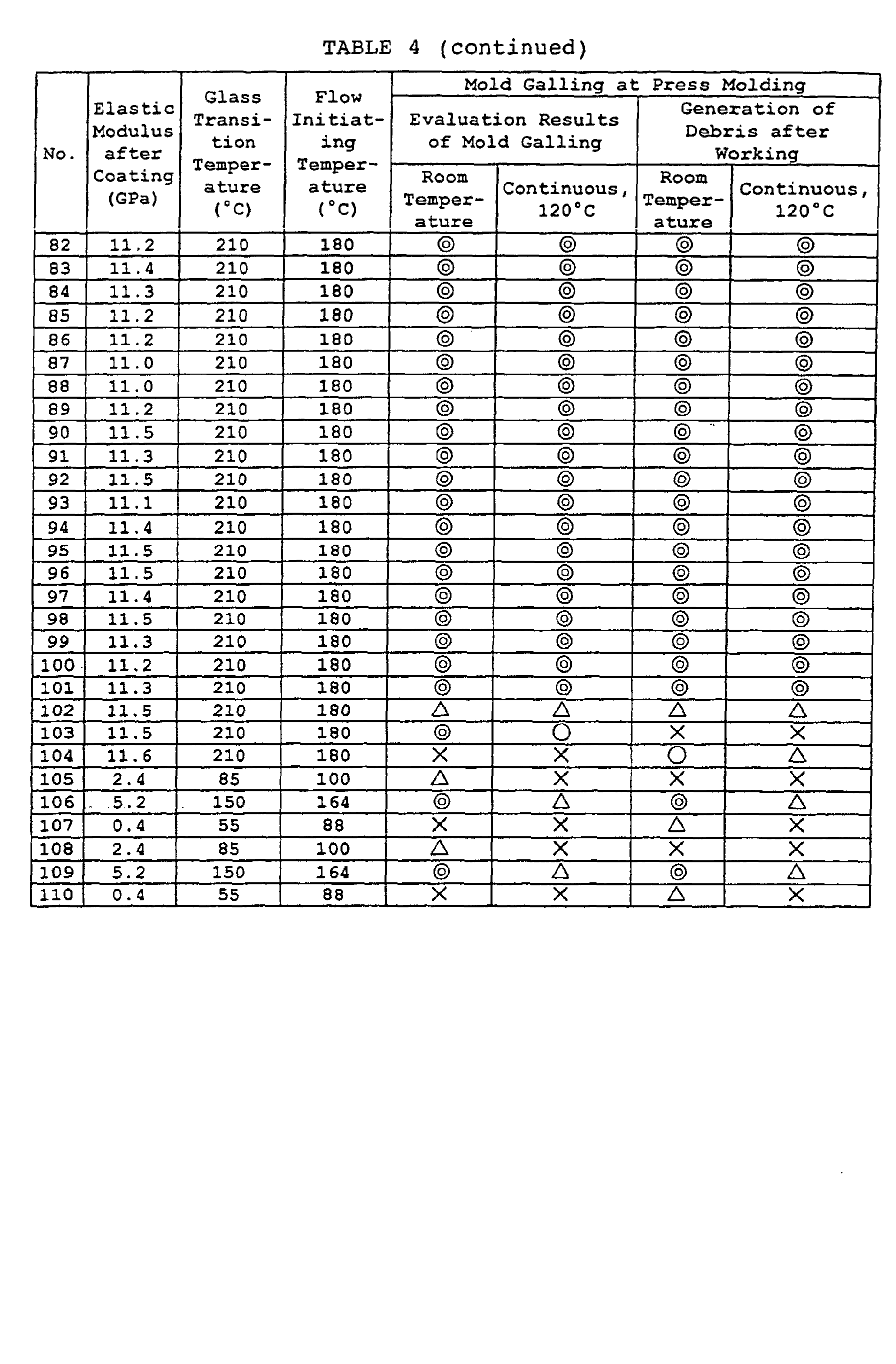
- a molding test was performed under the following conditions using a hydraulic molding tester with a cylindrical punch. As for the temperature conditions in the molding test, the evaluation was performed in two levels of room temperature and mold temperature (100°C or 120°C) elevated due to continuous pressing. Punch diameter 70 mm ⁇ Blank diameter 150 mm ⁇ Pressing load 5 kgf/cm 2 Molding rate 3.3 ⁇ 10 -2 m/s
- the steel sheet was molded to 80% of the maximum molding height and the mold galling was evaluated according to the following indices. o ⁇ : The steel sheet could be molded and the surface was free of defects. ⁇ : The steel sheet could be molded and the surface was free of defects but the sliding surface was slightly discolored. ⁇ : The steel sheet could be molded but a galling flaw was slightly generated on the surface. ⁇ : The steel sheet could be molded but a large number of linear galling flaws were generated on the surface.
- the molding test was performed under the following conditions using a hydraulic molding tester with a cylindrical punch and the mold galling was evaluated by the limiting drawing ratio (LDR) and appearance after working.
- LDR limiting drawing ratio
- the evaluation was performed in two levels of room temperature and mold temperature (100°C) elevated due to continuous pressing. Punch diameter 40 mm ⁇ Blank diameter 68 to 97.5 mm Die diameter 43 mm ⁇ Wrinkle pressing force 1 ton
- the lubricating resin-coated steel sheet was not coated with a lubricating oil and the substrate metal sheet was coated with a Johnson Wax #122 lubricating oil.
- the mold galling was evaluated according to the following indices. o ⁇ : The steel sheet could be molded and the surface was free of defects. ⁇ : The steel sheet could be molded and the surface was free of defects but the sliding surface was slightly discolored. ⁇ : The steel sheet could be molded but a galling flaw was slightly generated on the surface. ⁇ : The steel sheet could be molded but a large number of linear galling flaws were generated on the surface.
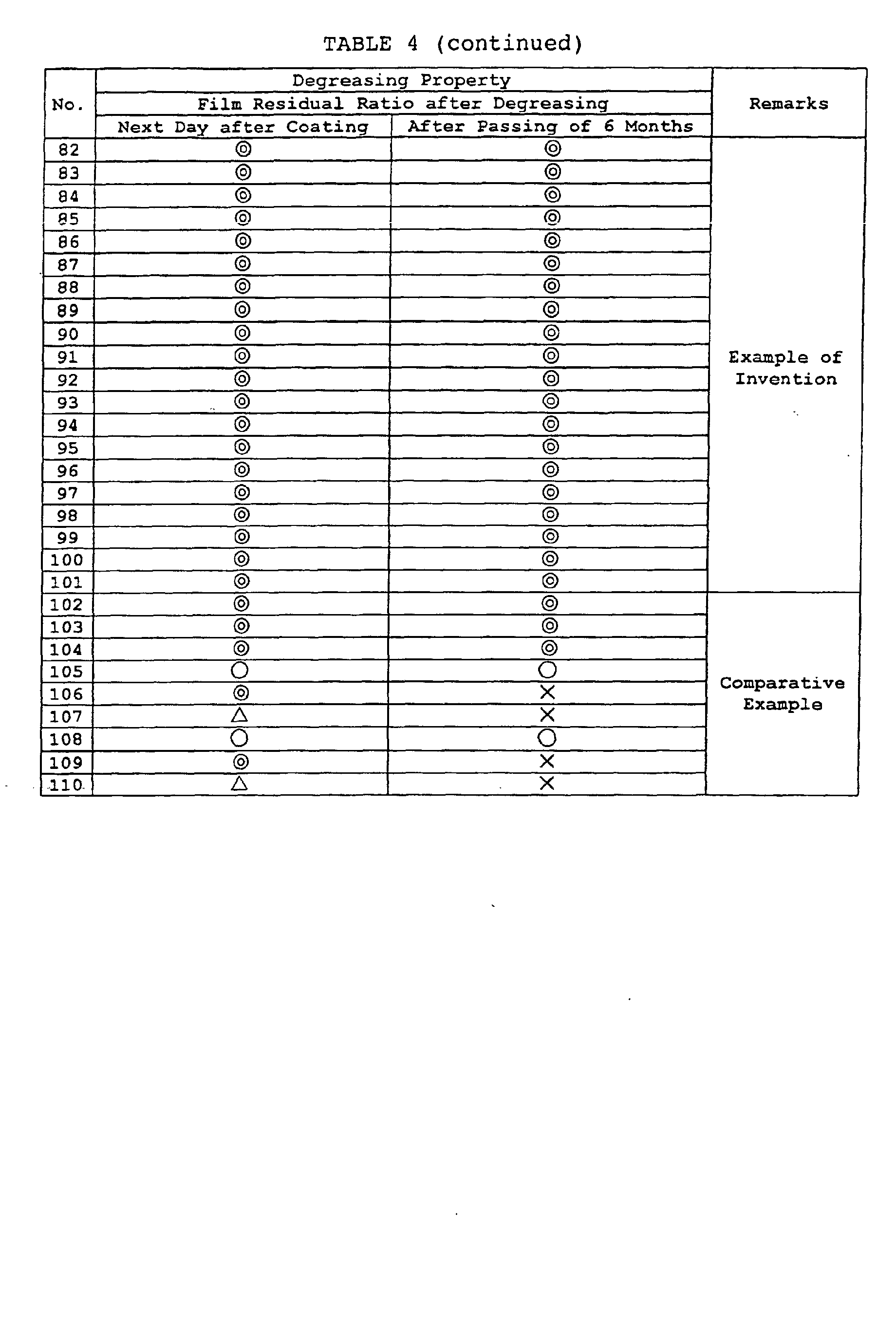
- the test piece was sprayed with a degreasing solution FC-4358 (produced by Nihon Parkerizing Co., Ltd., pH: adjusted to 0.5, liquid temperature: 40°C) for 8 seconds, then washed with water and dried and thereafter, the film residual ratio was measured by infrared spectroscopic analysis and evaluated according to the following indices. Two kinds of samples were used, a sample on the next day after coating and a sample after the passage of 6 months.
- ⁇ The film residual area percentage was 5% or less.
- the film residual area percentage was more than 5% to 10%.
- ⁇ The film residual area percentage was more than 10%.
- the alkali-soluble-film surface-lubricated stainless steel sheet for fuel tanks was evaluated on the corrosion resistance against gasoline.
- the steel sheet was drawn into a flat bottom cylinder having a flange width of 80 mm, a diameter of 50 mm and a depth of 20 mm by a hydraulic molding machine and after the working, the lubricating resin film was removed by degreasing.
- a test solution gasoline + distilled water (10%) + formic acid (200 ppm)
- the evaluation was performed according to the following indices. ⁇ : Red rust generation was less than 0.1%.
- the surface-lubricated metal products according to the present invention exhibit excellent moldability in both cases of room temperature and a mold temperature (100°C) elevated due to continuous pressing, less debris after molding and good film-removability by alkali degreasing over a long period of time irrespective of the peak metal temperature.
- the amount of wax added, the film thickness and the elastic modulus after coating each is out of the range specified in the present invention, the alkali degreasability is poor at a high peak metal temperature or after the passing of long time, and resin debris is readily generated after molding.
- the surface-lubricated metal products according to the present invention exhibit excellent moldability in both cases of room temperature and a mold temperature (120°C) elevated due to continuous pressing, less debris after molding and good film-removability by alkali degreasing.
- the aqueous composition, the amount of wax added, the film thickness and the elastic modulus after coating each is out of the range specified in the present invention, the continuous moldability is poor and resin debris is readily generated after molding.
- the alkali-soluble-film surface-lubricated stainless steel sheets for fuel tanks according to the present invention all exhibit excellent results in the press moldability and film-removability by alkali degreasing and also exhibit good corrosion resistance.
- the metal product of the present invention is free of mold galling even under severe molding conditions, ensures stable film-removability over a long period of time and does not allow the lubricating film to remain after degreasing and, therefore, this metal product is suitably used for uses where the glossy metal surface or metal texture is made good use of or a welding property is demanded. Furthermore, according to the present invention, an alkali-soluble-film surface-lubricated stainless steel sheet with excellent moldability for fuel tanks and a production method of a fuel tank can be provided. Thus, the present invention has a very high industrial value.
Landscapes
- Chemical & Material Sciences (AREA)
- Organic Chemistry (AREA)
- Chemical Kinetics & Catalysis (AREA)
- Health & Medical Sciences (AREA)
- Medicinal Chemistry (AREA)
- Polymers & Plastics (AREA)
- Engineering & Computer Science (AREA)
- General Chemical & Material Sciences (AREA)
- Materials Engineering (AREA)
- Manufacturing & Machinery (AREA)
- Oil, Petroleum & Natural Gas (AREA)
- Life Sciences & Earth Sciences (AREA)
- Wood Science & Technology (AREA)
- Mechanical Engineering (AREA)
- Metallurgy (AREA)
- Laminated Bodies (AREA)
- Paints Or Removers (AREA)
Abstract
Description
- PE Wax A (low-density polyethylene wax, softening temperature: 110°C, average particle size: 4.0 µm, dispersed as an aqueous emulsion, solid content: 40 mass%)
- PE Wax B (low-density polyethylene wax, softening temperature: 110°C, average particle size: 1.0 µm, dispersed as an aqueous emulsion, solid content: 40 mass%)
- PE Wax C (low-density polyethylene wax, softening temperature: 110°C, average particle size: 2.5 µm, dispersed as an aqueous emulsion, solid content: 40 mass%)
- PTFE Wax A (polytetrafluoroethylene wax, average particle size: 0.8 µm, dispersed as an aqueous emulsion, solid content: 60 mass%)
- PTFE Wax B (polytetrafluoroethylene wax, average particle size: 3.5 µm, dispersed as an aqueous emulsion, solid content: 60 mass%)
- Paraffin wax (synthetic paraffin wax, melting point: 105°C, average particle size: 5.0 µm, dispersed as an aqueous emulsion, solid content: 33 mass%)
- Calcium stearate (average particle size: 2.0 µm, dispersed as an aqueous emulsion, solid content: 40 mass%)
- Indenter: Vickers quadrangular pyramid-shaped diamond indenter
- Measurement temperature: 25°C
- Maximum penetration depth of indenter: 1/2 or less of film thickness; in order to eliminate the effect of the metal surface far harder than film, the press fitting (increase of load) was stopped in the depth range where the gradient of a graph configured by the square root F1/2 of applied load F and the penetration depth h becomes constant (dF1/2/dh = constant), and subsequently, the load was decreased.
- Applied Load Increasing Mode: The load was stepwise increased every 1.0, 2.0 or 4.0 seconds. With the square root F1/2 of applied load F and the elapsed time t, dF1/2/dt = constant. In order to reduce the effect of film creep, the load application time was set to 4 seconds at longest.
- Applied Load Decreasing Mode:
| Punch diameter | 70 mm |
| Blank diameter | 150 mm |
| Pressing load | 5 kgf/cm2 |
| Molding rate | 3.3×10⁻² m/s |
o ○: The steel sheet could be molded and the surface was free of defects.
○: The steel sheet could be molded and the surface was free of defects but the sliding surface was slightly discolored.
Δ: The steel sheet could be molded but a galling flaw was slightly generated on the surface.
×: The steel sheet could be molded but a large number of linear galling flaws were generated on the surface.
o ○: Debris was not generated.
○: Trace resin debris was generated.
Δ: Resin debris was slightly generated.
×: A large amount of resin debris was generated.
| Punch diameter | 40 mm |
| Blank diameter | 68 to 97.5 mm |
| Die diameter | 43 mm |
| | 1 ton |
o ○: The steel sheet could be molded and the surface was free of defects.
○: The steel sheet could be molded and the surface was free of defects but the sliding surface was slightly discolored.
Δ: The steel sheet could be molded but a galling flaw was slightly generated on the surface.
×: The steel sheet could be molded but a large number of linear galling flaws were generated on the surface.
o ○: No film.
○: The film residual area percentage was 5% or less.
Δ: The film residual area percentage was more than 5% to 10%.
×: The film residual area percentage was more than 10%.
○: Red rust generation was less than 0.1%.
Δ: Red rust generation was from 0.1% to less than 5%.
×: Red rust generation was 5% or more.







Claims (14)
- A surface-lubricated metal product excellent in moldability and long-term stable film-removability independent of film drying temperature, comprising a metal having coated on both surfaces or one surface thereof an alkali-soluble lubricating film mainly comprising (A) an alkali-soluble polyurethane aqueous composition containing a polyether polyol as a skeleton and containing a carboxyl group within the molecule and (B) a lubricating function-imparting agent in an amount of 1 to 30 mass% based on said alkali-soluble polyurethane aqueous composition, said film being coated such that the elastic modulus of said alkali-soluble lubricating film after coating is from 0.5 to 20 GPa at 25°C and the film thickness is 0.5 to 10 µm.
- The surface-lubricated metal product excellent in moldability and long-term stable film-removability independent of film drying temperature as claimed in claim 1, wherein an alkali-soluble lubricating film mainly comprising (A) the alkali-soluble polyurethane aqueous composition, (B) a lubricating function-imparting agent in an amount of 1 to 30 mass% based on said alkali-soluble polyurethane aqueous composition and (C) silica particles in an amount of 1 to 30 mass% based on said alkali soluble polyurethane aqueous composition is coated on both surfaces or one surface of a metal such that the elastic modulus of said alkali-soluble lubricating film after coating is from 0.5 to 20 GPa at 25°C and the film thickness is 0.5 to 10 µm.
- The surface-lubricated metal product excellent in moldability and long-term stable film-removability independent of film drying temperature as claimed in claim 1 or 2, wherein the glass transition temperature of the alkali-soluble polyurethane aqueous composition (A) in the coated lubricating film is 120°C or more.
- The surface-lubricated metal product excellent in moldability and long-term stable film-removability independent of film drying temperature as claimed in claim 1 or 2, wherein the amount of the carboxyl group contained in the alkali-soluble polyurethane aqueous composition (A) constituting the alkali-soluble lubricating film is from 30 to 180 mg KOH/g in terms of the acid value.
- The surface-lubricated metal product excellent in moldability and long-term stable film-removability independent of film drying temperature as claimed in claim 1 or 2, wherein the neutralizer for the carboxyl group contained in the alkali-soluble polyurethane aqueous composition (A) constituting the alkali-soluble lubricating film is sodium hydroxide or potassium hydroxide.
- The surface-lubricated metal product excellent in moldability and long-term stable film-removability independent of film drying temperature as claimed in claim 1 or 2, wherein the alkali-soluble polyurethane aqueous composition (A) in the coated lubricating film has a hydroxyl group within the molecule.
- The surface-lubricated metal product excellent in moldability and long-term stable film-removability independent of film drying temperature as claimed in any one of claims 1 to 6, wherein the lubricating function-imparting agent (B) comprises one or more member selected from the group consisting of a polyolefin-base wax, a paraffin-base wax, a stearic acid-base solid lubricant and a wax comprising a fluorine-containing resin.
- The surface-lubricated metal product excellent in moldability and long-term stable film-removability independent of film drying temperature as claimed in any one of claims 1 to 7, wherein the flow initiating temperature of the alkali-soluble polyurethane aqueous composition (A) constituting the alkali-soluble lubricating film is 170°C or more.
- The surface-lubricated metal product excellent in moldability and long-term stable film-removability independent of film drying temperature as claimed in any one of claims 1 to 8, wherein the substrate metal is any one stainless steel sheet for fuel tanks, selected from an austenite-type stainless steel sheet, a ferrite-type stainless steel sheet and a two phase-type stainless steel sheet.
- The surface-lubricated metal product excellent in moldability and long-term stable film-removability independent of film drying temperature as claimed in claim 9, wherein the substrate metal is an austenite-type stainless steel sheet for fuel tanks, comprising, in % by mass:
C 0.5% or less, Si 5% or less, Mn 15% or less, P 0.1% or less, S 0.05% or less, Ni 6 to 20%, Cr 15 to 30%, N 0.5% or less, and Al 0.001 to 5% - The surface-lubricated metal product excellent in moldability and long-term stable film-removability independent of film drying temperature as claimed in claim 9, wherein the substrate metal is a ferrite-type stainless steel sheet for fuel tanks, comprising, in % by mass:
C 0.5% or less, Si 3% or less, Mn 5% or less, P 0.1% or less, S 0.05% or less, Ni 5% or less, Cr 9 to 30%, N 0.2% or less, and Al 0.001 to 5% - The surface-lubricated metal product excellent in moldability and long-term stable film-removability independent of film drying temperature as claimed in claim 9, wherein the substrate metal is a two phase-type stainless steel sheet for fuel tanks, comprising, in % by mass:
C 0.5% or less, Si 5% or less, Mn 15% or less, P 0.1% or less, S 0.05% or less, Ni 2 to 20%, Cr 12 to 30%, N 0.5% or less, and Al 0.001 to 5% - The surface-lubricated metal product excellent in moldability and long-term stable film-removability independent of film drying temperature as claimed in any one of claims 10 to 12, wherein the substrate metal is the stainless steel sheet for fuel tanks, further comprising one or more member of, in % by mass:
Mo 0.01 to 8%, Cu 0.01 to 5%, Ti 0.01 to 1%, Nb 0.01 to 1%, V 0.01 to 1%, Mg 0.001 to 0.1%, Ca 0.001 to 0.1%, B 0.0005 to 0.05%, and W 0.01 to 5%. - A method for producing a fuel tank, comprising a step of molding the surface-lubricated metal product coated with a soluble lubricating resin film claimed in any one of claims 9 to 13, a step of treating said molded soluble surface-lubricated metal product with an alkali or hot water to remove said soluble lubricating resin film, and a step of welding said soluble surface-lubricated metal product after the removal of said soluble lubricating resin film.
Applications Claiming Priority (7)
| Application Number | Priority Date | Filing Date | Title |
|---|---|---|---|
| JP2001099312 | 2001-03-30 | ||
| JP2001099311 | 2001-03-30 | ||
| JP2001099311 | 2001-03-30 | ||
| JP2001099312 | 2001-03-30 | ||
| JP2001176681A JP4132729B2 (en) | 2000-08-09 | 2001-06-12 | A soluble type lubricated surface-treated stainless steel plate for fuel tanks with excellent formability and a method for producing fuel tanks |
| JP2001176681 | 2001-06-12 | ||
| PCT/JP2002/003232 WO2002078949A1 (en) | 2001-03-30 | 2002-03-29 | Metal product surface-treated with alkali-soluble lubricating film exhibiting excellent formability and excellent film removal property being stable for a long time and independent of temperature for drying film |
Publications (2)
| Publication Number | Publication Date |
|---|---|
| EP1378345A1 true EP1378345A1 (en) | 2004-01-07 |
| EP1378345A4 EP1378345A4 (en) | 2004-06-16 |
Family
ID=27346421
Family Applications (1)
| Application Number | Title | Priority Date | Filing Date |
|---|---|---|---|
| EP02707265A Withdrawn EP1378345A4 (en) | 2001-03-30 | 2002-03-29 | METALLIC PRODUCT COATED WITH AN ALKALINO-SOLUBLE LUBRICANT FILM, PARTICULARLY SUITABLE FOR FORMING AND DEPELLICULATION, LONG-TERM STABLE, AND NOT SENSITIVE TO THE DRYING TEMPERATURE OF THE FILM |
Country Status (5)
| Country | Link |
|---|---|
| US (1) | US20040121162A1 (en) |
| EP (1) | EP1378345A4 (en) |
| KR (1) | KR100686387B1 (en) |
| CA (1) | CA2442748C (en) |
| WO (1) | WO2002078949A1 (en) |
Cited By (3)
| Publication number | Priority date | Publication date | Assignee | Title |
|---|---|---|---|---|
| EP2735592A1 (en) * | 2012-11-26 | 2014-05-28 | Hydro Aluminium Rolled Products GmbH | Coating of a metal sheet or strip |
| WO2014195166A1 (en) | 2013-06-07 | 2014-12-11 | Hydro Aluminium Rolled Products Gmbh | Coating of a metal sheet or strip |
| EP3019583A4 (en) * | 2013-07-11 | 2017-03-15 | Houghton Technical Corp. | Compositions and use thereof for metal shaping |
Families Citing this family (16)
| Publication number | Priority date | Publication date | Assignee | Title |
|---|---|---|---|---|
| JP4328634B2 (en) * | 2003-01-31 | 2009-09-09 | キヤノン株式会社 | Image forming apparatus, process cartridge, cleaning apparatus and cleaning blade used in the image forming apparatus |
| JP4437036B2 (en) | 2003-12-26 | 2010-03-24 | パナソニック株式会社 | Case material for storage cells |
| JP4671609B2 (en) | 2004-01-26 | 2011-04-20 | 日本パーカライジング株式会社 | Lubricating water-based polyurethane resin composition, surface lubrication treatment method for galvanized steel sheet using the same, and surface-treated steel sheet thereof |
| DE102005030862B4 (en) * | 2005-07-01 | 2009-12-24 | Sintec Keramik Gmbh | First wetting auxiliary material for an evaporator body, its use for preparing the evaporator surface of an evaporator body and an electrically heatable ceramic evaporator body |
| JP5546097B2 (en) * | 2006-06-23 | 2014-07-09 | 新日鐵住金株式会社 | Surface treatment metal material and metal surface treatment agent |
| KR100792278B1 (en) * | 2007-02-27 | 2008-01-07 | 고려상사주식회사 | Phosphate Film Cold Rolling Stainless Steel Wire and Direct Screw Using It |
| JP5311756B2 (en) | 2007-03-26 | 2013-10-09 | 株式会社神戸製鋼所 | Electrical Zn-plated steel sheet with excellent stain resistance |
| CA2593299A1 (en) * | 2007-04-27 | 2008-10-27 | Dave Schulte | Polyurethane compound and shoe soles made therefrom |
| JP5205845B2 (en) * | 2007-07-31 | 2013-06-05 | Jfeスチール株式会社 | Surface-treated steel sheet with excellent resistance to oil wetting and spreading |
| ES2902857T3 (en) * | 2014-04-01 | 2022-03-30 | Hydro Quebec | Use of polymers as lubricating agents in the production of alkali metal films |
| CN106423806B (en) * | 2015-07-27 | 2021-05-28 | 斯凯孚公司 | Method of making a coating |
| FR3060604B1 (en) | 2016-12-15 | 2021-05-28 | Skf Ab | GREASE COMPOSITIONS AND THEIR MANUFACTURING PROCESS |
| FR3060605B1 (en) | 2016-12-15 | 2021-05-28 | Skf Ab | GREASE COMPOSITIONS AND THEIR MANUFACTURING PROCESS |
| DE102019108459B4 (en) * | 2019-04-01 | 2021-02-18 | Salzgitter Flachstahl Gmbh | Process for the production of a steel strip with improved adhesion of metallic hot-dip coatings |
| DE102019108457B4 (en) | 2019-04-01 | 2021-02-04 | Salzgitter Flachstahl Gmbh | Process for the production of a steel strip with improved adhesion of metallic hot-dip coatings |
| US11725266B2 (en) * | 2019-10-30 | 2023-08-15 | Garrett Transportation I Inc. | Stainless steel alloys, turbocharger components formed from the stainless steel alloys, and methods for manufacturing the same |
Family Cites Families (11)
| Publication number | Priority date | Publication date | Assignee | Title |
|---|---|---|---|---|
| EP0042180B1 (en) * | 1980-06-17 | 1987-03-25 | Kabushiki Kaisha Toshiba | A high cavitation erosion resistance stainless steel and hydraulic machines being made of the same |
| DE3706415A1 (en) * | 1987-02-27 | 1988-09-08 | Thyssen Edelstahlwerke Ag | SEMI-FINISHED FERRITIC STEEL PRODUCT AND ITS USE |
| JP3026385B2 (en) * | 1992-03-13 | 2000-03-27 | 関西ペイント株式会社 | Coating composition for lubricating steel sheet excellent in press workability and lubricating steel sheet using the same |
| JP2719571B2 (en) * | 1992-11-12 | 1998-02-25 | 日本パーカライジング株式会社 | Water-based lubricating coating composition |
| JP2743237B2 (en) * | 1992-12-02 | 1998-04-22 | 新日本製鐵株式会社 | Non-delamination type lubricated steel sheet which can be omitted press oil |
| JP3135815B2 (en) * | 1995-03-20 | 2001-02-19 | 新日本製鐵株式会社 | Method for producing surface-treated steel sheet with excellent press workability |
| JP3343842B2 (en) * | 1996-03-18 | 2002-11-11 | 日新製鋼株式会社 | Alkali-soluble resin film coated zinc-coated steel sheet with excellent adhesiveness and powdering resistance |
| JP2000203588A (en) * | 1998-10-19 | 2000-07-25 | Nisshin Steel Co Ltd | Al-based plated steel sheet for fuel tank and method of manufacturing fuel tank using the steel sheet |
| JP3647659B2 (en) * | 1998-11-26 | 2005-05-18 | 日新製鋼株式会社 | Alkali-soluble resin-coated steel sheet with excellent galling resistance and workability |
| JP4324296B2 (en) * | 1999-02-26 | 2009-09-02 | 新日本製鐵株式会社 | Coating composition capable of forming an alkali-soluble lubricating film excellent in press formability and galling resistance, and lubricated surface-treated metal product using this composition |
| CA2354665C (en) * | 2000-08-09 | 2006-10-31 | Nippon Steel Corporation | Soluble lubricating surface-treated stainless steel sheet with excellent shapability for fuel tank and method for manufacturing fuel tank |
-
2002
- 2002-03-29 CA CA 2442748 patent/CA2442748C/en not_active Expired - Fee Related
- 2002-03-29 KR KR1020037012771A patent/KR100686387B1/en not_active Expired - Fee Related
- 2002-03-29 EP EP02707265A patent/EP1378345A4/en not_active Withdrawn
- 2002-03-29 US US10/473,957 patent/US20040121162A1/en not_active Abandoned
- 2002-03-29 WO PCT/JP2002/003232 patent/WO2002078949A1/en not_active Ceased
Cited By (4)
| Publication number | Priority date | Publication date | Assignee | Title |
|---|---|---|---|---|
| EP2735592A1 (en) * | 2012-11-26 | 2014-05-28 | Hydro Aluminium Rolled Products GmbH | Coating of a metal sheet or strip |
| WO2014195166A1 (en) | 2013-06-07 | 2014-12-11 | Hydro Aluminium Rolled Products Gmbh | Coating of a metal sheet or strip |
| EP3019583A4 (en) * | 2013-07-11 | 2017-03-15 | Houghton Technical Corp. | Compositions and use thereof for metal shaping |
| US10308892B2 (en) | 2013-07-11 | 2019-06-04 | Houghton Technical Corp. | Compositions and use thereof for metal shaping |
Also Published As
| Publication number | Publication date |
|---|---|
| KR100686387B1 (en) | 2007-02-23 |
| WO2002078949A1 (en) | 2002-10-10 |
| KR20030092036A (en) | 2003-12-03 |
| EP1378345A4 (en) | 2004-06-16 |
| CA2442748C (en) | 2011-05-31 |
| US20040121162A1 (en) | 2004-06-24 |
| CA2442748A1 (en) | 2002-10-10 |
Similar Documents
| Publication | Publication Date | Title |
|---|---|---|
| CA2442748C (en) | Alkali-soluble-film surface-lubricated metal product excellent in moldability and long-term stable film-removability independent of film drying temperature | |
| KR100782588B1 (en) | Soluble lubricating surface-treated stainless steel sheet with excellent shapability for fuel tank, fuel tank made of soluble lubricating surface-treated stainless steel sheel and method for manufacturing fuel tank | |
| JP4324296B2 (en) | Coating composition capable of forming an alkali-soluble lubricating film excellent in press formability and galling resistance, and lubricated surface-treated metal product using this composition | |
| JP4318610B2 (en) | Surface-treated metal plate | |
| AU2002214316B2 (en) | Metal product with excellent moldability surface-treated with alkali-soluble lubricant | |
| JP4132729B2 (en) | A soluble type lubricated surface-treated stainless steel plate for fuel tanks with excellent formability and a method for producing fuel tanks | |
| JP3872969B2 (en) | Soluble-type lubricated surface-treated metal product for hydrofoam excellent in moldability and emulsion type hydraulic oil resistance, and its molding method | |
| JP2003027256A (en) | An alkali-soluble lubricated surface-treated metal product that excels in long-term stable film removal regardless of moldability and film drying temperature | |
| JP4397073B2 (en) | Coating composition capable of forming lubricating film excellent in press workability and weldability, and lubricated surface-treated steel sheet using this composition | |
| JP4392967B2 (en) | Alkali-soluble lubricated surface-treated metal products with excellent moldability | |
| JP2003003278A (en) | Alkali-soluble lubricated surface-treated metal products with excellent continuous formability | |
| JP2006218856A (en) | Alkali-soluble lubricating steel sheet with excellent ironing process and emulsion type press oil resistance |
Legal Events
| Date | Code | Title | Description |
|---|---|---|---|
| PUAI | Public reference made under article 153(3) epc to a published international application that has entered the european phase |
Free format text: ORIGINAL CODE: 0009012 |
|
| 17P | Request for examination filed |
Effective date: 20031029 |
|
| AK | Designated contracting states |
Kind code of ref document: A1 Designated state(s): AT BE CH CY DE DK ES FI FR GB GR IE IT LI LU MC NL PT SE TR |
|
| A4 | Supplementary search report drawn up and despatched |
Effective date: 20040504 |
|
| RIC1 | Information provided on ipc code assigned before grant |
Ipc: 7B 05D 7/14 B Ipc: 7C 09D 175/06 A Ipc: 7C 08G 18/66 B Ipc: 7C 08G 18/08 B Ipc: 7C 08G 18/12 B |
|
| RBV | Designated contracting states (corrected) |
Designated state(s): DE FR GB |
|
| 17Q | First examination report despatched |
Effective date: 20091207 |
|
| STAA | Information on the status of an ep patent application or granted ep patent |
Free format text: STATUS: THE APPLICATION IS DEEMED TO BE WITHDRAWN |
|
| 18D | Application deemed to be withdrawn |
Effective date: 20100818 |