EP1377960B1 - Verfahren zum überführen eines musiksignals in eine noten-basierte beschreibung und zum referenzieren eines musiksignals in einer datenbank - Google Patents
Verfahren zum überführen eines musiksignals in eine noten-basierte beschreibung und zum referenzieren eines musiksignals in einer datenbank Download PDFInfo
- Publication number
- EP1377960B1 EP1377960B1 EP02730100A EP02730100A EP1377960B1 EP 1377960 B1 EP1377960 B1 EP 1377960B1 EP 02730100 A EP02730100 A EP 02730100A EP 02730100 A EP02730100 A EP 02730100A EP 1377960 B1 EP1377960 B1 EP 1377960B1
- Authority
- EP
- European Patent Office
- Prior art keywords
- music signal
- note
- time
- frequency
- accordance
- Prior art date
- Legal status (The legal status is an assumption and is not a legal conclusion. Google has not performed a legal analysis and makes no representation as to the accuracy of the status listed.)
- Expired - Lifetime
Links
Images




Classifications
-
- G—PHYSICS
- G10—MUSICAL INSTRUMENTS; ACOUSTICS
- G10H—ELECTROPHONIC MUSICAL INSTRUMENTS; INSTRUMENTS IN WHICH THE TONES ARE GENERATED BY ELECTROMECHANICAL MEANS OR ELECTRONIC GENERATORS, OR IN WHICH THE TONES ARE SYNTHESISED FROM A DATA STORE
- G10H1/00—Details of electrophonic musical instruments
- G10H1/0033—Recording/reproducing or transmission of music for electrophonic musical instruments
- G10H1/0041—Recording/reproducing or transmission of music for electrophonic musical instruments in coded form
Definitions
- the present invention relates to the field of Processing of music signals and in particular to the conversion a music signal into a note-based description.
- MIDI Music Interface Description
- a MIDI file includes a note-based description such that the beginning of the sound and the sound end of a Sounds or the beginning of the sound and the duration of the sound as a function the time are recorded.
- MIDI files can be read in electronic keyboards and be "played".
- too Sound cards for playing a MIDI file over with the Sound card of a computer connected speakers from that it can be seen that reshaping a note-based description, which in its most original form an intrumentalist is done "manually", the one notes recorded by notes by means of a musical instrument plays, even without further ado automatically performed can be.
- the method is disadvantageous in that it is based on a sung input is limited.
- the default is the melody sung by a stop consonant and a vocal part become, in the form "there” "there” "there”, thus a segmentation be made of the recorded music signal can.
- the known method calculates Intervals of two successive pitch values, d. H. Pitch values, in pitch order. This interval value is assumed to be the distance measure.
- the resulting Pitch sequence is then stored in a database Reference sequences compared, where the minimum of a sum squared differences over all reference sequences as a solution, d. H. as a sequence of notes referenced in the database, Is accepted.
- Another disadvantage of this method is that a pitch tracker is used, which octave jump error which are subsequently compensated have to. Furthermore, the pitch tracker must be fine-tuned, to deliver valid values.
- the procedure uses only the interval distances of two successive ones Pitch values. A coarse quantization of the intervals will be performed, this coarse quantization only rough Has steps that are considered "very tall,” “big,” “consistent” are divided. Through this coarse quantization the absolute tones are lost in Hertz, causing a finer determination of the melody is no longer possible.
- a note-based Description for example, in the form of a MIDI file or in the form of a conventional musical notation determine each note by tone start, tone length and Pitch is given.
- the input is not always accurate is.
- the sung note sequence both in terms of pitch as well as in terms of tone rhythm and the tone sequence can be incomplete. If the Sequence of notes with an instrument to be played, so It must be assumed that the instrument may under certain circumstances is detuned, on a different frequency root is tuned (for example, not to the pitch A of 440 Hz but to the "A" at 435 Hz).
- the instrument be tuned in its own key, such as. B. the Bb clarinet or the Eb saxophone.
- the melody sequence may also be incomplete in instrumental performance, sounds are omitted (Delete) by interspersing tones are (insert), or by playing other (wrong) tones be (Replace). Likewise, the tempo can vary be. It should also be remembered that every instrument has its own timbre, so that one of a Instrument played sound a mixture of fundamental and other frequency components, the so-called overtones is.
- the object of the present invention is a more robust method and a more robust transfer device a music signal into a note-based description to accomplish.
- Another object of the present invention is a more robust process and a more robust device for referencing a music signal in a database, the one note-based description of a plurality of database music signals.
- the present invention is based on the knowledge that for an efficient and robust transfer of a music signal in a note-based description a limitation is not acceptable that a sung or played note sequence by stop consonants must be presented, which lead to the performance time representation the music signal sharp power dips which can be used to a Segmentation of the music signal to perform individual To be able to distinguish tones of the melody sequences from each other.
- a note-based description gained by that first generates a frequency-time representation of the music signal is where the frequency-time representation is coordinate tuple wherein a coordinate tuple has a frequency value and a time value, wherein the time value the time of occurrence of the assigned frequency in the Music signal indicates. Subsequently, a fit function as Function of the time calculated whose course through the coordinate tuple the frequency-time representation is determined. The fit function becomes at least two adjacent extreme values determined.
- the temporal segmentation of the frequency-time representation, to tones of a melody sequence from each other To be able to demarcate is based on the determined Extreme values are performed, with a segment through the limited at least two adjacent extreme values of the fit function is, with the temporal length of the segment on one time length of a note for the segment. In order to will get a rhythm of notes.
- the note heights will be finally using only coordinate tuples determined in each segment, so that for each segment a tone is detected, with the tones in the successive Indicate segments to the melody sequence.
- An advantage of the present invention is that achieved a segmentation of the music signal independently whether the music signal is played by an instrument will be sung or sung. It is according to the invention no longer necessary for a music signal to be processed has a performance-time history of sharp break-ins must have to make the segmentation can.
- the input type is in the method according to the invention thus no longer limited. While the invention Method for monophonic music signals, as they by a single voice or by a single instrument to be produced, works best, it is too suitable for a polyphonic performance when in polyphonic Performance one instrument or one voice prevailing is.
- Invention will be an instrument-specific post-processing the frequency-time representation performed to the Frequency-time representation with knowledge of the characteristics to rework a particular instrument to produce a more accurate pitch-contour line and thus a more accurate pitch determination to reach.
- An advantage of the present invention is that the music signal from any harmonic-sustained musical instrument can be performed, wherein the harmonic-sustained musical instruments the brass instruments, the Woodwinds or the stringed instruments, such. Plucked instruments, strings or percussion instruments, counting. From the frequency-time distribution becomes independent from the timbre of the instrument the played one Basic tone given by a note of a musical notation is, extracted.
- the inventive concept is thus characterized from that the melody sequence, i. H. the music signal, from one any musical instrument can be performed.
- the inventive concept is robust against detuned Instruments, "crooked" pitch while singing or whistling by inexperienced singers and performed differently Tempo in the song section to be edited.
- the method in its preferred embodiment in the case of a Hough transformation for generation the frequency-time representation of the music signal used will be implemented in a computationally efficient way a high execution speed can be achieved.
- Another advantage of the inventive concept exists in that for referencing a sung or played Music signal due to the fact that a score-based Description representing a rhythm representation and provides a representation of the note heights, a referencing in a database can be made in the a variety of music signals are stored. Especially due to the widespread use of the MIDI standard There is a rich treasure of MIDI files for a big one Number of pieces of music.
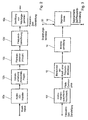
- Fig. 1 shows a block diagram of an inventive Device for transferring a music signal into a score-based Presentation.
- a music signal that sings, played or in the form of digital time samples is present in a device 10 for generating a Frequency-time representation of the music signal fed, wherein the frequency-time representation has coordinate tuples, where a coordinate tuple has a frequency value and includes a time value, the time value being the time of occurrence indicates the assigned frequency in the music signal.
- the frequency-time representation is in a facility 12 for calculating a fit function as a function of Time fed in, whose course through the coordinate tuple the frequency-time representation is determined.
- a device 14 Extrema determined, which then from a device 16 for Segmenting the frequency-time representation to be used to perform a segmentation based on a note rhythm indicates that issued at an output 18 becomes.
- the segmentation information is further from a Device 20 used to determine the pitch per segment is provided.
- the device 20 used to determine the pitch per segment only the coordinate tuples in one segment, for successive ones Segments consecutive grades on one Output 22 output.
- the data at the output 18, so the Rhythm information, and the data at the output 22, so the tone or note height information make up together a score-based representation of a MIDI file or by means of a graphical interface also a musical notation can be generated.
- a music signal for example, as a result of PCM samples, such as by recording a sung or played music signal and subsequent sampling and analog-to-digital conversion is generated in an audio I / O handler 10a fed.
- the music signal in digital Format also directly from the hard drive of a computer or come from the sound card of a computer.
- PCM Pulse Code Modulation
- the preprocessing device 10b further comprises a level adjusting unit, which is generally a standardization of Volume of the music signal performs as the volume information the music signal in the frequency-time representation is not needed. So that the volume information the determination of the frequency-time coordinate tuple will not affect volume normalization as follows performed.
- the preprocessing unit for normalization the level of the music signal includes a look-ahead buffer and determines the mean volume the signal. The signal is then scaled multiplied. The scaling factor is the product from a weighting factor and the quotient of full rash and medium signal volume. The length of the look-ahead buffer is variable.
- the edge detection device 10c is arranged to turn off extract signal edges of specified length from the music signal.
- the device 10c preferably performs a Hough transformation through.
- the Hough transformation is disclosed in U.S. 3,069,654 to Paul V. C. Hough.
- the Hough Transformation serves to detect complex structures and in particular for the automatic detection of complex Lines in photographs or other pictorial representations.
- the Hough transformation used to get out of the time signal Extract signal edges with specified time lengths.
- a signal edge is first by its temporal Length specified.
- a sine wave would be a signal edge due to the rising edge of the sine function defined from 0 to 90 °.
- the Signal edge also by the increase of the sine function of - 90 ° to + 90 °.
- the time length corresponds to a signal edge taking into account the sampling frequency with which the samples have been generated, a certain number of samples.
- the length of a signal edge can thus without further by specifying the number of samples that the Signal edge should be specified.
- a signal edge only then to detect as a signal edge, if it is steady is and has a monotonous course, so in the case of a positive signal edge a monotonously increasing course Has. Of course, negative signal edges, So monotonically falling signal edges are detected.
- Another criterion for the classification of signal edges is that a signal edge only as a signal edge is detected when there is a certain level range sweeps. To hide noise interference, is it prefers a minimum level range for a signal edge or amplitude range, where monotone rising signal edges below this range are not considered Signal edges are detected.
- the signal edge detection unit 12 thus provides a Signal edge and the time of occurrence of the signal edge.
- the time of Signal edge the instant of the first sample of the signal edge, the time of the last sample of the signal edge or the timing of any sample within the signal edge is taken as long consecutive Signal edges are treated the same.
- the edge detector 10c is a frequency calculation unit 10d downstream.
- the frequency calculation unit 10d is trained to be two temporally successive same or equal signal edges within a tolerance value search and then the difference of the occurrence times of the signal edges to build. The reciprocal of the difference corresponds the frequency passing through the two signal edges is determined. If a simple sine tone is considered, such is a period of sine tone by the time interval two consecutive equal long z. B. more positive Signal edges given.
- the Hough transform a high resolution in detecting signal edges in the Music signal, so that by the frequency calculation unit 10d shows a frequency-time representation of the music signal which can be obtained with a high resolution to one has certain frequencies available.
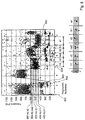
- a such frequency-time representation is shown in FIG.
- the Frequency-time representation has as abscissa a time axis, along which the absolute time is plotted in seconds, and has as ordinate a frequency axis in which in Fig. 8 selected representation, the frequency plotted in Hz is. All pixels in Fig. 8 represent time-frequency coordinate tuples how they are obtained when the first 13 seconds of the work of W. A. Mozart, Köchel directory No. 581, subjected to a Hough transformation become.
- this piece finds a relatively polyphonic orchestral part with a wide range of relatively uniform frequencies between about 600 and about 950 Hz. Then, about from 5.5 seconds, sets in a dominant clarinet voice, which plays the tone sequence H1, C2, Cis2, D2, H1 and A1.
- the Orchestral music takes a back seat to the clarinet, which is reflected in the frequency-time representation of Fig. 8 makes noticeable by the fact that the main distribution of frequency-time coordinate tuples within one limited band 800, which is also called pitch-contour tape strip referred to as.
- the frequency calculation unit 10d is a device 10e downstream for the determination of accumulation areas.
- the Become means 10e for determining the accumulation areas the characteristic distribution point clouds (clusters), when editing audio files as stationary Feature revealed, worked out.
- This can be an elimination all isolated frequency-time tuples performed which are a predetermined minimum distance to exceed next spatial neighbor. So will one Such processing will cause almost all coordinate tuples above the pitch contour band 800 be eliminated, whereby the example of Fig. 8 in the Range of 6 to 12 seconds, only the pitch-contour tape strip and some cluster areas below the Pitch-Contour strip bands remain.
- the pitch-contour strip 800 thus consists of clusters certain frequency width and time length, where these clusters are caused by the played notes.
- the frequency-time representation generated by means 10e, in the isolated coordinate tuple already are eliminated, is preferably for further processing using the device shown in Fig. 3 is used.
- an instrument-specific Post-processing 10f performed to off the Pitch Contour Strip 800 tape, if possible, a single one Create pitch-contour line.
- the pitch-contour strip band an instrument-specific case analysis subjected.
- Certain instruments, such as B. Oboe or French horn, have characteristic pitch-contour tapes on.
- the oboe for example, has two parallel strip bands on, as by the double reed of the oboe mouthpiece the air column to two longitudinal vibrations different frequency is stimulated and the waveform oscillates between these two modes.
- the device 10f for instrument-specific Postprocessing examines the frequency-time representation on the presence of characteristic features, and switches, When these features have been identified, an instrument specific one Aftertreatment process, which on specialties stored for example in a database received various instruments.
- a possibility would be, for example, of the two parallel band stripes the oboe is either the top or the bottom too or, as needed, an average or median between both strip bands of further processing to underlie.
- individual instruments own characteristics in the frequency-time diagram as each instrument is typical Has sound color, due to the composition of the Harmonics and the time course of the fundamental frequency and the harmonics is determined.
- the frequency-time representation as for example behind the unit 10d of FIG. 2, alternatively also by a frequency transformation method can be generated, like it for example, a fast Fourier transform.
- a Fourier transform is made from a block of temporal sample of the music signal a short-term spectrum generated.
- Problematic in the Fourier transformation is the fact of low time resolution, though a block with many samples in the frequency domain is transformed. A block with many samples is however required to achieve good frequency resolution. Will, however, to achieve a high time resolution, a block with few samples is used achieved a lower frequency resolution. It can be seen from this that in a Fourier transform either a high frequency resolution or a high time resolution can be achieved.
- a polynomial function with a degree n preferred. If a polynomial function used, enter the intervals between two minima of the polynomial function an indication of the temporal segmentation of the music signal, d. H. on the Sequence of musical music notes.
- Such a polynomial function 820 is shown in FIG. 8. It can be seen, that the polynomial function 820 at the beginning of the music signal and after about 2.8 seconds two polynomial zeros 830, 832 having the two polyphonic accumulation areas at the beginning of the Mozart piece "initiate".
- the coefficients of the polynomial function which are high Degrees in the range of over 30 may be included Compensation Calculation Methods Using Frequency-Time Coordinate Tuples which are shown in FIG. 8, calculated.
- the polynomial function is placed in the frequency-time representation, that the polynomial function in a certain section of the piece, in Fig. 8 the first 13 seconds, optimally placed in the coordinate tuple, so that the distance the tuple to the polynomial function total calculated becomes minimal.
- This can create "fake minima", such as for example, the minima of the polynomial function at about 10.6 seconds. This minimum is due to the fact that under the Pitch-Contour strip band clusters are, preferably by the means 10e for determining the accumulation areas (Fig. 2) are eliminated.
- the coefficients of the polynomial function calculated can by means of a device 10h the minima the polynomial function are determined. Because the polynomial function is analytic, is a simple differentiation and zeros search easily possible. For Other polynomial functions can be numerical methods for Deriving and zeroing searches are used.
- the device 16 a segmentation of the time-frequency representation made on the basis of the determined minimums.
- the following will discuss how the degree of Polynomial function whose coefficients are determined by the device 12, according to a preferred embodiment is determined.
- This is a standard tone sequence with fixed standard lengths for calibration of the inventive device played. Thereupon becomes for polynomials of different degrees a coefficient calculation and minima determined. The degree then becomes chosen so that the sum of the differences of two successive Minima of the polynomial of the measured tone length, d. H. by segmentation determined sound length, the pre-played Default reference tones is minimized.
- the calibration run using the tone sequence Standard reference tones of given length may also be added used to determine a scaling characteristic, fed to the device 16 for segmentation can be (30) to the time interval of the minima to scale the polynomial function.
- a scaling characteristic fed to the device 16 for segmentation can be (30) to the time interval of the minima to scale the polynomial function.
- FIG. 8 lies the minimum of the polynomial function not immediately at the beginning of the heap, the h1 sound represents not immediately after about 5.5 seconds, but at about 5.8 seconds. If a polynomial function higher order, the minimum would be more Edge of the heap to be moved. However, this would be below Cause the polynomial function to be too strong wriggles and creates too many dummy minima. Therefore it will preferred to generate the scaling characteristic that for every calculated minimum distance provides a scaling factor holds.
- a scaling characteristic with freely selectable Resolution can be generated. It should be noted that this calibration or scaling characteristic only be generated once before commissioning the device must then during an operation of the device for Transferring a music signal into a score-based description to be used.
- the temporal segmentation of the device 16 thus takes place by the polynomial fit of the nth order, with the degree before Commissioning the device is chosen so that the Sum of the differences between two consecutive minima of the polynomial from the measured tone lengths of standard reference tones is minimized. From the mean deviation is the scaling characteristic determines the relation between the measured with the inventive method tone length and the actual tone length. Although without Scaling already obtainable results, As it is clear from FIG. 8, the scaling characteristic can be used the accuracy of the process even better become.
- Fig. 4 a preferred construction of the device 20 for determining the Pitch per segment.
- the by the device 16 of FIG. 3 segmented time-frequency representation is fed to a device 20a, to an average value all frequency tuples or a median of all coordinate tuples per segment. The best results arise when only the coordinate tuples within the pitch contour line can be used.
- a pitch value d. H. a pitch value, educated.
- the music signal is at the exit of the device 20a thus already as a consequence of absolute Pitch heights in front. In principle, this sequence could be absolute Pitch heights already as a note sequence or note-based Representation can be used.
- the interval combination pairs are for a Note sequence of length in detail: grade 1 minus grade 2, grade 1 minus grade 3, grade 1 minus grade 4, grade 1 minus grade 5, grade 2 minus grade 3, grade 2 minus grade 4, grade 2 minus Grade 5, Grade 3 minus Grade 4, Grade 3 minus Grade 5, Grade 4 minus note 5.
- the set of interval values forms a tone coordinate system.
- This is now fed into a device 20c, which performs a compensation calculation and the tone coordinate system calculated by means 20b Compares with sound coordinate systems in a mood database 40 are stored.
- the mood can gleichschwebend subdivision of an octave in 12 equal large semitone intervals
- enharmonic of course, harmonic, Pythagorean, middle king, after Huygens, twelve parts with natural harmonic basis after Kepler, Euler, Mattheson, Kirnberger I + II, Malcolm, with modified Fifths after Silbermann, Werckmeister III, IV; V, VI, Neidhardt I, II, III.
- the mood can be instrument specific due to the design of the instrument, d. H.
- the device 20c determines by means of Methods of the equalization calculus the absolute halftone levels, by taking the mood by variation calculus which is the total of the residuals of the distances of the Halftone levels minimized by the pitch values.
- the absolute Sound levels are determined by the halftone levels be changed in parallel in steps of 1 Hz and those Halftone levels are considered to be absolute, which the Total of residuals of intervals of halftone steps of minimize the pitch values. For each pitch value results then a deviation value from the nearest halftone step. Extreme outliers are determinable thereby, these Values can be excluded by iteratively excluding the Outlier the mood is recalculated.
- the Device 20c thus lies for each pitch value of a segment a nearest half tone level of the music signal underlying mood.
- the pitch value is given by the nearest one Halftone stage replaced, so that at the output of the device 20d a sequence of note heights as well as information about the Mood that underlies the music signal, and the reference chamber sound available.
- This information at the output of Means 20c could now readily be used to create notation or a MIDI file to write.
- the quantization device 20d is preferred, irrespective of the instrument, which delivers the music signal to become.
- the device 20d preferably further configured to not only the but to output absolute quantized pitch values also the interval half-tone jumps two consecutive To determine scores and then this episode of semitone jumps as a search sequence for a reference to FIG. 7 described DNA sequencer to use.
- the pre-recorded or transposed music signal transposed into another key depending on the mood of the instrument eg B Clarinet, Eb saxophone
- is for reference Referencing not described in FIG. 7 Sequence of absolute pitches used but the episode of differences, since the difference frequencies from the absolute Pitch are independent.
- the segmentation information be used as rhythm information because through which the duration of a sound is given. It will however, preferably, the segmented time-frequency representation or from the same by distance two adjacent Minima certain tone lengths by means of a device 16a into normalized tone lengths to transform. These Normalization is done by means of a subjective-duration characteristic calculated from the sound length. So show psychoacoustic Researches that, for example, a 1/8-break longer as a 1/8 note lasts. Such information is going in the subjective-duration characteristic to the normalized Tone lengths and thus to receive the normalized pauses.
- the normalized tone lengths are then converted into a device 16b fed for histogramming.
- the device 16b provides statistics about which tone lengths occur or what tone lengths accumulations take place.
- On the base of the tone length histogram is by a device 16c sets a basic note length by dividing the subdivision the basic note length is made so that the note lengths as integer multiples of this basic note length are. So you can to sixteenth, eighth, quarter, Half or full marks arrive.
- the device 16c is based that in usual music signals by no means arbitrary Sound lengths are given, but the used note lengths usually in a fixed relationship to each other stand.
- This provides note height information and note rhythm information at the outputs 22 ( Figure 4) and 18 ( Figure 5) in front.
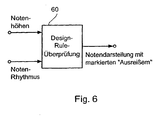
- This information may be stored in a device 60 for Design rule review will be merged.
- the device 60 checks to see if the played notes are after compositional rules of the melody guide are constructed. Notes in the episode that do not fit into the scheme will be marked to allow these marked notes from the DNA sequencer, which is shown with reference to FIG. 7, separately be treated.
- the device 16 is looking for meaningful Constructs and is trained to, for example to recognize whether certain note sequences are unplayable or usually do not occur.
- Fig. 7 a Method for referencing a music signal in a database according to another aspect of the present invention display.
- the music signal is at the entrance, for example as file 70.
- a device 72 for Transferring the music signal into a score-based description, constructed according to FIGS. 1 to 6 according to the invention is, note rhythm information and / or note height information generates a search sequence 74 for form a DNA sequencer 76.
- the sequence of notes that is represented by the search sequence 74 is now either in terms of note rhythm and / or in terms of the note heights with a variety of note-based descriptions for different tracks (Track_1 to Track_n) compared stored in a score database 78 could be.
- the DNA sequencer which is a device for Compare the music signal with a note-based description represents the database 78, checks a match or similarity. Thus, a statement regarding hit the music signal based on the comparison become.
- the DNA sequencer 76 is preferably with connected to a music database in which the various Tracks (track_1 to track_n) whose score-based descriptions stored in the scorebook as Audio file are stored.
- the sheet music database 78 and the database 80 a single database be.
- the database 80 could be omitted when the score database has meta information about the pieces whose score-based descriptions are stored are, include, such. B. author, name of the piece, music publisher, Pressing, etc.
- the device shown in FIG Referencing a song achieved in which an audio section, in which a sung or with a musical instrument recorded sequence of sounds is recorded in one Sequence of notes is transferred, this sequence of notes as a search criterion with stored note sequences in the scorebook is compared and the song from the scorebook is referenced, where the largest match between note input sequence and note sequence in the database is present.
- the MIDI description preferred because MIDI files for huge Sets of music already exist.
- the device shown in FIG. 7 could also be constructed be to generate the note-based description itself, when the database is initially operated in a learning mode is indicated by a dashed arrow 82 is.
- the device 72 In the learning mode (82), the device 72 would first a score-based for a variety of music signals Generate description and in the score database 78 save. Only when the scorebook is filled sufficiently is, the connection 82 would be interrupted to to perform a referencing of a music signal. After this MIDI files already exist for many pieces However, it prefers to existing note databases recourse.
- the DNA sequencer 76 searches for the most similar melody sequence in the score database, by listening to the melody sequence varies by the operations Replace / Insert / Delete. Each elementary operation is associated with a cost measure. Optimal is when all notes without special operations to match. On the other hand, it is suboptimal if n from m values. This will be automatic, so to speak introduced a ranking of melody sequences, and the Similarity of the music signal 70 to a database music signal Track_1 ... Track_n can be specified quantitatively become. It is preferred the similarity of, for example the top five candidates from the scorebook as output descending list.
- the notes are displayed as sixteenth, Eighth, quarter, half and full tone filed.
- the DNA sequencer searches for the most similar rhythm sequence in the rhythm database, by following the rhythm sequence through the operations Replace / Insert / Delete varies. Every elementary operation is also associated again with a cost measure. Optimal is suboptimal if all note lengths match is it, if n of m values agree. This will again introduced a ranking of the rhythm sequences, and the Similarity of the rhythmic sequences may be in a descending order List to be output.
- the DNA sequencer in a preferred embodiment the present invention further comprises a melody / rhythm matching unit, which determines what consequences both the pitch sequence and the rhythm sequence match.
- the melody / rhythm matching unit searches the greatest possible coincidence of both consequences by the Number of matches is assumed as a reference criterion. Optimal it is, if all values agree, suboptimal is it, if n of m values agree. This will again introduced a ranking, and the similarity of melody / rhythm sequences can be back in a descending list be issued.
- the DNA sequencer may be further arranged to be of the Design rule checker 60 ( Figure 6) either marked notes ignore or provide a lower weight, so that the result is not unnecessarily distorted by outliers becomes.
Landscapes
- Physics & Mathematics (AREA)
- Engineering & Computer Science (AREA)
- Acoustics & Sound (AREA)
- Multimedia (AREA)
- Electrophonic Musical Instruments (AREA)
- Auxiliary Devices For Music (AREA)
- Information Retrieval, Db Structures And Fs Structures Therefor (AREA)
- Reverberation, Karaoke And Other Acoustics (AREA)
Description
- Fig. 1
- ein Blockschaltbild einer erfindungsgemäßen Vorrichtung zum Überführen eines Musiksignals in eine Noten-basierte Darstellung;
- Fig. 2
- ein Blockschaltbild einer bevorzugten Vorrichtung zum Erzeugen einer Frequenz-Zeit-Darstellung aus einem Musiksignal, bei der zur Flankendetektion eine Hough-Transformation eingesetzt wird;
- Fig. 3
- ein Blockschaltbild einer bevorzugten Vorrichtung zum Erzeugen einer segmentierten Zeit-Frequenz-Darstellung aus der durch Fig. 2 gelieferten Frequenz-Zeit-Darstellung;
- Fig. 4
- eine erfindungsgemäße Vorrichtung zum Ermitteln einer Folge von Notenhöhen auf der Basis der von Fig. 3 ermittelten segmentierten Zeit-Frequenz-Darstellung;
- Fig. 5
- eine bevorzugte Vorrichtung zum Ermitteln eines Noten-Rhythmus auf der Basis der segmentierten Zeit-Frequenz-Darstellung von Fig. 3;
- Fig. 6
- eine schematische Darstellung einer Design-Rule-Überprüfungseinrichtung, um unter Kenntnis der Notenhöhen und des Notenrhythmus zu überprüfen, ob die ermittelten Werte nach kompositorischen Regeln sinnvoll sind;
- Fig. 7
- ein Blockschaltbild einer erfindungsgemäßen Vorrichtung zum Referenzieren eines Musiksignal in einer Datenbank; und
- Fig. 8
- ein Frequenz-Zeit-Diagramm der ersten 13 Sekunden des Klarinettenquintetts A-Dur von W. A. Mozart, KV 581, Larghetto, Jack Bryner, Klarinette, Aufnahme: 12/1969, London, Philips 420 710-2 einschließlich Fitfunktion und Notenhöhen.
Claims (32)
- Verfahren zum Überführen eines Musiksignals in eine Noten-basierte Beschreibung, mit folgenden Schritten:Erzeugen (10) einer Frequenz-Zeit-Darstellung des Musiksignals, wobei die Frequenz-Zeit-Darstellung Koordinatentupel aufweist, wobei ein Koordinatentupel einen Frequenzwert und einen Zeitwert umfaßt, wobei der Zeitwert die Zeit des Auftretens der zugeordneten Frequenz in dem Musiksignal angibt;Berechnen (12) einer Fitfunktion als Funktion der Zeit, deren Verlauf durch die Koordinatentupel der Frequenz-Zeit-Darstellung bestimmt ist;Ermitteln (14) zumindest zwei benachbarter Extrema der Fitfunktion;zeitliches Segmentieren (16) der Frequenz-Zeit-Darstellung auf der Basis der ermittelten Extrema, wobei ein Segment durch zwei benachbarte Extrema der Fitfunktion begrenzt, wobei die zeitliche Länge des Segments auf eine zeitliche Länge einer diesem Segment zugeordneten Note hinweist; undBestimmen (20) einer Tonhöhe der Note für das Segment unter Verwendung von Koordinaten-Tupeln in dem Segment.
- Verfahren nach Anspruch 1, bei dem die Fitfunktion eine analytische Funktion ist, wobei die Einrichtung (14) zum Ermitteln benachbarter Extrema eine Differenzierung der analytischen Funktion und Nullstellenbestimmung durchführt.
- Verfahren nach Anspruch 1 oder 2, bei dem die Extremwerte, die durch die Einrichtung (14) ermittelt werden, Minima der Fitfunktion sind.
- Verfahren nach einem der vorhergehenden Ansprüche, bei dem die Fitfunktion eine Polynomfitfunktion des Grads n ist, wobei n größer als 2 ist.
- Verfahren nach einem der vorhergehenden Ansprüche, bei dem im Schritt des Segmentierens (16) die zeitliche Länge einer Note unter Verwendung eines Kalibrierwerts aus dem zeitlichen Abstand zweier benachbarter Extremwerte bestimmt wird, wobei der Kalibrierwert das Verhältnis einer vorgegebenen zeitlichen Länge eines Tons zu einem Abstand zwischen zwei Extremwerten, der für den Ton unter Verwendung der Fitfunktion bestimmt wurde, ist.
- Verfahren nach Anspruch 4 oder 5, bei dem der Grad der Fitfunktion unter Verwendung von vorgegebenen Tönen verschiedener bekannter Längen und für Fitfunktionen verschiedener Grade im voraus bestimmt wird, wobei der Grad im Schritt des Berechnens (12) verwendet wird, für den sich eine spezifizierte Übereinstimmung zwischen durch benachbarte Extremwerte bestimmten Tonlängen und bekannten Tonlängen ergibt.
- Verfahren nach einem der Ansprüche 3 bis 6, bei dem im Schritt des zeitlichen Segmentierens (16) nur an einem solchen Minima der Fitfunktion segmentiert wird, dessen Frequenzwert zu dem Frequenzwert eines benachbarten Maximas um mindestens einen Minima-Maxima-Schwellenwert unterschiedlich ist, um Schein-Minima zu eliminieren.
- Verfahren nach einem der vorhergehenden Ansprüche, bei dem im Schritt des Erzeugens (10) folgende Schritte durchgeführt werden:Detektieren (10c) des zeitlichen Auftretens von Signalflanken in dem Zeitsignal;Ermitteln (10d) eines zeitlichen Abstands zwischen zwei ausgewählten detektierten Signalflanken und Berechnen eines Frequenzwerts aus dem ermittelten zeitlichen Abstand und Zuordnen des Frequenzwerts zu einer Auftrittszeit des Frequenzwerts in dem Musiksignal, um einen Koordinatentupel aus dem Frequenzwert und der Auftrittszeit für diesen Frequenzwert zu erhalten.
- Verfahren nach Anspruch 8, bei dem im Schritt des Detektierens (10c) eine Hough-Transformation durchgeführt wird.
- Verfahren nach einem der vorhergehenden Ansprüche, bei dem im Schritt des Erzeugens (10) die Frequenz-Zeit-Darstellung gefiltert wird (10e), so daß ein Pitch-Contour-Streifenband verbleibt, und bei dem im Schritt des Berechnens (12) einer Fitfunktion lediglich die Koordinatentupel in dem Pitch-Contour-Streifenband berücksichtigt werden.
- Verfahren nach einem der vorhergehenden Ansprüche, bei dem das Musiksignal monophon oder polyphon mit dominantem monophonen Anteil ist.
- Verfahren nach Anspruch 11, bei dem das Musiksignal eine gesungene oder eine mit einem Instrument gespielte Notenfolge ist.
- Verfahren nach einem der vorhergehenden Ansprüche, bei dem im Schritt (10) des Erzeugens einer Frequenz-Zeit-Darstellung eine Abtastratenumwandlung auf eine vorbestimmte Abtastrate durchgeführt wird (10b).
- Verfahren nach einem der vorhergehenden Ansprüche, bei dem im Schritt (10) des Erzeugens einer Frequenz-Zeit-Darstellung eine Lautstärkenormierung (10b) durch Multiplikation mit einem Skalierungsfaktor, der von der mittleren Lautstärke eines Abschnitts und einer vorbestimmten maximalen Lautstärke abhängt, durchgeführt wird.
- Verfahren nach einem der vorhergehenden Ansprüche, bei dem im Schritt des Erzeugens (10) eine instrumentenspezifische Nachbehandlung (10f) der Frequenz-Zeit-Darstellung durchgeführt wird, um eine instrumentenspezifische Frequenz-Zeit-Darstellung zu erhalten, und
bei dem im Schritt des Berechnens (12) der Fitfunktion die instrumentenspezifische Frequenz-Zeit-Darstellung zugrunde gelegt wird. - Verfahren nach einem der vorhergehenden Ansprüche, bei dem im Schritt des Bestimmens (20) der Tonhöhe pro Segment der Mittelwert der Koordinatentupel in einem Segment oder der Medianwert der Koordinatentupel in dem Segment verwendet wird, wobei der Mittelwert oder der Medianwert in einem Segment auf einen absoluten Tonhöhenwert der Note für das Segment hinweist.
- Verfahren nach Anspruch 16, bei dem der Schritt des Bestimmens (20) der Tonhöhe den Schritt des Ermittelns (20b, 20c) einer dem Musiksignal zugrunde liegenden Stimmung unter Verwendung der absoluten Tonhöhenwerte von Noten für Segmente des Musiksignals aufweist.
- Verfahren nach Anspruch 17, bei dem der Schritt des Ermittelns der Stimmung folgende Merkmale aufweist:Bilden (20b) einer Mehrzahl von Frequenzdifferenzen aus den Tonhöhenwerten des Musiksignals, um ein Frequenzdifferenz-Koordinatensystem zu erhalten;Ermitteln (20c) der absoluten Stimmung, die dem Musiksignal zugrunde liegt, unter Verwendung des Frequenzdifferenzkoordinatensystems und unter Verwendung einer Mehrzahl von abgespeicherten Stimmungskoordinatensystemen (40) mittels einer Ausgleichsrechnung.
- Verfahren nach Anspruch 18, bei dem der Schritt des Bestimmens (20) der Tonhöhe einen Schritt des Quantisierens (20d) der absoluten Tonhöhenwerte auf der Basis der absoluten Stimmung und des Referenz-Kammertons aufweist, um eine Note pro Segment zu erhalten.
- Verfahren nach einem der vorhergehenden Ansprüche, bei dem der Schritt des Segmentierens (16) folgenden Schritt aufweist:Transformieren (16a) der zeitlichen Länge von Tönen in normierte Notenlängen durch Histogrammieren (16b) der zeitlichen Länge und Festlegen (16c) einer Grundnotenlänge, derart, daß die zeitlichen Längen der Töne als ganzzahlige Vielfache oder ganzzahlige Bruchteile der Grundnotenlänge angebbar sind, und Quantisieren (16c) der zeitlichen Längen der Töne auf das nächstliegende ganzzahlige Vielfache oder den nächstliegenden ganzzahligen Bruchteil, um quantisierte Notenlängen zu erhalten.
- Verfahren nach Anspruch 20, bei dem der Schritt des Segmentierens (16) ferner einen Schritt des Bestimmens (16e) eines Takts aus den quantisierten Notenlängen durch Untersuchen umfaßt, ob aufeinanderfolgende Noten zu einem Taktschema gruppiert werden können.
- Verfahren nach Anspruch 21, das ferner folgenden Schritt aufweist:Untersuchen (60) einer Folge von Noten, die das Musiksignal darstellt, wobei jede Note durch Anfang, Länge und Tonhöhe spezifiziert ist, hinsichtlich kompositorischer Regeln und Markieren einer Note, die mit den kompositorischen Regeln nicht vereinbar ist.
- Verfahren zum Referenzieren eines Musiksignals (70) in einer Datenbank (78), die eine Noten-basierte Beschreibung einer Mehrzahl von Datenbank-Musiksignalen aufweist, mit folgenden Schritten:Überführen (72) des Musiksignals in eine Noten-basierte Beschreibung (74) gemäß einem der Patentansprüche 1 bis 22;Vergleichen (76) der Noten-basierten Beschreibung (74) des Musiksignals mit der Noten-basierten Beschreibung der Mehrzahl von Datenbank-Musiksignalen in der Datenbank (78); undTreffen (76) einer Aussage hinsichtlich des Musiksignals (70) auf der Basis des Schritts des Vergleichens.
- Verfahren nach Anspruch 23, bei dem die Noten-basierte Beschreibung für die Datenbank-Musiksignale ein MIDI-Format hat, wobei ein Tonanfang und ein Tonende als Funktion der Zeit spezifiziert sind, und bei dem vor dem Schritt des Vergleichens folgende Schritte ausgeführt werden:Bilden von Differenzwerten zwischen zwei benachbarten Noten des Musiksignals, um eine Differenz-Notenfolge zu erhalten;Bilden von Differenzwerten zwischen zwei benachbarten Noten der Noten-basierten Beschreibung des Datenbank-Musiksignals, undbei dem im Schritt des Vergleichens die Differenz-Notenfolge des Musiksignals mit der Differenz-Notenfolge eines Datenbank-Musiksignals verglichen wird.
- Verfahren nach Anspruch 23 oder 24, bei dem der Schritt des Vergleichens (76) unter Verwendung eines DNA-Sequenzing-Algorithmus und insbesondere unter Verwendung des Boyer-Moore-Algorithmus durchgeführt wird.
- Verfahren nach einem der Ansprüche 23 bis 25, bei dem der Schritt des Treffens einer Aussage das Feststellen der Identität des Musiksignals (70) und eines Datenbank-Musiksignals aufweist, falls die Noten-basierte Beschreibung des Datenbank-Musiksignals und die Noten-basierte Beschreibung des Musiksignals identisch sind.
- Verfahren nach einem der Ansprüche 23 bis 25, bei dem der Schritt des Treffens einer Aussage hinsichtlich des Musiksignals eine Ähnlichkeit zwischen dem Musiksignal (70) und einem Datenbank-Musiksignal feststellt, wenn nicht alle Tonhöhen und/oder Tonlängen des Musiksignals mit Tonhöhen und/oder Tonlängen des Datenbank-Musiksignals übereinstimmen.
- Verfahren nach einem der Ansprüche 23 bis 27, bei dem die Noten-basierte Beschreibung eine Rhythmusbeschreibung aufweist, und bei dem im Schritt des Vergleichens (76) ein Vergleich der Rhythmen des Musiksignals und des Datenbank-Musiksignals durchgeführt wird.
- Verfahren nach einem der Ansprüche 23 bis 28, bei dem die Noten-basierte Beschreibung eine Tonhöhenbeschreibung aufweist, und bei dem im Schritt des Vergleichens (76) die Tonhöhen des Musiksignals mit den Tonhöhen eines Datenbank-Musiksignals verglichen werden.
- Verfahren nach einem der Ansprüche 25 bis 29, bei dem im Schritt des Vergleichens (26) Einfügen-, Ersetzenoder Löschen-Operationen mit der Noten-basierten Beschreibung (74) des Musiksignals (70) durchgeführt werden, und bei dem im Schritt des Treffens einer Aussage eine Ähnlichkeit zwischen dem Musiksignal (70) und einem Datenbank-Musiksignal auf der Basis der Anzahl von Einfügen-, Ersetzen- oder Löschen-Operationen festgestellt wird, die erforderlich sind, um eine größtmögliche Übereinstimmung zwischen der Noten-basierten Beschreibung (74) des Musiksignals (70) und der Noten-basierten Beschreibung eines Datenbank-Musiksignals zu erreichen.
- Vorrichtung zum Überführen eines Musiksignals in eine Noten-basierte Beschreibung, mit folgenden Merkmalen:einer Einrichtung zum Erzeugen (10) einer Frequenz-Zeit-Darstellung des Musiksignals, wobei die Frequenz-Zeit-Darstellung Koordinatentupel aufweist, wobei ein Koordinatentupel einen Frequenzwert und einen Zeitwert umfaßt, wobei der Zeitwert die Zeit des Auftretens der zugeordneten Frequenz in dem Musiksignal angibt;einer Einrichtung zum Berechnen (12) einer Fitfunktion als Funktion der Zeit, deren Verlauf durch die Koordinatentupel der Frequenz-Zeit-Darstellung bestimmt ist;einer Einrichtung zum Ermitteln (14) zumindest zwei benachbarter Extrema der Fitfunktion;einer Einrichtung zum zeitlichen Segmentieren (16) der Frequenz-Zeit-Darstellung auf der Basis der ermittelten Extrema, wobei ein Segment durch zwei benachbarte Extrema der Fitfunktion begrenzt, wobei die zeitliche Länge des Segments auf eine zeitliche Länge einer diesem Segment zugeordneten Note hinweist; undeiner Einrichtung zum Bestimmen (20) einer Tonhöhe der Note für das Segment unter Verwendung von Koordinaten-Tupeln in dem Segment.
- Vorrichtung zum Referenzieren eines Musiksignal (70) in einer Datenbank (78), die eine Noten-basierte Beschreibung einer Mehrzahl von Datenbank-Musiksignalen aufweist, mit folgenden Merkmalen:einer Einrichtung zum Überführen (72) des Musiksignals in eine Noten-basierte Beschreibung (74) durch ein Verfahren gemäß einem der Patentansprüche 1 bis 22;einer Einrichtung zum Vergleichen (76) der Noten-basierten Beschreibung (74) des Musiksignals mit der Noten-basierten Beschreibung der Mehrzahl von Datenbank-Musiksignalen in der Datenbank (78); undeiner Einrichtung zum Treffen (76) einer Aussage hinsichtlich des Musiksignals (70) auf der Basis des Schritts des Vergleichens.
Applications Claiming Priority (3)
| Application Number | Priority Date | Filing Date | Title |
|---|---|---|---|
| DE10117870A DE10117870B4 (de) | 2001-04-10 | 2001-04-10 | Verfahren und Vorrichtung zum Überführen eines Musiksignals in eine Noten-basierte Beschreibung und Verfahren und Vorrichtung zum Referenzieren eines Musiksignals in einer Datenbank |
| DE10117870 | 2001-04-10 | ||
| PCT/EP2002/003736 WO2002084641A1 (de) | 2001-04-10 | 2002-04-04 | Verfahren zum überführen eines musiksignals in eine noten-basierte beschreibung und zum referenzieren eines musiksignals in einer datenbank |
Publications (2)
| Publication Number | Publication Date |
|---|---|
| EP1377960A1 EP1377960A1 (de) | 2004-01-07 |
| EP1377960B1 true EP1377960B1 (de) | 2004-11-24 |
Family
ID=7681082
Family Applications (1)
| Application Number | Title | Priority Date | Filing Date |
|---|---|---|---|
| EP02730100A Expired - Lifetime EP1377960B1 (de) | 2001-04-10 | 2002-04-04 | Verfahren zum überführen eines musiksignals in eine noten-basierte beschreibung und zum referenzieren eines musiksignals in einer datenbank |
Country Status (6)
| Country | Link |
|---|---|
| US (1) | US7064262B2 (de) |
| EP (1) | EP1377960B1 (de) |
| JP (1) | JP3964792B2 (de) |
| AT (1) | ATE283530T1 (de) |
| DE (2) | DE10117870B4 (de) |
| WO (1) | WO2002084641A1 (de) |
Families Citing this family (29)
| Publication number | Priority date | Publication date | Assignee | Title |
|---|---|---|---|---|
| DE10232916B4 (de) * | 2002-07-19 | 2008-08-07 | Fraunhofer-Gesellschaft zur Förderung der angewandten Forschung e.V. | Vorrichtung und Verfahren zum Charakterisieren eines Informationssignals |
| US7247782B2 (en) * | 2003-01-08 | 2007-07-24 | Hennings Mark R | Genetic music |
| EP1687803A4 (de) * | 2003-11-21 | 2007-12-05 | Agency Science Tech & Res | Verfahren und vorrichtung für melodierepräsentation und -vergleich für das abrufen von musik |
| DE102004049517B4 (de) * | 2004-10-11 | 2009-07-16 | Fraunhofer-Gesellschaft zur Förderung der angewandten Forschung e.V. | Extraktion einer einem Audiosignal zu Grunde liegenden Melodie |
| DE102004049478A1 (de) * | 2004-10-11 | 2006-04-20 | Fraunhofer-Gesellschaft zur Förderung der angewandten Forschung e.V. | Verfahren und Vorrichtung zur Glättung eines Melodieliniensegments |
| DE102004049457B3 (de) * | 2004-10-11 | 2006-07-06 | Fraunhofer-Gesellschaft zur Förderung der angewandten Forschung e.V. | Verfahren und Vorrichtung zur Extraktion einer einem Audiosignal zu Grunde liegenden Melodie |
| DE102004049477A1 (de) * | 2004-10-11 | 2006-04-20 | Fraunhofer-Gesellschaft zur Förderung der angewandten Forschung e.V. | Verfahren und Vorrichtung zur harmonischen Aufbereitung einer Melodielinie |
| US7598447B2 (en) * | 2004-10-29 | 2009-10-06 | Zenph Studios, Inc. | Methods, systems and computer program products for detecting musical notes in an audio signal |
| US8093484B2 (en) * | 2004-10-29 | 2012-01-10 | Zenph Sound Innovations, Inc. | Methods, systems and computer program products for regenerating audio performances |
| US20060293089A1 (en) * | 2005-06-22 | 2006-12-28 | Magix Ag | System and method for automatic creation of digitally enhanced ringtones for cellphones |
| KR100735444B1 (ko) * | 2005-07-18 | 2007-07-04 | 삼성전자주식회사 | 오디오데이터 및 악보이미지 추출방법 |
| US7615701B2 (en) * | 2005-10-19 | 2009-11-10 | Tiao-Pin Cultural Enterprise Co., Ltd. | Method for keying human voice audio frequency |
| US7467982B2 (en) * | 2005-11-17 | 2008-12-23 | Research In Motion Limited | Conversion from note-based audio format to PCM-based audio format |
| US20070276668A1 (en) * | 2006-05-23 | 2007-11-29 | Creative Technology Ltd | Method and apparatus for accessing an audio file from a collection of audio files using tonal matching |
| AU2007252225A1 (en) * | 2006-05-24 | 2007-11-29 | National Ict Australia Limited | Selectivity estimation |
| DE102006062061B4 (de) | 2006-12-29 | 2010-06-10 | Fraunhofer-Gesellschaft zur Förderung der angewandten Forschung e.V. | Vorrichtung, Verfahren und Computerprogramm zum Bestimmen einer Position basierend auf einem Kamerabild von einer Kamera |
| JP2010518428A (ja) | 2007-02-01 | 2010-05-27 | ミューズアミ, インコーポレイテッド | 音楽転写 |
| US20090288547A1 (en) * | 2007-02-05 | 2009-11-26 | U.S. Music Corporation | Method and Apparatus for Tuning a Stringed Instrument |
| WO2008101126A1 (en) * | 2007-02-14 | 2008-08-21 | Museami, Inc. | Web portal for distributed audio file editing |
| US8084677B2 (en) * | 2007-12-31 | 2011-12-27 | Orpheus Media Research, Llc | System and method for adaptive melodic segmentation and motivic identification |
| US8494257B2 (en) | 2008-02-13 | 2013-07-23 | Museami, Inc. | Music score deconstruction |
| JP4862003B2 (ja) * | 2008-02-28 | 2012-01-25 | Kddi株式会社 | 再生順序決定装置、楽曲再生システムおよび再生順序決定方法 |
| DE102008013172B4 (de) | 2008-03-07 | 2010-07-08 | Neubäcker, Peter | Verfahren zur klangobjektorientierten Analyse und zur notenobjektorientierten Bearbeitung polyphoner Klangaufnahmen |
| US8119897B2 (en) * | 2008-07-29 | 2012-02-21 | Teie David Ernest | Process of and apparatus for music arrangements adapted from animal noises to form species-specific music |
| JP5728888B2 (ja) * | 2010-10-29 | 2015-06-03 | ソニー株式会社 | 信号処理装置および方法、並びにプログラム |
| JP5732994B2 (ja) * | 2011-04-19 | 2015-06-10 | ソニー株式会社 | 楽曲検索装置および方法、プログラム、並びに記録媒体 |
| US20120294457A1 (en) * | 2011-05-17 | 2012-11-22 | Fender Musical Instruments Corporation | Audio System and Method of Using Adaptive Intelligence to Distinguish Information Content of Audio Signals and Control Signal Processing Function |
| US20180144729A1 (en) * | 2016-11-23 | 2018-05-24 | Nicechart, Inc. | Systems and methods for simplifying music rhythms |
| CN115472143B (zh) * | 2022-09-13 | 2024-10-01 | 天津大学 | 一种调性音乐音符起始点检测与音符解码方法及装置 |
Family Cites Families (10)
| Publication number | Priority date | Publication date | Assignee | Title |
|---|---|---|---|---|
| US3069654A (en) | 1960-03-25 | 1962-12-18 | Paul V C Hough | Method and means for recognizing complex patterns |
| GB2139405B (en) * | 1983-04-27 | 1986-10-29 | Victor Company Of Japan | Apparatus for displaying musical notes indicative of pitch and time value |
| DE68907616T2 (de) * | 1988-02-29 | 1994-03-03 | Nippon Denki Home Electronics | Verfahren und Gerät zur Musiktranskribierung. |
| US5210820A (en) * | 1990-05-02 | 1993-05-11 | Broadcast Data Systems Limited Partnership | Signal recognition system and method |
| US5874686A (en) * | 1995-10-31 | 1999-02-23 | Ghias; Asif U. | Apparatus and method for searching a melody |
| DE69908226T2 (de) * | 1998-03-19 | 2004-03-25 | Tomonari Sonoda | Vorrichtung und Verfahren zum Wiederauffinden von Melodien |
| US6124542A (en) * | 1999-07-08 | 2000-09-26 | Ati International Srl | Wavefunction sound sampling synthesis |
| GR1003625B (el) * | 1999-07-08 | 2001-08-31 | Μεθοδος χημικης αποθεσης συνθετων επικαλυψεων αγωγιμων πολυμερων σε επιφανειες κραματων αλουμινιου | |
| US6438530B1 (en) | 1999-12-29 | 2002-08-20 | Pitney Bowes Inc. | Software based stamp dispenser |
| WO2001069575A1 (en) | 2000-03-13 | 2001-09-20 | Perception Digital Technology (Bvi) Limited | Melody retrieval system |
-
2001
- 2001-04-10 DE DE10117870A patent/DE10117870B4/de not_active Expired - Fee Related
-
2002
- 2002-04-04 AT AT02730100T patent/ATE283530T1/de not_active IP Right Cessation
- 2002-04-04 EP EP02730100A patent/EP1377960B1/de not_active Expired - Lifetime
- 2002-04-04 WO PCT/EP2002/003736 patent/WO2002084641A1/de not_active Ceased
- 2002-04-04 US US10/473,462 patent/US7064262B2/en not_active Expired - Lifetime
- 2002-04-04 DE DE50201624T patent/DE50201624D1/de not_active Expired - Lifetime
- 2002-04-04 JP JP2002581512A patent/JP3964792B2/ja not_active Expired - Fee Related
Also Published As
| Publication number | Publication date |
|---|---|
| US7064262B2 (en) | 2006-06-20 |
| WO2002084641A1 (de) | 2002-10-24 |
| EP1377960A1 (de) | 2004-01-07 |
| DE50201624D1 (de) | 2004-12-30 |
| DE10117870A1 (de) | 2002-10-31 |
| DE10117870B4 (de) | 2005-06-09 |
| JP2004526203A (ja) | 2004-08-26 |
| ATE283530T1 (de) | 2004-12-15 |
| JP3964792B2 (ja) | 2007-08-22 |
| US20040060424A1 (en) | 2004-04-01 |
| HK1060428A1 (en) | 2004-08-06 |
Similar Documents
| Publication | Publication Date | Title |
|---|---|---|
| DE10117870B4 (de) | Verfahren und Vorrichtung zum Überführen eines Musiksignals in eine Noten-basierte Beschreibung und Verfahren und Vorrichtung zum Referenzieren eines Musiksignals in einer Datenbank | |
| Muller et al. | Towards timbre-invariant audio features for harmony-based music | |
| DE69904640T2 (de) | Verfahren zum ändern des oberweyllengehalts einer komplexen wellenform | |
| Grubb et al. | A stochastic method of tracking a vocal performer | |
| Collins | Using a Pitch Detector for Onset Detection. | |
| US20080190272A1 (en) | Music-Based Search Engine | |
| Plaja-Roglans et al. | Repertoire-specific vocal pitch data generation for improved melodic analysis of carnatic music | |
| CN116034421A (zh) | 乐曲构造解析装置及乐曲构造解析方法 | |
| DE10157454B4 (de) | Verfahren und Vorrichtung zum Erzeugen einer Kennung für ein Audiosignal, Verfahren und Vorrichtung zum Aufbauen einer Instrumentendatenbank und Verfahren und Vorrichtung zum Bestimmen der Art eines Instruments | |
| Lerch | Software-based extraction of objective parameters from music performances | |
| Tian et al. | Towards music structural segmentation across genres: Features, structural hypotheses, and annotation principles | |
| CN112837698A (zh) | 一种演唱或演奏评价方法、装置和计算机可读存储介质 | |
| Kitahara et al. | Instrument Identification in Polyphonic Music: Feature Weighting with Mixed Sounds, Pitch-Dependent Timbre Modeling, and Use of Musical Context. | |
| EP1377924B1 (de) | VERFAHREN UND VORRICHTUNG ZUM EXTRAHIEREN EINER SIGNALKENNUNG, VERFAHREN UND VORRICHTUNG ZUM ERZEUGEN EINER DAZUGEHÖRIGEN DATABANK und Verfahren und Vorrichtung zum Referenzieren eines Such-Zeitsignals | |
| Ikemiya et al. | Transcribing vocal expression from polyphonic music | |
| Chen et al. | An efficient method for polyphonic audio-to-score alignment using onset detection and constant Q transform | |
| Holzapfel et al. | Improving tempo-sensitive and tempo-robust descriptors for rhythmic similarity | |
| Shelke et al. | An effective feature calculation for analysis & classification of Indian musical instruments using timbre measurement | |
| Morman et al. | A system for the automatic segmentation and classification of chord sequences | |
| Politis et al. | Motivic, Horizontal and Temporal Chromaticism: a Mathematical Classifier Method for Global & Ethnic Music | |
| Wang | Scattering Transform for Playing Technique Recognition | |
| Wegener et al. | On the robustness of audio features for musical instrument classification | |
| Uhle et al. | Generation of musical scores of percussive un-pitched instruments from automatically detected events | |
| Heydarian et al. | Tonic and scale recognition in Persian audio musical signals | |
| Pollastri et al. | Processing singing voice for music retrieval. |
Legal Events
| Date | Code | Title | Description |
|---|---|---|---|
| PUAI | Public reference made under article 153(3) epc to a published international application that has entered the european phase |
Free format text: ORIGINAL CODE: 0009012 |
|
| 17P | Request for examination filed |
Effective date: 20030812 |
|
| AK | Designated contracting states |
Kind code of ref document: A1 Designated state(s): AT BE CH CY DE DK ES FI FR GB GR IE IT LI LU MC NL PT SE TR |
|
| AX | Request for extension of the european patent |
Extension state: AL LT LV MK RO SI |
|
| RIN1 | Information on inventor provided before grant (corrected) |
Inventor name: KAUFMANN, MATTHIAS Inventor name: BRANDENBURG, KARLHEINZ Inventor name: KLEFENZ, FRANK |
|
| GRAP | Despatch of communication of intention to grant a patent |
Free format text: ORIGINAL CODE: EPIDOSNIGR1 |
|
| REG | Reference to a national code |
Ref country code: HK Ref legal event code: DE Ref document number: 1060428 Country of ref document: HK |
|
| GRAS | Grant fee paid |
Free format text: ORIGINAL CODE: EPIDOSNIGR3 |
|
| GRAA | (expected) grant |
Free format text: ORIGINAL CODE: 0009210 |
|
| AK | Designated contracting states |
Kind code of ref document: B1 Designated state(s): AT CH DE FR GB LI |
|
| REG | Reference to a national code |
Ref country code: GB Ref legal event code: FG4D Free format text: NOT ENGLISH |
|
| REG | Reference to a national code |
Ref country code: CH Ref legal event code: EP |
|
| REF | Corresponds to: |
Ref document number: 50201624 Country of ref document: DE Date of ref document: 20041230 Kind code of ref document: P |
|
| REG | Reference to a national code |
Ref country code: IE Ref legal event code: FG4D Free format text: GERMAN |
|
| REG | Reference to a national code |
Ref country code: HK Ref legal event code: GR Ref document number: 1060428 Country of ref document: HK |
|
| GBT | Gb: translation of ep patent filed (gb section 77(6)(a)/1977) |
Effective date: 20050506 |
|
| REG | Reference to a national code |
Ref country code: IE Ref legal event code: FD4D |
|
| ET | Fr: translation filed | ||
| PLBE | No opposition filed within time limit |
Free format text: ORIGINAL CODE: 0009261 |
|
| STAA | Information on the status of an ep patent application or granted ep patent |
Free format text: STATUS: NO OPPOSITION FILED WITHIN TIME LIMIT |
|
| 26N | No opposition filed |
Effective date: 20050825 |
|
| PGFP | Annual fee paid to national office [announced via postgrant information from national office to epo] |
Ref country code: AT Payment date: 20100422 Year of fee payment: 9 |
|
| PGFP | Annual fee paid to national office [announced via postgrant information from national office to epo] |
Ref country code: CH Payment date: 20100426 Year of fee payment: 9 |
|
| REG | Reference to a national code |
Ref country code: CH Ref legal event code: PL |
|
| REG | Reference to a national code |
Ref country code: AT Ref legal event code: MM01 Ref document number: 283530 Country of ref document: AT Kind code of ref document: T Effective date: 20110404 |
|
| PG25 | Lapsed in a contracting state [announced via postgrant information from national office to epo] |
Ref country code: CH Free format text: LAPSE BECAUSE OF NON-PAYMENT OF DUE FEES Effective date: 20110430 Ref country code: LI Free format text: LAPSE BECAUSE OF NON-PAYMENT OF DUE FEES Effective date: 20110430 |
|
| PG25 | Lapsed in a contracting state [announced via postgrant information from national office to epo] |
Ref country code: AT Free format text: LAPSE BECAUSE OF NON-PAYMENT OF DUE FEES Effective date: 20110404 |
|
| REG | Reference to a national code |
Ref country code: FR Ref legal event code: PLFP Year of fee payment: 15 |
|
| REG | Reference to a national code |
Ref country code: FR Ref legal event code: PLFP Year of fee payment: 16 |
|
| REG | Reference to a national code |
Ref country code: FR Ref legal event code: PLFP Year of fee payment: 17 |
|
| PGFP | Annual fee paid to national office [announced via postgrant information from national office to epo] |
Ref country code: FR Payment date: 20190429 Year of fee payment: 18 |
|
| PGFP | Annual fee paid to national office [announced via postgrant information from national office to epo] |
Ref country code: GB Payment date: 20190624 Year of fee payment: 18 Ref country code: DE Payment date: 20190624 Year of fee payment: 18 |
|
| REG | Reference to a national code |
Ref country code: DE Ref legal event code: R119 Ref document number: 50201624 Country of ref document: DE |
|
| PG25 | Lapsed in a contracting state [announced via postgrant information from national office to epo] |
Ref country code: DE Free format text: LAPSE BECAUSE OF NON-PAYMENT OF DUE FEES Effective date: 20201103 Ref country code: FR Free format text: LAPSE BECAUSE OF NON-PAYMENT OF DUE FEES Effective date: 20200430 |
|
| GBPC | Gb: european patent ceased through non-payment of renewal fee |
Effective date: 20200404 |
|
| PG25 | Lapsed in a contracting state [announced via postgrant information from national office to epo] |
Ref country code: GB Free format text: LAPSE BECAUSE OF NON-PAYMENT OF DUE FEES Effective date: 20200404 |