EP1377123A1 - Equalization for audio mixing - Google Patents
Equalization for audio mixing Download PDFInfo
- Publication number
- EP1377123A1 EP1377123A1 EP03253971A EP03253971A EP1377123A1 EP 1377123 A1 EP1377123 A1 EP 1377123A1 EP 03253971 A EP03253971 A EP 03253971A EP 03253971 A EP03253971 A EP 03253971A EP 1377123 A1 EP1377123 A1 EP 1377123A1
- Authority
- EP
- European Patent Office
- Prior art keywords
- channel
- loudness
- audio signal
- mixed
- channel signals
- Prior art date
- Legal status (The legal status is an assumption and is not a legal conclusion. Google has not performed a legal analysis and makes no representation as to the accuracy of the status listed.)
- Withdrawn
Links
- 230000003595 spectral effect Effects 0.000 claims abstract description 40
- 230000001419 dependent effect Effects 0.000 claims abstract description 4
- 230000005236 sound signal Effects 0.000 claims description 50
- 238000000034 method Methods 0.000 claims description 33
- 230000001131 transforming effect Effects 0.000 claims description 3
- 238000001228 spectrum Methods 0.000 description 7
- 238000010586 diagram Methods 0.000 description 4
- 230000000694 effects Effects 0.000 description 4
- 238000009499 grossing Methods 0.000 description 2
- 239000000463 material Substances 0.000 description 2
- 230000010363 phase shift Effects 0.000 description 2
- 238000003860 storage Methods 0.000 description 2
- 230000003044 adaptive effect Effects 0.000 description 1
- 230000005540 biological transmission Effects 0.000 description 1
- 238000009826 distribution Methods 0.000 description 1
- 238000009429 electrical wiring Methods 0.000 description 1
- 230000005670 electromagnetic radiation Effects 0.000 description 1
- 239000000835 fiber Substances 0.000 description 1
- 238000001914 filtration Methods 0.000 description 1
- 238000004519 manufacturing process Methods 0.000 description 1
- 238000005259 measurement Methods 0.000 description 1
- 238000004091 panning Methods 0.000 description 1
- 239000012488 sample solution Substances 0.000 description 1
Images
Classifications
-
- G—PHYSICS
- G10—MUSICAL INSTRUMENTS; ACOUSTICS
- G10L—SPEECH ANALYSIS TECHNIQUES OR SPEECH SYNTHESIS; SPEECH RECOGNITION; SPEECH OR VOICE PROCESSING TECHNIQUES; SPEECH OR AUDIO CODING OR DECODING
- G10L19/00—Speech or audio signals analysis-synthesis techniques for redundancy reduction, e.g. in vocoders; Coding or decoding of speech or audio signals, using source filter models or psychoacoustic analysis
- G10L19/008—Multichannel audio signal coding or decoding using interchannel correlation to reduce redundancy, e.g. joint-stereo, intensity-coding or matrixing
-
- G—PHYSICS
- G10—MUSICAL INSTRUMENTS; ACOUSTICS
- G10L—SPEECH ANALYSIS TECHNIQUES OR SPEECH SYNTHESIS; SPEECH RECOGNITION; SPEECH OR VOICE PROCESSING TECHNIQUES; SPEECH OR AUDIO CODING OR DECODING
- G10L15/00—Speech recognition
- G10L15/22—Procedures used during a speech recognition process, e.g. man-machine dialogue
-
- H—ELECTRICITY
- H04—ELECTRIC COMMUNICATION TECHNIQUE
- H04S—STEREOPHONIC SYSTEMS
- H04S1/00—Two-channel systems
- H04S1/007—Two-channel systems in which the audio signals are in digital form
-
- H—ELECTRICITY
- H04—ELECTRIC COMMUNICATION TECHNIQUE
- H04S—STEREOPHONIC SYSTEMS
- H04S3/00—Systems employing more than two channels, e.g. quadraphonic
-
- H—ELECTRICITY
- H04—ELECTRIC COMMUNICATION TECHNIQUE
- H04S—STEREOPHONIC SYSTEMS
- H04S5/00—Pseudo-stereo systems, e.g. in which additional channel signals are derived from monophonic signals by means of phase shifting, time delay or reverberation
- H04S5/005—Pseudo-stereo systems, e.g. in which additional channel signals are derived from monophonic signals by means of phase shifting, time delay or reverberation of the pseudo five- or more-channel type, e.g. virtual surround
-
- G—PHYSICS
- G10—MUSICAL INSTRUMENTS; ACOUSTICS
- G10L—SPEECH ANALYSIS TECHNIQUES OR SPEECH SYNTHESIS; SPEECH RECOGNITION; SPEECH OR VOICE PROCESSING TECHNIQUES; SPEECH OR AUDIO CODING OR DECODING
- G10L19/00—Speech or audio signals analysis-synthesis techniques for redundancy reduction, e.g. in vocoders; Coding or decoding of speech or audio signals, using source filter models or psychoacoustic analysis
- G10L19/02—Speech or audio signals analysis-synthesis techniques for redundancy reduction, e.g. in vocoders; Coding or decoding of speech or audio signals, using source filter models or psychoacoustic analysis using spectral analysis, e.g. transform vocoders or subband vocoders
- G10L19/0212—Speech or audio signals analysis-synthesis techniques for redundancy reduction, e.g. in vocoders; Coding or decoding of speech or audio signals, using source filter models or psychoacoustic analysis using spectral analysis, e.g. transform vocoders or subband vocoders using orthogonal transformation
-
- H—ELECTRICITY
- H04—ELECTRIC COMMUNICATION TECHNIQUE
- H04S—STEREOPHONIC SYSTEMS
- H04S2420/00—Techniques used stereophonic systems covered by H04S but not provided for in its groups
- H04S2420/03—Application of parametric coding in stereophonic audio systems
Definitions
- the present invention relates to audio signal processing and, in particular, to mixing audio signals.
- a common problem in many areas of audio recording, audio production, and audio coding is the mixing of a number of input audio channels to generate a different number of output audio channels.
- the change in the number of channels can be motivated by, e.g., a difference between the number of audio tracks (channels) of the recording device and the number of channels supported by the playback system or a difference between the number of channels of the distribution medium (e.g., CD, DVD, radio) and the number of channels supported by the playback system.
- One example is FM radio where audio is usually delivered as a two-channel stereo signal, but many receivers have only one playback channel (one loudspeaker). In such case, the two stereo channels are typically down-mixed to form a single mono audio signal for playback.
- down-mixing occurs when the multiple (e.g., five) channels of an input signal conforming to a surround audio format, e.g., 5.1 surround, are down-mixed for playback, e.g., using a two-channel stereo system.
- mixing of audio signals may involve up-mixing (i.e., where the number of output channels is greater than the number of input channels).
- up-mixing is the generation of a three-channel output signal (e.g., left, right, and center) from a two-channel (e.g., left, right) input signal.
- each output channel is derived from a weighted summation of the input channels in the time domain, where "panning laws” or “matrixing schemes” are applied to determine the weight of each input channel for each output channel.
- panning laws or “matrixing schemes” are applied to determine the weight of each input channel for each output channel.
- conventional mixing techniques are applied to the full bandwidth of the audio channels.
- One drawback of such mixing techniques is a possible loss of spectral energy and/or loudness when some of the spectral components of the input audio channels are not aligned in phase. Such phase differences commonly occur, for instance, in multiple-microphone recordings, when each microphone has a different distance to the sound source.
- the problems of the prior art are addressed in accordance with principles of the present invention by an equalized mixing technique that enables the energy and/or loudness levels of a mixer's output signals to match the energy and/or loudness levels of the mixer's input signals, such that coloration effects are reduced and possibly avoided.
- the time-domain channel signals of an N -channel input signal are transformed to a frequency domain, where the resulting spectral components are mixed and then adaptively amplified in order to adjust for loss of spectral energy and/or loudness during the mixing process.
- An inverse transform is then applied to the resulting equalized mixed channel spectra to generate the time-domain channel signals of an M -channel output signal.
- the present invention is a method for mixing an N -channel input audio signal to generate an M -channel output audio signal, where N and M are positive integers.
- a first loudness measure is generated for the N -channel input audio signal.
- the N input channel signals corresponding to the N -channel input audio signal are mixed to generate M mixed channel signals, and a second loudness measure is generated for the M mixed channel signals.
- the M mixed channel signals are equalized based on the first and second loudness measures to generate the M -channel output audio signal.
- the present invention is an M-channel output audio signal generated by the previously described method.
- the present invention is an apparatus for mixing an N-channel input audio signal to generate a M-channel output audio signal, where N and M are positive integers.
- the apparatus comprises a mixer, one or more loudness estimators, and an equalizer.
- the mixer is configured to mix N input channel signals corresponding to the N-channel input audio signal to generate M mixed channel signals.
- the equalizer is configured to equalize the M mixed channel signals based on the first and second loudness measures to generate the M-channel output audio signal.
- the equalizer is configured to amplify the M mixed channel signals using a gain factor that is based on the first and second loudness measures to maintain the overall loudness of the M-channel output audio signal substantially equal to the overall loudness of the N-channel input audio signal.
- the apparatus further comprises a set of one or more transform blocks configured to transform the N-channel input audio signal from a time domain into a frequency domain, and a set of one or more inverse transform blocks configured to transform the M equalized mixed channel signals from the frequency domain into the time domain to generate the M-channel output audio signal.
- the one or more loudness estimators are configured to generate a first spectral loudness measure for the input audio signal and a second spectral loudness measure for the M mixed channel signals; the first and second loudness measures are the first and second spectral loudness measures, respectively and the equalizer is configured to equalise the M mixed channel signals based on the first and second spectral loudness measures to generate the M equalized mixed channel signals.
- the equalizer is configured to amplify the M mixed channel signals using a frequency-dependent gain factor that is based on the first and second spectral loudness measures to maintain overall spectral loudness of the M-channel output audio signal substantially equal to the overall spectral loudness of the N-channel input audio signal.
- the one or more loudness estimators are configured to smooth the first and second spectral loudness measures over time.
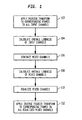
- Fig 1 shows a flow diagram of an equalized mixing procedure, according to one embodiment of the present invention.
- 1 ⁇ N ⁇ M 1 ⁇ N ⁇ M.
- a short-time Fourier transform is applied to frames of each time-domain input channel signal (step 102), where the complex STFT transform of a short-time frame with index k of input channel signal X n,k (t) is denoted as X n,k ( ⁇ ).
- the STFT transform preferably includes the application of a window function when generating each time-domain signal frame from a continuous time signal.
- a window function consecution windows overlap in time, e.g. by 50% of the length of each window.
- ⁇ i.e., either greater than or less than 2
- the optimum choice of ⁇ may depend on many factors, including loudspeaker location, the acoustical properties of the playback system (e.g., monophonic, stereophonic, headphones), and the playback level.
- the spectral components X n,k ( ⁇ ) for frame k of the N-channel input signal are mixed to generate M sets of spectral components Y m,k ( ⁇ ) for frame k of the M -channel output signal (step 106 ).
- any suitable mixing algorithm may be applied to generate the mixed spectral components Y m,k ( ⁇ ), including the weighted summation techniques described in the Background of the Invention section.
- One possible weighted summation technique is represented by Equation (2) as follows: where W m,n is the weight applied to the n th input spectral component X n,k ( ⁇ ) when generating the m th mixed spectral component Y m,k ( ⁇ ).
- Equation (3) The overall short-time spectral loudness ⁇ k of frame k of the M mixed channels is calculated (step 108 ), according to Equation (3) as follows:
- the weighting factor ⁇ determines the time-domain smoothing in Equations (4) and (5) of the loudness estimates from Equations (1) and (3), respectively.
- the smoothed loudness estimates from Equations (4) and (5) will have smaller variations over time when ⁇ is larger.
- the initial smoothed loudness estimates ⁇ ⁇ 0 ( ⁇ ) and ⁇ ⁇ 0 ( ⁇ ) are preferably initialized to zero.
- the denominator of Equation (7) preferably includes a small positive constant ⁇ (e.g., 100 dB below the maximum signal level) to avoid a division by zero.
- the equalization of step 110 is intended to ensure that the M -channel output signal has equal estimated loudness as the original N -channel input signal.
- the time-domain channel signals Y' m ( t ) of the M -channel output signal are then generated by applying an inverse STFT transform to each equalized mixed spectrum Y' m,k ( ⁇ ) (step 112 ).
- an overlap-add procedure with the previous frame should be implemented.
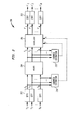
- Fig. 2 shows a block diagram of an equalized mixer 200 , according to one embodiment of the present invention.
- Equalized mixer 200 is configured to perform the processing of Fig. 1.
- equalized mixer 200 has N short-time Fourier transform (STFT) blocks 202 , a frequency-domain mixer 204 , a frequency-domain equalizer 206 , and M inverse short-time Fourier transform (ISTFT) blocks 208 .
- STFT short-time Fourier transform
- ISTFT inverse short-time Fourier transform
- equalized mixer 200 has two loudness estimation blocks 210 and 212 .
- Each transform block 202 performs part of step 102 of Fig. 1 to transform a different channel signal of an N -channel input signal into the frequency domain.
- Loudness estimation block 210 performs step 104 of Fig.
- equalized mixer 200 has been depicted with N different transform blocks operating in parallel and M different inverse transform blocks operating in parallel, in alternative embodiments, as few as one transform block and/or as few as one inverse transform block can be operated in a serial, time-multiplexed manner to process multiple, different signals.
- an equalized mixer of the present invention can be implemented using a single loudness estimator that generates overall spectral loudness measures for both the N input channel signals and the M mixed channel signals.
- the present invention has been described in the context of continuous time t and continuous frequency ⁇ , the present invention can also be implemented in discrete time and discrete frequency, e.g., using a discrete Fourier transform (DFT). Moreover, the present invention is not limited to Fourier transforms, be they continuous or discrete. In general, the present invention can be implemented using any suitable orthogonal transform or filter bank that is, preferably, energy preserving. In theory, it is also possible to implement the equalized mixing of the present invention in the time domain using adaptive filtering.
- DFT discrete Fourier transform
- the mixing techniques of the present invention can be applied in many different audio coding and sound engineering applications involving the mixing of audio signals, especially those that deal with the whole audio bandwidth, without having the problem of merging different generated parts of the spectrum.
- the mixing process is improved by "spectral equalization," wherein the total spectral energy and/or loudness of all output channels is maintained approximately equal to the total spectral energy and/or loudness of all input channels.
- the present invention can also be implemented in partial-bandwidth applications, in which equalized mixing is performed on only one or more portions of the full bandwidth of the audio signals.
- the present invention may be implemented as circuit-based processes, including possible implementation on a single integrated circuit.
- various functions of circuit elements may also be implemented as processing steps in a software program.
- Such software may be employed in, for example, a digital signal processor, micro-controller, or general-purpose computer.
- the present invention can be embodied in the form of methods and apparatuses for practicing those methods.
- the present invention can also be embodied in the form of program code embodied in tangible media, such as floppy diskettes, CD-ROMs, hard drives, or any other machine-readable storage medium, wherein, when the program code is loaded into and executed by a machine, such as a computer, the machine becomes an apparatus for practicing the invention.
- the present invention can also be embodied in the form of program code, for example, whether stored in a storage medium, loaded into and/or executed by a machine, or transmitted over some transmission medium or carrier, such as over electrical wiring or cabling, through fiber optics, or via electromagnetic radiation, wherein, when the program code is loaded into and executed by a machine, such as a computer, the machine becomes an apparatus for practicing the invention.
- program code When implemented on a general-purpose processor, the program code segments combine with the processor to provide a unique device that operates analogously to specific logic circuits.
Landscapes
- Engineering & Computer Science (AREA)
- Physics & Mathematics (AREA)
- Acoustics & Sound (AREA)
- Signal Processing (AREA)
- Multimedia (AREA)
- Computational Linguistics (AREA)
- Health & Medical Sciences (AREA)
- Audiology, Speech & Language Pathology (AREA)
- Human Computer Interaction (AREA)
- Mathematical Physics (AREA)
- Tone Control, Compression And Expansion, Limiting Amplitude (AREA)
- Stereophonic System (AREA)
- Amplifiers (AREA)
- Circuit For Audible Band Transducer (AREA)
Abstract
During mixing of an N-channel input signal to generate an M-channel output signal, the mixed channel signals are equalized (e.g., amplified) to maintain the overall energy/loudness level of the output signal substantially equal to the overall energy/loudness level of the input signal. In one embodiment, the N input channel signals are converted to the frequency domain on a frame-by-frame basis, and the overall spectral loudness of the N-channel input signal is estimated. After mixing the spectral components for the N input channel signals (e.g., using weighted summation), the overall spectral loudness of the resulting M mixed channel signals is also estimated. A frequency-dependent gain factor, which is based on the two loudness estimates, is applied to the spectral components of the M mixed channel signals to generate M equalized mixed channel signals. The M-channel output signal is generated by converting the M equalized mixed channel signals to the time domain.
Description
- The present invention relates to audio signal processing and, in particular, to mixing audio signals.
- A common problem in many areas of audio recording, audio production, and audio coding is the mixing of a number of input audio channels to generate a different number of output audio channels. The change in the number of channels can be motivated by, e.g., a difference between the number of audio tracks (channels) of the recording device and the number of channels supported by the playback system or a difference between the number of channels of the distribution medium (e.g., CD, DVD, radio) and the number of channels supported by the playback system.
One example is FM radio where audio is usually delivered as a two-channel stereo signal, but many receivers have only one playback channel (one loudspeaker). In such case, the two stereo channels are typically down-mixed to form a single mono audio signal for playback. Another example of down-mixing occurs when the multiple (e.g., five) channels of an input signal conforming to a surround audio format, e.g., 5.1 surround, are down-mixed for playback, e.g., using a two-channel stereo system.
In addition to down-mixing (i.e., where the number of output channels is less than the number of input channels), mixing of audio signals may involve up-mixing (i.e., where the number of output channels is greater than the number of input channels). An example of up-mixing is the generation of a three-channel output signal (e.g., left, right, and center) from a two-channel (e.g., left, right) input signal.
Both down-mixing and up-mixing should be performed using processes that degrade the spatial image quality as little as possible. In a conventional mixing process, each output channel is derived from a weighted summation of the input channels in the time domain, where "panning laws" or "matrixing schemes" are applied to determine the weight of each input channel for each output channel.
By operating on signals in the time domain, conventional mixing techniques are applied to the full bandwidth of the audio channels. One drawback of such mixing techniques is a possible loss of spectral energy and/or loudness when some of the spectral components of the input audio channels are not aligned in phase. Such phase differences commonly occur, for instance, in multiple-microphone recordings, when each microphone has a different distance to the sound source. As a result, different phases are introduced in the microphone signals. In the extreme case of a 180-degree phase shift between two input channels of the same amplitude, an output channel composed of the input-channel sum would have zero energy since the input signals would cancel each other. In a realistic scenario, the signal energy and/or loudness can significantly drop for some spectral components in the output channels due to the misaligned signal phases. This energy/loudness loss is audible as a coloration effect.
Coloration effects were studied to a large extent in the framework of the "mono-compatibility" problem at the time when two-channel stereo sound was widely introduced in the 1950's and 60's. See, e.g., F.K. Harvey and E.H. Uecke, "Compatibility problems in two-channel stereophonic recordings," 13th AES meeting, preprint 197, Oct. 1961, the teachings of which are incorporated herein by reference. The goal of these studies was to find ways to create a two-channel stereo signal that would largely maintain the perceived loudness over frequency when both channels are mixed to mono. Some sample solutions are to impose a phase shift of +45 and -45 degrees on the left and right audio signals, respectively,before summation or to use coincidence microphones for the recording (where both microphones have the same distance from the sound source). Although these techniques tend to reduce the coloration effect for particular situations, there are many audio processing applications in which these techniques either cannot be applied and/or will not provide satisfactory results. - The problems of the prior art are addressed in accordance with principles of the present invention by an equalized mixing technique that enables the energy and/or loudness levels of a mixer's output signals to match the energy and/or loudness levels of the mixer's input signals, such that coloration effects are reduced and possibly avoided. In one embodiment, the time-domain channel signals of an N-channel input signal are transformed to a frequency domain, where the resulting spectral components are mixed and then adaptively amplified in order to adjust for loss of spectral energy and/or loudness during the mixing process. An inverse transform is then applied to the resulting equalized mixed channel spectra to generate the time-domain channel signals of an M-channel output signal.
According to one embodiment, the present invention is a method for mixing an N-channel input audio signal to generate an M-channel output audio signal, where N and M are positive integers. According to the method, a first loudness measure is generated for the N-channel input audio signal. The N input channel signals corresponding to the N-channel input audio signal are mixed to generate M mixed channel signals, and a second loudness measure is generated for the M mixed channel signals. The M mixed channel signals are equalized based on the first and second loudness measures to generate the M-channel output audio signal. - According to another embodiment, the present invention is an M-channel output audio signal generated by the previously described method.
- According to yet another embodiment, the present invention is an apparatus for mixing an N-channel input audio signal to generate a M-channel output audio signal, where N and M are positive integers. The apparatus comprises a mixer, one or more loudness estimators, and an equalizer. The mixer is configured to mix N input channel signals corresponding to the N-channel input audio signal to generate M mixed channel signals. The equalizer is configured to equalize the M mixed channel signals based on the first and second loudness measures to generate the M-channel output audio signal.
- Preferably in the apparatus, the equalizer is configured to amplify the M mixed channel signals using a gain factor that is based on the first and second loudness measures to maintain the overall loudness of the M-channel output audio signal substantially equal to the overall loudness of the N-channel input audio signal.
- Preferably the apparatus further comprises a set of one or more transform blocks configured to transform the N-channel input audio signal from a time domain into a frequency domain, and a set of one or more inverse transform blocks configured to transform the M equalized mixed channel signals from the frequency domain into the time domain to generate the M-channel output audio signal.
- Preferably, the one or more loudness estimators are configured to generate a first spectral loudness measure for the input audio signal and a second spectral loudness measure for the M mixed channel signals; the first and second loudness measures are the first and second spectral loudness measures, respectively and the equalizer is configured to equalise the M mixed channel signals based on the first and second spectral loudness measures to generate the M equalized mixed channel signals.
- Preferably, the equalizer is configured to amplify the M mixed channel signals using a frequency-dependent gain factor that is based on the first and second spectral loudness measures to maintain overall spectral loudness of the M-channel output audio signal substantially equal to the overall spectral loudness of the N-channel input audio signal.
- Preferably, the one or more loudness estimators are configured to smooth the first and second spectral loudness measures over time.
- Other aspects, features, and advantages of the present invention will become more fully apparent from the following detailed description, the appended claims, and the accompanying drawings in which:
- Fig 1 shows a flow diagram of an equalized mixing procedure, according to one embodiment of the present invention; and
- Fig 2 shows a block diagram of an equalized mixer, according to one embodiment of the present invention.
- Fig 1 shows a flow diagram of an equalized mixing procedure, according to one embodiment of the present invention. In particular, the processing of Fig 1 corresponds to the mixing of an N-channel input signal to generate an M-channel output signal, where the input signal has N time-domain channel signals xn(t), n=1, ..., N, and the output signal has M time-domain channel signals y'm(t), m=1, ..., M.
- For down-mixing applications, N>M≥ 1. For example, when down-mixing a stereo input signal to a mono output signal, N=2 and M=1. For up-mixing applications, 1≤ N <M. For example, when up-mixing a stereo input signal to a three-channel output signal, N=2 and M=3. It is also possible for a mixing application to have the same number of input and output channels (i.e., N=M>2).
- According to the processing of Fig. 1, a short-time Fourier transform (STFT) is applied to frames of each time-domain input channel signal (step 102), where the complex STFT transform of a short-time frame with index k of input channel signal Xn,k(t) is denoted as Xn,k(ω). In order to improve the spectral resolution, the STFT transform preferably includes the application of a window function when generating each time-domain signal frame from a continuous time signal. According to a typical window function, consecution windows overlap in time, e.g. by 50% of the length of each window.
- After transforming frame k for each of the N input channel signals, the overall short-time spectral loudness Γk of frame k of the N-channel input signal is calculated (step 104 ), according to Equation (1) as follows:

The spectral components X n,k (ω) for frame k of the N-channel input signal are mixed to generate M sets of spectral components Y m,k (ω) for frame k of the M-channel output signal (step 106). Depending on the particular application, any suitable mixing algorithm may be applied to generate the mixed spectral components Y m,k (ω), including the weighted summation techniques described in the Background of the Invention section. One possible weighted summation technique is represented by Equation (2) as follows:
- The overall short-time spectral loudness Λ k of frame k of the M mixed channels is calculated (step 108 ), according to Equation (3) as follows:

- The two spectral loudness estimates Γ k and Λ k are preferably smoothed over time, according to Equations (4) and (5) as follows:


- The mixed spectral components Y m,k (ω) are equalized (step 110) to generate equalized mixed spectral components Y' m,k (ω), according to Equation (6) as follows:


step 110 is intended to ensure that the M-channel output signal has equal estimated loudness as the original N-channel input signal. - The time-domain channel signals Y' m (t) of the M-channel output signal are then generated by applying an inverse STFT transform to each equalized mixed spectrum Y' m,k (ω) (step 112). When overlapping frames are employed, an overlap-add procedure with the previous frame should be implemented.
- Fig. 2 shows a block diagram of an equalized
mixer 200, according to one embodiment of the present invention. Equalizedmixer 200 is configured to perform the processing of Fig. 1. As shown in Fig. 2, equalizedmixer 200 has N short-time Fourier transform (STFT) blocks 202, a frequency-domain mixer 204, a frequency-domain equalizer 206, and M inverse short-time Fourier transform (ISTFT) blocks 208. In addition, equalizedmixer 200 has two loudness estimation blocks 210 and 212. Eachtransform block 202 performs part ofstep 102 of Fig. 1 to transform a different channel signal of an N-channel input signal into the frequency domain.Loudness estimation block 210 performsstep 104 of Fig. 1 to calculate (and smooth) the overall estimated loudness Γ of the N-channel input signal.Mixer 204 performsstep 106 of Fig. 1 to generate M mixed spectra.Loudness estimation block 212 performsstep 108 of Fig. 1 to calculate (and smooth) the overall estimated loudness Λ of the M mixed spectra.Equalizer 206 performsstep 110 of Fig. 1 to equalize the M mixed spectra. EachISTFT block 208 performs part ofstep 112 of Fig. 1 to transform a different one of the resulting M equalized mixed spectra to the time domain, thereby generating a different channel of an M-channel output signal. - Although equalized
mixer 200 has been depicted with N different transform blocks operating in parallel and M different inverse transform blocks operating in parallel, in alternative embodiments, as few as one transform block and/or as few as one inverse transform block can be operated in a serial, time-multiplexed manner to process multiple, different signals. Similarly, an equalized mixer of the present invention can be implemented using a single loudness estimator that generates overall spectral loudness measures for both the N input channel signals and the M mixed channel signals. - Although the present invention has been described in the context of continuous time t and continuous frequency ω, the present invention can also be implemented in discrete time and discrete frequency, e.g., using a discrete Fourier transform (DFT). Moreover, the present invention is not limited to Fourier transforms, be they continuous or discrete. In general, the present invention can be implemented using any suitable orthogonal transform or filter bank that is, preferably, energy preserving. In theory, it is also possible to implement the equalized mixing of the present invention in the time domain using adaptive filtering.
- The mixing techniques of the present invention can be applied in many different audio coding and sound engineering applications involving the mixing of audio signals, especially those that deal with the whole audio bandwidth, without having the problem of merging different generated parts of the spectrum. According to the present invention, the mixing process is improved by "spectral equalization," wherein the total spectral energy and/or loudness of all output channels is maintained approximately equal to the total spectral energy and/or loudness of all input channels. The present invention can also be implemented in partial-bandwidth applications, in which equalized mixing is performed on only one or more portions of the full bandwidth of the audio signals.
- The present invention may be implemented as circuit-based processes, including possible implementation on a single integrated circuit. As would be apparent to one skilled in the art, various functions of circuit elements may also be implemented as processing steps in a software program. Such software may be employed in, for example, a digital signal processor, micro-controller, or general-purpose computer.
- The present invention can be embodied in the form of methods and apparatuses for practicing those methods. The present invention can also be embodied in the form of program code embodied in tangible media, such as floppy diskettes, CD-ROMs, hard drives, or any other machine-readable storage medium, wherein, when the program code is loaded into and executed by a machine, such as a computer, the machine becomes an apparatus for practicing the invention. The present invention can also be embodied in the form of program code, for example, whether stored in a storage medium, loaded into and/or executed by a machine, or transmitted over some transmission medium or carrier, such as over electrical wiring or cabling, through fiber optics, or via electromagnetic radiation, wherein, when the program code is loaded into and executed by a machine, such as a computer, the machine becomes an apparatus for practicing the invention. When implemented on a general-purpose processor, the program code segments combine with the processor to provide a unique device that operates analogously to specific logic circuits.
- It will be further understood that various changes in the details, materials, and arrangements of the parts which have been described and illustrated in order to explain the nature of this invention may be made by those skilled in the art without departing from the scope of the invention as expressed in the following claims.
Claims (10)
- A method for mixing an N-channel input audio signal to generate an M-channel output audio signal, where N and M are positive integers, the method comprising the steps of:(a) generating a first loudness measure for the N-channel input audio signal;(b) mixing N input channel signals corresponding to the N-channel input audio signal to generate M mixed channel signals;(c) generating a second loudness measure for the M mixed channel signals; and(d) equalizing the M mixed channel signals based on the first and second loudness measures to generate the M-channel output audio signal.
- A method of generating a M-channel output audio signal, the method comprising the steps of:(a) generating a first loudness measure for an N-channel input audio signal;(b) mixing N input channel signals corresponding to the N-channel input audio signal to generate M mixed channel signals, where N and Mare positive integers;(c) generating a second loudness measure for the M mixed channel signals; and(d) equalizing the M mixed channel signals based on the first and second loudness measures to generate the M-channel output audio signal.
- The method as claimed in claim 1 or 2, wherein step (d) comprises the step of amplifying the M mixed channel signals using a gain factor that is based on the first and second loudness measures to maintain the overall loudness of the M-channel output audio signal substantially equal to the overall loudness of the N-channel input audio signal.
- The method as claimed in any of claims 1 to 3, wherein:step (a) comprises the steps of:(1) transforming the N-channel input audio signal from a time domain into a frequency domain; and(2) generating a first spectral loudness measure for the input audio signal;step (c) comprises the step of generating a second spectral loudness measure for the M mixed channel signals;the first and second loudness measures are the first and second spectral loudness measures, respectively; andstep (d) comprises the steps of:(1) equalizing the M mixed channel signals based on the first and second spectral loudness measures to generate M equalized mixed channel signals; and(2) transforming the M equalized mixed channel signals from the frequency domain into the time domain to generate the M-channel output audio signal.
- The method as claimed in claim 4, wherein step (d)(1) comprises the step of amplifying the M mixed channel signals using a frequency-dependent gain factor that is based on the first and second spectral loudness measures to maintain the overall spectral loudness of the M-channel output audio signal substantially equal to the overall spectral loudness of the N-channel input audio signal.
- The method as claimed in claim 4 or 5, wherein the first and second spectral loudness measures are smoothed over time.
- The method as claimed in any of claims 4 to 6, wherein:step (a)(1) comprises the step of applying a short-time Fourier transform (STFT) to each frame of each input channel signal;step (d)(2) comprises the step of applying an inverse STFT (ISTFT) to each frame of each equalized mixed channel signal; andconsecutive frames of each input channel signal overlap in time.
- The method as claimed in any of claims 1 to 7, wherein: when N> M, the N-channel input audio signal is down-mixed to generate the M-channel output audio signal; and when N < M, the N-channel input audio signal is up-mixed to generate the M-channel output audio signal.
- The method as claimed in any of claims 1 to 8, wherein step (b) comprises the step of mixing based on weighted summation to generate the M mixed channel signals from the N input channel signals.
- An apparatus for mixing an N-channel input audio signal to generate an M-channel output audio signal, where N and M are positive integers, the apparatus comprising:(a) a mixer configured to mix N input channel signals corresponding to the N-channel input audio signal to generate M mixed channel signals;(b) one or more loudness estimators configured to generate a first loudness measure for the N-channel input audio signal and a second loudness measure for the M mixed channel signals; and(c) an equalizer configured to equalize the M mixed channel signals based on the first and second loudness measures to generate the M-channel output audio signal.
Applications Claiming Priority (4)
| Application Number | Priority Date | Filing Date | Title |
|---|---|---|---|
| US39109502P | 2002-06-24 | 2002-06-24 | |
| US391095P | 2002-06-24 | ||
| US10/246,165 US7039204B2 (en) | 2002-06-24 | 2002-09-18 | Equalization for audio mixing |
| US246165 | 2002-09-18 |
Publications (1)
| Publication Number | Publication Date |
|---|---|
| EP1377123A1 true EP1377123A1 (en) | 2004-01-02 |
Family
ID=29718508
Family Applications (1)
| Application Number | Title | Priority Date | Filing Date |
|---|---|---|---|
| EP03253971A Withdrawn EP1377123A1 (en) | 2002-06-24 | 2003-06-24 | Equalization for audio mixing |
Country Status (3)
| Country | Link |
|---|---|
| US (1) | US7039204B2 (en) |
| EP (1) | EP1377123A1 (en) |
| JP (1) | JP4307917B2 (en) |
Cited By (9)
| Publication number | Priority date | Publication date | Assignee | Title |
|---|---|---|---|---|
| WO2005093717A1 (en) * | 2004-03-12 | 2005-10-06 | Nokia Corporation | Synthesizing a mono audio signal based on an encoded miltichannel audio signal |
| WO2006120419A1 (en) * | 2005-05-09 | 2006-11-16 | Sony Computer Entertainment Europe Ltd | Audio processing |
| EP1909284A1 (en) * | 2006-09-29 | 2008-04-09 | Kabushi Kaisha Toshiba | Sound mixing processing apparatus and sound mixing processing method |
| KR100923478B1 (en) * | 2004-03-12 | 2009-10-27 | 노키아 코포레이션 | Synthesizing a mono audio signal based on an encoded multichannel audio signal |
| WO2009109374A3 (en) * | 2008-03-04 | 2010-04-01 | Fraunhofer-Gesellschaft zur Förderung der angewandten Forschung e.V. | Mixing of input data streams and generation of an output data stream therefrom |
| RU2407227C2 (en) * | 2006-07-07 | 2010-12-20 | Фраунхофер-Гезелльшафт Цур Фердерунг Дер Ангевандтен Форшунг Е.Ф. | Concept for combination of multiple parametrically coded audio sources |
| US8046217B2 (en) | 2004-08-27 | 2011-10-25 | Panasonic Corporation | Geometric calculation of absolute phases for parametric stereo decoding |
| EP2579247A1 (en) * | 2011-09-30 | 2013-04-10 | Harman International Industries, Inc. | Methods and systems for measuring and reporting an energy level of a sound component within a sound mix |
| USRE50697E1 (en) | 2006-07-07 | 2025-12-09 | Fraunhofer-Gesellschaft Zur Foerderung Der Angewandten Forschung E.V. | Concept for combining multiple parametrically coded audio sources |
Families Citing this family (48)
| Publication number | Priority date | Publication date | Assignee | Title |
|---|---|---|---|---|
| US8767969B1 (en) | 1999-09-27 | 2014-07-01 | Creative Technology Ltd | Process for removing voice from stereo recordings |
| US7072477B1 (en) * | 2002-07-09 | 2006-07-04 | Apple Computer, Inc. | Method and apparatus for automatically normalizing a perceived volume level in a digitally encoded file |
| US7970144B1 (en) * | 2003-12-17 | 2011-06-28 | Creative Technology Ltd | Extracting and modifying a panned source for enhancement and upmix of audio signals |
| ES2426917T3 (en) * | 2004-04-05 | 2013-10-25 | Koninklijke Philips N.V. | Encoder, decoder, methods and associated audio system |
| KR101120911B1 (en) * | 2004-07-02 | 2012-02-27 | 파나소닉 주식회사 | Audio signal decoding device and audio signal encoding device |
| TWI393121B (en) | 2004-08-25 | 2013-04-11 | 杜比實驗室特許公司 | Method and apparatus for processing a set of N sound signals and computer programs associated therewith |
| JP5166030B2 (en) * | 2004-09-06 | 2013-03-21 | コーニンクレッカ フィリップス エレクトロニクス エヌ ヴィ | Audio signal enhancement |
| SE0402652D0 (en) * | 2004-11-02 | 2004-11-02 | Coding Tech Ab | Methods for improved performance of prediction based multi-channel reconstruction |
| JP2008530958A (en) * | 2005-02-17 | 2008-08-07 | パナソニック オートモーティブ システムズ カンパニー オブ アメリカ ディビジョン オブ パナソニック コーポレイション オブ ノース アメリカ | Method and apparatus for optimizing playback of audio source material in an audio system |
| US7573912B2 (en) * | 2005-02-22 | 2009-08-11 | Fraunhofer-Gesellschaft Zur Foerderung Der Angewandten Forschunng E.V. | Near-transparent or transparent multi-channel encoder/decoder scheme |
| US7991610B2 (en) * | 2005-04-13 | 2011-08-02 | Fraunhofer-Gesellschaft Zur Foerderung Der Angewandten Forschung E.V. | Adaptive grouping of parameters for enhanced coding efficiency |
| US20060235683A1 (en) * | 2005-04-13 | 2006-10-19 | Fraunhofer-Gesellschaft Zur Forderung Der Angewandten Forschung E.V. | Lossless encoding of information with guaranteed maximum bitrate |
| JP4938015B2 (en) * | 2005-09-13 | 2012-05-23 | コーニンクレッカ フィリップス エレクトロニクス エヌ ヴィ | Method and apparatus for generating three-dimensional speech |
| US20070135952A1 (en) * | 2005-12-06 | 2007-06-14 | Dts, Inc. | Audio channel extraction using inter-channel amplitude spectra |
| US8081762B2 (en) * | 2006-01-09 | 2011-12-20 | Nokia Corporation | Controlling the decoding of binaural audio signals |
| WO2007080211A1 (en) * | 2006-01-09 | 2007-07-19 | Nokia Corporation | Decoding of binaural audio signals |
| EP1999997B1 (en) * | 2006-03-28 | 2011-04-13 | Fraunhofer-Gesellschaft zur Förderung der angewandten Forschung e.V. | Enhanced method for signal shaping in multi-channel audio reconstruction |
| US9197977B2 (en) * | 2007-03-01 | 2015-11-24 | Genaudio, Inc. | Audio spatialization and environment simulation |
| US8934640B2 (en) * | 2007-05-17 | 2015-01-13 | Creative Technology Ltd | Microphone array processor based on spatial analysis |
| WO2010075377A1 (en) | 2008-12-24 | 2010-07-01 | Dolby Laboratories Licensing Corporation | Audio signal loudness determination and modification in the frequency domain |
| WO2010138311A1 (en) | 2009-05-26 | 2010-12-02 | Dolby Laboratories Licensing Corporation | Equalization profiles for dynamic equalization of audio data |
| WO2010138309A1 (en) | 2009-05-26 | 2010-12-02 | Dolby Laboratories Licensing Corporation | Audio signal dynamic equalization processing control |
| US9055374B2 (en) * | 2009-06-24 | 2015-06-09 | Arizona Board Of Regents For And On Behalf Of Arizona State University | Method and system for determining an auditory pattern of an audio segment |
| JP5448771B2 (en) * | 2009-12-11 | 2014-03-19 | キヤノン株式会社 | Sound processing apparatus and method |
| CN103188595B (en) * | 2011-12-31 | 2015-05-27 | 展讯通信(上海)有限公司 | Method and system of processing multichannel audio signals |
| US9685921B2 (en) * | 2012-07-12 | 2017-06-20 | Dts, Inc. | Loudness control with noise detection and loudness drop detection |
| CN116741187A (en) | 2013-04-05 | 2023-09-12 | 杜比国际公司 | Stereo audio encoders and decoders |
| JP6543627B2 (en) | 2013-07-30 | 2019-07-10 | ディーティーエス・インコーポレイテッドDTS,Inc. | Matrix decoder with constant output pairwise panning |
| EP2854133A1 (en) | 2013-09-27 | 2015-04-01 | Fraunhofer-Gesellschaft zur Förderung der angewandten Forschung e.V. | Generation of a downmix signal |
| KR102294767B1 (en) | 2013-11-27 | 2021-08-27 | 디티에스, 인코포레이티드 | Multiplet-based matrix mixing for high-channel count multichannel audio |
| JP6313641B2 (en) * | 2014-03-25 | 2018-04-18 | 日本放送協会 | Channel number converter |
| JP6285790B2 (en) * | 2014-03-25 | 2018-02-28 | 日本放送協会 | Channel number converter |
| JP6510870B2 (en) * | 2015-04-20 | 2019-05-08 | 日本放送協会 | Program sound channel number conversion device, broadcast program reception device, and program sound channel number conversion program |
| JP6637736B2 (en) * | 2015-11-13 | 2020-01-29 | 日本放送協会 | Loudness adjusting device and program |
| JP6637735B2 (en) * | 2015-11-13 | 2020-01-29 | 日本放送協会 | Sound feature adjustment device and program |
| WO2017087460A1 (en) * | 2015-11-16 | 2017-05-26 | D-Box Technologies Inc. | Method and system for synchronizing vibro-kinetic effects to a virtual reality session |
| US9947332B2 (en) | 2015-12-11 | 2018-04-17 | Ibiquity Digital Corporation | Method and apparatus for automatic audio alignment in a hybrid radio system |
| US9755598B2 (en) | 2015-12-18 | 2017-09-05 | Ibiquity Digital Corporation | Method and apparatus for level control in blending an audio signal in an in-band on-channel radio system |
| EP3335218B1 (en) * | 2016-03-16 | 2019-06-05 | Huawei Technologies Co., Ltd. | An audio signal processing apparatus and method for processing an input audio signal |
| JP6703884B2 (en) * | 2016-04-13 | 2020-06-03 | 日本放送協会 | Channel number converter, broadcast receiver and program |
| US9820073B1 (en) | 2017-05-10 | 2017-11-14 | Tls Corp. | Extracting a common signal from multiple audio signals |
| JP6854194B2 (en) * | 2017-06-02 | 2021-04-07 | 日本放送協会 | Content provision system, multimedia distribution device, terminal device and program |
| US10484115B2 (en) | 2018-02-09 | 2019-11-19 | Ibiquity Digital Corporation | Analog and digital audio alignment in the HD radio exciter engine (exgine) |
| US10177729B1 (en) | 2018-02-19 | 2019-01-08 | Ibiquity Digital Corporation | Auto level in digital radio systems |
| EP3550561A1 (en) * | 2018-04-06 | 2019-10-09 | Fraunhofer-Gesellschaft zur Förderung der angewandten Forschung e.V. | Downmixer, audio encoder, method and computer program applying a phase value to a magnitude value |
| CN109121067B (en) * | 2018-10-19 | 2020-06-09 | 北京声加科技有限公司 | Multichannel loudness equalization method and apparatus |
| CN112750444B (en) * | 2020-06-30 | 2023-12-12 | 腾讯科技(深圳)有限公司 | Mixing methods, devices and electronic equipment |
| CN121034323A (en) * | 2020-07-17 | 2025-11-28 | 华为技术有限公司 | Multi-channel audio signal encoding and decoding method and apparatus |
Citations (2)
| Publication number | Priority date | Publication date | Assignee | Title |
|---|---|---|---|---|
| US5636324A (en) * | 1992-03-30 | 1997-06-03 | Matsushita Electric Industrial Co., Ltd. | Apparatus and method for stereo audio encoding of digital audio signal data |
| US5812969A (en) * | 1995-04-06 | 1998-09-22 | Adaptec, Inc. | Process for balancing the loudness of digitally sampled audio waveforms |
Family Cites Families (2)
| Publication number | Priority date | Publication date | Assignee | Title |
|---|---|---|---|---|
| US6111958A (en) * | 1997-03-21 | 2000-08-29 | Euphonics, Incorporated | Audio spatial enhancement apparatus and methods |
| KR100635022B1 (en) * | 2002-05-03 | 2006-10-16 | 하만인터내셔날인더스트리스인코포레이티드 | Multichannel Downmixing Unit |
-
2002
- 2002-09-18 US US10/246,165 patent/US7039204B2/en not_active Expired - Lifetime
-
2003
- 2003-06-24 EP EP03253971A patent/EP1377123A1/en not_active Withdrawn
- 2003-06-24 JP JP2003179073A patent/JP4307917B2/en not_active Expired - Fee Related
Patent Citations (2)
| Publication number | Priority date | Publication date | Assignee | Title |
|---|---|---|---|---|
| US5636324A (en) * | 1992-03-30 | 1997-06-03 | Matsushita Electric Industrial Co., Ltd. | Apparatus and method for stereo audio encoding of digital audio signal data |
| US5812969A (en) * | 1995-04-06 | 1998-09-22 | Adaptec, Inc. | Process for balancing the loudness of digitally sampled audio waveforms |
Non-Patent Citations (6)
| Title |
|---|
| BERNARDINI A ET AL: "One-shot Digital Equalization For Nonlinear Modulations", CONFERENCE PROCEEDINGS ARTICLE, 19 March 1992 (1992-03-19), pages 252 - 263, XP010322100 * |
| BERNARDINI A.; DE FINA S.: "One-shot digital equalization for nonlinear modulations", CONFERENCE PROCEEDINGS ARTICLE, 19 March 1992 (1992-03-19), pages 252 - 263, XP010322100 * |
| CHOI Y. ET AL: "A new digital surround processing system for general A/V sources", IEEE TRANSACTIONS ON CONSUMER ELECTRONICS, vol. 41, no. 4, 30 November 1995 (1995-11-30), NEW YORK, pages 1174 - 1180, XP000553496, DOI: 10.1109/30.477238 * |
| FRHLICH T.; DILLIER N.: "DSP-implementation of a multiband loudness correction hearing aid", PROCEEDINGS OPF ANNUAL INTERNATIONAL CONFERENCE OF THE IEEE ENGINEERING IN MEDICINE AND BIOLOGY SOCIETEY, vol. 13, no. 4, 31 October 1991 (1991-10-31), NEW YORK, pages 1889 - 1890, XP010101951 * |
| FROHLICH T ET AL: "DSP-implementation Of A Multiband Loudness Correction Hearing Aid", ENGINEERING IN MEDICINE AND BIOLOGY SOCIETY, 1991. VOL.13: 1991., PROCEEDINGS OF THE ANNUAL INTERNATIONAL CONFERENCE OF THE IEEE ORLANDO, FL, USA 31 OCT.-3 NOV. 1991, NEW YORK, NY, USA,IEEE, US, 31 October 1991 (1991-10-31), pages 1889 - 1890, XP010101951, ISBN: 0-7803-0216-8 * |
| YEONGHA CHOI ET AL: "A NEW DIGITAL SURROUND PROCESSING SYSTEM FOR GENERAL A/V SOURCES", IEEE TRANSACTIONS ON CONSUMER ELECTRONICS, IEEE INC. NEW YORK, US, vol. 41, no. 4, 1 November 1995 (1995-11-01), pages 1174 - 1180, XP000553496, ISSN: 0098-3063 * |
Cited By (28)
| Publication number | Priority date | Publication date | Assignee | Title |
|---|---|---|---|---|
| US7899191B2 (en) | 2004-03-12 | 2011-03-01 | Nokia Corporation | Synthesizing a mono audio signal |
| WO2005093717A1 (en) * | 2004-03-12 | 2005-10-06 | Nokia Corporation | Synthesizing a mono audio signal based on an encoded miltichannel audio signal |
| AU2004317678B2 (en) * | 2004-03-12 | 2009-02-05 | Nokia Technologies Oy | Synthesizing a mono audio signal based on an encoded multichannel audio signal |
| AU2004317678C1 (en) * | 2004-03-12 | 2009-09-24 | Nokia Technologies Oy | Synthesizing a mono audio signal based on an encoded multichannel audio signal |
| KR100923478B1 (en) * | 2004-03-12 | 2009-10-27 | 노키아 코포레이션 | Synthesizing a mono audio signal based on an encoded multichannel audio signal |
| RU2381571C2 (en) * | 2004-03-12 | 2010-02-10 | Нокиа Корпорейшн | Synthesisation of monophonic sound signal based on encoded multichannel sound signal |
| CN1926610B (en) * | 2004-03-12 | 2010-10-06 | 诺基亚公司 | Method for synthesizing monophonic audio signal, audio decoder and coding system |
| US8046217B2 (en) | 2004-08-27 | 2011-10-25 | Panasonic Corporation | Geometric calculation of absolute phases for parametric stereo decoding |
| WO2006120419A1 (en) * | 2005-05-09 | 2006-11-16 | Sony Computer Entertainment Europe Ltd | Audio processing |
| GB2426168B (en) * | 2005-05-09 | 2008-08-27 | Sony Comp Entertainment Europe | Audio processing |
| USRE50857E1 (en) | 2006-07-07 | 2026-04-07 | Fraunhofer-Gesellschaft Zur Foerderung Der Angewandten Forschung E.V. | Concept for combining multiple parametrically coded audio sources |
| RU2407227C2 (en) * | 2006-07-07 | 2010-12-20 | Фраунхофер-Гезелльшафт Цур Фердерунг Дер Ангевандтен Форшунг Е.Ф. | Concept for combination of multiple parametrically coded audio sources |
| USRE50818E1 (en) | 2006-07-07 | 2026-03-10 | Fraunhofer-Gesellschaft Zur Foerderung Der Angewandten Forschung E.V. | Concept for combining multiple parametrically coded audio sources |
| USRE50697E1 (en) | 2006-07-07 | 2025-12-09 | Fraunhofer-Gesellschaft Zur Foerderung Der Angewandten Forschung E.V. | Concept for combining multiple parametrically coded audio sources |
| USRE50772E1 (en) | 2006-07-07 | 2026-01-27 | Fraunhofer-Gesellschaft Zur Foerderung Der Angewandten Forschung E.V. | Concept for combining multiple parametrically coded audio sources |
| USRE50746E1 (en) | 2006-07-07 | 2026-01-06 | Fraunhofer-Gesellschaft Zur Foerderung Der Angewandten Forschung E.V. | Concept for combining multiple parametrically coded audio sources |
| USRE50721E1 (en) | 2006-07-07 | 2025-12-30 | Fraunhofer-Gesellschaft Zur Foerderung Der Angewandten Forschung E.V. | Concept for combining multiple parametrically coded audio sources |
| EP1909284A1 (en) * | 2006-09-29 | 2008-04-09 | Kabushi Kaisha Toshiba | Sound mixing processing apparatus and sound mixing processing method |
| US8116486B2 (en) | 2008-03-04 | 2012-02-14 | Fraunhofer-Gesellschaft Zur Foerderung Der Angewandten Forschung E.V. | Mixing of input data streams and generation of an output data stream therefrom |
| RU2488896C2 (en) * | 2008-03-04 | 2013-07-27 | Фраунхофер-Гезелльшафт цур Фёрдерунг дер ангевандтен Форшунг Е.Ф. | Mixing of incoming information flows and generation of outgoing information flow |
| CN102016985B (en) * | 2008-03-04 | 2014-04-02 | 弗劳恩霍夫应用研究促进协会 | Mixes input streams and produces output streams from them |
| EP2378518A3 (en) * | 2008-03-04 | 2012-11-21 | Fraunhofer-Gesellschaft zur Förderung der angewandten Forschung e.V. | Mixing of input data streams and generation of an output data stream therefrom |
| US8290783B2 (en) | 2008-03-04 | 2012-10-16 | Fraunhofer-Gesellschaft Zur Foerderung Der Angewandten Forschung E.V. | Apparatus for mixing a plurality of input data streams |
| AU2009221444B2 (en) * | 2008-03-04 | 2012-06-14 | Fraunhofer-Gesellschaft Zur Foerderung Der Angewandten Forschung E.V. | Mixing of input data streams and generation of an output data stream therefrom |
| CN102016985A (en) * | 2008-03-04 | 2011-04-13 | 弗劳恩霍夫应用研究促进协会 | Mixes input streams and produces output streams from them |
| WO2009109374A3 (en) * | 2008-03-04 | 2010-04-01 | Fraunhofer-Gesellschaft zur Förderung der angewandten Forschung e.V. | Mixing of input data streams and generation of an output data stream therefrom |
| US9589550B2 (en) | 2011-09-30 | 2017-03-07 | Harman International Industries, Inc. | Methods and systems for measuring and reporting an energy level of a sound component within a sound mix |
| EP2579247A1 (en) * | 2011-09-30 | 2013-04-10 | Harman International Industries, Inc. | Methods and systems for measuring and reporting an energy level of a sound component within a sound mix |
Also Published As
| Publication number | Publication date |
|---|---|
| JP2004048741A (en) | 2004-02-12 |
| US7039204B2 (en) | 2006-05-02 |
| US20030235317A1 (en) | 2003-12-25 |
| JP4307917B2 (en) | 2009-08-05 |
Similar Documents
| Publication | Publication Date | Title |
|---|---|---|
| US7039204B2 (en) | Equalization for audio mixing | |
| US8090122B2 (en) | Audio mixing using magnitude equalization | |
| EP2614659B1 (en) | Upmixing method and system for multichannel audio reproduction | |
| US10354634B2 (en) | Method and system for denoise and dereverberation in multimedia systems | |
| US6449368B1 (en) | Multidirectional audio decoding | |
| US7894611B2 (en) | Spatial disassembly processor | |
| EP1790195B1 (en) | Method of mixing audio channels using correlated outputs | |
| US7970144B1 (en) | Extracting and modifying a panned source for enhancement and upmix of audio signals | |
| US10242692B2 (en) | Audio coherence enhancement by controlling time variant weighting factors for decorrelated signals | |
| CN105284133B (en) | Scaled and stereo enhanced apparatus and method based on being mixed under signal than carrying out center signal | |
| CN102833665A (en) | Audio spatial environment engine | |
| EP2730103B1 (en) | Method and apparatus for decomposing a stereo recording using frequency-domain processing employing a spectral subtractor | |
| EP2291002A1 (en) | Acoustic processing apparatus | |
| Karjalainen et al. | About room response equalization and dereverberation | |
| US9913036B2 (en) | Apparatus and method and computer program for generating a stereo output signal for providing additional output channels | |
| EP3171362B1 (en) | Bass enhancement and separation of an audio signal into a harmonic and transient signal component | |
| JP2004343590A (en) | Stereo sound signal processing method, apparatus, program, and storage medium | |
| CN103098494A (en) | Method and device for producing a downward compatible sound format | |
| Kadam et al. | Review Of Loudspeaker Equalization | |
| HK1197782A (en) | Method and apparatus for decomposing a stereo recording using frequency-domain processing employing a spectral subtractor | |
| HK1197782B (en) | Method and apparatus for decomposing a stereo recording using frequency-domain processing employing a spectral subtractor |
Legal Events
| Date | Code | Title | Description |
|---|---|---|---|
| PUAI | Public reference made under article 153(3) epc to a published international application that has entered the european phase |
Free format text: ORIGINAL CODE: 0009012 |
|
| AK | Designated contracting states |
Kind code of ref document: A1 Designated state(s): AT BE BG CH CY CZ DE DK EE ES FI FR GB GR HU IE IT LI LU MC NL PT RO SE SI SK TR |
|
| AX | Request for extension of the european patent |
Extension state: AL LT LV MK |
|
| 17P | Request for examination filed |
Effective date: 20040628 |
|
| AKX | Designation fees paid |
Designated state(s): DE FR GB |
|
| 17Q | First examination report despatched |
Effective date: 20050404 |
|
| STAA | Information on the status of an ep patent application or granted ep patent |
Free format text: STATUS: THE APPLICATION IS DEEMED TO BE WITHDRAWN |
|
| 18D | Application deemed to be withdrawn |
Effective date: 20051015 |