EP1376459A2 - Autonomous integrated-circuit card - Google Patents
Autonomous integrated-circuit card Download PDFInfo
- Publication number
- EP1376459A2 EP1376459A2 EP03012241A EP03012241A EP1376459A2 EP 1376459 A2 EP1376459 A2 EP 1376459A2 EP 03012241 A EP03012241 A EP 03012241A EP 03012241 A EP03012241 A EP 03012241A EP 1376459 A2 EP1376459 A2 EP 1376459A2
- Authority
- EP
- European Patent Office
- Prior art keywords
- chip
- present chip
- command
- key
- present
- Prior art date
- Legal status (The legal status is an assumption and is not a legal conclusion. Google has not performed a legal analysis and makes no representation as to the accuracy of the status listed.)
- Withdrawn
Links
Images


Classifications
-
- G—PHYSICS
- G07—CHECKING-DEVICES
- G07F—COIN-FREED OR LIKE APPARATUS
- G07F7/00—Mechanisms actuated by objects other than coins to free or to actuate vending, hiring, coin or paper currency dispensing or refunding apparatus
- G07F7/08—Mechanisms actuated by objects other than coins to free or to actuate vending, hiring, coin or paper currency dispensing or refunding apparatus by coded identity card or credit card or other personal identification means
- G07F7/10—Mechanisms actuated by objects other than coins to free or to actuate vending, hiring, coin or paper currency dispensing or refunding apparatus by coded identity card or credit card or other personal identification means together with a coded signal, e.g. in the form of personal identification information, like personal identification number [PIN] or biometric data
- G07F7/1008—Active credit-cards provided with means to personalise their use, e.g. with PIN-introduction/comparison system
-
- G—PHYSICS
- G06—COMPUTING OR CALCULATING; COUNTING
- G06K—GRAPHICAL DATA READING; PRESENTATION OF DATA; RECORD CARRIERS; HANDLING RECORD CARRIERS
- G06K19/00—Record carriers for use with machines and with at least a part designed to carry digital markings
- G06K19/06—Record carriers for use with machines and with at least a part designed to carry digital markings characterised by the kind of the digital marking, e.g. shape, nature, code
- G06K19/067—Record carriers with conductive marks, printed circuits or semiconductor circuit elements, e.g. credit or identity cards also with resonating or responding marks without active components
- G06K19/07—Record carriers with conductive marks, printed circuits or semiconductor circuit elements, e.g. credit or identity cards also with resonating or responding marks without active components with integrated circuit chips
-
- G—PHYSICS
- G06—COMPUTING OR CALCULATING; COUNTING
- G06K—GRAPHICAL DATA READING; PRESENTATION OF DATA; RECORD CARRIERS; HANDLING RECORD CARRIERS
- G06K19/00—Record carriers for use with machines and with at least a part designed to carry digital markings
- G06K19/06—Record carriers for use with machines and with at least a part designed to carry digital markings characterised by the kind of the digital marking, e.g. shape, nature, code
- G06K19/067—Record carriers with conductive marks, printed circuits or semiconductor circuit elements, e.g. credit or identity cards also with resonating or responding marks without active components
- G06K19/07—Record carriers with conductive marks, printed circuits or semiconductor circuit elements, e.g. credit or identity cards also with resonating or responding marks without active components with integrated circuit chips
- G06K19/073—Special arrangements for circuits, e.g. for protecting identification code in memory
-
- G—PHYSICS
- G06—COMPUTING OR CALCULATING; COUNTING
- G06K—GRAPHICAL DATA READING; PRESENTATION OF DATA; RECORD CARRIERS; HANDLING RECORD CARRIERS
- G06K7/00—Methods or arrangements for sensing record carriers, e.g. for reading patterns
-
- G—PHYSICS
- G06—COMPUTING OR CALCULATING; COUNTING
- G06Q—INFORMATION AND COMMUNICATION TECHNOLOGY [ICT] SPECIALLY ADAPTED FOR ADMINISTRATIVE, COMMERCIAL, FINANCIAL, MANAGERIAL OR SUPERVISORY PURPOSES; SYSTEMS OR METHODS SPECIALLY ADAPTED FOR ADMINISTRATIVE, COMMERCIAL, FINANCIAL, MANAGERIAL OR SUPERVISORY PURPOSES, NOT OTHERWISE PROVIDED FOR
- G06Q20/00—Payment architectures, schemes or protocols
- G06Q20/30—Payment architectures, schemes or protocols characterised by the use of specific devices or networks
- G06Q20/34—Payment architectures, schemes or protocols characterised by the use of specific devices or networks using cards, e.g. integrated circuit [IC] cards or magnetic cards
- G06Q20/341—Active cards, i.e. cards including their own processing means, e.g. including an IC or chip
-
- G—PHYSICS
- G06—COMPUTING OR CALCULATING; COUNTING
- G06Q—INFORMATION AND COMMUNICATION TECHNOLOGY [ICT] SPECIALLY ADAPTED FOR ADMINISTRATIVE, COMMERCIAL, FINANCIAL, MANAGERIAL OR SUPERVISORY PURPOSES; SYSTEMS OR METHODS SPECIALLY ADAPTED FOR ADMINISTRATIVE, COMMERCIAL, FINANCIAL, MANAGERIAL OR SUPERVISORY PURPOSES, NOT OTHERWISE PROVIDED FOR
- G06Q20/00—Payment architectures, schemes or protocols
- G06Q20/38—Payment protocols; Details thereof
- G06Q20/40—Authorisation, e.g. identification of payer or payee, verification of customer or shop credentials; Review and approval of payers, e.g. check credit lines or negative lists
- G06Q20/409—Device specific authentication in transaction processing
- G06Q20/4097—Device specific authentication in transaction processing using mutual authentication between devices and transaction partners
- G06Q20/40975—Device specific authentication in transaction processing using mutual authentication between devices and transaction partners using encryption therefor
-
- G—PHYSICS
- G07—CHECKING-DEVICES
- G07F—COIN-FREED OR LIKE APPARATUS
- G07F7/00—Mechanisms actuated by objects other than coins to free or to actuate vending, hiring, coin or paper currency dispensing or refunding apparatus
- G07F7/08—Mechanisms actuated by objects other than coins to free or to actuate vending, hiring, coin or paper currency dispensing or refunding apparatus by coded identity card or credit card or other personal identification means
- G07F7/0806—Details of the card
- G07F7/0833—Card having specific functional components
- G07F7/084—Additional components relating to data transfer and storing, e.g. error detection, self-diagnosis
Definitions
- the present invention relates to an integrated circuit (IC) card, more specifically, to an autonomous IC card which is configured to directly and autonomously communicate with another device connected to an IC card terminal directly or via a network.
- IC integrated circuit
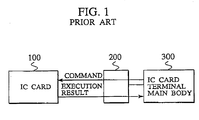
- Fig.1 is a view for describing a conventional scheme of exchanges of signals between an IC card and an IC card terminal.
- the IC card terminal includes an IC card reader/writer 200 and an IC card terminal main body 300.
- an IC card 100 and the IC card reader/writer 200 are schematically illustrated as being separated herein, the IC card 100 and the IC card reader/writer 200 may be configured into a contaetles S type as described therein, or alternatively, the IC card 100 and the IC card reader/writer 200 may be configured into a contact type in which the IC card 100 is typically inserted into the IC card reader/writer 200.
- the IC card terminal main body 300 serves as a master device and the IC card 100 serves as a slave device.
- the operator firstly inputs an instruction to an input terminal (not shown) provided to the IC card terminal main body 300.
- the IC card terminal main body 300 being the master device transmits a command to the IC card 100 via the IC card reader/writer 200.
- the IC card 100 being the slave device executes processing corresponding to the command, and returns an execution result to the IC card terminal main body 300 via the IC card reader/writer 200.
- Fig.2 is a view for describing a conventional scheme of exchanges of signals in the case where two IC cards communicate with each other.
- an IC cardreader/writer 200b is connected to the IC card terminal main body 300 in addition to the configuration shown in Fig.1.
- an IC card 100b is connected to the IC card reader/writer 200b either in a contactless mode or in a contact mode.
- an operator firstly inputs an instruction concerning communication between the IC cards to the input terminal (not shown) provided to the IC card terminal main body 300.
- the IC card terminal main body 300 transmits a command to an IC card 100a via an IC card reader/writer 200a.
- the IC card 100a executes processing corresponding to the command, and outputs a response A which is an execution result.
- the response A outputted from the IC card 100a is inputted to the IC card terminal main body 300 via the IC card reader/writer 200a.
- the IC card terminal main body 300 performs a relaying operation of information, concerning the response A in this case.
- the response A outputted from the IC card terminal main body 300 is inputted to the IC card 100b via the IC card reader/writer,200b.
- the IC card 100b executes processing corresponding to the inputted response A, and outputs a response B which is an execution result.
- the response B outputted from the IC card 100b is inputted to the IC card terminal main body 300 via the IC card reader/writer 200b.
- the IC card terminal main body 300 performs a relaying operation of information, concerning the response B in this case.
- the response B outputted from the IC card terminal main body 300 is inputted to the IC card 100a via the IC card reader/writer 200a.
- the operations are basically the same when the above-described exchanges between the IC card 100a and the IC card 100b continue.
- the IC card terminal main body 300 always plays a role to perform relaying operations of information exchanged between the IC card 100a and the IC card 100b.
- the IC card terminal main body in conventional communication between IC cards, the IC card terminal main body always plays the role to perform relaying operations of information concerning the communication between the IC cards as described above. Therefore, conventionally, an intermediate device as represented by the IC card terminal main body has been capable of falsification or theft of the information communicated between the IC cards. Hence there has been conventionally a problem that communication of accurate information between the IC cards is not ensured.
- the present invention has been made in the light of the foregoing problem. It is an object of the present invention to provide an autonomous IC card capable of ensuring safe communication of accurate information by directly communicating with another communication device seemingly without interposing an intermediate device, such as an IC card terminal, between the IC card and the another communication device when the IC card communicates with the another communication device connected to the IC card terminal directly or via a network.
- an intermediate device such as an IC card terminal
- an autonomous IC card comprising a logic host interface which is connected to an IC card terminal via a physical layer, a logic external communication interface which communicates with a communication device connected thereto via the IC card terminal physically, and an IC chip configured to recognize connection of the communication device and directly communicate with the communication device via the logic external communication interface.
- the autonomous IC card can autonomously recognize the communication device connected thereto via the IC card terminal, and directly communicate with the communication device.
- the IC chip includes a communication control unit being a software module which directly communicates with the communication device via the logic external communication interface.
- the communication control unit can execute processing by use of the software module which is not conscious of the connected IC card terminal.
- the communication control unit includes a session management command group which establishes a session communication path for the communication device, and a transaction management command group which establishes a transaction session for the communication device.
- the IC chip includes an encryption processing unit which performs mutual authentication processing with the communication device and encrypts and decrypts information concerning communication with the communication device.
- the encryption processing unit performs the mutual authentication processing with the communication device, and encrypts and decrypts the information concerning the communication with the communication device.
- the IC chip includes an assigned unique identifier.
- the IC chip identifies the communication device and performs the mutual authentication processing based on the identifier.
- the encryption processing unit selects an appropriate authentication process and an appropriate encryption process out of a plurality of authentication processes and a plurality of encryption processes respectively to perform those processes, depending on a type of the identified communication device.
- the IC chip includes a storage unit which stores value information.
- the IC chip communicates with the communication device concerning the value information.
- Fig.3 is a view showing a logical configuration of one embodiment of the IC card according to the present invention.
- an autonomous IC card I of the present invention includes a central processing unit (CPU) 10, a read-only memory (ROM) 11, a random access memory (RAM) 12, a nonvolatile memory 13, an encryption processing unit 14, a communication control unit 15, an external communication interface 16, and a host device interface 17.
- CPU central processing unit
- ROM read-only memory
- RAM random access memory
- nonvolatile memory 13 an encryption processing unit 14
- communication control unit 15 an external communication interface 16
- the above-described configuration is a mixture of a physical configuration (hardware) and a logical configuration (software). Description will be made below severally regarding both the configurations.
- the host device interface 17 is a conventionally provided physical interface for performing external communication. As similarly to the related art, the host device interface 17 includes a contact type and a contactless type.
- the CPU 10 is a central processing unit which executes all kinds of operations except part of floating-point operations. Note that a floating-point processing unit (not shown) is specially provided for executing some floating-point operations.
- the ROM 11 is a read-only memory in which software (such as an operating system (OS) or programs) unique to the autonomous IC card 1 and a chip ID of the present invention to be described later are stored.
- the RAM 12 is a random access memory in which data treated by the software which operates inside the autonomous IC card are temporarily stored. Contents in the RAM 12 are completely deleted when power supply to the IC card is stopped.
- the nonvolatile memory 13 stores value information to be described later.
- the value information is equivalent to data containing values such as electronic tickets and electronic money. Note that since the nonvolatile memory 13 is amemory designed to preserve contents, the contents therein are preserved even if the power supply is stopped.
- the external communication interface 16 is a logical interface which allows a chip of the present invention to be described later, which includes the CPU 10 and the like, to perform direct communication with the outside.
- a conventional IC card only includes a logic interface for communicating only with a device which is physically connected thereto, typically, only with an IC card terminal.
- the autonomous IC card 1 of the present invention includes the external communication interface 16 which performs direct communication with an external device (a service client with the chip of the present invention incorporated therein, which will be described later) in addition to the logic host interface.
- this external communication interface 16 is an interface which performs communication in accordance with a protocol to be described in detail later in "4. API protocol for the present chip".
- the communication control unit 15 is a software module which controls communication with the external device via the external communication interface 16.
- the communication control unit 15 is the software module which realizes the entirety of "10. API specification for the present chip" to be described later.
- the software module is closely related to "10.1 Session management command group” and "10.2 Transaction management command group” in particular. Communication is performed directly with the external device by use of this module.
- the encryptionprocessing unit 14 is amodule for enabling various types of mutual authentication and encryption communication as defined in "3.4 Authentication, access control and encryption", "5. eTP key certificate”, and “6. key entity”, which will be described later.
- the encryption processing unit 14 selects and switches appropriate mutual authentication and appropriate encryption communication out of a plurality of options of mutual authentication and a plurality of options of encryption communication respectively.
- the risk of theft of the data contents or falsification of the data via the intermediate device such as the IC card terminal will be further reduced by performing the mutual authentication and the encryption communication by use of the encryption processing unit 14.
- a configuration unit according to the present invention shown in Fig.3 is preferably materialized by use of a one-chip microcomputer (hereinafter referred to as an "IC chip"), specifications of which will be listed in detail in the last part of the description of the embodiment.
- IC chip one-chip microcomputer
- the IC chip according to the present invention is designed to function as a node in a distributed environment. Therefore, if a device, in which the IC card of the present invention is connected to an IC card terminal main body including an IC card reader/writer either in a contact mode or in a contactless mode to operate the device, is configured to be capable of physically communicating with, for example, another IC card via a network, each of those IC cards severally including the IC chips according to the present invention has a function as a node on the communication network. Moreover, in this event, the IC card reader/writer and the IC card terminal main body play a role as a gateway (bridge) for making communicable aphysical layer of contactless communication with the network. In other words, the above-described external communication interface 16 controls the IC card communication as the node in a distributed system, while the host device interface 17 plays the role for making communicable the physical layer of the contactless communication.
- the IC chip according to the present invention has a unique identifier (ID) in the entire distributed system, which is represented by the above-described network as the simplest example.
- ID unique identifier
- the IC chip incorporated in the autonomous IC card of the present invention identifies a plurality of devices which are connected via the network and severally provided with the similar IC chips, and performs mutual authentication with those devices first.
- the IC card is designed to then perform communication with those devices after confirming those devices as qualified entities.
- the IC chip according to the present invention adopts an access control list based on the above-described ID to protect resources owned by the 1C chip. That is, the access control list is added to each of chips and files (and records).
- the IC chip according to the present invention deals with "owner”, “issuer”, and “other” service clients uniformly.
- the IC card issues an application programming interface (API) for changing the access control list in accordance with authority owned by each service client.
- API application programming interface
- the IC chip can flexibly perform control such as restriction, release, or transfer of access rights.
- the IC chip according to the present invention supports a hybrid mode for retaining contents while distributing the contents among a plurality of contents holders, for example, between the chip of the present invention and a value information storage server on the network.
- the IC chip according to the present invention further provides a link function between the contents as a mechanism for supporting the hybrid mode.
- Fig. 4 is a view showing a system configuration for performing communication between IC cards by use of the autonomous IC card of the present invention.
- an autonomous IC card 1a is connected to an IC card reader/writer 2a provided on an IC card terminal main body 3 either in a contact mode or in a contactless mode.
- an autonomous IC card 1b is similarly connected to an IC card reader/writer 2b provided on the IC card terminal main body 3 either in a contact mode or in a contactless mode.
- the operator when an operator intends to cause the autonomous IC card 1a to communicate with the autonomous IC card 1b, the operator inputs an instruction to an input terminal (not shown) provided to the IC card terminal main body 3.
- the IC card terminal main body 3 transmits a command to the IC card 1a via the IC card reader/writer 2a.
- the autonomous IC card 1a directly and autonomously communicates with the autonomous IC card 1b in a software manner via the external communication interface 16 shown in Fig. 3.
- the reason why the autonomous IC card 1a can directly communicate with the autonomous IC card 1b is because the autonomous IC card 1a can function as the node in the distributed environment as described above.
- the encryption processing unit 14 shown in Fig. 3 encrypts and decrypts the communication data, it is possible to surely prevent the risk such as falsification or theft of the data in the course of communication.
- Fig. 5 is a view showing another system configuration for performing communication by use of the autonomous IC card of the present invention.
- the other one to communicate with does not need to be an IC card, but may be another communication device.
- the IC card terminal main body 3 is connected to a communication device 5 via a network 4.
- the autonomous IC card 1 communicates with the communication device 5 via the network 4
- the autonomous IC card 1 which has received a command from the IC card terminal main body 3 communicates with the communication device 5 directly and autonomously in a software manner.
- contents holders correspond to the above-described autonomous IC cards 1 and 1a
- service clients correspond to all the devices communicating with the autonomous IC cards 1 and 1a, that is, to the above-described IC card terminal main body 3, the autonomous IC card 1b, and the communication device 5.
- the present chip (a value information-added chip) is a computer system (such as an IC card) which constitutes a storage medium for value information in a highly functional distributed system which a project related to the present invention aims for, and external specifications of the computer system.
- the present chip is put into a series of the 8-bit CPU Version, the 16-bit CPU version, and the 32-bit CPU version, and the present chip provides a common command and a common message format concerning a common operation.
- this description particularly explains an overview of the specifications in the case of adopting the IC chip of the 16 -bit CPU version as a target hardware.
- the present chip is designed as a node in a distributed environment.
- a service provider module on a network and the chip, and the chip and a card, perform peer-to-peer communication on an equal basis.
- a reader/writer device constitutes a gateway (bridge) for making communicable a physical layer of contactless communication with a local area network (LAN).
- LAN local area network
- the present chip has an identifier (the present chip ID) which is unique in the entire distributed system.
- the present chip ID is used not only for identifying the chip physically, but also for controlling a path in the distributed environment.
- the present chip ID is utilized by the other one to communicate with as an identifier.
- the target for authentication of the present chip is not the reader/writer, but is calculation entities (contents holders) on the network, the calculation entities exchanging information with the chip via the network and the reader/writer.
- the present chip performs communication after performing mutual authentication and thereby confirming that the other one to communicate with is a qualified entity.
- the present chip-incorporated contents holders (CHs) and the present chip-incorporated service clients (SCs) both include consistent unique identifiers (the present chip ID), and identify the present chip ID of the other one to communicate with after the mutual authentication.
- the present chip specifies a SC which issues the present chip API through the mutual authentication. Therefor, an access control list based on the present chip ID is used to protect resources owned by the present chip.
- the present chip at the moment expresses attributes such as an "issuer”, an "owner” and the like by use of the present chip ID with respect to the resources. Moreover, it is possible to designate commands which can be issued by the "issuer", the "owner”, and “other” SCs by use of the access control list.
- the value information includes various types. For example, the following types of information are conceivable as the information in the chip:
- the present chip uniformly treats the "issuer”, the "owner”, and the “other” SCs in the access control list, and issues an API for changing the access control list in accordance with authority owned by each SC. In this way, the present chip can flexibly perform control such as restriction, release, or transfer of access rights.
- the present chip provides a transaction mechanism to ensure atomicity of processing. After starting a transaction, an operation attributable to an issued command is reflected by a commit command upon ending the transaction. If an abort command is issued, or if the commit command does not reach on or before a defined timeout duration, then the issued command is subjected to roll-back. Similarly, if the present chip is powered off in the course of the transaction due to any trouble, then roll-back processing takes place in an initial state when the present chip becomes active again.
- the present invention supports a hybrid method for distributing and retaining the contents among a plurality of the contents holders of the present invention, such as the present chip and avalue information storage server on a network. Moreover, the present invention provides a link function between the contents as a mechanism for supporting the hybrid method.
- the present chip has consistency with other architectures of the project related to the present invention regarding API command conventions, error codes, methods of statically and dynamically treating the resources, and the like.
- general parts of the error codes are in common between a related chip and the present chip.
- the present invention assists an engineer having experience in development on the related chip architecture in developing the present chip applications.
- the present chip provides API systems consistent with various IC cards including' 8-bit to 32-bit CPUs, contact/contactless/dual interfaces, and smart cards to radio frequency identifications (RF-IDs).
- IC cards including' 8-bit to 32-bit CPUs, contact/contactless/dual interfaces, and smart cards to radio frequency identifications (RF-IDs).
- RFIDs radio frequency identifications
- the present chip architecture is distributed system architecture for safely storing tamper-resistant value information and for safely exchanging the tamper-resistant value information on a computer network.
- the present chip architecture essentially includes the following elements.
- the present chip-incorporated contents holders are calculation entities on the distributed system.
- the present chip-incorporated content holders store the value information and provides the present chip-incorporated API, thereby allowing operation of this value information from the outside.
- the present chip-incorporated content holders include the following.
- the present chip A tamper-resistant LSI chip which safely stores the value information.
- a present chip box A large-volume electronic safe housed in a tamper-resistant casing, which safely stores the value information.
- the present chip-incorporated service clients are calculation entities for accessing the value information stored in the present chip-incorporated content holder through the present chip API.
- the present chip-incorporated service clients include the following types.
- the present chip A sophisticated one of the present chips also has a function as a client.
- An issuing server A server which issues the value information and stores the value information in the present chip-incorporated content holder.
- a service field system An application system which uses the value information stored in the present chip.
- the service field system includes an electronic ticketing gate, for example.
- An authentication station plays a main role.
- the application network infrastructure includes network protocols for instructing search or purchase of tickets, and the like.
- the instructions up to the purchase are conducted within the ANI frames, and transfer of the ticket being the value information is conducted in the ENI which applies the functions of the present chip.
- the present chip identifier (the present chip ID)
- the present chip-incorporated content holders and service clients severally have unique identifiers, each of which is referred to as the present chip identifier (the present chip IDS).
- the present chip ID is used on the network for authentication of the present chip-incorporated content holders and service clients, path control of messages, and the like.
- the present chip ID is expressed by a 16-octet (128-bit) number.
- the present chip is a small-size calculation entity used for allowing a user, who directly receives services using the value information from various enterprises, to carry the value information.
- the present chip is an object to be mainly handled by these specifications.
- the present chip is thought to be implemented principally on hardware such as an IC card, a smart card, or a portable terminal.
- the specifications of the present chip provide various specifications corresponding to various types of hardware while standardizing only the interfaces, whereby the present chips are made into series.
- Table: Series of the present chip specifications The present chip /8 for 8-bit CPU chip
- the value information to be stored in the present chip box or the present chip will be visible from outside as a following hierarchical data structure.
- the present chip /16 adopts a structure in which only a single record is stored in one file.
- the present chip is operated by the present chip API from the present chip-incorporated service client.
- the present chip API is a protocol based on a session using the following procedures:
- the present chip and the present chip-incorporated service client perform the mutual authentication upon establishing the session. Being specialized in the hardware or the like which is incorporated in the chip, various types of concrete algorithms for this authentication can be used.
- Authentication includes an (information) issuer mode and an owner mode, which are designated upon authentication.
- the authentication algorithm is (generally) different depending on each mode.
- a mode to authenticate the present chip-incorporated service client as an issuer of the file After being authenticated by the issuer mode, the file created by the present chip-incorporated service client becomes accessible with the issuer authority, and other resources become accessible with other authority.
- the owner mode is the owner mode
- a mode to authenticate the present chip-incorporated service client as an owner of the chip A human-friendly authentication method such as a password is usually used.
- the present chip-incorporated service client authenticated by the owner mode possesses the owner authority.
- the present chip After the authentication, the present chip retains the following information:
- the access is restricted in accordance with the authority to be owned by the session defined as below.
- the present chip session unit (forward)
- the present chip session unit (backward)
- command ID of the present chip API is expressed by a positive 1-byte integer.
- the command identifiers are commonly defined in the series of the present chips /8, 16, and 32, which are as follows. Table: List of the command identifiers of the present chip API ID Mnemonic 8/16/32 Meaning 0x01 eopn_ses O ⁇ ⁇ ⁇ Open Session 0x02 ecfm_ses O ⁇ ⁇ ⁇ Confirm Session 0x03 eels_ses O ⁇ ⁇ ⁇ Close Session 0x04 eopn_ses ⁇ OO Open Transaction 0x05 ecfm_tra ⁇ OO Confirm Transaction 0x06 ecom_tra ⁇ OO Commit Transaction 0x07 eabo_tra ⁇ OO Abort Transaction (0x11 ecre_fol ⁇ O Create Folder) (0x12 edel_fol ⁇ O Delete Folder) (0x13 dupe_fom ⁇ O Update Folder Mode 0x21 ecre_fil OOO Create File 0x22 edel_fil OOO Delete File
- the error code is expressed by the following conventions.
- HMAC Used in a session/transaction encryption communication path.
- First 64 bytes in a key of a secret key encryption for the encryption communication path is used as a key K.
- HMAC is calculated by the following formula.
- MD5 K xor opad
- MD5 K xor ipad
- MD5 K xor ipad
- "1001") ("01001001")
- the session/transaction as the "encryption" communication path is established after the "mutual authentication", and "encrypted” message communication is performed thereafter.
- Concerning the "erea_rec command” i.e. read the contents of the record
- non-session communication which is directly executed without passing through an "authentication” phase, is supported.
- it is possible to start up by retrieving the command with the "session ID 0", instead of establishing a session.
- This access by the non-session communication will be successful if the relevant file permits "the other access”.
- an access packet is not encrypted. This is used in places where a "touch & go application” is highly required, such as in ticket gating.
- the mutual authentication upon establishing a session with the present chip /16 is based on the premise of a public key basis and existence of PKI.
- the present chip-incorporated nodes (which refer to the present chip-incorporates SC and the present chip-incorporated CH collectively) transmit the public keys of the present chips of their own to each other as the certificates signed by the present chip device issuer, * see Note (1)
- the present chip-incorporated node has a public key of akey signed by a certificate issuer in the form of a certificate. Validity is confirmed by use of this key.
- the present chip /16 uses either one of the following:
- the foregoing description is a device for reducing the time required for initial setting of communication of the node such as the present chip or a card.
- the node implemented on a server machine should always complete confirmation of the signature off-line in the first place and then proceed to confirmation of "cancellation and nullification". This is for preventing a DoS which is a waste of server inquiry processing attributable to transmission of an invalid certificate from a device having the invalid certificate.
- This byte length is made to be a multiple of 8 by null padding, and the 24-byte data are signed by RSA encryption.
- the overall length of the certificate is calculated as follows:
- the value e itself This is expanded into a byte unit as required to be buried as a byte sequence. Subsequently, the value N is buried as a byte sequence.
- the overall length can be calculated as follows:
- the key entity is a system data format which compiles an encryption key and information necessary for value information operation by use of the encryption key.
- the encryption key and the information are stored in a normal file by the present chip.
- D0 D1 D2 D3 D4 D5 D6 D7 keyObj ID Encryption Mode Specifier Reserved KEY (1) KEY (2) BANK ID Reserved Balance of Payment LEN Reserved
- Encryption Mode Specifier Specifies which encryption algorithm each of KEY (1) and KEY (2) is a key for. As described below, such specification is performed by the same mode as specification of the encryption algorithm for the encryption communication path in "eopn_ses”.
- the standard content format is a standard content data format which manipulates a value information operation inside the present chip.
- the following method is adopted as a calculation method using the key entity.
- a safe session transmission path is constructed for the present chip.
- the "eopn_ses” is used in the case of using authentication when 1 path is satisfactory, and the “eopn_ses” and “ecnf_ses” are used in this order in the case of using authentication which requires 2 paths.
- the mode of authentication and the encryption type are selectable in accordance with parameters in the packet. An error occurs when authentication/encryption unusable on the present chip side is specified.
- ERR eopn_ses ERR eopn_ses (ETRONID destId, ETRONID sroId, TIME t, UB authMode, UB authAlgorithm, UB sessionAlgorithm, UH len, UB*authData, UH*rlen, UB**rAuthData);
- ERR ecnf_ses ERR ecnf_ses (ETRONID destId, ETRONID srcid, TIME t, UH len, UB*authData, UH*rlen, UB**rAuthData);
- the "open/confirm session” command establishes a session as the safe encryption communication path after the mutual authentication between the present chip-incorporated service client and the present chip.
- the concrete actions depend on the authentication and encryption modes, and the modes usually depend on an encryption supporting function of the present N chip hardware (implementation dependency).
- a session establishment protocol includes authentication in the issuer mode and authentication in the owner mode, which are distinguished by the authmode parameter in the "open session" command.
- 3DES encryption based on the E-D-E mode using Ra-Rb-Ra is performed.
- the value stored in the sid column of the outbound packet of "eopn_ses ()" is used as the session ID.
- the session id which was specified by the caller who was first called, is used as it is.
- DES encryption is performed by use of Rb as the key.
- Ra is used as the session ID.
- the present chip retains a password depending on the owner, and authentication is performed by use of the password.
- the present chip creates a random number and transmits the random number to the R/W.
- the R/W side uses the random number to encrypt the password, and then transmits the password to the present chip.
- the random number Ra is created, then,
- the random number Rb is created, then,
- Decryption is performed by D3_p (Y) and R'b is confirmed. (Authentication is performed to confirm that the qualified owner is operating through the present chip-incorporated service client)
- the session ID (sid) is created from Ra and is returned to A
- ID_A and ID_B represent the present chip IDs (128 bits) of the present chip-incorporated service client (A) and the present chip (B), respectively.
- the session is closed.
- ERR ecls_ses (SID sid, ETRONID destId, ETRONID srcID, TIME t, UH len, UH*rlen);
- This command is always usable by the present chip-incorporated service client which constructed the session.
- the established session is closed.
- a transaction session is constructed for the present chip.
- the "eopn_tra” is used in the case of using authentication when 1 path is satisfactory, and the “eopn_tra” and '"ecnf_tra” are used in this order in the case of using authentication which requires 2 paths.
- ERR eopn_tra ERR eopn_tra (ETRONID destid, ETRONID srcId,TIME t. UB authMode, UB authAlgorithm, UB sessionAlgorithm, UH len, UB*authData, UH*rlen, UB**rAuthData);
- ERR ecnf_tra ERR ecnf_tra (ETRONID destId, ETRONID sroId, TIME t, UH len,UB*authData, UH*rlen,UB**rAuthData);
- ERR ecom_tra (SID sid, ETRONID destId, ETRONID sroID, TIME t, UH len, UH*rlen);
- ERR eabo_tra SID sid, ETRONID destId, ETRONID srcID, TIME t, UH len, UH*rlen
- This command is always usable by the present chip-incorporated service client which constructed the session.
- a file in this system has the following restrictions.
- a (vacant) file is created.
- ERR ecre_fil (SID sid, ETRONID destId, ETRONID srcId, TIME t, UH len, FID fid, UH blk, UH cnt. FACL facl, UH*rlen);
- a file having the tile ID specified by fid is created. An error occurs when the specified fid is already in use.
- the file is deleted.
- ERR edel_fil (SID sid, ETRONID destId, ETRONID srcId, TIME t, UH len, FID fid, UH*rlen);
- the file having the file ID specified by fid is deleted.
- a control block specifying a physical position of the file is cleared and the nonvolatile memory is released, and in addition, all data in the memory is set to "0" or "1".
- the contents of the file are transferred to other present chip-incorporated contents holder.
- ERR atra_fil (SID sid, ETRONID destid, ETRONID srcID, TIME t, UH len, FID fid, ETRONID targetID, Fid targetFid, UH*rlen);
- a chip in which this system call occurred performs a series of processing described below.
- the transaction is aborted if any abnormality is detected in mid-course. Meanwhile, the commands in the session are not reflected unless the commit command arrives normally.
- the file storing the encrypted contents is decrypted.
- ERR eenc_fil (SID sid, ETRONID destId, ETRONID srcID, TIME t, UB len, FID srcFid, FID destFid, FID keyed, UB*rlen, UW*currentMoney, UW*payedMoney);
- ERR ednc_fil (SID sid, ETRONID destId, ETRONID srcId, TIME t, UB len, FID srcFid. FID destFid, FID keyed, UB*rlen, UW*currentMoney, UW*payedMoney);
- the access control list of the file is changed.
- ERR eupd_fim (SID sid, ETRONID destId, ETRONID srcId, TIME t.UHlen.FID fid,FILACL filad, UH*rlen);
- the access control list of the file is changed to a specified value.
- a list of the defined file is obtained.
- ERR elst_fid (SID sid, ETRONID destId, ETRONID srcId, TIME t, UH len, FID fid, UH*rlen, UB**fileCtrlBlk);
- a request for writing data of cnt octets from the beginning in a blk record is issued.
- An upper limit may be provided to cnt depending on hardware conditions.
- the actually written octet number is returned to rCnt.
- the contents of the record is read out.
- ERR erea_rec (SID sid, ETRONID destId, ETRONID srcId, TIME t, UH len, FID fid. UH blk, UH cnt, UH*rlen, UH*rCnt. UB*rData)
- a request for reading data of cnt octets from the beginning in the blk record is issued.
- An upper limit may be provided to cnt depending on hardware conditions.
- the octet number actually read is returned to rCnt.
- a key entity in this system has the following restrictions.
- ERR ecre_key (SID sid, ETRONID destId, ETRONID srcId, TIME t, UH len, UH kid, UH keyAlgorithm, UB*Key, UH bankId, KEYACL acl, UL initMoney Val, UH*rlen);
- ERR edel_key (SID sid, ETRONID destId, ETRONID srcId, TIME t, UB len. UH kid, UH*bankId, UL*remainingMoney, UH * rsize, UB**bookList, UH*rlen);
- An amount of money in the specified key entity is updated.
- ERR eupd_key (SID sid, ETRONID destId, ETRONID srcid, TIME t, UH len, UH kid, UL addMoney. UH*rlen, UL*currentMoney);
- ERR area_key (SID sid, ETRONID destId, ETRONID srcId, TIME t. UH len, UH kid, UH*rlen, UL*currentMoney);
- the access control list of the key entity is updated.
- ERR eupd_key (SID sid, ETRONID destId, ETRONID srcId, TIME t, UH len, UH kid, KEYACL keyacl, UH*rlen);
- a list of the defined key entity is obtained.
- ERR elst_kid (SID sid, ETRONID destid, ETRONID scoId, TIME t, UH len, KID kid, UH*rlen, UB**keyCtrlBlk);
- ERR ecfm_cer (SID sid, ETRONID destId, ETRONID srcId, TIME t, UH len, UB checkMode, UH serial, UHcaId, UB*rlen, UB*crl)
- the API commands described below have formats similar to the present chip API commands. Nevertheless, the following commands are not always issued by the present chip-incorporated service client but also issued by other entities. These commands are mainly centered on management and operation depending on the hardware, and interfaces for supporting lower layer of communication. These commands may be issued by a chip reader/writer unit or issued by a computer in the event of fabrication.
- the status of the present chip is readout (implementation dependency, operation dependency).
- ERR epol_car ERR epol_car (ETRONID* destId, ETRONID srcId, TIME t);
- This API is always usable.
- the present chip ID of the chip is stored and returned to a srcID portion in a routing header portion of the return packet of "epol_car". Accordingly, anybody can use this API for obtaining the present chip ID in the beginning.
- Anybody can issue this command even if it is not during the session.
- a chip management portion is oreated to initialize the present chip.
- ERR eini_car ERR eini_car (ETRONID dstId, ETRONID srcId. TIME t, UB initKeyl[8] UB initKey2 [8], UB initPasswd [8], UB fileNum, UB keyObjLen, UB swapLen, CACL cacl, UB rsaSecretKey [128], UH len, UH*rlen);
- a system control block is initialized in accordance with a given argument.
- the own certificate of the present chip is updated.
- ERR eupd_cer ERR eupd_cer (ETRONID destId, ETRONID SrcId, TIME t, UB*certificate, UH len, UH*rlen);
- the public key of the CA station is exchanged.
- ERR eupd_cpk ERR eupd_cpk (ETRONID destId, ETRONID srcId, TIME t, UB*caPublicKey, UH len. UH*rlen);
- each octet is assigned as a parity bit as shown below (a chip just ignores the parity bit but does not check it).
- the 56 bits obtained by adding the upper 7 bits of 8 octets are used as the DES.
- the autonomous IC card of the present invention autonomously identifies a communication device to be connected via an IC card terminal and communicates directly with the communication device. Therefore, it is possible to guarantee safe communication of accurate information.
- the autonomous IC card of the present invention includes an encryption processing unit for performing authentication processing mutually with the communication device and for encrypting and decrypting information concerning communication with the communication device, then it is possible to judge propriety of the communication device and to sufficiently reduce a risk of theft of the data contents or falsification of the data via the intermediate device. The significance of such reduction of the risk is particularly high when the data are related to value information such as an electronic ticket.
- the encryption processing unit selects and performs appropriate authentication processing and encryption processing out of a plurality of authentication processing and a plurality of encryption processing depending on the type of the identified communication device, it is possible to perform the processing suitable for the identified communication device.
Landscapes
- Engineering & Computer Science (AREA)
- Physics & Mathematics (AREA)
- General Physics & Mathematics (AREA)
- Theoretical Computer Science (AREA)
- Business, Economics & Management (AREA)
- Microelectronics & Electronic Packaging (AREA)
- Computer Hardware Design (AREA)
- Accounting & Taxation (AREA)
- Computer Security & Cryptography (AREA)
- General Business, Economics & Management (AREA)
- Strategic Management (AREA)
- Finance (AREA)
- General Engineering & Computer Science (AREA)
- Artificial Intelligence (AREA)
- Computer Vision & Pattern Recognition (AREA)
- Computer Networks & Wireless Communication (AREA)
- Storage Device Security (AREA)
- Computer And Data Communications (AREA)
- Credit Cards Or The Like (AREA)
Abstract
Description
- information which cannot be changed by the chip owner but only by the information issuer (e.g. a seat number of an electronic ticket);
- information which is not disclosed even to the chip owner (e.g. a key for changing the electronic ticket);
- information which can be fully controlled only by the chip owner (e.g. personal information of the chip owner); and
- information which can be read by anybody.
- Attention: There exists also a calculation entity which serves as the present chip-incorporated service client as well as the present chip box.
- The present chip ID is an exchange format of an identifier used in the ENI communication protocols. The present chip ID does not define an internal saving format within the present chip.
- Considering facility of implementing the path control, it is also conceivable to adopt a implementing method which defines an identifier in a protocol on a network layer of the ENI directly as the present chip ID. For example, lower bits of a network address may be applied to the present chip ID without modification.
- The present chip ID for the owner will be defined as "0x00-00" (all "0"). For example, if the present chip-incorporated service client having the present chip ID "X" establishes a session after being authenticated in an owner authentication mode and then creates a file in the session, an issuer ID column of the file stores "0".
- The present chip ID for an administrative superuser will be defined as "0xff-ff" (all "1").
| Table: Series of the present chip specifications | |
| The present chip /8 | for 8-bit CPU chip |
| The present chip /16 | for 16-bit CPU chip |
| The present chip /32 | for 32-bit CPU chip |
| The present chip /T | for terminal |
- Mutual authentication and establishment of an
encryption communication path between the present chip and
the present chip-incorporated service client,
- Establishment of a session (transaction);
- Transmission of a command message; and
- Cutoff of the session (transaction).
- A session/transaction method involves a high frequency of message exchanges and therefore may be unsuitable for an application which requires high responsiveness such as "& Go". Accordingly, authentication or encryption is applied to each command message. A non-session protocol is also adopted concerning part of commands.
- A command issued as "session ID = 0" will be treated as a non-session mode.
- Session commands
- eopn_ses
- Open Session
- ecfm_ses
- Confirm Session
- ecls_ses
- Close Session
- Transaction commands
- eopn_tra
- Open Transaction
- ecfm_tra
- Confirm Transaction
- ecom_tra
- Commit Transaction
- eabo_tra
- Abort Transaction
- File operation commands
- ecre_fil
- Create File
- edel_fil
- Delete File
- etra_fil
- Transfer File
- eupd_flm
- Update Pile Mode
- eenc_fil
- Encrypt File
- edec_fil
- Decrypt File
- Record operation commands
- eupd_rec
- Update Record
- erea_rec
- Read Record
- Key entity operation commands
- ecre_key
- Create Key
- edel_key
- Delete Key
- eupd_key
- Update Key
- Authentication ancillary command
- ecfm_cer
- Confirm Certificate
- Control commands
- epol_chp
- Polling Chip
- eini_car
- Initialize Card
- eupd_cer
- Update My Certificate
- eupd_cpk
- Update CA Public Key
- The present chip ID of the officially authenticated present chip-incorporated service client;
- A common key for encryption of a message to be transmitted to the present chip-incorporated service client;
- A common key for decryption of a message arrived from the present chip-incorporated service client;
- The session ID; and
- The session mode (the issuer mode / the owner mode).
- The present chip ID representing the issuer; and
- The access control list (operations permitted depending on authorities).
* In this case, eid = 0x00 (all "0")
| F | E | D | C | B | A | 9 | 8 |
| Reserved | Reserved | Reserved | Reserved | Reserved | Reserved | Reserved | Reserved |
| 7 | 6 | 5 | 4 | 3 | 2 | 1 | 0 |
| Reserve | Reserve | ACL5 | ACL4 | ACL3 | ACL2 | ACL1 | ACL0 |
- whether or not creation of a file in a route folder is permitted by the owner access
- whether or not creation of a file in the route folder is permitted by an access other than the owner access
- whether or not deletion of a file from the route folder is permitted by the owner access
- whether or not deletion of a file from the route folder is permitted by an access other than the owner access
- whether or not transfer of a file from the route folder is permitted by the owner access
- whether or not transfer of a file from the route folder is permitted by an access other than the owner access
| cre_fil | del_fil | tra_fil | |
| Owner access | ACL0 | ACL2 | ACL4 |
| Issuer access | - | - | - |
| Other access | ACL1 | ACL3 | ACL5 |
- The (information) issuer of the route folder manages as the owner.
- In other words, a general value information server for filing the value information into the route folder and creating the key entity corresponds to the "other access" depending on the route folder.
| F | E | D | C | B | A | 9 | 8 |
| ACLf | ACLe | ACLd | ACLc | ACLb | ACLa | ACL9 | ACL8 |
| 7 | 6 | 5 | 4 | 3 | 2 | 1 | 0 |
| ACL7 | ACI6 | ACL5 | ACL4 | ACL3 | ACL2 | ACL1 | ACL0 |
ACL1 =0/1 eupd_rec other access No/Yes
ACL3 =0/1 erea_rec other access No/Yes
ACL5 =0/1 eupd_fim other access No/Yes
ACL7 =0/1 elst_fil other access No/Yes
ACL9 =0/1 edel_fil other access No/Yes
ACLb =0/1 etra_fil other access No/Yes
ACLd =0/1 eenc_fil other access No/Yes
ACLf =0/1 edec_fil other access No/Yes
| upd_rec | rea_rec | upd_fim | lst_fil | del_fil | tra_fil | enc_fil | dec_fil | |
| Owner access | ACL0 | ACL2 | ACL4 | ACL6 | ACL8 | ACLa | ACLc | ACLe |
| Issuer access | always yes |
always yes |
always yes |
always yes |
always yes |
always yes |
always yes |
always yes |
| Other access | ACL1 | ACL3 | ACL5 | ACL7 | ACL9 | ACLb | ACLd | ACLf |
| F | E | D | C | B | A | 9 | 8 |
| ACLf | ACLe | ACLd | ACLc | ACLb | ACLa | ACL9 | ACL8 |
| 7 | 6 | 5 | 4 | 3 | 2 | 1 | 0 |
| ACL7 | ACI6 | ACL5 | ACL4 | ACL3 | ACL2 | ACL1 | ACL0 |
ACL1 =0/1 eupd_key other access No/Yes
ACL3 =0/1 erea_key other access No/Yes
ACL5 =0/1 eupd_kym other access No/Yes
ACL9 =0/1 edel_key other access No/Yes
ACLd =0/1 eenc_fil other access No/Yes
ACLf =0/1 edec_fil other access No/Yes
| upd_key | rea_key | upd_kym | del_key | enc_fil | dec_fil | |
| Owner access | ACL0 | ACL2 | ACL4 | ACL8 | ACLc | ACLe |
| Issuer access | always yes | always yes | always yes | always yes | always yes | always yes |
| Other access | ACL1 | ACL3 | ACL5 | ACL9 | ACLd | ACLf |
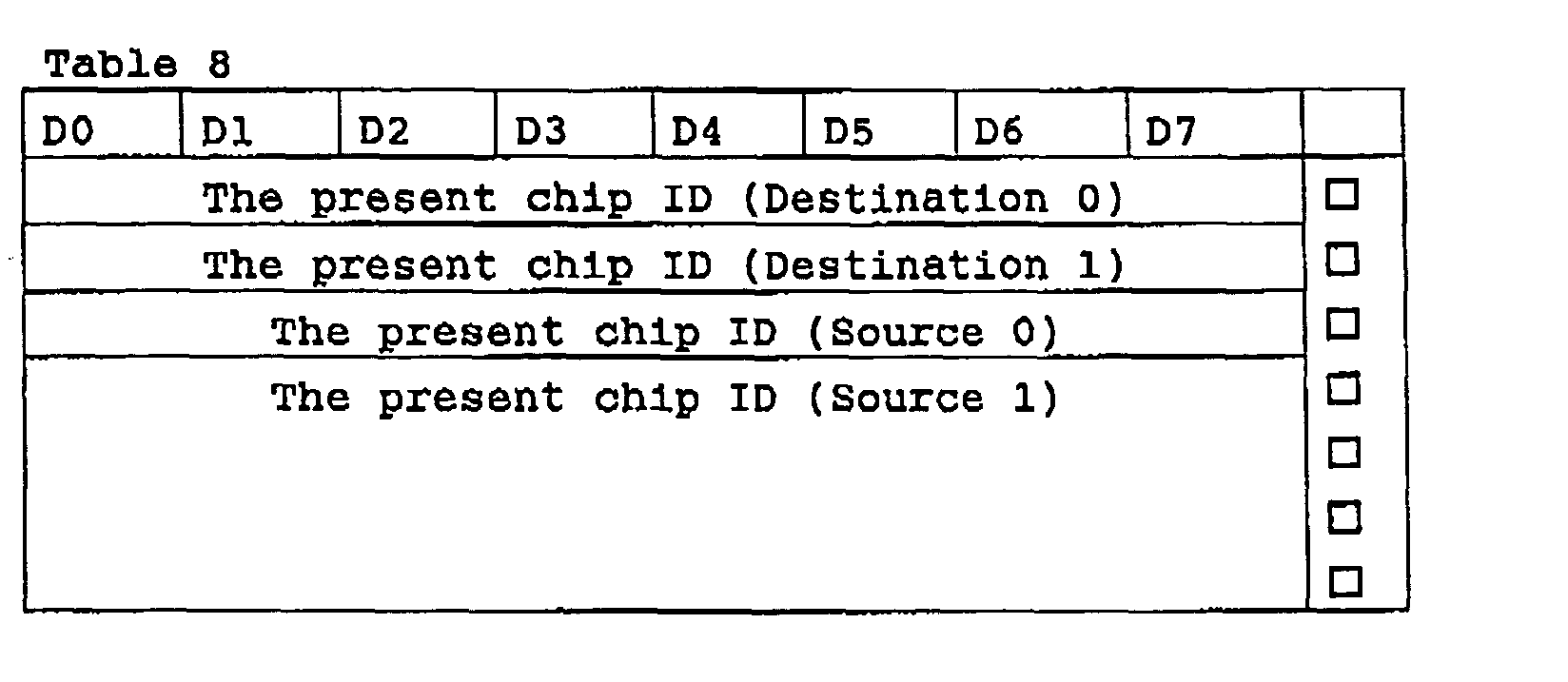
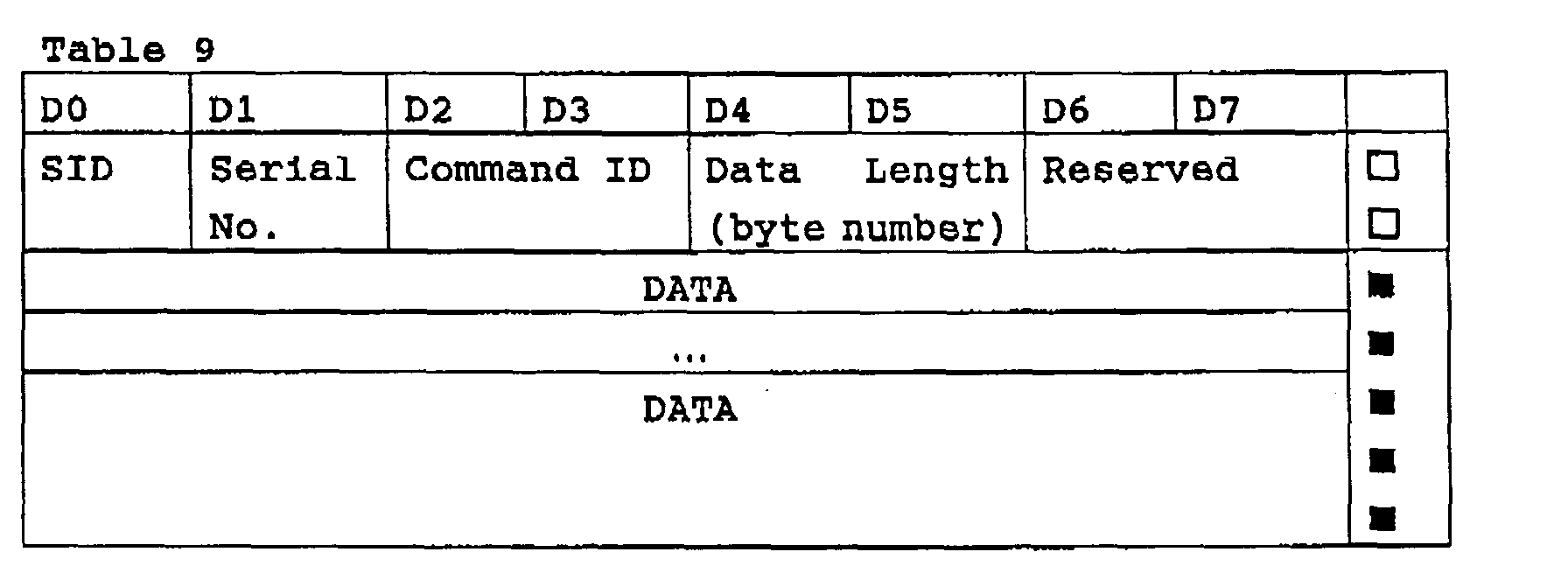
- The mark "□" on the right end of the packet type represents a unencrypted portion and the mark "▪" represents an encrypted portion in an encoding session, respectively.
- Numeric data equal to or more than 2 octets are stored using Little Endian format.


- MAC is attached to the data after encryption.
| Table: List of the command identifiers of the present chip API | |||
| ID | Mnemonic | 8/16/32 | Meaning |
| 0x01 | eopn_ses | O⊙ ○⊙ ○ | Open Session |
| 0x02 | ecfm_ses | O⊙ ○⊙ ○ | Confirm Session |
| 0x03 | eels_ses | O⊙ ○⊙ ○ | Close Session |
| 0x04 | eopn_ses | ×OO | Open Transaction |
| 0x05 | ecfm_tra | ×OO | Confirm Transaction |
| 0x06 | ecom_tra | ×OO | Commit Transaction |
| 0x07 | eabo_tra | ×OO | Abort Transaction |
| (0x11 | ecre_fol | ××O | Create Folder) |
| (0x12 | edel_fol | ××O | Delete Folder) |
| (0x13 | dupe_fom | ××O | Update Folder Mode |
| 0x21 | ecre_fil | OOO | Create File |
| 0x22 | edel_fil | OOO | Delete File |
| 0x23 | etra_fil | ×OO | Transfer File |
| (0x24 | erdm_fil | ××O | Redeem File) |
| 0x25 | eenc_fil | ×OO | Encrypted File |
| 0x26 | edec_fil | ×OO | Decrypted File |
| 0x27 | eupd_fim | OOO | Update File Mode |
| 0x2F | elst_fid | OOO | List File ID |
| (0x31 | ecre_rec | ××O | Create Record) |
| (0x32 | edel_rec | ××O | Delete Record) |
| 0x33 | eupd_rec | OOO | Update Record |
| 0x34 | erea_rec | OOO | Read Record |
| (0x35 | eupd_rcm | ××O | Update Record Mode) |
| 0x41 | epol_car | OOO | Poll Card |
| 0x51 | eini_car | OOO | Initialize Card |
| 0x52 | eupd_cer | ×OO | Update My Certificate |
| 0x53 | eupd_cpk | ×OO | Update CA Public Key |
| 0x61 | eore_key | ×OO | Create Key |
| 0x62 | edel_key | ×OO | Delete Key |
| 0x63 | eupd_key | ×OO | Update Key |
| 0x71 | ecfm_cer | ×OO | Confirm Certificate |
- Not loaded on the present chip /16 First version.
- Description "E_" represents a general error that occurs in local command processing in the chip (common to the error codes of a related chip).
- Description "EN_" represents a general error concerning communication (common to the error codes of a related chip except session error).
- Description "ES_" mainly represents a general error concerning security (dedicated to the present chip).
| Table: List of error codes of the present chip API | ||
| Code | Mnemonic | Meaning |
| -0x00 | E_OK | Normally Closed |
| -0x05 | E_SYS | System Error |
| -0x0a | E_NOMEN | Memory Shortage |
| -0x11 | E_NOSPT | Unsupported Function |
| -0x21 | E_PAR | Parameter Error |
| -0x23 | E_ID | Invalid ID Number |
| -0x34 | E_NOEXS | No Object Exists |
| -0x3f | E_OBJ | Invalid Object Status |
| -0x41 | E_MACV | Memory Not Accessible, Memory Access Violation |
| -0x42 | E_OACV | Object Access Violation |
| -0x55 | E_TMOUT | Polling Failed or Timeout |
| -0x72 | EN_OBJNO | Specify Object Number Not Accessible By The Present Chip |
| -0x73 | E_PROTO | Protocol Not Supported By The Present Chip |
| -0x74 | E_RSFN | Command Not Supported By The Present Chip |
| -0x77 | EN_PAR | Parameter Is Not In The Range Supported By The Present Chip Is Specified |
| -0x7a | EN_EXEC | Not Executable Due To Resource Shortage On The Present Chip Side |
| -0x7f | EN_NOSES | No Specified Session |
| -0x81 | ES_AUTH | Authentication Error |
| -0x82 | ES_EACL | Access Control Violation |
| MAC ID | Length (bytes) | |
| 0x01 | ||
| 16 | Check SUM | |
| 0x02 | 2 | CRC-CCITT |
| 0x03 | 4 | |
| 0x04 | ||
| 16 | Reserved | |
| 0x05 | 16 | HMAC With MD5 (RFC 2085) |
| 0x06 | 16 | Reserved |
| D0 | D1 | D2 | D3 | D4 | D5 | D6 | D7 |
| MAC ID | MAC Length | Reserved | |||||
| MAC (1) | |||||||
| ... | |||||||
| MAC (16) |
G(X) =
*When a packet size is an odd number, CRC is performed after the latter byte is subjected to null padding.

First 64 bytes in a key of a secret key encryption for the encryption communication path is used as a key K. Here, HMAC is calculated by the following formula.
MD5 (K xor opad | MD5 (K xor ipad |TEXT))
opad + the byte 0x36 repeated 64 times
ipad + the byte 0x36 repeated 64 times
"|" means simple bit append.
e.g. ("0100" | "1001") = ("01001001")
- In the case of performing the encryption communication after establishment of the session, a number obtained by repeating a 16-byte encryption key for 4 times in other words , an exchanged random number in the case of RSA authentication of eopn_ses (), is used as the 64-byte secret key by appending as follows.
| D0 | D1 | D2 | D3 | D4 | D5 | D6 | D7 |
| MAC ID | MAC Length | Reserved | |||||
| MAC (1) | |||||||
| MAC (2) |
- A service provider will bear a higher risk by use of this mode. The following sound source chip is incorporated.
- The present chip ID is allocated to each of the present chip-incorporated CHs and the present chip-incorporated SCs, and the pair of a public key and a secret key for authentication is allocated upon issuance.
- A certificate signed by the present chip-incorporated
CA is always stored inside the present chip-incorporated CH
or the present chip-incorporated SC, so that the present
chip-incorporated CH and the present chip-incorporated SC can
indicate the possession of the officially issued pairs (of
the present chip ID and public key) to each other when
establishing the session/transaction.
- Although it is assumed that there will be a plurality of the present chip-incorporated CA in the future, the present chip-incorporated CA is limited to one in this version.
- In the certificate, the signature (S_ca(id, PK_id)) of the present chip-incorporated CA certifies that the present chip ID, the pair of the public keys, and (id, PK_id) are officially issued.
| D0 | D1 | D2 | D3 | D4 | D5 | D6 | D7 |
| ver | Reserved | Certificate number | Signature method | Reserved | Issuer ID | ||
| Start of Expiration Date | End of Expiration Date | ||||||
| The present chip ID (1) | |||||||
| The present chip ID (2) | |||||||
| CAKEY # | Reserved | Key length | Signature length | Reserved | |||
| Public key (1) | |||||||
| ... | |||||||
| Public key (17) | |||||||
| Signature (1) | |||||||
| ... | |||||||
| Signature (16) |
- ver: a version number of the certificate format, which is set as ver="1" in ver. 0.1
- Certificate number: a certificate serial number of the key for the present chip ID
- Signature method: signature algorithm specifiers
- 0: the portion up to the key field portion of the certificate is subjected to SHA-1 hash, and the result is subjected to RSA encryption (implementation)
- 1: Reserved
- 2: Reserved
- 3: Reserved
- Issuer ID: an ID of the issuer (a CA station) of the certificate, which is fixed to "0" in ver. 0.1
- Start of Effective duration. End of Expiration Date: effective duration of the certificate
- Unsigned 4 octet integers (Accumulation of seconds starting from 0:00AM on January 1, 2000)
- CAKEY#: an ID number of a key for distinction when a plurality of keys are used by the CA for key signature
- Key length: a bit-length size of a key having an added end.
- When the key is not a multiple number of 8 octets in the certificate, "0" is added (null padding) to the end of the key field for storing the key, and the key is thereby stored as 8-octet multiple number data. The "key length" bit in the key field is an effective key.
- Signature length: A bit length of the hash (such as sha-1) used for the signature to be added to the end
- The hash obtains 8-octet multiple number data with null padding at the last if necessary, and then creates the signature by enorypting the number with the CA key. When the signature is confirmed, this 8-octet multiple number data added to the end are decrypted with the public key of a CA server saved in the present chip-incorporated node. The head signature length bit among the decrypted values becomes a hash value to be used for confirmation.
- Concrete example of the length (when RSA/sha-1 signature is applied):
- RSA
The public key for the present chip authentication
is set to 1024 bits by RSA
1024 bits = 128 bytes = 16×8 bytes
"sha-1" is used as a hash function for signature - sha-1
An output of sha-1 is 160 bits
160 bits = 20 bytes
- a fixed length portion (40 bytes); and
- a signature portion (128 bytes),
Public Key = 0x01 | 0x03 | byte sequence of N (128 bytes)

| D0 | D1 | D2 | D3 | D4 | D5 | D6 | D7 |
| keyObj ID | Encryption Mode Specifier | Reserved | |||||
| KEY (1) | |||||||
| KEY (2) | |||||||
| BANK ID | Reserved | Balance of Payment | |||||
| LEN | Reserved |
| Encryption Mode Specifier | Types of Encryption |
| 0x01 | DES |
| 0x02 | 3DES |
| 0x03 | Rijndael |
| 0x04 | Hierocrypt-3 |
| 0x05 | Camellia |

| D0 | D1 | D2 | D3 | D4 | D5 | D6 | D7 |
| Content ID | Segment ID | Publisher Info. |
| D0 | D1 | D2 | D3 | D4 | D5 | D6 | D7 |
| Payment | Expression | Parameter (1) | Parameter (2) | ||||
| Scheme | Length | ||||||
| Parameter (3) | Parameter (4) | Parameter (5) | Parameter (6) |
| D0 | D1 | D2 | D3 | D4 | D5 | D6 | D7 |
| Encryption Mode Specifier | Data Length LEN | Reserved | |||||
| Encryption KEY (1) | |||||||
| Encryption KEY (2) | |||||||
| Encrypted Content Body (l) | |||||||
| ... | |||||||
| Encrypted Content Body (m) |
- The encryption KEYS (1) and (2) are encrypted by the use of the key which is stored in the key entity required for decrypting the contents. In the present chip /16, only common-key encryption is considered as the encryption of the key entity due to the factor of the file capacity thereof, and public-key encryption will not be considered herein (because the data length of the encryption key thereof will be elongated after encryption)
| D0 | D1 | D2 | D3 | D4 | D5 | D6 | D7 |
| Signature ID | Signature Length | Reserved | |||||
| Signature (l) | |||||||
| Signature (n) |
- The mode of signature will be set to the same mode as a signature trailer of an eTP packet.
K= K1 | K2 | K1 | K2 | K1 | K2 | K1 | K2
| Payment Method | Payment scheme Parameter | Parameter 2 | ... |
| Fixed Price Payment | 0x01 | Price (unit: sen (0.01 yen)) | - |
| Encryption Mode Specifier | Types of Encryption |
| 0x01 | DES |
| 0x02 | 3DES |
| 0x03 | Rijndael |
| 0x04 | Hierocrypt-3 |
| 0x05 | Camellia |
- B
- Signed 1-byte integer
- UB
- Unsigned 1-byte integer
- H
- Signed 2-byte integer
- UH
- Unsigned 2-byte integer
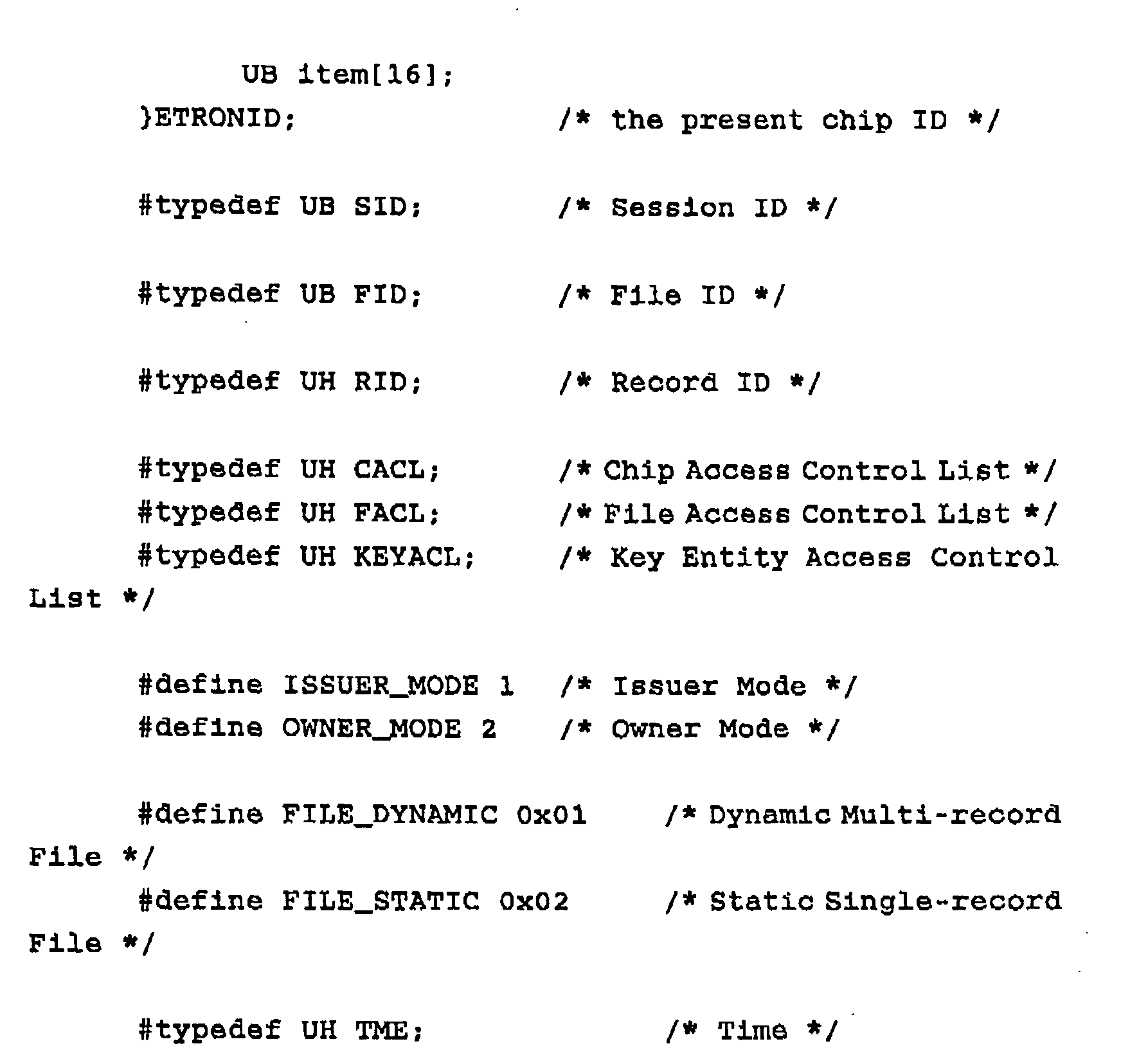
- SID
- Unsigned 1-byte integer (Session Id)
- FID
- Unsigned 2-byte integer (File/Folder Id)
- RID
- Unsigned 2-byte integer (Record Id)
- CACL.
- Unsigned 2-byte integer (Chip Access Control List)
- FACL
- Unsigned 2-byte integer (File Access Control List)
- KEYACL
- Unsigned 2-byte integer (Key Object Access Control List)
- TIME
- Unsigned 4-byte integer (Accumulation of seconds starting from 0:00AM on January 1, 2000)
- ERR
- Signed 2-byte integer

Open/Confirm Session
UB authMode, UB authAlgorithm,
UB sessionAlgorithm, UH len,
UB*authData, UH*rlen,
UB**rAuthData);
- destId
- the chip ID of the present chip being
an object for issuing a command
(Destination present chip ID) - srcId
- the present chip of the present
chip-incorporated service client calling the command
(Source present chip ID) - t
- time
- authMode
- specify the authentication mode
- authAlgorithm
- the specifier of the algorithm used for authentication
- sessionAlgorithm
- the specifier of the encryption algorithm in a session after authentication
- len
- an outbound packet length (an octet number)
- authData
- data to be passed from the present chip-incorporated service client to the present chip for authentication (len-16)
- rlen
- a return packet length (an octet number)
- rAuthData
- data returned from the present chip to the present chip-incorporated service client for authentication (rlen-8)
- authMode
- 0x01
- ISSUER Issuer mode
- 0x02
- OWNER Owner mode
- authAlgorithm
- 0x01
- Reserved
- 0x02
- RSA (off-line authentication using a certificate)
- 0x03
- RSA (on-line authentication for confirming the CRL)
- 0x04
- Reserved
- sessionAlgorithm
- 0x01
- DES
- 0x02
- 3DES
- 0x03
- Reserved
- 0x04
- Reserved
- 0x05
- Reserved
> 0 Session ID (upon normal closing)
< 0 Error code
<= 0 Error code
| D0 | D1 | D2 | D3 | D4 | D5 | D6 | D7 |
| Reserved | Serial (0x01) | Command ID (0x01) | Len (octet) | Reserved | |||
| t | authMode | authAlgorithm | sesAlgorithm | authData | |||
| authData | |||||||
| ... | |||||||
| authData |
| Field Name | Data Length | Meaning |
| Command ID | 2(=0x01) | Command Code |
| len | 2 | Packet Length (octet number) |
| t | 4 | |
| authmode | ||
| 1 | | |
| authAlgorithm | ||
| 1 | Authentication | |
| sessionAlgorithm | ||
| 1 | Session Encryption Algorithm Specifier | |
| authData | len-16 | Data for Authentication |
| D0 | D1 | D2 | D3 | D4 | D5 | D6 | D7 |
| Reserved | Serial (0x01) | Error Code | rLen (octet) | Reserved | |||
| t | authMode | authAlgorithm | sesAlgorithm | authData | |||
| rAuthData | |||||||
| ... | |||||||
| rAuthData |
| Field Name | Data Length | Meaning |
| Error Code | 2 | Error Code (, Session ID (in the 1-path case)) |
| rlen | 2 | Return Packet Length (octet number) |
| rAuthData | rlen-8 | Data for Authentication |
UH len, UB*authData, UH*rlen,
UB**rAuthData);
- destId
- the chip ID of the present chip being
the object for issuing a command
(Destination present chip ID) - srcId
- the present chip of the present
chip-incorporated service client calling the command
(Source present chip ID) - t
- time
- len
- an outbound packet length (an octet number)
- authData
- data to be passed from the present chip-incorporated service client to the present chip for authentication (len-12)
- rlen
- a return packet length (an octet number)
- rAuthData
- data returned from the present chip to the present chip-incorporated service client for authentication (rlen-8)
| D0 | D1 | D2 | D3 | D4 | D5 | D6 | D7 |
| Reserved | Serial (0x02) | Command ID (0x02) | len (octet) | Reserved | |||
| t | authData | ||||||
| ... | |||||||
| authData |
| Field Name | Data Length | Meaning |
| Command ID | 2(=0x02) | Command Data |
| len | 2 | Packet Length (octet) |
| t | 4 | Time |
| authData | len-12 | Data for Authentication |
| D0 | D1 | D2 | D3 | D4 | D5 | D6 | D7 |
| Reserved | Serial (0x02) | Error Code | rlen | Reserved | |||
| rAuthData | |||||||
| ... | |||||||
| rAuthData |
| Field Name | Data Length | Meaning |
| Error Code | 2 | Error Code, Session ID |
| rlen | 2 | Return Packet Length (octet number) |
| rAuthData | len-8 | Data for Authentication |
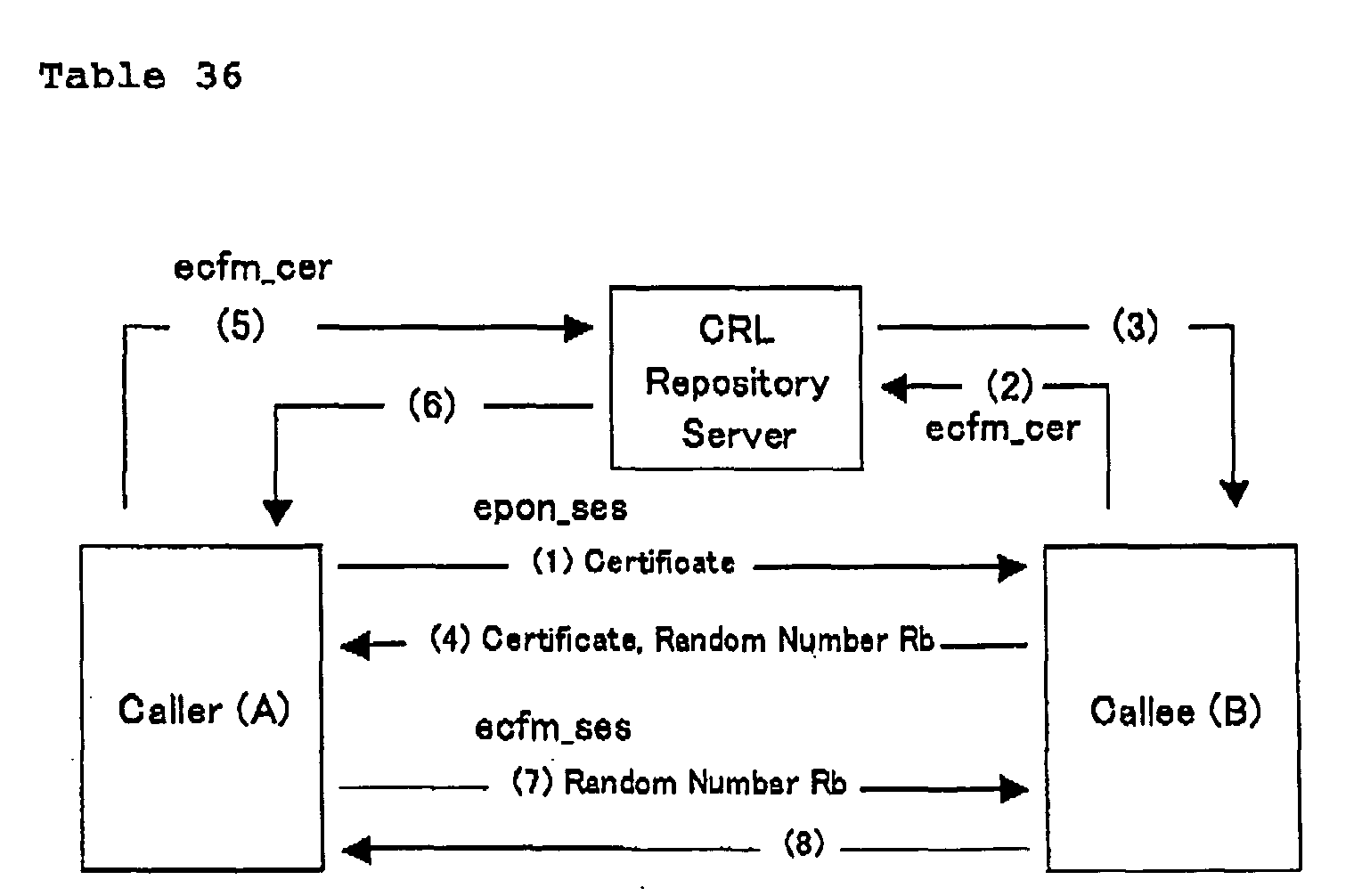
- authMode 0×02 (ISSUER)
- authAlgorithm 0x03 (RSA: on-line authentication for confirming CRL)
- sessionAlgorithm 0x02 (3DES)
- authData the eTP public key certificate for A
- MAC trailer check sum
- Confirm the validity of the eTP certificate for A
- Confirm the expiration date of the eTP certificate
- Confirm the signature on the eTP certificate by use of the public key of the CA station → to (2)
- Confirm the CRL list
- Retrieve the public key for A
- checkMode 0x00
- certificateId ***********
- MAC trailer check sum
- Error Code E_OK or not
- MAC trailer check sum
- Error Code E_OK or not
- authMode 0x02 (ISSUER)
- authAlgorithm 0x03 (RSA: on-line authentication for confirming CRL)
- sessionAlgorithm 0x02 (3DES)
- authData
- 1. the eTP public key certificate for B
- 2. a value obtained by RSA encryption of the 64-bit random number Rb with the public key for A
- MAC trailer check sum
- Confirm the validity of the eTP certificate for B
- Confirm the expiration date of the eTP certificate
- Confirm the CRL list → to (5)
- Confirm the signature on the eTP certificate by use of the public key of the CA station
- Retrieve the public key for B out of the certificate
- Retrieve the random number Rb received in authData2. after decryption with the secret key for A
- Assign the retrieved random number Rb as part of the secret key of 3DES for session encryption
- Create digital signature for the retrieved random number Rb by use of the secret key for A
- checkmode 0x00
- certificateId ***********
- MAC trailer check sum
- Error Code E_OK or not
- MAC trailer check sum
- authData
- 1. a value obtained by RSA encryption of the 64-bit Ra with the public key for B, and
- 2. a value obtained by RSA encryption with the secret key for A, of the digital signature by the secret key for A for the random number received from B, are appended and transmitted
- MAC trailer check sum
- Retrieve Ra and the digital signature obtained by decrypting the data received in authData with the public key for A
- Assign the retrieved Ra as part of the secret key of 3DES for session encryption
- Create digital signature for the retrieved Ra by use of the secret key for B
- Confirm the retrieved signature with the public key for A
- Error Code E_OK or not
- authData the digital signature for the random number Ra received from A according to the secret key for B
- MAC trailer check sum
- Confirm the received signature by use of the public
key of B
- (supplementary) Details of authentication algorithms
- Details of algorithms
- Keys for encryption and authentication
Secret key sk= d
Public key pk= (e, n) - Encryption algorithm for a normal sentence m
E_pk(m) = m-e mod n - Decryption algorithm for an encrypted sentence c D_sk(C)= c^d mod n
- Signature creation algorithm for a message M
f_sk(M) = (h(M))-d mod n- Here, h(M) is a hash function such as MD5 or SHA-1
- Verification algorithm for signature s to the message
M
g_pk(M,s)= if(h(M)==s^e mod n) then 1 else 0 endif
- Keys for encryption and authentication
- List of information owned by the respective nodes
- CA station (C)
Public key for CApk_c (130B)
Secret key for CA sk_c (128B) - Caller (A) side
Public key for A pk_a (130B) Secret key for A sk_a (128B) Certificate for A cer_a (304B) Signature of CA station in certificate for A s_(a,c) (128B) Public key for CA station pk_c (130B) - Callee (B) side
Public key for B pk_b (130B) Secret key for B sk_b (128B) Certificate for B cer_b (304B) Signature of CA station in certificate for B s_(b, c) (128B) Public key for CA station pk_c (130B)
- CA station (C)
- Details of authentication algorithms on the RSA basis
by the eTP
eopn_ses: (A) → (B)[Transmitted information] (cer_a) *total 304 bytes Certificate for A cer_a: including PK_a and s_(a,c)
g_(pk_c)(cer_aR s_(a.c))
eopn_sesi (A) ← (B)
| [Transmitted information] | (oer_b | rb) | *total 432 bytes |
| Certificate for B | cer_b: including | pk_b and s_(b,c) |
| Random number (Rb) | created by B | rb=E_(pk-a) (Rb) |
g_(pk_c)(cer_b, s_(b,c))
ecfm_ses: (A) → (B)
x_a2=E_(pk_b) (srb)
Ra' =D_( sk_b) (x_a1)
srb' =D_( sk_b) (x_a2)
g_(pk_a)(Rb, srb')
ecfm_ses: (A) ← (B)
g_(pk_b)(Ra, sra')
- In this way, a pair of (Ra, Rb) are left to both A and B, and a session common key is created therefrom by a certain algorithm.
- Setting of encryption communication parameters after establishing the session
In this event, Ra is used as the session ID.
- Authentication in the owner mode (authmode= OWNER) according to the secret key encryption

- ID_A; and
- Ra
- X1= E1_Key (ID_A | Ra); and
- X2= E2_P(Pb)
(Authentication is performed to qualify the present chip).
- Y = E3_P(R'b)
is created and transmitted to B.
(Authentication is performed to confirm that the qualified owner is operating through the present chip-incorporated service client)
- Here, "|" means to append and join bit sequences . For
example, when A= "010010011" and B= "00100101", then,
(A | B)= "01001001100100101"
- When E2 is assumed to be the operation of DES, the E3 is an operation in which an argument is bit-inverted and then subjected to DES.
Close Session
- destId
- the chip ID of the present chip being
an object of a command
(Destination present chip ID) - srcId
- the present chip ID of the present
chip-incorporated service client calling the command
(Source present chip ID) - t
- time
- len
- an outbound packet length (an octet number)
- rlen
- a return packet length (an octet number)

| Field Name | Data Length | Meaning |
| Command ID | 2(=0x03) | Command Code |
| len | 2(=12) | Packet Length (octet number) |
| t | 4 | Time |
| D0 | D1 | D2 | D3 | D4 | D5 | D6 | D7 |
| SID | Serial No. | Error Code | Len (8) | Reserved |
| Field Name | Data Length | Meaning |
| Error Code | 2 | Error Code(, Session ID) |
| rlen | 2 | Return Packet Length (octet number) |
Open/Confirm Transaction
- Basic operations are similar to ueopn_sestm and "ecfm_sas" . However, the difference is roll-back capability regarding the subsequent processing.
UB authMode, UB authAlgorithm,
UB sessionAlgorithm, UH len,
UB*authData, UH*rlen,
UB**rAuthData);
- destId
- the chip ID of the present chip being
an object of a command
(Destination present chip ID) - srcId
- the present chip of the present
chip-incorporated service client calling the command
(Source present chip ID) - t
- time
- authMode
- specify the authentication mode
- authAlgorithm
- the specifier of the algorithm used for authentication
- sessionAlgorithm
- the specifier of the encryption algorithm in a session after authentication
- len
- an outbound packet length (an octet number)
- authData
- data to be passed from the present chip-incorporated service client to the present chip for authentication (len-16)
- rlen
- a return packet length (an octet number)
- rAuthData
- data returned from the present chip to the present chip-incorporated service client for authentication (rlen-8)
> 0 Session ID (upon normal closing)
< 0 Error code
<= 0 Error code
| D0 | D1 | D2 | D3 | D4 | D5 | D6 | D7 |
| Reserv ed | Serial (0x01) | Command ID (0x04) | Len | Reserved | |||
| t | authMode | AuthAlgorithm | sesAlgorithm | authData | |||
| authData | |||||||
| ... | |||||||
| authData |
| Field Name | Data Length | Meaning |
| Command ID | 2(=0x04) | Command Code |
| len | 2 | Packet Length (octet number) |
| t | 4 | |
| authmode | ||
| 1 | | |
| authAlgorithm | ||
| 1 | Authentication | |
| sessionAlgorithm | ||
| 1 | Session Encryption algorithm Specifier | |
| authData | len-16 | Data for Authentication |
| D0 | D1 | D2 | D3 | D4 | D5 | D6 | D7 |
| Reserved | Serial (0x01) | Error Code | Rlen (octet) | Reserved | |||
| rAuthData | |||||||
| ... | |||||||
| rAuthData |
| Field Name | Data Length | Meaning |
| Error Code | 2 | Error Code (, Session ID (in the 1-path case)) |
| rlen | 2 | Return Packet Length (octet number) |
| rAuthData | rlen-8 | Data for Authentication |
UH len,UB*authData,
UH*rlen,UB**rAuthData);
- destId
- the chip ID of the present chip being
an object of a command
(Destination present chip ID) - sraId
- the present chip of the present
chip-incorporated service client calling the command
(Source present chip ID) - t
- time
- len
- an outbound packet length (an octet number)
- authData
- data to be passed from the present chip-incorporated service client to the present chip for authentication (len-12)
- rlen
- a return packet length (an octet number)
- rAuthData
- data returned from the present chip to the present chip-incorporated service client for authentication (rlen-8)
| D0 | D1 | D2 | D3 | D4 | D5 | D6 | D7 |
| Reserved | Serial (0x02) | Command ID (0x05) | len (octet) | Reserved | |||
| t | authData | ||||||
| ... | |||||||
| authData |
| Field Name | Data Length | Meaning |
| Command ID | 2(=0x02) | Command Code |
| len | 2 | Packet Length (octet number) |
| t | 4 | Time |
| authData | len-12 | Data for Authentication |
| D0 | D1 | D2 | D3 | D4 | D5 | D6 | D7 |
| Reserved | Serial (0x02) | Error Code | rlen (octet) | Reserved | |||
| rAuthData | |||||||
| ... | |||||||
| rAuthData |
| Field Name | Data Length | Meaning |
| Error Code | 2 | Error Code(, Session ID) |
| rlen | 2 | Return Packet Length (octet number) |
| rAuthData | rien-8 | Data for Authentication |
- Create File ecre_fil
- Delete File edel_fil
- Create Record ecra_reo
- Delete Record edel_rec
- Update Record eupd_rec
Commit/Abort Transaction
ETRONID sroID, TIME t, UH len,
UH*rlen);
- destId
- the chip ID of the present chip being
an object of a command
(Destination present chip ID) - srcId
- the present chip ID of the present
chip-incorporated service client calling the command
(Source present chip ID) - t
- time
- len
- an outbound packet length (an octet number)
- rlen
- a return packet length (an octet number)

| Field Name | Data Length | Meaning |
| Command ID | 2(=0x06) | Command Code |
| len | 2(0x0C) | Packet Length (octet number ) |
| t | 4 | Time |
| D0 | D1 | D2 | D3 | D4 | D5 | D6 | D7 |
| SID | Serial No. | Error Code | rlen (8) | Reserved |
| Field Name | Data Length | Meaning |
| Error Code | 2 | Error Code(, Session ID) |
| rlen | 2 (0x08) | Return Packet Length (octet number) |
ETRONID srcID, TIME t, UH len,
UH*rlen);
- destId
- the chip ID of the present chip being
an object of a command
(Destination present chip ID) - srcId
- the present chip ID of the present
chip-incorporated service client calling the command
(Source present chip ID) - t
- time
- len
- an outbound packet length (an octet number)
- rlen
- a return packet length (an octet number)

| Field Name | Data Length | Meaning |
| Command ID | 2(=0x07) | Command Code |
| len | 2(0x0C) | Packet Length (octet number) |
| t | 4 | Time |
| D0 | D1 | D2 | D3 | D4 | D5 | D6 | D7 |
| SID | Serial No. | Error Code | rlen (8) | Reserved |
| Field Name | Data Length | Meaning |
| Error Code | 2 | Error Code(, Session ID) |
| rlen | 2 | Return Packet Length (octet number) |
- The established transaction is committed or aborted.
- When the transaction is committed, all the commands issued between "ecfm_tra" and "ecom_"tra" are reflected to a nonvolatile memory of the present chip.
- When the transaction is aborted or when no commitment arrives after waiting for a certain time period, then all the commands issued between "ecfm_tre" and "ecom_tra" are reflected to a nonvolatile memory of the present chip.
- Upper limit number of usable files 50
- File ID 0 to 49
- Upper limit of a file size 256 (octets)
Create File
UH cnt. FACL facl, UH*rlen);
- sid
- session ID
- destId
- the chip ID of the present chip being
an object of a command
(Destination present chip ID) - srcId
- the present chip ID of the present
chip-incorporated service client calling the command
(Source present chip ID) - t
- time
- fid
- the file ID to be created
- facl
- an initial value of the file access control list
- blk
- a starting address of the file (which is fixed to "1" herein)
- cnt
- a file length (an octet number)
- len
- an outbound packet length (an octet number)
- rlen
- a return packet length (an octet number)
| D0 | D1 | D2 | D3 | D4 | D5 | D6 | D7 |
| SID | Serial No. | Command ID (0x21) | len (24) | Reserved | |||
| t | fid | Reserved | |||||
| facl | Reserved | blk | cnt |
| Field Name | Data Length | Meaning |
| Command ID | 2(=0x21) | Command Code |
| len | 2(=0x18) | Packet Length (octet number) |
| t | 4 | Time |
| fid | 2 | File ID |
| facl | 2 | Initial Access Control List |
| blk | 2 | 0×0000 |
| cnt | File ID | File Length (octet) |
| D0 | D1 | D2 | D3 | D4 | D5 | D6 | D7 |
| SID | Serial No. | Error Code | rlen (8) | Reserved |
| Field Name | Data Length | Meaning |
| Error Code | 2 | File ID, Error Code |
| rlen | 2(=0x08) | Return Packet Length (octet number) |
- Always usable in the issuer mode (the present chip ID of the ISSUER of a parent folder is equals to the present chip ID of the SC which constructed the Session)
- Usable in the owner mode and the other mode if permitted in the access control list of the parent folder
Delete File
TIME t, UH len, FID fid, UH*rlen);
- sid
- the session ID
- destId
- the chip ID of the present chip being
an object of a command
(Destination present chip ID) - srcId
- the present chip ID of the present
chip-incorporated service client calling the command
(Source present chip ID) - t
- time
- fid
- the file ID to be deleted
- len
- an outbound packet length (an octet number)
- rlen
- a return packet length (an octet number)
| D0 | D1 | D2 | D3 | D4 | D5 | D6 | D7 |
| SID | Serial No. | Command ID (0x22) | len (16) | Reserved | |||
| t | fid | Reserved |
| Field Name | Data Length | Meaning |
| Command ID | 2(=0x22) | Command Code |
| len | 2(=0x10) | Packet Length (octet number) |
| t | 4 | Time |
| fid | 2 | File ID to be deleted |
| D0 | D1 | D2 | D3 | D4 | D5 | D6 | D7 |
| SID | Serial No. | Error Code | rlen (8) | Reserved |
| Field Name | Data Length | Meaning |
| Error Code | 2 | File ID, Error Code |
| rlen | 2(=0x08) | Return Packet Length (octet number) |
- The following conditions must be satisfied to execute "edel_fil". Attention is needed herein because two types of access control lists are involved.
Request File Transfer
ETRONID targetID, Fid targetFid,
UH*rlen);
- sid
- the session ID
- destId
- the chip ID of the present chip being
an object of a command
(Destination present chip ID) - srcId
- the present chip ID of the present
chip-incorporated service client calling the command
(Source present chip ID) - t
- time
- fid
- the file ID to be created
- targetId
- the present chip ID of a transfer destination of the file
- targetFid
- the file ID of the file to be transferred at the transfer destination
- len
- an outbound packet length (an octet number)
- rlen
- a return packet length (an octet number)
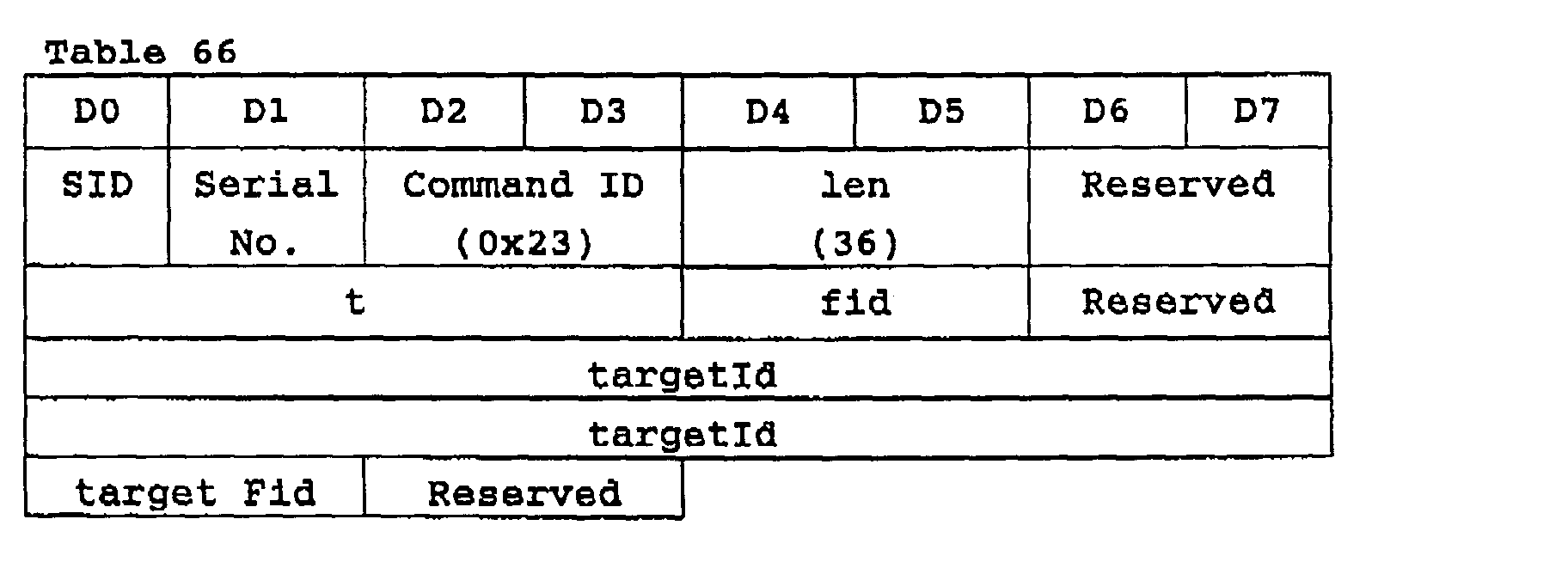
| Field Name | Data Length | Meaning |
| Command ID | 2(=0x23) | Command Code |
| len | 2(=0x24) | Packet Length (octet number) |
| t | 4 | Time |
| fid | 2 | |
| targetId | ||
| 16 | The Present Chip ID of Destination to which File is transferred | |
| targetFidId | 2 | File ID of Transfer Destination |
| D0 | D1 | D2 | D3 | D4 | D5 | D6 | D7 |
| SID | Serial No. | Error Code | rlen (8) | Reserved |
| Field Name | Data Length | Meaning |
| Error Code | 2 | File ID, Error Code |
| rlen | 2(=0x08) | Return Packet Length (octet number) |
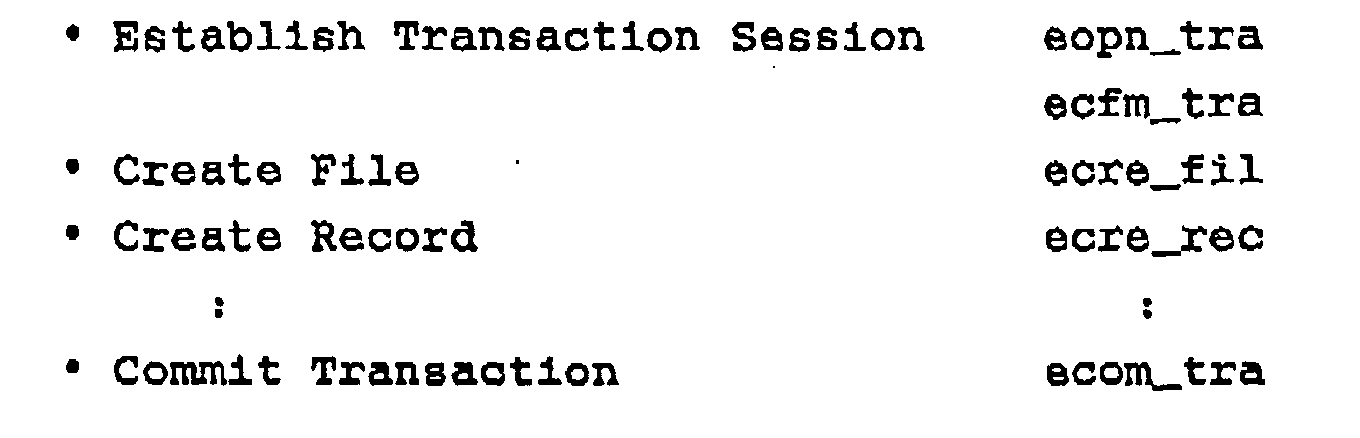
Encrypting/Decrypting File
FID destFid, FID keyed, UB*rlen,
UW*currentMoney, UW*payedMoney);
TIME t, UB len, FID srcFid.
FID destFid, FID keyed, UB*rlen,
UW*currentMoney, UW*payedMoney);
- sid
- the session ID
- destId
- the chip ID of the present chip being
an object of a command
(Destination present chip ID) - srcId
- the present chip ID of the present
chip-incorporated service client calling the command
(Source present chip ID) - t
- time
- srcFid
- the file ID where the encrypted contents are stored
- destFid
- the file ID storing the decrypted contents
- keyId
- the file ID storing the key entity to be used for decryption processing
- currentMoney
- the balance of money left in the key entity
- payedMoney
- the amount of money settled this time
- len
- an outbound packet length (an octet number)
- rlen
- a return packet length (an octet number)
| D0 | D1 | D2 | D3 | D4 | D5 | D6 | D7 |
| SID | Serial No. | Command ID (0x34,35) | len (84 + signature length) | Reserved | |||
| t | srcFid | Reserved | |||||
| destFid | Reserved | keyed | Reserved |
| Field Name | Data Length | Meaning |
| Command ID | 2(0x34,35) | Command Code |
| len | 2 | Packet Length (octet number) |
| t | 4 | |
| srcFid | ||
| 1 | Original | |
| destFidl | ||
| 1 | Output Destination File ID | |
| keyed | 1 | Key Entity ID |
| D0 | D1 | D2 | D3 | D4 | D5 | D6 | D7 |
| SID | Serial No. | Error Code | rlen (16) | Reserved | |||
| currentMoney | payedMoney |
| Field Name | Data Length | Meaning |
| Error Code | 2 | File ID, Error Code |
| rien | 2 | Return Packet Length (octet number) |
| currentMoney | 4 | Balance of Money in Key Entity |
| payedMoney | 4 | Amount of Money SettledThis Time |

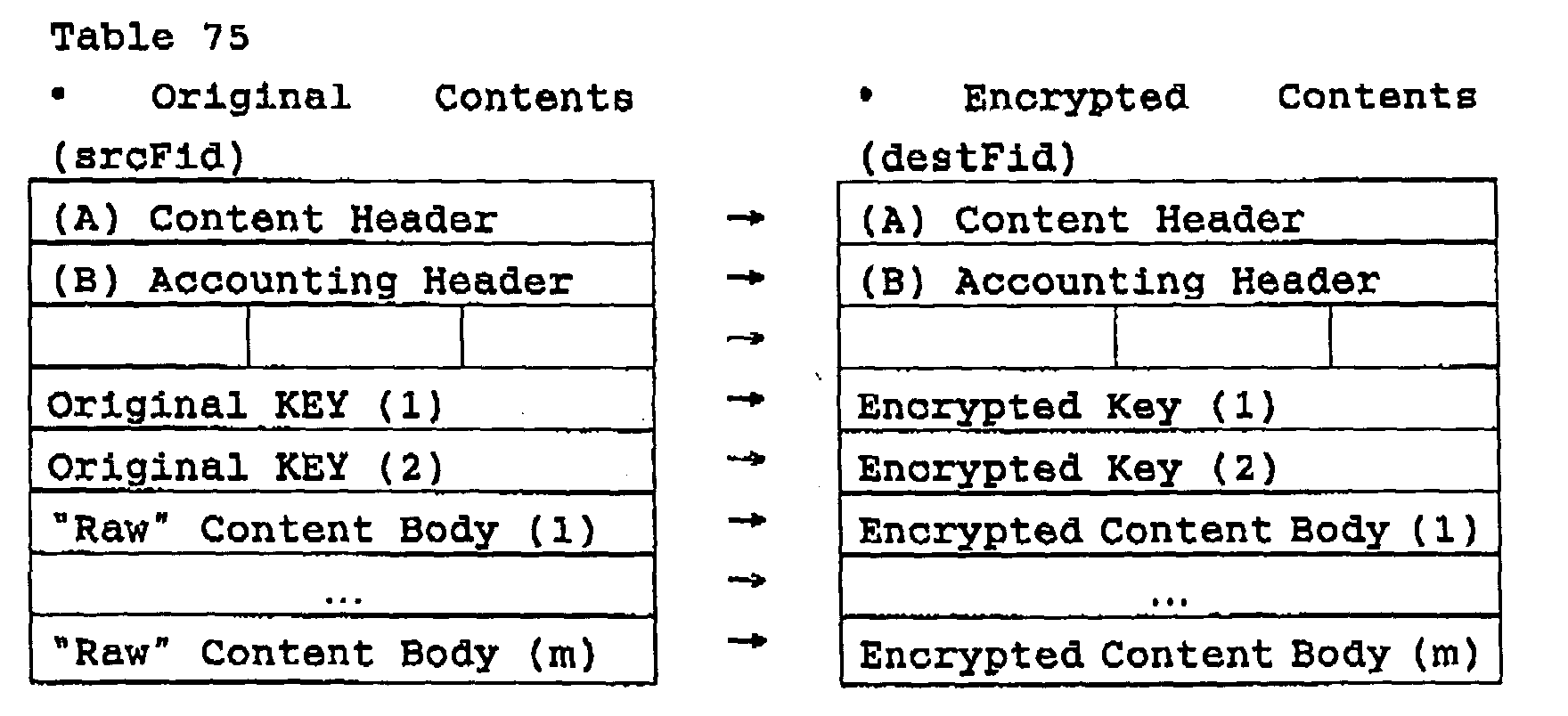

Update File Mode
TIME t.UHlen.FID fid,FILACL filad,
UH*rlen);
- sid
- the session ID
- destId
- the chip ID of the present chip being
an object of a command
(Destination present chip ID) - srcId
- the present chip ID of the present
chip-incorporated service client calling the command
(Source present chip ID) - t
- time
- fid
- the file ID of the object of change in the access control list
- filacl
- update data of the file access control list
- callerId
- the present chip ID of the present chip-incorporated service client calling the command
- len
- an outbound packet length (an octet number)
- rlen
- a return packet length (an octet number)
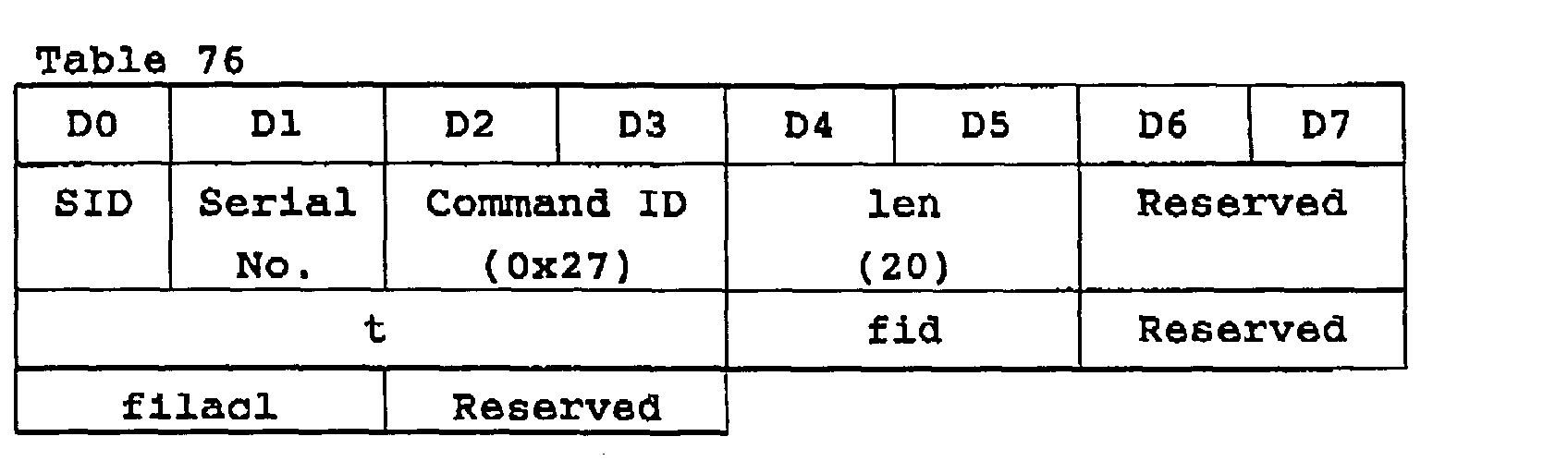
| Field Name | Data Length | Meaning |
| Command ID | 2(=0x27) | Command Code |
| len | 2(=0x14) | Packet Length (octet number) |
| t | 4 | Time |
| fid | 2 | File ID |
| fllacl | 2 | File Access Control List |
| D0 | D1 | D2 | D3 | D4 | D5 | D6 | D7 |
| SID | Serial No. | Error Code | rlen (8) | Reserved |
| Field Name | Data Length | Meaning |
| Error Code | 2 | File ID, Error Code |
| rlen | 2(=0x08) | Return Packet Length (octet number) |
- Always usable in the issuer mode (the present chip ID of the ISSUER of a parent folder is equals to the present chip ID of the SC which constructed the Session) with respect to the object file
- Usable in the owner mode and the other mode if permitted in the access conrol list of the object file
List File_ID
TIME t, UH len, FID fid, UH*rlen,
UB**fileCtrlBlk);
- sid
- the session ID
- destId
- the chip ID of the present chip being
an object of a command
(Destination present chip ID) - srcId
- the present chip ID of the present
chip-incorporated service client calling the command
(Source present chip ID) - t
- time
- fid
- the object file ID
- fileCtrlBlk
- a control block of the object file
- len
- an outbound packet length (an octet number)
- rlen
- a return packet length (an octet number)
| D0 | D1 | D2 | D3 | D4 | D5 | D6 | D7 |
| SID | Serial No. | Command ID (0x2F) | len (16) | Reserved | |||
| t | fid | Reserved |
| Field Name | Data Length | Meaning |
| Command ID | 2(= 0x2F) | Command Code |
| len | 2(16) | Packet Length (octet number) |
| t | 4 | Time |
| fid | 2 | File ID |
| D0 | D1 | D2 | D3 | D4 | D5 | D6 | D7 |
| SID | Serial No. | Error Code | rlen | Reserved | |||
| FileCtrlBlk | |||||||
| ... | |||||||
| FileCtrlBlk |
| Field Name | Data Length | Meaning |
| Error Code | 2 | File ID, Error Code |
| rlen | 2 | Return Packet Length (octet number) |
| fileCtrlBlk | *rlen-8 | Control Block of Object File |
- Always usable in the issuer mode (the present chip ID of the ISSUER of a parent folder is equals to the present chip ID of the SC which constructed the Session) with respect to the object file
- Usable in the owner mode and the other mode if permitted in the access control list of the object file
Update Record
TIME t, UH len, FID fid, UH blk,
UH cnt, UB*data, UH*rlen);
- sid
- the session ID
- destId
- the chip ID of the present chip being
an object of a command
(Destination present chip ID) - srcId
- the present chip ID of the present
chip-incorporated service client calling the command
(Source present chip ID) - t
- time
- fid
- the file ID to be changed
- blk
- a record number to be changed (fixed to 1 herein)
- cnt
- a record data length to be changed (an octet number)
- data
- the contents of data to be changed (cnt octet)
- len
- an outbound packet length (an octet number)
- rlen
- a return packet length (an octet number)
| D0 | D1 | D2 | D3 | D4 | D5 | D6 | D7 |
| SID | Serial No. | Command ID (0x33) | len | Reserved | |||
| t | fid | Reserved | |||||
| blk | cnt | data | |||||
| data | |||||||
| ... | |||||||
| data |
| Field Name | Data Length | Meaning |
| Command ID | 2(0x33) | Command Code |
| len | 2 | Packet Length (octet number) |
| t | 4 | Time |
| fid | 2 | File ID |
| blk | 2 | Changed Record ID (fixed to 1 herein) |
| cnt | 2 | Data Length (octet number) |
| data | Cnt | Data to be Written |
| D0 | D1 | D2 | D3 | D4 | D5 | D6 | D7 |
| SID | Serial No. | Error Code | rlen (8) | Reserved |
| Field Name | Data Length | Meaning |
| Error Code | 2 | File ID, Error Code |
| rlen | 2 | Return Packet Length (octet number) |
- Always usable in the issuer mode (the present chip ID of the ISSUER of a parent folder is equals to the present chip ID of the SC which constructed the Session) with respect to the object file
- Usable in the owner mode and the other mode if permitted in the access control list of the object record
Read Record
TIME t, UH len, FID fid. UH blk,
UH cnt, UH*rlen, UH*rCnt. UB*rData)
- sid
- the session ID
- destId
- the chip ID of the present chip being
an object of a command
(Destination present chip ID) - srcId
- the present chip ID of the present
chip-Incorporated, service client calling the command
(Source present chip ID) - t
- time
- fid
- the file ID to be read out
- blk
- the record ID to be read out
- cnt
- a data length to be read out (an octet number)
- rCnt
- a length of the data actually read out (an octet number)
- rData
- the read-out data (rCnt octet)
- len
- an outbound packet length (an octet number)
- rlen
- a return packet length (an octet number)
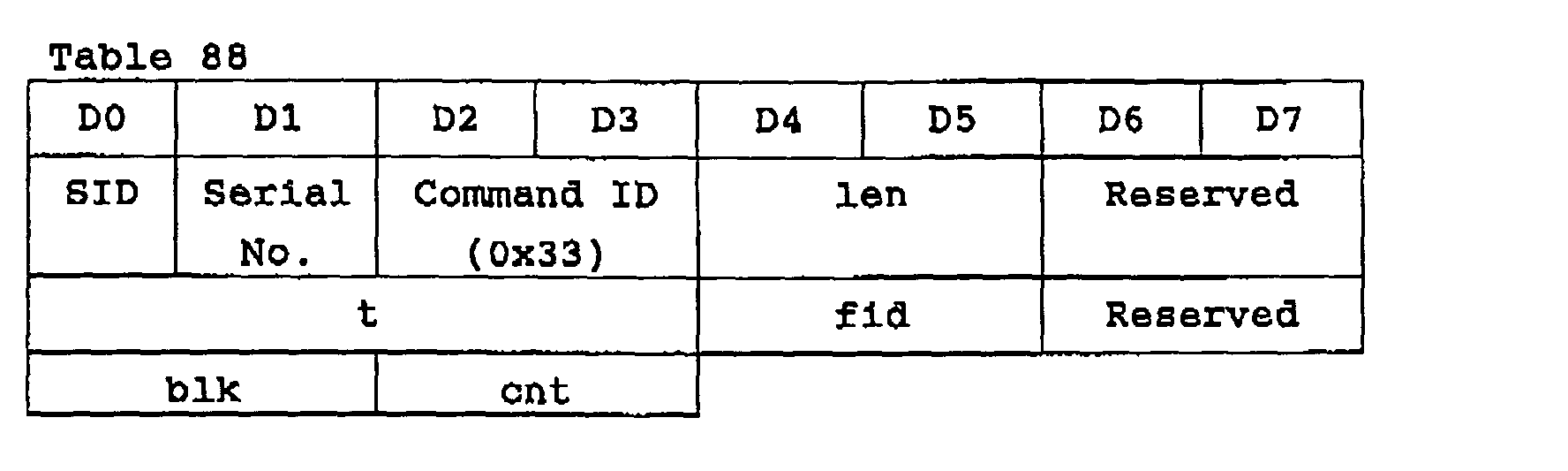
| Field Name | Data Length | Meaning |
| Command ID | 2(0x34) | Command Code |
| len | 2 | Packet Length (octet number) |
| t | 4 | Time |
| fid | 2 | File ID |
| blk | 2 | Record ID |
| cnt | 2 | Data Length (octet) |
| D0 | D1 | D2 | D3 | D4 | D5 | D6 | D7 |
| SID | Serial No. | Error Code | rlen (8) | Reserved | |||
| rCnt | Reserved | rData | |||||
| rData | |||||||
| ... | |||||||
| rData |
| Field Name | Data Length | Meaning |
| Error Code | 2 | Read Out Data Length (octet number), Error Code |
| rCnt | 2 | Data Length Actually Read Out (octet number) |
| rData | rCnt | Read Out Data |
- Always usable in the issuer mode (the present chip ID of the ISSUER of a parent folder is equals to the present chip ID of the SC which constructed the Session) with respect to the object record
- Usable in the owner mode and the other mode if permitted in the access control list of the object record
- Upper limit number of
usable files 10 - Key entity ID 0 to 9
- Upper limit of a key entity size 256 (octets)
Create Key Object
TIME t, UH len, UH kid,
UH keyAlgorithm, UB*Key, UH bankId,
KEYACL acl, UL initMoney Val,
UH*rlen);
- sid
- the session ID
- destId
- the chip ID of the present chip being
an object of a command
(Destination present chip ID) - srcId
- the present chip ID of the present
chip-incorporated service client calling the command
(Source present chip ID) - t
- time
- kid
- the key entity ID
- KeyAlgorithm
- the encryption algorithm specifier
- key
- an encryption key
- bankID
- a bank ID
- initMoney Val
- an initial amount of money
- acl
- an initial access control list value (unused in the first version)
- len
- an outbound packet length (an octet number)
- rlen
- a return packet length (an octet number)
| D0 | D1 | D2 | D3 | D4 | D5 | D6 | D7 |
| SID | Serial No. | Command ID (0x61) | len | Reserved | |||
| t | kid | keyAlgorithm | |||||
| KEY (1) | |||||||
| KEY (2) | |||||||
| BankID | acl | initMoney Val |
| Field Name | Data Length | Meaning |
| Command ID | 2(0x61) | Command Code |
| len | 2 | Packet Length (octet number) |
| t | 4 | Time |
| kid | 2 | Key Entity ID |
| keyAlgorithm | 2 | Encryption |
| key | ||
| 16 | Encryption Key | |
| bankID | 2 | Bank ID |
| acl | 2 | Initial Access Control List Value (unused in the first version) |
| initMoneyVal | 4 | Initial Money Amount |
| D0 | D1 | D2 | D3 | D4 | D5 | D6 | D7 |
| SID | Serial No. | Error Code | rlen (8) | Reserved |
| Field Name | Data Length | Meaning |
| Error Code | 2 | Error Code |
| rlen | 2 | Return Packet Length (octet number) |
Delete Key Object
TIME t, UB len. UH kid, UH*bankId,
UL*remainingMoney, UH*rsize,
UB**bookList, UH*rlen);
- sid
- the session ID
- destId
- the chip ID of the present chip being
an object of a command
(Destination present chip ID) - srcId
- the present chip ID of the present
chip-incorporated service client calling the command
(Source present chip ID) - t
- time
- kid
- the key entity ID to be deleted
- bankID
- the bank ID
- remainingMoney
- a remaining amount of money
- rsize
- a length of Distribution List
- bookList
- Distribution List
- len
- an outbound packet length (an octet number)
- rlen
- a return packet length (an octet number)
| D0 | D1 | D2 | D3 | D4 | D5 | D6 | D7 |
| SID | Serial No. | Command ID (0x62) | len | Reserved | |||
| t | kid | Reserved |
| Field Name | Data Length | Meaning |
| Command ID | 2(0x62) | Command Code |
| len | 2 | Packet Length (octet number) |
| t | 4 | Time |
| kid | 2 | Key Entity ID |
| D0 | D1 | D2 | D3 | D4 | D5 | D6 | D7 |
| SID | Serial No. | Error Code | rlen (16) | Reserved | |||
| BANK ID | Reserved | CurrentMoney Balance after Payment |
| Field Name | Data Length | Meaning |
| Error Code | 2 | Error Code |
| rlen | 2 | Return Packet Length (octet number) |
| bankId | 2 | Bank ID |
| currentMoney | 4 | Current Money Balance |
Update Key Object
TIME t, UH len, UH kid, UL addMoney.
UH*rlen, UL*currentMoney);
- sid
- the session ID
- destId
- the chip ID of the present chip being
an object of a command
(Destination present chip ID) - srcId
- the present chip ID of the present
chip-incorporated service client calling the command
(Source present chip ID) - t
- time
- kid
- the key entity ID to be updated
- addMoney
- the amount of money to be added
- currentMoney
- the amount of money after addition
- len
- an outbound packet length (an octet number)
- rlen
- a return packet length (an octet number)

| Field Name | Data Length | Meaning |
| Command ID | 2(0x63) | Command Code |
| len | 2 | Packet Length (octet number) |
| t | 4 | Time |
| kid | 2 | Key Entity ID to be Updated |
| addMoney | 4 | Amount of Money to be Added |

| Field Name | Data Length | Meaning |
| Error Code | 2 | Error Code |
| rlen | 2(12) | Return Packet Length (octet number) |
| currentMoney | 2 | Amount of Money after Addition |
Read Key Object
TIME t. UH len, UH kid, UH*rlen,
UL*currentMoney);
- sid
- the session ID
- destId
- the chip ID of the present chip being
an object of a command
(Destination present chip ID) - srcId
- the present chip ID of the present
chip-incorporated service client calling the command
(Source present chip ID) - t
- time
- kid
- the key entity ID being the object for reading the money amount information
- currentMoney
- the current amount of money
- len
- an outbound packet length (an octet number)
- rlen
- a return packet length (an octet number)
| D0 | D1 | D2 | D3 | D4 | D5 | D6 | D7 |
| SID | Serial No. | Command ID (0x64) | len | Reserved | |||
| t | kid | Reserved |
| Field Name | Data Length | Meaning |
| Command ID | 2(0x63) | Command Code |
| len | 2 | Packet Length (octet number) |
| t | 4 | Time |
| kid | 2 | Key Entity ID to be read |
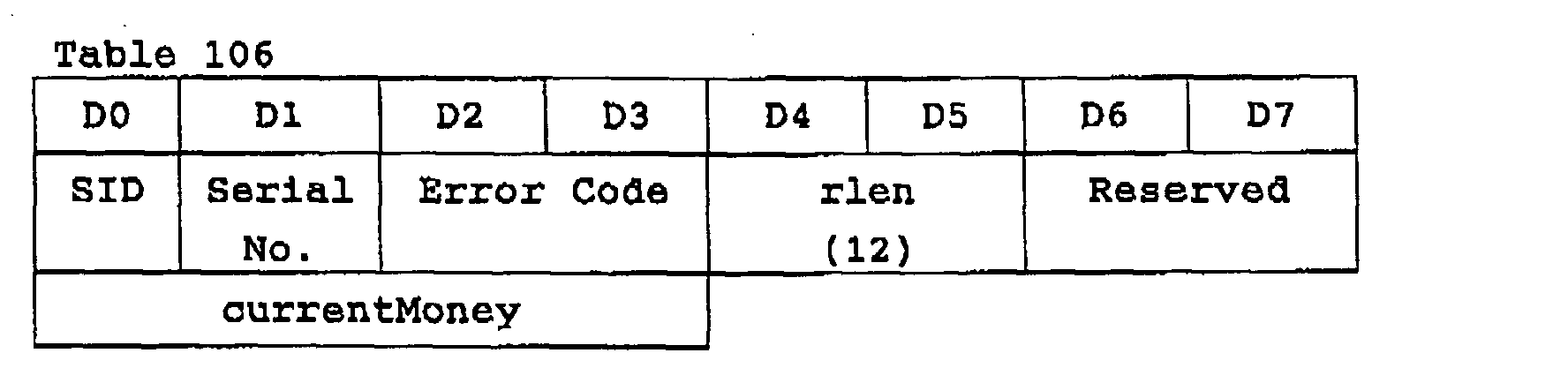
| Field Name | Data Length | Meaning |
| Error Code | 2 | Error Code |
| rlen | 2(=12) | Return Packet Length (octet number) |
| currentMoney | 4 | Current Amount of Money |
Update Key Mode
- Not loaded in the first version
TIME t, UH len, UH kid, KEYACL keyacl,
UH*rlen);
- sid
- the session ID
- destId
- the chip ID of the present chip being
an object of a command
(Destination present chip ID) - srcId
- the present chip ID of the present
chip-incorporated service client calling the command
(Source present chip ID) - t
- time
- kid
- the key entity ID being the object for updating the access control list
- keyacl
- the key entity access control list to be updated
- len
- an outbound packet length (an octet number)
- rlen
- a return packet length (an octet number)
| D0 | D1 | D2 | D3 | D4 | D5 | D6 | D7 |
| SID | Serial No. | Command ID (0x65) | len | Reserved | |||
| t | kid | Reserved |
| Field Name | Data Length | Meaning |
| Command ID | 2(0x65) | Command Code |
| len | 2 | Packet Length (octet number) |
| t | 4 | Time |
| kid | 2 | Key Entity ID to be Updated |
| keyac1 | 2 | Key Entity Access Control List |

| Field Name | Data Length | Meaning |
| Error Code | 2 | Error Code |
| rlen | 2(=8) | Return Packet Length (octet number) |
| currentMoney | 4 | Amount of Money after Addition |
List Key Object ID
TIME t, UH len, KID kid, UH*rlen,
UB**keyCtrlBlk);
- sid
- the session ID
- destId
- the chip ID of the present chip being
an object of a command
(Destination present chip ID) - srcId
- the present chip ID of the present
chip-incorporated service client calling the command
(Source present chip ID) - t
- time
- kid
- the object key entity ID
- keyCtrlBlk
- a control block of the object key entity
- len
- an outbound packet length (an octet number)
- rlen
- a return packet length (an octet number)
| D0 | D1 | D2 | D3 | D4 | D5 | D6 | D7 |
| SID | Serial No. | Command ID (0x6F) | len (16) | Reserved | |||
| t | kid | Reserved |
| Field Name | Data Length | Meaning |
| Command ID | 2(=0x6F) | Command Code |
| len | 2 (=16) | Packet Length (octet number) |
| t | 4 | Time |
| kid | 2 | Key Entity ID |
| D0 | D1 | D2 | D3 | D4 | D5 | D6 | D7 |
| SID | Serial No. | Error Code | rlen | Reserved | |||
| keyCtrlBlk | |||||||
| ... | |||||||
| keyCtrlBlk |
| Field Name | Data Length | Meaning |
| Error Code | 2 | Error Code |
| rlen | 2(=8) | Return Packet Length (octet number) |
| keyrlBlk | *rlen-8 | Control Block of Object File |
- Always usable in the issuer mode (the present chip ID of the ISSUER of a parent folder is equals to the present chip ID of the SC which constructed the Session) with respect to the object key entity
- Usable in the owner mode and the other mode if permitted in the access control list of the object key entity
Confirm Certificate
TIME t, UH len, UB checkMode,
UH serial, UHcaId, UB*rlen, UB*crl)
- sid
- the session ID
- destId
- the chip ID of the present chip being
an object of a command
(Destination present chip ID) - srcId
- the present chip ID of the present
chip-incorporated service client calling the command
(Source present chip ID) - t
- time
- checkMode
- a check mode of a list to be nullified
- serial
- a certificate number of a certificate to be confirmed
- caId
- the issuer ID of the certificate to be confirmed
- crl
- a nullified list (the present chip format)
- len
- an outbound packet length (an octet number)
- rlen
- a return packet length (an octet number)
- 0x00
- return only the check
- 0x01
- obtain the corresponding nullified list

| Field Name | Data Length | Meaning |
| Command ID | 2(0x71) | Command Code |
| len | 2 | Packet Length |
| t | 4 | Time |
| checkMode | 2 | |
| certificateId | ||
| 16 | Certificate ID to be Checked |
| D0 | D1 | D2 | D3 | D4 | D5 | D6 | D7 |
| SID | Serial No. | Error Code | rlen (8) | Reserved | |||
| crl | |||||||
| ... | |||||||
| crl |
| Field Name | Data Length | Meaning |
| Error Code | 2 | Error Code |
| rlen | 2 | Nullified List Length |
| cr1 | rlen-8 | Nullified List |
Poll CHIP
- destId
- the chip ID which is returned upon polling
- srcId
- the present chip ID of the present chip-incorporated service client calling the command
- t
- time
| D0 | D1 | D2 | D3 |
| Reserved | Serial | Com. ID | Reserved |
| (0x00) | (0x00) | (0x41) |
| Field Name | Data Length | Meaning |
| Command ID | 1(0x41) | Command Code |
| D0 | D1 | D2 | D3 | D4 | D5 | D6 | D7 |
| SID (0x00) | Serial (0x00) | Error Code | rlen (0x08) | cardVersion | Reserved |
| Field Name | Data Length | |
| Error Code | ||
| 1 | Error Code | |
| cardVersion | 2 | Card Version |
| rlen | 1 | Data Packet Length (=0x08) |
- Both eared and clientId are attached to a chip header and therefore are not included in the main body.
Initialize CHIP
UB initKeyl[8] UB initKey2 [8],
UB initPasswd [8], UB fileNum,
UB keyObjLen, UB swapLen, CACL cacl,
UB rsaSecretKey [128], UH len,
UH*rlen);
- destId
- the chip ID of the present chip being
an object of a command
(Destination present chip ID) - srcId
- all "1"
- t
- time
- initKey1
- a common key (1) for authentication
- initKey2
- a common key (2) for authentication
- initPasswd
- an initial password
- fileNum
- an upper limit of the number of files creatable in the chip
- keyObjNum
- an upper limit of the number of key entities
- swapLen
- the size of a swap area in the nonvolatile memory
- cacl
- the access control list of the chip
- rsaSecretKey
- a secret key for authentication (RSA) of an own card
- len
- an outbound packet length (an octet number)
- rlen
- a return packet length (an octet number)
| D0 | D1 | D2 | D3 | D4 | D5 | D6 | D7 |
| SID | Serial No. | Command ID (0x51) | len (176) | Reserved | |||
| t | Reserved | ||||||
| Common Key (1) for Authentication | |||||||
| Common Key (2) for Authentication | |||||||
| Password | |||||||
| cacl | file Num | keyObj Num | swap Len | Reserved | version | ||
| Own (RSA) Secret Key (1) | |||||||
| ... | |||||||
| Own (RSA) Secret Key (16) |
| Field Name | Data Length | Meaning |
| Command ID | 2(0x51) | Command Code |
| len | 2(176) | Packet Length |
| t | 4 | Time |
| initKey1 | 8 | Common Key (1) for Authentication |
| initKey2 | 8 | Common Key (2) for Authentication |
| initPasswd | 8 | |
| fileNum | ||
| 1 | File Number Upper Limit (50) | |
| |
1 | Key Entity Number Upper Limit (10) |
| |
1 | |
| cacl | ||
| 1 | Initial Card Access Control List | |
| rsaSecretKey | 128 | Own Authentication RSA Key (1024 bits) |
| D0 | D1 | D2 | D3 | D4 | D5 | D6 | D7 |
| SID | Serial No. | Error Code | rlen (8) | Reserved |
| Field Name | Data Length | Meaning |
| Error Code | 2 | Error Code |
| rlen | 2 | Return Packet Length |
Update My Certificate
UB*certificate, UH len, UH*rlen);
- sid
- the session ID
- destId
- the chip ID of the present chip being
an object of a command
(Destination present chip ID) - srcId
- the present chip ID of the present
chip-incorporated service client calling the command
(Source present chip ID) - t
- time
- certificate
- the certificate
- len
- an outbound packet length (an octet number)
- rlen
- a return packet length (an octet number)
| D0 | D1 | D2 | D3 | D4 | D5 | D6 | D7 |
| SID | Serial No. | Command ID (0x52) | len (320) | Reserved | |||
| t | Reserved | ||||||
| Certificate (1) | |||||||
| ... | |||||||
| Certificate (38) |
| Field Name | Data Length | Meaning |
| Command ID | 2(0x52) | Command Code |
| len | 2(304) | Packet Length |
| t | 4 | Time |
| certificate | 304 | Certificate |
| D0 | D1 | D2 | D3 | D4 | D5 | D6 | D7 |
| SID | Serial No. | Error | Code | rlen (8) | Reserved |
| Field Name | Data Length | Meaning |
| Error Code | 2 | Error Code, Session ID |
| rlen | 2 | Return Packet Length (octet number) |
Update CA Public Key
UB*caPublicKey, UH len. UH*rlen);
- sid
- the session ID
- destId
- the chip ID of the present chip being
an object of a command
(Destination present chip ID) - srcId
- the present chip ID of the present
chip-incorporated service client calling the command
(Source present chip ID) - t
- time
- caPubicKey
- the public key of the CA station
- len
- an outbound packet length (an octet number)
- rlen
- a return packet length (an octet number)
| D0 | D1 | D2 | D3 | D4 | D5 | D6 | D7 |
| SID | Serial No. | Command ID (0x53) | len (144) | Reserved | |||
| t | Reserved | ||||||
| CA Station Public Key (1) | |||||||
| ... | |||||||
| CA Station Public Key (16) |
| Field Name | Data Length | Meaning |
| Command ID | 2(0x53) | Command Code |
| len | 2(144) | Packet Length |
| t | 4 | Time |
| certificate | 128 | RSA Certificate (1024 bits) |
| D0 | D1 | D2 | D3 | D4 | D5 | D6 | D7 |
| SID | Serial No. | Error Code | rlen (8) | Reserved |
| Field Name | Data Length | Meaning |
| Error Code | 2 | Error Code, Session ID |
| rlen | 2 | Return Packet Length (octet number) |


Claims (7)
- An autonomous integrated circuit card (1) comprising:a logic host interface (17) which is connected to an integrated circuit card terminal (3) via a physical layer;a logic external communication interface (16) which communicates with a communication device (5) connected thereto via the integrated circuit card terminal (3) physically; andan integrated circuit chip which is configured to recognize connection of the communication device (5) and directly communicate with the communication device (5) via the logic external communication interface (16).
- The autonomous integrated circuit card (1) according to claim 1,
wherein the integrated circuit chip includes a communication control unit (15) being a software module which directly communicates with the communication device (5) via the logic external communication interface (16). - The autonomous integrated circuit card (1) according to claim 2,
wherein the communication control unit (15) includes;
a session management command group which establishes a session communication path for the communication device (5); and
a transaction management command group which establishes a transaction session for the communication device (5). - The autonomous integrated circuit card (1) according to claim 1,
wherein the integrated circuit chip includes an encryption processing unit (14) which performs mutual authentication processing with the communication device (5) and encrypts and decrypts information concerning communication with the communication device (5). - The autonomous integrated circuit card (1) according to claim 4,
wherein the integrated circuit chip includes an assigned unique identifier, and identifies the communication device (5) and performs the mutual authentication processing based on the identifier. - The autonomous integrated circuit card (1) according to claim 4,
wherein the encryption processing unit (14) selects an appropriate authentication process and an appropriate encryption process out of a plurality of authentication processes and a plurality of encryption processes respectively to perform those processes, depending on a type of the identified communication device (5). - The autonomous integrated circuit card (1) according to any one of claims 1 to 6,
wherein the integrated circuit chip includes a storage unit (13) which stores value information, and communicates with the communication device (5) concerning the value information.
Applications Claiming Priority (2)
| Application Number | Priority Date | Filing Date | Title |
|---|---|---|---|
| JP2002169315 | 2002-06-10 | ||
| JP2002169315A JP4326189B2 (en) | 2002-06-10 | 2002-06-10 | Autonomous IC card and communication system |
Publications (2)
| Publication Number | Publication Date |
|---|---|
| EP1376459A2 true EP1376459A2 (en) | 2004-01-02 |
| EP1376459A3 EP1376459A3 (en) | 2005-09-07 |
Family
ID=29717429
Family Applications (1)
| Application Number | Title | Priority Date | Filing Date |
|---|---|---|---|
| EP03012241A Withdrawn EP1376459A3 (en) | 2002-06-10 | 2003-06-10 | Autonomous integrated-circuit card |
Country Status (5)
| Country | Link |
|---|---|
| US (1) | US7346718B2 (en) |
| EP (1) | EP1376459A3 (en) |
| JP (1) | JP4326189B2 (en) |
| KR (1) | KR100544991B1 (en) |
| CN (1) | CN1241144C (en) |
Families Citing this family (21)
| Publication number | Priority date | Publication date | Assignee | Title |
|---|---|---|---|---|
| US7409543B1 (en) * | 2000-03-30 | 2008-08-05 | Digitalpersona, Inc. | Method and apparatus for using a third party authentication server |
| JP3956130B2 (en) * | 2002-12-25 | 2007-08-08 | インターナショナル・ビジネス・マシーンズ・コーポレーション | Authentication device, authentication system, authentication method, program, and recording medium |
| FR2867930A1 (en) * | 2004-03-16 | 2005-09-23 | France Telecom | ANONYMOUS AUTHENTICATION METHOD |
| WO2005091551A1 (en) * | 2004-03-22 | 2005-09-29 | Samsung Electronics Co., Ltd. | Authentication between device and portable storage |
| US20060047955A1 (en) * | 2004-08-30 | 2006-03-02 | Axalto Inc. | Application code integrity check during virtual machine runtime |
| JP4706220B2 (en) * | 2004-09-29 | 2011-06-22 | ソニー株式会社 | Information processing apparatus and method, recording medium, and program |
| US8281132B2 (en) * | 2004-11-29 | 2012-10-02 | Broadcom Corporation | Method and apparatus for security over multiple interfaces |
| US8719840B2 (en) * | 2005-02-17 | 2014-05-06 | Koninklijke Philips N.V. | Device for secure interprocess communication |
| JP5430050B2 (en) | 2005-06-24 | 2014-02-26 | フェリカネットワークス株式会社 | Data communication system, device for executing IC card function, control method therefor, and information processing terminal |
| JP4435084B2 (en) * | 2005-12-27 | 2010-03-17 | フェリカネットワークス株式会社 | Communication system, reader / writer, authentication method, and computer program |
| JP4896595B2 (en) * | 2006-01-18 | 2012-03-14 | 株式会社Pfu | Image reading apparatus and program |
| JP2008098792A (en) * | 2006-10-10 | 2008-04-24 | Hitachi Ltd | Method and system for encrypted communication with computer system |
| US9082055B2 (en) * | 2008-09-30 | 2015-07-14 | Deutsche Telekom Ag | Method and communication system for the authorization-dependent control of a contactless interface device |
| JP2013011986A (en) * | 2011-06-28 | 2013-01-17 | Toshiba Corp | Memory device |
| CN104102611A (en) * | 2013-04-01 | 2014-10-15 | 深圳市天方信安电子科技有限公司 | Electronic device with dual systems |
| US10832229B2 (en) * | 2015-12-03 | 2020-11-10 | Mastercard International Incorporated | Translating data signals between a frontend interface and a backend server |
| US10262164B2 (en) | 2016-01-15 | 2019-04-16 | Blockchain Asics Llc | Cryptographic ASIC including circuitry-encoded transformation function |
| KR102436485B1 (en) * | 2017-11-20 | 2022-08-26 | 삼성전자주식회사 | Electronic device and method for transmitting and receiving data based on secured operating system in the electronic device |
| US10372943B1 (en) | 2018-03-20 | 2019-08-06 | Blockchain Asics Llc | Cryptographic ASIC with combined transformation and one-way functions |
| US10404454B1 (en) | 2018-04-25 | 2019-09-03 | Blockchain Asics Llc | Cryptographic ASIC for derivative key hierarchy |
| CN110866291B (en) * | 2019-11-15 | 2023-03-24 | 北京工业大学 | Waste electronic product information clearing method based on dual security mechanisms |
Family Cites Families (34)
| Publication number | Priority date | Publication date | Assignee | Title |
|---|---|---|---|---|
| FR2601535B1 (en) * | 1986-07-11 | 1988-10-21 | Bull Cp8 | METHOD FOR CERTIFYING THE AUTHENTICITY OF DATA EXCHANGED BETWEEN TWO DEVICES CONNECTED LOCALLY OR REMOTELY THROUGH A TRANSMISSION LINE |
| JPH03144823A (en) * | 1989-10-31 | 1991-06-20 | N T T Data Tsushin Kk | Controller for communication between ic card and host device |
| US5434395A (en) * | 1990-03-05 | 1995-07-18 | Jean-Rene Storck | Method and device for effecting a transaction between a first and at least one second data carrier and carrier used for this purpose |
| GB9112898D0 (en) * | 1991-06-14 | 1991-07-31 | Digital Equipment Int | Communication networks |
| FR2707408B1 (en) * | 1993-07-09 | 1995-08-18 | Cga Hbs | Method for the fast and secure transmission of data contained in a smart card during a remote transaction. |
| FR2717286B1 (en) * | 1994-03-09 | 1996-04-05 | Bull Cp8 | Method and device for authenticating a data medium intended to allow a transaction or access to a service or a place, and corresponding medium. |
| US5778071A (en) * | 1994-07-12 | 1998-07-07 | Information Resource Engineering, Inc. | Pocket encrypting and authenticating communications device |
| US5537474A (en) * | 1994-07-29 | 1996-07-16 | Motorola, Inc. | Method and apparatus for authentication in a communication system |
| EP0731583A1 (en) * | 1995-03-08 | 1996-09-11 | International Business Machines Corporation | Method and system for routing messages in a multi-node data communication network |
| JP3519491B2 (en) * | 1995-03-31 | 2004-04-12 | 株式会社東海理化電機製作所 | IC card |
| JP3565967B2 (en) * | 1995-12-21 | 2004-09-15 | 富士通株式会社 | IC card reading / writing device and IC card system |
| JPH09190515A (en) * | 1996-01-11 | 1997-07-22 | Toppan Printing Co Ltd | IC card system and data transmission method thereof |
| FR2743647B1 (en) * | 1996-01-12 | 1998-02-13 | Bull Cp8 | COUPLER FOR MANAGING A COMMUNICATION BETWEEN A PORTABLE DATA MEDIUM AND A DATA EXCHANGE DEVICE, AND ASSOCIATED DATA EXCHANGE DEVICE |
| US6073236A (en) * | 1996-06-28 | 2000-06-06 | Sony Corporation | Authentication method, communication method, and information processing apparatus |
| US5923884A (en) * | 1996-08-30 | 1999-07-13 | Gemplus S.C.A. | System and method for loading applications onto a smart card |
| US5901303A (en) * | 1996-12-27 | 1999-05-04 | Gemplus Card International | Smart cards, systems using smart cards and methods of operating said cards in systems |
| US6212649B1 (en) * | 1996-12-30 | 2001-04-03 | Sentar, Inc. | System and method for providing highly-reliable coordination of intelligent agents in a distributed computing system |
| US6182215B1 (en) * | 1997-02-28 | 2001-01-30 | Matsushita Electric Industrial Co., Ltd. | Information devices which select and use one out of plurality of encryption utilization protocols for protecting copyrights of digital productions |
| US6157966A (en) * | 1997-06-30 | 2000-12-05 | Schlumberger Malco, Inc. | System and method for an ISO7816 complaint smart card to become master over a terminal |
| US6073198A (en) * | 1998-03-31 | 2000-06-06 | Micron Electronics, Inc. | System for peer-to-peer mastering over a computer bus |
| US6247644B1 (en) * | 1998-04-28 | 2001-06-19 | Axis Ab | Self actuating network smart card device |
| US6185681B1 (en) * | 1998-05-07 | 2001-02-06 | Stephen Zizzi | Method of transparent encryption and decryption for an electronic document management system |
| JP3713141B2 (en) * | 1998-05-19 | 2005-11-02 | インターナショナル・ビジネス・マシーンズ・コーポレーション | How to prevent unauthorized execution of programs |
| FR2782435B1 (en) * | 1998-08-13 | 2000-09-15 | Bull Cp8 | COMMUNICATION METHOD BETWEEN A USER STATION AND A NETWORK, PARTICULARLY AN INTERNET TYPE, AND IMPLEMENTATION ARCHITECTURE |
| FR2784479B1 (en) * | 1998-10-09 | 2000-11-17 | Bull Cp8 | PROTOCOL FOR INTERNAL DATA EXCHANGE BETWEEN APPLICATIONS OF A MULTI-APPLICATION PORTABLE OBJECT AND CORRESPONDING MULTI-APPLICATION PORTABLE OBJECT |
| JP2000353225A (en) * | 1999-06-11 | 2000-12-19 | Dainippon Printing Co Ltd | IC card |
| CN1352779A (en) * | 1999-06-23 | 2002-06-05 | 富士通株式会社 | Portable card unit processing equipment |
| US7149816B1 (en) * | 2000-05-16 | 2006-12-12 | Lucent Technologies Inc. | System and method for peer-level communication with a network interface card |
| US20010050989A1 (en) * | 2000-06-07 | 2001-12-13 | Jabari Zakiya | Systems and methods for implementing encryption algorithms |
| US6516997B1 (en) * | 2000-10-30 | 2003-02-11 | Fuji Electric Co., Ltd. | User authentication system |
| US7340748B2 (en) * | 2000-12-21 | 2008-03-04 | Gemplus | Automatic client proxy configuration for portable services |
| WO2002052765A2 (en) * | 2000-12-25 | 2002-07-04 | Matsushita Electric Industrial Co., Ltd. | Security communication packet processing apparatus and the method thereof |
| EP1237129B1 (en) * | 2001-03-02 | 2004-08-18 | Hitachi, Ltd. | Service providing method |
| US20030037191A1 (en) * | 2001-08-13 | 2003-02-20 | Robert Baranowski | Wireless module |
-
2002
- 2002-06-10 JP JP2002169315A patent/JP4326189B2/en not_active Expired - Fee Related
-
2003
- 2003-06-10 US US10/457,512 patent/US7346718B2/en not_active Expired - Fee Related
- 2003-06-10 EP EP03012241A patent/EP1376459A3/en not_active Withdrawn
- 2003-06-10 KR KR1020030037059A patent/KR100544991B1/en not_active Expired - Fee Related
- 2003-06-10 CN CNB031379745A patent/CN1241144C/en not_active Expired - Fee Related
Also Published As
| Publication number | Publication date |
|---|---|
| JP2004013748A (en) | 2004-01-15 |
| EP1376459A3 (en) | 2005-09-07 |
| JP4326189B2 (en) | 2009-09-02 |
| US7346718B2 (en) | 2008-03-18 |
| CN1487468A (en) | 2004-04-07 |
| US20040034766A1 (en) | 2004-02-19 |
| KR20030095344A (en) | 2003-12-18 |
| KR100544991B1 (en) | 2006-01-24 |
| CN1241144C (en) | 2006-02-08 |
Similar Documents
| Publication | Publication Date | Title |
|---|---|---|
| US7346718B2 (en) | Autonomous integrated-circuit card | |
| US20220109667A1 (en) | Cryptographic trust enabled devices of cybersecurity systems | |
| US8789146B2 (en) | Dual interface device for access control and a method therefor | |
| JP6662982B2 (en) | System, method, and computer program product for interfacing a trusted element with a trusted service manager of multiple service providers | |
| JP5443659B2 (en) | Local trusted service manager for contactless smart cards | |
| JP5944556B2 (en) | System, method, and computer program for interfacing between a service provider and secure storage | |
| US7844819B2 (en) | Application authentication system | |
| CN101599130B (en) | Information processing device, information processing method, program and communication system | |
| US7882208B2 (en) | Information management apparatus, information management method, and program for managing an integrated circuit | |
| US8028083B2 (en) | Method and system for remote activation and management of personal security devices | |
| US20130145455A1 (en) | Method for accessing a secure storage, secure storage and system comprising the secure storage | |
| JP2004104539A (en) | Memory card | |
| CN103714633A (en) | Method and POS terminal for safely generating transmission key | |
| JP3617054B2 (en) | Value transfer method | |
| CN102047634A (en) | Method of accessing and communicating data related to applications installed on a security module associated with a mobile terminal, associated security module, management server and system | |
| WO2011076102A1 (en) | Implementing method, system of universal card system and smart card | |
| JP2007293826A (en) | Secure device and read / write device | |
| JP5391743B2 (en) | Payment processing security information distribution method, payment processing security information distribution system, center device thereof, server device, payment terminal, and program | |
| CN102713939A (en) | PSAM for a compatible transportation card, and PSAM operating method | |
| CN101883143B (en) | Method, device and system for realizing one-card roaming | |
| EP2174481A2 (en) | Method, server and mobile communication device for managing unique memory device identifications | |
| EP1547416A1 (en) | Method for calculating hashing of a message in a device communicating with a smart card | |
| Terada et al. | A framework for distributed inter-smartcard communication | |
| Láng et al. | Anatomy of a Cloud-Connected Door Lock Prototype, Integrating NFC-Enabled Mobile Wallet Technologies | |
| CN118886440A (en) | An electronic card information interaction method, device, electronic equipment and medium |
Legal Events
| Date | Code | Title | Description |
|---|---|---|---|
| PUAI | Public reference made under article 153(3) epc to a published international application that has entered the european phase |
Free format text: ORIGINAL CODE: 0009012 |
|
| 17P | Request for examination filed |
Effective date: 20030610 |
|
| AK | Designated contracting states |
Kind code of ref document: A2 Designated state(s): AT BE BG CH CY CZ DE DK EE ES FI FR GB GR HU IE IT LI LU MC NL PT RO SE SI SK TR |
|
| AX | Request for extension of the european patent |
Extension state: AL LT LV MK |
|
| PUAL | Search report despatched |
Free format text: ORIGINAL CODE: 0009013 |
|
| AK | Designated contracting states |
Kind code of ref document: A3 Designated state(s): AT BE BG CH CY CZ DE DK EE ES FI FR GB GR HU IE IT LI LU MC NL PT RO SE SI SK TR |
|
| AX | Request for extension of the european patent |
Extension state: AL LT LV MK |
|
| AKX | Designation fees paid |
Designated state(s): DE GB |
|
| RAP1 | Party data changed (applicant data changed or rights of an application transferred) |
Owner name: NTT DOCOMO, INC. |
|
| STAA | Information on the status of an ep patent application or granted ep patent |
Free format text: STATUS: THE APPLICATION IS DEEMED TO BE WITHDRAWN |
|
| 18D | Application deemed to be withdrawn |
Effective date: 20161206 |