EP1376400A2 - Method for choosing optimal query execution plan for multiple defined equivalent query expressions - Google Patents
Method for choosing optimal query execution plan for multiple defined equivalent query expressions Download PDFInfo
- Publication number
- EP1376400A2 EP1376400A2 EP03013139A EP03013139A EP1376400A2 EP 1376400 A2 EP1376400 A2 EP 1376400A2 EP 03013139 A EP03013139 A EP 03013139A EP 03013139 A EP03013139 A EP 03013139A EP 1376400 A2 EP1376400 A2 EP 1376400A2
- Authority
- EP
- European Patent Office
- Prior art keywords
- group
- choose
- operator
- query
- argument
- Prior art date
- Legal status (The legal status is an assumption and is not a legal conclusion. Google has not performed a legal analysis and makes no representation as to the accuracy of the status listed.)
- Withdrawn
Links
Images


Classifications
-
- G—PHYSICS
- G06—COMPUTING OR CALCULATING; COUNTING
- G06F—ELECTRIC DIGITAL DATA PROCESSING
- G06F16/00—Information retrieval; Database structures therefor; File system structures therefor
- G06F16/20—Information retrieval; Database structures therefor; File system structures therefor of structured data, e.g. relational data
- G06F16/24—Querying
- G06F16/245—Query processing
- G06F16/2453—Query optimisation
- G06F16/24534—Query rewriting; Transformation
- G06F16/24542—Plan optimisation
-
- Y—GENERAL TAGGING OF NEW TECHNOLOGICAL DEVELOPMENTS; GENERAL TAGGING OF CROSS-SECTIONAL TECHNOLOGIES SPANNING OVER SEVERAL SECTIONS OF THE IPC; TECHNICAL SUBJECTS COVERED BY FORMER USPC CROSS-REFERENCE ART COLLECTIONS [XRACs] AND DIGESTS
- Y10—TECHNICAL SUBJECTS COVERED BY FORMER USPC
- Y10S—TECHNICAL SUBJECTS COVERED BY FORMER USPC CROSS-REFERENCE ART COLLECTIONS [XRACs] AND DIGESTS
- Y10S707/00—Data processing: database and file management or data structures
- Y10S707/99931—Database or file accessing
- Y10S707/99933—Query processing, i.e. searching
Definitions
- the present invention relates to a method for choosing from among several submitted equivalent query expressions for execution in connection with a database or the like. More particularly, the present invention relates to such a method for choosing the most efficient query expression from among various alternatives derived from the equivalent query expressions, based on query optimization techniques.
- a query language and query evaluator are employed to access and employ the information stored in such a database system.
- a query language and query evaluator are provided by MICROSOFT SQL SERVER, distributed by MICROSOFT Corporation of Redmond, Washington.
- a query evaluator such as may be included in a database management system (DBMS) typically includes a query optimizer to optimize a received query as written in the query language.
- DBMS database management system
- a query as defined may contain multiple query sub-expressions (hereinafter 'expressions') joined by various defined query commands.
- each query expression may contain multiple query expressions joined by query commands.
- Query optimization is generally known, and is performed according to known rules based on the database being queried and the structure thereof.
- a query optimizer generates multiple alternatives based on the received query, and then selects the most efficient of the alternatives for execution.
- a query expression within a query as submitted by a user or as written in an application can take on multiple alternate forms, where each form should produce the same result.
- these equivalences cannot always be inferred by the optimizer.
- the user or the application does not know which form is most efficient, and therefore does not know which form to submit as the preferred query expression.
- the user or the application cannot pre-submit each form of the query expression to the query optimizer and then choose the most efficient of the forms as optimized by such query optimizer.
- the aforementioned need is satisfied by the present invention in which a query including therein at least one choice of a pair of equivalent expressions is optimized.
- the query comprises operators and arguments relating to the operators, and each choice is represented by a CHOOSE operator having a pair of CHOOSE arguments representing the corresponding pair of equivalent forms.
- An initial tree representation of the query includes a node for each operator and each argument thereof. Each argument relating to an operator is represented in the tree as a child node of the node representing such operator.
- An initial version of a lookup table is generated to include a group for each node of the initial tree other than the nodes for each CHOOSE operator and the CHOOSE arguments thereof.
- the generated lookup table includes with regard to each CHOOSE operator node and the CHOOSE argument nodes thereof a single group having both CHOOSE argument nodes as members thereof.
- Each operator is represented as a member within a group thereof as the operator and a reference to a group of each argument associated therewith.
- Transformation rules or the like may be applied to each member in each group of the initial version of the table to generate at least one of an additional member of a group, a new member of a new group, and combinations thereof, whereby for each group, every member thereof is an equivalent.
- a cost value is assigned to each member of each group and a member of each group is selected as a lowest cost value member of the group.
- the assigned cost value of each member reflects a cost of such member and if the member implies one or more other groups a cost of the lowest cost value member of each implied group.
- the lowest cost value members of the groups define an optimized tree for the query and thereby an optimization of the query.
- Fig. 1 and the following discussion are intended to provide a brief general description of a suitable computing environment in which the present invention and/or portions thereof may be implemented.
- the invention is described in the general context of computer-executable instructions, such as program modules, being executed by a computer, such as a client workstation or a server.
- program modules include routines, programs, objects, components, data structures and the like that perform particular tasks or implement particular abstract data types.
- the invention and/or portions thereof may be practiced with other computer system configurations, including hand-held devices, multiprocessor systems, microprocessor-based or programmable consumer electronics, network PCs, minicomputers, mainframe computers and the like.
- the invention may also be practiced in distributed computing environments where tasks are performed by remote processing devices that are linked through a communications network.
- program modules may be located in both local and remote memory storage devices.
- an exemplary general purpose computing system includes a conventional personal computer 120 or the like, including a processing unit 121, a system memory 122, and a system bus 123 that couples various system components including the system memory to the processing unit 121.
- the system bus 123 may be any of several types of bus structures including a memory bus or memory controller, a peripheral bus, and a local bus using any of a variety of bus architectures.
- the system memory includes read-only memory (ROM) 124 and random access memory (RAM) 125.
- ROM read-only memory
- RAM random access memory
- a basic input/output system 126 (BIOS) containing the basic routines that help to transfer information between elements within the personal computer 120, such as during start-up, is stored in ROM 124.
- the personal computer 120 may further include a hard disk drive 127 for reading from and writing to a hard disk (not shown), a magnetic disk drive 128 for reading from or writing to a removable magnetic disk 129, and an optical disk drive 130 for reading from or writing to a removable optical disk 131 such as a CD-ROM or other optical media.
- the hard disk drive 127, magnetic disk drive 128, and optical disk drive 130 are connected to the system bus 123 by a hard disk drive interface 132, a magnetic disk drive interface 133, and an optical drive interface 134, respectively.
- the drives and their associated computer-readable media provide non-volatile storage of computer readable instructions, data structures, program modules and other data for the personal computer 120.
- exemplary environment described herein employs a hard disk, a removable magnetic disk 129, and a removable optical disk 131
- other types of computer readable media which can store data that is accessible by a computer may also be used in the exemplary operating environment.
- Such other types of media include a magnetic cassette, a flash memory card, a digital video disk, a Bernoulli cartridge, a random access memory (RAM), a read-only memory (ROM), and the like.
- a number of program modules may be stored on the hard disk, magnetic disk 129, optical disk 131, ROM 124 or RAM 125, including an operating system 135, one or more application programs 136, other program modules 137 and program data 138.
- a user may enter commands and information into the personal computer 120 through input devices such as a keyboard 140 and pointing device 142.
- Other input devices may include a microphone, joystick, game pad, satellite disk, scanner, or the like.
- serial port interface 146 that is coupled to the system bus, but may be connected by other interfaces, such as a parallel port, game port, or universal serial bus (USB).
- a monitor 147 or other type of display device is also connected to the system bus 123 via an interface, such as a video adapter 148.
- a personal computer typically includes other peripheral output devices (not shown), such as speakers and printers.
- the exemplary system of Fig. 1 also includes a host adapter 155, a Small Computer System Interface (SCSI) bus 156, and an external storage device 162 connected to the SCSI bus 156.
- SCSI Small Computer System Interface
- the personal computer 120 may operate in a networked environment using logical connections to one or more remote computers, such as a remote computer 149.
- the remote computer 149 may be another personal computer, a server, a router, a network PC, a peer device or other common network node, and typically includes many or all of the elements described above relative to the personal computer 120, although only a memory storage device 150 has been illustrated in Fig. 1.
- the logical connections depicted in Fig. 1 include a local area network (LAN) 151 and a wide area network (WAN) 152.
- LAN local area network
- WAN wide area network
- Such networking environments are commonplace in offices, enterprise-wide computer networks, intranets, and the Internet.
- the personal computer 120 When used in a LAN networking environment, the personal computer 120 is connected to the LAN 151 through a network interface or adapter 153. When used in a WAN networking environment, the personal computer 120 typically includes a modem 154 or other means for establishing communications over the wide area network 152, such as the Internet.
- the modem 154 which may be internal or external, is connected to the system bus 123 via the serial port interface 146.
- program modules depicted relative to the personal computer 120, or portions thereof may be stored in the remote memory storage device. It will be appreciated that the network connections shown are exemplary and other means of establishing a communications link between the computers may be used.
- a user or an application submits a query indicating multiple semantically equivalent forms for some query expressions to a query optimizer of a query evaluator , the query optimizer selects the most efficient one of the forms of the query expression and optimizes same, and the selected optimized query is executed on a pre-determined database.
- the query language employed by the user of the application includes a 'CHOOSE' construct that allows such user or such application to declare that two forms of a query expression indeed equivalent, at least in terms of the results produced thereby.
- a user or application developer In addition to equivalence information that can be coded 'natively' in a query optimizer, a user or application developer often knows equivalences that cannot be effectively declared using current constraint mechanisms. For example, and turning now to Fig. 2, consider an OLAP engine that uses a relational database to store results of partial aggregations from sales data. Detail data is stored in a table detail(amount, customer, date, product, store, etc.). Each customer has a rating, computed based on a total purchase amount. Based on such a customer rating, the OLAP engine materializes aggregations including:
- Such information can be computed by further aggregating either of the two pre-aggregated tables, tableCrPS or tableCrPD.
- a query expression can take at least two equivalent forms.
- the most efficiently executed query expression depends on the data distribution within the database and any database indexes that are available.
- both forms of the query expression are submitted to the OLAP engine by way of a 'CHOOSE' operator, and a query optimizer associated with the OLAP engine thereby associates both forms of the query expression as being equivalents.
- the CHOOSE operator acts as a function with two or more inputs, each input corresponding to a form of the query expression.
- the CHOOSE operator couples a pair of the forms of the query expression and is syntactically inserted therebetween. Note that in the latter case, multiple nested CHOOSE operators may be employed to couple greater numbers of forms of the query expression.
- the result of a CHOOSE operator is that one of the coupled pair of forms of the query expression is chosen by the query optimizer for execution and is in fact executed.
- the query optimizer is presumed to choose the form that is most efficient based on an expected cost that takes into consideration computer resources, time, etc.
- the query optimizer may choose based on any other appropriate rationale without departing from the spirit and scope of the present invention.
- the query optimizer chooses based on the user-defined equivalence between the forms of the query expression that is inherent in the CHOOSE operator.
- the query optimizer also defines the forms of the query expression as defined by the CHOOSE operator as "user" equivalents and treats the native and user equivalents in a like manner.
- total sales per product and customer ranking can be defined by the following view:
- such view or query can then be submitted to a query optimizer, where such query optimizer then selects the more efficient form of the query expression.
- query optimizer selects the more efficient form of the query expression.
- query expression is submitted as a sub-part of a larger query to the query optimizer, where the query optimizer then selects the more efficient form of the query expression as part of optimizing the larger query.
- the CHOOSE operator is integrated into an algebraic query optimizer that is based on a memo-izing optimizer framework such as that employed in commercial products including the aforementioned MICROSOFT SQL SERVER as distributed by MICROSOFT Corporation of Redmond, Washington.
- a memo-izing optimizer framework such as that employed in commercial products including the aforementioned MICROSOFT SQL SERVER as distributed by MICROSOFT Corporation of Redmond, Washington.
- other frameworks may be employed without departing from the spirit and scope of the present invention.
- the result of the query is at the top or apex of the tree 10 and the nodes are applied according to the tree structure, from the bottom up.
- each node represents a sub-result, and the sub-result from an nth layer is applied to a linked node at an (n+1 )th layer up to achieve another sub-result or to achieve the result of the query at the top or apex layer.
- the query optimizer employs a cost function to estimate the cost of achieving each sub-result and the result.
- Costs functions are generally known or should be apparent to the relevant public and therefore need not be described herein in any detail.
- the cost function provides an estimate for the time needed to achieve the sub-result, although the cost function may provide any other type of estimate without departing from the spirit and scope of the present invention.
- the query optimizer considers each node (including each operator and each argument) within the tree 10 as a partial plan having a sub-result, and for each partial plan generates any known semantically equivalent plans. Using the cost function, then, the query optimizer determines the cost of each partial plan and the equivalents thereof, and selects the least costly one from among all of same.
- Fig. 4 it is seen that information about each operator and each argument of Fig. 3 and its equivalents and the costs thereof is maintained in a lookup table or structure 12 that holds all operators / arguments and equivalents thereof to be considered by the query optimizer during the optimization process.
- the lookup table 12 is organized in groups 14, where each group 14 has an entry in the table 12.
- Each group 14 contains all operators / arguments and equivalents thereof which implement a given sub-result.
- the query is initially received by the query optimizer (step 501) and the query optimizer algebra-izes the query as received to produce an initial tree 10 such as that of Fig. 3 (step 503).
- tree 10 may be impliedly or in fact constructed.
- executing the query as received is sub-optimal; thus the need for the optimizer.
- the query optimizer begins by generating an initial version of the lookup table 12 such as that shown in Fig. 4 (step 505). Note that within the table 12, every node from the tree of Fig. 3, including operators and arguments, is assigned to a different group 14.
- Each argument is represented within a group 14 thereof as the argument itself, while each operator is represented within a group 14 thereof as the operator and the arguments associated therewith (i.e., the children of the node of the operator).
- Each reference to a child node of an operator is thus substituted by a reference to the group 14 of such child (step 507).
- each operator in the table 12 no longer refers to an argument or other operator but instead refers to a corresponding group 14 having the argument or other operator.
- the group 14 which represents the top or apex level of the tree 10 i.e., the ultimate result
- the tree 10 as shown in Fig. 3 has three levels including a root (first) level with a first JOIN operator joining a second JOIN operator and a Scan C operator from the next (second) level, and the second JOIN operator joins a Scan A operator and Scan B operator from the next (third) level.
- Group 4 has five groups 14: Group 1 has Scan A as a member, Group 2 has Scan B as a member, Group 3 has the second JOIN of Group 1 (having Scan A) and Group 2 (having Scan B) as a member, Group 4 has Scan C as a member, and the Root Group has the first JOIN of Group 3 (having the second JOIN) and Group 4 (having Scan C) as a member.
- transformation rules may be applied to each member in the table 12 of Fig. 4 (step 509).
- Such transformation rules are generally known or should be apparent to the relevant public and therefore need not be discussed herein in any detail.
- the outcome of any particular transformation on a particular member can be one or more member operators which are each an equivalent of and thus go to the same group 14 as the particular member, or multiple members that span several groups 14, perhaps including new groups 14. Great care is taken to ensure that the transformations span the entire search space.
- transformation rules are merely one technique employed to generate multiple equivalent forms. Accordingly, any other appropriate technique for generating multiple equivalent forms may be employed without departing from the spirit and scope of the present invention.
- the table 12 of alternatives is used to enumerate multiple equivalent forms of each expression of the query. Such enumeration is achieved algorithmically in a variety of ways; including the aforementioned transformation rules and dynamic programming join enumeration. In any case, an algorithm is used by the enumeration component of the query optimizer to generate multiple equivalent forms for each query expression, based on known properties of the operators and constraints declared in the database.
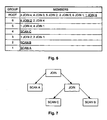
- Fig. 6 shows the table 12 after the transformation rules are applied.
- Group 3 now has 2 JOIN 1 as a member in addition to and as an equivalent of the 1 JOIN 2 member initially present
- the Root Group now has 4 JOIN 3 as a member in addition to and as an equivalent of the 3 JOIN 4 member initially present.
- Groups 5 and 6 have been added with new members and the Root Group has additional equivalent members to reflect that the first and second JOINs can be performed in a different order, essentially.
- the query optimizer assigns a cost value to each member which not only reflects the cost of the individual member but also the cost of the least costly members implied by such individual member (step 511).
- each 'child' group referenced by any member of the parent group must first have a calculated lowest cost member.
- the query optimizer figuratively starts at the bottom of the tree of Fig. 3 and works its way upward to get to the top or apex.
- the query optimizer calculates a cost value for Scan A and therefore the lowest cost value for Group 1; calculates a cost value for Scan B and therefore the lowest cost value for Group 2; calculates cost values for 1 JOIN 2 and 2 JOIN 1 based on the lowest cost values of Groups 1 and 2 and selects the lower as the lowest cost value for Group 3, calculates a cost value for Scan C and therefore the lowest cost value for Group 4; calculates cost values for 1 JOIN 4 and 4 JOIN 1 based on the lowest cost values of Groups 1 and 4 and selects the lower as the lowest cost value for Group 5; calculates cost values for 4 JOIN 2 and 2 JOIN 4 based on the lowest cost values of Groups 2 and 4 and selects the lower as the lowest cost value for Group 6; and then calculates cost values for 3 JOIN 4, 4 JOIN 3, 5 JOIN 2, 2 JOIN 5, 6 JOIN 1, and 1 JOIN 6 based on the lowest cost values of Groups 1-6 and selects the lowest as the lowest cost
- each lowest cost value member as selected from a group 14 is identified for future reference.
- the selected member may be marked, or all other members of the group 14 may be discarded so that only such lowest cost value member remains.
- the lowest cost value member of the Root Group implicitly define the optimization for the query that was originally received by the query optimizer (step 513). For example, if the selected member of the Root Group is 1 JOIN 6, then the lowest cost value member of Group 1 (Scan A) is joined with the lowest cost value member of Group 6. Similarly, the process is repeated until an optimized tree for the optimized query is fully defined . In particular, if the selected member of the Group 6 is 4 JOIN 2, then the lowest cost value member of Group 4 (Scan C) is joined with the lowest cost value member of Group 2 (Scan B). Such an optimized tree 10 based on such selected members is shown in Fig. 7.
- selecting the lowest cost value member of each group 14 guarantees that the lowest cost value is selected for each subsequent group 14 and in turn guarantees that the lowest cost value is selected for the Root Group.
- the optimized query tree 10 is found, and may then be executed to produce query results in the most cost effective manner known.
- the CHOOSE operator and the CHOOSE arguments thereof are applied to the query optimizer as summarized above to allow multiple forms of a query expression to be submitted to the query optimizer.
- the CHOOSE operator of the present invention defines the CHOOSE arguments thereof (i.e., the alternative but equivalent query expressions embodied in the operands) as equivalents, and takes advantage of the fact that the query optimizer operates by selecting from among equivalents based on the most efficient (least cost value, e.g.) one of the equivalents.
- the CHOOSE operator in effect submits the defined equivalent CHOOSE arguments to the query optimizer, and the query optimizer then selects the more efficient of the CHOOSE arguments (or an equivalent thereof).
- a query to be executed includes a CHOOSE operator having a pair of arguments representing equivalent query expressions and is algebra-ized into an n-level tree 10 as shown.
- the tree 10 is based on the query:
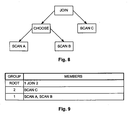
- Fig. 9 the table 12 corresponding to the tree 10 of Fig. 8 is shown.
- one of the defined groups 14 includes 1 (i.e., Scan A) and 2 (i.e., Scan B). That is, based on the CHOOSE operator, the query optimizer places the CHOOSE arguments thereof in a single group 14.
- the CHOOSE operator does not itself appear in any group 14 of the table 14, but instead is replaced by the CHOOSE arguments thereof as assigned to the aforementioned single group 14(Group 3 in Fig. 4).
- the subsequent JOIN in the Root Group which previously referenced the CHOOSE operator in the tree 12 now references the single group 14 having the CHOOSE arguments of the CHOOSE operator.
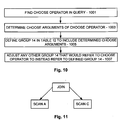
- the query optimizer in finding a CHOOSE operator in the query handles same by: determining the CHOOSE arguments of the CHOOSE operator (step 1003), defining a group 14 in the table 12 to include the determined CHOOSE arguments (step 1005), and adjusting any other group 14 that would refer to the CHOOSE operator to instead refer to the defined group 14 with the determined CHOOSE arguments (step 1007).
- determining the CHOOSE arguments of the CHOOSE operator step 1003
- defining a group 14 in the table 12 to include the determined CHOOSE arguments step 1005
- adjusting any other group 14 that would refer to the CHOOSE operator to instead refer to the defined group 14 with the determined CHOOSE arguments step 1007.
- no other alteration to the process outlined in Fig. 5 is believed to be necessary.
- the tree 10 as shown in Fig. 8 has three levels including a root (first) level with a first JOIN operator joining a CHOOSE operator and a Scan C operator from the next (second) level, and the CHOOSE operator joins a Scan A operator and Scan B operator from the next (third) level.
- the initial table 12 as shown in Fig. 9 has three groups 14: Group 1 has Scan A and Scan B as members inasmuch as Scan A and Scan B are the CHOOSE arguments, Group 2 has Scan C as a member, and the Root Group has the JOIN of Group 1 (having Scan A and Scan B) and Group 2 (having Scan C) as a member.
- transformation rules are applied to each member in the table of Fig. 9 to produce additional members of groups and/or additional groups (not shown), and the query optimizer then assigns a cost value to each member of each group 14 and selects the lowest cost value member of each group 14.
- Scan A and Scan B as equivalent members in Group 1
- equivalents of Scan A and equivalents of Scan B are also placed in Group 1
- all of the equivalents in Group 1 including Scan A and its equivalents and Scan B and its equivalents are assigned a cost value, and the lowest cost value member of all such members in group 1 is selected.
- the more efficient one of Scan A or an equivalent thereof and Scan B or an equivalent thereof is selected.
- the optimized tree 10 derived from the initial tree 10 of Fig. 8 is shown in Fig. 11.
- the query optimizer has defined the CHOOSE arguments thereof as equivalents in a group 14, and the alternative forms of the sub-query as represented by the CHOOSE arguments are indistinguishable from other equivalent members in the same group 14. Note that since the CHOOSE operator is eliminated from the table 14, the query optimizer need not be concerned with any special rules or instructions in generating equivalents for the table 14.
- the cost-based selection mechanism of the query optimizer is carried out as before, and the query optimizer chooses an optimal query expression from among multiple equivalent expressions including an appropriate one of the alternative forms of the query expressions that are the basis for the CHOOSE operator or an equivalent thereof.
- the present invention comprises a new and useful method and mechanism that allows a user or application to submit multiple alternate forms of a query expression in a manner so that a query optimizer selects the most efficient one of the forms of the query expression and optimizes same.
Landscapes
- Engineering & Computer Science (AREA)
- Theoretical Computer Science (AREA)
- Operations Research (AREA)
- Computational Linguistics (AREA)
- Data Mining & Analysis (AREA)
- Databases & Information Systems (AREA)
- Physics & Mathematics (AREA)
- General Engineering & Computer Science (AREA)
- General Physics & Mathematics (AREA)
- Information Retrieval, Db Structures And Fs Structures Therefor (AREA)
Abstract
Description
Claims (9)
- A method of optimizing a query including therein at least one choice of at least a pair of equivalent forms, the query comprising operators and arguments relating to the operators, each choice being represented by a CHOOSE operator having at least a pair of CHOOSE arguments representing the corresponding pair of equivalent forms, an initial tree representation of the query including a node for each operator and each argument, each argument relating to an operator being represented in the tree as a child node of the node representing such operator, the method comprising:generating an initial version of a lookup table, the generated lookup table including a group for each node of the initial tree other than the nodes for each CHOOSE operator and the CHOOSE arguments thereof, the generated lookup table including with regard to each CHOOSE operator node and the CHOOSE argument nodes thereof a single group having both CHOOSE argument nodes as members thereof, each operator being represented as a member within a group thereof as the operator and a reference to a group of each argument associated therewith;generating any available equivalents for each group based on the initial version of the table, including generating at least one of:whereby for each group, every member thereof is an equivalent; andan additional member of a group;a new member of a new group; andcombinations thereof;assigning a cost value to each member of each group and selecting a member of each group as a lowest cost value member of the group, the assigned cost value of each member reflecting a cost of such member and if the member implies one or more other groups a cost of the lowest cost value member of each implied group, the lowest cost value members of the groups defining an optimized tree for the query and thereby an optimization of the query.
- The method of claim 1 further comprising executing the optimization of the query to produce query results.
- The method of claim 1 wherein generating the initial version of the table comprises with regard to each CHOOSE operator node in the tree:determining the CHOOSE argument nodes of the CHOOSE operator node;defining a group in the table to include the determined CHOOSE argument nodes; andadjusting any other group that would refer to the CHOOSE operator to instead refer to the defined group with the determined CHOOSE argument nodes.
- A computer-readable medium having computer-executable instructions thereon for performing a method of optimizing a query including therein at least one choice of a pair of equivalent forms, the query comprising operators and arguments relating to the operators, each choice being represented by a CHOOSE operator having a pair of CHOOSE arguments representing the corresponding pair of equivalent forms, an initial tree representation of the query including a node for each operator and each argument, each argument relating to an operator being represented in the tree as a child node of the node representing such operator, the method comprising:generating an initial version of a lookup table, the generated lookup table including a group for each node of the initial tree other than the nodes for each CHOOSE operator and the CHOOSE arguments thereof, the generated lookup table including with regard to each CHOOSE operator node and the CHOOSE argument nodes thereof a single group having both CHOOSE argument nodes as members thereof, each operator being represented as a member within a group thereof as the operator and a reference to a group of each argument associated therewith;generating any available equivalents for each group based on the initial version of the table, including generating at least one of:whereby for each group, every member thereof is an equivalent; andan additional member of a group;a new member of a new group; andcombinations thereof;assigning a cost value to each member of each group and selecting a member of each group as a lowest cost value member of the group, the assigned cost value of each member reflecting a cost of such member and if the member implies one or more other groups a cost of the lowest cost value member of each implied group, the lowest cost value members of the groups defining an optimized tree for the query and thereby an optimization of the query.
- The medium of claim 4 wherein the method further comprises executing the optimization of the query to produce query results.
- The medium of claim 4 wherein generating the initial version of the table comprises with regard to each CHOOSE operator node in the tree:determining the CHOOSE argument nodes of the CHOOSE operator node;defining a group in the table to include the determined CHOOSE argument nodes; andadjusting any other group that would refer to the CHOOSE operator to instead refer to the defined group with the determined CHOOSE argument nodes.
- A computer performing a method of optimizing a query including therein at least one choice of a pair of equivalent forms, the query comprising operators and arguments relating to the operators, each choice being represented by a CHOOSE operator having a pair of CHOOSE arguments representing the corresponding pair of equivalent forms, an initial tree representation of the query including a node for each operator and each argument, each argument relating to an operator being represented in the tree as a child node of the node representing such operator, the method comprising:generating an initial version of a lookup table, the generated lookup table including a group for each node of the initial tree other than the nodes for each CHOOSE operator and the CHOOSE arguments thereof, the generated lookup table including with regard to each CHOOSE operator node and the CHOOSE argument nodes thereof a single group having both CHOOSE argument nodes as members thereof, each operator being represented as a member within a group thereof as the operator and a reference to a group of each argument associated therewith;generating any available equivalents for each group based on the initial version of the table, including generating at least one of:whereby for each group, every member thereof is an equivalent; andan additional member of a group;a new member of a new group; andcombinations thereof;assigning a cost value to each member of each group and selecting a member of each group as a lowest cost value member of the group, the assigned cost value of each member reflecting a cost of such member and if the member implies one or more other groups a cost of the lowest cost value member of each implied group, the lowest cost value members of the groups defining an optimized tree for the query and thereby an optimization of the query.
- The computer of claim 7 wherein the method further comprises executing the optimization of the query to produce query results.
- The computer of claim 7 wherein generating the initial version of the table comprises with regard to each CHOOSE operator node in the tree:determining the CHOOSE argument nodes of the CHOOSE operator node;defining a group in the table to include the determined CHOOSE argument nodes; andadjusting any other group that would refer to the CHOOSE operator to instead refer to the defined group with the determined CHOOSE argument nodes.
Applications Claiming Priority (2)
| Application Number | Priority Date | Filing Date | Title |
|---|---|---|---|
| US183190 | 1988-04-26 | ||
| US10/183,190 US6598044B1 (en) | 2002-06-25 | 2002-06-25 | Method for choosing optimal query execution plan for multiple defined equivalent query expressions |
Publications (2)
| Publication Number | Publication Date |
|---|---|
| EP1376400A2 true EP1376400A2 (en) | 2004-01-02 |
| EP1376400A3 EP1376400A3 (en) | 2006-04-19 |
Family
ID=22671819
Family Applications (1)
| Application Number | Title | Priority Date | Filing Date |
|---|---|---|---|
| EP03013139A Withdrawn EP1376400A3 (en) | 2002-06-25 | 2003-06-11 | Method for choosing optimal query execution plan for multiple defined equivalent query expressions |
Country Status (3)
| Country | Link |
|---|---|
| US (1) | US6598044B1 (en) |
| EP (1) | EP1376400A3 (en) |
| JP (1) | JP4515050B2 (en) |
Cited By (1)
| Publication number | Priority date | Publication date | Assignee | Title |
|---|---|---|---|---|
| US20130144866A1 (en) * | 2011-12-06 | 2013-06-06 | Zbigniew Jerzak | Fault tolerance based query execution |
Families Citing this family (14)
| Publication number | Priority date | Publication date | Assignee | Title |
|---|---|---|---|---|
| US6721724B1 (en) * | 2000-03-31 | 2004-04-13 | Microsoft Corporation | Validating multiple execution plans for database queries |
| US6754652B2 (en) * | 2002-03-29 | 2004-06-22 | International Business Machines Corporation | Database query optimizer framework with dynamic strategy dispatch |
| US6823329B2 (en) * | 2002-04-02 | 2004-11-23 | Sybase, Inc. | Database system providing methodology for acceleration of queries involving functional expressions against columns having enumerated storage |
| US6807546B2 (en) * | 2002-08-12 | 2004-10-19 | Sybase, Inc. | Database system with methodology for distributing query optimization effort over large search spaces |
| US8180784B2 (en) * | 2003-03-28 | 2012-05-15 | Oracle International Corporation | Method and system for improving performance of counting hits in a search |
| US20050210023A1 (en) * | 2004-03-18 | 2005-09-22 | Renato Barrera | Query optimizer using implied predicates |
| US7533384B2 (en) * | 2004-05-27 | 2009-05-12 | International Business Machines Corporation | Job routing to earliest available resources in a parallel job scheduler |
| US7512629B2 (en) * | 2006-07-13 | 2009-03-31 | International Business Machines Corporation | Consistent and unbiased cardinality estimation for complex queries with conjuncts of predicates |
| US9274950B2 (en) * | 2009-08-26 | 2016-03-01 | Hewlett Packard Enterprise Development Lp | Data restructuring in multi-level memory hierarchies |
| JP5800720B2 (en) * | 2012-01-24 | 2015-10-28 | 三菱電機株式会社 | Information processing apparatus, information processing method, and program |
| US9280584B2 (en) | 2013-11-25 | 2016-03-08 | International Business Machines Corporation | Finding optimal query plans |
| US10311054B2 (en) * | 2014-01-08 | 2019-06-04 | Red Hat, Inc. | Query data splitting |
| CN105335403B (en) * | 2014-07-23 | 2020-02-14 | 华为技术有限公司 | Database access method and device and database system |
| KR102138627B1 (en) | 2015-11-30 | 2020-07-28 | 후아웨이 테크놀러지 컴퍼니 리미티드 | Data query method and device, and database system |
Family Cites Families (9)
| Publication number | Priority date | Publication date | Assignee | Title |
|---|---|---|---|---|
| US5210870A (en) * | 1990-03-27 | 1993-05-11 | International Business Machines | Database sort and merge apparatus with multiple memory arrays having alternating access |
| US5742806A (en) * | 1994-01-31 | 1998-04-21 | Sun Microsystems, Inc. | Apparatus and method for decomposing database queries for database management system including multiprocessor digital data processing system |
| DE19515020A1 (en) * | 1994-07-01 | 1996-01-04 | Hewlett Packard Co | Method and device for optimizing queries with group-by-operators |
| JPH0934760A (en) * | 1995-07-24 | 1997-02-07 | Omron Corp | Search command optimization device and search command optimization method |
| US5822747A (en) * | 1996-08-23 | 1998-10-13 | Tandem Computers, Inc. | System and method for optimizing database queries |
| US6108648A (en) * | 1997-07-18 | 2000-08-22 | Informix Software, Inc. | Optimizer with neural network estimator |
| US6339768B1 (en) * | 1998-08-13 | 2002-01-15 | International Business Machines Corporation | Exploitation of subsumption in optimizing scalar subqueries |
| JP2000112982A (en) * | 1998-10-07 | 2000-04-21 | Ricoh Co Ltd | Heterogeneous database integration system |
| US6510422B1 (en) * | 2000-09-27 | 2003-01-21 | Microsoft Corporation | Cost based materialized view selection for query optimization |
-
2002
- 2002-06-25 US US10/183,190 patent/US6598044B1/en not_active Expired - Lifetime
-
2003
- 2003-06-11 EP EP03013139A patent/EP1376400A3/en not_active Withdrawn
- 2003-06-25 JP JP2003181885A patent/JP4515050B2/en not_active Expired - Fee Related
Cited By (2)
| Publication number | Priority date | Publication date | Assignee | Title |
|---|---|---|---|---|
| US20130144866A1 (en) * | 2011-12-06 | 2013-06-06 | Zbigniew Jerzak | Fault tolerance based query execution |
| US9424150B2 (en) * | 2011-12-06 | 2016-08-23 | Sap Se | Fault tolerance based query execution |
Also Published As
| Publication number | Publication date |
|---|---|
| JP4515050B2 (en) | 2010-07-28 |
| US6598044B1 (en) | 2003-07-22 |
| JP2004030677A (en) | 2004-01-29 |
| EP1376400A3 (en) | 2006-04-19 |
Similar Documents
| Publication | Publication Date | Title |
|---|---|---|
| US6801905B2 (en) | Database system providing methodology for property enforcement | |
| US7184998B2 (en) | System and methodology for generating bushy trees using a left-deep tree join enumeration algorithm | |
| US6574623B1 (en) | Query transformation and simplification for group by queries with rollup/grouping sets in relational database management systems | |
| CN100424696C (en) | Method and system for processing abstract queries | |
| US8126870B2 (en) | System and methodology for parallel query optimization using semantic-based partitioning | |
| Hellerstein | Optimization techniques for queries with expensive methods | |
| US7617179B2 (en) | System and methodology for cost-based subquery optimization using a left-deep tree join enumeration algorithm | |
| US7359922B2 (en) | Database system and methodology for generalized order optimization | |
| US11693856B2 (en) | Query processing in a polystore | |
| US7769770B2 (en) | Secondary index and indexed view maintenance for updates to complex types | |
| US6598044B1 (en) | Method for choosing optimal query execution plan for multiple defined equivalent query expressions | |
| US6826562B1 (en) | Method of simplifying and optimizing scalar subqueries and derived tables that return exactly or at most one tuple | |
| Theodoratos et al. | A general framework for the view selection problem for data warehouse design and evolution | |
| US20080256047A1 (en) | Selecting rules engines for processing abstract rules based on functionality and cost | |
| US20150220597A1 (en) | Decorrelation of user-defined function invocations in queries | |
| Brucato et al. | Scalable package queries in relational database systems | |
| IL152987A (en) | System and method for automatically generating database queries | |
| US8554760B2 (en) | System and method for optimizing queries | |
| Constantinescu et al. | Flexible and efficient matchmaking and ranking in service directories | |
| US7188098B2 (en) | Query transformation for union all view join queries using join predicates for pruning and distribution | |
| Ding et al. | Extensible query optimizers in practice | |
| US20080059439A1 (en) | Query Translation from XPath to SQL in the Presence of Recursive DTDs | |
| US7283996B2 (en) | Converting expressions to execution plans | |
| Wu et al. | Answering XML queries using materialized views revisited | |
| US7529730B2 (en) | Method and system for database join disambiguation |
Legal Events
| Date | Code | Title | Description |
|---|---|---|---|
| PUAI | Public reference made under article 153(3) epc to a published international application that has entered the european phase |
Free format text: ORIGINAL CODE: 0009012 |
|
| AK | Designated contracting states |
Kind code of ref document: A2 Designated state(s): AT BE BG CH CY CZ DE DK EE ES FI FR GB GR HU IE IT LI LU MC NL PT RO SE SI SK TR |
|
| AX | Request for extension of the european patent |
Extension state: AL LT LV MK |
|
| PUAL | Search report despatched |
Free format text: ORIGINAL CODE: 0009013 |
|
| AK | Designated contracting states |
Kind code of ref document: A3 Designated state(s): AT BE BG CH CY CZ DE DK EE ES FI FR GB GR HU IE IT LI LU MC NL PT RO SE SI SK TR |
|
| AX | Request for extension of the european patent |
Extension state: AL LT LV MK |
|
| 17P | Request for examination filed |
Effective date: 20061012 |
|
| AKX | Designation fees paid |
Designated state(s): AT BE BG CH CY CZ DE DK EE ES FI FR GB GR HU IE IT LI LU MC NL PT RO SE SI SK TR |
|
| R17C | First examination report despatched (corrected) |
Effective date: 20070525 |
|
| STAA | Information on the status of an ep patent application or granted ep patent |
Free format text: STATUS: THE APPLICATION HAS BEEN WITHDRAWN |
|
| 18W | Application withdrawn |
Effective date: 20120925 |