EP1376306A2 - Multiplexierung von einem sicheren Zähler zur Bereitstellung von sicheren Zählern auf zweiter Stufe - Google Patents
Multiplexierung von einem sicheren Zähler zur Bereitstellung von sicheren Zählern auf zweiter Stufe Download PDFInfo
- Publication number
- EP1376306A2 EP1376306A2 EP03013563A EP03013563A EP1376306A2 EP 1376306 A2 EP1376306 A2 EP 1376306A2 EP 03013563 A EP03013563 A EP 03013563A EP 03013563 A EP03013563 A EP 03013563A EP 1376306 A2 EP1376306 A2 EP 1376306A2
- Authority
- EP
- European Patent Office
- Prior art keywords
- level counter
- value
- file
- counter
- data
- Prior art date
- Legal status (The legal status is an assumption and is not a legal conclusion. Google has not performed a legal analysis and makes no representation as to the accuracy of the status listed.)
- Withdrawn
Links
Images

Classifications
-
- G—PHYSICS
- G06—COMPUTING OR CALCULATING; COUNTING
- G06F—ELECTRIC DIGITAL DATA PROCESSING
- G06F21/00—Security arrangements for protecting computers, components thereof, programs or data against unauthorised activity
- G06F21/60—Protecting data
- G06F21/64—Protecting data integrity, e.g. using checksums, certificates or signatures
-
- G—PHYSICS
- G06—COMPUTING OR CALCULATING; COUNTING
- G06F—ELECTRIC DIGITAL DATA PROCESSING
- G06F21/00—Security arrangements for protecting computers, components thereof, programs or data against unauthorised activity
- G06F21/10—Protecting distributed programs or content, e.g. vending or licensing of copyrighted material ; Digital rights management [DRM]
-
- G—PHYSICS
- G06—COMPUTING OR CALCULATING; COUNTING
- G06F—ELECTRIC DIGITAL DATA PROCESSING
- G06F2221/00—Indexing scheme relating to security arrangements for protecting computers, components thereof, programs or data against unauthorised activity
- G06F2221/21—Indexing scheme relating to G06F21/00 and subgroups addressing additional information or applications relating to security arrangements for protecting computers, components thereof, programs or data against unauthorised activity
- G06F2221/2145—Inheriting rights or properties, e.g., propagation of permissions or restrictions within a hierarchy
Definitions
- the present invention relates to counters, and more specifically, to the use of a secure counter in such a way as to implement second-level secure counters.
- Persistent storage is storage where contents are preserved even when no power is supplied to the storage.
- Magnetic storage is normally non-volatile by nature, whereas semiconductor memories (e.g. dynamic and static RAM) are normally volatile.
- Persistent storage may be used for maintaining state information.
- state information may include information about how many times a user may listen to a certain audio file. When a use has occurred, the state information regarding the number of uses will be changed by the rights management application. The state information is maintained even when the rights management application is not running or inactive, and when the computer system is off. Other contexts similarly use state information to store information in a persistent way.
- state information may store sensitive data, such information must be protected from an adversary who may wish to change the data.
- An adversary in the rights management context may wish to change the state information to grant unlimited use of the audio file.
- One way to secure the state information is through the use of encryption. If a trusted party signs the state information each time it is changed, no change can occur in the state information without being detected. Before the use of the state information, it can be checked to make sure that it has been signed by the trusted party.
- a problem with this is the problem of rollback.
- An adversary may save a version of the signed state information and, after the signed state information has been replaced with a newer version, the adversary may remove the newer version and replace it with the saved older version.
- the adversary may replace state information indicating no plays remain for the user of the audio file with older state information indicating that some plays remain. In this way, the adversary may gain access to the content.
- a secure counter is a counter that holds data (a counter value) securely, so that no adversary can change the data, and which can perform two operations on request.
- the secure counter can report on the counter value, and the secure counter can increment the counter value. Because operations on the counter are limited to these operations, the security of the counter is more easily ensured. If there is no way for a user or a computer system containing a secure counter to, for example, set a counter to a specific value, then an adversary will generally not be able to do so either.
- This rollback prevention method requires a secure counter for each piece of data that is being secured.
- the counter is used to secure a first piece of data
- the counter value is appended to that data and signed.
- the signature is verified and the counter value is checked against the actual present value of the counter. If a second piece of data is also secured using that same counter, then any modification of the first piece of data, which will entail a counter increment, will cause the verification of the second piece of data to fail, since the counter value stored with the second data will no longer be equal to the present value of the counter.
- the present invention provides systems and methods for a multiplexed secure counter, which allows the creation of a multiplicity of child secure counters from one existing parent secure counter.
- a value for each of the child secure counters is stored together with the value of the parent secure counter.
- the two values are then signed by a trusted entity.
- a number of child secure counters may be stored together. For example, all of the child secure counter values and the value of the parent secure counter may be concatenated together, and a signature for this concatenation may be created.
- the signature is verified and the value stored for the parent secure counter is checked against the actual value in the parent secure counter. If the verification is successful and the value stored for the parent secure counter is equal to the actual value of the parent secure counter, the value for the child secure counter is presumed to be authentic and not a "rolled back" value.
- the value for that specific child secure counter is incremented, as is the value for the parent secure counter.
- the new value for the specific child secure counter is stored with the new value for the parent secure counter and signed by the trusted entity. All other child secure counter values must also be stored with the new value for the parent secure counter and signed by the trusted entity.
- additional secure counters (“child” or “second-level” secure counters) are provided.
- the value to be used for each child secure counter is stored together with the value read from the first ("parent” or “first-level” or “base”) secure counter. This value is signed by a trusted entity.
- the signature In order to read the value for one of the child secure counters, the signature must be verified and the stored value for the parent secure counter compared to the actual value of parent secure counter. If the signature can be verified and the stored value for the parent counter matches the actual value of the parent counter, the value read for the child secure counter can be used.
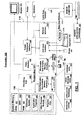
- FIG. 1 illustrates an example of a suitable computing system environment 100 in which the invention may be implemented.
- the computing system environment 100 is only one example of a suitable computing environment and is not intended to suggest any limitation as to the scope of use or functionality of the invention. Neither should the computing environment 100 be interpreted as having any dependency or requirement relating to any one or combination of components illustrated in the exemplary operating environment 100.
- a computer or other client or server device can be deployed as part of a computer network, or in a distributed computing environment.
- the present invention pertains to any computer system having any number of memory or storage units, and any number of applications and processes occurring across any number of storage units or volumes, which may be used in connection with the present invention.
- the present invention may apply to an environment with server computers and client computers deployed in a network environment or distributed computing environment, having remote or local storage.
- the present invention may also be applied to standalone computing devices, having programming language functionality, interpretation and execution capabilities for generating, receiving and transmitting information in connection with remote or local services.
- the invention is operational with numerous other general purpose or special purpose computing system environments or configurations.
- Examples of well known computing systems, environments, and/or configurations that may be suitable for use with the invention include, but are not limited to, personal computers, server computers, hand-held or laptop devices, multiprocessor systems, microprocessor-based systems, set top boxes, programmable consumer electronics, network PCs, minicomputers, mainframe computers, distributed computing environments that include any of the above systems or devices, and the like.
- the invention may be described in the general context of computer-executable instructions, such as program modules, being executed by a computer.
- program modules include routines, programs, objects, components, data structures, etc. that perform particular tasks or implement particular abstract data types.
- the invention may also be practiced in distributed computing environments where tasks are performed by remote processing devices that are linked through a communications network or other data transmission medium.
- program modules and other data may be located in both local and remote computer storage media including memory storage devices.
- Distributed computing facilitates sharing of computer resources and services by direct exchange between computing devices and systems. These resources and services include the exchange of information, cache storage, and disk storage for files.
- Distributed computing takes advantage of network connectivity, allowing clients to leverage their collective power to benefit the entire enterprise.
- a variety of devices may have applications, objects or resources that may utilize the techniques of the present invention.
- an exemplary system for implementing the invention includes a general-purpose computing device in the form of a computer 110.
- Components of computer 110 may include, but are not limited to, a processing unit 120, a system memory 130, and a system bus 121 that couples various system components including the system memory to the processing unit 120.
- the system bus 121 may be any of several types of bus structures including a memory bus or memory controller, a peripheral bus, and a local bus using any of a variety of bus architectures.
- such architectures include Industry Standard Architecture (ISA) bus, Micro Channel Architecture (MCA) bus, Enhanced ISA (EISA) bus, Video Electronics Standards Association (VESA) local bus, and Peripheral Component Interconnect (PCI) bus (also known as Mezzanine bus).
- ISA Industry Standard Architecture
- MCA Micro Channel Architecture
- EISA Enhanced ISA
- VESA Video Electronics Standards Association
- PCI Peripheral Component Interconnect
- Computer 110 typically includes a variety of computer readable media.
- Computer readable media can be any available media that can be accessed by computer 110 and includes both volatile and nonvolatile media, removable and non-removable media.
- Computer readable media may comprise computer storage media and communication media.
- Computer storage media includes both volatile and nonvolatile, removable and non-removable media implemented in any method or technology for storage of information such as computer readable instructions, data structures, program modules or other data.
- Computer storage media includes, but is not limited to, RAM, ROM, EEPROM, flash memory or other memory technology, CD-ROM, digital versatile disks (DVD) or other optical disk storage, magnetic cassettes, magnetic tape, magnetic disk storage or other magnetic storage devices, or any other medium that can be used to store the desired information and that can accessed by computer 110.
- Communication media typically embodies computer readable instructions, data structures, program modules or other data in a modulated data signal such as a carrier wave or other transport mechanism and includes any information delivery media.
- modulated data signal means a signal that has one or more of its characteristics set or changed in such a manner as to encode information in the signal.
- communication media includes wired media such as a wired network or direct-wired connection, and wireless media such as acoustic, RF, infrared and other wireless media. Combinations of any of the above should also be included within the scope of computer readable media.
- the system memory 130 includes computer storage media in the form of volatile and/or nonvolatile memory such as read only memory (ROM) 131 and random access memory (RAM) 132.
- ROM read only memory
- RAM random access memory
- BIOS basic input/output system
- RAM 132 typically contains data and/or program modules that are immediately accessible to and/or presently being operated on by processing unit 120.
- FIG. 1 illustrates operating system 134, application programs 135, other program modules 136, and program data 137.
- the computer 110 may also include other removable/non-removable, volatile/nonvolatile computer storage media.
- FIG. 1 illustrates a hard disk drive 140 that reads from or writes to non-removable, nonvolatile magnetic media, a magnetic disk drive 151 that reads from or writes to a removable, nonvolatile magnetic disk 152, and an optical disk drive 155 that reads from or writes to a removable, nonvolatile optical disk 156, such as a CD ROM or other optical media.
- removable/non-removable, volatile/nonvolatile computer storage media that can be used in the exemplary operating environment include, but are not limited to, magnetic tape cassettes, flash memory cards, digital versatile disks, digital video tape, solid state RAM, solid state ROM, and the like.
- the hard disk drive 141 is typically connected to the system bus 121 through an non-removable memory interface such as interface 140, and magnetic disk drive 151 and optical disk drive 155 are typically connected to the system bus 121 by a removable memory interface, such as interface 150.
- hard disk drive 141 is illustrated as storing operating system 144, application programs 145, other program modules 146, and program data 147. Note that these components can either be the same as or different from operating system 134, application programs 135, other program modules 136, and program data 137. Operating system 144, application programs 145, other program modules 146, and program data 147 are given different numbers here to illustrate that, at a minimum, they are different copies.
- a user may enter commands and information into the computer 20 through input devices such as a keyboard 162 and pointing device 161, commonly referred to as a mouse, trackball or touch pad.
- Other input devices may include a microphone, joystick, game pad, satellite dish, scanner, or the like. These and other input devices are often connected to the processing unit 120 through a user input interface 160 that is coupled to the system bus, but may be connected by other interface and bus structures, such as a parallel port, game port or a universal serial bus (USB).
- a monitor 191 or other type of display device is also connected to the system bus 121 via an interface, such as a video interface 190.
- computers may also include other peripheral output devices such as speakers 197 and printer 196, which may be connected through an output peripheral interface 190.
- the computer 110 may operate in a networked environment using logical connections to one or more remote computers, such as a remote computer 180.
- the remote computer 180 may be a personal computer, a server, a router, a network PC, a peer device or other common network node, and typically includes many or all of the elements described above relative to the computer 110, although only a memory storage device 181 has been illustrated in FIG. 1.
- the logical connections depicted in FIG. 1 include a local area network (LAN) 171 and a wide area network (WAN) 173, but may also include other networks.
- LAN local area network
- WAN wide area network
- Such networking environments are commonplace in offices, enterprise-wide computer networks, intranets and the Internet.
- the computer 110 When used in a LAN networking environment, the computer 110 is connected to the LAN 171 through a network interface or adapter 170. When used in a WAN networking environment, the computer 110 typically includes a modem 172 or other means for establishing communications over the WAN 173, such as the Internet.
- the modem 172 which may be internal or external, may be connected to the system bus 121 via the user input interface 160, or other appropriate mechanism.
- program modules depicted relative to the computer 110, or portions thereof may be stored in the remote memory storage device.
- FIG. 1 illustrates remote application programs 185 as residing on memory device 181. It will be appreciated that the network connections shown are exemplary and other means of establishing a communications link between the computers may be used.
- a parent secure counter is multiplexed to provide at least one child secure counter.
- the parent secure counter comprises memory which holds a value securely and accepts read and increment commands.
- the read command causes the parent secure counter to return the value stored in the memory.
- the increment command causes the parent secure counter to increment the value stored in memory.
- incrementing a counter adds one to the previous value of the counter.
- an increment may change the value of the counter in other ways.
- successive new values of the counter must be unique or, at least, rare. Otherwise, when a stored counter value is checked against the current counter value they may match, even though a rollback or other tampering may have occurred.
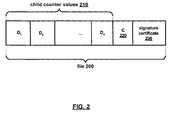
- child counter values D 1 through D n 210 are stored along with parent counter value C 220.
- the child counter values 210 and the parent counter value C 220 is signed by a trusted entity and a signature certificate 230 is included.
- file 200 may have a different format. A number of files may be used, each storing one or more child counter values, parent counter value, and signature. In one embodiment, a separate file exists for each child counter value.
- two operations can be performed on the child secure counters: (1) the value of the child secure counter can be verified, and (2) the value of the child secure counter can be incremented.
- these operations are performed through a request to the trusted entity, which may be implemented by hardware or software.
- the signature of the trusted entity must be secure and the parent counter must be secure.
- the file 200 containing the counter values need not be stored securely. If the file is altered, the alteration can be detected by checking the signature.
- a rollback attempt may be attempted, where a previous version of the file is substituted by an adversary for the current version of the file. In this case, the signature will verify but the parent counter value will not match the stored parent counter value, and so this rollback can be detected.
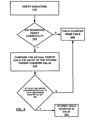
- the signature In order to read a child counter D m , as shown in FIG. 3, the signature must be verified 310. If the signature is verified successfully 320, the actual parent counter value is compared to the stored parent counter value 330. If the signature is not verified successfully, the child counter read fails 340. If the actual parent counter value is equal to the stored counter value 350, then the stored child counter value D m is valid 360. If the actual parent counter value is not equal to the stored parent counter value, then the child counter read fails 340.
- signature check 310 is performed after or concurrently with the parent counter value check 330.
- the same checks must be performed as for a child counter read.
- the signature must be verified 410. If the signature is verified successfully 420, the actual parent counter value is compared to the stored parent counter value 430. If the signature is not verified successfully, the child counter increment fails 440. If the actual parent counter value is not equal to the parent stored counter value 450, then the child counter increment fails 440.
- the stored child counter D m is valid.
- the value of the counter value D m is then incremented 460.
- the value of the parent counter C is incremented 470.
- the new value of child counter D m , the old value of any other child counters (D 1 through D m-1 and D m+1 through D n ) and new value of the parent counter C are signed 480.
- the signature and stored parent counter value are checked. If no tampering is detected, the parent counter value is incremented. The new child counter is stored with the previously existing child counters and the parent counter value. A file storing the parent and child counter values is then signed. A counter value may be deleted in the same way.
- a number of files may be used, each storing one or more child counter values, parent counter value, and signature. If a certain file comprises only one child counter value, that child counter may be deleted by deleting that certain file.
- a counter may be created by creating a new child counter value, concatenating it with the current counter value, and signing the resulting concatenation.
- the techniques for to using multiple secure counters in accordance with the present invention may be applied to a variety of applications and devices.
- the techniques of the invention may be applied to the operating system of a computing device, provided as a separate object on the device, as part of another object, as a downloadable object from a server, as a "middle man" between a device or object and the network, as a distributed object, etc. While exemplary names and examples are chosen herein as representative of various choices, these names and examples are not intended to be limiting.
- the various techniques described herein may be implemented in connection with hardware or software or, where appropriate, with a combination of both.
- the methods and apparatus of the present invention may take the form of program code (i.e., instructions) embodied in tangible media, such as floppy diskettes, CD-ROMs, hard drives, or any other machine-readable storage medium, wherein, when the program code is loaded into and executed by a machine, such as a computer, the machine becomes an apparatus for practicing the invention.
- the computing device will generally include a processor, a storage medium readable by the processor (including volatile and non-volatile memory and/or storage elements), at least one input device, and at least one output device.
- One or more programs that may utilize the techniques of the present invention are preferably implemented in a high level procedural or object oriented programming language to communicate with a computer system.
- the program(s) can be implemented in assembly or machine language, if desired.
- the language may be a compiled or interpreted language, and combined with hardware implementations.
- the methods and apparatus of the present invention may also be practiced via communications embodied in the form of program code that is transmitted over some transmission medium, such as over electrical wiring or cabling, through fiber optics, or via any other form of transmission, wherein, when the program code is received and loaded into and executed by a machine, such as an EPROM, a gate array, a programmable logic device (PLD), a client computer, a video recorder or the like, or a receiving machine having the signal processing capabilities as described in exemplary embodiments above becomes an apparatus for practicing the invention.
- a machine such as an EPROM, a gate array, a programmable logic device (PLD), a client computer, a video recorder or the like, or a receiving machine having the signal processing capabilities as described in exemplary embodiments above becomes an apparatus for practicing the invention.
- PLD programmable logic device
- client computer a video recorder or the like
- a receiving machine having the signal processing capabilities as described in exemplary embodiments above becomes an apparatus for practicing the invention.
Landscapes
- Engineering & Computer Science (AREA)
- Theoretical Computer Science (AREA)
- Software Systems (AREA)
- Computer Security & Cryptography (AREA)
- General Physics & Mathematics (AREA)
- Computer Hardware Design (AREA)
- Physics & Mathematics (AREA)
- General Engineering & Computer Science (AREA)
- General Health & Medical Sciences (AREA)
- Bioethics (AREA)
- Health & Medical Sciences (AREA)
- Multimedia (AREA)
- Technology Law (AREA)
- Storage Device Security (AREA)
- Communication Control (AREA)
Applications Claiming Priority (2)
| Application Number | Priority Date | Filing Date | Title |
|---|---|---|---|
| US10/185,506 US7421579B2 (en) | 2002-06-28 | 2002-06-28 | Multiplexing a secure counter to implement second level secure counters |
| US185506 | 2002-06-28 |
Publications (2)
| Publication Number | Publication Date |
|---|---|
| EP1376306A2 true EP1376306A2 (de) | 2004-01-02 |
| EP1376306A3 EP1376306A3 (de) | 2004-04-21 |
Family
ID=27612987
Family Applications (1)
| Application Number | Title | Priority Date | Filing Date |
|---|---|---|---|
| EP03013563A Withdrawn EP1376306A3 (de) | 2002-06-28 | 2003-06-13 | Multiplexierung von einem sicheren Zähler zur Bereitstellung von sicheren Zählern auf zweiter Stufe |
Country Status (4)
| Country | Link |
|---|---|
| US (1) | US7421579B2 (de) |
| EP (1) | EP1376306A3 (de) |
| JP (1) | JP2004038968A (de) |
| NO (1) | NO20032786L (de) |
Cited By (4)
| Publication number | Priority date | Publication date | Assignee | Title |
|---|---|---|---|---|
| FR2895608A1 (fr) * | 2005-12-23 | 2007-06-29 | Trusted Logic Sa | Procede pour la realisation d'un compteur securise sur un systeme informatique embarque disposant d'une carte a puce |
| WO2007121903A1 (en) * | 2006-04-24 | 2007-11-01 | Telefonaktiebolaget L M Ericsson (Publ) | Authorisation of the installation of a software version |
| WO2009101445A1 (en) * | 2008-02-14 | 2009-08-20 | Wolfson Microelectronics Plc | Real time clock |
| WO2010023147A1 (en) * | 2008-08-27 | 2010-03-04 | Hewlett-Packard Development Company, L.P. | Method and apparatus for storing and verifying data |
Families Citing this family (16)
| Publication number | Priority date | Publication date | Assignee | Title |
|---|---|---|---|---|
| US7609406B2 (en) * | 2002-08-16 | 2009-10-27 | Avery Dennison Retail Information Services, Llc | Hand held portable printer with RFID read write capability |
| US7681050B2 (en) * | 2005-12-01 | 2010-03-16 | Telefonaktiebolaget L M Ericsson (Publ) | Secure and replay protected memory storage |
| US9811330B2 (en) * | 2006-10-06 | 2017-11-07 | Avago Technologies General Ip (Singapore) Pte. Ltd. | Method and system for version control in a reprogrammable security system |
| JP4956292B2 (ja) * | 2007-06-25 | 2012-06-20 | パナソニック株式会社 | 情報セキュリティ装置およびカウンタ制御方法 |
| US9588803B2 (en) | 2009-05-11 | 2017-03-07 | Microsoft Technology Licensing, Llc | Executing native-code applications in a browser |
| US9323921B2 (en) | 2010-07-13 | 2016-04-26 | Microsoft Technology Licensing, Llc | Ultra-low cost sandboxing for application appliances |
| JP5159849B2 (ja) | 2010-09-24 | 2013-03-13 | 株式会社東芝 | メモリ管理装置及びメモリ管理方法 |
| DE102010054446A1 (de) * | 2010-12-14 | 2012-06-14 | Giesecke & Devrient Gmbh | Portabler Datenträger mit Fehlbedienungszähler |
| US9495183B2 (en) | 2011-05-16 | 2016-11-15 | Microsoft Technology Licensing, Llc | Instruction set emulation for guest operating systems |
| US9389933B2 (en) | 2011-12-12 | 2016-07-12 | Microsoft Technology Licensing, Llc | Facilitating system service request interactions for hardware-protected applications |
| US9413538B2 (en) | 2011-12-12 | 2016-08-09 | Microsoft Technology Licensing, Llc | Cryptographic certification of secure hosted execution environments |
| US9571275B1 (en) * | 2012-08-14 | 2017-02-14 | Google Inc. | Single use identifier values for network accessible devices |
| US9146969B2 (en) * | 2012-11-26 | 2015-09-29 | The Boeing Company | System and method of reduction of irrelevant information during search |
| US10592710B1 (en) | 2018-10-02 | 2020-03-17 | Capital One Services, Llc | Systems and methods for cryptographic authentication of contactless cards |
| GB2596585B (en) * | 2020-07-03 | 2022-09-07 | Advanced Risc Mach Ltd | Integrity tree for memory security |
| JP7362583B2 (ja) | 2020-09-23 | 2023-10-17 | 株式会社東芝 | 情報処理装置 |
Family Cites Families (18)
| Publication number | Priority date | Publication date | Assignee | Title |
|---|---|---|---|---|
| US5347579A (en) * | 1989-07-05 | 1994-09-13 | Blandford Robert R | Personal computer diary |
| US5386369A (en) * | 1993-07-12 | 1995-01-31 | Globetrotter Software Inc. | License metering system for software applications |
| US5563946A (en) | 1994-04-25 | 1996-10-08 | International Business Machines Corporation | Method and apparatus for enabling trial period use of software products: method and apparatus for passing encrypted files between data processing systems |
| US20030191719A1 (en) * | 1995-02-13 | 2003-10-09 | Intertrust Technologies Corp. | Systems and methods for secure transaction management and electronic rights protection |
| US5892900A (en) | 1996-08-30 | 1999-04-06 | Intertrust Technologies Corp. | Systems and methods for secure transaction management and electronic rights protection |
| DE69724947T2 (de) * | 1997-07-31 | 2004-05-19 | Siemens Ag | Rechnersystem und Verfahren zur Sicherung einer Datei |
| DE19821696A1 (de) | 1998-05-14 | 1999-11-18 | Ernst Olav Pagel | Verfahren und Vorrichtung zum manipulationssicheren Übertragen und Speichern einer Information, insbesondere eine von einem Kraftfahrzeug zurückgelegten Wegstrecke |
| US6865675B1 (en) | 1998-07-14 | 2005-03-08 | Koninklijke Philips Electronics N.V. | Method and apparatus for use of a watermark and a unique time dependent reference for the purpose of copy protection |
| US6820063B1 (en) * | 1998-10-26 | 2004-11-16 | Microsoft Corporation | Controlling access to content based on certificates and access predicates |
| US6219656B1 (en) * | 1998-11-25 | 2001-04-17 | Schlumberger Resource Management Services, Inc. | Memory integrity for meters |
| US6510513B1 (en) * | 1999-01-13 | 2003-01-21 | Microsoft Corporation | Security services and policy enforcement for electronic data |
| NO311197B1 (no) | 2000-03-02 | 2001-10-22 | Ramirez Olguin Nelson Eric | Sikkerhetssystem mot ulovlig bruk eller kopiering av elektronisk data |
| JP2002024098A (ja) * | 2000-07-04 | 2002-01-25 | Canon Inc | 情報処理装置、情報処理システム、情報処理方法及び記録媒体 |
| US20020152393A1 (en) * | 2001-01-09 | 2002-10-17 | Johannes Thoma | Secure extensible computing environment |
| US20020107806A1 (en) * | 2001-02-02 | 2002-08-08 | Akio Higashi | Content usage management system and content usage management method |
| US7134144B2 (en) * | 2001-03-01 | 2006-11-07 | Microsoft Corporation | Detecting and responding to a clock rollback in a digital rights management system on a computing device |
| US7020850B2 (en) * | 2001-05-02 | 2006-03-28 | The Mathworks, Inc. | Event-based temporal logic |
| US20030088783A1 (en) * | 2001-11-06 | 2003-05-08 | Dipierro Massimo | Systems, methods and devices for secure computing |
-
2002
- 2002-06-28 US US10/185,506 patent/US7421579B2/en not_active Expired - Fee Related
-
2003
- 2003-06-13 EP EP03013563A patent/EP1376306A3/de not_active Withdrawn
- 2003-06-18 NO NO20032786A patent/NO20032786L/no not_active Application Discontinuation
- 2003-06-24 JP JP2003180219A patent/JP2004038968A/ja active Pending
Non-Patent Citations (1)
| Title |
|---|
| None * |
Cited By (8)
| Publication number | Priority date | Publication date | Assignee | Title |
|---|---|---|---|---|
| FR2895608A1 (fr) * | 2005-12-23 | 2007-06-29 | Trusted Logic Sa | Procede pour la realisation d'un compteur securise sur un systeme informatique embarque disposant d'une carte a puce |
| WO2007080289A1 (fr) * | 2005-12-23 | 2007-07-19 | Trusted Logic | Procede pour la realisation d'un compteur securise sur un systeme informatique embarque disposant d'une carte a puce. |
| US8082450B2 (en) | 2005-12-23 | 2011-12-20 | Trusted Logic | Method for creating a secure counter on an on-board computer system comprising a chip card |
| WO2007121903A1 (en) * | 2006-04-24 | 2007-11-01 | Telefonaktiebolaget L M Ericsson (Publ) | Authorisation of the installation of a software version |
| WO2009101445A1 (en) * | 2008-02-14 | 2009-08-20 | Wolfson Microelectronics Plc | Real time clock |
| US7702943B2 (en) | 2008-02-14 | 2010-04-20 | Wolfson Microelectronics Plc | Real time clock |
| WO2010023147A1 (en) * | 2008-08-27 | 2010-03-04 | Hewlett-Packard Development Company, L.P. | Method and apparatus for storing and verifying data |
| EP2166471A1 (de) * | 2008-08-27 | 2010-03-24 | Hewlett-Packard Development Company, L.P. | Verfahren und Vorrichtung zum Speichern und Prüfen von Daten |
Also Published As
| Publication number | Publication date |
|---|---|
| JP2004038968A (ja) | 2004-02-05 |
| US20040003244A1 (en) | 2004-01-01 |
| EP1376306A3 (de) | 2004-04-21 |
| US7421579B2 (en) | 2008-09-02 |
| NO20032786L (no) | 2003-12-29 |
| NO20032786D0 (no) | 2003-06-18 |
Similar Documents
| Publication | Publication Date | Title |
|---|---|---|
| US7421579B2 (en) | Multiplexing a secure counter to implement second level secure counters | |
| US6263431B1 (en) | Operating system bootstrap security mechanism | |
| US6968456B1 (en) | Method and system for providing a tamper-proof storage of an audit trail in a database | |
| RU2332703C2 (ru) | Защита объекта заголовка потока данных | |
| US7165076B2 (en) | Security system with methodology for computing unique security signature for executable file employed across different machines | |
| EP1399808B1 (de) | Bindung durch hash | |
| US8122256B2 (en) | Secure bytecode instrumentation facility | |
| US7093132B2 (en) | Method and apparatus for protecting ongoing system integrity of a software product using digital signatures | |
| CN108960830B (zh) | 智能合约的部署方法、装置、设备及存储介质 | |
| US7062650B2 (en) | System and method for verifying integrity of system with multiple components | |
| US20200204358A1 (en) | File redaction database system | |
| US20040003248A1 (en) | Protection of web pages using digital signatures | |
| KR101301332B1 (ko) | 보안 기계 카운팅 | |
| US20200204376A1 (en) | File provenance database system | |
| US8341616B2 (en) | Updating digitally signed active content elements without losing attributes associated with an original signing user | |
| KR19980042805A (ko) | 자료파일내 자료가 진짜임을 검증하기 위한 방법, 장치 및 프로덕트 | |
| IL184881A (en) | Systems and methods for verifying trust of executable files | |
| CN101473335A (zh) | 信息处理终端与状态通知方法 | |
| CN110555293A (zh) | 用于保护数据的方法、装置、电子设备和计算机可读介质 | |
| CN110851851B (zh) | 一种块链式账本中的权限管理方法、装置及设备 | |
| CN111797426B (zh) | 一种用于去信任通知服务的方法和系统 | |
| US8826024B2 (en) | Trusted compliance operations inside secure computing boundaries | |
| US20060129821A1 (en) | Believably trustworthy enforcement of privacy enhancing technologies in data processing | |
| US20060253760A1 (en) | System and methods for processing software authorization and error feedback | |
| US20050010752A1 (en) | Method and system for operating system anti-tampering |
Legal Events
| Date | Code | Title | Description |
|---|---|---|---|
| PUAI | Public reference made under article 153(3) epc to a published international application that has entered the european phase |
Free format text: ORIGINAL CODE: 0009012 |
|
| AK | Designated contracting states |
Kind code of ref document: A2 Designated state(s): AT BE BG CH CY CZ DE DK EE ES FI FR GB GR HU IE IT LI LU MC NL PT RO SE SI SK TR |
|
| AX | Request for extension of the european patent |
Extension state: AL LT LV MK |
|
| PUAL | Search report despatched |
Free format text: ORIGINAL CODE: 0009013 |
|
| AK | Designated contracting states |
Kind code of ref document: A3 Designated state(s): AT BE BG CH CY CZ DE DK EE ES FI FR GB GR HU IE IT LI LU MC NL PT RO SE SI SK TR |
|
| AX | Request for extension of the european patent |
Extension state: AL LT LV MK |
|
| 17P | Request for examination filed |
Effective date: 20040906 |
|
| 17Q | First examination report despatched |
Effective date: 20041103 |
|
| AKX | Designation fees paid |
Designated state(s): AT BE BG CH CY CZ DE DK EE ES FI FR GB GR HU IE IT LI LU MC NL PT RO SE SI SK TR |
|
| APBN | Date of receipt of notice of appeal recorded |
Free format text: ORIGINAL CODE: EPIDOSNNOA2E |
|
| APBR | Date of receipt of statement of grounds of appeal recorded |
Free format text: ORIGINAL CODE: EPIDOSNNOA3E |
|
| APAF | Appeal reference modified |
Free format text: ORIGINAL CODE: EPIDOSCREFNE |
|
| APAF | Appeal reference modified |
Free format text: ORIGINAL CODE: EPIDOSCREFNE |
|
| APAF | Appeal reference modified |
Free format text: ORIGINAL CODE: EPIDOSCREFNE |
|
| APBT | Appeal procedure closed |
Free format text: ORIGINAL CODE: EPIDOSNNOA9E |
|
| STAA | Information on the status of an ep patent application or granted ep patent |
Free format text: STATUS: THE APPLICATION IS DEEMED TO BE WITHDRAWN |
|
| 18D | Application deemed to be withdrawn |
Effective date: 20110104 |