EP1376166B1 - Sheet-switch device - Google Patents
Sheet-switch device Download PDFInfo
- Publication number
- EP1376166B1 EP1376166B1 EP03013740A EP03013740A EP1376166B1 EP 1376166 B1 EP1376166 B1 EP 1376166B1 EP 03013740 A EP03013740 A EP 03013740A EP 03013740 A EP03013740 A EP 03013740A EP 1376166 B1 EP1376166 B1 EP 1376166B1
- Authority
- EP
- European Patent Office
- Prior art keywords
- light guiding
- guiding member
- light
- sheet
- switch
- Prior art date
- Legal status (The legal status is an assumption and is not a legal conclusion. Google has not performed a legal analysis and makes no representation as to the accuracy of the status listed.)
- Expired - Lifetime
Links
- 230000003287 optical effect Effects 0.000 claims description 11
- 239000013013 elastic material Substances 0.000 claims description 8
- 239000007779 soft material Substances 0.000 claims description 8
- 238000002834 transmittance Methods 0.000 claims description 6
- 238000002310 reflectometry Methods 0.000 claims description 2
- 239000013307 optical fiber Substances 0.000 description 23
- 239000000758 substrate Substances 0.000 description 19
- 239000000835 fiber Substances 0.000 description 14
- 238000010276 construction Methods 0.000 description 8
- 239000000463 material Substances 0.000 description 8
- 229920002379 silicone rubber Polymers 0.000 description 8
- 239000011248 coating agent Substances 0.000 description 7
- 238000000576 coating method Methods 0.000 description 7
- 239000004945 silicone rubber Substances 0.000 description 7
- 238000005286 illumination Methods 0.000 description 6
- 239000004925 Acrylic resin Substances 0.000 description 5
- 229920000178 Acrylic resin Polymers 0.000 description 5
- 238000000034 method Methods 0.000 description 5
- 229920003002 synthetic resin Polymers 0.000 description 5
- 239000000057 synthetic resin Substances 0.000 description 5
- 230000000994 depressogenic effect Effects 0.000 description 4
- 238000005452 bending Methods 0.000 description 3
- 238000009413 insulation Methods 0.000 description 3
- 238000000465 moulding Methods 0.000 description 3
- 239000000853 adhesive Substances 0.000 description 2
- 230000001070 adhesive effect Effects 0.000 description 2
- 238000003780 insertion Methods 0.000 description 2
- 230000037431 insertion Effects 0.000 description 2
- XAGFODPZIPBFFR-UHFFFAOYSA-N aluminium Chemical compound [Al] XAGFODPZIPBFFR-UHFFFAOYSA-N 0.000 description 1
- 229910052782 aluminium Inorganic materials 0.000 description 1
- 230000005540 biological transmission Effects 0.000 description 1
- 239000003086 colorant Substances 0.000 description 1
- 238000004040 coloring Methods 0.000 description 1
- 238000009792 diffusion process Methods 0.000 description 1
- 230000008020 evaporation Effects 0.000 description 1
- 238000001704 evaporation Methods 0.000 description 1
- 238000012986 modification Methods 0.000 description 1
- 230000004048 modification Effects 0.000 description 1
- 238000010422 painting Methods 0.000 description 1
- 238000007639 printing Methods 0.000 description 1
- 238000007650 screen-printing Methods 0.000 description 1
- 229920002050 silicone resin Polymers 0.000 description 1
- 229910052709 silver Inorganic materials 0.000 description 1
- 239000004332 silver Substances 0.000 description 1
- 235000015096 spirit Nutrition 0.000 description 1
Images



Classifications
-
- H—ELECTRICITY
- H01—ELECTRIC ELEMENTS
- H01H—ELECTRIC SWITCHES; RELAYS; SELECTORS; EMERGENCY PROTECTIVE DEVICES
- H01H13/00—Switches having rectilinearly-movable operating part or parts adapted for pushing or pulling in one direction only, e.g. push-button switch
- H01H13/70—Switches having rectilinearly-movable operating part or parts adapted for pushing or pulling in one direction only, e.g. push-button switch having a plurality of operating members associated with different sets of contacts, e.g. keyboard
- H01H13/702—Switches having rectilinearly-movable operating part or parts adapted for pushing or pulling in one direction only, e.g. push-button switch having a plurality of operating members associated with different sets of contacts, e.g. keyboard with contacts carried by or formed from layers in a multilayer structure, e.g. membrane switches
-
- H—ELECTRICITY
- H01—ELECTRIC ELEMENTS
- H01H—ELECTRIC SWITCHES; RELAYS; SELECTORS; EMERGENCY PROTECTIVE DEVICES
- H01H2219/00—Legends
- H01H2219/054—Optical elements
- H01H2219/06—Reflector
-
- H—ELECTRICITY
- H01—ELECTRIC ELEMENTS
- H01H—ELECTRIC SWITCHES; RELAYS; SELECTORS; EMERGENCY PROTECTIVE DEVICES
- H01H2219/00—Legends
- H01H2219/054—Optical elements
- H01H2219/062—Light conductor
-
- H—ELECTRICITY
- H01—ELECTRIC ELEMENTS
- H01H—ELECTRIC SWITCHES; RELAYS; SELECTORS; EMERGENCY PROTECTIVE DEVICES
- H01H2219/00—Legends
- H01H2219/054—Optical elements
- H01H2219/062—Light conductor
- H01H2219/0621—Optical fiber light conductor
Definitions
- the present invention relates to a switch-device sheet in which a light guiding member is provided on a soft and elastic sheet body having operation parts.
- a light guiding member is installed on a soft and elastic sheet body which is made of, for example, silicone rubber, and has an operation part (contact operation part) for operating switch contacts.
- the light guiding member is generally formed with a transparent and hard synthetic resin block, and is embedded in the sheet body.
- a light emitting body is located just under or near the light guiding member.
- the light guiding member receives light emitted from the light emitting body at one end, and emits the light at the other end, and operation knobs of the switch device, the display section, or the like are illuminated.
- the sheet body is soft and elastic, but the light guiding member is formed with the hard synthetic resin block. Therefore, the resultant switch-device sheet is not flexible as a whole. Accordingly, a place to attach the switch-device sheet is limited to a flat plane portion, while avoiding a curved portion.
- the light guiding member of the hard synthetic resin block is not flexible in design also of its size and configuration. Accordingly, a light emitting position on the other end of the light guiding member in the sheet body is limited in its selection by the size and configuration of the light guiding member. Additionally, the distance between the light emitting body and the operation knob is also limited in its selection by the size and configuration of the light guiding member.
- the conventional switch device which includes a light source, such as a light emitting diode or a bulb, to illuminate a display section presenting the contents on operations of the light guiding device, and a light guiding member for guiding light emitted from the light source to the display section.
- the light guiding member is made of a material of a high optical transmittance, such as acrylic resin.
- a light transmission plate inwhich a light diffusion layer is provided on the reverse side of a transparent light guiding member (see JP-A-05-11117 , for example), although it has no direct relation to the problem to be solved by the present invention.
- a light guiding member is installed on a soft and elastic sheet body which is made of, for example, silicone rubber, and has an operation part (contact operation part) for operating switch contacts.
- the light guiding member may be handled together with the sheet body. Accordingly, the switch device is excellent in its assembling.
- the light guiding member of the switch device is formed with a transparent and hard synthetic resin block, such as acrylic resin. And it is embedded in the sheet body.
- a light emitting body is located just under or near one end of the light guiding member.
- the light guiding member receives light emitted from the light emitting body at one end and guides the light, and emits the light at the other end.
- the guided light illuminates operation knobs of the switch device, the display section, or the like.
- the sheet body contains the light guiding member
- the sheet body is soft and elastic, but the light guiding member is formed with the hard synthetic resin block. Therefore, the whole of the resultant switch-device sheet is not flexible. Accordingly, a place to attach the switch-device sheet is limited to a flat plane portion, while avoiding a curved portion.
- US 5, 975, 711 relates to an integrated display panel assembly and discloses all the features in the preamble of claim 1.
- an object of the present invention is to a switch-device sheet which may be attached not only to the flat plane portion but also the curved portion, and enables one to select, as desired, the light emitting position on the other end of the light guiding member and the distance between the light emitting body and the operation knob.
- Another object of the present invention is to provided a light guiding device which is capable of improving the optional directivity and the illumination efficiency of a light guiding member.
- the invention is characterized by claim 1.
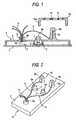
- FIG. 1 showing an overall construction of a switch device, especially, a vehicular switch device
- reference numeral 1 designates an insulating substrate.
- electric parts such as fixed contacts 2 and a light emitting body 3 are provided on the insulating substrate 1.
- the pair of fixed contacts 2 is disposed while being spaced from each other by a distance necessary for insulation.
- a light emitting diode or an electric bulb is used for the light emitting body 3.
- a sheet 4 for the switch device (The sheet will be referred to as a switch-device sheet), as shown also in Fig. 2 , includes a sheet body 5 and light guiding members 6.
- the sheet body 5 is made of a soft and elastic material, such as silicone rubber, which is semitransparent, e.g., milky-white, and has a translucency.
- the sheet body 5 may be made of a material which is transparent and has a translucency, such as soft acrylic resin, in place of the silicone rubber.
- Two operation parts 5a are disposed on the central portion of the sheet body 5.
- a first fiber embedding part 5b is formed on the left side of the operation parts, while two second fiber embedding parts 5c are formed on the right side.
- the operation parts 5a are cylindrical parts higher than the remaining upper surface of the sheet body 5.
- a periphery of each operation part is connected to the remaining part of the sheet body 5 by a thin part 7. With this structure, the operation part is elastically displaceable in the vertical directions in the figure.
- a movable contact 8 is provided on a lower surface of each operation part 5a, while corresponding to each pair of fixed contacts 2.
- the first fiber embedding part 5b includes a raised part of a height substantially equal to that of the operation parts 5a.
- a fiber insertion hole 9 vertically passes through a central part of the first fiber embedding part.
- the second fiber embedding parts 5c are raised parts higher than the operation parts 5a.
- the light guiding members 6 are optical fibers as linear members each containing mainly acrylic resin, for example, and are flexible: A necessary number of light guiding members 6 are used. All of one ends 6a of the light guiding members are press fit into and embedded in the fiber insertion hole 9 of the first fiber embedding part 5b.
- those corresponding to the second fiber embedding parts 5c are embedded in the second fiber embedding parts 5c in advance and, in this state, those are molded, viz., insert-molded.
- the remaining other ends 6b of the light guiding members 6 are put in a free state so as to be adaptable to other guided light destinations, for example.
- the middle portions of the light guiding members each between one end 6a and the other end 6b of the light guiding members 6 are wired outside the sheet body 5 (above the sheet body in the figure).
- the sheet 4 thus constructed is applied and coupled to the insulating substrate 1. Therefore, the movable contact 8 (operation parts 5a) faces the fixed contacts 2, and one end group of the light guiding members 6 (second fiber embedding parts 5b face the light emitting body 3.
- An operation knob 10 is disposed above the first fiber embedding part 5b, and the operation knob 10 is, for example, a push button having light transmitting parts 11.
- One end 10a of the operation knob 10 is located above the operation parts 5a. Accordingly, when an operator depresses the operation knob 10, the operation part 5a is depressed by the one end 10a of the operation knob 10 through a pusher (not shown). The depressed operation part 5a causes the movable contact 8 to contact with the fixed contacts 2, whereby those contacts are electrically connected to each other.
- the operation parts 5a function as members to operate the contacts of the switch device.
- Light emitted by the light emitting body 3 is led from the one end 6a of each light guiding member 6 to the other end 6b through the corresponding light guiding member 6. The light is then emitted through the second fiber embedding parts 5c of the sheet body 5 having a translucency, and illuminates the light transmitting parts 11 of the operation knob 10.
- the switch-device sheet 4 thus constructed includes the sheet body 5 as a soft and elastic member having operation parts 5a for operating the contacts of the switch device, and the light guiding members 6, as optical fibers, of which both ends 6a and 6b as parts of them are embedded and wired, and thus the one end 6a receives light and the other end 6b emits light.
- the optical fibers are linear members, and flexible. Accordingly, with the soft and elastic feature of the sheet body 5, the whole switch-device sheet 4 is flexible.
- the switch-device sheet may be attached not only to the flat plane portion but also to the curved portion, while in the conventional switch device, the portion to attach the switch-device sheet is limited only to the flat plane portion.
- the optical fibers (light guiding members 6) as flexible linear members can be wired, as desired, outside the sheet body 5, while allowing for the size and wiring configuration. Accordingly, the light emitting positions of the other ends 6b of the light guiding members 6 and the distance between the light emitting body 3 and the operation knob 10 can be selected, as desired, without any limitation by the size and configuration of the light guiding members 6.
- the ends 6a and 6b of the light guiding members 6 but also the whole of the light guiding members 6 maybe embedded and wired in the sheet body 5 by insert molding process. Even if so constructed, the whole switch-device sheet 4 is flexible, and the light guiding members 6 can be wired, as desired, in the sheet body 5, while allowing for the dimensions and wiring configuration. Accordingly, the advantages similar to those mentioned above can be obtained.
- the tips of the other ends 6b of the light guiding members 6 may be exposed from the sheet body 5 and light is emitted from the exposed tips of the other ends.
- Figs. 3 through 7 show a second example. Description will be given about only the differences of the second example from the first example.
- a sheet body 22 of a switch-device sheet 21 is made of a soft and elastic material, such as a silicone rubber, as in the case of the sheet body 5.
- Operation parts 22a are provided at plural positions (5 positions, for example) dispersedly laid out over the entire surface of the switch-device sheet, as in the case of the operation parts 5a.
- An embedding hole 22b is formed in a right end part of the sheet body 22.
- a holder part 22c shaped like a reversed U, is provided near (on the left side in the figure) the embedding hole 22b.
- a semicylinrdical-shape part 22d is provided at a position in a left end part of the sheet body 22.
- Holder parts 22e and 22f are formed on both sides of the protruded part 22d.
- a light guiding member 23, as shown also in Fig. 5 is formed with a plurality of optical fibers 24, which are similar to the optical fibers of the light guiding members 6 already described.
- a core 24a is coated with a coating 25.
- An optical refractive index of the coating 25 is small, while that of the core 24a is large. Light passing through the core 24a is totally reflected at an interface between the coating and the core 24a.
- the light guiding member 23 is preferably constructed such that the optical fibers 24 are arranged into a strip form shown in Fig. 5 , and are bonded together by adhesive. In this case, those optical fibers 24 are gathered into a cylindrical form at the right end (one end) 23a of the light guiding member 23, and are bonded together thereat except a part 23b.
- the part 23b of the light guiding member is bent to have a reversed L shape, as will be described later. Thus, the optical fibers of the light guiding member 23 are bonded together thereat except the bent part 23b.
- optical fibers 24 of the light guiding member 23 are not bonded also at a part 23c near the right end 23a, and are gently bent in a state that those fibers are arranged to be flat, as will be described later. Accordingly, the optical fibers of the light guiding member 23 are not bonded also at the bent part 23c.
- the one end 23a of the light guiding member 23 is passed through the holder part 22c, and is bent at the part 23b to be shaped like L, and inserted into and embedded in the embedding hole 22b of the sheet body 22.
- the other end 23d of the light guiding member 23 is passed through the holder part 22f, led along the protruded part 22d, and passed through the holder part 22e and fixed thereto.
- the light emitting part 26 is located on the protruded part 22d.
- a middle part of the light guiding member 23 between the one end 23a and the other end part 23b is gently bent at the part 23c near the one end 23a, whereby the middle part is laid on the upper surface of the sheet body 22, while being somewhat bent backward.
- the sheet 21 thus constructed is applied and coupled to the insulating substrate.
- a movable contact (not shown) provided on the lower side of the operation parts 22a faces fixed contacts (not shown) on the insulating substrate.
- the right end 23a of the light guiding member 23, particularly its end face, faces a light emitting body 29 ( Fig. 4 ) on the insulating substrate.
- the light guiding member 23 is formed with the optical fibers 24 each coated with a coating 25.
- a part of the coating 25 is. removed from the optical fibers at the other end 23d of the light guiding member by grinding, and light is emitted from the coating removed part of the light guiding member. Accordingly, it is easy to carry out a process to totally reflect light in the middle part of the light guiding member 23 and a process of emitting light from the other end 23d for the illumination.
- the light guiding member 23 is constructed such that the optical fibers 24 forming the light guiding member are bonded together except the parts 23b and 23c where the optical fibers 24 are bent.
- the optical fibers 24 forming the light guiding member 23 are gathered together. Accordingly, the light guiding member is easy to handle. Further, in the bending parts 23b and 23c, the optical fibers 24 are not bonded together. This feature eliminates the increase of a rigidity of the light guiding member, and hence, provides an easy bending of the same.
- Fig. 8 shows a third example of the invention. Description will be given about only the differences of the third example from the second example.
- the light guiding member 23 is constructed such that the plurality of the optical fibers 24 of the light guiding member 23 are arranged in a strip form, and in this state, bonded together.
- the light guiding member 23 thus constructed is branched out into plural, for example, three, sections 23e, 23f and 23g at the other end 23d, by tearing the light guiding member at the other end 23d into the corresponding number of fragmental section.
- the switch device of the instant embodiment in a case where a plurality of destinations for which light emitted from the light guiding member 23 is destined are present, light from the light guiding member may easily be branched out for those emitted light destinations by merely tearing the light guiding member 23.
- the switch-device sheet may be attached not only to the flat plane portion but also to the curved portion, while in the conventional switch device, the portion to attach the switch-device sheet is limited only to the flat plane portion. Accordingly, the light emitting positions of the other ends of the light guiding members and the distance between the light emitting body and the operation knob may be selected, as desired.
- a contact sheet 101 and an insulating substrate 102 in a switch device in a switch device, especially, a vehicular switch device.
- the contact sheet 101 is made of a material, such as silicone rubber, and the material is opaque, e.g., white or black, and is low in optical transmittance.
- Aplurality of operation parts 103 are disposed on the contact sheet 101.
- the operation parts 103 as shown in Fig. 11 , are each cylindrical part higher than the remaining upper surface of the contact sheet 1.
- a periphery of each operation part is connected to the remaining part of the contact sheet 101 by a thin part.104.
- a movable contact 105 is provided on a lower surface of each operation part 103.
- a light guiding member 106 is mounted on the reverse side of the contact sheet 101. Accordingly, the contact sheet 101 serves as a base member to mount the light guiding member 106.
- the light guiding member 106 is made of a soft and elastic material of a high optical transmittance, such as transparent silicone rubber, soft silicone resin, and soft acrylic resin. In this instance, the light guiding member 106 is long and shaped like a semicircular roof as shown in Fig. 10 .
- the light guiding member while its flat surface is directed upward, is brought into close contact with the rear surface of the contact sheet 101 and fixed thereon by integral molding, adhesive, or the like, in such a way that it partially bites into the contact sheet 101. Further, in this case, the light guiding member 106 is disposed such that one end (not shown) thereof is directed downward on the rear side of the contact sheet 101, and the other end 106a thereof is protruded upward from the contact sheet 101.
- the insulating substrate 102 is formed with a circuit board, for example. Electric parts, such as two pairs of fixed contacts 107 shown in Fig. 11 , are provided on the upper surface of the insulating substrate 102. Each pair of the fixed contacts 107 are disposed while being spaced from each other by a distance necessary for insulation. A light source, such as a light emitting diode or an electric bulb, both not shown, is additionally provided on the insulating substrate 102.
- the upper surface of the insulating substrate 102 serves as a reflecting surface 108 of a high reflectivity.
- the reflecting surface 108 is formed such that the whole insulating substrate 102 is made of a reflecting colorant of white color or that the upper surface of the insulating substrate 102 is colored reflecting color, such as white.
- painting or printing may be used.
- the circuit board the screen printing or the like may be used.
- the reflecting color may be silver or the like.
- the reflecting surface may be made by aluminum evaporation.
- the contact sheet 101 is placed above the insulating substrate 102 which serves as the reflecting member having the reflecting surface 108, and coupled to the latter.
- the lower surface 106b parallel the light guiding member 106 is abutted against the light guiding member 106 so as to press it.
- the semicircular surface ( Fig. 10 ) of the lower surface 106b of the light guiding member 106 is flattened as shown in Figs. 9 and 11 .
- the light source faces the one end of the light guiding member 106, and the movable contact 105 faces the fixed contacts 107.
- An operation knob (not shown) is located above the operation parts 103, with a pusher (also not shown) being interposed therebetween.
- a display section allowing light to pass therethrough (also not shown), which is for the display on switch operations, is located above the other end 106a of the light guiding member 106.
- Light emitted from the light source (not shown) is guided from one end of the light guiding member 106 to the other end. thereof, through the light guiding member 106.
- the lower surface 106b of the light guiding member 106 is a surface parallel to the light guiding direction (arrow A of Fig. 10 ) of the light guiding member 106.
- Light led by the light guiding member 106 is emitted upward from the other end 106a of the light guiding member 106, and illuminates the display section having a translucency.
- the light While the light is being transmitted through the light guiding member 106, the light is scattered inside the light guide member 106. Thus the light is transmitted not only in a direction along the light guide member 106 but also in a various directions.
- the reflecting surface 108 of the insulating substrate 102 as the reflecting member is abutted against the lower surface 106b of the light guiding member 106, to thereby thrust down the lower surface. Therefore, since the reflecting surface 108 is in close contact with the lower surface 106b of the light guiding member 106, the scattered light toward the insulating substrate 102 is reflected by the reflecting surface 108, to thereby eliminate the leakage of light. In this way, the optical directivity and illumination efficiency of the light guiding member 106 are improved.
- Figs. 12 and 13 show fifth and sixth examples of the present invention. Like or equivalent portions in those examples are designated by like reference numerals in the first example, for simplicity.
- a plurality of light transmitting parts 111 are formed in a portion of the contact sheet 101 on which the light guiding member 106 is attached. Light guided by the light guiding member 106 is emitted also from the light transmitting parts 11 and illuminates portions other than the display section corresponding to the other end 106a.
- a light guiding member 121 shaped like a square pillar, is used in place of the light guiding member 106.
- the lower surface 121b of the guiding member 121 is abutted against the reflecting surface 108 which is parallel with the light guiding direction of the guide member 121, whereby the reflecting surface presses the lower surface 121b of the guiding member 121 (In Fig. 14 , a cross-sectional configuration of the light guiding member 121 before it is pressed is indicated by a two-dot-chain line, and after it is pressed is indicated by a solid line.)
- the reflecting surface 108 is positioned in close contact with the light guiding member 121, as in the fourth embodiment, whereby no light leakage occurs.
- the optical directivity of the light guiding member 106 is improved, and the illumination efficiency is also improved.
- reference numeral 201 designates an insulating substrate, such as a circuit board, used in a switch device, especially, a vehicular switch device.
- electric parts such as fixed contacts 202 and a light emitting body 203, are provided on the insulating substrate 201.
- each pair of the fixed contacts 202 are disposed while being spaced from each other by a distance necessary for insulation.
- a light-emittingdiodeoranelectric bulb is used for the light emitting body 203.
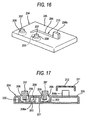
- a sheet 204 for the switch device which is disposed on and coupled to the insulating substrate 201, as shown in Figs. 15A, 15B and 16 , includes a sheet body 205 and a light guiding member 206.
- the sheet body 205 is made of a soft and elastic material, such as silicon rubber, and is opaque, or is colored black, milky-white, or white.
- operation parts 207 are formed at positions opposed to those paired fixed contacts 202, as shown in Fig. 17 .
- the operation parts 207 are cylindrical parts higher than the remaining upper surface of the sheet body 205.
- Aperiphery of each operation part is connected to the remaining part of the sheet body 205 by a thin part 208. With this structure, the operation part is elastically displaceable in the vertical directions in the figure.
- a movable contact 209 is provided on a lower surface of each operation part 207, while corresponding to each pair of fixed contacts 202.
- the operation parts 207 When the operation parts 207 are depressed, the movable contact 209 comes in contact with the corresponding paired fixed contacts 202, whereby those are electrically continuous to each other.
- the operation parts 207 function as members to operate the contacts of the switch device.
- the light guiding member 206 is a material made of a soft and elastic material of a high optical transmittance, and as shown in Fig. 15A , is provided extending from a portion where it faces the light emitting body 203 to another portion.
- one end part 206a of the light guiding member 206 is protruded downward toward the light emitting body 203, and the other end 026b is protruded upward.
- a portion 206c between those ends, viz., most the light guiding member, is embedded in the sheet body 205. In this case, the upper surface and the lower surface of the light guiding member 206 are exposed from the sheet body 205.
- the light guiding member 206 is embeddedby a two-colormolding process in which a material of the light guiding member 206 and a material of the sheet body 205 are both injected into a forming mold and in this state, those are molded, or an insert molding process in which a light guiding member 206 already molded is set in a forming mold, and a material of the sheet body 205 is injected into the forming mold.
- the light guiding member 206 is integral with the sheet body 205, and a light guiding path 210 defined by the light guiding member is formed in the sheet body ( Figs. 15A and 16 ).
- reference numeral 211 indicates, for example, an operation knob having a light transmitting display section 212 serving as a light emission portion, which is disposed above the other end 206b of the light guiding member 206.
- light emitted from the light emitting body 203 is led from the one end part 206a of the light guiding member 206 to the portion 206c extending to the other end 206b, viz., to the light guiding path 210, and is emitted from the other end 206b and illuminates the light transmitting display section 212.
- the sheet body 205 is made of a soft and elastic material and has operation parts 207 for operating contacts of the switch device, and the light guiding member 206 is provided.
- the light guiding member 206 is made of a soft and elastic material having a high optical transmittance.
- the light guiding member is integral with the sheet body 205, and the light guiding path 210 is formed in the sheet body.
- the light guiding member 206 is flexible. Accordingly, with the flexible feature of the sheet body 205, the whole switch-device sheet 204 is flexible.
- the switch-device sheet can be attached not only to the flat plane portion but also to the curved portion.
- the light guiding member 206 may be arranged such that the portion 206c defining the light guiding path 21.0 is entirely covered with the sheet body 205, or a part of it is partially exposed and light is emitted from the exposed part.
- the light guiding member may be covered with a surface region of the switch-device sheet 204, and embedded in the switch-device sheet 204. In this construction, light which will leaks from the light guiding member when it travels through the light guiding member is lessened in amount (see Fig. 15B ).
- a switch-device sheet of the invention is flexible as a whole, and may be attached not only to the flat plane portion but also the curved portion.
Landscapes
- Push-Button Switches (AREA)
Description
- The present invention relates to a switch-device sheet in which a light guiding member is provided on a soft and elastic sheet body having operation parts.
- In a conventional vehicular switch device, for example, a light guiding member is installed on a soft and elastic sheet body which is made of, for example, silicone rubber, and has an operation part (contact operation part) for operating switch contacts.
- The light guiding member is generally formed with a transparent and hard synthetic resin block, and is embedded in the sheet body. A light emitting body is located just under or near the light guiding member. The light guiding member receives light emitted from the light emitting body at one end, and emits the light at the other end, and operation knobs of the switch device, the display section, or the like are illuminated.
- In the conventional switch device, the sheet body is soft and elastic, but the light guiding member is formed with the hard synthetic resin block. Therefore, the resultant switch-device sheet is not flexible as a whole. Accordingly, a place to attach the switch-device sheet is limited to a flat plane portion, while avoiding a curved portion.
- The light guiding member of the hard synthetic resin block is not flexible in design also of its size and configuration. Accordingly, a light emitting position on the other end of the light guiding member in the sheet body is limited in its selection by the size and configuration of the light guiding member. Additionally, the distance between the light emitting body and the operation knob is also limited in its selection by the size and configuration of the light guiding member.
- Further, the conventional switch device is known, which includes a light source, such as a light emitting diode or a bulb, to illuminate a display section presenting the contents on operations of the light guiding device, and a light guiding member for guiding light emitted from the light source to the display section.
The light guiding member is made of a material of a high optical transmittance, such as acrylic resin.
Incidentally, there is a light transmission plate inwhich a light diffusion layer is provided on the reverse side of a transparent light guiding member (seeJP-A-05-11117 - In a device having the conventional light guiding member, light passing through the light guiding member leaks from a surface of the light guiding member parallel to the light guiding direction since the light is scattered inside the light guiding member. For this reason, the optical directivity of the light guiding member is not good, and the illumination efficiency is not satisfactory in illuminating the display section with light emitted from the light source.
- In further another conventional vehicular switch device, a light guiding member is installed on a soft and elastic sheet body which is made of, for example, silicone rubber, and has an operation part (contact operation part) for operating switch contacts. In this switch device, the light guiding member may be handled together with the sheet body. Accordingly, the switch device is excellent in its assembling.
- The light guiding member of the switch device is formed with a transparent and hard synthetic resin block, such as acrylic resin. And it is embedded in the sheet body. A light emitting body is located just under or near one end of the light guiding member. The light guiding member receives light emitted from the light emitting body at one end and guides the light, and emits the light at the other end. The guided light illuminates operation knobs of the switch device, the display section, or the like.
- In the conventional switch device in which the sheet body contains the light guiding member, the sheet body is soft and elastic, but the light guiding member is formed with the hard synthetic resin block. Therefore, the whole of the resultant switch-device sheet is not flexible. Accordingly, a place to attach the switch-device sheet is limited to a flat plane portion, while avoiding a curved portion.
-
US 5, 975, 711 relates to an integrated display panel assembly and discloses all the features in the preamble ofclaim 1. - Accordingly, an object of the present invention is to a switch-device sheet which may be attached not only to the flat plane portion but also the curved portion, and enables one to select, as desired, the light emitting position on the other end of the light guiding member and the distance between the light emitting body and the operation knob.
- Another object of the present invention is to provided a light guiding device which is capable of improving the optional directivity and the illumination efficiency of a light guiding member.
- In order to solve the aforesaid object, the invention is characterized by
claim 1. -
-
Fig. 1 is a longitudinal sectional view showing an overall switch device which is not part of the invention. -
Fig. 2 is a perspective view showing a single switch-device sheet. -
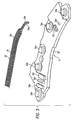
Fig. 3 is a perspective view showing a switch device which is not part of the invention. -
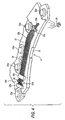
Fig. 4 is a partial perspective view showing a switch device. -
Fig. 5 is a perspective view showing a single switch-device sheet. -
Fig. 6 is a longitudinal sectional view showing a single optical fiber. -
Fig. 7 is a longitudinal sectional view showing a single optical fiber at a light emitting part. -
Fig. 8 is a perspective view showing a portion corresponding to that ofFig. 5 . -
Fig. 9 is a broken perspective view showing a major portion of the invention. -
Fig. 10 is a broken exploded perspective view showing an overall construction of the invention. -
Fig. 11 is a longitudinal sectional view showing an overall construction of the light guiding device of the invention. -
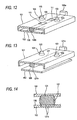
Fig. 12 is a broken exploded perspective view showing an overall construction of an example which is not part of the invention. -
Fig. 13 is a longitudinal sectional view showing an example which is not part of the invention. -
Fig. 14 is a partially enlarged longitudinal sectional view showing the the example ofFig. 13 . -
Fig. 15A is a broken perspective view of a major part showing an example which is not part of the invention, andFig. 15B is a broken perspective view of a major part showing modification of the example ofFig. 15A . -
Fig. 16 is a perspective view showing an outward appearance of a switch-device sheet. -
Fig. 17 is a longitudinal sectional view showing an overall switch-device sheet. - A first example will be described with reference to
Figs. 1 and 2 .
Firstly, inFig. 1 showing an overall construction of a switch device, especially, a vehicular switch device,reference numeral 1 designates an insulating substrate. In this instance, electric parts, such asfixed contacts 2 and alight emitting body 3, are provided on theinsulating substrate 1. The pair offixed contacts 2 is disposed while being spaced from each other by a distance necessary for insulation. A light emitting diode or an electric bulb is used for thelight emitting body 3. - A
sheet 4 for the switch device (The sheet will be referred to as a switch-device sheet), as shown also inFig. 2 , includes asheet body 5 and light guidingmembers 6. Thesheet body 5 is made of a soft and elastic material, such as silicone rubber, which is semitransparent, e.g., milky-white, and has a translucency. Thesheet body 5 may be made of a material which is transparent and has a translucency, such as soft acrylic resin, in place of the silicone rubber. - Two
operation parts 5a are disposed on the central portion of thesheet body 5. A firstfiber embedding part 5b is formed on the left side of the operation parts, while two secondfiber embedding parts 5c are formed on the right side. Theoperation parts 5a are cylindrical parts higher than the remaining upper surface of thesheet body 5. A periphery of each operation part is connected to the remaining part of thesheet body 5 by athin part 7. With this structure, the operation part is elastically displaceable in the vertical directions in the figure. As shown inFig. 1 , amovable contact 8 is provided on a lower surface of eachoperation part 5a, while corresponding to each pair of fixedcontacts 2. - The first
fiber embedding part 5b includes a raised part of a height substantially equal to that of theoperation parts 5a. A fiber insertion hole 9 vertically passes through a central part of the first fiber embedding part. The secondfiber embedding parts 5c are raised parts higher than theoperation parts 5a. - The
light guiding members 6 are optical fibers as linear members each containing mainly acrylic resin, for example, and are flexible: A necessary number oflight guiding members 6 are used. All of one ends 6a of the light guiding members are press fit into and embedded in the fiber insertion hole 9 of the firstfiber embedding part 5b. - Of the other ends 6b of the
light guiding members 6, those corresponding to the secondfiber embedding parts 5c are embedded in the secondfiber embedding parts 5c in advance and, in this state, those are molded, viz., insert-molded. The remainingother ends 6b of thelight guiding members 6 are put in a free state so as to be adaptable to other guided light destinations, for example. - In this case, the middle portions of the light guiding members each between one
end 6a and theother end 6b of thelight guiding members 6 are wired outside the sheet body 5 (above the sheet body in the figure). - The
sheet 4 thus constructed is applied and coupled to the insulatingsubstrate 1. Therefore, the movable contact 8 (operation parts 5a) faces the fixedcontacts 2, and one end group of the light guiding members 6 (secondfiber embedding parts 5b face thelight emitting body 3. - An
operation knob 10 is disposed above the firstfiber embedding part 5b, and theoperation knob 10 is, for example, a push button havinglight transmitting parts 11. Oneend 10a of theoperation knob 10 is located above theoperation parts 5a. Accordingly, when an operator depresses theoperation knob 10, theoperation part 5a is depressed by the oneend 10a of theoperation knob 10 through a pusher (not shown). Thedepressed operation part 5a causes themovable contact 8 to contact with the fixedcontacts 2, whereby those contacts are electrically connected to each other. Theoperation parts 5a function as members to operate the contacts of the switch device. - Light emitted by the
light emitting body 3 is led from the oneend 6a of each light guidingmember 6 to theother end 6b through the correspondinglight guiding member 6. The light is then emitted through the secondfiber embedding parts 5c of thesheet body 5 having a translucency, and illuminates thelight transmitting parts 11 of theoperation knob 10. - Thus, the switch-
device sheet 4 thus constructed includes thesheet body 5 as a soft and elastic member havingoperation parts 5a for operating the contacts of the switch device, and thelight guiding members 6, as optical fibers, of which both ends 6a and 6b as parts of them are embedded and wired, and thus the oneend 6a receives light and theother end 6b emits light. - The optical fibers (light guiding members 6) are linear members, and flexible. Accordingly, with the soft and elastic feature of the
sheet body 5, the whole switch-device sheet 4 is flexible. The switch-device sheet may be attached not only to the flat plane portion but also to the curved portion, while in the conventional switch device, the portion to attach the switch-device sheet is limited only to the flat plane portion. - The optical fibers (light guiding members 6) as flexible linear members can be wired, as desired, outside the
sheet body 5, while allowing for the size and wiring configuration. Accordingly, the light emitting positions of the other ends 6b of thelight guiding members 6 and the distance between the light emittingbody 3 and theoperation knob 10 can be selected, as desired, without any limitation by the size and configuration of thelight guiding members 6. - Not only the
ends light guiding members 6 but also the whole of thelight guiding members 6 maybe embedded and wired in thesheet body 5 by insert molding process. Even if so constructed, the whole switch-device sheet 4 is flexible, and thelight guiding members 6 can be wired, as desired, in thesheet body 5, while allowing for the dimensions and wiring configuration. Accordingly, the advantages similar to those mentioned above can be obtained. - The tips of the other ends 6b of the
light guiding members 6 may be exposed from thesheet body 5 and light is emitted from the exposed tips of the other ends. -
Figs. 3 through 7 show a second example. Description will be given about only the differences of the second example from the first example. - In the second , as shown in
Figs. 3 and4 , asheet body 22 of a switch-device sheet 21 is made of a soft and elastic material, such as a silicone rubber, as in the case of thesheet body 5.Operation parts 22a are provided at plural positions (5 positions, for example) dispersedly laid out over the entire surface of the switch-device sheet, as in the case of theoperation parts 5a. An embeddinghole 22b is formed in a right end part of thesheet body 22. Aholder part 22c, shaped like a reversed U, is provided near (on the left side in the figure) the embeddinghole 22b. A semicylinrdical-shape part 22d is provided at a position in a left end part of thesheet body 22.Holder parts protruded part 22d. - A
light guiding member 23, as shown also inFig. 5 , is formed with a plurality ofoptical fibers 24, which are similar to the optical fibers of thelight guiding members 6 already described. In eachoptical fiber 24, as shown inFig. 6 , acore 24a is coated with acoating 25. An optical refractive index of thecoating 25 is small, while that of thecore 24a is large. Light passing through thecore 24a is totally reflected at an interface between the coating and thecore 24a. - The
light guiding member 23 is preferably constructed such that theoptical fibers 24 are arranged into a strip form shown inFig. 5 , and are bonded together by adhesive. In this case, thoseoptical fibers 24 are gathered into a cylindrical form at the right end (one end) 23a of thelight guiding member 23, and are bonded together thereat except apart 23b. Thepart 23b of the light guiding member is bent to have a reversed L shape, as will be described later. Thus, the optical fibers of thelight guiding member 23 are bonded together thereat except thebent part 23b. - The
optical fibers 24 of thelight guiding member 23 are not bonded also at apart 23c near theright end 23a, and are gently bent in a state that those fibers are arranged to be flat, as will be described later. Accordingly, the optical fibers of thelight guiding member 23 are not bonded also at thebent part 23c. - At the left end (the other end) 23d of the
light guiding member 23, only an upper part of thecoating 25 of theoptical fibers 24 is cut out by grinding as shown inFig. 7 to thereby form alight emitting part 26. - With such. a construction, the one
end 23a of thelight guiding member 23 is passed through theholder part 22c, and is bent at thepart 23b to be shaped like L, and inserted into and embedded in the embeddinghole 22b of thesheet body 22. Theother end 23d of thelight guiding member 23 is passed through theholder part 22f, led along theprotruded part 22d, and passed through theholder part 22e and fixed thereto. At this time, thelight emitting part 26 is located on theprotruded part 22d. A middle part of thelight guiding member 23 between the oneend 23a and theother end part 23b is gently bent at thepart 23c near the oneend 23a, whereby the middle part is laid on the upper surface of thesheet body 22, while being somewhat bent backward. - The
sheet 21 thus constructed is applied and coupled to the insulating substrate. As a result, a movable contact (not shown) provided on the lower side of theoperation parts 22a faces fixed contacts (not shown) on the insulating substrate. Theright end 23a of thelight guiding member 23, particularly its end face, faces a light emitting body 29 (Fig. 4 ) on the insulating substrate. - Therefore, light emitted from the light emitting body . 29 is led from the one
end 23a of thelight guiding member 23 to theother end 23d via thelight guiding member 23, and is emitted outside from thelight emitting part 26 as indicated by an arrow "a" infig 7 . - In the switch device thus constructed, the
light guiding member 23 is formed with theoptical fibers 24 each coated with acoating 25. A part of thecoating 25 is. removed from the optical fibers at theother end 23d of the light guiding member by grinding, and light is emitted from the coating removed part of the light guiding member. Accordingly, it is easy to carry out a process to totally reflect light in the middle part of thelight guiding member 23 and a process of emitting light from theother end 23d for the illumination. - In this case, the
light guiding member 23 is constructed such that theoptical fibers 24 forming the light guiding member are bonded together except theparts optical fibers 24 are bent. Thus, theoptical fibers 24 forming thelight guiding member 23 are gathered together. Accordingly, the light guiding member is easy to handle. Further, in the bendingparts optical fibers 24 are not bonded together. This feature eliminates the increase of a rigidity of the light guiding member, and hence, provides an easy bending of the same. - In this case, only either of the
parts light guiding member 23, especially only theparts 23c which is difficult to be bent may not be bonded (For this reason, thelight emitting part 26 and the portions on both sides of the light emitting part as other bending portions of thelight guiding member 23 are bonded together). Accordingly, it suffices that the optical fibers of the light guiding member, except at least one portion thereof to be bent, are bonded together. -
Fig. 8 shows a third example of the invention. Description will be given about only the differences of the third example from the second example. In the instant embodiment, thelight guiding member 23 is constructed such that the plurality of theoptical fibers 24 of thelight guiding member 23 are arranged in a strip form, and in this state, bonded together.. Thelight guiding member 23 thus constructed is branched out into plural, for example, three,sections other end 23d, by tearing the light guiding member at theother end 23d into the corresponding number of fragmental section. - In the switch device of the instant embodiment, in a case where a plurality of destinations for which light emitted from the
light guiding member 23 is destined are present, light from the light guiding member may easily be branched out for those emitted light destinations by merely tearing thelight guiding member 23. - It should be understood that the invention is not limited to those illustrated embodiments, but may variously be modified, altered, and changed within the true spirits of the invention.
- As described above, the switch-device sheet may be attached not only to the flat plane portion but also to the curved portion, while in the conventional switch device, the portion to attach the switch-device sheet is limited only to the flat plane portion. Accordingly, the light emitting positions of the other ends of the light guiding members and the distance between the light emitting body and the operation knob may be selected, as desired.
- A fourth example according to the invention will be described with reference to
Figs. 9 to 11 . - Firstly, in
Fig. 9 , there is shown acontact sheet 101 and an insulatingsubstrate 102 in a switch device, especially, a vehicular switch device. Thecontact sheet 101 is made of a material, such as silicone rubber, and the material is opaque, e.g., white or black, and is low in optical transmittance. - Aplurality of operation parts 103 (two in this instance) are disposed on the
contact sheet 101. Theoperation parts 103, as shown inFig. 11 , are each cylindrical part higher than the remaining upper surface of thecontact sheet 1. A periphery of each operation part is connected to the remaining part of thecontact sheet 101 by a thin part.104. Amovable contact 105 is provided on a lower surface of eachoperation part 103. - A
light guiding member 106 is mounted on the reverse side of thecontact sheet 101. Accordingly, thecontact sheet 101 serves as a base member to mount thelight guiding member 106. Thelight guiding member 106 is made of a soft and elastic material of a high optical transmittance, such as transparent silicone rubber, soft silicone resin, and soft acrylic resin. In this instance, thelight guiding member 106 is long and shaped like a semicircular roof as shown inFig. 10 . The light guiding member, while its flat surface is directed upward, is brought into close contact with the rear surface of thecontact sheet 101 and fixed thereon by integral molding, adhesive, or the like, in such a way that it partially bites into thecontact sheet 101. Further, in this case, thelight guiding member 106 is disposed such that one end (not shown) thereof is directed downward on the rear side of thecontact sheet 101, and theother end 106a thereof is protruded upward from thecontact sheet 101. - The insulating
substrate 102 is formed with a circuit board, for example. Electric parts, such as two pairs of fixedcontacts 107 shown inFig. 11 , are provided on the upper surface of the insulatingsubstrate 102. Each pair of the fixedcontacts 107 are disposed while being spaced from each other by a distance necessary for insulation. A light source, such as a light emitting diode or an electric bulb, both not shown, is additionally provided on the insulatingsubstrate 102. - The upper surface of the insulating
substrate 102 serves as a reflectingsurface 108 of a high reflectivity. The reflectingsurface 108 is formed such that the whole insulatingsubstrate 102 is made of a reflecting colorant of white color or that the upper surface of the insulatingsubstrate 102 is colored reflecting color, such as white. For the coloring of the reflecting surface, painting or printing may be used. Particularly for the circuit board, the screen printing or the like may be used. The reflecting color may be silver or the like. In this case, the reflecting surface may be made by aluminum evaporation. - The
contact sheet 101 is placed above the insulatingsubstrate 102 which serves as the reflecting member having the reflectingsurface 108, and coupled to the latter. In this case, thelower surface 106b parallel thelight guiding member 106 is abutted against thelight guiding member 106 so as to press it. As a result, the semicircular surface (Fig. 10 ) of thelower surface 106b of thelight guiding member 106 is flattened as shown inFigs. 9 and11 . - The light source faces the one end of the
light guiding member 106, and themovable contact 105 faces the fixedcontacts 107. An operation knob (not shown) is located above theoperation parts 103, with a pusher (also not shown) being interposed therebetween. A display section allowing light to pass therethrough (also not shown), which is for the display on switch operations, is located above theother end 106a of thelight guiding member 106. - With such a construction, when an operation knob (not shown) is operated, the
operation parts 103 are depressed through a pusher (not shown), so that themovable contact 105 comes in contact with the fixedcontacts 107, whereby those contacts are electrically continuous. - Light emitted from the light source (not shown) is guided from one end of the
light guiding member 106 to the other end. thereof, through thelight guiding member 106. In this case, thelower surface 106b of thelight guiding member 106 is a surface parallel to the light guiding direction (arrow A ofFig. 10 ) of thelight guiding member 106. Light led by thelight guiding member 106 is emitted upward from theother end 106a of thelight guiding member 106, and illuminates the display section having a translucency. - While the light is being transmitted through the
light guiding member 106, the light is scattered inside thelight guide member 106. Thus the light is transmitted not only in a direction along thelight guide member 106 but also in a various directions. At this time, the reflectingsurface 108 of the insulatingsubstrate 102 as the reflecting member is abutted against thelower surface 106b of thelight guiding member 106, to thereby thrust down the lower surface. Therefore, since the reflectingsurface 108 is in close contact with thelower surface 106b of thelight guiding member 106, the scattered light toward the insulatingsubstrate 102 is reflected by the reflectingsurface 108, to thereby eliminate the leakage of light. In this way, the optical directivity and illumination efficiency of thelight guiding member 106 are improved. -
Figs. 12 and 13 show fifth and sixth examples of the present invention. Like or equivalent portions in those examples are designated by like reference numerals in the first example, for simplicity. - In the fifth example shown in
Fig. 12 , a plurality of light transmittingparts 111 are formed in a portion of thecontact sheet 101 on which thelight guiding member 106 is attached. Light guided by thelight guiding member 106 is emitted also from thelight transmitting parts 11 and illuminates portions other than the display section corresponding to theother end 106a. - In the sixth example shown in
Figs. 13 and 14 , alight guiding member 121, shaped like a square pillar, is used in place of thelight guiding member 106. Thelower surface 121b of the guidingmember 121 is abutted against the reflectingsurface 108 which is parallel with the light guiding direction of theguide member 121, whereby the reflecting surface presses thelower surface 121b of the guiding member 121 (InFig. 14 , a cross-sectional configuration of thelight guiding member 121 before it is pressed is indicated by a two-dot-chain line, and after it is pressed is indicated by a solid line.) - Also in this example, the reflecting
surface 108 is positioned in close contact with thelight guiding member 121, as in the fourth embodiment, whereby no light leakage occurs. As a result, the optical directivity of thelight guiding member 106 is improved, and the illumination efficiency is also improved. - As seen from the foregoing description, advantages of improved optical directivity and illumination efficiency accrue by the light guiding device of the invention.
- A seventh example of the present invention will be described with reference to the accompanying drawings.
- Firstly, in
Fig. 17 ,reference numeral 201 designates an insulating substrate, such as a circuit board, used in a switch device, especially, a vehicular switch device. In this instance, electric parts, such as fixedcontacts 202 and alight emitting body 203, are provided on the insulatingsubstrate 201. In this instance, each pair of the fixedcontacts 202 are disposed while being spaced from each other by a distance necessary for insulation.A light-emittingdiodeoranelectric bulb is used for thelight emitting body 203. - A
sheet 204 for the switch device, which is disposed on and coupled to the insulatingsubstrate 201, as shown inFigs. 15A, 15B and16 , includes asheet body 205 and alight guiding member 206. Thesheet body 205 is made of a soft and elastic material, such as silicon rubber, and is opaque, or is colored black, milky-white, or white. - On the
sheet body 205,operation parts 207 are formed at positions opposed to those pairedfixed contacts 202, as shown inFig. 17 . Theoperation parts 207 are cylindrical parts higher than the remaining upper surface of thesheet body 205. Aperiphery of each operation part is connected to the remaining part of thesheet body 205 by athin part 208. With this structure, the operation part is elastically displaceable in the vertical directions in the figure. - A
movable contact 209 is provided on a lower surface of eachoperation part 207, while corresponding to each pair of fixedcontacts 202. When theoperation parts 207 are depressed, themovable contact 209 comes in contact with the corresponding paired fixedcontacts 202, whereby those are electrically continuous to each other. Theoperation parts 207 function as members to operate the contacts of the switch device. - The
light guiding member 206 is a material made of a soft and elastic material of a high optical transmittance, and as shown inFig. 15A , is provided extending from a portion where it faces thelight emitting body 203 to another portion. - To be more specific, one
end part 206a of thelight guiding member 206 is protruded downward toward thelight emitting body 203, and the other end 026b is protruded upward. Aportion 206c between those ends, viz., most the light guiding member, is embedded in thesheet body 205. In this case, the upper surface and the lower surface of thelight guiding member 206 are exposed from thesheet body 205. Thelight guiding member 206 is embeddedby a two-colormolding process in which a material of thelight guiding member 206 and a material of thesheet body 205 are both injected into a forming mold and in this state, those are molded, or an insert molding process in which alight guiding member 206 already molded is set in a forming mold, and a material of thesheet body 205 is injected into the forming mold. - The
light guiding member 206 is integral with thesheet body 205, and alight guiding path 210 defined by the light guiding member is formed in the sheet body (Figs. 15A and16 ). - In
Fig. 17 ,reference numeral 211 indicates, for example, an operation knob having a lighttransmitting display section 212 serving as a light emission portion, which is disposed above theother end 206b of thelight guiding member 206. - With such a structure, light emitted from the
light emitting body 203 is led from the oneend part 206a of thelight guiding member 206 to theportion 206c extending to theother end 206b, viz., to thelight guiding path 210, and is emitted from theother end 206b and illuminates the lighttransmitting display section 212. - Thus, in the switch-
device sheet 204, thesheet body 205 is made of a soft and elastic material and hasoperation parts 207 for operating contacts of the switch device, and thelight guiding member 206 is provided. Thelight guiding member 206 is made of a soft and elastic material having a high optical transmittance. The light guiding member is integral with thesheet body 205, and thelight guiding path 210 is formed in the sheet body. - With such a construction, the
light guiding member 206 is flexible. Accordingly, with the flexible feature of thesheet body 205, the whole switch-device sheet 204 is flexible. The switch-device sheet can be attached not only to the flat plane portion but also to the curved portion. - The
light guiding member 206 may be arranged such that theportion 206c defining the light guiding path 21.0 is entirely covered with thesheet body 205, or a part of it is partially exposed and light is emitted from the exposed part.The light guiding member may be covered with a surface region of the switch-device sheet 204, and embedded in the switch-device sheet 204. In this construction, light which will leaks from the light guiding member when it travels through the light guiding member is lessened in amount (seeFig. 15B ). - As seen from the foregoing description, a switch-device sheet of the invention is flexible as a whole, and may be attached not only to the flat plane portion but also the curved portion.
Claims (1)
- A light guiding device comprising:a light guiding member (106) made of a soft and elastic material of a high optical transmittance, a light being transmitted from one end of the light guiding member (106) to the other end of the light guide member (106) in a guiding direction, allows that some of the light leaks from a surface of the light guiding member (106) parallel to the guiding direction of the light guiding member (106); anda printed circuit board (102) including a reflecting- surface (108) colored to have a color of a high reflectivity,wherein the reflecting surface (108) is pressed against a surface of the light guiding member (106) which is substantially parallel to the guiding direction so that the light guiding member (106) is elastically transformed and the reflecting surface (108) is positioned in close contact with the light guiding member to lessen light to leak from the surface of the light guiding member (106), when it travels through the light guiding memberwherein the light guiding member (106) is attached to a contact sheet (101) including a operation part (103),the printed circuit board includes a contact (107), andwhen the contact sheet (101) is coupled to the printed circuit board (102) so as to face the operation part (103) to the contact, the reflecting surface (108) is pressed against the surface of the light guiding member (106b).
Applications Claiming Priority (8)
| Application Number | Priority Date | Filing Date | Title |
|---|---|---|---|
| JP2002178459 | 2002-06-19 | ||
| JP2002178459 | 2002-06-19 | ||
| JP2002259928 | 2002-09-05 | ||
| JP2002259929A JP4084137B2 (en) | 2002-09-05 | 2002-09-05 | Light guide device |
| JP2002259929 | 2002-09-05 | ||
| JP2002259928 | 2002-09-05 | ||
| JP2002357916 | 2002-12-10 | ||
| JP2002357916A JP2004079499A (en) | 2002-06-19 | 2002-12-10 | Sheet for switching device |
Publications (3)
| Publication Number | Publication Date |
|---|---|
| EP1376166A2 EP1376166A2 (en) | 2004-01-02 |
| EP1376166A3 EP1376166A3 (en) | 2005-06-01 |
| EP1376166B1 true EP1376166B1 (en) | 2011-05-25 |
Family
ID=29718687
Family Applications (1)
| Application Number | Title | Priority Date | Filing Date |
|---|---|---|---|
| EP03013740A Expired - Lifetime EP1376166B1 (en) | 2002-06-19 | 2003-06-17 | Sheet-switch device |
Country Status (2)
| Country | Link |
|---|---|
| US (3) | US6878892B2 (en) |
| EP (1) | EP1376166B1 (en) |
Families Citing this family (13)
| Publication number | Priority date | Publication date | Assignee | Title |
|---|---|---|---|---|
| KR101035816B1 (en) * | 2004-04-05 | 2011-05-20 | 선아로 가부시키가이샤 | Key Unit with Reinforcement Plate |
| TWI257018B (en) * | 2004-07-07 | 2006-06-21 | Epistar Corp | A back light module with independent light source |
| DE202005003663U1 (en) * | 2005-03-08 | 2005-07-21 | Trw Automotive Electronics & Components Gmbh & Co. Kg | Electric push-button |
| JP2006270885A (en) * | 2005-03-25 | 2006-10-05 | Orion Denki Kk | Electronic device |
| KR100692742B1 (en) * | 2005-05-13 | 2007-03-09 | 삼성전자주식회사 | Keypad and Keypad Assembly with Light Guide Layer |
| FI20065009L (en) * | 2006-01-09 | 2007-06-13 | Perlos Oyj | Lighting arrangement, electronic device and manufacturing method |
| JPWO2007097117A1 (en) * | 2006-02-20 | 2009-07-09 | シチズン電子株式会社 | Side light emitting unit and illumination panel |
| US7982149B2 (en) * | 2008-09-29 | 2011-07-19 | Microsoft Corporation | Mechanical architecture for display keyboard keys |
| JP5051119B2 (en) * | 2008-12-25 | 2012-10-17 | 豊田合成株式会社 | Lighting device |
| US20100214135A1 (en) * | 2009-02-26 | 2010-08-26 | Microsoft Corporation | Dynamic rear-projected user interface |
| CN101872691B (en) * | 2009-04-21 | 2013-05-29 | 深圳富泰宏精密工业有限公司 | Keypress assembly and portable electronic device equipped with same |
| EP2557359B1 (en) * | 2011-08-04 | 2014-07-30 | OSRAM GmbH | A lighting module |
| CN103037649B (en) * | 2011-10-06 | 2015-09-30 | 鸿富锦精密工业(武汉)有限公司 | Electronic installation |
Family Cites Families (12)
| Publication number | Priority date | Publication date | Assignee | Title |
|---|---|---|---|---|
| DE3522717A1 (en) * | 1985-04-29 | 1986-10-30 | Josef Gartner & Co, 8883 Gundelfingen | Device for illuminating indoor spaces with natural daylight |
| US5097396A (en) * | 1990-09-25 | 1992-03-17 | Poly-Optical Products, Inc. | Fiber optic backlighting panel |
| JP3071247B2 (en) | 1991-06-28 | 2000-07-31 | 日本写真印刷株式会社 | Light guide plate for surface light emitting device and method of manufacturing the same |
| JP3179188B2 (en) * | 1992-06-11 | 2001-06-25 | ヤマザキマザック株式会社 | Laser processing machine |
| US5975711A (en) * | 1995-06-27 | 1999-11-02 | Lumitex, Inc. | Integrated display panel assemblies |
| JPH10199314A (en) * | 1997-01-09 | 1998-07-31 | Sony Corp | Light guide device |
| JP2893445B2 (en) * | 1997-02-18 | 1999-05-24 | サンアロー株式会社 | Illuminated key and method of manufacturing the same |
| JP2001067145A (en) * | 1999-08-30 | 2001-03-16 | Matsushita Electric Ind Co Ltd | Keyboard irradiation method and information processing apparatus provided with keyboard irradiation |
| US6217183B1 (en) * | 1999-09-15 | 2001-04-17 | Michael Shipman | Keyboard having illuminated keys |
| US6789910B2 (en) * | 2000-04-12 | 2004-09-14 | Semiconductor Energy Laboratory, Co., Ltd. | Illumination apparatus |
| US6561660B2 (en) * | 2001-06-26 | 2003-05-13 | Wintek Corporation | Light guiding device of a liquid crystal display |
| JP4013682B2 (en) * | 2002-07-22 | 2007-11-28 | セイコーエプソン株式会社 | Light guide device, lighting device, projection display device |
-
2003
- 2003-06-17 EP EP03013740A patent/EP1376166B1/en not_active Expired - Lifetime
- 2003-06-18 US US10/463,386 patent/US6878892B2/en not_active Expired - Fee Related
-
2005
- 2005-03-10 US US11/075,731 patent/US7002087B2/en not_active Expired - Fee Related
- 2005-03-10 US US11/075,751 patent/US7026563B2/en not_active Expired - Fee Related
Also Published As
| Publication number | Publication date |
|---|---|
| EP1376166A3 (en) | 2005-06-01 |
| US20030234168A1 (en) | 2003-12-25 |
| US7002087B2 (en) | 2006-02-21 |
| US20050151098A1 (en) | 2005-07-14 |
| US6878892B2 (en) | 2005-04-12 |
| US20050150752A1 (en) | 2005-07-14 |
| US7026563B2 (en) | 2006-04-11 |
| EP1376166A2 (en) | 2004-01-02 |
Similar Documents
| Publication | Publication Date | Title |
|---|---|---|
| JP4779065B2 (en) | Display panel assembly | |
| US10942581B2 (en) | Illuminated keyboard | |
| US5847336A (en) | Direct keypad backlighting | |
| US4343975A (en) | Key board switch unit with illumination | |
| EP1376166B1 (en) | Sheet-switch device | |
| US20070039809A1 (en) | Sheet switch, sheet switch module and panel switch | |
| US20030210537A1 (en) | Arrangement for illuminating a switch surface for a touch sensor switch | |
| US20070279932A1 (en) | Sheet switch module | |
| US20120139843A1 (en) | Illuminated keyboard | |
| US20080143560A1 (en) | Lightpipe for illuminating keys of a keyboard | |
| WO2007132781A1 (en) | Input device having illuminating function | |
| GB2285518A (en) | Sheet-like light guide for illuminating keypad | |
| JP2010114010A (en) | Lighting structure of mobile apparatus | |
| CN109314513B (en) | Device comprising at least one illuminable region | |
| US8690368B1 (en) | Cavity filled lightpipe for illuminating keys of a keyboard | |
| JP4529546B2 (en) | Panel display unit | |
| JPH0750788Y2 (en) | Lighting equipment | |
| JP2001265348A (en) | Keyboard device | |
| JP2836582B2 (en) | Key input device | |
| JP2001282244A (en) | Keyboard device | |
| CN220085907U (en) | Key switch | |
| JPH03257728A (en) | Luminescence configuration for push type panel switch | |
| JPH11213793A (en) | Lighted switch apparatus | |
| JP4084137B2 (en) | Light guide device | |
| JP2004227897A (en) | Light guide structure of push button switch |
Legal Events
| Date | Code | Title | Description |
|---|---|---|---|
| PUAI | Public reference made under article 153(3) epc to a published international application that has entered the european phase |
Free format text: ORIGINAL CODE: 0009012 |
|
| AK | Designated contracting states |
Kind code of ref document: A2 Designated state(s): AT BE BG CH CY CZ DE DK EE ES FI FR GB GR HU IE IT LI LU MC NL PT RO SE SI SK TR |
|
| AX | Request for extension of the european patent |
Extension state: AL LT LV MK |
|
| PUAL | Search report despatched |
Free format text: ORIGINAL CODE: 0009013 |
|
| AK | Designated contracting states |
Kind code of ref document: A3 Designated state(s): AT BE BG CH CY CZ DE DK EE ES FI FR GB GR HU IE IT LI LU MC NL PT RO SE SI SK TR |
|
| AX | Request for extension of the european patent |
Extension state: AL LT LV MK |
|
| RIC1 | Information provided on ipc code assigned before grant |
Ipc: 7H 01H 13/70 A |
|
| 17P | Request for examination filed |
Effective date: 20050802 |
|
| AKX | Designation fees paid |
Designated state(s): DE FR GB SE |
|
| GRAP | Despatch of communication of intention to grant a patent |
Free format text: ORIGINAL CODE: EPIDOSNIGR1 |
|
| GRAS | Grant fee paid |
Free format text: ORIGINAL CODE: EPIDOSNIGR3 |
|
| GRAA | (expected) grant |
Free format text: ORIGINAL CODE: 0009210 |
|
| AK | Designated contracting states |
Kind code of ref document: B1 Designated state(s): DE FR GB SE |
|
| REG | Reference to a national code |
Ref country code: GB Ref legal event code: FG4D |
|
| REG | Reference to a national code |
Ref country code: DE Ref legal event code: R096 Ref document number: 60337213 Country of ref document: DE Effective date: 20110707 |
|
| REG | Reference to a national code |
Ref country code: SE Ref legal event code: TRGR |
|
| PLBE | No opposition filed within time limit |
Free format text: ORIGINAL CODE: 0009261 |
|
| STAA | Information on the status of an ep patent application or granted ep patent |
Free format text: STATUS: NO OPPOSITION FILED WITHIN TIME LIMIT |
|
| 26N | No opposition filed |
Effective date: 20120228 |
|
| REG | Reference to a national code |
Ref country code: DE Ref legal event code: R084 Ref document number: 60337213 Country of ref document: DE Effective date: 20120309 |
|
| REG | Reference to a national code |
Ref country code: DE Ref legal event code: R097 Ref document number: 60337213 Country of ref document: DE Effective date: 20120228 |
|
| PGFP | Annual fee paid to national office [announced via postgrant information from national office to epo] |
Ref country code: GB Payment date: 20140611 Year of fee payment: 12 |
|
| PGFP | Annual fee paid to national office [announced via postgrant information from national office to epo] |
Ref country code: SE Payment date: 20140611 Year of fee payment: 12 Ref country code: DE Payment date: 20140611 Year of fee payment: 12 |
|
| PGFP | Annual fee paid to national office [announced via postgrant information from national office to epo] |
Ref country code: FR Payment date: 20140609 Year of fee payment: 12 |
|
| REG | Reference to a national code |
Ref country code: DE Ref legal event code: R119 Ref document number: 60337213 Country of ref document: DE |
|
| REG | Reference to a national code |
Ref country code: SE Ref legal event code: EUG |
|
| GBPC | Gb: european patent ceased through non-payment of renewal fee |
Effective date: 20150617 |
|
| PG25 | Lapsed in a contracting state [announced via postgrant information from national office to epo] |
Ref country code: SE Free format text: LAPSE BECAUSE OF NON-PAYMENT OF DUE FEES Effective date: 20150618 |
|
| REG | Reference to a national code |
Ref country code: FR Ref legal event code: ST Effective date: 20160229 |
|
| PG25 | Lapsed in a contracting state [announced via postgrant information from national office to epo] |
Ref country code: DE Free format text: LAPSE BECAUSE OF NON-PAYMENT OF DUE FEES Effective date: 20160101 Ref country code: GB Free format text: LAPSE BECAUSE OF NON-PAYMENT OF DUE FEES Effective date: 20150617 |
|
| PG25 | Lapsed in a contracting state [announced via postgrant information from national office to epo] |
Ref country code: FR Free format text: LAPSE BECAUSE OF NON-PAYMENT OF DUE FEES Effective date: 20150630 |