EP1375655A1 - Method for producing l-leucine - Google Patents
Method for producing l-leucine Download PDFInfo
- Publication number
- EP1375655A1 EP1375655A1 EP03014093A EP03014093A EP1375655A1 EP 1375655 A1 EP1375655 A1 EP 1375655A1 EP 03014093 A EP03014093 A EP 03014093A EP 03014093 A EP03014093 A EP 03014093A EP 1375655 A1 EP1375655 A1 EP 1375655A1
- Authority
- EP
- European Patent Office
- Prior art keywords
- leucine
- gene
- bacterium
- valine
- amount
- Prior art date
- Legal status (The legal status is an assumption and is not a legal conclusion. Google has not performed a legal analysis and makes no representation as to the accuracy of the status listed.)
- Withdrawn
Links
- ROHFNLRQFUQHCH-YFKPBYRVSA-N L-leucine Chemical compound CC(C)C[C@H](N)C(O)=O ROHFNLRQFUQHCH-YFKPBYRVSA-N 0.000 title claims abstract description 160
- 238000004519 manufacturing process Methods 0.000 title claims abstract description 18
- 235000019454 L-leucine Nutrition 0.000 claims abstract description 79
- 239000004395 L-leucine Substances 0.000 claims abstract description 79
- 229960003136 leucine Drugs 0.000 claims abstract description 79
- KZSNJWFQEVHDMF-BYPYZUCNSA-N L-valine Chemical compound CC(C)[C@H](N)C(O)=O KZSNJWFQEVHDMF-BYPYZUCNSA-N 0.000 claims abstract description 64
- 241000894006 Bacteria Species 0.000 claims abstract description 47
- 229960004295 valine Drugs 0.000 claims abstract description 32
- AGPKZVBTJJNPAG-WHFBIAKZSA-N L-isoleucine Chemical compound CC[C@H](C)[C@H](N)C(O)=O AGPKZVBTJJNPAG-WHFBIAKZSA-N 0.000 claims abstract description 27
- 229930182844 L-isoleucine Natural products 0.000 claims abstract description 27
- 229960000310 isoleucine Drugs 0.000 claims abstract description 27
- 101150028338 tyrB gene Proteins 0.000 claims abstract description 24
- 101150099953 ilvE gene Proteins 0.000 claims abstract description 20
- 230000000694 effects Effects 0.000 claims abstract description 19
- 230000001965 increasing effect Effects 0.000 claims abstract description 19
- FMUMEWVNYMUECA-LURJTMIESA-N (2s)-2-azaniumyl-5-methylhexanoate Chemical compound CC(C)CC[C@H](N)C(O)=O FMUMEWVNYMUECA-LURJTMIESA-N 0.000 claims abstract description 18
- FMUMEWVNYMUECA-UHFFFAOYSA-N L-homoleucine Natural products CC(C)CCC(N)C(O)=O FMUMEWVNYMUECA-UHFFFAOYSA-N 0.000 claims abstract description 18
- 241000588722 Escherichia Species 0.000 claims abstract description 15
- 230000002779 inactivation Effects 0.000 claims abstract description 8
- 108090000623 proteins and genes Proteins 0.000 claims description 46
- 238000000034 method Methods 0.000 claims description 20
- 102000004169 proteins and genes Human genes 0.000 claims description 18
- 230000009466 transformation Effects 0.000 claims description 7
- 230000015572 biosynthetic process Effects 0.000 claims description 5
- 230000003247 decreasing effect Effects 0.000 claims description 5
- 239000013598 vector Substances 0.000 claims description 5
- 108010088278 Branched-chain-amino-acid transaminase Proteins 0.000 abstract description 5
- 108030000991 Aromatic-amino-acid transaminases Proteins 0.000 abstract description 4
- 239000002609 medium Substances 0.000 description 19
- 241000588724 Escherichia coli Species 0.000 description 16
- 108020004414 DNA Proteins 0.000 description 12
- 239000013612 plasmid Substances 0.000 description 9
- 102000004190 Enzymes Human genes 0.000 description 8
- 108090000790 Enzymes Proteins 0.000 description 8
- 244000005700 microbiome Species 0.000 description 8
- 210000004027 cell Anatomy 0.000 description 7
- IJGRMHOSHXDMSA-UHFFFAOYSA-N Atomic nitrogen Chemical compound N#N IJGRMHOSHXDMSA-UHFFFAOYSA-N 0.000 description 6
- 238000000855 fermentation Methods 0.000 description 6
- 230000004151 fermentation Effects 0.000 description 6
- 229940024606 amino acid Drugs 0.000 description 5
- 150000001413 amino acids Chemical class 0.000 description 5
- 238000007796 conventional method Methods 0.000 description 5
- 239000001963 growth medium Substances 0.000 description 5
- QGZKDVFQNNGYKY-UHFFFAOYSA-N Ammonia Chemical compound N QGZKDVFQNNGYKY-UHFFFAOYSA-N 0.000 description 4
- LFQSCWFLJHTTHZ-UHFFFAOYSA-N Ethanol Chemical compound CCO LFQSCWFLJHTTHZ-UHFFFAOYSA-N 0.000 description 4
- 150000008575 L-amino acids Chemical class 0.000 description 4
- CSNNHWWHGAXBCP-UHFFFAOYSA-L Magnesium sulfate Chemical compound [Mg+2].[O-][S+2]([O-])([O-])[O-] CSNNHWWHGAXBCP-UHFFFAOYSA-L 0.000 description 4
- 108090000340 Transaminases Proteins 0.000 description 4
- 230000033228 biological regulation Effects 0.000 description 4
- 210000000349 chromosome Anatomy 0.000 description 4
- 230000007423 decrease Effects 0.000 description 4
- 230000035772 mutation Effects 0.000 description 4
- 238000003752 polymerase chain reaction Methods 0.000 description 4
- 238000004809 thin layer chromatography Methods 0.000 description 4
- 102000014898 transaminase activity proteins Human genes 0.000 description 4
- KPULXFNPTWGJQH-UHFFFAOYSA-N 3-hydroxy-4-oxo-4-propan-2-yloxybutanoic acid Chemical compound CC(C)OC(=O)C(O)CC(O)=O KPULXFNPTWGJQH-UHFFFAOYSA-N 0.000 description 3
- QHKABHOOEWYVLI-UHFFFAOYSA-N 3-methyl-2-oxobutanoic acid Chemical compound CC(C)C(=O)C(O)=O QHKABHOOEWYVLI-UHFFFAOYSA-N 0.000 description 3
- KEZRWUUMKVVUPT-UHFFFAOYSA-N 4-azaleucine Chemical compound CN(C)CC(N)C(O)=O KEZRWUUMKVVUPT-UHFFFAOYSA-N 0.000 description 3
- 241001646716 Escherichia coli K-12 Species 0.000 description 3
- XEKOWRVHYACXOJ-UHFFFAOYSA-N Ethyl acetate Chemical compound CCOC(C)=O XEKOWRVHYACXOJ-UHFFFAOYSA-N 0.000 description 3
- WQZGKKKJIJFFOK-GASJEMHNSA-N Glucose Natural products OC[C@H]1OC(O)[C@H](O)[C@@H](O)[C@@H]1O WQZGKKKJIJFFOK-GASJEMHNSA-N 0.000 description 3
- PEDCQBHIVMGVHV-UHFFFAOYSA-N Glycerine Chemical compound OCC(O)CO PEDCQBHIVMGVHV-UHFFFAOYSA-N 0.000 description 3
- 108020004511 Recombinant DNA Proteins 0.000 description 3
- ZAYJDMWJYCTABM-UHFFFAOYSA-N beta-hydroxy leucine Natural products CC(C)C(O)C(N)C(O)=O ZAYJDMWJYCTABM-UHFFFAOYSA-N 0.000 description 3
- 230000002255 enzymatic effect Effects 0.000 description 3
- 239000008103 glucose Substances 0.000 description 3
- 230000005764 inhibitory process Effects 0.000 description 3
- 239000007788 liquid Substances 0.000 description 3
- 238000002703 mutagenesis Methods 0.000 description 3
- 231100000350 mutagenesis Toxicity 0.000 description 3
- 229910052757 nitrogen Inorganic materials 0.000 description 3
- ZAYJDMWJYCTABM-CRCLSJGQSA-N (2s,3r)-2-azaniumyl-3-hydroxy-4-methylpentanoate Chemical compound CC(C)[C@@H](O)[C@H]([NH3+])C([O-])=O ZAYJDMWJYCTABM-CRCLSJGQSA-N 0.000 description 2
- JVQYSWDUAOAHFM-BYPYZUCNSA-N (S)-3-methyl-2-oxovaleric acid Chemical compound CC[C@H](C)C(=O)C(O)=O JVQYSWDUAOAHFM-BYPYZUCNSA-N 0.000 description 2
- IJROUPFSQHMOBK-UHFFFAOYSA-N 1-methyl-3-nitro-1-nitrosoguanidine 2-nitrosoguanidine Chemical compound NC(=N)NN=O.O=NN(C)C(=N)N[N+]([O-])=O IJROUPFSQHMOBK-UHFFFAOYSA-N 0.000 description 2
- XNIHZNNZJHYHLC-UHFFFAOYSA-N 2-oxohexanoic acid Chemical compound CCCCC(=O)C(O)=O XNIHZNNZJHYHLC-UHFFFAOYSA-N 0.000 description 2
- XFGVJLGVINCWDP-UHFFFAOYSA-N 5,5,5-trifluoroleucine Chemical compound FC(F)(F)C(C)CC(N)C(O)=O XFGVJLGVINCWDP-UHFFFAOYSA-N 0.000 description 2
- 229920001817 Agar Polymers 0.000 description 2
- VTYYLEPIZMXCLO-UHFFFAOYSA-L Calcium carbonate Chemical compound [Ca+2].[O-]C([O-])=O VTYYLEPIZMXCLO-UHFFFAOYSA-L 0.000 description 2
- OKTJSMMVPCPJKN-UHFFFAOYSA-N Carbon Chemical compound [C] OKTJSMMVPCPJKN-UHFFFAOYSA-N 0.000 description 2
- 108700028146 Genetic Enhancer Elements Proteins 0.000 description 2
- KFZMGEQAYNKOFK-UHFFFAOYSA-N Isopropanol Chemical compound CC(C)O KFZMGEQAYNKOFK-UHFFFAOYSA-N 0.000 description 2
- WHUUTDBJXJRKMK-VKHMYHEASA-N L-glutamic acid Chemical compound OC(=O)[C@@H](N)CCC(O)=O WHUUTDBJXJRKMK-VKHMYHEASA-N 0.000 description 2
- FAPWRFPIFSIZLT-UHFFFAOYSA-M Sodium chloride Chemical compound [Na+].[Cl-] FAPWRFPIFSIZLT-UHFFFAOYSA-M 0.000 description 2
- 108091081024 Start codon Proteins 0.000 description 2
- JZRWCGZRTZMZEH-UHFFFAOYSA-N Thiamine Natural products CC1=C(CCO)SC=[N+]1CC1=CN=C(C)N=C1N JZRWCGZRTZMZEH-UHFFFAOYSA-N 0.000 description 2
- 238000009825 accumulation Methods 0.000 description 2
- 239000002253 acid Substances 0.000 description 2
- 150000007513 acids Chemical class 0.000 description 2
- 238000005273 aeration Methods 0.000 description 2
- 239000008272 agar Substances 0.000 description 2
- 230000004075 alteration Effects 0.000 description 2
- 125000000539 amino acid group Chemical group 0.000 description 2
- 229910021529 ammonia Inorganic materials 0.000 description 2
- BFNBIHQBYMNNAN-UHFFFAOYSA-N ammonium sulfate Chemical compound N.N.OS(O)(=O)=O BFNBIHQBYMNNAN-UHFFFAOYSA-N 0.000 description 2
- 229910052921 ammonium sulfate Inorganic materials 0.000 description 2
- 235000011130 ammonium sulphate Nutrition 0.000 description 2
- WTOFYLAWDLQMBZ-LURJTMIESA-N beta(2-thienyl)alanine Chemical compound OC(=O)[C@@H](N)CC1=CC=CS1 WTOFYLAWDLQMBZ-LURJTMIESA-N 0.000 description 2
- 229940041514 candida albicans extract Drugs 0.000 description 2
- 229910052799 carbon Inorganic materials 0.000 description 2
- 238000010367 cloning Methods 0.000 description 2
- 239000012634 fragment Substances 0.000 description 2
- -1 glucose and sucrose Chemical class 0.000 description 2
- 229930195712 glutamate Natural products 0.000 description 2
- 238000002744 homologous recombination Methods 0.000 description 2
- 230000006801 homologous recombination Effects 0.000 description 2
- 229910052500 inorganic mineral Inorganic materials 0.000 description 2
- 101150025049 leuB gene Proteins 0.000 description 2
- 229910052943 magnesium sulfate Inorganic materials 0.000 description 2
- 239000011707 mineral Substances 0.000 description 2
- 235000010755 mineral Nutrition 0.000 description 2
- 239000002773 nucleotide Substances 0.000 description 2
- 125000003729 nucleotide group Chemical group 0.000 description 2
- 230000003389 potentiating effect Effects 0.000 description 2
- 239000002243 precursor Substances 0.000 description 2
- 125000002924 primary amino group Chemical group [H]N([H])* 0.000 description 2
- 239000000047 product Substances 0.000 description 2
- 238000002741 site-directed mutagenesis Methods 0.000 description 2
- 235000002639 sodium chloride Nutrition 0.000 description 2
- 238000012360 testing method Methods 0.000 description 2
- 229960003495 thiamine Drugs 0.000 description 2
- 239000011721 thiamine Substances 0.000 description 2
- KYMBYSLLVAOCFI-UHFFFAOYSA-N thiamine Chemical compound CC1=C(CCO)SCN1CC1=CN=C(C)N=C1N KYMBYSLLVAOCFI-UHFFFAOYSA-N 0.000 description 2
- 235000019157 thiamine Nutrition 0.000 description 2
- 238000013518 transcription Methods 0.000 description 2
- 230000035897 transcription Effects 0.000 description 2
- 238000009281 ultraviolet germicidal irradiation Methods 0.000 description 2
- 239000012138 yeast extract Substances 0.000 description 2
- TYEYBOSBBBHJIV-UHFFFAOYSA-N 2-oxobutanoic acid Chemical compound CCC(=O)C(O)=O TYEYBOSBBBHJIV-UHFFFAOYSA-N 0.000 description 1
- KDVFRMMRZOCFLS-UHFFFAOYSA-M 2-oxopentanoate Chemical compound CCCC(=O)C([O-])=O KDVFRMMRZOCFLS-UHFFFAOYSA-M 0.000 description 1
- JVQYSWDUAOAHFM-UHFFFAOYSA-N 3-methyl-2-oxovaleric acid Chemical compound CCC(C)C(=O)C(O)=O JVQYSWDUAOAHFM-UHFFFAOYSA-N 0.000 description 1
- KKADPXVIOXHVKN-UHFFFAOYSA-N 4-hydroxyphenylpyruvic acid Chemical compound OC(=O)C(=O)CC1=CC=C(O)C=C1 KKADPXVIOXHVKN-UHFFFAOYSA-N 0.000 description 1
- 101710205573 Alanine aminotransferase Proteins 0.000 description 1
- VHUUQVKOLVNVRT-UHFFFAOYSA-N Ammonium hydroxide Chemical compound [NH4+].[OH-] VHUUQVKOLVNVRT-UHFFFAOYSA-N 0.000 description 1
- 241001550224 Apha Species 0.000 description 1
- 101710092506 Aspartate aminotransferase Proteins 0.000 description 1
- 101710203251 Aspartate aminotransferase 1 Proteins 0.000 description 1
- 101710200994 Aspartate aminotransferase, cytoplasmic Proteins 0.000 description 1
- 102100036608 Aspartate aminotransferase, cytoplasmic Human genes 0.000 description 1
- 101710201058 Aspartate aminotransferase, mitochondrial Proteins 0.000 description 1
- 101710192252 Aspartate/prephenate aminotransferase Proteins 0.000 description 1
- 101000755953 Bacillus subtilis (strain 168) Ribosome maturation factor RimP Proteins 0.000 description 1
- UXVMQQNJUSDDNG-UHFFFAOYSA-L Calcium chloride Chemical compound [Cl-].[Cl-].[Ca+2] UXVMQQNJUSDDNG-UHFFFAOYSA-L 0.000 description 1
- 108091026890 Coding region Proteins 0.000 description 1
- 230000004544 DNA amplification Effects 0.000 description 1
- 241000660147 Escherichia coli str. K-12 substr. MG1655 Species 0.000 description 1
- 241000701959 Escherichia virus Lambda Species 0.000 description 1
- MBZXSJWDBIIBLL-GDVGLLTNSA-N Homoisoleucine Chemical compound CCC(C)C[C@H](N)C(O)=O MBZXSJWDBIIBLL-GDVGLLTNSA-N 0.000 description 1
- 239000007836 KH2PO4 Substances 0.000 description 1
- SNDPXSYFESPGGJ-BYPYZUCNSA-N L-2-aminopentanoic acid Chemical compound CCC[C@H](N)C(O)=O SNDPXSYFESPGGJ-BYPYZUCNSA-N 0.000 description 1
- CKLJMWTZIZZHCS-REOHCLBHSA-N L-aspartic acid Chemical compound OC(=O)[C@@H](N)CC(O)=O CKLJMWTZIZZHCS-REOHCLBHSA-N 0.000 description 1
- SNDPXSYFESPGGJ-UHFFFAOYSA-N L-norVal-OH Natural products CCCC(N)C(O)=O SNDPXSYFESPGGJ-UHFFFAOYSA-N 0.000 description 1
- LRQKBLKVPFOOQJ-YFKPBYRVSA-N L-norleucine Chemical compound CCCC[C@H]([NH3+])C([O-])=O LRQKBLKVPFOOQJ-YFKPBYRVSA-N 0.000 description 1
- COLNVLDHVKWLRT-QMMMGPOBSA-N L-phenylalanine Chemical compound OC(=O)[C@@H](N)CC1=CC=CC=C1 COLNVLDHVKWLRT-QMMMGPOBSA-N 0.000 description 1
- OUYCCCASQSFEME-QMMMGPOBSA-N L-tyrosine Chemical compound OC(=O)[C@@H](N)CC1=CC=C(O)C=C1 OUYCCCASQSFEME-QMMMGPOBSA-N 0.000 description 1
- 101100123410 Methanosarcina acetivorans (strain ATCC 35395 / DSM 2834 / JCM 12185 / C2A) hacA gene Proteins 0.000 description 1
- 108010021466 Mutant Proteins Proteins 0.000 description 1
- 102000008300 Mutant Proteins Human genes 0.000 description 1
- VZUNGTLZRAYYDE-UHFFFAOYSA-N N-methyl-N'-nitro-N-nitrosoguanidine Chemical compound O=NN(C)C(=N)N[N+]([O-])=O VZUNGTLZRAYYDE-UHFFFAOYSA-N 0.000 description 1
- 108091034117 Oligonucleotide Proteins 0.000 description 1
- 239000001888 Peptone Substances 0.000 description 1
- 108010080698 Peptones Proteins 0.000 description 1
- 101710101107 Probable aspartate aminotransferase Proteins 0.000 description 1
- 101710100249 Probable aspartate/prephenate aminotransferase Proteins 0.000 description 1
- 241000607142 Salmonella Species 0.000 description 1
- 101100181662 Salmonella typhimurium (strain LT2 / SGSC1412 / ATCC 700720) leuC1 gene Proteins 0.000 description 1
- 241000607715 Serratia marcescens Species 0.000 description 1
- 229930006000 Sucrose Natural products 0.000 description 1
- CZMRCDWAGMRECN-UGDNZRGBSA-N Sucrose Chemical compound O[C@H]1[C@H](O)[C@@H](CO)O[C@@]1(CO)O[C@@H]1[C@H](O)[C@@H](O)[C@H](O)[C@@H](CO)O1 CZMRCDWAGMRECN-UGDNZRGBSA-N 0.000 description 1
- 150000004716 alpha keto acids Chemical class 0.000 description 1
- 238000005576 amination reaction Methods 0.000 description 1
- 150000001412 amines Chemical class 0.000 description 1
- 150000003863 ammonium salts Chemical class 0.000 description 1
- 230000003321 amplification Effects 0.000 description 1
- 125000003118 aryl group Chemical group 0.000 description 1
- 229940009098 aspartate Drugs 0.000 description 1
- WQZGKKKJIJFFOK-VFUOTHLCSA-N beta-D-glucose Chemical compound OC[C@H]1O[C@@H](O)[C@H](O)[C@@H](O)[C@@H]1O WQZGKKKJIJFFOK-VFUOTHLCSA-N 0.000 description 1
- 230000001851 biosynthetic effect Effects 0.000 description 1
- 150000005693 branched-chain amino acids Chemical class 0.000 description 1
- 238000009395 breeding Methods 0.000 description 1
- 230000001488 breeding effect Effects 0.000 description 1
- 239000000872 buffer Substances 0.000 description 1
- 229910000019 calcium carbonate Inorganic materials 0.000 description 1
- 239000001110 calcium chloride Substances 0.000 description 1
- 229910001628 calcium chloride Inorganic materials 0.000 description 1
- 235000011148 calcium chloride Nutrition 0.000 description 1
- 150000001720 carbohydrates Chemical class 0.000 description 1
- 235000014633 carbohydrates Nutrition 0.000 description 1
- 238000005119 centrifugation Methods 0.000 description 1
- 238000012512 characterization method Methods 0.000 description 1
- 238000006243 chemical reaction Methods 0.000 description 1
- 230000002759 chromosomal effect Effects 0.000 description 1
- 238000010276 construction Methods 0.000 description 1
- 238000002425 crystallisation Methods 0.000 description 1
- 238000012217 deletion Methods 0.000 description 1
- 230000029087 digestion Effects 0.000 description 1
- ZPWVASYFFYYZEW-UHFFFAOYSA-L dipotassium hydrogen phosphate Chemical compound [K+].[K+].OP([O-])([O-])=O ZPWVASYFFYYZEW-UHFFFAOYSA-L 0.000 description 1
- 239000003623 enhancer Substances 0.000 description 1
- 230000002708 enhancing effect Effects 0.000 description 1
- 229940093499 ethyl acetate Drugs 0.000 description 1
- 235000019439 ethyl acetate Nutrition 0.000 description 1
- 239000011790 ferrous sulphate Substances 0.000 description 1
- 235000003891 ferrous sulphate Nutrition 0.000 description 1
- 238000004128 high performance liquid chromatography Methods 0.000 description 1
- 239000000413 hydrolysate Substances 0.000 description 1
- 101150043028 ilvD gene Proteins 0.000 description 1
- 101150105723 ilvD1 gene Proteins 0.000 description 1
- 101150003892 ilvM gene Proteins 0.000 description 1
- 230000006698 induction Effects 0.000 description 1
- 238000003780 insertion Methods 0.000 description 1
- 230000037431 insertion Effects 0.000 description 1
- 230000010354 integration Effects 0.000 description 1
- 238000005342 ion exchange Methods 0.000 description 1
- BAUYGSIQEAFULO-UHFFFAOYSA-L iron(2+) sulfate (anhydrous) Chemical compound [Fe+2].[O-]S([O-])(=O)=O BAUYGSIQEAFULO-UHFFFAOYSA-L 0.000 description 1
- 229910000359 iron(II) sulfate Inorganic materials 0.000 description 1
- BTNMPGBKDVTSJY-UHFFFAOYSA-N keto-phenylpyruvic acid Chemical compound OC(=O)C(=O)CC1=CC=CC=C1 BTNMPGBKDVTSJY-UHFFFAOYSA-N 0.000 description 1
- 101150087199 leuA gene Proteins 0.000 description 1
- 101150081723 leuC gene Proteins 0.000 description 1
- WQVJUBFKFCDYDQ-BBWFWOEESA-N leubethanol Natural products C1=C(C)C=C2[C@H]([C@H](CCC=C(C)C)C)CC[C@@H](C)C2=C1O WQVJUBFKFCDYDQ-BBWFWOEESA-N 0.000 description 1
- AGBQKNBQESQNJD-UHFFFAOYSA-M lipoate Chemical compound [O-]C(=O)CCCCC1CCSS1 AGBQKNBQESQNJD-UHFFFAOYSA-M 0.000 description 1
- 235000019136 lipoic acid Nutrition 0.000 description 1
- 239000007791 liquid phase Substances 0.000 description 1
- 235000019341 magnesium sulphate Nutrition 0.000 description 1
- 229940099596 manganese sulfate Drugs 0.000 description 1
- 239000011702 manganese sulphate Substances 0.000 description 1
- 235000007079 manganese sulphate Nutrition 0.000 description 1
- SQQMAOCOWKFBNP-UHFFFAOYSA-L manganese(II) sulfate Chemical compound [Mn+2].[O-]S([O-])(=O)=O SQQMAOCOWKFBNP-UHFFFAOYSA-L 0.000 description 1
- 238000005374 membrane filtration Methods 0.000 description 1
- 108020004999 messenger RNA Proteins 0.000 description 1
- 230000037353 metabolic pathway Effects 0.000 description 1
- 230000002906 microbiologic effect Effects 0.000 description 1
- 239000000203 mixture Substances 0.000 description 1
- 238000010369 molecular cloning Methods 0.000 description 1
- 229910000402 monopotassium phosphate Inorganic materials 0.000 description 1
- 239000003471 mutagenic agent Substances 0.000 description 1
- 231100000707 mutagenic chemical Toxicity 0.000 description 1
- 230000003505 mutagenic effect Effects 0.000 description 1
- 229910017464 nitrogen compound Inorganic materials 0.000 description 1
- 150000002830 nitrogen compounds Chemical class 0.000 description 1
- 238000003199 nucleic acid amplification method Methods 0.000 description 1
- 108020004707 nucleic acids Proteins 0.000 description 1
- 150000007523 nucleic acids Chemical class 0.000 description 1
- 102000039446 nucleic acids Human genes 0.000 description 1
- 235000015097 nutrients Nutrition 0.000 description 1
- 150000007524 organic acids Chemical class 0.000 description 1
- 235000005985 organic acids Nutrition 0.000 description 1
- KXFJZKUFXHWWAJ-UHFFFAOYSA-N p-hydroxybenzoylformic acid Natural products OC(=O)C(=O)C1=CC=C(O)C=C1 KXFJZKUFXHWWAJ-UHFFFAOYSA-N 0.000 description 1
- 235000019319 peptone Nutrition 0.000 description 1
- COLNVLDHVKWLRT-UHFFFAOYSA-N phenylalanine Natural products OC(=O)C(N)CC1=CC=CC=C1 COLNVLDHVKWLRT-UHFFFAOYSA-N 0.000 description 1
- 239000013600 plasmid vector Substances 0.000 description 1
- GNSKLFRGEWLPPA-UHFFFAOYSA-M potassium dihydrogen phosphate Chemical compound [K+].OP(O)([O-])=O GNSKLFRGEWLPPA-UHFFFAOYSA-M 0.000 description 1
- 238000002360 preparation method Methods 0.000 description 1
- 238000000746 purification Methods 0.000 description 1
- 238000011084 recovery Methods 0.000 description 1
- 102220277134 rs776745497 Human genes 0.000 description 1
- 150000003839 salts Chemical class 0.000 description 1
- 239000011780 sodium chloride Substances 0.000 description 1
- 239000007787 solid Substances 0.000 description 1
- 125000006850 spacer group Chemical group 0.000 description 1
- 238000003756 stirring Methods 0.000 description 1
- 238000006467 substitution reaction Methods 0.000 description 1
- 239000000758 substrate Substances 0.000 description 1
- 239000005720 sucrose Substances 0.000 description 1
- 229960002663 thioctic acid Drugs 0.000 description 1
- 238000005891 transamination reaction Methods 0.000 description 1
- OUYCCCASQSFEME-UHFFFAOYSA-N tyrosine Natural products OC(=O)C(N)CC1=CC=C(O)C=C1 OUYCCCASQSFEME-UHFFFAOYSA-N 0.000 description 1
- 238000011144 upstream manufacturing Methods 0.000 description 1
- 235000013343 vitamin Nutrition 0.000 description 1
- 229940088594 vitamin Drugs 0.000 description 1
- 239000011782 vitamin Substances 0.000 description 1
- 229930003231 vitamin Natural products 0.000 description 1
Images

Classifications
-
- C—CHEMISTRY; METALLURGY
- C12—BIOCHEMISTRY; BEER; SPIRITS; WINE; VINEGAR; MICROBIOLOGY; ENZYMOLOGY; MUTATION OR GENETIC ENGINEERING
- C12P—FERMENTATION OR ENZYME-USING PROCESSES TO SYNTHESISE A DESIRED CHEMICAL COMPOUND OR COMPOSITION OR TO SEPARATE OPTICAL ISOMERS FROM A RACEMIC MIXTURE
- C12P13/00—Preparation of nitrogen-containing organic compounds
- C12P13/04—Alpha- or beta- amino acids
- C12P13/06—Alanine; Leucine; Isoleucine; Serine; Homoserine
-
- C—CHEMISTRY; METALLURGY
- C12—BIOCHEMISTRY; BEER; SPIRITS; WINE; VINEGAR; MICROBIOLOGY; ENZYMOLOGY; MUTATION OR GENETIC ENGINEERING
- C12N—MICROORGANISMS OR ENZYMES; COMPOSITIONS THEREOF; PROPAGATING, PRESERVING, OR MAINTAINING MICROORGANISMS; MUTATION OR GENETIC ENGINEERING; CULTURE MEDIA
- C12N9/00—Enzymes; Proenzymes; Compositions thereof; Processes for preparing, activating, inhibiting, separating or purifying enzymes
- C12N9/10—Transferases (2.)
- C12N9/1096—Transferases (2.) transferring nitrogenous groups (2.6)
Definitions
- the present invention relates to microbiological industry, specifically to a method for producing amino acids. More specifically, the present invention concerns a method for producing L-leucine using bacterium belonging to the genus Escherichia wherein the amount of L-valine, L-isoleucine and L-homoleucine produced is less than 1% of that of L-leucine produced.
- L-amino acids have been industrially produced by a method of fermentation utilizing strains of microorganisms obtained from natural sources or mutants of the same especially modified to enhance the L-amino acids productivity.
- strains belonging to the genus Escherichia used for production of L-leucine by fermentation are known.
- There are strains resistant to L-leucine and its analogs such as 4-azaleucine or 5,5,5-trifluoroleucine (US patent 5,744,331), ⁇ -2-thienylalanine and ⁇ -hydroxyleucine (US patent 5,763,231), L-valine, 4-azaleucine, 3-hydroxyleucine and L-leucine (Russian patent RU 2140450); strains requiring lipoic acid for growth (US patent 6,214,591); strains with increased activities of the enzymes involved in L-leucine biosynthesis, such as ilvE gene product (US patent 5,120,654); strains with the target enzymes desensitized to the feedback inhibition by produced L-leucine, such as isopropylmalate synthase (European patent EP1067191).
- L-leucine producing strains simultaneously produce L-valine and in the small extent L-isoleucine.
- E. coli strain AJ11478 (US patent 5,763,231) produces simultaneously 1.9 g/1 of L-leucine and 0.09 g/1 of L-valine (amount of L-valine is 4.7% of L-leucine amount).
- L-valine and L-isoleucine produced simultaneously with L-leucine inconvenience the recovery of L-leucine from cultural liquids.
- L-valine and L-isoleucine co-production decreases L-leucine production since both amino acids are originated from a common precursor, 2-ketoisovalerate.
- the unnatural amino acids such as norvaline, homoisoleucine and norleucine
- the unnatural amino acids could be formed by L-leucine biosynthetic enzymes in Serratia marcescens from ⁇ -ketobutyrate, ⁇ -keto- ⁇ -methylvalerate and ⁇ -ketovalerate, respectively (Kisumi M., Sugiura M. and Chibata I., J. Biochem. 1976, 80(2) 333-9).
- An object of the present invention is to obtain an L-leucine producing bacterium, which produces L-valine, L-isoleucine and L-homoleucine in an amount of less than 1% of that of L-leucine produced.
- the inactivation of the ilvE gene decreases the L-leucine production, as this aminotransferase participates in L-leucine formation from its keto-precursor, 2-keto-methyl-pentanoate.
- Another aminotransferase, which could participate in L-leucine production is aromatic amino acid transaminase encoded by the tyrB gene. Therefore, to restore or even increase L-leucine production when the ilvE gene is inactivated, the increasing of activity of the enzyme, encoded by the tyrB gene was performed, for example, by transformation of the bacterium with a multicopy plasmid containing tyrB gene.
- the present invention provides an L-leucine producing bacterium belonging to the genus Escherichia, which produces L-valine, L-isoleucine or L-homoleucine in an amount of less than 1% of that of L-leucine produced. Further, the present invention provides an L-leucine producing bacterium belonging to the genus Escherlchia, which produces L-valine, L-isoleucine or L-homoleucine in an amount of less than 1% of that of L-leucine produced, and L-leucine production is increased by increasing activity of the enzyme, encoded by the tyrB gene.
- the present invention further provides a method for producing L-leucine by fermentation comprising the steps of cultivating the aforementioned bacterium in a culture medium to produce and accumulate the L-leucine in the medium, and collecting the L-leucine from the medium.
- the bacterium of the present invention is a bacterium belonging to the genus Escherichia, which produce L-valine, L-isoleucine and L-homoleucine in an amount of less than 1% of that of L-leucine produced.
- L-leucine producing bacterium means a bacterium, which is able to produce and accumulate L-leucine in a culture medium in an amount of larger than a wild type or parental strain of E. coli, such as E. coli K-12 strain, and preferably means that the microorganism is able to produce and accumulate in a medium an amount of not less than 0.5 g/L, more preferably not less than 1.0 g/L of L-leucine.
- a bacterium belonging to the genus Escherichia means that the bacterium is classified as the genus Escherichia according to the classification known to a person skilled in the microbiology.
- Escherichia coli Escherichia coli ( E. coli ) can be mentioned.
- the term "produce L-valine, L-isoleucine and L-homoleucine in an amount of less than 1% of that of L-leucine produced” means that the amount of L-valine, L-isoleucine and L-homoleucine, which is present in the culture medium after completion of cultivation of L-leucine producing bacterium, is significantly less compared to the amount of main product, L-leucine.
- Amount of L-valine, L-isoleucine and L-homoleucine in the culture medium is significantly less compared to the amount of L-leucine when, for example, the amount of L-valine, L-isoleucine or L-homoleucine each is less than 1%, preferably less than 0.5%, more preferably less than 0.1 % of the amount of the L-leucine produced. It preferably means that the amount of L-valine, L-isoleucine and L-homoleucine could be even not detectable by conventional methods, for example, by thin layer chromatography (TLC) or HPLC.
- TLC thin layer chromatography
- activation of ilvE gene means that the target gene is modified in the way that the modified gene encodes for a mutant enzyme (inactive enzyme) with undetectable by known methods level of its activity or the modified gene is unable to express any enzyme.
- the ilvE gene codes for branched chain amino acid transaminase (309 amino acid residues), which is able to catalyze reactions of amination of ⁇ -ketocarboxylic acids and its salts.
- the branched chain amino acid transaminase for example, converts ⁇ -ketocaproate into L-leucine, ⁇ -ketoisovalerate into L-valine, ⁇ -keto- ⁇ -methylvalerate into L-isoleucine.
- the ilvE gene (numbers 3950107 to 3951036 in the GenBank accession number NC_000913.1, gi:16131628) is located between ilvM and ilvD genes.
- Inactivation of the gene can be performed by conventional methods, such as mutagenesis treatment using UV irradiation or nitrosoguanidine (N-methyl-N'-nitro-N-nitrosoguanidine) treatment, site-directed mutagenesis, gene disruption using homologous recombination or/and insertion-deletion mutagenesis (Datsenko K.A. and Wanner B.L., Proc. Natl. Acad. Sci. USA, 2000, 97(12), 6640-6645).
- decreasing activity of the protein coded by ilvE gene means that the protein coding sequence of ilvE gene or the expression regulation sequence of ilvE gene have been modified to have the enzymatic activity per cell decreased. Decreasing activity of the protein also can be performed by conventional methods, such as mutagenesis treatment using UV irradiation or nitrosoguanidine (N-methyl-N'-nitro-N-nitrosoguanidine) treatment, or site-directed mutagenesis followed by selection of the bacterium with desired phenotype. A bacterium having the "leaky-type”mutation in the said protein also can be used in the present invention. Protein having leaky type mutation is a mutant protein wherein the sequence change does not entirely abolish its activity (Lewin B., Genes VII, Oxford Press, 2000, p. 16)
- the bacterium of the present invention may be a bacterium belonging to the genus Escherichia, which produce L-valine, L-isoleucine and L-homoleucine in an amount of less than 1% of that of L-leucine produced, and activity of the protein coded by tyrB gene is increased.
- an activity of a protein coded by tyrB gene is increased means that the molecule amount of the protein in a cell is increased, or that the activity per the protein itself is increased.
- the tyrB gene codes for aromatic amino acid transaminase (397 amino acid residues), which catalyzes, with using glutamate as the amino donor, a transamination of the ⁇ -ketoacids such as phenylpyruvate and 4-hydroxyphenylpyruvate into amino acids such as phenylalanine and tyrosine, respectively.
- the term "activity” here means the activity to convert ⁇ -ketocaproate into L-leucine with glutamate as the amino doner (Escherichia coli and Salmonella, Second Edition, Editor in Chief: F.C. Neidhardt, ASM Press, Washington D.C., 1996).
- the tyrB gene (numbers 4264693 to 4265886 in the GenBank accession number NC_000913.1, gi:16131880) is located between air and aphA genes.
- Techniques for increasing the activity of the protein include increasing the copy number of the gene and alteration of expression regulation sequence or enhancer sequence of a DNA coding for the protein of present invention, but are not limited thereto.
- transformation of a bacterium with a DNA containing tyrB gene means introduction of the DNA into bacterium cell for example by conventional methods to increase copy number of gene.
- the copy number of the gene may be increased by insertion of a gene into a multicopy vector to form a recombinant DNA, followed by introduction of the recombinant DNA into microorganism.
- Vectors used for introduction of the recombinant DNA are exemplified by plasmid vectors such as pMW118, pBR322, pUC19, pET22b, pACYC184 or the like, phage vectors such as 11059, 1BF101, M13mp9, Mu phage (Japanese Patent Application Laid-Open No.
- transposon (Berg, D.E. and Berg, C.M., Bio/Technol., 1, 417 (1983)), such as Mu, Tn10, Tn5 or the like. It is also possible to increase the copy number of a gene by integration the gene into a chromosome by a method utilizing a plasmid for homologous recombination or the like.
- the technique of altering an expression regulation sequence or enhancer sequence can be combined with the technique based on the multiplication of gene copies.
- telomere sequence For breeding a microorganism belonging to the genus Escherichia and having an increased expression amount of the gene, necessary regions of gene may be obtained by PCR (polymerase chain reaction) mainly based on already available information about E. coil genes.
- PCR polymerase chain reaction
- tyrB gene can be cloned from the chromosome DNA of E. coil K12 or E. coli MG1655 strains using a PCR technique.
- the chromosome DNA used for this may be derived from any other strain of E. coli.
- An alteration of expression regulation sequence of a DNA coding for tyrB protein can be achieved by locating the tyrB structural gene under control of a potent promoter.
- a potent promoter For example, 1ac promoter, trp promoter, trc promoter, P L promoter of lambda phage are known as potent promoters.
- a promoter can be enhanced by, for example, introducing a mutation into the promoter to increase a transcription level of a gene located downstream of the promoter.
- substitution of several nucleotides in spacer between ribosome binding site (RBS) and start codon and especially the sequences immediately upstream of the start codon profoundly affect the mRNA translatability (Gold et al. , Annu. Rev. Microbiol., 35, 365-403, 1981; Hui et al. , EMBO J., 3, 623-629, 1984).
- an enhancer may be newly introduced.
- Introduction of DNA containing either gene or promoter into chromosome DNA is described in, for example, International Patent Publication WO00/18935 and Japanese Patent Application Laid-Open No. 1-215280.
- the bacterium of the present invention may be further improved by enhancing the expression of one or more genes involved in the L-leucine biosynthesis.
- genes are exemplified by a gene among L-leucine operon, i.e. leu operon , which preferably comprises a gene coding for isopropylmalate synthase (leuA gene, numbers 81958 to 83529 in the GenBank accession number NC_000913.1, gi:16128068) of which feedback inhibition by L-leucine is desensitized (European patent EP1067191).
- L-leucine operon also comprises leuB (gi:16128067), leuC (gi:16128066) and leuD (gi:16128065) genes (numbers 80867 to 81961; 79464 to 80864; and 78848 to 79453 in the GenBank accession number NC - 000913.1, respectively).
- the bacteria belonging to the genus Escherichia such as E. coli strain K12, E. coli strain W1660 and the like may be used. Also it is possible to use as a parental strain the L-leucine producing bacteria belonging to the genus Escherichia such as E.
- Methods for preparation of plasmid DNA, digestion and ligation of DNA, transformation, selection of an oligonucleotide as a primer and the like may be ordinary methods well known to one skilled in the art. These methods are described, for instance, in Sambrook, J., Fritsch, E.F., and Maniatis, T., "Molecular Cloning A Laboratory Manual, Second Edition", Cold Spring Harbor Laboratory Press (1989).
- the method of the present invention is a method for producing the L-leucine, which method comprises the steps of cultivating the bacterium of the present invention in a culture medium to produce and accumulate the L-leucine in the medium, and collecting the L-leucine from the medium.
- the cultivation, the collection and purification of L-amino acid from the medium and the like may be performed in a manner similar to the conventional fermentation method wherein an amino acid is produced using a bacterium.
- a medium used for culture may be either a synthetic medium or a natural medium, so long as the medium includes a carbon source and a nitrogen source and minerals and, if necessary, appropriate amounts of nutrients which the bacterium requires for growth.
- the carbon source may include various carbohydrates such as glucose and sucrose, and various organic acids. Depending on the mode of assimilation of the used microorganism, alcohol including ethanol and glycerol may be used.
- As the nitrogen source various ammonium salts such as ammonia and ammonium sulfate, other nitrogen compounds such as amines, a natural nitrogen source such as peptone, soybean-hydrolysate, and digested fermentative microorganism are used.
- As minerals potassium monophosphate, magnesium sulfate, sodium chloride, ferrous sulfate, manganese sulfate, calcium chloride, and the like are used.
- vitamins, thiamine, yeast extract and the like are used.
- the cultivation is performed preferably under aerobic conditions such as a shaking culture, and stirring culture with aeration, at a temperature of 20 to 40 °C, preferably 30 to 38 °C.
- the pH of the culture is usually between 5 and 9, preferably between 6.5 and 7.2.
- the pH of the culture can be adjusted with ammonia, calcium carbonate, various acids, various bases, and buffers. Usually, a 1 to 5-day cultivation leads to the accumulation of the target L-amino acid in the liquid medium.
- solids such as cells can be removed from the liquid medium by centrifugation or membrane filtration, and then L-leucine can be collected and purified by ion-exchange, concentration and crystallization methods.
- Example 1 Preparing the L-leucine producing bacterium belonging to the genus Escherichia.
- the cells of wild type strain E. coli K12 (VKPM B-7) was treated with a mutagen, N-methyl-N'-nitro-N-nitrosoguanidine (0.05 mg/ml), for 20 min at 37°C, washed 4 times with physiological solution and plated on minimal agar medium M9 supplemented with 4.0 mg/ml DL-4-azaleucine. The plates were incubated for 5 days at 37°C. Colonies appeared on the plates were picked up and purified by streaking on the L-agar plates. The best of the obtained mutant resistant to DL-4-azaleucine, the mutant 55, produced 2.1 g/1 of L-leucine and 0.8 g/1 L-valine (Table 1, see below).
- coli 55 has been selected and was used for induction of double L-isoleucine and L-valine auxotrophy.
- the best L-leucine producer, strain 505 producing 1.3 g/1 of L-leucine has been selected.
- the strain did not produce any amount of L-valine and L-isoleucine, but the double auxotrophs led to decrease of L-leucine production.
- Double L-isoleucine and L-valine auxotrophy was caused by mutation in the ilvE gene. It was proved by the fact that introduction the plasmid containing ilvE gene (US patent 5,120,654) into the strain 505 complemented double L-isoleucine and L-valine auxotrophy. Moreover, the measuring of .enzymatic activity of the branched chain amino acid aminotransferase coded by ilvE gene in the strain 505 using 2-ketoisovalerate as substrate showed absence of it's activity. Condition for measuring the enzymatic activity described by Coller R.H. and Kohlhaw G. (Nonidentity of the aspartate and the aromatic aminotransferase components of transaminase A in E. coli. J. Bacteriology, 1972, 112(1), p.365-371).
- the strain E. coli 505 has been deposited in the Russian National Collection of Industrial Microorganisms (VKPM) ( Russian 113545, Moscow, 1 Dorozhny proezd, 1) on May 14, 2001 under accession numbers VKPM B-8124.
- VKPM National Collection of Industrial Microorganisms
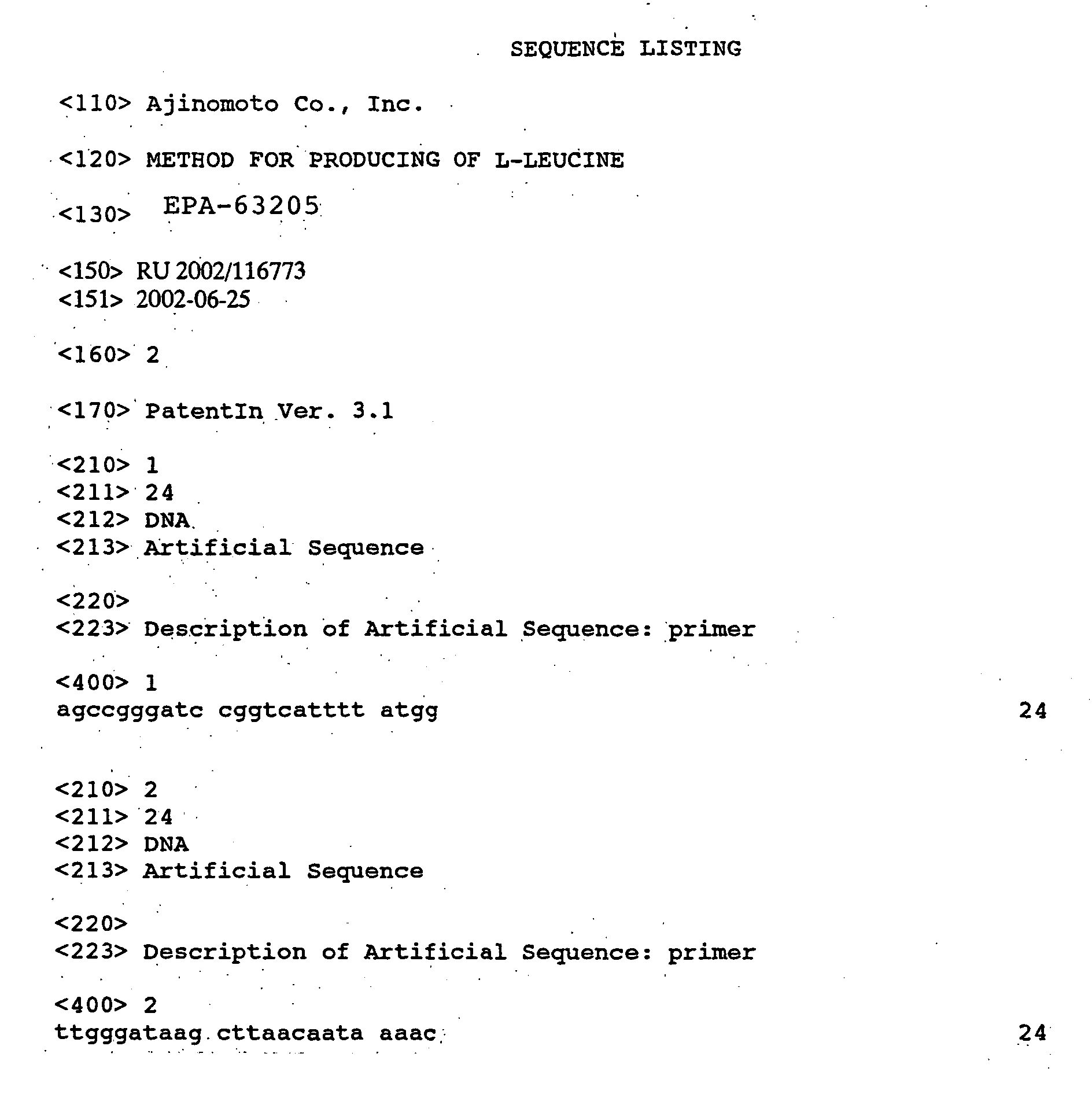
- the chromosomal fragment of E. coli K12 strain (VKPM-7), containing the tyrB gene was amplified by the PCR method, using two primers: primer 1 (SEQ ID NO:1) and primer 2 (SEQ ID NO:2) shown in the Sequence Listing.
- the primers 1 and 2 (24-mers) contain sequence including Bam HI and Hind III sites, respectively, tagged at 5'-ends. Then, Bam HI- Hind III fragment of 1.7 kb was ligated into corresponding sites of the plasmid pACYC184 (Chang, A.C.Y.
- Each of the strains 55, 505, 505/ pACYC-tyrB was transferred by one loop of culture in 20-ml test tubes with L-broth and was incubated overnight with aeration at 32 °C.
- the 0.1 ml of each night culture was transferred into the 20-ml test tubes (inner diameter 22 mm), suspended in 2 ml of medium for fermentation and cultivated at 32 °C for 48 hours with rotary shaker.
- the medium for fermentation contained 60 g/l glucose, 25 g/l ammonium sulfate, 2 g/l KH 2 PO 4 , 1 g/l MgSO 4 , 0.1 mg/l thiamine, 5 g/l yeast extract Difco and 25 g/l chalk (pH 7.2). Glucose and chalk were sterilized separately.
- Liquid phase composition for TLC was as follows: isopropanol - 80 ml, ethylacetate - 80 ml, NH 4 OH (30 %) - 25 ml, H 2 O - 50 ml.
- strains 505 and505/pACYC-tyrB did not produce any amount of L-valine, L-isoleucine and L-homoleucine.
- the inactivation of the ilvE gene brought about the decrease in L-leucine production.
- amplification of tyrB gene improved the L-leucine accumulation by the L-leucine producing strain 505.
Landscapes
- Chemical & Material Sciences (AREA)
- Organic Chemistry (AREA)
- Life Sciences & Earth Sciences (AREA)
- Engineering & Computer Science (AREA)
- Health & Medical Sciences (AREA)
- Zoology (AREA)
- Wood Science & Technology (AREA)
- Genetics & Genomics (AREA)
- Bioinformatics & Cheminformatics (AREA)
- General Health & Medical Sciences (AREA)
- Biochemistry (AREA)
- General Engineering & Computer Science (AREA)
- Microbiology (AREA)
- Biotechnology (AREA)
- Chemical Kinetics & Catalysis (AREA)
- General Chemical & Material Sciences (AREA)
- Medicinal Chemistry (AREA)
- Molecular Biology (AREA)
- Biomedical Technology (AREA)
- Preparation Of Compounds By Using Micro-Organisms (AREA)
- Micro-Organisms Or Cultivation Processes Thereof (AREA)
Abstract
Description
- cultivating the bacterium according to any of (1) to (5) in a medium to produce and accumulate the L-leucine in the medium, and
- collecting the L-leucine from the medium.
| Strain | Amount of L-leucine, g/l | Amount of L-valine, g/l | Amount of L-isoleucine, g/l | Amount of L-homoleucine, g/l |
| 55 | 2.1 | 0.8 | 0.2 | 0.02 |
| 505 | 1.3 | < 0.01 | < 0.01 | < 0.01 |
| 505/pACY C-tyrB | 2.7 | <0.01 | < 0.01 | < 0.01 |
Claims (7)
- An L-leucine producing bacterium belonging to the genus Escherichia, which produces L-valine, L-isoleucine and L-homoleucine in an amount of less than 1% of that of L-leucine produced.
- The bacterium according to claim 1, wherein the bacterium produces L-valine, L-isoleucine and L-homoleucine in an amount of less than 1% of that of L-leucine produced due to inactivation of ilvE gene or decreasing activity of the protein coded by ilvE gene.
- The bacterium according to claim 2, wherein the activity of the protein coded by tyrB gene is increased.
- The bacterium according to claim 3, wherein the activity of the protein coded by tyrB gene is increased by transformation of the bacterium with a DNA containing tyrB gene.
- The bacterium according to claim 4, wherein the bacterium is transformed using a multicopy vector.
- A method for producing the L-leucine, which method comprises the steps of:cultivating the bacterium according to any of claim 1 to 5 in a medium to produce and accumulate the L-leucine in the medium, andcollecting the L-leucine from the medium.
- The method according to claim 6, wherein the bacterium has been modified to have enhanced expression of a gene of L-leucine biosynthesis.
Applications Claiming Priority (2)
| Application Number | Priority Date | Filing Date | Title |
|---|---|---|---|
| RU2002116773/13A RU2243260C2 (en) | 2002-06-25 | 2002-06-25 | Method for preparing l-leucine (variants), strain escherichia coli 505/pacyc-tyr b as producer of l-leucine |
| RU2002116773 | 2002-06-25 |
Publications (1)
| Publication Number | Publication Date |
|---|---|
| EP1375655A1 true EP1375655A1 (en) | 2004-01-02 |
Family
ID=29717746
Family Applications (1)
| Application Number | Title | Priority Date | Filing Date |
|---|---|---|---|
| EP03014093A Withdrawn EP1375655A1 (en) | 2002-06-25 | 2003-06-23 | Method for producing l-leucine |
Country Status (6)
| Country | Link |
|---|---|
| US (1) | US7220572B2 (en) |
| EP (1) | EP1375655A1 (en) |
| JP (1) | JP4314897B2 (en) |
| CN (1) | CN1293184C (en) |
| BR (2) | BRPI0301960B1 (en) |
| RU (1) | RU2243260C2 (en) |
Cited By (3)
| Publication number | Priority date | Publication date | Assignee | Title |
|---|---|---|---|---|
| EP2080769A3 (en) * | 2004-07-02 | 2010-12-01 | Metanomics GmbH | Process for the production of fine chemicals |
| EP2368905A3 (en) * | 2004-12-17 | 2012-08-29 | Metanomics GmbH | Process for the control of production of fine chemicals |
| CN116355818A (en) * | 2022-12-20 | 2023-06-30 | 天津科技大学 | A kind of genetically engineered bacteria producing L-leucine and its application |
Families Citing this family (6)
| Publication number | Priority date | Publication date | Assignee | Title |
|---|---|---|---|---|
| DE102004031177A1 (en) * | 2004-06-29 | 2006-01-19 | Henkel Kgaa | New odoriferous gene products from Bacillus licheniformis and improved biotechnological production processes based on them |
| JP2010088301A (en) | 2007-02-01 | 2010-04-22 | Ajinomoto Co Inc | Method for production of l-amino acid |
| KR101119593B1 (en) | 2009-08-14 | 2012-03-06 | 한국과학기술원 | Mutant microorganism with improved L-leucine production capacity and method for preparing L-leucine using the same |
| KR102143964B1 (en) * | 2019-12-06 | 2020-08-12 | 씨제이제일제당 주식회사 | Novel branched-chain amino acid aminotranferase variant and a method of producing leucine using thereof |
| CN113683666B (en) * | 2021-08-23 | 2024-08-20 | 黑龙江伊品生物科技有限公司 | Engineering bacteria obtained by genetic modification of YH66-RS07020 and its application in the preparation of valine |
| CN119391666B (en) * | 2024-11-19 | 2025-07-08 | 安徽华恒生物科技股份有限公司 | Isopropylmalate synthase mutant and its application |
Citations (3)
| Publication number | Priority date | Publication date | Assignee | Title |
|---|---|---|---|---|
| EP0297619A2 (en) * | 1987-07-02 | 1989-01-04 | Hoechst Aktiengesellschaft | Process for the preparation of L-phenyl alanine from benzylidene hydantoin |
| US5120654A (en) * | 1986-10-29 | 1992-06-09 | Hoechst Aktiengesellschaft | Cloning and use of the transaminase gene ilve |
| EP0533216A1 (en) * | 1986-06-04 | 1993-03-24 | Hoechst Schering AgrEvo GmbH | Process for the preparation of L-tertiairy-leucin by transamination |
Family Cites Families (8)
| Publication number | Priority date | Publication date | Assignee | Title |
|---|---|---|---|---|
| GB8301700D0 (en) * | 1983-01-21 | 1983-02-23 | Searle & Co | Cloning and utilisation of aminotransferase genes |
| CA2152885C (en) * | 1994-06-30 | 2007-05-01 | Tetsuo Nakano | Process for producing l-leucine |
| JP3709564B2 (en) * | 1994-08-30 | 2005-10-26 | 味の素株式会社 | Process for producing L-valine and L-leucine |
| JP3704737B2 (en) * | 1995-03-30 | 2005-10-12 | 味の素株式会社 | Method for producing L-leucine |
| RU2140450C1 (en) * | 1997-10-29 | 1999-10-27 | Закрытое акционерное общество "Научно-исследовательский институт "Аджиномото-Генетика" (ЗАО "АГРИ") | Strains of bacterium escherichia coli - producers of l-leucine (variants) |
| CN1222576A (en) * | 1997-10-29 | 1999-07-14 | 味之素株式会社 | Method for producing L-leucine |
| RU2148642C1 (en) * | 1998-12-23 | 2000-05-10 | ЗАО "Научно-исследовательский институт АДЖИНОМОТО-Генетика" (ЗАО "АГРИ") | Dna rhtc fragment encoding synthesis of rhtc protein that determines enhanced resistance of bacterium escherichia coli to l-threonine and method of l-amino acid producing |
| RU2201454C2 (en) | 1999-07-09 | 2003-03-27 | Закрытое акционерное общество "Научно-исследовательский институт Аджиномото-Генетика" | Mutant alpha-isopropylmalate synthase (ipms), dna encoding mutant ipms, method of preparing escherichia coli strain, method of l-leucine preparing |
-
2002
- 2002-06-25 RU RU2002116773/13A patent/RU2243260C2/en active
-
2003
- 2003-06-17 JP JP2003171720A patent/JP4314897B2/en not_active Expired - Lifetime
- 2003-06-23 EP EP03014093A patent/EP1375655A1/en not_active Withdrawn
- 2003-06-24 US US10/601,634 patent/US7220572B2/en not_active Expired - Fee Related
- 2003-06-25 BR BRPI0301960-8A patent/BRPI0301960B1/en unknown
- 2003-06-25 BR BR0301960-8A patent/BR0301960A/en active IP Right Grant
- 2003-06-25 CN CNB031438504A patent/CN1293184C/en not_active Expired - Lifetime
Patent Citations (3)
| Publication number | Priority date | Publication date | Assignee | Title |
|---|---|---|---|---|
| EP0533216A1 (en) * | 1986-06-04 | 1993-03-24 | Hoechst Schering AgrEvo GmbH | Process for the preparation of L-tertiairy-leucin by transamination |
| US5120654A (en) * | 1986-10-29 | 1992-06-09 | Hoechst Aktiengesellschaft | Cloning and use of the transaminase gene ilve |
| EP0297619A2 (en) * | 1987-07-02 | 1989-01-04 | Hoechst Aktiengesellschaft | Process for the preparation of L-phenyl alanine from benzylidene hydantoin |
Non-Patent Citations (3)
| Title |
|---|
| GELFAND D H ET AL: "ESCHERICHIA-COLI MUTANTS DEFICIENT IN THE ASPARTATE AMINO TRANSFERASE AND AROMATIC AMINO-ACID AMINO TRANSFERASE", JOURNAL OF BACTERIOLOGY, vol. 130, no. 1, 1977, pages 429 - 440, XP008022968, ISSN: 0021-9193 * |
| POWELL J T ET AL: "ROLE OF THE ESCHERICHIA-COLI AROMATIC AMINO-ACID AMINO TRANSFERASE IN LEUCINE BIOSYNTHESIS", JOURNAL OF BACTERIOLOGY, vol. 136, no. 1, 1978, EN, pages 1 - 4, XP008022967, ISSN: 0021-9193 * |
| VARTAK N B ET AL: "A FUNCTIONAL LEUABCD OPERON IS REQUIRED FOR LEUCINE SYNTHESIS BY THE TYROSINE-REPRESSIBLE TRANSAMINASE IN ESCHERICHIA-COLI K-12", JOURNAL OF BACTERIOLOGY, vol. 173, no. 12, 1991, pages 3864 - 3871, XP008022971, ISSN: 0021-9193 * |
Cited By (4)
| Publication number | Priority date | Publication date | Assignee | Title |
|---|---|---|---|---|
| EP2080769A3 (en) * | 2004-07-02 | 2010-12-01 | Metanomics GmbH | Process for the production of fine chemicals |
| US8541208B1 (en) | 2004-07-02 | 2013-09-24 | Metanomics Gmbh | Process for the production of fine chemicals |
| EP2368905A3 (en) * | 2004-12-17 | 2012-08-29 | Metanomics GmbH | Process for the control of production of fine chemicals |
| CN116355818A (en) * | 2022-12-20 | 2023-06-30 | 天津科技大学 | A kind of genetically engineered bacteria producing L-leucine and its application |
Also Published As
| Publication number | Publication date |
|---|---|
| CN1293184C (en) | 2007-01-03 |
| CN1492049A (en) | 2004-04-28 |
| JP2004024259A (en) | 2004-01-29 |
| US20040091980A1 (en) | 2004-05-13 |
| RU2243260C2 (en) | 2004-12-27 |
| JP4314897B2 (en) | 2009-08-19 |
| BR0301960A (en) | 2004-08-24 |
| RU2002116773A (en) | 2004-03-10 |
| US7220572B2 (en) | 2007-05-22 |
| BRPI0301960B1 (en) | 2017-11-07 |
Similar Documents
| Publication | Publication Date | Title |
|---|---|---|
| JP4380305B2 (en) | Method for producing L-amino acid by fermentation | |
| RU2230114C2 (en) | Mutant glutamine synthetase, dna fragment, strain of escherichia coli as p roducer of l-glutamine and method for preparing l-amino acids | |
| EP1092776B1 (en) | Method for producing L-amino acids by fermentation of an Escherichia strain which is transformed with a pyruvate carboxylase-encoding gene from Bacilus subtilis | |
| EP1479775B1 (en) | Process for producing l-threonine with the use of bacterium beloniging to the genus escherichia | |
| US7618803B2 (en) | Method for producing L-amino acid using bacteria belonging to the genus Escherichia | |
| US6319696B1 (en) | Process for producing L-amino acids | |
| US6214591B1 (en) | Methods for producing L-valine and L-leucine | |
| JP4265093B2 (en) | Method for producing threonine and isoleucine | |
| US7635579B2 (en) | Metabolic engineering of amino acid production | |
| RU2209246C2 (en) | Small subunit of isozyme iii and isozyme iii of acetohydroxyacid synthetase from escherichia coli, dna fragment (variants), strain of bacterium escherichia coli as producer of l-valine (variants) and method for preparing l-valine | |
| JPWO1996006926A1 (en) | Method for producing L-valine and L-leucine | |
| JPWO2004111258A1 (en) | Method for producing L-glutamic acid | |
| US7220572B2 (en) | Method for producing L-leucine | |
| EP1510582A1 (en) | Method for producing L-amino acid using bacterium of Enterobacteriaceae family, having nir operon inactivated | |
| EP1689876B1 (en) | L-threonine producing bacterium belonging to the genus escherichia and method for producing l-threonine | |
| JP3975470B2 (en) | Method for producing L-isoleucine by fermentation | |
| RU2315807C2 (en) | METHOD FOR PREPARING NORLEUCINE AND NORVALINE USING MICROORGANISM OF Escherichia GENUS WHEREIN ALL ACETOHYDROXYACID SYNTHASES ARE INACTIVATED | |
| JP4582573B2 (en) | Method for producing pyruvic acid and method for producing L-valine | |
| RU2264457C2 (en) | METHOD FOR PRODUCTION OF L-AMINO ACIDS USING BACTERIUM OF GENUS ESCHERICHIA CONTAINING NON-ACTIVE gadB GENE | |
| WO2005075626A1 (en) | MICROORGANISM PRODUCING L-THREONINE HAVING INACTIVATED tyrR GENE, METHOD OF PRODUCING THE SAME AND METHOD OF PRODUCING L-THREONINE USING THE MICROORGANISM |
Legal Events
| Date | Code | Title | Description |
|---|---|---|---|
| PUAI | Public reference made under article 153(3) epc to a published international application that has entered the european phase |
Free format text: ORIGINAL CODE: 0009012 |
|
| AK | Designated contracting states |
Kind code of ref document: A1 Designated state(s): AT BE BG CH CY CZ DE DK EE ES FI FR GB GR HU IE IT LI LU MC NL PT RO SE SI SK TR |
|
| AX | Request for extension of the european patent |
Extension state: AL LT LV MK |
|
| 17P | Request for examination filed |
Effective date: 20040624 |
|
| AKX | Designation fees paid |
Designated state(s): DE FR GB IT |
|
| GRAP | Despatch of communication of intention to grant a patent |
Free format text: ORIGINAL CODE: EPIDOSNIGR1 |
|
| RTI1 | Title (correction) |
Free format text: E. COLI STRAIN FOR PRODUCTION L-LEUCINE |
|
| STAA | Information on the status of an ep patent application or granted ep patent |
Free format text: STATUS: THE APPLICATION IS DEEMED TO BE WITHDRAWN |
|
| 18D | Application deemed to be withdrawn |
Effective date: 20070828 |