EP1375586A1 - Styrene polymer composition and molded article obtained therefrom - Google Patents
Styrene polymer composition and molded article obtained therefrom Download PDFInfo
- Publication number
- EP1375586A1 EP1375586A1 EP02702807A EP02702807A EP1375586A1 EP 1375586 A1 EP1375586 A1 EP 1375586A1 EP 02702807 A EP02702807 A EP 02702807A EP 02702807 A EP02702807 A EP 02702807A EP 1375586 A1 EP1375586 A1 EP 1375586A1
- Authority
- EP
- European Patent Office
- Prior art keywords
- component
- styrene
- styrene polymer
- parts
- poly
- Prior art date
- Legal status (The legal status is an assumption and is not a legal conclusion. Google has not performed a legal analysis and makes no representation as to the accuracy of the status listed.)
- Withdrawn
Links
Classifications
-
- C—CHEMISTRY; METALLURGY
- C08—ORGANIC MACROMOLECULAR COMPOUNDS; THEIR PREPARATION OR CHEMICAL WORKING-UP; COMPOSITIONS BASED THEREON
- C08L—COMPOSITIONS OF MACROMOLECULAR COMPOUNDS
- C08L25/00—Compositions of, homopolymers or copolymers of compounds having one or more unsaturated aliphatic radicals, each having only one carbon-to-carbon double bond, and at least one being terminated by an aromatic carbocyclic ring; Compositions of derivatives of such polymers
- C08L25/02—Homopolymers or copolymers of hydrocarbons
- C08L25/04—Homopolymers or copolymers of styrene
- C08L25/06—Polystyrene
-
- C—CHEMISTRY; METALLURGY
- C08—ORGANIC MACROMOLECULAR COMPOUNDS; THEIR PREPARATION OR CHEMICAL WORKING-UP; COMPOSITIONS BASED THEREON
- C08L—COMPOSITIONS OF MACROMOLECULAR COMPOUNDS
- C08L71/00—Compositions of polyethers obtained by reactions forming an ether link in the main chain; Compositions of derivatives of such polymers
- C08L71/08—Polyethers derived from hydroxy compounds or from their metallic derivatives
- C08L71/10—Polyethers derived from hydroxy compounds or from their metallic derivatives from phenols
- C08L71/12—Polyphenylene oxides
- C08L71/123—Polyphenylene oxides not modified by chemical after-treatment
-
- C—CHEMISTRY; METALLURGY
- C08—ORGANIC MACROMOLECULAR COMPOUNDS; THEIR PREPARATION OR CHEMICAL WORKING-UP; COMPOSITIONS BASED THEREON
- C08L—COMPOSITIONS OF MACROMOLECULAR COMPOUNDS
- C08L21/00—Compositions of unspecified rubbers
-
- C—CHEMISTRY; METALLURGY
- C08—ORGANIC MACROMOLECULAR COMPOUNDS; THEIR PREPARATION OR CHEMICAL WORKING-UP; COMPOSITIONS BASED THEREON
- C08L—COMPOSITIONS OF MACROMOLECULAR COMPOUNDS
- C08L2205/00—Polymer mixtures characterised by other features
- C08L2205/02—Polymer mixtures characterised by other features containing two or more polymers of the same C08L -group
-
- C—CHEMISTRY; METALLURGY
- C08—ORGANIC MACROMOLECULAR COMPOUNDS; THEIR PREPARATION OR CHEMICAL WORKING-UP; COMPOSITIONS BASED THEREON
- C08L—COMPOSITIONS OF MACROMOLECULAR COMPOUNDS
- C08L2205/00—Polymer mixtures characterised by other features
- C08L2205/03—Polymer mixtures characterised by other features containing three or more polymers in a blend
- C08L2205/035—Polymer mixtures characterised by other features containing three or more polymers in a blend containing four or more polymers in a blend
-
- C—CHEMISTRY; METALLURGY
- C08—ORGANIC MACROMOLECULAR COMPOUNDS; THEIR PREPARATION OR CHEMICAL WORKING-UP; COMPOSITIONS BASED THEREON
- C08L—COMPOSITIONS OF MACROMOLECULAR COMPOUNDS
- C08L23/00—Compositions of homopolymers or copolymers of unsaturated aliphatic hydrocarbons having only one carbon-to-carbon double bond; Compositions of derivatives of such polymers
- C08L23/02—Compositions of homopolymers or copolymers of unsaturated aliphatic hydrocarbons having only one carbon-to-carbon double bond; Compositions of derivatives of such polymers not modified by chemical after-treatment
- C08L23/04—Homopolymers or copolymers of ethene
-
- C—CHEMISTRY; METALLURGY
- C08—ORGANIC MACROMOLECULAR COMPOUNDS; THEIR PREPARATION OR CHEMICAL WORKING-UP; COMPOSITIONS BASED THEREON
- C08L—COMPOSITIONS OF MACROMOLECULAR COMPOUNDS
- C08L23/00—Compositions of homopolymers or copolymers of unsaturated aliphatic hydrocarbons having only one carbon-to-carbon double bond; Compositions of derivatives of such polymers
- C08L23/02—Compositions of homopolymers or copolymers of unsaturated aliphatic hydrocarbons having only one carbon-to-carbon double bond; Compositions of derivatives of such polymers not modified by chemical after-treatment
- C08L23/10—Homopolymers or copolymers of propene
- C08L23/12—Polypropene
-
- C—CHEMISTRY; METALLURGY
- C08—ORGANIC MACROMOLECULAR COMPOUNDS; THEIR PREPARATION OR CHEMICAL WORKING-UP; COMPOSITIONS BASED THEREON
- C08L—COMPOSITIONS OF MACROMOLECULAR COMPOUNDS
- C08L23/00—Compositions of homopolymers or copolymers of unsaturated aliphatic hydrocarbons having only one carbon-to-carbon double bond; Compositions of derivatives of such polymers
- C08L23/02—Compositions of homopolymers or copolymers of unsaturated aliphatic hydrocarbons having only one carbon-to-carbon double bond; Compositions of derivatives of such polymers not modified by chemical after-treatment
- C08L23/16—Ethylene-propylene or ethylene-propylene-diene copolymers
-
- C—CHEMISTRY; METALLURGY
- C08—ORGANIC MACROMOLECULAR COMPOUNDS; THEIR PREPARATION OR CHEMICAL WORKING-UP; COMPOSITIONS BASED THEREON
- C08L—COMPOSITIONS OF MACROMOLECULAR COMPOUNDS
- C08L25/00—Compositions of, homopolymers or copolymers of compounds having one or more unsaturated aliphatic radicals, each having only one carbon-to-carbon double bond, and at least one being terminated by an aromatic carbocyclic ring; Compositions of derivatives of such polymers
- C08L25/02—Homopolymers or copolymers of hydrocarbons
- C08L25/16—Homopolymers or copolymers of alkyl-substituted styrenes
-
- C—CHEMISTRY; METALLURGY
- C08—ORGANIC MACROMOLECULAR COMPOUNDS; THEIR PREPARATION OR CHEMICAL WORKING-UP; COMPOSITIONS BASED THEREON
- C08L—COMPOSITIONS OF MACROMOLECULAR COMPOUNDS
- C08L51/00—Compositions of graft polymers in which the grafted component is obtained by reactions only involving carbon-to-carbon unsaturated bonds; Compositions of derivatives of such polymers
- C08L51/003—Compositions of graft polymers in which the grafted component is obtained by reactions only involving carbon-to-carbon unsaturated bonds; Compositions of derivatives of such polymers grafted on to macromolecular compounds obtained by reactions only involving unsaturated carbon-to-carbon bonds
-
- C—CHEMISTRY; METALLURGY
- C08—ORGANIC MACROMOLECULAR COMPOUNDS; THEIR PREPARATION OR CHEMICAL WORKING-UP; COMPOSITIONS BASED THEREON
- C08L—COMPOSITIONS OF MACROMOLECULAR COMPOUNDS
- C08L71/00—Compositions of polyethers obtained by reactions forming an ether link in the main chain; Compositions of derivatives of such polymers
- C08L71/08—Polyethers derived from hydroxy compounds or from their metallic derivatives
- C08L71/10—Polyethers derived from hydroxy compounds or from their metallic derivatives from phenols
- C08L71/12—Polyphenylene oxides
-
- C—CHEMISTRY; METALLURGY
- C08—ORGANIC MACROMOLECULAR COMPOUNDS; THEIR PREPARATION OR CHEMICAL WORKING-UP; COMPOSITIONS BASED THEREON
- C08L—COMPOSITIONS OF MACROMOLECULAR COMPOUNDS
- C08L91/00—Compositions of oils, fats or waxes; Compositions of derivatives thereof
Definitions
- the present invention relates to a styrene polymer composition predominantly containing a styrene polymer, and to a molded product endowed with excellent chemical resistance and formed from the composition.
- Atactic polystyrene styrene polymers having an atactic configuration
- Atactic polystyrene which are produced through radical polymerization
- Atactic polystyrene which has an atactic configuration
- styrene is copolymerized with a polar monomer such as acrylonitrile, a methacrylate, an acrylate, maleic anhydride, or maleimide.
- a copolymer produced through this method involves the following problems: a limitation is imposed on the random copolymerization ratio; productivity is low; the copolymer has a poor color and issues an odor; difficulty is encountered in mixing the copolymer with another polystyrene resin and in recycling the copolymer; and the copolymer generates cyanogen gas when incinerated.
- a syndiotactic polystyrene resin exhibiting crystallinity has been developed, and in addition, a composition of a syndiotactic polystyrene resin and atactic polystyrene has been proposed for the purpose of improving chemical resistance of the atactic polystyrene (e.g., Japanese Patent Application Laid-Open (kokai) Nos. 11-279347 and 11-279349).
- objects of the present invention are to provide a molded product exhibiting chemical resistance even when high strain is applied thereto, and to provide a styrene polymer composition which is suitable as a material for forming such a molded product.
- the present inventors have performed extensive studies, and as a result have found that, when syndiotactic polystyrene and a plasticizer are incorporated into atactic polystyrene or a mixture of atactic polystyrene and polyphenylene ether, the resultant composition exhibits sufficient chemical resistance.
- the present invention has been accomplished on the basis of this finding.
- the present invention provides a styrene polymer composition
- a component (A) i.e., a styrene polymer having an atactic configuration, or a mixture of a styrene polymer having an atactic configuration and a polyphenylene ether
- a component (B) i.e., a styrene polymer having a syndiotactic configuration
- a component (E) i.e., a plasticizer
- the styrene polymer composition of the present invention contains, as essential components, (A) a styrene polymer having an atactic configuration, or a mixture of a styrene polymer having an atactic configuration and a polyphenylene ether, (B) a styrene polymer having a syndiotactic configuration, and (E) a plasticizer; and contains, as optional components, (C) a polyphenylene ether and (D) a rubber and/or a polyolefin.
- the styrene polymer having an atactic configuration (component (A)) employed in the present invention (hereinafter the polymer may be referred to as the "atactic polystyrene") is produced through a typical polymerization technique such as solution polymerization, bulk polymerization, suspension polymerization, or bulk-suspension polymerization.
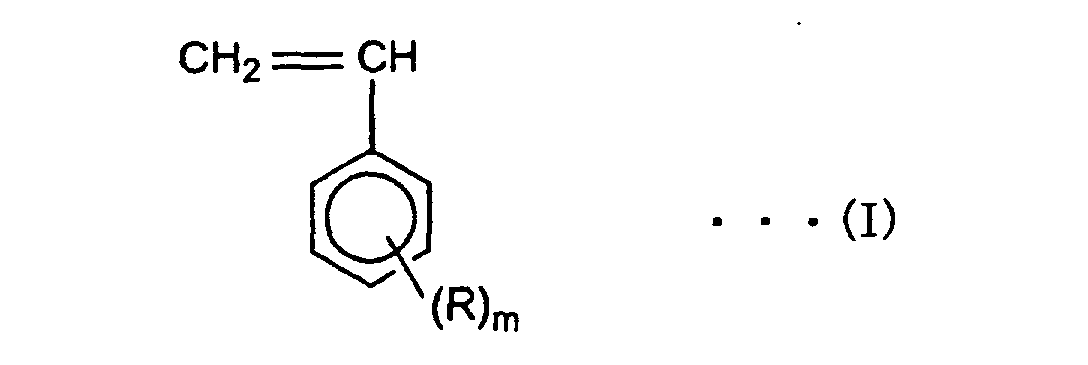
- the atactic polystyrene is produced from an aromatic vinyl-group-containing compound (hereinafter may be referred to simply as an "aromatic vinyl compound”) serving as a monomer (i.e., a raw material) represented by the following formula (I): [wherein R represents a hydrogen atom, a halogen atom, or a substituent including at least one atomic species selected from the group consisting of a carbon atom, an oxygen atom, a nitrogen atom, a sulfur atom, a phosphorus atom, a selenium atom, a silicon atom, and a tin atom; m represents an integer of 1 to 3; and, when m is 2 or more, the Rs may be identical or may differ from one another].
- the atactic polystyrene may be a copolymer of one or more species of the aromatic vinyl compound represented by the formula (I) and a vinyl-group-containing monomer (hereinafter may be referred to simply as a "vinyl monomer") other than the vinyl compound or a rubbery polymer, which can be copolymerized with the vinyl compound; a hydride of the polymer or the copolymer; or a mixture thereof.
- a vinyl monomer a vinyl-group-containing monomer
- aromatic vinyl compound represented by the formula (I) examples include styrene, ⁇ -methylstyrene, methylstyrene, ethylstyrene, isopropylstyrene, tert-butylstyrene, phenylstyrene, vinylstyrene, chlorostyrene, bromostyrene, fluorostyrene, chloromethylstyrene, methoxystyrene, and ethoxystyrene. These compounds may be employed singly or in combination of two or more species.
- styrene p-methylstyrene, m-methylstyrene, p-tert-butylstyrene, p-chlorostyrene, m-chlorostyrene, and p-fluorostyrene are particularly preferred.
- vinyl monomer other than the aforementioned aromatic vinyl compound which can be copolymerized with the aromatic vinyl compound, include vinyl cyanic compounds such as acrylonitrile and methacrylonitrile; acrylates such as methyl acrylate, ethyl acrylate, propyl acrylate, butyl acrylate, amyl acrylate, hexyl acrylate, octyl acrylate, 2-ethylhexyl acrylate, cyclohexyl acrylate, dodecyl acrylate, octadecyl acrylate, phenyl acrylate, and benzyl acrylate; methacrylates such as methyl methacrylate, ethyl methacrylate, butyl methacrylate, amyl methacrylate, hexyl methacrylate, octyl methacrylate, 2-ethylhexyl methacrylate, cyclohexyl
- Examples of the rubbery polymer which can be copolymerized with the aforementioned aromatic vinyl compound include diene rubbers such as polybutadiene, styrene-butadiene copolymers, acrylonitrile-butadiene copolymers, and polyisoprene; non-diene rubbers such as ethylene- ⁇ -olefin copolymers, ethylene- ⁇ -olefin-polyene copolymers, and polyacrylates; styrene-butadiene block copolymers; hydrogenated styrene-butadiene block copolymers; ethylenepropylene elastomers; styrene-graft-ethylene-propylene elastomers; ethylene-based ionomer resins; and hydrogenated styrene-isoprene copolymers.
- diene rubbers such as polybutadiene, styrene-butadiene copolymers,
- the weight average molecular weight of the atactic polystyrene is typically 10,000 or more, preferably 50,000 or more.
- the weight average molecular weight of the atactic polystyrene is less than 10,000, a molded product formed from the polymer composition exhibits poor thermal and mechanical characteristics.
- No particular limitations are imposed on the molecular weight distribution of the atactic polystyrene, and atactic polystyrenes with various molecular weight distributions may be employed.
- a rubbery elastomer may be employed as a constituent of the component (A) in combination with the atactic polystyrene.
- the rubbery elastomer which may be employed include natural rubber; polybutadiene; polyisoprene; polyisobutylene; neoprene; polysulfide rubber; Thiokol rubber; acrylic rubber; urethane rubber; silicone rubber; epichlorohydrin rubber; a styrene-butadiene block copolymer (SBR); a hydrogenated styrene-butadiene block copolymer (SEB, SEBC); a styrene-butadiene-styrene block copolymer (SBS); a hydrogenated styrene-butadiene-styrene block copolymer (SEBS); a styrene-
- Rubbery elastomers SBR, SEB, SBS, SEBS, SIR, SEP, SIS, SEPS, core-shell rubbers, EPM, EPDM, and modified rubbers thereof are particularly preferred. These rubbery elastomers may be employed singly or in combination of two or more species.
- the amount of the rubbery elastomer incorporated into the component (A) is 50 wt.% or less, preferably 40 wt.% or less, more preferably 30 wt.% or less, on the basis of the entirety of the component (A).
- the incorporation amount of the rubbery elastomer exceeds 50 wt.%, the polymer composition may exhibit poor chemical resistance and low elastic modulus.
- the component (A) may contain a polyphenylene ether as a constituent thereof.
- the polyphenylene ether incorporated into the component (A) is preferably a polyphenylene ether described, for example, in US Patent No. 3306874, 3306875, 3257357, or 3257358.
- a polyphenylene ether is prepared through oxidative coupling reaction forming homopolymers or copolymers in the presence of, for example, a copper-amine complex and a phenol compound having one or more substituents.
- the copper-amine complex to be employed is preferably a copper-amine complex derived from a primary, secondary, or tertiary amine.
- polyphenylene ether suitable for use as a constituent of the component (A) examples include poly(2,3-dimethyl-6-ethyl-1,4-phenylene ether), poly(2-methyl-6-chloromethyl-1,4-phenylene ether), poly(2-methyl-6-hydroxyethyl-1,4-phenylene ether), poly(2-methyl-6-n-butyl-1,4-phenylene ether), poly(2-ethyl-6-isopropyl-1,4-phenylene ether), poly(2-ethyl-6-n-propyl-1,4-phenylene ether), poly(2,3,6-trimethyl-1,4-phenylene ether), poly(2-(4'-methylphenyl)-1,4-phenylene ether), poly(2-bromo-6-phenyl-1,4-phenylene ether), poly(2-methyl-6-phenyl-1,4-phenylene ether), poly(2-phenyl-1,4-phenylene ether), poly(2-
- the polyphenylene ether may be, for example, a copolymer derived from two or more phenol compounds employed for preparation of the aforementioned homopolymers. Also, products obtained by modifying the above polymers or copolymers by use of a modifier such as maleic anhydride or fumaric acid may be beneficially employed. Alternatively, copolymers obtained through graft copolymerization or block copolymerization between an aromatic vinyl compound (e.g., styrene) and the aforementioned polyphenylene ether may be employed.
- a modifier such as maleic anhydride or fumaric acid
- copolymers obtained through graft copolymerization or block copolymerization between an aromatic vinyl compound (e.g., styrene) and the aforementioned polyphenylene ether may be employed.
- the molecular weight of the polyethylene ether employed herein is defined by its intrinsic viscosity.
- the intrinsic viscosity as measured at 25°C in chloroform is 0.5 dl/g or less, preferably 0.45 dl/g or less.
- the incorporation amount of the polyphenylene ether is preferably 5 to 80 wt.%, more preferably 10 to 60 wt.%, on the basis of the entirety of the component (A).
- the incorporation amount of the polyphenylene ether is less than 5 wt.% on the basis of the entirety of the component (A)
- the polyphenylene ether exhibits insufficient effect of improving heat resistance
- the incorporation amount exceeds 80 wt.% the resultant molding material may exhibit considerably lowered fluidity during the course of molding.
- the styrene polymer composition of the present invention contains a styrene polymer having a syndiotactic configuration (component (B)) (hereinafter the polymer may be referred to simply as an "SPS").
- component (B) a styrene polymer having a syndiotactic configuration
- an SPS has a syndiotactic configuration refers to the case where an SPS has a stereochemical configuration in which phenyl groups (side chains) alternate in opposite directions with respect to the main chain formed of a carbon-carbon bond. Tacticity is quantified by means of nuclear magnetic resonance spectroscopy employing a carbon isotope ( 13 C-NMR).
- Tacticity measured by means of 13 C-NMR is represented by the amount of a plurality of successive structural units; for example, diad (two successive structural units), triad (three successive structural units), or pentad (five successive structural units).
- the SPS refers to polystyrene, poly(alkylstyrene), poly(halogenated styrene), poly(halogenated alkylstyrene), poly(alkoxystyrene), poly(vinyl benzoate), hydrogenated polymers of these polymers, mixtures of these polymers, and copolymers predominantly containing such a polymer, which typically have a diad (racemic diad) syndiotacticity of 75% or more, preferably 85% or more, or have a pentad (racemic pentad) syndiotacticity of 30% or more, preferably 50% or more.
- poly(alkylstyrene) examples include poly(methylstyrene), poly(ethylstyrene), poly(isopropylstyrene), poly(tert-butylstyrene), poly(phenylstyrene), poly(vinylnaphthalene), and poly(vinylstyrene).
- poly(halogenated styrene) examples include poly(chlorostyrene), poly(bromostyrene), and poly(fluorostyrene).
- poly(halogenated alkylstyrene) examples include poly(chloromethylstyrene).
- poly(alkoxystyrene) examples include poly(methoxystyrene) and poly(ethoxystyrene).
- polystyrene polystyrene, poly(p-methylstyrene), poly(m-methylstyrene), poly(ethylstyrene), poly(divinylbenzene), poly(p-tert-butylstyrene), poly(p-chlorostyrene), poly(m-chlorostyrene), poly(p-fluorostyrene), hydrogenated polystyrene, and copolymers containing such a structural unit are particularly preferred.
- the aforementioned SPS can be produced through, for example, polymerization of a styrene monomer (i.e., a monomer corresponding to the aforementioned styrene polymer) by use of a catalyst (a titanium compound and a condensation product of water and trialkylaluminum) in an inert hydrocarbon solvent or in the absence of a solvent (Japanese Patent Application Laid-Open (kokai) No. 62-187708).
- the poly(halogenated alkylstyrene) can be produced through, for example, the method described in Japanese Patent Application Laid-Open (kokai) No. 1-46912.
- Hydrogenated polymers of the SPS can be produced through, for example, the method described in Japanese Patent Application Laid-Open (kokai) No. 1-178505.
- Examples of the comonomer employed for forming the styrene copolymer include the aforementioned monomer for forming the styrene polymer; olefin monomers such as ethylene, propylene, butene, hexene, and octene; diene monomers such as butadiene and isoprene; cyclic diene monomers; and polar vinyl monomers such as methyl methacrylate, maleic anhydride, and acrylonitrile.
- a styrene polymer containing a styrene repeating unit in an amount of 80 to 100 mol% and p-methylstyrene repeating unit in an amount of 0 to 20 mol% is preferably employed.
- the weight average molecular weight of the SPS as reduced to polystyrene is preferably 10,000 or more, more preferably 50,000 or more, as measured by means of gel permeation chromatography (GPC) (solvent: trichlorobenzene, 135°C).
- GPC gel permeation chromatography
- solvent solvent: trichlorobenzene, 135°C
- the weight average molecular weight is less than 10,000, the resultant composition or molded product exhibits poor thermal and mechanical characteristics.
- SPSs with various molecular weight distributions may be employed.
- the melting point of the SPS is preferably 270°C or lower, more preferably 250°C or lower.
- the melting point exceeds 270°C, molding of the resultant composition requires a temperature of 280°C to 300°C, which may lead to problems, including impairment of moldability of the composition and impairment of physical properties of the composition caused by thermal deterioration.
- the amount of the component (B) is 3 to 90 parts by weight, preferably 5 to 80 parts by weight, more preferably 10 to 50 parts by weight, on the basis of 100 parts by weight of the total amount of the components (A), (B), (C), and (D).
- the amount of the component (B) is below the above range, the effect of improving chemical resistance is insubstantial, whereas when the amount of the component (B) exceeds the above range, production cost disadvantageously increases.
- a polyphenylene ether may be incorporated into the composition as the component (C).
- the polyphenylene ether (component (C)) may be a polyphenylene ether serving as a constituent of the component (A).
- the incorporation amount of the component (C) is 5 to 80 parts by weight, preferably 10 to 50 parts by weight, on the basis of 100 parts by weight of the total amount of the components (A), (B), (C), and (D).
- the incorporation amount of the component (C) is less than 5 parts by weight, the effect of improving heat resistance of the composition is lowered, whereas when the incorporation amount exceeds 80 parts by weight, fluidity of the resultant composition may be considerably lowered during the course of molding.
- a rubber and/or a polyolefin may be incorporated into the composition as the component (D).
- the rubber and polyolefin components include natural rubber; polybutadiene; polyisoprene; polyisobutylene; neoprene; polysulfide rubber; Thiokol rubber; acrylic rubber; urethane rubber; silicone rubber; epichlorohydrin rubber; a styrene-butadiene block copolymer (SBR); a hydrogenated styrene-butadiene block copolymer (SEB, SEBC); a styrene-butadiene-styrene block copolymer (SBS); a hydrogenated styrene-butadiene-styrene block copolymer (SEBS); a styrene-isoprene block copolymer (S)
- styrene block polymers such as SBR, SEB, SBS, SEBS, SIR, SEP, SIS, and SEPS; and combinations of the aforementioned styrene block polymer, EPM, EPDM, an ethylene- ⁇ -olefin copolymer, and a polyolefin-based resin are preferably employed.
- the aforementioned rubbers or polyolefins may be employed singly or in combination of two or more species.
- the incorporation amount of the component (D) is 1 to 80 parts by weight, preferably 3 to 50 parts by weight, more preferably 5 to 30 parts by weight, on the basis of 100 parts by weight of the total amount of the components (A), (B), (C), and (D).
- the incorporation amount of the component (D) is less than 1 part by weight, the effect of improving physical properties of the composition is lowered, whereas when the incorporation amount exceeds 80 parts by weight, the chemical resistance and elastic modulus of the resultant composition may be lowered.
- the polymer composition of the present invention further contains a plasticizer as the component (E).
- the plasticizer may be arbitrarily chosen from among known plasticizers. Examples of the known plasticizers include polyethylene glycol, polyamide oligomers, ethylene bis(stearamide), phthalates, polystyrene oligomers, polyethylene waxes, mineral oils (paraffin-based, naphthene-based, and aromatic-based), and silicone oil. These plasticizers may be employed singly or in combination of two or more species. Of these plasticizers, mineral oils are particularly preferred.
- Mineral oils are roughly classified into three types: paraffin-based, naphthene-based, and aromatic-based oils.
- a paraffin-based oil in which the percentage of the number of carbon atoms contained in the paraffin moiety with respect to the total number of carbon atoms is 60%C P or more as measured by means of the n-d-M method.
- No particular limitations are imposed on the viscosity of the plasticizer, but the kinematic viscosity of the plasticizer as measured at 40°C preferably falls within a range of 15 to 600 mm 2 /second.
- the kinematic viscosity of the plasticizer When the kinematic viscosity of the plasticizer is less than 15 mm 2 /second, the boiling point of the resultant composition is lowered, and problems tend to occur during melt-kneading, molding, or similar processes, such as generation of white fumes or gas, contamination of a die with the composition, and adhesion of the composition to a roll. In contrast, when the kinematic viscosity of the plasticizer is 600 mm 2 /second or more, the effect of improving the chemical resistance of the composition is lowered.
- the amount of the plasticizer incorporated into the composition is 0.05 to 10 parts by weight, preferably 0.1 to 8 parts by weight, more preferably 0.3 to 5 parts by weight, on the basis of 100 parts by weight of the total amount of the components (A), (B), (C), and (D).
- incorporation amount of the plasticizer is less than 0.05 parts by weight, the effect of improving the chemical resistance of the composition is lowered, whereas when the incorporation amount exceeds 10 parts by weight, the heat distortion temperature of the resultant composition may be lowered, and moldability of the composition may be impaired.
- the plasticizer is melted and incorporated into the component (A), (B), (C), or (D) in advance; or the plasticizer is melted and incorporated into the composition simultaneous with preparation of the composition through mixing of these components.
- the styrene polymer composition of the present invention may contain, in an appropriate amount, an additive such as an inorganic filler, a release agent, an antioxidant, a flame retardant, a flame retarding aid, a dye, a pigment, carbon black, or an antistatic agent; a thermoplastic resin; rubber; or a similar material, so long as the purposes of the present invention are not impeded.
- an additive such as an inorganic filler, a release agent, an antioxidant, a flame retardant, a flame retarding aid, a dye, a pigment, carbon black, or an antistatic agent; a thermoplastic resin; rubber; or a similar material, so long as the purposes of the present invention are not impeded.
- the inorganic filler may have an arbitrary form such as a fibrous form, a granular form, or a powdery form.
- fibrous fillers include glass fiber, carbon fiber, and whiskers.
- the fibrous filler may have, for example, a cloth-like shape, a mat-like shape, a cut-bundle-like shape, a short fiber shape, a filament-like shape, or a whisker-like shape.
- the length and diameter of the fibrous filler are 0.05 mm to 50 mm and 5 to 20 ⁇ m, respectively.
- Examples of the granular and powdery fillers include talc, carbon black, graphite, titanium dioxide, silica, mica, calcium carbonate, calcium sulfate, barium carbonate, magnesium carbonate, magnesium sulfate, barium sulfate, oxysulfate, tin oxide, alumina, kaolin, silicon carbide, metallic powder, glass powder, glass flakes, and glass beads.
- glass fillers for example, glass powder, glass flakes, glass beads, glass filaments, glass fiber, glass robe, and glass mat, are particularly preferred.
- the aforementioned filler is preferably subjected to surface treatment.
- a coupling agent is employed for surface treatment of the filler in order to enhance adhesion between the filler and the resin.
- the coupling agent may be arbitrarily chosen from among conventionally known coupling agents such as silane-based coupling agents and titanium-based coupling agents.
- Preferred examples of the coupling agent include aminosilanes such as ⁇ -aminopropyltrimethoxysilane, N- ⁇ -(aminoethyl)- ⁇ -aminopropyltrimethoxysilane, ⁇ -glycidoxypropyltrimethoxysilane, and ⁇ -(3,4-epoxycyclohexyl)ethyltrimethoxysilane; epoxysilanes; and isopropyltri(N-amidoethyl, aminoethyl) titanate.
- aminosilanes such as ⁇ -aminopropyltrimethoxysilane, N- ⁇ -(aminoethyl)- ⁇ -aminopropyltrimethoxysilane, ⁇ -glycidoxypropyltrimethoxysilane, and ⁇ -(3,4-epoxycyclohexyl)ethyltrimethoxysilane.
- the polymer composition may contain a conventionally known film former.
- a urethane-based film former for example, an epoxy-based film former, or a polyether-based film former is preferably employed.
- the incorporation amount of the filler is 1 to 80 wt.%, preferably 5 to 50 wt.%, on the basis of the entirety of the composition.
- the incorporation amount of the inorganic filler is less than 1 wt.%, the effect of the filler is insufficiently obtained, whereas when the incorporation amount exceeds 80 wt.%, dispersibility of the filler is impaired, and difficulty is encountered in molding the composition.
- the release agent may be arbitrarily chosen from among known release agents such as polyethylene wax, silicone oil, long-chain carboxylic acids, and long-chain carboxylic acid metallic salts. These release agents may be employed singly or in combination of two or more species.
- the antioxidant may be arbitrarily chosen from among a variety of known antioxidant compounds such as phosphorus-based antioxidants, phenol-based antioxidants, and sulfur-based antioxidants. These antioxidants may be employed singly or in combination of two or more species.
- the flame retardant may be arbitrarily chosen from among, for example, brominated polymers such as brominated polystyrene, brominated syndiotactic polystyrene, and brominated polyphenylene ether; brominated aromatic compounds such as brominated diphenylalkane and brominated diphenyl ether; and phosphorus-based flame retardants such as tricresyl phosphate, triphenyl phosphate, and tris-3-chloropropyl phosphate.
- brominated polymers such as brominated polystyrene, brominated syndiotactic polystyrene, and brominated polyphenylene ether
- brominated aromatic compounds such as brominated diphenylalkane and brominated diphenyl ether
- phosphorus-based flame retardants such as tricresyl phosphate, triphenyl phosphate, and tris-3-chloropropyl phosphate.
- the flame retarding aid may be arbitrarily chosen from among known flame retarding aids such as antimony compounds (e.g., antimony trioxide).
- the polymer composition may contain an agent for drip prevention.
- the agent may be arbitrarily chosen from known drip prevention agents such as Teflon.
- the aforementioned flame retardants or flame retarding aids may be employed singly or in combination of two or more species.
- the thermoplastic resin may be arbitrarily chosen from among known thermoplastic resins, including polystyrene resins such as AS and ABS; polyester-based resins such as polycarbonate, polyethylene terephthalate, and polybutylene terephthalate; polyamide-based resins such as polyamide 6 and polyamide 6,6; PPS; and polyether. These thermoplastic resins may be employed singly or in combination of two or more species.
- the composition may be produced, by means of a known technique, through melt-kneading or dry-blending of the aforementioned components (A), (B), and (E), and, if desired, the components (C) and (D) and other additives.
- the molded product may be produced by means of a known technique such as injection molding or extrusion molding.
- a known technique such as injection molding or extrusion molding.
- the temperature of a molding cylinder must be regulated to become equal to or higher than the melting point of the syndiotactic polystyrene (i.e., component (B) of the composition).
- component (B) of the composition the syndiotactic polystyrene
- difficulty is encountered in imparting sufficient chemical resistance and physical properties to the resultant molded product.
- the upper limit of the cylinder temperature varies in accordance with the compositional proportion of the components constituting the polymer composition (i.e., molding material).
- the cylinder temperature is typically 290°C or lower, preferably 270°C or lower, more preferably 260°C or lower.
- the molding temperature exceeds 290°C, the number of molding cycles within a predetermined period of time is reduced (the cooling time increases), shrinkage occurs in the molded product, and the molding material is impaired when the material is held in the molding cylinder.
- Molded products formed from the aforementioned styrene polymer composition of the present invention by means of various molding techniques exhibit excellent characteristics, and are suitable for use in parts requiring chemical resistance.
- the molded products of the present invention can be widely employed in a variety of industrial fields.
- Examples of the application of the injection-molded products include the following: exterior parts for a vehicle, such as a radiator grille, a grille, a mark, a back panel, a side mirror, a wheel cap, an air spoiler, and a cowl for a two-wheeled vehicle; interior parts for an automobile, such as an instrument panel, a meter hood, a pillar, a glove box, a console box, a speaker box, a lid, and a battery; audiovisual equipment parts, such as a housing, a chassis, a cassette case, a CD magazine, and a remote controller case; electric refrigerator parts, such as a lining, a tray, an arm, a door cap, and a handle; electric vacuum cleaner parts, such as a housing, a handle, a pipe, and an inlet port; air conditioner parts, such as a housing, a fan, a remote controller case, and a drain case;
- the extrusion-molded products are suitable for use as industrial base materials, such as film, sheet, pipe, and filament.
- the weight average molecular weight and molecular weight distribution of each of the above polymers were measured at 135°C by means of GPC employing 1,2,4-trichlorobenzene serving as a solvent.
- the melting point of each of the polymers was determined on the basis of the position of the melting peak as obtained by use of a differential scanning calorimeter at a temperature increasing rate of 20°C/min.
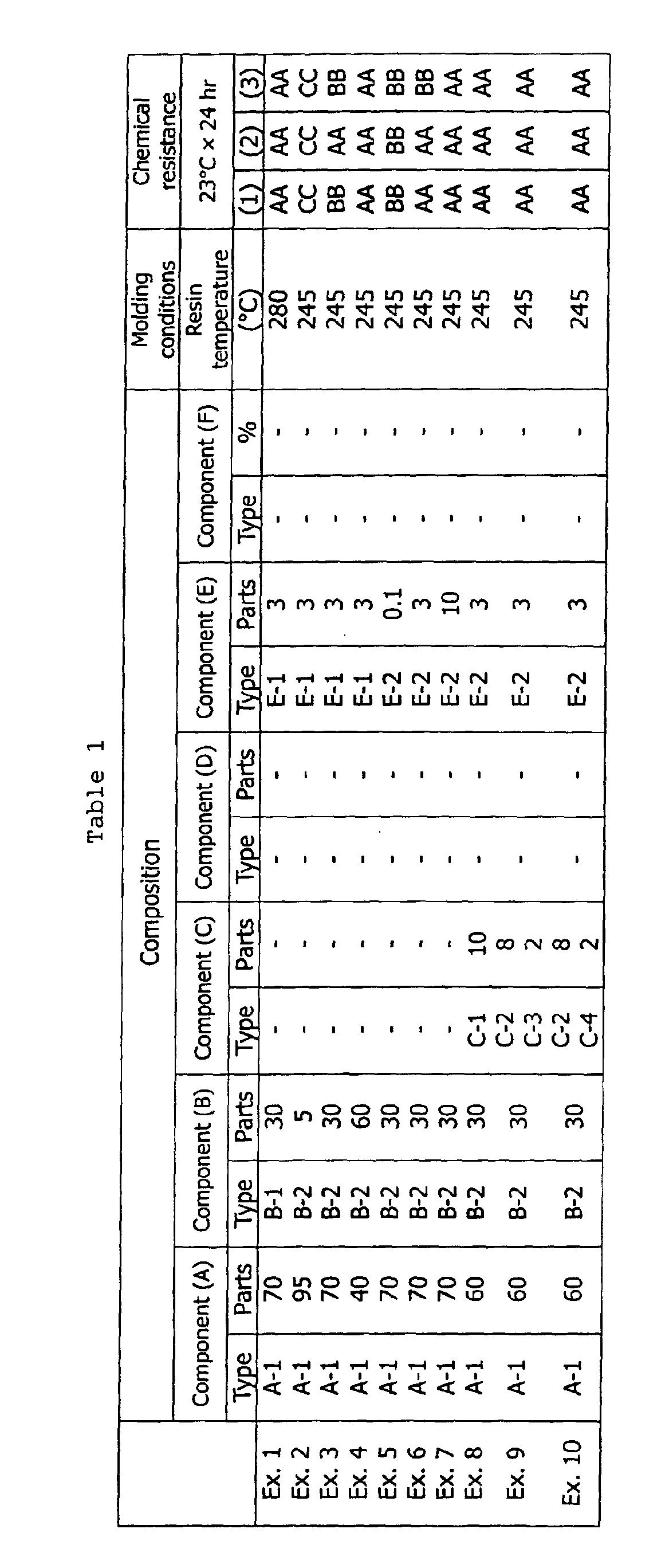
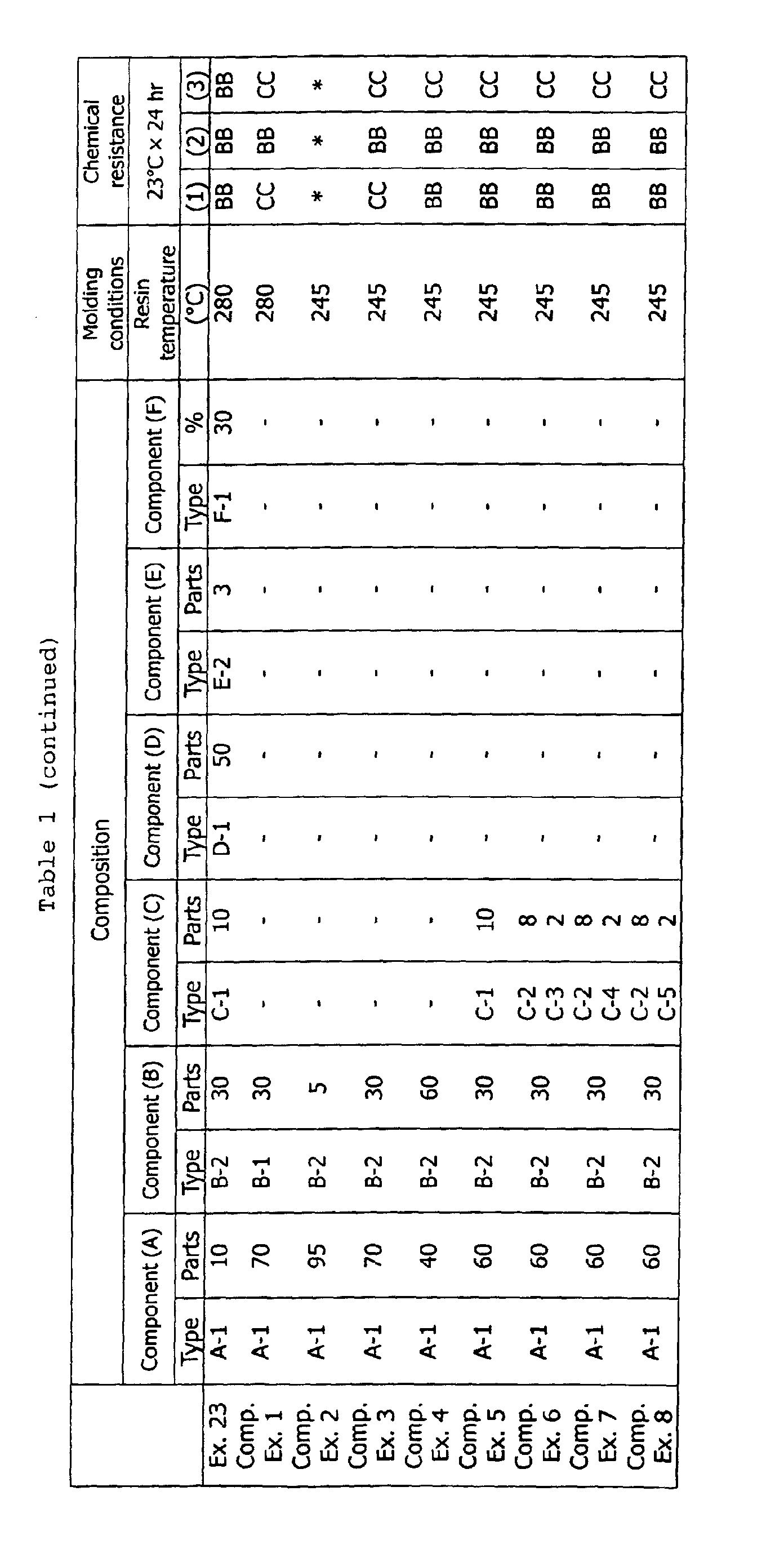
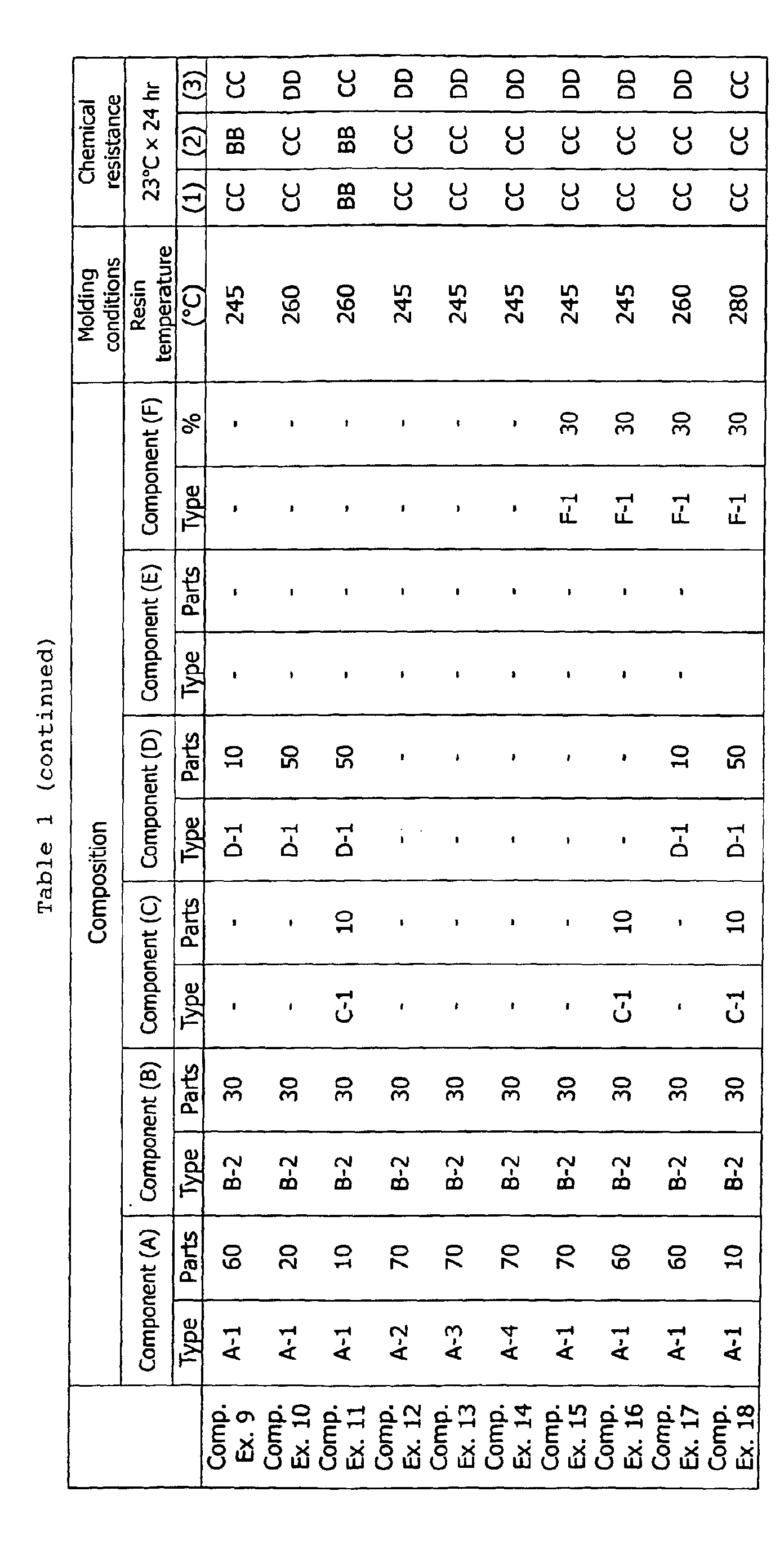
- Components (A), (B), and (E) and other components were mixed in compositional proportions shown in Table 1, to thereby prepare a polymer composition.
- the resultant composition was melt-kneaded by use of an extruder at a temperature equal to or higher than the melting point of the component (B), to thereby form pellets.
- the thus-formed pellets were subjected to injection molding under the following conditions: resin temperature: a Celsius temperature higher by 10 degrees or more than the melting point of the syndiotactic polystyrene (component (B)), a molding die temperature: 40°C, to thereby form a bar (test piece) having a thickness of 3.2 mm.
- the styrene polymer composition of the present invention When the styrene polymer composition of the present invention is subjected to molding, there can be readily formed a molded product at low cost, which molded product exhibits excellent characteristics, particularly high chemical resistance even when high strain is applied thereto.
- the chemical-resistance styrene polymer composition of the present invention is envisaged to be effectively employed for producing a variety of molded products; for example, molded products formed through injection molding, sheets and films formed through extrusion molding, containers and trays formed through extrusion molding and thermoforming, uniaxially stretched or biaxially stretched films and sheets formed through extrusion molding and stretching, fibrous molded products formed through spinning, and molded products formed through expansion molding.
Landscapes
- Chemical & Material Sciences (AREA)
- Health & Medical Sciences (AREA)
- Chemical Kinetics & Catalysis (AREA)
- Medicinal Chemistry (AREA)
- Polymers & Plastics (AREA)
- Organic Chemistry (AREA)
- Compositions Of Macromolecular Compounds (AREA)
- Manufacture Of Macromolecular Shaped Articles (AREA)
- Injection Moulding Of Plastics Or The Like (AREA)
Abstract
Description
*: occurrence of dissolving or large cracking

Claims (8)
- A styrene polymer composition comprising a component (A); i.e., a styrene polymer having an atactic configuration, or a mixture of a styrene polymer having an atactic configuration and a polyphenylene ether, a component (B); i.e., a styrene polymer having a syndiotactic configuration, and a component (E); i.e., a plasticizer; and optionally comprising a component (C); i.e., a polyphenylene ether and a component (D); i.e., a rubber and/or a polyolefin, wherein the amount of the component (B) is 3 to 90 parts by weight on the basis of 100 parts by weight of the total amount of the components (A), (B), (C), and (D), and the amount of the component (E) is 0.05 to 10 parts by weight on the basis of 100 parts by weight of the total amount of the components (A), (B), (C), and (D).
- A styrene polymer composition according to claim 1, wherein the component (E) is a mineral oil.
- A styrene polymer composition according to claim 1, wherein the component (A) is a rubber-modified atactic polystyrene polymer, or a mixture of a rubber-modified atactic polystyrene polymer and a polyphenylene ether.
- A styrene polymer composition according to claim 1, wherein the component (A) further contains a rubbery elastomer as a constituent.
- A styrene polymer composition according to claim 1, wherein the amount of the polyphenylene ether contained in the component (A) is 5 to 80 wt.%.
- A styrene polymer composition according to claim 1, wherein the component (D) is a styrene block polymer, or a mixture of a styrene block polymer and a polyolefin.
- A styrene polymer composition according to claim 1, which further comprises a component (F); i.e., an inorganic filler, in an amount of 1 to 80 wt.%.
- A chemical-resistant molded product formed through molding of a composition as recited in claim 1.
Applications Claiming Priority (3)
| Application Number | Priority Date | Filing Date | Title |
|---|---|---|---|
| JP2001085435A JP4865952B2 (en) | 2001-03-23 | 2001-03-23 | Styrene polymer composition and molded article using the same |
| JP2001085435 | 2001-03-23 | ||
| PCT/JP2002/002133 WO2002077098A1 (en) | 2001-03-23 | 2002-03-07 | Styrene polymer composition and molded article obtained therefrom |
Publications (2)
| Publication Number | Publication Date |
|---|---|
| EP1375586A1 true EP1375586A1 (en) | 2004-01-02 |
| EP1375586A4 EP1375586A4 (en) | 2004-06-30 |
Family
ID=18940948
Family Applications (1)
| Application Number | Title | Priority Date | Filing Date |
|---|---|---|---|
| EP02702807A Withdrawn EP1375586A4 (en) | 2001-03-23 | 2002-03-07 | STYRENE POLYMER COMPOSITION AND MOLDED ARTICLE THEREOF |
Country Status (4)
| Country | Link |
|---|---|
| US (1) | US20040116583A1 (en) |
| EP (1) | EP1375586A4 (en) |
| JP (1) | JP4865952B2 (en) |
| WO (1) | WO2002077098A1 (en) |
Cited By (2)
| Publication number | Priority date | Publication date | Assignee | Title |
|---|---|---|---|---|
| WO2004026962A3 (en) * | 2002-09-20 | 2004-06-03 | Gen Electric | Underhood components |
| WO2012091295A1 (en) * | 2010-12-30 | 2012-07-05 | 제일모직 주식회사 | Rubber-modified vinyl-based graft copolymer, and thermoplastic resin composition including same |
Families Citing this family (8)
| Publication number | Priority date | Publication date | Assignee | Title |
|---|---|---|---|---|
| ITMI20021496A1 (en) * | 2002-07-09 | 2004-01-09 | Polimeri Europa Spa | POLYMERIC COMPOSITIONS BASED ON SHOCKPROOF VINYLAROMATIC POLYMERS |
| JP4574150B2 (en) * | 2003-09-19 | 2010-11-04 | Sabicイノベーティブプラスチックスジャパン合同会社 | Resin composition with excellent flexibility |
| JP4716351B2 (en) * | 2004-02-24 | 2011-07-06 | 旭化成ケミカルズ株式会社 | Piping resin composition and resin pipe obtained therefrom |
| EP2712883B1 (en) * | 2011-04-26 | 2016-02-24 | Teijin Limited | High-insulating film |
| US20140357757A1 (en) * | 2013-05-30 | 2014-12-04 | Sabic Global Technologies B.V. | Poly(phenylene ether) composition and article |
| EP3072571B1 (en) * | 2015-03-26 | 2017-05-31 | Carl Freudenberg KG | Flexible filter element with an injection moulded frame made of plastic |
| CN107207850B (en) * | 2015-03-27 | 2019-08-16 | 旭化成株式会社 | Resin composition, molding, piping machine parts |
| JP6402064B2 (en) * | 2015-03-31 | 2018-10-10 | 富士フイルム株式会社 | Optical film, method for producing optical film, polarizing plate using optical film, and image display device |
Family Cites Families (11)
| Publication number | Priority date | Publication date | Assignee | Title |
|---|---|---|---|---|
| US4166055A (en) * | 1977-10-03 | 1979-08-28 | General Electric Company | Composition of a polyphenylene ether, a block copolymer of a vinyl aromatic compound and a conjugated diene and a polyolefin |
| IT1223326B (en) * | 1987-10-28 | 1990-09-19 | Montedipe Spa | THERMOPLASTIC COMPOSITIONS BASED ON SYNDIOTACTIC POLYMERS OF STYRENE AND POLYPHENYLENETERS |
| JP3313247B2 (en) * | 1994-09-20 | 2002-08-12 | 旭化成株式会社 | Styrene resin composition and molded article |
| DE69602150T2 (en) * | 1995-09-08 | 1999-09-02 | Idemitsu Petrochemical Co. | Styrene-based resin composition |
| CA2305380A1 (en) * | 1997-09-29 | 1999-04-22 | National Research Council Of Canada | Trivalent thrombin inhibitor |
| JPH11166115A (en) * | 1997-12-02 | 1999-06-22 | Sumitomo Chem Co Ltd | Polyphenylene ether resin composition |
| JP4042195B2 (en) * | 1997-12-19 | 2008-02-06 | 住友化学株式会社 | Polyphenylene ether resin composition and method for producing the same |
| JP3805105B2 (en) * | 1998-01-29 | 2006-08-02 | 出光興産株式会社 | Styrene resin composition and method for producing the same, and method for producing styrene resin molded product |
| JP2000080228A (en) * | 1998-09-08 | 2000-03-21 | Asahi Chem Ind Co Ltd | Styrene-based thermoplastic resin composition |
| JP4439611B2 (en) * | 1999-04-09 | 2010-03-24 | 出光興産株式会社 | Inorganic fiber-containing styrenic resin molding material, molding method and molded article |
| WO2001025329A1 (en) * | 1999-10-05 | 2001-04-12 | Idemitsu Petrochemical Co., Ltd. | Molding material, process for producing molded article, and molded article |
-
2001
- 2001-03-23 JP JP2001085435A patent/JP4865952B2/en not_active Expired - Fee Related
-
2002
- 2002-03-07 EP EP02702807A patent/EP1375586A4/en not_active Withdrawn
- 2002-03-07 WO PCT/JP2002/002133 patent/WO2002077098A1/en not_active Ceased
- 2002-03-07 US US10/472,554 patent/US20040116583A1/en not_active Abandoned
Cited By (4)
| Publication number | Priority date | Publication date | Assignee | Title |
|---|---|---|---|---|
| WO2004026962A3 (en) * | 2002-09-20 | 2004-06-03 | Gen Electric | Underhood components |
| WO2012091295A1 (en) * | 2010-12-30 | 2012-07-05 | 제일모직 주식회사 | Rubber-modified vinyl-based graft copolymer, and thermoplastic resin composition including same |
| KR101397688B1 (en) * | 2010-12-30 | 2014-05-22 | 제일모직주식회사 | Rubber-modified vinyl graft copolymer and thermoplastic resin composition comprising the same |
| US9382369B2 (en) | 2010-12-30 | 2016-07-05 | Cheil Industries Inc. | Rubber-modified vinyl-based graft copolymer, and thermoplastic resin composition including the same |
Also Published As
| Publication number | Publication date |
|---|---|
| WO2002077098A1 (en) | 2002-10-03 |
| EP1375586A4 (en) | 2004-06-30 |
| JP4865952B2 (en) | 2012-02-01 |
| JP2002284945A (en) | 2002-10-03 |
| US20040116583A1 (en) | 2004-06-17 |
Similar Documents
| Publication | Publication Date | Title |
|---|---|---|
| EP0933393B1 (en) | Styrene resin composition and method of manufacturing the same, and method of manufacturing styrene resin molded products | |
| EP0767211B1 (en) | Styrene-based resin composition | |
| EP0784076B1 (en) | Flame-retardant polystyrenic resin composition and moldings of polystyrenic resin | |
| JPH08104785A (en) | Impact-resistant polystyrene resin composition | |
| US20040116583A1 (en) | Styrene polymer composition and molded article obtained therefrom | |
| JP2010031283A (en) | Styrene resin composition | |
| JP2004155928A (en) | Thermoplastic resin composition and molded product thereof | |
| CN113260670B (en) | Polystyrene resin composition | |
| JP4481378B2 (en) | Styrenic resin composition | |
| JP2000265022A (en) | Styrene resin composition | |
| US6635712B1 (en) | Molding material, process for producing molded article, and molded article | |
| JP2002356593A (en) | Polystyrene resin composition with excellent chemical resistance and transparency and molding thereof | |
| US20040152838A1 (en) | Chemical-resitant polystyrene resin compositon and molded article | |
| JPH11279349A (en) | Styrenic resin composition | |
| JPH11172062A (en) | Styrene resin composition | |
| JP2002003672A (en) | Chemical-resistant styrenic resin composition and molded article using the same | |
| JPH08151492A (en) | Impact-resistant polystyrene resin composition | |
| JPH11279348A (en) | Styrenic resin composition | |
| JP4943590B2 (en) | Chemical-resistant polystyrene resin molded product | |
| JPH11181225A (en) | Acrylonitrile / butadiene / styrene resin composition | |
| JP4878697B2 (en) | Chemical resistant polystyrene resin composition and molded article | |
| JP2025151940A (en) | resin composition | |
| JP2001106851A (en) | Molding material and preparation of molded article and molded article | |
| JPH11181226A (en) | Acrylonitrile / butadiene / styrene resin composition | |
| JP2004269899A (en) | Syndiotactic polystyrene resin composition |
Legal Events
| Date | Code | Title | Description |
|---|---|---|---|
| PUAI | Public reference made under article 153(3) epc to a published international application that has entered the european phase |
Free format text: ORIGINAL CODE: 0009012 |
|
| 17P | Request for examination filed |
Effective date: 20030916 |
|
| AK | Designated contracting states |
Kind code of ref document: A1 Designated state(s): AT BE CH CY DE DK ES FI FR GB GR IE IT LI LU MC NL PT SE TR |
|
| A4 | Supplementary search report drawn up and despatched |
Effective date: 20040519 |
|
| RAP1 | Party data changed (applicant data changed or rights of an application transferred) |
Owner name: IDEMITSU KOSAN CO., LTD. |
|
| RBV | Designated contracting states (corrected) |
Designated state(s): AT BE CH CY DE DK ES FI FR GB GR IE IT LI LU MC NL PT SE TR |
|
| 17Q | First examination report despatched |
Effective date: 20050321 |
|
| STAA | Information on the status of an ep patent application or granted ep patent |
Free format text: STATUS: THE APPLICATION IS DEEMED TO BE WITHDRAWN |
|
| 18D | Application deemed to be withdrawn |
Effective date: 20050801 |