EP1375493A1 - Process for the preparation of an dioxane acetic acid ester - Google Patents
Process for the preparation of an dioxane acetic acid ester Download PDFInfo
- Publication number
- EP1375493A1 EP1375493A1 EP02100715A EP02100715A EP1375493A1 EP 1375493 A1 EP1375493 A1 EP 1375493A1 EP 02100715 A EP02100715 A EP 02100715A EP 02100715 A EP02100715 A EP 02100715A EP 1375493 A1 EP1375493 A1 EP 1375493A1
- Authority
- EP
- European Patent Office
- Prior art keywords
- formula
- acid chloride
- group
- process according
- alcohol
- Prior art date
- Legal status (The legal status is an assumption and is not a legal conclusion. Google has not performed a legal analysis and makes no representation as to the accuracy of the status listed.)
- Withdrawn
Links
Classifications
-
- C—CHEMISTRY; METALLURGY
- C07—ORGANIC CHEMISTRY
- C07D—HETEROCYCLIC COMPOUNDS
- C07D319/00—Heterocyclic compounds containing six-membered rings having two oxygen atoms as the only ring hetero atoms
- C07D319/04—1,3-Dioxanes; Hydrogenated 1,3-dioxanes
- C07D319/06—1,3-Dioxanes; Hydrogenated 1,3-dioxanes not condensed with other rings
Definitions
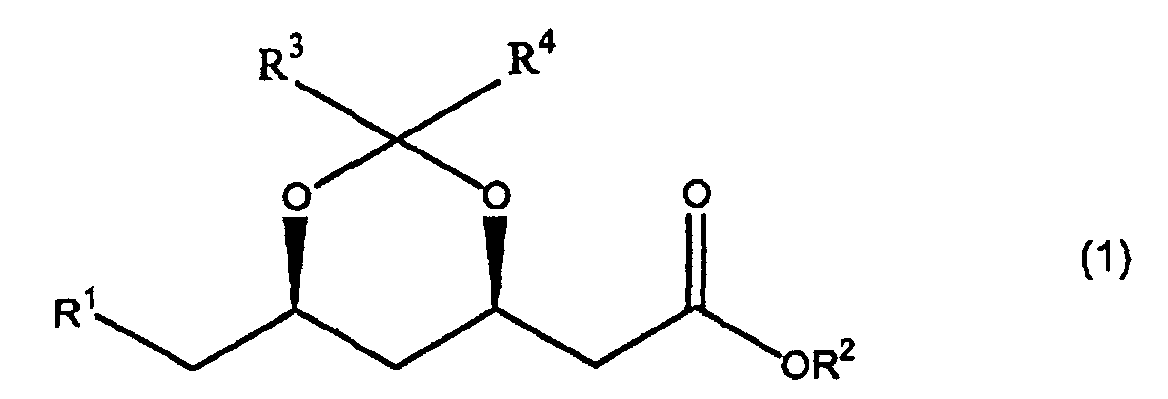
- the invention relates to a process for the preparation of an ester of formula (1) wherein R 1 represents a leaving group, CN, OH or a COOR 5 group, R 3 and R 4 each independently represent a C1-3 alkyl group and R 2 and R 5 each independently represent an ester group, wherein the corresponding salt with formula (2) wherein M represents H or an alkali (earth) metal in an inert solvent is contacted with an acid chloride forming agent to form the corresponding acid chloride, and the acid chloride is contacted with an alcohol with formula R 2 OH in the presence of N-methyl morpholine (NMM).
- NMM N-methyl morpholine
- esters with formula (1) that are unstable under acidic conditions, for instance with pH ⁇ 4, can be prepared in high yield.
- R 1 represents a leaving group, CN, OH or a COOR 5 group wherein R 5 represents an ester group, for example an alkyl group with for instance 1-6 C-atoms, or an aryl group with for instance 6-12 C-atoms.
- a leaving group by definition is a group that can easily be replaced, for example a halogen, for instance Cl, Br or I; a tosylate group; a mesylate group; an acyloxy group, with, for instance, 1-6 C-atoms in particular an acetoxy group; a phenacetyloxy group; an alkoxy group with, for instance, 1-6 C-atoms or an (hetero) aryloxy group with, for instance, 6-12 C-atoms .
- R 1 represents Cl.
- R 2 represents an ester group, preferably an alkyl group, for instance an alkyl group with 1-6 C-atoms or an aryl group, for instance an aryl group with 6-12 C-atoms, in particular a methyl, ethyl, propyl, isobutyl or t.butyl group.
- An important group of esters that can be prepared with the process according to the invention are t.butyl esters.
- R 3 and R 4 each independently represent a C1-C3 alkyl group, for instance a methyl or ethyl group. Preferably R 3 and R 4 both represent methyl.
- the metal M in formula (2) can be chosen from the group of H, alkali metals, for instance lithium, sodium, potassium and alkali earth metals, for instance magnesium or calcium.
- M represents sodium or potassium.
- the acid chloride forming agent can be chosen from the group of reagents that is generally known as such. Suitable examples of acid chloride forming agents are oxalyl chloride, thionyl chloride, PCl 3 , PCl 5 , and POCl 3 . Preferably the acid chloride forming agent is used in an excess relative to the amount the salt with formula (2), for instance between 1 and 3 equivalents, more preferably between 1.2 and 1.8 equivalents.
- a catalyst may be present in the acid chloride formation.
- the amount of catalyst may for instance vary from 0-1, preferably 0-0.5 equivalents, calculated with respect to the amount of salt with formula (2). Higher amounts of catalyst are also possible, but will normally have no extra advantageous effect.
- the amount of catalyst, if any, will be between 0.05 and 0.2 equivalents calculated with respect to the salt with formula (2).
- Suitable catalysts are the catalysts generally know to accelerate acid chloride formation, for instance dimethylformamide (DMF) and N-methylpyrrolidone (NMP).
- the conversion of the acid chloride into the ester with formula (1) is carried out in the presence of an alcohol with formula R 2 OH.
- the amount of alcohol with formula R 2 OH is not very critical and preferably is between 1 and 15 equivalent calculated with respect to the amount of salt with formula (2), more preferably between 2 and 13, most preferably between 3 and 6. Surprisingly it has been found that even t.-butyl esters can be prepared with high yield using a relatively low amount of t.-butyl alcohol.
- the conversion of the acid chloride into the ester with formula (1) is carried out in the presence of NMM.
- NMM efficient to catch eventually remaining free HCI, for instance 1.5 to 2.5, preferably 1.8 to 2.0 equivalents calculated with respect to the amount of salt with formula (2) is applied.
- a large excess of acid chloride forming agent preferably higher amounts of NMM are used, and when a lower excess of acid chloride forming agent is used, preferably lower amounts of NMM are used.
- the acid chloride formation reaction preferably is carried out at a temperature between -30° and 60°C, more preferably between 20 and 50°C.
- the conversion of the acid chloride into the ester with formula (1) preferably is carried out at a temperature between 20 and 80°C, more preferably between 20 and 50°C.
- the process of the present invention may be carried out in one step.
- the salt with formula (2) is converted into the corresponding acid chloride, and subsequently the acid chloride is contacted with the alcohol with formula R 2 OH and NMM.
- the acid chloride formed is quenched with NMM and the alcohol with formula R 2 OH.
Landscapes
- Chemical & Material Sciences (AREA)
- Organic Chemistry (AREA)
- Organic Low-Molecular-Weight Compounds And Preparation Thereof (AREA)
- Low-Molecular Organic Synthesis Reactions Using Catalysts (AREA)
- Heterocyclic Compounds That Contain Two Or More Ring Oxygen Atoms (AREA)
- Heterocyclic Carbon Compounds Containing A Hetero Ring Having Nitrogen And Oxygen As The Only Ring Hetero Atoms (AREA)
- Steroid Compounds (AREA)
Abstract
Description
- The invention relates to a process for the preparation of an ester of formula (1)wherein R1 represents a leaving group, CN, OH or a COOR5 group, R3 and R4 each independently represent a C1-3 alkyl group and R2 and R5 each independently represent an ester group, wherein the corresponding salt with formula (2)
 wherein M represents H or an alkali (earth) metal in an inert solvent is contacted with an acid chloride forming agent to form the corresponding acid chloride, and the acid chloride is contacted with an alcohol with formula R2OH in the presence of N-methyl morpholine (NMM).
- Many processes for the preparation of esters are known in the art, for instance the preparation of esters via the formation of the acid chloride. It was, however, to be expected that such processes would not lead to high yields due to the lack of stability of the present compound under acidic conditions.
- It is the object of the invention to provide a process for the preparation of esters with high yield in a robust process, even at large scale and with relatively high concentrations.
- Surprisingly it has been found that even sterically hindered esters that are difficult to obtain in esterifications like t-butyl esters of the acid unstable molecules of formula (1), can be obtained in high yield in an easily reproducible process.
- With the process according to the invention esters with formula (1) that are unstable under acidic conditions, for instance with pH < 4, can be prepared in high yield.
- R1 represents a leaving group, CN, OH or a COOR5 group wherein R5 represents an ester group, for example an alkyl group with for instance 1-6 C-atoms, or an aryl group with for instance 6-12 C-atoms. A leaving group by definition is a group that can easily be replaced, for example a halogen, for instance Cl, Br or I; a tosylate group; a mesylate group; an acyloxy group, with, for instance, 1-6 C-atoms in particular an acetoxy group; a phenacetyloxy group; an alkoxy group with, for instance, 1-6 C-atoms or an (hetero) aryloxy group with, for instance, 6-12 C-atoms . Preferably R1 represents Cl.
- R2 represents an ester group, preferably an alkyl group, for instance an alkyl group with 1-6 C-atoms or an aryl group, for instance an aryl group with 6-12 C-atoms, in particular a methyl, ethyl, propyl, isobutyl or t.butyl group. An important group of esters that can be prepared with the process according to the invention are t.butyl esters.
- R3 and R4 each independently represent a C1-C3 alkyl group, for instance a methyl or ethyl group. Preferably R3 and R4 both represent methyl.
- The metal M in formula (2) can be chosen from the group of H, alkali metals, for instance lithium, sodium, potassium and alkali earth metals, for instance magnesium or calcium. Preferably M represents sodium or potassium.
- The acid chloride forming agent can be chosen from the group of reagents that is generally known as such. Suitable examples of acid chloride forming agents are oxalyl chloride, thionyl chloride, PCl3, PCl5, and POCl3. Preferably the acid chloride forming agent is used in an excess relative to the amount the salt with formula (2), for instance between 1 and 3 equivalents, more preferably between 1.2 and 1.8 equivalents.
- If desired, in the acid chloride formation also a catalyst may be present. The amount of catalyst may for instance vary from 0-1, preferably 0-0.5 equivalents, calculated with respect to the amount of salt with formula (2). Higher amounts of catalyst are also possible, but will normally have no extra advantageous effect. Preferably the amount of catalyst, if any, will be between 0.05 and 0.2 equivalents calculated with respect to the salt with formula (2).Suitable catalysts are the catalysts generally know to accelerate acid chloride formation, for instance dimethylformamide (DMF) and N-methylpyrrolidone (NMP).
- The conversion of the acid chloride into the ester with formula (1) is carried out in the presence of an alcohol with formula R2OH. The amount of alcohol with formula R2OH is not very critical and preferably is between 1 and 15 equivalent calculated with respect to the amount of salt with formula (2), more preferably between 2 and 13, most preferably between 3 and 6. Surprisingly it has been found that even t.-butyl esters can be prepared with high yield using a relatively low amount of t.-butyl alcohol.
- The conversion of the acid chloride into the ester with formula (1) is carried out in the presence of NMM. In practice a small amount of NMM, efficient to catch eventually remaining free HCI, for instance 1.5 to 2.5, preferably 1.8 to 2.0 equivalents calculated with respect to the amount of salt with formula (2) is applied. When a large excess of acid chloride forming agent is used, preferably higher amounts of NMM are used, and when a lower excess of acid chloride forming agent is used, preferably lower amounts of NMM are used.
- The acid chloride formation reaction preferably is carried out at a temperature between -30° and 60°C, more preferably between 20 and 50°C. The conversion of the acid chloride into the ester with formula (1) preferably is carried out at a temperature between 20 and 80°C, more preferably between 20 and 50°C.
- The process of the present invention may be carried out in one step. Preferably first the salt with formula (2) is converted into the corresponding acid chloride, and subsequently the acid chloride is contacted with the alcohol with formula R2OH and NMM. In a particularly preferred embodiment the acid chloride formed is quenched with NMM and the alcohol with formula R2OH.
- The invention will be elucidated by the following examples.
- 1864 g of an aqueous solution of the (4R-cis)-(6-chloromethyl)-2,2-dimethyl-1,3-dioxane-4-yl-acetic acid, sodium salt (3.31 moles) and 4.8 L of toluene were mixed and water was removed by azeotropic distillation under reduced pressure. Subsequently, 870 g of fresh toluene were added and removed by distillation. To the obtained suspension was added, 588 g of oxalyl chloride, while maintaining the temperature at 20 °C. The resulting mixture was stirred for 6 hours at 20-25 °C and then slowly added to a mixture of 979 g of t.-butanol and 836 g of N-methyl morpholine. After stirring for 1 hour, 3966 g of an 8% (w/w) aqueous NaOH solution was added and the resulting mixture stirred for 1.5 hours at 40 °C. After washing the organic phase with 3300 g of water, 3064 g of a toluene solution of the desired t.-butyl ester was obtained, corresponding to 751 g (81%) of product.
- In a 100 ml HEL Vessel with 4 blade stirrer 8.0 g (4R-cis)-(6-chloromethyl)-2,2-dimethyl-1,3-dioxane-4-yl-acetic acid, sodium salt (92.4%; 30 mmol) was suspended in 41 g toluene and 0.3 g NMP (3 mmol). In 1 h 4.5 g (36 mmol) oxalylchloride was dosed at a temperature of 15-20°C. The reaction mixture (50 g) was stirred for 2.5 hours. The reaction mixture was split into 2 parts: Part A (23.83 g) and part B (24.25 g). Part A of the reaction mixture was dosed during 1 h. to a mixture of 22.2 g (20 eq.) t.-butanol and 3.0 g (2 eq.) NMM at 25°C. The reaction mixture was stirred overnight and analyzed by GC. The yield of the t.-butyl ester was 88%.
Claims (9)
- Process for the preparation of an ester of formula (1),wherein R1 represents a leaving group, CN, OH or a COOR5 group, R3 and R4 each independently represent a 1-3 C alkyl group, and R2 and R5 each independently represent an ester group, wherein the corresponding salt with formula (2),
 wherein M represents H or an alkali (earth) metal in an inert solvent is contacted with an acid chloride forming agent to form the corresponding acid chloride, and the acid chloride is contacted with an alcohol with formula R2OH in the presence of N-methyl-morpholine.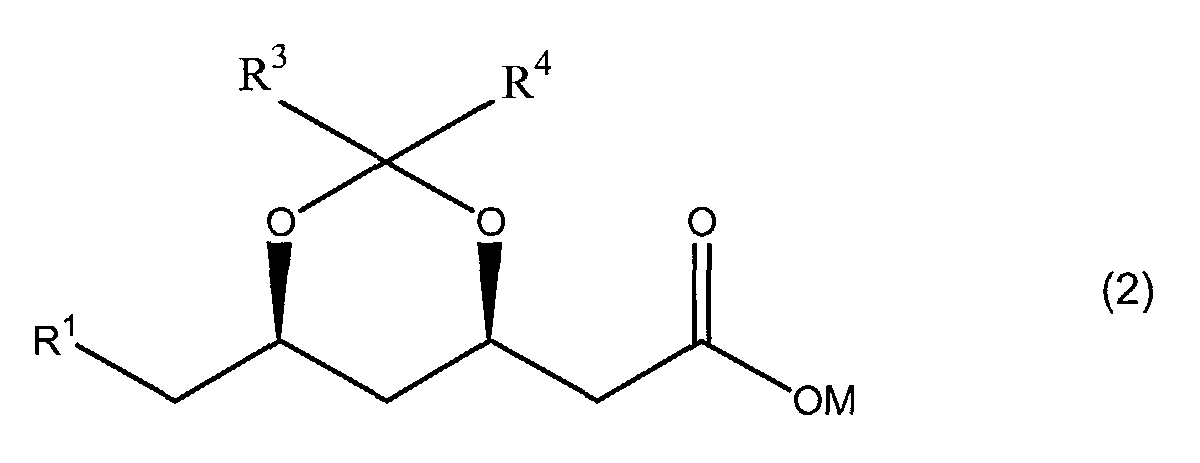
- Process according to claim 1, wherein M represents an alkali metal.
- Process according to claim 1 or 2, wherein R2 represents an alkyl group.
- Process according to claim 3, wherein R2 represents a t.-butyl group.
- Process according to any one of claims 1-4, wherein the acid chloride forming agent is oxalylchloride.
- Process according to any one of claims 1-5, wherein the acid chloride formation is performed in the presence of a catalyst.
- Process according to any one of claims 1-6, wherein the amount of alcohol with formula R2OH is between 3 and 6 equivalents calculated with respect to the amount of salt with formula (2).
- Process according to any one of claims 1-7, wherein first the salt with formula (2) is converted into the corresponding acid chloride and subsequently the acid chloride is contacted with the alcohol with formula R2OH and N-methyl-morpholine.
- Process according to claim 8, wherein the acid chloride is quenched with the alcohol with formula R2OH and N-methyl-morpholine.
Priority Applications (29)
| Application Number | Priority Date | Filing Date | Title |
|---|---|---|---|
| EP02100715A EP1375493A1 (en) | 2002-06-17 | 2002-06-17 | Process for the preparation of an dioxane acetic acid ester |
| PL375077A PL207130B1 (en) | 2002-06-17 | 2003-06-12 | Process for the preparation of dioxane acetic acid esters |
| CN038140373A CN1662520B (en) | 2002-06-17 | 2003-06-12 | Process for preparing dioxane acetic acid esters |
| EP03741639A EP1515962B1 (en) | 2002-06-17 | 2003-06-12 | Process for the preaparation of dioxane acetic acid esters |
| JP2004513279A JP4632784B2 (en) | 2002-06-17 | 2003-06-12 | Process for producing dioxane acetates |
| PCT/NL2003/000435 WO2003106447A1 (en) | 2002-06-17 | 2003-06-12 | Process for the preparation of dioxane acetic acid esters |
| NZ537260A NZ537260A (en) | 2002-06-17 | 2003-06-12 | Process that results in sterically hindered esters that are difficult to obtain in esterifications like t-butyl esters are obtained in high yield in an easily reproducible process |
| AT03741639T ATE348825T1 (en) | 2002-06-17 | 2003-06-12 | PROCESS FOR PRODUCING DIOXAACETIC ACID ESTERS |
| ES03741639T ES2278174T3 (en) | 2002-06-17 | 2003-06-12 | PROCEDURE FOR THE PREPARATION OF ESTERES OF DIOXANOACETIC ACID. |
| HK05105964.6A HK1073303B (en) | 2002-06-17 | 2003-06-12 | Process for the preparation of dioxane acetic acid esters |
| PT03741639T PT1515962E (en) | 2002-06-17 | 2003-06-12 | Process for the preaparation of dioxane acetic acid esters |
| SI200330658T SI1515962T1 (en) | 2002-06-17 | 2003-06-12 | Process for the preaparation of dioxane acetic acid esters |
| MXPA04012651A MXPA04012651A (en) | 2002-06-17 | 2003-06-12 | Process for the preparation of dioxane acetic acid esters. |
| CA2490205A CA2490205C (en) | 2002-06-17 | 2003-06-12 | Process for the preparation of dioxane acetic acid esters |
| DE60310559T DE60310559T2 (en) | 2002-06-17 | 2003-06-12 | PROCESS FOR THE PREPARATION OF DIOXANEIC ACID ESTERS |
| DK03741639T DK1515962T3 (en) | 2002-06-17 | 2003-06-12 | Process for preparing dioxane acetic acid esters |
| CN2010101725560A CN101812045B (en) | 2002-06-17 | 2003-06-12 | Process for the preparation of an dioxane acetic acid ester |
| AU2003277230A AU2003277230B2 (en) | 2002-06-17 | 2003-06-12 | Process for the preparation of dioxane acetic acid esters |
| US10/518,164 US7442811B2 (en) | 2002-06-17 | 2003-06-12 | Process for the preparation of dioxane acetic acid esters |
| RU2004139042/04A RU2315761C2 (en) | 2002-06-17 | 2003-06-12 | Method for preparing dioxaneacetic acid esters |
| BR0311884-3A BR0311884A (en) | 2002-06-17 | 2003-06-12 | Process for the preparation of an ester |
| KR1020047020617A KR101008920B1 (en) | 2002-06-17 | 2003-06-12 | Method for preparing dioxane acetic acid ester |
| UAA200500156A UA79970C2 (en) | 2002-06-17 | 2003-12-06 | Process for the preparation of ester |
| ZA200409986A ZA200409986B (en) | 2002-06-17 | 2004-12-09 | Process for the preparation of dioxane acetic acidesters. |
| IL16576704A IL165767A0 (en) | 2002-06-17 | 2004-12-14 | Process for the preparation of dioxane acetic acidesters |
| EGNA2004000143 EG24561A (en) | 2002-06-17 | 2004-12-15 | Process for the preparation of dioxane acetic acidesters |
| NO20045491A NO328946B1 (en) | 2002-06-17 | 2004-12-16 | Process for the preparation of dioxane acetic acid esters |
| IS7617A IS2477B (en) | 2002-06-17 | 2004-12-28 | Process for producing dioxane acetic acid esters |
| CY20071100215T CY1107344T1 (en) | 2002-06-17 | 2007-02-16 | PROCEDURE FOR PREPARATION OF DIOXANIC ACIDS |
Applications Claiming Priority (1)
| Application Number | Priority Date | Filing Date | Title |
|---|---|---|---|
| EP02100715A EP1375493A1 (en) | 2002-06-17 | 2002-06-17 | Process for the preparation of an dioxane acetic acid ester |
Publications (1)
| Publication Number | Publication Date |
|---|---|
| EP1375493A1 true EP1375493A1 (en) | 2004-01-02 |
Family
ID=29716908
Family Applications (2)
| Application Number | Title | Priority Date | Filing Date |
|---|---|---|---|
| EP02100715A Withdrawn EP1375493A1 (en) | 2002-06-17 | 2002-06-17 | Process for the preparation of an dioxane acetic acid ester |
| EP03741639A Expired - Lifetime EP1515962B1 (en) | 2002-06-17 | 2003-06-12 | Process for the preaparation of dioxane acetic acid esters |
Family Applications After (1)
| Application Number | Title | Priority Date | Filing Date |
|---|---|---|---|
| EP03741639A Expired - Lifetime EP1515962B1 (en) | 2002-06-17 | 2003-06-12 | Process for the preaparation of dioxane acetic acid esters |
Country Status (26)
| Country | Link |
|---|---|
| US (1) | US7442811B2 (en) |
| EP (2) | EP1375493A1 (en) |
| JP (1) | JP4632784B2 (en) |
| KR (1) | KR101008920B1 (en) |
| CN (2) | CN1662520B (en) |
| AT (1) | ATE348825T1 (en) |
| AU (1) | AU2003277230B2 (en) |
| BR (1) | BR0311884A (en) |
| CA (1) | CA2490205C (en) |
| CY (1) | CY1107344T1 (en) |
| DE (1) | DE60310559T2 (en) |
| DK (1) | DK1515962T3 (en) |
| EG (1) | EG24561A (en) |
| ES (1) | ES2278174T3 (en) |
| IL (1) | IL165767A0 (en) |
| IS (1) | IS2477B (en) |
| MX (1) | MXPA04012651A (en) |
| NO (1) | NO328946B1 (en) |
| NZ (1) | NZ537260A (en) |
| PL (1) | PL207130B1 (en) |
| PT (1) | PT1515962E (en) |
| RU (1) | RU2315761C2 (en) |
| SI (1) | SI1515962T1 (en) |
| UA (1) | UA79970C2 (en) |
| WO (1) | WO2003106447A1 (en) |
| ZA (1) | ZA200409986B (en) |
Families Citing this family (16)
| Publication number | Priority date | Publication date | Assignee | Title |
|---|---|---|---|---|
| GB0011120D0 (en) * | 2000-05-09 | 2000-06-28 | Avecia Ltd | Process |
| NL1015744C2 (en) | 2000-07-19 | 2002-01-22 | Dsm Nv | Process for the preparation of 2- (6-substituted-1,3-dioxan-4-yl) acetic acid derivatives. |
| KR100888408B1 (en) | 2001-07-13 | 2009-03-13 | 아스트라제네카 유케이 리미티드 | Process for preparing aminopyrimidine compound |
| EP1323717A1 (en) | 2001-12-27 | 2003-07-02 | Dsm N.V. | Process for the preparation of 2-(6-Substituted-1,3-Dioxane-4-yL) acetic acid derivatives |
| GB0218781D0 (en) | 2002-08-13 | 2002-09-18 | Astrazeneca Ab | Chemical process |
| DE60330050D1 (en) | 2002-12-16 | 2009-12-24 | Astrazeneca Uk Ltd | METHOD FOR PRODUCING PYRIMIDINE COMPOUNDS |
| GB0312896D0 (en) * | 2003-06-05 | 2003-07-09 | Astrazeneca Ab | Chemical process |
| UY28501A1 (en) | 2003-09-10 | 2005-04-29 | Astrazeneca Uk Ltd | CHEMICAL COMPOUNDS |
| GB0324791D0 (en) | 2003-10-24 | 2003-11-26 | Astrazeneca Ab | Chemical process |
| GB0428328D0 (en) * | 2004-12-24 | 2005-02-02 | Astrazeneca Uk Ltd | Chemical process |
| GB0514078D0 (en) * | 2005-07-08 | 2005-08-17 | Astrazeneca Uk Ltd | Chemical process |
| TW200831469A (en) * | 2006-12-01 | 2008-08-01 | Astrazeneca Uk Ltd | Chemical process |
| GB2482525A (en) * | 2010-08-05 | 2012-02-08 | Phoenix Chemicals Ltd | A process for the production of acyloxymethyldioxanylacetic derivatives |
| CN105198856B (en) * | 2014-06-27 | 2017-10-13 | 上海弈柯莱生物医药科技有限公司 | The preparation method of one kind 2 (6 substitution 1,3 dioxane 4 base) acetogenin |
| RU2596623C1 (en) * | 2015-07-20 | 2016-09-10 | Федеральное государственное бюджетное образовательное учреждение высшего профессионального образования "Уфимский государственный нефтяной технический университет" | Method for producing 1,4-dioxancarboxylate |
| CN111675689B (en) * | 2020-06-16 | 2021-08-24 | 浙江工业大学 | A kind of chemical synthesis method of rosuvastatin intermediate |
Citations (3)
| Publication number | Priority date | Publication date | Assignee | Title |
|---|---|---|---|---|
| GB885516A (en) * | 1958-01-16 | 1961-12-28 | Arthur Henry Clarkson | Higher fatty acid esters of dextran |
| WO2000068221A1 (en) * | 1999-05-06 | 2000-11-16 | EGIS Gyógyszergyár Rt. | Salts of 2,2-dimethyl-1,3-dioxane intermediates and process for the preparation thereof |
| WO2002006266A1 (en) * | 2000-07-19 | 2002-01-24 | Dsm N.V. | Process for the preparation of 2-(6-substituted-1,3-dioxane-4-yl)acetic acid derivatives |
Family Cites Families (30)
| Publication number | Priority date | Publication date | Assignee | Title |
|---|---|---|---|---|
| US3325466A (en) | 1961-01-11 | 1967-06-13 | American Cyanamid Co | Tertiary butyl group as a carboxyl protecting group in the synthesis of peptides |
| GB9005966D0 (en) | 1990-03-16 | 1990-05-09 | May & Baker Ltd | New compositions of matter |
| SU1743164A1 (en) * | 1990-05-29 | 2000-02-20 | Уфимский Нефтяной Институт | METHOD OF OBTAINING 2,2-DIMETHYL-2- (5 ', 5'-DIMETHYL-1', 3'-DIOXANILE) ETHYL CYCLOGEXYL ETHER |
| US5103024A (en) * | 1990-10-17 | 1992-04-07 | Warner-Lambert Company | Process for the synthesis of (4r-cis)-1,1-dimethylethyl 6-cyanomethyl-2,2-dimethyl-1,3-dioxane-4-acetate |
| JP3097143B2 (en) | 1991-02-21 | 2000-10-10 | チッソ株式会社 | Method for producing optically active compound for synthesis of physiologically active substance and optically active intermediate compound |
| EP0604483A1 (en) | 1991-09-20 | 1994-07-06 | Zeneca Limited | Process for the preparation of enantiomerically pure 4-hydroxytetrahydro-2-pyranone derivatives |
| WO1993008823A1 (en) | 1991-11-06 | 1993-05-13 | Tanabe Seiyaku Co., Ltd. | Guanidinyl and related cell adhesion modulation compounds |
| US5278313A (en) | 1992-03-27 | 1994-01-11 | E. R. Squibb & Sons, Inc. | Process for the preparation of 1,3-dioxane derivatives useful in the preparation of HMG-COA reductase inhibitors |
| US5795749A (en) | 1995-04-05 | 1998-08-18 | The Scripps Research Institution | Use of 2-deoxyribose-5-phosphate aldolase to prepare 2-deoxyfucose, analogues and derivatives |
| GB9523924D0 (en) | 1995-11-23 | 1996-01-24 | Zeneca Ltd | Production of optically active 2-substituted tetrahydropyran-4-ones |
| FR2741620B1 (en) | 1995-11-28 | 1997-12-26 | Oreal | PROCESS FOR THE PREPARATION OF COMPOUNDS WITH A BETA-HYDROXY -DELTA-LACTONE GROUP ANALOGS OF (+) COMPACTIN AND (+) MEVINOLINE |
| US6278001B1 (en) | 1995-11-28 | 2001-08-21 | L'oréal | Method for preparing (+) compactin and (+) mevinolin analog compounds having a β-hydroxy-δ-lactone grouping |
| WO1999057109A1 (en) | 1998-04-30 | 1999-11-11 | Kaneka Corporation | Process for producing 6-cyanomethyl-1,3-dioxane-4-acetic acid derivatives |
| HUP0101122A3 (en) | 1998-08-05 | 2006-02-28 | Kaneka Corp | Process for the preparation of optically active 2-[6-(hydroxymethyl)-1,3-dioxan-4-yl]acetic acid derivatives |
| WO2000034264A1 (en) | 1998-12-10 | 2000-06-15 | Kaneka Corporation | Process for producing simvastatin |
| GB9903472D0 (en) | 1999-02-17 | 1999-04-07 | Zeneca Ltd | Chemical process |
| KR20010072175A (en) | 1999-06-04 | 2001-07-31 | 후루타 타케시 | Processes for the preparation of 5-hydroxy-3-oxopentanoic acid derivatives |
| AU2000254249A1 (en) | 2000-03-28 | 2001-10-08 | Biocon India Limited | Synthesis of (r-(r*,r*))-2-(4-fluorophenyl)-beta,delta-dihydroxy-5-(1- |
| GB0011120D0 (en) | 2000-05-09 | 2000-06-28 | Avecia Ltd | Process |
| KR100888408B1 (en) | 2001-07-13 | 2009-03-13 | 아스트라제네카 유케이 리미티드 | Process for preparing aminopyrimidine compound |
| EP1323717A1 (en) | 2001-12-27 | 2003-07-02 | Dsm N.V. | Process for the preparation of 2-(6-Substituted-1,3-Dioxane-4-yL) acetic acid derivatives |
| GB0218781D0 (en) | 2002-08-13 | 2002-09-18 | Astrazeneca Ab | Chemical process |
| DE60330050D1 (en) | 2002-12-16 | 2009-12-24 | Astrazeneca Uk Ltd | METHOD FOR PRODUCING PYRIMIDINE COMPOUNDS |
| GB0312896D0 (en) | 2003-06-05 | 2003-07-09 | Astrazeneca Ab | Chemical process |
| WO2004113314A1 (en) | 2003-06-23 | 2004-12-29 | Biocon Limited | Novel boronate esters |
| UY28501A1 (en) | 2003-09-10 | 2005-04-29 | Astrazeneca Uk Ltd | CHEMICAL COMPOUNDS |
| GB0321827D0 (en) | 2003-09-18 | 2003-10-15 | Astrazeneca Uk Ltd | Chemical compounds |
| GB0324791D0 (en) | 2003-10-24 | 2003-11-26 | Astrazeneca Ab | Chemical process |
| TWI276043B (en) | 2004-09-09 | 2007-03-11 | Seiko Epson Corp | Display apparatus |
| GB0428328D0 (en) | 2004-12-24 | 2005-02-02 | Astrazeneca Uk Ltd | Chemical process |
-
2002
- 2002-06-17 EP EP02100715A patent/EP1375493A1/en not_active Withdrawn
-
2003
- 2003-06-12 RU RU2004139042/04A patent/RU2315761C2/en not_active IP Right Cessation
- 2003-06-12 CN CN038140373A patent/CN1662520B/en not_active Expired - Lifetime
- 2003-06-12 SI SI200330658T patent/SI1515962T1/en unknown
- 2003-06-12 DK DK03741639T patent/DK1515962T3/en active
- 2003-06-12 CN CN2010101725560A patent/CN101812045B/en not_active Expired - Lifetime
- 2003-06-12 JP JP2004513279A patent/JP4632784B2/en not_active Expired - Fee Related
- 2003-06-12 AU AU2003277230A patent/AU2003277230B2/en not_active Ceased
- 2003-06-12 EP EP03741639A patent/EP1515962B1/en not_active Expired - Lifetime
- 2003-06-12 NZ NZ537260A patent/NZ537260A/en not_active IP Right Cessation
- 2003-06-12 PL PL375077A patent/PL207130B1/en not_active IP Right Cessation
- 2003-06-12 CA CA2490205A patent/CA2490205C/en not_active Expired - Fee Related
- 2003-06-12 US US10/518,164 patent/US7442811B2/en not_active Expired - Fee Related
- 2003-06-12 DE DE60310559T patent/DE60310559T2/en not_active Expired - Lifetime
- 2003-06-12 BR BR0311884-3A patent/BR0311884A/en not_active IP Right Cessation
- 2003-06-12 AT AT03741639T patent/ATE348825T1/en active
- 2003-06-12 MX MXPA04012651A patent/MXPA04012651A/en active IP Right Grant
- 2003-06-12 ES ES03741639T patent/ES2278174T3/en not_active Expired - Lifetime
- 2003-06-12 WO PCT/NL2003/000435 patent/WO2003106447A1/en not_active Ceased
- 2003-06-12 KR KR1020047020617A patent/KR101008920B1/en not_active Expired - Fee Related
- 2003-06-12 PT PT03741639T patent/PT1515962E/en unknown
- 2003-12-06 UA UAA200500156A patent/UA79970C2/en unknown
-
2004
- 2004-12-09 ZA ZA200409986A patent/ZA200409986B/en unknown
- 2004-12-14 IL IL16576704A patent/IL165767A0/en not_active IP Right Cessation
- 2004-12-15 EG EGNA2004000143 patent/EG24561A/en active
- 2004-12-16 NO NO20045491A patent/NO328946B1/en not_active IP Right Cessation
- 2004-12-28 IS IS7617A patent/IS2477B/en unknown
-
2007
- 2007-02-16 CY CY20071100215T patent/CY1107344T1/en unknown
Patent Citations (3)
| Publication number | Priority date | Publication date | Assignee | Title |
|---|---|---|---|---|
| GB885516A (en) * | 1958-01-16 | 1961-12-28 | Arthur Henry Clarkson | Higher fatty acid esters of dextran |
| WO2000068221A1 (en) * | 1999-05-06 | 2000-11-16 | EGIS Gyógyszergyár Rt. | Salts of 2,2-dimethyl-1,3-dioxane intermediates and process for the preparation thereof |
| WO2002006266A1 (en) * | 2000-07-19 | 2002-01-24 | Dsm N.V. | Process for the preparation of 2-(6-substituted-1,3-dioxane-4-yl)acetic acid derivatives |
Non-Patent Citations (1)
| Title |
|---|
| JERRY MARCH: "Advanced organic chemistry: reactions, mechanisms, and structure", 1992, WILEY-INTERSCIENCE, XP002217003 * |
Also Published As
Similar Documents
| Publication | Publication Date | Title |
|---|---|---|
| EP1515962B1 (en) | Process for the preaparation of dioxane acetic acid esters | |
| US10618868B2 (en) | Method for preparing 2-aryl malonamide and applications thereof | |
| JP2002187864A (en) | Catalytic reduction of alkyne compounds | |
| JPWO2000075099A1 (en) | Method for producing 5-hydroxy-3-oxopentanoic acid derivatives | |
| HU214958B (en) | Process for producing beta-ketocarboxylic acid esters | |
| JP2014062076A (en) | Methylenedisulfonyl chloride compound, methylene disulfonate compound and method for producing methylene disulfonate compound | |
| JPH0258272B2 (en) | ||
| US6291710B1 (en) | Process for preparing sulfonyl halides | |
| HK1073303B (en) | Process for the preparation of dioxane acetic acid esters | |
| US20020062026A1 (en) | Method for preparing N-methyleneglycinates | |
| JP2000128868A (en) | Tetraalkylfluoroformamidinium trifluoroacetate and its production | |
| JPH09255668A (en) | Method for producing bisoxazolines | |
| JP3775883B2 (en) | Protocatecaldehyde production method | |
| JP2004238368A (en) | Azadirs-Alder reaction method | |
| FI90068B (en) | FRUIT PROCESSING FOR A VITAMIN A ELLER DESS CARBOXYLSYRAESTRAR | |
| JPH10310567A (en) | Crystallization method of 3-amino-2- (N-alkoxycarbonyl) aminopropionic acid ester / substituted benzenesulfonic acid salt | |
| JPH10130204A (en) | Method for producing 4-halogeno-3-trifluoromethylphenoxybutanoic acid esters | |
| JPH11343272A (en) | Method for producing α, α-dialkyl-substituted amino acid amide | |
| JPS61140561A (en) | Production of aziridine-2-nitrile or aziridine-2-carboxylic acid amide | |
| JP2001354664A (en) | Method for producing thiazolidinedione derivative | |
| JPH10130239A (en) | Production of 1-acetyl-4-piperidone | |
| JPH0625075A (en) | Production of oxocarboxylic acid derivative |
Legal Events
| Date | Code | Title | Description |
|---|---|---|---|
| PUAI | Public reference made under article 153(3) epc to a published international application that has entered the european phase |
Free format text: ORIGINAL CODE: 0009012 |
|
| AK | Designated contracting states |
Kind code of ref document: A1 Designated state(s): AT BE CH CY DE DK ES FI FR GB GR IE IT LI LU MC NL PT SE TR |
|
| AX | Request for extension of the european patent |
Extension state: AL LT LV MK RO SI |
|
| RAP1 | Party data changed (applicant data changed or rights of an application transferred) |
Owner name: KONINKLIJKE DSM N.V. |
|
| RAP1 | Party data changed (applicant data changed or rights of an application transferred) |
Owner name: ASTRAZENECA UK LIMITED |
|
| AKX | Designation fees paid | ||
| REG | Reference to a national code |
Ref country code: DE Ref legal event code: 8566 |
|
| STAA | Information on the status of an ep patent application or granted ep patent |
Free format text: STATUS: THE APPLICATION IS DEEMED TO BE WITHDRAWN |
|
| 18D | Application deemed to be withdrawn |
Effective date: 20040703 |