EP1375492A1 - Process for producing (dioxolenon-4-yl)methyl ester derivative - Google Patents
Process for producing (dioxolenon-4-yl)methyl ester derivative Download PDFInfo
- Publication number
- EP1375492A1 EP1375492A1 EP02707247A EP02707247A EP1375492A1 EP 1375492 A1 EP1375492 A1 EP 1375492A1 EP 02707247 A EP02707247 A EP 02707247A EP 02707247 A EP02707247 A EP 02707247A EP 1375492 A1 EP1375492 A1 EP 1375492A1
- Authority
- EP
- European Patent Office
- Prior art keywords
- formula
- dioxolenon
- methyl ester
- producing
- ester derivative
- Prior art date
- Legal status (The legal status is an assumption and is not a legal conclusion. Google has not performed a legal analysis and makes no representation as to the accuracy of the status listed.)
- Granted
Links
- -1 (dioxolenon-4-yl)methyl Chemical group 0.000 title claims abstract description 125
- 238000000034 method Methods 0.000 title claims abstract description 26
- 238000006243 chemical reaction Methods 0.000 claims abstract description 45
- 239000002904 solvent Substances 0.000 claims abstract description 18
- 229910001511 metal iodide Inorganic materials 0.000 claims abstract description 16
- 239000003444 phase transfer catalyst Substances 0.000 claims abstract description 14
- 125000004435 hydrogen atom Chemical group [H]* 0.000 claims abstract description 13
- 125000004169 (C1-C6) alkyl group Chemical group 0.000 claims abstract description 12
- 125000001997 phenyl group Chemical group [H]C1=C([H])C([H])=C(*)C([H])=C1[H] 0.000 claims abstract description 8
- 125000000962 organic group Chemical group 0.000 claims abstract description 7
- 229910052784 alkaline earth metal Inorganic materials 0.000 claims abstract description 6
- 229910052783 alkali metal Inorganic materials 0.000 claims abstract description 5
- 150000001340 alkali metals Chemical class 0.000 claims abstract description 4
- 150000001342 alkaline earth metals Chemical class 0.000 claims abstract description 4
- 229910052723 transition metal Inorganic materials 0.000 claims abstract description 4
- 150000003624 transition metals Chemical class 0.000 claims abstract description 4
- 125000000623 heterocyclic group Chemical group 0.000 claims description 17
- 239000002585 base Substances 0.000 claims description 11
- 239000012535 impurity Substances 0.000 claims description 9
- 125000004432 carbon atom Chemical group C* 0.000 claims description 8
- 150000001732 carboxylic acid derivatives Chemical class 0.000 claims description 8
- 125000003460 beta-lactamyl group Chemical group 0.000 claims description 6
- 150000004820 halides Chemical class 0.000 claims description 6
- 125000001453 quaternary ammonium group Chemical group 0.000 claims description 6
- 150000003242 quaternary ammonium salts Chemical class 0.000 claims description 6
- 230000002378 acidificating effect Effects 0.000 claims description 5
- 229910001516 alkali metal iodide Inorganic materials 0.000 claims description 4
- 125000003710 aryl alkyl group Chemical group 0.000 claims description 4
- 230000003028 elevating effect Effects 0.000 claims description 4
- 239000000908 ammonium hydroxide Substances 0.000 claims description 3
- 239000002798 polar solvent Substances 0.000 claims description 3
- 125000003837 (C1-C20) alkyl group Chemical group 0.000 claims description 2
- 150000001875 compounds Chemical class 0.000 abstract description 25
- 125000003178 carboxy group Chemical group [H]OC(*)=O 0.000 abstract description 8
- 150000001735 carboxylic acids Chemical class 0.000 abstract description 4
- JQQMHSZYUXSEET-UHFFFAOYSA-N 4-(chloromethyl)dioxol-3-one Chemical class ClCC1=COOC1=O JQQMHSZYUXSEET-UHFFFAOYSA-N 0.000 abstract description 2
- WYURNTSHIVDZCO-UHFFFAOYSA-N Tetrahydrofuran Chemical compound C1CCOC1 WYURNTSHIVDZCO-UHFFFAOYSA-N 0.000 description 14
- UIIMBOGNXHQVGW-UHFFFAOYSA-M Sodium bicarbonate Chemical compound [Na+].OC([O-])=O UIIMBOGNXHQVGW-UHFFFAOYSA-M 0.000 description 12
- NLKNQRATVPKPDG-UHFFFAOYSA-M potassium iodide Chemical compound [K+].[I-] NLKNQRATVPKPDG-UHFFFAOYSA-M 0.000 description 12
- 239000000047 product Substances 0.000 description 10
- CSCPPACGZOOCGX-UHFFFAOYSA-N Acetone Chemical compound CC(C)=O CSCPPACGZOOCGX-UHFFFAOYSA-N 0.000 description 9
- 239000000203 mixture Substances 0.000 description 9
- 238000004519 manufacturing process Methods 0.000 description 8
- 125000002496 methyl group Chemical group [H]C([H])([H])* 0.000 description 8
- ZMXDDKWLCZADIW-UHFFFAOYSA-N N,N-Dimethylformamide Chemical compound CN(C)C=O ZMXDDKWLCZADIW-UHFFFAOYSA-N 0.000 description 7
- 125000001495 ethyl group Chemical group [H]C([H])([H])C([H])([H])* 0.000 description 7
- 125000005843 halogen group Chemical group 0.000 description 7
- YLQBMQCUIZJEEH-UHFFFAOYSA-N tetrahydrofuran Natural products C=1C=COC=1 YLQBMQCUIZJEEH-UHFFFAOYSA-N 0.000 description 7
- KWOLFJPFCHCOCG-UHFFFAOYSA-N Acetophenone Chemical compound CC(=O)C1=CC=CC=C1 KWOLFJPFCHCOCG-UHFFFAOYSA-N 0.000 description 6
- IAZDPXIOMUYVGZ-UHFFFAOYSA-N Dimethylsulphoxide Chemical compound CS(C)=O IAZDPXIOMUYVGZ-UHFFFAOYSA-N 0.000 description 6
- KWYUFKZDYYNOTN-UHFFFAOYSA-M Potassium hydroxide Chemical compound [OH-].[K+] KWYUFKZDYYNOTN-UHFFFAOYSA-M 0.000 description 6
- HEMHJVSKTPXQMS-UHFFFAOYSA-M Sodium hydroxide Chemical compound [OH-].[Na+] HEMHJVSKTPXQMS-UHFFFAOYSA-M 0.000 description 6
- ZMANZCXQSJIPKH-UHFFFAOYSA-N Triethylamine Chemical compound CCN(CC)CC ZMANZCXQSJIPKH-UHFFFAOYSA-N 0.000 description 6
- 239000011541 reaction mixture Substances 0.000 description 6
- 229910000030 sodium bicarbonate Inorganic materials 0.000 description 6
- 235000017557 sodium bicarbonate Nutrition 0.000 description 6
- FVAUCKIRQBBSSJ-UHFFFAOYSA-M sodium iodide Chemical compound [Na+].[I-] FVAUCKIRQBBSSJ-UHFFFAOYSA-M 0.000 description 6
- NHGXDBSUJJNIRV-UHFFFAOYSA-M tetrabutylammonium chloride Chemical compound [Cl-].CCCC[N+](CCCC)(CCCC)CCCC NHGXDBSUJJNIRV-UHFFFAOYSA-M 0.000 description 6
- ZAMOUSCENKQFHK-UHFFFAOYSA-N Chlorine atom Chemical compound [Cl] ZAMOUSCENKQFHK-UHFFFAOYSA-N 0.000 description 5
- PXGOKWXKJXAPGV-UHFFFAOYSA-N Fluorine Chemical compound FF PXGOKWXKJXAPGV-UHFFFAOYSA-N 0.000 description 5
- 229910052801 chlorine Inorganic materials 0.000 description 5
- 239000000460 chlorine Substances 0.000 description 5
- 229910052731 fluorine Inorganic materials 0.000 description 5
- 239000011737 fluorine Substances 0.000 description 5
- 125000004108 n-butyl group Chemical group [H]C([H])([H])C([H])([H])C([H])([H])C([H])([H])* 0.000 description 5
- 125000004123 n-propyl group Chemical group [H]C([H])([H])C([H])([H])C([H])([H])* 0.000 description 5
- 125000002914 sec-butyl group Chemical group [H]C([H])([H])C([H])([H])C([H])(*)C([H])([H])[H] 0.000 description 5
- 125000000999 tert-butyl group Chemical group [H]C([H])([H])C(*)(C([H])([H])[H])C([H])([H])[H] 0.000 description 5
- HGGAKXAHAYOLDJ-FHZUQPTBSA-N 6alpha-[(R)-1-hydroxyethyl]-2-[(R)-tetrahydrofuran-2-yl]pen-2-em-3-carboxylic acid Chemical compound S([C@@H]1[C@H](C(N1C=1C(O)=O)=O)[C@H](O)C)C=1[C@H]1CCCO1 HGGAKXAHAYOLDJ-FHZUQPTBSA-N 0.000 description 4
- ZCYVEMRRCGMTRW-UHFFFAOYSA-N 7553-56-2 Chemical compound [I] ZCYVEMRRCGMTRW-UHFFFAOYSA-N 0.000 description 4
- WKBOTKDWSSQWDR-UHFFFAOYSA-N Bromine atom Chemical compound [Br] WKBOTKDWSSQWDR-UHFFFAOYSA-N 0.000 description 4
- VTYYLEPIZMXCLO-UHFFFAOYSA-L Calcium carbonate Chemical compound [Ca+2].[O-]C([O-])=O VTYYLEPIZMXCLO-UHFFFAOYSA-L 0.000 description 4
- JUJWROOIHBZHMG-UHFFFAOYSA-N Pyridine Chemical compound C1=CC=NC=C1 JUJWROOIHBZHMG-UHFFFAOYSA-N 0.000 description 4
- CDBYLPFSWZWCQE-UHFFFAOYSA-L Sodium Carbonate Chemical compound [Na+].[Na+].[O-]C([O-])=O CDBYLPFSWZWCQE-UHFFFAOYSA-L 0.000 description 4
- 235000011114 ammonium hydroxide Nutrition 0.000 description 4
- VJGNLOIQCWLBJR-UHFFFAOYSA-M benzyl(tributyl)azanium;chloride Chemical compound [Cl-].CCCC[N+](CCCC)(CCCC)CC1=CC=CC=C1 VJGNLOIQCWLBJR-UHFFFAOYSA-M 0.000 description 4
- 239000003782 beta lactam antibiotic agent Substances 0.000 description 4
- GDTBXPJZTBHREO-UHFFFAOYSA-N bromine Substances BrBr GDTBXPJZTBHREO-UHFFFAOYSA-N 0.000 description 4
- 229910052794 bromium Inorganic materials 0.000 description 4
- 239000011630 iodine Substances 0.000 description 4
- 229910052740 iodine Inorganic materials 0.000 description 4
- 125000001449 isopropyl group Chemical group [H]C([H])([H])C([H])(*)C([H])([H])[H] 0.000 description 4
- 125000001280 n-hexyl group Chemical group C(CCCCC)* 0.000 description 4
- 125000000740 n-pentyl group Chemical group [H]C([H])([H])C([H])([H])C([H])([H])C([H])([H])C([H])([H])* 0.000 description 4
- BWHMMNNQKKPAPP-UHFFFAOYSA-L potassium carbonate Chemical compound [K+].[K+].[O-]C([O-])=O BWHMMNNQKKPAPP-UHFFFAOYSA-L 0.000 description 4
- 159000000000 sodium salts Chemical class 0.000 description 4
- VDZOOKBUILJEDG-UHFFFAOYSA-M tetrabutylammonium hydroxide Chemical compound [OH-].CCCC[N+](CCCC)(CCCC)CCCC VDZOOKBUILJEDG-UHFFFAOYSA-M 0.000 description 4
- WGTYBPLFGIVFAS-UHFFFAOYSA-M tetramethylammonium hydroxide Chemical compound [OH-].C[N+](C)(C)C WGTYBPLFGIVFAS-UHFFFAOYSA-M 0.000 description 4
- XLYOFNOQVPJJNP-UHFFFAOYSA-N water Substances O XLYOFNOQVPJJNP-UHFFFAOYSA-N 0.000 description 4
- 125000004191 (C1-C6) alkoxy group Chemical group 0.000 description 3
- 125000006700 (C1-C6) alkylthio group Chemical group 0.000 description 3
- ZWEHNKRNPOVVGH-UHFFFAOYSA-N 2-Butanone Chemical compound CCC(C)=O ZWEHNKRNPOVVGH-UHFFFAOYSA-N 0.000 description 3
- QCLFSYYUWPUWQR-UHFFFAOYSA-N 4-(chloromethyl)-5-methyl-1,3-dioxol-2-one Chemical compound CC=1OC(=O)OC=1CCl QCLFSYYUWPUWQR-UHFFFAOYSA-N 0.000 description 3
- WEVYAHXRMPXWCK-UHFFFAOYSA-N Acetonitrile Chemical compound CC#N WEVYAHXRMPXWCK-UHFFFAOYSA-N 0.000 description 3
- HEDRZPFGACZZDS-UHFFFAOYSA-N Chloroform Chemical compound ClC(Cl)Cl HEDRZPFGACZZDS-UHFFFAOYSA-N 0.000 description 3
- YMWUJEATGCHHMB-UHFFFAOYSA-N Dichloromethane Chemical compound ClCCl YMWUJEATGCHHMB-UHFFFAOYSA-N 0.000 description 3
- RTZKZFJDLAIYFH-UHFFFAOYSA-N Diethyl ether Chemical compound CCOCC RTZKZFJDLAIYFH-UHFFFAOYSA-N 0.000 description 3
- LFQSCWFLJHTTHZ-UHFFFAOYSA-N Ethanol Chemical compound CCO LFQSCWFLJHTTHZ-UHFFFAOYSA-N 0.000 description 3
- XEKOWRVHYACXOJ-UHFFFAOYSA-N Ethyl acetate Chemical compound CCOC(C)=O XEKOWRVHYACXOJ-UHFFFAOYSA-N 0.000 description 3
- OKKJLVBELUTLKV-UHFFFAOYSA-N Methanol Chemical compound OC OKKJLVBELUTLKV-UHFFFAOYSA-N 0.000 description 3
- 238000013019 agitation Methods 0.000 description 3
- JFDZBHWFFUWGJE-UHFFFAOYSA-N benzonitrile Chemical compound N#CC1=CC=CC=C1 JFDZBHWFFUWGJE-UHFFFAOYSA-N 0.000 description 3
- NDKBVBUGCNGSJJ-UHFFFAOYSA-M benzyltrimethylammonium hydroxide Chemical compound [OH-].C[N+](C)(C)CC1=CC=CC=C1 NDKBVBUGCNGSJJ-UHFFFAOYSA-M 0.000 description 3
- 239000006227 byproduct Substances 0.000 description 3
- 125000004093 cyano group Chemical group *C#N 0.000 description 3
- JQBKWZPHJOEQAO-DVPVEWDBSA-N faropenem medoxil Chemical compound S([C@@H]1[C@H](C(N1C=1C(=O)OCC2=C(OC(=O)O2)C)=O)[C@H](O)C)C=1[C@H]1CCCO1 JQBKWZPHJOEQAO-DVPVEWDBSA-N 0.000 description 3
- XLYOFNOQVPJJNP-UHFFFAOYSA-M hydroxide Chemical compound [OH-] XLYOFNOQVPJJNP-UHFFFAOYSA-M 0.000 description 3
- 239000010422 internal standard material Substances 0.000 description 3
- 238000004811 liquid chromatography Methods 0.000 description 3
- 125000000449 nitro group Chemical group [O-][N+](*)=O 0.000 description 3
- 238000004445 quantitative analysis Methods 0.000 description 3
- 150000003839 salts Chemical class 0.000 description 3
- 239000000126 substance Substances 0.000 description 3
- 125000001424 substituent group Chemical group 0.000 description 3
- 125000004454 (C1-C6) alkoxycarbonyl group Chemical group 0.000 description 2
- 125000004738 (C1-C6) alkyl sulfinyl group Chemical group 0.000 description 2
- 125000004890 (C1-C6) alkylamino group Chemical group 0.000 description 2
- 125000004916 (C1-C6) alkylcarbonyl group Chemical group 0.000 description 2
- 125000004739 (C1-C6) alkylsulfonyl group Chemical group 0.000 description 2
- 125000004737 (C1-C6) haloalkoxy group Chemical group 0.000 description 2
- 125000000171 (C1-C6) haloalkyl group Chemical group 0.000 description 2
- 125000000094 2-phenylethyl group Chemical group [H]C1=C([H])C([H])=C(C([H])=C1[H])C([H])([H])C([H])([H])* 0.000 description 2
- 125000006201 3-phenylpropyl group Chemical group [H]C1=C([H])C([H])=C(C([H])=C1[H])C([H])([H])C([H])([H])C([H])([H])* 0.000 description 2
- VHYFNPMBLIVWCW-UHFFFAOYSA-N 4-Dimethylaminopyridine Chemical compound CN(C)C1=CC=NC=C1 VHYFNPMBLIVWCW-UHFFFAOYSA-N 0.000 description 2
- 125000000882 C2-C6 alkenyl group Chemical group 0.000 description 2
- 125000003601 C2-C6 alkynyl group Chemical group 0.000 description 2
- KFZMGEQAYNKOFK-UHFFFAOYSA-N Isopropanol Chemical compound CC(C)O KFZMGEQAYNKOFK-UHFFFAOYSA-N 0.000 description 2
- JGFZNNIVVJXRND-UHFFFAOYSA-N N,N-Diisopropylethylamine (DIPEA) Chemical compound CCN(C(C)C)C(C)C JGFZNNIVVJXRND-UHFFFAOYSA-N 0.000 description 2
- MZRVEZGGRBJDDB-UHFFFAOYSA-N N-Butyllithium Chemical compound [Li]CCCC MZRVEZGGRBJDDB-UHFFFAOYSA-N 0.000 description 2
- FAPWRFPIFSIZLT-UHFFFAOYSA-M Sodium chloride Chemical compound [Na+].[Cl-] FAPWRFPIFSIZLT-UHFFFAOYSA-M 0.000 description 2
- WQDUMFSSJAZKTM-UHFFFAOYSA-N Sodium methoxide Chemical compound [Na+].[O-]C WQDUMFSSJAZKTM-UHFFFAOYSA-N 0.000 description 2
- 125000002777 acetyl group Chemical group [H]C([H])([H])C(*)=O 0.000 description 2
- 239000005456 alcohol based solvent Substances 0.000 description 2
- 229910000288 alkali metal carbonate Inorganic materials 0.000 description 2
- 150000008041 alkali metal carbonates Chemical class 0.000 description 2
- 150000008044 alkali metal hydroxides Chemical class 0.000 description 2
- 229910001860 alkaline earth metal hydroxide Inorganic materials 0.000 description 2
- HSFWRNGVRCDJHI-UHFFFAOYSA-N alpha-acetylene Natural products C#C HSFWRNGVRCDJHI-UHFFFAOYSA-N 0.000 description 2
- 125000001797 benzyl group Chemical group [H]C1=C([H])C([H])=C(C([H])=C1[H])C([H])([H])* 0.000 description 2
- ANHXKSXTBQIUAZ-UHFFFAOYSA-M benzyl(tributyl)azanium;hydroxide Chemical compound [OH-].CCCC[N+](CCCC)(CCCC)CC1=CC=CC=C1 ANHXKSXTBQIUAZ-UHFFFAOYSA-M 0.000 description 2
- 230000015572 biosynthetic process Effects 0.000 description 2
- 229910000019 calcium carbonate Inorganic materials 0.000 description 2
- AXCZMVOFGPJBDE-UHFFFAOYSA-L calcium dihydroxide Chemical compound [OH-].[OH-].[Ca+2] AXCZMVOFGPJBDE-UHFFFAOYSA-L 0.000 description 2
- 239000000920 calcium hydroxide Substances 0.000 description 2
- 229910001861 calcium hydroxide Inorganic materials 0.000 description 2
- 239000007795 chemical reaction product Substances 0.000 description 2
- 229960001701 chloroform Drugs 0.000 description 2
- 230000000052 comparative effect Effects 0.000 description 2
- 150000003983 crown ethers Chemical class 0.000 description 2
- JHIVVAPYMSGYDF-UHFFFAOYSA-N cyclohexanone Chemical compound O=C1CCCCC1 JHIVVAPYMSGYDF-UHFFFAOYSA-N 0.000 description 2
- HGCIXCUEYOPUTN-UHFFFAOYSA-N cyclohexene Chemical compound C1CCC=CC1 HGCIXCUEYOPUTN-UHFFFAOYSA-N 0.000 description 2
- LPIQUOYDBNQMRZ-UHFFFAOYSA-N cyclopentene Chemical compound C1CC=CC1 LPIQUOYDBNQMRZ-UHFFFAOYSA-N 0.000 description 2
- 125000002147 dimethylamino group Chemical group [H]C([H])([H])N(*)C([H])([H])[H] 0.000 description 2
- 239000003759 ester based solvent Substances 0.000 description 2
- 125000003754 ethoxycarbonyl group Chemical group C(=O)(OCC)* 0.000 description 2
- 125000006125 ethylsulfonyl group Chemical group 0.000 description 2
- 125000002534 ethynyl group Chemical group [H]C#C* 0.000 description 2
- 150000004679 hydroxides Chemical class 0.000 description 2
- 150000004694 iodide salts Chemical class 0.000 description 2
- 125000000555 isopropenyl group Chemical group [H]\C([H])=C(\*)C([H])([H])[H] 0.000 description 2
- 239000005453 ketone based solvent Substances 0.000 description 2
- ZCSHNCUQKCANBX-UHFFFAOYSA-N lithium diisopropylamide Chemical compound [Li+].CC(C)[N-]C(C)C ZCSHNCUQKCANBX-UHFFFAOYSA-N 0.000 description 2
- ZLNQQNXFFQJAID-UHFFFAOYSA-L magnesium carbonate Chemical compound [Mg+2].[O-]C([O-])=O ZLNQQNXFFQJAID-UHFFFAOYSA-L 0.000 description 2
- 239000001095 magnesium carbonate Substances 0.000 description 2
- 229910000021 magnesium carbonate Inorganic materials 0.000 description 2
- VTHJTEIRLNZDEV-UHFFFAOYSA-L magnesium dihydroxide Chemical compound [OH-].[OH-].[Mg+2] VTHJTEIRLNZDEV-UHFFFAOYSA-L 0.000 description 2
- 239000000347 magnesium hydroxide Substances 0.000 description 2
- 229910001862 magnesium hydroxide Inorganic materials 0.000 description 2
- 125000001160 methoxycarbonyl group Chemical group [H]C([H])([H])OC(*)=O 0.000 description 2
- 125000006216 methylsulfinyl group Chemical group [H]C([H])([H])S(*)=O 0.000 description 2
- 125000004170 methylsulfonyl group Chemical group [H]C([H])([H])S(*)(=O)=O 0.000 description 2
- 125000004370 n-butenyl group Chemical group [H]\C([H])=C(/[H])C([H])([H])C([H])([H])* 0.000 description 2
- 125000006126 n-butyl sulfonyl group Chemical group 0.000 description 2
- 125000004888 n-propyl amino group Chemical group [H]N(*)C([H])([H])C([H])([H])C([H])([H])[H] 0.000 description 2
- 125000006124 n-propyl sulfonyl group Chemical group 0.000 description 2
- 150000007530 organic bases Chemical class 0.000 description 2
- 125000003356 phenylsulfanyl group Chemical group [*]SC1=C([H])C([H])=C([H])C([H])=C1[H] 0.000 description 2
- 125000003170 phenylsulfonyl group Chemical group C1(=CC=CC=C1)S(=O)(=O)* 0.000 description 2
- 150000004714 phosphonium salts Chemical class 0.000 description 2
- 229910000028 potassium bicarbonate Inorganic materials 0.000 description 2
- 235000015497 potassium bicarbonate Nutrition 0.000 description 2
- 239000011736 potassium bicarbonate Substances 0.000 description 2
- 229910000027 potassium carbonate Inorganic materials 0.000 description 2
- 235000011181 potassium carbonates Nutrition 0.000 description 2
- TYJJADVDDVDEDZ-UHFFFAOYSA-M potassium hydrogencarbonate Chemical compound [K+].OC([O-])=O TYJJADVDDVDEDZ-UHFFFAOYSA-M 0.000 description 2
- 229940086066 potassium hydrogencarbonate Drugs 0.000 description 2
- BDERNNFJNOPAEC-UHFFFAOYSA-N propan-1-ol Chemical compound CCCO BDERNNFJNOPAEC-UHFFFAOYSA-N 0.000 description 2
- 125000001501 propionyl group Chemical group O=C([*])C([H])([H])C([H])([H])[H] 0.000 description 2
- YKYONYBAUNKHLG-UHFFFAOYSA-N propyl acetate Chemical compound CCCOC(C)=O YKYONYBAUNKHLG-UHFFFAOYSA-N 0.000 description 2
- UMJSCPRVCHMLSP-UHFFFAOYSA-N pyridine Natural products COC1=CC=CN=C1 UMJSCPRVCHMLSP-UHFFFAOYSA-N 0.000 description 2
- 229910000029 sodium carbonate Inorganic materials 0.000 description 2
- 235000009518 sodium iodide Nutrition 0.000 description 2
- 239000007858 starting material Substances 0.000 description 2
- 150000005622 tetraalkylammonium hydroxides Chemical class 0.000 description 2
- VZGDMQKNWNREIO-UHFFFAOYSA-N tetrachloromethane Chemical compound ClC(Cl)(Cl)Cl VZGDMQKNWNREIO-UHFFFAOYSA-N 0.000 description 2
- 229940073455 tetraethylammonium hydroxide Drugs 0.000 description 2
- LRGJRHZIDJQFCL-UHFFFAOYSA-M tetraethylazanium;hydroxide Chemical compound [OH-].CC[N+](CC)(CC)CC LRGJRHZIDJQFCL-UHFFFAOYSA-M 0.000 description 2
- LPSKDVINWQNWFE-UHFFFAOYSA-M tetrapropylazanium;hydroxide Chemical compound [OH-].CCC[N+](CCC)(CCC)CCC LPSKDVINWQNWFE-UHFFFAOYSA-M 0.000 description 2
- 125000002023 trifluoromethyl group Chemical group FC(F)(F)* 0.000 description 2
- 125000000391 vinyl group Chemical group [H]C([*])=C([H])[H] 0.000 description 2
- FTTATHOUSOIFOQ-UHFFFAOYSA-N 1,2,3,4,6,7,8,8a-octahydropyrrolo[1,2-a]pyrazine Chemical compound C1NCCN2CCCC21 FTTATHOUSOIFOQ-UHFFFAOYSA-N 0.000 description 1
- WSLDOOZREJYCGB-UHFFFAOYSA-N 1,2-Dichloroethane Chemical compound ClCCCl WSLDOOZREJYCGB-UHFFFAOYSA-N 0.000 description 1
- CYSGHNMQYZDMIA-UHFFFAOYSA-N 1,3-Dimethyl-2-imidazolidinon Chemical compound CN1CCN(C)C1=O CYSGHNMQYZDMIA-UHFFFAOYSA-N 0.000 description 1
- SMWUDAKKCDQTPV-UHFFFAOYSA-N 1,3-dimethylimidazolidine Chemical compound CN1CCN(C)C1 SMWUDAKKCDQTPV-UHFFFAOYSA-N 0.000 description 1
- RYHBNJHYFVUHQT-UHFFFAOYSA-N 1,4-Dioxane Chemical compound C1COCCO1 RYHBNJHYFVUHQT-UHFFFAOYSA-N 0.000 description 1
- 125000004066 1-hydroxyethyl group Chemical group [H]OC([H])([*])C([H])([H])[H] 0.000 description 1
- XEZNGIUYQVAUSS-UHFFFAOYSA-N 18-crown-6 Chemical compound C1COCCOCCOCCOCCOCCO1 XEZNGIUYQVAUSS-UHFFFAOYSA-N 0.000 description 1
- 125000004206 2,2,2-trifluoroethyl group Chemical group [H]C([H])(*)C(F)(F)F 0.000 description 1
- 125000002927 2-methoxybenzyl group Chemical group [H]C1=C([H])C([H])=C(C(OC([H])([H])[H])=C1[H])C([H])([H])* 0.000 description 1
- 125000003852 3-chlorobenzyl group Chemical group [H]C1=C([H])C(=C([H])C(Cl)=C1[H])C([H])([H])* 0.000 description 1
- CSDQQAQKBAQLLE-UHFFFAOYSA-N 4-(4-chlorophenyl)-4,5,6,7-tetrahydrothieno[3,2-c]pyridine Chemical compound C1=CC(Cl)=CC=C1C1C(C=CS2)=C2CCN1 CSDQQAQKBAQLLE-UHFFFAOYSA-N 0.000 description 1
- NQGDXLPSWJWGJM-UHFFFAOYSA-N 4-(bromomethyl)-5-methyldioxol-3-one Chemical compound CC=1OOC(=O)C=1CBr NQGDXLPSWJWGJM-UHFFFAOYSA-N 0.000 description 1
- 125000006181 4-methyl benzyl group Chemical group [H]C1=C([H])C(=C([H])C([H])=C1C([H])([H])[H])C([H])([H])* 0.000 description 1
- RVDLHGSZWAELAU-UHFFFAOYSA-N 5-tert-butylthiophene-2-carbonyl chloride Chemical compound CC(C)(C)C1=CC=C(C(Cl)=O)S1 RVDLHGSZWAELAU-UHFFFAOYSA-N 0.000 description 1
- HTFFABIIOAKIBH-UHFFFAOYSA-N C1CNNCC1 Chemical compound C1CNNCC1 HTFFABIIOAKIBH-UHFFFAOYSA-N 0.000 description 1
- ITMRNLDTXGAVBI-UHFFFAOYSA-N C1NC[IH]NC1 Chemical compound C1NC[IH]NC1 ITMRNLDTXGAVBI-UHFFFAOYSA-N 0.000 description 1
- OYPRJOBELJOOCE-UHFFFAOYSA-N Calcium Chemical compound [Ca] OYPRJOBELJOOCE-UHFFFAOYSA-N 0.000 description 1
- UNMYWSMUMWPJLR-UHFFFAOYSA-L Calcium iodide Chemical compound [Ca+2].[I-].[I-] UNMYWSMUMWPJLR-UHFFFAOYSA-L 0.000 description 1
- LZZYPRNAOMGNLH-UHFFFAOYSA-M Cetrimonium bromide Chemical compound [Br-].CCCCCCCCCCCCCCCC[N+](C)(C)C LZZYPRNAOMGNLH-UHFFFAOYSA-M 0.000 description 1
- VEXZGXHMUGYJMC-UHFFFAOYSA-M Chloride anion Chemical compound [Cl-] VEXZGXHMUGYJMC-UHFFFAOYSA-M 0.000 description 1
- VMQMZMRVKUZKQL-UHFFFAOYSA-N Cu+ Chemical compound [Cu+] VMQMZMRVKUZKQL-UHFFFAOYSA-N 0.000 description 1
- JPVYNHNXODAKFH-UHFFFAOYSA-N Cu2+ Chemical compound [Cu+2] JPVYNHNXODAKFH-UHFFFAOYSA-N 0.000 description 1
- GSNUFIFRDBKVIE-UHFFFAOYSA-N DMF Natural products CC1=CC=C(C)O1 GSNUFIFRDBKVIE-UHFFFAOYSA-N 0.000 description 1
- CWYNVVGOOAEACU-UHFFFAOYSA-N Fe2+ Chemical compound [Fe+2] CWYNVVGOOAEACU-UHFFFAOYSA-N 0.000 description 1
- VTLYFUHAOXGGBS-UHFFFAOYSA-N Fe3+ Chemical compound [Fe+3] VTLYFUHAOXGGBS-UHFFFAOYSA-N 0.000 description 1
- UFHFLCQGNIYNRP-UHFFFAOYSA-N Hydrogen Chemical compound [H][H] UFHFLCQGNIYNRP-UHFFFAOYSA-N 0.000 description 1
- DGAQECJNVWCQMB-PUAWFVPOSA-M Ilexoside XXIX Chemical compound C[C@@H]1CC[C@@]2(CC[C@@]3(C(=CC[C@H]4[C@]3(CC[C@@H]5[C@@]4(CC[C@@H](C5(C)C)OS(=O)(=O)[O-])C)C)[C@@H]2[C@]1(C)O)C)C(=O)O[C@H]6[C@@H]([C@H]([C@@H]([C@H](O6)CO)O)O)O.[Na+] DGAQECJNVWCQMB-PUAWFVPOSA-M 0.000 description 1
- WHXSMMKQMYFTQS-UHFFFAOYSA-N Lithium Chemical compound [Li] WHXSMMKQMYFTQS-UHFFFAOYSA-N 0.000 description 1
- FYYHWMGAXLPEAU-UHFFFAOYSA-N Magnesium Chemical compound [Mg] FYYHWMGAXLPEAU-UHFFFAOYSA-N 0.000 description 1
- WAEMQWOKJMHJLA-UHFFFAOYSA-N Manganese(2+) Chemical compound [Mn+2] WAEMQWOKJMHJLA-UHFFFAOYSA-N 0.000 description 1
- NTIZESTWPVYFNL-UHFFFAOYSA-N Methyl isobutyl ketone Chemical compound CC(C)CC(C)=O NTIZESTWPVYFNL-UHFFFAOYSA-N 0.000 description 1
- UIHCLUNTQKBZGK-UHFFFAOYSA-N Methyl isobutyl ketone Natural products CCC(C)C(C)=O UIHCLUNTQKBZGK-UHFFFAOYSA-N 0.000 description 1
- OKIZCWYLBDKLSU-UHFFFAOYSA-M N,N,N-Trimethylmethanaminium chloride Chemical compound [Cl-].C[N+](C)(C)C OKIZCWYLBDKLSU-UHFFFAOYSA-M 0.000 description 1
- FXHOOIRPVKKKFG-UHFFFAOYSA-N N,N-Dimethylacetamide Chemical compound CN(C)C(C)=O FXHOOIRPVKKKFG-UHFFFAOYSA-N 0.000 description 1
- SECXISVLQFMRJM-UHFFFAOYSA-N N-Methylpyrrolidone Chemical compound CN1CCCC1=O SECXISVLQFMRJM-UHFFFAOYSA-N 0.000 description 1
- ZLMJMSJWJFRBEC-UHFFFAOYSA-N Potassium Chemical compound [K] ZLMJMSJWJFRBEC-UHFFFAOYSA-N 0.000 description 1
- XBDQKXXYIPTUBI-UHFFFAOYSA-M Propionate Chemical compound CCC([O-])=O XBDQKXXYIPTUBI-UHFFFAOYSA-M 0.000 description 1
- KEAYESYHFKHZAL-UHFFFAOYSA-N Sodium Chemical compound [Na] KEAYESYHFKHZAL-UHFFFAOYSA-N 0.000 description 1
- PTFCDOFLOPIGGS-UHFFFAOYSA-N Zinc dication Chemical compound [Zn+2] PTFCDOFLOPIGGS-UHFFFAOYSA-N 0.000 description 1
- 125000000738 acetamido group Chemical group [H]C([H])([H])C(=O)N([H])[*] 0.000 description 1
- KXKVLQRXCPHEJC-UHFFFAOYSA-N acetic acid trimethyl ester Natural products COC(C)=O KXKVLQRXCPHEJC-UHFFFAOYSA-N 0.000 description 1
- 239000003905 agrochemical Substances 0.000 description 1
- 229910001619 alkaline earth metal iodide Inorganic materials 0.000 description 1
- 150000004703 alkoxides Chemical class 0.000 description 1
- 125000000217 alkyl group Chemical group 0.000 description 1
- 125000003368 amide group Chemical group 0.000 description 1
- 150000001408 amides Chemical class 0.000 description 1
- 125000003277 amino group Chemical group 0.000 description 1
- 125000004429 atom Chemical group 0.000 description 1
- 125000000043 benzamido group Chemical group [H]N([*])C(=O)C1=C([H])C([H])=C([H])C([H])=C1[H] 0.000 description 1
- UDYGXWPMSJPFDG-UHFFFAOYSA-M benzyl(tributyl)azanium;bromide Chemical compound [Br-].CCCC[N+](CCCC)(CCCC)CC1=CC=CC=C1 UDYGXWPMSJPFDG-UHFFFAOYSA-M 0.000 description 1
- QVGHRPSUYBFXLH-UHFFFAOYSA-M benzyl(tributyl)azanium;iodide Chemical compound [I-].CCCC[N+](CCCC)(CCCC)CC1=CC=CC=C1 QVGHRPSUYBFXLH-UHFFFAOYSA-M 0.000 description 1
- UUZYBYIOAZTMGC-UHFFFAOYSA-M benzyl(trimethyl)azanium;bromide Chemical compound [Br-].C[N+](C)(C)CC1=CC=CC=C1 UUZYBYIOAZTMGC-UHFFFAOYSA-M 0.000 description 1
- KXHPPCXNWTUNSB-UHFFFAOYSA-M benzyl(trimethyl)azanium;chloride Chemical compound [Cl-].C[N+](C)(C)CC1=CC=CC=C1 KXHPPCXNWTUNSB-UHFFFAOYSA-M 0.000 description 1
- LRRJQNMXIDXNIM-UHFFFAOYSA-M benzyl(trimethyl)azanium;iodide Chemical compound [I-].C[N+](C)(C)CC1=CC=CC=C1 LRRJQNMXIDXNIM-UHFFFAOYSA-M 0.000 description 1
- 150000001649 bromium compounds Chemical class 0.000 description 1
- 229910052791 calcium Inorganic materials 0.000 description 1
- 239000011575 calcium Substances 0.000 description 1
- 229910001640 calcium iodide Inorganic materials 0.000 description 1
- 229940046413 calcium iodide Drugs 0.000 description 1
- 229950005499 carbon tetrachloride Drugs 0.000 description 1
- BVKZGUZCCUSVTD-UHFFFAOYSA-N carbonic acid Chemical class OC(O)=O BVKZGUZCCUSVTD-UHFFFAOYSA-N 0.000 description 1
- WOWHHFRSBJGXCM-UHFFFAOYSA-M cetyltrimethylammonium chloride Chemical compound [Cl-].CCCCCCCCCCCCCCCC[N+](C)(C)C WOWHHFRSBJGXCM-UHFFFAOYSA-M 0.000 description 1
- 239000003153 chemical reaction reagent Substances 0.000 description 1
- USJRLGNYCQWLPF-UHFFFAOYSA-N chlorophosphane Chemical compound ClP USJRLGNYCQWLPF-UHFFFAOYSA-N 0.000 description 1
- XLJKHNWPARRRJB-UHFFFAOYSA-N cobalt(2+) Chemical compound [Co+2] XLJKHNWPARRRJB-UHFFFAOYSA-N 0.000 description 1
- JAWGVVJVYSANRY-UHFFFAOYSA-N cobalt(3+) Chemical compound [Co+3] JAWGVVJVYSANRY-UHFFFAOYSA-N 0.000 description 1
- 239000000470 constituent Substances 0.000 description 1
- ZXIJMRYMVAMXQP-UHFFFAOYSA-N cycloheptene Chemical compound C1CCC=CCC1 ZXIJMRYMVAMXQP-UHFFFAOYSA-N 0.000 description 1
- URYYVOIYTNXXBN-UPHRSURJSA-N cyclooctene Chemical compound C1CCC\C=C/CC1 URYYVOIYTNXXBN-UPHRSURJSA-N 0.000 description 1
- 239000004913 cyclooctene Substances 0.000 description 1
- 238000000354 decomposition reaction Methods 0.000 description 1
- 125000001664 diethylamino group Chemical group [H]C([H])([H])C([H])([H])N(*)C([H])([H])C([H])([H])[H] 0.000 description 1
- FDPIMTJIUBPUKL-UHFFFAOYSA-N dimethylacetone Natural products CCC(=O)CC FDPIMTJIUBPUKL-UHFFFAOYSA-N 0.000 description 1
- BXNKCKFDLBMOTA-UHFFFAOYSA-N dioxol-3-one Chemical class O=C1C=COO1 BXNKCKFDLBMOTA-UHFFFAOYSA-N 0.000 description 1
- 229940079593 drug Drugs 0.000 description 1
- 239000003814 drug Substances 0.000 description 1
- 230000032050 esterification Effects 0.000 description 1
- 238000005886 esterification reaction Methods 0.000 description 1
- 239000004210 ether based solvent Substances 0.000 description 1
- 125000001033 ether group Chemical group 0.000 description 1
- 125000004705 ethylthio group Chemical group C(C)S* 0.000 description 1
- 239000000706 filtrate Substances 0.000 description 1
- 238000001914 filtration Methods 0.000 description 1
- 125000000524 functional group Chemical group 0.000 description 1
- 229910052736 halogen Inorganic materials 0.000 description 1
- 150000002367 halogens Chemical class 0.000 description 1
- GNOIPBMMFNIUFM-UHFFFAOYSA-N hexamethylphosphoric triamide Chemical compound CN(C)P(=O)(N(C)C)N(C)C GNOIPBMMFNIUFM-UHFFFAOYSA-N 0.000 description 1
- 229910052739 hydrogen Inorganic materials 0.000 description 1
- 239000001257 hydrogen Substances 0.000 description 1
- 238000009776 industrial production Methods 0.000 description 1
- 238000002329 infrared spectrum Methods 0.000 description 1
- 150000002496 iodine Chemical class 0.000 description 1
- 125000000959 isobutyl group Chemical group [H]C([H])([H])C([H])(C([H])([H])[H])C([H])([H])* 0.000 description 1
- 238000002955 isolation Methods 0.000 description 1
- 125000005928 isopropyloxycarbonyl group Chemical group [H]C([H])([H])C([H])(OC(*)=O)C([H])([H])[H] 0.000 description 1
- 125000004551 isoquinolin-3-yl group Chemical group C1=NC(=CC2=CC=CC=C12)* 0.000 description 1
- 125000004552 isoquinolin-4-yl group Chemical group C1=NC=C(C2=CC=CC=C12)* 0.000 description 1
- 125000002183 isoquinolinyl group Chemical group C1(=NC=CC2=CC=CC=C12)* 0.000 description 1
- 239000010410 layer Substances 0.000 description 1
- 229910052744 lithium Inorganic materials 0.000 description 1
- 229910052749 magnesium Inorganic materials 0.000 description 1
- 239000011777 magnesium Substances 0.000 description 1
- BLQJIBCZHWBKSL-UHFFFAOYSA-L magnesium iodide Chemical compound [Mg+2].[I-].[I-] BLQJIBCZHWBKSL-UHFFFAOYSA-L 0.000 description 1
- 229910001641 magnesium iodide Inorganic materials 0.000 description 1
- CRGZYKWWYNQGEC-UHFFFAOYSA-N magnesium;methanolate Chemical compound [Mg+2].[O-]C.[O-]C CRGZYKWWYNQGEC-UHFFFAOYSA-N 0.000 description 1
- 238000001819 mass spectrum Methods 0.000 description 1
- 229910052751 metal Inorganic materials 0.000 description 1
- 239000002184 metal Substances 0.000 description 1
- 229910052987 metal hydride Inorganic materials 0.000 description 1
- 150000004681 metal hydrides Chemical class 0.000 description 1
- 125000002816 methylsulfanyl group Chemical group [H]C([H])([H])S[*] 0.000 description 1
- 125000002950 monocyclic group Chemical group 0.000 description 1
- 125000002911 monocyclic heterocycle group Chemical group 0.000 description 1
- 125000006095 n-butyl sulfinyl group Chemical group 0.000 description 1
- 125000003136 n-heptyl group Chemical group [H]C([H])([H])C([H])([H])C([H])([H])C([H])([H])C([H])([H])C([H])([H])C([H])([H])* 0.000 description 1
- 125000006093 n-propyl sulfinyl group Chemical group 0.000 description 1
- 125000001624 naphthyl group Chemical group 0.000 description 1
- 125000001971 neopentyl group Chemical group [H]C([*])([H])C(C([H])([H])[H])(C([H])([H])[H])C([H])([H])[H] 0.000 description 1
- 125000002560 nitrile group Chemical group 0.000 description 1
- 150000002825 nitriles Chemical class 0.000 description 1
- 239000012044 organic layer Substances 0.000 description 1
- 125000006340 pentafluoro ethyl group Chemical group FC(F)(F)C(F)(F)* 0.000 description 1
- RGSFGYAAUTVSQA-UHFFFAOYSA-N pentamethylene Natural products C1CCCC1 RGSFGYAAUTVSQA-UHFFFAOYSA-N 0.000 description 1
- PMOIAJVKYNVHQE-UHFFFAOYSA-N phosphanium;bromide Chemical compound [PH4+].[Br-] PMOIAJVKYNVHQE-UHFFFAOYSA-N 0.000 description 1
- LSMAIBOZUPTNBR-UHFFFAOYSA-N phosphanium;iodide Chemical compound [PH4+].[I-] LSMAIBOZUPTNBR-UHFFFAOYSA-N 0.000 description 1
- PTMHPRAIXMAOOB-UHFFFAOYSA-L phosphoramidate Chemical compound NP([O-])([O-])=O PTMHPRAIXMAOOB-UHFFFAOYSA-L 0.000 description 1
- 239000003495 polar organic solvent Substances 0.000 description 1
- 229910052700 potassium Inorganic materials 0.000 description 1
- 229960003975 potassium Drugs 0.000 description 1
- 239000011591 potassium Substances 0.000 description 1
- LPNYRYFBWFDTMA-UHFFFAOYSA-N potassium tert-butoxide Chemical compound [K+].CC(C)(C)[O-] LPNYRYFBWFDTMA-UHFFFAOYSA-N 0.000 description 1
- 238000000425 proton nuclear magnetic resonance spectrum Methods 0.000 description 1
- 238000000746 purification Methods 0.000 description 1
- 125000004159 quinolin-2-yl group Chemical group [H]C1=C([H])C([H])=C2C([H])=C([H])C(*)=NC2=C1[H] 0.000 description 1
- 125000004548 quinolin-3-yl group Chemical group N1=CC(=CC2=CC=CC=C12)* 0.000 description 1
- 125000004549 quinolin-4-yl group Chemical group N1=CC=C(C2=CC=CC=C12)* 0.000 description 1
- 125000004550 quinolin-6-yl group Chemical group N1=CC=CC2=CC(=CC=C12)* 0.000 description 1
- 125000002943 quinolinyl group Chemical group N1=C(C=CC2=CC=CC=C12)* 0.000 description 1
- 230000006340 racemization Effects 0.000 description 1
- 238000000926 separation method Methods 0.000 description 1
- 229910052708 sodium Inorganic materials 0.000 description 1
- 239000011734 sodium Substances 0.000 description 1
- 239000011780 sodium chloride Substances 0.000 description 1
- QDRKDTQENPPHOJ-UHFFFAOYSA-N sodium ethoxide Chemical compound [Na+].CC[O-] QDRKDTQENPPHOJ-UHFFFAOYSA-N 0.000 description 1
- 239000012312 sodium hydride Substances 0.000 description 1
- 229910000104 sodium hydride Inorganic materials 0.000 description 1
- 238000001228 spectrum Methods 0.000 description 1
- 125000000547 substituted alkyl group Chemical group 0.000 description 1
- JRMUNVKIHCOMHV-UHFFFAOYSA-M tetrabutylammonium bromide Chemical compound [Br-].CCCC[N+](CCCC)(CCCC)CCCC JRMUNVKIHCOMHV-UHFFFAOYSA-M 0.000 description 1
- DPKBAXPHAYBPRL-UHFFFAOYSA-M tetrabutylazanium;iodide Chemical compound [I-].CCCC[N+](CCCC)(CCCC)CCCC DPKBAXPHAYBPRL-UHFFFAOYSA-M 0.000 description 1
- HWCKGOZZJDHMNC-UHFFFAOYSA-M tetraethylammonium bromide Chemical compound [Br-].CC[N+](CC)(CC)CC HWCKGOZZJDHMNC-UHFFFAOYSA-M 0.000 description 1
- YMBCJWGVCUEGHA-UHFFFAOYSA-M tetraethylammonium chloride Chemical compound [Cl-].CC[N+](CC)(CC)CC YMBCJWGVCUEGHA-UHFFFAOYSA-M 0.000 description 1
- UQFSVBXCNGCBBW-UHFFFAOYSA-M tetraethylammonium iodide Chemical compound [I-].CC[N+](CC)(CC)CC UQFSVBXCNGCBBW-UHFFFAOYSA-M 0.000 description 1
- 125000003718 tetrahydrofuranyl group Chemical group 0.000 description 1
- DDFYFBUWEBINLX-UHFFFAOYSA-M tetramethylammonium bromide Chemical compound [Br-].C[N+](C)(C)C DDFYFBUWEBINLX-UHFFFAOYSA-M 0.000 description 1
- RXMRGBVLCSYIBO-UHFFFAOYSA-M tetramethylazanium;iodide Chemical compound [I-].C[N+](C)(C)C RXMRGBVLCSYIBO-UHFFFAOYSA-M 0.000 description 1
- ZTXFOCMYRCGSMU-UHFFFAOYSA-M tetramethylphosphanium;bromide Chemical compound [Br-].C[P+](C)(C)C ZTXFOCMYRCGSMU-UHFFFAOYSA-M 0.000 description 1
- NJFUXFRJVIXVSG-UHFFFAOYSA-M tetramethylphosphanium;chloride Chemical compound [Cl-].C[P+](C)(C)C NJFUXFRJVIXVSG-UHFFFAOYSA-M 0.000 description 1
- OSBSFAARYOCBHB-UHFFFAOYSA-N tetrapropylammonium Chemical compound CCC[N+](CCC)(CCC)CCC OSBSFAARYOCBHB-UHFFFAOYSA-N 0.000 description 1
- BGQMOFGZRJUORO-UHFFFAOYSA-M tetrapropylammonium bromide Chemical compound [Br-].CCC[N+](CCC)(CCC)CCC BGQMOFGZRJUORO-UHFFFAOYSA-M 0.000 description 1
- GKXDJYKZFZVASJ-UHFFFAOYSA-M tetrapropylazanium;iodide Chemical compound [I-].CCC[N+](CCC)(CCC)CCC GKXDJYKZFZVASJ-UHFFFAOYSA-M 0.000 description 1
- 238000011282 treatment Methods 0.000 description 1
- HNJXPTMEWIVQQM-UHFFFAOYSA-M triethyl(hexadecyl)azanium;bromide Chemical compound [Br-].CCCCCCCCCCCCCCCC[N+](CC)(CC)CC HNJXPTMEWIVQQM-UHFFFAOYSA-M 0.000 description 1
- WPPGURUIRLDHAB-UHFFFAOYSA-M triethyl(hexadecyl)azanium;chloride Chemical compound [Cl-].CCCCCCCCCCCCCCCC[N+](CC)(CC)CC WPPGURUIRLDHAB-UHFFFAOYSA-M 0.000 description 1
- NDPWCNORTYFYDW-UHFFFAOYSA-M triethyl(methyl)azanium;iodide Chemical compound [I-].CC[N+](C)(CC)CC NDPWCNORTYFYDW-UHFFFAOYSA-M 0.000 description 1
- IMNIMPAHZVJRPE-UHFFFAOYSA-N triethylenediamine Chemical compound C1CN2CCN1CC2 IMNIMPAHZVJRPE-UHFFFAOYSA-N 0.000 description 1
- PRYDGNPXVINHFJ-UHFFFAOYSA-N triethylphosphane;hydrobromide Chemical compound [Br-].CC[PH+](CC)CC PRYDGNPXVINHFJ-UHFFFAOYSA-N 0.000 description 1
- 125000000876 trifluoromethoxy group Chemical group FC(F)(F)O* 0.000 description 1
- QMGCGMCWRCSEPP-UHFFFAOYSA-N trimethylphosphane;hydrochloride Chemical compound [Cl-].C[PH+](C)C QMGCGMCWRCSEPP-UHFFFAOYSA-N 0.000 description 1
Classifications
-
- C—CHEMISTRY; METALLURGY
- C07—ORGANIC CHEMISTRY
- C07D—HETEROCYCLIC COMPOUNDS
- C07D499/00—Heterocyclic compounds containing 4-thia-1-azabicyclo [3.2.0] heptane ring systems, i.e. compounds containing a ring system of the formula:, e.g. penicillins, penems; Such ring systems being further condensed, e.g. 2,3-condensed with an oxygen-, nitrogen- or sulfur-containing hetero ring
- C07D499/88—Compounds with a double bond between positions 2 and 3 and a carbon atom having three bonds to hetero atoms with at the most one bond to halogen, e.g. an ester or nitrile radical, directly attached in position 2
-
- C—CHEMISTRY; METALLURGY
- C07—ORGANIC CHEMISTRY
- C07D—HETEROCYCLIC COMPOUNDS
- C07D499/00—Heterocyclic compounds containing 4-thia-1-azabicyclo [3.2.0] heptane ring systems, i.e. compounds containing a ring system of the formula:, e.g. penicillins, penems; Such ring systems being further condensed, e.g. 2,3-condensed with an oxygen-, nitrogen- or sulfur-containing hetero ring
- C07D499/04—Preparation
-
- C—CHEMISTRY; METALLURGY
- C07—ORGANIC CHEMISTRY
- C07D—HETEROCYCLIC COMPOUNDS
- C07D317/00—Heterocyclic compounds containing five-membered rings having two oxygen atoms as the only ring hetero atoms
- C07D317/08—Heterocyclic compounds containing five-membered rings having two oxygen atoms as the only ring hetero atoms having the hetero atoms in positions 1 and 3
- C07D317/10—Heterocyclic compounds containing five-membered rings having two oxygen atoms as the only ring hetero atoms having the hetero atoms in positions 1 and 3 not condensed with other rings
- C07D317/32—Heterocyclic compounds containing five-membered rings having two oxygen atoms as the only ring hetero atoms having the hetero atoms in positions 1 and 3 not condensed with other rings with hetero atoms or with carbon atoms having three bonds to hetero atoms with at the most one bond to halogen, e.g. ester or nitrile radicals, directly attached to ring carbon atoms
- C07D317/34—Oxygen atoms
- C07D317/40—Vinylene carbonate; Substituted vinylene carbonates
-
- C—CHEMISTRY; METALLURGY
- C07—ORGANIC CHEMISTRY
- C07D—HETEROCYCLIC COMPOUNDS
- C07D499/00—Heterocyclic compounds containing 4-thia-1-azabicyclo [3.2.0] heptane ring systems, i.e. compounds containing a ring system of the formula:, e.g. penicillins, penems; Such ring systems being further condensed, e.g. 2,3-condensed with an oxygen-, nitrogen- or sulfur-containing hetero ring
Definitions
- This invention relates to a process by which (dioxolenon-4-yl)methyl ester derivatives useful as medicines, agrichemicals, etc. can be produced in industrial scale advantageously.
- the method produces the desired compound in comparatively high yield.
- this approach of using the 4-bromomethyl compound is not very advantageous for industrial mass production since the 4-bromomethyldioxolenone compound has poor chemical stability and is comparatively high in cost.
- a 4-chloromethyldioxolenone compound is known to be more chemically stable than the 4-bromomethyldioxolenone compound and also easy to obtain.
- this compound is subjected to reaction under the same conditions as when the 4-bromomethyldioxolenone compound is reacted, efficient conversion to a (dioxolenon-4-yl)methyl ester cannot be realized.
- the present invention has been accomplished under these circumstances and has as an object providing a process by which various compounds having a carboxyl group in the molecule can be treated to have the carboxyl group converted to a (dioxolenon-4-yl)methyl ester in a simple way and at high yield using the 4-chloromethyldioxolenone compound.
- the present inventors conducted intensive studies and found that the reaction for conversion to a (dioxolenon-4-yl)methyl ester proceeded efficiently by reacting a carboxylic acid of formula (1) with a 4-chloromethyldioxolenone compound of formula (2) in a suitable solvent in the presence of both a phase transfer catalyst and a metal iodide.
- the present invention has been accomplished on the basis of this finding.
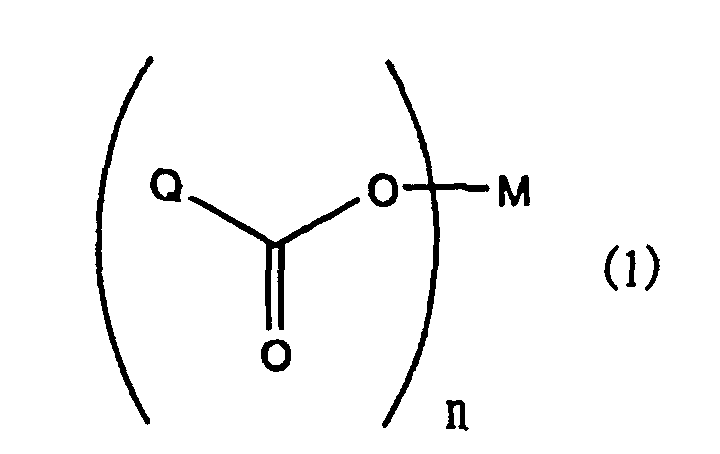
- a process for producing a (dioxolenon-4-yl)methyl ester derivative of formula (3) (where Q represents an organic group, and R 1 and R 2 each independently represent a hydrogen atom, an optionally substituted C 1-6 alkyl group or an optionally substituted phenyl group, provided that R 1 and R 2 may combine to form an optionally substituted ring having 3-8 carbon atoms) by reacting a carboxylic acid of formula (1) (where Q has the same meaning as defined above, M represents a hydrogen atom, an alkali metal, an alkaline earth metal or a transition metal, and n represents the atomic valency of M) with a 4-chloromethyldioxolenone compound of formula (2) (where R 1 and R 2 have the same meanings as defined above) in a solvent in the presence of both a phase transfer catalyst and a metal iodide.
- Q represents an organic group
- R 1 and R 2 each independently represent a hydrogen atom, an optionally substituted C 1-6
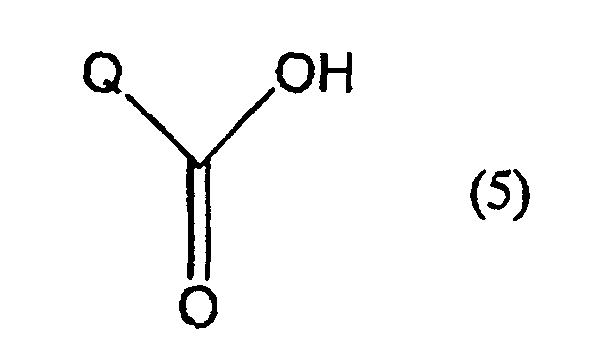
- a process for producing a (dioxolenon-4-yl)methyl ester derivative of formula (3) (where Q represents an organic group, and R 1 and R 2 each independently represent a hydrogen atom, an optionally substituted C 1-6 alkyl group or an optionally substituted phenyl group, provided that R 1 and R 2 may combine to form an optionally substituted ring having 3-8 carbon atoms) by reacting a carboxylic acid of formula (5) (where Q has the same meaning as defined above) with a 4-chloromethyldioxolenone compound of formula (2) (where R 1 and R 2 have the same meanings as defined above) in a solvent in the presence of both a quaternary ammonium hydroxide of the formula: R a R b R c R d NOH (where R a -R d each independently represent a C 7-20 alkyl group or a C 7-20 aralkyl group) and a metal io
- a polar solvent is preferably used as said solvent.
- said metal iodide is preferably used in an amount of 5-20 mol% of the 4-chloromethyldioxolenone compound of said formula (2) and it is also preferred to use an alkali metal iodide as said metal iodide.
- a quaternary ammonium salt is preferably used as said phase transfer catalyst and it is more preferred to use a benzyltrialkylammonium halide.
- the invention can be applied with particular preference in a case of producing a compound among the (dioxolenon-4-yl)methyl ester derivatives of said formula (3) in which said Q is a fused heterocyclic group having a ⁇ -lactam ring.
- a base is further added at least in an amount corresponding to the amount of acidic impurities contained in the 4-chloromethyldioxolenone compound used which is represented by said formula (2).
- the reaction is performed by elevating the reaction temperature through a plurality of stages, and more preferably the reaction is performed by elevating the reaction temperature in two stages, the first stage at 40°C or below and the second stage at 50°C or above.
- the 4-chloromethyldioxolenone compound which features comparatively high chemical stability and easy availability is used, and it is characterized by adding a phase transfer catalyst and a metal iodide to the reaction system.
- the carboxyl group can be converted to a (dioxolenon-4-yl)methyl ester in a simple way and at high yield.
- the invention provides a process for producing the (dioxolenon-4-yl)methyl ester compound of formula (3) by reacting the carboxylic acid of formula (1) with the compound of formula (2) in a solvent in the presence of both a metal iodide and a phase transfer catalyst as depicted in the following reaction scheme:
- Q represents an organic group.
- organic group means a functional group composed of several constituent elements including carbon atoms. Specific examples include: C 1-6 alkyl groups such as methyl, ethyl, n-propyl, isopropoyl, n-butyl, sec-butyl, t-butyl, n-pentyl and n-hexyl groups that may optionally be substituted by G 1 ; C 2-6 alkenyl groups such as ethenyl, n-propenyl, isopropenyl, n-butenyl, sec-butenyl, t-butenyl, n-pentenyl and n-hexenyl groups that may optionally be substituted by G 1 ; C 2-6 alkynyl groups such as ethynyl, n-propynyl, isopropynyl, n-butynyl, sec-butynyl,
- Said heterocyclic groups that may optionally be substituted by G 1 may be monocyclic or fused.
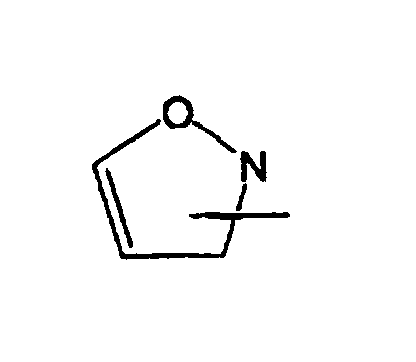
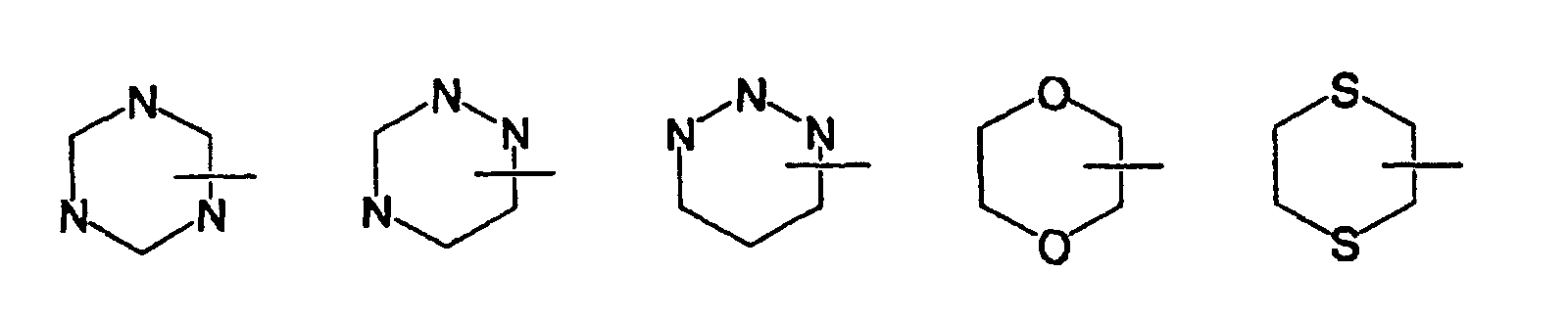
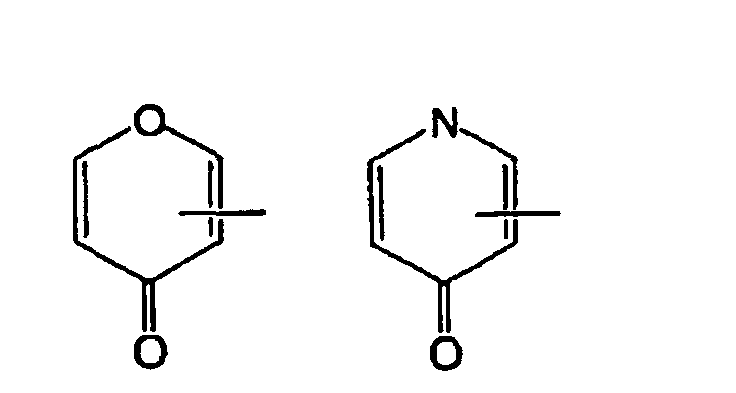
- monocyclic heterocyclic groups include (A) 5-membered saturated heterocyclic groups, (B) 5-membered unsaturated heterocyclic groups, (C) 6-membered saturated heterocyclic groups and (D) 6-membered unsaturated heterocyclic groups, as listed below.
- fused heterocyclic groups include the following fused heterocyclic groups having a ⁇ -lactam ring which provide a base skeleton for ⁇ -lactam antimicrobial agents: (where r 1 and r 4 represent a 1-hydroxyethyl group or an optionally substituted benzoylamino group; r 2 , r 5 , r 6 , r 7 and r 8 each independently represent hydrogen or C 1-6 alkyl groups such as methyl, ethyl, n-propyl, isopropyl, n-butyl, sec-butyl, t-butyl, n-pentyl and n-hexyl groups that may optionally be substituted by G 1 ; C 2-6 alkenyl groups such as ethenyl, n-propenyl, isopropenyl, n-butenyl, sec-butenyl, t-butenyl, n-pentenyl and n-hex
- G 1 represents the following: a nitro group; a cyano group; halogen atoms such as fluorine, chlorine, bromine and iodine; C 1-6 alkoxy groups such as methoxy, ethoxy, n-propoxy, isopropoxy, n-butoxy, secbutoxy and t-butoxy groups; C 1-6 alkylthio groups such as methylthio, ethylthio, n-propylthio, isopropylthio, n-butylthio, sec-butylthio and t-butylthio groups; C 1-6 alkylsulfinyl groups such as methylsulfinyl, ethylsulfinyl, n-propylsulfinyl, isopropylsulfinyl, n-butylsulfinyl, sec-butylsulfinyl and t-butylsulfin
- G 2 represents the following: halogen atoms such as fluorine, chlorine and bromine; C 1-6 alkyl groups such as methyl, ethyl, n-propyl, isopropyl, n-butyl, sec-butyl and t-butyl groups; C 1-6 haloalkyl groups such as trifluoromethyl, 2,2,2-trifluoroethyl and pentafluoroethyl groups; or C 1-6 haloalkoxy groups such as trifluoromethoxy, 2,2,2-trifluoroethoxy and pentafluoroethoxy groups.
- halogen atoms such as fluorine, chlorine and bromine
- C 1-6 alkyl groups such as methyl, ethyl, n-propyl, isopropyl, n-butyl, sec-butyl and t-butyl groups
- C 1-6 haloalkyl groups such as trifluoromethyl, 2,2,2-tri
- M typically represents the following: a hydrogen atom; alkali metals such as lithium, sodium and potassium; alkaline earth metals such as magnesium and calcium; or transition metals such as copper(I), copper(II), cobalt(II), cobalt(III), iron(II), iron(III), zinc(II) and manganese(II).
- carboxylic acids represented by formula (1) those compounds wherein Q is a heterocyclic group having a ⁇ -lactam ring have the ⁇ -lactam ring and asymmetric carbon atoms in the molecule, so racemization and decomposition reactions may potentially occur if conversion to (dioxolenon-4-yl)methyl ester is effected under hostile reaction conditions.
- reactions can be caused to proceed under extremely mild conditions, so it can be applied with particular preference to the manufacture of ⁇ -lactam antimicrobial agents having a (dioxolenon-4-yl)methyl ester moiety.
- R 1 and R 2 each independently represent a hydrogen atom, an optionally substituted C 1-6 alkyl group such as a methyl, ethyl, n-propyl, isopropyl, n-butyl, sec-butyl, t-butyl, n-pentyl or n-hexyl group, or an optionally substituted phenyl group.
- Examples of the substituent on said C 1-6 alkyl group and phenyl group include the following: a nitro group; a cyano group; a halogen atom such as fluorine, chlorine, bromine or iodine; C 1-6 alkoxy groups such as methoxy, ethoxy, n-propoxy, isopropoxy, n-butoxy and t-butoxy groups; C 1-6 alkylthio groups such as methylthio, ethylthio, n-propylthio, isopropylthio, n-butylthio and t-butylthio groups; C 1-6 alkylsulfinyl groups such as methylsulfinyl and ethylsulfinyl groups; C 1-6 alkylsulfonyl groups such as methylsulfonyl, ethylsulfonyl, n-propylsulfonyl, isopropyl
- G 3 examples include: halogen atoms such as fluorine, chlorine and bromine; C 1-6 alkyl groups such as methyl and ethyl groups; C 1-6 haloalkyl groups such as a trifluoromethyl group; and C 1-6 haloalkoxy groups such as a trifluoromethoxy group.
- halogen atoms such as fluorine, chlorine and bromine
- C 1-6 alkyl groups such as methyl and ethyl groups
- C 1-6 haloalkyl groups such as a trifluoromethyl group
- C 1-6 haloalkoxy groups such as a trifluoromethoxy group.
- R 1 and R 2 may combine to form an optionally substituted ring having 3-8 carbon atoms.
- the ring having 3-8 carbon atoms include cyclopentene, cyclohexene, cycloheptene and cyclooctene.
- substituents on said ring include: C 1-6 alkyl groups such as methyl and ethyl groups; C 1-6 alkoxy groups such as methoxy, ethoxy, n-propoxy, isopropoxy, n-butoxy and t-butoxy groups; halogen atoms such as fluorine and chlorine; C 1-6 alkylthio groups such as methylthio and ethylthio groups; substituted amino groups such as dimethylamino and acetylamino groups; a nitro group; and a cyano group.
- Said ring may have identical or different substituents in any positions.
- a hydrogen atom or a methyl group is particularly preferred as R 1 and R 2 .
- dioxolenone compounds of the aforementioned formula (2) can be produced and made available, typically by the method described in USP 4,448,732.
- the 4-chloromethyldioxolenone compound represented by said formula (2) is typically used in an amount of 1 mole to 10 moles, preferably in a range of 1 mole to 5 moles, per mole of the compound of formula (1).
- Metal iodides are employed in the present invention. They are added in order to ensure that reactions proceed smoothly.
- Exemplary metal iodides that can be employed in the reaction include: alkali metal iodides such as potassium iodide and sodium iodide; alkaline earth metal iodides such as magnesium iodide and calcium iodide; iodine salts of quaternary ammonium such as tetramethylammonium iodide, tetraethylammonium iodide, tetrapropylammonium iodide, tetrabutylammonium iodide, triethylmethylammonium iodide, benzyltrimethylammonium iodide and benzyl-tri-n-butylammonium iodide.
- alkali metal iodides such as potassium iodide and sodium iodide
- alkaline earth metal iodides such as magnesium iodide and calcium iodide
- alkali metal iodides are preferred from the viewpoints of easy availability, production cost, and high yield at which the desired product can be obtained.
- the iodides are typically used in amounts of 0.1 to 40 mol%, preferably in the range of 5-20 mol%, relative to the compound of formula (1).
- phase transfer catalyst is employed in addition to said metal iodide.
- a phase transfer catalyst is added to ensure smooth progress of the reaction.
- quaternary ammonium salts include: tetraalkylammonium chlorides such as tetramethylammonium chloride, tetraethylammonium chloride, tetrapropylammonium, chloride and tetrabutylammonium chloride (TBAC); tetraalkylammonioum bromides such as tetramethylammonium bromide, tetraethylammonium bromide, tetrapropylammonium bromide and tetrabutylammonium bromide; benzyltrialkylammonium halides such as benzyltrimethylammonium chloride, benzyltrimethylammonium bromide, benzyl-tri-n-butylammonium chloride (BTBAC) and benzyl-tri
- Exemplary phosphonium salts include phosphonium chloride, phosphonium bromide, trimethylphosphonium chloride, triethylphosphonium bromide, tetramethylphosphonium chloride, tetramethylphosphonium bromide and phosphonium iodide.
- Exemplary crown ethers include 18-crown-6.
- quaternary ammonium salts is preferred from the viewpoints of easy availability, and high yield at which the desired product can be obtained.
- the use of tetraalkylammonium halides and benzyltrialkylammonium halides is more preferred, with the use of benzyltrialkylammonium halides being particularly preferred.
- phase transfer catalyst is typically employed in amounts ranging from 0.0001 mole to 1 mole per mole of the compound of formula (1).
- the solvents to be used in the invention are preferably those which can dissolve salts of the compound of said formula (1) as well as the reaction product, and examples are ether-, halogen-, nitrile-, amide-, ketone-, alcohol- and ester-based solvents.
- ether-based solvents such as diethyl ether, tetrahydrofuran (THF), 1,2-diomethoxyethane and 1,4-dioxane
- halogen-based solvents such as dichloromethane, chloroform, trichloromethane, carbon tetrachloride and 1,2-dichloroethane
- nitrile-based solvents such as acetonitrile and benzonitrile
- phosphoric amide-based solvents such as hexamethylphosphoric triamide
- amide-based solvents such as N,N-dimethylformamide (DMF), N,N-dimethylacetamide, 1,3-dimethylimidazolidine, 1,3-dimethyl-2-imidazolidinone and N-methylpyrrolidone
- ketone-based solvents such as acetone, methyl ethyl ketone, methyl isobutyl ketone and cyclohexanone
- the use of polar organic solvents is preferred since upon addition of water, the reaction mixture separates into layers, making it possible to wash the reaction mixture with water; the use of THF, DMF, DMSO or acetone is more preferred, and the use of THF is particularly preferred.
- a base is preferably added to the reaction system.
- useful bases include: alkali metal hydroxides such as sodium hydroxide and potassium hydroxide; alkaline earth metal hydroxides such as magnesium hydroxide and calcium hydroxide; alkali metal carbonates such as sodium carbonate and potassium carbonate; alkali metal hydrogencarbonates such as sodium hydrogencarbonate and potassium hydrogencarbonate; alkaline earth metal carbonates such as magnesium carbonate and calcium carbonate; metal hydrides such as sodium hydride and calcium hydride; metal alkoxides such as sodium methoxide, sodium ethoxide, potassium t-butoxide, magnesium methoxide and magnesium ethoxide; organic bases such as triethylamine, diisopropylethylamine, pyridine, 1,4-diazabicyclo[2,2,2]octane, 4-dimethylaminopyr
- R a R b R c R d NOH is particularly preferred since they serve the role of the base and the phase transfer catalyst.
- R a -R d each independently represent C 1-20 alkyl groups such as methyl, ethyl, n-propyl, isopropyl, n-butyl, isobutyl, sec-butyl, t-butyl, n-pentyl, neopentyl, n-hexyl, n-heptyl, n-octyl, n-nonyl, n-decyl, n-dodecyl and n-cetyl groups; or C 7-20 aralkyl groups such as benzyl, 3-chlorobenzyl, 4-methylbenzyl, 2-methoxybenzyl, ⁇ -methylbenzyl, 2-phenylethyl, 3-phenylpropyl and 4-phenyl-n-butyl groups.
- R a R b R c R d NOH examples include: tetraalkylammonium hydroxides such as tetramethylammonium hydroxide, tetraethylammonium hydroxide, tetrapropylammonium hydroxide and tetrabutylammonium hydroxide; benzyltrialkyl hydroxides such as benzyltrimethylammonium hydroxide, benzyltrimethylammonium hydroxide, benzyltri-n-butyloammonium hydroxide and benzyltri-n-butyloammonium hydroxide.
- the base is used typically in amounts ranging from 1 mole to 3 moles per mole of the compound of formula (1).
- the 4-chloromethyldioxolenone compound represented by said formula (2) is relatively stable compared to the 4-bromomethyldioxolenone compound but if it is used industrially in large volumes, part of it will decompose, sometimes coming to contain acidic impurities. Therefore, in the present invention, in order to neutralize the acidic impurities contained in the 4-chloromethyldioxolenone compound represented by said formula (2) which is used in the reaction, it is preferred to further add a base to the reaction mixture at least in an amount corresponding to the amount of said acidic impurities.
- Exemplary bases that can be used here include: alkali metal hydroxides such as sodium hydroxide and potassium hydroxide; alkaline earth metal hydroxides such as magnesium hydroxide and calcium hydroxide; alkali metal carbonates such as sodium carbonate and potassium carbonate; alkaline earth metal carbonates such as magnesium carbonate and calcium carbonate; hydrogencarbonates such as sodium hydrogencarbonate and potassium hydrogencarbonate; organic bases such as triethylamine and pyridine.
- reaction temperature for use in the production method of the invention is not limited to any particular value as long as it is within the temperature range where the compounds of formulas (1) and (2) or the compound of formula (3), which is the product, will not be decomposed in the reaction system using the above-mentioned reagents.
- a typical reaction temperature is 80°C or less and it is preferred to perform the reaction at 60°C or less.
- the reaction temperature is set on the higher side of the above-mentioned temperature range in consideration of the reaction efficiency, the progress of esterification is sometimes accompanied by simultaneous formation of by-products as the result of reaction at those other reaction points.
- the reaction is first performed for a given time at low temperature, which is later elevated to a higher temperature where the reaction is further carried out for a certain period of time, whereby the reaction efficiency can be enhanced while suppressing the generation of by-products.
- the reaction temperature is elevated in two stages, the first stage being at 40°C or less and the second stage at 50°C or more.
- Q in formula (1) is a fused heterocyclic group having a ⁇ -lactam ring which is the basic skeleton of ⁇ -lactam antimicrobial agents
- the reaction temperature is preferably controlled as described above.
- the desired product can be obtained by performing isolation and purification in accordance with ordinary techniques in organic synthetic chemistry.
- the structure of the desired product can be determined by, for example, measuring various spectrums including 1 H-NMR, IR and MASS spectrums.
- the obtained mixture was subjected to quantitative analysis by liquid chromatography using acetophenone as an internal standard material; the end product was obtained in a yield of 99.11%.
- the solvent was distilled off under reduced pressure to obtain a mixture of the desired product and impurities.
- the obtained mixture was subjected to quantitative analysis by liquid chromatography using acetophenone as an internal standard material; the desired product was obtained in a yield of 94.2%.
- reaction mixture was filtered to separate the inorganic salts insoluble in THF and the filtrate was concentrated under reduced pressure to obtain a mixture of the desired product and impurities.
- the obtained mixture was subjected to quantitative analysis by liquid chromatography using acetophenone as an internal standard material; the desired product was obtained in a yield of 36.7%.
- (dioxolenon-4-yl)methyl ester derivatives can be produced at low cost, in a simple manner, and at high yield.
- the production process of the invention can be performed under comparatively mild reaction conditions and post-treatments after the end of the reaction are simple to perform. Therefore, the present invention can be applied advantageously to the case where compounds such as ⁇ -lactam antimicrobial agents that contain asymmetric carbons in the molecule are manufactured at an industrial production scale.
Landscapes
- Chemical & Material Sciences (AREA)
- Organic Chemistry (AREA)
- Organic Low-Molecular-Weight Compounds And Preparation Thereof (AREA)
- Catalysts (AREA)
Abstract

Description
- This invention relates to a process by which (dioxolenon-4-yl)methyl ester derivatives useful as medicines, agrichemicals, etc. can be produced in industrial scale advantageously.
- Heretofore, compounds represented by formula (4)(where R' represents a hydrogen atom or an optionally substituted alkyl group, etc., and X' represents a halogen atom) have commonly been used as the starting material in a process by which compounds having a carboxyl group in the molecule (hereunder referred to as "carboxylic acids") are treated to have the carboxyl group converted to a (dioxolenon-4-yl)methyl ester.

- An exemplary method currently known to be used in converting the carboxyl group in carboxylic acids to a (dioxolenon-4-yl)methyl ester is by employing 4-bromomethyl-5-methyldioxolenone as set forth below (see, for example, USP 4,448,732):

- Using the highly reactive 4-bromomethyldioxolenone compound, the method produces the desired compound in comparatively high yield. However, this approach of using the 4-bromomethyl compound is not very advantageous for industrial mass production since the 4-bromomethyldioxolenone compound has poor chemical stability and is comparatively high in cost.
- On the other hand, a 4-chloromethyldioxolenone compound is known to be more chemically stable than the 4-bromomethyldioxolenone compound and also easy to obtain. However, even if this compound is subjected to reaction under the same conditions as when the 4-bromomethyldioxolenone compound is reacted, efficient conversion to a (dioxolenon-4-yl)methyl ester cannot be realized.
- The present invention has been accomplished under these circumstances and has as an object providing a process by which various compounds having a carboxyl group in the molecule can be treated to have the carboxyl group converted to a (dioxolenon-4-yl)methyl ester in a simple way and at high yield using the 4-chloromethyldioxolenone compound.
- To attain the stated object, the present inventors conducted intensive studies and found that the reaction for conversion to a (dioxolenon-4-yl)methyl ester proceeded efficiently by reacting a carboxylic acid of formula (1) with a 4-chloromethyldioxolenone compound of formula (2) in a suitable solvent in the presence of both a phase transfer catalyst and a metal iodide. The present invention has been accomplished on the basis of this finding.
- Thus, according to a first aspect of the invention, there is provided a process for producing a (dioxolenon-4-yl)methyl ester derivative of formula (3)(where Q represents an organic group, and R1 and R2 each independently represent a hydrogen atom, an optionally substituted C1-6 alkyl group or an optionally substituted phenyl group, provided that R1 and R2 may combine to form an optionally substituted ring having 3-8 carbon atoms) by reacting a carboxylic acid of formula (1)
 (where Q has the same meaning as defined above, M represents a hydrogen atom, an alkali metal, an alkaline earth metal or a transition metal, and n represents the atomic valency of M) with a 4-chloromethyldioxolenone compound of formula (2)
 (where R1 and R2 have the same meanings as defined above) in a solvent in the presence of both a phase transfer catalyst and a metal iodide.
- According to a second aspect of the invention, there is provided a process for producing a (dioxolenon-4-yl)methyl ester derivative of formula (3)(where Q represents an organic group, and R1 and R2 each independently represent a hydrogen atom, an optionally substituted C1-6 alkyl group or an optionally substituted phenyl group, provided that R1 and R2 may combine to form an optionally substituted ring having 3-8 carbon atoms) by reacting a carboxylic acid of formula (5)
 (where Q has the same meaning as defined above) with a 4-chloromethyldioxolenone compound of formula (2)
 (where R1 and R2 have the same meanings as defined above) in a solvent in the presence of both a quaternary ammonium hydroxide of the formula: RaRbRcRdNOH (where Ra-Rd each independently represent a C7-20 alkyl group or a C7-20 aralkyl group) and a metal iodide.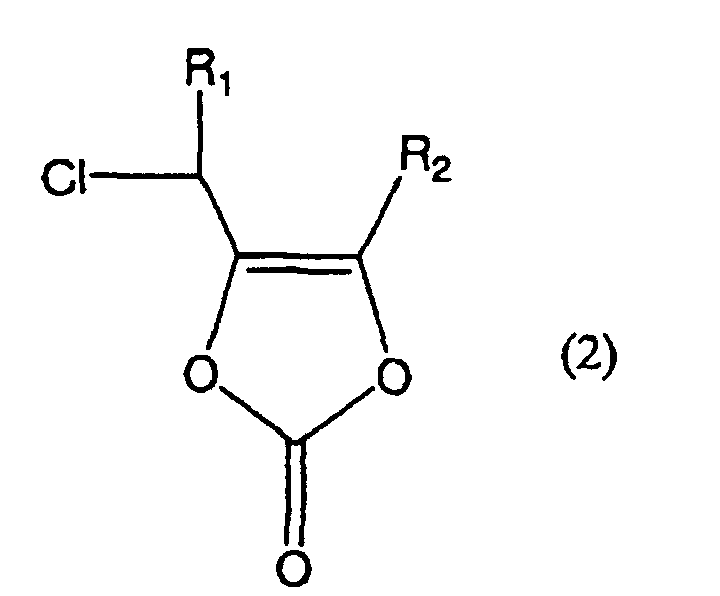
- In the invention, a polar solvent is preferably used as said solvent.
- In the invention, said metal iodide is preferably used in an amount of 5-20 mol% of the 4-chloromethyldioxolenone compound of said formula (2) and it is also preferred to use an alkali metal iodide as said metal iodide.
- Further in the invention, a quaternary ammonium salt is preferably used as said phase transfer catalyst and it is more preferred to use a benzyltrialkylammonium halide.
- The invention can be applied with particular preference in a case of producing a compound among the (dioxolenon-4-yl)methyl ester derivatives of said formula (3) in which said Q is a fused heterocyclic group having a β-lactam ring.
- It is also preferred in the invention that a base is further added at least in an amount corresponding to the amount of acidic impurities contained in the 4-chloromethyldioxolenone compound used which is represented by said formula (2).
- It is also preferred in the invention that the reaction is performed by elevating the reaction temperature through a plurality of stages, and more preferably the reaction is performed by elevating the reaction temperature in two stages, the first stage at 40°C or below and the second stage at 50°C or above.
- In the invention, the 4-chloromethyldioxolenone compound which features comparatively high chemical stability and easy availability is used, and it is characterized by adding a phase transfer catalyst and a metal iodide to the reaction system. According to the invention, the carboxyl group can be converted to a (dioxolenon-4-yl)methyl ester in a simple way and at high yield.
- The present invention will now be described below in detail.
- The invention provides a process for producing the (dioxolenon-4-yl)methyl ester compound of formula (3) by reacting the carboxylic acid of formula (1) with the compound of formula (2) in a solvent in the presence of both a metal iodide and a phase transfer catalyst as depicted in the following reaction scheme:

- In formula (1), Q represents an organic group. The term "organic group" means a functional group composed of several constituent elements including carbon atoms. Specific examples include: C1-6 alkyl groups such as methyl, ethyl, n-propyl, isopropoyl, n-butyl, sec-butyl, t-butyl, n-pentyl and n-hexyl groups that may optionally be substituted by G1; C2-6 alkenyl groups such as ethenyl, n-propenyl, isopropenyl, n-butenyl, sec-butenyl, t-butenyl, n-pentenyl and n-hexenyl groups that may optionally be substituted by G1; C2-6 alkynyl groups such as ethynyl, n-propynyl, isopropynyl, n-butynyl, sec-butynyl, t-butynyl, n-pentynyl and n-hexynyl groups that may optionally be substituted by G1; a phenyl group that may optionally be substituted by G1; naphthyl groups such as α-naphthyl and β-naphthyl groups that may optionally be substituted by G1; aralkyl groups such as benzyl, 2-phenylethyl, α-methylbenzyl and 3-phenylpropyl groups that may optionally be substituted by G1; and heterocyclic groups that may optionally be substituted by G1.
- Said heterocyclic groups that may optionally be substituted by G1 may be monocyclic or fused. Specific examples of monocyclic heterocyclic groups include (A) 5-membered saturated heterocyclic groups, (B) 5-membered unsaturated heterocyclic groups, (C) 6-membered saturated heterocyclic groups and (D) 6-membered unsaturated heterocyclic groups, as listed below.
-


-





-


-


- Exemplary fused heterocyclic groups include the following fused heterocyclic groups having a β-lactam ring which provide a base skeleton for β-lactam antimicrobial agents:


 (where r1 and r4 represent a 1-hydroxyethyl group or an optionally substituted benzoylamino group; r2, r5, r6, r7 and r8 each independently represent hydrogen or C1-6 alkyl groups such as methyl, ethyl, n-propyl, isopropyl, n-butyl, sec-butyl, t-butyl, n-pentyl and n-hexyl groups that may optionally be substituted by G1; C2-6 alkenyl groups such as ethenyl, n-propenyl, isopropenyl, n-butenyl, sec-butenyl, t-butenyl, n-pentenyl and n-hexenyl groups that may optionally be substituted by G1; C2-6 alkynyl groups such as ethynyl, n-propynyl, isopropynyl, n-butynyl, sec-butynyl, t-butynyl, n-pentynyl and n-hexynyl groups that may optionally be substituted by G1; tetrahydrofuranyl and heterocyclic groups that may optionally be substituted by G1);
quinolinyl groups such as quinolin-2-yl, quinolin-3-yl, quinolin-4-yl, quinolin-5-yl, quinolin-6-yl, quinolin-7-yl and quinolin-8-yl groups;
isoquinolinyl groups such as isoquinolin-2-yl, isoquinolin-3-yl, isoquinolin-4-yl, isoquinolin-5-yl, isoquinolin-6-yl, isoquinolin-7-yl and isoquinolin-8-yl grouops. - In addition, G1 represents the following: a nitro group; a cyano group; halogen atoms such as fluorine, chlorine, bromine and iodine; C1-6 alkoxy groups such as methoxy, ethoxy, n-propoxy, isopropoxy, n-butoxy, secbutoxy and t-butoxy groups; C1-6 alkylthio groups such as methylthio, ethylthio, n-propylthio, isopropylthio, n-butylthio, sec-butylthio and t-butylthio groups; C1-6 alkylsulfinyl groups such as methylsulfinyl, ethylsulfinyl, n-propylsulfinyl, isopropylsulfinyl, n-butylsulfinyl, sec-butylsulfinyl and t-butylsulfinyl groups; C1-6 alkylsulfonyl groups such as methylsulfonyl, ethylsulfonyl, n-propylsulfonyl, isopropylsulfonyl, n-butylsulfonyl, sec-butylsulfonyl and t-butylsulfonyl groups; C1-6 alkylamino groups such as methylamino, ethylamino and n-propylamino groups; di-C1-6 alkylamino groups such as dimethylamino, diethylamino, dipropylamino, ethylmethylamino and methylpropylamino groups; C1-6 alkylcarbonyl groups such as acetyl and propionyl groups; C1-6 alkoxycarbonyl groups such as methoxycarbonyl, ethoxycarbonyl, n-propoxycarbonyl, isopropoxycarbonyl, n-butoxycarbonyl and t-butoxycarbonyl groups; an optionally G2 substituted phenylsulfinyl group; an optionally G2 substituted phenylsulfonyl group; or an optionally G2 substituted phenylthio group.
- G2 represents the following: halogen atoms such as fluorine, chlorine and bromine; C1-6 alkyl groups such as methyl, ethyl, n-propyl, isopropyl, n-butyl, sec-butyl and t-butyl groups; C1-6 haloalkyl groups such as trifluoromethyl, 2,2,2-trifluoroethyl and pentafluoroethyl groups; or C1-6 haloalkoxy groups such as trifluoromethoxy, 2,2,2-trifluoroethoxy and pentafluoroethoxy groups.
- M typically represents the following: a hydrogen atom; alkali metals such as lithium, sodium and potassium; alkaline earth metals such as magnesium and calcium; or transition metals such as copper(I), copper(II), cobalt(II), cobalt(III), iron(II), iron(III), zinc(II) and manganese(II).
- Among the carboxylic acids represented by formula (1), those compounds wherein Q is a heterocyclic group having a β-lactam ring have the β-lactam ring and asymmetric carbon atoms in the molecule, so racemization and decomposition reactions may potentially occur if conversion to (dioxolenon-4-yl)methyl ester is effected under hostile reaction conditions.
- According to the invention, reactions can be caused to proceed under extremely mild conditions, so it can be applied with particular preference to the manufacture of β-lactam antimicrobial agents having a (dioxolenon-4-yl)methyl ester moiety.
- Many of the compounds represented by said formula (1) are known substances and can be produced and made available by known methods.
- In said formula (2), R1 and R2 each independently represent a hydrogen atom, an optionally substituted C1-6 alkyl group such as a methyl, ethyl, n-propyl, isopropyl, n-butyl, sec-butyl, t-butyl, n-pentyl or n-hexyl group, or an optionally substituted phenyl group.
- Examples of the substituent on said C1-6 alkyl group and phenyl group include the following: a nitro group; a cyano group; a halogen atom such as fluorine, chlorine, bromine or iodine; C1-6 alkoxy groups such as methoxy, ethoxy, n-propoxy, isopropoxy, n-butoxy and t-butoxy groups; C1-6 alkylthio groups such as methylthio, ethylthio, n-propylthio, isopropylthio, n-butylthio and t-butylthio groups; C1-6 alkylsulfinyl groups such as methylsulfinyl and ethylsulfinyl groups; C1-6 alkylsulfonyl groups such as methylsulfonyl, ethylsulfonyl, n-propylsulfonyl, isopropylsulfonyl, n-butylsulfonyl and t-butylsulfonyl groups; C1-6 alkylamino groups such as methylamino, ethylamino and n-propylamino groups; di-C1-6 alkylamino groups such as dimethylamino and diethylamino groups; C1-6 alkylcarbonyl groups such as acetyl and propionyl groups; C1-6 alkoxycarbonyl groups such as methoxycarbonyl and ethoxycarbonyl groups; an optionally G3 substituted phenylsulfinyl group, an optionally G3 substituted phenylsulfonyl group and an optionally G3 substituted phenylthio group.
- Examples of said G3 include: halogen atoms such as fluorine, chlorine and bromine; C1-6 alkyl groups such as methyl and ethyl groups; C1-6 haloalkyl groups such as a trifluoromethyl group; and C1-6 haloalkoxy groups such as a trifluoromethoxy group.
- If desired, R1 and R2 may combine to form an optionally substituted ring having 3-8 carbon atoms. Examples of the ring having 3-8 carbon atoms include cyclopentene, cyclohexene, cycloheptene and cyclooctene. Exemplary substituents on said ring include: C1-6 alkyl groups such as methyl and ethyl groups; C1-6 alkoxy groups such as methoxy, ethoxy, n-propoxy, isopropoxy, n-butoxy and t-butoxy groups; halogen atoms such as fluorine and chlorine;
C1-6 alkylthio groups such as methylthio and ethylthio groups; substituted amino groups such as dimethylamino and acetylamino groups; a nitro group; and a cyano group. Said ring may have identical or different substituents in any positions. - Among the atoms or groups mentioned above, a hydrogen atom or a methyl group is particularly preferred as R1 and R2.
- The following are preferred specific examples of the dioxolenone compound represented by said formula (2):


- The dioxolenone compounds of the aforementioned formula (2) can be produced and made available, typically by the method described in USP 4,448,732.
- The 4-chloromethyldioxolenone compound represented by said formula (2) is typically used in an amount of 1 mole to 10 moles, preferably in a range of 1 mole to 5 moles, per mole of the compound of formula (1).
- Metal iodides are employed in the present invention. They are added in order to ensure that reactions proceed smoothly.
- Exemplary metal iodides that can be employed in the reaction include: alkali metal iodides such as potassium iodide and sodium iodide; alkaline earth metal iodides such as magnesium iodide and calcium iodide; iodine salts of quaternary ammonium such as tetramethylammonium iodide, tetraethylammonium iodide, tetrapropylammonium iodide, tetrabutylammonium iodide, triethylmethylammonium iodide, benzyltrimethylammonium iodide and benzyl-tri-n-butylammonium iodide. These iodides may be used either alone or in admixture of two or more kinds as exemplified by potassium iodide/iodine and sodium iodide/iodine.
- Among those, the use of alkali metal iodides is preferred from the viewpoints of easy availability, production cost, and high yield at which the desired product can be obtained.
- The iodides are typically used in amounts of 0.1 to 40 mol%, preferably in the range of 5-20 mol%, relative to the compound of formula (1).
- In the present invention, a phase transfer catalyst is employed in addition to said metal iodide. A phase transfer catalyst is added to ensure smooth progress of the reaction.
- As the phase transfer catalyst, quaternary ammonium salts, phosphonium salts, crown ethers and so forth are employed. Exemplary quaternary ammonium salts include: tetraalkylammonium chlorides such as tetramethylammonium chloride, tetraethylammonium chloride, tetrapropylammonium, chloride and tetrabutylammonium chloride (TBAC); tetraalkylammonioum bromides such as tetramethylammonium bromide, tetraethylammonium bromide, tetrapropylammonium bromide and tetrabutylammonium bromide; benzyltrialkylammonium halides such as benzyltrimethylammonium chloride, benzyltrimethylammonium bromide, benzyl-tri-n-butylammonium chloride (BTBAC) and benzyl-tri-n-butylammonium bromide; cetyltrialkylammonium halides such as cetyltrimethylammonium chloride, cetyltrimethylammonium bromide, cetyltriethylammonium chloride and cetyltriethylammonium bromide; tetraalkylammonium hydroxides such as tetramethylammonium hydroxide, tetraethylammonium hydroxide, tetrapropylammonium hydroxide and tetrabutylammonium hydroxide; and benzyltrialkylammonium hydroxides such as benzyltrimethylammonium hydroxide, benayltrimethylammonium hydroxide, benzyltri-n-butylammonium hydroxide and benzyl-tri-n-butylammonium hydroxide.
- Exemplary phosphonium salts include phosphonium chloride, phosphonium bromide, trimethylphosphonium chloride, triethylphosphonium bromide, tetramethylphosphonium chloride, tetramethylphosphonium bromide and phosphonium iodide.
- Exemplary crown ethers include 18-crown-6.
- Among those, the use of quaternary ammonium salts is preferred from the viewpoints of easy availability, and high yield at which the desired product can be obtained. The use of tetraalkylammonium halides and benzyltrialkylammonium halides is more preferred, with the use of benzyltrialkylammonium halides being particularly preferred.
- The phase transfer catalyst is typically employed in amounts ranging from 0.0001 mole to 1 mole per mole of the compound of formula (1).
- The solvents to be used in the invention are preferably those which can dissolve salts of the compound of said formula (1) as well as the reaction product, and examples are ether-, halogen-, nitrile-, amide-, ketone-, alcohol- and ester-based solvents.
- Specific examples include: ether-based solvents such as diethyl ether, tetrahydrofuran (THF), 1,2-diomethoxyethane and 1,4-dioxane; halogen-based solvents such as dichloromethane, chloroform, trichloromethane, carbon tetrachloride and 1,2-dichloroethane; nitrile-based solvents such as acetonitrile and benzonitrile; phosphoric amide-based solvents such as hexamethylphosphoric triamide; amide-based solvents such as N,N-dimethylformamide (DMF), N,N-dimethylacetamide, 1,3-dimethylimidazolidine, 1,3-dimethyl-2-imidazolidinone and N-methylpyrrolidone; ketone-based solvents such as acetone, methyl ethyl ketone, methyl isobutyl ketone and cyclohexanone; alcohol-based solvents such as methanol, ethanol, n-propanol and isopropanol; ester-based solvents such as methyl acetate, ethyl acetate and n-propyl acetate; polar solvents such as dimethyl sulfoxide (DMSO) and water. These solvents can be used either alone or in admixture of two or more kinds.
- Among these, the use of polar organic solvents is preferred since upon addition of water, the reaction mixture separates into layers, making it possible to wash the reaction mixture with water; the use of THF, DMF, DMSO or acetone is more preferred, and the use of THF is particularly preferred.
- In the present invention, if M in said formula (1) is a hydrogen atom (i.e. in the case of a carboxylic acid), a base is preferably added to the reaction system. Examples of useful bases include: alkali metal hydroxides such as sodium hydroxide and potassium hydroxide; alkaline earth metal hydroxides such as magnesium hydroxide and calcium hydroxide; alkali metal carbonates such as sodium carbonate and potassium carbonate; alkali metal hydrogencarbonates such as sodium hydrogencarbonate and potassium hydrogencarbonate; alkaline earth metal carbonates such as magnesium carbonate and calcium carbonate; metal hydrides such as sodium hydride and calcium hydride; metal alkoxides such as sodium methoxide, sodium ethoxide, potassium t-butoxide, magnesium methoxide and magnesium ethoxide; organic bases such as triethylamine, diisopropylethylamine, pyridine, 1,4-diazabicyclo[2,2,2]octane, 4-dimethylaminopyridine, 1,4-diazabicyclo[5,4,0]und-7-ene, n-butyllithium and lithium diisopropylamide; quaternary ammonium hydroxides represented by the formula: RaRbRcRdNOH.
- Among those, the use of quaternary ammonium hydroxides represented by the formula: RaRbRcRdNOH is particularly preferred since they serve the role of the base and the phase transfer catalyst.
- Said Ra-Rd each independently represent C1-20 alkyl groups such as methyl, ethyl, n-propyl, isopropyl, n-butyl, isobutyl, sec-butyl, t-butyl, n-pentyl, neopentyl, n-hexyl, n-heptyl, n-octyl, n-nonyl, n-decyl, n-dodecyl and n-cetyl groups; or C7-20 aralkyl groups such as benzyl, 3-chlorobenzyl, 4-methylbenzyl, 2-methoxybenzyl, α-methylbenzyl, 2-phenylethyl, 3-phenylpropyl and 4-phenyl-n-butyl groups.
- Specific examples of the quaternary ammonium hydroxide represented by said formula: RaRbRcRdNOH include: tetraalkylammonium hydroxides such as tetramethylammonium hydroxide, tetraethylammonium hydroxide, tetrapropylammonium hydroxide and tetrabutylammonium hydroxide; benzyltrialkyl hydroxides such as benzyltrimethylammonium hydroxide, benzyltrimethylammonium hydroxide, benzyltri-n-butyloammonium hydroxide and benzyltri-n-butyloammonium hydroxide.
- The base is used typically in amounts ranging from 1 mole to 3 moles per mole of the compound of formula (1).
- The 4-chloromethyldioxolenone compound represented by said formula (2) is relatively stable compared to the 4-bromomethyldioxolenone compound but if it is used industrially in large volumes, part of it will decompose, sometimes coming to contain acidic impurities. Therefore, in the present invention, in order to neutralize the acidic impurities contained in the 4-chloromethyldioxolenone compound represented by said formula (2) which is used in the reaction, it is preferred to further add a base to the reaction mixture at least in an amount corresponding to the amount of said acidic impurities.
- Exemplary bases that can be used here include: alkali metal hydroxides such as sodium hydroxide and potassium hydroxide; alkaline earth metal hydroxides such as magnesium hydroxide and calcium hydroxide; alkali metal carbonates such as sodium carbonate and potassium carbonate; alkaline earth metal carbonates such as magnesium carbonate and calcium carbonate; hydrogencarbonates such as sodium hydrogencarbonate and potassium hydrogencarbonate; organic bases such as triethylamine and pyridine.
- The reaction temperature for use in the production method of the invention is not limited to any particular value as long as it is within the temperature range where the compounds of formulas (1) and (2) or the compound of formula (3), which is the product, will not be decomposed in the reaction system using the above-mentioned reagents. A typical reaction temperature is 80°C or less and it is preferred to perform the reaction at 60°C or less.
- If the compound of formula (1) has reactive points other than the carboxylic acid residue that react with formula (2) and if the reaction temperature is set on the higher side of the above-mentioned temperature range in consideration of the reaction efficiency, the progress of esterification is sometimes accompanied by simultaneous formation of by-products as the result of reaction at those other reaction points. Considering the drop in the yield of reaction and the increase in the complexity of separation steps due to increased impurities, it is preferable from an industrial point of view to minimize the formation of by-products. Thus, it is preferable to elevate the reaction temperature through a plurality of stages. Specifically, the reaction is first performed for a given time at low temperature, which is later elevated to a higher temperature where the reaction is further carried out for a certain period of time, whereby the reaction efficiency can be enhanced while suppressing the generation of by-products. Stated more specifically, the reaction temperature is elevated in two stages, the first stage being at 40°C or less and the second stage at 50°C or more. Particularly in the case where Q in formula (1) is a fused heterocyclic group having a β-lactam ring which is the basic skeleton of β-lactam antimicrobial agents, the reaction temperature is preferably controlled as described above.
- After the end of the reaction, the desired product can be obtained by performing isolation and purification in accordance with ordinary techniques in organic synthetic chemistry. The structure of the desired product can be determined by, for example, measuring various spectrums including 1H-NMR, IR and MASS spectrums.
- On the pages that follow, the invention is described in greater detail by reference to examples. The invention is by no means limited to the following examples and the kinds of the compounds represented by formulas (1)-(3) and the solvent, as well as the kind of the bases to be used, etc. can be freely changed without departing from the scope and spirit of the invention.
- Note that the sodium salt 2.5 hydrate of (5R,6S)-6-((R)-1-hydroxyethyl)-7-oxo-3-((R)-2-tetrahydrofuryl)-4-thia-1-azabicyclo[3.2.0]hept-2-ene-2-carboxylate which was used as a starting material in the examples and the comparative example that follow was prepared in accordance with the method described in JP 63-162694 A.
- Production of (5-methyl-2-oxo-1,3-dioxolen-4-yl)methyl (5R,6S)-6-((R)-1-hydroxyethyl)-7-oxo-3-((R)-2-tetrahydrofuryl)-4-thia-1-azabicyclo[3.2.0]hept-2-ene-2-carboxylate

- A weight (17.9 g) of sodium salt 2.5 hydrate of (5R,6S)-6-((R)-1-hydroxyethyl)-7-oxo-3-((R)-2-tetrahydrofuryl)-4-thia-1-azabicyclo[3.2.0]hept-2-ene-2-carboxylate (purity: 98.05%), potassium iodide (2.08 g), sodium hydrogencarbonate (0.84 g) and BTBAC (1.56 g) were mixed in THF (150 ml); to the mixture, 17.02 g of 4-chloromethyl-5-methyl-2-oxo-1,3-dioxolene (purity: 93.3%) was added and agitation was effected at 30°C for 2 hours, then at 55°C for 3 hours. After the end of the reaction, the reaction mixture was washed once with 50 ml of water and twice with 50 ml of 20% aqueous sodium chloride adjusted to pH = 8 with sodium hydrogencarbonate; thereafter, the organic layer was concentrated under reduced pressure to give a mixture of the desired product and impurities. The obtained mixture was subjected to quantitative analysis by liquid chromatography using acetophenone as an internal standard material; the end product was obtained in a yield of 99.11%.
- Production of (5-methyl-2-oxo-1,3-dioxolen-4-yl)methyl (5R,6S)-6-((R)-1-hydroxyethyl)-7-oxo-3-((R)-2-tetrahydrofuryl)-4-thia-1-azabicyclo[3.2.0]hept-2-ene-2-carboxylate

- A weight (8.95 g) of sodium salt 2.5 hydrate of (5R,6S)-6-((R)-1-hydroxyethyl)-7-oxo-3-((R)-2-tetrahydrofuryl)-4-thia-1-azabicyclo[3.2.0]hept-2-ene-2-carboxylate (purity: 98.4%), potassium iodide (0.51 g), sodium hydrogencarbonate (0.21 g) and TBAC (0.40 g) were mixed in acetone (25 ml); to the mixture, 4.13 g of 4-chloromethyl-5-methyl-2-oxo-1,3-dioxolene (purity: 97.2%) was added and agitation was effected at 50°C for 4 hours to perform the reaction. After filtering the reaction mixture to separate the inorganic salts insoluble in acetone, the solvent was distilled off under reduced pressure to obtain a mixture of the desired product and impurities. The obtained mixture was subjected to quantitative analysis by liquid chromatography using acetophenone as an internal standard material; the desired product was obtained in a yield of 94.2%.
- Production of (5-methyl-2-oxo-1,3-dioxolen-4-yl)methyl (5R,6S)-6-((R)-1-hydroxyethyl)-7-oxo-3-((R)-2-tetrahydrofuryl)-4-thia-1-azabicyclo[3.2.0]hept-2-ene-2-carboxylate
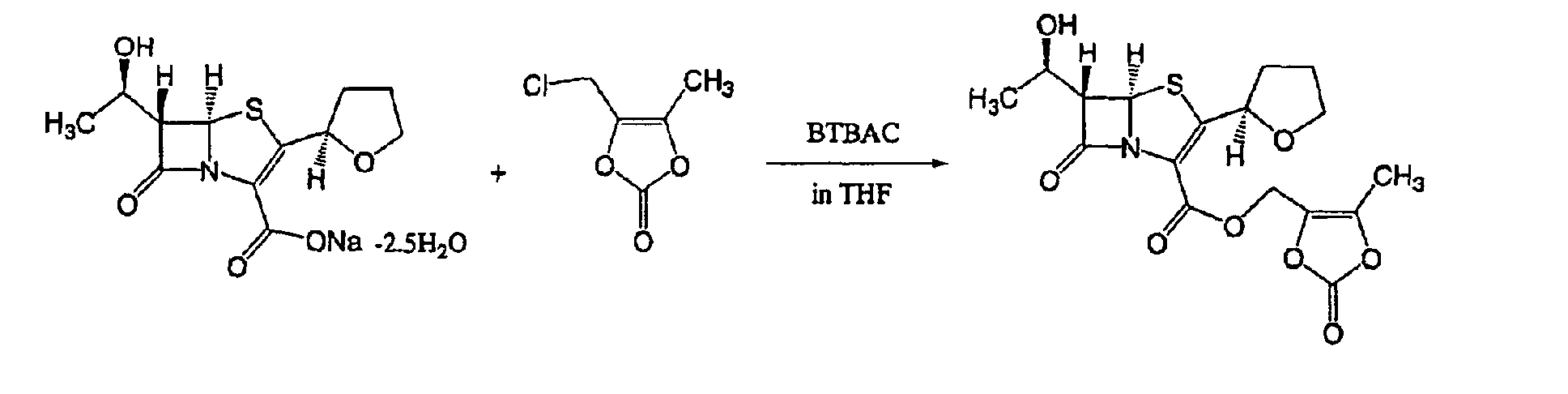
- A weight (17.9 g) of sodium salt 2.5 hydrate of (5R,6S)-6-((R)-1-hydroxyethyl)-7-oxo-3-((R)-2-tetrahydrofuryl)-4-thia-1-azabicyclo[3.2.0]hept-2-ene-2-carboxylate (purity: 98.4%), sodium hydrogencarbonate (0.42 g) and BTBAC (0.78 g) were mixed in THF (75 ml); to the mixture, 8.25 g of 4-chloromethyl-5-methyl-2-oxo-1,3-dioxolene (purity: 97.2%) was added and agitation was effected at 50°C for 4 hours to perform the reaction. After the end of the reaction, the reaction mixture was filtered to separate the inorganic salts insoluble in THF and the filtrate was concentrated under reduced pressure to obtain a mixture of the desired product and impurities. The obtained mixture was subjected to quantitative analysis by liquid chromatography using acetophenone as an internal standard material; the desired product was obtained in a yield of 36.7%.
- As described above, according to the present invention, (dioxolenon-4-yl)methyl ester derivatives can be produced at low cost, in a simple manner, and at high yield.
- In addition, the production process of the invention can be performed under comparatively mild reaction conditions and post-treatments after the end of the reaction are simple to perform. Therefore, the present invention can be applied advantageously to the case where compounds such as β-lactam antimicrobial agents that contain asymmetric carbons in the molecule are manufactured at an industrial production scale.
Claims (11)
- A process for producing a (dioxolenon-4-yl)methyl ester derivative of formula (3)(where Q represents an organic group, and R1 and R2 each independently represent a hydrogen atom, an optionally substituted C1-6 alkyl group or an optionally substituted phenyl group, provided that R1 and R2 may combine to form an optionally substituted ring having 3-8 carbon atoms) by reacting a carboxylic acid derivative of formula (1)
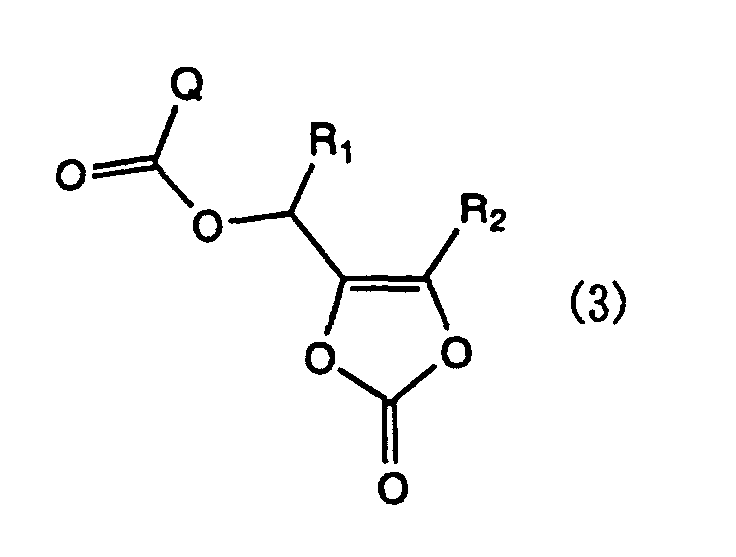 (where Q has the same meaning as defined above, M represents a hydrogen atom, an alkali metal, an alkaline earth metal or a transition metal, and n represents the atomic valency of M) with a 4-chloromethyldioxolenone compound of formula (2)
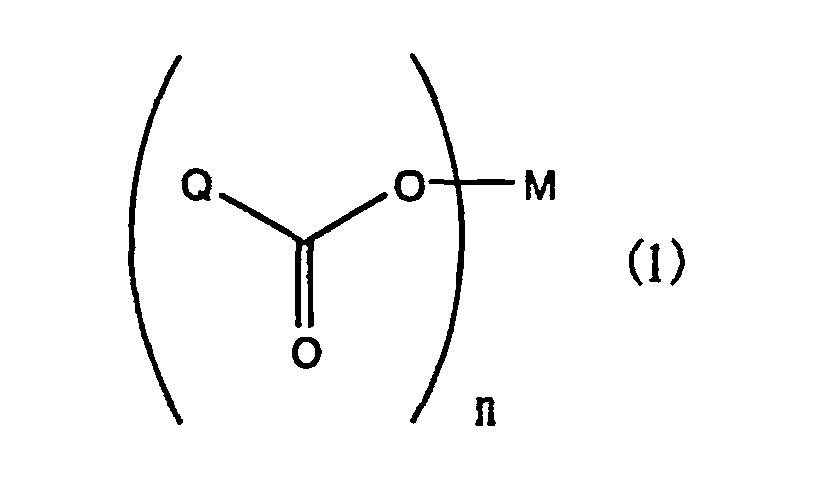 (where R1 and R2 have the same meanings as defined above) in a solvent in the presence of both a phase transfer catalyst and a metal iodide.
- A process for producing a (dioxolenon-4-yl)methyl ester derivative of formula (3)(where Q represents an organic group, and R1 and R2 each independently represent a hydrogen atom, an optionally substituted C1-6 alkyl group or an optionally substituted phenyl group, provided that R1 and R2 may combine to form an optionally substituted ring having 3-8 carbon atoms) by reacting a carboxylic acid of formula (5)
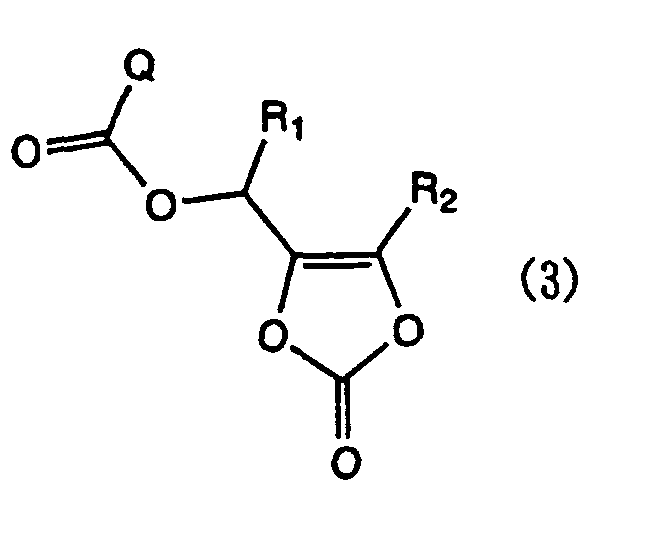 (where Q has the same meaning as defined above) with a 4-chloromethyldioxolenone compound of formula (2)
 (where R1 and R2 have the same meanings as defined above) in a solvent in the presence of both a quaternary ammonium hydroxide of the formula: RaRbRcRdNOH (where Ra-Rd each independently represent a C1-20 alkyl group or a C7-20 aralkyl group) and a metal iodide.
- The process for producing a (dioxolenon-4-yl)methyl ester derivative of formula (3) according to claim 1 or 2, wherein a polar solvent is used as said solvent.
- The process for producing a (dioxolenon-4-yl)methyl ester derivative of formula (3) according to any one of claims 1-3, wherein said metal iodide is used in an amount of 5-20 mol% of the 4-chloromethyldioxolenone compound of said formula (2).
- The process for producing a (dioxolenon-4-yl)methyl ester derivative of formula (3) according to any one of claims 1-4, wherein an alkali metal iodide is used as said metal iodide.
- The process for producing a (dioxolenon-4-yl)methyl ester derivative of formula (3) according to claim 1, 3, 4 or 5, wherein a quaternary ammonium salt is used as said phase transfer catalyst.
- The process for producing a (dioxolenon-4-yl)methyl ester derivative of formula (3) according to claim 6, wherein a benzyltrialkylammonium halide is used as said quaternary ammonium salt.
- The process for producing a (dioxolenon-4-yl)methyl ester derivative of formula (3) according to any one of claims 1-7, wherein said Q is a fused heterocyclic group having a β-lactam ring.
- The process for producing a (dioxolenon-4-yl)methyl ester derivative of formula (3) according to any one of claims 1-8, wherein a base is further added at least in an amount corresponding to the amount of the acidic impurities contained in the 4-chloromethyldioxolenone compound represented by said formula (2).
- The process for producing a (dioxolenon-4-yl)methyl ester derivative of formula (3) according to any one of claims 1-9, wherein the reaction is performed by elevating the reaction temperature through a plurality of stages.
- The process for producing a (dioxolenon-4-yl)methyl ester derivative of formula (3) according to claim 10, wherein the reaction is performed by elevating the reaction temperature in two stages, the first stage at 40°C or below and the second stage at 50°C or above.
Applications Claiming Priority (3)
| Application Number | Priority Date | Filing Date | Title |
|---|---|---|---|
| JP2001100561 | 2001-03-30 | ||
| JP2001100561 | 2001-03-30 | ||
| PCT/JP2002/003160 WO2002079185A1 (en) | 2001-03-30 | 2002-03-29 | Process for producing (dioxolenon-4-yl)methyl ester derivative |
Publications (3)
| Publication Number | Publication Date |
|---|---|
| EP1375492A1 true EP1375492A1 (en) | 2004-01-02 |
| EP1375492A4 EP1375492A4 (en) | 2008-03-26 |
| EP1375492B1 EP1375492B1 (en) | 2011-08-17 |
Family
ID=18953995
Family Applications (1)
| Application Number | Title | Priority Date | Filing Date |
|---|---|---|---|
| EP02707247A Expired - Lifetime EP1375492B1 (en) | 2001-03-30 | 2002-03-29 | Process for producing (dioxolenon-4-yl)methyl ester derivative |
Country Status (7)
| Country | Link |
|---|---|
| US (1) | US7041820B2 (en) |
| EP (1) | EP1375492B1 (en) |
| JP (1) | JP4275348B2 (en) |
| KR (1) | KR100880807B1 (en) |
| CN (1) | CN100361989C (en) |
| AT (1) | ATE520679T1 (en) |
| WO (1) | WO2002079185A1 (en) |
Cited By (2)
| Publication number | Priority date | Publication date | Assignee | Title |
|---|---|---|---|---|
| EP1548017A4 (en) * | 2002-10-02 | 2010-06-02 | Nippon Soda Co | PROCESSES FOR THE PREPARATION OF ORGANIC COMPOUNDS |
| US11084833B2 (en) | 2016-10-10 | 2021-08-10 | The Johns Hopkins University | Antibacterial agents against D,D- and L,D-transpeptidases |
Families Citing this family (3)
| Publication number | Priority date | Publication date | Assignee | Title |
|---|---|---|---|---|
| FR3071502B1 (en) | 2017-09-28 | 2020-06-19 | Bostik Sa | LIQUID HYDROCARBON COPOLYMERS WITH TWO ESTER CYCLOCARBONATE TERMINAL GROUPS |
| WO2020148423A1 (en) | 2019-01-18 | 2020-07-23 | Basf Se | Method for the preparation of compounds with cyclic monothiocarbonate groups |
| CN115304577B (en) * | 2022-08-16 | 2024-03-12 | 鲁北超能新材料产业(山东)有限公司 | Preparation method of vinylene carbonate |
Family Cites Families (4)
| Publication number | Priority date | Publication date | Assignee | Title |
|---|---|---|---|---|
| JPS5412231A (en) * | 1977-06-29 | 1979-01-29 | Hitachi Ltd | Recording device for magnetic bubble information |
| JPS54122231A (en) * | 1978-03-10 | 1979-09-21 | Nippon Soda Co Ltd | Preparation of benzyltributylammonium chloride |
| KR850000612B1 (en) * | 1983-05-27 | 1985-05-01 | 주식회사 종근당 | Process for preparing ester compound of alpha-amino benzyl penicillin |
| JP3452596B2 (en) * | 1992-12-25 | 2003-09-29 | 第一サントリーファーマ株式会社 | Method for producing penem derivatives |
-
2002
- 2002-03-29 AT AT02707247T patent/ATE520679T1/en not_active IP Right Cessation
- 2002-03-29 KR KR1020037012757A patent/KR100880807B1/en not_active Expired - Fee Related
- 2002-03-29 WO PCT/JP2002/003160 patent/WO2002079185A1/en not_active Ceased
- 2002-03-29 EP EP02707247A patent/EP1375492B1/en not_active Expired - Lifetime
- 2002-03-29 JP JP2002095431A patent/JP4275348B2/en not_active Expired - Fee Related
- 2002-03-29 US US10/473,297 patent/US7041820B2/en not_active Expired - Fee Related
- 2002-03-29 CN CNB028092317A patent/CN100361989C/en not_active Expired - Fee Related
Non-Patent Citations (2)
| Title |
|---|
| No further relevant documents disclosed * |
| See also references of WO02079185A1 * |
Cited By (2)
| Publication number | Priority date | Publication date | Assignee | Title |
|---|---|---|---|---|
| EP1548017A4 (en) * | 2002-10-02 | 2010-06-02 | Nippon Soda Co | PROCESSES FOR THE PREPARATION OF ORGANIC COMPOUNDS |
| US11084833B2 (en) | 2016-10-10 | 2021-08-10 | The Johns Hopkins University | Antibacterial agents against D,D- and L,D-transpeptidases |
Also Published As
| Publication number | Publication date |
|---|---|
| KR100880807B1 (en) | 2009-01-30 |
| US20040133016A1 (en) | 2004-07-08 |
| US7041820B2 (en) | 2006-05-09 |
| WO2002079185A1 (en) | 2002-10-10 |
| JP4275348B2 (en) | 2009-06-10 |
| CN1505622A (en) | 2004-06-16 |
| KR20040002885A (en) | 2004-01-07 |
| EP1375492B1 (en) | 2011-08-17 |
| ATE520679T1 (en) | 2011-09-15 |
| EP1375492A4 (en) | 2008-03-26 |
| JP2002356488A (en) | 2002-12-13 |
| CN100361989C (en) | 2008-01-16 |
Similar Documents
| Publication | Publication Date | Title |
|---|---|---|
| US8877931B2 (en) | Process and intermediates for preparing integrase inhibitors | |
| CA2935601A1 (en) | 5-fluoro-4-imino-3-(alkyl/substituted alkyl)-1-(arylsulfonyl)-3,4-dihydropyrimidin-2(1h)-one and processes for their preparation | |
| EP1375492B1 (en) | Process for producing (dioxolenon-4-yl)methyl ester derivative | |
| CN116075498B (en) | Process for preparing oxazole compounds | |
| CN106188046B (en) | A kind of synthetic method of 3- arylthios imidazo [1,5-a] N- heterocyclic compounds that iodine promotes | |
| JP2006232802A (en) | Process for producing (Z) -1-phenyl-1- (N, N-diethylaminocarbonyl) -2-phthalimidomethylcyclopropane | |
| KR101587438B1 (en) | Method for producing 3-mercaptoaniline compound | |
| KR100725440B1 (en) | Process for preparing organic compound | |
| CN102442947B (en) | Preparation method of Montelukast Sodium intermediate | |
| CN109516933B (en) | Preparation method of silodosin intermediate | |
| JP5663482B2 (en) | Method for producing pyrimidinylacetonitrile derivative and synthetic intermediate thereof | |
| KR20220084092A (en) | Process for the preparation of 5-bromo-2-(3-chloro-pyridin-2-yl)-2H-pyrazole-3-carboxylic acid | |
| JP2007238540A (en) | Process for producing optically active alcohol compounds | |
| CN101654439A (en) | Ortho-position dihalogen substitution compound of aryl pyrimidine and preparing method thereof | |
| KR20220084086A (en) | Process for the preparation of 5-bromo-2-(3-chloro-pyridin-2-yl)-2H-pyrazole-3-carboxylic acid | |
| CN102442948B (en) | Method for preparing montelukast sodium intermediate | |
| ITMI20091328A1 (en) | PROCEDURE FOR THE PREPARATION OF CINACALCET | |
| Nallapati et al. | Synthesis and Charecterization of New Substituted 4-Iodoquinolines | |
| HK1209748B (en) | Process and intermediates for preparing integrase inhibitors | |
| JP2008174452A (en) | Method for producing 2,2-dichloro-12- (4-halophenyl) dodecanoate | |
| JP2000063345A (en) | Production of benzamidoxime compound | |
| RU2002114050A (en) | The method of obtaining 4-methyl-2-pentin |
Legal Events
| Date | Code | Title | Description |
|---|---|---|---|
| PUAI | Public reference made under article 153(3) epc to a published international application that has entered the european phase |
Free format text: ORIGINAL CODE: 0009012 |
|
| 17P | Request for examination filed |
Effective date: 20030930 |
|
| AK | Designated contracting states |
Kind code of ref document: A1 Designated state(s): AT BE CH CY DE DK ES FI FR GB GR IE IT LI LU MC NL PT SE TR |
|
| RAP1 | Party data changed (applicant data changed or rights of an application transferred) |
Owner name: DAIICHI ASUBIO PHARMA CO., LTD. Owner name: NIPPON SODA CO., LTD. |
|
| RAP1 | Party data changed (applicant data changed or rights of an application transferred) |
Owner name: NIPPON SODA CO., LTD. Owner name: ASUBIO PHARMA CO., LTD. |
|
| A4 | Supplementary search report drawn up and despatched |
Effective date: 20080226 |
|
| RAP1 | Party data changed (applicant data changed or rights of an application transferred) |
Owner name: NIPPON SODA CO., LTD. |
|
| 17Q | First examination report despatched |
Effective date: 20091202 |
|
| GRAJ | Information related to disapproval of communication of intention to grant by the applicant or resumption of examination proceedings by the epo deleted |
Free format text: ORIGINAL CODE: EPIDOSDIGR1 |
|
| GRAP | Despatch of communication of intention to grant a patent |
Free format text: ORIGINAL CODE: EPIDOSNIGR1 |
|
| GRAS | Grant fee paid |
Free format text: ORIGINAL CODE: EPIDOSNIGR3 |
|
| GRAA | (expected) grant |
Free format text: ORIGINAL CODE: 0009210 |
|
| AK | Designated contracting states |
Kind code of ref document: B1 Designated state(s): AT BE CH CY DE DK ES FI FR GB GR IE IT LI LU MC NL PT SE TR |
|
| REG | Reference to a national code |
Ref country code: GB Ref legal event code: FG4D |
|
| REG | Reference to a national code |
Ref country code: NL Ref legal event code: T3 Ref country code: CH Ref legal event code: EP |
|
| REG | Reference to a national code |
Ref country code: IE Ref legal event code: FG4D |
|
| REG | Reference to a national code |
Ref country code: DE Ref legal event code: R096 Ref document number: 60240790 Country of ref document: DE Effective date: 20111013 |
|
| REG | Reference to a national code |
Ref country code: SE Ref legal event code: TRGR |
|
| PG25 | Lapsed in a contracting state [announced via postgrant information from national office to epo] |
Ref country code: FI Free format text: LAPSE BECAUSE OF FAILURE TO SUBMIT A TRANSLATION OF THE DESCRIPTION OR TO PAY THE FEE WITHIN THE PRESCRIBED TIME-LIMIT Effective date: 20110817 Ref country code: PT Free format text: LAPSE BECAUSE OF FAILURE TO SUBMIT A TRANSLATION OF THE DESCRIPTION OR TO PAY THE FEE WITHIN THE PRESCRIBED TIME-LIMIT Effective date: 20111219 |
|
| REG | Reference to a national code |
Ref country code: AT Ref legal event code: MK05 Ref document number: 520679 Country of ref document: AT Kind code of ref document: T Effective date: 20110817 |
|
| PG25 | Lapsed in a contracting state [announced via postgrant information from national office to epo] |
Ref country code: CY Free format text: LAPSE BECAUSE OF FAILURE TO SUBMIT A TRANSLATION OF THE DESCRIPTION OR TO PAY THE FEE WITHIN THE PRESCRIBED TIME-LIMIT Effective date: 20110817 Ref country code: GR Free format text: LAPSE BECAUSE OF FAILURE TO SUBMIT A TRANSLATION OF THE DESCRIPTION OR TO PAY THE FEE WITHIN THE PRESCRIBED TIME-LIMIT Effective date: 20111118 Ref country code: AT Free format text: LAPSE BECAUSE OF FAILURE TO SUBMIT A TRANSLATION OF THE DESCRIPTION OR TO PAY THE FEE WITHIN THE PRESCRIBED TIME-LIMIT Effective date: 20110817 |
|
| PG25 | Lapsed in a contracting state [announced via postgrant information from national office to epo] |
Ref country code: BE Free format text: LAPSE BECAUSE OF FAILURE TO SUBMIT A TRANSLATION OF THE DESCRIPTION OR TO PAY THE FEE WITHIN THE PRESCRIBED TIME-LIMIT Effective date: 20110817 |
|
| PLBE | No opposition filed within time limit |
Free format text: ORIGINAL CODE: 0009261 |
|
| STAA | Information on the status of an ep patent application or granted ep patent |
Free format text: STATUS: NO OPPOSITION FILED WITHIN TIME LIMIT |
|
| PG25 | Lapsed in a contracting state [announced via postgrant information from national office to epo] |
Ref country code: DK Free format text: LAPSE BECAUSE OF FAILURE TO SUBMIT A TRANSLATION OF THE DESCRIPTION OR TO PAY THE FEE WITHIN THE PRESCRIBED TIME-LIMIT Effective date: 20110817 |
|
| PGFP | Annual fee paid to national office [announced via postgrant information from national office to epo] |
Ref country code: IT Payment date: 20120321 Year of fee payment: 11 |
|
| 26N | No opposition filed |
Effective date: 20120521 |
|
| REG | Reference to a national code |
Ref country code: DE Ref legal event code: R097 Ref document number: 60240790 Country of ref document: DE Effective date: 20120521 |
|
| PG25 | Lapsed in a contracting state [announced via postgrant information from national office to epo] |
Ref country code: MC Free format text: LAPSE BECAUSE OF NON-PAYMENT OF DUE FEES Effective date: 20120331 |
|
| REG | Reference to a national code |
Ref country code: CH Ref legal event code: PL |
|
| PG25 | Lapsed in a contracting state [announced via postgrant information from national office to epo] |
Ref country code: LI Free format text: LAPSE BECAUSE OF NON-PAYMENT OF DUE FEES Effective date: 20120331 Ref country code: CH Free format text: LAPSE BECAUSE OF NON-PAYMENT OF DUE FEES Effective date: 20120331 |
|
| PG25 | Lapsed in a contracting state [announced via postgrant information from national office to epo] |
Ref country code: ES Free format text: LAPSE BECAUSE OF FAILURE TO SUBMIT A TRANSLATION OF THE DESCRIPTION OR TO PAY THE FEE WITHIN THE PRESCRIBED TIME-LIMIT Effective date: 20111128 |
|
| PGFP | Annual fee paid to national office [announced via postgrant information from national office to epo] |
Ref country code: IE Payment date: 20130319 Year of fee payment: 12 Ref country code: DE Payment date: 20130327 Year of fee payment: 12 Ref country code: SE Payment date: 20130312 Year of fee payment: 12 Ref country code: FR Payment date: 20130325 Year of fee payment: 12 Ref country code: GB Payment date: 20130327 Year of fee payment: 12 |
|
| PGFP | Annual fee paid to national office [announced via postgrant information from national office to epo] |
Ref country code: NL Payment date: 20130316 Year of fee payment: 12 |
|
| PG25 | Lapsed in a contracting state [announced via postgrant information from national office to epo] |
Ref country code: TR Free format text: LAPSE BECAUSE OF FAILURE TO SUBMIT A TRANSLATION OF THE DESCRIPTION OR TO PAY THE FEE WITHIN THE PRESCRIBED TIME-LIMIT Effective date: 20110817 |
|
| PG25 | Lapsed in a contracting state [announced via postgrant information from national office to epo] |
Ref country code: LU Free format text: LAPSE BECAUSE OF NON-PAYMENT OF DUE FEES Effective date: 20120329 |
|
| REG | Reference to a national code |
Ref country code: DE Ref legal event code: R119 Ref document number: 60240790 Country of ref document: DE |
|
| REG | Reference to a national code |
Ref country code: NL Ref legal event code: V1 Effective date: 20141001 |
|
| REG | Reference to a national code |
Ref country code: SE Ref legal event code: EUG |
|
| GBPC | Gb: european patent ceased through non-payment of renewal fee |
Effective date: 20140329 |
|
| PG25 | Lapsed in a contracting state [announced via postgrant information from national office to epo] |
Ref country code: SE Free format text: LAPSE BECAUSE OF NON-PAYMENT OF DUE FEES Effective date: 20140330 |
|
| REG | Reference to a national code |
Ref country code: FR Ref legal event code: ST Effective date: 20141128 |
|
| REG | Reference to a national code |
Ref country code: IE Ref legal event code: MM4A |
|
| REG | Reference to a national code |
Ref country code: DE Ref legal event code: R119 Ref document number: 60240790 Country of ref document: DE Effective date: 20141001 |
|
| PG25 | Lapsed in a contracting state [announced via postgrant information from national office to epo] |
Ref country code: FR Free format text: LAPSE BECAUSE OF NON-PAYMENT OF DUE FEES Effective date: 20140331 Ref country code: DE Free format text: LAPSE BECAUSE OF NON-PAYMENT OF DUE FEES Effective date: 20141001 Ref country code: IE Free format text: LAPSE BECAUSE OF NON-PAYMENT OF DUE FEES Effective date: 20140329 Ref country code: GB Free format text: LAPSE BECAUSE OF NON-PAYMENT OF DUE FEES Effective date: 20140329 |
|
| PG25 | Lapsed in a contracting state [announced via postgrant information from national office to epo] |
Ref country code: NL Free format text: LAPSE BECAUSE OF NON-PAYMENT OF DUE FEES Effective date: 20141001 |
|
| PG25 | Lapsed in a contracting state [announced via postgrant information from national office to epo] |
Ref country code: IT Free format text: LAPSE BECAUSE OF NON-PAYMENT OF DUE FEES Effective date: 20140329 |