EP1375422A1 - Process for production of ammonium thiosulphate - Google Patents
Process for production of ammonium thiosulphate Download PDFInfo
- Publication number
- EP1375422A1 EP1375422A1 EP03013536A EP03013536A EP1375422A1 EP 1375422 A1 EP1375422 A1 EP 1375422A1 EP 03013536 A EP03013536 A EP 03013536A EP 03013536 A EP03013536 A EP 03013536A EP 1375422 A1 EP1375422 A1 EP 1375422A1
- Authority
- EP
- European Patent Office
- Prior art keywords
- absorber
- stream
- gas
- feed
- solution
- Prior art date
- Legal status (The legal status is an assumption and is not a legal conclusion. Google has not performed a legal analysis and makes no representation as to the accuracy of the status listed.)
- Granted
Links
- 238000000034 method Methods 0.000 title claims abstract description 55
- XYXNTHIYBIDHGM-UHFFFAOYSA-N ammonium thiosulfate Chemical compound [NH4+].[NH4+].[O-]S([O-])(=O)=S XYXNTHIYBIDHGM-UHFFFAOYSA-N 0.000 title claims abstract description 52
- 238000004519 manufacturing process Methods 0.000 title claims description 9
- 239000006096 absorbing agent Substances 0.000 claims abstract description 50
- 239000000243 solution Substances 0.000 claims abstract description 39
- XLYOFNOQVPJJNP-UHFFFAOYSA-N water Substances O XLYOFNOQVPJJNP-UHFFFAOYSA-N 0.000 claims abstract description 34
- 239000000443 aerosol Substances 0.000 claims abstract description 21
- 239000007864 aqueous solution Substances 0.000 claims abstract description 19
- 230000015572 biosynthetic process Effects 0.000 claims abstract description 10
- 239000007788 liquid Substances 0.000 claims abstract description 10
- 238000002156 mixing Methods 0.000 claims abstract description 9
- 238000009833 condensation Methods 0.000 claims abstract description 8
- 230000005494 condensation Effects 0.000 claims abstract description 8
- 238000010924 continuous production Methods 0.000 claims abstract description 5
- 238000010521 absorption reaction Methods 0.000 claims description 10
- UCKMPCXJQFINFW-UHFFFAOYSA-N Sulphide Chemical compound [S-2] UCKMPCXJQFINFW-UHFFFAOYSA-N 0.000 claims description 8
- LSNNMFCWUKXFEE-UHFFFAOYSA-L sulfite Chemical compound [O-]S([O-])=O LSNNMFCWUKXFEE-UHFFFAOYSA-L 0.000 claims description 7
- 238000011144 upstream manufacturing Methods 0.000 claims description 6
- 230000005587 bubbling Effects 0.000 claims description 2
- 238000001816 cooling Methods 0.000 claims 1
- QGZKDVFQNNGYKY-UHFFFAOYSA-N Ammonia Chemical compound N QGZKDVFQNNGYKY-UHFFFAOYSA-N 0.000 description 73
- RWSOTUBLDIXVET-UHFFFAOYSA-N Dihydrogen sulfide Chemical compound S RWSOTUBLDIXVET-UHFFFAOYSA-N 0.000 description 67
- 239000007789 gas Substances 0.000 description 66
- 229910000069 nitrogen hydride Inorganic materials 0.000 description 58
- NINIDFKCEFEMDL-UHFFFAOYSA-N Sulfur Chemical compound [S] NINIDFKCEFEMDL-UHFFFAOYSA-N 0.000 description 13
- 239000005864 Sulphur Substances 0.000 description 13
- 238000011084 recovery Methods 0.000 description 8
- ZETCGWYACBNPIH-UHFFFAOYSA-N azane;sulfurous acid Chemical compound N.OS(O)=O ZETCGWYACBNPIH-UHFFFAOYSA-N 0.000 description 7
- 238000006243 chemical reaction Methods 0.000 description 5
- PQUCIEFHOVEZAU-UHFFFAOYSA-N Diammonium sulfite Chemical compound [NH4+].[NH4+].[O-]S([O-])=O PQUCIEFHOVEZAU-UHFFFAOYSA-N 0.000 description 3
- RAHZWNYVWXNFOC-UHFFFAOYSA-N Sulphur dioxide Chemical compound O=S=O RAHZWNYVWXNFOC-UHFFFAOYSA-N 0.000 description 3
- 238000005194 fractionation Methods 0.000 description 3
- 229910021529 ammonia Inorganic materials 0.000 description 2
- 238000005265 energy consumption Methods 0.000 description 2
- 238000002474 experimental method Methods 0.000 description 2
- 239000011261 inert gas Substances 0.000 description 2
- 238000000926 separation method Methods 0.000 description 2
- 238000011282 treatment Methods 0.000 description 2
- LSNNMFCWUKXFEE-UHFFFAOYSA-N Sulfurous acid Chemical class OS(O)=O LSNNMFCWUKXFEE-UHFFFAOYSA-N 0.000 description 1
- 238000002485 combustion reaction Methods 0.000 description 1
- 238000005336 cracking Methods 0.000 description 1
- 238000005516 engineering process Methods 0.000 description 1
- 238000001704 evaporation Methods 0.000 description 1
- 230000008020 evaporation Effects 0.000 description 1
- 239000008246 gaseous mixture Substances 0.000 description 1
- 229930195733 hydrocarbon Natural products 0.000 description 1
- 150000002430 hydrocarbons Chemical class 0.000 description 1
- 238000005984 hydrogenation reaction Methods 0.000 description 1
- 230000008676 import Effects 0.000 description 1
- 239000000203 mixture Substances 0.000 description 1
- 229920001021 polysulfide Polymers 0.000 description 1
- 238000005507 spraying Methods 0.000 description 1
- 239000000126 substance Substances 0.000 description 1
- 150000004763 sulfides Chemical class 0.000 description 1
Images
Classifications
-
- C—CHEMISTRY; METALLURGY
- C01—INORGANIC CHEMISTRY
- C01B—NON-METALLIC ELEMENTS; COMPOUNDS THEREOF; METALLOIDS OR COMPOUNDS THEREOF NOT COVERED BY SUBCLASS C01C
- C01B17/00—Sulfur; Compounds thereof
- C01B17/64—Thiosulfates; Dithionites; Polythionates
Definitions
- the present invention relates to a process for continuous production of a concentrated solution of ammonium thiosulfate (ATS) from off gases comprising H 2 S and NH 3 such as refinery SWS (Sour Water Stripper)-gas, which contains NH 3 as well as H 2 S and H 2 S gas streams.
- ATS ammonium thiosulfate
- the process according to the invention is distinguished by utilizing only the NH 3 in the SWS gas for the production of high purity ATS solution, thus producing 7.25 kg 60% ATS solution per kg of NH 3 in the SWS gas treated in the process. Furthermore, when the process according to the invention uses the effluent gas of a Claus plant as SO 2 -source for the process, the total sulphur-recovery of the Claus plant and the ATS plant taken together is increased to more than 99.95% with only 86-95% sulphur recovery being required in the Claus plant.
- ATS and sulphur is produced from a first feed gas stream comprising H 2 S and NH 3 and a second feed gas stream comprising SO 2 in three absorption steps.
- a first absorber NH 3 and H 2 S are separated in a H 2 S off-gas stream and an NH 3 -rich solution of ATS.
- the main part of the solution is passed to a second absorber, in which it is contacted with the SO 2 -rich feed gas stream under formation of an off-gas that is vented and a solution rich in ATS and ammonium sulphites, which in a third absorber is contacted with the H 2 S-gas from the first absorber and, optionally, with additional H 2 S.
- a third absorber is contacted with the H 2 S-gas from the first absorber and, optionally, with additional H 2 S.
- the major part of the ATS-solution formed in the third absorber is recycled to the first absorber, while a minor part is mixed with a fraction of the NH 3 -rich solution of ATS formed in the first absorber forming the product solution of ATS.
- a first feed stream typically SWS-gas, comprising more than 0.33 mole H 2 S per mole of NH 3 is contacted with a stream of sulphite solution in line 18 in the drawing Fig. 1 and Fig. 2 in said patent application in a reactor A1 for formation of ATS.
- a reactor A1 for formation of ATS a reactor A1 for formation of ATS.
- experiments have shown that the presence of excess H 2 S for the formation of ATS from sulphites in the reactor will lead to the presence of free sulphide in the product solution (line 12), part of which is recycled (line 17) to the SO 2 absorber (A2), in which the sulphide will be decomposed to give H 2 S in the absorber effluent gas (line 19).
- the large recycle of solution (line 13) to the SO 2 absorber and back to the reactor (lines 17-18) is also a disadvantage of the process.
- the objective of this invention is to establish an improved process for the production of ATS in which over 99.9% of all sulphur and all NH 3 in the feed streams are recovered as ATS without any of the above mentioned disadvantages.
- This invention relates to a process for continuous production of ammonium thiosulphate, (NH 4 ) 2 S 2 O 3 (ATS) from NH 3 , H 2 S and SO 2 comprising following steps:
- Step (e) can preferably be carried out by adding said aqueous solution to the liquid recycle loop 27 of the SO 2 -absorber.
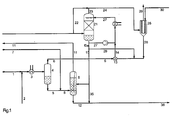
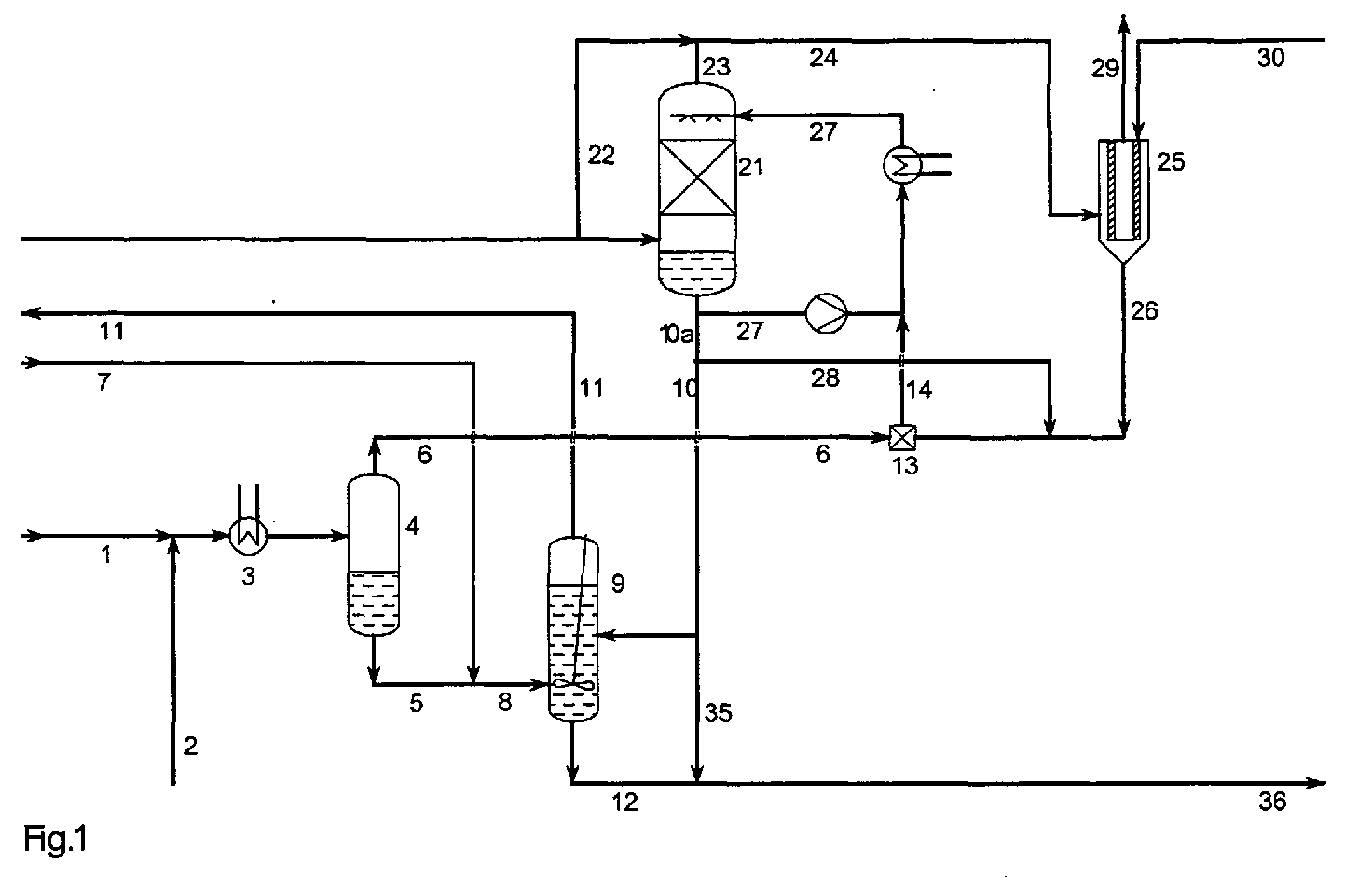
- a first feed stream of fractionated SWS-gas in line 1 comprising, for example, 6 kmole/h NH 3 associated with 1.1 kmole/h H 2 S and 2 kmole/h H 2 O, is treated with a second feed gas stream in line 20 comprising SO 2 associated with water vapor and inert components such as N 2 , CO 2 and O 2 and a 3d feed gas stream comprising H 2 S in line 7.
- Feed water required for the process is fed in line 30 to the aerosol filter 25. Some feed water may also be added in line 2 to the first feed gas stream. More than 99.95% of the amounts of NH 3 and SO 2 in the feed streams are recovered in the product ATS stream exiting the process in line 36.
- the off gas from the process in line 29 contains a negligible amount of SO 2 and essentially no NH 3 and H 2 S.
- the original SWS-gas available in refineries usually have a molar H 2 S:NH 3 ratio of about 1:1, which is higher than directly acceptable for the process. Therefore, the original SWS-gas must first be fractionated by known methods in columns not shown on the figure to give a feed gas stream in line 1 with less than about 0.35 mole H 2 S per mole of NH 3 in the feed gas, preferably with a H 2 S:NH 3 molar ratio in the range of 0.1-0.25.
- the two other off streams (not shown in Fig. 1) from said fractionation are H 2 S, which can be used as make-up for stream 7, and practically pure water.
- the first feed stream comprising 6 kmole NH 3 , 1.1 kmole H 2 S and 2 kmole H 2 O in line 1 is cooled in the cooler 3 to a temperature between 20°C and 60°C, or well below its dew point upstream of the separator 4.
- the separator 4 the first feed stream is separated in an aqueous solution exiting in line 5 comprising NH 4 HS and some NH 3 dissolved in practically all of the water in the feed stream 1, and in a gas phase exiting in line 6 comprising most of the NH 3 (approximately 4.6 kmole NH 3 ) and a small amount of H 2 S (approximately 0.1 kmole H 2 S).
- Water may be added in line 2 upstream of 4, but in the example the amount of water added to the process at this point is chosen to be zero.
- the liquid stream 5 comprising in the example 1.0 kmole NH 4 HS, 0.4 kmole NH 3 and 2 kmole H 2 O goes to the reactor 9 in which it is reacted with (0.9 + x) kmole H 2 S, the third feedstream and as defined below, introduced in line 7 and with the liquid sulphite stream 10 comprising 0.15 kmole ATS, 3.3 kmole AHS (NH 4 HSO 3 ) , 0.5 kmole DAS ((NH 4 ) 2 SO 3 ) and 11.65 kmole H 2 O.
- ATS will be formed by the principal reactions: Equation(2) 4 NH 4 HSO 3 + 2 NH 3 + 2H 2 S ⁇ 3 (NH 4 ) 2 S 2 O 3 + 3H 2 O Equation(3) : 4 (NH 4 ) 2 SO 3 + 2 H 2 S ⁇ 3 (NH 4 ) 2 S 2 O 3 + 2 NH 3 + 3H 2 O resulting in formation of 741.8 kg of 60% ATS solution leaving the reactor through line 12.
- An excess amount of x kmole H 2 S may be added to the feed stream of 0.9 kmole H 2 S, which constitutes the third feed gas stream, in line 7 in order to increase the rates of reactions 2 and 3.
- the x kmole H 2 S which may constitute 0-10% of equivalent amount of H 2 S required for the process, is vented from the reactor through the vent line 11.
- Additional sulphite solution may be added through line 35 to the ATS product solution having e.g. a composition of 60% ATS (3 kmol ATS and 16.5 kmol water), in order to complete the conversion to ATS of possible traces of sulphide or H 2 S in the stream 12 and/or to add 0-2% DAS to the product ATS solution exiting the process in line 36.
- the ATS product solution having e.g. a composition of 60% ATS (3 kmol ATS and 16.5 kmol water), in order to complete the conversion to ATS of possible traces of sulphide or H 2 S in the stream 12 and/or to add 0-2% DAS to the product ATS solution exiting the process in line 36.
- no sulphite is added through line 35 in the present example.
- pH of the solution in line 12 and in the reactor 9 will typically be in the range 7.6-8.6.
- the off gas from 4 (4.6 kmol NH 3 and 0.1 kmol H 2 S) is passed to the mixing device 13 in which it is completely dissolved in the aqueous stream 26 from the aerosol filter 25.
- Stream 26 will usually comprise at least 0.1 kmole AHS which reacts with the H 2 S and NH 3 in stream 6 under formation of ATS according to for instance equation 2.
- a minor fraction of the sulphite solution exiting the SO 2 -absorption is added to stream 26 through line 28 in order to ensure complete removal of all H 2 S or sulphide in the aqueous stream 14 before it is added to the SO 2 absorption loop 27. Addition of excess ammonium sulphites through 28 will also keep pH in stream 14 below of about 9.2.
- the flow of SO 2 (second feed gas stream) required for the process is in line 20 fed to the SO 2 -absorber 21 in which the SO 2 is in principle absorbed by the NH 3 comprised in the NH 3 -rich off gas in line 6 from the partial condensation in 4 of the feed stream 1.
- 4.0 kmole SO 2 is required for the process.
- the SO 2 feed stream is produced by upstream combustion of H 2 S or other sulphurous components
- the SO 2 in line 20 will be diluted with inert gas comprising N 2 , CO 2 and O 2 and with water vapor.
- the 4 kmole SO 2 is diluted with approximately 100 kmole inert gases and 6 kmole H 2 O corresponding to a H 2 O dew point of 35-36°C.
- the SO 2 absorber 21 is typically a fixed bed absorber where the absorption liquid is recycled in a loop 27 comprising a circulating pump and a cooler which maintains the temperature of absorption preferably at 35-40°C, whereby no net condensation or net evaporation of H 2 O takes place in the absorber and in the subsequent aerosol filter 25.
- the NH 3 and SO 2 react in the gas phase forming an aerosol of AHS, which is removed in the filter 25. All aerosols present in the gas leaving the SO 2 -absorber will also be removed and dissolved in the water supplied to the filter.
- the filter off gas in line 29 contains typically about 40 ppm SO 2 , less than 2 ppm NH 3 and essentially no H 2 S.
- the separation can in principle be replaced by splitting stream 1 in a stream 5 being passed to 9 together with stream 7 and a stream 6 being mixed in 13 in principle as seen in Fig 1.
- the SO 2 -absorption may also be carried out with two SO 2 -absorbers connected in series, or the SO 2 -absorber 21 may be a bubbling SO 2 -absorber in which the feed gas in line 20 is bubbled through the absorbing solution with or without external circulation in a loop 27 as shown in Fig 1.
- a fraction of the second feed gas stream can be by-passed the absorber 21 and mixed with the effluent gas from the absorber 21 upstream of the aerosol filter 25.
- the fraction can contain 0.7 - 1.3 moles of SO 2 per mole of NH 3 contained in the off gas from the SO 2 -absorber 21.
- the feed rate of H 2 S in the third feedstream 7 is adjusted to give an excess effluent H 2 S stream from the reactor 9 of 0-10% of the equivalent amount of H 2 S for the production of (NH 4 ) 2 S 2 O 3 and a fraction 10 of the solution produced in the SO 2 absorber 21 is bypassed to the (NH 4 ) 2 S 2 O 3 solution withdrawn from the reactor 9.
- the SWS gas containing e.g. 1 kmol ammonia and 1 kmol hydrogen sulphide, in line 1 is sent to a fractionation unit 2, in which it is split into an H 2 S-rich stream 3 having e.g. 2/3 kmol hydrogen sulphide, and an NH 3 -rich stream 4 containing all the NH 3 and approximately 0.33 mole H 2 S per mole NH 3 .
- the H 2 S-rich stream 3 is mixed with an H 2 S gas having e.g. 9 kmol hydrogen sulphide, in line 5 and sent to a Claus plant 6, in which most of the H 2 S is recovered as sulphur in line 7. Air is also required in the Claus plant 6 and steam is produced.
- the sulphur recovery can be e.g. more than 93.1%.
- the off-gas from the Claus plant is sent to a tail gas incinerator 8, in which the H 2 S is combusted to SO 2 with an excess of air. Steam is produced.
- a fraction of the Claus feed gas is bypassed (hydrogen sulphide bypass) around the Claus plant in line 9 to the tail gas incinerator and combusted to SO 2 .
- the bypass flow in line 9 is adjusted to give approximately 2/3 mole SO 2 in the off-gas from the incinerator in line 10 per mole NH 3 contained in the SWS gas in line 1.
- a fraction of the water contained in the off-gas from the incinerator is removed in a condensation step 11.
- the off-gas from the condensation step containing approximately 2/3 mole SO 2 is sent to the ATS process 12 according to the present invention, in which the SO 2 is removed by reaction with the NH 3 -rich stream 4 from the fractionation unit 2.
- the purified gas stream 13 is vented through the stack and the product ATS solution (e.g. a 60% solution with 0.5 kmol ATS) is recovered in line 14.
Landscapes
- Chemical & Material Sciences (AREA)
- Organic Chemistry (AREA)
- Inorganic Chemistry (AREA)
- Treating Waste Gases (AREA)
- Gas Separation By Absorption (AREA)
- Pharmaceuticals Containing Other Organic And Inorganic Compounds (AREA)
- Cephalosporin Compounds (AREA)
Abstract
Description
- The present invention relates to a process for continuous production of a concentrated solution of ammonium thiosulfate (ATS) from off gases comprising H2S and NH3 such as refinery SWS (Sour Water Stripper)-gas, which contains NH3 as well as H2S and H2S gas streams.
- The process according to the invention is distinguished by utilizing only the NH3 in the SWS gas for the production of high purity ATS solution, thus producing 7.25 kg 60% ATS solution per kg of NH3 in the SWS gas treated in the process. Furthermore, when the process according to the invention uses the effluent gas of a Claus plant as SO2-source for the process, the total sulphur-recovery of the Claus plant and the ATS plant taken together is increased to more than 99.95% with only 86-95% sulphur recovery being required in the Claus plant.
- It is known to produce aqueous solutions of ATS by reacting a solution of ammonium sulphite with sulphur in liquid form or with sulphides or polysulphides in aqueous solution as described in Kirk-Othmer Encyclopedia of Chemical Technology, 4th edition, 1997, vol 24, page 62 and in US Patent Nos. 2,412,607; 3,524,724 and 4,478,807.
- It is furthermore known from US Patent No. 3,431,070 to produce ATS in a continuous process from gaseous feed streams comprising H2S, NH3 and SO2. By the process of this invention ATS and sulphur is produced from a first feed gas stream comprising H2S and NH3 and a second feed gas stream comprising SO2 in three absorption steps. In a first absorber, NH3 and H2S are separated in a H2S off-gas stream and an NH3-rich solution of ATS. The main part of the solution is passed to a second absorber, in which it is contacted with the SO2-rich feed gas stream under formation of an off-gas that is vented and a solution rich in ATS and ammonium sulphites, which in a third absorber is contacted with the H2S-gas from the first absorber and, optionally, with additional H2S. After removal of sulphur being formed in the third absorber, the major part of the ATS-solution formed in the third absorber is recycled to the first absorber, while a minor part is mixed with a fraction of the NH3-rich solution of ATS formed in the first absorber forming the product solution of ATS.
- There are three major disadvantages of this process: Elementary sulphur is formed in the third absorber and must be separated from the solution, the off-gas vented from the third absorber has a high concentration of H2S and the process is complicated with three integrated absorption steps.
- It is also known from EP 0 928 774 A1 to produce an aqueous solution of ATS from gaseous feed streams comprising NH3, H2S and possibly SO2. By the process of this patent, a concentrated solution of ammonium hydrogen sulphite (AHS) is produced from NH3 and SO2 in a first absorption step comprising one or two absorbers in series. Said solution is contacted in a second absorption step with a gaseous mixture of H2S and NH3 forming the product solution of ATS.
- The major disadvantage of this process is that it requires import of NH3 for the process.
- Furthermore, a process is known from Danish Patent No. 174407, wherein ATS is produced by using only the NH3 contained in the SWS-gas stream as the NH3 source for ATS-production.
- In said process a first feed stream, typically SWS-gas, comprising more than 0.33 mole H2S per mole of NH3 is contacted with a stream of sulphite solution in line 18 in the drawing Fig. 1 and Fig. 2 in said patent application in a reactor A1 for formation of ATS. However, experiments have shown that the presence of excess H2S for the formation of ATS from sulphites in the reactor will lead to the presence of free sulphide in the product solution (line 12), part of which is recycled (line 17) to the SO2 absorber (A2), in which the sulphide will be decomposed to give H2S in the absorber effluent gas (line 19). Furthermore, the large recycle of solution (line 13) to the SO2 absorber and back to the reactor (lines 17-18) is also a disadvantage of the process.
- The objective of this invention is to establish an improved process for the production of ATS in which over 99.9% of all sulphur and all NH3 in the feed streams are recovered as ATS without any of the above mentioned disadvantages.
- This invention relates to a process for continuous production of ammonium thiosulphate, (NH4)2S2O3 (ATS) from NH3, H2S and SO2 comprising following steps:
- (a) partial condensation in a partial condenser 4 of a first gaseous or partial liquid feed stream comprising H2O, H2S and NH3 with a molar H2S:NH3 ratio <0.4, preferably in the range 0.1-0.25;
- (b) passing the aqueous condensate comprising NH4HS and NH3 from the partial condenser 4 through line 5 to a reactor 9 in which said condensate is contacted with a third feed gas stream comprising H2S supplied through line 7 and with an aqueous solution comprising NH4HSO3 (AHS) and (NH4)2SO3 (DAS) supplied through line 10 under formation of an aqueous solution of ATS being removed from the reactor through line 12;
- (c) passing the gas stream comprising NH3 and H2S from the partial condenser 4 through line 6 to a mixing device 13 in which said gas stream is completely dissolved in the water that is drained off from the aerosol filter 25 and passed to 13 through the line 26;
- (d) passing a second feed gas stream in line 20 comprising in principle 2/3 mole SO2 per mole of NH3 comprised in the first feed stream to a SO2 absorber 21 and the aerosol filter 25;
- (e) passing the aqueous solution produced in mixing device 13 through line 14 to the SO2 absorber 21;
- (f) passing the off gas from absorber 21 through line 23 and 24 to an aerosol filter 25 to which is added, through line 30, the balance amount of water required for obtaining about 60 wt% (40-65 wt%) ATS in the aqueous solution removed from the reactor 9 in line 12.
-
- Step (e) can preferably be carried out by adding said aqueous solution to the liquid recycle loop 27 of the SO2-absorber.
- Referring to the drawing Fig. 1, a first feed stream of fractionated SWS-gas in line 1 comprising, for example, 6 kmole/h NH3 associated with 1.1 kmole/h H2S and 2 kmole/h H2O, is treated with a second feed gas stream in line 20 comprising SO2 associated with water vapor and inert components such as N2, CO2 and O2 and a 3d feed gas stream comprising H2S in line 7. Feed water required for the process is fed in line 30 to the aerosol filter 25. Some feed water may also be added in line 2 to the first feed gas stream. More than 99.95% of the amounts of NH3 and SO2 in the feed streams are recovered in the product ATS stream exiting the process in line 36. Thus, the off gas from the process in line 29 contains a negligible amount of SO2 and essentially no NH3 and H2S.
- The original SWS-gas available in refineries usually have a molar H2S:NH3 ratio of about 1:1, which is higher than directly acceptable for the process. Therefore, the original SWS-gas must first be fractionated by known methods in columns not shown on the figure to give a feed gas stream in line 1 with less than about 0.35 mole H2S per mole of NH3 in the feed gas, preferably with a H2S:NH3 molar ratio in the range of 0.1-0.25. The two other off streams (not shown in Fig. 1) from said fractionation are H2S, which can be used as make-up for stream 7, and practically pure water. Experiments with the process have shown that with H2S:NH3 > about 0.35 in stream 1, it will be very difficult or impossible to avoid presence of free sulphide in the ATS product stream in line 36 and/or presence of H2S in the process exit gas in line 29. A H2S:NH3 ratio of about 1.1:6 = 0.18 in feed stream 1 seems very suitable for conducting the process according the invention.
- The amounts of H2S, SO2 and H2O comprised in the feed streams for production of a 60% ATS solution from 6 kmole NH3 in the first feed stream are calculated from the mass balance of the over-all process:
- An excess amount of x kmole H2S may be added to the feed stream of 0.9 kmole H2S, which constitutes the third feed gas stream, in line 7 in order to increase the rates of reactions 2 and 3. The x kmole H2S, which may constitute 0-10% of equivalent amount of H2S required for the process, is vented from the reactor through the vent line 11.
- Additional sulphite solution may be added through line 35 to the ATS product solution having e.g. a composition of 60% ATS (3 kmol ATS and 16.5 kmol water), in order to complete the conversion to ATS of possible traces of sulphide or H2S in the stream 12 and/or to add 0-2% DAS to the product ATS solution exiting the process in line 36. For simplicity, no sulphite is added through line 35 in the present example. pH of the solution in line 12 and in the reactor 9 will typically be in the range 7.6-8.6.
- The off gas from 4 (4.6 kmol NH3 and 0.1 kmol H2S) is passed to the mixing device 13 in which it is completely dissolved in the aqueous stream 26 from the aerosol filter 25. Stream 26 will usually comprise at least 0.1 kmole AHS which reacts with the H2S and NH3 in stream 6 under formation of ATS according to for instance equation 2. A minor fraction of the sulphite solution exiting the SO2-absorption is added to stream 26 through line 28 in order to ensure complete removal of all H2S or sulphide in the aqueous stream 14 before it is added to the SO2 absorption loop 27. Addition of excess ammonium sulphites through 28 will also keep pH in stream 14 below of about 9.2. If pH is higher than 9.2 in stream 14 (due to the high concentration of NH3 in said stream), the formation of ATS from the sulphide may be inhibited leading to liberation of H2S in the SO2-absorber 21 and to presence of H2S in the absorber off gas.
- The flow of SO2 (second feed gas stream) required for the process is in line 20 fed to the SO2-absorber 21 in which the SO2 is in principle absorbed by the NH3 comprised in the NH3-rich off gas in line 6 from the partial condensation in 4 of the feed stream 1. According to the over-all mass balance of the present example given in equation 1, 4.0 kmole SO2 is required for the process. As the SO2 feed stream is produced by upstream combustion of H2S or other sulphurous components, the SO2 in line 20 will be diluted with inert gas comprising N2, CO2 and O2 and with water vapor. In Fig. 1 it is assumed that the 4 kmole SO2 is diluted with approximately 100 kmole inert gases and 6 kmole H2O corresponding to a H2O dew point of 35-36°C.
- The SO2 absorber 21 is typically a fixed bed absorber where the absorption liquid is recycled in a loop 27 comprising a circulating pump and a cooler which maintains the temperature of absorption preferably at 35-40°C, whereby no net condensation or net evaporation of H2O takes place in the absorber and in the subsequent aerosol filter 25.
- In the example in Fig. 1, 15.5 kmole/h water is supplied to the aerosol filter 25 for instance by spraying the water on the filter candles. As there will be practically no NH3, SO2 or aerosols in the process off gas in line 29, the aqueous solution exiting the absorber in line 10 (after subtraction of the fraction taken out in line 28) can be calculated from the mass balances to be 617.2 kg/h solution comprising 0.15 kmole/h ATS, 3.3 kmole/h AHS, 0.5 kmole/h DAS and 11.65 kmole/h H2O. The equilibrium partial pressures of NH3 of this solution at 40°C have been found to be approximately 10-3 bars higher than that of SO2.
- In order to recover this NH3, 0.1 kmole SO2 is added to the SO2 absorber effluent gas by bypassing in line 22 about 0.1/4 = 2.5% of the gas flow in line 20 around the SO2 absorber and adding said bypass stream to the absorber effluent gas in line 23. The NH3 and SO2 react in the gas phase forming an aerosol of AHS, which is removed in the filter 25. All aerosols present in the gas leaving the SO2-absorber will also be removed and dissolved in the water supplied to the filter. The filter off gas in line 29 contains typically about 40 ppm SO2, less than 2 ppm NH3 and essentially no H2S.
- Separation in the partial condenser 4 of the fractionated SWS-feed gas stream in a gaseous NH3-rich stream 6 and a liquid stream 5 is very advantageous but not strictly necessary for the process.
- The separation can in principle be replaced by splitting stream 1 in a stream 5 being passed to 9 together with stream 7 and a stream 6 being mixed in 13 in principle as seen in Fig 1.
- The SO2-absorption may also be carried out with two SO2-absorbers connected in series, or the SO2-absorber 21 may be a bubbling SO2-absorber in which the feed gas in line 20 is bubbled through the absorbing solution with or without external circulation in a loop 27 as shown in Fig 1.
- A fraction of the second feed gas stream can be by-passed the absorber 21 and mixed with the effluent gas from the absorber 21 upstream of the aerosol filter 25. The fraction can contain 0.7 - 1.3 moles of SO2 per mole of NH3 contained in the off gas from the SO2-absorber 21.
- Essentially complete conversion of sulphide to (NH4)2S2O3 in the process and a desired concentration of excess (NH4)2SO3 and NH4HSO3 of 0-2 wt% in the product exit stream 36 are achieved (1) by adjusting the feed rate of H2S in line 7 to give a small stream in line 11 of excess H2S in the range of 0-10% of the equivalent amount of H2S for the production of ATS and (2) by bypassing a minor fraction of stream 10 through line 35 to stream 12. In other words, the feed rate of H2S in the third feedstream 7 is adjusted to give an excess effluent H2S stream from the reactor 9 of 0-10% of the equivalent amount of H2S for the production of (NH4)2S2O3 and a fraction 10 of the solution produced in the SO2 absorber 21 is bypassed to the (NH4)2S2O3 solution withdrawn from the reactor 9.
- Use of the present ATS process is in particular advantageous when the off gas from a Claus plant is used as source for the SO2 required for the process. This is seen in the overview in Fig. 2 of sulphur recovery with a simple Claus process combined with the present ATS process in a refinery producing H2S and SWS-gas from various hydrogenation and cracking treatments of hydrocarbons. Without use of the ATS process all H2S and SWS gas had to be treated in the Claus plant and the ammonia had to be decomposed at substantial costs. No more than 95-97% sulphur recovery can be achieved in simple 2 or 3-bed Claus plants. Higher degrees of sulphur recovery require expensive processes for tail gas treatment. Increasing the sulphur recovery to more than 99% by known processes is very expensive investment wise as well as with regard to operating costs and energy consumption. However, 99.95% total sulphur recovery or more is automatically achieved with no increase in operating costs and energy consumption by utilizing the off gas from a simple 2-bed Claus plant as the SO2-source for the present ATS process utilizing the SWS-gas for ATS-production, as shown in the schematic drawing in Fig. 2.
- Referring to Fig. 2, the SWS gas containing e.g. 1 kmol ammonia and 1 kmol hydrogen sulphide, in line 1 is sent to a fractionation unit 2, in which it is split into an H2S-rich stream 3 having e.g. 2/3 kmol hydrogen sulphide, and an NH3-rich stream 4 containing all the NH3 and approximately 0.33 mole H2S per mole NH3. The H2S-rich stream 3 is mixed with an H2S gas having e.g. 9 kmol hydrogen sulphide, in line 5 and sent to a Claus plant 6, in which most of the H2S is recovered as sulphur in line 7. Air is also required in the Claus plant 6 and steam is produced. The sulphur recovery can be e.g. more than 93.1%. The off-gas from the Claus plant is sent to a tail gas incinerator 8, in which the H2S is combusted to SO2 with an excess of air. Steam is produced. A fraction of the Claus feed gas is bypassed (hydrogen sulphide bypass) around the Claus plant in line 9 to the tail gas incinerator and combusted to SO2. The bypass flow in line 9 is adjusted to give approximately 2/3 mole SO2 in the off-gas from the incinerator in line 10 per mole NH3 contained in the SWS gas in line 1. In order to produce concentrated ATS solution, a fraction of the water contained in the off-gas from the incinerator is removed in a condensation step 11. The off-gas from the condensation step containing approximately 2/3 mole SO2 is sent to the ATS process 12 according to the present invention, in which the SO2 is removed by reaction with the NH3-rich stream 4 from the fractionation unit 2. The purified gas stream 13 is vented through the stack and the product ATS solution (e.g. a 60% solution with 0.5 kmol ATS) is recovered in line 14.
Claims (10)
- A process for continuous production of ammonium thiosulphate, (NH4)2S2O3 (ATS) from NH3, H2S and SO2 comprising steps of:(a) partial condensation in a partial condenser 4 of a first gaseous or partial liquid feed stream comprising H2O, H2S and NH3 with a molar H2S:NH3 ratio < 0.4;(b) passing the aqueous condensate comprising NH4HS and NH3 from the partial condenser 4 to a reactor 9 in which said condensate is contacted with a third feed gas stream 7 comprising H2S and with an aqueous solution 10 comprising NH4HSO3 and (NH4)2SO3 under formation of an aqueous solution of (NH4)2S2O3;(c) passing the gas stream comprising NH3 and H2S from the partial condenser 4 to a mixing device 13 in which said gas stream is completely dissolved in the water drained off from the aerosol filter 25;(d) passing a second feed gas stream 20 comprising approximately 2/3 mole SO2 per mole of NH3 contained in the first feed stream to a SO2 absorber 21 and the aerosol filter 25;(e) passing the aqueous solution produced in mixing device 13 to the SO2 absorber 21;(f) passing the off gas from the absorber 21 to the aerosol filter 25, and(g) adding to the aerosol filter 25 a balance amount of water required for obtaining approximately 40-65 wt% (NH4)2S2O3 in the aqueous of solution of (NH4)2S2O3 being withdrawn from the reactor 9.
- A process of claim 1, wherein the first feed stream of step (a) is divided into a substream 6 being passed to the mixing device 13 and a further substream 5 which is contacted in the reactor 9 with the third feed stream 7 comprising H2S and with an aqueous solution 10 comprising NH4HSO3 and (NH4)2SO3 under formation of an aqueous solution Of (NH4)2S2O3.
- A process of claim 1, wherein a fraction of the second feed gas stream 20 is by-passed the absorber 21 and mixed with the effluent gas from the absorber 21 upstream of the aerosol filter 25, said fraction containing 0.7 - 1.3 moles of SO2 per mole of NH3 contained in the off gas from the SO2-absorber 21.
- A process of claim 1, wherein the SO2-absorber 21 is a packed column.
- A process of claim 1, wherein the SO2-absorber is a bubbling tank reactor with or without external liquid recycle
- A process of claim 1, wherein a fraction 28 of the solution 10 comprising NH4HSO3 and (NH4)2SO3 produced in the SO2-absorber 21 is passed to the mixing device 13, said fraction of the solution comprising a flow of sulphite (NH4HSO3 and (NH4)2SO3) which together with the sulphite in the off stream from the aerosol filter 25 relates to the flow of sulphide (H2S + NH3HS) in the stream from the condenser 4 by a molar ratio of 2:1 or more.
- A process of claim 1, wherein the second feed gas stream is an effluent gas stream from a Claus plant which is incinerated and its H2O-content reduced to 3-10 vol% H2O, preferably 6 vol% H2O by cooling and partial condensation of its content of H2O upstream of the present process.
- A process of claim 1, wherein the first feed stream 1 is Sour Water Stripper gas having been fractionated and adjusted to contain H2S and NH3 to a molar ratio of H2S:NH3 of <0.4.
- A process of claim 1, wherein pH value of the aqueous solution comprising NH4HSO3 and (NH4)2SO3 used for absorption of SO2 in the absorber 21 is adjusted between approximately 5 and approximately 7.5.
- A process of claim 1, wherein the feed rate of H2S in the third feedstream 7 is adjusted to give an excess effluent H2S stream from the reactor 9 of 0-10% of the equivalent amount of H2S for the production of (NH4)2S2O3 and a fraction 10 and 35 of the solution produced in the SO2 absorber 21 is bypassed to the (NH4)2S2O3 solution 12 withdrawn from the reactor 9.
Applications Claiming Priority (2)
| Application Number | Priority Date | Filing Date | Title |
|---|---|---|---|
| DK200200950 | 2002-06-20 | ||
| DKPA200200950 | 2002-06-20 |
Publications (2)
| Publication Number | Publication Date |
|---|---|
| EP1375422A1 true EP1375422A1 (en) | 2004-01-02 |
| EP1375422B1 EP1375422B1 (en) | 2006-06-28 |
Family
ID=27589023
Family Applications (1)
| Application Number | Title | Priority Date | Filing Date |
|---|---|---|---|
| EP03013536A Expired - Lifetime EP1375422B1 (en) | 2002-06-20 | 2003-06-13 | Process for production of ammonium thiosulphate |
Country Status (9)
| Country | Link |
|---|---|
| EP (1) | EP1375422B1 (en) |
| JP (1) | JP4391140B2 (en) |
| KR (1) | KR100575352B1 (en) |
| AT (1) | ATE331691T1 (en) |
| CA (1) | CA2433291C (en) |
| DE (1) | DE60306460T2 (en) |
| NO (1) | NO20032813L (en) |
| RU (1) | RU2337056C2 (en) |
| TW (1) | TWI280227B (en) |
Cited By (2)
| Publication number | Priority date | Publication date | Assignee | Title |
|---|---|---|---|---|
| WO2012130450A1 (en) | 2011-03-29 | 2012-10-04 | Haldor Topsøe A/S | Method for the purification of raw gas |
| WO2021216600A1 (en) * | 2020-04-24 | 2021-10-28 | Clarke Rajchel Engineering, LLC | Process to produce ammonium thiosulfate |
Families Citing this family (2)
| Publication number | Priority date | Publication date | Assignee | Title |
|---|---|---|---|---|
| US7655211B2 (en) | 2006-08-23 | 2010-02-02 | ThioSolv, LLC | Process for producing ammonium thiosulfate |
| EP4574753A1 (en) * | 2023-12-20 | 2025-06-25 | Azcvoc Investment in Commercial Enterprises & Management L.L.C. | Production of ammonium thiosulfate |
Citations (4)
| Publication number | Priority date | Publication date | Assignee | Title |
|---|---|---|---|---|
| US3431070A (en) * | 1964-04-28 | 1969-03-04 | Union Oil Co | Method of treating ammonia and hydrogen sulfide gases to produce ammonium thiosulfate and sulfur therefrom |
| US3473891A (en) * | 1966-03-05 | 1969-10-21 | Goldschmidt Ag Th | Process for the continuous production of aqueous ammonium thiosulfate solutions |
| US3591335A (en) * | 1967-02-27 | 1971-07-06 | Continental Oil Co | Method of preparing ammonium thiosulfate from amine thiosulfates |
| EP0928774A1 (en) * | 1998-01-09 | 1999-07-14 | Haldor Topsoe A/S | Process for production of ammonium thiosulphate |
Family Cites Families (6)
| Publication number | Priority date | Publication date | Assignee | Title |
|---|---|---|---|---|
| SU63473A1 (en) * | 1941-04-17 | 1943-11-30 | Я.И. Зильберман | The method of producing ammonium thiosulfate |
| DE1263721B (en) * | 1965-12-23 | 1968-03-21 | Hoechst Ag | Process for the production of ammonium thiosulfate |
| GB1245456A (en) * | 1967-10-17 | 1971-09-08 | Itek Corp | Planographic printing plate and process for the production thereof |
| SU779298A1 (en) * | 1978-12-18 | 1980-11-15 | Предприятие П/Я А-3481 | Method of producing ammonium tiosulfate |
| US4478807A (en) * | 1982-09-30 | 1984-10-23 | Ott Clifford J | Method for manufacture of ammonium thiosulfate from ammonia and _solid sulfur or H2 S rich gas stream and/or both solid sulfur _and H2 S gas streams |
| RU2110473C1 (en) * | 1996-07-09 | 1998-05-10 | Уральская государственная лесотехническая академия | Method for production of crystalline ammonium thiosulfate |
-
2003
- 2003-06-13 AT AT03013536T patent/ATE331691T1/en not_active IP Right Cessation
- 2003-06-13 EP EP03013536A patent/EP1375422B1/en not_active Expired - Lifetime
- 2003-06-13 DE DE60306460T patent/DE60306460T2/en not_active Expired - Lifetime
- 2003-06-18 JP JP2003173764A patent/JP4391140B2/en not_active Expired - Fee Related
- 2003-06-19 CA CA2433291A patent/CA2433291C/en not_active Expired - Fee Related
- 2003-06-19 TW TW092116641A patent/TWI280227B/en not_active IP Right Cessation
- 2003-06-19 RU RU2003118129/15A patent/RU2337056C2/en not_active IP Right Cessation
- 2003-06-19 NO NO20032813A patent/NO20032813L/en not_active Application Discontinuation
- 2003-06-20 KR KR1020030040112A patent/KR100575352B1/en not_active Expired - Fee Related
Patent Citations (4)
| Publication number | Priority date | Publication date | Assignee | Title |
|---|---|---|---|---|
| US3431070A (en) * | 1964-04-28 | 1969-03-04 | Union Oil Co | Method of treating ammonia and hydrogen sulfide gases to produce ammonium thiosulfate and sulfur therefrom |
| US3473891A (en) * | 1966-03-05 | 1969-10-21 | Goldschmidt Ag Th | Process for the continuous production of aqueous ammonium thiosulfate solutions |
| US3591335A (en) * | 1967-02-27 | 1971-07-06 | Continental Oil Co | Method of preparing ammonium thiosulfate from amine thiosulfates |
| EP0928774A1 (en) * | 1998-01-09 | 1999-07-14 | Haldor Topsoe A/S | Process for production of ammonium thiosulphate |
Cited By (4)
| Publication number | Priority date | Publication date | Assignee | Title |
|---|---|---|---|---|
| WO2012130450A1 (en) | 2011-03-29 | 2012-10-04 | Haldor Topsøe A/S | Method for the purification of raw gas |
| WO2012130258A1 (en) | 2011-03-29 | 2012-10-04 | Haldor Topsøe A/S | Method for the purification of raw gas |
| WO2021216600A1 (en) * | 2020-04-24 | 2021-10-28 | Clarke Rajchel Engineering, LLC | Process to produce ammonium thiosulfate |
| US11254570B2 (en) | 2020-04-24 | 2022-02-22 | Clarke Rajchel Engineering, LLC | Process for treating a mixed feed of hydrogen sulfide gas and ammonia gas to produce ammonium thiosulfate and including methodology for emissions control |
Also Published As
| Publication number | Publication date |
|---|---|
| ATE331691T1 (en) | 2006-07-15 |
| DE60306460D1 (en) | 2006-08-10 |
| TWI280227B (en) | 2007-05-01 |
| EP1375422B1 (en) | 2006-06-28 |
| KR100575352B1 (en) | 2006-05-03 |
| CA2433291A1 (en) | 2003-12-20 |
| DE60306460T2 (en) | 2006-11-09 |
| JP4391140B2 (en) | 2009-12-24 |
| RU2003118129A (en) | 2005-02-10 |
| JP2004161603A (en) | 2004-06-10 |
| TW200404738A (en) | 2004-04-01 |
| KR20030097718A (en) | 2003-12-31 |
| CA2433291C (en) | 2011-08-16 |
| RU2337056C2 (en) | 2008-10-27 |
| NO20032813L (en) | 2003-12-22 |
| NO20032813D0 (en) | 2003-06-19 |
Similar Documents
| Publication | Publication Date | Title |
|---|---|---|
| KR100323470B1 (en) | Process for Production of Ammonium Thiosulphate | |
| EP1392415B1 (en) | Process for producing ammonium thiosulphate | |
| US3833710A (en) | Process for purifying a gas containing oxygen and sulfur compounds | |
| EP1456123B1 (en) | Method of recovering sulfurous components in a sulfur-recovery process | |
| WO2005007570A3 (en) | Process for recovering sulphur from a gas stream containing hydrogen sulphide | |
| US4634582A (en) | Sulfur dioxide removal process | |
| US4263270A (en) | Process for working-up hydrogen sulphide-containing gases | |
| US3431070A (en) | Method of treating ammonia and hydrogen sulfide gases to produce ammonium thiosulfate and sulfur therefrom | |
| US7052669B2 (en) | Process for production of ammonium thiosulphate | |
| EP1375422B1 (en) | Process for production of ammonium thiosulphate | |
| US4781910A (en) | Hydrogen sulfide removal and sulfur recovery | |
| US4536382A (en) | Process for the conversion of H2 S and adjustment of the H2 /CO ratio in gaseous streams containing hydrogen sulfide, hydrogen, and carbon monoxide | |
| JPS61205602A (en) | Manufacture of chlorine dioxide | |
| US20030039606A1 (en) | Process for production of ammonium thiosulphate | |
| US4960575A (en) | Removal of hydrogen sulfide with on site generated sulfite from geothermal steam | |
| US4086324A (en) | Removal of sulfur and nitrogen oxides with aqueous absorbent | |
| US20260042058A1 (en) | Method and system for treating sulfur dioxide containing stream by catalytic oxidation and acid aqueous absorption | |
| KR960014336B1 (en) | Selective removing method of h2s | |
| AU2002247282A1 (en) | Process for producing amonium thiosulphate | |
| JPH07507724A (en) | Method for removing hydrogen sulfide from a gas mixture containing hydrogen sulfide and excess water vapor and ammonia |
Legal Events
| Date | Code | Title | Description |
|---|---|---|---|
| PUAI | Public reference made under article 153(3) epc to a published international application that has entered the european phase |
Free format text: ORIGINAL CODE: 0009012 |
|
| AK | Designated contracting states |
Kind code of ref document: A1 Designated state(s): AT BE BG CH CY CZ DE DK EE ES FI FR GB GR HU IE IT LI LU MC NL PT RO SE SI SK TR |
|
| AX | Request for extension of the european patent |
Extension state: AL LT LV MK |
|
| 17P | Request for examination filed |
Effective date: 20040702 |
|
| 17Q | First examination report despatched |
Effective date: 20040805 |
|
| AKX | Designation fees paid |
Designated state(s): AT BE BG CH CY CZ DE DK EE ES FI FR GB GR HU IE IT LI LU MC NL PT RO SE SI SK TR |
|
| GRAP | Despatch of communication of intention to grant a patent |
Free format text: ORIGINAL CODE: EPIDOSNIGR1 |
|
| GRAS | Grant fee paid |
Free format text: ORIGINAL CODE: EPIDOSNIGR3 |
|
| GRAA | (expected) grant |
Free format text: ORIGINAL CODE: 0009210 |
|
| AK | Designated contracting states |
Kind code of ref document: B1 Designated state(s): AT BE BG CH CY CZ DE DK EE ES FI FR GB GR HU IE IT LI LU MC NL PT RO SE SI SK TR |
|
| PG25 | Lapsed in a contracting state [announced via postgrant information from national office to epo] |
Ref country code: SI Free format text: LAPSE BECAUSE OF FAILURE TO SUBMIT A TRANSLATION OF THE DESCRIPTION OR TO PAY THE FEE WITHIN THE PRESCRIBED TIME-LIMIT Effective date: 20060628 Ref country code: LI Free format text: LAPSE BECAUSE OF FAILURE TO SUBMIT A TRANSLATION OF THE DESCRIPTION OR TO PAY THE FEE WITHIN THE PRESCRIBED TIME-LIMIT Effective date: 20060628 Ref country code: SK Free format text: LAPSE BECAUSE OF FAILURE TO SUBMIT A TRANSLATION OF THE DESCRIPTION OR TO PAY THE FEE WITHIN THE PRESCRIBED TIME-LIMIT Effective date: 20060628 Ref country code: RO Free format text: LAPSE BECAUSE OF FAILURE TO SUBMIT A TRANSLATION OF THE DESCRIPTION OR TO PAY THE FEE WITHIN THE PRESCRIBED TIME-LIMIT Effective date: 20060628 Ref country code: AT Free format text: LAPSE BECAUSE OF FAILURE TO SUBMIT A TRANSLATION OF THE DESCRIPTION OR TO PAY THE FEE WITHIN THE PRESCRIBED TIME-LIMIT Effective date: 20060628 Ref country code: CZ Free format text: LAPSE BECAUSE OF FAILURE TO SUBMIT A TRANSLATION OF THE DESCRIPTION OR TO PAY THE FEE WITHIN THE PRESCRIBED TIME-LIMIT Effective date: 20060628 Ref country code: CH Free format text: LAPSE BECAUSE OF FAILURE TO SUBMIT A TRANSLATION OF THE DESCRIPTION OR TO PAY THE FEE WITHIN THE PRESCRIBED TIME-LIMIT Effective date: 20060628 |
|
| REG | Reference to a national code |
Ref country code: GB Ref legal event code: FG4D |
|
| REG | Reference to a national code |
Ref country code: CH Ref legal event code: EP |
|
| REG | Reference to a national code |
Ref country code: IE Ref legal event code: FG4D |
|
| REF | Corresponds to: |
Ref document number: 60306460 Country of ref document: DE Date of ref document: 20060810 Kind code of ref document: P |
|
| PG25 | Lapsed in a contracting state [announced via postgrant information from national office to epo] |
Ref country code: SE Free format text: LAPSE BECAUSE OF FAILURE TO SUBMIT A TRANSLATION OF THE DESCRIPTION OR TO PAY THE FEE WITHIN THE PRESCRIBED TIME-LIMIT Effective date: 20060928 Ref country code: DK Free format text: LAPSE BECAUSE OF FAILURE TO SUBMIT A TRANSLATION OF THE DESCRIPTION OR TO PAY THE FEE WITHIN THE PRESCRIBED TIME-LIMIT Effective date: 20060928 |
|
| PG25 | Lapsed in a contracting state [announced via postgrant information from national office to epo] |
Ref country code: ES Free format text: LAPSE BECAUSE OF FAILURE TO SUBMIT A TRANSLATION OF THE DESCRIPTION OR TO PAY THE FEE WITHIN THE PRESCRIBED TIME-LIMIT Effective date: 20061009 |
|
| PG25 | Lapsed in a contracting state [announced via postgrant information from national office to epo] |
Ref country code: PT Free format text: LAPSE BECAUSE OF FAILURE TO SUBMIT A TRANSLATION OF THE DESCRIPTION OR TO PAY THE FEE WITHIN THE PRESCRIBED TIME-LIMIT Effective date: 20061128 |
|
| REG | Reference to a national code |
Ref country code: CH Ref legal event code: PL |
|
| ET | Fr: translation filed | ||
| PLBE | No opposition filed within time limit |
Free format text: ORIGINAL CODE: 0009261 |
|
| STAA | Information on the status of an ep patent application or granted ep patent |
Free format text: STATUS: NO OPPOSITION FILED WITHIN TIME LIMIT |
|
| 26N | No opposition filed |
Effective date: 20070329 |
|
| PG25 | Lapsed in a contracting state [announced via postgrant information from national office to epo] |
Ref country code: MC Free format text: LAPSE BECAUSE OF NON-PAYMENT OF DUE FEES Effective date: 20070630 |
|
| PG25 | Lapsed in a contracting state [announced via postgrant information from national office to epo] |
Ref country code: GR Free format text: LAPSE BECAUSE OF FAILURE TO SUBMIT A TRANSLATION OF THE DESCRIPTION OR TO PAY THE FEE WITHIN THE PRESCRIBED TIME-LIMIT Effective date: 20060929 |
|
| PG25 | Lapsed in a contracting state [announced via postgrant information from national office to epo] |
Ref country code: IE Free format text: LAPSE BECAUSE OF NON-PAYMENT OF DUE FEES Effective date: 20070613 |
|
| PG25 | Lapsed in a contracting state [announced via postgrant information from national office to epo] |
Ref country code: BG Free format text: LAPSE BECAUSE OF FAILURE TO SUBMIT A TRANSLATION OF THE DESCRIPTION OR TO PAY THE FEE WITHIN THE PRESCRIBED TIME-LIMIT Effective date: 20060928 |
|
| PG25 | Lapsed in a contracting state [announced via postgrant information from national office to epo] |
Ref country code: EE Free format text: LAPSE BECAUSE OF FAILURE TO SUBMIT A TRANSLATION OF THE DESCRIPTION OR TO PAY THE FEE WITHIN THE PRESCRIBED TIME-LIMIT Effective date: 20060628 |
|
| PG25 | Lapsed in a contracting state [announced via postgrant information from national office to epo] |
Ref country code: LU Free format text: LAPSE BECAUSE OF NON-PAYMENT OF DUE FEES Effective date: 20070613 Ref country code: CY Free format text: LAPSE BECAUSE OF FAILURE TO SUBMIT A TRANSLATION OF THE DESCRIPTION OR TO PAY THE FEE WITHIN THE PRESCRIBED TIME-LIMIT Effective date: 20060628 |
|
| PG25 | Lapsed in a contracting state [announced via postgrant information from national office to epo] |
Ref country code: HU Free format text: LAPSE BECAUSE OF FAILURE TO SUBMIT A TRANSLATION OF THE DESCRIPTION OR TO PAY THE FEE WITHIN THE PRESCRIBED TIME-LIMIT Effective date: 20061229 Ref country code: TR Free format text: LAPSE BECAUSE OF FAILURE TO SUBMIT A TRANSLATION OF THE DESCRIPTION OR TO PAY THE FEE WITHIN THE PRESCRIBED TIME-LIMIT Effective date: 20060628 |
|
| PGFP | Annual fee paid to national office [announced via postgrant information from national office to epo] |
Ref country code: FR Payment date: 20110629 Year of fee payment: 9 |
|
| PGFP | Annual fee paid to national office [announced via postgrant information from national office to epo] |
Ref country code: GB Payment date: 20110628 Year of fee payment: 9 Ref country code: FI Payment date: 20110629 Year of fee payment: 9 Ref country code: NL Payment date: 20110630 Year of fee payment: 9 |
|
| PGFP | Annual fee paid to national office [announced via postgrant information from national office to epo] |
Ref country code: IT Payment date: 20110623 Year of fee payment: 9 Ref country code: BE Payment date: 20110627 Year of fee payment: 9 |
|
| PGFP | Annual fee paid to national office [announced via postgrant information from national office to epo] |
Ref country code: DE Payment date: 20110629 Year of fee payment: 9 |
|
| BERE | Be: lapsed |
Owner name: *HALDOR TOPSOE A/S Effective date: 20120630 |
|
| REG | Reference to a national code |
Ref country code: NL Ref legal event code: V1 Effective date: 20130101 |
|
| PG25 | Lapsed in a contracting state [announced via postgrant information from national office to epo] |
Ref country code: FI Free format text: LAPSE BECAUSE OF NON-PAYMENT OF DUE FEES Effective date: 20120613 |
|
| GBPC | Gb: european patent ceased through non-payment of renewal fee |
Effective date: 20120613 |
|
| PG25 | Lapsed in a contracting state [announced via postgrant information from national office to epo] |
Ref country code: IT Free format text: LAPSE BECAUSE OF NON-PAYMENT OF DUE FEES Effective date: 20120613 |
|
| REG | Reference to a national code |
Ref country code: FR Ref legal event code: ST Effective date: 20130228 |
|
| REG | Reference to a national code |
Ref country code: DE Ref legal event code: R119 Ref document number: 60306460 Country of ref document: DE Effective date: 20130101 |
|
| PG25 | Lapsed in a contracting state [announced via postgrant information from national office to epo] |
Ref country code: BE Free format text: LAPSE BECAUSE OF NON-PAYMENT OF DUE FEES Effective date: 20120630 Ref country code: NL Free format text: LAPSE BECAUSE OF NON-PAYMENT OF DUE FEES Effective date: 20130101 Ref country code: DE Free format text: LAPSE BECAUSE OF NON-PAYMENT OF DUE FEES Effective date: 20130101 Ref country code: FR Free format text: LAPSE BECAUSE OF NON-PAYMENT OF DUE FEES Effective date: 20120702 Ref country code: GB Free format text: LAPSE BECAUSE OF NON-PAYMENT OF DUE FEES Effective date: 20120613 |