EP1375163A2 - Modification of inks during printing to reduce color intensity - Google Patents
Modification of inks during printing to reduce color intensity Download PDFInfo
- Publication number
- EP1375163A2 EP1375163A2 EP03253512A EP03253512A EP1375163A2 EP 1375163 A2 EP1375163 A2 EP 1375163A2 EP 03253512 A EP03253512 A EP 03253512A EP 03253512 A EP03253512 A EP 03253512A EP 1375163 A2 EP1375163 A2 EP 1375163A2
- Authority
- EP
- European Patent Office
- Prior art keywords
- printing
- agent
- colorant
- dye
- substrate
- Prior art date
- Legal status (The legal status is an assumption and is not a legal conclusion. Google has not performed a legal analysis and makes no representation as to the accuracy of the status listed.)
- Granted
Links
Classifications
-
- D—TEXTILES; PAPER
- D06—TREATMENT OF TEXTILES OR THE LIKE; LAUNDERING; FLEXIBLE MATERIALS NOT OTHERWISE PROVIDED FOR
- D06P—DYEING OR PRINTING TEXTILES; DYEING LEATHER, FURS OR SOLID MACROMOLECULAR SUBSTANCES IN ANY FORM
- D06P5/00—Other features in dyeing or printing textiles, or dyeing leather, furs, or solid macromolecular substances in any form
- D06P5/30—Ink jet printing
-
- B—PERFORMING OPERATIONS; TRANSPORTING
- B41—PRINTING; LINING MACHINES; TYPEWRITERS; STAMPS
- B41J—TYPEWRITERS; SELECTIVE PRINTING MECHANISMS, i.e. MECHANISMS PRINTING OTHERWISE THAN FROM A FORME; CORRECTION OF TYPOGRAPHICAL ERRORS
- B41J2/00—Typewriters or selective printing mechanisms characterised by the printing or marking process for which they are designed
- B41J2/005—Typewriters or selective printing mechanisms characterised by the printing or marking process for which they are designed characterised by bringing liquid or particles selectively into contact with a printing material
- B41J2/01—Ink jet
- B41J2/21—Ink jet for multi-colour printing
- B41J2/2107—Ink jet for multi-colour printing characterised by the ink properties
- B41J2/2114—Ejecting specialized liquids, e.g. transparent or processing liquids
Definitions
- This invention relates to modification of colorants during ink-jet printing, and, more specifically, to modification of colorants to reduce the intensity of the printed dye.
- the light pens are required for producing pastels and other lighter colors.
- To produce a light color with a dark pen full strength colors are printed in a dithering pattern. While an observer standing far away would observe the pastel color, on closer observation, the customer would see the individual pixels of color instead of the overall design.
- light color inks are necessary to produce light color fabrics.
- ink-jet pens are relatively expensive, and the use of a large number of pens increases printing costs dramatically. As a result, it is desirable to have a printing method that can produce a range of color intensities with a minimal number of pens.
- the invention is a method of printing with an ink-jet printer.
- a colorant and a deactivating agent are printed onto a substrate.
- the agent is caused to react with either the substrate or the colorant, and the substrate is washed.
- colorants are used to print on different types of fabrics. Two broad classes of colorants are used, dyes and pigments. Dyes, which are typically charged, may be further divided into classes that are used to print on specific fabric types. Some common examples of these are discussed below. Pigments, on the other hand, are microscopic colorant particles that are usually dispersed with polymers. By virtue of their polymeric dispersant, pigments may be applied to most substrate types. Most colorants are printed on the fabric and heated, typically with steam. The steam increases the mobility of the colorant within the material, which disperses the colorant more evenly in the fabric. This reduces pixellation of the colorant on the fabric.
- Acid dyes are typically used to print patterns on silk and wool. These dyes may also be used on polyamides such as nylon.
- Silk and wool are primarily composed of keratin, the major component of hair and skin. Acid dyes are composed of aromatic and fused aromatic rings with carboxylate and sulfonate substituents.
- high temperature steaming disrupts the secondary and tertiary structure of the keratin. As the fabric is cooled, the keratin reforms the non-covalent bonds, which originally maintained the secondary and tertiary structure of the protein, with the dyes.
- Pure synthetic fabrics such as nylon and rayon may also be patterned with disperse dyes.
- the dye is printed onto these polymeric fabrics, which are then heated in excess of their glass transition temperatures (T g ).
- T g glass transition temperatures
- the high temperatures both soften the polymer fabric and increase the diffusivity of the dye within the polymers.
- the dye penetrates into the fabric and remains there once the fabrics are cooled.
- any fabric may be colored with a pigment.
- pigments are typically confined to applications where the consumer is not concerned with the hand, or feel, of the fabric.
- Pigments also result in a less lustrous printed pattern than other colorants. They are typically used for automobile upholstery, carpeting, airplane seats, and inexpensive curtains.
- a resin is also applied with the pigment; subsequent to printing, heat curing is used to form a film which provides durability to the pattern.
- Reactive dyes are typically used for printing on cotton or cotton/synthetic blends, such as cotton/polyester blends.
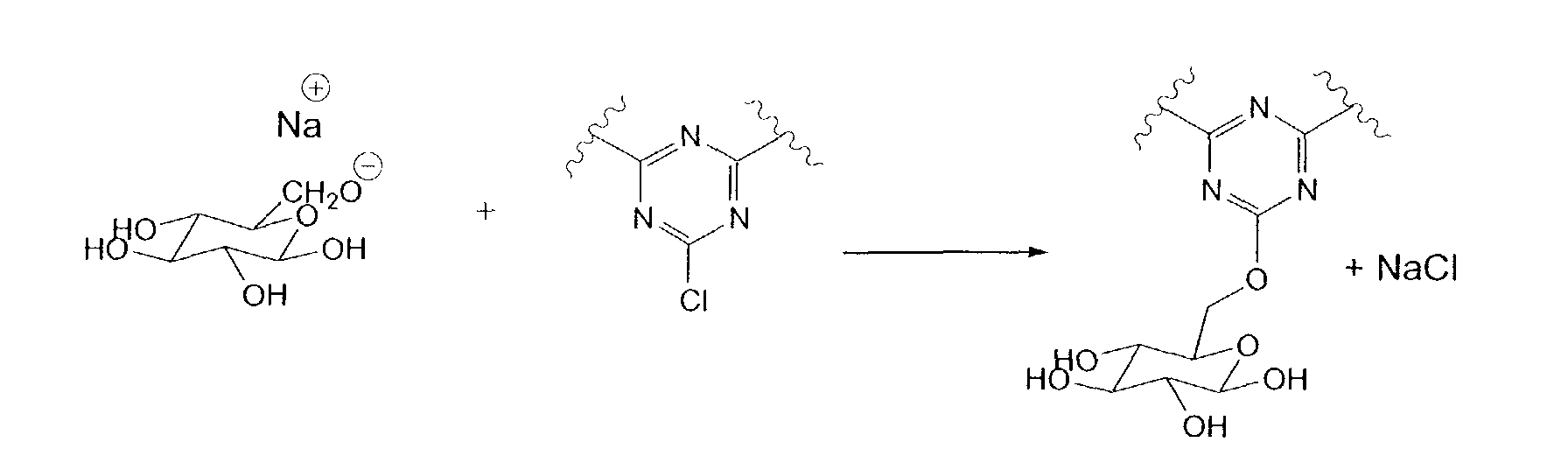
- Cotton is composed of cellulose, the primary component of plants. Prior to printing, multiple chemical pretreatment steps of the fabric may be used. Common to these methods is the treatment with base, which forms reactive alkoxides on the cellulose. Typical reactive dyes utilize a monochlorotriazine moiety.
- the dye is printed on the fabric, which is then steamed. The steam provides energy for the alkoxide on the deprotonated cellulose to substitute for the chlorine atom on the dye via nucleophilic addition (of the alkoxide) and elimination (of the chloride) to form an ether linkage, as shown below. Because the dye is covalently bound to the fabric, these fabrics can be washed in warm or hot water without separating the dye from the fabric.
- the invention exploits the realization that dark pens can be used to print lighter colors if a portion of the ink deposited on the fabric is not allowed to penetrate or react with the material.
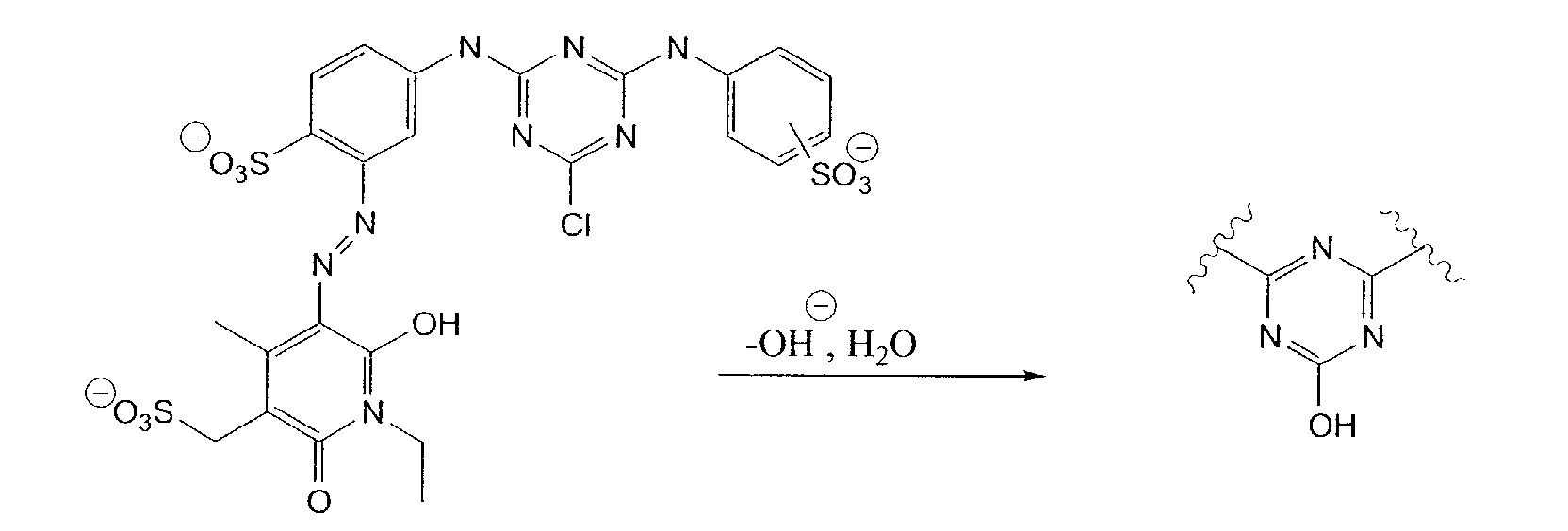
- a hydrolyzing agent is overprinted on a reactive dye, the agent will compete with the cellulose in the fabric when the material is steamed.
- Any dye that reacts with the hydrolyzing agent instead of with the fabric will have a hydroxyl group attached to the triazine instead of a chlorine atom, as shown below. The hydroxyl group is not a good leaving group, and the dye will not be able to react with the cellulose but will be washed off following steaming.
- the hydrolyzing pen obviates the use of light colored ink pens for printing.
- the light colored ink pens may be replaced with different colors, such as purple, navy, silver, or brown.
- the invention also facilitates higher quality printing of monochrome patterns.
- Use of a hydrolyzing pen will increase the continuity of the range of colors that can be achieved with the pens, reducing pixellation of printed patterns.
- Hydrolyzing agents appropriate for use with the invention include sodium hydroxide, potassium hydroxide, and other metal hydroxide salts.
- any hydrolysis agent that can compete effectively with the cellulose alkoxide may be used.
- Different agents may be selected depending on the temperature required for hydrolysis of the dye, which may range from room temperature to 100° C or higher.
- the hydrolyzing agent is only one of a variety of deactivating agents that may be employed.
- Alternative deactivating agents may also compete effectively with the cellulose by reacting with the dye to render it largely unreactive towards the cellulose.
- Exemplary deactivating agents include alkyl thiolates, various amines, alkoxide salts, azides, and other nucleophiles.
- An alternative strategy is to employ a deactivating agent to react with base-treated cellulose in order to render it unreactive towards the reactive dye.
- a deactivating agent for example, an acid solution would convert some fraction of alkoxide in the cellulose to less reactive hydroxyl groups.
- solutions of electrophiles can be used to deactivate these types of substrates.
- one or more chemical moieties may be attached to a dye or pigment dispersion before loading it in a printing cartridge.
- the colorant is printed on the fabric, followed by a deactivating agent.
- the deactivating agent chemically modifies the moiety to render the colorant more soluble in water.
- the solubilized colorant rinses out.
- an acid dye's solubility can be altered such that its removal during washing can be enhanced.
- a reactive reagent is used not to disrupt covalent bond formation between the dye and the substrate, but to modify the dye itself.
- One way to accomplish this is by modifying the dye with a sufficiently labile alkyl ester. This ester can be subsequently cleaved by a base, yielding a more soluble carboxylate group on the dye.
- introducing alternative counterions onto the printed pixel can enhance the dye's solubility.
- lithium and various alkyl ammonium salts are usually more soluble than sodium salts.
- a complementary method would be to reduce the affinity of the dye for the fiber.
- Non-reactive reagents that do not involve formation of covalent bonds may be used as well.
- Other exemplary reagent classes include surfactants. These may be used as penetrants, in which case the dye is carried so far into the interior of the fiber that its effective color strength is reduced. Alternatively, they may be employed as detergents that enhance the dye's solubility during the washing steps.
- Appropriate surfactants include those commonly used in ink vehicles and should be optimized with respect to the chemical properties of the ink, the substrate, or both.
- the deactivating agent is mixed with a liquid vehicle and deposited into the reservoir of a pen.
- the pen may be part of a separate cartridge or may be included with colored pens in a single cartridge. Alternatively, each color pen may be paired with a hydrolyzing pen in an individual cartridge.
- Typical ink vehicles include a humectant, various surfactants, corrosion inhibitors, polymers and a biocide.
- a humectant forms hydrogen bonds with water in the vehicle to decrease evaporation during storage and to maintain colorant or ink vehicle component solubility during drop formation on the print head.
- Typical humectants include diols, triols, polyols, and various heavy alcohols.
- Suitable diols include ethanediols, propanediols, butanediols, hexanediols, heptanediols, and octanediols.
- Typical triols include propanetriols such as 2-ethyl-2-hydroxymethyl-1, 3-propanediol and ethylhydroxypropanediol.
- Glycol ethers, thioglycol ethers, polyalkylene glycols e.g., diethylene glycol, diporpylene glycol, PEG 200 and larger polymeric glycols
- polyalkylene glycols e.g., diethylene glycol, diporpylene glycol, PEG 200 and larger polymeric glycols
- An anti-cockle reagent prevents buckling of the substrate as it is wet by the ink and may be useful for thinner fabrics such as silk.
- a variety of biocides suitable for inkjet printing are well known in the art and include NUOSEPTTM (Hals America), PROXEL TM GXL (Avecia, Inc.), and glutaraldehyde.
- Polymers for ink-jet printing include polyethylene imine, for example, LIPOSOL TM G (MW ⁇ 700), available from BASF.
- Typical surfactants include betaines, quaternary ammonium compounds, cationic amine oxides, and imidazoline surfactants.
- Typical non-ionic surfactants include secondary alcohol ethoxylates, nonionic fluoro surfactants, non-ionic fatty acid ethoxylate surfactants, and acetylenic polyethylene oxide surfactants.
- Anionic, non-ionic, or zwitterionic surfactants are preferred for negatively charged acid and reactive dyes.
- Typical anionic surfactants include alkyldiphenyloxide surfactants and fluorinated surfactants. Appropriate surfactants are well known to those skilled in the art and are commonly available from chemical suppliers.
- the stoichiometry of the reaction should be carefully controlled.
- chemical reactions of small molecules are not 100% efficient.
- colorants react differently with materials having different compositions or even different sources. For example, cotton grown in Indonesia reacts differently with a given dye than cotton grown in Georgia.
- the conditions for the reaction can be carefully controlled.
- a test swatch of material By first printing a test swatch of material to calibrate the amount of deactivating agent required to form different shades, an operator can print a consistent pattern on a large amount of material. Because the color of the pattern changes after steaming, a test swatch of the final product should be used to perform the calibration. Colorimeters may be used to further automate the calibration process. Indeed, a manufacturer may wish to perform frequent calibrations to adjust the printing conditions for variations in humidity and temperature.
Landscapes
- Engineering & Computer Science (AREA)
- Textile Engineering (AREA)
- Coloring (AREA)
- Ink Jet (AREA)
- Treatment Of Fiber Materials (AREA)
- Ink Jet Recording Methods And Recording Media Thereof (AREA)
- Inks, Pencil-Leads, Or Crayons (AREA)
Abstract
Description
Thus, complex patterns composed of many colors are difficult to produce. If it is desired to alter colors within a pattern, the ink used with a particular screen can simply be changed. If an alteration to the pattern itself is desired, however, the manufacturer must produce a whole new set of screens. This process is expensive and may take many weeks to complete.
Claims (10)
- A method of printing with an ink-jet printer, comprising:printing a colorant onto a predetermined pixel on a substrate;printing a deactivating agent on the pixel;causing the agent to react with a member of the colorant and the substrate; andwashing the substrate, wherein the step of printing the deactivating agent is performed before or after the step of printing the colorant.
- The method of claim 1, wherein the substrate comprises a member of a synthetic fiber, a natural fiber, and a mixture of both of the above.
- The method of claim 1, further comprising calculating an amount of the deactivating agent to print, wherein the amount is calculated to react with a predetermined amount of the colorant via a member of a covalent and a non-covalent interaction, and wherein the step of causing optionally comprises heating the substrate in steam.
- The method of claim 1, wherein the colorant comprises a reactive dye.
- The method of claim 1, wherein the deactivating agent comprises a member of a hydrolyzing agent, and alkylthiolate, an amine, an alkoxide, an azide, an acid, an electrophile, a lithium salt, an alkyl ammonium salt, a surfactant and a detergent, wherein the hydrolyzing agent optionally comprises a member of the group consisting of sodium hydroxide, potassium hydroxide, and metal hydroxides.
- The method of claim 1, further comprising, before the step of printing, attaching a labile chemical group to the colorant, wherein the labile group is optionally attached to the colorant via an ester linkage.
- An ink cartridge for use with an inkjet printer, comprising:a plurality of pens;a plurality of reservoirs, each of which is in fluidic communication with a pen; wherein:a portion of the plurality of reservoirs contain an ink comprising a dye,at least one of the reservoirs contains a deactivating agent.
- The ink cartridge of claim 7, wherein at least one of the dyes is a reactive dye and the agent is a hydrolyzing agent.
- The ink cartridge of claim 7, wherein at least one of the dyes comprises a labile group, and wherein the deactivating agent cleaves the labile group from the dye.
- The ink cartridge of claim 7, wherein the deactivating agent comprises a member of the group consisting of alkyl thiolates, alkoxide salts, azides, substituted triazines, a detergent and a surfactant or wherein the deactivating agent modifies a member of the solubility and the penetrability of at least one of the dyes.
Applications Claiming Priority (2)
| Application Number | Priority Date | Filing Date | Title |
|---|---|---|---|
| US10/173,850 US6719421B2 (en) | 2002-06-18 | 2002-06-18 | Modification of inks during printing to reduce color intensity |
| US173850 | 2002-06-18 |
Publications (3)
| Publication Number | Publication Date |
|---|---|
| EP1375163A2 true EP1375163A2 (en) | 2004-01-02 |
| EP1375163A3 EP1375163A3 (en) | 2004-05-19 |
| EP1375163B1 EP1375163B1 (en) | 2006-08-16 |
Family
ID=29717786
Family Applications (1)
| Application Number | Title | Priority Date | Filing Date |
|---|---|---|---|
| EP03253512A Expired - Lifetime EP1375163B1 (en) | 2002-06-18 | 2003-06-04 | Modification of inks during printing to reduce color intensity |
Country Status (4)
| Country | Link |
|---|---|
| US (1) | US6719421B2 (en) |
| EP (1) | EP1375163B1 (en) |
| JP (1) | JP4053470B2 (en) |
| DE (1) | DE60307546T2 (en) |
Cited By (2)
| Publication number | Priority date | Publication date | Assignee | Title |
|---|---|---|---|---|
| DE102004057623A1 (en) * | 2004-11-29 | 2006-06-01 | Henkel Kgaa | Aqueous cleaning agent concentrate, useful for cleaning oil- and/or fat- polluted metallic surfaces, comprises water, glycol ether and/or non-ionic surfactant, polyethylenimine and cationic surfactant |
| WO2008010705A1 (en) * | 2006-07-20 | 2008-01-24 | Stork Digital Imaging B.V. | Printing method and ink jet printing device |
Families Citing this family (3)
| Publication number | Priority date | Publication date | Assignee | Title |
|---|---|---|---|---|
| US8356878B2 (en) | 2011-05-20 | 2013-01-22 | Hewlett-Packard Development Company, L.P. | Method of printing images |
| AU2014266438B2 (en) * | 2013-11-25 | 2018-01-04 | Crayola Llc | Marking system |
| CN109537321A (en) * | 2018-11-05 | 2019-03-29 | 合肥聚合辐化技术有限公司 | A kind of ink-jet printed use reactive dye ink and the preparation method of less salt low conductivity |
Family Cites Families (5)
| Publication number | Priority date | Publication date | Assignee | Title |
|---|---|---|---|---|
| JP3376027B2 (en) * | 1992-12-04 | 2003-02-10 | キヤノン株式会社 | Fabric image forming apparatus, fabric image forming method, article made of image-formed fabric, and printed matter manufacturing method |
| JP2711081B2 (en) * | 1994-07-21 | 1998-02-10 | キヤノン株式会社 | Ink jet printing apparatus, ink jet printing method, and printed matter |
| GB9627075D0 (en) * | 1996-12-31 | 1997-02-19 | Zeneca Ltd | Printing method |
| US6394569B1 (en) * | 1998-10-29 | 2002-05-28 | Eastman Kodak Company | Ink jet printer method of providing an image on a receiver so that the image has reduced graininess |
| EP1152017A4 (en) * | 1999-05-25 | 2004-12-15 | Seiko Epson Corp | WATER REPELLENT, INK, REACTIVE LIQUID, AND METHOD FOR INK JET PRINTING WITH TWO LIQUIDS |
-
2002
- 2002-06-18 US US10/173,850 patent/US6719421B2/en not_active Expired - Fee Related
-
2003
- 2003-06-04 EP EP03253512A patent/EP1375163B1/en not_active Expired - Lifetime
- 2003-06-04 DE DE60307546T patent/DE60307546T2/en not_active Expired - Lifetime
- 2003-06-18 JP JP2003173086A patent/JP4053470B2/en not_active Expired - Fee Related
Cited By (4)
| Publication number | Priority date | Publication date | Assignee | Title |
|---|---|---|---|---|
| DE102004057623A1 (en) * | 2004-11-29 | 2006-06-01 | Henkel Kgaa | Aqueous cleaning agent concentrate, useful for cleaning oil- and/or fat- polluted metallic surfaces, comprises water, glycol ether and/or non-ionic surfactant, polyethylenimine and cationic surfactant |
| WO2008010705A1 (en) * | 2006-07-20 | 2008-01-24 | Stork Digital Imaging B.V. | Printing method and ink jet printing device |
| NL1032217C2 (en) * | 2006-07-20 | 2008-01-29 | Stork Digital Imaging Bv | Printing method and ink jet printer. |
| US8360568B2 (en) | 2006-07-20 | 2013-01-29 | Stork Digital Imaging B.V. | Printing method and ink jet printing device |
Also Published As
| Publication number | Publication date |
|---|---|
| EP1375163B1 (en) | 2006-08-16 |
| US20030231233A1 (en) | 2003-12-18 |
| US6719421B2 (en) | 2004-04-13 |
| JP4053470B2 (en) | 2008-02-27 |
| JP2004042636A (en) | 2004-02-12 |
| EP1375163A3 (en) | 2004-05-19 |
| DE60307546D1 (en) | 2006-09-28 |
| DE60307546T2 (en) | 2007-08-16 |
Similar Documents
| Publication | Publication Date | Title |
|---|---|---|
| US9803094B2 (en) | Aqueous ink-jet inks containing mixtures of anionic and non-ionic polymeric binders | |
| KR100392578B1 (en) | Printing Process, Print Obtained by the Process and Processed Article | |
| JP5110404B2 (en) | Image forming method, method for producing fabric having image, and processing agent | |
| US11261342B2 (en) | Cleaning solution, set of ink and cleaning solution, cleaning method, cleaning apparatus, printing method, and printing apparatus | |
| Kan et al. | Digital ink-jet printing on textiles | |
| EP3063238B1 (en) | Aqueous ink-jet inks containing two or more binders | |
| EP3532591B1 (en) | Cleaning solution, set of ink and cleaning solution, cleaning method, cleaning apparatus, printing method, and printing apparatus | |
| US6336721B1 (en) | Multicolor ink jet printing method | |
| EP1388576A1 (en) | Fluid set for ink-jet printers | |
| JP2022514779A (en) | Textile printing fluid set containing pretreatment liquid and mixture of pigments and disperse dyes | |
| EP1375163B1 (en) | Modification of inks during printing to reduce color intensity | |
| US10857805B2 (en) | Treatment agent for image recording, set including ink and treatment agent for image recording, and recording method | |
| JP4214734B2 (en) | Ink for inkjet printing, printing method using the same, and printed matter | |
| JP2001354890A (en) | Ink set for inkjet printing | |
| EP0951515B1 (en) | Multicolour ink jet printing method | |
| JP2004292468A (en) | Ink for inkjet, its manufacturing method, inkjet recording method using the same, and inkjet printing method | |
| JP7830921B2 (en) | Printing method, set of processing solution and ink, and method for manufacturing printed materials | |
| CN110546216B (en) | Novel black ink | |
| JP2020066711A (en) | Printing inkjet ink composition and recording method | |
| JP2506618B2 (en) | Ink Jet Coloring Discharge Method | |
| HK40078291A (en) | New black ink | |
| JP4076101B2 (en) | Water-soluble azo compound and dyeing method using the same | |
| JPH1161016A (en) | Assisting method for preparation of ink jet printing ink and ink jet printing ink prepared thereby, and printed matter printed therewith | |
| JP2025115867A (en) | Ink, ink container, printing device, and printing method | |
| WO2026046942A1 (en) | New ink set for ink jet printing on textile |
Legal Events
| Date | Code | Title | Description |
|---|---|---|---|
| PUAI | Public reference made under article 153(3) epc to a published international application that has entered the european phase |
Free format text: ORIGINAL CODE: 0009012 |
|
| AK | Designated contracting states |
Kind code of ref document: A2 Designated state(s): AT BE BG CH CY CZ DE DK EE ES FI FR GB GR HU IE IT LI LU MC NL PT RO SE SI SK TR |
|
| AX | Request for extension of the european patent |
Extension state: AL LT LV MK |
|
| PUAL | Search report despatched |
Free format text: ORIGINAL CODE: 0009013 |
|
| AK | Designated contracting states |
Kind code of ref document: A3 Designated state(s): AT BE BG CH CY CZ DE DK EE ES FI FR GB GR HU IE IT LI LU MC NL PT RO SE SI SK TR |
|
| AX | Request for extension of the european patent |
Extension state: AL LT LV MK |
|
| 17P | Request for examination filed |
Effective date: 20041029 |
|
| AKX | Designation fees paid |
Designated state(s): DE FR GB |
|
| 17Q | First examination report despatched |
Effective date: 20050301 |
|
| GRAP | Despatch of communication of intention to grant a patent |
Free format text: ORIGINAL CODE: EPIDOSNIGR1 |
|
| GRAS | Grant fee paid |
Free format text: ORIGINAL CODE: EPIDOSNIGR3 |
|
| GRAA | (expected) grant |
Free format text: ORIGINAL CODE: 0009210 |
|
| AK | Designated contracting states |
Kind code of ref document: B1 Designated state(s): DE FR GB |
|
| REG | Reference to a national code |
Ref country code: GB Ref legal event code: FG4D |
|
| REF | Corresponds to: |
Ref document number: 60307546 Country of ref document: DE Date of ref document: 20060928 Kind code of ref document: P |
|
| ET | Fr: translation filed | ||
| PLBE | No opposition filed within time limit |
Free format text: ORIGINAL CODE: 0009261 |
|
| STAA | Information on the status of an ep patent application or granted ep patent |
Free format text: STATUS: NO OPPOSITION FILED WITHIN TIME LIMIT |
|
| 26N | No opposition filed |
Effective date: 20070518 |
|
| PGFP | Annual fee paid to national office [announced via postgrant information from national office to epo] |
Ref country code: DE Payment date: 20130523 Year of fee payment: 11 Ref country code: GB Payment date: 20130527 Year of fee payment: 11 |
|
| PGFP | Annual fee paid to national office [announced via postgrant information from national office to epo] |
Ref country code: FR Payment date: 20130724 Year of fee payment: 11 |
|
| REG | Reference to a national code |
Ref country code: DE Ref legal event code: R119 Ref document number: 60307546 Country of ref document: DE |
|
| GBPC | Gb: european patent ceased through non-payment of renewal fee |
Effective date: 20140604 |
|
| REG | Reference to a national code |
Ref country code: FR Ref legal event code: ST Effective date: 20150227 |
|
| REG | Reference to a national code |
Ref country code: DE Ref legal event code: R119 Ref document number: 60307546 Country of ref document: DE Effective date: 20150101 |
|
| PG25 | Lapsed in a contracting state [announced via postgrant information from national office to epo] |
Ref country code: DE Free format text: LAPSE BECAUSE OF NON-PAYMENT OF DUE FEES Effective date: 20150101 |
|
| PG25 | Lapsed in a contracting state [announced via postgrant information from national office to epo] |
Ref country code: GB Free format text: LAPSE BECAUSE OF NON-PAYMENT OF DUE FEES Effective date: 20140604 Ref country code: FR Free format text: LAPSE BECAUSE OF NON-PAYMENT OF DUE FEES Effective date: 20140630 |