EP1374993A2 - Solid acid catalyst containing platinum group metal component and method for preparation thereof - Google Patents
Solid acid catalyst containing platinum group metal component and method for preparation thereof Download PDFInfo
- Publication number
- EP1374993A2 EP1374993A2 EP02702717A EP02702717A EP1374993A2 EP 1374993 A2 EP1374993 A2 EP 1374993A2 EP 02702717 A EP02702717 A EP 02702717A EP 02702717 A EP02702717 A EP 02702717A EP 1374993 A2 EP1374993 A2 EP 1374993A2
- Authority
- EP
- European Patent Office
- Prior art keywords
- catalyst
- platinum group
- group metal
- solid acid
- concentration
- Prior art date
- Legal status (The legal status is an assumption and is not a legal conclusion. Google has not performed a legal analysis and makes no representation as to the accuracy of the status listed.)
- Withdrawn
Links
Images

Classifications
-
- B—PERFORMING OPERATIONS; TRANSPORTING
- B01—PHYSICAL OR CHEMICAL PROCESSES OR APPARATUS IN GENERAL
- B01J—CHEMICAL OR PHYSICAL PROCESSES, e.g. CATALYSIS OR COLLOID CHEMISTRY; THEIR RELEVANT APPARATUS
- B01J29/00—Catalysts comprising molecular sieves
- B01J29/04—Catalysts comprising molecular sieves having base-exchange properties, e.g. crystalline zeolites
- B01J29/06—Crystalline aluminosilicate zeolites; Isomorphous compounds thereof
- B01J29/064—Crystalline aluminosilicate zeolites; Isomorphous compounds thereof containing iron group metals, noble metals or copper
- B01J29/068—Noble metals
-
- B—PERFORMING OPERATIONS; TRANSPORTING
- B01—PHYSICAL OR CHEMICAL PROCESSES OR APPARATUS IN GENERAL
- B01J—CHEMICAL OR PHYSICAL PROCESSES, e.g. CATALYSIS OR COLLOID CHEMISTRY; THEIR RELEVANT APPARATUS
- B01J37/00—Processes, in general, for preparing catalysts; Processes, in general, for activation of catalysts
- B01J37/02—Impregnation, coating or precipitation
-
- B—PERFORMING OPERATIONS; TRANSPORTING
- B01—PHYSICAL OR CHEMICAL PROCESSES OR APPARATUS IN GENERAL
- B01J—CHEMICAL OR PHYSICAL PROCESSES, e.g. CATALYSIS OR COLLOID CHEMISTRY; THEIR RELEVANT APPARATUS
- B01J35/00—Catalysts, in general, characterised by their form or physical properties
- B01J35/30—Catalysts, in general, characterised by their form or physical properties characterised by their physical properties
- B01J35/391—Physical properties of the active metal ingredient
- B01J35/393—Metal or metal oxide crystallite size
-
- B—PERFORMING OPERATIONS; TRANSPORTING
- B01—PHYSICAL OR CHEMICAL PROCESSES OR APPARATUS IN GENERAL
- B01J—CHEMICAL OR PHYSICAL PROCESSES, e.g. CATALYSIS OR COLLOID CHEMISTRY; THEIR RELEVANT APPARATUS
- B01J23/00—Catalysts comprising metals or metal oxides or hydroxides, not provided for in group B01J21/00
- B01J23/38—Catalysts comprising metals or metal oxides or hydroxides, not provided for in group B01J21/00 of noble metals
- B01J23/40—Catalysts comprising metals or metal oxides or hydroxides, not provided for in group B01J21/00 of noble metals of the platinum group metals
- B01J23/42—Platinum
-
- B—PERFORMING OPERATIONS; TRANSPORTING
- B01—PHYSICAL OR CHEMICAL PROCESSES OR APPARATUS IN GENERAL
- B01J—CHEMICAL OR PHYSICAL PROCESSES, e.g. CATALYSIS OR COLLOID CHEMISTRY; THEIR RELEVANT APPARATUS
- B01J27/00—Catalysts comprising the elements or compounds of halogens, sulfur, selenium, tellurium, phosphorus or nitrogen; Catalysts comprising carbon compounds
- B01J27/02—Sulfur, selenium or tellurium; Compounds thereof
- B01J27/053—Sulfates
-
- B—PERFORMING OPERATIONS; TRANSPORTING
- B01—PHYSICAL OR CHEMICAL PROCESSES OR APPARATUS IN GENERAL
- B01J—CHEMICAL OR PHYSICAL PROCESSES, e.g. CATALYSIS OR COLLOID CHEMISTRY; THEIR RELEVANT APPARATUS
- B01J35/00—Catalysts, in general, characterised by their form or physical properties
- B01J35/60—Catalysts, in general, characterised by their form or physical properties characterised by their surface properties or porosity
-
- B—PERFORMING OPERATIONS; TRANSPORTING
- B01—PHYSICAL OR CHEMICAL PROCESSES OR APPARATUS IN GENERAL
- B01J—CHEMICAL OR PHYSICAL PROCESSES, e.g. CATALYSIS OR COLLOID CHEMISTRY; THEIR RELEVANT APPARATUS
- B01J2235/00—Indexing scheme associated with group B01J35/00, related to the analysis techniques used to determine the catalysts form or properties
- B01J2235/15—X-ray diffraction
-
- B—PERFORMING OPERATIONS; TRANSPORTING
- B01—PHYSICAL OR CHEMICAL PROCESSES OR APPARATUS IN GENERAL
- B01J—CHEMICAL OR PHYSICAL PROCESSES, e.g. CATALYSIS OR COLLOID CHEMISTRY; THEIR RELEVANT APPARATUS
- B01J35/00—Catalysts, in general, characterised by their form or physical properties
- B01J35/60—Catalysts, in general, characterised by their form or physical properties characterised by their surface properties or porosity
- B01J35/61—Surface area
- B01J35/615—100-500 m2/g
-
- B—PERFORMING OPERATIONS; TRANSPORTING
- B01—PHYSICAL OR CHEMICAL PROCESSES OR APPARATUS IN GENERAL
- B01J—CHEMICAL OR PHYSICAL PROCESSES, e.g. CATALYSIS OR COLLOID CHEMISTRY; THEIR RELEVANT APPARATUS
- B01J35/00—Catalysts, in general, characterised by their form or physical properties
- B01J35/60—Catalysts, in general, characterised by their form or physical properties characterised by their surface properties or porosity
- B01J35/63—Pore volume
- B01J35/633—Pore volume less than 0.5 ml/g
-
- B—PERFORMING OPERATIONS; TRANSPORTING
- B01—PHYSICAL OR CHEMICAL PROCESSES OR APPARATUS IN GENERAL
- B01J—CHEMICAL OR PHYSICAL PROCESSES, e.g. CATALYSIS OR COLLOID CHEMISTRY; THEIR RELEVANT APPARATUS
- B01J35/00—Catalysts, in general, characterised by their form or physical properties
- B01J35/60—Catalysts, in general, characterised by their form or physical properties characterised by their surface properties or porosity
- B01J35/64—Pore diameter
- B01J35/647—2-50 nm
Definitions
- the present invention relates to a method for supporting a platinum group metal component with which a solid acid catalyst having high activity in an acid-catalyzed reaction can be obtained, and to a solid acid catalyst obtained by this method.
- Acid-catalyzed reactions such as alkylation, esterification, and isomerization are known in the chemical industry.
- Acid catalysts such as sulfuric acid, aluminum chloride, hydrogen fluoride, phosphoric acid, and paratoluenesulfonic acid have been used in these types of reactions in the past.
- a property of these acid catalysts is that they corrode metals, which has meant that the manufacturing equipment had to be made from expensive corrosion-resistant materials or subjected to an anti-corrosion treatment.
- a waste acid treatment was usually necessary, the process entailed complicated steps such as alkali washing, and caused a serious environmental problem. Furthermore, it was extremely difficult to recycle the catalyst.
- the inventors discovered that the concentration is higher around the outer periphery or is nonuniform in catalyst cross section in the concentration distribution of a platinum group metal component produced by a conventional preparing method, and perfected the present invention upon realizing that catalyst activity could be increased by making this distribution uniform.
- the solid acid catalyst containing a platinum group metal component pertaining to the present invention is a solid acid catalyst that comprises porous catalyst pellets exhibiting solid acid characteristics, and a platinum group metal component supported by these catalyst pellets, and that is used in an acid-catalyzed reaction, in which a quotient of dividing a standard deviation of concentration in the platinum group metal component concentration distribution in the catalyst by an average concentration is 0.4 or less. It is preferable if the platinum group metal component has been crystallized. It is also preferable if the catalyst pellets are composed of a shaped support consisting of a metal oxide, and a sulfurous component supported by this support.
- the support preferably includes zirconium in an amount of 20 to 72 wt% as elemental zirconium weight in the catalyst.
- This solid acid catalyst can be used to advantage in the isomerization of hydrocarbons containing a saturated hydrocarbon component having 4 to 10 carbon atoms, preferably a saturated hydrocarbon component having 4 to 6 carbon atoms, in an amount of at least 70 wt%.
- Metal oxide as used in this Specification is defined as encompassing hydrated metal oxides.
- the method for preparing a solid acid catalyst pertaining to the present invention comprises a step of preparing a support solution containing a platinum group metal as a cation, and a step of impregnating crystalline, porous catalyst pellets exhibiting solid acid characteristics with this support solution.
- the catalyst pellets are produced by a step of supporting a sulfureous component on a shaped support consisting of a metal oxide, and the support solution contains an ammine complex of a platinum group metal.
- chloroplatinic acid which forms a platinum group metal anion
- the capillary action of pores of the porous support will cause the concentration of platinum group metal to be higher in the center portion of the pellets, but the subsequent calcining will result in considerable local variance in the concentration of the platinum group metal. The reason for this seems to be that there is no interaction between the anions and the acidic activity points within the catalyst pellets, so the concentration distribution of the platinum group metal tends to vary during drying and calcining.
- the platinum group metal when the platinum group metal is present as cations in impregnation, it selectively reaches the acidic activity points within the catalyst pellets, and the platinum group metal concentration becomes higher around the outer part of the catalyst. Drying and calcining then result in a uniform distribution of the platinum group metal. This uniform support of the platinum group metal increases catalyst activity.
- the solid acid catalyst of the present invention comprises porous catalyst pellets exhibiting solid acid characteristics, and a platinum group metal component supported by these catalyst pellets, and that is used in an acid-catalyzed reaction, wherein the quotient (hereinafter also referred to simply as the standard deviation/average) of dividing the standard deviation of the concentration in the platinum group metal component concentration distribution in said catalyst by the average concentration is 0.4 or less. It is preferable if the catalyst pellets that exhibit solid acid characteristics are crystalline and porous.
- the catalyst of the present invention is in a shaped form known as pellets, rather than a powder, and pellets 0.5 to 20 mm in size can be easily obtained. Usually, those with an average size of 0.5 to 20 mm, and particularly 0.6 to 5 mm, can be used to advantage.
- the mechanical strength of the catalyst in terms of the side crushing strength of cylindrical pellets with a diameter of 1.5 mm, is at least 2 kg, and preferably at least 3 kg, and even more preferably 4 to 8 kg.
- the catalyst pellets of the present invention preferably include a shaped support consisting of a metal oxide.
- a metal oxide There are no particular restrictions on the metal component of this metal oxide (including a hydrated metal oxide), but examples include boron, magnesium, aluminum, silicon, phosphorus, calcium, titanium, vanadium, chromium, manganese, iron, cobalt, nickel, copper, zinc, gallium, germanium, yttrium, zirconium, niobium, molybdenum, tin, hafnium, tungsten, lanthanum, and cerium.
- Aluminum, silicon, titanium, manganese, iron, yttrium, zirconium, molybdenum, tin, hafnium, and tungsten are preferred, and aluminum, titanium, iron, zirconium, and tin are particularly favorable.
- These metal oxides can be used singly or in mixtures, and can also be used in the form of a composite metal oxide such as a zeolite.
- At least part of the metal component of the metal oxide used in the support of the present invention is preferably zirconium, and the zirconium content in the catalyst is preferably 20 to 72 wt%, and more preferably 30 to 60 wt%, as elemental zirconium weight.
- at least part of the metal component of the metal oxide used in the support of the present invention is preferably aluminum, and the aluminum content in the catalyst is preferably 5 to 30 wt%, and more preferably 8 to 25 wt%, as elemental aluminum weight. It is particularly favorable that the solid acid catalyst of the present invention contains zirconium and aluminum as metal components, and a halogen can be further contained as needed in order to enhance the acid catalyst performance of the product.
- the catalyst pellets of the present invention contain a sulfureous component.
- the proportion of the catalyst accounted for by the sulfureous component (SO 4 ) is 0.7 to 7 wt% as elemental sulfur weight, and preferably 1 to 6 wt%, and even more preferably 2 to 5 wt%. Catalyst activity will decrease if the content of the sulfureous component is either too large or too small.
- platinum group metals are contained in the solid acid catalyst of the present invention.
- Example of the platinum group metals referred to here include platinum, palladium, ruthenium, rhodium, iridium, and osmium. Platinum, palladium, and ruthenium are preferable, and the use of platinum is particularly favorable.
- the platinum group metal prefferably has been crystallized.
- the platinum group metal being crystallized means that there is a clear diffraction peak for a platinum group metal as measured by powder X-ray analysis. If we let 100% be the surface area of a diffraction peak produced by fully crystallized platinum, then the crystallization of the platinum group metal is confirmed by the appearance of a peak with a surface area of at least 30%, and particularly at least 50%, at the same position (hereinafter, the degree of crystallization is referred to as "crystallinity").
- the proportion of the catalyst accounted for by the platinum group metal component (the average platinum group metal component concentration) is 0.01 to 10 wt%, and preferably 0.05 to 5 wt%, and especially 0.1 to 2 wt%, as the elemental metal weight. It is undesirable for the platinum group metal component content to be too low because the improvement in catalyst performance will be small. It is also undesirable for the platinum group metal component content to be too high because it will lower the specific surface area and pore volume of the catalyst.
- the quotient of dividing the standard deviation of the concentration of the platinum group metal component concentration in the catalyst pertaining to the present invention by the average concentration is 0.4 or less, and preferably 0.3 or less. This value can be obtained by dividing up a line that passes through the center of the catalyst cross section (such as a line corresponding to the diameter in the case of a circular cross section) into at least 50 segments and finding the average concentration in each segment,and the standard deviation of the measured concentrations.
- the concentration distribution of the platinum group metal component can be found as the concentration of the platinum group metal component in the catalyst cross section from the measurement of X-ray intensity using an EPMA measurement apparatus.
- the crystallite diameter of the platinum group metal measured by X-ray diffraction is 10 nm or less, with 1 to 10 nm being particularly favorable.
- the platinum group metal concentration will tend to be uniform if the platinum group metal component is contained in an amount of at least 0.15 wt%, and particularly at least 0.2 wt%, and especially at least 0.3 wt%.
- the specific surface area of the solid acid catalyst of the present invention is 50 to 500 m 2 /g, with 100 to 300 m 2 /g being preferable, and 140 to 200 m 2 /g being particularly favorable.
- the specific surface area can be measured by the commonly known BET method.
- the pore structure of the solid acid catalyst of the present invention can be analyzed by a nitrogen adsorption method for pore diameters ranging from 0.002 to 0.05 ⁇ m, and by a mercury porosimetry for pore diameters ranging from 0.05 to 10 ⁇ m.
- the pore volume at a pore diameter of 0.002 to 10 ⁇ m is at least 0.2 cm 3 /g, with at least 0.3 cm 3 /g being preferable, and 0.35 to 1.0 cm 3 /g being particularly favorable.
- the method for preparing a solid acid catalyst of the present invention comprises a step of preparing a support solution containing a platinum group metal as a cation, and a step of impregnating crystalline, porous catalyst pellets exhibiting solid acid characteristics with this support solution.
- a support solution containing a platinum group metal as a cation
- an ammine complex of a platinum group metal is preferred.
- This ammine complex can be dichlorotetraammine platinum, tetrachlorohexaammine platinum, or the like.
- Platinum, palladium, ruthenium, and the like are favorable as the metal component selected as the platinum group metal component, and platinum can be used to particular advantage.
- the platinum group metal component may also include a metal component from another group. It is preferable to add these metal compounds such that the total amount of the platinum group metal component in the solid acid catalyst is 0.01 to 10 wt%, with 0.1 to 5 wt% being preferable, and 0.15 or higher being particularly favorable.
- the pH of the support solution should be 5 to 8, with 6 to 7.5 being particularly good. Outside this range there will be a relative decrease in catalyst activity.
- the support solution is usually stabilized by drying, calcining, or the like.
- the calcining temperature will vary with the calcining time and other calcining conditions, but is generally 300 to 800°C, with 400 to 800°C being particularly good, and 500 to 700°C being even better.
- the calcining time will vary with the calcining temperature and other calcining conditions, but is generally 0.05 to 20 hours, with 0.1 to 10 hours being particularly good, and 0.2 to 5 hours being even better.
- the calcining prefferably be performed at the same or higher temperature as in the calcining or other such heat treatment carried out in the preparation of catalyst pellets.
- the drying and calcining may be conducted in a gas atmosphere of air, nitrogen, or the like, but it is more desirable that it be conducted in air.
- Reduction is preferably performed in a gas flow containing hydrogen.
- porous catalyst pellets exhibiting solid acid characteristics
- an example is a method in which a sulfur-containing compound is added to and kneaded with a powder of a hydrated metal oxide and/or a metal hydroxide, which is a powder that becomes a precursor of the metal oxide that makes up the support (hereinafter referred to as "precursor powder"), and this mixture is then shaped and calcined.
- precursor powder a powder that becomes a precursor of the metal oxide that makes up the support
- the precursor powder which becomes the metal oxide constituting the support by calcining after shaping, can be prepared in any way desired, but it can generally be obtained by neutralizing or hydrolyzing a metal salt or organometal compound, then washing and drying.
- This precursor powder can be a mixture of two or more kinds of powder.
- This precursor powder can also be a composite metal hydroxide and/or composite metal hydrate oxide.
- the sulfur-containing compound is a compound containing sulfureous component, or a compound containing sulfur that can be subsequently converted into sulfureous component by calcining or another such a treatment.
- sulfur-containing compounds include sulfuric acid, ammonium sulfate, sulfurous acid, ammonium sulfite, thionyl chloride, and dimethylsulfuric acid, but the use of a sulfureous component-containing compound is preferable, and ammonium sulfate and dimethylsulfuric acid are favorable because of their low corrosivity to the preparing equipment. The use of ammonium sulfate is best of all.
- the sulfur-containing compound may be used just as it is, or in the form of a solution, such as an aqueous solution.
- the sulfur-containing compound may be in the form of a solid or a liquid, and there are no particular restrictions on the concentration of the solution, which can be prepared by taking into account such factors as the amount of solution needed for kneading. It is preferable to add the sulfur-containing compound such that the amount of the sulfureous component (SO 4 ) in the ultimately obtained solid acid catalyst be 1 to 10 wt%, and preferably 1.5 to 9 wt%, and particularly 2 to 8 wt%, as the elemental sulfur weight.
- any kneader commonly used in the preparation of catalysts can be employed.
- a method in which the raw material is put into a kneader, and water is added and mixed with an agitation impeller can usually be used to advantage, but there are no particular restrictions on the order in which the raw materials and additives are introduced and so forth.
- Water is usually added during kneading, but the added liquid may instead be ethanol, isopropanol, acetone, methyl ethyl ketone, methyl isobutyl ketone, or another organic solvent.
- the kneading temperature and time will vary with the hydrated metal oxide and/or metal hydroxide precursor powder and sulfur-containing compound as the raw materials, but there are no particular restrictions as long as the conditions allow a favorable pore structure to be obtained.
- an acid such as nitric acid, a base such as ammonia, an organic compound, a metal salt, ceramic fibers, a surfactant, a zeolite, clay, or the like may also be added and kneaded.
- any shaping method commonly employed in the preparation of catalysts can be used.
- Extrusion shaping using a screw extruder or the like is particularly favorable because it allows the material to be efficiently shaped into pellets, a honeycomb shape, or other desired shape.
- the size of the shaped product is usually 0.5 to 20 mm. For instance, cylindrical pellets with a diameter of 0.5 to 10 mm and a length of about 0.5 to 15 mm can usually be obtained with ease.
- the calcining performed after shaping is conducted in a gas atmosphere of air, nitrogen, or the like, but it is especially favorably conducted in air.
- the calcining temperature will vary with the calcining time, the gas flux, and other calcining conditions, but is generally 400 to 900°C, and preferably 500 to 800°C.
- the calcining time will vary with the calcining temperature, the gas flux, and other calcining conditions, but is generally 0.05 to 20 hours, with 0.1 to 10 hours being preferable, and 0.2 to 5 hours being particularly favorable.
- the acid-catalyzed reactions to which the solid acid catalyst pertaining to the present invention is applied include acid-catalyzed reactions which in the past made use of a Lewis acid catalyst, typified by an aluminum chloride-based catalyst, or a Broensted acid catalyst, typified by sulfuric acid.
- the catalyst of the present invention can be used to advantage in a wide range of reactions, especially isomerization, disproportionation, nitration, decomposition, alkylation, esterification, acylation, etherification, rearrangement, polymerization, and so forth.
- the catalyst of the present invention includes the isomerization of light naphtha, isomerization of a wax, isomerization of an olefin, isomerization of xylene, disproportionation of toluene, nitration of an aromatic compound, decomposition of fluorocarbons, decomposition of cumene hydroperoxide, alkylation of butene and butane, alkylation of an aromatic compound, esterification of methacrylic acid and the like, esterification of phthalic anhydride, acylation of an aromatic compound, etherification of isobutene and methanol, Beckmann rearrangement, ring-opening polymerization of tetrahydrofuran, polymerization of an olefin, and oxidative coupling of methane.
- the use of the catalyst of the present invention is favorable in the isomerization of hydrocarbons including at least 70 wt% saturated hydrocarbon component having 4 to 10 carbon atoms, and particularly
- hydrocarbon that serves as the raw material of the isomerization reaction of the present invention
- hydrocarbons in a petroleum fraction whose boiling point is between -20°C and 250°C, and particularly between -20°C and 150°C, can be used favorably.
- a favorable reaction is one in which a straight-chain paraffin is isomerized into a branched paraffin, or an olefin or an aromatic compound is hydrogenated into a linear or cyclic paraffin, and then further isomerized.
- the preferred reaction temperature range is from 20 to 300°C, and particularly 100 to 250°C
- the preferred reaction pressure range is from 1 to 50 kgf/cm 2
- the preferred LHSV range is from 0.2 to 10/hr
- the preferred hydrogen/raw material ratio is given so as to provide at least the amount of hydrogen needed to saturate the unsaturated component (olefin component, aromatic component) included in the raw material hydrocarbon, and particularly from 0.01 to 10 mol/mol.
- the amount of benzene included in the hydrocarbon serving as the raw material is at least 0.5 wt%, and particularly 2 to 20 wt%, it is preferable to use a solid acid catalyst pertaining to the present invention in which the total amount of platinum group metal component accounts for 0.15 to 5 wt%, and preferably 0.2 to 4 wt%, and even more preferably 0.3 to 3 wt%, of the solid acid catalyst. If the platinum group metal content is lower than this range, the benzene that is present will hinder the isomerization of the linear or cyclic paraffin, resulting in a relative decrease in the conversion of hydrocarbons.
- the amount in which the sulfur compound is contained in the hydrocarbon serving as the raw material in the isomerization reaction of the present invention is preferably no more than 500 ppm, and preferably no more than 100 ppm, and particularly no more than 1 ppm, as the sulfur weight.
- the amount of water in the hydrocarbon serving as the raw material in the isomerization reaction of the present invention is preferably no more than 100 ppm, and preferably no more than 5 ppm, and particularly no more than 1 ppm.
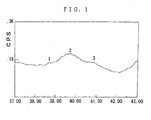
- Fig. 1 is the X-ray diffraction pattern of catalyst A obtained in Example 1;
- Fig. 2 is the X-ray diffraction pattern of catalyst F obtained in Comparative Example 2.
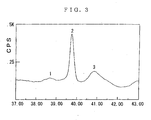
- Fig. 3 is the X-ray diffraction pattern of a standard catalyst in which the crystallinity is 100%.
- Measurement was carried out by a wet measurement method using a Microtrac particle size analyzer made by Nikkiso Co., Ltd. With this method, the powder is dispersed in water, a laser beam is irradiated onto the flowing agglomerated particles, and particle size analysis is carried out using the forward-scattered light. [Method of measuring pore structure]
- the specific surface area and the pore structure for a pore diameter range of 0.002 to 0.05 ⁇ m were measured by a nitrogen adsorption method using an ASAP 2400 measuring apparatus made by Micromeritics.
- the side crushing strength was measured using a sample obtained by extruding into a cylindrical shape, drying and calcining, using a tablet crushability tester "TH-203CP" made by Toyama Sangyo Co., Ltd. A measuring probe having a circular tip of diameter 4.5 mm was used. The operation of carrying out measurement by pushing the measuring sample against the center of the side of the cylindrical sample was repeated 20 times, and the mean was calculated.
- the platinum concentration was measured at approximately 150 points at intervals of 10 ⁇ m in the radial direction of the catalyst cross section using an EPMA measurement apparatus.
- concentration was calculated as follows.
- the X-ray intensity at the peak of the characteristic X-ray for the platinum group metal was measured as well as the X-ray intensities at the background positions ahead of and behind the peak, the background was determined at the peak position, the background was subtracted from the measured intensity at the peak position, and this remainder was termed the true intensity.
- Measurement with the EPMA apparatus was conducted under the following conditions using an EPMA JXA8900R made by JEOL Ltd.
- a powder with an average particle size of 1.5 ⁇ m and produced by drying commercially available dry zirconium hydroxide was used as a hydrated zirconia powder.
- a commercially available pseudo-boehmite powder with an average particle size of 10 ⁇ m was used as a hydrated alumina powder. 1860 g of this hydrated zirconia powder and 1120 g of hydrated alumina powder were added, 575 g of ammonium sulfate was further added, and the components were kneaded for 45 minutes in a kneader equipped with agitating blades while water was added.
- the kneaded product was extruded from an extruder having a circular opening 1.6 mm in diameter, which formed cylindrical pellets, and these were dried at 110°C to obtain dry pellets. A portion of these dry pellets was then calcined for 1.5 hours at 657°C to obtain catalyst pellets A.
- These shaped catalyst pellets A were cylindrical, with an average diameter of 1.4 mm and an average length of 4 mm, and their average crushing strength was 4.2 kg.
- the proportion of zirconia in the catalyst pellets A was 45.4 wt% as the elemental zirconium weight, the proportion of alumina was 14.7 wt% as the elemental aluminum weight, the proportion of sulfureous component was 3.0 wt% as the elemental sulfur weight, and the proportion of nitrogen was no more than 0.01 wt%.
- the specific surface area of the catalyst pellets A was 165 m 2 /g, the pore volume of pores with a diameter of 0.002 to 10 ⁇ m was 0.32 mL/g, and the median pore diameter in a pore diameter range of 0.002 to 0.05 ⁇ m of the catalyst pellets A was 54 ⁇ .
- Catalyst B (MO-673) was obtained in the same manner as in Example 1, except that the amount of platinum in the catalyst was changed to 0.33 wt%.
- Catalyst C (MO-599) was obtained in the same manner as in Example 1, except that the amount of platinum in the catalyst was changed to 0.11 wt%.
- Catalyst D (MO-631) was obtained in the same manner as in Example 1, except that hydrochloric acid was added to the aqueous solution of dichlorotetraammine platinum to adjust the pH of the support solution to 1.8.
- Catalyst E (MO-630) was obtained in the same manner as in Example 1, except that aqueous ammonia was added to the aqueous solution of dichlorotetraammine platinum to adjust the pH of the support solution to 9.6.
- Catalysts A to E were the same as the catalyst pellets A in terms of their shape, average crushing strength, proportion of zirconia, proportion of alumina, proportion of sulfureous component, and pore volume of pores having a diameter of 0.002 to 10 ⁇ m.
- Tables 1 and 2 show the standard deviation/average value for the platinum concentration in each of Catalysts A to E, the platinum crystallite diameter measured by X-ray diffraction, the proportion of the catalyst accounted for by nitrogen, the specific surface area, the median pore diameter in a pore diameter range of 0.002 to 0.05 ⁇ m, and the sulfureous component content (as the elemental sulfur weight).
- Standard sample for crystallinity This sample was prepared in the same manner as Catalyst F, except that the calcining after the supporting of the chloroplatinic acid aqueous solution was performed for 12 hours at 800°C.
- the desulfurized light naphtha used as the reaction raw material contained 5.8 wt% butane, 58.8 wt% pentane, 29.7 wt% hexane, 2.3 wt% cyclopentane, 2.6 wt% methylcyclopentane and cyclohexane, 1.0 wt% benzene, and 0.1 wt% olefin.
- the water content was no more than 40 weight ppm
- the sulfur compound concentration was no more than 1 weight ppm (as sulfur)
- the nitrogen compound concentration was no more than 0.1 weight ppm (as nitrogen)
- the concentration of oxygen compounds other than water was no more than 0.1 weight ppm (as oxygen)
- the chlorine compound concentration was no more than 0.1 weight ppm (as chlorine).
- the hydrogen gas used in the reaction had a purity of 99.99 vol%, the water concentration was no more than 0.5 weight ppm, and as for other impurities, the sulfur compound concentration was no more than 1 weight ppm (as sulfur), the nitrogen compound concentration was no more than 0.1 weight ppm (as nitrogen), the concentration of oxygen compounds other than water was no more than 0.1 weight ppm (as oxygen), and the chlorine compound concentration was no more than 0.1 weight ppm (as chlorine).
- the isomerization of light naphtha was carried out at a reaction temperature of 195°C, a reaction pressure (gauge pressure) of 1.96 MPa (20 kg/cm 2 ), an LHSV of 2/hr, and a hydrogen/oil ratio (H 2 /oil) of 2 (mol/mol).
- a reaction temperature of 195°C
- a reaction pressure gauge pressure
- a hydrogen/oil ratio H 2 /oil
- i-C5/ ⁇ C5 in Table 4 is the proportion (wt%) of isopentane in the fraction of C 5 straight-chain hydrocarbons
- the i-C5/ ⁇ C5 of the desulfurized light naphtha used as the reaction raw material was 40.1 wt%
- the 2,2'-DMB/ ⁇ C6 was 1.4 wt%.
- Catalyst i-C5/ ⁇ C5 2,2'-DMB/ ⁇ C6 Example 5 Catalyst A 73.4 wt% 26.3 wt% Comp. Ex. 3 Catalyst F 73.1 wt% 25.0 wt%
- the reaction raw material consisted of either raw material 1 (100 wt% n-hexane) or raw material 2 (a mixture of 6 wt% benzene and 94 wt% n-hexane).
- the water concentration was no more than 40 weight ppm
- the sulfur compound concentration was no more than 1 weight ppm (as sulfur)
- the nitrogen compound concentration was no more than 0.1 weight ppm (as nitrogen)
- the concentration of oxygen compounds other than water was no more than 0.1 weight ppm (as oxygen)
- the chlorine compound concentration was no more than 0.1 weight ppm (as chlorine).
- the isomerization of n-hexane was carried out at a reaction temperature of 180°C, a reaction pressure (gauge pressure) of 0.98 MPa, an LHSV of 1.5/hr, and a hydrogen/oil ratio (H 2 /oil) of 5 (mol/mol). 70 hours after the start of oil flow, the composition at the reaction tube outlet was analyzed by gas chromatography. The rest of the reaction conditions were the same as in the isomerization of light naphtha.
- Table 5 shows the n-hexane conversion when Catalysts A, B, C and F were used, and the amount (wt%) of 2,2'-dimethylbutane contained in the saturated hydrocarbons having six carbon atoms in the reaction product.
- the benzene conversion was roughly 100%. The conversion was the same in all of the reactions in which just n-hexane was isomerized, but when benzene was contained, it can be seen that the conversion decreased depending on the supporting method and the amount of platinum supported.
- Catalyst Platinum content (wt%)
- Raw material 1 100 wt% n-hexane
- Raw material 2 6 wt% benzene, 94 wt% n-hexane Conversion (wt%) 2,2'-DMB/ C6p (wt%) Conversion (wt%) 2,2'-DMB/ C6p (wt%)
- Ex. 6 Catalyst A 0.5 85 17.0 80 12.5
- Catalyst B 0.33 85 16.5 80 12.1 C.
- E. 4 Catalyst C 0.11 85 17.4 58 3.2 C.
- E. 5 Catalyst F 0.5 85 17.6 67 4.6 [C. E.: Comparative Example]
- Table 6 shows the amount (wt%) of the 2,2'-dimethylbutane contained in the saturated hydrocarbons having six carbon atoms in the n-hexane reaction product when Catalysts D and E were used, along with the results for Example 6. There is a slight decrease in the amount contained when the pH of the support solution is not near neutral.
- Catalyst pH of 22DMB/C6p support solution n-C6 100%
- Example 6 Catalyst A 7.0 17.0
- Example 8 Catalyst D 1.8 15.0
- Example 9 Catalyst E 9.6 15.1
- the platinum group metal when used as a cation in impregnation, it selectively reaches the acidic activity point within the catalyst pellets, and the platinum group metal concentration becomes higher around the outer part of the catalyst. Drying and calcining then result in a uniform distribution of the platinum group metal. This uniform support of the platinum group metal increases catalyst activity.
Landscapes
- Chemical & Material Sciences (AREA)
- Engineering & Computer Science (AREA)
- Materials Engineering (AREA)
- Organic Chemistry (AREA)
- Chemical Kinetics & Catalysis (AREA)
- Crystallography & Structural Chemistry (AREA)
- Catalysts (AREA)
- Low-Molecular Organic Synthesis Reactions Using Catalysts (AREA)
- Organic Low-Molecular-Weight Compounds And Preparation Thereof (AREA)
- Production Of Liquid Hydrocarbon Mixture For Refining Petroleum (AREA)
Abstract
Description
Acceleration voltage: 20 kV
Sample current: 0.1 µA
Beam diameter: 10 µm
Spectroscopic crystal: LiF
Measurement energy position (with platinum)
PtLα (peak position): 9.441 kev
background position: 8.768 keV, 9.817 kev
| Example 1 | Example 2 | Comp. Ex. 1 | |
| Catalyst | Catalyst A | Catalyst B | Catalyst C |
| pH of support | 7.0 | 7.0 | 7.0 |
| Platinum concentration (wt%) | 0.5 | 0.33 | 0.11 |
| Standard deviation/average value of platinum concentration | 0.18 | 0.33 | 0.86 |
| Platinum crystallite diameter (nm) | 8.0 | 6.5 | 7.2 |
| Nitrogen content (wt%) | ≤0.01 | ≤ 0.01 | ≤ 0.01 |
| Specific surface area (m2/g) | 162 | 158 | 163 |
| Median pore diameter (nm) | 5.8 | 6.0 | 5.7 |
| Sulfureous component content (wt%) | 2.8 | 2.7 | 2.7 |
| Example 3 | Example 4 | Comp. Ex. 2 | |
| Catalyst | Catalyst D | Catalyst E | Catalyst F |
| pH of support | 1.8 | 9.6 | - |
| Platinum concentration (wt%) | 0.5 | 0.5 | 0.5 |
| Standard deviation/average value of platinum concentration | 0.20 | 0.24 | 0.51 |
| Platinum crystallite diameter (nm) | 7.9 | 7.9 | 40 |
| Nitrogen content (wt%) | ≤ 0.01 | ≤ 0.01 | ≤ 0.01 |
| Specific surface area (m2/g) | 159 | 159 | 163 |
| Median pore diameter (nm) | 5.9 | 6.0 | 5.6 |
| Sulfureous component content (wt%) | 2.7 | 2.8 | 2.8 |
X-ray tube; sealed copper bulb
(tube voltage: 30 kV, tube current: 45 mA, wavelength: 0.15407 nm)
Measurement region (2): 37 to 43°
Scanning rate: 0.1°/minute
Step width: 0.01°
Slit width: divergent slit (DS) = 1°
scattering slit (SS) = 1°
receiving slit (RS) = 0.03 mm
Smoothing: 25 times
| Peak surface area | Crystallinity | Diffraction pattern | |
| Catalyst A | 48.17 | 66% | Fig. 1 |
| Catalyst F | 0.29 | ≤ 20% | Fig. 2 |
| Standard sample | 73.37 | 100% | Fig. 3 |
| Catalyst | i- | 2,2'-DMB/ΣC6 | |
| Example 5 | Catalyst A | 73.4 wt% | 26.3 wt% |
| Comp. Ex. 3 | Catalyst F | 73.1 wt% | 25.0 wt% |
| Catalyst | Platinum content (wt%) | Raw material 1: 100 wt% n-hexane | Raw material 2: 6 wt% benzene, 94 wt% n-hexane | |||
| Conversion (wt%) | 2,2'-DMB/ C6p (wt%) | Conversion (wt%) | 2,2'-DMB/ C6p (wt%) | |||
| Ex. 6 | Catalyst A | 0.5 | 85 | 17.0 | 80 | 12.5 |
| Ex. 7 | Catalyst B | 0.33 | 85 | 16.5 | 80 | 12.1 |
| C. E. 4 | Catalyst C | 0.11 | 85 | 17.4 | 58 | 3.2 |
| C. E. 5 | Catalyst F | 0.5 | 85 | 17.6 | 67 | 4.6 |
| [C. E.: Comparative Example] |
| Catalyst | pH of | 22DMB/C6p | |
| support solution | n-C6 100% | ||
| Example 6 | Catalyst A | 7.0 | 17.0 |
| Example 8 | Catalyst D | 1.8 | 15.0 |
| Example 9 | Catalyst E | 9.6 | 15.1 |
Claims (13)
- A solid acid catalyst that comprises porous catalyst pellets exhibiting solid acid characteristics, and a platinum group metal component supported by the catalyst pellets, and that is used in an acid-catalyzed reaction, in which a quotient of dividing a standard deviation of concentration in the platinum group metal component concentration distribution in said catalyst by an average concentration is 0.4 or less.
- The solid acid catalyst according to Claim 1, wherein the platinum group metal component has been crystallized.
- The solid acid catalyst according to Claim 1 or 2, wherein the catalyst pellets are composed of a shaped support consisting of a metal oxide, and a sulfureous component supported by the support.
- The solid acid catalyst according to Claim 3, wherein the metal component of the support includes zirconium, and the zirconium is contained in the catalyst in an amount of 20 to 72 wt% as elemental zirconium weight.
- The solid acid catalyst according to Claim 1, wherein the acid-catalyzed reaction is an isomerization reaction of a hydrocarbon containing at least 70 wt% of a saturated hydrocarbon component having 4 to 10 carbon atoms.
- The solid acid catalyst according to Claim 5, wherein the acid-catalyzed reaction is an isomerization reaction of a hydrocarbon containing at least 0.5 wt% benzene, and the platinum group metal component concentration in the catalyst is at least 0.15 wt%.
- A method for preparing a solid acid catalyst, comprising a step of preparing a support solution containing a platinum group metal as a cation, and a step of impregnating crystalline, porous catalyst pellets exhibiting solid acid characteristics with the support solution, a quotient of dividing a standard deviation of concentration in a platinum group metal component concentration distribution in said catalyst by an average concentration being 0.4 or less.
- The method for preparing a solid acid catalyst according to Claim 7, wherein the platinum group metal component concentration in the catalyst is at least 0.15 wt%.
- The method for preparing a solid acid catalyst according to Claim 7, wherein the catalyst pellets comprise a sulfureous component supported by a shaped support consisting of a metal oxide.
- The method for preparing a solid acid catalyst according to Claim 7, wherein the support solution contains an ammine complex of a platinum group metal.
- The method for preparing a solid acid catalyst according to Claim 7, wherein the pH of the support solution is 5 to 8.
- A method for isomerizing a hydrocarbon, wherein a hydrocarbon including at least 70 wt% of a saturated hydrocarbon component having 4 to 10 carbon atoms is brought into contact with the solid acid catalyst. according to Claim 1.
- The isomerization method according to Claim 12, wherein the hydrocarbon contains at least 0.5 wt% benzene, and the platinum group metal component concentration in the catalyst is at least 0.15 wt%.
Applications Claiming Priority (5)
| Application Number | Priority Date | Filing Date | Title |
|---|---|---|---|
| JP2001057840 | 2001-03-02 | ||
| JP2001057840 | 2001-03-02 | ||
| JP2001333715 | 2001-10-31 | ||
| JP2001333715 | 2001-10-31 | ||
| PCT/JP2002/001873 WO2002070129A1 (en) | 2001-03-02 | 2002-02-28 | Solid acid catalyst containing platinum group metal component and method for preparation thereof |
Publications (2)
| Publication Number | Publication Date |
|---|---|
| EP1374993A2 true EP1374993A2 (en) | 2004-01-02 |
| EP1374993A4 EP1374993A4 (en) | 2006-05-17 |
Family
ID=26610488
Family Applications (1)
| Application Number | Title | Priority Date | Filing Date |
|---|---|---|---|
| EP02702717A Withdrawn EP1374993A4 (en) | 2001-03-02 | 2002-02-28 | SOLID ACID CATALYST CONTAINING METAL COMPONENT OF PLATINUM GROUP, AND PROCESS FOR PREPARING THE SAME |
Country Status (5)
| Country | Link |
|---|---|
| EP (1) | EP1374993A4 (en) |
| JP (1) | JP3995241B2 (en) |
| KR (1) | KR100840446B1 (en) |
| CA (1) | CA2439194C (en) |
| WO (1) | WO2002070129A1 (en) |
Cited By (2)
| Publication number | Priority date | Publication date | Assignee | Title |
|---|---|---|---|---|
| EP1894626A4 (en) * | 2005-06-20 | 2012-10-10 | Chiyoda Corp | HOMOGENOUS, HIGH-DISPERSANT METAL CATALYST AND METHOD FOR THE PRODUCTION THEREOF |
| CN102962081A (en) * | 2012-11-21 | 2013-03-13 | 武汉工程大学 | Solid super acid and method for catalyzing and preparing chloracetate by using same |
Families Citing this family (9)
| Publication number | Priority date | Publication date | Assignee | Title |
|---|---|---|---|---|
| JP5027391B2 (en) * | 2004-06-01 | 2012-09-19 | 出光興産株式会社 | Hydrocracking catalyst for waxy feedstock |
| KR100831014B1 (en) * | 2007-02-12 | 2008-05-20 | 삼성에스디아이 주식회사 | Reformer of a fuel cell system, and a fuel cell system comprising the same |
| JP5240430B2 (en) | 2007-02-12 | 2013-07-17 | 三星エスディアイ株式会社 | Fuel cell system reformer and fuel cell system including the same |
| US7910514B2 (en) * | 2007-08-09 | 2011-03-22 | Nissan Motor Co., Ltd. | Inorganic fiber catalyst, production method thereof and catalyst structure |
| KR100943952B1 (en) | 2008-02-26 | 2010-02-26 | 삼성에스디아이 주식회사 | A reforming catalyst for a fuel cell, a method of manufacturing the same, a reformer for a fuel cell including the same, and a fuel cell system including the same |
| JP5570277B2 (en) * | 2010-03-31 | 2014-08-13 | 株式会社日本触媒 | Catalyst for producing ethylene oxide and method for producing ethylene oxide |
| CN104028301B (en) * | 2014-06-26 | 2016-02-17 | 江南大学 | A kind of high temperature resistant renewable carbon-based solid acid catalyst and preparation method thereof |
| CN113492005B (en) * | 2020-04-07 | 2023-04-14 | 凯德利斯特国际有限公司 | powder catalyst |
| JP7615436B2 (en) * | 2020-07-15 | 2025-01-17 | 大成建設株式会社 | Platinum-supported catalyst, air purification system and air purification method |
Family Cites Families (7)
| Publication number | Priority date | Publication date | Assignee | Title |
|---|---|---|---|---|
| US4920088A (en) * | 1987-09-08 | 1990-04-24 | Phillips Petroleum Company | Catalyst for the oxidation of carbon monoxide |
| JPH10195001A (en) | 1997-01-09 | 1998-07-28 | Japan Energy Corp | Method for producing methylcyclopentane-containing hydrocarbon |
| JP4163292B2 (en) * | 1998-07-28 | 2008-10-08 | 千代田化工建設株式会社 | Hydrocarbon reforming catalyst and reforming method |
| JP2000233132A (en) * | 1998-12-17 | 2000-08-29 | Petroleum Energy Center | Catalyst for hydrodesulfurization/isomerization of light hydrocarbon oil and production thereof |
| FR2793706B1 (en) * | 1999-05-18 | 2001-08-03 | Total Raffinage Distribution | OXIDE-BASED CATALYTIC SUPPORT OF A METAL FROM GROUP IVB OF THE PERIODIC CLASSIFICATION OF ELEMENTS, ITS PREPARATION AND USES |
| JP4182663B2 (en) * | 2001-02-05 | 2008-11-19 | 財団法人石油産業活性化センター | Solid acid catalyst, production method thereof, and hydrodesulfurization isomerization method of light hydrocarbon oil using the same |
| WO2002062469A1 (en) * | 2001-02-05 | 2002-08-15 | Petroleum Energy Center | Solid acid catalyat, method for preparing the same and method for hydrogenation isomerization |
-
2002
- 2002-02-28 JP JP2002569291A patent/JP3995241B2/en not_active Expired - Fee Related
- 2002-02-28 EP EP02702717A patent/EP1374993A4/en not_active Withdrawn
- 2002-02-28 CA CA2439194A patent/CA2439194C/en not_active Expired - Fee Related
- 2002-02-28 WO PCT/JP2002/001873 patent/WO2002070129A1/en not_active Ceased
- 2002-02-28 KR KR1020037011463A patent/KR100840446B1/en not_active Expired - Fee Related
Cited By (4)
| Publication number | Priority date | Publication date | Assignee | Title |
|---|---|---|---|---|
| EP1894626A4 (en) * | 2005-06-20 | 2012-10-10 | Chiyoda Corp | HOMOGENOUS, HIGH-DISPERSANT METAL CATALYST AND METHOD FOR THE PRODUCTION THEREOF |
| USRE46145E1 (en) * | 2005-06-20 | 2016-09-13 | Chiyoda Corporation | Uniformly, highly dispersed metal catalyst and process for producing the same |
| CN102962081A (en) * | 2012-11-21 | 2013-03-13 | 武汉工程大学 | Solid super acid and method for catalyzing and preparing chloracetate by using same |
| CN102962081B (en) * | 2012-11-21 | 2014-05-28 | 武汉工程大学 | Solid super acid and method for catalyzing and preparing chloracetate by using same |
Also Published As
| Publication number | Publication date |
|---|---|
| KR20030080247A (en) | 2003-10-11 |
| EP1374993A4 (en) | 2006-05-17 |
| JP3995241B2 (en) | 2007-10-24 |
| JPWO2002070129A1 (en) | 2004-07-02 |
| KR100840446B1 (en) | 2008-06-20 |
| WO2002070129A9 (en) | 2003-01-03 |
| CA2439194A1 (en) | 2002-09-12 |
| WO2002070129A1 (en) | 2002-09-12 |
| CA2439194C (en) | 2011-03-29 |
Similar Documents
| Publication | Publication Date | Title |
|---|---|---|
| RU2595341C1 (en) | Catalyst for isomerisation of paraffin hydrocarbons and preparation method thereof | |
| EP1894626B1 (en) | Process for producing a homogeneous, highly dispersed metal catalyst | |
| US6420305B1 (en) | Solid acid catalyst, method for producing the same and reaction method using the same | |
| CA2439194C (en) | Solid acid catalyst containing platinum group metal component, and method for preparation thereof | |
| JPWO1999044738A1 (en) | Solid acid catalyst, its production method and reaction method using the same | |
| US7026268B2 (en) | Solid acid catalyst containing platinum group metal component and method for preparation thereof | |
| US7989386B2 (en) | Multi-layer catalyst made from niobium for the catalytic conversion of hydrocarbons | |
| EP1491613B1 (en) | Method of isomerizing hydrocarbon | |
| JP3989078B2 (en) | Method for producing solid acid catalyst | |
| JP3730792B2 (en) | Hydrocarbon isomerization process | |
| JPH0529504B2 (en) | ||
| EP1052280B1 (en) | Method for isomerization of hydrocarbon, and solid acid catalyst and isomerization system for use therein | |
| JP3922681B2 (en) | Hydrocarbon isomerization process and solid acid catalyst for isomerization | |
| JP2001070794A (en) | Solid acid catalyst containing platinum group metal component | |
| RU2783119C2 (en) | Catalyst of light alkane isomerization, its production method and use | |
| JPWO2000012652A1 (en) | Hydrocarbon isomerization method | |
| JP4191059B2 (en) | Hydrocarbon isomerization process | |
| JP3973176B2 (en) | Acid-catalyzed reaction method | |
| WO2000056447A1 (en) | Solid acid catalyst, method for preparing the same and reaction using the same |
Legal Events
| Date | Code | Title | Description |
|---|---|---|---|
| PUAI | Public reference made under article 153(3) epc to a published international application that has entered the european phase |
Free format text: ORIGINAL CODE: 0009012 |
|
| 17P | Request for examination filed |
Effective date: 20030909 |
|
| AK | Designated contracting states |
Kind code of ref document: A2 Designated state(s): AT BE CH CY DE DK ES FI FR GB GR IE IT LI LU MC NL PT SE TR |
|
| AX | Request for extension of the european patent |
Extension state: AL LT LV MK RO SI |
|
| R17D | Deferred search report published (corrected) |
Effective date: 20020912 |
|
| A4 | Supplementary search report drawn up and despatched |
Effective date: 20060331 |
|
| 17Q | First examination report despatched |
Effective date: 20060630 |
|
| STAA | Information on the status of an ep patent application or granted ep patent |
Free format text: STATUS: THE APPLICATION HAS BEEN WITHDRAWN |
|
| 18W | Application withdrawn |
Effective date: 20101126 |