EP1374688A1 - Ethylene gas adsorbent, method of controlling ethylene gas concentration and ethylene gas sensor - Google Patents
Ethylene gas adsorbent, method of controlling ethylene gas concentration and ethylene gas sensor Download PDFInfo
- Publication number
- EP1374688A1 EP1374688A1 EP02702758A EP02702758A EP1374688A1 EP 1374688 A1 EP1374688 A1 EP 1374688A1 EP 02702758 A EP02702758 A EP 02702758A EP 02702758 A EP02702758 A EP 02702758A EP 1374688 A1 EP1374688 A1 EP 1374688A1
- Authority
- EP
- European Patent Office
- Prior art keywords
- ethylene gas
- ethylene
- concentration
- bamboo
- controlling
- Prior art date
- Legal status (The legal status is an assumption and is not a legal conclusion. Google has not performed a legal analysis and makes no representation as to the accuracy of the status listed.)
- Withdrawn
Links
Images





Classifications
-
- B—PERFORMING OPERATIONS; TRANSPORTING
- B01—PHYSICAL OR CHEMICAL PROCESSES OR APPARATUS IN GENERAL
- B01D—SEPARATION
- B01D53/00—Separation of gases or vapours; Recovering vapours of volatile solvents from gases; Chemical or biological purification of waste gases, e.g. engine exhaust gases, smoke, fumes, flue gases, aerosols
- B01D53/02—Separation of gases or vapours; Recovering vapours of volatile solvents from gases; Chemical or biological purification of waste gases, e.g. engine exhaust gases, smoke, fumes, flue gases, aerosols by adsorption, e.g. preparative gas chromatography
- B01D53/04—Separation of gases or vapours; Recovering vapours of volatile solvents from gases; Chemical or biological purification of waste gases, e.g. engine exhaust gases, smoke, fumes, flue gases, aerosols by adsorption, e.g. preparative gas chromatography with stationary adsorbents
- B01D53/0454—Controlling adsorption
-
- B—PERFORMING OPERATIONS; TRANSPORTING
- B01—PHYSICAL OR CHEMICAL PROCESSES OR APPARATUS IN GENERAL
- B01J—CHEMICAL OR PHYSICAL PROCESSES, e.g. CATALYSIS OR COLLOID CHEMISTRY; THEIR RELEVANT APPARATUS
- B01J20/00—Solid sorbent compositions or filter aid compositions; Sorbents for chromatography; Processes for preparing, regenerating or reactivating thereof
- B01J20/22—Solid sorbent compositions or filter aid compositions; Sorbents for chromatography; Processes for preparing, regenerating or reactivating thereof comprising organic material
-
- A—HUMAN NECESSITIES
- A23—FOODS OR FOODSTUFFS; TREATMENT THEREOF, NOT COVERED BY OTHER CLASSES
- A23B—PRESERVATION OF FOODS, FOODSTUFFS OR NON-ALCOHOLIC BEVERAGES; CHEMICAL RIPENING OF FRUIT OR VEGETABLES
- A23B2/00—Preservation of foods or foodstuffs, in general
- A23B2/70—Preservation of foods or foodstuffs, in general by treatment with chemicals
- A23B2/704—Preservation of foods or foodstuffs, in general by treatment with chemicals in the form of gases, e.g. fumigation; Compositions or apparatus therefor
- A23B2/708—Preservation of foods or foodstuffs, in general by treatment with chemicals in the form of gases, e.g. fumigation; Compositions or apparatus therefor in a controlled atmosphere, e.g. partial vacuum, comprising only CO2, N2, O2 or H2O
- A23B2/712—Preservation of foods or foodstuffs, in general by treatment with chemicals in the form of gases, e.g. fumigation; Compositions or apparatus therefor in a controlled atmosphere, e.g. partial vacuum, comprising only CO2, N2, O2 or H2O in which an absorbent is placed or used
-
- A—HUMAN NECESSITIES
- A23—FOODS OR FOODSTUFFS; TREATMENT THEREOF, NOT COVERED BY OTHER CLASSES
- A23B—PRESERVATION OF FOODS, FOODSTUFFS OR NON-ALCOHOLIC BEVERAGES; CHEMICAL RIPENING OF FRUIT OR VEGETABLES
- A23B2/00—Preservation of foods or foodstuffs, in general
- A23B2/70—Preservation of foods or foodstuffs, in general by treatment with chemicals
- A23B2/704—Preservation of foods or foodstuffs, in general by treatment with chemicals in the form of gases, e.g. fumigation; Compositions or apparatus therefor
- A23B2/721—Preservation of foods or foodstuffs, in general by treatment with chemicals in the form of gases, e.g. fumigation; Compositions or apparatus therefor in a controlled atmosphere comprising other gases in addition to CO2, N2, O2 or H2O
-
- A—HUMAN NECESSITIES
- A23—FOODS OR FOODSTUFFS; TREATMENT THEREOF, NOT COVERED BY OTHER CLASSES
- A23B—PRESERVATION OF FOODS, FOODSTUFFS OR NON-ALCOHOLIC BEVERAGES; CHEMICAL RIPENING OF FRUIT OR VEGETABLES
- A23B7/00—Preservation of fruit or vegetables; Chemical ripening of fruit or vegetables
- A23B7/14—Preserving or ripening with chemicals not covered by group A23B7/08 or A23B7/10
- A23B7/144—Preserving or ripening with chemicals not covered by group A23B7/08 or A23B7/10 in the form of gases, e.g. fumigation; Compositions or apparatus therefor
- A23B7/152—Preserving or ripening with chemicals not covered by group A23B7/08 or A23B7/10 in the form of gases, e.g. fumigation; Compositions or apparatus therefor in a controlled atmosphere comprising other gases in addition to CO2, N2, O2 or H2O ; Elimination of such other gases
-
- A—HUMAN NECESSITIES
- A23—FOODS OR FOODSTUFFS; TREATMENT THEREOF, NOT COVERED BY OTHER CLASSES
- A23B—PRESERVATION OF FOODS, FOODSTUFFS OR NON-ALCOHOLIC BEVERAGES; CHEMICAL RIPENING OF FRUIT OR VEGETABLES
- A23B7/00—Preservation of fruit or vegetables; Chemical ripening of fruit or vegetables
- A23B7/14—Preserving or ripening with chemicals not covered by group A23B7/08 or A23B7/10
- A23B7/153—Preserving or ripening with chemicals not covered by group A23B7/08 or A23B7/10 in the form of liquids or solids
- A23B7/154—Organic compounds; Microorganisms; Enzymes
-
- B—PERFORMING OPERATIONS; TRANSPORTING
- B01—PHYSICAL OR CHEMICAL PROCESSES OR APPARATUS IN GENERAL
- B01D—SEPARATION
- B01D53/00—Separation of gases or vapours; Recovering vapours of volatile solvents from gases; Chemical or biological purification of waste gases, e.g. engine exhaust gases, smoke, fumes, flue gases, aerosols
- B01D53/02—Separation of gases or vapours; Recovering vapours of volatile solvents from gases; Chemical or biological purification of waste gases, e.g. engine exhaust gases, smoke, fumes, flue gases, aerosols by adsorption, e.g. preparative gas chromatography
-
- G—PHYSICS
- G01—MEASURING; TESTING
- G01N—INVESTIGATING OR ANALYSING MATERIALS BY DETERMINING THEIR CHEMICAL OR PHYSICAL PROPERTIES
- G01N1/00—Sampling; Preparing specimens for investigation
- G01N1/02—Devices for withdrawing samples
- G01N1/22—Devices for withdrawing samples in the gaseous state
- G01N1/2202—Devices for withdrawing samples in the gaseous state involving separation of sample components during sampling
- G01N1/2205—Devices for withdrawing samples in the gaseous state involving separation of sample components during sampling with filters
-
- G—PHYSICS
- G01—MEASURING; TESTING
- G01N—INVESTIGATING OR ANALYSING MATERIALS BY DETERMINING THEIR CHEMICAL OR PHYSICAL PROPERTIES
- G01N5/00—Analysing materials by weighing, e.g. weighing small particles separated from a gas or liquid
- G01N5/02—Analysing materials by weighing, e.g. weighing small particles separated from a gas or liquid by absorbing or adsorbing components of a material and determining change of weight of the adsorbent, e.g. determining moisture content
-
- B—PERFORMING OPERATIONS; TRANSPORTING
- B01—PHYSICAL OR CHEMICAL PROCESSES OR APPARATUS IN GENERAL
- B01D—SEPARATION
- B01D2253/00—Adsorbents used in seperation treatment of gases and vapours
- B01D2253/10—Inorganic adsorbents
-
- B—PERFORMING OPERATIONS; TRANSPORTING
- B01—PHYSICAL OR CHEMICAL PROCESSES OR APPARATUS IN GENERAL
- B01D—SEPARATION
- B01D2257/00—Components to be removed
- B01D2257/70—Organic compounds not provided for in groups B01D2257/00 - B01D2257/602
- B01D2257/702—Hydrocarbons
- B01D2257/7022—Aliphatic hydrocarbons
-
- G—PHYSICS
- G01—MEASURING; TESTING
- G01N—INVESTIGATING OR ANALYSING MATERIALS BY DETERMINING THEIR CHEMICAL OR PHYSICAL PROPERTIES
- G01N1/00—Sampling; Preparing specimens for investigation
- G01N1/28—Preparing specimens for investigation including physical details of (bio-)chemical methods covered elsewhere, e.g. G01N33/50, C12Q
- G01N1/40—Concentrating samples
- G01N1/405—Concentrating samples by adsorption or absorption
-
- G—PHYSICS
- G01—MEASURING; TESTING
- G01N—INVESTIGATING OR ANALYSING MATERIALS BY DETERMINING THEIR CHEMICAL OR PHYSICAL PROPERTIES
- G01N1/00—Sampling; Preparing specimens for investigation
- G01N1/02—Devices for withdrawing samples
- G01N1/22—Devices for withdrawing samples in the gaseous state
- G01N1/24—Suction devices
- G01N2001/245—Fans
-
- G—PHYSICS
- G01—MEASURING; TESTING
- G01N—INVESTIGATING OR ANALYSING MATERIALS BY DETERMINING THEIR CHEMICAL OR PHYSICAL PROPERTIES
- G01N33/00—Investigating or analysing materials by specific methods not covered by groups G01N1/00 - G01N31/00
- G01N33/02—Food
Definitions
- the present invention relates to an ethylene gas adsorbent used for maintaining the freshness of plants and perishables such as fruits, vegetables, and flowers and to a wrapping material and a packaging material used for maintaining the freshness of plants and perishables such as fruits, vegetables, and flowers.
- the present invention relates to an ethylene gas concentration controlling method and apparatus used for maintaining the freshness of plants andperishables such as fruits , vegetables, and flowers or for controlling maturation thereof.
- the present invention relates to an ethylene gas sensor that detects ethylene in a gas and to a method and apparatus for measuring the concentration of ethylene gas in a gas.
- Fruits and vegetables such as apples and strawberries, or flowers such as carnation are usually packaged in a box in the producing district and transported therefrom.
- ethylene gas generated in the inside of, for example, fruits and released therefrom due to fermentation during transportation accelerates fermentation in other individuals or sites, so that the freshness of the transported fruits is decreased.
- JP 54-117060 A a method in which potassium permanganate having a capability of decomposing ethylene gas is allowed to coexist during transportation or storage of fruits, vegetables, or the like to decompose and remove ethylene gas released from the fruits or vegetables has been proposed (JP 54-117060 A) and partly put to practical use.
- potassium permanganate has a problem of safety in that it is poisonous when it is swallowed or inhaled and it stimulates the mucous membrane or tissues strongly.
- an adsorbent of the physical adsorption type such as zeolite or activated carbon
- JP 2000-210526 A discloses use of essential oils obtained by steam distillation of various kinds of plants as materials for removing hazardous gases and cites Japanese cypress and tea plant as examples of such plants.
- the essential oils obtained by steam distillation of these plants have had no fully satisfactory ability of removing ethylene gas.
- scent components to be detected have been studied, examples of which include trimethylamine (TMA) and dimethylamine (DMA) that relate to the freshness of fish and shellfish; methylpyrazine, acetone and the like that are contained in consommé soup; ethyl acetate, acetoin and the like that relate to the freshness of beef; H 2 S and NH 3 that are also hazardous gases; fruit oils, methylmercaptan, aliphatic amines and so forth.
- TMA trimethylamine
- DMA dimethylamine
- Conventional materials that have been known as materials for use in scent sensors include metal oxide semiconductors and organic materials.
- sensors with metal oxide semiconductors in which sintered compacts of oxide particles are mainly used, adsorption or reaction of scent molecules on or with the surface of the semiconductor particles changes the electrical resistance of the semiconductor, the amount of which change is taken out as a sensor signal.
- organic materials adsorption of the scent components on the organic materials changes the mass, absorbance or the like, the amount of which change is physically measured.
- the QCM method can easily realize sensors having various characteristics by varying the sensitive film to be coated on the electrode.
- the film material polymers and lipids are mainly used.
- scents are distinguished with the sensors, a technique of pattern recognition by multivariate analysis or through a neural network is used for the recognition of outputs from a plurality of sensors coated with different sensitive films.
- the present invention has been made to solve the above problems of the prior art and therefore an object of the present invention is to provide means that is safe to human body and used for maintaining the freshness of plants and perishables such as fruits, vegetables, and flowers for a long period of time. Further, another object of the present invention is to provide means for accelerating or conversely inhibiting maturation of plants and perishables such as fruits, vegetables, and flowers.
- the inventors of the present invention have made extensive studies on the above-mentioned problems and as a result they have anticipated that use of ethylene monooxygenase that can biochemically metabolize and decompose ethylene gas in place of a physical adsorbent such as zeolite would solve the above-mentioned problems, thereby achieving the present invention. Then, the inventors of the present invention have focused attention, in particular, to an alcohol extract solution of raw bamboo as a substance containing ethylene monooxygenase.
- the present invention relates to an ethylene gas adsorbent characterized by containing ethylene monooxygenase.
- the ethylene gas adsorbent of the present invention further contains a coenzyme (NADPH) in addition to ethylene monooxygenase.
- NADPH coenzyme
- the present invention further relates to an ethylene gas adsorbent using raw bamboo fiber or bamboo vinegar that contains ethylene monooxygenase, in particular an alcohol extract solution of raw bamboo.
- bamboo vinegar in particular an alcohol extract solution of raw bamboo is preferable.
- the ethylene gas adsorbent of the present invention is held on a substrate such as a transparent sheet-form material and that the ethylene gas adsorbent is held on the substrate through a gel forming substance having an amino group.
- the present invention further relates to application of such an ethylene gas adsorbent to a wrapping material or a packaging material for wrapping or packaging plants and perishables such as fruits, vegetables, and flowers.
- the present invention has an excellent advantage in that the ethylene monooxygenase causes no danger at all and is safe even if it contacts with foods and the like and introduced into the body of an individual or if it is eaten together with the foods since only nonhazardous plant-based materials are utilized.
- the present invention relates to a method for controlling the concentration of ethylene gas with a filter that ethylene monooxygenase is supported thereon.
- a filter that ethylene monooxygenase is supported thereon As the substance that contains ethylene monooxygenase, in particular an alcohol extract solution of raw bamboo is preferable.
- said filter further contains NADPH as a coenzyme for ethylene monooxygenase.
- the present invention relates to a method for controlling a concentration of ethylene gas with a filter on which a raw bamboo fiber or bamboo vinegar solution.
- a bamboo vinegar solution in particular an alcohol extract solution of raw bamboo is preferable.
- the method for controlling the concentration of ethylene gas preferably includes measuring an ethylene gas concentration of an atmosphere by an ethylene gas concentration measuring apparatus; and decreasing the ethylene gas concentration by operating a fan to have ethylene gas adsorbed onto the filter when the ethylene gas concentration is equal to or above a predetermined value or introducing ethylene gas into the atmosphere when the ethylene gas concentration is equal to or below a predetermined value.
- the present invention relates to a method for maintaining freshness or controlling maturation of perishables such as fruits, vegetables, and flowers , by using the above method for controlling ethylene gas concentration.
- the present invention relates to an apparatus for controlling ethylene gas concentration which includes the filter described above and a fan and also relates to an apparatus for maintaining freshness or controlling maturation of perishables such as fruits, vegetables, and flowers which is characterized by including an ethylene gas concentration measuring apparatus, the filter described above, and a fan.
- the present invention relates to an ethylene gas sensor that detects ethylene gas in a gas as well as a method and apparatus for measuring the concentration of ethylene gas with said ethylene gas sensor.
- the present invention relates to an ethylene gas sensor characterized by including a quartz crystal microbalance having held thereon ethylene monooxygenase, in particular an alcohol extract solution of raw bamboo.
- the ethylene gas sensor of the present invention further contains a coenzyme (NADPH).
- NADPH coenzyme
- the present invention also relates to an ethylene gas sensor including a quartz crystal microbalance having coated thereon bamboo vinegar solution containing ethylene monooxygenase.
- the present invention relates to an ethylene gas sensor, in which the quartz crystal microbalance is coated with the bamboo vinegar solution through a gel forming substance having an amino group.
- the present invention also relates to a method and apparatus for measuring a concentration of ethylene gas in a gas by using the ethylene gas sensor described above.
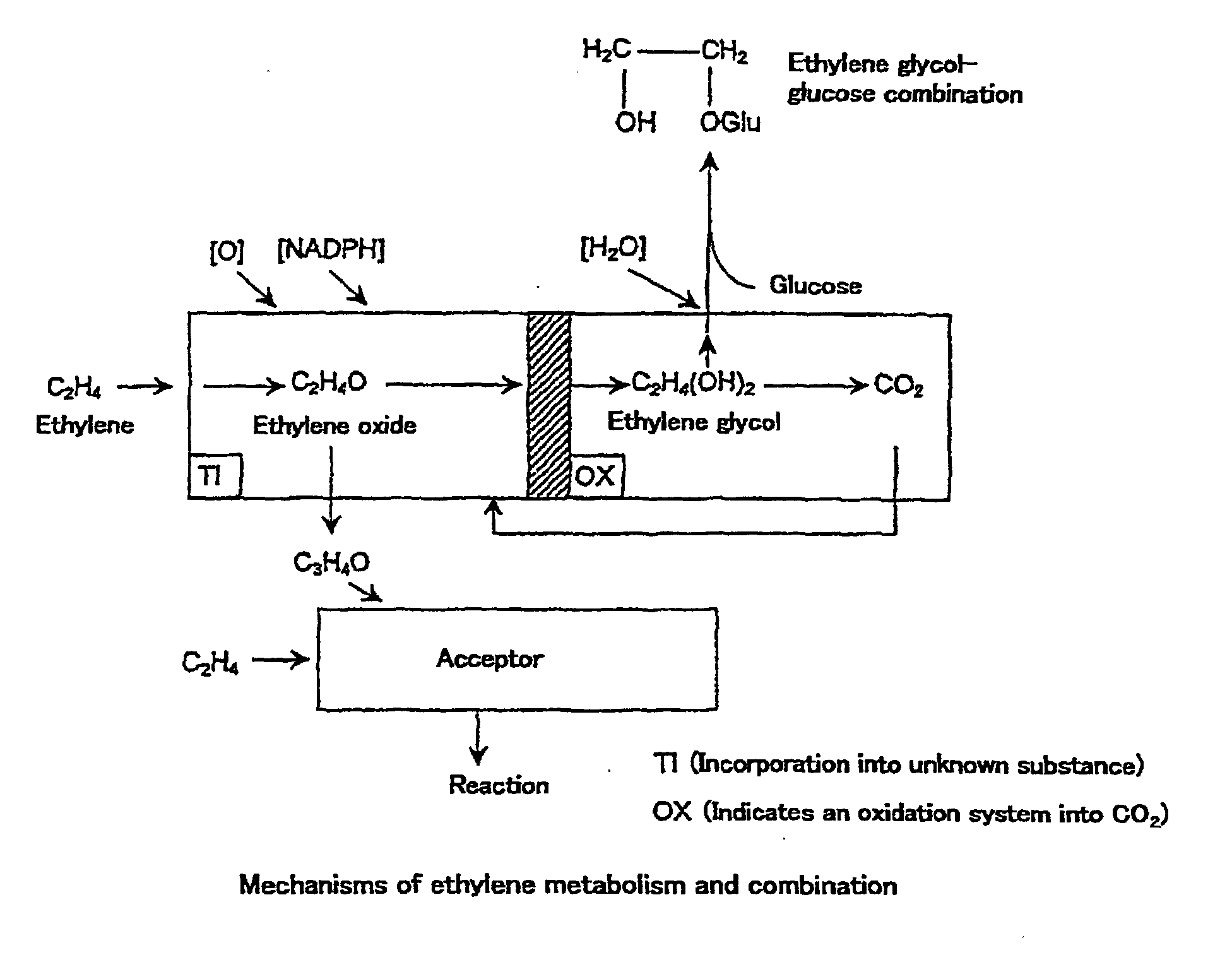
- Ethylene is converted by an ethylene oxidase (ethylene monooxygenase) into ethylene oxide, which combines with a receptor to cause a biochemical reaction.
- NADPH is required as a coenzyme.
- the chemical reaction is carried out by utilizing energy released when the coenzyme is oxidized and decomposed.
- ethylene oxide is converted into ethylene glycol at another site and metabolized into carbon dioxide.
- the carbon dioxide has an action of increasing ethylene monooxygenase activity.
- Glyoxylation of ethylene glycol is a route of detoxication of ethylene (cf., Keishi Shimokawa, "Ethylene", University of Tokyo Press (1988), p. 76 and 80).
- the inventors of the present invention have carried out tests of using raw bamboo cut laterally without any modification and activated carbon obtained by roasting said cut raw bamboo as ethylene gas adsorbents for maintaining the freshness of plants such as fruits , vegetables and flowers.
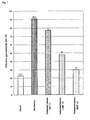
- 25 g each of raw bamboo and activated carbons (carbonized bamboo) obtained by roasting raw bamboo at 300°C, 1,000°C and 2,000°C, respectively was charged in a sealed vessel filled with ethylene gas of a concentration of 50 ppm and air was circulated therein with a fan to carry out ethylene gas removal tests.
- Fig. 1 shows the results of the ethylene gas removal tests. From the results shown in Fig. 1, it has been recognized that raw bamboo removed ethylene gas best. This has led to anticipation that removal of ethylene gas may be related not to physical adsorption by activated carbon but to plant metabolism of bamboo.
- bamboo vinegar is meant a liquid obtained from raw bamboo by dry distillation or extraction, more specifically, a liquid obtained by dry distillation of powdered raw bamboo at a temperature of 100 - 300°C with applying a pressure of 3 to 5 atm or a liquid obtained by extracting powdered raw bamboo with alcohol, water or an aqueous solution of an enzyme such as cellulase.
- an alcohol extract solution obtained by extracting raw bamboo with an alcohol be used as a bamboo vinegar solution.
- ethylene is converted into ethylene oxide by an ethylene oxidase (ethylene monooxygenase) and further into ethylene glycol and finally metabolized into carbon dioxide.
- ethylene oxidase ethylene monooxygenase
- ethylene glycol ethylene glycol
- carbon dioxide ethylene glycol
- catabolism (destructive metabolism) of ethylene with an enzyme contained in raw bamboo or a bamboo vinegar solution may be involved in the ability of removing ethylene gas by raw bamboo or a bamboo vinegar solution.
- the inventors of the present invention have analyzed raw bamboo and a bamboo vinegar solution and as a result they have confirmed that the raw bamboo or the bamboo vinegar solution contained ethylene monooxygenase belonging to ethylene oxidase.
- the inventors of the present invention have obtained the knowledge that any material that contains ethylene monooxygenase, not limited to raw bamboo or a bamboo vinegar solution, is effective for adsorbing ethylene gas.
- an alcohol extract solution of raw bamboo is particularly suitable for the adsorption of ethylene gas. That is, the inventors of the present invention have carried out ethylene gas removal tests with alcohol solutions of Japanese cypress and of a tea plant and compared the results thereof with those of an alcohol solution of raw bamboo.
- a liquid obtained by extracting 100 g of powder of each plant charged in a vessel with 70 cc of ethanol was used as an extract solution.
- an adsorbent used was one obtained by holding each extract solution on a substrate made of a biodegradable foam through chitosan that is a gel forming substance having an amino group.
- Table 2 shows the results of measurement of ethylene gas concentration after five days from introduction of each adsorbent in a sealed vessel filled with 100 ppm of ethylene gas. Ethylene gas removing ability Adsorbent Initial concentration (ppm) After five days (ppm) removal rate (%) bamboo extract solutions /chitosan /substrate 100 40 to 50 50 to 60 Japanese cypress /chitosan /substrate 100 95 5 Tea plant /chitosan /substrate 100 100 0
- the alcohol extract solution of raw bamboo exhibits an ability of removing ethylene gas 10 times or more in comparison with those of the alcohol extract solutions of Japanese cypress or tea.
- Fig. 2 shows the results.
- an alcohol extract solution of raw bamboo is represented as bamboo extract and a dry distillate of raw bamboo is represented as bamboo vinegar.
- the solid lines indicate abilities of ethylene gas removal, with the horizontal axis indicating number of days and the vertical axis indicating ethylene gas concentration. From the results, it can be seen that the ability of ethylene gas adsorption is more excellent for the alcohol extract of raw bamboo than for the dry distillate of raw bamboo.
- the concentration of ethylene glycol released as a result of adsorption and oxidation of ethylene gas is also described (broken lines). Also, a released amount of ethylene glycol is more in the alcohol extract solution than in the dry distillate.
- raw bamboo, a bamboo vinegar solution or the like that contains ethylene monooxygenase is preferably held on a substrate.
- the substrate may be in any form, such as a film, sheet, granule, or mass.
- the material used for the substrate include polyethylene, polystyrene, wood pulp, cellulose, polyvinyl chloride, polyvinylidene chloride, cellophane, and cardboard box material. They may be made of foams.
- the substrate is preferably a transparent film such as a polyethylene sheet that can be seen through and more preferably a cellophane paper in order to arouse willingness to purchase.
- the ethylene gas adsorbent of the present invention is used as a packaging material for plants such as fruits, vegetables and flowers, wood pulp or natural cellulose sheets are preferable as substrates.
- the bamboo vinegar solution as it is may be applied onto the substrate by immersion, casting or coating.
- holding the bamboo vinegar solution on a substrate through a gel forming substance having an amino group is preferred since the ethylene gas adsorption rate is increased.
- a preferable substance as the gel forming substance having an amino group includes polyallylamine, polyethyleneimine and chitosan .
- Chitosan has two amino groups in the molecule and in addition is harmless so that it is more preferable.
- a weak acid harmless to the human body such as acetic acid or citric acid, be added to chitosan to form a transparent solution before it can be used.
- the bamboo vinegar solution and the gel forming substance may be mixed with each other and held on a substrate or the gel forming substance may be held on a substrate and the bamboo vinegar solution may be laminated on the gel forming substance so as to be held thereon.
- the adsorbent of the present invention can be produced by using a solution prepared by mixing a bamboo vinegar solution with an aqueous solution of polyallylamine or an aqueous solution of chitosan in citric acid and coating or immersing a substrate such as a cellophane paper with or in the solution.
- the adsorbent of the present invention can also be produced by coating a substrate with a solution of polyallylamine or chitosan in citric acid, drying the coating, further coating a bamboo vinegar solution on the coating, and drying the resulting coating.
- the ethylene gas adsorbent of the present invention has been explained as one used for holding the freshness of plants such as fruits, vegetables and flowers but the ethylene gas adsorbent of the present invention can be used as a filter for removing ethylene gas as well.
- a method for controlling ethylene gas concentration includes decreasing the ethylene gas concentration by having ethylene adsorbed on a filter to remove ethylene from the atmosphere or conversely, increasing the ethylene gas concentration by having ethylene released from the filter.
- Ethylene can be eliminated from the atmosphere when it is desired to control thematuration of perishables such as fruits, vegetables and flowers to maintain the freshness thereof, and conversely ethylene can be desorbed from the filter so as to release to the atmosphere when it is desired to accelerate the maturation.
- the raw bamboo fiber, bamboo vinegar solution, or the like that contains ethylene monooxygenase is held on a filter substrate.
- the filter substrate may be in any form selected from film, sheet, nonwoven fabric, woven fabric, granules, or mass and the material used for the substrate includes polyethylene, polystyrene, wood pulp, cellulose, polyvinyl chloride, polyvinylidene chloride, artificial fibers, animal fibers, plant fibers and glass fibers. These may be foams.
- raw bamboo fibers are mixed into a filter substrate such as a foam, nonwoven fabric, or the like, or are adhered onto a surface of the filter substrate.
- a filter substrate such as a foam, nonwoven fabric, or the like
- the bamboo vinegar solution as it is may be applied onto a substrate by immersion, casting or coating.
- holding it on a substrate through a gel forming substance having an amino group is preferred since the adsorption rate of ethylene gas is increased.
- the bamboo vinegar solution when a bamboo vinegar solution is used in an ethylene gas sensor, the bamboo vinegar solution is held on a quartz crystal microbalance.
- the bamboo vinegar solution as it is may be cast or coated onto the quartz crystal microbalance but, as well as in the case where the bamboo vinegar solution is used in an absorbent or a filter, it is preferred that the bamboo vinegar solution be held on the substrate through a gel forming substance having an amino group since the ethylene gas adsorption rate is elevated.
- the bamboo vinegar solution and the gel forming substance may be mixed with each other and held on a quartz crystal microbalance or the gel forming substance may be held on a quartz crystal microbalance and the bamboo vinegar solution may be laminated on the gel forming substance so as to be held thereon.
- the senor of the present invention can be produced by using a solution prepared by mixing a bamboo vinegar solution with an aqueous solution of polyallylamine or an aqueous solution of chitosan in citric acid and coating or casting a quartz crystal microbalance therewith. Further, the sensor of the present invention can also be produced by coating a quartz crystal microbalance with a solution of polyallylamine or chitosan in citric acid, drying the coating, further coating a bamboo vinegar solution on the coating, and drying the resulting coating.
- a bamboo vinegar solution was obtained by charging powder of moso bamboo (Phyllostachys pubescens) in a basket and dry distilling it at 300°C and at 5 atm for 4 hours. 0.2 ⁇ l of the bamboo vinegar solution was cast on an electrode of a quartz crystal microbalance and spontaneously dried for 24 hours to obtain a sensor.
- the sample thus obtained was inserted in a sealed vessel in which the ethylene gas concentration was kept at a constant level of 150, 300, or 800 ppm, and after 100 seconds the sample was taken out into the air. The measurement was repeated three times.
- the adsorption amount of ethylene gas was measured by use of quartz crystal microbalance method (QCM method).
- the QCM method utilizes the phenomenon that the eigenfrequency of a quartz crystal microbalance is changed due to a change in mass attached to the electrode.
- a trace substance is attached onto the electrode of a quartz crystal microbalance by gas adsorption or the like, these minute mass change can be detected as a change in resonant frequency due to a mass loading effect.
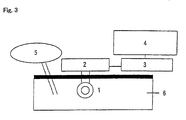
- Fig. 3 shows a schematic diagram of an apparatus using the QCM method.
- Reference numeral 1 designates a quartz crystal microbalance having cast thereon with ethylene monooxygenase
- 2 designates an oscillation circuit
- 3 designates a resonant frequency detector
- 4 designates a computer. A change in frequency appearing at 3 as a result of adsorption of ethylene gas supplied from an ethylene gas source 5 to a sealed vessel 6 onto the quartz crystal microbalance 1 is detected.
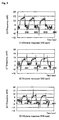
- Fig. 4 shows the results.
- (1) shows the case in which the ethylene gas concentration was 150 ppm
- (2) shows the case in which the ethylene gas concentration was 300 ppm
- (3) shows the case in which the ethylene gas concentration was 800 ppm. From those results, it can be seen that in any case in which the ethylene gas concentration was 150, 300 or 800 ppm, when the quartz crystal microbalance on which the bamboo vinegar solution was cast was inserted into the sealed vessel, adsorption of ethylene gas was started, while when the quartz crystal microbalance was exposed to the atmospheric air, the adsorbed ethylene was released. From this it was revealed that the quartz crystal microbalance having cast thereon with the bamboo vinegar solution could be used as an ethylene gas sensor. According to Figs. 4 (1) to (3) , the saturated adsorption amounts in respective cases are substantially equal and differences are minute.
- Example 2 ethylene gas adsorbent and a sensor comprising a composite film with a gel forming substance having an amino group are shown.
- PA polyallylamine hydrochloride
- the quartz crystal microbalance was subjected to hydrophilic treatment with KOH and 0.2 ⁇ l of a PAH solution was cast thereon and spontaneously dried for 24 hours to fabricate a thin film. Thereafter, 0.2 ⁇ l of the bamboo vinegar solution was cast and spontaneously dried for 24 hours to prepare a composite film.
- Fig. 5 shows the results.
- the vertical axis indicates ethylene gas adsorption amount (ng/ng) per adsorbing film amount. From the results, it can be seen that a composite film with PAH increased the adsorbability as compared with the single film of the bamboo vinegar solution.
- Example 3 removal tests of ethylene generated from apple is shown.
- Fig. 6 shows the results of ethylene gas concentration measured after 192-hour from the start of the experiment by use of a gas detecting tube.
- the ethylene gas concentration in the case increased up to 100 ppm in the absence of the bamboo vinegar solution, due to generation of ethylene from the apples.
- the bamboo vinegar solution in the presence of the bamboo vinegar solution, the ethylene gas concentration in the case was suppressed to 5 ppm. Thus, a difference in concentration was 20 times.
- the experiment was carried out in the same manner as in Example 3 except that an extract solution obtained by extracting raw bamboo with an alcohol was used as a bamboo vinegar solution.
- a bamboo vinegar solution a liquid obtained by charging 100 g of powdered raw green moso bamboo in a vessel and extracting with 70 cc of ethanol was used.
- Fig. 7 shows the results.
- the bamboo vinegar solution obtained from raw bamboo by extraction was used, the ethylene concentration in the case first increased up to 14 ppm but after about 30 hours, it was continually suppressed to about 10 ppm.
- Ethylene gas adsorbability was examined by using an extract solution obtained by extracting raw bamboo with an alcohol as a bamboo vinegar solution and varying the substrate.
- the packaging material was obtained by coating a tray made of wood pulp and natural cellulose with a solution of chitosan in citric acid and further coating thereon with the bamboo vinegar solution (the same solution as in Example 1).
- the ethylene gas concentration in the vessel was suppressed to 5 ppm and the similar results as those in Fig. 6 were obtained.
- Example 1 The filter of Example 1 was placed in an acrylic resin made sealed case of 200 mm in each side similar to that used in Example 1 and apples were arranged therein .
- the case was allowed to stand for 6 hours and the measured concentration of the generated ethylene gas was 100 ppm.
- the air in the sealed case was circulated by a fan through the filter, the ethylene gas concentration in the case was then decreased to 5 ppm.
- the power of the fan was turned OFF and the case was allowed to stand for 6 hours again, the ethylene gas concentration in the sealed case increased to 100 ppm again. But when the fan was turned ON to circulate the air, the ethylene gas concentration was decreased to 5 ppm again.
- Fig. 9 shows a change of ethylene gas concentration in the sealed vessel.
- the fan In the case where the maturation of apples is intended to accelerate by use of the ethylene gas filter, the fan is kept OFF to increase the ethylene gas concentration, while in the case where the maturation of apples is intended to delay, the fan is turned ON to maintain the ethylene gas concentration at a low concentration.
- Example 10 a system for controlling the ethylene gas concentration in the storage chamber of perishables by the feedback control type is shown.
- Fig. 10 shows a schematic diagram of the concentration control apparatus for a storage chamber.
- reference numeral 1 is a storage chamber for storing perishables such as fruits
- 2 is perishables such as fruits to be stored
- 3 is an ethylene gas bomb
- 4 is an ethylene gas filter
- 5 is a fan
- 6 is an ethylene gas sensor
- 7 is a measuring device
- 8 is a personal computer
- 9 is a feedback controller
- 10 is a solenoid valve.
- Apples stored in the storage chamber 1 were kept in a low concentration ethylene gas atmosphere with turning the power of the fan 5 ON and having ethylene gas that was released from the apples adsorbed on the filter during the time when no order for purchase was received.
- the ethylene gas bomb was opened to introduce ethylene gas into the storage chamber so that the apples could be ripened with ease.
- the filter was rotated at a low speed so as to the ethylene gas concentration in the storage chamber became 30 ppm.
- the ethylene gas concentration in the storage chamber was increased to 70 ppm and the apples were exposed to 70 ppm ethylene gas for 2 hours so as to they could be shipped after they were completely ripened.
- Fig. 11 shows a change of ethylene gas concentration in the storage chamber by the ethylene gas concentration control system.
- Example 2 The sensor obtained in Example 2 with the composite film of PAH and the bamboo vinegar solution was placed in a sealed vessel filled with ethylene gas having a concentration of 8, 25, 30, 40, 200 or 600 ppm and its response was observed.
- the same ethylene gas measuring apparatus shown in Fig. 3 as in Example 1 was used.
- the ethylene gas concentration in the sealed vessel was measured by use of a commercially available detecting tube (manufactured by Gastec Corporation).
- Fig. 12 shows the obtained results of adsorption isothermal curve.
- the horizontal axis indicates the ethylene gas concentration in the sealed vessel and the vertical axis indicates ethylene gas adsorption amount measuredby the QCMmethod.
- the curve is a Langmuir adsorption isothermal. This has linearity at an ethylene gas concentration of 40 ppm or less and can be used as a simple ethylene gas concentration measuring apparatus having the same accuracy as that of the commercially available detecting tube.
- the curve is nonlinear but conversion using a calibration curve makes it possible to similarly use the apparatus in the measurement of concentrations .
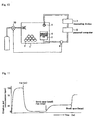
- Fig. 13 shows the results.
- the horizontal axis indicates time and the vertical axis indicates adsorption amount of ethylene. From Fig. 13, it can be seen that the sensor of the present invention adsorbed ethylene gas but did not adsorb other compounds such as formaldehyde and trichloromethane. From the results, it can be seen that a sensor having adhered a bamboo vinegar solution in the form of a film onto a quartz crystal microbalance has a selectivity to ethylene gas.
- Ethylene gas adsorbent, wrapping material and packaging material containing ethylene monooxygenase, in particular an alcohol extract of raw bamboo can efficiently adsorb ethylene gas, so that they can suppress maturation by ethylene gas generated form plants such as fruits, vegetables and flowers.
- ethylene gas concentration can be safely controlled to the human body by use of a filter having supported thereon ethylene monooxygenase.
- a controlling method can be applied to maintaining freshness or controlling maturation of perishables such as fruits, vegetables and flowers in storage chamber or the like.
- a quartz crystal microbalance having held thereon ethylene monooxygenase or a bamboo vinegar solution can selectively and efficiently adsorb ethylene gas so that it can be applied to a method and apparatus for measuring ethylene gas concentration.
Landscapes
- Chemical & Material Sciences (AREA)
- Life Sciences & Earth Sciences (AREA)
- Engineering & Computer Science (AREA)
- Chemical Kinetics & Catalysis (AREA)
- Analytical Chemistry (AREA)
- Wood Science & Technology (AREA)
- Zoology (AREA)
- Food Science & Technology (AREA)
- Polymers & Plastics (AREA)
- General Chemical & Material Sciences (AREA)
- Health & Medical Sciences (AREA)
- Physics & Mathematics (AREA)
- Oil, Petroleum & Natural Gas (AREA)
- Biochemistry (AREA)
- General Health & Medical Sciences (AREA)
- General Physics & Mathematics (AREA)
- Immunology (AREA)
- Pathology (AREA)
- Microbiology (AREA)
- Biomedical Technology (AREA)
- Molecular Biology (AREA)
- Organic Chemistry (AREA)
- Storage Of Fruits Or Vegetables (AREA)
- Agricultural Chemicals And Associated Chemicals (AREA)
Abstract
The present invention provides means which can be used for
maintaining the freshness of or controlling maturation of plants
or perishables such as fruits, vegetables, and flowers and which
is safe to the human body. According to the present invention,
amethod formaintaining the freshness of or conversely controlling
the maturation of plants or perishables by controlling the
concentration of ethylene gas by use of an ethylene gas adsorbent
containing an alcohol extract solution of raw bamboo and a filter
having held thereon the alcohol extract solution of raw bamboo .
Also, according to the present invention, there is provided an
ethylene gas sensor including a quartz crystal microbalance having
coated thereon the alcohol extract solution of raw bamboo.
Description
The present invention relates to an ethylene gas adsorbent
used for maintaining the freshness of plants and perishables such
as fruits, vegetables, and flowers and to a wrapping material
and a packaging material used for maintaining the freshness of
plants and perishables such as fruits, vegetables, and flowers.
Also, the present invention relates to an ethylene gas
concentration controlling method and apparatus used for
maintaining the freshness of plants andperishables such as fruits ,
vegetables, and flowers or for controlling maturation thereof.
Further, the present invention relates to an ethylene gas
sensor that detects ethylene in a gas and to a method and apparatus
for measuring the concentration of ethylene gas in a gas.
Fruits and vegetables such as apples and strawberries, or
flowers such as carnation are usually packaged in a box in the
producing district and transported therefrom. However, there
has been a problem in that ethylene gas generated in the inside
of, for example, fruits and released therefrom due to fermentation
during transportation accelerates fermentation in other
individuals or sites, so that the freshness of the transported
fruits is decreased.
Accordingly, to transport fruits or other produce, in
particular, to a distant location, a method must be adopted in
which fruits or the like are harvested in an unripe state and
delivered as they are to the hand of consumers while leaving the
fruits to ripen during the transportation, so that it was difficult
to ship the fruits in a completely ripened state and the delivered
fruits in many cases tend to become poor in sugar degree or taste.
As means for solving this problem, a method in which potassium
permanganate having a capability of decomposing ethylene gas is
allowed to coexist during transportation or storage of fruits,
vegetables, or the like to decompose and remove ethylene gas
released from the fruits or vegetables has been proposed (JP
54-117060 A) and partly put to practical use. However, potassium
permanganate has a problem of safety in that it is poisonous when
it is swallowed or inhaled and it stimulates the mucous membrane
or tissues strongly. Also, a method in which an adsorbent of
the physical adsorption type, such as zeolite or activated carbon,
is compounded in a wrapping material to thereby adsorb and remove
ethylene gas has been proposed (JP 64-31838 A). However, the
method exhibits no satisfactory effect. Further, a method in
which vegetables are stored in a refrigerator in coexistence with
a copper-containing antimicrobial agent has been also proposed
(JP 11-211342 A). However, no satisfactory effect has been
obtained in practical use. Furthermore, a method in which
transportation is performed together with fruits having function
of absorbing ethylene gas, such as banana and kiwi that are unripe,
that is, in a green state, to prevent fermentation has been proposed
(JP 11-32668 A). However, fermentation also proceeds in the
fruits per se that absorb ethylene gas, so that prolonged effects
cannot be expected. In addition, this method involves the risk
of deteriorating the flavor of the fruit by the mixing of the
scents due to mixing of different kind of fruits.
Further, JP 2000-210526 A discloses use of essential oils
obtained by steam distillation of various kinds of plants as
materials for removing hazardous gases and cites Japanese cypress
and tea plant as examples of such plants. However, the essential
oils obtained by steam distillation of these plants have had no
fully satisfactory ability of removing ethylene gas.
Furthermore, as described above, it has been known that
plants and perishables such as fruits, vegetables, and flowers
generate ethylene gas as a result of fermentation and the released
ethylene gas makes their fermentation proceed further.
Accordingly, to control fermentation of fruits, vegetables,
flowers and so forth andmaintain their freshness, it is important
to detect ethylene gas in refrigerators and transportation
chambers and measure its concentration.
Conventionally, gas sensors are directed to combustible
gases, oxygen, humidity, and hazardous gases such as CO and have
come to have a big market. Still now, new needs are created one
after another and active researches are being carried out
continuously. One recent big need is for detection of scent.
Detection of scent finds specific applicationsin risk management,
food management and the like and at the same time is a part of
sensing of sensibilities, which is a new theme of information
science.
A wide variety of scent components to be detected have been
studied, examples of which include trimethylamine (TMA) and
dimethylamine (DMA) that relate to the freshness of fish and
shellfish; methylpyrazine, acetone and the like that are contained
in consommé soup; ethyl acetate, acetoin and the like that relate
to the freshness of beef; H2S and NH3 that are also hazardous gases;
fruit oils, methylmercaptan, aliphatic amines and so forth.
However, in actuality, substantially no study has been made for
the detection of ethylene gas.
Conventional materials that have been known as materials
for use in scent sensors include metal oxide semiconductors and
organic materials. In sensors with metal oxide semiconductors,
in which sintered compacts of oxide particles are mainly used,
adsorption or reaction of scent molecules on or with the surface
of the semiconductor particles changes the electrical resistance
of the semiconductor, the amount of which change is taken out
as a sensor signal. On the other hand, where organic materials
are used, adsorption of the scent components on the organic
materials changes the mass, absorbance or the like, the amount
of which change is physically measured.
On the other hand, a method of using a quartz crystal
microbalance as a sensor using an organic material (Quartz Crystal
Microbalance method (QCM method)) has been known (G. Sauerbrey,
"Verwendung von Schwingquartzen zur Wägung dünner Schichten und
zur Mikrowägung", Zeitshrift für Physik, Vol. 155, pp.206-222,
1959). In this method, a quartz crystal microbalance is used
as a high-sensitivity gas sensor element since the quartz crystal
microbalance can detect a minute change in mass on an electrode
of the quartz crystal microbalance due to, for example, gas
adsorption thereon as a change in resonant frequency due to
mass-loading effect. Further, the QCM method can easily realize
sensors having various characteristics by varying the sensitive
film to be coated on the electrode. As the film material, polymers
and lipids are mainly used. In the case where scents are
distinguished with the sensors, a technique of pattern recognition
by multivariate analysis or through a neural network is used for
the recognition of outputs from a plurality of sensors coated
with different sensitive films.
As described above, although hazardous gas sensors or scent
sensors have been conventionally developed, no simple and accurate
ethylene gas sensor has been developed yet which is suitable for
detecting and measuring concentration of ethylene gas in the gas
in a refrigerator or transportation chamber in order to control
fermentation of fruits, vegetables, and flowers therein to
maintain their freshness.
The present invention has been made to solve the above
problems of the prior art and therefore an object of the present
invention is to provide means that is safe to human body and used
for maintaining the freshness of plants and perishables such as
fruits, vegetables, and flowers for a long period of time. Further,
another object of the present invention is to provide means for
accelerating or conversely inhibiting maturation of plants and
perishables such as fruits, vegetables, and flowers.
The inventors of the present invention have made extensive
studies on the above-mentioned problems and as a result they have
anticipated that use of ethylene monooxygenase that can
biochemically metabolize and decompose ethylene gas in place of
a physical adsorbent such as zeolite would solve the
above-mentioned problems, thereby achieving the present
invention. Then, the inventors of the present invention have
focused attention, in particular, to an alcohol extract solution
of raw bamboo as a substance containing ethylene monooxygenase.
That is, in the course of their studies on activated carbon
(referred to as carbonized bamboo) obtained by roasting raw green
bamboo (hereinafter simply referred to as raw bamboo) used for
adsorption of ethylene gas, the inventors of the present invention
have found that the raw bamboo itself adsorbs ethylene gas and
conceived that use of ethylene monooxygenase, which is an ethylene
oxidase contained in raw bamboo, and further an alcohol extract
solution of raw bamboo would enable adsorption of ethylene gas
more efficiently, thereby achieving the present invention.
In more detail, the present invention relates to an ethylene
gas adsorbent characterized by containing ethylene
monooxygenase.
It is preferable that the ethylene gas adsorbent of the
present invention further contains a coenzyme (NADPH) in addition
to ethylene monooxygenase.
The present invention further relates to an ethylene gas
adsorbent using raw bamboo fiber or bamboo vinegar that contains
ethylene monooxygenase, in particular an alcohol extract solution
of raw bamboo. As bamboo vinegar, in particular an alcohol extract
solution of raw bamboo is preferable.
Further, it is preferable that the ethylene gas adsorbent
of the present invention is held on a substrate such as a transparent
sheet-form material and that the ethylene gas adsorbent is held
on the substrate through a gel forming substance having an amino
group.
The present invention further relates to application of
such an ethylene gas adsorbent to a wrapping material or a packaging
material for wrapping or packaging plants and perishables such
as fruits, vegetables, and flowers.
In the case where ethylene monooxygenase in the raw bamboo
or the like of the present invention is used for the adsorption
of ethylene gas, the present invention has an excellent advantage
in that the ethylene monooxygenase causes no danger at all and
is safe even if it contacts with foods and the like and introduced
into the body of an individual or if it is eaten together with
the foods since only nonhazardous plant-based materials are
utilized.
Further, the present invention relates to a method for
controlling the concentration of ethylene gas with a filter that
ethylene monooxygenase is supported thereon. As the substance
that contains ethylene monooxygenase, in particular an alcohol
extract solution of raw bamboo is preferable.
It is preferred that said filter further contains NADPH
as a coenzyme for ethylene monooxygenase.
Further, the present invention relates to a method for
controlling a concentration of ethylene gas with a filter on which
a raw bamboo fiber or bamboo vinegar solution. As the bamboo
vinegar solution, in particular an alcohol extract solution of
raw bamboo is preferable.
In order to control the concentration of ethylene gas,
according to the present invention, the method for controlling
the concentration of ethylene gas preferably includes measuring
an ethylene gas concentration of an atmosphere by an ethylene
gas concentration measuring apparatus; and decreasing the
ethylene gas concentration by operating a fan to have ethylene
gas adsorbed onto the filter when the ethylene gas concentration
is equal to or above a predetermined value or introducing ethylene
gas into the atmosphere when the ethylene gas concentration is
equal to or below a predetermined value.
The present invention relates to a method for maintaining
freshness or controlling maturation of perishables such as fruits,
vegetables, and flowers , by using the above method for controlling
ethylene gas concentration.
Further, the present invention relates to an apparatus for
controlling ethylene gas concentration which includes the filter
described above and a fan and also relates to an apparatus for
maintaining freshness or controlling maturation of perishables
such as fruits, vegetables, and flowers which is characterized
by including an ethylene gas concentration measuring apparatus,
the filter described above, and a fan.
Furthermore, the present invention relates to an ethylene
gas sensor that detects ethylene gas in a gas as well as a method
and apparatus for measuring the concentration of ethylene gas
with said ethylene gas sensor.
That is, the present invention relates to an ethylene gas
sensor characterized by including a quartz crystal microbalance
having held thereon ethylene monooxygenase, in particular an
alcohol extract solution of raw bamboo.
It is preferable that the ethylene gas sensor of the present
invention further contains a coenzyme (NADPH).
The present invention also relates to an ethylene gas sensor
including a quartz crystal microbalance having coated thereon
bamboo vinegar solution containing ethylene monooxygenase.
Further, the present invention relates to an ethylene gas
sensor, in which the quartz crystal microbalance is coated with
the bamboo vinegar solution through a gel forming substance having
an amino group.
The present invention also relates to a method and apparatus
for measuring a concentration of ethylene gas in a gas by using
the ethylene gas sensor described above.
Hereinafter, the present invention will be described in
detail.
The mechanism of ethylene metabolism in a plant tissue is
described below. In "Mechanism of CH2CH2 metabolism in a plant
tissue", [O] indicates ethylene oxidase (ethylene monooxygenase)
As described below, there are two active sites for ethylene
metabolism in a plant body. At an active site I, ethylene is
oxidized and converted into ethylene oxide, which is further
oxidized through ethylene glycol into carbon dioxide. At an
active site II, after conversion into ethylene glycol, the ethylene
glycol is combined with glucose to form ethylene glycol-glucose
combination.

In the following description, the mechanism of ethylene
metabolism is shown in more detail.
Ethylene is converted by an ethylene oxidase (ethylene
monooxygenase) into ethylene oxide, which combines with a receptor
to cause a biochemical reaction. On this occasion, NADPH is
required as a coenzyme. The chemical reaction is carried out
by utilizing energy released when the coenzyme is oxidized and
decomposed. Further, ethylene oxide is converted into ethylene
glycol at another site and metabolized into carbon dioxide. The
carbon dioxide has an action of increasing ethylene monooxygenase
activity. Glyoxylation of ethylene glycol is a route of
detoxication of ethylene (cf., Keishi Shimokawa, "Ethylene",
University of Tokyo Press (1988), p. 76 and 80).
Initially, the inventors of the present invention have
carried out tests of using raw bamboo cut laterally without any
modification and activated carbon obtained by roasting said cut
raw bamboo as ethylene gas adsorbents for maintaining the freshness
of plants such as fruits , vegetables and flowers. For the purpose,
25 g each of raw bamboo and activated carbons (carbonized bamboo)
obtained by roasting raw bamboo at 300°C, 1,000°C and 2,000°C,
respectively, was charged in a sealed vessel filled with ethylene
gas of a concentration of 50 ppm and air was circulated therein
with a fan to carry out ethylene gas removal tests. Fig. 1 shows
the results of the ethylene gas removal tests. From the results
shown in Fig. 1, it has been recognized that raw bamboo removed
ethylene gas best. This has led to anticipation that removal
of ethylene gas may be related not to physical adsorption by
activated carbon but to plant metabolism of bamboo.
However, because of poor usability provided by use of raw
bamboo as it is for the adsorption of ethylene gas, studies have
been made to see if there is a substance that is liquid allowing
thin film formation and has an ethylene gas removing effect
equivalent to that of raw bamboo. As a result, attention has
been focused on bamboo vinegar obtained by dry distillation
(carbonization) or extraction of raw bamboo.
In the present invention, bamboo vinegar is meant a liquid
obtained from raw bamboo by dry distillation or extraction, more
specifically, a liquid obtained by dry distillation of powdered
raw bamboo at a temperature of 100 - 300°C with applying a pressure
of 3 to 5 atm or a liquid obtained by extracting powdered raw
bamboo with alcohol, water or an aqueous solution of an enzyme
such as cellulase. In the present invention, it is most preferable
that an alcohol extract solution obtained by extracting raw bamboo
with an alcohol be used as a bamboo vinegar solution.
Next, the inventors of the present invention have tried
to perform ethylene gas removal experiments with a bamboo vinegar
solution obtained from raw bamboo. 100 ml of a bamboo vinegar
solution obtained by dry distillation of raw bamboo was diluted
with 300 ml of ultrapure water, and biodegradable resin foam
particulates made of cellulose as a main ingredient were immersed
therein for 24 hours and then spontaneously dried for 24 hours
to fabricate a filter. As the biodegradable resin foam
particulates were used particulates formed by pulverizing foam
of a thumb size so as to have a large specific surface area. The
fabricated filter was introduced in a sealed vessel filled with
about 50 ppm of ethylene and air was circulated with a fan. After
three hours, ethylene gas removal rate was measured. Table 1
shows the results obtained.
| Ethylene gas removal rate | ||
| Initial concentration | Concentration after three hours | |
| Bamboo vinegar solution/foam | 55 ppm 55 ppm | 0.2 ppm 0.2 ppm |
| Foam only | 58 ppm | 21.0 ppm |
From the results, it can be seen that the foam immersed
in the bamboo vinegar solution considerably increased the removal
rate as compared with the foam alone.
As described above, in a plant body, ethylene is converted
into ethylene oxide by an ethylene oxidase (ethylene
monooxygenase) and further into ethylene glycol and finally
metabolized into carbon dioxide. From this and the
above-mentioned test results obtained by the inventors of the
present invention that a radial section of raw bamboo or a bamboo
vinegar solution exhibits the effect of adsorbing ethylene gas,
the inventors of the present invention have presumed that
catabolism (destructive metabolism) of ethylene with an enzyme
contained in raw bamboo or a bamboo vinegar solution may be involved
in the ability of removing ethylene gas by raw bamboo or a bamboo
vinegar solution.
On the other hand, the inventors of the present invention
have analyzed raw bamboo and a bamboo vinegar solution and as
a result they have confirmed that the raw bamboo or the bamboo
vinegar solution contained ethylene monooxygenase belonging to
ethylene oxidase.
From the above-mentioned tests and analyses, the inventors
of the present invention have obtained the knowledge that any
material that contains ethylene monooxygenase, not limited to
raw bamboo or a bamboo vinegar solution, is effective for adsorbing
ethylene gas.
Further, based on the following experiments, the inventors
of the present invention have found that among various kinds of
plant extract solutions , an alcohol extract solution of raw bamboo
is particularly suitable for the adsorption of ethylene gas. That
is, the inventors of the present invention have carried out
ethylene gas removal tests with alcohol solutions of Japanese
cypress and of a tea plant and compared the results thereof with
those of an alcohol solution of raw bamboo. Here, a liquid obtained
by extracting 100 g of powder of each plant charged in a vessel
with 70 cc of ethanol was used as an extract solution. As an
adsorbent, used was one obtained by holding each extract solution
on a substrate made of a biodegradable foam through chitosan that
is a gel forming substance having an amino group. Table 2 shows
the results of measurement of ethylene gas concentration after
five days from introduction of each adsorbent in a sealed vessel
filled with 100 ppm of ethylene gas.
| Ethylene gas removing ability | |||
| Adsorbent | Initial concentration (ppm) | After five days (ppm) | removal rate (%) |
| Bamboo extract solutions /chitosan / | 100 | 40 to 50 | 50 to 60 |
| Japanese cypress /chitosan / | 100 | 95 | 5 |
| Tea plant /chitosan / | 100 | 100 | 0 |
From Table 2 , it can be seen that the alcohol extract solution
of raw bamboo exhibits an ability of removing ethylene gas 10
times or more in comparison with those of the alcohol extract
solutions of Japanese cypress or tea.
Next, the inventors of the present invention have compared
the alcohol extract solution of raw bamboo with the dry distillate
of raw bamboo with respect to their ability of ethylene gas
adsorption. Fig. 2 shows the results. In Fig. 2, an alcohol
extract solution of raw bamboo is represented as bamboo extract
and a dry distillate of raw bamboo is represented as bamboo vinegar.
In Fig. 2, the solid lines indicate abilities of ethylene gas
removal, with the horizontal axis indicating number of days and
the vertical axis indicating ethylene gas concentration. From
the results, it can be seen that the ability of ethylene gas
adsorption is more excellent for the alcohol extract of raw bamboo
than for the dry distillate of raw bamboo. Note that in Fig.
2, the concentration of ethylene glycol released as a result of
adsorption and oxidation of ethylene gas is also described (broken
lines). Also, a released amount of ethylene glycol is more in
the alcohol extract solution than in the dry distillate.
In the ethylene gas adsorbent of the present invention,
raw bamboo, a bamboo vinegar solution or the like that contains
ethylene monooxygenase is preferably held on a substrate. The
substrate may be in any form, such as a film, sheet, granule,
or mass. Examples of the material used for the substrate include
polyethylene, polystyrene, wood pulp, cellulose, polyvinyl
chloride, polyvinylidene chloride, cellophane, and cardboard box
material. They may be made of foams.
In particular, when the ethylene gas adsorbent of the present
invention is used as a wrapping material for plants such as fruits ,
vegetables and flowers, the substrate is preferably a transparent
film such as a polyethylene sheet that can be seen through and
more preferably a cellophane paper in order to arouse willingness
to purchase.
When the ethylene gas adsorbent of the present invention
is used as a packaging material for plants such as fruits,
vegetables and flowers, wood pulp or natural cellulose sheets
are preferable as substrates.
To hold the bamboo vinegar solution on a substrate, the
bamboo vinegar solution as it is may be applied onto the substrate
by immersion, casting or coating. However, holding the bamboo
vinegar solution on a substrate through a gel forming substance
having an amino group is preferred since the ethylene gas
adsorption rate is increased.
It is presumed that holding a bamboo vinegar solution on
a substrate through a gel forming substance having an amino group
results in an increased ethylene gas adsorption rate because an
amino group can react with a carboxyl group of the enzyme protein
in the bamboo vinegar solution to immobilize the enzyme.
A preferable substance as the gel forming substance having
an amino group includes polyallylamine, polyethyleneimine and
chitosan . Chitosan has two amino groups in the molecule and in
addition is harmless so that it is more preferable. When chitosan
is used, it is preferable that a weak acid harmless to the human
body, such as acetic acid or citric acid, be added to chitosan
to form a transparent solution before it can be used.
The bamboo vinegar solution and the gel forming substance
may be mixed with each other and held on a substrate or the gel
forming substance may be held on a substrate and the bamboo vinegar
solution may be laminated on the gel forming substance so as to
be held thereon.
For example, the adsorbent of the present invention can
be produced by using a solution prepared by mixing a bamboo vinegar
solution with an aqueous solution of polyallylamine or an aqueous
solution of chitosan in citric acid and coating or immersing a
substrate such as a cellophane paper with or in the solution.
Further, the adsorbent of the present invention can also be
produced by coating a substrate with a solution of polyallylamine
or chitosan in citric acid, drying the coating, further coating
a bamboo vinegar solution on the coating, and drying the resulting
coating.
Thus far, the ethylene gas adsorbent of the present invention
has been explained as one used for holding the freshness of plants
such as fruits, vegetables and flowers but the ethylene gas
adsorbent of the present invention can be used as a filter for
removing ethylene gas as well.
In the present invention, a method for controlling ethylene
gas concentration includes decreasing the ethylene gas
concentration by having ethylene adsorbed on a filter to remove
ethylene from the atmosphere or conversely, increasing the
ethylene gas concentration by having ethylene released from the
filter. Ethylene can be eliminated from the atmosphere when it
is desired to control thematuration of perishables such as fruits,
vegetables and flowers to maintain the freshness thereof, and
conversely ethylene can be desorbed from the filter so as to release
to the atmosphere when it is desired to accelerate the maturation.
In the ethylene gas filter of the present invention, the
raw bamboo fiber, bamboo vinegar solution, or the like that
contains ethylene monooxygenase is held on a filter substrate.
The filter substrate may be in any form selected from film, sheet,
nonwoven fabric, woven fabric, granules, or mass and the material
used for the substrate includes polyethylene, polystyrene, wood
pulp, cellulose, polyvinyl chloride, polyvinylidene chloride,
artificial fibers, animal fibers, plant fibers and glass fibers.
These may be foams.
To hold raw bamboo fibers on a substrate, raw bamboo fibers
are mixed into a filter substrate such as a foam, nonwoven fabric,
or the like, or are adhered onto a surface of the filter substrate.
To hold a bamboo vinegar solution on the filter substrate,
the bamboo vinegar solution as it is may be applied onto a substrate
by immersion, casting or coating. However, holding it on a
substrate through a gel forming substance having an amino group
is preferred since the adsorption rate of ethylene gas is
increased.
In the present invention, when a bamboo vinegar solution
is used in an ethylene gas sensor, the bamboo vinegar solution
is held on a quartz crystal microbalance. To hold the bamboo
vinegar solution on a quartz crystal microbalance, the bamboo
vinegar solution as it is may be cast or coated onto the quartz
crystal microbalance but, as well as in the case where the bamboo
vinegar solution is used in an absorbent or a filter, it is preferred
that the bamboo vinegar solution be held on the substrate through
a gel forming substance having an amino group since the ethylene
gas adsorption rate is elevated.
The bamboo vinegar solution and the gel forming substance
may be mixed with each other and held on a quartz crystal
microbalance or the gel forming substance may be held on a quartz
crystal microbalance and the bamboo vinegar solution may be
laminated on the gel forming substance so as to be held thereon.
For example, the sensor of the present invention can be
produced by using a solution prepared by mixing a bamboo vinegar
solution with an aqueous solution of polyallylamine or an aqueous
solution of chitosan in citric acid and coating or casting a quartz
crystal microbalance therewith. Further, the sensor of the
present invention can also be produced by coating a quartz crystal
microbalance with a solution of polyallylamine or chitosan in
citric acid, drying the coating, further coating a bamboo vinegar
solution on the coating, and drying the resulting coating.
Hereinafter, examples of the present invention will be
described. However, the present invention should not be
considered to be limited thereto.
A bamboo vinegar solution was obtained by charging powder
of moso bamboo (Phyllostachys pubescens) in a basket and dry
distilling it at 300°C and at 5 atm for 4 hours. 0.2 µl of the
bamboo vinegar solutionwas cast on an electrode of a quartz crystal
microbalance and spontaneously dried for 24 hours to obtain a
sensor.
The sample thus obtained was inserted in a sealed vessel
in which the ethylene gas concentration was kept at a constant
level of 150, 300, or 800 ppm, and after 100 seconds the sample
was taken out into the air. The measurement was repeated three
times.
The adsorption amount of ethylene gas was measured by use
of quartz crystal microbalance method (QCM method). The QCM
method utilizes the phenomenon that the eigenfrequency of a quartz
crystal microbalance is changed due to a change in mass attached
to the electrode. When a trace substance is attached onto the
electrode of a quartz crystal microbalance by gas adsorption or
the like, these minute mass change can be detected as a change
in resonant frequency due to a mass loading effect.
Fig. 3 shows a schematic diagram of an apparatus using the
QCM method.
Fig. 4 shows the results. In Fig. 4, (1) shows the case
in which the ethylene gas concentration was 150 ppm, (2) shows
the case in which the ethylene gas concentration was 300 ppm,
and (3) shows the case in which the ethylene gas concentration
was 800 ppm. From those results, it can be seen that in any case
in which the ethylene gas concentration was 150, 300 or 800 ppm,
when the quartz crystal microbalance on which the bamboo vinegar
solution was cast was inserted into the sealed vessel, adsorption
of ethylene gas was started, while when the quartz crystal
microbalance was exposed to the atmospheric air, the adsorbed
ethylene was released. From this it was revealed that the quartz
crystal microbalance having cast thereon with the bamboo vinegar
solution could be used as an ethylene gas sensor. According to
Figs. 4 (1) to (3) , the saturated adsorption amounts in respective
cases are substantially equal and differences are minute.
In Example 2, ethylene gas adsorbent and a sensor comprising
a composite film with a gel forming substance having an amino
group are shown.
Before casting a bamboo vinegar solution on a quartz crystal
microbalance, polyallylamine hydrochloride (PA) was used as a
binder and the bamboo vinegar solution was cast thereon to prepare
a composite film of PAH and the bamboo vinegar solution. First,
the quartz crystal microbalance was subjected to hydrophilic
treatment with KOH and 0.2 µl of a PAH solution was cast thereon
and spontaneously dried for 24 hours to fabricate a thin film.
Thereafter, 0.2 µl of the bamboo vinegar solution was cast and
spontaneously dried for 24 hours to prepare a composite film.
Quartz crystal microbalances with the prepared composite film,
a single film of PAH or a single film of the bamboo vinegar solution ,
respectively was put into and out from a sealed vessel of which
the ethylene concentration was 200 ppm and responses of adsorption
and desorption were observed. Fig. 5 shows the results. In Fig.
5, the vertical axis indicates ethylene gas adsorption amount
(ng/ng) per adsorbing film amount. From the results, it can be
seen that a composite film with PAH increased the adsorbability
as compared with the single film of the bamboo vinegar solution.
In Example 3, removal tests of ethylene generated from apple
is shown.
Two acrylic resin cases of cubes of 200 mm in each side
were provided and apples were placed therein. In one of them,
50 g of a biodegradable resin foam to which 30 cc of the bamboo
vinegar solution obtained in Example 1 was attached and dried
was arranged around the apples. On the other hand, in the other
case, nothing was arranged therein. On the upper part of the
cases were equipped fans respectively for circulating the air
in these systems.
Fig. 6 shows the results of ethylene gas concentration
measured after 192-hour from the start of the experiment by use
of a gas detecting tube. The ethylene gas concentration in the
case increased up to 100 ppm in the absence of the bamboo vinegar
solution, due to generation of ethylene from the apples. On the
other hand, in the presence of the bamboo vinegar solution, the
ethylene gas concentration in the case was suppressed to 5 ppm.
Thus, a difference in concentration was 20 times.
The experiment was carried out in the same manner as in
Example 3 except that an extract solution obtained by extracting
raw bamboo with an alcohol was used as a bamboo vinegar solution.
As the bamboo vinegar solution, a liquid obtained by charging
100 g of powdered raw green moso bamboo in a vessel and extracting
with 70 cc of ethanol was used.
Fig. 7 shows the results. In the case where the bamboo
vinegar solution obtained from raw bamboo by extraction was used,
the ethylene concentration in the case first increased up to 14
ppm but after about 30 hours, it was continually suppressed to
about 10 ppm.
Ethylene gas adsorbability was examined by using an extract
solution obtained by extracting raw bamboo with an alcohol as
a bamboo vinegar solution and varying the substrate. Three kinds
of substrate, i.e., a biodegradable foamed material, silica gel
and activated carbon were used.
15 g of each substrate was immersed in 100 ml of an aqueous
solution containing 1% chitosan for 10 minutes to treat the surface
of the substrate. After annealing at 90°C for 2 hours, the
substrate was immersed in 100 ml of the bamboo extract solution
for 10 minutes and sufficiently dried spontaneously. 15 g of
the adsorbent thus produced was charged in a 9-liter sealed vessel
filled with 100 ppm of ethylene gas and ethylene gas was caused
to be adsorbed while circulating the air by a fan. After 5 days,
the removal rate of ethylene gas and the concentration of ethylene
glycol produced were measured. Fig. 8 shows the results.
Since the specific surface area of the substrate increases
in order of biodegradable foamedmaterial , silica gel and activated
carbon, it can be seen from Fig. 8 that the removal rate of ethylene
with the bamboo vinegar solution can be increased by increasing
the specific surface are of the substrate.
An example in which the adsorbent of the present invention
was used as a wrapping material of flowers is shown as follows.
As a wrapping material, cellophane paper coated with PAH
to 2 g/m2 and further coated with the bamboo vinegar solution
obtained in Example 1 to 5 g/m2 was used.
Six carnations in a bud stage were wrapped with the wrapping
material and charged in a 30-liter acrylic resin case, which was
then sealed and stored at 25°C for 3 days. During this period,
the buds of carnation did not open at all and the size of the
buds showed no change . However, when the carnations were taken
out of the acrylic resin case, the buds were opened within 12
hours. This indicates that the wrapping material of the present
invention can suppress the maturation of the flowers.
Shown is an example in which the adsorbent of the present
invention was used as a packaging material.
The packaging material was obtained by coating a tray made
of wood pulp and natural cellulose with a solution of chitosan
in citric acid and further coating thereon with the bamboo vinegar
solution (the same solution as in Example 1).
On this tray were mounted apples and these were placed in
a sealed vessel and stored for 2 weeks while measuring the ethylene
gas concentration in the vessel for every 24 hours.
The ethylene gas concentration in the vessel was suppressed
to 5 ppm and the similar results as those in Fig. 6 were obtained.
Shown is an example in which the filter of the present
invention was used for storage of perishables.
The filter of Example 1 was placed in an acrylic resin made
sealed case of 200 mm in each side similar to that used in Example
1 and apples were arranged therein . The case was allowed to stand
for 6 hours and the measured concentration of the generated
ethylene gas was 100 ppm. The air in the sealed case was circulated
by a fan through the filter, the ethylene gas concentration in
the case was then decreased to 5 ppm. When the power of the fan
was turned OFF and the case was allowed to stand for 6 hours again,
the ethylene gas concentration in the sealed case increased to
100 ppm again. But when the fan was turned ON to circulate the
air, the ethylene gas concentration was decreased to 5 ppm again.
Fig. 9 shows a change of ethylene gas concentration in the sealed
vessel.
In the case where the maturation of apples is intended to
accelerate by use of the ethylene gas filter, the fan is kept
OFF to increase the ethylene gas concentration, while in the case
where the maturation of apples is intended to delay, the fan is
turned ON to maintain the ethylene gas concentration at a low
concentration.
Six roses in a bud stage were provided. Three of them were
arranged in a usual room kept at 23°C. The remaining three were
placed in a 1-m cubic vessel together with the filter holding
the bamboo vinegar solution on a biodegradable resin foam. For
roses kept in a usual room, two among three withered after 5 days,
while they were still in the state of buds. On the other hand,
for those kept in the vessel in which the bamboo vinegar solution
was released, all the threewitheredafter theycompletelybloomed.
In Example 10, a system for controlling the ethylene gas
concentration in the storage chamber of perishables by the feedback
control type is shown.
Fig. 10 shows a schematic diagram of the concentration
control apparatus for a storage chamber. In Fig. 10, reference
numeral 1 is a storage chamber for storing perishables such as
fruits, 2 is perishables such as fruits to be stored, 3 is an
ethylene gas bomb, 4 is an ethylene gas filter, 5 is a fan, 6
is an ethylene gas sensor, 7 is a measuring device, 8 is a personal
computer, 9 is a feedback controller, and 10 is a solenoid valve.
Apples stored in the storage chamber 1 were kept in a low
concentration ethylene gas atmosphere with turning the power of
the fan 5 ON and having ethylene gas that was released from the
apples adsorbed on the filter during the time when no order for
purchase was received. When it was approached three days before
the delivery date according to the purchase order received, the
ethylene gas bomb was opened to introduce ethylene gas into the
storage chamber so that the apples could be ripened with ease.
During this time, the filter was rotated at a low speed so as
to the ethylene gas concentration in the storage chamber became
30 ppm. Immediately before shipment, the ethylene gas
concentration in the storage chamber was increased to 70 ppm and
the apples were exposed to 70 ppm ethylene gas for 2 hours so
as to they could be shipped after they were completely ripened.
Fig. 11 shows a change of ethylene gas concentration in
the storage chamber by the ethylene gas concentration control
system.
Next, application to a method and apparatus for measuring
an ethylene gas concentration will be shown.
The sensor obtained in Example 2 with the composite film
of PAH and the bamboo vinegar solution was placed in a sealed
vessel filled with ethylene gas having a concentration of 8, 25,
30, 40, 200 or 600 ppm and its response was observed. The same
ethylene gas measuring apparatus shown in Fig. 3 as in Example
1 was used. The ethylene gas concentration in the sealed vessel
was measured by use of a commercially available detecting tube
(manufactured by Gastec Corporation).
Fig. 12 shows the obtained results of adsorption isothermal
curve. In Fig. 12, the horizontal axis indicates the ethylene
gas concentration in the sealed vessel and the vertical axis
indicates ethylene gas adsorption amount measuredby the QCMmethod.
From Fig. 12 , it can be seen that the curve is a Langmuir adsorption
isothermal. This has linearity at an ethylene gas concentration
of 40 ppm or less and can be used as a simple ethylene gas
concentration measuring apparatus having the same accuracy as
that of the commercially available detecting tube. IF the
ethylene gas concentration above 40 ppm, the curve is nonlinear
but conversion using a calibration curve makes it possible to
similarly use the apparatus in the measurement of concentrations .
Specificity of the ethylene gas sensor of the present
invention to ethylene gas will be shown.
By using the QCM apparatus similar to that used in Example
1, 3 ppm of formaldehyde, 80 ppm of trichloromethane and 40 ppm
of ethylene were filled in the sealed vessel. Fig. 13 shows the
results. The horizontal axis indicates time and the vertical
axis indicates adsorption amount of ethylene. From Fig. 13, it
can be seen that the sensor of the present invention adsorbed
ethylene gas but did not adsorb other compounds such as
formaldehyde and trichloromethane. From the results, it can be
seen that a sensor having adhered a bamboo vinegar solution in
the form of a film onto a quartz crystal microbalance has a
selectivity to ethylene gas.
Ethylene gas adsorbent, wrapping material and packaging
material containing ethylene monooxygenase, in particular an
alcohol extract of raw bamboo can efficiently adsorb ethylene
gas, so that they can suppress maturation by ethylene gas generated
form plants such as fruits, vegetables and flowers.
Further, ethylene gas concentration can be safely
controlled to the human body by use of a filter having supported
thereon ethylene monooxygenase. Such a controlling method can
be applied to maintaining freshness or controlling maturation
of perishables such as fruits, vegetables and flowers in storage
chamber or the like.
Furthermore, a quartz crystal microbalance having held
thereon ethylene monooxygenase or a bamboo vinegar solution can
selectively and efficiently adsorb ethylene gas so that it can
be applied to a method and apparatus for measuring ethylene gas
concentration.
Claims (15)
- An ethylene gas adsorbent characterized by containing an alcohol extract solution of raw bamboo.
- An ethylene gas adsorbent according to claim 1, wherein the ethylene gas adsorbent is held on a substrate.
- An ethylene gas adsorbent according to claim 2, wherein the substrate is a transparent sheet-form material.
- An ethylene gas adsorbent according to claim 2 or 3 , wherein the ethylene gas adsorbent is held on the substrate through a gel forming substance having an amino group.
- A wrapping material or packaging material for plants, comprising the ethylene gas adsorbent according to any one of claims 2 - 4.
- A method for controlling a concentration of ethylene gas with a filter having held thereon an alcohol extract solution of raw bamboo.
- A method for controlling a concentration of ethylene gas, comprising measuring an ethylene gas concentration of an atmosphere by an ethylene gas concentration measuring apparatus; and decreasing the ethylene gas concentration by operating a fan to have ethylene gas adsorbed onto the filter according to claim 6 when the ethylene gas concentration is equal to or above a predetermined value or introducing ethylene gas into the atmosphere when the ethylene gas concentration is equal to or below a predetermined value.
- A method for maintaining freshness or controlling maturation of perishables such as fruits, vegetables, and flowers, comprising using the method for controlling ethylene gas concentration according to claim 7.
- An apparatus for controlling ethylene gas concentration, comprising the filter according to claim 6 and a fan.
- An apparatus for maintaining freshness or controlling maturation of perishables such as fruits, vegetables, and flowers , comprising an ethylene gas concentration measuring apparatus, the filter according to claim 6, and a fan.
- An ethylene gas sensor for sensing ethylene in a gas, characterized by comprising a quartz crystal microbalance having coated thereon an alcohol extract solution of raw bamboo.
- An ethylene gas sensor according to claim 11, wherein the quartz crystal microbalance is coated with the alcohol extract solution of raw bamboo through a gel forming substance having an amino group.
- A method for measuring a concentration of ethylene gas in a gas by use of the ethylene gas sensor according to claim 11 or 12.
- A method for measuring a concentration of ethylene gas according to claim 13, wherein the concentration of ethylene gas is quantitatively determined by measuring a change in an eigenfrequency of the quartz crystal microbalance.
- An apparatus for measuring the concentration of ethylene gas, characterized by including an ethylene gas sensor having an alcohol extract solution of raw bamboo coated on a quartz crystal microbalance; a device for measuring an eigenfrequency of the quartz crystal microbalance; a device for measuring a change in the eigenfrequency; and a device for converting a value of said change into an ethylene gas concentration.
Applications Claiming Priority (7)
| Application Number | Priority Date | Filing Date | Title |
|---|---|---|---|
| JP2001064514 | 2001-03-08 | ||
| JP2001064515A JP3250197B1 (en) | 2001-03-08 | 2001-03-08 | Ethylene gas concentration control method and its application |
| JP2001064513 | 2001-03-08 | ||
| JP2001064515 | 2001-03-08 | ||
| JP2001064514A JP3218032B1 (en) | 2001-03-08 | 2001-03-08 | Ethylene gas sensor, ethylene gas determination method and apparatus |
| JP2001064513A JP3250196B1 (en) | 2001-03-08 | 2001-03-08 | Ethylene gas adsorbent and packaging material or packaging material |
| PCT/JP2002/002070 WO2002071851A1 (en) | 2001-03-08 | 2002-03-06 | Ethylene gas adsorbent, method of controlling ethylene gas concentration and ethylene gas sensor |
Publications (2)
| Publication Number | Publication Date |
|---|---|
| EP1374688A1 true EP1374688A1 (en) | 2004-01-02 |
| EP1374688A4 EP1374688A4 (en) | 2004-09-01 |
Family
ID=27346188
Family Applications (1)
| Application Number | Title | Priority Date | Filing Date |
|---|---|---|---|
| EP02702758A Withdrawn EP1374688A4 (en) | 2001-03-08 | 2002-03-06 | EHTYLENE GAS ADSORBENT, METHOD FOR CONTROLLING THE CONCENTRATION OF EHTYLENE GAS, AND DETECTOR OF SAID GAS |
Country Status (5)
| Country | Link |
|---|---|
| US (1) | US20040210099A1 (en) |
| EP (1) | EP1374688A4 (en) |
| KR (1) | KR20030083719A (en) |
| CN (1) | CN1222347C (en) |
| WO (1) | WO2002071851A1 (en) |
Cited By (12)
| Publication number | Priority date | Publication date | Assignee | Title |
|---|---|---|---|---|
| EP2327311A4 (en) * | 2008-08-19 | 2014-05-07 | Minoru Kanno | Raw materials, methods and fruits and vegetables pertaining to sugar content improvement, sugar component adjustment or flavor adjustment |
| US10009667B2 (en) | 2014-12-31 | 2018-06-26 | Walmart Apollo, Llc | System and method for monitoring gas emission of perishable products |
| EP3560335A1 (en) * | 2018-04-28 | 2019-10-30 | Linde Aktiengesellschaft | Apparatus and method for controlling an amount of ethylene |
| US10466111B2 (en) | 2016-05-05 | 2019-11-05 | Walmart Apollo, Llc | Systems and methods for monitoring temperature or movement of merchandise |
| US11054379B2 (en) | 2018-05-22 | 2021-07-06 | Strella Biotechnology, Inc. | Electrochemical ethylene biosensor |
| US11138554B2 (en) | 2017-05-23 | 2021-10-05 | Walmart Apollo, Llc | Automated inspection system |
| US11388325B2 (en) | 2018-11-20 | 2022-07-12 | Walmart Apollo, Llc | Systems and methods for assessing products |
| US11393082B2 (en) | 2018-07-26 | 2022-07-19 | Walmart Apollo, Llc | System and method for produce detection and classification |
| US11448632B2 (en) | 2018-03-19 | 2022-09-20 | Walmart Apollo, Llc | System and method for the determination of produce shelf life |
| US11715059B2 (en) | 2018-10-12 | 2023-08-01 | Walmart Apollo, Llc | Systems and methods for condition compliance |
| US12175476B2 (en) | 2022-01-31 | 2024-12-24 | Walmart Apollo, Llc | Systems and methods for assessing quality of retail products |
| US12325961B2 (en) | 2020-09-10 | 2025-06-10 | Leonard Tim Sperry, III | Method for making air purifying paper goods |
Families Citing this family (29)
| Publication number | Priority date | Publication date | Assignee | Title |
|---|---|---|---|---|
| CN101482530B (en) * | 2008-08-20 | 2013-01-16 | 上海博物馆 | Method for producing piezoelectric crystal gas transducer |
| US8152902B2 (en) * | 2009-09-30 | 2012-04-10 | Cellresin Technologies, Llc | Packaging material such as film, fiber, woven and nonwoven fabric with adsorbancy |
| KR101376261B1 (en) * | 2011-04-21 | 2014-03-21 | 대한민국 | Ethylene generating agent |
| US10441670B2 (en) | 2012-08-28 | 2019-10-15 | Sensor Electronic Technology, Inc. | Storage device including ultraviolet illumination |
| US10688210B2 (en) | 2012-08-28 | 2020-06-23 | Sensor Electronic Technology, Inc. | Storage device including ultraviolet illumination |
| US10646603B2 (en) | 2012-08-28 | 2020-05-12 | Sensor Electronic Technology, Inc. | Multi wave sterilization system |
| CN105163605B (en) | 2012-08-28 | 2018-06-12 | 传感器电子技术股份有限公司 | The sterilization of ultraviolet light gradient, disinfection and storage system |
| US10383964B2 (en) | 2012-08-28 | 2019-08-20 | Sensor Electronic Technology, Inc. | Storage device including ultraviolet illumination |
| US9919068B2 (en) | 2012-08-28 | 2018-03-20 | Sensor Electronic Technology, Inc. | Storage device including ultraviolet illumination |
| US9707307B2 (en) | 2012-08-28 | 2017-07-18 | Sensor Electronic Technology, Inc. | Ultraviolet system for disinfection |
| US9724441B2 (en) | 2012-08-28 | 2017-08-08 | Sensor Electronic Technology, Inc. | Storage device including target UV illumination ranges |
| CN104853625A (en) | 2012-08-28 | 2015-08-19 | 传感器电子技术股份有限公司 | Multi wave sterilization system |
| CN107187700A (en) | 2012-08-28 | 2017-09-22 | 传感器电子技术股份有限公司 | Food storage box and food deposit Tibetan device |
| US9878061B2 (en) | 2012-08-28 | 2018-01-30 | Sensor Electronic Technology, Inc. | Ultraviolet system for disinfection |
| US20140137587A1 (en) * | 2012-11-20 | 2014-05-22 | General Electric Company | Method for storing food items within a refrigerator appliance |
| US9182376B2 (en) * | 2013-02-28 | 2015-11-10 | Halliburton Energy Services, Inc. | Determining constituents of a wellbore fluid |
| US9850512B2 (en) | 2013-03-15 | 2017-12-26 | The Research Foundation For The State University Of New York | Hydrolysis of cellulosic fines in primary clarified sludge of paper mills and the addition of a surfactant to increase the yield |
| ES2733759T3 (en) | 2014-02-04 | 2019-12-02 | Electrolux Appliances AB | Home / Professional Refrigerator |
| US9951363B2 (en) | 2014-03-14 | 2018-04-24 | The Research Foundation for the State University of New York College of Environmental Science and Forestry | Enzymatic hydrolysis of old corrugated cardboard (OCC) fines from recycled linerboard mill waste rejects |
| ES2815650T3 (en) * | 2014-09-05 | 2021-03-30 | Basf Corp | Food storage system comprising a container and an adsorbent material, and a procedure to extend the commercial life of a product |
| US9733226B1 (en) | 2016-02-02 | 2017-08-15 | Ripetime Limited | Apparatus and method for measuring a gas |
| CN106589416B (en) | 2016-11-22 | 2019-05-14 | 华南理工大学 | A kind of method utilizing amorphous granular starch to adsorb ethylene gas |
| CN109927968A (en) * | 2019-03-12 | 2019-06-25 | 福建省亚热带植物研究所 | A kind of packing method of flatulence remover and agricultural product |
| CN110031513B (en) * | 2019-03-28 | 2022-01-07 | 西安理工大学 | Miniature sensor for detecting Cu vapor content in environment-friendly switch equipment |
| CN113924489B (en) * | 2019-06-03 | 2024-03-26 | 爱沛股份有限公司 | Substance detection system and substance detection method |
| CN111229159A (en) * | 2020-01-15 | 2020-06-05 | 武汉世林福幸科技发展有限公司 | Ethylene adsorbent and preparation method thereof |
| US12222341B2 (en) * | 2020-02-10 | 2025-02-11 | Post Harvest IP Pty Ltd | Gas monitor and method of detecting gas, including a ripening monitor |
| CN116193999B (en) * | 2020-09-25 | 2026-05-12 | 大金工业株式会社 | Ripening control device, air composition adjusting device, container and freezer |
| CN113932533B (en) * | 2021-06-28 | 2023-06-23 | 海信冰箱有限公司 | Refrigerator, ethylene removal device and operation control method thereof |
Family Cites Families (8)
| Publication number | Priority date | Publication date | Assignee | Title |
|---|---|---|---|---|
| JPH0283032A (en) * | 1988-09-20 | 1990-03-23 | Takeizumi Sangyo Kk | Odorless dry distilled bamboo powder and its manufacture and deodorant |
| JPH0345261A (en) * | 1989-07-13 | 1991-02-26 | Shinki Sangyo Kk | Absorptive/releasing liquid agent |
| JPH04116448A (en) * | 1990-09-06 | 1992-04-16 | Toshiaki Nomura | Frequency generating element and gas concentration measuring element and gas concentration measuring method |
| JPH11318406A (en) * | 1998-05-15 | 1999-11-24 | Toru Okada | Granular freshness-keeping agent |
| JP2000143471A (en) * | 1998-11-13 | 2000-05-23 | Chikutan Circle Kk | Toothpaste composition |
| JP2985003B1 (en) * | 1998-11-25 | 1999-11-29 | 俊則 國府 | Production method of bamboo vinegar liquid |
| JP2000210526A (en) * | 1999-01-20 | 2000-08-02 | Cosmo Ace:Kk | Hazardous chemical remover |
| US6509294B1 (en) * | 1999-08-04 | 2003-01-21 | Dorikamu Kabushiki Kaisha | Composition containing bamboo charcoal and carrier having the same |
-
2002
- 2002-03-06 KR KR10-2003-7010945A patent/KR20030083719A/en not_active Ceased
- 2002-03-06 WO PCT/JP2002/002070 patent/WO2002071851A1/en not_active Ceased
- 2002-03-06 EP EP02702758A patent/EP1374688A4/en not_active Withdrawn
- 2002-03-06 US US10/471,147 patent/US20040210099A1/en not_active Abandoned
- 2002-03-06 CN CNB028058895A patent/CN1222347C/en not_active Expired - Fee Related
Cited By (20)
| Publication number | Priority date | Publication date | Assignee | Title |
|---|---|---|---|---|
| EP2327311A4 (en) * | 2008-08-19 | 2014-05-07 | Minoru Kanno | Raw materials, methods and fruits and vegetables pertaining to sugar content improvement, sugar component adjustment or flavor adjustment |
| US8784923B2 (en) | 2008-08-19 | 2014-07-22 | Minoru Kanno | Raw materials, methods and fruits and vegetables pertaining to sugar content improvement, sugar component adjustment, and tastes adjustment |
| US10009667B2 (en) | 2014-12-31 | 2018-06-26 | Walmart Apollo, Llc | System and method for monitoring gas emission of perishable products |
| US11070895B2 (en) | 2014-12-31 | 2021-07-20 | Walmart Apollo, Llc | System and method for monitoring gas emission of perishable products |
| US10466111B2 (en) | 2016-05-05 | 2019-11-05 | Walmart Apollo, Llc | Systems and methods for monitoring temperature or movement of merchandise |
| US12450564B2 (en) | 2017-05-23 | 2025-10-21 | Walmart Apollo, Llc | Automated inspection system |
| US11836674B2 (en) | 2017-05-23 | 2023-12-05 | Walmart Apollo, Llc | Automated inspection system |
| US11138554B2 (en) | 2017-05-23 | 2021-10-05 | Walmart Apollo, Llc | Automated inspection system |
| US11448632B2 (en) | 2018-03-19 | 2022-09-20 | Walmart Apollo, Llc | System and method for the determination of produce shelf life |
| EP3560335A1 (en) * | 2018-04-28 | 2019-10-30 | Linde Aktiengesellschaft | Apparatus and method for controlling an amount of ethylene |
| US11662330B2 (en) | 2018-05-22 | 2023-05-30 | Strella Biotechnology, Inc. | Ethylene receptor biosensor |
| US11054379B2 (en) | 2018-05-22 | 2021-07-06 | Strella Biotechnology, Inc. | Electrochemical ethylene biosensor |
| US11393082B2 (en) | 2018-07-26 | 2022-07-19 | Walmart Apollo, Llc | System and method for produce detection and classification |
| US11734813B2 (en) | 2018-07-26 | 2023-08-22 | Walmart Apollo, Llc | System and method for produce detection and classification |
| US11715059B2 (en) | 2018-10-12 | 2023-08-01 | Walmart Apollo, Llc | Systems and methods for condition compliance |
| US12106261B2 (en) | 2018-10-12 | 2024-10-01 | Walmart Apollo, Llc | Systems and methods for condition compliance |
| US11388325B2 (en) | 2018-11-20 | 2022-07-12 | Walmart Apollo, Llc | Systems and methods for assessing products |
| US11733229B2 (en) | 2018-11-20 | 2023-08-22 | Walmart Apollo, Llc | Systems and methods for assessing products |
| US12325961B2 (en) | 2020-09-10 | 2025-06-10 | Leonard Tim Sperry, III | Method for making air purifying paper goods |
| US12175476B2 (en) | 2022-01-31 | 2024-12-24 | Walmart Apollo, Llc | Systems and methods for assessing quality of retail products |
Also Published As
| Publication number | Publication date |
|---|---|
| WO2002071851A1 (en) | 2002-09-19 |
| US20040210099A1 (en) | 2004-10-21 |
| KR20030083719A (en) | 2003-10-30 |
| CN1494381A (en) | 2004-05-05 |
| CN1222347C (en) | 2005-10-12 |
| EP1374688A4 (en) | 2004-09-01 |
Similar Documents
| Publication | Publication Date | Title |
|---|---|---|
| US20040210099A1 (en) | Ethylene gas adsorbent, method of controlling ethylene gas concentration and ethylene gas sensor | |
| US9186649B2 (en) | Adsorption of volatile organic compounds derived from organic matter | |
| EP3412714A1 (en) | Functional film, functional container, and method for retaining freshness | |
| US8900348B2 (en) | Adsorption of volatile organic compounds derived from organic matter | |
| WO2014144481A1 (en) | Reactive ethylene absorber | |
| JP3250196B1 (en) | Ethylene gas adsorbent and packaging material or packaging material | |
| JP3250197B1 (en) | Ethylene gas concentration control method and its application | |
| US10517973B2 (en) | Method for the sterilization of chromatographic material and chromatographic material sterilized according to said method | |
| JP2002267586A (en) | Ethylene gas sensor, ethylene gas determination method and apparatus | |
| JPS61100153A (en) | Maintenance of high freshness | |
| JPH0317672Y2 (en) | ||
| JPH01284754A (en) | Maturity degree sensing agent for vegetables and fruits |
Legal Events
| Date | Code | Title | Description |
|---|---|---|---|
| PUAI | Public reference made under article 153(3) epc to a published international application that has entered the european phase |
Free format text: ORIGINAL CODE: 0009012 |
|
| 17P | Request for examination filed |
Effective date: 20031007 |
|
| AK | Designated contracting states |
Kind code of ref document: A1 Designated state(s): AT BE CH CY DE DK ES FI FR GB GR IE IT LI LU MC NL PT SE TR |
|
| A4 | Supplementary search report drawn up and despatched |
Effective date: 20040721 |
|
| 17Q | First examination report despatched |
Effective date: 20050120 |
|
| GRAP | Despatch of communication of intention to grant a patent |
Free format text: ORIGINAL CODE: EPIDOSNIGR1 |
|
| STAA | Information on the status of an ep patent application or granted ep patent |
Free format text: STATUS: THE APPLICATION IS DEEMED TO BE WITHDRAWN |
|
| 18D | Application deemed to be withdrawn |
Effective date: 20051103 |