EP1373261B1 - Cyclopropaheterocycles as non-nucleoside reverse transcriptase inhibitors - Google Patents
Cyclopropaheterocycles as non-nucleoside reverse transcriptase inhibitors Download PDFInfo
- Publication number
- EP1373261B1 EP1373261B1 EP02748329A EP02748329A EP1373261B1 EP 1373261 B1 EP1373261 B1 EP 1373261B1 EP 02748329 A EP02748329 A EP 02748329A EP 02748329 A EP02748329 A EP 02748329A EP 1373261 B1 EP1373261 B1 EP 1373261B1
- Authority
- EP
- European Patent Office
- Prior art keywords
- cis
- urea
- cyclopropa
- chromen
- tetrahydro
- Prior art date
- Legal status (The legal status is an assumption and is not a legal conclusion. Google has not performed a legal analysis and makes no representation as to the accuracy of the status listed.)
- Expired - Lifetime
Links
- 229940042402 non-nucleoside reverse transcriptase inhibitor Drugs 0.000 title description 3
- 239000002726 nonnucleoside reverse transcriptase inhibitor Substances 0.000 title description 3
- 150000001875 compounds Chemical class 0.000 claims abstract description 140
- -1 amino, carboxy, carbamoyl Chemical group 0.000 claims abstract description 49
- 125000004169 (C1-C6) alkyl group Chemical group 0.000 claims abstract description 27
- 239000003814 drug Substances 0.000 claims abstract description 16
- 150000003839 salts Chemical class 0.000 claims abstract description 16
- IJGRMHOSHXDMSA-UHFFFAOYSA-N Atomic nitrogen Chemical compound N#N IJGRMHOSHXDMSA-UHFFFAOYSA-N 0.000 claims abstract description 14
- 229940079593 drug Drugs 0.000 claims abstract description 13
- 125000006273 (C1-C3) alkyl group Chemical group 0.000 claims abstract description 8
- 125000004093 cyano group Chemical group *C#N 0.000 claims abstract description 8
- 125000000468 ketone group Chemical group 0.000 claims abstract description 8
- 229910052757 nitrogen Inorganic materials 0.000 claims abstract description 8
- 125000002252 acyl group Chemical group 0.000 claims abstract description 7
- 239000000651 prodrug Substances 0.000 claims abstract description 6
- 229940002612 prodrug Drugs 0.000 claims abstract description 6
- 125000004191 (C1-C6) alkoxy group Chemical group 0.000 claims abstract description 5
- 125000003545 alkoxy group Chemical group 0.000 claims abstract description 5
- 125000000882 C2-C6 alkenyl group Chemical group 0.000 claims abstract description 4
- 229930194542 Keto Natural products 0.000 claims abstract description 4
- 229910052717 sulfur Inorganic materials 0.000 claims abstract description 4
- 125000003601 C2-C6 alkynyl group Chemical group 0.000 claims abstract description 3
- 229910052760 oxygen Inorganic materials 0.000 claims abstract description 3
- 239000004202 carbamide Substances 0.000 claims description 94
- XSQUKJJJFZCRTK-UHFFFAOYSA-N Urea Natural products NC(N)=O XSQUKJJJFZCRTK-UHFFFAOYSA-N 0.000 claims description 47
- 125000005843 halogen group Chemical group 0.000 claims description 33
- UMGDCJDMYOKAJW-UHFFFAOYSA-N thiourea Chemical compound NC(N)=S UMGDCJDMYOKAJW-UHFFFAOYSA-N 0.000 claims description 24
- 125000002887 hydroxy group Chemical group [H]O* 0.000 claims description 19
- 125000001153 fluoro group Chemical group F* 0.000 claims description 18
- 125000006239 protecting group Chemical group 0.000 claims description 17
- 229910052739 hydrogen Inorganic materials 0.000 claims description 12
- 125000001495 ethyl group Chemical group [H]C([H])([H])C([H])([H])* 0.000 claims description 11
- 125000000217 alkyl group Chemical group 0.000 claims description 10
- 125000004494 ethyl ester group Chemical group 0.000 claims description 9
- 239000001257 hydrogen Substances 0.000 claims description 9
- 125000004435 hydrogen atom Chemical group [H]* 0.000 claims description 9
- 125000002496 methyl group Chemical group [H]C([H])([H])* 0.000 claims description 9
- 241000713772 Human immunodeficiency virus 1 Species 0.000 claims description 7
- 239000012948 isocyanate Substances 0.000 claims description 7
- 150000002513 isocyanates Chemical class 0.000 claims description 7
- 125000001449 isopropyl group Chemical group [H]C([H])([H])C([H])(*)C([H])([H])[H] 0.000 claims description 7
- 230000035772 mutation Effects 0.000 claims description 7
- REMGJOJHWYXEKB-UHFFFAOYSA-N 1h-cyclopropa[b][1]benzothiole-1-carboxylic acid Chemical compound S1C2=CC=CC=C2C2=C1C2C(=O)O REMGJOJHWYXEKB-UHFFFAOYSA-N 0.000 claims description 6
- 125000005907 alkyl ester group Chemical group 0.000 claims description 6
- 150000002148 esters Chemical class 0.000 claims description 6
- 125000004105 2-pyridyl group Chemical group N1=C([*])C([H])=C([H])C([H])=C1[H] 0.000 claims description 5
- 125000004448 alkyl carbonyl group Chemical group 0.000 claims description 5
- 150000001412 amines Chemical class 0.000 claims description 5
- 125000001559 cyclopropyl group Chemical group [H]C1([H])C([H])([H])C1([H])* 0.000 claims description 5
- 239000008194 pharmaceutical composition Substances 0.000 claims description 5
- 125000002924 primary amino group Chemical group [H]N([H])* 0.000 claims description 5
- 238000002560 therapeutic procedure Methods 0.000 claims description 5
- HDGQLUHRINMBHX-UHFFFAOYSA-N 1-(5-cyanopyridin-2-yl)-3-(5,7-difluoro-1,1a,2,7b-tetrahydrocyclopropa[c]chromen-1-yl)urea Chemical compound C1OC2=CC(F)=CC(F)=C2C2C1C2NC(=O)NC1=CC=C(C#N)C=N1 HDGQLUHRINMBHX-UHFFFAOYSA-N 0.000 claims description 4
- DFOFQXDVDQNAAS-UHFFFAOYSA-N 1-(6-chloro-5-cyanopyridin-2-yl)-3-(5,7-difluoro-1,1a,2,7b-tetrahydrocyclopropa[c]chromen-1-yl)urea Chemical compound C1OC2=CC(F)=CC(F)=C2C2C1C2NC(=O)NC1=CC=C(C#N)C(Cl)=N1 DFOFQXDVDQNAAS-UHFFFAOYSA-N 0.000 claims description 4
- SBVUUGCSLRPEPB-UHFFFAOYSA-N 1h-cyclopropa[b][1]benzofuran-1-carboxylic acid Chemical compound O1C2=CC=CC=C2C2=C1C2C(=O)O SBVUUGCSLRPEPB-UHFFFAOYSA-N 0.000 claims description 4
- HSFWRNGVRCDJHI-UHFFFAOYSA-N alpha-acetylene Natural products C#C HSFWRNGVRCDJHI-UHFFFAOYSA-N 0.000 claims description 4
- 125000003178 carboxy group Chemical group [H]OC(*)=O 0.000 claims description 4
- 125000002534 ethynyl group Chemical group [H]C#C* 0.000 claims description 4
- 150000002540 isothiocyanates Chemical class 0.000 claims description 4
- 230000003287 optical effect Effects 0.000 claims description 4
- 125000003373 pyrazinyl group Chemical group 0.000 claims description 4
- 125000004076 pyridyl group Chemical group 0.000 claims description 4
- 125000000714 pyrimidinyl group Chemical group 0.000 claims description 4
- JBTLEEJOBGUVCX-BCSUUIJWSA-N 1-[(1s,1ar,7br)-4,7-difluoro-1,1a,2,7b-tetrahydrocyclopropa[c]chromen-1-yl]-1-(5-cyclopropyl-1h-pyrazol-3-yl)urea Chemical compound NC(=O)N([C@H]1[C@H]2C3=C(F)C=CC(F)=C3OC[C@H]21)C(=NN1)C=C1C1CC1 JBTLEEJOBGUVCX-BCSUUIJWSA-N 0.000 claims description 3
- 125000001164 benzothiazolyl group Chemical group S1C(=NC2=C1C=CC=C2)* 0.000 claims description 3
- 239000003085 diluting agent Substances 0.000 claims description 3
- 239000003937 drug carrier Substances 0.000 claims description 3
- 125000000335 thiazolyl group Chemical group 0.000 claims description 3
- LOVXDNSVHWYESC-IHPUGEDLSA-N 1-[(1s,1ar,7br)-4,7-difluoro-1,1a,2,7b-tetrahydrocyclopropa[c]chromen-1-yl]-1-(5-fluoropyridin-2-yl)urea Chemical compound NC(=O)N([C@H]1[C@H]2C3=C(F)C=CC(F)=C3OC[C@H]21)C1=CC=C(F)C=N1 LOVXDNSVHWYESC-IHPUGEDLSA-N 0.000 claims description 2
- FJVMZUFUWXVCFQ-RGYTYGDFSA-N 1-[(1s,1ar,7br)-4,7-difluoro-1,1a,2,7b-tetrahydrocyclopropa[c]chromen-1-yl]-1-[4-(4-chlorophenyl)-1,3-thiazol-2-yl]urea Chemical compound NC(=O)N([C@H]1[C@H]2C3=C(F)C=CC(F)=C3OC[C@H]21)C(SC=1)=NC=1C1=CC=C(Cl)C=C1 FJVMZUFUWXVCFQ-RGYTYGDFSA-N 0.000 claims description 2
- 125000001309 chloro group Chemical group Cl* 0.000 claims description 2
- 238000004519 manufacturing process Methods 0.000 claims description 2
- 125000000956 methoxy group Chemical group [H]C([H])([H])O* 0.000 claims description 2
- BQUOOEOWUJDXOL-KXHDPYLZSA-N 1-[(1s,1ar,7br)-4,7-difluoro-1,1a,2,7b-tetrahydrocyclopropa[c]chromen-1-yl]-1-(1,2-oxazol-3-yl)urea Chemical compound NC(=O)N([C@H]1[C@H]2C3=C(F)C=CC(F)=C3OC[C@H]21)C=1C=CON=1 BQUOOEOWUJDXOL-KXHDPYLZSA-N 0.000 claims 1
- GKMKURQCFWVMIK-IHPUGEDLSA-N 1-[(1s,1ar,7br)-4,7-difluoro-1,1a,2,7b-tetrahydrocyclopropa[c]chromen-1-yl]-1-(5-iodopyridin-2-yl)urea Chemical compound NC(=O)N([C@H]1[C@H]2C3=C(F)C=CC(F)=C3OC[C@H]21)C1=CC=C(I)C=N1 GKMKURQCFWVMIK-IHPUGEDLSA-N 0.000 claims 1
- 125000000842 isoxazolyl group Chemical group 0.000 claims 1
- 239000003112 inhibitor Substances 0.000 abstract description 3
- 101100439664 Arabidopsis thaliana CHR8 gene Proteins 0.000 abstract 2
- 125000001475 halogen functional group Chemical group 0.000 abstract 2
- 101900297506 Human immunodeficiency virus type 1 group M subtype B Reverse transcriptase/ribonuclease H Proteins 0.000 abstract 1
- 125000004356 hydroxy functional group Chemical group O* 0.000 abstract 1
- HEDRZPFGACZZDS-MICDWDOJSA-N Trichloro(2H)methane Chemical compound [2H]C(Cl)(Cl)Cl HEDRZPFGACZZDS-MICDWDOJSA-N 0.000 description 126
- RTZKZFJDLAIYFH-UHFFFAOYSA-N Diethyl ether Chemical class CCOCC RTZKZFJDLAIYFH-UHFFFAOYSA-N 0.000 description 119
- 238000005160 1H NMR spectroscopy Methods 0.000 description 92
- YMWUJEATGCHHMB-UHFFFAOYSA-N Dichloromethane Chemical compound ClCCl YMWUJEATGCHHMB-UHFFFAOYSA-N 0.000 description 83
- 239000011541 reaction mixture Substances 0.000 description 80
- XEKOWRVHYACXOJ-UHFFFAOYSA-N Ethyl acetate Chemical compound CCOC(C)=O XEKOWRVHYACXOJ-UHFFFAOYSA-N 0.000 description 75
- XLYOFNOQVPJJNP-UHFFFAOYSA-N water Substances O XLYOFNOQVPJJNP-UHFFFAOYSA-N 0.000 description 72
- YXFVVABEGXRONW-UHFFFAOYSA-N Toluene Chemical compound CC1=CC=CC=C1 YXFVVABEGXRONW-UHFFFAOYSA-N 0.000 description 69
- VYPSYNLAJGMNEJ-UHFFFAOYSA-N Silicium dioxide Chemical compound O=[Si]=O VYPSYNLAJGMNEJ-UHFFFAOYSA-N 0.000 description 67
- OKKJLVBELUTLKV-UHFFFAOYSA-N Methanol Chemical compound OC OKKJLVBELUTLKV-UHFFFAOYSA-N 0.000 description 63
- VLKZOEOYAKHREP-UHFFFAOYSA-N n-Hexane Chemical compound CCCCCC VLKZOEOYAKHREP-UHFFFAOYSA-N 0.000 description 58
- ZMANZCXQSJIPKH-UHFFFAOYSA-N Triethylamine Chemical compound CCN(CC)CC ZMANZCXQSJIPKH-UHFFFAOYSA-N 0.000 description 56
- WEVYAHXRMPXWCK-UHFFFAOYSA-N Acetonitrile Chemical compound CC#N WEVYAHXRMPXWCK-UHFFFAOYSA-N 0.000 description 54
- IAZDPXIOMUYVGZ-WFGJKAKNSA-N Dimethyl sulfoxide Chemical compound [2H]C([2H])([2H])S(=O)C([2H])([2H])[2H] IAZDPXIOMUYVGZ-WFGJKAKNSA-N 0.000 description 54
- 239000000203 mixture Substances 0.000 description 47
- 239000000243 solution Substances 0.000 description 43
- 239000000047 product Substances 0.000 description 39
- 239000012043 crude product Substances 0.000 description 38
- LFQSCWFLJHTTHZ-UHFFFAOYSA-N Ethanol Chemical compound CCO LFQSCWFLJHTTHZ-UHFFFAOYSA-N 0.000 description 34
- HEMHJVSKTPXQMS-UHFFFAOYSA-M Sodium hydroxide Chemical compound [OH-].[Na+] HEMHJVSKTPXQMS-UHFFFAOYSA-M 0.000 description 33
- 239000000741 silica gel Substances 0.000 description 32
- 229910002027 silica gel Inorganic materials 0.000 description 32
- CSCPPACGZOOCGX-UHFFFAOYSA-N Acetone Chemical compound CC(C)=O CSCPPACGZOOCGX-UHFFFAOYSA-N 0.000 description 30
- 235000019439 ethyl acetate Nutrition 0.000 description 28
- IAZDPXIOMUYVGZ-UHFFFAOYSA-N Dimethylsulphoxide Chemical compound CS(C)=O IAZDPXIOMUYVGZ-UHFFFAOYSA-N 0.000 description 27
- VEXZGXHMUGYJMC-UHFFFAOYSA-N Hydrochloric acid Chemical compound Cl VEXZGXHMUGYJMC-UHFFFAOYSA-N 0.000 description 26
- 239000002904 solvent Substances 0.000 description 25
- 239000012074 organic phase Substances 0.000 description 24
- 239000007787 solid Substances 0.000 description 23
- 238000004440 column chromatography Methods 0.000 description 22
- 238000000034 method Methods 0.000 description 21
- 229940093499 ethyl acetate Drugs 0.000 description 19
- 238000003756 stirring Methods 0.000 description 19
- 239000012267 brine Substances 0.000 description 18
- 238000006243 chemical reaction Methods 0.000 description 18
- 239000012071 phase Substances 0.000 description 18
- HPALAKNZSZLMCH-UHFFFAOYSA-M sodium;chloride;hydrate Chemical compound O.[Na+].[Cl-] HPALAKNZSZLMCH-UHFFFAOYSA-M 0.000 description 18
- 239000000377 silicon dioxide Substances 0.000 description 17
- 238000004587 chromatography analysis Methods 0.000 description 15
- 229940086542 triethylamine Drugs 0.000 description 14
- 0 CN[C@]1[C@](*)[C@@]1* Chemical compound CN[C@]1[C@](*)[C@@]1* 0.000 description 13
- 241000725303 Human immunodeficiency virus Species 0.000 description 13
- SORGEQQSQGNZFI-UHFFFAOYSA-N [azido(phenoxy)phosphoryl]oxybenzene Chemical compound C=1C=CC=CC=1OP(=O)(N=[N+]=[N-])OC1=CC=CC=C1 SORGEQQSQGNZFI-UHFFFAOYSA-N 0.000 description 13
- 238000000605 extraction Methods 0.000 description 13
- 238000002360 preparation method Methods 0.000 description 13
- 239000002253 acid Substances 0.000 description 12
- 239000000543 intermediate Substances 0.000 description 12
- BWHMMNNQKKPAPP-UHFFFAOYSA-L potassium carbonate Chemical compound [K+].[K+].[O-]C([O-])=O BWHMMNNQKKPAPP-UHFFFAOYSA-L 0.000 description 12
- 235000002639 sodium chloride Nutrition 0.000 description 12
- 239000013543 active substance Substances 0.000 description 11
- 235000011121 sodium hydroxide Nutrition 0.000 description 11
- 125000001424 substituent group Chemical group 0.000 description 11
- IDJURXRPTLNZPD-BTZDVCGTSA-N (1s,1ar,7bs)-4,7-difluoro-1,1a,2,7b-tetrahydrocyclopropa[c]chromene-1-carboxylic acid Chemical compound C1=CC(F)=C2[C@@H]3[C@H](C(=O)O)[C@@H]3COC2=C1F IDJURXRPTLNZPD-BTZDVCGTSA-N 0.000 description 10
- HEDRZPFGACZZDS-UHFFFAOYSA-N Chloroform Chemical compound ClC(Cl)Cl HEDRZPFGACZZDS-UHFFFAOYSA-N 0.000 description 10
- WMFOQBRAJBCJND-UHFFFAOYSA-M Lithium hydroxide Chemical compound [Li+].[OH-] WMFOQBRAJBCJND-UHFFFAOYSA-M 0.000 description 10
- 238000009472 formulation Methods 0.000 description 10
- 239000000843 powder Substances 0.000 description 10
- 230000002829 reductive effect Effects 0.000 description 10
- 238000010992 reflux Methods 0.000 description 10
- 238000002390 rotary evaporation Methods 0.000 description 10
- DNWYKNASZCPJOV-UHFFFAOYSA-N 1-(5-fluoro-2h-chromen-8-yl)propan-1-one Chemical compound C1=CCOC2=C1C(F)=CC=C2C(=O)CC DNWYKNASZCPJOV-UHFFFAOYSA-N 0.000 description 8
- XKRFYHLGVUSROY-UHFFFAOYSA-N Argon Chemical compound [Ar] XKRFYHLGVUSROY-UHFFFAOYSA-N 0.000 description 8
- CSNNHWWHGAXBCP-UHFFFAOYSA-L Magnesium sulfate Chemical compound [Mg+2].[O-][S+2]([O-])([O-])[O-] CSNNHWWHGAXBCP-UHFFFAOYSA-L 0.000 description 8
- 239000003921 oil Substances 0.000 description 8
- 239000003826 tablet Substances 0.000 description 8
- KDVBYUUGYXUXNL-UHFFFAOYSA-N 6-aminopyridine-3-carbonitrile Chemical compound NC1=CC=C(C#N)C=N1 KDVBYUUGYXUXNL-UHFFFAOYSA-N 0.000 description 7
- WDYVUKGVKRZQNM-UHFFFAOYSA-N 6-phosphonohexylphosphonic acid Chemical compound OP(O)(=O)CCCCCCP(O)(O)=O WDYVUKGVKRZQNM-UHFFFAOYSA-N 0.000 description 7
- QTBSBXVTEAMEQO-UHFFFAOYSA-N Acetic acid Chemical compound CC(O)=O QTBSBXVTEAMEQO-UHFFFAOYSA-N 0.000 description 7
- YVPJCJLMRRTDMQ-UHFFFAOYSA-N ethyl diazoacetate Chemical compound CCOC(=O)C=[N+]=[N-] YVPJCJLMRRTDMQ-UHFFFAOYSA-N 0.000 description 7
- 238000001914 filtration Methods 0.000 description 7
- 239000007788 liquid Substances 0.000 description 7
- 125000001997 phenyl group Chemical group [H]C1=C([H])C([H])=C(*)C([H])=C1[H] 0.000 description 7
- 239000002244 precipitate Substances 0.000 description 7
- WSLDOOZREJYCGB-UHFFFAOYSA-N 1,2-Dichloroethane Chemical compound ClCCCl WSLDOOZREJYCGB-UHFFFAOYSA-N 0.000 description 6
- CPGYSXCJYFRARD-UHFFFAOYSA-N 1-(4-fluoro-2-prop-2-ynoxyphenyl)propan-1-one Chemical compound CCC(=O)C1=CC=C(F)C=C1OCC#C CPGYSXCJYFRARD-UHFFFAOYSA-N 0.000 description 6
- ZEYLXIHOEHPVAB-UHFFFAOYSA-N 2,6-difluoro-6-prop-1-ynoxycyclohexa-1,3-diene Chemical compound CC#COC1(F)CC=CC(F)=C1 ZEYLXIHOEHPVAB-UHFFFAOYSA-N 0.000 description 6
- JLTDJTHDQAWBAV-UHFFFAOYSA-N N,N-dimethylaniline Chemical compound CN(C)C1=CC=CC=C1 JLTDJTHDQAWBAV-UHFFFAOYSA-N 0.000 description 6
- UIIMBOGNXHQVGW-UHFFFAOYSA-M Sodium bicarbonate Chemical compound [Na+].OC([O-])=O UIIMBOGNXHQVGW-UHFFFAOYSA-M 0.000 description 6
- 230000000840 anti-viral effect Effects 0.000 description 6
- WORJEOGGNQDSOE-FNLFVDAESA-N deuteriooxymethane trichloro(deuterio)methane Chemical compound [2H]OC.[2H]C(Cl)(Cl)Cl WORJEOGGNQDSOE-FNLFVDAESA-N 0.000 description 6
- 238000003818 flash chromatography Methods 0.000 description 6
- 238000004895 liquid chromatography mass spectrometry Methods 0.000 description 6
- 229910000027 potassium carbonate Inorganic materials 0.000 description 6
- YORCIIVHUBAYBQ-UHFFFAOYSA-N propargyl bromide Chemical compound BrCC#C YORCIIVHUBAYBQ-UHFFFAOYSA-N 0.000 description 6
- 238000003786 synthesis reaction Methods 0.000 description 6
- ITMCEJHCFYSIIV-UHFFFAOYSA-N triflic acid Chemical compound OS(=O)(=O)C(F)(F)F ITMCEJHCFYSIIV-UHFFFAOYSA-N 0.000 description 6
- QEVFHSARMKZJDY-UHFFFAOYSA-N 5,8-difluoro-2h-chromene Chemical compound C1=CCOC2=C1C(F)=CC=C2F QEVFHSARMKZJDY-UHFFFAOYSA-N 0.000 description 5
- 229940122313 Nucleoside reverse transcriptase inhibitor Drugs 0.000 description 5
- QAOWNCQODCNURD-UHFFFAOYSA-N Sulfuric acid Chemical compound OS(O)(=O)=O QAOWNCQODCNURD-UHFFFAOYSA-N 0.000 description 5
- 238000003556 assay Methods 0.000 description 5
- UHOVQNZJYSORNB-UHFFFAOYSA-N benzene Substances C1=CC=CC=C1 UHOVQNZJYSORNB-UHFFFAOYSA-N 0.000 description 5
- 239000006227 byproduct Substances 0.000 description 5
- 239000003054 catalyst Substances 0.000 description 5
- 239000013078 crystal Substances 0.000 description 5
- YMGUBTXCNDTFJI-UHFFFAOYSA-N cyclopropanecarboxylic acid Chemical compound OC(=O)C1CC1 YMGUBTXCNDTFJI-UHFFFAOYSA-N 0.000 description 5
- 238000001035 drying Methods 0.000 description 5
- KDLHZDBZIXYQEI-UHFFFAOYSA-N palladium Substances [Pd] KDLHZDBZIXYQEI-UHFFFAOYSA-N 0.000 description 5
- 239000010948 rhodium Substances 0.000 description 5
- 239000003419 rna directed dna polymerase inhibitor Substances 0.000 description 5
- JIAARYAFYJHUJI-UHFFFAOYSA-L zinc dichloride Chemical compound [Cl-].[Cl-].[Zn+2] JIAARYAFYJHUJI-UHFFFAOYSA-L 0.000 description 5
- YMMQXTBDFCTCJR-HFHMMWAZSA-N (1s,5r,6s)-6-(3,6-difluoro-2-methoxyphenyl)-3-oxabicyclo[3.1.0]hexan-2-one Chemical compound COC1=C(F)C=CC(F)=C1[C@@H]1[C@@H]2C(=O)OC[C@@H]21 YMMQXTBDFCTCJR-HFHMMWAZSA-N 0.000 description 4
- LVEYOSJUKRVCCF-UHFFFAOYSA-N 1,3-bis(diphenylphosphino)propane Chemical compound C=1C=CC=CC=1P(C=1C=CC=CC=1)CCCP(C=1C=CC=CC=1)C1=CC=CC=C1 LVEYOSJUKRVCCF-UHFFFAOYSA-N 0.000 description 4
- JOXFVWGHNMYWMK-UHFFFAOYSA-N 1-(2-hydroxy-4-prop-2-ynoxyphenyl)ethanone Chemical compound CC(=O)C1=CC=C(OCC#C)C=C1O JOXFVWGHNMYWMK-UHFFFAOYSA-N 0.000 description 4
- QCELVCNDJKBEOC-UHFFFAOYSA-N 1-(5-hydroxy-2h-chromen-6-yl)ethanone Chemical compound O1CC=CC2=C(O)C(C(=O)C)=CC=C21 QCELVCNDJKBEOC-UHFFFAOYSA-N 0.000 description 4
- LNETULKMXZVUST-UHFFFAOYSA-N 1-naphthoic acid Chemical compound C1=CC=C2C(C(=O)O)=CC=CC2=C1 LNETULKMXZVUST-UHFFFAOYSA-N 0.000 description 4
- WGOLHUGPTDEKCF-UHFFFAOYSA-N 5-bromopyridin-2-amine Chemical compound NC1=CC=C(Br)C=N1 WGOLHUGPTDEKCF-UHFFFAOYSA-N 0.000 description 4
- MAXBVGJEFDMHNV-UHFFFAOYSA-N 5-chloropyridin-2-amine Chemical compound NC1=CC=C(Cl)C=N1 MAXBVGJEFDMHNV-UHFFFAOYSA-N 0.000 description 4
- IZFJPQFHAVXLRF-UHFFFAOYSA-N 6-acetyl-7-hydroxy-1,1a,2,7b-tetrahydrocyclopropa[c]chromene-1-carboxylic acid Chemical compound O1CC2C(C(O)=O)C2C2=C(O)C(C(=O)C)=CC=C21 IZFJPQFHAVXLRF-UHFFFAOYSA-N 0.000 description 4
- QGZKDVFQNNGYKY-UHFFFAOYSA-N Ammonia Chemical compound N QGZKDVFQNNGYKY-UHFFFAOYSA-N 0.000 description 4
- NLXLAEXVIDQMFP-UHFFFAOYSA-N Ammonia chloride Chemical class [NH4+].[Cl-] NLXLAEXVIDQMFP-UHFFFAOYSA-N 0.000 description 4
- CURLTUGMZLYLDI-UHFFFAOYSA-N Carbon dioxide Chemical compound O=C=O CURLTUGMZLYLDI-UHFFFAOYSA-N 0.000 description 4
- MZRVEZGGRBJDDB-UHFFFAOYSA-N N-Butyllithium Chemical compound [Li]CCCC MZRVEZGGRBJDDB-UHFFFAOYSA-N 0.000 description 4
- ISWSIDIOOBJBQZ-UHFFFAOYSA-N Phenol Natural products OC1=CC=CC=C1 ISWSIDIOOBJBQZ-UHFFFAOYSA-N 0.000 description 4
- FAPWRFPIFSIZLT-UHFFFAOYSA-M Sodium chloride Chemical compound [Na+].[Cl-] FAPWRFPIFSIZLT-UHFFFAOYSA-M 0.000 description 4
- CZMRCDWAGMRECN-UGDNZRGBSA-N Sucrose Chemical compound O[C@H]1[C@H](O)[C@@H](CO)O[C@@]1(CO)O[C@@H]1[C@H](O)[C@@H](O)[C@H](O)[C@@H](CO)O1 CZMRCDWAGMRECN-UGDNZRGBSA-N 0.000 description 4
- 229930006000 Sucrose Natural products 0.000 description 4
- 239000003443 antiviral agent Substances 0.000 description 4
- 229940121357 antivirals Drugs 0.000 description 4
- 229910052786 argon Inorganic materials 0.000 description 4
- 125000003118 aryl group Chemical group 0.000 description 4
- ILAHWRKJUDSMFH-UHFFFAOYSA-N boron tribromide Chemical compound BrB(Br)Br ILAHWRKJUDSMFH-UHFFFAOYSA-N 0.000 description 4
- 239000000969 carrier Substances 0.000 description 4
- 210000004027 cell Anatomy 0.000 description 4
- QZHPTGXQGDFGEN-UHFFFAOYSA-N chromene Chemical compound C1=CC=C2C=C[CH]OC2=C1 QZHPTGXQGDFGEN-UHFFFAOYSA-N 0.000 description 4
- 150000008371 chromenes Chemical class 0.000 description 4
- ZYGHJZDHTFUPRJ-UHFFFAOYSA-N coumarin Chemical compound C1=CC=C2OC(=O)C=CC2=C1 ZYGHJZDHTFUPRJ-UHFFFAOYSA-N 0.000 description 4
- MKRTXPORKIRPDG-UHFFFAOYSA-N diphenylphosphoryl azide Chemical compound C=1C=CC=CC=1P(=O)(N=[N+]=[N-])C1=CC=CC=C1 MKRTXPORKIRPDG-UHFFFAOYSA-N 0.000 description 4
- XCTLDQQOHIEUCJ-UHFFFAOYSA-N ethyl naphthalene-1-carboxylate Chemical compound C1=CC=C2C(C(=O)OCC)=CC=CC2=C1 XCTLDQQOHIEUCJ-UHFFFAOYSA-N 0.000 description 4
- KDCIHNCMPUBDKT-UHFFFAOYSA-N hexane;propan-2-one Chemical compound CC(C)=O.CCCCCC KDCIHNCMPUBDKT-UHFFFAOYSA-N 0.000 description 4
- 238000004128 high performance liquid chromatography Methods 0.000 description 4
- 230000007062 hydrolysis Effects 0.000 description 4
- 238000006460 hydrolysis reaction Methods 0.000 description 4
- 229910052943 magnesium sulfate Inorganic materials 0.000 description 4
- 239000000546 pharmaceutical excipient Substances 0.000 description 4
- 238000000746 purification Methods 0.000 description 4
- 238000010898 silica gel chromatography Methods 0.000 description 4
- 229910000104 sodium hydride Inorganic materials 0.000 description 4
- 239000007858 starting material Substances 0.000 description 4
- 239000005720 sucrose Substances 0.000 description 4
- 229960004793 sucrose Drugs 0.000 description 4
- MPBBYVVHPSVLBY-UHFFFAOYSA-N (4-formyl-3-hydroxyphenyl) trifluoromethanesulfonate Chemical compound OC1=CC(OS(=O)(=O)C(F)(F)F)=CC=C1C=O MPBBYVVHPSVLBY-UHFFFAOYSA-N 0.000 description 3
- KJPUDCIRLXJKDX-IHWYPQMZSA-N (z)-3-(3,6-difluoro-2-methoxyphenyl)prop-2-en-1-ol Chemical compound COC1=C(F)C=CC(F)=C1\C=C/CO KJPUDCIRLXJKDX-IHWYPQMZSA-N 0.000 description 3
- ZOFTWFDLBJRYJI-UHFFFAOYSA-N 1,3-difluoro-5-prop-2-ynoxybenzene Chemical compound FC1=CC(F)=CC(OCC#C)=C1 ZOFTWFDLBJRYJI-UHFFFAOYSA-N 0.000 description 3
- HYUVYQNOTXGHLX-UHFFFAOYSA-N 1-(2-hydroxy-4-prop-2-ynoxyphenyl)propan-1-one Chemical compound CCC(=O)C1=CC=C(OCC#C)C=C1O HYUVYQNOTXGHLX-UHFFFAOYSA-N 0.000 description 3
- VGEPKKUTRKZFEW-UHFFFAOYSA-N 1-(2h-quinolin-1-yl)ethanone Chemical compound C1=CC=C2N(C(=O)C)CC=CC2=C1 VGEPKKUTRKZFEW-UHFFFAOYSA-N 0.000 description 3
- FLHOJYDOUKXBNH-UHFFFAOYSA-N 1-(5-hydroxy-2h-chromen-6-yl)propan-1-one Chemical compound O1CC=CC2=C(O)C(C(=O)CC)=CC=C21 FLHOJYDOUKXBNH-UHFFFAOYSA-N 0.000 description 3
- LIXUXJLQOIEJKH-UHFFFAOYSA-N 1-bromo-4-fluoro-2-prop-2-ynoxybenzene Chemical compound FC1=CC=C(Br)C(OCC#C)=C1 LIXUXJLQOIEJKH-UHFFFAOYSA-N 0.000 description 3
- 150000003930 2-aminopyridines Chemical class 0.000 description 3
- ONJRTQUWKRDCTA-UHFFFAOYSA-N 2h-thiochromene Chemical compound C1=CC=C2C=CCSC2=C1 ONJRTQUWKRDCTA-UHFFFAOYSA-N 0.000 description 3
- HYEXHFRZMQGPEJ-UHFFFAOYSA-N 4-chloro-1-fluoro-2-prop-2-ynoxybenzene Chemical compound FC1=CC=C(Cl)C=C1OCC#C HYEXHFRZMQGPEJ-UHFFFAOYSA-N 0.000 description 3
- SFUVVKGBHDCVGU-UHFFFAOYSA-N 5-chloro-8-fluoro-2h-chromene Chemical compound C1=CCOC2=C1C(Cl)=CC=C2F SFUVVKGBHDCVGU-UHFFFAOYSA-N 0.000 description 3
- YSBJQFDQHNMAMC-UHFFFAOYSA-N 5-phenoxypyridin-2-amine Chemical compound C1=NC(N)=CC=C1OC1=CC=CC=C1 YSBJQFDQHNMAMC-UHFFFAOYSA-N 0.000 description 3
- DQTBPANHSUIJIF-UHFFFAOYSA-N 6-amino-2-chloropyridine-3-carbonitrile Chemical compound NC1=CC=C(C#N)C(Cl)=N1 DQTBPANHSUIJIF-UHFFFAOYSA-N 0.000 description 3
- JZVYKRTWKMZJMX-UHFFFAOYSA-N 6-fluoro-2h-chromene Chemical compound O1CC=CC2=CC(F)=CC=C21 JZVYKRTWKMZJMX-UHFFFAOYSA-N 0.000 description 3
- AJGKGZIQURARTL-UHFFFAOYSA-N 6-fluoro-3,4-dihydro-2h-chromen-4-ol Chemical compound C1=C(F)C=C2C(O)CCOC2=C1 AJGKGZIQURARTL-UHFFFAOYSA-N 0.000 description 3
- WFDIJRYMOXRFFG-UHFFFAOYSA-N Acetic anhydride Chemical compound CC(=O)OC(C)=O WFDIJRYMOXRFFG-UHFFFAOYSA-N 0.000 description 3
- USFZMSVCRYTOJT-UHFFFAOYSA-N Ammonium acetate Chemical compound N.CC(O)=O USFZMSVCRYTOJT-UHFFFAOYSA-N 0.000 description 3
- 108010010803 Gelatin Proteins 0.000 description 3
- 229910004373 HOAc Inorganic materials 0.000 description 3
- CPELXLSAUQHCOX-UHFFFAOYSA-N Hydrogen bromide Chemical compound Br CPELXLSAUQHCOX-UHFFFAOYSA-N 0.000 description 3
- 102100034343 Integrase Human genes 0.000 description 3
- 235000010643 Leucaena leucocephala Nutrition 0.000 description 3
- 240000007472 Leucaena leucocephala Species 0.000 description 3
- 238000005481 NMR spectroscopy Methods 0.000 description 3
- 108010092799 RNA-directed DNA polymerase Proteins 0.000 description 3
- 241000700605 Viruses Species 0.000 description 3
- 230000002378 acidificating effect Effects 0.000 description 3
- 125000004423 acyloxy group Chemical group 0.000 description 3
- 230000015572 biosynthetic process Effects 0.000 description 3
- SIPUZPBQZHNSDW-UHFFFAOYSA-N bis(2-methylpropyl)aluminum Chemical compound CC(C)C[Al]CC(C)C SIPUZPBQZHNSDW-UHFFFAOYSA-N 0.000 description 3
- 239000002775 capsule Substances 0.000 description 3
- 239000003638 chemical reducing agent Substances 0.000 description 3
- 238000001816 cooling Methods 0.000 description 3
- 230000008878 coupling Effects 0.000 description 3
- 238000010168 coupling process Methods 0.000 description 3
- 238000005859 coupling reaction Methods 0.000 description 3
- 238000002425 crystallisation Methods 0.000 description 3
- 230000008025 crystallization Effects 0.000 description 3
- 230000018044 dehydration Effects 0.000 description 3
- 238000006297 dehydration reaction Methods 0.000 description 3
- 230000000694 effects Effects 0.000 description 3
- MTHORIMGWXYCSU-UHFFFAOYSA-N ethyl 6-acetyl-7-hydroxy-1,1a,2,7b-tetrahydrocyclopropa[c]chromene-1-carboxylate Chemical compound C1=C(C(C)=O)C(O)=C2C3C(C(=O)OCC)C3COC2=C1 MTHORIMGWXYCSU-UHFFFAOYSA-N 0.000 description 3
- HOAQEFUDHVGJSE-UHFFFAOYSA-N ethyl 7-hydroxy-6-propanoyl-1,1a,2,7b-tetrahydrocyclopropa[c]chromene-1-carboxylate Chemical compound C1=C(C(=O)CC)C(O)=C2C3C(C(=O)OCC)C3COC2=C1 HOAQEFUDHVGJSE-UHFFFAOYSA-N 0.000 description 3
- 238000001704 evaporation Methods 0.000 description 3
- 230000008020 evaporation Effects 0.000 description 3
- 239000008273 gelatin Substances 0.000 description 3
- 229920000159 gelatin Polymers 0.000 description 3
- 229940014259 gelatin Drugs 0.000 description 3
- 235000019322 gelatine Nutrition 0.000 description 3
- 235000011852 gelatine desserts Nutrition 0.000 description 3
- 239000004615 ingredient Substances 0.000 description 3
- YJVFFLUZDVXJQI-UHFFFAOYSA-L palladium(ii) acetate Chemical compound [Pd+2].CC([O-])=O.CC([O-])=O YJVFFLUZDVXJQI-UHFFFAOYSA-L 0.000 description 3
- 150000002989 phenols Chemical class 0.000 description 3
- 238000006798 ring closing metathesis reaction Methods 0.000 description 3
- 210000002966 serum Anatomy 0.000 description 3
- 229910000030 sodium bicarbonate Inorganic materials 0.000 description 3
- 229940083608 sodium hydroxide Drugs 0.000 description 3
- 239000000725 suspension Substances 0.000 description 3
- 239000011592 zinc chloride Substances 0.000 description 3
- WOJHQOHOQLYGSD-NETWJXFUSA-N (1s,1ar,7bs)-1-(bromomethyl)-4,7-difluoro-1a,7b-dihydro-1h-cyclopropa[c]chromen-2-one Chemical compound O=C([C@H]1[C@@H](CBr)[C@H]11)OC2=C1C(F)=CC=C2F WOJHQOHOQLYGSD-NETWJXFUSA-N 0.000 description 2
- TTWWBBZHMQTZRR-ITWGVGNSSA-N (1s,5r,6s)-6-(3,6-difluoro-2-methoxyphenyl)-2-methoxy-3-oxabicyclo[3.1.0]hexane Chemical compound C1([C@@H]2[C@H]3[C@@H]2COC3OC)=C(F)C=CC(F)=C1OC TTWWBBZHMQTZRR-ITWGVGNSSA-N 0.000 description 2
- RYHBNJHYFVUHQT-UHFFFAOYSA-N 1,4-Dioxane Chemical compound C1COCCO1 RYHBNJHYFVUHQT-UHFFFAOYSA-N 0.000 description 2
- PTPIYGMOBSBJNO-UHFFFAOYSA-N 1-(1a,6b-dihydro-1h-cyclopropa[b][1]benzothiol-1-yl)-3-(5-cyanopyridin-2-yl)urea Chemical compound C12SC3=CC=CC=C3C2C1NC(=O)NC1=CC=C(C#N)C=N1 PTPIYGMOBSBJNO-UHFFFAOYSA-N 0.000 description 2
- GFYDYQHYABTTSZ-UHFFFAOYSA-N 1-(4-fluoro-2-hydroxyphenyl)propan-1-one Chemical compound CCC(=O)C1=CC=C(F)C=C1O GFYDYQHYABTTSZ-UHFFFAOYSA-N 0.000 description 2
- HRESEVRCMDUKRG-TWPQKTAQSA-N 1-[(1s,1ar,7br)-4,7-difluoro-1,1a,2,7b-tetrahydrocyclopropa[c]chromen-1-yl]-1-pyrazin-2-ylurea Chemical compound NC(=O)N([C@H]1[C@H]2C3=C(F)C=CC(F)=C3OC[C@H]21)C1=CN=CC=N1 HRESEVRCMDUKRG-TWPQKTAQSA-N 0.000 description 2
- LKOKECONINHMQQ-UHFFFAOYSA-N 1-chloro-4-fluoro-2-prop-2-ynoxybenzene Chemical compound FC1=CC=C(Cl)C(OCC#C)=C1 LKOKECONINHMQQ-UHFFFAOYSA-N 0.000 description 2
- UZKWTJUDCOPSNM-UHFFFAOYSA-N 1-ethenoxybutane Chemical compound CCCCOC=C UZKWTJUDCOPSNM-UHFFFAOYSA-N 0.000 description 2
- VBICKXHEKHSIBG-UHFFFAOYSA-N 1-monostearoylglycerol Chemical compound CCCCCCCCCCCCCCCCCC(=O)OCC(O)CO VBICKXHEKHSIBG-UHFFFAOYSA-N 0.000 description 2
- WFEGNTSZTMKNFT-UHFFFAOYSA-N 1a,6b-dihydro-1h-cyclopropa[b][1]benzothiole-1-carboxylic acid Chemical compound C1=CC=C2C3C(C(=O)O)C3SC2=C1 WFEGNTSZTMKNFT-UHFFFAOYSA-N 0.000 description 2
- SULYEHHGGXARJS-UHFFFAOYSA-N 2',4'-dihydroxyacetophenone Chemical compound CC(=O)C1=CC=C(O)C=C1O SULYEHHGGXARJS-UHFFFAOYSA-N 0.000 description 2
- IUNJCFABHJZSKB-UHFFFAOYSA-N 2,4-dihydroxybenzaldehyde Chemical compound OC1=CC=C(C=O)C(O)=C1 IUNJCFABHJZSKB-UHFFFAOYSA-N 0.000 description 2
- WZUODJNEIXSNEU-UHFFFAOYSA-N 2-Hydroxy-4-methoxybenzaldehyde Chemical compound COC1=CC=C(C=O)C(O)=C1 WZUODJNEIXSNEU-UHFFFAOYSA-N 0.000 description 2
- SCBFBAWJWLXVHS-ZCFIWIBFSA-N 2-amino-9-[(2r)-4-hydroxy-2-(hydroxymethyl)butyl]-3h-purin-6-one Chemical compound N1C(N)=NC(=O)C2=C1N(C[C@H](CO)CCO)C=N2 SCBFBAWJWLXVHS-ZCFIWIBFSA-N 0.000 description 2
- NKDGIXACNXVWNY-UHFFFAOYSA-N 2-bromo-4-fluoro-1-prop-2-ynoxybenzene Chemical compound FC1=CC=C(OCC#C)C(Br)=C1 NKDGIXACNXVWNY-UHFFFAOYSA-N 0.000 description 2
- ZNBGBHISQKMEPA-UHFFFAOYSA-N 2-oxoacetyl chloride Chemical compound ClC(=O)C=O ZNBGBHISQKMEPA-UHFFFAOYSA-N 0.000 description 2
- FWVSZXYNCFXKRT-UHFFFAOYSA-N 3,4-dihydro-2h-thiochromen-4-ol Chemical compound C1=CC=C2C(O)CCSC2=C1 FWVSZXYNCFXKRT-UHFFFAOYSA-N 0.000 description 2
- WMJSLAZAHRZHMH-UHFFFAOYSA-N 4,7-difluoro-1,1a,2,7b-tetrahydrocyclopropa[c]chromen-1-amine Chemical compound C1=CC(F)=C2C3C(N)C3COC2=C1F WMJSLAZAHRZHMH-UHFFFAOYSA-N 0.000 description 2
- VGKZBAMIYUHSMU-UHFFFAOYSA-N 4-[[2-chloroethyl(nitroso)carbamoyl]amino]cyclohexane-1-carboxylic acid Chemical compound OC(=O)C1CCC(NC(=O)N(CCCl)N=O)CC1 VGKZBAMIYUHSMU-UHFFFAOYSA-N 0.000 description 2
- JWSWGVMVRLVNAA-UHFFFAOYSA-N 4h-thiochromene Chemical compound C1=CC=C2CC=CSC2=C1 JWSWGVMVRLVNAA-UHFFFAOYSA-N 0.000 description 2
- LYIVLMSQQXPGPR-UHFFFAOYSA-N 5,8-dichloro-2h-chromene Chemical compound C1=CCOC2=C1C(Cl)=CC=C2Cl LYIVLMSQQXPGPR-UHFFFAOYSA-N 0.000 description 2
- YWOSXPDVPWMKJU-UHFFFAOYSA-N 5-(2-trimethylsilylethynyl)pyridin-2-amine Chemical compound C[Si](C)(C)C#CC1=CC=C(N)N=C1 YWOSXPDVPWMKJU-UHFFFAOYSA-N 0.000 description 2
- OXYMXKWYYJNHHK-UHFFFAOYSA-N 5-fluoro-8-methoxy-2h-chromene Chemical compound C1=CCOC2=C1C(F)=CC=C2OC OXYMXKWYYJNHHK-UHFFFAOYSA-N 0.000 description 2
- IVILGUFRMDBUEQ-UHFFFAOYSA-N 5-iodopyridin-2-amine Chemical compound NC1=CC=C(I)C=N1 IVILGUFRMDBUEQ-UHFFFAOYSA-N 0.000 description 2
- KSQSBNSABUZDMI-UHFFFAOYSA-N 6-aminopyridine-2-carbonitrile Chemical compound NC1=CC=CC(C#N)=N1 KSQSBNSABUZDMI-UHFFFAOYSA-N 0.000 description 2
- ZHKPHJFAXZCKDQ-UHFFFAOYSA-N 6-fluoro-2-hydroxy-3-methoxybenzaldehyde Chemical compound COC1=CC=C(F)C(C=O)=C1O ZHKPHJFAXZCKDQ-UHFFFAOYSA-N 0.000 description 2
- WKLAKZZGTAMLGA-UHFFFAOYSA-N 6-isothiocyanatopyridine-3-carbonitrile Chemical compound S=C=NC1=CC=C(C#N)C=N1 WKLAKZZGTAMLGA-UHFFFAOYSA-N 0.000 description 2
- QMKXIHSGSUGVEE-UHFFFAOYSA-N 8-bromo-5-fluoro-2h-chromene Chemical compound O1CC=CC2=C1C(Br)=CC=C2F QMKXIHSGSUGVEE-UHFFFAOYSA-N 0.000 description 2
- WTMSWLPATMMPQX-UHFFFAOYSA-N 8-bromo-6-fluoro-2h-chromene Chemical compound O1CC=CC2=CC(F)=CC(Br)=C21 WTMSWLPATMMPQX-UHFFFAOYSA-N 0.000 description 2
- PPAWWLWTYSTUDY-UHFFFAOYSA-N 8-chloro-5-fluoro-2h-chromene Chemical compound O1CC=CC2=C1C(Cl)=CC=C2F PPAWWLWTYSTUDY-UHFFFAOYSA-N 0.000 description 2
- QTBSBXVTEAMEQO-UHFFFAOYSA-M Acetate Chemical compound CC([O-])=O QTBSBXVTEAMEQO-UHFFFAOYSA-M 0.000 description 2
- PAYRUJLWNCNPSJ-UHFFFAOYSA-N Aniline Chemical compound NC1=CC=CC=C1 PAYRUJLWNCNPSJ-UHFFFAOYSA-N 0.000 description 2
- BHELIUBJHYAEDK-OAIUPTLZSA-N Aspoxicillin Chemical compound C1([C@H](C(=O)N[C@@H]2C(N3[C@H](C(C)(C)S[C@@H]32)C(O)=O)=O)NC(=O)[C@H](N)CC(=O)NC)=CC=C(O)C=C1 BHELIUBJHYAEDK-OAIUPTLZSA-N 0.000 description 2
- 241000416162 Astragalus gummifer Species 0.000 description 2
- 229910015845 BBr3 Inorganic materials 0.000 description 2
- OKTJSMMVPCPJKN-UHFFFAOYSA-N Carbon Chemical compound [C] OKTJSMMVPCPJKN-UHFFFAOYSA-N 0.000 description 2
- OKKJLVBELUTLKV-MZCSYVLQSA-N Deuterated methanol Chemical compound [2H]OC([2H])([2H])[2H] OKKJLVBELUTLKV-MZCSYVLQSA-N 0.000 description 2
- FEWJPZIEWOKRBE-JCYAYHJZSA-N Dextrotartaric acid Chemical compound OC(=O)[C@H](O)[C@@H](O)C(O)=O FEWJPZIEWOKRBE-JCYAYHJZSA-N 0.000 description 2
- XPOQHMRABVBWPR-UHFFFAOYSA-N Efavirenz Natural products O1C(=O)NC2=CC=C(Cl)C=C2C1(C(F)(F)F)C#CC1CC1 XPOQHMRABVBWPR-UHFFFAOYSA-N 0.000 description 2
- PEDCQBHIVMGVHV-UHFFFAOYSA-N Glycerine Chemical compound OCC(O)CO PEDCQBHIVMGVHV-UHFFFAOYSA-N 0.000 description 2
- KJHKTHWMRKYKJE-SUGCFTRWSA-N Kaletra Chemical compound N1([C@@H](C(C)C)C(=O)N[C@H](C[C@H](O)[C@H](CC=2C=CC=CC=2)NC(=O)COC=2C(=CC=CC=2C)C)CC=2C=CC=CC=2)CCCNC1=O KJHKTHWMRKYKJE-SUGCFTRWSA-N 0.000 description 2
- OFBQJSOFQDEBGM-UHFFFAOYSA-N Pentane Chemical compound CCCCC OFBQJSOFQDEBGM-UHFFFAOYSA-N 0.000 description 2
- JUJWROOIHBZHMG-UHFFFAOYSA-N Pyridine Chemical compound C1=CC=NC=C1 JUJWROOIHBZHMG-UHFFFAOYSA-N 0.000 description 2
- SMWDFEZZVXVKRB-UHFFFAOYSA-N Quinoline Chemical compound N1=CC=CC2=CC=CC=C21 SMWDFEZZVXVKRB-UHFFFAOYSA-N 0.000 description 2
- NCDNCNXCDXHOMX-UHFFFAOYSA-N Ritonavir Natural products C=1C=CC=CC=1CC(NC(=O)OCC=1SC=NC=1)C(O)CC(CC=1C=CC=CC=1)NC(=O)C(C(C)C)NC(=O)N(C)CC1=CSC(C(C)C)=N1 NCDNCNXCDXHOMX-UHFFFAOYSA-N 0.000 description 2
- 229920002472 Starch Polymers 0.000 description 2
- QAOWNCQODCNURD-UHFFFAOYSA-L Sulfate Chemical compound [O-]S([O-])(=O)=O QAOWNCQODCNURD-UHFFFAOYSA-L 0.000 description 2
- YTPLMLYBLZKORZ-UHFFFAOYSA-N Thiophene Chemical compound C=1C=CSC=1 YTPLMLYBLZKORZ-UHFFFAOYSA-N 0.000 description 2
- 229920001615 Tragacanth Polymers 0.000 description 2
- ACBSZTQIFTYFGH-IAPPQJPRSA-N [(2r)-4-[(2s)-2-amino-3-methylbutanoyl]oxy-2-[(2-amino-6-oxo-3h-purin-9-yl)methyl]butyl] octadecanoate Chemical compound N1C(N)=NC(=O)C2=C1N(C[C@@H](CCOC(=O)[C@@H](N)C(C)C)COC(=O)CCCCCCCCCCCCCCCCC)C=N2 ACBSZTQIFTYFGH-IAPPQJPRSA-N 0.000 description 2
- VPFQYWIBPWCYTN-IHWYPQMZSA-N [(Z)-3-(3,6-difluoro-2-methoxyphenyl)prop-2-enyl] 2-diazoacetate Chemical compound COC1=C(F)C=CC(F)=C1\C=C/COC(=O)C=[N+]=[N-] VPFQYWIBPWCYTN-IHWYPQMZSA-N 0.000 description 2
- 150000007513 acids Chemical class 0.000 description 2
- WOZSCQDILHKSGG-UHFFFAOYSA-N adefovir depivoxil Chemical compound N1=CN=C2N(CCOCP(=O)(OCOC(=O)C(C)(C)C)OCOC(=O)C(C)(C)C)C=NC2=C1N WOZSCQDILHKSGG-UHFFFAOYSA-N 0.000 description 2
- 235000010443 alginic acid Nutrition 0.000 description 2
- 229920000615 alginic acid Polymers 0.000 description 2
- 125000004414 alkyl thio group Chemical group 0.000 description 2
- BHELZAPQIKSEDF-UHFFFAOYSA-N allyl bromide Chemical compound BrCC=C BHELZAPQIKSEDF-UHFFFAOYSA-N 0.000 description 2
- ICSNLGPSRYBMBD-UHFFFAOYSA-N alpha-aminopyridine Natural products NC1=CC=CC=N1 ICSNLGPSRYBMBD-UHFFFAOYSA-N 0.000 description 2
- PNEYBMLMFCGWSK-UHFFFAOYSA-N aluminium oxide Inorganic materials [O-2].[O-2].[O-2].[Al+3].[Al+3] PNEYBMLMFCGWSK-UHFFFAOYSA-N 0.000 description 2
- 229910021529 ammonia Inorganic materials 0.000 description 2
- 239000012298 atmosphere Substances 0.000 description 2
- WPYMKLBDIGXBTP-UHFFFAOYSA-N benzoic acid Chemical compound OC(=O)C1=CC=CC=C1 WPYMKLBDIGXBTP-UHFFFAOYSA-N 0.000 description 2
- PNPBGYBHLCEVMK-UHFFFAOYSA-N benzylidene(dichloro)ruthenium;tricyclohexylphosphanium Chemical compound Cl[Ru](Cl)=CC1=CC=CC=C1.C1CCCCC1[PH+](C1CCCCC1)C1CCCCC1.C1CCCCC1[PH+](C1CCCCC1)C1CCCCC1 PNPBGYBHLCEVMK-UHFFFAOYSA-N 0.000 description 2
- 239000011230 binding agent Substances 0.000 description 2
- 229910052794 bromium Inorganic materials 0.000 description 2
- 229910002092 carbon dioxide Inorganic materials 0.000 description 2
- 150000001732 carboxylic acid derivatives Chemical class 0.000 description 2
- 238000007405 data analysis Methods 0.000 description 2
- 238000011161 development Methods 0.000 description 2
- GGSUCNLOZRCGPQ-UHFFFAOYSA-N diethylaniline Chemical compound CCN(CC)C1=CC=CC=C1 GGSUCNLOZRCGPQ-UHFFFAOYSA-N 0.000 description 2
- 239000002552 dosage form Substances 0.000 description 2
- XPOQHMRABVBWPR-ZDUSSCGKSA-N efavirenz Chemical compound C([C@]1(C2=CC(Cl)=CC=C2NC(=O)O1)C(F)(F)F)#CC1CC1 XPOQHMRABVBWPR-ZDUSSCGKSA-N 0.000 description 2
- 229960003804 efavirenz Drugs 0.000 description 2
- 238000010828 elution Methods 0.000 description 2
- 239000000839 emulsion Substances 0.000 description 2
- 230000001747 exhibiting effect Effects 0.000 description 2
- 238000004817 gas chromatography Methods 0.000 description 2
- 239000008187 granular material Substances 0.000 description 2
- 229910052736 halogen Inorganic materials 0.000 description 2
- 125000004029 hydroxymethyl group Chemical group [H]OC([H])([H])* 0.000 description 2
- 125000002883 imidazolyl group Chemical group 0.000 description 2
- 239000012535 impurity Substances 0.000 description 2
- 125000001041 indolyl group Chemical group 0.000 description 2
- SUMDYPCJJOFFON-UHFFFAOYSA-N isethionic acid Chemical compound OCCS(O)(=O)=O SUMDYPCJJOFFON-UHFFFAOYSA-N 0.000 description 2
- 238000002955 isolation Methods 0.000 description 2
- 150000002596 lactones Chemical class 0.000 description 2
- 239000010410 layer Substances 0.000 description 2
- 239000012280 lithium aluminium hydride Substances 0.000 description 2
- 239000000314 lubricant Substances 0.000 description 2
- HQKMJHAJHXVSDF-UHFFFAOYSA-L magnesium stearate Chemical compound [Mg+2].CCCCCCCCCCCCCCCCCC([O-])=O.CCCCCCCCCCCCCCCCCC([O-])=O HQKMJHAJHXVSDF-UHFFFAOYSA-L 0.000 description 2
- 235000019341 magnesium sulphate Nutrition 0.000 description 2
- GBMDVOWEEQVZKZ-UHFFFAOYSA-N methanol;hydrate Chemical compound O.OC GBMDVOWEEQVZKZ-UHFFFAOYSA-N 0.000 description 2
- 239000012452 mother liquor Substances 0.000 description 2
- 238000000465 moulding Methods 0.000 description 2
- NQDJXKOVJZTUJA-UHFFFAOYSA-N nevirapine Chemical compound C12=NC=CC=C2C(=O)NC=2C(C)=CC=NC=2N1C1CC1 NQDJXKOVJZTUJA-UHFFFAOYSA-N 0.000 description 2
- 125000000449 nitro group Chemical group [O-][N+](*)=O 0.000 description 2
- 239000012299 nitrogen atmosphere Substances 0.000 description 2
- 238000010534 nucleophilic substitution reaction Methods 0.000 description 2
- 239000003960 organic solvent Substances 0.000 description 2
- 125000000951 phenoxy group Chemical group [H]C1=C([H])C([H])=C(O*)C([H])=C1[H] 0.000 description 2
- 125000004193 piperazinyl group Chemical group 0.000 description 2
- 125000005936 piperidyl group Chemical group 0.000 description 2
- 229920000036 polyvinylpyrrolidone Polymers 0.000 description 2
- 235000013855 polyvinylpyrrolidone Nutrition 0.000 description 2
- 230000003389 potentiating effect Effects 0.000 description 2
- 229960000311 ritonavir Drugs 0.000 description 2
- NCDNCNXCDXHOMX-XGKFQTDJSA-N ritonavir Chemical compound N([C@@H](C(C)C)C(=O)N[C@H](C[C@H](O)[C@H](CC=1C=CC=CC=1)NC(=O)OCC=1SC=NC=1)CC=1C=CC=CC=1)C(=O)N(C)CC1=CSC(C(C)C)=N1 NCDNCNXCDXHOMX-XGKFQTDJSA-N 0.000 description 2
- 238000000926 separation method Methods 0.000 description 2
- 239000012279 sodium borohydride Substances 0.000 description 2
- 229910000033 sodium borohydride Inorganic materials 0.000 description 2
- 239000011780 sodium chloride Substances 0.000 description 2
- LPXPTNMVRIOKMN-UHFFFAOYSA-M sodium nitrite Chemical compound [Na+].[O-]N=O LPXPTNMVRIOKMN-UHFFFAOYSA-M 0.000 description 2
- RYYKJJJTJZKILX-UHFFFAOYSA-M sodium octadecanoate Chemical compound [Na+].CCCCCCCCCCCCCCCCCC([O-])=O RYYKJJJTJZKILX-UHFFFAOYSA-M 0.000 description 2
- 239000008107 starch Substances 0.000 description 2
- 229940032147 starch Drugs 0.000 description 2
- 235000019698 starch Nutrition 0.000 description 2
- UCSJYZPVAKXKNQ-HZYVHMACSA-N streptomycin Chemical compound CN[C@H]1[C@H](O)[C@@H](O)[C@H](CO)O[C@H]1O[C@@H]1[C@](C=O)(O)[C@H](C)O[C@H]1O[C@@H]1[C@@H](NC(N)=N)[C@H](O)[C@@H](NC(N)=N)[C@H](O)[C@H]1O UCSJYZPVAKXKNQ-HZYVHMACSA-N 0.000 description 2
- 150000003440 styrenes Chemical class 0.000 description 2
- 229910021653 sulphate ion Inorganic materials 0.000 description 2
- 229940095064 tartrate Drugs 0.000 description 2
- 125000000999 tert-butyl group Chemical group [H]C([H])([H])C(*)(C([H])([H])[H])C([H])([H])[H] 0.000 description 2
- 238000012360 testing method Methods 0.000 description 2
- FPGGTKZVZWFYPV-UHFFFAOYSA-M tetrabutylammonium fluoride Chemical compound [F-].CCCC[N+](CCCC)(CCCC)CCCC FPGGTKZVZWFYPV-UHFFFAOYSA-M 0.000 description 2
- 235000010487 tragacanth Nutrition 0.000 description 2
- 239000000196 tragacanth Substances 0.000 description 2
- 229940116362 tragacanth Drugs 0.000 description 2
- VZCYOOQTPOCHFL-UHFFFAOYSA-N trans-butenedioic acid Natural products OC(=O)C=CC(O)=O VZCYOOQTPOCHFL-UHFFFAOYSA-N 0.000 description 2
- WJKHJLXJJJATHN-UHFFFAOYSA-N triflic anhydride Chemical compound FC(F)(F)S(=O)(=O)OS(=O)(=O)C(F)(F)F WJKHJLXJJJATHN-UHFFFAOYSA-N 0.000 description 2
- RIOQSEWOXXDEQQ-UHFFFAOYSA-N triphenylphosphine Chemical compound C1=CC=CC=C1P(C=1C=CC=CC=1)C1=CC=CC=C1 RIOQSEWOXXDEQQ-UHFFFAOYSA-N 0.000 description 2
- 239000003981 vehicle Substances 0.000 description 2
- 150000003751 zinc Chemical class 0.000 description 2
- 235000005074 zinc chloride Nutrition 0.000 description 2
- LSPHULWDVZXLIL-UHFFFAOYSA-N (+/-)-Camphoric acid Chemical compound CC1(C)C(C(O)=O)CCC1(C)C(O)=O LSPHULWDVZXLIL-UHFFFAOYSA-N 0.000 description 1
- JIMSXLUBRRQALI-VXGBXAGGSA-N (1r,2r)-2-phenylmethoxycyclopentan-1-amine Chemical compound N[C@@H]1CCC[C@H]1OCC1=CC=CC=C1 JIMSXLUBRRQALI-VXGBXAGGSA-N 0.000 description 1
- LNAZSHAWQACDHT-XIYTZBAFSA-N (2r,3r,4s,5r,6s)-4,5-dimethoxy-2-(methoxymethyl)-3-[(2s,3r,4s,5r,6r)-3,4,5-trimethoxy-6-(methoxymethyl)oxan-2-yl]oxy-6-[(2r,3r,4s,5r,6r)-4,5,6-trimethoxy-2-(methoxymethyl)oxan-3-yl]oxyoxane Chemical compound CO[C@@H]1[C@@H](OC)[C@H](OC)[C@@H](COC)O[C@H]1O[C@H]1[C@H](OC)[C@@H](OC)[C@H](O[C@H]2[C@@H]([C@@H](OC)[C@H](OC)O[C@@H]2COC)OC)O[C@@H]1COC LNAZSHAWQACDHT-XIYTZBAFSA-N 0.000 description 1
- HINZVVDZPLARRP-YSVIXOAZSA-N (4r,5s,6s,7r)-1,3-bis[(3-aminophenyl)methyl]-4,7-dibenzyl-5,6-dihydroxy-1,3-diazepan-2-one;methanesulfonic acid Chemical compound CS(O)(=O)=O.CS(O)(=O)=O.NC1=CC=CC(CN2C(N(CC=3C=C(N)C=CC=3)[C@H](CC=3C=CC=CC=3)[C@H](O)[C@@H](O)[C@H]2CC=2C=CC=CC=2)=O)=C1 HINZVVDZPLARRP-YSVIXOAZSA-N 0.000 description 1
- 125000006274 (C1-C3)alkoxy group Chemical group 0.000 description 1
- GHOKWGTUZJEAQD-ZETCQYMHSA-N (D)-(+)-Pantothenic acid Chemical compound OCC(C)(C)[C@@H](O)C(=O)NCCC(O)=O GHOKWGTUZJEAQD-ZETCQYMHSA-N 0.000 description 1
- XLLXMBCBJGATSP-VOTSOKGWSA-N (e)-2-phenylethenol Chemical class O\C=C\C1=CC=CC=C1 XLLXMBCBJGATSP-VOTSOKGWSA-N 0.000 description 1
- DYLIWHYUXAJDOJ-OWOJBTEDSA-N (e)-4-(6-aminopurin-9-yl)but-2-en-1-ol Chemical compound NC1=NC=NC2=C1N=CN2C\C=C\CO DYLIWHYUXAJDOJ-OWOJBTEDSA-N 0.000 description 1
- GWKIPRVERALPRD-ZDUSSCGKSA-N (s)-4-isopropoxycarbonyl-6-methoxy-3-methylthiomethyl-3,4-dihydroquinoxalin-2(1h)-thione Chemical compound N1C(=S)[C@H](CSC)N(C(=O)OC(C)C)C2=CC(OC)=CC=C21 GWKIPRVERALPRD-ZDUSSCGKSA-N 0.000 description 1
- IBXMSNQYVNFGIC-UHFFFAOYSA-N 1,1a,2,3a-tetrahydrocyclopropa[c]thiochromene-1-carboxylic acid Chemical compound C1=CC=CC2=C3C(C(=O)O)C3CSC21 IBXMSNQYVNFGIC-UHFFFAOYSA-N 0.000 description 1
- ITLYQJSISCHVRH-UHFFFAOYSA-N 1,1a,2,7b-tetrahydrocyclopropa[c]thiochromene-1-carboxylic acid Chemical compound C1=CC=C2C3C(C(=O)O)C3CSC2=C1 ITLYQJSISCHVRH-UHFFFAOYSA-N 0.000 description 1
- RHFWLPWDOYJEAL-UHFFFAOYSA-N 1,2-oxazol-3-amine Chemical compound NC=1C=CON=1 RHFWLPWDOYJEAL-UHFFFAOYSA-N 0.000 description 1
- FJWSGXDVDSVXLY-UHFFFAOYSA-N 1,4-dichloro-2-prop-2-ynoxybenzene Chemical compound ClC1=CC=C(Cl)C(OCC#C)=C1 FJWSGXDVDSVXLY-UHFFFAOYSA-N 0.000 description 1
- HUDMAQLYMUKZOZ-UHFFFAOYSA-N 1,4-difluoro-2-methoxybenzene Chemical compound COC1=CC(F)=CC=C1F HUDMAQLYMUKZOZ-UHFFFAOYSA-N 0.000 description 1
- LLBBBYLDTDJMNU-UHFFFAOYSA-N 1-(2,4-dihydroxyphenyl)propan-1-one Chemical compound CCC(=O)C1=CC=C(O)C=C1O LLBBBYLDTDJMNU-UHFFFAOYSA-N 0.000 description 1
- NPLNIXNICCUONJ-UHFFFAOYSA-N 1-(2-ethoxyethenyl)-2-(methoxymethoxy)benzene Chemical compound CCOC=CC1=CC=CC=C1OCOC NPLNIXNICCUONJ-UHFFFAOYSA-N 0.000 description 1
- HOCFDYZWQYGULA-UHFFFAOYSA-N 1-(5-bromopyridin-2-yl)-3-(2-pyridin-2-ylethyl)thiourea Chemical compound N1=CC(Br)=CC=C1NC(=S)NCCC1=CC=CC=N1 HOCFDYZWQYGULA-UHFFFAOYSA-N 0.000 description 1
- RQPPQYFKGWSGJC-TWPQKTAQSA-N 1-[(1s,1ar,7br)-4,7-difluoro-1,1a,2,7b-tetrahydrocyclopropa[c]chromen-1-yl]-1-pyrimidin-4-ylurea Chemical compound NC(=O)N([C@H]1[C@H]2C3=C(F)C=CC(F)=C3OC[C@H]21)C1=CC=NC=N1 RQPPQYFKGWSGJC-TWPQKTAQSA-N 0.000 description 1
- ACMWRGIWVIZRDC-KXHDPYLZSA-N 1-[(1s,1ar,7br)-4,7-difluoro-1,1a,2,7b-tetrahydrocyclopropa[c]chromen-1-yl]-3-(1,2-oxazol-3-yl)urea Chemical compound N([C@@H]1[C@H]2[C@@H]1C=1C(F)=CC=C(C=1OC2)F)C(=O)NC=1C=CON=1 ACMWRGIWVIZRDC-KXHDPYLZSA-N 0.000 description 1
- DQGIUTUTGLYVTL-IHPUGEDLSA-N 1-[(1s,1ar,7br)-4,7-difluoro-1,1a,2,7b-tetrahydrocyclopropa[c]chromen-1-yl]-3-(5-fluoropyridin-2-yl)urea Chemical compound N1=CC(F)=CC=C1NC(=O)N[C@H]1[C@H]2C3=C(F)C=CC(F)=C3OC[C@H]21 DQGIUTUTGLYVTL-IHPUGEDLSA-N 0.000 description 1
- JOYCLPVYXZEOMJ-IHPUGEDLSA-N 1-[(1s,1ar,7br)-4,7-difluoro-1,1a,2,7b-tetrahydrocyclopropa[c]chromen-1-yl]-3-(5-iodopyridin-2-yl)urea Chemical compound N([C@@H]1[C@H]2[C@@H]1C=1C(F)=CC=C(C=1OC2)F)C(=O)NC1=CC=C(I)C=N1 JOYCLPVYXZEOMJ-IHPUGEDLSA-N 0.000 description 1
- HEVWAFSDXAQPHZ-RGYTYGDFSA-N 1-[(1s,1ar,7br)-4,7-difluoro-1,1a,2,7b-tetrahydrocyclopropa[c]chromen-1-yl]-3-[4-(4-chlorophenyl)-1,3-thiazol-2-yl]urea Chemical compound N([C@@H]1[C@H]2[C@@H]1C=1C(F)=CC=C(C=1OC2)F)C(=O)NC(SC=1)=NC=1C1=CC=C(Cl)C=C1 HEVWAFSDXAQPHZ-RGYTYGDFSA-N 0.000 description 1
- IPVYDYJJKSVPHV-TWPQKTAQSA-N 1-[(1s,1ar,7br)-4,7-difluoro-1,1a,2,7b-tetrahydrocyclopropa[c]chromen-1-yl]-3-pyrimidin-4-ylurea Chemical compound N([C@@H]1[C@H]2[C@@H]1C=1C(F)=CC=C(C=1OC2)F)C(=O)NC1=CC=NC=N1 IPVYDYJJKSVPHV-TWPQKTAQSA-N 0.000 description 1
- IANQTJSKSUMEQM-UHFFFAOYSA-N 1-benzofuran Chemical compound C1=CC=C2OC=CC2=C1 IANQTJSKSUMEQM-UHFFFAOYSA-N 0.000 description 1
- OFZRVBWQHLUKLN-UHFFFAOYSA-N 1-ethenyl-2-phenylmethoxybenzene Chemical class C=CC1=CC=CC=C1OCC1=CC=CC=C1 OFZRVBWQHLUKLN-UHFFFAOYSA-N 0.000 description 1
- MHDWTUSVABUGMH-UHFFFAOYSA-N 1-iodo-2-methoxy-3-oxabicyclo[3.1.0]hexane Chemical compound COC1OCC2CC12I MHDWTUSVABUGMH-UHFFFAOYSA-N 0.000 description 1
- CJWIVHXPQDARHX-UHFFFAOYSA-N 1-iodo-3-oxabicyclo[3.1.0]hexan-2-one Chemical compound C1OC(=O)C2(I)C1C2 CJWIVHXPQDARHX-UHFFFAOYSA-N 0.000 description 1
- VSNHCAURESNICA-NJFSPNSNSA-N 1-oxidanylurea Chemical compound N[14C](=O)NO VSNHCAURESNICA-NJFSPNSNSA-N 0.000 description 1
- 125000001462 1-pyrrolyl group Chemical group [*]N1C([H])=C([H])C([H])=C1[H] 0.000 description 1
- 238000004791 1D NOESY Methods 0.000 description 1
- MFJCPDOGFAYSTF-UHFFFAOYSA-N 1H-isochromene Chemical compound C1=CC=C2COC=CC2=C1 MFJCPDOGFAYSTF-UHFFFAOYSA-N 0.000 description 1
- 125000000453 2,2,2-trichloroethyl group Chemical group [H]C([H])(*)C(Cl)(Cl)Cl 0.000 description 1
- UMPSXRYVXUPCOS-UHFFFAOYSA-N 2,3-dichlorophenol Chemical compound OC1=CC=CC(Cl)=C1Cl UMPSXRYVXUPCOS-UHFFFAOYSA-N 0.000 description 1
- CVQSWZMJOGOPAV-UHFFFAOYSA-N 2,3-dihydrothiochromen-4-one Chemical compound C1=CC=C2C(=O)CCSC2=C1 CVQSWZMJOGOPAV-UHFFFAOYSA-N 0.000 description 1
- RANCECPPZPIPNO-UHFFFAOYSA-N 2,5-dichlorophenol Chemical compound OC1=CC(Cl)=CC=C1Cl RANCECPPZPIPNO-UHFFFAOYSA-N 0.000 description 1
- INXKVYFOWNAVMU-UHFFFAOYSA-N 2,5-difluorophenol Chemical compound OC1=CC(F)=CC=C1F INXKVYFOWNAVMU-UHFFFAOYSA-N 0.000 description 1
- HUHXLHLWASNVDB-UHFFFAOYSA-N 2-(oxan-2-yloxy)oxane Chemical class O1CCCCC1OC1OCCCC1 HUHXLHLWASNVDB-UHFFFAOYSA-N 0.000 description 1
- 125000003821 2-(trimethylsilyl)ethoxymethyl group Chemical group [H]C([H])([H])[Si](C([H])([H])[H])(C([H])([H])[H])C([H])([H])C(OC([H])([H])[*])([H])[H] 0.000 description 1
- MEYRABVEYCFHHB-UHFFFAOYSA-N 2-bromo-4-fluorophenol Chemical compound OC1=CC=C(F)C=C1Br MEYRABVEYCFHHB-UHFFFAOYSA-N 0.000 description 1
- HUVAOAVBKOVPBZ-UHFFFAOYSA-N 2-bromo-5-fluorophenol Chemical compound OC1=CC(F)=CC=C1Br HUVAOAVBKOVPBZ-UHFFFAOYSA-N 0.000 description 1
- WFJPRCMYUOOTNS-UHFFFAOYSA-N 2-isothiocyanatopyridine Chemical compound S=C=NC1=CC=CC=N1 WFJPRCMYUOOTNS-UHFFFAOYSA-N 0.000 description 1
- RSEBUVRVKCANEP-UHFFFAOYSA-N 2-pyrroline Chemical compound C1CC=CN1 RSEBUVRVKCANEP-UHFFFAOYSA-N 0.000 description 1
- TXFPXOOSYYKSKL-UHFFFAOYSA-N 2h-chromen-7-yl trifluoromethanesulfonate Chemical compound C1=CCOC2=CC(OS(=O)(=O)C(F)(F)F)=CC=C21 TXFPXOOSYYKSKL-UHFFFAOYSA-N 0.000 description 1
- XGSLEUZGQFYRFS-UHFFFAOYSA-N 2h-pyrazin-1-amine Chemical compound NN1CC=NC=C1 XGSLEUZGQFYRFS-UHFFFAOYSA-N 0.000 description 1
- HJSSBIMVTMYKPD-UHFFFAOYSA-N 3,5-difluorophenol Chemical compound OC1=CC(F)=CC(F)=C1 HJSSBIMVTMYKPD-UHFFFAOYSA-N 0.000 description 1
- RBCARPJOEUEZLS-UHFFFAOYSA-N 3-bromopyridin-2-amine Chemical compound NC1=NC=CC=C1Br RBCARPJOEUEZLS-UHFFFAOYSA-N 0.000 description 1
- 125000004179 3-chlorophenyl group Chemical group [H]C1=C([H])C(*)=C([H])C(Cl)=C1[H] 0.000 description 1
- RZJPBQGRCNJYBU-UHFFFAOYSA-N 3-chloropyridin-2-amine Chemical compound NC1=NC=CC=C1Cl RZJPBQGRCNJYBU-UHFFFAOYSA-N 0.000 description 1
- ZURMHOLLXQZTHT-UHFFFAOYSA-N 3-cyclohexyl-3-iodo-2-methoxyoxane Chemical compound COC1OCCCC1(I)C1CCCCC1 ZURMHOLLXQZTHT-UHFFFAOYSA-N 0.000 description 1
- 125000005917 3-methylpentyl group Chemical group 0.000 description 1
- MJTHRNDBNYACBS-UHFFFAOYSA-N 3-phenoxypyridin-2-amine Chemical compound NC1=NC=CC=C1OC1=CC=CC=C1 MJTHRNDBNYACBS-UHFFFAOYSA-N 0.000 description 1
- XMIIGOLPHOKFCH-UHFFFAOYSA-M 3-phenylpropionate Chemical compound [O-]C(=O)CCC1=CC=CC=C1 XMIIGOLPHOKFCH-UHFFFAOYSA-M 0.000 description 1
- DWGWNNCHJPKZNC-UHFFFAOYSA-N 4-(4-chlorophenyl)-1,3-thiazol-2-amine Chemical compound S1C(N)=NC(C=2C=CC(Cl)=CC=2)=C1 DWGWNNCHJPKZNC-UHFFFAOYSA-N 0.000 description 1
- MSTDXOZUKAQDRL-UHFFFAOYSA-N 4-Chromanone Chemical compound C1=CC=C2C(=O)CCOC2=C1 MSTDXOZUKAQDRL-UHFFFAOYSA-N 0.000 description 1
- ILAYIAGXTHKHNT-UHFFFAOYSA-N 4-[4-(2,4,6-trimethyl-phenylamino)-pyrimidin-2-ylamino]-benzonitrile Chemical compound CC1=CC(C)=CC(C)=C1NC1=CC=NC(NC=2C=CC(=CC=2)C#N)=N1 ILAYIAGXTHKHNT-UHFFFAOYSA-N 0.000 description 1
- YSHYFXQIAJFBMV-UHFFFAOYSA-N 4-chloro-1-fluorocyclohexa-2,4-dien-1-ol Chemical compound OC1(F)CC=C(Cl)C=C1 YSHYFXQIAJFBMV-UHFFFAOYSA-N 0.000 description 1
- RJWBTWIBUIGANW-UHFFFAOYSA-N 4-chlorobenzenesulfonic acid Chemical compound OS(=O)(=O)C1=CC=C(Cl)C=C1 RJWBTWIBUIGANW-UHFFFAOYSA-N 0.000 description 1
- RHZKUSUOPWINRE-UHFFFAOYSA-N 5,7-difluoro-2h-chromene Chemical compound C1=CCOC2=CC(F)=CC(F)=C21 RHZKUSUOPWINRE-UHFFFAOYSA-N 0.000 description 1
- ATXXLNCPVSUCNK-UHFFFAOYSA-N 5-bromo-2-nitropyridine Chemical compound [O-][N+](=O)C1=CC=C(Br)C=N1 ATXXLNCPVSUCNK-UHFFFAOYSA-N 0.000 description 1
- JCYROOANFKVAIB-UHFFFAOYSA-N 5-chloro-2-fluoroaniline Chemical compound NC1=CC(Cl)=CC=C1F JCYROOANFKVAIB-UHFFFAOYSA-N 0.000 description 1
- OYEGPBZYKCARCW-UHFFFAOYSA-N 5-chloro-2-fluorophenol Chemical compound OC1=CC(Cl)=CC=C1F OYEGPBZYKCARCW-UHFFFAOYSA-N 0.000 description 1
- MXVAGCQKBDMKPG-UHFFFAOYSA-N 5-cyclopropyl-1h-pyrazol-3-amine Chemical compound N1C(N)=CC(C2CC2)=N1 MXVAGCQKBDMKPG-UHFFFAOYSA-N 0.000 description 1
- ZVGIVKMNLUTRPN-UHFFFAOYSA-N 5-ethynylpyridin-2-amine Chemical compound NC1=CC=C(C#C)C=N1 ZVGIVKMNLUTRPN-UHFFFAOYSA-N 0.000 description 1
- YJTXQLYMECWULH-UHFFFAOYSA-N 5-fluoropyridin-2-amine Chemical compound NC1=CC=C(F)C=N1 YJTXQLYMECWULH-UHFFFAOYSA-N 0.000 description 1
- SLOISJVQLUVVSD-UHFFFAOYSA-N 6-amino-5-methylpyridine-3-carbonitrile Chemical compound CC1=CC(C#N)=CN=C1N SLOISJVQLUVVSD-UHFFFAOYSA-N 0.000 description 1
- CJLUXPZQUXVJNF-UHFFFAOYSA-N 6-fluoro-1,3-benzothiazol-2-amine Chemical compound C1=C(F)C=C2SC(N)=NC2=C1 CJLUXPZQUXVJNF-UHFFFAOYSA-N 0.000 description 1
- SWBBIJZMIGAZHW-UHFFFAOYSA-N 6-fluoro-2,3-dihydrochromen-4-one Chemical compound O1CCC(=O)C2=CC(F)=CC=C21 SWBBIJZMIGAZHW-UHFFFAOYSA-N 0.000 description 1
- GDOQJEBNBOJBQX-UHFFFAOYSA-N 6-fluoro-2,3-dimethoxybenzaldehyde Chemical compound COC1=CC=C(F)C(C=O)=C1OC GDOQJEBNBOJBQX-UHFFFAOYSA-N 0.000 description 1
- FHVDTGUDJYJELY-UHFFFAOYSA-N 6-{[2-carboxy-4,5-dihydroxy-6-(phosphanyloxy)oxan-3-yl]oxy}-4,5-dihydroxy-3-phosphanyloxane-2-carboxylic acid Chemical compound O1C(C(O)=O)C(P)C(O)C(O)C1OC1C(C(O)=O)OC(OP)C(O)C1O FHVDTGUDJYJELY-UHFFFAOYSA-N 0.000 description 1
- 208000030507 AIDS Diseases 0.000 description 1
- UXCAQJAQSWSNPQ-XLPZGREQSA-N Alovudine Chemical compound O=C1NC(=O)C(C)=CN1[C@@H]1O[C@H](CO)[C@@H](F)C1 UXCAQJAQSWSNPQ-XLPZGREQSA-N 0.000 description 1
- GUBGYTABKSRVRQ-XLOQQCSPSA-N Alpha-Lactose Chemical compound O[C@@H]1[C@@H](O)[C@@H](O)[C@@H](CO)O[C@H]1O[C@@H]1[C@@H](CO)O[C@H](O)[C@H](O)[C@H]1O GUBGYTABKSRVRQ-XLOQQCSPSA-N 0.000 description 1
- 239000005995 Aluminium silicate Substances 0.000 description 1
- KYNSBQPICQTCGU-UHFFFAOYSA-N Benzopyrane Chemical compound C1=CC=C2C=CCOC2=C1 KYNSBQPICQTCGU-UHFFFAOYSA-N 0.000 description 1
- 241000167854 Bourreria succulenta Species 0.000 description 1
- 108091003079 Bovine Serum Albumin Proteins 0.000 description 1
- WKBOTKDWSSQWDR-UHFFFAOYSA-N Bromine atom Chemical compound [Br] WKBOTKDWSSQWDR-UHFFFAOYSA-N 0.000 description 1
- FERIUCNNQQJTOY-UHFFFAOYSA-M Butyrate Chemical compound CCCC([O-])=O FERIUCNNQQJTOY-UHFFFAOYSA-M 0.000 description 1
- FERIUCNNQQJTOY-UHFFFAOYSA-N Butyric acid Natural products CCCC(O)=O FERIUCNNQQJTOY-UHFFFAOYSA-N 0.000 description 1
- VIVCWQJLYMEPPM-ADEWGFFLSA-N C#Cc1ccc([C@@H]([C@H]2CO3)[C@@H]2C(O)=O)c3c1 Chemical compound C#Cc1ccc([C@@H]([C@H]2CO3)[C@@H]2C(O)=O)c3c1 VIVCWQJLYMEPPM-ADEWGFFLSA-N 0.000 description 1
- 125000004649 C2-C8 alkynyl group Chemical group 0.000 description 1
- OKFIPOCPDUOJMJ-SEKRXSDASA-N CCC(c(c(OC[C@H]12)c3C1=C2NC1OC1Nc(nc1)ccc1Br)ccc3F)=O Chemical compound CCC(c(c(OC[C@H]12)c3C1=C2NC1OC1Nc(nc1)ccc1Br)ccc3F)=O OKFIPOCPDUOJMJ-SEKRXSDASA-N 0.000 description 1
- BRDRYHSDPGWGOA-UHFFFAOYSA-N CCOC(C1C2Sc3ccccc3C12)=O Chemical compound CCOC(C1C2Sc3ccccc3C12)=O BRDRYHSDPGWGOA-UHFFFAOYSA-N 0.000 description 1
- IOGKSECTPGNSDH-BXKDBHETSA-N CCOC([C@H](COc1c2)[C@H](C)c1ccc2C#N)=O Chemical compound CCOC([C@H](COc1c2)[C@H](C)c1ccc2C#N)=O IOGKSECTPGNSDH-BXKDBHETSA-N 0.000 description 1
- AUYACBJEKIATAI-USEVMTSZSA-N COc1c(/C=C\COC(C=[NH+][N-2])=O)c(F)ccc1F Chemical compound COc1c(/C=C\COC(C=[NH+][N-2])=O)c(F)ccc1F AUYACBJEKIATAI-USEVMTSZSA-N 0.000 description 1
- ZNAOBPPKRCMMRW-RLHMFNPLSA-N COc1c([C@@H]2[C@@H]3C(O)OC[C@H]23)c(F)ccc1F Chemical compound COc1c([C@@H]2[C@@H]3C(O)OC[C@H]23)c(F)ccc1F ZNAOBPPKRCMMRW-RLHMFNPLSA-N 0.000 description 1
- QAGYKUNXZHXKMR-UHFFFAOYSA-N CPD000469186 Natural products CC1=C(O)C=CC=C1C(=O)NC(C(O)CN1C(CC2CCCCC2C1)C(=O)NC(C)(C)C)CSC1=CC=CC=C1 QAGYKUNXZHXKMR-UHFFFAOYSA-N 0.000 description 1
- KRKNYBCHXYNGOX-UHFFFAOYSA-K Citrate Chemical compound [O-]C(=O)CC(O)(CC([O-])=O)C([O-])=O KRKNYBCHXYNGOX-UHFFFAOYSA-K 0.000 description 1
- 229910021595 Copper(I) iodide Inorganic materials 0.000 description 1
- 238000006969 Curtius rearrangement reaction Methods 0.000 description 1
- HTJDQJBWANPRPF-UHFFFAOYSA-N Cyclopropylamine Chemical compound NC1CC1 HTJDQJBWANPRPF-UHFFFAOYSA-N 0.000 description 1
- 102000018832 Cytochromes Human genes 0.000 description 1
- 108010052832 Cytochromes Proteins 0.000 description 1
- FBPFZTCFMRRESA-FSIIMWSLSA-N D-Glucitol Natural products OC[C@H](O)[C@H](O)[C@@H](O)[C@H](O)CO FBPFZTCFMRRESA-FSIIMWSLSA-N 0.000 description 1
- FBPFZTCFMRRESA-KVTDHHQDSA-N D-Mannitol Chemical compound OC[C@@H](O)[C@@H](O)[C@H](O)[C@H](O)CO FBPFZTCFMRRESA-KVTDHHQDSA-N 0.000 description 1
- RGHNJXZEOKUKBD-SQOUGZDYSA-M D-gluconate Chemical compound OC[C@@H](O)[C@@H](O)[C@H](O)[C@@H](O)C([O-])=O RGHNJXZEOKUKBD-SQOUGZDYSA-M 0.000 description 1
- 235000019739 Dicalciumphosphate Nutrition 0.000 description 1
- XQSPYNMVSIKCOC-NTSWFWBYSA-N Emtricitabine Chemical compound C1=C(F)C(N)=NC(=O)N1[C@H]1O[C@@H](CO)SC1 XQSPYNMVSIKCOC-NTSWFWBYSA-N 0.000 description 1
- 102000004190 Enzymes Human genes 0.000 description 1
- 108090000790 Enzymes Proteins 0.000 description 1
- 239000001856 Ethyl cellulose Substances 0.000 description 1
- ZZSNKZQZMQGXPY-UHFFFAOYSA-N Ethyl cellulose Chemical compound CCOCC1OC(OC)C(OCC)C(OCC)C1OC1C(O)C(O)C(OC)C(CO)O1 ZZSNKZQZMQGXPY-UHFFFAOYSA-N 0.000 description 1
- VZCYOOQTPOCHFL-OWOJBTEDSA-N Fumaric acid Chemical compound OC(=O)\C=C\C(O)=O VZCYOOQTPOCHFL-OWOJBTEDSA-N 0.000 description 1
- 101150026303 HEX1 gene Proteins 0.000 description 1
- 208000031886 HIV Infections Diseases 0.000 description 1
- KFZMGEQAYNKOFK-UHFFFAOYSA-N Isopropanol Chemical compound CC(C)O KFZMGEQAYNKOFK-UHFFFAOYSA-N 0.000 description 1
- 239000003810 Jones reagent Substances 0.000 description 1
- CKLJMWTZIZZHCS-REOHCLBHSA-N L-aspartic acid Chemical compound OC(=O)[C@@H](N)CC(O)=O CKLJMWTZIZZHCS-REOHCLBHSA-N 0.000 description 1
- JVTAAEKCZFNVCJ-UHFFFAOYSA-M Lactate Chemical compound CC(O)C([O-])=O JVTAAEKCZFNVCJ-UHFFFAOYSA-M 0.000 description 1
- GUBGYTABKSRVRQ-QKKXKWKRSA-N Lactose Natural products OC[C@H]1O[C@@H](O[C@H]2[C@H](O)[C@@H](O)C(O)O[C@@H]2CO)[C@H](O)[C@@H](O)[C@H]1O GUBGYTABKSRVRQ-QKKXKWKRSA-N 0.000 description 1
- 229930195725 Mannitol Natural products 0.000 description 1
- 244000246386 Mentha pulegium Species 0.000 description 1
- 235000016257 Mentha pulegium Nutrition 0.000 description 1
- 235000004357 Mentha x piperita Nutrition 0.000 description 1
- AFVFQIVMOAPDHO-UHFFFAOYSA-M Methanesulfonate Chemical compound CS([O-])(=O)=O AFVFQIVMOAPDHO-UHFFFAOYSA-M 0.000 description 1
- 229920000168 Microcrystalline cellulose Polymers 0.000 description 1
- 229930192392 Mitomycin Natural products 0.000 description 1
- XMDAERFPKLPXHF-FLHMCOGYSA-N N#Cc(cc1)cnc1NC(N[C@H](C1COc2c(cc3)F)C1c2c3F)=S Chemical compound N#Cc(cc1)cnc1NC(N[C@H](C1COc2c(cc3)F)C1c2c3F)=S XMDAERFPKLPXHF-FLHMCOGYSA-N 0.000 description 1
- WHNWPMSKXPGLAX-UHFFFAOYSA-N N-Vinyl-2-pyrrolidone Chemical compound C=CN1CCCC1=O WHNWPMSKXPGLAX-UHFFFAOYSA-N 0.000 description 1
- 229940124821 NNRTIs Drugs 0.000 description 1
- 239000007832 Na2SO4 Substances 0.000 description 1
- 206010028980 Neoplasm Diseases 0.000 description 1
- PVNIIMVLHYAWGP-UHFFFAOYSA-N Niacin Chemical compound OC(=O)C1=CC=CN=C1 PVNIIMVLHYAWGP-UHFFFAOYSA-N 0.000 description 1
- SWAVNKNATAJRJE-IHPUGEDLSA-N O=C(N[C@H]1[C@H]2c(c(Cl)ccc3F)c3OC[C@@H]12)Nc(cc1)ncc1Br Chemical compound O=C(N[C@H]1[C@H]2c(c(Cl)ccc3F)c3OC[C@@H]12)Nc(cc1)ncc1Br SWAVNKNATAJRJE-IHPUGEDLSA-N 0.000 description 1
- 240000007817 Olea europaea Species 0.000 description 1
- MUBZPKHOEPUJKR-UHFFFAOYSA-N Oxalic acid Chemical compound OC(=O)C(O)=O MUBZPKHOEPUJKR-UHFFFAOYSA-N 0.000 description 1
- 229930182555 Penicillin Natural products 0.000 description 1
- JGSARLDLIJGVTE-MBNYWOFBSA-N Penicillin G Chemical compound N([C@H]1[C@H]2SC([C@@H](N2C1=O)C(O)=O)(C)C)C(=O)CC1=CC=CC=C1 JGSARLDLIJGVTE-MBNYWOFBSA-N 0.000 description 1
- SCKXCAADGDQQCS-UHFFFAOYSA-N Performic acid Chemical compound OOC=O SCKXCAADGDQQCS-UHFFFAOYSA-N 0.000 description 1
- JKIJEFPNVSHHEI-UHFFFAOYSA-N Phenol, 2,4-bis(1,1-dimethylethyl)-, phosphite (3:1) Chemical compound CC(C)(C)C1=CC(C(C)(C)C)=CC=C1OP(OC=1C(=CC(=CC=1)C(C)(C)C)C(C)(C)C)OC1=CC=C(C(C)(C)C)C=C1C(C)(C)C JKIJEFPNVSHHEI-UHFFFAOYSA-N 0.000 description 1
- 241000233872 Pneumocystis carinii Species 0.000 description 1
- 101000966448 Pneumocystis carinii Dihydrofolate reductase Proteins 0.000 description 1
- 229920000604 Polyethylene Glycol 200 Polymers 0.000 description 1
- 239000002202 Polyethylene glycol Substances 0.000 description 1
- ZLMJMSJWJFRBEC-UHFFFAOYSA-N Potassium Chemical compound [K] ZLMJMSJWJFRBEC-UHFFFAOYSA-N 0.000 description 1
- XBDQKXXYIPTUBI-UHFFFAOYSA-M Propionate Chemical compound CCC([O-])=O XBDQKXXYIPTUBI-UHFFFAOYSA-M 0.000 description 1
- 239000012980 RPMI-1640 medium Substances 0.000 description 1
- 239000012327 Ruthenium complex Substances 0.000 description 1
- KEAYESYHFKHZAL-UHFFFAOYSA-N Sodium Chemical compound [Na] KEAYESYHFKHZAL-UHFFFAOYSA-N 0.000 description 1
- PMZURENOXWZQFD-UHFFFAOYSA-L Sodium Sulfate Chemical compound [Na+].[Na+].[O-]S([O-])(=O)=O PMZURENOXWZQFD-UHFFFAOYSA-L 0.000 description 1
- 238000003477 Sonogashira cross-coupling reaction Methods 0.000 description 1
- 235000021355 Stearic acid Nutrition 0.000 description 1
- 210000001744 T-lymphocyte Anatomy 0.000 description 1
- ZMZDMBWJUHKJPS-UHFFFAOYSA-M Thiocyanate anion Chemical compound [S-]C#N ZMZDMBWJUHKJPS-UHFFFAOYSA-M 0.000 description 1
- SUJUHGSWHZTSEU-UHFFFAOYSA-N Tipranavir Natural products C1C(O)=C(C(CC)C=2C=C(NS(=O)(=O)C=3N=CC(=CC=3)C(F)(F)F)C=CC=2)C(=O)OC1(CCC)CCC1=CC=CC=C1 SUJUHGSWHZTSEU-UHFFFAOYSA-N 0.000 description 1
- 101000838529 Toxoplasma gondii Thymidylate synthase Proteins 0.000 description 1
- DTQVDTLACAAQTR-UHFFFAOYSA-M Trifluoroacetate Chemical compound [O-]C(=O)C(F)(F)F DTQVDTLACAAQTR-UHFFFAOYSA-M 0.000 description 1
- RLAHNGKRJJEIJL-RFZPGFLSSA-N [(2r,4r)-4-(2,6-diaminopurin-9-yl)-1,3-dioxolan-2-yl]methanol Chemical compound C12=NC(N)=NC(N)=C2N=CN1[C@H]1CO[C@@H](CO)O1 RLAHNGKRJJEIJL-RFZPGFLSSA-N 0.000 description 1
- BINXAIIXOUQUKC-UIPNDDLNSA-N [(3as,4r,6ar)-2,3,3a,4,5,6a-hexahydrofuro[2,3-b]furan-4-yl] n-[(2s,3r)-3-hydroxy-4-[(4-methoxyphenyl)sulfonyl-(2-methylpropyl)amino]-1-phenylbutan-2-yl]carbamate Chemical compound C1=CC(OC)=CC=C1S(=O)(=O)N(CC(C)C)C[C@@H](O)[C@@H](NC(=O)O[C@@H]1[C@@H]2CCO[C@@H]2OC1)CC1=CC=CC=C1 BINXAIIXOUQUKC-UIPNDDLNSA-N 0.000 description 1
- 229960004748 abacavir Drugs 0.000 description 1
- MCGSCOLBFJQGHM-SCZZXKLOSA-N abacavir Chemical compound C=12N=CN([C@H]3C=C[C@@H](CO)C3)C2=NC(N)=NC=1NC1CC1 MCGSCOLBFJQGHM-SCZZXKLOSA-N 0.000 description 1
- DPXJVFZANSGRMM-UHFFFAOYSA-N acetic acid;2,3,4,5,6-pentahydroxyhexanal;sodium Chemical compound [Na].CC(O)=O.OCC(O)C(O)C(O)C(O)C=O DPXJVFZANSGRMM-UHFFFAOYSA-N 0.000 description 1
- 150000001252 acrylic acid derivatives Chemical class 0.000 description 1
- 239000004480 active ingredient Substances 0.000 description 1
- 229960001997 adefovir Drugs 0.000 description 1
- 229960003205 adefovir dipivoxil Drugs 0.000 description 1
- WNLRTRBMVRJNCN-UHFFFAOYSA-L adipate(2-) Chemical compound [O-]C(=O)CCCCC([O-])=O WNLRTRBMVRJNCN-UHFFFAOYSA-L 0.000 description 1
- 229940072056 alginate Drugs 0.000 description 1
- 239000000783 alginic acid Substances 0.000 description 1
- 229960001126 alginic acid Drugs 0.000 description 1
- 150000004781 alginic acids Chemical class 0.000 description 1
- 150000001336 alkenes Chemical class 0.000 description 1
- 125000003342 alkenyl group Chemical group 0.000 description 1
- 150000001345 alkine derivatives Chemical group 0.000 description 1
- 150000005215 alkyl ethers Chemical class 0.000 description 1
- 150000001350 alkyl halides Chemical class 0.000 description 1
- 230000003281 allosteric effect Effects 0.000 description 1
- 229950004424 alovudine Drugs 0.000 description 1
- AWUCVROLDVIAJX-UHFFFAOYSA-N alpha-glycerophosphate Natural products OCC(O)COP(O)(O)=O AWUCVROLDVIAJX-UHFFFAOYSA-N 0.000 description 1
- 235000012211 aluminium silicate Nutrition 0.000 description 1
- 150000001408 amides Chemical class 0.000 description 1
- YMARZQAQMVYCKC-OEMFJLHTSA-N amprenavir Chemical compound C([C@@H]([C@H](O)CN(CC(C)C)S(=O)(=O)C=1C=CC(N)=CC=1)NC(=O)O[C@@H]1COCC1)C1=CC=CC=C1 YMARZQAQMVYCKC-OEMFJLHTSA-N 0.000 description 1
- 229960001830 amprenavir Drugs 0.000 description 1
- 238000004458 analytical method Methods 0.000 description 1
- 239000000538 analytical sample Substances 0.000 description 1
- RDOXTESZEPMUJZ-UHFFFAOYSA-N anisole Chemical compound COC1=CC=CC=C1 RDOXTESZEPMUJZ-UHFFFAOYSA-N 0.000 description 1
- 239000005557 antagonist Substances 0.000 description 1
- 230000000798 anti-retroviral effect Effects 0.000 description 1
- 238000011225 antiretroviral therapy Methods 0.000 description 1
- 229940124522 antiretrovirals Drugs 0.000 description 1
- 239000003903 antiretrovirus agent Substances 0.000 description 1
- 238000013459 approach Methods 0.000 description 1
- 239000012300 argon atmosphere Substances 0.000 description 1
- 150000007860 aryl ester derivatives Chemical class 0.000 description 1
- 229940009098 aspartate Drugs 0.000 description 1
- SRSXLGNVWSONIS-UHFFFAOYSA-M benzenesulfonate Chemical compound [O-]S(=O)(=O)C1=CC=CC=C1 SRSXLGNVWSONIS-UHFFFAOYSA-M 0.000 description 1
- 125000003785 benzimidazolyl group Chemical group N1=C(NC2=C1C=CC=C2)* 0.000 description 1
- 229940050390 benzoate Drugs 0.000 description 1
- 125000001797 benzyl group Chemical group [H]C1=C([H])C([H])=C(C([H])=C1[H])C([H])([H])* 0.000 description 1
- XMIIGOLPHOKFCH-UHFFFAOYSA-N beta-phenylpropanoic acid Natural products OC(=O)CCC1=CC=CC=C1 XMIIGOLPHOKFCH-UHFFFAOYSA-N 0.000 description 1
- QAOWNCQODCNURD-UHFFFAOYSA-M bisulphate group Chemical group S([O-])(O)(=O)=O QAOWNCQODCNURD-UHFFFAOYSA-M 0.000 description 1
- GDTBXPJZTBHREO-UHFFFAOYSA-N bromine Substances BrBr GDTBXPJZTBHREO-UHFFFAOYSA-N 0.000 description 1
- 125000001246 bromo group Chemical group Br* 0.000 description 1
- 239000001506 calcium phosphate Substances 0.000 description 1
- MIOPJNTWMNEORI-UHFFFAOYSA-N camphorsulfonic acid Chemical compound C1CC2(CS(O)(=O)=O)C(=O)CC1C2(C)C MIOPJNTWMNEORI-UHFFFAOYSA-N 0.000 description 1
- 201000011510 cancer Diseases 0.000 description 1
- 229950008230 capravirine Drugs 0.000 description 1
- YQXCVAGCMNFUMQ-UHFFFAOYSA-N capravirine Chemical compound C=1C(Cl)=CC(Cl)=CC=1SC1=C(C(C)C)N=C(COC(N)=O)N1CC1=CC=NC=C1 YQXCVAGCMNFUMQ-UHFFFAOYSA-N 0.000 description 1
- 150000004657 carbamic acid derivatives Chemical class 0.000 description 1
- 125000003917 carbamoyl group Chemical group [H]N([H])C(*)=O 0.000 description 1
- 239000001569 carbon dioxide Substances 0.000 description 1
- 235000011089 carbon dioxide Nutrition 0.000 description 1
- 125000002915 carbonyl group Chemical group [*:2]C([*:1])=O 0.000 description 1
- 239000001768 carboxy methyl cellulose Substances 0.000 description 1
- 150000001735 carboxylic acids Chemical class 0.000 description 1
- 125000002057 carboxymethyl group Chemical group [H]OC(=O)C([H])([H])[*] 0.000 description 1
- 230000003197 catalytic effect Effects 0.000 description 1
- 238000006555 catalytic reaction Methods 0.000 description 1
- 238000004113 cell culture Methods 0.000 description 1
- 239000007795 chemical reaction product Substances 0.000 description 1
- 239000003795 chemical substances by application Substances 0.000 description 1
- 235000019693 cherries Nutrition 0.000 description 1
- 229910052801 chlorine Inorganic materials 0.000 description 1
- VZWXIQHBIQLMPN-UHFFFAOYSA-N chromane Chemical group C1=CC=C2CCCOC2=C1 VZWXIQHBIQLMPN-UHFFFAOYSA-N 0.000 description 1
- 229940001468 citrate Drugs 0.000 description 1
- 239000008119 colloidal silica Substances 0.000 description 1
- 238000004040 coloring Methods 0.000 description 1
- 230000000295 complement effect Effects 0.000 description 1
- 239000002131 composite material Substances 0.000 description 1
- 239000007891 compressed tablet Substances 0.000 description 1
- 238000007906 compression Methods 0.000 description 1
- 230000006835 compression Effects 0.000 description 1
- 238000013270 controlled release Methods 0.000 description 1
- ARUVKPQLZAKDPS-UHFFFAOYSA-L copper(II) sulfate Chemical compound [Cu+2].[O-][S+2]([O-])([O-])[O-] ARUVKPQLZAKDPS-UHFFFAOYSA-L 0.000 description 1
- 229910000366 copper(II) sulfate Inorganic materials 0.000 description 1
- LSXDOTMGLUJQCM-UHFFFAOYSA-M copper(i) iodide Chemical compound I[Cu] LSXDOTMGLUJQCM-UHFFFAOYSA-M 0.000 description 1
- WIVXEZIMDUGYRW-UHFFFAOYSA-L copper(i) sulfate Chemical compound [Cu+].[Cu+].[O-]S([O-])(=O)=O WIVXEZIMDUGYRW-UHFFFAOYSA-L 0.000 description 1
- 229910052593 corundum Inorganic materials 0.000 description 1
- 238000006880 cross-coupling reaction Methods 0.000 description 1
- 125000004122 cyclic group Chemical group 0.000 description 1
- JBDSSBMEKXHSJF-UHFFFAOYSA-N cyclopentanecarboxylic acid Chemical compound OC(=O)C1CCCC1 JBDSSBMEKXHSJF-UHFFFAOYSA-N 0.000 description 1
- 238000005888 cyclopropanation reaction Methods 0.000 description 1
- WHBIGIKBNXZKFE-UHFFFAOYSA-N delavirdine mesylate Natural products CC(C)NC1=CC=CN=C1N1CCN(C(=O)C=2NC3=CC=C(NS(C)(=O)=O)C=C3C=2)CC1 WHBIGIKBNXZKFE-UHFFFAOYSA-N 0.000 description 1
- 230000002939 deleterious effect Effects 0.000 description 1
- 239000012954 diazonium Substances 0.000 description 1
- 150000001989 diazonium salts Chemical class 0.000 description 1
- NEFBYIFKOOEVPA-UHFFFAOYSA-K dicalcium phosphate Chemical compound [Ca+2].[Ca+2].[O-]P([O-])([O-])=O NEFBYIFKOOEVPA-UHFFFAOYSA-K 0.000 description 1
- 229940038472 dicalcium phosphate Drugs 0.000 description 1
- 229910000390 dicalcium phosphate Inorganic materials 0.000 description 1
- YNHIGQDRGKUECZ-UHFFFAOYSA-N dichloropalladium;triphenylphosphanium Chemical compound Cl[Pd]Cl.C1=CC=CC=C1[PH+](C=1C=CC=CC=1)C1=CC=CC=C1.C1=CC=CC=C1[PH+](C=1C=CC=CC=1)C1=CC=CC=C1 YNHIGQDRGKUECZ-UHFFFAOYSA-N 0.000 description 1
- 125000002147 dimethylamino group Chemical group [H]C([H])([H])N(*)C([H])([H])[H] 0.000 description 1
- KPUWHANPEXNPJT-UHFFFAOYSA-N disiloxane Chemical class [SiH3]O[SiH3] KPUWHANPEXNPJT-UHFFFAOYSA-N 0.000 description 1
- 239000002270 dispersing agent Substances 0.000 description 1
- 238000006073 displacement reaction Methods 0.000 description 1
- 239000012039 electrophile Substances 0.000 description 1
- 239000003480 eluent Substances 0.000 description 1
- 229960000366 emtricitabine Drugs 0.000 description 1
- CCIVGXIOQKPBKL-UHFFFAOYSA-M ethanesulfonate Chemical compound CCS([O-])(=O)=O CCIVGXIOQKPBKL-UHFFFAOYSA-M 0.000 description 1
- XTLNYNMNUCLWEZ-UHFFFAOYSA-N ethanol;propan-2-one Chemical compound CCO.CC(C)=O XTLNYNMNUCLWEZ-UHFFFAOYSA-N 0.000 description 1
- VRAYVWUMBAJVGH-UHFFFAOYSA-M ethenyl(triphenyl)phosphanium;bromide Chemical compound [Br-].C=1C=CC=CC=1[P+](C=1C=CC=CC=1)(C=C)C1=CC=CC=C1 VRAYVWUMBAJVGH-UHFFFAOYSA-M 0.000 description 1
- 239000012259 ether extract Substances 0.000 description 1
- 150000002170 ethers Chemical class 0.000 description 1
- SRCZQMGIVIYBBJ-UHFFFAOYSA-N ethoxyethane;ethyl acetate Chemical compound CCOCC.CCOC(C)=O SRCZQMGIVIYBBJ-UHFFFAOYSA-N 0.000 description 1
- ZKQFHRVKCYFVCN-UHFFFAOYSA-N ethoxyethane;hexane Chemical compound CCOCC.CCCCCC ZKQFHRVKCYFVCN-UHFFFAOYSA-N 0.000 description 1
- HWJHWSBFPPPIPD-UHFFFAOYSA-N ethoxyethane;propan-2-one Chemical compound CC(C)=O.CCOCC HWJHWSBFPPPIPD-UHFFFAOYSA-N 0.000 description 1
- UJTJVQIYRQALIK-ARJAWSKDSA-N ethyl (z)-3-bromoprop-2-enoate Chemical compound CCOC(=O)\C=C/Br UJTJVQIYRQALIK-ARJAWSKDSA-N 0.000 description 1
- 235000019325 ethyl cellulose Nutrition 0.000 description 1
- 229920001249 ethyl cellulose Polymers 0.000 description 1
- LDDOSDVZPSGLFZ-UHFFFAOYSA-N ethyl cyclopropanecarboxylate Chemical class CCOC(=O)C1CC1 LDDOSDVZPSGLFZ-UHFFFAOYSA-N 0.000 description 1
- PYGWGZALEOIKDF-UHFFFAOYSA-N etravirine Chemical compound CC1=CC(C#N)=CC(C)=C1OC1=NC(NC=2C=CC(=CC=2)C#N)=NC(N)=C1Br PYGWGZALEOIKDF-UHFFFAOYSA-N 0.000 description 1
- 229960002049 etravirine Drugs 0.000 description 1
- 238000002474 experimental method Methods 0.000 description 1
- 239000012894 fetal calf serum Substances 0.000 description 1
- 239000000945 filler Substances 0.000 description 1
- 239000000706 filtrate Substances 0.000 description 1
- 239000000796 flavoring agent Substances 0.000 description 1
- 239000012530 fluid Substances 0.000 description 1
- 229910052731 fluorine Inorganic materials 0.000 description 1
- 125000001207 fluorophenyl group Chemical group 0.000 description 1
- 235000013305 food Nutrition 0.000 description 1
- 235000013355 food flavoring agent Nutrition 0.000 description 1
- 230000037406 food intake Effects 0.000 description 1
- 229960003142 fosamprenavir Drugs 0.000 description 1
- MLBVMOWEQCZNCC-OEMFJLHTSA-N fosamprenavir Chemical compound C([C@@H]([C@H](OP(O)(O)=O)CN(CC(C)C)S(=O)(=O)C=1C=CC(N)=CC=1)NC(=O)O[C@@H]1COCC1)C1=CC=CC=C1 MLBVMOWEQCZNCC-OEMFJLHTSA-N 0.000 description 1
- 230000002068 genetic effect Effects 0.000 description 1
- 229940050410 gluconate Drugs 0.000 description 1
- 235000011187 glycerol Nutrition 0.000 description 1
- 229960005150 glycerol Drugs 0.000 description 1
- 150000002367 halogens Chemical class 0.000 description 1
- 238000010438 heat treatment Methods 0.000 description 1
- MNWFXJYAOYHMED-UHFFFAOYSA-N heptanoic acid Chemical compound CCCCCCC(O)=O MNWFXJYAOYHMED-UHFFFAOYSA-N 0.000 description 1
- 125000005842 heteroatom Chemical group 0.000 description 1
- 238000003929 heteronuclear multiple quantum coherence Methods 0.000 description 1
- FUZZWVXGSFPDMH-UHFFFAOYSA-N hexanoic acid Chemical compound CCCCCC(O)=O FUZZWVXGSFPDMH-UHFFFAOYSA-N 0.000 description 1
- 235000001050 hortel pimenta Nutrition 0.000 description 1
- 150000007857 hydrazones Chemical class 0.000 description 1
- 235000011167 hydrochloric acid Nutrition 0.000 description 1
- XMBWDFGMSWQBCA-UHFFFAOYSA-N hydrogen iodide Chemical compound I XMBWDFGMSWQBCA-UHFFFAOYSA-N 0.000 description 1
- ZMZDMBWJUHKJPS-UHFFFAOYSA-N hydrogen thiocyanate Natural products SC#N ZMZDMBWJUHKJPS-UHFFFAOYSA-N 0.000 description 1
- 239000001866 hydroxypropyl methyl cellulose Substances 0.000 description 1
- 235000010979 hydroxypropyl methyl cellulose Nutrition 0.000 description 1
- 229920003088 hydroxypropyl methyl cellulose Polymers 0.000 description 1
- UFVKGYZPFZQRLF-UHFFFAOYSA-N hydroxypropyl methyl cellulose Chemical compound OC1C(O)C(OC)OC(CO)C1OC1C(O)C(O)C(OC2C(C(O)C(OC3C(C(O)C(O)C(CO)O3)O)C(CO)O2)O)C(CO)O1 UFVKGYZPFZQRLF-UHFFFAOYSA-N 0.000 description 1
- 238000001727 in vivo Methods 0.000 description 1
- 229960001936 indinavir Drugs 0.000 description 1
- CBVCZFGXHXORBI-PXQQMZJSSA-N indinavir Chemical compound C([C@H](N(CC1)C[C@@H](O)C[C@@H](CC=2C=CC=CC=2)C(=O)N[C@H]2C3=CC=CC=C3C[C@H]2O)C(=O)NC(C)(C)C)N1CC1=CC=CN=C1 CBVCZFGXHXORBI-PXQQMZJSSA-N 0.000 description 1
- 239000003701 inert diluent Substances 0.000 description 1
- 208000015181 infectious disease Diseases 0.000 description 1
- 230000005764 inhibitory process Effects 0.000 description 1
- 238000007918 intramuscular administration Methods 0.000 description 1
- 238000001990 intravenous administration Methods 0.000 description 1
- 229910052740 iodine Inorganic materials 0.000 description 1
- 125000002346 iodo group Chemical group I* 0.000 description 1
- VLODBNNWEWTQJX-UHFFFAOYSA-N iodocyclopropane Chemical compound IC1CC1 VLODBNNWEWTQJX-UHFFFAOYSA-N 0.000 description 1
- 150000002500 ions Chemical class 0.000 description 1
- 229940112586 kaletra Drugs 0.000 description 1
- NLYAJNPCOHFWQQ-UHFFFAOYSA-N kaolin Chemical compound O.O.O=[Al]O[Si](=O)O[Si](=O)O[Al]=O NLYAJNPCOHFWQQ-UHFFFAOYSA-N 0.000 description 1
- 229960000829 kaolin Drugs 0.000 description 1
- 229940001447 lactate Drugs 0.000 description 1
- 229940099584 lactobionate Drugs 0.000 description 1
- JYTUSYBCFIZPBE-AMTLMPIISA-N lactobionic acid Chemical compound OC(=O)[C@H](O)[C@@H](O)[C@@H]([C@H](O)CO)O[C@@H]1O[C@H](CO)[C@H](O)[C@H](O)[C@H]1O JYTUSYBCFIZPBE-AMTLMPIISA-N 0.000 description 1
- 239000008101 lactose Substances 0.000 description 1
- 229960001375 lactose Drugs 0.000 description 1
- 229950004697 lasinavir Drugs 0.000 description 1
- 239000003446 ligand Substances 0.000 description 1
- 230000000670 limiting effect Effects 0.000 description 1
- 229960004525 lopinavir Drugs 0.000 description 1
- 229950006243 loviride Drugs 0.000 description 1
- CJPLEFFCVDQQFZ-UHFFFAOYSA-N loviride Chemical compound CC(=O)C1=CC=C(C)C=C1NC(C(N)=O)C1=C(Cl)C=CC=C1Cl CJPLEFFCVDQQFZ-UHFFFAOYSA-N 0.000 description 1
- 239000007937 lozenge Substances 0.000 description 1
- 235000019359 magnesium stearate Nutrition 0.000 description 1
- 229940049920 malate Drugs 0.000 description 1
- VZCYOOQTPOCHFL-UPHRSURJSA-N maleic acid Chemical compound OC(=O)\C=C/C(O)=O VZCYOOQTPOCHFL-UPHRSURJSA-N 0.000 description 1
- BJEPYKJPYRNKOW-UHFFFAOYSA-N malic acid Chemical compound OC(=O)C(O)CC(O)=O BJEPYKJPYRNKOW-UHFFFAOYSA-N 0.000 description 1
- 235000010355 mannitol Nutrition 0.000 description 1
- 239000000594 mannitol Substances 0.000 description 1
- 229960001855 mannitol Drugs 0.000 description 1
- 238000002483 medication Methods 0.000 description 1
- 230000002503 metabolic effect Effects 0.000 description 1
- 229910052987 metal hydride Inorganic materials 0.000 description 1
- 150000004681 metal hydrides Chemical class 0.000 description 1
- 238000005649 metathesis reaction Methods 0.000 description 1
- 125000004184 methoxymethyl group Chemical group [H]C([H])([H])OC([H])([H])* 0.000 description 1
- 229920000609 methyl cellulose Polymers 0.000 description 1
- 150000005217 methyl ethers Chemical class 0.000 description 1
- OSWPMRLSEDHDFF-UHFFFAOYSA-N methyl salicylate Chemical compound COC(=O)C1=CC=CC=C1O OSWPMRLSEDHDFF-UHFFFAOYSA-N 0.000 description 1
- LSEFCHWGJNHZNT-UHFFFAOYSA-M methyl(triphenyl)phosphanium;bromide Chemical compound [Br-].C=1C=CC=CC=1[P+](C=1C=CC=CC=1)(C)C1=CC=CC=C1 LSEFCHWGJNHZNT-UHFFFAOYSA-M 0.000 description 1
- 239000001923 methylcellulose Substances 0.000 description 1
- 235000010981 methylcellulose Nutrition 0.000 description 1
- 235000019813 microcrystalline cellulose Nutrition 0.000 description 1
- 239000008108 microcrystalline cellulose Substances 0.000 description 1
- 229940016286 microcrystalline cellulose Drugs 0.000 description 1
- 150000007522 mineralic acids Chemical class 0.000 description 1
- 238000002156 mixing Methods 0.000 description 1
- 239000002324 mouth wash Substances 0.000 description 1
- 125000004108 n-butyl group Chemical group [H]C([H])([H])C([H])([H])C([H])([H])C([H])([H])* 0.000 description 1
- 125000001280 n-hexyl group Chemical group C(CCCCC)* 0.000 description 1
- SVEUVITYHIHZQE-UHFFFAOYSA-N n-methylpyridin-2-amine Chemical compound CNC1=CC=CC=N1 SVEUVITYHIHZQE-UHFFFAOYSA-N 0.000 description 1
- 125000000740 n-pentyl group Chemical group [H]C([H])([H])C([H])([H])C([H])([H])C([H])([H])C([H])([H])* 0.000 description 1
- 125000004123 n-propyl group Chemical group [H]C([H])([H])C([H])([H])C([H])([H])* 0.000 description 1
- XMNLZSSPSGOPHK-UHFFFAOYSA-N n-pyridin-2-yl-3,4,4a,5-tetrahydro-2h-quinolin-1-amine Chemical class C1CCC2CC=CC=C2N1NC1=CC=CC=N1 XMNLZSSPSGOPHK-UHFFFAOYSA-N 0.000 description 1
- 229960000884 nelfinavir Drugs 0.000 description 1
- QAGYKUNXZHXKMR-HKWSIXNMSA-N nelfinavir Chemical compound CC1=C(O)C=CC=C1C(=O)N[C@H]([C@H](O)CN1[C@@H](C[C@@H]2CCCC[C@@H]2C1)C(=O)NC(C)(C)C)CSC1=CC=CC=C1 QAGYKUNXZHXKMR-HKWSIXNMSA-N 0.000 description 1
- 230000007935 neutral effect Effects 0.000 description 1
- 229960000689 nevirapine Drugs 0.000 description 1
- 235000001968 nicotinic acid Nutrition 0.000 description 1
- 239000011664 nicotinic acid Substances 0.000 description 1
- QIQXTHQIDYTFRH-UHFFFAOYSA-N octadecanoic acid Chemical compound CCCCCCCCCCCCCCCCCC(O)=O QIQXTHQIDYTFRH-UHFFFAOYSA-N 0.000 description 1
- OQCDKBAXFALNLD-UHFFFAOYSA-N octadecanoic acid Natural products CCCCCCCC(C)CCCCCCCCC(O)=O OQCDKBAXFALNLD-UHFFFAOYSA-N 0.000 description 1
- JRZJOMJEPLMPRA-UHFFFAOYSA-N olefin Natural products CCCCCCCC=C JRZJOMJEPLMPRA-UHFFFAOYSA-N 0.000 description 1
- 229950002238 omaciclovir Drugs 0.000 description 1
- 150000007524 organic acids Chemical class 0.000 description 1
- 235000005985 organic acids Nutrition 0.000 description 1
- 239000012044 organic layer Substances 0.000 description 1
- 125000004430 oxygen atom Chemical group O* 0.000 description 1
- 229940014662 pantothenate Drugs 0.000 description 1
- 235000019161 pantothenic acid Nutrition 0.000 description 1
- 239000011713 pantothenic acid Substances 0.000 description 1
- 235000010603 pastilles Nutrition 0.000 description 1
- 229940049954 penicillin Drugs 0.000 description 1
- MWSOLOKEHHPOBC-UHFFFAOYSA-N pentylaluminum Chemical compound CCCCC[Al] MWSOLOKEHHPOBC-UHFFFAOYSA-N 0.000 description 1
- JRKICGRDRMAZLK-UHFFFAOYSA-L persulfate group Chemical group S(=O)(=O)([O-])OOS(=O)(=O)[O-] JRKICGRDRMAZLK-UHFFFAOYSA-L 0.000 description 1
- 229940124531 pharmaceutical excipient Drugs 0.000 description 1
- 125000000286 phenylethyl group Chemical group [H]C1=C([H])C([H])=C(C([H])=C1[H])C([H])([H])C([H])([H])* 0.000 description 1
- 150000003014 phosphoric acid esters Chemical class 0.000 description 1
- 229940075930 picrate Drugs 0.000 description 1
- OXNIZHLAWKMVMX-UHFFFAOYSA-M picrate anion Chemical compound [O-]C1=C([N+]([O-])=O)C=C([N+]([O-])=O)C=C1[N+]([O-])=O OXNIZHLAWKMVMX-UHFFFAOYSA-M 0.000 description 1
- 229950010765 pivalate Drugs 0.000 description 1
- IUGYQRQAERSCNH-UHFFFAOYSA-N pivalic acid Chemical compound CC(C)(C)C(O)=O IUGYQRQAERSCNH-UHFFFAOYSA-N 0.000 description 1
- 230000036470 plasma concentration Effects 0.000 description 1
- 229920001223 polyethylene glycol Polymers 0.000 description 1
- 229920001296 polysiloxane Polymers 0.000 description 1
- 239000001267 polyvinylpyrrolidone Substances 0.000 description 1
- 229910052700 potassium Inorganic materials 0.000 description 1
- 239000011591 potassium Substances 0.000 description 1
- CHKVPAROMQMJNQ-UHFFFAOYSA-M potassium bisulfate Chemical compound [K+].OS([O-])(=O)=O CHKVPAROMQMJNQ-UHFFFAOYSA-M 0.000 description 1
- 229910000343 potassium bisulfate Inorganic materials 0.000 description 1
- 229940069328 povidone Drugs 0.000 description 1
- 239000003755 preservative agent Substances 0.000 description 1
- 230000002335 preservative effect Effects 0.000 description 1
- 102000004169 proteins and genes Human genes 0.000 description 1
- 108090000623 proteins and genes Proteins 0.000 description 1
- 239000012264 purified product Substances 0.000 description 1
- 125000000561 purinyl group Chemical group N1=C(N=C2N=CNC2=C1)* 0.000 description 1
- 125000002098 pyridazinyl group Chemical group 0.000 description 1
- UMJSCPRVCHMLSP-UHFFFAOYSA-N pyridine Natural products COC1=CC=CN=C1 UMJSCPRVCHMLSP-UHFFFAOYSA-N 0.000 description 1
- OYRRZWATULMEPF-UHFFFAOYSA-N pyrimidin-4-amine Chemical compound NC1=CC=NC=N1 OYRRZWATULMEPF-UHFFFAOYSA-N 0.000 description 1
- ZVJHJDDKYZXRJI-UHFFFAOYSA-N pyrroline Natural products C1CC=NC1 ZVJHJDDKYZXRJI-UHFFFAOYSA-N 0.000 description 1
- 125000000168 pyrrolyl group Chemical group 0.000 description 1
- 125000005493 quinolyl group Chemical group 0.000 description 1
- 239000002464 receptor antagonist Substances 0.000 description 1
- 229940044551 receptor antagonist Drugs 0.000 description 1
- 238000001953 recrystallisation Methods 0.000 description 1
- 230000009467 reduction Effects 0.000 description 1
- 230000003362 replicative effect Effects 0.000 description 1
- YNWSXIWHOSSPCO-UHFFFAOYSA-N rhodium(2+) Chemical class [Rh+2] YNWSXIWHOSSPCO-UHFFFAOYSA-N 0.000 description 1
- SYBXSZMNKDOUCA-UHFFFAOYSA-J rhodium(2+);tetraacetate Chemical compound [Rh+2].[Rh+2].CC([O-])=O.CC([O-])=O.CC([O-])=O.CC([O-])=O SYBXSZMNKDOUCA-UHFFFAOYSA-J 0.000 description 1
- 229910052701 rubidium Inorganic materials 0.000 description 1
- SMQUZDBALVYZAC-UHFFFAOYSA-N salicylaldehyde Chemical class OC1=CC=CC=C1C=O SMQUZDBALVYZAC-UHFFFAOYSA-N 0.000 description 1
- 229960001852 saquinavir Drugs 0.000 description 1
- QWAXKHKRTORLEM-UGJKXSETSA-N saquinavir Chemical compound C([C@@H]([C@H](O)CN1C[C@H]2CCCC[C@H]2C[C@H]1C(=O)NC(C)(C)C)NC(=O)[C@H](CC(N)=O)NC(=O)C=1N=C2C=CC=CC2=CC=1)C1=CC=CC=C1 QWAXKHKRTORLEM-UGJKXSETSA-N 0.000 description 1
- 125000002914 sec-butyl group Chemical group [H]C([H])([H])C([H])([H])C([H])(*)C([H])([H])[H] 0.000 description 1
- 150000003335 secondary amines Chemical group 0.000 description 1
- 230000035945 sensitivity Effects 0.000 description 1
- 238000007493 shaping process Methods 0.000 description 1
- 125000003808 silyl group Chemical group [H][Si]([H])([H])[*] 0.000 description 1
- AWUCVROLDVIAJX-GSVOUGTGSA-N sn-glycerol 3-phosphate Chemical compound OC[C@@H](O)COP(O)(O)=O AWUCVROLDVIAJX-GSVOUGTGSA-N 0.000 description 1
- 235000017557 sodium bicarbonate Nutrition 0.000 description 1
- 235000019812 sodium carboxymethyl cellulose Nutrition 0.000 description 1
- 229920001027 sodium carboxymethylcellulose Polymers 0.000 description 1
- 229960002668 sodium chloride Drugs 0.000 description 1
- 239000012312 sodium hydride Substances 0.000 description 1
- 239000012064 sodium phosphate buffer Substances 0.000 description 1
- 229910052938 sodium sulfate Inorganic materials 0.000 description 1
- 239000011343 solid material Substances 0.000 description 1
- 239000000600 sorbitol Substances 0.000 description 1
- 229960002920 sorbitol Drugs 0.000 description 1
- 235000010356 sorbitol Nutrition 0.000 description 1
- 230000002269 spontaneous effect Effects 0.000 description 1
- 238000001256 steam distillation Methods 0.000 description 1
- 239000008117 stearic acid Substances 0.000 description 1
- 229960005322 streptomycin Drugs 0.000 description 1
- 125000003011 styrenyl group Chemical group [H]\C(*)=C(/[H])C1=C([H])C([H])=C([H])C([H])=C1[H] 0.000 description 1
- 238000007920 subcutaneous administration Methods 0.000 description 1
- 238000006467 substitution reaction Methods 0.000 description 1
- KDYFGRWQOYBRFD-UHFFFAOYSA-L succinate(2-) Chemical compound [O-]C(=O)CCC([O-])=O KDYFGRWQOYBRFD-UHFFFAOYSA-L 0.000 description 1
- 239000004094 surface-active agent Substances 0.000 description 1
- 238000013268 sustained release Methods 0.000 description 1
- 239000012730 sustained-release form Substances 0.000 description 1
- 230000005737 synergistic response Effects 0.000 description 1
- 235000020357 syrup Nutrition 0.000 description 1
- 239000006188 syrup Substances 0.000 description 1
- 239000000454 talc Substances 0.000 description 1
- 229910052623 talc Inorganic materials 0.000 description 1
- JFVZFKDSXNQEJW-CQSZACIVSA-N tenofovir disoproxil Chemical compound N1=CN=C2N(C[C@@H](C)OCP(=O)(OCOC(=O)OC(C)C)OCOC(=O)OC(C)C)C=NC2=C1N JFVZFKDSXNQEJW-CQSZACIVSA-N 0.000 description 1
- BEUUJDAEPJZWHM-COROXYKFSA-N tert-butyl n-[(2s,3s,5r)-3-hydroxy-6-[[(2s)-1-(2-methoxyethylamino)-3-methyl-1-oxobutan-2-yl]amino]-6-oxo-1-phenyl-5-[(2,3,4-trimethoxyphenyl)methyl]hexan-2-yl]carbamate Chemical compound C([C@@H]([C@@H](O)C[C@H](C(=O)N[C@H](C(=O)NCCOC)C(C)C)CC=1C(=C(OC)C(OC)=CC=1)OC)NC(=O)OC(C)(C)C)C1=CC=CC=C1 BEUUJDAEPJZWHM-COROXYKFSA-N 0.000 description 1
- ILMRJRBKQSSXGY-UHFFFAOYSA-N tert-butyl(dimethyl)silicon Chemical group C[Si](C)C(C)(C)C ILMRJRBKQSSXGY-UHFFFAOYSA-N 0.000 description 1
- DZLFLBLQUQXARW-UHFFFAOYSA-N tetrabutylammonium Chemical compound CCCC[N+](CCCC)(CCCC)CCCC DZLFLBLQUQXARW-UHFFFAOYSA-N 0.000 description 1
- 125000004299 tetrazol-5-yl group Chemical group [H]N1N=NC(*)=N1 0.000 description 1
- 125000003831 tetrazolyl group Chemical group 0.000 description 1
- 230000001225 therapeutic effect Effects 0.000 description 1
- 125000000437 thiazol-2-yl group Chemical group [H]C1=C([H])N=C(*)S1 0.000 description 1
- 229930192474 thiophene Natural products 0.000 description 1
- ZWZVWGITAAIFPS-UHFFFAOYSA-N thiophosgene Chemical compound ClC(Cl)=S ZWZVWGITAAIFPS-UHFFFAOYSA-N 0.000 description 1
- 150000003585 thioureas Chemical class 0.000 description 1
- 229960000838 tipranavir Drugs 0.000 description 1
- SUJUHGSWHZTSEU-FYBSXPHGSA-N tipranavir Chemical compound C([C@@]1(CCC)OC(=O)C([C@H](CC)C=2C=C(NS(=O)(=O)C=3N=CC(=CC=3)C(F)(F)F)C=CC=2)=C(O)C1)CC1=CC=CC=C1 SUJUHGSWHZTSEU-FYBSXPHGSA-N 0.000 description 1
- JOXIMZWYDAKGHI-UHFFFAOYSA-M toluene-4-sulfonate Chemical compound CC1=CC=C(S([O-])(=O)=O)C=C1 JOXIMZWYDAKGHI-UHFFFAOYSA-M 0.000 description 1
- JOXIMZWYDAKGHI-UHFFFAOYSA-N toluene-4-sulfonic acid Chemical compound CC1=CC=C(S(O)(=O)=O)C=C1 JOXIMZWYDAKGHI-UHFFFAOYSA-N 0.000 description 1
- 230000000699 topical effect Effects 0.000 description 1
- 230000009466 transformation Effects 0.000 description 1
- 238000000844 transformation Methods 0.000 description 1
- 125000001425 triazolyl group Chemical group 0.000 description 1
- FAQYAMRNWDIXMY-UHFFFAOYSA-N trichloroborane Chemical compound ClB(Cl)Cl FAQYAMRNWDIXMY-UHFFFAOYSA-N 0.000 description 1
- ITMCEJHCFYSIIV-UHFFFAOYSA-M triflate Chemical compound [O-]S(=O)(=O)C(F)(F)F ITMCEJHCFYSIIV-UHFFFAOYSA-M 0.000 description 1
- 125000005951 trifluoromethanesulfonyloxy group Chemical group 0.000 description 1
- 125000002023 trifluoromethyl group Chemical group FC(F)(F)* 0.000 description 1
- 125000000026 trimethylsilyl group Chemical group [H]C([H])([H])[Si]([*])(C([H])([H])[H])C([H])([H])[H] 0.000 description 1
- CWMFRHBXRUITQE-UHFFFAOYSA-N trimethylsilylacetylene Chemical group C[Si](C)(C)C#C CWMFRHBXRUITQE-UHFFFAOYSA-N 0.000 description 1
- 125000002221 trityl group Chemical group [H]C1=C([H])C([H])=C([H])C([H])=C1C([*])(C1=C(C(=C(C(=C1[H])[H])[H])[H])[H])C1=C([H])C([H])=C([H])C([H])=C1[H] 0.000 description 1
- 229950000977 trovirdine Drugs 0.000 description 1
- ZDPHROOEEOARMN-UHFFFAOYSA-N undecanoic acid Chemical compound CCCCCCCCCCC(O)=O ZDPHROOEEOARMN-UHFFFAOYSA-N 0.000 description 1
- 230000035899 viability Effects 0.000 description 1
- 125000000391 vinyl group Chemical group [H]C([*])=C([H])[H] 0.000 description 1
- 229920002554 vinyl polymer Polymers 0.000 description 1
- 238000005406 washing Methods 0.000 description 1
- 239000001993 wax Substances 0.000 description 1
- 239000009637 wintergreen oil Substances 0.000 description 1
- 238000010626 work up procedure Methods 0.000 description 1
- 238000002424 x-ray crystallography Methods 0.000 description 1
- 229910001845 yogo sapphire Inorganic materials 0.000 description 1
- 239000011701 zinc Substances 0.000 description 1
Classifications
-
- C—CHEMISTRY; METALLURGY
- C07—ORGANIC CHEMISTRY
- C07D—HETEROCYCLIC COMPOUNDS
- C07D417/00—Heterocyclic compounds containing two or more hetero rings, at least one ring having nitrogen and sulfur atoms as the only ring hetero atoms, not provided for by group C07D415/00
- C07D417/02—Heterocyclic compounds containing two or more hetero rings, at least one ring having nitrogen and sulfur atoms as the only ring hetero atoms, not provided for by group C07D415/00 containing two hetero rings
- C07D417/12—Heterocyclic compounds containing two or more hetero rings, at least one ring having nitrogen and sulfur atoms as the only ring hetero atoms, not provided for by group C07D415/00 containing two hetero rings linked by a chain containing hetero atoms as chain links
-
- A—HUMAN NECESSITIES
- A61—MEDICAL OR VETERINARY SCIENCE; HYGIENE
- A61K—PREPARATIONS FOR MEDICAL, DENTAL OR TOILETRY PURPOSES
- A61K31/00—Medicinal preparations containing organic active ingredients
- A61K31/33—Heterocyclic compounds
- A61K31/395—Heterocyclic compounds having nitrogen as a ring hetero atom, e.g. guanethidine or rifamycins
- A61K31/435—Heterocyclic compounds having nitrogen as a ring hetero atom, e.g. guanethidine or rifamycins having six-membered rings with one nitrogen as the only ring hetero atom
- A61K31/44—Non condensed pyridines; Hydrogenated derivatives thereof
- A61K31/4427—Non condensed pyridines; Hydrogenated derivatives thereof containing further heterocyclic ring systems
- A61K31/4433—Non condensed pyridines; Hydrogenated derivatives thereof containing further heterocyclic ring systems containing a six-membered ring with oxygen as a ring hetero atom
-
- A—HUMAN NECESSITIES
- A61—MEDICAL OR VETERINARY SCIENCE; HYGIENE
- A61K—PREPARATIONS FOR MEDICAL, DENTAL OR TOILETRY PURPOSES
- A61K31/00—Medicinal preparations containing organic active ingredients
- A61K31/33—Heterocyclic compounds
- A61K31/395—Heterocyclic compounds having nitrogen as a ring hetero atom, e.g. guanethidine or rifamycins
- A61K31/435—Heterocyclic compounds having nitrogen as a ring hetero atom, e.g. guanethidine or rifamycins having six-membered rings with one nitrogen as the only ring hetero atom
- A61K31/44—Non condensed pyridines; Hydrogenated derivatives thereof
- A61K31/4427—Non condensed pyridines; Hydrogenated derivatives thereof containing further heterocyclic ring systems
- A61K31/4436—Non condensed pyridines; Hydrogenated derivatives thereof containing further heterocyclic ring systems containing a heterocyclic ring having sulfur as a ring hetero atom
-
- A—HUMAN NECESSITIES
- A61—MEDICAL OR VETERINARY SCIENCE; HYGIENE
- A61P—SPECIFIC THERAPEUTIC ACTIVITY OF CHEMICAL COMPOUNDS OR MEDICINAL PREPARATIONS
- A61P31/00—Antiinfectives, i.e. antibiotics, antiseptics, chemotherapeutics
- A61P31/12—Antivirals
- A61P31/14—Antivirals for RNA viruses
- A61P31/18—Antivirals for RNA viruses for HIV
-
- A—HUMAN NECESSITIES
- A61—MEDICAL OR VETERINARY SCIENCE; HYGIENE
- A61P—SPECIFIC THERAPEUTIC ACTIVITY OF CHEMICAL COMPOUNDS OR MEDICINAL PREPARATIONS
- A61P37/00—Drugs for immunological or allergic disorders
- A61P37/02—Immunomodulators
- A61P37/04—Immunostimulants
-
- A—HUMAN NECESSITIES
- A61—MEDICAL OR VETERINARY SCIENCE; HYGIENE
- A61P—SPECIFIC THERAPEUTIC ACTIVITY OF CHEMICAL COMPOUNDS OR MEDICINAL PREPARATIONS
- A61P43/00—Drugs for specific purposes, not provided for in groups A61P1/00-A61P41/00
-
- C—CHEMISTRY; METALLURGY
- C07—ORGANIC CHEMISTRY
- C07C—ACYCLIC OR CARBOCYCLIC COMPOUNDS
- C07C245/00—Compounds containing chains of at least two nitrogen atoms with at least one nitrogen-to-nitrogen multiple bond
- C07C245/12—Diazo compounds, i.e. compounds having the free valencies of >N2 groups attached to the same carbon atom
- C07C245/14—Diazo compounds, i.e. compounds having the free valencies of >N2 groups attached to the same carbon atom having diazo groups bound to acyclic carbon atoms of a carbon skeleton
- C07C245/18—Diazo compounds, i.e. compounds having the free valencies of >N2 groups attached to the same carbon atom having diazo groups bound to acyclic carbon atoms of a carbon skeleton the carbon skeleton being further substituted by carboxyl groups
-
- C—CHEMISTRY; METALLURGY
- C07—ORGANIC CHEMISTRY
- C07C—ACYCLIC OR CARBOCYCLIC COMPOUNDS
- C07C43/00—Ethers; Compounds having groups, groups or groups
- C07C43/02—Ethers
- C07C43/20—Ethers having an ether-oxygen atom bound to a carbon atom of a six-membered aromatic ring
- C07C43/23—Ethers having an ether-oxygen atom bound to a carbon atom of a six-membered aromatic ring containing hydroxy or O-metal groups
-
- C—CHEMISTRY; METALLURGY
- C07—ORGANIC CHEMISTRY
- C07D—HETEROCYCLIC COMPOUNDS
- C07D307/00—Heterocyclic compounds containing five-membered rings having one oxygen atom as the only ring hetero atom
- C07D307/77—Heterocyclic compounds containing five-membered rings having one oxygen atom as the only ring hetero atom ortho- or peri-condensed with carbocyclic rings or ring systems
- C07D307/93—Heterocyclic compounds containing five-membered rings having one oxygen atom as the only ring hetero atom ortho- or peri-condensed with carbocyclic rings or ring systems condensed with a ring other than six-membered
-
- C—CHEMISTRY; METALLURGY
- C07—ORGANIC CHEMISTRY
- C07D—HETEROCYCLIC COMPOUNDS
- C07D405/00—Heterocyclic compounds containing both one or more hetero rings having oxygen atoms as the only ring hetero atoms, and one or more rings having nitrogen as the only ring hetero atom
- C07D405/02—Heterocyclic compounds containing both one or more hetero rings having oxygen atoms as the only ring hetero atoms, and one or more rings having nitrogen as the only ring hetero atom containing two hetero rings
- C07D405/12—Heterocyclic compounds containing both one or more hetero rings having oxygen atoms as the only ring hetero atoms, and one or more rings having nitrogen as the only ring hetero atom containing two hetero rings linked by a chain containing hetero atoms as chain links
-
- C—CHEMISTRY; METALLURGY
- C07—ORGANIC CHEMISTRY
- C07D—HETEROCYCLIC COMPOUNDS
- C07D409/00—Heterocyclic compounds containing two or more hetero rings, at least one ring having sulfur atoms as the only ring hetero atoms
- C07D409/02—Heterocyclic compounds containing two or more hetero rings, at least one ring having sulfur atoms as the only ring hetero atoms containing two hetero rings
- C07D409/12—Heterocyclic compounds containing two or more hetero rings, at least one ring having sulfur atoms as the only ring hetero atoms containing two hetero rings linked by a chain containing hetero atoms as chain links
-
- C—CHEMISTRY; METALLURGY
- C07—ORGANIC CHEMISTRY
- C07D—HETEROCYCLIC COMPOUNDS
- C07D413/00—Heterocyclic compounds containing two or more hetero rings, at least one ring having nitrogen and oxygen atoms as the only ring hetero atoms
- C07D413/02—Heterocyclic compounds containing two or more hetero rings, at least one ring having nitrogen and oxygen atoms as the only ring hetero atoms containing two hetero rings
- C07D413/12—Heterocyclic compounds containing two or more hetero rings, at least one ring having nitrogen and oxygen atoms as the only ring hetero atoms containing two hetero rings linked by a chain containing hetero atoms as chain links
Definitions
- This invention relates to non-nucleoside reverse transcriptase inhibitors active against HIV-1 and having an improved resistance and pharmacokinetic profile.
- the invention further relates to novel intermediates in the synthesis of such compounds and the use of the compounds in antiviral methods and compositions.
- Non nucleoside reverse transcriptase inhibitors bind to an allosteric site on reverse transcriptase and represent an important development in the arsenal of drugs against HIV, particularly HIV-1.
- International patent application WO 93/03022 discloses thiourea NNRTI which were later denoted "PETT" (phenyl ethyl thiazalyl thiourea) compounds in J Med Chem 39 6 1329-1335 (1995 ) and J Med Chem 3921 4261-4274 (1996 ).
- PETT phenyl ethyl thiazalyl thiourea
- International patent application nos. WO99147501 , WO/0039095 , WO/0056736 WO00/78315 and WO00178721 describe thiourea PETT derivatives which have allegedly been optimised against a composite RT binding pocket.
- Rosowsky et al describe the styrene derivative 1-(2,5-dimethoxyphenyl)-2-methoxyethylene, the preparation thereof and its use as a synthetic intermediate in the preparation of potential inhibitors of Pneumocystis carinii and Toxoplasma gondii dihydrofolate reductase.
- DE-A-20 41 563 describes a procedure wherein the styrene derivative 2-(2-methoxyphenyl)-vinylacetate is used as an intermediate in the prepartion of polycyclic ketones containing an oxygen atom in one of the rings.
- urea and thiourea NNRTI disclosed in the above documents are active against reverse transcriptase, especially that of HIV-1, the nature of the HIV virus with its extreme lack of replicative fidelity and consequent tendency to rapid resistance development prompts a demand for further antiretroviral agents with enhanced antiviral performance against problematic drug escape mutants, notably at the RT 100, 103 and/or 181 positions.
- HAART Highly Active Anti Retroviral Therapy
- administer antivirals as combinations of three or more antivirals of various classes, which combinations are administered for prolonged periods, if not for life.
- HAART requires the patient to follow a complicated dosing schedule with sometimes dozens of tablets per day taken at various times of the day in some cases before and in other cases after the ingestion of food. There is thus a need for antiretroviral preparations allowing greater flexibility in dosing to facilitate patient compliance.
- R 1 is O, that is a urea derivative, although R 1 as S (ie a thiourea derivative) is also highly potent.
- R 2 Representative values for R 2 include thiazolyl, pyridyl, pyrimidyl, pyrazinyl, pyridazinyl, pyrrolyl, imidazolyl, indolyl, triazolyl, tetrazolyl, piperidyl, piperazinyl and fused rings such as benzothiazolyl, benzopyridyl, benzodiazolyl, benzimidazolyl, quinolyl, purinyl and the like, any of which can be optionally substituted.
- Preferred R 2 values include pyrid-2-yl and thiazol-2-yl.
- the optional substituents to R 2 can include up to three substituents such as C 1 -C 6 alkyl, C 1 -C 6 alkoxy, C 2 -C 6 alkenyl, C 2 -C 8 alkynyl, C 2 -C 8 alkenoxy, C 1 -C 6 alkoxy C 1 -C 6 alkyl, C 1 -C 6 alkanoyl, haloC 1 -C 6 alkyl, C 1 -C 4 alkanoyloxy, C 1 -C 4 alkylthio, amino (including C 1- C 3 alkyl-substituted amino), carboxy, carbamoyl, cyano, halo, hydroxy, aminomethyl, carboxymethyl, hydroxymethyl, nitro, aryl, (such as phenyl, pyrrol-1-yl, tetrazol-5-yl, triazol-4-yl, pyridyl, pyrimidyl, pyrazinyl, imidazo
- Heteroatoms in R 2 can be derivatised, such as with C 1 -C 6 alkyl, oxo and the like.
- the optional R 2 substituent may be ortho or meta to the bond to the (thio)urea function but is preferably para.
- Preferred optional substituents to R 2 include ethynyl, phenoxy, pyrrid-1-yl, cyclopropyl, phenyl, halo-substituted phenyl (especially para and meta chloro and fluorophenyl), and dimethylamino.
- Particularly preferred R 2 substituents include halo (F, Br, Cl and I) and cyano.
- Preferred halo groups include Cl.
- R 3 The currently preferred value for R 3 is H.
- R 4 is hydrogen, halo or hydroxy, especially fluoro.
- R 5 is halo, C 1-3 alkylcarbonyl, C1-3alkyloxy or H, especially fluoro and most preferably H.
- R 6 is hydrogen, halo, C 1 -C 3 alkyloxy, C1-3alkylcarbonyl, cyano or ethynyl, especially methoxy or fluoro and most preferably H.
- R 7 is hydrogen; halo, C 1-3 alkyloxy, or C 1-3 alkylcarbonyl; most preferably fluoro.
- R 5 and R 6 are H and R 4 and R 7 are halo, most preferably both are fluoro.
- D is -O-, n is 0, m is 1, R 1 is O, R 2 is substituted pyrid-2-yl and R 3 is H.
- An alternative preferred embodiment embraces compounds wherein D is -O-, n is 0, m is 1, R 1 is S, R 2 is substituted pyrid-2-yl and R 3 is H.
- the compounds of formula I may be administered as a racemic mixture, but preferably the cyclopropyl moiety intermediate the (thio)urea function, X and the phenyl ring (denoted Y below) is at least 75% such as around 90% enantiomerically pure with respect to the conformation:
- Prefered optical isomers of the compounds of formula I show a negative optical rotation value.
- Such isomers for example when X is -O-CH 2 -, tend to elute less rapidly from a chiral chromatagram, for example chiral AGP 150 x 10 mm, 5 ⁇ m; Crom Tech LTD Colomn, flow rate 4 ml/min, mobile phase 89 vol % 10mM HOAc/NH 4 OAc in acetonitrile.
- a presently favoured absolute configuration appears to be:
- n and m include 1:0 and 1:1.
- Preferred values of n:m include 0:2 and especially 0:1, that is a chroman derivative.
- Particularly preferred compounds have stereochemistry corresponding to (1 S ,1a R ,7b R )-1,1a,2,7b-tetrahydrocyclopropa[ c ]chromen-1-yl.
- C 1 -C n alkyl where n is 3, 6, 7 etc or lower alkyl includes such groups as methyl, ethyl, n-propyl, isopropyl, n-butyl, s-butyl, t-butyl, n-pentyl, n-hexyl, 3-methyl pentyl and the like.
- the term halo refers to chloro, bromo, fluoro and iodo, especially fluoro.
- C 1 -C n alkoxy refers to groups such as methoxy, ethoxy, propoxy, t-butoxy and the like.
- C 2 -C n alkenyl refers to groups such as vinyl, 1-propen-2-yl, 1-buten-4-yl, I-penten-5-yl, 1-buten-1-yl and the like.
- C 1 -C n alkylthio includes methylthio, ethylthio, t-butylthio and the like.
- C 1 -C n alkanoyloxy includes acetoxy, propionoxy, formyloxy, butyryloxy and the like.
- C 2 -C n alkenoxy includes ethenyloxy, propenyloxy, iso-butoxyethenyl and the like.
- HaloC 1 -C n alkyl includes alkyls as defined herein substituted 1 to 3 times by a halogen including trifluormethyl, 2-dichloroethyl, 3,3-difluoropropyl and the like.
- amine includes goups such as NH 2 , NHMe, N(Me) 2 which may optionally be substituted with halogen, C 1 -C 7 acyloxy, C 1 -C 6 alkyl, C 1 -C 6 alkoxy, nitro, carboxy, carbamoyl, carbamoyloxy cyano, methylsulphonylamino and the like.
- Carboxy, carboxymethyl and carbamoyl include the corresponding pharmaceutically acceptable C 1 -C 6 alkyl and aryl esters.
- Prodrugs of the compounds of formula I are those compounds which following administration to a patient release a compound of the formula I in vivo.
- Typical prodrugs are pharmaceutically acceptable ethers and especially esters (including phosphate esters) when any of R 4 -R 7 or the optional substituent to R 2 represent an hydroxy function, pharmaceutically acceptable amides or carbamates when any of the R 2 substituent or R 4 -R 7 represent an amine function or pharmaceutically acceptable esters when the R 2 substituent or R 4 -R 7 represent a carboxy function.
- the compounds of formula I can form salts which form an additional aspect of the invention.
- Appropriate pharmaceutically acceptable salts of the compounds of formula I include salts of organic acids, especially carboxylic acids, including but not limited to acetate, trifluoroacetate, lactate, gluconate, citrate, tartrate, maleate, malate, pantothenate, isethionate, adipate, alginate, aspartate, benzoate, butyrate, digluconate, cyclopentanate, glucoheptanate, glycerophosphate, oxalate, heptanoate, hexanoate, fumarate, nicotinate, palmoate, pectinate, 3-phenylpropionate, picrate, pivalate, proprionate, tartrate, lactobionate, pivolate, camphorate, undecanoate and succinate, organic sulphonic acids such as methanesulphonate, ethanesulphonate, 2-
- Hydroxy protecting group refers to a substituent which protects hydroxyl groups against undesirable reactions during synthetic procedures such as those O-protecting groups disclosed in Greene, "Protective Groups In Organic Synthesis,” (John Wiley & Sons, New York (1981 )).
- Hydroxy protecting groups comprise substituted methyl ethers, for example, methoxymethyl, benzyloxymethyl,-2-methoxyethoxymethyl, 2-(trimethylsilyl)ethoxymethyl, t-butyl and other lower alkyl ethers, such as isopropyl, ethyl and especially methyl, benzyl and triphenylmethyl; tetrahydropyranyl ethers; substituted ethyl ethers, for example, 2,2,2-trichloroethyl; silyl ethers, for example, trimethylsilyl, t-butyldimethylsilyl and t-butyldiphenylsilyl; and esters prepared by reacting the hydroxyl group with a carboxylic acid, for example, acetate, propionate, benzoate and the like.
- a carboxylic acid for example, acetate, propionate, benzoate and the like.
- the invention further provides pharmaceutical compositions comprising the compounds of the invention and pharmaceutically acceptable carriers or diluents therefor. Additional aspects of the invention provide methods for the inhibition of HIV comprising administering a compound of the formula I to a subject afflicted with or exposed to HIV-1.
- the HIV-1 may comprise a drug escape mutant, such as HIV strain comprising the mutations at the 100, 103 and/or 181 mutations, especially K103N.
- the invention also extends to the use of the compounds of formula I in therapy, such as in the preparation of a medicament for the treatment of HIV infections.
- the compounds of formula I are preferably administered in an amount to achieve a plasma level of around 100 to 5000 nM, such as 300 to 2000 nM.
- a dosage rate depending on the bioavailability of the formulation, of the order 0.01 to 10 mg/kg/day, preferably 0.1 to 2 mg/kglday.
- a typical dosage rate for a normal adult will be around 0.05 to 5 g per day, preferably 0.1 to 2 g such as 500-750 mg, in one to four dosage units per day.
- dosage rates will vary with the size and metabolic condition of the patient as well as the severity of the infection and may need to be adjusted for concomitant medications.
- additional antivirals may include AZT, ddl, ddC, D4T, 3TC, DAPD, alovudine, abacavir, adefovir, adefovir dipivoxil, bis-POC-PMPA, GW420 867X, foscamet, hydroxyurea, Hoechst-Bayer HBY 097, efavirenz, trovirdine, capravirine, nevirapine, delaviridine, tipranavir, emtricitabine, PFA, H2G (omaciclovir), MIV-606 (valomaciclovir stearate), TMC-126, TMC-125, TMC-120, efavirenz, DMP-450, loviride, ritonavir, (including kaletra
- the isothiocyanate may be prepared from the optionally ring substituted 2-aminopyridine by known methods, such as treatment with thiophosgene or thibcarbonyldiimidazole.
- R 3 variants of formula I are prepared correspondingly using the appropriately amine-substituted amino-R 2 , ie 2-(N-methylamino)pyridine for R 3 as methyl.
- Cyclopropanation of the double bond in the chromene 1-Scheme-3 with ethyl diazoacetate is catalyzed by cuprous or rhodium(II) salts such as Cul, (CuOTf) 2 -benzene, and Rh 2 (OAc) 4 in solvents such as dichloromethane, 1,2-dichloroethane, or chloroform.
- cuprous or rhodium(II) salts such as Cul, (CuOTf) 2 -benzene, and Rh 2 (OAc) 4 in solvents such as dichloromethane, 1,2-dichloroethane, or chloroform.
- the reaction provides a diastereomeric mixture of the cyclopropanecarboxylic acid ethyl esters 2-Scheme-3 , with the all cis relative configuration, and its trans isomer 3-Scheme-3 .
- Separation by column chromatography of the cis and trans diastereomers may be accomplished at this stage, followed by hydrolysis of the isolated 2-Scheme-3 , such as by refluxing in aqueous methanolic LiOH, to yield a racemic mixture of the all cis cyclopropanecarboxylic acid 4-Scheme-3 , as described in step (b).
- the diastereomeric mixture of ethyl esters may be subjected to hydrolysis, and separation conducted on the mixture of cyclopropanecarboxylic acids to provide the isolated all cis isomer, as in step (c).
- Step (d) involves isolation of the cis ethyl ester 2-Scheme-3 which may also be done by selective hydrolysis of the trans 3-Scheme-3 at lower temperatures, such as treatment with aqueous methanolic NaOH at ambient temperature.
- the isolated cis ethyl ester may then be hydrolyzed in the usual manner to the cyclopropanecarboxylic acid 4-Scheme-3 .
- the cyclopropanecarboxylic acid is subjected to the methods outlined in Scheme 1 to obtain the urea or thiourea 5-Scheme-3 .
- the chromenes 1-Scheme-3 are prepared by methods shown in Schemes 4, 5, and 6.
- Scheme 4 describes the preparation of chromenes, including many from commercially available disubstituted phenols, such as those wherein the substitution pattern in the benzene ring is as follows: R4 and R7 are halo; R4 and R6 are halo; R5 and R7 are halo; R4 is halo and R7 is C 1-3 alkylcarbonyl; and R4 is hydroxy white R5 is C 1-3 alkylcarbonyl.
- Reaction of the available disubstituted phenol 1-Scheme-4 with 3-bromopropyne in the presence of a base, such as K 2 CO 3 in acetone or NaH in DMF results in nucleophilic substitution of the halide to provide the ether 2-Scheme-4 .
- Ring closure may be accomplished by heating the ether in N, N-dimethylaniline or polyethylene glycol to yield the chromene 3-Scheme-4.
- Scheme 5 describes the preparation of chromenes, used as starting material in Scheme 3, from the appropriately substituted chromanones, which are readily accessed from commercially available chromanones, for example those wherein one of the positions in R4 to R7 is substituted with halo or C 1-3 alkoxy.
- Conversion of the carbonyl group in 4-chromanone 1a-Scheme-5 and to the correponding alcohol by a suitable reducing agent such sodium borohydride in ethanol provides 2-Scheme-5 .
- Refluxing the alcohol with small amounts of acid, such as p-TsOH in toluene causes dehydration of 2-Scheme-5 to the desired chromene 1-Scheme-3 .
- Corresponding manipulations will be available for other D variants.
- the corresponding 2H-1-benzothiopyran is readily prepared from commercially available (substituted) thiochroman-4-ones by reaction with a reductant such as a metal hydride for example lithium aluminium hydride in an organic solvent such as ether, followed by dehydration such as refluxing with an acid for example potassium acid sulphate or the like.
- a reductant such as a metal hydride for example lithium aluminium hydride in an organic solvent such as ether
- Chromenes for use as starting material in Scheme 3, are prepared from substituted o-hydroxybenzaldehydes as shown by methods outlined in Scheme 6.
- Witting reaction transforms the aldehydic group into the olefin and provides 3-Scheme-6 .
- the pair of terminal double bonds may undergo metathesis intramolecularly by treatment with a catalyst such as the ruthenium complex Grubb's catalyst in step (c) to produce the chromene.
- 1-Scheme -6 can be cyclised directly as shown in step d) in the legend above.
- Scheme 7 provides the preparation of synthesis intermediates for use in scheme 3 to give the urea or thiourea 5-Scheme-3 wherein R6 is cyano, ethynyl, or C 1-3 alkylcarbonyl.
- Convenient routes to compounds wherein X is -CH 2 -O- are depicted in Scheme 8, where R a and R b are optional substituents R 4 -R 7 , which are suitably protected with conventional protecting groups as necessary and R c is a lower alkyl ester.
- Optionally substituted phenol 1-Scheme-8 which is hydroxy-protected with a protecting group such as methyl, MOM and the like is reacted with a base such as BuLi or the like in a solvent such as THF or the like-and.transformed to zinc salt by adding zinc chloride or the like.
- the reaction mixture is cooled and a reducing agent such as DIBAL or the like is added portionwise and quenched to yield 2-Scheme-8 .
- a hydrazone such as the p-toluenesulfonylhydrazone of glyoxylic acid chloride or the like and a base such as N,N-dimethylaniline or the like is added in a solvent such as CH 2 Cl 2 or the like followed by the addition of another base such as Et 3 N or the like to yield 3-Scheme-8 .
- the reaction product is dissolved in a solvent such as dichloromethane or the like which is preferably degassed.
- a chiral Doyle's catalyst such as Rh 2 (5-R-MEPy) 4 US 5175311 , available from Aldrich or Johnson Matthey), or the like is added to yield 4-Scheme-8 in a high enantiorneric excess such as greater than 80, preferably greater than 90% ee.
- this compound is first reacted with BBr 3 in dichloromethane followed by the addition of acetonitrile the reaction mixture and finally sodiumhydroxide is added to give 6-Scheme-8 .
- this product (4-Scheme-8) is ring-opened with an electrophile preferably HBr or the like under in conjunction with an acid such as AcOH or the like.
- chromenone 5-Scheme-8 Under acid conditions a spontaneous ring closure takes place to form chromenone 5-Scheme-8 .
- basic conditions such as NaOH or the like
- the chromenone rearranges to form the chromencyclopropylcarboxylic acid 6-Scheme-8.
- 4-Scheme-8 for instance when the phenolic protecting group is MOM, can be subjected to basic conditions such as NaOH, carbon dioxide and a lower alkyl halide such as iPrl in a solvent such as DMSO to open the lactone and yield the alkyl ester 7-Scheme-8.
- Displacement of the hydroxy protecting group and ring closure with the free hydroxymethyl moiety occurs in acidic conditions such as iPrOH/HCl or the like followed by DEAD; PPH 3 in an organic solvent such as THF or the like.
- compound 1-Scheme-8 is reacted with BuLi and transformed to a zinc salt.
- This salt reacted with the cyclopropyliodide, 9-Scheme-8 , in a palladium-catalyzed reaction to give after reaction with Jone's reagent compound 4-Scheme-8.
- This carboxylic acid is in turn converted to the isocyanate as shown in Scheme 1 and subsequently to the heteroarylurea or heteroaryithiourea of the Formula 1.
- a further aspect of the invention provides novel intermediates useful in the above described syntheses of the compound of formula I.
- a preferred group of intermediate include compounds of the formula II: where X and R 4 -R 7 are as defined above and R 11 is -C(O)OR 12 , where R 12 is H or a carboxy protecting group such as a lower alkyl ester; -NCO, -NCS or an amine such as NH 2 , with the proviso that the compound is not 1H-cyclopropa[b]benzofuran-1-carboxylic acid, 1 a,6b-dihydro-, ethyl ester; 1H-benzo[b]cyclopropa[d]thiophene-1-carboxylic acid, 1a,6b-dihydro-, ethyl ester; 1H-cyclopropa[b]benzofuran-1-carboxylic acid, 1a,6b-dihydro-; 1H-benzo[b]cyclo
- R 4 and R 7 are independently halo, most preferably fluoro, and R 11 is - COOH, a lower alkyl ester thereof, isocyanate, isothiocyanate or amino.
- a further group of preferred intermediates includes compounds of the formula IV where R 4 to R 7 are as defined above, PG is an hydroxy protecting group and PG* is an hydroxy protecting group or together with the adjacent O defines a keto function.
- a preferred subset of compounds of formula IV are those of formula V: where R 4 and R 7 are independently halo, most preferably fluoro, PG is lower alkyl, such as isopropyl, ethyl and most preferably methyl and PG* is lower alkyl such as isopropyl, ethyl and most preferably methyl or together with the adjacent O defines a keto group
- a still further group of preferred intermediates includes compounds of the formula VI: where R 4 -R 7 are independently halo, and R 5 and R 6 are H PG is an hydroxy protecting group and R 13 is H, an ester thereof or an hydroxy protecting group.
- Particularly preferred compound thus include
- the active agent While it is possible for the active agent to be administered alone, it is preferable to present it as part of a pharmaceutical formulation.
- a pharmaceutical formulation will comprise the above defined active agent together with one or more acceptable carriers or excipients and optionally other therapeutic ingredients.
- the carrier(s) must be acceptable in the sense of being compatibly with-the other ingredients of the formulation and-not deleterious to the recipient.
- the formulations include those suitable for rectal, nasal, topical (including buccal and sublingual), vaginal or parenteral (including subcutaneous, intramuscular, intravenous and intradermal) administration, but preferably the formulation is an orally administered formulation.
- the formulations may conveniently be presented in unit dosage form, e.g. tablets and sustained release capsules, and may be prepared by any methods well known in the art of pharmacy.
- Such methods include the step of bringing into association the above defined active agent with the carrier.
- the formulations are prepared by uniformly and intimately bringing into association the active agent with liquid carriers or finely divided solid carriers or both, and then if necessary shaping the product.
- the invention extends to methods for preparing a pharmaceutical composition comprising bringing a compound of Formula I or its pharmaceutically acceptable salt in conjunction or association with a pharmaceutically acceptable carrier or vehicle. If the manufacture of pharmaceutical formulations involves intimate mixing of pharmaceutical excipients and the active ingredient in salt form, then it is often preferred to use excipients which are non-basic in nature, i.e. either acidic or neutral.
- Formulations for oral administration in the present invention may be presented as discrete units such as capsules, cachets or tablets each containing a predetermined amount of the active agent; as a powder or granules; as a solution or a suspension of the active agent in an aqueous liquid or a nonaqueous liquid; or as an oil-in-water liquid emulsion or a water in oil liquid emulsion and as a bolus etc.
- suitable carrier includes vehicles such as common excipients e.g. binding agents, for example syrup, acacia, gelatin, sorbitol, tragacanth, polyvinylpyrrolidone (Povidone), methylcellulose, ethylcellulose, sodium carboxymethylcellulose, hydroxypropylmethylcellulose, sucrose and starch; ...
- vehicles such as common excipients e.g. binding agents, for example syrup, acacia, gelatin, sorbitol, tragacanth, polyvinylpyrrolidone (Povidone), methylcellulose, ethylcellulose, sodium carboxymethylcellulose, hydroxypropylmethylcellulose, sucrose and starch; ...
- fillers and carriers for example com starch, gelatin, lactose, sucrose, microcrystalline cellulose, kaolin, mannitol, dicalcium phosphate, sodium chloride and alginic acid; and lubricants such as magnesium stearate, sodium stearate and other metallic stearates, stearic acid, glycerol stearate, silicone fluid, talc waxes, oils and colloidal silica.
- Flavouring agents such as peppermint, oil of wintergreen, cherry flavouring or the like can also be used. It may be desirable to add a colouring agent to make the dosage form readily identifiable. Tablets may also be coated by methods well known in the art.
- a tablet may be made by compression or moulding, optionally with one or more accessory ingredients.
- Compressed tablets may be prepared by compressing in a suitable machine the active agent in a free flowing form such as a powder or granules, optionally mixed with a binder, lubricant, inert diluent, preservative, surface-active or dispersing agent.
- Moulded tablets may be made by moulding in a suitable machine a mixture of the powdered compound moistened with an inert liquid diluent.
- the tablets may be optionally be coated or scored and may be formulated so as to provide slow or controlled release of the active agent.
- compositions suitable for oral administration include lozenges comprising the active agent in a flavoured base, usually sucrose and acacia or tragacanth; pastilles comprising the active agent in an inert base such as gelatin and glycerin, or sucrose and acacia; and mouthwashes comprising the active agent in a suitable liquid carrier.
- 1-(2-Hydroxy-4-prop-2-ynyloxy-phenyl)-ethanone was synthesized analogously to Example 3a from 1-(2,4-dihydroxy-phenyl)-ethanone (20 g, 131 mmol), to give 22 g (88%) of 1-(2-hydroxy-4-prop-2-ynyloxy-phenyl)-ethanone.
- 1-(5-Hydroxy-2 H -chromen-6-yl)-ethanone was synthesized analogously to Example 3b from 1-(2-hydroxy-4-prop-2-ynyloxy-phenyl)-ethanone (17 g, 89 mmol), to give 6.0 g (35%) of 1-(5-hydroxy-2H-chromen-6-yl)-ethanone.
- 6-Acetyl-7-hydroxy-1,1a,2,7b-tetrahydro-cyclopropa[c]chromene-1-carboxylic acid was synthesized analogously to Example 1 b from 6-acetyl-7-hydroxy-1,1a,2,7b-tetrahydro-cyclopropa[ c ]chromene-1-carboxylic acid ethyl ester (2 g, 8.1 mmol, a 40/60 mixture of cis and trans isomers), to give 300 mg (17%) of 6-acetyl-7-hydroxy-1,1a,2,7b-tetrahydro-cyclopropa[ c ]chromene-1-carboxylic acid (a 40/60 mixture of cis and trans isomers).
- the crude product was purified by column chromatography (silica gel, 1 ⁇ 5% MeOH in CH 2 Cl 2 )
- 1-(5-Fluoro-2 H -chromen-8-yl)-propan-1-one was synthesized analagously to Example 3b from 1-(4-fluoro-2-prop-2-ynyloxy-phenyl)-propan-1 -one (1.34 g, 6.5 mmol), to give 619 mg (46%) of 1-(5-fluoro-2 H -chromen-8-yl)-propan-1-one.
- 6-Fluoro-2-hydroxy-3-mathoxy-benzaldehyde (3.32 g, 19 mmol) was dissolved in acetonitrile.(20 ml) and DBU (2.97 ml, 19 mmol) was added followed by vinyltriphenylphosphine bromide (7.2 g, 19 mmol).
- the reaction mixture was heated under reflux for 48h, diluted with water and extracted with ether (3x50 ml). The organic phase was washed with water, 10% sodium hydroxide, water and brine and evaporated in vacuo. The residue was submitted to column chromatography (silica gel, EA:Hex, 1:20) yielding 1.2 g of 5-fiuoro-8-methoxy-2H-chromene (34%).
- ⁇ cis-1-(5-Chloro-pyridin-2-yl)-3-(4-chloro-7-fluoro-1,1a,2,7b-tetrahydro-cyclopropa[c]chromene-1-yl)-urea (15 mg, 24 %) was prepared according to the procedure described in example 1c, from ⁇ cis-(4-chloro-7-fluoro-1,1a,2,7b-tetrahydro-cyclopropa[c]chromene)-1-carboxylic acid (40 mg, 0.16 mmol) and 2-amino-5-chloropyridine (76 mg, 0.57 mmol).
- ⁇ cis-1-(5-Bromo-pyridin-2-yl)-3-(4-chloro-7-fluoro-1,1a,2,7b-tetrahydro-cyclopropa[c]chromene-1-yl)-urea 13 mg, 19 %) was prepared according to the procedure described in example 1c, from ⁇ cis-(4-chloro-7-fluoro-1,1a,2,7b-tetrahydro-cyclopropa[c]chromene)-1-carboxylic acid (40 mg, 0.16 mmol) and 2-amino-5-bromopyridine (99 mg, 0.57 mmol).
- Methyltriphenylphosphonium bromide (1.95 g, 5.45 mmol) was added to a suspension of sodium hydride (60% in oil) (0.25 g, 6.3 mmol) in THF (35 ml) at 0C and it was stirred for 30 min at room temperature.
- To the above solution was added solution of trifluoro-methanesulfonic acid 3-allyloxy-4-formylphenyl ester (1.3 g, 4.2 mmol) in THF (15 ml), and the reaction mixture was stirred for 2h at room temperature. The reaction mixture was diluted with hexane and extracted with water. Organic phase was washed with brine and evaporated.
- Silica gel column chromatography (EA:Hex, 1:20) afforded trifluoro-methanesulfonic acid 3-allyloxy-4-vinyl-phenyl ester (0.68 g, 53 %).
- Rh(OAc) 2 (19 mg, 2 mol%) was added to the above solution (10d) and the solution of EDA (0.44 ml, 4.4 mmol) in 1 ml of dichloromethane was added with a syringe pump over 5h at room temperature.
- dichloromethane was evaporated, the residue was dissolved in ethyl acetate and washed with saturated ammonium chloride solution and brine.
- reaction mixture was diluted with ethyl acetate, washed with water, brine and evaporated.
- the residue was purified by silica gel column chromatography (EA:Hex, 1:15) to give 0.1 g (77%) of ⁇ cis -5-trimethylsilanylethynyl-1,1a,2,7b-tetrahydro-cyclopropa[c]chromene-1-carboxylic acid ethyl ester.
- ⁇ cis-( N -acetyl-1,1a,2,7b-tetrahydro-cyclopropa[ c ]quinoline)-1-carboxylic acid ethyl ester was prepared according to the procedure described in example 1 a, from N -acetyl-1,2-dihydroquinoline (10 g, 58 mmol) The product was purified by column chromatography on silica (EtOAc/hexane 5% ⁇ 50%) to give ⁇ cis-( N -acetyl-1,1a,2,7b-tetrahydro-cyclopropa[c]quinoline)-1-carboxylic acid ethyl ester (2.0 g, 13 %).
- ⁇ cis-( N -Acetyl-1,1a,2,7b-tetrahydro-cyclopropa[ c ]quinoline)-1-carboxylic acid (425 mg, 24 %) was prepared according to the procedure described in example 1b, from ⁇ cis-( N -acetyl-1,1a,2,7b-tetrahydro-cyclopropa[ c ]quinoline)-1-carboxylic acid ethyl ester (2.0 mg, 7.7 mmol) .
- ⁇ cis-1-(5-Cyano-pyridin-2-yl)-3-( N -acetyl-1,1a,3,7b-tetrahydro-2-oxa-cyclopropa[a]quinoline-1-yl))-urea 250 mg, 40 %) was prepared according to the procedure described in example 1c, from ⁇ cis-( N -acetyl-1,1a,2,7b-tetrahydro-cyclopropa[c]quinoline)-1-carboxylic acid (416 mg, 1.8 mmol).
- Cis -4,7-Difluoro-1, 1a,2,7b-tetrahydro-cyclopropa[c]chromene-1-carboxylic acid ethyl ester (2 g, 0.008 mol) was heated in 1 M LiOH in methanol-water (25 %) at 80 deg. for 2 h. The volume was reduced to half and acidified. Extraction with ether followed by chromatography (silica gel, ether) gave pure title compound (35 %)
- (+/-)- cis -1-(5-Cyano-pyridin-2-yl)-3-(4,7-difluoro-1,1a,2,7b-tetrahydro-cyclopropa[c]chromen-1-yl)-urea was prepared analogously to Example 1 c but using cis -4,7-difluoro-1, 1 a,2,7b-tetrahydro-cyclopropa[c]chromene-1-carboxylic acid (0.2 g, 0.00088 mol) to give 0.130 g (42 %) of pure title compound.
- the crude product was purified by extraction between 0.01 M HCl (aq) and ethyl acetate and chromatography (silica gel, 0 ⁇ 1% MeOH in Ether). The solvent was evaporated and the solid washed with a cold solution of 50 % aceton in n-hexane.
- (+/-)- cis -1-(5-Cyano-3-methyl-pyridin-2-yl)-3-(4,7-difluoro-1,1a,2,7b-tetrahydro-cyclopropa[c]chromen-1-yl)-urea was prepared analogously to
- Example 1 c but using cis -4,7-Difluoro-1,1 a,2,7b-tetrahydro-cyclopropa[c]chromene-1-carboxylic acid (168 mg, 0.74 mmol) and 6-amino-5-methyl-nicotinonitrile (109 mg, 0.82 mmol) to give (+/-)- cis -1-(5-cyano-3-methyl-pyridin-2-yl)-3-(4,7-difluoro-1,1a,2,7b-tetrahydro-cyclopropa[c]chromen-1-yl)-urea 52 mg of(20 %).
- the crude product was purified by extraction between 0.01 M HCl (aq) and ethyl acetate and chromatography (silica gel, 0 ⁇ 25% MeOH in Ether). The solvent was evaporated and the solid washed with 25 % aceton in n-hexane.
- +/-- cis -1-(5-Chloro-pyridin-2-yl)-3-(4,7-difluoro-1,1a,2,7b-tetrahydro-cyclopropa[c]chromen-1-yl)-urea was prepared analogously to Example 1c but using cis -4,7-difluoro-1,1a,2,7b-tetrahydro-cyclopropa[c]chromene-1-carboxylic acid (90 mg, 0.4 mmol) and 6-amino-5-chloropyridine (51 mg, 0.44 mmol) to give +/-- cis -1-(5-chloro-pyridin-2-yl)-3-(4,7-difluoro-1,1a,2,7b-tetrahydro-cyclopropa[c]chromen-1-yl)-urea (50 mg, 35 %).
- the crude product was purified by extraction between 0.01 M HCl (aq)
- the crude product was purified by extraction between 0.01 M HCl (aq) and ethyl acetat-ether (1:1) and chromatography (silica gel, ether). The mixture obtained (containing the title compound together with silylated compound) was stirred with Bu 4 N + F in 25 %water in THF for 30 min and the chromatography was repeated to obtain pure +/- cis -1-(4,7-Difluoro-1,1a,2,7b-tetrahydro-cyclopropa[c]chromen-1-yl)-3-(5-ethynyl-pyridin-2-yl)-urea.
- +/- cis -1-(5-Bromo-pyridin-2-yl)-3-(4,7-difluoro-1,1a,2,7b-tetrahydro-cyclopropa[c]chromen-1-yl)-urea was prepared analogously to Example 1c but using cis -4,7-difluoro-1,1a,2,7b-tetrahydro-cyclopropa[c]chromene-1-carboxylic acid (50 mg, 0.22mmol) and 6-amino-5-bromopyridine (42 mg, 0.24 mmol) to give +/- cis -1-(5-bromo-pyridin-2-yl)-3-(4,7-difluoro-1,1a,2,7b-tetrahydro-cyclopropa[c]chromen-1-yl)-urea (50 mg, 35 %). The crude product was purified by extraction between 0.01 M HCl (aq) and ethy
- (+/-)- cis -1-(4,7-Diffuoro-1,1a,2,7b-tetrahydro-cyclopropa[c]chromen-1-yl)-3-(5-phenoxy-pyridin-2-yl)-urea was prepared analogously to Example 1 c) but using cis -4,7-difluoro-1,1a,2,7b-tetrahydro-cyclopropa[c]chromene-1-carboxylic acid (60 mg, 0.26 mmol) and 6-amino-5-phenoxypyridine (56 mg, 0.29 mmol) to give 32 mg (30 %) of the title compound.
- the crude product was purified by extraction between 0.01 M HCl (aq) and ethyl acetate and chromatography (silica gel, 20 % ether in n-hexane)
- cis -1-(4-Bromo-7-fluoro-1,1a,2,7b-tetrahydro-cyclopropa[c]chromen-1-yl)-3-(6-chloro-5-cyano-pyridin-2-yl)-urea was prepared analogously to Example 1c but using cis -4-bromo-7fluoro-1,1a,2,7b-tetrahydro-cyclopropa[c]chromene-1-carboxylic acid (178 mg, 0.62 mmol) and 2-amino-6-chloro-5-cyanopyridine ( 105 mg, 0.68 mmol).
- cis -1-(4-Bromo-6-fluoro-1,1a,2,7b-tetrahydro-cyclopropa[c]chromen-1-yl)-3-(5-cyano-pyridin-2-yl)-urea urea was prepared analogously to Example 1c but using cis -4-bromo-6-fluoro-1,1a,2,7b-tetrahydro-cyclopropa[c]chromene-1-carboxylic acid (177 mg, 0.62 mmol) and 2-amino-5-cyanopyridine (81 mg, 0.68 mmol) .
- cis -1-(4-Bromo-6-fluoro-1,1a,2,7b-tetrahydro-cyclopropa[c]chromen-1-yl)-3-(6-chloro-5-cyano-pyridin-2-yl)-urea was prepared analogously to Example 1 c) but using cis -4-bromo-6-fluoro-1,1a,2,7b-tetrahydro-cyclopropa[c]chromene-1-carboxylic acid (177 mg, 0.62 mmol) and 2-amino-6-chloro-5-cyanopyridine (105 mg, 0.68 mmol).
- cis -1-(5-Cyano-pyridin-2-yl)-3-(6-fluoro-1,1a,2,7b-tetrahydro-cyclopropa[c]chromen-1-yl)urea was prepared analogously to Example 1c) but using cis -6-fluoro-1,1a,2,7b-tetrahydro-cyclopropa[c]chromene-1-carboxylic acid (168 mg, 0.8 mmol) and 2-amino-5-cyanopyridine ( 105 mg, 0.88 mmol) .
- 6-Fluorochroman-4-one (10 g, 61 mmol) was dissolved In ethanol (100 ml). NaBH 4 (excess) was added and cooled on icebath. The mixture was then left in room temperature for 2h, folowed by reflux for 4 h. Purification by chromatography (silica gel, ether-hexane, 1:5) gave 8. g (80 %) pure 6-fluoro-chroman-4-ol.
- 6-Fluorochroman-4-ol (8 g, 48 mmol) and toluene-4-sulphonic acidn (1 g) were dissolved in toluene and refluxed over-night with subsequent water removal. The mixture was then cooled and washed with NaHCO 3 (aq) and purified by chromatography (silica gel, n-hexane) to give 4.2 g (52 %) of pure 6-fluoro-2H-chromene.
- This compound was prepared analogously to cis -4,7-difluoro-1,1a,2,7b-tetrahydro-cyclopropa[c]chromene-1-carboxylic acid but using cis-6-fluoro-1,1a,2,7b-tetrahydro-cyclopropa[c]chromene-1-carboxylic acid ethyl ester (1.9 g, 8 mmol) to give 350 mg (21 %) of pure cis -641uoro-1,1a,2,7b-tetrahydro-cyclopropa[c]chromene-1-carboxylic acid
- This compound was prepared analogously to 2,4-difluoro-2-prop-ynyloxy-benzene but using 2-bromo-5-fluorphenol (15 g, 78 mmol) to give 1-bromo-4-fluoro-2-prop-2-ynyloxy-benzene 15.6 g (87 %)
- This compound was prepared analogously to 2,4-difluoro-2-prop-ynyloxy-benzene but using 2-bromo-4-fluoro-phenol (15 g, 78 mmol) to give 2-bromo-4-fluoro-1-prop-2-ynyloxy-benzene 15. g (84 %).
- This compound was prepared analogously to 2,4-difluoro-2-propynyloxybenzene but using 3,5-difluoro-phenol (14 g, 107 mmol) to give 1,3-difluoro-5-prop-2-ynyloxy-benzene 12 g (67 %).
- This compound was prepared analogously to 5,8-difluoro-2 H -chromene but using (18 g, 107 mmol) of 1,3-difluoro-5-prop-2-ynyloxybenzene and PEG-200 as solvent to give the title compound (4 g, 23 %).
- This compound was prepared analogously to +/- cis -4,7-difluoro-1,1a,2,7b-tetrahydro-cyclopropa[c]chromene-1-carboxylic acid ethyl ester but using 5 g (22 mmol) of 8-bromo 6-fluoro-2 H -chromene to give 1.9 g (30 %) of cis-6-fluoro-1,1a,2,7b-tetrahydro-cyclopropa[c]chromene-1-carboxylic acid ethyl ester.
- This compound was prepared analogously to +/- cis -4,7-difluoro-1,1a,2,7b-tetrahydro-cyclopropa[c]chromene-1-carboxylic acid ethyl ester but using 3.5 g (15.3 mmol) of 8-bromo-5-fluoro-2H-chromene to give 1.6 g (33 %) of +/- cis -4-bromo-7-fluoro-1,1a,2,7b-tetrahydro-cyclopropa[c]chromene-1-carboxylic acid ethyl ester.
- This compound was prepared analogously to +/- cis -4,7-difluoro-1,1a,2,7b-tetrahydro-cyclopropa[c]chromene-1-carboxylic acid ethyl ester but using 2 g (12 mmol) of 5,7-difluoro-2 H -chromene to give 0.9 g (29 %) of +/- cis -5,7-difluoro-1, 1 a,2,7b-tetrahydro-cyclopropa[c]chromene-1-carboxylic acid ethyl ester.
- Racemic (+/-)- cis -1-(5-cyano-pyridin-2-yl)-3-(4,7-difluoro-1,1a,2,7b-tetrahydro-cyclopropa[c]chromen-1-yl)-urea was separated into optically active compounds by using a chiral AGP 150 x 10 mm, 5 ⁇ m; Crom Tech LTD Colomn. The flow rate was set to 4 ml/min. The mobile phase was 89 vol % 10mM HOAc/NH 4 OAc in acetonitrile. Two elution peaks are seen. The isomer eluting second, typically exhibiting negative rotation is particularly active.
- Racemic (+/-)- cis -1-(5-chloropyridin-2-yl)-3-(4,7-difluoro-1,1a,2,7b-tetrahydro-cyclopropa[c]chromen-1-yl)-urea was separated into optically active compounds by using a chiral AGP 150 x 10 mm, 5 ⁇ m; Crom Tech LTD Colomn. The flow rate was set to 4 ml/min. The mobile phase was 89 vol % 10mM HOAc/NH 4 OAc in acetonitrile. Two elution peaks at 27.7 min and 33.2 min are seen. The title isomer eluting at 33.2 min, typically exhibiting negative rotation, is particularly active.
- 2,5-Dichlorophenol (8 g, 49 mmol) was mixed with potassium carbonate (13.6 g, 98 mmol) and 80% solution of propargyl bromide in toluene (11 ml, 98 mmol) in acetone (100 ml) and stirred overnight at room temperature. The precipitate was removed by filtration and washed with acetone. The acetone solution obtaind was concentrated by rotary evaporation and kept under vacuum for 5 h. The product was obtained as yellow oil with quantitative yield. It was used for futher transformations without additional purification.
- 1,4-Dichioro-2-(2-propynyloxy)benzene was degassed and heated at stirring under argon for 4 h at 224°C.
- the reaction mixture was then distilled in Kugelrohr apparatus (150-175°C/4.1x10 -2 mbar) to give 3.58 g of desired product as white solid. Yield 36% from starting dichlorophenol.
- 5-Chloro-8-fluoro-2 H -chromene was synthesized analogously to Example 33b) from 4-chloro-1-fluoro-2-(2-propynyloxy)benzene (4.6 g, 25 mmol) to give 1 g of product (purified by column chromatography on alumina, ethyl acetate/n-hexane 1:15) as colourless oil. Yield 22%.
- Ethyl +/- cis -7-chloro-4-fluoro-1,1a,2,7b-tetrahydrocyclopropa[ c ]chromene-1-carboxylate was synthesized analogously to Example 33c from 5-chloro-8-fluoro-2 H -chromene (1 g, 5.4 mmol) to give 360 mg of +/ -cis product (purified by column chromatography on silica, ethyl acetate/n-hexane 1:20) as white solid. Yield 25%.
- +/- cis -7-Chloro-4-fluoro-1,1a,2,7b-tetrahydrocyclopropa[ c ]chromene-1-carboxylic acid was synthesized analogously to Example 33d from ethyl +/- cis -7-chloro-4-fluoro-1,1a,2,7b-tetrahydrocyclopropa[ c ]chromene-1-carboxylate (360 mg, 1.3 mmol) to give 259 mg of +/- cis acid (80%).
- reaction mixture was placed in preheated oil bath and heated under reflux for 1 h.
- the resulting reaction mixture was chilled to -78 C and 60 ml (0.06 mol) of DIBAL (1M solution in hexanes) was added dropwise.
- the stirring was continued at -78 C for 2h and 1h at room temperature.
- the reaction was quenched with water and all solids were dissolved by addition of HCl.
- the organic phase was diluted with ether, separated, washed with 5N HCl, brine and evaporated in vacuo.
- Example 42e This compound was prepared analogously to Example 1 c but using chiral (+)- cis -4,7-difluoro-1,1a,2,7b-tetrahydrocyclopropa[c]chromen-1-carboxylic acid (see Example 42e) (1.3 g, 5.75 mmol).
- the silica gel purified product was recrystallized from acetonitrile to give 0.95 g (47%) of the title product. Absolute stereochemical configuration assigned as for Example 30.
- 1-(5-Fluoro-2 H -chromen-8-yl)-propan-1-one was synthesized analagously to Example 3b from 1-(4-fluoro-2-prop-2-ynyloxy-phenyl)-propan-1-one (1.34 g, 6.5 mmol), to give 619 mg (46%) of 1-(5-fluoro-2 H -chromen-8-yl)-propan-1-one.
- the title compound is synthesized analogously to example 1c) by reacting 1 equivalent of ( ⁇ )- cis -7-fluoro-4-propionyl-1,1a,2,7b-tetrahydro-cyclopropa[ c ]chromene-1-carboxylic acid and 1 eq of triethylamine in toluene with 1 eq of diphenylphosphoryl azide for 30 minutes at room temperature.
- the reaction mixture is heated to 120°C and an approximately equimolar solution of 2-amino-5-bromopyridine is added. After 3 hours the solution is allowed to assume room temperature and the title compound extracted as shown above.
- 2,4-diflouroanisol (90 mg, 0.62 mmol) was dissolved in anhydrous, degassed, THF (7 ml) and cooled to -78 °C under N 2 .
- nBuLi, 2,5 M in hexane, (0.30 ml, 0.77 mmol) was added and the reaction mixture was stirred at -78°C for 2 hrs.
- ZnCl 2 150 mg, 1.1 mmol
- reaction mixture was concentrated by rotary evaporation and two compounds were separated by column chromatography on silica (50g, ethylacetate/hexane 1:3) to give 3 mg of the title product.
- the structure assignment was proved by 13 C, gHMBC, gHMQC and NOESY NMR experiments.
- Compounds of the invention are assayed for HIV activity, for example using multiple determinations with XTT in MT-4 cells ( Weislow et al, J Nat Cancer Inst 1989, vol 81 no 8, 577 et seq ), preferably including determinations in the presence of 40-50% human serum to indicate the contribution of protein binding.
- the XTT assay uses human T cell line MT4 cells grown in RPMI 1640 medium supplemented with 10% fetal calf serum (or 40-50% human serum as appropriate), penicillin and streptomycin seeded into 96 well microplates (2 ⁇ 10 4 cells/well) infected with 10-20 TCID 50 per well of HIV-1 IIIB (wild type) or mutant virus, such as those bearing RT Ile 100, Cys 181 or Asn 103 mutations. Serially diluted test compounds are added to respective wells and the culture incubated at 37°C in a CO 2 enriched atmosphere and the viability of cells is determined at day five or six with XTT vital dye. Results are typically presented as ED 50 ⁇ M.
- Drug escape mutations are those which arise in patients due to the selective pressure of a prior art antiviral and which confer enhanced resistance to that antiviral.
- the above cited Data Analysis Plan outlines relevant drug escape mutants for each of the antiviral classes currently on the market. Drug escape clones are readily isolated from HIV patients who are failing on a particular antiviral therapy. Alternatively the preparation of RT mutations on a known genetic background is shown in WO97/27319 , WO99/61658 and WO00/73511 which also show the use of such mutants in sensitivity profiling.
- K103 N is a particularly relevant drug escape mutant in the context of NNRTI therapy and compounds of the invention preferably have a low ED 50 against this mutant, especially in assays mimicking the presence of human serum.
- Compounds of the invention, such as those exemplified above show sub micromolar activities in such assays.
Landscapes
- Chemical & Material Sciences (AREA)
- Organic Chemistry (AREA)
- Health & Medical Sciences (AREA)
- Life Sciences & Earth Sciences (AREA)
- Veterinary Medicine (AREA)
- Animal Behavior & Ethology (AREA)
- Medicinal Chemistry (AREA)
- Public Health (AREA)
- Pharmacology & Pharmacy (AREA)
- General Health & Medical Sciences (AREA)
- Epidemiology (AREA)
- Nuclear Medicine, Radiotherapy & Molecular Imaging (AREA)
- Immunology (AREA)
- General Chemical & Material Sciences (AREA)
- Chemical Kinetics & Catalysis (AREA)
- Bioinformatics & Cheminformatics (AREA)
- Virology (AREA)
- Engineering & Computer Science (AREA)
- Tropical Medicine & Parasitology (AREA)
- Molecular Biology (AREA)
- Communicable Diseases (AREA)
- Oncology (AREA)
- AIDS & HIV (AREA)
- Pharmaceuticals Containing Other Organic And Inorganic Compounds (AREA)
- Plural Heterocyclic Compounds (AREA)
- Medicines That Contain Protein Lipid Enzymes And Other Medicines (AREA)
- Organic Low-Molecular-Weight Compounds And Preparation Thereof (AREA)
- Heterocyclic Compounds Containing Sulfur Atoms (AREA)
- Furan Compounds (AREA)
- Pyrane Compounds (AREA)
Abstract
Description
- This invention relates to non-nucleoside reverse transcriptase inhibitors active against HIV-1 and having an improved resistance and pharmacokinetic profile. The invention further relates to novel intermediates in the synthesis of such compounds and the use of the compounds in antiviral methods and compositions.
- Non nucleoside reverse transcriptase inhibitors (NNRTI) bind to an allosteric site on reverse transcriptase and represent an important development in the arsenal of drugs against HIV, particularly HIV-1. International patent application
WO 93/03022 WO99147501 WO/0039095 WO/0056736 WO00/78315 WO00178721 - International patent application no
WO95/06034 WO99/36406 WO00/47561 - In J. Med. Chem., 1993, 3103-3112, Rosowsky et al describe the styrene derivative 1-(2,5-dimethoxyphenyl)-2-methoxyethylene, the preparation thereof and its use as a synthetic intermediate in the preparation of potential inhibitors of Pneumocystis carinii and Toxoplasma gondii dihydrofolate reductase.
- T. Sakamoto et al. describe in Tetahedron, 1991, 1877-1886 the preparation of the styrene derivative 1-(2-ethoxyethenyl)-2-(methoxymethoxy)benzene using a Pd catalyzed cross coupling reaction, and its use in the preparation of benzo[b]furane. In Organic letters, 2001, 1141-11-44, Coleman and Chen describe the preparation of the styrene derivative β-(2-benzyloxyphenyl) silyl enol ether and its use in a stereocontrolled addition to a pyrroline N-acyliminium ion. The afforded compound is subsequently used in the preparation of the tricyclic ringsystem of mitomycins.
-
DE-A-20 41 563 describes a procedure wherein the styrene derivative 2-(2-methoxyphenyl)-vinylacetate is used as an intermediate in the prepartion of polycyclic ketones containing an oxygen atom in one of the rings. - In Synlett, 2000, 137-139, Merriman et al. describe the use of i.a. 2-methoxy and 2-benzyloxy styrene derivatives as intermediates in the synthesis of N-(pyridylamino)tetrahydroquinolines as a part of their programme to prepare novel α2-receptor antagonists.
- None of the above mentioned documents describe derivatives of β-hydroxy styrene wherein the phenyl ring of the styrene moiety is 3,6-dihalosubstituted or the corresponding derivatives wherein the β-hydroxy group is protected.
- Although the urea and thiourea NNRTI disclosed in the above documents are active against reverse transcriptase, especially that of HIV-1, the nature of the HIV virus with its extreme lack of replicative fidelity and consequent tendency to rapid resistance development prompts a demand for further antiretroviral agents with enhanced antiviral performance against problematic drug escape mutants, notably at the RT 100, 103 and/or 181 positions.
- Additionally, modern HIV therapy regimes, denoted HAART, Highly Active Anti Retroviral Therapy, administer antivirals as combinations of three or more antivirals of various classes, which combinations are administered for prolonged periods, if not for life. HAART requires the patient to follow a complicated dosing schedule with sometimes dozens of tablets per day taken at various times of the day in some cases before and in other cases after the ingestion of food. There is thus a need for antiretroviral preparations allowing greater flexibility in dosing to facilitate patient compliance.
- In accordance with a first aspect of the invention there are provided compounds of the formula I:

- R1 is O, S;
- R2 is an optionally substituted, nitrogen-containing heterocycle, wherein the nitrogen is located at the 2 position relative to the (thio)urea bond;
- R3 is H; C1-C3 alkyl,
- R4-R7 are independently selected from H, C1-C6 alkyl, C2-C6 alkenyl, C2-C6 alkynyl, haloC1-C6 alkyl, C1-C6 alkanoyl, haloC1-C6 alkanoyl, C1-C6 alkoxy, haloC1-C6 alkoxy, C1-C6 alkyloxy-C1-C6 alkyl, haloC1-C6 alkyloxy-C1-C6 alkyl hydroxy-C1-C6 alkyl, amino-C1-C6 alkyl, carboxy-C1-C6 alkyl, cyano-C1-C6 alkyl, amino, carboxy, carbamoyl, cyano, halo, hydroxy, keto and the like; X is -(CH2)n-D-(CH2)m-
- D is -NR8-, -O-, -S-, -S(=O)- or -S(=O)2-
- R8 is H, C1-C3 alkyl
- n and m are independently 0 or 1;
- The currently preferred value for R1 is O, that is a urea derivative, although R1 as S (ie a thiourea derivative) is also highly potent.
- Representative values for R2 include thiazolyl, pyridyl, pyrimidyl, pyrazinyl, pyridazinyl, pyrrolyl, imidazolyl, indolyl, triazolyl, tetrazolyl, piperidyl, piperazinyl and fused rings such as benzothiazolyl, benzopyridyl, benzodiazolyl, benzimidazolyl, quinolyl, purinyl and the like, any of which can be optionally substituted.
- Preferred R2 values include pyrid-2-yl and thiazol-2-yl.
- The optional substituents to R2 can include up to three substituents such as C1-C6 alkyl, C1-C6 alkoxy, C2-C6 alkenyl, C2-C8 alkynyl, C2-C8 alkenoxy, C1-C6 alkoxy C1-C6 alkyl, C1-C6 alkanoyl, haloC1-C6 alkyl, C1-C4 alkanoyloxy, C1-C4 alkylthio, amino (including C1-C3 alkyl-substituted amino), carboxy, carbamoyl, cyano, halo, hydroxy, aminomethyl, carboxymethyl, hydroxymethyl, nitro, aryl, (such as phenyl, pyrrol-1-yl, tetrazol-5-yl, triazol-4-yl, pyridyl, pyrimidyl, pyrazinyl, imidazolyl, indolyl, piperidyl, piperazinyl, and the like) substituted (as herein defined) aryl, or -SO2Q or-C(=O)Q, where Q is C1-C6 alkyl, halosubstituted C1-C6 alkyl, aryl (as herein defined), substituted (as herein defined) aryl or amino. Heteroatoms in R2 can be derivatised, such as with C1-C6 alkyl, oxo and the like. The optional R2 substituent may be ortho or meta to the bond to the (thio)urea function but is preferably para.
- Preferred optional substituents to R2 include ethynyl, phenoxy, pyrrid-1-yl, cyclopropyl, phenyl, halo-substituted phenyl (especially para and meta chloro and fluorophenyl), and dimethylamino. Particularly preferred R2 substituents include halo (F, Br, Cl and I) and cyano. Preferred halo groups include Cl.
- The currently preferred value for R3 is H.
- Preferably R4 is hydrogen, halo or hydroxy, especially fluoro.
- Preferably R5 is halo, C1-3 alkylcarbonyl, C1-3alkyloxy or H, especially fluoro and most preferably H.
- Preferably R6 is hydrogen, halo, C1-C3alkyloxy, C1-3alkylcarbonyl, cyano or ethynyl, especially methoxy or fluoro and most preferably H.
- Preferably R7 is hydrogen; halo, C1-3alkyloxy, or C1-3alkylcarbonyl; most preferably fluoro.
- Preferably R5 and R6 are H and R4 and R7 are halo, most preferably both are fluoro.
- Preferably D is -O-, n is 0, m is 1, R1 is O, R2 is substituted pyrid-2-yl and R3 is H. An alternative preferred embodiment embraces compounds wherein D is -O-, n is 0, m is 1, R1 is S, R2 is substituted pyrid-2-yl and R3 is H.
- The compounds of formula I may be administered as a racemic mixture, but preferably the cyclopropyl moiety intermediate the (thio)urea function, X and the phenyl ring (denoted Y below) is at least 75% such as around 90% enantiomerically pure with respect to the conformation:

- Prefered optical isomers of the compounds of formula I show a negative optical rotation value. Such isomers, for example when X is -O-CH2-, tend to elute less rapidly from a chiral chromatagram, for example chiral AGP 150 x 10 mm, 5 µm; Crom Tech LTD Colomn, flow rate 4 ml/min, mobile phase 89 vol % 10mM HOAc/NH4OAc in acetonitrile. On the basis of preliminary x-ray crystallography analysis a presently favoured absolute configuration appears to be:

- The currently preferred value for D is -O-. Convenient values for n and m include 1:0 and 1:1. Preferred values of n:m include 0:2 and especially 0:1, that is a chroman derivative. Particularly preferred compounds have stereochemistry corresponding to (1S,1aR,7bR)-1,1a,2,7b-tetrahydrocyclopropa[c]chromen-1-yl. For the sake of clarity, it is noted that the structure:

- The expression C1-Cn alkyl, where n is 3, 6, 7 etc or lower alkyl includes such groups as methyl, ethyl, n-propyl, isopropyl, n-butyl, s-butyl, t-butyl, n-pentyl, n-hexyl, 3-methyl pentyl and the like. The term halo refers to chloro, bromo, fluoro and iodo, especially fluoro. C1-Cn alkoxy refers to groups such as methoxy, ethoxy, propoxy, t-butoxy and the like. C2-Cn alkenyl,refers to groups such as vinyl, 1-propen-2-yl, 1-buten-4-yl, I-penten-5-yl, 1-buten-1-yl and the like. C1-Cn alkylthio includes methylthio, ethylthio, t-butylthio and the like. C1-Cn alkanoyloxy includes acetoxy, propionoxy, formyloxy, butyryloxy and the like. C2-Cn alkenoxy includes ethenyloxy, propenyloxy, iso-butoxyethenyl and the like. HaloC1-Cn alkyl (including complex substituents comprising this moiety such as haloC1-Cn alkyloxy) includes alkyls as defined herein substituted 1 to 3 times by a halogen including trifluormethyl, 2-dichloroethyl, 3,3-difluoropropyl and the like. The term amine includes goups such as NH2, NHMe, N(Me)2 which may optionally be substituted with halogen, C1-C7 acyloxy, C1-C6 alkyl, C1-C6 alkoxy, nitro, carboxy, carbamoyl, carbamoyloxy cyano, methylsulphonylamino and the like. Carboxy, carboxymethyl and carbamoyl include the corresponding pharmaceutically acceptable C1-C6 alkyl and aryl esters.
- Prodrugs of the compounds of formula I are those compounds which following administration to a patient release a compound of the formula I in vivo. Typical prodrugs are pharmaceutically acceptable ethers and especially esters (including phosphate esters) when any of R4-R7 or the optional substituent to R2 represent an hydroxy function, pharmaceutically acceptable amides or carbamates when any of the R2 substituent or R4-R7 represent an amine function or pharmaceutically acceptable esters when the R2 substituent or R4-R7 represent a carboxy function.
- The compounds of formula I can form salts which form an additional aspect of the invention. Appropriate pharmaceutically acceptable salts of the compounds of formula I include salts of organic acids, especially carboxylic acids, including but not limited to acetate, trifluoroacetate, lactate, gluconate, citrate, tartrate, maleate, malate, pantothenate, isethionate, adipate, alginate, aspartate, benzoate, butyrate, digluconate, cyclopentanate, glucoheptanate, glycerophosphate, oxalate, heptanoate, hexanoate, fumarate, nicotinate, palmoate, pectinate, 3-phenylpropionate, picrate, pivalate, proprionate, tartrate, lactobionate, pivolate, camphorate, undecanoate and succinate, organic sulphonic acids such as methanesulphonate, ethanesulphonate, 2-hydroxyethane sulphonate, camphorsulphonate, 2-napthalenesulphonate, benzenesulphonate, p-chlorobenzenesulphonate and p-toluenesulphonate; and inorganic acids such as hydrochloride, hydrobromide, hydroiodide, sulphate, bisulphate, hemisulphate, thiocyanate, persulphate, phosphoric and sulphonic acids. Hydroxy protecting group as used herein refers to a substituent which protects hydroxyl groups against undesirable reactions during synthetic procedures such as those O-protecting groups disclosed in Greene, "Protective Groups In Organic Synthesis," (John Wiley & Sons, New York (1981)). Hydroxy protecting groups comprise substituted methyl ethers, for example, methoxymethyl, benzyloxymethyl,-2-methoxyethoxymethyl, 2-(trimethylsilyl)ethoxymethyl, t-butyl and other lower alkyl ethers, such as isopropyl, ethyl and especially methyl, benzyl and triphenylmethyl; tetrahydropyranyl ethers; substituted ethyl ethers, for example, 2,2,2-trichloroethyl; silyl ethers, for example, trimethylsilyl, t-butyldimethylsilyl and t-butyldiphenylsilyl; and esters prepared by reacting the hydroxyl group with a carboxylic acid, for example, acetate, propionate, benzoate and the like.
- The invention further provides pharmaceutical compositions comprising the compounds of the invention and pharmaceutically acceptable carriers or diluents therefor. Additional aspects of the invention provide methods for the inhibition of HIV comprising administering a compound of the formula I to a subject afflicted with or exposed to HIV-1. The HIV-1 may comprise a drug escape mutant, such as HIV strain comprising the mutations at the 100, 103 and/or 181 mutations, especially K103N.
- The invention also extends to the use of the compounds of formula I in therapy, such as in the preparation of a medicament for the treatment of HIV infections.
- In treating conditions caused by HIV, the compounds of formula I are preferably administered in an amount to achieve a plasma level of around 100 to 5000 nM, such as 300 to 2000 nM. This corresponds to a dosage rate, depending on the bioavailability of the formulation, of the order 0.01 to 10 mg/kg/day, preferably 0.1 to 2 mg/kglday. A typical dosage rate for a normal adult will be around 0.05 to 5 g per day, preferably 0.1 to 2 g such as 500-750 mg, in one to four dosage units per day. As with all pharmaceuticals, dosage rates will vary with the size and metabolic condition of the patient as well as the severity of the infection and may need to be adjusted for concomitant medications.
- In keeping with the usual practice with HIV inhibitors it is advantageous to co-administer one to three additional antivirals to provide synergistic responses and to ensure complementary resistance patterns. Such additional antivirals may include AZT, ddl, ddC, D4T, 3TC, DAPD, alovudine, abacavir, adefovir, adefovir dipivoxil, bis-POC-PMPA, GW420 867X, foscamet, hydroxyurea, Hoechst-Bayer HBY 097, efavirenz, trovirdine, capravirine, nevirapine, delaviridine, tipranavir, emtricitabine, PFA, H2G (omaciclovir), MIV-606 (valomaciclovir stearate), TMC-126, TMC-125, TMC-120, efavirenz, DMP-450, loviride, ritonavir, (including kaletra), lopinavir, saquinavir, lasinavir, indinavir, amprenavir, amprenavir phosphate, nelfinavir and the like, typically at molar ratios reflecting their respective activities and bioavailabilities. Generally such ratio will be of the order of 25:1 to 1:25, relative to the compound of formula I, but may be lower, for instance in the case of cytochrome antagonists such as ritonavir.
- Compounds of the invention are typically prepared as follows:

- Compounds of the general formula (I), wherein R1 is O (urea) or S (thiourea), R2 is, for instance, a 5-substituted pyrid-2-yl, and R3 is H, are prepared by methods shown in Scheme 1. The cyclopropanecarboxylic acid 1-Scheme-1 is converted to the acyl azide and heated to 120 °C to induce Curtius rearrangement and provide the isocyanate 2-Scheme-1. The urea 3-Scheme-1 is obtained by coupling of the isocyanate with the relevantly substituted 2-aminopyridine. Hydrolysis of the isocyanate as instep (c)-which results in the cyclopropylamine 4-Scheme-1, followed by reaction with a 2-pyridyl isothiocyanate provides the thiourea 5-Scheme-1. The isothiocyanate may be prepared from the optionally ring substituted 2-aminopyridine by known methods, such as treatment with thiophosgene or thibcarbonyldiimidazole. R3 variants of formula I are prepared correspondingly using the appropriately amine-substituted amino-R2, ie 2-(N-methylamino)pyridine for R3 as methyl. Many 2-aminopyridines are commercially available and others are described in literature, for example those shown in Scheme 2. R1=S compounds can alternatively be prepared from the isothiocyanate corresponding to 2-Scheme 2 or from amine 3-Scheme 2 and amino-R2 in conjunction with an RC(=S)R' both as described in
WO 9303022 
- Replacement of the bromine in 5-bromo-2-nitropyridine by a phenoxy group, followed by reduction of the nitro group affords the 2-amino-5-phenoxypyridine. The Sonogashira coupling of 2-amino-5-iodopyridine with the terminal alkyne SiMe3C≡CH in the presence of catalytic amounts of bis(triphenylphosphine)palladium dichloride and cuprous iodide as in step (c) provides the 2-amino-5-(2-trimethylsilylethynyl)pyridine. Removal of the silyl group by TBAF yields 2-amino-5-ethynylpyridine which can be coupled to the isocyanate as described in Scheme 1. Alternatively, treatment with TBAF may be performed on the urea 3-Scheme-1 or thiourea 5-Scheme-1 where R10 is -C≡CSiMe3 to convert R10 to -C≡CH.
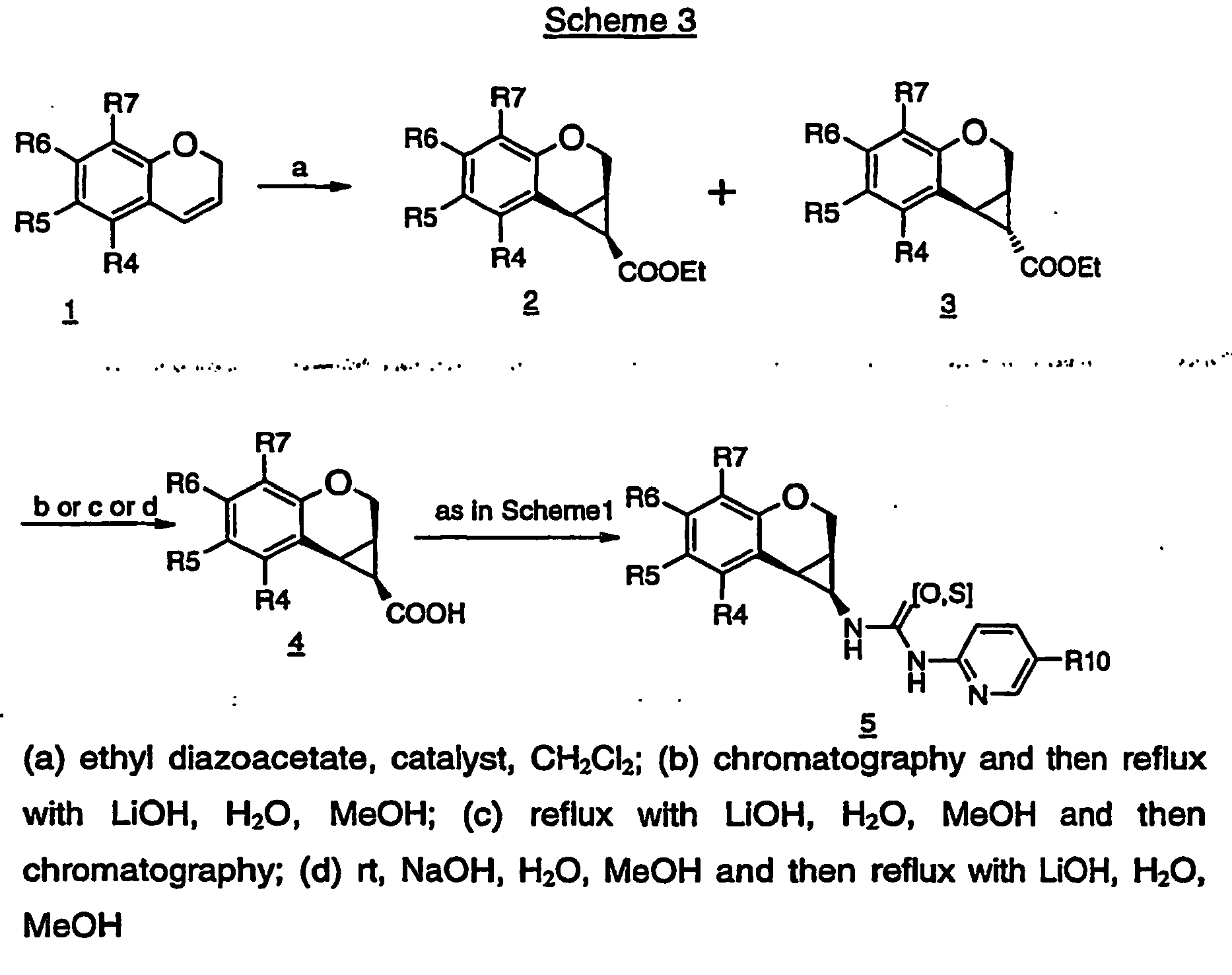
- Compounds of the general formula (I), wherein R1 is O (urea) or S (thiourea), R2 is, for example, a 5-substituted pyrid-2-yl, R3 is H, X is -D-CH2, and wherein the cyclopropyl moiety has the relative configuration

- Although this scheme 3 has been illustrated with a D=O variant it will be apparent that corresponding manipulations will be available to the D=S, S=O; S(=O)2 and D=NR8 variants. When R8 is H, the nitrogen is typically protected with a conventional secondary amine protecting group, such as those described in Greene & Wuts Protective Groups in Organic Synthesis 2nd ed, Wiley NY 1991).

- Scheme 4 describes the preparation of chromenes, including many from commercially available disubstituted phenols, such as those wherein the substitution pattern in the benzene ring is as follows: R4 and R7 are halo; R4 and R6 are halo; R5 and R7 are halo; R4 is halo and R7 is C1-3 alkylcarbonyl; and R4 is hydroxy white R5 is C1-3 alkylcarbonyl. Reaction of the available disubstituted phenol 1-Scheme-4 with 3-bromopropyne in the presence of a base, such as K2CO3 in acetone or NaH in DMF, results in nucleophilic substitution of the halide to provide the ether 2-Scheme-4. Ring closure may be accomplished by heating the ether in N, N-dimethylaniline or polyethylene glycol to yield the chromene 3-Scheme-4.
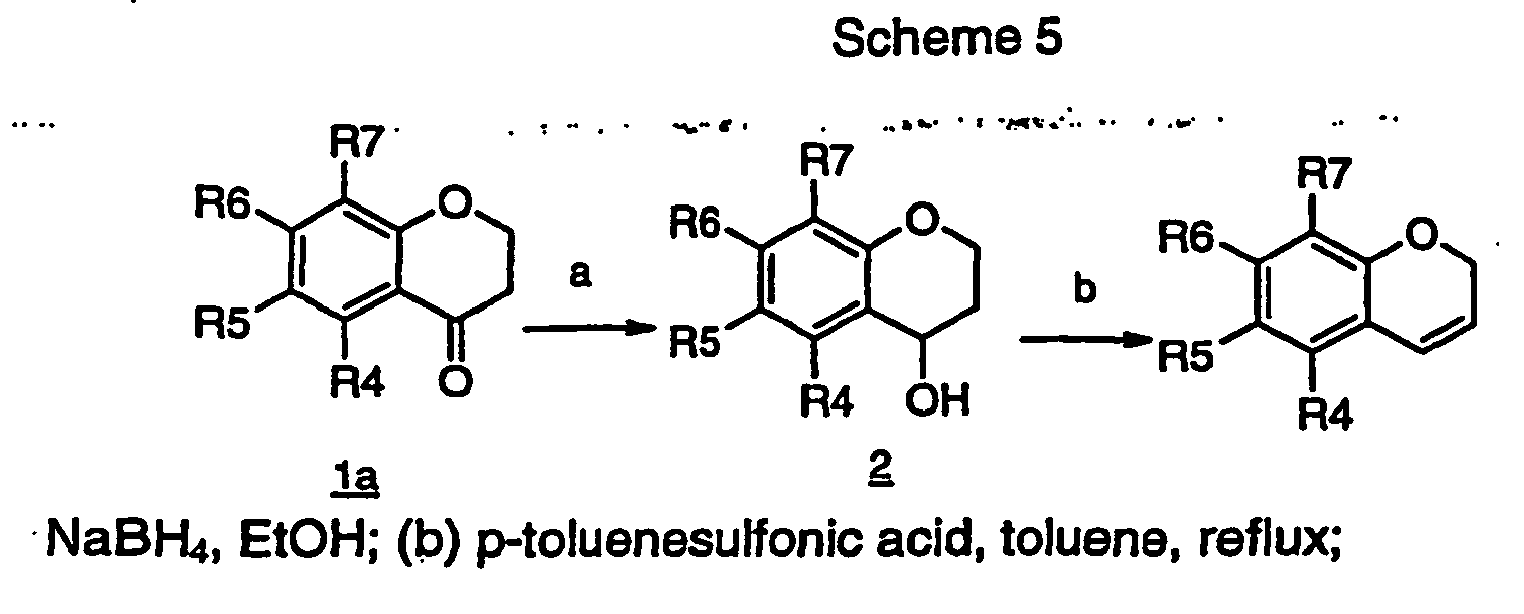
- Scheme 5 describes the preparation of chromenes, used as starting material in Scheme 3, from the appropriately substituted chromanones, which are readily accessed from commercially available chromanones, for example those wherein one of the positions in R4 to R7 is substituted with halo or C1-3 alkoxy. Conversion of the carbonyl group in 4-chromanone 1a-Scheme-5 and to the correponding alcohol by a suitable reducing agent such sodium borohydride in ethanol provides 2-Scheme-5. Refluxing the alcohol with small amounts of acid, such as p-TsOH in toluene, causes dehydration of 2-Scheme-5 to the desired chromene 1-Scheme-3. Corresponding manipulations will be available for other D variants. For example the corresponding 2H-1-benzothiopyran is readily prepared from commercially available (substituted) thiochroman-4-ones by reaction with a reductant such as a metal hydride for example lithium aluminium hydride in an organic solvent such as ether, followed by dehydration such as refluxing with an acid for example potassium acid sulphate or the like.

- Chromenes, for use as starting material in Scheme 3, are prepared from substituted o-hydroxybenzaldehydes as shown by methods outlined in Scheme 6. Reaction of 1-Scheme-6 with allyl bromide in the presence of a base, such as K2CO3 in acetone, results in nucleophilic substitution of the halide to provide the ether 2-Scheme-6. Witting reaction transforms the aldehydic group into the olefin and provides 3-Scheme-6. The pair of terminal double bonds may undergo metathesis intramolecularly by treatment with a catalyst such as the ruthenium complex Grubb's catalyst in step (c) to produce the chromene. Alternatively 1-Scheme-6 can be cyclised directly as shown in step d) in the legend above.

- Pd(O) catalyzed coupling of the triflate 1-Scheme-7 leads to the replacement of the trifluoromethanesulfonyloxy group and the introduction of other substiutents at R6. Thus, Scheme 7 provides the preparation of synthesis intermediates for use in scheme 3 to give the urea or thiourea 5-Scheme-3 wherein R6 is cyano, ethynyl, or C1-3 alkylcarbonyl.
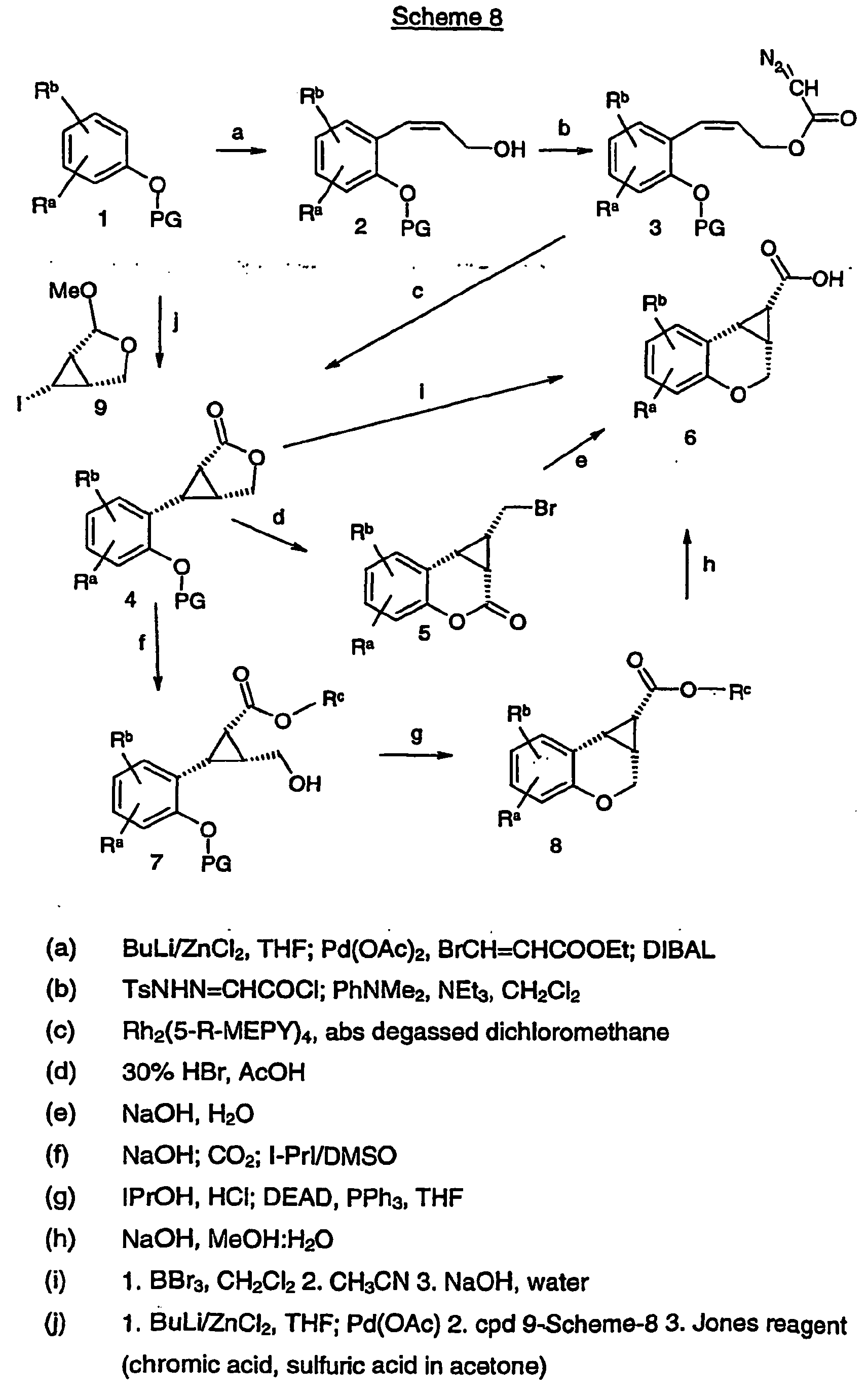
US 5175311 , available from Aldrich or Johnson Matthey), or the like is added to yield 4-Scheme-8 in a high enantiorneric excess such as greater than 80, preferably greater than 90% ee. Preferably, this compound is first reacted with BBr3 in dichloromethane followed by the addition of acetonitrile the reaction mixture and finally sodiumhydroxide is added to give 6-Scheme-8. Alternatively, this product (4-Scheme-8) is ring-opened with an electrophile preferably HBr or the like under in conjunction with an acid such as AcOH or the like. Under acid conditions a spontaneous ring closure takes place to form chromenone 5-Scheme-8. When subjected to basic conditions such as NaOH or the like, the chromenone rearranges to form the chromencyclopropylcarboxylic acid 6-Scheme-8. Alternatively, 4-Scheme-8, for instance when the phenolic protecting group is MOM, can be subjected to basic conditions such as NaOH, carbon dioxide and a lower alkyl halide such as iPrl in a solvent such as DMSO to open the lactone and yield the alkyl ester 7-Scheme-8. Displacement of the hydroxy protecting group and ring closure with the free hydroxymethyl moiety occurs in acidic conditions such as iPrOH/HCl or the like followed by DEAD; PPH3 in an organic solvent such as THF or the like. - Alternatively, in a convergent approach, compound 1-Scheme-8 is reacted with BuLi and transformed to a zinc salt. This salt reacted with the cyclopropyliodide, 9-Scheme-8, in a palladium-catalyzed reaction to give after reaction with Jone's reagent compound 4-Scheme-8. This carboxylic acid is in turn converted to the isocyanate as shown in Scheme 1 and subsequently to the heteroarylurea or heteroaryithiourea of the Formula 1.
- A further aspect of the invention provides novel intermediates useful in the above described syntheses of the compound of formula I. A preferred group of intermediate include compounds of the formula II:


- A further group of preferred intermediates includes compounds of the formula IV

- A preferred subset of compounds of formula IV are those of formula V:

- A still further group of preferred intermediates includes compounds of the formula VI:


- Favoured compounds of formula I include
- cis-1-(5-Cyano-pyridin-2-yl)-3-(1,1a,2,7b-tetrahydro-cyclopropa[c]chromene-1-yl)-urea,
- cis-1-(5-Cyano-pyridin-2-yl)-3-(1,1a,3,7b-tetrahydro-2-oxa-cyclopropa[a]naphthalen-1-yl)-urea;
- cis-1-(5-Cyano-pyridin-2-yl)-3-(7-hydroxy-6-propionyl-1,1a,2,7b-tetrahydro-cyclopropa[c]chromen-1-yl)-urea,
- cis-1-(6-Acetyl-7-hydroxy-1,1a,2,7b-teUahydro-cyclopropa[c]chromen-1-yl)-3-(5-cyano-pyridin-2-yl)-urea,
- cis-1-(5-Cyanopyridin-2-yl)-3-(7-fluoro-propionyl-1,1a,2,7b-tetrahydro-cyclopropa[c]chromen-1-yl)-urea,
- cis-1-(5-Cyano-pyridin-2-yl)-3-(7-fluoro-4-methoxy-1,1a,2,7b-tetrahydro-cyclopmpa[c]chromen-1-yl)-urea;
- cis-1-(5-Cyano-pyridin-2-yl)-3-(7-fluoro-4-chloro-1,1a,2,7b-tetrahydro-cyclopropa[c]chromen-1-yl)-urea,
- cis-1-(5-Chloro-pyridin-2-yl)-3-(4-chloro-7-fluoro-1,1a,2,7b-tetrahydro-cyclopropa[c]chromene-1-yl)-urea,
- cis-1-(5-Bromo-pyridin-2-yl)-3-(4-chloro-7-fluoro-1,1a,2,7b-tetrahydro-cyclopropa[c]chromene-1-yl)-urea,
- cis-1-(5-Cyano-pyridin-2-yl)-3-(5-cyano-1,1a,2,7b-tetrahydro-cyclopropa[c]chromen-1-yl)-urea,
- cis-1-(5-Cyano-pyddin-2-yl)-3-(5-ethynyl-1,1a,2,7b-tetrahydro-cyclopropa[c]chromen-1-yl)-urea,
- cis-1-(5-Acetyl-1,1 a,2,7b-tetrahydro-cyclopropa[c]chromen-1-yl)-3-(5-cyano-pyridin-2-yl)-urea,
- cis-1-(5-Methoxy-1,1a,2,7b-tetrahydro-cyclopropa[c]chromen-1-yl)-3-(5-cyano-pyridin-2-yl)-urea,
- cis-1-(5-Cyano-pyridin-2-yl)-3-(N-acetyl-1,1a,3,7b-tetrahydro-2-oxa-cyclopropa[a]quinoline-1-yl))-urea,
- cis-1-(5-Cyano-3-methyl-pyridin-2-yl)-3-(4,7-difluoro-1,1a,2,7b-tetrahydro-cyclopropa[c]chromen-1-yl)-urea,
- cis-1-(4,7-Difluoro-1,1a,2,7b-tetrahydro-cyclopropa[c]chromen-1-yl)-3-(5-ethynyl-pyridin-2-yl)-urea,
- cis-1-(5-Bromo-pyridin-2-yl)-3-(4,7-difluoro-1,1a,2,7b-tetrahydro-cyclopropa[c]chromen-1-yl)-urea,
- cis-1-(4,7-Difluoro-1,1a,2,7b-tetrahydro-cyclopropa[c]chromen-1-yl)-3-(5-phenoxy-pyridin-2-yl)-urea,
- cis-1-(5-Cyano-pyridin-2-yl-3-(4,7-difluoro-1,1a,2,7b-tetrahydro-cyclopropa[c]chromen-1-yl)-thiourea,
- 1-(6-Chloro-5-cyano-pyridin-2-yl)-3-(5,7-difluoro-1,1a,2,7b-tetrahydro-cyclopropa[c]chromen-1-yl)urea,
- 1-(5-Cyano-pyridin-2-yl)-3-(5,7-difluoro-1,1a,2,7b-tetrahydro-cyclopropa[c]chromen-1-yl)urea,
- cis-1-(4-Bromo-7-fluoro-1,1a,2,7b-tetrahydro-cyclopropa[c]chromen-1-yl)-3-(5-cyano-pyridin-2-yl)-urea,
- cis-1-(4-Bromo-7-fluoro-1,1a,2,7b-tetrahydro-cyclopropa[c]chromen-1-yl)-3-(6-chloro-5-cyano-pyridin-2-yl)-urea,
- cis-1-(4-Bromo-6-fluoro-1,1a,2,7b-tetrahydro-cyclopropa[c]chromen-1-yl)-3-(5-cyano-pyridin-2-yl)-urea,
- cis-1-(4-Bromo-6-fluoro-1,1a,2,7b-tetrahydro.cycropropa[c]chromen-1-yl)-3-(6-cloro-5-cyano-pyridin-2-yl)-urea,
- cis-1-(5-Cyanopyridin-2-yl)-3-(6-fluoro-1,1a,2,7b-tetrahydro-cyclopropa[c]chromen-1-yl)urea,
- cis N-[1a, 6b-dihydro-1H-benzo[b]cyclopropa[d]thien-1-yl]-N'-(5-cyano-2-pyridinyl)-urea,
- N-[(1S, 1aR, 7bR) or (1 R, 1 aS, 7bS)-1. 1a, 2, 7b-tetrahydrocyclopropa[c]-[1]benzothiopyran-1-yl]-N'-(5-cyano-2-pyridinyl) urea,
- cis-N-(5-bromo-2-pyridinyl)-N-(7-chloro-4-fluoro-1,1 a,2,7b-tetrahydrocyclopropa[c]chromen-1-yl)urea,
- cis-N-(7-chloro-4-fluoro-1,1a,2,7b-tetrahydrocyclopropa[c]chromen-1-yl)-N'-(5-chloro-2-pyridinyl)urea,
- cis-N-(7-chloro-4-fluoro-1,1a,2,7b-tetrahydrocyclopropa[c]chromen-1-yl)-N-(5-cyano-2-pyridinyl)urea,
- cis-N-(5-phenoxy-2-pyridinyl)-N-(4,7-dichloro-1,1a,2,7b-tetrahydrocyclopropa[c]chromen-1-yl)urea,
- cis-N-(5-bromo-2-pyridinyl)-N'-(4,7-dichloro-1,1a,2,7b-tetrahydrocyclopropa[c]chromen-1-yl)urea,
- cis-N-(5-chloro-2-pyridinyl)-N-(4,7-dichloro-1,1a,2,7b-tetrahydrocyclopropa[c]chromen-1-yl)urea,
- cis-N-(5-cyano-2-pyridinyl)-N-(4,7-dichloro-1,1a,2,7b-tetrahydrocyclopropa[c]chromen-1-yl)urea,
- N-[(1S,1aR,7bR)-4,7-difluoro-1,1a,2,7b-tetrahydrocyclopropa[c]chromen-1-yl]-N'-(5-fluoro-2-pyridinyl)urea,
- N-[(1S,1aR,7bR)-4,7-difluoro-1,1a,2,7b-tetrahydrocyclopropa[c]chromen-1-yl]-N-(5-iodo-2-pyidinyl)urea,
- N-[1S,1aR,7bR)-4,7-difluoro-1,1a,2,7b-tetrahydrocyclopropa[c]chromen-1-yl]-N-(3-isoxazolyl)urea,
- N-[(1S,1aR,7bR)-4,7-difluoro-1,1a,2,7b-tetrahydrocyclopropa[c]chromen-1-yl]-N-[4-(4-chlorophenyl)-1,3-thiazol-2-yl]urea,
- N-[[(1S,1aR,7bR)-4,7-difluoro-1,1a,2,7b-tetrahydrocyclopropa[c]chromen-1-yl]-N'-(6-fluoro-1,3-benzothiazol-2-yl)urea,
- N-[(1S,1aR,7bR)-4,7-difluoro-1,1a,2,7b-tetrahydrocyclopropa[c]chromen-1-yl]-N-(4-pyrimidinyl)urea
- N-[(1S,1aR,7bR)-4,7-difluoro-1,1a,2,7b-tetrahydrocyclopropa[c]chromen-1-yl]-N-(2-pyrazinyl)urea,
- N-[(1S,1aR,7bR)-4,7-difluoro-1,1a,2,7b-tetrahydrocyclopropa[c]chromen-1-yl]-N-(5-cyclopropyl-1H-pyrazol-3-yl)urea
- Particularly preferred compound thus include
- (-)-cis-1-(5-Cyano-pyridin-2-yl)-3-(4,7-difluoro-1,1a,2,7b-tetrahydro-cyclopropa[c]chromen-1-yl)-urea,
- (-) cis-1-(5-Chloro-pyridin-2-yl)-3-(4,7-difluoro-1,1a,2,7b-tetrahydro-cyclopropa[c]chromen-1-yl)-urea; or
- (-)-cis-1-(5-Cyano-pyridin-2-yl)-3-(4,7-difluoro-1,1a,2,7b-tetrahydro-cyclopropa[c]chromen-1-yl)-thiourea;
- (-)-cis-1-(5-Fluoropyridin-2-yl)-3-(4,7-difluoro-1,1a,2,7b-tetrahydro-cyclopropa[c]chromen-1-yl)-urea,
- (-)-cis-1-(5-Fluoropyridin-2-yl)-3-(4,7-difluoro-1,a,2,7b-tetrahydro-cyclopropa[c]chromen-1-yl)-thiourea;
- While it is possible for the active agent to be administered alone, it is preferable to present it as part of a pharmaceutical formulation. Such a formulation will comprise the above defined active agent together with one or more acceptable carriers or excipients and optionally other therapeutic ingredients. The carrier(s) must be acceptable in the sense of being compatibly with-the other ingredients of the formulation and-not deleterious to the recipient.
- The formulations include those suitable for rectal, nasal, topical (including buccal and sublingual), vaginal or parenteral (including subcutaneous, intramuscular, intravenous and intradermal) administration, but preferably the formulation is an orally administered formulation. The formulations may conveniently be presented in unit dosage form, e.g. tablets and sustained release capsules, and may be prepared by any methods well known in the art of pharmacy.
- Such methods include the step of bringing into association the above defined active agent with the carrier. In general, the formulations are prepared by uniformly and intimately bringing into association the active agent with liquid carriers or finely divided solid carriers or both, and then if necessary shaping the product. The invention extends to methods for preparing a pharmaceutical composition comprising bringing a compound of Formula I or its pharmaceutically acceptable salt in conjunction or association with a pharmaceutically acceptable carrier or vehicle. If the manufacture of pharmaceutical formulations involves intimate mixing of pharmaceutical excipients and the active ingredient in salt form, then it is often preferred to use excipients which are non-basic in nature, i.e. either acidic or neutral. Formulations for oral administration in the present invention may be presented as discrete units such as capsules, cachets or tablets each containing a predetermined amount of the active agent; as a powder or granules; as a solution or a suspension of the active agent in an aqueous liquid or a nonaqueous liquid; or as an oil-in-water liquid emulsion or a water in oil liquid emulsion and as a bolus etc.
- With regard to compositions for oral administration (e.g. tablets and capsules), the term suitable carrier includes vehicles such as common excipients e.g. binding agents, for example syrup, acacia, gelatin, sorbitol, tragacanth, polyvinylpyrrolidone (Povidone), methylcellulose, ethylcellulose, sodium carboxymethylcellulose, hydroxypropylmethylcellulose, sucrose and starch; ... fillers and carriers, for example com starch, gelatin, lactose, sucrose, microcrystalline cellulose, kaolin, mannitol, dicalcium phosphate, sodium chloride and alginic acid; and lubricants such as magnesium stearate, sodium stearate and other metallic stearates, stearic acid, glycerol stearate, silicone fluid, talc waxes, oils and colloidal silica. Flavouring agents such as peppermint, oil of wintergreen, cherry flavouring or the like can also be used. It may be desirable to add a colouring agent to make the dosage form readily identifiable. Tablets may also be coated by methods well known in the art. A tablet may be made by compression or moulding, optionally with one or more accessory ingredients. Compressed tablets may be prepared by compressing in a suitable machine the active agent in a free flowing form such as a powder or granules, optionally mixed with a binder, lubricant, inert diluent, preservative, surface-active or dispersing agent. Moulded tablets may be made by moulding in a suitable machine a mixture of the powdered compound moistened with an inert liquid diluent. The tablets may be optionally be coated or scored and may be formulated so as to provide slow or controlled release of the active agent.
- Other formulations suitable for oral administration include lozenges comprising the active agent in a flavoured base, usually sucrose and acacia or tragacanth; pastilles comprising the active agent in an inert base such as gelatin and glycerin, or sucrose and acacia; and mouthwashes comprising the active agent in a suitable liquid carrier.
- Various aspects of the invention will now be illustrated by way of example only with reference to the following non-limiting examples.
-

- To a mixture of 2H-chromene (4.89 g, 37 mmol) and (CuOTf)2-benzene (186 mg, 0.37 mmol) in 1,2-dichloroethane (80 mL) at 20 °C, was added dropwise (3h) a solution of ethyl diazoacetate (8.44 g, 74 mmol) in 1,2-dichloroethane (20 mL). After 15 min at 20 °C, the reaction mixture was washed with H2O (100 mL). The H2O phase was washed with CH2Cl2 (50 mL) and the solvent of the combined organic phases was removed under reduced pressure. The crude product was column chromatographed (silica gel, 20→50% EtOAc in hexane), to give 1.96 g (24%) of ±cis-1,1a,2,7b-tetrahydro-cyclopropa[c]chromene-1-carboxylic acid ethyl ester and 3.87 g (48%) of ±-trans-1,1a,2,7b-tetrahydro-cyclopropa[c]chromene-1-carboxylic acid ethyl ester as a byproduct.
- 1H-NMR (CDCl3): 7.26 (d, 1H), 7.10 (dd, 1H), 6.90 (dd, 1H), 6.78 (d, 1H), 4.49 (dd, 1H), 4.20 (dd, 1H), 3.97 (q, 2H), 2.44 (dd, 1H), 2.14 (dd, 1H), 2.07-1.95 (m, 1H), 1.02 (t, 3H).
-

- A mixture of (±)-cis-1,1a,2,7b-tetrahydro-cyclopropa[c]chromene-1-carboxylic acid ethyl ester (1.96 g, 9.0 mmol), LiOH (539 mg, 22.5 mmol), H2O (10 mL). and MeOH (20 mL) was heated to reflux for 2h. The reaction mixture was concentrated to about 10 mL, 4N HCl was added dropwise giving a white precipitate. The reaction mixture was extracted with CH2Cl2 (3x15 mL) and the solvent of the combined organic phases was removed under reduced pressure. The crude product was crystallized from EtOAc/hexane, to give 435 mg (25%) of (±)-cis-1,1a,2,7b-tetrahydro-cyclopropa[c]chromene-1-carboxylic acid as a white solid.
- 1H-NMR (CDCl3): 9.80 (br s, 1H), 7.22 (d, 1H), 7.10 (dd, 1H), 6.89 (dd, 1H), 6.77 (d, 1H), 4.45 (dd, 1H), 4.22 (dd, 1H), 2.45 (dd, 1H), 2.14-1.98 (m, 2H).
-

- To a solution of (±)-cis-1,1a,2,7b-tetrahydro-cydopropa[c]chromene-1-carboxylic acid (285 mg, 1.5 mmol) and triethylamine (209 µL, 1.5 mmol) in toluene (1.5 mL) at 20 °C, was added diphenylphosphoryl azide (413 mg, 1.5 mmol). After 30 min at 20 °C, the reaction mixture was heated to 120 °C for 15 min, where after a solution of 2-amino-5-cyano-pyridine (197 mg, 1.65 mmol) in DMF (1 mL) was added. After 3h at 120 °C, the reaction mixture was allowed to assume room temperature. The reaction mixture was concentrated under reduced pressure, benzene (20 mL) was added and the reaction mixture was washed with 1 N HCl (30 mL), H2O (30 mL) and brine (30 mL). The solvent of the organic phases was removed under reduced pressure. The crude product was crystallized from EtOH/CH2Cl2, to give 133 mg (29%) of (±) -cis-1-(5-cyano-pyridin-2-yl)-3-(1,1a,2,7b-tetrahydro-cyclopropa[c]chromene-1-yl)-urea.
- 1H-NMR (DMSO-d6): 9.78 (s, 1H), 8.31 (d, 1H), 7.99 (dd, 1H), 7.83 (d, 1H), 7.43 (d, 1H), 7.27 (d, 1H), 7.09 (dd, 1H), 6.89 (dd, 1H), 6.80 (d, 1H), 4.25 (dd, 1H), 4.14 (dd, 1H), 3.43 (m, 1H), 2.35 (dd, 1H), 1.92 (m, 1H).
-
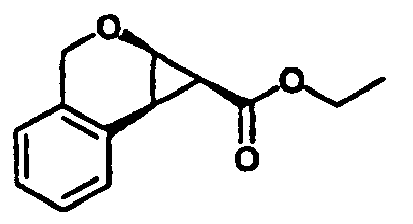
- (±)-cis-1,1a,3,7b-Tetrahydro-2-oxa-cyclopropa[a]naphthalene-1-carboxylic acid ethyl ester was synthesized analogously to Example 1 a from 1H-isochromene (3.57 g, 27 mmol), to give 910 mg (15%) of (±)-cis-1,1a,3,7b-tetrahydro-2-oxa-cyclopropa[a]naphthalene-1-carboxylic acid ethyl ester.
- 1H-NMR (CDCl3): 7.34 (d, 1H), 7.25 (dd, 1H), 7.18 (dd, 1H), 7.03 (d, 1H), 4.81 (d, 1H), 4.51 (d, 1H), 4.28 (dd, 1H), 3.95 (q, 2H), 2.43 (dd, 1H), 2.05 (dd, 1H), 1.04 (t, 3H).
-

- (±)-cis-1,1a,3,7b-Tetrahydro-2-oxa-cyclopropa[a]naphthalene-1-carboxylic acid was synthesized analogously to Example 1b from (±)-cis-1,1a,3,7b-tetrahydro-2-oxa-cyclopropa[a]naphthalene-1-carboxylic acid ethyl ester (436 mg, 2 mmol), to give 86 mg (22%) of (±)-cis-1,1a,3,7b-tetrahydro-2-oxa-cydopropa[a]-naphthalene-1-carboxylic acid as a white solid. The crude product was column chromatographed (silica gel, 1→5% MeOH in CH2Cl2).
- 1H-NMR (CDCl3): 8.50 (br s, 1H), 7.39 (d, 1H), 7.30 (dd, 1H), 7.21 (dd, 1H), 7.07 (d, 1H), 4.87 (d, 1H), 4.57 (d, 1H), 4.38 (dd, 1H), 2.59 (dd, 1H), 2.15 (dd, 1H).
-

- (±)-cis-1-(5-Cyano-pyridin-2-yl)-3-(1,1a,3,7b-tetrahydro-2-oxa-cyclopropa[a]naphthalen-1-yl)-urea was synthesized analogously to example 1 c from (±)-cis-1,1a,3,7b-tetrahydro-2-oxa-cyclopropa[a]naphthalene-1-carboxylic acid (86 mg, 0.45 mmol). The crude product was column chromatographed (silica gel, 1→5% MeOH in CH2Cl2), to give 21 mg (15%) of (±)-cis-1-(5-cyano-pyridin-2-yl)-3-(1,1a,3,7b-tetrahydro-2-oxa-cyclopropa[a]naphthalen-1-yl)-urea.
- 1H-NMR (DMSO-d6): 9.62 (s,1H), 8.29 (d, 1H), 7.98 (dd, 1H), 7.52-7.44 (m, 2H), 7.27-7.05 (m, 4H), 4.69 (d, 1H), 4.45 (d, 1H), 4.05 (dd, 1H), 3.25-3.10 (m, 1H), 2.22 (dd, 1H).
-

- A mixture of 2',4'-dihydroxy-propiophenone (24.9 g, 0.15 mol), 3-bromo-propyne (24.2 g, 0.20 mol) and K2CO3 (20.7 g, 0.15 mol) in acetone (500 mL) was refluxed for 12 h. The reaction mixture was allowed assume room temperature and the precipitate was removed by filtration. The filtrate was concentrated under reduced pressure. The crude product was purified by column chromatography (silica gel, 0→2% MeOH in H2O), to give 26.2 g (85%) of 1-(2-hydroxy-4-prop-2-ynyloxy-phenyl)-propan-1-one.
- 1H-NMR (CDCl3): 12.80 (s, 1H), 7.69 (d, 1H), 6.52 (m, 2H), 4.72 (d, 2H), 2.96 (q, 2H), 2.56 (t, 1H), 1.23 (t, 3H).
-

- A mixture of 1-(2-hydroxy-4-prop-2-ynyloxy-phenyl)-propan-1-one (19.8 g, 97 mmol) and N,N-diethylaniline (100 mL) was heated to reflux for 3 h. The reaction mixture was concentrated under reduced pressure. The crude product was purified by column chromatography (silica gel, 5→10% EtOAc in Hexane) and thereafter recrystallized from EtOAc/Hexane, to give 8.91 g (45%) of 1-(5-hydroxy-2H-chromen-6-yl)-propan-1-one.
- 1H-NMR (CDCl3): 13.00 (s, 1H), 7.49 (d, 1H), 6.75 (dt, 1H), 6.27 (d, 1H), 5.67 (dt, 1H), 4.86 (dd, 2H), 2.90 (q, 2H), 1.19 (t, 3H).
-

- To a mixture of 1-(5-hydroxy-2H-chromen-6-yl)-propan-1-one (511 mg, 2.5 mmol) and (Rh(II)Ac2)2 (11 mg, 0.025 mmol) in 1,2-dichloroethane (8 mL) at 20 °C, was added dropwise (3h) a solution of ethyl diazoacetate (571 mg, 5 mmol) in 1,2-dichloroethane (2 mL). After 15 min at 20 °C, the reaction mixture was washed with H2O (10 mL). The H2O phase was washed with CH2Cl2 (10 mL) and the solvent of the combined organic phases was removed under reduced pressure. The crude product was purified by column chromatography (silica gel, 1→5% MeOH in CH2Cl2), to give 300 mg (41%) of 7-hydroxy-6-propionyl-1,1a,2,7b-tetrahydro-cyclopropa[c]chromene-1-carboxylic acid ethyl ester (a 33/64 mixture of cis and trans isomers).
- 1H-NMR (CDCl3): 13.13-13.07 (m, 1H), 7.57-7.49 (m, 1H), 6.41-6.38 (m, 1H), 4.65-3.92 (m, 4H), 3.01-1.95 (m, 5H), 1.29-1.08 (m, 6H).
-

- ±cis-7-Hydroxy-6-propionyl-1,1a,2,7b-tetrahydro-cyclopropa[c]chromene-1-carboxylic acid was synthesized analogously to Example 2b from 7-hydroxy-6-propionyl-1,1a,2,7b-tetrahydro-cyclopropa[c]chromene-1-carboxylic acid ethyl ester (299 mg, 1.03 mmol, a 33/64 mixture of cis and trans isomers), to give 39.3 mg (15%) of (±)-cis-7-hydroxy-6-propionyl-1,1a,2,7b-tetrahydro-cyclopropa[c]chromene-1-carboxylic acid as a white solid and (±)-trans-7-hydroxy-6-propionyl-1,1a,2,7b-tetrahydro-cyclopropa[c]chromene-1-carboxylic acid as a byproduct. The crude product was purified by column chromatography (silica gel, 1→5% MeOH in CH2Cl2).
- 1H-NMR (DMSO-d6): 7.67 (d, 1H), 6.35 (d, 1H), 4.57 (dd, 1H), 4.36 (dd, 1H), 2.98 (q, 2H), 2.55-2.46 (m, 1H), 2.18-2.00 (m, 2H), 1.10 (t, 3H).
-

- (±)-cis-1-(5-Cyano-pyridin-2-yl)-3-(7-hydroxy-6-propionyl-1,1a,2,7b-tetrahydro-cyclopropa[c]chromen-1-yl)-urea was synthesized analogously to Example 1c from +cis-7-hydroxy-6-propionyl-1,1a,2,7b-tetrahydro-cyclopropa[c]chromene-1-carboxylic acid (39.3 mg, 0.15 mmol). The crude product was purified by HPLC (C18, 5→95% acetonitrile in H2O), to give 2.9 mg (5.1%) of (±)-cis-1-(5-cyano-pyridin-2-yl)-3-(7-hydroxy-6-propionyl-1,1a,2,7b-tetrahydro-cyclopropa[c]chromen-1-yl)-urea.
- 1H-NMR (DMSO-d6): 13.15 (s, 1H), 9.71 (s, 1H), 8.30 (d, 1H), 8.01 (dd, 1H), 7.73 (d, 1H), 7.57 (d, 1H), 7.50 (d, H), 6.43 (d, 1H), 4.42 (dd, 1H), 4.13 (dd, 1H), 3.45-3.32 (m, 1H), 3.01 (q, 2H), 2.49-2.42 (m, 1H), 1.97-1.86 (m, 1H), 1.12 (t, 3H).
-

- 1-(2-Hydroxy-4-prop-2-ynyloxy-phenyl)-ethanone was synthesized analogously to Example 3a from 1-(2,4-dihydroxy-phenyl)-ethanone (20 g, 131 mmol), to give 22 g (88%) of 1-(2-hydroxy-4-prop-2-ynyloxy-phenyl)-ethanone.
- 1H-NMR (CDCl3): 12.70 (s, 1H), 7.66 (d, 1H), 6.52 (m, 2H), 4.72 (d, 2H), 2.58-2.55 (m, 4H).
-

- 1-(5-Hydroxy-2H-chromen-6-yl)-ethanone was synthesized analogously to Example 3b from 1-(2-hydroxy-4-prop-2-ynyloxy-phenyl)-ethanone (17 g, 89 mmol), to give 6.0 g (35%) of 1-(5-hydroxy-2H-chromen-6-yl)-ethanone.
- 1H-NMR (CDCl3): 12.92 (s, 1H), 7.51 (d, 1H), 6.79 (dt, 1H), 6.32 (d, 1H), 5.71 (dt, 1H), 4.89 (dd, 2H), 2.55 (s, 3H).
-

- 6-Acetyl-7-hydroxy-1,1a,2,7b-tetrahydro-cyclopropa[c]chromene-1-carboxylic acid ethyl ester (a 40/60 mixture of cis and trans isomers) was synthesized analogously to Example 3c from 1-(5-hydroxy-2H-chromen-6-yl)-ethanone.
- 1H-NMR (CDCl3): 13.05-12.97 (m, 1H), 7.54-7.47 (m, 1H), 6.43-6.33 (m, 1H), 4.63-3.94 (m, 4H), 3.02-1.96 (m, 6H), 1.31-1.08 (m, 3H).
-

- 6-Acetyl-7-hydroxy-1,1a,2,7b-tetrahydro-cyclopropa[c]chromene-1-carboxylic acid was synthesized analogously to Example 1 b from 6-acetyl-7-hydroxy-1,1a,2,7b-tetrahydro-cyclopropa[c]chromene-1-carboxylic acid ethyl ester (2 g, 8.1 mmol, a 40/60 mixture of cis and trans isomers), to give 300 mg (17%) of 6-acetyl-7-hydroxy-1,1a,2,7b-tetrahydro-cyclopropa[c]chromene-1-carboxylic acid (a 40/60 mixture of cis and trans isomers). The crude product was purified by column chromatography (silica gel, 1→5% MeOH in CH2Cl2)
- 1H-NMR (CDCl3): 7.55-7.45 (m, 1H), 6.45-6.30 (m, 1H), 4.65-4.00 (m, 2H), 3.05-1.95 (m, 6H).
-

- (±)-cis-1-(6-Acetyl-7-hydroxy-1,1a,2,7b-tetrahydro-cyclopropa[c]chromen-1-yl)-3-(5-cyano-pyridin-2-yl)-urea was synthesized analogously to Example 1 c from 6-acetyl-7-hydroxy-1,1a,2,7b-tetrahydro-cyclopropa[c]chromene-1-carboxylic acid (300 mg, 1.21 mmol, a 40/60 mixture of cis and trans isomers).
- The crude product was purified by HPLC (C18, 5→95% acetonitrile in H2O), to give 7.7 mg (17 %) of (±)-cis-1-(6-acetyl-7-hydroxy-1,1a,2,7b-tetrahydro-cyclopropa[c]chromen-1-yl)-3-(5-cyano-pyridin-2-yl)-urea and 9.0 mg (20 %) of (±)-trans-1-(6-acetyl-7-hydroxy-1,1a,2,7b-tetrahydro-cyclopropa[c]chromen-1-yl)-3-(5-cyano-pyridin-2-yl)-urea as a byproduct.
- 1H-NMR (CDCl3+CD3OD): 7.98 (d, 1H), 7.74 (dd, 1H), 7.60 (d,1H), 7.01 (d, 1H), 6.40 (d, 1H), 4.43 (dd, 1H), 4.29 (dd, 1H), 3.57 (dd, 1H), 2.69 (m, 1H), 2.61 (s, 3H), 2.00-1.86 (m, 1H).
-

- To a mixture of NaH (95%, 278 mg, 11 mmol) in DMF (20 mL) at 0 °C, was added 1-(4-fluoro-2-hydroxy-phenyl)-propan-1-one (1.68 g, 10 mmol) in DMF (5 mL). After 15 min at 0 °C, was 3-bromo-propyne (3.02 g, 20 mmol) added to the reaction mixture. After 1 h at 0 °C, was the reaction mixture allowed to assume room temperature. The reaction mixture was extracted with H2O (100 mL). The H2O phase was washed with Et2O (3x100 mL) and the solvent of the combined organic phases was removed under reduced pressure. The crude product was purified by column chromatography (silica gel, CH2Cl2), to give 1.40 g (68%) of 1-(4-fluoro-2-prop-2-ynyloxy-phenyl)-propan-1-one.
- 1H-NMR (CDCl3): 7.64 (dd, 1H), 6.69 (dd, 1H), 6.60 (ddd, 1H), 4.68 (d, 2H), 2.85 (q, 2H), 2.58 (t, 1H), 1.03 (t, 3H).
-

- 1-(5-Fluoro-2H-chromen-8-yl)-propan-1-one was synthesized analagously to Example 3b from 1-(4-fluoro-2-prop-2-ynyloxy-phenyl)-propan-1 -one (1.34 g, 6.5 mmol), to give 619 mg (46%) of 1-(5-fluoro-2H-chromen-8-yl)-propan-1-one.
- 1H-NMR (CDCl3): 7.60 (dd, 1H), 6.67-6.58 (m, 2H), 5.86 (dt, 1H), 4.76 (dd, 2H), 2.93 (q, 2H), 1.23 (t, 3H).
-

- (±)-cis-7-Fluoro-4-propionyl-1,1a,2,7b-tetrahydro-cyclropa[c]chromene-1-carboxylic acid ethyl ester was synthesized according to method 3c) from 1-(5-fluoro-2H-chromen-8-yl)-propan-1-one (619 mg, 3 mmol), to give 142 mg (16%) of (±)-cis-7-fluoro-4-propionyl-1,1a,2,7b-tetrahydro-cyclopropa[c]chromene-1-carboxylic acid ethyl ester and (±)-trans-7-fluoro-4-propionyl-1,1a,2,7b-tetrahydro-cyclopropa[c]chromene-1-carboxylic acid ethyl ester as a byproduct.
- 1H-NMR (CDCl3): 7.59 (dd, 1H), 6.65 (m, 1H), 4.50-4.46 (m, 2H), 3.95 (q, 2H); 2.89 (q, 2H), 2.57 (dd, 1H), 2.20 (dd, 1H), 1.13-1.03 (m, 1H), 1.12-1.01 (m, 6H).
-

- (±)-cis-7-Fluoro-4-propionyl-1,1a,2,7b-tetrahydro-cyclopropa[c]chromene-1-carboxylic acid was synthesized analogously to Example 1b from (±)-cis-7-fluoro-4-propionyl-1,1a,2,7b-tetrahydro-cyclopropa[c]chromene-1-carboxylic acid ethyl ester (140.3 mg, 0.48 mmol), to give 83 mg (65%) of (±)-cis-7-fluoro-4-propionyl-1,1a,2,7b-tetrahydro-cydopropa[c]chromene-1-carboxylic acid as a white solid. The crude product was purified by column chromatography (silica gel, 1→5% MeOH in CH2Cl2).
- 1H-NMR (DMSO-d6): 12.15 (br s, 1H), 7.46 (dd, 1H), 6.78 (dd, 1H), 4.57 (dd, 1H), 4.43 (dd, 1H), 2.93-2.80 (m, 2H), 2.55 (dd, 1H), 2.24 (dd, 1H), 2.20-2.10 (m, 1H), 1.02 (t, 3H).
-

- (±)-cis-1-(5-Cyanopyridin-2-yl)-3-(-7-fluoro-4-propionyl-1,1a,2,7b-tetrahydro-cyclopropa[c]chromen-1-yl)-urea was synthesized analagously to Example 1 c from (±)-cis-7-fluoro-4-propionyl-1,1a,2,7b-tetrahydro-cyclopropa[c]chromene-1-carboxylic acid (81.9 mg, 0.31 mmol). The crude product was purified by HPLC (C18, 5→95% acetonitrile in H2O), to give 12 mg (10%) of (±)-cis-1-(5-cyanopyridin-2-yl)-3-(7-ftuoro-4-propionyl-1,1a,2,7b-tetrahydro-cyclopropa[c]chromen-1-yl)-urea.
- 1H-NMR (DMSO-d6): 9.81 (s, 1H), 8.33 (d, 1H), 8.04 (dd, 1H), 7.83 (br s, 1H), 7.49-7.40 (m, 2H), 6.89 (dd, 1H), 4.41 (dd, 1H), 4.34 (dd, 1H), 3.46-3.38 (m, 1H), 2.76 (q, 2H), 2.56-2.46 (m, 1H), 2.09-1.98 (m, 1H), 0.93 (t, 3H).
- 1 M boron trichloride indichlotomethane (25 ml; 25 mmol) was added to a solution of 6-fluoro-2,3-dimethoxy-benzaldehyde [Cantrell, Amanda S.; Engelhardt, Per; Hoegberg, Marita; Jaskunas, S. Richard; Johansson, Nils Gunnar; et al.; J.Med.Chem.; 39; 21; 1996; 4261-4274] (4.26 g; 23 mmol) in dichloromethane (30 ml) keeping the reaction temperature at -70 C. The reaction mixture stirred at room temperature overnight and hydrolyzed with water. The organic phase was separated, washed with water and evaporated in vacuo. The residue was chromatographed (silica gel, EA:Hex, 5:1) to give 3.72 g (94%) of 6-fluoro-2-hydroxy-3-methoxy-benzaldehyde as yellow crystals.
- 1H-NMR (CDCl3): 11.61 (s, 1H), 10.23 (s, 1H), 7.02 (dd, 1H), 6.55 (app. t, 1H), 3.87 (s, 3H).
- 6-Fluoro-2-hydroxy-3-mathoxy-benzaldehyde (3.32 g, 19 mmol) was dissolved in acetonitrile.(20 ml) and DBU (2.97 ml, 19 mmol) was added followed by vinyltriphenylphosphine bromide (7.2 g, 19 mmol). The reaction mixture was heated under reflux for 48h, diluted with water and extracted with ether (3x50 ml). The organic phase was washed with water, 10% sodium hydroxide, water and brine and evaporated in vacuo. The residue was submitted to column chromatography (silica gel, EA:Hex, 1:20) yielding 1.2 g of 5-fiuoro-8-methoxy-2H-chromene (34%).
- 1H-NMR (CDCl3): 6.65 (m, 2H), 6.54 (t, 1H), 5.83 (dt, 1H), 4.88 (dd, 2H), 3.83(s, 3H).
- The title compound was synthesized analogously to example 3c from 5-fluoro-8-methoxy-2H-chromene.
- 1H-NMR (CDCl3): 6.7-6.5 (m, 2H), 4.48 (m, 2H), 3.99 (m, 2H), 3.80 (s, 3H), 2.57 (app.t, 1H), 2.20 (app.t, 1H), 2.05 (m; 1H), 1.08 (t, 3H).
- The title compound was synthesized analogously to example 1 b from (±)-cis-7-fluoro-4-methoxy-1,1a,2,7b-tetrahydro-cyclopropa[c]chromene-1-carboxylic acid ethyl ester.
- 1H-NMR (CDCl3): 6.7-6.5 (m, 2H), 4.48 (m, 2H), 3.80 (s, 3H), 2.61 (app. t, 1H), 2.17 (app. t, 1H), 2.06 (m, 1H).
- The title compound was synthesized analogously to Example 1c from (±)-cis-7-fluoro-4-methoxy-1,1a,2,7b-tetrahydro-cyclopropa[c]chromene-1-carboxylic acid (62 mg, 0.17 mmol). Yield 38 mg (40%).
- 1H-NMR (CDCl3): 10.06 (br. s, 1H), 9.40 (br. d, 1H), 8.11 (d, 1H), 7.70 (dd, 1H), 6.91 (d, 1H), 6.68 (m, 2H), 4.48 (dd, 1H), 4.28 (dd, 1H), 3.90-3.72 (m, 4H), 2.64 (app. T, 1H), 1.96 (m, 1H).
- The title compound was synthesized analogously to example 15a) from 2-chloro-5-fluorophehol (2.5 g). Yield 2.8g (90%).
- 1H-NMR (CDCl3): 7.32 (dd, 1H), 6.85 (dd, 1H), 6.68 (m, 1H), 4.77 (d, 2H), 2.58 (t, 1H).
- The title compound was synthesized analogously to Example 15b) from 1-chloro-4-fluoro-2-prop-2-ynyloxy-benzene (2.8 g). Yield 0.97 g (35%).
- 1H-NMR (CDCl3): 7.09 (dd, 1H), 6.63 (dt, 1H), 6.56 (t, 1H), 5.84 (dt, 1H), 4.95 (dd, 2H).
- The title compound was synthesized analogously to Example 15c) from 5-Fluoro-8-chloro-2H-chromene.
- 1H-NMR (CDCl3): 7.14 (dd, 1H), 6.60 (t, 1H), 4.51 (m, 2H), 4.01 (m, 2H), 2.60( app. t, 1H), 2.23 (t, 1H), 2.09 (m, 1H), 1.08 (t, 3H).
- The title compound was synthesized analogously to example 15 d) from (±)-cis-7-fluoro-4-chloro-1,1a,2,7b-tetrahydro-cyclopropa[c]chromene-1-carboxylic acid ethyl ester 850 mg). Yield 43 mg (96%).
- 1H-NMR (CDCl3): 8.86 (br. s, 1H), 7.13 (dd, 1H), 6.59 (t, 1H), 4.50 (m, 2H), 2.63 (t, 1H), 2.23-2.05 (m, 2H).
- The title compound was synthesized analogously to example 1c from (±)-cis-7-fluoro-4-chloro-1,1a,2,7b-tetrahydro-cyclopropa[c]chromene-1-carboxylic acid (63 mg). Yield 52 mg (56%).
- 1H-NMR (CDCl3): 9.79 (br. s, 1H), 9.34 (br. s, 1H), 8.22 (d, 1H), 7.72 (dd, 1H), 7.17 (dd, 1H), 6.87 (d, 1H), 6.67 (t, 1H), 4.54(dd, 1H), 4.33 (dd, 1H), 3.84 (app. q, 1H), 2.68 (dd, 1H), 2.00 (m, 1H).
- ±cis-1-(5-Chloro-pyridin-2-yl)-3-(4-chloro-7-fluoro-1,1a,2,7b-tetrahydro-cyclopropa[c]chromene-1-yl)-urea (15 mg, 24 %) was prepared according to the procedure described in example 1c, from ±cis-(4-chloro-7-fluoro-1,1a,2,7b-tetrahydro-cyclopropa[c]chromene)-1-carboxylic acid (40 mg, 0.16 mmol) and 2-amino-5-chloropyridine (76 mg, 0.57 mmol).
- 1H NMR (400 MHz,CDCl3) δ ppm: 9.29 (brs, 1H), 9.26 (brs 1H), 7.84 (d, 1H), 7.47 (dd, 1H), 7.16 (dd, 1H), 6.76 (d, 1H), 6.67 (dd, 1H), 4.65 (dd, 1H), 4.34 (dd, 1H), 3.82 (dd, 1H), 2.62 (dd, 1H), 1.96 (m, 1H)
- ±cis-1-(5-Bromo-pyridin-2-yl)-3-(4-chloro-7-fluoro-1,1a,2,7b-tetrahydro-cyclopropa[c]chromene-1-yl)-urea (13 mg, 19 %) was prepared according to the procedure described in example 1c, from ±cis-(4-chloro-7-fluoro-1,1a,2,7b-tetrahydro-cyclopropa[c]chromene)-1-carboxylic acid (40 mg, 0.16 mmol) and 2-amino-5-bromopyridine (99 mg, 0.57 mmol).
- 1H NMR (400 MHz, CDCl3) δ ppm: 9.27 (brs, 1H), 9.02 (brs, 1H), 7.95 (d, 1H), 7.60 (dd, 1H), 7.16 (dd, 1H), 6.70 (d, 1H), 6.67 (dd, 1H), 4.50 (dd, 1H), 4.35 (dd, 1H), 3.81 (dd, 1H), 2.63 (dd, 1H), 1.97 (m, 1H)
- A solution of triflic anhydride (1.77 ml, 10.5 mmol) in dichloromethane 10 ml) was added to a mixture of 2,4-dihydroxybenzaldehyde (1.38 g, 10 mmol) and pyridine (0.85 ml, 10.5 mmol) in dichloromethane (30 ml) at -70C. Dry ice bath was removed and the reaction mixture was stirred for 2h at room temperature. The reaction mixture was diluted with dichloromethane, washed with water, brine and evaporated in vacuo. The crude product was purified by column chromatography (silica gel, EA:Hex, 1:6) to give 1.55 g of trifluoro-methanesulfonic acid 4-formyl-3-hydroxy-phenyl ester (57%).
- 10b) Trifluoro-methanesulfonic acid 3-allyloxy-4-formyl-phenyl ester. Potassium carbonate (1.6 g, 11.5 mmol) and allyl bromide (1 ml, 11.5 mmol) were added to a solution of trifluoro-methanesulfonic acid 4-formyl-3-hydroxyphenyl ester (1.55 g, 5.7 mmol) in acetone (50 ml). The reaction mixture was stirred at 55C for 2h, filtered and evaporated in vacuo. The residue was chromatographed (silica gel, EA:Hex, 1:20) to give 1.3 g (73%) of trifluoro-methanesulfonic acid 3-allyloxy-4-formyl-phenyl ester.
- 1H-NMR (CDCl3): 10.47 (s, 1H), 7.93 (d, 1H), 6.95 (d, 1H), 6.90 (s, 1H), 6.05 (m, 1H), 5.47. (d, 1H), 5.40 (d, 1H), 4.69 (d, 2H).
- Methyltriphenylphosphonium bromide (1.95 g, 5.45 mmol) was added to a suspension of sodium hydride (60% in oil) (0.25 g, 6.3 mmol) in THF (35 ml) at 0C and it was stirred for 30 min at room temperature. To the above solution was added solution of trifluoro-methanesulfonic acid 3-allyloxy-4-formylphenyl ester (1.3 g, 4.2 mmol) in THF (15 ml), and the reaction mixture was stirred for 2h at room temperature. The reaction mixture was diluted with hexane and extracted with water. Organic phase was washed with brine and evaporated. Silica gel column chromatography (EA:Hex, 1:20) afforded trifluoro-methanesulfonic acid 3-allyloxy-4-vinyl-phenyl ester (0.68 g, 53 %).
- 1H-NMR (CDCl3): 7.51 (d, 1H), 7.02 (dd, 1H), 6.85 (dd, 1H), 6.77 (d, 1H), 6.05 (m, 1H), 5.76 (dd, 1H), 5.43(m, 1H), 5.32 (m, 2H), 4.58 (dt, 2H).
- To a solution of trifluoro-methanesulfonic acid 3-allyloxy-4-vinyl-phenyl ester (0.68 g, 2.2 mmol) in dichloromethane (5 ml) was added Ru-catalyst (Grubb's catalyst) (36 mg, 2 mol%), and the reaction mixture was stirred for 2h at room temperature. After that period the reaction was complete (GC) and the reaction mixture was used in the next step without any work-up. Analytical sample was obtained after removal of the solvent by silica gel column chromatography (EA:Hex, 1:20).
- 1H-NMR (CDCl3): 6.97 (d, 1H), 6.76 (dd, 1H), 6.68 (d, 1H), 6.39 (dt, 1H), 5.81 (dt, 1H), 4.98(dd, 2H).
- Rh(OAc)2 (19 mg, 2 mol%) was added to the above solution (10d) and the solution of EDA (0.44 ml, 4.4 mmol) in 1 ml of dichloromethane was added with a syringe pump over 5h at room temperature. When the reaction was complete (GC) dichloromethane was evaporated, the residue was dissolved in ethyl acetate and washed with saturated ammonium chloride solution and brine. Organic phase was evaporated and crude mixture of cis- and trans-isomers (1:1.3) was separated by column chromatography (silica gel, EA:Hex, 1:6) to give 0.4 g (50%) of ±cis-5-trifluoromethanesulfonyloxy-1,1a,2,7b-tetrahydro-cyclopropa[c]chromene-1-carboxylic acid ethyl ester.
- 1H-NMR (CDCl3): 7.29 (d, 1H), 6.82 (dd, 1H), 6.73 (d, 1H), 4.51 (dd, 1H), 4.29 (dd, 1H), 3.98 (m, 2H), 2.45 (t, 1H), 2.19 (t, 1H), 2.05 (m, 1H), 1.03 (t, 3H).
- ±cis-5-Trifluoromethanesulfonyloxy-1,1a,2,7b-tetrahydro-cyclopropa[c]chromene-1-carboxylic acid ethyl ester (154 mg, 0.42 mmol), Pd(OAc)2 (9 mg, 10 mol%) and PPh3 (44 mg, 40 mol%) were mixed in DMF (4 ml) and gentle stream of nitrogen passed through reaction mixture for 10 min. Zn(CN)2 (74 mg, 0.63 mmol) was added, vial was sealed and the reaction mixture was stirred at 120C overnight. The reaction mixture was diluted with ethyl acetate and extracted with saturated ammonium chloride. Organic phase was evaporated and residue chromatographed (silica gel, EA:Hex 1:5) to give 53 mg (52%) of ±cis-5-cyano-1,1a,2,7b-tetrahydro-cyclopropa[c]chromene-1-carboxylic acid ethyl ester.
- 1H-NMR (CDCl3): 7.33 (d, 1 H), 7.19 (dd, 1H), 7.05 (d, 1H), 4.50 (dd, 1H), 4.25 (dd, 1H), 3.99 (q, 2H), 2.46 (t, 1H), 2.25 (t, 1H), 2.11 (m, 1H), 1.06 (t, 3H). 10g) ±cis-5-cyano-1,1a,2,7b-tetrahydro-cyclopropa[c]chromene-1-carboxylic acid.
- ±cis-5-Cyano-1,1a,2,7b-tetrahydro-cyclopropa[c]chromene-1-carboxylic acid ethyl ester (53 mg, 0.22 mmol) and NaOH (35 mg, 0.88 mmol) were dissolved in mixture methanol water (1:1) (5 ml). Reaction mixture was stirred at 60C for 30 min. Methanol was evaporated in vacuo and 20 ml of water was added. Resulting solution was extracted with ether. Water phrase was concentrated, acidified with 1 M HCl to pH∼2 and extracted with ether. The organic phase was washed with brine and evaporated to give 42 mg (90%) of ±cis-5-cyano-1,1a,2,7b-tetrahydro-cyclopropa[c]chromene-1-carboxylic acid.
- 1H-NMR (CDCl3): 7.33 (d, 1H), 7.19 (dd, 1H), 7.06 (d, 1H), 4.51 (dd, 1H), 4.31 (dd, 1H), 2.53 (app. t, 1H), 2.27 (app. t, 1H), 2.16 (m, 1H).
- ±cis-5-Cyano-1,1a,2,7b-tetrahydro-cyclopropa[c]chromene-1-carboxylic acid (42 mg, 0.19 mmol) and TEA (0.032 ml, 0.21 mmol) were dissolved in 3 ml of toluene. DPPA (0.046 ml, 0.21 mmol) and 2-amino-5-cyano-pirydine (25 mg, 0.21 mmol) were added. The reaction mixture was heated under reflux with stirring for 3h. The resulting precipitate was filtered and washed with hot ethanol (3 ml) yielding 41 mg (63%) of ±cis-1-(5-cyano-pyridin-2-yl)-3-(5-cyano-1,1a,2,7b-tetrahydro- cyclopropa[c]chromene-1-yl)-urea.
- 1H-NMR (DMSO-d6): 9.86 (s, 1H), 8.48 (d, 1H), 8.07 (dd, 1H), 7.97 (br. s, 1H), 7.51 (d, 1H), 7.43 (d, 1H), 7.37 (d, 1H), 7.34 (dd, 1H), 4.39 (dd, 1H), 4.19 (dd, 1H), 3.57 (app. q, 1H), 2.54 (app. t, 1H), 2.09 (m, 1H).
- ±cis-5-Trifluoromethanesulfonyloxy-1,1a,2,7b-tetrahydro-cyclopropa[c]chromene-1-carboxylic acid ethyl ester (152 mg, 0.41 mmol), DPPP (38 mg, 20.mol%), Pd(dba)2 (24 mg, 10 mol%), Cul (3 mg, 4 mol%) were mixed in 3 ml of triethylamine and gentle stream of nitrogen passed through reaction mixture for 10 min. Trimethylsilyl-acetylene (0.088 ml, 0.62 mmol) was added, vial was sealed and the reaction mixture was stirred at 120C overnight. The reaction mixture was diluted with ethyl acetate, washed with water, brine and evaporated. The residue was purified by silica gel column chromatography (EA:Hex, 1:15) to give 0.1 g (77%) of ±cis-5-trimethylsilanylethynyl-1,1a,2,7b-tetrahydro-cyclopropa[c]chromene-1-carboxylic acid ethyl ester.
- 1H-NMR (CDCl3): 7.15 (d, 1H), 7.01 (dd, 1H), 6.88 (d, 1H), 4.47 (dd, 1H), 4.16 (dd, 1H), 3.96 (q, 2H), 2.38 (t, 1H), 2.13 (t, 1H), 2.01 (m, 1H), 1.04 (t, 3H), 0.22 (s, 9H).
- ±cis-5-Trimethylsilanylethynyl-1,1a,2,7b-tetrahydro-cyclopropa[c]chromene-1-carboxylic acid ethyl ester (0.1 g, 0.32 mmol) and sodium hydroxide (0.076 g, 1.9 mmol) were dissolved in mixture of methanol:water (1:1) (5 ml). The reaction mixture was heated at 60C for 5h, then it was acidified with 1 M HCl to pH∼2 and extracted with ether. The organic phase was washed with brine and evaporated to give 66 mg (97%) of) ±cis-5-ethynyl-1,1a,2,7b-tetrahydro-cyclopropa[c]chromene-1-carboxylic acid.
- 1H-NMR (CDCl3): 7.17 (d, 1H), 7.03 (dd, 1H), 6.91 (d, 1H), 4.45 (dd, 1H), 4.23 (dd, 1H), 3.02 (s, 1H), 2.46 (t, 1H), 2.13 (t, 1H), 2.07 (m, 1H).
- The title compound was synthesized analogously to example 10h from ±cis-5-ethynyl-1,1a,2,7b-tetrahydro-cyclopropa[c]chromene-1-carboxylic acid (66.mg, 31 mmol).Yield 53 mg (52%).
- 1H-NMR (DMSO-d6): 9.88 (s, 1H), 8.41 (d, 1H), 8.06 (dd, 1H), 7.86 (br. s, 1H), 7.46 (d, 1H), 7.32 (d, 1H), 7.02 (dd, 1H), 6.93 (d, 1H), 4.31 (dd, 1H), 4.16 (dd, 1H), 4.12 (s, 1H), 3.47 (q, 1H), 2.43 (app. t, 1H), 2.00 (m, 1H).
- ±cis-5-Trifluoromethanesulfonyloxy-1,1a,2,7b-tetrahydro-cyclopropa[c]chromene-1-carboxylic acid ethyl ester (117 mg, 0.32 mmol), DPPP (7.3 mg, 50 mol%), Pd(OAC)2 (2 mg, 25 mol%) and triethyl amine (0.09 ml, 0.64.mmol) were mixed in DMF (3 ml) and gentle stream of nitrogen passed through reaction mixture for 10 min. Butyl vinyl ether (0.21 ml, 1.6 mmol) was added, vial was sealed and the reaction mixture was stirred at 100C for 2h. 5% HCl (5 ml) was added and the reaction mixture was stirred at room temperature for 30 min. Resulting mixture was extracted with ethyl acetate. The organic phase was washed with saturated ammonium chloride and evaporated. The residue was purified by silica gel column chromatography (EA:Hex, 1:5) to give 76 mg (91%) of ±cis-5-acetyl-1,1a,2,7b-tetrahydro-cyclopropa[c]chromene-1-carboxylic acid ethyl ester.
- 1H-NMR (CDCl3):7.52 (dd, 1H), 7.36 (d, 1H), 7.34 (d, 1H), 4.51 (dd, 1H), 4.21 (dd, 1H), 3.98 (q, 2H), 2.53 (s, 3H), 2.47 (t, 1H), 2.23 (t, 1H), 2.08 (m, 1H), 1.05 (t, 3H).
- The title compound was synthesized analogously to example 10g from ±cis-5-acetyl-1,1a,2,7b-tetrahydro-cyclopropa[c]chromene-1-carboxylic acid ethyl ester (76 mg, 29 mmol).Yield 66 mg (97%).
- 1H-NMR (CDCl3): 7.52 (dd, 1H), 7.37 (d, 1H), 7.34 (d, 1H), 4.52 (dd, 1H), 4.26 (dd, 1H), 2.55 (s, 3H), 2.53 (t, 1H), 2.25 (t, 1H), 2.13 (m, 1H).
- The title compound was synthesized analogously to example 10h from ±cis-5-acetyl-1,1a,2,7b-tetrahydro-yclopropa[c]chromene-1-carboxylic acid (66 mg, 28 mmol).Yield 58 mg (59%).
- 1H-NMR (DMSO-d6): 9.87 (s, 1H), 8.42 (d, 1H), 8.05 (dd, 1H), 7.88 (br. s, 1H), 7.52 (dd, 1H), 7.49-7.44 (m, 2H), 7.37 (d, 1H), 4.39 (dd, 1H), 4.18 (dd, 1H), 3.55 (q, 1H), 2.55-2.50 (m, 4H, superimposed on residual DMSO-d6 peak), 2.07 (m, 1H).
- The title compound was synthesized analogously to example 10 from 2-hydroxy-4-methoxybenzaldehyde.
- 1H-NMR (CDCl3): 8.44 (br. s, 1H), 8.06 (d, 1H), 7.70 (dd, 1H), 7.18 (d, 1H), 6.82 (br. d, 1H), 6.55 (dd, 1H), 6.36 (d, 1H), 4.32 (dd, 1H), 4.24 (dd, 1H), 3.76 (s, 3H), 3.58 (q, 1H), 2.36 (dd, 1H), 1.86 (m, 1H).
- Quinoline (19.37g, 150 mmol) was dissolved in anhydrous diethyl ether (500 ml) and cooled to 0 °C under inert atmosphere. DIBAL, 1.5 M in toluene (100 ml, 150 mmol) was added dropwise over 2 hrs and the reaction mixture was stirred at 0°C for 30 min. Acetic anhydride (500 ml) was added dropwise over 30 min and the reaction mixture was stirred at 0 °C for 30 min. H2O was added cautiously. The reaction mixture was extracted with diethyl ether and concentrated to give N-acetyl-1,2-dihydroquinoline (11.5 g, 44 %).
- ±cis-(N-acetyl-1,1a,2,7b-tetrahydro-cyclopropa[c]quinoline)-1-carboxylic acid ethyl ester was prepared according to the procedure described in example 1 a, from N-acetyl-1,2-dihydroquinoline (10 g, 58 mmol) The product was purified by column chromatography on silica (EtOAc/hexane 5%→50%) to give ±cis-(N-acetyl-1,1a,2,7b-tetrahydro-cyclopropa[c]quinoline)-1-carboxylic acid ethyl ester (2.0 g, 13 %).
- ±cis-(N-Acetyl-1,1a,2,7b-tetrahydro-cyclopropa[c]quinoline)-1-carboxylic acid (425 mg, 24 %) was prepared according to the procedure described in example 1b, from ±cis-(N-acetyl-1,1a,2,7b-tetrahydro-cyclopropa[c]quinoline)-1-carboxylic acid ethyl ester (2.0 mg, 7.7 mmol) .
- ±cis-1-(5-Cyano-pyridin-2-yl)-3-(N-acetyl-1,1a,3,7b-tetrahydro-2-oxa-cyclopropa[a]quinoline-1-yl))-urea (250 mg, 40 %) was prepared according to the procedure described in example 1c, from ±cis-(N-acetyl-1,1a,2,7b-tetrahydro-cyclopropa[c]quinoline)-1-carboxylic acid (416 mg, 1.8 mmol).
- 1H NMR (250 MHz, DMSO-d6) δ ppm: 9.51 (brs, 1H), 8.30 (d 1H), 8.01 (dd, 1H), 7.54 (dd, 1H); 7.44, (dd, 1H), 7.36 (d, 1H), 7.23-7.18 (m, 3H), 4.10 (d, 1H), 3.60 (dd, 1H), 3.12-3.05 (m, 1H), 2.37 (tr, 1H), 2.0-1.92 (m, 4H)
-

-

- Commercially available 2,5-difluorophenol (20 g, 0.15 mol), K2CO3 (53 g, 0.38 mol) and commercially available 3-bromopropyne (45 g, 0.38 mol) were dissolved in acetone (300 ml), refluxed over night, cooled and filtrated. The solvent was removed and the crude product, dissolved in ether and washed with water and brine. The organic phase was evaporated and the crude product was re-dissolved in a small amount of ether and filtrated through a column of basic Al2O3. Evaporation and drying gave20 g (80 %) of 2,4-difluoro-2-prop-ynyloxy-benzene
-

- 2,4-Difluoro-2-propynyloxybenzene (20 g, 0.12 mol) was dissolved in N,N,-diethyl aniline, (100 ml) and heated under argon atmosphere at 225 deg. Celcius with an oil-bath for 6-8 h. Ether (150 ml) was added and the aniline was removed by extraction using 2 M HCl(aq). Purification by chromatography (silica gel, n-hexane) gave 5,8-difluoro-2H-chromene 5.8 g (29 %)
-

- 5,8-Difluoro-2H-chromene (5 g, 0.03 mol), (Rh(II)Ac2)2 (0.39 g, 0.00089 mol) was dissolved in 1,2-dichloroethane (60 ml) or ethanol-free chloroform. Ethyl diazoacetate (9.4 ml, 0089 mol) in the same solvent was added dropwise over a period of approximately 5 h under N2 atmosphere. The solvent was then removed under vacuum and the mixture was taken upp in ethyl acetate, washed with NaHCO3(aq), water and brine and the solvent removed. The product (33 % cis, 66 % trans) was purified by hromatography (0 → 0 % ethyl acetate in n-hexane) to give 2.2 g of the title compound (30 %).
-

- Cis-4,7-Difluoro-1, 1a,2,7b-tetrahydro-cyclopropa[c]chromene-1-carboxylic acid ethyl ester (2 g, 0.008 mol) was heated in 1 M LiOH in methanol-water (25 %) at 80 deg. for 2 h. The volume was reduced to half and acidified. Extraction with ether followed by chromatography (silica gel, ether) gave pure title compound (35 %)
-

- (+/-)-cis-1-(5-Cyano-pyridin-2-yl)-3-(4,7-difluoro-1,1a,2,7b-tetrahydro-cyclopropa[c]chromen-1-yl)-urea was prepared analogously to Example 1 c but using cis-4,7-difluoro-1, 1 a,2,7b-tetrahydro-cyclopropa[c]chromene-1-carboxylic acid (0.2 g, 0.00088 mol) to give 0.130 g (42 %) of pure title compound. The crude product was purified by extraction between 0.01 M HCl (aq) and ethyl acetate and chromatography (silica gel, 0→1% MeOH in Ether). The solvent was evaporated and the solid washed with a cold solution of 50 % aceton in n-hexane.
- 1H-NMR (CDCl3-MeOD): 8.16 (d, 1H), 7.72 (dd, 1H), 6.97-6.86 (m, 2H), 6.69-6.61 (m, 1H), 4.47 (dd, 1H), 4.31 (dd, 1H), 3.75 (m, 1H), 2.65 (t, 1H), 2.05-1.96 (m, 1H).
-
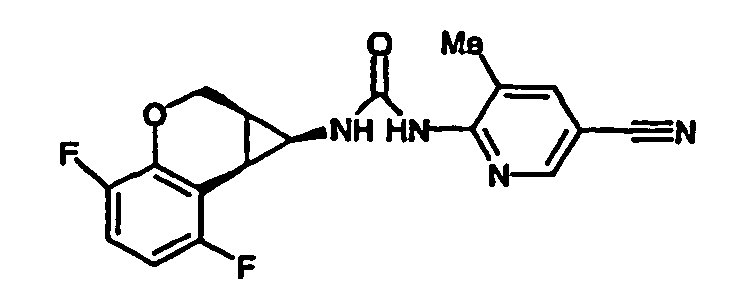
- (+/-)-cis-1-(5-Cyano-3-methyl-pyridin-2-yl)-3-(4,7-difluoro-1,1a,2,7b-tetrahydro-cyclopropa[c]chromen-1-yl)-urea was prepared analogously to
- Example 1 c but using cis-4,7-Difluoro-1,1 a,2,7b-tetrahydro-cyclopropa[c]chromene-1-carboxylic acid (168 mg, 0.74 mmol) and 6-amino-5-methyl-nicotinonitrile (109 mg, 0.82 mmol) to give (+/-)-cis-1-(5-cyano-3-methyl-pyridin-2-yl)-3-(4,7-difluoro-1,1a,2,7b-tetrahydro-cyclopropa[c]chromen-1-yl)-urea 52 mg of(20 %). The crude product was purified by extraction between 0.01 M HCl (aq) and ethyl acetate and chromatography (silica gel, 0→25% MeOH in Ether). The solvent was evaporated and the solid washed with 25 % aceton in n-hexane.
- 1H NMR (CDCl3-MeOD): 8.02 (d, 1H), 7.61 (dd, 1H), 6.97-6.87 (m, 1H, 6.70-6.62 (m, 1H), 4.48 (dd, 1H), 4.30 (dd, 1H), 3.78 (t, 1H), 3.37 (s, 3H), 2.66 (t, 1H), 2.03 (m, 1H).
-

- +/--cis-1-(5-Chloro-pyridin-2-yl)-3-(4,7-difluoro-1,1a,2,7b-tetrahydro-cyclopropa[c]chromen-1-yl)-urea was prepared analogously to Example 1c but using cis-4,7-difluoro-1,1a,2,7b-tetrahydro-cyclopropa[c]chromene-1-carboxylic acid (90 mg, 0.4 mmol) and 6-amino-5-chloropyridine (51 mg, 0.44 mmol) to give +/--cis-1-(5-chloro-pyridin-2-yl)-3-(4,7-difluoro-1,1a,2,7b-tetrahydro-cyclopropa[c]chromen-1-yl)-urea (50 mg, 35 %). The crude product was purified by extraction between 0.01 M HCl (aq) and ethyl acetate-ether (1:1) and chromatography (silica gel, ether).
- 1H NMR (CDCl3): 9.2 (broad s, NH), 8.6 (broad s, NH), 7.81 (dd, 1H), 7.48 (dd, 1H), 6.89 (m, 1H), 6.75 (d, 1H), 6.69 (m, 1H), 4.45 (dd, 1H), 4.33 (dd, 1H), 3.75 (m, 1H), 2.61 (m, 1H), 1.97 (m, 1H).
-

- +/- cis-1-(4,7-Difluoro-1,1a,2,7b-tetrahydro-cyclopropa[c]chromen-1-yl)-3-(5-ethynyl-pyridin-2-yl)-urea was prepared analogously to Example 1 c) but using cis-4,7-difluoro-1,1a,2,7b-tetrahydro-cyclopropa[c]chromene-1-carboxylic acid (100 mg, 0.4 0.44 mmol) and 5-trimethylsilanylethynyl-pyridine-2-ylamine (93 mg, 0.49 mmol) to give (25 mg, 17 %). The crude product was purified by extraction between 0.01 M HCl (aq) and ethyl acetat-ether (1:1) and chromatography (silica gel, ether). The mixture obtained (containing the title compound together with silylated compound) was stirred with Bu4N+F in 25 %water in THF for 30 min and the chromatography was repeated to obtain pure +/- cis-1-(4,7-Difluoro-1,1a,2,7b-tetrahydro-cyclopropa[c]chromen-1-yl)-3-(5-ethynyl-pyridin-2-yl)-urea.
- 1H NMR (CDCl3): 9.2(broad s, NH), 7.95 (d, 1H), 7.59 (dd, 1H), 7.48 (broad s, 1H), 6.89 (td, 1H), 6.64 (td, 1H), 6.57 (d, 1H), 4.46 (dd, 1H), 4.33 (dd, 1H), 3.78 (q, 1H), 3.11 (s, 1H), 2.62 (t, 1H), 1.99-1.97 (m, 1H)
-

- +/-cis-1-(5-Bromo-pyridin-2-yl)-3-(4,7-difluoro-1,1a,2,7b-tetrahydro-cyclopropa[c]chromen-1-yl)-urea was prepared analogously to Example 1c but using cis-4,7-difluoro-1,1a,2,7b-tetrahydro-cyclopropa[c]chromene-1-carboxylic acid (50 mg, 0.22mmol) and 6-amino-5-bromopyridine (42 mg, 0.24 mmol) to give +/-cis-1-(5-bromo-pyridin-2-yl)-3-(4,7-difluoro-1,1a,2,7b-tetrahydro-cyclopropa[c]chromen-1-yl)-urea (50 mg, 35 %). The crude product was purified by extraction between 0.01 M HCl (aq) and ethyl acetate and chromatography (silica gel, ether.
- 1H NMR (CDCl3): 9.2 (broad s, NH), 7.88 (d, 1H), 7.75 (broad s, 1H), 7.60 (dd, 1H), 6.89 (m, 1H), 6.63 (td, 1H), 6.59 (d, 1H), 4.45 (dd, 1H), 4.33 (dd, 1H), 3.78 (q, 1H), 2.62 (t, 1H), 1.98 (m, 1H).
-

- (+/-)-cis-1-(4,7-Diffuoro-1,1a,2,7b-tetrahydro-cyclopropa[c]chromen-1-yl)-3-(5-phenoxy-pyridin-2-yl)-urea was prepared analogously to Example 1 c) but using cis-4,7-difluoro-1,1a,2,7b-tetrahydro-cyclopropa[c]chromene-1-carboxylic acid (60 mg, 0.26 mmol) and 6-amino-5-phenoxypyridine (56 mg, 0.29 mmol) to give 32 mg (30 %) of the title compound. The crude product was purified by extraction between 0.01 M HCl (aq) and ethyl acetate and chromatography (silica gel, 20 % ether in n-hexane)
- 1H NMR (CDCl3): 7.60 (d, 1H), 7.45 (broad s, 1H), 7.37-7.34 (m, 2H), 7.27-7.24 (m, 2H), 7.14-7.11 (m, 1H), 6.94-9.92 (m, 2H), 6.79-7.74 (m, 1H), 6.63 (d, 1H), 6.59-6.55 (m, 1H), 4.43 (dd, 1H), 4.36 (dd, 1H), 3.75 (q, 1H), 2.59 (t, 1H), 1.98-1.94 (m, 1H).
-

- cis-4,7-Difluoro-1,1a,2,7b-tetrahydro-cyclopropa[c]chromene-1-carboxylic acid (113 mg, 0.5 mmol), DPPA (118.6 µl, 0.55 mmol) and TEA (70.7 µl, 0.55 mmol) was refluxed in toluene (2ml) for 1 h. Dioxane (3 ml) and HCl(aq) (1.5 ml, 6M) was then added and the reaction mixture was left for 1 h. at 50 °C. Ether and water was then added and the layers separated. The water phase was washed with ether and then made alkaline with ammonia (aq). Extraction with dichlorometane and drying gave the intermdiate 4,7-difluoro-1,1a,2,7b-tetrahydrocyclopropa[c]chromen-1ylamine, which was directly treated with 6-isothiocyanato-nicotinonitril (34 mg, 0.55 mmol) in acetonitrile (4 ml) at RT over-night. The precipitated crystals were filtrated off and washed with cold acetonitrile to give30 mg (17 %) of pure (+/-)-cis-1-(5-Cyano-pyridin-2-yl)-3-(4,7-difluoro-1,1a,2,7b-tetrahydro-cyclopropa[c]chromen-1-yl)-thiourea LC-MS: m/z 358.9
-

- 1-(6-Chloro-5-cyano-pyridin-2-yl)-3-(5,7-difluoro-1,1a,2,7b-tetrahydro-cyclopropa[c]chromen-1-yl)urea was prepared analogously to Example 1c) but using cis-5,7-difluoro-1,1a,2,7b-tetrahydro-cyclopropa[c]chromene-1-carboxylic acid (280 mg, 1.21 mmol) and 6-amino-2-chloro-3-cyanopyridine ( 203 mg, 1.33 mmol) to give the title compound in small amount. The crude product was purified by extraction between 0.01 M HCl (aq) and ether and chromatography (silica gel, ether) and washed with acetone-ether.
- 1H NMR (DMSO-d6): 10 (br s, NH), 8.20 (d, 1H), 7.70 (d, 1H), 6.9 (br s, NH), 6.8 (m, 1H), 6.6 (m, 1H), 4.4 (dd, 1H), 4.2 (dd, 1H), 3.2 (m, 1H), 2.4 (t, 1H), 1.9 (m, 1H).
-

- 1-(5-cyano-pyridin-2-yl)-3-(5,7-difluoro-1,1a,2,7b-tetrahydro-cyclopropa[c]chromen-1-yl)urea was prepared analogously to Example 1c) but using cis-5,7-difluoro-1,1a,2,7b-tetrahydro-cyclopropa[c]chromene-1-carboxylic acid (390 mg, 1.72mmol) and 2-amino-5-cyanopyridine (226 mg, 1.89 mmol) . The crude product was purified by extraction between 0.01 M HCl (aq), recrystallization, several washings with aceton and acetonitrile and chromatography (silica gel, 1 % EtOAc in ether) to give 28 mg of the title compound.
- 1H NMR (CDCl3-MeOD): 8.16 (t, 1H), 7.78 (dd, 1H), 7.09 (d, 1H), 6.56-6.34 (m, 2H), 4.34 (m, 2H), 3.54 (t, 1H), 2.57 (dd, 1H), 2.00-1.90 (m, 1H).
-

- cis-1-(4-Bromo-7-fluoro-1,1a,2,7b-tetrahydro-cyclopropa[c]chromen-1-yl)-3-(5-cyano-pyridin-2-yl)-urea was prepared analogously to Example 1c) but using cis-4-bromo-7fluoro-1,1a,2,7b-tetrahydro-cyclopropa[c]chromene-1-carboxylic acid (178 mg, 0.62 mmol) and 2-amino-5-cyanopyridine (0.81 mg, 0.68 mmol)
- The crude product was chromatographed (silica, ether) and washed with acetone to give 40 mg (16%) of cis-1-(4-Bromo-7-fluoro-1,1a,2,7b-tetrahydro-cyclopropa[c]chromen-1-yl)-3-(5-cyano-pyridin-2-yl)-urea.
- 1H NMR (CDCl3): 9.85 (s, 1H), 9.3 (s,1H), 7.75 (dd, 1H), 7.33 (dd, 1H), 6.95 (d, 1H), 6.65 (t, 1H), 4.05 (dd, 1H), 4.32 (dd, 1H), 3.35 (t, H), 2.65 (t, 1H), 2.05-1.95 (m, 1H).
-

- cis-1-(4-Bromo-7-fluoro-1,1a,2,7b-tetrahydro-cyclopropa[c]chromen-1-yl)-3-(6-chloro-5-cyano-pyridin-2-yl)-urea was prepared analogously to Example 1c but using cis-4-bromo-7fluoro-1,1a,2,7b-tetrahydro-cyclopropa[c]chromene-1-carboxylic acid (178 mg, 0.62 mmol) and 2-amino-6-chloro-5-cyanopyridine ( 105 mg, 0.68 mmol). The crude product was chromatographed (silica, 0→1 % MeOH in ether) and washed with acetone-hexane to give 40 mg (13 %) of cis-1-(4.bromo-7-fluoro-1,1a,2,7b-tetrahydro-cyclopropa[c]chromen-1-yl)-3-(6-chloro-5-cyano-pyridin-2-yl)-urea.
- 1H NMR (CDCl3): 9.90 (s, 1H), 8.30 (s, 1H), 7.75 (d, 1H), 7.25 (d, 1H), 6.60 (t, 1H), 4,5 (dd, 1H), 4.35 (dd, 1H), 3.5 (m, 1H), 2.65 (m, 1H), 2.1-1.95 (m, 1H).
-

- cis-1-(4-Bromo-6-fluoro-1,1a,2,7b-tetrahydro-cyclopropa[c]chromen-1-yl)-3-(5-cyano-pyridin-2-yl)-urea urea was prepared analogously to Example 1c but using cis-4-bromo-6-fluoro-1,1a,2,7b-tetrahydro-cyclopropa[c]chromene-1-carboxylic acid (177 mg, 0.62 mmol) and 2-amino-5-cyanopyridine (81 mg, 0.68 mmol) . The crude product was extracted between ether and 0.02 M HCl(aq), chromatographed (silica, 0→1 % MeOH in ether) and washed with acetone-hexane to give 42 mg (17 %) of cis-1-(4-Bromo-6 fluoro-1,1a,2,7b-tetrahydro-cyclopropa[c]chromen-1-yl)-3-(5-cyano-pyddin-2-yl)-urea.
- 1H NMR (CDCl3-MeOD): 8.37 (m, 1H), 7.75 (dd, 1H), 7.14 (dd, 1H), 7.05 (dd, 1H), 6.93 (d, 1H), 4.56 (dd, 1H), 4.21 (dd, 1H), 3.77 (t, 1H), 2.42 (dd, 1H), 2.00 (m, 1H).
-

- cis-1-(4-Bromo-6-fluoro-1,1a,2,7b-tetrahydro-cyclopropa[c]chromen-1-yl)-3-(6-chloro-5-cyano-pyridin-2-yl)-urea was prepared analogously to Example 1 c) but using cis-4-bromo-6-fluoro-1,1a,2,7b-tetrahydro-cyclopropa[c]chromene-1-carboxylic acid (177 mg, 0.62 mmol) and 2-amino-6-chloro-5-cyanopyridine (105 mg, 0.68 mmol). The crude product was extracted between ether and 0.01 M HCl(aq), chromatographed (silica, 0→1 % MeOH in ether) and washed with acetone-hexane to give 46 mg (17 %) of cis-1-(4-bromo-6-fluoro-1,1a,2,7b-tetrahydro-cyclopropa[c]chromen-1-yl)-3-(6-cloro-5-cyano-pyridin-2-yl)-urea.
- 1H NMR (CDCl3): 9.41 (s1H, ), 8.28 (dd, 1H), 7.04 (dd, 1H), 4.54 (dd, 1H), 4.25 (dd, 1H), 3.50 (m, 1H), 2.41 (dd, 1H), 2.06-1.98 (m, 1H).
-

- cis-1-(5-Cyano-pyridin-2-yl)-3-(6-fluoro-1,1a,2,7b-tetrahydro-cyclopropa[c]chromen-1-yl)urea was prepared analogously to Example 1c) but using cis-6-fluoro-1,1a,2,7b-tetrahydro-cyclopropa[c]chromene-1-carboxylic acid (168 mg, 0.8 mmol) and 2-amino-5-cyanopyridine ( 105 mg, 0.88 mmol) . The crude product was extracted between ether and 0.01 M HCl(aq) chromatographed (silica, 0→1 % MeOH in ether) and washed with aceton-hexane to give only 10mg (4 %) of cis-1-(5-cyano-pyridin-2-yl)-3-(6-fluoro-1,1 a,2,7b-tetrahydro-cyclopropa[c]chromen-1-yl)urea.
- 1H NMR (CDCl3-MeOD): 8.16 (d, 1H), 7.73 (dd, 1H), 7.05 (dd, 1H), 6.96 (d, 1H), 6.84 (td 1H), 6.76 (dd, 1H), 4.39 (dd, 1H), 4.17 (dd, 1H), 3.67 (t, 1H), 2.39 (dd, 1H), 1.96-1.92 (m, 1H).
-

- 6-Fluorochroman-4-one (10 g, 61 mmol) was dissolved In ethanol (100 ml). NaBH4 (excess) was added and cooled on icebath. The mixture was then left in room temperature for 2h, folowed by reflux for 4 h. Purification by chromatography (silica gel, ether-hexane, 1:5) gave 8. g (80 %) pure 6-fluoro-chroman-4-ol.
-

- 6-Fluorochroman-4-ol (8 g, 48 mmol) and toluene-4-sulphonic acidn (1 g) were dissolved in toluene and refluxed over-night with subsequent water removal. The mixture was then cooled and washed with NaHCO3 (aq) and purified by chromatography (silica gel, n-hexane) to give 4.2 g (52 %) of pure 6-fluoro-2H-chromene.
-

- This Compound was prepared analogously to cis-4,7-Difluoro-1,1a,2,7b-tetrahydro-cyclopropa[c]chromene-1-carboxylic acid ethyl ester but using 6-fluoro-2H-chromene to give 1.9 (29 %) of the title compound.
-

- This compound was prepared analogously to cis-4,7-difluoro-1,1a,2,7b-tetrahydro-cyclopropa[c]chromene-1-carboxylic acid but using cis-6-fluoro-1,1a,2,7b-tetrahydro-cyclopropa[c]chromene-1-carboxylic acid ethyl ester (1.9 g, 8 mmol) to give 350 mg (21 %) of pure cis-641uoro-1,1a,2,7b-tetrahydro-cyclopropa[c]chromene-1-carboxylic acid
-

- This compound was prepared analogously to 2,4-difluoro-2-prop-ynyloxy-benzene but using 2-bromo-5-fluorphenol (15 g, 78 mmol) to give 1-bromo-4-fluoro-2-prop-2-ynyloxy-benzene 15.6 g (87 %)
-

- This compound was prepared analogously to 2,4-difluoro-2-prop-ynyloxy-benzene but using 2-bromo-4-fluoro-phenol (15 g, 78 mmol) to give 2-bromo-4-fluoro-1-prop-2-ynyloxy-benzene 15. g (84 %).
-

- This compound was prepared analogously to 2,4-difluoro-2-propynyloxybenzene but using 3,5-difluoro-phenol (14 g, 107 mmol) to give 1,3-difluoro-5-prop-2-ynyloxy-benzene 12 g (67 %).
-

- This compound was prepared analogously to 5,8-difluoro-2H-chromene but using (15 g, 65 mmol) of 2-bromo-4-fluoro-1-prop-2-ynyloxybenzeneto give the title compound (7 g, 46 %)
-

- This compound was prepared analogously to 5,8-difluoro-2H-chromene but using (15 g,-65 mmol) of 1-bromo-4-fluoro-2-prop-2-ynyloxybenzene to give the title compound (3.7 g, 25
-

- This compound was prepared analogously to 5,8-difluoro-2H-chromene but using (18 g, 107 mmol) of 1,3-difluoro-5-prop-2-ynyloxybenzene and PEG-200 as solvent to give the title compound (4 g, 23 %).
-

- This compound was prepared analogously to +/- cis-4,7-difluoro-1,1a,2,7b-tetrahydro-cyclopropa[c]chromene-1-carboxylic acid ethyl ester but using 5 g (22 mmol) of 8-bromo 6-fluoro-2H-chromene to give 1.9 g (30 %) of cis-6-fluoro-1,1a,2,7b-tetrahydro-cyclopropa[c]chromene-1-carboxylic acid ethyl ester.
-

- This compound was prepared analogously to +/- cis-4,7-difluoro-1,1a,2,7b-tetrahydro-cyclopropa[c]chromene-1-carboxylic acid ethyl ester but using 3.5 g (15.3 mmol) of 8-bromo-5-fluoro-2H-chromene to give 1.6 g (33 %) of +/-cis-4-bromo-7-fluoro-1,1a,2,7b-tetrahydro-cyclopropa[c]chromene-1-carboxylic acid ethyl ester.
-

- This compound was prepared analogously to +/- cis-4,7-difluoro-1,1a,2,7b-tetrahydro-cyclopropa[c]chromene-1-carboxylic acid ethyl ester but using 2 g (12 mmol) of 5,7-difluoro-2H-chromene to give 0.9 g (29 %) of +/- cis-5,7-difluoro-1, 1 a,2,7b-tetrahydro-cyclopropa[c]chromene-1-carboxylic acid ethyl ester.
- Racemic (+/-)-cis-1-(5-cyano-pyridin-2-yl)-3-(4,7-difluoro-1,1a,2,7b-tetrahydro-cyclopropa[c]chromen-1-yl)-urea (see Example 15) was separated into optically active compounds by using a chiral AGP 150 x 10 mm, 5µm; Crom Tech LTD Colomn. The flow rate was set to 4 ml/min. The mobile phase was 89 vol % 10mM HOAc/NH4OAc in acetonitrile. Two elution peaks are seen. The isomer eluting second, typically exhibiting negative rotation is particularly active.
- Without in any way wishing to be bound by this observation, it is believed that the more slowly eluting isomer bears the absolute configuration depicted below, which has been established by reference to x-ray crystallographic coordinates of the unsubstituted analogue of Example 1 liganded within reverse transcriptase enzyme. The configuration depicted below is clearly seen in the solved structure, whereas the other enantiomer is not present.

- Racemic (+/-)-cis-1-(5-chloropyridin-2-yl)-3-(4,7-difluoro-1,1a,2,7b-tetrahydro-cyclopropa[c]chromen-1-yl)-urea (see Example 17) was separated into optically active compounds by using a chiral AGP 150 x 10 mm, 5µm; Crom Tech LTD Colomn. The flow rate was set to 4 ml/min. The mobile phase was 89 vol % 10mM HOAc/NH4OAc in acetonitrile. Two elution peaks at 27.7 min and 33.2 min are seen. The title isomer eluting at 33.2 min, typically exhibiting negative rotation, is particularly active.
- 0.32 g (1.32 mmol) of racemic cis-7-fluoro-4-chloro-1,1a,2,7b-tetrahydro-cyclopropa[c]chromene-1-carboxylic acid was dissolved in hot acetonitrile (50 mn and (1 R,2R)-2-benzyloxycyclopentylamine (0.25 g, 1.32 mmol) was added. The resulting solution was left for crystallization. After few hours the mother liquor was decanted and crystals were washed with acetonitrile. The second crystallization from acetonitrile gave 92 mg of pure diastereomeric salt. The salt was treated with 1 M HCl and resulting mixture was extracted with ethyl acetate. The organic phase was washed with water, brine and evaporated to give 0.05 g of enantiomeric cis-7-fluoro-4-chloro-1,1a,2,7b-tetrahydro-cyclopropa[c]chromene-1-carboxylic acid.
- The title compound was synthesized analogously to Example 1c) from enantiomeric cis-7-fluoro-4-chloro-1,1a,2,7b-tetrahydro-cyclopropa[c]chromene-1-carboxylic acid (50 mg). Yield 60.2 mg (84%). [α]D= -0.388 (c=0.5, CHCl3).
-

- 2,5-Dichlorophenol (8 g, 49 mmol) was mixed with potassium carbonate (13.6 g, 98 mmol) and 80% solution of propargyl bromide in toluene (11 ml, 98 mmol) in acetone (100 ml) and stirred overnight at room temperature. The precipitate was removed by filtration and washed with acetone. The acetone solution obtaind was concentrated by rotary evaporation and kept under vacuum for 5 h. The product was obtained as yellow oil with quantitative yield. It was used for futher transformations without additional purification.
-

- 1,4-Dichioro-2-(2-propynyloxy)benzene was degassed and heated at stirring under argon for 4 h at 224°C. The reaction mixture was then distilled in Kugelrohr apparatus (150-175°C/4.1x10-2 mbar) to give 3.58 g of desired product as white solid. Yield 36% from starting dichlorophenol.
-

- 5,8-Dichloro-2H-chromene (3.15 g, 16 mmol), (Rh(II)Ac2)2 (30 mg, 0.1 mol %) was dissolved in degassed dry methylene chloride (3 ml). Ethyl diazoacetate (3 ml, 2 eq.) in the same solvent was added by a syringe at the flow rate 0.4 ml/h over a period of approximately 5 h under N2 atmosphere. The reaction mixture was then washed with NH4Cl (aq), water and brine and the solvent removed. The product (45 % cis, 55 % trans) was purified by chromatography on silica (200g, ethyl acetate/n-hexane 1:15) to give 0.9 g of the pure cis product (racemate). Yield 20 %. M+=287.
- 1H-NMR (CDCl3): 7.15 (d, 1H, J=8.5Hz), 6.91 (d, 1H, J=8.8Hz), 4.59 (dd, 1H, J=12.02, J2=7.03), 4.48 (dd, 1H, J1=12.02, J2=4.10), 4.07-3.94 (m, 3H), 2.62 (t, 1H, J=8.8Hz), 2.27 (t, 1H, J=8.36Hz), 2.20-2.12 (m, 1H), 1.1 (t, 3H).
-

- +/-cis-Ethyl 4,7-dichloro-1,1a,2,7b-tetrahydrocyclopropa[c]chromene-1-carboxylate was mixed with methanol (3 ml) and water solution of NaOH (1.5 eq., 3 ml) and heated at stirring for 1.5 h at 60°C. The extraction of basic reaction mixture into hexane showed that no starting material present. The reaction mixture was acidified with excess of 3M HCl solution (pH=1). The precipitate formed was collected by suction and washed with water. White solid obtained was dried under high vacuum (yield 80%).
-

- +/-cis-4,7-dichloro-1,1a,2,7b-tetrahydrocyclopropa[c]chromene-1-carboxylic acid
- (100mg, 0.39mmol) was mixed with toluene (3ml), triethylamine (1.1 eq), 5-cyano-2-aminopyridine (1.1 eq), DPPA (1.1eq) and bubbled with argon for about 5 min. The reaction mixture was then heated at stirring at 115°C for 3 h under argon. The reaction mixture was concentrated by rotary evaporation and mixed with small amount of dry ethanol. The precipitate formed was collected by suction and washed with ethanol (2x2 ml) Desired product (+/-cis isomer) was obtained as beige-white powder (65mg, yield 45%).
- 1H-NMR (DMSO-d6): 9.83 (s, 1H), 8.34 (d, 1H), 8.03 (dd, 1H), 7.75 (br s, 1H), 7.44 (d, 1H), 7.30 (d, 1H), 7.10 (d, 1H), 4.43 (dd, 1H), 4.18 (dd, 1H), 3.55-3.45 (m, ~1H overlapped with H2O signal), 2.54 (dd, 1H), 2.10-2.02 (m, 1H).
-
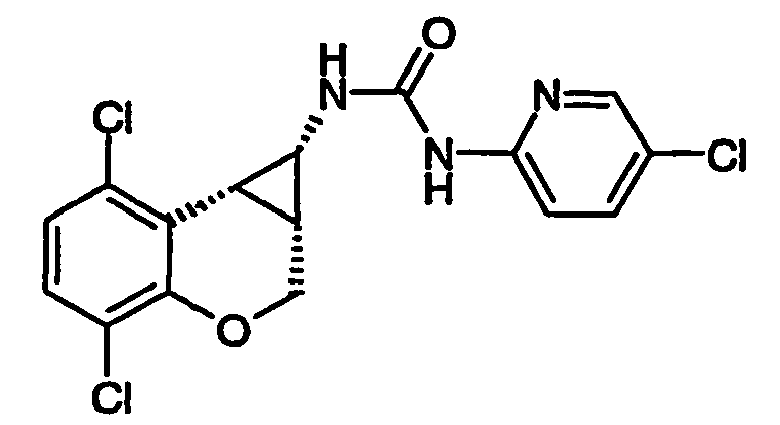
- +/-cis-N-(5-chloro-2-pyridinyl)-N'-(4,7-dichloro-1,1a,2,7b-tetrahydrocyclopropa [c]chromen-1-yl)urea was synthesized analogously to Example 33 from +/-cis-4,7-dichloro-1,1a,2,7b-tetrahydrocyclopropa[c]chromene-1-carboxylic acid (100 mg, 0.39mmol) and 2-amino-5-chloropyridine (1.1 eq) to give 66 mg of product as white powder. Yield 44%.
- 1H-NMR (DMSO-d6): 9.47 (s, 1H), 7.98 (d, 1H), 7.86 (br s, ~1H), 7.83 (dd, 1H), 7.30 (d, 1H), 7.23 (d, 1H), 7.10 (d, 1H), 4.44 (dd, 1H), 4.18 (dd, 1H), 3.55-3.48 (m, 1H), 2.54 (dd, 1H), 2.10-2.02 (m, 1H).
-

- +/-cis-N-(5-bromo-2-pyridinyl)-N'-(4,7-dichloro-1,1a,2,7b-tetrahydrocyclopropa [c]chromen-1-yl)urea was synthesized analogously to Example 33 from +/-cis-4,7-dichloro-1,1a,2,7b-tetrahydrocyclopropa[c]chromene-1-carboxylic acid (100 mg, 0.39mmol) and 2-amino-5-bromopyridine (1.1 eq) to give 35 mg of product as grey powder. Yield 21 %.
- 1H-NMR (DMSO-d6): 9.47 (s, 1H), 7.97 (d, 1H), 7.86 (br s, ~1H), 7.83 (dd, 1H), 7.30 (d, 1H), 7.23 (d, 1H), 7.10 (d, 1H), 4.43 (dd, 1H), 4.18 (dd, 1H), 3.55-3.48 (m, 1H), 2.54 (dd, ~1H overlapped with DMSO signal), 2.08-2.01 (m, 1H).
-

- +/cis-N-(5-phenoxy-2-pyridinyl)-N'-(4,7-dichloro-1,1a,2,7b-tetrahydrocyclopropa [c]chromen-1-yl)urea was synthesized analogously to Example 33 from +/-cis-4,7-dichloro-1,1a,2,7b-tetrahydrocyclopropa[c]chromene-1-carboxylic acid (58 mg, 0.22 mmol) and 2-amino-5-phenoxypyridine (1.1 eq) to give 49 mg of product as slightly brownish powder. Yield 49%.
- 1H-NMR (CDCl3): 9.30 (br s, 1H), 8.26 (s, 1H), 7.53 (d, 1H), 7.35 (m, 2H), 7.25 (dd, 1H), 7.16-7.10 (dd, ~1H overlapped with CHCl3 signal), 7.05 (d, 1H), 6.97-6.90 (m, 3H), 6.72 (d, 1H), 4.46 (dd, 1H), 4.30 (dd, 1H), 2.73 (m, 1H), 2.63 (dd, 1H), 2.05-1.95 (m, 1H).
-

- 5-Chloro-2-fluoroaniline (10g, 68 mmol) was dissolved in 6M sulfuric acid and cooled in ice/brine bath to -5°C. The solution of NaNO2 (5.2 g, 76 mmol) in minimum amount of water was added dropwise to the stirred suspension at the temperature not higher then -2°C. After the addition clear yellow solution formed was allowed to stir for additional 30 min at cooling. CuSO4 was dissolved water (80 ml) and mixed with sulfuric acid (32 ml). The diazonium salt solution was added dropwise to the preheated (160°C) cuprous sulfate solution and the product was removed from the reaction flask by steam distillation. The reaction took about 2 h to be complete. The water/phnol solution was extracted into ether, washed with brine and dried over Na2SO4. Concentration gave 4g of crude phenol (40%).
-

- 4-Chloro-1-fluoro-2-(2-propynyloxy)benzene was synthesized analogously to Example 33a from (4 g, 27 mmol) 4-chloro-1-fluorophenol to give 4.6g of product (purified by column chromatography on silica, ethyl acetate/n-hexane 1:15) as yellow oil. Yield 90%.
-
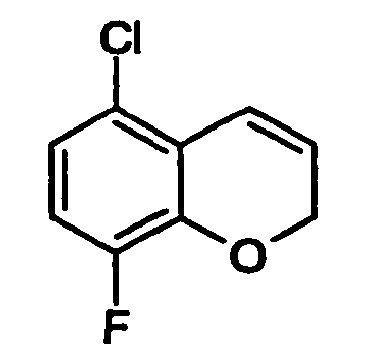
- 5-Chloro-8-fluoro-2H-chromene was synthesized analogously to Example 33b) from 4-chloro-1-fluoro-2-(2-propynyloxy)benzene (4.6 g, 25 mmol) to give 1 g of product (purified by column chromatography on alumina, ethyl acetate/n-hexane 1:15) as colourless oil. Yield 22%.
-

- Ethyl +/-cis-7-chloro-4-fluoro-1,1a,2,7b-tetrahydrocyclopropa[c]chromene-1-carboxylate was synthesized analogously to Example 33c from 5-chloro-8-fluoro-2H-chromene (1 g, 5.4 mmol) to give 360 mg of +/-cis product (purified by column chromatography on silica, ethyl acetate/n-hexane 1:20) as white solid. Yield 25%.
-

- +/-cis-7-Chloro-4-fluoro-1,1a,2,7b-tetrahydrocyclopropa[c]chromene-1-carboxylic acid was synthesized analogously to Example 33d from ethyl +/-cis-7-chloro-4-fluoro-1,1a,2,7b-tetrahydrocyclopropa[c]chromene-1-carboxylate (360 mg, 1.3 mmol) to give 259 mg of +/-cis acid (80%).
-

- +/-cis-N-(7-chloro-4-fluoro-1,1a,2,7b-tetrahydrocyclopropa[c]chromen-1-yl)-N'-(5-cyano-2-pyridinyl)urea was synthesized analogously to Example 33e from +/-cis-7-chloro-4-fluoro-1,1a,2,7b-tetrahydrocyclopropa[c]chromene-1-carboxylic acid (60 mg, 0.25mmol) and 2-amino-5-chloropyridine (1.1 eq) to give 59 mg of product as white powder. Yield 66%.
- 1H-NMR (DMSO-d6): 9.47 (br s, 1H), 7.89 (d, 1H), 7.80 (br s, 1H), 7.74 (dd, 1H), 7.32 (d, 1H), 7.16-7.05 (m, 2H), 4.39 (dd, 1H), 4.16 (dd, 1H), 3.55-3.48 (m, 1H), 2.51 (dd, ~1H overlapped with DMSO signal), 2.08-2.01 (m, 1H).
-

- +/cis-N-(7-chloro-4-fluoro-1,1a,2,7b-tetrahydrocyclopropa[c]chromen-1-yl)-N'-(5-chloro-2-pyridinyl)urea was synthesized analogously to Example 5 from +/-cis-7-chloro-4-fluoro-1,1a,2,7b-tetrahydrocyclopropa[c]chromene-1-carboxylic acid (60 mg, 0.25mmol) and 2-amino-5-chloropyridine (1.1 eq) to give 59 mg of product as white powder. Yield 65%.
- 1H-NMR (DMSO-d6): 9.47 (br s, 1H), 7.89 (d, H), 7.80 (br s, 1H), 7.74 (dd, 1H), 7.32 (d, 1H), 7.16-7.04 (m, 2H), 4.39 (dd, 1H), 4.16 (dd, 1H), 3.55-3.48 (m, 1H), 2.51 (dd, ~1H overlapped with DMSO signal), 2.06-2.01 (m, 1H).
-

- +/-cis-N'-(5-bromo-2-pyddinyl)-N'-(7-chloro-4-fluoro-1,1a,2,7b-tetrahydrocyclopropa [c]chromen-1-yl)urea was synthesized analogously to Example 32e from +/-cis-7-chloro-4-fluoro-1,1a,2,7b-tetrahydrocyclopropa[c]chromene-1-carboxylic acid (60 mg, 0.25mmol) and 2-amino-5-bromopyridine (1.1 eq) to give 56 mg of product as white powder. Yield 55%.
- 1H-NMR (DMSO-d6): 9.46 (br s, 1H), 7.96 (d, 1H), 7.83 (dd, 1H), 7.81 (br s, 1H), 7.27 (d, 1H), 7.16-7.04 (m, 2H), 4.38 (dd, 1H), 4.17 (dd, 1H), 3.55-3.48 (m, 1H), 2.51 (dd, ~1H overlapped with DMSO signal), 2.07-2.00 (m, 1H).
-

- +/-cis-N-(7-Chloro-4-fluoro-1,1a,2,7b-tetrahydrocyclopropa[c]chromen-1-yl)-N-(5-phenoxy-2-pyridinyl)urea was synthesized analogously to Example 32e from +/-cis-7-chloro-4-fluoro-1,1a,2,7b-tetmhydrocyclopropa[c]chromene-1-carboxylic acid (60 mg, 0.25 mmol) and 2-amino-5-phenoxypyridine (1.1 eq) to give 76 mg of product as slightly brownish powder. Yield 73%.
- 1H-NMR (CDCl3): 9.33 (br s, 1H), 7.93 (s, 1H), 7.51 (d, 1H), 7.38-7.32 (m, 2H), 7.25 (dd, ~1H overlapped with CHCl3 signal), 7.16-7.10 (m, 1H), 6.96-6.88 (m, 3H), 6.79 (dd, 1H), 6.68 (d, 1H), 4.45 (dd, 1H), 4.25 (dd, 1H), 3.75-3.70 (m, 1H), 2.61 (dd, 1H), 2.05-1.95 (m, 1H).
-

-

- 4-Thiochromanol (8.9 g) and potassium acid sulfate (0.89 g) were placed in a flask and evacuated to 1 mm. The flask was put in a bath heated at 90 °C until the alcohol melted. The magnetic stirrer was started and the bath slowly brought to 120 °C. Dehydration was rapid and a mixture of the product and water distilled and was collected in a ice-cooled receiver. The product was taken up in ether and dried. The crude product (7g, Rdt= 88%) wasn't purified. The NMR showed the presence of 10% of the 4H-1-benzothiopyran.
-

- Ethyl diazoacetate was added slowly to 500 mg of thiochromene at 140 C. The reaction was followed by Gas chromatography and stopped when all starting material was consumed (about 7 hours). The residue was purified by flash chromatography (5% ether in hexane). The cis isomer (46,5 mg, Rdt = 6%) was identified by NMR spectroscopy.
-

- A mixture of the cis isomer (46,5 mg), LiOH (4eq., 19 mg) in 5 ml of methanol / 25% H2O was refluxed for 1 hour. After evaporation of the solvent under vacuum, the residue was dissolved in water and washed with ether. The water phase was acidified with concentrated HCl, and extracted twice with dichloromethane. After drying, the organic phase was evaporated and gave the desired acid (30 mg). Rdt = 73%.
-

- The cis acid (30 mg) was refluxed for 4 hours in toluene (2 ml) in presence of Et3N (0.02 ml), diphenyl phosphonic azide (0.03 ml) and 2-amino 6-cyanopyridine (19.5 mg). After cooling, the toluene phase was washed with water, followed by a solution of HCl (0.01 M). The organic phase was dried and evaporated. The residue was purified by flash chromatography (EtOAc 2 / Hexane 1) and gave 10 mg of the desired compound. Rdt = 22%.
- 1H (DMSO-d6): 1.96 (1H, m); 2.30 (1H, t, 8.6); 2.71 (1H, ddt, 13.65, 6.24); 3.24 (2H, m); 7.19 (3H, m); 7.37 (1H, dd, 7.4, 1.56); 7.42 (1H, dd, 9.0, 3.1); 7.60 (1H, NH); 8.02 (1H, dd, 9.0, 2.3); 8.15 (1H, s); 9.89 (1H, NH)
Mass: 322 (M+.), 321 (M-H) -

- A solution of BuLi (2.5M) in hexane (9.6 ml; 0.024 mol) was added to a stirred solution of 2,5-difluoroanisol (2.88 g, 0.02 mol) in dry THF (30 ml) at -70C, followed after 2h by solution of zinc chloride (3.6 g ; 0.026 mol) in dry THF (50 ml). The reaction temperature was allowed to raise to room temperature and then stirring was maintained at room temperature for 30 min. Pd(OAc)2 (8 mg; 0.2 mol %) was added, followed by ethyl cis-3-bromoacrylate (3.58 g; 0.02 mol). The reaction mixture was placed in preheated oil bath and heated under reflux for 1 h. The resulting reaction mixture was chilled to -78 C and 60 ml (0.06 mol) of DIBAL (1M solution in hexanes) was added dropwise. The stirring was continued at -78 C for 2h and 1h at room temperature. The reaction was quenched with water and all solids were dissolved by addition of HCl. The organic phase was diluted with ether, separated, washed with 5N HCl, brine and evaporated in vacuo. The residue was Kugelrohr distilled (1.5x10⁻² mbar, 150 C) to give 3.7 g (92%) of crude (2Z)-3-(3,6-difluoro-2-methoxyphenyl)-2-propen-1-ol, which contains ~6 % of other regioisomers. The crude product was used in the next step without further purification.
1H-NMR (CDCl3): 7.00 (m, 1H); 6.77 (m, 1H); 6.31 (app. d, 1H); 6.12 (app. dt, 1H); 4.08 (br. t, 2H); 3.89 (d, 3H); 1.80 (br. t, 1H). -

- The p-toluenesulfonylhydrozone of glyoxylic acid chloride (5.16 g; 0.02 mol) was added to a solution of (2Z)-3-(3,6-difluoro-2-methoxyphenyl)-2-propen-1-ol (3.6 g; 0.018 mol) in dry CH2Cl2 (50 ml) at -5C, and N,N-dimethylaniline (2.5 ml; 0.02 mol) was added slowly. After stirring for 30 min at -5C, Et3N (12 ml; 0.09 mol) was added slowly. The resulting mixture was stirred for 15 min at - 5C and then for 30 min at room temperature, whereupon water (-50 ml) was added. The organic phase was separated washed with water, brine and concentrated in vacuo. Flash chromatography (silica, EA:Hex; 1:15) gave 3.86 g (80 %) of product as a yellow solid.
- 1H-NMR (CDCl3): 7.00 (m, 1H); 6.76 (m, 1H); 6.41 (app. d, J=12.2 Hz; 1H); 6.00 (app. dt, J=12.2; 6.10 Hz; 1H); 4.71 (br. s, 1H); 4.67 (dt, 2H); 3.89 (d, 3H).
-

- (2Z)-3-(3,6-difluoro-2-methoxyphenyl)prop-2enyl diazoacetate (3.45 g, 0.013 mol) was dissolved in 100 ml of dried degassed dichloromethane and added dropwise to the solution of chiral Doyle catalyst (Aldrich, also available from Johnsson Matthey, 10 mg, 0.1 mol%) in 50 ml of dichloromethane under argon at ambient temperature over a period of ~6 h. The initial blue color had turned to olive by the end of the addition. The reaction mixture was concentrated in vacuo and the crude product was purified by flash chromatography (silica, EA:Hex, 1:5 → 1:1) to give 2.72 g (88 %) of (1 S,5R,6S)-6-(3,6-difluoro-2-methoxyphenyl)-3-oxabicyclo[3.1.0]hexan-2-one as colorless solid. Enantiomeric purity could be checked on this stage using Chiracel OD column, 10% IPA in hexane - 94% ee.
1H-NMR (CDCl3): 7.00 (m, 1H); 6.72 (m, 1H); 4.33 (dd, 1H); 4.10 (d, 1H); 4.02 (d, 3H); 2.66 (m, 2H); 2.37 (t, 1H). -
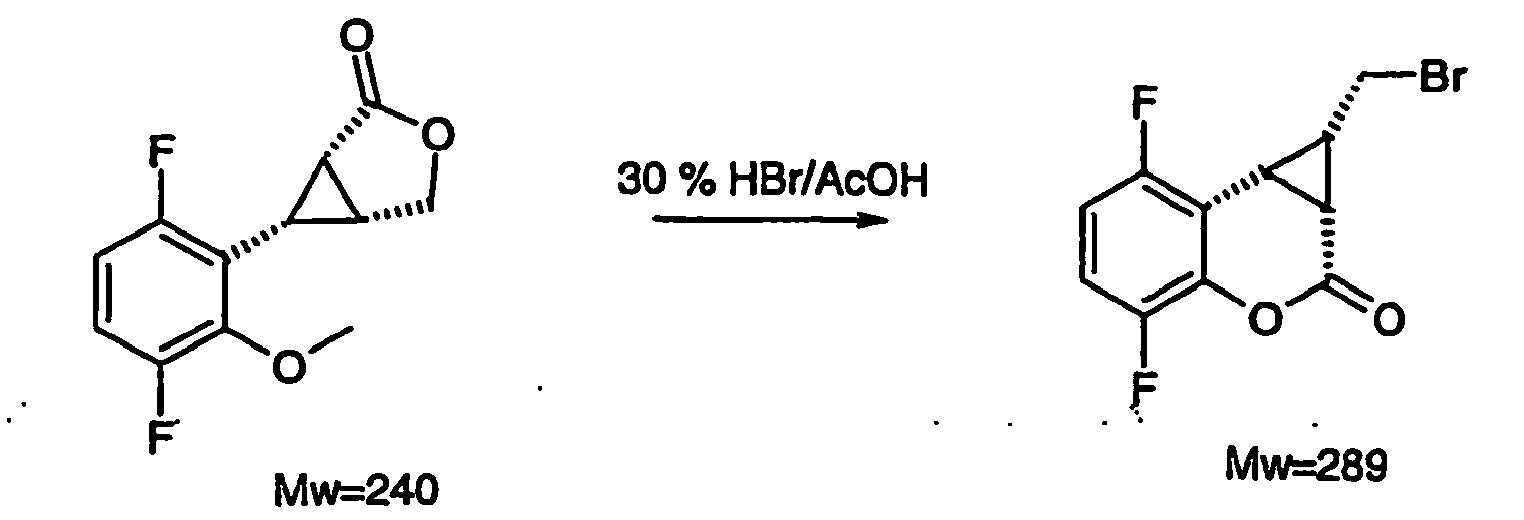
- (1 S,5R,6S)-6-(3,6-difluoro-2-methoxyphenyl)-3-oxabicyclo[3.1.0]hexan-2-one (130 mg, 0.55 mmol) was mixed with 1.2 ml of 30% HBr/AcOH (6 mmol) and heated in a sealed vessel at stirring for about 4h at 90°C. The reaction mixture was then cooled down, mixed with water and extracted into diethyl ether (3x20 ml). Ether extract was washed with sat. sodium bicarbonate solution and brine. Dried over magnesium sulfate. Concentration gave 160 mg of white solid material. 98% yield.
1H-NMR (CDCl3): 7.08 (m, 1H); 6.88 (m, 1H); 3.44 (dd, 1H); 3.06 (t, 1H); 2.96 (dd, 1H); 2.64 (dd, 1H); 2.46 (m, 1H). -

- (1S,1aR,7bS)-1-(bromomethyl)-4,7-difluoro-1a,7b-dihydrocyclopropa [c]chromen-2(1H)-one (360mg, 1.2 mmol) was mixed with the solution of NaOH (0.1 g, 2.5 mmol) in 5 ml of water and heated at stirring for 1 h at 90°C. After completion the reaction mixture was cooled down and extracted into diethyl ether (2x20 ml). Water phase was acidified with conc. HCl. The precipitate formed was collected by filtration to give 180 mg of pure product. Mother liquor was extracted into ether and washed with brine, dried over magnesium sulfate. Concentration gave additional 70 mg of product (containing up to 15% of impurities). Overall yield about 92%.
1H-NMR (CDCl3): 6.86 (m, 1H); 6.54 (m, 1H); 4.48 (m, 2H); 2.62 (t, 1H); 2.20 (t, 1H); 2.11 (m, 1H). -

-

- Ethyl diazoacetate is added slowly to 10 g of thiophene at 140 °C. The reaction was checked by gas chromatography and stopped after 7 hours. The residue is purified by flash chromatography (5% ether in hexane). The cis isomer (917 mg, Rdt = 6%) was identified by NMR spectroscopy.
- Reference: Badger G.M. et al, J. Chem. Soc., 1958, 1179-1184.
- Badger G.M. et al, J. Chem. Soc., 1958, 4777-4779.
-

- A mixture of the cis isomer (443 mg), LiOH (193 mg) in 15 ml of methanol / 25% H2O is refluxed for 1 hour. After evaporation of the solvent under vacuum, the residue is dissolved in water and washed with ether. The water phase is acidified with concentrated HCl, and extracted twice with dichloromethane. After drying, the organic phase is evaporated and gave the desired acid (313.6 mg). Rdt = 81%.
-

- The cis acid (313 mg) was refluxed for 4 hours in toluene (20 ml) in presence of Et3N (0.25 ml), diphenyl phosphoryl azide (0.3 ml) and 2-amino 6-cyanopyridine (220 mg). After cooling, the toluene phase was washed with water, followed by a solution of HCl (0.01 M). The organic phase was dried and evaporated. The residue was purified by flash chromatography (EtOAc 2 / Hexane 1) and gave 10 mg of the desired compound. Rdt = 2%.
- 1H (DMSO-d6): 3.32 (1H, m); 3.39 (1H, td, 8.05, 7.69); 3.52 (1H, dd, 7.69, 6.22); 7.08 (1H, td, 7.32, 1.1); 7.15 (1H, td, 7.32, 1.1); 7.22 (1H, dd, 8.4, 0.8); 7.39 (2H, m); 7.50 (1H, NH); 8.00 (1H, dd, 8.79, 2.2); 8.23 (1H, d, 2.2); 9.76 (1H, NH)
13C (DMSO-d6): 25.6 (CH), 29.5 (CH), 33.7 (CH), 101.5 (C), 112.1 (CH), 118.0 (C), 122.1 (CH), 124.9 (CH), 127.3 (CH), 128.0 (CH), 136.3 (C), 141.7 (CH), 143.7 (C), 151.6 (CH), 155.1 (C), 156.1 (C)
Mass: 310 (M+2), 309 (M+H) -

- This compound was prepared analogously to Example 1 c but using chiral (+)-cis-4,7-difluoro-1,1a,2,7b-tetrahydrocyclopropa[c]chromen-1-carboxylic acid (see Example 42e) (1.3 g, 5.75 mmol). The silica gel purified product was recrystallized from acetonitrile to give 0.95 g (47%) of the title product. Absolute stereochemical configuration assigned as for Example 30.
- 1H-NMR (CDCl3): 9.25 (broad s, 1H), 8.67 (s, 1H), 7.79 (d, 1H), 7.48 (dd, 1H), 6.92-6.86 (m, 1H), 6.71 (d, 1H), 6.65-6.60 (m, 1H), 4.45 (dd, 1H), 4.34 (dd, 1H), 3.80 (q, 1H), 2.61 (t, 1H), 2.00-1.98 (m, 1H).
-

- (+)-cis-4,7-Difluoro-1,1a,2,7b-tetrahydro-cyclopropa[c]chromene-1-carboxylic acid (see example 42e) (1,18 g, 5.2 mmol), diphenylphosphorylazide [1340 µL, 6.3 mmol (d=1.277)], triethylamine (870 µL, 6.3 mmol) and 2-amino-5-cyanopyridine (740 mg, 6.3 mmol) were dissolved in toluene (15 mL) and refluxed for 4 h. The solvent was then removed in vacuo and the crude product was dissolved in ether and washed (3 x 100 mL 0.01 M HCl) and purified by chromatography (silica gel, 0→1% MeOH in ether) to give pure (-)-cis-1-(5-cyano-pyridin-2-yl)-3-(4,7-difluoro-1,1a,2,7b-tetrahydro-cyclopropa[c]chromen-1-yl)-urea (1.1 g, 64%). ee 92% as determined by HPLC on a Chiral AGP column, eluent 11 % acetonitrile in sodium phosphate buffer, flow 0.9 mL/min. Absolute stereochemical configuration assigned as for Example 30.
- 1H-NMR (CDCl3): 9 (s, NH), 8.42 (s, NH), 8.16 (d, 1H), 7.72 (dd, 1H), 6.97-6.76 (m, 2H), 6.69-6.61 (m, 1H), 4.47 (dd, 1H), 4.31 (dd, 1H), 3.75 (m, 1H), 2.65 (t, 1H), 2.05-1.96 (m, 1H).
-

- (+)-cis-4,7-Difluoro-1,1a,2,7b-tetrahydro-cyclopropa[c]chromene-1-carboxylic acid (2.2 g, 9.7 mmol), DPPA [2380 µl, 10.7 mmol 97%(d=1.277)] and TEA (1510 µl, 11.7 mmol) was refluxed in toluene (20ml) for 2 h. Dioxane (26 mL) and HCl(aq) (26 mL, 6M) was then added and the reaction mixture was left for 1-2 h. At 50 °C. Water (50 mL) was added and the water phase was washed with Ether (2 x 25 mL) and then made alkaline with ammonia (aq). Extraction with dichloromethane and drying gave the intermediate 4,7-difluoro-1,1a,2,7b-tetrahydrocyclopropa[c]chromen-1ylamine (1.37 g, 71%), which was directly treated with 6-isothiocyanato-nicotinonitrile (1.25 g, 7.7 mmol) in acetonitrile (2 mL) at RT over the weekend. The precipitated crystals were filtrated off and the solvent removed in vacuo and chromatographed (silica, 20 % ether in pentane). The product obtained was combined with the crystals and the crude product (900 mg) was re-crystallised (ethanol-acetone) to give pure (-)-cis-1-(5-cyano-pyridin-2-yl)-3-(4,7-difluoro-1,1a,2,7b-tetrahydro-cyclopropa[c]-chromen-1-yl)-thiourea (590 mg 18%). Absolute stereochemical configuration assigned as for Example 30.
- 1H-NMR (CDCl3-MeOD): 8.1 (d, 1H), 7.77 (dd, 1H), 6.99-6.91 (m, 1H), 6.74 (dd, 1H) 6.73-6.66 (m, 1H), 4.48 (dd, 1H), 4.33 (dd, 1H), 4.20( dd, 1H), 2.78(t, 1H), 2.16-2.1 (m, 1H).
-

- To a mixture of NaH (95%, 278 mg, 11 mmol) in DMF (20 mL) at 0 °C, was added 1-(4-fluoro-2-hydroxy-phenyl)-propan-1-one (1.68 g, 10 mmol) in DMF (5 mL). After 15 min at 0 °C, was 3-bromo-propyne (3.02 g, 20 mmol) added to the reaction mixture. After 1 h at 0 °C, was the reaction mixture allowed to assume room temperature. The reaction mixture was extracted with H2O (100 mL). The H2O phase was washed with Et2O (3x100 mL) and the solvent of the combined organic phases was removed under reduced pressure. The crude product was purified by column chromatography (silica gel, CH2Cl2), to give 1.40 g (68%) of 1-(4-fluoro-2-prop-2-ynyloxy-phenyl)-propan-1-one.
- 1H-NMR (CDCl3): 7.64 (dd, 1H), 6.69 (dd, 1H), 6.60 (ddd, 1H), 4.68 (d, 2H), 2.85 (q, 2H), 2.58 (t, 1H), 1.03 (t, 3H).
- 1-(5-Fluoro-2H-chromen-8-yl)-propan-1-one was synthesized analagously to Example 3b from 1-(4-fluoro-2-prop-2-ynyloxy-phenyl)-propan-1-one (1.34 g, 6.5 mmol), to give 619 mg (46%) of 1-(5-fluoro-2H-chromen-8-yl)-propan-1-one.
- 1H-NMR (CDCl3): 7.60 (dd, 1H), 6.67-6.58 (m, 2H), 5.86 (dt, 1H), 4.76 (dd, 2H), 2.93 (q, 2H), 1.23 (t, 3H).
- (±)-cis-7-Fluoro-4-propionyl-1,1a,2,7b-tetrahydro-cyclopropa[c]chromene-1-carboxylic acid ethyl ester was synthesized according to method 3c) from 1-(5-fluoro-2H-chromen-8-yl)-propan-1-one (619 mg, 3 mmol), to give 142 mg (16%) of (±)-cis-7-fluoro-4-propionyl-1,1a,2,7b-tetrahydro-cyclopropa[c]chromene-1-carboxylic acid ethyl ester and (±)-trans-7-fluoro-4-propionyl-1,1a,2,7b-tetrahydro-cyclopropa[c]chromene-1-carboxylic acid ethyl ester as a by product.
- 1H-NMR (CDCl3): 7.59 (dd, 1H), 6.65 (m, 1H), 4.50-4.46 (m, 2H), 3.95 (q, 2H); 2.89 (q, 2H), 2.57 (dd, 1H), 2.20 (dd, 1H), 1.13-1.03 (m, 1H), 1.12-1.01 (m, 6H).
- (±)-cis-7-Fluoro-4-propionyl-1,1a,2,7b-tetrahydro-cyclopropa[c]chromene-1-carboxylic acid was synthesized analogously to Example 1 b from (±)-cis-7-fluoro-4-propionyl-1,1a,2,7b-tetrahydro-cyclopropa[c]chromene-1-carboxylic acid ethyl ester (140.3 mg, 0.48 mmol), to give 83 mg (65%) of (±)-cis-7-fluoro-4-propionyl-1,1a,2,7b-tetrahydro-cyclopropa[c]chromene-1-carboxylic acid as a white solid. The crude product was purified by column chromatography (silica gel, 1→5% MeOH in CH2Cl2).
- 1H-NMR (DMSO-d6): 12.15 (br s, 1H), 7.46 (dd, 1H), 6.78 (dd, 1H), 4.57 (dd, 1H), 4.43 (dd, 1H), 2.93-2.80 (m, 2H), 2.55 (dd, 1H), 2.24 (dd, 1H), 2.20-2.10 (m, 1H), 1.02 (t, 3H).
- The title compound is synthesized analogously to example 1c) by reacting 1 equivalent of (±)-cis-7-fluoro-4-propionyl-1,1a,2,7b-tetrahydro-cyclopropa[c]chromene-1-carboxylic acid and 1 eq of triethylamine in toluene with 1 eq of diphenylphosphoryl azide for 30 minutes at room temperature. The reaction mixture is heated to 120°C and an approximately equimolar solution of 2-amino-5-bromopyridine is added. After 3 hours the solution is allowed to assume room temperature and the title compound extracted as shown above.
-

-

- The title compound is synthesised in the depicted stereochemistry as described in Doyle J Amer Chem Soc 117 (21) 5763-5775 (1993)
-

- The title compound is synthesised in the depicted stereochemistry as described in Martin et al Tett Lett 39 1521-1524 (1998).
-

- 2,4-diflouroanisol (90 mg, 0.62 mmol) was dissolved in anhydrous, degassed, THF (7 ml) and cooled to -78 °C under N2. nBuLi, 2,5 M in hexane, (0.30 ml, 0.77 mmol) was added and the reaction mixture was stirred at -78°C for 2 hrs. ZnCl2 (150 mg, 1.1 mmol), as a solution in anhydrous THF (7 ml), was added and the reaction mixture was allowed to warm to ambient temperature for 2 hrs. Iodo-2-methoxy-3-oxabicyclohexane (150 mg, 0.63 mmol), Pd (OAc)2 (1.5 mg, 6.2 µmol), and ligand Tris(2,4-di-tert-butylphenyl)phosphite (40 mg, 62 µmol) were mixed in anhydrous THF (7 ml) and added to the reaction mixture. The reaction mixture was heated at reflux for 3 days and quenched with H2O. Diethyl ether was added and the layers were separated, the organic layer was washed with H2O and aq. sat. NaCl, dried over MgSO4, filtered and concentrated to give the title compound, otherwise denoted 2,4-difluoro-5-(cyclopropylacetal)anisol. Column chromatography on silica (EtOAc/Hexane 1:3) gave (4) 50 mg, 31%.
- 1H NMR (CDCl3) δ (ppm): 6.88-6.94 (m, 1H, ArH), 6.68-6.73 (m, 1H, ArH), 4.82 (s, 1H, CHOCH3), 3.97-3.98 (m, 1H, CHOCH) 3.94 (s, 3H, OCH 3), 3.79-3.81 (m, 1H, CHOCH) 3.30 (s, 3H, OCH 3), 2.13-2.19 (m, 2H, 2x CH-cyclopropyl), 1.89 (tr, J=7.81Hz, 1H, CH cyclopropyl).
-

- BBr3 1M solution in CH2Cl2 (5.8 ml; 5.8 mmol 2.1 eq) was added to starting lactone, (1S,5R,6S)-6-(3,6-difluoro-2-methoxyphenyl)-3-oxabicyclo[3.1.0]hexan-2-one from example 42c) (0.66 g; 2.75 mmol) at 0°C. The reaction mixture was stirred at 0°C for 1 h. Acetonitrile (5.8 ml) was added and stirring was continued for 3h at 0°C. The reaction mixture was quenched by addition of water and the organic phase was separated. Water phase was extracted with CH2Cl2 and combined organic phases were evaporated. NaOH (0.33 g; 8.25 mmol; 3 eq) in water (-5 ml) was added to the resulted residue and stirred at 80 °C for 45 min. The reaction mixture was extracted with ether to remove none acidic impurities. The residual ether in water phase was evaporated in vacuo and conc. HCl was added to pH of ~3. After ~1h the solid was filtered off yielding 0.497 g (80%) of crude final acid as brownish solid. The crude acid was dissolved in 6 ml of EtOH/H2O (40/60 v/v) and treated with activated carbon. The hot solution was filtered and left for crystallization. Yield 0.4 g (64%).
-

- (1S,1aR,7bS)-4,7-difluoro-1,1a,2,7b-tetrahydrocyclopropa[c]chromene-1-carboxylic acid (50mg, 0.22mmol, ee ~90%) was mixed with toluene (1ml), triethylamine (0.034 ml, 1.1 eq), 2-amino-5-fluoropyridine (28 mg, 1.1 eq), DPPA (0.054 ml, 1.1eq). The reaction mixture was then heated at stirring at 110°C for 3 h. The reaction mixture was concentrated by rotary evaporation and purified by column chromatography on silica (50g, ethylacetate/hexane 1:1) to give 30 mg of the product as white solid.
- 1H-NMR (DMSO-d6): 9.34 (br s, ~1H), 7.85 (br d, 2H), 7.6 (d t, 1H), 7.33 (dd, 1H), 7.06 (m, 1H), 6.77 (dt, 1H), 4.29 (m, 2H), 3.48 (m, 1H), 2.48 (m, 1H/overlapped with DMSO signal), 2.00 (m, 1H). LC-MS: M+ 336
-

- (1S,1aR,7bS)-4,7-difluoro-1,1a,2,7b-tetrahydrocyclopropa[c]chromene-1-carboxylic acid (50mg, 0.22mmol, ee ~90%) was mixed with toluene (1ml), triethylamine (0.034 ml, 1.1eq), 2-amino-5-iodopyridine (54 mg, 1.1eq), DPPA (0.054 ml, 1.1 eq). The reaction mixture was then heated at stirring at 110°C for 3 h. The reaction mixture was concentrated by rotary evaporation and purified by column chromatography on silica (50g, ethylacetate/hexane 1:1) to give 35 mg of the product as white solid.
- 1H-NMR (DMSO-d6): 9.4 (br s, ~1H), 8.07 (d, 1H), 8.02 (br s, -1H), 7.91 (dd, 1H), 7.11 (d, 1H), 7.06 (m, 1H), 6.77 (dt, 1H), 4.29 (br d, 2H), 3.5 (m, 1H), 2.46 (m, 1H/overlapped with DMSO signal), 2.00 (m, 1H). LC-MS: M+ 444.
-

- (1S,1aR,7bS)-4,7-difluoro-1,1a,2,7b-tetrahydrocyclopropa[c]chromene-1-carboxylic acid (50mg, 0.22mmol, ee ~90%) was mixed with toluene (1ml), triethylamine (0.034 ml, 1.1 eq), 3-aminoisoxazole (0.018 ml, 1.1 eq), DPPA (0.054 ml, 1.1eq). The reaction mixture was then heated at stirring at 110°C for 3 h. The reaction mixture was concentrated by rotary evaporation and purified by column chromatography on silica (50g, ethylacetate/hexane 1:1) to give 10 mg of the product as white solid.
- 1H-NMR (DMSO-d6): 9.45 (br s, ~1H), 8.6 (d, 1H), 7.06 (m, 1H), 6.75 (dt, 1H), 6.63 (d, 1H), 6.33 (br s, ~1H), 4.29 (m, 2H), 3.37 (overlapped with water signal), 2.43 (m, 1H), 1.98 (m, 1H). LC-MS: M+ 308.
-

- (1S,1aR,7bS)-4,7-difluoro-1,1a,2,7b-tetrahydrocyclopropa[c]chromene-1-carboxylic acid (50mg, 0.22mmol, ee ~90%) was mixed with toluene (1 ml), triethylamine (0.034 ml, 1.1 eq), 2-amino-4-(4-chlorophenyl)-1,3-thiazole (52 mg, 1.1 eq), DPPA (0.054 ml, 1.1 eq). The reaction mixture was then heated at stirring at 110°C for 3 h. The reaction mixture was concentrated by rotary evaporation and the product was crystallized from ethanol and collected by filtration to give 50 mg of the product as white solid.
- 1H-NMR (CDCl3): 10.32 (br s, ~1H), 7.68 (d, 2H), 7.37 ( s, 1H), 7.32 (d, 2H), 6.96 (s, 1H), 6.87 (m, 1H), 6.62 (dt, 1H), 4.44 (dd, 1H), 4.33 (dd, 1H), 3.53 (m, 1H), 2.56 (m, ~1H), 1.96 (m, 1H). LC-MS: M+ 434.
-

- (1S,1aR,7bS)-4,7-difluoro-1,1a,2,7b-tetrahydrocyclopropa[c]chromene-1-carboxylic acid (50mg, 0.22mmol, ee ~90%) was mixed with toluene (1 ml), triethylamine (0.034 ml, 1.1 eq), 2-amino-6-fluoro-1,3-benzothiazole (41 mg, 1.1 eq), DPPA (0.054 ml, 1.1 eq). The reaction mixture was then heated at stirring at 110°C for 3 h. The reaction mixture was concentrated by rotary evaporation and the product was crystallized from ethanol and collected by filtration to give 20 mg of the product as white solid.
- 1H-NMR (CDCl3): 10.58 (br s, ~1H), 7.78 (br d, 1H), 7.52 (dd, 1H), 7.45 (dd, 1H), 7.05 (dt, 1H), 6.94 (m, 1H), 6.65 (dt, 1H), 4.44 (dd, 1H), 4.33 (dd, 1H), 3.53 (m, 1H), 2.58 (m, ~1H), 2.03 (m, 1H). LC-MS: M+ 434.
-
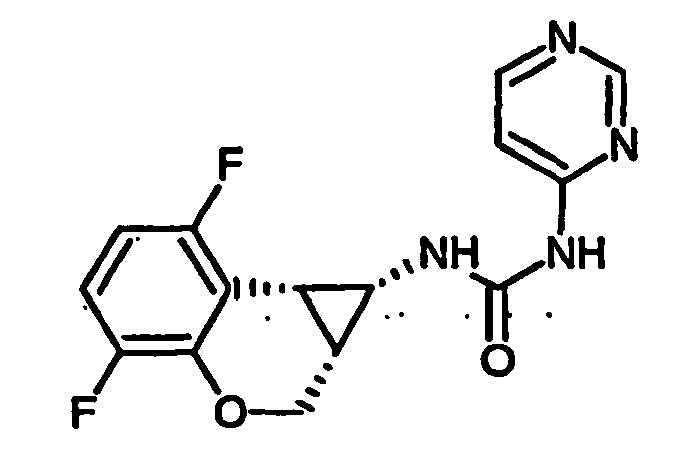
- (1S,1aR,7bS)-4,7-difluoro-1,1a,2,7b-tetrahydrocyclopropa[c]chromene-1-carboxylic acid (50mg, 0.22mmol, ee ~90%) was mixed with toluene (1ml), triethylamine (0.034 ml, 1.1eq), 4-aminopyrimidine (25 mg, 1.1eq), DPPA (0.054 ml, 1.1eq). The reaction mixture was then heated with stirring at 110°C for 3 h. The reaction mixture was concentrated by rotary evaporation and the product was crystallized from ethanol and collected by filtration to give 20 mg of the product as white solid.
- 1H-NMR (DMSO-d6): 9.71 (br s, 1H), 8.4 (br s, 1H), 8.39 (d, 1H), 7.86 (br s, 1H), 7.31 (d, 1H), 7.08 (m, 1H), 6.77 (dt, 1H), 4.31 (m, 2H), 3.48 (m, 1H), 2.48 (m, ~1H, overlapped with DMSO signal), 2.02 (m, 1H).
-

- (1S,1aR,7bS)-4,7-difluoro-1,1a,2,7b-tetrahydrocyclopropa[c]chromene-1-carboxylic acid (50mg, 0.22mmol, ee ~90%) was mixed with toluene (1ml), triethylamine (0.034 ml, 1.1eq), 4-aminopyrazine (25 mg, 1.1eq), DPPA (0.054 ml, 1.1eq). The reaction mixture was then heated with stirring at 110°C for 3 h. The reaction mixture was concentrated by rotary evaporation and the product was crystallized from ethanol and collected by filtration to give 5 mg of the product as white solid.
- 1H-NMR (DMSO-d6): 9.57 (br s, 1H), 8.67 (br s, 1H), 8.10 (d, 1H), 7.95 (br s, 1H), 7.64 (brs, 1H), 7.05 (m, 1H), 6.77 (dt, 1H), 4.31 (m, 2H), 3.49 (m, 1H), 2.48 (m, ~1H, overlapped with DMSO signal), 2.02 (m, 1H).
-

- (1S,1aR,7bS)-4,7-difluoro-1,1a,2,7b-tetrahydrocyclopropa[c]chromene-1-carboxylic acid (50mg, 0.22mmol, ee ~90%) was mixed with toluene (1ml), triethylamine (0.034 ml, 1.1eq), 3-amino-5-cyclopropyl-1H-pyrazole (30 mg, 1.1eq), DPPA (0.054 ml, 1.1 eq). The reaction mixture was then heated at stirring at 110°C for 3 h. The reaction mixture was concentrated by rotary evaporation and two compounds were separated by column chromatography on silica (50g, ethylacetate/hexane 1:3) to give 3 mg of the title product. The structure assignment was proved by 13C, gHMBC, gHMQC and NOESY NMR experiments.
- 1H-NMR (CDCl3): 7.05 (br d, ~1H), 6.88 (m, 1H), 6.64 (dt, 1H), 5.24 (d, 1H), 4.49 (dd, 1H), 4.33 (dd, 1H), 3.63 (m, 1H), 2.61 (m, -2H), 1.99 (m, 1H), 0.99 (m, 2H), 0.58 (m, 2H).
- Extensive guidance on the assay of test compounds at the enzyme level and in cell culture, including the isolation and/or selection of mutant HIV strains and mutant RT are found in DAIDS Virology Manual for HIV Laboratories complied by Division of AIDS, NIAID USA 1997. Resistance studies, including rational for various drug escape mutants is described in the HIV Resistance Collaborative Group Data Analysis Plan for Resistance Studies, revised 31 August 1999.
- Compounds of the invention are assayed for HIV activity, for example using multiple determinations with XTT in MT-4 cells (Weislow et al, J Nat Cancer Inst 1989, vol 81 no 8, 577 et seq), preferably including determinations in the presence of 40-50% human serum to indicate the contribution of protein binding. In short the XTT assay uses human T cell line MT4 cells grown in RPMI 1640 medium supplemented with 10% fetal calf serum (or 40-50% human serum as appropriate), penicillin and streptomycin seeded into 96 well microplates (2·104 cells/well) infected with 10-20 TCID50 per well of HIV-1IIIB (wild type) or mutant virus, such as those bearing RT Ile 100, Cys 181 or Asn 103 mutations. Serially diluted test compounds are added to respective wells and the culture incubated at 37°C in a CO2 enriched atmosphere and the viability of cells is determined at day five or six with XTT vital dye. Results are typically presented as ED50 µM.
- Compounds of the invention were assayed in the above XTT assay using wild type HIV-1IIIB as shown in Table I:
Table 1 Example ED50 (nM) Example 7 7 Example 16 6 Example 18 6 Example 19 10 Example 20 7 Example 23 7 Example 24 20 Example 30 3 Example 31 2.5 Example 33 9 Example 43 2 - Compounds are preferably potent against wild type virus and mutant HIV virus, especially virus comprising drug escape mutations. Drug escape mutations are those which arise in patients due to the selective pressure of a prior art antiviral and which confer enhanced resistance to that antiviral. The above cited Data Analysis Plan outlines relevant drug escape mutants for each of the antiviral classes currently on the market. Drug escape clones are readily isolated from HIV patients who are failing on a particular antiviral therapy. Alternatively the preparation of RT mutations on a known genetic background is shown in
WO97/27319 WO99/61658 WO00/73511 - K103 N is a particularly relevant drug escape mutant in the context of NNRTI therapy and compounds of the invention preferably have a low ED50 against this mutant, especially in assays mimicking the presence of human serum. Compounds of the invention, such as those exemplified above show sub micromolar activities in such assays.
Claims (46)
- A compound of the formula I:
 R1 is O, S;R2 is an optionally substituted nitrogen-containing heterocycle, wherein the nitrogen is located at the 2 position relative to the (thio)urea bond;R3 is H, C1-C3 alkyl,R4-R7 are independently selected from H, C1-C6 alkyl, C2-C6 alkenyl, C2-C6 alkynyl, haloC1-C6 alkyl, C1-C6 alkanoyl, haloC1-C6 alkanoyl, C1-C6 alkoxy, haloC1-C6 alkoxy, C1-C6 alkyloxy-C1-C6 alkyl, haloC1-C6 alkyloxy-C1-C6 alkyl hydroxy-C1-C6 alkyl, amino-C1-C6 alkyl, carboxy-C1-C6 alkyl, cyano-C1-C6 alkyl, amino, carboxy, carbamoyl, cyano, halo, hydroxy, keto;X is -(CHR8)n-D-(CHR8)m-;D is -NR9-, -O-, -S-, -S(=O)- or -S(=O)2-;R8 is independently H, C1-C3 alkyl, halo substituted C1-C3alkyl;R9 is H, C1-C3 alkyl;n and m are independently 0, 1 or 2;and prodrugs and pharmaceutically acceptable salts thereof.
 - A compound according to claim 1, wherein R1 is O.
- A compound according to claim 1, wherein R2 is optionally substituted: pyridyl, isoxazolyl, benzothiazolyl, pyrimidinyl, pyrazinyl or thiazolyl.
- A compound according to claim 3, wherein R2 is 5-substituted pyrid-2-yl.
- A compound according to claim 4, wherein the 5-substituent is halo, cyano, phenoxy or ethynyl.
- A compound according to claim 5 wherein the 5-substituent is cyano or chloro.
- A compound according to claim 1, wherein R3 is H.
- A compound according to claim 1, wherein the cyclopropyl moiety has an enantiomeric excess of the conformation depicted in the partial formulae:

- A compound according to claim 1 wherein the compound of formula I compises an enantiomeric excess of the isomer showing negative optical activity.
- A compound according to claim 1, wherein D is -O-
- A compound according to claim 1, wherein n is 0 and m is 1.
- A compound according to claim 11, wherein D is -O-.
- A compound according to claim 1, wherein R4 is hydrogen, halo or hydroxy.
- A compound according to claim 13, wherein R4 is fluoro.
- A compound according to claim 1 wherein R5 is hydrogen, halo, C1-3 alkylcarbonyl or C1-3alkyloxy.
- A compound according to claim 15, wherein R5 is hydrogen or fluoro.
- A compound according to claim 1, wherein R6 is hydrogen, halo, C1-C3alkyloxy, C1-3alkylcarbonyl, cyano or ethynyl.
- A compound according to claim 17 wherein R6 is hydrogen, methoxy or fluoro.
- A compound according to claim 1 wherein R7 is hydrogen, halo, C1-3alkyloxy, or C1-3alkyrcarbonyl.
- A compound according to claim 19, wherein R7 is fluoro.
- A compound according to claim 1, wherein R5 and R6 are H and R4 and R7 are halo.
- A compound according to claim 21, wherein R4 and R7 are fluoro.
- A compound according to claim 22, wherein D is -O-, n is 0, m is 1, R1 is O, R2 is substituted pyrid-2-yl and R3 is H.
- A compound according to claim 22, wherein D is -O-, n is0, mis 1, R1 is S, R2 is substituted pyrid-2-yl and R3 is H.
- A compound according to claim 23 wherein R2 is 5-chloropyridyl or 5-cyanopyridyl.
- A compound according to claim 24 wherein R2 is 5-chloropyridyl or 5-cyanopyridyl.
- A compound according to claim 1 selected fromcis-1-(5-Cyano-pyridin-2-yl)-3-(1,1a,2,7b-tetrahydro-cyclopropa[c]chromene-1-yl)-urea,cis-1-(5-Cyano-pyridin-2-yl)-3-(1,1a,3,7b-tetrahydro-2-oxa-cyclopropa[a]naphthalen-1-yl)-urea,cis-1-(5-Cyano-pyddin-2-yl)-3-(7-hydroxy-6-proplonyl-1,1a,2,7b-tetrahydro-cyclopropa[c]chromen-1-yl)-urea,cis-1-(6-Acetyl-7-hydroxy-1,1a,2,7b-tetrahydro-cyclopropa[c]chromen-1-yl)-3-(5-cyano-pyridin-2-yl)-urea,cis-1-(5-Cyanopyridin-2-yl)-3-(7-fluoro-4-propionyl-1,1a,2,7b-tetrahydro-cyclopropa[c]chromen-1-yl)-urea,cis-1-(5-Cyano-pyridin-2-yl)-3-(7-fluoro-4-methoxy-1,1a,2,7btetrahydro-cyclopropa[c]chromen-1-yl)-urea,cis-1-(5-Cyano-pyridin-2-yl)-3-(7-fluoro-4-chloro-1,1a,2,7b-tetrahydro-cyclopropa[c]chromen-1-yl)-urea,cis-1-(5-Chloro-pyridin-2-yl)-3-(4-chloro-7-fluoro-1,1a,2,7b-tetrahydro-cyclopropa[c]chromene-1-yl)-urea,cis-1-(5-Bromo-pyridin-2-yl)-3-(4-chloro-7-fluoro-1,1a,2,7b-tetrahydro-cyclopropa[c]chromene-1-yl)-urea,cis-1-(5-Cyano-pyridin-2-yl)-3-(5-cyano-1,1a,2,7b-tetrahydro-cyclopropa[c]chromen-1-yl)-urea,cis-1-(5-Cyano-pyridin-2-yl)-3-(5-ethynyl-1,1a,2,7b-tetrahydro-cyclopropa[c]chromen-1-yl)-urea,cis-1-(5-Acetyl-1,1a,2,7b-tatrahydro-cyclopropa[c]chromen-1-yl)-3-(5-cyano-pyridin-2-yl)-urea,cis-1-(5-Methoxy-1,1a,2,7b-tetrahydro-cyclopropa[c]chromen-1-yl)-3-(5-cyano-pyridin-2-yl)-urea,cis-1-(5-Cyano-pyridin-2-yl)-3-(N-acetyl-1,1a,3,7b-tetrahydro-2-oxa-cyctopropa[a]quinoline-1-yl))-urea,cis-1-(5-Cyano-3-methyl-pyridin-2-yl)-3-(4,7-difluoro-1,1a,2,7b-tetrahydro-cyclopropa[c]chromen-1-yl)-urea,cis-1-(4,7-Difluoro-1,1a,2,7b-tetrahydro-cyclopropa[c]chromen-1-yl)-3-(5-ethynyl-pyridin-2-yl)-urea,cis-1-(5-Bromo-pyridin-2-yl)-3-(4,7-difluoro-1,1a,2,7b-tetrahydro-cyclopropa[c]chromen-1-yl)-urea,cis-1-(4,7-Difluoro-1,1a,2,7b-tetrahydro-cyclopropa[c]chromen-1-yl)-3-(5-phenoxy-pyridin-2-yl)-urea,cis-1-(5-Cyano-pyridin-2-yl)-3-(4,7-difluoro-1,1a,2,7b-tetrahydro-cyclopropa[c]chromen-1-yl)-thiourea,1-(6-Chloro-5-cyano-pyridin-2-yl)-3-(5,7-difluoro-1,1a,2,7b-tetrahydro-cyclopropa[c]chromen-1-yl)urea,1-(5-Cyano-pyridin-2-yl)-3-(5,7-difluoro-1,1a,2,7b-tetrahydro-cyclopropa[c]chromen-1-yl)urea,cis-1-(4-Bromo-7-fluoro-1,1a,2,7b-tetrahydro-cyclopropa[c]chromen-1-yl)-3-(5-cyano-pyridin-2-yl)-urea,cis-1-(4-Bromo-7-fluoro-1,1a,2,7b-tetrahydro-cyclopropa[c]chromen-1-yl)-3-(6-chloro-5-cyano-pyridin-2-yl)-urea,cis-1-(4-Bromo-6-fluoro-1,1a,2,7btetrahydro-cyclopropa[c]chromen-1-yl)-3-(5-cyano-pyridin-2-yl)-urea,cis-1-(4-Bromo-6-fluoro-1,1a,2,7b-tetrahydro-cyclopropa[c]chromen-1-yl)-3-(6-cloro-5-cyano-pyridin-2-yl)-urea,cis-1-(5-Cyanopyridin-2-yl)-3-(6-fluoro-1,1a,2,7b-tetrahydro-cyclopropa[c]chromen-1-yl)urea,cis N-[1a, 6b-dihydro-1H-benzo[b]cyclopropa[d]thlen-1-yl]-N'-(5-cyano-2-pyridinyl)-urea,N-[(1S, 1aR, 7bR) or (1R, 1aS, 7bS)-1. 1a, 2, 7b-tetrahydrocyclopropa[c]-[1]benzothiopyran-1-yl]-N'-(5-cyano-2-pyridinyl) urea,cis-N-(5-bromo-2-pyridinyl)-N-(7-chloro-4-fluoro-1,1a,2,7b-tetrahydrocyclopropa[c]chromen-1-yl)urea,cis-N-(7-chloro-4-fluoro-1,1a,2,7b-tetrahydrocyclopropa[c]chromen-1-yl)-N-(5-chloro-2-pyridinyl)urea,cis-N-(7-chloro-4-fluoro-1,1a,2,7b-tetrahydrocyclopropa[c]chromen-1-yl-N-(5-cyano-2-pyridinyl)urea,cis-N-(5-phenoxy-2-pyridinyl)-N-(4,7-dichloro-1,1a,2,7b-tetrahydrocyclopropa[c]chromen-1-yl)urea,cis-N-(5-bromo-2-pyridinyl)-N-(4,7-dichloro-1,1a,2,7b-tetrahydrocyclopropa[c]chromen-1-yl)urea,cis-N-(5-chloro-2-pyridinyl)-N-(4,7-dichloro-1,1a,2,7b-tetrahydrocyclopropa[c]chromen-1-yl)urea,cis-N-(5-cyano-2-pyridinyl)-N-(4,7-dichloro-1,1a,2,7b-tetrahydrocyclopropa[c]chromen-1-yl)urea,N-[(1S,1aR,7bR)-4,7-difluoro-1,1a,2,7b-tetrahydrocyclopropa[c]chromen-1-yl]-N-(5-fluoro-2-pyridinyl)urea,N-[(1S,1aR,7bR)-4,7-difluoro-1,1a,2,7b-tetrahydrocyclopropa[c]chromen-1-yl]-N-(5-iodo-2-pyridinyl)urea,N-[(1S,1aR,7bR)-4,7-difluoro-1,1a,2,7b-tetrahydrocyclopropa[c]chromen-1-yl]-N-(3-isoxazolyl)urea,N-[(1S,1aR,7bR)-4,7-difluoro-1,1a,2,7b-tetrahydrocyclopropa[c]chromen-1-yl]-N-[4-(4-chlorophenyl)-1,3-thiazol-2-yl]urea,N-[(1S,1aR,7bR)-4,7-difluoro-1,1a,2,7,b-tetrahydrocyclopropa[c]chromen-1-yl]-N-(6-fluoro-1,3-benzothiazol-2-yl)urea,N-[(1S,1aR,7bR)-4,7-difluoro-1,1a,2,7b-tetrahydrocyclopropa[c]chromen-1-yl]-N-(4-pyrimidinyl)ureaN-[(1S,1aR,7bR)-4,7-difluoro-1,1a,2,7b-tetrahydrocyclopropa[c]chromen-1-yl]-N-(2-pyrazinyl)urea,N-[(1S,1aR,7bR)-4,7-difluoro-1,1a,2,7b-tetrahydrocyclopropa[c]chromen-1-yl]-N-(5-cyclopropyl-1H-pyrazol-3-yl)ureaand pharmaceutically acceptable salts thereof.
- A compound according to claim 27 selected from(-)-cis-1-(5-Cyano-pyridin-2-yl)-3-(4,7-difluoro-1,1a,2,7b-tetrahydro-cyclopropa[c]chromen-1-yl)-urea,(-) cis-1-(5-Chloro-pyridin-2-yl)-3-(4,7-difluoro-1,1a,2,7b-tetrahydro-cyclopropa[c]chromen-1-yl)-urea; or(-)-cis-1-(5-Cyano-pyridin-2-yl)-3-(4,7-difluoro-1,1a,2,7b-tetrahydro-cyclopropa[c]chromen-1-yl)-thiourea;and pharmaceutically acceptable salts thereof.
- A compound according to claim 1 selected from(-)-cis-1-(5-fluoropyridin-2-yl)-3-(4,7-difluoro-1,1a,2,7b-tetrahydro-cyclopropa[c]chromen-1-yl)-urea,(-)-cis-1-(5-fluoropyridin-2-yl)-3-(4,7-difluoro-1,1a,2,7b-tetrahydro-cyclopropa[c]chromen-1-yl)-thiourea;and pharmaceutically acceptable salts thereof.
- A pharmaceutical composition comprising a compound as defined in any one of claims 1-29 and a pharmaceutically acceptable carrier or diluent therefor.
- A compound as defined in claims 1-29 for use in therapy.
- Use of a compound as defined in any of claims 1-29 in the manufacture of a medicament for the treatment of patients infected with or exposed to HIV-1.
- Use according to claim 32, wherein the HIV-1 is a drug escape mutant.
- Use according to claim 33, wherein the drug escape mutant comprises the K103N mutation.
- A compound of the formula II:

R11 is -C(O)OR12, where R12 is H or a carboxy protecting group such as a lower alkyl ester; -NCO; -NCS or an amine such as NH2, with the proviso that the compound is not 1H-cyclopropa[b]benzofuran-1-carboxylic acid, 1a,6b-dihydro-, ethyl ester; 1H-benzo[b]cyclopropa[d]thiophene-1-carboxylic acid, 1a,6b-dihydro-, ethyl ester; 1H-cyclopropa[b]benzofuran-1-carboxylic acid, 1a,6b-dihydro-; 1H-benzo[b]cyclopropa[d]thiophene-1-carboxylic acid, 1a,6b-dihydro-2,2-dioxide or 1H-benzo[b]cyclopropa[d]thiophene-1-carboxylic acid, 1a,6b-dihydro-. - A compound according to claim 35 with the formula III:

- A compound according to claim 36, wherein R4 and R7 are fluoro.
- A compound of the formula IV:

- A compound according to claim 38 with the formula V:

- A compound according to claim 39 wherein R4 and R7 are fluoro
- A compound according to claim 39 where the protecting group is isopropyl, ethyl or preferably methyl.
- A compound according to claim 39 wherein PG* together with the adjacent O defines a keto group.
- A compound of the formula VI:

- A compound according to claim 43 with the formula VII:

- A compound according to claim 44, wherein R4 and R7 are fluoro.
- A compound according to claim 44, wherein PG is isopropyl, ethyl or preferably methyl.
Applications Claiming Priority (3)
| Application Number | Priority Date | Filing Date | Title |
|---|---|---|---|
| SE0100733A SE0100733D0 (en) | 2001-03-05 | 2001-03-05 | Non-nucleoside reverse transcriptase inhibitors |
| SE0100733 | 2001-03-05 | ||
| PCT/EP2002/002328 WO2002070516A2 (en) | 2001-03-05 | 2002-03-04 | Cyclopropaheterocycles as non-nucleoside reverse transcriptase inhibitors |
Publications (2)
| Publication Number | Publication Date |
|---|---|
| EP1373261A2 EP1373261A2 (en) | 2004-01-02 |
| EP1373261B1 true EP1373261B1 (en) | 2011-05-04 |
Family
ID=20283208
Family Applications (1)
| Application Number | Title | Priority Date | Filing Date |
|---|---|---|---|
| EP02748329A Expired - Lifetime EP1373261B1 (en) | 2001-03-05 | 2002-03-04 | Cyclopropaheterocycles as non-nucleoside reverse transcriptase inhibitors |
Country Status (21)
| Country | Link |
|---|---|
| US (3) | US6716850B2 (en) |
| EP (1) | EP1373261B1 (en) |
| JP (2) | JP4463478B2 (en) |
| KR (1) | KR100884494B1 (en) |
| CN (2) | CN1264839C (en) |
| AR (1) | AR035941A1 (en) |
| AT (1) | ATE508128T1 (en) |
| AU (1) | AU2002308231B2 (en) |
| BR (1) | BR0207886A (en) |
| CA (1) | CA2438524C (en) |
| DE (1) | DE60239924D1 (en) |
| DK (1) | DK1373261T3 (en) |
| ES (1) | ES2364926T3 (en) |
| IL (2) | IL157543A0 (en) |
| MX (1) | MXPA03008040A (en) |
| MY (1) | MY137083A (en) |
| PL (1) | PL207392B1 (en) |
| RU (1) | RU2281284C2 (en) |
| SE (1) | SE0100733D0 (en) |
| TW (1) | TWI228990B (en) |
| WO (1) | WO2002070516A2 (en) |
Families Citing this family (10)
| Publication number | Priority date | Publication date | Assignee | Title |
|---|---|---|---|---|
| ATE413174T1 (en) * | 2002-09-05 | 2008-11-15 | Medivir Ab | NON-NUCLEOSIDE REVERSE TRANSCRIPTASE INHIBITORS |
| WO2005037845A1 (en) * | 2003-10-17 | 2005-04-28 | Rigel Pharmaceuticals, Inc. | Benzothiazole and thiazole[5,5-b] pyridine compositions and their use as ubiquitin ligase inhibitors |
| AU2004312284B2 (en) * | 2004-01-08 | 2010-08-05 | Medivir Ab | Non-nucleotide reverse transcriptase inhibitors |
| SE0400021D0 (en) * | 2004-01-08 | 2004-01-08 | Medivir Ab | Non-nucleoside reverse transcriptase inhibitors |
| GB0608876D0 (en) | 2006-05-05 | 2006-06-14 | Medivir Ab | Combination therapy |
| ATE552245T1 (en) | 2006-05-15 | 2012-04-15 | Merck Sharp & Dohme | ANTIDIABETIC BICYCLIC COMPOUNDS |
| US9670231B2 (en) | 2013-06-28 | 2017-06-06 | Beigene, Ltd. | Fused tricyclic amide compounds as multiple kinase inhibitors |
| JP6380861B2 (en) | 2013-06-28 | 2018-08-29 | ベイジーン リミテッド | Condensed tricyclic urea compounds as Raf kinase and / or dimer inhibitors of Raf kinase |
| WO2015089842A1 (en) * | 2013-12-20 | 2015-06-25 | Merck Sharp & Dohme Corp. | Novel tricyclic calcium sensing receptor antagonists for the treatment of osteoporosis |
| TWI849043B (en) | 2019-01-25 | 2024-07-21 | 英屬開曼群島商百濟神州有限公司 | Stable solid dispersion of a b-raf kinase dimer inhibitor, methods of preparation, and uses therefor |
Family Cites Families (15)
| Publication number | Priority date | Publication date | Assignee | Title |
|---|---|---|---|---|
| CA973885A (en) * | 1969-08-22 | 1975-09-02 | Universal Oil Products Company | Vinylation of aromatic compounds |
| US3803175A (en) | 1969-08-22 | 1974-04-09 | Universal Oil Prod Co | Preparation of coumarin compounds |
| US4931221A (en) * | 1988-12-30 | 1990-06-05 | Ppg Industries, Inc. | Photochromic spiropyran compounds |
| IL102548A (en) | 1991-08-02 | 1998-08-16 | Medivir Ab | Thiourea derivatives for use in the preparation of medicaments for the inhibition of hiv and the treatment of aids and some such novel compounds |
| CA2115426C (en) * | 1991-08-14 | 2001-09-11 | Stanford Salvatore Pelosi Jr. | Novel cyclic ureas useful as antiarrhythmic and antifibrillatory agents |
| WO1993004061A1 (en) * | 1991-08-14 | 1993-03-04 | Procter & Gamble Pharmaceuticals | Novel 4-oxocyclic ureas useful as antiarrhythmic and antifibrillatory agents |
| DE69414708T2 (en) * | 1993-08-24 | 1999-04-15 | Medivir Ab, Huddinge | CONNECTIONS AND METHODS FOR INHIBITING HIV AND RELATED VIRUSES |
| DE69916425T2 (en) * | 1998-01-16 | 2005-05-19 | Medivir Ab | ANTIVIRAL MEDIUM |
| US5998411A (en) | 1998-03-17 | 1999-12-07 | Hughes Institute | Heterocyclic nonnucleoside inhibitors of reverse transcriptase |
| WO1999051613A1 (en) | 1998-04-03 | 1999-10-14 | Medivir Ab | Prodrugs of phosphorous-containing pharmaceuticals |
| US6136335A (en) | 1998-12-31 | 2000-10-24 | Hughes Institute | Phenethyl-5-bromopyridylthiourea (PBT) and dihydroalkoxybenzyloxopyrimidine (DABO) derivatives exhibiting spermicidal activity |
| US7186736B1 (en) | 1999-03-20 | 2007-03-06 | Parker Hughes Institute | NNI for treatment of multi-drug resistant HIV |
| US6469034B1 (en) | 1999-06-23 | 2002-10-22 | Parker Hughes Institute | Cyclohexenyl-ethyl-thiourea compounds for inhibiting HIV reverse transcriptase |
| US6124324A (en) | 1999-06-23 | 2000-09-26 | Hughes Institute | Thiophene-ethyl thiourea compounds and use |
| US6207688B1 (en) | 1999-06-23 | 2001-03-27 | Parker Hughes Institute | Phenethyl-thiourea compounds and use |
-
2001
- 2001-03-05 SE SE0100733A patent/SE0100733D0/en unknown
-
2002
- 2002-02-25 TW TW091103297A patent/TWI228990B/en not_active IP Right Cessation
- 2002-03-01 MY MYPI20020739A patent/MY137083A/en unknown
- 2002-03-04 IL IL15754302A patent/IL157543A0/en unknown
- 2002-03-04 EP EP02748329A patent/EP1373261B1/en not_active Expired - Lifetime
- 2002-03-04 ES ES02748329T patent/ES2364926T3/en not_active Expired - Lifetime
- 2002-03-04 WO PCT/EP2002/002328 patent/WO2002070516A2/en not_active Ceased
- 2002-03-04 DE DE60239924T patent/DE60239924D1/en not_active Expired - Lifetime
- 2002-03-04 CN CNB02806027XA patent/CN1264839C/en not_active Expired - Fee Related
- 2002-03-04 BR BR0207886-4A patent/BR0207886A/en not_active IP Right Cessation
- 2002-03-04 PL PL364414A patent/PL207392B1/en not_active IP Right Cessation
- 2002-03-04 JP JP2002569836A patent/JP4463478B2/en not_active Expired - Fee Related
- 2002-03-04 KR KR1020037011616A patent/KR100884494B1/en not_active Expired - Fee Related
- 2002-03-04 AU AU2002308231A patent/AU2002308231B2/en not_active Ceased
- 2002-03-04 MX MXPA03008040A patent/MXPA03008040A/en active IP Right Grant
- 2002-03-04 AT AT02748329T patent/ATE508128T1/en not_active IP Right Cessation
- 2002-03-04 CA CA2438524A patent/CA2438524C/en not_active Expired - Fee Related
- 2002-03-04 CN CN200610082490XA patent/CN101081843B/en not_active Expired - Fee Related
- 2002-03-04 DK DK02748329.6T patent/DK1373261T3/en active
- 2002-03-04 RU RU2003129513/04A patent/RU2281284C2/en not_active IP Right Cessation
- 2002-03-05 AR ARP020100797A patent/AR035941A1/en unknown
- 2002-03-05 US US10/092,752 patent/US6716850B2/en not_active Expired - Fee Related
-
2003
- 2003-02-28 US US10/377,057 patent/US6894177B2/en not_active Expired - Fee Related
- 2003-08-21 IL IL157543A patent/IL157543A/en not_active IP Right Cessation
-
2005
- 2005-03-02 US US11/071,675 patent/US7405310B2/en not_active Expired - Fee Related
-
2009
- 2009-02-10 JP JP2009028717A patent/JP2009102436A/en active Pending
Also Published As
Similar Documents
| Publication | Publication Date | Title |
|---|---|---|
| JP2009102436A (en) | Cyclopropa-heterocycle as non-nucleoside reverse transcriptase inhibitor | |
| AU2002308231A1 (en) | Cyclopropaheterocycles as non-nucleoside reverse transcriptase inhibitors | |
| EP1534276B1 (en) | Non-nucleoside reverse transcriptase inhibitors | |
| EP1701942B1 (en) | Non-nucleotide reverse transcriptase inhibitors | |
| US6610714B2 (en) | Non-nucleoside reverse transcriptase inhibitors | |
| CN1926108B (en) | Non-Nucleotide Reverse Transcriptase Inhibitors | |
| HK1111155B (en) | Non-nucleoside reverse transcriptase inhibitors | |
| MXPA06007726A (en) | Non-nucleotide reverse transcriptase inhibitors | |
| AU2002311031A1 (en) | Urea and thiourea derivatives as non-nucleoside reverse transcriptase inhibitors |
Legal Events
| Date | Code | Title | Description |
|---|---|---|---|
| PUAI | Public reference made under article 153(3) epc to a published international application that has entered the european phase |
Free format text: ORIGINAL CODE: 0009012 |
|
| 17P | Request for examination filed |
Effective date: 20030930 |
|
| AK | Designated contracting states |
Kind code of ref document: A2 Designated state(s): AT BE CH CY DE DK ES FI FR GB GR IE IT LI LU MC NL PT SE TR |
|
| AX | Request for extension of the european patent |
Extension state: AL LT LV MK RO SI |
|
| RIN1 | Information on inventor provided before grant (corrected) |
Inventor name: ODEN, LOURDES Inventor name: SAHLBERG, CHRISTER Inventor name: NAESLUND, LOTTA Inventor name: LINDSTROEM, STEFAN Inventor name: WALLBERG, HANS Inventor name: KALYANOV, GENAIDY |
|
| 17Q | First examination report despatched |
Effective date: 20070503 |
|
| RAP1 | Party data changed (applicant data changed or rights of an application transferred) |
Owner name: MEDIVIR AB |
|
| GRAP | Despatch of communication of intention to grant a patent |
Free format text: ORIGINAL CODE: EPIDOSNIGR1 |
|
| GRAS | Grant fee paid |
Free format text: ORIGINAL CODE: EPIDOSNIGR3 |
|
| GRAA | (expected) grant |
Free format text: ORIGINAL CODE: 0009210 |
|
| AK | Designated contracting states |
Kind code of ref document: B1 Designated state(s): AT BE CH CY DE DK ES FI FR GB GR IE IT LI LU MC NL PT SE TR |
|
| AX | Request for extension of the european patent |
Extension state: AL LT LV MK RO SI |
|
| REG | Reference to a national code |
Ref country code: GB Ref legal event code: FG4D |
|
| REG | Reference to a national code |
Ref country code: CH Ref legal event code: EP |
|
| REG | Reference to a national code |
Ref country code: IE Ref legal event code: FG4D |
|
| REF | Corresponds to: |
Ref document number: 60239924 Country of ref document: DE Date of ref document: 20110616 Kind code of ref document: P |
|
| REG | Reference to a national code |
Ref country code: DE Ref legal event code: R096 Ref document number: 60239924 Country of ref document: DE Effective date: 20110616 |
|
| REG | Reference to a national code |
Ref country code: CH Ref legal event code: NV Representative=s name: FIAMMENGHI-FIAMMENGHI |
|
| REG | Reference to a national code |
Ref country code: SE Ref legal event code: TRGR |
|
| REG | Reference to a national code |
Ref country code: NL Ref legal event code: T3 |
|
| REG | Reference to a national code |
Ref country code: DK Ref legal event code: T3 |
|
| REG | Reference to a national code |
Ref country code: ES Ref legal event code: FG2A Ref document number: 2364926 Country of ref document: ES Kind code of ref document: T3 Effective date: 20110916 |
|
| LTIE | Lt: invalidation of european patent or patent extension |
Effective date: 20110504 |
|
| PG25 | Lapsed in a contracting state [announced via postgrant information from national office to epo] |
Ref country code: PT Free format text: LAPSE BECAUSE OF FAILURE TO SUBMIT A TRANSLATION OF THE DESCRIPTION OR TO PAY THE FEE WITHIN THE PRESCRIBED TIME-LIMIT Effective date: 20110905 |
|
| PG25 | Lapsed in a contracting state [announced via postgrant information from national office to epo] |
Ref country code: AT Free format text: LAPSE BECAUSE OF FAILURE TO SUBMIT A TRANSLATION OF THE DESCRIPTION OR TO PAY THE FEE WITHIN THE PRESCRIBED TIME-LIMIT Effective date: 20110504 Ref country code: FI Free format text: LAPSE BECAUSE OF FAILURE TO SUBMIT A TRANSLATION OF THE DESCRIPTION OR TO PAY THE FEE WITHIN THE PRESCRIBED TIME-LIMIT Effective date: 20110504 Ref country code: CY Free format text: LAPSE BECAUSE OF FAILURE TO SUBMIT A TRANSLATION OF THE DESCRIPTION OR TO PAY THE FEE WITHIN THE PRESCRIBED TIME-LIMIT Effective date: 20110504 Ref country code: GR Free format text: LAPSE BECAUSE OF FAILURE TO SUBMIT A TRANSLATION OF THE DESCRIPTION OR TO PAY THE FEE WITHIN THE PRESCRIBED TIME-LIMIT Effective date: 20110805 |
|
| PLBE | No opposition filed within time limit |
Free format text: ORIGINAL CODE: 0009261 |
|
| STAA | Information on the status of an ep patent application or granted ep patent |
Free format text: STATUS: NO OPPOSITION FILED WITHIN TIME LIMIT |
|
| 26N | No opposition filed |
Effective date: 20120207 |
|
| PGFP | Annual fee paid to national office [announced via postgrant information from national office to epo] |
Ref country code: IE Payment date: 20120323 Year of fee payment: 11 Ref country code: CH Payment date: 20120314 Year of fee payment: 11 |
|
| REG | Reference to a national code |
Ref country code: DE Ref legal event code: R097 Ref document number: 60239924 Country of ref document: DE Effective date: 20120207 |
|
| PGFP | Annual fee paid to national office [announced via postgrant information from national office to epo] |
Ref country code: IT Payment date: 20120326 Year of fee payment: 11 Ref country code: GB Payment date: 20120326 Year of fee payment: 11 Ref country code: BE Payment date: 20120326 Year of fee payment: 11 Ref country code: DK Payment date: 20120323 Year of fee payment: 11 Ref country code: SE Payment date: 20120322 Year of fee payment: 11 |
|
| PGFP | Annual fee paid to national office [announced via postgrant information from national office to epo] |
Ref country code: DE Payment date: 20120327 Year of fee payment: 11 Ref country code: NL Payment date: 20120402 Year of fee payment: 11 |
|
| PGFP | Annual fee paid to national office [announced via postgrant information from national office to epo] |
Ref country code: FR Payment date: 20120413 Year of fee payment: 11 |
|
| PG25 | Lapsed in a contracting state [announced via postgrant information from national office to epo] |
Ref country code: MC Free format text: LAPSE BECAUSE OF NON-PAYMENT OF DUE FEES Effective date: 20120331 |
|
| PGFP | Annual fee paid to national office [announced via postgrant information from national office to epo] |
Ref country code: ES Payment date: 20120321 Year of fee payment: 11 |
|
| BERE | Be: lapsed |
Owner name: MEDIVIR A.B. Effective date: 20130331 |
|
| REG | Reference to a national code |
Ref country code: NL Ref legal event code: V1 Effective date: 20131001 |
|
| REG | Reference to a national code |
Effective date: 20130331 Ref country code: DK Ref legal event code: EBP |
|
| REG | Reference to a national code |
Ref country code: SE Ref legal event code: EUG |
|
| PG25 | Lapsed in a contracting state [announced via postgrant information from national office to epo] |
Ref country code: SE Free format text: LAPSE BECAUSE OF NON-PAYMENT OF DUE FEES Effective date: 20130305 |
|
| REG | Reference to a national code |
Ref country code: CH Ref legal event code: PL |
|
| GBPC | Gb: european patent ceased through non-payment of renewal fee |
Effective date: 20130304 |
|
| REG | Reference to a national code |
Ref country code: FR Ref legal event code: ST Effective date: 20131129 |
|
| REG | Reference to a national code |
Ref country code: IE Ref legal event code: MM4A |
|
| REG | Reference to a national code |
Ref country code: DE Ref legal event code: R119 Ref document number: 60239924 Country of ref document: DE Effective date: 20131001 |
|
| PG25 | Lapsed in a contracting state [announced via postgrant information from national office to epo] |
Ref country code: FR Free format text: LAPSE BECAUSE OF NON-PAYMENT OF DUE FEES Effective date: 20130402 Ref country code: DE Free format text: LAPSE BECAUSE OF NON-PAYMENT OF DUE FEES Effective date: 20131001 Ref country code: GB Free format text: LAPSE BECAUSE OF NON-PAYMENT OF DUE FEES Effective date: 20130304 Ref country code: LI Free format text: LAPSE BECAUSE OF NON-PAYMENT OF DUE FEES Effective date: 20130331 Ref country code: CH Free format text: LAPSE BECAUSE OF NON-PAYMENT OF DUE FEES Effective date: 20130331 Ref country code: BE Free format text: LAPSE BECAUSE OF NON-PAYMENT OF DUE FEES Effective date: 20130331 Ref country code: IE Free format text: LAPSE BECAUSE OF NON-PAYMENT OF DUE FEES Effective date: 20130304 |
|
| PG25 | Lapsed in a contracting state [announced via postgrant information from national office to epo] |
Ref country code: IT Free format text: LAPSE BECAUSE OF NON-PAYMENT OF DUE FEES Effective date: 20130304 Ref country code: NL Free format text: LAPSE BECAUSE OF NON-PAYMENT OF DUE FEES Effective date: 20131001 |
|
| PG25 | Lapsed in a contracting state [announced via postgrant information from national office to epo] |
Ref country code: TR Free format text: LAPSE BECAUSE OF FAILURE TO SUBMIT A TRANSLATION OF THE DESCRIPTION OR TO PAY THE FEE WITHIN THE PRESCRIBED TIME-LIMIT Effective date: 20110504 Ref country code: DK Free format text: LAPSE BECAUSE OF NON-PAYMENT OF DUE FEES Effective date: 20130331 |
|
| PG25 | Lapsed in a contracting state [announced via postgrant information from national office to epo] |
Ref country code: LU Free format text: LAPSE BECAUSE OF NON-PAYMENT OF DUE FEES Effective date: 20120304 |
|
| REG | Reference to a national code |
Ref country code: ES Ref legal event code: FD2A Effective date: 20140606 |
|
| PG25 | Lapsed in a contracting state [announced via postgrant information from national office to epo] |
Ref country code: ES Free format text: LAPSE BECAUSE OF NON-PAYMENT OF DUE FEES Effective date: 20130305 |