EP1371624A1 - Verfahren zur Herstellung von 2-Chloro-1,1,1-trialkoxyethan - Google Patents
Verfahren zur Herstellung von 2-Chloro-1,1,1-trialkoxyethan Download PDFInfo
- Publication number
- EP1371624A1 EP1371624A1 EP03009111A EP03009111A EP1371624A1 EP 1371624 A1 EP1371624 A1 EP 1371624A1 EP 03009111 A EP03009111 A EP 03009111A EP 03009111 A EP03009111 A EP 03009111A EP 1371624 A1 EP1371624 A1 EP 1371624A1
- Authority
- EP
- European Patent Office
- Prior art keywords
- trialkoxyethane
- chloro
- preparation
- alcohol
- reaction
- Prior art date
- Legal status (The legal status is an assumption and is not a legal conclusion. Google has not performed a legal analysis and makes no representation as to the accuracy of the status listed.)
- Withdrawn
Links
- 238000000034 method Methods 0.000 title claims description 24
- 238000004519 manufacturing process Methods 0.000 title description 2
- 238000002360 preparation method Methods 0.000 claims abstract description 18
- LFQSCWFLJHTTHZ-UHFFFAOYSA-N Ethanol Chemical compound CCO LFQSCWFLJHTTHZ-UHFFFAOYSA-N 0.000 claims abstract description 17
- KZBUYRJDOAKODT-UHFFFAOYSA-N Chlorine Chemical compound ClCl KZBUYRJDOAKODT-UHFFFAOYSA-N 0.000 claims abstract description 4
- 239000002585 base Substances 0.000 claims description 11
- 238000006243 chemical reaction Methods 0.000 claims description 10
- 125000004432 carbon atom Chemical group C* 0.000 claims description 5
- 239000003513 alkali Substances 0.000 claims description 2
- 125000000959 isobutyl group Chemical group [H]C([H])([H])C([H])(C([H])([H])[H])C([H])([H])* 0.000 claims description 2
- 125000001449 isopropyl group Chemical group [H]C([H])([H])C([H])(*)C([H])([H])[H] 0.000 claims description 2
- 125000002496 methyl group Chemical group [H]C([H])([H])* 0.000 claims description 2
- 125000004108 n-butyl group Chemical group [H]C([H])([H])C([H])([H])C([H])([H])C([H])([H])* 0.000 claims description 2
- 125000001436 propyl group Chemical group [H]C([*])([H])C([H])([H])C([H])([H])[H] 0.000 claims description 2
- OKTJSMMVPCPJKN-UHFFFAOYSA-N Carbon Chemical group [C] OKTJSMMVPCPJKN-UHFFFAOYSA-N 0.000 claims 1
- 125000003545 alkoxy group Chemical group 0.000 claims 1
- 125000000484 butyl group Chemical group [H]C([*])([H])C([H])([H])C([H])([H])C([H])([H])[H] 0.000 claims 1
- 125000001495 ethyl group Chemical group [H]C([H])([H])C([H])([H])* 0.000 claims 1
- 239000002904 solvent Substances 0.000 abstract description 6
- 125000004122 cyclic group Chemical group 0.000 abstract description 2
- 239000000376 reactant Substances 0.000 abstract description 2
- 125000000217 alkyl group Chemical group 0.000 abstract 1
- OKKJLVBELUTLKV-UHFFFAOYSA-N Methanol Chemical compound OC OKKJLVBELUTLKV-UHFFFAOYSA-N 0.000 description 18
- 238000004821 distillation Methods 0.000 description 15
- ZAMOUSCENKQFHK-UHFFFAOYSA-N Chlorine atom Chemical compound [Cl] ZAMOUSCENKQFHK-UHFFFAOYSA-N 0.000 description 12
- JRNVZBWKYDBUCA-UHFFFAOYSA-N N-chlorosuccinimide Chemical compound ClN1C(=O)CCC1=O JRNVZBWKYDBUCA-UHFFFAOYSA-N 0.000 description 12
- 239000000460 chlorine Substances 0.000 description 12
- 229910052801 chlorine Inorganic materials 0.000 description 12
- 239000000203 mixture Substances 0.000 description 8
- 238000010992 reflux Methods 0.000 description 8
- 239000007787 solid Substances 0.000 description 6
- NPEIUNVTLXEOLT-UHFFFAOYSA-N 2-chloro-1,1,1-trimethoxyethane Chemical compound COC(CCl)(OC)OC NPEIUNVTLXEOLT-UHFFFAOYSA-N 0.000 description 4
- XBDQKXXYIPTUBI-UHFFFAOYSA-M Propionate Chemical compound CCC([O-])=O XBDQKXXYIPTUBI-UHFFFAOYSA-M 0.000 description 4
- KXKVLQRXCPHEJC-UHFFFAOYSA-N acetic acid trimethyl ester Natural products COC(C)=O KXKVLQRXCPHEJC-UHFFFAOYSA-N 0.000 description 4
- 150000001298 alcohols Chemical class 0.000 description 4
- 150000002905 orthoesters Chemical class 0.000 description 4
- 239000011541 reaction mixture Substances 0.000 description 4
- -1 (monochlorinated acetic acid orthoesters Chemical class 0.000 description 3
- NDQXKKFRNOPRDW-UHFFFAOYSA-N 1,1,1-triethoxyethane Chemical compound CCOC(C)(OCC)OCC NDQXKKFRNOPRDW-UHFFFAOYSA-N 0.000 description 3
- HDPNBNXLBDFELL-UHFFFAOYSA-N 1,1,1-trimethoxyethane Chemical compound COC(C)(OC)OC HDPNBNXLBDFELL-UHFFFAOYSA-N 0.000 description 3
- WVDDGKGOMKODPV-UHFFFAOYSA-N Benzyl alcohol Chemical compound OCC1=CC=CC=C1 WVDDGKGOMKODPV-UHFFFAOYSA-N 0.000 description 3
- 239000006227 byproduct Substances 0.000 description 3
- 230000003197 catalytic effect Effects 0.000 description 3
- 150000008280 chlorinated hydrocarbons Chemical class 0.000 description 3
- 238000005660 chlorination reaction Methods 0.000 description 3
- URFKLQSFBXBOQU-UHFFFAOYSA-N 2-chloro-1,1,1-triethoxyethane Chemical compound CCOC(CCl)(OCC)OCC URFKLQSFBXBOQU-UHFFFAOYSA-N 0.000 description 2
- DGAQECJNVWCQMB-PUAWFVPOSA-M Ilexoside XXIX Chemical compound C[C@@H]1CC[C@@]2(CC[C@@]3(C(=CC[C@H]4[C@]3(CC[C@@H]5[C@@]4(CC[C@@H](C5(C)C)OS(=O)(=O)[O-])C)C)[C@@H]2[C@]1(C)O)C)C(=O)O[C@H]6[C@@H]([C@H]([C@@H]([C@H](O6)CO)O)O)O.[Na+] DGAQECJNVWCQMB-PUAWFVPOSA-M 0.000 description 2
- JUJWROOIHBZHMG-UHFFFAOYSA-N Pyridine Chemical compound C1=CC=NC=C1 JUJWROOIHBZHMG-UHFFFAOYSA-N 0.000 description 2
- WQDUMFSSJAZKTM-UHFFFAOYSA-N Sodium methoxide Chemical compound [Na+].[O-]C WQDUMFSSJAZKTM-UHFFFAOYSA-N 0.000 description 2
- 230000015572 biosynthetic process Effects 0.000 description 2
- 239000002994 raw material Substances 0.000 description 2
- 229910052708 sodium Inorganic materials 0.000 description 2
- 239000011734 sodium Substances 0.000 description 2
- 239000007858 starting material Substances 0.000 description 2
- 239000000126 substance Substances 0.000 description 2
- KZNICNPSHKQLFF-UHFFFAOYSA-N succinimide Chemical compound O=C1CCC(=O)N1 KZNICNPSHKQLFF-UHFFFAOYSA-N 0.000 description 2
- 238000003786 synthesis reaction Methods 0.000 description 2
- VZGDMQKNWNREIO-UHFFFAOYSA-N tetrachloromethane Chemical compound ClC(Cl)(Cl)Cl VZGDMQKNWNREIO-UHFFFAOYSA-N 0.000 description 2
- PPKPKFIWDXDAGC-IHWYPQMZSA-N (z)-1,2-dichloroprop-1-ene Chemical compound C\C(Cl)=C\Cl PPKPKFIWDXDAGC-IHWYPQMZSA-N 0.000 description 1
- 150000000183 1,3-benzoxazoles Chemical class 0.000 description 1
- UJTTUOLQLCQZEA-UHFFFAOYSA-N 9h-fluoren-9-ylmethyl n-(4-hydroxybutyl)carbamate Chemical compound C1=CC=C2C(COC(=O)NCCCCO)C3=CC=CC=C3C2=C1 UJTTUOLQLCQZEA-UHFFFAOYSA-N 0.000 description 1
- LRHPLDYGYMQRHN-UHFFFAOYSA-N N-Butanol Chemical class CCCCO LRHPLDYGYMQRHN-UHFFFAOYSA-N 0.000 description 1
- ZLMJMSJWJFRBEC-UHFFFAOYSA-N Potassium Chemical compound [K] ZLMJMSJWJFRBEC-UHFFFAOYSA-N 0.000 description 1
- GHVZOJONCUEWAV-UHFFFAOYSA-N [K].CCO Chemical compound [K].CCO GHVZOJONCUEWAV-UHFFFAOYSA-N 0.000 description 1
- 239000002253 acid Substances 0.000 description 1
- 239000004480 active ingredient Substances 0.000 description 1
- 230000001476 alcoholic effect Effects 0.000 description 1
- 150000008044 alkali metal hydroxides Chemical class 0.000 description 1
- 150000001412 amines Chemical class 0.000 description 1
- IOJUPLGTWVMSFF-UHFFFAOYSA-N benzothiazole Chemical class C1=CC=C2SC=NC2=C1 IOJUPLGTWVMSFF-UHFFFAOYSA-N 0.000 description 1
- 235000019445 benzyl alcohol Nutrition 0.000 description 1
- 238000009835 boiling Methods 0.000 description 1
- 230000015556 catabolic process Effects 0.000 description 1
- 150000001805 chlorine compounds Chemical class 0.000 description 1
- 238000001816 cooling Methods 0.000 description 1
- 239000006184 cosolvent Substances 0.000 description 1
- 238000006731 degradation reaction Methods 0.000 description 1
- 125000003963 dichloro group Chemical group Cl* 0.000 description 1
- 150000002168 ethanoic acid esters Chemical class 0.000 description 1
- 239000008187 granular material Substances 0.000 description 1
- 150000008282 halocarbons Chemical class 0.000 description 1
- 125000000623 heterocyclic group Chemical group 0.000 description 1
- 150000002596 lactones Chemical class 0.000 description 1
- 239000007788 liquid Substances 0.000 description 1
- MAYUCBCSAVDUKG-UHFFFAOYSA-N orthoacetic acid Chemical class CC(O)(O)O MAYUCBCSAVDUKG-UHFFFAOYSA-N 0.000 description 1
- 229910052700 potassium Inorganic materials 0.000 description 1
- 239000011591 potassium Substances 0.000 description 1
- BDAWXSQJJCIFIK-UHFFFAOYSA-N potassium methoxide Chemical compound [K+].[O-]C BDAWXSQJJCIFIK-UHFFFAOYSA-N 0.000 description 1
- LPNYRYFBWFDTMA-UHFFFAOYSA-N potassium tert-butoxide Chemical compound [K+].CC(C)(C)[O-] LPNYRYFBWFDTMA-UHFFFAOYSA-N 0.000 description 1
- ZUPDNLCLXSWMAE-UHFFFAOYSA-N potassium;butan-2-olate Chemical compound [K+].CCC(C)[O-] ZUPDNLCLXSWMAE-UHFFFAOYSA-N 0.000 description 1
- 239000000843 powder Substances 0.000 description 1
- 239000000047 product Substances 0.000 description 1
- BDERNNFJNOPAEC-UHFFFAOYSA-N propan-1-ol Chemical class CCCO BDERNNFJNOPAEC-UHFFFAOYSA-N 0.000 description 1
- 239000012063 pure reaction product Substances 0.000 description 1
- 238000000746 purification Methods 0.000 description 1
- UMJSCPRVCHMLSP-UHFFFAOYSA-N pyridine Natural products COC1=CC=CN=C1 UMJSCPRVCHMLSP-UHFFFAOYSA-N 0.000 description 1
- 230000035484 reaction time Effects 0.000 description 1
- LMHHRCOWPQNFTF-UHFFFAOYSA-N s-propan-2-yl azepane-1-carbothioate Chemical compound CC(C)SC(=O)N1CCCCCC1 LMHHRCOWPQNFTF-UHFFFAOYSA-N 0.000 description 1
- 238000000926 separation method Methods 0.000 description 1
- QDRKDTQENPPHOJ-UHFFFAOYSA-N sodium ethoxide Chemical compound [Na+].CC[O-] QDRKDTQENPPHOJ-UHFFFAOYSA-N 0.000 description 1
- 238000001228 spectrum Methods 0.000 description 1
- 229960002317 succinimide Drugs 0.000 description 1
- 239000002699 waste material Substances 0.000 description 1
- 238000010626 work up procedure Methods 0.000 description 1
Classifications
-
- C—CHEMISTRY; METALLURGY
- C07—ORGANIC CHEMISTRY
- C07C—ACYCLIC OR CARBOCYCLIC COMPOUNDS
- C07C41/00—Preparation of ethers; Preparation of compounds having groups, groups or groups
- C07C41/60—Preparation of compounds having groups or groups
Definitions
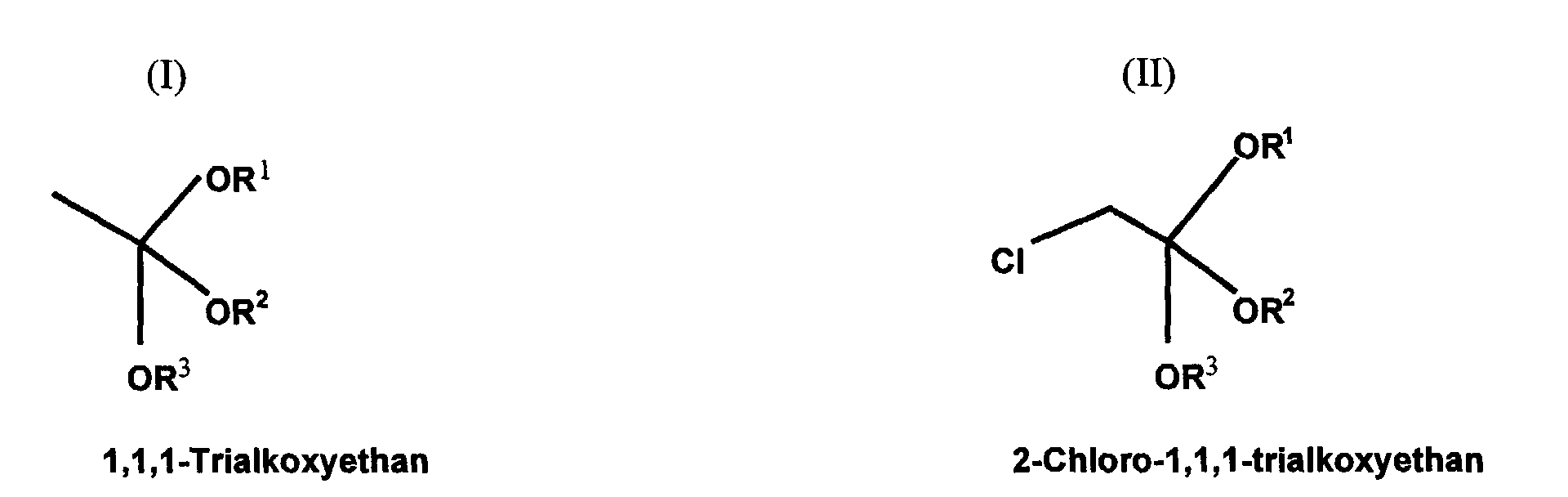
- the invention relates to a process for the preparation of 2-chloro-1,1,1-trialkoxyethane (II) (monochlorinated acetic acid orthoesters) by reacting 1,1,1-trialkoxyethane (I) (orthoacetic acid esters) with chlorine, preferably in the presence of alcohols and preferably in the presence of catalytic amounts of a base:
- 2-Chloro-1,1,1-trialkoxyethane chlorinated orthoacetic acid esters
- 2-Chloro-1,1,1-trialkoxyethane chlorinated orthoacetic acid esters
- 2-chloro-1,1,1-trialkoxyethane serves as a building block with an amine as a reactant for the preparation of substituted acid amidoesters.
- synth. Commun. 19 (16) 2921-2924 describes both the use of 2-chloro-1,1,1-triethoxyethane as a versatile building block for the preparation of benzothiazoles and benzoxazoles and the preparation by reacting triethyl orthoacetate with N-chlorosuccinimide.
- the production of 2-chloro-1,1,1-orthoesters is carried out according to the prior art by reacting orthoesters with chlorosuccinimide in large quantities in chlorinated hydrocarbons.
- the European patent application EP 0 222 576 describes the synthesis of 2-chloro-1,1,1-triethoxyethane starting from 1,1,1-triethoxyethane with N-chlorosuccinimide in the presence of carbon tetrachloride as solvent.
- 2-chloro-1,1,1 - (C1-C4) -alkoxyethane by reaction of 1 , 1,1- (C1-C4) -alkoxyethane is synthesized with N-chlorosuccinimide in the presence of chlorinated hydrocarbons as solvents.
- a further synthetic route is proposed, the same starting material being reacted with chlorine in the presence of stoichiometric amounts of pyridine as the base, chlorinated hydrocarbon serving as the cosolvent.
- the alkoxy radicals R 1 , R 2 and R 3 are the same or different and contain 1 to 8, preferably 1 to 6 and particularly preferably 1 to 4 carbon atoms in the alkyl radical. However, they can also be connected to one another via an alkylene bridge.
- the methyl, propyl, isopropyl, n-butyl, isobutyl and sec-butyl radicals may be mentioned as alkyl radicals. In the case of an alkylene bridge, this preferably contains 2 to 3 carbon atoms.
- the alcohol can be linear or branched or can also contain an aromatic radical. The total number of carbon atoms in the alcohol is 1 to 10. Examples include methanol, ethanol, the isomeric propanols, the isomeric butanols and benzyl alcohol.
- the inventive method is carried out at - 20 ° C to + 100 ° C and preferably at normal pressure.
- Low overpressures up to about 10 bar, preferably 5 bar (absolute) should not be excluded.
- Relatively small amounts of solvents are used, preference being given to low-boiling, low-molecular alcohols which can be easily separated off by distillation.
- the proportion of alcohols is generally 0.1 to 20%, preferably 5 to 20%, based on the 1,1,1-trialkoxyethane used.
- the reaction can also be started entirely without an alcohol, in which case the work-up by distillation to obtain the pure reaction product is even easier.
- the use of catalytic amounts of a base at the start of the chlorination proved to be surprisingly, as advantageous.
- the bases can be used as a pure substance, for example as Solid in powder or granule form or also used as an alcoholic solution become. According to the invention, the amounts of pure base, if used, should be between 0.1 and 10%, preferably between 0.2 and 1% (based on trialkoxyethane used), lie.
- the alcohol content that can be used to dissolve the base should preferably be used from an economic point of view not greater than 20% based on the used Orthoester amount.
- the process can be operated batchwise or continuously. If the process is carried out continuously, only as many parts are added to the reaction mixture as are added to educts, so that the fill level in the reactor remains constant. When starting the reaction, it is advisable to bring sales to a very high level. Depending on the heat of reaction that can be removed, the required reaction or residence times are in a range of 2-10 hours. The times are essentially determined by the available cooling capacity and the reactor design. However, all of the process variants mentioned bring better conversion within short reaction times with very high selectivity compared to conventional processes according to the prior art.
- the dichloro content of the orthoester is usually well below two percent, so that the purification by distillation with economically tolerable distillation losses leads to a highly pure monochloroorthoacetate.
- no solids or - with the exception of the use of small amounts of alkali alcoholate - in the form of chlorides.
- such small amounts of solid of approx. 0.1 to 1% can easily be separated mechanically, for example with simple filter candles, before the reaction mixture is worked up by distillation, as a result of which solid deposits are avoided in the distillation plants.
Landscapes
- Chemical & Material Sciences (AREA)
- Organic Chemistry (AREA)
- Organic Low-Molecular-Weight Compounds And Preparation Thereof (AREA)
- Low-Molecular Organic Synthesis Reactions Using Catalysts (AREA)
Abstract
Description
In Synth. Commun. 19 (16), 2921 - 2924 wird sowohl die Anwendung von 2-Chloro-1,1,1-triethoxyethan als vielseitiger Baustein zur Herstellung von Benzothiazolen und Benzoxazolen als auch die Herstellung durch Umsetzung von Triethylorthoacetat mit N-Chlorsuccinimid beschrieben.
Die Herstellung von 2-Chloro-1,1,1-orthoestem wird nach dem Stand der Technik durch Umsetzung von Orthoestern mit Chlorsuccinimid vielfach in großen Mengen chlorierter Kohlenwasserstoffe ausgeführt. So wird in der europäischen Patentanmeldung EP 0 222 576 die Synthese von 2-Chloro-1,1,1-triethoxyethan ausgehend von 1,1,1-Triethoxyethan mit N-Chlorsuccinimid in Gegenwart von Tetrachlorkohlenstoff als Lösemittel beschrieben. Weitere Beispiele nach dem Stand der Technik sind in den Patentschriften EP 0 222 576 und US 4 748 280 (31.7.1987) zu finden, wobei 2-Chloro- 1,1,1 -(C1-C4)-alkoxyethan durch Umsetzung von 1,1,1-(C1-C4)-alkoxyethan mit N-Chlorsuccinimid in Gegenwart von chlorierten Kohlenwasserstoffen als Lösemittel synthetisiert wird. In der zuletzt zitierten Patentschrift wird ein weiterer Syntheseweg vorgeschlagen, wobei das gleiche Edukt mit Chlor in Gegenwart von stöchiometrischen Mengen Pyridin als Base umgesetzt wird, wobei Chlorkohlenwasserstoff als Cosolvens dient.
Der Alkohol kann linear oder verzweigt sein oder auch einen aromatischen Rest enthalten. Die Gesamtzahl der Kohlenstoffatome im Alkohol beträgt 1 bis 10. Als Beispiele seien Methanol, Ethanol, die isomeren Propanole, die isomeren Butanole und Benzylalkohol genannt.
Zur Chlorierung wird gasförmiges oder flüssiges Chlor eingesetzt, das in den Reaktor beziehungsweise in das Orthoacetat oder die vorgelegte Mischung Orthoacetat/Alkohol dosiert wird. Weil die Chlorierung stark exotherm ist (ΔH ca. - 100 kJ/mol), wird Chlor vorzugsweise absatzweise oder langsam mit einer geringen Dosierrate hinzugefahren, so dass die Innentemperatur nicht so weit ansteigt, dass die Selektivität negativ beeinflusst wird. Es wurde festgestellt, dass ein tolerabel geringes Nebenproduktspektrum innerhalb eines Temperaturbereiches von - 20 °C bis maximal 100 °C auftrat.
Alle erwähnten Verfahrensvarianten bringen jedoch gegenüber herkömmlichen Verfahren nach dem Stand der Technik einen besseren Umsatz innerhalb kurzer Reaktionszeiten bei sehr hoher Selektivität. Der Dichloranteil des Orthoesters liegt in Abhängigkeit vom Orthoester oder dem eingesetzten Alkoholanteil meist weit unter zwei Prozent, so dass die destillative Reinigung unter wirtschaftlich tolerablen Destillationsverlusten zu einem hochreinen Monochlororthoacetat führt.
Im Unterschied zu herkömmlichen Verfahren fallen keine Feststoffe oder - mit Ausnahme bei Verwendung von geringen Mengen Alkalialkoholat - in Form von Chloriden an. Derart geringe Mengen Feststoff von ca. 0,1 bis 1 % lassen sich jedoch leicht mechanisch zum Beispiel mit einfachen Filterkerzen abtrennen, bevor die Reaktionsmischung destillativ aufgearbeitet wird, wodurch Feststoffablagerungen in den Destillationsanlagen vermieden werden.
Claims (12)
- Verfahren zur Herstellung von 2-Chloro-1,1,1-trialkoxyethan durch Umsetzung von 1,1,1-Trialkoxyethan mit gasförmigem oder flüssigem Chlor, wobei die Alkoxyreste gleich oder verschieden oder über eine Alkylenbrücke verbunden sein können, in Gegenwart von 0,1 % bis 20 % Alkohol.
- Verfahren zur Herstellung von 2-Chloro-1,1,1-trialkoxyethan nach Anspruch 1,
dadurch gekennzeichnet, dass die Alkoxyreste 1 bis 8 Kohlenstoffatome enthalten. - Verfahren zur Herstellung von 2-Chloro-1,1,1 -trialkoxyethan nach Anspruch 2,
dadurch gekennzeichnet, dass die Alkyoxyreste eine Methyl-, Ethyl-, Propyl-, Isopropyl-, n-Butyl-, Isobutyl- oder sec. Butylgruppen tragen oder im Falle einer Alkylenbrücke die Brücke 2 - 3 Kohlenstoffe trägt. - Verfahren zur Herstellung von 2-Chloro-1,1,1 -trialkoxyethan nach Anspruch 1,
dadurch gekennzeichnet, dass ein Alkohol mit 1 bis 10 Kohlenstoffatomen anwesend ist. - Verfahren zur Herstellung von 2-Chloro-1,1,1-trialkoxyethan nach Anspruch 4,
dadurch gekennzeichnet, dass der Alkohol eine geradkettig oder verzweigte Kohlenstoffkette oder auch einen aromatischen Rest enthält. - Verfahren zur Herstellung von 2-Chloro-1,1,1-trialkoxyethan nach Anspruch 1,
dadurch gekennzeichnet, dass die Alkoholmengen bezogen auf das eingesetzte 1,1,1-Trialkoxyethan 5 % bis 20 % betragen. - Verfahren zur Herstellung von 2-Chloro-1,1,1-trialkoxyethan nach einem der vorhergehenden Ansprüche,
dadurch gekennzeichnet, dass eine Base zugesetzt wird. - Verfahren zur Herstellung von 2-Chloro-1,1,1-trialkoxyethan nach einem der vorhergehenden Ansprüche,
dadurch gekennzeichnet, dass die Base ein Alkalialkoholat ist. - Verfahren zur Herstellung von 2-Chloro-1,1,1-trialkoxyethan nach einem der vorhergehenden Ansprüche,
dadurch gekennzeichnet, dass die Mengen an Base 0,1 bis 10 % beträgt. - Verfahren zur Herstellung von 2-Chloro-1,1,1-trialkoxyethan nach einem der vorhergehenden Ansprüche,
dadurch gekennzeichnet, dass die Temperatur bei der Reaktion - 20 °C bis 100 °C beträgt. - Verfahren zur Herstellung von 2-Chloro-1,1,1-trialkoxyethan nach einem der vorhergehenden Ansprüche,
dadurch gekennzeichnet, dass die Reaktion bei 1 bis 5 bar absolut durchgeführt wird. - Verfahren zur Herstellung von 2-Chloro-1,1,1-trialkoxyethan nach einem der vorhergehenden Ansprüche,
dadurch gekennzeichnet, dass die Reaktion absatzweise oder kontinuierlich durchgeführt wird.
Applications Claiming Priority (2)
| Application Number | Priority Date | Filing Date | Title |
|---|---|---|---|
| DE10225750A DE10225750A1 (de) | 2002-06-10 | 2002-06-10 | Verfahren zur Herstellung von 2-Chloro-1,1,1-trialkoxyethan |
| DE10225750 | 2002-06-10 |
Publications (1)
| Publication Number | Publication Date |
|---|---|
| EP1371624A1 true EP1371624A1 (de) | 2003-12-17 |
Family
ID=29557728
Family Applications (1)
| Application Number | Title | Priority Date | Filing Date |
|---|---|---|---|
| EP03009111A Withdrawn EP1371624A1 (de) | 2002-06-10 | 2003-04-19 | Verfahren zur Herstellung von 2-Chloro-1,1,1-trialkoxyethan |
Country Status (4)
| Country | Link |
|---|---|
| US (1) | US6747176B2 (de) |
| EP (1) | EP1371624A1 (de) |
| JP (1) | JP2004010616A (de) |
| DE (1) | DE10225750A1 (de) |
Families Citing this family (1)
| Publication number | Priority date | Publication date | Assignee | Title |
|---|---|---|---|---|
| CN105367391B (zh) * | 2015-12-15 | 2017-07-11 | 新乡科信化工有限公司 | 一种2‑氯‑1,1,1‑三甲氧基乙烷的制备方法 |
Citations (2)
| Publication number | Priority date | Publication date | Assignee | Title |
|---|---|---|---|---|
| US4723010A (en) * | 1985-11-07 | 1988-02-02 | Pfizer Inc. | Process for preparing chloromethyl thiazoles or oxazoles, and intermediates for use therein |
| US4748280A (en) * | 1985-11-07 | 1988-05-31 | Pfizer Inc. | Certain chlorination process for preparing 2-chloro-1,1,1-(C1 -C6) |
Family Cites Families (4)
| Publication number | Priority date | Publication date | Assignee | Title |
|---|---|---|---|---|
| ES2032749T3 (es) | 1985-11-07 | 1993-03-01 | Pfizer Inc. | Acidos oxoftalazinil-aceticos heterociclicos. |
| AU3207297A (en) * | 1996-07-01 | 1998-01-21 | Pharmacia & Upjohn Company | Process for the production of 8-chloro-6-(2-fluorophenyl)-1-methyl-4h-imidazo{1,5-a}benzod iazepine |
| DE19853089A1 (de) * | 1998-11-18 | 2000-05-25 | Basf Ag | Verfahren zur Herstellung von Orthoestern |
| GB0014876D0 (en) | 2000-06-16 | 2000-08-09 | Merck Sharp & Dohme | Chemical synthesis |
-
2002
- 2002-06-10 DE DE10225750A patent/DE10225750A1/de not_active Withdrawn
-
2003
- 2003-04-19 EP EP03009111A patent/EP1371624A1/de not_active Withdrawn
- 2003-06-09 JP JP2003163870A patent/JP2004010616A/ja active Pending
- 2003-06-10 US US10/457,570 patent/US6747176B2/en not_active Expired - Fee Related
Patent Citations (2)
| Publication number | Priority date | Publication date | Assignee | Title |
|---|---|---|---|---|
| US4723010A (en) * | 1985-11-07 | 1988-02-02 | Pfizer Inc. | Process for preparing chloromethyl thiazoles or oxazoles, and intermediates for use therein |
| US4748280A (en) * | 1985-11-07 | 1988-05-31 | Pfizer Inc. | Certain chlorination process for preparing 2-chloro-1,1,1-(C1 -C6) |
Non-Patent Citations (1)
| Title |
|---|
| KAMATA, KAZUYUKI ET AL: "Synthesis of optically active 2-( chloromethyl )-2-oxazolines by the ortho-ester condensation method using triethyl orthochloroacetate", HETEROCYCLES (1999), 51(2), 373-378, XP002176381 * |
Also Published As
| Publication number | Publication date |
|---|---|
| DE10225750A1 (de) | 2003-12-18 |
| US6747176B2 (en) | 2004-06-08 |
| JP2004010616A (ja) | 2004-01-15 |
| US20030229255A1 (en) | 2003-12-11 |
Similar Documents
| Publication | Publication Date | Title |
|---|---|---|
| EP0315783B1 (de) | Verfahren zur Herstellung von fluorierten C4- bis C6-Kohlenwasserstoffen und neue cyclische fluorierte Kohlenwasserstoffe, sowie die Verwendung von fluorierten C4- bis C6-Kohlenwasserstoffen als Treibgas und Arbeitsflüssigkeit für Wärmepumpensysteme | |
| WO2001027060A1 (de) | Verfahren zur herstellung von arylalkylethern | |
| DE2533920A1 (de) | Verfahren zur herstellung von resorcinen | |
| EP0082413B1 (de) | Verfahren zur Herstellung von 2-(Hydroxyphenoxy)-carbonsäureestern | |
| CH671220A5 (de) | ||
| DE3825119A1 (de) | Verfahren zur gemeinschaftlichen herstellung von 3-dialkylaminopropionitrilen, bis-(2-cyanoethyl)-ether und gewuenschtenfalls ethylencyanhydrin | |
| DE10225750A1 (de) | Verfahren zur Herstellung von 2-Chloro-1,1,1-trialkoxyethan | |
| DE69704836T2 (de) | Verfahren zur Herstellung von Benzoylchloriden | |
| EP0909749B1 (de) | Verfahren zur Herstellung von Pentafluorpentanol | |
| EP0048370B1 (de) | Verfahren zur Herstellung von trans-3-(Z-2-Chlor-2-aryl-vinyl)-2,2-dimethyl-cyclopropan-1-carbon-säure-derivaten, neue Zwischenprodukte hierfür, Verfahren zu deren Herstellung und Verwendung von Zwischenprodukten in Schädlingsbekämpfungsmitteln | |
| EP1176133B1 (de) | Verfahren zur Herstellung von substituierten Benzoylchloriden | |
| DE4222497A1 (de) | Verfahren zur Herstellung von chlorfreiem Cyclopropancarbonsäuremethylester | |
| EP1375490A1 (de) | Verfahren zur Herstellung von 2-Acetyl-2-chlor-gamma-butyrolacton | |
| DE3243545A1 (de) | Verfahren zur herstellung von 1,3-diacetoxy-2-methylenpropan | |
| DE69806957T2 (de) | Vinylether derivate | |
| EP0011855B1 (de) | Verfahren zur Herstellung von Alkylestern ungesättigter alpha-Hydroxycarbonsäuren | |
| EP0045429B1 (de) | Verfahren zur Herstellung von 4-tert.-Butylbenzaldehyden | |
| EP1002783B1 (de) | Verfahren zur Herstellung von Orthoestern | |
| EP0900777B1 (de) | Verfahren zur Herstellung von Cyclopropancarbonsäureestern von C1-C4 Alkoholen | |
| EP0103749B1 (de) | Dialkoxymethyl-butyrolactone, Verfahren zu ihrer Herstellung, Zwischenprodukte dafür und ihre Verwendung | |
| EP0021039B1 (de) | Verfahren zur Herstellung von aromatischen Azomethinen | |
| EP0365914A2 (de) | Neue Fluor enthaltende und an der CH3-Gruppe gegebenenfalls halogenierte Acetophenone und deren Herstellung aus neuen Fluor enthaltenden Benzonitrilen | |
| DE3210705A1 (de) | Verfahren zur herstellung von 3-alkyl-2,5-dihydrofuran-2-onen | |
| EP0301446B1 (de) | Verfahren zur Herstellung von Carbonsäurehalogeniden | |
| DE19748775A1 (de) | Verfahren zum Herstellen von Pentafluorpentanol |
Legal Events
| Date | Code | Title | Description |
|---|---|---|---|
| PUAI | Public reference made under article 153(3) epc to a published international application that has entered the european phase |
Free format text: ORIGINAL CODE: 0009012 |
|
| 17P | Request for examination filed |
Effective date: 20030419 |
|
| AK | Designated contracting states |
Kind code of ref document: A1 Designated state(s): AT BE BG CH CY CZ DE DK EE ES FI FR GB GR HU IE IT LI LU MC NL PT RO SE SI SK TR |
|
| AX | Request for extension of the european patent |
Extension state: AL LT LV MK |
|
| AKX | Designation fees paid |
Designated state(s): AT BE BG CH CY CZ DE DK EE ES FI FR GB GR HU IE IT LI LU MC NL PT RO SE SI SK TR |
|
| RAP1 | Party data changed (applicant data changed or rights of an application transferred) |
Owner name: DEGUSSA GMBH |
|
| 17Q | First examination report despatched |
Effective date: 20070125 |
|
| STAA | Information on the status of an ep patent application or granted ep patent |
Free format text: STATUS: THE APPLICATION IS DEEMED TO BE WITHDRAWN |
|
| RAP1 | Party data changed (applicant data changed or rights of an application transferred) |
Owner name: EVONIK DEGUSSA GMBH |
|
| 18D | Application deemed to be withdrawn |
Effective date: 20070605 |