EP1371357B1 - Kosmetische und dermatologische Lichtschutzzubereitungen enthaltend UV-Absorber und Schichtsilikate - Google Patents
Kosmetische und dermatologische Lichtschutzzubereitungen enthaltend UV-Absorber und Schichtsilikate Download PDFInfo
- Publication number
- EP1371357B1 EP1371357B1 EP03007933A EP03007933A EP1371357B1 EP 1371357 B1 EP1371357 B1 EP 1371357B1 EP 03007933 A EP03007933 A EP 03007933A EP 03007933 A EP03007933 A EP 03007933A EP 1371357 B1 EP1371357 B1 EP 1371357B1
- Authority
- EP
- European Patent Office
- Prior art keywords
- bis
- triazine
- phenyl
- hydroxy
- methoxyphenyl
- Prior art date
- Legal status (The legal status is an assumption and is not a legal conclusion. Google has not performed a legal analysis and makes no representation as to the accuracy of the status listed.)
- Expired - Lifetime
Links
- 0 *c1cc(S(O)(=O)=O)c2nc(-c(cc3)ccc3-c([n]c3cc(*)c4)nc3c4S(O)(=O)=O)[n]c2c1 Chemical compound *c1cc(S(O)(=O)=O)c2nc(-c(cc3)ccc3-c([n]c3cc(*)c4)nc3c4S(O)(=O)=O)[n]c2c1 0.000 description 1
Classifications
-
- A—HUMAN NECESSITIES
- A61—MEDICAL OR VETERINARY SCIENCE; HYGIENE
- A61K—PREPARATIONS FOR MEDICAL, DENTAL OR TOILETRY PURPOSES
- A61K8/00—Cosmetics or similar toiletry preparations
- A61K8/18—Cosmetics or similar toiletry preparations characterised by the composition
- A61K8/19—Cosmetics or similar toiletry preparations characterised by the composition containing inorganic ingredients
- A61K8/25—Silicon; Compounds thereof
-
- A—HUMAN NECESSITIES
- A61—MEDICAL OR VETERINARY SCIENCE; HYGIENE
- A61K—PREPARATIONS FOR MEDICAL, DENTAL OR TOILETRY PURPOSES
- A61K8/00—Cosmetics or similar toiletry preparations
- A61K8/18—Cosmetics or similar toiletry preparations characterised by the composition
- A61K8/30—Cosmetics or similar toiletry preparations characterised by the composition containing organic compounds
- A61K8/49—Cosmetics or similar toiletry preparations characterised by the composition containing organic compounds containing heterocyclic compounds
- A61K8/494—Cosmetics or similar toiletry preparations characterised by the composition containing organic compounds containing heterocyclic compounds with more than one nitrogen as the only hetero atom
- A61K8/4946—Imidazoles or their condensed derivatives, e.g. benzimidazoles
-
- A—HUMAN NECESSITIES
- A61—MEDICAL OR VETERINARY SCIENCE; HYGIENE
- A61K—PREPARATIONS FOR MEDICAL, DENTAL OR TOILETRY PURPOSES
- A61K8/00—Cosmetics or similar toiletry preparations
- A61K8/18—Cosmetics or similar toiletry preparations characterised by the composition
- A61K8/30—Cosmetics or similar toiletry preparations characterised by the composition containing organic compounds
- A61K8/49—Cosmetics or similar toiletry preparations characterised by the composition containing organic compounds containing heterocyclic compounds
- A61K8/494—Cosmetics or similar toiletry preparations characterised by the composition containing organic compounds containing heterocyclic compounds with more than one nitrogen as the only hetero atom
- A61K8/496—Triazoles or their condensed derivatives, e.g. benzotriazoles
-
- A—HUMAN NECESSITIES
- A61—MEDICAL OR VETERINARY SCIENCE; HYGIENE
- A61K—PREPARATIONS FOR MEDICAL, DENTAL OR TOILETRY PURPOSES
- A61K8/00—Cosmetics or similar toiletry preparations
- A61K8/18—Cosmetics or similar toiletry preparations characterised by the composition
- A61K8/30—Cosmetics or similar toiletry preparations characterised by the composition containing organic compounds
- A61K8/49—Cosmetics or similar toiletry preparations characterised by the composition containing organic compounds containing heterocyclic compounds
- A61K8/494—Cosmetics or similar toiletry preparations characterised by the composition containing organic compounds containing heterocyclic compounds with more than one nitrogen as the only hetero atom
- A61K8/4966—Triazines or their condensed derivatives
-
- A—HUMAN NECESSITIES
- A61—MEDICAL OR VETERINARY SCIENCE; HYGIENE
- A61Q—SPECIFIC USE OF COSMETICS OR SIMILAR TOILETRY PREPARATIONS
- A61Q17/00—Barrier preparations; Preparations brought into direct contact with the skin for affording protection against external influences, e.g. sunlight, X-rays or other harmful rays, corrosive materials, bacteria or insect stings
- A61Q17/04—Topical preparations for affording protection against sunlight or other radiation; Topical sun tanning preparations
Definitions
- the present invention relates to cosmetic and dermatological preparations for the protection of skin and hair against UV radiation and their use for the stated purpose, in particular in the field of decorative cosmetics.
- the damaging effect of the ultraviolet part of solar radiation is known.
- the UV radiation in the range between 290 nm and 320 nm, the so-called UV-B range can lead to erythema, a simple sunburn or even more or less severe burns as acute manifestations.
- the narrower range around 308 nm is given.
- UV-A radiation with a wavelength between 320 nm and 400 nm has only a negligible biological effect.
- numerous studies have since proven that UV-A radiation is far more dangerous than UV-B radiation in terms of triggering photodynamic, especially phototoxic and chronic skin changes. Also, the damaging effect of UV-B radiation can be enhanced by UV-A radiation.
- UV-A radiation About 90% of the ultraviolet radiation reaching the Earth consists of UVA rays. While UV-B radiation varies widely depending on many factors (eg, time of year, day or latitude), UV-A radiation remains relatively constant day and day regardless of year, daytime or geographical factors. At the same time, most of the UV-A radiation penetrates into the living epidermis, while about 70% of the UV-B rays are retained by the horny layer.
- the EP-A-1 077 058 discloses cosmetic or dermatological preparations which are water-in-oil type finely-dispersed systems and which contain an oil phase, a water phase, a combination of at least one modified layered silicate and boron nitride.
- the EP-A-0 987 004 Pickering discloses emulsions containing an oil, a water phase, at least one type of microfine particles with specific particle size and hydrophilic and lipophilic properties, at least one asymmetrically substituted S-triazine derivative and at most 0.5 wt.% Emulsifier.
- the DE-A-100 26 571 discloses the use of astringent substances as sunscreen in particular against UV radiation and infrared radiation of sunlight.
- the FR-2 816 836 relates to a cosmetic or dermatological composition for self-tanning of the skin, which contains UV radiation filtering substances.
- the EP-A-1 093 796 discloses cosmetic or dermatological emulsions containing in addition to at least one organic UV filter substance associated polymers other than C 8 to C 16 alkylpolyglucosides.
- the object of the present invention is to provide sunscreen preparations which offer high protection against the above-mentioned various adverse effects of the radiation in the UV-A and UV-B range, in particular solar radiation, and at the same time have improved sensory properties.
- the preparations according to the invention should furthermore have good skin-care properties, in particular activity against skin aging phenomena (for example wrinkling, loss of elasticity) and be user-friendly, e.g. have sand repellent effect.
- the invention further provides a dermatological preparation with ingredients as defined above for the cosmetic preparation.
- the invention furthermore relates to the use of the preparations according to the invention defined above for protecting the skin and hair against the harmful effects of UV radiation, in particular UVA and UVB radiation, in particular solar radiation.
- the preparations according to the invention are extremely satisfactory preparations in all respects, which with regard to the other constituents are not limited to a specific choice of these further constituents. Accordingly, they are particularly suitable for serving as a basis for multi-purpose preparation forms.
- the preparations according to the invention surprisingly show synergistically improved sensory and cosmetic properties, such as, for example, the uniform spreadability on the skin or the ability to absorb into the skin, and at the same time have a high light-protection effectiveness coupled with excellent skincare data.
- a measure of the UV protection performance in the context of the present invention is, for example, the sun protection factor (SPF or SPF).
- the cosmetic and dermatological preparations in the sense of the present invention leave no greasy or sticky impression on the skin, are extremely tolerated by the skin and are furthermore surprisingly characterized by being sand-repellent.
- UV filter substances based on triazine derivatives which are the structural motif are known per se and are used for example in the EP-A-775,698 , of the EP-A-0 878 469 and the EP-A-1 027 881 described.
- component (a) the 2,4-bis - ⁇ [4- (2-ethyl-hexyloxy) -2-hydroxy] -phenyl ⁇ -6- (4-methoxyphenyl) -1,3,5-triazine ( INCI: Aniso triazine), which is available under the trade name Tinosorb® S from CIBA-Chemikalien GmbH and characterized by the following structure:
- the unsymmetrically substituted s-triazine derivative according to the invention is advantageously incorporated in the oil phase of the cosmetic or dermatological formulations.
- UV-A filter substance of component (a) of the preparations according to the invention is the phenylene-1,4-bis (2-benzimidazyl) -3,3'-5,5'-tetrasulfonic acid bis-sodium salt with the INCI name bisimidazylate, which is available, for example, under the trade name Neo Heliopan AP from Haarmann & Reimer.
- Another embodiment of the present invention contains 2,4-bis - ⁇ [4- (2-ethyl-hexyloxy) -2-hydroxy] -phenyl ⁇ -6- (4-methoxyphenyl) -1,3,5-triazine (Tinosorb ® S), phenylene-1,4-bis (2-benzimidazyl) -3,3'-5,5'-tetrasulfonic acid bis-sodium salt (Neo Heliopan® AP) and 2,2'-methylene-bis ( 6- (2H-benzotriazol-2-yl) -4- (1,1,3,3-tetramethylbutyl) -phenol) (Tinosorb® M) together as UV filter substances of component (a).
- the abovementioned UV filter substances of component (a) are advantageously in total in amounts of from 0.1% by weight to 20% by weight, preferably from 0.5 to 15% by weight, in particular from 1 to 10% by weight. present, in each case based on the total weight of the preparations.
- the cosmetic and dermatological preparations according to the invention contain as second component (b) of the synergistic combination at least one filler which is selected from phyllosilicates which are not swellable in water.
- the fillers are particulate matter which does not cause any color effect in the product (i.e., the cosmetic and dermatological preparation itself) or on the skin.
- Such sheet silicates are (ideally) silicate structures with two-dimensionally infinite layers of [SiO 4] 4 'tetrahedra , each tetrahedron being connected via 3 bridging oxygens with neighboring tetrahedrons.
- Chemical formulas can only be approximated for the layered silicates because they have a large ion exchange capacity and silicon can be exchanged for aluminum and this in turn against magnesium, Fe 2+ , Fe 3+ , Zn 2+ and the like.
- the resulting possibly negative charge of the layers is usually compensated by cations, in particular by Na + and Ca 2+ in interlayer positions.
- the fillers of the invention can be used both individually and in admixture. Furthermore, the combination of non-swellable in water phyllosilicates with spherical silica or organic fillers is vorteillhaft.
- the total amount of the fillers is advantageously 0.1 wt .-% to 30 wt .-%, preferably 0.5 to 15 wt .-%, in particular 1.0 to 10 wt .-%, each based on the total weight of the preparations.
- Aerosils such as the products available under the following trade names Aerosil 130 (Degussa Huls), Aerosil 200 (Degussa Huls), Aerosil 255 (Degussa Huls), Aerosil 300 (Degussa Huls), Aerosil 380 (Degussa Huls), B-6C (Suzuki Yushi ), CAB-O-SIL fumed silica (Cabot), CAB-O-SIL EH-5 (Cabot), CAB-O-SIL HS-5 (Cabot), CAB-O-SIL LM-130 (Cabot), CAB O-SIL MS-55 (Cabot), CAB-O-SIL M-5 (Cabot), E-6C (Suzuki Yushi), Fossil Flour MBK (MBK), MSS-500 (Kobo), Neosil CT 11 (Crosfield Co.), Ronasphere (Rona / EM Industries), Silica, Anhydrous 31 (Whittaker,
- boron nitrides are suitable, in particular the following commercial products: trade name Available at: Boron Nitride Powder Advanced Ceramics Boron Nitride Powder Sintec ceramics Ceram Blanche Kawasaki HCST Boron Nitride strongly réelle BN ® Carborundum Wacker boron nitride BNP Wacker-Chemie
- fillers which can additionally be incorporated into the preparations according to the invention are carbonates, such as. As magnesium carbonate (MgCO 3 ) and calcium carbonate (CaCO 3 ). Carbonates are used according to the invention in particular as fillers in dry powders.
- MgCO 3 magnesium carbonate
- CaCO 3 calcium carbonate
- Natural organic polymers such as silk powder, microcrystalline cellulose and / or zinc stearates may also be used in addition.
- UV-A filters which can be used in formulations according to the invention are, for example, derivatives of dibenzoylmethane, in particular 1- (4'-tert-butylphenyl) -3- (4'-methoxyphenyl) propane-1,3-dione and 1-phenyl -3- (4'-isopropylphenyl) propane-1,3-dione.
- Advantageous UV-A filter substance is also 4- (tert-butyl) -4'-methoxydibenzoylmethane (CAS no. 70356-09-1), which is sold by Givaudan under the name Parsol ® 1789 and by Merck under the trade name Eusolex® 9020th
- 1,4-di (2-oxo-10-sulfo-3-bomylidenemethyl) benzene and its salts especially the corresponding 10-sulfato compounds, in particular the corresponding sodium, potassium or triethanolammonium salt
- benzene-1,4-di (2-oxo-3-bomylidenemethyl-10-sulfonic acid is also referred to as benzene-1,4-di (2-oxo-3-bomylidenemethyl-10-sulfonic acid
- Advantageous filter substances which absorb both UV-A and UV-B radiation are, for example, 2,2'-methylenebis (6- (2H-benzotriazol-2-yl) -4- (1, 1,3,3-tetramethylbutyl) phenol) or 2- (2H-benzotriazol-2-yl) -4-methyl-6- [2-methyl-3- [1,3,3,3-tetramethyl-1] [(trimethylsilyl) oxy] disiloxanyl] propyl] phenol (CAS No .: 155633-54-8) with the INCI name Drometrizole Trisiloxane, which is represented by the chemical structural formula is marked.
- a further light protection filter substance according to the invention to be used advantageously is ethylhexyl-2-cyano-3,3-diphenylacrylate (octocrylene), which is under the name Uvinul ® N 539 available from BASF and is characterized by the following structure:
- the preparations according to the invention if they are in the form of so-called oil-free cosmetic or dermatological preparations which contain a water phase and at least one UV filter substance which is liquid at room temperature, may contain the following UV filter substances which are liquid at room temperature.
- UV filter substances which are liquid at room temperature are homomenthyl salicylate, 2-ethylhexyl 2-cyano-3,3-diphenyl acrylate, 2-ethylhexyl 2-hydroxybenzoate and esters of cinnamic acid, preferably 4-methoxycinnamic acid (2-ethylhexyl) ester and 4-methoxycinnamic acid isopentyl ester ,
- Homomenthyl salicylate (INCI: Homosalate) is characterized by the following structure:
- 2-ethylhexyl-2-cyano-3,3-diphenylacrylate (INCI: Octocrylene) is available from BASF under the name Uvinul ® N 539 available and is characterized by the following structure:
- 2-Ethylhexyl 2-hydroxybenzoate (2-ethylhexyl salicylate, octyl salicylate, INCI: octyl salicylate) is available, for example, from Haarmann & Reimer under the trade name Neo Heliopan OS and is characterized by the following structure:
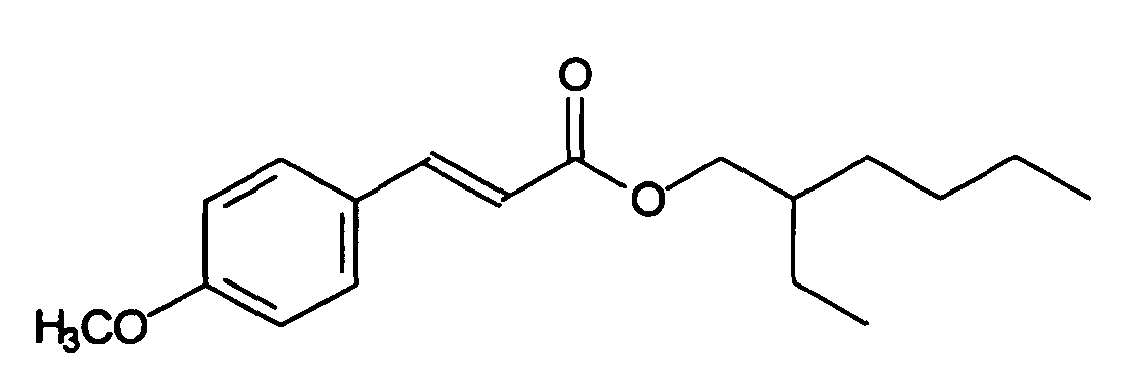
- 4-Methoxycinnamate (2-ethylhexyl) ester (2-ethylhexyl-4-methoxycinnamate, INCI: Octyl Methoxycinnamate) is available, for example, from Hoffmann-La Roche under the trade name Parsol MCX and is characterized by the following structure:
- Isopentyl 4-methoxycinnamate isopentyl-4-methoxycinnamate, INCI: isoamyl p-methoxycinnamate
- isoamyl p-methoxycinnamate is available, for example, from Haarmann & Reimer under the trade name Neo Heliopan E 1000 and has the following structure:
- the total amount of one or more UV filter substances which are liquid at room temperature in the finished cosmetic or dermatological preparations will be advantageous selected from the range 0.1 wt .-% to 30 wt .-%, preferably from 0.5 to 20 wt .-%, each based on the total weight of the preparations.
- the preparations of the invention contain the substances which absorb UV radiation in the UV-A and / or UV-B range, in a total amount of z. B. 0.1 wt .-% to 30 wt .-%, preferably 0.5 to 20 wt .-%, in particular 1.0 to 15.0 wt .-%, each based on the total weight of the preparations.
- the cosmetic and dermatological preparations according to the invention may further contain cosmetic adjuvants and other active ingredients such as are commonly used in such preparations, for.
- cosmetic adjuvants and other active ingredients such as are commonly used in such preparations, for.
- Preservatives, preservatives, bactericides, perfumes, anti-foaming agents, dyes and color pigments, thickeners, moisturizing and / or moisturizing substances, fats, oils, waxes or other common ingredients of a cosmetic or dermatological formulation such as alcohols, polyols, polymers, Foam stabilizers, electrolytes, organic solvents or silicone derivatives.
- Advantageous preservatives are, for example, formaldehyde releasers (such as, for example, DMDM hydantoin), iodopropyl butylcarbamates (for example those available under the trade names Koncyl-L, Koncyl-S and Konkaben LMB from Lonza), parabens, phenoxyethanol, ethanol, benzoic acid and more.
- formaldehyde releasers such as, for example, DMDM hydantoin
- iodopropyl butylcarbamates for example those available under the trade names Koncyl-L, Koncyl-S and Konkaben LMB from Lonza
- parabens phenoxyethanol
- ethanol benzoic acid
- the preservation system according to the invention also advantageously also preserving aids, such as octoxyglycerol, glycine soy etc.
- antioxidants are used as additives or active ingredients.
- the preparations advantageously contain one or more antioxidants.
- antioxidants all suitable or customary for cosmetic and / or dermatological applications or conventional antioxidants can be used.
- the antioxidants are selected from the group consisting of amino acids (eg, glycine, histidine, tyrosine, tryptophan) and their derivatives, imidazoles (eg, urocanic acid) and derivatives thereof, peptides such as D, L-carnosine, D- Carnosine, L-carnosine and their derivatives (eg anserine), carotenoids, carotenes (eg ⁇ -carotene, ⁇ -carotene, lycopene) and their derivatives, lipoic acid and derivatives thereof (eg dihydrolipoic acid), Aurothioglucose, propylthiouracil and other thiols (eg thioredoxin, glutathione, cysteine, cystine, cystamine and their glycosyl, N-acetyl, methyl, ethyl, propyl, amyl, butyl and lauryl, palmitoyl) , O
- compositions of the present invention are very good vehicles for cosmetic or dermatological agents into the skin, with preferred agents being antioxidants which can protect the skin from oxidative stress.
- preferred agents are antioxidants which can protect the skin from oxidative stress.
- Preferred antioxidants are vitamin E and its derivatives as well as vitamin A and its derivatives.
- the amount of the antioxidants (one or more compounds) in the preparations is preferably 0.001 to 30 wt .-%, particularly preferably 0.05 to 20 wt .-%, in particular 0.1 to 10 wt .-%, based on the total weight the preparation.
- vitamin E and / or its derivatives are the antioxidant (s), it is advantageous to choose their respective concentrations from the range from 0.001 to 10% by weight, based on the total weight of the preparation.
- vitamin A or vitamin A derivatives, or carotenes or derivatives thereof are the antioxidant (s), it is advantageous if their respective concentrations are in the range from 0.001 to 10% by weight, based on the total weight of the preparation choose.
- the active compounds can also be chosen very advantageously from the group of lipophilic active compounds, in particular from the following group:
- vitamins of the B and D series very low the vitamin B 1 , the vitamin B 12 the vitamin D 1 ,
- the active ingredient (s) are furthermore advantageously selected from the group of NO synthase inhibitors, in particular when the preparations according to the invention are to be used for the treatment and prophylaxis of the symptoms of intrinsic and / or extrinsic skin aging and for the treatment and prophylaxis of the harmful effects of ultraviolet radiation on the skin ,
- Preferred NO synthase inhibitor is nitroarginine.
- the active ingredient (s) are selected from the group comprising catechins and bile acid esters of catechins and aqueous or organic extracts of plants or plant parts which have a content of catechins or bile acid esters of catechins, such as the leaves of the plant family Theaceae, in particular of the species Camellia sinensis (green tea).
- catechins and bile acid esters of catechins are selected from the group comprising catechins and bile acid esters of catechins and aqueous or organic extracts of plants or plant parts which have a content of catechins or bile acid esters of catechins, such as the leaves of the plant family Theaceae, in particular of the species Camellia sinensis (green tea).
- Particularly advantageous are their typical ingredients (such as, for example, polyphenols or catechins, caffeine, vitamins, sugars, minerals, amino acids, lipids).
- Catechins represent a group of compounds which are to be regarded as hydrogenated flavones or anthocyanidins and derivatives of catechins (catechol, 3,3 ', 4', 5,7-flavanpentaol, 2- (3,4-dihydroxyphenyl) chromanidine). Also, epicatechin ((2R, 3R) -3,3 ', 4', 5,7-flavanpentaol) is an advantageous active ingredient within the meaning of the present invention.
- herbal extracts containing catechins especially extracts of green tea, such as. B. extracts from leaves of the plants of the species Camellia spec., Especially the teas Camellia sinenis, C. assamica, C. taliensis or C. irrawadiensis and crosses of these with, for example, Camellia japonica.
- Further preferred active substances are polyphenols or catechins from the group (-) - catechin, (+) - catechin, (-) - catechin gallate, (-) - gallocatechin gallate, (+) - epicatechin, (-) - epicatechin, (-) Epicatechin gallate, (-) - epigallocatechin, (-) - epigallocatechin gallate.
- Flavone and its derivatives are also advantageous active substances in the sense of the present invention, characterized by the following basic structure (substitution positions indicated):
- flavones usually occur in glycosidated form.
- the flavonoids are preferably selected from the group of substances of the generic structural formula where Z 1 to Z 7 are independently selected from the group consisting of H, OH, alkoxy and hydroxyalkoxy, where the alkoxy or hydroxyalkoxy groups can be branched and unbranched and can have 1 to 18 C atoms, and Gly is selected from the group the mono- and oligoglycoside residues.
- the flavonoids can also be chosen advantageously from the group of substances of the generic structural formula where Z 1 to Z 6 are independently selected from the group consisting of H, OH, alkoxy and hydroxyalkoxy, where the alkoxy or hydroxyalkoxy groups may be branched and unbranched and have 1 to 18 C atoms, and Gly is selected from the group the mono- and oligoglycoside residues.
- such structures can be selected from the group of substances of the generic structural formula where Gly 1 , Gly 2 and Gly 3 independently represent monoglycoside residues or. Gly Gly 2 and 3 may also, individually or together, represent saturations by hydrogen atoms.
- Gly 1 , Gly 2 and Gly 3 are independently selected from the group of Hexosylreste, in particular the Rhamnosylreste and Glucosylreste.
- Hexosylreste in particular the Rhamnosylreste and Glucosylreste.
- other hexosyl radicals for example allosyl, altrosyl, galactosyl, gulosyl, idosyl, mannosyl and talosyl, may also be advantageous to use. It may also be advantageous according to the invention to use pentosyl radicals.
- Z 1 to Z 5 are independently selected from the group H, OH, methoxy, ethoxy and 2-hydroxyethoxy, and the flavone glycosides have the structure
- the flavone glycosides according to the invention are particularly advantageous from the group which are represented by the following structure: where Gly 1 , Gly 2 and Gly 3 independently represent monoglycoside residues or. Gly Gly 2 and 3 may also, individually or together, represent saturations by hydrogen atoms.
- Gly 1 , Gly 2 and Gly 3 are independently selected from the group of Hexosylreste, in particular the Rhamnosylreste and Glucosylreste.
- Hexosylreste in particular the Rhamnosylreste and Glucosylreste.
- other hexosyl radicals for example allosyl, altrosyl, galactosyl, gulosyl, idosyl, mannosyl and talosyl, may also be advantageous to use. It may also be advantageous according to the invention to use pentosyl radicals.
- the flavone glycoside (s) from the group ⁇ -glucosylrutin, ⁇ -glucosylmyricetin, ⁇ -glucosylisoquercitrin, ⁇ -glucosylisoquercetin and ⁇ -glucosylquercitrin.
- Particularly preferred according to the invention is ⁇ -glucosylrutin.
- Naringin (aurantiine, naringenin-7-rhamnoglucoside), hesperidin (3 ', 5,7-trihydroxy-4'-methoxyflavanone-7-rutinoside, hesperidoside, hesperetin-7-O-rutinoside) are also advantageous according to the invention.
- Rutin (3,3 ', 4', 5,7-pentahydroxyfly of 3-rutinoside, quercetin-3-rutinoside, sophorin, birutane, rutabion, taurutin, phytomelin, melin), troxerutin (3,5-dihydroxy-3 ', 4 ', 7-tris (2-hydroxyethoxy) flavone-3- (6-O- (6-deoxy- ⁇ -L-mannopyranosyl) - ⁇ -D-glucopyranoside)), monoxerutin (3,3', 4 ' , 5-Tetrahydroxy-7- (2-hydroxyethoxy) flavone-3- (6-O- (6-deoxy- ⁇ -L-mannopyranosyl) - ⁇ -D-glucopyranoside)), dihydrorobinetine (3,3 ', 4 ', 5', 7-pentahydroxyflavanone), taxifolin (3,3 ', 4', 5,7-pentahydroxyf
- coenzyme Q10 which is characterized by the following structural formula:
- Creatine and / or creatine derivatives are also preferred active ingredients in the context of the present invention. Creatine is characterized by the following structure:
- Preferred derivatives are creatine phosphate as well as creatine sulfate, creatine acetate, creatine ascorbate and the derivatives esterified at the carboxyl group with mono- or polyfunctional alcohols.
- acyl-carnitines which are selected from the group of substances of the following general structural formula wherein R is selected from the group of branched and unbranched alkyl radicals having up to 10 carbon atoms are advantageous active ingredients in the context of the present invention. Preference is given to propionyl carnitine and in particular acetyl carnitine. Both enantiomers (D and L form) are to be used advantageously in the context of the present invention. It may also be advantageous to use any mixtures of enantiomers, for example a racemate of D and L form.
- beneficial agents are sericoside, pyridoxol, vitamin K, biotin and flavorings.
- the list of active substances or combinations of active substances which can be used in the preparations according to the invention should of course not be limiting.
- the active substances can be used individually or in any desired combinations with one another.
- the formulations of the invention may be in the form of water-in-oil (W / O) or oil-in-water (O / W) emulsions, complex emulsions (O / W / O, W / O / W), as Oil-in-alcohol lotion, as a vesicular dispersion of an ionic or nonionic amphiphilic lipid, as a gel, solid anhydrous or hydrous pens, or as a loose or pressed powder.
- W / O water-in-oil
- O / W oil-in-water
- Oil-in-alcohol lotion as a vesicular dispersion of an ionic or nonionic amphiphilic lipid, as a gel, solid anhydrous or hydrous pens, or as a loose or pressed powder.
- Preparations according to the invention are preferably emulsions or anhydrous preparations, in particular sticks.
- the oil phase of the preparations according to the invention is advantageously selected from the group of polar oils, for example from the group of lecithins and fatty acid triglycerides, namely the triglycerol esters of saturated and / or unsaturated, branched and / or unbranched alkanecarboxylic acids having a chain length of 8 to 24, in particular 12 to 18 C atoms.
- the fatty acid triglycerides can be advantageous, for example be selected from the group of synthetic, semi-synthetic and natural oils, such as.
- Cocoglyceride olive oil, sunflower oil, soybean oil, peanut oil, rapeseed oil, almond oil, palm oil, coconut oil, castor oil, wheat germ oil, grape seed oil, thistle oil, evening primrose oil, macadamia nut oil and the like.
- further advantageous polar oil components can furthermore be selected from the group of esters of saturated and / or unsaturated, branched and / or unbranched alkanecarboxylic acids having a chain length of 3 to 30 carbon atoms and saturated and / or unsaturated, branched and / or or unbranched alcohols having a chain length of 3 to 30 carbon atoms and from the group of esters of aromatic carboxylic acids and saturated and / or unsaturated, branched and / or unbranched alcohols having a chain length of 3 to 30 carbon atoms.
- ester oils can then advantageously be selected from the group octyl palmitate, octyl cocoate, octyl isostearate, octyl dodecyl myristate, cetearyl isononanoate, isopropyl myristate, isopropyl palmitate, isopropyl stearate, isopropyl oleate, n-butyl stearate, n-hexyl laurate, n-decyl oleate, isooctyl stearate, isononyl stearate, isononyl isononanoate, 2-ethylhexyl palmitate, 2-ethylhexyl laurate, 2-hexyldecyl stearate, 2-octyl dodecyl palmitate, stearyl heptanoate, oleyl oleate, oleyl eru
- oil phase can be advantageously selected from the group of dialkyl ethers and dialkyl carbonates, advantageous z.
- the oil component (s) is selected from the group isoeicosan, neopentyl glycol diheptanoate, propylene glycol dicaprylate / dicaprate, caprylic / capric / diglyceryl succinate, butylene glycol caprylate / caprate, C 12-13 alkyl lactate, di-C 12-13 alkyl tartrate, triisostearin, dipentaerythrityl Hexacaprylate / hexacaprate, propylene glycol monoisostearate, tricaprylin, dimethylisosorbide. It is particularly advantageous if the oil phase of the formulations according to the invention has a content of C 12-15 -alkyl benzoate or consists entirely of this.
- Advantageous oil components are also z. Butyloctyl salicylate (for example that available under the trade name Hallbrite BHB from the company CP Hall), hexadecyl benzoate and butyloctyl benzoate and mixtures thereof (Hallstar AB) and / or diethylhexylnaphthalate (Hallbrite / Corapan TQ ).
- Butyloctyl salicylate for example that available under the trade name Hallbrite BHB from the company CP Hall
- hexadecyl benzoate and butyloctyl benzoate and mixtures thereof Hallstar AB
- Hallbrite / Corapan TQ diethylhexylnaphthalate
- the oil phase may also advantageously contain nonpolar oils, for example those which are selected from the group of branched and unbranched hydrocarbons and waxes, in particular mineral oil, Vaseline (petrolatum), paraffin oil, squalane and squalene, polyolefins, hydrogenated polyisobutenes and isohexadecane.
- nonpolar oils for example those which are selected from the group of branched and unbranched hydrocarbons and waxes, in particular mineral oil, Vaseline (petrolatum), paraffin oil, squalane and squalene, polyolefins, hydrogenated polyisobutenes and isohexadecane.
- polyolefins polydecenes are the preferred substances.
- the oil phase may further comprise a content of cyclic or linear silicone oils or consist entirely of such oils, although it is preferred to use an additional content of other oil phase components in addition to the silicone oil or silicone oils.
- Silicone oils are high molecular weight synthetic polymeric compounds in which silicon atoms via oxygen atoms chain and / or net-like linked and the remaining valences of silicon by hydrocarbon radicals (usually methyl, more rarely ethyl, propyl, phenyl groups, etc.) are saturated , Systematically, the silicone oils are called polyorganosiloxanes.
- the methyl-substituted polyorganosiloxanes which are the quantitatively most important compounds of this group and are characterized by the following structural formula are also referred to as polydimethylsiloxane or dimethicone (INCI). Dimethicones are available in different chain lengths or with different molecular weights.
- Particularly advantageous polyorganosiloxanes in the context of the present invention are, for example, dimethylpolysiloxanes [poly (dimethylsiloxane)], which are obtainable, for example, under the trade names Abil 10 to 10,000 from Th. Goldschmidt.
- phenylmethylpolysiloxanes INCI: phenyl dimethicone, phenyl trimethicone
- cyclic silicones octamethylcyclotetrasiloxane or decamethylcyclopentasiloxane
- amino-modified silicones INCI: amodimethicones
- silicone waxes eg.
- polysiloxane-polyalkylene copolymers ICI: stearyl dimethicone and cetyl dimethicone
- dialkoxydimethylpolysiloxanes stearoxy dimethicones and behenoxy stearyl dimethicone
- other silicone oils are also advantageous for the purposes of the present invention, for example cetyl dimethicone, hexamethylcyclotrisiloxane, polydimethylsiloxane, poly (methylphenylsiloxane).
- z For example, natural waxes of animal and vegetable origin, such as beeswax, China wax, bumblebee and other insect waxes and shea butter.
- the aqueous phase of the preparations according to the invention may advantageously contain customary cosmetic auxiliaries, for example alcohols, in particular those of low C number, preferably ethanol and / or isopropanol, diols or polyols of low C number and their ethers, preferably propylene glycol, glycerol, ethylene glycol, ethylene glycol monoethyl or monobutyl ether, propylene glycol monomethyl, monoethyl or monobutyl ether, diethylene glycol monomethyl or monoethyl ether and analogous products, polymers, foam stabilizers, electrolytes and in particular one or more thickening agents, which or which can be advantageously selected from the group of silica, aluminum silicates, polysaccharides or .
- customary cosmetic auxiliaries for example alcohols, in particular those of low C number, preferably ethanol and / or isopropanol, diols or polyols of low C number and their ethers,
- hyaluronic acid xanthan gum
- hydroxypropylmethylcellulose particularly advantageous from the group of polyacrylates, preferably a polyacrylate from the group of so-called carbopols, for example Carbopols types 980, 981, 1382, 2984, 5984, each individually or in combination. Moisturizers can also be used with preference.
- TEWL t rans e pidermal w ater l oss
- moisturizers for the purposes of the present invention are, for example, glycerol, lactic acid, pyrrolidonecarboxylic acid and urea. Furthermore, it is particularly advantageous to use polymeric moisturizers from the group of water-soluble and / or water-swellable and / or water-gellable polysaccharides.
- Hyaluronic acid, chitosan and / or a fucose-rich polysaccharide for example, which are filed in the Chemical Abstracts under the registry number 178463-23-5 and z. B. under the name Fucogel®1000 from the company SOLABIA S.A. is available.
- the cosmetic or dermatological preparations according to the invention can furthermore advantageously, although not necessarily, contain dyes and / or color pigments, in particular if they are in the form of decorative cosmetics.
- the dyes and pigments can be selected from the corresponding positive list of the Cosmetics Regulation or EC List of cosmetic colorants. In most cases, they are identical to the food-approved dyes.
- advantageous color pigments are titanium dioxide, mica, iron oxides (eg Fe 2 O 3 , Fe 3 O 4 , FeO (OH)) and / or tin oxide.
- Advantageous dyes are, for example, carmine, Berlin blue, chrome oxide green, ultramarine blue and / or manganese violet.
- the dyes and pigments can be present both individually and in a mixture and can be mutually coated with one another, wherein different coating thicknesses generally cause different color effects.
- the total amount of dyes and coloring pigments is advantageously from the range of z. B. 0.1 wt .-% to 30 wt .-%, preferably from 0.5 to 20 wt .-%, in particular from 1.0 to 15 wt .-%, each based on the total weight of the preparations.
- the pigments can also act advantageously as UV filter substances.
- film formers in the cosmetic or dermatological preparations according to the invention, for example in order to improve the water resistance of the preparations or to increase the UV protection performance (UV-A and / or UV-B boosting).
- Both water-soluble or dispersible as well as fat-soluble film formers in each case individually or in combination with one another.
- Advantageous water-soluble or dispersible film formers are z.
- Polyurethanes eg the Avalure® grades from Goodrich
- dimethicone copolyol polyacrylates Silsoft Surface® from the Witco Organo Silicones Group
- PVPNA vinyl acetate copolymer
- Luviscol VA 64 Powder from BASF acrylate Copolymers
- acrylate Copolymers Dermacryl 79, National Starch
- Advantageous fat-soluble film formers are z. B., the film former from the group of polymers based on polyvinylpyrrolidone (PVP)
- copolymers of polyvinylpyrrolidone for example the PVP hexadecene copolymer and the PVP eicosene copolymer, which are available under the trade names Antaron V216 and Antaron V220 in the GAF Chemicals Cooperation, and the Tricontayl PVP and the like.
- the cosmetic or dermatological sunscreen formulations according to the invention may be applied to cosmetic or dermatological sunscreens, e.g. as a sunscreen, further for the treatment, care and cleansing of the skin and / or hair and in particular serve as a make-up product in decorative cosmetics.
- cosmetic or topical dermatological compositions in the context of the present invention, for example, be used as skin protection cream, cleansing milk, day or night cream, etc. It may be possible and advantageous to use the compositions of the invention as a basis for pharmaceutical formulations.
- UV protection substances So z. B. in day creams or makeup products usually incorporated UV-A or UV-B filter substances. Also, UV protectants, as well as antioxidants and, if desired, preservatives, provide effective protection of the preparations themselves against spoilage.
- the present invention therefore relates in particular to products for the care of naturally aged skin, as well as for the treatment of the consequential damages of photoageing, in particular the phenomena listed under a) to g).
- the cosmetic and dermatological preparations are applied in the usual manner for cosmetics on the skin and / or hair in sufficient quantity.
- the preparations of the invention are prepared by methods known in the art, for example Uhlamann's Encyclopedia of Industrial Chemistry, Vol A 24 Skin Cosmetics, VCH Verlagsgesellschaft, Weinheim (1993), pages 219 ff are described and the literature cited therein.
Landscapes
- Health & Medical Sciences (AREA)
- Life Sciences & Earth Sciences (AREA)
- Animal Behavior & Ethology (AREA)
- General Health & Medical Sciences (AREA)
- Public Health (AREA)
- Veterinary Medicine (AREA)
- Birds (AREA)
- Epidemiology (AREA)
- Chemical & Material Sciences (AREA)
- Inorganic Chemistry (AREA)
- Dermatology (AREA)
- Cosmetics (AREA)
Description
- Die vorliegende Erfindung betrifft kosmetische und dermatologische Zubereitungen zum Schutz von Haut und Haar gegen UV-Strahlung sowie deren Verwendung zu dem genannten Zweck, insbesondere im Bereich der dekorativen Kosmetik.
- Die schädigende Wirkung des ultravioletten Teils der Sonnenstrahlung ist bekannt. Die UV-Strahlung im Bereich zwischen 290 nm und 320 nm, dem sogenannten UV-B-Bereich kann zu einem Erythem, einem einfachen Sonnenbrand oder sogar mehr oder weniger starken Verbrennungen als akuten Erscheinungsformen führen. Als ein Maximum der Erythemwirksamkeit des Sonnenlichtes wird der engere Bereich um 308 nm angegeben.
- Man hat lange Zeit fälschlicherweise angenommen, dass die längerwellige UV-A-Strahlung mit einer Wellenlänge zwischen 320 nm und 400 nm nur eine vernachlässigbare biologische Wirkung aufweist. Inzwischen ist allerdings durch zahlreiche Studien belegt, dass UV-A-Strahlung im Hinblick auf die Auslösung photodynamischer, speziell phototoxischer Reaktionen und chronischer Veränderungen der Haut weitaus gefährlicher als UV-B-Strahlung ist. Auch kann der schädigende Einfluß der UV-B-Strahlung durch UV-A-Strahlung noch verstärkt werden.
- So ist es u. a. erwiesen, dass selbst die UV-A-Strahlung unter ganz normalen Alltagsbedingungen ausreicht, um innerhalb kurzer Zeit die Collagen- und Elastinfasern zu schädigen, die für die Struktur und Festigkeit der Haut von wesentlicher Bedeutung sind. Hierdurch kommt es zu chronischen lichtbedingten Hautveränderungen - die Haut "altert" vorzeitig. Zum klinischen Erscheinungsbild der durch Licht gealterten Haut gehören beispielsweise Falten und Fältchen sowie ein unregelmäßiges, zerfurchtes Relief. Ferner können die von lichtbedingter Hautalterung betroffenen Partien eine unregelmäßige Pigmentierung aufweisen. Auch die Bildung von braunen Flecken, Keratosen und sogar Karzinomen bzw. malignen Melanomen ist möglich. Eine durch die alltägliche UV-Belastung vorzeitig gealterte Haut zeichnet sich außerdem durch eine geringere Aktivität der Langerhanszellen und eine leichte, chronische Entzündung aus.
- Etwa 90 % der auf die Erde gelangenden ultravioletten Strahlung besteht aus UV-A-Strahlen. Während die UV-B-Strahlung in Abhängigkeit von zahlreichen Faktoren stark variiert (z. B. Jahres- und Tageszeit oder Breitengrad), bleibt die UV-A-Strahlung unabhängig von jahres- und tageszeitlichen oder geographischen Faktoren Tag für Tag relativ konstant. Gleichzeitig dringt der überwiegende Teil der UV-A-Strahlung in die lebende Epidermis ein, während etwa 70 % der UV-B-Strahlen von der Hornschicht zurückgehalten werden.
- Es ist daher von grundsätzlicher Wichtigkeit, dass kosmetische und dermatologische Lichtschutzzubereitungen sowohl gegen UV-B- als auch gegen UV-A-Strahlung ausreichenden Schutz bieten. Für diese Zwecke sind im Stand der Technik schon eine Vielzahl von kosmetischen Zubereitungen entwickelt worden. Allerdings ist deren Wirkungsspektrum weiter verbesserbar. Insbesondere weisen Zubereitungen, die Kombinationen von UV-Filtersubstanzen oder anderen Wirkstoffen enthalten, bisweilen in Bezug auf die Einsatzkonzentrationen formulierungstechnische Schwierigkeiten auf, die das Erreichen guter UV-Schutzleistung erschweren.
- Die
EP-A-1 077 058 offenbart kosmetische oder dermatologische Zubereitungen, die feindisperse Systeme vom Typ Wasser-in-öl darstellen, und eine Ölphase, eine Wasserphase, eine Kombination von mindestens einem modifizierten Schichtsilikat und Bornitrid enthalten. - Die
EP-A-0 987 004 offenbart Pickering Emulsionen, die eine Öl-, eine Wasserphase, mindestens einen Typ mikrofeiner Partikel mit bestimmter Partikelgröße und hydrophilen als auch lipophilen Eigenschaften, mindestens ein unsymmetrisch substituiertes S-Triazinderivat und höchstens 0,5 Gew.% Emulgator enthalten. - Die
DE-A-100 26 571 offenbart die Verwendung adstringierender Substanzen als Sonnenschutzmittel insbesondere gegen UV-Strahlung und Infrarotstrahlung des Sonnenlichtes. - Die
FR-2 816 836 - Die
EP-A-1 093 796 offenbart kosmetische oder dermatologische Emulsionen, die neben mindestens einer organischen UV-Filtersubstanz verbundene Polymere enthalten, die von C8- bis C16-Alkylpolyglucosiden verschieden sind. - Neben den oben bereits beschriebenen Wirkungen der UV-Strahlen kommt es in der Nachreaktion der Haut ferner zu einer verminderten Sebumproduktion und einem Austrocknen der Haut. Zur Linderung und zur Pflege dieser Phänomene kennt der Stand der Technik Produkte, welche nach dem Sonnenbaden angewendet werden und üblicherweise spezielle Wirkstoffe enthalten, wie beispielsweise
- ■ Rückfettungs- und Feuchthaltemittel,
- ■ entzündungslindernde und kühlende Stoffe,
- ■ lokal anaestesierende Stoffe und/oder
- ■ desinfizierende Stoffe, um mögliche Hautinfektionen zu verhindern.
- Diese sogenannten Aftersun- oder Après-soleil-Präparate sind dazu bestimmt, die Haut nach dem Sonnenbad zu kühlen und ihr Feuchthaltevermögen zu verbessern, wobei die Vermittlung des Kühleffektes eine zentrale Rolle spielt. Allerdings mangelt es dem Stand der Technik an Produkten, welche die Haut bereits während der UV-Einstrahlung vor dem Austrocknen schützen und sie ausreichend pflegen.
- Ein weiterer Nachteil des Standes der Technik ist, dass übliche Lichtschutzformulierungen einen meist klebrigen Film auf der Haut hinterlassen. Dies hat bei der Anwendung solcher Produkte z.B. in Form von Sonnenschutzmitteln an einem Sandstrand zur Folge, dass der Sand am Körper haften bleibt, was vom Anwender als unangenehm empfunden wird und im schlimmsten Fall dazu führen kann, dass das Sonnenschutzmittel zu wenig oder gar nicht mehr verwendet wird. Da am Meer meist ein mehr oder weniger starker Wind herrscht, tritt dieser Nachteil in der Regel selbst dann auf, wenn der Körper gar nicht direkt mit dem Sand in Berührung kommt - beispielsweise beim Sonnenbaden auf einem Liegestuhl - da auch der im Wind herumwirbelnde Sandstaub auf den eingecremten Hautpartien haften bleibt.
- Aufgabe der vorliegenden Erfindung ist es, Lichtschutzzubereitungen bereitzustellen, die einen hohen Schutz gegen die oben genannten verschiedenen nachteiligen Wirkungen der Strahlung im UV-A- und UV-B-Bereich, insbesondere Sonnenstrahlung, bieten und gleichzeitig verbesserte sensorische Eigenschaften aufweisen. Die erfindungsgemäßen Zubereitungen sollen ferner gute hautpflegende Eigenschaften, insbesondere Wirksamkeit gegen Hautalterungserscheinungen (z.B. Faltenbildung, Elastizitätsverlust), aufweisen sowie anwendungsfreundlich sein, z.B. sandabweisende Wirkung aufweisen.
- Erfindungsgemäß wird eine lichtschutzwirksame kosmetische Zubereitung bereitgestellt, die dadurch gekennzeichnet ist, dass sie
- (a) mindestens 2 UV-Filtersubstanzen enthält, wobei die erste UV-Filtersubstanz 2,4-Bis-{[4-(2-ethyl-hexyloxy)-2-hydroxy]-phenyl}-6-(4-methoxyphenyl)-1,3,5-triazin und die zweite UV-Filtersubstanz in Komponente (a) Phenylen-1,4-bis-(2-benzimidazyl)-3,3'-5,5'-tetrasulfonsäure-bis-natriumsalz ist
- (b) mindestens einen Füllstoff, ausgewählt aus in Wasser nicht quellbaren Schichtsilikaten
- Gegenstand der Erfindung ist ferner eine dermatologische Zubereitung mit Bestandteilen wie zuvor für die kosmetische Zubereitung definiert.
- Gegenstand der Erfindung ist ferner die Verwendung der erfindungsgemäßen vorstehend definierten Zubereitungen zum Schutz von Haut und Haar gegen die schädlichen Wirkungen von UV-Strahlung, insbesondere UV-A- und UV-B-Strahlung, insbesondere Sonnenstrahlung.
- Bevorzugte Ausführungsformen der vorliegenden Erfindung ergeben sich aus den abhängigen Patentansprüchen.
- Die erfindungsgemäßen Zubereitungen stellen in jeglicher Hinsicht überaus befriedigende Präparate dar, welche im Hinblick auf die weiteren Bestandteile nicht auf eine spezielle Auswahl dieser weiteren Bestandteile begrenzt sind. Dementsprechend eignen sie sich ganz besonders, um als Grundlage für Zubereitungsformen mit vielfältigen Anwendungszwecken zu dienen. Die erfindungsgemäßen Zubereitungen zeigen überraschenderweise synergistisch verbesserte sensorische und kosmetische Eigenschaften, wie beispielsweise die gleichmäßige Verteilbarkeit auf der Haut oder das Einzugsvermögen in die Haut, und zeichnen sich gleichzeitig durch eine hohe Lichtschutzeffektivität bei gleichzeitig hervorragenden Hautpflegedaten aus.
- Ein Maß für die UV-Schutzleistung stellt im Sinne der vorliegenden Erfindung beispielsweise der Lichtschutzfaktor (LSF bzw. SPF) dar.
- Die kosmetischen und dermatologischen Zubereitungen im Sinne der vorliegende Erfindung hinterlassen auf der Haut keinen schmierigen oder klebrigen Eindruck, sind ausgezeichnet hautverträglich und zeichnen sich ferner überraschender Weise dadurch aus, dass sie sandabweisend sind.
- UV-Filtersubstanzen auf Basis von Triazinderivaten , welche das Strukturmotiv

EP-A-775 698 EP-A-0 878 469 und derEP-A-1 027 881 beschrieben. - Hinsichtlich der C3-Achse des Triazingrundkörpers dieser Verbindungen sind sowohl symmetrische Substitution als auch unsymmetrische Substitution denkbar. In diesem Sinne symmetrisch substituierte s-Triazine weisen drei gleiche Substituenten R1, R2 und R3 auf, während unsymmetrisch substituierte s-Triazinderivate demzufolge unterschiedliche Substituenten aufweisen, wodurch die C3-Symmetrie zerstört wird. Im Sinne der vorliegenden Erfindung wird als "unsymmetrisch stets unsymmetrisch hinsichtlich der C3-Achse des Triazingrundkörpers verstanden, es sei denn, etwas anderes wäre ausdrücklich erwähnt. Erfindungsgemäße unsymmetrisch substituierte s-Triazinderivate werden im Folgenden auch einfach als Triazinderivate bezeichnet.
- Erfindungsgemäß ist in Komponente (a) das 2,4-Bis-{[4-(2-ethyl-hexyloxy)-2-hydroxy]-phenyl}-6-(4-methoxyphenyl)-1,3,5-triazin (INCI: Aniso Triazin) enthalten, welches unter der Handelsbezeichnung Tinosorb® S bei der CIBA-Chemikalien GmbH erhältlich und durch folgende Struktur gekennzeichnet ist:

- Das erfindungsgemäße unsymmetrisch substituierte s-Triazinderivat wird vorteilhaft in die Ölphase der kosmetischen oder dermatologischen Formulierungen eingearbeitet.
- Weitere UV-A-Filtersubstanz der Komponente (a) der erfindungsgemäßen Zubereitungen ist das Phenylen-1,4-bis-(2-benzimidazyl)-3,3'-5,5'-tetrasulfonsäure-bis-natriumsalz

- Erfindungsgemäß werden in Komponente (a) also mindestens die beiden nachstehend genannten UV-Filtersubstanzen zusammen verwendet.
- 2,4-Bis-{[4-(2-ethyl-hexyloxy)-2-hydroxy]-phenyl}-6-(4-methoxyphenyl)-1,3,5-triazin mit Phenylen-1,4-bis-(2-benzimidazyl)-3,3'-5,5'-tetrasulfonsäure-bis-natriumsalz.
- Eine weitere Ausführungsform der vorliegenden Erfindung enthält 2,4-Bis-{[4-(2-ethyl-hexyloxy)-2-hydroxy]-phenyl}-6-(4-methoxyphenyl)-1,3,5-triazin (Tinosorb® S), Phenylen-1,4-bis-(2-benzimidazyl)-3,3'-5,5'-tetrasulfonsäure-bis-natriumsalz (Neo Heliopan® AP) und 2,2'-Methylen-bis-(6-(2H-benzotriazol-2-yl)-4-(1,1,3,3-tetramethylbutyl)-phenol) (Tinosorb® M) zusammen als UV-Filtersubstanzen der Komponente (a).
- Die oben genannten UV-Filtersubstanzen der Komponente (a) sind vorteilhaft insgesamt in Mengen von 0,1 Gew.-% bis 20 Gew.-%, vorzugsweise 0,5 bis 15 Gew.-%, insbesondere 1 bis 10 Gew.-% vorhanden, jeweils bezogen auf das Gesamtgewicht der Zubereitungen.
- Die erfindungsgemäßen kosmetischen und dermatologischen Zubereitungen enthalten als zweite Komponente (b) der synergistischen Kombination mindestens einen Füllstoff, der aus in Wasser nicht quellbaren Schichtsilikaten ausgewählt ist. Bei den Füllstoffen handelt es sich um partikuläre Stoffe, die keinen Farbeffekt im Produkt (d.h. der kosmetischen und dermatologischen Zubereitung selbst) oder auf der Haut hervorrufen.
- Derartige Schichtsilikate (Phyllosilikate, Blattsilikate) sind (idealerweise) Silikat-Strukturen mit zweidimensional unendlichen Schichten aus [SiO4] 4'-Tetraedern, wobei jedes Tetraeder über 3 Brücken-Sauerstoffe mit Nachbar-Tetraedern verbunden ist.
- Chemische Formeln lassen sich für die Schichtsilikate nur angenähert aufstellen, da sie ein großes lonenaustausch-Vermögen besitzen und Silicium gegen Aluminium und dieses wiederum gegen Magnesium, Fe2+, Fe3+, Zn2+ und dergleichen ausgetauscht werden kann. Die daraus möglicherweise resultierende negative Ladung der Schichten wird in der Regel durch Kationen, insbesondere durch Na+ und Ca2+ in Zwischenschicht-Positionen ausgeglichen.
- Erfindungsgemäß vorteilhafte Schichtsilikate sind insbesondere:
- ⇒ Talkum: Mg3 [Si4O10] (OH)2,
- ⇒ Kaolin: Al2[Si2O5] (OH)4,
- ⇒ Glimmer (Mica), ein Alumosilikat, das leicht spaltbar ist und in tafeligen Kristallen vorliegt. Glimmer ist transparent bis durchscheinend und weist Perlglanz auf. Die wichtigste Form ist Muskovit: K Al2 [AlSi3O10] (OH, F)2. Sericite ist eine Sonderform des Glimmers, die kleinere Plättchen als Muskovit aufweist.
- Die erfindungsgemäßen Füllstoffe können sowohl einzeln als auch im Gemisch eingesetzt werden. Weiterhin ist die Kombination der in Wasser nicht quellbaren Schichtsilikate mit sphärischen Siliziumdioxiden oder organischen Füllstoffen vorteillhaft.
- Die Gesamtmenge der Füllstoffe beträgt vorteilhaft 0,1 Gew.-% bis 30 Gew.-%, vorzugsweise 0,5 bis 15 Gew.-%, insbesondere 1,0 bis 10 Gew.-%, jeweils bezogen auf das Gesamtgewicht der Zubereitungen.
- Weitere Füllstoffe, die neben denen der Komponente (b) in den erfindungsgemäßen Zubereitungen eingesetzt werden können, sind im Folgenden genannt:
- Aerosile wie die unter den folgenden Handelsnamen erhältlichen Produkte Aerosil 130 (Degussa Hüls), Aerosil 200 (Degussa Hüls), Aerosil 255 (Degussa Hüls), Aerosil 300 (Degussa Hüls), Aerosil 380 (Degussa Hüls), B-6C (Suzuki Yushi), CAB-O-SIL Fumed Silica (Cabot), CAB-O-SIL EH-5 (Cabot), CAB-O-SIL HS-5 (Cabot), CAB-O-SIL LM-130 (Cabot), CAB-O-SIL MS-55 (Cabot), CAB-O-SIL M-5 (Cabot), E-6C (Suzuki Yushi), Fossil Flour MBK (MBK), MSS-500 (Kobo), Neosil CT 11 (Crosfield Co.), Ronasphere (Rona/EM Industries), Silica, Anhydrous 31 (Whittaker, Clark & Daniels), Silica, Crystalline 216 (Whittaker, Clark & Daniels), Silotrat-1 (Vevy), Sorbosil AC33 (Crosfield Co.), Sorbosil AC 35 (Crosfield Co.), Sorbosil AC 37 (Crosfield Co.), Sorbosil AC 39 (Crosfield Co.), Sorbosil AC77 (Crosfield Co.), Sorbosil TC 15 (Crosfield Co.), Spherica (Ikeda), Spheriglass (Potters-Ballotini), Spheron L-1500 (Presperse), Spheron N-2000 (Presperse), Spheron P-1500 (Presperse), Wacker HDK H 30 (Wacker-Chemie), Wacker HDK N 20 (Wacker-Chemie), Wacker HDK P 100 H (Wacker Silicones), Wacker HDK N 20P (Wacker-Chemie), Wacker HDK N 25P (Wacker-Chemie), Wacker HDK S 13 (Wacker-Chemie), Wacker HDK T 30 (Wacker-Chemie), Wacker HDK V 15 (Wacker-Chemie), Wacker HDK V 15 P (Wacker-Chemie), Zelec Sil (DuPont).
- Ferner sind Bornitride geeignet, insbesondere die folgenden Handelsprodukte:
Handelsname erhältlich bei: Boron Nitride Powder Advanced Ceramics Boron Nitride Powder Sintec Keramik Ceram Blanche Kawasaki HCST Boron Nitride Stark Très BN® Carborundum Wacker-Bornitrid BNP Wacker-Chemie - Weitere zusätzlich in die erfindungsgemäßen Zubereitungen einarbeitbare Füllstoffe sind Carbonate, wie z. B. Magnesiumcarbonat (MgCO3) und Calciumcarbonat (CaCO3). Carbonate werden erfindungsgemäß insbesondere als Füllstoffe in trockenen Pudern verwendet.
- Natürliche organische Polymere wie Seidenpuder, mikrokristalline Cellulose und/oder Zinkstearate können ebenfalls zusätzlich verwendet werden.
- Vorteilhafte organische Füllstoffe sind ferner Stärke und Stärkederivate, wie:
- ⇒ Maisstärke Zea Mays (Amidon De Mais MST (Wackherr), Argo Brand Corn Starch (Corn Products), Pure-Dent (Grain Processing), Purity 21C (National Starch)),
- ⇒ Reisstärke (D.S.A. 7 (Agrana Stärke), Oryzapearl (Ichimaru Pharcos)),
- ⇒ Distarch Phosphate (Corn PO4 (Agrana Stärke), Corn PO4 (Tri-K)),
- ⇒ Sodium Corn Starch Octenylsuccinate (C* EmCap - Instant 12639 (Cerestar USA)),
- ⇒ Aluminium Starch Octenylsuccinate (Covafluid AMD (Wackherr), Dry Flo-PC (National Starch), Dry Flo Pure (National Starch), Fluidamid DF 12 (Roquette)),.
- Diese zusätzlichen Füllstoffe können insgesamt in solchen Mengen vorliegen, wie oben für die erfindungsgemäßen Füllstoffe der Komponente (b) angegeben.
- Weitere herkömmliche UV-Filtersubstanzen, die neben denen der Komponente (a) in den erfindungsgemäßen Zubereitungen eingesetzt werden, sind im Folgenden genannt:
- Vorteilhafte öllösliche UV-B-Filter sind z. B.:
- 3-Benzylidencampher-Derivate, vorzugsweise 3-(4-Methylbenzyliden)campher [INCI: 4-Methylbenzylidene Camphor], welches von Merck unter der Warenbezeichnung Eusolex 6300 vertrieben wird und/oder 3-Benzylidencampher;
- 4-Aminobenzoesäure-Derivate, vorzugsweise 4-(Dimethylamino)-benzoesäure(2-ethylhexyl)ester, 4-(Dimethylamino)benzoesäureamylester;
- Ester der Zimtsäure, vorzugsweise 4-Methoxyzimtsäure(2-ethylhexyl)ester, 4-Methoxyzimtsäureisopentylester;
- Ester der Salicylsäure, vorzugsweise Salicylsäure(2-ethylhexyl)ester, Salicylsäure(4-isopropylbenzyl)ester, Salicylsäurehomomenthylester,
- Derivate des Benzophenons, vorzugsweise 2-Hydroxy-4-methoxybenzophenon, 2-Hydroxy-4-methoxy-4'-methylbenzophenon, 2,2'-Dihydroxy-4-methoxybenzophenon;
- Ester der Benzalmalonsäure, vorzugsweise 4-Methoxybenzalmalonsäuredi(2-ethylhexyl)ester,
- hinsichtlich der C3-Achse des Triazingrundkörpers symmetrisch Triazinderivate, vorzugsweise 4,4',4"-(1,3,5-Triazin-2,4,6-triyltriimino)-tris-benzoesäure-tris(2-ethyl-hexylester) [INCI: Octyl Triazone], welches von der BASF Aktiengesellschaft unter der Warenbezeichnung UVINUL® T 150 vertrieben wird,
- Benzotriazolderivate, vorzugsweise 2,2'-Methylen-bis-(6-(2H-benzotriazol-2-yl)-4-(1,1,3,3-tetramethylbutyl)-phenol)
- sowie an Polymere gebundene UV-Filter.
- Vorteilhafte wasserlösliche UV-B-Filtersubstanzen sind z. B.:
- ■ Salze der 2-Phenylbenzimidazol-5-sulfonsäure, wie ihr Natrium-, Kalium- oder ihr Triethanolammonium-Salz, sowie die Sulfonsäure selbst;
- ■ Sulfonsäure-Derivate des 3-Benzylidencamphers, wie z. B. 4-(2-Oxo-3-bornylidenmethyl)benzolsulfonsäure, 2-Methyl-5-(2-oxo-3-bornylidenmethyl)sulfonsäure und deren Salze.
- Weitere herkömmliche, in erfindungsgemäßen Zubereitungen verwendbare UV-A-Filter sind beispielsweise Derivate des Dibenzoylmethans, insbesondere 1-(4'-tert.Butylphenyl)-3-(4'-methoxyphenyl)propan-1,3-dion und um 1-Phenyl-3-(4'-isopropylphenyl)propan-1,3-dion. Vorteilhafte UV-A-Filtersubstanz ist ferner das 4-(tert.-Butyl)-4'-methoxydibenzoylmethan (CAS-Nr. 70356-09-1), welches von Givaudan unter der Marke Parsol® 1789 und von Merck unter der Handelsbezeichnung Eusolex® 9020 verkauft wird.
- Ferner vorteilhaft sind das 1,4-di(2-oxo-10-Sulfo-3-bomylidenmethyl)-Benzol und dessen Salze (besonders die entsprechenden 10-Sulfato-verbindungen, insbesondere das entsprechende Natrium-, Kalium- oder Triethanolammonium-Salz), das auch als Benzol-1,4-di(2-oxo-3-bornylidenmethyl-10-sulfonsäure) bezeichnet wird und sich durch die folgende Struktur auszeichnet:

- Vorteilhafte Filtersubstanzen, die sowohl UV-A- als auch UV-B-Strahlung absorbieren, sogenannte Breitbandfilter, sind z.B. 2,2'-Methylen-bis-(6-(2H-benzotriazol-2-yl)-4-(1,1,3,3-tetramethylbutyl)-phenol) oder 2-(2H-benzotriazol-2-yl)-4-methyl-6-[2-methyl-3-[1,3,3,3-tetramethyl-1-[(trimethylsilyl)oxy]disiloxanyl]propyl]-phenol (CAS-Nr.: 155633-54-8) mit der INCI-Bezeichnung Drometrizole Trisiloxane, welches durch die chemische Strukturformel

- Ferner sind beispielsweise bestimmte Salicylsäurederivate wie 4-lsopropylbenzylsalicylat, 2-Ethylhexylsalicylat (= Octylsalicylat), Homomenthylsalicylat als UV-Filtersubstanzen geeignet.
- Eine weitere erfindungsgemäß vorteilhaft zu verwendende Lichtschutzfiltersubstanz ist das Ethylhexyl-2-cyano-3,3-diphenylacrylat (Octocrylen), welches von BASF unter der Bezeichnung Uvinul® N 539 erhältlich ist und sich durch folgende Struktur auszeichnet:

- Ferner können die erfindungsgemäßen Zubereitungen, wenn sie in Form von sogenannten ölfreien kosmetischen oder dermatologischen Zubereitungen vorliegen, welche eine Wasserphase und mindestens eine bei Raumtemperatur flüssige UV-Filtersubstanz als weitere Phase enthalten, die folgenden bei Raumtemperatur flüssigen UV-Filtersubstanzen enthalten.
- Vorteilhafte bei Raumtemperatur flüssige UV-Filtersubstanzen sind Homomenthylsalicylat, 2-Ethylhexyl-2-cyano-3,3-diphenylacrylat, 2-Ethylhexyl-2-hydroxybenzoat und Ester der Zimtsäure, vorzugsweise 4-Methoxyzimtsäure(2-ethylhexyl)ester und 4-Methoxyzimtsäureisopentylester.
- Homomenthylsalicylat (INCI: Homosalate) zeichnet sich durch die folgende Struktur aus:

- 2-Ethylhexyl-2-cyano-3,3-diphenylacrylat (INCI: Octocrylene) ist von BASF unter der Bezeichnung Uvinul® N 539 erhältlich und zeichnet sich durch folgende Struktur aus:

- 2-Ethylhexyl-2-hydroxybenzoat (2-Ethylhexylsalicylat, Octylsalicylat, INCI: Octyl Salicylate) ist beispielsweise bei Haarmann & Reimer unter der Handelsbezeichnung Neo Heliopan OS erhältlich und zeichnet sich durch die folgende Struktur aus:

- 4-Methoxyzimtsäure(2-ethylhexyl)ester (2-Ethylhexyl-4-methoxycinnamat, INCI: Octyl Methoxycinnamate) ist beispielsweise bei Hoffmann-La Roche unter der Handelsbezeichnung Parsol MCX erhältlich und zeichnet sich durch die folgende Struktur aus:
- 4-Methoxyzimtsäureisopentylester (lsopentyl-4-methoxycinnamat, INCI: Isoamyl p-Methoxycinnamate) ist beispielsweise bei Haarmann & Reimer unter der Handelsbezeichnung Neo Heliopan E 1000 erhältlich und zeichnet sich durch die folgende Struktur aus:

- Die Gesamtmenge an einer oder mehreren bei Raumtemperatur flüssigen UV-Filtersubstanzen in den fertigen kosmetischen oder dermatologischen Zubereitungen wird vorteilhaft aus dem Bereich 0,1 Gew.-% bis 30 Gew.-%, vorzugsweise von 0,5 bis 20 Gew.-% gewählt, jeweils bezogen auf das Gesamtgewicht der Zubereitungen.
- Die Liste der genannten herkömmlichen UV-Filtersubstanzen, die im Sinne der vorliegenden Erfindung eingesetzt werden können, soll selbstverständlich nicht limitierend sein.
- Vorteilhaft enthalten die erfindungsgemäßen Zubereitungen die Substanzen, die UV-Strahlung im UV-A- und/oder UV-B-Bereich absorbieren, in einer Gesamtmenge von z. B. 0,1 Gew.-% bis 30 Gew.-%, vorzugsweise 0,5 bis 20 Gew.-%, insbesondere 1,0 bis 15,0 Gew.-%, jeweils bezogen auf das Gesamtgewicht der Zubereitungen.
- Die kosmetischen und dermatologischen Zubereitungen gemäß der Erfindung können ferner kosmetische Hilfsstoffe und weitere Wirkstoffe enthalten, wie sie üblicherweise in solchen Zubereitungen verwendet werden, z. B. Konservierungsmittel, Konservierungshelfer, Bakterizide, Parfüme, Substanzen zum Verhindern des Schäumens, Farbstoffe und Farbpigmente, Verdickungsmittel, anfeuchtende und/oder feuchthaltende Substanzen, Fette, Öle, Wachse oder andere übliche Bestandteile einer kosmetischen oder dermatologischen Formulierung wie Alkohole, Polyole, Polymere, Schaumstabilisatoren, Elektrolyte, organische Lösungsmittel oder Silikonderivate.
- Vorteilhafte Konservierungsmittel sind beispielsweise Formaldehydabspalter (wie z. B. DMDM Hydantoin), lodopropylbutylcarbamate (z. B. die unter den Handelsbezeichnungen Koncyl-L, Koncyl-S und Konkaben LMB von der Fa. Lonza erhältlichen), Parabene, Phenoxyethanol, Ethanol, Benzoesäure und dergleichen mehr. Üblicherweise umfaßt das Konservierungssystem erfindungsgemäß ferner vorteilhaft auch Konservierungshelfer, wie beispielsweise Octoxyglycerin, Glycine Soja etc.
- Besonders vorteilhafte Zubereitungen werden ferner erhalten, wenn als Zusatz- oder Wirkstoffe Antioxidantien eingesetzt werden. Erfindungsgemäß enthalten die Zubereitungen vorteilhaft eines oder mehrere Antioxidantien. Als günstige, aber dennoch fakultativ zu verwendende Antioxidantien können alle für kosmetische und/oder dermatologische Anwendungen geeigneten oder gebräuchlichen Antioxidantien verwendet werden.
- Vorteilhaft werden die Antioxidantien gewählt aus der Gruppe bestehend aus Aminosäuren (z. B. Glycin, Histidin, Tyrosin, Tryptophan) und deren Derivate, Imidazole (z. B. Urocaninsäure) und deren Derivate, Peptide wie D,L-Carnosin, D-Carnosin, L-Carnosin und deren Derivate (z. B. Anserin), Carotinoide, Carotine (z. B. α-Carotin, β-Carotin, Lycopin) und deren Derivate, Liponsäure und deren Derivate (z. B. Dihydroliponsäure), Aurothioglucose, Propylthiouracil und andere Thiole (z. B. Thioredoxin, Glutathion, Cystein, Cystin, Cystamin und deren Glycosyl-, N-Acetyl-, Methyl-, Ethyl-, Propyl-, Amyl-, Butyl- und Lauryl-, Palmitoyl-, Oleyl-, γ-Linoleyl-, Cholesteryl - und Glycerylester) sowie deren Salze, Dilaurylthiodipropionat, Distearylthiodipropionat, Thiodipropionsäure und deren Derivate (Ester, Ether, Peptide, Lipide, Nukleotide, Nukleoside und Salze) sowie Sulfoximinverbindungen (z. B. Buthioninsulfoximine, Homocysteinsulfoximin, Buthioninsulfone, Penta-, Hexa-, Heptathioninsulfoximin) in sehr geringen verträglichen Dosierungen (z. B. pmol bis µmol/kg), ferner (Metall)-Chelatoren (z. B. α-Hydroxyfettsäuren, Palmitinsäure, Phytinsäure, Lactoferrin), α-Hydroxysäuren (z. B. Zitronensäure, Milchsäure, Apfelsäure), Huminsäure, Gallensäure, Gallenextrakte, Bilirubin, Biliverdin, EDTA, EGTA, IDS (lminodibernsteinsäure) und deren Derivate, ungesättigte Fettsäuren und deren Derivate (z. B. γ-Linolensäure, Linolsäure, Ölsäure), Folsäure und deren Derivate, Ubichinon und Ubichinol und deren Derivate, Vitamin C und Derivate (z. B. Ascorbylpalmitat, Mg - Ascorbylphosphat, Ascorbylacetat), Tocopherole und Derivate (z. B. Vitamin E - acetat), Vitamin A und Derivate (Vitamin A - palmitat) sowie Konyferylbenzoat des Benzoeharzes, Rutinsäure und deren Derivate, Ferulasäure und deren Derivate, Butylhydroxytoluol, Butylhydroxyanisol, Nordihydroguajakharzsäure, Nordihydroguajaretsäure, Trihydroxybutyrophenon, Harnsäure und deren Derivate, Mannose und deren Derivate, Zink und dessen Derivate (z. B. ZnO, ZnSO4) Selen und dessen Derivate (z. B. Selenmethionin), Stilbene und deren Derivate (z. B. Stilbenoxid, Trans-Stilbenoxid) und die erfindungsgemäß geeigneten Derivate (Salze, Ester, Ether, Zucker, Nukleotide, Nukleoside, Peptide und Lipide) dieser genannten Wirkstoffe.
- Eine erstaunliche Eigenschaft der erfindungsgemäße Zubereitungen ist, dass diese sehr gute Vehikel für kosmetische oder dermatologische Wirkstoffe in die Haut sind, wobei bevorzugte Wirkstoffe Antioxidantien sind, welche die Haut vor oxidativer Beanspruchung schützen können. Bevorzugte Antioxidantien sind dabei Vitamin E und dessen Derivate sowie Vitamin A und dessen Derivate.
- Die Menge der Antioxidantien (eine oder mehrere Verbindungen) in den Zubereitungen beträgt vorzugsweise 0,001 bis 30 Gew.-%, besonders bevorzugt 0,05 bis 20 Gew.-%, insbesondere 0,1 bis 10 Gew.-%, bezogen auf das Gesamtgewicht der Zubereitung.
- Sofern Vitamin E und/oder dessen Derivate das oder die Antioxidantien darstellen, ist vorteilhaft, deren jeweilige Konzentrationen aus dem Bereich von 0,001 bis 10 Gew.-%, bezogen auf das Gesamtgewicht der Zubereitung, zu wählen.
- Sofern Vitamin A bzw. Vitamin-A-Derivate, bzw. Carotine bzw. deren Derivate das oder die Antioxidantien darstellen, ist vorteilhaft, deren jeweilige Konzentrationen aus dem Bereich von 0,001 bis 10 Gew.-%, bezogen auf das Gesamtgewicht der Zubereitung, zu wählen.
- Erfindungsgemäß können die Wirkstoffe (eine oder mehrere Verbindungen) auch sehr vorteilhaft gewählt werden aus der Gruppe der lipophilen Wirkstoffe, insbesondere aus folgender Gruppe:
- Acetylsalicylsäure, Atropin, Azulen, Hydrocortison und dessen Derivaten, z. B. Hydrocortison-17-valerat, Vitamine der B- und D-Reihe, sehr günstig das Vitamin B1, das Vitamin B12 das Vitamin D1, aber auch Bisabolol, ungesättigte Fettsäuren, namentlich die essentiellen Fettsäuren (oft auch Vitamin F genannt), insbesondere die gamma-Linolensäure, Ölsäure, Eicosapentaënsäure, Docosahexaensäure und deren Derivate, Chloramphenicol, Coffein, Prostaglandine, Thymol, Campher, Extrakte oder andere Produkte pflanzlicher und tierischer Herkunft, z. B. Nachtkerzenöl, Borretschöl oder Johannisbeerkernöl, Fischöle, Lebertran aber auch Ceramide und ceramidähnliche Verbindungen und so weiter.
- Besonders vorteilhaft werden der oder die Wirkstoffe ferner gewählt aus der Gruppe der NO-Synthasehemmer, insbesondere wenn die erfindungsgemäßen Zubereitungen zur Behandlung und Prophylaxe der Symptome der intrinsischen und/oder extrinsischen Hautalterung sowie zur Behandlung und Prophylaxe der schädlichen Auswirkungen ultravioletter Strahlung auf die Haut dienen sollen.
- Bevorzugter NO-Synthasehemmer ist das Nitroarginin.
- Weiter vorteilhaft werden der oder die Wirkstoffe gewählt aus der Gruppe, welche Catechine und Gallensäureester von Catechinen und wäßrige bzw. organische Extrakte aus Pflanzen oder Pflanzenteilen umfaßt, die einen Gehalt an Catechinen oder Gallensäureestem von Catechinen aufweisen, wie beispielsweise den Blättern der Pflanzenfamilie Theaceae, insbesondere der Spezies Camellia sinensis (grüner Tee). Insbesondere vorteilhaft sind deren typische Inhaltsstoffe (wie z. B. Polyphenole bzw. Catechine, Coffein, Vitamine, Zucker, Mineralien, Aminosäuren, Lipide).
- Catechine stellen eine Gruppe von Verbindungen dar, die als hydrierte Flavone oder Anthocyanidine aufzufassen sind und Derivate des Catechins" (Catechol, 3,3',4',5,7-Flavanpentaol, 2-(3,4-Dihydroxyphenyl)-chroman-3,5,7-triol) darstellen. Auch Epicatechin ((2R,3R)-3,3',4',5,7-Flavanpentaol) ist ein vorteilhafter Wirkstoff im Sinne der vorliegenden Erfindung.
- Vorteilhaft sind ferner pflanzliche Auszüge mit einem Gehalt an Catechinen, insbesondere Extrakte des grünen Tees, wie z. B. Extrakte aus Blättern der Pflanzen der Spezies Camellia spec., ganz besonders der Teesorten Camellia sinenis, C. assamica, C. taliensis bzw. C. irrawadiensis und Kreuzungen aus diesen mit beispielsweise Camellia japonica.
- Bevorzugte Wirkstoffe sind ferner Polyphenole bzw. Catechine aus der Gruppe (-)-Catechin, (+)-Catechin, (-)-Catechingallat, (-)-Gallocatechingallat, (+)-Epicatechin, (-)-Epicatechin, (-)-Epicatechin Gallat, (-)-Epigallocatechin, (-)-Epigallocatechingallat.
- Auch Flavon und seine Derivate (oft auch kollektiv Flavone" genannt) sind vorteilhafte Wirkstoffe im Sinne der vorliegenden Erfindung. Sie sind durch folgende Grundstruktur gekennzeichnet (Substitutionspositionen angegeben):

- Einige der wichtigeren Flavone, welche auch bevorzugt in erfindungsgemäßen Zubereitungen eingesetzt werden können, sind in der nachstehenden Tabelle aufgeführt:
OH-Substitutionspositionen 3 5 7 8 2' 3' 4' 5' Flavon - - - - - - - - Flavonol + - - - - - - - Chrysin - + + - - - - - Galangin + + + - - - - - Apigenin - + + - - - + - Fisetin + - + - - + + - Luteolin - + + - - + + - Kämpferol + + + - - - + - Quercetin + + + - - + + - Morin + + + - + - + - Robinetin + - + - - + + + Gossypetin + + + + - + + - Myricetin + + + - - + + + - In der Natur kommen Flavone in der Regel in glycosidierter Form vor.
- Erfindungsgemäß werden die Flavonoide bevorzugt gewählt aus der Gruppe der Substanzen der generischen Strukturformel

- Erfindungsgemäß können die Flavonoide aber auch vorteilhaft gewählt werden aus der Gruppe der Substanzen der generischen Strukturformel

- Bevorzugt können solche Strukturen gewählt werden aus der Gruppe der Substanzen der generischen Strukturformel

- Bevorzugt werden Gly1, Gly2 und Gly3 unabhängig voneinander gewählt aus der Gruppe der Hexosylreste, insbesondere der Rhamnosylreste und Glucosylreste. Aber auch andere Hexosylreste, beispielsweise Allosyl, Altrosyl, Galactosyl, Gulosyl, Idosyl, Mannosyl und Talosyl sind gegebenenfalls vorteilhaft zu verwenden. Es kann auch erfindungsgemäß vorteilhaft sein, Pentosylreste zu verwenden.
- Vorteilhaft werden Z1 bis Z5 unabhängig voneinander gewählt aus der Gruppe H, OH, Methoxy-, Ethoxy- sowie 2-Hydroxyethoxy-, und die Flavonglycoside haben die Struktur

- Besonders vorteilhaft werden die erfindungsgemäßen Flavonglycoside aus der Gruppe, welche durch die folgende Struktur wiedergegeben werden:

- Bevorzugt werden Gly1, Gly2 und Gly3 unabhängig voneinander gewählt aus der Gruppe der Hexosylreste, insbesondere der Rhamnosylreste und Glucosylreste. Aber auch andere Hexosylreste, beispielsweise Allosyl, Altrosyl, Galactosyl, Gulosyl, Idosyl, Mannosyl und Talosyl sind gegebenenfalls vorteilhaft zu verwenden. Es kann auch erfindungsgemäß vorteilhaft sein, Pentosylreste zu verwenden.
- Besonders vorteilhaft im Sinne der vorliegenden Erfindung ist, das oder die Flavonglycoside zu wählen aus der Gruppe α-Glucosylrutin, α-Glucosylmyricetin, α-Glucosylisoquercitrin, α-Glucosylisoquercetin und α-Glucosylquercitrin.
- Erfindungsgemäß besonders bevorzugt ist α-Glucosylrutin.
- Erfindungsgemäß vorteilhaft sind auch Naringin (Aurantiin, Naringenin-7-rhamnoglucosid), Hesperidin (3',5,7-Trihydroxy-4'-methoxyflavanon-7-rutinosid, Hesperidosid, Hesperetin-7-O-rutinosid). Rutin (3,3',4',5,7-Pentahydroxyflyvon-3-rutinosid, Quercetin-3-rutinosid, Sophorin, Birutan, Rutabion, Taurutin, Phytomelin, Melin), Troxerutin (3,5-Dihydroxy-3',4',7-tris(2-hydroxyethoxy)-flavon-3-(6-O-(6-deoxy-α-L-mannopyranosyl)-β-D-glucopyranosid)), Monoxerutin (3,3',4',5-Tetrahydroxy-7-(2-hydroxyethoxy)-flavon-3-(6-O-(6-deoxy-α-L-mannopyranosyl)-β-D-glucopyranosid)), Dihydrorobinetin (3,3',4',5',7-Pentahydroxyflavanon), Taxifolin (3,3',4',5,7-Pentahydroxyflavanon), Eriodictyol-7-glucosid (3',4',5,7-Tetrahydroxyflavanon-7-glucosid), Flavanomareïn (3',4',7,8-Tetrahydroxyflavanon-7-glucosid) und Isoquercetin (3,3',4',5,7-Pentahydroxyflavanon-3-(β-D-Glucopyranosid).
- Vorteilhaft ist es auch, dem oder die Wirkstoffe aus der Gruppe der Ubichinone und Plastochinone zu wählen.
- Ubichinone zeichnen sich durch die Strukturformel

- Besonders vorteilhaft ist Coenzym Q10, welches durch folgende Strukturformel gekennzeichnet ist:

- Plastochinone weisen die allgemeine Strukturformel

- Auch Kreatin und/oder Kreatinderivate sind bevorzugte Wirkstoffe im Sinne der vorliegenden Erfindung. Kreatin zeichnet sich durch folgende Struktur aus:

- Bevorzugte Derivate sind Kreatinphosphat sowie Kreatinsulfat, Kreatinacetat, Kreatinascorbat und die an der Carboxylgruppe mit mono- oder polyfunktionalen Alkoholen veresterten Derivate.
- Ein weiterer vorteilhafter Wirkstoff ist L-Carnitin [3-Hydroxy-4-(trimethylammonio)-butter-säurebetain]. Auch Acyl-Carnitine, welche gewählt aus der Gruppe der Substanzen der folgenden allgemeinen Strukturformel

- Weitere vorteilhafte Wirkstoffe sind Sericosid, Pyridoxol, Vitamin K, Biotin und Aromastoffe.
- Die Liste der genannten Wirkstoffe bzw. Wirkstoffkombinationen, die in den erfindungsgemäßen Zubereitungen verwendet werden können, soll selbstverständlich nicht limitierend sein. Die Wirkstoffe können einzelnen oder in beliebigen Kombinationen miteinander verwendet werden.
- Die erfindungsgemäßen Zubereitungen können in Form von Wasser-in-Öl-(W/O) oder Öl-in-Wasser-(O/W)-Emulsionen, komplexen Emulsionen (O/W/O, W/O/W), als Öl-in-Alkohol-Lotion, als vesikulare Dispersion eines ionischen oder nichtionischen amphiphilen Lipids, als Gel, feste wasserfreie oder wasserhaltige Stifte oder als loses oder gepresstes Puder vorliegen.
- Vorzugsweise sind erfindungsgemäße Zubereitungen Emulsionen oder wasserfreie Zubereitungen, insbesondere Stifte.
- Die Ölphase der erfindungsgemäßen Zubereitungen wird vorteilhaft ausgewählt aus der Gruppe der polaren Öle, beispielsweise aus der Gruppe der Lecithine und der Fettsäuretriglyceride, namentlich der Triglycerinester gesättigter und/oder ungesättigter, verzweigter und/oder unverzweigter Alkancarbonsäuren einer Kettenlänge von 8 bis 24, insbesondere 12 bis 18 C-Atomen. Die Fettsäuretriglyceride können beispielsweise vorteilhaft gewählt werden aus der Gruppe der synthetischen, halbsynthetischen und natürlichen Öle, wie z. B. Cocoglycerid, Olivenöl, Sonnenblumenöl, Sojaöl, Erdnußöl, Rapsöl, Mandelöl, Palmöl, Kokosöl, Rizinusöl, Weizenkeimöl, Traubenkemöl, Distelöl, Nachtkerzenöl, Macadamianußöl und dergleichen mehr.
- Weitere vorteilhafte polare Ölkomponenten können im Sinne der vorliegenden Erfindung ferner gewählt werden aus der Gruppe der Ester aus gesättigten und/oder ungesättigten, verzweigten und/oder unverzweigten Alkancarbonsäuren einer Kettenlänge von 3 bis 30 C-Atomen und gesättigten und/oder ungesättigten, verzweigten und/oder unverzweigten Alkoholen einer Kettenlänge von 3 bis 30 C-Atomen sowie aus der Gruppe der Ester aus aromatischen Carbonsäuren und gesättigten und/oder ungesättigten, verzweigten und/oder unverzweigten Alkoholen einer Kettenlänge von 3 bis 30 C-Atomen. Solche Esteröle können dann vorteilhaft gewählt werden aus der Gruppe Octylpalmitat, Octylcocoat, Octylisostearat, Octyldodeceylmyristat, Cetearylisononanoat, Isopropylmyristat, Isopropylpalmitat, Isopropylstearat, Isopropyloleat, n-Butylstearat, n-Hexyllaurat, n-Decyloleat, Isooctylstearat, Isononylstearat, Isononylisononanoat, 2-Ethylhexylpalmitat, 2-Ethylhexyllaurat, 2-Hexyldecylstearat, 2-Octyldodecylpalmitat, Stearylheptanoat, Oleyloleat, Oleylerucat, Erucyloleat, Erucylerucat, Tridecylstearat, Tridecyltrimellitat, sowie synthetische, halbsynthetische und natürliche Gemische solcher Ester, wie z. B. Jojobaöl.
- Ferner kann die Ölphase vorteilhaft gewählt werden aus der Gruppe der Dialkylether und Dialkylcarbonate, vorteilhaft sind z. B. Dicaprylylether und/oder Dicaprylylcarbonat, beispielsweise das unter der Handelsbezeichnung Cetiol CC bei der Fa. Cognis erhältliche.
- Es ist ferner bevorzugt, das oder die Ölkomponenten aus der Gruppe Isoeikosan, Neopentylglykoldiheptanoat, Propylenglykoldicaprylat/dicaprat, Caprylic/Capric/Diglycerylsuccinat, Butylenglykol Caprylat/Caprat, C12-13-Alkyllactat, Di-C12-13-Alkyltartrat, Triisostearin, Dipentaerythrityl Hexacaprylat/Hexacaprat, Propylenglykolmonoisostearat, Tricaprylin, Dimethylisosorbid. Es ist insbesondere vorteilhaft, wenn die Ölphase der erfindungsgemäßen Formulierungen einen Gehalt an C12-15-Alkylbenzoat aufweist oder vollständig aus diesem besteht.
- Vorteilhafte Ölkomponenten sind ferner z. B. Butyloctylsalicylat (beispielsweise das unter der Handelsbezeichnung Hallbrite BHB bei der Fa. CP Hall erhältliche), Hexadecylbenzoat und Butyloctylbenzoat und Gemische davon (Hallstar AB) und/oder Diethylhexylnaphthalat (Hallbrite/Corapan TQ).
- Auch beliebige Abmischungen solcher Öl- und Wachskomponenten sind vorteilhaft im Sinne der vorliegenden Erfindung einzusetzen.
- Ferner kann die Ölphase ebenfalls vorteilhaft auch unpolare Öle enthalten, beispielsweise solche, welche gewählt werden aus der Gruppe der verzweigten und unverzweigten Kohlenwasserstoffe und -wachse, insbesondere Mineralöl, Vaseline (Petrolatum), Paraffinöl, Squalan und Squalen, Polyolefine, hydrogenierte Polyisobutene und Isohexadecan. Unter den Polyolefinen sind Polydecene die bevorzugten Substanzen.
- Vorteilhaft kann die Ölphase ferner einen Gehalt an cyclischen oder linearen Silikonölen aufweisen oder vollständig aus solchen Ölen bestehen, wobei allerdings bevorzugt wird, außer dem Silikonöl oder den Silikonölen einen zusätzlichen Gehalt an anderen Ölphasenkomponenten zu verwenden.
- Silikonöle sind hochmolekulare synthetische polymere Verbindungen, in denen SiliciumAtome über Sauerstoff-Atome ketten- und/oder netzartig verknüpft und die restlichen Valenzen des Siliciums durch Kohlenwasserstoff-Reste (meist Methyl-, seltener Ethyl-, Propyl-, Phenyl-Gruppen u. a.) abgesättigt sind. Systematisch werden die Silikonöle als Polyorganosiloxane bezeichnet. Die methylsubstituierten Polyorganosiloxane, welche die mengenmäßig bedeutendsten Verbindungen dieser Gruppe darstellen und sich durch die folgende Strukturformel auszeichnen

- Besonders vorteilhafte Polyorganosiloxane im Sinne der vorliegenden Erfindung sind beispielsweise Dimethylpolysiloxane [Poly(dimethylsiloxan)], welche beispielsweise unter den Handelsbezeichnungen Abil 10 bis 10 000 bei Th. Goldschmidt erhältlich sind. Ferner vorteilhaft sind Phenylmethylpolysiloxane (INCI: Phenyl Dimethicone, Phenyl Trimethicone), cyclische Silikone (Octamethylcyclotetrasiloxan bzw. Decamethylcyclopentasiloxan), welche nach INCI auch als Cyclomethicone bezeichnet werden, aminomodifizierte Silikone (INCI: Amodimethicone) und Silikonwachse, z. B. Polysiloxan-Polyalkylen-Copolymere (INCI: Stearyl Dimethicone und Cetyl Dimethicone) und Dialkoxydimethylpolysiloxane (Stearoxy Dimethicone und Behenoxy Stearyl Dimethicone), welche als verschiedene Abil-Wax-Typen bei Th. Goldschmidt erhältlich sind. Aber auch andere Silikonöle sind vorteilhaft im Sinne der vorliegenden Erfindung zu verwenden, beispielsweise Cetyldimethicon, Hexamethylcyclotrisiloxan, Polydimethylsiloxan, Poly(methylphenylsiloxan).
- Erfindungsgemäß vorteilhaft sind ferner z. B. natürliche Wachse tierischen und pflanzlichen Ursprungs, wie beispielsweise Bienenwachs, Chinawachs, Hummelwachs und andere Insektenwachse sowie Sheabutter.
- Die Wasserphase der erfindungsgemäßen Zubereitungen kann vorteilhaft übliche kosmetische Hilfsstoffe enthalten, wie beispielsweise Alkohole, insbesondere solche niedriger C-Zahl, vorzugsweise Ethanol und/oder Isopropanol, Diole oder Polyole niedriger C-Zahl sowie deren Ether, vorzugsweise Propylenglykol, Glycerin, Ethylenglykol, Ethylenglykolmonoethyl- oder -monobutylether, Propylenglykolmonomethyl, -monoethyl- oder - monobutylether, Diethylenglykolmonomethyl- oder -monoethylether und analoge Produkte, Polymere, Schaumstabilisatoren, Elektrolyte sowie insbesondere ein oder mehrere Verdickungsmittel, welches oder welche vorteilhaft gewählt werden können aus der Gruppe Siliciumdioxid, Aluminiumsilikate, Polysaccharide bzw. deren Derivate, z. B. Hyaluronsäure, Xanthangummi, Hydroxypropylmethylcellulose, besonders vorteilhaft aus der Gruppe der Polyacrylate, bevorzugt ein Polyacrylat aus der Gruppe der sogenannten Carbopole, beispielsweise Carbopole der Typen 980, 981, 1382, 2984, 5984, jeweils einzeln oder in Kombination. Auch Moisturizer können bevorzugt verwendet werden.
- Als Moisturizer werden Stoffe oder Stoffgemische bezeichnet, welche kosmetischen oder dermatologischen Zubereitungen die Eigenschaft verleihen, nach dem Auftragen bzw. Verteilen auf der Hautoberfläche die Feuchtigkeitsabgabe der Hornschicht (auch transepidermal water loss (TEWL) genannt) zu reduzieren und/oder die Hydratation der Hornschicht positiv zu beeinflussen.
- Vorteilhafte Moisturizer im Sinne der vorliegenden Erfindung sind beispielsweise Glycerin, Milchsäure, Pyrrolidoncarbonsäure und Harnstoff. Ferner ist es insbesondere von Vorteil, polymere Moisturizer aus der Gruppe der wasserlöslichen und/oder in Wasser quellbaren und/oder mit Hilfe von Wasser gelierbaren Polysaccharide zu verwenden. Insbesondere vorteilhaft sind beispielsweise Hyaluronsäure, Chitosan und/oder ein fucosereiches Polysaccharid, welches in den Chemical Abstracts unter der Registraturnummer 178463-23-5 abgelegt und z. B. unter der Bezeichnung Fucogel®1000 von der Gesellschaft SOLABIA S.A. erhältlich ist.
- Die erfindungsgemäßen kosmetischen oder dermatologischen Zubereitungen können ferner vorteilhaft, wenngleich nicht zwingend, Farbstoffe und/oder Farbpigmente enthalten, insbesondere wenn sie in Form von dekorativen Kosmetika vorliegen.
- Die Farbstoffe und -pigmente können aus der entsprechenden Positivliste der Kosmetikverordnung bzw. der EG-Liste kosmetischer Färbemittel ausgewählt werden. In den meisten Fällen sind sie mit den für Lebensmittel zugelassenen Farbstoffen identisch. Vorteilhafte Farbpigmente sind beispielsweise Titandioxid, Glimmer, Eisenoxide (z. B. Fe2O3, Fe3O4, FeO(OH)) und/oder Zinnoxid. Vorteilhafte Farbstoffe sind beispielsweise Carmin, Berliner Blau, Chromoxidgrün, Ultramarinblau und/oder Manganviolett.
- Die Farbstoffe und Pigmente können sowohl einzeln als auch im Gemisch vorliegen sowie gegenseitig miteinander beschichtet sein, wobei durch unterschiedliche Beschichtungsdicken im allgemeinen verschiedene Farbeffekte hervorgerufen werden. Die Gesamtmenge der Farbstoffe und farbgebenden Pigmente wird vorteilhaft aus dem Bereich von z. B. 0,1 Gew.-% bis 30 Gew.-%, vorzugsweise von 0,5 bis 20 Gew.-%, insbesondere von 1,0 bis 15 Gew.-% gewählt, jeweils bezogen auf das Gesamtgewicht der Zubereitungen.
- Die Pigmente können auch vorteilhaft als UV-Filtersubstanzen wirken.
- Ferner kann es gegebenenfalls von Vorteil sein, Filmbildner in die erfindungsgemäßen kosmetischen oder dermatologischen Zubereitungen einzuarbeiten, beispielsweise um die Wasserfestigkeit der Zubereitungen zu verbessern oder die UV-Schutzleistung zu erhöhen (UV-A- und/oder UV-B-Boosting). Geeignet sind sowohl wasserlösliche bzw. dispergierbare als auch fettlösliche Filmbildner, jeweils einzeln oder in Kombination miteinander.
- Vorteilhafte wasserlöslich bzw. dispergierbare Filmbildner sind z. B. Polyurethane (z. B. die Avalure® -Typen von Goodrich), Dimethicone Copolyol Polyacrylate (Silsoft Surface® von der Witco Organo Silicones Group), PVPNA (VA = Vinylacetat) Copolymer (Luviscol VA 64 Powder der BASF), Acrylat-Copolymere (Dermacryl 79, National Starch) etc.
- Vorteilhafte fettlösliche Filmbildner sind z. B., die Filmbildner aus der Gruppe der Polymere auf Basis von Polyvinylpyrrolidon (PVP)

- Besonders bevorzugt sind Copolymere des Polyvinylpyrrolidons, beispielsweise das PVP Hexadecen Copolymer und das PVP Eicosen Copolymer, welche unter den Handelsbezeichnungen Antaron V216 und Antaron V220 bei der GAF Chemicals Cooperation erhältlich sind, sowie das Tricontayl PVP und dergleichen mehr.
- Die erfindungsgemäßen kosmetischen oder dermatologischen Lichtschutzformulierungen können dem kosmetischen oder dermatologischen Lichtschutz, z.B. als Sonnenschutzmittel, ferner zur Behandlung, Pflege und Reinigung der Haut und/oder der Haare und insbesondere als Schminkprodukt in der dekorativen Kosmetik dienen.
- Entsprechend ihrem Aufbau können kosmetische oder topische dermatologische Zusammensetzungen im Sinne der vorliegenden Erfindung, beispielsweise verwendet werden als Hautschutzcreme, Reinigungsmilch, Tages- oder Nachtcreme usw. Es ist gegebenenfalls möglich und vorteilhaft, die erfindungsgemäßen Zusammensetzungen als Grundlage für pharmazeutische Formulierungen zu verwenden.
- Erfindungsgemäß sind ferner kosmetische und dermatologische Zubereitungen, deren hauptsächlicher Zweck nicht der Schutz vor Sonnenlicht ist, die aber dennoch einen Gehalt an UV-Schutzsubstanzen enthalten. So werden z. B. in Tagescremes oder Makeup-Produkten gewöhnlich UV-A- bzw. UV-B-Filtersubstanzen eingearbeitet. Auch stellen UV-Schutzsubstanzen, ebenso wie Antioxidantien und, gewünschtenfalls, Konservierungsstoffe, einen wirksamen Schutz der Zubereitungen selbst gegen Verderb dar.
- Darüber hinaus eignen sich ausgewählte erfindungsgemäße Rezepturen, welche z. B. bekannte Antifaltenwirkstoffe wie Flavonglycoside (insbesondere a-Glycosylrutin), Coenzym Q10, Vitamin E und/oder Derivate und dergleichen enthalten, insbesondere zur Prophylaxe und Behandlung kosmetischer oder dermatologischer Hautveränderungen, wie sie z. B. bei der Hautalterung auftreten. Hautalterung wird z. B. durch endogene, genetisch determinierte Faktoren verursacht. In Epidermis und Dermis kommt es alterungsbedingt z. B. zu folgenden Strukturschäden und Funktionsstörungen, die auch unter den Begriff Senile Xerosis" fallen können:
- a) Trockenheit, Rauhigkeit und Ausbildung von (Trockenheits-) Fältchen,
- b) Juckreiz und
- c) verminderte Rückfettung durch Talgdrüsen (z. B. nach dem Waschen).
- Exogene Faktoren, wie UV-Licht und chemische Noxen, können kumulativ wirksam sein und z. B. die endogenen Alterungsprozesse beschleunigen bzw. sie ergänzen. In Epidermis und Dermis kommt es insbesondere durch exogene Faktoren z. B. zu folgenden Strukturschäden- und Funktionsstörungen in der Haut, die über Maß und Qualität der Schäden bei chronologischer Alterung hinausgehen:
- d) Sichtbare Gefäßerweiterungen (Teleangiektasien, Cuperosis);
- e) Schlaffheit und Ausbildung von Falten;
- f) lokale Hyper-, Hypo- und Fehlpigmentierungen (z. B. Altersflecken) und
- g) vergrößerte Anfälligkeit gegenüber mechanischem Stress (z. B. Rissigkeit).
- In einer besonderen Ausführungsform betrifft die vorliegende Erfindung daher insbesondere Produkte zur Pflege der auf natürliche Weise gealterten Haut, sowie zur Behandlung der Folgeschäden der Lichtalterung, insbesondere der unter a) bis g) aufgeführten Phänomene.
- Zur Anwendung werden die kosmetischen und dermatologischen Zubereitungen in der für Kosmetika üblichen Weise auf die Haut und/oder die Haare in ausreichender Menge aufgebracht.
- Die Herstellung der erfindungsgemäßen Zubereitungen erfolgt nach im Stand der Technik bekannten Methoden, die z.B. Uhlamann's Enzyclopedia of Industrial Chemistry, Vol A 24 Skin Cosmetics, VCH Verlagsgesellschaft, Weinheim (1993) auf den Seiten 219 ff beschrieben sind und die darin zitierte Literatur.
- Die nachfolgenden Beispiele sollen die vorliegende Erfindung verdeutlichen, ohne sie einzuschränken. Die Zahlenwerte in den Beispielen bedeuten Gewichtsprozente, bezogen auf das Gesamtgewicht der jeweiligen Zubereitungen.
-
1 2 Mikrokristallines Wachs 3,5 3,0 Ozokerit Carnaubawachs 3,2 1,5 Candelillawachs 8,0 4,2 Bienenwachs 0,6 C24-40 Alkyl Stearat 12,0 Cetyl Ricinoleat Cetyl Alkohol 1,5 Lanolinöl 10,0 Bis-Diglyceryl Polyacyladipat-2 16,0 Caprylic/Capric Triglycerid 4,0 Avocadoöl Isopropyl Palmitate 4,0 Isostearyl lsostearat Triisostearin 3,0 Oleyl Erucat C12-C15 Alkyl Benzoate Pentaerythrityl Tetraisostearat 3,0 Myristyl Lactat 1,0 Jojobaöl Octyldodecanol 6,0 2,0 Polyisobuten hydriertes Polydecen 4,0 3,0 Squalan 2,0 PVP/Hexadecen Copolymer 3,0 PVP/Eicosen Copolymer Lecithin Polyglyceryl-2 Dipolyhydroxystearat Polyglyceryl-3 Diisostearate 0,5 Mikronisiertes Titandioxid 2,0 0,5 Ethylhexyl Methoxycinnamat 4,50 Bis-Ethylhexyloxyphenol methoxyphenyl Triazin 2,50 1,00 Butyl Methoxydibenzoylmethan Phenyl Dibenzimidazol Tetrasulfonsäure 3,00 2,00 Ethylhexyl Triazon Octocrylen 3,00 2,00 Diethylhexyl Butamido Triazon 1,50 Phenylbenzmidazol Sulfonsäure Methylen Bis-Benzotriazolyl Tetramethylbutylphenol Diethylhexyl-2,6-naphthalat Disteardimonium Hectorite Propylen Carbonat Silica Dimethyl Silylate (Aerosil R972) Glimmer 4,5 5,0 Bornitrid Polymethylsilsesquioxan 5,0 Interferenz Pigmente 0,6 Titandioxid CI 77891 2,0 Eisenoxide Cl 77491, 77492, 77499 1,6 3,5 D&C Rot 7 0,6 3,5 D&C Rot 6 FD&C Blau 1 D&C Rot 33 0,75 D&C Rot 21 FD&C Gelb 6 0,2 D&C Rot 30 0,75 D&C Rot 28 0,5 D&C Rot 34 Tocopheryl Acetate 1 1,5 Ubichinon Parfüm, Konservierungsmittel, Antioxidantien, etc. q.s. q.s. Rizinusöl ad 100 ad 100 -
Inhaltsstoffe Maskara PEG-30 Stearat PEG-40 Stearat PEG-100 Stearat Gylceryl Stearat Ceteareth-20 Polyglyceryl-3 Methylglucose Stearat 3,5 Sorbitan Stearat 1,5 Stearinsäure Glyceryl Stearat Citrat Cetyl Alkohol 1,0 Lecithin Cetylpalmitat Veegum K = Mg-Al-Silikat Xanthan Gummi Carbomer Hydroxyethylcellulose 0,1 Capryl- / Caprinsäure Triglycerid 3,0 Dicaprylylether 3,0 Octyldodecanol 3,0 Dimethicon 3,0 Cyctomethicon 3,0 C12-C15 Alkyl Benzoat Cetearyloctanoat Squalan Isopropylpalmitat PPG -15 Stearylether Vaseline Hydrierte Kokosglyceride Hydrierte Polydecen Stearyl Dimethicon Ethylhexyl Methoxycinnamat Bis-Ethylhexyloxyphenol methoxyphenyl Triazin 4,00 Butyl Methoxydibenzoylmethan Phenyl Dibenzimidazol Tetrasulfonsäure 1,00 Ethylhexyl Triazon 4,00 Octocrylen Diethylhexyl Butamido Triazon 1,00 Phenylbenzmidazol Sulfonsäure 1,00 Methylen Bis-Benzotriazolyl Tetramethylbutylphenol Ethylhexyl Salicylat Diethylhexyl-2,6-naphthalat Distärke Phosphat Silizium Dioxid PMMA Nylon-12 5,0 Lauroyl Lysin 0,5 Glimmer Kaolin 1,0 Dimethicon / Vinyl Dimethicon Crosspolymer Polymethylsilsesquioxan Eisenoxide Cl 77491, 77492, 77499 8,0 Titandioxid, Cl 77891 Ultramarin, Cl 77007 2,0 Chromoxid, Cl 77288 0,6 Interferenz Pigmente Glycerin 5,0 Parfum, Antioxidans, Neutralisationsmittel, Sequestriermittel, Konservierungsmittel q.s. Wasser ad 100 -
1 Glycerylstearat Citrat Glycerylstearat SE 2.00 Glycerylstearat PEG-40 Stearat Stearinsäure 2.00 Cetyl Phosphat Caprylic/Capric Triglycerid Cetearyl Alkohol 2.00 Cetyl Alkohol Stearyl Alkohol 0.50 Lanolin Alkohol 0.50 Myristyl Alkohol 2.00 Octyldodecanol C18-36 Säure Triglycerid 2.00 Mineralöl Ethylhexyl Methoxycinnamat 7.50 Bis-Ethylhexyloxyphenol methoxyphenyl Triazin 3.00 Butyl Methoxydibenzoylmethan Phenyl Dibenzimidazol Tetrasulfonsäure 1.50 Ethylhexyl Triazon 4.00 4-Methylbenzyliden Camphor Octocrylen Diethylhexyl Butamido Triazon Phenylbenzmidazol Sulfonsäure 2.50 Methylen Bis-Benzotriazolyl Tetramethylbutylphenol Drometrizol Trisiloxan 2.00 Terephthaliden Dicamphor Sulfonsäure 2.00 Benzophenon-3 Ethylhexyl Salicylat Homosalat 4.00 Diethylhexyl-2,6-naphthalat 7.50 Titandioxid MT-100Z Zinkoxid HP1 Aerosil 1.50 Bornitrid C12-C15 Alkyl Benzoat Dicaprylyl Carbonat 2.00 Butylenglycol DicaprylaUDicaprat 4.50 Butylenglycol Carbomer 0.30 Tocopheryl Acetat 0.50 Dicaprylyl Ether Polyurethane 2.00 PVP/Hexadecen Copolymer Xanthan Gum 0.60 Dimethicon Cyclomethicon Tocopheryl Acetat Glycerin 3.50 Distärke Phosphat Kaolin Glimmer 3,50 Polymethylsilsesquioxan Eisenoxide Cl 77491, 77492, 77499 Titandioxid, Cl 77891 Interferenz Pigmente 6,00 DMDM Hydantoin Propylparaben Methylparaben Ethanol 1.50 Konkaben LMB ® 0.20 Trinatrium EDTA Phenoxyethanol 0.50 Parfüm 0.20 Wasser Ad 100 2 Polyglyceryl 3-Methylglucose Distearat Glycerylstearat Citrat Glycerylstearat SE 3.00 PEG-40 Stearat PEG-100 Stearat 1.00 Sorbitan Stearat Natrium Cetearyl Sulfat Cetearylpolyglucosid Caprylic/Capric Triglycerid Cetearyl Alkohol Cetyl Alkohol 1.00 Stearyl Alkohol Behenyl Alkohol Octyldodecanol C18-36 Säure Triglycerid Mineralöl Dimethicodiethylbenzalmalonat Ethylhexyl Methoxycinnamat 7.50 Bis-Ethylhexyloxyphenol methoxyphenyl Triazin 3.00 Butyl Methoxydibenzoylmethan Phenyl Dibenzimidazol Tetrasulfonsäure 1.50 Ethylhexyl Triazon 4.00 4-Methylbenzyliden Camphor Octocrylen Diethylhexyl Butamido Triazon Phenylbenzmidazol Sulfonsäure 2.50 Methylen Bis-Benzotriazolyl Tetramethylbutylphenol Drometrizol Trisiloxan 2.00 Terephthaliden Dicamphor Sulfonsäure 2.00 Ethylhexyl Salicylat Homosalat 4.00 Diethylhexyl-2,6-naphthalat 8.50 Titandioxid 0.50 Zinkoxid Aerosil 1.00 Bornitrid Bariumsulfat C12-C15 Alkyl Benzoat Dicaprylyl Carbonat 2.00 Butylenglycol Dicaprylat/Dicaprat 4.50 Butylenglycol Carbomer 0.30 Tocopheryl Acetat 0.50 Dicaprylyl Ether Polyurethane 2.00 PVP/Hexadecen Copolymer Xanthan Gum 0.60 Dimethicon Cyclomethicon Styren/Acrylat Copolymer 1.50 Tocopheryl Acetat Glycerin 3.50 Talkum Kaolin 3,00 Glimmer Eisenoxide CI 77491, 77492, 77499 Titandioxid, Cl 77891 Interferenz Pigmente 6,00 DMDM Hydantoin Propylparaben Methylparaben Ethanol 1.50 Konkaben LMB ® 0.20 Trinatrium EDTA Phenoxyethanol 0.50 Parfüm 0.20 Wasser Ad 100 -
1 2 Triglycerinisostearat 1,0 Diglycerindipolyhydroxystearat 3,0 PEG-30 Dipolyhydroxystearat 5,0 Cetyldimethiconcopolyol 1,0 Paraffinöl 12,5 17,5 Vaseline 8,0 2,5 hydrierte Kokosglyceride 2,0 0,25 Decyloleat 0,5 0,25 Octyldodecanol 0,5 0,25 Aluminiumstearat 0,4 0,05 Magnesiumstearat 0,1 1,0 hydriertes Rizinusöl 0,5 5,0 Cyclomethicon 1,0 1,0 Phenyltrimethicon hydriertes Polyisobuten 0,5 3,0 Capryl/Caprinsäuretriglycerid 3,0 10,0 Magnesiumsulfat 0,5 1,0 Glycerin 3,0 1,5 Ethylhexyl Methoxycinnamat Bis-Ethylhexyloxyphenol methoxyphenyl Triazin 1,50 3 , 00 Butyl Methoxydibenzoylmethan 2,00 Phenyl Dibenzimidazol Tetrasulfonsäure 0,50 4,00 Ethylhexyl Triazon 1,50 Octocrylen 4,00 Diethylhexyl Butamido Triazon Phenylbenzmidazol Sulfonsäure Methylen Bis-Benzotriazolyl Tetramethylbutylphenol Diethylhexyl-2,6-naphthalat 4,50 Zinkoxid NDM 4, 50 Titandioxid, CI 777891 3,6 5,2 Eisenoxide, CI 77491, 77492, 77499 2,2 2,8 Ultramarin; CI 77007 0,4 0,4 Quaternium-18 Hectorit Propylen Carbonat Natrium Stärke Octenylsuccinat 0,25 0,75 Talkum Kaolin 2,0 2,0 Bornitrid Parfum, Konservierungsmittel, Zitronensäure q.s. q.s. Wasser ad 100 ad 100 -
1 Isoparaffin C10-12 Stearinsäure 3,5 Paraffinwachs 4,0 Carnaubawachs 3,0 Bienenwachs 3,0 Neutralöl 3,0 Cyclomethicon Lanolin Alkohol Talkum 5,0 Farbpigmente (Eisenoxide) 8,0 Ethylhexyl Methoxycinnamat Bis-Ethylhexyloxyphenol methoxyphenyl Triazin 1,25 Butyl Methoxydibenzoylmethan Phenyl Dibenzimidazol Tetrasulfonsäure 0,50 Ethylhexyl Triazon 0,5 Octocrylen Phenylbenzmidazol Sulfonsäure Methylen Bis-Benzotriazolyl Tetramethylbutylphenol Dimethicodiethylbenzalmalonat 5,00 Diethylhexyl-2,6-naphthalat Perlglanzpigmente Stearoxydimethicone (Belsil SM 6021 VP 621, Wacker) Polyalkoxy (C18-C36) dimethicone (176-10877, General Electric) PVP Copolymer 3,0 PVP/ VA Copolymer Quatemium-18-Hectorite Butandiol 2,0 Carbomer Hydroxyethylcellulose Ethanol Panthenol 1,3 Parfüm, Konservierungsmittel, Neutralisationsmittel, Antioxidantien, Sequestriermittel, etc. q.s. Wasser, demineralisiert ad 100
Claims (9)
- Kosmetische Zubereitung, dadurch gekennzeichnet, dass sie(a) mindestens 2 UV-Filtersubstanzen enthält, wobei die erste UV-Filtersubstanz2,4-Bis-{[4-(2-ethyl-hexyl-oxy)-2-hydroxy]-phenyl}-6-(4-methoxyphenyl)-1,3,5-triazin und die zweite UV-Filtersubstanz in Komponente (a) Phenylen-1,4-bis-(2-benzimidazyl)-3,3'-5,5'-tetrasulfonsäure-bis-natriumsalz ist, und(b) mindestens einen Füllstoff, ausgewählt aus in Wasser nicht quellbaren Schichtsilikaten enthält.
- Dermatologische Zubereitung, dadurch gekennzeichnet, dass sie(a) mindestens 2 UV-Filtersubstanzen enthält, wobei die erste UV-Filtersubstanz 2,4-Bis-{[4-(2-ethyl-hexyloxy)-2-hydroxy]-phenyl}-6-(4-methoxyphenyl)-1,3,5-triazin und die zweite W-Filtersubstanz in Komponente (a) Phenylen-1,4-bis-(2-benzimidazyl)-3,3'-5,5'-tetrasulfonsäure-bis-natriumsalz ist, und(b) mindestens einen Füllstoff, ausgewählt aus in Wasser nicht quellbaren Schichtsilikaten, enthält.
- Zubereitung nach Anspruch 1 oder 2, dadurch gekennzeichnet, dass als weitere UV-Filtersubstanz(en) das oder die unsymmetrisch substituierten Triazin(e) ausgewählt werden aus der Gruppe bestehend aus:Dioctylbutylamidotriazon,2,4-Bis-{[4-(3-sulfonato)-2-hydroxy-propyloxy)-2-hydroxy]-phenyl}-6-(4-methoxyphenyl)-1,3,5-triazin Natriumsalz,2,4-Bis-{[4-(3-(2-propyloxy)-2-hydroxy-propyloxy)-2-hydroxy]-phenyl}-6-(4-methoxyphenyl)-1,3,5-triazin,2,4-Bis-{[4-(2-ethyl-hexyloxy)-2-hydroxy]-phenyl}-6-[4-(2-methoxyethyl-carboxyl)-phenylamino]-1,3,5-triazin,2,4-Bis-{[4-(3-(2-propyloxy)-2-hydroxy-propyloxy)-2-hydroxy]-phenyl}-6-[4-(ethylcarboxyl)-phenylamino]-1,3,5-triazin,2,4-Bis-{[4-(2-ethyl-hexyloxy)-2-hydroxy]-phenyl}6-(1-methyl-pyrrol-2-yl)-1,3,5-triazin,2,4-Bis-{[4-tris(trimethylsiloxy-silylpropyloxy)-2-hydroxy]-phenyl}-6-(4-methoxyphenyl)-1,3,5-triazin,2,4-Bis-{[4-(2-methylpropenyloxy)-2-hydroxy]-phenyl}-6-(4-methoxyphenyl)-1,3,5-triazin und2,4-Bis-{[4-(1',1',1,3',5',5',5'-Heptamethylsiloxy-2-methyl-propyloxy)-2-hydroxy]-phenyl}-6-(4-methoxyphenyl)-1,3,5-triazin.
- Zubereitung nach einem der vorhergehenden Ansprüche, dadurch gekennzeichnet, dass der mindestens eine Füllstoff aus Kaolin, Talkum und Glimmer ausgewählt ist.
- Zubereitung nach einem der vorhergehenden Ansprüche dadurch gekennzeichnet, dass sie als UV-Filter 2,4-Bis-{[4-(2-ethyl-hexyloxy)-2-hydroxy]-phenyl}-6-(4-methoxyphenyl)-1,3,5-triazin, Phenylen-1,4-bis-(2-benzimidazyl)-3,3'-5,5'-tetrasulfon-säure-bis-natriumsalz, und 2,2'-Methylen-bis-(6-(2H-benzotriazol-2-yl)-4-(1,1,3,3-tetramethylbutyl)-phenol) in Kombination mit Talkum oder Kaolin als Füllstoff enthält.
- Zubereitung nach einem der vorhergehenden Ansprüche, welche ein samtiges oder seidiges Hautgefühl hervorruft oder verstärkt, dadurch gekennzeichnet, dass sie ferner mindestens ein organisches Polymer als weitere(n) Füllstoff(e) der Komponente (b) enthält.
- Verwendung von Zubereitungen nach Anspruch 1 oder einem der Ansprüche 3 bis 6, soweit auf Anspruch 1 zurückbezogen, zum Schutz von Haut und Haar gegen die schädlichen Wirkungen von UV-A- und UV-B-Strahlung, insbesondere Sonnenstrahlung, dadurch gekennzeichnet, dass die Zubereitung zur Dekoration von Haut, Lippe und/oder Haar dient.
- Verwendung von Zubereitungen nach Anspruch 2 oder einem der Ansprüche 3 bis 6, soweit auf Anspruch 2 zurückbezogen, zur Herstellung eines Mittels zum Schutz von Haut und Haar gegen die schädlichen Wirkungen von UV-A- und UV-B-Strahlung, insbesondere Sonnenstrahlung.
- Verwendung nach Anspruch 8, dadurch gekennzeichnet, dass das Mittel zum Schutz der Haut vor vorzeitiger Alterung, insbesondere der Faltenbildung und Elastizitätsverlust verwendet wird.
Applications Claiming Priority (2)
| Application Number | Priority Date | Filing Date | Title |
|---|---|---|---|
| DE10226351A DE10226351A1 (de) | 2002-06-13 | 2002-06-13 | Kosmetische und dermatologische Lichtschutzzubereitungen enthaltend eine synergistische Kombination aus UV-Absorbern und in Wasser nicht quellbaren Schichtsilikaten als Füllstoffen |
| DE10226351 | 2002-06-13 |
Publications (3)
| Publication Number | Publication Date |
|---|---|
| EP1371357A2 EP1371357A2 (de) | 2003-12-17 |
| EP1371357A3 EP1371357A3 (de) | 2004-01-07 |
| EP1371357B1 true EP1371357B1 (de) | 2007-08-01 |
Family
ID=29557809
Family Applications (1)
| Application Number | Title | Priority Date | Filing Date |
|---|---|---|---|
| EP03007933A Expired - Lifetime EP1371357B1 (de) | 2002-06-13 | 2003-04-08 | Kosmetische und dermatologische Lichtschutzzubereitungen enthaltend UV-Absorber und Schichtsilikate |
Country Status (4)
| Country | Link |
|---|---|
| EP (1) | EP1371357B1 (de) |
| AT (1) | ATE368443T1 (de) |
| DE (2) | DE10226351A1 (de) |
| ES (1) | ES2290373T3 (de) |
Cited By (1)
| Publication number | Priority date | Publication date | Assignee | Title |
|---|---|---|---|---|
| FR3162628A1 (fr) * | 2024-05-31 | 2025-12-05 | L'oreal | Composition comprenant un filtre UV organique lipophile solide et au moins un phospholipide |
Families Citing this family (10)
| Publication number | Priority date | Publication date | Assignee | Title |
|---|---|---|---|---|
| DE102005006748B4 (de) * | 2005-02-15 | 2010-03-11 | Schott Ag | Transparente Brandschutzverglasung mit UV-stabilisierter Brandschutzschicht, Verfahren zu deren Herstellung und deren Verwendung |
| FR2925359B1 (fr) | 2007-12-19 | 2010-01-15 | Commissariat Energie Atomique | Utilisation d'un polymere organosilicate metallique en tant qu'agent de formation d'une dispersion |
| KR101390075B1 (ko) | 2009-07-07 | 2014-04-29 | 바스프 에스이 | 벤질리덴 말로네이트를 포함하는 uv 필터 조합물 |
| BRPI1005345B1 (pt) * | 2010-04-13 | 2017-06-13 | U.S. Cosmetics Corporation | Strengthening composition of sun protection factor |
| DE102012200072A1 (de) | 2012-01-04 | 2013-07-04 | Beiersdorf Ag | Wohlriechende kosmetische Zubereitung |
| EP3128995B1 (de) | 2014-04-09 | 2020-06-10 | Basf Se | Lösungsmittel für uv-filter in kosmetischen formulierungen |
| ES2832611T3 (es) | 2014-04-11 | 2021-06-10 | Basf Se | Mezclas de absorbentes de UV cosméticos |
| ES2833431T3 (es) | 2014-12-04 | 2021-06-15 | Basf Se | Microcápsulas |
| KR102618836B1 (ko) | 2014-12-09 | 2023-12-28 | 바스프 에스이 | 화장품 제제에서의 uv 필터를 위한 가용화제 |
| CA3038597A1 (en) | 2016-10-05 | 2018-04-12 | Basf Se | Ultraviolet radiation absorbing polymer composition |
Family Cites Families (8)
| Publication number | Priority date | Publication date | Assignee | Title |
|---|---|---|---|---|
| DE19842669A1 (de) * | 1998-09-18 | 2000-03-23 | Beiersdorf Ag | Emulgatorfreie feindisperse Systeme vom Typ Öl-in-Wasser und Wasser-in-Öl |
| DE19938757A1 (de) * | 1999-08-16 | 2001-02-22 | Beiersdorf Ag | Kosmetische oder dermatologische Zubereitungen vom Typ Öl-in-Wasser |
| DE19939139A1 (de) * | 1999-08-18 | 2001-02-22 | Beiersdorf Ag | Emulgatorfreie feindisperse Systeme vom Typ Wasser-in-Öl |
| FR2799964B1 (fr) * | 1999-10-22 | 2002-07-26 | Oreal | Emulsions contenant au moins un filtre uv organique insoluble et un polymere associatif |
| DE10026571A1 (de) * | 2000-05-30 | 2001-12-13 | Weber Gerhard | Adstringierende Substanzen als Sonnenschutzmittel insbesondere gegen UV-Strahlung und Infrarotstrahlung des Sonnenlichtes |
| US6696049B2 (en) * | 2000-07-10 | 2004-02-24 | The Procter & Gamble Company | Cosmetic compositions |
| FR2816836B1 (fr) * | 2000-11-21 | 2003-09-26 | Oreal | Compositions autobronzantes colorees comportant du carmin de cochenille |
| DE10063345A1 (de) * | 2000-12-19 | 2002-06-20 | Beiersdorf Ag | Kosmetische und dermatologische Lichtschutzformulierungen mit einem Gehalt an Benzotriazolderivaten und oberflächenaktiven Zitronensäureestern |
-
2002
- 2002-06-13 DE DE10226351A patent/DE10226351A1/de not_active Withdrawn
-
2003
- 2003-04-08 AT AT03007933T patent/ATE368443T1/de not_active IP Right Cessation
- 2003-04-08 DE DE50307796T patent/DE50307796D1/de not_active Expired - Lifetime
- 2003-04-08 EP EP03007933A patent/EP1371357B1/de not_active Expired - Lifetime
- 2003-04-08 ES ES03007933T patent/ES2290373T3/es not_active Expired - Lifetime
Non-Patent Citations (1)
| Title |
|---|
| None * |
Cited By (1)
| Publication number | Priority date | Publication date | Assignee | Title |
|---|---|---|---|---|
| FR3162628A1 (fr) * | 2024-05-31 | 2025-12-05 | L'oreal | Composition comprenant un filtre UV organique lipophile solide et au moins un phospholipide |
Also Published As
| Publication number | Publication date |
|---|---|
| EP1371357A3 (de) | 2004-01-07 |
| DE10226351A1 (de) | 2003-12-24 |
| DE50307796D1 (de) | 2007-09-13 |
| EP1371357A2 (de) | 2003-12-17 |
| ATE368443T1 (de) | 2007-08-15 |
| ES2290373T3 (es) | 2008-02-16 |
Similar Documents
| Publication | Publication Date | Title |
|---|---|---|
| EP1371359B1 (de) | Kosmetische und dermatologische Lichtschutzzubereitungen enthaltend UV-Absorber, anorganische Pigmente und organische Farbstoffe | |
| EP1216690B1 (de) | Kosmetische und dermatologische Lichtschutzformulierungen mit einem Gehalt an unsymmetrisch substituierten Triazinderivaten und oberflächenaktiven Zitronensäureestern | |
| EP1371358B1 (de) | Kosmetische und dermatologische Lichtschutzzubereitungen enthaltend UV-Absorber und synthetische organische Polymere | |
| DE10138496A1 (de) | Verwendung von Kombinationen von Füllstoffen und Latexpartikeln zur Verstärkung des Lichtschutzfaktors und/oder der UV-A-Schutzleistung kosmetischer oder dermatologischer Formulierungen | |
| EP1371356A2 (de) | Kosmetische und dermatologische Lichtschutzzubereitungen enthaltend eine synergistische Kombination aus UV-Absorbern und sphärischen Siliziumdioxiden | |
| EP1371357A2 (de) | Kosmetische und dermatologische Lichtschutzzubereitungen enthaltend UV-Absorber und Schichtsilikate | |
| DE10063345A1 (de) | Kosmetische und dermatologische Lichtschutzformulierungen mit einem Gehalt an Benzotriazolderivaten und oberflächenaktiven Zitronensäureestern | |
| US20040247540A1 (en) | Cosmetic and dermatological light-protective formulation with a content of water-soluble UV-filter substances and alkylnaphthalates | |
| DE10138499A1 (de) | Kosmetische und dermatologische Lichtschutzformulierungen mit einem Gehalt an Benzotriazolderivaten und Latexpartikeln | |
| EP1557153A1 (de) | Dünnflüssige W/O Emulsionen ohne O/W-Emulgatoren | |
| DE10138500A1 (de) | Kosmetische oder dermatologische Lichtschutzformulierungen mit einem Gehalt an Latexpartikeln und unsymmetrisch substituierten Triazinderivaten | |
| EP1281388B1 (de) | Kosmetische und dermatologische Lichtschutzformulierungen mit einem Gehalt an Phenylen-1,4-bis(2-benzimidazyl)-3,3'-5,5'-tetrasulfonsäure und/oder ihren Salzen und Latexpartikeln | |
| DE10063344A1 (de) | Kosmetische und dermatologische Lichtschutzformulierungen mit einem Gehalt an Phenylen-1,4-bis-(2-benzimidazyl)-3,3'-5,5'- tetrasulfonsäure und/oder ihren Salzen und oberflächenaktiven Zitronensäureestern | |
| DE10100410A1 (de) | Kosmetische und dermatologische Lichtschutzformulierungen mit einem Gehalt an Phenylen-1,4-bis-(2-benzimidazyl)-3,3'-5,5'-tetrasulfonsäure und/oder ihren Salzen und oberflächenaktiven Saccharoseestern | |
| DE10140548A1 (de) | Kosmetische und dermatologische Lichtschutzformulierungen mit einem Gehalt an Dibenzoylmethanderivaten und Iminodibernsteinsäure und/oder ihren Salzen | |
| DE10100409A1 (de) | Kosmetische und dermatologische Lichtschutzformulierungen mit einem Gehalt an Benzotriazolderivaten und oberflächenaktiven Saccharoseestern | |
| EP1555017A1 (de) | Dünnflüssige W/O Emulsionen | |
| DE10140546A1 (de) | Kosmetische und dermatologische Lichtschutzformulierungen mit einem Gehalt an öllöslichen UV-Filtersubstanzen und Iminodibernsteinsäure und/oder ihren Salzen | |
| DE10100411A1 (de) | Kosmetische und dermatologische Lichtschutzformulierungen mit einem Gehalt an unsymmetrisch substituierten Triazinderivaten und oberflächenaktiven Saccharoseestern | |
| DE10140540A1 (de) | Kosmetische und dermatologische Lichtschutzformulierungen mit einem Gehalt an wasserlöslichen UV-Filtersubstanzen und Iminodibernsteinsäure und/oder ihren Salzen | |
| DE10131796A1 (de) | Verwendung von Cardiolipin in kosmetischen oder dermatologischen Zubereitungen | |
| EP2959885A1 (de) | Stabile kosmetische und dermatologische zubereitung mit hohem lichtschutzfaktor |
Legal Events
| Date | Code | Title | Description |
|---|---|---|---|
| PUAI | Public reference made under article 153(3) epc to a published international application that has entered the european phase |
Free format text: ORIGINAL CODE: 0009012 |
|
| PUAL | Search report despatched |
Free format text: ORIGINAL CODE: 0009013 |
|
| AK | Designated contracting states |
Kind code of ref document: A2 Designated state(s): AT BE BG CH CY CZ DE DK EE ES FI FR GB GR HU IE IT LI LU MC NL PT RO SE SI SK TR |
|
| AX | Request for extension of the european patent |
Extension state: AL LT LV MK |
|
| AK | Designated contracting states |
Kind code of ref document: A3 Designated state(s): AT BE BG CH CY CZ DE DK EE ES FI FR GB GR HU IE IT LI LU MC NL PT RO SE SI SK TR |
|
| AX | Request for extension of the european patent |
Extension state: AL LT LV MK |
|
| 17P | Request for examination filed |
Effective date: 20040423 |
|
| AKX | Designation fees paid |
Designated state(s): AT BE BG CH CY CZ DE DK EE ES FI FR GB GR HU IE IT LI LU MC NL PT RO SE SI SK TR |
|
| 17Q | First examination report despatched |
Effective date: 20040924 |
|
| GRAP | Despatch of communication of intention to grant a patent |
Free format text: ORIGINAL CODE: EPIDOSNIGR1 |
|
| RIC1 | Information provided on ipc code assigned before grant |
Ipc: A61Q 17/04 20060101ALI20070102BHEP Ipc: A61K 8/49 20060101ALI20070102BHEP Ipc: A61K 8/25 20060101AFI20070102BHEP Ipc: A61K 47/04 20060101ALI20070102BHEP |
|
| GRAS | Grant fee paid |
Free format text: ORIGINAL CODE: EPIDOSNIGR3 |
|
| GRAA | (expected) grant |
Free format text: ORIGINAL CODE: 0009210 |
|
| AK | Designated contracting states |
Kind code of ref document: B1 Designated state(s): AT BE BG CH CY CZ DE DK EE ES FI FR GB GR HU IE IT LI LU MC NL PT RO SE SI SK TR |
|
| REG | Reference to a national code |
Ref country code: GB Ref legal event code: FG4D Free format text: NOT ENGLISH |
|
| GBT | Gb: translation of ep patent filed (gb section 77(6)(a)/1977) |
Effective date: 20070801 |
|
| REG | Reference to a national code |
Ref country code: CH Ref legal event code: EP Ref country code: CH Ref legal event code: NV Representative=s name: BOVARD AG PATENTANWAELTE |
|
| REG | Reference to a national code |
Ref country code: IE Ref legal event code: FG4D Free format text: LANGUAGE OF EP DOCUMENT: GERMAN |
|
| REF | Corresponds to: |
Ref document number: 50307796 Country of ref document: DE Date of ref document: 20070913 Kind code of ref document: P |
|
| PG25 | Lapsed in a contracting state [announced via postgrant information from national office to epo] |
Ref country code: BG Free format text: LAPSE BECAUSE OF FAILURE TO SUBMIT A TRANSLATION OF THE DESCRIPTION OR TO PAY THE FEE WITHIN THE PRESCRIBED TIME-LIMIT Effective date: 20071101 Ref country code: NL Free format text: LAPSE BECAUSE OF FAILURE TO SUBMIT A TRANSLATION OF THE DESCRIPTION OR TO PAY THE FEE WITHIN THE PRESCRIBED TIME-LIMIT Effective date: 20070801 Ref country code: FI Free format text: LAPSE BECAUSE OF FAILURE TO SUBMIT A TRANSLATION OF THE DESCRIPTION OR TO PAY THE FEE WITHIN THE PRESCRIBED TIME-LIMIT Effective date: 20070801 |
|
| NLV1 | Nl: lapsed or annulled due to failure to fulfill the requirements of art. 29p and 29m of the patents act | ||
| ET | Fr: translation filed | ||
| REG | Reference to a national code |
Ref country code: ES Ref legal event code: FG2A Ref document number: 2290373 Country of ref document: ES Kind code of ref document: T3 |
|
| REG | Reference to a national code |
Ref country code: IE Ref legal event code: FD4D |
|
| PG25 | Lapsed in a contracting state [announced via postgrant information from national office to epo] |
Ref country code: GR Free format text: LAPSE BECAUSE OF FAILURE TO SUBMIT A TRANSLATION OF THE DESCRIPTION OR TO PAY THE FEE WITHIN THE PRESCRIBED TIME-LIMIT Effective date: 20071102 Ref country code: DK Free format text: LAPSE BECAUSE OF FAILURE TO SUBMIT A TRANSLATION OF THE DESCRIPTION OR TO PAY THE FEE WITHIN THE PRESCRIBED TIME-LIMIT Effective date: 20070801 |
|
| PG25 | Lapsed in a contracting state [announced via postgrant information from national office to epo] |
Ref country code: PT Free format text: LAPSE BECAUSE OF FAILURE TO SUBMIT A TRANSLATION OF THE DESCRIPTION OR TO PAY THE FEE WITHIN THE PRESCRIBED TIME-LIMIT Effective date: 20080102 Ref country code: IE Free format text: LAPSE BECAUSE OF FAILURE TO SUBMIT A TRANSLATION OF THE DESCRIPTION OR TO PAY THE FEE WITHIN THE PRESCRIBED TIME-LIMIT Effective date: 20070801 Ref country code: SK Free format text: LAPSE BECAUSE OF FAILURE TO SUBMIT A TRANSLATION OF THE DESCRIPTION OR TO PAY THE FEE WITHIN THE PRESCRIBED TIME-LIMIT Effective date: 20070801 Ref country code: CZ Free format text: LAPSE BECAUSE OF FAILURE TO SUBMIT A TRANSLATION OF THE DESCRIPTION OR TO PAY THE FEE WITHIN THE PRESCRIBED TIME-LIMIT Effective date: 20070801 |
|
| PLBE | No opposition filed within time limit |
Free format text: ORIGINAL CODE: 0009261 |
|
| STAA | Information on the status of an ep patent application or granted ep patent |
Free format text: STATUS: NO OPPOSITION FILED WITHIN TIME LIMIT |
|
| PG25 | Lapsed in a contracting state [announced via postgrant information from national office to epo] |
Ref country code: RO Free format text: LAPSE BECAUSE OF FAILURE TO SUBMIT A TRANSLATION OF THE DESCRIPTION OR TO PAY THE FEE WITHIN THE PRESCRIBED TIME-LIMIT Effective date: 20070801 Ref country code: SE Free format text: LAPSE BECAUSE OF FAILURE TO SUBMIT A TRANSLATION OF THE DESCRIPTION OR TO PAY THE FEE WITHIN THE PRESCRIBED TIME-LIMIT Effective date: 20071101 |
|
| 26N | No opposition filed |
Effective date: 20080506 |
|
| BERE | Be: lapsed |
Owner name: BEIERSDORF A.G. Effective date: 20080430 |
|
| PG25 | Lapsed in a contracting state [announced via postgrant information from national office to epo] |
Ref country code: MC Free format text: LAPSE BECAUSE OF NON-PAYMENT OF DUE FEES Effective date: 20080430 |
|
| PG25 | Lapsed in a contracting state [announced via postgrant information from national office to epo] |
Ref country code: EE Free format text: LAPSE BECAUSE OF FAILURE TO SUBMIT A TRANSLATION OF THE DESCRIPTION OR TO PAY THE FEE WITHIN THE PRESCRIBED TIME-LIMIT Effective date: 20070801 |
|
| PG25 | Lapsed in a contracting state [announced via postgrant information from national office to epo] |
Ref country code: BE Free format text: LAPSE BECAUSE OF NON-PAYMENT OF DUE FEES Effective date: 20080430 |
|
| PG25 | Lapsed in a contracting state [announced via postgrant information from national office to epo] |
Ref country code: SI Free format text: LAPSE BECAUSE OF FAILURE TO SUBMIT A TRANSLATION OF THE DESCRIPTION OR TO PAY THE FEE WITHIN THE PRESCRIBED TIME-LIMIT Effective date: 20070801 |
|
| PG25 | Lapsed in a contracting state [announced via postgrant information from national office to epo] |
Ref country code: CY Free format text: LAPSE BECAUSE OF FAILURE TO SUBMIT A TRANSLATION OF THE DESCRIPTION OR TO PAY THE FEE WITHIN THE PRESCRIBED TIME-LIMIT Effective date: 20070801 |
|
| PG25 | Lapsed in a contracting state [announced via postgrant information from national office to epo] |
Ref country code: AT Free format text: LAPSE BECAUSE OF NON-PAYMENT OF DUE FEES Effective date: 20080408 |
|
| PG25 | Lapsed in a contracting state [announced via postgrant information from national office to epo] |
Ref country code: HU Free format text: LAPSE BECAUSE OF FAILURE TO SUBMIT A TRANSLATION OF THE DESCRIPTION OR TO PAY THE FEE WITHIN THE PRESCRIBED TIME-LIMIT Effective date: 20080202 Ref country code: LU Free format text: LAPSE BECAUSE OF NON-PAYMENT OF DUE FEES Effective date: 20080408 |
|
| PG25 | Lapsed in a contracting state [announced via postgrant information from national office to epo] |
Ref country code: TR Free format text: LAPSE BECAUSE OF FAILURE TO SUBMIT A TRANSLATION OF THE DESCRIPTION OR TO PAY THE FEE WITHIN THE PRESCRIBED TIME-LIMIT Effective date: 20070801 |
|
| PG25 | Lapsed in a contracting state [announced via postgrant information from national office to epo] |
Ref country code: IT Free format text: LAPSE BECAUSE OF NON-PAYMENT OF DUE FEES Effective date: 20080430 |
|
| REG | Reference to a national code |
Ref country code: CH Ref legal event code: PFA Owner name: BEIERSDORF AG Free format text: BEIERSDORF AG#UNNASTRASSE 48#20253 HAMBURG (DE) -TRANSFER TO- BEIERSDORF AG#UNNASTRASSE 48#20253 HAMBURG (DE) |
|
| REG | Reference to a national code |
Ref country code: FR Ref legal event code: PLFP Year of fee payment: 14 |
|
| REG | Reference to a national code |
Ref country code: FR Ref legal event code: PLFP Year of fee payment: 15 |
|
| REG | Reference to a national code |
Ref country code: FR Ref legal event code: PLFP Year of fee payment: 16 |
|
| PGFP | Annual fee paid to national office [announced via postgrant information from national office to epo] |
Ref country code: CH Payment date: 20210420 Year of fee payment: 19 Ref country code: ES Payment date: 20210621 Year of fee payment: 19 Ref country code: GB Payment date: 20210421 Year of fee payment: 19 |
|
| PGFP | Annual fee paid to national office [announced via postgrant information from national office to epo] |
Ref country code: FR Payment date: 20220420 Year of fee payment: 20 Ref country code: DE Payment date: 20220430 Year of fee payment: 20 |
|
| REG | Reference to a national code |
Ref country code: CH Ref legal event code: PL |
|
| GBPC | Gb: european patent ceased through non-payment of renewal fee |
Effective date: 20220408 |
|
| PG25 | Lapsed in a contracting state [announced via postgrant information from national office to epo] |
Ref country code: LI Free format text: LAPSE BECAUSE OF NON-PAYMENT OF DUE FEES Effective date: 20220430 Ref country code: GB Free format text: LAPSE BECAUSE OF NON-PAYMENT OF DUE FEES Effective date: 20220408 Ref country code: CH Free format text: LAPSE BECAUSE OF NON-PAYMENT OF DUE FEES Effective date: 20220430 |
|
| REG | Reference to a national code |
Ref country code: DE Ref legal event code: R071 Ref document number: 50307796 Country of ref document: DE |
|
| REG | Reference to a national code |
Ref country code: ES Ref legal event code: FD2A Effective date: 20230526 |
|
| PG25 | Lapsed in a contracting state [announced via postgrant information from national office to epo] |
Ref country code: ES Free format text: LAPSE BECAUSE OF NON-PAYMENT OF DUE FEES Effective date: 20220409 |