EP1369812A1 - Procédé anticollision pour module électronique sans contact - Google Patents
Procédé anticollision pour module électronique sans contact Download PDFInfo
- Publication number
- EP1369812A1 EP1369812A1 EP03011294A EP03011294A EP1369812A1 EP 1369812 A1 EP1369812 A1 EP 1369812A1 EP 03011294 A EP03011294 A EP 03011294A EP 03011294 A EP03011294 A EP 03011294A EP 1369812 A1 EP1369812 A1 EP 1369812A1
- Authority
- EP
- European Patent Office
- Prior art keywords
- identification
- module
- response
- request
- pcall16
- Prior art date
- Legal status (The legal status is an assumption and is not a legal conclusion. Google has not performed a legal analysis and makes no representation as to the accuracy of the status listed.)
- Granted
Links
Images



Classifications
-
- G—PHYSICS
- G06—COMPUTING OR CALCULATING; COUNTING
- G06K—GRAPHICAL DATA READING; PRESENTATION OF DATA; RECORD CARRIERS; HANDLING RECORD CARRIERS
- G06K7/00—Methods or arrangements for sensing record carriers, e.g. for reading patterns
- G06K7/10—Methods or arrangements for sensing record carriers, e.g. for reading patterns by electromagnetic radiation, e.g. optical sensing; by corpuscular radiation
- G06K7/10009—Methods or arrangements for sensing record carriers, e.g. for reading patterns by electromagnetic radiation, e.g. optical sensing; by corpuscular radiation sensing by radiation using wavelengths larger than 0.1 mm, e.g. radio-waves or microwaves
- G06K7/10019—Methods or arrangements for sensing record carriers, e.g. for reading patterns by electromagnetic radiation, e.g. optical sensing; by corpuscular radiation sensing by radiation using wavelengths larger than 0.1 mm, e.g. radio-waves or microwaves resolving collision on the communication channels between simultaneously or concurrently interrogated record carriers.
- G06K7/10029—Methods or arrangements for sensing record carriers, e.g. for reading patterns by electromagnetic radiation, e.g. optical sensing; by corpuscular radiation sensing by radiation using wavelengths larger than 0.1 mm, e.g. radio-waves or microwaves resolving collision on the communication channels between simultaneously or concurrently interrogated record carriers. the collision being resolved in the time domain, e.g. using binary tree search or RFID responses allocated to a random time slot
-
- G—PHYSICS
- G06—COMPUTING OR CALCULATING; COUNTING
- G06K—GRAPHICAL DATA READING; PRESENTATION OF DATA; RECORD CARRIERS; HANDLING RECORD CARRIERS
- G06K7/00—Methods or arrangements for sensing record carriers, e.g. for reading patterns
- G06K7/0008—General problems related to the reading of electronic memory record carriers, independent of its reading method, e.g. power transfer
Definitions
- the present invention relates to the techniques of contactless data transmission, in particular by electromagnetic induction, applied to labels electronic contactless, smart cards without contact ... and other portable electronic objects without equivalent type contact.
- the present invention relates more particularly an anti-collision process for identification by a terminal of electronic modules without touching.
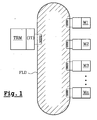
- FIG. 1 For contactless applications such as mentioned above, it is common for several modules to be found at the same time in the query field of a terminal.
- the TRM terminal is equipped with a communication interface IT comprising an antenna coil allowing it to emit an FLD magnetic field, to send data modules, usually by amplitude modulation of the magnetic field, and receive transmitted data by modules.
- the modules M1 to Mn are equipped IM communication interfaces each comprising a antenna coil, allowing them to send data at the terminal, generally by load modulation (weakening of the magnetic field by short circuit antenna coils) and receive the transmitted data through the terminal.
- the terminal must establish communication with each of modules in order to perform an operation planned by the application, for example a monetary transaction, a identification and authentication operation in sight to issue a passage authorization (control access), a toll operation or simply a identification without authentication of the modules present (inventory).
- Communication with a module cannot that being individual and should not be disturbed by messages from other modules. In the case on the contrary, a message collision occurs translated at the terminal level by the reception of error messages.
- the terminal does not know the identity of the modules present in its field question. This means that it is not conceivable that the terminal sends to a determined module a particular message that would make this active module while keeping the others silent.
- the terminal sends marking messages delimiting response positions ("time slots") on a response time scale comprising 2 N response positions.
- Each module sends an identification message including its identification number, when a response position corresponding to the first N bits of its identification number is reached.
- the terminal identifies it and can select it. If two modules respond at the same response position, this means that the first N bits of their identification number are identical.
- the terminal detects the collision and sends an additional identification request of nominative type, comprising the N bits of the identification numbers in collision. This request for additional nominal identification concerns only the modules in collision on the response position defined by the N bits specified.
- the modules concerned develop a new response position using this time the following N bits of their identification number, and return a new identification message.
- This sequence can be repeated several times until all the modules are identified and / or selected, and can be repeated for each response position as many times as the number of subgroups of N bits remaining to be traversed in the numbers Identification.
- the identification process is tree-like because each additional nominal identification step only concerns modules colliding on a position determined response. So, for example, if two first modules have N identical first bits and two other modules have N identical first bits but different from the first N bits of the first two modules, identifying the four modules will require at least two additional identification steps, one to decide between the first two modules and the other to decide between the two other modules.
- Anti-collision procedures also imply that modules execute algorithms relatively complex allowing them to know whether or not they should respond to a request for additional identification nominative.
- a deterministic collision avoidance process is by example recommended by standard ISO 14443-3 type B, which provides that modules have identification numbers 32 bits can be random.
- deterministic processes provide for a identification of tree-type modules, which is complex to implement, sluggish, and requires efficient random number generators.
- Probabilistic processes are distinguished from deterministic processes in that the response position of a module is independent of its number Identification.
- the terminal first sends a general identification request that triggers in the modulates the generation of a random number. This number random determines the response position of the module for sending an identification message including its ID number.
- Process efficiency probabilistic when the number of modules increases, does not not dependent on length of identification numbers (although there still remains the need not to have two modules with the same identification number) but spreading the response scale. So the higher the the greater the number of response positions, the more the process probabilistic is effective.
- the unidentified modules receive a request non-nominal additional identification and determine a new random response position. Since the additional identification step is not nominative, it concerns modules having been collision on different response positions, unlike the nominal identification stages of deterministic processes.
- probabilistic collision avoidance procedures are simpler to implement with regard to the algorithms embedded in the modules, but require an extended response scale to be applicable to a large number of modules.
- the identification process can be unnecessarily long when a reduced number of modules is found simultaneously in the interrogation field of the terminal.
- 255 positions of response is expected and only two modules found in the query field of the terminal. he a module may randomly choose the position N ° 1 while the other module chooses the response position no. 255. In this case, after identified the first module, you have to go through the whole the response scale and reach the 255th position of response to identify the second module.
- the present invention aims to provide a anti-collision process which does not have the disadvantages of known methods.
- the general idea of this invention is to provide a combination of means pertaining to both deterministic processes and probabilistic processes.
- the requests identification issued by the terminal are not nominative, as is the case with a process probabilistic, but the response position of a module is according to the module identification number, as in a deterministic process.
- the response position does not depend as part of the identification number, as in deterministic processes, so the scale of response may include a reduced number of positions of response if the part of the identification number used to set response position includes number of bits reduced.
- the present invention provides an anti-collision process for the identification and the selection by a terminal of electronic modules contactless, in which: before a communication, a module generates a random identification number; the terminal sends a general identification request to trigger the sending of identification messages by modules, and send one or more requests non-nominal additional identification when identification messages are in collision; a module is selected when it receives a message from selection including his identification number; in response to a general identification request or additional, an unselected module sends a identification message including number identification, when it reaches, on a scale of response, a determined response position, process in which: a module responds to an identification request general or complementary on a response position which is based on its identification number, and a unselected module generates a new number identification when receiving a request additional identification, so that the position response of an unselected module in response to a additional identification request is not statistically not the same as its response position in response to a previous identification request, all depending on its identification number.
- a request general identification is identical in format and code to a request for additional identification.
- a module determines a response position which is equal to one part determined from its identification number, the party determined comprising bits of determined rank whose rank does not vary when module responds to requests successive identification.
- the determined part of the identification number of a module includes bits low weight identification number.
- one module to generate a new random identification number, one module retains a first part of its number identification, and randomly generates a second part of the identification number.
- a module determines a response position which is equal to the second part of the identification number.
- the first part of the module identification number is generated so random by the module before a communication.
- the first part of the module identification number is fixed data saved in the module.
- the terminal sends also a request for additional identification when it receives, in response to a previous request additional identification, a message identification of a module which is not in collision with another identification message but which includes an identification number already used by another module.
- a module is automatically activated when in the presence of a magnetic field emitted by the terminal, and generates a random identification number when activated.
- the positions of answer on the answer scale are marked with marking messages sent by the terminal.
- a request general identification forms a marking order of the first response position on the scale of reply.
- a command of marking includes a response position number, at less for response positions greater than one first response position.
- the terminal sends marking messages in a non-matching order not to an increasing rank of response positions.
- the terminal does not send a request for additional identification only after all response positions on the response scale have been covered.
- the terminal first sends a request for immediate identification to which modules respond immediately, with no response scale.
- a module comprises a selected state as well as a deselected state or disabled in which the terminal can switch it after having selected it, and in which a module in the selected state or in the deselected state or disabled does not respond to an identification request general or complementary.
- the present invention also relates to a module contactless electronics, including means for send and receive contactless messages, means for decoding received messages arranged to decode at minus a general identification request, a request non-nominative complementary identification and a selection message, means for switching to a selected state on receipt of a selection message including a module identification number, the module being arranged to: generate a number random identification before a communication; sure receipt of a general identification request or additional, determine, if the module is not in the selected state, a response position on a response scale then send, when the position of response is reached, an identification message including the module identification number, and response to a general identification request or complementary, determine a response position which is based on its identification number, and generate a new random identification number when receives a request for additional identification, so the response position of the module in response to a request for additional identification is not statistically not the same as its response position in response to a previous identification request, all depending on its identification number.
- the module is arranged to decode an additional identification request identical in format and code to a request general identification.
- the module is arranged to determine a response position which is equal to a specific part of its identification number, the determined part comprising bits of determined rank whose rank does not vary when the module responds to successive identification requests.
- the determined part includes least significant bits of the number module identification.
- the module is arranged to generate a new identification number in retaining a first part of its number current identification, and generating random a second part of the identification number.
- the module is arranged to determine a response position equal to the second part of the identification number, in response to a request for general or additional identification.
- the first part of the module identification number is fixed data saved in the module.
- the first part of the module identification number is generated so random by the module before a communication.
- the module is arranged to determine a response position which is equal to the second part of the identification number.
- the module is arranged to automatically switch to an activated state when in the presence of a magnetic field of a specified frequency, and generate a number identification when it switches to the activated state.
- the module is arranged to decode marking messages sent by the terminal, allowing the module to delimit positions on the response scale.
- the module is arranged to decode marking messages comprising a response position number, at least for response positions greater than a first position Answer.
- the module is arranged to decode a general identification request in as a command to mark a first position of answer on the answer scale.
- the module is arranged to decode an immediate identification request and to send immediately, without response scale, in response to an immediate identification request, a identification message.
- the module comprises a deselected or disabled state in which it can switch after being in the selected state, the module being arranged not to respond to a request general or complementary identification when is in the deselected or deactivated state.
- FIG. 2 is the block diagram of a module without MDL contact planned to implement the process collision avoidance according to the invention.
- the module presents a general architecture in itself classic and thus understands a central processing unit CPU, a memory area MEM1 of the non-type volatile (for example EPROM or EEPROM), a MEM2 memory volatile (RAM) and an equipped communication interface an ACL antenna coil.
- a central processing unit CPU central processing unit
- MEM1 of the non-type volatile for example EPROM or EEPROM
- RAM MEM2 memory volatile
- an ACL antenna coil When the module is immersed in an alternating magnetic field FLD emitted by a TRM terminal, an alternating voltage Vi appears at antenna coil terminals, the voltage Vi oscillating at the carrier frequency of the magnetic field.
- the memory area MEM1 comprises for example 128 blocks 32 bits each.
- MEM2 memory area includes various classic registers used by the CPU, not shown in Figure 2 except for an IDREG register.
- This IDREG register contains an identification number of the module, or ID number, comprising here two parts ID1, ID2.
- the ID1 part includes for example the weight bits with the ID number and the ID2 part the weight bits low.
- parts ID1, ID2 each include four bits. Examples of numbers IDs described in the following will be expressed in notation hexadecimal, ID numbers can range from 00 (8 bits at 0) at FF (8 bits at 1, i.e. 256 in base 10).
- the IDREG register is linked to the output of a RGEN generator of random number, here a 4-bit generator simple to implement and occupying a low silicon surface.
- the RGEN generator is used by the central processing unit to generate, before a communication, parts ID1, ID2 of an ID number random.
- the ID number is generated here when the module is activated by the FLD magnetic field and switches to a READY state described later.
- the CPU unit uses the RGEN generator to generate a new ID2 part when it has to respond to a request corresponding general or complementary identification to a PCALL16 command described below.
- the central unit in response to a such identification request, chooses a position of response which is equal to the ID2 part of the ID number.
- the module's communication interface includes a PSC supply circuit, a DMD demodulator, and a LMD modulator.
- the PSC circuit delivers a voltage Vcc module supply, obtained by rectifying the induced voltage Vi.
- the DMD demodulator extracted from the induced voltage Vi of the DTx data sent by the terminal. This data is generally sent by modulation of the amplitude of the magnetic field, and are for example coded ASK (modulation by amplitude jump, or "Amplitude Shift Keying Modulation").
- the modulator LMD is intended to send DTx data according to the principle of the coil load modulation antenna.
- DTx data is for example BPSK coded (Phase jump modulation, or Phase Shift Keying Modulation) by means of a subcarrier extracted from the carrier of the magnetic field.
- the carrier is for example of 13.56 MHz and the subcarrier of 847 KHz.
- the flow of data obtained is in this case of the order of 100 Kbits / s.
- the CPU unit can be of the microprocessor type or wired logic (sequencer), and provides decoding and processing of messages (commands) sent by the terminal, and sending messages (responses) to the terminal, as well as performing steps or. instructions specific to the anti-collision process according to the invention.
- Figure 3 is a state diagram illustrating the operation of the MDL module. There are six states designated respectively POWER-OFF, READY, INVENTORY, SELECTED, DEACTIVATED and DESELECTED, and commands sent by the terminal, PCALL0, PCALL16, SLOT-MARKER (i), SELECT (ID), SELECT (NONID), DESACTIVATE, READ-BLOCK, WRITE-BLOCK.
- Transitions between the various states of the module are also determined by designated OF events and OOF.
- the OF event (“on field”) corresponds to the case where the module enters the field induction perimeter magnetic FLD.
- the module then goes from POWER-OFF state in the READY state because the PSC circuit delivers the voltage Vcc when the alternating voltage Vi appears at the terminals of its antenna coil.
- the OOF (“out of field”) event corresponds to the case where the module leaves the field induction perimeter magnetic emitted by the terminal.
- the module if it is active and is in one of the READY, INVENTORY states, SELECTED, DESELECTED or DEACTIVATED, is no longer powered electrically through the PSC circuit due to the disappearance (or insufficient value) of the voltage induced Vi. The module then returns to the POWER-OFF state.
- the module When the module switches to READY state, it generates a random ID number and waits for an order PCALL0 or PCALL16 to switch to the INVENTORY state.
- the PCALL0 command is optional in the scope of the present invention because it is not a anti-collision control, all modules being required to identify themselves simultaneously. This order is planned to avoid triggering the collision avoidance process when only one module is present. So in a variant, the transition from READY state to INVENTORY state may be linked to receipt of the PCALL16 command only. Conversely, it can be expected that the transition from READY state to INVENTORY state either exclusively linked to the reception of the PCALL0 command. In this case, in the event of a collision, the process collision avoidance is only triggered from the state INVENTORY.
- the module When the module switches to the INVENTORY state, it performs a number of actions represented on the flowchart of figure 4. If the transition to the state INVENTORY is triggered by the receipt of an order PCALLO, the module goes directly to a step S3 where it send an identification message taking the form here an R (ID) response including its ID number. After step S3, the module goes to step S2. If the transition to the INVENTORY state is triggered by the reception of a PCALL16 command, the module goes directly to a step 31 where it generates a new ID2 part of its ID number at using the RGEN random generator. The module will then in step 32.
- SLOT-MARKER (ID2) command is received, the module goes to step S3 where it sends a response R (ID) and then returns to step S2.
- the module goes directly from step S2 to step S3 if the part ID2 of its ID number is equal to 0, because the ID2 part then corresponds to the first response position.
- Step S2 is also a waiting step for selection in which the module remains (or returns) until a SELECT (ID) command including its ID number is received. When this command is received, the module switches to the SELECTED state.
- the module can also receive a new PCALL16 command when it is in step S2. In this case the module returns to step 31 to generate a new ID2 part of its ID number then returns to step S2.
- the module does not respond more to requests for immediate identification PCALL0 or general identification requests or complementary PCALL16.
- MEM1 memory area of the module can be read or written by the terminal using the READ-BLOCK or WRITE-BLOCK commands.
- the terminal receives a response R-READ-BLOCK.
- the module receives an order SELECT (NONID), i.e. a SELECT (ID) command including an ID number which is not his, the module switches to the DESELECTED state. If the module receives a DESACTIVATE command, it switches to the DEACTIVATED state.
- the module in the DESELECTED state does not respond to any command except a SELECT (ID) command including its ID number, which returns it to the SELECTED state.
- ID SELECT
- OEF event The disappearance of the magnetic field (OOF event) return to the POWER-OFF state.
- the module in the DEACTIVATED state does not respond to no command. Only the disappearance of the magnetic field (OOF event) returns it to the POWER-OFF state.
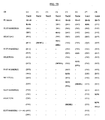
- FIGs 5A to 5D An example of an anti-collision sequence according to the invention is shown in Figures 5A to 5D.
- TAG1 to TAG8 Eight modules according to the invention, designated respectively TAG1 to TAG8, enter simultaneously into the terminal interrogation field.
- Column C0 describes commands sent by the terminal.
- Columns C1 to C8 describe the responses sent by the modules, the ID numbers generated by modules and reports in which are the modules.
- the POWER-OFF state is designated "P-O”
- the READY state is designated "RDY”
- the state INVENTORY is designated "INV”
- the state SELECTED is designated "SALT”.
- the DESELECTED state is designated "DESEL".
- modules are in the POWER-OFF state and include in their respective IDREG registers unspecified identification numbers ("xx").
- modules switch to READY state and each generate a number identification, respectively 40, 13, 3F, 4A, 50, 48, 52, 7C in this example.
- Terminal sends request of immediate identification PCALL0 in the event that a only module would be in its field question.
- Modules switch to state INVENTORY and respond simultaneously with messages R (ID) including their ID numbers, i.e. R (40), R (13), R (3F), R (4A), R (50), R (48), R (52), R (7C) respectively.
- the answers are all in collision and cannot be read by the terminal.
- the latter then sends a request of general identification PCALL16.
- Each module calculates a new part ID2 of its ID number while keeping the part ID1.
- the module ID numbers become respectively, in this example: 45, 12, 30, 43, 55, 43, 53, 73.
- the PCALL16 command by convention forming a command to mark the first response position, the TAG3 module responds to the PCALL16 command by sending a message R (30) because the ID2 part of its number identification is 0 and corresponds to the first response position.
- the terminal can read it and return a command to SELECT selection (30) to which the module responds by sending the message R (ID) again. Then the module switches to the SELECTED state.
- the terminal then sends the SLOT-MARKER (1) command to which no module responds, then the SLOT-MARKER (2) command to which the TAG2 module responds by identifying itself since the ID2 part of its ID number is equal to 2.
- the selection of the module TAG2 is done according to the procedure already described, and has for effect that the previously selected TAG3 module toggles automatically in the DESELECTED state (see figure 3, SELECT command (NONID)).
- the terminal then continues send SLOT-MARKER (i) commands for i ranging from 3 to F.
- SLOT-MARKER (3) command is issued, the TAG4, TAG6, TAG7, TAG8 modules respond simultaneously and therefore cannot be selected.
- TAG1 modules and TAG5 respond simultaneously to the SLOT-MARKER command (4) and are also not selected. No module does not respond to the following response positions ranging from 6 to F.
- a new collision avoidance subsequence is triggered by sending the command PCALL16, which constitutes an identification request additional for modules still awaiting selection. These then generate a new ID2 part of their ID numbers which become respectively in this example: 40 (TAG1), 41 (TAG4), 53 (TAG5), 42 (TAG6), 50 (TAG7) and 74 (TAG8).
- the TAG1 and TAG7 modules respond simultaneously on the first response position and does not cannot be selected.
- the TAG4 module is selected on the second response position marked by command SLOT-MARKER (1) and the TAG6 module is selected on the third response position marked with the SLOT-MARKER (2) command.
- the TAG5 module is selected on the fourth response position identified with the SLOT-MARKER (3) command.
- the TAG8 module is selected on the fifth response position identified with the SLOT-MARKER (4) command.
- No module responds on the following response positions, for i going from 5 to F.
- a third collision avoidance sequence is triggered by sending the PCALL16 command.
- the TAG1 module generates an equal ID number to 41 and the TAG7 module generates an ID number equal to 50, the ID1 parts being kept, as before.
- the TAG7 module is selected on the first position of response marked by the PCALL16 command.
- the TAG1 module being alone not to be selected, he is the only one to answer on the second answer position, marked by the SLOT-MARKER command (1), and sends the message R (41).
- a fourth collision avoidance sub-sequence is triggered by sending the PCALL16 command.
- the TAG1 module this time chose a ID number equal to 43 which is not used by any other module.
- the TAG1 module is therefore selected on the fourth response position, identified by the command SLOT-MARKER (3).
- the terminal continues to mark the following response positions, in case other modules would be in its interrogation field.
- the terminal can stop sending commands from marking the following response positions, and establishing communication with the TAG3 module to read or write data, then switch the module to the state DEACTIVATED.
- the terminal can also, after having dialogued with the TAG3 module, leave it in the SELECTED state and continue the collision avoidance sequence.
- the terminal sends the SELECT command (12) to select the TAG2 module
- the TAG3 module switches automatically in the DESELECTED state because this command is for him a SELECT command (NONID).
- NONID SELECT command
- the difference with the DEACTIVATED state is that the terminal converts the possibility to select the TAG3 module later by sending it the SELECT command (30).
- the terminal can also send marking commands in disorder or in an order it determines.
- the marking commands being under his control, nothing does not force the terminal to mark the response positions in ascending order.
- identification request general or complementary PCALL16 has been used in the above as a benchmark for the first position of response, a specific SLOT-MARKER (0) command could also be expected.
- the first part ID1 of the ID number of a module may not be random and be saved in memory area MEM1.
- the ID1 part can also be long greater than the ID2 part used to determine response positions.
- the determination of the positions of response can be made from the full ID number.
- generating a new ID number in response to the PCALL16 command can relate to the entire ID number, or only part of the ID number.
- Modules executing the command modules in the READY state or INVENTORY (either modules not selected).
- the modules each send immediately an identification message R (ID).
- Modules executing the command modules in the READY state or INVENTORY (either modules not selected).
- Modules executing the command modules in the state INVENTORY.
- a module sends a message of identification R (ID) if the rank "i" is equal to the ID2 part of the module ID number.
- command to select the module whose ID code is specified in the command (command nominative).
- Modules executing the command modules in the state INVENTORY or DESELECTED.
- the module targeted by the ID number sends an identification message R (ID) as confirmation.
- selection command received (command SELECT (ID)) including an ID code that does not match that of the module.
- Modules reacting to the command modules in the state SELECTED.
- Modules executing the command : modules in the state SELECTED.
- Modules executing the modules command in the report SELECTED.
- Modules executing the command : modules in the state SELECTED.
- Modules executing the command modules in the state SELECTED only.
Landscapes
- Engineering & Computer Science (AREA)
- Physics & Mathematics (AREA)
- Toxicology (AREA)
- Artificial Intelligence (AREA)
- Computer Vision & Pattern Recognition (AREA)
- General Physics & Mathematics (AREA)
- Theoretical Computer Science (AREA)
- Health & Medical Sciences (AREA)
- Computer Networks & Wireless Communication (AREA)
- Electromagnetism (AREA)
- General Health & Medical Sciences (AREA)
- Near-Field Transmission Systems (AREA)
- Mobile Radio Communication Systems (AREA)
Abstract
Description
- la figure 1 précédemment décrite représente plusieurs modules sans contact présents simultanément dans le champ d'interrogation d'un terminal,
- la figure 2 est un schéma bloc d'un module agencé pour mettre en oeuvre le procédé anticollision selon l'invention,
- la figure 3 est un diagramme d'états illustrant le fonctionnement du module de la figure 2,
- la figure 4 est un organigramme illustrant le fonctionnement du module de la figure 2 lorsque celui-ci se trouve dans un état déterminé parmi les divers états représenté en figure 3,
- les figures 5A à 5D illustrent une séquence anticollision selon l'invention, comprenant plusieurs sous-séquences.
- commande : message émis par le terminal,
- réponse : message émis par un module.
- SOF : champ de début de trame ("start of frame"),
- EOF : champ de fin de trame ("end of frame"),
- CODE(COMMANDE) : code d'une commande ou d'une réponse, sur 4, 8 ou 16 bits, présent dans un champ de la commande ou de la réponse,
- CRC1 et CRCh : bits de poids fort et de poids faible d'une signature de type CRC accompagnant les commandes ou les réponses, permettant au destinataire de détecter des erreurs de transmission, et permettant notamment au terminal de détecter des collisions entre réponses R(ID).
| Exemple de format : | ||||
| SOF | CODE(PCALL0) | CRCl | CRCh | EOF |
| 8 bits | 8 bits | 8 bits | 8 bits |
| Exemple de format : | ||||
| SOF | CODE(PCALL16) | CRCl | CRCh | EOF |
| 8 bits | 8 bits | 8 bits | 8 bits |
| Exemple de format : | |||||
| SOF | i | CODE(SLOT-MARKER) | CRCl | CRCh | EOF |
| N bits | 4 bits | 8 bits | 8 bits |
| Exemple de format : | |||||
| SOF | CODE(SELECT) | ID | CRC1 | CRCh | EOF |
| 8 bits | 8 bits | 8 bits | 8 bits |
| Exemple de format : | ||||
| SOF | CODE(DESACTIVATE) | CRCl | CRCh | EOF |
| 8 bits | 8 bits | 8 bits |
| Exemple de format : | ||||
| SOF | CODE(RESET-TO-INVENTORY) | CRCl | CRCh | EOF |
| 8 bits | 8 bits | 8 bits |
| Exemple de format : | |||||
| SOF | CODE(READ-BLOCK) | ADRESSE | CRCl | CRCh | EOF |
| 8 bits | 8 bits | 8 bits | 8 bits |
| Exemple de format : | |||||||||
| SOF | CODE(WTRITE-BLOCK) | ADRESSE | DATA1 | DATA2 | DATA3 | DATA4 | CRCl | CRCh | EOF |
| 8 bits | 8 bits | N/4 bits | N/4 bits | N/4 bits | N/4 bits | 8 bits | 8 bits |
| Exemple de format : | ||||
| SOF | ID | CRCl | CRCh | EOF |
| 8 bits | 8 bits | 8 bits |
| Exemple de format : | |||||||
| SOF | DATA1 | DATA2 | DATA3 | DATA4 | CRCl | CRCh | EOF |
| N/4 bits | N/4 bits | N/4 bits | N/4 bits | 8 bits | 8 bits |
Claims (32)
- Procédé anticollision pour l'identification et la sélection par un terminal de modules électroniques sans contact (MDL, TAG1-TAG8), dans lequel :caractérisé en ce que :avant une communication, un module génère un numéro d'identification (ID) aléatoire,le terminal envoie une demande d'identification générale (PCALL16) pour déclencher l'envoi de messages d'identification par les modules, et envoie une ou plusieurs demandes d'identification complémentaire non nominatives (PCALL16) lorsque des messages d'identification se trouvent en collision,un module est sélectionné lorsqu'il reçoit un message de sélection (SELECT(ID)) comprenant son numéro d'identification,en réponse à une demande d'identification générale ou complémentaire, un module non sélectionné envoie un message d'identification (R(ID)) comprenant son numéro d'identification, lorsqu'il atteint, sur une échelle de réponse, une position de réponse déterminée,un module répond à une demande d'identification générale ou complémentaire sur une position de réponse qui est fonction de son numéro d'identification (ID), et en ce que :un module non sélectionné génère un nouveau numéro d'identification aléatoire lorsqu'il reçoit une demande d'identification complémentaire (PCALL16), de sorte que la position de réponse d'un module non sélectionné en réponse à une demande d'identification complémentaire n'est statistiquement pas la même que sa position de réponse en réponse à une précédente demande d'identification, tout en étant fonction de son numéro d'identification (ID).
- Procédé selon la revendication 1, dans lequel une demande d'identification générale (PCALL16) est identique en format et en code à une demande d'identification complémentaire (PCALL16).
- Procédé selon l'une des revendications 1 et 2, dans lequel un module détermine une position de réponse qui est égale à une partie déterminée (ID2) de son numéro d'identification, la partie déterminée (ID2) comprenant des bits de rang déterminé dont le rang ne varie pas lorsque le module répond à des demandes d'identification successives (PCALL16).
- Procédé selon la revendication 3, dans lequel la partie déterminée (ID2) du numéro d'identification d'un module comprend des bits de poids faible du numéro d'identification (ID).
- Procédé selon l'une des revendications 1 à 4, dans lequel, pour générer un nouveau numéro d'identification aléatoire, un module conserve une première partie (ID1) de son numéro d'identification actuel, et génère de façon aléatoire une deuxième partie (ID2) du numéro d'identification.
- Procédé selon la revendication 5, dans lequel un module détermine une position de réponse qui est égale à la deuxième partie (ID2) du numéro d'identification.
- Procédé selon l'une des revendications 5 et 6, dans lequel la première partie (ID1) du numéro d'identification (ID) d'un module est générée de façon aléatoire par le module avant une communication.
- Procédé selon l'une des revendications 5 et 6, dans lequel la première partie (ID1) du numéro d'identification d'un module est une donnée fixe enregistrée dans le module.
- Procédé selon l'une des revendications 1 à 8, dans lequel le terminal envoie également une demande d'identification complémentaire (PCALL16) lorsqu'il reçoit, en réponse à une précédente demande d'identification complémentaire, un . message d'identification d'un module qui n'est pas en collision avec un autre message d'identification mais qui comprend un numéro d'identification (ID) déjà utilisé par un autre module.
- Procédé selon l'une des revendications 1 à 9, dans lequel un module est automatiquement activé (READY) lorsqu'il se trouve en présence d'un champ magnétique émis par le terminal, et génère un numéro d'identification aléatoire lorsqu'il est activé.
- Procédé selon l'une des revendications 1 à 10, dans lequel les positions de réponse sur l'échelle de réponse sont repérées par des messages de marquage (PCALL16, SLOT-MARKER) envoyés par le terminal.
- Procédé selon l'une des revendications 1 à 11, dans lequel une demande d'identification générale (PCALL16) forme une commande de marquage de la première position de réponse sur l'échelle de réponse.
- Procédé selon l'une des revendications 11 et 12, dans lequel une commande de marquage (SLOT-MARKER(i)) comprend un numéro (i) de position de réponse, au moins pour des positions de réponse supérieures à une première position de réponse.
- Procédé selon la revendication 13, dans lequel le terminal envoie des messages de marquage dans un ordre ne correspondant pas à un rang croissant des positions de réponse.
- Procédé selon l'une des revendications 1 à 14, dans lequel le terminal n'envoie une demande d'identification complémentaire qu'après que toutes les positions de réponse de l'échelle de réponse ont été parcourues.
- Procédé selon l'une des revendications 1 à 15, dans lequel, pour initier une communication, le terminal envoie tout d'abord une demande d'identification immédiate (PCALL0) auquel les modules répondent immédiatement, sans échelle de réponse.
- Procédé selon l'une des revendications 1 à 16, dans lequel un module comprend un état sélectionné (SELECTED) ainsi qu'un état désélectionné ou désactivé (DESELECTED, DEACTIVATED) dans lequel le terminal peut le faire basculer après l'avoir sélectionné, et dans lequel un module dans l'état sélectionné ou dans l'état désélectionné ou désactivé ne répond pas à une demande d'identification générale ou complémentaire (PCALL16).
- Module électronique sans contact (MDL), comprenant des moyens (DMD, LMD) pour émettre et recevoir des messages sans contact, des moyens (CPU) de décodage de messages reçus agencés pour décoder au moins une demande d'identification générale (PCALL16), une demande d'identification complémentaire non nominative (PCALL16) et un message de sélection (SELECTED(ID)), des moyens pour basculer dans un état sélectionné (SELECTED) sur réception d'un message de sélection (SELECT(ID)) comprenant un numéro d'identification (ID) du module, le module étant agencé pour :caractérisé en ce qu'il est agencé pour :générer un numéro d'identification aléatoire (ID) avant une communication,sur réception d'une demande d'identification générale ou complémentaire, déterminer, si le module n'est pas dans l'état sélectionné, une position de réponse sur une échelle de réponse puis envoyer, lorsque la position de réponse est atteinte, un message d'identification (R(ID)) comprenant le numéro d'identification (ID) du module,en réponse à une demande d'identification générale (PCALL16) ou complémentaire (PCALL16), déterminer une position de réponse qui est fonction de son numéro d'identification (ID), etgénérer un nouveau numéro d'identification aléatoire (ID) lorsqu'il reçoit une demande d'identification complémentaire (PCALL16), de sorte que la position de réponse du module en réponse à une demande d'identification complémentaire n'est statistiquement pas la même que sa position de réponse en réponse à une précédente demande d'identification, tout en étant fonction de son numéro d'identification.
- Module selon la revendication 18, agencé pour décoder une demande d'identification complémentaire (PCALL16) identique en format et en code à une demande d'identification générale (PCALL16).
- Module selon l'une des revendications 18 et 19, agencé pour déterminer une position de réponse qui est égale à une partie déterminée (ID2) de son numéro d'identification (ID), la partie déterminée (ID2) comprenant des bits de rang déterminé dont le rang ne varie pas lorsque le module répond à des demandes d'identification successives.
- Module selon la revendication 20, dans lequel la partie déterminée (ID2) comprend des bits de poids faible du numéro d'identification du module.
- Module selon l'une des revendications 18 à 21, agencé pour générer un nouveau numéro d'identification en conservant une première partie (ID1) de son numéro d'identification actuel, et en générant de façon aléatoire une deuxième partie (ID2) du numéro d'identification.
- Module selon la revendication 22, agencé pour déterminer une position de réponse égale à la deuxième partie (ID2) du numéro d'identification (ID), en réponse à une demande d'identification générale ou complémentaire (PCALL16).
- Module selon l'une des revendications 22 et 23, dans lequel la première partie (ID1) du numéro d'identification (ID) d'un module est une donnée fixe enregistrée dans le module.
- Module selon l'une des revendications 22 et 23, dans lequel la première partie (ID1) du numéro d'identification d'un module est générée de façon aléatoire par le module avant une communication.
- Module selon l'une des revendications 22 à 25, agencé pour déterminer une position de réponse qui est égale à la deuxième partie (ID2) du numéro d'identification (ID).
- Module selon l'une des revendications 18 à 26, agencé pour basculer automatiquement dans un état activé (READY) lorsqu'il se trouve en présence d'un champ magnétique d'une fréquence déterminée, et générer un numéro d'identification (ID) lorsqu'il bascule dans l'état activé.
- Module selon l'une des revendications 18 à 27, agencé pour décoder des messages de marquage (SLOT-MARKER) envoyés par le terminal, permettant au module de délimiter des positions de réponse sur l'échelle de réponse.
- Module selon la revendication 28, agencé pour décoder des messages de marquage (SLOT-MARKER(i)) comprenant un numéro (i) de position de réponse, au moins pour des positions de réponse supérieures à une première position de réponse.
- Module selon l'une des revendications 28 et 29, agencé pour décoder une demande d'identification générale (PCALL16) en tant que commande de marquage d'une première position de réponse sur l'échelle de réponse.
- Module selon l'une des revendications 18 à 30, agencé pour décoder une demande d'identification immédiate (PCALL0) et pour envoyer immédiatement, sans échelle de réponse, en réponse à une demande d'identification immédiate (PCALL0), un message d'identification (R(ID)).
- Module selon l'une des revendications 18 à 31, comprenant un état désélectionné ou désactivé (DESELECTED, DEACTIVATED) dans lequel il peut basculer après avoir été dans l'état sélectionné (SELECTED), le module étant agencé pour ne pas répondre à une demande d'identification générale ou complémentaire lorsqu'il se trouve dans l'état désélectionné ou de désactivation.
Applications Claiming Priority (2)
| Application Number | Priority Date | Filing Date | Title |
|---|---|---|---|
| FR0206831A FR2840472A1 (fr) | 2002-06-04 | 2002-06-04 | Procede anticollision pour module electronique sans contact |
| FR0206831 | 2002-06-04 |
Publications (2)
| Publication Number | Publication Date |
|---|---|
| EP1369812A1 true EP1369812A1 (fr) | 2003-12-10 |
| EP1369812B1 EP1369812B1 (fr) | 2005-12-14 |
Family
ID=29433312
Family Applications (1)
| Application Number | Title | Priority Date | Filing Date |
|---|---|---|---|
| EP03011294A Expired - Lifetime EP1369812B1 (fr) | 2002-06-04 | 2003-05-17 | Procédé anticollision pour module électronique sans contact |
Country Status (5)
| Country | Link |
|---|---|
| US (1) | US7053754B2 (fr) |
| EP (1) | EP1369812B1 (fr) |
| JP (1) | JP2004046824A (fr) |
| DE (1) | DE60302709T2 (fr) |
| FR (1) | FR2840472A1 (fr) |
Families Citing this family (34)
| Publication number | Priority date | Publication date | Assignee | Title |
|---|---|---|---|---|
| JP2007528136A (ja) * | 2003-06-25 | 2007-10-04 | コーニンクレッカ フィリップス エレクトロニクス エヌ ヴィ | 通信局内の中継器のインベントリを作成する方法 |
| DE10336308A1 (de) * | 2003-08-01 | 2005-03-03 | Atmel Germany Gmbh | Verfahren zur Auswahl eines oder mehrerer Transponder |
| US7389274B2 (en) | 2003-09-29 | 2008-06-17 | Pitney Bowes Inc. | Integrated payment for international business reply mail |
| DE10349647B4 (de) * | 2003-10-21 | 2006-08-10 | Atmel Germany Gmbh | Verfahren zur Auswahl eines oder mehrerer Transponder |
| DE102004041437B3 (de) * | 2004-08-27 | 2006-03-09 | Atmel Germany Gmbh | Verfahren zur Auswahl eines oder mehrerer Transponder |
| FR2881007B1 (fr) * | 2005-01-19 | 2007-02-23 | Gemplus Sa | Etablissement d'une communication entre dispositifs sans contact |
| ATE378662T1 (de) * | 2005-03-15 | 2007-11-15 | Siemens Schweiz Ag | Verfahren zur bestimmung der konfiguration einer gefahrenmeldeanlage und gefahrenmeldeanlage |
| US20060214772A1 (en) * | 2005-03-24 | 2006-09-28 | Beedar Technology Inc. | Anti-Collision Scheme for Active and Passive RFID Tag System |
| KR100610358B1 (ko) * | 2005-04-18 | 2006-08-09 | 삼성전자주식회사 | 비트동기신호를 이용한 rfid 리더 및 태그 그리고 태그인식 시스템 및 방법 |
| US7501932B2 (en) * | 2005-06-06 | 2009-03-10 | Intermec Ip Corp. | System and method of reading from and/or writing to an RF transponder |
| US20070075838A1 (en) * | 2005-10-04 | 2007-04-05 | Symbol Technologies, Inc. | Method and apparatus for avoiding radio frequency identification (RFID) tag response collisions |
| JP4548671B2 (ja) * | 2006-02-10 | 2010-09-22 | 富士通株式会社 | 質問器、応答器、応答器認証方法 |
| FR2898008A1 (fr) * | 2006-02-24 | 2007-08-31 | Gemplus Sa | Identification d'un objet electronique portable dans des communications avec un terminal |
| KR100795577B1 (ko) * | 2006-03-23 | 2008-01-21 | 주식회사 케이티 | 전자 태그 인식 장치 및 그 방법과, 전자 태그의 데이터처리 방법 |
| US7911323B2 (en) * | 2006-09-29 | 2011-03-22 | Intel Corporation | Radio frequency identification (RFID) tag response modulation |
| US20080111661A1 (en) * | 2006-11-15 | 2008-05-15 | Symbol Technologies, Inc. | Method and system for transmission power reduction in RFID interrogators |
| EP2115384B1 (fr) * | 2007-02-16 | 2015-03-25 | Orica Explosives Technology Pty Ltd | Détonateur, appareil de destruction à l'explosif et procédé correspondant |
| US8905312B2 (en) * | 2007-11-21 | 2014-12-09 | Infineon Technologies Ag | Identification of contactless cards |
| US10049317B1 (en) | 2010-02-01 | 2018-08-14 | Impinj, Inc. | RFID tags with public and private inventory states |
| US10402710B1 (en) | 2009-02-03 | 2019-09-03 | Impinj, Inc. | RFID tags with public and private inventory states |
| EP2239926A1 (fr) * | 2009-04-09 | 2010-10-13 | Gemalto SA | Procédé de détection d'un dispositif NFC émulant plusieurs cartes sans contact pouvant utiliser différents protocoles |
| US9081996B2 (en) * | 2009-05-21 | 2015-07-14 | Alcatel Lucent | Identifying RFID categories |
| US8885821B2 (en) * | 2010-01-28 | 2014-11-11 | Cleversafe, Inc. | Sequencing encoded data slices |
| EP3133579B1 (fr) | 2010-01-29 | 2020-03-04 | Avery Dennison Corporation | Boitier de signe intelligent utilisant des interactions electroniques |
| US10977965B2 (en) | 2010-01-29 | 2021-04-13 | Avery Dennison Retail Information Services, Llc | Smart sign box using electronic interactions |
| US9239942B2 (en) * | 2011-07-22 | 2016-01-19 | Avery Dennison Corporation | Apparatus, system and method for extending the field area of a device equipped with a high-frequency reader |
| EP2751979B1 (fr) | 2011-09-01 | 2020-02-26 | Avery Dennison Corporation | Système et procédé de suivi de consommateurs |
| US8779902B2 (en) * | 2011-10-29 | 2014-07-15 | International Business Machines Corporation | Identifier sequencing of wireless identification tags |
| US9070028B2 (en) | 2011-10-29 | 2015-06-30 | International Business Machines Corporation | Control of wireless identification tag activation |
| US9070026B2 (en) | 2011-10-29 | 2015-06-30 | International Business Machines Corporation | Coordination of transmission of data from wireless identification tags |
| US8630908B2 (en) | 2011-11-02 | 2014-01-14 | Avery Dennison Corporation | Distributed point of sale, electronic article surveillance, and product information system, apparatus and method |
| WO2014039089A1 (fr) | 2012-09-10 | 2014-03-13 | Avery Dennison Corporation | Procédé de prévention de détournement non autorisé d'étiquettes nfc |
| EP3214572B1 (fr) | 2012-10-18 | 2020-01-29 | Avery Dennison Corporation | Procédé et appareil de sécurité nfc |
| US9767329B2 (en) | 2012-11-19 | 2017-09-19 | Avery Dennison Retail Information Services, Llc | NFC tags with proximity detection |
Citations (3)
| Publication number | Priority date | Publication date | Assignee | Title |
|---|---|---|---|---|
| WO1999067737A1 (fr) * | 1998-06-24 | 1999-12-29 | Pinpoint Corporation | Systeme de reperage bimode |
| EP1017005A2 (fr) * | 1998-12-01 | 2000-07-05 | Integrated Sensor Solutions | Système et méthode pour communiquer avec plusieurs transpondeurs |
| EP1197909A1 (fr) * | 2000-10-13 | 2002-04-17 | Matsushita Electric Industrial Co., Ltd. | Carte à puce sans contact, procède à réponse et programme correspondant |
Family Cites Families (5)
| Publication number | Priority date | Publication date | Assignee | Title |
|---|---|---|---|---|
| US5539394A (en) * | 1994-03-16 | 1996-07-23 | International Business Machines Corporation | Time division multiplexed batch mode item identification system |
| US5530702A (en) * | 1994-05-31 | 1996-06-25 | Ludwig Kipp | System for storage and communication of information |
| US6377203B1 (en) * | 2000-02-01 | 2002-04-23 | 3M Innovative Properties Company | Collision arbitration method and apparatus for reading multiple radio frequency identification tags |
| US6727803B2 (en) * | 2001-03-16 | 2004-04-27 | E-Tag Systems, Inc. | Method and apparatus for efficiently querying and identifying multiple items on a communication channel |
| EP1610256B1 (fr) * | 2001-11-20 | 2006-12-27 | Matsushita Electric Industrial Co., Ltd. | Carte à puce sans contact, procède à réponse et programme correspondant |
-
2002
- 2002-06-04 FR FR0206831A patent/FR2840472A1/fr not_active Withdrawn
-
2003
- 2003-05-17 DE DE60302709T patent/DE60302709T2/de not_active Expired - Lifetime
- 2003-05-17 EP EP03011294A patent/EP1369812B1/fr not_active Expired - Lifetime
- 2003-06-03 JP JP2003157411A patent/JP2004046824A/ja active Pending
- 2003-06-03 US US10/453,454 patent/US7053754B2/en not_active Expired - Lifetime
Patent Citations (3)
| Publication number | Priority date | Publication date | Assignee | Title |
|---|---|---|---|---|
| WO1999067737A1 (fr) * | 1998-06-24 | 1999-12-29 | Pinpoint Corporation | Systeme de reperage bimode |
| EP1017005A2 (fr) * | 1998-12-01 | 2000-07-05 | Integrated Sensor Solutions | Système et méthode pour communiquer avec plusieurs transpondeurs |
| EP1197909A1 (fr) * | 2000-10-13 | 2002-04-17 | Matsushita Electric Industrial Co., Ltd. | Carte à puce sans contact, procède à réponse et programme correspondant |
Also Published As
| Publication number | Publication date |
|---|---|
| DE60302709D1 (de) | 2006-01-19 |
| EP1369812B1 (fr) | 2005-12-14 |
| JP2004046824A (ja) | 2004-02-12 |
| US7053754B2 (en) | 2006-05-30 |
| US20040012486A1 (en) | 2004-01-22 |
| DE60302709T2 (de) | 2006-08-10 |
| FR2840472A1 (fr) | 2003-12-05 |
Similar Documents
| Publication | Publication Date | Title |
|---|---|---|
| EP1369812B1 (fr) | Procédé anticollision pour module électronique sans contact | |
| EP0586492B1 (fr) | Systeme d'identification automatique d'objets ou d'individus par interrogation a distance | |
| EP2446579B1 (fr) | Procédé d'authentification mutuelle d'un lecteur et d'une étiquette radio | |
| JP6644046B2 (ja) | 無線周波数タグに対する識別とアクセスを提供する方法 | |
| EP0495708B1 (fr) | Système de communication entre une borne et des mobiles | |
| WO2001001326A2 (fr) | Procede d'identification d'etiquettes electroniques par rondes adaptatives | |
| WO2004032025A1 (fr) | Systeme d'identification par radiofrequence (rfid) et procede comprenant la compression de l'identite d'une etiquette | |
| EP0897563B1 (fr) | Procede pour selectionner un module electronique parmi une pluralite de modules presents dans le champ d'interrogation d'un terminal | |
| EP0935222B1 (fr) | Procédé d'identification de cartes électroniques présentes dans une zone d'investigation | |
| EP0976084B1 (fr) | Procede perfectionne de gestion des collisions dans un systeme d'echange de donnees sans contact | |
| CN1672165A (zh) | 标记时隙的防冲突方法 | |
| EP1257964B1 (fr) | Procede de lecture d'etiquettes electroniques par identification simultanee de leur code | |
| CH715284A2 (fr) | Dispositif et système de communication en champ proche NFC. | |
| FR2788858A1 (fr) | Maintien d'un canal avec anticollision dans un systeme d'identification electronique | |
| FR2881007A1 (fr) | Etablissement d'une communication entre dispositifs sans contact | |
| EP0779590B1 (fr) | Procédé de gestion d'accès concurrents et dipositif pour sa mise en ouvre | |
| EP0957442B1 (fr) | Système d'identification électronique d'une pluralité de transpondeurs | |
| WO2001091037A1 (fr) | Procede de detection d'emissions simultanees d'etiquettes electroniques | |
| EP1862945B1 (fr) | Dispositif d'identification électronique ou transpondeur muni de deux antennes accordées à des fréquences différentes | |
| EP0997835B1 (fr) | Procédé d'identification de cartes électroniques | |
| FR2776409A1 (fr) | Systeme et procede d'identification de produits par identifiant aleatoire | |
| EP1256095A2 (fr) | Puce electronique pour objet portatif | |
| FR2776095A1 (fr) | Procede et systeme de lecture multiple d'un ensemble dynamique d'etiquettes avec synchronisation de communication entre les etiquettes et le lecteur | |
| WO2020127112A1 (fr) | Procede et systeme d'enrolement autonome assiste pour detenteur de dispositif biometrique | |
| FR2900483A1 (fr) | Procede et dispositif de personnalisation d'une entite electronique portable |
Legal Events
| Date | Code | Title | Description |
|---|---|---|---|
| PUAI | Public reference made under article 153(3) epc to a published international application that has entered the european phase |
Free format text: ORIGINAL CODE: 0009012 |
|
| AK | Designated contracting states |
Kind code of ref document: A1 Designated state(s): AT BE BG CH CY CZ DE DK EE ES FI FR GB GR HU IE IT LI LU MC NL PT RO SE SI SK TR |
|
| AX | Request for extension of the european patent |
Extension state: AL LT LV MK |
|
| 17P | Request for examination filed |
Effective date: 20040424 |
|
| AKX | Designation fees paid |
Designated state(s): DE FR GB IT |
|
| GRAP | Despatch of communication of intention to grant a patent |
Free format text: ORIGINAL CODE: EPIDOSNIGR1 |
|
| GRAP | Despatch of communication of intention to grant a patent |
Free format text: ORIGINAL CODE: EPIDOSNIGR1 |
|
| GRAS | Grant fee paid |
Free format text: ORIGINAL CODE: EPIDOSNIGR3 |
|
| GRAA | (expected) grant |
Free format text: ORIGINAL CODE: 0009210 |
|
| AK | Designated contracting states |
Kind code of ref document: B1 Designated state(s): DE FR GB IT |
|
| REG | Reference to a national code |
Ref country code: GB Ref legal event code: FG4D Free format text: NOT ENGLISH |
|
| REF | Corresponds to: |
Ref document number: 60302709 Country of ref document: DE Date of ref document: 20060119 Kind code of ref document: P |
|
| GBT | Gb: translation of ep patent filed (gb section 77(6)(a)/1977) |
Effective date: 20060406 |
|
| PLBE | No opposition filed within time limit |
Free format text: ORIGINAL CODE: 0009261 |
|
| STAA | Information on the status of an ep patent application or granted ep patent |
Free format text: STATUS: NO OPPOSITION FILED WITHIN TIME LIMIT |
|
| 26N | No opposition filed |
Effective date: 20060915 |
|
| PGFP | Annual fee paid to national office [announced via postgrant information from national office to epo] |
Ref country code: IT Payment date: 20110423 Year of fee payment: 9 |
|
| PGFP | Annual fee paid to national office [announced via postgrant information from national office to epo] |
Ref country code: GB Payment date: 20120423 Year of fee payment: 10 |
|
| PG25 | Lapsed in a contracting state [announced via postgrant information from national office to epo] |
Ref country code: IT Free format text: LAPSE BECAUSE OF NON-PAYMENT OF DUE FEES Effective date: 20120517 |
|
| PGFP | Annual fee paid to national office [announced via postgrant information from national office to epo] |
Ref country code: FR Payment date: 20130626 Year of fee payment: 11 |
|
| GBPC | Gb: european patent ceased through non-payment of renewal fee |
Effective date: 20130517 |
|
| PG25 | Lapsed in a contracting state [announced via postgrant information from national office to epo] |
Ref country code: GB Free format text: LAPSE BECAUSE OF NON-PAYMENT OF DUE FEES Effective date: 20130517 |
|
| REG | Reference to a national code |
Ref country code: FR Ref legal event code: ST Effective date: 20150130 |
|
| PG25 | Lapsed in a contracting state [announced via postgrant information from national office to epo] |
Ref country code: FR Free format text: LAPSE BECAUSE OF NON-PAYMENT OF DUE FEES Effective date: 20140602 |
|
| PGFP | Annual fee paid to national office [announced via postgrant information from national office to epo] |
Ref country code: DE Payment date: 20220420 Year of fee payment: 20 |
|
| REG | Reference to a national code |
Ref country code: DE Ref legal event code: R071 Ref document number: 60302709 Country of ref document: DE |